WO2022196245A1 - 選択マーカー発現カセット - Google Patents
選択マーカー発現カセット Download PDFInfo
- Publication number
- WO2022196245A1 WO2022196245A1 PCT/JP2022/006667 JP2022006667W WO2022196245A1 WO 2022196245 A1 WO2022196245 A1 WO 2022196245A1 JP 2022006667 W JP2022006667 W JP 2022006667W WO 2022196245 A1 WO2022196245 A1 WO 2022196245A1
- Authority
- WO
- WIPO (PCT)
- Prior art keywords
- sequence
- expression
- sequence dna
- dna
- selectable marker
- Prior art date
- Legal status (The legal status is an assumption and is not a legal conclusion. Google has not performed a legal analysis and makes no representation as to the accuracy of the status listed.)
- Ceased
Links
Images


Classifications
-
- C—CHEMISTRY; METALLURGY
- C12—BIOCHEMISTRY; BEER; SPIRITS; WINE; VINEGAR; MICROBIOLOGY; ENZYMOLOGY; MUTATION OR GENETIC ENGINEERING
- C12N—MICROORGANISMS OR ENZYMES; COMPOSITIONS THEREOF; PROPAGATING, PRESERVING, OR MAINTAINING MICROORGANISMS; MUTATION OR GENETIC ENGINEERING; CULTURE MEDIA
- C12N15/00—Mutation or genetic engineering; DNA or RNA concerning genetic engineering, vectors, e.g. plasmids, or their isolation, preparation or purification; Use of hosts therefor
- C12N15/09—Recombinant DNA-technology
- C12N15/11—DNA or RNA fragments; Modified forms thereof; Non-coding nucleic acids having a biological activity
-
- C—CHEMISTRY; METALLURGY
- C12—BIOCHEMISTRY; BEER; SPIRITS; WINE; VINEGAR; MICROBIOLOGY; ENZYMOLOGY; MUTATION OR GENETIC ENGINEERING
- C12N—MICROORGANISMS OR ENZYMES; COMPOSITIONS THEREOF; PROPAGATING, PRESERVING, OR MAINTAINING MICROORGANISMS; MUTATION OR GENETIC ENGINEERING; CULTURE MEDIA
- C12N15/00—Mutation or genetic engineering; DNA or RNA concerning genetic engineering, vectors, e.g. plasmids, or their isolation, preparation or purification; Use of hosts therefor
- C12N15/09—Recombinant DNA-technology
- C12N15/63—Introduction of foreign genetic material using vectors; Vectors; Use of hosts therefor; Regulation of expression
Definitions
- the present invention relates to a selectable marker expression cassette, in particular, a selectable marker expression cassette that enables efficient selection of cultured animal cells that highly express a target protein.
- Methods for attenuating the expression or function of the selectable marker include using a promoter with weak transcriptional activity, introducing an mRNA destabilizing sequence into the expression cassette of the selectable marker, and introducing mutations into the coding sequence of the selectable marker. and a method of attenuating the function of the selectable marker protein itself.
- upstream ORF upstream open reading frame
- uORF upstream open reading frame
- the upstream ORF exists in the 5' untranslated region of mRNA and regulates the translation of the downstream ORF by various mechanisms.It is known that the translation of the upstream ORF generally reduces the translation efficiency of the downstream ORF.
- Pattern 1 is classified into the following subclasses. Pattern 1-1: After termination of translation of the upstream ORF, the ribosome leaves the mRNA and the downstream ORF is not translated. Pattern 1-2: After translation termination of the upstream ORF, the ribosome recognizes the initiation codon of the downstream ORF and initiates translation without leaving the mRNA. Patterns 1-4: After termination of translation of the upstream ORF, the ribosome does not leave the mRNA, but passes through the initiation codon of the downstream ORF, so the downstream ORF is not translated.
- Pattern 2 is classified into the following subclasses. Pattern 2-1: Recognizes the initiation codon of the downstream ORF and initiates translation. Pattern 2-2: Since the initiation codon of the downstream ORF is also passed through, the downstream ORF is not translated.
- the present inventors studied a technique for (1) increasing the recognition efficiency of initiation codons of upstream ORFs and (2) decreasing the recognition efficiency of initiation codons of downstream ORFs.
- the modified Kozak sequence DNA and the short ORF (upstream ORF) sequence DNA upstream of the gene whose expression is to be attenuated we succeeded in effectively attenuating the expression of the selectable marker gene.
- the present invention has been completed.
- An object of the present invention is to comprising an expression control sequence DNA,
- the expression control sequence DNA comprises one or more secondary expression control sequence DNAs,
- the secondary expression regulatory sequence DNA comprises a modified Kozak sequence DNA and an upstream ORF sequence DNA downstream of the modified Kozak sequence DNA,
- the base sequence of the secondary expression regulatory sequence DNA has only one start codon base sequence, To provide a selectable marker expression cassette.
- selectable marker expression cassette By using the selectable marker expression cassette according to the present invention, it is possible to attenuate the expression of the selectable marker and reduce the translation efficiency of the selectable marker gene.
- the one or more secondary expression regulatory sequence DNAs may be one, two or three secondary expression regulatory sequence DNAs.
- the upstream ORF sequence DNA has a nucleotide sequence represented by SEQ ID NO: 1 or 2, or its base sequence, 1) A nucleotide sequence with 95% or more sequence homology, or 2) A nucleotide sequence in which one or several bases have been deleted, substituted, or added, or 3) It may consist of a nucleotide sequence capable of hybridizing with a complementary sequence under stringent conditions.
- the modified Kozak sequence DNA has the base sequence represented by SEQ ID NO: 3, or its base sequence; 1) A nucleotide sequence with 95% or more sequence homology, or 2) A nucleotide sequence in which one or several bases have been deleted, substituted, or added, or 3) It may consist of a nucleotide sequence capable of hybridizing with a complementary sequence under stringent conditions.
- Another object of the invention is to comprising the selectable marker expression cassette; It is to provide an expression vector.
- the expression vector of the present invention it is possible to attenuate the expression of the selectable marker and reduce the translation efficiency of the selectable marker gene.
- the expression vector may further comprise two terminal tDNA insulators.
- the selectable marker expression cassette may be located between the two terminal tDNA insulators.
- the expression vector may further comprise one or more target protein expression cassettes.
- Said one or more protein-of-interest expression cassettes may be located between said two terminal tDNA insulators.
- the expression vector may further comprise one or more intermediate tDNA insulators.
- the one or more protein-of-interest expression cassettes may be a plurality of protein-of-interest expression cassettes. At least one of said intermediate tDNA insulators may be present between one of said plurality of protein of interest expression cassettes and an adjacent protein of interest expression cassette.
- the intermediate tDNA insulator may have a nucleotide sequence derived from the mouse tRNA gene.
- the terminal tDNA insulator may have a base sequence derived from the mouse tRNA gene.
- the selectable marker expression cassette may further comprise a selectable marker gene.
- the selectable marker gene may be located downstream of the expression control sequence DNA.
- the start codon sequence of the selectable marker gene may be included in the base sequence of the upstream ORF sequence DNA.
- FIG. 1 shows a schematic diagram of the expression vector preparation plasmid (pCHR002) used in this example.
- FIG. 2 shows a schematic diagram of the second gene cloning plasmid (pCHR006) used in this example.
- FIG. 3 shows a schematic diagram of the vector plasmid (pCHR002-Lc) in which the Herceptin light chain gene was introduced into the expression vector preparation plasmid (pCHR002).
- FIG. 4 shows a schematic diagram of the vector plasmid (CHR008) in which the Herceptin heavy chain gene was introduced into the second gene cloning plasmid (pCHR006).
- FIG. 1 shows a schematic diagram of the expression vector preparation plasmid (pCHR002) used in this example.
- FIG. 2 shows a schematic diagram of the second gene cloning plasmid (pCHR006) used in this example.
- FIG. 3 shows a schematic diagram of the vector plasmid (pCHR002-Lc)
- FIG. 5 shows a schematic diagram of a Herceptin expression vector (pCHR012) in which a fragment containing the Herceptin heavy chain gene derived from the vector plasmid (pCHR008) shown in FIG. 4 was introduced into the vector plasmid (pCHR002-Lc) shown in FIG. ing.
- FIG. 6 shows a schematic diagram of the positions of the modified Kozak sequence and the upstream ORF in the vector plasmid used in this example, and the alignment arrangement of the base sequences of the modified Kozak sequence (underlined) and the upstream ORF (box). .
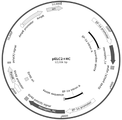
- FIG. 7 shows a schematic diagram of the Herceptin expression vector (pELC2+HC) in which the Herceptin gene was introduced into the Mammalian PowerExpress System (registered trademark) (TOYOBO).
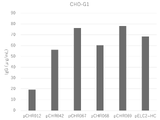
- FIG. 8 shows a graph of the amount of herceptin secreted from each cell transfected with pCHR012, pCHR042, pCHR067, pCHR068, pCHR069 and pELC2+HC.
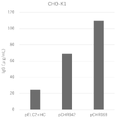
- FIG. 9 shows a graph of the amount of Herceptin secreted from each cell transfected with pELC2+HC, pCHR042, and pCHR069.
- nucleotide sequences in this specification, drawings and sequence listing are listed in order from the 5' end to the 3' end.
- 100th base means the 100th base from the 5' end.
- reverse complementary sequence means a sequence that is in a reverse complementary relationship to a given sequence.
- the reverse complement of the 5'-AAATTCGG-3' sequence is 5'-CCGAATTT-3'.
- upstream refers to the direction of the 5' end
- downstream means the direction of the 3' end.
- the initiation codon refers to a codon that specifies the initiation of protein synthesis, and is usually represented by the nucleotide sequence ATG or AUG.
- the nucleotide sequence of the nucleic acid molecule (e.g., DNA, region, cassette, genome, and vector plasmid) according to this embodiment includes the nucleotide sequence, 1) is a nucleotide sequence with 95% or more sequence homology, or 2) a nucleotide sequence in which one or several bases have been deleted, substituted, or added, or 3) It may be a nucleotide sequence that can hybridize with a complementary sequence under stringent conditions.
- a nucleotide sequence having sequence homology with the nucleotide sequence shown in the SEQ ID NO may have a sequence homology of 95% or more, for example, 96% or more, 97% or more, 98% or more, 99% or more, It may be 99.5% or more, or 99.8% or more.
- “several bases” in “a base sequence in which one or several bases are deleted, substituted, or added” are, for example, 2 to 10 bases, 2 to 9 bases, 2 to 8 bases, 2 to 7 base, 2-6 bases, 2-5 bases, 2-4 bases, 2-3 bases, and 2 bases.
- the number of deleted, substituted or added bases is generally preferably as small as possible. Two or more of deletion, substitution, and addition of bases may occur simultaneously.
- well-known techniques can be used for deletion, substitution, and addition of bases.
- stringent conditions include, for example, the following (1) and (2).
- Low ionic strength and high washing temperature include, for example, 0.015 M NaCl/0.0015 M sodium citrate (titrate)/0.1% SDS at a temperature of 50°C. or (2) using a denaturing agent such as formamide during hybridization, e.g., 0.1% bovine serum albumin/0.1% Ficoll/0.1% polyinylpyrrolidone/ 50 mM sodium phosphate buffer pH 6.5, 750 mM NaCl, 75 mM sodium citrate at a temperature of 42°C.
- a denaturing agent such as formamide during hybridization, e.g., 0.1% bovine serum albumin/0.1% Ficoll/0.1% polyinylpyrrolidone/ 50 mM sodium phosphate buffer pH 6.5, 750 mM NaCl, 75 mM sodium citrate at a temperature of 42°C.
- Another example is 50% formamide, 5 x SSC (0.75 M NaCl, 0.075 M sodium citrate), 50 mM sodium phosphate (pH 6.8), 0.1% sodium pyrophosphate, 5 x Denhardt's solution, Sonicated salmon sperm DNA (50 ⁇ g/ml), 0.1% SDS, 10% dextran sulfate, temperature 42° C., washing temperature 42° C., 0.2 ⁇ SSC, 0.1% SDS. It will also be appreciated by those of ordinary skill in the art that stringent conditions can be altered as appropriate to obtain a clear and detectable hybridization signal.
- molecular biology techniques e.g., cloning, plasmid extraction, DNA fragment cleavage, ligation, hybridization, site-directed mutagenesis, PCR, Western blotting, etc.
- Conventional methods well known to those skilled in the art can be employed. For these methods, see Sambrook, J., Fritsch, E. F., and Maniatis, T., "Molecular Cloning A Laboratory Manual, Second Edition", Cold Spring Harbor Laboratory Press, (1989), etc. .
- the selectable marker expression cassette according to this embodiment is comprising an expression control sequence DNA,
- the expression control sequence DNA comprises one or more secondary expression control sequence DNAs,
- the secondary expression regulatory sequence DNA comprises a modified Kozak sequence DNA and an upstream ORF sequence DNA downstream of the modified Kozak sequence DNA,
- the base sequence of the secondary expression regulatory sequence DNA has only one start codon base sequence.
- the base sequence of Kozak sequence DNA is a common sequence that appears in eukaryotic mRNA and is mainly involved in the initiation of translation. However, it is not a strict consensus sequence and very often there are discrepancies.
- the Kozak sequence of vertebrates is represented by (gcc)gccRccAUGG (SEQ ID NO: 39). considered to play an important role (Kozak M. An analysis of 5'-noncoding sequences from 699 vertebrate messenger RNAs. Nucleic Acids Res. 1987;15(20):8125-8148. doi:10.1093/nar/15.20 .8125).
- Kozak sequences (1) lower case letters indicate the most common base at that position, although bases may vary, (2) "AUGG" sequences indicate highly conserved bases, and (3) Sequences in brackets (gcc) are of uncertain significance.
- the modified Kozak sequence DNA in this embodiment has a base sequence different from that of the Kozak sequence DNA.
- the above-mentioned modified Kozak sequence DNA has a base sequence represented by SEQ ID NO: 3 (GCCACC), or a mutant base sequence thereof (the base sequence and 1) A nucleotide sequence with 95% or more sequence homology, or 2) A nucleotide sequence in which one or several bases have been deleted, substituted, or added, or 3) A nucleotide sequence that can hybridize with a complementary sequence under stringent conditions) It may consist of The nucleotide sequence of the modified Kozak sequence DNA does not contain an ATG sequence that serves as an initiation codon.
- the upstream ORF sequence DNA in this embodiment is located downstream of the modified Kozak sequence DNA.
- the upstream ORF sequence DNA has only one initiation codon (ATG).
- the secondary expression control sequence DNA has only one initiation codon.
- the initiation codon (ATG) of the upstream ORF sequence DNA is located at its 5' end.
- the nucleotide sequence of the upstream ORF sequence DNA may have an ATG sequence downstream of the initiation codon (ATG) that does not serve as an initiation codon for the upstream ORF.
- the upstream ORF sequence DNA has a base sequence represented by SEQ ID NO: 1 (ATGGCTTGA) or SEQ ID NO: 2 (ATGGCTCTAGAAATCGGATGA), or a variant base sequence thereof (the base sequence and 1) A nucleotide sequence with 95% or more sequence homology, or 2) A nucleotide sequence in which one or several bases have been deleted, substituted, or added, or 3) A nucleotide sequence that can hybridize with a complementary sequence under stringent conditions) It may consist of The base sequence of the upstream ORF sequence DNA does not include the base sequence represented by SEQ ID NO: 3 or its mutant base sequence.
- the upstream ORF sequence DNA is directly linked to the modified Kozak sequence DNA (in other words, no bases are present between the upstream ORF sequence DNA and the modified Kozak sequence DNA).
- the upstream ORF sequence DNA is linked to the modified Kozak sequence DNA via spacer DNA.
- the spacer DNA may consist of 1, 2, 3, 4 or 5 arbitrary bases. Spacer DNA does not have an ATG sequence that serves as an initiation codon.
- the selectable marker expression cassette may comprise a promoter (eg mouse PGK promoter) and/or a poly A signal (eg BGH poly A signal) in addition to the expression control sequence DNA.
- the selection marker expression cassette includes a fluorescent selection marker gene (e.g., DNA encoding green fluorescent protein (GFP)), a drug selection marker gene (e.g., puromycin resistance gene and neomycin resistance gene), and/or a nutritional selection marker.
- GFP green fluorescent protein
- Selectable marker genes including genes eg, glutamine synthetase gene
- the selectable marker expression cassette may comprise a promoter, expression control sequence DNA, selectable marker gene and poly A signal.
- the expression level of the "selective marker gene” is 0.5%, 1%, 5% compared to the expression level of the "selective marker gene” that does not employ the configuration of this embodiment (not subjected to expression suppression). %, 10%, 20%, 30%, 40%, 50%, 60%, 70%, 80%, 90%, 95% or 99% or more.
- the expression control sequence DNA comprises one or more secondary expression control sequence DNAs.
- one secondary expression control sequence DNA is directly connected to adjacent secondary expression control sequence DNAs.
- one secondary expression control sequence DNA is directly connected to adjacent secondary expression control sequence DNAs via spacer DNAs.
- the spacer DNA may consist of 1, 2, 3, 4 or 5 arbitrary bases. Spacer DNA does not have an ATG sequence that serves as an initiation codon.
- the one or more secondary expression control sequence DNAs are 1, 2 or 3 secondary expression control sequence DNAs.
- the expression control sequence DNA may comprise one secondary expression control sequence DNA.
- the initiation codon sequence of the selectable marker gene may be included (present) in the nucleotide sequence of the upstream ORF sequence DNA.
- the reading frame of the upstream ORF sequence DNA may overlap the start codon of the selectable marker gene.
- the Kozak sequence, modified Kozak sequence and their mutant base sequences are not present between the selectable marker gene and the adjacent upstream ORF sequence.
- the expression vector according to this embodiment comprises a selectable marker expression cassette.
- the expression vector in this embodiment can be created by inserting a selection marker expression cassette into a cloning vector.
- cloning vectors include plasmids, phages, phagemids, cosmids, fosmids, artificial chromosomes, and the like. Specifically, E.
- coli-derived plasmids e.g., pBR322, pBR325, pUC12, pUC13
- yeast-derived plasmids e.g., pSH19, pSH15
- Bacillus subtilis-derived plasmids e.g., pUB110, pTP5, pC194
- animal cell expression plasmids e.g., pA1 -11, pXT1, pRc/CMV, pRc/RSV, pcDNAI/Neo
- bacteriophages such as ⁇ phage
- viral vectors such as HIV, adenovirus, retrovirus, vaccinia virus, baculovirus, and artificial chromosomes be able to.
- the expression vector according to this embodiment may further comprise two terminal tDNA insulators.
- the selection marker expression cassette is preferably positioned between the two terminal tDNA insulators.
- a terminal tDNA insulator is a DNA consisting of nucleotide sequences capable of delimiting expression units of a gene, which reduces promoter interference, silencing, and is involved in stabilizing gene expression, for example, consisting of the nucleotide sequence of the mouse tRNA gene. DNA can be mentioned.
- the expression vector according to this embodiment can comprise one or more target protein expression cassettes.
- the expression vector according to this embodiment comprises one or more protein-of-interest expression cassettes
- the one or more protein-of-interest expression cassettes are preferably located between the two terminal tDNA insulators.
- a protein of interest expression cassette comprises a gene that expresses the protein of interest.
- the target protein expression cassette includes, in addition to the gene expressing the target protein, (For example, it may have at least one selected from the group consisting of a Woodchuck hepatitis virus Post-transcriptional Regulatory Element (WPRE) sequence and a poly A signal (SV40 poly A signal).
- WPRE Woodchuck hepatitis virus Post-transcriptional Regulatory Element
- Target protein refers to a protein whose expression level is to be increased by attenuating the expression level of the "selection marker gene”.
- the expression level of the "target protein” in the configuration of this embodiment is compared with the expression level of the "target protein” that does not employ the configuration of the present invention (the selection marker is not suppressed in expression). 5-fold, 2.0-fold, 2.5-fold, 3.0-fold, 3.5-fold, 4.0-fold, 4.5-fold or more than 5.0-fold.
- the expression vector according to this embodiment can comprise one or more intermediate tDNA insulators.
- the expression vector according to this embodiment comprises a plurality of target protein expression cassettes
- at least one intermediate tDNA insulator is present between one of the plurality of target protein expression cassettes and the adjacent target protein expression cassette.
- the intermediate tDNA insulator may be the same as the intermediate tDNA insulator, and may include, for example, DNA consisting of the base sequence of the mouse tRNA gene.
- Example 1 Construction of expression vector construction plasmid (pCHR002) and second gene cloning plasmid (pCHR006) Plasmid constructed by VectorBuilder, consisting of standard components available on VectorBuilder's online platform (Vector ID: VB900085-9593ncv and VB190621-1088bqm) and a plasmid containing artificially synthesized tDNA (Ebersole T, Kim JH, Samoshkin A, et al. tRNA genes protect a reporter gene from epigenetic silencing in mouse cells. Cell Cycle. 2011;10(16):2779 -2791.) was prepared. Based on these plasmids, the components shown in Table 1 were amplified by PCR so that the restriction enzyme sites shown in FIG. 1 were added.
- Each component was amplified by PCR using the primers shown in Table 2.
- pCHR002 contains tDNA, human EF-1 ⁇ promoter, SV40 late pA, mPGK promoter, PuroR, BGH pA, bacterial origin of replication (pUC ori), ampicillin resistance marker (AmpR).
- a second gene cloning plasmid pCHR006 containing tDNA, human EF-1 ⁇ promoter, SV40 late pA, pUC ori, and AmpR was constructed (Fig. 2). Each component was amplified by PCR using the primers shown in Table 3.
- the bound DNA fragment was amplified by PCR using the primer set AscI_MluI_NdeI_tDNA-F (SEQ ID NO: 20) and NotI_PacI_EcoT22I_SV40pA-R (SEQ ID NO: 21).
- the amplified ligated DNA fragment was introduced into the restriction enzyme AscI and NotI sites of the backbone of a plasmid (VB900085-9593ncv) constructed by VectorBuilder to construct pCHR006.
- Herceptin Expression Vector Herceptin light chain gene (SEQ ID NO: 33) and Herceptin heavy chain gene (SEQ ID NO: :34) was amplified by PCR, and the primers used are shown in Table 4.
- the Herceptin light chain gene was amplified by PCR to add HindIII and SalI restriction enzyme sites.
- pCHR002-Lc was constructed by introducing the amplified Herceptin light chain gene into the HindIII and SalI sites of pCHR002 (Fig. 3).
- the Herceptin heavy chain gene was amplified by PCR to add HindIII and SbfI restriction enzyme sites.
- pCHR008 was constructed by introducing the amplified Herceptin heavy chain gene into the HindIII and SbfI sites of pCHR006 (Fig. 4).
- a fragment containing the Herceptin heavy chain gene was excised from pCHR008 with restriction enzymes MluI and NsiI.
- Herceptin expression vector pCHR012 was constructed by introducing the excised fragment into the MluI and NsiI sites of pCHR002-Lc (Fig. 5).
- pCHR027 Using pCHR027 as a template, a PCR product amplified with a primer set of PacI_mPGKpro-F (SEQ ID NO: 10) and XbaI-K-uORF-mPGK-R (SEQ ID NO: 35) was introduced into the PacI and XbaI sites of pCHR027. This resulted in the construction of pCHR042 with an upstream ORF inserted into the puromycin resistance gene (Fig. 6). Similarly, the plasmids shown in Table 5 were constructed by introducing the PCR products amplified using the corresponding primer sets into the PacI and XbaI sites of pCHR027.
- pCHR067 has two upstream ORFs inserted into the puromycin resistance gene
- pCHR068 has three upstream ORFs inserted into the puromycin resistance gene
- pCHR069 has an insertion over the start codon of the puromycin resistance gene.
- Upstream ORF is inserted to wrap.
- CHO-G1 Chinese hamster ovary-derived cells CHO-G1 (established by chromocenter, Inc.) adapted to suspension culture were placed in a 12-well plate. 1 mL each was seeded. CHO-G1 cells were prepared for transfection by overnight adherent culture.
- ProCHO4 medium with 5% FBS HT Supplement (1 ⁇ ) (GIBCO), L-Glutamine (2 mM) (GIBCO), ProCHO4 Protein supplemented with Penicillin-Streptomycin (100 U/mL) (GIBCO) -free CHO Medium (manufactured by LONZA) was used as the medium.
- plasmids As plasmids, pCHR012, pCHR042, pCHR067, pCHR068, pCHR069, pELC2+HC (Fig. 7, Herceptin expression vector in which artificially synthesized Herceptin gene was introduced into TOYOBO, Mammalian PowerExpress System (registered trademark)) was used. Transfection was performed by the following method. 1.6 ⁇ g of plasmid vector was diluted with 100 ⁇ L Opti-MEM I Reduced Serum Medium (manufactured by GIBCO).
- the dispersed cells were transferred to a ⁇ 93 ⁇ 19.2 mm cell culture dish and cultured in ProCHO4 medium+5% FBS. The next day, Puromycin (manufactured by Sigma-Aldrich) was added to the medium in which the cells were being cultured at a concentration of 7.5 ⁇ g/mL, and drug-selective adhesion culture was performed for 6 to 12 days. During the selection culture, the medium was changed every 3-4 days, or subculture was performed at an appropriate cell density. When the cells had grown sufficiently, they were transferred to stationary stationary culture in ProCHO4 medium containing 5 ⁇ g/mL Puromycin. The cells were further cultured in floating stationary culture for about one week to obtain a CHO-G1 heterocell pool stably expressing Herceptin.
- Puromycin manufactured by Sigma-Aldrich
- Herceptin Productivity Each herceptin stably expressing CHO-G1 heterocell pool transfected with pCHR012, pCHR042, pCHR067, ppCH068, CHR069, and pELC2+HC expression vectors was cultured in fresh ProCHO4 medium containing 5 ⁇ g/mL Puromycin. It was adjusted to ⁇ 10 5 cells/mL. 2 mL of the cell pool was seeded in a 6-well plate and cultured in suspension at 37°C. After 5 days, the culture supernatant was collected, centrifuged at 4000 rpm for 5 minutes, and the supernatant was collected to obtain a sample of produced Herceptin. Herceptin was quantified with an Ensight Multimode Plate Reader (PerkinElmer) using AlphaLISA human IgG kit (PerkinElmer).
- Fig. 8 shows the results of herceptin quantification in the culture supernatant of each herceptin-stably-expressing CHO-G1 heterocell pool into which each expression vector of pCHR012, pCHR042, pCHR067, pCHR068, pCHR069, and pELC2+HC was introduced.
- the vector (pCHR042) in which the upstream ORF was inserted into the puromycin resistance gene increased herceptin production by about 3-fold compared to the vector (pCHR012) in which the upstream ORF was not inserted.
- the vector (pCHR067) loaded with two copies of the upstream ORF further increased herceptin production compared to the vector (pCHR042).
- the vector (pCHR069) in which the upstream ORF was inserted so as to overlap with the initiation codon of the puromycin resistance gene produced Herceptin at the same level as the vector (pCHR067).
- CHO-K1 cells (JCRB cell bank, IFO50414) were adapted to suspension culture at chromocenter.
- CHO-K1 cells for transfection were prepared and transfected with pELC2+HC, pCHR042, and pCHR069 using the same method as for the CHO-G1 cells described above.
- drug-selective adhesion culture was performed for 7 days, and when the cells were sufficiently grown, they were transferred to suspension stationary culture in ProCHO4 medium containing 5 ⁇ g/mL Puromycin. Cell culture was further carried out for about 2 weeks in stationary stationary culture to obtain a CHO-K1 heterocell pool stably expressing Herceptin.
- FIG. 9 shows the results of quantification of herceptin in the culture supernatant of each CHO-K1 heterocell pool stably expressing herceptin into which each expression vector of pELC2+HC, pCHR042 and pCHR069 was introduced.
- pCHR042 showed about 2.8-fold higher herceptin production and pCHR069 about 4.5-fold higher than pELC2+HC.
Landscapes
- Genetics & Genomics (AREA)
- Health & Medical Sciences (AREA)
- Life Sciences & Earth Sciences (AREA)
- Engineering & Computer Science (AREA)
- Biomedical Technology (AREA)
- Chemical & Material Sciences (AREA)
- Wood Science & Technology (AREA)
- Biotechnology (AREA)
- General Engineering & Computer Science (AREA)
- Organic Chemistry (AREA)
- Bioinformatics & Cheminformatics (AREA)
- Zoology (AREA)
- Molecular Biology (AREA)
- Microbiology (AREA)
- Biophysics (AREA)
- Physics & Mathematics (AREA)
- Biochemistry (AREA)
- General Health & Medical Sciences (AREA)
- Plant Pathology (AREA)
- Micro-Organisms Or Cultivation Processes Thereof (AREA)
Priority Applications (1)
| Application Number | Priority Date | Filing Date | Title |
|---|---|---|---|
| JP2023506894A JP7416355B2 (ja) | 2021-03-15 | 2022-02-18 | 選択マーカー発現カセット |
Applications Claiming Priority (2)
| Application Number | Priority Date | Filing Date | Title |
|---|---|---|---|
| JP2021041250 | 2021-03-15 | ||
| JP2021-041250 | 2021-03-15 |
Publications (1)
| Publication Number | Publication Date |
|---|---|
| WO2022196245A1 true WO2022196245A1 (ja) | 2022-09-22 |
Family
ID=83322300
Family Applications (1)
| Application Number | Title | Priority Date | Filing Date |
|---|---|---|---|
| PCT/JP2022/006667 Ceased WO2022196245A1 (ja) | 2021-03-15 | 2022-02-18 | 選択マーカー発現カセット |
Country Status (2)
| Country | Link |
|---|---|
| JP (1) | JP7416355B2 (https=) |
| WO (1) | WO2022196245A1 (https=) |
Cited By (2)
| Publication number | Priority date | Publication date | Assignee | Title |
|---|---|---|---|---|
| WO2024094009A1 (zh) * | 2022-10-31 | 2024-05-10 | 苏州荷光科汇生物科技有限公司 | 用于目的基因的表达盒及其应用 |
| WO2025059168A1 (en) * | 2023-09-12 | 2025-03-20 | University Of Pittsburgh - Of The Commonwealth System Of Higher Education | Hsv vectors |
Citations (2)
| Publication number | Priority date | Publication date | Assignee | Title |
|---|---|---|---|---|
| WO2009107775A1 (ja) * | 2008-02-27 | 2009-09-03 | 国立大学法人北海道大学 | 動物細胞を用いて外来遺伝子由来タンパク質を大量に生産するための発現ベクター、およびその利用 |
| US20120301919A1 (en) * | 2011-05-24 | 2012-11-29 | Agency For Science, Technology And Research | Ires mediated multicistronic vectors |
-
2022
- 2022-02-18 JP JP2023506894A patent/JP7416355B2/ja active Active
- 2022-02-18 WO PCT/JP2022/006667 patent/WO2022196245A1/ja not_active Ceased
Patent Citations (2)
| Publication number | Priority date | Publication date | Assignee | Title |
|---|---|---|---|---|
| WO2009107775A1 (ja) * | 2008-02-27 | 2009-09-03 | 国立大学法人北海道大学 | 動物細胞を用いて外来遺伝子由来タンパク質を大量に生産するための発現ベクター、およびその利用 |
| US20120301919A1 (en) * | 2011-05-24 | 2012-11-29 | Agency For Science, Technology And Research | Ires mediated multicistronic vectors |
Non-Patent Citations (3)
| Title |
|---|
| GATHER FABIAN, SCHMITZ KATJA, KOCH KATHRIN, VOGT LEA-MARIE, PAUTZ ANDREA, KLEINERT HARTMUT: "Regulation of human inducible nitric oxide synthase expression by an upstream open reading frame", NITRIC OXIDE: BIOLOGY AND CHEMISTRY., ACADEMIC PRESS, AMSTERDAM, NL, vol. 88, 1 July 2019 (2019-07-01), AMSTERDAM, NL , pages 50 - 60, XP055968245, ISSN: 1089-8603, DOI: 10.1016/j.niox.2019.04.008 * |
| JOSHUA P FERREIRA, WILLIAM L NODERER, ALEXANDER J DIAZ DE ARCE, CLIFFORD L WANG: "Engineering ribosomal leaky scanning and upstream open reading frames for precise control of protein translation", BIOENGINEERED, LANDES BIOSCIENCE, US, vol. 5, no. 3, 1 May 2014 (2014-05-01), US , pages 186 - 192, XP055539418, ISSN: 2165-5979, DOI: 10.4161/bioe.27607 * |
| NADERI FATEMEH, HASHEMI MEHRDAD, BAYAT HADI, MOHAMMADIAN OMID, POURMALEKI ES'HAGH, ETEMADZADEH MOHAMMAD HOSSEIN, RAHIMPOUR AZAM: "The Augmenting Effects of the tDNA Insulator on Stable Expression of Monoclonal Antibody in Chinese Hamster Ovary Cells", MONOCLONAL ANTIBODIES IN IMMUNODIAGNOSIS AND IMMUNOTHERAPY, vol. 37, no. 5, 1 November 2018 (2018-11-01), pages 200 - 206, XP055968248, DOI: 10.1089/mab.2018.0015 * |
Cited By (2)
| Publication number | Priority date | Publication date | Assignee | Title |
|---|---|---|---|---|
| WO2024094009A1 (zh) * | 2022-10-31 | 2024-05-10 | 苏州荷光科汇生物科技有限公司 | 用于目的基因的表达盒及其应用 |
| WO2025059168A1 (en) * | 2023-09-12 | 2025-03-20 | University Of Pittsburgh - Of The Commonwealth System Of Higher Education | Hsv vectors |
Also Published As
| Publication number | Publication date |
|---|---|
| JP7416355B2 (ja) | 2024-01-17 |
| JPWO2022196245A1 (https=) | 2022-09-22 |
Similar Documents
| Publication | Publication Date | Title |
|---|---|---|
| US8501454B2 (en) | Homologous recombination-based DNA cloning compositions | |
| EP3344766B1 (en) | Systems and methods for selection of grna targeting strands for cas9 localization | |
| JP7189943B2 (ja) | 細胞の遺伝子修飾のための非組込みdnaベクター | |
| Bird et al. | High-efficiency counterselection recombineering for site-directed mutagenesis in bacterial artificial chromosomes | |
| WO2022196245A1 (ja) | 選択マーカー発現カセット | |
| US9012226B2 (en) | Bacterial strains with improved plasmid stability | |
| JP7521028B2 (ja) | 標的タンパク質への検出可能なタグのCRISPR/Cas制御組み込みに基づく細胞の選択方法 | |
| EP3906304A2 (en) | Non-replicative transduction particles with one or more non-native tail fibers and transduction particle-based reporter systems | |
| AU2017225350A1 (en) | Promoter | |
| Chen et al. | Minimized antibiotic-free plasmid vector for gene therapy utilizing a new toxin-antitoxin system | |
| CA2804381C (en) | Dna element having the activity of enhancing foreign gene expression | |
| Underhill et al. | Transient gene expression levels from multigene expression vectors | |
| CN107532178A (zh) | 用于自诱导蛋白表达的方法和系统 | |
| JP2026511240A (ja) | 単離ヌクレアーゼ及びその使用 | |
| Radulovich et al. | Modified gateway system for double shRNA expression and Cre/lox based gene expression | |
| CN102296087B (zh) | 基于枯草芽孢杆菌生物素连接酶的外源基因诱导表达调控系统及其构建方法 | |
| JP6779513B2 (ja) | インビボクローニング可能な細胞株をスクリーニングするための方法、インビボクローニング可能な細胞株の製造方法、細胞株、インビボクローニング方法、及びインビボクローニングを行うためのキット | |
| KR101346620B1 (ko) | 신규 박테리아 용해 단백질 및 그의 용도 | |
| RU2714763C1 (ru) | Генотерапевтический ДНК-вектор для таргетной генной терапии, способ его получения (варианты), штамм для его производства, способ его получения | |
| Putti et al. | Highly efficient, in vivo optimized, archaeal endonuclease for controlled RNA splicing in mammalian cells | |
| WO2025231315A2 (en) | Bacterial host strains | |
| Zha et al. | One-step construction of lentiviral reporter using red-mediated recombination | |
| JPH11332560A (ja) | 組換えアデノウイルス、該組換えウイルスゲノムを有しているコスミドベクター及び該組換えウイルスにより感染された動物細胞 |
Legal Events
| Date | Code | Title | Description |
|---|---|---|---|
| 121 | Ep: the epo has been informed by wipo that ep was designated in this application |
Ref document number: 22771004 Country of ref document: EP Kind code of ref document: A1 |
|
| ENP | Entry into the national phase |
Ref document number: 2023506894 Country of ref document: JP Kind code of ref document: A |
|
| NENP | Non-entry into the national phase |
Ref country code: DE |
|
| 122 | Ep: pct application non-entry in european phase |
Ref document number: 22771004 Country of ref document: EP Kind code of ref document: A1 |