WO2022196121A1 - アクリルオレフィン複合樹脂組成物、非水系樹脂組成物、非水系樹脂組成物の製造方法、アクリルオレフィン複合樹脂組成物の製造方法、コーティング組成物、インキ組成物、接着剤組成物、フィルム及び成形材 - Google Patents
アクリルオレフィン複合樹脂組成物、非水系樹脂組成物、非水系樹脂組成物の製造方法、アクリルオレフィン複合樹脂組成物の製造方法、コーティング組成物、インキ組成物、接着剤組成物、フィルム及び成形材 Download PDFInfo
- Publication number
- WO2022196121A1 WO2022196121A1 PCT/JP2022/003079 JP2022003079W WO2022196121A1 WO 2022196121 A1 WO2022196121 A1 WO 2022196121A1 JP 2022003079 W JP2022003079 W JP 2022003079W WO 2022196121 A1 WO2022196121 A1 WO 2022196121A1
- Authority
- WO
- WIPO (PCT)
- Prior art keywords
- resin composition
- composition
- composite resin
- resin
- mass
- Prior art date
- Legal status (The legal status is an assumption and is not a legal conclusion. Google has not performed a legal analysis and makes no representation as to the accuracy of the status listed.)
- Ceased
Links
Classifications
-
- C—CHEMISTRY; METALLURGY
- C08—ORGANIC MACROMOLECULAR COMPOUNDS; THEIR PREPARATION OR CHEMICAL WORKING-UP; COMPOSITIONS BASED THEREON
- C08F—MACROMOLECULAR COMPOUNDS OBTAINED BY REACTIONS ONLY INVOLVING CARBON-TO-CARBON UNSATURATED BONDS
- C08F255/00—Macromolecular compounds obtained by polymerising monomers on to polymers of hydrocarbons as defined in group C08F10/00
- C08F255/02—Macromolecular compounds obtained by polymerising monomers on to polymers of hydrocarbons as defined in group C08F10/00 on to polymers of olefins having two or three carbon atoms
-
- C—CHEMISTRY; METALLURGY
- C08—ORGANIC MACROMOLECULAR COMPOUNDS; THEIR PREPARATION OR CHEMICAL WORKING-UP; COMPOSITIONS BASED THEREON
- C08L—COMPOSITIONS OF MACROMOLECULAR COMPOUNDS
- C08L23/00—Compositions of homopolymers or copolymers of unsaturated aliphatic hydrocarbons having only one carbon-to-carbon double bond; Compositions of derivatives of such polymers
- C08L23/02—Compositions of homopolymers or copolymers of unsaturated aliphatic hydrocarbons having only one carbon-to-carbon double bond; Compositions of derivatives of such polymers not modified by chemical after-treatment
- C08L23/10—Homopolymers or copolymers of propene
- C08L23/12—Polypropene
-
- C—CHEMISTRY; METALLURGY
- C08—ORGANIC MACROMOLECULAR COMPOUNDS; THEIR PREPARATION OR CHEMICAL WORKING-UP; COMPOSITIONS BASED THEREON
- C08L—COMPOSITIONS OF MACROMOLECULAR COMPOUNDS
- C08L23/00—Compositions of homopolymers or copolymers of unsaturated aliphatic hydrocarbons having only one carbon-to-carbon double bond; Compositions of derivatives of such polymers
- C08L23/02—Compositions of homopolymers or copolymers of unsaturated aliphatic hydrocarbons having only one carbon-to-carbon double bond; Compositions of derivatives of such polymers not modified by chemical after-treatment
- C08L23/16—Ethylene-propylene or ethylene-propylene-diene copolymers
-
- C—CHEMISTRY; METALLURGY
- C08—ORGANIC MACROMOLECULAR COMPOUNDS; THEIR PREPARATION OR CHEMICAL WORKING-UP; COMPOSITIONS BASED THEREON
- C08L—COMPOSITIONS OF MACROMOLECULAR COMPOUNDS
- C08L33/00—Compositions of homopolymers or copolymers of compounds having one or more unsaturated aliphatic radicals, each having only one carbon-to-carbon double bond, and only one being terminated by only one carboxyl radical, or of salts, anhydrides, esters, amides, imides or nitriles thereof; Compositions of derivatives of such polymers
-
- C—CHEMISTRY; METALLURGY
- C08—ORGANIC MACROMOLECULAR COMPOUNDS; THEIR PREPARATION OR CHEMICAL WORKING-UP; COMPOSITIONS BASED THEREON
- C08L—COMPOSITIONS OF MACROMOLECULAR COMPOUNDS
- C08L51/00—Compositions of graft polymers in which the grafted component is obtained by reactions only involving carbon-to-carbon unsaturated bonds; Compositions of derivatives of such polymers
- C08L51/06—Compositions of graft polymers in which the grafted component is obtained by reactions only involving carbon-to-carbon unsaturated bonds; Compositions of derivatives of such polymers grafted on to homopolymers or copolymers of aliphatic hydrocarbons containing only one carbon-to-carbon double bond
-
- C—CHEMISTRY; METALLURGY
- C09—DYES; PAINTS; POLISHES; NATURAL RESINS; ADHESIVES; COMPOSITIONS NOT OTHERWISE PROVIDED FOR; APPLICATIONS OF MATERIALS NOT OTHERWISE PROVIDED FOR
- C09D—COATING COMPOSITIONS, e.g. PAINTS, VARNISHES OR LACQUERS; FILLING PASTES; CHEMICAL PAINT OR INK REMOVERS; INKS; CORRECTING FLUIDS; WOODSTAINS; PASTES OR SOLIDS FOR COLOURING OR PRINTING; USE OF MATERIALS THEREFOR
- C09D11/00—Inks
- C09D11/02—Printing inks
- C09D11/10—Printing inks based on artificial resins
- C09D11/106—Printing inks based on artificial resins containing macromolecular compounds obtained by reactions only involving carbon-to-carbon unsaturated bonds
-
- C—CHEMISTRY; METALLURGY
- C09—DYES; PAINTS; POLISHES; NATURAL RESINS; ADHESIVES; COMPOSITIONS NOT OTHERWISE PROVIDED FOR; APPLICATIONS OF MATERIALS NOT OTHERWISE PROVIDED FOR
- C09D—COATING COMPOSITIONS, e.g. PAINTS, VARNISHES OR LACQUERS; FILLING PASTES; CHEMICAL PAINT OR INK REMOVERS; INKS; CORRECTING FLUIDS; WOODSTAINS; PASTES OR SOLIDS FOR COLOURING OR PRINTING; USE OF MATERIALS THEREFOR
- C09D151/00—Coating compositions based on graft polymers in which the grafted component is obtained by reactions only involving carbon-to-carbon unsaturated bonds; Coating compositions based on derivatives of such polymers
- C09D151/06—Coating compositions based on graft polymers in which the grafted component is obtained by reactions only involving carbon-to-carbon unsaturated bonds; Coating compositions based on derivatives of such polymers grafted on to homopolymers or copolymers of aliphatic hydrocarbons containing only one carbon-to-carbon double bond
-
- C—CHEMISTRY; METALLURGY
- C09—DYES; PAINTS; POLISHES; NATURAL RESINS; ADHESIVES; COMPOSITIONS NOT OTHERWISE PROVIDED FOR; APPLICATIONS OF MATERIALS NOT OTHERWISE PROVIDED FOR
- C09J—ADHESIVES; NON-MECHANICAL ASPECTS OF ADHESIVE PROCESSES IN GENERAL; ADHESIVE PROCESSES NOT PROVIDED FOR ELSEWHERE; USE OF MATERIALS AS ADHESIVES
- C09J151/00—Adhesives based on graft polymers in which the grafted component is obtained by reactions only involving carbon-to-carbon unsaturated bonds; Adhesives based on derivatives of such polymers
- C09J151/06—Adhesives based on graft polymers in which the grafted component is obtained by reactions only involving carbon-to-carbon unsaturated bonds; Adhesives based on derivatives of such polymers grafted on to homopolymers or copolymers of aliphatic hydrocarbons containing only one carbon-to-carbon double bond
Definitions
- the present invention relates to an acrylic olefin composite resin composition and its manufacturing method, a non-aqueous resin composition and its manufacturing method, a coating composition, an ink composition, an adhesive composition, a film and a molding material.
- Polyolefin resins which are polymers of olefin monomers, are widely used in a wide variety of applications because they have excellent mechanical properties and chemical resistance, are low cost, and are easy to mold. Furthermore, polyolefin resins are excellent in recyclability, and their applications are expanding further against the backdrop of recent global environmental problems. However, due to the low polarity of polyolefin resins, it is generally believed that adhesion to polyolefin base materials is difficult.
- Methods for improving the adhesion to polyolefin base materials include methods of chemically treating the surface of polyolefin base materials with chemicals, and methods of oxidizing the surface by corona discharge treatment, plasma treatment, flame treatment, etc. It has been known. However, these methods have the problem that special equipment is required and the effect of improving adhesiveness is not sufficient.
- Patent Document 1 discloses a resin solution containing a graft copolymer obtained by graft-polymerizing a specific monomer to an olefin-based polymer as a chlorine-free resin having high adhesiveness to a polyolefin-based substrate. is described. However, since the resin solution described in Patent Document 1 separates over time, there is a problem with storage stability.
- Patent Literature 2 describes a solid resin containing a graft copolymer obtained by graft-polymerizing a specific monomer to an olefin-based polymer and having no concerns about storage stability.
- the method described in Patent Document 2 does not have good solubility in the solvent used, so there is a problem in using it for applications such as inks, paints, and adhesives that require solubility in solvents.
- the present invention provides an acrylic olefin composite resin composition having excellent adhesion to polyolefin substrates and excellent storage stability, and a non-aqueous system comprising a composite resin composition having excellent adhesion to polyolefin substrates and storage stability.
- An object of the present invention is to provide resin compositions and methods for producing them.
- the gist of the present invention is the following [1] to [21].
- the acrylic olefin composite resin C contains a structural unit derived from the (meth)acrylic monomer a and a structure derived from the olefin resin B,
- An acrylic olefin composite resin composition D having a moisture content of 0.01% by mass or more and 10% by mass or less.
- the acrylic-olefin composite resin composition D of [1] further comprising an acrylic resin A containing a structural unit derived from the (meth)acrylic monomer a, and the olefin resin B.
- the mass ratio of the total mass of the structural units derived from all the monomers constituting the olefin resin B to the total mass of the structural units derived from the (meth)acrylic monomer a is 1 to 100%.
- the non-aqueous resin composition E of [7] further containing an organic solvent.
- SP value solubility parameter
- the acrylic olefin composite resin composition D of any one of [1] to [6] is mixed with an organic solvent containing 50% by mass or more of an organic solvent having an SP value of less than 9.2, and the acrylic olefin composite resin composition is obtained.
- a method for producing an acrylic olefin composite resin composition D containing an acrylic olefin composite resin C having a structural unit derived from a (meth)acrylic monomer a and a structure derived from an olefin resin B A method for producing an acrylic olefin composite resin composition D, comprising suspension polymerization of the (meth)acrylic monomer a in the presence of the olefin resin B.
- a coating composition comprising the acrylic olefin composite resin composition D of any one of [1] to [6].
- An adhesive composition comprising the acrylic olefin composite resin composition D of any one of [1] to [6].
- a film or molded material containing the acrylic olefin composite resin composition D of any one of [1] to [6].
- a coating composition comprising the non-aqueous resin composition E according to any one of [7] to [12].
- An ink composition containing the non-aqueous resin composition E according to any one of [7] to [12].
- An adhesive composition comprising the non-aqueous resin composition E according to any one of [7] to [12].
- an acrylic olefin composite resin composition having excellent adhesion to polyolefin substrates and excellent storage stability, and a composite resin composition having excellent adhesion to polyolefin substrates and storage stability are included.
- Non-aqueous resin compositions and methods for producing them can be provided.
- (meth)acryl means a generic term for "acryl” and “methacryl”.
- (Meth)acrylate is a generic term for "acrylate” and “methacrylate”.
- the acrylic olefin composite resin composition D (hereinafter also referred to as “composite resin composition D") of the present invention contains acrylic olefin composite resin C (hereinafter also referred to as “resin C”), and resin C is , (Meth)acrylic monomer a (hereinafter also referred to as “monomer a”) containing structural units derived from and olefin resin B (hereinafter also referred to as “resin B”) derived structure,
- the moisture content of the composite resin composition D is 0.01% or more and 10% or less.
- Composite resin composition D contains, in addition to resin C, acrylic resin A (hereinafter referred to as “resin A”), and resin B are preferably further included.
- the existence state of the structure derived from the resin B and the structural unit derived from the monomer a in the resin C is, for example, A state in which the structure derived from resin B and the structural unit derived from monomer a are bonded by chemical bonds such as covalent bonds, ionic bonds, and hydrogen bonds; A state of existing as secondary particles which are aggregates of primary particles of resin B and primary particles of resin having structural units derived from monomer a; A state in which a resin having a structure derived from resin B and a structural unit derived from monomer a exists in a core-shell structure; A state in which a resin having a structure derived from resin B and a structural unit derived from monomer a exists in a microphase-separated structure such as a sea-island structure or an interconnected structure.
- the structure derived from resin B and the constituent units derived from monomer a are bound by covalent bonds, ionic bonds, hydrogen bonds, and the like.
- a state in which they are bonded by chemical bonds, and a state in which they exist as secondary particles that are aggregates of primary particles of the resin B and primary particles of the resin having structural units derived from the monomer a are preferable; structure and monomers derived from the resin B.
- the constituent units derived from body a are bonded by chemical bonds such as covalent bonds, ionic bonds and hydrogen bonds.
- the composite resin composition D may be in the form of particles, for example, particles obtained by pulverizing lumps, powders, solids such as pellets, particles in a suspended state, and particles in an emulsified state. good.
- Composite resin composition D is preferably in the form of particles obtained by pulverizing lumps, or in the form of particles in a suspended state, from the viewpoint of handleability when dissolved in an organic solvent.
- Resin A and Resin C have at least one structural unit derived from monomer a.
- Examples of the monomer a include methyl (meth) acrylate, ethyl (meth) acrylate, n-propyl (meth) acrylate, i-propyl (meth) acrylate, n-butyl (meth) acrylate, i-butyl (meth) acrylate, ) acrylate, t-butyl (meth) acrylate, n-pentyl (meth) acrylate, i-pentyl (meth) acrylate, n-hexyl (meth) acrylate, n-octyl (meth) acrylate, 2-ethylhexyl (meth) Alkyl (meth)acrylates having a linear or branched hydrocarbon skeleton such as acrylates, lauryl (meth)acrylate, stearyl (meth)acrylate, isostearyl (meth)acrylate, 4-t-butylcyclohexyl
- alkyl (meth)acrylates having a linear or branched hydrocarbon skeleton and alkyl (meth)acrylates having an alicyclic skeleton It preferably contains at least one of methyl (meth) acrylate, ethyl (meth) acrylate, n-butyl (meth) acrylate, i-butyl (meth) acrylate, t-butyl (meth) acrylate, cyclohexyl ( It more preferably contains at least one of meth)acrylate and isobornyl (meth)acrylate, and more preferably contains both methyl (meth)acrylate and n-butyl (meth)acrylate.
- Monomer a may be used alone or in combination of two or more.
- the resin A and the resin C may have a structural unit derived from a monomer other than the monomer a in the copolymerization component.
- monomers other than monomer a include aromatic vinyl monomers such as styrene, ⁇ -methylstyrene, p-methylstyrene, vinyltoluene, and chlorostyrene; Vinyl cyanide monomers such as acrylonitrile, methacrylonitrile, ⁇ -cyanoacrylate, dicyanovinylidene, and fumaronitrile; monomers having a carboxyl group such as crotonic acid, isocrotonic acid, cinnamic acid, itaconic acid, maleic acid, fumaric acid, citraconic acid, mesaconic acid, glutaconic acid; sulfonic acid group-containing monomers such as vinylsulfonic acid and 2-acrylamido-2-methylpropanesulfonic acid; Polyfunctional monomers such as divinylbenzene, divin
- the resin A preferably contains 50% by mass or more, more preferably 80% by mass or more, of structural units derived from the monomer a.
- the mass ratio of the structural unit derived from the monomer a in the resin A is at least the above lower limit, the storage stability of the composite resin composition D tends to be improved.
- the resin A may have any structure such as random copolymer, graft copolymer, block copolymer, linear, or branched.
- the weight average molecular weight Mw of resin A measured by gel permeation chromatography (GPC) is preferably 5000 or more and 500000 or less from the viewpoint of heat resistance, adhesion to polyolefin base materials and storage stability of composite resin composition D. , 10000 or more and 300000 or less. If it is more than the said lower limit, there exists a tendency for adhesiveness to improve. When the content is equal to or less than the above upper limit, the storage stability of the composite resin composition D tends to be improved.
- the glass transition temperature (Tg) of resin A is preferably 0° C. or higher and 150° C. or lower, and preferably 15° C. or higher and 100° C. or lower, from the viewpoint of heat resistance, adhesion to polyolefin substrates, and storage stability of composite resin composition D. More preferably, the temperature is 25° C. or higher and 80° C. or lower. If it is at least the above lower limit, there is a tendency for the adhesiveness to improve. When the content is equal to or less than the above upper limit, the storage stability of the composite resin composition D tends to be improved.
- glass transition temperature (Tg) (unit: °C) is calculated by the Fox formula shown in formula (1) below.
- Tgi Tg (°C) of homopolymer of monomer i
- Tg (°C) Tg (°C) of homopolymer of monomer i
- Resin A and resin C can be produced by commonly known polymerization methods such as bulk polymerization, solution polymerization and suspension polymerization. Among these, suspension polymerization is preferable in that a resin in the form of spherical particles, which is easy to handle, can be obtained. Resin A and resin C can be produced, for example, by the following suspension polymerization method.
- the method for producing Resin A and Resin C preferably includes a polymerization step, a first dehydration step, a washing step, a second dehydration step, and a drying step.
- the polymerization step is a step of suspension polymerization of the monomer a and, if necessary, a monomer other than the monomer a to obtain the resin A or the resin C.
- a known method can be employed as the suspension polymerization method. For example, in a container having a polymerization temperature control function and a stirring function, the monomer a and, if necessary, a monomer other than the monomer a is polymerized in water in the presence of a polymerization aid.
- Polymerization aids include, for example, polymerization initiators, chain transfer agents, dispersants, and dispersion aids.
- polymerization initiators include 2,2'-azobisisobutyronitrile, 2,2'-azobis(2-methylbutyronitrile), benzoyl peroxide and lauroyl peroxide.
- chain transfer agents include t-dodecylmercaptan, n-dodecylmercaptan, octylthioglycolate, and ⁇ -methylstyrene dimer.
- Dispersants include, for example, surfactants capable of stably dispersing monomers in water.
- Copolymers of sulfopropyl methacrylate and methyl methacrylate, copolymers of sodium methacrylate and methacrylic acid, polyvinyl alcohol, polyvinylpyrrolidone, hydroxyethyl cellulose and hydroxypropyl cellulose can be mentioned.
- Dispersing aids include, for example, sodium sulfate, sodium carbonate, sodium dihydrogen phosphate, disodium hydrogen phosphate, potassium chloride, calcium acetate, magnesium sulfate, and manganese sulfate.
- the resins obtained by suspension polymerization (for example, resin A, resin B, and resin C) are obtained in a slurry state. By dehydrating the slurry, bead-like resin particles that are nearly spherical are usually obtained.
- the dehydration step includes a first dehydration step in which the slurry after the suspension polymerization is dehydrated with a dehydrator or the like to separate the resin (for example, resin A, resin B, resin C) from the reaction solution, and the resin after the washing step ( For example, there is a second dehydration step in which particles of resin A, resin B, and resin C) are dehydrated with a dehydrator or the like to separate resin particles (for example, particles of resin A, resin B, and resin C) from the washing liquid. .
- dehydrator can be used in each dehydration step, and for example, a centrifugal dehydrator, a dehydrator having a mechanism for removing water by suction on a perforated belt, or the like can be appropriately selected and used.
- a centrifugal dehydrator a dehydrator having a mechanism for removing water by suction on a perforated belt, or the like can be appropriately selected and used.
- One dehydrator may be used, two of the same model may be prepared and used in each dehydration step, or a plurality of different dehydrator models may be used. It is possible to appropriately select a model that meets the purpose in terms of product quality, equipment investment cost, productivity, operating cost, and the like. If the balance between product quality and production speed is emphasized, a dedicated dehydrator may be used in each dehydration step.
- the washing step increases the purity of the resin (eg resin A, resin B, resin C).
- a washing liquid is added to the resin particles dehydrated in the first dehydration step, and the resin is slurried again and stirred and mixed.
- a second dehydration step such as a method of subsequently adding a washing liquid for washing, may be performed later. Also, these washing methods may be combined to wash the resin (for example, resin A, resin B, and resin C).
- the kind and amount of the cleaning liquid may be selected so that the purpose of the cleaning process is achieved.
- the cleaning agent include water (ion-exchanged water, distilled water, purified water, etc.), an aqueous solution in which sodium salt is dissolved, and methanol.
- the drying step is a step of drying particles of the resin (for example, resin A, resin B, and resin C) after the second dehydration step. Water remains on the surface of the resin particles after the second dehydration step.
- drying is preferable in order to further reduce the water content of the resin.
- Various dryers can be used for drying, for example, a dryer that heats and dries under reduced pressure, a dryer that simultaneously dries resin particles while air-flying them in a tube using heated air, There is a dryer in which heated air is blown from the lower side of a perforated plate, and the resin particles on the upper side are dried while flowing.
- Resin B has a structural unit derived from at least one olefinic monomer b (hereinafter also referred to as "monomer b").
- the resin B may have a reactive group.
- reactive groups include carboxyl groups, epoxy groups, isocyanate groups, sulfonic acid groups, hydroxyl groups, and amino groups.
- the reactive group may be an acid anhydride structure of a carboxyl group.
- Examples of the monomer b include ethylene, propylene, butene-1, pentene-1, hexene-1, heptene-1, octene-1, cyclopentene, cyclohexene and norbornene.
- the resin B for example, a homopolymer of the monomer b; copolymers of ethylene and propylene; At least one of ethylene and propylene, and a monomer copolymerizable with ethylene and propylene (e.g., ⁇ -olefin having 4 or more carbon atoms (e.g., butene-1, pentene-1, hexene-1, heptene-1, octene -1, cyclopentene, cyclohexene, norbornene)); Copolymer of two or more ⁇ -olefins having 4 or more carbon atoms; A copolymer of an ⁇ -olefin having 2 or more carbon atoms and an aromatic monomer or a hydrogenated product thereof; A conjugated diene block copolymer or a hydrogenated product thereof may be mentioned.
- Monomer b may be used alone or in combination of two or more.
- the mass ratio of the structural units derived from the olefinic monomer b to the total mass of the structural units constituting the resin B is preferably 50% by mass or more, more preferably 65% by mass or more, and even more preferably 75% by mass or more. , and preferably 100% by mass or less.
- the content is equal to or less than the above lower limit, there is a tendency for the adhesiveness to the polyolefin base material to be improved.
- Resin B is preferably a polymer having a propylene-derived structural unit from the viewpoint of adhesion to polyolefin-based substrates, such as polypropylene, ethylene-propylene copolymer, ethylene-propylene-butene copolymer, propylene-butene copolymer. Polymers are more preferred, and polypropylene and ethylene-propylene copolymers are even more preferred.
- the mass ratio of the propylene-derived structural unit in the polymer having the propylene-derived structural unit is preferably 50% by mass or more, more preferably 60% by mass or more, further preferably 70% by mass or more, and preferably 100% by mass or less. . When the content is equal to or less than the above lower limit, there is a tendency for the adhesiveness to the polyolefin base material to be improved.
- the resin B may have any structure such as random copolymer, graft copolymer, block copolymer, linear or branched.
- the melting point (Tm) of Resin B is preferably 125° C. or lower, more preferably 110° C. or lower, still more preferably 95° C. or lower, and preferably 50° C. or higher. If it is at least the above lower limit, there is a tendency for the adhesion to polyolefin base materials to improve. When the content is equal to or less than the above upper limit, the storage stability of the composite resin composition D tends to be improved.
- the "melting point (Tm)" (unit: °C) is measured by differential scanning calorimetry (DSC).
- the weight average molecular weight Mw of Resin B measured by gel permeation chromatography is preferably 3,000 or more and 500,000 or less, more preferably 6,000 or more and 200,000 or less, more preferably 10,000, from the viewpoint of heat resistance and adhesion to polyolefin base materials. 100000 or more is more preferable. If it is more than the said lower limit, there exists a tendency for adhesiveness to improve. When the amount is equal to or less than the above upper limit, there is a tendency that solvent solubility is improved.
- the method for producing Resin B is not particularly limited, but for example, it can be produced by polymerizing an olefin by a method such as radical polymerization, cationic polymerization, anionic polymerization, or coordination polymerization. Each of these polymerization methods may be a living polymerization method.
- catalysts used for coordination polymerization include Ziegler-Natta catalysts and single-site catalysts.
- single-site catalysts can have sharp molecular weight distributions and stereoregularity distributions by designing ligands.
- single-site catalysts include metallocene catalysts and Brookhart catalysts.
- Metallocene catalysts include, for example, C1 symmetric type, C2 symmetric type, C2V symmetric type, and CS symmetric type, and can be appropriately selected depending on the stereoregularity of the desired polyolefin.
- the method of polymerizing resin B is not particularly limited, and may be any method such as solution polymerization, suspension polymerization, bulk polymerization, and gas phase polymerization.
- examples of polymerization solvents include aromatic hydrocarbons such as toluene and xylene; aliphatic hydrocarbons such as hexane, heptane and octane; and alicyclic carbonization such as cyclohexane and methylcyclohexane.
- Aroma hydrocarbons such as toluene and xylene
- aliphatic hydrocarbons such as hexane, heptane and octane
- alicyclic carbonization such as cyclohexane and methylcyclohexane.
- Halogenated hydrocarbons esters; ketones; and ethers.
- Aromatic hydrocarbons, aliphatic hydrocarbons and alicyclic hydrocarbons are preferred, and toluene, xylene, heptane and cyclohexane are more preferred.
- One type of polymerization solvent may be used alone, or two or more types may be used in combination.
- the production method thereof includes, for example, a method in which an olefin resin and a radically polymerizable monomer having a reactive group are reacted by heating and stirring in a solution, and an olefin resin and a reactive group.
- a method of reacting by melting, heating and stirring a radically polymerizable monomer having A method of graft polymerizing a radically polymerizable monomer having the above to an olefin resin.
- the polymerization solvent exemplified in the production method of resin B by solution polymerization or suspension polymerization can be used.
- the content of the reactive group is preferably 0.01 to 1 mmol/g, more preferably 0.05 to 0.5 mmol/g, more preferably 0.05 to 0.5 mmol/g, per 1 g of the resin B. 1 to 0.3 mmol/g is more preferable.
- Resin C can be produced by subjecting a mixture of a monomer mixture containing monomer a and resin B to radical polymerization in the presence of a radical polymerization initiator.
- the resin A may also be produced at the same time by radically polymerizing only the monomer mixture containing the monomer a.
- a composite resin composition D which is composed of three types of resin compositions, the resin A, the unreacted resin B, and the resin C, may be obtained.
- composite resin composition D a resin composition of resin A, resin B and resin C is preferable.
- the composite resin composition D is a resin composition of the resin A, the resin B and the resin C, the monomer a and the resin B which are the raw materials of the resin A depending on the desired physical properties of the composite resin composition D
- the mass ratio of the resin A, the resin B and the resin C in the composite resin composition D can be adjusted.
- the mass ratio of the resin A in the composite resin composition D is preferably 45% by mass or more and 95% by mass or less, more preferably 55% by mass or more and 90% by mass or less. If it is at least the above lower limit, the storage stability tends to be improved when dispersed in a solvent. When the content is equal to or less than the above upper limit, the adhesion to polyolefin substrates tends to be improved.
- the mass ratio of the resin B in the composite resin composition D is preferably 5% by mass or more and 55% by mass or less, more preferably 10% by mass or more and 45% by mass or less. If it is at least the above lower limit, the adhesiveness to the polyolefin base material tends to be improved. If it is less than the above upper limit, the storage stability tends to improve when dispersed in a solvent.
- the mass ratio of the resin C in the composite resin composition D is preferably 0.001% by mass or more and 10% by mass or less, and 0.01% by mass or more and 4% by mass. The following is more preferable, and 0.05% by mass or more and 2% by mass or less is even more preferable. If it is at least the above lower limit, the storage stability tends to be improved when the composite resin composition D is dispersed in a solvent. If it is equal to or less than the above upper limit, the viscosity tends to decrease when the composite resin composition D is dispersed in a solvent.
- the mass ratio of resin A, resin B and resin C contained in composite resin composition D can be measured by a known method using 1 H-NMR, 13 C-NMR or the like.
- a polymerization method for obtaining Resin C known polymerization methods such as radical polymerization such as bulk polymerization, solution polymerization, suspension polymerization, and emulsion polymerization, anionic polymerization, group transfer polymerization (GTP), and coordination anionic polymerization are employed.
- radical polymerization such as bulk polymerization, solution polymerization, suspension polymerization, and emulsion polymerization, anionic polymerization, group transfer polymerization (GTP), and coordination anionic polymerization
- GTP group transfer polymerization
- GTP group transfer polymerization
- coordination anionic polymerization are employed.
- Bulk polymerization and suspension polymerization are preferred from the viewpoint of ease of resin recovery, and suspension polymerization is more preferred from the viewpoint of particle size control.
- a method for producing resin C by suspension polymerization includes, for example, a mixture of a monomer mixture containing monomer a in water and resin B, a dispersant, a radical polymerization initiator, and optionally a chain transfer agent.
- an aqueous suspension is prepared by adding an aqueous suspension, and the monomer is dispersed into droplets of about 0.05 to 2.5 mm while stirring, and the polymerization proceeds under heating.
- the polymerization temperature is preferably 0° C. or higher and 200° C. or lower, more preferably 20° C. or higher and 150° C. or lower, even more preferably 50° C. or higher and 100° C. or lower.
- the content is equal to or less than the above upper limit, there is a tendency that the dispersion stability of the polymer is improved. If it is at least the above lower limit, there is a tendency that the solubility of the resin C in the solvent is improved.
- Method 1 Resin B is added to a monomer mixture containing monomer a and heated and stirred to form a mixture of the monomer mixture containing monomer a and resin B, and then a radical polymerization initiator and A method in which water and a dispersant are added and stirred to polymerize.
- Method 2 A mixture of monomer a, a mixture of monomers other than monomer a, and resin B are added to water and heated and stirred to form a mixture of the monomer mixture containing monomer a and resin B. After that, a radical polymerization initiator and a dispersant are added and stirred to polymerize.
- a chain transfer agent may be added to the mixture of the monomer mixture and Resin B.
- radical polymerization initiator used for producing the aqueous suspension of Resin C examples include organic peroxides and azo compounds, with organic peroxides being preferred.
- a radical polymerization initiator may be used alone or in combination of two or more.
- organic peroxides used as radical polymerization initiators include o-methylbenzoyl peroxide, bis-3,5,5-trimethylhexanoyl peroxide, octanoyl peroxide, cyclohexanone peroxide, benzoyl peroxide, and methyl ethyl ketone.
- azo compounds used as radical polymerization initiators include 2,2′-azobisisobutyronitrile, 2,2′-azobis(2-methylbutyronitrile), 2,2′-azobis(2,4 -dimethylvaleronitrile), 2,2′-azobis(2,4-dimethyl-4-methoxyvaleronitrile).
- t-butyl peroxypivalate t-butyl peroxyneoheptanoate, t-butyl peroxyneodecanoate, t-butyl peroxy-2-ethylhexanoate, t -butyl peroxylaurate, t-butyl peroxyacetate, t-butyl peroxy isobutyrate, t-butyl peroxy isononanoate, t-butyl peroxybenzoate, t-butyl peroxy-3,5,5 -trimethylhexanoate, t-butylperoxymaleic acid, t-butylperoxyisopropylmonocarbonate, t-butylperoxy-2-ethylhexylmonocarbonate, di-t-butylperoxyhexahydroterephthalate, 1,6- Di-(t-butylperoxycarbonyloxy)hexane
- t-butylperoxy-2-ethylhexanoate t-butylperoxylaurate, t-butylperoxyisobutyrate, di-t-butylperoxyhexahydroterephthalate , 1,6-di-(t-butylperoxycarbonyloxy)hexane is more preferred.
- the amount of the radical polymerization initiator used is preferably 0.0001 to 10 parts by mass, and 0.01 to 5 parts by mass with respect to a total of 100 parts by mass of the monomer mixture containing the monomer a and the resin B. More preferably, 0.1 to 2 parts by mass is even more preferable. If it is more than the said lower limit, there exists a tendency for adhesiveness to improve. If it is below the said upper limit, there exists a tendency for solvent solubility to improve.
- the hydrogen abstraction ability is an index indicating the ease of occurrence of a hydrogen abstraction reaction, which is one of the reactions involving radical species generated from the organic peroxide.
- the hydrogen abstraction ability of an organic peroxide is determined by the method described in various documents (e.g., Polymer Journal, 29, 366 (1997), Polymer Journal, 29, 940 (1997), Polymer Journal, 29, 733 (1997)). can be measured.
- Chain transfer agents used in the preparation of the aqueous suspension of Resin C include, for example, hydrogen, mercaptans, ⁇ -methylstyrene dimers, terpenoids, and cobalt chain transfer agents.
- a chain transfer agent may be used individually by 1 type, and may use 2 or more types together.
- Chain transfer agents include, for example, n-octylmercaptan, n-dodecylmercaptan, tert-dodecylmercaptan, n-octylmercaptan, n-tetradecylmercaptan, n-hexylmercaptan, and 2-ethylhexyl thioglycolate.
- the amount of the chain transfer agent used is preferably 0.01 parts by mass or more and 10 parts by mass or less, and 0.05 parts by mass or more with respect to a total of 100 parts by mass of the mixture of monomers containing the monomer a and the resin B. 5 parts by mass or less is more preferable, and 0.1 to 2 parts by mass is even more preferable. If it is at least the above lower limit, the solubility in solvents tends to improve. When the content is equal to or less than the above upper limit, the adhesion to polyolefin substrates tends to be improved.
- Examples of dispersing agents used for producing an aqueous suspension of Resin C include poly(meth)acrylic acid metal salts, copolymer alkali metal salts of (meth)acrylic acid and methyl (meth)acrylate; degree of saponification 70-100% polyvinyl alcohol; methyl cellulose; From the viewpoint of dispersibility, a copolymer alkali metal salt of (meth)acrylic acid and methyl (meth)acrylate, and polyvinyl alcohol are preferable, and a copolymer alkali metal salt of (meth)acrylic acid and methyl (meth)acrylate. is more preferred. Dispersants may be used singly or in combination of two or more.
- the amount of the dispersant used is preferably 0.001 to 10% by mass, more preferably 0.005 to 5% by mass, with respect to the total 100 parts by mass of the mixture of monomers containing the monomer a and the resin B. , 0.01 to 2 mass % is more preferable. If it is at least the above lower limit, there is a tendency for the dispersibility during suspension polymerization to be good. When the content is equal to or less than the above upper limit, the solubility in solvents tends to be improved.
- electrolytes such as sodium carbonate, sodium sulfate, and sodium hydrogen carbonate may be used.
- the method of adding the electrolyte includes, for example, method 1 and method 2 described above, a method in which the electrolyte is dissolved in water in advance and used for polymerization, and a method in which the monomer is added together with water in a solid state. A method of putting it into a solution and using it for polymerization can be mentioned.
- the same method as the method for obtaining the resin C can be mentioned.
- the same production method as the production method for obtaining resin C can be used.
- the monomer a and the resin B that can be used in the production of the composite resin composition D the monomer a and the resin B used in the production method for obtaining the composite resin C can be used.
- the mass average particle size of the composite resin composition D of the present invention is preferably 10 ⁇ m to 2500 ⁇ m, more preferably 100 ⁇ m to 2000 ⁇ m, and even more preferably 150 ⁇ m to 1500 ⁇ m. If it is at least the above lower limit, the adhesive area between the resins is reduced, and as a result, the resins are less likely to fuse with each other, and the storage stability of the composite resin composition D is improved. When the content is equal to or less than the above upper limit, the solvent solubility of the composite resin composition D is improved.
- the mass average particle size can be calculated by shaking 20 g of the granular resin for 5 minutes and classifying it using a standard sieve.
- the mass ratio of the total mass of the structural units derived from all the monomers constituting the resin B to the total mass of the structural units derived from the monomer a is preferably 1 to 100%. ⁇ 90% is more preferred, and 20-80% is even more preferred. If it is at least the above lower limit, the adhesiveness to the polyolefin base material tends to be improved. When the content is equal to or less than the above upper limit, the storage stability of the composite resin composition D tends to be improved.
- the water content of composite resin composition D is 0.01% or more and 10% or less, preferably 0.05% or more and 5% or less, and more preferably 0.1% or more and 3% or less.
- the content is equal to or less than the above upper limit, the adhesion to polyolefin substrates is improved. If it is at least the above lower limit, the composite granular resin is less likely to be charged, and the risk of dust explosion is reduced.
- Methods for adjusting the moisture content of the composite resin composition D include, for example, a method of adjusting drying conditions such as the degree of pressure reduction, drying temperature, and drying time when drying the composite resin composition D, and a method of adjusting moisture content such as a dehydrating agent. to the composite resin composition D.
- Examples of the dehydrating agent used in the method for adjusting the water content of the composite resin composition D include inorganic compounds such as anhydrous sodium sulfate, anhydrous magnesium sulfate, and phosphorus pentoxide; Examples include organic compounds.
- the method of adding a moisture adjusting agent such as a dehydrating agent to the composite resin composition D is to reduce the concentration of the active ingredient in the composite resin composition D to reduce the effect obtained in the present invention, and to reduce the effect of the moisture adjusting agent such as a dehydrating agent.
- a method for adjusting the water content of the composite resin composition D it is simple and preferable to adjust the drying conditions such as the degree of pressure reduction, the drying temperature, and the drying time when drying the composite resin composition D.
- composition E contains the composite resin composition D of the present invention. Since the composition E contains the composite resin composition D of the present invention, the dispersibility of the composition E is improved, and the storage stability of the composition E is improved. Composition E preferably further contains an organic solvent. When the composition E contains an organic solvent, the composition E may be in a state in which the composite resin composition D is completely dissolved in the organic solvent, or in a state in which the composite resin composition D is partially dissolved and dispersed in the organic solvent.
- organic solvent that can dissolve part or all of the composite resin composition D may be used as the organic solvent.
- organic solvents examples include aromatic hydrocarbons such as xylene (solubility parameter (SP value): 8.8) and toluene (SP value: 8.9); Alicyclic hydrocarbons such as methylcyclocyclohexane (SP value: 7.8) and cyclohexane (SP value: 8.2); Ketones such as acetone (SP value: 9.9), methyl ethyl ketone (SP value: 9.3), methyl propyl ketone (SP value: 8.7), methyl isobutyl ketone (SP value: 8.4); ethyl acetate (SP value: 9.1), n-propyl acetate (SP value: 8.8), n-butyl acetate (SP value: 8.5), i-propyl acetate (SP value: 8.4), Esters such as i-butyl acetate (SP value: 8.3); Methanol (SP value: 14.5), ethanol (SP value: 12.7), n-butanol (SP
- alcohols such as n-hexanol (SP value: 10.7); Glycols such as ethylene glycol (SP value: 14.6) and propylene glycol (SP value: 12.6); Ethylene glycol monomethyl ether acetate (SP value: 9.2), propylene glycol monomethyl ether acetate (SP value: 8.2), diethylene glycol monobutyl ether acetate (SP value: 8.5), diethylene glycol monoethyl ether acetate (SP value: 8.5) Glycol esters such as; Diethylene glycol monomethyl ether (SP value: 10.2), diethylene glycol monoethyl ether (SP value: 10.2), diethylene glycol monobutyl ether (SP value: 9.5), propylene glycol monomethyl ether (SP value: 10.1), etc.
- Glycol esters such as; Diethylene glycol monomethyl ether (SP value: 10.2), diethylene glycol monoethyl ether (SP value: 10.2), diethylene glycol monobuty
- the organic solvent preferably contains both an organic solvent with an SP value of 8.0 or less and an organic solvent with an SP value of 9.2 or more.
- Organic solvents with an SP value of 8.0 or less are preferably compounds having a cycloalkane structure, and organic solvents with an SP value of 9.2 or more are preferably ketone solvents.
- solubility parameter is a solubility parameter expressed in units of (cal/cm 3 ) 1/2 , and is described in Polymer Engineering and Science, Vol. 14, 147 (1974).
- the content of organic solvents having an SP value of 8.0 or less relative to the total mass of all organic solvents is preferably 5% by mass or more and 80% by mass or less, more preferably 20% by mass or more and 72% by mass or less, and 25% by mass or more and 65% by mass. % by mass or less is more preferable. If it is at least the above lower limit, the adhesiveness to the polyolefin base material tends to be improved. When the content is equal to or less than the above upper limit, the storage stability of composition E tends to be improved.
- the content of an organic solvent having an SP value of 9.2 or more with respect to the total mass of all organic solvents is preferably 10% by mass or more and 70% by mass or less, more preferably 15% by mass or more and 60% by mass or less, and 25% by mass or more and 40% by mass. % by mass or less is more preferable. If it is at least the above lower limit, the storage stability of composition E tends to be improved. When the content is equal to or less than the above upper limit, the adhesion to polyolefin substrates tends to be improved.
- composition E examples include the following method.
- Method 3 A method of stirring a mixture of composite resin composition D and an organic solvent.
- Method 4 After mixing part or all of the composite resin composition D with an organic solvent containing 50% by mass or more of an organic solvent having an SP value of less than 9.2, the mixture of the composite resin composition D is mixed with the SP value A method of coexisting with an organic solvent of 9.2 or more.
- Method 4 is preferred because the composition E after dissolution or dispersion is less likely to separate and the composition E has good storage stability.
- the production of composition E may be carried out at room temperature or under heating.
- the combination of organic solvents used when part or all of the composite resin composition D is mixed includes: At least one organic solvent having an SP value of 8.0 or less is preferably included. At this time, the ratio of the organic solvent having an SP value of 8.0 or less to the organic solvent used when part or all of the composite resin composition D is mixed is preferably 25% by mass or more and 100% by mass or less. It is more preferably 95% by mass or less, and even more preferably 45% by mass or more and 90% by mass or less. If it is at least the above lower limit, the adhesiveness to the polyolefin base material tends to be improved. When the content is equal to or less than the above upper limit, the storage stability of composition E tends to be improved.
- the content of the organic solvent having an SP value of 9.2 or more is preferably 10% by mass or more and 70% by mass or less, more preferably 15% by mass or more and 60% by mass or less, relative to the total mass of all organic solvents. It is preferably 25% by mass or more and 40% by mass or less. If it is at least the above lower limit, the storage stability of composition E tends to be improved. When the content is equal to or less than the above upper limit, the adhesion to polyolefin substrates tends to be improved.
- the organic solvent having an SP value of less than 9.2 should be at least one of the above-described hydrocarbons and alicyclic hydrocarbons, an ester and It preferably contains at least one of ketones, more preferably contains an alicyclic hydrocarbon and either an ester or a ketone, still more preferably contains an alicyclic hydrocarbon and an ester, and a cycloalkane It is particularly preferred to include compounds having structures and esters.
- the organic solvent having an SP value of 8.0 or less in Method 3 and Method 4 is preferably the above-described hydrocarbon or alicyclic hydrocarbon, more preferably a compound having a cycloalkane structure, and still more preferably methylcyclohexane.
- the organic solvent having an SP value of 9.2 or more in Method 3 and Method 4 the above-described ketones, alcohols and glycols are preferred, ketones are more preferred, and acetone and methyl ethyl ketone are even more preferred.
- Composition E of the present invention may contain other resins in addition to Resin A, Resin B and Resin C within a range that does not impair adhesion to the substrate.
- Other resins include, for example, polyaromatic vinyl compounds such as polystyrene; polyester resins; polyurethane resins; alkyd resins; epoxy resins; vinyl chloride vinyl acetate copolymer resins such as vinyl chloride resins, vinyl chloride vinyl acetate copolymer resins, and vinyl acetate resins;
- composition E of the present invention if necessary, for example, a conductivity imparting agent such as carbon black and ferrite; an inorganic filler; a lubricant; a plasticizer; an organic peroxide; Antioxidants; UV absorbers; weather resistance imparting agents; radiation resistance imparting agents; thermal stability imparting agents; surface conditioners; can be added by common compounding methods.
- Composite resin composition D and composition E of the present invention have excellent adhesiveness to the surface of substrates made of polyolefin resins, which has been difficult to adhere to with conventional techniques.
- Substrates made of polyolefin resin include, for example, polyethylene film (PE), non-oriented polypropylene film (CPP), oriented polypropylene film (OPP), ethylene-vinyl acetate copolymer film (EVA), ethylene-vinyl alcohol Films such as polymer films (EVOH) and polyvinyl chloride films (PVC); -Molded articles for automobile parts and molded articles for home electric appliances made of polyolefin resins such as butene copolymers and propylene-butene copolymers;
- the composite resin composition D and the composition E of the present invention can be used as a substrate other than the substrate made of the polyolefin resin described above, such as polyethylene terephthalate film (PET), amorphous polyethylene terephthalate film (A-PE
- Plastic films such as films, polybutylene terephthalate (PBT) resin films, unstretched nylon films, biaxially stretched nylon films, polyvinylidene chloride films, polyvinyl alcohol films, polystyrene films; acrylic resins such as copolymers, polyester resins, resin alloys composed of polypropylene and synthetic rubber, polyamide resins, unsaturated polyester resins, polybutylene terephthalate resins, polycarbonate resins, polystyrene resins, etc.; Metal substrates such as uncoated steel plates, steel plates plated with oxide film of zinc or aluminum; excellent adhesion to non-ferrous metal substrates such as copper plate, aluminum plate, aluminum foil, aluminum alloy plate, titanium plate, etc. have sex.
- PBT polybutylene terephthalate
- the substrate to be printed using the composite resin composition D and composition E of the present invention is a substrate molded by any known molding method such as injection molding, compression molding, hollow molding, extrusion molding, and rotational molding.
- the base material may be subjected to a surface treatment for improving adhesiveness such as corona treatment, plasma treatment, undercoat treatment, primer coat treatment, or the like.
- a pigment may be added to the base material, or a metal or the like may be deposited on the surface of the base material.
- Examples of the base material having a metal vapor-deposited on the surface of the base material include films obtained by vapor-depositing a metal such as aluminum, gold, silver, copper, nickel, zinc, titanium, cobalt, indium, and chromium on a film; aluminum oxide; A film in which silicon oxide is vapor-deposited can be mentioned.
- the adhesive composition of the present invention contains at least one of the composite resin composition D and composition E of the present invention.
- adhesive compositions include, for example, hot-melt adhesives and heat-sealing adhesives.
- Heat-sealing adhesives are adhesives used to hermetically seal packaging containers for foods, pharmaceuticals, industrial products, daily necessities, cosmetics, etc. with lids. Used for paper, non-woven fabric, glass, etc.
- the aluminum foil may be a single layer of aluminum foil, may be an aluminum foil having a primer layer (for example, a resin layer containing a vinyl chloride-vinyl acetate copolymer), or may be an aluminum foil and a sealant film.
- a laminate for example, a laminate having an aluminum foil, an adhesive layer, and a sealant film in this order
- the adhesive composition of the present invention is preferably used as an adhesive layer interposed between the sealant film and the container.
- the adhesive composition After the adhesive composition is applied to the substrate, it may be dried by heating.
- the drying conditions are preferably in the range of 100 to 200° C. for 5 to 1000 seconds.
- the thickness of the adhesive composition after drying by heating is appropriately set according to the lid material and container to be adhered, and is preferably 0.1 to 40 ⁇ m, more preferably 1 to 20 ⁇ m, even more preferably 3 to 15 ⁇ m.
- the coating composition of the present invention contains at least one of the composite resin composition D and composition E of the present invention.
- the coating method for applying the coating composition includes, for example, a spray coating method, a brush coating method, a dip coating method, a roll coating method, and a flow coating method.
- the temperature and time for drying the applied coating composition can be appropriately selected depending on the type and content of the solvent in the coating composition, specifically the evaporation rate of the solvent and the drying conditions.
- the drying temperature is preferably room temperature to 200° C. from the viewpoint of the heat resistance of the substrate.
- the drying temperature is preferably equal to or lower than the heat resistance temperature of the base material.
- the drying time is preferably 1 minute or longer, more preferably 30 minutes or longer, and preferably 24 hours or shorter.
- the ink composition of the present invention contains at least one of composite resin composition D and composition E.
- the hues of the coloring agent that can be used in the ink composition include, for example, white as the basic process color, yellow, crimson, indigo, and black; (green) and purple; transparent yellow, peony, vermillion, brown, gold, silver, and pearl; and almost transparent medium for adjusting color density (including extender pigment if necessary) as base colors.
- the ink composition can be mixed with a white colorant to form a white ink and mixed with other inks.
- organic pigments, inorganic pigments, and dyes can be mixed as necessary.
- examples of white inorganic pigments include titanium oxide, zinc oxide, zinc sulfide, barium sulfate, calcium carbonate, chromium oxide, and silica. It is preferable to use titanium oxide as a pigment for white ink from the viewpoint of coloring power, hiding power, chemical resistance and weather resistance.
- examples of non-white inorganic pigments include pigments such as carbon black, aluminum, and mica (mica).
- examples of colored colorants include organic pigments, inorganic pigments, and dyes used in general inks, paints, and recording agents.
- organic pigments that can be used in combination with the ink composition include azo-based, phthalocyanine-based, anthraquinone-based, perylene-based, perinone-based, quinacridone-based, thioindigo-based, dioxazine-based, isoindolinone-based, quinophthalone-based, azomethineazo-based, and dictopyrrolo pigments.
- examples include pyrrole-based and isoindoline-based pigments. From the viewpoints of cost and lightfastness, as organic pigments, copper phthalocyanine is used for indigo ink, and C.I. I. Pigment No Yellow 83 is preferably used.
- the content of the colorant in the ink composition is preferably 1 to 50% by mass based on the total mass of the ink composition from the viewpoint of ensuring coloring power. Colorants may be used singly or in combination of two or more.
- a dispersant in combination, since the colorant can be stably dispersed in the ink composition.
- Anionic, nonionic, cationic or amphoteric surfactants can be used as dispersants.
- the content of the dispersant in the ink composition is preferably 0.05% by mass or more and 5% by mass or less with respect to the total mass of the ink composition, and 0.1% by mass. % or more and 2 mass % or less is more preferable.
- a dispersing agent may be used individually by 1 type, and may use 2 or more types together.
- a printing ink composition containing the ink composition of the present invention can be used in general printing methods such as gravure printing and flexographic printing. Also, the printing ink composition can be used at a viscosity and concentration suitable for various printing methods.
- the acrylic olefin composite resin composition D of the present invention can also be used for films or molded materials.
- Applications of the film or molding material include, for example, automobile members, household appliance members, medical members, construction members, and packaging materials.
- the molding material may optionally contain UV absorbers, antioxidants, weather resistance imparting agents, plasticizers, lubricants, antistatic agents, colorants, pigments, and flame retardants that are commonly used in the field of resin compositions. , a dispersant, and other additives may be added.
- methods for molding the molding material include injection molding, blow molding, vacuum/pressure molding, T-die extrusion, profile extrusion, calendar molding, and inflation molding. Injection molding is preferred because of good moldability and high productivity.
- Tetrahydrofuran (containing dibutylhydroxytoluene as a stabilizer) was used as the eluent, the flow rate was 0.35 mL/min, the inlet temperature was 40°C, the oven temperature was 40°C, and the RI detector temperature was 40°C. As a sample, 10 ⁇ L of a resin concentration adjusted with tetrahydrofuran to 0.2% by mass was injected.
- the mass average particle size was measured by classifying 20 g of the granular resin by shaking it for 5 minutes using a standard sieve.
- MMA methyl methacrylate
- a dropping pump was used to continuously drop MMA at a rate of 0.24 parts by mass/minute for 75 minutes to add a total of 18 parts by mass.
- the resulting mixture was held at a polymerization temperature of 60° C. for 6 hours and then cooled to room temperature to obtain a dispersant (1).
- the solid content concentration of the dispersant (1) was 10% by mass.
- the inside of the polymerization apparatus was sufficiently replaced with nitrogen, and the dispersion obtained while continuing stirring was heated to 80°C and held for 2 hours, then heated to 90°C and held for 1 hour to remove the granular resin.
- a suspension containing The obtained suspension was filtered with a filter cloth, and the filtrate was washed with deionized water, dehydrated, and dried at 40° C. for 16 hours to obtain a particulate acrylic resin A (resin 8).
- Table 1 shows the weight-average molecular weight, mass-average particle size, and water content of acrylic resin A (resin 8).
- MMA methyl methacrylate (manufactured by Mitsubishi Chemical Corporation, Acryester M)
- nBMA n-butyl methacrylate (manufactured by Mitsubishi Chemical Corporation, Acryester B)
- MAA methacrylic acid (manufactured by Mitsubishi Chemical Corporation, methacrylic acid)
- PBO t-butyl peroxy-2-ethylhexanoate (manufactured by NOF Corporation, Perbutyl O)
- PHO t-hexylperoxy-2-ethylhexanoate (manufactured by NOF Corporation, Perhexyl O)
- MSD ⁇ -methylstyrene dimer (Nofmer MSD manufactured by NOF Corporation)
- nDM n-dodecyl mercaptan (manufactured by Kanto Chemical Co., Ltd., 1-dodecanethiol)
- PP1602 ethylene-propylene glycol glycol
- the resin liquid immediately after being evaluated for solubility in a solvent was coated on the primer surface of a hard aluminum foil with a bar coater so that the thickness after drying was 5 ⁇ m, and dried at 180° C. for 3 minutes.
- a CPP film (Super Foil E0025NA, manufactured by Mitsubishi Chemical Co., Ltd.) is superimposed on the coated surface, and a heat seal tester (TP-701, manufactured by Tester Sangyo Co., Ltd.) is used at 180 ° C. and 0.5 kgf / cm 2 for 2 seconds. Sealed.
- Example 19 and 20 A hard aluminum foil (manufactured by Takeuchi Metal Foil Industry Co., Ltd., A1N30H-H18) is coated with a resin solution immediately after being evaluated for solubility in a solvent so that the thickness after drying is 5 ⁇ m with a bar coater. and dried at 180° C. for 3 minutes.
- a CPP film Super Foil E0025NA, manufactured by Mitsubishi Chemical Co., Ltd.
- a heat seal tester TP-701, manufactured by Tester Sangyo Co., Ltd.
- Examples 1 to 20 contain a resin C having a structural unit derived from the monomer a and a structure derived from the resin B, and the water content is 0.01% or more and 10% or less. Since the composite resin composition D was used, the storage stability and adhesion to the polyolefin substrate were excellent.
- the resin A is used without using the composite resin composition D, which contains a resin C having a structural unit derived from the monomer a and a structure derived from the resin B and has a water content of 0.01% or more and 10% or less.
- Comparative Example 1 used had poor adhesion to polyolefin substrates.
- Comparative Example 2 in which resin A and resin B were mixed, was inferior in solubility in solvents and adhesiveness to olefin substrates.
- Comparative Example 3 using an acrylic olefin composite resin composition containing a resin C having a structural unit derived from the monomer a and a structure derived from the resin B, but having a water content not in the range of 0.01% or more and 10% or less After 24 hours, two layers were separated and the storage stability was poor.
- the acrylic olefin composite resin composition of the present invention is excellent in adhesion to polyolefin base materials and storage stability, and can be used in printing inks, UV inks, adhesives, adhesives, hot melt adhesives, ceramic sintering agents, It can be suitably used in fields such as paints, primers, heat sealing agents, molding materials, and toners.
Landscapes
- Chemical & Material Sciences (AREA)
- Chemical Kinetics & Catalysis (AREA)
- Organic Chemistry (AREA)
- Health & Medical Sciences (AREA)
- Medicinal Chemistry (AREA)
- Polymers & Plastics (AREA)
- Materials Engineering (AREA)
- Engineering & Computer Science (AREA)
- Life Sciences & Earth Sciences (AREA)
- Wood Science & Technology (AREA)
- Compositions Of Macromolecular Compounds (AREA)
- Processes Of Treating Macromolecular Substances (AREA)
- Polymerisation Methods In General (AREA)
- Graft Or Block Polymers (AREA)
- Paints Or Removers (AREA)
- Inks, Pencil-Leads, Or Crayons (AREA)
- Adhesives Or Adhesive Processes (AREA)
- Addition Polymer Or Copolymer, Post-Treatments, Or Chemical Modifications (AREA)
Abstract
Description
本願は、2021年3月16日に、日本出願された特願2021-042195号に基づき優先権を主張し、その内容をここに援用する。
しかし、これらの方法は特殊な装置が必要であり、また接着性の改善効果も十分ではないという課題があった。
しかし、塩素化ポリオレフィン等の含塩素化合物は、昨今の環境問題への関心の高まりから、その使用が回避される傾向にある。このため近年では、塩素を含まない化合物で構成された樹脂組成物に対する要求が高まっている。
しかし、特許文献1に記載の樹脂溶液は経時的に分離してしまうため、貯蔵安定性に課題があった。
しかし、特許文献2に記載の方法は、使用する溶剤への溶解性が良好ではないため、インキや塗料、接着剤といった溶剤への溶解性が求められる用途への使用においては課題があった。
前記アクリルオレフィン複合樹脂Cが、(メタ)アクリル系単量体a由来の構成単位及びオレフィン樹脂B由来の構造を含み、
含水率が0.01質量%以上10質量%以下である、アクリルオレフィン複合樹脂組成物D。
[2]前記(メタ)アクリル系単量体a由来の構成単位を含むアクリル樹脂A、及び
前記オレフィン樹脂Bをさらに含む、[1]のアクリルオレフィン複合樹脂組成物D。
[3]粒子状である、[1]又は[2]のアクリルオレフィン複合樹脂組成物D。
[4]質量平均粒子径が10μm以上2500μm以下である、[3]のアクリルオレフィン複合樹脂組成物D。
[5]前記オレフィン樹脂Bがエチレン-プロピレン共重合体及びポリプロピレンの少なくとも一方を含む、[1]~[4]のいずれかのアクリルオレフィン複合樹脂組成物D。
[6]前記(メタ)アクリル系単量体a由来の構成単位の合計質量に対する、前記オレフィン樹脂Bを構成する全ての単量体由来の構成単位の合計質量の質量割合が1~100%である、[1]~[5]のいずれかのアクリルオレフィン複合樹脂組成物D。
[7][1]~[6]のいずれか一項に記載のアクリルオレフィン複合樹脂組成物Dを含む非水系樹脂組成物E。
[8]有機溶剤をさらに含む、[7]の非水系樹脂組成物E。
[9]前記有機溶剤が、溶解度パラメーター(SP値)が8.0以下の有機溶剤及びSP値が9.2以上の有機溶剤を含む、[8]の非水系樹脂組成物E。
[10]前記有機溶剤の合計質量に対して、前記SP値が8.0以下の有機溶剤を5質量%以上80質量%以下含み、
前記有機溶剤の合計質量に対して、前記SP値が9.2以上の有機溶剤を10質量%以上70質量%以下含む、[9]の非水系樹脂組成物E。
[11]前記SP値が8.0以下の有機溶剤がシクロアルカン構造を有する化合物を含む、[9]又は[10]の非水系樹脂組成物E。
[12]前記SP値が9.2以上の有機溶剤がケトン系溶剤を含む、[9]~[11]のいずれかの非水系樹脂組成物E。
[13][9]~[12]のいずれか一項に記載の非水系樹脂組成物Eの製造方法であって、
[1]~[6]のいずれかのアクリルオレフィン複合樹脂組成物Dと、SP値が9.2未満の有機溶剤を50質量%以上含む有機溶剤とを混合し、前記アクリルオレフィン複合樹脂組成物Dと前記SP値が9.2以上の有機溶剤とを共存させることを含む、非水系樹脂組成物Eの製造方法。
[14](メタ)アクリル系単量体a由来の構成単位及びオレフィン樹脂B由来の構造を有するアクリルオレフィン複合樹脂Cを含むアクリルオレフィン複合樹脂組成物Dの製造方法であって、
前記オレフィン樹脂B存在下、前記(メタ)アクリル系単量体aを懸濁重合することを含む、アクリルオレフィン複合樹脂組成物Dの製造方法。
[15][1]~[6]のいずれかのアクリルオレフィン複合樹脂組成物Dを含むコーティング組成物。
[16][1]~[6]のいずれかのアクリルオレフィン複合樹脂組成物Dを含むインキ組成物。
[17][1]~[6]のいずれかのアクリルオレフィン複合樹脂組成物Dを含む接着剤組成物。
[18][1]~[6]のいずれかのアクリルオレフィン複合樹脂組成物Dを含むフィルムもしくは成形材。
[19][7]~[12]のいずれかの非水系樹脂組成物Eを含むコーティング組成物。
[20][7]~[12]のいずれかの非水系樹脂組成物Eを含むインキ組成物。
[21][7]~[12]のいずれかの非水系樹脂組成物Eを含む接着剤組成物。
複合樹脂組成物Dは、ポリオレフィン系基材への接着性と貯蔵安定性が良好となる点から、樹脂Cに加えて、単量体a由来の構成単位を含むアクリル樹脂A(以下、「樹脂A」とも記載する。)、及び樹脂Bをさらに含むことが好ましい。
樹脂B由来の構造及び単量体a由来の構成単位が、共有結合、イオン結合、水素結合等の化学結合で結合した状態;
樹脂Bの一次粒子及び単量体a由来の構成単位を有する樹脂の一次粒子の凝集物である二次粒子として存在する状態;
樹脂B由来の構造及び単量体a由来の構成単位を有する樹脂が、コア-シェル構造で存在する状態;
樹脂B由来の構造及び単量体a由来の構成単位を有する樹脂が、海島構造、相互連結構造等のミクロ相分離された構造で存在する状態;を挙げることができる。
ポリオレフィン系基材への接着性と複合樹脂組成物の貯蔵安定性が良好となる点から、樹脂B由来の構造及び単量体a由来の構成単位が、共有結合、イオン結合、水素結合等の化学結合で結合した状態、樹脂Bの一次粒子及び単量体a由来の構成単位を有する樹脂の一次粒子の凝集物である二次粒子として存在する状態が好ましく;樹脂B由来の構造及び単量体a由来の構成単位が、共有結合、イオン結合、水素結合等の化学結合で結合した状態がより好ましい。
シクロヘキシル(メタ)アクリレート、イソボルニル(メタ)アクリレート、アダマンチル(メタ)アクリレート、トリシクロデカニル(メタ)アクリレート、ジシクロペンタジエニル(メタ)アクリレート、ジシクロペンタニル(メタ)アクリレート等の脂環式骨格を有するアルキル(メタ)アクリレート;
グリシジル(メタ)アクリレート、ヒドロキシブチル(メタ)アクリレートグリシジルエーテル等のグリシジル基を有する(メタ)アクリル酸エステル;
フェノキシ(メタ)アクリレート、ベンジル(メタ)アクリレート、フェニル(メタ)アクリレート、フェノキシエチル(メタ)アクリレート、フェノキシポリエチレングリコール(メタ)アクリレート、ノニルフェノールEO付加物(メタ)アクリレート、o-ビフェニルオキシエチル(メタ)アクリレート等の芳香族環を有する(メタ)アクリル酸エステル;
(メタ)アクリル酸アンモニウム、(メタ)アクリル酸ナトリウム、(メタ)アクリル酸カリウム等の(メタ)アクリル酸塩;
テトラヒドロフルフリル(メタ)アクリレート等の環状エーテルを有する(メタ)アクリレート;
N-ジメチルアミノエチル(メタ)アクリレート、N-ジエチルアミノエチル(メタ)アクリレート等のアミノ基を有する(メタ)アクリレート;
(メタ)アクリルアミド、(メタ)アクリルアミドジアセトンアクリルアミド、N-メチロール(メタ)アクリルアミド、N-メトキシメチル(メタ)アクリルアミド、N-エトキシメチル(メタ)アクリルアミド、N-ブトキシメチル(メタ)アクリルアミド、(メタ)アクリロイルモルホリン等の(メタ)アクリルアミド誘導体;
2-(メタ)アクリロイルオキシエチルアシッドホスフェート、2-(メタ)アクリロイルオキシエチルアシッドホスフェート・モノエタノールアミン塩、ジフェニル((メタ)アクリロイルオキシエチル)ホスフェート、(メタ)アクリロイルオキシプロピルアシッドホスフェート、3-クロロ-2-アシッド・ホスホオキシプロピル(メタ)アクリレート、アシッド・ホスホオキシポリオキシエチレングリコールモノ(メタ)アクリレート、アシッド・ホスホオキシポリオキシプロピレングリコール(メタ)アクリレート等のリン酸基を有する単量体;
2-ヒドロキシエチル(メタ)アクリレート、2-ヒドロキシプロピル(メタ)アクリレート、2-ヒドロキシブチル(メタ)アクリレート、4-ヒドロキシブチル(メタ)アクリレート、6-ヒドロキシヘキシル(メタ)アクリレート、1,2-ジヒドロキシエチル(メタ)アクリレート、1,2-ジヒドロキシプロピル(メタ)アクリレート、1,2-ジヒドロキシブチル(メタ)アクリレート、1,2-ジヒドロキシ5-エチルヘキシル(メタ)アクリレート、1,1-ジヒドロキシエチル(メタ)アクリレート、1,1-ジヒドロキシプロピル(メタ)アクリレート、1,1-ジヒドロキシブチル(メタ)アクリレート、1,2,3-トリヒドロキシプロピル(メタ)アクリレート、1,2,3-トリヒドロキシブチル(メタ)アクリレート、1,1,2-トリヒドロキシプロピル(メタ)アクリレート、1,1,2-トリヒドロキシブチル(メタ)アクリレート等のヒドロキシアルキル(メタ)アクリレート;
2-ヒドロキシ-3-フェノキシプロピル(メタ)アクリレート等の芳香環を有するヒドロキシ(メタ)アクリレート;
ヒドロキシポリエチレンオキシドモノ(メタ)アクリレート、ヒドロキシポリプロピレンオキシドモノ(メタ)アクリレート、ヒドロキシ(ポリエチレンオキシド-ポリプロピレンオキシド)モノ(メタ)アクリレート、ヒドロキシ(ポリエチレンオキシド-プロピレンオキシド)モノ(メタ)アクリレート、ヒドロキシ(ポリエチレンオキシド-ポリテトラメチレンオキシド)モノ(メタ)アクリレート、ヒドロキシ(ポリエチレンオキシド-テトラメチレンオキシド)モノ(メタ)アクリレート、ヒドロキシ(ポリプロピレンオキシド-ポリテトラメチレンオキシド)モノ(メタ)アクリレート、ヒドロキシ(ポリプロピレンオキシド-ポリテトラメチレンオキシド)モノ(メタ)アクリレート、1,2-ジヒドロキシポリエチルオキシド(メタ)アクリレート、1,2-ジヒドロキシポリプロピレンオキシド(メタ)アクリレート、ポリヒドロキシアルキル(メタ)アクリレート;1,2,3-トリヒドロキシプロピレングリコール(メタ)アクリレート、1,1,2-トリヒドロキシプロピレングリコール(メタ)アクリレート等のヒドロキシポリアルキレンオキシド(メタ)アクリレート;
アクリル酸、メタクリル酸、コハク酸モノ(2-(メタ)アクリロイロキシエチル)、ω-カルボキシ-ポリカプロラクトンモノ(メタ)アクリレート等のカルボキシル基を有する(メタ)アクリレート;が挙げられる。
単量体a以外の単量体としては、例えば、スチレン、α-メチルスチレン、p-メチルスチレン、ビニルトルエン、クロルスチレン等の芳香族ビニル単量体;
アクリロニトリル、メタクリロニトリル、α-シアノアクリレート、ジシアノビニリデン、フマロニトリル等のシアン化ビニル単量体;
クロトン酸、イソクロトン酸、ケイ皮酸、イタコン酸、マレイン酸、フマル酸、シトラコン酸、メサコン酸、グルタコン酸、等のカルボキシル基を有する単量体;
ビニルスルホン酸、2-アクリルアミド-2-メチルプロパンスルホン酸等のスルホン酸基含有単量体;
ジビニルベンゼン、ジビニルナフタリン、ジビニルエーテル等の多官能単量体;
酢酸ビニル、プロピオン酸ビニル等のビニル系単量体;
1,3-ブタジエン、イソプレン、2-クロロ-1、3-ブタジエン、クロロプレン等の共役ジエン単量体;を挙げることができる。
単量体a以外の単量体は、1種を単独で用いてもよく、2種以上を併用してもよい。

Wi:単量体iの質量分率
Tgi:単量体iの単独重合体のTg(℃)
単独重合体のTgは、「ポリマーハンドブック第4版 John Wiley & Sons著」に記載の数値を用いることができる。「ポリマーハンドブック第4版 John Wiley & Sons著」に記載のない単独重合体のTgは、JIS規格K-7121-1987「プラスチックの転移温度測定方法」に記載の方法で測定した実測値を用いることができる。
樹脂A及び樹脂Cは、例えば以下の懸濁重合法により製造することができる。
重合工程は、単量体aと、必要に応じて単量体a以外の単量体とを懸濁重合し、樹脂A又は樹脂Cを得る工程である。
懸濁重合の方法としては公知の方法を採用でき、例えば、重合温度制御機能と撹拌機能とを有する容器内にて、単量体aと、必要に応じて単量体a以外の単量体とを、重合用助剤の存在下、水中で重合させる方法が挙げられる。
重合開始剤としては、例えば、2,2’-アゾビスイソブチロニトリル、2,2’-アゾビス(2-メチルブチロニトリル)、過酸化ベンゾイル、ラウロイルパーオキサイドが挙げられる。
連鎖移動剤としては、例えば、t-ドデシルメルカプタン、n-ドデシルメルカプタン、オクチルチオグリコレート、α-メチルスチレンダイマーを挙げることができる。
分散剤としては、例えば、水中で単量体を安定に分散させる界面活性剤が挙げられ、例えば、メタクリル酸2-スルホエチルナトリウムとメタクリル酸カリウムとメタクリル酸メチルとの共重合体、3-ナトリウムスルホプロピルメタクリレートとメタクリル酸メチルとの共重合体、メタクリル酸ナトリウムとメタクリル酸との共重合体、ポリビニルアルコール、ポリビニルピロリドン、ヒドロキシエチルセルロース、ヒドロキシプロピルセルロースが挙げられる。
分散助剤としては、例えば、硫酸ナトリウム、炭酸ナトリウム、リン酸二水素ナトリウム、リン酸水素二ナトリウム、塩化カリウム、酢酸カルシウム、硫酸マグネシウム、硫酸マンガンが挙げられる。
脱水工程は、懸濁重合後のスラリーを脱水機等で脱水して樹脂(例えば、樹脂A、樹脂B、樹脂C)を反応液から分離する第一の脱水工程と、洗浄工程後の樹脂(例えば、樹脂A、樹脂B、樹脂C)の粒子を脱水機等で脱水して樹脂粒子(例えば、樹脂A、樹脂B、樹脂Cの粒子)を洗浄液から分離する第二の脱水工程が挙げられる。
各脱水工程には各種の脱水機を使用することができ、例えば、遠心脱水機、多孔ベルト上で水を吸引除去する機構の脱水機等を適宜選択して使用することができる。脱水機は、1基を使用してもよいし、同一機種を2基用意して各脱水工程で使用してもよいし、複数の異なる機種の脱水機を使用してもよい。製品品質、設備投資費、生産性、運転コスト等の点から目的に沿う機種を適宜選択することができる。製品品質と生産速度のバランスを重視する場合は、各脱水工程でそれぞれ専用の脱水機を使用してもよい。
洗浄工程により、樹脂(例えば、樹脂A、樹脂B、樹脂C)の純度が高まる。
樹脂の洗浄方法としては、例えば、第一の脱水工程で脱水した樹脂の粒子に洗浄液を添加して樹脂を再度スラリー化させて撹拌混合する方法、洗浄機能を有する脱水機内で脱水工程を行った後に、続けて洗浄液を加えて洗浄する方法等による第二の脱水工程が挙げられる。また、これらの洗浄方法を組み合わせて樹脂(例えば、樹脂A、樹脂B、樹脂C)の洗浄を行ってもよい。
洗浄剤としては、例えば、水(イオン交換水、蒸留水、精製水等)、ナトリウム塩が溶解した水溶液、メタノールが挙げられる。
乾燥工程は、第二の脱水工程後の樹脂(例えば、樹脂A、樹脂B、樹脂C)の粒子を乾燥する工程である。
第二の脱水工程後の樹脂の粒子の表面には水が残留している。樹脂の内部が飽和吸水に近い状態にある場合には、樹脂の含水率をさらに下げるために、乾燥することが好ましい。
乾燥には各種の乾燥機を使用することができ、例えば、減圧下で加温して乾燥を行う乾燥機、加温空気を用いて樹脂の粒子を管内空輸しながら同時に乾燥を行う乾燥機、多孔板の下側から加温空気を吹き込み、上側にある樹脂の粒子を流動させながら乾燥を行う乾燥機が挙げられる。
エチレンとプロピレンとの共重合体;
エチレン及びプロピレンの少なくとも一方と、エチレン及びプロピレンと共重合可能な単量体(例えば、炭素数4以上のα-オレフィン(例えば、ブテン-1、ペンテン-1、ヘキセン-1、ヘプテン-1、オクテン-1、シクロペンテン、シクロヘキセン、ノルボルネン))との共重合体;
2種以上の炭素数4以上のα-オレフィンの共重合体;
炭素数2以上のα-オレフィンと、芳香族系単量体との共重合体又はその水素添加物;
共役ジエンブロック共重合体又はその水素添加物が挙げられる。
単量体bは1種を単独で用いてもよく、2種以上を併用してもよい。
プロピレン由来の構成単位を有する重合体におけるプロピレン由来の構成単位の質量割合は、50質量%以上が好ましく、60質量%以上がより好ましく、70質量%以上がさらに好ましく、また100質量%以下が好ましい。上記下限値以下であれば、ポリオレフィン系基材への接着性が向上する傾向にある。
本明細書において「融点(Tm)」(単位:℃)は、示差走査熱量測定(DSC)で測定する。
一般にシングルサイト触媒は配位子のデザインにより分子量分布や立体規則性分布をシャープにすることができる。シングルサイト触媒としては、例えば、メタロセン触媒、ブルックハート型触媒が挙げられる。
メタロセン触媒は、例えば、C1対称型、C2対称型、C2V対称型、CS対称型があり、所望のポリオレフィンの立体規則性に応じて適宜選択することができる。
重合溶媒は1種を単独で用いてもよく、2種以上を併用してもよい。
溶液中で製造する場合の溶媒としては、樹脂Bの溶液重合や懸濁重合による製造方法で例示した重合溶媒を用いることができる。
複合樹脂組成物Dが、樹脂Aと樹脂Bと樹脂Cとの樹脂組成物である場合、複合樹脂組成物Dの所望される物性に応じて樹脂Aの原料となる単量体a及び樹脂Bの使用量を調整することで、複合樹脂組成物D中の樹脂A、樹脂B及び樹脂Cの質量割合を調整できる。
樹脂の回収のしやすさの点で塊状重合及び懸濁重合が好ましく、粒子径制御の点で懸濁重合がより好ましい。
重合温度は0℃以上200℃以下が好ましく、20℃以上150℃以下がより好ましく、50℃以上100℃以下がさらに好ましい。前記上限値以下であれば、重合体の分散安定性が向上する傾向がある。上記下限値以上であれば、樹脂Cの溶剤への溶解性が向上する傾向がある。
方法1:単量体aを含む単量体混合物に樹脂Bを投入して加熱撹拌して、単量体aを含む単量体混合物と樹脂Bとの混合物とした後、ラジカル重合開始剤と水と分散剤を加えて撹拌して重合する方法。
方法2:水に、単量体aと単量体a以外の単量体の混合物及び樹脂Bを投入して加熱撹拌して、単量体aを含む単量体混合物と樹脂Bとの混合物とした後、ラジカル重合開始剤と分散剤を加えて撹拌して重合する方法。
ラジカル重合開始剤は、1種を単独で用いてもよく、2種以上を併用してもよい。
有機過酸化物の水素引き抜き能は、各種文献(例えば、Polymer Journal,29,366(1997)、Polymer Journal,29,940(1997)、Polymer Journal,29,733(1997))に記載の方法により測定することができる。
連鎖移動剤は、1種を単独で用いてもよく、2種以上を併用してもよい。
分散剤は、1種を単独で用いてもよく、2種以上を併用してもよい。
単量体a由来の構成単位及び樹脂B由来の構造を有するアクリルオレフィン樹脂Cを含む複合樹脂組成物Dの製造方法であって、樹脂B存在下、単量体aを懸濁重合する複合樹脂組成物Dの製造方法としては、樹脂Cを得るための製造方法と同じ製造方法が挙げられる。
複合樹脂組成物Dの製造で使用することができる単量体a及び樹脂Bとしては、複合樹脂Cを得るための製造方法で用いた単量体a及び樹脂Bを使用することができる。
質量平均粒子径は、標準ふるいを使用して、粒状樹脂20gを5分間振とうさせて分級することで算出することができる。
複合樹脂組成物Dの含水率の調整方法としては、例えば、複合樹脂組成物Dを乾燥する際の減圧度、乾燥温度、乾燥時間等の乾燥条件を調整する方法、脱水剤等の水分調整剤を複合樹脂組成物Dに添加する方法が挙げられる。
脱水剤等の水分調整剤を複合樹脂組成物Dに添加する方法は、複合樹脂組成物Dの有効成分濃度を下げ、本願発明で得られる効果を低減させること、脱水剤等の水分調整剤の分離精製という煩雑な操作を要すること、複合樹脂組成物Dを保存しておくと経時的に含水率を下限値未満に下げ過ぎて粉塵爆発の危険性を増大させること、などの可能性があることから、複合樹脂組成物Dの含水率の調整方法としては、複合樹脂組成物Dを乾燥する際の減圧度、乾燥温度、乾燥時間等の乾燥条件を調整する方法が簡便で好ましい。
組成物Eが本発明の複合樹脂組成物Dを含むことで組成物Eの分散性が向上し、組成物Eの貯蔵安定性が良好となる。
組成物Eは、有機溶剤をさらに含むことが好ましい。組成物Eが有機溶剤を含む場合、組成物Eは、複合樹脂組成物Dが有機溶剤に完全に溶解した状態、一部が溶解して有機溶剤中に分散した状態であってもよい。
メチルシクロシクロヘキサン(SP値:7.8)、シクロヘキサン(SP値:8.2)等の脂環式炭化水素;
アセトン(SP値:9.9)、メチルエチルケトン(SP値:9.3)、メチルプロピルケトン(SP値:8.7)、メチルイソブチルケトン(SP値:8.4)等のケトン;
酢酸エチル(SP値:9.1)、酢酸n-プロピル(SP値:8.8)、酢酸n-ブチル(SP値:8.5)、酢酸i-プロピル(SP値:8.4)、酢酸i-ブチル(SP値:8.3)等のエステル;
メタノール(SP値:14.5)、エタノール(SP値:12.7)、n-ブタノール(SP値:11.4)、シクロヘキサノール(SP値:11.4)、n-プロピルアルコール(SP値:12.0)、イソプロピルアルコール(SP値:11.5)、n-ブタノール(SP値:11.4)、i-ブタノール(SP値:11.1)、t-ブタノール(SP値:10.6)、n-ヘキサノール(SP値:10.7)等のアルコール;
エチレングリコール(SP値:14.6)、プロピレングリコール(SP値:12.6)等のグリコール;
エチレングリコールモノメチルエーテルアセテート(SP値:9.2)、プロピレングリコールモノメチルエーテルアセテート(SP値:8.2)、ジエチレングリコールモノブチルエーテルアセテート(SP値:8.5)、ジエチレングリコールモノエチルエーテルアセテート(SP値:8.5)等のグリコールエステル;
ジエチレングリコールモノメチルエーテル(SP値:10.2)、ジエチレングリコールモノエチルエーテル(SP値:10.2)、ジエチレングリコールモノブチルエーテル(SP値:9.5)、プロピレングリコールモノメチルエーテル(SP値:10.1)等のグリコールエーテル;
n-オクタン(SP値:7.6)、i-オクタン(SP値:7.5)、n-ヘプタン(SP値:7.4)、n-ヘキサン(SP値:7.3)、n-ペンタン(SP値:7.0)、アイソパーE(エクソン化学(株)製)等の炭化水素;
テトラヒドロフラン(SP値:9.1)、ジエチルエーテル(SP値:7.4)等のエーテル;が挙げられる。
複合樹脂組成物Dの溶解性の点から、有機溶剤は、SP値が8.0以下の有機溶剤及びSP値が9.2以上の有機溶剤をともに含むことが好ましい。
SP値が8.0以下の有機溶剤としては、シクロアルカン構造を有する化合物が好ましく、SP値が9.2以上の有機溶剤としてはケトン系溶剤が好ましい。
全有機溶剤の合計質量に対する、SP値が9.2以上の有機溶剤の含有割合は10質量%以上70質量%以下が好ましく、15質量%以上60質量%以下がより好ましく、25質量%以上40質量%以下がさらに好ましい。上記下限値以上であれば、組成物Eの貯蔵安定性が向上する傾向にある。上記上限値以下であれば、ポリオレフィン基材への接着性が向上する傾向にある。
方法3:複合樹脂組成物Dと有機溶剤との混合物を撹拌する方法。
方法4:複合樹脂組成物Dの一部もしくは全部と、SP値が9.2未満の有機溶剤を50質量%以上含む有機溶剤に混合させた後に、複合樹脂組成物Dの混合液をSP値が9.2以上の有機溶剤と共存させる方法。
溶解もしくは分散後の組成物Eが分離しにくくなり、組成物Eの貯蔵安定性が良好となる点から、方法4が好ましい。
組成物Eの製造は、室温下で行っても、加温下で行ってもよい。
その他の樹脂としては、例えば、ポリスチレン等のポリ芳香族ビニル化合物;ポリエステル樹脂;ポリウレタン樹脂;アルキッド樹脂;エポキシ樹脂;ニトロセルロース、セルロースアセテートブチレート、セルロースアセテートプロピオネート、酢酸セルロース等のセルロース系樹脂;塩化ビニル樹脂、塩化ビニル酢酸ビニル共重合体樹脂、酢酸ビニル樹脂等の塩化ビニル酢酸ビニル共重合系樹脂;が挙げられる。
ポリオレフィン系樹脂からなる基材としては、例えば、ポリエチレンフィルム(PE)、無延伸ポリプロピレンフィルム(CPP)、延伸ポリプロピレンフィルム(OPP)、エチレン-酢酸ビニル共重合体フィルム(EVA)、エチレン-ビニルアルコール共重合体フィルム(EVOH)、ポリ塩化ビニルフィルム(PVC)等のフィルム;高圧法ポリエチレン、中低圧法ポリエチレン、ポリプロピレン、ポリ4-メチル-1-ペンテン等のポリオレフィン、あるいはエチレン-プロピレン共重合体、エチレン-ブテン共重合体、プロピレン-ブテン共重合体等のポリオレフィン系樹脂からなる自動車部品用成形品、家電製品用成形品;が挙げられる。
本発明の複合樹脂組成物D及び組成物Eは、上述したポリオレフィン系樹脂からなる基材以外の基材として、例えば、ポリエチレンテレフタレートフィルム(PET)、アモルファス・ポリエチレンテレフタレートフィルム(A-PET)、ポリカーボネートフィルム、ポリブチレンテレフタレート(PBT)系樹脂フィルム、無延伸ナイロンフィルム、二軸延伸ナイロンフィルム、ポリ塩化ビニリデンフィルム、ポリビニルアルコールフィルム、ポリスチレンフィルム等のプラスチックフィルム;ポリメチルメタクリレート、メチルメタクリレート由来の構成単位を有する共重合体等のアクリル系樹脂、ポリエステル系樹脂、ポリプロピレンと合成ゴムからなる樹脂アロイ、ポリアミド樹脂、不飽和ポリエステル樹脂、ポリブチレンテレフタレート樹脂、ポリカーボネート樹脂、ポリスチレン樹脂等の高分子基材;表面処理されていない鋼板、亜鉛やアルミの酸化皮膜でめっき処理された鋼板等の金属基材;銅板、アルミ板、アルミ箔、アルミ合金板、チタニウム板等の非鉄金属基材に対しても優れた密着性を有する。
前記アルミ箔は、アルミニウム箔単層であってもよいし、プライマー層(例えば、塩化ビニル酢酸ビニル共重合体を含む樹脂層)を有するアルミニウム箔であってもよいし、アルミニウム箔とシーラントフィルムを含む積層体(例えば、アルミニウム箔、接着剤層、及びシーラントフィルムをこの順に有する積層体)であってもよい。アルミニウム箔とシーラントフィルムを含む積層体を蓋材として使用する場合、本発明の接着剤組成物は、シーラントフィルムと容器との間に介在する接着剤層として使用されることが好ましい。
接着剤組成物を基材に塗工後、加熱乾燥してもよく、例えば、アルミ箔へ塗工した場合の乾燥条件としては、例えば、100~200℃で5~1000秒の範囲が好ましい。
接着剤組成物の加熱乾燥後の厚さは、接着する蓋材及び容器により適宜設定され、0.1~40μmが好ましく、1~20μmがより好ましく、3~15μmがさらに好ましい。
塗工されたコーティング組成物を乾燥させる温度、及び時間は、コーティング組成物中の溶剤の種類、及び含有量等によって、具体的には溶剤の蒸発速度や乾燥条件によって適宜選択することができる。基材の耐熱性の点から、乾燥温度は、室温~200℃が好ましい。また、基材の耐熱性の点から、乾燥温度は、基材の耐熱温度以下が好ましい。コーティング組成物の乾燥性の点から、乾燥時間は1分以上が好ましく、30分以上がより好ましく、また24時間以下が好ましい。
着色剤は1種を単独で用いてもよく、2種以上を併用してもよい。
分散剤は1種を単独で用いてもよく、2種以上を併用してもよい。
前記フィルムもしくは前記成形材の用途としては、例えば、自動車用部材、家電用部材、医療用部材、建築用部材、包装用資材、が挙げられる。
前記成形材の成形方法としては、例えば、射出成形法、ブロー成形法、真空・圧空成形法、Tダイ押出成形法、異型押出成形法、カレンダー成形法及びインフレーション成形法が挙げられる。成形性が良好で生産性が高い点から、射出成形法が好ましい。
重量平均分子量の測定には東ソー製高速GPC装置HLC-8320GPC型(検出器:RI検出器)を用いた。カラムとして、東ソー社製 TSKgel superHZM-M(4.6mmID×15cmL)2本と、東ソー社製 TSKgel HZ2000(4.6mmID×15cmL)1本とを連結して用いた。溶離液はテトラヒドロフラン(安定剤のジブチルヒドロキシトルエンを含む)を用い、流速は0.35mL/分、注入口温度40℃、オーブン温度40℃、RI検出器温度40℃とした。サンプルとして、樹脂濃度が0.2質量%になるようテトラヒドロフランで調整したものを10μL注入した。
質量平均粒子径は、標準ふるいを使用して粒状樹脂20gを5分間振とうさせて分級して測定した。
粒状樹脂を105℃で2時間乾燥した直後の粒状樹脂の含水率を0%として、乾燥前後のアクリル系樹脂の質量の乾燥減量から算出した。
撹拌機、冷却管及び温度計を備えた重合装置に、脱イオン水900質量部、メタクリル酸2-スルホエチルナトリウム60質量部、メタクリル酸カリウム10質量部、メタクリル酸メチル(MMA)12質量部を加えて撹拌し、重合装置内を窒素置換しながら、重合温度50℃に昇温した。得られた混合物に、重合開始剤として2,2’-アゾビス(2-メチルプロピオンアミジン)二塩酸塩0.08質量部を添加し、重合温度60℃に昇温した。重合開始剤の添加と同時に、滴下ポンプを使用して、MMAを0.24質量部/分の速度で75分間連続的に滴下することで合計18質量部を加えた。得られた混合物を重合温度60℃で6時間保持した後、室温に冷却して分散剤(1)を得た。分散剤(1)の固形分濃度は10質量%であった。
(合成例1~7、9~12:樹脂1~7、9~12の合成)
撹拌機、冷却管及び温度計を備えた重合装置に、脱イオン水200質量部、硫酸ナトリウム(Na2SO4)0.10質量部を入れて撹拌して、均一な水溶液とした。得られた水溶液に、表1に示す量の(メタ)アクリル系単量体a、連鎖移動剤及びオレフィン樹脂Bを加え、70℃に昇温して1時間保持してオレフィン樹脂Bを(メタ)アクリル系単量体aに溶解させた。得られた混合物に、分散剤(1)を0.50質量部投入して分散液とした後、30℃まで冷却した。冷却後、表1に示す量のラジカル重合開始剤を加え、重合装置内を十分に窒素置換し、分散液を80℃に昇温してから2時間保持し、さらに90℃に昇温して1時間保持した。反応液を40℃に冷却して、粒状樹脂を含む懸濁液を得た。得られた懸濁液を濾過布で濾過し、濾過物を脱イオン水で洗浄、脱水し、40℃で16時間乾燥して、粒子状の(メタ)アクリル系単量体a由来の構成単位及びオレフィン樹脂B由来の構造を有するアクリルオレフィン複合樹脂Cを含むアクリルオレフィン複合樹脂組成物D(樹脂1~7、9、10、12)を得た。乾燥後に脱イオン水を添加して、(メタ)アクリル系単量体a由来の構成単位及びオレフィン樹脂B由来の構造を有するアクリルオレフィン複合樹脂Cを含む粒子状のアクリルオレフィン複合樹脂D(樹脂11)を得た。
アクリルオレフィン複合樹脂D(樹脂1~7、9~12)の重量平均分子量、平均粒子径、含水率を表1に示す。
(合成例8:樹脂8の合成)
撹拌機、冷却管及び温度計を備えた重合装置に、脱イオン水145質量部、硫酸ナトリウム(Na2SO4)0.10質量部及び分散剤(1)0.25質量部を入れて撹拌して、均一な水溶液とした。得られた水溶液に、表1に示す(メタ)アクリル系単量体aと連鎖移動剤及びラジカル重合開始剤を加え、分散液とした。重合装置内を十分に窒素置換し、撹拌を継続しながら得られた分散液を80℃に昇温してから2時間保持し、さらに90℃に昇温して1時間保持し、粒状樹脂を含む懸濁液を得た。得られた懸濁液を濾過布で濾過し、濾過物を脱イオン水で洗浄、脱水し、40℃で16時間乾燥して、粒子状のアクリル樹脂A(樹脂8)を得た。
アクリル樹脂A(樹脂8)の重量平均分子量、質量平均粒子径、含水率を表1に示す。
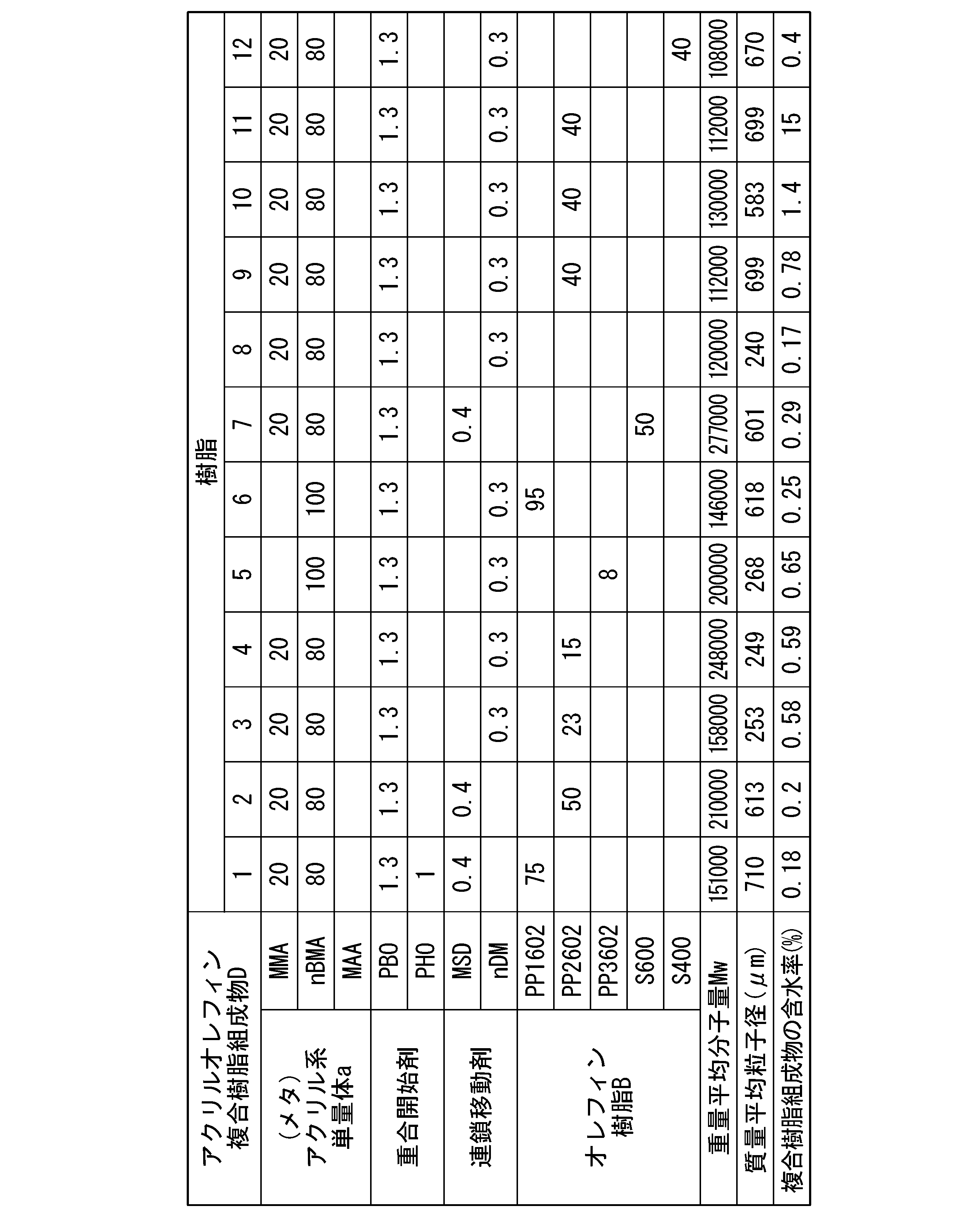
MMA:メチルメタクリレート(三菱ケミカル(株)製、アクリエステルM)
nBMA:n-ブチルメタクリレート(三菱ケミカル(株)製、アクリエステルB)
MAA:メタクリル酸(三菱ケミカル(株)製、メタクリル酸)
PBO:t-ブチルパーオキシ-2-エチルヘキサノエート(日本油脂(株)製、パーブチルO)
PHO:t-ヘキシルパーオキシ-2-エチルヘキサノエート(日本油脂(株)製、パーヘキシルO)
MSD:α-メチルスチレンダイマー(日本油脂(株)製、ノフマーMSD)
nDM:n-ドデシルメルカプタン(関東化学(株)製、1-ドデカンチオール)
PP1602:エチレン-プロピレン共重合樹脂(クラリアント(株)製、LICOCENE PP1602)
PP2602:エチレン-プロピレン共重合樹脂(クラリアント(株)製、LICOCENE PP2602)
PP3602:エチレン-プロピレン共重合樹脂(クラリアント(株)製、LICOCENE PP3602)
S600:ポリプロピレン(出光興産(株)製、L-MODU S600)
S400:ポリプロピレン(出光興産(株)製、L-MODU S400)
以下の方法に従って、樹脂組成物の貯蔵安定性及びポリオレフィン基材への接着性を評価した。
結果を表2~3に示す。
撹拌機、冷却管及び温度計を備えた200mLフラスコ容器中に、表2~3に示す量の樹脂と初期溶剤を加え25℃で撹拌した。得られた配合液中に肥大粒子がなくなったことを確認した後、追加溶剤Aもしくは樹脂が溶解した追加溶剤Bを投入し25℃で10分撹拌した。その後、撹拌を止めて組成物の初期状態の外観が分散状態か透明状態かを確認し、24時間静置した。そして得られたフラスコ容器内の反応溶液の24時間後の外観を以下評価基準で目視評価した。
(評価基準)
A:変化なし
B:流動性は低いが、二層分離なく、実用上問題ないレベル
C:二層分離ないが、流動性が悪く、使用できないレベル
D:ともに流動性がある二層に分離し、貯蔵安定性に劣る
E:一方が流動性のない層からなる二層に分離し、貯蔵安定性に劣る
(実施例1~18)
硬質アルミ箔(竹内金属箔工業(株)製、A1N30H-H18)に、塩化ビニル酢酸ビニル共重合体(WACKER(株)製、VINNOL H15/45M)のメチルエチルケトン20%樹脂液を、バーコーターで乾燥後の厚みが1μmになるように塗工し、80℃で1分乾燥して硬質アルミ箔の表面をプライマー処理した。硬質アルミ箔のプライマー面に、溶剤への溶解性の評価で作成した直後の樹脂液を、バーコーターで乾燥後の厚みが5μmになるように塗工し、180℃で3分乾燥した。CPPフィルム(三菱ケミカル(株)製 スーパーホイルE0025NA)を塗工面に重ね合わせ、ヒートシールテスター(テスター産業(株)製、TP-701)を用いて180℃、0.5kgf/cm2で2秒間シールした。シールされた箇所を幅15mmに切り出し、引張試験機(島津製作所製、小型卓上試験機EZ)を用いて、250mm/分の速度で180°の方向へ引っ張り、剥離強度(単位:N/15mm)を測定し、以下の評価基準で評価した。
硬質アルミ箔(竹内金属箔工業(株)製、A1N30H-H18)に、溶剤への溶解性の評価で作成した直後の樹脂液を、バーコーターで乾燥後の厚みが5μmになるように塗工し、180℃で3分乾燥した。CPPフィルム(三菱ケミカル(株)製 スーパーホイルE0025NA)を塗工面に重ね合わせ、ヒートシールテスター(テスター産業(株)製、TP-701)を用いて180℃、0.5kgf/cm2で2秒間シールした。シールされた箇所を幅15mmに切り出し、引張試験機(島津製作所製、小型卓上試験機EZ)を用いて、250mm/分の速度で180°の方向へ引っ張り、剥離強度(単位:N/15mm)を測定し、以下の評価基準で評価した。
A:8以上
B:5以上8未満
C:1以上5未満
D:1未満


Claims (21)
- アクリルオレフィン複合樹脂Cを含むアクリルオレフィン複合樹脂組成物Dであって、
前記アクリルオレフィン複合樹脂Cが、(メタ)アクリル系単量体a由来の構成単位及びオレフィン樹脂B由来の構造を含み、
含水率が0.01質量%以上10質量%以下である、アクリルオレフィン複合樹脂組成物D。 - 前記(メタ)アクリル系単量体a由来の構成単位を含むアクリル樹脂A、及び
前記オレフィン樹脂Bをさらに含む、請求項1に記載のアクリルオレフィン複合樹脂組成物D。 - 粒子状である、請求項1又は2に記載のアクリルオレフィン複合樹脂組成物D。
- 質量平均粒子径が10μm以上2500μm以下である、請求項3に記載のアクリルオレフィン複合樹脂組成物D。
- 前記オレフィン樹脂Bがエチレン-プロピレン共重合体及びポリプロピレンの少なくとも一方を含む、請求項1~4のいずれか一項に記載のアクリルオレフィン複合樹脂組成物D。
- 前記(メタ)アクリル系単量体a由来の構成単位の合計質量に対する、前記オレフィン樹脂Bを構成する全ての単量体由来の構成単位の合計質量の質量割合が1~100%である、請求項1~5のいずれか一項に記載のアクリルオレフィン複合樹脂組成物D。
- 請求項1~6のいずれか一項に記載のアクリルオレフィン複合樹脂組成物Dを含む非水系樹脂組成物E。
- 有機溶剤をさらに含む、請求項7に記載の非水系樹脂組成物E。
- 前記有機溶剤が、溶解度パラメーター(SP値)が8.0以下の有機溶剤及びSP値が9.2以上の有機溶剤を含む、請求項8に記載の非水系樹脂組成物E。
- 前記有機溶剤の合計質量に対して、前記SP値が8.0以下の有機溶剤を5質量%以上80質量%以下含み、
前記有機溶剤の合計質量に対して、前記SP値が9.2以上の有機溶剤を10質量%以上70質量%以下含む、請求項9に記載の非水系樹脂組成物E。 - 前記SP値が8.0以下の有機溶剤がシクロアルカン構造を有する化合物を含む、請求項9又は10に記載の非水系樹脂組成物E。
- 前記SP値が9.2以上の有機溶剤がケトン系溶剤を含む、請求項9~11のいずれか一項に記載の非水系樹脂組成物E。
- 請求項7~12のいずれか一項に記載の非水系樹脂組成物Eの製造方法であって、
請求項1~6のいずれか一項に記載のアクリルオレフィン複合樹脂組成物Dと、SP値が9.2未満の有機溶剤を50質量%以上含む有機溶剤とを混合し、前記アクリルオレフィン複合樹脂組成物Dと前記SP値が9.2以上の有機溶剤とを共存させることを含む、非水系樹脂組成物Eの製造方法。 - (メタ)アクリル系単量体a由来の構成単位及びオレフィン樹脂B由来の構造を有するアクリルオレフィン複合樹脂Cを含むアクリルオレフィン複合樹脂組成物Dの製造方法であって、
前記オレフィン樹脂B存在下、前記(メタ)アクリル系単量体aを懸濁重合することを含む、アクリルオレフィン複合樹脂組成物Dの製造方法。 - 請求項1~6のいずれか一項に記載のアクリルオレフィン複合樹脂組成物Dを含むコーティング組成物。
- 請求項1~6のいずれか一項に記載のアクリルオレフィン複合樹脂組成物Dを含むインキ組成物。
- 請求項1~6のいずれか一項に記載のアクリルオレフィン複合樹脂組成物Dを含む接着剤組成物。
- 請求項1~6のいずれか一項に記載のアクリルオレフィン複合樹脂組成物Dを含むフィルムもしくは成形材。
- 請求項7~12のいずれか一項に記載の非水系樹脂組成物Eを含むコーティング組成物。
- 請求項7~12のいずれか一項に記載の非水系樹脂組成物Eを含むインキ組成物。
- 請求項7~12のいずれか一項に記載の非水系樹脂組成物Eを含む接着剤組成物。
Priority Applications (2)
| Application Number | Priority Date | Filing Date | Title |
|---|---|---|---|
| CN202280007955.2A CN116583563A (zh) | 2021-03-16 | 2022-01-27 | 丙烯酸烯烃复合树脂组合物、非水系树脂组合物、非水系树脂组合物的制造方法、丙烯酸烯烃复合树脂组合物的制造方法、涂布组合物、油墨组合物、粘接剂组合物、膜及成型材料 |
| JP2023506824A JP7559925B2 (ja) | 2021-03-16 | 2022-01-27 | アクリルオレフィン複合樹脂組成物、非水系樹脂組成物、非水系樹脂組成物の製造方法、アクリルオレフィン複合樹脂組成物の製造方法、コーティング組成物、インキ組成物、接着剤組成物、フィルム及び成形材 |
Applications Claiming Priority (2)
| Application Number | Priority Date | Filing Date | Title |
|---|---|---|---|
| JP2021-042195 | 2021-03-16 | ||
| JP2021042195 | 2021-03-16 |
Publications (1)
| Publication Number | Publication Date |
|---|---|
| WO2022196121A1 true WO2022196121A1 (ja) | 2022-09-22 |
Family
ID=83320288
Family Applications (1)
| Application Number | Title | Priority Date | Filing Date |
|---|---|---|---|
| PCT/JP2022/003079 Ceased WO2022196121A1 (ja) | 2021-03-16 | 2022-01-27 | アクリルオレフィン複合樹脂組成物、非水系樹脂組成物、非水系樹脂組成物の製造方法、アクリルオレフィン複合樹脂組成物の製造方法、コーティング組成物、インキ組成物、接着剤組成物、フィルム及び成形材 |
Country Status (3)
| Country | Link |
|---|---|
| JP (1) | JP7559925B2 (ja) |
| CN (1) | CN116583563A (ja) |
| WO (1) | WO2022196121A1 (ja) |
Citations (3)
| Publication number | Priority date | Publication date | Assignee | Title |
|---|---|---|---|---|
| JPS59187012A (ja) * | 1983-04-06 | 1984-10-24 | Toray Ind Inc | 熱可塑性樹脂の製造方法 |
| JP2004067729A (ja) * | 2002-08-01 | 2004-03-04 | Mitsubishi Chemicals Corp | プロピレン系共重合体、それを含む組成物及び接着剤 |
| JP2004269866A (ja) * | 2003-02-18 | 2004-09-30 | Mitsubishi Chemicals Corp | プロピレン系重合体類を含むコーティング組成物及び使用方法 |
Family Cites Families (3)
| Publication number | Priority date | Publication date | Assignee | Title |
|---|---|---|---|---|
| JPH0710935A (ja) * | 1993-06-25 | 1995-01-13 | Kanegafuchi Chem Ind Co Ltd | グラフト共重合体及び該グラフト共重合体を含有してなるポリオレフィン系樹脂組成物 |
| DE102009001886A1 (de) * | 2009-03-26 | 2010-10-07 | Evonik Degussa Gmbh | Haftvermittler zum Beschichten von Polyolefin-Oberflächen basierend auf Polyolefin-graft-poly(meth)acrylat Copolymeren |
| JP6293778B2 (ja) * | 2013-11-05 | 2018-03-14 | 三井化学株式会社 | 変性プロピレン・α−オレフィン共重合体とその製造方法、それを含むコーティング材、成形用樹脂組成物およびホットメルト組成物 |
-
2022
- 2022-01-27 WO PCT/JP2022/003079 patent/WO2022196121A1/ja not_active Ceased
- 2022-01-27 JP JP2023506824A patent/JP7559925B2/ja active Active
- 2022-01-27 CN CN202280007955.2A patent/CN116583563A/zh active Pending
Patent Citations (3)
| Publication number | Priority date | Publication date | Assignee | Title |
|---|---|---|---|---|
| JPS59187012A (ja) * | 1983-04-06 | 1984-10-24 | Toray Ind Inc | 熱可塑性樹脂の製造方法 |
| JP2004067729A (ja) * | 2002-08-01 | 2004-03-04 | Mitsubishi Chemicals Corp | プロピレン系共重合体、それを含む組成物及び接着剤 |
| JP2004269866A (ja) * | 2003-02-18 | 2004-09-30 | Mitsubishi Chemicals Corp | プロピレン系重合体類を含むコーティング組成物及び使用方法 |
Also Published As
| Publication number | Publication date |
|---|---|
| JPWO2022196121A1 (ja) | 2022-09-22 |
| CN116583563A (zh) | 2023-08-11 |
| JP7559925B2 (ja) | 2024-10-02 |
Similar Documents
| Publication | Publication Date | Title |
|---|---|---|
| KR101354871B1 (ko) | 수지 분산체, 도료, 적층체 및 그 제조 방법 | |
| CN106574052B (zh) | 水性树脂分散体、涂料、粘合剂和层叠体 | |
| CN102352045A (zh) | 水性树脂分散体的制造方法 | |
| WO2015068385A1 (ja) | 変性プロピレン・α-オレフィン共重合体とその製造方法、それを含むコーティング材、成形用樹脂組成物およびホットメルト組成物 | |
| EP2138547B1 (en) | Resin composition for aqueous coating material, method for producing the same, and aqueous coating material | |
| WO2012086737A1 (ja) | 組成物 | |
| WO2022054727A1 (ja) | ポリオレフィン系塗料組成物 | |
| WO2024106431A1 (ja) | ポリオレフィン系塗料組成物及びプライマー塗料 | |
| CN111433272B (zh) | 水性树脂分散体、水性树脂分散体的制造方法、水性涂料、粘合剂 | |
| JP2019131716A (ja) | 非水系印刷インキ用樹脂組成物 | |
| JP6794775B2 (ja) | インキ組成物及び塗膜 | |
| JP7559925B2 (ja) | アクリルオレフィン複合樹脂組成物、非水系樹脂組成物、非水系樹脂組成物の製造方法、アクリルオレフィン複合樹脂組成物の製造方法、コーティング組成物、インキ組成物、接着剤組成物、フィルム及び成形材 | |
| JP2024177221A (ja) | 水系樹脂分散体、前記水系樹脂分散体を原料とする組成物、前記組成物の乾燥物を含む積層体 | |
| WO2024106348A1 (ja) | ポリオレフィン系塗料組成物及びプライマー塗料 | |
| JP7815863B2 (ja) | 重合体組成物、接着剤及び積層体 | |
| JP2018070723A (ja) | 樹脂組成物 | |
| JP2022114088A (ja) | グラフト変性体およびコーティング材 | |
| WO2023182275A1 (ja) | 非水ディスパージョン組成物、接着剤組成物、ヒートシールラッカー、及びコーティング組成物 | |
| CN118829684A (zh) | 非水分散体组合物、粘接剂组合物、热封漆和涂覆组合物 | |
| JP2025152280A (ja) | 非水ディスパージョン組成物、接着剤組成物、ヒートシールラッカー、及びコーティング組成物 | |
| JP2024120352A (ja) | 組成物、塗膜及び積層体 | |
| JP2004131565A (ja) | 水性樹脂組成物及び水性塗料 | |
| EP4341312A1 (en) | Aqueous dispersion comprising polymer particles useful in heat sealing applications | |
| JP2025146389A (ja) | 樹脂分散体、塗料、接着剤及び積層体 | |
| DE19707137A1 (de) | Kunststoffolie, ihre Verwendung in Verfahren zur Herstellung von Verpackungsbehältern, die so hergestellten Verpackungsbehälter sowie die Verwendung von wäßrigen Lacken zur Beschichtung von Kunststoffolien für die Herstellung von Verpackungsbehältern |
Legal Events
| Date | Code | Title | Description |
|---|---|---|---|
| 121 | Ep: the epo has been informed by wipo that ep was designated in this application |
Ref document number: 22770883 Country of ref document: EP Kind code of ref document: A1 |
|
| ENP | Entry into the national phase |
Ref document number: 2023506824 Country of ref document: JP Kind code of ref document: A |
|
| WWE | Wipo information: entry into national phase |
Ref document number: 202280007955.2 Country of ref document: CN |
|
| WWE | Wipo information: entry into national phase |
Ref document number: 202317040066 Country of ref document: IN |
|
| NENP | Non-entry into the national phase |
Ref country code: DE |
|
| 122 | Ep: pct application non-entry in european phase |
Ref document number: 22770883 Country of ref document: EP Kind code of ref document: A1 |