WO2022195313A1 - 情報処理装置及び情報処理方法 - Google Patents
情報処理装置及び情報処理方法 Download PDFInfo
- Publication number
- WO2022195313A1 WO2022195313A1 PCT/IB2021/000183 IB2021000183W WO2022195313A1 WO 2022195313 A1 WO2022195313 A1 WO 2022195313A1 IB 2021000183 W IB2021000183 W IB 2021000183W WO 2022195313 A1 WO2022195313 A1 WO 2022195313A1
- Authority
- WO
- WIPO (PCT)
- Prior art keywords
- accuracy
- information processing
- vehicle
- waiting
- user
- Prior art date
- Legal status (The legal status is an assumption and is not a legal conclusion. Google has not performed a legal analysis and makes no representation as to the accuracy of the status listed.)
- Ceased
Links
Images


Classifications
-
- G—PHYSICS
- G06—COMPUTING OR CALCULATING; COUNTING
- G06Q—INFORMATION AND COMMUNICATION TECHNOLOGY [ICT] SPECIALLY ADAPTED FOR ADMINISTRATIVE, COMMERCIAL, FINANCIAL, MANAGERIAL OR SUPERVISORY PURPOSES; SYSTEMS OR METHODS SPECIALLY ADAPTED FOR ADMINISTRATIVE, COMMERCIAL, FINANCIAL, MANAGERIAL OR SUPERVISORY PURPOSES, NOT OTHERWISE PROVIDED FOR
- G06Q50/00—Information and communication technology [ICT] specially adapted for implementation of business processes of specific business sectors, e.g. utilities or tourism
- G06Q50/40—Business processes related to the transportation industry
- G06Q50/43—Business processes related to the sharing of vehicles, e.g. car sharing
- G06Q50/47—Passenger ride requests, e.g. ride-hailing
-
- G—PHYSICS
- G01—MEASURING; TESTING
- G01C—MEASURING DISTANCES, LEVELS OR BEARINGS; SURVEYING; NAVIGATION; GYROSCOPIC INSTRUMENTS; PHOTOGRAMMETRY OR VIDEOGRAMMETRY
- G01C21/00—Navigation; Navigational instruments not provided for in groups G01C1/00 - G01C19/00
- G01C21/26—Navigation; Navigational instruments not provided for in groups G01C1/00 - G01C19/00 specially adapted for navigation in a road network
- G01C21/34—Route searching; Route guidance
- G01C21/3407—Route searching; Route guidance specially adapted for specific applications
- G01C21/3438—Rendezvous; Ride sharing
-
- G—PHYSICS
- G06—COMPUTING OR CALCULATING; COUNTING
- G06Q—INFORMATION AND COMMUNICATION TECHNOLOGY [ICT] SPECIALLY ADAPTED FOR ADMINISTRATIVE, COMMERCIAL, FINANCIAL, MANAGERIAL OR SUPERVISORY PURPOSES; SYSTEMS OR METHODS SPECIALLY ADAPTED FOR ADMINISTRATIVE, COMMERCIAL, FINANCIAL, MANAGERIAL OR SUPERVISORY PURPOSES, NOT OTHERWISE PROVIDED FOR
- G06Q50/00—Information and communication technology [ICT] specially adapted for implementation of business processes of specific business sectors, e.g. utilities or tourism
- G06Q50/40—Business processes related to the transportation industry
-
- G—PHYSICS
- G08—SIGNALLING
- G08G—TRAFFIC CONTROL SYSTEMS
- G08G1/00—Traffic control systems for road vehicles
-
- G—PHYSICS
- G08—SIGNALLING
- G08G—TRAFFIC CONTROL SYSTEMS
- G08G1/00—Traffic control systems for road vehicles
- G08G1/005—Traffic control systems for road vehicles including pedestrian guidance indicator
-
- G—PHYSICS
- G08—SIGNALLING
- G08G—TRAFFIC CONTROL SYSTEMS
- G08G1/00—Traffic control systems for road vehicles
- G08G1/09—Arrangements for giving variable traffic instructions
- G08G1/0962—Arrangements for giving variable traffic instructions having an indicator mounted inside the vehicle, e.g. giving voice messages
- G08G1/0968—Systems involving transmission of navigation instructions to the vehicle
-
- H—ELECTRICITY
- H04—ELECTRIC COMMUNICATION TECHNIQUE
- H04W—WIRELESS COMMUNICATION NETWORKS
- H04W4/00—Services specially adapted for wireless communication networks; Facilities therefor
- H04W4/02—Services making use of location information
- H04W4/024—Guidance services
Definitions
- the present invention relates to an information processing device and an information processing method.
- a place that the user can reach most easily from the user's current location (for example, a place with the shortest required time or required distance) is selected as the boarding place. set. Therefore, when the accuracy of the user's position is low, there is a problem that a place that the user cannot easily reach may be set as the boarding place.
- the present invention has been made in view of the above problems, and sets a place that the user can easily reach as a waiting point where the user and the vehicle to be dispatched meet even when the accuracy of the user's position is low. It is an object of the present invention to provide an information processing apparatus and an information processing method that can
- an information processing apparatus and an information processing method determine a vehicle to be dispatched to a user based on a dispatch request from an information terminal operated by the user.
- the accuracy of the position of the information terminal is calculated based on the position data indicating the position, a waiting point as a candidate for the meeting point between the user and the vehicle is extracted based on the position data, and the waiting point is transmitted to the information terminal.
- the number of waiting points extracted when the accuracy is low is larger than the number of waiting points extracted when the accuracy is high.
- the present invention even if the accuracy of the user's position is low, it is possible to set a place that the user can easily reach as a waiting point where the user and the dispatched vehicle meet.
- FIG. 1 is a block diagram showing the configuration of an information processing system according to one embodiment of the present invention.
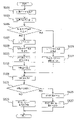
- FIG. 2 is a flow chart showing processing of the information processing system according to one embodiment of the present invention.
- FIG. 3 is a sequence chart illustrating an operation example of the information processing system according to one embodiment of the present invention.
- FIG. 1 is a block diagram showing the configuration of an information processing system according to one embodiment of the present invention.
- the information processing system includes a terminal 100 (information terminal), a server 200, and a vehicle 300, which are connected to each other via a wireless or wired network 400.
- FIG. 1 is a block diagram showing the configuration of an information processing system according to one embodiment of the present invention.
- the information processing system includes a terminal 100 (information terminal), a server 200, and a vehicle 300, which are connected to each other via a wireless or wired network 400.
- FIG. 1 is a block diagram showing the configuration of an information processing system according to one embodiment of the present invention.
- the information processing system includes a terminal 100 (information terminal), a server 200, and a vehicle 300, which are connected to each other via a wireless or wired network 400.
- FIG. 1 is a block diagram showing the configuration of an information processing system according to one embodiment of the present invention.
- the information processing system includes a terminal 100 (information terminal), a server 200, and
- the network 400 is, for example, the Internet.
- the network 400 may utilize mobile communication capabilities such as 4G/LTE and 5G.
- the terminal 100 accepts the user's operation and transmits information regarding the accepted operation to the network 400 .
- the terminal 100 may transmit a vehicle allocation request to the network 400 based on the user's operation.
- a portable terminal smarttphone, tablet, etc.
- a user on a daily basis can be used as the terminal 100.
- the vehicle 300 is a vehicle that provides a means of transportation to a destination specified by the user, and includes, for example, a self-driving vehicle.
- the vehicle 300 includes various means of transportation such as manned/unmanned taxis, buses, and trucks.
- a plurality of vehicles may be registered in the information processing system.
- the vehicle 300 may transmit vehicle information of the vehicle 300 at a predetermined timing or at a predetermined cycle, or transmit vehicle information of the vehicle 300 based on commands from the terminal 100 or the server 200. may be
- the server 200 generates information related to the meeting of the user and the vehicle to be dispatched to the user.
- the server 200 may be installed in an external server (not shown) that provides a dispatch service, or may be installed in the terminal 100 or the vehicle 300 .
- the terminal 100, the server 200, and the vehicle 300 can communicate bidirectionally with each other via the network 400.
- the terminal 100 (information terminal) will be described.
- the terminal 100 includes a sensor 150, a display section 160, an operation section 170, a communication section 110, and a controller .
- the sensor 150 is made up of a plurality of sensor groups and includes a position detection sensor that acquires position data indicating the position of the terminal 100 .
- the position detection sensor is a sensor that measures an absolute position, such as GPS (Global Positioning System).
- the position detection sensor may be a sensor that measures an absolute position by a technique such as Wi-Fi (registered trademark) positioning, RFID (Radio Frequency Identifier) positioning, beacon positioning, or the like.
- the position data may include error data indicating the position error of the terminal 100 .
- error means the magnitude of the difference between the position of terminal 100 specified by position data and the actual position of terminal 100 .
- the position detection sensor is a sensor that measures the absolute position using GPS
- the error in the position of the terminal 100 can be calculated based on the reception status of GPS radio waves.
- the sensor 150 may calculate error data based on the reception status of GPS radio waves (DOP value (Dilution of Precision), number of supplementary satellites, etc.).
- the error of the position of the terminal 100 is calculated based on the reference signal strength, the number of signals, etc. be able to.
- the sensor 150 may calculate the error data based on the intensity of the reference signal, the number of signals, and the like.
- the position data may include, as supplementary data, data such as the reception status of GPS radio waves used to output the error data, the strength of the reference signal, and the number of signals.
- the display unit 160 displays information about the meeting point with the vehicle 300. Further, the display unit 160 may display guidance information for guiding the movement of the user to the waiting point. In addition, the display unit 160 may display information on the vehicle 300 and information on the travel route of the vehicle 300 . The movement route information and the guidance information for guiding the movement of the user may be acquired from the server 200 via the network 400 by the communication unit 110, which will be described later.
- the display unit 160 is not limited to presenting various types of information as visual information.
- the display unit 160 may present information to the user using auditory information, or may present information to the user by generating vibration and stimulating the user with the vibration.
- the operation unit 170 receives user operations corresponding to various commands from the user to the information processing system.
- the operation unit 170 may be an input interface with a plurality of buttons, or a touch panel with a touch interface.
- the display unit 160 displays icons represented by pictures or symbols so that the user can operate them. may be accepted.
- the communication unit 110 transmits and receives information to and from the network 400.
- the communication unit 110 stores information acquired from the network 400 in a memory (not shown) or the like, and outputs predetermined information such as a dispatch request generated based on user's operation and position data to the network 400 .
- the communication unit 110 may be a device with a mobile communication function such as 4G/LTE or 5G, or a device with a Wifi communication function.
- the controller 130 is connected to the sensor 150, the display unit 160, the operating unit 170, and the communication unit 110. Information is input to the controller 130 from the sensor 150, the operating unit 170, and the communication unit 110. Information is output to the display unit 160 and the communication unit 110 .
- controller 130 is a general-purpose microcomputer that includes a CPU (Central Processing Unit), memory, and an input/output unit.
- a computer program (information terminal program) for functioning as part of the information processing system is installed in the controller 130 .
- controller 130 controls display unit 160 and communication unit 110 .
- controller 130 may be realized by software, or may be realized by dedicated hardware.
- the controller 130 generates a request to an external server that provides a vehicle dispatch service or an information processing system based on the user's operation on the operation unit 170 .
- the request may include specification of the destination to which the vehicle 300 is headed and the estimated time of arrival at the destination.
- the request may also include a specification of the scheduled departure time at which the vehicle 300 departs.
- the server 200 includes a communication unit 210 (communication means), a database 220, and a controller 230.
- the communication unit 210 transmits and receives information to and from the network 400 .
- the communication unit 210 acquires predetermined information from the network 400 , such as a dispatch request and position data transmitted from the terminal 100 and vehicle information transmitted from the vehicle 300 , and records the acquired information in the database 220 .
- the database 220 stores the information acquired by the communication unit 210.
- the database 220 may store points where the vehicle can stop and past position data of the user.
- the controller 230 is a general-purpose microcomputer equipped with a CPU (central processing unit), memory, and input/output unit.
- a computer program (information processing server program) is installed in the controller 230 to function as part of the information processing system. By executing a computer program, the controller 230 functions as a plurality of information processing circuits (231, 233, 235, 237, 239).
- the controller 230 includes an accuracy calculation unit 231, a dispatch vehicle determination unit 233, a waiting point extraction unit 235, a route calculation unit 237, and a waiting plan setting unit 239 as a plurality of information processing circuits (231, 233, 235, 237, 239). Prepare.
- the accuracy calculation unit 231 calculates the accuracy of the location of the terminal 100 based on the location data transmitted from the terminal 100. Specifically, the accuracy of the position of terminal 100 is calculated based on error data or supplementary data included in the position data.
- “high accuracy” means that the positional error of the terminal 100 is small.
- “low accuracy” means that the positional error of the terminal 100 is large.
- the accuracy calculation unit 231 may calculate that the smaller the error indicated by the error data, the higher the accuracy of the position of the terminal 100 .
- the accuracy calculation unit 231 refers to the reception status of GPS radio waves obtained as supplementary data, and calculates the accuracy of the position of the terminal 100 as the smaller the DOP value or the larger the number of supplementary satellites, the higher the accuracy. can be anything.
- the accuracy calculation unit 231 may calculate the accuracy of the position of the terminal 100 as higher as the intensity of the reference signal is higher or as the number of signals is larger.
- the accuracy calculation unit 231 may calculate the accuracy of the position of the terminal 100 as being low when the reception condition of radio waves used to determine the position of the terminal 100 is poor. Conversely, when the radio wave reception condition used to determine the position of the terminal 100 is good, the accuracy of the position of the terminal 100 may be calculated as high.
- the accuracy of the position of the terminal 100 may be calculated assuming that it is low.
- the predetermined time and the timing of acquiring the position data are arbitrarily determined.
- the dispatched vehicle determination unit 233 determines the vehicle dispatched to the user from among the plurality of vehicles 300 based on the dispatch request transmitted from the terminal 100 . Known methods can be used to determine the vehicle to be dispatched based on the dispatch request. In addition, the dispatched vehicle determination unit 233 may acquire information on a vehicle dispatched to the user from an external server (not shown) that provides a dispatch service.
- the waiting point extraction unit 235 extracts waiting points, which are candidates for meeting points for the user and the vehicle to be dispatched to the user, based on the position data.
- the number of waiting points extracted by the waiting point extraction unit 235 when the accuracy is low is greater than the number of waiting points extracted when the accuracy is high.
- the waiting point extraction unit 235 sets an area for extracting the waiting point based on the position data transmitted from the terminal 100 .
- a range within a predetermined distance from the position of the terminal 100 indicated by the position data, or a range within which the user can move within a predetermined period of time is set as an area for extracting waiting points. Then, from the points registered in advance in the database 220 where the vehicle can stop, points included in the area are extracted as waiting points.
- the predetermined distance may be determined by the distance that the user can move
- the predetermined time may be determined by the time that the user can move.
- the position of the terminal 100 indicated by the position data may fluctuate by an error in the position of the terminal 100 due to the position measurement by the position acquisition sensor. Therefore, a wider area is set when the accuracy is low compared to the area set when the accuracy is high. For example, when the accuracy is low, the predetermined distance or the predetermined time may be set larger than the predetermined distance or the predetermined time determined when the accuracy is high.
- the waiting point extraction unit 235 extracts a waiting point so as to include a plurality of positions indicated by a plurality of position data acquired within a predetermined time. area may be set.
- the waiting point extraction unit 235 also determines whether or not the accuracy calculated by the accuracy calculation unit 231 has been updated. It may be one that reduces the area for.
- the waiting point extraction unit 235 requests input of the position data. It may also generate an input request for the user. The generated input request is transmitted to terminal 100 via communication unit 210 .
- the position data input by the user to the terminal 100 in response to the input request is transmitted to the server 200 via the communication unit 110 and presented to the user.
- the waiting point extraction unit 235 may set an area for extracting the waiting point based on the position indicated by the position data input by the user.
- the waiting point extraction unit 235 can find the user most easily from the position of the terminal 100. It may be one that extracts a waiting point that can be reached.
- the case where the calculated accuracy is sufficiently high means, for example, the case where the accuracy is higher than a predetermined threshold.
- the waiting point that the user can reach most easily means, for example, the waiting point that requires the shortest time or distance to travel from the user's position to the waiting point.
- the waiting point extraction unit 235 may generate a selection request asking the user to select one waiting point from among the plurality of waiting points when there are multiple extracted waiting points.
- the generated input request is transmitted to the terminal 100 via the communication unit 210 and presented to the user.
- the waiting point selected by the user is transmitted to the server 200 via the communication unit 110 in response to the selection request.
- the waiting point extraction unit 235 may generate a message indicating that multiple waiting points have been extracted due to low accuracy of the position of the terminal 100 when there are multiple waiting points extracted. .
- the generated message is transmitted to the terminal 100 via the communication unit 210 and presented to the user. As a result, it can be expected that the user will move to a place where the position of the terminal 100 is highly accurate (for example, a place where the radio wave reception condition used to determine the position of the terminal 100 is good) according to the message.
- the route calculation unit 237 calculates a route for traveling from the position of the dispatched vehicle to the waiting point for each waiting point extracted by the waiting point extracting unit 235 .
- the route calculation unit 237 calculates a route based on map information or the like.
- a known method can be used as a method of calculating the route.
- the route calculation unit 237 calculates a branch point where the calculated routes diverge from each other, and sets the branch point as the destination of the vehicle. There may be.
- the calculation of the branch point will be described in detail.
- the route calculated for each waiting point by the route calculating unit 237 starts at the position of the dispatched vehicle and ends at the waiting point. Therefore, when a plurality of different waiting points are extracted by the accuracy calculation unit 231, the plurality of routes calculated by the route calculation unit 237 have a common start point and a plurality of different end points.
- the multiple routes calculated by the route calculation unit 237 have a common portion with the position of the dispatched vehicle as one end.
- the route calculation unit 237 extracts a common portion whose one end is the position of the dispatched vehicle from among the calculated routes, and calculates the other end of the common portion as a branch point.
- the multiple routes calculated by the route calculation unit 237 differ in the portion from the branch point to the waiting point.
- the number of waiting points extracted when the accuracy of the user's position is low (for example, when the user is located underground where the communication than the number of waiting points extracted in the case where the user is located on the ground, which is a good place. Therefore, when the accuracy of the user's position is low, the vehicle dispatched to the user cannot narrow down the number of waiting points to which it should go.
- the vehicle it is desirable for the vehicle to wait until the accuracy of the user's position changes from low to high and the number of waiting points can be narrowed down.
- the vehicle dispatched to the user cannot start traveling until the number of waiting points can be narrowed down, the arrival of the vehicle at the waiting point to meet the user may be delayed. .
- the route calculation unit 237 can drive the vehicle to the branch point and move to the user's surrounding area. As a result, it is possible to reduce the possibility that the vehicle will arrive late at the waiting point where the user is to meet.
- the route calculation unit 237 updates the branch point, and updates the branch point after the update.
- a point may be reset as a destination.
- the route calculation unit 237 sets the waiting point as the destination.
- the route calculation unit 237 may calculate the arrival time of the vehicle at the calculated branch point and the arrival time of the vehicle at each waiting point based on the calculated route.
- the arrival time of the vehicle at the junction and the arrival time of the vehicle at each waiting point are transmitted to the terminal 100 via the communication unit 210 and presented to the user.
- the waiting plan setting unit 239 determines whether or not the vehicle needs to wait until the vehicle reaches the destination after the route calculation unit 237 sets the destination (branch point or waiting point). do. Then, when it is determined that the vehicle needs to wait, the standby plan setting unit 239 generates a travel plan (standby plan) for causing the vehicle to wait.
- the waiting plan setting unit 239 determines that the vehicle needs to wait when there are multiple waiting points extracted by the waiting point extracting unit 235 . On the other hand, if there is only one waiting point extracted by the waiting point extraction unit 235, it is determined that the vehicle does not need to wait.
- the standby plan setting unit 239 may determine that the vehicle needs to wait when the accuracy calculated by the accuracy calculation unit 231 is less than a predetermined threshold.
- the waiting plan setting unit 239 calculates the arrival time at which the user arrives at the waiting point based on the position information of the terminal 100, and calculates the arrival time at which the user arrives at the waiting point before the arrival time at which the vehicle arrives at the waiting point. When the time is later, it may be determined that the vehicle needs to wait.
- the standby plan setting unit 239 extracts standby points located around the destination (branch point or waiting point) and generates a standby plan to temporarily stop the vehicle at the standby points.
- the waiting plan setting unit 239 extracts, as a waiting point, a point located within a predetermined distance from the destination from among the points at which the vehicle can stop registered in the database 220 in advance. good too.
- the standby point may be on the route calculated by the route calculation unit 237, or may be a point away from the route.
- the waiting plan setting unit 239 may correct the route calculated by the route calculating unit 237 to calculate a route from the position of the dispatched vehicle to the destination via the waiting point. .
- the waiting plan setting unit 239 instead of generating a waiting plan to temporarily stop the vehicle at the waiting point, creates a migratory route that returns to the destination after passing through the destination (passing through without stopping at the destination). and generate a waiting plan for repeatedly driving the vehicle on the excursion route.
- the excursion route may be a route included in a range within a predetermined distance from the destination.
- the calculated waiting point and the route passing through the waiting point or the calculated excursion route are transmitted to the dispatched vehicle via the communication unit 210, and the vehicle transmits the route passing through the waiting point or the excursion route. It may be controlled to run along.
- the calculated waiting point and the route passing through the waiting point, or the calculated excursion route may be transmitted to the terminal 100 via the communication unit 210 and presented to the user.
- FIG. 2 is a flow chart showing processing of the information processing system according to one embodiment of the present invention.
- FIG. 3 is a sequence chart illustrating an operation example of the information processing system according to one embodiment of the present invention.
- the processing of the flowchart shown in FIG. 2 is started after the vehicle to be dispatched to the user is determined based on the dispatch request, and is repeatedly executed at a predetermined cycle until the vehicle stops at the waiting point.
- step S301 the terminal 100 generates position data, and the position data is transmitted from the terminal 100 to the server 200. Then, in step S ⁇ b>101 , the accuracy calculation unit 231 acquires position data indicating the position of the terminal 100 .
- step S103 the accuracy calculation unit 231 calculates the accuracy of the position of the terminal 100 based on the position data.
- step S105 the waiting point extraction unit 235 determines whether the accuracy calculated by the accuracy calculation unit 231 is equal to or greater than a predetermined threshold.
- step S107 the waiting point extraction unit 235 extracts the waiting point based on the position data transmitted from the terminal 100. set an area for
- step S109 the waiting point extraction unit 235 extracts a plurality of points included in the area from among the points where the vehicle can stop as waiting points. Then, in step S111, the route calculation unit 237 calculates a route for traveling from the position of the dispatched vehicle to the waiting point for each of the extracted waiting points.
- step S113 the waiting point extraction unit 235 calculates branch points at which the calculated routes diverge from each other.
- step S115 the waiting point extraction unit 235 extracts the waiting point that the user can most easily reach from the position of the terminal 100. (For example, the waiting point with the shortest required time or required distance) is extracted. Then, in step S117, the route calculation unit 237 calculates a route to the extracted waiting point.
- step S119 the waiting point extraction unit 235 sets the destination of the vehicle.
- the waiting point extraction unit 235 sets the branch point as the destination of the vehicle when the branch point is calculated, and sets the waiting point as the destination of the vehicle when the branch point is not calculated. .
- the extracted waiting point, the calculated route, and the arrival time at which the vehicle arrives at the destination may be transmitted from the server 200 to the terminal 100.
- the information transmitted from the server 200 to the terminal 100 is displayed on the display unit 160 of the terminal 100 in step S303. , may be notified to the user.
- step S121 the waiting plan setting unit 239 determines whether or not the vehicle needs to wait until it reaches the destination.
- step S123 the waiting plan setting unit 239 transmits the route calculated by the route calculating unit 237 to the dispatched vehicle. , the vehicle is controlled along the transmitted route.
- the standby plan setting unit 239 generates a standby plan in step S125.
- step S127 the waiting plan setting unit 239 transmits the waiting plan to the dispatched vehicle, and the vehicle is controlled according to the transmitted waiting plan.
- the calculated route and waiting plan are transmitted from the server 200 to the dispatched vehicle 300 .
- the extracted waiting point, the calculated route, the waiting plan, and the arrival time when the vehicle arrives at the destination may be transmitted from the server 200 to the terminal 100. Then, the information transmitted from the server 200 to the terminal 100 (extracted waiting point, calculated route, waiting plan, arrival time at which the vehicle arrives at the destination) is displayed on the display unit 160 of the terminal 100 in step S305. It may be displayed and notified to the user.
- the information processing apparatus and information processing method determine a vehicle to be dispatched to the user based on a dispatch request from the information terminal operated by the user, and indicate the position of the information terminal.
- the accuracy of the position of the information terminal is calculated based on the position data
- a waiting point that is a candidate for the meeting point between the user and the vehicle is extracted based on the position data, and the waiting point is transmitted to the information terminal.
- the number of waiting points extracted when the accuracy is low is larger than the number of waiting points extracted when the accuracy is high.
- the information processing apparatus and information processing method set an area based on position data, extract a waiting point included in the area, and set an area with high accuracy when the accuracy is low. It may be wider than the area set in the case. As a result, even if the accuracy of the position of the information terminal is low, it is possible to reduce the possibility that a place that the user can easily reach cannot be extracted.
- the information processing apparatus and information processing method according to the present embodiment may obtain a plurality of position data within a predetermined time, and the area may include a plurality of positions specified by the plurality of position data. .
- the waiting point can be extracted from the entire area where the user moves frequently.
- the information processing apparatus and information processing method determine whether or not the accuracy has been updated, and if the accuracy after updating is higher than the accuracy before updating, the area is reduced. may be As a result, when the accuracy of the user's position changes from low to high (for example, when the user moves from a place with poor communication conditions (such as underground) to a place with good communication conditions (such as above ground)), You can narrow down the number of points. As a result, it is possible to extract an appropriate waiting point that matches the latest position of the user.
- the information processing apparatus and information processing method acquire the position of the vehicle, and if the accuracy is lower than a predetermined threshold, for each waiting point, determine the route along which the vehicle travels from the position of the vehicle to the waiting point. It is also possible to calculate a branch point at which the routes diverge from each other and set the branch point as the destination of the vehicle. As a result, the vehicle can travel to the user's surrounding area by driving the vehicle to the branch point. As a result, it is possible to reduce the possibility that the vehicle will arrive late at the waiting point where the user is to meet. As a result, user convenience can be improved.
- the information processing apparatus and information processing method according to the present embodiment may calculate the arrival time of the vehicle at the destination and transmit the arrival time to the information terminal. Thereby, the user can recognize the arrival time of the vehicle dispatched to him/herself. As a result, user convenience can be improved.
- the information processing apparatus and information processing method according to the present embodiment may transmit an input request requesting the user to input position data to the information terminal when the accuracy is lower than a predetermined threshold. This can reduce the possibility that the number of extracted waiting points will become enormous. As a result, it becomes unnecessary to calculate the route for each waiting point, and the calculation cost can be reduced. Furthermore, the waiting point can be extracted without being affected by the error due to the measurement of the position of the terminal.
- the information terminal transmits position data and a dispatch request to the information processing device described above, receives a waiting point from the information processing device, and presents the received waiting point to the user. good. This allows the user to recognize the waiting point. Furthermore, the user can select a desired waiting point from a plurality of waiting points. As a result, user convenience can be improved.
- Processing circuitry includes programmed processors, electrical circuits, etc., as well as devices such as application specific integrated circuits (ASICs) and circuit components arranged to perform the described functions. etc. are also included.
- ASICs application specific integrated circuits
Landscapes
- Engineering & Computer Science (AREA)
- General Physics & Mathematics (AREA)
- Physics & Mathematics (AREA)
- Radar, Positioning & Navigation (AREA)
- Remote Sensing (AREA)
- Business, Economics & Management (AREA)
- General Business, Economics & Management (AREA)
- Strategic Management (AREA)
- Economics (AREA)
- General Health & Medical Sciences (AREA)
- Human Resources & Organizations (AREA)
- Marketing (AREA)
- Primary Health Care (AREA)
- Health & Medical Sciences (AREA)
- Tourism & Hospitality (AREA)
- Theoretical Computer Science (AREA)
- Automation & Control Theory (AREA)
- Computer Networks & Wireless Communication (AREA)
- Signal Processing (AREA)
- Navigation (AREA)
- Traffic Control Systems (AREA)
Priority Applications (4)
| Application Number | Priority Date | Filing Date | Title |
|---|---|---|---|
| US18/282,142 US12546613B2 (en) | 2021-03-17 | 2021-03-17 | Information processing device and information processing method |
| JP2023506366A JP7546142B2 (ja) | 2021-03-17 | 2021-03-17 | 情報処理装置及び情報処理方法 |
| PCT/IB2021/000183 WO2022195313A1 (ja) | 2021-03-17 | 2021-03-17 | 情報処理装置及び情報処理方法 |
| CN202180095544.9A CN117015816A (zh) | 2021-03-17 | 2021-03-17 | 信息处理装置及信息处理方法 |
Applications Claiming Priority (1)
| Application Number | Priority Date | Filing Date | Title |
|---|---|---|---|
| PCT/IB2021/000183 WO2022195313A1 (ja) | 2021-03-17 | 2021-03-17 | 情報処理装置及び情報処理方法 |
Publications (1)
| Publication Number | Publication Date |
|---|---|
| WO2022195313A1 true WO2022195313A1 (ja) | 2022-09-22 |
Family
ID=83319892
Family Applications (1)
| Application Number | Title | Priority Date | Filing Date |
|---|---|---|---|
| PCT/IB2021/000183 Ceased WO2022195313A1 (ja) | 2021-03-17 | 2021-03-17 | 情報処理装置及び情報処理方法 |
Country Status (4)
| Country | Link |
|---|---|
| US (1) | US12546613B2 (https=) |
| JP (1) | JP7546142B2 (https=) |
| CN (1) | CN117015816A (https=) |
| WO (1) | WO2022195313A1 (https=) |
Families Citing this family (1)
| Publication number | Priority date | Publication date | Assignee | Title |
|---|---|---|---|---|
| DE102021210264B4 (de) * | 2021-09-16 | 2023-06-29 | Robert Bosch Gesellschaft mit beschränkter Haftung | Verfahren zum Ermitteln einer Position eines Haltebereichs für ein Fahrzeug und für einen potentiellen Passagier des Fahrzeugs |
Citations (3)
| Publication number | Priority date | Publication date | Assignee | Title |
|---|---|---|---|---|
| JP2016091411A (ja) * | 2014-11-07 | 2016-05-23 | 株式会社デンソー | 自動配車システム、センタ装置 |
| JP2018163578A (ja) * | 2017-03-27 | 2018-10-18 | 株式会社日本総合研究所 | アクティブ迎車システムにおける迎車制御サーバ、車載端末、制御方法及び制御プログラム |
| US10134286B1 (en) * | 2017-09-26 | 2018-11-20 | GM Global Technology Operations LLC | Selecting vehicle pickup location |
Family Cites Families (5)
| Publication number | Priority date | Publication date | Assignee | Title |
|---|---|---|---|---|
| JP2003202231A (ja) * | 2002-01-09 | 2003-07-18 | Nissan Motor Co Ltd | 情報取得提供装置 |
| FR3056291A1 (fr) * | 2016-09-19 | 2018-03-23 | Valeo Schalter Und Sensoren Gmbh | Procede de determination d'un lieu de rendez-vous entre un vehicule autonome et un usager |
| JP6852638B2 (ja) | 2017-10-10 | 2021-03-31 | トヨタ自動車株式会社 | 自動運転車両の配車システム、自動運転車両、及び配車方法 |
| US11268821B2 (en) * | 2018-08-01 | 2022-03-08 | Uber Technologies, Inc. | Point of interest based pickup coordination system |
| US11567514B2 (en) * | 2019-02-11 | 2023-01-31 | Tesla, Inc. | Autonomous and user controlled vehicle summon to a target |
-
2021
- 2021-03-17 CN CN202180095544.9A patent/CN117015816A/zh active Pending
- 2021-03-17 WO PCT/IB2021/000183 patent/WO2022195313A1/ja not_active Ceased
- 2021-03-17 JP JP2023506366A patent/JP7546142B2/ja active Active
- 2021-03-17 US US18/282,142 patent/US12546613B2/en active Active
Patent Citations (3)
| Publication number | Priority date | Publication date | Assignee | Title |
|---|---|---|---|---|
| JP2016091411A (ja) * | 2014-11-07 | 2016-05-23 | 株式会社デンソー | 自動配車システム、センタ装置 |
| JP2018163578A (ja) * | 2017-03-27 | 2018-10-18 | 株式会社日本総合研究所 | アクティブ迎車システムにおける迎車制御サーバ、車載端末、制御方法及び制御プログラム |
| US10134286B1 (en) * | 2017-09-26 | 2018-11-20 | GM Global Technology Operations LLC | Selecting vehicle pickup location |
Also Published As
| Publication number | Publication date |
|---|---|
| CN117015816A (zh) | 2023-11-07 |
| JP7546142B2 (ja) | 2024-09-05 |
| JPWO2022195313A1 (https=) | 2022-09-22 |
| US20240295405A1 (en) | 2024-09-05 |
| US12546613B2 (en) | 2026-02-10 |
Similar Documents
| Publication | Publication Date | Title |
|---|---|---|
| US20180224284A1 (en) | Distributed autonomous mapping | |
| EP2604977A2 (en) | Apparatus and method for performing map matching | |
| JP7249767B2 (ja) | 情報処理装置及び情報処理方法 | |
| CN102027321A (zh) | 导航装置及方法 | |
| US20150302622A1 (en) | Weather information display system, human navigation device, and method of displaying weather information | |
| US20200132493A1 (en) | Information analysis device and path information analysis method | |
| US11227491B2 (en) | Information analysis device and information analysis method | |
| US12546613B2 (en) | Information processing device and information processing method | |
| JP7213107B2 (ja) | 車両位置分析装置及び車両位置分析方法 | |
| JP2014066576A (ja) | タクシー運転手案内システム、案内メッセージ提供装置、携帯通信端末、タクシー運転手案内装置およびタクシー運転手案内方法 | |
| US10880694B2 (en) | Service assistance device, service assistance method, and computer readable storage medium | |
| US12142145B2 (en) | Information processing method, information processing system, information processing device, and information terminal | |
| CN110412636A (zh) | 信息处理装置以及信息处理方法 | |
| JP4537984B2 (ja) | ナビゲーションシステム、端末装置および出発時刻案内方法ならびにプログラム | |
| JP7380713B2 (ja) | 運転支援方法、運転支援システム、及び、運転支援装置 | |
| CN109116357B (zh) | 用于同步时间的方法、装置及服务器 | |
| JP6174091B2 (ja) | 測位装置、測位方法及び測位プログラム | |
| JP2015190785A (ja) | 携帯情報端末、コンピュータプログラム、および動作制御システム | |
| JP7105704B2 (ja) | ルート探索用設定情報生成装置、ルート探索用設定情報生成方法及びルート探索用設定情報生成プログラム | |
| JP2006313126A (ja) | 交通情報取得システム、データ転送方法及びデータ転送装置 | |
| KR20090069671A (ko) | 네비게이션 장치 및 이를 이용한 지도정보 제공방법 | |
| KR102068796B1 (ko) | 내비게이션 장치, 그 방법 및 컴퓨터 프로그램이 기록된 기록매체 | |
| KR20160016102A (ko) | 내비게이션 장치, 그 방법 및 컴퓨터 프로그램이 기록된 기록매체 | |
| KR20160031084A (ko) | 실내외 측위 기반 컨시어지 서비스 방법 및 시스템 | |
| KR20160041204A (ko) | 버스 정보 제공 서비스 방법 및 시스템 |
Legal Events
| Date | Code | Title | Description |
|---|---|---|---|
| 121 | Ep: the epo has been informed by wipo that ep was designated in this application |
Ref document number: 21930607 Country of ref document: EP Kind code of ref document: A1 |
|
| WWE | Wipo information: entry into national phase |
Ref document number: 2023506366 Country of ref document: JP |
|
| WWE | Wipo information: entry into national phase |
Ref document number: 202180095544.9 Country of ref document: CN |
|
| WWE | Wipo information: entry into national phase |
Ref document number: 18282142 Country of ref document: US |
|
| NENP | Non-entry into the national phase |
Ref country code: DE |
|
| 122 | Ep: pct application non-entry in european phase |
Ref document number: 21930607 Country of ref document: EP Kind code of ref document: A1 |
|
| WWG | Wipo information: grant in national office |
Ref document number: 18282142 Country of ref document: US |