WO2022173028A1 - 情報提供システム、情報提供方法及びプログラム - Google Patents
情報提供システム、情報提供方法及びプログラム Download PDFInfo
- Publication number
- WO2022173028A1 WO2022173028A1 PCT/JP2022/005549 JP2022005549W WO2022173028A1 WO 2022173028 A1 WO2022173028 A1 WO 2022173028A1 JP 2022005549 W JP2022005549 W JP 2022005549W WO 2022173028 A1 WO2022173028 A1 WO 2022173028A1
- Authority
- WO
- WIPO (PCT)
- Prior art keywords
- compatibility
- information
- user
- unit
- evaluation
- Prior art date
- Legal status (The legal status is an assumption and is not a legal conclusion. Google has not performed a legal analysis and makes no representation as to the accuracy of the status listed.)
- Ceased
Links
Images






Classifications
-
- G—PHYSICS
- G16—INFORMATION AND COMMUNICATION TECHNOLOGY [ICT] SPECIALLY ADAPTED FOR SPECIFIC APPLICATION FIELDS
- G16H—HEALTHCARE INFORMATICS, i.e. INFORMATION AND COMMUNICATION TECHNOLOGY [ICT] SPECIALLY ADAPTED FOR THE HANDLING OR PROCESSING OF MEDICAL OR HEALTHCARE DATA
- G16H10/00—ICT specially adapted for the handling or processing of patient-related medical or healthcare data
-
- G—PHYSICS
- G16—INFORMATION AND COMMUNICATION TECHNOLOGY [ICT] SPECIALLY ADAPTED FOR SPECIFIC APPLICATION FIELDS
- G16H—HEALTHCARE INFORMATICS, i.e. INFORMATION AND COMMUNICATION TECHNOLOGY [ICT] SPECIALLY ADAPTED FOR THE HANDLING OR PROCESSING OF MEDICAL OR HEALTHCARE DATA
- G16H15/00—ICT specially adapted for medical reports, e.g. generation or transmission thereof
-
- G—PHYSICS
- G16—INFORMATION AND COMMUNICATION TECHNOLOGY [ICT] SPECIALLY ADAPTED FOR SPECIFIC APPLICATION FIELDS
- G16H—HEALTHCARE INFORMATICS, i.e. INFORMATION AND COMMUNICATION TECHNOLOGY [ICT] SPECIALLY ADAPTED FOR THE HANDLING OR PROCESSING OF MEDICAL OR HEALTHCARE DATA
- G16H20/00—ICT specially adapted for therapies or health-improving plans, e.g. for handling prescriptions, for steering therapy or for monitoring patient compliance
-
- G—PHYSICS
- G16—INFORMATION AND COMMUNICATION TECHNOLOGY [ICT] SPECIALLY ADAPTED FOR SPECIFIC APPLICATION FIELDS
- G16Y—INFORMATION AND COMMUNICATION TECHNOLOGY SPECIALLY ADAPTED FOR THE INTERNET OF THINGS [IoT]
- G16Y10/00—Economic sectors
- G16Y10/60—Healthcare; Welfare
Definitions
- the present invention relates to an information providing system, an information providing method and a program.
- the human intestinal environmental pattern such as the balance of the intestinal microflora and metabolites derived from the intestinal microbiota, is affected by daily lifestyle habits.
- Patent Document 1 users are classified based on test results related to intestinal bacteria, and based on the evaluation results when another user classified into the same group ingests a functional material, it is suitable for the user. It is disclosed to present a functional material that will do.
- the intestinal environment pattern is affected by lifestyle habits such as diet, it can be said that it reflects a person's diet-centered lifestyle. Therefore, by using the intestinal environment pattern, it is possible to infer the person's dietary preferences, and by comparing with other people's intestinal environment patterns, it is possible to predict the compatibility of lifestyle habits. .
- one object of the present invention is to provide an information provision system that makes it possible to estimate compatibility with other people and meal information by utilizing intestinal environment pattern information.
- a compatibility evaluation unit that evaluates compatibility with a predetermined evaluation target based on at least data on the intestinal environment pattern of the user; and an information providing system is obtained.
- the intestinal environment pattern information can be used to estimate compatibility with other people and meal information.
- the present invention has the following configurations.
- An information providing system comprising: an information providing unit that presents information about an evaluation result by the compatibility evaluating unit.
- the evaluation target is another user;
- the compatibility evaluation unit includes the intestinal environment pattern of the user, The information providing system according to item 1, wherein the degree of compatibility is evaluated based on the degree of similarity with the other user's intestinal environment pattern.
- the evaluation target is another user;
- the compatibility evaluation unit evaluates compatibility between the user and the plurality of other users, 3.
- the information providing system according to item 1 or 2, wherein the information providing unit presents information of the other user having a high degree of compatibility evaluated by the compatibility evaluating unit.
- the evaluation target is meal information, further comprising a compatibility information storage unit that stores compatibility between the features of the intestinal environment pattern and the features of the meal information;
- the information providing system according to item 1, wherein the compatibility evaluation unit evaluates compatibility based on the intestinal environment pattern of the user and the features of the meal information.
- the evaluation targets are other users and meal information, The compatibility evaluation unit evaluates compatibility between the user and the plurality of other users, Further, the degree of compatibility is evaluated based on the intestinal environment patterns of the user and the other users and the features of the meal information, 5.
- the information providing system according to item 4, wherein the information providing unit presents the other user and meal information having a high degree of compatibility evaluated by the compatibility evaluating unit.
- a compatibility evaluation unit that evaluates compatibility with other users based on at least data on the intestinal environment pattern of the user; a feedback reception unit that receives feedback information on meal information from the other user;
- An information providing system comprising: an information providing unit that provides the user with the feedback information received from another user having a high degree of compatibility evaluated by the compatibility evaluating unit.
- the information providing unit provides the user with the meal information for which feedback information received from other users with high compatibility evaluated by the compatibility evaluating unit is good.
- [Item 8] a compatibility evaluation step of evaluating the degree of compatibility with a predetermined evaluation target based on at least data on the intestinal environment pattern of the user; and an information providing step of presenting information about the evaluation result by the compatibility evaluation unit.
- [Item 9] a compatibility evaluation step in which the computer evaluates compatibility with a predetermined evaluation target based on at least data relating to the intestinal environment pattern of the user; and an information provision step of presenting information about the evaluation result by the compatibility evaluation unit.
- the present invention utilizes information about the user's intestinal environment pattern to find people, restaurants, and places that match the user's lifestyle habits. It is intended to guess meal information such as menus and recipes.
- intestinal environment pattern refers to the presence or absence of specific intestinal bacteria and the relative abundance ratio, the balance between intestinal bacteria, the presence or absence of specific intestinal bacteria-derived genes and the relative abundance ratio, the intestinal It refers to the balance between genes derived from bacteria, the presence or absence of metabolites derived from intestinal bacteria, their content, the balance between metabolites, the amount of fecal immunoglobulin A, and combinations thereof.
- the term “compatibility” refers to an indicator of whether or not two or more people are compatible with each other in terms of their natures and personalities. It refers to whether or not are similar.
- “compatibility” between a person and a meal refers to an indicator of whether or not the person's lifestyle, constitution, and physical condition are compatible with that meal. It also refers to whether or not eating the food will improve physical condition, or whether eating the food will have no adverse effect on physical condition.
- a system as shown in FIG. 1, comprises a server 1 and user terminals 2 connected to the server 1 via a network such as the Internet.
- a network such as the Internet.
- one user terminal 2 is illustrated in FIG. 1 for convenience of explanation, a plurality of terminals can be connected to the network of this system.
- the server 1 and the user terminal 2 according to this embodiment have the following hardware configurations.
- the following configuration is an example, and may have a configuration other than this.
- the server 1 constitutes part of the system by executing information processing through communication with the user terminal 2 .
- the server 1 may be a general-purpose computer such as a workstation or personal computer, or may be logically implemented by cloud computing.
- the server 1 includes at least a processor 10 , a memory 11 , a storage 12 , a transmission/reception section 13 , an input/output section 14 and the like, which are electrically connected to each other through a bus 15 .
- the processor 10 is an arithmetic device that controls the overall operation of the server 1, controls transmission and reception of data between elements, and performs information processing necessary for executing applications.
- the processor 10 is a CPU (Central Processing Unit), and executes a program or the like stored in the storage 12 and developed in the memory 11 to carry out each information process.
- CPU Central Processing Unit
- the memory 11 includes a main memory composed of a volatile memory device such as a DRAM (Dynamic Random Access Memory), and an auxiliary memory composed of a non-volatile memory device such as a flash memory or a HDD (Hard Disc Drive). .
- the memory 11 is used as a work area or the like for the processor 10, and stores a BIOS (Basic Input/Output System) executed when the server 1 is started, various setting information, and the like.
- BIOS Basic Input/Output System
- the storage 12 stores various programs such as application programs.
- a database storing data used for each process may be constructed in the storage 12 .
- the transmission/reception unit 13 connects the server 1 to the network 3.
- the transmitting/receiving unit 13 may include a short-range communication interface of Bluetooth (registered trademark) and BLE (Bluetooth Low Energy).
- the input/output unit 14 is an information input device such as a keyboard and mouse, and an output device such as a display, which are used as needed.
- a bus 15 is commonly connected to the above elements and transmits, for example, address signals, data signals and various control signals.
- the user terminal 2 configures a part of the information providing system by executing information processing through communication with the server 1 .
- the user terminal 2 may be, for example, a general-purpose computer such as a workstation or personal computer, or may be a mobile communication device such as a smart phone.
- FIG. 3 is a diagram showing a software configuration example of the server 1 in the system of the present invention.
- the server 1 includes a data acquisition unit 101, a feature addition unit 102, a compatibility evaluation unit 103, an information provision unit 104, a feedback reception unit 105, a user information storage unit 111, a feature information storage unit 112, a meal information storage unit 113, and compatibility information storage.
- a portion 114 may be provided.
- the data acquisition unit 101, the feature addition unit 102, the compatibility evaluation unit 103, the information provision unit 104, and the feedback reception unit 105 cause the processor 10 provided in the server to read a program stored in the storage 12 into the memory 11 and execute it.
- the user information storage unit 111, the characteristic information storage unit 112, the meal information storage unit 113, and the compatibility information storage unit 114 are implemented as part of the storage area provided by at least one of the memory 11 and the storage 12. be done.
- the user information storage unit 111 stores user information.
- FIG. 4 is a configuration example of user information stored in the user information storage unit 111.
- the user information may be linked to the user ID, and may include basic user information and intestinal environment pattern information of the user.
- User basic information includes information related to user attributes such as name, age, gender, address, occupation, and hometown, as well as physical conditions such as chronic diseases, medical history, allergies, physical constitution (obesity, weakness, etc.), prescription drugs, regular drugs, etc. It may also include information related to lifestyle habits such as diet, drinking habits, smoking habits, exercise habits, and the like. Further, the basic user information may include information about a predetermined group to which the user belongs.
- the information about the group may be, for example, information specifying the affiliation of a predetermined group such as a job or hobby (any unit such as a company, a branch, a department, or a team), or information regarding an event or party. It may be information about attendance, or information about registration in a group established for a specific purpose such as dating or marriage with the opposite sex.
- the user's intestinal environment pattern information is typically the user's intestinal environment pattern information obtained by analyzing the user's stool, and may be stored together with the sampling date. When sampling and analysis are performed multiple times, multiple pieces of intestinal environment pattern information can be obtained, each of which can be assigned a sample ID and stored together with the date of sampling.
- the intestinal environment pattern information includes the presence/absence and relative abundance ratio of specific intestinal bacteria, the balance between intestinal bacteria, the presence/absence and relative abundance ratio of genes derived from specific intestinal bacteria, and the balance between genes derived from intestinal bacteria. , the presence or absence of metabolites derived from intestinal bacteria, their content, the balance between metabolites, the amount of immunoglobulin A in stool, and a combination thereof. and the quantitative data of metabolites themselves.
- the result (responder/non-responder) and action information proposed in the case of a non-responder can also be stored.
- the intestinal environment pattern information can also be generated based on the answer information of the user's answers to questions about lifestyle habits such as meals and questions about defecation such as bowel movement and stool color.
- Intestinal bacteria can be quantified, for example, by extracting total DNA from fecal samples, reading their sequences, and comparing the sequences with a 16S ribosomal RNA database (eg, SILVA).
- microorganisms can also be quantified by a method using specific bacterium-specific primers or probes (eg, quantitative PCR method) or a method using a specific bacterium-specific antibody.
- Data on genes derived from intestinal bacteria can be obtained by extracting total DNA from stool samples provided by users, reading their sequences, and quantifying them based on the sequences and a gene database (e.g., KEGG). .
- the amount of total DNA is 4, the amount of DNA in a certain genus A (or gene A; the same applies hereinafter) is 3, and the amount of DNA in genus B is 1, the relative abundance of genus A is 0.75 and the relative abundance of genus B is 0.25.
- data on metabolites is data on metabolites in the intestinal environment of the user, and includes types of each compound in the intestinal environment and quantitative data thereof.
- Metabolites can be exhaustively quantified from a user's stool sample, for example, by using an analyzer equipped with a mass spectrometer such as CE-MS, LC-MS, and GC-MS.
- specific metabolites can be quantified by colorimetric methods, antibody-based techniques, and the like.
- the amount of metabolite can be defined by the content in a predetermined amount of stool sample.
- the amount of immunoglobulin A can be quantified by the ELISA method.
- the feature information storage unit 112 stores information related to rules when the feature attachment unit 102 assigns feature tags to information including the user's intestinal environment pattern.
- the feature information storage unit 112 can be composed of identification information (ID and tag name) of the feature tag and feature information represented by the tag.
- the feature information represented by the feature tag for example, represents the feature of the intestinal environment pattern, and may be a tag related to the intestinal environment type defined based on a predetermined classification method, for example.
- the intestinal environment type typically refers to an enterotype classified by statistically clustering the pattern of the intestinal flora. It may be classified according to other points of view, such as the presence or absence of specific bacteria or metabolites.
- An example of enterotypes is one that employs three classifications: Ruminococcus enterotypes, Bacteroides enterotypes, and Prevotella enterotypes.
- the feature tags include the presence of a specific intestinal bacterium above a predetermined value/the presence of a predetermined value or less, the presence/absence of a specific combination of intestinal bacteria, and the presence of a specific intestinal bacterium.
- the ratio is within a predetermined range/outside the predetermined range, the presence of a specific enterobacterium-derived gene at a predetermined value or more/the presence of a predetermined value or less, the presence of a specific combination of enterobacterium-derived genes the existence ratio of a specific intestinal bacterium-derived gene is within a predetermined range/outside a predetermined range; the presence of a predetermined amount or more of a specific metabolite/the presence of a predetermined amount or less; Existence/nonexistence of a combination of specific metabolites, presence/absence of a specific metabolite relative to other metabolites within a predetermined range/outside a predetermined range, presence of immunoglobulin A at a predetermined value or more It can be given based on
- the genus (Prevotella bacteria, etc.), species (Prevotella copri, etc.), etc., and any specific method are not required.
- One specific genus (or one species, etc.) may be selected, or a functionally aggregated group such as lactic acid bacteria and butyric acid-producing bacteria may be selected.
- Metabolites may be of a specific type, or may be a group aggregated by physical properties such as short-chain fatty acids, bile acids, and amino acids.
- the feature tag may also be attached to other information such as the user's lifestyle information and disease information. Also, weighting information may be added to each feature tag. By adding the weighting information, the feature tags associated with items that have a particularly large impact on the compatibility evaluation described below are given greater weight in compatibility evaluation than other feature tags.
- the meal information storage unit 113 includes meal information such as restaurants, menus, recipes, ingredients, foods, supplements, and ingredients contained in foods.
- the restaurant may be not only a store-type restaurant but also a restaurant specializing in home delivery or takeout. Also, home delivery is not limited to handling completed menus, but may also be a service for delivering ingredients for cooking by the user himself/herself.
- a database of meal information of these restaurants may be constructed for each restaurant that is registered with a service that cross-searches restaurants that specialize in home delivery and/or takeout.
- the meal information can include meal feature tag information in association with information such as restaurants, menus, recipes, ingredients, foods, supplements, ingredients contained in foods, and the like.
- the meal feature tag attached to the meal information represents the feature of the meal, such as a large/small amount of vegetables, a large/small amount of meat, a large/small amount of fat, and a high/low amount of salt. , high/low sugar content, inclusion/no inclusion of specific ingredients/ingredients, etc.
- these meal feature tags may be assigned as an overall trend of the menus offered at the restaurant, or a meal feature tag may be assigned for each menu provided.
- a feature tag that is the same as or corresponding to the above-described feature tag that is assigned to the user may be attached to the meal information.
- FIG. 5 is a configuration example of meal information stored in the meal information storage unit 113.
- the meal information restaurant information is used as an example.
- ID identification information
- basic information such as the name, address, and telephone number of the restaurant and the meal feature tag registered in the restaurant can be included. It can also include information about menus offered at restaurants.
- meal information may be created for each menu or for each ingredient used. Dietary information may also relate to recipes.
- ID identification information
- ID basic information such as ingredients and processes and information on feature tags registered in the recipe can be included in association with identification information (ID) assigned to each recipe.
- the data acquisition unit 101 acquires data on the user's intestinal environment pattern.
- the data acquisition unit 101 may acquire the analyzed intestinal bacteria pattern information from the user terminal 2, the server 1, or via another data server.
- the data acquisition unit 101 may acquire data related to the intestinal environment pattern of the user himself/herself, or may receive input of data of persons other than the user, such as the user's family and friends. Data input may be accepted.
- the data acquisition unit 101 can acquire information on lifestyle habits.
- Information on lifestyle habits includes eating habits (usual meal content, number of meals, meal times, drinking habits, frequency of eating out, etc.), exercise habits (usual exercise time, frequency, content, etc.), smoking habits (whether or not smoking is used). , frequency, amount, etc.); Information on lifestyle habits may be acquired in the form of answering a questionnaire.
- the data acquisition unit 101 collects ancillary information about the user's diet (preferences for meals and tastes, dietary restrictions due to illness, calorie restrictions, dietary restrictions due to allergies, other restrictions), and information about people's preferences (favorites). type, important points, etc.), and physical condition information such as the results of health checkups may be obtained.
- Information acquired by the data acquisition unit 101 is stored in the user information storage unit 111 .
- the feature adding unit 102 adds feature tags to the user's intestinal environment pattern information and other information.
- the feature adding unit 102 reads the user's intestinal environment pattern and other information from the user information storage unit 111, and if there is a feature that matches the feature information registered in the feature information storage unit 112, the corresponding feature is added. Give a tag.
- the added feature tag information can be recorded in the user information storage unit 111 . Also, a meal feature tag is attached to the meal information.
- the compatibility evaluation unit 103 evaluates the compatibility between the user and the evaluation target based on the user's intestinal environment pattern.
- the evaluation target may be another user, or may be meal information such as a restaurant, a menu, or a recipe.
- the information providing unit 104 provides information regarding the degree of compatibility calculated by the compatibility evaluating unit 103 to a predetermined terminal.
- the information providing unit 104 may present the information to a terminal of a third party other than the user who received the compatibility evaluation and other users to be evaluated. Further, the information providing unit 104 may extract and present an evaluation target with a particularly high degree of compatibility or, conversely, an evaluation target with a particularly low degree of compatibility from a plurality of evaluation targets.
- compatibility evaluation will be described below.
- the affinity evaluation unit 103 can evaluate the degree of affinity between the user and other users. When evaluating the degree of compatibility between a user and another user, evaluation is performed based on mutual intestinal environment pattern information.
- the compatibility evaluation unit 103 evaluates so that the higher the similarity of the intestinal environment pattern information, the higher the compatibility.
- the similarity of the intestinal environment pattern information can be calculated by any statistical method. For example, the similarity can be evaluated by calculating the distance between features of the intestinal environment pattern using a cluster analysis method. good.
- the value of UniFrac distance which is a value obtained by calculating the difference in the intestinal flora profile as a distance, can be used as an index.
- the compatibility evaluation unit 103 calculates the UniFrac distance between the user and another user to be evaluated based on the types of bacteria present in the intestines of each person and the abundance ratio of each bacteria. Then, the compatibility is evaluated so that the smaller the UniFrac distance, the higher the compatibility.
- An index other than UniFrac distance may be used as long as the distance between the features of the intestinal flora profile can be calculated. be able to.
- the affinity evaluation unit 103 may evaluate the degree of affinity between a user and another user based on feature tags. Characteristic tags related to other information such as intestinal environment patterns and lifestyle information given to the user and other users to be evaluated are read out from the user information storage unit 111, and the degree of compatibility is evaluated. The degree of compatibility may be evaluated by the number of matching feature tags, the ratio, or the like. Also, when weighting information is added to the feature tag, the degree of compatibility is evaluated with the weighting added.
- the server device includes a compatibility information storage unit 114 .
- the compatibility information storage unit 114 includes evaluation values between feature tags.
- FIG. 6 is a configuration example of compatibility information in the second embodiment.
- each characteristic tag is described as tag A, tag B, etc., but it is attached to other information such as actual intestinal environment pattern, lifestyle information, disease information, etc. of each user. Refers to a feature tag that "Characteristic tag 1" indicates a characteristic tag given to a user, and "Characteristic tag 2" indicates a characteristic tag given to another user to be evaluated.
- the compatibility evaluation value is plus 3 points.
- the compatibility evaluation value is plus 1 point.
- the compatibility evaluation value is plus 3 points.
- the compatibility evaluation value is minus 1 point. In this way, for each combination of feature tags, a positive compatibility evaluation value is set when the compatibility is estimated to be good, and a negative compatibility evaluation value is set when the compatibility is estimated to be poor.
- a final degree of compatibility can be calculated by totaling the compatibility evaluation values of the assigned feature tags between a certain user and another user to be evaluated.
- the evaluation values of the feature tags for example, a combination of the same tags can be given a high score, and a combination of different tags can be given a low score. Moreover, even if the combination of different feature tags, the combination of tags that can be determined to be similar in terms of the intestinal environment may be set so as to give a high score.
- the evaluation value can be adjusted according to the purpose of compatibility evaluation. Adjustment of these evaluation values can also be set based on known academic reports, feedback of the results of actual actions based on the evaluation values, and the like.
- the affinity evaluation unit 103 may evaluate the degree of affinity between the user and a specified other user, or may evaluate the degree of affinity between the user and a plurality of other users. good.
- the plurality of other users are usually users registered in the user information storage unit 111, and a predetermined number of users may be randomly extracted, or users belonging to a predetermined group may be selected. For example, the degree of compatibility with other users belonging to the same workplace, other users attending the same party, and other users registered in a group constructed for the purpose of dating or marriage with the opposite sex In cases such as when there are many other users who can be evaluated, evaluation targets may be narrowed down based on other information about users such as age, place of residence, occupation, type of preference, etc., in addition to compatibility.
- the information provision unit 104 provides information including the evaluation result by the compatibility evaluation unit 103.
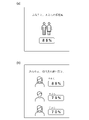
- FIG. 7 is an example of screen configuration displayed on the user terminal.
- FIG. 7A is an example of a result display screen when the degree of compatibility between the user (you) and a specified other specified user (Mr. A) is evaluated.
- FIG. 7(b) is an example of a result display screen when the degree of compatibility between the user (you) and a plurality of other users is evaluated. This indicates that they are arranged and displayed in descending order of degree of compatibility. Also, the degree of compatibility with many other users may be evaluated, and only those with a high degree of compatibility may be extracted and displayed.
- the users may be arranged and displayed in descending order of compatibility, or only those with low compatibility may be extracted and displayed.
- the degree of compatibility is represented by a numerical value of 1 to 100, but the display of the degree of compatibility is not limited to this, and may be represented by any method such as 5 levels or 3 levels.
- the information providing unit 104 may provide information including evaluation results to a third party other than the user who received the compatibility evaluation and other users.
- Embodiments 1 and 2 When evaluating compatibility between a user and other users, the methods described in Embodiments 1 and 2 may be combined. That is, as described in Embodiment 1, the result of evaluation by calculating the statistical similarity of the intestinal environment pattern, and as described in Embodiment 2, compatibility evaluation based on the characteristics of the intestinal environment pattern The final compatibility may be evaluated by comprehensively evaluating the results of Also, when combining the evaluation value according to the first embodiment and the evaluation value according to the second embodiment, either one may be weighted. By combining both, more accurate compatibility evaluation becomes possible.
- first and second embodiments are realized by an application on a user terminal.
- a user uses the service according to the first embodiment by downloading a predetermined application on his/her own terminal or accessing a web browser.
- the user inputs information such as his/her own intestinal environment pattern and other lifestyle habits on the application and registers as a member.
- FIG. 8(a) is an example of a screen display of a user terminal. The screen shows a state in which the two-dimensional code of another user can be read.
- FIG. 8B is an example of a screen display of another user's terminal. The screen shows a state in which information including the own user ID is generated as a two-dimensional code.
- a user can obtain information specifying another user by reading a two-dimensional code containing information about the other user with his/her own terminal, and can transmit a compatibility determination request to the server. Acquisition of user information is not limited to this aspect, and the user may directly input the information through the input means of the user terminal.
- the server When the server receives the compatibility determination request, it performs compatibility determination as described above based on the information about the user and other users included in the compatibility determination request, and outputs the result to the user terminal. The results may also be output to other user terminals.
- the affinity evaluation unit 103 can evaluate the degree of affinity between the user and meal information such as restaurants, menus, and recipes.
- the compatibility evaluation unit 103 reads the feature tag assigned to the user from the user information storage unit 111 and reads the meal feature tag attached to each piece of meal information from the meal information storage unit 113 . Then, the degree of compatibility is evaluated based on the feature tag assigned to the user and the meal feature tag attached to the meal information.
- the server device includes a compatibility information storage unit 114 .
- the compatibility information storage unit 114 includes evaluation values relating to combinations of feature tags and meal feature tags.
- FIG. 9 is a configuration example of compatibility information in the third embodiment.
- each characteristic tag is described as tag A, tag B, etc., but it is attached to other information such as actual intestinal environment pattern, lifestyle information, disease information, etc. of each user.
- each meal characteristic tag is described as tag a, tag b, and so on, but it refers to the meal characteristic tag attached to each actual meal information.
- the compatibility evaluation value is +3.
- the compatibility evaluation value is +1.
- the compatibility evaluation value is +3.
- the compatibility evaluation value is +3.
- the compatibility evaluation value is minus one. In this way, it is possible to set a positive compatibility evaluation value when the combination of the feature tag indicating the intestinal environment pattern of the user and the meal feature tag is well matched, and set a negative compatibility evaluation value when the combination is not compatible. can.
- a final degree of compatibility can be calculated by totaling compatibility evaluation values between a given feature tag and a meal feature tag between a certain user and the meal information to be evaluated.
- An evaluation value associated with a combination of a feature tag indicating the intestinal environment pattern of the user and a meal feature tag (for example, if feature tag A is assigned to the user's intestinal environment pattern, the meal to be evaluated has a meal feature
- the reason why the compatibility evaluation value is +3 when the tag a is assigned can be set based on publicly known information such as papers. For example, it is possible to give a high score to a combination of meals or foodstuffs (meal feature tags) considered to be preferred by a person with a certain intestinal environment pattern (feature tag), and give a low score to a combination considered to be unfavorable.
- the evaluation value can be adjusted according to the purpose of compatibility evaluation. Adjustment of these evaluation values can also be set based on known academic reports, feedback of the results of actual actions based on the evaluation values, and the like.
- the menus, recipes, ingredients, etc. evaluated by the compatibility evaluation unit 103 may be handled not only by store-type restaurants, but also by restaurants that specialize in delivery or takeout. In addition, it may be used for a service that cross-searches restaurants that specialize in home delivery and/or takeout. may be prepared in advance and used for receiving services. In addition, home delivery may be used not only for the handling of completed menus, but also for the service of delivering materials for cooking by the user himself/herself. It can be used for services such as sending recipes and ingredients for creating menus that have a high compatibility evaluation value with users. Even in these cases, the method of attaching meal feature tags to menus, recipes, ingredients, etc., and the method of evaluating compatibility with the user are as described above.
- the compatibility evaluation unit 103 may evaluate compatibility between the user and one or more pieces of specific meal information specified by the user, or may evaluate compatibility between the user and a plurality of pieces of meal information existing in the database. You may evaluate compatibility between.
- a situation in which the user designates two or more meal information is, for example, when there are two restaurants of a specific genre that the user wants to go to, and both of them look good. It is conceivable that a judgment of a store suitable for oneself is requested.
- requests from the user Narrowing down may be performed within the range of specific information determined by (for example, limiting to restaurants existing in a specific area of a travel destination).
- the user may request a compatibility evaluation between the meal information and other users instead of themselves.
- compatibility may be evaluated between a plurality of users and meal information. For example, it is possible to search for meal information that is commonly compatible with one or more other users (including, but not limited to, family members, friends, co-workers, etc.) who eat together with the user. Conceivable. Or conversely, it is also possible to search for meal information that is incompatible with the user in common with other users.
- the user transmits information (such as a user ID) specifying another user to be evaluated or information regarding the intestinal environment pattern of the other user to the server, and requests compatibility evaluation.
- the server can read feature tags for each of a plurality of users, including other users specified by the user, extract common feature tags, and determine the degree of matching with the feature tags of meal information.
- the degree of compatibility with meal information may be individually determined for each user, and the meal information with the highest (or lowest) average degree of compatibility for each user may be determined.
- the information provision unit 104 provides information including the evaluation result by the compatibility evaluation unit 103.
- FIG. 10 is an example of screen configuration displayed on the user terminal.
- FIG. 10A is an example of a result display screen when the degree of compatibility between the user (you) and specified specific meal information (restaurant A) is evaluated.
- FIG. 10(b) is an example of a result display screen when the degree of compatibility between the user (you) and a plurality of pieces of meal information is evaluated. This indicates that they are arranged and displayed in descending order of degree of compatibility.
- the information may be displayed in descending order of compatibility with the user, or a predetermined number of meal information items with low compatibility may be extracted and displayed.
- a recommended menu at a predetermined restaurant may be displayed as meal information.
- the data acquisition unit 101 acquires the user's intestinal environment pattern information (S101).
- the intestinal environment pattern information may be acquired by newly sampling and analyzing the user's stool, or may be acquired from data already held by the user or another server.
- other information including the user's lifestyle information is acquired as appropriate.
- the feature assigning unit 102 assigns feature tags to the user's intestinal environment pattern (S102). Characteristic tags may also be assigned to other information such as lifestyle habits. Note that the step S102 is unnecessary if the characteristic tag is not used in the compatibility evaluation step.
- the feature tag information is registered in the user information storage unit 111 (S103). In addition, when evaluating compatibility with meal information, a meal feature tag is added to the meal information as necessary.
- the compatibility evaluation unit 103 reads out the user's intestinal environment pattern information or the attached feature tag (S202), and evaluates compatibility with the evaluation target (S203). When compatibility with a plurality of evaluation targets is evaluated, evaluation targets with high (or low) compatibility are extracted as necessary (S204). In addition, the narrowing down is not limited to the narrowing based on the degree of compatibility, and the narrowing down may be performed based on other information of the evaluation target.
- the information providing unit 104 displays the evaluation result on a predetermined terminal (S205).
- the above is the basic explanation of the information providing system of the present invention. According to the present invention, it is possible to search for other users who have similar dietary preferences and lifestyle habits based on the user's intestinal environment data. In addition, it is possible to search for restaurants, menus, and recipes that suit the user's taste.
- ⁇ Modification 1> The configuration of this modified example is the same as the basic description above except that the server 1 further includes a feedback receiving unit 105 .
- the feedback reception unit 105 receives input of feedback information on meal information from the user. Users enter feedback on restaurants they've actually been to, menus they've actually eaten, and whether the recipes were to their liking.
- the feedback information received by the feedback receiving unit 105 is stored in a database such as the meal information storage unit 113 together with the user's information or the user's characteristic tag information.
- FIG. 13 is a processing flow diagram of the server 1 in Modification 1.
- a compatibility evaluation request for meal information is received from a user (S301). Similar to the above, the compatibility evaluation unit 103 reads the intestinal environment pattern information and feature tag information of the user and a plurality of other users (S302), and evaluates the compatibility between the user and other users (S303). Then, other users with high compatibility are extracted (S304).
- the information providing unit 104 can then provide the user with meal information including the extracted feedback information of other users. That is, the feedback information input by other users who are highly compatible with the user is presented together with the target meal information. The user can select meal information by referring to the feedback information of other users whose intestinal environment patterns are highly compatible with him/herself.
- the information providing unit 104 may also extract meal information based on the extracted feedback information of other users (S305). In other words, other extracted user extracts the meal information that gave good feedback.
- the information providing unit 104 displays the extracted meal information on the user terminal (S306). According to this modification, it is possible to present meal information recommended by other users with similar intestinal environment patterns. Since it can be inferred that other users with similar intestinal environmental patterns have similar diets and lifestyle habits, there is a high possibility that dietary information that suits their tastes will be presented.
- the compatibility evaluation unit 103 By using the compatibility evaluation unit 103 twice, it is possible to extract other users highly compatible with the user and meal information (restaurants, etc.) highly compatible with these two users. For example, in a matching service for men and women who wish to associate with a person of the opposite sex, it is assumed that a person of the opposite sex who is compatible with the person is presented, and a restaurant to go on a date with the person of the opposite sex is also presented.
- FIG. 14 is a processing flow diagram of the server 1 in Modification 2.
- a compatibility evaluation request for another user is accepted from a user (S401). Similar to the above, the compatibility evaluation unit 103 reads the intestinal environment pattern information and feature tag information of the user and a plurality of other users (S402), and evaluates the compatibility between the user and other users (S403). Then, other users with high compatibility are extracted (S404). After that, the compatibility evaluation unit 103 extracts meal information that is highly compatible with the user and other users with high compatibility extracted in S404 (S405). That is, the user can obtain other users whose intestinal environment patterns are highly compatible with him/herself, and restaurant information that is considered to be commonly liked by the other users. The information providing unit 104 causes the user terminal to display the extracted other users and meal information together (S406).
- the opposite sex can be matched based on the intestinal environment information, and restaurant information satisfying both the opposite sex and the user can be obtained. Based on the result, it is thought that the possibility of building an intimate relationship can be increased by visiting a restaurant with the opposite sex who wishes to associate.
- the menu embodies the common points of the intestinal environment of the opposite sex who wishes to date, and it is possible to easily discover new common points.
- the level of satisfaction with the meal By being able to know what dishes they like, it is possible to increase the level of satisfaction with the meal, and furthermore, it has the effect of improving the accuracy of couple formation after matching and contributing to the continuation of relationships after couple formation. You can expect it to increase.
- the compatibility is not so high in the matching service, if the intestinal environment becomes similar by continuing to eat the same meal on each date, the food preferences will become similar in the future, and the degree of couple formation will increase. It is thought that there is a possibility that it will increase.
- the test was conducted on 12 people (6 men, 6 women) whose intestinal environment information was obtained in advance. The subjects' ages ranged from 20's to 40's. Based on intestinal environment data, each subject was classified into 3 enterotypes (Bacteroides enterotypes: 3, Prevotella enterotypes: 4, Ruminococcus enterotypes: 5).
- enterotypes are related to dietary patterns.
- intestinal environment type A is a diet centered on meat
- intestinal environment type B is a high intake of dietary fiber
- intestinal environment type C is a variety of foods evenly consumed.
- the food preference of the subject can be determined by the type of intestinal environment that the subject is classified into.
- menus that were thought to be similar to the diet that subjects with the three enterotypes ingested on a daily basis.
- the user terminal 2 may be provided with some or all of the functions of the server 1 as far as the gist of the present invention can be realized with respect to the processing of the software function units provided in the server device 1 described above.
- 11, 12, 13, and 14 show an example of processing by the system of the present embodiment, and are not intended to limit the present invention. Each step included in the processing of FIGS. 11, 12, 13, and 14 may be executed in an order different from that shown in the drawings, or some processing may be executed in parallel. However, some steps may be omitted, or other steps may be added.
Landscapes
- Engineering & Computer Science (AREA)
- Health & Medical Sciences (AREA)
- Epidemiology (AREA)
- General Health & Medical Sciences (AREA)
- Medical Informatics (AREA)
- Primary Health Care (AREA)
- Public Health (AREA)
- Bioethics (AREA)
- Business, Economics & Management (AREA)
- Accounting & Taxation (AREA)
- Development Economics (AREA)
- Economics (AREA)
- General Business, Economics & Management (AREA)
- Computing Systems (AREA)
- Medical Treatment And Welfare Office Work (AREA)
Priority Applications (1)
| Application Number | Priority Date | Filing Date | Title |
|---|---|---|---|
| JP2022580701A JPWO2022173028A1 (https=) | 2021-02-12 | 2022-02-14 |
Applications Claiming Priority (2)
| Application Number | Priority Date | Filing Date | Title |
|---|---|---|---|
| JP2021-020861 | 2021-02-12 | ||
| JP2021020861 | 2021-02-12 |
Publications (1)
| Publication Number | Publication Date |
|---|---|
| WO2022173028A1 true WO2022173028A1 (ja) | 2022-08-18 |
Family
ID=82838836
Family Applications (1)
| Application Number | Title | Priority Date | Filing Date |
|---|---|---|---|
| PCT/JP2022/005549 Ceased WO2022173028A1 (ja) | 2021-02-12 | 2022-02-14 | 情報提供システム、情報提供方法及びプログラム |
Country Status (2)
| Country | Link |
|---|---|
| JP (1) | JPWO2022173028A1 (https=) |
| WO (1) | WO2022173028A1 (https=) |
Citations (4)
| Publication number | Priority date | Publication date | Assignee | Title |
|---|---|---|---|---|
| JP2011232989A (ja) * | 2010-04-28 | 2011-11-17 | Hirotaro Matsui | サプリメント提案方法、及びそのシステム、プログラム、記憶媒体 |
| WO2017026544A1 (ja) * | 2015-08-12 | 2017-02-16 | ヤヱガキ醗酵技研株式会社 | 情報処理装置、情報処理方法、及びプログラム |
| KR20200137097A (ko) * | 2019-05-29 | 2020-12-09 | 한국식품연구원 | 개인 선호 기반의 식이 구성 및 추천 방법 |
| US20210005304A1 (en) * | 2019-07-03 | 2021-01-07 | Kpn Innovations, Llc | Methods and systems for generating a supplement instruction set using artificial intelligence |
-
2022
- 2022-02-14 WO PCT/JP2022/005549 patent/WO2022173028A1/ja not_active Ceased
- 2022-02-14 JP JP2022580701A patent/JPWO2022173028A1/ja active Pending
Patent Citations (4)
| Publication number | Priority date | Publication date | Assignee | Title |
|---|---|---|---|---|
| JP2011232989A (ja) * | 2010-04-28 | 2011-11-17 | Hirotaro Matsui | サプリメント提案方法、及びそのシステム、プログラム、記憶媒体 |
| WO2017026544A1 (ja) * | 2015-08-12 | 2017-02-16 | ヤヱガキ醗酵技研株式会社 | 情報処理装置、情報処理方法、及びプログラム |
| KR20200137097A (ko) * | 2019-05-29 | 2020-12-09 | 한국식품연구원 | 개인 선호 기반의 식이 구성 및 추천 방법 |
| US20210005304A1 (en) * | 2019-07-03 | 2021-01-07 | Kpn Innovations, Llc | Methods and systems for generating a supplement instruction set using artificial intelligence |
Also Published As
| Publication number | Publication date |
|---|---|
| JPWO2022173028A1 (https=) | 2022-08-18 |
Similar Documents
| Publication | Publication Date | Title |
|---|---|---|
| Khodarahmi et al. | A structural equation modeling approach for the association of a healthy eating index with metabolic syndrome and cardio-metabolic risk factors among obese individuals | |
| CN102084368B (zh) | 心脏年龄评估 | |
| Chick et al. | Leisure constraints, leisure satisfaction, life satisfaction, and self-rated health in six cities in Taiwan | |
| Klöckner | A stage model as an analysis framework for studying voluntary change in food choices–The case of beef consumption reduction in Norway | |
| JP7018279B2 (ja) | 代替レシピ提示装置、代替レシピ提示方法、コンピュータプログラム及びデータ構造 | |
| US20140377725A1 (en) | Method and system for nutritional profiling utilizing a trainable database | |
| US20150279235A1 (en) | Nutrition management system and nutrition management program | |
| M. Silva et al. | Investigating preferred food description practices in digital food journaling | |
| JP2020181491A (ja) | システム、プログラム、及び方法 | |
| KR102298350B1 (ko) | 마이크로바이옴을 이용한 맞춤형 건강기능식품 제조 및 추천 정보를 제공하는 방법 및 장치 | |
| Hershey et al. | Effect of a nutrition intervention on Mediterranean diet adherence among firefighters: a cluster randomized clinical trial | |
| Asperin et al. | Exploring food neophobia and perceptions of ethnic foods: The case of Chinese and Thai cuisines | |
| Neff et al. | Foods and nutritional characteristics associated with addictive-like eating | |
| JP2010049332A (ja) | 不足栄養情報提供方法及びプログラム | |
| Persky et al. | Beliefs about genetic influences on eating behaviors: Characteristics and associations with weight management confidence | |
| Wetherill et al. | Food choice considerations among American Indians living in rural Oklahoma: The THRIVE study | |
| Cassidy et al. | The impact of racially-targeted food marketing and attentional biases on consumption in Black adolescent females with and without obesity: Pilot data from the Black Adolescent & Entertainment (BAE) study | |
| Borzekowski et al. | A six country study of young children’s media exposure, logo recognition, and dietary preferences | |
| Ayers et al. | Can religion help prevent obesity? Religious messages and the prevalence of being overweight or obese among Korean women in California | |
| JP7199118B2 (ja) | 情報処理システム | |
| Wallace | Sibling popularity: A moderator of sibling influence for adolescent substance use | |
| WO2022173028A1 (ja) | 情報提供システム、情報提供方法及びプログラム | |
| Nakamura et al. | Perceived food environment predicts vegetable intake according to income: a cross-sectional study | |
| Siaki et al. | A cultural perspective of Samoans’ perceived risk of cardiovascular disease and diabetes | |
| Guevara Beltran et al. | Food scarcity and disease concern reduce interdependence when people eat together |
Legal Events
| Date | Code | Title | Description |
|---|---|---|---|
| 121 | Ep: the epo has been informed by wipo that ep was designated in this application |
Ref document number: 22752850 Country of ref document: EP Kind code of ref document: A1 |
|
| DPE1 | Request for preliminary examination filed after expiration of 19th month from priority date (pct application filed from 20040101) | ||
| WWE | Wipo information: entry into national phase |
Ref document number: 2022580701 Country of ref document: JP |
|
| NENP | Non-entry into the national phase |
Ref country code: DE |
|
| 122 | Ep: pct application non-entry in european phase |
Ref document number: 22752850 Country of ref document: EP Kind code of ref document: A1 |