WO2022157835A1 - 送電装置、及び、電力伝送システム - Google Patents
送電装置、及び、電力伝送システム Download PDFInfo
- Publication number
- WO2022157835A1 WO2022157835A1 PCT/JP2021/001718 JP2021001718W WO2022157835A1 WO 2022157835 A1 WO2022157835 A1 WO 2022157835A1 JP 2021001718 W JP2021001718 W JP 2021001718W WO 2022157835 A1 WO2022157835 A1 WO 2022157835A1
- Authority
- WO
- WIPO (PCT)
- Prior art keywords
- coil
- power transmission
- sensor
- unit
- power
- Prior art date
- Legal status (The legal status is an assumption and is not a legal conclusion. Google has not performed a legal analysis and makes no representation as to the accuracy of the status listed.)
- Ceased
Links
Images






Classifications
-
- H—ELECTRICITY
- H02—GENERATION; CONVERSION OR DISTRIBUTION OF ELECTRIC POWER
- H02J—ELECTRIC POWER NETWORKS; CIRCUIT ARRANGEMENTS OR SYSTEMS FOR SUPPLYING OR DISTRIBUTING ELECTRIC POWER; SYSTEMS FOR STORING ELECTRIC ENERGY
- H02J50/00—Circuit arrangements or systems for wireless supply or distribution of electric power
- H02J50/60—Circuit arrangements or systems for wireless supply or distribution of electric power responsive to the presence of foreign objects, e.g. detection of living beings
-
- B—PERFORMING OPERATIONS; TRANSPORTING
- B60—VEHICLES IN GENERAL
- B60L—PROPULSION OF ELECTRICALLY-PROPELLED VEHICLES; SUPPLYING ELECTRIC POWER FOR AUXILIARY EQUIPMENT OF ELECTRICALLY-PROPELLED VEHICLES; ELECTRODYNAMIC BRAKE SYSTEMS FOR VEHICLES IN GENERAL; MAGNETIC SUSPENSION OR LEVITATION FOR VEHICLES; MONITORING OPERATING VARIABLES OF ELECTRICALLY-PROPELLED VEHICLES; ELECTRIC SAFETY DEVICES FOR ELECTRICALLY-PROPELLED VEHICLES
- B60L53/00—Methods of charging batteries, specially adapted for electric vehicles; Charging stations or on-board charging equipment therefor; Exchange of energy storage elements in electric vehicles
- B60L53/10—Methods of charging batteries, specially adapted for electric vehicles; Charging stations or on-board charging equipment therefor; Exchange of energy storage elements in electric vehicles characterised by the energy transfer between the charging station and the vehicle
- B60L53/12—Inductive energy transfer
- B60L53/124—Detection or removal of foreign bodies
-
- H—ELECTRICITY
- H02—GENERATION; CONVERSION OR DISTRIBUTION OF ELECTRIC POWER
- H02J—ELECTRIC POWER NETWORKS; CIRCUIT ARRANGEMENTS OR SYSTEMS FOR SUPPLYING OR DISTRIBUTING ELECTRIC POWER; SYSTEMS FOR STORING ELECTRIC ENERGY
- H02J50/00—Circuit arrangements or systems for wireless supply or distribution of electric power
- H02J50/10—Circuit arrangements or systems for wireless supply or distribution of electric power using inductive coupling
-
- H—ELECTRICITY
- H02—GENERATION; CONVERSION OR DISTRIBUTION OF ELECTRIC POWER
- H02J—ELECTRIC POWER NETWORKS; CIRCUIT ARRANGEMENTS OR SYSTEMS FOR SUPPLYING OR DISTRIBUTING ELECTRIC POWER; SYSTEMS FOR STORING ELECTRIC ENERGY
- H02J50/00—Circuit arrangements or systems for wireless supply or distribution of electric power
- H02J50/10—Circuit arrangements or systems for wireless supply or distribution of electric power using inductive coupling
- H02J50/12—Circuit arrangements or systems for wireless supply or distribution of electric power using inductive coupling of the resonant type
-
- H—ELECTRICITY
- H02—GENERATION; CONVERSION OR DISTRIBUTION OF ELECTRIC POWER
- H02J—ELECTRIC POWER NETWORKS; CIRCUIT ARRANGEMENTS OR SYSTEMS FOR SUPPLYING OR DISTRIBUTING ELECTRIC POWER; SYSTEMS FOR STORING ELECTRIC ENERGY
- H02J50/00—Circuit arrangements or systems for wireless supply or distribution of electric power
- H02J50/80—Circuit arrangements or systems for wireless supply or distribution of electric power involving the exchange of data, concerning supply or distribution of electric power, between transmitting devices and receiving devices
-
- Y—GENERAL TAGGING OF NEW TECHNOLOGICAL DEVELOPMENTS; GENERAL TAGGING OF CROSS-SECTIONAL TECHNOLOGIES SPANNING OVER SEVERAL SECTIONS OF THE IPC; TECHNICAL SUBJECTS COVERED BY FORMER USPC CROSS-REFERENCE ART COLLECTIONS [XRACs] AND DIGESTS
- Y02—TECHNOLOGIES OR APPLICATIONS FOR MITIGATION OR ADAPTATION AGAINST CLIMATE CHANGE
- Y02T—CLIMATE CHANGE MITIGATION TECHNOLOGIES RELATED TO TRANSPORTATION
- Y02T10/00—Road transport of goods or passengers
- Y02T10/60—Other road transportation technologies with climate change mitigation effect
- Y02T10/70—Energy storage systems for electromobility, e.g. batteries
-
- Y—GENERAL TAGGING OF NEW TECHNOLOGICAL DEVELOPMENTS; GENERAL TAGGING OF CROSS-SECTIONAL TECHNOLOGIES SPANNING OVER SEVERAL SECTIONS OF THE IPC; TECHNICAL SUBJECTS COVERED BY FORMER USPC CROSS-REFERENCE ART COLLECTIONS [XRACs] AND DIGESTS
- Y02—TECHNOLOGIES OR APPLICATIONS FOR MITIGATION OR ADAPTATION AGAINST CLIMATE CHANGE
- Y02T—CLIMATE CHANGE MITIGATION TECHNOLOGIES RELATED TO TRANSPORTATION
- Y02T10/00—Road transport of goods or passengers
- Y02T10/60—Other road transportation technologies with climate change mitigation effect
- Y02T10/7072—Electromobility specific charging systems or methods for batteries, ultracapacitors, supercapacitors or double-layer capacitors
-
- Y—GENERAL TAGGING OF NEW TECHNOLOGICAL DEVELOPMENTS; GENERAL TAGGING OF CROSS-SECTIONAL TECHNOLOGIES SPANNING OVER SEVERAL SECTIONS OF THE IPC; TECHNICAL SUBJECTS COVERED BY FORMER USPC CROSS-REFERENCE ART COLLECTIONS [XRACs] AND DIGESTS
- Y02—TECHNOLOGIES OR APPLICATIONS FOR MITIGATION OR ADAPTATION AGAINST CLIMATE CHANGE
- Y02T—CLIMATE CHANGE MITIGATION TECHNOLOGIES RELATED TO TRANSPORTATION
- Y02T90/00—Enabling technologies or technologies with a potential or indirect contribution to GHG emissions mitigation
- Y02T90/10—Technologies relating to charging of electric vehicles
- Y02T90/14—Plug-in electric vehicles
Definitions
- the present disclosure relates to a power transmission device and a power transmission system.
- Wireless power transmission technology that transmits power wirelessly is attracting attention.
- Wireless power transmission technology can wirelessly transmit power from a power transmission device to a power reception device, so it is expected to be applied to various products such as transportation equipment such as trains and electric vehicles, home appliances, wireless communication equipment, and toys.
- Wireless power transmission technology uses a power transmitting coil and a power receiving coil that are coupled by magnetic flux to transmit power.
- Patent Document 1 discloses that, in a power transmitting device that wirelessly transmits power to a power receiving device, a foreign object detection threshold is determined according to information that defines the power that the power transmitting device can transmit and information that defines the power that the power receiving device can receive. technology is disclosed.
- the density of the magnetic flux generated by the power transmission coil is not uniform and varies depending on the location. Therefore, when multiple sensors are arranged side by side to detect a foreign object, if a uniform reference is set for the multiple sensors as a foreign object detection standard, the foreign object may not be detected accurately depending on the magnetic flux received by each sensor.
- the present disclosure has been made in view of the above problems, and aims to improve foreign object detection accuracy in wireless power transmission.
- a power transmission device includes: A power transmitting device that wirelessly transmits power to a power receiving device, a power transmission coil configured by winding a conducting wire; a foreign object detection device for detecting foreign objects, The foreign matter detection device is a plurality of sensor coils arranged to cover the power transmission coil; The presence or absence of the foreign matter is determined based on a comparison result between a comparison target value based on an output voltage output from one of the plurality of sensor coils and a threshold value set for the one sensor coil.
- a detection unit that executes a determination process for each of the plurality of sensor coils, The detection unit performs a threshold change process of changing the threshold set for the one sensor coil based on an induced voltage induced in the one sensor coil by the magnetic flux generated by the power transmission coil. Execute for each of the sensor coils.
- the power transmission device configured as described above, it is possible to improve the detection accuracy of a foreign object in wireless power transmission.
- FIG. 1 is a configuration diagram of a detection unit included in the foreign object detection device according to Embodiment 1.
- FIG. 4 is a diagram showing an example of voltages induced in a plurality of sensor coils during power transmission by the power transmission device in Embodiment 1;
- FIG. 4 is a diagram showing an example of threshold values set for a plurality of sensor coils in Embodiment 1;
- a diagram showing the relationship between the threshold and the reference value shown in FIG. Flowchart showing foreign object detection processing executed by the foreign object detection device according to the first embodiment
- FIG. 10 is a diagram showing an example of frequency of determination processing set for a plurality of sensor coils in Embodiment 2;
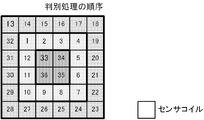
- FIG. 11 is a diagram showing an example of the order of determination processing set for a plurality of sensor coils in Embodiment 3;
- a power transmission system is a system that wirelessly transmits power to a mobile object and charges a secondary battery provided in the mobile object.
- the moving bodies are, for example, EVs (Electric Vehicles), mobile devices such as smartphones, industrial devices, and the like.
- EVs Electric Vehicles
- mobile devices such as smartphones, industrial devices, and the like.
- a case where the mobile body is an EV and the power transmission system charges a storage battery provided in the EV will be exemplified below.
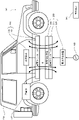
- FIG. 1 shows a schematic configuration of a power transmission system 1000 used for charging a storage battery 500 provided in an electric vehicle 700.
- the electric vehicle 700 runs using a motor driven by electric power charged in a storage battery 500 such as a lithium ion battery or a lead storage battery as a power source.
- a storage battery 500 such as a lithium ion battery or a lead storage battery as a power source.
- the power transmission system 1000 is a system that wirelessly transmits power from the power transmission device 200 to the power reception device 300 by magnetic coupling.
- the power transmission system 1000 includes a power transmission device 200 that wirelessly transmits power from an AC or DC commercial power source 400 to an electric vehicle 700, and a power reception device 300 that receives the power transmitted by the power transmission device 200 and charges a storage battery 500.
- commercial power supply 400 is an AC power supply.
- the power transmission device 200 is a device that wirelessly transmits power to the power reception device 300 by magnetic coupling.
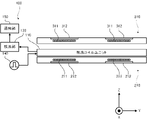
- the power transmission device 200 includes a foreign object detection device 100 that detects foreign objects, a power transmission coil unit 210 that transmits AC power to the electric vehicle 700 , and a power supply device 220 that supplies AC power to the power transmission coil unit 210 .
- the foreign object detection device 100 is arranged on the power transmission coil unit 210 .
- the vertically upward axis is the Z-axis
- the axis orthogonal to the Z-axis is the X-axis
- the axis orthogonal to the Z-axis and the X-axis is the Y-axis. Details of the foreign object detection device 100 will be described later.
- the power transmission coil unit 210 is supplied with AC power from a power supply device 220, and has a power transmission coil 211 that induces an alternating magnetic flux ⁇ . and a magnetic plate 212 for suppressing.
- the power transmission coil 211 is configured by spirally winding a conductive wire on a magnetic plate 212 .
- the power transmission coil 211 and the capacitors provided at both ends of the power transmission coil 211 constitute a resonance circuit, and an alternating magnetic flux ⁇ is induced by an alternating current flowing along with the application of an alternating voltage.
- the magnetic plate 212 has a plate shape with a hole in the center and is made of a magnetic material.
- the magnetic plate 212 is, for example, a plate-like member made of ferrite, which is a composite oxide of iron oxide and metal.
- the magnetic plate 212 may be composed of an assembly of a plurality of individual pieces of magnetic material, and the plurality of individual pieces of magnetic material are arranged in a frame shape and formed to have an opening in the central portion. may be
- the power supply device 220 includes a power factor correction circuit that improves the power factor of the commercial AC power supplied by the commercial power supply 400 and an inverter circuit that generates the AC power to be supplied to the power transmission coil 211 .
- the power factor correction circuit rectifies and boosts AC power generated by commercial power supply 400, and converts it into DC power having a predetermined voltage value.
- the inverter circuit converts DC power generated by power conversion by the power factor correction circuit into AC power having a predetermined frequency.
- Power transmission device 200 is fixed, for example, to the floor of a parking lot.
- the power receiving device 300 is a device that wirelessly receives power from the power transmitting device 200 by magnetic coupling.
- the power receiving device 300 includes a power receiving coil unit 310 that receives the AC power transmitted by the power transmitting device 200, and a rectifier circuit 320 that converts the AC power supplied from the power receiving coil unit 310 into DC power and supplies the DC power to the storage battery 500. Prepare.
- the power receiving coil unit 310 includes a power receiving coil 311 that induces an electromotive force in response to a change in the alternating magnetic flux ⁇ induced by the power transmitting coil 211, and a magnetic force generated by the power receiving coil 311 that passes through the magnetic force. and a magnetic plate 312 that suppresses loss.
- Power receiving coil 311 and capacitors provided at both ends of power receiving coil 311 form a resonance circuit.
- the power receiving coil 311 faces the power transmitting coil 211 while the electric vehicle 700 is stopped at a preset position.
- the power transmission coil 211 receives power from the power supply device 220 and induces an alternating magnetic flux ⁇
- the alternating magnetic flux ⁇ interlinks with the power receiving coil 311 , thereby inducing an induced electromotive force in the power receiving coil 311 .
- the magnetic plate 312 has a plate shape with a hole in the center and is made of a magnetic material.
- the magnetic plate 312 is, for example, a plate-like member made of ferrite, which is a composite oxide of iron oxide and metal.
- the magnetic plate 312 may be composed of an assembly of a plurality of individual pieces of magnetic material, and the plurality of individual pieces of magnetic material are arranged in a frame shape and formed to have an opening in the central portion. may be
- the rectifier circuit 320 rectifies the electromotive force induced in the receiving coil 311 to generate DC power.
- the DC power generated by the rectifier circuit 320 is supplied to the storage battery 500 .
- Power receiving device 300 may include a charging circuit between rectifier circuit 320 and storage battery 500 that converts the DC power supplied from rectifier circuit 320 into DC power suitable for charging storage battery 500. good.
- the power receiving device 300 is fixed to the chassis of the electric vehicle 700, for example.
- the terminal device 600 is a device that receives notification of the presence of a foreign object from the foreign object detection device 100 .
- Terminal device 600 is, for example, a smartphone owned by the owner of electric vehicle 700 .
- the terminal device 600 receives notification of the presence of a foreign object from the foreign object detection apparatus 100, the terminal device 600 notifies the user of the presence of the foreign object through screen display, voice output, or the like.
- the foreign object detection device 100 detects foreign objects existing in the detection target area.
- the detection target area is a target area for foreign matter detection, and is an area in which foreign matter can be detected.
- the detection target area is an area near power transmitting coil unit 210 and power receiving coil unit 310 and includes an area between power transmitting coil unit 210 and power receiving coil unit 310 .
- a foreign object is an object or a living body that is not necessary for power transmission.
- the foreign object detection apparatus 100 detects a foreign object existing in the detection target area and notifies the user that the foreign object has been detected. The user can receive this notification and remove the foreign matter. Various things such as metal pieces, people, and animals are assumed as the foreign matter.
- the foreign object detection device 100 includes a detection coil unit 110, a detection section 120, a pulse generation section 140, and a notification section 150.
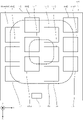
- the detection coil unit 110 is a unit that detects foreign matter. As shown in FIG. 3 , the detection coil unit 110 is formed in a flat plate shape and arranged on the power transmission coil unit 210 so as to overlap the power transmission coil 211 in plan view.
- the detection coil unit 110 includes a detection coil substrate 113 made of a magnetically permeable material such as resin.
- the detection coil substrate 113 includes a plurality of sensor coils 111 arranged in a matrix in the X-axis direction and the Y-axis direction so as to cover the power transmission coil 211 , each sensor coil 111 , a detection unit 120 , and a pulse generation unit 140 . and an external connector 112 for connecting to and are mounted.
- the number and arrangement of the sensor coils 111 shown in FIG. 3 are examples. That is, the number and arrangement of the plurality of sensor coils 111 provided in the detection coil unit 110 are not limited to those shown in FIG. The same applies to subsequent figures.
- the detection unit 120 determines whether or not a foreign object exists in the detection target area based on the output voltages output from each of the plurality of sensor coils 111 provided in the detection coil unit 110 . Details of the detection unit 120 will be described later.
- the pulse generator 140 includes a pulse generator that generates pulses, and generates a pulse voltage, which is a pulse-shaped voltage signal, as an input voltage for foreign object detection.
- the pulse generator 140 applies the generated pulse voltage to each of the sensor coils 111 provided in the detection coil unit 110 .
- the notification unit 150 has a communication interface that communicates with devices outside the foreign object detection device 100 according to a well-known communication standard such as a wireless LAN (Local Area Network).
- a wireless LAN Local Area Network
- the notification unit 150 notifies the user that the foreign object has been detected. For example, the notification unit 150 transmits information indicating that a foreign object has been detected to the terminal device 600 carried by the user.
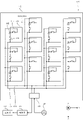
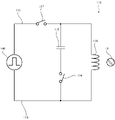
- FIG. The sensor coil 111 is a general term for the sensor coils 111A to 111L. Each sensor coil 111 has substantially the same configuration. Sensor coil 111 includes coil 114 , capacitor 115 , switch 116 and switch 117 . In addition, in FIG. 4, only the sensor coil 111A is denoted by reference numerals in consideration of the visibility of the drawing.
- the coil 114 has a conductor pattern wound one or more times around an axis parallel to the Z-axis on the upper surface of the detection coil substrate 113 .
- One terminal of coil 114 is connected to one terminal of switch 116 and first connection wiring 118 .
- the first connection wiring 118 is arranged on the upper surface of the detection coil substrate 113 and connected to the external connector 112 .
- the other terminal of coil 114 is connected to one terminal of capacitor 115 and one terminal of switch 117 .
- the other terminal of switch 117 is connected to second connection wiring 119 .
- the other terminal of capacitor 115 is connected to the other terminal of switch 116 .
- the second connection wiring 119 is arranged on the lower surface of the detection coil substrate 113 and connected to the external connector 112 .
- the switches 116 and 117 are controlled to be on or off under the control of the detector 120 via a control line (not shown).
- the ON state is a conducting state and the OFF state is a non-conducting state.
- Switch 116 has the function of switching the state between coil 114 and capacitor 115 . When switch 116 is turned on, coil 114 and capacitor 115 form a resonant circuit.
- the switch 117 has a function of switching the state between this resonance circuit and the pulse generator 140 .
- the resonance frequency of the resonance circuit is designed to be several MHz, for example.
- coil 114 and capacitor 115 form a resonant circuit.
- the resonance circuit is electrically connected to the detection section 120 and the pulse generation section 140 via the first connection wiring 118 and the second connection wiring 119 . Therefore, the voltage across the resonance circuit, that is, across the coil 114 is led to the detection section 120 via the first connection wiring 118 and the second connection wiring 119 .
- switch 116 when switch 116 is turned off, coil 114 and capacitor 115 do not form a resonant circuit. Also, when the switch 117 is turned off, the resonance circuit is electrically disconnected from the detection section 120 and the pulse generation section 140 .
- FIG. 5 shows an equivalent circuit of the resonance circuit formed by the coil 114 and the capacitor 115.
- the resonant circuit When a pulse voltage is input, energy is stored in the coil 114 and the capacitor 115, and the voltage across the resonance circuit oscillates while attenuating as the pulse voltage falls. Therefore, the resonant circuit outputs an oscillating voltage whose crest value is gradually attenuated over time to the detecting section 120 as a response voltage to the pulse voltage.
- the detection unit 120 determines the presence or absence of the foreign object 10 by detecting changes in the frequency of the oscillating voltage, changes in the degree of attenuation of the oscillating voltage, and the like.
- an alternating current is supplied from the power supply device 220 to the power transmission device 200 and the power transmission coil 211 induces an alternating magnetic flux ⁇
- an induction occurs between both ends of the coil 114 according to the change in the alternating magnetic flux ⁇ .
- voltage is generated.
- the induced voltage is a voltage generated by such magnetic force during power transmission.
- the induced voltage induced in the coil 114 is output to the detection section 120 in the same manner as the response voltage to the pulse voltage.
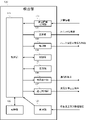
- the detection unit 120 includes a control unit 121 , a storage unit 122 and a measurement unit 123 .
- the control unit 121 includes a CPU (Central Processing Unit).
- the CPU includes a microprocessor and the like, and is a central processing unit that executes various processes and calculations.
- the CPU reads the control program stored in the ROM and controls the operation of the entire detection unit 120 while using the RAM as a work memory.
- the storage unit 122 includes ROM (Read Only Memory), RAM (Random Access Memory), flash memory, and the like.
- the storage unit 122 stores programs and data used by the control unit 121 to perform various processes.
- the storage unit 122 also stores data generated or acquired by the control unit 121 performing various processes.
- the measurement unit 123 measures output voltages output from each of the plurality of sensor coils 111 provided in the detection coil unit 110 .
- the measurement unit 123 includes an A/D (Analog/Digital) conversion circuit, a peak hold circuit, and the like.
- the measurement unit 123 converts the analog signal output from each sensor coil 111 into a digital signal by an A/D converter, and measures the voltage value of the digital signal after A/D conversion.
- the measurement unit 123 measures the response voltage to the pulse voltage. In addition, even when the pulse voltage is not input from the pulse generation unit 140, the measurement unit 123 measures the induced voltage induced by the alternating magnetic flux ⁇ when the power transmission device 200 transmits power. Thus, the measurement unit 123 measures two types of voltage signals, the response voltage and the induced voltage.
- the switch 116 When measuring the response voltage, the switch 116 is turned on, and the coil 114 and the capacitor 115 form a resonant circuit. In this state, the measurement unit 123 measures the voltage across the resonance circuit when the pulse voltage is input from the pulse generation unit 140 as the response voltage. On the other hand, when measuring the induced voltage, the switch 116 is turned off and the capacitor 115 is disconnected from the circuit. Therefore, no resonant circuit is formed. In this state, the measuring unit 123 measures the voltage across the coil 114 when power is being transmitted by the power transmitting device 200 as an induced voltage.
- the detection unit 120 functionally includes a power transmission information acquisition unit 131, a selection unit 132, a drive unit 133, a determination unit 134, a change unit 135, and a result output unit 136. , and a power transmission control unit 137 . These units are functions of the control unit 121 . Specifically, in the control unit 121, the CPU reads a program stored in the ROM into the RAM and executes and controls the program, thereby functioning as these units.
- the power transmission information acquisition unit 131 acquires power transmission information.
- the power transmission information is information related to power transmission by the power transmission device 200 , and specifically, information indicating whether or not the power transmission device 200 is transmitting power to the power reception device 300 .
- the power supply device 220 notifies the detection unit 120 that power transmission is in progress.
- the power supply device 220 notifies the detection unit 120 that power transmission is not being performed.
- the power transmission information acquisition unit 131 acquires the information notified from the power supply device 220 in this way as the power transmission information.
- the power transmission information acquisition unit 131 may acquire information indicating the transmitted power of the power transmitting device 200 from the power transmitting device 200 as the power transmission information, or wirelessly transmit information indicating the received power of the power receiving device 300 from the power receiving device 300 . It may be obtained through communication.
- the transmitted power or received power is substantially 0, it can be determined that power is not being transmitted from the power transmitting device 200 to the power receiving device 300, and when the transmitted power or received power is not substantially 0, It can be determined that power is being transmitted to the power receiving device 300 .
- the selection unit 132 selects one sensor coil 111 to be subjected to foreign matter detection processing from among the plurality of sensor coils 111 provided in the detection coil unit 110 according to a predetermined selection rule. Specifically, the selection unit 132 selects the sensor coils 111A to 111L in the order of the sensor coil 111A, the sensor coil 111B, . Select one of them in order.
- the selection unit 132 controls the switches 116 and 117 of the selected sensor coil 111 in order to detect the presence or absence of the foreign object 10 in the vicinity of the selected sensor coil 111. Specifically, when measuring the induced voltage, the selection unit 132 turns on the switch 116 of the selected sensor coil 111 and turns off the switch 117 . Further, the selection unit 132 turns on the switches 116 and 117 of the selected sensor coil 111 when measuring the response voltage. The selection unit 132 turns off the switches 116 and 117 of the unselected sensor coils 111 .
- the driving unit 133 drives the pulse generating unit 140 to generate a single pulse voltage after the selecting unit 132 performs selection and ON control. Accordingly, the driving section 133 inputs the pulse voltage generated by the pulse generating section 140 to the sensor coil 111 selected by the selecting section 132 as an input voltage.
- the pulse voltage generated by the pulse generation section 140 is applied to the resonance circuit formed in the sensor coil 111 selected by the selection section 132 via the external connector 112, the first connection wiring 118, the second connection wiring 119, and the like. be done.
- the voltage across the resonance circuit is led to the measuring section 123 via the external connector 112, the first connection wiring 118, the second connection wiring 119, and the like.
- the sensor coil 111 selected by the selection unit 132 When a pulse voltage is input as an input voltage, the sensor coil 111 selected by the selection unit 132 outputs an oscillating voltage representing the voltage across the resonance circuit as a response voltage.
- the measurement unit 123 measures the response voltage output from the sensor coil 111 .
- the determination unit 134 determines whether or not the foreign object 10 exists near the sensor coil 111.
- the output voltage is specifically the response voltage output from the sensor coil 111 in response to the pulse voltage input from the pulse generator 140 .
- the determination unit 134 determines the presence or absence of the foreign object 10 based on the result of comparison between the comparison target value based on the response voltage output from the sensor coil 111 and the threshold value set for the sensor coil 111 .
- the comparison target value is the value to be compared with the threshold.
- the comparison target value is a difference value between the value indicating the characteristic of the response voltage measured by the measuring unit 123 and the reference value, or a value based on this difference value.
- the comparison target value is the difference value between the value indicating the characteristics of the response voltage and the reference value.
- Values that indicate the characteristics of the response voltage are, for example, the frequency of the oscillating voltage, the convergence time of the oscillating voltage, the magnitude of the amplitude of the oscillating voltage, and the like.
- the convergence time of the oscillating voltage is, for example, the time from when the pulse voltage is applied until the amplitude of the oscillating voltage falls below a predetermined amplitude.
- the magnitude of the amplitude of the oscillating voltage is, for example, the magnitude of the amplitude of the oscillating voltage when a predetermined time has elapsed since the pulse voltage was applied. It is possible to appropriately adjust the value indicating the characteristics of the response voltage for obtaining the comparison target value.
- the reference value is a value that indicates the characteristic of the response voltage when the foreign object 10 does not exist near the sensor coil 111 .
- the reference value is set in advance through experiments, simulations, or the like, and stored in the storage unit 122 .
- the determination unit 134 calculates the difference value between the value indicating the characteristics of the response voltage measured by the measurement unit 123 and the reference value as a comparison target value. Thus, the determination unit 134 calculates the amount of change in the characteristic value of the response voltage output from the sensor coil 111 as a response to the pulse voltage input from the pulse generation unit 140 from when the foreign object 10 is not present.
- a small difference value means that there is a high possibility that the foreign object 10 does not exist, and a large difference value means that there is a high possibility that the foreign object 10 exists.
- the determination unit 134 After calculating the difference value as the comparison target value, the determination unit 134 compares the comparison target value with the threshold. Then, the determination unit 134 determines that the foreign object 10 is present when the number of times the comparison target value exceeds the threshold reaches a predetermined threshold number of times.
- a threshold is a threshold for determining a comparison target value.
- the threshold values are individually set for each of the plurality of sensor coils 111 provided in the detection coil unit 110 and stored in the storage section 122 .
- the threshold is set in advance in consideration of, for example, the expected magnitude of noise, the degree of change in the response voltage due to the presence or absence of the foreign object 10, and the like.
- the threshold count is a threshold for determining the number of times exceeded. When the number of times of excess reaches the threshold number of times, it is determined that the foreign object 10 is present.
- the threshold number of times is determined in advance in consideration of, for example, the likelihood of noise generation and the magnitude of the risk of presence of the foreign object 10, and is stored in the storage unit 122. FIG. By increasing the threshold number of times, erroneous determination can be suppressed and the certainty of foreign object detection can be improved. Also, by reducing the threshold number of times, the response speed of foreign object detection can be increased.
- FIG. 7 shows the correspondence relationship between the number of times the response voltage is measured by the measurement unit 123 and the comparison target value based on the response voltage.
- the graph shown in FIG. 7 shows that the comparison value does not exceed the threshold from the first measurement to the 20th measurement, and the comparison value exceeds the threshold in the 21st and subsequent measurements. For example, when the threshold number of times is 5, the determination unit 134 determines that the foreign object 10 is present when the 25th measurement is completed.
- the determination unit 134 executes determination processing for determining the presence or absence of the foreign object 10 based on the result of comparison between the comparison target value and the threshold for the sensor coils 111 selected one by one by the selection unit 132. do. That is, the determination unit 134 determines a comparison target value based on a response voltage output from one sensor coil 111 as a response to an input voltage input to one sensor coil 111 of the plurality of sensor coils 111, and Based on the result of comparison with the threshold value set in the sensor coil 111 , determination processing for determining the presence or absence of the foreign object 10 is performed for each of the plurality of sensor coils 111 . Thereby, the determination unit 134 determines whether or not the foreign object 10 exists near each of the plurality of sensor coils 111 .
- the changing unit 135 performs a plurality of threshold changing processes for changing the threshold set for the sensor coil 111 based on the induced voltage induced in the sensor coil 111 by the magnetic flux generated by the power transmitting coil 211. for each of the sensor coils 111.
- the threshold value is a value used for determining the presence or absence of the foreign object 10 in the determination processing of the determination unit 134 described above.
- an induced voltage is induced in each sensor coil 111 by the alternating magnetic flux ⁇ induced by the power transmission coil 211 .
- the density of the alternating magnetic flux ⁇ induced by the power transmission coil 211 is not uniform within the detection target area. Inconsistency occurs depending on the location. Therefore, the magnitude of the induced voltage induced in each sensor coil 111 is not the same among the sensor coils 111 and a difference occurs between the sensor coils 111 .
- the changing unit 135 individually changes the threshold set for each sensor coil 111 based on the magnitude of the induced voltage induced in each sensor coil 111 in order to improve the detection accuracy of the foreign object 10 during power transmission. do.
- the change unit 135 refers to the voltage value of the induced voltage that is output from the sensor coil 111 selected by the selection unit 132 and measured by the measurement unit 123 during power transmission by the power transmission device 200 . Then, the changing unit 135 uses the voltage value as the magnitude of the induced voltage induced in the selected sensor coil 111 .
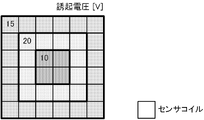
- FIG. 8 shows an example of the magnitude of the induced voltage induced in the multiple sensor coils 111 .
- FIG. 8 shows, by way of example, 36 sensor coils 111 arranged in a 6 ⁇ 6 arrangement.
- an induced voltage of 10 V is induced in the four sensor coils 111 in the central portion
- an induced voltage of 20 V is induced in the 12 sensor coils 111 around the central portion (hereinafter referred to as “intermediate portion”).
- a voltage is induced, and an induced voltage of 15 V is induced in the 20 sensor coils 111 around the intermediate portion (hereinafter referred to as the “outer portion”). That is, in the area where the 12 sensor coils 111 in the middle portion are arranged, the magnetic flux density of the alternating magnetic flux ⁇ is relatively high, and a large induced voltage is induced.
- the changing unit 135 changes the threshold of the sensor coil 111 in which a relatively large induced voltage is induced to a smaller value than the threshold of the sensor coil 111 in which a relatively small induced voltage is induced.
- the determination unit 134 determines that the foreign object 10 exists even if the difference between the comparison target value and the reference value is small. Therefore, the changing unit 135 changes the threshold value of the sensor coil 111 in which a relatively large induced voltage is induced to a value small enough to prevent erroneous detection of the foreign object 10 . As a result, when the foreign object 10 exists in a place where the magnetic flux density is relatively high, the foreign object 10 can be detected more quickly and reliably.
- the changing unit 135 changes the induced voltage induced in the first sensor coil 111 out of the plurality of sensor coils 111 to the second sensor coil 111 out of the plurality of sensor coils 111 . If it is larger than the induced voltage, the threshold set for the first sensor coil 111 is made smaller than the threshold set for the second sensor coil 111 .
- the first sensor coil 111 and the second sensor coil 111 are any two or more sensor coils 111 having different induced voltages among the plurality of sensor coils 111 provided in the detection coil unit 110.
- the first sensor coils 111 correspond to the middle 12 sensor coils 111 in which relatively large induced voltages are induced in FIG. 8, and the second sensor coils 111 correspond to relatively This corresponds to the central four sensor coils 111 in which a small induced voltage is induced.
- the first and second sensor coils 111 can be said to correspond to the intermediate and outer sensor coils 111, respectively, or can be said to correspond to the outer and central sensor coils 111, respectively.
- FIG. 9 shows an example of thresholds changed by the changing unit 135 when the induced voltage shown in FIG. 8 is induced in each sensor coil 111.
- the threshold set for each sensor coil 111 is expressed as a ratio (%) to the reference value.
- the changing unit 135 changes the threshold value of the central sensor coil 111 with a relatively low induced voltage to a relatively large value of 50%, and changes the threshold value of the sensor coil 111 in the middle with a relatively high induced voltage.
- the threshold value of the coil 111 is changed to a relatively small value of 20%, and the threshold value of the sensor coil 111 on the outer side, which has a moderate magnitude of the induced voltage, is changed to a moderate value of 30%.
- the changing unit 135 changes the threshold of the sensor coil 111 with relatively high induced voltage among the plurality of sensor coils 111 to a relatively small value, and the sensor coil 111 with relatively low induced voltage to a relatively large value.
- the sensor coil 111 sets uneven thresholds for the reference values of 20%, 30%, and 50%.
- the determination unit 134 determines the presence or absence of the foreign object 10 near each of the plurality of sensor coils 111 based on the threshold changed by the change unit 135 .
- the result output unit 136 outputs the foreign object detection result obtained by the determination unit 134 .
- the result output unit 136 instructs the notification unit 150 to notify that the foreign object 10 exists.
- the notification unit 150 transmits information indicating that the foreign object 10 has been detected to the terminal device 600 carried by the user.
- the terminal device 600 informs the user that the foreign object 10 has been detected by screen display, voice output, or the like. The user removes the foreign object 10 when notified by the terminal device 600 that the foreign object 10 is present.
- the power transmission control unit 137 controls power transmission from the power transmission coil unit 210 to the power reception coil unit 310 . Specifically, when the determination unit 134 determines that the foreign object 10 exists, the power transmission control unit 137 controls the power supply device 220 to supply an alternating current to the power transmission coil 211 in order to avoid problems caused by the foreign object 10 . Limit the power supply.
- limiting the supply of AC power means stopping the supply of AC power or reducing the supply to the extent that no problems arise.
- the power transmission control unit 137 instructs to stop the supply of AC power to limit the supply of AC power.
- the power supply device 220 stops supplying AC power to the power transmission coil 211 .
- power transmission by the power transmission device 200 is stopped.
- the foreign matter detection process shown in FIG. 11 is started, for example, when the power of the foreign object detection apparatus 100 is turned on.
- the detection unit 120 determines whether or not it has received an instruction to start the foreign object detection process (step S101). Specifically, when it is determined that power is being transmitted from the power transmission device 200 to the power reception device 300 based on the power transmission information acquired by the power transmission information acquisition unit 131, the detection unit 120 determines that a start instruction has been received. .
- the detection unit 120 Upon determining that an instruction to start the foreign object detection process has been received (step S101: YES), the detection unit 120 performs initial settings related to the foreign object detection process (step S102). In the initial setting, for example, the switches 116 and 117 included in the detection coil unit 110 are set to be off.
- the detection unit 120 After executing the initial setting, the detection unit 120 functions as the selection unit 132 and selects one sensor coil 111 from among the plurality of sensor coils 111 (step S103). Specifically, the detection unit 120 selects one sensor coil 111 to be subjected to discrimination processing from among the plurality of sensor coils 111 provided in the detection coil unit 110 according to a determined selection rule.
- the detection unit 120 controls the states of the switches 116 and 117 (step S104). Specifically, the detection unit 120 turns on the switch 117 included in the selected sensor coil 111 and turns on the switch 116 included in the selected sensor coil 111 and the switch included in the unselected sensor coil 111. The switches 116 and 117 of the sensor coils 111 provided in the detection coil unit 110 are controlled so that the switches 116 and 117 are all turned off.
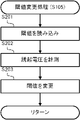
- the detection unit 120 After controlling the states of the switches 116 and 117, the detection unit 120 functions as the change unit 135 and executes threshold change processing for the selected sensor coil 111 (step S105). Details of the threshold changing process will be described with reference to FIG.
- the detection unit 120 reads the threshold set for the selected sensor coil 111 among the thresholds of the plurality of sensor coils 111 stored in the storage unit 122 (step S201). ). Then, the detection unit 120 measures the induced voltage induced in the selected sensor coil 111 by the measurement unit 123 (step S202).
- the detection unit 120 After measuring the induced voltage, the detection unit 120 changes the threshold set for the selected sensor coil 111 based on the measured induced voltage (step S203). Specifically, when the magnitude of the measured induced voltage is relatively large, the detection unit 120 changes the threshold set for the selected sensor coil 111 to a relatively small value. Further, when the magnitude of the measured induced voltage is relatively small, the detection unit 120 changes the threshold set for the selected sensor coil 111 to a relatively large value. After changing the threshold, the detection unit 120 stores the changed threshold in the storage unit 122 . Thus, the threshold changing process shown in FIG. 12 ends.
- the detection unit 120 when the detection unit 120 executes the threshold change process, it controls the states of the switches 116 and 117 (step S106). Specifically, the detection unit 120 switches the switch 116 to the ON state while maintaining the switch 117 included in the sensor coil 111 selected in step S103 to the ON state. Thereby, a resonance circuit is formed by the coil 114 and the capacitor 115 . Note that the detection unit 120 continues to keep the switches 116 and 117 included in the unselected sensor coils 111 in the OFF state.
- the detection unit 120 After controlling the states of the switches 116 and 117, the detection unit 120 functions as the determination unit 134 and performs determination processing on the selected sensor coil 111 (step S107). Details of the determination process will be described with reference to FIG.
- the detection unit 120 inputs a pulse voltage to the selected sensor coil 111 (step S301). Specifically, the detection unit 120 causes the pulse generation unit 140 to generate a pulse voltage by the driving unit 133 and inputs the pulse voltage as the input voltage to the selected sensor coil 111 .
- the detection unit 120 measures the response voltage output from the selected sensor coil 111 by the measurement unit 123 (step S302). Then, the detection unit 120 calculates a difference value between the measured characteristic value of the response voltage and the reference value (step S303).
- the detection unit 120 determines whether the calculated difference value exceeds the threshold value set for the selected sensor coil 111 (step S304).
- the threshold is a threshold changed based on the induced voltage induced in the selected sensor coil 111 in the threshold change process of step S105.
- step S304 determines that the difference value exceeds the threshold (step S304: YES)
- step S304: NO determines that the difference value does not exceed the threshold
- step S306 resets the number of times of excess (step S306). That is, the detection unit 120 sets the number of times of excess to zero.
- the detection unit 120 determines whether or not the number of times of excess has reached the threshold number of times (step S307). If the number of times of excess has not reached the threshold number of times (step S307: NO), the detection unit 120 determines that the foreign object 10 does not exist near the selected sensor coil 111 . In this case, the detection unit 120 skips the processing of steps S308 and S309 and ends the discrimination processing shown in FIG.
- step S307 when the number of times of excess has reached the threshold number of times (step S307: YES), the detection unit 120 determines that the foreign object 10 exists near the selected sensor coil 111 . In this case, the detection unit 120 functions as the result output unit 136 and notifies the user of foreign object detection via the notification unit 150 (step S308).
- the detection unit 120 Upon notification of foreign object detection, the detection unit 120 functions as the power transmission control unit 137 and instructs the power supply device 220 to stop power transmission (step S309). Specifically, the detection unit 120 transmits an instruction to the power supply device 220 to stop supplying AC power to the power transmission coil 211 . Note that the process of instructing to stop power transmission in step S309 may be performed prior to the process of notifying foreign object detection in step S308.
- the detection unit 120 When instructed to stop power transmission, the detection unit 120 exits the determination process shown in FIG. 12 and returns to step S101 in the foreign object detection process shown in FIG. That is, the detection unit 120 exits the loop of the threshold value changing process and the discrimination process that are repeatedly executed for the plurality of sensor coils 111 and waits until receiving the instruction to start the foreign object detection process again.
- the detection unit 120 determines whether or not an instruction to end the foreign matter detection process has been received (step S108). . For example, when it is determined that power is not being transmitted from the power transmission device 200 to the power reception device 300 based on the power transmission information acquired by the power transmission information acquisition unit 131, the detection unit 120 determines that an instruction to end the foreign object detection process has been received.
- step S108 If an instruction to end the foreign object detection process has not been received (step S108: NO), the detection unit 120 returns the process to step S103. Then, the detection unit 120 changes the sensor coil 111 to be selected from among the plurality of sensor coils 111, and executes the processes of steps S103 to S108 again. Accordingly, the detection unit 120 repeats the process of determining the presence or absence of the foreign object 10 by each of the plurality of sensor coils 111 until receiving the termination process or until the foreign object 10 is detected in step S105.
- step S108 YES
- step S101 NO
- the detection unit 120 advances the process to step S101. return. Then, the detection unit 120 waits until receiving an instruction to start the foreign object detection process again. Upon receiving the instruction to start the foreign object detection process again, the detection unit 120 executes the processes of steps S101 to S108 again.
- the result of comparison between the comparison target value based on the response voltage output from each sensor coil 111 in response to the input of the pulse voltage and the threshold is , the threshold value set for each sensor coil 111 is individually changed based on the induced voltage induced in each sensor coil 111 .
- the detection target area may extend over a wide range, and the difference in magnetic flux density tends to increase depending on the location. Even if the detection target area extends over a wide range as described above, the foreign object detection apparatus 100 according to Embodiment 1 individually changes the threshold value set for each sensor coil 111 so that each sensor coil 111 It is possible to suppress the deterioration of the detection accuracy due to the difference in the magnetic flux density received.
- Embodiment 2 Next, Embodiment 2 of the present disclosure will be described. Descriptions of configurations and processes similar to those of the first embodiment are omitted or simplified.
- the changing unit 135 changes the threshold set for each of the multiple sensor coils 111 .
- the changing unit 135 changes the frequency of determination processing performed for each of the plurality of sensor coils 111 instead of or in addition to changing the threshold. That is, in the second embodiment, the changing unit 135 changes the frequency of determination processing performed for each of the plurality of sensor coils 111 based on the induced voltage induced in each of the plurality of sensor coils 111. .
- FIG. 14 shows an example of the frequency changed by the changing unit 135 when the induced voltage shown in FIG. 8 is induced in each sensor coil 111 .
- the frequency set for each sensor coil 111 corresponds to the number of determination processes performed by the determination unit 134 per predetermined length of time. If the frequency of the determination process is increased, the determination process is performed at short time intervals on average, and if the frequency of the determination process is decreased, the determination process is performed at long time intervals on average.
- the frequency of determination processing is set to an appropriate frequency in the initial settings.
- the changing unit 135 determines that the induced voltage induced in the first sensor coil 111 among the plurality of sensor coils 111 is higher than the induced voltage induced in the second sensor coil 111 among the plurality of sensor coils 111. In this case, the frequency of determination processing performed on the first sensor coil 111 is made higher than the frequency of determination processing performed on the second sensor coil 111 .
- the first sensor coil 111 and the second sensor coil 111 have different induced voltages among the plurality of sensor coils 111 provided in the detection coil unit 110, as in the first embodiment. It corresponds to any two or more sensor coils 111 .
- the changing unit 135 changes the frequency of the central sensor coil 111 with a relatively low induced voltage to a relatively low value of 5, so that the induced voltage is relatively low.
- the frequency of the large intermediate sensor coil 111 is changed to a relatively high value of 20 times, and the frequency of the outer sensor coil 111 with a medium induced voltage is changed to a medium value of 10 times. do.
- the changing unit 135 changes the frequency of the determination process to be performed on the sensor coil 111 having a relatively high induced voltage among the plurality of sensor coils 111 to a relatively high value, so that the induced voltage is relatively high.
- the frequency of determination processing executed for the relatively small sensor coil 111 is changed to a relatively low value.
- the selecting unit 132 selects, from among the plurality of sensor coils 111 provided in the detection coil unit 110, the frequency after being changed by the changing unit 135 as the target of the determination process. select the sensor coil 111 that is Specifically, as shown in FIG. 15, the selection unit 132 performs a cycle of selecting the sensor coils 111 in the order of intermediate, outer, intermediate, intermediate, outer, central, intermediate, and so on. repeat. That is, the selection unit 132 selects the middle sensor coil 111 with a relatively high frequency setting the most, and selects the central sensor coil 111 with a relatively low frequency setting. to the lowest.
- the determination unit 134 determines the presence or absence of the foreign object 10 in the vicinity of the selected sensor coil 111 based on the response voltage to the pulse voltage input to the selected sensor coil 111. Execute the determination process to be performed. As described above, sensor coils 111 arranged at locations with relatively high magnetic flux density are selected with high frequency. The existing foreign matter 10 can be detected more quickly and more reliably.
- Embodiment 3 Next, Embodiment 3 of the present disclosure will be described. Descriptions of configurations and processes similar to those of the first and second embodiments are omitted or simplified.
- the changing unit 135 changes the threshold set for each of the multiple sensor coils 111 .
- the changing unit 135 changes the order of the determination processes performed on the plurality of sensor coils 111 instead of or in addition to changing the threshold.
- the changing unit 135 changes the order of determination processing performed on the plurality of sensor coils 111 based on the induced voltage induced in each of the plurality of sensor coils 111 .
- FIG. 16 shows an example of the order changed by the changing unit 135 when the induced voltage shown in FIG. 8 is induced in each sensor coil 111 .
- the numbers 1 to 36 marked on each sensor coil 111 represent the order of determination processing executed by the determination unit 134 .
- the order of determination processing is set to an appropriate order in the initial settings.
- the changing unit 135 determines that the induced voltage induced in the first sensor coil 111 among the plurality of sensor coils 111 is higher than the induced voltage induced in the second sensor coil 111 among the plurality of sensor coils 111. In this case, the order of determination processing performed on the first sensor coil 111 is set earlier than the order of determination processing performed on the second sensor coil 111 .
- the first sensor coil 111 and the second sensor coil 111 have the magnitude of the induced voltage among the plurality of sensor coils 111 provided in the detection coil unit 110. corresponds to any two or more sensor coils 111 having different values.
- the changing unit 135 sets the order of the central sensor coils 111 with relatively low induced voltages to the relatively slow order of 33rd to 36th so that the induced voltages are relatively low.
- the order of the intermediate sensor coils 111 which are relatively large, is changed to the relatively early order of Nos. 1 to 12, and the order of the outer sensor coils 111, whose magnitude of the induced voltage is medium, is changed to Nos. 13 to 32. Change to medium order.
- the changing unit 135 changes the order of the determination processing to be executed on the sensor coil 111 having a relatively high induced voltage among the plurality of sensor coils 111 to a relatively earlier order, so that the induced voltage is relatively high.
- the order of the determination processes executed for the relatively small sensor coil 111 is changed to a relatively later order.
- the selecting unit 132 selects, from among the plurality of sensor coils 111 provided in the detection coil unit 110, the order changed by the changing unit 135 as the target of the discrimination processing. select the sensor coil 111 that is That is, the selection unit 132 selects the sensor coils 111 arranged at locations with relatively high magnetic flux densities in an earlier order than the sensor coils 111 arranged at locations with relatively low magnetic flux densities.
- the determination unit 134 determines the presence or absence of the foreign object 10 in the vicinity of the selected sensor coil 111 based on the response voltage to the pulse voltage input to the selected sensor coil 111. Execute the determination process. In this way, sensor coil 111 arranged at a location with a relatively high magnetic flux density is preferentially selected. The existing foreign matter 10 can be detected more quickly and more reliably.
- Embodiment 4 of the present disclosure will be described. Descriptions of configurations and processes similar to those of the first to third embodiments are omitted or simplified.
- the foreign object detection device 100 detects the foreign object 10 existing in the detection target area. In contrast, in the fourth embodiment, foreign object detection device 100 detects an abnormality other than foreign object 10 in power transmission device 200 in addition to detection of foreign object 10 .
- the determination unit 134 determines whether or not the induced voltage induced in any one of the sensor coils 111 provided in the detection coil unit 110 is abnormal.
- the abnormality determined by the determination unit 134 is based on an event different from the existence of the foreign object 10, such as occurrence of overcurrent, failure of the sensor coil 111, or the like.
- the determining unit 134 selects the sensor coil 111 selected by the selecting unit 132.
- the induced voltage is measured by the measurement unit 123 .
- the determination unit 134 determines that the induced voltage is abnormal. This corresponds to the case where an abnormally large induced voltage is induced, for example, by an overcurrent.
- the upper limit value is set in advance to the maximum value of the magnitude of the induced voltage assumed in normal times.
- the determination unit 134 also determines that the induced voltage is abnormal when the magnitude of the induced voltage is smaller than a predetermined lower limit. This corresponds to the case where the induced voltage is not output from the sensor coil 111 selected by the selection unit 132, or the output value of the induced voltage is excessively small, such as when the sensor coil 111 is out of order. do.
- the lower limit value is set in advance to the minimum value of the magnitude of the induced voltage that is assumed to be normal, including 0.
- the determination unit 134 determines that the induced voltage is abnormal
- the result output unit 136 instructs the notification unit 150 to notify the abnormality.
- the notification unit 150 transmits information indicating the occurrence of an abnormality to the terminal device 600 possessed by the user.
- the terminal device 600 Upon receiving this information, the terminal device 600 notifies the user of the occurrence of the abnormality through screen display, voice output, or the like.
- the power transmission control unit 137 causes the power supply device 220 to limit the supply of AC power to the power transmission coil 211 .
- the power transmission control unit 137 instructs the power supply device 220 to stop supplying AC power to the power transmission coil 211 .
- the power supply device 220 stops supplying AC power to the power transmission coil 211 upon receiving an instruction to stop supplying AC power. As a result, power transmission by the power transmission device 200 is stopped.
- the threshold changing process in Embodiment 4 will be described with reference to FIG.
- the foreign object detection apparatus 100 according to the fourth embodiment executes the threshold changing process shown in FIG. 17 instead of the threshold changing process shown in FIG. 12 in the first embodiment.
- the processing other than the threshold change processing in the fourth embodiment is the same as the processing shown in FIGS. 11 and 13 in the first embodiment, so the description is omitted.
- the detection unit 120 reads the threshold set for the selected sensor coil 111 among the thresholds of the plurality of sensor coils 111 stored in the storage unit 122 (step S401). ). Then, the detection unit 120 measures the induced voltage induced in the selected sensor coil 111 by the measurement unit 123 (step S402).
- the detection unit 120 determines whether the induced voltage is abnormal (step S403). For example, the detection unit 120 determines that the induced voltage is abnormal when the magnitude of the induced voltage is greater than a predetermined upper limit value or less than a predetermined lower limit value.
- step S403 If the induced voltage is abnormal (step S403; YES), the detection unit 120 functions as the result output unit 136 and notifies the user of the abnormality via the notification unit 150 (step S404).
- the detection unit 120 Upon notification of the abnormality, the detection unit 120 functions as the power transmission control unit 137 and instructs the power supply device 220 to stop power transmission (step S405). Specifically, the detection unit 120 transmits an instruction to the power supply device 220 to stop supplying AC power to the power transmission coil 211 . Note that the process of instructing to stop power transmission in step S405 may be performed prior to the process of notifying foreign object detection in step S404.
- the detection unit 120 When instructed to stop power transmission, the detection unit 120 exits the threshold change process shown in FIG. 17 and returns to step S101 in the foreign object detection process shown in FIG. That is, the detection unit 120 exits the loop of the threshold value changing process and the discrimination process that are repeatedly executed for the plurality of sensor coils 111 and waits until receiving the instruction to start the foreign object detection process again.
- the detection unit 120 performs the same processing as in step S203 and after in the first embodiment. That is, the detection unit 120 changes the threshold set for the selected sensor coil 111 based on the measured induced voltage (step S404). After changing the threshold, the detection unit 120 stores the changed threshold in the storage unit 122 . With the above, the threshold changing process shown in FIG. 17 ends.
- the foreign object detection device 100 detects the foreign object 10 based on the induced voltage induced in each sensor coil 111 by the alternating magnetic flux ⁇ , and detects the foreign object 10 in the power transmission device 200. to detect anomalies in Since the induced voltage used to detect the foreign object 10 is also used to detect abnormalities other than the foreign object 10, there is no need to add a new configuration. Therefore, an abnormality that occurs in the power transmission device 200 can be detected with a simple configuration.
- the foreign object detection device 100 since the foreign object detection device 100 according to Embodiment 4 uses the induced voltage, it is possible to detect an abnormality on the power transmission device 200 side, not on the power reception device 300 side. If the power receiving device 300 detects a state abnormality, it takes time for the power receiving device 300 to detect the abnormality and notify the power transmitting device 200 of the abnormality. For example, when the power receiving apparatus 300 instructs the power transmitting apparatus 200 to stop supplying power using periodic communication such as Wi-Fi (Wireless Fidelity) when an output overvoltage occurs, it takes several tens of milliseconds. On the other hand, in the fourth embodiment, it is possible to instruct the power supply device 220 to stop supplying power directly from the detection unit 120 via the signal line. Therefore, power supply can be stopped much faster than periodic communication such as Wi-Fi.
- Wi-Fi Wireless Fidelity
- Embodiment 5 Next, Embodiment 5 of the present disclosure will be described. Descriptions of configurations and processes similar to those of the first to fourth embodiments are omitted or simplified.
- determination section 134 detects foreign object 10 in the vicinity of sensor coil 111 based on the response voltage output from sensor coil 111 as a response to the pulse voltage input from pulse generation section 140. It was determined whether or not In other words, the determination unit 134 determined the presence or absence of the foreign object 10 by the self-excitation method. On the other hand, in Embodiment 5, the discriminating unit 134 discriminates the presence or absence of the foreign matter 10 by the separate excitation method.
- the determination unit 134 determines whether or not the foreign object 10 exists in the vicinity of the sensor coil 111 based on the induced voltage induced in the sensor coil 111 by the magnetic flux generated by the power transmission coil 211. do. That is, in Embodiment 5, the output voltage used for determining the presence or absence of the foreign object 10 is not the response voltage output from the sensor coil 111 as a response to the pulse voltage, but the alternating magnetic flux ⁇ generated by the power transmission coil 211. It is an induced voltage induced in the sensor coil 111 .
- the induced voltage is used in both the determination process performed by the determination unit 134 and the threshold change process performed by the change unit 135.
- the discrimination unit 134 discriminates the presence or absence of the foreign object 10 according to minute changes in the induced voltage in a relatively short period.
- the density of the alternating magnetic flux ⁇ for determining the threshold depends on the state of the power transmission device 200, the installation environment, etc., and is unlikely to change on a short time scale. Therefore, the changing unit 135 changes the threshold according to dynamic changes in the induced voltage over a relatively long period of time.
- the induced voltages induced in periods with different lengths of time are used in the discrimination process and the threshold change process.
- the determination unit 134 determines the result of comparison between the comparison target value based on the induced voltage output from the sensor coil 111 in the first period and the threshold value set for the sensor coil 111. Based on this, the presence or absence of the foreign object 10 is determined.
- the first period is a period of a predetermined length in the past based on the current time, and is, for example, a period of several minutes to several hours.
- the determination unit 134 determines whether or not the foreign object 10 exists near the sensor coil 111 based on the average value of the magnitude of the induced voltage induced in the sensor coil 111 in the first period.
- the changing unit 135 changes the threshold set for the sensor coil 111 based on the induced voltage induced in the sensor coil 111 by the alternating magnetic flux ⁇ during the second period longer than the first period. do.
- the second period is a period of a predetermined length in the past based on the current time, and is, for example, a period of several hours to several days.
- the changing unit 135 changes the threshold set for the sensor coil 111 based on the average magnitude of the induced voltage induced in the sensor coil 111 in the second period.
- Embodiment 5 Other items in Embodiment 5 are to replace "response voltage” and "induced voltage” in Embodiment 1 with "induced voltage in the first period” and “induced voltage in the second period” respectively. , can be similarly described.
- the resonance frequency of the resonance circuit formed by coil 114 and capacitor 115 is designed to be several MHz. Therefore, in Embodiment 1, measurement unit 123 measures the voltage value across coil 114 with switch 116 turned off as the induced voltage.
- the resonant frequency is designed to be approximately 85 kHz. Therefore, in the fifth embodiment, the measurement unit 123 measures the voltage value across the resonance circuit with the switch 116 turned on as the induced voltage.
- step S104 of the foreign matter detection process shown in FIG. 11 the detection unit 120 turns on both the switches 116 and 117 included in the sensor coil 111 selected in step S103, and detects the unselected sensor.
- the switches 116 and 117 of each sensor coil 111 provided in the detection coil unit 110 are controlled so that all the switches 116 and 117 included in the coil 111 are turned off.
- the detection unit 120 executes the threshold change processing in step S105 and the determination processing in step S107.
- the switch control process in step S106 is omitted.
- the foreign object detection device 100 since the pulse voltage is not used in the fifth embodiment, the foreign object detection device 100 does not need to include the pulse generator 140 .
- the process of step S301 in the determination process shown in FIG. 13 is omitted.
- the presence or absence of the foreign object 10 can be determined based on the output voltage output from each sensor coil 111 .
- the threshold value set for each sensor coil 111 based on the induced voltage, it is possible to obtain the effect of improving the detection accuracy of the foreign object 10, as in the first to fourth embodiments.
- the comparison target value to be compared with the threshold value is the difference value between the value indicating the characteristics of the response voltage output from the sensor coil 111 and the reference value.
- the comparison target value does not have to be the difference value itself as long as it is a value based on the difference value.
- the comparison target value may be a value calculated by performing a predetermined operation on the difference value, or may be a value obtained from the difference value by referring to a predetermined table.
- the determination unit 134 determines that the foreign object 10 exists when the number of times the comparison target value exceeds the threshold reaches the threshold number of times. However, the determination unit 134 may determine that the foreign object 10 exists when the comparison target value exceeds the threshold value even once. Alternatively, a plurality of thresholds are set, and the determination unit 134 may determine the presence or absence of the foreign matter 10 based on the number of times the comparison target value exceeds each of the plurality of thresholds. When a plurality of thresholds are set, the changing unit 135 may execute the above-described threshold changing process for each of the plurality of thresholds, or may perform the above-described threshold changing process for some of the plurality of thresholds. Change processing may be executed.
- the measuring section 123 measures the induced voltage output from the sensor coil 111 . Then, the changing unit 135 executed threshold changing processing based on the induced voltage measured by the measuring unit 123 .
- the measurement unit 123 may include a circuit for measuring current and measure the induced current output from the sensor coil 111 . Then, the changing unit 135 may execute threshold changing processing based on the induced current measured by the measuring unit 123 .
- the notification unit 150 notifies the user of the terminal device 600 that the foreign object 10 has been detected by transmitting information indicating that the foreign object 10 has been detected to the terminal device 600 .
- the method of notifying the user that the foreign object 10 has been detected is not limited to this.
- the notification unit 150 may directly notify the user that the foreign object 10 has been detected through screen display, voice output, or the like.
- the control unit 121 includes dedicated hardware such as ASIC (Application Specific Integrated Circuit), FPGA (Field-Programmable Gate Array), and various control circuits. may function as In this case, each function of each unit may be realized by separate hardware, or the functions of each unit may be collectively realized by single hardware. Moreover, among the functions of each unit, a part may be realized by dedicated hardware, and another part may be realized by software or firmware.
- ASIC Application Specific Integrated Circuit
- FPGA Field-Programmable Gate Array
Landscapes
- Engineering & Computer Science (AREA)
- Power Engineering (AREA)
- Computer Networks & Wireless Communication (AREA)
- Transportation (AREA)
- Mechanical Engineering (AREA)
- Geophysics And Detection Of Objects (AREA)
- Charge And Discharge Circuits For Batteries Or The Like (AREA)
Priority Applications (3)
| Application Number | Priority Date | Filing Date | Title |
|---|---|---|---|
| JP2021558998A JPWO2022157835A1 (https=) | 2021-01-19 | 2021-01-19 | |
| US17/620,377 US11777343B2 (en) | 2021-01-19 | 2021-01-19 | Power transmission device and electric power transmission system |
| PCT/JP2021/001718 WO2022157835A1 (ja) | 2021-01-19 | 2021-01-19 | 送電装置、及び、電力伝送システム |
Applications Claiming Priority (1)
| Application Number | Priority Date | Filing Date | Title |
|---|---|---|---|
| PCT/JP2021/001718 WO2022157835A1 (ja) | 2021-01-19 | 2021-01-19 | 送電装置、及び、電力伝送システム |
Publications (1)
| Publication Number | Publication Date |
|---|---|
| WO2022157835A1 true WO2022157835A1 (ja) | 2022-07-28 |
Family
ID=82549614
Family Applications (1)
| Application Number | Title | Priority Date | Filing Date |
|---|---|---|---|
| PCT/JP2021/001718 Ceased WO2022157835A1 (ja) | 2021-01-19 | 2021-01-19 | 送電装置、及び、電力伝送システム |
Country Status (3)
| Country | Link |
|---|---|
| US (1) | US11777343B2 (https=) |
| JP (1) | JPWO2022157835A1 (https=) |
| WO (1) | WO2022157835A1 (https=) |
Cited By (1)
| Publication number | Priority date | Publication date | Assignee | Title |
|---|---|---|---|---|
| WO2024095600A1 (ja) * | 2022-11-01 | 2024-05-10 | トヨタ自動車株式会社 | 異常診断方法 |
Families Citing this family (1)
| Publication number | Priority date | Publication date | Assignee | Title |
|---|---|---|---|---|
| CN111030318B (zh) * | 2019-12-31 | 2022-04-12 | 华为数字能源技术有限公司 | 无线电能传输系统 |
Citations (2)
| Publication number | Priority date | Publication date | Assignee | Title |
|---|---|---|---|---|
| JP2011229265A (ja) * | 2010-04-19 | 2011-11-10 | Panasonic Electric Works Co Ltd | 非接触電力伝送装置 |
| JP2018050468A (ja) * | 2017-12-15 | 2018-03-29 | 株式会社東芝 | 異物検出装置、無線電力伝送装置、及び無線電力伝送システム |
Family Cites Families (5)
| Publication number | Priority date | Publication date | Assignee | Title |
|---|---|---|---|---|
| US20100328044A1 (en) * | 2006-10-26 | 2010-12-30 | Koninklijke Philips Electronics N.V. | Inductive power system and method of operation |
| JP5071574B1 (ja) * | 2011-07-05 | 2012-11-14 | ソニー株式会社 | 検知装置、受電装置、非接触電力伝送システム及び検知方法 |
| JP6671920B2 (ja) | 2015-10-26 | 2020-03-25 | キヤノン株式会社 | 送電装置及びその制御方法 |
| JP6834799B2 (ja) * | 2017-06-20 | 2021-02-24 | Tdk株式会社 | 金属異物検出装置、ワイヤレス給電装置、ワイヤレス受電装置、及びワイヤレス電力伝送システム |
| DE102018115104A1 (de) * | 2017-06-23 | 2018-12-27 | Tdk Corporation | Streuverlustdetektor, drahtlosleistungsübertragungsvorrichtung, drahtlosleistungsempfangsvorrichtung und drahtlosleistungsübertragungssystem |
-
2021
- 2021-01-19 JP JP2021558998A patent/JPWO2022157835A1/ja active Pending
- 2021-01-19 WO PCT/JP2021/001718 patent/WO2022157835A1/ja not_active Ceased
- 2021-01-19 US US17/620,377 patent/US11777343B2/en active Active
Patent Citations (2)
| Publication number | Priority date | Publication date | Assignee | Title |
|---|---|---|---|---|
| JP2011229265A (ja) * | 2010-04-19 | 2011-11-10 | Panasonic Electric Works Co Ltd | 非接触電力伝送装置 |
| JP2018050468A (ja) * | 2017-12-15 | 2018-03-29 | 株式会社東芝 | 異物検出装置、無線電力伝送装置、及び無線電力伝送システム |
Cited By (3)
| Publication number | Priority date | Publication date | Assignee | Title |
|---|---|---|---|---|
| WO2024095600A1 (ja) * | 2022-11-01 | 2024-05-10 | トヨタ自動車株式会社 | 異常診断方法 |
| JP2024066131A (ja) * | 2022-11-01 | 2024-05-15 | トヨタ自動車株式会社 | 異常診断方法 |
| JP7688009B2 (ja) | 2022-11-01 | 2025-06-03 | トヨタ自動車株式会社 | 異常診断方法 |
Also Published As
| Publication number | Publication date |
|---|---|
| JPWO2022157835A1 (https=) | 2022-07-28 |
| US11777343B2 (en) | 2023-10-03 |
| US20230155421A1 (en) | 2023-05-18 |
Similar Documents
| Publication | Publication Date | Title |
|---|---|---|
| EP3093957B1 (en) | Foreign object detecting device, wireless power transmitting apparatus, and wireless power transfer system | |
| JP6920646B2 (ja) | 異物検出装置、無線送電装置、および無線電力伝送システム | |
| US10305334B2 (en) | Wireless power-supplying system, power-receiving device, and power-transmitting device | |
| KR102329581B1 (ko) | 차량용 무선전력 전송장치 및 무선 충전 방법 | |
| JP5690251B2 (ja) | 共鳴型ワイヤレス充電装置 | |
| US10103565B2 (en) | Handheld-terminal charging device | |
| JP6025891B2 (ja) | 無線電力送信装置及び方法 | |
| JP2013123306A (ja) | 非接触電力伝送装置 | |
| WO2010090323A1 (ja) | 非接触電力伝送装置 | |
| JP6566131B2 (ja) | 非接触給電システムのコイル位置検出方法及び非接触給電システム | |
| WO2015198895A1 (ja) | 送電機器及び非接触電力伝送装置 | |
| WO2022157835A1 (ja) | 送電装置、及び、電力伝送システム | |
| JP6702541B2 (ja) | 無線電力伝送装置、送電装置および受電装置 | |
| EP3512073A1 (en) | Wireless electrical charging system with object detection circuitry and method of operating same | |
| WO2015146605A1 (ja) | 送電機器及び非接触電力伝送装置 | |
| JP2017127064A (ja) | 車両及び電力伝送システム | |
| CN114056136A (zh) | 异物检测装置、供电装置、受电装置及电力传输系统 | |
| JP6588867B2 (ja) | 非接触電力伝送システムおよび磁界検出装置 | |
| WO2022144994A1 (ja) | 異物検出装置、送電装置、受電装置、及び、電力伝送システム | |
| CN114056137B (zh) | 异物检测装置、供电装置、受电装置及电力传输系统 | |
| CN121359346A (zh) | 无线电力系统中的耦合系数 | |
| JP2020156307A (ja) | 非接触給電装置 | |
| CN112567592A (zh) | 非接触供电系统、非接触供电用的受电设备以及基于非接触供电用的受电设备的启动信号发送方法 | |
| WO2022144993A1 (ja) | 異物検出装置、送電装置、受電装置、及び、電力伝送システム | |
| JP2022114397A (ja) | 物体検出装置、送電装置、及び、電力伝送システム |
Legal Events
| Date | Code | Title | Description |
|---|---|---|---|
| ENP | Entry into the national phase |
Ref document number: 2021558998 Country of ref document: JP Kind code of ref document: A |
|
| 121 | Ep: the epo has been informed by wipo that ep was designated in this application |
Ref document number: 21920950 Country of ref document: EP Kind code of ref document: A1 |
|
| NENP | Non-entry into the national phase |
Ref country code: DE |
|
| 122 | Ep: pct application non-entry in european phase |
Ref document number: 21920950 Country of ref document: EP Kind code of ref document: A1 |