WO2022145456A1 - ペットフード - Google Patents
ペットフード Download PDFInfo
- Publication number
- WO2022145456A1 WO2022145456A1 PCT/JP2021/048840 JP2021048840W WO2022145456A1 WO 2022145456 A1 WO2022145456 A1 WO 2022145456A1 JP 2021048840 W JP2021048840 W JP 2021048840W WO 2022145456 A1 WO2022145456 A1 WO 2022145456A1
- Authority
- WO
- WIPO (PCT)
- Prior art keywords
- pet food
- area ratio
- opening area
- less
- pet
- Prior art date
- Legal status (The legal status is an assumption and is not a legal conclusion. Google has not performed a legal analysis and makes no representation as to the accuracy of the status listed.)
- Ceased
Links
Images



Classifications
-
- A—HUMAN NECESSITIES
- A23—FOODS OR FOODSTUFFS; TREATMENT THEREOF, NOT COVERED BY OTHER CLASSES
- A23K—FODDER
- A23K40/00—Shaping or working-up of animal feeding-stuffs
- A23K40/25—Shaping or working-up of animal feeding-stuffs by extrusion
-
- A—HUMAN NECESSITIES
- A23—FOODS OR FOODSTUFFS; TREATMENT THEREOF, NOT COVERED BY OTHER CLASSES
- A23K—FODDER
- A23K40/00—Shaping or working-up of animal feeding-stuffs
- A23K40/10—Shaping or working-up of animal feeding-stuffs by agglomeration; by granulation, e.g. making powders
-
- A—HUMAN NECESSITIES
- A23—FOODS OR FOODSTUFFS; TREATMENT THEREOF, NOT COVERED BY OTHER CLASSES
- A23K—FODDER
- A23K40/00—Shaping or working-up of animal feeding-stuffs
- A23K40/20—Shaping or working-up of animal feeding-stuffs by moulding, e.g. making cakes or briquettes
-
- A—HUMAN NECESSITIES
- A23—FOODS OR FOODSTUFFS; TREATMENT THEREOF, NOT COVERED BY OTHER CLASSES
- A23K—FODDER
- A23K50/00—Feeding-stuffs specially adapted for particular animals
- A23K50/40—Feeding-stuffs specially adapted for particular animals for carnivorous animals, e.g. cats or dogs
- A23K50/42—Dry feed
Definitions
- the present invention relates to pet food.
- This application claims priority based on Japanese Patent Application No. 2020-219693 filed in Japan on December 28, 2020, and Japanese Patent Application No. 2021-213426 filed in Japan on December 27, 2021. Incorporate the content here.
- Pet food can be divided into staple foods and snacks when the purpose of salary is divided by opportunity.
- Pet food as a main food is called “general nutrition food”, and it is made so that the necessary nutrients can be ingested if the pet food and water are given.
- "snack” is a pet food intended to be given in a limited amount such as discipline, exercise, and reward for pets. Classification by purpose is divided into “general nutrition food”, “snack food”, “therapeutic food”, and “other purpose food” that does not correspond to any of them.
- the classification according to the water content is as follows: dry food having a water content of about 10% (12% or less), soft food having a water content of about 25 to 35% and being foamed, and water content. It is roughly classified into a semi-moist food having a water content of about 25 to 35% and not being foamed, and a wet food having a water content of about 75%. Of these, dry-type pet food has been in increasing demand in recent years due to its ease of handling and good storage stability.
- Dry type pet food is generally hard, not only harder than other types of pet food, but also harder than most foods eaten by humans. Dogs and cats are carnivorous in nature, and their teeth have evolved primarily to hold prey or cut meat and are not suitable for crushing hard ones with molars. For the dogs and cats, the conventional hard dry type pet food is not easy to eat. Grains that are easy to chew become grains that are easy to eat, and being easy to eat leads to high palatability.
- Patent Document 1 discloses a pet food containing air, which is less than about 5 kcal per gram of weight as a low-calorie, low-fat snack. ..
- pet food with a chewy texture also improves palatability. That is, as in the case of the pet food described in Patent Document 1, if the pet food is made into a whip shape, for example, to improve the ease of chewing the pet food, the chewing response is lowered. Therefore, as a result, it does not lead to improvement in palatability. Further, in the pet food described in Patent Document 1, since it is necessary to mix air into the pet food to form a whip or the like, the components that can be contained are limited.
- the present invention has been made in view of the above circumstances, and an object of the present invention is to provide a pet food having improved palatability by making it easy to chew while maintaining a chewy response.
- the present invention has the following aspects.
- a pet food having an opening wherein the opening area ratio of the first surface obtained by projecting the pet food in the first direction is 10% or more.
- the surface on which the pet food is projected on the A side of the second direction intersecting the first direction is the second surface, and the surface on which the pet food is projected on the B side in the second direction is the third surface.
- the pet food according to [1] or [2], wherein the opening area ratio of at least one of the second surface and the third surface is 10% or more.
- a pet food having improved palatability can be obtained by making it easy to chew while maintaining a chewy texture.
- pet means an animal kept by a human. In a narrower sense, pets are animals that are loved by their owners. Further, “pet food” means feed for pets.
- the pet food according to the present invention can be sold as “animal feed” or “animal feed”.
- preference is an index of whether or not a pet prefers to eat, and is caused by texture, taste, smell, and the like.
- the value of the water content is a value obtained by the "dry weight loss method".
- the drying weight loss method is a method in which a sample is heated and dried by infrared irradiation, and the amount of water in the sample is obtained from the mass change due to evaporation of the contained water.
- the water content can be measured using a known device.
- the water content can be measured with an Infrared Moisture Analyzer FD-720 (manufactured by Kett Science Institute Headquarters).
- the size of the pet food means the diameter when the shape of the pet food is spherical, and the most when the shape of the pet food is other than the spherical shape (cylindrical, polygonal column, plate shape, etc.). Means major axis.
- the pet food of the present embodiment is a pet food having an opening.
- the term "opening" is a fine hole on the surface and inside of pet food.
- the hole may be a communication hole in which a plurality of holes are connected.
- holes that penetrate from the front surface of the pet food to the corresponding back surface, such as donut-shaped pet food do not have the effect of making it easier to chew while maintaining chewyness, so they are "opened". Is not included in.
- the pet food according to the present embodiment may consist only of the pet food according to the present embodiment, or may be a mixture of the pet food according to the present embodiment and other pet foods.
- the other pet food is not particularly limited, and examples thereof include dry type pet food, materials, flakes, and the like other than the pet food according to the present embodiment.
- 1% or more of the pet food according to the present embodiment may be contained in the mixture with other pet foods with respect to the total amount of the mixture.
- opening means, for example, a hole having a diameter equivalent to a circle of 50 to 5000 ⁇ m.
- the circle-equivalent diameter when the opening is a communication hole means the circle-equivalent diameter when the surface of the pet food is viewed in a plan view. More specifically, for example, an image of the surface of the pet food is taken using a digital microscope (trade name "VHX-7000", manufactured by Keyence Co., Ltd.), and the image is used to obtain an image of the digital microscope. It means the value obtained by measuring the equivalent circle diameter of the opening (communication hole) with a measurement / scale tool.
- the opening area ratio of the first surface on which the pet food is projected in the first direction is 10% or more.
- the first direction is any direction.
- the digital microscope is used.
- the direction toward the top of the pet food is the first direction.
- the image of the top surface of the pet food taken with the digital microscope is the first surface on which the pet food is projected.
- the opening area ratio of the first surface of the pet food of the present embodiment is 10% or more, preferably 12% or more, more preferably 16% or more, still more preferably 20% or more, and particularly preferably. Is 25% or more.
- the opening area ratio of the pet food is 10% or more, the pet food is easily chewed and the palatability is improved. Further, when the opening area ratio of the pet food is equal to or more than the above-mentioned preferable value, the pet food is more easily chewed and the palatability is further improved.
- the opening area ratio of the first surface of the pet food of the present embodiment is preferably 60% or less, more preferably 55% or less, and further preferably 50% or less.
- the opening area ratio of the pet food is equal to or less than the above-mentioned preferable value, the chewy texture of the pet food is further improved and the palatability is further improved.
- the opening area ratio of the first surface of the pet food of the present embodiment is preferably 10% or more and 60% or less, more preferably 12% or more and 60% or less, and further preferably 16% or more and 55%. It is less than or equal to, particularly preferably 20% or more and 50% or less, and most preferably 25% or more and 50% or less.
- the "opening area ratio” refers to an image of the surface of a pet food taken with a digital microscope (trade name "VHX-7000", manufactured by KEYENCE CORPORATION), and the image is used. It means the value measured by the measurement / scale tool automatic area measurement (particle count) of the digital microscope, excluding the circle equivalent diameter of less than 50 ⁇ m, and measuring the opening area ratio.
- the more specific operation procedure is as follows.
- the opening area ratio of the surface (hereinafter, also referred to as “other surface”) on which the pet food is projected in a direction other than the first direction is 8% or less. That is, in the pet food of the present embodiment, it is preferable that a portion having a large number of openings and a portion having a small number of openings are mixed on the surface of the pet food.
- the pet food of the present embodiment has a first surface having an opening area ratio of 10% or more and another surface having an opening area ratio of 8% or less, so that when the pet food is chewed, a plurality of pet foods are present. Since you can enjoy the texture, the palatability is further improved.
- the opening area ratio of the other surface of the pet food of the present embodiment is preferably 8% or less, more preferably 4% or less, still more preferably 2% or less, and may be 0%. .. If the opening area ratio of the other surface of the pet food of the present embodiment is equal to or less than the above-mentioned preferable value, the difference between the opening area ratio of the first surface of the pet food and the opening area ratio of the other surface. It becomes larger and you can enjoy more than one texture, so the palatability is further improved.
- the pet food of the present embodiment is on the A side (which can be said to be the + side, the first side, or one side) of the second direction intersecting the first direction.
- the surface on which the pet food is projected is the second surface
- the surface on which the pet food is projected on the B side (which can be said to be the-side, the second side, or the other side) of the second direction is the third surface.
- the opening area ratio of at least one of the second surface and the third surface is 10% or more. That is, it is preferable that the pet food of the present embodiment has a plurality of portions having a large number of openings on the surface of the pet food.
- the second direction typically means a direction that is "orthogonal" to the first direction, but is not limited to a direction orthogonal to the first direction, intersects the first direction, and faces the surface of the pet food. It may also mean a predetermined direction that is orthogonal to the direction.
- the pet hood of the present embodiment has a tetrahedral shape, and when the bottom surface is the first surface, the tetrahedral shape is used.
- the direction orthogonal to the side surface of the pet food is the second direction.
- the second direction means a direction "orthogonal" to the first direction.
- the preferable range of the opening area ratio of the second surface and the third surface is the same as the preferable range of the opening area ratio of the first surface described above.
- the opening area ratio of at least one of the second surface and the third surface of the pet food of the present embodiment is equal to or higher than the above-mentioned preferable value, the pet food is more easily chewed and the palatability is further improved. ..
- the opening area ratio of at least one of the second surface and the third surface of the pet food of the present embodiment is equal to or less than the above-mentioned preferable value, the chewy texture of the pet food is further improved and the palatability is improved. Is improved.
- the opening area ratio of the second surface and the third surface of the pet food is preferably 10% or more.
- the opening area ratio of the second surface and the third surface of the pet food of the present embodiment is equal to or more than the above-mentioned preferable value, the pet food is more easily chewed and the palatability is further improved.
- the opening area ratio of the second surface and the third surface of the pet food of the present embodiment is equal to or less than the above-mentioned preferable value, the chewy texture of the pet food is further improved and the palatability is further improved.
- the opening area ratios of the first surface, the second surface, and the third surface are all 10% or more, and at least one other than the first surface, the second surface, and the third surface. It is preferable that the opening area ratio of one surface is 8% or less.
- the opening area ratios of the first surface, the second surface and the third surface are all 10% or more and 60% or less, and the first surface and the second surface are the same.
- the opening area ratio of at least one surface other than the surface and the third surface is preferably 8% or less, and the opening area ratio of the first surface, the second surface, and the third surface is 12% or more and 60%.
- the opening area ratio of at least one surface other than the first surface, the second surface and the third surface is 4% or less, and the first surface, the second surface and the third surface are The opening area ratio of each of the above is 16% or more and 55% or less, and the opening area ratio of at least one surface other than the first surface, the second surface and the third surface is 4% or less.
- the opening area ratio of the first surface, the second surface and the third surface is 20% or more and 50% or less, and at least one surface other than the first surface, the second surface and the third surface.
- the opening area ratio is 4% or less, and the opening area ratios of the first surface, the second surface and the third surface are all 25% or more and 50% or less, and the first surface, It is particularly preferable that the opening area ratio of at least one surface other than the second surface and the third surface is 4% or less, and the opening area ratio of the first surface, the second surface and the third surface is 25%. It is most preferably 50% or less, and the opening area ratio of at least one surface other than the first surface, the second surface and the third surface is 2% or less. Further, in the above pet food, "at least one surface other than the first surface, the second surface and the third surface" may be "two surfaces other than the first surface, the second surface and the third surface". preferable.
- the ratio of the opening area ratio on the first surface to the opening area ratio on the cross section (hereinafter referred to as cross section A) when the pet hood is cut so as to be orthogonal to the first direction.
- Cross section A Opening area ratio on the first surface / Opening area ratio on the cross section A
- the pet food of the present embodiment may have holes not only on the surface of the pet food but also inside the pet food. preferable.
- the ratio of the opening area ratio on the first surface to the opening area ratio on the cross section A is preferably 0.3 to 3, preferably 0.35 to 2.5. Is more preferable, and 0.4 to 2 is even more preferable.
- the ratio of the opening area ratio on the first surface to the opening area ratio on the cross section A is within the above-mentioned preferable range, the pet food is easy to chew and the chewy response of the pet food is improved. Is improved.
- the hole opening area ratio on the first surface and the opening in the cross section (hereinafter referred to as cross section B) when the pet food is cut in the first direction so as to equally divide the first surface.
- the ratio to the area ratio is preferably 0.3 to 3. That is, from the viewpoint of further improving the palatability, the pet food of the present embodiment may have holes not only on the surface of the pet food but also inside the pet food. preferable.
- the ratio of the opening area ratio on the first surface to the opening area ratio on the cross section B is preferably 0.3 to 3, preferably 0.35 to 2.5. Is more preferable, and 0.4 to 2 is even more preferable.
- the ratio of the opening area ratio on the first surface to the opening area ratio on the cross section B is within the above-mentioned preferable range, the pet food is easy to chew and the chewy response of the pet food is improved. Is improved.
- the ratio of the opening area ratio on the first surface to the opening area ratio on the cross section A or the cross section B is preferably 0.3 to 3, preferably 0.35 to 2.5. Is more preferable, and 0.4 to 2 is even more preferable. Further, in the pet food of the present embodiment, the ratio of the opening area ratio on the first surface to the opening area ratio on the cross section A and the cross section B is preferably 0.3 to 3, preferably 0.35 to 2. It is more preferably .5, and even more preferably 0.4 to 2.
- the pet food of the present embodiment preferably has a grain density of 600 g / L or less, more preferably 500 g / L or less, and even more preferably 400 g / L or less.
- the grain density of the pet food of the present embodiment is equal to or less than the above-mentioned preferable value, the pet food is more easily chewed and the palatability is further improved.
- the grain density is equal to or less than the above-mentioned preferable value, the mass per unit volume can be reduced while having an appropriate chewy texture, and a feeling of fullness can be easily obtained, so that the diet effect is further improved.
- the grain density of pet food is calculated by the following formulas (1) and (2).
- Grain volume (L) Grain volume (mm 3 ) / 1,000,000 ...
- Grain density (g / L) grain mass (g) / grain volume (L) ...
- the grain mass in the above formula (2) can be measured by the following procedure.
- Step 1A Select one pet food to be measured.
- Step 2A The mass of one grain is measured with an electronic scale.
- the grain volume in the above formula (2) can be measured by the following procedure.
- Step 1B Select one pet food to be measured.
- Step 2B The grain volume is calculated by an X-ray CT device (for example, CosmoScan FX (manufactured by Rigaku Co., Ltd.)).
- the CT image in the step 2B adopts the following imaging conditions.
- CT image shooting conditions Tube voltage: 90kV Tube current: 88 ⁇ A Irradiation time: 2 minutes Resolution: 50 ⁇ m FOV (Field of View): 25.6 mm x 25.6 mm x 25.6 mm matrix: 512 x 512 x 512
- the area (grain area) of the entire grain in each CT cross-sectional image is calculated by the following procedure.
- An X-ray CT image is binarized using image analysis software (for example, Fiji) (maximum entropy method).
- image analysis software for example, Fiji
- the background value is subtracted to calculate the dough area.
- the area (grain area) of the entire grain is calculated by filling the openings by Fill holes and Laid / Erode processing and subtracting the background value.
- the CT image is measured by dividing the FOV (Field of View) into 512 equal parts, it can be considered that one CT cross-sectional image has a thickness of 50 ⁇ m. Therefore, multiplying the grain area of one CT cross-sectional image by a thickness of 50 ⁇ m yields the grain volume of one CT cross-sectional image, and adding up the grain volumes of all CT cross-sectional images gives one hood to be measured. The grain volume of the grain can be calculated.
- the shape of the pet food of the present embodiment may be any shape suitable for the pet to eat, and is not particularly limited.
- any shape such as a spherical shape, an ellipsoidal shape (go stone shape), a pellet shape, a columnar shape, a polygonal pillar shape, a hexahedron shape (plate shape), a clover shape, a heart shape, a star shape, and a cross shape can be applied.
- it is preferably columnar, polygonal or hexahedral, and more preferably hexahedral.
- the size of the pet food of the present embodiment may be a small grain shape that the pet can chew with a bite, or a large grain shape that the pet can bite multiple times, but the longest diameter of the pet food. However, it is preferably 1 to 200 mm, more preferably 1 to 150 mm, and even more preferably 3 to 40 mm. Further, the shortest diameter of the pet food is preferably 1 to 100 mm, more preferably 1 to 50 mm, and further preferably 3 to 30 mm.
- the water content of the pet food of the present embodiment is preferably 1 to 50% by mass, more preferably 3 to 30% by mass, still more preferably 3 to 12% by mass.
- the pet food of the present embodiment is preferably a dry food having a water content of about 10% or less, and a dry food having a water content of 5 to 12%, from the viewpoint of making it easier to obtain the effect of the present invention. Is more preferable.
- the hardness of the pet food of the present embodiment is preferably 60 N or less, more preferably 50 N or less, and further preferably 40 N or less. When the hardness of the pet food is equal to or less than the above-mentioned preferable value, the pet food is easily chewed and the palatability is improved.
- the hardness of the pet food of the present embodiment is preferably 6N or more, more preferably 8N or more, and further preferably 10N or more.
- the hardness of the pet food is equal to or higher than the above-mentioned preferable value, the chewy texture of the pet food is further improved and the palatability is further improved.
- the hardness of pet food is a value obtained by the following measuring method.
- a compression tester texture analyzer, model number: EZ-SX, manufactured by Shimadzu Corporation
- the breaking force when pet food is compressed at a constant compression rate is measured.
- one pet food to be measured is placed on a saucer, and the test force is measured while pressing the plunger vertically from directly above at a constant speed.
- the unit is converted to Newton (N) by multiplying the numerical value of the breaking force (unit: kgw) measured by the compression tester by 9.8.
- the measurement conditions are as shown below.
- Plunger width 10 mm, length 20 mm, tip 1 mm thickness, wedge-shaped plunger Platform: flat saucer with a diameter of 100 mm Compression speed: 60 mm / min The lowest point of the plunger: for the thickness (height) of pet food Set to be pushed in 70 to 90% of the measurement temperature: 25 ° C
- the hardness of the first surface is the above-mentioned preferable hardness value. That is, in the above-mentioned method for measuring the hardness of pet food, the value (hardness) when the test force is measured while pressing the plunger against the first surface of the pet food of the present embodiment is 6N or more and 60N or less. It is more preferable, it is more preferably 8N or more and 50N or less, and further preferably 10N or more and 40N or less.
- the value when the test force is measured while pressing the plunger against the other surface of the pet food of the present embodiment is preferably 15 N or more and 70 N or less, more preferably 20 N or more and 60 N or less, and further preferably 25 N or more and 50 N or less.
- the pet food of the present embodiment has an opening area ratio of 10% or more on the first surface and a large specific surface area, so that the pet food has a higher water absorption rate than the conventional pet food.
- the water absorption rate is high, the hardness of the pet food can be easily changed in a short time according to the taste of the pet by immersing it in water.
- the higher the pore-opening area ratio is, the specific surface area is larger and the water absorption rate is higher, the height of the pore-opening area ratio of the pet food of the present embodiment can be expressed by the water absorption rate.
- Water absorption rate for 5 seconds of the pet food of the present embodiment is preferably 30% by mass or more, more preferably 50% by mass or more, still more preferably 80% by mass or more. It is particularly preferably 100% by mass or more, and most preferably 130% by mass or more.
- the "water absorption rate for 5 seconds" is the ratio of the increase in the mass of the pet food to the original mass of the pet food when the pet food is immersed in water for 5 seconds at a constant temperature. be.
- the temperature of water when measuring the water absorption rate typically means a value measured with water at 20 ° C., but is, for example, a value measured with water at 5 to 60 ° C. It may be a value measured with water at 15 to 30 ° C.
- the 30-second water absorption rate of the pet food of the present embodiment is preferably 40% by mass or more, more preferably 60% by mass or more, still more preferably 100% by mass or more. It is particularly preferably 120% by mass or more, and most preferably 150% by mass or more.
- the "water absorption rate for 30 seconds" is the ratio of the increase in the mass of the pet food to the original mass of the pet food when the pet food is immersed in water for 30 seconds under the above-mentioned temperature. Is.
- the 60-second water absorption rate of the pet food of the present embodiment is preferably 50% by mass or more, more preferably 70% by mass or more, still more preferably 120% by mass or more. It is particularly preferably 140% by mass or more, and most preferably 160% by mass or more.
- the "water absorption rate for 60 seconds" is the ratio of the increase in the mass of the pet food to the original mass of the pet food when the pet food is immersed in water for 60 seconds under the above-mentioned temperature. Is.
- the pet food of the present embodiment is a pet food having an opening area ratio of the first surface of 10% or more and a water absorption rate of 5 seconds measured with water at 20 ° C. of the above-mentioned preferable value or more. Is preferable. Further, the pet food of the present embodiment is a pet food having an opening area ratio of the first surface of 10% or more and a water absorption rate of 30 seconds measured with water at 20 ° C. of the above-mentioned preferable value or more. Is preferable. Further, the pet food of the present embodiment is a pet food having an opening area ratio of the first surface of 10% or more and a water absorption rate of 60 seconds measured with water at 20 ° C. of the above-mentioned preferable value or more. Is preferable.
- Step 1 First, a predetermined amount of pet food grains are placed in a container containing water, and the pet food grains are immersed in water.
- Step 2 With the pet food grains immersed in water, immediately after 5 seconds have passed, the pet food grains are collected from the container and drained.
- the draining method is not particularly limited as long as it is a known method.
- the water absorption rate for 5 seconds is calculated by subtracting the mass of the pet food of (step 1) from the mass of the pet food after (step 2) as shown in the following formula (1), and subtracting the value from the mass of the pet food of (step 1). It can be calculated by dividing by.
- Water absorption rate (mass%) for 5 seconds (mass of pet food after (step 2) (g)-mass of pet food in (step 1) (g)) / mass of pet food in (step 1) (g) ⁇ 100 ... (1)
- the predetermined amount in (step 1) is, for example, 20 g.
- the water activity of the pet food of the present embodiment is preferably less than 0.65.
- Pet food spoilage is mainly caused by the decomposition of proteins by bacteria and mold. Depending on the type of microorganism that grows, it may cause food poisoning.
- the presence of the appropriate amount of water is essential for the growth of microorganisms.
- microorganisms can use not all the water in pet food, but the water called "free water”. Moisture in pet food is roughly divided into "bound water” and "free water” depending on the state of existence.
- “Bound water” is water that binds to other components (proteins, carbohydrates, etc.) in pet food by hydrogen bonds and binds the movement of molecules. Therefore, “bound water” does not freeze even at 0 ° C., is difficult to vaporize even at high temperatures, and is not used by microorganisms.
- “free water” is water in which molecules can move around freely, and is represented by an index of water activity.
- the hardness of pet food grains soaked in water for 5 seconds is preferably 50 N or less, and preferably 40 N or less. More preferably, it is more preferably 30 N or less, particularly preferably 20 N or less, and most preferably 10 N or less.
- “the hardness of the pet food grains soaked in water for 5 seconds” means the value obtained by the above-mentioned method for the hardness of the pet food after the pet food is soaked in water for 5 seconds. do.
- the hardness of pet food grains soaked in water for 30 seconds is preferably 30 N or less, and preferably 25 N or less. More preferably, it is more preferably 15 N or less, particularly preferably 10 N or less, and most preferably 5 N or less.
- the hardness of the pet food grains soaked in water for 30 seconds means the value obtained by the above-mentioned method for the hardness of the pet food after the pet food is soaked in water for 30 seconds. do.
- the hardness of pet food grains soaked in water for 60 seconds is preferably 20 N or less, and preferably 15 N or less. More preferably, it is more preferably 10 N or less, particularly preferably 5 N or less, and most preferably 4 N or less.
- the hardness of the pet food grains immersed in water for 60 seconds means the value obtained by the above-mentioned method for the hardness of the pet food after the pet food is immersed in water for 60 seconds. do.
- the pet food soaked in water can be obtained by the same steps as in (Step 1) and (Step 2) above in terms of hardness after soaking for 5 seconds, hardness after soaking for 30 seconds, and hardness after soaking for 60 seconds. can.
- the hardness of the pet food grains immersed in water for 5 seconds, 30 seconds or 60 seconds was measured within 20 seconds (preferably within 10 seconds) after draining in the above (step 2).
- the hardness of the hood was measured within 20 seconds (preferably within 10 seconds) after draining in the above (step 2).
- the pet food of the present embodiment Since the pet food of the present embodiment has an opening area ratio of 10% or more on the first surface, it is easy to chew and has high palatability while maintaining chewy texture. On the other hand, the palatability of pets may fluctuate depending on the health condition, growing condition, etc., and the preference for hardness of pet food may also fluctuate.
- the pet food of the present embodiment has a pore opening area ratio of 10% or more on the first surface and a large specific surface area, so that the water absorption rate is also high. You can also soften the hardness of pet food. Therefore, the pet food of the present embodiment has the characteristic that it is easy to chew while maintaining the chewy texture, and also has the excellent characteristic that it can be easily changed to a desired hardness by immersing it in water. It is a thing.
- a powder raw material and a liquid raw material known in the production of pet food can be used, and the following pet food raw materials may be used alone or in two types. The above may be mixed and used.
- powder raw materials and liquid raw materials include grains (corn, grain sol gum, wheat, barley, brown rice, starch, rye, wheat flour, rice flour, corn flour, wheat bran, rice, wheat germ, wheat gluten, and corn gluten. Feed, corn gluten meal, bread flour, etc.); potatoes (sweet potato, horse bell ⁇ , etc.); Beans (soybeans, soybeans, small beans, pea beans, defatted soybeans, soybean meal, kinako, soyflower, soybean protein, starch, etc.); starch Kind (corn starch, potato starch, tapioca starch, wheat starch, rice starch, horse bell starch, sweet potato starch, sago starch, etc.); meat (beef, pork, lamb, mutton, chicken, turkey, poultry meat, liver, etc.
- grains corn, grain sol gum, wheat, barley, brown rice, starch, rye, wheat flour, rice flour, corn flour, wheat bran, rice, wheat germ, wheat gluten, and corn gluten. Feed, corn gluten
- the pet food of the present embodiment preferably contains cereals and meat.
- the content of grains in the pet food of the present embodiment is preferably 10 to 90% by mass, more preferably 15 to 80% by mass, and further preferably 20 to 70% by mass with respect to the total amount of pet food. preferable.
- the content of meat in the pet food of the present embodiment is preferably 1 to 40% by mass, more preferably 3 to 30% by mass, and further preferably 5 to 20% by mass with respect to the total amount of pet food. preferable.
- the composition of the pet food of the present embodiment includes (a) cereals, (b) beans, (c) meat, (d) seafood, (e) dietary fiber, (f) dried yeast and its extract.
- the composition of the pet food in the present embodiment includes (a) grains, (b) beans, (c) meat, (d) seafood, (e) dietary fiber, (f) dried yeast and its extract powder, and the like.
- the mixture may contain a colorant; a preservative; a thickening stabilizer; an antioxidant; a pH adjuster; a seasoning; an emulsifier; a fragrance.
- the Z direction indicates the height direction (gravity direction).
- the two directions orthogonal to the Z direction are the X direction and the Y direction.
- the arrow side will be referred to as a plus (+) side, and the side opposite to the arrow will be referred to as a minus (-) side.
- the + Z side corresponds to the upper part in the height direction
- the ⁇ Z side corresponds to the lower part in the height direction.
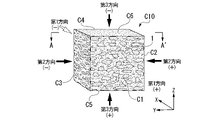
- the pet food C10 is a hexahedral pet food.
- the four side surfaces (side peripheral surfaces) of the pet food C10 are surfaces having more openings 1 than the top surface and the bottom surface.
- the first direction coincides with the X direction
- the second direction coincides with the Y direction
- the third direction coincides with the Z direction. That is, the two directions orthogonal to the first direction are the second direction and the third direction.
- the pet food C10 is a hexahedral pet food, and since the two directions orthogonal to the first direction are the second direction and the third direction, the pet food C10 is projected on the A side (+ X side) of the first direction.
- the first surface C1 and the side surface of the pet food C10 on the A side in the first direction coincide with each other.
- the pet food C10 has an opening area ratio of 10% or more on the first surface C1 on which the pet food C10 is projected onto the A side (+ X side) in the first direction.
- the surface on which the pet food C10 is projected onto the A side (+ X side) in the first direction is the first surface C1.
- the surface on which the pet food C10 is projected onto the B side ( ⁇ X side) in the first direction is the fourth surface C4.
- the plane on which the pet food C10 is projected on the A side (+ Y side) in the second direction orthogonal to the first direction is the second plane C2.
- the surface on which the pet food C10 is projected on the B side ( ⁇ Y side) of the second direction orthogonal to the first direction is the third surface C3.
- the plane on which the pet food C10 is projected on the A side (+ Z side) in the third direction orthogonal to the first direction is the fifth plane C5. Further, the surface on which the pet food C10 is projected on the B side ( ⁇ Z side) of the third direction orthogonal to the first direction is the sixth surface C6.
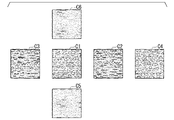
- FIG. 2 is a diagram showing a plane on which the pet food C10 is projected in each direction, that is, the first plane C1 to the sixth plane C6.
- the first surface C1 to the fourth surface C4 are surfaces having an opening area ratio of 10% or more
- the fifth surface C5 and the sixth surface C6 are surfaces having an opening area ratio of 8% or less. Is.
- the preferable range of the opening area ratio of the first surface C1 to the fourth surface C4 in the pet food C10 is as described above, for example, preferably 10% or more and 60% or less, and more preferably 12% or more and 60. % Or less, more preferably 16% or more and 55% or less, particularly preferably 20% or more and 50% or less, and most preferably 25% or more and 50% or less.
- the preferable value of the opening area ratio of the fifth surface C5 and the sixth surface C6 in the pet food C10 is preferably 8% or less, more preferably 4% or less, still more preferably 2% or less, and 0. May be%.
- the pet food C10 since the projected first surface C1 and the side surface of the pet food C10 on the A side in the first direction coincide with each other, the pet food C10 has holes on the bottom surface and the top surface. It can be said that the area ratio is 8% or less, and the open area ratio of the four side peripheral surfaces is 10% or more.
- the pet hood C10 has an opening area ratio on the first surface C1 and an opening on a cross section (AA'cross section: a plane parallel to the first surface C1) when the pet hood C10 is cut so as to be orthogonal to the first direction.
- the ratio to the pore area ratio (opening area ratio on the first surface C1 / opening area ratio in the cross section) is 0.4 to 2.0.
- the preferable range of the ratio of the opening area ratio is as described above.
- the preferred grain density, size, water content, hardness, and raw material of pet food C10 are as described above.
- the pet food C10 described above has a surface having a high opening area ratio, it is easy to chew while maintaining a chewy texture.
- the pet food C10 has both a surface having a high opening area ratio and a surface having a low opening area ratio, a plurality of textures can be enjoyed and the pet food C10 has a higher palatability.
- the first surface C1 to the fourth surface C4 are surfaces having a hole opening area ratio of 10% or more
- the fifth surface C5 and the sixth surface C6 are surfaces having a hole opening area ratio of 8% or less.
- the fourth surface C4 and the second surface C2 or the third surface C3 may be surfaces having an opening area ratio of 8% or less.
- the fifth surface C5 or the sixth surface C6 may be a surface having an opening area ratio of 10% or more.
- the present invention has the following aspects.
- a hexahedral pet food having an opening which has an A surface having an opening area ratio of 10% or more.
- the ratio of the opening area ratio on the A plane to the opening area ratio on the cross section (the A).
- the pet food according to any one of “1" to "4", wherein the opening area ratio on the surface / opening area ratio on the cross section is 0.4 to 2.0.
- a hexahedral pet food having "6" openings, the opening area ratio of the bottom surface and the top surface of the pet food is 8% or less, and the opening area ratio of the side peripheral surfaces (all four surfaces) is Pet food that is 10% or more in each case.
- the pet food D10 is a columnar pet food.
- the side peripheral surface is a surface having many openings 2
- the top surface and the bottom surface of the pet food D10 are surfaces having few openings 2.
- the first direction coincides with the X direction
- the second direction coincides with the Y direction
- the third direction coincides with the Z direction. That is, the two directions orthogonal to the first direction are the second direction and the third direction.
- the pet food D10 has an opening area ratio of 10% or more on the first surface D10 on which the pet food D10 is projected onto the A side (+ X side) in the first direction.
- the surface on which the pet food D10 is projected onto the A side (+ X side) in the first direction is the first surface D1.
- the surface on which the pet food D10 is projected onto the B side ( ⁇ X side) in the first direction is the fourth surface D4.
- the plane on which the pet food D10 is projected on the A side (+ Y side) in the second direction orthogonal to the first direction is the second plane D2.
- the surface on which the pet food D10 is projected on the B side ( ⁇ Y side) of the second direction orthogonal to the first direction is the third surface D3.
- the plane on which the pet food D10 is projected on the A side (+ Z side) in the third direction orthogonal to the first direction is the fifth plane D5. Further, the surface on which the pet food D10 is projected on the B side ( ⁇ Z side) of the third direction orthogonal to the first direction is the sixth surface D6.
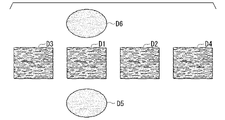
- FIG. 4 is a diagram showing a plane on which the pet food D10 is projected in each direction, that is, the first plane D1 to the sixth plane D6.
- the first surface D1 to the fourth surface D4 are surfaces having an opening area ratio of 10% or more
- the fifth surface D5 and the sixth surface D6 are surfaces having an opening area ratio of 8% or less. Is.
- the preferable range of the opening area ratio of the first surface D1 to the fourth surface D4 in the pet food D10 is as described above, for example, preferably 10% or more and 60% or less, and more preferably 12% or more and 60. % Or less, more preferably 16% or more and 55% or less, particularly preferably 20% or more and 50% or less, and most preferably 25% or more and 50% or less.
- the preferable value of the opening area ratio of the fifth surface D5 and the sixth surface D6 in the pet food D10 is preferably 8% or less, more preferably 4% or less, still more preferably 2% or less, and 0. May be%.
- the surface has a pore area ratio of 8% or less, and the side peripheral surface has a pore area ratio of 10% or more.
- the opening area ratio in the one surface D1 / the opening area ratio in the cross section) is 0.4 to 2.0.
- the preferable range of the ratio of the opening area ratio is as described above.
- the preferred grain density, size, water content, hardness, and raw material of pet food D10 are as described above.
- the pet food D10 described above has a surface having a high opening area ratio, it is easy to chew while maintaining a chewy texture.
- the pet food D10 has both a surface having a high opening area ratio and a surface having a low opening area ratio, it is possible to enjoy a plurality of textures and the pet food has a higher palatability.
- the first surface D1 to the fourth surface D4 are surfaces having a hole opening area ratio of 10% or more
- the fifth surface D5 and the sixth surface D6 are surfaces having a hole opening area ratio of 8% or less.
- the fourth surface D4 and the second surface D2 or the third surface D3 may be surfaces having an opening area ratio of 8% or less. That is, the pet food D10 may have a part of the side peripheral surface having an opening instead of the entire side peripheral surface having an opening.
- the fifth surface D5 or the sixth surface D6 may be a surface having an opening area ratio of 10% or more. That is, the bottom surface or the top surface of the pet food D10 may be a surface having an opening area ratio of 10% or more.
- a swelling step of extruding a kneaded raw material mixture from an extruder to obtain a swelled dough for example, a swelling step of extruding a kneaded raw material mixture from an extruder to obtain a swelled dough, and a swelling step of making the swelled dough porous to make it porous.
- a method for producing a pet food which comprises a porosification step of obtaining a porous dough and a cutting step of cutting the porous dough.
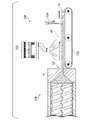
- the pet food manufacturing method 100 will be described in detail with reference to FIG.
- the swelling dough sd is obtained by kneading the raw material mixture with the extruder 101 and extruding the raw material mixture from the extruder.
- the obtained swelling dough sd is conveyed by the belt conveyor 102.
- the conveyed expanded dough sd is made porous by being cooled by the cooler 103, and the porous porous dough pd is obtained.
- the pet food PF of the present embodiment can be obtained.
- the swelling step is a step of extruding the raw material mixture kneaded by the extrusion molding machine 101 from the extrusion molding machine to swell and obtain a swelling dough sd.
- the extruder 101 is not particularly limited, and a known single-screw or twin-screw extruder or the like can be used.
- the temperature of the raw material mixture when the raw material mixture is kneaded by the extruder 101 is, for example, preferably 75 to 140 ° C, more preferably 80 to 135 ° C, and even more preferably 85 to 130 ° C.
- the porosification step is a step of making the swollen dough sd porous to obtain a porous dough pd.
- Specific examples of the porosification step include a step of placing the expanded dough sd under atmospheric pressure and cooling the expanded dough sd with a cooler 103.
- the cooler 103 is not particularly limited, and a known spot cooler or the like can be used.
- the cutting step is a step of cutting the porous dough pd with the cutter 104.
- the porous dough pd may be cut from the MD, may be cut from the CD, or may be cut from either the MD or the CD direction.
- the MD machine direction
- the CD cross direction
- the MD is a direction orthogonal to the flow direction of the porous fabric pd.
- the temperature of the porous dough pd when cutting the porous dough pd with the cutter 104 is preferably 70 ° C. or lower, for example.
- the method for producing pet food described above includes a porosification step, the above-mentioned pet food can be easily produced.
- a cutter is provided at the outlet of the extruder, and the cutter is provided at the moment when the raw material mixture is extruded from the extruder. It is common to cut with.
- the pet food is made porous by extruding the raw material mixture from the extruder and then allowing time before cutting with a cutter. Therefore, according to the method for producing pet food according to the present embodiment, the above-mentioned pet food can be easily produced.
- the cooling by the cooler 103 may be performed in a batch manner by moving the expanded dough extruded from the extrusion molding machine out of the line. Further, in the porosification step in the pet food manufacturing method 100, the expanded dough sd is cooled by the cooler 103, but the cooler 103 may not be used. That is, it may be a step of cooling the expanded dough sd at room temperature by increasing the length of the belt conveyor 102. For example, the length of the belt conveyor 102 may be adjusted, and the expanded dough sd may be left at room temperature (25 ° C.) for 1 minute or more from the time when it is extruded from the extruder to the time when it is cut. ..
- the method for producing the pet food of the present embodiment may be a method other than the above-mentioned production method.
- the pet food of the present embodiment may be produced by using a raw material that generates gas by heating. ..
- Specific examples of the raw material for generating gas include sodium hydrogencarbonate and the like.
- Example 1 The raw materials constituting the pet food were mixed according to the formulations shown in Table 1 to obtain a raw material mixture.
- Water was added to the raw material mixture by a preconditioner in an amount of 12 to 25 parts by mass based on 100 parts by mass of the total amount of the raw material mixture, and the mixture was mixed while heating at 70 to 100 ° C. for 5 seconds to 3 minutes.
- the heated raw material mixture was put into an extruder and heat-treated at 80 to 125 ° C. for 10 seconds to 2 minutes while kneading to pregelatinize the starch component and discharged from the extruder to obtain a swollen dough. ..
- the obtained dough was cooled with a cooler so that the surface temperature of the dough was 70 ° C. or lower to obtain a porous dough.
- the obtained dough was cut from MD and CD so as to have a hexahedral shape with a cutter, and the hexahedral shape (length 8 mm (X direction) ⁇ width 8 mm (Y direction) ⁇ height (thickness) 11.5 mm (Z). Direction))
- Pet food of Example 1 having an opening was obtained.
- the pet food of Example 1 has the same embodiment as the pet food C10 shown in FIG. 1, and the surface cut by the cutter is the side peripheral surface. Further, the first surface of the pet food of Example 1 and the first surface C1 of the pet food C10 shown in FIG.
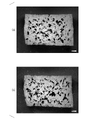
- FIG. 6 is an image of the first surface of the pet food of Example 1 and an image at the time of measuring the opening area ratio of the first surface.
- FIG. 6a is an image of the first surface
- FIG. 6b is an image at the time of measuring the opening area ratio.
- the colored portion represents the opening (hereinafter, the same applies).
- FIG. 7 is an image of the third surface of the pet food of Example 1 and an image at the time of measuring the opening area ratio of the third surface.
- FIG. 7a is an image of the third surface
- FIG. 7b is an image at the time of measuring the opening area ratio.
- FIG. 8 is an image of the fifth surface of the pet food of Example 1 and an image at the time of measuring the opening area ratio of the fifth surface.
- FIG. 8a is an image of the fifth surface
- FIG. 8b is an image at the time of measuring the opening area ratio.
- the opening area ratio on the first surface of the pet hood of each example (the opening area ratio measured by the above "surface measurement") and the opening area ratio on the cross section (measured by the above "section measurement”).
- the ratio (the opening area ratio on the first surface / the opening area ratio in the cross section) to the (opening area ratio) was determined.
- the ratio of the opening area ratio on the third surface to the opening area ratio on the cross section (parallel to the third surface) (opening on the third surface) is performed in the same manner.
- Area ratio / opening area ratio in cross section) was also determined. The results are shown in Table 2 as the "opening area ratio".
- the pet food of Example 1 had a higher opening area ratio on the first surface (opening area ratio on the third surface) than the pet foods of Comparative Examples 1 to 7. ..
- none of the commercially available pet foods of Comparative Examples 1 to 7 had an opening area ratio of 10% or more on the first surface.
- FIG. 9 is an image at the time of measuring the opening area ratio of the first surface of the pet food of Example 1 and an image at the time of measuring the opening area ratio of the cross section (plane parallel to the first surface).
- FIG. 10 is an image at the time of measuring the opening area ratio of the third surface of the pet food of Example 1 and an image at the time of measuring the opening area ratio of the cross section (plane parallel to the third surface).
- the first surface and the cross section (parallel to the first surface) and the third surface and the cross section (parallel to the third surface) of the pet food of Example 1 are opened. It can be confirmed that the distribution of the holes is close to each other.
- the pet food of Example 1 has a pore opening area ratio of the first surface (the opening area ratio of the third surface) closer to 1 than the pet foods of Comparative Examples 1 to 7. It was a thing. From this, it was confirmed that the pet food of Example 1 had evenly opened holes on the surface and inside as compared with the pet foods of Comparative Examples 1 to 7.
- the hardness of pet food is a value obtained by the following measuring method.
- a compression tester texture analyzer, model number: EZ-SX, manufactured by Shimadzu Corporation
- the breaking force when the pet food was compressed at a constant compression rate was measured.
- one pet food of Example 1 was placed on a saucer, and the test force was measured while pressing the plunger vertically from directly above at a constant speed.
- the pet food was placed so that the surfaces with which the plunger came into contact were the first surface, the third surface, or the fifth surface, and measurement was repeated 10 times for each, and the average value was calculated.
- the unit was converted to Newton (N) by multiplying the value of the breaking force (unit: kgw) measured by the compression tester by 9.8.
- the pet food of Example 1 had a high water absorption rate.
- Example 2 The same method as in Example 1 described above, except that the die plate of the pet food extruder of Example 2 was changed and the porous dough was cut only from the CD with a cutter, was hexahedral (length 8 mm (X)). A pet food of Example 2 having a direction) ⁇ width 8 mm (Y direction) ⁇ height (thickness) 11.5 mm (Z direction) was obtained. Since the cut surface is a surface having an opening, the pet food of Example 2 has two surfaces having an opening.
- the opening area ratio of the surface of the pet food of Example 2 having holes is about the same as the opening area ratio of the first surface and the third surface of the pet food of Example 1, respectively, and Example 2
- the opening area ratio of the surface of the pet food having no opening was about the same as the opening area ratio of the fifth surface of the pet food of Example 1.
- Example 3 The die plate of the pet food extruder of Example 3 was changed, and a pet food slightly larger than the pet food of Example 1 having a hexahedron shape was obtained by the same method as in Example 1.
- the non-cut surface of the pet food (the surface corresponding to the 5th and 6th surfaces of the pet food of Example 1) is cut with a cutter, and a hexahedron shape (length 8 mm (X)) having holes all around is cut.
- a pet food of Example 3 having a direction) ⁇ width 8 mm (Y direction) ⁇ height (thickness) 11.5 mm (Z direction) was obtained. Since the cut surface is a surface having an opening, the pet food of Example 3 has six surfaces having an opening.
- the opening area ratio of the surface of the pet food of Example 3 having holes was about the same as the opening area ratio of the first surface and the third surface of the pet food of Example 1.
- Example 1 A pet food of Reference Example 1 having (X direction) ⁇ width 8 mm (Y direction) ⁇ height (thickness) 11.5 mm (Z direction)) was obtained.
- the pet food of Reference Example 1 did not have a surface having an opening.
- the pet food of the example has a surface with an opening area ratio of 10% or more, it is easier to chew while maintaining the chewy texture as compared with the pet food of the reference example, so that the pet food has a high palatability. It could be confirmed. Further, among the examples, the pet food of Example 1 having four surfaces having holes and two surfaces having no holes had the highest palatability.
Landscapes
- Life Sciences & Earth Sciences (AREA)
- Chemical & Material Sciences (AREA)
- Polymers & Plastics (AREA)
- Zoology (AREA)
- Engineering & Computer Science (AREA)
- Food Science & Technology (AREA)
- Animal Husbandry (AREA)
- Birds (AREA)
- Fodder In General (AREA)
Abstract
開孔1を有するペットフードであって、第1方向に前記ペットフードを投影した第1面C1の開孔面積率が10%以上である、ペットフード。
Description
本発明は、ペットフードに関する。
本願は、2020年12月28日に日本に出願された、特願2020-219693号、及び2021年12月27日に日本に出願された、特願2021-213426に基づき優先権主張し、その内容をここに援用する。
本願は、2020年12月28日に日本に出願された、特願2020-219693号、及び2021年12月27日に日本に出願された、特願2021-213426に基づき優先権主張し、その内容をここに援用する。
ペットフードは、給与目的を機会で分けると主食と間食に分けられる。主食としてのペットフードは「総合栄養食」と言い、当該ペットフードと水を与えていれば必要とされる栄養素が摂取できるように作られる。
一方、「間食」は、ペットのしつけや運動、ご褒美として与えるなど限られた量を与えることが意図されているペットフードである。
目的別による分類は、「総合栄養食」「間食」「療法食」、そのいずれにも該当しない「その他の目的食」に分かれる。
一方、「間食」は、ペットのしつけや運動、ご褒美として与えるなど限られた量を与えることが意図されているペットフードである。
目的別による分類は、「総合栄養食」「間食」「療法食」、そのいずれにも該当しない「その他の目的食」に分かれる。
また、水分含有量による分類としては、水分含有量が10%程度(12%以下)であるドライフード、水分含有量が25~35%程度であり、発泡処理されているソフトフード、水分含有量が25~35%程度であり、発泡処理されていないセミモイストフード、及び水分含有量が75%程度であるウエットフードに大別される。これらのうち、ドライタイプのペットフードは、取り扱い易さ、保存性の良さなどの点から、近年その需要がますます増加している。
ドライタイプのペットフードは一般的に固く、他タイプのペットフードより硬いのはもちろん、人間が食べている食品のほとんどのものよりも硬い。イヌ・ネコは元来肉食であり、その歯は主に獲物をくわえるため、又は肉を切り取るために進化したものであって、硬いものを臼歯で砕くのには適していない。そのイヌ・ネコにとって従来の硬いドライタイプのペットフードは食べやすいフードとは言えない。噛み砕きやすい粒は食べやすい粒となり、食べやすいということは嗜好性が高いということにつながる。
ドライタイプのペットフードではないが、噛み砕きやすいペットフードとして、特許文献1には、低カロリー低脂肪のおやつとして、重量1グラムあたり約5キロカロリー未満である、ペット用空気混入おやつが開示されている。
噛み砕きやすさは嗜好性向上につながるものの、噛み応えを有するペットフードも嗜好性が向上する。すなわち、特許文献1に記載のペットフードのように、ペットフードを例えばホイップ状にすることにより、単にペットフードの噛み砕きやすさを向上させるだけでは、噛み応えが低下してしまう。そのため、結果として、嗜好性向上にはつながらない。また、特許文献1に記載のペットフードにおいては、空気を混入させ、ホイップ状等にする必要があるため、含有させることができる成分が限られてしまう。
本発明は上記事情に鑑みてなされたものであり、噛み応えを維持しつつ、噛み砕きやすくすることにより、嗜好性を向上させたペットフードを提供することを課題とする。
本発明は以下の態様を有する。
[1]開孔を有するペットフードであって、第1方向に前記ペットフードを投影した第1面の開孔面積率が10%以上である、ペットフード。
[2]第1方向以外の方向に前記ペットフードを投影した面の開孔面積率が8%以下である、[1]に記載のペットフード。
[3]前記第1方向に交差する第2方向のうちA側に前記ペットフードを投影した面を第2面、前記第2方向のうちB側に前記ペットフードを投影した面を第3面とした場合、第2面及び第3面の少なくともいずれかの面の開孔面積率が10%以上である、[1]又は[2]に記載のペットフード。
[4]前記第2面及び前記第3面のいずれも開孔面積率が10%以上である、[3]に記載のペットフード。
[5]前記第1面における開孔面積率と、前記第1方向に直交するように前記ペットフードを切断した際の断面における開孔面積率との比(第1面における開孔面積率/断面における開孔面積率)が0.4~2である、[1]~[4]のいずれか一項に記載のペットフード。
[6]前記第1面における開孔面積率と、前記第1面を等分するように前記ペットフードを切断した際の断面における開孔面積率との比(第1面における開孔面積率/断面における開孔面積率)が0.4~2である、[1]~[5]のいずれか一項に記載のペットフード。
本発明によれば、噛み応えを維持しつつ、噛み砕きやすくすることにより、嗜好性を向上させたペットフードが得られる。
本明細書において、「ペット」とは人に飼育されている動物をいう。より狭義の意味では、ペットは飼い主に愛玩される動物である。また、「ペットフード」とは、ペット用の飼料をいう。本発明にかかるペットフードを「動物用飼料」又は「動物の餌」として販売することが可能である。
本明細書において「嗜好性」とは、ペットに好まれて食されるか否かの指標であり、食感、食味、におい等に起因する。
本明細書において、水分含有量の値は「乾燥減量法」で得られる値である。
乾燥減量法は、試料を赤外線照射によって加熱乾燥させ、含まれていた水分の蒸発による質量変化から試料中の水分の量を求める方法である。水分含有量は、公知の装置を用いて測定することができる。例えば、水分含有量は、Infrared Moisture Analyzer FD-720(株式会社ケツト科学研究所製)で測定することができる。
乾燥減量法は、試料を赤外線照射によって加熱乾燥させ、含まれていた水分の蒸発による質量変化から試料中の水分の量を求める方法である。水分含有量は、公知の装置を用いて測定することができる。例えば、水分含有量は、Infrared Moisture Analyzer FD-720(株式会社ケツト科学研究所製)で測定することができる。
本明細書においてペットフードの大きさは、ペットフードの形状が、球状の場合は直径を意味し、ペットフードの形状が、球状以外の場合(円柱状、多角柱状、板状等)は、最長径を意味する。
(ペットフード)
本実施形態のペットフードは、開孔を有するペットフードである。
本明細書において、「開孔」とは、ペットフードの表面及び内部に有する微細な孔である。該孔は、連通孔として複数の孔が繋がったものであってもよい。
一方で、例えば、ドーナッツ形状のペットフードのような、ペットフードの表面から対応する裏面まで貫通する穴については、噛み応えを維持しつつ、噛み砕きやすくするという効果を奏しないため、「開孔」には、含まれない。
本実施形態のペットフードは、開孔を有するペットフードである。
本明細書において、「開孔」とは、ペットフードの表面及び内部に有する微細な孔である。該孔は、連通孔として複数の孔が繋がったものであってもよい。
一方で、例えば、ドーナッツ形状のペットフードのような、ペットフードの表面から対応する裏面まで貫通する穴については、噛み応えを維持しつつ、噛み砕きやすくするという効果を奏しないため、「開孔」には、含まれない。
なお、本実施形態に係るペットフードは、本実施形態に係るペットフードのみからなってもよく、本実施形態に係るペットフードとその他のペットフードとの混合物であってもよい。その他のペットフードとしては特に限定されず、本実施形態に係るペットフード以外のドライタイプのペットフード、素材、フレーク等が挙げられる。本実施形態に係るとその他のペットフードとの混合物中、前記混合物の全量に対し、本実施形態に係るペットフードが1%以上含まれていればよい。
より具体的に「開孔」とは、例えば、円相当径が50~5000μmの孔を意味する。
なお、開孔が連通孔の場合の円相当径は、ペットフードの表面を平面視した際の円相当径を意味する。より具体的には、例えば、デジタルマイクロスコープ(商品名「VHX-7000」、株式会社キーエンス製)を用いて、ペットフードの表面の画像を撮影し、該画像を用いて、該デジタルマイクロスコープの計測・スケールツールで開孔(連通孔)の円相当径を測定した値を意味する。
なお、開孔が連通孔の場合の円相当径は、ペットフードの表面を平面視した際の円相当径を意味する。より具体的には、例えば、デジタルマイクロスコープ(商品名「VHX-7000」、株式会社キーエンス製)を用いて、ペットフードの表面の画像を撮影し、該画像を用いて、該デジタルマイクロスコープの計測・スケールツールで開孔(連通孔)の円相当径を測定した値を意味する。
≪第1面の開孔面積率≫
本実施形態のペットフードは、第1方向に前記ペットフードを投影した第1面の開孔面積率が10%以上である。
該第1方向とは任意の方向である。例えば、本実施形態のペットフードを上記デジタルマイクロスコープの測定台に載置し、該ペットフードの載置面とは反対の面(天面)の画像を撮影した場合、上記デジタルマイクロスコープから該ペットフードの天面に向かう方向が第1方向となる。また、上記デジタルマイクロスコープで撮影した該ペットフードの天面の画像が、該ペットフードを投影した第1面となる。
本実施形態のペットフードは、第1方向に前記ペットフードを投影した第1面の開孔面積率が10%以上である。
該第1方向とは任意の方向である。例えば、本実施形態のペットフードを上記デジタルマイクロスコープの測定台に載置し、該ペットフードの載置面とは反対の面(天面)の画像を撮影した場合、上記デジタルマイクロスコープから該ペットフードの天面に向かう方向が第1方向となる。また、上記デジタルマイクロスコープで撮影した該ペットフードの天面の画像が、該ペットフードを投影した第1面となる。
本実施形態のペットフードの第1面の開孔面積率が10%以上であり、好ましくは12%以上であり、より好ましくは16%以上であり、さらに好ましくは20%以上であり、特に好ましくは25%以上である。
ペットフードの開孔面積率が10%以上であれば、ペットフードが噛み砕きやすくなり、嗜好性が向上する。
また、ペットフードの開孔面積率が上記の好ましい値以上であれば、よりペットフードが噛み砕きやすくなり、嗜好性がより向上する。
ペットフードの開孔面積率が10%以上であれば、ペットフードが噛み砕きやすくなり、嗜好性が向上する。
また、ペットフードの開孔面積率が上記の好ましい値以上であれば、よりペットフードが噛み砕きやすくなり、嗜好性がより向上する。
一方で、本実施形態のペットフードの第1面の開孔面積率は、好ましくは60%以下であり、より好ましくは55%以下であり、さらに好ましくは50%以下である。
ペットフードの開孔面積率が上記の好ましい値以下であれば、よりペットフードの噛み応えが向上し、嗜好性がより向上する。
ペットフードの開孔面積率が上記の好ましい値以下であれば、よりペットフードの噛み応えが向上し、嗜好性がより向上する。
例えば、本実施形態のペットフードの第1面の開孔面積率は、好ましくは10%以上60%以下であり、より好ましくは12%以上60%以下であり、さらに好ましくは16%以上55%以下であり、特に好ましくは20%以上50%以下であり、最も好ましくは25%以上50%以下である。
本明細書において、「開孔面積率」とは、デジタルマイクロスコープ(商品名「VHX-7000」、キーエンス社製)を用いて、ペットフードの表面の画像を撮影し、該画像を用いて、該デジタルマイクロスコープの計測・スケールツール自動面積計測(粒子カウント)で、円相当径50μm未満を除外して、開孔面積率を測定した値を意味する。
より具体的な操作手順は以下の通りである。
より具体的な操作手順は以下の通りである。
(i)測定台に載置したペットフードの第1面が全て映り込むようにデジタルマイクロスコープの倍率を設定する(例えば、20倍に設定する)。
(ii)落射照明の設定値は、100~255の間で最も開孔が見える数値を設定する。
(iii)デジタルマイクロスコープの計測・スケールツール自動面積計測(粒子カウント)において、抽出方法は「明るさ(標準)」に設定する。次いで、ペットフードの第1面の抽出領域を設定する。
(iv)円相当径50μm未満を除外して、デジタルマイクロスコープの計測・スケールツール自動面積計測(粒子カウント)を行うと、ペットフードの第1面の開孔率が計測できる。
(ii)落射照明の設定値は、100~255の間で最も開孔が見える数値を設定する。
(iii)デジタルマイクロスコープの計測・スケールツール自動面積計測(粒子カウント)において、抽出方法は「明るさ(標準)」に設定する。次いで、ペットフードの第1面の抽出領域を設定する。
(iv)円相当径50μm未満を除外して、デジタルマイクロスコープの計測・スケールツール自動面積計測(粒子カウント)を行うと、ペットフードの第1面の開孔率が計測できる。
≪他の面の開孔面積率≫
本実施形態のペットフードは、第1方向以外の方向に該ペットフードを投影した面(以下、「他の面」ともいう)の開孔面積率が8%以下であることが好ましい。すなわち、本実施形態のペットフードは、ペットフードの表面に開孔の数が多い部分と、開孔の数が少ない部分とが混在していることが好ましい。
本実施形態のペットフードは、開孔面積率が10%以上の第1面と、開孔面積率が8%以下である他の面とを有することにより、該ペットフードを噛んだ時に複数の食感を楽しめるため、より嗜好性が向上する。
本実施形態のペットフードは、第1方向以外の方向に該ペットフードを投影した面(以下、「他の面」ともいう)の開孔面積率が8%以下であることが好ましい。すなわち、本実施形態のペットフードは、ペットフードの表面に開孔の数が多い部分と、開孔の数が少ない部分とが混在していることが好ましい。
本実施形態のペットフードは、開孔面積率が10%以上の第1面と、開孔面積率が8%以下である他の面とを有することにより、該ペットフードを噛んだ時に複数の食感を楽しめるため、より嗜好性が向上する。
本実施形態のペットフードの他の面の開孔面積率は、好ましくは8%以下であり、より好ましくは4%以下であり、さらに好ましくは2%以下であり、0%であってもよい。
本実施形態のペットフードの他の面の開孔面積率が、上記の好ましい値以下であれば、該ペットフードの第1面の開孔面積率と他の面の開孔面積率との差が大きくなり、より複数の食感を楽しめるため、より嗜好性が向上する。
本実施形態のペットフードの他の面の開孔面積率が、上記の好ましい値以下であれば、該ペットフードの第1面の開孔面積率と他の面の開孔面積率との差が大きくなり、より複数の食感を楽しめるため、より嗜好性が向上する。
≪第2面及び第3面の開孔面積率≫
本実施形態のペットフードは、上述した該ペットフードの第1面に加えて、前記第1方向に交差する第2方向のうちA側(+側、第1側、又は一方側ともいえる)に前記ペットフードを投影した面を第2面、前記第2方向のうちB側(-側、第2側、又は他方側ともいえる)に前記ペットフードを投影した面を第3面とした場合、第2面及び第3面の少なくともいずれかの面の開孔面積率が10%以上であることが好ましい。すなわち、本実施形態のペットフードは、ペットフードの表面に開孔の数が多い部分を複数有することが好ましい。
本実施形態のペットフードは、上述した該ペットフードの第1面に加えて、前記第1方向に交差する第2方向のうちA側(+側、第1側、又は一方側ともいえる)に前記ペットフードを投影した面を第2面、前記第2方向のうちB側(-側、第2側、又は他方側ともいえる)に前記ペットフードを投影した面を第3面とした場合、第2面及び第3面の少なくともいずれかの面の開孔面積率が10%以上であることが好ましい。すなわち、本実施形態のペットフードは、ペットフードの表面に開孔の数が多い部分を複数有することが好ましい。
ここで、第2方向は典型的には、第1方向に「直交」する方向を意味するが、第1方向に直交する方向に限定されず、第1方向に交差し、ペットフードの面に対して直交するような所定の方向を意味する場合もある。
例えば、第2方向が第1方向に直交する方向ではない場合の具体例としては、本実施形態のペットフードが四面体状であり、底面を第1面とした場合は、該四面体状のペットフードの側面に対して直交する方向が、第2方向となる。
また、本実施形態のペットフードが球状及び円柱状等の形状を面で表せない場合は、第2方向は第1方向に「直交」する方向を意味する。
例えば、第2方向が第1方向に直交する方向ではない場合の具体例としては、本実施形態のペットフードが四面体状であり、底面を第1面とした場合は、該四面体状のペットフードの側面に対して直交する方向が、第2方向となる。
また、本実施形態のペットフードが球状及び円柱状等の形状を面で表せない場合は、第2方向は第1方向に「直交」する方向を意味する。
第2面及び第3面の開孔面積率の好ましい範囲は、上述した第1面の開孔面積率の好ましい範囲と同様である。
本実施形態のペットフードの第2面及び第3面の少なくともいずれかの面の開孔面積率が、上記の好ましい値以上であれば、よりペットフードが噛み砕きやすくなり、嗜好性がより向上する。また、本実施形態のペットフードの第2面及び第3面の少なくともいずれかの面の開孔面積率が、上記の好ましい値以下であれば、よりペットフードの噛み応えが向上し、嗜好性がより向上する。
本実施形態のペットフードの第2面及び第3面の少なくともいずれかの面の開孔面積率が、上記の好ましい値以上であれば、よりペットフードが噛み砕きやすくなり、嗜好性がより向上する。また、本実施形態のペットフードの第2面及び第3面の少なくともいずれかの面の開孔面積率が、上記の好ましい値以下であれば、よりペットフードの噛み応えが向上し、嗜好性がより向上する。
本実施形態のペットフードは、上述した該ペットフードの第1面に加えて、該ペットフードの第2面及び第3面の開孔面積率も、いずれも10%以上であることが好ましい。
本実施形態のペットフードの第2面及び第3面の開孔面積率が、上記の好ましい値以上であれば、よりペットフードが噛み砕きやすくなり、嗜好性がより向上する。また、本実施形態のペットフードの第2面及び第3面の開孔面積率が、上記の好ましい値以下であれば、よりペットフードの噛み応えが向上し、嗜好性がより向上する。
本実施形態のペットフードの第2面及び第3面の開孔面積率が、上記の好ましい値以上であれば、よりペットフードが噛み砕きやすくなり、嗜好性がより向上する。また、本実施形態のペットフードの第2面及び第3面の開孔面積率が、上記の好ましい値以下であれば、よりペットフードの噛み応えが向上し、嗜好性がより向上する。
本実施形態のペットフードは、第1面、第2面及び第3面の開孔面積率がいずれも10%以上であり、かつ、第1面、第2面及び第3面以外の少なくとも1つの面の開孔面積率が8%以下であることが好ましい。
より具体的には、本実施形態のペットフードは、第1面、第2面及び第3面の開孔面積率がいずれも10%以上60%以下であり、かつ、第1面、第2面及び第3面以外の少なくとも1つの面の開孔面積率が8%以下であることが好ましく、第1面、第2面及び第3面の開孔面積率がいずれも12%以上60%以下であり、かつ、第1面、第2面及び第3面以外の少なくとも1つの面の開孔面積率が4%以下であることがより好ましく、第1面、第2面及び第3面の開孔面積率がいずれも16%以上55%以下であり、かつ、第1面、第2面及び第3面以外の少なくとも1つの面の開孔面積率が4%以下であることがさらに好ましく、第1面、第2面及び第3面の開孔面積率がいずれも20%以上50%以下であり、かつ、第1面、第2面及び第3面以外の少なくとも1つの面の開孔面積率が4%以下であることがさらにより好ましく、第1面、第2面及び第3面の開孔面積率がいずれも25%以上50%以下であり、かつ、第1面、第2面及び第3面以外の少なくとも1つの面の開孔面積率が4%以下であることが特に好ましく、第1面、第2面及び第3面の開孔面積率がいずれも25%以上50%以下であり、かつ、第1面、第2面及び第3面以外の少なくとも1つの面の開孔面積率が2%以下であることが最も好ましい。
さらに、上記のペットフードにおいて、「第1面、第2面及び第3面以外の少なくとも1つの面」は、「第1面、第2面及び第3面以外の2面」であることが好ましい。
さらに、上記のペットフードにおいて、「第1面、第2面及び第3面以外の少なくとも1つの面」は、「第1面、第2面及び第3面以外の2面」であることが好ましい。
≪第1面の開孔面積率と断面の開孔面積率との比≫
本実施形態のペットフードは、第1面における開孔面積率と、第1方向に直交するように前記ペットフードを切断した際の断面(以下、断面Aという)における開孔面積率との比(第1面における開孔面積率/断面Aにおける開孔面積率)が0.3~3であることが好ましい。すなわち、本実施形態のペットフードは、より嗜好性を向上させる観点から、該ペットフードの表面のみに開孔を有するのではなく、該ペットフードの内部にも開孔を有するものであることが好ましい。
本実施形態のペットフードは、第1面における開孔面積率と、第1方向に直交するように前記ペットフードを切断した際の断面(以下、断面Aという)における開孔面積率との比(第1面における開孔面積率/断面Aにおける開孔面積率)が0.3~3であることが好ましい。すなわち、本実施形態のペットフードは、より嗜好性を向上させる観点から、該ペットフードの表面のみに開孔を有するのではなく、該ペットフードの内部にも開孔を有するものであることが好ましい。
本実施形態のペットフードにおける上記第1面における開孔面積率と断面Aにおける開孔面積率との比は、0.3~3であることが好ましく、0.35~2.5であることがより好ましく、0.4~2であることがさらに好ましい。
上記第1面における開孔面積率と断面Aにおける開孔面積率との比が上記の好ましい範囲内であれば、ペットフードが噛み砕きやすく、かつ、ペットフードの噛み応えが向上するため、嗜好性がより向上する。
上記第1面における開孔面積率と断面Aにおける開孔面積率との比が上記の好ましい範囲内であれば、ペットフードが噛み砕きやすく、かつ、ペットフードの噛み応えが向上するため、嗜好性がより向上する。
本実施形態のペットフードは、第1面における開孔面積率と、第1面を等分するように第1方向に前記ペットフードを切断した際の断面(以下、断面Bという)における開孔面積率との比(第1面における開孔面積率/断面Bにおける開孔面積率)が0.3~3であることが好ましい。すなわち、本実施形態のペットフードは、より嗜好性を向上させる観点から、該ペットフードの表面のみに開孔を有するのではなく、該ペットフードの内部にも開孔を有するものであることが好ましい。
本実施形態のペットフードにおける上記第1面における開孔面積率と断面Bにおける開孔面積率との比は、0.3~3であることが好ましく、0.35~2.5であることがより好ましく、0.4~2であることがさらに好ましい。
上記第1面における開孔面積率と断面Bにおける開孔面積率との比が上記の好ましい範囲内であれば、ペットフードが噛み砕きやすく、かつ、ペットフードの噛み応えが向上するため、嗜好性がより向上する。
上記第1面における開孔面積率と断面Bにおける開孔面積率との比が上記の好ましい範囲内であれば、ペットフードが噛み砕きやすく、かつ、ペットフードの噛み応えが向上するため、嗜好性がより向上する。
本実施形態のペットフードにおける上記第1面における開孔面積率と断面A又は断面Bにおける開孔面積率との比は、0.3~3であることが好ましく、0.35~2.5であることがより好ましく、0.4~2であることがさらに好ましい。
また、本実施形態のペットフードにおける上記第1面における開孔面積率と断面A及び断面Bにおける開孔面積率との比は、0.3~3であることが好ましく、0.35~2.5であることがより好ましく、0.4~2であることがさらに好ましい。
また、本実施形態のペットフードにおける上記第1面における開孔面積率と断面A及び断面Bにおける開孔面積率との比は、0.3~3であることが好ましく、0.35~2.5であることがより好ましく、0.4~2であることがさらに好ましい。
≪ペットフードの粒密度≫
本実施形態のペットフードは、粒密度が600g/L以下であることが好ましく、500g/L以下がより好ましく、400g/L以下が更に好ましい。
本実施形態のペットフードの粒密度が上記の好ましい値以下であれば、よりペットフードが噛み砕きやすくなり、嗜好性がより向上する。また、粒密度が上記の好ましい値以下であれば、適度な噛み応えを有しつつ、単位体積当たりの質量を減らすことができ、満腹感を得られやすいのでダイエット効果もより向上する。
本実施形態のペットフードは、粒密度が600g/L以下であることが好ましく、500g/L以下がより好ましく、400g/L以下が更に好ましい。
本実施形態のペットフードの粒密度が上記の好ましい値以下であれば、よりペットフードが噛み砕きやすくなり、嗜好性がより向上する。また、粒密度が上記の好ましい値以下であれば、適度な噛み応えを有しつつ、単位体積当たりの質量を減らすことができ、満腹感を得られやすいのでダイエット効果もより向上する。
ペットフードの粒密度は、下記の式(1)~(2)により算出される。
粒体積(L)=粒体積(mm3)/1,000,000・・・(1)
粒密度(g/L)=粒質量(g)/粒体積(L)・・・(2)
粒体積(L)=粒体積(mm3)/1,000,000・・・(1)
粒密度(g/L)=粒質量(g)/粒体積(L)・・・(2)
上記式(2)における粒質量は、下記の手順で測定できる。
(工程1A)測定対象のペットフードを1粒選択する。
(工程2A)電子秤で1粒の質量を測定する。
(工程1A)測定対象のペットフードを1粒選択する。
(工程2A)電子秤で1粒の質量を測定する。
上記式(2)における粒体積は、下記の手順で測定できる。
(工程1B)測定対象のペットフードを1粒選択する。
(工程2B)X線CT装置(例えば、CosmoScan FX(株式会社リガク製))により、粒体積を算出する。
(工程1B)測定対象のペットフードを1粒選択する。
(工程2B)X線CT装置(例えば、CosmoScan FX(株式会社リガク製))により、粒体積を算出する。
本実施形態において、上記工程2BにおけるCT画像は以下の撮影条件を採用する。
(CT画像の撮影条件)
管電圧:90kV
管電流:88μA
照射時間:2分
分解能:50μm
FOV(有効視野(Field of View)):25.6mm×25.6mm×25.6mm
matrix:512×512×512
(CT画像の撮影条件)
管電圧:90kV
管電流:88μA
照射時間:2分
分解能:50μm
FOV(有効視野(Field of View)):25.6mm×25.6mm×25.6mm
matrix:512×512×512
上記工程2Bにおいて、以下の手順によりそれぞれのCT断面画像における粒全体の面積(粒面積)を算出する。
(ib)画像解析ソフト(例えば、Fiji)を用いて、X線CT画像を2値化する(最大エントロピー法)。それぞれの粒断面画像において、バックグラウンド値を引いて、生地面積を算出する。
(iib)それぞれのCT断面画像において、Fill holes、Dilate/Erode処理にて開孔を埋めてバッググランド値を引いて、粒全体の面積(粒面積)を算出する。
上記条件の場合では、CT画像はFOV(有効視野(Field of View))を512等分して測定するので、1枚のCT断面画像は厚みが50μmになるとみなせる。その為、1枚のCT断面画像の粒面積に50μmの厚みをかけると1枚のCT断面画像の粒体積となり、全てのCT断面画像の粒体積を足し合わせると、測定対象となる1つのフード粒の粒体積を算出できる。
≪形状≫
本実施形態のペットフードの形状は、ペットが食するのに好適な形状であればよく、特に限定されない。
例えば球状、楕円体状(碁石状)、ペレット状、円柱状、多角柱状、六面体状(板状)、クローバー状、ハート状、星状、十字状等あらゆる形状が適用可能である。その中でも、本発明の効果がより得やすくなる観点から、円柱状、多角柱状又は六面体状であることが好ましく、六面体状であることがより好ましい。
本実施形態のペットフードの形状は、ペットが食するのに好適な形状であればよく、特に限定されない。
例えば球状、楕円体状(碁石状)、ペレット状、円柱状、多角柱状、六面体状(板状)、クローバー状、ハート状、星状、十字状等あらゆる形状が適用可能である。その中でも、本発明の効果がより得やすくなる観点から、円柱状、多角柱状又は六面体状であることが好ましく、六面体状であることがより好ましい。
≪大きさ≫
本実施形態のペットフードの大きさは、ペットが一口で頬張れる小粒形状であってもよいし、ペットが複数回にわたってかじり付くことができる大粒形状であってもよいが、ペットフードの最長径が、1~200mmであることが好ましく、1~150mmであることがより好ましく、3~40mmであることがさらに好ましい。
また、ペットフードの最短径が、1~100mmであることが好ましく、1~50mmであることがより好ましく、3~30mmであることがさらに好ましい。
本実施形態のペットフードの大きさは、ペットが一口で頬張れる小粒形状であってもよいし、ペットが複数回にわたってかじり付くことができる大粒形状であってもよいが、ペットフードの最長径が、1~200mmであることが好ましく、1~150mmであることがより好ましく、3~40mmであることがさらに好ましい。
また、ペットフードの最短径が、1~100mmであることが好ましく、1~50mmであることがより好ましく、3~30mmであることがさらに好ましい。
≪水分含有量≫
本実施形態のペットフードの水分含有量は1~50質量%が好ましく、3~30質量%がより好ましく、3~12質量%がさらに好ましい。
本実施形態のペットフードは、本発明の効果がより得やすくなる観点から、水分含有量が10%程度以下であるドライフードであることが好ましく、水分含有量が5~12%のドライフードであることがより好ましい。
本実施形態のペットフードの水分含有量は1~50質量%が好ましく、3~30質量%がより好ましく、3~12質量%がさらに好ましい。
本実施形態のペットフードは、本発明の効果がより得やすくなる観点から、水分含有量が10%程度以下であるドライフードであることが好ましく、水分含有量が5~12%のドライフードであることがより好ましい。
≪硬さ≫
本実施形態のペットフードの硬さは、好ましくは60N以下であり、より好ましくは50N以下であり、さらに好ましくは40N以下である。
ペットフードの硬さが上記の好ましい値以下であれば、ペットフードが噛み砕きやすくなり、嗜好性が向上する。
本実施形態のペットフードの硬さは、好ましくは60N以下であり、より好ましくは50N以下であり、さらに好ましくは40N以下である。
ペットフードの硬さが上記の好ましい値以下であれば、ペットフードが噛み砕きやすくなり、嗜好性が向上する。
一方で、本実施形態のペットフードの硬さは、好ましくは6N以上であり、より好ましくは8N以上であり、さらに好ましくは10N以上である。
ペットフードの硬さが上記の好ましい値以上であれば、よりペットフードの噛み応えが向上し、嗜好性がより向上する。
ペットフードの硬さが上記の好ましい値以上であれば、よりペットフードの噛み応えが向上し、嗜好性がより向上する。
本明細書において、ペットフードの硬さは以下の測定方法で得られる値である。
圧縮試験機(テクスチャーアナライザー、型番:EZ-SX、株式会社島津製作所製)を用い、ペットフードを一定の圧縮速度で圧縮したときの破断力を測定する。
具体的には、受け皿の上に、測定対象のペットフードを1つ置き、真上から垂直にプランジャーを一定速度で押し付けながら試験力を測定する。試験力のピーク値(最大値)を破断力の値として読み取る。ペットフード10個について測定を繰り返して平均値を求める。
上記圧縮試験機で測定される破断力(単位:kgw)の数値に9.8を掛けることによって、単位をニュートン(N)に変換する。
測定条件は以下に示す通りである。
プランジャー:幅10mm、長さ20mm、先端1mm厚み、くさび型のプランジャー
プラットフォーム:径100mmの平らの受け皿
圧縮速度:60mm/分
プランジャーの最下点:ペットフードの厚さ(高さ)に対して7~9割押し込まれるように設定
測定温度:25℃
本実施形態のペットフードにおいて、第1面の硬さが上述した好ましい硬さの値であることが好ましい。すなわち、上述したペットフードの硬さの測定方法において、本実施形態のペットフードの第1面にプランジャーを押し付けながら試験力を測定した際の値(硬さ)が、6N以上60N以下であることが好ましく、8N以上50N以下であることがより好ましく、10N以上40N以下であることがさらに好ましい。
また、本実施形態のペットフードが開孔面積率が8%以下である他の面を有する場合、本実施形態のペットフードの他の面にプランジャーを押し付けながら試験力を測定した際の値(硬さ)が、15N以上70N以下であることが好ましく、20N以上60N以下であることがより好ましく、25N以上50N以下であることがさらに好ましい。
≪吸水率≫
本実施形態のペットフードは、第1面の開孔面積率が10%以上であり、比表面積が大きいため、従来のペットフードに比べて吸水率が高いペットフードとなる。また、吸水率が高いため、水に浸漬させることで、ペットの好みに応じて、短時間で容易にペットフードの硬さを変えることができる。
また、開孔面積率が高いほど、比表面積が大きく、吸水率が高くなるため、本実施形態のペットフードの開孔面積率の高さを吸水率で表すこともできる。
本実施形態のペットフードは、第1面の開孔面積率が10%以上であり、比表面積が大きいため、従来のペットフードに比べて吸水率が高いペットフードとなる。また、吸水率が高いため、水に浸漬させることで、ペットの好みに応じて、短時間で容易にペットフードの硬さを変えることができる。
また、開孔面積率が高いほど、比表面積が大きく、吸水率が高くなるため、本実施形態のペットフードの開孔面積率の高さを吸水率で表すこともできる。
・5秒間吸水率
本実施形態のペットフードの5秒間吸水率は、30質量%以上であることが好ましく、50質量%以上であることがより好ましく、80質量%以上であることがさらに好ましく、100質量%以上であることが特に好ましく、130質量%以上であることが最も好ましい。
本明細書において、「5秒間吸水率」とは、一定温度下で、5秒間ペットフードを水に浸漬した際の、ペットフードの質量の増加分と、ペットフードの元の質量との比率である。
本実施形態のペットフードの5秒間吸水率は、30質量%以上であることが好ましく、50質量%以上であることがより好ましく、80質量%以上であることがさらに好ましく、100質量%以上であることが特に好ましく、130質量%以上であることが最も好ましい。
本明細書において、「5秒間吸水率」とは、一定温度下で、5秒間ペットフードを水に浸漬した際の、ペットフードの質量の増加分と、ペットフードの元の質量との比率である。
本明細書において、吸水率を測定する際の水の温度は、典型的には、20℃の水で測定した値を意味するが、例えば、5~60℃の水で測定した値であってもよく、15~30℃の水で測定した値であってもよい。温度が低いほど、吸水率は低下するため、より低い温度の水で測定した5秒間吸水率が上記の好ましい値以上であれば、ペットフードの吸水性がより高いといえる。
・30秒間吸水率
本実施形態のペットフードの30秒間吸水率は、40質量%以上であることが好ましく、60質量%以上であることがより好ましく、100質量%以上であることがさらに好ましく、120質量%以上であることが特に好ましく、150質量%以上であることが最も好ましい。
本明細書において、「30秒間吸水率」とは、上述した温度下で、30秒間ペットフードを水に浸漬した際の、ペットフードの質量の増加分と、ペットフードの元の質量との比率である。
本実施形態のペットフードの30秒間吸水率は、40質量%以上であることが好ましく、60質量%以上であることがより好ましく、100質量%以上であることがさらに好ましく、120質量%以上であることが特に好ましく、150質量%以上であることが最も好ましい。
本明細書において、「30秒間吸水率」とは、上述した温度下で、30秒間ペットフードを水に浸漬した際の、ペットフードの質量の増加分と、ペットフードの元の質量との比率である。
・60秒間吸水率
本実施形態のペットフードの60秒間吸水率は、50質量%以上であることが好ましく、70質量%以上であることがより好ましく、120質量%以上であることがさらに好ましく、140質量%以上であることが特に好ましく、160質量%以上であることが最も好ましい。
本明細書において、「60秒間吸水率」とは、上述した温度下で、60秒間ペットフードを水に浸漬した際の、ペットフードの質量の増加分と、ペットフードの元の質量との比率である。
本実施形態のペットフードの60秒間吸水率は、50質量%以上であることが好ましく、70質量%以上であることがより好ましく、120質量%以上であることがさらに好ましく、140質量%以上であることが特に好ましく、160質量%以上であることが最も好ましい。
本明細書において、「60秒間吸水率」とは、上述した温度下で、60秒間ペットフードを水に浸漬した際の、ペットフードの質量の増加分と、ペットフードの元の質量との比率である。
例えば、本実施形態のペットフードは、第1面の開孔面積率が10%以上であり、かつ、20℃の水で測定した5秒間吸水率が上記の好ましい値以上であるペットフードであることが好ましい。
また、本実施形態のペットフードは、第1面の開孔面積率が10%以上であり、かつ、20℃の水で測定した30秒間吸水率が上記の好ましい値以上であるペットフードであることが好ましい。
また、本実施形態のペットフードは、第1面の開孔面積率が10%以上であり、かつ、20℃の水で測定した60秒間吸水率が上記の好ましい値以上であるペットフードであることが好ましい。
また、本実施形態のペットフードは、第1面の開孔面積率が10%以上であり、かつ、20℃の水で測定した30秒間吸水率が上記の好ましい値以上であるペットフードであることが好ましい。
また、本実施形態のペットフードは、第1面の開孔面積率が10%以上であり、かつ、20℃の水で測定した60秒間吸水率が上記の好ましい値以上であるペットフードであることが好ましい。
≪吸水率の測定方法≫
・5秒間吸水率
5秒間吸水率は、以下の方法で求めた値である。
(工程1)まず、所定量のペットフードの粒を、水の入った容器に入れ、ペットフードの粒を水に浸漬させる。
(工程2)ペットフードの粒が水に浸漬した状態で、5秒間が経過したら、すぐに容器からペットフードの粒を回収し、水切りする。
工程2において、水切りは公知の方法であれば特に限定されない。例えば、回収したペットフードの粒をキムタオル(日本製紙クレシア(株)社製)の上に3秒静置する方法が推奨されるが、回収したペットフードの粒を網等に挟んで1~10秒程度振る方法等でもよい。
・5秒間吸水率
5秒間吸水率は、以下の方法で求めた値である。
(工程1)まず、所定量のペットフードの粒を、水の入った容器に入れ、ペットフードの粒を水に浸漬させる。
(工程2)ペットフードの粒が水に浸漬した状態で、5秒間が経過したら、すぐに容器からペットフードの粒を回収し、水切りする。
工程2において、水切りは公知の方法であれば特に限定されない。例えば、回収したペットフードの粒をキムタオル(日本製紙クレシア(株)社製)の上に3秒静置する方法が推奨されるが、回収したペットフードの粒を網等に挟んで1~10秒程度振る方法等でもよい。
5秒間吸水率は、下記式(1)の通り、(工程2)後のペットフードの質量から(工程1)のペットフードの質量を引いて、その値を(工程1)のペットフードの質量で除算することで求めることができる。
5秒間吸水率(質量%)=((工程2)後のペットフードの質量(g)-(工程1)のペットフードの質量(g))/(工程1)のペットフードの質量(g)×100・・・(1)
5秒間吸水率(質量%)=((工程2)後のペットフードの質量(g)-(工程1)のペットフードの質量(g))/(工程1)のペットフードの質量(g)×100・・・(1)
なお、(工程1)における所定量とは、例えば20gである。
・30秒間吸水率及び60秒間吸水率
30秒間吸水率及び60秒間吸水率は、上述した5秒間吸水率における(工程2)において、水に浸漬させる時間をそれぞれ30秒間又は60秒間に変更したこと以外は、上述した5秒間吸水率の測定方法と同様の方法でそれぞれ求めた値である。
30秒間吸水率及び60秒間吸水率は、上述した5秒間吸水率における(工程2)において、水に浸漬させる時間をそれぞれ30秒間又は60秒間に変更したこと以外は、上述した5秒間吸水率の測定方法と同様の方法でそれぞれ求めた値である。
≪水分活性≫
本実施形態のペットフードの水分活性は、0.65未満であることが好ましい。
ペットフードの腐敗は、細菌やカビにより、主にタンパク質が分解されて起こる。増殖する微生物の種類によっては、食中毒の原因になる。微生物が増殖するには、栄養素の存在や適当な温度のほかに、適量の水の存在が不可欠である。しかし、微生物が利用できるのは、ペットフード中のすべての水ではなく、「自由水」と呼ばれる水分である。
ペットフード中の水分は、その存在状態により、大きく「結合水」と「自由水」とに分けられる。
本実施形態のペットフードの水分活性は、0.65未満であることが好ましい。
ペットフードの腐敗は、細菌やカビにより、主にタンパク質が分解されて起こる。増殖する微生物の種類によっては、食中毒の原因になる。微生物が増殖するには、栄養素の存在や適当な温度のほかに、適量の水の存在が不可欠である。しかし、微生物が利用できるのは、ペットフード中のすべての水ではなく、「自由水」と呼ばれる水分である。
ペットフード中の水分は、その存在状態により、大きく「結合水」と「自由水」とに分けられる。
「結合水」は、ペットフード中の他の成分(タンパク質や炭水化物など)と水素結合で結びつき、分子の運動が束縛されている水である。このため、「結合水」は0℃でも凍結せず、高温でも気化し難く、微生物に利用されることがない。
一方、「自由水」とは、分子が自由に動き回ることができる水であり、水分活性という指標で表される。「水分活性」とは、同一条件下における食品の水蒸気圧を純水の水蒸気圧で除した値である。水分活性は、脂質の酸化やペットフード中に存在する微生物の成育に大きな影響を及ぼす。
水分活性(Aw)=P/P0
P:ペットフードの水蒸気圧
P0:純水の水蒸気圧
一方、「自由水」とは、分子が自由に動き回ることができる水であり、水分活性という指標で表される。「水分活性」とは、同一条件下における食品の水蒸気圧を純水の水蒸気圧で除した値である。水分活性は、脂質の酸化やペットフード中に存在する微生物の成育に大きな影響を及ぼす。
水分活性(Aw)=P/P0
P:ペットフードの水蒸気圧
P0:純水の水蒸気圧
≪ペットフードの粒の硬さ(硬度)≫
・水に5秒間浸漬させたペットフードの粒の硬さ
本実施形態において、水に5秒間浸漬させたペットフードの粒の硬さは、50N以下であることが好ましく、40N以下であることがより好ましく、30N以下であることがさらに好ましく、20N以下であることが特に好ましく、10N以下であることが最も好ましい。
本明細書において、「水に5秒間浸漬させたペットフードの粒の硬さ」は、ペットフードを水に5秒間浸漬させた後のペットフードの硬さを上述した方法で求めた値を意味する。
・水に5秒間浸漬させたペットフードの粒の硬さ
本実施形態において、水に5秒間浸漬させたペットフードの粒の硬さは、50N以下であることが好ましく、40N以下であることがより好ましく、30N以下であることがさらに好ましく、20N以下であることが特に好ましく、10N以下であることが最も好ましい。
本明細書において、「水に5秒間浸漬させたペットフードの粒の硬さ」は、ペットフードを水に5秒間浸漬させた後のペットフードの硬さを上述した方法で求めた値を意味する。
・水に30秒間浸漬させたペットフードの粒の硬さ
本実施形態において、水に30秒間浸漬させたペットフードの粒の硬さは、30N以下であることが好ましく、25N以下であることがより好ましく、15N以下であることがさらに好ましく、10N以下であることが特に好ましく、5N以下であることが最も好ましい。
本明細書において、「水に30秒間浸漬させたペットフードの粒の硬さ」は、ペットフードを水に30秒間浸漬させた後のペットフードの硬さを上述した方法で求めた値を意味する。
本実施形態において、水に30秒間浸漬させたペットフードの粒の硬さは、30N以下であることが好ましく、25N以下であることがより好ましく、15N以下であることがさらに好ましく、10N以下であることが特に好ましく、5N以下であることが最も好ましい。
本明細書において、「水に30秒間浸漬させたペットフードの粒の硬さ」は、ペットフードを水に30秒間浸漬させた後のペットフードの硬さを上述した方法で求めた値を意味する。
・水に60秒間浸漬させたペットフードの粒の硬さ
本実施形態において、水に60秒間浸漬させたペットフードの粒の硬さは、20N以下であることが好ましく、15N以下であることがより好ましく、10N以下であることがさらに好ましく、5N以下であることが特に好ましく、4N以下であることが最も好ましい。
本明細書において、「水に60秒間浸漬させたペットフードの粒の硬さ」は、ペットフードを水に60秒間浸漬させた後のペットフードの硬さを上述した方法で求めた値を意味する。
本実施形態において、水に60秒間浸漬させたペットフードの粒の硬さは、20N以下であることが好ましく、15N以下であることがより好ましく、10N以下であることがさらに好ましく、5N以下であることが特に好ましく、4N以下であることが最も好ましい。
本明細書において、「水に60秒間浸漬させたペットフードの粒の硬さ」は、ペットフードを水に60秒間浸漬させた後のペットフードの硬さを上述した方法で求めた値を意味する。
5秒間浸漬後硬さ、30秒間浸漬後硬さ及び60秒秒間浸漬後硬さにおいて、水に浸漬させたペットフードは、上記(工程1)及び(工程2)と同様の工程で得ることができる。
また、水に5秒間、30秒間又は60秒秒間浸漬させたペットフードの粒の硬さは、上記(工程2)で水切りをした後、20秒以内(好ましくは10秒以内)に測定したペットフードの硬さである。
また、水に5秒間、30秒間又は60秒秒間浸漬させたペットフードの粒の硬さは、上記(工程2)で水切りをした後、20秒以内(好ましくは10秒以内)に測定したペットフードの硬さである。
本実施形態のペットフードは、第1面の開孔面積率が10%以上であるため、噛み応えを維持しつつ、噛み砕きやすく、嗜好性が高いものである。一方で、ペットの嗜好性は、健康状態や生育状況等に応じて変動する場合があり、ペットフードの硬さの好みが変動することもある。
本実施形態のペットフードは、第1面の開孔面積率が10%以上であり、比表面積が大きいため、吸水率も高く、本実施形態のペットフードを水に浸漬させることで、短時間でペットフードの硬さを柔らかくすることもできる。
したがって、本実施形態のペットフードは、噛み応えを維持しつつ、噛み砕きやすいという特性を有しつつ、水に浸漬させることで簡易に所望の硬さに変更することができるという優れた特性を併せ持つものである。
本実施形態のペットフードは、第1面の開孔面積率が10%以上であり、比表面積が大きいため、吸水率も高く、本実施形態のペットフードを水に浸漬させることで、短時間でペットフードの硬さを柔らかくすることもできる。
したがって、本実施形態のペットフードは、噛み応えを維持しつつ、噛み砕きやすいという特性を有しつつ、水に浸漬させることで簡易に所望の硬さに変更することができるという優れた特性を併せ持つものである。
≪原料≫
本実施形態のペットフードの原料としては、ペットフードの製造において公知の粉体原料、及び液体原料を用いることができ、以下のペットフードの原料を1種単独で用いてもよいし、2種以上を混合させて用いてもよい。
本実施形態のペットフードの原料としては、ペットフードの製造において公知の粉体原料、及び液体原料を用いることができ、以下のペットフードの原料を1種単独で用いてもよいし、2種以上を混合させて用いてもよい。
粉体原料及び液体原料として、具体的には、穀類(トウモロコシ、グレインソルガム、小麦、大麦、玄米、えん麦、ライ麦、小麦粉、米粉、コーンフラワー、小麦ふすま、米、小麦胚芽、小麦グルテン、コーングルテンフィード、コーングルテンミール、パン粉等);いも類(さつまいも、馬鈴薯等);豆類(大豆、そら豆、小豆、エンドウ豆、脱脂大豆、大豆ミール、きなこ、ソイフラワー、大豆タンパク、おから等);でん粉類(コーンスターチ、ポテトスターチ、タピオカでん粉、小麦でん粉、米デンプン、馬鈴薯デンプン、甘藷デンプン、サゴデンプン等);肉類(ビーフ、ポーク、ラム、マトン、チキン、ターキー、家禽等の肉類、レバー等の内臓、それらの肉エキスパウダーやリキッド、その加工物のポークミール、チキンミール、ビーフミール、これらの混合ミール等);魚介類(まぐろ、かつお、サーモン、タラ、あじ、いわし等の魚類、えび、かに等の甲殻類、貝類、その加工物のフィッシュミール、魚エキスパウダーやリキッド類、鰹節等);卵類(鶏卵(全卵、乾燥全卵、卵黄、卵白)等;野菜類(にんじん、キャベツ、グリーンピース、かぼちゃ、ビートパルプ等)、種実類;きのこ類;糖類(砂糖、ブドウ糖、果糖、異性化糖、オリゴ糖類、水飴、シロップ、糖蜜、蜂蜜等);乳類(全脂乳、脱脂乳、全脂粉乳、脱脂粉乳、ホエー、チーズ、バター、クリーム等);油脂類(動物性油脂(牛脂、豚脂、鶏脂、魚油等);植物性油脂(大豆油、ごま油、胚芽油、パーム油、コーン油、オリーブ油、ココナッツ油等)、脂肪酸等);乾燥酵母やそのエキスパウダーやリキッド;食物繊維(セルロース等);ハーブ;ビタミン類;ミネラル類;アミノ酸類;甘味料;着色料;保存料;増粘安定剤;加工でん粉;酸化防止剤;pH調整剤;調味料;乳化剤;膨張剤;香料等が挙げられる。
本実施形態のペットフードは、上記の中でも、穀類及び肉類を含有することが好ましい。
本実施形態のペットフードにおける穀類の含有量は、ペットフード全量に対して、10~90質量%が好ましく、15~80質量%であることがより好ましく、20~70質量%であることがさらに好ましい。
本実施形態のペットフードにおける穀類の含有量は、ペットフード全量に対して、10~90質量%が好ましく、15~80質量%であることがより好ましく、20~70質量%であることがさらに好ましい。
本実施形態のペットフードにおける肉類の含有量は、ペットフード全量に対して、1~40質量%が好ましく、3~30質量%であることがより好ましく、5~20質量%であることがさらに好ましい。
本実施形態のペットフードの構成としては、上記の中でも、(a)穀類、(b)豆類、(c)肉類、(d)魚介類、(e)食物繊維、(f)乾燥酵母やそのエキスパウダーやリキッド、(g)野菜類、(h)ビタミン類及びミネラル類、(i)油脂類の混合物が好ましい。該混合物に必要に応じて、着色料;酸化防止剤;調味料が含有されていてもよい。
また、本実施形態におけるペットフードの構成としては、(a)穀類、(b)豆類、(c)肉類、(d)魚介類、(e)食物繊維、(f)乾燥酵母やそのエキスパウダーやリキッド、(g)野菜類、(h)ビタミン類及びミネラル類、(i)油脂類、(j)でん粉類、(k)卵類、(l)糖類、(m)乳類の混合物であってもよい。該混合物に必要に応じて、着色料;保存料;増粘安定剤;酸化防止剤;pH調整剤;調味料;乳化剤;香料が含有されていてもよい。
総合栄養食の場合のペットフード(ドライフード)の配合例を以下に示す。
穀類(10~90質量%)、豆類(0~40質量%)、肉類(0~40質量%)、魚介類(0~40質量%)、食物繊維(0~20質量%)、乾燥酵母やそのエキスパウダーやリキッド(0~10質量%)、野菜類(0~20質量%)、ビタミン類及びミネラル類(0~10質量%)、油脂類(0~20質量%)、着色料(0~5質量%)、酸化防止剤(0~5質量%)、調味料(0~5質量%)となるように調整される。
穀類(10~90質量%)、豆類(0~40質量%)、肉類(0~40質量%)、魚介類(0~40質量%)、食物繊維(0~20質量%)、乾燥酵母やそのエキスパウダーやリキッド(0~10質量%)、野菜類(0~20質量%)、ビタミン類及びミネラル類(0~10質量%)、油脂類(0~20質量%)、着色料(0~5質量%)、酸化防止剤(0~5質量%)、調味料(0~5質量%)となるように調整される。
以下本実施形態に係るペットフードの具体的な態様として、第1及び第2の実施形態に係るペットフードを、図面を用いて詳細に説明する。
以下の説明では、必要に応じてX、Y、Zの直交座標系を用いて説明する。この場合、Z方向は、高さ方向(重力方向)を示している。Z方向に直交する2方向がX方向及びY方向である。図中矢印側をプラス(+)側とし、矢印とは反対側をマイナス(-)側として説明する。例えば、+Z側は、高さ方向の上方に相当し、-Z側は高さ方向の下方に相当する。
(本発明の第1実施形態に係るペットフード)
本発明の第1実施形態に係るペットフードC10について、図1を用いて詳細に説明する。
ペットフードC10は、六面体状のペットフードである。ペットフードC10において、ペットフードC10の4つの側面(側周面)は、天面及び底面に比べて、開孔1が多い面である。
本発明の第1実施形態に係るペットフードC10について、図1を用いて詳細に説明する。
ペットフードC10は、六面体状のペットフードである。ペットフードC10において、ペットフードC10の4つの側面(側周面)は、天面及び底面に比べて、開孔1が多い面である。
図1に示す通り、第1方向は、X方向に一致し、第2方向は、Y方向に一致し、第3方向は、Z方向に一致する。すなわち、第1方向に直交する2方向が、第2方向及び第3方向である。
ペットフードC10は、六面体状のペットフードであり、第1方向に直交する2方向が、第2方向及び第3方向であるため、第1方向のA側(+X側)にペットフードC10を投影した第1面C1と、ペットフードC10の第1方向のA側の側面は一致する。
ペットフードC10は、六面体状のペットフードであり、第1方向に直交する2方向が、第2方向及び第3方向であるため、第1方向のA側(+X側)にペットフードC10を投影した第1面C1と、ペットフードC10の第1方向のA側の側面は一致する。
ペットフードC10は、第1方向のA側(+X側)にペットフードC10を投影した第1面C1の開孔面積率が10%以上である。
ペットフードC10において、第1方向のA側(+X側)にペットフードC10を投影した面が、第1面C1である。また、第1方向のB側(-X側)にペットフードC10を投影した面が、第4面C4である。
ペットフードC10において、第1方向に直交する第2方向のうちA側(+Y側)にペットフードC10を投影した面が、第2面C2である。また、第1方向に直交する第2方向のうちB側(-Y側)にペットフードC10を投影した面が、第3面C3である。
ペットフードC10において、第1方向に直交する第3方向のうちA側(+Z側)にペットフードC10を投影した面が、第5面C5である。また、第1方向に直交する第3方向のうちB側(-Z側)にペットフードC10を投影した面が、第6面C6である。
ペットフードC10において、第1方向に直交する第2方向のうちA側(+Y側)にペットフードC10を投影した面が、第2面C2である。また、第1方向に直交する第2方向のうちB側(-Y側)にペットフードC10を投影した面が、第3面C3である。
ペットフードC10において、第1方向に直交する第3方向のうちA側(+Z側)にペットフードC10を投影した面が、第5面C5である。また、第1方向に直交する第3方向のうちB側(-Z側)にペットフードC10を投影した面が、第6面C6である。
図2は、各方向にペットフードC10を投影した面、すなわち、第1面C1~第6面C6を示す図である。
ペットフードC10は、第1面C1~第4面C4が、開孔面積率が10%以上の面であり、第5面C5及び第6面C6が、開孔面積率が8%以下の面である。
ペットフードC10は、第1面C1~第4面C4が、開孔面積率が10%以上の面であり、第5面C5及び第6面C6が、開孔面積率が8%以下の面である。
ペットフードC10における第1面C1~第4面C4の開孔面積率の好ましい範囲は、それぞれ上述の通りであり、例えば、好ましくは10%以上60%以下であり、より好ましくは12%以上60%以下であり、さらに好ましくは16%以上55%以下であり、特に好ましくは20%以上50%以下であり、最も好ましくは25%以上50%以下である。
ペットフードC10における第5面C5及び第6面C6の開孔面積率の好ましい値は、好ましくは8%以下であり、より好ましくは4%以下であり、さらに好ましくは2%以下であり、0%であってもよい。
また上述の通り、ペットフードC10においては、投影した第1面C1とペットフードC10の第1方向のA側の側面とが一致しているため、ペットフードC10は、底面及び天面の開孔面積率が、8%以下の面であり、4つの側周面の開孔面積率が、いずれも10%以上の面であるともいえる。
ペットフードC10は、第1面C1における開孔面積率と、第1方向に直交するようにペットフードC10を切断した際の断面(A-A’断面:第1面C1と平行面)における開孔面積率との比(第1面C1における開孔面積率/断面における開孔面積率)が0.4~2.0である。該開孔面積率の比の好ましい範囲は、上述の通りである。
ペットフードC10の好ましい粒密度、大きさ、水分含有量、硬さ、及び原料については、それぞれ上述の通りである。
以上説明したペットフードC10は、開孔面積率が高い面を有するため、噛み応えを維持しつつ、噛み砕きやすい。加えて、ペットフードC10は、開孔面積率が高い面及び開孔面積率が低い面をいずれも有するため、複数の食感を楽しむことができ、嗜好性がより高いものである。
ペットフードC10は、第1面C1~第4面C4が開孔面積率が10%以上の面であり、第5面C5及び第6面C6が開孔面積率が8%以下の面であるが、第4面C4及び第2面C2又は第3面C3は、開孔面積率が8%以下の面であってもよい。また、第5面C5又は第6面C6が開孔面積率10%以上の面であってもよい。
上述の通り、本実施形態に係るペットフードの形状が六面体状であり、かつ、第1方向に直交する2方向が、第2方向及び第3方向である場合は、第1方向のA側(+X側)にペットフードを投影した面と、ペットフードC10の第1方向のA側の側面とは一致する。
すなわち、本発明は、以下の側面を有する。
すなわち、本発明は、以下の側面を有する。
「1」開孔を有する六面体状のペットフードであって、開孔面積率が10%以上であるA面を有する、ペットフード。
「2」さらに、開孔面積率が8%以下であるB面を有する、「1」に記載のペットフード。
「3」さらに、前記A面に隣接する4面のうち、少なくとも1面は開孔面積率が10%以上である、「1」又は「2」に記載のペットフード。
「4」さらに、前記A面に隣接する4面のうち、少なくとも2面は開孔面積率が10%以上である、「1」又は「2」に記載のペットフード。
「5」前記A面に平行な面ができるように前記ペットフードを切断し、断面を作製した際に、前記A面における開孔面積率と前記断面における開孔面積率との比(前記A面における開孔面積率/前記断面における開孔面積率)が0.4~2.0である、「1」~「4」のいずれか一項に記載のペットフード。
「6」開孔を有する六面体状のペットフードであって、前記ペットフードの底面及び天面の開孔面積率が8%以下であり、側周面(全4面)の開孔面積率がいずれも10%以上である、ペットフード。
(本発明の第2実施形態に係るペットフード)
本発明の第2実施形態に係るペットフードD10について、図3を用いて詳細に説明する。
ペットフードD10は、円柱状のペットフードである。ペットフードD10において、側周面は、開孔2が多い面であり、ペットフードD10の天面及び底面は、開孔2が少ない面である。
本発明の第2実施形態に係るペットフードD10について、図3を用いて詳細に説明する。
ペットフードD10は、円柱状のペットフードである。ペットフードD10において、側周面は、開孔2が多い面であり、ペットフードD10の天面及び底面は、開孔2が少ない面である。
図3及び4に示す通り、第1方向は、X方向に一致し、第2方向は、Y方向に一致し、第3方向は、Z方向に一致する。すなわち、第1方向に直交する2方向が、第2方向及び第3方向である。
ペットフードD10は、第1方向のA側(+X側)にペットフードD10を投影した第1面D10の開孔面積率が10%以上である。
ペットフードD10において、第1方向のA側(+X側)にペットフードD10を投影した面が、第1面D1である。また、第1方向のB側(-X側)にペットフードD10を投影した面が、第4面D4である。
ペットフードD10において、第1方向に直交する第2方向のうちA側(+Y側)にペットフードD10を投影した面が、第2面D2である。また、第1方向に直交する第2方向のうちB側(-Y側)にペットフードD10を投影した面が、第3面D3である。
ペットフードD10において、第1方向に直交する第3方向のうちA側(+Z側)にペットフードD10を投影した面が、第5面D5である。また、第1方向に直交する第3方向のうちB側(-Z側)にペットフードD10を投影した面が、第6面D6である。
ペットフードD10において、第1方向に直交する第2方向のうちA側(+Y側)にペットフードD10を投影した面が、第2面D2である。また、第1方向に直交する第2方向のうちB側(-Y側)にペットフードD10を投影した面が、第3面D3である。
ペットフードD10において、第1方向に直交する第3方向のうちA側(+Z側)にペットフードD10を投影した面が、第5面D5である。また、第1方向に直交する第3方向のうちB側(-Z側)にペットフードD10を投影した面が、第6面D6である。
ペットフードD10は円柱状であるため、第5面D5とペットフードD10の天面、及び第6面D6とペットフードD10の底面のみ一致する。
図4は、各方向にペットフードD10を投影した面、すなわち、第1面D1~第6面D6を示す図である。
ペットフードD10は、第1面D1~第4面D4が、開孔面積率が10%以上の面であり、第5面D5及び第6面D6が、開孔面積率が8%以下の面である。
ペットフードD10は、第1面D1~第4面D4が、開孔面積率が10%以上の面であり、第5面D5及び第6面D6が、開孔面積率が8%以下の面である。
ペットフードD10における第1面D1~第4面D4の開孔面積率の好ましい範囲は、それぞれ上述の通りであり、例えば、好ましくは10%以上60%以下であり、より好ましくは12%以上60%以下であり、さらに好ましくは16%以上55%以下であり、特に好ましくは20%以上50%以下であり、最も好ましくは25%以上50%以下である。
ペットフードD10における第5面D5及び第6面D6の開孔面積率の好ましい値は、好ましくは8%以下であり、より好ましくは4%以下であり、さらに好ましくは2%以下であり、0%であってもよい。
また上述の通り、ペットフードD10においては、第5面D5とペットフードD10の天面、及び第6面D6とペットフードD10の底面のみ一致するため、ペットフードD10は、底面及び天面の開孔面積率が8%以下の面であり、側周面の開孔面積率が10%以上の面であるともいえる。
ペットフードD10は、第1面D1における開孔面積率と、第1方向に直交するようにペットフードD10を切断した際の断面(B-B’断面)における開孔面積率との比(第1面D1における開孔面積率/断面における開孔面積率)が0.4~2.0である。該開孔面積率の比の好ましい範囲は、上述の通りである。
ペットフードD10の好ましい粒密度、大きさ、水分含有量、硬さ、及び原料については、それぞれ上述の通りである。
以上説明したペットフードD10は、開孔面積率が高い面を有するため、噛み応えを維持しつつ、噛み砕きやすい。加えて、ペットフードD10は、開孔面積率が高い面及び開孔面積率が低い面をいずれも有するため、複数の食感を楽しむことができ、嗜好性がより高いものである。
ペットフードD10は、第1面D1~第4面D4が開孔面積率が10%以上の面であり、第5面D5及び第6面D6が開孔面積率が8%以下の面であるが、第4面D4及び第2面D2又は第3面D3は、開孔面積率が8%以下の面であってもよい。すなわち、ペットフードD10は、側周面全体が開孔を有するのではなく、側周面の一部が開孔を有するものであってもよい。また、第5面D5又は第6面D6が開孔面積率10%以上の面であってもよい。すなわち、ペットフードD10の底面又は天面が開孔面積率10%以上の面であってもよい。
(ペットフードの製造方法)
本実施形態のペットフードの製造方法としては、例えば、混練した原料混合物を押出成形機から押し出すことにより膨化させ、膨化した生地を得る膨化工程と、膨化した生地を多孔質化させ、多孔質化した生地を得る多孔質化工程と、多孔質化した生地を切断する切断工程とを有する、ペットフードの製造方法が挙げられる。
本実施形態のペットフードの製造方法としては、例えば、混練した原料混合物を押出成形機から押し出すことにより膨化させ、膨化した生地を得る膨化工程と、膨化した生地を多孔質化させ、多孔質化した生地を得る多孔質化工程と、多孔質化した生地を切断する切断工程とを有する、ペットフードの製造方法が挙げられる。
本実施形態のペットフードの製造方法の具体例として、ペットフードの製造方法100について、図5を用いて詳細に説明する。
図5に示す通り、押出成形機101で原料混合物を混練し、該原料混合物を押出成形機から押し出すことにより膨化生地sdが得られる。得られた膨化生地sdは、ベルトコンベアー102により搬送される。搬送された膨化生地sdは、冷却機103により冷却されることにより多孔質化され、多孔質化した多孔質生地pdが得られる。得られた多孔質生地pdをカッター104で切断することにより、本実施形態のペットフードPFが得られる。
図5に示す通り、押出成形機101で原料混合物を混練し、該原料混合物を押出成形機から押し出すことにより膨化生地sdが得られる。得られた膨化生地sdは、ベルトコンベアー102により搬送される。搬送された膨化生地sdは、冷却機103により冷却されることにより多孔質化され、多孔質化した多孔質生地pdが得られる。得られた多孔質生地pdをカッター104で切断することにより、本実施形態のペットフードPFが得られる。
[膨化工程]
膨化工程は、押出成形機101で混練した原料混合物を押出成形機から押し出すことにより膨化させ、膨化生地sdを得る工程である。
押出成形機101としては、特に限定されず、公知の1軸又は2軸エクストルーダー等を用いることができる。
膨化工程は、押出成形機101で混練した原料混合物を押出成形機から押し出すことにより膨化させ、膨化生地sdを得る工程である。
押出成形機101としては、特に限定されず、公知の1軸又は2軸エクストルーダー等を用いることができる。
押出成形機101で原料混合物を混練する際の原料混合物の温度は、例えば、75~140℃が好ましく、80~135℃がより好ましく、85~130℃がさらに好ましい。
[多孔質化工程]
多孔質化工程は、膨化生地sdを多孔質化させ、多孔質生地pdを得る工程である。
多孔質化工程として、具体的には、膨化生地sdを大気圧下におき、かつ、冷却機103により膨化生地sdを冷却する工程が挙げられる。
多孔質化工程は、膨化生地sdを多孔質化させ、多孔質生地pdを得る工程である。
多孔質化工程として、具体的には、膨化生地sdを大気圧下におき、かつ、冷却機103により膨化生地sdを冷却する工程が挙げられる。
冷却機103としては、特に限定されず、公知のスポットクーラー等を用いることができる。
[切断工程]
切断工程は、多孔質生地pdをカッター104で切断する工程である。多孔質生地pdをカッター104で切断する際、多孔質生地pdをMDから切断してもよく、CDから切断してもよく、MD及びCDのいずれの方向からも切断してもよい。ここで、MD(machine direction)とは多孔質生地pdの流れる方向(押出成形機から押し出された膨化生地sdの流れる方向ともいえる)である。CD(cross direction)とは多孔質生地pdの流れる方向に直交する方向である。
切断工程は、多孔質生地pdをカッター104で切断する工程である。多孔質生地pdをカッター104で切断する際、多孔質生地pdをMDから切断してもよく、CDから切断してもよく、MD及びCDのいずれの方向からも切断してもよい。ここで、MD(machine direction)とは多孔質生地pdの流れる方向(押出成形機から押し出された膨化生地sdの流れる方向ともいえる)である。CD(cross direction)とは多孔質生地pdの流れる方向に直交する方向である。
多孔質生地pdをカッター104で切断する際の多孔質生地pdの温度は、例えば、70℃以下が好ましい。
以上の方法により、開孔を有するペットフードであって、第1方向に前記ペットフードを投影した第1面の開孔面積率が10%以上であるペットフードを得ることができる。
以上説明したペットフードの製造方法は、多孔質化工程を有するため、上述したペットフードを簡易に製造することができる。具体的には、従来のペットフードの製造方法においては、例えば「小動物の臨床栄養学 第5版」(Michael S. Hand、Craig D. Thatcher, Rebecca L. Remillard, Philip Roudebusg、Bruce J. Novotny 編集、Mark Morris Associates 発行;2014年;p.209~p.215)に記載されているように、押出成形機の出口にカッターが設けられており、原料混合物を押出成形機から押し出した瞬間にカッターで切断することが一般的である。一方で、本実施形態のペットフードの製造方法においては、原料混合物を押出成形機から押し出した後、カッターで切断する前に時間をおくことでペットフードを多孔質化させている。そのため、本実施形態のペットフードの製造方法によれば、上述したペットフードを簡易に製造することができる。
ペットフード製造方法100における多孔質化工程において、冷却機103による冷却は、押出成形機から押し出された膨化生地をライン外に移動させてバッチ式に行ってもよい。
また、ペットフードの製造方法100における多孔質化工程において、膨化生地sdを冷却機103により冷却しているが、冷却機103を用いなくてもよい。すなわち、ベルトコンベアー102の長さを長くすることにより、膨化生地sdを室温で冷却する工程であってもよい。例えば、ベルトコンベアー102の長さを調製し、膨化生地sdが、押出成形機から押し出された時から、切断される時まで、例えば、1分以上、室温(25℃)下に置かれればよい。
また、ペットフードの製造方法100における多孔質化工程において、膨化生地sdを冷却機103により冷却しているが、冷却機103を用いなくてもよい。すなわち、ベルトコンベアー102の長さを長くすることにより、膨化生地sdを室温で冷却する工程であってもよい。例えば、ベルトコンベアー102の長さを調製し、膨化生地sdが、押出成形機から押し出された時から、切断される時まで、例えば、1分以上、室温(25℃)下に置かれればよい。
<他の製造方法>
本実施形態のペットフードの製造方法としては、上述した製造方法以外の方法であってもよく、例えば、加熱により気体を発生させる原料を用いて、本実施形態のペットフードを製造してもよい。気体を発生させる原料として、具体的には、炭酸水素ナトリウム等が挙げられる。
本実施形態のペットフードの製造方法としては、上述した製造方法以外の方法であってもよく、例えば、加熱により気体を発生させる原料を用いて、本実施形態のペットフードを製造してもよい。気体を発生させる原料として、具体的には、炭酸水素ナトリウム等が挙げられる。
以下に実施例を用いて本発明をさらに詳しく説明するが、本発明はこれら実施例に限定されるものではない。
(開孔を有するペットフードの製造1)
<実施例1>
表1に示す配合で、ペットフードを構成する原料を混合し、原料混合物を得た。プレコンディショナーで該原料混合物に水を、原料混合物全量100質量部に対して12~25質量部加え、70~100℃で5秒~3分間加熱しながら、混合した。加熱した原料混合物をエクストルーダーに投入し、混練しながら80~125℃で10秒~2分間の加熱処理を施してデンプン成分をアルファ化し、エクストルーダーから吐出させることにより、膨化した生地を得た。得られた生地について、該生地の表面温度が70℃以下となるように、冷却機で冷却し、多孔質化された生地を得た。次いで、得られた該生地を六面体状になるようにMD及びCDからカッターで切断し、六面体状(縦8mm(X方向)×横8mm(Y方向)×高さ(厚み)11.5mm(Z方向))の開孔を有する実施例1のペットフードを得た。なお、実施例1のペットフードは、図1に示すペットフードC10と同一の態様であり、カッターで切断された面が側周面である。また、実施例1のペットフードの第1面と図1に示すペットフードC10の第1面C1は一致し、実施例1のペットフードの第3面と図1に示すペットフードC10の第3面C3は一致し、実施例1のペットフードの第5面と図1に示すペットフードC10の第5面C5は一致する。また、上述した「乾燥減量法」で求められた実施例1のペットフードの水分含有量は、8.4%であった。

(開孔を有するペットフードの準備)
<比較例1~7>
比較例1~7のペットフードとして、7種類の市販品(市販品A~G)のペットフードを準備した。
<比較例1~7>
比較例1~7のペットフードとして、7種類の市販品(市販品A~G)のペットフードを準備した。
<開孔面積率の評価>
・表面測定
デジタルマイクロスコープ(商品名「VHX-7000」、株式会社キーエンス製)を用いて、各例のペットフードの表面の画像をそれぞれ撮影し、該画像を用いて、該デジタルマイクロスコープの計測・スケールツール自動面積計測(粒子カウント)で、円相当径50μm未満を除外して、各例のペットフードの第1面の開孔面積率を測定した。なお、実施例1のペットフードについては、第1面に加えて、第3面及び第5面についても開孔面積率を測定した。
具体的な方法は以下に示す通りである。
・表面測定
デジタルマイクロスコープ(商品名「VHX-7000」、株式会社キーエンス製)を用いて、各例のペットフードの表面の画像をそれぞれ撮影し、該画像を用いて、該デジタルマイクロスコープの計測・スケールツール自動面積計測(粒子カウント)で、円相当径50μm未満を除外して、各例のペットフードの第1面の開孔面積率を測定した。なお、実施例1のペットフードについては、第1面に加えて、第3面及び第5面についても開孔面積率を測定した。
具体的な方法は以下に示す通りである。
(i)測定台に載置した各例のペットフードの特定の面が全て映り込むようにデジタルマイクロスコープの倍率を20倍に設定した。
(ii)落射照明の設定値は、100~255の間で最も開孔が見える数値を設定した。
(iii)デジタルマイクロスコープの計測・スケールツール自動面積計測(粒子カウント)において、抽出方法は「明るさ(標準)」に設定する。次いで、ペットフードの第1面の抽出領域を設定した。
(iv)円相当径50μm未満を除外して、デジタルマイクロスコープの計測・スケールツール自動面積計測(粒子カウント)により開孔率を計測した。
その結果を「表面開孔面積率(%)」として、表2に示した。
(ii)落射照明の設定値は、100~255の間で最も開孔が見える数値を設定した。
(iii)デジタルマイクロスコープの計測・スケールツール自動面積計測(粒子カウント)において、抽出方法は「明るさ(標準)」に設定する。次いで、ペットフードの第1面の抽出領域を設定した。
(iv)円相当径50μm未満を除外して、デジタルマイクロスコープの計測・スケールツール自動面積計測(粒子カウント)により開孔率を計測した。
その結果を「表面開孔面積率(%)」として、表2に示した。
図6は、実施例1のペットフードの第1面の画像と、第1面の開孔面積率測定時の画像である。図6aが、第1面の画像であり、図6bが、開孔面積率測定時の画像である。図6bにおいて、色が塗られた部分が開孔を表す(以下、同様である)。
図7は、実施例1のペットフードの第3面の画像と、第3面の開孔面積率測定時の画像である。図7aが、第3面の画像であり、図7bが、開孔面積率測定時の画像である。
図8は、実施例1のペットフードの第5面の画像と、第5面の開孔面積率測定時の画像である。図8aが、第5面の画像であり、図8bが、開孔面積率測定時の画像である。
・断面測定
各例のペットフードを第1方向に直交するようにカッターで切断し、各例のペットフードを等分した。上記「表面測定」と同様の方法により、切断した各例のペットフードの断面の開孔面積率を測定した。
なお、実施例1のペットフードについては、別途実施例1のペットフードを用意し、該ペットフードを第2方向に直交するようにカッターで切断し、該ペットフードを等分し、上記「表面測定」と同様の方法により、該ペットフードの断面(第3面と平行面)の開孔面積率を測定した。
その結果を「断面開孔面積率(%)」として、表2に示した。
各例のペットフードを第1方向に直交するようにカッターで切断し、各例のペットフードを等分した。上記「表面測定」と同様の方法により、切断した各例のペットフードの断面の開孔面積率を測定した。
なお、実施例1のペットフードについては、別途実施例1のペットフードを用意し、該ペットフードを第2方向に直交するようにカッターで切断し、該ペットフードを等分し、上記「表面測定」と同様の方法により、該ペットフードの断面(第3面と平行面)の開孔面積率を測定した。
その結果を「断面開孔面積率(%)」として、表2に示した。
・開孔面積比算出
各例のペットフードの第1面における開孔面積率(上記「表面測定」で測定した開孔面積率)と、断面における開孔面積率(上記「断面測定」で測定した開孔面積率)との比(第1面における開孔面積率/断面における開孔面積率)を求めた。なお、実施例1のペットフードについては、同様の方法で、第3面における開孔面積率と、断面(第3面と平行面)における開孔面積率との比(第3面における開孔面積率/断面における開孔面積率)も求めた。
その結果を「開孔面積比」として、表2に示した。
各例のペットフードの第1面における開孔面積率(上記「表面測定」で測定した開孔面積率)と、断面における開孔面積率(上記「断面測定」で測定した開孔面積率)との比(第1面における開孔面積率/断面における開孔面積率)を求めた。なお、実施例1のペットフードについては、同様の方法で、第3面における開孔面積率と、断面(第3面と平行面)における開孔面積率との比(第3面における開孔面積率/断面における開孔面積率)も求めた。
その結果を「開孔面積比」として、表2に示した。
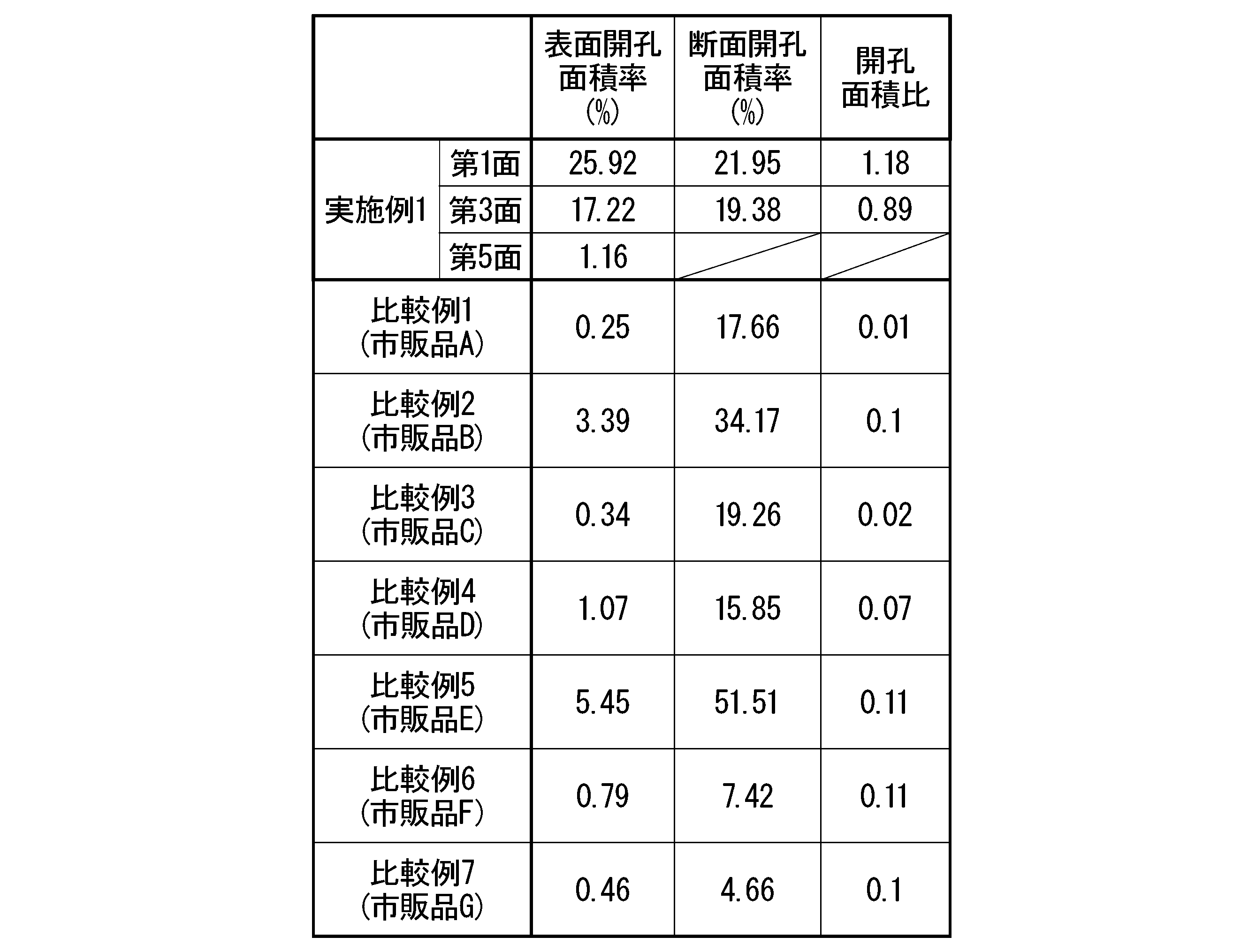
表2に示す通り、実施例1のペットフードは、比較例1~7のペットフードに比べて、第1面の開孔面積率(第3面の開孔面積率)が高いものであった。また、市販品である比較例1~7のペットフードにおいて、第1面の開孔面積率が10%以上となるものは存在しなかった。
図9は、実施例1のペットフードの第1面の開孔面積率測定時の画像と、断面(第1面と平行面)の開孔面積率測定時の画像である。
図10は、実施例1のペットフードの第3面の開孔面積率測定時の画像と、断面(第3面と平行面)の開孔面積率測定時の画像である。
図9、及び図10に示す通り、実施例1のペットフードの第1面と、断面(第1面と平行面)、及び、第3面と、断面(第3面と平行面)の開孔の分布がそれぞれ近似していることが確認できる。
図10は、実施例1のペットフードの第3面の開孔面積率測定時の画像と、断面(第3面と平行面)の開孔面積率測定時の画像である。
図9、及び図10に示す通り、実施例1のペットフードの第1面と、断面(第1面と平行面)、及び、第3面と、断面(第3面と平行面)の開孔の分布がそれぞれ近似していることが確認できる。
また、表2に示す通り、実施例1のペットフードは、比較例1~7のペットフードに比べて、第1面の開孔面積比(第3面の開孔面積比)が1に近いものであった。このことから、実施例1のペットフードは、比較例1~7のペットフードに比べて、表面及び内部において、均等に開孔を有することが確認できた。
<硬さの評価>
実施例1のペットフードの第1面、第3面及び第5面について、以下の方法で硬さを測定した。
実施例1のペットフードの第1面、第3面及び第5面について、以下の方法で硬さを測定した。
本明細書において、ペットフードの硬さは以下の測定方法で得られた値である。
圧縮試験機(テクスチャーアナライザー、型番:EZ-SX、島津製作所社製)を用い、ペットフードを一定の圧縮速度で圧縮したときの破断力を測定した。
具体的には、受け皿の上に、実施例1のペットフードを1つ置き、真上から垂直にプランジャーを一定速度で押し付けながら試験力を測定した。プランジャーが接触する面が第1面、第3面又は第5面となるようにペットフードを置き、それぞれ10個ずつ測定を繰り返し、平均値を求めた。
上記圧縮試験機で測定される破断力(単位:kgw)の数値に9.8を掛けることによって、単位をニュートン(N)に変換した。
測定条件は以下に示す通りである。
プランジャー:幅10mm、長さ20mm、先端1mm厚み、くさび型のプランジャー
プラットフォーム:径100mmの平らの受け皿
圧縮速度:60mm/分
プランジャーの最下点:第1面及び第3面;6mm、第5面;10mm
測定温度:25℃
その結果を表3に示した。

表3に示すように、実施例1のペットフードは、面によって硬さが異なるため、該ペットフードを噛んだ時に複数の食感を楽しめることが確認できた。
<吸水率の評価>
上述した5、30、60秒間吸水率と同様の方法で、水の温度が20℃である場合の実施例1のペットフードの5、30、60秒間吸水率を測定した。その結果を表4に示す。
上述した5、30、60秒間吸水率と同様の方法で、水の温度が20℃である場合の実施例1のペットフードの5、30、60秒間吸水率を測定した。その結果を表4に示す。

表4に示す通り、実施例1のペットフードは吸水率が高いものであった。
<硬さの評価>
上述した、水に5、30又は60秒間水に浸漬したペットフードの粒の硬さと同様の方法で、20℃の水に浸漬させた実施例1のペットフードの第5面の5、30、60秒間水に浸漬した後のペットフードの粒の硬さ(5秒間浸漬後硬さ、30秒間浸漬後硬さ、60秒間浸漬後硬さ)を測定した。その結果を表5に示した。なお、表5中の0秒間浸漬後硬さは、上述した<硬さの評価>で示した第5面の硬さと同一である。
上述した、水に5、30又は60秒間水に浸漬したペットフードの粒の硬さと同様の方法で、20℃の水に浸漬させた実施例1のペットフードの第5面の5、30、60秒間水に浸漬した後のペットフードの粒の硬さ(5秒間浸漬後硬さ、30秒間浸漬後硬さ、60秒間浸漬後硬さ)を測定した。その結果を表5に示した。なお、表5中の0秒間浸漬後硬さは、上述した<硬さの評価>で示した第5面の硬さと同一である。

表5に示す通り、実施例1のペットフードは数秒水に浸漬させだけで硬さが変化するものであった。
<嗜好性の評価>
・(開孔を有するペットフードの製造2)
上述した実施例1と同様の方法で六面体状(縦8mm(X方向)×横8mm(Y方向)×高さ(厚み)11.5mm(Z方向))の実施例2、3、及び参考例1のペットフードを製造した。具体的な製造方法は以下の通りである。
なお、以下の記載及び表4中の「開孔を有する面」は、上述した方法により測定される開孔面積率が10%以上の面である。また、「開孔を有さない面」は、上述した方法により測定される開孔面積率が10%未満の面である。
・(開孔を有するペットフードの製造2)
上述した実施例1と同様の方法で六面体状(縦8mm(X方向)×横8mm(Y方向)×高さ(厚み)11.5mm(Z方向))の実施例2、3、及び参考例1のペットフードを製造した。具体的な製造方法は以下の通りである。
なお、以下の記載及び表4中の「開孔を有する面」は、上述した方法により測定される開孔面積率が10%以上の面である。また、「開孔を有さない面」は、上述した方法により測定される開孔面積率が10%未満の面である。
・実施例2のペットフード
エクストルーダーのダイプレートを変更し、かつ、多孔質生地をCDからのみカッターで切断したこと以外は上述した実施例1と同様の方法で、六面体状(縦8mm(X方向)×横8mm(Y方向)×高さ(厚み)11.5mm(Z方向))の実施例2のペットフードを得た。切断面が開孔を有する面となるため、実施例2のペットフードは開孔を有する面を2面有する。なお、実施例2のペットフードの開孔を有する面の開孔面積率は、実施例1のペットフードの第1面及び第3面の開孔面積率とそれぞれ同程度であり、実施例2のペットフードの開孔を有さない面の開孔面積率は、実施例1のペットフードの第5面の開孔面積率と同程度であった。
エクストルーダーのダイプレートを変更し、かつ、多孔質生地をCDからのみカッターで切断したこと以外は上述した実施例1と同様の方法で、六面体状(縦8mm(X方向)×横8mm(Y方向)×高さ(厚み)11.5mm(Z方向))の実施例2のペットフードを得た。切断面が開孔を有する面となるため、実施例2のペットフードは開孔を有する面を2面有する。なお、実施例2のペットフードの開孔を有する面の開孔面積率は、実施例1のペットフードの第1面及び第3面の開孔面積率とそれぞれ同程度であり、実施例2のペットフードの開孔を有さない面の開孔面積率は、実施例1のペットフードの第5面の開孔面積率と同程度であった。
・実施例3のペットフード
エクストルーダーのダイプレートを変更し、実施例1と同様の方法で六面体状の実施例1のペットフードより少し大きいペットフードを得た。該ペットフードの切断面ではない面(実施例1のペットフードの第5面及び第6面に相当する面)をそれぞれカッターで切断し、全周にわたって開孔を有する六面体状(縦8mm(X方向)×横8mm(Y方向)×高さ(厚み)11.5mm(Z方向))の実施例3のペットフードを得た。切断面が開孔を有する面となるため、実施例3のペットフードは開孔を有する面を6面有する。なお、実施例3のペットフードの開孔を有する面の開孔面積率は、実施例1のペットフードの第1面及び第3面の開孔面積率と同程度であった。
エクストルーダーのダイプレートを変更し、実施例1と同様の方法で六面体状の実施例1のペットフードより少し大きいペットフードを得た。該ペットフードの切断面ではない面(実施例1のペットフードの第5面及び第6面に相当する面)をそれぞれカッターで切断し、全周にわたって開孔を有する六面体状(縦8mm(X方向)×横8mm(Y方向)×高さ(厚み)11.5mm(Z方向))の実施例3のペットフードを得た。切断面が開孔を有する面となるため、実施例3のペットフードは開孔を有する面を6面有する。なお、実施例3のペットフードの開孔を有する面の開孔面積率は、実施例1のペットフードの第1面及び第3面の開孔面積率と同程度であった。
・参考例1のペットフード
エクストルーダーのダイプレートを変更し、かつ、原料混合物がエクストルーダーから吐出された直後にカッターで切断したこと以外は、実施例1と同様の方法で六面体状(縦8mm(X方向)×横8mm(Y方向)×高さ(厚み)11.5mm(Z方向))の参考例1のペットフードを得た。参考例1のペットフードは開孔を有する面を有していなかった。
エクストルーダーのダイプレートを変更し、かつ、原料混合物がエクストルーダーから吐出された直後にカッターで切断したこと以外は、実施例1と同様の方法で六面体状(縦8mm(X方向)×横8mm(Y方向)×高さ(厚み)11.5mm(Z方向))の参考例1のペットフードを得た。参考例1のペットフードは開孔を有する面を有していなかった。
・嗜好性試験
空腹時の犬(体重5kg以下)に対して、実施例1~3、参考例1のペットフードをそれぞれ100g皿に入れ、5分後に各ペットフードの残った量を測定し、以下の基準で嗜好性を評価した。その結果を表6に示した。
A:5g未満
B:5g以上25g未満
C:25g以上
空腹時の犬(体重5kg以下)に対して、実施例1~3、参考例1のペットフードをそれぞれ100g皿に入れ、5分後に各ペットフードの残った量を測定し、以下の基準で嗜好性を評価した。その結果を表6に示した。
A:5g未満
B:5g以上25g未満
C:25g以上
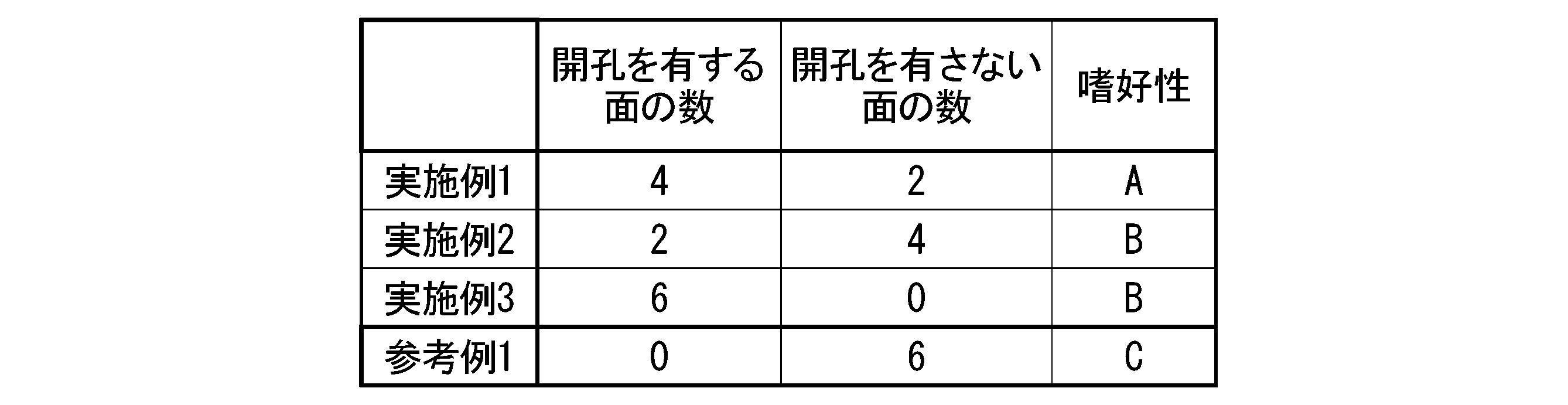
以上より、実施例のペットフードは、開孔面積率が10%以上の面を有するため、参考例のペットフードに比べて、噛み応えを維持しつつ、噛み砕きやすいため、嗜好性が高いことが確認できた。
また、実施例の中でも、開孔を有する面を4つ有し、開孔を有さない面を2つ有する実施例1のペットフードが最も嗜好性が高かった。
また、実施例の中でも、開孔を有する面を4つ有し、開孔を有さない面を2つ有する実施例1のペットフードが最も嗜好性が高かった。
以上、本発明の好ましい実施例を説明したが、本発明はこれら実施例に限定されることはない。本発明の趣旨を逸脱しない範囲で、構成の付加、省略、置換、およびその他の変更が可能である。本発明は前述した説明によって限定されることはなく、添付のクレームの範囲によってのみ限定される。
C10・・・ペットフード、C1・・・第1面、C2・・・第2面、C3・・・第3面、C4・・・第4面、C5・・・第5面、C6・・・第6面、1・・・開孔
D10・・・ペットフード、D1・・・第1面、D2・・・第2面、D3・・・第3面、D4・・・第4面、D5・・・第5面、D6・・・第6面、2・・・開孔
101・・・押出成形機、102・・・ベルトコンベアー、103・・・冷却機、104・・・カッター
D10・・・ペットフード、D1・・・第1面、D2・・・第2面、D3・・・第3面、D4・・・第4面、D5・・・第5面、D6・・・第6面、2・・・開孔
101・・・押出成形機、102・・・ベルトコンベアー、103・・・冷却機、104・・・カッター
Claims (6)
- 開孔を有するペットフードであって、
第1方向に前記ペットフードを投影した第1面の開孔面積率が10%以上である、ペットフード。 - 第1方向以外の方向に前記ペットフードを投影した面の開孔面積率が8%以下である、請求項1に記載のペットフード。
- 前記第1方向に交差する第2方向のうちA側に前記ペットフードを投影した面を第2面、前記第2方向のうちB側に前記ペットフードを投影した面を第3面とした場合、第2面及び第3面の少なくともいずれかの面の開孔面積率が10%以上である、請求項1又は2に記載のペットフード。
- 前記第2面及び前記第3面のいずれも開孔面積率が10%以上である、請求項3に記載のペットフード。
- 前記第1面における開孔面積率と、前記第1方向に直交するように前記ペットフードを切断した際の断面における開孔面積率との比(第1面における開孔面積率/断面における開孔面積率)が0.4~2である、請求項1~4のいずれか一項に記載のペットフード。
- 前記第1面における開孔面積率と、前記第1面を等分するように前記ペットフードを切断した際の断面における開孔面積率との比(第1面における開孔面積率/断面における開孔面積率)が0.4~2である、請求項1~5のいずれか一項に記載のペットフード。
Priority Applications (2)
| Application Number | Priority Date | Filing Date | Title |
|---|---|---|---|
| CN202180087293.XA CN116744801A (zh) | 2020-12-28 | 2021-12-28 | 宠物食品 |
| US18/214,810 US20230345973A1 (en) | 2020-12-28 | 2023-06-27 | Pet food |
Applications Claiming Priority (4)
| Application Number | Priority Date | Filing Date | Title |
|---|---|---|---|
| JP2020-219693 | 2020-12-28 | ||
| JP2020219693 | 2020-12-28 | ||
| JP2021-213426 | 2021-12-27 | ||
| JP2021213426A JP7818398B2 (ja) | 2020-12-28 | 2021-12-27 | ペットフード |
Related Child Applications (1)
| Application Number | Title | Priority Date | Filing Date |
|---|---|---|---|
| US18/214,810 Continuation US20230345973A1 (en) | 2020-12-28 | 2023-06-27 | Pet food |
Publications (1)
| Publication Number | Publication Date |
|---|---|
| WO2022145456A1 true WO2022145456A1 (ja) | 2022-07-07 |
Family
ID=82260791
Family Applications (1)
| Application Number | Title | Priority Date | Filing Date |
|---|---|---|---|
| PCT/JP2021/048840 Ceased WO2022145456A1 (ja) | 2020-12-28 | 2021-12-28 | ペットフード |
Country Status (2)
| Country | Link |
|---|---|
| US (1) | US20230345973A1 (ja) |
| WO (1) | WO2022145456A1 (ja) |
Citations (3)
| Publication number | Priority date | Publication date | Assignee | Title |
|---|---|---|---|---|
| JP2002238469A (ja) * | 2001-02-20 | 2002-08-27 | Uni Harts Kk | ペットフード、その製造方法及び製造装置 |
| US20160330998A1 (en) * | 2015-05-16 | 2016-11-17 | Big Heart Pet, Inc. | Palatable expanded food products and methods of manufacture thereof |
| JP2018088842A (ja) * | 2016-11-30 | 2018-06-14 | ユニ・チャーム株式会社 | ペットフード用フード粒、その製造方法、および粒状ペットフード |
Family Cites Families (20)
| Publication number | Priority date | Publication date | Assignee | Title |
|---|---|---|---|---|
| US2690011A (en) * | 1949-10-26 | 1954-09-28 | Damrow Brothers Company | Curd mill |
| US3482992A (en) * | 1965-02-01 | 1969-12-09 | Gen Mills Inc | Process for producing a cereal food product |
| US4055681A (en) * | 1974-06-12 | 1977-10-25 | The Quaker Oats Company | Method of making a dry-type pet food |
| US3883672A (en) * | 1974-06-12 | 1975-05-13 | Quaker Oats Co | Method of making a dry type pet food having a meat-like texture and composition thereof |
| US3959511A (en) * | 1974-06-12 | 1976-05-25 | The Quaker Oats Company | Method of making a dry fibrous meat-like pet food and composition thereof |
| US4193272A (en) * | 1974-11-22 | 1980-03-18 | Bernard Vincent E | Portion controlled frozen food |
| US5149555A (en) * | 1989-05-18 | 1992-09-22 | Kraft General Foods Canada Inc. | Method for forming an open textured product |
| US5750173A (en) * | 1996-11-05 | 1998-05-12 | Mjm Technologies, L.L.P. | Method of manufacturing syrup-infused food pieces |
| US6277425B1 (en) * | 1998-12-28 | 2001-08-21 | Good Mark Foods, Inc. | Method for producing an extruded cooked food product |
| US6607774B1 (en) * | 2000-11-13 | 2003-08-19 | Mars, Incorporated | Self-sealing expanded edible product |
| CN100456944C (zh) * | 2001-03-27 | 2009-02-04 | 明治制果株式会社 | 膨化小食品的制造方法及其制造装置 |
| US6586031B1 (en) * | 2002-05-21 | 2003-07-01 | Recot, Inc. | Method for producing expanded, shaped pellet products |
| US20080248180A1 (en) * | 2007-04-03 | 2008-10-09 | Michelle Latrese Barnett | Extruded legume snack food |
| CA2678279C (en) * | 2008-09-10 | 2016-10-11 | Christopher J. Langford | Puffed pet treat |
| US20100258970A1 (en) * | 2009-04-13 | 2010-10-14 | T.F.H. Publications, Inc. | Multi layer extrusion including animal deterrent |
| RU2658664C2 (ru) * | 2013-03-15 | 2018-06-22 | Марс, Инкорпорейтед | Аэрированное лакомство для домашних животных |
| DE102017010083A1 (de) * | 2017-10-30 | 2019-05-02 | Christian Schein | Bearbeitung eines Preßkuchens und/oder Pulvers aus ölhaltigen Saaten |
| JP2019097416A (ja) * | 2017-11-29 | 2019-06-24 | ユニ・チャーム株式会社 | キャットフード |
| DK3524059T3 (da) * | 2018-02-13 | 2020-10-19 | Buehler Ag | Køledyse til en ekstruder |
| JP7229675B2 (ja) * | 2018-05-18 | 2023-02-28 | ユニ・チャーム株式会社 | ペットフード、粒状ペットフード、及びペットフードの製造方法 |
-
2021
- 2021-12-28 WO PCT/JP2021/048840 patent/WO2022145456A1/ja not_active Ceased
-
2023
- 2023-06-27 US US18/214,810 patent/US20230345973A1/en active Pending
Patent Citations (3)
| Publication number | Priority date | Publication date | Assignee | Title |
|---|---|---|---|---|
| JP2002238469A (ja) * | 2001-02-20 | 2002-08-27 | Uni Harts Kk | ペットフード、その製造方法及び製造装置 |
| US20160330998A1 (en) * | 2015-05-16 | 2016-11-17 | Big Heart Pet, Inc. | Palatable expanded food products and methods of manufacture thereof |
| JP2018088842A (ja) * | 2016-11-30 | 2018-06-14 | ユニ・チャーム株式会社 | ペットフード用フード粒、その製造方法、および粒状ペットフード |
Non-Patent Citations (1)
| Title |
|---|
| OHSHIMA, SEINOSUKE: "Types of Pet Foods (5) Classification of pet foods by the kind of kibbles or content of individual foods", JOURNAL OF PET ANIMAL NUTRITION, vol. 19, no. 2, 1 January 2016 (2016-01-01), pages 97 - 104, XP009538021, ISSN: 2185-7601, DOI: 10.11266/jpan.19.2_97 * |
Also Published As
| Publication number | Publication date |
|---|---|
| US20230345973A1 (en) | 2023-11-02 |
Similar Documents
| Publication | Publication Date | Title |
|---|---|---|
| JP6243329B2 (ja) | 動物向け食用おしゃぶりタイプの噛み物 | |
| CN101351126B (zh) | 一种挤压食品 | |
| JP7833886B2 (ja) | ペットフード | |
| CN116761515B (zh) | 宠物食品的制造方法 | |
| JP7229675B2 (ja) | ペットフード、粒状ペットフード、及びペットフードの製造方法 | |
| JP2019198312A (ja) | ペットフード、粒状ペットフード、及びペットフードの製造方法 | |
| WO2022145458A1 (ja) | ペットフード | |
| JP7818398B2 (ja) | ペットフード | |
| TW202430040A (zh) | 乾式寵物食品 | |
| US12137707B2 (en) | Pet food | |
| US20230345973A1 (en) | Pet food | |
| JP2019198310A (ja) | ペットフード、粒状ペットフード、及びペットフードの製造方法 | |
| JP6655705B1 (ja) | ペットフード | |
| CN116744801A (zh) | 宠物食品 | |
| CN116669566A (zh) | 宠物食品 | |
| WO2025234290A1 (ja) | ドライペットフードおよびドライペットフードの製造方法 | |
| TW202533766A (zh) | 小型犬暨中型犬用寵物食品製品 | |
| TW202404476A (zh) | 綜合營養寵物食品 | |
| JP2005013079A (ja) | 犬用のスナックフード | |
| WO2020095726A1 (ja) | ペットフード |
Legal Events
| Date | Code | Title | Description |
|---|---|---|---|
| 121 | Ep: the epo has been informed by wipo that ep was designated in this application |
Ref document number: 21915314 Country of ref document: EP Kind code of ref document: A1 |
|
| WWE | Wipo information: entry into national phase |
Ref document number: 202180087293.X Country of ref document: CN |
|
| NENP | Non-entry into the national phase |
Ref country code: DE |
|
| 122 | Ep: pct application non-entry in european phase |
Ref document number: 21915314 Country of ref document: EP Kind code of ref document: A1 |