WO2022145297A1 - 給湯システム - Google Patents
給湯システム Download PDFInfo
- Publication number
- WO2022145297A1 WO2022145297A1 PCT/JP2021/047399 JP2021047399W WO2022145297A1 WO 2022145297 A1 WO2022145297 A1 WO 2022145297A1 JP 2021047399 W JP2021047399 W JP 2021047399W WO 2022145297 A1 WO2022145297 A1 WO 2022145297A1
- Authority
- WO
- WIPO (PCT)
- Prior art keywords
- hot water
- water supply
- supply system
- learning
- total
- Prior art date
- Legal status (The legal status is an assumption and is not a legal conclusion. Google has not performed a legal analysis and makes no representation as to the accuracy of the status listed.)
- Ceased
Links
Images




Classifications
-
- F—MECHANICAL ENGINEERING; LIGHTING; HEATING; WEAPONS; BLASTING
- F24—HEATING; RANGES; VENTILATING
- F24D—DOMESTIC- OR SPACE-HEATING SYSTEMS, e.g. CENTRAL HEATING SYSTEMS; DOMESTIC HOT-WATER SUPPLY SYSTEMS; ELEMENTS OR COMPONENTS THEREFOR
- F24D17/00—Domestic hot-water supply systems
- F24D17/02—Domestic hot-water supply systems using heat pumps
-
- F—MECHANICAL ENGINEERING; LIGHTING; HEATING; WEAPONS; BLASTING
- F24—HEATING; RANGES; VENTILATING
- F24H—FLUID HEATERS, e.g. WATER OR AIR HEATERS, HAVING HEAT-GENERATING MEANS, e.g. HEAT PUMPS, IN GENERAL
- F24H1/00—Water heaters, e.g. boilers, continuous-flow heaters or water-storage heaters
- F24H1/18—Water-storage heaters
-
- F—MECHANICAL ENGINEERING; LIGHTING; HEATING; WEAPONS; BLASTING
- F24—HEATING; RANGES; VENTILATING
- F24D—DOMESTIC- OR SPACE-HEATING SYSTEMS, e.g. CENTRAL HEATING SYSTEMS; DOMESTIC HOT-WATER SUPPLY SYSTEMS; ELEMENTS OR COMPONENTS THEREFOR
- F24D19/00—Details
- F24D19/10—Arrangement or mounting of control or safety devices
- F24D19/1006—Arrangement or mounting of control or safety devices for water heating systems
- F24D19/1051—Arrangement or mounting of control or safety devices for water heating systems for domestic hot water
- F24D19/1054—Arrangement or mounting of control or safety devices for water heating systems for domestic hot water the system uses a heat pump
-
- F—MECHANICAL ENGINEERING; LIGHTING; HEATING; WEAPONS; BLASTING
- F24—HEATING; RANGES; VENTILATING
- F24H—FLUID HEATERS, e.g. WATER OR AIR HEATERS, HAVING HEAT-GENERATING MEANS, e.g. HEAT PUMPS, IN GENERAL
- F24H15/00—Control of fluid heaters
- F24H15/10—Control of fluid heaters characterised by the purpose of the control
- F24H15/172—Scheduling based on user demand, e.g. determining starting point of heating
-
- F—MECHANICAL ENGINEERING; LIGHTING; HEATING; WEAPONS; BLASTING
- F24—HEATING; RANGES; VENTILATING
- F24H—FLUID HEATERS, e.g. WATER OR AIR HEATERS, HAVING HEAT-GENERATING MEANS, e.g. HEAT PUMPS, IN GENERAL
- F24H15/00—Control of fluid heaters
- F24H15/20—Control of fluid heaters characterised by control inputs
- F24H15/212—Temperature of the water
-
- F—MECHANICAL ENGINEERING; LIGHTING; HEATING; WEAPONS; BLASTING
- F24—HEATING; RANGES; VENTILATING
- F24H—FLUID HEATERS, e.g. WATER OR AIR HEATERS, HAVING HEAT-GENERATING MEANS, e.g. HEAT PUMPS, IN GENERAL
- F24H15/00—Control of fluid heaters
- F24H15/20—Control of fluid heaters characterised by control inputs
- F24H15/238—Flow rate
-
- F—MECHANICAL ENGINEERING; LIGHTING; HEATING; WEAPONS; BLASTING
- F24—HEATING; RANGES; VENTILATING
- F24H—FLUID HEATERS, e.g. WATER OR AIR HEATERS, HAVING HEAT-GENERATING MEANS, e.g. HEAT PUMPS, IN GENERAL
- F24H15/00—Control of fluid heaters
- F24H15/30—Control of fluid heaters characterised by control outputs; characterised by the components to be controlled
- F24H15/375—Control of heat pumps
-
- F—MECHANICAL ENGINEERING; LIGHTING; HEATING; WEAPONS; BLASTING
- F24—HEATING; RANGES; VENTILATING
- F24H—FLUID HEATERS, e.g. WATER OR AIR HEATERS, HAVING HEAT-GENERATING MEANS, e.g. HEAT PUMPS, IN GENERAL
- F24H4/00—Fluid heaters characterised by the use of heat pumps
- F24H4/02—Water heaters
- F24H4/04—Storage heaters
-
- F—MECHANICAL ENGINEERING; LIGHTING; HEATING; WEAPONS; BLASTING
- F24—HEATING; RANGES; VENTILATING
- F24D—DOMESTIC- OR SPACE-HEATING SYSTEMS, e.g. CENTRAL HEATING SYSTEMS; DOMESTIC HOT-WATER SUPPLY SYSTEMS; ELEMENTS OR COMPONENTS THEREFOR
- F24D2220/00—Components of central heating installations excluding heat sources
- F24D2220/08—Storage tanks
Definitions
- This disclosure relates to a hot water supply system.
- Patent Document 1 discloses a hot water supply system having a hot water generating means such as a fuel cell or a gas engine and a hot water storage tank that utilizes the exhaust heat thereof. This hot water supply system provides an optimal operation plan for fuel cells by learning the demand pattern of hot water supply water.
- the demand pattern of hot water supply is learned with a focus on the amount of hot water supply of hot water filling and shower. Therefore, when hot water is supplied to a plurality of hot water supply targets, the accuracy of predicting the amount of heat of the required hot water supply water is not always high.
- the purpose of the present disclosure is to improve the prediction accuracy of the total hot water supply demand in a hot water supply system having a plurality of hot water supply targets and a storage tank for supplying hot water to the hot water supply targets.
- the first aspect is A hot water supply device (10) having a heating device (20) for heating water, a tank (40) for storing water heated by the heating device (20), and a water circuit (50) for circulating water in the tank (40).
- a plurality of supply paths (5) connected to each of the plurality of hot water supply targets (4) and supplying water from the tank (40), and It is provided with an estimation unit (33) that predicts the total amount of hot water supply demand based on the time-series data of the first index indicating the amount of heat of water used in each of the plurality of hot water supply targets (4).
- the prediction accuracy of the total hot water supply demand can be improved.
- the second aspect is, in the first aspect, It has a first learning unit (32) that learns by associating the time-series data with the total hot water supply demand.
- the estimation unit (33) predicts the total hot water supply demand amount based on the learning result by the first learning unit (32).
- the total hot water supply demand can be predicted by the first learning unit (32).
- the third aspect is, in the second aspect, The first learning unit (32) learns by machine learning.
- the first learning unit (32) can be learned by machine learning.
- the total hot water supply demand can be predicted based on the learning results by machine learning.
- the fourth aspect is in the first or third aspect.
- the estimation unit (33) includes an estimation model (M1) generated by machine learning to predict the total hot water supply demand based on the time series data.
- the total hot water supply demand is predicted using the estimation model (M1).
- the total hot water supply demand can be predicted using the estimation model (M1).
- the fifth aspect is in any one of the first to fourth aspects.
- the first index is the temperature and amount of water used in each of the plurality of hot water supply targets (4).
- the first index can be obtained based on the temperature and the amount of water used in the hot water supply target (4).
- the sixth aspect is in any one of the first to fourth aspects.
- the first index is the temperature of water used in each of the plurality of hot water supply targets (4) and the pressure of water in each of the supply paths (5).
- the first index can be obtained based on the water pressure and the temperature of the water flowing through the supply path (5) connected to each hot water supply target (4) and the amount of water flowing out from the tank (40).
- the seventh aspect is in any one of the first to sixth aspects.
- the estimation unit (33) is based on the time series data, the number of the hot water supply targets (4), the type of the hot water supply target (4), and at least one of the specifications of the faucet of the hot water supply target (4).
- the total hot water supply demand is predicted.
- the information for predicting the total hot water supply demand amount in addition to the time-series data of the calorific value of the water used in each hot water supply target (4), predetermined information for each hot water supply target is also included. Since there is a plurality of significant information that can be used to predict the total hot water supply demand in this way, the prediction accuracy of the total hot water supply demand can be improved as compared with the prediction using only the time-series data of the heat quantity of water.
- the eighth aspect is in any one of the first to seventh aspects.
- the estimation unit (33) predicts the total hot water supply demand amount based on the time-series data of the selected hot water supply target (4).
- the eighth aspect it is possible to omit the calculation of the hot water supply target, which has a small influence on the prediction of the total hot water supply demand.
- the ninth aspect is in any one of the first to eighth aspects. It has a control unit (30) that controls the operation of the heating device (20) based on the total hot water supply demand amount.
- the heating device (20) can be operated with high efficiency by predicting the operation control of the heating device (20).
- the tenth aspect is the ninth aspect in the ninth aspect. It has a second learning unit (35) that learns by associating the total hot water supply demand with the operating state of the heating device (20).
- the control unit (30) controls the operating state of the heating device (20) based on the learning result by the second learning unit (35).
- the operation of the heating device (20) can be controlled based on the learning result by the second learning unit (35).
- the eleventh aspect is the tenth aspect.
- the second learning unit (35) learns by machine learning.
- the second learning unit (35) can learn by machine learning.
- the operation control of the heating device (20) can be predicted based on the learning result by machine learning.
- the twelfth aspect is in any one of the ninth and eleventh aspects.
- the control unit (30) includes an operation prediction model (M2) generated by machine learning to predict the operation control of the heating device (20) based on the total hot water supply demand.
- the operation of the heating device (20) is controlled by using the operation prediction model (M2).
- the operation control of the heating device (20) can be predicted by using the operation prediction model (M2).
- the thirteenth aspect is in any one of the first to twelfth aspects.
- the heating device (20) is a heat pump type.
- the risk of running out of hot water can be reduced and the heating device (20) can be operated with high efficiency even in a heat pump having a relatively low start-up capacity.
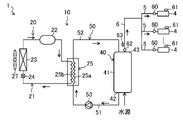
- FIG. 1 is an overall configuration diagram of a hot water supply system according to an embodiment.
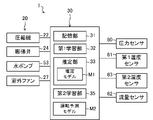
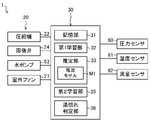
- FIG. 2 is a block diagram of a hot water supply system.
- FIG. 3 is a diagram showing the flow of the refrigerant in the operating state of the heating device.
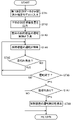
- FIG. 4 is a flowchart showing the operation of the hot water supply system.
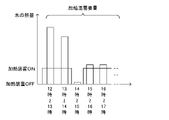
- FIG. 5 is a diagram showing the relationship between the total demand for hot water supply and the operation control of the heating device.
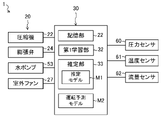
- FIG. 6 is a block diagram of the hot water supply system according to the first modification of the embodiment.
- FIG. 7 is a block diagram of the hot water supply system according to the second modification of the embodiment.
- FIG. 8 is a flowchart showing the operation of the hot water supply system.
- FIG. 1 is an overall configuration diagram of a hot water supply system according to an embodiment.
- FIG. 2 is a block diagram of a hot water supply system.
- FIG. 3 is a diagram showing the flow of the refrigerant in the operating state of the heating device.
- FIG. 9 is a block diagram of the hot water supply system according to the third modification of the embodiment.
- FIG. 10 is a block diagram of the hot water supply system according to the modified example 4 of the embodiment.
- FIG. 11 is a flowchart showing the operation of the hot water supply system.
- the present disclosure is a hot water supply system (1).
- the hot water supply system (1) heats the water supplied from the water source (1) and stores the heated water in the tank (40).
- the hot water stored in the tank (40) is supplied to a plurality of hot water supply targets (4).
- Water sources include water supply.
- the target of hot water supply (4) includes bathtubs, showers, faucets, etc.
- the hot water supply system (1) includes a heating device (20), a tank (40), a water circuit (50), a supply path (5), a first pipe (6), a pressure sensor (60), and a temperature sensor (61, 63). It also has a control unit (30).
- the heating device (20) of the present embodiment is a heat pump type.
- the heating device (20) produces heat for heating the water.
- the heating device (20) is a steam compression type.
- the heating device (20) has a refrigerant circuit (21).
- the refrigerant circuit (21) is filled with the refrigerant.
- the refrigerant circuit (21) includes a compressor (22), a heat source heat exchanger (23), an expansion valve (24), and a utilization heat exchanger (25).
- the compressor (22) compresses the sucked refrigerant and discharges the compressed refrigerant.
- the heat source heat exchanger (23) is an air-cooled heat exchanger.
- the heat source heat exchanger (23) is located outdoors.
- the heating device (20) has an outdoor fan (27).
- the outdoor fan (27) is located near the heat source heat exchanger (23).
- the heat source heat exchanger (23) exchanges heat between the air conveyed by the outdoor fan (27) and the refrigerant.
- the expansion valve (24) is a decompression mechanism that depressurizes the refrigerant.
- the expansion valve (24) is provided between the liquid end portion of the utilization heat exchanger (25) and the liquid end portion of the heat source heat exchanger (23).
- the depressurizing mechanism is not limited to the expansion valve, but may be a capillary tube, an expander, or the like.
- the expander recovers the energy of the refrigerant as power.
- the used heat exchanger (25) is a liquid-cooled heat exchanger.
- the utilization heat exchanger (25) has a first flow path (25a) and a second flow path (25b).
- the second flow path (25b) is connected to the refrigerant circuit (21).
- the first flow path (25a) is connected to the water circuit (50).
- the utilization heat exchanger (25) exchanges heat between the water flowing through the first flow path (25a) and the refrigerant flowing through the second flow path (25b).
- the first flow path (25a) is formed along the second flow path (25b).
- the direction of the refrigerant flowing through the second flow path (25b) and the direction of the water flowing through the first flow path (25a) are substantially opposite to each other.
- the utilization heat exchanger (25) during the heating operation functions as a countercurrent heat exchanger.
- the tank (40) is a container for storing water.
- the tank (40) is formed in a vertically long cylindrical shape.
- the tank (40) has a cylindrical body portion (41), a bottom portion (42) that closes the lower end of the body portion (41), and a top portion (43) that closes the upper end of the body portion (41). Have.
- the water circuit (50) In the water circuit (50), the water in the tank (40) circulates.
- the first flow path (25a) of the utilization heat exchanger (25) is connected to the water circuit (50).
- the water circuit (50) includes an upstream channel (51) and a downstream channel (52).
- the inflow end of the upstream flow path (51) is connected to the bottom (42) of the tank (40).
- the inflow end of the upstream flow path (51) connects to the bottom (42) of the tank (40).
- the outflow end of the upstream flow path (51) is connected to the inflow end of the first flow path (25a).
- the inflow end of the downstream flow path (52) is connected to the outflow end of the first flow path (25a).
- the outflow end of the downstream flow path (52) connects to the top (43) of the tank (40).
- the water circuit (50) has a water pump (53).
- the water pump (53) circulates the water in the water circuit (50).
- the water pump (53) conveys the water in the tank (40) and sends it to the first flow path (25a) of the utilization heat exchanger (25). Further, the water pump (53) conveys water to the first flow path (25a) and sends it to the tank (40).
- the inflow end of the first pipe (6) is connected to the tank (40).
- the outflow end of the first pipe (6) is connected to each inflow end of the plurality of supply paths (5).
- the outflow end of each supply path (5) is connected to each hot water supply target (4).
- a pressure sensor (60) is connected to each supply path (5).
- the pressure sensor (60) detects the pressure of water in the supply path (5).
- the pressure sensor (60) detects the pressure of the water supplied to each hot water supply target (4).
- the hot water supply system (1) has a first temperature sensor (61) and a second temperature sensor (63).
- the first temperature sensor (61) is provided for each hot water supply target (4).
- the first temperature sensor (61) detects the temperature of the water used in the hot water supply target (4).
- the second temperature sensor (63) is provided at the inflow end of the first pipe (6).
- the second temperature sensor (63) detects the temperature of the water flowing from the tank (40) into the first pipe (6).
- a flow rate sensor (62) is provided at the inflow end of the first pipe (6).
- the flow rate sensor (62) detects the amount of water flowing from the tank (40) into the first pipe (6).
- the control unit (30) shown in FIG. 2 has a microcomputer and a memory device (specifically, a semiconductor memory) for storing software for operating the microcomputer.
- the control unit (30) is connected to various devices and sensors of the water heater (10) by wire or wirelessly.
- the control unit (30) controls the equipment of the heating device (20) and the water circuit (50).
- the equipment of the water circuit (50) includes the water pump (53).
- the control unit (30) includes a storage unit (31), a first learning unit (32), an estimation unit (33), and a second learning unit (35).
- the storage unit (31) stores the time-series data of the first index.
- the first index indicates the amount of heat of water used in each hot water supply target (4).
- the first index is the temperature of the water used in each hot water supply target (4) and the water pressure in each supply path (5).
- the time series data of the first index will be referred to as the first time series data.
- the first time-series data is the time-series data of the present disclosure.
- the total amount of hot water supply demand means the amount of heat of water used as a whole of the hot water supply device (10) in a predetermined time.
- the total amount of hot water supply demand corresponds to the total amount of heat of water used in each hot water supply target (4).
- the storage unit (31) stores the actual total hot water supply demand as time-series data.
- the actual total demand for hot water supply is obtained by measuring the amount of heat of water flowing out from the tank (40) to the first pipe (6) by a detecting means. Specifically, the total hot water supply demand amount is obtained based on the values of the flow rate sensor (62) and the second temperature sensor (63).
- the time-series data of the total hot water supply demand amount stored in the storage unit (31) is referred to as a second time-series data.
- the first learning unit (32) learns by associating the first time-series data for a predetermined period stored in the storage unit (31) with the second time-series data in the same time zone as the first time-series data. do.
- the first learning unit (32) learns by machine learning.
- the estimation unit (33) predicts the amount of hot water supply demand based on the first time series data. Specifically, the estimation unit (33) predicts the total hot water supply demand based on the learning result learned by the first learning unit (32). More specifically, the estimation unit (33) uses a trained estimation model (M1) learned by associating the first time-series data and the second time-series data stored in the storage unit (31) by machine learning. Use to predict total hot water supply demand.
- the estimation unit (33) predicts the total hot water supply demand for one day of the next day, which is a predetermined time, for example.
- the total hot water supply demand amount predicted by the estimation unit (33) may be time-series data that changes every certain time (for example, one hour) as shown in FIG.
- the estimation model (M1) is included in the estimation unit (33).
- the estimation model (M1) is generated to predict the total hot water supply demand based on the first time series data.
- the estimation model (M1) is constructed as a multi-layered neural network that has acquired measurement ability by machine learning.
- the estimation model (M1) of this embodiment is generated by "supervised learning”.
- the neural network for generating the estimation model (M1) is trained using the training data and the discriminant function.
- the training data is a set of pairs of input data and teacher data corresponding to the input data.
- the input data is the first time-series data for a predetermined period stored in the storage unit (31). Specifically, the input data is time-series data of the water pressure of the supply path (5) in a predetermined period and time-series data of the temperature of the water used in the hot water supply target (4) connected to the supply path (5). ..
- the teacher data is the second time series data in the same period as the input data.
- the estimation unit (33) predicts the total hot water supply demand using the trained estimation model (M1).
- the estimation unit (33) inputs the first time-series data for a predetermined period (for example, one week up to the previous day) stored in the storage unit (31) into the trained estimation model (M1). Output the amount of hot water supply demand. In this way, the estimation unit (33) predicts the total hot water supply demand.
- the second learning unit (35) learns by associating the total hot water supply demand with the operating state of the heating device (20).
- the second learning unit (35) learns by machine learning.
- the control unit (30) controls the operation of the heating device (20) based on the learning result by the second learning unit (35). Specifically, the control unit (30) controls the operation of the heating device (20) using the operation prediction model (M2).
- the control unit (30) includes the operation prediction model (M2).
- the operation prediction model (M2) is generated by machine learning to predict the operation control of the heating device (20) based on the total hot water supply demand.
- the control unit (30) controls the operation of the heating device (20) by using such a learned operation prediction model (M2).
- the driving prediction model (M2) is generated by "reinforcement learning". Specifically, the second learning unit (35) sets the reward as the daily electricity bill and the state variable as the operating state of the heating device (20).
- the operating state of the heating device (20) means, for example, an ON state or an OFF state of the heating device (20).
- the second learning unit (35) inputs the second time series data of a predetermined period as input data to the operation prediction model (M2). As a result, the second learning unit (35) learns so that the electricity cost required for the daily operation of the heating device (20) is minimized.
- the operation control of the heating device (20) is such that the electric power is minimized by inputting the total hot water supply demand predicted by the estimation unit (33) into the trained operation prediction model (M2) generated in this way. Is done.
- the control unit (30) controls the heating device (20) to perform the heating operation. Specifically, the control unit (30) operates the compressor (22) and the outdoor fan (27). The control unit (30) appropriately adjusts the opening degree of the expansion valve (24). The control unit (30) operates the water pump (53).
- the refrigerant compressed by the compressor (22) flows through the second flow path (25b) of the utilization heat exchanger (25).
- the refrigerant in the second flow path (25b) dissipates heat to the water in the first flow path (25a).
- the refrigerant dissipated or condensed in the second flow path (25b) is decompressed by the expansion valve (24) and then flows through the heat source heat exchanger (23).
- the heat source heat exchanger (23) the refrigerant absorbs heat from the outdoor air and evaporates.
- the refrigerant evaporated in the heat source heat exchanger (23) is sucked into the compressor (22).
- the water in the tank (40) flows out to the upstream flow path (51).
- the water in the upstream flow path (51) flows through the first flow path (25a) of the utilization heat exchanger (25).
- the water in the first flow path (25a) is heated by the refrigerant of the heating device (20).
- the heated water in the tank (40) flows through the predetermined supply path (5) via the first pipe (6).
- the water flowing through the supply channel (5) flows out from the hot water supply target (4) connected to the supply channel (5).
- step ST1 the control unit (30) inputs the first time-series data for the week up to the previous day into the trained estimation model (M1).
- step ST2 the control unit (30) outputs the total hot water supply demand for the next day (future) from the trained estimation model (M1) in step ST2.
- the total hot water supply demand output here is time-series data that changes every hour on the next day.
- step ST3 the control unit (30) inputs the total hot water supply demand for the next day output in step ST2 into the trained operation prediction model (M2).
- step ST4 the control unit (30) outputs the operation control of the heating device (20) on the next day from the learned operation prediction model (M2).
- the operation control output here is, for example, as shown in FIG. 5, an operation plan for turning the heating device (20) into an ON state or an OFF state every hour in one day of the next day.
- the control unit (30) controls the heating operation of the heating device (20).
- the heating device (20) boils the water in the tank (40) so that the required amount of hot water supplied in each time zone can be supplied to the hot water supply target (4) based on the predicted total hot water supply demand.
- step ST5 the control unit (30) controls the heating operation of the heating device (20) based on the operation control of the heating device (20) output in step ST4.
- the control unit (30) controls the heating operation of the heating device (20) so that the required amount of hot water can be supplied to the hot water supply target (4) from 13:00 to 14:00. Boil the water in the tank (40).
- the control unit (30) controls the heating device (20) so that the heating operation is not performed from 14:00 to 15:00.
- control unit (30) controls the heating operation of the heating device (20) to boil the water in the tank (40) according to the required amount of hot water supplied in each time zone after 15:00.
- the hot water supply system (1) of the present embodiment is based on the time series data (first time series data) of the first index indicating the amount of heat of water used in each of the plurality of hot water supply targets (4), and the total hot water supply demand. It is equipped with an estimation unit (33) that predicts the amount. As a result, since the total hot water supply demand is estimated based on the first index of each hot water supply target (4), it is estimated based only on the hot water supply target (4) (for example, shower or bathtub) having a relatively large amount of hot water supply. The prediction accuracy of the total hot water supply demand can be improved more than in the case.
- the accuracy of predicting the total hot water supply demand of the house can be improved.
- the amount of hot water supplied to each hot water supply target (4) used differs depending on each household. Therefore, for example, when the amount of hot water supplied to the shower or bathtub used in household A is larger than the amount of hot water supplied to other households, the predicted value of the amount of hot water supplied in household A affects the predicted value of the entire housing complex. There is a risk that the accuracy of predicting the amount of hot water supplied in households will be low.
- the total hot water supply demand of the entire apartment house is estimated based on the time series data of the first index of each hot water supply target (4) of each household of the apartment house.
- the prediction accuracy of the total hot water supply demand of the entire apartment house can be improved, and the prediction accuracy of the total hot water supply demand of each household can be improved.
- the hot water supply system (1) of the embodiment has a first learning unit (32) for learning by associating the first time series data with the second time series data (total hot water supply demand).
- the estimation unit (33) predicts the total hot water supply demand based on the learning result by the first learning unit (32). As a result, the total hot water supply demand can be predicted based on the learning result by the first learning unit (32).
- the first learning unit (32) learns by machine learning. This makes it possible to predict the total amount of hot water supply demand based on the learning results obtained by machine learning.
- the estimation unit (33) includes and estimates an estimation model (M1) generated by machine learning to predict the total hot water supply demand based on the first time series data. Predict the total hot water supply demand using the model (M1).
- supervised learning generates a trained estimation model (M1) based on the first time-series data for a predetermined period.
- the trained estimation model (M1) is updated by sequential learning. Therefore, as the number of times the hot water supply system (1) is used increases, the number of updates of the trained estimation model (M1) also increases, and as a result, the prediction accuracy of the total hot water supply demand output from the trained estimation model (M1) can be improved.
- the first index is the temperature of the water used in each of the plurality of hot water supply targets (4) and the pressure of each water in the supply path (5).
- the time-series data of the temperature of the water used in the hot water supply target (4) and the time-series data of the water pressure in the supply path (5) connected to the hot water supply target (4) are used as input data, and the second time-series data is used.
- a trained estimation model (M1) can be generated by supervised learning.
- the hot water supply system (1) of the embodiment has a control unit (30) that controls the operation of the heating device (20) based on the total hot water supply demand amount.
- the heating device (20) can be operated according to the amount of heat of water required for the hot water supply target (4) in each time zone of the next day.
- the hot water supply system (1) of the embodiment has a second learning unit (35) for learning by associating the total hot water supply demand amount with the operating state of the heating device (20), and the control unit (30) has a second learning unit.
- the operation of the heating device (20) is controlled based on the learning result of the unit (35). As a result, the operation of the heating device (20) can be controlled based on the learning result by the second learning unit (35).
- the second learning unit (35) learns by machine learning. This makes it possible to predict the control of the operation of the heating device (20) based on the learning result obtained by machine learning.
- the control unit (30) is generated by machine learning to predict the operation control of the heating device (20) based on the total hot water supply demand (M2).
- the operation of the heating device (20) is controlled by using the operation prediction model (M2).
- the heating device (20) can be operated with high efficiency, and the daily electricity bill is minimized compared to the past electricity bill.
- the operation of the heating device (20) can be controlled. Since the heating device (20) can be operated and controlled according to the total hot water supply demand, it is possible to suppress the running out of hot water in the tank (40) during hot water supply.
- the trained driving prediction model (M2) is updated by sequential learning. Therefore, as the number of times the hot water supply system (1) is used increases, the number of times the learned operation prediction model (M2) is updated also increases, and as a result, it is possible to predict operation control in which the electricity bill becomes cheaper. Therefore, as the number of times the hot water supply system (1) of this example is used increases, the daily electricity bill can be kept cheaper.
- the heating device (20) is a heat pump type. As a result, even in a heat pump with a relatively low start-up capacity, the risk of running out of hot water is reduced and highly efficient operation becomes possible.
- the estimation unit (33) includes a pre-learned estimation model (M1).
- M1 pre-learned estimation model
- the control unit (30) does not have the first learning unit (32).
- the estimation model (M1) of this example predicts the total hot water supply demand based on the first time series data in advance before the hot water supply system (1) is used by the user (before the hot water supply system (1) is shipped). Is generated as.
- the estimation model (M1) of this example is also generated by "supervised learning”.
- Predetermined training data stored in the data server is input to the estimation model (M1).
- the input data includes user information nationwide (number of people constituting the family, age, gender, residential area), information on the hot water supply target (4) owned by each user (number, type, and faucet information of the hot water supply target). ), And time-series data of the water pressure of the supply channel (5) connected to the hot-water supply target (4) of the hot-water supply system (1) owned by each user, and time-series data of the temperature of the water used in the hot water supply target.
- the teacher data is the second time series data stored in the data server.
- the data server stores time-series data for the past few years.
- the neural network Using such learning data, let the neural network "supervised learning”. As a training result, the trained estimation model (M1) of this example is generated.
- the estimation unit (33) predicts the total hot water supply demand using the trained estimation model (M1).
- User data is stored in the storage unit (31).
- User data includes information such as family structure (number of family members, age, gender, etc.), area of residence, and the like.
- the trained estimation model (M1) of this example is generated using the first time-series data of users nationwide stored in the data server. Therefore, by inputting information such as the user's residential area and family structure and the first time series data into the trained estimation model (M1), the prediction according to the user is more than the case where only the first time series data is input. It is possible to obtain a highly accurate total hot water supply demand.
- the hot water supply system (1) is equipped with an estimation model (M1) that has already been learned at the time of shipment, the user can use the hot water supply system (1) with high prediction accuracy of the total hot water supply demand from the start of use. ..
- the hot water supply system (1) of this example predicts the total hot water supply demand using a predetermined logical formula.
- the amount of hot water supply demand means the amount of heat of water for each hot water supply target (4) used in a predetermined period.
- the amount of hot water supply demand corresponds to the total amount of heat of water used in each hot water supply target (4).
- the hot water supply system (1) of this example predicts the hot water supply demand of each hot water supply target (4) based on the time-series data of the calorific value of the water used in each hot water supply target (4) for a predetermined period. After that, the hot water supply system (1) predicts the total hot water supply demand based on the hot water supply demand of each predicted hot water supply target (4).
- configurations different from the above-described embodiment and the above-mentioned modification 1 will be described.
- the control unit (30) has a calculation unit (34).
- the control unit (30) in this example does not have an estimation model (M1).
- the first learning unit (32) does not perform machine learning.
- the calculation unit (34) obtains time-series data of the amount of hot water supply demand of each hot water supply target (4) in a predetermined period based on the first time-series data stored in the storage unit (31).
- the estimation unit (33) predicts the hot water supply demand amount of each hot water supply target (4) based on the hot water supply demand amount of each hot water supply target (4) for a predetermined period obtained by the calculation unit (34).
- the amount of hot water supply demand for each hot water supply target (4) is predicted by using a predetermined logical formula and the first coefficient.
- the total hot water supply demand predicted by the estimation unit (33) may be time-series data that changes every time (for example, one hour) on the next day.
- the estimation unit (33) predicts the total hot water supply demand based on the hot water supply demand of each predicted hot water supply target (4).
- the total hot water supply demand is predicted by using a predetermined logical formula and a second coefficient.
- the first coefficient and the second coefficient are input to the estimation unit (33) by the first learning unit (32).
- the residual between the hot water supply demand amount predicted by the estimation unit (33) for each hot water supply target (4) and the hot water supply demand amount actually used in the predetermined period becomes small.
- the first coefficient is adjusted so as to be.
- the first learning unit (32) inputs the adjusted first coefficient to the estimation unit (33).
- the first learning unit (32) has a second coefficient so that the residual between the total hot water supply demand for a predetermined period predicted by the estimation unit (33) and the total hot water supply demand actually used for the predetermined period becomes small. To adjust.
- the first learning unit (32) inputs the second coefficient to the estimation unit (33).
- step ST21 the control unit (30) is subject to each hot water supply during the predetermined period (for example, one week until the previous day) based on the first time-series data stored in the storage unit (31). Obtain time-series data of hot water supply demand.
- step ST22 the control unit (30) uses a predetermined logical formula and the first coefficient to obtain the hot water supply demand for each hot water supply target (4) on the next day from the time-series data of the hot water supply demand obtained in step ST21. Predict.
- step ST23 the control unit (30) predicts the total supply demand for the next day from the hot water supply demand for the next day for each hot water supply target (4) predicted in step ST22.
- step ST27 the control unit (30) is based on the residual between the hot water supply demand of each hot water supply target (4) predicted in step ST22 and the hot water supply demand of each hot water supply target (4) actually used. Therefore, the first coefficient is adjusted so that the prediction error becomes small.
- the control unit (30) inputs the adjusted first coefficient to the estimation unit (33).
- step ST28 the control unit (30) determines the prediction error to be small based on the residual between the total hot water supply demand predicted in step ST23 and the total hot water supply demand actually used. 2 Adjust the coefficient.
- the control unit (30) inputs the adjusted second coefficient to the estimation unit (33).
- the hot water supply demand forecast of each hot water supply target (4) by repeating the adjustment of the input of the first coefficient, the predicted hot water supply demand amount of each hot water supply target (4) and each hot water supply actually used The residual with the hot water supply demand of the target (4) can be reduced. Further, by repeating the adjustment of the input of the second coefficient, the residual between the predicted hot water supply demand and the actually used hot water supply demand can be reduced, and as a result, the prediction accuracy of the total hot water supply demand can be improved.
- control unit (30) includes a pre-learned trained operation prediction model (M2).
- M2 pre-learned trained operation prediction model
- the control unit (30) of this example does not have the second learning unit (35).
- the operation prediction model (M2) of this example predicts the operation control based on the total hot water supply demand before the hot water supply system (1) is used by the user (before the shipment of the hot water supply system (1)). Has been generated.
- the driving prediction model (M2) of this example is also generated by "reinforcement learning".
- Input data stored in the data server of the above embodiment (user information nationwide (number of people constituting the family, age, gender, residential area), information on the hot water supply target (4) owned by each user (number of hot water supply targets). , Type and faucet information), and the total hot water supply demand of each user) are input to the operation prediction model (M2).
- the operation prediction model (M2) By setting the reward as the daily electricity bill and setting the state variable as the operating state of the heating device (20), we learned that the daily electricity bill of the heating device (20) is minimized.
- a trained driving prediction model (M2) is generated. By inputting the total amount of hot water supply demand into the trained operation prediction model (M2) in this way, the operation control of the heating device (20) that minimizes the electric power is output.
- the heating device (20) can be controlled so that the daily electricity bill is the smallest compared to the past electricity bill. ..
- the trained operation prediction model (M2) of this example is generated using the total hot water supply demand of users nationwide stored in the data server. Therefore, by inputting information such as the user's residential area and family composition and the total hot water supply demand in the trained estimation model (M1), the electricity bill can be calculated according to the user rather than inputting only the total hot water supply demand.
- the operation control of the suppressed heating device (20) can be predicted.
- the hot water supply system (1) is equipped with an operation prediction model (M2) that has already been learned at the time of shipment, the user can use the heating device (20) to reduce the daily electricity bill from the start of use.
- An operation prediction model (M2) that has already been learned at the time of shipment, the user can use the heating device (20) to reduce the daily electricity bill from the start of use.
- a hot water supply system (1) with controllable operation can be used.
- the hot water supply system (1) of this example predicts the operation control of the heating device (20) from the total hot water supply demand amount based on a predetermined control.
- a configuration different from the above-described embodiment and modification will be described.
- the control unit (30) has a hot water shortage determination unit (36).
- the control unit (30) does not have a driving prediction model (M2).
- the hot water shortage determination unit (36) determines that there is no water in the tank (40) (hot water out). ..
- the second learning unit (35) learns the operation control of the heating device (20) that suppresses the risk of running out of hot water based on the total demand for hot water supply. Specifically, if there is a time when the hot water runs out as a result of controlling the operating state of the heating device (20) based on the total hot water supply demand predicted by the estimation unit (33), the second learning unit (35) Revises the operation control of the heating device (20) performed that day. Based on such feedback, the second learning unit (35) corrects the operation control of the heating device (20) and predicts the operation control of the heating device (20) on the next day ⁇ Operation of the hot water supply system>.
- steps ST41 to ST42 are the same as steps ST1 to ST2 of the above embodiment, the description thereof will be omitted.
- step ST43 the control unit (30) predicts the operation control of the heating device (20) based on the total hot water supply demand estimated by the estimation unit (33).
- step ST44 the control unit (30) controls the heating device (20) so as to execute the operation control predicted in step ST43.
- step ST45 the control unit (30) determines whether or not hot water has run out during hot water supply to the hot water supply target (4).
- the control unit (30) controls the heating device (20) so as to boil the water supplied in the tank (40) (step ST44). If the hot water does not run out (NO in step ST45), step ST46 is executed.
- step ST46 the control unit (30) determines whether or not the one-day operation of the heating device (20) has been completed. When the operation is completed (YES in step ST46), step ST47 is executed. If the operation is not completed (NO in step ST46), step ST44 is executed again.
- step ST47 the control unit (30) determines whether or not the hot water has run out during the one-day operation of the heating device (20). If there is a shortage of hot water (YES in step ST47), step ST48 is executed.
- step ST48 the control unit (30) corrects the operation control based on the time when the hot water runs out, the amount of boiling water, the boiling temperature, and the like.
- control unit (30) corrects the operation control of the heating device (20) each time there is a shortage of hot water. By predicting the operation control based on such a correction, the risk of running out of hot water the next day can be suppressed.
- the first index may be the temperature of the water used in the hot water supply target (4) and the amount of water in the supply channel (5) connected to the hot water supply target (4).
- each supply path (5) is provided with a flow rate sensor (not shown) for measuring the flow rate of water.
- the flow rate sensor is connected to the control unit (30) by wire or wirelessly.
- the first index may be the amount of heat of water used in each hot water supply target (4).
- the time-series data of the amount of heat of water used in each hot-water supply target (4) includes the time-series data of the water temperature used in the hot-water supply target (4) and the supply path (5) connected to the hot-water supply target (4). It may be obtained based on the time-series data of the water pressure of.
- the time-series data of the amount of heat of water used in each hot-water supply target (4) includes the time-series data of the water temperature used in the hot-water supply target (4) and the supply path (5) connected to the hot-water supply target (4). It may be obtained based on the time-series data of the amount of water in.
- M1 time-series data of the amount of heat of water used in each hot water supply target (4) is input as input data.
- the operating state of the heating device (20) set as the state variable is the rotation speed of the compressor (22), the condensation temperature of the used heat exchanger (25), and the expansion valve ( It may be the opening degree of 24).
- the control unit (30) heats the water in the tank (40) by increasing the rotation speed of the compressor (22), or reduces the opening degree of the expansion valve (24) to utilize the heat exchanger. By suppressing the rise in the condensation temperature of (25), the heating of water in the tank (40) can be suppressed.
- the hot water supply system (1) may have a predetermined sensor (not shown) that can directly detect the amount of heat of water used in each hot water supply target (4).
- a predetermined sensor not shown
- the time series data of the amount of heat of water used in each hot water supply target (4) detected by the sensor regardless of the calculation unit (34) is input to the estimation model (M1).
- the input data input to the estimation model (M1) may include at least one of the number of hot water supply targets (4), the type of hot water supply target (4), and the specifications of the faucet of the hot water supply target (4). In this way, by using the information of each hot water supply target (4) as input data in addition to the first time series data, the hot water supply target (4) whose type is specified and the first time of the hot water supply target (4). The total hot water supply demand can be predicted based on the series data.
- the hot water supply target (4) is a bathtub and a shower
- the bathtub (hot water filling) and the shower are often used at the same time or at a relatively close time (before and during bathing, etc.)
- the first learning Part (32) can learn the total hot water supply demand in consideration of the hot water supply demand of the shower based on the first time series data of the bathtub, and can also learn the total hot water supply demand based on the first time series data of the shower. You can learn the total amount of hot water supply in consideration of the amount of hot water supply.
- the trained estimation model (M1) learned in this way, the risk of running out of hot water can be suppressed.
- the total amount of hot water supply demand predicted by the estimation unit (33) may be the amount of heat of water used in the hot water supply device (10) only in a predetermined time zone (for example, one hour from a certain time on the next day).
- the second time series data may be obtained based on the change in the hot water storage temperature of the tank (40).
- a hot water storage temperature sensor (not shown) is provided in the tank (40).
- the hot water storage temperature sensor is connected to the control unit (30) by wire or wirelessly. For example, when the temperature value of the hot water storage temperature sensor drops, it can be seen that hot water is supplied from the tank (40) and water is supplied to the tank (40). The amount of heat of the water flowing out of the tank (40) can be obtained based on how much the temperature of the hot water storage temperature sensor has dropped.
- the estimation unit (33) may estimate the total hot water supply demand amount based on each hot water supply usage amount of the selected hot water supply target (4). As a result, the prediction accuracy of the total hot water supply demand can be improved by omitting the noise-like hot water supply target that lowers the prediction accuracy.
- the estimation model (M1) can also be generated by "unsupervised learning”.
- the neural network repeats a learning operation of grouping a plurality of input data into a plurality of classifications so that input data (total hot water supply demand) similar to each other have the same classification by clustering. This makes it possible to generate a trained estimation model (M1) without using teacher data.
- the estimation model (M1) may be generated by "reinforcement learning”.
- the storage unit (31) does not have to be provided in the control unit (30).
- the storage unit (31) may be stored in a predetermined server capable of communicating with the control unit (30).
- the driving prediction model (M2) can also be generated by "supervised learning” or “unsupervised learning”.
- the first learning unit (32) may learn by a learning method other than the above-described embodiment and modification.
- the second learning unit (35) may learn by a learning method other than the above-described embodiment and modification.
- this disclosure is useful for hot water supply systems.
- M1 estimation model M2 operation prediction model 4 hot water supply target 5 supply path 10 hot water supply device 20 heating device 30 control unit 32 1st learning unit 33 estimation unit 35 2nd learning unit 40 tank 50 water circuit
Landscapes
- Engineering & Computer Science (AREA)
- Physics & Mathematics (AREA)
- Thermal Sciences (AREA)
- Chemical & Material Sciences (AREA)
- Combustion & Propulsion (AREA)
- Mechanical Engineering (AREA)
- General Engineering & Computer Science (AREA)
- Fluid Mechanics (AREA)
- Heat-Pump Type And Storage Water Heaters (AREA)
- Domestic Hot-Water Supply Systems And Details Of Heating Systems (AREA)
Priority Applications (5)
| Application Number | Priority Date | Filing Date | Title |
|---|---|---|---|
| CA3203244A CA3203244A1 (en) | 2020-12-28 | 2021-12-21 | Hot water supply system |
| CN202180087604.2A CN116710713A (zh) | 2020-12-28 | 2021-12-21 | 热水供给系统 |
| EP21915157.8A EP4249826B1 (en) | 2020-12-28 | 2021-12-21 | Hot water supply system |
| ES21915157T ES3032879T3 (en) | 2020-12-28 | 2021-12-21 | Hot water supply system |
| US18/214,849 US20230332801A1 (en) | 2020-12-28 | 2023-06-27 | Hot water supply system |
Applications Claiming Priority (2)
| Application Number | Priority Date | Filing Date | Title |
|---|---|---|---|
| JP2020218484A JP7108210B2 (ja) | 2020-12-28 | 2020-12-28 | 給湯システム |
| JP2020-218484 | 2020-12-28 |
Related Child Applications (1)
| Application Number | Title | Priority Date | Filing Date |
|---|---|---|---|
| US18/214,849 Continuation US20230332801A1 (en) | 2020-12-28 | 2023-06-27 | Hot water supply system |
Publications (1)
| Publication Number | Publication Date |
|---|---|
| WO2022145297A1 true WO2022145297A1 (ja) | 2022-07-07 |
Family
ID=82260443
Family Applications (1)
| Application Number | Title | Priority Date | Filing Date |
|---|---|---|---|
| PCT/JP2021/047399 Ceased WO2022145297A1 (ja) | 2020-12-28 | 2021-12-21 | 給湯システム |
Country Status (7)
| Country | Link |
|---|---|
| US (1) | US20230332801A1 (https=) |
| EP (1) | EP4249826B1 (https=) |
| JP (2) | JP7108210B2 (https=) |
| CN (1) | CN116710713A (https=) |
| CA (1) | CA3203244A1 (https=) |
| ES (1) | ES3032879T3 (https=) |
| WO (1) | WO2022145297A1 (https=) |
Families Citing this family (1)
| Publication number | Priority date | Publication date | Assignee | Title |
|---|---|---|---|---|
| US20250383126A1 (en) * | 2024-06-14 | 2025-12-18 | Regal Beloit America, Inc. | Hybrid water heater system and methods of use |
Citations (8)
| Publication number | Priority date | Publication date | Assignee | Title |
|---|---|---|---|---|
| JP2006183947A (ja) | 2004-12-28 | 2006-07-13 | Tokyo Gas Co Ltd | コージェネレーションシステム及び制御方法 |
| WO2011024311A1 (ja) * | 2009-08-31 | 2011-03-03 | 株式会社 東芝 | 給湯装置 |
| JP2012097951A (ja) * | 2010-11-01 | 2012-05-24 | Mitsubishi Electric Corp | 給湯機の制御装置、制御システム、制御プログラム、及び制御方法 |
| JP2014149094A (ja) * | 2013-01-30 | 2014-08-21 | Noritz Corp | 給湯装置 |
| JP2015158362A (ja) * | 2015-06-10 | 2015-09-03 | 三菱電機株式会社 | 貯湯式給湯システム |
| JP2019007692A (ja) * | 2017-06-26 | 2019-01-17 | 株式会社ノーリツ | 貯湯給湯装置 |
| JP2019173975A (ja) * | 2018-03-26 | 2019-10-10 | 株式会社ノーリツ | 貯湯給湯装置 |
| JP2020166971A (ja) * | 2019-03-28 | 2020-10-08 | 大阪瓦斯株式会社 | 制御システム |
Family Cites Families (6)
| Publication number | Priority date | Publication date | Assignee | Title |
|---|---|---|---|---|
| CN100520190C (zh) * | 2007-09-29 | 2009-07-29 | 江苏天舒电器有限公司 | 热泵热水系统动态节能运行的预测与控制方法 |
| JP5595794B2 (ja) * | 2010-06-02 | 2014-09-24 | 関西電力株式会社 | 給湯システム |
| JP5507615B2 (ja) * | 2012-05-25 | 2014-05-28 | 大阪瓦斯株式会社 | コージェネレーションシステム |
| JP7013854B2 (ja) * | 2017-12-26 | 2022-02-01 | 株式会社ノーリツ | 貯湯給湯装置 |
| JP7110730B2 (ja) * | 2018-05-29 | 2022-08-02 | 株式会社ノーリツ | 貯湯給湯装置 |
| CN110822724B (zh) * | 2019-12-03 | 2021-03-16 | 美的集团股份有限公司 | 热水器用水量预测方法及装置、热水器及电子设备 |
-
2020
- 2020-12-28 JP JP2020218484A patent/JP7108210B2/ja active Active
-
2021
- 2021-12-21 CA CA3203244A patent/CA3203244A1/en active Pending
- 2021-12-21 WO PCT/JP2021/047399 patent/WO2022145297A1/ja not_active Ceased
- 2021-12-21 CN CN202180087604.2A patent/CN116710713A/zh active Pending
- 2021-12-21 EP EP21915157.8A patent/EP4249826B1/en active Active
- 2021-12-21 ES ES21915157T patent/ES3032879T3/es active Active
-
2022
- 2022-07-13 JP JP2022112220A patent/JP7633534B2/ja active Active
-
2023
- 2023-06-27 US US18/214,849 patent/US20230332801A1/en active Pending
Patent Citations (8)
| Publication number | Priority date | Publication date | Assignee | Title |
|---|---|---|---|---|
| JP2006183947A (ja) | 2004-12-28 | 2006-07-13 | Tokyo Gas Co Ltd | コージェネレーションシステム及び制御方法 |
| WO2011024311A1 (ja) * | 2009-08-31 | 2011-03-03 | 株式会社 東芝 | 給湯装置 |
| JP2012097951A (ja) * | 2010-11-01 | 2012-05-24 | Mitsubishi Electric Corp | 給湯機の制御装置、制御システム、制御プログラム、及び制御方法 |
| JP2014149094A (ja) * | 2013-01-30 | 2014-08-21 | Noritz Corp | 給湯装置 |
| JP2015158362A (ja) * | 2015-06-10 | 2015-09-03 | 三菱電機株式会社 | 貯湯式給湯システム |
| JP2019007692A (ja) * | 2017-06-26 | 2019-01-17 | 株式会社ノーリツ | 貯湯給湯装置 |
| JP2019173975A (ja) * | 2018-03-26 | 2019-10-10 | 株式会社ノーリツ | 貯湯給湯装置 |
| JP2020166971A (ja) * | 2019-03-28 | 2020-10-08 | 大阪瓦斯株式会社 | 制御システム |
Non-Patent Citations (1)
| Title |
|---|
| See also references of EP4249826A4 |
Also Published As
| Publication number | Publication date |
|---|---|
| JP2022103697A (ja) | 2022-07-08 |
| ES3032879T3 (en) | 2025-07-28 |
| CA3203244A1 (en) | 2022-07-07 |
| EP4249826A4 (en) | 2024-05-01 |
| JP2022137204A (ja) | 2022-09-21 |
| JP7633534B2 (ja) | 2025-02-20 |
| US20230332801A1 (en) | 2023-10-19 |
| CN116710713A (zh) | 2023-09-05 |
| JP7108210B2 (ja) | 2022-07-28 |
| EP4249826A1 (en) | 2023-09-27 |
| EP4249826B1 (en) | 2025-05-14 |
Similar Documents
| Publication | Publication Date | Title |
|---|---|---|
| EP2356387B1 (en) | Hybrid heating system | |
| GB2604953A (en) | Methods and systems for predictive heated water provision | |
| KR102298489B1 (ko) | 가상센서와 딥러닝을 통합한 건물 에너지 고장 진단 및 분석 시스템, 이를 이용한 건물 에너지 고장 진단 및 분석 방법 | |
| US9127866B2 (en) | Hybrid heating system | |
| KR101672831B1 (ko) | 환수의 온도를 이용한 난방 제어시스템 및 난방 제어방법 | |
| Underwood | Fuzzy multivariable control of domestic heat pumps | |
| US12140322B2 (en) | Methods and systems for performing a heat pump defrost cycle | |
| US11226135B2 (en) | Control apparatus and method for combination space and water heating | |
| JP7633534B2 (ja) | 給湯システム | |
| AU2022216534B2 (en) | Methods and systems for modifying heated water usage | |
| WO2022168042A1 (en) | Methods and systems for predictive heated water provision | |
| US12222135B2 (en) | Methods and systems for predictive heated water provision | |
| US10830494B2 (en) | Water heater appliance and methods of operation | |
| Tran et al. | Energy efficiency modelling of residential air source heat pump water heater | |
| Jung et al. | Analysis of the impact of supply air temperature on outdoor unit power consumption in EHP-AHU systems and development of a DNN-Based predictive model | |
| WO2022168031A1 (en) | Methods and systems for modifying heated water usage | |
| Maxwell | Exploration of Residential Electric Water Heating Modeling and Load Shifting via Model Predictive Control | |
| Glanville et al. | Parametric Laboratory Evaluation of Residential Heat Pump Water Heaters. | |
| Brown | Towards Generic-Optimal Domestic Heating Control | |
| CN121655051A (zh) | 空调设备及空调设备的节能调控方法 | |
| Ahmad | Advanced control strategies for optimal operation of a combined solar and heat pump system | |
| Ferreira | Advanced Fuzzy Logic Heat-Pump Controller | |
| Deshmukh | Software for fault detection in HVAC systems in commercial buildings | |
| Li | Dynamic modeling, intelligent control and diagnostics of hot water heating systems | |
| Perers et al. | Measurement and modelling of a multifunctional solar plus heatpump system from Nilan. Experiences from one year of test operation. |
Legal Events
| Date | Code | Title | Description |
|---|---|---|---|
| 121 | Ep: the epo has been informed by wipo that ep was designated in this application |
Ref document number: 21915157 Country of ref document: EP Kind code of ref document: A1 |
|
| ENP | Entry into the national phase |
Ref document number: 3203244 Country of ref document: CA |
|
| ENP | Entry into the national phase |
Ref document number: 2021915157 Country of ref document: EP Effective date: 20230621 |
|
| WWE | Wipo information: entry into national phase |
Ref document number: 202180087604.2 Country of ref document: CN |
|
| NENP | Non-entry into the national phase |
Ref country code: DE |
|
| WWG | Wipo information: grant in national office |
Ref document number: 2021915157 Country of ref document: EP |