WO2022145241A1 - 複合吸収体、及び高分子吸収剤 - Google Patents
複合吸収体、及び高分子吸収剤 Download PDFInfo
- Publication number
- WO2022145241A1 WO2022145241A1 PCT/JP2021/046326 JP2021046326W WO2022145241A1 WO 2022145241 A1 WO2022145241 A1 WO 2022145241A1 JP 2021046326 W JP2021046326 W JP 2021046326W WO 2022145241 A1 WO2022145241 A1 WO 2022145241A1
- Authority
- WO
- WIPO (PCT)
- Prior art keywords
- absorbent
- polymer
- liquid
- composite
- absorber
- Prior art date
- Legal status (The legal status is an assumption and is not a legal conclusion. Google has not performed a legal analysis and makes no representation as to the accuracy of the status listed.)
- Ceased
Links
Images





Classifications
-
- C—CHEMISTRY; METALLURGY
- C08—ORGANIC MACROMOLECULAR COMPOUNDS; THEIR PREPARATION OR CHEMICAL WORKING-UP; COMPOSITIONS BASED THEREON
- C08F—MACROMOLECULAR COMPOUNDS OBTAINED BY REACTIONS ONLY INVOLVING CARBON-TO-CARBON UNSATURATED BONDS
- C08F220/00—Copolymers of compounds having one or more unsaturated aliphatic radicals, each having only one carbon-to-carbon double bond, and only one being terminated by only one carboxyl radical or a salt, anhydride ester, amide, imide or nitrile thereof
- C08F220/02—Monocarboxylic acids having less than ten carbon atoms; Derivatives thereof
- C08F220/10—Esters
- C08F220/12—Esters of monohydric alcohols or phenols
- C08F220/16—Esters of monohydric alcohols or phenols of phenols or of alcohols containing two or more carbon atoms
- C08F220/18—Esters of monohydric alcohols or phenols of phenols or of alcohols containing two or more carbon atoms with acrylic or methacrylic acids
- C08F220/1804—C4-(meth)acrylate, e.g. butyl (meth)acrylate, isobutyl (meth)acrylate or tert-butyl (meth)acrylate
-
- A—HUMAN NECESSITIES
- A61—MEDICAL OR VETERINARY SCIENCE; HYGIENE
- A61F—FILTERS IMPLANTABLE INTO BLOOD VESSELS; PROSTHESES; DEVICES PROVIDING PATENCY TO, OR PREVENTING COLLAPSING OF, TUBULAR STRUCTURES OF THE BODY, e.g. STENTS; ORTHOPAEDIC, NURSING OR CONTRACEPTIVE DEVICES; FOMENTATION; TREATMENT OR PROTECTION OF EYES OR EARS; BANDAGES, DRESSINGS OR ABSORBENT PADS; FIRST-AID KITS
- A61F13/00—Bandages or dressings; Absorbent pads
- A61F13/15—Absorbent pads, e.g. sanitary towels, swabs or tampons for external or internal application to the body; Supporting or fastening means therefor; Tampon applicators
- A61F13/53—Absorbent pads, e.g. sanitary towels, swabs or tampons for external or internal application to the body; Supporting or fastening means therefor; Tampon applicators characterised by the absorbing medium
-
- B—PERFORMING OPERATIONS; TRANSPORTING
- B01—PHYSICAL OR CHEMICAL PROCESSES OR APPARATUS IN GENERAL
- B01J—CHEMICAL OR PHYSICAL PROCESSES, e.g. CATALYSIS OR COLLOID CHEMISTRY; THEIR RELEVANT APPARATUS
- B01J20/00—Solid sorbent compositions or filter aid compositions; Sorbents for chromatography; Processes for preparing, regenerating or reactivating thereof
- B01J20/22—Solid sorbent compositions or filter aid compositions; Sorbents for chromatography; Processes for preparing, regenerating or reactivating thereof comprising organic material
- B01J20/26—Synthetic macromolecular compounds
- B01J20/265—Synthetic macromolecular compounds modified or post-treated polymers
- B01J20/267—Cross-linked polymers
-
- B—PERFORMING OPERATIONS; TRANSPORTING
- B01—PHYSICAL OR CHEMICAL PROCESSES OR APPARATUS IN GENERAL
- B01J—CHEMICAL OR PHYSICAL PROCESSES, e.g. CATALYSIS OR COLLOID CHEMISTRY; THEIR RELEVANT APPARATUS
- B01J20/00—Solid sorbent compositions or filter aid compositions; Sorbents for chromatography; Processes for preparing, regenerating or reactivating thereof
- B01J20/28—Solid sorbent compositions or filter aid compositions; Sorbents for chromatography; Processes for preparing, regenerating or reactivating thereof characterised by their form or physical properties
- B01J20/28002—Solid sorbent compositions or filter aid compositions; Sorbents for chromatography; Processes for preparing, regenerating or reactivating thereof characterised by their form or physical properties characterised by their physical properties
- B01J20/28011—Other properties, e.g. density, crush strength
-
- B—PERFORMING OPERATIONS; TRANSPORTING
- B01—PHYSICAL OR CHEMICAL PROCESSES OR APPARATUS IN GENERAL
- B01J—CHEMICAL OR PHYSICAL PROCESSES, e.g. CATALYSIS OR COLLOID CHEMISTRY; THEIR RELEVANT APPARATUS
- B01J20/00—Solid sorbent compositions or filter aid compositions; Sorbents for chromatography; Processes for preparing, regenerating or reactivating thereof
- B01J20/28—Solid sorbent compositions or filter aid compositions; Sorbents for chromatography; Processes for preparing, regenerating or reactivating thereof characterised by their form or physical properties
- B01J20/28014—Solid sorbent compositions or filter aid compositions; Sorbents for chromatography; Processes for preparing, regenerating or reactivating thereof characterised by their form or physical properties characterised by their form
- B01J20/28033—Membrane, sheet, cloth, pad, lamellar or mat
- B01J20/28035—Membrane, sheet, cloth, pad, lamellar or mat with more than one layer, e.g. laminates, separated sheets
-
- B—PERFORMING OPERATIONS; TRANSPORTING
- B01—PHYSICAL OR CHEMICAL PROCESSES OR APPARATUS IN GENERAL
- B01J—CHEMICAL OR PHYSICAL PROCESSES, e.g. CATALYSIS OR COLLOID CHEMISTRY; THEIR RELEVANT APPARATUS
- B01J20/00—Solid sorbent compositions or filter aid compositions; Sorbents for chromatography; Processes for preparing, regenerating or reactivating thereof
- B01J20/28—Solid sorbent compositions or filter aid compositions; Sorbents for chromatography; Processes for preparing, regenerating or reactivating thereof characterised by their form or physical properties
- B01J20/28054—Solid sorbent compositions or filter aid compositions; Sorbents for chromatography; Processes for preparing, regenerating or reactivating thereof characterised by their form or physical properties characterised by their surface properties or porosity
- B01J20/28057—Surface area, e.g. B.E.T specific surface area
-
- B—PERFORMING OPERATIONS; TRANSPORTING
- B01—PHYSICAL OR CHEMICAL PROCESSES OR APPARATUS IN GENERAL
- B01J—CHEMICAL OR PHYSICAL PROCESSES, e.g. CATALYSIS OR COLLOID CHEMISTRY; THEIR RELEVANT APPARATUS
- B01J20/00—Solid sorbent compositions or filter aid compositions; Sorbents for chromatography; Processes for preparing, regenerating or reactivating thereof
- B01J20/28—Solid sorbent compositions or filter aid compositions; Sorbents for chromatography; Processes for preparing, regenerating or reactivating thereof characterised by their form or physical properties
- B01J20/28054—Solid sorbent compositions or filter aid compositions; Sorbents for chromatography; Processes for preparing, regenerating or reactivating thereof characterised by their form or physical properties characterised by their surface properties or porosity
- B01J20/28069—Pore volume, e.g. total pore volume, mesopore volume, micropore volume
-
- B—PERFORMING OPERATIONS; TRANSPORTING
- B01—PHYSICAL OR CHEMICAL PROCESSES OR APPARATUS IN GENERAL
- B01J—CHEMICAL OR PHYSICAL PROCESSES, e.g. CATALYSIS OR COLLOID CHEMISTRY; THEIR RELEVANT APPARATUS
- B01J20/00—Solid sorbent compositions or filter aid compositions; Sorbents for chromatography; Processes for preparing, regenerating or reactivating thereof
- B01J20/28—Solid sorbent compositions or filter aid compositions; Sorbents for chromatography; Processes for preparing, regenerating or reactivating thereof characterised by their form or physical properties
- B01J20/28054—Solid sorbent compositions or filter aid compositions; Sorbents for chromatography; Processes for preparing, regenerating or reactivating thereof characterised by their form or physical properties characterised by their surface properties or porosity
- B01J20/28078—Pore diameter
-
- C—CHEMISTRY; METALLURGY
- C08—ORGANIC MACROMOLECULAR COMPOUNDS; THEIR PREPARATION OR CHEMICAL WORKING-UP; COMPOSITIONS BASED THEREON
- C08F—MACROMOLECULAR COMPOUNDS OBTAINED BY REACTIONS ONLY INVOLVING CARBON-TO-CARBON UNSATURATED BONDS
- C08F8/00—Chemical modification by after-treatment
- C08F8/12—Hydrolysis
-
- A—HUMAN NECESSITIES
- A61—MEDICAL OR VETERINARY SCIENCE; HYGIENE
- A61F—FILTERS IMPLANTABLE INTO BLOOD VESSELS; PROSTHESES; DEVICES PROVIDING PATENCY TO, OR PREVENTING COLLAPSING OF, TUBULAR STRUCTURES OF THE BODY, e.g. STENTS; ORTHOPAEDIC, NURSING OR CONTRACEPTIVE DEVICES; FOMENTATION; TREATMENT OR PROTECTION OF EYES OR EARS; BANDAGES, DRESSINGS OR ABSORBENT PADS; FIRST-AID KITS
- A61F13/00—Bandages or dressings; Absorbent pads
- A61F13/15—Absorbent pads, e.g. sanitary towels, swabs or tampons for external or internal application to the body; Supporting or fastening means therefor; Tampon applicators
- A61F13/53—Absorbent pads, e.g. sanitary towels, swabs or tampons for external or internal application to the body; Supporting or fastening means therefor; Tampon applicators characterised by the absorbing medium
- A61F2013/530131—Absorbent pads, e.g. sanitary towels, swabs or tampons for external or internal application to the body; Supporting or fastening means therefor; Tampon applicators characterised by the absorbing medium being made in fibre but being not pulp
- A61F2013/530226—Absorbent pads, e.g. sanitary towels, swabs or tampons for external or internal application to the body; Supporting or fastening means therefor; Tampon applicators characterised by the absorbing medium being made in fibre but being not pulp with polymeric fibres
-
- A—HUMAN NECESSITIES
- A61—MEDICAL OR VETERINARY SCIENCE; HYGIENE
- A61F—FILTERS IMPLANTABLE INTO BLOOD VESSELS; PROSTHESES; DEVICES PROVIDING PATENCY TO, OR PREVENTING COLLAPSING OF, TUBULAR STRUCTURES OF THE BODY, e.g. STENTS; ORTHOPAEDIC, NURSING OR CONTRACEPTIVE DEVICES; FOMENTATION; TREATMENT OR PROTECTION OF EYES OR EARS; BANDAGES, DRESSINGS OR ABSORBENT PADS; FIRST-AID KITS
- A61F13/00—Bandages or dressings; Absorbent pads
- A61F13/15—Absorbent pads, e.g. sanitary towels, swabs or tampons for external or internal application to the body; Supporting or fastening means therefor; Tampon applicators
- A61F13/53—Absorbent pads, e.g. sanitary towels, swabs or tampons for external or internal application to the body; Supporting or fastening means therefor; Tampon applicators characterised by the absorbing medium
- A61F2013/530481—Absorbent pads, e.g. sanitary towels, swabs or tampons for external or internal application to the body; Supporting or fastening means therefor; Tampon applicators characterised by the absorbing medium having superabsorbent materials, i.e. highly absorbent polymer gel materials
-
- A—HUMAN NECESSITIES
- A61—MEDICAL OR VETERINARY SCIENCE; HYGIENE
- A61F—FILTERS IMPLANTABLE INTO BLOOD VESSELS; PROSTHESES; DEVICES PROVIDING PATENCY TO, OR PREVENTING COLLAPSING OF, TUBULAR STRUCTURES OF THE BODY, e.g. STENTS; ORTHOPAEDIC, NURSING OR CONTRACEPTIVE DEVICES; FOMENTATION; TREATMENT OR PROTECTION OF EYES OR EARS; BANDAGES, DRESSINGS OR ABSORBENT PADS; FIRST-AID KITS
- A61F13/00—Bandages or dressings; Absorbent pads
- A61F13/15—Absorbent pads, e.g. sanitary towels, swabs or tampons for external or internal application to the body; Supporting or fastening means therefor; Tampon applicators
- A61F13/53—Absorbent pads, e.g. sanitary towels, swabs or tampons for external or internal application to the body; Supporting or fastening means therefor; Tampon applicators characterised by the absorbing medium
- A61F2013/530868—Absorbent pads, e.g. sanitary towels, swabs or tampons for external or internal application to the body; Supporting or fastening means therefor; Tampon applicators characterised by the absorbing medium characterized by the liquid distribution or transport means other than wicking layer
- A61F2013/53089—Absorbent pads, e.g. sanitary towels, swabs or tampons for external or internal application to the body; Supporting or fastening means therefor; Tampon applicators characterised by the absorbing medium characterized by the liquid distribution or transport means other than wicking layer having impervious part
-
- B—PERFORMING OPERATIONS; TRANSPORTING
- B01—PHYSICAL OR CHEMICAL PROCESSES OR APPARATUS IN GENERAL
- B01J—CHEMICAL OR PHYSICAL PROCESSES, e.g. CATALYSIS OR COLLOID CHEMISTRY; THEIR RELEVANT APPARATUS
- B01J2220/00—Aspects relating to sorbent materials
- B01J2220/50—Aspects relating to the use of sorbent or filter aid materials
- B01J2220/68—Superabsorbents
Definitions
- the present invention relates to a composite absorber and a polymer absorbent.
- an absorber used for absorbing a liquid such as an aqueous solution
- a highly absorbent polymer such as "SAP"
- various materials such as disposable disposable diapers, dew condensation prevention sheets, civil engineering / building materials such as simple soil, base materials such as pharmaceuticals, and materials for absorbing leaked liquids. It is applied to the field.
- SAP highly absorbent polymer
- the liquid to be absorbed by the absorber generally contains not a few ions, and in particular, the amount of divalent ions (for example, Ca 2+ , Mg 2+ , etc.) in the liquid is very small.
- the conventional absorber does not have a function of modifying the salt concentration in the liquid, the liquid temporarily held in the pulp is transferred to the SAP as it is, and is in the liquid. Due to the influence of the salt concentration (particularly, the divalent ion concentration), the absorption performance of the SAP may vary, and as a result, the absorption performance of the absorber may not be stably exhibited.
- the present invention has been made in view of such a problem, and an object of the present invention is to provide an absorber capable of stably exhibiting absorption performance.
- One aspect (aspect 1) of the present invention is a composite absorber for absorbing a liquid.
- the composite absorber comprises a polymer absorbent having a hydrophilic continuous skeleton and continuous pores, and a highly absorbent polymer.
- the polymer absorbent contains at least -COOH group and -COONa group as ion exchange groups, and the total ion exchange capacity of the -COOH group and -COONa group per mass in a dry state is 4.0 mg equivalent /
- the complex absorber characterized in that it is g or more.
- the polymer absorbent has a hydrophilic continuous skeleton and continuous pores, so that the liquid can be quickly absorbed and temporarily retained, and further, it is an ion exchange group.
- the ions in the liquid particularly Ca 2+ , Mg 2
- the liquid is adversely affected by the absorption performance (particularly, the amount of liquid absorbed, the amount of liquid retained, and the absorption rate) of the highly absorbent polymer (SAP).
- the polymer absorbent in the composite absorber of the above aspect 1, is characterized in that the ion exchange rate of polyvalent ions is 50% or more.
- the ion exchange rate of the polyvalent ion (ion having a divalent or higher valence) of the polymer absorbent is 50% or more, and the liquid can be more reliably modified, so that the absorption performance of the SAP is achieved. It is possible to make the variation less likely to occur, and it is possible to more stably exhibit the absorption performance as an absorber.
- the polymer absorbent in the composite absorber of the above aspect 1 or 2, has a liquid absorption amount of 30 g / g or more per unit mass. ..
- the polymer absorbent has a liquid absorption amount of a certain level or more, and can absorb a larger amount of liquid and steadily reform the mixture. It can be made less likely to occur, and the absorption performance as an absorber can be more stably exhibited.
- the polymer absorbent in any of the composite absorbers of the above aspects 1 to 3, has a porosity of 85% or more per unit volume of the polymer absorbent. It is characterized by being.
- the polymer absorbent has a porosity of a certain level or more, and can absorb more liquid and steadily reform the mixture, so that the absorption performance of the SAP varies more. It can be made difficult, and the absorption performance as an absorber can be more stably and satisfactorily exhibited.
- the polymer absorbent in any of the composite absorbers of the above aspects 1 to 4, is characterized in that the average diameter of the continuous pores is 1 ⁇ m to 1000 ⁇ m. And.
- the space (pores) for taking in the liquid of the polymer absorbent is less likely to be crushed, and more. It can have a high absorption rate and can stably exhibit excellent absorption performance.
- the porosity per unit volume of the polymer absorbent is 85% or more and the average diameter of the continuous pores is 1 ⁇ m to 1000 ⁇ m, the liquid should be absorbed and modified by more pores. Therefore, there is an advantage that more excellent ion exchange efficiency can be realized.
- the polymer absorbent is a monolithic absorbent.
- the polymer absorbent is a monolithic absorbent, which can quickly absorb the liquid and more steadily transfer the temporarily held liquid to the SAP. Further excellent absorption performance can be stably exhibited.
- the polymer absorbent in any of the composite absorbers of aspects 1 to 6, is a (meth) acrylic acid ester and two or more in one molecule. It is characterized by being a hydrolyzate of a crosslinked polymer of a compound containing a vinyl group.
- the hydrophilic continuous skeleton is likely to be elongated and the continuous pores are likely to be expanded when the liquid is absorbed.
- the liquid can be taken into the continuous pores more quickly, and it can exhibit higher absorption performance as an absorber, and more liquid can be steadily modified, further increasing the variation in the absorption performance of SAP. It can be made less likely to occur.
- the highly absorbent polymer is an acrylic acid-based highly absorbent polymer having cations on its surface. It is characterized by being.
- Acrylic acid-based highly absorbent polymer (SAP) having cations on the surface is particularly susceptible to adverse effects on the absorption performance (particularly, the amount of liquid absorbed, the amount of liquid retained, and the absorption rate) due to the ions in the liquid.
- SAP highly absorbent polymer
- the composite absorber of this embodiment contains such a SAP
- the polymer absorbent absorbs the liquid and temporarily retains the liquid
- the ions in the liquid are contained in the -COOH group and the -COONa group. Since the liquid can be reformed by exchanging ions, the absorption performance of the SAP is less likely to vary, and the absorption performance as an absorber can be stably exhibited.
- Yet another aspect of the present invention is a polymer absorbent used with a highly absorbent polymer.
- a hydrophilic continuous skeleton and continuous pores It is characterized by containing at least -COOH group and -COONa group as ion exchange groups, and the total ion exchange capacity of the -COOH group and -COONa group per mass in a dry state is 4.0 mg equivalent / g or more.
- the polymer absorbent of this embodiment has a hydrophilic continuous skeleton and continuous pores, so that it can quickly absorb a liquid and temporarily retain it, and further, it is an ion exchange group-COOH group.
- a certain amount or more of -COONa groups when the polymer absorbent absorbs the liquid and temporarily retains it, the ions in the liquid (particularly Ca 2+ , Mg 2+ , etc. 2)
- the valent ion) is ion-exchanged by the -COOH group and the -COONa group, and the liquid is a liquid that does not easily adversely affect the absorption performance (particularly, the amount of liquid absorbed, the amount of liquid retained, and the absorption rate) of the highly absorbent polymer (SAP).
- SAP highly absorbent polymer
- the polymer absorbent of this embodiment is delivered to SAP after the liquid is modified with the polymer absorbent, so that the absorption performance of SAP is less likely to vary and the absorption performance as an absorber is stable
- the present invention can provide an absorber capable of stably exhibiting absorption performance.
- FIG. 1 is an exploded perspective view of a composite absorber 1 according to an embodiment of the present invention.
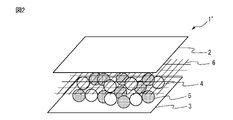
- FIG. 2 is an exploded perspective view of the composite absorber 1', which is another embodiment of the present invention.
- FIG. 3 is a diagram illustrating a manufacturing process of the absorbent A, which is an example of the polymer absorbent.
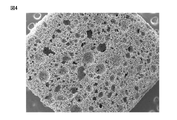
- FIG. 4 is an SEM photograph of the absorbent A at a magnification of 50 times.
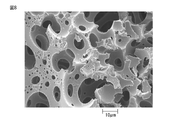
- FIG. 5 is an SEM photograph of the absorbent A at a magnification of 100 times.
- FIG. 6 is an SEM photograph of the absorbent A at a magnification of 500 times.
- FIG. 7 is an SEM photograph of the absorbent A at a magnification of 1000 times.
- FIG. 8 is an SEM photograph of the absorbent A at a magnification of 1500 times.
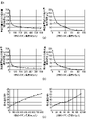
- FIG. 9 is a graph showing the relationship between the monovalent and divalent ion concentrations in the liquid and the absorption performance of SAP (liquid absorption amount, liquid retention amount and absorption rate).
- FIG. 10 is a graph showing the effect of the absorbent A, which is an example of the polymer absorbent, on the divalent ion concentration in the liquid.
- FIG. 1 is an exploded perspective view of a composite absorber 1 according to an embodiment of the present invention.
- the composite absorber 1 shown in FIG. 1 has a substantially rectangular outer shape in a plan view, and has a first holding sheet 2 forming a surface on one side of the composite absorber 1 in the thickness direction.
- a liquid absorbent consisting of a second holding sheet 3 forming the other surface of the composite absorbent 1 and a mixture of the polymer absorbent 4 and the highly absorbent polymer 5 (SAP) located between these sheets. It is provided with a sex member as a basic configuration.
- the liquid-absorbent member in the composite absorber 1 is a polymer absorbent 4 having a hydrophilic continuous skeleton and continuous pores located between the first holding sheet 2 and the second holding sheet 3.
- the highly absorbent polymer 5 is configured to be able to absorb and hold the liquid that has permeated through the first holding sheet 2.
- the above-mentioned polymer absorbent contains at least -COOH group and -COONa group as ion exchange groups, and the total ion exchange capacity of -COOH group and -COONa group per mass in a dry state is 4.0 mg. It has a peculiar ion exchange ability of equal amount / g or more.
- the composite absorber 4 can quickly absorb and temporarily retain the liquid, and is an ion exchange group.
- the ions in the liquid particularly Ca 2+ , Mg 2+ , etc.
- the composite absorber 4 can be delivered to the SAP after the liquid is modified with the polymer absorbent, so that the absorption performance of the SAP is less likely to vary and the absorption performance as the absorber is stably exhibited. can do.
- the liquid-absorbent member is not limited to the embodiment of the composite absorber 1 of the above-described embodiment, and the liquid-absorbent member includes at least a polymer absorbent and SAP exhibiting the above-mentioned peculiar liquid-absorbing behavior. If it is contained, it may or may not contain other liquid-absorbing materials.
- the configuration of the composite absorber is not limited to the embodiment of the composite absorber 1 of the above-described embodiment, and the composite absorber is, for example, the composite absorption of another embodiment of the present invention shown in FIG. Even if the hydrophilic fiber sheet 6 is located between the first holding sheet 2 and the liquid-absorbent member (that is, the polymer absorbent 4 and the highly absorbent polymer 5) as in the body 1'. good.
- the outer shape, various dimensions, basis weight, etc. of the composite absorber are not particularly limited as long as the effects of the present invention are not impaired, and any outer shape (for example, circular shape) according to various uses, usage modes, etc. , Oval shape, polygonal shape, hourglass shape, design shape, etc.), various dimensions, basis weight, etc. can be adopted.
- the first holding sheet 2 forming the surface on one side of the composite absorber 1 has a substantially rectangular outer shape similar to the outer shape of the composite absorber 1 in a plan view. It has a shape.
- the first holding sheet 2 is formed of a liquid-permeable sheet-like member capable of allowing the liquid supplied to the composite absorber 1 to permeate and be absorbed and held by the inner liquid-absorbing member. ..
- the first holding sheet 2 has a slightly larger size as a whole than the liquid absorbing member arranged inside (that is, compared with the arrangement area of the liquid absorbing material such as the polymer absorbent 4).
- the composite absorber 1 is bonded to the second holding sheet 3 located on the other side in the thickness direction by an arbitrary adhesive, heat fusion means, or the like.
- the second holding sheet 3 forming the surface on the other side of the composite absorber 1 has a substantially rectangular outer shape similar to the outer shape of the composite absorber 1 in a plan view.
- the second holding sheet 3 is liquid impermeable, preventing liquids that were not absorbed or held by the inner liquid-absorbing member or liquid exuded from the liquid-absorbing member from leaking to the outside of the composite absorber 1. It is formed by a sheet-like member of.
- each of the sheet-like members that can be used as the first holding sheet and the second holding sheet is not limited to that of the above-described embodiment, and the composite absorber of the present invention is the first holding sheet and the first holding sheet.
- At least one of the second holding sheets may be formed by a liquid-permeable sheet-like member. That is, in the composite absorber of the present invention, one of the first holding sheet and the second holding sheet may be formed of a liquid-impermeable sheet-like member.
- the liquid-permeable sheet-shaped member is not particularly limited as long as the effect of the present invention is not impaired, and is arbitrary according to various uses, usage modes, and the like.
- a liquid-permeable sheet-like member can be adopted. Examples of such a liquid-permeable sheet-like member include non-woven fabrics such as hydrophilic air-through non-woven fabrics, spunbonded non-woven fabrics, and point-bonded non-woven fabrics, woven fabrics, knitted fabrics, and porous resin films.
- fiber sheet when a hydrophilic non-woven fabric, a woven fabric, a knitted fabric, or the like (hereinafter, these are collectively referred to as "fiber sheet") is used as the liquid-permeable sheet-like member, these fiber sheets have a single-layer structure. It may have a multilayer structure of two or more layers.
- the type of constituent fibers of the fiber sheet is not particularly limited, and examples thereof include hydrophilic fibers such as cellulosic fibers and thermoplastic resin fibers that have been subjected to a hydrophilization treatment. These fibers may be used alone or in combination of two or more types.
- Examples of the cellulosic fiber that can be used as the constituent fiber of the fiber sheet include natural cellulosic fiber (for example, plant fiber such as cotton), regenerated cellulose fiber, purified cellulose fiber, semi-synthetic cellulose fiber and the like.
- Examples of the thermoplastic resin fibers that can be used as the constituent fibers of the fiber sheet include olefin resins such as polyethylene (PE) and polypropylene (PP), polyester resins such as polyethylene terephthalate (PET), and 6-nylon.
- Examples thereof include fibers made of known thermoplastic resins such as polyamide resins. These resins may be used alone or in combination of two or more kinds of resins.
- the liquid-impermeable sheet-like member is not particularly limited as long as the effect of the present invention is not impaired, and is suitable for various uses and usage modes. Any liquid-impermeable sheet-like member can be adopted. Examples of such a liquid-impermeable sheet-like member include various hydrophobic thermoplastic resin fibers (for example, polyolefin fibers such as PE and PP, polyester fibers such as PET, and core sheath type).
- Hydrophobic non-woven fabric formed of composite fibers, etc . Perforated or non-perforated resin film formed of hydrophobic thermoplastic resin such as PE or PP; Laminated body in which the non-woven fabric is bonded to the resin film; SMS non-woven fabric Such as laminated non-woven fabrics and the like.
- the outer shape, various dimensions, basis weight, etc. of the holding sheet are not particularly limited as long as the effects of the present invention are not impaired, and any outer shape (for example, circular shape, etc.) according to various uses, usage modes, etc. Oval shape, polygonal shape, hourglass shape, design shape, etc.), various dimensions, basis weight, etc. can be adopted.
- the liquid-absorbent member has a hydrophilic continuous skeleton and continuous pores located between the first holding sheet 2 and the second holding sheet 3 as described above.
- the polymer absorbent 4 and the highly absorbent polymer 5 are configured to be able to absorb and hold the liquid that has permeated through the first holding sheet 2.
- the polymer absorbent 4 and the highly absorbent polymer 5 of the liquid-absorbing member are hot-melt type bonded to each of the above-mentioned first holding sheet 2 and second holding sheet 3. Although it is bonded by any adhesive such as an agent, in the composite absorbent of the present invention, the polymer absorbent may not be bonded to the holding sheet.
- the liquid-absorbent member is essential to include, as described above, a polymer absorbent having a hydrophilic continuous skeleton and continuous pores and having the above-mentioned unique ion exchange ability, and a highly absorbent polymer. It is included as an ingredient.
- the polymer absorbent will be described later, but the superabsorbent polymer is a powder or granule made of a superabsorbent polymer such as a sodium acrylate copolymer known in the art, and is referred to as SAP (Super Absorbent Polymer). Is to be done.
- the specific type of the highly absorbent polymer is not particularly limited, but for example, an acrylic acid-based SAP in which cations are present on the surface can be preferably used.
- Acrylic acid-based SAPs in which cations are present on the surface are particularly susceptible to adverse effects on the absorption performance (particularly, the amount of liquid absorbed, the amount of liquid retained, and the absorption rate) due to the ions in the liquid, but they are composite absorbers.
- the polymer absorbent absorbs the liquid and temporarily retains the liquid, the ions in the liquid are exchanged by the -COOH group and the -COONa group. Since the liquid can be modified, the absorption performance of the SAP is less likely to vary, and the absorption performance as an absorber can be stably exhibited.
- the liquid-absorbent member located between the first holding sheet and the second holding sheet may contain only the above-mentioned polymer absorbent and SAP as the liquid-absorbing material.
- a liquid-absorbent material known in the art may be further contained. Examples of such a liquid-absorbent material include hydrophilic fibers, and more specifically, pulp fibers (for example, crushed pulp and the like), cellulosic fibers such as cotton, rayon, and acetate. ..
- the outer shape of the liquid-absorbent member (the plan-view shape of the arrangement region of the liquid-absorbent material), various dimensions, the basis weight, etc. are not particularly limited as long as the effects of the present invention are not impaired, and are desired. Any external shape, various dimensions, basis weight, etc. can be adopted according to the liquid absorbency, flexibility, strength, and the like.
- the composite absorber is, for example, as in the composite absorbent 1'of another embodiment shown in FIG. 2, the first holding sheet 2 and the liquid absorbent member (that is, the polymer absorbent 4 and the polymer absorbent 4).
- a hydrophilic fiber sheet 6 may be provided between the highly absorbent polymer 5).
- the hydrophilic fiber sheet that can be used for the composite absorber is not particularly limited as long as the effect of the present invention is not impaired, and any hydrophilic fiber sheet according to various uses, usage modes and the like can be adopted. ..
- hydrophilic fiber sheets include hydrophilic non-woven fabrics, woven fabrics, and knitted fabrics.
- the hydrophilic fiber sheet may have a single-layer structure or may have a multi-layer structure of two or more layers.
- the type of constituent fibers of the hydrophilic fiber sheet is not particularly limited, and examples thereof include hydrophilic fibers such as cellulosic fibers and thermoplastic resin fibers that have been subjected to a hydrophilization treatment. These fibers may be used alone or in combination of two or more types.
- examples of the cellulosic fiber that can be used as the constituent fiber of the hydrophilic fiber sheet include natural cellulose fiber (for example, plant fiber such as cotton), regenerated cellulose fiber, purified cellulose fiber, semi-synthetic cellulose fiber and the like. ..
- thermoplastic resin fiber that can be used as the constituent fiber of the hydrophilic fiber sheet for example, known heat such as an olefin resin such as PE and PP, a polyester resin such as PET, and a polyamide resin such as 6-nylon.
- known heat such as an olefin resin such as PE and PP
- a polyester resin such as PET
- a polyamide resin such as 6-nylon.
- fibers made of a plastic resin These resins may be used alone or in combination of two or more kinds of resins.
- the outer shape, various dimensions, basis weight, etc. of the hydrophilic fiber sheet are not particularly limited as long as the effects of the present invention are not impaired, and any outer shape, various dimensions, etc. according to various uses, usage modes, etc. Basis weight etc. can be adopted.
- the polymer absorbent used in the composite absorber of the present invention will be described in more detail.
- the polymer absorbent has a hydrophilic continuous skeleton and continuous pores, contains at least -COOH groups and -COONa groups as ion exchange groups, and has -COOH groups and-per mass in a dry state.
- the total ion exchange capacity of the COONa group is not particularly limited as long as it has a unique ion exchange ability of 4.0 mg equivalent / g or more.
- Such a polymer absorbent is, for example, a hydrolyzate of a crosslinked polymer of two or more monomers containing at least (meth) acrylic acid ester, and has a high functional group having at least one hydrophilic group.
- Molecular compounds can be mentioned. More specifically, it is a hydrolyzate of a (meth) acrylic acid ester and a crosslinked polymer of a compound containing two or more vinyl groups in one molecule, and has at least -COOH group and -COONa group.
- Molecular compounds can be mentioned.
- Such a polymer absorbent is an organic porous body having at least one -COONa group in one molecule, and further has a -COOH group. -COONa groups are distributed substantially uniformly in the skeleton of the porous body.
- the polymer absorbent is a hydrolyzate of such a (meth) acrylic acid ester and a crosslinked polymer of a compound containing two or more vinyl groups in one molecule, as will be described later, an aqueous solution or the like may be used.
- the hydrophilic continuous skeleton tends to expand (that is, expands easily), and the continuous pores also tend to expand, so that more liquid can be taken into the continuous pores more quickly.
- the composite absorber containing such a polymer absorbent can exhibit even higher absorption performance as an absorber, and can steadily modify more liquid, so that the absorption performance of SAP can be improved. It is possible to further reduce the variation.
- the (meth) acrylic acid ester means an acrylic acid ester or a methacrylic acid ester.
- a continuous hydrophilicity is provided by an organic polymer having at least -COONa group and -COOH group.
- a skeleton is formed, and there are communication holes (continuous vacancies) between the skeletons that serve as absorption fields for liquids. Since the hydrolysis treatment changes the -COOR group (that is, the carboxylic acid ester group) of the crosslinked polymer to a -COONa group or a -COOH group (see FIG. 3), the polymer absorbent is -COOR. It may have a group.
- the presence of -COOH and -COONa groups in the organic polymer forming a hydrophilic continuous skeleton and the total ion exchange capacity of -COOH and -COONa groups per mass in the dry state are determined by the infrared spectrophotometric method and weakly acidic. It can be confirmed by analysis by the quantification method of ion exchange groups.
- FIG. 3 is a diagram illustrating a manufacturing process of the absorbent A, which is an example of the polymer absorbent.
- the upper figure shows the constituent raw materials of the polymerization
- the middle figure shows Monolith A which is a crosslinked polymer of (meth) acrylic acid ester and divinylbenzene
- the lower figure shows the hydrolysis and hydrolysis to Monolith A in the middle figure.
- the absorbent A obtained by the drying treatment is shown.
- an absorbent A formed by a hydrolyzate of a crosslinked polymer of (meth) acrylic acid ester and divinylbenzene, which is an example of a polymer absorbent, will be described.
- the polymer absorbent is not limited to such a absorbent A, but is a hydrolyzate of a (meth) acrylic acid ester and a crosslinked polymer of a compound having two or more vinyl groups in one molecule, or , It may be a hydrolyzate of a crosslinked polymer of two or more kinds of monomers containing at least (meth) acrylic acid ester.
- the polymer absorbent is a monolithic absorbent, the liquid can be quickly absorbed and the liquid temporarily held in the polymer absorbent can be more steadily delivered to the SAP.
- a composite absorber containing such a polymer absorbent can stably exhibit even better absorption performance.
- “monolith A” is an organic porous body composed of a crosslinked polymer of (meth) acrylic acid ester and divinylbenzene before hydrolysis treatment, and is “monolithic organic porous”. Sometimes referred to as “polymer”. Further, the “absorbent A” is a hydrolyzate of a crosslinked polymer (monolith A) of (meth) acrylic acid ester and divinylbenzene after being hydrolyzed and dried. In the following description, the absorbent A is in a dry state.
- the absorbent A has a hydrophilic continuous skeleton and continuous pores as described above.
- the absorbent A which is an organic polymer having a hydrophilic continuous skeleton, was obtained by cross-linking and polymerizing a (meth) acrylic acid ester as a polymerization monomer and divinylbenzene as a cross-linking monomer. It is obtained by further hydrolyzing the crosslinked polymer (Monolith A).
- the organic polymer forming a hydrophilic continuous skeleton has an ethylene group polymerization residue (hereinafter referred to as “constituent unit X”) and a crosslinked polymerization residue of divinylbenzene (hereinafter referred to as “constituent unit Y”) as constituent units. ”) And. Furthermore, the polymerization residue (constituent unit X) of the ethylene group in the organic polymer forming the hydrophilic continuous skeleton has both -COOH group and -COONa group generated by hydrolysis of the carboxylic acid ester group. .. When the polymerization monomer is a (meth) acrylic acid ester, the polymerization residue (constituent unit X) of the ethylene group has an —COONa group, a —COOH group and an ester group.
- the ratio of the crosslinked polymerization residue (constituent unit Y) of divinylbenzene in the organic polymer forming the hydrophilic continuous skeleton is, for example, 0.1 to 30 mol% with respect to all the constituent units. , Preferably 0.1 to 20 mol%.
- the ratio of the cross-linking polymerization residue (constituent unit Y) of divinylbenzene in the organic polymer forming a hydrophilic continuous skeleton is, for example, 0.1 to 30 mol% with respect to all the constituent units. , Preferably 0.1 to 20 mol%.
- the ratio of the cross-linking polymerization residue (constituent unit Y) of divinylbenzene in the organic polymer forming a hydrophilic continuous skeleton is, for example, 0.1 to 30 mol% with respect to all the constituent units. , Preferably 0.1 to 20 mol%.
- the ratio of the crosslinked polymerization residue of divinylbenzene in the organic polymer forming the hydrophilic continuous skeleton is 0.1 mol% or more, the strength of the absorbent A is less likely to decrease, and this divinylbenzene is less likely to decrease.
- the ratio of the crosslinked polymerization residue of the above is 30 mol% or less, the amount of the liquid to be absorbed is less likely to decrease.
- the organic polymer forming the hydrophilic continuous skeleton may be composed of only the constituent unit X and the constituent unit Y, or in addition to the constituent unit X and the constituent unit Y, It may have a structural unit other than the structural unit X and the structural unit Y, that is, a polymerization residue of a monomer other than the (meth) acrylic acid ester and divinylbenzene.
- Examples of the constituent units other than the constituent unit X and the constituent unit Y include styrene, ⁇ -methylstyrene, vinyltoluene, vinylbenzyl chloride, glycidyl (meth) acrylate, isobutene, butadiene, isoprene, chloroprene, vinyl chloride, and bromide.
- Polymerization residues of monomers such as vinyl, vinylidene chloride, tetrafluoroethylene, (meth) acrylonitrile, vinyl acetate, ethylene glycol di (meth) acrylate, tripropylene glycol di (meth) acrylate, trimethylolpropanetri (meth) acrylate Can be mentioned.
- the ratio of the structural units other than the structural unit X and the structural unit Y in the organic polymer forming the hydrophilic continuous skeleton is, for example, 0 to 50 mol%, preferably 0 to 30 with respect to all the structural units. It is mol%.
- the absorbent A preferably has a hydrophilic continuous skeleton having a thickness of 0.1 to 100 ⁇ m.
- the thickness of the hydrophilic continuous skeleton of the absorbent A is 0.1 ⁇ m or more, the spaces (pores) for taking in the liquid in the porous body are less likely to be crushed during absorption, and the amount of liquid absorbed is less likely to decrease.
- the thickness of the hydrophilic continuous skeleton is 100 ⁇ m or less, an excellent absorption rate can be easily obtained.
- the thickness of the continuous skeleton is measured by using the skeleton cross section appearing on the test piece for electron microscope measurement as the evaluation point of the thickness. ..
- the continuous skeleton is often formed in a polygonal shape because it is formed at intervals between water (water droplets) that are removed by dehydration / drying treatment after hydrolysis. Therefore, the thickness of the continuous skeleton is the average value of the diameters ( ⁇ m) of the circles circumscribing the polygonal cross section. Also, in rare cases, there may be a small hole in the polygon, in which case the circumscribed circle of the cross section of the polygon surrounding the small hole is measured.
- the absorbent A preferably has an average diameter of continuous pores of 1 ⁇ m to 1000 ⁇ m.
- the average diameter of the continuous pores of the absorbent A is 1 ⁇ m or more, the space (pores) for taking in the liquid in the porous body is less likely to be crushed during absorption, and the absorption rate is less likely to decrease.
- the average diameter of the continuous pores is 1000 ⁇ m or less, an excellent absorption rate can be easily obtained. Therefore, the composite absorber provided with such an absorbent A can stably exhibit excellent absorption performance.
- the porosity per unit volume of the polymer absorbent described later is 85% or more and the average diameter of the continuous pores is 1 ⁇ m to 1000 ⁇ m, the liquid is absorbed by more pores and modified. Since the quality can be improved, there is an advantage that better ion exchange efficiency can be realized.
- the average diameter ( ⁇ m) of the continuous pores of the absorbent A can be measured by the mercury intrusion method, and the maximum value of the pore distribution curve obtained by the mercury intrusion method is adopted.
- a sample for measuring the average diameter of the continuous pores a sample dried for 18 hours or more in a vacuum dryer set at a temperature of 50 ° C. is used regardless of the ionic form of the absorbent A.
- the final ultimate pressure is 0 Torr.
- FIG. 4 is an SEM photograph having a magnification of 50 times for the absorbent A
- FIG. 5 is an SEM photograph having a magnification of 100 times for the absorbent A
- FIG. 6 is an SEM photograph having a magnification of 500 for the absorbent A. It is a double SEM photograph
- FIG. 7 is an SEM photograph having a magnification of 1000 times for the absorbent A
- FIG. 8 is an SEM photograph having a magnification of 1500 times for the absorbent A.
- the absorbent A shown in FIGS. 4 to 8 is an example of an absorbent having butyl methacrylate as a polymerization monomer and divinylbenzene as a cross-linking monomer, and each has a cubic structure of 2 mm square.
- the absorbent A shown in FIGS. 4 to 8 has a large number of bubble-shaped macropores, and further has a portion where these bubble-shaped macropores overlap each other.
- the absorbent A has an open cell structure in which the overlapping portions of the macropores have a common opening (mesopore), that is, an open cell structure (continuous macropore structure).
- the portion where the macropores overlap each other has a common opening (mesopore) having an average diameter of 1 to 1000 ⁇ m, preferably 10 to 200 ⁇ m, particularly preferably 20 to 100 ⁇ m in a dry state, and most of them have an open pore structure. It has become.
- the average diameter of the mesopore in a dry state is 1 ⁇ m or more, the absorption rate of the liquid to be absorbed becomes better.
- the average diameter of the mesopore in a dry state is 1000 ⁇ m or less, the absorbent A is less likely to become brittle. It should be noted that the number of such macropores overlapped with each other is about 1 to 12 for one macropore, and about 3 to 10 for most macropores.
- the absorbent A has such an open cell structure, the macropore group and the mesopore group can be uniformly formed, and the particle aggregation type as described in Japanese Patent Application Laid-Open No. 8-252579 etc. can be formed uniformly. Compared to the porous body, there is an advantage that the pore volume and the specific surface area can be significantly increased.
- the total pore volume of the pores (pores) of the absorbent A is preferably 0.5 to 50 mL / g, more preferably 2 to 30 mL / g.
- the total pore volume of the absorbent A is 0.5 mL / g or more, the space (vacancy) for taking in the liquid in the porous body is less likely to be crushed during absorption, and the amount of liquid absorbed and the absorption rate are less likely to decrease. Become.
- the total pore volume of the absorbent A is 50 mL / g or less, the strength of the absorbent A is less likely to decrease.
- the total pore volume can be measured by the mercury intrusion method.
- a sample dried for 18 hours or more in a vacuum dryer set at a temperature of 50 ° C. is used regardless of the ionic form of the absorbent A.
- the final ultimate pressure is 0 Torr.
- the continuous pores included in the absorbent A shown in FIGS. 4 to 8 are pores in which a plurality of pores (pores) communicate with each other, and a large number of pores are provided from the appearance. Can be visually recognized with the naked eye.
- the hydrophilic continuous skeleton first instantly takes up some of the liquid by osmotic pressure and elongates (ie, expands). This extension of the continuous skeleton occurs in almost all directions.
- the size of each pore of the absorbent A also increases as the outer shape of the absorbent A increases due to the elongation of the continuous skeleton during liquid absorption.
- the absorbent A which has been enlarged by absorbing a certain amount of liquid in this way, can further absorb a predetermined amount of liquid into the enlarged pores by the capillary phenomenon.
- the liquid absorbed in the hydrophilic continuous skeleton of the absorbent A is difficult to be released from the continuous skeleton (that is, it is difficult to release the liquid), while the liquid absorbed in the continuous pores is easy to release.
- the liquid absorbed in the continuous pores is separated, transferred to the SAP having a high liquid retention capacity, and steadily held in the SAP.
- the amount of the liquid absorbed by the absorbent A is larger than the amount of the liquid absorbed in the hydrophilic continuous skeleton. Since most of the absorption of the liquid by the absorbent A is performed by retaining the liquid in the pores by capillarity, the porosity (that is, absorption) which is the ratio of the volume of the voids in the pores (total pore volume). The larger the volume of the voids in the pores relative to the unit volume of the agent A, the more liquid can be absorbed.
- the porosity per unit volume of such a polymer absorbent is preferably 85% or more, and more preferably 90% or more.
- the porosity per unit volume of the polymer absorbent is 85% or more, it is possible to absorb a larger amount of liquid and steadily reform it, so that it is possible to make it more difficult for the absorption performance of SAP to vary. ..
- the composite absorber containing such a polymer absorbent can more stably and satisfactorily exhibit the absorption performance as an absorber.
- the porosity of the absorbent A shown in FIGS. 4 to 8 described above is as follows.
- the specific surface area of the absorbent A obtained by the mercury intrusion method is 400 m 2 / g, and the pore volume is 15.5 mL / g.
- This pore volume of 15.5 mL / g means that the volume of the pores in 1 g of the absorbent A is 15.5 mL.
- the specific gravity of the absorbent A is 1 g / mL
- the volume occupied by the pores in 1 g of the absorbent A that is, the pore volume is 15.5 mL
- the volume of the absorbent A of 1 g. Becomes 1 mL.
- the total volume (volume) of 1 g of the absorbent A becomes 15.5 + 1 (mL), and the ratio of the pore volume thereof becomes the porosity. Therefore, the porosity of the absorbent A is 15.5 / (. 15.5 + 1) ⁇ 100 ⁇ 94%.
- the absorbent A having such a hydrophilic continuous skeleton and continuous pores that is, the polymer absorbent is applied to the composite absorber in the form of particles, sheets, or the like. Further, as described above, this polymer absorbent contains at least -COOH group and -COONa group as ion exchange groups, and has a total ion exchange capacity of -COOH group and -COONa group per mass in a dry state.
- the polymer absorbent absorbs the liquid and temporarily retains it
- the ions in the liquid are ion-exchanged by -COOH group and -COONa group, and the liquid is absorbed by the highly absorbent polymer (SAP) (particularly, the amount of liquid absorbed, the amount of liquid retained, and the absorption rate).
- SAP highly absorbent polymer
- the composite absorber to which such a polymer absorbent is applied can be delivered to the SAP after the liquid is modified with the polymer absorbent, so that the absorption performance of the SAP is less likely to vary, and the absorber is less likely to vary. It is possible to stably demonstrate the absorption performance as.
- FIG. 9 is a graph showing the relationship between the monovalent and divalent ion concentrations in the liquid and the absorption performance of SAP (liquid absorption amount, liquid retention amount and absorption rate), and
- FIG. 10 is a graph showing a polymer. It is a graph which shows the influence which the absorbent A which is an example of an absorbent has on the divalent ion concentration in a liquid.
- the liquid absorption amount, the liquid retention amount, and the absorption rate of the SAP decrease as the monovalent and divalent ion concentrations in the liquid increase.
- the divalent ion concentration has a large effect on the absorption performance of SAP, and even if it is a trace amount, the amount of liquid absorbed, the amount of liquid retained, and the absorption rate of SAP are greatly reduced.
- the ion concentration in the liquid has a great adverse effect on the absorption performance of SAP, but since the ion concentration varies from liquid to liquid, the absorption performance of SAP also varies according to the variation. It will occur.
- the absorbent A which is an example of the present invention, contains at least -COOH group and -COONa group as ion exchange groups, and has a total ion exchange capacity of -COOH group and -COONa group per mass in a dry state. Since it has a unique ion exchange ability of 4.0 mg equivalent / g or more, as shown in FIG. 10, ions in the liquid (particularly divalent ions) are separated by -COOH groups and -COONa groups. Ion exchange can be carried out to significantly reduce the ion concentration in the liquid, that is, the liquid can be modified into a liquid that does not adversely affect the absorption performance of the SAP.
- the graph shown in FIG. 10 shows the rate of change in ion concentration before and after contact between the actual urine (actual urine A, B and C) of three humans having different divalent ion concentrations and the absorbent A (that is, that is).
- the ion exchange rate of the absorbent A) was measured as follows. First, the divalent ion concentrations (mEq / L) of each of the three real urines A, B and C are measured using an ion meter (HORIBA Compact Calcium Ion Meter LAQUAtwin-Ca-11 manufactured by Horiba Advanced Techno Co., Ltd.). do. The measured ion concentration is defined as the ion concentration "before contact with the absorbent A".
- 0.2 g of the polymer absorbent (absorbent A) was added to a glass filter (climbing glass filter, model number: 0777-01-101, outer diameter x foot length (mm): ⁇ 7 x 80, filter diameter. : ⁇ 20 mm, capacity: 30 mL, material: borosilicate glass, pore diameter: 100 to 120 ⁇ m), pour 30 mL of the actual urine, and measure the divalent ion concentration (mEq / L) of the obtained filtrate with the above ion meter. Is measured using. The measured ion concentration is defined as the ion concentration "after contact with the absorbent A".
- the amount of change in ion concentration (mEq / L) before and after the contact with the absorbent A is calculated by subtracting the ion concentration after the contact with the absorbent A from the ion concentration before the contact with the absorbent A, and further, before and after the contact with the absorbent A.
- the rate of change (%) in the divalent ion concentration in each of the actual urine A, B and C. is calculated. All of the above measurements are performed under the conditions of a temperature of 25 ° C. and a humidity of 60%.
- the absorbent A of the example of the present invention has the above-mentioned peculiar ion exchange ability which is not found in the conventional liquid-absorbent material, and can quickly absorb the liquid and temporarily retain it. Ions in the liquid (particularly divalent ions) can be exchanged to reform the liquid into a liquid that does not adversely affect the absorption performance of the SAP.
- the composite absorber containing such an absorbent A polymer absorbent
- the composite absorber containing such an absorbent A can be delivered to the SAP after the liquid is modified, so that the absorption performance of the SAP is less likely to vary, and the absorber is less likely to vary. It is possible to stably demonstrate the absorption performance as.
- the total ion exchange capacity of the -COOH group and the -COONa group per mass in the dry state of the polymer absorbent is preferably 6.0 mg equivalent / g or more, and 8.0 mg equivalent / g. The above is more preferable.
- the polymer absorber preferably has an ion exchange rate of polyvalent ions (that is, divalent or higher ions) of 50% or more.
- polyvalent ions that is, divalent or higher ions
- the ion exchange rate of the polyvalent ion of the polymer absorbent is 50% or more, the liquid can be reformed more reliably, so that the variation in the absorption performance of SAP can be made less likely to occur. Therefore, the composite absorber containing such a polymer absorbent can more stably exhibit the absorption performance as an absorber.
- the ion exchange rate of the polyvalent ion of the polymer absorbent is more preferably 60% or more, further preferably 70% or more.
- the ion exchange rate of the polyvalent ion of the polymer absorbent can be measured by any measuring method such as ICP emission analysis method, IC analysis method, atomic absorbance analysis method, etc., for example, divalent ion.
- the ion exchange rate of can be measured as follows.
- the amount of change in ion concentration (mEq / L) before and after contact with the polymer absorbent was calculated by subtracting the ion concentration after contact with the polymer absorbent from the ion concentration before contact with the polymer absorbent, and further, this high value was obtained.
- the rate of change in divalent ion concentration (%) is calculated by dividing the amount of change in ion concentration (mEq / L) before and after contact with the molecular absorbent by the ion concentration before contact with the polymer absorbent and multiplying by 100. .. In the present specification, this "rate of change in divalent ion concentration (%)" is referred to as "divalent ion exchange rate of the polymer absorbent". All of the above measurements are performed under the conditions of a temperature of 25 ° C. and a humidity of 60%.
- the measurement sample (polymer absorbent) is recovered from the product and used, it can be obtained according to the following ⁇ method for recovering the measurement sample (polymer absorbent)>.
- ⁇ Method of recovering sample (polymer absorbent) for measurement> Peel off the surface sheet or the like from the product to expose the absorber. (2) Drop the object to be measured (polymer absorbent) from the exposed absorber, and use a tweezers or the like to remove something other than the object to be measured (particle-like) (for example, pulp or synthetic resin fiber). And remove it. (3) Using a microscope or a simple loupe as a magnifying observation means, collect the object to be measured using tweezers or the like while observing the difference from SAP at a magnification that can be recognized or the pores of the porous body at a magnification that can be visually recognized. .. The magnification of the simple loupe is not particularly limited as long as the pores of the porous body can be visually recognized, and examples thereof include a magnification of 25 to 50 times. (4) The measurement object thus recovered is used as a sample for measurement in various measurement methods.
- the polymer absorbent preferably has a liquid absorption amount of 30 g / g or more per unit mass.
- the polymer absorbent has a certain amount of liquid absorption or more, it can absorb more liquid and steadily reform it, so that the absorption performance of SAP is less likely to vary. Can be done. Therefore, the composite absorber containing such a polymer absorbent can more stably exhibit the absorption performance as an absorber.
- the amount of liquid absorbed per unit mass of the polymer absorbent is more preferably 40 g / g or more, and further preferably 50 g / g or more.
- the amount of liquid absorbed per unit mass of the polymer absorbent can be measured as follows.
- ⁇ Measuring method of liquid absorption per unit mass of polymer absorbent> (1) Mesh bag obtained by cutting 1 g of a sample (polymer absorbent) for measurement into 10 cm squares (manufactured by NBC Meshtec Inc., N-NO255HD 115 (standard width: 115 cm, 255 mesh / 2.54 cm, opening:) Enclose in 57 ⁇ m, wire diameter: 43 ⁇ m, thickness: 75 ⁇ m)). The mass (g) of the mesh bag is measured in advance.
- the sample for measurement polymer absorbent
- it can be obtained according to the above-mentioned ⁇ Method for recovering the sample for measurement (polymer absorbent)>.
- the above-mentioned absorbent A can be obtained by undergoing a cross-linking polymerization step and a hydrolysis step. Hereinafter, each of these steps will be described.
- Cross-link polymerization step First, an oil-soluble monomer for cross-linking polymerization, a cross-linking monomer, a surfactant, water, and, if necessary, a polymerization initiator are mixed to obtain a water-in-oil emulsion.
- This water-in-oil emulsion is an emulsion in which the oil phase becomes a continuous phase and water droplets are dispersed therein.
- butyl methacrylate which is a (meth) acrylic acid ester
- divinylbenzene is used as the crosslinkable monomer
- surfactant is used.
- Crosslink polymerization is carried out using sorbitan monooleate as an activator and isobutyronitrile as a polymerization initiator to obtain monolith A.
- this emulsion is immediately transferred to a reaction vessel, sealed, and polymerized at 60 ° C. for 24 hours under the static condition. After completion of the polymerization, the contents are taken out, extracted with methanol, and dried under reduced pressure to obtain Monolith A having a continuous macropore structure.
- the monolith A had an open cell structure and the thickness of the continuous skeleton was 5.4 ⁇ m.
- the average diameter of the continuous pores measured by the mercury intrusion method was 36.2 ⁇ m, and the total pore volume was 15.5 mL / g.
- the content of divinylbenzene with respect to all the monomers is preferably 0.3 to 10 mol%, more preferably 0.3 to 5 mol%. Further, the ratio of divinylbenzene to the total of butyl methacrylate and divinylbenzene is preferably 0.1 to 10 mol%, more preferably 0.3 to 8 mol%. In the above-mentioned absorbent A, the ratio of butyl methacrylate to the total of butyl methacrylate and divinylbenzene is 97.0 mol%, and the ratio of divinylbenzene is 3.0 mol%.
- the amount of the surfactant added can be set according to the type of the oil-soluble monomer and the size of the desired emulsion particles (macropores), and is about 2 to 70 with respect to the total amount of the oil-soluble monomer and the surfactant. It is preferably in the range of%.
- alcohols such as methanol and stearyl alcohol
- carboxylic acids such as stearic acid
- hydrocarbons such as octane, dodecane and toluene
- cyclic ethers such as tetrahydrofuran and dioxane are used. It may coexist in the polymerization system.
- the mixing method for forming the water-in-oil emulsion is not particularly limited.
- a method of mixing each component at once, an oil-soluble monomer, a surfactant, and an oil-soluble polymerization initiator, which are oil-soluble can be adopted.
- the mixing device for forming the emulsion is not particularly limited, and any device such as a normal mixer, a homogenizer, or a high-pressure homogenizer can be adopted depending on the desired emulsion particle size, and further, the object to be treated can be used.
- a so-called planetary stirrer or the like can also be used, in which an object is placed in a mixing container and the mixture is rotated while revolving around a revolving axis in an inclined state to stir and mix the object to be processed.
- the mixing conditions are not particularly limited, and the stirring rotation speed, stirring time, etc. can be arbitrarily set according to the desired emulsion particle size.
- water droplets in the W / O emulsion can be uniformly generated, and the average diameter thereof can be arbitrarily set in a wide range.
- Various conditions can be adopted for the polymerization conditions of the water-in-oil emulsion depending on the type of monomer and initiator.
- azobisisobutyronitrile, benzoyl peroxide, potassium persulfate, etc. they should be polymerized by heating at a temperature of 30 to 100 ° C. for 1 to 48 hours in a sealed container under an inert atmosphere.
- hydrogen peroxide-ferrous chloride, sodium persulfate-sodium acid sulfite, etc. are used as the polymerization initiator, the temperature is 0 to 30 ° C. for 1 to 48 hours in a sealed container under an inert atmosphere. It may be polymerized.
- the unreacted monomer and the residual surfactant can be removed by taking out the contents and performing Soxhlet extraction with a solvent such as isopropanol to obtain the monolith A shown in the middle figure of FIG. ..
- monolith A is immersed in dichloroethane containing zinc bromide, stirred at 40 ° C. for 24 hours, and hydrolyzed by contacting it with methanol, 4% hydrochloric acid, 4% sodium hydroxide aqueous solution and water in this order. After that, it is dried to obtain a block-shaped absorbent A. Further, the block-shaped absorbent A is pulverized to a predetermined size to obtain a particulate absorbent A.
- the form of the absorbent A is not limited to particles, and may be formed into a sheet during or after drying, for example.
- the method for hydrolyzing Monolith A is not particularly limited, and various methods can be adopted.
- aromatic solvents such as toluene and xylene
- halogen solvents such as chloroform and dichloroethane
- ether solvents such as tetrahydrofuran and isopropyl ether
- amide solvents such as dimethylformamide and dimethylacetamide
- alcohol solvents such as methanol and ethanol.
- P-solvented acid such as toluenesulfonic acid or Lewis acid such as zinc bromide, aluminum chloride, aluminum bromide, titanium chloride (IV), cerium chloride / sodium iodide, magnesium iodide, etc. Be done.
- the (meth) acrylic acid ester is not particularly limited, but the (meth) acrylic acid has C1 to C10 (that is, the number of carbon atoms). Alkyl esters of 1 to 10) are preferable, and C4 (that is, 4 carbon atoms) alkyl esters of (meth) acrylic acid are particularly preferable.
- the C4 alkyl ester of (meth) acrylic acid include (meth) acrylic acid t-butyl ester, (meth) acrylic acid n-butyl ester, and (meth) acrylic acid iso-butyl ester.
- the monomer used for the cross-linking polymerization may be only (meth) acrylic acid ester and divinylbenzene, and in addition to (meth) acrylic acid ester and divinylbenzene, other than (meth) acrylic acid ester and divinylbenzene. It may contain other monomers. In the latter case, the other monomer is not particularly limited, but for example, styrene, ⁇ -methylstyrene, vinyltoluene, vinylbenzyl chloride, glycidyl (meth) acrylate, diethylhexyl (meth) acrylate, isobutene, butadiene, isobrene.
- the proportion of the monomers other than the (meth) acrylic acid ester and divinylbenzene in all the monomers used for the cross-linking polymerization is preferably 0 to 80 mol%, more preferably 0 to 50 mol%.
- the surfactant is not limited to the above-mentioned sorbitan monooleate, and may be any one that can form a water-in-oil (W / O) emulsion when the cross-linking polymerization monomer and water are mixed. ..
- surfactants include sorbitan monolaurate, sorbitan monopalmitate, sorbitan monostearate, sorbitan trioleate, polyoxyethylene group nonylphenyl ether, polyoxyethylene group stearyl ether, and polyoxyethylene group sorbitan.
- Nonionic surfactants such as monooleate, anionic surfactants such as potassium oleate, sodium dodecylbenzenesulfonate, sodium dioctyl sulfosuccinate, cationic surfactants such as distearyldimethylammonium chloride, lauryldimethylbetaine and the like. Androgynous surfactants can be mentioned. These surfactants may be used alone or in combination of two or more.
- the polymerization initiator a compound that generates radicals by heat and light irradiation is preferably used.
- the polymerization initiator may be water-soluble or oil-soluble, and may be, for example, azobis (4-methoxy-2,4-dimethylvaleronitrile), azobisisobutyronitrile, azobisdimethylvaleronitrile, azobiscyclohexanenitrile, etc.
- Azobiscyclohexanecarbonitrile azobis (2-methylpropionamidine) dihydrochloride
- benzoyl peroxide potassium persulfate, ammonium persulfate, hydrogen peroxide-ferrous chloride, sodium persulfate-sodium acid sulfite, tetramethylthium disulfide, etc.
- the polymerization proceeds only by heating or light irradiation without adding the polymerization initiator, so that it is not necessary to add the polymerization initiator in such a system.
- the composite absorber of the present invention is not particularly limited, but for example, composite absorption in various fields such as dew condensation prevention sheets, civil engineering / building materials such as simple soil, base materials such as pharmaceuticals, and materials for absorbing leaked liquids. Can be applied to the body. Therefore, the liquid to be absorbed by the composite absorber is not particularly limited, and is, for example, water, an aqueous solution (for example, seawater), an acid (for example, hydrochloric acid, etc.), a base (for example, sodium hydroxide, etc.), an organic solvent (for example, sodium hydroxide, etc.).
- alcohols such as methanol and ethanol, ketones such as acetone, ethers such as tetrahydrofuran (THF) and 1,4-dioxane, N, N-dimethylformamide (DMF), dimethylsulfoxide (DMSO) and the like
- THF tetrahydrofuran
- DMF dimethylformamide
- DMSO dimethylsulfoxide
- these liquids may be a mixture of two or more kinds of liquids.
- the present invention is not limited to the above-described embodiments and the like, and can be appropriately combined, substituted, modified, etc. within the range not deviating from the object and purpose of the present invention.
- the ordinal numbers such as “first” and “second” are for distinguishing the items to which the ordinal numbers are attached, and mean the order, priority, importance, etc. of each item. It's not something to do.
Landscapes
- Chemical & Material Sciences (AREA)
- Health & Medical Sciences (AREA)
- Organic Chemistry (AREA)
- Chemical Kinetics & Catalysis (AREA)
- Analytical Chemistry (AREA)
- Vascular Medicine (AREA)
- Engineering & Computer Science (AREA)
- Animal Behavior & Ethology (AREA)
- General Health & Medical Sciences (AREA)
- Public Health (AREA)
- Veterinary Medicine (AREA)
- Heart & Thoracic Surgery (AREA)
- Biomedical Technology (AREA)
- Epidemiology (AREA)
- Life Sciences & Earth Sciences (AREA)
- Polymers & Plastics (AREA)
- Medicinal Chemistry (AREA)
- General Chemical & Material Sciences (AREA)
- Solid-Sorbent Or Filter-Aiding Compositions (AREA)
- Absorbent Articles And Supports Therefor (AREA)
- Addition Polymer Or Copolymer, Post-Treatments, Or Chemical Modifications (AREA)
- Compositions Of Macromolecular Compounds (AREA)
Abstract
Description
例えば、特許文献1~5に開示されているように、使い捨て紙おむつをはじめとして、結露防止シートや簡易土壌等の土木・建築資材、医薬品等の基材、漏出液体の吸収用資材などの様々な分野に適用されている。
一方、吸収体の吸収対象となる液体は、少なからずイオンを含むのが一般的であり、特に液体中の2価のイオン(例えば、Ca2+、Mg2+等)は、微量であってもSAPの吸収性能(特に、吸液量や保液量、吸収速度)に大きな悪影響を及ぼすものとなる。
ところが、従来の吸収体では、液体中の塩濃度を改質する機能が備わっていないため、パルプ内に一時的に保持された液体はそのままの状態でSAPへ受け渡されてしまい、液体中の塩濃度(特に、2価のイオン濃度)の影響によってSAPの吸収性能にバラつきが生じ、結果的に吸収体の吸収性能が安定的に発揮できない恐れがあった。
前記複合吸収体は、親水性の連続骨格及び連続空孔を備えた高分子吸収剤と、高吸収性ポリマーと、を含み、
前記高分子吸収剤は、イオン交換基として少なくとも-COOH基及び-COONa基を含有し、且つ、乾燥状態における質量当たりの前記-COOH基及び-COONa基の総イオン交換容量が4.0mg当量/g以上であることを特徴とする、前記複合吸収体である。
これにより、本態様の複合吸収体は、液体が高分子吸収剤で改質された後にSAPへ受け渡されるため、SAPの吸収性能にバラつきが生じにくく、吸収体としての吸収性能を安定的に発揮することができる。
特に、高分子吸収剤の単位体積当たりの空隙率が85%以上であり且つ連続空孔の平均直径が1μm~1000μmである場合は、より多くの細孔で液体を吸収して改質することができるため、より優れたイオン交換効率を実現することができるという利点がある。
親水性の連続骨格及び連続空孔を備え、
イオン交換基として少なくとも-COOH基及び-COONa基を含有し、且つ、乾燥状態における質量当たりの前記-COOH基及び-COONa基の総イオン交換容量が4.0mg当量/g以上であることを特徴とする高分子吸収剤である。
これにより、本態様の高分子吸収剤は、液体が高分子吸収剤で改質された後にSAPへ受け渡されるため、SAPの吸収性能にバラつきが生じにくく、吸収体としての吸収性能を安定的に発揮することができる。
なお、本明細書においては、特に断りのない限り、「展開状態で水平面上に置いた対象物(例えば、複合吸収体等)を、垂直方向の上方側から対象物の厚さ方向に見ること」を、単に「平面視」という。
図1は、本発明の一実施形態である複合吸収体1の分解斜視図である。
図1に示す複合吸収体1は、平面視にて略矩形状の外形形状を有しており、厚さ方向において、複合吸収体1の一方側の表面を形成する第1の保持シート2と、複合吸収体1の他方側の表面を形成する第2の保持シート3と、これらのシートの間に位置し且つ高分子吸収剤4及び高吸収性ポリマー5(SAP)の混合物からなる吸液性部材とを、基本構成として備えている。
これにより、複合吸収体4は、液体を高分子吸収剤で改質した後にSAPへ受け渡すことができるため、SAPの吸収性能にバラつきが生じにくく、吸収体としての吸収性能を安定的に発揮することができる。
図1に示す複合吸収体1において、当該複合吸収体1の一方側の表面を形成する第1の保持シート2は、平面視にて複合吸収体1の外形形状と同様の略矩形状の外形形状を有している。かかる第1の保持シート2は、複合吸収体1に供給された液体を透過させて、内側の吸液性部材に吸収・保持させることができる、液透過性のシート状部材によって形成されている。
図1に示す複合吸収体1において、吸液性部材は、上述のとおり第1の保持シート2と第2の保持シート3の間に位置する、親水性の連続骨格及び連続空孔を備えた高分子吸収剤4と高吸収性ポリマー5とによって、第1の保持シート2を透過してきた液体を吸収・保持し得るように構成されている。
本発明においては、複合吸収体は、例えば、図2に示す別の実施形態の複合吸収体1’のように、第1の保持シート2と吸液性部材(すなわち、高分子吸収剤4及び高吸収性ポリマー5)との間に、親水性繊維シート6を有していてもよい。
さらに、親水性繊維シートの構成繊維に用い得るセルロース系繊維としては、例えば、天然セルロース繊維(例えば、コットン等の植物繊維など)や再生セルロース繊維、精製セルロース繊維、半合成セルロース繊維などが挙げられる。また、親水性繊維シートの構成繊維に用い得る熱可塑性樹脂繊維としては、例えば、PE、PP等のオレフィン系樹脂、PET等のポリエステル系樹脂、6-ナイロン等のポリアミド系樹脂などの公知の熱可塑性樹脂からなる繊維が挙げられる。これらの樹脂は単独で用いても、二種類以上の樹脂を併用してもよい。
[高分子吸収剤]
本発明において高分子吸収剤は、親水性の連続骨格及び連続空孔を備え、イオン交換基として少なくとも-COOH基及び-COONa基を含有し、且つ、乾燥状態における質量当たりの-COOH基及び-COONa基の総イオン交換容量が4.0mg当量/g以上であるという特有のイオン交換能を有するものであれば特に限定されない。そのような高分子吸収剤としては、例えば、少なくとも(メタ)アクリル酸エステルを含む2個以上のモノマーの架橋重合体の加水分解物であり、官能基に少なくとも1個以上の親水基を有する高分子化合物が挙げられる。より具体的には、(メタ)アクリル酸エステルと、一分子中に2個以上のビニル基を含有する化合物の架橋重合体の加水分解物であり、少なくとも-COOH基及び-COONa基を有する高分子化合物が挙げられる。かかる高分子吸収剤は、一分子中に少なくとも1個以上の-COONa基を有する有機多孔質体であり、さらに、-COOH基を有している。多孔質体の骨格中には、-COONa基が略均一に分布している。
なお、加水分解処理は、架橋重合体の-COOR基(すなわち、カルボン酸エステル基)を-COONa基又は-COOH基にするものであるため(図3を参照)、高分子吸収剤は-COOR基を有していてもよい。
但し、高分子吸収剤がモノリス状の吸収剤であると、液体を素早く吸収することができる上、当該高分子吸収剤に一時的に保持した液体をより着実にSAPへ受け渡すことができるため、このような高分子吸収剤を含む複合吸収体は、更に優れた吸収性能を安定的に発揮することができる。
また、「吸収剤A」は、加水分解処理及び乾燥処理がなされた後の(メタ)アクリル酸エステルとジビニルベンゼンとの架橋重合体(モノリスA)の加水分解物である。なお、以下の説明において、吸収剤Aは乾燥状態のものをいう。
吸収剤Aは、上述のとおり親水性の連続骨格と連続空孔を有している。親水性の連続骨格を有する有機ポリマーである吸収剤Aは、図3に示すように、重合モノマーである(メタ)アクリル酸エステルと、架橋モノマーであるジビニルベンゼンとを架橋重合し、得られた架橋重合体(モノリスA)を更に加水分解することにより得られる。
さらに、親水性の連続骨格を形成する有機ポリマー中のエチレン基の重合残基(構成単位X)は、カルボン酸エステル基の加水分解により生成する-COOH基と-COONa基の両方の基を有する。なお、重合モノマーが(メタ)アクリル酸エステルである場合、エチレン基の重合残基(構成単位X)は、-COONa基、-COOH基及びエステル基を有する。
なお、親水性の連続骨格を形成する有機ポリマー中のジビニルベンゼンの架橋重合残基の割合が0.1モル%以上であると、吸収剤Aの強度が低下しにくくなり、また、このジビニルベンゼンの架橋重合残基の割合が30モル%以下であると、吸収対象となる液体の吸液量が低下しにくくなる。
特に、後述する高分子吸収剤の単位体積当たりの空隙率が85%以上であり、且つ連続空孔の平均直径が1μm~1000μmである場合は、より多くの細孔で液体を吸収して改質することができるため、より優れたイオン交換効率を実現することができるという利点がある。
これら図4~図8に示す吸収剤Aは、メタクリル酸ブチルを重合モノマーとし、ジビニルベンゼンを架橋モノマーとする吸収剤の一例であり、それぞれ2mm角の立方体の構造を有している。
なお、このようなマクロポア同士の重なりは、1個のマクロポアで1~12個程度、多くのものは3~10個程度である。
まず、水銀圧入法によって得られた吸収剤Aの比表面積は400m2/gであり、細孔容積は15.5mL/gである。この細孔容積15.5mL/gは、1gの吸収剤Aの中にある細孔の容積が15.5mLであることを意味する。
ここで、吸収剤Aの比重を仮に1g/mLと仮定すると、1gの吸収剤Aの中で細孔が占める体積、すなわち細孔容積は15.5mLとなり、また、1gの吸収剤Aの体積は1mLとなる。
そうすると、1gの吸収剤Aの全容積(体積)は、15.5+1(mL)となり、そのうちの細孔容積の比率が空隙率となるため、吸収剤Aの空隙率は、15.5/(15.5+1)×100≒94%となる。
さらに、この高分子吸収剤は、上述のとおり、イオン交換基として少なくとも-COOH基及び-COONa基を含有し、且つ、乾燥状態における質量当たりの-COOH基及び-COONa基の総イオン交換容量が4.0mg当量/g以上であるという特有のイオン交換能を有するものであるので、高分子吸収剤が液体を吸収して一時的に保持する際に、液体中のイオン(特に、Ca2+、Mg2+等の2価のイオン)を-COOH基及び-COONa基によってイオン交換し、液体を、高吸収性ポリマー(SAP)の吸収性能(特に、吸液量や保液量、吸収速度)に悪影響を及ぼしにくい液体に改質することができる。したがって、このような高分子吸収剤を適用した複合吸収体は、液体を高分子吸収剤で改質した後にSAPへ受け渡すことができるため、SAPの吸収性能にバラつきが生じにくくなり、吸収体としての吸収性能を安定的に発揮することができる。
まず、3つの実尿A、B及びCのそれぞれの2価のイオン濃度(mEq/L)を、イオンメーター(堀場アドバンスドテクノ社製、HORIBAコンパクトカルシウムイオンメータ LAQUAtwin-Ca-11)を用いて測定する。測定したイオン濃度を「吸収剤A接触前」のイオン濃度とする。
なお、以上の測定は、すべて温度25℃、湿度60%の条件下で行う。
これにより、このような吸収剤A(高分子吸収剤)を含む複合吸収体は、液体を改質した後にSAPへ受け渡すことができるため、SAPの吸収性能にバラつきが生じにくくなり、吸収体としての吸収性能を安定的に発揮することができる。
なお、高分子吸収剤の多価イオンのイオン交換率は、60%以上であることがより好ましく、70%以上であることが更に好ましい。
ここで、高分子吸収剤の多価イオンのイオン交換率は、ICP発光分析法やIC分析法、原子吸光度分析法等の任意の測定方法によって測定することができるが、例えば、2価のイオンのイオン交換率は、次のようにして測定することができる。
(1)イオン交換水10Lに、尿素200g、塩化ナトリウム80g、硫酸マグネシウム8g、塩化カルシウム3g及び色素:青色1号約1gを溶解させることにより、人工尿を調製する。
(2)調製した人工尿の2価のイオン濃度(mEq/L)を、イオンメーター(堀場アドバンスドテクノ社製、HORIBAコンパクトカルシウムイオンメータ LAQUAtwin-Ca-11)を用いて測定する。測定したイオン濃度を「高分子吸収剤接触前のイオン濃度」とする。
(3)測定用の試料である高分子吸収剤0.2gをガラス製のろ過器(クライミングガラスろ過器、型番:0777-01-101、外径×足長(mm):φ7×80、フィルター径:φ20mm、容量:30mL、材質:硼珪酸ガラス、細孔径:100~120μm)に入れて、上記人工尿30mLを注ぎ、得られるろ液の2価のイオン濃度(mEq/L)を、上記イオンメーターを用いて測定する。測定したイオン濃度を「高分子吸収剤接触後のイオン濃度」とする。
(4)高分子吸収剤接触前のイオン濃度から高分子吸収剤接触後のイオン濃度を差し引くことにより高分子吸収剤接触前後のイオン濃度変化量(mEq/L)を算出し、さらに、この高分子吸収剤接触前後のイオン濃度変化量(mEq/L)を高分子吸収剤接触前のイオン濃度で除して、100を乗ずることにより、2価のイオン濃度の変化率(%)を算出する。そして、本明細書においては、この「2価のイオン濃度の変化率(%)」を「高分子吸収剤の2価のイオン交換率」とする。
なお、以上の測定は、すべて温度25℃、湿度60%の条件下で行う。
(1)製品から表面シート等を剥がして、吸収体を露出させる。
(2)露出させた吸収体から測定対象物(高分子吸収剤)を落下させて、(粒子状の)測定対象物以外のもの(例えば、パルプや合成樹脂繊維等)を、ピンセット等を用いて取り除く。
(3)拡大観察手段として顕微鏡又は簡易ルーペを使用し、SAPとの違いを認識できる倍率又は多孔質体の空孔を視認できる倍率で観察しながら、ピンセット等を用いて測定対象物を回収する。なお、簡易ルーペの倍率は、多孔質体の空孔を視認できる倍率であれば特に限定されず、例えば25倍~50倍の倍率が挙げられる。
(4)このようにして回収した測定対象物を各種測定方法における測定用の試料とする。
なお、高分子吸収剤の単位質量当たりの吸液量は、40g/g以上がより好ましく、50g/g以上が更に好ましい。
ここで、高分子吸収剤の単位質量当たりの吸液量は、次のようにして測定することができる。
(1)測定用の試料(高分子吸収剤)1gを10cm四方に切断したメッシュ袋((株)NBCメッシュテック製、N-NO255HD 115(規格巾:115cm、255メッシュ/2.54cm、オープニング:57μm、線径:43μm、厚さ:75μm))に封入する。なお、メッシュ袋は、予め質量(g)を測定しておく。また、測定用の試料(高分子吸収剤)を製品から回収して用いる場合は、前述の<測定用の試料(高分子吸収剤)の回収方法>に従って得ることができる。
(2)試料を封入したメッシュ袋を0.9%塩化ナトリウム水溶液に1時間浸漬する。
(3)メッシュ袋を5分間吊るして水切りした後の質量(g)を測定する。
(4)上記(3)で測定した水切り後のメッシュ袋の質量から試料の質量(=1g)及びメッシュ袋の合計質量を差し引くことにより試料の吸液量(g)を算出し、さらにこの吸液量を試料の質量(=1g)で除することにより試料(高分子吸収剤)の単位質量当たりの吸液量(g/g)を得る。
なお、以上の測定方法は、すべて温度25℃、湿度60%の条件下で行う。
上述の吸収剤Aは、図3に示すように、架橋重合工程と加水分解工程を経ることにより得ることができる。以下、これらの各工程について説明する。
まず、架橋重合用の油溶性モノマーと、架橋性モノマーと、界面活性剤と、水と、必要に応じて重合開始剤とを混合し、油中水滴型エマルションを得る。この油中水滴型エマルションは、油相が連続相となって、その中に水滴が分散したエマルションである。
次に、メタクリル酸t-ブチル/ジビニルベンゼン/SMO/2,2’-アゾビス(イソブチロニトリル)の混合物を180gの純水に添加し、遊星式撹拌装置である真空撹拌脱泡ミキサー(イーエムイー社製)を用いて減圧下で撹拌し、油中水滴型エマルションを得る。
続いて、モノリスA(架橋重合体)を加水分解して、吸収剤Aを得る工程(加水分解工程)について説明する。
なお、(メタ)アクリル酸のC4のアルキルエステルとしては、(メタ)アクリル酸t-ブチルエステル、(メタ)アクリル酸n-ブチルエステル、(メタ)アクリル酸iso-ブチルエステルが挙げられる。
後者の場合、他のモノマーとしては、特に限定されないが、例えばスチレン、α―メチルスチレン、ビニルトルエン、ビニルベンジルクロライド、(メタ)アクリル酸グリシジル、(メタ)アクリル酸2エチルヘキシル、イソブテン、ブタジエン、イソブレン、クロロプレン、塩化ビニル、臭化ビニル、塩化ビニリデン、テトラフルオロエチレン、(メタ)アクリロニトリル、酢酸ビニル、エチレングリコールジ(メタ)アクリレート、トリメチロールプロパントリ(メタ)アクリレートなどが挙げられる。
なお、架橋重合に用いる全モノマー中の、(メタ)アクリル酸エステル及びジビニルベンゼン以外の他のモノマーの割合は、0~80モル%が好ましく、0~50モル%がより好ましい。
2 第1の保持シート
3 第2の保持シート
4 高分子吸収剤
5 高吸収性ポリマー(SAP)
6 親水性繊維シート
Claims (9)
- 液体を吸収するための複合吸収体であって、
前記複合吸収体は、親水性の連続骨格及び連続空孔を備えた高分子吸収剤と、高吸収性ポリマーと、を含み、
前記高分子吸収剤は、イオン交換基として少なくとも-COOH基及び-COONa基を含有し、且つ、乾燥状態における質量当たりの前記-COOH基及び-COONa基の総イオン交換容量が4.0mg当量/g以上であることを特徴とする、前記複合吸収体。 - 前記高分子吸収剤は、多価イオンのイオン交換率が50%以上であることを特徴とする、請求項1に記載の複合吸収体。
- 前記高分子吸収剤は、単位質量当たりの吸液量が30g/g以上であることを特徴とする、請求項1又は2に記載の複合吸収体。
- 前記高分子吸収剤は、前記高分子吸収剤の単位体積当たりの空隙率が85%以上であることを特徴とする、請求項1~3のいずれか一項に記載の複合吸収体。
- 前記高分子吸収剤は、前記連続空孔の平均直径が1μm~1000μmであることを特徴とする、請求項1~4のいずれか一項に記載の複合吸収体。
- 前記高分子吸収剤は、モノリス状の吸収剤であることを特徴とする、請求項1~5のいずれか一項に記載の複合吸収体。
- 前記高分子吸収剤は、(メタ)アクリル酸エステルと、一分子中に2個以上のビニル基を含有する化合物の架橋重合体の加水分解物であることを特徴とする、請求項1~6のいずれか一項に記載の複合吸収体。
- 前記高吸収性ポリマーが、表面に陽イオンが存在するアクリル酸系の高吸収性ポリマーであることを特徴とする、請求項1~7のいずれか一項に記載の複合吸収体。
- 高吸収性ポリマーと共に用いられる高分子吸収剤であって、
親水性の連続骨格及び連続空孔を備え、
イオン交換基として少なくとも-COOH基及び-COONa基を含有し、且つ、乾燥状態における質量当たりの前記-COOH基及び-COONa基の総イオン交換容量が4.0mg当量/g以上であることを特徴とする高分子吸収剤。
Priority Applications (4)
| Application Number | Priority Date | Filing Date | Title |
|---|---|---|---|
| CN202180088297.XA CN116648219A (zh) | 2020-12-29 | 2021-12-15 | 复合吸收体以及高分子吸收剂 |
| CA3203478A CA3203478C (en) | 2020-12-29 | 2021-12-15 | Composite absorber, and polymer absorbent |
| DE112021005745.6T DE112021005745T5 (de) | 2020-12-29 | 2021-12-15 | Absorbierender Verbundkörper und Polymer-Absorptionsmittel |
| US18/269,649 US20240225920A9 (en) | 2020-12-29 | 2021-12-15 | Composite absorber, and polymer absorbent |
Applications Claiming Priority (2)
| Application Number | Priority Date | Filing Date | Title |
|---|---|---|---|
| JP2020-219823 | 2020-12-29 | ||
| JP2020219823A JP7591924B2 (ja) | 2020-12-29 | 2020-12-29 | 複合吸収体、及び高分子吸収剤 |
Publications (1)
| Publication Number | Publication Date |
|---|---|
| WO2022145241A1 true WO2022145241A1 (ja) | 2022-07-07 |
Family
ID=82259291
Family Applications (1)
| Application Number | Title | Priority Date | Filing Date |
|---|---|---|---|
| PCT/JP2021/046326 Ceased WO2022145241A1 (ja) | 2020-12-29 | 2021-12-15 | 複合吸収体、及び高分子吸収剤 |
Country Status (5)
| Country | Link |
|---|---|
| US (1) | US20240225920A9 (ja) |
| JP (1) | JP7591924B2 (ja) |
| CN (1) | CN116648219A (ja) |
| DE (1) | DE112021005745T5 (ja) |
| WO (1) | WO2022145241A1 (ja) |
Cited By (1)
| Publication number | Priority date | Publication date | Assignee | Title |
|---|---|---|---|---|
| WO2026085042A1 (en) | 2024-10-16 | 2026-04-23 | The Procter & Gamble Company | Absorbent articles including hipe foam imparted with color, and method of manufacture |
Citations (7)
| Publication number | Priority date | Publication date | Assignee | Title |
|---|---|---|---|---|
| JPH10505118A (ja) * | 1994-09-09 | 1998-05-19 | コモンウェルス サイエンティフィック アンド インダストリアル リサーチ オーガニゼーション | ポリマービーズおよびその製造法 |
| JP2002505702A (ja) * | 1997-06-19 | 2002-02-19 | エスシーエー ハイジーン プロダクツ アーベー | 吸収材料構造体、その製造方法及び用途、及びかかる材料構造体を含む使い捨て吸収物品 |
| JP2003102784A (ja) * | 2001-09-28 | 2003-04-08 | Toyobo Co Ltd | 吸湿/吸水発熱性おむつ |
| JP2020151700A (ja) * | 2019-03-15 | 2020-09-24 | セイコーエプソン株式会社 | 液体吸収体、液体吸収器及び液体吐出装置 |
| WO2020262343A1 (ja) * | 2019-06-28 | 2020-12-30 | ユニ・チャーム株式会社 | 吸収体及び吸収性物品 |
| WO2020261929A1 (ja) * | 2019-06-28 | 2020-12-30 | オルガノ株式会社 | モノリス状有機多孔質イオン交換体 |
| WO2021131301A1 (ja) * | 2019-12-27 | 2021-07-01 | ユニ・チャーム株式会社 | 吸収性物品 |
Family Cites Families (5)
| Publication number | Priority date | Publication date | Assignee | Title |
|---|---|---|---|---|
| JP4428616B2 (ja) * | 2003-05-06 | 2010-03-10 | オルガノ株式会社 | グラフト修飾有機多孔質体及びその製造方法並びに吸着剤、クロマトグラフィー用充填剤及びイオン交換体 |
| JP5839534B2 (ja) * | 2009-12-08 | 2016-01-06 | 花王株式会社 | 吸収体及び吸収性物品 |
| SG2013095260A (en) | 2011-08-03 | 2014-03-28 | Sumitomo Seika Chemicals | Water absorbing resin particles, method for manufacturing water absorbing resin particles, absorption body, absorptive article, and water-sealing material |
| WO2017127890A1 (en) * | 2016-01-29 | 2017-08-03 | Commonwealth Scientific And Industrial Research Organisation | Conducting polymers |
| WO2018181277A1 (ja) * | 2017-03-28 | 2018-10-04 | Sdpグローバル株式会社 | 吸収性物品 |
-
2020
- 2020-12-29 JP JP2020219823A patent/JP7591924B2/ja active Active
-
2021
- 2021-12-15 US US18/269,649 patent/US20240225920A9/en active Pending
- 2021-12-15 DE DE112021005745.6T patent/DE112021005745T5/de active Pending
- 2021-12-15 WO PCT/JP2021/046326 patent/WO2022145241A1/ja not_active Ceased
- 2021-12-15 CN CN202180088297.XA patent/CN116648219A/zh active Pending
Patent Citations (7)
| Publication number | Priority date | Publication date | Assignee | Title |
|---|---|---|---|---|
| JPH10505118A (ja) * | 1994-09-09 | 1998-05-19 | コモンウェルス サイエンティフィック アンド インダストリアル リサーチ オーガニゼーション | ポリマービーズおよびその製造法 |
| JP2002505702A (ja) * | 1997-06-19 | 2002-02-19 | エスシーエー ハイジーン プロダクツ アーベー | 吸収材料構造体、その製造方法及び用途、及びかかる材料構造体を含む使い捨て吸収物品 |
| JP2003102784A (ja) * | 2001-09-28 | 2003-04-08 | Toyobo Co Ltd | 吸湿/吸水発熱性おむつ |
| JP2020151700A (ja) * | 2019-03-15 | 2020-09-24 | セイコーエプソン株式会社 | 液体吸収体、液体吸収器及び液体吐出装置 |
| WO2020262343A1 (ja) * | 2019-06-28 | 2020-12-30 | ユニ・チャーム株式会社 | 吸収体及び吸収性物品 |
| WO2020261929A1 (ja) * | 2019-06-28 | 2020-12-30 | オルガノ株式会社 | モノリス状有機多孔質イオン交換体 |
| WO2021131301A1 (ja) * | 2019-12-27 | 2021-07-01 | ユニ・チャーム株式会社 | 吸収性物品 |
Cited By (1)
| Publication number | Priority date | Publication date | Assignee | Title |
|---|---|---|---|---|
| WO2026085042A1 (en) | 2024-10-16 | 2026-04-23 | The Procter & Gamble Company | Absorbent articles including hipe foam imparted with color, and method of manufacture |
Also Published As
| Publication number | Publication date |
|---|---|
| CN116648219A (zh) | 2023-08-25 |
| JP2022104706A (ja) | 2022-07-11 |
| DE112021005745T5 (de) | 2023-08-17 |
| CA3203478A1 (en) | 2022-07-07 |
| US20240130903A1 (en) | 2024-04-25 |
| JP7591924B2 (ja) | 2024-11-29 |
| US20240225920A9 (en) | 2024-07-11 |
Similar Documents
| Publication | Publication Date | Title |
|---|---|---|
| JP7630276B2 (ja) | 複合吸収体及び衛生用品 | |
| TWI879778B (zh) | 吸收體及吸收性物品 | |
| JP2024014926A (ja) | 吸収性物品 | |
| JP7682631B2 (ja) | 複合吸収体及び高分子吸収剤 | |
| WO2022145237A1 (ja) | 複合吸収体及び高分子吸収剤 | |
| WO2022145241A1 (ja) | 複合吸収体、及び高分子吸収剤 | |
| WO2024057952A1 (ja) | 複合吸収体及びそれを用いた衛生用品 | |
| JP7682630B2 (ja) | 複合吸収体及び高分子吸収剤 | |
| JP7680838B2 (ja) | 複合吸収体及び高分子吸収剤 | |
| JP7680836B2 (ja) | 複合吸収体及び高分子吸収剤 | |
| JP2022104696A (ja) | 複合吸収体及び高分子吸収剤 | |
| CA3203478C (en) | Composite absorber, and polymer absorbent | |
| WO2022145243A1 (ja) | 複合吸収体及び衛生用品 | |
| JP2023157677A (ja) | 複合吸収体及び高分子吸収剤 | |
| JP7692697B2 (ja) | 複合吸収体及び衛生用品 | |
| JP2024041649A (ja) | 複合吸収体及び高分子吸収剤 | |
| KR102861337B1 (ko) | 복합 흡수체 및 위생용품 | |
| WO2023199775A1 (ja) | 複合吸収体及びそれを用いた衛生用品 | |
| CN116710489A (zh) | 复合吸收体及卫生用品 |
Legal Events
| Date | Code | Title | Description |
|---|---|---|---|
| 121 | Ep: the epo has been informed by wipo that ep was designated in this application |
Ref document number: 21915102 Country of ref document: EP Kind code of ref document: A1 |
|
| WWE | Wipo information: entry into national phase |
Ref document number: 202317040274 Country of ref document: IN |
|
| WWE | Wipo information: entry into national phase |
Ref document number: 18269649 Country of ref document: US |
|
| ENP | Entry into the national phase |
Ref document number: 3203478 Country of ref document: CA |
|
| WWE | Wipo information: entry into national phase |
Ref document number: 202180088297.X Country of ref document: CN |
|
| 122 | Ep: pct application non-entry in european phase |
Ref document number: 21915102 Country of ref document: EP Kind code of ref document: A1 |