WO2022137495A1 - 情報処理装置、通知提供方法、および、プログラム記録媒体 - Google Patents
情報処理装置、通知提供方法、および、プログラム記録媒体 Download PDFInfo
- Publication number
- WO2022137495A1 WO2022137495A1 PCT/JP2020/048682 JP2020048682W WO2022137495A1 WO 2022137495 A1 WO2022137495 A1 WO 2022137495A1 JP 2020048682 W JP2020048682 W JP 2020048682W WO 2022137495 A1 WO2022137495 A1 WO 2022137495A1
- Authority
- WO
- WIPO (PCT)
- Prior art keywords
- product
- coupon
- customer
- issuance
- notification
- Prior art date
- Legal status (The legal status is an assumption and is not a legal conclusion. Google has not performed a legal analysis and makes no representation as to the accuracy of the status listed.)
- Ceased
Links
Images







Classifications
-
- G—PHYSICS
- G06—COMPUTING OR CALCULATING; COUNTING
- G06Q—INFORMATION AND COMMUNICATION TECHNOLOGY [ICT] SPECIALLY ADAPTED FOR ADMINISTRATIVE, COMMERCIAL, FINANCIAL, MANAGERIAL OR SUPERVISORY PURPOSES; SYSTEMS OR METHODS SPECIALLY ADAPTED FOR ADMINISTRATIVE, COMMERCIAL, FINANCIAL, MANAGERIAL OR SUPERVISORY PURPOSES, NOT OTHERWISE PROVIDED FOR
- G06Q30/00—Commerce
- G06Q30/02—Marketing; Price estimation or determination; Fundraising
- G06Q30/0207—Discounts or incentives, e.g. coupons or rebates
- G06Q30/0222—During e-commerce, i.e. online transactions
-
- G—PHYSICS
- G06—COMPUTING OR CALCULATING; COUNTING
- G06Q—INFORMATION AND COMMUNICATION TECHNOLOGY [ICT] SPECIALLY ADAPTED FOR ADMINISTRATIVE, COMMERCIAL, FINANCIAL, MANAGERIAL OR SUPERVISORY PURPOSES; SYSTEMS OR METHODS SPECIALLY ADAPTED FOR ADMINISTRATIVE, COMMERCIAL, FINANCIAL, MANAGERIAL OR SUPERVISORY PURPOSES, NOT OTHERWISE PROVIDED FOR
- G06Q30/00—Commerce
- G06Q30/02—Marketing; Price estimation or determination; Fundraising
-
- G—PHYSICS
- G06—COMPUTING OR CALCULATING; COUNTING
- G06Q—INFORMATION AND COMMUNICATION TECHNOLOGY [ICT] SPECIALLY ADAPTED FOR ADMINISTRATIVE, COMMERCIAL, FINANCIAL, MANAGERIAL OR SUPERVISORY PURPOSES; SYSTEMS OR METHODS SPECIALLY ADAPTED FOR ADMINISTRATIVE, COMMERCIAL, FINANCIAL, MANAGERIAL OR SUPERVISORY PURPOSES, NOT OTHERWISE PROVIDED FOR
- G06Q30/00—Commerce
- G06Q30/02—Marketing; Price estimation or determination; Fundraising
- G06Q30/0207—Discounts or incentives, e.g. coupons or rebates
- G06Q30/0238—Discounts or incentives, e.g. coupons or rebates at point-of-sale [POS]
Definitions
- This disclosure relates to information processing devices, etc.
- Patent Document 1 discloses a self-scan shopping system that displays a selling price on a customer's mobile terminal when the selling price is changed according to a predetermined condition such as a set sale. Patent Document 1 discloses, for example, a set discount for a combination of specific products and a total price discount that occurs when the total price of the purchased products is a predetermined amount or more.
- Patent Document 1 by providing a set discount or a discount on the total amount, it is possible to increase the sales volume of the product that the store wants to sell or increase the customer unit price. In general, in the retail industry, it is desired to further increase both the sales volume of goods and the unit price of customers.
- the purpose of this disclosure is to provide an information processing device or the like that promotes the sale of products that the store wants to sell and increases the customer unit price.
- the information processing device is a determination means for determining whether the total amount of products registered on the mobile terminal by the customer's operation satisfies the coupon issuance condition for the target product, and if the issuance condition is not satisfied, the above-mentioned It is provided with a notification means for notifying the customer of the coupon issuance condition before the payment of the product is completed.
- the notification providing method determines whether the total amount of the products registered on the mobile terminal by the customer's operation satisfies the coupon issuance condition of the target product, and if the issuance condition is not satisfied, the coupon is issued. Notify the customer of the conditions before the settlement of the product is completed.
- the program according to the present disclosure is a determination means for determining whether the total amount of products registered on the mobile terminal by the customer's operation satisfies the coupon issuance condition of the target product, and if the issuance condition is not satisfied, the coupon is used.
- the computer functions as a notification means for notifying the customer of the issuance condition before the payment of the product is completed.
- the customer unit price can be increased.
- the configuration of the information processing system 1 according to the first embodiment is shown. It is a block diagram which shows one configuration example of a POS server 11. It is a block diagram which shows one configuration example of a customer terminal 12. It is a block diagram which shows one configuration example of a coupon notification device 10. It is a flowchart which shows the example of the registration process and the notification process of the coupon issuance condition. It is a figure which shows the example of the product registration screen which reads a product code. It is a figure which shows the example of the coupon information. It is a figure which shows the example of the screen of the purchased product list. It is a figure which shows the example of the coupon issuance notice. It is a figure which shows the example of notification of the issue condition of a coupon.
- FIG. 1 shows the configuration of the information processing system 1 according to the first embodiment.
- the information processing system 1 includes a coupon notification device 10, a POS (Point of Sales) server 11, and a customer terminal 12.
- the coupon notification device 10, the POS server 11, and the customer terminal 12 may be connected via, for example, a communication network 16.
- the customer performs self-scan shopping. Specifically, the customer acquires the product from the shelf or the like at the store and registers the product using the customer terminal 12.
- the customer terminal 12 is a terminal used by the customer.
- the customer terminal 12 is, for example, a mobile terminal such as a smartphone or a tablet.
- the type of the customer terminal 12 is not particularly limited.
- the customer terminal 12 may be owned by the customer or rented out at the store.
- the customer terminal 12 may be attached to a shopping cart or a shopping cart, or may be provided integrally with the shopping cart or the shopping cart.
- the device having the function of the customer terminal 12 includes a mobile terminal, a movable terminal, a portable terminal, a mobile terminal, and a mobile body.
- the coupon notification device 10 notifies the customer by notifying the customer terminal 12 of information regarding the electronic coupon. Issuance conditions are set for the coupon.
- the coupon notification device 10 notifies the customer, for example, the coupon issuance condition as information regarding the coupon. As an issue condition, the total amount of registered products is set. When the coupon is applied, the price of the target product will be reduced. One type of coupon lowers the price of one or more types of eligible products. Multiple types of coupons can be prepared for each target product.
- the customer when the customer is notified of the coupon issuance conditions, the customer additionally registers the products in order to meet the issuance conditions.
- the coupon is applied and the customer can purchase the product covered by the coupon at a lower price than before the coupon was applied.
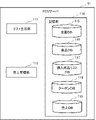
- FIG. 2 is a block diagram showing a configuration example of the POS server 11.
- the POS server 11 has a list generation unit 111, a sales management unit 113, and a storage unit 114.
- the POS server 11 is a server that manages various sales information such as prices, inventory status, and store sales information related to products sold in stores.
- the POS server 11 may collectively manage sales information of a plurality of stores. Alternatively, the POS server 11 may exist for each store.
- the POS server 11 may manage the sales information of one store.
- the POS server 11 may perform processing according to a request from the customer terminal 12.
- the POS server 11 may, for example, transmit information necessary for display control of the customer terminal 12 to the customer terminal 12.
- the POS server 11 may transmit the information on the screen displaying the product to be purchased registered by the customer terminal 12 together with the price to the customer terminal 12.
- the registered product to be purchased is hereinafter referred to as "purchased product”.
- the purchased product is an embodiment of "a product registered on the customer terminal 12 by a customer's operation”. Further, the purchased product is an embodiment of the "product registered in association with the customer”.
- a list including purchased products and their prices is hereinafter referred to as a "purchased product list”.
- the POS server 11 may manage information about customers registered as members of the store.
- the POS server 11 is realized by one device.
- the implementation example of the POS server 11 is not particularly limited.
- the POS server 11 may be realized by a device different depending on the function or DB (Database).
- the list generation unit 111 generates a purchased product list for each customer. Specifically, the list generation unit 111 generates a purchased product list in which information for identifying the customer, product information of the product to be purchased by the customer, and the purchased quantity are associated with each other, and stores the purchased product list DB 117.
- the purchased product list is uniquely identified by the information that identifies the customer.
- the information that identifies the customer is, for example, a customer ID that uniquely identifies the customer.
- the list generation unit 111 assigns the customer ID to the customer. Assuming that one transaction is from the start of registration to the end of settlement, a customer ID may be given for each transaction.
- the product information included in the purchased product list includes information that can uniquely identify the product, such as a product ID.
- the product information in the purchased product list includes the price of the product excluding tax or the price of the product including tax.
- the purchased product list may include information on the coupon associated with the product information of the product.
- the information about the coupon is, for example, the price, the discount amount, or the discount rate of the product after the coupon is applied.
- the list generation unit 111 updates the purchased product list based on the update request from the customer terminal 12. Specifically, the list generation unit 111 adds or deletes the products included in the purchased product list based on the product information included in the update request.
- the sales management unit 113 When the registration of the product is completed, the sales management unit 113 generates the settlement information used for the settlement.
- the settlement information includes at least information on the total payment amount for the products registered in the purchased product list. Specifically, the settlement information may be the total payment amount itself, or may be product information and quantity required for calculating the total payment amount.
- the settlement information may further include the trade name of the purchased merchandise, the total number of purchased merchandise, information about the applicable coupon, or information identifying the settlement.
- the sales management unit 113 may generate a list of purchased products for which product registration has been completed as settlement information. The above-mentioned customer ID may be used as the information for identifying the settlement.
- the sales management unit 113 updates the sales DB 119, for example, according to the content of the settlement.
- the storage unit 114 stores, for example, data used for processing each unit of the POS server 11. Examples of the storage unit include ROM (Read Only Memory), RAM (Random Access Memory), semiconductor memory, HDD (Hard Disk Drive), and SSD (Solid State Drive). The storage unit 114 may be a combination of these.
- the storage unit 114 has a member DB 115, a product DB 116, a purchased product list DB 117, a coupon DB 118, and a sales DB 119.
- the member DB 115 stores member information for each member (customer), for example.
- the member information is, for example, at least one of a member ID (Identifier), a member's name, a member's gender, a member's age or age group, a member rank, and a member's contact information.
- the member ID is, for example, an identifier that uniquely identifies a member.
- the type of member ID is not particularly limited.
- the member ID may be represented by a member number.
- the member rank is determined according to, for example, the number of times the store is used, the frequency of use, the amount of money used, and the like.
- a contact is a contact such as an e-mail address or a telephone number.
- the member DB 115 may further store information such as a password, past purchase history, and points for each member. Further, the member DB 115 may further store biological information for each member. The biometric information is not particularly limited. Examples of biological information include facial feature amount information, facial image data, fingerprint data, iris data, vein data, and the like. Further, the member DB may store the ID of the customer terminal 12 used by the customer. In the case of the customer terminal 12 lent from the store for self-scanning, the ID of the customer terminal 12 is deleted from the member DB after the settlement of the purchased product is completed.
- the member DB 115 may include payment information used for electronic payment.
- Examples of the electronic payment include at least one of credit payment, debit payment, electronic money payment, point payment, and virtual currency payment.
- the payment information is, for example, a credit card number.
- the member DB 115 does not have to include a part of the above-mentioned information about the member. Further, the member DB 115 may include information other than the above-mentioned information regarding the member.
- the product DB 116 stores product information of products handled by stores or affiliated stores including stores. Specifically, the product DB 116 stores product information for each product, for example.
- the product information stored in the product DB 116 is, for example, information such as a product ID, a product name, a product classification, a product price, a product feature, and a product inventory status.
- the product ID is, for example, a product code (hereinafter referred to as a product code).
- the product code is at least one of a JAN (Japanese Article Number) code, an EAN (European Article Number) code, and a UPC (Universal Product Code). Further, the product ID may be a product name.
- the classification of products is not particularly limited.
- the classification of products may be broadly classified into, for example, foods, stationery, and the like. Further, the classification of products may be the classification of confectionery, meat, vegetables and the like.
- the price of the product is the unit price of the product before the price reduction by the coupon is applied.
- the characteristics of the product are not particularly limited. The characteristics of the product may be the expiration date, the expiration date, the name of the manufacturing company, the name of the selling company, and the like.
- the inventory status of the product may be the number of products in stock, the inventory position of the product, or the like.
- the product information may include information for identifying the product in addition to the product ID.
- the product information may include image data of the product, information on the feature amount obtained from the image data of the product, and the like.
- the product DB 116 does not have to include a part of the above-mentioned information about the product. Further, the product DB 116 may include information other than the above-mentioned information regarding the product.
- the purchased product list DB117 stores the latest purchased product list that has not been settled for each customer.
- a member ID may be used as a customer ID that uniquely identifies the purchased product list.
- the purchased product list DB 117 may store the customer ID and the member ID in association with each other.
- the price of the product is obtained from the product DB 116 based on the product ID of the purchased product list.
- the purchased product list DB 117 may store the price of the product including tax calculated based on the price of the product excluding tax acquired from the product DB 116.
- the purchased product list DB117 does not have to include a part of the above-mentioned information regarding the purchased product list. Further, the purchased product list DB 117 may include information other than the above-mentioned information regarding the purchased product list.
- the coupon DB 118 stores, for example, coupon information regarding one or more coupons to be issued to a customer.
- the coupon information includes, for example, coupon issuance conditions, target product information, and price reduction information for each coupon.
- the coupon issuance condition includes that the total amount of purchased products for each customer is equal to or greater than the predetermined amount.
- the total price of the purchased products may be the total price excluding tax or the total price including tax.
- the target product information is information that identifies the product to which the price reduction is applied when the issuance conditions are met.
- the information of the target product is, for example, a product name or a product ID.
- the information on the target product may further include an image, price, or inventory position of the product.
- the price reduction information is, for example, information on the discount amount, the discount rate, or the price after the coupon is applied.
- the discount amount information indicates, for example, the amount to be deducted from the price of the target product when the issuance condition is satisfied. Coupons may be reduced from the tax-included price or the tax-excluded price.
- Coupon information may be determined for each customer attribute.
- the customer attributes are, for example, the customer's age, gender, membership rank, family structure, and the like.
- the coupon issuance conditions regarding the total amount, the target product, and the discount amount or the discount rate may be determined according to the attributes of the customer.
- Coupon information may be set for each customer. Further, the coupon information may be determined based on the purchase history of the customer. For example, based on the purchase history of the customer, the same product as the product purchased by the customer in the past, a similar product (for example, a higher-grade product than before), or other related products may be defined as the target product. In addition, the issuance condition of the total amount may be determined based on the payment amount of the past transaction.
- coupon information for each customer attribute or for each customer, coupons can be issued more effectively than when coupons are distributed uniformly to all customers.
- the coupon information may be stored based on the input of the store manager, or may be generated and stored by the POS server 11.
- the POS server 11 may generate and update coupon information based on, for example, a date, a day of the week, a time, a sales target number, an inventory status, an expiration date of a product, an expiration date, and the like.
- the coupon information may be delivered to the customer terminal 12 so that the customer can view it.
- the sales DB 119 stores, for example, information about store sales for each store.
- the sales DB 119 may manage information according to each settlement for each store.
- the sales DB 119 contains, for example, store ID, ID of the customer terminal 12 that has registered the product, member ID of the user of the device, product ID of the purchased product, purchase quantity, selling price, and information on the purchase date and time. Store in association with each other.
- the store ID is an identifier that uniquely identifies the store.
- the sales DB 119 does not have to include a part of the above-mentioned information regarding sales. Further, the sales DB 119 may include information other than the above-mentioned information regarding sales.
- the sales management unit 113 updates the sales DB 119 according to the content of the settlement, for example. Further, for example, the sales DB 119 and the product DB 116 are associated with each other by the product ID. Further, the POS server 11 may update the inventory status of the product DB 116, for example, based on the information on the purchase quantity registered in the sales DB 119.
- the POS server 11 does not have to have a part of the functional unit.
- the POS server 11 may have a functional unit (not shown).
- the functional unit of the POS server 11 shown in FIG. 2 may be realized by a plurality of devices.
- each functional unit may be realized by two devices, a list generation unit 111 and a device having a sales management unit 113.
- the POS server 11 has various DBs
- the various DBs may be possessed by different devices.
- the server that manages the sales DB 119, the server that manages the member DB 115, and the server that manages the purchased product list DB 117 may be different from each other.
- the server that manages the sales DB 119 and the server that manages the member DB 115 function as a database server.
- the server that manages the purchased product list DB 117 functions as, for example, an application server.
- the coupon notification device 10 may have a part or all of the various DBs.
- Each server passes information used for the assigned processing, for example, via the communication network 16.
- the POS server 11 may handle various information (not shown). For example, the POS server 11 may acquire information on price changes such as bundle split, set split, and classification split, and perform settlement processing using the information. Alternatively, the POS server 11 may update the purchased product list using the information.
- the bundle discount is a discount given when a plurality of specific products are purchased.
- a set discount is a discount for a specific combination of products.
- the classification discount is a discount for products belonging to a specific classification (for example, frozen foods).
- the issuance condition for the total amount is whether it is the total amount of the product before the price change such as bundle split, set split, classification split is applied, or the total amount of the product after it is applied. good.
- FIG. 3 is a block diagram showing a configuration example of the customer terminal 12.
- the customer terminal 12 includes an acquisition unit 121 and an output unit 123.
- the output unit 123 includes a display unit 1230.
- a storage unit (not shown) of the customer terminal 12 stores a member ID and an identifier that identifies the customer terminal 12.
- the acquisition unit 121 acquires the product ID of the product selected by the customer, sends an update request including the product ID to the POS server 11, and registers the product in the POS server 11 as a purchased product.
- the acquisition unit 121 acquires the product ID of the purchased product by reading the product code attached to the product or the like, for example, via an image pickup device (not shown).
- the image pickup device is not particularly limited, but is, for example, a camera included in the customer terminal 12.
- the product code is the above-mentioned JAN code or the like.
- the image pickup device reads a coded product code such as a bar code or a two-dimensional code.
- the acquisition unit 121 may acquire the product ID by, for example, identifying the product from the image of the product captured by the image pickup apparatus by using the image recognition function.
- the acquisition unit 121 may acquire the product ID by reading the image of the product or the image of the picture of the product captured in advance through the image pickup device.
- the product code may be included in these images.
- the acquisition unit 121 may acquire the product ID by reading the tag to which the RFID (Radio Frequency Identifier) is attached via the reading device.
- the reader is an RFID reader.
- the acquisition unit 121 may acquire the product ID by accepting the selection of the product from the result of the product search.
- the product search method is not particularly limited.
- a product search may be performed by characters.
- a product search may be performed by an image.
- the acquisition unit 121 may acquire the product ID by accepting the selection of the product to be purchased from the displayed image of the product.
- the acquisition unit 121 may acquire the product ID by accepting the input of the JAN code number via an input device (not shown).
- the input device include a touch panel display and a keyboard capable of inputting numbers and characters.
- the output unit 123 transmits the product ID acquired by the acquisition unit 121 to the POS server 11. At this time, the output unit 123 also transmits the member ID or the identifier that identifies the customer terminal 12 to the POS server 11. The customer terminal 12 may receive the name and price of the product corresponding to the transmitted product ID from the POS server 11. At this time, the display unit 1230 displays the name and price of the product.
- the display unit 1230 displays a list of purchased products received from the POS server 11. In addition, the display unit 1230 displays information about the coupon received from the coupon notification device 10.
- FIG. 4 is a block diagram showing a configuration example of the coupon notification device 10.
- the coupon notification device 10 has a determination unit 101 and a notification unit 102.
- the determination unit 101 determines whether the total amount of the products registered in association with the customer satisfies the coupon issuance condition of the target product. Specifically, the determination unit 101 receives the purchased product list from the POS server 11 when the purchased product list is updated. The determination unit 101 refers to the coupon DB 118 and determines whether or not the total amount of the purchased products satisfies the coupon issuance condition stored in the coupon DB 118.
- the determination unit 101 refers to the coupon DB 118 and determines whether the target product of any of the coupons is included in the purchased product list. If there is a target product, the determination unit 101 determines whether the total amount of the purchased products satisfies the coupon issuance condition of the target product. If the issuance condition is satisfied, the determination unit 101 may determine that there is a coupon to be issued. If the target product of the coupon is not included in the purchased product list, or if the total amount of the purchased products does not meet the coupon issuance conditions, the determination unit 101 may determine that there is no coupon to be issued. The determination unit 101 may transmit the determination result to the POS server 11.
- the notification unit 102 notifies the customer of the coupon issuance conditions before the settlement of the purchased product is completed. Specifically, the notification unit 102 notifies the customer by, for example, transmitting the coupon information to the customer terminal 12.
- the coupon information includes coupon issuance conditions, target product information, and price reduction information.
- the information of the target product is, for example, one of a product name, a product image, and a product inventory position.
- the customer terminal 12 displays the received coupon information. It is assumed that the customer before the settlement is completed is, for example, in the shopping area where the product is displayed. Therefore, the notified customer may add purchased items.
- the notification unit 102 may notify the issuance conditions of the plurality of coupons.
- FIG. 5 is a flowchart showing an example of registration processing and notification processing of coupon issuance conditions.
- the acquisition unit 121 of the customer terminal 12 acquires the product ID of the purchased product by reading the product code attached to the product or the like, and the customer terminal 12 sends an update request including the product ID to the POS server 11. (Step S01).
- the renewal request may include a customer member ID, a customer terminal 12 ID, and the like.
- FIG. 6 is a diagram showing an example of a product registration screen for reading a product code.
- the display unit 1230 of the customer terminal 12 displays the screen d050 for reading the product code.
- the screen d050 has a read portion d051, a display field d052 for displaying information on the read products, and a button d053 for displaying a "to shopping cart" for displaying a list of purchased products.
- the acquisition unit 121 acquires the product ID of the purchased product.
- the list generation unit 111 of the POS server 11 adds the product included in the update request to the customer's purchased product list (step S02).
- the POS server 11 transmits the product information of the product for which the product ID has been acquired to the customer terminal 12.
- the customer terminal 12 displays the received product information (step S03). For example, in FIG. 6, in the display column d052, among the received product information, "ZOO biscuits" are displayed as the product name and 252 yen is displayed as the product price.
- the POS server 11 transmits the purchased product list to the coupon notification device 10.
- the determination unit 101 of the coupon notification device 10 determines whether the purchased product list satisfies the coupon issuance condition (step S04). When the total amount of money satisfies the issuance condition and the coupon is issued (step S05: Yes), the determination unit 101 transmits the product ID and price reduction information of the target product of the coupon to the POS server 11 as the determination result (step S05: Yes). Step S06).
- the list generation unit 111 applies the coupon to the purchased product list based on the received determination result (step S07). Specifically, for example, the list generation unit 111 associates the information related to the coupon with the product registered in the purchased product list and stores it in the purchased product list DB 117. The list generation unit 111 transmits the updated purchased product list to the customer terminal 12.
- the customer terminal 12 displays the updated purchased product list (step S09). Specifically, the customer terminal 12 displays a purchased product list in which products are added and price reduction information of the target product is displayed.
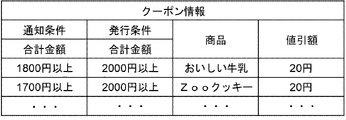
- FIG. 7 is a diagram showing an example of coupon information stored in the coupon DB 118.
- the coupon information in FIG. 7 includes information on a coupon targeting "delicious milk", which is a product of a certain company.
- the condition for issuing this coupon is that the total amount of purchased products is 4000 yen or more.
- the discount amount when the coupon is applied is "20 yen" for each target product.
- FIG. 8 is a diagram showing an example of a screen of a purchased product list displayed on the customer terminal 12.
- the screen d060 includes, for example, a summary column d061 of a purchased product list, a detail column d062, a product addition button d064, a payment button d065, a transaction cancellation button d066, and an operator name display column d067.
- the summary column d061 for example, information such as the total quantity of products registered in the purchased product list, the estimated payment amount, and the store name is displayed.
- the planned payment amount is, for example, the amount after the price reduction by the coupon is applied from the total amount of the selling price including tax.
- the detail column d062 for example, information such as the name of the product registered in the purchased product list, the purchase quantity, the unit price before the discount, the price obtained by multiplying the unit price before the discount by the purchase quantity, the discount rate, the discount amount, etc. Is displayed.
- the detail field d062 may have a purchase quantity input field d063 for each product.
- product information may be displayed in the order of newest registration. In the detail column d062, for example, the display order of the product information may be specified.
- the display unit 1230 of the customer terminal 12 displays, for example, the screen d060 shown in FIG. In the detail column d062, a coupon is applied to each of the two “delicious milk", and it is indicated that the discount amount is "40 yen”.
- FIG. 9 is a diagram showing an example of a coupon issuance notification.
- the notice of FIG. 9 includes the target product name of the applied coupon, the discount amount, and the image of the product.
- the notification of FIG. 9 may be displayed superimposed on the screen of d050 of FIG. 6 or the screen of d060 of FIG.
- the notification of FIG. 9 may be displayed in association with the coupon target product displayed in the detail column d062 of FIG.
- step S05 determines that the coupon is not issued. In this case, the determination unit 101 transmits to the POS server 11 that there is no issued coupon as the determination result. Upon receiving the determination result, the POS server 11 transmits the updated purchased product list to the customer terminal 12 (step S09).
- the customer terminal 12 displays the updated purchased product list (step S10). Specifically, the customer terminal 12 displays a list of purchased products to which the product for which the product ID has been acquired is added.
- the notification unit 102 After the determination unit 101 of the coupon notification device 10 determines whether the total amount of purchased products satisfies the issuance condition, the notification unit 102 notifies the customer terminal 12 of the issuance condition of the coupon that does not satisfy the issuance condition. (Step S11). When one coupon is issued, the notification unit 102 may notify the issuance conditions of another coupon that does not meet the issuance conditions. Upon receiving the notification, the customer terminal 12 displays the coupon issuance condition on the display unit 1230 (step S12).
- FIG. 10 and 11 are diagrams showing an example of notification of coupon issuance conditions displayed on the display unit 1230.
- FIG. 10 is an example of coupon issuance conditions displayed when the target product is registered in the purchased product list. In the image of FIG. 10, the difference between the total price of the purchased products and the total price of the issuance conditions is notified as the issuance condition.
- the notification of FIG. 10 may be displayed in association with the coupon target product displayed in the detail column d062 of FIG.
- the notification unit 102 may notify the issuance condition of the coupon for the product added to the purchased product among the plurality of coupons.
- FIG. 11 is an example of issuance conditions displayed when the target product is not registered in the purchased product list.
- the notification unit 102 may notify the issuance condition of the coupon for which the issuance condition is satisfied by adding the target product.
- the notification of the issuance conditions of FIGS. 10 and 11 is displayed before the settlement is completed.
- the images of FIGS. 10 and 11 may be displayed superimposed on the screen of d050 of FIG. 6 or the screen of d060 of FIG. 8, respectively.
- the images of FIGS. 10 and 11 notify the target product name together with the coupon issuance conditions.
- the notification to the customer does not have to include the target product name.
- the issuance condition and the classification name may be notified to the customer.
- the coupon issuance notification as shown in FIG. 9 and the issuance condition notification of FIGS. 10 and 11 may be displayed in different modes.
- the coupon issuance notification and the issuance condition notification may be displayed in different colors. By being displayed in different colors, the customer can distinguish between the coupon issuance notification and the issuance condition notification.
- step S13: No If payment is not made (step S13: No), the customer terminal 12 returns to step S01.
- step S13: Yes the customer terminal 12 ends the registration process and proceeds to the settlement process. For example, in FIG. 8, when the payment button d065 is pressed, the customer terminal 12 ends the registration of the product.
- FIG. 12 is a flowchart showing an example of the settlement process.
- the customer terminal 12 transmits the settlement request to the POS server 11 (step S21).
- the sales management unit 113 of the POS server 11 generates settlement information (step S22) and transmits it to the customer terminal 12.
- the settlement information includes, for example, the total payment amount for the purchased product.
- the customer terminal 12 displays the payment screen (step S23).
- the payment screen may display payment information such as the total number of purchased products, the total payment amount for the purchased products, and the last four digits of the credit card number used for electronic payment. Further, the payment screen may display an execution button for payment processing.
- the customer terminal 12 communicates with a payment server (not shown) using payment information such as a credit card number stored in the member DB 115, and executes payment processing (step S24).
- the customer terminal 12 transmits the completion of the payment process to the POS server 11.
- the sales management unit 113 of the POS server 11 updates the sales DB 119.
- the information processing system 1 ends the settlement process.
- the issuance condition can also be called the application condition.
- the coupon is issued electronically and distributed electronically or in paper to the customer.
- the customer operates the customer terminal 12 and applies the coupon before the settlement is completed.
- the issued coupon may be a type of coupon that will be applied in the next shopping.
- [effect] it is possible to propose to the customer to increase the total amount of the purchased products.
- the reason is that a coupon with issuance conditions regarding the total amount of purchased products is issued.
- the notification unit 102 of the coupon notification device 10 notifies the customer before the settlement is completed of the coupon issuance condition.
- By notifying the customer of the coupon issuance conditions it is possible to encourage the customer to add purchased products in order to meet the issuance conditions.
- the first embodiment it is possible to promote the sale of products suitable for the purpose of the store, such as products with a near expiration date or expiration date, products with a large inventory, seasonal products, and products with a high profit margin.
- the reason is that the price of the target product is lowered when the coupon is applied.
- the store considers the product to be sold as the target product of the coupon.
- the customer who receives the notification of the target product of the coupon adds the target product as a purchased product.
- a customer who has been notified of a coupon target product or issuance conditions for a registered product will not cancel the registration of the target product.
- the sales volume of the product will only increase and the customer unit price cannot be increased. Further, when the total amount of the registered products is equal to or more than the predetermined amount, even if the discount is applied to the entire purchased products, the sales of the products that the store wants to sell cannot be promoted. According to the first embodiment, the number of notifications given to the customer can be reduced as compared with the case where the notification for promoting the sale of the product that the store wants to sell and the notification for increasing the customer unit price are given respectively. In some cases. The reason is that the notification unit 102 notifies the customer of the issuance condition regarding the total amount of the coupon of the target product. If a coupon is issued while the customer is shopping and the coupon is available at the time of the shopping, it is possible to promote the sales volume of the target product in the customer's shopping and raise the customer unit price. ..
- the issuance condition stored in the coupon DB 118 may further include that the customer is in a predetermined area in the store.
- the issuance condition may include that the customer is in a predetermined position in the store.
- the position of the customer terminal 12 in the store may be detected by a Wi-Fi, a beacon, or a sensor of the customer terminal 12 such as a magnetometer, an accelerometer, or a gyroscope, and used as the position in the customer's store. In this case, the location information detected by the customer terminal 12 is transmitted to the POS server 11.
- a position where the customer's member ID or biometric information is detected by a sensor such as a non-contact IC chip reader / writer, a card reader / writer, a barcode reader, or a camera installed in the display area may be used.
- the determination unit 101 of the coupon notification device 10 receives the position in the customer's store from the POS server 11 and determines whether the position in the customer's store satisfies the issuing condition.
- FIG. 13 is a diagram showing an example of coupon information according to this modified example.
- the issuing condition of the position is associated with the target product and the discount amount.
- the position means an area where a customer is located, which is one of the issuance conditions.
- a coupon is issued in which the total amount of the purchased products of the customer is 2000 yen or more and the customer is in the dairy product section, and the "delicious milk" is discounted by 20 yen.
- the determination unit 101 may determine that the customer is in the area when the customer stays in the area for a predetermined time or longer. For example, if the determination unit 101 determines that the customer is in the confectionery section and determines that the total amount of the purchased products is 2000 yen or more, the determination unit 101 determines that the coupon issuance condition for the "Zoo cookie" is satisfied.
- the notification unit 102 may notify that the coupon is issued by going to a predetermined area in the store.
- the store can promote the sales of the products in the sales floor and expect an increase in the customer unit price. be able to.
- the coupon issuance condition includes that the customer is in a predetermined area in the store, the issuance condition does not have to include the total price of the purchased products. That is, for example, the coupon may be issued according to the position of the customer regardless of the total amount of the purchased products.
- a notification condition for notifying information about the coupon may be provided. Different notification conditions may be set for each coupon.
- the determination unit 101 determines whether the notification condition is satisfied.
- the notification unit 102 notifies the information regarding the coupon when it is determined that the notification condition is satisfied.
- the information about the coupon is, for example, a notification that the coupon has been issued or a condition for issuing the coupon.
- the notification unit 102 for example, notifies the customer of the issuance condition of the coupon that the issuance condition is not satisfied and the notification condition is satisfied.
- FIG. 14 is a diagram showing an example of other coupon information related to this modified example.
- the coupon information shown in FIG. 14 is associated with the coupon notification conditions in addition to the coupon target product, the discount amount, and the issuance conditions shown in FIG. 7.
- the notification condition of the coupon is the position, for example, the sales floor where the target product of the coupon is displayed.
- the determination unit 101 receives the customer's position in the store by any method, and determines whether the customer has entered a predetermined area in the store. For example, the determination unit 101 determines whether the customer's position in the store satisfies the notification condition. When the customer enters a predetermined area in the store, the notification unit 102 notifies the issuing condition. For example, the notification unit 102 notifies the issuing condition when the position of the customer terminal in the store is a predetermined position.
- the notification condition in the example of FIG. 14, when the customer is in the dairy product section, the information regarding the coupon is notified to the customer terminal 12.
- the information about the coupon at this time is that a coupon is issued with a 20 yen discount on "delicious milk" on condition that the total amount of the purchased products of the customer is 2000 yen or more.
- the notification condition is not limited to the position, and may be, for example, the total amount.
- FIG. 15 is a diagram showing an example of other coupon information related to this modified example.
- the coupon information shown in FIG. 15 is an example in which the notification condition shown in FIG. 14 is the total amount from the position.
- the notification condition is set to a predetermined threshold value (1800 yen) lower than the total price (2000 yen) of the customer's purchased products, which is the coupon issuance condition, and the total customer price exceeds the threshold price.
- the customer terminal 12 is notified of the information regarding the coupon.
- the information about the coupon at this time is that when the total amount of the purchased products of the customer is 2000 yen or more, a coupon with a 20 yen discount on "delicious milk" is issued.
- the determination unit 101 determines whether the total amount of the registered products satisfies the notification condition.
- the notification unit 102 notifies the coupon issuance condition when the total amount of the registered products is between the total amount of the issuance conditions and the predetermined first amount smaller than the total amount of the issuance conditions.
- the store can promote the sales of the product and can expect an increase in the customer unit price.
- the notification condition may be the difference between the total price of the purchased products, which is the condition for issuing the coupon, and the price of the coupon target product.
- the coupon issuance condition is that the total price of the purchased products is 2000 yen and the price of the target product of the coupon is 250 yen
- the difference of 1750 yen may be used as the notification condition of the predetermined threshold value.
- the determination unit 101 determines whether the difference between the total amount of the registered products and the total amount of the issuance conditions satisfies the notification condition.
- the notification unit 102 notifies the coupon issuance condition when the difference between the total amount of the registered products and the total amount of the issuance conditions is a predetermined amount.
- the determination unit 101 may determine whether the issue condition of the coupon for which the total amount has been issued is satisfied. Specifically, when the product registration is canceled, the POS server 11 transmits the purchased product list to the coupon notification device 10. When the total amount of the purchased products, which is the condition for issuing the coupon, is not reached due to the cancellation of the product registration, the notification unit 102 may notify the customer that the coupon is no longer applied.
- the determination unit 101 may determine whether the issuance condition is satisfied if the registration is canceled when the pre-operation for canceling the registration of the product is started.
- the determination unit 101 may determine, for example, that the total amount of money changes from the state in which the issuance condition is satisfied to the state in which the total amount does not meet. If the issuance condition is not satisfied due to the cancellation of the registration, the notification unit 102 notifies that the issuance of the coupon is canceled due to the cancellation of the registration.
- the notification unit 102 may notify the customer that the issuance condition will not be satisfied due to the cancellation of the registration before the operation of canceling the registration of the product is completed. Due to such notification, the customer may cancel the operation of unregistering the product.
- the notification unit 102 may notify the issue conditions of the coupon of the target product different from the canceled product. That is, the notification unit 102 does not recommend purchasing a product whose registration has been canceled after it has been registered once. By such a notification, the notification unit 102 can notify the coupon for the product having a higher possibility of purchase.
- the coupon may be issued based on the total amount of all the products acquired by the group members.
- the information processing system 1 associates group members and sets representatives. All the products acquired by the group members are associated with the representative and registered. That is, the products acquired by the group members are registered in one purchased product list.
- the coupon notification device 10 may notify each group member regarding the coupon, or may notify only the representative.
- FIG. 16 is a diagram showing a configuration example of the information processing system 2 according to this modification.
- the information processing system 2 is different from the information processing system 1 according to the first embodiment in that it has a settlement device 13.
- the settlement device 13 receives settlement information from the POS server 11 or the customer terminal 12, and performs settlement by either cash settlement or electronic settlement.
- the customer terminal 12 may display the settlement code on the display unit 1230.
- the checkout code contains information for identifying the checkout information.
- the settlement code may be a customer ID, an identifier of the customer terminal 12, or a member ID.
- the settlement device 13 receives the settlement information corresponding to the settlement code read from the customer terminal 12 from the POS server 11.
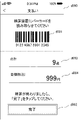
- FIG. 17 is a diagram showing an example of a settlement code.
- the screen d090 of FIG. 17 includes a settlement code display column d091, a total quantity display column d093, and a payment amount display column d094.
- the display column d093 of the total quantity the total purchase quantity of the products purchased by the customer is displayed.
- the payment amount display field d094 for example, the total amount including tax of the product purchased by the customer after the coupon is applied is displayed.
- the screen d090 has a completion button d092 that is tapped after the settlement is completed.
- the settlement device 13 When making a cash settlement, the settlement device 13 makes a settlement based on the money inserted into the slot provided in the settlement device 13.
- the type of electronic payment is not particularly limited.
- the above-mentioned electronic money payment includes, for example, bar code payment or Quick Response code (QR code (registered trademark)) payment.
- QR code Quick Response code
- the payment device 13 communicates with a payment server (not shown) using, for example, credit information acquired via a reading device provided in the payment device 13, to perform payment.
- FIG. 18 is a diagram showing a configuration example of the information processing system 3 according to this modification.
- the information processing system 3 includes a server 100 and one or more cameras 40.
- the server 100 and the camera 40 are connected via the communication network 16.
- the server 100 includes the functions of the coupon notification device 10 according to the first embodiment and the POS server 11.
- the camera 40 is an image pickup device.
- the camera 40 includes an image sensor such as a CCD (Charge Coupled Device) sensor and a CMOS (Complementary Metal Oxide Semiconductor) sensor.
- CCD Charge Coupled Device
- CMOS Complementary Metal Oxide Semiconductor
- the camera 40 is installed at a plurality of positions in the store, such as near the entrance of the store, the place where products are displayed in the store (hereinafter, also referred to as the sales floor), and the vicinity of the exit of the store.
- the camera 40 provided near the entrance captures a customer entering the store.
- the camera 40 provided in the sales floor captures the customers and products existing in the sales floor.
- the camera 40 provided near the exit captures a customer leaving the store.
- the store is provided with an arrangement and number of cameras 40 capable of capturing images of customers and products located anywhere in the store.
- the camera 40 transmits image data including the captured image to the POS server 11.
- the POS server 11 identifies the customer who acquired the product and the acquired product based on the image captured by the camera 40, and generates a purchased product list for each customer.
- the product identified by the image is an embodiment of the product registered in association with the customer.
- the coupon notification device 10 may transmit information about the coupon to the customer terminal 12 owned by the customer by using the customer's contact information or the ID of the customer terminal 12 stored in the POS server 11.
- the POS server 11 performs settlement processing for the registered products. For example, the POS server 11 identifies a customer who leaves the store and makes a payment based on the customer's purchased product list.
- the coupon DB 118 may include coupon information of coupons in which the total amount of issuance conditions differs for each target product. Further, the coupon DB 118 may include coupon information of a coupon that further reduces the price of the target product according to the total amount.
- the notification unit 102 After the issuance condition of the first coupon is achieved, the notification unit 102 notifies the issuance condition of the second coupon, which has a higher total amount of the issuance conditions. Upon receiving the notification, the customer adds more products in order to meet the issuance condition with a higher total amount.
- Coupon notification method Coupon notification method
- the notification unit 102 of the coupon notification device 10 notifies the customer terminal 12 and the display unit 1230 displays information about the coupon.
- the information processing system 1 notifies the customer by another method.
- the output unit 123 of the customer terminal 12 may output information about the coupon by voice. Further, the output unit 123 may notify the customer that the notification has been received from the notification unit 102 by sound or vibration.
- the customer terminal 12 does not have to be used for the notification to the customer.
- the notification unit 102 displays information about the coupon on a display provided in the shopping area of the store.
- the shopping area is an area where products are displayed.
- the notification unit 102 may use known techniques to locate the customer and display information about the coupon on a display near the customer.
- the type of display is not particularly limited.
- the display includes, for example, digital signage, electronic shelf labels, and images projected by a projector. Further, the notification unit 102 may notify the customer by voice using a speaker.
- the coupon notification device 10 according to the first embodiment is an embodiment of the information processing device 50 according to the second embodiment.
- the information processing apparatus 50 may include a part or all of the functions related to the POS server 11.
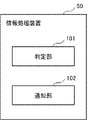
- FIG. 19A is a diagram showing an example of a basic configuration of the information processing apparatus 50 according to the second embodiment.
- the information processing device 50 is communicably connected to another device that is associated with the customer and registers the product.
- the information processing apparatus 50 is communicably connected to the customer terminal 12 and the POS server 11 according to the first embodiment.
- the information processing device 50 includes a determination unit 101 and a notification unit 102.
- the determination unit 101 and the notification unit 102 are embodiments of the determination unit and the notification unit, respectively.
- the determination unit 101 determines whether the total amount of the products registered in association with the customer satisfies the coupon issuance condition of the target product.
- the notification unit 102 notifies the customer of the coupon issuance conditions before the payment of the products is completed. Before the settlement is completed, for example, it is during the period when additional registration of the product can be performed. When the coupon is applied, the price of the registered target product will be reduced. Therefore, the customer can purchase the target product at a lower price than before applying the coupon.
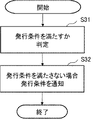
- FIG. 19B is a flowchart showing the basic operation of the information processing apparatus 50.
- the determination unit 101 determines whether the total amount of the products registered in association with the customer satisfies the coupon issuance condition of the target product (step S31). If the total amount of the registered products does not satisfy the coupon issuance condition, the notification unit 102 notifies the customer before the completion of the settlement of the product of the coupon issuance condition (step S32).
- [effect] it is possible to promote the sale of the product that the store wants to sell and to increase the customer unit price.
- the reason is that when the total amount of the products registered in association with the customer does not satisfy the coupon issuance condition of the target product, the notification unit 102 notifies the customer of the coupon issuance condition before the payment of the product is completed. ..
- each component of the coupon notification device 10, the POS server 11, and the information processing device 50 indicates a block of functional units. Some or all of each component may be realized by any combination of the computer 31 and the program. There are various modifications in the method of realizing the coupon notification device 10 and the POS server 11.
- the coupon notification device 10 and the POS server 11 may be realized by a single computer 31. Further, it may be realized by a different computer 31 for each of a plurality of components included in each device.
- the computer 31 has, for example, a processor 311, a ROM 312, a RAM 313, a storage device 314, and a communication interface 315. Further, each component of the computer 31 is connected via the bus 316.
- the customer terminal 32 is an example in which the customer terminal 12 described in the first embodiment is realized by a computer.
- the customer terminal 32 has a processor 321, a ROM 322, a RAM 323, a storage device 324, a communication interface 325, an input / output device 326, and a camera 327. Further, each component of the customer terminal 32 is connected via the bus 328.
- the processors 311 and 321 control the entire computer 31 or the customer terminal 32.
- Examples of the processors 311 and 321 include a CPU (Central Processing Unit) and a DSP (Digital Signal Processor).
- the computer 31 and the customer terminal 32 have ROM 312, 322, RAM 313, 323, storage devices 314, 324, and the like as storage units.
- Examples of the storage devices 314 and 324 include semiconductor memories such as flash memories, HDDs, SSDs, and the like.
- the storage devices 314 and 324 store OS (Operating System) programs, application programs, and the like.
- the ROM 312 and 322 store the application program.
- the RAMs 313 and 323 are used as work areas for the processors 311 and 321.
- processors 311 and 321 load the programs stored in the storage devices 314, 324, ROM 312, 322 and the like. Then, the processors 311 and 321 execute each process coded in the program. Further, the processors 311 and 321 may download various programs via the communication network. Further, the processors 311 and 321 function as a part or all of the computer 31 or the customer terminal 32. Then, the processors 311 and 321 may execute the process or the instruction in the flowchart shown in the figure based on the program.
- the communication interface 315, 325 is connected to a communication network such as a LAN (Local Area Network) or a WAN (Wide Area Network) through a wireless or wired communication line.
- a communication network such as a LAN (Local Area Network) or a WAN (Wide Area Network)
- the computer 31 and the customer terminal 32 are connected to an external device or an external computer via a communication network.
- the communication interfaces 315 and 325 control the interface between the communication network and the inside of the computer 31 and the customer terminal 32.
- the communication interfaces 315 and 325 control the input / output of data from an external device or an external computer.
- FIGS. 20 and 21 are examples. Components other than those shown in each figure may be added, or some components may not be included.
- the computer 31 may have input devices such as a keyboard, mouse, and physical buttons.
- each device This is the end of the explanation of the hardware configuration of each device.
- the system may be realized by any combination of computers and programs that are different for each component.
- a plurality of components included in each device may be realized by any combination of one computer and a program.
- each component of the system may be realized by a circuit for a specific application.
- a part or all of the system may be realized by a general-purpose circuit including a processor such as FPGA (Field Programmable Gate Array).
- a part or all of the system may be realized by a combination of a circuit for a specific application, a general-purpose circuit, and the like.
- these circuits may be a single integrated circuit. Alternatively, these circuits may be divided into a plurality of integrated circuits. Then, a plurality of integrated circuits may be configured by being connected via a bus or the like.
- each component of each device when a part or all of each component of each device is realized by a plurality of computers and circuits, the plurality of computers and circuits may be centrally arranged or distributed.
- the method described in each embodiment can be realized by executing the coupon notification device, the POS server, or the customer terminal. Further, the method is realized by executing a program prepared in advance by a computer such as a coupon notification device, a POS server, or a customer terminal.
- the program is recorded on a computer-readable recording medium such as an HDD, SSD, flexible disk, optical disk, flexible disk, magnetic optical disk, or USB memory. Then, this program is executed by being read from the recording medium by a computer.
- the program may also be distributed via a communication network.
- Each component of the system in each embodiment described above may have its function realized by hardware like the computer system shown in FIGS. 20 and 21.
- each component may be realized by a computer device or firmware based on program control.
- the present invention has been described above with reference to each embodiment, the present invention is not limited to the above-described embodiment.
- Each configuration or detail of the present invention may include embodiments to which various modifications that can be grasped by those skilled in the art within the scope of the present invention are applied.
- the present invention may include embodiments in which the matters described herein are appropriately combined or replaced as necessary.
- the matters described using a particular embodiment may be applied to other embodiments as long as they do not cause inconsistency.
- a plurality of operations are described in order in the form of a flowchart, the order of description does not limit the order in which the plurality of operations are executed. Therefore, when each embodiment is implemented, the order of the plurality of operations can be changed within a range that does not hinder the content.
- Judgment means for determining whether the total amount of products registered in association with the customer meets the coupon issuance conditions for the target product. If the issuance condition is not satisfied, a notification means for notifying the customer of the coupon issuance condition before the completion of payment of the product, and a notification means.
- Appendix 2 The coupon for the target product is the information processing device according to Appendix 1, which lowers the price of the target product among the registered products.
- the registered product is a product registered by the customer using the customer terminal during shopping.
- the information processing device according to Appendix 1 or 2, wherein the notification means notifies the customer terminal of the issuance condition.
- the target product associated with the coupon issuance condition is the information processing device according to any one of Supplementary Provisions 1 to 5, which is determined according to the attributes of the customer.
- the notification means is any one of Supplementary notes 1 to 7 for notifying the issuance condition of the coupon when the total amount of the registered products is between the total amount of the issuance conditions and a predetermined first amount smaller than the total amount of the issuance conditions.
- the notification means is described in any one of Supplementary note 1 to 8 for notifying the issuance condition of the coupon when the difference between the total amount of the registered products and the total amount of the issuance conditions is a predetermined amount.
- Information processing device
- the determination means determines whether the issuance condition is satisfied by the cancellation of the registration.
- the information processing device according to any one of Supplementary note 1 to 9, wherein the notification means notifies that the issuance of the coupon is canceled due to the cancellation of registration if the notification means is not satisfied.
- (Appendix 12) Customer terminals that are used by customers to read product identification information, A POS server that receives the identification information from the customer terminal and registers the product in association with the customer. A coupon notification device for notifying the customer terminal is provided. The coupon notification device determines whether the total amount of the products registered in association with the customer satisfies the coupon issuance condition of the target product, and if the issuance condition is not satisfied, the coupon issuance condition is determined. It is provided with a notification means for notifying the customer terminal of the customer before the payment of the product is completed.
- the customer terminal is an information processing system that outputs information about the coupon to the customer terminal by superimposing it on the registered product list screen.
- Appendix 13 The information processing system according to Appendix 12, wherein the customer terminal outputs a notification of issuance of the coupon and a notification of the issuance condition in different modes.
- a computer-readable, non-temporary recording medium that records a program that activates a computer as a means of notifying the customer of the coupon issuance conditions before the completion of payment of the product if the issuance conditions are not satisfied. ..
- Judgment means for determining whether the total amount of products registered on the mobile terminal by the customer's operation satisfies the coupon issuance condition for the target product. If the issuance condition is not satisfied, a notification means for notifying the customer of the coupon issuance condition before the completion of payment of the product, and a notification means.
- Judgment means for determining whether the total amount of products registered on the mobile terminal by the customer's operation satisfies the coupon issuance condition for the target product.
- a computer-readable, non-temporary recording medium that records a program that activates a computer as a means of notifying the customer of the coupon issuance conditions before the completion of payment of the product if the issuance conditions are not satisfied. ..
- Coupon notification device 101 Judgment unit 102 Notification unit 11 POS server 111 List generation unit 113 Sales management unit 114 Storage unit 115 Member DB 116 Product DB 117 Purchased product list DB 118 Coupon DB 119 Sales DB 12 Customer terminal 121 Acquisition unit 123 Output unit 13 Settlement device 16 Communication network 40 Camera 100 Server
Landscapes
- Business, Economics & Management (AREA)
- Accounting & Taxation (AREA)
- Finance (AREA)
- Strategic Management (AREA)
- Engineering & Computer Science (AREA)
- Development Economics (AREA)
- Economics (AREA)
- Game Theory and Decision Science (AREA)
- Entrepreneurship & Innovation (AREA)
- Marketing (AREA)
- Physics & Mathematics (AREA)
- General Business, Economics & Management (AREA)
- General Physics & Mathematics (AREA)
- Theoretical Computer Science (AREA)
- Management, Administration, Business Operations System, And Electronic Commerce (AREA)
- Cash Registers Or Receiving Machines (AREA)
Priority Applications (3)
| Application Number | Priority Date | Filing Date | Title |
|---|---|---|---|
| US18/269,176 US20240086960A1 (en) | 2020-12-25 | 2020-12-25 | Information processing device and notification provision method |
| JP2022570940A JP7791112B2 (ja) | 2020-12-25 | 2020-12-25 | 情報処理装置、通知提供方法、および、プログラム |
| PCT/JP2020/048682 WO2022137495A1 (ja) | 2020-12-25 | 2020-12-25 | 情報処理装置、通知提供方法、および、プログラム記録媒体 |
Applications Claiming Priority (1)
| Application Number | Priority Date | Filing Date | Title |
|---|---|---|---|
| PCT/JP2020/048682 WO2022137495A1 (ja) | 2020-12-25 | 2020-12-25 | 情報処理装置、通知提供方法、および、プログラム記録媒体 |
Publications (1)
| Publication Number | Publication Date |
|---|---|
| WO2022137495A1 true WO2022137495A1 (ja) | 2022-06-30 |
Family
ID=82157436
Family Applications (1)
| Application Number | Title | Priority Date | Filing Date |
|---|---|---|---|
| PCT/JP2020/048682 Ceased WO2022137495A1 (ja) | 2020-12-25 | 2020-12-25 | 情報処理装置、通知提供方法、および、プログラム記録媒体 |
Country Status (3)
| Country | Link |
|---|---|
| US (1) | US20240086960A1 (https=) |
| JP (1) | JP7791112B2 (https=) |
| WO (1) | WO2022137495A1 (https=) |
Families Citing this family (1)
| Publication number | Priority date | Publication date | Assignee | Title |
|---|---|---|---|---|
| JP2024089399A (ja) * | 2022-12-21 | 2024-07-03 | 東芝テック株式会社 | 商品情報登録装置およびプログラム |
Citations (7)
| Publication number | Priority date | Publication date | Assignee | Title |
|---|---|---|---|---|
| JP2003030754A (ja) * | 2001-07-17 | 2003-01-31 | Teraoka Seiko Co Ltd | 商品登録装置 |
| WO2010131629A1 (ja) * | 2009-05-11 | 2010-11-18 | インターナショナル・ビジネス・マシーンズ・コーポレーション | 電子棚札(esl)からコンテンツを取得していくセルフ買物支援 |
| JP2013047884A (ja) * | 2011-08-29 | 2013-03-07 | Toshiba Tec Corp | 販売データ処理装置およびプログラム |
| JP2020067974A (ja) * | 2018-10-26 | 2020-04-30 | 東芝テック株式会社 | 登録装置及びプログラム |
| JP2020129342A (ja) * | 2019-02-12 | 2020-08-27 | 東芝テック株式会社 | 情報処理装置 |
| JP2020129337A (ja) * | 2019-02-12 | 2020-08-27 | 株式会社寺岡精工 | 販売データ処理システム及びプログラム |
| WO2020174881A1 (ja) * | 2019-02-28 | 2020-09-03 | 日本電気株式会社 | 売価管理装置、売価管理システム、制御方法及び記憶媒体 |
-
2020
- 2020-12-25 JP JP2022570940A patent/JP7791112B2/ja active Active
- 2020-12-25 WO PCT/JP2020/048682 patent/WO2022137495A1/ja not_active Ceased
- 2020-12-25 US US18/269,176 patent/US20240086960A1/en not_active Abandoned
Patent Citations (7)
| Publication number | Priority date | Publication date | Assignee | Title |
|---|---|---|---|---|
| JP2003030754A (ja) * | 2001-07-17 | 2003-01-31 | Teraoka Seiko Co Ltd | 商品登録装置 |
| WO2010131629A1 (ja) * | 2009-05-11 | 2010-11-18 | インターナショナル・ビジネス・マシーンズ・コーポレーション | 電子棚札(esl)からコンテンツを取得していくセルフ買物支援 |
| JP2013047884A (ja) * | 2011-08-29 | 2013-03-07 | Toshiba Tec Corp | 販売データ処理装置およびプログラム |
| JP2020067974A (ja) * | 2018-10-26 | 2020-04-30 | 東芝テック株式会社 | 登録装置及びプログラム |
| JP2020129342A (ja) * | 2019-02-12 | 2020-08-27 | 東芝テック株式会社 | 情報処理装置 |
| JP2020129337A (ja) * | 2019-02-12 | 2020-08-27 | 株式会社寺岡精工 | 販売データ処理システム及びプログラム |
| WO2020174881A1 (ja) * | 2019-02-28 | 2020-09-03 | 日本電気株式会社 | 売価管理装置、売価管理システム、制御方法及び記憶媒体 |
Also Published As
| Publication number | Publication date |
|---|---|
| JP7791112B2 (ja) | 2025-12-23 |
| JPWO2022137495A1 (https=) | 2022-06-30 |
| US20240086960A1 (en) | 2024-03-14 |
Similar Documents
| Publication | Publication Date | Title |
|---|---|---|
| JP2024164303A (ja) | サーバ、プログラム、システム | |
| JP7561958B2 (ja) | チェックアウトシステム | |
| JP2018147252A (ja) | チェック装置、及びチェックプログラム | |
| JP7387860B2 (ja) | 商品データ処理装置及び制御プログラム、商品販売システム | |
| US12165481B2 (en) | Mobile registration terminal and method for registering an age-restricted commodity | |
| JP2016057883A (ja) | 買物支援システム、顧客端末、サーバ、買物支援方法、プログラム、及び買物カート | |
| JP7181766B2 (ja) | 商品決済システム、商品運搬カート及び商品決済方法 | |
| JP2025087906A (ja) | 登録装置、情報処理装置、およびプログラム | |
| JP2020115261A (ja) | 商品登録装置及び情報処理プログラム | |
| US20230419293A1 (en) | Checkout device and program | |
| JP7563499B2 (ja) | 情報処理システム、通知提供方法、可搬端末、及び、プログラム | |
| JP2010231622A (ja) | ポイント発行装置 | |
| JP2018092373A (ja) | チェックアウトシステム、登録装置、決済装置及び制御プログラム | |
| JP7791112B2 (ja) | 情報処理装置、通知提供方法、および、プログラム | |
| JP2025081620A (ja) | 販売支援システム、販売支援方法、及び、販売支援プログラム | |
| JP2025004266A (ja) | 精算装置、精算方法、およびプログラム | |
| EP4300453A1 (en) | Checkout device and method | |
| JP2020057131A (ja) | 買い物支援システム、情報処理装置及び情報処理プログラム | |
| JP7433807B2 (ja) | 商品推奨装置、情報処理プログラム及び商品推奨方法 | |
| CN114792261A (zh) | 信息处理装置、信息处理系统以及存储介质 | |
| US20230410141A1 (en) | Sales data processing apparatus and sales data processing system | |
| JP6633727B2 (ja) | 商品登録装置、制御プログラム及びチェックアウトシステム | |
| JP2006039619A (ja) | 商品販売データ処理装置 | |
| US20240095710A1 (en) | Settlement device, settlement method, and recording medium | |
| JP2025174725A (ja) | 会計装置及び情報処理プログラム |
Legal Events
| Date | Code | Title | Description |
|---|---|---|---|
| 121 | Ep: the epo has been informed by wipo that ep was designated in this application |
Ref document number: 20966981 Country of ref document: EP Kind code of ref document: A1 |
|
| ENP | Entry into the national phase |
Ref document number: 2022570940 Country of ref document: JP Kind code of ref document: A |
|
| WWE | Wipo information: entry into national phase |
Ref document number: 18269176 Country of ref document: US |
|
| NENP | Non-entry into the national phase |
Ref country code: DE |
|
| 122 | Ep: pct application non-entry in european phase |
Ref document number: 20966981 Country of ref document: EP Kind code of ref document: A1 |