WO2022118977A1 - 構造体、細胞培養装置、配向した細胞シートならびに配向した細胞シート形成を誘導する方法 - Google Patents
構造体、細胞培養装置、配向した細胞シートならびに配向した細胞シート形成を誘導する方法 Download PDFInfo
- Publication number
- WO2022118977A1 WO2022118977A1 PCT/JP2021/044598 JP2021044598W WO2022118977A1 WO 2022118977 A1 WO2022118977 A1 WO 2022118977A1 JP 2021044598 W JP2021044598 W JP 2021044598W WO 2022118977 A1 WO2022118977 A1 WO 2022118977A1
- Authority
- WO
- WIPO (PCT)
- Prior art keywords
- rib
- cell
- cells
- cell culture
- oriented
- Prior art date
- Legal status (The legal status is an assumption and is not a legal conclusion. Google has not performed a legal analysis and makes no representation as to the accuracy of the status listed.)
- Ceased
Links
Images






Classifications
-
- C—CHEMISTRY; METALLURGY
- C12—BIOCHEMISTRY; BEER; SPIRITS; WINE; VINEGAR; MICROBIOLOGY; ENZYMOLOGY; MUTATION OR GENETIC ENGINEERING
- C12M—APPARATUS FOR ENZYMOLOGY OR MICROBIOLOGY; APPARATUS FOR CULTURING MICROORGANISMS FOR PRODUCING BIOMASS, FOR GROWING CELLS OR FOR OBTAINING FERMENTATION OR METABOLIC PRODUCTS, i.e. BIOREACTORS OR FERMENTERS
- C12M1/00—Apparatus for enzymology or microbiology
-
- C—CHEMISTRY; METALLURGY
- C12—BIOCHEMISTRY; BEER; SPIRITS; WINE; VINEGAR; MICROBIOLOGY; ENZYMOLOGY; MUTATION OR GENETIC ENGINEERING
- C12M—APPARATUS FOR ENZYMOLOGY OR MICROBIOLOGY; APPARATUS FOR CULTURING MICROORGANISMS FOR PRODUCING BIOMASS, FOR GROWING CELLS OR FOR OBTAINING FERMENTATION OR METABOLIC PRODUCTS, i.e. BIOREACTORS OR FERMENTERS
- C12M3/00—Tissue, human, animal or plant cell, or virus culture apparatus
-
- C—CHEMISTRY; METALLURGY
- C12—BIOCHEMISTRY; BEER; SPIRITS; WINE; VINEGAR; MICROBIOLOGY; ENZYMOLOGY; MUTATION OR GENETIC ENGINEERING
- C12N—MICROORGANISMS OR ENZYMES; COMPOSITIONS THEREOF; PROPAGATING, PRESERVING, OR MAINTAINING MICROORGANISMS; MUTATION OR GENETIC ENGINEERING; CULTURE MEDIA
- C12N5/00—Undifferentiated human, animal or plant cells, e.g. cell lines; Tissues; Cultivation or maintenance thereof; Culture media therefor
- C12N5/06—Animal cells or tissues; Human cells or tissues
Definitions
- the present invention relates to a technique for inducing the formation of an oriented cell sheet on a continuous cell culture surface. More specifically, the present invention relates to structures, cell culture devices, oriented cell sheets and methods of inducing oriented cell sheet formation.
- One of the inventors of the present invention is a cell culture support capable of producing and maintaining a high-quality and highly safe cell sheet formed only of cells in good condition without the need for passage, and using the cell culture support.
- An invention relating to a cell culture support having a planar mesh structure has been filed with an object of providing the manufactured cell sheet or the like (Patent Document 1).
- Patent Document 1 when cells are seeded in a state where the cell culture support is floated in the culture medium, the cells spontaneously extend into the opening of the mesh-like structure, and the cells in contact adhere to and connect with each other. It fills the openings in the mesh structure and eventually forms a monolayer of cell sheets, such cell sheets that prevent cells from becoming confluent and that even if the cells proliferate, they are dead cells or states. It is stated that since poor cells spontaneously shed from the cell culture support, the cells can be maintained for a long period of time without subculture, and a highly safe cell sheet consisting only of live cells in good condition can be obtained. There is. Further, Patent Document 1 describes that the orientation of cells can be controlled by imparting shape anisotropy to the mesh structure.
- the present inventor has found that the formation of an oriented cell sheet is induced by the mechanical anisotropy generated in the culture surface of the culture support in contact with the cells, and has completed the present invention. ..
- the present inventor has found that the ability to sense the mechanical anisotropy generated in the culture plane of the culture support inherent in the cell itself can be used to induce the formation of an oriented cell sheet.
- the present invention has been completed.
- the present invention A deformable structure that induces the formation of oriented cell sheets on a continuous cell culture surface and has anisotropic mechanical properties;
- a cell culture device for inducing the formation of an oriented cell sheet on the continuous cell culture surface which comprises the above structure and the culture medium;
- Oriented cell sheet induced using the above cell culture apparatus Provided is a method for inducing oriented cell sheet formation, which comprises immersing the above structure in a culture medium, seeding and culturing cells on the continuous cell culture surface of the structure.
- an oriented cell tissue formed under a mechanical environment in a living body (for example, skin cell tissue, myocardial cell tissue, skeletal muscle cell tissue, tendon / ligament cell tissue, etc.).
- a mechanical environment in a living body for example, skin cell tissue, myocardial cell tissue, skeletal muscle cell tissue, tendon / ligament cell tissue, etc.
- it is possible to control the movement of cells in the process of constructing higher-order tissues.
- it can be used to create an in vitro model for drug screening and to regulate cell differentiation by mechanical stimulation.
- FIG. 1A shows a perspective view of one embodiment of a structure (a structure having a square rib-shaped portion).
- 1 (B) is a cross-sectional view taken along the line YY'of FIG. 2 (B) (a structure having a square or rectangular rib-shaped portion).
- w1 and w2 a structure having a square or rectangular rib-shaped portion.
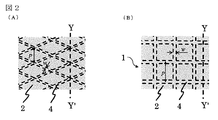
- FIG. 2 is a top view showing one embodiment of the structure (a structure (A) having a rhombic rib-shaped portion and a structure (B) having a square or rectangular rib-shaped portion).
- FIG. 3 is a cross-sectional view showing one embodiment (embedded portion) of the structure.
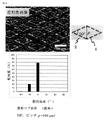
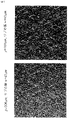
- FIG. 4 shows a microscopic image showing oriented cell sheet formation induced by a structure having a rhombic rib-shaped site (anisotropic in-plane elastic property / in-plane viscoelastic property) and distribution of cell sheet orientation. It is a graph.
- FIG. 1 is a top view showing one embodiment of the structure (a structure (A) having a rhombic rib-shaped portion and a structure (B) having a square or rectangular rib-shaped portion).
- FIG. 3 is a cross-sectional view showing one embodiment (embedded portion) of the structure.
- FIG. 4 shows a microscopic image showing oriented cell sheet formation induced by a
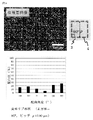
- FIG. 5 is a graph showing the distribution of the degree of orientation of the cell sheet and the microscopic image in the structure having the square rib-shaped portion (isotropy (or isotropic) in-plane elastic property).
- FIG. 6 is a microscopic image showing oriented cell sheet formation induced in a structure (anisotropic in-plane elastic property / in-plane viscoelastic property) in which the rib width of the rhombic rib-shaped portion is changed.
- FIG. 7 is a microscopic image showing oriented cell sheet formation induced in a structure (anisotropic in-plane elastic property) in which the pitch of the rhombic rib-shaped portion is changed.
- FIG. 8 is a graph showing the distribution of microscopic images and cell sheet orientation in a structure having a square rib-shaped portion (isotropy (or isotropic) in-plane elastic property / in-plane viscoelastic property).
- FIG. 9 shows an in-plane elastic property and an in-plane viscoelastic property of a structure having a square rib-shaped portion (isotropy (or isotropic)) when only the lateral rib width is changed from the structure of FIG. It is a graph showing the distribution of the degree of orientation of the microscopic image and the cell sheet in the anisotropic in-plane elastic property / in-plane viscoelastic property).
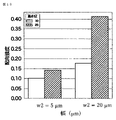
- FIG. 10 is a graph showing the orientation strength in a structure having square rib-shaped portions having different widths and / or heights (isobiaxial or anisotropic in-plane elastic property / in-plane viscoelastic property).
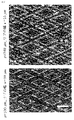
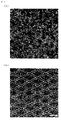
- FIG. 11 shows the acquisition of orientation over time on the third day (A) and the fifth day (B) of culture in a structure having a rhombic rib-shaped site (anisotropic in-plane elastic property / in-plane viscoelastic property). It is a microscope image which shows.
- FIG. 11 shows the acquisition of orientation over time on the third day (A) and the fifth day (B) of culture in a structure having a rhombic rib-shaped site (anisotropic in-plane elastic property / in-plane viscoelastic property). It is a microscope image which shows.
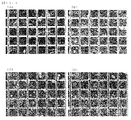
- FIG. 12-1 shows 10 hours to 56 hours after culturing in a structure having square rib-shaped portions having different rib widths in the vertical and horizontal directions (anisotropic in-plane elastic properties / in-plane viscoelastic properties).
- 6 is a microscope image showing the acquisition of orientation over time up to (D).
- FIG. 12-2 shows from (E) to 86 after 70 hours and 30 minutes of culturing in a structure (anisotropic in-plane elastic property / in-plane viscoelastic property) having square rib-shaped portions having different rib widths in the vertical and horizontal directions. It is a microscope image which shows the acquisition of orientation with time until after time (F).
- the term "continuous cell culture surface” refers to a substantially flat surface that constitutes at least one surface of a structure in which the formation of a cell sheet is induced.
- the "aligned cell sheet” is a sheet formed by the desired aggregation of a plurality of cells, preferably as an in-plane direction of a structure and / or a cell culture surface. A sheet formed by a relatively large number of cells gathering in a certain direction), and more preferably a sheet formed by gathering a plurality of cells in a uniaxial direction. In such a cell sheet, the cells may or may not be in contact with each other.
- anisotropic mechanical property means that the mechanical property of the structure (including the force generated by the cells to be cultured) is not isotropic or equibiaxial, in other words, the structure.
- the mechanical properties of, for example, the elastic, rigid or viscoelastic properties mean that they do not have equal magnitudes on any orthogonal biaxis in the culture plane.
- the term “deformable structure or site” refers to a structure or site made of a material that is deformable to stress (including the forces generated by the adhering cells themselves), such as elastic bodies and /. Alternatively, a structure or part made of a viscoelastic body or the like is included.
- the deformable structure or part can also be a non-rigid structure or part.
- the deformable part may be placed inside the structure, may be placed outside the structure as in the rib-shaped part described below, and may have any shape and / or size. May be good.
- the "rib-shaped site” refers to a protrusion formed on the outside (for example, the back surface) of the continuous cell culture surface of the structure, and a plurality of rib-shaped sites are arranged at arbitrary angles. This forms rib shapes such as squares, rectangles, rhombuses, and / or honeycombs (hexagons or oblong hexagons).
- the shape of the rib-shaped portion itself is not particularly limited.
- the cross section of the rib-shaped part in the direction perpendicular to the in-plane direction of the cell culture surface may be a square (square and / or rectangular), a polygon such as a triangle, a pentagon and / or a hexagon, a semicircle or an ellipse, and the like.
- the shape may be.
- the "rib width" is the size or dimension of the rib-shaped portion in the in-plane direction on the outside (for example, the back surface thereof) of the continuous cell culture surface.
- the "rib width" may be the size or dimension of a rib extending in-plane in the cell culture plane in a direction orthogonal to the extending direction, more specifically such a rib.
- two or more types of rib-shaped parts having different widths, different pitches, and / or different heights are arranged to generate mechanical anisotropy. It's okay.
- “Rib height” refers to the size of the rib-shaped site perpendicular to the in-plane direction on the outside (for example, the back surface thereof) of the continuous cell culture surface.
- the "rib pitch” means, for example, the length between the rib center line and the rib center line in the direction in which the distance between the ribs is maximized.
- the “embedded portion” refers to a deformable portion arranged inside the structure, and can be arranged at any angle, width, height, and / or pitch like the rib-shaped portion.
- the "uniaxial direction of the structure” refers to the axial direction having the highest elasticity, rigidity or viscous elasticity among any two orthogonal axes in the in-plane direction of the continuous cell culture surface.
- the "uniaxial direction of the cell” refers to the axial direction in which the cell is oriented as a result.
- alignment strength refers to a dimensionless value obtained by dividing the number of cells within ⁇ 10 ° from the direction in which the largest number of cells are oriented by the total number of cultured cells.
- Both the present invention and the invention according to Patent Document 1 use a structure to induce the formation of a cell sheet.
- cell sheet formation oriented to a continuous cell culture surface that is, a substantially flat cell culture surface is induced
- cell sheet formation is induced in the opening of the culture substrate mesh structure. To. Therefore, the shapes of the structures that induce the cell sheet are completely different between the two.
- the present invention utilizes the property that cells are oriented by sensing the in-plane mechanical anisotropy of the structure.
- the invention of Patent Document 1 is an invention utilizing the property that cells extend into an opening of a mesh structure, and the cells in contact adhere to each other and connect with each other to fill the opening of the mesh structure. Therefore, the mechanism of inducing cell sheet formation is completely different between the two.
- the present invention provides, in certain embodiments, a structure for inducing oriented cell sheet formation on a continuous cell culture surface, with alien mechanical properties.
- the structure may have deformable sites inside or outside the structure that give rise to the anisotropic mechanical properties of the structure.
- the structure may have a portion inside or outside the structure that causes the anisotropic mechanical property of the structure.
- the structure may be deformable including the portion. If the structure has a deformable part that causes anisotropic mechanical properties inside or outside the structure, if the structure alone has isotropic mechanical properties, the part inside the structure It can give rise to anisotropic mechanical properties to induce a cell sheet in which cells are uniaxially oriented.
- a portion having a shape that causes the anisotropic mechanical property in the uniaxial direction of the structure may be provided inside or outside the structure.
- the structure is provided with a part having a shape that causes anisotropic mechanical properties in the uniaxial direction of the structure inside or outside the structure, when the structure alone has isotropic mechanical properties.
- anisotropic mechanical properties can be generated inside the structure depending on the site, and a cell sheet in which cells are oriented in the uniaxial direction can be induced.
- a portion having a different width that causes the anisotropic mechanical property in the uniaxial direction of the structure may be provided inside or outside the structure.
- parts having different widths are provided to uniaxially inside the structure. It is possible to induce a cell sheet in which cells are uniaxially oriented, giving rise to directionally anisotropic mechanical properties.
- parts having different rigidity may be unevenly arranged inside or outside the structure as the parts. When parts having different rigidity are unevenly arranged inside or outside the structure as the above-mentioned parts, the parts having different rigidity arranged unevenly inside or outside the structure are uniaxially arranged inside the structure.
- the structure may be composed of at least one material selected from the group consisting of biocompatible materials and biodegradable materials. If the structure is composed of at least one material selected from the group consisting of biocompatible materials and biodegradable materials, the structure can be safely utilized in vivo or in vitro. ..
- the present invention may, in one embodiment, the site be made of a polymer or metal. When the material of the site is made of polymer or metal, it is possible to easily and inexpensively produce a cell sheet in which cells are oriented in the uniaxial direction.
- the present invention may be the formation of a sheet formed by aggregating cells having a contractile ability or exerting a contractile force.
- the structure of the present invention is applied to the cells having contractile ability or emitting contractile force.
- the invention may induce the oriented cell sheet formation in the axial direction with higher rigidity in the structure. If the oriented cell sheet formation is induced in the structure in the more rigid axial direction, the oriented cell sheet formation can be induced by providing the structure in the more rigid axial direction.
- the present invention may have the anisotropic mechanical properties of the structure by previously pulling the deformable structure in a uniaxial direction.
- a deformable structure is previously pulled in a uniaxial direction to give the structure anisotropic mechanical properties, even if the structure itself has isotropic mechanical properties, it is anisotropic. It is possible to induce a cell sheet in which cells are oriented in the uniaxial direction by giving rise to mechanical properties.
- INDUSTRIAL APPLICABILITY provides a cell culture apparatus for inducing the formation of an oriented cell sheet on the continuous cell culture surface, which comprises the structure according to any one of the above and a culture solution. ..
- the cell culture apparatus can induce the formation of cell sheets in which cells are oriented in the uniaxial direction.
- cell sheet formation can be induced so that, for example, the mechanical properties such as stiffness, elasticity and / or viscoelasticity of the structure are most axially oriented.
- the present invention provides, in certain embodiments, an oriented cell sheet induced using the cell culture apparatus described above.
- the cell sheet may be used for the construction and regenerative medicine of cell tissues (eg, tissues such as skin, myocardium, skeletal muscle, tendons, ligaments, nerves, blood vessels, valves, etc.). It may also be used to control cell migration as cells build tissue.
- an in-vitro model for drug screening for example, measurement of contractile force of oriented cardiomyocytes
- the present invention is oriented, comprising immersing the structure according to any one of the above in a culture medium and seeding and culturing the cells on the continuous cell culture surface of the structure in one embodiment.
- a method for inducing cell sheet formation is provided.
- Cell sheets derived by this method may be used for the construction and regenerative medicine of cell tissues (eg, tissues such as skin, myocardium, skeletal muscle, tendons, ligaments, nerves, blood vessels and / or valves). It may also be used to control cell migration as cells build tissue.
- the method may be used to prepare an in-vitro model for drug screening (for example, measurement of contractile force of oriented cardiomyocytes) and to regulate cell differentiation by mechanical stimulation.
- the method may be carried out in static culture. By performing the method in static culture, this method can be applied to cells that are statically cultured as normal culture.
- the structure (1) of the present invention is a deformed body having at least one continuous cell culture surface (2) for seeding and culturing cells, more specifically, an elastic body and / or a viscoelastic body. It may be in any form, but generally it may be a rectangular parallelepiped including a membrane or a plate, a rectangular parallelepiped, or another square column.
- the structure of the present invention induces the formation of a cell sheet oriented on the continuous cell culture surface (2).
- the anisotropic mechanical properties of the structure are such that the anisotropic structure (1) is outside the continuous cell culture surface (2), eg, the back surface (3), or inside the structure. It can be created by forming or providing a site that produces anisotropic mechanical properties. That is, the continuous cell culture surface (2) itself with which the cells come into direct contact is substantially flat when viewed from the cells, but by forming the above-mentioned site on the structure, the structure is heterogeneous. Can give rise to various mechanical properties.
- the outside of the structure refers to the outside with respect to the main member of the structure (eg, preferably a plate or plate structure or film or film structure).
- the inside of the structure refers to the inside from the surface including the cell culture surface of the main member of the structure (for example, preferably a plate or a plate structure or a film or a film structure).
- This portion of the structure may be, for example, a rib (4) protruding from the back surface (3) of the structure.
- the site may be made of a deformable material.
- it may contain a material that can be deformed due to an external force (for example, a resin material such as a polymer).
- the structure and / or the portion concerned may be made of a material / material having elastic properties and / or viscoelastic properties.
- uniaxially eccentric in the culture surface of the structure protruding from the outside of the continuous cell culture surface (2) for culturing the cells of the structure, for example, to the back surface (3).
- the portion may be provided as a rib (4) having a shape that causes mechanical properties.
- a plurality of ribs may be provided. By forming the plurality of ribs so as to be arranged at an arbitrary angle, the shape of the ribs such as a square, a rectangle, a rhombus, and / or a honeycomb (hexagon or oblong hexagon) can be obtained. As an example, FIG. 2 shows a rhombic rib formed by crossing ribs (4) at ⁇ 90 °.
- a structure having square ribs has equibiaxial mechanical properties in the culture plane, but by making the dimensions of the plurality of ribs forming the square different, the mechanical properties in the culture plane of the structure are different.
- the mechanical properties in the culture plane of the structure can be made anisotropic.
- the widths of the vertical and horizontal ribs forming a square when viewed in a plan view may be different from each other, or the heights of the vertical and horizontal ribs may be different from each other.
- the mechanical properties in the culture plane can be made anisotropic.
- rectangular and rhombic ribs have different sizes of mechanical properties in the biaxial direction in the culture plane of the structure, so even if the ribs have the same width and height, they have anisotropic mechanical properties.
- the widths and / or heights of the plurality of ribs forming the rectangle or rhombus can be different.
- the anisotropic mechanical properties of the structure are such that ribs of different widths and / or heights are formed, for example at a constant pitch, or ribs of the same width and / or height are arranged, for example, at different pitches. It can also be caused by doing.
- the rib-shaped portion described above is an embodiment in which the mechanical properties in the culture plane of the structure are made anisotropic by forming a convex portion protruding to the outside (for example, the back surface thereof) of the structure, but the structure (for example, the back surface thereof) is formed.
- the mechanical properties in the culture plane of the structure can also be made anisotropic by providing a recess fitted in the back surface). That is, by providing the uneven portion on the outside of the structure (for example, the back surface thereof), the mechanical properties in the culture surface of the structure can be made anisotropic.
- the site that causes anisotropic mechanical properties for example, deformed parts (5, 6) having different rigidity, elasticity, and / or viscoelasticity as shown in FIG. 3 are unevenly arranged inside the structure.
- the anisotropic mechanical properties of the structure can also be produced by arranging parts of different widths in the structure at a constant pitch, or by arranging parts of the same width at different pitches. ..
- the seeded cells sense the anisotropic mechanical properties of the structure caused by the above-mentioned sites, and the rigidity, elasticity and / or viscoelasticity of the structure are common on the continuous cell culture surface of the structure. Is oriented in a relatively high axial direction, preferably in the axial direction with the highest rigidity, elasticity and / or viscoelasticity of the structure, inducing the formation of cell sheets.
- anisotropic dynamics are performed by pulling a structure having unique isotropic mechanical properties in the uniaxial (uniaxial) direction before or after cell seeding.
- Aligned cell sheet formation can also be induced by producing properties.
- it may be a structure having anisotropic mechanical properties due to uniaxial (or predetermined direction) tension of the deformable structure. The uniaxial tension may be performed before the cells are seeded or after the cells are seeded.
- the continuous cell culture surface of the cell seeding structure is a smooth surface, but the mechanical properties (rigidity, elasticity, and / or viscoelasticity) of the material change in a direction-dependent manner (not isotropic).
- It may be a structure having properties, that is, elastic and / or viscous elasticity having anisotropy (the cell itself can control the adhesive force associated with elastic deformation to the same extent as the self-contracting force of the cell).
- a deformable elastic film polymer or silicone rubber
- anisotropy of the elastic and / or viscoelastic properties of the structure may be realized by applying uniaxial dynamic repeated tension to the structure while culturing the cells.
- the seeded cells are oriented in the axial direction with the highest elasticity and / or viscoelasticity of the structure to induce the formation of a cell sheet.
- the seeded cells may be axially oriented with the lowest elastic and / or viscoelasticity of the structure to induce cell sheet formation.
- the structures and / or sites of the present invention may be composed of the same or different materials as long as they do not exhibit cytotoxicity and induce cell sheet formation.
- the structure and / or the portion may be composed and formed of a resin material and / or a metal material.
- the part is composed of a single or a plurality of types of materials having different rigidity, elasticity and / or viscoelasticity from the structure.
- the structure and site according to the present invention may be composed of, for example, a biocompatible material such as a biocompatible metal and / or a biocompatible polymer, or a biodegradable material.
- Cell sheets obtained by using structures and sites composed of biocompatible materials and / or biodegradable materials are more preferably used in regenerative medicine by transplanting them into a living body together with these structures and sites. be able to.
- Biocompatible materials include metals such as titanium, silicone, polyether blockamide (PEBAX), polyurethane, silicone-polyurethane copolymers, ceramics, collagen, hydroxyapatite, nylon, polyethylene terephthalate, and / or Goretex (registered). Examples include, but are not limited to, ultra-high molecular weight polyethylene such as (trademark), and / or polymers such as polyvinyl chloride, and other bio-derived materials.
- metals such as titanium, silicone, polyether blockamide (PEBAX), polyurethane, silicone-polyurethane copolymers, ceramics, collagen, hydroxyapatite, nylon, polyethylene terephthalate, and / or Goretex (registered). Examples include, but are not limited to, ultra-high molecular weight polyethylene such as (trademark), and / or polymers such as polyvinyl chloride, and other bio-derived materials.
- Biodegradable materials include polylactide (PLA), polyglycolide (PGA), polycaprolactone (PCL), and / or copolymers thereof, PHB-PHV-based poly (alkanoic acid), polyesters, and / or.
- PLA polylactide
- PGA polyglycolide
- PCL polycaprolactone
- PHB-PHV-based poly (alkanoic acid) PHB-PHV-based poly (alkanoic acid)
- polyesters and / or.
- examples include, but are not limited to, natural polymers such as starch, cellulose and / or chitosan and derivatives thereof.
- the structure and / or site of the present invention may be formed of a material other than the biocompatible material, and the surface may be coated with the biocompatible material and / or the biodegradable material.
- the structure and / or the part of the present invention may be produced by a conventional method.
- a plastic resin and / or a curable resin may be used as the material of the structure and / or site.
- the structure and / or site may be prepared by using, for example, a photolithography method.
- the photocurable resin used when the structure and / or the site are prepared by the photolithography method include acrylate compounds, methacrylate compounds, epoxy compounds, isocyanate compounds, thiol compounds, and silicone compounds. Is not limited to these. Moreover, you may use these 2 or more types in combination.
- the photocurable resin examples include urethane acrylate, polyester acrylate, epoxy acrylate, methyl poly (meth) acrylate, ethoxylated bisphenol A acrylate, aliphatic urethane acrylate, polyester acrylate, polyethylene terephthalate, polystyrene, polycarbonate, and acrylic modification.
- examples thereof include, but are not limited to, alicyclic epoxides, bifunctional alcohol ether type epoxides, acrylic silicones, and / or acrylic dimethylsiloxanes.
- the continuous cell culture surface of the structure for culturing the cells of the present invention may be coated with a cell adhesive molecule such as fibronectin to promote cell aggregation or adhesion and induction of oriented cell sheet formation. ..
- the structure and site according to the present invention can be appropriately produced by a method known to those skilled in the art or a method equivalent thereto according to the structure, use, and / or material, and the like, as an example, a photolithography method or the like. , And / or a printing method such as an inkjet method, and / or a method of producing by a molding method.
- a structure having a portion is manufactured from a resin material by a photolithography method, it can be manufactured by the following steps.
- a photocurable resin constituting the structure is applied on a wafer substrate by spin coating, and the structure is heated and exposed to prepare the structure.
- a photocurable resin corresponding to the site is applied by spin coating.
- a photomask can be placed on a photocurable resin that does not form a rib-shaped portion, and after heating and exposure, the uncured portion can be removed to prepare a structure having a rib-shaped portion.
- a photocurable resin constituting the structure is applied on a wafer substrate by spin coating.
- a photomask is placed on a photocurable resin that forms an embedded portion, and after heating and exposure, the uncured portion is removed to prepare a structure.
- a structure having an embedded portion can be produced by pouring a photocurable resin into a portion corresponding to the embedded portion and heating and exposing the portion.
- any cell that can sense the anisotropy of the mechanical properties of the structure that serves as a support can be used.
- cells having adhesion specifically cells having adhesion to the cell culture surface of the structure (eg, sticking to, adhering to or adhering to the cell culture surface of the structure), and / Or, cells having contractile ability or emitting contractile force by themselves can be mentioned.
- Cells that can sense the anisotropy of the mechanical properties of structures include, for example, muscular cells such as skeletal muscle, myocardium and / or smooth muscle, cells that are oriented in vivo and / or cells that have mechanical functions. Can be mentioned.
- Examples of cells include embryonic stem cells (ES cells), induced pluripotent stem cells (iPS cells), and mesenchymal stem cells (MS cells), which have the property of having contractile ability or developing contractile force by themselves in the process of differentiation.
- Examples include cells that have led to the presence of cells, and more specifically, examples thereof include cells that constitute tissues such as skin, myocardium, skeletal muscle, tendons, ligaments, nerves, blood vessels, and / or valves. Not limited to. In oriented sheet formation, these cells sense the anisotropy of the mechanical properties of the structure and orient, and assemble on a continuous cell culture surface in the direction of the highest mechanical properties of the structure. It is formed.
- the present invention provides a cell culture apparatus for inducing the formation of an oriented cell sheet on the continuous cell culture surface, which comprises the above-mentioned structure and a culture solution.
- the culture medium constituting the cell culture apparatus include Dalveco-modified Eagle medium (DMEM) containing various additives, Ames medium, Eagle basal medium, Crick medium, DME-ham mixed medium, Dalbeco PBS (D-PBS), and the like.
- the present invention provides, in certain embodiments, an oriented cell sheet induced using the cell culture apparatus described above.
- the present invention comprises immersing the above-mentioned structure in a culture medium, seeding and culturing cells on a continuous cell culture surface of the above-mentioned structure, and inducing the formation of an oriented cell sheet.
- a culture medium For example, 100 ⁇ l of cells at a concentration of 10,000 to 500,000 cells / ml were seeded on a continuous cell culture surface of the structure having an area of 12 mm 2 , and the conditions were 37 ° C. and 5% CO 2 for 3 days. It may be cultured for ⁇ 15 days, for example, 3 to 7 days to induce the formation of an oriented cell sheet, but these may be changed depending on the cells used or the like.
- the structure of the present invention has anisotropic mechanical properties, it may have mechanical properties that do not have the same size on any orthogonal biaxis in the culture plane.
- the shape of the rib site, the width of the rib site and / or the pitch of the rib site is set to be different from the other in one of the mechanical properties of any orthogonal biaxis in the culture plane. You can do it.
- First aspect A structure for forming a cell sheet on a cell culture surface, comprising a plate-like member having the cell culture surface (for example, the structure is preferably a plate or a plate structure).
- a structure comprising ribs (ie, sites corresponding to ribs) on the opposite surface of the cell culture surface of the plate-like member.
- the back surface of the structure opposite to the cell culture surface may have a rib morphology that locally protrudes or rises in the thickness direction of the structure (for example, provided on the back surface of the structure or plate-like member).
- One or more ribs extending in a direction orthogonal to the thickness direction of the structure or plate member preferably a rib extending long along the back surface, for example, length.
- the structure may be provided with ribs extending in a scale).
- the structure according to the first aspect is preferably a non-penetrating / non-opening structure having no through hole or opening, or a non-mesh structure having no mesh structure.
- the structure according to the first aspect may be a solid structure, preferably a structure in which substantially all of the plate-like members and / or ribs are solid.
- a plurality of cell aggregates are formed, and such cell aggregates preferably adhere to, adhere to, or adhere to the cell culture surface to form a sheet.
- a cell aggregate formed in that is, a sheet composed of cell aggregates, preferably a sheet composed of spontaneously aggregated cells, more preferably a place where multiple cells are joined or connected to each other. It may be a sheet composed of an aggregate having at least a cell culture surface, and more preferably a cell sheet composed of cells adhering to the cell culture surface (for example, along a predetermined direction in the in-plane direction of the cell culture surface).
- a cell sheet composed of cell aggregates having or improved orientation such that more cells are aggregated in one direction.
- the structure may be a structure for inducing cell sheet formation.
- the cell culture surface may be a flat surface.
- the cell culture surface may be a continuous surface, a flat surface, a smooth surface, or the like.
- the cell culture surface of such a structure may be a cell adhesion surface to which cells adhere, adhere or adhere.
- the plate-shaped member and the rib may be integrated with each other.
- the plate-shaped member and the rib may be made of the same and / or different materials.
- the ribs may have a geometric pattern in the plan view. That is, the ribs may have an overall regular arrangement.
- the ribs may be arranged so that the distances between the ribs have a predetermined pitch in a plan view, and / or the ribs may be arranged so as to intersect each other in a plan view (for example, they intersect).
- the ribs may have a unified arrangement as a whole so that the angles formed by the ribs have a predetermined angle of 1 or more).
- the ribs (particularly the ribs, eg, the ribs having shapes that intersect each other) are squares, rectangles, rhombuses, or honeycombs (eg hexagons or oblong hexagons) in the plan view of the structure. ) May be provided so as to form a pattern / form.
- ribs (particularly a plurality of ribs) extending along different directions in a plan view (for example, “one direction” and “the other direction” that intersect or are orthogonal to each other in a plan view).
- the shape and / or arrangement of the ribs may be different from each other.
- the rib spacing (eg, pitch) of a plurality of ribs extending along "one direction" in different directions is in the different directions.
- the distance between the rib intersections in the "one direction" is the "other direction” in the different directions (eg, the "other” in the direction intersecting or orthogonal to each other.
- the rib intersection angle (ie, the angle formed by the intersecting ribs) in "one direction") is the “other direction” in the different directions (eg, the “other direction” in the direction intersecting or orthogonal to each other). ) May be different from the rib intersection angle (that is, the angle formed by the intersecting ribs).
- a plurality of ribs in "one direction” in different directions (for example, “one direction” in a direction intersecting or orthogonal to each other) have the same shape and shape (for example, the same as each other).
- the other direction in different directions (eg, "the other direction” in the direction intersecting or orthogonal to each other). May have the same shape, shape, and the like (for example, the same width dimension, pitch, and / or height).
- the width dimension between the ribs may be non-constant.
- a predetermined rib or a plurality of predetermined ribs for example, a plurality of ribs extending in either the vertical direction or the horizontal direction in a plan view or “one in a direction intersecting each other”).
- Multiple ribs in "direction") are other ribs or other ribs (similarly, multiple ribs extending in the "other direction” in the vertical and horizontal directions in a plan view, or "in a direction intersecting each other".
- the width dimension may be relatively smaller or larger than the "multiple ribs in the other direction” (eg, the width dimension of each rib in the plurality of ribs in one direction is the width dimension of each rib in the plurality of ribs in the other direction). It may be 1.2 times or more and 20 times or less, for example, 1.5 times or more and 10 times or less, 1.5 times or more and 8 times or less, 1.5 times or more and 6 times or less, 2 times or more and 5.5 times or less.
- the height dimension between the ribs may be non-constant.
- a predetermined rib or a plurality of predetermined ribs for example, a plurality of ribs extending in either the vertical direction or the horizontal direction in a plan view, or a plurality of ribs in a direction intersecting each other ". Multiple ribs in "one direction") extend in "the other direction” in the vertical and horizontal directions or intersect with each other in the other ribs or other ribs (also exemplified in plan view).
- the height dimension may be relatively smaller or larger than (multiple ribs in the "other direction”).
- the rib width and / or rib height for a plurality of ribs in “one direction” in different directions is “the other” in the different directions. It may be different from the rib width and / or the rib height with respect to the plurality of ribs in the "direction” (eg, "the other direction” in the direction intersecting or orthogonal to each other).
- the height dimension of the rib may be the same as the thickness dimension of the plate-shaped member, or may be larger than the thickness dimension of the plate-shaped member.
- the height dimension of the rib may be equal to or larger than the thickness dimension (plate thickness) of the plate-shaped member.
- the height dimension of the rib is 1 times or more and 50 times or less of the thickness dimension of the plate-shaped member, 1 time or more and 40 times or less, 1 time or more and 30 times or less, 1 time or more and 20 times or less, 1 time or more and 15 times or less, Alternatively, it may be 1 times or more and 13 times or less, or may be, for example, 4 times or more and 13 times or less.
- the structure of the first aspect may be made of a deformable material / material (for example, it can be deformed by increasing an external force such as a tensile stress applied to the structure). It may be composed of such a material / material, for example, it may be composed of a material / material that can be finally deformed or deformed from an arbitrary time point when such an external force is increased under normal temperature / atmospheric pressure conditions. ).
- the structure according to a preferred first aspect is made of such a deformable material / material, including a portion preferably corresponding to a rib.
- the structure of the first aspect (particularly the plate-like member and / or rib thereof) may contain a resin material such as a polymer.
- the structure (particularly its plate-like members and / or ribs) may be made of a resin material such as a polymer and therefore elastic and / or elastic and rigid. It may be a structure having the above.
- the cell culture surface does not necessarily have to be a flat surface, and the cell culture surface may have a convex portion and / or a concave portion (that is, the cell culture surface locally has a convex portion and / or a concave portion). It may have a raised morphology).
- the convex portion of the cell culture surface and the rib may be aligned with each other in the thickness direction of the plate-shaped member (therefore, in such a case, the structure or the plate-shaped member thereof has an uneven shape as a whole. It may have, and preferably has a regular uneven shape in a cross-sectional view or a plan view).
- the material of the structure of the first aspect may be a material made of a so-called biocompatible material and / or a biodegradable material.
- the structure may be combined with at least a cell culture solution and provided as a cell culture means, a cell culture product, a cell device (in short, for example, a cell culture device) or the like. Further, in the cell culture apparatus having such a structure of the first aspect, it is preferable to obtain a cell sheet having orientation.
- a structure for forming a cell sheet on a cell culture surface comprising a plate-like member having the cell culture surface (for example, the structure is preferably a plate or a plate structure).
- the structure in which the plate-like members have a rigid portion, an elastic portion and / or a viscoelastic portion having different rigid properties, elastic properties and / or viscoelastic properties.
- the structure has a material / material different from the main material or body material (for example, a material / material that occupies a relatively large volume in the plate-shaped member) in the plate-shaped member. It's okay.
- a form in which a material / material different from the body material / main material of the plate-shaped member in terms of rigidity, elasticity, and / or viscoelasticity is incorporated or embedded in the body of the plate-shaped member.
- the structure may have (preferably a locally or partially incorporated or embedded form).
- such a part or site locally or partially incorporated into or embedded in the structure is also simply referred to as an “incorporated / embedded portion” for convenience of explanation.
- the cell culture surface of the plate-like member may be configured to include at least different rigid, elastic and / or viscoelastic portions.
- Such rigid, elastic and / or viscoelastic portions may be provided in the structure as one or more portions / regions.
- the built-in / embedded portion may be provided so as to extend in a direction orthogonal to the thickness direction of the structure or the plate-shaped member, and in that case, the built-in / embedded portion extends in a direction orthogonal to the thickness direction. It may be present, for example, it may be extended in a long shape.
- the structure according to the second aspect is preferably a non-penetrating / non-opening structure having no through hole or opening or a non-mesh structure having no mesh structure.
- the structure according to the second aspect may be a solid structure, preferably a structure in which substantially all of the plate-shaped members are solid.
- a plurality of cell aggregates are formed, and such cell aggregates preferably adhere to, adhere to, or adhere to the cell culture surface to form a sheet.
- a cell aggregate formed in that is, a sheet composed of cell aggregates, preferably a sheet composed of spontaneously aggregated cells, more preferably a place where multiple cells are joined or connected to each other.
- a cell sheet composed of cells adhering to the cell culture surface for example, along a predetermined direction in the in-plane direction of the cell culture surface), preferably one.
- the structure may be a structure for inducing cell sheet formation.
- the cell culture surface may be a flat surface.
- a cell culture surface may form, for example, a continuous surface, a flat surface, a smooth surface, or the like.
- the cell culture surface of such a structure may be a cell adhesion surface to which cells adhere, adhere or adhere.
- different rigid parts, elastic parts and / or viscoelastic parts may have a geometric pattern.
- the rigid portions, elastic portions and / or viscoelastic portions that are different from each other may have a generally regular arrangement form in the plate-shaped member.
- the rigid portion having a relatively high or low rigidity characteristic has a geometric pattern
- the elastic portion having a relatively high or low elastic characteristic has a geometric pattern
- a viscoelastic portion having a geometric pattern or having relatively high or low viscoelastic properties may have a geometric pattern.
- different rigid parts, elastic parts and / or viscoelastic parts are square, rectangular or rhombic.
- a honeycomb for example, a hexagon or a long hexagon
- the pitch, width dimension and / or thickness dimension may not all be constant and may be non-constant (for example, they may not all be the same as a whole).
- a plurality of embedded / embedded portions may have a pitch pattern, a width dimension pattern and / or a thickness dimension pattern different from each other, which can be regarded as non-uniform in that respect).
- the embedded / embedded portion (particularly a plurality) extending in different directions in a plan view (for example, “one direction” and “the other direction” that intersect or are orthogonal to each other in a plan view).
- the shape, material / material and / or arrangement of the embedded / embedded portion may be different from each other.
- the spacing (eg, pitch) of a plurality of built-in / embedded portions extending along "one direction" in different directions is such that each other.
- Different or different directions from the spacing (eg, pitch) of multiple built-in / embedded portions extending along the "other direction” in different directions eg, "the other direction” in the direction intersecting or orthogonal to each other).
- the distance between the built-in / embedded partial intersections (that is, the distance between the built-in / embedded parts that intersect each other) in "one direction” (for example, "one direction” in the direction intersecting or orthogonal to each other) is the said. Spacing between built-in / embedded partial intersections in "other directions” in different directions (eg, “other directions” in directions intersecting or orthogonal to each other) (ie, spacing between built-in / embedded portions intersecting each other) And / or the angle of intersection of the built-in / embedded portions provided along "one direction” (eg, "one direction” in a direction intersecting or orthogonal to each other) in different directions from each other (ie, each other).
- the angle of intersection of the built-in / embedded parts in which the intersecting built-in / embedded parts are in the "other direction” (for example, the "other direction” in the direction intersecting or orthogonal to each other) in different directions. That is, it may be different from the angle formed by the embedded / embedded portions that intersect each other).
- the materials / materials of the plurality of embedded / embedded portions extending along "one direction" in different directions are in different directions. It may be different from the material of the plurality of embedded / embedded portions extending along the "other direction” (for example, the "other direction” in the direction intersecting or orthogonal to each other).
- a plurality of built-in / embedded portions in "one direction" in different directions have the same shape / form and / or the same shape and / or
- the materials may have materials, and similarly, a plurality of embedded / embedded portions in the "other direction” in the different directions (for example, the "other direction” in the direction intersecting or orthogonal to each other) may have each other. They may have the same shape / form and / or material / material.
- the width dimension of the rigid portions, elastic portions and / or viscoelastic portions different from each other may be non-constant.
- a predetermined built-in / embedded portion or a plurality of predetermined built-in / embedded portions for example, a plurality of built-in / embedded portions extending in either the vertical direction or the horizontal direction in a plan view.
- An embedded portion or a plurality of embedded / embedded portions extending in "one direction" in a direction intersecting each other is another predetermined embedded / embedded portion or a plurality of predetermined embedded / embedded portions (similarly, in a plan view).
- the width dimension is relative to the multiple built-in / embedded parts extending in the "other direction” in the vertical and horizontal directions or the multiple built-in / embedded parts extending in the "other direction” in the direction intersecting each other. It may be small or large.
- the structure of the second aspect may be made of a deformable material / material (for example, a material that can be deformed by increasing an external force such as a tensile stress applied to the structure). It may be composed of a material, for example, it may be composed of a material / material that can be finally deformed or deformed from an arbitrary time point when such an external force is increased under normal temperature / atmospheric pressure conditions).
- the structure according to a preferred second aspect is made of such a deformable material / material, preferably including a portion corresponding to an embedded / embedded portion.
- the structure may be made of a resin material such as a polymer.
- the material of the structure may be a material made of a so-called biocompatible material and / or a biodegradable material.
- a plate-shaped member is composed of resin portions having different rigidity characteristics
- a plate-shaped member is composed of resin portions having different elastic characteristics
- a plate is composed of resin portions having different viscoelastic characteristics.
- the shaped members may be configured (such portions of different rigid, elastic or viscoelastic properties may be integrated with each other to form a structure / plate-shaped member).
- a plate-shaped member is composed of a relatively hard portion and a relatively soft portion, and in a plan view of the plate-shaped member, the relatively hard portion is generally regular. Or the relatively soft portion may have an overall regular arrangement. In such a case, in the plate-shaped member, the relatively hard portion and the relatively soft portion may be adjacent to each other or in contact with each other. In the cross-sectional view obtained), the relatively hard portion and the relatively soft portion may be arranged so that one is located between the other.
- the relatively hard portion and the relatively soft portion may have the above-mentioned relationship, that is, in a plan view, different directions (for example, "one direction” and "the other direction” orthogonal to each other". They may have different relationships with each other.
- the structure may be combined with at least a cell culture solution and provided as a cell culture means, a cell culture product, a cell device (in short, for example, a cell culture device) or the like. Further, in the cell culture apparatus having such a structure of the second aspect, it is preferable to obtain a cell sheet having orientation.
- a structure for forming a cell sheet for example, a cell sheet attached to, adhered to or attached to the cell culture surface, more preferably a cell sheet oriented to the cell culture surface
- a structure to which tensile stress is applied or applied in a predetermined direction eg, only in one direction or in a single direction.
- the structure may be a structure for inducing cell sheet formation.
- the cell culture surface may be a flat surface. Such a cell culture surface may form, for example, a continuous surface, a flat surface, a smooth surface, or the like.
- the cell culture surface of such a structure may be a cell adhesion surface to which cells adhere, adhere or adhere.
- the structure of the third aspect may be composed of a plate-like member having a cell culture surface (for example, the structure may be a plate or a plate structure), or may be composed of a membranous member (for example,).
- the structure may preferably be a film or film structure).
- the structure of the third aspect (particularly a plate structure or a film structure) may be made of a deformable material / material (for example, so as to be deformable due to an external force such as a tensile stress applied to the structure). It may be composed of various materials / materials).
- the structure of the third aspect (for example, its plate-like member or membrane-like member) may be deformable by an external force that can be applied during cell culture.
- the structure may be deformable during cell culture due to the tensile force that can be applied during cell culture (for example, it may be deformable at a level that can be visually confirmed).
- the structure of the third aspect eg, a plate-like member or a film-like member thereof
- may include an elastic material for example, an elastic material such as a polymer, an elastomer and / or a silicone rubber.
- an elastic material for example, an elastic material such as a polymer, an elastomer and / or a silicone rubber.
- the structure is such that tensile stress is applied or applied in "one direction” (for example, “one direction” in a direction intersecting or orthogonal to each other) in different directions in a plan view.
- the structure may have no or no such tensile stress applied.
- the structure may have a tensile stress applied or applied differently in such "one direction” than in "one direction”.
- the structure according to the third aspect is preferably a non-penetrating / non-opening structure having no through hole or opening or a non-mesh structure having no mesh structure.
- the structure according to the third aspect may be a solid structure, preferably a plate structure or a film structure in which substantially all of the structure is solid.
- a plurality of cell aggregates are formed, and such cell aggregates preferably adhere to, adhere to, or adhere to the cell culture surface to form a sheet.
- a cell aggregate formed in that is, a sheet composed of cell aggregates, preferably a sheet composed of spontaneously aggregated cells, more preferably a plurality of cells joined or connected to each other.
- It may be a sheet composed of an aggregate having at least a portion, and more preferably a cell sheet composed of cells adhering to the cell culture surface (for example, along a predetermined direction in the in-plane direction of the cell culture surface).
- the material of the structure of the third aspect may be a material made of a so-called biocompatible material and / or a biodegradable material as in the first aspect and the second aspect.
- the structure may be combined with at least a cell culture solution and provided as a cell culture means, a cell culture product, a cell device (in short, for example, a cell culture device) or the like. Further, in the cell culture apparatus having such a structure of the third aspect, it is preferable to obtain a cell sheet having orientation.
- the rib-shaped part was composed of resin.
- the ribbed portion was prepared by a photolithography method. Specifically, SU-8-2 (Microchem Co., Ltd.), which is a photocurable resin, was added onto an approximately 5 ml wafer, placed on a spin coater, and rotated to prepare a flat first layer. Then, the entire surface of the wafer was irradiated with ultraviolet rays (wavelength of about 405 nm) with an exposure device called a micro aligner to prepare a layer having a thickness of 2 ⁇ m as a structure.
- SU-8-2 Microchem Co., Ltd.
- the thickness of the layer is determined by the rotation speed of the spin coater, it is possible to adjust the rotation speed to obtain the desired thickness of the structure and ribs. If the rib height is 2 ⁇ m, SU-8-2 is used, if the rib height is 10 ⁇ m, SU-8-3010 is used, and if the rib height is 25 ⁇ m, SU-8 is used. -3025 was used.
- -Cultured cells Mouse myoblasts (C2C12) (Product name: Manufacturing and sales company name: RIKEN Cell Bank)
- -Culture period Incubator (37 ° C, 5% CO 2 ) 3 to 7 days-Coating agent for structures and sites: Fibronectin (10 ⁇ g / ml) -Medium: 10% FBS (product name, manufacturing and sales company name: FSB, Gibco, Thermo Fisher Scientific) and 1% antibiotic (product name, manufacturing and sales company name: antibiotic-antifungal agent solution (Penicillin streptomycin amphotericin B,) DMEM (Dulvecco's Modified Eagle's Medium) medium supplemented with Sigma Aldrich (product name, manufacturing and sales company name: DMEM high glucose GlutaMAX, GIBCO (Thermo Fisher Scientific))
- FIGS. 4 and 5 The microscopic images of the structures having the respective rib-shaped sites after culturing and the distribution of the cell orientation angles are shown in FIGS. 4 and 5.
- Anisotropic in-plane elasticity and / or in-plane viscoelasticity occurs in the structure having the diamond-shaped rib-shaped portion in FIG. 4, and lateral elasticity and / or lateral elasticity and / or viscoelasticity rather than vertical elasticity and / or viscoelasticity in the figure / Or has high viscoelasticity.
- the cell sheet guided to the continuous cell culture surface opposite to the surface on which the rib-shaped site was formed was found to be oriented in the left-right direction in the figure.
- the structure having the square rib-shaped portion of FIG. 5 has biaxial in-plane elasticity and / or in-plane viscoelastic properties that do not cause anisotropy, and has mechanical anisotropy.
- FIG. 6 A microscopic image of the structure having each rib-shaped site after culturing is shown in FIG.
- the induced cell sheet was found to be oriented in the left-right direction in the figure. That is, the desired cell sheet formation was induced on the cell culture surface of the structure having anisotropic mechanical properties. From the above, the cells sense the anisotropic in-plane elastic properties and in-plane viscoelastic properties that occur in the culture surface of the structure, not the size of the occupied area and / or width of the rib-shaped part on the back surface of the structure. It was shown that oriented cell sheet formation was induced.
- FIG. 7 A microscopic image of the structure having each rib-shaped site after culturing is shown in FIG.
- the induced cell sheet was found to be oriented in the left-right direction in the figure. That is, the desired cell sheet formation was induced on the cell culture surface of the structure having a site having an anisotropic mechanical property. From the above, it is possible to form a cell sheet in which cells are oriented by sensing the anisotropic in-plane elastic properties and in-plane viscoelastic properties that occur in the culture of the structure, rather than the size of the pitch of the rib-shaped part on the back surface of the structure. It was shown to be induced.
- the cells sense the anisotropic in-plane elastic properties and in-plane viscoelastic properties that occur in the culture surface of the structure, not the size of the occupied area and / or width of the rib-shaped part on the back surface of the structure. It was shown that oriented cell sheet formation was induced.
- FIG. 10 shows the orientation strength of the cells after culturing using the structures having rib-shaped sites having a width of 20 ⁇ m (w1) and w1).
- W2 5 ⁇ m (left side) in FIG.
- FIG. 10 corresponds to the result of a structure having an anisotropic mechanical property
- the rib width dimension is set between the rib-shaped portion extending in one direction and the rib-shaped portion extending in the other direction. Cell sheet orientation was observed in the structures different from each other.
- FIG. 11 shows a microscopic image showing changes in cell orientation over time when mouse myoblasts (C2C12) were added to a continuous cell culture surface of a structure having a rhombic rib-shaped site and cultured.
- C2C12 mouse myoblasts
- FIGS. 12-1 and 12-1 Microscopic images showing changes in cell orientation over time when mouse myoblasts (C2C12) were added to the continuous cell culture surface of a structure having square rib-shaped sites and cultured are shown in FIGS. 12-1 and 12-1. It is shown in 12-2. Although the orientation of the cells (A) 10 hours after culturing is temporarily disturbed, the formation of cell sheets oriented in one direction (vertical direction) toward the cells (F) 86 hours after culturing is induced over time. It was shown to be done. That is, the desired cell sheet formation was induced on the cell culture surface of the structure having a site having an anisotropic mechanical property.
- the cells sense the anisotropic mechanical properties that occur on the cultured surface of the structure (eg, the anisotropy of the mechanical properties such as stiffness, elasticity and / or viscoelasticity of the structure). It was demonstrated that the formation of cell sheets is induced according to the anisotropic mechanical properties.
- the structure may have anisotropic mechanical properties during manufacturing. For example, by extruding and / or stretching the melt of the material of the structure, anisotropic (anisotropic mechanical properties) are obtained in terms of rigidity, elasticity, and / or viscoelasticity during the manufacture of the structure. It may be given to the structure.
- the present invention may be used for the construction and regenerative medicine of oriented cell sheets and cell tissues (for example, tissues such as skin, myocardium, skeletal muscle, tendons, ligaments, nerves, blood vessels, valves, etc.) for regenerative medicine. be. It may also be used to control cell migration as cells build tissue. Furthermore, it may be used to prepare an in-vitro model for drug screening (for example, measurement of contractile force of oriented cardiomyocytes) and to regulate cell differentiation by mechanical stimulation.
- oriented cell sheets and cell tissues for example, tissues such as skin, myocardium, skeletal muscle, tendons, ligaments, nerves, blood vessels, valves, etc.
Landscapes
- Engineering & Computer Science (AREA)
- Health & Medical Sciences (AREA)
- Life Sciences & Earth Sciences (AREA)
- Bioinformatics & Cheminformatics (AREA)
- Chemical & Material Sciences (AREA)
- Organic Chemistry (AREA)
- Biomedical Technology (AREA)
- Zoology (AREA)
- Wood Science & Technology (AREA)
- Biotechnology (AREA)
- Genetics & Genomics (AREA)
- Microbiology (AREA)
- Biochemistry (AREA)
- General Engineering & Computer Science (AREA)
- General Health & Medical Sciences (AREA)
- Cell Biology (AREA)
- Sustainable Development (AREA)
- Medicinal Chemistry (AREA)
- Virology (AREA)
- Micro-Organisms Or Cultivation Processes Thereof (AREA)
- Apparatus Associated With Microorganisms And Enzymes (AREA)
Abstract
本発明では、連続的な細胞培養面において配向した細胞シート形成を誘導するための構造体であって、異方的な力学特性を有する構造体が提供される。
Description
本発明は、連続的な細胞培養面における配向した細胞シート形成の誘導技術に関する。
より詳細には、本発明は、構造体、細胞培養装置、配向した細胞シートならびに配向した細胞シート形成を誘導する方法に関する。
より詳細には、本発明は、構造体、細胞培養装置、配向した細胞シートならびに配向した細胞シート形成を誘導する方法に関する。
本発明者のうちの一人は、状態のよい細胞のみで形成された高品質で安全性の高い細胞シートを、継代を必要とせず作製及び維持できる細胞培養支持体、およびこれを使用して製造した細胞シート等を提供することを課題として、平面状メッシュ構造を有する細胞培養支持体に関する発明を出願している(特許文献1)。
特許文献1の発明では、細胞培養支持体を培養液中に浮かせた状態で細胞を播種すると、細胞が自発的にメッシュ状構造の開口部に伸展し、接触した細胞同士が接着・連結してメッシュ構造の開口部を埋め、最終的に単層の細胞シートが形成され、このような細胞シートによれば、細胞がコンフルエントな状態になることがなく、細胞が増殖しても死細胞や状態の悪い細胞は細胞培養支持体から自然に脱落するので、継代を行わずに長期間培養維持でき、状態の良い生細胞のみからなる安全性の高い細胞シートを得ることができると記載されている。
さらに、特許文献1には、メッシュ構造に形状的異方性を付与することにより細胞の配向性を制御できることが記載されている。
さらに、特許文献1には、メッシュ構造に形状的異方性を付与することにより細胞の配向性を制御できることが記載されている。
再生医療分野では、細胞が自己集合的に形成した細胞シートの応用が期待されており、一部実用化されつつある。
特に配向性を有する骨格筋や心筋等の組織の再生には配向性細胞シートが有用であるため、細胞が配向した細胞シートの製造方法および装置の要望が存在する。
特に配向性を有する骨格筋や心筋等の組織の再生には配向性細胞シートが有用であるため、細胞が配向した細胞シートの製造方法および装置の要望が存在する。
本発明者は、鋭意検討した結果、配向した細胞シート形成が、細胞が接する培養支持体の培養面内に生じる力学的異方性によって誘導されることを見出し、本発明を完成するに至った。
より具体的には、本発明者は、細胞自体が固有に有する培養支持体の培養面内に生じる力学的異方性の感知能力を利用して、配向した細胞シート形成を誘導できることを見出し、本発明を完成するに至った。
すなわち、本発明は、
連続的な細胞培養面において配向した細胞シート形成を誘導するための構造体であって、異方的な力学特性を有する変形可能な構造体;
上記の構造体と、培養液とを含む、前記連続的な細胞培養面において配向した細胞シート形成を誘導するための細胞培養装置;
上記の細胞培養装置を用いて誘導された配向した細胞シート;
上記の構造体を培養液に浸漬し、前記構造体の前記連続的な細胞培養面に細胞を播種し、培養することを含む、配向した細胞シート形成を誘導する方法
を提供する。
連続的な細胞培養面において配向した細胞シート形成を誘導するための構造体であって、異方的な力学特性を有する変形可能な構造体;
上記の構造体と、培養液とを含む、前記連続的な細胞培養面において配向した細胞シート形成を誘導するための細胞培養装置;
上記の細胞培養装置を用いて誘導された配向した細胞シート;
上記の構造体を培養液に浸漬し、前記構造体の前記連続的な細胞培養面に細胞を播種し、培養することを含む、配向した細胞シート形成を誘導する方法
を提供する。
本発明では、細胞が配向した細胞シートの形成を誘導できる。例えば、本発明に係る構造体によれば、生体内の力学的環境下で形成される配向した細胞組織(例えば、皮膚細胞組織、心筋細胞組織、骨格筋細胞組織、腱・靭帯細胞組織など)の形成を生体外の環境下で誘導することができる。また、高次細胞構造体を形成することもでき、各種の研究や再生医療に適用することができる。また、細胞が高次の組織を構築する過程における細胞の移動を制御することができる。さらに、薬剤スクリーニングのためのイン・ビトロモデルを作製したり、機械的刺激による細胞分化の調節に利用することができる。
本明細書中で用いる「連続的な細胞培養面」とは、細胞シートの形成が誘導される構造体の少なくとも一面を構成する、実質的に平坦な面をいう。
本明細書中で用いる「配向した細胞シート」とは、複数の細胞が所望に集合してできたシート、好ましくは、ある方向(例えば、構造体および/または細胞培養面の面内方向としてのある方向)に相対的に多く細胞が集合してできたシートをいい、より好ましくは複数の細胞が一軸方向を向いて集合してできたシートをいう。このような細胞シートにおいては、細胞同士は接触していても接触していなくてもよい。
本明細書中で用いる「異方的な力学特性」とは、構造体の力学特性(培養する細胞自体が発する力を含む)が等方性または等二軸でないこと、換言すれば、構造体の力学特性をいい、例えば、弾性、剛性または粘弾性特性が、培養面内の任意の直交する二軸で等しい大きさを有さないことを意味する。
本明細書中で用いる「変形可能な構造体または部位」とは応力(付着する細胞自体が発生する力を含む)に対して変形可能な材料からなる構造体または部位いい、例えば弾性体および/または粘弾性体などからなる構造体または部位が含まれる。換言すれば、変形可能な構造体または部位とは、剛体でない構造体または部位ということもできる。変形可能な部位は、構造体の内部に配置しても、下記するリブ型部位のように構造体の外部に配置してもよく、またいずれの形状および/または大きさを有するものであってもよい。
本明細書中で用いる「リブ型部位」とは、構造体の連続的な細胞培養面の外部(例えば裏面)に形成される突出部をいい、複数のリブ型部位が任意の角度で配置することによって正方形、長方形、菱形、および/またはハニカム(六角形、もしくは長六角形)などのリブ形状が形成される。リブ型部位自体の形状は、特に制限はない。例えば、細胞培養面の面内方向に垂直となる方向のリブ型部位の断面が四角形(正方形および/または長方形)、三角形、五角形および/または六角形などの多角形、半円形または楕円形などとなる形状としてよい。また、「リブの幅」とは連続的な細胞培養面の外部(例えばその裏面)の面内方向のリブ型部位の大きさまたは寸法である。例えば、「リブの幅」は、細胞培養面の面内方向に延在するリブについて当該延在方向に直交する方向における大きさまたは寸法であってよく、より具体的には、そのようなリブ延在方向に直交する方向の大きさまたは寸法のうち最大となるもの(リブ同士の交点箇所を除く部分での最大の大きさまたは寸法)であってよい。例えば、幅が異なる、ピッチの異なるおよび/または高さが異なる2種類以上のリブ型部位(例えば、互いに交差する2種類以上のリブ型部位)を配置して、力学的異方性を生じさせてよい。「リブの高さ」とは連続的な細胞培養面の外部(例えばその裏面)の面内方向に垂直のリブ型部位の大きさをいう。また、「リブのピッチ」とは、例えばリブ間の距離が最大となる方向のリブ中心線とリブ中心線との間の長さをいう。一方、「埋め込み型部位」とは構造体の内部に配置される変形可能な部位をいい、リブ型部位と同様に任意の角度、幅、高さ、および/またはピッチで配置することができる。
本明細書中で用いる「構造体の一軸方向」とは、連続的な細胞培養面の面内方向の任意の直交する二軸のうちの弾性、剛性または粘弾性が大きい軸方向をいい、「細胞の一軸方向」とは、結果として細胞が配向する軸方向をいう。
本明細書中で用いる「配向強度」とは、最も多数の細胞が配向する方向から±10°以内に入る細胞の数を培養細胞の総数で除した無次元の値をいう。
本発明と特許文献1に係る発明は、両方とも細胞シートの形成を誘導するために構造体を用いるものである。しかし、本発明では連続的な細胞培養面、すなわち実質的に平坦な細胞培養面に配向した細胞シート形成が誘導され、特許文献1では培養基材メッシュ構造の開口部に細胞シート形成が誘導される。したがって、両者は細胞シートを誘導する構造体の形状が全く異なる。
また、本発明では構造体の面内の力学的異方性を感知して細胞が配向するという性質を利用する発明である。一方、特許文献1の発明は細胞がメッシュ状構造の開口部に伸展し、接触した細胞同士が接着・連結してメッシュ構造の開口部を埋めるという性質を利用する発明である。したがって、両者は細胞シート形成の誘導機構が全く異なる。
本発明はある実施態様において、連続的な細胞培養面において配向した細胞シート形成を誘導するための構造体であって、異方的な力学特性を有する構造体を提供する。
本発明は1つの実施態様において、前記の構造体は、その内部または外部に、該構造体の前記異方的な力学特性を生じさせる変形可能な部位を有していてもよい。また、前記の構造体は、その内部または外部に、該構造体の前記異方的な力学特性を生じさせる部位を有していてもよい。例えば、当該部位を含めて構造体が変形可能であってよい。構造体がその内部または外部に異方的な力学特性を生じさせる変形可能な部位を有する場合は、構造体のみでは等方的な力学特性を有している場合において、その部位により構造体内部に異方的な力学特性を生じさせて、細胞が一軸方向に配向している細胞シートを誘導することができる。
本発明は1つの実施態様において、前記部位として、構造体の内部または外部に、前記構造体の一軸方向に前記異方的な力学特性を生じさせる形状の部位が設けられていてよい。構造体がその内部または外部に構造体の一軸方向に異方的な力学特性を生じさせる形状の部位が設けられている場合は、構造体のみでは等方的な力学特性を有している場合において、その部位により構造体内部に一軸方向に異方的な力学特性を生じさせて、細胞が一軸方向に配向している細胞シートを誘導することができる。
本発明は1つの実施態様において、前記部位として、前記構造体の内部または外部に、前記構造体の一軸方向に前記異方的な力学特性を生じさせる幅の異なる部位が設けられていてよい。構造体の内部または外部に、前記構造体の一軸方向に前記異方的な力学特性を生じさせる幅の異なる部位が設けられている場合は、幅の異なる部位を設けることによって構造体内部に一軸方向に異方的な力学特性を生じさせて、細胞が一軸方向に配向している細胞シートを誘導することができる。
本発明は1つの実施態様において、前記部位として、剛性の異なる部位が構造体の内部または外部に不均一に配置されていてよい。前記部位として、剛性の異なる部位が構造体の内部または外部に不均一に配置されている場合は、構造体の内部または外部に不均一に配置された剛性の異なる部位によって構造体内部に一軸方向に異方的な力学特性を生じさせて、細胞が一軸方向に配向している細胞シートを誘導することができる。
本発明は1つの実施態様において、前記構造体が、生体適合性材料および生体分解性材料からなる群から選択される少なくとも1種の素材から構成されていてよい。構造体が、生体適合性材料および生体分解性材料からなる群から選択される少なくとも1種の素材から構成される場合は、イン・ビボまたはイン・ビトロにおいて構造体を安全に利用することができる。
本発明は1つの実施態様において、前記部位がポリマーまたは金属からなっていてよい。部位の素材がポリマーまたは金属からなる場合は、簡単にかつ低コストで細胞を一軸方向に配向している細胞シートを製造できる。
本発明は1つの実施態様において、前記細胞シート形成が自ら収縮能を有するまたは収縮力を発する細胞が集合して形成されたシートの形成であってよい。細胞シート形成が自ら収縮能を有するまたは収縮力を発する細胞が集合して形成されたシートの形成である場合は、自ら収縮能を有するまたは収縮力を発する細胞に対して本発明の構造体を用いてシート形成をすることができる。
本発明は1つの実施態様において、前記配向した細胞シート形成が、前記構造体において剛性がより高い軸方向に誘導されてよい。配向した細胞シート形成が、構造体において剛性がより高い軸方向に誘導される場合は、構造体において剛性がより高い軸方向を設けることにより配向した細胞シート形成を誘導することができる。
本発明は1つの実施態様において、前記変形可能な構造体をあらかじめ一軸方向に引っ張っておくことにより、該構造体の前記異方的な力学特性を有してよい。変形可能な構造体をあらかじめ一軸方向に引っ張っておくことにより、構造体に異方的な力学特性を生じさせる場合は、構造体そのものは等方的な力学特性を有するものであっても異方的な力学特性を生じさせて、細胞が一軸方向に配向している細胞シートを誘導することができる。
本発明はある実施態様において、前記いずれか1つに記載の構造体と、培養液とを含む、前記連続的な細胞培養面において配向した細胞シート形成を誘導するための細胞培養装置を提供する。当該細胞培養装置により、細胞が一軸方向に配向している細胞シート形成を誘導することができる。ある好適な例であるが、例えば、構造体の剛性、弾性および/または粘弾性などの力学特性が最も高い軸方向に配向するように細胞シート形成を誘導することができる。
本発明はある実施態様において、前記の細胞培養装置を用いて誘導された配向した細胞シートを提供する。当該細胞シートは、細胞組織(例えば、皮膚、心筋、骨格筋、腱、靭帯、神経、血管、弁等の組織)の構築と再生医療に利用できる可能性がある。また、細胞が組織を構築する過程における細胞移動の制御に利用できる可能性がある。さらに、薬剤スクリーニングのためのイン・ビトロモデルの作製(例えば、配向した心筋細胞の収縮力測定)や機械的刺激による細胞分化の調節などに利用できる可能性がある。
本発明はある実施態様において、前記いずれか1つに記載の構造体を培養液に浸漬し、前記構造体の前記連続的な細胞培養面に細胞を播種し、培養することを含む、配向した細胞シート形成を誘導する方法を提供する。当該方法により誘導される細胞シートは、細胞組織(例えば、皮膚、心筋、骨格筋、腱、靭帯、神経、血管および/または弁等の組織)の構築と再生医療に利用できる可能性がある。また、細胞が組織を構築する過程における細胞移動の制御に利用できる可能性がある。さらに、薬剤スクリーニングのためのイン・ビトロモデルの作製(例えば、配向した心筋細胞の収縮力測定)や機械的刺激による細胞分化の調節などに利用できる可能性がある。
本発明は1つの実施形態において、前記方法は静置培養で行ってよい。当該方法を静置培養で行うことにより、通常の培養として静置培養される細胞に対して、この方法を適用することができる。
本発明の構造体を図1~図13を参照しつつ説明する。
<構造体>
本発明の構造体(1)は、細胞の播種・培養を行う少なくとも1つの連続的な細胞培養面(2)を有する変形体、より具体的には弾性体および/または粘弾性体であり、どのような形態のものであってもよいが、一般的には膜やプレートなどを含む直方体、正方体、その他の角柱などとすることができる。本発明の構造体により、前記の連続的な細胞培養面(2)上に配向した細胞シートの形成が誘導される。
<構造体>
本発明の構造体(1)は、細胞の播種・培養を行う少なくとも1つの連続的な細胞培養面(2)を有する変形体、より具体的には弾性体および/または粘弾性体であり、どのような形態のものであってもよいが、一般的には膜やプレートなどを含む直方体、正方体、その他の角柱などとすることができる。本発明の構造体により、前記の連続的な細胞培養面(2)上に配向した細胞シートの形成が誘導される。
1つの態様において、構造体の異方的な力学特性は、等方的な構造体(1)の連続的な細胞培養面(2)の外部、例えばその裏面(3)、または構造体内部に、異方的な力学特性を生じさせる部位を形成すること又は備えることにより生じさせることができる。すなわち、細胞が直接的に接触する連続的な細胞培養面(2)自体は細胞からみて実質的に平坦であるが、構造体に上記の部位を形成することにより、構造体としては異方的な力学特性を生じさせることができる。このような説明から分かるように、構造体の外部とは、構造体(例えば、好ましくはプレートもしくはプレート構造体またはフィルムもしくはフィルム構造体)の主要部材に対して外側を指している。一方、構造体の内部とは、構造体の主要部材(例えば、好ましくはプレートもしくはプレート構造体またはフィルムもしくはフィルム構造体)の細胞培養面を含めて当該面から内側を指している。
<構造体の部位>
(リブ型部位)
構造体が有するこの部位は、例えば構造体の裏面(3)に突出したリブ(4)であってよい。例えば、かかる部位は変形可能な材料からなっていてよい。例えば外力などに起因して変形可能な材料(1つ例示すると、ポリマーなどの樹脂材)を含んで成っていてよい。別の切り口からいえば、構造体および/または当該部位などは弾性特性および/または粘弾性特性を有する材料・材質から構成されていてよい。例えば、図1に示すように構造体の細胞を培養する連続的な細胞培養面(2)の外部、例えば裏面(3)に突出した、構造体の培養面内の一軸方向に異方的な力学特性を生じさせる形状のリブ(4)として当該部位を設けてよい。リブは複数設けてよい。複数のリブを任意の角度で配置するように形成することにより、正方形、長方形、菱形、ならびに/またはハニカム(六角形、もしくは長六角形)などのリブの形状とすることができる。一例として、図2にリブ(4)を<90°で交差させて形成した菱形のリブを示す。一般に正方形のリブを有する構造体は培養面内において等二軸性の力学特性を有するが、正方形を形成する複数のリブの寸法を異なるものとすることにより、構造体の培養面内の力学特性を異方性にすることができる。例えば、正方形を形成する複数のリブの幅を異なるものとしたり、複数のリブの高さを異なるものとすることにより、構造体の培養面内の力学特性を異方性にすることができる。例えば、平面視でみた場合の正方形を形成する縦方向と横方向のリブの幅を互いに異なるものとしたり、縦方向と横方向のリブの高さを互いに異なるものとすることにより、構造体の培養面内の力学特性を異方性にすることができる。一方で、長方形や菱形のリブは、構造体の培養面内の二軸方向に力学特性の大きさに差が生じるため、リブの幅や高さが同じであっても異方的な力学特性が生じる。また、長方形や菱形を形成する複数のリブの幅および/または高さは、異なるものとすることもできる。さらに、構造体の異方的な力学特性は、異なる幅および/または高さのリブを例えば一定のピッチで形成することにより、または同一の幅および/または高さのリブを例えば異なるピッチで配置することによっても生じさせることができる。
上記したリブ型部位は構造体の外部(例えばその裏面)に突出した凸部を形成することにより構造体の培養面内の力学特性を異方性にする態様であるが、構造体(例えばその裏面)に嵌入した凹部を設ける態様によっても構造体の培養面内の力学特性を異方性にすることができる。すなわち、構造体の外部(例えばその裏面)に凹凸部を設けることにより、構造体の培養面内の力学特性を異方性にすることができる。
(埋め込み型部位)
また、異方的な力学特性を生じさせる部位は、例えば、図3に示すような剛性、弾性および/または粘弾性が互いに異なる変形部位(5、6)を構造体内部に不均一に配置したものとすることができる。例えば、異なる剛性、弾性および/または粘弾性を有する材料からなる複数の部位を上記したようなリブ型部位の形状または幅で構造体の内部に配置することにより、構造体に異方的な力学特性を生じさせることができる。また、構造体の異方的な力学特性は、異なる幅の部位を一定のピッチで構造体に配置することにより、または同一の幅の部位を異なるピッチで配置することによっても生じさせることができる。
また、異方的な力学特性を生じさせる部位は、例えば、図3に示すような剛性、弾性および/または粘弾性が互いに異なる変形部位(5、6)を構造体内部に不均一に配置したものとすることができる。例えば、異なる剛性、弾性および/または粘弾性を有する材料からなる複数の部位を上記したようなリブ型部位の形状または幅で構造体の内部に配置することにより、構造体に異方的な力学特性を生じさせることができる。また、構造体の異方的な力学特性は、異なる幅の部位を一定のピッチで構造体に配置することにより、または同一の幅の部位を異なるピッチで配置することによっても生じさせることができる。
播種した細胞は、上記したような部位により生じる構造体の異方的な力学特性を感知し、構造体の連続的な細胞培養面上で構造体の剛性、弾性および/また粘弾性が一般的には相対的に高い軸方向に配向し、好ましくは構造体の剛性、弾性および/また粘弾性が最も高い軸方向に配向して、細胞シートの形成が誘導される。
<引っ張りによる異方的な力学特性の発生>
また、上記した配向した細胞シート形成の誘導メカニズムの下で、等方的な力学特性を固有に有する構造体を細胞播種の前または後に単軸(一軸)方向に引っ張ることにより異方的な力学特性を生じさせることによっても、配向した細胞シート形成を誘導することができる。換言すれば、変形可能な構造体の一軸方向(または所定方向)の引張りに起因して異方的な力学特性を有する構造体であってもよい。単軸方向の引張りは、細胞を播種する前から予め行っておいても、細胞を播種した後に行ってもよい。
また、上記した配向した細胞シート形成の誘導メカニズムの下で、等方的な力学特性を固有に有する構造体を細胞播種の前または後に単軸(一軸)方向に引っ張ることにより異方的な力学特性を生じさせることによっても、配向した細胞シート形成を誘導することができる。換言すれば、変形可能な構造体の一軸方向(または所定方向)の引張りに起因して異方的な力学特性を有する構造体であってもよい。単軸方向の引張りは、細胞を播種する前から予め行っておいても、細胞を播種した後に行ってもよい。
細胞を播種する構造体の連続的な細胞培養面は平滑な表面であるが、材料の力学的特性(剛性、弾性、および/または粘弾性)が方向に依存して変化する(等方性でない)特性をもたせる、すなわち、異方性をもつ弾性および/または粘弾性(細胞の自己収縮力と同程度で細胞自身が弾性変形に伴う接着力を制御できる)構造体であってよい。例えば、変形可能な弾性膜(ポリマーやシリコーンゴム)をあらかじめ単軸に引っ張っておいてもよく、すなわち、予延伸を与えることで、弾性膜の非線形弾性特性を活用し、弾性特性および/または粘弾性特性の異方性を実現してもよい。
さらに、細胞を培養する間に、一軸方向の動的な繰り返し引張りを構造体に加えることにより、構造体の弾性特性および/または粘弾性特性の異方性を実現してもよい。
構造体に動的な繰り返し引張りを与えて培養する場合は、播種した細胞が構造体の弾性および/または粘弾性が最も高い軸方向に配向して細胞シートの形成が誘導される場合に限らず、播種した細胞が構造体の弾性および/または粘弾性が最も低い軸方向に配向して細胞シートの形成が誘導される場合もあり得る。
<構造体および部位の材料>
本発明の構造体および/または部位は、細胞毒性を示さず、細胞シート形成が誘導される限り、同一または異なる材料から構成されるものであってよい。例えば、構造体および/または部位は、樹脂材、および/または金属材から構成・形成されていてよい。なお、埋め込み型の部位においては、構造体とは剛性、弾性および/または粘弾性が異なる単数または複数の種類の材料から部位が構成される。本発明に係る構造体および部位は、例えば、生体適合性金属および/または生体適合性ポリマーなどの生体適合性材料、または生体分解性材料から構成されていてもよい。
本発明の構造体および/または部位は、細胞毒性を示さず、細胞シート形成が誘導される限り、同一または異なる材料から構成されるものであってよい。例えば、構造体および/または部位は、樹脂材、および/または金属材から構成・形成されていてよい。なお、埋め込み型の部位においては、構造体とは剛性、弾性および/または粘弾性が異なる単数または複数の種類の材料から部位が構成される。本発明に係る構造体および部位は、例えば、生体適合性金属および/または生体適合性ポリマーなどの生体適合性材料、または生体分解性材料から構成されていてもよい。
生体適合性材料および/または生体分解性材料から構成される構造体および部位を用いて得られる細胞シートは、これらの構造体および部位と一緒に生体に移植するなどして再生医療により好適に用いることができる。
生体適合性材料としては、チタンなどの金属、シリコーン、ポリエーテルブロックアミド(PEBAX)、ポリウレタン、シリコーン−ポリウレタン共重合体、セラミックス、コラーゲン、ヒドロキシアパタイト、ナイロン、ポリエチレンテレフタレート、および/またはゴアテックス(登録商標)などの超高分子量ポリエチレン、ならびに/またはポリ塩化ビニルなどのポリマー、その他生体由来材料などが挙げられるがこれらに限定されない。
生体分解性材料としては、ポリラクチド(PLA)、ポリグリコリド(PGA)、ポリカプロラクトン(PCL)、および/もしくはそれらの共重合体、PHB−PHV系ポリ(アルカン酸)類、ポリエステル類、ならびに/またはデンプン、セルロース、および/もしくはキトサンなどの天然高分子やその誘導体などが挙げられるがこれらに限定されない。
また、本発明の構造体および/または部位は、生体適合性材料以外の材料で形成し、表面を生体適合性材料および/または生体分解性材料で被覆したものであってもよい。
また、構造体および/または部位の材料として樹脂を用いる場合は、慣用的な方法によって本発明の構造体および/または部位を作製してよい。
構造体および/または部位の材料として、例えば可塑性樹脂および/または硬化性樹脂を用いてよい。硬化性樹脂を用いる場合、例えばフォトリソグラフィ法を用いて構造体および/または部位を作製してもよい。フォトリソグラフィ法を用いて構造体および/または部位を作製する場合に用いる光硬化性樹脂としては、例えば、アクリレート化合物、メタクリレート化合物、エポキシ化合物、イソシアネート化合物、チオール化合物、またはシリコーン系化合物などが挙げられるがこれらに限定されない。また、これらの2種以上を組み合わせて用いてもよい。光硬化性樹脂の具体例としては、ウレタンアクリレート、ポリエステルアクリレート、エポキシアクリレート、ポリ(メタ)アクリル酸メチル、エトキシ化ビスフェノールAアクリレート、脂肪族ウレタンアクリレート、ポリエステルアクリレート、ポリエチレンテレフタレート、ポリスチレン、ポリカーボネート、アクリル変性脂環式エポキシド、2官能アルコールエーテル型エポキシド、アクリルシリコーン、および/またはアクリルジメチルシロキサンなどが挙げられるがこれらに限定されない。
構造体および/または部位の材料として、例えば可塑性樹脂および/または硬化性樹脂を用いてよい。硬化性樹脂を用いる場合、例えばフォトリソグラフィ法を用いて構造体および/または部位を作製してもよい。フォトリソグラフィ法を用いて構造体および/または部位を作製する場合に用いる光硬化性樹脂としては、例えば、アクリレート化合物、メタクリレート化合物、エポキシ化合物、イソシアネート化合物、チオール化合物、またはシリコーン系化合物などが挙げられるがこれらに限定されない。また、これらの2種以上を組み合わせて用いてもよい。光硬化性樹脂の具体例としては、ウレタンアクリレート、ポリエステルアクリレート、エポキシアクリレート、ポリ(メタ)アクリル酸メチル、エトキシ化ビスフェノールAアクリレート、脂肪族ウレタンアクリレート、ポリエステルアクリレート、ポリエチレンテレフタレート、ポリスチレン、ポリカーボネート、アクリル変性脂環式エポキシド、2官能アルコールエーテル型エポキシド、アクリルシリコーン、および/またはアクリルジメチルシロキサンなどが挙げられるがこれらに限定されない。
本発明の細胞を培養する構造体の連続的な細胞培養面にはフィブロネクチン等の細胞接着性分子をコーティングして、細胞の集合または接着、および配向した細胞シート形成の誘導を促進してもよい。
<構造体の製造方法>
本発明に係る構造体および部位は、その構造、用途、および/または材料等に応じて、当業者が公知の方法やそれに準ずる方法で適宜作製することができるが、一例として、フォトリソグラフィ法や、および/もしくはインクジェット方式などのプリンティング法、ならびに/または成型法によって作製する方法が挙げられる。
フォトリソグラフィ法により部位を有する構造体を樹脂材から作製する場合、以下の工程により作製することができる。
本発明に係る構造体および部位は、その構造、用途、および/または材料等に応じて、当業者が公知の方法やそれに準ずる方法で適宜作製することができるが、一例として、フォトリソグラフィ法や、および/もしくはインクジェット方式などのプリンティング法、ならびに/または成型法によって作製する方法が挙げられる。
フォトリソグラフィ法により部位を有する構造体を樹脂材から作製する場合、以下の工程により作製することができる。
・リブ型部位を有する構造体
(1)ウェハ基板上に構造体を構成する光硬化性樹脂をスピンコーティングにより塗布し、加熱、露光を行って構造体を作製し、
(2)硬化した光硬化性樹脂の上に、部位に相当する光硬化性樹脂をスピンコーティングにより塗布し、
(3)リブ型部位を形成しない光硬化性樹脂の上にフォトマスクを設置し、加熱、露光を行った後に非硬化部分を除去してリブ型部位を有する構造体を作製することができる。
(1)ウェハ基板上に構造体を構成する光硬化性樹脂をスピンコーティングにより塗布し、加熱、露光を行って構造体を作製し、
(2)硬化した光硬化性樹脂の上に、部位に相当する光硬化性樹脂をスピンコーティングにより塗布し、
(3)リブ型部位を形成しない光硬化性樹脂の上にフォトマスクを設置し、加熱、露光を行った後に非硬化部分を除去してリブ型部位を有する構造体を作製することができる。
・埋め込み型部位を有する構造体
(1)ウェハ基板上に構造体を構成する光硬化性樹脂をスピンコーティングにより塗布し、
(2)埋め込み型部位を形成する光硬化性樹脂の上にフォトマスクを設置し、加熱、露光を行った後に、非硬化部分を除去して構造体を作製し、
(3)埋め込み型部位に相当する部分に光硬化性樹脂を流し込み、加熱、露光を行って埋め込み型部位を有する構造体を作製することができる。
(1)ウェハ基板上に構造体を構成する光硬化性樹脂をスピンコーティングにより塗布し、
(2)埋め込み型部位を形成する光硬化性樹脂の上にフォトマスクを設置し、加熱、露光を行った後に、非硬化部分を除去して構造体を作製し、
(3)埋め込み型部位に相当する部分に光硬化性樹脂を流し込み、加熱、露光を行って埋め込み型部位を有する構造体を作製することができる。
<細胞>
本発明の構造体を用いて配向したシート形成を誘導する細胞としては、支持体となる構造体の力学特性の異方性を感知することができる細胞であればどのような細胞であってもよいが、例えば、接着性を有する細胞、具体的には構造体の細胞培養面に対して接着性を有する(例えば、構造体の細胞培養面にくっ付く、接着するまたは付着する)細胞、および/または、自ら収縮能を有するまたは収縮力を発する細胞を挙げることができる。構造体の力学特性の異方性を感知できる細胞としては、例えば、骨格筋、心筋および/または平滑筋などの筋系細胞、生体内で配向性を有する細胞および/または力学的機能を有する細胞を挙げることができる。また、細胞の例としては、胚性幹細胞(ES細胞)、人工多能性幹細胞(iPS細胞)や間葉系幹細胞(MS細胞)から分化する過程において自ら収縮能を有するまたは収縮力を発する性質を有するに至った細胞などが挙げられ、より具体的には、例えば、皮膚、心筋、骨格筋、腱、靭帯、神経、血管および/または弁などの組織を構成する細胞などが挙げられるがこれらに限定されない。
配向したシート形成では、これらの細胞が固有に有する構造体の力学特性の異方性を感知して配向し、構造体の最も高い力学特性の方向に連続的な細胞培養面上に集合して形成される。
<細胞培養装置>
本発明はある実施態様において、前記した構造体と、培養液とを含む、前記連続的な細胞培養面において配向した細胞シート形成を誘導するための細胞培養装置を提供する。
細胞培養装置を構成する培養液としては、例えば、各種添加剤を含むダルベッコ改変イーグル培地(DMEM)、Ames培地、イーグル基礎培地、クリック培地、DME−ハム混合培地、ダルベッコPBS(D−PBS)、アール平衡塩、F10培地、F12培地、Glasgow MEM培地、グレース昆虫培地、ハンクス緩衝塩HBS)、イスコフ改変ダルベッコ培地(IMDM培地)、IPL41昆虫培地、L15培地、M2、M16培地、マッコイ5A培地、MCDB培地、199培地、MEM、NCTC培地、ウィリアムス培地などが挙げられるが、対象となる細胞を培養できるものであればこれらに限定されない。
<細胞シート>
本発明はある実施態様において、前記した細胞培養装置を用いて誘導された配向した細胞シートを提供する。
本発明はある実施態様において、前記した細胞培養装置を用いて誘導された配向した細胞シートを提供する。
<配向した細胞シート形成の誘導>
本発明はある実施態様において、前記した構造体を培養液に浸漬し、前記構造体の連続的な細胞培養面に細胞を播種し、培養することを含む、配向した細胞シート形成を誘導する方法を提供する。例えば、面積が12mm2の前記構造体の連続的な細胞培養面に対し、1万~50万個/mlの濃度の細胞を100μl播種し、37℃、5%CO2の条件下で3日~15日、例えば3日~7日培養して、配向した細胞シート形成を誘導してもよいが、使用する細胞などによってこれらを変化させてもよい。
本発明はある実施態様において、前記した構造体を培養液に浸漬し、前記構造体の連続的な細胞培養面に細胞を播種し、培養することを含む、配向した細胞シート形成を誘導する方法を提供する。例えば、面積が12mm2の前記構造体の連続的な細胞培養面に対し、1万~50万個/mlの濃度の細胞を100μl播種し、37℃、5%CO2の条件下で3日~15日、例えば3日~7日培養して、配向した細胞シート形成を誘導してもよいが、使用する細胞などによってこれらを変化させてもよい。
なお、本発明の構造体は異方的な力学特性を有するところ、培養面内の任意の直交する二軸で等しい大きさを有さない力学的特性を有していてよい。この特性につき、例えば、リブ部位の形状、リブ部位の幅および/またはリブ部位のピッチは、培養面内の任意の直交する二軸の一方の力学的特性において他方のものとは異なるように設定してよい。
尚、上述の本発明は、次の態様を包含し得ることを確認的に述べておく。
第1態様:細胞培養面において細胞シートを形成するための構造体であって、前記細胞培養面を有する板状部材を有して成り(例えば、構造体が好ましくはプレートまたはプレート構造体となっており)、該板状部材の前記細胞培養面の反対側の面にリブ(即ち、リブに相当する部位)を備える、構造体。例えば、細胞培養面の反対側となる構造体の裏面は、局所的に構造体の厚み方向に突出または隆起するリブ形態を有していてよい(例えば、構造体又は板状部材の裏面に設けられた1またはそれによりも多い複数のリブであって、構造体または板状部材の厚み方向と直交する方向に延在するリブ、好ましくは当該裏面に沿うように長く延在するリブ、例えば長尺状に延在するリブが構造体に設けられていてよい)。第1態様に係る構造体は、好ましくは、貫通孔または開口部を有さない非貫通・非開口構造体、またはメッシュ構造を有さない非メッシュ構造体である。別の表現でいえば、第1態様に係る構造体は中実の構造体であってよく、好ましくは板状部材および/またはリブの実質的に全てが中実となった構造体である。第1態様に係る構造体の細胞培養面では、複数の細胞の集合体が形成され、そのような細胞集合体は、好ましくは細胞培養面にくっ付いて、接着してまたは付着してシート状に形成される細胞集合体(即ち、細胞の集合体から構成されるシート、好ましくは複数の細胞が自発的に集合して構成されるシート、より好ましくは複数の細胞が互いに接合または接続した箇所を少なくとも有する集合体からなるシート)であってよく、より好ましくは細胞培養面に接着した細胞から構成される細胞シート(例えば、細胞培養面の面内方向における所定方向に沿って、好ましくはある一方向に沿ってより多く細胞が集合した細胞列から成るような配向性を有する又は配向性が高い若しくは向上した細胞集合体から構成される細胞シート)である。
第1態様において、構造体は、細胞シート形成を誘導するための構造体であってよい。第1態様の構造体において、細胞培養面は平坦面であってよい。例えば、細胞培養面は、連続的な面、平面または平滑面などを成していてよい。また、そのような構造体の細胞培養面は、細胞がくっ付く、接着するまたは付着する細胞接着面であってよい。第1態様の構造体において、板状部材とリブとは互いに一体化していてよい。例えば、板状部材とリブとは互いに同一および/または異なる材質・材料などから構成されていてよい。第1態様の構造体は、その平面視において、リブが幾何学的パターンを有していてよい。すなわち、リブは全体的に規則的な配置形態を有していてよい。例示すると、平面視にてリブ間の距離が所定ピッチとなる配置形態となっていたり、および/または、平面視にてリブ同士が交差している配置形態となっていてよい(例えば、交差するリブ同士が成す角度は1またはそれ以上の所定角度を有するように全体として統一された配置形態を有していてよい)。そのような配置形態につき、リブ(特に複数のリブ、例えば互いに交差する形態を有する複数のリブ)は、構造体の平面視にて正方形、長方形、菱形、またはハニカム(例えば六角形もしくは長六角形)のパターン・形態を成すように設けられていてよい。第1態様の構造体では、平面視にて互いに異なる方向(例えば平面視にて互いに交差する又は直交する“一方の方向”と“他方の方向”)に沿って延在するリブ(特に複数のリブ)に関する形状および/または配置などは互いに異なっていてよい。例示すると、互いに異なる方向における“一方の方向”(例えば互いに交差する又は直交する方向の“一方の方向”)に沿って延在する複数リブのリブ間隔(例えばピッチ)が、当該互いに異なる方向における“他方の方向”(例えば互いに交差する又は直交する方向の“他方の方向”)のリブ間隔(例えばピッチ)と異なっていたり、互いに異なる方向における“一方の方向”(例えば互いに交差する又は直交する方向の“一方の方向”)のリブ交点の間隔(すなわち、交差するリブ同士の交点箇所の間隔)が、当該互いに異なる方向における“他方の方向”(例えば互いに交差する又は直交する方向の“他方の方向”)におけるリブ交点の間隔(すなわち、交差するリブ同士の交点箇所の間隔)と異なっていたり、ならびに/または、互いに異なる方向における“一方の方向”(例えば互いに交差する又は直交する方向の“一方の方向”)におけるリブ交点角度(すなわち、交差するリブ同士によって形成される角度)が、当該互いに異なる方向の“他方の方向”(例えば互いに交差する又は直交する方向の“他方の方向”)におけるリブ交点角度(すなわち、交差するリブ同士によって形成される角度)と異なっていたりしてよい。このような構造体では、互いに異なる方向の“一方の方向”(例えば互いに交差する又は直交する方向の“一方の方向”)における複数のリブ同士は、互いに同じ形状・形態など(例えば、互いに同じ幅寸法、ピッチおよび/または高さ)を有していてよく、同様に、互いに異なる方向の“他方の方向”(例えば互いに交差する又は直交する方向の“他方の方向”)における複数のリブ同士は、互いに同じ形状・形態など(例えば、互いに同じ幅寸法、ピッチおよび/または高さ)を有していてよい。第1態様の構造体において、リブ同士の幅寸法は非一定であってよい。特に制限されないが、ある所定のリブまたは所定の複数のリブ(例示すると平面視にて縦方向および横方向のいずれか“一方の方向”に延在する複数リブ又は互いに交差する方向における“一方の方向”の複数リブ)が、他のリブまたは他の複数のリブ(同様に例示する平面視にて縦方向および横方向の“他方の方向”に延在する複数リブ又は互いに交差する方向における“他方の方向”の複数リブ)よりも幅寸法が相対的に小さく若しくは大きくてもよい(例えば、一方の方向の複数リブにおける各リブ幅寸法が、他方の方向の複数リブにおける各リブの幅寸法の1.2倍以上20倍以下であってよく、例えば1.5倍以上10倍以下、1.5倍以上8倍以下、1.5倍以上6倍以下、2倍以上5.5倍以下、3倍以上5倍以下、3.5倍以上4.5倍以下、3.8倍以上4.2倍以下などであってよい)。第1態様の構造体では、リブ同士の高さ寸法が非一定であってよい。同様に特に制限されないが、ある所定のリブまたは所定の複数のリブ(例示すると平面視にて縦方向および横方向のいずれか“一方の方向”に延在する複数リブ又は互いに交差する方向の“一方の方向”における複数リブ)が、他のリブまたは他の複数のリブ(同様に例示する平面視にて縦方向および横方向の“他方の方向”に延在する複数リブ又は互いに交差する方向の“他方の方向”における複数リブ)よりも高さ寸法が相対的に小さく若しくは大きくてもよい。換言すれば、互いに異なる方向の“一方の方向”(例えば互いに交差する又は直交する方向の“一方の方向”)における複数リブに関するリブ幅および/またはリブ高さが、当該互いに異なる方向の“他方の方向”(例えば互いに交差する又は直交する方向の“他方の方向”)における複数リブに関するリブ幅および/またはリブ高さと異なっていてよい。第1態様の構造体において、リブの高さ寸法は、板状部材の厚み寸法と同じであってよく、あるいは、板状部材の厚み寸法よりも大きくてもよい。すなわち、リブの高さ寸法は板状部材の厚み寸法(プレート厚み)以上であってよい。例えば、リブの高さ寸法が板状部材の厚み寸法の1倍以上50倍以下、1倍以上40倍以下、1倍以上30倍以下、1倍以上20倍以下、1倍以上15倍以下、または1倍以上13倍以下であってよく、あるいは、例えば例えば4倍以上13倍以下などであってもよい。第1態様の構造体(特にその板状部材および/またはリブ)は、変形可能な材料・材質から構成されていてよい(例えば、構造体に加えられる引張り応力など外力を増していくと変形できるような材料・材質から構成されていてよく、例えば常温・大気圧条件下でそのような外力を増していくと最終的に又は任意の時点から変形できるような材料・材質から構成されていてよい)。ある好適な第1態様に係る構造体は、好ましくはリブに相当するような部位も含め、そのような変形可能な材料・材質から構成されている。第1態様の構造体(特にその板状部材および/またはリブ)は、ポリマーなどの樹脂材を含んで成っていてよい。ある好適な第1態様では、構造体(特にその板状部材および/またはリブ)が、ポリマーなどの樹脂材を含んで成っていてよく、それゆえ、弾性特性および/もしくは粘弾特性、ならびに剛性などを有する構造体となっていてよい。第1態様の構造体において、細胞培養面は必ずしも平坦面である必要はなく、細胞培養面が凸状部および/または凹状部を有していてもよい(つまり、細胞培養面が局所的に隆起した形態を有していてもよい)。かかる場合、細胞培養面の凸状部とリブとが板状部材の厚み方向にて互いに整合する形態となっていてよい(よって、かかる場合、構造体またはその板状部材が全体として凹凸形態を有していてよく、好ましくは断面視または平面視で規則的な凹凸形態を有していてもよい)。第1態様の構造体の材質は、いわゆる生体適合性材料および/または生体分解性材料からなる材質となっていてよい。なお、第1態様において、構造体は、細胞培養液と少なくとも組み合わされ、細胞培養手段・細胞培養品・細胞デバイス(端的にいえば、例えば細胞培養装置)などとして供されてよい。また、そのような第1態様の構造体を有して成る細胞培養装置では、好ましくは、配向性を有する細胞シートを得ることができる。
第2態様:細胞培養面において細胞シートを形成するための構造体であって、前記細胞培養面を有する板状部材を有して成り(例えば、構造体が好ましくはプレートまたはプレート構造体となっており)、該板状部材が互いに異なる剛性特性、弾性特性および/または粘弾性特性を有する剛性部分、弾性部分および/または粘弾性部分を有している、構造体。例えば、構造体は、その板状部材における主要材またはボディ材(例えば板状部材にて相対的に大きな体積を占めている材質・材料)と異なる材質・材料を当該板状部材が有していてよい。例えば、板状部材のボディ材・主要材とは剛性特性、弾性特性および/または粘弾性特性などの点で異なる材質・材料が当該板状部材のボディに組み込まれた又は埋み込まれた形態(好ましくは局所的もしくは部分的に組み込まれた又は埋め込まれた形態)を構造体が有していてよい。第2態様では、そのように局所的もしくは部分的に構造体に組み込まれた又は埋め込まれた部分や部位を、説明の便宜上、単に「組込み・埋込み部分」とも称す。ある1つの好適な態様では、互いに異なる剛性部分、弾性部分および/または粘弾性部分を少なくとも含むように板状部材の細胞培養面が構成されていてよい。そのような剛性部分、弾性部分および/または粘弾性部分は、構造体において1またはそれによりも多い複数の部分・領域として設けられてよい。例えば、構造体または板状部材の厚み方向と直交する方向に延在するように組込み・埋込み部分が設けられていてよく、その場合、当該厚み方向と直交する方向に組込み・埋込み部分が長く延在していてよく、例えば長尺状に延在していてよい。第2態様に係る構造体は、好ましくは、貫通孔または開口部を有さない非貫通・非開口構造またはメッシュ構造を有さない非メッシュ構造体である。別の表現でいえば、第2態様に係る構造体は中実の構造体であってよく、好ましくは板状部材の実質的に全てが中実となった構造体である。第2態様に係る構造体の細胞培養面では、複数の細胞の集合体が形成され、そのような細胞集合体は、好ましくは細胞培養面にくっ付いて、接着してまたは付着してシート状に形成される細胞集合体(即ち、細胞の集合体から構成されるシート、好ましくは複数の細胞が自発的に集合して構成されるシート、より好ましくは複数の細胞が互いに接合または接続した箇所を少なくとも有する集合体からなるシート)であって、より好ましくは細胞培養面に接着した細胞から構成される細胞シート(例えば、細胞培養面の面内方向における所定方向に沿って、好ましくはある一方向に沿ってより多く細胞が集合した細胞列から成るような配向性を有する又は配向性が高い若しくは向上した細胞集合体から構成される細胞シート)である。
第2態様において、構造体は、細胞シート形成を誘導するための構造体であってよい。第2態様の構造体では、細胞培養面が平坦面であってよい。かかる細胞培養面は、例えば、連続的な面、平面または平滑面などを成していてよい。また、そのような構造体の細胞培養面は、細胞がくっ付く、接着するまたは付着する細胞接着面であってよい。第2態様の構造体の平面視において、互いに異なる剛性部分、弾性部分および/または粘弾性部分(例えば、互いに異なる材質・材料部分)は幾何学的パターンを有していてよい。換言すれば、互いに異なる剛性部分、弾性部分および/または粘弾性部分が板状部材にて全体的に規則的な配置形態を有していてよい。つまり、第2態様の構造体の板状部材では、相対的に高いまたは低い剛性特性を有する剛性部分が幾何学的パターンを有していたり、相対的に高いまたは低い弾性特性を有する弾性部分が幾何学的パターンを有していたり、あるいは、相対的に高いまたは低い粘弾性特性を有する粘弾性部分が幾何学的パターンを有していてよい。例示すると、第2態様の構造体の平面視または平面透視図において、互いに異なる剛性部分、弾性部分および/または粘弾性部分(例えば、互いに異なる材質・材料部分の少なくとも一方)が正方形、長方形、菱形、またはハニカム(例えば六角形もしくは長六角形)のパターン・配置形態を成すように設けられていてよい。第2態様の構造体の複数の組込み・埋込み部分については、ピッチ、幅寸法および/または厚み寸法などが全て一定となっていなくてよく、非一定であってよい(例えば全体として全てが同じではなく、その点で不均一と捉えることもできるようなピッチ・パターン、互いに異種の幅寸法パターンおよび/または厚み寸法パターンなどを複数の組込み・埋込み部分が有していてよい)。第2態様の構造体では、平面視にて互いに異なる方向(例えば平面視にて互いに交差する又は直交する“一方の方向”と“他方の方向”)に延在する組込み・埋込み部分(特に複数の組込み・埋込み部分)の形状、材質・材料および/または配置などは互いに異なっていてよい。例示すると、互いに異なる方向における“一方の方向”(例えば互いに交差する又は直交する方向の“一方の方向”)に沿って延在する複数の組込み・埋込み部分の間隔(例えばピッチ)が、当該互いに異なる方向における“他方の方向”(例えば互いに交差する又は直交する方向の“他方の方向”)に沿って延在する複数の組込み・埋込み部分の間隔(例えばピッチ)と異なっていたり、互いに異なる方向における“一方の方向”(例えば互いに交差する又は直交する方向の“一方の方向”)における組込み・埋込み部分交点の間隔(すなわち、互いに交差する組込み・埋込み部分同士の交点箇所の間隔)が、当該互いに異なる方向における“他方の方向”(例えば互いに交差する又は直交する方向の“他方の方向”)における組込み・埋込み部分交点の間隔(すなわち、互いに交差する組込み・埋込み部分同士の交点箇所の間隔)と異なっていたり、ならびに/または、互いに異なる方向における“一方の方向”(例えば互いに交差する又は直交する方向の“一方の方向”)に沿って設けられる組込み・埋込み部分の交点角度(すなわち、互いに交差する組込み・埋込み部分同士によって形成される角度)が、当該互いに異なる方向における“他方の方向”(例えば互いに交差する又は直交する方向の“他方の方向”)の組込み・埋込み部分の交点角度(すなわち、互いに交差する組込み・埋込み部分同士によって形成される角度)と異なっていたりしてよい。あるいは、互いに異なる方向における“一方の方向”(例えば互いに交差する又は直交する方向の“一方の方向”)に沿って延在する複数の組込み・埋込み部分の材質・材料が、当該互いに異なる方向における“他方の方向”(例えば互いに交差する又は直交する方向の“他方の方向”)に沿って延在する複数の組込み・埋込み部分の材質・材料と異なっていてもよい。このような構造体では、互いに異なる方向の“一方の方向”(例えば互いに交差する又は直交する方向の“一方の方向”)における複数の組込み・埋込み部分同士は、互いに同じ形状・形態および/または材質・材料を有していてよく、同様に、当該互いに異なる方向の“他方の方向”(例えば互いに交差する又は直交する方向の“他方の方向”)における複数の組込み・埋込み部分同士は、互いに同じ形状・形態および/または材質・材料を有していてよい。第2態様の構造体において、互いに異なる剛性部分、弾性部分および/または粘弾性部分同士(例えば、互いに異なる材質・材料部分同士)の幅寸法は非一定となっていてよい。特に制限されないが、ある所定の組込み・埋込み部分または所定の複数の組込み・埋込み部分(例示すると、平面視にて縦方向および横方向のいずれか“一方の方向”に延在する複数の組込み・埋込み部分又は互いに交差する方向における“一方の方向”に延在する複数の組込み・埋込み部分)は、他の所定の組込み・埋込み部分または所定の複数の組込み・埋込み部分(同様に例示すると平面視にて縦方向および横方向の“他方の方向”に延在する複数の組込み・埋込み部分又は互いに交差する方向における“他方の方向”に延在する複数の組込み・埋込み部分)より幅寸法が相対的に小さく若しくは大きくてもよい。第2態様の構造体(特にその板状部材)は、変形可能な材料・材質から構成されていてよい(例えば、構造体に加えられる引張り応力など外力を増していくと変形できるような材料・材質から構成されていてよく、例えば常温・大気圧条件下でそのような外力を増していくと最終的にまたは任意の時点から変形できるような材料・材質から構成されていてよい)。ある好適な第2態様に係る構造体は、好ましくは組込み・埋込み部分に相当するような部位も含め、そのような変形可能な材料・材質から構成されている。第2態様の構造体では、構造体がポリマーなどの樹脂材を含んで成っていてよい。また、構造体の材質は、いわゆる生体適合性材料および/または生体分解性材料からなる材質となっていてよい。例えば、互いに異なる剛性特性を有する樹脂部から板状部材が構成されたり、互いに異なる弾性特性を有する樹脂部から板状部材が構成されていたり、あるいは、互いに異なる粘弾性特性を有する樹脂部から板状部材が構成されていたりしてよい(そのような互いに異なる剛性特性、弾性特性または粘弾性特性の部分は、互いに一体化して構造体・板状部材を成していてよい)。ある1つの例示にすぎないが、相対的に硬い部分と相対的に柔らかい部分とから板状部材が構成されており、その板状部材の平面視において、相対的に硬い部分が全体的に規則的な配置形態を有していたり、あるいは、相対的に柔らかい部分が全体的に規則的な配置形態を有していたりしてよい。かかる場合、板状部材において、相対的に硬い部分と相対的に柔らかい部分とは互いに隣接又は接していてよく、例えば、板状部材の断面視(板状部材の厚み方向に板状部材を切断して得られる断面視)にて、相対的に硬い部分および相対的に柔らかい部分とは、一方が他方の間に位置するように配置されていてよい。なお、かかる相対的に硬い部分と相対的に柔らかい部分は、上記の関係を有していてよく、すなわち、平面視において、互いに異なる方向(例えば互いに直交する“一方の方向”と“他方の方向”との間)において互いに異なる関係を有していてよい。第2態様では、構造体は、細胞培養液と少なくとも組み合わされ、細胞培養手段・細胞培養品・細胞デバイス(端的にいえば、例えば細胞培養装置)などとして供されてよい。また、そのような第2態様の構造体を有して成る細胞培養装置では、好ましくは、配向性を有する細胞シートを得ることができる。
第2態様において、構造体は、細胞シート形成を誘導するための構造体であってよい。第2態様の構造体では、細胞培養面が平坦面であってよい。かかる細胞培養面は、例えば、連続的な面、平面または平滑面などを成していてよい。また、そのような構造体の細胞培養面は、細胞がくっ付く、接着するまたは付着する細胞接着面であってよい。第2態様の構造体の平面視において、互いに異なる剛性部分、弾性部分および/または粘弾性部分(例えば、互いに異なる材質・材料部分)は幾何学的パターンを有していてよい。換言すれば、互いに異なる剛性部分、弾性部分および/または粘弾性部分が板状部材にて全体的に規則的な配置形態を有していてよい。つまり、第2態様の構造体の板状部材では、相対的に高いまたは低い剛性特性を有する剛性部分が幾何学的パターンを有していたり、相対的に高いまたは低い弾性特性を有する弾性部分が幾何学的パターンを有していたり、あるいは、相対的に高いまたは低い粘弾性特性を有する粘弾性部分が幾何学的パターンを有していてよい。例示すると、第2態様の構造体の平面視または平面透視図において、互いに異なる剛性部分、弾性部分および/または粘弾性部分(例えば、互いに異なる材質・材料部分の少なくとも一方)が正方形、長方形、菱形、またはハニカム(例えば六角形もしくは長六角形)のパターン・配置形態を成すように設けられていてよい。第2態様の構造体の複数の組込み・埋込み部分については、ピッチ、幅寸法および/または厚み寸法などが全て一定となっていなくてよく、非一定であってよい(例えば全体として全てが同じではなく、その点で不均一と捉えることもできるようなピッチ・パターン、互いに異種の幅寸法パターンおよび/または厚み寸法パターンなどを複数の組込み・埋込み部分が有していてよい)。第2態様の構造体では、平面視にて互いに異なる方向(例えば平面視にて互いに交差する又は直交する“一方の方向”と“他方の方向”)に延在する組込み・埋込み部分(特に複数の組込み・埋込み部分)の形状、材質・材料および/または配置などは互いに異なっていてよい。例示すると、互いに異なる方向における“一方の方向”(例えば互いに交差する又は直交する方向の“一方の方向”)に沿って延在する複数の組込み・埋込み部分の間隔(例えばピッチ)が、当該互いに異なる方向における“他方の方向”(例えば互いに交差する又は直交する方向の“他方の方向”)に沿って延在する複数の組込み・埋込み部分の間隔(例えばピッチ)と異なっていたり、互いに異なる方向における“一方の方向”(例えば互いに交差する又は直交する方向の“一方の方向”)における組込み・埋込み部分交点の間隔(すなわち、互いに交差する組込み・埋込み部分同士の交点箇所の間隔)が、当該互いに異なる方向における“他方の方向”(例えば互いに交差する又は直交する方向の“他方の方向”)における組込み・埋込み部分交点の間隔(すなわち、互いに交差する組込み・埋込み部分同士の交点箇所の間隔)と異なっていたり、ならびに/または、互いに異なる方向における“一方の方向”(例えば互いに交差する又は直交する方向の“一方の方向”)に沿って設けられる組込み・埋込み部分の交点角度(すなわち、互いに交差する組込み・埋込み部分同士によって形成される角度)が、当該互いに異なる方向における“他方の方向”(例えば互いに交差する又は直交する方向の“他方の方向”)の組込み・埋込み部分の交点角度(すなわち、互いに交差する組込み・埋込み部分同士によって形成される角度)と異なっていたりしてよい。あるいは、互いに異なる方向における“一方の方向”(例えば互いに交差する又は直交する方向の“一方の方向”)に沿って延在する複数の組込み・埋込み部分の材質・材料が、当該互いに異なる方向における“他方の方向”(例えば互いに交差する又は直交する方向の“他方の方向”)に沿って延在する複数の組込み・埋込み部分の材質・材料と異なっていてもよい。このような構造体では、互いに異なる方向の“一方の方向”(例えば互いに交差する又は直交する方向の“一方の方向”)における複数の組込み・埋込み部分同士は、互いに同じ形状・形態および/または材質・材料を有していてよく、同様に、当該互いに異なる方向の“他方の方向”(例えば互いに交差する又は直交する方向の“他方の方向”)における複数の組込み・埋込み部分同士は、互いに同じ形状・形態および/または材質・材料を有していてよい。第2態様の構造体において、互いに異なる剛性部分、弾性部分および/または粘弾性部分同士(例えば、互いに異なる材質・材料部分同士)の幅寸法は非一定となっていてよい。特に制限されないが、ある所定の組込み・埋込み部分または所定の複数の組込み・埋込み部分(例示すると、平面視にて縦方向および横方向のいずれか“一方の方向”に延在する複数の組込み・埋込み部分又は互いに交差する方向における“一方の方向”に延在する複数の組込み・埋込み部分)は、他の所定の組込み・埋込み部分または所定の複数の組込み・埋込み部分(同様に例示すると平面視にて縦方向および横方向の“他方の方向”に延在する複数の組込み・埋込み部分又は互いに交差する方向における“他方の方向”に延在する複数の組込み・埋込み部分)より幅寸法が相対的に小さく若しくは大きくてもよい。第2態様の構造体(特にその板状部材)は、変形可能な材料・材質から構成されていてよい(例えば、構造体に加えられる引張り応力など外力を増していくと変形できるような材料・材質から構成されていてよく、例えば常温・大気圧条件下でそのような外力を増していくと最終的にまたは任意の時点から変形できるような材料・材質から構成されていてよい)。ある好適な第2態様に係る構造体は、好ましくは組込み・埋込み部分に相当するような部位も含め、そのような変形可能な材料・材質から構成されている。第2態様の構造体では、構造体がポリマーなどの樹脂材を含んで成っていてよい。また、構造体の材質は、いわゆる生体適合性材料および/または生体分解性材料からなる材質となっていてよい。例えば、互いに異なる剛性特性を有する樹脂部から板状部材が構成されたり、互いに異なる弾性特性を有する樹脂部から板状部材が構成されていたり、あるいは、互いに異なる粘弾性特性を有する樹脂部から板状部材が構成されていたりしてよい(そのような互いに異なる剛性特性、弾性特性または粘弾性特性の部分は、互いに一体化して構造体・板状部材を成していてよい)。ある1つの例示にすぎないが、相対的に硬い部分と相対的に柔らかい部分とから板状部材が構成されており、その板状部材の平面視において、相対的に硬い部分が全体的に規則的な配置形態を有していたり、あるいは、相対的に柔らかい部分が全体的に規則的な配置形態を有していたりしてよい。かかる場合、板状部材において、相対的に硬い部分と相対的に柔らかい部分とは互いに隣接又は接していてよく、例えば、板状部材の断面視(板状部材の厚み方向に板状部材を切断して得られる断面視)にて、相対的に硬い部分および相対的に柔らかい部分とは、一方が他方の間に位置するように配置されていてよい。なお、かかる相対的に硬い部分と相対的に柔らかい部分は、上記の関係を有していてよく、すなわち、平面視において、互いに異なる方向(例えば互いに直交する“一方の方向”と“他方の方向”との間)において互いに異なる関係を有していてよい。第2態様では、構造体は、細胞培養液と少なくとも組み合わされ、細胞培養手段・細胞培養品・細胞デバイス(端的にいえば、例えば細胞培養装置)などとして供されてよい。また、そのような第2態様の構造体を有して成る細胞培養装置では、好ましくは、配向性を有する細胞シートを得ることができる。
第3態様:細胞培養面において細胞シート(例えば、細胞培養面にくっ付いた、接着したまたは付着した細胞シート、より好ましくは細胞培養面に配向した細胞シート)を形成するための構造体であって、所定方向(例えば、ある1つの方向もしくは単一方向のみ)に引張り応力が加えられる又は加えられた構造体。第3態様において、構造体は細胞シート形成を誘導するための構造体であってよい。第3態様の構造体では、細胞培養面が平坦面であってよい。かかる細胞培養面は、例えば、連続的な面、平面または平滑面などを成していてよい。そのような構造体の細胞培養面は、細胞がくっ付く、接着するまたは付着する細胞接着面であってよい。第3態様の構造体は、細胞培養面を有する板状部材から構成されていたり(構造体が例えばプレートまたはプレート構造体となっていたり)、あるいは、膜状部材から構成されていてよい(例えば、構造体が好ましくはフィルムまたはフィルム構造体となっていてよい)。第3態様の構造体(特にプレート構造体またはフィルム構造体)は、変形可能な材料・材質から構成されていてよい(例えば、構造体に加えられる引張り応力などの外力に起因して変形できるような材料・材質から構成されていてよい)。特に、第3態様の構造体(例えば、その板状部材または膜状部材)は、細胞培養時の加えることが可能な外力によって変形可能となっていてよい。例えば、細胞培養に際して加えることができる引張り力などに起因して構造体が細胞培養時に変形可能となっていてよい(例えば、目視で確認できるレベルで変形可能となっていてよい)。第3態様の構造体(例えば、その板状部材または膜状部材)は、弾性材(例えば、ポリマー、エラストマーおよび/またはシリコーンゴムなどの弾性材)を含んで成っていてよい。また、第3態様の構造体では、第1態様および第2態様と同様、平面視で互いに異なる方向において(例えば平面視にて互いに直交する“一方の方向”と“他方の方向”との間で)互いに異なる関係を有していてよい。例示すると、平面視にて互いに異なる方向における“一方の方向”(例えば互いに交差する又は直交する方向の“一方の方向”)で引張り応力が加えられる又は加えられた構造体でありつつも、当該互いに異なる方向における“他方の方向”(例えば互いに交差する又は直交する方向の“他方の方向”)では、そのような引張り応力が加えられない又は加えられていない構造体となっていてよい。あるいは、そのような“他方の方向”では“一方の方向”とは異なる引張り応力が加えられる又は加えられた構造体であってもよい。第3態様に係る構造体は、好ましくは、貫通孔または開口部を有さない非貫通・非開口構造またはメッシュ構造を有さない非メッシュ構造体である。別の表現でいえば、第3態様に係る構造体は中実の構造体であってよく、好ましくはプレート構造体またはフィルム構造体の実質的に全てが中実となった構造体である。第3態様に係る構造体の細胞培養面では、複数の細胞の集合体が形成され、そのような細胞集合体は、好ましくは細胞培養面にくっ付いて、接着してまたは付着してシート状に形成される細胞集合体(即ち、細胞の集合体から構成されるシート、好ましくは複数の細胞が自発的に集合して構成されるシート、より好ましくは複数の細胞同士が互いに接合または接続した箇所を少なくとも有する集合体から構成されるシート)であってよく、より好ましくは細胞培養面に接着した細胞から構成される細胞シート(例えば、細胞培養面の面内方向における所定方向に沿って、好ましくはある一方向に沿ってより多く細胞が集合した細胞列から成るような配向性を有する又は配向性が高い若しくは向上した細胞集合体から構成される細胞シート)である。第3態様の構造体の材質も、第1態様および第2態様と同様、いわゆる生体適合性材料および/または生体分解性材料からなる材質となっていてもよい。同様に第3態様においても、構造体は、細胞培養液と少なくとも組み合わされ、細胞培養手段・細胞培養品・細胞デバイス(端的にいえば、例えば細胞培養装置)などとして供されてよい。また、そのような第3態様の構造体を有して成る細胞培養装置では、好ましくは、配向性を有する細胞シートを得ることができる。
上記第1態様~第3態様の構造体では、細胞が一軸方向に配向している細胞シートの製造方法および装置の要望などに応えることができ、好ましくは簡易にかつ低コストで細胞が一軸方向に配向している細胞シートの製造方法および装置の要望に応えることができる。
リブ型部位を有する構造体の作製
リブ型部位は樹脂から構成した。リブ型部位の作製はフォトリソグラフィ法により行った。具体的には、光硬化性樹脂であるSU−8−2(Microchem株式会社)を約5mlウェハ上に添加し、スピンコーターに設置して回転させ、平坦な第1層を作製した。その後、マイクロアライナーと呼ばれる露光装置にてウェハ全面に紫外線(波長405nm程度)を照射することにより構造体となる厚み2μmの層を作製した。次に、上記で作製した前記構造体の上にさらに5mlのSU−8−2またはSU−8−3010(Microchem株式会社)またはSU−8−3025(Microchem株式会社)を添加し、同じようにスピンコーターで回転させて第2層を作製した後、リブ型部位のパターンの刻まれたマスクを介して紫外線を照射した。エッチングを行うことにより、マスクによってさえぎられていた部分でSU−8が解けて第1層が露出し、逆に紫外線が当たった部分ではSU−8が硬化し、前記リブ型部位を作製した。
フォトリソグラフィ法では、様々なリブ型部位の幅、配置する角度、形状等のパラメータを自由に設計し易い。また、スピンコーターの回転速度で層の厚みが決まるため、回転速度を調節して所望の構造体およびリブの厚みにすることが可能である。なお、リブの高さを2μmとする場合にはSU−8−2を用い、リブの高さを10μmとする場合SU−8−3010を用い、リブの高さを25μmとする場合SU−8−3025を用いた。
実験条件
実証試験1~4および実証試験6~7の細胞シートの誘導実験はすべて以下の条件で行った。
・培養細胞:マウス筋芽細胞(C2C12)(製品名:製造販売会社名:理研セルバンク)
・培養期間:インキュベーター(37℃、5%CO2)3~7日間
・構造体および部位のコーティング剤:フィブロネクチン(10μg/ml)
・培地:10%FBS(製品名、製造販売会社名:FSB,Gibco,Thermo Fisher Scientific)および1%抗生物質(製品名、製造販売会社名:抗生物質−抗真菌剤溶液(Penicillin streptomycin amphotericin B,Sigma Aldrich)を添加したDMEM(Dulbecco’s Modified Eagle Medium)培地(製品名、製造販売会社名:DMEM high glucose GlutaMAX,GIBCO(Thermo Fisher Scientific))
[実証試験1]
構造体のリブ型部位形状による細胞シート配向性の制御
以下のリブ型部位を有する構造体の連続的な細胞培養面(面積12mm2)にマウス筋芽細胞(C2C12)を50万個/mlの濃度で100μlを播種し、静置条件下、37℃にて7日培養した後に位相差顕微鏡(製品:OlympusIX83、製造販売会社名:オリンパス株式会社)を用いて細胞の配向性を解析した。
構造体のリブ型部位形状による細胞シート配向性の制御
以下のリブ型部位を有する構造体の連続的な細胞培養面(面積12mm2)にマウス筋芽細胞(C2C12)を50万個/mlの濃度で100μlを播種し、静置条件下、37℃にて7日培養した後に位相差顕微鏡(製品:OlympusIX83、製造販売会社名:オリンパス株式会社)を用いて細胞の配向性を解析した。
・菱形リブ型部位を有する構造体(異方性の面内弾性特性・面内粘弾性特性を有する構造体)
構造体の厚み(t1):2μm
リブ型部位の高さ(t2):2μm
リブ型部位の幅(w):30μm
リブ型部位のピッチ(p):100μm
リブ角度:50°
・正方形リブ型部位を有する構造体(等二軸性の面内弾性特性・面内粘弾性特性を有する構造体)
構造体の厚み(t1):2μm
リブ型部位の高さ(t2):2μm
リブ型部位の幅(w):30μm
リブ型部位のピッチ(p):100μm
リブ角度:90°
構造体の厚み(t1):2μm
リブ型部位の高さ(t2):2μm
リブ型部位の幅(w):30μm
リブ型部位のピッチ(p):100μm
リブ角度:50°
・正方形リブ型部位を有する構造体(等二軸性の面内弾性特性・面内粘弾性特性を有する構造体)
構造体の厚み(t1):2μm
リブ型部位の高さ(t2):2μm
リブ型部位の幅(w):30μm
リブ型部位のピッチ(p):100μm
リブ角度:90°
それぞれのリブ型部位を有する構造体の培養後の顕微鏡画像および細胞の配向角度の分布を図4および図5に示す。
図4の菱形リブ型部位を有する構造体では異方性の面内弾性および/または面内粘弾性が生じており、図中の上下方向の弾性および/または粘弾性よりも左右方向の弾性および/または粘弾性が大きい。
リブ型部位が形成された面とは反対側の連続的な細胞培養面に誘導された細胞シートには、図中の左右方向の配向性が認められた。
一方、図5の正方形リブ型部位を有する構造体では異方性を生じない等二軸性の面内弾性および/または面内粘弾性特性を有しており、力学的異方性を有さない構造体であるので配向性が認められなかった。
すなわち、異方的な力学特性を生じさせる部位を有することにより異方的な力学特性を有する構造体の細胞培養面においては所望の細胞シート形成が誘導されたものの、異方的な力学特性を有しない構造体の細胞培養面においては所望の細胞シート形成が誘導されなかった。
以上より、細胞が構造体の培養面に生じる異方性の面内弾性および/または面内粘弾性特性を感知して配向した細胞シート形成が誘導されることが示された。
[実証試験2]
リブ型部位の幅による細胞シート配向性の制御
菱形リブ型部位を有する構造体(異方性の面内弾性特性・面内粘弾性特性を有する構造体)
構造体の厚み(t1):2μm
リブ型部位の高さ(t2):2μm
リブ型部位の幅(w):15、30μm
リブ型部位のピッチ(p):100μm
リブ角度:50°
リブ型部位の幅による細胞シート配向性の制御
菱形リブ型部位を有する構造体(異方性の面内弾性特性・面内粘弾性特性を有する構造体)
構造体の厚み(t1):2μm
リブ型部位の高さ(t2):2μm
リブ型部位の幅(w):15、30μm
リブ型部位のピッチ(p):100μm
リブ角度:50°
それぞれのリブ型部位を有する構造体の培養後の顕微鏡画像を図6に示す。
図6のリブ型部位の幅のみを変化させたいずれの構造体においても、誘導された細胞シートには図中の左右方向の配向性が認められた。
すなわち、異方的な力学特性を有する構造体の細胞培養面においては所望の細胞シート形成が誘導された。
以上より、細胞が構造体における裏面のリブ型部位の占有面積および/または幅の大小ではなく、構造体の培養面に生じる異方性の面内弾性特性・面内粘弾性特性を感知して配向した細胞シート形成が誘導されることが示された。
図6のリブ型部位の幅のみを変化させたいずれの構造体においても、誘導された細胞シートには図中の左右方向の配向性が認められた。
すなわち、異方的な力学特性を有する構造体の細胞培養面においては所望の細胞シート形成が誘導された。
以上より、細胞が構造体における裏面のリブ型部位の占有面積および/または幅の大小ではなく、構造体の培養面に生じる異方性の面内弾性特性・面内粘弾性特性を感知して配向した細胞シート形成が誘導されることが示された。
[実証試験3]
リブ型部位のピッチによる細胞シート配向性の制御
菱形リブ型部位を有する構造体(異方性の面内弾性特性・面内粘弾性特性を有する構造体)
構造体の厚み(t1):2μm
リブ型部位の高さ(t2):2μm
リブ型部位の幅(w):45μm
リブ型部位のピッチ(p):100μm、200μm
リブ角度:50°
リブ型部位のピッチによる細胞シート配向性の制御
菱形リブ型部位を有する構造体(異方性の面内弾性特性・面内粘弾性特性を有する構造体)
構造体の厚み(t1):2μm
リブ型部位の高さ(t2):2μm
リブ型部位の幅(w):45μm
リブ型部位のピッチ(p):100μm、200μm
リブ角度:50°
それぞれのリブ型部位を有する構造体の培養後の顕微鏡画像を図7に示す。
図7のリブ型部位のピッチのみを変化させたいずれの構造体においても、誘導された細胞シートには図中の左右方向の配向性が認められた。
すなわち、異方的な力学特性を生じさせる部位を有する構造体の細胞培養面においては所望の細胞シート形成が誘導された。
以上より、細胞が構造体における裏面のリブ型部位のピッチの大小ではなく、構造体の培養に生じる異方性の面内弾性特性・面内粘弾性特性を感知して配向した細胞シート形成が誘導されることが示された。
図7のリブ型部位のピッチのみを変化させたいずれの構造体においても、誘導された細胞シートには図中の左右方向の配向性が認められた。
すなわち、異方的な力学特性を生じさせる部位を有する構造体の細胞培養面においては所望の細胞シート形成が誘導された。
以上より、細胞が構造体における裏面のリブ型部位のピッチの大小ではなく、構造体の培養に生じる異方性の面内弾性特性・面内粘弾性特性を感知して配向した細胞シート形成が誘導されることが示された。
[実証試験4]
リブ型部位の幅による細胞シート配向性の制御
正方形リブ型部位を有する構造体(等二軸性または異方性の面内弾性特性・面内粘弾性特性を有する構造体)
構造体の厚み(t1):2μm
リブ型部位の高さ(t2):25μm
リブ型部位の幅(w1):5μm
リブ型部位の幅(w2):5、20μm
リブ型部位のピッチ(p):100μm
リブ角度:90°
リブ型部位の幅による細胞シート配向性の制御
正方形リブ型部位を有する構造体(等二軸性または異方性の面内弾性特性・面内粘弾性特性を有する構造体)
構造体の厚み(t1):2μm
リブ型部位の高さ(t2):25μm
リブ型部位の幅(w1):5μm
リブ型部位の幅(w2):5、20μm
リブ型部位のピッチ(p):100μm
リブ角度:90°
5μmの幅(w1)と5μmの幅(w2)のリブ型部位を有する構造体、および、5μmの幅(w1)と20μmの幅(w2)のリブ型部位を有する構造体(それぞれ、等二軸性の面内弾性特性・面内粘弾性特性を有する構造体、および異方性の面内弾性特性・面内粘弾性特性を有する構造体)を用いた培養後の顕微鏡画像および細胞の配向角度の分布を図8および図9に示す。
リブ型部位の幅(w2)のみを変化させた構造体において、図8の2種類の幅が同じである構造体(w1=w2=5μm)において誘導された細胞シートには配向性が認められなかった一方、図9の2種類の幅が異なる構造体(w1=5μm、w2=20μm)において誘導された細胞シートには図中の左右方向の配向性が認められた。
すなわち、異方的な力学特性を生じさせる部位を有する構造体の細胞培養面においては所望の細胞シート形成が誘導されたものの、異方的な力学特性を生じさせる部位を有しない構造体の細胞培養面においては所望の細胞シート形成が誘導されなかった。
以上より、細胞が構造体における裏面のリブ型部位の占有面積および/または幅の大小ではなく、構造体の培養面に生じる異方性の面内弾性特性・面内粘弾性特性を感知して配向した細胞シート形成が誘導されることが示された。
[実証試験5]
実験条件
実証試験5および以下の実証試験8の配向した細胞シートの誘導実験はすべて以下の条件で行った。
・培養細胞:マウス筋芽細胞(C2C12)(製品名:製造販売会社名:理研セルバンク)
・培養期間:インキュベーター(37℃、5%CO2)7日間
・構造体および部位のコーティング剤:フィブロネクチン(10μg/ml)
・培地:15%FBS(製品名、製造販売会社名:FSB,Gibco,Thermo Fisher Scientific)および1%抗生物質(製品名、製造販売会社名:抗生物質−抗真菌剤溶液(Penicillin streptomycin amphotericin B,Sigma Aldrich)を添加したDMEM(Dulbecco’s Modified Eagle Medium)培地(製品名、製造販売会社名:DMEM high glucose GlutaMAX,GIBCO(Thermo Fisher Scientific))
リブ型部位の高さおよび幅による細胞シート配向性の制御
正方形リブ型部位を有する構造体(等二軸性または異方性の面内弾性特性・面内粘弾性特性を有する構造体)
構造体の厚み(t1):2μm
リブ型部位の高さ(t2):10、25μm
リブ型部位の幅(w1):5μm
リブ型部位の幅(w2):5、20μm
リブ型部位のピッチ(p):100μm
リブ角度:90°
正方形リブ型部位を有する構造体(等二軸性または異方性の面内弾性特性・面内粘弾性特性を有する構造体)
構造体の厚み(t1):2μm
リブ型部位の高さ(t2):10、25μm
リブ型部位の幅(w1):5μm
リブ型部位の幅(w2):5、20μm
リブ型部位のピッチ(p):100μm
リブ角度:90°
10μm高さ(t2)、5μmの幅(w1)および5μmの幅(w2)のリブ型部位を有する構造体、25μm高さ(t2)、5μmの幅(w1)および5μmの幅(w2)のリブ型部位を有する構造体、10μm高さ(t2)、5μmの幅(w1)および20μmの幅(w2)のリブ型部位を有する構造体、ならびに、25μm高さ(t2)、5μmの幅(w1)および20μmの幅(w2)のリブ型部位を有する構造体をそれぞれ用いた培養後の細胞の配向強度を図10に示す。
図10のW2=5μm(左側)は、異方的な力学特性を有さない構造体の結果に相当し、図10のW2=20μm(右側)は、異方的な力学特性を有する構造体の結果に相当する。 構造体の平面視にて互いに交差するように延在する複数のリブ型部位について一方の方向に延在するリブ型部位と他方の方向に延在するリブ型部位との間でリブ幅寸法が互いに異なる構造体では細胞シートの配向性が認められた。具体的には、互いに交差するリブ同士の幅寸法が互いに異なる構造体(w1=5μm、w2=20μm)で形成された細胞シートでは所定方向(図9(A)に示されるのと同様の顕微鏡画像における左右方向)の配向性が認められた。
すなわち、異方的な力学特性を生じさせる部位を有する構造体の細胞培養面においては所望の細胞シート形成が誘導されたものの、異方的な力学特性を生じさせる部位を有さない構造体の細胞培養面においては所望の細胞シート形成が誘導されなかった。
以上より、リブ型部位の全体的な配置形態および/またはリブ型部位の幅の種類によって構造体の培養面に生じる異方性の面内弾性特性・面内粘弾性特性を感知し易くなり配向した細胞シート形成が誘導され易いことが示された。
[実証試験6]
配向性獲得の経時的観察(1)
菱形リブ型部位を有する構造体(異方性の面内弾性特性・面内粘弾性特性を有する構造体)
構造体の厚み(t1):2μm
リブ型部位の高さ(t2):10μm
リブ型部位の幅(w):15μm
リブ型部位のピッチ(p):100μm
リブ角度:50°
配向性獲得の経時的観察(1)
菱形リブ型部位を有する構造体(異方性の面内弾性特性・面内粘弾性特性を有する構造体)
構造体の厚み(t1):2μm
リブ型部位の高さ(t2):10μm
リブ型部位の幅(w):15μm
リブ型部位のピッチ(p):100μm
リブ角度:50°
マウス筋芽細胞(C2C12)を菱形リブ型部位を有する構造体の連続的な細胞培養面に加えて培養した際の経時的な細胞配向性の変化を示した顕微鏡画像を図11に示す。培養3日目となる細胞(A)では配向が一時的に乱れているものの、次第に配向の乱れが減じられ、培養5日目の細胞(B)では図中の左右方向に細胞が配向した細胞シート形成が誘導されることが示された。
すなわち、異方的な力学特性を生じさせる部位を有する構造体は、その細胞培養面において所望の細胞シート形成が誘導された。
すなわち、異方的な力学特性を生じさせる部位を有する構造体は、その細胞培養面において所望の細胞シート形成が誘導された。
[実証試験7]
配向性獲得の経時的観察(2)
複数種(ここでは2種類)の幅寸法を有する正方形リブ型部位を有する構造体(異方性の面内弾性特性・面内粘弾性特性を有する構造体)
構造体の厚み(t1):2μm
リブ型部位の高さ(t2):10μm
リブ型部位の幅(w):上下方向のリブの幅20μm、左右方向のリブの幅5μm
リブ型部位のピッチ(p):100μm
リブ角度:90°
配向性獲得の経時的観察(2)
複数種(ここでは2種類)の幅寸法を有する正方形リブ型部位を有する構造体(異方性の面内弾性特性・面内粘弾性特性を有する構造体)
構造体の厚み(t1):2μm
リブ型部位の高さ(t2):10μm
リブ型部位の幅(w):上下方向のリブの幅20μm、左右方向のリブの幅5μm
リブ型部位のピッチ(p):100μm
リブ角度:90°
マウス筋芽細胞(C2C12)を正方形リブ型部位を有する構造体の連続的な細胞培養面に加えて培養した際の経時的な細胞配向性の変化を示した顕微鏡画像を図12−1および図12−2に示す。培養後10時間の細胞(A)は配向が一時的には乱れているものの、培養後86時間の細胞(F)に向けて一方向(上下方向)に配向した細胞シート形成が経時的に誘導されることが示された。
すなわち、異方的な力学特性を生じさせる部位を有する構造体の細胞培養面においては所望の細胞シート形成が誘導された。
すなわち、異方的な力学特性を生じさせる部位を有する構造体の細胞培養面においては所望の細胞シート形成が誘導された。
[実証試験8]
細胞内張力の抑制効果
実証試験5の構造体を用いた培養において、ミオシンの阻害剤として知られているブレビスタチン(10μM)を用いて培養細胞自らが有する収縮能および/または収縮力の発生を抑制した場合の配向した細胞シート形成の誘導について調べた。その結果を図13に示す。
細胞は異方性の面内弾性特性・面内粘弾性特性に応じて、構造体の所定方向(例えば剛性および/または弾性が最も高い軸方向)に配向することが示された。また、細胞自らが有する収縮能または収縮力を抑制した場合には、異方性の面内弾性を有する構造体を用いて培養した場合でも配向が乱れ易いことが示された。
この結果から、自ら収縮能を有するまたは収縮力を発する細胞は、構造体の培養面に生じる異方性の面内弾性特性・面内粘弾性特性を感知し易く、配向した細胞シート形成が誘導され易いことが分かった。
上記した一連の実験から、細胞が構造体の培養面に生じる異方的な力学特性(例えば、構造体の剛性、弾性および/または粘弾性などの力学特性の異方性)を感知して、当該異方的な力学特性に応じて細胞シートの形成が誘導されることが実証された。
[関連出願の相互参照]
本願は2020年12月1日に出願された日本国特許出願2020−199782号明細書を基礎とする優先権を主張し、その全内容は参照により本明細書に組み込まれる。
本願は2020年12月1日に出願された日本国特許出願2020−199782号明細書を基礎とする優先権を主張し、その全内容は参照により本明細書に組み込まれる。
本願明細書に記載された効果はあくまでも例示であって、これらの効果に必ずしも限定されるものでなく、また、付加的な効果があってもよい。
以上、本発明のある一実施形態について説明してきたが、あくまでも典型例を例示したに過ぎない。したがって、本発明はこれら記載したものに限定されず、種々の態様・変更態様などが考えられることを当業者は容易に理解できるであろう。
例えば、構造体は、製造に際して異方的な力学特性を持たせてよい。例えば、構造体の材料の溶融物を押出しおよび/または延伸などすることによって、構造体の製造時に剛性特性、弾性特性および/または粘弾性特性などに関して異方性(異方的な力学特性)を構造体に付与してよい。
本発明は、再生医療に向けた配向性細胞シート、細胞組織(例えば、皮膚、心筋、骨格筋、腱、靭帯、神経、血管、弁等の組織)の構築と再生医療に利用できる可能性がある。また、細胞が組織を構築する過程における細胞移動の制御に利用できる可能性がある。さらに、薬剤スクリーニングのためのイン・ビトロモデルの作製(例えば、配向した心筋細胞の収縮力測定)や機械的刺激による細胞分化の調節などに利用できる可能性がある。
1:構造体、2:連続的な細胞培養面、3:裏面、4:リブ、5、6:弾性が異なる変形部位、p:リブ型部位のピッチ、w1:一方のリブ型部位の幅、w2:もう一方のリブ型部位の幅、t1:構造体の厚み、t2:リブ型部位の高さ
Claims (14)
- 連続的な細胞培養面において配向した細胞シート形成を誘導するための構造体であって、異方的な力学特性を有する変形可能な構造体。
- 前記構造体は、その内部または外部に、該構造体の前記異方的な力学特性を生じさせる変形可能な部位を有する、請求項1に記載の構造体。
- 前記部位として、構造体の内部または外部に、前記構造体の一軸方向に前記異方的な力学特性を生じさせる形状の部位が設けられている、請求項2に記載の構造体。
- 前記部位として、前記構造体の内部または外部に、前記構造体の一軸方向に前記異方的な力学特性を生じさせる幅の異なる部位が設けられている、請求項2に記載の構造体。
- 前記部位として、剛性の異なる部位が構造体の内部または外部に不均一に配置される、請求項2に記載の構造体。
- 前記構造体が、生体適合性材料および生体分解性材料からなる群から選択される少なくとも1種の素材から構成される、請求項1~5のいずれか1項に記載の構造体。
- 前記部位がポリマーまたは金属からなる、請求項2~5のいずれか1項に記載の構造体。
- 前記細胞シート形成が自ら収縮能を有するまたは収縮力を発する細胞が集合して形成されたシートの形成である、請求項1~7のいずれか1項に記載の構造体。
- 前記配向した細胞シート形成が、前記構造体において剛性がより高い軸方向に誘導される、請求項1に記載の構造体。
- 前記変形可能な構造体をあらかじめ一軸方向に引っ張っておくことにより、該構造体の前記異方的な力学特性を有する、請求項1に記載の構造体。
- 請求項1~10のいずれか1項に記載の構造体と、培養液とを含む、前記連続的な細胞培養面において配向した細胞シート形成を誘導するための細胞培養装置。
- 請求項11に記載の細胞培養装置を用いて誘導された配向した細胞シート。
- 請求項1~10のいずれか1項に記載の構造体を培養液に浸漬し、前記構造体の前記連続的な細胞培養面に細胞を播種し、培養することを含む、配向した細胞シート形成を誘導する方法。
- 静置培養で行う、請求項13に記載の配向した細胞シート形成を誘導する方法。
Priority Applications (1)
| Application Number | Priority Date | Filing Date | Title |
|---|---|---|---|
| JP2022567018A JPWO2022118977A1 (ja) | 2020-12-01 | 2021-11-30 |
Applications Claiming Priority (2)
| Application Number | Priority Date | Filing Date | Title |
|---|---|---|---|
| JP2020199782 | 2020-12-01 | ||
| JP2020-199782 | 2020-12-01 |
Publications (1)
| Publication Number | Publication Date |
|---|---|
| WO2022118977A1 true WO2022118977A1 (ja) | 2022-06-09 |
Family
ID=81853389
Family Applications (1)
| Application Number | Title | Priority Date | Filing Date |
|---|---|---|---|
| PCT/JP2021/044598 Ceased WO2022118977A1 (ja) | 2020-12-01 | 2021-11-30 | 構造体、細胞培養装置、配向した細胞シートならびに配向した細胞シート形成を誘導する方法 |
Country Status (2)
| Country | Link |
|---|---|
| JP (1) | JPWO2022118977A1 (ja) |
| WO (1) | WO2022118977A1 (ja) |
Cited By (1)
| Publication number | Priority date | Publication date | Assignee | Title |
|---|---|---|---|---|
| JP2024067658A (ja) * | 2022-11-07 | 2024-05-17 | 国立大学法人山口大学 | 細胞シートを培養基材から剥離する方法及び細胞シートの作製方法 |
Citations (4)
| Publication number | Priority date | Publication date | Assignee | Title |
|---|---|---|---|---|
| JPH1128083A (ja) * | 1997-07-11 | 1999-02-02 | Menicon Co Ltd | 細胞培養用容器 |
| JP2001233786A (ja) * | 2000-02-28 | 2001-08-28 | Ltt Institute Co Ltd | ヘパリン結合性成長因子用徐放基材、およびヘパリン結合性成長因子徐放剤 |
| JP2018507895A (ja) * | 2015-03-18 | 2018-03-22 | バイオヌークス スイス エスエー | ヘルペスを処置するための方法において使用するためのジヒドロケルセチンを含む組成物 |
| JP2020025496A (ja) * | 2018-08-10 | 2020-02-20 | 日本電信電話株式会社 | 細胞培養用基板、製造方法、及び予測方法 |
-
2021
- 2021-11-30 WO PCT/JP2021/044598 patent/WO2022118977A1/ja not_active Ceased
- 2021-11-30 JP JP2022567018A patent/JPWO2022118977A1/ja active Pending
Patent Citations (4)
| Publication number | Priority date | Publication date | Assignee | Title |
|---|---|---|---|---|
| JPH1128083A (ja) * | 1997-07-11 | 1999-02-02 | Menicon Co Ltd | 細胞培養用容器 |
| JP2001233786A (ja) * | 2000-02-28 | 2001-08-28 | Ltt Institute Co Ltd | ヘパリン結合性成長因子用徐放基材、およびヘパリン結合性成長因子徐放剤 |
| JP2018507895A (ja) * | 2015-03-18 | 2018-03-22 | バイオヌークス スイス エスエー | ヘルペスを処置するための方法において使用するためのジヒドロケルセチンを含む組成物 |
| JP2020025496A (ja) * | 2018-08-10 | 2020-02-20 | 日本電信電話株式会社 | 細胞培養用基板、製造方法、及び予測方法 |
Cited By (1)
| Publication number | Priority date | Publication date | Assignee | Title |
|---|---|---|---|---|
| JP2024067658A (ja) * | 2022-11-07 | 2024-05-17 | 国立大学法人山口大学 | 細胞シートを培養基材から剥離する方法及び細胞シートの作製方法 |
Also Published As
| Publication number | Publication date |
|---|---|
| JPWO2022118977A1 (ja) | 2022-06-09 |
Similar Documents
| Publication | Publication Date | Title |
|---|---|---|
| Martínez et al. | Stem cell differentiation by functionalized micro-and nanostructured surfaces | |
| Yao et al. | Cell–material interactions revealed via material techniques of surface patterning | |
| Bucaro et al. | Fine-tuning the degree of stem cell polarization and alignment on ordered arrays of high-aspect-ratio nanopillars | |
| JP6949385B2 (ja) | 細胞培養支持体、細胞培養装置、細胞培養キット、及び細胞シート | |
| Ross et al. | Physical aspects of cell culture substrates: topography, roughness, and elasticity | |
| Shao et al. | Integrated micro/nanoengineered functional biomaterials for cell mechanics and mechanobiology: a materials perspective | |
| Hu et al. | Micropatterned hydrogel surface with high-aspect-ratio features for cell guidance and tissue growth | |
| Zhang et al. | Micro-and nanotechnology in cardiovascular tissue engineering | |
| US9068168B2 (en) | Boundary conditions for the arrangement of cells and tissues | |
| Liu et al. | Electrospun fibrous mats on lithographically micropatterned collectors to control cellular behaviors | |
| US20130029422A1 (en) | Composite Substrate for 3D Cell Culture | |
| JPWO2017222065A1 (ja) | 三次元培養皮膚シート、その製造に使用するための細胞培養容器及びその製造方法 | |
| Yang et al. | Biomaterial nanotopography-mediated cell responses: experiment and modeling | |
| TW201912781A (zh) | 細胞層片形成構件、細胞層片形成構件的製造方法、及細胞層片的製造方法 | |
| Yang et al. | Decoupling the amplitude and wavelength of anisotropic topography and the influence on osteogenic differentiation of mesenchymal stem cells using a high-throughput screening approach | |
| JP7180698B2 (ja) | 細胞シート形成部材、基材、および、細胞シート形成部材の製造方法 | |
| Shimizu et al. | Micropatterning of single myotubes on a thermoresponsive culture surface using elastic stencil membranes for single-cell analysis | |
| Chen et al. | Effect of anisotropic structural depth on orientation and differentiation behavior of skeletal muscle cells | |
| Park et al. | Quantitative analysis of the combined effect of substrate rigidity and topographic guidance on cell morphology | |
| KR20200134523A (ko) | 마이크로 나노패턴의 전기적 지형학적 조절을 통한 세포 증식 및 분화 방법 | |
| Patel et al. | Biophysical mechanisms of single-cell interactions with microtopographical cues | |
| Gao et al. | Three dimensional and homogenous single cell cyclic stretch within a magnetic micropillar array (mMPA) for a cell proliferation study | |
| Zhang et al. | Effects of biomimetic micropatterned surfaces on the adhesion and morphology of cervical cancer cells | |
| Qin et al. | Engineering cardiac tissue: The role of topographic cues in cardiomyocytes | |
| Liu et al. | Spreading and migration of nasopharyngeal normal and cancer cells on microgratings |
Legal Events
| Date | Code | Title | Description |
|---|---|---|---|
| 121 | Ep: the epo has been informed by wipo that ep was designated in this application |
Ref document number: 21900726 Country of ref document: EP Kind code of ref document: A1 |
|
| ENP | Entry into the national phase |
Ref document number: 2022567018 Country of ref document: JP Kind code of ref document: A |
|
| NENP | Non-entry into the national phase |
Ref country code: DE |
|
| 122 | Ep: pct application non-entry in european phase |
Ref document number: 21900726 Country of ref document: EP Kind code of ref document: A1 |