WO2022097334A1 - 抗菌・抗ウイルス樹脂、抗菌・抗ウイルス樹脂の製造方法、成形品および成形品の製造方法 - Google Patents
抗菌・抗ウイルス樹脂、抗菌・抗ウイルス樹脂の製造方法、成形品および成形品の製造方法 Download PDFInfo
- Publication number
- WO2022097334A1 WO2022097334A1 PCT/JP2021/028242 JP2021028242W WO2022097334A1 WO 2022097334 A1 WO2022097334 A1 WO 2022097334A1 JP 2021028242 W JP2021028242 W JP 2021028242W WO 2022097334 A1 WO2022097334 A1 WO 2022097334A1
- Authority
- WO
- WIPO (PCT)
- Prior art keywords
- antibacterial
- antiviral
- resin
- producing
- sbw
- Prior art date
- Legal status (The legal status is an assumption and is not a legal conclusion. Google has not performed a legal analysis and makes no representation as to the accuracy of the status listed.)
- Ceased
Links
Classifications
-
- A—HUMAN NECESSITIES
- A01—AGRICULTURE; FORESTRY; ANIMAL HUSBANDRY; HUNTING; TRAPPING; FISHING
- A01N—PRESERVATION OF BODIES OF HUMANS OR ANIMALS OR PLANTS OR PARTS THEREOF; BIOCIDES, e.g. AS DISINFECTANTS, AS PESTICIDES OR AS HERBICIDES; PEST REPELLANTS OR ATTRACTANTS; PLANT GROWTH REGULATORS
- A01N47/00—Biocides, pest repellants or attractants, or plant growth regulators containing organic compounds containing a carbon atom not being member of a ring and having no bond to a carbon or hydrogen atom, e.g. derivatives of carbonic acid
- A01N47/40—Biocides, pest repellants or attractants, or plant growth regulators containing organic compounds containing a carbon atom not being member of a ring and having no bond to a carbon or hydrogen atom, e.g. derivatives of carbonic acid the carbon atom having a double or triple bond to nitrogen, e.g. cyanates, cyanamides
- A01N47/42—Biocides, pest repellants or attractants, or plant growth regulators containing organic compounds containing a carbon atom not being member of a ring and having no bond to a carbon or hydrogen atom, e.g. derivatives of carbonic acid the carbon atom having a double or triple bond to nitrogen, e.g. cyanates, cyanamides containing —N=CX2 groups, e.g. isothiourea
- A01N47/44—Guanidine; Derivatives thereof
-
- A—HUMAN NECESSITIES
- A01—AGRICULTURE; FORESTRY; ANIMAL HUSBANDRY; HUNTING; TRAPPING; FISHING
- A01N—PRESERVATION OF BODIES OF HUMANS OR ANIMALS OR PLANTS OR PARTS THEREOF; BIOCIDES, e.g. AS DISINFECTANTS, AS PESTICIDES OR AS HERBICIDES; PEST REPELLANTS OR ATTRACTANTS; PLANT GROWTH REGULATORS
- A01N59/00—Biocides, pest repellants or attractants, or plant growth regulators containing elements or inorganic compounds
- A01N59/16—Heavy metals; Compounds thereof
-
- A—HUMAN NECESSITIES
- A01—AGRICULTURE; FORESTRY; ANIMAL HUSBANDRY; HUNTING; TRAPPING; FISHING
- A01P—BIOCIDAL, PEST REPELLANT, PEST ATTRACTANT OR PLANT GROWTH REGULATORY ACTIVITY OF CHEMICAL COMPOUNDS OR PREPARATIONS
- A01P1/00—Disinfectants; Antimicrobial compounds or mixtures thereof
-
- C—CHEMISTRY; METALLURGY
- C08—ORGANIC MACROMOLECULAR COMPOUNDS; THEIR PREPARATION OR CHEMICAL WORKING-UP; COMPOSITIONS BASED THEREON
- C08L—COMPOSITIONS OF MACROMOLECULAR COMPOUNDS
- C08L101/00—Compositions of unspecified macromolecular compounds
-
- C—CHEMISTRY; METALLURGY
- C08—ORGANIC MACROMOLECULAR COMPOUNDS; THEIR PREPARATION OR CHEMICAL WORKING-UP; COMPOSITIONS BASED THEREON
- C08L—COMPOSITIONS OF MACROMOLECULAR COMPOUNDS
- C08L79/00—Compositions of macromolecular compounds obtained by reactions forming in the main chain of the macromolecule a linkage containing nitrogen with or without oxygen or carbon only, not provided for in groups C08L61/00 - C08L77/00
- C08L79/02—Polyamines
Definitions
- the present invention relates to an antibacterial / antiviral resin, a method for producing an antibacterial / antiviral resin, a molded product, and a method for producing a molded product.
- Patent Document 1 discloses an antiviral agent composition containing a quaternary ammonium salt.
- Patent Document 2 describes that benzalkonium chloride, which is a quaternary ammonium salt, is fixed to a fiber, but benzalkonium chloride is sensitive to heat (pyrolysis temperature 135 ° C.).
- the molding temperature of the resin becomes higher than the thermal decomposition temperature of benzalkonium chloride, so that it is difficult to maintain the antibacterial effect of benzalkonium chloride. ..
- an antiviral substance having heat resistance it is disclosed that an antiviral substance containing cuprous oxide and predetermined inorganic particles is contained in the resin, but a large amount of cuprous oxide and predetermined inorganic particles are disclosed. It was necessary to include it (see, for example, Patent Document 3).
- cuprous oxide when such a resin containing cuprous oxide is used for daily necessities, in general, only cuprous oxide present on the surface of the film formed of the resin exerts antibacterial and antiviral effects, so that formability and durability are achieved. There were many restrictions from the viewpoint of sex.
- An object of the present invention is to provide an antibacterial / antiviral resin having a high antibacterial / antiviral effect and a method for producing an antibacterial / antiviral resin.
- the present invention also provides a molded product using the antibacterial / antiviral resin, and a method for producing a molded product using the antibacterial / antiviral resin produced by the method for producing the antibacterial / antiviral resin. The purpose is to provide.
- the antibacterial / antiviral resin according to (1) or (2), wherein the antibacterial / antiviral composition further contains a polyhexamethylene biguanide or a salt thereof.
- a method for producing an antibacterial / antiviral resin which comprises a miniaturization step of refining the body and a mixing step of mixing the finely divided powder and the resin.
- an antibacterial / antiviral resin having a high antiviral effect and a method for producing an antibacterial / antiviral resin. Further, according to the present invention, it is possible to provide a writing tool using the antibacterial / antiviral resin and a method for manufacturing a writing tool manufactured by the method for manufacturing the antibacterial / antiviral resin.
- the antibacterial / antiviral resin of the present invention comprises an antibacterial / antiviral composition containing K 11 H [(VO) 3 (SbW 9 O 33 ) 2 ] and Na 9 [SbW 9 O 33 ], and a resin. include.
- the antibacterial / antiviral composition used in the present invention contains K 11 H [(VO) 3 (SbW 9 O 33 ) 2 ] and Na 9 [SbW 9 O 33 ].
- K 11 H [(VO) 3 (SbW 9 O 33 ) 2 ] and Na 9 [SbW 9 O 33 ] are compounds belonging to metal oxide clusters called polyoxometalates (PM compounds, polyacids).
- the PM compound is a metal oxide cluster compound having a polyacid ion, and each compound belonging to the PM compound is described in the Journal of Materials Chemistry, Vol. 15, pp. 4773-4782, 2005, Royal Society of Chemistry. It has unique biological activities such as antibacterial activity and antiviral activity.
- the polyacid refers to a metal oxide cluster compound composed of transition metal elements (W (VI), V (V), etc.), and is a tetrahedron in which an oxygen atom is usually coordinated with 4 or 6 to a metal atom or the like.
- a body or an octahedron is used as a basic unit, and this basic unit has a structure connected via a ridge or an apex.
- the polyacid used in the present invention is a prescription of K 11 H [(VO) 3 (SbW 9 O 33 ) 2 ] and Na 9 [SbW 9 O 33 ] in a predetermined ratio.
- the compounding ratio of each compound is not particularly limited, but Na 9 [SbW 9 O 33 ] is preferably 0.1 to 30 mol with respect to 1 mol of K 11 H [(VO) 3 (SbW 9 O 33 ) 2 ]. , More preferably 10 to 20 mol. Further, it is particularly preferable to use 17.3 mol of Na 9 [SbW 9 O 33 ] with respect to 1 mol of K 11 H [(VO) 3 (SbW 9 O 33 ) 2 ].
- VOSO 4 may be used as the antibacterial / antiviral component in addition to K 11 H [(VO) 3 (SbW 9 O 33 ) 2 ] and Na 9 [SbW 9 O 33 ].
- VOSO 4 is a vanadium compound characterized by the diatomic ion VO 2+ .
- the physiological activity it is described in International Publication No. 99/17782 and the like that it has a blood glucose lowering effect.
- PHMB polyhexamethylene biguanide or a salt thereof
- PHMB polyhexamethylene biguanide or a salt thereof
- n represents an integer of 2 to 18, and n is preferably 12.
- PHMB is odorless and mild, is a safe compound granule used as an industrial antibacterial agent in 30 countries around the world, and is a compound whose effect does not easily decrease due to its non-volatility. Further, unlike hypochlorous acid and the like, it does not corrode metals and rubber, so that it is a compound that facilitates maintenance of factory equipment in the manufacturing process.
- PHMB can be produced by a known method. Further, PHMB can also be used as a salt of hydrochloric acid, nitric acid, sulfuric acid, acetic acid and the like, and is preferably used as a hydrochloride because it is easily available.
- the compounding ratio of PHMB is not particularly limited, but is preferably 0.1 to 30 mol, more preferably 1 to 5 mol, with respect to 1 mol of K 11 H [(VO) 3 (SbW 9 O 33 ) 2 ]. It is a mole. Further, it is particularly preferable to use 2.3 mol of PHMB with respect to 1 mol of K 11 H [(VO) 3 (SbW 9 O 33 ) 2 ].
- the antibacterial / antiviral composition used in the present invention has a broad antibacterial / antiviral spectrum. That is, the antibacterial / antiviral composition used in the present invention is a gram-positive bacterium such as Staphylococcus aureus, Streptococcus aureus, Bacillus subtilis, Escherichia coli, Proteus Vulgaris, Salmonella typhi, Shigella dysenteriae, Salmonella choleraesui.
- a gram-positive bacterium such as Staphylococcus aureus, Streptococcus aureus, Bacillus subtilis, Escherichia coli, Proteus Vulgaris, Salmonella typhi, Shigella dysenteriae, Salmonella choleraesui.
- the antibacterial / antiviral composition used in the present invention is also active against MRSA (methicillin-resistant Staphylococcus aureus).
- MRSA methicillin-resistant Staphylococcus aureus
- the antibacterial / antiviral composition used in the present invention is water-soluble, and when it is used as an aqueous solution, it inhibits the growth of microorganisms such as bacteria, fungi (molds) and viruses even when the concentration is low. be able to.
- PHMB When PHMB is used, it also has a bactericidal effect on spores when used in combination with the above metal compounds.
- the antibacterial / antiviral composition used in the present invention can maintain antibacterial and antiviral activities even at high temperatures (for example, the molding temperature of the resin), and is relatively stable even at high temperatures. ..
- the compounds constituting the antibacterial / antiviral composition used in the present invention do not react with each other, and the antibacterial activity and antiviral activity of each compound are not inhibited.
- these are highly safe compounds that do not cause rough skin on the human body.
- the antibacterial / antiviral composition used in the present invention is a highly safe compound that does not accumulate in the human body.
- the compound contained in the antibacterial / antiviral composition used in the present invention is a compound that is not subject to environmental regulations, the manufacturing process is not complicated, and the cost required for manufacturing can be suppressed. Further, the antibacterial / antiviral composition used in the present invention is difficult to reduce the effect even if the antibacterial / antiviral resin of the present invention is dirty, and further, the effect is difficult to reduce because it is non-volatile.
- the resin used in the present invention can be used without particular limitation as long as it does not inhibit the effect of the antibacterial / antiviral composition, but it is preferable to use a thermoplastic resin from the viewpoint of moldability.
- the thermoplastic resin is not particularly limited, but polypropylene (PP), polycarbonate (PC), ABS resin (ABS), polybutylene terephthalate (PBT), polyacetal (POM), polyester-based thermoplastic resin (TPC), and styrene.
- a system thermoplastic resin (TPS), AS resin (AS), polystyrene (PS), polyethylene (PE), polyamide (PA) and the like can be used.
- the antibacterial / antiviral resin of the present invention contains K 11 H [(VO) 3 (SbW 9 O 33 ) 2 ] and Na 9 [SbW 9 O 33 ], and optionally contains VOSO 4 and PHMB. It goes through a powdering step of making an antibacterial / antiviral composition into a powder, a micronization step of refining the powder, and a molding step of mixing the minced powder and a resin and molding the powder. It is obtained by.
- An antibacterial / antiviral composition containing K 11 H [(VO) 3 (SbW 9 O 33 ) 2 ] and Na 9 [SbW 9 O 33 ] and, if necessary, VOSO 4 and PHMB is powdered.
- the method of doing so is not particularly limited.
- the bulk powder of VOSO 4 used as needed. It is preferable to mix and powder the aqueous solution of the above.
- the bulk powder of K 11 H [(VO) 3 (SbW 9 O 33 ) 2 ] and Na 9 [SbW 9 O 33 ] and the bulk powder of VOSO 4 used as needed are used.
- an aqueous solution of PHMB are preferably mixed and powdered.
- the bulk powder hydrate may be used.
- the concentration of the aqueous solution of PHMB is not particularly limited, but is preferably 1 to 40 wt%, more preferably 10 to 30 wt%.
- the compounding ratio of each compound is not particularly limited, but Na 9 [SbW 9 O 33 ] is preferably 0. 1 mol of K 11 H [(VO) 3 (SbW 9 O 33 ) 2 ]. It is 1 to 30 mol, more preferably 10 to 20 mol. Further, it is particularly preferable to use 17.3 mol of Na 9 [SbW 9 O 33 ] with respect to 1 mol of K 11 H [(VO) 3 (SbW 9 O 33 ) 2 ].
- the compounding ratio is not particularly limited, but it is preferable to use 0.1 to 20 mol of VOSO 4 per 1 mol of K 11 H [(VO) 3 (SbW 9 O 33 ) 2 ]. It is more preferable to use 4 to 8 mol. Further, it is particularly preferable to use 5.5 mol of VOSO 4 with respect to 1 mol of K 11 H [(VO) 3 (SbW 9 O 33 ) 2 ].
- the compounding ratio is not particularly limited, but is preferably 0.1 to 30 mol, more preferably 1 to 1 to 1 mol of K 11 H [(VO) 3 (SbW 9 O 33 ) 2 ]. It is 5 mol. Further, it is particularly preferable to use 2.3 mol of PHMB with respect to 1 mol of K 11 H [(VO) 3 (SbW 9 O 33 ) 2 ].
- Powder of a mixture of K 11 H [(VO) 3 (SbW 9 O 33 ) 2 ] and Na 9 [SbW 9 O 33 ] powder, VOSO 4 raw powder used as needed, and PHMB aqueous solution As a means for converting the powder, a spray drying method (spray drying method), a coagulation method using a salt or an acid, a freeze drying method, a centrifugation method after insolubilizing PHMB from an aqueous solution, a filtration method, or the like is used. However, it is not limited to these.
- the means for refining the powder obtained in the powdering step is not particularly limited, but a grinder, a bead mill, a jet mill, a roll mill and the like can be used.
- the average particle size of the finely divided powder is preferably 100 ⁇ m or less, more preferably 50 ⁇ m or less, and further preferably 20 ⁇ m or less.
- the average crown diameter indicates the median diameter ( D50 ) measured by the laser diffraction method, and is measured by, for example, using a laser diffraction / scattering type particle size distribution measuring device LA-960 manufactured by Horiba Co., Ltd. You can ask.
- the resin and the finely divided powder are mixed, and then molding is performed to obtain a molded product.
- the mixing step it is preferable to add a dispersant in addition to the resin and the finely divided powder and mix them.
- the molding method for obtaining a molded product is not particularly limited, but conventionally known molding methods such as extrusion molding, injection molding, transfer molding, and compression molding can be adopted. This makes it possible to obtain a molded product having a desired shape.
- the blending amount of the finely divided powder with respect to the resin is not particularly limited as long as the performance of the resin is not impaired, but is preferably 0.1 to 2.0 wt%, more preferably 0.1 to 1.0 wt%. More preferably, it is 0.3 to 0.5 wt%.
- the dispersant is not particularly limited, and examples thereof include general metal soaps and waxes.
- the method for mixing and molding the resin, the finely divided powder, and the dispersant used as needed is not particularly limited, but a single-screw extruder, a twin-screw extruder, a roll, and the like. It is preferable to mix (knead and melt) and mold using a Banbury mixer or various kneaders.
- the mixing (kneading and melting) temperature and the molding temperature at this time can be appropriately set depending on the temperature of the resin to be used.
- PP it is usually 160 to 250 ° C., preferably 180 to 220 ° C.
- PC in the case of PC, it is usually 270 to 350 ° C., preferably 280 to 310 ° C. Further, it is preferably 400 ° C. or lower regardless of the type of resin.
- the use of the antibacterial / antiviral resin of the present invention is not particularly limited, and examples thereof include a wide range of uses.
- a molded product can be manufactured using the antibacterial / antiviral resin of the present invention.
- the molded product is not particularly limited, but can be used for daily miscellaneous goods, home appliances, building materials, automobile interiors, and the like.
- the antibacterial / antiviral resin of the present invention may be used as a 3D printer filament to manufacture a molded product by a 3D printer.
- the molded product using the antibacterial / antiviral resin of the present invention can also be used for writing tools, cosmetic tools, styluses and the like.
- exterior parts such as a shaft tube, a grip portion, a clip, and the like that can be touched by a hand.
- the antiviral performance can be maintained even when the above mixing and molding temperatures are applied. Further, according to the antibacterial / antiviral resin of the present invention, the dispersibility of the antibacterial / antiviral composition is good. Further, according to the antibacterial / antiviral resin of the present invention, the antibacterial / antiviral effect can be exhibited even if the blending amount of the antibacterial / antiviral composition is small.
- an antibacterial / antiviral resin was prepared by adding 0.1 wt%, 0.3 wt%, and 0.5 wt% of powder having an average particle size of 50 ⁇ m or less to each resin.
- an antibacterial / antiviral resin was prepared by adding 0.1 wt% and 0.5 wt% of powder having an average particle size of 100 ⁇ m or less.
- each resin to which no powder was added was also produced.
- Viruses / cultured cells include influenza virus (Influenza virus type A / MDCK cells (dog kidney-derived strained cells)) and herpes virus (herpes simplex virus type 2 (HSV) / Vero cells (African green monkey kidney-derived strained cells)). )) was prepared.
- influenza virus Influenza virus type A / MDCK cells (dog kidney-derived strained cells)
- herpes virus herpes simplex virus type 2 (HSV) / Vero cells (African green monkey kidney-derived strained cells)).
- Each virus solution added to the maintenance medium (1% FBS-added culture solution) was placed in a sterilization bag, and the above-mentioned antibacterial / antiviral resin and powder containing the antibacterial / antiviral composition were not added thereto.
- Each plate was incubated for 24 hours (37 ° C., 5% CO 2 condition). After 24 hours, the virus solution was taken out, and the virus activity was determined by the TCID 50 method. Further, the same judgment was made for the resin and the powder containing the antibacterial / antiviral composition (Virus Control).
- This reagent is a reagent that stains and develops color only cells that have not been denatured by a virus.
- TCID 50 was determined using absorbance. That is, in Virus Control, the absorbance showing 50% inhibition was 0.4285 for influenza virus and 0.4195 for herpes virus, respectively, from the absorbance at 450 nm where no cytopathic effect was observed and the absorbance at which the cytopathic effect was maximized. I asked. In addition, in each sample, the dilution ratio showing these absorbances (0.4285 for influenza virus and 0.4195 for herpes virus) at 450 nm was read to determine TCID 50 .
- the absorbance was 0.4285 for influenza virus and 0.4195 for herpes virus.
- the base 10 logarithm was taken for the dilution ratio, and the code-reversed value was obtained.
- the result was 5.6 for influenza virus and 5.2 for herpes virus. ..
- the difference between these values (5.6 for influenza virus and 5.2 for herpes virus) and (-log10 (TCID 50 )) of each sample was taken to obtain a value showing antiviral effect. The larger this value is, the greater the antiviral effect is.
- Table 1 below shows the antiviral effect against influenza virus
- Table 2 shows the antiviral effect against herpes virus.
- the antibacterial / antiviral composition had a virus-suppressing effect on both influenza virus and herpesvirus by blending the resin.
- the effect was great when the antibacterial / antiviral composition was blended in an amount of 0.3 wt% or more.
- each virus solution influenza virus or herpes virus
- the maintenance medium 1% FBS-added culture solution
- PC polycarbonate
- Influenza virus type A / MDCK cells (dog kidney-derived cell lines) were prepared as viruses / cultured cells.
- the antibacterial / antiviral composition had a virus-suppressing effect by blending the resin.
Landscapes
- Life Sciences & Earth Sciences (AREA)
- Chemical & Material Sciences (AREA)
- Health & Medical Sciences (AREA)
- Environmental Sciences (AREA)
- Engineering & Computer Science (AREA)
- Chemical Kinetics & Catalysis (AREA)
- Zoology (AREA)
- Wood Science & Technology (AREA)
- Pest Control & Pesticides (AREA)
- Plant Pathology (AREA)
- General Health & Medical Sciences (AREA)
- Dentistry (AREA)
- Polymers & Plastics (AREA)
- Agronomy & Crop Science (AREA)
- Medicinal Chemistry (AREA)
- Organic Chemistry (AREA)
- General Chemical & Material Sciences (AREA)
- Inorganic Chemistry (AREA)
- Compositions Of Macromolecular Compounds (AREA)
- Manufacture Of Macromolecular Shaped Articles (AREA)
Abstract
K11H[(VO)3(SbW9O33)2]及びNa9[SbW9O33]を含有する抗菌・抗ウイルス組成物と、樹脂と、を含む。
Description
本発明は、抗菌・抗ウイルス樹脂、抗菌・抗ウイルス樹脂の製造方法、成形品および成形品の製造方法に関するものである。
近年、衛生意識の高まりにより、台所回り等の衛生状態を向上させるために抗菌・抗ウイルス性物質が用いられている。このような抗菌・抗ウイルス性物質は、水などの溶媒に溶解または分散させて用いられ、日用品、壁または床等に噴霧や塗布することにより、日用品等の表面に付着した細菌やウイルスの除去を行うことができる。例えば、特許文献1には、第四級アンモニウム塩を含有する抗ウイルス剤組成物が開示されている。
一方で、このような抗菌・抗ウイルス性物質を日用品等に含有させることが検討されている。例えば、特許文献2には、第四級アンモニウム塩である塩化ベンザルコニウムを繊維に固着させているが、塩化ベンザルコニウムが熱に弱いこと(熱分解温度135℃)が記載されている。
すなわち、塩化ベンザルコニウムを樹脂に配合させようとすると、樹脂の成形温度は塩化ベンザルコニウムの熱分解温度よりも高くなるため、塩化ベンザルコニウムの抗菌効果を保持することは困難であった。
また、耐熱性を有する抗ウイルス性物質として、亜酸化銅と所定の無機粒子を含む抗ウイルス性物質を樹脂に含ませることが開示されているが、亜酸化銅及び所定の無機粒子を多量に含ませる必要があった(例えば、特許文献3参照)。
また、このような亜酸化銅を含む樹脂を日用品等に用いる場合、一般には、樹脂により形成された皮膜の表面に存在する亜酸化銅しか抗菌・抗ウイルス効果を発揮しないため、成形性、耐久性の観点からの制約が大きかった。
本発明の目的は、高い抗菌・抗ウイルス効果を有する抗菌・抗ウイルス樹脂および抗菌・抗ウイルス樹脂の製造方法を提供することである。また、本発明は、前記抗菌・抗ウイルス樹脂を用いた成形品を提供すること、および前記抗菌・抗ウイルス樹脂の製造方法により製造された抗菌・抗ウイルス樹脂を用いた成形品の製造方法を提供することを目的とする。
本発明者らは鋭意検討の結果、所定のクラスター化合物を用いることにより上記目的
が達成されることを見出し、本発明の完成に至った。
が達成されることを見出し、本発明の完成に至った。
すなわち、本発明によれば、
(1) K11H[(VO)3(SbW9O33)2]及びNa9[SbW9O33]を含有する抗菌・抗ウイルス組成物と、樹脂と、を含む抗菌・抗ウイルス樹脂、
(2) 前記抗菌・抗ウイルス組成物は、さらにVOSO4を含む(1)記載の抗菌・抗ウイルス樹脂、
(3) 前記抗菌・抗ウイルス組成物は、さらにポリヘキサメチレンビグアナイドまたはその塩を含む(1)または(2)記載の抗菌・抗ウイルス樹脂、
(4) 前記樹脂は、熱可塑性樹脂である(1)~(3)の何れかに記載の抗菌・抗ウイルス樹脂、
(5) 前記抗菌・抗ウイルス組成物は、粒径50μm以下の粉体として存在する(1)~(4)の何れかに記載の抗菌・抗ウイルス樹脂、
(6) 前記樹脂に対して前記抗菌・抗ウイルス組成物を0.1~2.0重量%含有する(1)~(5)の何れかに記載の抗菌・抗ウイルス樹脂、
(7) さらに分散剤を含む(1)~(6)の何れかに記載の抗菌・抗ウイルス樹脂、
(8) (1)~(7)の何れかに記載の抗菌・抗ウイルス樹脂を用いた成形品、
(9) K11H[(VO)3(SbW9O33)2]及びNa9[SbW9O33]を含有する抗菌・抗ウイルス組成物を粉体とする粉体化工程と、前記粉体を微細化する微細化工程と、微細化された前記粉体と樹脂とを混合する混合工程とを含む抗菌・抗ウイルス樹脂の製造方法、
(10) 前記抗菌・抗ウイルス組成物は、さらにVOSO4を含む(9)記載の抗菌・抗ウイルス樹脂の製造方法、
(11) 前記抗菌・抗ウイルス組成物は、さらにポリヘキサメチレンビグアナイドまたはその塩を含む(9)または(10)記載の抗菌・抗ウイルス樹脂の製造方法、
(12) 前記樹脂は、熱可塑性樹脂である(9)~(11)の何れかに記載の抗菌・抗ウイルス樹脂の製造方法、
(13) 前記微細化工程は、前記粉体を粒径50μm以下まで微細化する(9)~(12)の何れかに記載の抗菌・抗ウイルス樹脂の製造方法、
(14) 前記混合工程において、前記粉体を前記樹脂に対して0.1~2.0重量%混合する(9)~(13)の何れかに記載の抗菌・抗ウイルス樹脂の製造方法、
(15) 前記混合工程において、さらに分散剤を混合する(9)~(14)の何れかに記載の抗菌・抗ウイルス樹脂の製造方法、
(16) (9)~(15)の何れか記載の抗菌・抗ウイルス樹脂の製造方法により製造された抗菌・抗ウイルス樹脂を用いた成形品、
(17) 前記成形品の成形温度が、160℃以上、かつ400℃以下である(16)記載の抗菌・抗ウイルス樹脂を用いた成形品の製造方法、
が提供される。
(1) K11H[(VO)3(SbW9O33)2]及びNa9[SbW9O33]を含有する抗菌・抗ウイルス組成物と、樹脂と、を含む抗菌・抗ウイルス樹脂、
(2) 前記抗菌・抗ウイルス組成物は、さらにVOSO4を含む(1)記載の抗菌・抗ウイルス樹脂、
(3) 前記抗菌・抗ウイルス組成物は、さらにポリヘキサメチレンビグアナイドまたはその塩を含む(1)または(2)記載の抗菌・抗ウイルス樹脂、
(4) 前記樹脂は、熱可塑性樹脂である(1)~(3)の何れかに記載の抗菌・抗ウイルス樹脂、
(5) 前記抗菌・抗ウイルス組成物は、粒径50μm以下の粉体として存在する(1)~(4)の何れかに記載の抗菌・抗ウイルス樹脂、
(6) 前記樹脂に対して前記抗菌・抗ウイルス組成物を0.1~2.0重量%含有する(1)~(5)の何れかに記載の抗菌・抗ウイルス樹脂、
(7) さらに分散剤を含む(1)~(6)の何れかに記載の抗菌・抗ウイルス樹脂、
(8) (1)~(7)の何れかに記載の抗菌・抗ウイルス樹脂を用いた成形品、
(9) K11H[(VO)3(SbW9O33)2]及びNa9[SbW9O33]を含有する抗菌・抗ウイルス組成物を粉体とする粉体化工程と、前記粉体を微細化する微細化工程と、微細化された前記粉体と樹脂とを混合する混合工程とを含む抗菌・抗ウイルス樹脂の製造方法、
(10) 前記抗菌・抗ウイルス組成物は、さらにVOSO4を含む(9)記載の抗菌・抗ウイルス樹脂の製造方法、
(11) 前記抗菌・抗ウイルス組成物は、さらにポリヘキサメチレンビグアナイドまたはその塩を含む(9)または(10)記載の抗菌・抗ウイルス樹脂の製造方法、
(12) 前記樹脂は、熱可塑性樹脂である(9)~(11)の何れかに記載の抗菌・抗ウイルス樹脂の製造方法、
(13) 前記微細化工程は、前記粉体を粒径50μm以下まで微細化する(9)~(12)の何れかに記載の抗菌・抗ウイルス樹脂の製造方法、
(14) 前記混合工程において、前記粉体を前記樹脂に対して0.1~2.0重量%混合する(9)~(13)の何れかに記載の抗菌・抗ウイルス樹脂の製造方法、
(15) 前記混合工程において、さらに分散剤を混合する(9)~(14)の何れかに記載の抗菌・抗ウイルス樹脂の製造方法、
(16) (9)~(15)の何れか記載の抗菌・抗ウイルス樹脂の製造方法により製造された抗菌・抗ウイルス樹脂を用いた成形品、
(17) 前記成形品の成形温度が、160℃以上、かつ400℃以下である(16)記載の抗菌・抗ウイルス樹脂を用いた成形品の製造方法、
が提供される。
本発明によれば、高い抗ウイルス効果を有する抗菌・抗ウイルス樹脂および抗菌・抗ウイルス樹脂の製造方法を提供することができる。また、本発明によれば、前記抗菌・抗ウイルス樹脂を用いた筆記具、および前記抗菌・抗ウイルス樹脂の製造方法により製造された筆記具の製造方法を提供することができる。
以下、本発明の抗菌・抗ウイルス樹脂について説明する。本発明の抗菌・抗ウイルス樹脂は、K11H[(VO)3(SbW9O33)2]及びNa9[SbW9O33]を含有する抗菌・抗ウイルス組成物と、樹脂と、を含む。
(抗菌・抗ウイルス組成物)
本発明において用いる抗菌・抗ウイルス組成物は、K11H[(VO)3(SbW9O33)2]及びNa9[SbW9O33]を含有する。
本発明において用いる抗菌・抗ウイルス組成物は、K11H[(VO)3(SbW9O33)2]及びNa9[SbW9O33]を含有する。
K11H[(VO)3(SbW9O33)2]およびNa9[SbW9O33]は、polyoxometalates(PM化合物、ポリ酸)と呼ばれる金属酸化物クラスターに属する化合物である。ここで、PM化合物は、ポリ酸イオンを有する金属酸化物クラスター化合物であり、PM化合物に属する各化合物は、Journal of Materials Chemistry、15巻、4773-4782ページ、2005年、英国王立化学会に記載されているように抗菌活性や抗ウイルス活性など、それぞれに特有の生物活性を有する。なお、ポリ酸とは、遷移金属元素(W(VI)、V(V)など)によって構成される金属酸化物クラスター化合物をいい、金属原子などに酸素原子が、通常4又は6配位した四面体又は八面体を基本単位として、この基本単位が稜又は頂点を介して結合した構造を有するものである。
ここで、本発明において用いるポリ酸は、K11H[(VO)3(SbW9O33)2]およびNa9[SbW9O33]を所定の割合で処方したものである。各化合物の配合比は、特に制限されないが、K11H[(VO)3(SbW9O33)2] 1モルに対し、Na9[SbW9O33]は好ましくは0.1~30モル、より好ましくは10~20モルである。また、K11H[(VO)3(SbW9O33)2] 1モルに対し、Na9[SbW9O33]を17.3モル用いることが特に好ましい。
また、本発明において、抗菌・抗ウイルス成分として、K11H[(VO)3(SbW9O33)2]およびNa9[SbW9O33]に加えて、VOSO4を用いてもよい。VOSO4は、二原子イオンVO2+を特徴とするバナジウム化合物である。なお、生理活性としては、国際公開第99/17782号等に血糖値降下作用を有する旨が記載されている。ここで、VOSO4を用いる場合には、K11H[(VO)3(SbW9O33)2] 1モルに対し、VOSO4を0.1~20モル用いることが好ましく、4~8モル用いることがより好ましい。また、K11H[(VO)3(SbW9O33)2] 1モルに対し、VOSO4を5.5モル用いることが特に好ましい。
また、本発明において、抗菌・抗ウイルス成分として、上記ポリ酸および必要に応じて用いられるVOSO4に加えて、ポリヘキサメチレンビグアナイドまたはその塩(以下、「PHMB」ということがある。)を用いてもよい。PHMBは、式(1)

で表される化合物である。ここで、上記式(1)中、nは2~18の整数を示し、nは12であることが好ましい。
また、PHMBは無臭・低刺激であり、世界30か国で工業用抗菌剤として利用されている安全な化合粒であり、また、不揮発性のため効果が落ちにくい化合物である。さらに、次亜塩素酸等とは異なり、金属・ゴムを腐蝕させないため、製造工程における工場の設備のメンテナンスを容易なものとすることができる化合物である。
なお、PHMBは公知の方法により製造することができる。また、PHMBは、塩酸、硝酸、硫酸、酢酸等の塩として用いることもでき、入手が容易である点で塩酸塩として用いることが好ましい。
本発明において、PHMBの配合比は特に限定されないが、K11H[(VO)3(SbW9O33)2] 1モルに対し、好ましくは0.1~30モル、より好ましくは1~5モルである。また、K11H[(VO)3(SbW9O33)2] 1モルに対し、PHMBを2.3モル用いることが特に好ましい。
ここで、本発明に用いる抗菌・抗ウイルス組成物は、広い抗菌・抗ウイルススペクトルを有する。即ち、本発明に用いる抗菌・抗ウイルス組成物は、細菌(例えば、Staphylococcus aureus、Streptococcus aureus、Bacillus subtilis等のグラム陽性菌、Escherichia coli、Proteus Vulgaris、Salmonella typhi、Shigella dysenteriae、Salmonella choleraesuis等のグラム陰性菌)・真菌(カビ)(例えば、Peonicillium citrinum、Candida albicans等のカビ、Trichophyton floccosum Epidermophyton floccosum)・ウイルス(例えば、インフルエンザウイルス、ヘルペスウイルス)等の幅広い菌種・ウイルスに対して活性を有する。さらに、本発明に用いる抗菌・抗ウイルス組成物はMRSA(メチシリン耐性黄色ブドウ球菌)に対しても活性を有する。なお、本発明に用いる抗菌・抗ウイルス組成物は、水溶性であり、水溶液とした場合には、濃度が低い場合であっても細菌・真菌(カビ)・ウイルス等の微生物の発育を阻止することができる。また、PHMBを用いる場合、上記の金属化合物と共に用いることにより、芽胞に対しても殺菌効果を有する。
また、本発明に用いる抗菌・抗ウイルス組成物は、高温(例えば、樹脂の成形温度)に対しても抗菌、抗ウイルス活性を保持することができ、高温となった場合でも比較的安定である。また、本発明に用いる抗菌・抗ウイルス組成物を構成する各化合物は、化合物同士が反応せず、かつ、各化合物が有する抗菌活性や抗ウイルス活性が阻害されない。また、これらは人体に対して肌荒れ等を起こさない安全性の高い化合物である。さらに、本発明に用いる抗菌・抗ウイルス組成物は、人体に蓄積しない安全性の高い化合物である。
また、本発明に用いる抗菌・抗ウイルス組成物に含まれる化合物は、環境規制の対象外である化合物であり、また、製造工程が煩雑ではなく、製造にかかるコストを抑制することができる。また、本発明に用いる抗菌・抗ウイルス組成物は、本発明の抗菌・抗ウイルス樹脂に汚れが付着していても効果が低減しにくく、さらに不揮発性であるため効果が低減しにくい。
(樹脂)
本発明に用いる樹脂は、前記抗菌・抗ウイルス組成物の効果を阻害しない限り、特に限定することなく用いることができるが、成形性の観点から熱可塑性樹脂を用いることが好ましい。熱可塑性樹脂としては特に制限はされないが、ポリプロピレン(PP)、ポリカーボネート(PC)、ABS樹脂(ABS)、ポリブチレンテレフタラート(PBT)、ポリアセタール(POM)、ポリエステル系熱可塑性樹脂(TPC)、スチレン系熱可塑性樹脂(TPS)、AS樹脂(AS)、ポリスチレン(PS)、ポリエチレン(PE)、ポリアミド(PA)等を用いることができる。
本発明に用いる樹脂は、前記抗菌・抗ウイルス組成物の効果を阻害しない限り、特に限定することなく用いることができるが、成形性の観点から熱可塑性樹脂を用いることが好ましい。熱可塑性樹脂としては特に制限はされないが、ポリプロピレン(PP)、ポリカーボネート(PC)、ABS樹脂(ABS)、ポリブチレンテレフタラート(PBT)、ポリアセタール(POM)、ポリエステル系熱可塑性樹脂(TPC)、スチレン系熱可塑性樹脂(TPS)、AS樹脂(AS)、ポリスチレン(PS)、ポリエチレン(PE)、ポリアミド(PA)等を用いることができる。
(抗菌・抗ウイルス樹脂)
本発明の抗菌・抗ウイルス樹脂は、K11H[(VO)3(SbW9O33)2]及びNa9[SbW9O33]を含有し、必要に応じてVOSO4、PHMBを含有する抗菌・抗ウイルス組成物を粉体とする粉体化工程と、前記粉体を微細化する微細化工程と、微細化された前記粉体と樹脂とを混合し、成形する成形工程とを経ることにより得られる。
本発明の抗菌・抗ウイルス樹脂は、K11H[(VO)3(SbW9O33)2]及びNa9[SbW9O33]を含有し、必要に応じてVOSO4、PHMBを含有する抗菌・抗ウイルス組成物を粉体とする粉体化工程と、前記粉体を微細化する微細化工程と、微細化された前記粉体と樹脂とを混合し、成形する成形工程とを経ることにより得られる。
(粉体化工程)
K11H[(VO)3(SbW9O33)2]及びNa9[SbW9O33]を含有し、必要に応じてVOSO4、PHMBを含有する抗菌・抗ウイルス組成物を粉体化する方法としては、特に限定はされない。例えば、K11H[(VO)3(SbW9O33)2]の原末の水溶液及びNa9[SbW9O33]の原末の水溶液と、必要に応じて用いられるVOSO4の原末の水溶液とを、混合し、粉体化することが好ましい。また、PHMBを用いる場合には、K11H[(VO)3(SbW9O33)2]及びNa9[SbW9O33]の原末と、必要に応じて用いられるVOSO4の原末と、PHMBの水溶液とを混合し、粉体化することが好ましい。なお、原末としては、水和物を用いてもよい。PHMBの水溶液の濃度は、特に限定されないが、好ましくは1~40wt%、より好ましくは10~30wt%である。
K11H[(VO)3(SbW9O33)2]及びNa9[SbW9O33]を含有し、必要に応じてVOSO4、PHMBを含有する抗菌・抗ウイルス組成物を粉体化する方法としては、特に限定はされない。例えば、K11H[(VO)3(SbW9O33)2]の原末の水溶液及びNa9[SbW9O33]の原末の水溶液と、必要に応じて用いられるVOSO4の原末の水溶液とを、混合し、粉体化することが好ましい。また、PHMBを用いる場合には、K11H[(VO)3(SbW9O33)2]及びNa9[SbW9O33]の原末と、必要に応じて用いられるVOSO4の原末と、PHMBの水溶液とを混合し、粉体化することが好ましい。なお、原末としては、水和物を用いてもよい。PHMBの水溶液の濃度は、特に限定されないが、好ましくは1~40wt%、より好ましくは10~30wt%である。
ここで、各化合物の配合比は、特に制限されないが、K11H[(VO)3(SbW9O33)2]の1モルに対し、Na9[SbW9O33]は好ましくは0.1~30モル、より好ましくは10~20モルである。また、K11H[(VO)3(SbW9O33)2] 1モルに対し、Na9[SbW9O33]を17.3モル用いることが特に好ましい。
また、VOSO4を用いる場合、配合比は特に限定されないが、K11H[(VO)3(SbW9O33)2] 1モルに対し、VOSO4を0.1~20モル用いることが好ましく、4~8モル用いることがより好ましい。また、K11H[(VO)3(SbW9O33)2] 1モルに対し、VOSO4を5.5モル用いることが特に好ましい。
さらに、PHMBを用いる場合、配合比は特に限定されないが、K11H[(VO)3(SbW9O33)2] 1モルに対し、好ましくは0.1~30モル、より好ましくは1~5モルである。また、K11H[(VO)3(SbW9O33)2] 1モルに対し、PHMBを2.3モル用いることが特に好ましい。
K11H[(VO)3(SbW9O33)2]及びNa9[SbW9O33]の原末と、必要に応じて用いられるVOSO4の原末、PHMB水溶液との混合物を粉体化する手段としては、噴霧乾燥法(スプレードライ法)、塩や酸等による凝固法、凍結乾燥法、水溶液からPHMBを不溶化させてからの遠心分離法、濾過法等の手法を用いて粉体化することができるが、これらに限定されるものではない。
(微細化工程)
粉体化工程により得られた粉体を微細化する手段としては、特に限定されないが、摩砕機、ビーズミル、ジェットミル、ロールミル等を用いることができる。
粉体化工程により得られた粉体を微細化する手段としては、特に限定されないが、摩砕機、ビーズミル、ジェットミル、ロールミル等を用いることができる。
また、微細化された粉体の平均粒径は、好ましくは100μm以下、より好ましくは50μm以下、さらに好ましくは20μm以下である。ここで、平均りゅう径は、レーザー回折法により測定されたメディアン径(D50)を示し、例えば、堀場社製レーザー回折式/散乱式粒子径分布測定装置LA-960を用いて測定することにより求めることができる。
(混合工程および成形品)
次に、前記樹脂と、微細化された粉体とを混合し、その後、成形を行うことにより成形品を得ることができる。ここで、混合工程では、前記樹脂、微細化された粉体に加えて、分散剤を加えて混合することが好ましい。また、成形品を得る際の成形方法としては、特に限定されないが、押出成形、射出成形、トランスファー成形、圧縮成形などの従来公知の成形法を採用できる。これにより所望の形状の成形品を得ることができる。
次に、前記樹脂と、微細化された粉体とを混合し、その後、成形を行うことにより成形品を得ることができる。ここで、混合工程では、前記樹脂、微細化された粉体に加えて、分散剤を加えて混合することが好ましい。また、成形品を得る際の成形方法としては、特に限定されないが、押出成形、射出成形、トランスファー成形、圧縮成形などの従来公知の成形法を採用できる。これにより所望の形状の成形品を得ることができる。
前記樹脂に対する微細化された粉体の配合量としては、樹脂の性能を損なわない限り特に限定されないが、好ましくは0.1~2.0wt%、より好ましくは0.1~1.0wt%、さらに好ましくは0.3~0.5wt%である。
分散剤としては、特に限定されないが、例えば、一般的な金属石鹸、ワックス等が挙げ
られる。
られる。
また、前記樹脂と、微細化された粉体と、必要に応じて用いてられる分散剤とを混合、成形する方法としては、特に限定されないが、単軸押出機、二軸押出機、ロール、バンバリーミキサー又は各種のニーダー等を用いて混合(混練溶融)、成形することが好ましい。この際の混合(混練溶融)温度および成形温度は、用いる樹脂の温度によって適宜設定することができる。例えば、PPの場合、通常160~250℃、好ましくは、180~220℃であり、PCの場合、通常270~350℃、好ましくは280~310℃である。また、樹脂の種類に関わらず400℃以下であることが好ましい。
(用途)
本発明の抗菌・抗ウイルス樹脂の用途としては、特に限定はされず、広汎な用途が挙げられる。例えば、本発明の抗菌・抗ウイルス樹脂を用いて成形品を製造することができる。成形品としては、特に制限はないが、日用雑貨、家電、建材、自動車内装等に用いることができる。また、本発明の抗菌・抗ウイルス樹脂を3Dプリンターフィラメントとして用い、3Dプリンターによる成形品を製造してもよい。
本発明の抗菌・抗ウイルス樹脂の用途としては、特に限定はされず、広汎な用途が挙げられる。例えば、本発明の抗菌・抗ウイルス樹脂を用いて成形品を製造することができる。成形品としては、特に制限はないが、日用雑貨、家電、建材、自動車内装等に用いることができる。また、本発明の抗菌・抗ウイルス樹脂を3Dプリンターフィラメントとして用い、3Dプリンターによる成形品を製造してもよい。
また、本発明の抗菌・抗ウイルス樹脂を用いた成形品を筆記具、化粧具、タッチペン等にも用いることができる。筆記具、化粧具、タッチペンに用いる場合には、軸筒、把持部、クリップ、等、手が触れる外装部品とすることが好ましい。
(効果)
本発明の抗菌・抗ウイルス樹脂によれば、上記の混合、成形温度をかけても抗ウイルス性能を維持することができる。また、本発明の抗菌・抗ウイルス樹脂によれば、抗菌・抗ウイルス組成物の分散性が良好である。また、本発明の抗菌・抗ウイルス樹脂によれば、抗菌・抗ウイルス組成物の配合量が少量であっても、抗菌・抗ウイルス効果を発揮することができる。
本発明の抗菌・抗ウイルス樹脂によれば、上記の混合、成形温度をかけても抗ウイルス性能を維持することができる。また、本発明の抗菌・抗ウイルス樹脂によれば、抗菌・抗ウイルス組成物の分散性が良好である。また、本発明の抗菌・抗ウイルス樹脂によれば、抗菌・抗ウイルス組成物の配合量が少量であっても、抗菌・抗ウイルス効果を発揮することができる。
以下、実施例を示して本発明について具体的に説明するが、本発明は以下の実施例に限定されるものではなく、本発明の要旨及び均等の範囲を逸脱しない範囲において任意に変更して実施することができる。
<第1の配合による評価>
(抗菌・抗ウイルス組成物を含む粉体の調製)
K11H[(VO)3(SbW9O33)2]の原末として89.1mgのK11H[(VO)3(SbW9O33)2]・27H2Oと、Na9[SbW9O33]の原末として9.9mgのNa9[SbW9O33]・19H2Oと、20wt%のPHMB水溶液15mLとを混合し、混合溶液を得た。得られた混合溶液を粉体化し、抗菌・抗ウイルス組成物を含む粉体を得た。
(抗菌・抗ウイルス組成物を含む粉体の調製)
K11H[(VO)3(SbW9O33)2]の原末として89.1mgのK11H[(VO)3(SbW9O33)2]・27H2Oと、Na9[SbW9O33]の原末として9.9mgのNa9[SbW9O33]・19H2Oと、20wt%のPHMB水溶液15mLとを混合し、混合溶液を得た。得られた混合溶液を粉体化し、抗菌・抗ウイルス組成物を含む粉体を得た。
(粉体の微細化)
得られた粉体を微細化することにより所定の粒径まで微細化した粉体を得た。なお、下記表1および2において、「細」は平均粒径50μm以下となるまで微細化したことを示し、「粗」は平均粒径100μm以下となるまで微細化したことを示す。
得られた粉体を微細化することにより所定の粒径まで微細化した粉体を得た。なお、下記表1および2において、「細」は平均粒径50μm以下となるまで微細化したことを示し、「粗」は平均粒径100μm以下となるまで微細化したことを示す。
(抗菌・抗ウイルス樹脂の調製)
微細化した粉体と、樹脂(PC、ABS、TPS、PBT,POMまたはTPCのうちの1種)と、分散剤とを、用いる樹脂の種類に応じて設定された温度でそれぞれ混合、成形し、抗菌・抗ウイルス樹脂を得た。
微細化した粉体と、樹脂(PC、ABS、TPS、PBT,POMまたはTPCのうちの1種)と、分散剤とを、用いる樹脂の種類に応じて設定された温度でそれぞれ混合、成形し、抗菌・抗ウイルス樹脂を得た。
ここで、それぞれの樹脂に対して、平均粒径50μm以下の粉体を0.1wt%、0.3wt%、0.5wt%それぞれ添加した抗菌・抗ウイルス樹脂を作製した。また、PCについては、平均粒径100μm以下の粉体を0.1wt%、0.5wt%添加した抗菌・抗ウイルス樹脂を作製した。なお、それぞれの樹脂について粉体を加えないもの(添加量0wt%)も作製した。
(抗ウイルス活性の評価)
ウイルス/培養細胞としては、インフルエンザウイルス(Influenza virus A型/ MDCK細胞(犬の腎臓由来株化細胞))およびヘルペスウイルス(単純ヘルペスウイルス2型(HSV) / Vero細胞(アフリカミドリザル腎臓由来株化細胞))を用意した。
ウイルス/培養細胞としては、インフルエンザウイルス(Influenza virus A型/ MDCK細胞(犬の腎臓由来株化細胞))およびヘルペスウイルス(単純ヘルペスウイルス2型(HSV) / Vero細胞(アフリカミドリザル腎臓由来株化細胞))を用意した。
維持培地(1%FBS添加培養液)に添加した各ウイルス液、3mLを滅菌袋に入れ、そこに上記の抗菌・抗ウイルス樹脂および抗菌・抗ウイルス組成物を含む粉体を添加しなかった樹脂のプレートをそれぞれ浸した状態で24時間(37℃、5%CO2条件下)、インキュベーションした。24時間経過後ウイルス液を取り出し、そのウイルス活性は、TCID50法により判定した。また、樹脂も抗菌・抗ウイルス組成物を含む粉体も用いないもの(Virus Control)についても同様に判定を行った。
具体的には、24時間経過後のウイルス液を10倍段階希釈した。そして所定の試薬を規定量添加した。なお、この試薬は、ウイルスにより変性されていない細胞のみを染色し、発色させる試薬である。
TCID50は、吸光度を用いて求めた。すなわち、Virus Controlにおいて、450nmにおける細胞変性効果が見られない吸光度と、細胞変性効果が最大で見られる吸光度とから、50%Inhibitionを示す吸光度をインフルエンザウイルスについては0.4285、ヘルペスウイルスについては0.4195とそれぞれ求めた。また、各検体において、450nmでこれらの吸光度(インフルエンザウイルスについては0.4285、ヘルペスウイルスについては0.4195)を示す希釈倍率を読み取り、TCID50を求めた。
また、読み取ったTCID50に対して底10の対数をとり、符号反転させた値(-log10(TCID50))を求めた。
Virus Controlで吸光度がインフルエンザウイルスについては0.4285、ヘルペスウイルスについては0.4195となる希釈倍率について底10の対数をとり、符号反転させた値を求めたところ、インフルエンザウイルスで5.6、ヘルペスウイルスで5.2であった。これら値(インフルエンザウイルスにおいては5.6、ヘルペスウイルスにおいては5.2)と、各検体の(-log10(TCID50))との差を取り、抗ウイルス効果を示す値とした。この値が大きいほど抗ウイルス効果が大きいことを示す。
インフルエンザウイルスに対する抗ウイルス効果を下記表1に、ヘルペスウイルスについての抗ウイルス効果を表2にそれぞれ示す。
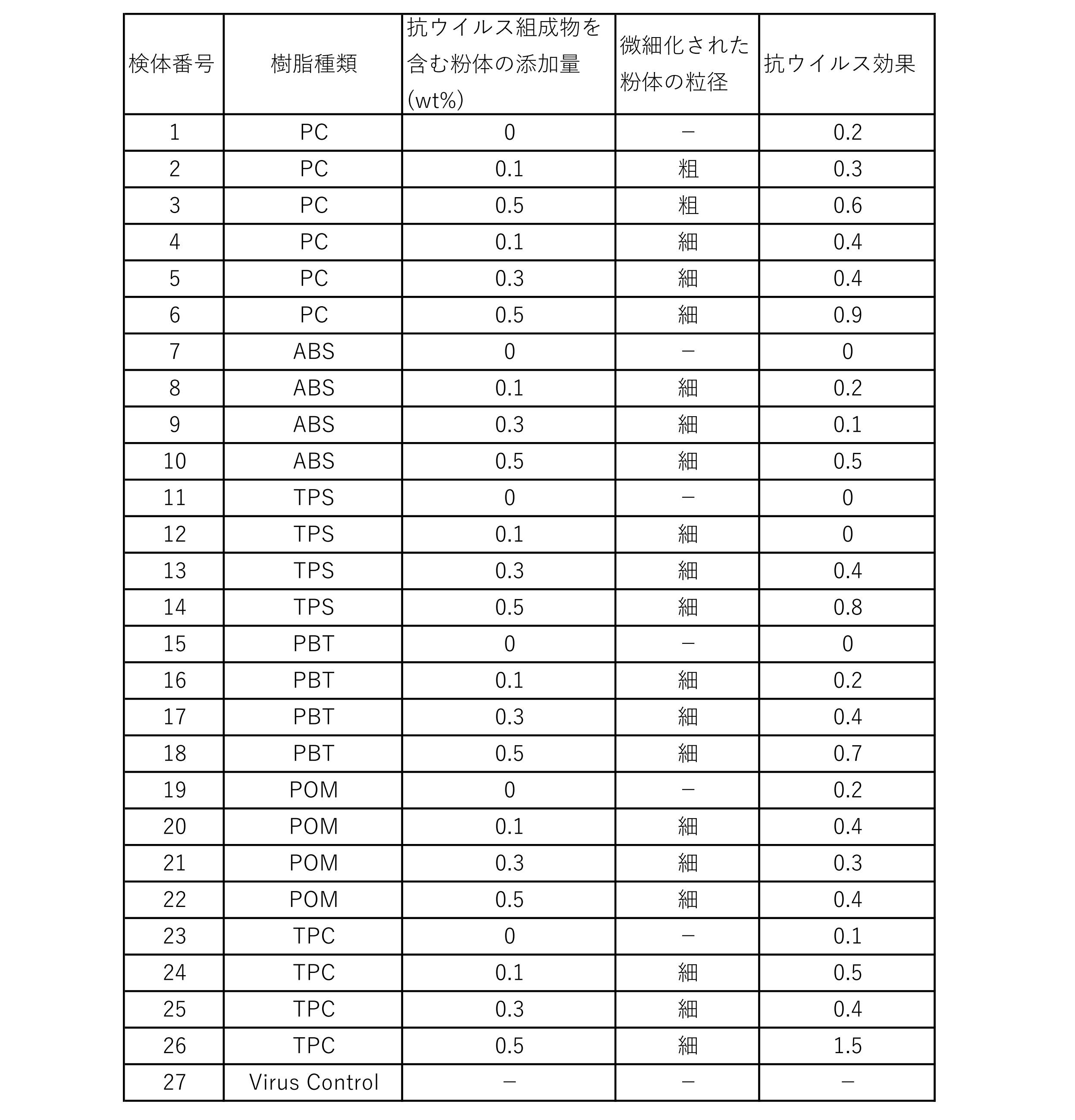
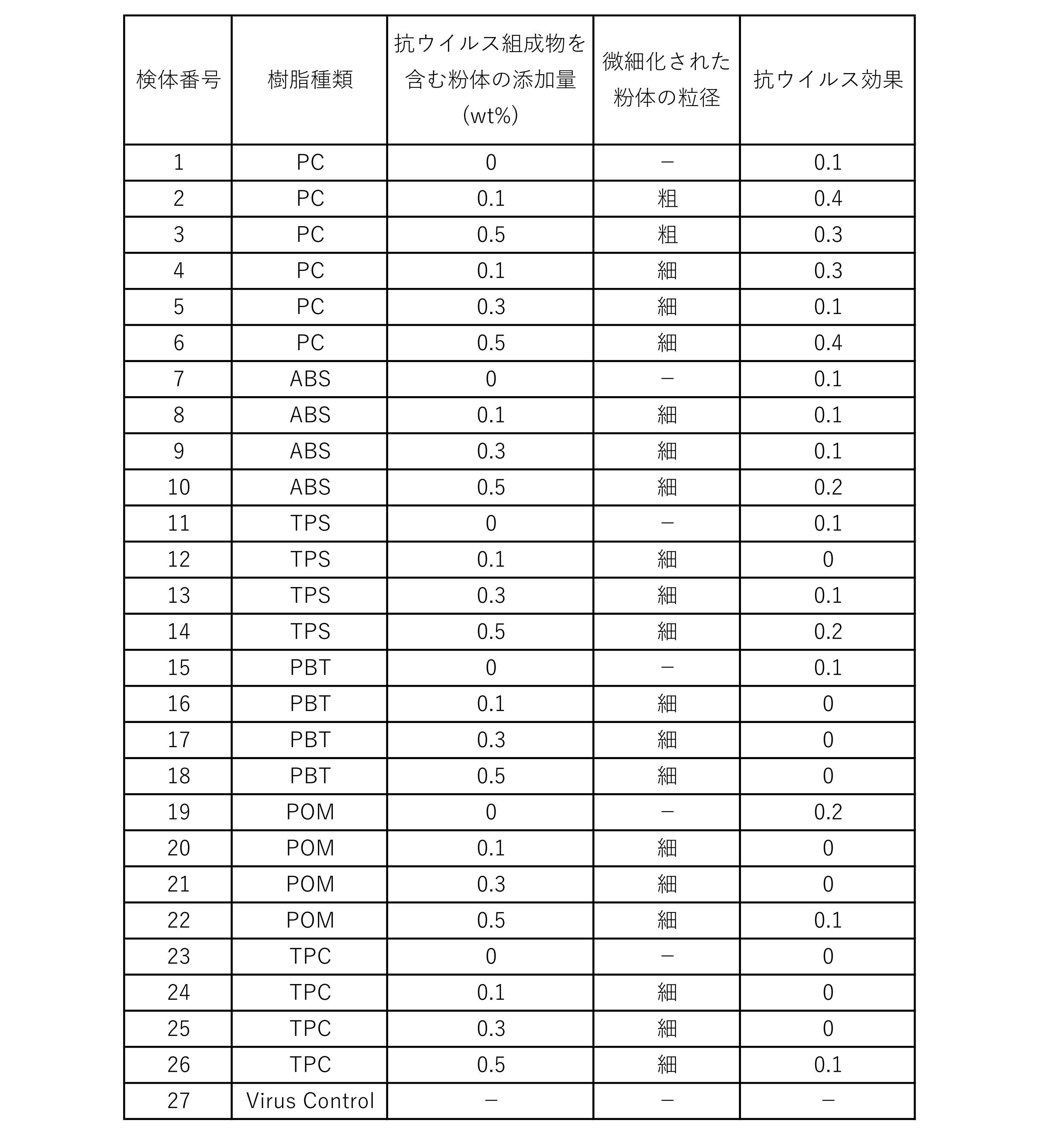
表1および表2に示すように、抗菌・抗ウイルス組成物を樹脂に配合することにより、インフルエンザウイルスおよびヘルペスウイルスの両方に対するウイルス抑制効果を有することが全体的に確認された。特に、抗菌・抗ウイルス組成物を0.3wt%以上配合したものでは、その効果が大きかった。
また、樹脂としてポリカーボネート(PC)を用いた抗菌・抗ウイルス樹脂については、抗ウイルス効果の経時変化も検証した。すなわち、維持培地(1%FBS添加培養液)に添加した各ウイルス液(インフルエンザウイルスまたはヘルペスウイルス)、3mLを滅菌袋に入れ、そこにポリカーボネート(PC)を使用した抗菌・抗ウイルス樹脂のプレートを浸した状態で(37℃、5%CO2条件下)、インキュベーションした。1、3、6、12時間経過後ウイルス液をそれぞれ取り出し、そのウイルス活性を、TCID50法により判定しところ、抗菌・抗ウイルス組成物を0.5wt%添加した検体では、1時間経過後から抗ウイルス作用が認められ、その効果はその後(3、6、12時間経過後)にも認められた。
<第2の配合による評価>
(抗菌・抗ウイルス組成物を含む粉体の調製)
K11H[(VO)3(SbW9O33)2]の原末として89.1mgのK11H[(VO)3(SbW9O33)2]・27H2Oと、Na9[SbW9O33]の原末として9.9mgのNa9[SbW9O33]・19H2Oとを混合した後、粉体化をし、抗菌・抗ウイルス組成物を含む粉体を得た。
(抗菌・抗ウイルス組成物を含む粉体の調製)
K11H[(VO)3(SbW9O33)2]の原末として89.1mgのK11H[(VO)3(SbW9O33)2]・27H2Oと、Na9[SbW9O33]の原末として9.9mgのNa9[SbW9O33]・19H2Oとを混合した後、粉体化をし、抗菌・抗ウイルス組成物を含む粉体を得た。
(粉体の微細化)
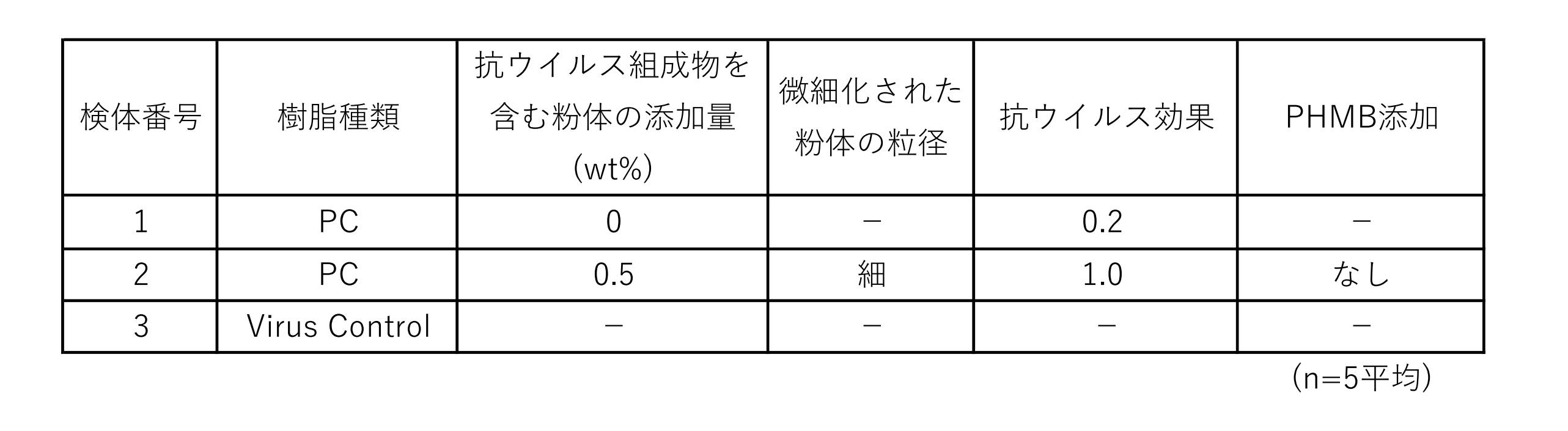
得られた粉体を微細化することにより平均粒径50μm以下となるまで微細化し、微細化した粉体を得た。なお、下記表3の「微細化された粉体の粒径」欄には、表1および2と同様の表記を行った。
得られた粉体を微細化することにより平均粒径50μm以下となるまで微細化し、微細化した粉体を得た。なお、下記表3の「微細化された粉体の粒径」欄には、表1および2と同様の表記を行った。
(抗菌・抗ウイルス樹脂の調製)
微細化した粉体と、樹脂(PC)と、分散剤とを、所定の温度(XX~XX℃)でそれぞれ混合、成形し、抗菌・抗ウイルス樹脂を得た。
微細化した粉体と、樹脂(PC)と、分散剤とを、所定の温度(XX~XX℃)でそれぞれ混合、成形し、抗菌・抗ウイルス樹脂を得た。
ここで、樹脂(PC)に対して、粉体を0.5wt%添加し、プレート状の抗菌・抗ウイルス樹脂を作製した。なお、樹脂(PC)に対して粉体を加えないもの(添加量0wt%)のサンプルも作製した。
(抗ウイルス活性の評価)
ウイルス/培養細胞としては、インフルエンザウイルス(Influenza virus A型/ MDCK細胞(犬の腎臓由来株化細胞))を用意した。
ウイルス/培養細胞としては、インフルエンザウイルス(Influenza virus A型/ MDCK細胞(犬の腎臓由来株化細胞))を用意した。
SIAA(抗菌製品技術協議会)により規定された方法に準じて、ウイルス液0.4mLを樹脂プレートに添加し、2cm四方のフィルムで蓋した状態にして室温(22~23℃)で、24時間インキュベーションしたのち、ウイルス液を回収して、ウイルス活性は、「第1の配合による評価」と同様、TCID50法により判定した。樹脂に対する粉体の添加量が0.5wt%のサンプルおよび0wt%のサンプルは、それぞれ5サンプル測定を行い、平均値を算出した。
なお、フィルムとしては、実験用ハイブ・バック;コスモバイオ製、品番S-1001を適応サイズに細切りし、滅菌後使用した。また、樹脂も抗菌・抗ウイルス組成物を含む粉体も用いないもの(Virus Control)についても同様に判定を行った。
表3に、TCID50法により評価を行った抗ウイルス効果を示す。
なお、フィルムとしては、実験用ハイブ・バック;コスモバイオ製、品番S-1001を適応サイズに細切りし、滅菌後使用した。また、樹脂も抗菌・抗ウイルス組成物を含む粉体も用いないもの(Virus Control)についても同様に判定を行った。
表3に、TCID50法により評価を行った抗ウイルス効果を示す。
表3に示すように、抗菌・抗ウイルス組成物を樹脂に配合することにより、ウイルス抑制効果を有することが確認された。
Claims (17)
- K11H[(VO)3(SbW9O33)2]及びNa9[SbW9O33]を含有する抗菌・抗ウイルス組成物と、
樹脂と、
を含む抗菌・抗ウイルス樹脂。 - 前記抗菌・抗ウイルス組成物は、さらにVOSO4を含む請求項1記載の抗菌・抗ウイルス樹脂。
- 前記抗菌・抗ウイルス組成物は、さらにポリヘキサメチレンビグアナイドまたはその塩を含む請求項1または2記載の抗菌・抗ウイルス樹脂。
- 前記樹脂は、熱可塑性樹脂である請求項1~3の何れかに記載の抗菌・抗ウイルス樹脂。
- 前記抗菌・抗ウイルス組成物は、粒径50μm以下の粉体として存在する請求項1~4の何れかに記載の抗菌・抗ウイルス樹脂。
- 前記樹脂に対して前記抗菌・抗ウイルス組成物を0.1~2.0重量%含有する請求項
1~5の何れかに記載の抗菌・抗ウイルス樹脂。 - さらに分散剤を含む請求項1~6の何れかに記載の抗菌・抗ウイルス樹脂。
- 請求項1~7の何れか記載の抗菌・抗ウイルス樹脂を用いた成形品。
- K11H[(VO)3(SbW9O33)2]及びNa9[SbW9O33]を含有する抗菌・抗ウイルス組成物を粉体とする粉体化工程と、
前記粉体を微細化する微細化工程と、
微細化された前記粉体と樹脂とを混合する混合工程と
を含む抗菌・抗ウイルス樹脂の製造方法。 - 前記抗菌・抗ウイルス組成物は、さらにVOSO4を含む請求項9記載の抗菌・抗ウイルス樹脂の製造方法。
- 前記抗菌・抗ウイルス組成物は、さらにポリヘキサメチレンビグアナイドまたはその塩を含む請求項9または10記載の抗菌・抗ウイルス樹脂の製造方法。
- 前記樹脂は、熱可塑性樹脂である請求項9~11の何れかに記載の抗菌・抗ウイルス樹脂の製造方法。
- 前記微細化工程は、前記粉体を粒径50μm以下まで微細化する請求項9~12の何れかに記載の抗菌・抗ウイルス樹脂の製造方法。
- 前記混合工程において、前記粉体を前記樹脂に対して0.1~2.0重量%混合する請求項9~13の何れかに記載の抗菌・抗ウイルス樹脂の製造方法。
- 前記混合工程において、さらに分散剤を混合する請求項9~14の何れかに記載の抗菌・抗ウイルス樹脂の製造方法。
- 請求項9~15の何れか一項に記載の抗菌・抗ウイルス樹脂の製造方法により製造された抗菌・抗ウイルス樹脂を用いた成形品の製造方法。
- 前記成形品の成形温度が、160℃以上、かつ400℃以下である請求項16記載の抗菌・抗ウイルス樹脂を用いた成形品の製造方法。
Priority Applications (1)
| Application Number | Priority Date | Filing Date | Title |
|---|---|---|---|
| JP2022560646A JPWO2022097334A1 (ja) | 2020-11-04 | 2021-07-30 |
Applications Claiming Priority (2)
| Application Number | Priority Date | Filing Date | Title |
|---|---|---|---|
| JP2020184426 | 2020-11-04 | ||
| JP2020-184426 | 2020-11-04 |
Publications (1)
| Publication Number | Publication Date |
|---|---|
| WO2022097334A1 true WO2022097334A1 (ja) | 2022-05-12 |
Family
ID=81457690
Family Applications (1)
| Application Number | Title | Priority Date | Filing Date |
|---|---|---|---|
| PCT/JP2021/028242 Ceased WO2022097334A1 (ja) | 2020-11-04 | 2021-07-30 | 抗菌・抗ウイルス樹脂、抗菌・抗ウイルス樹脂の製造方法、成形品および成形品の製造方法 |
Country Status (3)
| Country | Link |
|---|---|
| JP (1) | JPWO2022097334A1 (ja) |
| TW (1) | TW202229444A (ja) |
| WO (1) | WO2022097334A1 (ja) |
Citations (3)
| Publication number | Priority date | Publication date | Assignee | Title |
|---|---|---|---|---|
| JP2005325083A (ja) * | 2004-05-17 | 2005-11-24 | Rikogaku Shinkokai | 抗ウイルス剤 |
| WO2017092920A2 (en) * | 2015-12-03 | 2017-06-08 | BSH Hausgeräte GmbH | Use of (hetero)polyoxometalates for simultaneously imparting antimicrobial properties to, and reducing the growth of a biofilm on a surface of a substrate in or on a home appliance |
| WO2019230210A1 (ja) * | 2018-05-31 | 2019-12-05 | Vbジャパンテクノロジー株式会社 | 抗菌・抗ウイルス組成物及び水溶液 |
-
2021
- 2021-07-30 JP JP2022560646A patent/JPWO2022097334A1/ja active Pending
- 2021-07-30 WO PCT/JP2021/028242 patent/WO2022097334A1/ja not_active Ceased
- 2021-08-26 TW TW110131708A patent/TW202229444A/zh unknown
Patent Citations (3)
| Publication number | Priority date | Publication date | Assignee | Title |
|---|---|---|---|---|
| JP2005325083A (ja) * | 2004-05-17 | 2005-11-24 | Rikogaku Shinkokai | 抗ウイルス剤 |
| WO2017092920A2 (en) * | 2015-12-03 | 2017-06-08 | BSH Hausgeräte GmbH | Use of (hetero)polyoxometalates for simultaneously imparting antimicrobial properties to, and reducing the growth of a biofilm on a surface of a substrate in or on a home appliance |
| WO2019230210A1 (ja) * | 2018-05-31 | 2019-12-05 | Vbジャパンテクノロジー株式会社 | 抗菌・抗ウイルス組成物及び水溶液 |
Non-Patent Citations (2)
| Title |
|---|
| DAN KATSUAKI, DAN KATSUAKI, FUJINAMI KATSUYUKI, SUMITOMO HAJIME, OGIWARA YASUAKI, SUHARA SHIGEHIKO, KONNO YOSHIHARU, SAWADA MITSUH: "Application of Antiviral Polyoxometalates to Living Environments—Antiviral Moist Hand Towels and Stationery Items", APPLIED SCIENCES, MDPI SWITZERLAND, vol. 10, no. 22, 20 November 2020 (2020-11-20), pages 8246, XP055938366, ISSN: 2076-3417, DOI: 10.3390/app10228246 * |
| TOSHIHIRO YAMASE: "Anti-tumor, -viral, and -bacterial activities of polyoxometalates for realizing an inorganic drug", JOURNAL OF MATERIALS CHEMISTRY, ROYAL SOCIETY OF CHEMISTRY, vol. 15, no. 45, 1 January 2005 (2005-01-01), pages 4773, XP055159480, ISSN: 09599428, DOI: 10.1039/b504585a * |
Also Published As
| Publication number | Publication date |
|---|---|
| JPWO2022097334A1 (ja) | 2022-05-12 |
| TW202229444A (zh) | 2022-08-01 |
Similar Documents
| Publication | Publication Date | Title |
|---|---|---|
| CN101883489B (zh) | 含银无机抗菌剂 | |
| CN101166422B (zh) | 银系无机抗菌剂及抗菌制品 | |
| KR102256087B1 (ko) | 항균성 및 악취유발화합물 분해성을 가지는 조성물의 제조방법 및 그 방법을 이용하여 제조되는 조성물 | |
| AU2007202262B2 (en) | Antibacterial zeolite particles and antibacterial resin composition | |
| WO2010131667A1 (ja) | 銀系無機抗菌剤およびその製造方法 | |
| CN102017997A (zh) | 一种高效单原子银纳米线抗菌材料 | |
| CN110200013A (zh) | 一种抗菌防霉剂及其制备方法与应用 | |
| WO2023045822A1 (zh) | 一种聚丙烯基抗菌母粒及其制备方法和应用 | |
| WO2011075855A1 (en) | Nanoparticles with fungicidal properties, a process for their preparation and their use in the manufacture of different articles | |
| JP5854590B2 (ja) | 抗菌・消臭処理剤および抗菌・消臭処理物品 | |
| WO2022097334A1 (ja) | 抗菌・抗ウイルス樹脂、抗菌・抗ウイルス樹脂の製造方法、成形品および成形品の製造方法 | |
| JP3335689B2 (ja) | ゼオライト系抗菌剤とその製造法および抗菌性ポリマー組成物 | |
| WO2012111894A1 (ko) | 펠릿형 항균성 마스터배치 | |
| CN105647099A (zh) | 一种抗菌abs树脂的制备方法 | |
| CN111892756A (zh) | 抗菌塑料制品的母料及其制备方法和抗菌垃圾桶 | |
| JPS63215520A (ja) | 中性チタニアゾル及びその製造方法 | |
| JP2008074778A (ja) | 銀系無機抗菌剤 | |
| JP5574813B2 (ja) | 酸化チタン系微粒子の製造方法、該酸化チタン系微粒子を用いた抗菌・消臭剤ならびに抗菌・消臭性塗膜形成用塗布液および抗菌・消臭性塗膜付基材 | |
| WO2010098309A1 (ja) | 銀ナノ微粒子含有の組成物、銀ナノ微粒子含有のマスターバッチおよびその成形品 | |
| US20030223942A1 (en) | Aqueous composition containing high purity iron oxide | |
| JP3938447B2 (ja) | 抗菌防黴剤 | |
| JPH0742101B2 (ja) | サブミクロンa型ゼオライト及びその製造法 | |
| JP3585059B2 (ja) | 抗菌性組成物、および抗菌性樹脂組成物の製造方法 | |
| JPH08113729A (ja) | 抗菌性組成物およびその製造方法 | |
| JP3311966B2 (ja) | 抗菌抗カビ性粉末およびその製造方法 |
Legal Events
| Date | Code | Title | Description |
|---|---|---|---|
| 121 | Ep: the epo has been informed by wipo that ep was designated in this application |
Ref document number: 21888887 Country of ref document: EP Kind code of ref document: A1 |
|
| ENP | Entry into the national phase |
Ref document number: 2022560646 Country of ref document: JP Kind code of ref document: A |
|
| NENP | Non-entry into the national phase |
Ref country code: DE |
|
| 122 | Ep: pct application non-entry in european phase |
Ref document number: 21888887 Country of ref document: EP Kind code of ref document: A1 |