WO2022092170A1 - 十脚目甲殻類の成長調節方法 - Google Patents
十脚目甲殻類の成長調節方法 Download PDFInfo
- Publication number
- WO2022092170A1 WO2022092170A1 PCT/JP2021/039717 JP2021039717W WO2022092170A1 WO 2022092170 A1 WO2022092170 A1 WO 2022092170A1 JP 2021039717 W JP2021039717 W JP 2021039717W WO 2022092170 A1 WO2022092170 A1 WO 2022092170A1
- Authority
- WO
- WIPO (PCT)
- Prior art keywords
- gene
- growth
- function
- molting
- related gene
- Prior art date
- Legal status (The legal status is an assumption and is not a legal conclusion. Google has not performed a legal analysis and makes no representation as to the accuracy of the status listed.)
- Ceased
Links
Images




Classifications
-
- A—HUMAN NECESSITIES
- A01—AGRICULTURE; FORESTRY; ANIMAL HUSBANDRY; HUNTING; TRAPPING; FISHING
- A01K—ANIMAL HUSBANDRY; AVICULTURE; APICULTURE; PISCICULTURE; FISHING; REARING OR BREEDING ANIMALS, NOT OTHERWISE PROVIDED FOR; NEW BREEDS OF ANIMALS
- A01K67/00—Rearing or breeding animals, not otherwise provided for; New or modified breeds of animals
- A01K67/60—New or modified breeds of invertebrates
- A01K67/61—Genetically modified invertebrates, e.g. transgenic or polyploid
- A01K67/65—Genetically modified arthropods
- A01K67/67—Genetically modified crustaceans
-
- A—HUMAN NECESSITIES
- A01—AGRICULTURE; FORESTRY; ANIMAL HUSBANDRY; HUNTING; TRAPPING; FISHING
- A01K—ANIMAL HUSBANDRY; AVICULTURE; APICULTURE; PISCICULTURE; FISHING; REARING OR BREEDING ANIMALS, NOT OTHERWISE PROVIDED FOR; NEW BREEDS OF ANIMALS
- A01K67/00—Rearing or breeding animals, not otherwise provided for; New or modified breeds of animals
- A01K67/027—New or modified breeds of vertebrates
-
- C—CHEMISTRY; METALLURGY
- C12—BIOCHEMISTRY; BEER; SPIRITS; WINE; VINEGAR; MICROBIOLOGY; ENZYMOLOGY; MUTATION OR GENETIC ENGINEERING
- C12N—MICROORGANISMS OR ENZYMES; COMPOSITIONS THEREOF; PROPAGATING, PRESERVING, OR MAINTAINING MICROORGANISMS; MUTATION OR GENETIC ENGINEERING; CULTURE MEDIA
- C12N15/00—Mutation or genetic engineering; DNA or RNA concerning genetic engineering, vectors, e.g. plasmids, or their isolation, preparation or purification; Use of hosts therefor
- C12N15/09—Recombinant DNA-technology
-
- C—CHEMISTRY; METALLURGY
- C12—BIOCHEMISTRY; BEER; SPIRITS; WINE; VINEGAR; MICROBIOLOGY; ENZYMOLOGY; MUTATION OR GENETIC ENGINEERING
- C12N—MICROORGANISMS OR ENZYMES; COMPOSITIONS THEREOF; PROPAGATING, PRESERVING, OR MAINTAINING MICROORGANISMS; MUTATION OR GENETIC ENGINEERING; CULTURE MEDIA
- C12N15/00—Mutation or genetic engineering; DNA or RNA concerning genetic engineering, vectors, e.g. plasmids, or their isolation, preparation or purification; Use of hosts therefor
- C12N15/09—Recombinant DNA-technology
- C12N15/11—DNA or RNA fragments; Modified forms thereof; Non-coding nucleic acids having a biological activity
- C12N15/113—Non-coding nucleic acids modulating the expression of genes, e.g. antisense oligonucleotides; Antisense DNA or RNA; Triplex- forming oligonucleotides; Catalytic nucleic acids, e.g. ribozymes; Nucleic acids used in co-suppression or gene silencing
-
- C—CHEMISTRY; METALLURGY
- C12—BIOCHEMISTRY; BEER; SPIRITS; WINE; VINEGAR; MICROBIOLOGY; ENZYMOLOGY; MUTATION OR GENETIC ENGINEERING
- C12N—MICROORGANISMS OR ENZYMES; COMPOSITIONS THEREOF; PROPAGATING, PRESERVING, OR MAINTAINING MICROORGANISMS; MUTATION OR GENETIC ENGINEERING; CULTURE MEDIA
- C12N15/00—Mutation or genetic engineering; DNA or RNA concerning genetic engineering, vectors, e.g. plasmids, or their isolation, preparation or purification; Use of hosts therefor
- C12N15/09—Recombinant DNA-technology
- C12N15/11—DNA or RNA fragments; Modified forms thereof; Non-coding nucleic acids having a biological activity
- C12N15/113—Non-coding nucleic acids modulating the expression of genes, e.g. antisense oligonucleotides; Antisense DNA or RNA; Triplex- forming oligonucleotides; Catalytic nucleic acids, e.g. ribozymes; Nucleic acids used in co-suppression or gene silencing
- C12N15/1137—Non-coding nucleic acids modulating the expression of genes, e.g. antisense oligonucleotides; Antisense DNA or RNA; Triplex- forming oligonucleotides; Catalytic nucleic acids, e.g. ribozymes; Nucleic acids used in co-suppression or gene silencing against enzymes
Definitions
- the present invention relates to a method for regulating the growth of decapod crustaceans (shrimp, crab, etc.), particularly a method for promoting growth. More specifically, the present invention relates to a method for regulating the growth of a decapod crustacean, particularly a method for promoting growth, which comprises inhibiting or enhancing the function of a specific gene or a transcript or translation product thereof.
- Patent Document 1 a method of administering a low molecular weight lignin and / or a high molecular weight lignin
- Patent Document 2 a method of administering a peptide (GHRP-6) (Patent Document 2), a method of administering a fatty acid ester of cholesterol represented by a predetermined general formula (Patent Document 3), and the like.
- a method of improving the growth rate of decapod crustaceans by fluctuating (suppressing or enhancing) the expression level of the gene is, for example, suppressing the expression of the MIH (Molt-Inhibiting Hormone) gene of the decapoda shrimp by RNAi. It has been reported that this can accelerate the molting cycle (Non-Patent Document 1), but little is known so far.
- MIH Microlt-Inhibiting Hormone
- Patent Documents 1 to 3 and Non-Patent Document 1 have room for improvement in the effect of promoting growth (sustainability, stability, etc.).
- the present invention is a means for regulating the growth of animals belonging to the order Decapoda (Decapoda crustaceans) such as shrimp and crab, for example, a means for promoting the growth, and particularly includes varying the expression level of a gene.
- the challenge is to provide means.
- the present inventors include environmental information among the genes contained in the mTOR signal transduction pathway (sometimes referred to as "mTOR pathway" in the present specification), which is involved in the control of environmental information affecting the growth of living organisms.
- mTOR pathway mTOR pathway
- AMPK AMP-activated protein kinase
- Akt phosphoinositide
- the present invention provides the following items in one aspect.
- Function of genes including at least one growth regulation-related gene selected from the group consisting of mTOR pathway, Akt pathway and their upstream and downstream factors, and at least one molting-related gene optionally further selected from molting-related factors. , Or a method of regulating the growth of an animal belonging to the order of the tenth leg, comprising the step of regulating the function of a transcript or translation of the gene.
- Item 2 Item 2. The method according to Item 1, wherein the gene comprises at least one growth regulation related gene selected from the group consisting of Akt, AMPK, FOXO, p27, PDK, PTEN, TBC1D7, TSC1 and TSC2.
- Item 6 The method according to Item 1, wherein the gene comprises at least one molting-related gene selected from the group consisting of EcR, Kr-h1, Met and MIH.
- the gene comprises at least one selected from the group consisting of AMPK, TSC1, TSC2 and PDK as a growth regulation-related gene, and the step inhibits the function of the growth regulation-related gene or its transcript or translation product.
- Item 6. The method according to any one of Items 1 to 3, wherein the method comprises adjusting the gene so as to promote the growth of an animal belonging to the decapod.
- Item 5 Item 4. The method according to Item 4, wherein the growth regulation-related gene comprises at least AMPK and TSC1 and / or TSC2.
- the gene comprises at least Akt as a growth regulation-related gene, the step comprising regulating the growth regulation-related gene or its transcript or translation product to enhance its function, the animal belonging to the decapod. Item 6. The method according to any one of Items 1 to 3, wherein the method is regulated to promote growth.
- the gene comprises at least Akt as a growth regulation-related gene, and the step comprises regulating the function of the growth regulation-related gene or its transcript or translation product to inhibit the function of the animal belonging to the decapod. Item 6. The method according to any one of Items 1 to 3, wherein the method is regulated to suppress growth.
- the gene comprises at least PTEN as a growth regulation-related gene and at least MIH as a molting-related gene, and the step inhibits the function of the growth regulation-related gene and the molting-related gene or their transcripts or translation products.
- the method according to any one of Items 1 to 3, wherein the method comprises adjusting the gene so as to promote the growth of the animal belonging to the tenth leg.
- the gene is at least one growth regulatory related gene selected from the group consisting of 4EBP, Akt, FGF1, FOXO, ILP, PTEN, Rheb, S6K1, TSC1 and TSC2, and optionally further EcR, Kr-h1, Met and Item 2.
- the method according to Item 1 which comprises at least one molting-related gene selected from the group consisting of MIH.
- the regulation of the function of the gene or its transcript or translation product is an inhibition, and is carried out by suppressing the expression of the gene by RNA interference method (RNAi method), antisense method or genome editing, Items 1 to 5, 7 The method according to any one of 9 to 9.
- RNAi method RNA interference method
- Items 1 to 5, 7 The method according to any one of 9 to 9.
- Function of genes including at least one growth regulation-related gene selected from the group consisting of mTOR pathway, Akt pathway and their upstream and downstream factors, and at least one molting-related gene optionally further selected from molting-related factors. , Or animals belonging to the order Decapod, whose transcripts or translations are regulated in function.
- Item 12 Item 12.
- Item 13 Item 12.
- the gene is at least one growth regulatory related gene selected from the group consisting of 4EBP, Akt, FGF1, FOXO, ILP, PTEN, Rheb, S6K1, TSC1 and TSC2, and optionally further EcR, Kr-h1, Met and Item 12.
- the animal according to Item 11 which comprises at least one molting-related gene selected from the group consisting of MIH.
- Item 15 The regulation of the function of the gene or its transcript or translation product was inhibited, and the function of the double-stranded RNA or vector for suppressing the expression of the gene by the RNA interference method (RNAi method) and the function of the gene were deleted in the body.
- RNAi method RNA interference method
- decapod crustaceans By using the method for regulating the growth of decapod crustaceans according to the present invention, it is possible to promote the growth even in a large-scale breeding environment such as aquaculture, or conversely suppress the growth depending on the application. Become. For example, it is possible to obtain a high-growth decapod crustacean by knocking down a specific gene that does not involve gene modification, which is preferable from the viewpoint of environmental conservation, and the effect is inherited from generation to generation by gene modification. High-growth strains of decapod crustaceans can also be obtained.
- FIG. 1 shows the results regarding the difference in growth between the TSC2 function-inhibiting group (TSC2 RNAi ) and the GFP function-inhibiting group (GFP RNAi ) as a control group in Example 1.
- TSC2 RNAi TSC2 function-inhibiting group
- GFP RNAi GFP function-inhibiting group
- the regression coefficient indicating the growth rate per day was about twice as high in the TSC2 function-inhibited group as compared with the control group.
- [E] Changes in individual body weight for each molt. In the TSC2 function-inhibited group, the amount of molting growth increased and the molting was accelerated by one time within the experimental period. *: N 7-9; Students' t-test or Welch's t-test; P ⁇ 0.05. FIG.
- FIG. 2 is a photograph comparing the body sizes of the TSC1 and AMPK co-function inhibition group (TSC2 RNAi & AMPK RNAi ) (19 days after the start) and the control group (GFP RNAi ) (16 days after the start) in Example 2 ( The individual body weight at the start is 20 mg).
- FIG. 3 is a schematic diagram of the mTOR signaling pathway (quoted from Journal of Cell Science 122, 3589-3594. Doi: 10.1242 / jcs.051011).
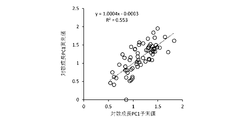
- FIG. 4 shows the relationship between the principal component score of the growth PC1 after molting predicted from the state of the individual before molting using the mathematical model created in Example 4 and the principal component score of the growth PC1 after molting. .. FIG.
- FIG. 5 shows the correlation of the gene expression level with the growth PC1 obtained in Example 4.
- FIG. 6 is a path diagram model showing the relationship between the expression kinetics and growth of each gene, which was prepared based on the results of Tables 6 and 7 of Example 4.
- -Growth regulation (promotion or suppression) method A method for regulating the growth of an animal belonging to the order Decapod (sometimes referred to as a "target animal” in the present specification) according to the present invention (may be referred to as a "growth regulating method of the present invention” in the present specification. ) Is a step of regulating the function of a specific gene or a transcript or translation product thereof (in the present specification, these genes, transcripts and translation products may be collectively referred to as "specific genes, etc.”). In the specification, it may be referred to as “adjustment step").
- the growth-regulating method of the present invention includes (I) a method for promoting the growth of a target animal (sometimes referred to as “the growth promoting method of the present invention” in the present specification) and (II) a method for promoting the growth of a target animal.
- a method for suppressing (sometimes referred to as “the method for suppressing growth of the present invention” in the present specification) is included, and may vary depending on the embodiment and application of the present invention.
- the regulatory steps include (i) a step of inhibiting the function of a specific gene or the like (sometimes referred to as an “inhibition step” in the present specification), and (ii) a step of enhancing the function of a specific gene or the like (book).
- enhancement step a step of inhibiting the function of a specific gene or the like and enhancing the function of another specific gene or the like (in the present specification, “suppression / enhancement step”).
- compression / enhancement step a step of inhibiting the function of a specific gene or the like and enhancing the function of another specific gene or the like
- suppression / enhancement step a step of inhibiting the function of a specific gene or the like and enhancing the function of another specific gene or the like
- suppression / enhancement step a step of inhibiting the function of a specific gene or the like and enhancing the function of another specific gene or the like.
- the growth regulating method of the present invention includes, for example, (I-i) a growth promoting method including an inhibition step of a specific gene or the like, (I-ii) a growth promoting method including an enhancing step of a specific gene or the like, (I-iii).
- a growth promoting method including a step of suppressing / enhancing a specific gene, that is, a step of inhibiting a specific gene or the like and a step of enhancing another specific gene or the like, (II-i) a method of suppressing growth including a step of inhibiting a specific gene or the like, (II-ii) A growth suppressing method including a step of enhancing a specific gene or the like, (II-iii) a step of suppressing / enhancing a specific gene, that is, a step of inhibiting a specific gene or the like and a step of enhancing another specific gene or the like are included. , Growth suppression methods, etc. are included.
- target animals are not particularly limited, and various decapods called shrimp, crabs, hermit crabs, decapodas, etc. Includes crustaceans.
- Mystery Crayfish Procambarus virginalis
- a freshwater shrimp that is exceptionally easy to breed and reproduce as a decapod crustacean used in the examples below, has been attracting attention as a model organism for decapod crustaceans in recent years.
- prawns Marsupenaeus japonicus
- black tigers Pieris monodon
- whiteleg shrimp Pieriseus vannamei
- spiny lobsters are also relatively important target animals.
- the “specific gene” in the present invention can include a "growth regulation-related gene”.
- the “growth regulation-related gene” in the present invention refers to a gene that is "mTOR pathway, Akt pathway and their upstream and downstream factors” related to the control mechanism of cell division or the mechanism that directs growth.
- factors of the "mTOR pathway” include genes such as 4EBP, AMPK, mTOR, PRAS40, Raptor, Rheb, S6K1, TBC1D7, TSC1 and TSC2.
- Factors of the "Akt pathway” include, for example, genes such as Akt, FOXO, PDK, and PTEN.
- Examples of "downstream factors of mTOR pathway and Akt pathway” include genes such as p27 that control the cell cycle.
- upstream factors of mTOR pathway and Akt pathway include genes such as FGF1 and ILP (Insulin-like peptide).
- FIG. 3 can be referred to.
- the growth regulation-related gene may be only one kind or a combination of two or more kinds.
- the growth regulation-related gene is one of "mTOR pathway factor”, “Akt pathway factor”, “mTOR pathway and / or Akt pathway upstream factor” and "mTOR pathway and / or Akt pathway downstream factor”. It may be at least one gene selected from one factor, or at least two genes (at least one gene for each factor) selected from a plurality of these factors.
- the “specific gene” in the present invention can include a "molting-related gene".
- the specific gene does not have to contain a growth regulation related gene.
- the "molting-related gene” in the present invention refers to a gene that is a "molting-related factor” related to the control mechanism of molting. Examples of the molting-related gene include E75, EcR, Kr-h1, Met, MIH and the like.
- the molting-related gene may be only one kind or a combination of two or more kinds.
- the molting-related gene may be, for example, at least one selected from the group consisting of E75, EcR, Kr-h1 and Met, preferably Kr-h1.
- the "specific gene” includes a "growth regulation-related gene” and can optionally further include a "molting-related gene”. That is, the specific gene may contain at least one growth regulation-related gene, or may contain both at least one growth regulation-related gene and at least one molting-related gene.
- the "specific gene” includes a "molting-related gene” and can optionally further include a "growth regulation-related gene”. That is, the specific gene may contain at least one molting-related gene, or may contain both at least one molting-related gene and at least one growth regulation-related gene.
- the “specific gene” in one embodiment of the present invention is referred to as "4EBP, Akt, AMPK, FGF1, FOXO, ILP, p27," as a growth regulation-related gene.
- 4EBP, Akt, AMPK, FGF1, FOXO, ILP, p27 as a growth regulation-related gene.
- the specific gene 0 is a combination of the following "specific gene 1" and "specific gene 2".
- the “specific gene” in one embodiment of the present invention is referred to as “Akt, AMPK, FOXO, p27, PDK, PTEN, TBC1D7,” as growth regulation-related genes. It may include “at least one gene selected from the group consisting of TSC1 and TSC2", and optionally further include “at least one gene selected from the group consisting of EcR, Kr-h1, Met and MIH” as a skinning-related gene. can.
- Akt, FOXO, PDK and PTEN are factors of the Akt pathway
- p27 is a downstream factor of the mTOR pathway and the Akt pathway.
- AMPK, TBC1D7, TSC1 and TSC2 are factors in the mTOR pathway.
- Examples 1 (Table 1), Example 2 (Table 2), Example 3 (Table 3), and the like, which will be described later in the present specification, can be referred to.
- the “specific gene” in one embodiment of the present invention is referred to as "4EBP, Akt, FGF1, FOXO, ILP, PTEN, Rheb” as a growth regulation-related gene.
- At least one gene selected from the group consisting of S6K1, TSC1 and TSC2 ", and optionally further” at least one gene selected from the group consisting of EcR, Kr-h1, Met and MIH “as a dehulling-related gene”.
- Akt, FOXO and PTEN are factors of the Akt pathway
- 4EBP, Rheb, S6K1, TSC1 and TSC2 are factors of the mTOR pathway
- FGF1 and ILP are factors of the Akt pathway and It is an upstream factor of the mTOR pathway.
- Example 4 Table 4, FIG. 5
- Akt, FOXO, PTEN and TSC2 correspond to both specific genes 1 and 2, and can be treated as specific gene 1 or as specific gene 2 depending on the relationship with the technical idea of the present invention. ..
- Specific genes include (A) a type in which the growth of the target animal is promoted by inhibiting the function, and conversely, the growth of the target animal is suppressed by enhancing the function. (Sometimes collectively referred to as "specific gene A” in the present specification) and (B) Growth of the target animal is suppressed by inhibiting the function, and conversely, growth of the target animal by enhancing the function. (Sometimes collectively referred to as "specific gene B" in the present specification) are included.
- Specific genes A include (A1) growth regulation-related genes such as AMPK, FOXO, p27, PDK, PTEN, TBC1D7, TSC1 and TSC2 among specific genes 1, and 4EBP, FOXO and PTEN among (A2) specific genes 2. , S6K1, TSC2 and other growth regulation-related genes, and Kr-h1 and MIH and other dehulling-related genes (sometimes collectively referred to as "specific gene 2A" in the present specification).
- Examples of the specific gene B include (B1) growth regulation-related genes such as Akt and PTEN among the specific genes 1, and growth regulation-related genes such as Akt, FGF1, ILP, Rheb, and S6K1 among the (B2) specific genes 2.
- PTEN and S6K1 correspond to both specific genes A and B, and are treated as specific genes A depending on the embodiment (for example, depending on the type of other specific genes used in combination and the number of molts). Can also be treated as a specific gene B.
- the specific gene comprises at least one selected from the group consisting of AMPK, TSC1, TSC2 and PDK as a growth regulation related gene (that is, at least the AMPK gene, TSC1 gene as a specific gene or the like). , TSC2 gene or PDK gene, or the effect of regulating the function of these transcripts or translations) on the regulation of the growth of the target animal (eg, the effect of promoting the growth of the target animal when the function is inhibited). Is preferable because it improves.
- At least one selected from the group consisting of AMPK, TSC1, TSC2 and PDK is used as a specific gene.
- at least one gene selected from the group consisting of AMPK, TSC1, TSC2 or PDK and other genes eg, Akt, FOXO, p27, PTEN and TBC1D7) (specification other than AMPK, TSC1, TSC2 and PDK). It may be used in combination with gene 1) or specific gene 2).
- Examples 1 (Table 1) and Example 2 (Table 2), which will be described later in the present specification, can be referred to.
- the particular gene comprises at least AMPK and TSC1 and / or TSC2 as growth regulatory related genes (ie, at least the AMPK gene and TSC1 gene and / or TSC2 gene, or them, as the particular gene or the like.
- AMPK is a factor (gene) that mediates the deterioration of the available energy state of cells, and embodiments used in combination with TSC1 / TSC2 that mediate the transmission of environmental information regulate (eg, promote) the growth rate of the target animal.
- AMPK and TSC1 and / or TSC2 may be used as specific genes, or AMPK and TSC1 and / or TSC2 and other genes (eg, Akt, FOXO, p27, PDK, PTEN and TBC1D7). It may be used in combination with at least one gene (specific gene 1) other than AMPK, TSC1 and TSC2, or specific gene 2) selected from the group consisting of.
- the subject is that the particular gene comprises at least Akt as a growth regulation related gene (ie, as a particular gene or the like, at least regulates the function of the Akt gene or its transcript or translation product). It is preferable for regulating the growth of an animal (for example, in terms of the effect of promoting the growth of the target animal when the function is enhanced, or in terms of the effect of suppressing the growth of the target animal when the function is inhibited).
- Akt growth regulation related gene
- the particular gene comprises at least PTEN or other growth regulation related gene (preferably contained in specific gene 2) and MIH, or PTEN and MIH or other molting related gene.
- PTEN or other growth regulation related gene preferably contained in specific gene 2
- MIH or PTEN and MIH or other molting related gene.
- it is preferable to regulate the growth of the target animal for example, in terms of the effect of promoting the growth of the target animal when the function is inhibited.
- the third embodiment described later in the present specification can be referred to.
- the means for regulating (inhibiting or enhancing) the function of a specific gene or the like is not particularly limited, and various well-known and well-known means can be used and are appropriate depending on the selected means. Conditions can be set.
- Examples of means for inhibiting the function of the specific gene itself include genome editing technology (CRISPR-Cas system, TALEN, ZFN) or other gene recombination technology (classical homologous recombination method, etc.).
- CRISPR-Cas system genome editing technology
- TALEN TALEN
- ZFN genome editing technology
- other gene recombination technology classical homologous recombination method, etc.
- RNA such as crRNA, tracrRNA, sgRNA corresponding to the base sequence of a specific gene
- Cas protein Cas9, Cas3, etc.
- MRNA vector, etc.
- RNA, vectors, other necessary elements, etc. as described above can be designed and prepared according to a conventional method.
- the same gene may be contained more than once in the genome (existing at multiple positions), but in that case, even if the functions of all the multiple genes are deleted. Alternatively, a part (at least one) of the plurality may be deleted.
- RNA interference method As a means for inhibiting the function of the transcript (mRNA) of a specific gene, for example, RNA interference method (RNAi method), conventional antisense method, etc., can be used to degrade the transcript of a specific gene or from the transcript. Examples include methods of inhibiting translation into protein.
- RNAi method in order to suppress the expression of a specific gene, (a) one of the mRNAs of a specific gene capable of inducing mRNA degradation of the specific gene by being incorporated into an RNA-induced silencing complex (RISC).
- RISC RNA-induced silencing complex
- SiRNA siRNA (synthesized double-stranded RNA) containing a partial base sequence and a base sequence complementary thereto, (b) a hairpin RNA for supplying siRNA, a vector for producing shRNA, (c) RISC.
- RISC a nucleic acid containing a base sequence complementary to the mRNA of a specific gene is used.
- RNA, vectors, other necessary elements, etc. as described above can be designed and prepared according to a conventional method.
- a translation product (protein) of a specific gene for example, a compound, an antibody (neutralizing antibody), an aptamer, or the like that inhibits the function by binding to the protein itself which is the translation product.
- Inhibitors or compounds that inhibit the function of the translation product protein by binding to other proteins that interact with the translation product protein (acceptor protein, proteins that combine to form a complex, etc.) Antibodies (neutralizing antibodies), aptamers, and other inhibitors.
- Inhibitors such as the above compounds, antibodies, and aptamers can be administered to an individual target animal by an appropriate method (injection, drug bath (addition to a water tank), etc.).
- known ones may be used (an inhibitory action has been observed on a specific gene, etc. in an animal different from the target animal). It may be a new product), or it may be newly produced according to conventional methods such as design, immunity, and screening.
- an expression vector into which the specific gene is inserted (viral vector plasmid, expression plasmid, etc.) is used, or identification in the genome is performed by the above-mentioned genome editing technique or the like. Inserting a highly expressed promoter into the promoter region of a gene, or additionally incorporating a specific gene into a specific region (target sequence) in the genome (for example, making two or more genes that originally have only one in the genome). Therefore, a method of overexpressing a specific gene can be mentioned.
- RNA, protein, mRNA, expression vector, etc. for these methods can be designed and prepared according to conventional methods, and if necessary, appropriate cell delivery means (lipolips, etc.) can be used in combination. Then, it can be administered to an individual, embryo, egg, etc. of a target animal by an appropriate method (injection, electroporation, addition to a culture solution, etc.) and introduced into cells.
- appropriate cell delivery means lipolips, etc.
- the mRNA As a means for enhancing the function of the transcript (mRNA) of a specific gene, for example, the mRNA itself is used in combination with an appropriate cell delivery means (liposomes, etc.) as necessary, and an appropriate method (injection, injection, etc.) is used. Examples thereof include a method of administering to an individual, an embryo, an egg, etc. of a target animal by electroporation, addition to a culture solution, etc., so that the gene can be translated into the introduced cells.
- Expression vectors, mRNAs, other necessary elements and the like as described above can be designed and prepared according to a conventional method.
- a translation product (protein) of a specific gene for example, other proteins that interact with the translation product protein (receptor protein, protein that combines to form a complex, etc.)
- examples thereof include a method using a compound, an antibody (agonist), an aptamer, and other enhancer (agonist) having the same function as a protein which is a translation product by binding.
- the enhancer (agonist) such as the above-mentioned compounds, antibodies, aptamers and the like can be administered to an individual target animal by an appropriate method (injection, drug bath (addition to a water tank), etc.).
- a known enhancer such as a compound, an antibody, an aptamer, etc., which has the same function as a protein of a specific gene
- a known agent may be used (an enhancer action is observed for a specific gene, etc. in an animal different from the target animal). It may be newly prepared according to conventional methods such as design, immunity, and screening.
- the form of the regulation (inhibition and / or enhancement) step for the target animal is not particularly limited, and an appropriate state (egg, embryo, individual) is applied according to the type of the target animal. Etc.) and stages (such as the stage of molting of an individual), the adjustment step can be carried out.
- elements necessary for carrying out the regulation step for example, a predetermined siRNA, a vector, etc. in the RNA interference method when the regulation is inhibited; a specific gene in the genome is modified (deletion, etc.) by a genome editing technique or the like.
- Elements for the purpose such as certain RNAs, proteins, vectors, etc.
- administration of an element as described above may be, for example, before the first molting and before the second molting (of the first and second molting) in the life cycle of the subject animal, depending on the type of specific gene selected. It can be done at any one timing, such as before the third molting (between the second and third molting), or at multiple timings.
- the number of administrations may be once for each timing, or may be administered a plurality of times at appropriate intervals, for example, in consideration of the sustainability of the action and effect of the invention.
- the dose injection amount into the body, concentration in the culture solution or aquarium, etc.
- the administration site may be systemic administration or local administration depending on the site where the specific gene is expressed.
- the degree to which the function of a specific gene or the like is regulated is not particularly limited, and is regulated by using appropriate means and conditions so that the desired action and effect of the present invention can be achieved. be able to.
- the specific gene may be knocked out by genome editing or the like, that is, the function of the specific gene or the like may be completely inhibited (100% suppressed), or the genome editing or RNAi may be inhibited.
- a specific gene may be knocked down by a method, an antisense method, or the like, that is, the function of the specific gene or the like may be inhibited to some extent (suppressed in the range of more than 0% and less than 100%).
- the expression level of the product or translation product is (1) statistically significantly reduced and / or (2) 1% or less, 5% or less, 10% or less, 20% or less, 30% or less, 40.
- the function of a specific gene or the like is inhibited (that is, the present embodiment).
- the action and effect of the present invention in (1) can be evaluated.
- the target animal to which the growth regulation method of the present invention is applied is compared with the target animal (control group) to which the growth regulation (promotion or suppression) method of the present invention is not applied.
- the expression level of the transcript or translation product of a specific gene is (1) statistically significantly increased and / or (2) 110% or more, 120% or more, 140% or more.
- At least one of the following (1) or (2) is effective from the administration of the "growth promoting method of the present invention” or the “growth suppressing method of the present invention”.
- the period until the first (first) molting, the period between the first molting and the next (second) molting, the second molting and the next (third) molting It suffices if it is allowed in at least one period such as the period between them, and so on.
- the administration was performed between the first and second molting in the life cycle of the target animal, the "first (first) molting after administration” is 2 in the life cycle of the target animal. Refers to the second molting.
- the growth-regulating (promoting or suppressing) method of the present invention can include, if necessary, steps other than the above-mentioned regulation (inhibition and / or enhancement) steps.
- steps other than the above-mentioned regulation (inhibition and / or enhancement) steps for example, in order to confirm the growth regulation effect by the regulation step and to actually obtain the target animal to which the growth regulation method is applied, the eggs and embryos of the target animal that have undergone the regulation step are cultured. Examples thereof include a step of rearing (including culturing) an individual of a target animal, which is born from such an egg or embryo, or has undergone other regulatory steps.
- the embodiments of the steps such as culturing and breeding (aquaculture) at that time are basically the same as the embodiments of those steps for general target animals, and depending on the regulation of growth, For example, the amount of food, the breeding density, and the like can be appropriately adjusted.
- Animals to which the method of the present invention has been applied have characteristics that reflect the applied growth-regulating (promoting or suppressing) method of the present invention.
- the animal to which the method is applied has the function of the specific gene. It contains the missing chromosome in the body.
- the means for inhibiting the function of the transcript (mRNA) of a specific gene RNA interference method, etc.
- the animal to which the method is applied is used for suppressing the expression of the specific gene.
- Double-stranded RNA or other elements for suppressing the expression of specific genes (vectors, etc.) are contained in the body.
- a means for inhibiting the function of a translation product (protein) of a specific gene RNA interference method, etc.
- the animal to which the method is applied is used for inhibiting the function of the protein. It contains inhibitors such as compounds, antibodies and aptamers in the body.
- the means for enhancing the function of the specific gene itself as described above is adopted in the growth regulation method of the present invention, does the animal to which the method has been applied contain the expression vector of the specific gene in the body?
- a chromosome in which a base sequence containing a specific gene derived from an expression vector is integrated, or a chromosome in which a high expression promoter of a specific gene is inserted by genome editing technology, etc., or a chromosome in which a specific gene is additionally integrated is contained in the body. ..
- the means for enhancing the function of the transcript (mRNA) of a specific gene is adopted in the growth regulation method of the present invention, the animal to which the method has been applied will express the mRNA of the specific gene (in the amount of overexpression). It is contained in the body.
- the animal to which the method is applied is a compound having the same function as the protein of the specific gene. It contains enhancers (activators) such as antibodies and aptamers in the body.
- enhancers activators
- the "intracellular” may be “intracellular” or “extracellular” (for example, in body fluid) of the animal to which the method has been applied, depending on various embodiments as described above.
- the characteristic substances contained in the animals to which the method has been applied which reflect the growth regulation (promotion or suppression) method, can be detected quantitatively or qualitatively according to a conventional method.
- the function of the specific gene or the like is inhibited or enhanced, but as described above in relation to the growth regulation method of the present invention, to what extent the function of the specific gene or the like is inhibited or enhanced. Whether or not it is enhanced is not particularly limited as long as the desired effects of the present invention can be achieved.
- a target animal to which the growth regulating (promoting or suppressing) method of the present invention, preferably having the same or similar instar and molting cycle, has not been applied. If the expression level of the transcript or translation product of a specific gene is statistically significantly decreased or increased as compared with the group, wild group), the test individual has inhibition or enhancement of the function of the specific gene or the like. It can be determined that the animal has been applied to the method, that is, the animal has the effect of the present invention.
- a chromosome or a specific gene that lacks the function of a specific gene to the extent that it has not been reported to exist naturally (non-artificially) and has an effect of promoting or suppressing growth.
- Individuals with integrated chromosomes, embryos, eggs, etc. (b) artificially synthesized (including unnatural nucleic acids in some cases), siRNA, etc. for inhibiting the function of mRNA of a specific gene, etc. RNA, vector, etc., or an individual containing mRNA for enhancing the function of the mRNA of a specific gene, (c) an inhibitor such as a compound, an antibody, an aptamer, etc.
- enhancers for inhibiting the function of a protein of a specific gene
- Individuals containing enhancers (agonists) such as compounds, antibodies, and aptamers for enhancing the function of a protein of a specific gene can be regarded as animals to which the method of the present invention has been applied.
- Example 1 the TSC2, PDK, Akt, FOXO and p27 genes (function-inhibiting group) or GFP gene (control group (GFP function-inhibiting group)) contained in the specific gene were knocked down by the RNAi method. Knockdown includes "dsTSC2”, “dsPDK”, “dsAkt”, “dsFOXO”, which are ds (double-stranded) RNAs targeting the following base sequences of TSC2, PDK, Akt, FOXO, p27 and GFP, respectively. , "Dsp27" and "dsGFP" were used.
- SEQ ID NO: 1 TSC2 target sequence 5'-ATACAGCGAGCAATGCGAGTACTTGACCTTATGAGGCATCAAGAAACTCACAAATAGGGGTATTGTATGTGGCTCAAAATCAAACTTCAGAACAAGAAATTTTAAGGAATTCATGTGGTTCACTGCGTTACATGCATTTCCTTCAGGGTTTAG
- SEQ ID NO: 2 PDK target sequence 5'-AAACGATCGGACTTGGATTTTATCTTTGGCAAACTTATAGGAGAAGGAAGTTTCAAGCGTTTACCTTGCAAAGGACATACACACAAATCAGGAATATGCAGTTAAGGTTTGTGAAAAGCAGTTAATTATACGGGAGAAGAAAGCAGT ⁇ 3:Akt ⁇ 5'- GGTGGTCCAGGTGATGTAAGAGAGGTTCAGAGTCATCCCTTCTATGTAACAATCAACTGGAAACTTCTTGAAGAAAAAAAAAGTTAACTCCACCATTCAAGCCACAAGTAACCAGCGAGACTGACACCCGGTACTTCGATCGATCGAATTC
- Each of the above dsRNAs was administered by injection to the mystery crayfish of the predetermined number of individuals in each group shown in Table 1, and the growth progress (days until molting and individual weight gain rate after molting) was observed for about 1 month.
- the results are shown in Table 1 and FIG.
- the most stable growth-promoting effect was observed when the function of TSC2 was inhibited (FIG. 1A). More specifically, the functional inhibition of TSC2 achieved both the promotion of molting and the increase in the amount of growth per molting, and the synergistic effect succeeded in improving the growth rate to about twice the normal rate (Fig.). 1B, C, D).
- Example 2 In the same manner as in Example 1 except that the target genes were changed to TSC1, AMPK, or both, dsRNA was administered to Mystery Crayfish to knock down these target genes, and the growth process was observed.
- SEQ ID NO: 7 target sequence of TSC1 5'-CCCTGAATCGACCTTTACTCACCAATAAAGATCGGAAGCCAGTAANGTTGGCAGTCGCCGAACTGTTGCTGCATTGTGTAGCCTTAAACTCAACAAATGTAGGTAAGGACAACAGAGCTACTGCAGAGTTTAGAGGCCAGT.
- SEQ ID NO: 8 Target sequence of AMPK 5'-TCAAGATTCTCAACCGCAAAACTATCAAGAATTTGGATATGGTCAGCAAGATAAAACGAGAAATAACAAATCTTAAATTGTTTCGTCATCCACATATCATTAAACTGTACCAGGTGATCAGCACTACAGATATCTTTATGGTGAATATGGATT
- Example 3 In the same manner as in Example 1 except that the target genes were changed to PTEN and MIH, dsRNA was administered to Mystery Crayfish to knock down these target genes, and the growth process was observed.
- SEQ ID NO: 9 PTEN target sequence 5'- TGGCTACGACCTGGATCTCAGCTATATCACAGATCGTCTTATCGCCATGGGCTTCCCTGCTCAGAAGTTGGAGGGTGTCTACAGAAACCATATTGATGACGTATGCCGCTTCCTAGAAGACAGACACAAGGACCATTATAGAATATATAATTTGTGTTCTGAGAGAAATCGATCGTACGACGTAGCAAGATTCCATAACCGCGTTAGAACGTTCCCATTTGCTGACCACAATCCACCTCCTCTGATTGATATCGAGCCACTATGCAAAGATATGGCAGATTGGCTCAATGAAGATCAGAAAAATGTAGGCTGTTGTGCA -3'
- SEQ ID NO: 10 MIH target sequence 5'- CCAGACCTGGAGAGGTTTCATACCTTAAGCTTGGTGCTGAGTTACCAGTAAGAGAAGAAGGTTCTACGAGTTGCTTGTGGAAGAGCACCAGAGCGGGTGTCAGTAGTGCTTCAAGACATGGTTAACCAAGCTGCTCAATGCTTCATTGTACGGAGAGTGTGGCTGGTGGTGGTGGTTGGGCTGCTGGTACACCAGACAGCGGCAAGGTATGTCTTCGAAGAATGTCCAGGAGTGATGGGCAACCGAGCCGTCCACGGCAAGGTGACCCGGGTTTGTGAGGATTGCTACAACGTCTTCAGGGACACTGAAGTCTTGGCTGGATGCAGGAAAGGCTGCTTTTCTAGTGAGATGTTCAAGCTTTGCCTCTTGGCTATGGAGCGTCGAGGAGTTTCCAGACTTCAAGATGGATTGGTATTCTTAACGCCGGTC -3'
- Example 4 Many quantitative traits represented by growth are less likely to involve only a single gene and are often the result of the collective action of multiple genes. For example, if one growth-promoting signal is elevated but another growth-suppressing signal is stronger than that, the overall growth signal intensity is negative and growth is expected to be suppressed. Therefore, in order to clarify the genes involved in growth, it is necessary to grasp the whole expression pattern of multiple genes and analyze the relationship with growth.
- Example 4 the molting cycle of littermate juvenile crayfish is unified and sampled, growth data is acquired, and real-time PCR is performed to determine the expression level of candidate genes predicted to be related to growth. analyzed. Taking advantage of the fact that the growth of crayfish is suppressed over time when transferred to individual breeding, by sampling at multiple timings over time, juvenile crayfish with different degrees of growth from littermate crayfish with no genetic difference Got Focusing on the mechanism that integrates various cell growth / proliferation signals and environmental information when viewed on a cell scale, as shown in Examples 1 to 3, factors that have been demonstrated to be involved in growth control are included. Candidate genes were selected focusing on the upstream and downstream factors of the mTOR pathway and Akt pathway.
- RNA extraction and reverse transcription Total RNA was extracted from the sample and reverse transcribed to synthesize cDNA. The synthesized cDNA was diluted 100-fold and used as a sample for subsequent real-time PCR analysis.
- Real-time PCR was performed using a commercially available real-time PCR reagent containing Cyber Green and primers designed specifically for each gene. The list of primers used is shown in Table 4 below. The standard used was cDNA, which was an equal mixture of all analytical samples and was serially diluted 20-fold or 30- to 2-fold. EF-1 ⁇ was used for internal control, and all measured values were quantified as relative values.
- Example 4 a model for predicting the growth of the next molting from the individual body weight on the day after molting, the number of days elapsed after the transition to individual breeding, and the number of moltings so far was created as follows. Since the growth of decapod crustaceans is determined by the molting interval and the amount of growth per molting, these were first combined into one variable as the principal component score by principal component analysis. Next, a model for predicting this principal component score from the individual body weight on the day after molting at the time of molting one time before, the number of days elapsed after the start of individual breeding at that time, and the number of moltings was obtained by a generalized linear model. In the subsequent analysis, R software version 4.0.2 was used.
- a ligand molecule having a role of a switch that activates these two pathways via a receptor was estimated as an upstream factor of the Akt pathway and the mTOR pathway.
- homologue genes for wnt, EGF, FGF and ILP were obtained by reciprocal BLAST search from the already prepared gene catalogs with reference to FIG. 4 and previous literatures containing similar information.
- the expression quantification results by real-time PCR and the principal component scores of the principal component 1 of growth were approximated to a linear model by the least squares method.
- Pearson's product-moment correlation coefficient is calculated, t-test of the correlation coefficient is performed, and those with significant correlation are the leading ligand molecules that control the growth via the Akt pathway and mTOR pathway. And added to the above-mentioned principal component analysis.
- S PC1 is the principal component score of the growing PC1
- M is the number of molts after the start of individual breeding
- W is the individual body weight
- D is the number of days elapsed since the start of individual breeding
- c is the main component score with the maximum absolute value. It is a constant term that takes a large value (maximum value +1 in this case). Therefore, the principal component score S PC1 of the growth PC1 is obtained as follows.
- FIG. 4 shows the correspondence between the value estimated from the breeding history and the actual value of the principal component score S PC1 of the growth PC1 using this model. It can be seen that the quality of growth can be estimated with a certain degree of accuracy from the breeding history.
- the degree of growth that can occur in an individual sampled for gene expression analysis using this model can be evaluated as the main component score S PC1 of the growth PC1 from the breeding history up to the sampling.
- the genes showing the increase / decrease in the expression level associated with growth were clarified.
- Table 6 shows the results of principal component analysis (principal component loading and cumulative explanatory rate) in Example 4, and Table 7 shows the analysis results of the principal components of gene expression that correlate with growth PC1.
- FIG. 6 shows a path diagram model showing the relationship between the expression kinetics and growth of each gene, which was created based on these results. It has been shown that the main component 2 of gene expression (gene expression PC2) and the gene expression PC3 having a large standardization coefficient (Table 7) have a strong influence on growth.
- the expression levels of various factors have a positive correlation (main component loading amount 0.3 or more) or a negative correlation (main component loading amount ⁇ 0.3 or less) with respect to gene expression PC2 and gene expression PC3. It is shown that.
- Factors shown to have a positive correlation with gene expression PC2 or gene expression PC3 have the effect of contributing to the promotion of growth by enhancing the expression of the gene, and the expression level is high.
- Factors shown to have a negative correlation have the effect of contributing to the promotion of growth by inhibiting the expression of the gene, and these factors grow by multiple combinations or by themselves. It can be understood that it exerts the action and effect of the present invention that promotes.
- the use of Akt (growth inhibitory effect by expression inhibition, that is, the growth promoting effect by expression enhancement) and the utilization of FOXO and TSC2 (growth promoting effect by expression inhibition) are as shown in Example 1.
- the use of MIH (growth promoting effect by inhibiting expression) is as shown in Example 3.
- Rheb is highly correlated with growth and is expected to be such a rate-determining factor (Fig. 5B). It is the TSC1 / TSC2 complex that suppresses Rheb, and the result that growth is promoted by inhibiting TSC1 or TSC2 with RNAi (Examples 1 and 2) also predicts that Rheb is a rate-determining factor. Is consistent with.
Landscapes
- Life Sciences & Earth Sciences (AREA)
- Engineering & Computer Science (AREA)
- Health & Medical Sciences (AREA)
- Genetics & Genomics (AREA)
- Biomedical Technology (AREA)
- Zoology (AREA)
- Biotechnology (AREA)
- Wood Science & Technology (AREA)
- Bioinformatics & Cheminformatics (AREA)
- Organic Chemistry (AREA)
- Chemical & Material Sciences (AREA)
- General Engineering & Computer Science (AREA)
- Molecular Biology (AREA)
- Environmental Sciences (AREA)
- General Health & Medical Sciences (AREA)
- Plant Pathology (AREA)
- Physics & Mathematics (AREA)
- Microbiology (AREA)
- Biophysics (AREA)
- Biochemistry (AREA)
- Animal Behavior & Ethology (AREA)
- Biodiversity & Conservation Biology (AREA)
- Animal Husbandry (AREA)
- Virology (AREA)
- Pharmaceuticals Containing Other Organic And Inorganic Compounds (AREA)
- Measuring Or Testing Involving Enzymes Or Micro-Organisms (AREA)
- Medicines That Contain Protein Lipid Enzymes And Other Medicines (AREA)
Priority Applications (3)
| Application Number | Priority Date | Filing Date | Title |
|---|---|---|---|
| US18/033,987 US20230397582A1 (en) | 2020-10-27 | 2021-10-27 | Method for regulating growth of decapoda crustaceans |
| JP2022559212A JP7636756B2 (ja) | 2020-10-27 | 2021-10-27 | 十脚目甲殻類の成長調節方法 |
| CN202180073418.3A CN116583601A (zh) | 2020-10-27 | 2021-10-27 | 十足目甲壳类的生长调节方法 |
Applications Claiming Priority (2)
| Application Number | Priority Date | Filing Date | Title |
|---|---|---|---|
| JP2020-179947 | 2020-10-27 | ||
| JP2020179947 | 2020-10-27 |
Publications (1)
| Publication Number | Publication Date |
|---|---|
| WO2022092170A1 true WO2022092170A1 (ja) | 2022-05-05 |
Family
ID=81382658
Family Applications (1)
| Application Number | Title | Priority Date | Filing Date |
|---|---|---|---|
| PCT/JP2021/039717 Ceased WO2022092170A1 (ja) | 2020-10-27 | 2021-10-27 | 十脚目甲殻類の成長調節方法 |
Country Status (4)
| Country | Link |
|---|---|
| US (1) | US20230397582A1 (https=) |
| JP (1) | JP7636756B2 (https=) |
| CN (1) | CN116583601A (https=) |
| WO (1) | WO2022092170A1 (https=) |
Families Citing this family (1)
| Publication number | Priority date | Publication date | Assignee | Title |
|---|---|---|---|---|
| CN119177296B (zh) * | 2024-10-31 | 2025-11-11 | 广西壮族自治区水产科学研究院(广西壮族自治区渔业病害防治环境监测和质量检验中心、广西壮族自治区水生野生动物救护中心) | 一种南美白对虾Raptor基因SNP分子标记及其应用 |
Citations (2)
| Publication number | Priority date | Publication date | Assignee | Title |
|---|---|---|---|---|
| JP2009297021A (ja) * | 2008-05-14 | 2009-12-24 | National Institute Of Agrobiological Sciences | 幼若ホルモン応答エレメント |
| WO2018084077A1 (ja) * | 2016-11-01 | 2018-05-11 | 国立研究開発法人国際農林水産業研究センター | 有用エビ類の卵成熟抑制を解除する方法 |
-
2021
- 2021-10-27 JP JP2022559212A patent/JP7636756B2/ja active Active
- 2021-10-27 US US18/033,987 patent/US20230397582A1/en active Pending
- 2021-10-27 WO PCT/JP2021/039717 patent/WO2022092170A1/ja not_active Ceased
- 2021-10-27 CN CN202180073418.3A patent/CN116583601A/zh active Pending
Patent Citations (2)
| Publication number | Priority date | Publication date | Assignee | Title |
|---|---|---|---|---|
| JP2009297021A (ja) * | 2008-05-14 | 2009-12-24 | National Institute Of Agrobiological Sciences | 幼若ホルモン応答エレメント |
| WO2018084077A1 (ja) * | 2016-11-01 | 2018-05-11 | 国立研究開発法人国際農林水産業研究センター | 有用エビ類の卵成熟抑制を解除する方法 |
Non-Patent Citations (4)
| Title |
|---|
| ABUHAGR ALI M., MACLEA KYLE S., CHANG ERNEST S., MYKLES DONALD L.: "Mechanistic target of rapamycin (mTOR) signaling genes in decapod crustaceans: Cloning and tissue expression of mTOR, Akt, Rheb, and p70 S6 kinase in the green crab, Carcinus maenas, and blackback land crab, Gecarcinus lateralis", COMPARATIVE BIOCHEMISTRY AND PHYSIOLOGY. PART A, MOLECULAR AND INTEGRATIVE PHYSIOLOGY, ELSEVIER SCIENCE, NEW YORK, NY, US, vol. 168, 1 February 2014 (2014-02-01), US , pages 25 - 39, XP055926775, ISSN: 1095-6433, DOI: 10.1016/j.cbpa.2013.11.008 * |
| FANG HAN, LIU XINWEI, SHAO XUQING, XIN FANG, WANG BAOJIE, WANG MENGQIANG, JIANG KEYONG, LIU MEI, WANG LEI: "Molecular and functional characterization of Raptor in mTOR pathway from Litopenaeus vannamei", AQUACULUTRE RESERCH, BLACKWELL SCIENCE, OXFORD,, GB, vol. 51, no. 6, 1 June 2020 (2020-06-01), GB , pages 2179 - 2189, XP055926766, ISSN: 1355-557X, DOI: 10.1111/are.14522 * |
| K. S. MACLEA, ABUHAGR A. M., PITTS N. L., COVI J. A., BADER B. D., CHANG E. S., MYKLES D. L.: "Rheb, an activator of target of rapamycin, in the blackback land crab, Gecarcinus lateralis: cloning and effects of molting and unweighting on expression in skeletal muscle", JOURNAL OF EXPERIMENTAL BIOLOGY, COMPANY OF BIOLOGISTS CAMBRIDGE, vol. 215, no. 4, 25 January 2012 (2012-01-25), pages 590 - 604, XP055694673, ISSN: 0022-0949, DOI: 10.1242/jeb.062869 * |
| MYKLES DONALD L., CHANG ERNEST S.: "Hormonal control of the crustacean molting gland: Insights from transcriptomics and proteomics", GENERAL AND COMPARATIVE ENDOCRINOLOGY, ACADEMIC PRESS., US, vol. 294, 1 August 2020 (2020-08-01), US , pages 113493, XP055926768, ISSN: 0016-6480, DOI: 10.1016/j.ygcen.2020.113493 * |
Also Published As
| Publication number | Publication date |
|---|---|
| JPWO2022092170A1 (https=) | 2022-05-05 |
| CN116583601A (zh) | 2023-08-11 |
| JP7636756B2 (ja) | 2025-02-27 |
| US20230397582A1 (en) | 2023-12-14 |
Similar Documents
| Publication | Publication Date | Title |
|---|---|---|
| Huo et al. | Comparison of muscle fiber characteristics and glycolytic potential between slow-and fast-growing broilers | |
| Shimell et al. | Prothoracicotropic hormone modulates environmental adaptive plasticity through the control of developmental timing | |
| Panserat et al. | New insights on intermediary metabolism for a better understanding of nutrition in teleosts | |
| Shibata et al. | Knocking out histone methyltransferase PRMT1 leads to stalled tadpole development and lethality in Xenopus tropicalis | |
| Shen et al. | MyoG-enhanced circGPD2 regulates chicken skeletal muscle development by targeting miR-203a | |
| Huang et al. | mTOR signaling pathway regulates embryonic development and rapid growth of triploid crucian carp | |
| Li et al. | Alteration of insulin and nutrition signal gene expression or depletion of Met reduce both lifespan and reproduction in the German cockroach | |
| Zhu et al. | Fatter or stronger: resource allocation strategy and the underlying metabolic mechanisms in amphibian tadpoles | |
| Zhong et al. | Low expression of miR-19a-5p is associated with high mRNA expression of diacylglycerol O-acyltransferase 2 (DGAT2) in hybrid tilapia | |
| Zhuo et al. | miR-8-3p regulates the antioxidant response and apoptosis in white shrimp, Litopenaeus vannamei under ammonia-N stress | |
| Yalcin et al. | Effect of egg storage duration and brooding temperatures on chick growth, intestine morphology and nutrient transporters | |
| Xie et al. | miR-275/305 cluster is essential for maintaining energy metabolic homeostasis by the insulin signaling pathway in Bactrocera dorsalis | |
| Huang et al. | Effect of dietary carbohydrate on glycometabolism of juvenile golden pompano (Trachinotus ovatus) related to growth performance, hepatic histopathology, transcriptome profiles and identification of differentially expressed genes | |
| JP7636756B2 (ja) | 十脚目甲殻類の成長調節方法 | |
| Rotllant et al. | Identification of genes involved in reproduction and lipid pathway metabolism in wild and domesticated shrimps | |
| Guan et al. | Participation of calmodulin in ovarian maturation induced by eyestalk ablation in red swamp crayfish P rocambarus clarkii | |
| Tao et al. | Silencing the fatty acid elongase gene elovl6 induces reprogramming of nutrient metabolism in male Oreochromis niloticus | |
| CN102041257B (zh) | 抑制鸡肌肉生成抑制素基因表达的siRNA及其应用 | |
| McClelland et al. | Loci associated with variation in gene expression and growth in juvenile salmon are influenced by the presence of a growth hormone transgene | |
| Cao et al. | Branched‐Chain Amino Acids Target miR‐203a/fosb Axis to Promote Skeletal Muscle Growth in Common Carp (Cyprinus carpio) | |
| Wu et al. | The analysis of growth performance and expression of growth-related genes in natural gynogenic blunt snout bream muscle derived from the blunt snout bream (Megalobrama amblycephala,♀)× Chinese perch (Siniperca chuatsi,♂) | |
| US20240090482A1 (en) | RNAi COMPOSITIONS AND METHODS FOR GENERATION OF SINGLE SEX OFFSPRING | |
| Shoyombo et al. | Applications of myostatin in poultry and aquaculture-a review | |
| Zhang et al. | MicroRNA sponge knockdowns miR-483-5p and upregulates serum ALT/AST in transgenic mice | |
| CN116218842B (zh) | 一种特异性敲降鸡TPM1基因表达的siRNA、试剂盒及其应用 |
Legal Events
| Date | Code | Title | Description |
|---|---|---|---|
| 121 | Ep: the epo has been informed by wipo that ep was designated in this application |
Ref document number: 21886287 Country of ref document: EP Kind code of ref document: A1 |
|
| WWE | Wipo information: entry into national phase |
Ref document number: 202180073418.3 Country of ref document: CN |
|
| ENP | Entry into the national phase |
Ref document number: 2022559212 Country of ref document: JP Kind code of ref document: A |
|
| NENP | Non-entry into the national phase |
Ref country code: DE |
|
| 122 | Ep: pct application non-entry in european phase |
Ref document number: 21886287 Country of ref document: EP Kind code of ref document: A1 |