WO2022070788A1 - 集中度予測システム、集中度予測方法、及びプログラム - Google Patents
集中度予測システム、集中度予測方法、及びプログラム Download PDFInfo
- Publication number
- WO2022070788A1 WO2022070788A1 PCT/JP2021/032643 JP2021032643W WO2022070788A1 WO 2022070788 A1 WO2022070788 A1 WO 2022070788A1 JP 2021032643 W JP2021032643 W JP 2021032643W WO 2022070788 A1 WO2022070788 A1 WO 2022070788A1
- Authority
- WO
- WIPO (PCT)
- Prior art keywords
- concentration
- user
- prediction
- concentration ratio
- unit
- Prior art date
- Legal status (The legal status is an assumption and is not a legal conclusion. Google has not performed a legal analysis and makes no representation as to the accuracy of the status listed.)
- Ceased
Links
Images


Classifications
-
- A—HUMAN NECESSITIES
- A61—MEDICAL OR VETERINARY SCIENCE; HYGIENE
- A61B—DIAGNOSIS; SURGERY; IDENTIFICATION
- A61B5/00—Measuring for diagnostic purposes; Identification of persons
- A61B5/16—Devices for psychotechnics; Testing reaction times ; Devices for evaluating the psychological state
-
- G—PHYSICS
- G16—INFORMATION AND COMMUNICATION TECHNOLOGY [ICT] SPECIALLY ADAPTED FOR SPECIFIC APPLICATION FIELDS
- G16H—HEALTHCARE INFORMATICS, i.e. INFORMATION AND COMMUNICATION TECHNOLOGY [ICT] SPECIALLY ADAPTED FOR THE HANDLING OR PROCESSING OF MEDICAL OR HEALTHCARE DATA
- G16H10/00—ICT specially adapted for the handling or processing of patient-related medical or healthcare data
Definitions
- the present invention relates to a concentration prediction system, a concentration prediction method, and a program.
- Patent Document 1 discloses an information processing apparatus. When it is determined that a stimulus is given to the subject due to a change that deviates from the steady state in the environment around the subject, this information processing device is used as a stimulus in the electroencephalogram signal obtained by measuring the electroencephalogram of the subject with an electroencephalogram sensor. Detect the corresponding event-related potential.
- the information processing apparatus includes a calculation unit that calculates a value indicating the degree of concentration of the subject on the object based on the feature amount obtained from the detected event-related potential.
- the present invention provides a concentration ratio prediction system, a concentration prediction method, and a program that facilitates management of users who perform intellectual work.
- the concentration ratio prediction system includes an acquisition unit, a calculation unit, and a prediction unit.
- the acquisition unit acquires the feature amount related to the biological activity of the user who is performing the intellectual work.
- the calculation unit calculates the degree of concentration of the user on the intellectual work based on the feature amount acquired by the acquisition unit.
- the prediction unit predicts the transition of the concentration degree based on the change of the concentration degree calculated by the calculation unit.
- the concentration ratio prediction method includes an acquisition step, a calculation step, and a prediction step.
- the acquisition step the feature amount related to the biological activity of the user who is performing the intellectual work is acquired.
- the calculation step the degree of concentration of the user on the intellectual work is calculated based on the feature amount acquired in the acquisition step.
- the prediction step the transition of the concentration degree is predicted based on the change of the concentration degree calculated in the calculation step.
- the program according to one aspect of the present invention causes one or more processors to execute the above-mentioned concentration prediction method.
- concentration ratio prediction system concentration ratio prediction method, and program of the present invention have an advantage that it becomes easy to manage a user who performs intellectual work.
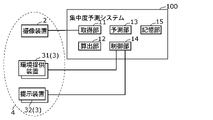
- FIG. 1 is a block diagram showing a functional configuration of a concentration ratio prediction system according to an embodiment.
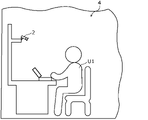
- FIG. 2 is a diagram showing an outline of an environment in which the concentration ratio prediction system according to the embodiment is used.
- FIG. 3 is a diagram showing an example of an image captured by an image pickup device.
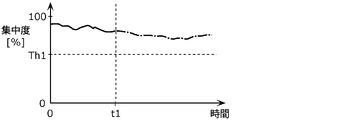
- FIG. 4A is an explanatory diagram of an example of a prediction result by the prediction unit of the concentration ratio prediction system according to the embodiment.
- FIG. 4B is an explanatory diagram of an example of a prediction result by the prediction unit of the concentration ratio prediction system according to the embodiment.
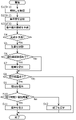
- FIG. 5 is a flowchart showing an operation example of the concentration ratio prediction system according to the embodiment.
- FIG. 1 is a block diagram showing a functional configuration of the concentration ratio prediction system 100 according to the embodiment.
- FIG. 2 is a diagram showing an outline of an environment in which the concentration ratio prediction system 100 according to the embodiment is used.
- the concentration ratio prediction system 100 is a system for predicting the concentration degree of the user U1 on the intellectual work.
- the "intellectual work” is a work mainly performed by using the intellectual ability (intelligence) of the user U1, and is, for example, a work such as cognition, thinking, and judgment.
- intellectual work may include desk work, study, and the like.
- the user U1 is assumed to be a worker who works in an office or at home using an information terminal such as a personal computer. Therefore, in the embodiment, the intellectual work is desk work.
- the user U1 may be, for example, a student, and in this case, the intellectual work is study.
- concentration means focusing attention on one thing and working on it.
- concentration ratio means the degree of concentration. In other words, “concentration” means the degree to which one thing is focused on when working on things. Concentration affects the amount of intellectual work per unit time (that is, the amount of intellectual work). That is, the higher the concentration level, the larger the intellectual work amount per unit time, and the lower the concentration level, the smaller the intellectual work amount per unit time.
- the concentration ratio prediction system 100 includes an acquisition unit 11, a calculation unit 12, a prediction unit 13, a control unit 14, and a storage unit 15.
- the concentration ratio prediction system 100 may include the acquisition unit 11, the calculation unit 12, the prediction unit 13, and the control unit 14, and may not include the storage unit 15.
- the concentration ratio prediction system 100 is realized by a server device.
- the server device may be installed in the space 4 (here, the office) in which the user U1 stays, or may be installed in a remote place away from the space 4.
- the concentration prediction system 100 may be realized by an information terminal such as a desktop type or laptop type personal computer, a smartphone, or a tablet terminal in addition to the server device.
- the concentration ratio prediction system 100 may be realized by the information terminal used by the user U1.
- an image pickup device 2 and one or more devices 3 are installed in the space 4 in which the concentration ratio prediction system 100 is used, that is, the space 4 in which the user U1 stays. ..
- the image pickup device 2 is a device that generates an image by imaging, and as shown in FIG. 3, is installed at a position where at least the head of the user U1 who is performing intellectual work can be imaged from substantially the front. ..
- FIG. 3 is a diagram showing an example of an image captured by the image pickup apparatus 2.
- the imaging range of the imaging device 2 is not limited to the head of the user U1, and may include the upper body of the user U1 and the like.
- the image pickup device 2 is, for example, a camera.
- the image pickup apparatus 2 may be a camera installed in the space 4 in which the user U1 stays, or may be a camera possessed by the information terminal used by the user U1.
- the image captured by the image pickup device 2 is transmitted to the acquisition unit 11 of the concentration ratio prediction system 100.
- the communication between the image pickup apparatus 2 and the acquisition unit 11 may be wired communication, wireless communication, and the communication standard is not particularly limited.
- the image pickup apparatus 2 may take an image of the user U1 with visible light or may take an image of the user U1 with infrared rays.
- One or more devices 3 may include one or more environment providing devices 31 and one or more presenting devices 32.
- both the environment providing device 31 and the presenting device 32 are installed in the space 4 in which the user U1 stays.
- the control unit 14 does not execute the control example using the device 3 which is not installed in the space 4 in which the user U1 stays among the control examples described later.
- the environment providing device 31 is a device for providing an environment to the space 4 in which the user U1 stays.
- the environment providing device 31 may be installed on the ceiling, wall, or floor of the space 4, or may be installed on furniture such as a desk.
- an example of the types of the environment providing device 31 will be listed.
- the environment providing device 31 may include a lighting fixture.
- the luminaire provides a lighting environment for the space 4 in which the user U1 stays by illuminating the space 4 with the illuminating light.
- the parameters of the lighting environment may include, for example, the illuminance of the illumination light, the color temperature, the light distribution, and the like.
- the lighting fixture is a spotlight as a task lighting that illuminates the hand of the user U1, and includes a light source having a solid-state light emitting element such as an LED (Light Emitting Diode).
- the light source of the luminaire is configured to be capable of dimming and / or toning by being controlled by the control unit 14.
- the lighting fixture may be a base light as an ambient lighting that uniformly illuminates the space 4, or may be a combination of a spot light and a base light.
- the environment providing device 31 may include an audio device.
- the acoustic device provides an acoustic environment to the space 4 in which the user U1 stays by outputting sound to the space 4.
- the parameters of the acoustic environment may include, for example, the content to be played, the volume, and the like.
- the audio device is an omnidirectional speaker, and by being controlled by the control unit 14, the content transmitted from the control unit 14 is reproduced.
- the acoustic device may be a speaker having directivity such as a parametric speaker, a speaker using ultrasonic waves, or a speaker having a horn structure in a housing. It is preferable to use a speaker having directivity because it is easy to reduce the ratio of some sounds leaking to other spaces.
- the environment providing device 31 may include a scent generating device.
- the scent generator provides a scent environment to the space 4 in which the user U1 stays by spraying the scent component.
- the parameters of the scent environment may include, for example, the type of scent component, the concentration of the scent component, and the like.
- the scent generator is, for example, an aroma diffuser.
- the environment providing device 31 may include a blower device.
- the blower provides an air environment to the space 4 in which the user U1 stays by sending a controlled air flow (that is, wind) to the space 4.
- the parameters of the air environment may include, for example, the air volume, pattern, or concentration of gas (eg, carbon dioxide) contained in the space 4.
- the blower is, for example, a fan, a circulator, or an air purifier.
- the presentation device 32 is a device for presenting information to the user U1.
- the presenting device 32 may include, for example, a display. When the presentation device 32 is a display, the presentation device 32 visually presents the information to the user U1 by displaying the information on the screen.
- the presenting device 32 may be a display installed in the space 4 in which the user U1 stays, or may be a display included in the information terminal used by the user U1. Further, the presenting device 32 may include, for example, a speaker. When the presentation device 32 is a speaker, the presentation device 32 aurally presents the information to the user U1 by outputting the information by voice.
- the presenting device 32 may be a speaker installed in the space 4 in which the user U1 stays, or may be a speaker included in the information terminal used by the user U1.
- the acquisition unit 11 periodically (for example, every few seconds) acquires the image of the user U1 transmitted from the image pickup device 2.
- the image of the user U1 includes at least the head of the user U1 as viewed from substantially the front.
- the image of the head of the user U1 contains information such as the tilt of the head of the user U1, the state of the eyes of the user U1 (the inner corner of the eye, the iris, the corneal reflex, the pupil, etc.), or the facial expression of the user U1. include. It can be said that these pieces of information are, so to speak, feature quantities related to the biological activity of the user U1. That is, the acquisition unit 11 acquires the feature amount related to the biological activity of the user U1 who is executing the intellectual work.
- the cycle for acquiring the feature amount by the acquisition unit 11 is the same as the cycle for acquiring the image by the image pickup apparatus 2.
- the term "same” as used herein includes not only being exactly the same but also including being almost identical.
- the calculation unit 12 calculates the degree of concentration of the user U1 on the intellectual work based on the image of the user U1 acquired by the acquisition unit 11. As already described, the image of the user U1 contains a feature amount related to the biological activity of the user U1. That is, the calculation unit 12 calculates the degree of concentration of the user U1 on the intellectual work based on the feature amount acquired by the acquisition unit 11. The calculation unit 12 may calculate the degree of concentration each time the acquisition unit 11 acquires the feature amount, or the calculation unit 11 calculates the degree of concentration each time the change (difference) of the feature amount is acquired by the acquisition unit 11. May be good.
- the calculation unit 12 extracts one or more feature quantities by performing appropriate image processing on the image of the user U1 acquired by the acquisition unit 11. Then, the calculation unit 12 calculates the score regarding the degree of concentration for each feature amount by comparing each extracted feature amount with the corresponding template image. The score is calculated according to, for example, the degree of agreement with the corresponding template image. Then, the calculation unit 12 adds the points calculated for each feature amount, and calculates the degree of concentration based on the added points. When adding points, weighting may be performed for each feature amount.
- the degree of concentration is expressed by a percentage so that the maximum value is 100% and the minimum value is 0%, but the aspect of the degree of concentration may be expressed by an aspect other than the percentage. For example, the degree of concentration may be expressed by a class such as level 1 or level 2.
- the prediction unit 13 predicts the transition of the concentration degree based on the change of the concentration degree calculated by the calculation unit 12. That is, as shown in FIGS. 4A and 4B, the prediction unit 13 predicts how the concentration ratio will change in the future from the time point t1 when the concentration ratio is calculated by the calculation unit 12. In the embodiment, as an example, the prediction unit 13 predicts whether or not there is a sign that the concentration degree is lowered to the threshold value Th1 or less at the time point t1 when the concentration degree is calculated by the calculation unit 12.
- the threshold value Th1 is, for example, a limit value at which it is assumed that the user U1 can recover the degree of concentration, and is set in advance.
- the concentration level is not lowered to the threshold value Th1 or less, it is considered that the user U1 can recover the concentration level until the concentration level becomes larger than the threshold value Th1.
- the concentration level drops to the threshold value Th1 or less, it is considered difficult for the user U1 to realize the recovery even if the user U1 tries to recover until the concentration level becomes larger than the threshold value Th1.
- FIGS. 4A and 4B are explanatory views of an example of a prediction result by the prediction unit 13 of the concentration ratio prediction system 100 according to the embodiment.
- the vertical axis represents the degree of concentration and the horizontal axis represents time.
- FIG. 4A shows a case where a sign that the concentration degree is lowered to the threshold value Th1 or less is not predicted at the time point t1 when the concentration degree is calculated by the calculation unit 12.
- FIG. 4B shows a case where a sign that the concentration degree drops below the threshold value Th1 is predicted at the time point t1 when the concentration degree is calculated by the calculation unit 12.
- FIG. 4A shows a case where a sign that the concentration degree drops below the threshold value Th1 is predicted at the time point t1 when the concentration degree is calculated by the calculation unit 12.
- the prediction unit 13 predicts that the concentration level does not decrease to the threshold value Th1 or less as shown by the alternate long and short dash line.
- the prediction unit 13 changes so that the concentration level reaches the threshold value Th1 after a certain period of time has elapsed from the time point t1 when the concentration level was calculated by the calculation unit 12. Predict to do.
- the prediction unit 13 executes any one of the first prediction example and the second prediction example listed below.
- the prediction unit 13 may predict the transition of the concentration degree by a method other than the first prediction example and the second prediction example shown below.
- the prediction unit 13 predicts the transition of the concentration degree based on one or more parameters related to the concentration degree calculated by the calculation unit 12.
- the parameter may include the amount of change in the degree of concentration per unit time (that is, the slope of the degree of concentration), the length of time during which the degree of concentration is changing, and the like.
- the prediction unit 13 predicts that there is a sign that the concentration level drops below the threshold Th1 when the amount of decrease in the concentration level per unit time is large or when the duration of the decrease in the concentration level is long.
- the prediction unit 13 is a temporary decrease in concentration, and then the degree of concentration. Predicts that will recover naturally.
- the prediction unit 13 compares the time-series change of the concentration calculated by the calculation unit 12 with the plurality of transition patterns stored in the storage unit 15, and determines one of the transition patterns. If there is a partial match, it is predicted that the concentration level will change according to the transition pattern.
- the "time-series change in the degree of concentration” here refers to the history of the degree of concentration from the time t1 when the degree of concentration is calculated by the calculation unit 12 to before a predetermined cycle.
- the "transition pattern” referred to here is a pattern obtained by conducting an experiment in which an unspecified number of users U1 execute intellectual work and actually calculating the transition of the degree of concentration during execution of the intellectual work. say. There may be as many transition patterns as the number of users U1 who participated in the experiment to be stored in the storage unit 15, but it is not necessary to adopt all the transition patterns.
- the sign that the concentration level drops below the threshold value Th1 can be predicted even when the concentration level is not actually lowered.
- the prediction unit 13 predicts that when the time-series change of the concentration degree calculated by the calculation unit 12 matches the slight fluctuation of the concentration degree in the transition pattern, the concentration degree changes according to the transition pattern. do. Therefore, in this case, the prediction unit 13 can predict the sign that the concentration degree decreases to the threshold value Th1 or less in the state where the concentration degree does not actually decrease.
- the control unit 14 can communicate with each device 3 and controls each device 3 by transmitting a control signal to each device 3.
- the communication between the control unit 14 and each device 3 may be wired communication, wireless communication, and the communication standard is not particularly limited.
- the control unit 14 controls the device 3 in the space 4 in which the user U1 stays, based on the transition of the concentration ratio predicted by the prediction unit 13.
- the control unit 14 controls the device 3 when the prediction unit 13 predicts a sign that the concentration level drops below the threshold value Th1. That is, the control unit 14 does not simply control the device 3 at the timing when the concentration degree becomes the threshold value Th1 or less, but at the stage where the concentration degree does not reach the threshold value Th1 and the concentration degree becomes the threshold value Th1 or less.
- the device 3 is controlled at the timing when the sign is predicted.
- the first control example shown below can be executed when one or more devices 3 include the environment providing device 31. Further, the second control example and the third control example shown below can be executed when one or more devices 3 include the presenting device 32. That is, when one or more devices 3 include both the environment providing device 31 and the presenting device 32, the control unit 14 can execute all of the first control examples to the third control examples shown below.
- control unit 14 controls the environment providing device 31 so as to change the environment of the space 4 in which the user U1 stays when the prediction unit 13 predicts a sign that the concentration ratio drops below the threshold value Th1. do.
- the control unit 14 may control only one type of environment providing device 31 or may control a plurality of types of environment providing device 31.
- control unit 14 changes the illuminance, the color temperature, or the light distribution of the illuminating light by controlling the luminaire.
- control unit 14 controls the audio device to play the content or change the volume if the content has already been played. ..
- the control unit 14 controls the scent generating device to disperse the scent component, or when the scent component has already been sprayed, the scent component.
- the type of scent or the concentration of the scent component is changed.
- the control unit 14 controls the blower device to generate an air flow or change the air volume if the air flow has already been generated. ..
- the blower may blow the wind directly to the user U1 or indirectly to the user U1.
- the user U1 is promoted to be physiologically or psychologically refreshed, and the mental fatigue of the user U1 is reduced. As a result, it can be expected that the concentration of the user U1 will be restored.
- the control unit 14 momentarily changes the environment when a sign that the concentration level drops below the threshold Th1 is predicted, and the environment providing device 31 so as to immediately restore the environment. May be controlled. Further, in the first control example, the control unit 14 maintains the state in which the environment is changed from the time when the sign that the concentration degree is predicted to decrease to the threshold value Th1 or less is predicted, and the control unit 14 is based on the environment when the concentration degree is recovered.
- the environment providing device 31 may be controlled so as to return.
- the presenting device is based on the remaining time Tr1 until the scheduled time t3 when the intellectual work is finished. 32 is controlled.
- the remaining time Tr1 is preset by the user U1 or the administrator of the concentration prediction system 100 from the time t2 when the sign that the concentration level drops below the threshold value Th1 is predicted. It is the time until the scheduled time t3 to finish the intellectual work.
- the time point t2 at which the sign that the concentration degree is predicted to decrease below the threshold value Th1 is the same as the time point t1 when the concentration degree is calculated by the calculation unit 12.
- the control unit 14 controls the presentation device 32 so as to encourage the user U1 to concentrate on the intellectual work when the remaining time Tr1 exceeds the threshold time.
- the control unit 14 causes the display to display a character string or an image having contents such as "last spurt! Or "a little more! That encourages concentration in the remaining time Tr1.
- the control unit 14 outputs the voice obtained by reading the above character string from the speaker. As a result, it can be expected that the user U1 will perform intellectual work without losing concentration in the remaining time Tr1.
- the user U1 may appropriately select whether or not to follow the content presented by the presentation device 32.
- control unit 14 controls the presentation device 32 so as to prompt the user U1 to end the intellectual work when the remaining time Tr1 is less than the threshold time.
- the control unit 14 displays a character string or an image of the content prompting the end of intellectual work such as "Would you like to take a break?" On the display.
- the control unit 14 outputs the voice obtained by reading the above character string from the speaker. As a result, it can be expected that the user U1 finishes the intellectual work and takes a break.
- the user U1 may appropriately select whether or not to follow the content presented by the presentation device 32.
- the control unit 14 controls the presentation device 32 so as to present the transition of the concentration degree predicted by the prediction unit 13 to the user U1.
- the control unit 14 causes the display to display a graph as shown in FIG. 4A or FIG. 4B.
- the user U1 can grasp the transition of his / her concentration level.
- the control unit 14 predicts a sign that the concentration level drops below the threshold value Th1 by the prediction unit 13, instead of displaying the graph as shown in FIG. 4B on the display, the remaining time Tr1 is displayed on the display. It may be displayed.
- the storage unit 15 is a storage device that stores information (computer program, etc.) necessary for each of the calculation unit 12, the prediction unit 13, and the control unit 14 to perform an operation.
- the storage unit 15 is realized by, for example, an HDD (Hard Disk Drive), but may be realized by a semiconductor memory, and a known electronic information storage means can be used without particular limitation.
- the storage unit 15 stores a template image of each feature amount used in the calculation unit 12, a transition pattern used in the prediction unit 13, a control content of each device 3, and the like.
- FIG. 5 is a flowchart showing an operation example of the concentration ratio prediction system 100 according to the embodiment.
- one or more devices 3 include at least one of the environment providing device 31 and the presenting device 32.
- the acquisition unit 11 acquires the feature amount related to the biological activity of the user U1 who is executing the intellectual work by acquiring the image of the user U1 transmitted from the image pickup device 2 (S1).
- the process S1 corresponds to the acquisition step ST1 of the concentration ratio prediction method.
- the calculation unit 12 calculates the degree of concentration of the user U1 on the intellectual work based on the feature amount acquired by the acquisition unit 11 (S2).
- the process S2 corresponds to the calculation step ST2 of the concentration ratio prediction method.
- the prediction unit 13 predicts the transition of the concentration degree based on the change of the concentration degree calculated by the calculation unit 12 (S3).
- the process S3 corresponds to the prediction step ST3 of the concentration ratio prediction method.
- the control unit 14 controls the device 3 installed in the space 4 in which the user U1 stays (S5). On the other hand, if the prediction unit 13 does not predict a sign that the concentration level drops below the threshold value Th1 (S4: No), nothing in particular is executed.
- the control unit 14 changes the environment of the space 4 in which the user U1 stays by controlling the environment providing device 31 (S6: Yes). S7). Further, when the presenting device 32 is included in the device 3 (S8: Yes), the control unit 14 controls the presenting device 32 based on the remaining time Tr1 until the scheduled time t3 when the intellectual work is finished. Presents information to user U1 (S9).
- the control unit 14 When the presenting device 32 is included in the device 3 and the remaining time Tr1 exceeds the threshold time (S10: Yes), the control unit 14 presents the user U1 with information that encourages the user U1 to concentrate on the intellectual work. As described above, the presentation device 32 is controlled (S11). On the other hand, when the remaining time Tr1 is less than the threshold time (S10: No), the control unit 14 controls the presentation device 32 so as to present information prompting the user U1 to end the intellectual work (S12). .. Hereinafter, the above series of processes S1 to S12 are repeated.
- the system of the comparative example is different from the concentration ratio prediction system 100 according to the embodiment in that it mainly does not include the prediction unit 13.
- the device 3 is controlled according to the degree of concentration calculated by the calculation unit 12. That is, in the system of the comparative example, when the concentration level actually drops below the threshold value Th1, some measures are taken for the user U1 by controlling the device 3 for the first time, and the system may be lost later. ..
- the environment providing device 31 is controlled when the concentration ratio actually drops to the threshold value Th1 or less, and the environment of the space 4 in which the user U1 stays is changed, and the environment is changed. The recovery of concentration cannot be expected by letting them do it.
- the concentration ratio prediction system 100 since it is possible to predict how the concentration degree will change in the future from the time t1 when the concentration degree is calculated, intellectual work is executed. There is an advantage that it becomes easy to manage the user U1.
- the environment providing device 31 can be controlled before the concentration degree becomes the threshold value Th1 or less to change the environment of the space 4 in which the user U1 stays. Therefore, unlike the system of the comparative example, the concentration prediction system 100 according to the embodiment can try to recover the concentration before the concentration is completely reduced, so that the concentration can be easily recovered.
- the concentration level prediction system 100 according to the embodiment has an advantage that various measures can be taken before the concentration level is completely reduced.
- the calculation unit 12 calculates the concentration degree based on the image of the user U1 acquired by the acquisition unit 11, but the present invention is not limited to this mode.
- the calculation unit 12 may calculate the concentration degree based on the information about the eyes of the user U1 or the vital information such as the heart rate of the user U1.
- the acquisition unit 11 may acquire vital information from a sensor that detects vital information instead of acquiring an image from the image pickup device 2.
- the prediction unit 13 may predict the transition of the concentration degree by further referring to not only the concentration degree calculated by the calculation unit 12 but also other parameters.
- the prediction unit 13 further refers to parameters such as the type of intellectual work being executed by the user U1, the time zone in which the user U1 executes the intellectual work, or the place where the user U1 executes the intellectual work. May be good.
- the feature amount related to the biological activity of the user U1 acquired by the acquisition unit 11 is information about the head of the main user U1 and the user U1, but is not limited to this.
- the feature amount may include information about a portion other than the head of the user U1, such as the movement of the shoulder of the user U1.
- the concentration ratio prediction system 100 targets one user U1, but is not limited to this.
- the concentration ratio prediction system 100 may target a plurality of users U1 and execute a series of processes such as prediction of the transition of the concentration degree for each user U1.
- control unit 14 may control the environment providing device 31 so as to provide a unique environment for each user U1.
- the environment of the space 4 in which the user U1 stays is changed, an environment suitable for the preference of the user U1 can be provided, so that an effect that the concentration of the user U1 can be easily restored can be expected. ..
- the image pickup device 2 and the device 3 are not included in the components of the concentration ratio prediction system 100, but at least one of the image pickup device 2 and the device 3 is included in the components of the concentration ratio prediction system 100. May be.
- the concentration ratio prediction system 100 is realized by a server device, that is, a single device, but the concentration ratio prediction system 100 which may be realized by a plurality of devices is realized by a plurality of devices.
- the components included in the concentration ratio prediction system 100 may be distributed to a plurality of devices in any way.
- the component included in the server device in the above embodiment may be provided in the information terminal installed in the closed space. That is, the present invention may be realized by cloud computing or edge computing.
- the communication method between the devices in the above embodiment is not particularly limited. Further, in the communication between the devices, a relay device (not shown) may intervene.
- each component may be realized by executing a software program suitable for each component.
- Each component may be realized by a program execution unit such as a CPU or a processor reading and executing a software program recorded on a recording medium such as a hard disk or a semiconductor memory.
- each component may be realized by hardware.
- each component may be a circuit (or an integrated circuit). These circuits may form one circuit as a whole, or may be separate circuits from each other. Further, each of these circuits may be a general-purpose circuit or a dedicated circuit.
- the general or specific embodiment of the present invention may be realized by a recording medium such as a system, an apparatus, a method, an integrated circuit, a computer program, or a computer-readable CD-ROM. Further, it may be realized by any combination of a system, an apparatus, a method, an integrated circuit, a computer program and a recording medium.
- the present invention may be realized as a concentration prediction method executed by a computer such as the concentration prediction system 100, or may be realized as a program for causing a computer to execute such a concentration prediction method.
- a program may be realized as a computer-readable non-temporary recording medium in which such a program is recorded.
- the concentration ratio prediction system 100 includes an acquisition unit 11, a calculation unit 12, and a prediction unit 13.
- the acquisition unit 11 acquires the feature amount related to the biological activity of the user U1 who is executing the intellectual work.
- the calculation unit 12 calculates the degree of concentration of the user U1 on the intellectual work based on the feature amount acquired by the acquisition unit 11.
- the prediction unit 13 predicts the transition of the concentration degree based on the change of the concentration degree calculated by the calculation unit 12.
- concentration degree prediction system 100 it is possible to predict how the concentration degree will change in the future from the time point t1 when the concentration degree is calculated, so that the user U1 who executes the intellectual work can be managed. It has the advantage of being easier to do.
- the concentration ratio prediction system 100 further includes a control unit 14 that controls the device 3 in the space 4 in which the user U1 stays, based on the transition of the concentration degree predicted by the prediction unit 13.
- control unit 14 controls the device 3 when the prediction unit 13 predicts a sign that the concentration level drops below the threshold value Th1.
- the concentration prediction system 100 by controlling the device 3 before the concentration is completely reduced, the concentration is reduced as compared with the case where the device 3 is controlled after the concentration is completely reduced. It has the advantage of being easy to take measures.
- the device 3 includes an environment providing device 31 that provides an environment for the space 4.
- the control unit 14 controls the environment providing device 31 so as to change the environment.
- concentration prediction system 100 by changing the environment of the space 4 before the concentration is completely reduced, the concentration is compared with the case where the environment of the space 4 is changed after the concentration is completely reduced. It has the advantage that it is easy to recover the degree.
- the device 3 includes a presentation device 32 that presents information to the user U1.
- the control unit 14 controls the presentation device 32 based on the remaining time Tr1 until the scheduled time t3 when the intellectual work is finished.
- control unit 14 controls the presentation device 32 so as to encourage the user U1 to concentrate on the intellectual work when the remaining time Tr1 exceeds the threshold time.
- control unit 14 controls the presentation device 32 so as to prompt the user U1 to end the intellectual work when the remaining time Tr1 is less than the threshold time.
- the device 3 includes a presentation device 32 that presents information to the user U1.
- the control unit 14 controls the presentation device 32 so as to present the transition of the concentration degree predicted by the prediction unit 13 to the user U1.
- the concentration ratio prediction method includes acquisition step ST1, calculation step ST2, and prediction step ST3.
- acquisition step ST1 the feature amount related to the biological activity of the user U1 who is executing the intellectual work is acquired.
- calculation step ST2 the degree of concentration of the user U1 on the intellectual work is calculated based on the feature amount acquired in the acquisition step ST1.
- prediction step ST3 the transition of the concentration degree is predicted based on the change of the concentration degree calculated in the calculation step ST2.
- concentration ratio prediction method it is possible to predict how the concentration ratio will change in the future from the time t1 when the concentration ratio is calculated, so that the user U1 who executes the intellectual work is managed. It has the advantage of being easier.
- the program causes one or more processors to execute the above-mentioned concentration prediction method.
Landscapes
- Health & Medical Sciences (AREA)
- Life Sciences & Earth Sciences (AREA)
- Engineering & Computer Science (AREA)
- Public Health (AREA)
- General Health & Medical Sciences (AREA)
- Medical Informatics (AREA)
- Pathology (AREA)
- Educational Technology (AREA)
- Social Psychology (AREA)
- Physics & Mathematics (AREA)
- Psychiatry (AREA)
- Biophysics (AREA)
- Hospice & Palliative Care (AREA)
- Biomedical Technology (AREA)
- Heart & Thoracic Surgery (AREA)
- Psychology (AREA)
- Molecular Biology (AREA)
- Surgery (AREA)
- Animal Behavior & Ethology (AREA)
- Developmental Disabilities (AREA)
- Child & Adolescent Psychology (AREA)
- Veterinary Medicine (AREA)
- Epidemiology (AREA)
- Primary Health Care (AREA)
- Management, Administration, Business Operations System, And Electronic Commerce (AREA)
Priority Applications (1)
| Application Number | Priority Date | Filing Date | Title |
|---|---|---|---|
| JP2022553726A JP7653609B2 (ja) | 2020-09-29 | 2021-09-06 | 集中度予測システム、集中度予測方法、及びプログラム |
Applications Claiming Priority (2)
| Application Number | Priority Date | Filing Date | Title |
|---|---|---|---|
| JP2020162894 | 2020-09-29 | ||
| JP2020-162894 | 2020-09-29 |
Publications (1)
| Publication Number | Publication Date |
|---|---|
| WO2022070788A1 true WO2022070788A1 (ja) | 2022-04-07 |
Family
ID=80950204
Family Applications (1)
| Application Number | Title | Priority Date | Filing Date |
|---|---|---|---|
| PCT/JP2021/032643 Ceased WO2022070788A1 (ja) | 2020-09-29 | 2021-09-06 | 集中度予測システム、集中度予測方法、及びプログラム |
Country Status (2)
| Country | Link |
|---|---|
| JP (1) | JP7653609B2 (https=) |
| WO (1) | WO2022070788A1 (https=) |
Cited By (2)
| Publication number | Priority date | Publication date | Assignee | Title |
|---|---|---|---|---|
| JPWO2023233935A1 (https=) * | 2022-05-30 | 2023-12-07 | ||
| WO2024048163A1 (ja) * | 2022-08-31 | 2024-03-07 | パナソニックホールディングス株式会社 | 情報処理方法、および、情報処理システム |
Citations (2)
| Publication number | Priority date | Publication date | Assignee | Title |
|---|---|---|---|---|
| WO2014147828A1 (ja) * | 2013-03-22 | 2014-09-25 | トヨタ自動車株式会社 | 運転支援装置、運転支援方法、情報提供装置、情報提供方法、ナビゲーション装置及びナビゲーション方法 |
| JP2019179523A (ja) * | 2018-03-30 | 2019-10-17 | ダイキン工業株式会社 | 心身状態認識システム |
-
2021
- 2021-09-06 JP JP2022553726A patent/JP7653609B2/ja active Active
- 2021-09-06 WO PCT/JP2021/032643 patent/WO2022070788A1/ja not_active Ceased
Patent Citations (2)
| Publication number | Priority date | Publication date | Assignee | Title |
|---|---|---|---|---|
| WO2014147828A1 (ja) * | 2013-03-22 | 2014-09-25 | トヨタ自動車株式会社 | 運転支援装置、運転支援方法、情報提供装置、情報提供方法、ナビゲーション装置及びナビゲーション方法 |
| JP2019179523A (ja) * | 2018-03-30 | 2019-10-17 | ダイキン工業株式会社 | 心身状態認識システム |
Cited By (4)
| Publication number | Priority date | Publication date | Assignee | Title |
|---|---|---|---|---|
| JPWO2023233935A1 (https=) * | 2022-05-30 | 2023-12-07 | ||
| WO2023233935A1 (ja) * | 2022-05-30 | 2023-12-07 | パナソニックIpマネジメント株式会社 | 知的作業支援システム、及び、知的作業支援方法 |
| JP7825188B2 (ja) | 2022-05-30 | 2026-03-06 | パナソニックIpマネジメント株式会社 | 知的作業支援システム、及び、知的作業支援方法 |
| WO2024048163A1 (ja) * | 2022-08-31 | 2024-03-07 | パナソニックホールディングス株式会社 | 情報処理方法、および、情報処理システム |
Also Published As
| Publication number | Publication date |
|---|---|
| JPWO2022070788A1 (https=) | 2022-04-07 |
| JP7653609B2 (ja) | 2025-03-31 |
Similar Documents
| Publication | Publication Date | Title |
|---|---|---|
| US10987042B2 (en) | Display system and display device | |
| JP6502589B1 (ja) | ビデオゲームのための照明 | |
| US9462262B1 (en) | Augmented reality environment with environmental condition control | |
| US11219395B2 (en) | Sleepiness estimating device and wakefulness inducing device | |
| JP2020020571A (ja) | 環境制御システム | |
| JP6748957B2 (ja) | 環境制御システムおよび環境制御方法 | |
| JP7108885B2 (ja) | 覚醒誘導制御装置、および、覚醒誘導システム | |
| JP6928856B2 (ja) | 環境制御システムおよび環境制御方法 | |
| CN119923615A (zh) | 扩展现实环境中的干扰减少 | |
| WO2022070788A1 (ja) | 集中度予測システム、集中度予測方法、及びプログラム | |
| US20200081535A1 (en) | Emotion recognition apparatus and control method thereof | |
| JPWO2018074224A1 (ja) | 雰囲気醸成システム、雰囲気醸成方法、雰囲気醸成プログラム、及び雰囲気推定システム | |
| WO2021200981A1 (ja) | 環境制御システム、及び、環境制御方法 | |
| WO2023137293A1 (en) | Brainwave entrainment using virtual objects and gamification | |
| JP2022131142A (ja) | 香り発生システム、香り発生装置、香り発生方法、および、プログラム | |
| JP7296626B2 (ja) | 情報処理装置及びプログラム | |
| JP7329743B2 (ja) | 環境制御システム | |
| WO2020045042A1 (ja) | メンタルコントロールシステム、メンタルコントロール方法、及びプログラム | |
| WO2023053730A1 (ja) | スケジュール管理システム、スケジュール管理方法、及びプログラム | |
| JP7555032B2 (ja) | 環境制御システム、環境制御方法、及びプログラム | |
| JP7825188B2 (ja) | 知的作業支援システム、及び、知的作業支援方法 | |
| US20240307652A1 (en) | Dream directing system and method for using the same | |
| US20260044215A1 (en) | Image display method, non-transitory computer-readable storage medium storing program, and image display system | |
| JP6963669B1 (ja) | ソリューション提供システム及び携帯端末 | |
| JP2025034036A (ja) | 支援方法、支援システム、及び、プログラム |
Legal Events
| Date | Code | Title | Description |
|---|---|---|---|
| 121 | Ep: the epo has been informed by wipo that ep was designated in this application |
Ref document number: 21875090 Country of ref document: EP Kind code of ref document: A1 |
|
| ENP | Entry into the national phase |
Ref document number: 2022553726 Country of ref document: JP Kind code of ref document: A |
|
| NENP | Non-entry into the national phase |
Ref country code: DE |
|
| 122 | Ep: pct application non-entry in european phase |
Ref document number: 21875090 Country of ref document: EP Kind code of ref document: A1 |