WO2022044909A1 - 口呼吸抑制テープ - Google Patents
口呼吸抑制テープ Download PDFInfo
- Publication number
- WO2022044909A1 WO2022044909A1 PCT/JP2021/030158 JP2021030158W WO2022044909A1 WO 2022044909 A1 WO2022044909 A1 WO 2022044909A1 JP 2021030158 W JP2021030158 W JP 2021030158W WO 2022044909 A1 WO2022044909 A1 WO 2022044909A1
- Authority
- WO
- WIPO (PCT)
- Prior art keywords
- mouth
- tape
- mouth breathing
- length direction
- peeling
- Prior art date
- Legal status (The legal status is an assumption and is not a legal conclusion. Google has not performed a legal analysis and makes no representation as to the accuracy of the status listed.)
- Ceased
Links
Images


Classifications
-
- A—HUMAN NECESSITIES
- A61—MEDICAL OR VETERINARY SCIENCE; HYGIENE
- A61F—FILTERS IMPLANTABLE INTO BLOOD VESSELS; PROSTHESES; DEVICES PROVIDING PATENCY TO, OR PREVENTING COLLAPSING OF, TUBULAR STRUCTURES OF THE BODY, e.g. STENTS; ORTHOPAEDIC, NURSING OR CONTRACEPTIVE DEVICES; FOMENTATION; TREATMENT OR PROTECTION OF EYES OR EARS; BANDAGES, DRESSINGS OR ABSORBENT PADS; FIRST-AID KITS
- A61F5/00—Orthopaedic methods or devices for non-surgical treatment of bones or joints; Nursing devices ; Anti-rape devices
- A61F5/56—Devices for preventing snoring
-
- A—HUMAN NECESSITIES
- A61—MEDICAL OR VETERINARY SCIENCE; HYGIENE
- A61L—METHODS OR APPARATUS FOR STERILISING MATERIALS OR OBJECTS IN GENERAL; DISINFECTION, STERILISATION OR DEODORISATION OF AIR; CHEMICAL ASPECTS OF BANDAGES, DRESSINGS, ABSORBENT PADS OR SURGICAL ARTICLES; MATERIALS FOR BANDAGES, DRESSINGS, ABSORBENT PADS OR SURGICAL ARTICLES
- A61L24/00—Surgical adhesives or cements; Adhesives for colostomy devices
-
- A—HUMAN NECESSITIES
- A61—MEDICAL OR VETERINARY SCIENCE; HYGIENE
- A61L—METHODS OR APPARATUS FOR STERILISING MATERIALS OR OBJECTS IN GENERAL; DISINFECTION, STERILISATION OR DEODORISATION OF AIR; CHEMICAL ASPECTS OF BANDAGES, DRESSINGS, ABSORBENT PADS OR SURGICAL ARTICLES; MATERIALS FOR BANDAGES, DRESSINGS, ABSORBENT PADS OR SURGICAL ARTICLES
- A61L24/00—Surgical adhesives or cements; Adhesives for colostomy devices
- A61L24/04—Surgical adhesives or cements; Adhesives for colostomy devices containing macromolecular materials
- A61L24/06—Surgical adhesives or cements; Adhesives for colostomy devices containing macromolecular materials obtained by reactions only involving carbon-to-carbon unsaturated bonds
Definitions
- Mouth breathing suppression tape suppresses mouth breathing by keeping the mouth closed so that it does not open. Therefore, it is required that the mouth breathing inhibitory tape does not come off from the mouth due to the unconscious movement of the user during sleep.
- the present invention relates to a mouth breathing inhibitory tape used by being attached to the mouth.
- the mouth breathing inhibitory tape of the present invention comprises a base material having a length and a width shorter than the length, and an adhesive layer provided on the back surface of the base material, and is peeled by 0 degrees in the length direction. It is characterized in that the maximum peeling force by the test is 7 N or more, and the elongation rate in the length direction is 5% or more and 25% or less.
- a preferred embodiment of the mouth breathing inhibitory tape of the present invention is characterized in that the average peeling force in the 180-degree peeling test in the length direction is 1N or more.
- a preferred embodiment of the mouth breathing inhibitory tape of the present invention is characterized in that the pressure-sensitive adhesive is an acrylic pressure-sensitive adhesive.
- the mouth breathing suppression tape of the present invention it is difficult to peel off from the mouth during sleep, so that the mouth can be effectively closed during sleep to suppress mouth breathing.
- the mouth breathing suppression tape of the present invention is used, for example, by being attached to the mouth at bedtime, and by keeping the mouth closed so as not to open, the mouth breathing during sleep is suppressed and the nose is suppressed. It promotes breathing.
- the direction in which the mouth is longitudinally traversed (from the upper lip to the lower lip) when attached to the mouth is defined as the "vertical direction", and the direction orthogonal to the vertical direction is defined as the "horizontal direction”.
- the vertical size is the "length” and the horizontal size is the "width”.
- the base material 2 is formed of a sheet material having breathability and flexibility, such as a non-woven fabric, a woven cloth, a paper such as Japanese paper, and a resin sheet having a large number of pores.
- the base material 2 may be formed by using the above-mentioned sheet material alone, or the base material 2 may be formed by combining two or more kinds.
- a pressure-sensitive adhesive called a silicon-based pressure-sensitive adhesive, a urethane-based pressure-sensitive adhesive, an acrylic-based pressure-sensitive adhesive, or a rubber-based pressure-sensitive adhesive can be used. It is preferable to use an acrylic pressure-sensitive adhesive from the viewpoint that many materials have a proven track record as the intended tape material, and a relatively inexpensive and highly safe material can be selected from a wider range of options.
- the acrylic pressure-sensitive adhesive is made of an acrylic polymer, and the strength of the adhesive strength can be controlled by controlling the type of monomer, the molecular weight of the polymer, the cross-linking density, and the like.
- the mouth breathing suppression tape 1 of the present embodiment is predetermined so as not to be easily peeled off from the mouth due to unconscious movements of the user during sleep, for example, mouth movements such as breathing, coughing, creaking, and sleeping. It has peeling resistance and extensibility.
- mouth movements such as breathing, coughing, creaking, and sleeping. It has peeling resistance and extensibility.
- the maximum peeling force by the 0 degree peeling test in the vertical direction (length direction) is the movement to open the mouth up and down during sleep. It is a numerical value indicating resistance (difficulty in peeling) that the mouth breathing suppression tape 1 is peeled from the mouth due to (movement of the upper lip and the lower lip apart).
- the mouth breathing suppression tape 1 attached to the mouth is pulled in the opposite direction at one end and the other end in the vertical direction (length direction), but the mouth breathing suppression tape 1 is pulled in the vertical direction.
- the 0 degree peeling test in the vertical direction (length direction) is performed by the following method.
- 50% of the area S of the mouth breathing inhibitor tape 1 protrudes from the test plate 10 in the vertical direction (length direction) on the flat surface of the polypropylene test plate 10. It is attached to the surface via the adhesive layer on the back surface.
- the mouth breathing suppression tape 1 is parallel to the lateral direction (width direction) and is axisymmetric with respect to the center line passing through the center of the length
- the mouth breathing suppression is performed with the center line passing through the center of the length as a boundary.
- the tape 1 is pushed out from the test plate 10.
- one reciprocating roll is performed on the entire area of the portion of the mouth breathing suppression tape 1 attached to the test plate 10 with the roller 11 weighing 2 kg in contact with the roller 11. Then, apply a load and firmly attach the mouth breathing suppression tape 1 to the test plate 10.
- FIG. 2C in the mouth breathing suppression tape 1, the entire end portion on the side protruding from the test plate 10 in the vertical direction (length direction) is grasped by the chuck 12, and the chuck 12 is held by the test plate.
- a tensile tester (Shimadzu Seisakusho Co., Ltd.) not shown in the direction parallel to the surface of 10 and protruding from the test plate 10 of the mouth breathing suppression tape 1 (0 ° direction of the arrow (length direction of the mouth breathing suppression tape 1)). It is pulled at a speed of 300 mm / min using a manufactured AUTOGRAPH AGS-500NX).
- the maximum peeling force can be obtained by measuring the force when the mouth breathing inhibitory tape 1 is pulled from the test plate 10 until it is peeled off, and measuring the maximum value thereof.
- the mouth breathing suppression tape 1 Since the maximum peeling force in the 0 degree peeling test in the vertical direction (length direction) is 7 N or more, the mouth breathing suppression tape 1 has high durability against the movement of opening the mouth up and down during sleep. Adhesion to the upper and lower lips of both ends of the mouth breathing suppression tape 1 in the vertical direction (longitudinal direction) can be maintained, and the mouth breathing suppression tape 1 can be prevented from peeling off from the mouth.
- This maximum peeling force is not particularly limited as long as it is 7 N or more, but it is preferably 30 N or more from the viewpoint of effectively making it difficult for the mouth breathing inhibitor 1 to be peeled from the mouth, while the upper limit thereof is pain when peeling. It is preferably 40 N or less from the viewpoint of making it difficult to feel.
- the material and dimensions (length, width and thickness) of the base material 2 are appropriately adjusted. By doing so, the size can be controlled to a desired size.
- the elongation rate in the vertical direction (length direction) refers to the fact that the mouth breathing inhibitor tape 1 is peeled off from the mouth due to the movement of the mouth to expand up and down during sleep. It is a numerical value indicating resistance (difficulty of peeling).
- the mouth breathing suppression tape 1 attached to the mouth is pulled in the opposite direction at one end and the other end in the vertical direction (length direction). At this time, the mouth breathing suppression tape 1 is pulled.
- the mouth breathing suppression tape 1 is stretched too much in the vertical direction (longitudinal direction), the mouth may open even when the mouth breathing suppression tape 1 is attached to the mouth, and mouth breathing may not be suppressed. Therefore, the mouth breathing suppression tape 1 needs to be appropriately stretched in the vertical direction (length direction).
- the elongation rate in the vertical direction (length direction) is measured by the following method.
- both ends of the mouth breathing suppression tape 1 in the vertical direction (length direction) are grasped by a pair of chucks 12A and 12B with a gap of 10 mm from each other. That is, the mouth breathing suppression tape 1 is attached to the pair of chucks 12A, with the center line parallel to the lateral direction (width direction) of the mouth breathing suppression tape 1 as a boundary and passing through the center of the length, leaving a portion within a range of 5 mm above and below. Grab with 12B.
- FIG. 3A both ends of the mouth breathing suppression tape 1 in the vertical direction (length direction) are grasped by a pair of chucks 12A and 12B with a gap of 10 mm from each other. That is, the mouth breathing suppression tape 1 is attached to the pair of chucks 12A, with the center line parallel to the lateral direction (width direction) of the mouth breathing suppression tape 1 as a boundary and passing through the center of the length,
- one chuck 12A is placed in the direction opposite to the other chuck 12B at 100 mm / min using a tensile tester (AUTOGRAPH AGS-500NX manufactured by Shimadzu Corporation) (not shown). It is pulled at a speed, and as shown in FIG. 3C, the distance Lmm between the chucks 12A and 12B at the time when a load of 500 gf is applied to the mouth breathing suppression tape 1 is measured.
- the ratio ((L-10) / 10) of the mouth breathing suppression tape 1 to the distance Lmm between the chucks 12A and 12B after stretching with respect to the distance 10 mm between the chucks 12A and 12B before stretching is calculated as a percentage, and this is calculated as a percentage. Let it be a rate.
- the mouth breathing suppression tape 1 Since the elongation rate in the vertical direction (length direction) is 5% or more, the mouth breathing suppression tape 1 has high followability to the movement of the mouth to open up and down during sleep, and the mouth moves up and down. Accordingly, the mouth breathing suppression tape 1 can be extended in the vertical direction (longitudinal direction) to maintain adhesion to the mouth, so that the mouth breathing suppression tape 1 can be prevented from peeling off from the mouth. On the other hand, since the elongation rate in the vertical direction (length direction) is 25% or less, the mouth breathing suppression tape 1 does not excessively extend in the vertical direction (length direction) following the vertical movement of the mouth. Mouth breathing can be suppressed because it suppresses the opening of the mouth.
- the elongation rate in the vertical direction (length direction) is not particularly limited as long as it is 5% or more and 25% or less.
- the stretchability of the mouth breathing suppression tape 1 in the lateral direction (width direction) is not particularly limited, and the length of extension when the same load is applied and pulled is about the same as in the vertical direction (length direction). Alternatively, it may be larger than the vertical direction (length direction).
- the mouth breathing inhibitory tape 1 of the present embodiment has a maximum peeling force of 7 N or more in the 0 degree peeling test in the vertical direction (longitudinal direction) and an elongation rate in the vertical direction (longitudinal direction). Since it is 5% or more and 25% or less, even if the user's mouth moves during sleep, it does not peel off from the mouth and does not stretch excessively, so that the state of being well attached to the mouth is maintained and mouth breathing is suppressed. be able to.
- the mouth breathing suppression tape 1 of the present embodiment prevents the user from easily peeling off from the mouth by contact with bedding (for example, a pillow, a futon, a mattress, etc.) due to the sleeping phase, which is an unconscious movement of the user during sleep. Therefore, it has a predetermined peeling resistance.
- bedding for example, a pillow, a futon, a mattress, etc.
- the average peeling force by 180-degree peeling test in the vertical direction (length direction) is the contact of the mouth breathing suppression tape 1 with the bedding during sleep. It is a numerical value indicating the resistance (difficulty of peeling) to the fact that a part of it is rolled up and then the whole is gradually peeled from the mouth.
- the mouth breathing suppression tape 1 is rubbed by the bedding, the end portion in the vertical direction (longitudinal direction) is mainly rolled up from the mouth, and after that, the entire portion of the mouth breathing suppression tape 1 is rolled up from the end portion which is rolled up by rubbing with the bedding.
- the 180 degree peeling test in the vertical direction (length direction) is performed by the following method.
- FIG. 4A the entire mouth breathing inhibitory tape 1 is attached to the flat surface of the polypropylene test plate 10 via the adhesive layer on the back surface.
- FIG. 4 (B) the mouth breathing suppression tape 1 is rolled over the entire mouth breathing suppression tape 1 in a state where the roller 11 having a weight of 2 kg is in contact with the mouth breathing suppression tape 1 to apply a load. 1 is firmly attached to the test plate 10.
- FIG. 4A the entire mouth breathing inhibitory tape 1 is attached
- the average peeling force in the 180-degree peeling test in the vertical direction (length direction) is preferably 1N or more, and as a result, the mouth breathing inhibitory tape 1 adheres well to the mouth and is therefore durable against rubbing against bedding. It has a high property and can prevent the mouth breathing suppressing tape 1 from being easily peeled off from the mouth.
- the average peeling force in the 180-degree peeling test in the vertical direction (length direction) is more preferably 3N or more from the viewpoint of effectively preventing the mouth breathing inhibitor tape 1 from peeling from the mouth, while the upper limit is peeled off. It is preferably 5N or less from the viewpoint of making it difficult to feel the pain at the time.
- the average peeling force in the 180-degree peeling test in the vertical direction (length direction) can be controlled to a desired size by appropriately adjusting the adhesive force of the adhesive layer 3 (adhesive) and the like.
- the adhesive layer 3 (adhesive) has a hard tactile sensation. While it peels off and gives a strong stimulus to the skin momentarily, the adhesive layer 3 (adhesive) does not give a strong stimulus because it peels off firmly and gives a weak stimulus to the skin. Therefore, the one having a soft touch to the adhesive layer 3 (adhesive) does not damage the skin when the mouth breathing inhibitory tape 1 is peeled off from the mouth.
- the tactile sensation of the adhesive layer 3 correlates with the peeling energy required in the 0 degree peeling test in the vertical direction (length direction) of the mouth breathing inhibitory tape 1 of the above (1). I found out to do. Specifically, when the adhesive layer 3 (adhesive) has a hard tactile sensation, it acts from the time when the mouth breathing inhibitory tape 1 is pulled until it is peeled off from the test plate 10, for example, as shown in FIG. 5 (A).
- the peeling energy in the 0-degree peeling test in the vertical direction (length direction) is preferably 200 N ⁇ mm or more, which can reduce the irritation given to the skin when the mouth breathing inhibitory tape 1 is peeled from the mouth. , A good feeling of use that is gentle on the skin can be achieved.
- the upper limit of the peeling energy by the 0 degree peeling test in the vertical direction (length direction) is 600 N ⁇ mm or less from the viewpoint that if the adhesive becomes too soft, it may cause stickiness or adhesive residue. Is preferable.
- the mouth breathing suppression tape 1 of the present embodiment includes a base material 2 having a length and a width shorter than the length, and an adhesive layer 3 provided on the back surface of the base material 2.
- the maximum peeling force by the 0 degree peeling test in the length direction is 7N or more, and the elongation rate in the length direction is 5% or more and 25% or less. Therefore, it is highly resistant to peeling from the mouth due to the vertical movement of the mouth during sleep (movement of the upper and lower lips separating) (difficulty of peeling), and the length direction that follows the vertical movement of the mouth.
- mouth breathing suppression tape 1 Since it has an appropriate elasticity, it cannot keep up with the vertical movement of the mouth and does not peel off from the mouth, and it does not stretch excessively in the length direction, so that the mouth breathing suppression tape 1 is attached to the mouth. It is possible to prevent the mouth from opening even in the open state. Therefore, according to the mouth breathing suppression tape 1 of the present embodiment, mouth breathing can be effectively suppressed.
- the mouth breathing suppressing tape 1 of the present embodiment since the average peeling force in the 180 degree peeling test in the length direction is 1N or more, the mouth breathing suppressing tape 1 comes into contact with the bedding during sleep and is rubbed by the bedding. However, it can be made difficult to peel off from the mouth.
- the peeling energy in the 0 degree peeling test in the length direction is 200 mm ⁇ N or more, the skin is stimulated when the mouth breathing inhibitory tape 1 is peeled off from the mouth. It can be suppressed, is gentle on the skin, and can improve the feeling of use.
- the mouth breathing inhibitory tape of Example 1 has the shape shown in FIG. 1, and its dimensions are 41 mm in length, 19 mm in width (between the constrictions on both sides) to 23 mm (between the bulges on both sides), and 0 in thickness. It was .32 mm.
- a polyester spunlace non-woven fabric was used as the base material, and an acrylic pressure-sensitive adhesive was used as the pressure-sensitive adhesive.
- the mouth breathing inhibitory tape of Example 2 had a substantially bullet shape with a rounded tip, and its dimensions were 51 mm in length, 25 mm in width (the most swollen part), and 0.25 mm in thickness. Paper was used as the base material, and an acrylic pressure-sensitive adhesive was used as the pressure-sensitive adhesive.
- the maximum peeling force was measured by the 0 degree peeling test in the length direction of (1) above, and the elongation rate in the length direction of (2) above. And the average peeling force was measured by the 180 degree peeling test in the length direction of (3) above. Further, the peeling energy of the mouth breathing inhibitory tapes of Examples 1 and 2 was measured by the 0 degree peeling test in the length direction of (4) above. The results are shown in Table 1.
- FIG. 6 shows the behavior of the tensile force acting on the mouth breathing inhibitory tapes of Examples 1 and 2 from being pulled to being peeled from the test plate 10.
- the mouth breathing suppression tapes of Examples 1 to 3 and Comparative Examples were subjected to a test (aiueo vocalization test) to confirm the difficulty of peeling due to the movement of the user's mouth.
- a test asueo vocalization test
- the mouth breathing suppression tapes of Examples 1 to 3 and Comparative Examples were sequentially attached to the mouths of the same person so as to straddle the upper lip and the lower lip, and "A" and "I”. I had them repeatedly say "U", "E", and "O”.
- the results are shown in Table 1.
- the results of the AIUEO vocalization test show that the larger the number of letters, the more difficult it is for the mouth breathing suppression tape to come off from the mouth due to the movement of the mouth.
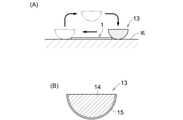
- the friction terminal 13 has a structure in which a cotton cloth 15 is attached to the outer peripheral surface of an acrylic base 14 via a curing tape (not shown).
- the mouth breathing suppression tapes of Examples 1 and 2 were subjected to a test (a stratum corneum peeling test) for confirming the degree of irritation given to the skin when the mouth breathing suppression tape was peeled off. Specifically, after washing with soap and drying, the mouth breathing suppression tape is placed side by side on the arm of the same person, left to stand for 4 hours, then the mouth breathing suppression tape is peeled off, and the adhesive surface on the back surface is exposed to infrared rays. Measured using a spectrophotometer (IRAffinity-1S manufactured by Shimadzu Corporation), the amount of change in the peak corresponding to 1543 cm -1 was measured in comparison with the same type of mouth breathing inhibitor tape that was not attached to the skin. It was measured.
- a test a stratum corneum peeling test
- the amount of change in this peak is proportional to the amount of stratum corneum peeled from the skin together with the mouth breathing inhibitor tape by removing the mouth breathing inhibitor tape from the skin.
- the results are shown in Table 1.
- the results of the stratum corneum peeling test show that the smaller the amount of change, the less irritation to the skin.
- sensory evaluation was performed by having 20 monitors use mouth breathing suppression tape for 3 days each during sleep.
- the evaluation items were set as follows.
- the degree of tape peeling when waking up the number of people who selected 3 and 4 was counted as "the number of people who had tape peeling", and the occurrence rate was calculated.
- the degree of pain when the tape was peeled off from the mouth the number of people who selected 2 and 3 was counted as the "number of people who felt pain", and the incidence was calculated.
- the results are shown in Table 2.
- the degree of peeling of the tape when waking up was subjected to sensory evaluation using the mouth breathing inhibitor tapes of Examples 1 to 3 and Comparative Examples, and the degree of pain when the tape was peeled from the mouth was the mouth of Examples 1 and 2. Sensory evaluation was performed using respiratory depression tape.
- the maximum peeling force in the 0 degree peeling test in the length direction is 7 N or more, and the elongation rate in the length direction is 5% or more. From the results of the AIUEO voice test and sensory evaluation, it was confirmed that the mouth breathing suppression tape, which is 25% or less, does not easily come off from the mouth even if there is movement of the mouth during sleep. In addition, by comparing Examples 1 and Examples 2 and 3, the mouth breathing suppression tape having a maximum peeling force of 30 N or more in the 0 degree peeling test in the length direction was found during sleep based on the results of the AIUEO vocal test and sensory evaluation. It was confirmed that the mouth breathing suppression tape was more effectively difficult to peel off from the mouth even if there was movement of the mouth.
- Example 1 the mouth breathing inhibitory tape having an average peeling force of 1 N or more in the 180-degree peeling test in the length direction was subjected to the friction peeling durability test. From the results, it was confirmed that the mouth breathing suppression tape was difficult to peel off from the mouth even if there was contact with the bedding during sleep. Further, by comparing Example 1 and Example 2, the mouth breathing inhibitory tape having an average peeling force of 3 N or more in the 180-degree peeling test in the length direction is different from the sleeping bedding based on the result of the friction peeling durability test. It was confirmed that the mouth breathing suppression tape was more effectively resistant to peeling from the mouth even when there was contact.
- the mouth breathing inhibitory tape having a peeling energy of 200 mm ⁇ N or more in the 0 degree peeling test in the length direction by comparison between Examples 1 and 2 has a stratum corneum peeling test and a sensory evaluation. From the results, it was confirmed that the irritation given to the skin when the mouth breathing inhibitor tape was peeled off from the mouth was reduced.
Landscapes
- Health & Medical Sciences (AREA)
- Life Sciences & Earth Sciences (AREA)
- Animal Behavior & Ethology (AREA)
- General Health & Medical Sciences (AREA)
- Public Health (AREA)
- Veterinary Medicine (AREA)
- Surgery (AREA)
- Epidemiology (AREA)
- Nursing (AREA)
- Vascular Medicine (AREA)
- Otolaryngology (AREA)
- Orthopedic Medicine & Surgery (AREA)
- Engineering & Computer Science (AREA)
- Biomedical Technology (AREA)
- Heart & Thoracic Surgery (AREA)
- Pulmonology (AREA)
- Chemical & Material Sciences (AREA)
- Chemical Kinetics & Catalysis (AREA)
- Adhesive Tapes (AREA)
- Materials For Medical Uses (AREA)
- Medicines Containing Material From Animals Or Micro-Organisms (AREA)
- Orthopedics, Nursing, And Contraception (AREA)
Abstract
【課題】睡眠時に口から剥がれ難い口呼吸抑制テープを提供することを目的とする。 【解決手段】口呼吸抑制テープ(1)は、長さ及び前記長さよりも短い幅を有する基材(2)と、基材(2)の裏面に設けられた粘着層(3)とを備えており、長さ方向(縦方向)における0度剥離試験による最大剥離力が7N以上であり、かつ、長さ方向(縦方向)における伸び率が5%以上25%以下である、ことを特徴とする。
Description
本発明は、例えば就寝の際に、上唇及び下唇に跨るように口に貼り付けることで睡眠時の口呼吸を抑制する口呼吸抑制テープに関する。
睡眠時の口呼吸を抑制するテープとして、特許文献1に記載の口呼吸抑制テープがある。口呼吸抑制テープは、不織布等からなり、一方面に粘着剤が塗布されている。粘着剤が塗布されている面を介して口呼吸抑制テープを上唇及び下唇に跨るように口に貼り付けることで、睡眠時の口呼吸を抑制できる。
口呼吸抑制テープは、口が開かないよう閉じた状態に維持することで口呼吸を抑制する。そのため、睡眠時の使用者の無意識な動きにより口呼吸抑制テープが口から剥がれないことが求められる。
本発明は、睡眠時に口から剥がれ難い口呼吸抑制テープを提供することを目的とする。
本発明者は、上記課題を解決すべく鋭意研究を重ねた結果、睡眠時の使用者の無意識な動き、主には呼吸やせき、歯軋り、寝言などの口の動きに対して口から容易に剥がれない剥離耐性と、口の動きに追随して適度に伸びる伸長性を口呼吸抑制シートが備えることで、睡眠時に口から剥がれ難くできることを見出した。本発明は、このような知見に基づいて完成されたものである。即ち、本発明は下記態様の口呼吸抑制テープを提供する。
本発明は、口に貼り付けて使用される口呼吸抑制テープに関する。本発明の口呼吸抑制テープは、長さ及び前記長さよりも短い幅を有する基材と、前記基材の裏面に設けられた粘着層と、を備えており、前記長さ方向における0度剥離試験による最大剥離力が7N以上であり、かつ、前記長さ方向における伸び率が5%以上25%以下である、ことを特徴とする。
本発明の口呼吸抑制テープにおいて好ましい態様は、前記長さ方向における180度剥離試験による平均剥離力が1N以上であることを特徴とする。
また、本発明の口呼吸抑制テープにおいて好ましい態様は、前記長さ方向における0度剥離試験による剥離エネルギーが200mm・N以上である、ことを特徴とする。
また、本発明の口呼吸抑制テープにおいて好ましい態様は、前記粘着剤がアクリル系粘着剤である、ことを特徴とする。
本発明の口呼吸抑制テープによれば、睡眠時に口から剥がれ難いので、睡眠時に効果的に口を閉じた状態にして口呼吸を抑制することができる。
本発明の口呼吸抑制テープは、例えば就寝の際に口に貼り付けて使用されるものであり、口を開かないよう閉じた状態に維持することにより、睡眠時の口呼吸を抑制して鼻呼吸を促すものである。なお、本開示では、口呼吸抑制テープにおいて、口への貼り付け時に口を縦断する(上唇から下唇に及ぶ)方向を「縦方向」とし、縦方向に直交する方向を「横方向」とし、縦方向の大きさを「長さ」とし、横方向の大きさを「幅」とする。
以下、本発明の口呼吸抑制テープに関する実施形態について、添付図面を参照しながら説明する。図1に示すように、本実施形態の口呼吸抑制テープ1は、基材2と、基材2の裏面に粘着剤の塗布により設けられた粘着層3とで構成されており、口呼吸抑制テープ1の裏面全体が粘着層3によって粘着面とされている。口呼吸抑制テープ1は、少なくとも縦方向(長さ方向)の一端部が上唇に他端部が下唇に接着することで、上唇及び下唇に跨るように口に貼り付けられる。なお、本開示において「裏面」とは、口に貼り付けられる側の面である。口呼吸抑制テープ1は、未使用時には、その裏面に剥離フィルムが貼り付けられている。
基材2は、不織布や織布、和紙などの紙、多数の細孔を有する樹脂シートなど、通気性及び柔軟性を有するシート材により形成されている。上述のシート材を単独で用いて基材2を形成してもよい、2種以上を組み合わせて基材2を形成してもよい。
基材2は、平面視で縦方向の大きさである長さが、横方向の大きさである幅よりも長い縦長形状を呈している。縦長形状としては、特に限定されるものではなく、平面視で長方形状、角丸長方形状、楕円形状、弾丸形状、瓢箪形状など、種々の形状とすることができる。本実施形態では、基材2は、縦方向(長さ方向)に沿う左右の両側縁20,21全体が内外にうねる波形状を呈している。なお、基材2は、縦方向に平行であり幅中央を通る中心線を軸として線対称であってもよいし、線対称でなくてもよい。また、基材2は、横方向に平行であり長さ中央を通る中心線を軸として線対称であってもよいし、線対称でなくてもよい。
基材2の長さは、口呼吸抑制テープ1の口への貼り付け時に上唇から下唇に及ぶ大きさであれば特に限定されないが、好ましくは30mm以上60mm以下であり、より好ましくは35mm以上45mm以下である。基材2の幅は、口呼吸抑制テープ1の口への貼り付け時に口との接触面積を十分に確保できて口から容易に剥がれない大きさであれば特に限定されないが、好ましくは15mm以上40mm以下であり、より好ましくは20mm以上30mm以下である。基材2の厚みは、口呼吸抑制テープ1の強度を十分に確保できる厚みであれば特に限定されないが、好ましくは0.1mm以上0.8mm以下であり、より好ましくは0.2mm以上0.4mm以下である。
粘着層3を形成する粘着剤は、例えば一般にシリコン系粘着剤、ウレタン系粘着剤、アクリル系粘着剤、ゴム系粘着剤と呼ばれる粘着剤を用いることができるが、その中でも、皮膚への貼付を目的としたテープ材としての実績をもつ資材が多く、より幅広い選択肢の中から比較的安価で安全性高いものを選択できるとの観点から、アクリル系粘着剤を用いることが好ましい。アクリル系粘着剤は、アクリルポリマーからなり、モノマーの種類、ポリマーの分子量、架橋密度などを制御することにより、接着力の強弱のコントロールが可能である。
本実施形態の口呼吸抑制テープ1は、睡眠時の使用者の無意識な動き、例えば呼吸やせき、歯軋り、寝言などの口の動きにより、口から容易に剥がれないようにするために、所定の剥離耐性及び伸長性を有している。以下、具体的に説明する。
(1)縦方向(長さ方向)における0度剥離試験による最大剥離力
縦方向(長さ方向)における0度剥離試験による最大剥離力とは、睡眠時における口の上下に開こうとする動き(上唇と下唇が離れる動き)により口呼吸抑制テープ1が口から剥がれることに対する耐性(剥がれ難さ)を示す数値である。口が上下に開くと、口に貼り付けられた口呼吸抑制テープ1は、縦方向(長さ方向)の一端部と他端部が反対方向に引っ張られるが、口呼吸抑制テープ1が縦方向に引っ張られたときに口から剥離するまでに耐えられる最大の力が大きいほど口から剥がれ難い。そのため、口呼吸抑制テープ1は縦方向(長さ方向)における0度剥離試験による最大剥離力が所定値以上である必要がある。
縦方向(長さ方向)における0度剥離試験による最大剥離力とは、睡眠時における口の上下に開こうとする動き(上唇と下唇が離れる動き)により口呼吸抑制テープ1が口から剥がれることに対する耐性(剥がれ難さ)を示す数値である。口が上下に開くと、口に貼り付けられた口呼吸抑制テープ1は、縦方向(長さ方向)の一端部と他端部が反対方向に引っ張られるが、口呼吸抑制テープ1が縦方向に引っ張られたときに口から剥離するまでに耐えられる最大の力が大きいほど口から剥がれ難い。そのため、口呼吸抑制テープ1は縦方向(長さ方向)における0度剥離試験による最大剥離力が所定値以上である必要がある。
縦方向(長さ方向)における0度剥離試験は、以下の方法により行う。まずは図2(A)に示すように、ポリプロピレン製の試験板10の平坦な表面に、口呼吸抑制テープ1を縦方向(長さ方向)でその面積Sの50%が試験板10からはみ出すように裏面の粘着層を介して貼り付ける。例えば口呼吸抑制テープ1が、横方向(幅方向)に平行であり長さ中央を通る中心線を軸として線対称である場合には、長さ中央を通る中心線を境界にして口呼吸抑制テープ1を試験板10からはみ出させる。次に図2(B)に示すように、口呼吸抑制テープ1の試験板10に貼り付けられた部分の全域上を、重さ2kgのローラ11を接触させた状態で1往復転動させることで、荷重をかけて口呼吸抑制テープ1を試験板10にしっかりと貼り付ける。次に図2(C)に示すように、口呼吸抑制テープ1において、縦方向(長さ方向)の試験板10からはみ出す側の端部の全体をチャック12で掴み、該チャック12を試験板10の表面に対して平行かつ口呼吸抑制テープ1の試験板10からはみ出す方向(矢印の0°方向(口呼吸抑制テープ1の長さ方向))に、図示しない引張試験機(株式会社島津製作所製のAUTOGRAPH AGS-500NX)を用いて300mm/minの速度で引っ張る。口呼吸抑制テープ1が試験板10から剥離するまでに引っ張った際の力を測定し、その最大値を計測することにより最大剥離力が得られる。
縦方向(長さ方向)における0度剥離試験による最大剥離力が7N以上であることにより、口呼吸抑制テープ1は、睡眠時における口の上下に開こうとする動きに対する耐久性が高いため、口呼吸抑制テープ1の縦方向(長さ方向)の両端部の上唇及び下唇に対する接着を維持することができ、口呼吸抑制テープ1を口から剥がれ難くすることができる。この最大剥離力は、7N以上であれば特に限定されないが、口呼吸抑制テープ1を効果的に口から剥がれ難くする観点から、30N以上であることが好ましい一方で、その上限は剥がす際の痛みを感じ難くするとの観点から、40N以下であることが好ましい。
縦方向(長さ方向)における0度剥離試験による最大剥離力は、粘着層3(粘着剤)による接着力の他、基材2の素材や寸法(長さ、幅及び厚み)などを適宜調整することにより、所望の大きさに制御することができる。
(2)縦方向(長さ方向)における伸び率
縦方向(長さ方向)における伸び率とは、睡眠時における口の上下に拡がろうとする動きにより口呼吸抑制テープ1が口から剥がれることに対する耐性(剥がれ難さ)を示す数値である。口が上下に拡がると、口に貼り付けられた口呼吸抑制テープ1は、縦方向(長さ方向)の一端部と他端部が反対方向に引っ張られるが、このとき口呼吸抑制テープ1が縦方向(長さ方向)に伸縮することで口の動きへの追従性が生じ、口から剥がれ難くなる。一方で、口呼吸抑制テープ1が縦方向(長さ方向)に伸び過ぎると、口呼吸抑制テープ1が口に貼り付けられた状態でも口が開いてしまって口呼吸を抑制できないおそれがある。そのため、口呼吸抑制テープ1は縦方向(長さ方向)に適度に伸びる必要がある。
縦方向(長さ方向)における伸び率とは、睡眠時における口の上下に拡がろうとする動きにより口呼吸抑制テープ1が口から剥がれることに対する耐性(剥がれ難さ)を示す数値である。口が上下に拡がると、口に貼り付けられた口呼吸抑制テープ1は、縦方向(長さ方向)の一端部と他端部が反対方向に引っ張られるが、このとき口呼吸抑制テープ1が縦方向(長さ方向)に伸縮することで口の動きへの追従性が生じ、口から剥がれ難くなる。一方で、口呼吸抑制テープ1が縦方向(長さ方向)に伸び過ぎると、口呼吸抑制テープ1が口に貼り付けられた状態でも口が開いてしまって口呼吸を抑制できないおそれがある。そのため、口呼吸抑制テープ1は縦方向(長さ方向)に適度に伸びる必要がある。
縦方向(長さ方向)における伸び率は、以下の方法により測定する。まずは図3(A)に示すように、口呼吸抑制テープ1の縦方向(長さ方向)の両端部を互いの間隔を10mmあけて一対のチャック12A,12Bで掴む。つまり、口呼吸抑制テープ1の横方向(幅方向)に平行であり長さ中央を通る中心線を境界にし、上下5mmの範囲にある部分を残して口呼吸抑制テープ1を一対のチャック12A,12Bで掴む。次に図3(B)に示すように、一方のチャック12Aを他方のチャック12Bと反対方向に、図示しない引張試験機(株式会社島津製作所製のAUTOGRAPH AGS-500NX)を用いて100mm/minの速度で引っ張り、図3(C)に示すように、口呼吸抑制テープ1に500gfの荷重がかかった時点でのチャック12A,12B間の距離Lmmを計測する。口呼吸抑制テープ1の伸びる前のチャック12A,12B間の距離10mmに対する伸びた後のチャック12A,12B間の距離Lmmに対する比((L-10)/10)を百分率で算出し、これを伸び率とする。
縦方向(長さ方向)の伸び率が5%以上であることにより、口呼吸抑制テープ1は、睡眠時における口の上下に開こうとする動きに対する追随性が高く、口の上下の動きに応じて口呼吸抑制テープ1が縦方向(長さ方向)に伸びて口に対する接着を維持することができるため、口呼吸抑制テープ1を口から剥がれ難くすることができる。一方で、縦方向(長さ方向)の伸び率が25%以下であることにより、口呼吸抑制テープ1は、口の上下の動きに追随して縦方向(長さ方向)に過度に伸びずに口が開こうとするのを抑制するため、口呼吸を抑制することができる。縦方向(長さ方向)伸び率は、5%以上25%以下であれば特に限定されない。
なお、口呼吸抑制テープ1の横方向(幅方向)の伸長性については、特に限定されず、同じ荷重を加えて引っ張ったときに伸長する長さが縦方向(長さ方向)と同程度、又は、縦方向(長さ方向)よりも大きくてもよい。
上述の通り、本実施形態の口呼吸抑制テープ1は、縦方向(長さ方向)における0度剥離試験による最大剥離力が7N以上であり、かつ、縦方向(長さ方向)の伸び率が5%以上25%以下であるので、睡眠時に使用者の口が動いても口から剥がれないうえ、過度に伸びないため、口に良好に貼り付けられた状態が維持され、口呼吸を抑制することができる。
さらに、本実施形態の口呼吸抑制テープ1は、睡眠時の使用者の無意識な動きである寝相による寝具(例えば枕や布団、敷布など)との接触により、口から容易に剥がれないようにするために、所定の剥離耐性を有している。以下、具体的に説明する。
(3)縦方向(長さ方向)における180度剥離試験による平均剥離力
縦方向(長さ方向)における180度剥離試験による平均剥離力とは、睡眠時に口呼吸抑制テープ1が寝具との接触によりその一部が捲れ上がった後、次第に全体が口から剥がれることに対する耐性(剥がれ難さ)を示す数値である。口呼吸抑制テープ1は、寝具に擦られることで主には縦方向(長さ方向)の端部が口から捲れ上がり、その後も寝具との擦れにより捲れ上がった端部を起点としてその全体が次第に口から剥がれようとするが、縦方向(長さ方向)の端部が捲れ上がったときに口呼吸抑制テープ1の口から剥離するのに抗する全体的な力が大きいほど口から剥がれ難い。そのため、口呼吸抑制テープ1は、縦方向(長さ方向)における180度剥離試験による平均剥離力が所定値以上であることが好ましい。
縦方向(長さ方向)における180度剥離試験による平均剥離力とは、睡眠時に口呼吸抑制テープ1が寝具との接触によりその一部が捲れ上がった後、次第に全体が口から剥がれることに対する耐性(剥がれ難さ)を示す数値である。口呼吸抑制テープ1は、寝具に擦られることで主には縦方向(長さ方向)の端部が口から捲れ上がり、その後も寝具との擦れにより捲れ上がった端部を起点としてその全体が次第に口から剥がれようとするが、縦方向(長さ方向)の端部が捲れ上がったときに口呼吸抑制テープ1の口から剥離するのに抗する全体的な力が大きいほど口から剥がれ難い。そのため、口呼吸抑制テープ1は、縦方向(長さ方向)における180度剥離試験による平均剥離力が所定値以上であることが好ましい。
縦方向(長さ方向)における180度剥離試験は、以下の方法により行う。まずは図4(A)に示すように、ポリプロピレン製の試験板10の平坦な表面に、口呼吸抑制テープ1の全体を裏面の粘着層を介して貼り付ける。次に図4(B)に示すように、口呼吸抑制テープ1の全体上を、重さ2kgのローラ11を接触させた状態で1往復転動させることで、荷重をかけて口呼吸抑制テープ1を試験板10にしっかりと貼り付ける。次に図4(C)に示すように、口呼吸抑制テープ1の縦方向(長さ方向)の一端部を試験板10から捲り上げてチャック12で掴み、該チャック12を試験板10の表面に対して平行かつ口呼吸抑制テープ1の縦方向(長さ方向)の他端部の方向(矢印の180°方向(口呼吸抑制テープ1の長さ方向))に、図示しない引張試験機(株式会社島津製作所製のAUTOGRAPH AGS-500NX)を用いて300mm/minの速度で引っ張る。口呼吸抑制テープ1が試験板10から剥離するまでに引っ張った際の力を測定し、測定値を凸点平均にて処理することにより平均剥離力が得られる。
縦方向(長さ方向)における180度剥離試験による平均剥離力は1N以上であることが好ましく、これにより、口呼吸抑制テープ1は良好に口に接着しているため、寝具との擦れに対する耐久性が高く、口呼吸抑制テープ1を口から剥がれ難くすることができる。縦方向(長さ方向)における180度剥離試験による平均剥離力は、口呼吸抑制テープ1を効果的に口から剥がれ難くする観点から、3N以上であることがより好ましい一方で、その上限は剥がす際の痛みを感じ難くするとの観点から、5N以下であることが好ましい。
縦方向(長さ方向)における180度剥離試験による平均剥離力は、粘着層3(粘着剤)による接着力などを適宜調整することにより、所望の大きさに制御することができる。
さらに、本実施形態の口呼吸抑制テープ1は、使用後に口から剥がした際に皮膚に与える物理的な刺激を抑えて痛みが生じないようにするために、所定の剥離特性を有している。以下、具体的に説明する。
(4)縦方向(長さ方向)における0度剥離試験による剥離エネルギー
口呼吸抑制テープ1は口に貼り付けられた状態から剥がす際に、粘着層3(粘着剤)が硬い触感であるとぴりっと剥がれて皮膚に瞬間的に強い刺激を与えるのに対して、粘着層3(粘着剤)が柔らかい触感であるともっちりと剥がれて皮膚に弱い刺激をじわっと与えるため、強い刺激を与えない。そのため、粘着層3(粘着剤)が柔らかい触感である方が口呼吸抑制テープ1を口から剥がした際に皮膚を傷つけない。
口呼吸抑制テープ1は口に貼り付けられた状態から剥がす際に、粘着層3(粘着剤)が硬い触感であるとぴりっと剥がれて皮膚に瞬間的に強い刺激を与えるのに対して、粘着層3(粘着剤)が柔らかい触感であるともっちりと剥がれて皮膚に弱い刺激をじわっと与えるため、強い刺激を与えない。そのため、粘着層3(粘着剤)が柔らかい触感である方が口呼吸抑制テープ1を口から剥がした際に皮膚を傷つけない。
本発明者が鋭意研究した結果、粘着層3(粘着剤)の触感が、上記(1)の口呼吸抑制テープ1の縦方向(長さ方向)における0度剥離試験において求められる剥離エネルギーに相関することを見出した。具体的に、粘着層3(粘着剤)が硬い触感である場合には、例えば図5(A)に示すように、口呼吸抑制テープ1が引っ張られてから試験板10から剥離するまでに作用する引張力の挙動(縦軸が引張力(N)、横軸がストローク(mm))は急カーブで瞬時にピークまで到達する曲線を描くが、粘着層3(粘着剤)が柔らかい触感である場合には、例えば図5(B)に示すように、前記挙動は緩やかなカーブでじわっとピークに到達する曲線を描く。よって、前記挙動と横軸により囲まれた面積で示される剥離エネルギーは、粘着層3(粘着剤)の触感が硬い場合よりも柔らかい場合の方が大きくなる。そのため、口呼吸抑制テープ1は縦方向(長さ方向)における0度剥離試験による剥離エネルギーが所定値以上であることが好ましい。
縦方向(長さ方向)における0度剥離試験による剥離エネルギーは200N・mm以上であることが好ましく、これにより、口呼吸抑制テープ1を口から剥がす際に皮膚に与える刺激を低減することができ、肌に優しい良好な使用感を達成することができる。なお、縦方向(長さ方向)における0度剥離試験による剥離エネルギーの上限は粘着剤が柔らかくなりすぎると、べたつきや糊残りの原因となることが懸念されるとの観点から、600N・mm以下であることが好ましい。
以上説明したように、本実施形態の口呼吸抑制テープ1は、長さ及び前記長さよりも短い幅を有する基材2と、基材2の裏面に設けられた粘着層3とを備えており、長さ方向における0度剥離試験による最大剥離力が7N以上であり、かつ、長さ方向における伸び率が5%以上25%以下である。そのため、睡眠時における口の上下方向の動き(上唇と下唇が離れる動き)が原因で口から剥がれることに対する耐性(剥がれ難さ)が高いとともに、口の上下方向の動きに追随する長さ方向の適度な伸縮性を有することから、口の上下方向の動きに付いていけずに口から剥がれることがなく、長さ方向に過度に伸びないことから、口呼吸抑制テープ1が口に貼り付けられた状態でも口が開いてしまうことを抑制できる。よって、本実施形態の口呼吸抑制テープ1によれば、効果的に口呼吸を抑制することができる。
また本実施形態の口呼吸抑制テープ1によれば、長さ方向における180度剥離試験による平均剥離力が1N以上であるため、睡眠時に口呼吸抑制テープ1が寝具と接触して寝具により擦られても、口から剥がれ難くすることができる。
また本実施形態の口呼吸抑制テープ1によれば、長さ方向における0度剥離試験による剥離エネルギーが200mm・N以上であるため、口呼吸抑制テープ1を口から剥がす際の皮膚への刺激を抑えることができ、肌に優しく使用感を向上させることができる。
以上、本発明の一実施形態について説明したが、上記実施形態は、全ての点で例示であって制限的なものではないため、本発明は上記実施形態に限定されるものではなく、本発明の趣旨を逸脱しない限りにおいて種々の変形が可能である。
以下、実施例により本発明を更に詳細に説明する。ただし、本発明に係る口呼吸抑制テープは、以下の実施例に限定されない。
実施例1の口呼吸抑制テープは、図1に示す形状を呈しており、その寸法は長さ41mm、幅19mm(両側縁のくびれの間)~23mm(両側縁のでっぱりの間)、厚み0.32mmであった。基材にはポリエステル製スパンレース不織布を用い、粘着剤にはアクリル系粘着剤を用いた。実施例2の口呼吸抑制テープは、先端の丸い略弾丸形状を呈しており、その寸法は長さ51mm、幅25mm(最も膨らんだところ)、厚み0.25mmであった。基材には紙を用い、粘着剤にはアクリル系粘着剤を用いた。実施例3の口呼吸抑制テープは、図1に示す形状を呈しており、その寸法は長さ42mm、幅15mm(両側縁のくびれの間)~18mm(両側縁のでっぱりの間)、厚み0.30mmであった。基材にはポリエステル製スパンレース不織布を用い、粘着剤にはシリコン系粘着剤を用いた。比較例の口呼吸抑制テープは、角の丸い長方形状を呈しており、その寸法は長さ51mm、幅20mm、厚み0.30mmであった。基材にはポリエステル製スパンレース不織布を用い、粘着剤にはアクリル系粘着剤を用いた。
また、実施例1~3及び比較例の口呼吸抑制テープの物性として、上記(1)の長さ方向における0度剥離試験よる最大剥離力の測定、上記(2)の長さ方向における伸び率の測定、及び上記(3)の長さ方向における180度剥離試験による平均剥離力の測定を行った。また、実施例1,2の口呼吸抑制テープに対して、上記(4)の長さ方向における0度剥離試験による剥離エネルギーの測定を行った。その結果を表1に示す。なお、実施例1,2の口呼吸抑制テープについて、引っ張られてから試験板10から剥離するまでに作用した引張力の挙動を図6に示す。
これら実施例1~3及び比較例の口呼吸抑制テープに対して、使用者の口の動きによる剥がれ難さを確認する試験(あいうえお発声試験)を行った。具体的には、実施例1~3及び比較例の口呼吸抑制テープを、時間をおいて同じ人物の口に上唇及び下唇に跨るように順次に貼り付けた状態で「あ」「い」「う」「え」「お」を繰り返し発声してもらった。そして、口呼吸抑制テープが口から剥がれたり、伸びきって使用できなくなるまでに発声できた文字数をカウントした。その結果を表1に示す。あいうえお発声試験の結果は、文字数が多いほど口の動きにより口呼吸抑制テープが口から剥がれ難いことを示す。
加えて実施例1~3及び比較例の口呼吸抑制テープに対して、口呼吸抑制テープが寝具により擦られることにより、使用者の口から剥がれるかどうかを確認する試験(摩擦剥がれ耐久試験)を行った。具体的には、実施例1~3及び比較例の口呼吸抑制テープを、時間をおいて同じ人物の腕に順次に貼り付け、図7(A)に示すように、テープ1の縦方向(長さ方向)の一端部上に半円柱形状(直径5cm、高さ5cm、重さ60g)の摩擦端子13を曲面を下にして接触させた状態で、株式会社ニーズ機工製の皮膚擦り試験装置を用いて40mm幅を毎秒1往復のペースで擦るよう設定し、テープ1上を縦方向(長さ方向)の他端部に向けて摺動させることにより、寝具との擦れ状況を再現した。摩擦端子13は、図7(B)に示すように、アクリル製の基部14の外周面に養生テープ(図示せず)を介して綿布15を貼り付けた構成のものである。テープ1の縦方向(長さ方向)の他端部に摩擦端子13が到達した後は、摩擦端子13をテープ1から浮かせて縦方向(長さ方向)の一端部側に戻し、再度、摩擦端子13をテープ1の縦方向(長さ方向)の他端部に向けて繰り返し摺動させた。そして、テープ1が腕から剥がれるまでに摩擦端子13を摺動させた回数をカウントした。その結果を表1に示す。摩擦剥がれ耐久試験の結果は、回数が多いほど寝具との擦れにより口呼吸抑制テープが口から剥がれ難いことを示す。
加えて実施例1,2の口呼吸抑制テープに対して、口呼吸抑制テープを剥がす際に皮膚に与える刺激の程度を確認する試験(角層剥離試験)を行った。具体的には、石鹸で洗浄し、乾燥させた後の同じ人物の腕に口呼吸抑制テープを並べて貼り付けて4時間静置後、口呼吸抑制テープを剥離し、裏面の粘着面を赤外分光光度計(株式会社島津製作所製のIRAffinity-1S)を用いて測定し、皮膚への貼り付けを行っていない同種の口呼吸抑制テープとの比較で1543cm-1に相当するピークの変化量を測定した。このピークの変化量は、口呼吸抑制テープを皮膚から剥がすことで、口呼吸抑制テープと一緒に皮膚から剥離した角層の量に比例する。その結果を表1に示す。角層剥離試験の結果は、変化量が少ないほど皮膚に与える刺激が少ないことを示す。

さらに、20名のモニターに口呼吸抑制テープをそれぞれ3日間、睡眠時に使用してもらうことで、官能評価を実施した。評価項目は以下の通り設定した。
・起床時のテープの剥がれ具合
1.剥がれていなかった。
2.一部に剥がれはあるが口は開かない状態であった。
3.一部に剥がれがあり、口も開く状態であった。
4.完全に剥がれていた。
1.剥がれていなかった。
2.一部に剥がれはあるが口は開かない状態であった。
3.一部に剥がれがあり、口も開く状態であった。
4.完全に剥がれていた。
・テープを口から剥がした際の痛みの程度
1.痛みを感じなかった。
2.やや痛みを感じた。
3.痛みを感じた。
1.痛みを感じなかった。
2.やや痛みを感じた。
3.痛みを感じた。
起床時のテープの剥がれ具合については、3及び4を選択した人数を「テープの剥がれが生じた人数」としてカウントし、その発生率を算出した。テープを口から剥がした際の痛みの程度については、2及び3を選択した人数を「痛みを感じた人数」としてカウントし、その発生率を算出した。その結果を表2に示す。なお、起床時のテープの剥がれ具合については実施例1~3及び比較例の口呼吸抑制テープによる官能評価を行い、テープを口から剥がした際の痛みの程度については実施例1,2の口呼吸抑制テープによる官能評価を行った。

表1,2を参照すると、実施例1~3と比較例の対比により、長さ方向における0度剥離試験による最大剥離力が7N以上であり、かつ、長さ方向における伸び率が5%以上25%以下である口呼吸抑制テープは、あいうえお発声試験及び官能評価の結果から、睡眠時の口の動きがあっても口呼吸抑制テープが口から剥がれ難いことが確認された。また、実施例1と実施例2,3の対比により、長さ方向における0度剥離試験による最大剥離力が30N以上である口呼吸抑制テープは、あいうえお発声試験及び官能評価の結果から、睡眠時の口の動きがあってもさらに効果的に口呼吸抑制テープが口から剥がれ難いことが確認された。
表1を参照すると、実施例1,2と実施例3及び比較例の対比により、長さ方向における180度剥離試験による平均剥離力が1N以上である口呼吸抑制テープは、摩擦剥がれ耐久試験の結果から、睡眠時の寝具との接触があっても口呼吸抑制テープが口から剥がれ難いことが確認された。また、実施例1と実施例2の対比により、長さ方向における180度剥離試験による平均剥離力が3N以上である口呼吸抑制テープは、摩擦剥がれ耐久試験の結果から、睡眠時の寝具との接触があってもさらに効果的に口呼吸抑制テープが口から剥がれ難いことが確認された。
表1,2を参照すると、実施例1と実施例2の対比により、長さ方向における0度剥離試験による剥離エネルギーが200mm・N以上である口呼吸抑制テープは、角層剥離試験及び官能評価の結果から、口呼吸抑制テープを口から剥がした際に皮膚に与える刺激が低減されることが確認された。
1 口呼吸抑制テープ
2 基材
3 粘着層
2 基材
3 粘着層
Claims (4)
- 口に貼り付けて使用される口呼吸抑制テープであって、
該口呼吸抑制テープは、
長さ及び前記長さよりも短い幅を有する基材と、前記基材の裏面に設けられた粘着層と、を備えており、
前記長さ方向における0度剥離試験による最大剥離力が7N以上であり、かつ、
前記長さ方向における伸び率が5%以上25%以下である、ことを特徴とする口呼吸抑制テープ。 - 前記長さ方向における180度剥離試験による平均剥離力が1N以上である、ことを特徴とする請求項1に記載の口呼吸抑制テープ。
- 前記長さ方向における0度剥離試験による剥離エネルギーが200mm・N以上である、ことを特徴とする請求項1又は2に記載の口呼吸抑制テープ。
- 前記粘着剤がアクリル系粘着剤である、ことを特徴とする請求項1~3のいずれかに記載の口呼吸抑制テープ。
Priority Applications (1)
| Application Number | Priority Date | Filing Date | Title |
|---|---|---|---|
| CN202180052787.4A CN115989047A (zh) | 2020-08-26 | 2021-08-18 | 用于抑制口呼吸的胶带 |
Applications Claiming Priority (2)
| Application Number | Priority Date | Filing Date | Title |
|---|---|---|---|
| JP2020-142561 | 2020-08-26 | ||
| JP2020142561A JP2022038194A (ja) | 2020-08-26 | 2020-08-26 | 口呼吸抑制テープ |
Publications (1)
| Publication Number | Publication Date |
|---|---|
| WO2022044909A1 true WO2022044909A1 (ja) | 2022-03-03 |
Family
ID=80354266
Family Applications (1)
| Application Number | Title | Priority Date | Filing Date |
|---|---|---|---|
| PCT/JP2021/030158 Ceased WO2022044909A1 (ja) | 2020-08-26 | 2021-08-18 | 口呼吸抑制テープ |
Country Status (4)
| Country | Link |
|---|---|
| JP (1) | JP2022038194A (ja) |
| CN (1) | CN115989047A (ja) |
| TW (1) | TW202222284A (ja) |
| WO (1) | WO2022044909A1 (ja) |
Citations (4)
| Publication number | Priority date | Publication date | Assignee | Title |
|---|---|---|---|---|
| JPH10305100A (ja) * | 1997-03-05 | 1998-11-17 | Mitsuaki Kondo | 口呼吸セーブテープ |
| JP2004505669A (ja) * | 2000-08-09 | 2004-02-26 | ザ プロクター アンド ギャンブル カンパニー | 皮膚適合性接着剤を含むいびき防止装置 |
| JP2014236928A (ja) * | 2013-06-10 | 2014-12-18 | 株式会社さつま屋商店 | 口呼吸矯正テープ |
| JP2020103622A (ja) * | 2018-12-27 | 2020-07-09 | スリーエム イノベイティブ プロパティズ カンパニー | 皮膚貼付医療用部材 |
Family Cites Families (3)
| Publication number | Priority date | Publication date | Assignee | Title |
|---|---|---|---|---|
| JP5651363B2 (ja) * | 2010-04-01 | 2015-01-14 | 日東電工株式会社 | 伸縮性粘着包帯 |
| KR101949364B1 (ko) * | 2017-07-20 | 2019-02-19 | 모던인테크(주) | 미세먼지 포집용 직물 및 그를 이용한 직물제품 |
| JP7130374B2 (ja) * | 2018-01-09 | 2022-09-05 | 小林製薬株式会社 | テープセット |
-
2020
- 2020-08-26 JP JP2020142561A patent/JP2022038194A/ja active Pending
-
2021
- 2021-07-12 TW TW110125440A patent/TW202222284A/zh unknown
- 2021-08-18 WO PCT/JP2021/030158 patent/WO2022044909A1/ja not_active Ceased
- 2021-08-18 CN CN202180052787.4A patent/CN115989047A/zh active Pending
Patent Citations (4)
| Publication number | Priority date | Publication date | Assignee | Title |
|---|---|---|---|---|
| JPH10305100A (ja) * | 1997-03-05 | 1998-11-17 | Mitsuaki Kondo | 口呼吸セーブテープ |
| JP2004505669A (ja) * | 2000-08-09 | 2004-02-26 | ザ プロクター アンド ギャンブル カンパニー | 皮膚適合性接着剤を含むいびき防止装置 |
| JP2014236928A (ja) * | 2013-06-10 | 2014-12-18 | 株式会社さつま屋商店 | 口呼吸矯正テープ |
| JP2020103622A (ja) * | 2018-12-27 | 2020-07-09 | スリーエム イノベイティブ プロパティズ カンパニー | 皮膚貼付医療用部材 |
Also Published As
| Publication number | Publication date |
|---|---|
| JP2022038194A (ja) | 2022-03-10 |
| CN115989047A (zh) | 2023-04-18 |
| TW202222284A (zh) | 2022-06-16 |
Similar Documents
| Publication | Publication Date | Title |
|---|---|---|
| US20210113384A1 (en) | Skin treatment devices | |
| US3547112A (en) | Therapeutic positioning glove | |
| CN1498604A (zh) | 织构透气膜及其作为绷带背衬材料的用途 | |
| TW201021857A (en) | Pressure-sensitive adhesive tape or sheet for application to skin, and process for producing the same | |
| JPH07502913A (ja) | 包帯 | |
| US6248932B1 (en) | Self-adhesive ready-made bandage for restricting stretching or bending of the metacarpophalangeal joint and of the wrist | |
| CN102210620B (zh) | 可拉伸的压敏胶粘绷带 | |
| JP2011172831A (ja) | 美容用貼付材及びその貼付方法 | |
| US11510804B2 (en) | Muscle or joint support article with a strap | |
| JP4928353B2 (ja) | 貼付材 | |
| JP2022038194A (ja) | 口呼吸抑制テープ | |
| JP2024105684A (ja) | 絆創膏及び絆創膏用ポリウレタン不織布 | |
| JPH119623A (ja) | 医療用粘着テープ | |
| WO2013180008A1 (ja) | 皮脂吸収性貼付材、及びその製造方法 | |
| HK40092737A (zh) | 用於抑制口呼吸的胶带 | |
| TWM619820U (zh) | 可自行設計紋路之運動墊 | |
| JP4806935B2 (ja) | 伸縮性シートおよび貼付剤ならびにそれらの製造方法 | |
| JP2011067615A (ja) | 貼付材 | |
| JP2022552142A (ja) | 解放可能な固定のためのフィルムバッキング | |
| JP7309161B1 (ja) | 貼付材 | |
| JP2010274042A (ja) | 皮膚用付着テープ | |
| JP4158016B2 (ja) | 皮膚貼付治療体 | |
| JP7838934B2 (ja) | 絆創膏 | |
| CN222899445U (zh) | 一种防变形的医用退热贴 | |
| JPH10279472A (ja) | 外用貼付剤 |
Legal Events
| Date | Code | Title | Description |
|---|---|---|---|
| 121 | Ep: the epo has been informed by wipo that ep was designated in this application |
Ref document number: 21861337 Country of ref document: EP Kind code of ref document: A1 |
|
| NENP | Non-entry into the national phase |
Ref country code: DE |
|
| 122 | Ep: pct application non-entry in european phase |
Ref document number: 21861337 Country of ref document: EP Kind code of ref document: A1 |