WO2022044236A1 - 姿勢判定装置、姿勢判定方法、及びプログラム - Google Patents
姿勢判定装置、姿勢判定方法、及びプログラム Download PDFInfo
- Publication number
- WO2022044236A1 WO2022044236A1 PCT/JP2020/032488 JP2020032488W WO2022044236A1 WO 2022044236 A1 WO2022044236 A1 WO 2022044236A1 JP 2020032488 W JP2020032488 W JP 2020032488W WO 2022044236 A1 WO2022044236 A1 WO 2022044236A1
- Authority
- WO
- WIPO (PCT)
- Prior art keywords
- posture
- sound wave
- user
- sound
- posture determination
- Prior art date
- Legal status (The legal status is an assumption and is not a legal conclusion. Google has not performed a legal analysis and makes no representation as to the accuracy of the status listed.)
- Ceased
Links
Images




Classifications
-
- A—HUMAN NECESSITIES
- A61—MEDICAL OR VETERINARY SCIENCE; HYGIENE
- A61B—DIAGNOSIS; SURGERY; IDENTIFICATION
- A61B5/00—Measuring for diagnostic purposes; Identification of persons
- A61B5/45—For evaluating or diagnosing the musculoskeletal system or teeth
- A61B5/4538—Evaluating a particular part of the muscoloskeletal system or a particular medical condition
- A61B5/4561—Evaluating static posture, e.g. undesirable back curvature
-
- A—HUMAN NECESSITIES
- A61—MEDICAL OR VETERINARY SCIENCE; HYGIENE
- A61B—DIAGNOSIS; SURGERY; IDENTIFICATION
- A61B5/00—Measuring for diagnostic purposes; Identification of persons
- A61B5/48—Other medical applications
- A61B5/486—Biofeedback
-
- A—HUMAN NECESSITIES
- A61—MEDICAL OR VETERINARY SCIENCE; HYGIENE
- A61B—DIAGNOSIS; SURGERY; IDENTIFICATION
- A61B5/00—Measuring for diagnostic purposes; Identification of persons
- A61B5/74—Details of notification to user or communication with user or patient; User input means
- A61B5/7405—Details of notification to user or communication with user or patient; User input means using sound
-
- G—PHYSICS
- G06—COMPUTING OR CALCULATING; COUNTING
- G06F—ELECTRIC DIGITAL DATA PROCESSING
- G06F3/00—Input arrangements for transferring data to be processed into a form capable of being handled by the computer; Output arrangements for transferring data from processing unit to output unit, e.g. interface arrangements
- G06F3/16—Sound input; Sound output
- G06F3/165—Management of the audio stream, e.g. setting of volume, audio stream path
-
- G—PHYSICS
- G06—COMPUTING OR CALCULATING; COUNTING
- G06F—ELECTRIC DIGITAL DATA PROCESSING
- G06F3/00—Input arrangements for transferring data to be processed into a form capable of being handled by the computer; Output arrangements for transferring data from processing unit to output unit, e.g. interface arrangements
- G06F3/16—Sound input; Sound output
- G06F3/167—Audio in a user interface, e.g. using voice commands for navigating, audio feedback
Definitions
- the present invention relates to a technique for correcting a bad posture during work of a user.
- Computer vision syndrome and text neck syndrome have become major problems as opportunities to work and study using laptops and smartphones increase. If you continue to work in a bad posture for a long period of time, it causes eyestrain, dry eye, neck pain, and back pain.
- the distance between the user's eyes and the screen be 40 cm or more while the user is operating the laptop computer.
- the smartphone it is recommended that the user bring the smartphone in front of his / her face so that he / she does not operate it in a depressed state.
- Non-Patent Documents 1 and 2 a wearable sensor for constantly monitoring such a posture has been developed (for example, Non-Patent Documents 1 and 2).
- KHURANA Rusir, et al. Neck Graffe: a postural awareness system. In: CHI'14 Extended Abstracts on Human Factors in Computing Systems. 2014. p. 227-232. MIN, Chulhong, et al. Tiger: Wearable Glasses for the 20-20-20 Rule to Alleviate Computer Vision Syndrome. In: Proceedings of the 21st International Conference on Human-Computer Interaction with Mobile Devices 11. 11.
- Non-Patent Document 1 the posture of the user is detected by using an acceleration element (gyro), and when it is determined that the detected posture is bad, "vibration" is used to inform the user of the posture state. I'm giving feedback.
- an acceleration element (gyro) is adhered to the user's body. However, sticking the element to the user's body makes it difficult to use as a device for daily use.
- Non-Patent Document 2 uses a dedicated eyeglass-type module, which is equipped with an inertial measurement unit (IMU: Inertial Measurement Unit) that measures angular velocity and acceleration with high accuracy.
- IMU Inertial Measurement Unit
- the present invention has been made in view of the above points, and an object of the present invention is to provide a device for correcting a posture that can be easily and continuously used by a user.
- a sound wave receiving unit that receives sound waves in the inaudible range output from a sound wave transmitting unit mounted on the user, and a sound wave receiving unit.
- a posture determination device including a posture determination unit that determines the quality of the posture of the user based on the sound wave in the non-audible region and outputs the determination result is provided.
- a device for correcting posture is provided that can be easily and continuously used by the user.
- a posture feedback device for preventing computer vision syndrome and text neck syndrome using a wearable speaker (neck speaker) that can be continuously used in daily life without a load is provided.
- the posture feedback device of the present embodiment music is played from the wearable speaker and ultrasonic waves are transmitted at the same time, the ultrasonic waves are picked up by the microphone of a laptop computer or a smartphone, and the change in sound pressure between the wearable speaker and the microphone.
- the relative positional relationship is estimated, and the user's posture is estimated accordingly.
- the user can be made aware that the posture is bad by applying an acoustic effect to the music being played to reduce the sound quality.
- the posture feedback device of the present embodiment is realized by using a wearable speaker used for enjoying music in daily life, the wearing load is small for the user and it can be continuously used.
- a wearable speaker (neck speaker) is used as the sound wave transmission unit, but using a wearable speaker (neck speaker) is an example.
- Any device may be used as the sound wave transmitter as long as it is a device that is attached to the upper body of the user (the part above the waist) and can transmit sound waves in the inaudible range so that the posture of the user can be determined. ..
- a headset including an earphone worn on the user's head may be used.
- a speaker, a speakerphone, or the like to be attached to the user's chest may be used.
- the user's head, user's shoulders, user's neck, user's chest, etc. are all examples of the user's upper body.
- FIG. 1 shows a configuration example of the posture feedback device according to the present embodiment.
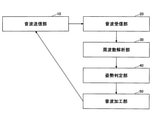
- the attitude feedback device according to the present embodiment includes a sound wave transmitting unit 10, a sound wave receiving unit 20, a frequency analysis unit 30, an attitude determining unit 40, and a sound wave processing unit 50.
- the functions of each part are as follows. Since the posture feedback device is also a device for determining the quality of the posture, it may be referred to as a posture determination device.
- a device including a sound wave receiving unit 20, a frequency analysis unit 30, and a posture determining unit 40 without providing the sound wave transmitting unit 10 and the sound wave processing unit 50 may be referred to as a posture determining device.
- the frequency analysis unit 30 may be included in the posture determination unit 40.
- the sound wave transmitting unit 10 simultaneously presents a sound wave in the audible range and an ultrasonic wave that is a sound wave in the non-audible range.
- the sound wave in the audible range may be referred to as "sound”.
- the sound wave receiving unit 20 receives the sound transmitted from the sound wave transmitting unit 10 and the ultrasonic wave.
- the frequency analysis unit 30 calculates the power spectrum by frequency analysis using the FFT with respect to the waveform of the sound wave signal received by the sound wave receiving unit 20.
- the posture determination unit 40 determines whether the user's posture is good or bad based on the ultrasonic power estimated from the power spectrum calculated by the frequency analysis unit 30.
- the sound wave processing unit 50 processes the sound in the audible range transmitted from the sound wave transmission unit 10 according to the posture determination result by the posture determination unit 40.
- step 1 the sound wave transmission unit 10 simultaneously transmits sound and ultrasonic waves.
- the sound wave receiving unit 20 receives the sound and ultrasonic waves transmitted from the sound wave transmitting unit 10.
- the frequency analysis unit 30 samples the signals (sound and ultrasonic waves) received by the sound wave receiving unit 20 and performs frequency analysis with the FFT for each fixed number of samples to calculate the power spectrum.
- the posture determination unit 40 determines whether the user's posture is good or bad from the power in the ultrasonic frequency band, and outputs the determination result.
- the process proceeds to S5, and the sound wave processing unit 50 receiving the determination result processes the sound in the audible range, and the processed sound (and the processed sound). Ultrasound) is presented to the sound wave transmission unit 10. This allows the user to notice that the posture is bad. If it is not determined in S4 that the user's posture is bad, the process proceeds to S6 and returns to S1 without processing the sound.
- the posture determination unit 40 may output information (eg, voice, light, image, characters, etc.) for feeding back to the user that the user's posture is bad.
- FIG. 3 is a diagram for explaining an implementation example of the posture feedback device of the present embodiment.
- a wearable speaker (neck speaker) 100 is used as a sound wave transmitting unit 10 for transmitting sound and ultrasonic waves, and a sound wave receiving unit 20, a frequency analysis unit 30, an attitude determination unit 40, and a sound wave processing unit 50 are used.
- a laptop PC 200 or a smartphone 300 is used as a device for realizing the above.
- the microphone of the laptop PC 200 or the smartphone 300 corresponds to the sound wave receiving unit 20.
- the frequency analysis unit 30, the posture determination unit 40, and the sound wave processing unit 50 are each realized by a program (application) that operates on the laptop PC 200 or the smartphone 300.
- the wearable speaker 100 neck speaker
- the wearable speaker 100 which is the sound wave transmission unit 10
- the wearable speaker 100 is hung on the user's neck (or is worn near the user's shoulder), and the user works on the laptop PC 200 or the smartphone 300.
- the sound wave transmission unit 10 (wearable speaker 100) simultaneously transmits sound and ultrasonic waves.
- the sound is the sound of music or the like heard by the user.
- the frequency of the ultrasonic wave is, for example, 20 kHz. By setting the frequency to 20 kHz, it is possible to present an ultrasonic wave that cannot be heard by the user but can be captured by the sound wave receiving unit 20 (microphone).
- the sound wave transmission unit 10 (wearable speaker 100) simultaneously transmits sound and ultrasonic waves is an example.
- a normal state a state in which the posture of the user is not bad
- only ultrasonic waves may be transmitted without transmitting sound.
- the sound wave transmission unit 10 (wearable speaker 100) transmits sound when notifying the user that the user's posture is bad.
- the sound wave transmitting unit 10 may transmit only ultrasonic waves in either a normal state (a state in which the user's posture is not bad) or a state in which the user's posture is bad.
- a normal state a state in which the user's posture is not bad
- information for the posture determination unit 40 to feed back to the user that the user's posture is bad eg, voice, light, image, characters, etc.
- the sound wave receiving unit 20 receives the sound and ultrasonic waves transmitted from the sound wave transmitting unit 10 (wearable speaker 100).
- the frequency analysis unit 30 samples the signals (sound and ultrasonic waves) received by the sound wave receiving unit 20 (microphone), and performs frequency analysis with FFT for each 1024 samples, for example, to calculate the power spectrum. Then, the power around 20 kHz, which is the frequency of the ultrasonic wave, is calculated. As will be described later, when a specific smartphone is used as a device provided with a microphone (sound wave receiving unit 20), a power near 12 kHz may be calculated and the power near 12 kHz may be used for posture determination. ..
- the posture determination unit 40 determines whether or not the user's posture is bad according to a predetermined procedure based on the power near 20 kHz calculated by the frequency analysis unit 30. The details of the determination method will be described later.
- the method of processing the sound is not limited to a specific method, but for example, audio such as adding white noise to the sound, applying a bandpass filter to narrow the range, or applying distortion to distort the sound.
- the sound quality is reduced by applying a digital effect. The user notices that the posture is bad due to the deterioration of the sound quality, and corrects the posture to improve the sound quality.
- Example of posture judgment procedure An example of a posture determination procedure executed by the posture determination unit 40 when ultrasonic waves are presented downward (including diagonally downward) from the sound wave transmission unit 10 (wearable speaker 100) will be described.
- a case where a user wearing the wearable speaker 100 operates the laptop PC 200 will be described as an example 1
- a case where a user wearing the wearable speaker 100 will operate the smartphone 300 will be described as an example 2.
- Example 1 If the user is operating the laptop PC 200 and the posture becomes bad (bent forward), the distance between the wearable speaker 100 and the microphone (sound wave receiver 20) of the laptop PC 200 becomes short, and the result is As a result, the power (sound pressure) of ultrasonic waves increases.
- the posture determination unit 40 detects that the power of the ultrasonic wave becomes larger than a predetermined threshold value, it is determined that the posture of the user has deteriorated while the user is operating the laptop PC 200. do.
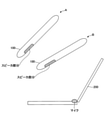
- FIG. 4 is a diagram showing an image of Example 1.
- A the position of the wearable speaker 100 when the user is in a normal state
- B the position of the wearable speaker 100 when the user's posture becomes poor.
- the speaker portion (the portion where sound and ultrasonic waves are output) of the wearable speaker 100 becomes closer to the microphone. Therefore, as described above, the power of the ultrasonic wave increases.
- Example 2 When the user is operating the smartphone 300 and the posture becomes bad (operated by turning down), the smartphone 300 is located under the wearable speaker 100, so that the microphone (sound wave receiving unit 20) emits ultrasonic waves. It becomes easier to pick up, and as a result, the power (sound pressure) of ultrasonic waves increases.
- the posture determination unit 40 detects that the power of the ultrasonic wave becomes larger than a predetermined threshold value, it determines that the posture of the user has deteriorated when the user is operating the smartphone 300. ..
- FIG. 5 is a diagram showing an image of Example 2.
- A the position of the wearable speaker 100 when the user is in a normal state
- B the position of the wearable speaker 100 when the user's posture becomes poor.
- the ultrasonic power increases as described above.
- the threshold value can be determined by calibrating in advance (measuring the power when the posture is good and when the posture is bad).
- FIG. 6 shows the value of the power spectrum near 20 kHz when the distance between the wearable speaker 100 and the microphone of the laptop PC 200 is changed from 0 cm to 40 cm in 10 cm increments.
- the values in the graph show the median of the results of 100 measurements at each distance, and are normalized by dividing by the power at a distance of 0 cm. From FIG. 6, it can be seen that the power is increased in the bad posture (0-30 cm) as compared with the good posture (40 cm).
- FIG. 7 shows the power when the user wearing the wearable speaker 100 holds the smartphone 300 in a good posture (holding it in front of the face) and in a bad posture (holding it down).
- the results of the experiment are shown as a box plot of the results of 100 measurements. Here, it is normalized by the value when the distance is 0 cm. From FIG. 7, it can be seen that the power is increased in the bad posture as compared with the good posture.
- the posture when used on a laptop PC 200 or a smartphone 300 other than a specific smartphone, the posture may be determined with a power of around 20 kHz, and when used on a specific smartphone, the posture may be determined with a power of around 12 kHz.
- the frequency analysis unit 30, the attitude determination unit 40, and the sound wave processing unit 50 in the attitude feedback device according to the present embodiment can all be realized by, for example, causing a computer including a microphone (sound wave receiving unit 20) to execute a program. ..
- the laptop PC 200 and smartphone 300 described above are examples of such computers.
- the device (a device having a frequency analysis unit 30, an attitude determination unit 40, a sound wave processing unit 50, etc.) is a process performed by the device using hardware resources such as a CPU and a memory built in the computer. It can be realized by executing the program corresponding to.
- the above program can be recorded on a computer-readable recording medium (portable memory, etc.), stored, and distributed. It is also possible to provide the above program through a network such as the Internet or e-mail.
- FIG. 8 is a diagram showing an example of the hardware configuration of the above computer.
- the computer of FIG. 8 has a drive device 1000, an auxiliary storage device 1002, a memory device 1003, a CPU 1004, an interface device 1005, a display device 1006, an input device 1007, an output device 1008, and the like, which are connected to each other by a bus B, respectively.
- the program that realizes the processing on the computer is provided by, for example, a recording medium 1001 such as a CD-ROM or a memory card.
- a recording medium 1001 such as a CD-ROM or a memory card.
- the program is installed in the auxiliary storage device 1002 from the recording medium 1001 via the drive device 1000.
- the program does not necessarily have to be installed from the recording medium 1001, and may be downloaded from another computer via the network.
- the auxiliary storage device 1002 stores the installed program and also stores necessary files, data, and the like.
- the memory device 1003 reads and stores the program from the auxiliary storage device 1002 when there is an instruction to start the program.
- the CPU 1004 realizes the function related to the device according to the program stored in the memory device 1003.
- the interface device 1005 is used as an interface for connecting to a network.
- the display device 1006 displays a GUI (Graphical User Interface) or the like by a program.
- the input device 1007 is composed of a microphone, a keyboard, a mouse, a button, a touch panel, or the like, and is used for inputting various information.
- the output device 1008 outputs the calculation result.
- the technique according to the present embodiment provides a device for correcting a posture that can be easily and continuously used by a user.
- the sound wave transmitting unit 10 that outputs sound and ultrasonic waves is not limited to the wearable speaker.
- a general-purpose device that outputs sound and ultrasonic waves By attaching a general-purpose device that outputs sound and ultrasonic waves to the user, it is possible to provide a device for correcting the posture that the user can easily and continuously use.
- the acceleration element (gyro) is adhered to the user's body, which makes it difficult to use as a device for daily use.
- the posture of the user can be detected by using ultrasonic waves, and the posture state can be fed back to the user by "sound", so that the device is adhered to the user's body. There is no need, and the user can easily and continuously use the device according to the present embodiment on a daily basis.
- Non-Patent Document 2 uses a dedicated device, is expensive, and is difficult for the user to use on a daily basis.
- a general-purpose device eg, a wearable speaker
- a dedicated device can be used as an ultrasonic wave presenting device and a feedback device of the posture determination result to the user, so that a dedicated device can be used.
- the device configuration can be realized at low cost without using it.
- the posture determination device includes the sound wave transmission unit.
- the posture determination device according to item 1 wherein the sound wave transmitting unit is attached to the upper body of the user and transmits sound waves in the inaudible region downward of the user's body.
- the posture determination device (Section 3) The posture determination device according to item 1 or 2, further comprising a frequency analysis unit that analyzes the frequency of the sound wave received from the sound wave receiving unit and acquires the power of the frequency of the sound wave in the inaudible region. (Section 4) The posture determination device according to item 3, wherein the posture determination unit determines whether or not the user's posture is good or bad by comparing the power with the threshold value. (Section 5) The posture determination according to any one of paragraphs 1 to 4, further comprising a sound wave processing unit for processing sound waves in the audible range output from the sound wave transmission unit according to the posture determination result for the user. Device.
Landscapes
- Health & Medical Sciences (AREA)
- Life Sciences & Earth Sciences (AREA)
- Engineering & Computer Science (AREA)
- Physics & Mathematics (AREA)
- General Health & Medical Sciences (AREA)
- Molecular Biology (AREA)
- Animal Behavior & Ethology (AREA)
- Veterinary Medicine (AREA)
- Biophysics (AREA)
- Pathology (AREA)
- Public Health (AREA)
- Biomedical Technology (AREA)
- Heart & Thoracic Surgery (AREA)
- Medical Informatics (AREA)
- Surgery (AREA)
- Physical Education & Sports Medicine (AREA)
- Theoretical Computer Science (AREA)
- Multimedia (AREA)
- Oral & Maxillofacial Surgery (AREA)
- Orthopedic Medicine & Surgery (AREA)
- Biodiversity & Conservation Biology (AREA)
- Dentistry (AREA)
- Audiology, Speech & Language Pathology (AREA)
- Human Computer Interaction (AREA)
- General Engineering & Computer Science (AREA)
- General Physics & Mathematics (AREA)
- Rheumatology (AREA)
- Telephone Function (AREA)
- Measurement Of The Respiration, Hearing Ability, Form, And Blood Characteristics Of Living Organisms (AREA)
Priority Applications (3)
| Application Number | Priority Date | Filing Date | Title |
|---|---|---|---|
| PCT/JP2020/032488 WO2022044236A1 (ja) | 2020-08-27 | 2020-08-27 | 姿勢判定装置、姿勢判定方法、及びプログラム |
| US18/023,072 US20230293093A1 (en) | 2020-08-27 | 2020-08-27 | Posture decision apparatus, posture decision method and program |
| JP2022545182A JP7556392B2 (ja) | 2020-08-27 | 2020-08-27 | 姿勢判定装置、姿勢判定方法、及びプログラム |
Applications Claiming Priority (1)
| Application Number | Priority Date | Filing Date | Title |
|---|---|---|---|
| PCT/JP2020/032488 WO2022044236A1 (ja) | 2020-08-27 | 2020-08-27 | 姿勢判定装置、姿勢判定方法、及びプログラム |
Publications (1)
| Publication Number | Publication Date |
|---|---|
| WO2022044236A1 true WO2022044236A1 (ja) | 2022-03-03 |
Family
ID=80352925
Family Applications (1)
| Application Number | Title | Priority Date | Filing Date |
|---|---|---|---|
| PCT/JP2020/032488 Ceased WO2022044236A1 (ja) | 2020-08-27 | 2020-08-27 | 姿勢判定装置、姿勢判定方法、及びプログラム |
Country Status (3)
| Country | Link |
|---|---|
| US (1) | US20230293093A1 (https=) |
| JP (1) | JP7556392B2 (https=) |
| WO (1) | WO2022044236A1 (https=) |
Families Citing this family (1)
| Publication number | Priority date | Publication date | Assignee | Title |
|---|---|---|---|---|
| US12408251B2 (en) * | 2023-07-30 | 2025-09-02 | Dell Products L.P. | Keyboard backlight control |
Citations (3)
| Publication number | Priority date | Publication date | Assignee | Title |
|---|---|---|---|---|
| CN101017418A (zh) * | 2006-02-06 | 2007-08-15 | 刘中华 | 带有坐姿监视功能的超声波手写板 |
| JP2014502203A (ja) * | 2010-12-07 | 2014-01-30 | ジェイ.ティ. ラブズ リミテッド | 睡眠姿勢検知及び監視システム |
| JP2016193020A (ja) * | 2015-03-31 | 2016-11-17 | セコム株式会社 | 超音波センサ |
Family Cites Families (6)
| Publication number | Priority date | Publication date | Assignee | Title |
|---|---|---|---|---|
| JPS59164524U (ja) * | 1983-04-21 | 1984-11-05 | 株式会社稲葉製作所 | 姿勢矯正装置付学習机 |
| JPH0610478Y2 (ja) * | 1988-06-25 | 1994-03-16 | 株式会社トキメック | 警報装置用ウエストベルト装置 |
| US9779593B2 (en) * | 2014-08-15 | 2017-10-03 | Elwha Llc | Systems and methods for positioning a user of a hands-free intercommunication system |
| CN203912278U (zh) * | 2014-06-12 | 2014-10-29 | 西安文理学院 | 一种led台灯智能控制器 |
| CN204634116U (zh) * | 2015-05-22 | 2015-09-09 | 无锡硅动力微电子股份有限公司 | 带有社交功能的智能台灯 |
| CN209149553U (zh) * | 2018-10-29 | 2019-07-23 | 荆门市探梦科技有限公司 | 一种超声波坐姿矫正报警器 |
-
2020
- 2020-08-27 WO PCT/JP2020/032488 patent/WO2022044236A1/ja not_active Ceased
- 2020-08-27 US US18/023,072 patent/US20230293093A1/en not_active Abandoned
- 2020-08-27 JP JP2022545182A patent/JP7556392B2/ja active Active
Patent Citations (3)
| Publication number | Priority date | Publication date | Assignee | Title |
|---|---|---|---|---|
| CN101017418A (zh) * | 2006-02-06 | 2007-08-15 | 刘中华 | 带有坐姿监视功能的超声波手写板 |
| JP2014502203A (ja) * | 2010-12-07 | 2014-01-30 | ジェイ.ティ. ラブズ リミテッド | 睡眠姿勢検知及び監視システム |
| JP2016193020A (ja) * | 2015-03-31 | 2016-11-17 | セコム株式会社 | 超音波センサ |
Also Published As
| Publication number | Publication date |
|---|---|
| US20230293093A1 (en) | 2023-09-21 |
| JPWO2022044236A1 (https=) | 2022-03-03 |
| JP7556392B2 (ja) | 2024-09-26 |
Similar Documents
| Publication | Publication Date | Title |
|---|---|---|
| US10306355B2 (en) | Orientation free handsfree device | |
| CN113475094B (zh) | 头戴式耳机中的不同头部检测 | |
| EP3127116B1 (en) | Attention-based dynamic audio level adjustment | |
| Hu et al. | HeadTrack: real-time human–computer interaction via wireless earphones | |
| JP5493611B2 (ja) | 情報処理装置、情報処理方法およびプログラム | |
| US10133358B1 (en) | Fitting detection for a bone conduction transducer (BCT) using an inertial measurement unit (IMU) sensor | |
| EP3016410B1 (en) | Measurement device and measurement system | |
| GB201207903D0 (en) | Headset and head mountable display | |
| US11533574B2 (en) | Wear detection | |
| CN109144460B (zh) | 发声控制方法、装置、电子装置以及存储介质 | |
| CN115412788A (zh) | 耳挂式麦克风 | |
| JP7556392B2 (ja) | 姿勢判定装置、姿勢判定方法、及びプログラム | |
| JP6214012B2 (ja) | 外部音知覚方法および外部音知覚装置 | |
| US10092223B2 (en) | Measurement system | |
| CN109144459B (zh) | 发声控制方法、装置、电子装置以及存储介质 | |
| CN115361636A (zh) | 声音信号调整方法、装置、终端设备及存储介质 | |
| CN110049395B (zh) | 耳机控制方法及耳机设备 | |
| JP6034715B2 (ja) | 動作検出装置およびプログラム | |
| US20150302840A1 (en) | Wearable device system for generating audio | |
| JP7534100B2 (ja) | 音検出装置及び音検出システム | |
| CN113573209A (zh) | 音频处理方法、装置及电子设备 | |
| WO2021110015A1 (zh) | 电子设备及其音量调节方法 | |
| CN112437373A (zh) | 音频处理方法、耳机设备及可读存储介质 | |
| CN120858588A (zh) | 应用于空间音讯的声波分析方法、系统及其设备 |
Legal Events
| Date | Code | Title | Description |
|---|---|---|---|
| 121 | Ep: the epo has been informed by wipo that ep was designated in this application |
Ref document number: 20951488 Country of ref document: EP Kind code of ref document: A1 |
|
| ENP | Entry into the national phase |
Ref document number: 2022545182 Country of ref document: JP Kind code of ref document: A |
|
| NENP | Non-entry into the national phase |
Ref country code: DE |
|
| 122 | Ep: pct application non-entry in european phase |
Ref document number: 20951488 Country of ref document: EP Kind code of ref document: A1 |