WO2022019219A1 - 吸水性樹脂組成物、吸収体及び吸収性物品 - Google Patents
吸水性樹脂組成物、吸収体及び吸収性物品 Download PDFInfo
- Publication number
- WO2022019219A1 WO2022019219A1 PCT/JP2021/026700 JP2021026700W WO2022019219A1 WO 2022019219 A1 WO2022019219 A1 WO 2022019219A1 JP 2021026700 W JP2021026700 W JP 2021026700W WO 2022019219 A1 WO2022019219 A1 WO 2022019219A1
- Authority
- WO
- WIPO (PCT)
- Prior art keywords
- water
- absorbent resin
- resin composition
- cleaning
- liquid
- Prior art date
- Legal status (The legal status is an assumption and is not a legal conclusion. Google has not performed a legal analysis and makes no representation as to the accuracy of the status listed.)
- Ceased
Links
Images

Classifications
-
- A—HUMAN NECESSITIES
- A61—MEDICAL OR VETERINARY SCIENCE; HYGIENE
- A61F—FILTERS IMPLANTABLE INTO BLOOD VESSELS; PROSTHESES; DEVICES PROVIDING PATENCY TO, OR PREVENTING COLLAPSING OF, TUBULAR STRUCTURES OF THE BODY, e.g. STENTS; ORTHOPAEDIC, NURSING OR CONTRACEPTIVE DEVICES; FOMENTATION; TREATMENT OR PROTECTION OF EYES OR EARS; BANDAGES, DRESSINGS OR ABSORBENT PADS; FIRST-AID KITS
- A61F13/00—Bandages or dressings; Absorbent pads
- A61F13/15—Absorbent pads, e.g. sanitary towels, swabs or tampons for external or internal application to the body; Supporting or fastening means therefor; Tampon applicators
- A61F13/53—Absorbent pads, e.g. sanitary towels, swabs or tampons for external or internal application to the body; Supporting or fastening means therefor; Tampon applicators characterised by the absorbing medium
-
- B—PERFORMING OPERATIONS; TRANSPORTING
- B01—PHYSICAL OR CHEMICAL PROCESSES OR APPARATUS IN GENERAL
- B01J—CHEMICAL OR PHYSICAL PROCESSES, e.g. CATALYSIS OR COLLOID CHEMISTRY; THEIR RELEVANT APPARATUS
- B01J20/00—Solid sorbent compositions or filter aid compositions; Sorbents for chromatography; Processes for preparing, regenerating or reactivating thereof
- B01J20/22—Solid sorbent compositions or filter aid compositions; Sorbents for chromatography; Processes for preparing, regenerating or reactivating thereof comprising organic material
- B01J20/26—Synthetic macromolecular compounds
- B01J20/265—Synthetic macromolecular compounds modified or post-treated polymers
- B01J20/267—Cross-linked polymers
-
- A—HUMAN NECESSITIES
- A61—MEDICAL OR VETERINARY SCIENCE; HYGIENE
- A61F—FILTERS IMPLANTABLE INTO BLOOD VESSELS; PROSTHESES; DEVICES PROVIDING PATENCY TO, OR PREVENTING COLLAPSING OF, TUBULAR STRUCTURES OF THE BODY, e.g. STENTS; ORTHOPAEDIC, NURSING OR CONTRACEPTIVE DEVICES; FOMENTATION; TREATMENT OR PROTECTION OF EYES OR EARS; BANDAGES, DRESSINGS OR ABSORBENT PADS; FIRST-AID KITS
- A61F13/00—Bandages or dressings; Absorbent pads
- A61F13/15—Absorbent pads, e.g. sanitary towels, swabs or tampons for external or internal application to the body; Supporting or fastening means therefor; Tampon applicators
- A61F13/45—Absorbent pads, e.g. sanitary towels, swabs or tampons for external or internal application to the body; Supporting or fastening means therefor; Tampon applicators characterised by the shape
- A61F13/47—Sanitary towels, incontinence pads or napkins
-
- A—HUMAN NECESSITIES
- A61—MEDICAL OR VETERINARY SCIENCE; HYGIENE
- A61F—FILTERS IMPLANTABLE INTO BLOOD VESSELS; PROSTHESES; DEVICES PROVIDING PATENCY TO, OR PREVENTING COLLAPSING OF, TUBULAR STRUCTURES OF THE BODY, e.g. STENTS; ORTHOPAEDIC, NURSING OR CONTRACEPTIVE DEVICES; FOMENTATION; TREATMENT OR PROTECTION OF EYES OR EARS; BANDAGES, DRESSINGS OR ABSORBENT PADS; FIRST-AID KITS
- A61F13/00—Bandages or dressings; Absorbent pads
- A61F13/15—Absorbent pads, e.g. sanitary towels, swabs or tampons for external or internal application to the body; Supporting or fastening means therefor; Tampon applicators
- A61F13/45—Absorbent pads, e.g. sanitary towels, swabs or tampons for external or internal application to the body; Supporting or fastening means therefor; Tampon applicators characterised by the shape
- A61F13/49—Absorbent pads, e.g. sanitary towels, swabs or tampons for external or internal application to the body; Supporting or fastening means therefor; Tampon applicators characterised by the shape specially adapted to be worn around the waist, e.g. diapers or nappies
-
- A—HUMAN NECESSITIES
- A61—MEDICAL OR VETERINARY SCIENCE; HYGIENE
- A61L—METHODS OR APPARATUS FOR STERILISING MATERIALS OR OBJECTS IN GENERAL; DISINFECTION, STERILISATION OR DEODORISATION OF AIR; CHEMICAL ASPECTS OF BANDAGES, DRESSINGS, ABSORBENT PADS OR SURGICAL ARTICLES; MATERIALS FOR BANDAGES, DRESSINGS, ABSORBENT PADS OR SURGICAL ARTICLES
- A61L15/00—Chemical aspects of, or use of materials for, bandages, dressings or absorbent pads
- A61L15/16—Bandages, dressings or absorbent pads for physiological fluids such as urine or blood, e.g. sanitary towels, tampons
- A61L15/22—Bandages, dressings or absorbent pads for physiological fluids such as urine or blood, e.g. sanitary towels, tampons containing macromolecular materials
- A61L15/24—Macromolecular compounds obtained by reactions only involving carbon-to-carbon unsaturated bonds; Derivatives thereof
-
- B—PERFORMING OPERATIONS; TRANSPORTING
- B01—PHYSICAL OR CHEMICAL PROCESSES OR APPARATUS IN GENERAL
- B01J—CHEMICAL OR PHYSICAL PROCESSES, e.g. CATALYSIS OR COLLOID CHEMISTRY; THEIR RELEVANT APPARATUS
- B01J20/00—Solid sorbent compositions or filter aid compositions; Sorbents for chromatography; Processes for preparing, regenerating or reactivating thereof
- B01J20/22—Solid sorbent compositions or filter aid compositions; Sorbents for chromatography; Processes for preparing, regenerating or reactivating thereof comprising organic material
- B01J20/26—Synthetic macromolecular compounds
-
- B—PERFORMING OPERATIONS; TRANSPORTING
- B01—PHYSICAL OR CHEMICAL PROCESSES OR APPARATUS IN GENERAL
- B01J—CHEMICAL OR PHYSICAL PROCESSES, e.g. CATALYSIS OR COLLOID CHEMISTRY; THEIR RELEVANT APPARATUS
- B01J20/00—Solid sorbent compositions or filter aid compositions; Sorbents for chromatography; Processes for preparing, regenerating or reactivating thereof
- B01J20/28—Solid sorbent compositions or filter aid compositions; Sorbents for chromatography; Processes for preparing, regenerating or reactivating thereof characterised by their form or physical properties
- B01J20/28002—Solid sorbent compositions or filter aid compositions; Sorbents for chromatography; Processes for preparing, regenerating or reactivating thereof characterised by their form or physical properties characterised by their physical properties
- B01J20/28004—Sorbent size or size distribution, e.g. particle size
-
- B—PERFORMING OPERATIONS; TRANSPORTING
- B01—PHYSICAL OR CHEMICAL PROCESSES OR APPARATUS IN GENERAL
- B01J—CHEMICAL OR PHYSICAL PROCESSES, e.g. CATALYSIS OR COLLOID CHEMISTRY; THEIR RELEVANT APPARATUS
- B01J20/00—Solid sorbent compositions or filter aid compositions; Sorbents for chromatography; Processes for preparing, regenerating or reactivating thereof
- B01J20/28—Solid sorbent compositions or filter aid compositions; Sorbents for chromatography; Processes for preparing, regenerating or reactivating thereof characterised by their form or physical properties
- B01J20/28014—Solid sorbent compositions or filter aid compositions; Sorbents for chromatography; Processes for preparing, regenerating or reactivating thereof characterised by their form or physical properties characterised by their form
- B01J20/28016—Particle form
-
- C—CHEMISTRY; METALLURGY
- C08—ORGANIC MACROMOLECULAR COMPOUNDS; THEIR PREPARATION OR CHEMICAL WORKING-UP; COMPOSITIONS BASED THEREON
- C08F—MACROMOLECULAR COMPOUNDS OBTAINED BY REACTIONS ONLY INVOLVING CARBON-TO-CARBON UNSATURATED BONDS
- C08F20/00—Homopolymers and copolymers of compounds having one or more unsaturated aliphatic radicals, each having only one carbon-to-carbon double bond, and only one being terminated by only one carboxyl radical or a salt, anhydride, ester, amide, imide or nitrile thereof
- C08F20/02—Monocarboxylic acids having less than ten carbon atoms, Derivatives thereof
- C08F20/04—Acids, Metal salts or ammonium salts thereof
- C08F20/06—Acrylic acid; Methacrylic acid; Metal salts or ammonium salts thereof
-
- C—CHEMISTRY; METALLURGY
- C08—ORGANIC MACROMOLECULAR COMPOUNDS; THEIR PREPARATION OR CHEMICAL WORKING-UP; COMPOSITIONS BASED THEREON
- C08J—WORKING-UP; GENERAL PROCESSES OF COMPOUNDING; AFTER-TREATMENT NOT COVERED BY SUBCLASSES C08B, C08C, C08F, C08G or C08H
- C08J3/00—Processes of treating or compounding macromolecular substances
- C08J3/24—Crosslinking, e.g. vulcanising, of macromolecules
- C08J3/245—Differential crosslinking of one polymer with one crosslinking type, e.g. surface crosslinking
-
- C—CHEMISTRY; METALLURGY
- C08—ORGANIC MACROMOLECULAR COMPOUNDS; THEIR PREPARATION OR CHEMICAL WORKING-UP; COMPOSITIONS BASED THEREON
- C08L—COMPOSITIONS OF MACROMOLECULAR COMPOUNDS
- C08L33/00—Compositions of homopolymers or copolymers of compounds having one or more unsaturated aliphatic radicals, each having only one carbon-to-carbon double bond, and only one being terminated by only one carboxyl radical, or of salts, anhydrides, esters, amides, imides or nitriles thereof; Compositions of derivatives of such polymers
- C08L33/02—Homopolymers or copolymers of acids; Metal or ammonium salts thereof
-
- C—CHEMISTRY; METALLURGY
- C08—ORGANIC MACROMOLECULAR COMPOUNDS; THEIR PREPARATION OR CHEMICAL WORKING-UP; COMPOSITIONS BASED THEREON
- C08J—WORKING-UP; GENERAL PROCESSES OF COMPOUNDING; AFTER-TREATMENT NOT COVERED BY SUBCLASSES C08B, C08C, C08F, C08G or C08H
- C08J2333/00—Characterised by the use of homopolymers or copolymers of compounds having one or more unsaturated aliphatic radicals, each having only one carbon-to-carbon double bond, and only one being terminated by only one carboxyl radical, or of salts, anhydrides, esters, amides, imides, or nitriles thereof; Derivatives of such polymers
- C08J2333/02—Homopolymers or copolymers of acids; Metal or ammonium salts thereof
Definitions
- the present invention relates to a water-absorbent resin composition, an absorbent body and an absorbent article, and more particularly, a water-absorbent resin composition constituting an absorbent body preferably used for sanitary materials such as paper diapers, sanitary napkins and incontinence pads. Concerning objects, absorbers and absorbent articles.
- water-absorbent resin particles have been widely used in the field of sanitary materials such as disposable diapers, sanitary napkins, and incontinence pads.
- the quality of the crosslinked acrylic acid partially neutralized salt polymer is constant because it has excellent water-absorbing ability and the acrylic acid as a raw material thereof is easily industrially available. It is said to be a preferable water-absorbent resin particle because it can be manufactured at low cost and has many advantages such as resistance to decay and deterioration (see, for example, Patent Document 1).
- absorbent articles such as paper omelets, sanitary napkins, and incontinence pads are mainly placed in the center of the body as an absorber that absorbs and retains body fluids such as urine and menstrual blood excreted from the body. It is composed of a liquid-permeable front sheet (top sheet) arranged on the side in contact with the body and a liquid-impermeable back sheet (back sheet) arranged on the opposite side in contact with the body. Further, the absorber is usually composed of hydrophilic fibers such as pulp and water-absorbent resin particles.
- the water absorption rate of the water-absorbent resin particles contained in the absorber is required to be high, but if the water absorption rate is too high, the liquid is charged when the liquid is charged into the absorber. At some points, the water-absorbent resin particles quickly absorb the liquid, making it difficult for the liquid to spread over the entire absorber, and a wide range of the absorber may not be effectively utilized. In such a case, the liquid charged into the absorber multiple times stays around the water-absorbent resin particles around the charging portion and reaches local saturation, and the liquid that has not been absorbed returns from the absorber (that is, from the absorber). It is a return phenomenon of the liquid, and there is a problem that the absorber feels wet when touched by hand).
- the present inventor has diligently studied in order to solve the above-mentioned problems, and as a method of diffusing the liquid over the entire absorber and suppressing the reversion of the absorber, an acidic compound or the like is present in the vicinity of the water-absorbent resin composition. While increasing the ion concentration near the surface to temporarily suppress the affinity with the aqueous liquid, and then lowering the ion concentration near the surface of the water-absorbent resin composition, the liquid diffusivity of the absorber is enhanced. I thought that it might be possible to suppress liquid leakage from the end.
- the acidic compound in the vicinity of the water-absorbent resin particles dissolves in the liquid, and the ion concentration near the surface can be increased, so that the water-absorbent resin particles become The affinity with the liquid is suppressed, and the liquid spreads over a wide range of the absorber.
- the acidic compound in the vicinity of the water-absorbent resin particles diffuses together with the liquid, so that the ion concentration near the surface decreases, and the water-absorbent resin particles exhibit high water absorption.
- the liquid reaches the end of the absorber and the liquid leaks from the end of the absorber is preferably suppressed.
- the present invention is an invention that has been completed through further diligent studies based on such findings.
- the present invention provides an invention having the following configuration.
- Item 1 A water-absorbent resin composition
- the electromotive force P (mV) of the cleaning liquid of the first cleaning obtained by cleaning the water-absorbent resin composition by the following cleaning method is 80 mV or more.
- the difference (PQ) between the electromotive force Q (mV) of the cleaning liquid of the second cleaning obtained by further cleaning the water-absorbent resin composition by the following cleaning method and the electromotive force P (mV) is A water-absorbent resin composition having a mV of 10 mV or more.
- Item 2. The water-absorbent resin composition according to Item 1, wherein the electromotive force Q (mV) of the cleaning liquid for the second cleaning is 130 mV or less.
- Item 3. The water-absorbent resin composition according to Item 1 or 2, wherein the water-absorbent resin composition has a physiological saline water absorption amount of 30 to 80 g / g.
- Item 4. Item 6.
- Item 4. The water-absorbent resin composition according to Item 4, wherein the water-absorbent resin particles have a medium particle size of 200 to 600 ⁇ m and the acidic compound has a medium particle size of 20 to 600 ⁇ m.
- Item 4 to 6 wherein the ratio (T / S) of the medium particle size T ( ⁇ m) of the water-absorbent resin particles to the medium particle size S ( ⁇ m) of the acidic compound is 0.1 to 30.
- Item 8. Item 6.
- An absorber comprising the water-absorbent resin composition according to any one of Items 1 to 8.
- Item 10 An absorbent article comprising the absorber according to item 9.
- a water-absorbent resin composition capable of achieving both high liquid diffusivity of the absorber and suppression of liquid leakage. Further, according to the present invention, it is also possible to provide an absorbent body and an absorbent article using the water-absorbent resin composition.
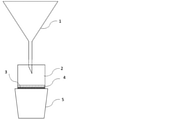
- test apparatus used for measuring the electromotive force of the water-absorbent resin composition cleaning liquid. It is a schematic diagram of the test apparatus used for the liquid leakage (horizontal leakage) test of an absorbent article.
- the electromotive force P (mV) of the cleaning liquid of the first cleaning obtained by cleaning the water-absorbent resin composition by the following cleaning method is 80 mV or more. .. Further, the difference (PQ) between the electromotive force Q (mV) and the electromotive force P (mV) of the cleaning liquid of the second cleaning obtained by cleaning the water-absorbent resin composition by the following cleaning method is 10 mV. That is all.
- physiological saline solution is quickly added onto the water-absorbent resin composition, and the physiological saline solution that has flowed down into the beaker is used as a cleaning solution for the second cleaning.
- the specific cleaning method is as described in Examples.
- the water absorption behavior of the water-absorbent resin composition is that the water-absorbent resin composition having a high ion concentration (including, for example, a partially neutralized product of sodium polyacrylate) and the liquid to be absorbed (relatively low ion concentration). It is caused by the osmotic pressure generated between them. Therefore, when the ion concentration in the liquid to be absorbed becomes high, the osmotic pressure becomes small, the water absorption capacity also weakens, and the water absorption characteristics such as the amount of water absorption and the water absorption rate deteriorate. Furthermore, the ion concentration in the liquid has a positive correlation with the electromotive force, indicating that the higher the electromotive force of the liquid, the higher the ion concentration.
- the water absorption characteristics of the water-absorbent resin composition deteriorate.
- the acidic compound in the vicinity of the water-absorbent resin particles is locally dissolved at the first water absorption, and the ion concentration near the surface of the water-absorbent resin composition is high. It increases and the water absorption characteristics decrease. As a result, the liquid diffusivity of the absorber is improved, and the reversion of the liquid of the absorber is suppressed.
- the acidic compound diffuses in the absorbent body or is absorbed by the water-absorbent resin particles, so that the ion concentration near the surface of the water-absorbent resin composition decreases. Therefore, the water-absorbent resin composition at the time of the second or third liquid absorption is suppressed from the deterioration of the water absorption characteristics. Therefore, the liquid absorption becomes superior to the liquid diffusion, and the liquid leakage from the end of the absorber when the liquid is poured a plurality of times is suppressed.
- the water-absorbent resin composition of the present invention will be described in detail.
- the electromotive force P (mV) of the cleaning liquid in the first cleaning is 80 mV or more, preferably 90 mV or more, more preferably 100 mV or more, still more preferably 120 mV or more. ..
- the electromotive force P (mV) is preferably 230 mV or less, more preferably 200 mV or less, still more preferably 190 mV or less, still more preferably 180 mV or less.
- the range of the electromotive force P (mV) is preferably 80 to 230 mV, more preferably 90 to 200 mV, still more preferably 100 to 190 mV, and even more preferably 120 to 180 mV.
- the electromotive force Q (mV) of the cleaning liquid for the second cleaning is preferably 20 mV or more, more preferably 30 mV or more, still more preferably 40 mV or more, still more preferably. It is 50 mV or more.
- the electromotive force Q (mV) is preferably 145 mV or less, more preferably 125 mV or less, still more preferably 100 mV or less, still more preferably 90 mV or less.
- the range of the electromotive force Q (mV) is preferably 20 to 145 mV, more preferably 30 to 125 mV, still more preferably 40 to 100 mV, still more preferably 50 to 90 mV.
- the difference (PQ) between the electromotive force Q (mV) and the electromotive force P (mV) is 10 mV or more, preferably 25 mV or more, more preferably. Is 35 mV or more, more preferably 50 mV or more.
- the difference (PQ) is preferably 200 mV or less, more preferably 150 mV or less, still more preferably 130 mV or less, still more preferably 110 mV or less.
- the range of the difference (PQ) is preferably 10 to 200 mV, more preferably 25 to 150 mV, still more preferably 35 to 130 mV, still more preferably 50 to 110 mV.
- the physiological saline water absorption amount of the water-absorbent resin composition of the present invention is 30 g / g or more, 35 g / g or more, 40 g / g or more, 45 g / g or more, from the viewpoint of facilitating the improvement of liquid leakage performance in an absorbent article. It is preferably 50 g / g or more, or 55 g / g or more.
- the water absorption amount is 80 g / g or less, 75 g / g or less, 70 g / g or less, 65 g / g or less, 60 g / g or less, or 63 g / g or less from the viewpoint of facilitating the improvement of the liquid diffusion performance in the absorbent article. Is preferable. From these viewpoints, the water retention amount is preferably 30 to 80 g / g, more preferably 45 to 65 g / g.
- the water-absorbent resin composition preferably contains water-absorbent resin particles and an acidic compound. More specifically, in the water-absorbent resin composition of the present invention, it is preferable that the acidic compound is present on at least a part of the surface of the water-absorbent resin particles. For example, by mixing the water-absorbent resin particles and the acidic compound in a solid phase state, the acidic compound can be present on the surface of the water-absorbent resin composition to the extent that the effect of the present invention can be exhibited.
- the ion concentration in the liquid has a positive correlation with the electromotive force, and the higher the electromotive force of the liquid, the higher the ion concentration.
- the acidic compound on the surface is locally dissolved at the time of the first water absorption, the ion concentration in the vicinity of the surface of the water-absorbent resin composition increases, and the liquid is liquid. The electromotive force is increased.
- the electromotive force P (mV) of the water-absorbent resin composition of the present invention contains an acidic compound
- the electromotive force Q (mV) of the water-absorbent resin composition of the present invention
- the difference between the electromotive force Q (mV) and the electromotive force P (mV) (P). -Q) and further, from the viewpoint of setting the electromotive force Q (mV) to the predetermined value and more preferably exerting the effect of the present invention
- the acidic compound is used in a normal temperature (25 ° C.) and normal pressure (1 atm) environment. It is preferably solid. From the same viewpoint, the acidic compound is preferably water-soluble.
- the term "water-soluble" in the present invention means that it exhibits a solubility in water of 0.5% by mass or more in a normal temperature and normal pressure environment.
- the first acid dissociation constant of the acidic compound is preferably 0.1 to 5.0, more preferably 0.5 to 4.5, and further preferably 1.0 to 4.0.
- the second acid dissociation constant is preferably 2.0 to 7.0, more preferably 2.5 to 6.5, and even more preferably 3.0 to 6. It is 0.0.
- the tertiary acid dissociation constant is preferably 3.0 to 7.0, more preferably 3.5 to 6.5, and even more preferably 4.0 to 6. It is 0.0.
- the medium particle size of the acidic compound is preferably about 20 to 600 ⁇ m, more preferably about 30 to 500 ⁇ m, and further preferably about 40 to 400 ⁇ m.
- the medium particle size of the acidic compound can be measured using a JIS standard sieve, and specifically, is a value measured by the method described in Examples.
- the ratio (T / S) of the medium particle size T ( ⁇ m) of the water-absorbent resin particles to the medium particle size S ( ⁇ m) of the acidic compound is preferably 0.1 to 30, more preferably. Is 0.5 to 20, more preferably 0.8 to 15, and even more preferably 1.0 to 10.
- the acidic compound is preferably an organic acid, and among the organic acids, tartrate acid, citric acid, malic acid, fumaric acid, sorbic acid, maleic acid, salicylic acid, succinic acid, adipic acid, glutaric acid, glycolic acid, phthalic acid, Mandelic acid and benzoic acid are preferable, and tartrate acid, citric acid, malic acid and fumaric acid are more preferable.
- the acidic compound contained in the water-absorbent resin composition of the present invention may be one kind or two or more kinds.
- the content of the acidic compound in the water-absorbent resin composition of the present invention is preferably 0.05 to 30 parts by mass with respect to 100 parts by mass of the water-absorbent resin particles. It is more preferably 0.1 to 20 parts by mass, still more preferably 0.5 to 15 parts by mass, and even more preferably 1 to 10 parts by mass.
- Water-absorbent resin particles The water-absorbent resin particles contained in the water-absorbent resin composition of the present invention are crosslinked with a polymer of a water-soluble ethylenically unsaturated monomer, that is, a structural unit derived from the water-soluble ethylenically unsaturated monomer. It is composed of a crosslinked polymer having.
- the water-absorbent resin is usually in the form of particles.
- the water-absorbent resin particles preferably have a medium particle diameter of 200 to 600 ⁇ m, more preferably 200 to 500 ⁇ m, and even more preferably 250 to 450 ⁇ m. That is, also in the water-absorbent resin composition of the present invention, the medium particle size is preferably 200 to 600 ⁇ m, more preferably 200 to 500 ⁇ m, further preferably 250 to 450 ⁇ m, and even more preferably 300 to 425 ⁇ m. Is even more preferable.
- the water-absorbent resin particles may be in the form of agglomerated fine particles (primary particles) in addition to the form in which each is composed of a single particle.
- the shape of the primary particles include a substantially spherical shape, an amorphous crushed shape, and a plate shape.
- a substantially spherical single particle shape having a smooth surface shape such as a true spherical shape or an elliptical spherical shape can be mentioned. Because the surface shape is smooth, the fluidity as a powder is high, and since the aggregated particles are easily packed densely, they are not easily destroyed even if they receive an impact, and the water-absorbent resin particles have high particle strength. It becomes.
- the medium particle size of the water-absorbent resin particles can be measured using a JIS standard sieve, and specifically, it is a value measured by the method described in Examples.
- a typical polymerization method such as an aqueous solution polymerization method, an emulsion polymerization method, or a reverse phase suspension polymerization method is used.
- aqueous solution polymerization method polymerization is carried out by heating a water-soluble ethylenically unsaturated monomer aqueous solution with stirring as necessary.
- reverse phase suspension polymerization method polymerization is carried out by heating a water-soluble ethylenically unsaturated monomer in a hydrocarbon dispersion medium under stirring.
- the reverse phase suspension polymerization method is preferably used from the viewpoint of precise polymerization reaction control and wide range of particle size control.
- a radical polymerization initiator in a method for producing water-absorbent resin particles by reverse-phase suspension polymerization of a water-soluble ethylenically unsaturated monomer in a hydrocarbon dispersion medium examples thereof include a production method including a step of carrying out polymerization in the presence of a polymerization agent and a step of post-crosslinking the hydrogel-like product obtained by the polymerization in the presence of a post-crosslinking agent.
- an internal cross-linking agent may be added to the water-soluble ethylenically unsaturated monomer to form a water-containing gel having an internal cross-linking structure, if necessary.
- Water-soluble ethylenically unsaturated monomer examples include (meth) acrylic acid (in the present specification, “acrylic” and “methacrylic” are collectively referred to as “(meth) acrylic”; the same applies hereinafter) and.
- water-soluble ethylenically unsaturated monomers (meth) acrylic acid or a salt thereof, (meth) acrylamide, N, N-dimethylacrylamide are preferable from the viewpoint of industrial availability. , (Meta) acrylic acid and salts thereof are more preferred.
- These water-soluble ethylenically unsaturated monomers may be used alone or in combination of two or more.
- acrylic acid and its salts are widely used as raw materials for water-absorbent resins, and these acrylic acids and / or their salts are copolymerized with the other water-soluble ethylenically unsaturated monomers described above. It may be used.
- acrylic acid and / or a salt thereof is preferably used as the main water-soluble ethylenically unsaturated monomer in an amount of 70 to 100 mol% with respect to the total water-soluble ethylenically unsaturated monomer.
- the water-soluble ethylenically unsaturated monomer is dispersed in a hydrocarbon dispersion medium in the state of an aqueous solution and subjected to reverse phase suspension polymerization.
- the concentration of the water-soluble ethylenically unsaturated monomer in this aqueous solution is preferably in the range of 20% by mass to the saturation concentration or less.
- the concentration of the water-soluble ethylenically unsaturated monomer is more preferably 55% by mass or less, further preferably 50% by mass or less, and further preferably 45% by mass or less.
- the concentration of the water-soluble ethylenically unsaturated monomer is more preferably 25% by mass or more, further preferably 28% by mass or more, and further preferably 30% by mass or more.
- the acid group is previously alkaline if necessary.
- Those neutralized with a neutralizing agent may be used.
- alkaline neutralizer include alkali metal salts such as sodium hydroxide, sodium carbonate, sodium hydrogencarbonate, potassium hydroxide and potassium carbonate; ammonia and the like.
- these alkaline neutralizers may be used in the form of an aqueous solution in order to simplify the neutralization operation.
- the above-mentioned alkaline neutralizer may be used alone or in combination of two or more.
- the degree of neutralization of the water-soluble ethylenically unsaturated monomer by the alkaline neutralizing agent shall be 10 to 100 mol% as the degree of neutralization with respect to all the acid groups of the water-soluble ethylenically unsaturated monomer. Is more preferable, 30 to 90 mol% is more preferable, 40 to 85 mol% is further preferable, and 50 to 80 mol% is even more preferable.
- radical polymerization initiator examples include persulfates such as potassium persulfate, ammonium persulfate, and sodium persulfate, methyl ethyl ketone peroxide, methyl isobutyl ketone peroxide, and dit-butyl peroxide.
- Peroxides such as t-butylcumylperoxide, t-butylperoxyacetate, t-butylperoxyisobutyrate, t-butylperoxypivalate, hydrogen peroxide, and 2,2'-azobis ( 2-Amidinopropane) 2 hydrochloride, 2,2'-azobis [2- (N-phenylamidino) propane] 2 hydrochloride, 2,2'-azobis [2- (N-allylamidino) propane] 2 hydrochloride , 2,2'-azobis ⁇ 2- [1- (2-hydroxyethyl) -2-imidazolin-2-yl] propane ⁇ 2 hydrochloride, 2,2'-azobis ⁇ 2-methyl-N- [1, 1-bis (hydroxymethyl) -2-hydroxyethyl] propionamide ⁇ , 2,2'-azobis [2-methyl-N- (2-hydroxyethyl) -propionamide], 4,4'-azobis (4-) Examples thereof include azo compounds such
- radical polymerization initiators potassium persulfate, ammonium persulfate, sodium persulfate and 2,2'-azobis (2-amidinopropane) dihydrochloride are preferable from the viewpoint of easy availability and handling. Be done.
- These radical polymerization initiators may be used alone or in combination of two or more. Further, the radical polymerization initiator can also be used as a redox polymerization initiator in combination with a reducing agent such as sodium sulfite, sodium hydrogen sulfite, ferrous sulfate, and L-ascorbic acid.
- Examples of the amount of the radical polymerization initiator used include 0.00005 to 0.01 mol per 1 mol of the water-soluble ethylenically unsaturated monomer. By satisfying such a usage amount, it is possible to avoid a rapid polymerization reaction from occurring and to complete the polymerization reaction in an appropriate time.
- Internal cross-linking agent examples include those capable of cross-linking a polymer of a water-soluble ethylenically unsaturated monomer used, for example, (poly) ethylene glycol [“(poly)” is a prefix of “poly”. It means with and without. The same shall apply hereinafter], (poly) propylene glycol, 1,4-butanediol, trimethylolpropane, diols such as (poly) glycerin, polyols such as triol, and unsaturated such as (meth) acrylic acid, maleic acid, fumaric acid and the like.
- (poly) ethylene glycol ““(poly)” is a prefix of “poly”. It means with and without. The same shall apply hereinafter]
- (poly) propylene glycol, 1,4-butanediol, trimethylolpropane diols such as (poly) glycerin
- polyols
- Unsaturated polyesters obtained by reacting with an acid bisacrylamides such as N, N-methylenebisacrylamide; di (meth) acrylic acid esters or tris obtained by reacting a polyepoxide with (meth) acrylic acid.
- unsaturated polyesters or polyglycidyl compounds are preferably used, more preferably diglycidyl ether compounds are used, and (poly) ethylene glycol diglycidyl ether and (poly) propylene glycol diglycidyl are used. It is preferable to use ether, (poly) glycerin diglycidyl ether.
- These internal cross-linking agents may be used alone or in combination of two or more.
- the amount of the internal cross-linking agent used is preferably 0.000001 to 0.02 mol, preferably 0.00001 to 0.01 mol, based on 1 mol of the water-soluble ethylenically unsaturated monomer. It is more preferably 0.00001 to 0.005 mol, still more preferably 0.00005 to 0.002 mol.
- hydrocarbon dispersion medium examples include n-hexane, n-heptane, 2-methylhexane, 3-methylhexane, 2,3-dimethylpentane, 3-ethylpentane, n-octane and the like having 6 to 8 carbon atoms.
- Aromatic hydrocarbons such as cyclohexane, methylcyclohexane, cyclopentane, methylcyclopentane, trans-1,2-dimethylcyclopentane, cis-1,3-dimethylcyclopentane, trans-1,3-dimethylcyclopentane, etc.
- Group hydrocarbons examples include aromatic hydrocarbons such as benzene, toluene and xylene.
- hydrocarbon dispersion media n-hexane, n-heptane, and cyclohexane are preferably used because they are industrially easily available, have stable quality, and are inexpensive.
- These hydrocarbon dispersion media may be used alone or in combination of two or more.
- a commercially available product such as ExxonMobil (manufactured by ExxonMobil: containing 75 to 85% by mass of hydrocarbon of heptane and its isomer) can also be used to obtain suitable results. be able to.
- the first-stage water-soluble ethylenically unsaturated monomer is used. It is preferably 100 to 1500 parts by mass, more preferably 200 to 1400 parts by mass with respect to 100 parts by mass.
- the reverse phase suspension polymerization is carried out in one stage (single stage) or in multiple stages of two or more stages, and the above-mentioned first stage polymerization is the first stage in single stage polymerization or multi-stage polymerization. Means the polymerization reaction of (the same applies hereinafter).
- a dispersion stabilizer In the reverse phase suspension polymerization, a dispersion stabilizer can also be used in order to improve the dispersion stability of the water-soluble ethylenically unsaturated monomer in the hydrocarbon dispersion medium.
- a surfactant can be used as the dispersion stabilizer.
- surfactant examples include sucrose fatty acid ester, polyglycerin fatty acid ester, sorbitan fatty acid ester, polyoxyethylene sorbitan fatty acid ester, polyoxyethylene glycerin fatty acid ester, sorbitol fatty acid ester, polyoxyethylene sorbitol fatty acid ester, and polyoxyethylene.
- Alkyl ether polyoxyethylene alkyl phenyl ether, polyoxyethylene castor oil, polyoxyethylene hydrogenated castor oil, alkylallyl formaldehyde condensed polyoxyethylene ether, polyoxyethylene polyoxypropylene block copolymer, polyoxyethylene polyoxypropyl alkyl ether,
- surfactants it is particularly preferable to use sorbitan fatty acid ester, polyglycerin fatty acid ester, and sucrose fatty acid ester from the viewpoint of dispersion stability of the monomer.
- These surfactants may be used alone or in combination of two or more.
- the amount of the surfactant used is preferably 0.1 to 30 parts by mass, preferably 0.3 to 20 parts by mass, based on 100 parts by mass of the water-soluble ethylenically unsaturated monomer in the first stage. It is more preferably by mass.
- a polymer-based dispersant may be used in combination with the above-mentioned surfactant.
- polymer dispersant examples include maleic anhydride-modified polyethylene, maleic anhydride-modified polypropylene, maleic anhydride-modified ethylene / propylene copolymer, maleic anhydride-modified EPDM (ethylene / propylene / diene / tarpolymer), and anhydrous.
- polymer-based dispersants in particular, from the viewpoint of the dispersion stability of the monomer, maleic anhydride-modified polyethylene, maleic anhydride-modified polypropylene, maleic anhydride-modified ethylene / propylene copolymer, maleic anhydride, and Ethylene copolymer, maleic anhydride / propylene copolymer, maleic anhydride / ethylene / propylene copolymer, polyethylene, polypropylene, ethylene / propylene copolymer, oxidized polyethylene, oxidized polypropylene, oxidized ethylene / propylene It is preferable to use a polymer.
- These polymer-based dispersants may be used alone or in combination of two or more.
- the amount of the polymer-based dispersant used is preferably 0.1 to 30 parts by mass, preferably 0.3 to 20 parts by mass with respect to 100 parts by mass of the water-soluble ethylenically unsaturated monomer in the first stage. It is more preferably by mass.
- a thickener can be added to an aqueous solution containing a water-soluble ethylenically unsaturated monomer to carry out reverse phase suspension polymerization.
- a thickener By adjusting the viscosity of the aqueous solution by adding a thickener in this way, it is possible to control the medium particle size obtained in the reverse phase suspension polymerization.
- the thickener examples include hydroxyethyl cellulose, hydroxypropyl cellulose, methyl cellulose, carboxymethyl cellulose, polyacrylic acid, polyacrylic acid (partial) neutralized product, polyethylene glycol, polyacrylamide, polyethyleneimine, dextrin, sodium alginate, and polyvinyl alcohol. , Polyvinylpyrrolidone, polyethylene oxide and the like can be used. If the stirring speed at the time of polymerization is the same, the higher the viscosity of the water-soluble ethylenically unsaturated monomer aqueous solution, the larger the primary particles and / or the secondary particles of the obtained particles tend to be.
- Reverse phase suspension polymerization In performing reverse phase suspension polymerization, for example, a monomer aqueous solution containing a water-soluble ethylenically unsaturated monomer is dispersed in a hydrocarbon dispersion medium in the presence of a dispersion stabilizer. At this time, the time for adding the dispersion stabilizer (surfactant or polymer-based dispersant) may be before or after the addition of the monomer aqueous solution before the polymerization reaction is started.
- the dispersion stabilizer surfactant or polymer-based dispersant
- the reaction mixture obtained in the first step polymerization reaction after the first step reverse phase suspension polymerization is water-soluble ethylenically unsaturated.
- the monomers may be added and mixed, and the reverse phase suspension polymerization of the second and subsequent stages may be carried out in the same manner as in the first stage.
- a radical polymerization initiator is used in the reverse phase suspension polymerization in each stage of the second and subsequent stages.
- the amount of the water-soluble ethylenically unsaturated monomer to be added it may be added within the range of the molar ratio of each component to the above-mentioned water-soluble ethylenically unsaturated monomer to carry out reverse-phase suspension polymerization. preferable.
- an internal cross-linking agent may be added to the water-soluble ethylenically unsaturated monomer, if necessary.
- the reaction temperature of the polymerization reaction is 20 to 110 ° C. from the viewpoint of increasing the economic efficiency by rapidly advancing the polymerization and shortening the polymerization time, and easily removing the heat of polymerization to allow the reaction to proceed smoothly. It is preferably 40 to 90 ° C., and more preferably 40 to 90 ° C.
- the water-absorbent resin particles of the present invention are crosslinked by adding a post-crosslinking agent to a hydrogel-like substance having an internal cross-linking structure obtained by polymerizing a water-soluble ethylenically unsaturated monomer. It is obtained by that (post-crosslinking reaction).
- the post-crosslinking reaction is preferably carried out in the presence of a post-crosslinking agent after the polymerization of the water-soluble ethylenically unsaturated monomer.
- the water-containing gel-like material having an internal cross-linking structure is subjected to a cross-linking reaction to increase the cross-linking density near the surface of the water-absorbent resin particles, resulting in various factors such as water absorption capacity under load. It is possible to obtain water-absorbent resin particles having improved performance.
- post-crosslinking agent examples include compounds having two or more reactive functional groups.
- polyols such as ethylene glycol, propylene glycol, 1,4-butanediol, trimethylolpropane, glycerin, polyoxyethylene glycol, polyoxypropylene glycol, polyglycerin; (poly) ethylene glycol diglycidyl ether, (poly).
- Polyglycidyl compounds such as glycerin diglycidyl ether, (poly) glycerin triglycidyl ether, trimethylolpropane triglycidyl ether, (poly) propylene glycol polyglycidyl ether, (poly) glycerol polyglycidyl ether; epichlorohydrin, epibromhydrin, ⁇ -Haloepoxy compounds such as methylepicrolhydrin; isocyanate compounds such as 2,4-tolylene diisocyanate and hexamethylenediisocyanate; 3-methyl-3-oxetanemethanol, 3-ethyl-3-oxetanmethanol, 3-butyl-3-oxetanmethanol , 3-Methyl-3-oxetaneethanol, 3-ethyl-3-oxetaneethanol, 3-butyl-3-oxetaneethanol and other oxetane compounds
- post-crosslinking agents (poly) ethylene glycol diglycidyl ether, (poly) glycerin diglycidyl ether, (poly) glycerin triglycidyl ether, trimethylolpropane triglycidyl ether, (poly) propylene glycol polyglycidyl ether, ( Poly) Polyglycidyl compounds such as glycerol polyglycidyl ether are preferred. These post-crosslinking agents may be used alone or in combination of two or more.
- the amount of the post-crosslinking agent used is preferably 0.00001 to 0.01 mol, preferably 0.00005 to 0, relative to 1 mol of the total amount of the water-soluble ethylenically unsaturated monomer used for the polymerization. It is more preferably 005 mol, further preferably 0.0001 to 0.002 mol.
- the post-crosslinking agent may be added as it is or as an aqueous solution, or may be added as a solution using a hydrophilic organic solvent as a solvent, if necessary.
- a hydrophilic organic solvent include lower alcohols such as methyl alcohol, ethyl alcohol, n-propyl alcohol and isopropyl alcohol; ketones such as acetone and methyl ethyl ketone; ethers such as diethyl ether, dioxane and tetrahydrofuran; N, N. -Amids such as dimethylformamide; sulfoxides such as dimethylsulfoxide and the like can be mentioned.
- These hydrophilic organic solvents may be used alone, in combination of two or more, or as a mixed solvent with water.
- the time for adding the post-crosslinking agent may be after almost all the polymerization reaction of the water-soluble ethylenically unsaturated monomer is completed, and 1 to 1 to 100 parts by mass of the water-soluble ethylenically unsaturated monomer. It is preferably added in the presence of water in the range of 400 parts by mass, more preferably in the presence of water in the range of 5 to 200 parts by mass, and added in the presence of water in the range of 10 to 100 parts by mass. Is more preferable, and it is even more preferable to add it in the presence of water in the range of 20 to 60 parts by mass.
- the amount of water means the total amount of water contained in the reaction system and water used as necessary when adding the post-crosslinking agent.
- the reaction temperature in the post-crosslinking reaction is preferably 50 to 250 ° C, more preferably 60 to 180 ° C, further preferably 60 to 140 ° C, and even more preferably 70 to 120 ° C. More preferred.
- the reaction time of the post-crosslinking reaction is preferably 1 to 300 minutes, more preferably 5 to 200 minutes.
- a drying step of removing water, a hydrocarbon dispersion medium, etc. by distillation by applying energy such as heat from the outside may be included.
- the water and the hydrocarbon dispersion medium are once removed from the system by co-boiling distillation by heating the system in which the hydrogel is dispersed in the hydrocarbon dispersion medium. Distill. At this time, if only the distilled hydrocarbon dispersion medium is returned into the system, continuous azeotropic distillation becomes possible.
- water-absorbent resin particles are obtained by distilling off water and a hydrocarbon dispersion medium.
- the drying process by distillation may be performed under normal pressure or under reduced pressure. Further, from the viewpoint of increasing the drying efficiency, it may be performed under an air flow such as nitrogen.
- the drying temperature is preferably 70 to 250 ° C, more preferably 80 to 180 ° C, further preferably 80 to 140 ° C, and 90 to 90 to. It is even more preferable that the temperature is 130 ° C.
- the drying temperature is preferably 40 to 160 ° C, more preferably 50 to 110 ° C.
- the drying step by distillation described above is performed after the cross-linking step is completed.
- the post-crosslinking step and the drying step may be performed at the same time.
- the water-absorbent resin composition of the present invention may contain additives according to the purpose.
- additives include inorganic powders, surfactants, oxidizing agents, reducing agents, metal chelating agents, radical chain prohibiting agents, antioxidants, antibacterial agents and the like.
- amorphous silica as an inorganic powder to 100 parts by mass of the water-absorbent resin particles, the fluidity of the water-absorbent resin composition can be further improved.
- the content of the water-absorbent resin particles is preferably 70% by mass or more, more preferably 80% by mass or more, still more preferably 90. It is mass% or more.
- the water-absorbent resin composition of the present invention is, for example, a mixture of water-absorbent resin particles which are a cross-linked polymer of the above-mentioned water-soluble ethylenically unsaturated monomer, an internal cross-linking agent and a post-cross-linking agent, and an acidic compound. It can be suitably produced by a method including a step.
- the temperature of the mixing step may be 10 to 100 ° C.
- the temperature in the mixing step is preferably 15 to 50 ° C., and the relative humidity is preferably 40 to 75%.
- the water-absorbent resin particles and the acidic compound in a solid phase state.
- the acidic compound can be present on the surface of the water-absorbent resin particles to the extent that the effect of the present invention can be exhibited.
- the water-absorbent resin composition of the present invention may be prepared by mixing the acidic compound with the water-absorbent resin particles in a state of being dissolved or dispersed in a liquid medium such as an aqueous liquid.
- the water-absorbent resin composition of the present invention constitutes an absorber used for sanitary materials such as sanitary napkins and disposable diapers, and is suitable for absorbent articles containing the absorber. Used.
- the absorber using the water-absorbent resin composition of the present invention includes the water-absorbent resin composition of the present invention.
- the absorber may further contain hydrophilic fibers.
- the structure of the absorber is a sheet-like structure in which the water-absorbent resin composition is fixed on the non-woven fabric or between a plurality of non-woven fabrics, and the water-absorbent resin composition and the hydrophilic fibers are mixed so as to have a uniform composition. Examples thereof include a mixed dispersion obtained as a result, a sandwich structure in which a water-absorbent resin composition is sandwiched between layered hydrophilic fibers, and a structure in which a water-absorbent resin composition and hydrophilic fibers are wrapped in a tissue. Be done.
- the absorber may contain other components, for example, an adhesive binder such as a heat-fusing synthetic fiber, a hot melt adhesive, or an adhesive emulsion for enhancing the shape retention of the absorber. ..
- the content of the water-absorbent resin composition in the absorber is preferably 5 to 100% by mass, more preferably 10 to 95% by mass, further preferably 20 to 90% by mass, and 30. It is more preferably ⁇ 80% by mass.
- hydrophilic fiber synthesis of cellulose fiber such as cotton-like pulp obtained from wood, mechanical pulp, chemical pulp, semi-chemical pulp, artificial cellulose fiber such as rayon and acetate, hydrophilic treated polyamide, polyester, polyolefin and the like. Examples include fibers made of resin.
- the average fiber length of the hydrophilic fibers is usually 0.1-10 mm or may be 0.5-5 mm.
- An absorber using the water-absorbent resin composition of the present invention is held between a liquid permeable sheet (top sheet) through which a liquid can pass and a liquid impermeable sheet (back sheet) through which a liquid cannot pass. By doing so, the absorbent article of the present invention can be obtained.
- the liquid permeable sheet is placed on the side that comes into contact with the body, and the liquid permeable sheet is placed on the opposite side that comes into contact with the body.
- liquid permeable sheet examples include non-woven fabrics such as air-through type, spunbond type, chemical bond type and needle punch type, and porous synthetic resin sheets made of fibers such as polyethylene, polypropylene and polyester.
- liquid impermeable sheet examples include a synthetic resin film made of a resin such as polyethylene, polypropylene, and polyvinyl chloride.
- the water-absorbent resin compositions obtained in the following Examples and Comparative Examples were evaluated in the following various tests. Unless otherwise specified, the measurement was carried out in an environment with a temperature of 25 ⁇ 2 ° C. and a humidity of 50 ⁇ 10%. Hereinafter, each evaluation test method will be described.
- the center of the cylindrical container and the center of the funnel are almost the same, and the distance between the tip of the funnel foot and the bottom surface of the cylindrical container is 55 mm. Fix it with a clamp so that it becomes.
- the measurement using the test device was carried out according to the following procedure. 1.00 g of the water-absorbent resin composition was weighed and evenly sprayed on a cylindrical container, and then the instruments were fixed in the order of beaker, cylindrical container, and funnel. 200 g of physiological saline (0.9 mass% sodium chloride aqueous solution) was weighed and put into the funnel at one time.
- the entire amount of saline was dispersed in a cylindrical container. After about 1 minute, the cleaning liquid flowing out of the cylindrical container was obtained, and the first cleaning liquid was obtained. Next, after replacing the beaker and installing it at the bottom of the device, 200 g of physiological saline was further added to the funnel 2 minutes after the start of the first addition of physiological saline, and the second water absorption was carried out. A cleaning solution of the resin composition was obtained. 70 g of each of the collected cleaning liquids was weighed in a 100 mL plastic beaker, a stirrer having a diameter of 8 mm and a length of 30 mm was placed therein, and the mixture was stirred at 700 rpm.
- the equilibrium value at a liquid temperature of 25 ⁇ 1 ° C. was read using a portable pH / ORP meter (D-72, electrode model 9625) manufactured by HORIBA in a stirred state, and used as the electromotive force of the cleaning liquid.
- the equilibrium value is a value at the time when the electromotive force fluctuation for 10 consecutive seconds becomes less than 1 mV at the time of measuring the electromotive force.
- the sieving conditions were set to a frequency of 80 Hz, a pulse interval of 1 second, and a classification time of 2 minutes. The mass of the particles remaining on each sieve was calculated as a mass percentage to the total amount.
- the mass percentages of the particles remaining on each sieve were integrated in order from the one with the largest particle size, and the relationship between the mesh opening of the sieve and the integrated value of the mass percentages of the particles remaining on the sieve was plotted on a logarithmic probability paper. .. By connecting the plots on the probability paper with a straight line, the particle size corresponding to the integrated mass percentage of 50% by mass was obtained, and this was defined as the medium particle size.
- ⁇ Medium particle size of water-absorbent resin particles From the top of the JIS standard sieve, a sieve with an opening of 850 ⁇ m, a sieve with an opening of 600 ⁇ m, a sieve with an opening of 500 ⁇ m, a sieve with an opening of 425 m, a sieve with an opening of 300 ⁇ m, a sieve with an opening of 250 ⁇ m, a sieve with an opening of 150 ⁇ m, and a sieve.
- 50 g of the water-absorbent resin composition was put into the best combined sieve and shaken for 10 minutes using a low-tap type shaker to classify.
- the mass of the water-absorbent resin particles remaining on each sieve was calculated as a mass percentage with respect to the total amount, and the particle size distribution was obtained.
- the relationship between the mesh size of the sieve and the integrated value of the mass percentage of the water-absorbent resin particles remaining on the sieve was plotted on a logarithmic probability paper by integrating the particles on the sieve in order from the one having the largest particle size with respect to this particle size distribution. By connecting the plots on the probability paper with a straight line, the particle size corresponding to the cumulative mass percentage of 50% by mass was defined as the medium particle size.
- a 75 ⁇ m standard sieve was left for 30 minutes in a state where the angle formed with respect to the horizontal was tilted to about 30 degrees, and excess physiological saline was removed from the water-absorbent resin composition.
- the mass Wc (g) of the sieve containing the swelling gel is measured, and the mass Wc (g) minus the mass Wb (g) of the 75 ⁇ m standard sieve is the mass (2.0 g) of the water-absorbent resin composition.
- a liquid permeable sheet was arranged to obtain an evaluation absorbent article having a laminated structure of a polyethylene sheet / tissue paper / absorber / tissue paper / air-through type porous liquid permeable sheet from below.
- the liquid leakage performance test of the absorbent article for evaluation was performed using the test apparatus shown in FIG.
- the U-shaped pedestal is provided with a side wall (11, maximum height 10 mm from the U-shaped surface) to prevent the absorbent article for evaluation from slipping off the U-shaped pedestal. Has been done.
- a mark was marked at a position 8 cm above the center of the absorbent article for evaluation in the longitudinal direction, and the position was set as the injection position of artificial urine.
- the center of the absorbent article for evaluation was placed so as to coincide with the center of the U-shaped table (6).
- a 200 mL glass dropping funnel whose cock was squeezed so that artificial urine could pass at 8 mL / sec was prepared in advance, and after co-washing with artificial urine, draining was performed. Finally, the dropping funnel was clamped so that the tip of the dropping funnel was 10 mm vertically above the artificial urine injection position of the absorbent article for evaluation.
- 80 mL of artificial urine at 25 ° C.
- ⁇ Manufacturing example 1> A round-bottomed cylindrical separable flask with an inner diameter of 11 cm and a capacity of 2 L, equipped with a reflux condenser, a dropping funnel, a nitrogen gas introduction pipe, and a stirring blade having four inclined paddle blades with a blade diameter of 5 cm in two stages as a stirrer. Got ready. To this flask, take 293 g of n-heptane as a hydrocarbon dispersion medium, add 0.736 g of a maleic anhydride-modified ethylene-propylene copolymer (Mitsui Chemicals Co., Ltd., High Wax 1105A) as a polymer-based dispersant, and stir. The temperature was raised to 80 ° C.
- aqueous solution of the first stage 0.0736 g (0.272 mmol) of potassium persulfate as a polymer and 0.010 g (0.057 mmol) of ethylene glycol diglycidyl ether as an internal cross-linking agent were added and dissolved to prepare an aqueous solution of the first stage. .. Then, the aqueous solution prepared above was added to the separable flask, and after stirring for 10 minutes, HLB3 sucrose stearate ester (Mitsubishi Chemical Foods Co., Ltd., Ryo) was added to 6.62 g of n-heptane as a surfactant.
- HLB3 sucrose stearate ester Mitsubishi Chemical Foods Co., Ltd., Ryo
- Toucgar ester S-370 0.736 g of a surfactant solution dissolved by heating is further added, and the inside of the system is sufficiently replaced with nitrogen while stirring at a stirring speed of 550 rpm, and then the flask is replaced with 70.
- the first-stage polymerized slurry liquid was obtained by immersing in a water bath at ° C. to raise the temperature and performing polymerization for 60 minutes.
- 128.8 g (1.43 mol) of an 80.5 mass% acrylic acid aqueous solution as a water-soluble ethylenically unsaturated monomer was placed in another beaker having an internal volume of 500 mL, and 27 mass% while cooling from the outside.
- the flask After replacing the inside of the system with nitrogen for 30 minutes, the flask was again immersed in a water bath at 70 ° C. to raise the temperature, and the polymerization reaction was carried out for 60 minutes to obtain a hydrogel polymer.
- a hydrogel polymer To the hydrogel polymer after the second stage polymerization, 0.589 g of a 45% by mass diethylenetriamine-5 sodium acetate aqueous solution was added under stirring. Then, the flask was immersed in an oil bath set at 125 ° C., and 257.7 g of water was extracted from the system while refluxing n-heptane by azeotropic distillation of n-heptane and water.
- the dissociation constant pKa2 3.97, medium particle diameter 280 ⁇ m) was mixed with 0.1 parts by mass of powder to obtain a water-absorbent resin composition.
- Various performance measurements of the obtained water-absorbent resin composition and evaluation of absorbent articles using the same were performed. The results are shown in Table 1.
- Example 2 a water-absorbent resin composition was obtained in the same manner as in Example 1 except that L-tartaric acid was changed to 0.5 parts by mass with respect to 100 parts by mass of the water-absorbent resin particles. Various performance measurements of the obtained water-absorbent resin composition and evaluation of absorbent articles using the same were performed. The results are shown in Table 1.
- Example 3 a water-absorbent resin composition was obtained in the same manner as in Example 1 except that L-tartaric acid was changed to 1.0 part by mass with respect to 100 parts by mass of the water-absorbent resin particles. Various performance measurements of the obtained water-absorbent resin composition and evaluation of absorbent articles using the same were performed. The results are shown in Table 1.
- Example 4 a water-absorbent resin composition was obtained in the same manner as in Example 1 except that L-tartaric acid was changed to 2.0 parts by mass with respect to 100 parts by mass of the water-absorbent resin particles. Various performance measurements of the obtained water-absorbent resin composition and evaluation of absorbent articles using the same were performed. The results are shown in Table 1.
- Example 5 a water-absorbent resin composition was obtained in the same manner as in Example 1 except that L-tartaric acid was changed to 3.0 parts by mass with respect to 100 parts by mass of the water-absorbent resin particles. Various performance measurements of the obtained water-absorbent resin composition and evaluation of absorbent articles using the same were performed. The results are shown in Table 1.
- Example 6 a water-absorbent resin composition was obtained in the same manner as in Example 1 except that L-tartaric acid was changed to 5.0 parts by mass with respect to 100 parts by mass of the water-absorbent resin particles. Various performance measurements of the obtained water-absorbent resin composition and evaluation of absorbent articles using the same were performed. The results are shown in Table 1.
- Example 7 a water-absorbent resin composition was obtained in the same manner as in Example 1 except that L-tartaric acid was changed to 10.0 parts by mass with respect to 100 parts by mass of the water-absorbent resin particles. Various performance measurements of the obtained water-absorbent resin composition and evaluation of absorbent articles using the same were performed. The results are shown in Table 1.
- Various performance measurements of the obtained water-absorbent resin composition and evaluation of absorbent articles using the same were performed. The results are shown in Table 1.
- the dissociation constant pKa2 4.77, medium particle diameter 156 ⁇ m) was mixed with 1.0 part by mass of powder to obtain a water-absorbent resin composition.
- Various performance measurements of the obtained water-absorbent resin composition and evaluation of absorbent articles using the same were performed. The results are shown in Table 1.
- Various performance measurements of the obtained water-absorbent resin composition and evaluation of absorbent articles using the same were performed. The results are shown in Table 1.
Landscapes
- Chemical & Material Sciences (AREA)
- Health & Medical Sciences (AREA)
- Chemical Kinetics & Catalysis (AREA)
- Organic Chemistry (AREA)
- Epidemiology (AREA)
- Analytical Chemistry (AREA)
- Veterinary Medicine (AREA)
- Engineering & Computer Science (AREA)
- General Health & Medical Sciences (AREA)
- Public Health (AREA)
- Life Sciences & Earth Sciences (AREA)
- Animal Behavior & Ethology (AREA)
- Heart & Thoracic Surgery (AREA)
- Biomedical Technology (AREA)
- Vascular Medicine (AREA)
- Medicinal Chemistry (AREA)
- Polymers & Plastics (AREA)
- Hematology (AREA)
- Materials Engineering (AREA)
- Compositions Of Macromolecular Compounds (AREA)
- Absorbent Articles And Supports Therefor (AREA)
Priority Applications (5)
| Application Number | Priority Date | Filing Date | Title |
|---|---|---|---|
| EP21846228.1A EP4186930A4 (en) | 2020-07-22 | 2021-07-15 | WATER-ABSORBENT RESIN COMPOSITION, ABSORBENT AND ABSORBENT ARTICLE |
| US18/006,065 US20230347318A1 (en) | 2020-07-22 | 2021-07-15 | Water-absorbing resin composition, absorbent, and absorptive article |
| JP2022537968A JPWO2022019219A1 (enExample) | 2020-07-22 | 2021-07-15 | |
| KR1020237002679A KR20230042282A (ko) | 2020-07-22 | 2021-07-15 | 흡수성 수지 조성물, 흡수체 및 흡수성 물품 |
| CN202180060421.1A CN116157428A (zh) | 2020-07-22 | 2021-07-15 | 吸水性树脂组合物、吸收体和吸收性物品 |
Applications Claiming Priority (2)
| Application Number | Priority Date | Filing Date | Title |
|---|---|---|---|
| JP2020-125175 | 2020-07-22 | ||
| JP2020125175 | 2020-07-22 |
Publications (1)
| Publication Number | Publication Date |
|---|---|
| WO2022019219A1 true WO2022019219A1 (ja) | 2022-01-27 |
Family
ID=79729581
Family Applications (1)
| Application Number | Title | Priority Date | Filing Date |
|---|---|---|---|
| PCT/JP2021/026700 Ceased WO2022019219A1 (ja) | 2020-07-22 | 2021-07-15 | 吸水性樹脂組成物、吸収体及び吸収性物品 |
Country Status (7)
| Country | Link |
|---|---|
| US (1) | US20230347318A1 (enExample) |
| EP (1) | EP4186930A4 (enExample) |
| JP (1) | JPWO2022019219A1 (enExample) |
| KR (1) | KR20230042282A (enExample) |
| CN (1) | CN116157428A (enExample) |
| TW (1) | TW202208446A (enExample) |
| WO (1) | WO2022019219A1 (enExample) |
Citations (4)
| Publication number | Priority date | Publication date | Assignee | Title |
|---|---|---|---|---|
| JPH03227301A (ja) | 1990-01-31 | 1991-10-08 | Sumitomo Seika Chem Co Ltd | 吸水性樹脂の製造方法 |
| JP2005186016A (ja) * | 2003-12-26 | 2005-07-14 | San-Dia Polymer Ltd | 吸収剤 |
| WO2014054656A1 (ja) * | 2012-10-01 | 2014-04-10 | 株式会社日本触媒 | 多元金属化合物からなる粉塵低減剤、多元金属化合物を含む吸水剤及びその製造方法 |
| JP2017110091A (ja) * | 2015-12-16 | 2017-06-22 | アース製薬株式会社 | 二酸化塩素含有ゲル状組成物 |
Family Cites Families (3)
| Publication number | Priority date | Publication date | Assignee | Title |
|---|---|---|---|---|
| DE102013209023A1 (de) * | 2013-05-15 | 2014-11-20 | Evonik Industries Ag | Superabsorbierende Polymere mit schnellen Absorptionseigenschaften sowie Verfahren zu dessen Herstellung |
| KR102356629B1 (ko) * | 2017-11-24 | 2022-01-26 | 주식회사 엘지화학 | 고흡수성 수지 조성물 |
| KR102452566B1 (ko) * | 2018-04-27 | 2022-10-06 | 주식회사 엘지화학 | 고흡수성 수지 조성물 |
-
2021
- 2021-07-15 KR KR1020237002679A patent/KR20230042282A/ko active Pending
- 2021-07-15 JP JP2022537968A patent/JPWO2022019219A1/ja active Pending
- 2021-07-15 US US18/006,065 patent/US20230347318A1/en not_active Abandoned
- 2021-07-15 EP EP21846228.1A patent/EP4186930A4/en active Pending
- 2021-07-15 CN CN202180060421.1A patent/CN116157428A/zh active Pending
- 2021-07-15 WO PCT/JP2021/026700 patent/WO2022019219A1/ja not_active Ceased
- 2021-07-20 TW TW110126623A patent/TW202208446A/zh unknown
Patent Citations (4)
| Publication number | Priority date | Publication date | Assignee | Title |
|---|---|---|---|---|
| JPH03227301A (ja) | 1990-01-31 | 1991-10-08 | Sumitomo Seika Chem Co Ltd | 吸水性樹脂の製造方法 |
| JP2005186016A (ja) * | 2003-12-26 | 2005-07-14 | San-Dia Polymer Ltd | 吸収剤 |
| WO2014054656A1 (ja) * | 2012-10-01 | 2014-04-10 | 株式会社日本触媒 | 多元金属化合物からなる粉塵低減剤、多元金属化合物を含む吸水剤及びその製造方法 |
| JP2017110091A (ja) * | 2015-12-16 | 2017-06-22 | アース製薬株式会社 | 二酸化塩素含有ゲル状組成物 |
Non-Patent Citations (1)
| Title |
|---|
| See also references of EP4186930A4 |
Also Published As
| Publication number | Publication date |
|---|---|
| EP4186930A4 (en) | 2024-07-17 |
| CN116157428A (zh) | 2023-05-23 |
| EP4186930A1 (en) | 2023-05-31 |
| JPWO2022019219A1 (enExample) | 2022-01-27 |
| KR20230042282A (ko) | 2023-03-28 |
| US20230347318A1 (en) | 2023-11-02 |
| TW202208446A (zh) | 2022-03-01 |
Similar Documents
| Publication | Publication Date | Title |
|---|---|---|
| JP5893117B2 (ja) | 吸水性樹脂及び吸収性物品 | |
| JP5719078B1 (ja) | 吸水性樹脂の製造方法 | |
| JP6993878B2 (ja) | 吸水性樹脂および吸水剤 | |
| JP2016028113A (ja) | 吸水性樹脂及び吸水性樹脂の製造方法 | |
| JPWO2018159800A1 (ja) | 吸水性樹脂及び吸収性物品 | |
| WO2018180864A1 (ja) | 吸水性樹脂 | |
| JP7021300B2 (ja) | 吸収体及び吸収性物品 | |
| JPWO2018159802A1 (ja) | 吸水性樹脂及び吸収性物品 | |
| JPWO2018168850A1 (ja) | 吸水性樹脂組成物、吸収体、及び吸収性物品 | |
| WO2024071258A1 (ja) | 吸水性樹脂粒子の製造方法 | |
| JP6710302B2 (ja) | 吸水性樹脂粒子 | |
| TW202333636A (zh) | 吸水性樹脂組成物、吸收體及吸收性物品 | |
| WO2022255300A1 (ja) | 吸水性樹脂の製造方法、吸水性樹脂、吸収体及び吸収性物品 | |
| JP2022183948A (ja) | 吸水性樹脂粒子及び吸収体 | |
| EP4186930A1 (en) | Water-absorbing resin composition, absorbent, and absorptive article | |
| EP4186948B1 (en) | Water-absorbent resin composition, method for producing water-absorbent resin composition, and method for slowing water absorption rate of water-absorbent resin particles | |
| JPWO2020095811A1 (ja) | 吸水性樹脂 | |
| JP7769631B2 (ja) | 吸水性樹脂、吸収体及び吸収性物品 | |
| JP6775048B2 (ja) | 吸水性樹脂粒子、吸水性樹脂粒子の液体漏れ性の評価方法、及び吸水性樹脂粒子の製造方法 | |
| WO2026070548A1 (ja) | 吸水性樹脂粒子の製造方法 | |
| WO2026034250A1 (ja) | 吸水性樹脂粒子の製造方法 | |
| KR20240089203A (ko) | 흡수성 수지 조성물, 흡수체 및 흡수성 물품 | |
| CN122603138A (zh) | 吸水性树脂颗粒的制造方法及吸水性树脂颗粒 | |
| WO2021220985A1 (ja) | 粒子状吸水性樹脂組成物及びその製造方法、吸収体、並びに吸収性物品 | |
| JP2016027845A (ja) | 吸水性樹脂及び吸収性物品 |
Legal Events
| Date | Code | Title | Description |
|---|---|---|---|
| 121 | Ep: the epo has been informed by wipo that ep was designated in this application |
Ref document number: 21846228 Country of ref document: EP Kind code of ref document: A1 |
|
| ENP | Entry into the national phase |
Ref document number: 2022537968 Country of ref document: JP Kind code of ref document: A |
|
| WWE | Wipo information: entry into national phase |
Ref document number: 202317008442 Country of ref document: IN |
|
| NENP | Non-entry into the national phase |
Ref country code: DE |
|
| ENP | Entry into the national phase |
Ref document number: 2021846228 Country of ref document: EP Effective date: 20230222 |