WO2022014236A1 - インクセット及び印刷物 - Google Patents
インクセット及び印刷物 Download PDFInfo
- Publication number
- WO2022014236A1 WO2022014236A1 PCT/JP2021/022702 JP2021022702W WO2022014236A1 WO 2022014236 A1 WO2022014236 A1 WO 2022014236A1 JP 2021022702 W JP2021022702 W JP 2021022702W WO 2022014236 A1 WO2022014236 A1 WO 2022014236A1
- Authority
- WO
- WIPO (PCT)
- Prior art keywords
- ink
- image
- ring
- group
- mass
- Prior art date
- Legal status (The legal status is an assumption and is not a legal conclusion. Google has not performed a legal analysis and makes no representation as to the accuracy of the status listed.)
- Ceased
Links
Classifications
-
- C—CHEMISTRY; METALLURGY
- C09—DYES; PAINTS; POLISHES; NATURAL RESINS; ADHESIVES; COMPOSITIONS NOT OTHERWISE PROVIDED FOR; APPLICATIONS OF MATERIALS NOT OTHERWISE PROVIDED FOR
- C09D—COATING COMPOSITIONS, e.g. PAINTS, VARNISHES OR LACQUERS; FILLING PASTES; CHEMICAL PAINT OR INK REMOVERS; INKS; CORRECTING FLUIDS; WOODSTAINS; PASTES OR SOLIDS FOR COLOURING OR PRINTING; USE OF MATERIALS THEREFOR
- C09D11/00—Inks
- C09D11/02—Printing inks
- C09D11/03—Printing inks characterised by features other than the chemical nature of the binder
- C09D11/037—Printing inks characterised by features other than the chemical nature of the binder characterised by the pigment
-
- G—PHYSICS
- G06—COMPUTING OR CALCULATING; COUNTING
- G06K—GRAPHICAL DATA READING; PRESENTATION OF DATA; RECORD CARRIERS; HANDLING RECORD CARRIERS
- G06K7/00—Methods or arrangements for sensing record carriers, e.g. for reading patterns
- G06K7/10—Methods or arrangements for sensing record carriers, e.g. for reading patterns by electromagnetic radiation, e.g. optical sensing; by corpuscular radiation
- G06K7/14—Methods or arrangements for sensing record carriers, e.g. for reading patterns by electromagnetic radiation, e.g. optical sensing; by corpuscular radiation using light without selection of wavelength, e.g. sensing reflected white light
- G06K7/1404—Methods for optical code recognition
- G06K7/1408—Methods for optical code recognition the method being specifically adapted for the type of code
-
- B—PERFORMING OPERATIONS; TRANSPORTING
- B41—PRINTING; LINING MACHINES; TYPEWRITERS; STAMPS
- B41J—TYPEWRITERS; SELECTIVE PRINTING MECHANISMS, i.e. MECHANISMS PRINTING OTHERWISE THAN FROM A FORME; CORRECTION OF TYPOGRAPHICAL ERRORS
- B41J11/00—Devices or arrangements of selective printing mechanisms, e.g. ink-jet printers or thermal printers, for supporting or handling copy material in sheet or web form
- B41J11/0015—Devices or arrangements of selective printing mechanisms, e.g. ink-jet printers or thermal printers, for supporting or handling copy material in sheet or web form for treating before, during or after printing or for uniform coating or laminating the copy material before or after printing
- B41J11/002—Curing or drying the ink on the copy materials, e.g. by heating or irradiating
- B41J11/0021—Curing or drying the ink on the copy materials, e.g. by heating or irradiating using irradiation
- B41J11/00216—Curing or drying the ink on the copy materials, e.g. by heating or irradiating using irradiation using infrared [IR] radiation or microwaves
-
- C—CHEMISTRY; METALLURGY
- C09—DYES; PAINTS; POLISHES; NATURAL RESINS; ADHESIVES; COMPOSITIONS NOT OTHERWISE PROVIDED FOR; APPLICATIONS OF MATERIALS NOT OTHERWISE PROVIDED FOR
- C09B—ORGANIC DYES OR CLOSELY-RELATED COMPOUNDS FOR PRODUCING DYES, e.g. PIGMENTS; MORDANTS; LAKES
- C09B57/00—Other synthetic dyes of known constitution
- C09B57/007—Squaraine dyes
-
- C—CHEMISTRY; METALLURGY
- C09—DYES; PAINTS; POLISHES; NATURAL RESINS; ADHESIVES; COMPOSITIONS NOT OTHERWISE PROVIDED FOR; APPLICATIONS OF MATERIALS NOT OTHERWISE PROVIDED FOR
- C09D—COATING COMPOSITIONS, e.g. PAINTS, VARNISHES OR LACQUERS; FILLING PASTES; CHEMICAL PAINT OR INK REMOVERS; INKS; CORRECTING FLUIDS; WOODSTAINS; PASTES OR SOLIDS FOR COLOURING OR PRINTING; USE OF MATERIALS THEREFOR
- C09D11/00—Inks
- C09D11/02—Printing inks
- C09D11/10—Printing inks based on artificial resins
- C09D11/101—Inks specially adapted for printing processes involving curing by wave energy or particle radiation, e.g. with UV-curing following the printing
-
- C—CHEMISTRY; METALLURGY
- C09—DYES; PAINTS; POLISHES; NATURAL RESINS; ADHESIVES; COMPOSITIONS NOT OTHERWISE PROVIDED FOR; APPLICATIONS OF MATERIALS NOT OTHERWISE PROVIDED FOR
- C09D—COATING COMPOSITIONS, e.g. PAINTS, VARNISHES OR LACQUERS; FILLING PASTES; CHEMICAL PAINT OR INK REMOVERS; INKS; CORRECTING FLUIDS; WOODSTAINS; PASTES OR SOLIDS FOR COLOURING OR PRINTING; USE OF MATERIALS THEREFOR
- C09D11/00—Inks
- C09D11/02—Printing inks
- C09D11/10—Printing inks based on artificial resins
- C09D11/106—Printing inks based on artificial resins containing macromolecular compounds obtained by reactions only involving carbon-to-carbon unsaturated bonds
- C09D11/107—Printing inks based on artificial resins containing macromolecular compounds obtained by reactions only involving carbon-to-carbon unsaturated bonds from unsaturated acids or derivatives thereof
-
- C—CHEMISTRY; METALLURGY
- C09—DYES; PAINTS; POLISHES; NATURAL RESINS; ADHESIVES; COMPOSITIONS NOT OTHERWISE PROVIDED FOR; APPLICATIONS OF MATERIALS NOT OTHERWISE PROVIDED FOR
- C09D—COATING COMPOSITIONS, e.g. PAINTS, VARNISHES OR LACQUERS; FILLING PASTES; CHEMICAL PAINT OR INK REMOVERS; INKS; CORRECTING FLUIDS; WOODSTAINS; PASTES OR SOLIDS FOR COLOURING OR PRINTING; USE OF MATERIALS THEREFOR
- C09D11/00—Inks
- C09D11/30—Inkjet printing inks
- C09D11/32—Inkjet printing inks characterised by colouring agents
- C09D11/322—Pigment inks
-
- C—CHEMISTRY; METALLURGY
- C09—DYES; PAINTS; POLISHES; NATURAL RESINS; ADHESIVES; COMPOSITIONS NOT OTHERWISE PROVIDED FOR; APPLICATIONS OF MATERIALS NOT OTHERWISE PROVIDED FOR
- C09D—COATING COMPOSITIONS, e.g. PAINTS, VARNISHES OR LACQUERS; FILLING PASTES; CHEMICAL PAINT OR INK REMOVERS; INKS; CORRECTING FLUIDS; WOODSTAINS; PASTES OR SOLIDS FOR COLOURING OR PRINTING; USE OF MATERIALS THEREFOR
- C09D11/00—Inks
- C09D11/30—Inkjet printing inks
- C09D11/32—Inkjet printing inks characterised by colouring agents
- C09D11/328—Inkjet printing inks characterised by colouring agents characterised by dyes
-
- C—CHEMISTRY; METALLURGY
- C09—DYES; PAINTS; POLISHES; NATURAL RESINS; ADHESIVES; COMPOSITIONS NOT OTHERWISE PROVIDED FOR; APPLICATIONS OF MATERIALS NOT OTHERWISE PROVIDED FOR
- C09D—COATING COMPOSITIONS, e.g. PAINTS, VARNISHES OR LACQUERS; FILLING PASTES; CHEMICAL PAINT OR INK REMOVERS; INKS; CORRECTING FLUIDS; WOODSTAINS; PASTES OR SOLIDS FOR COLOURING OR PRINTING; USE OF MATERIALS THEREFOR
- C09D11/00—Inks
- C09D11/30—Inkjet printing inks
- C09D11/40—Ink-sets specially adapted for multi-colour inkjet printing
-
- C—CHEMISTRY; METALLURGY
- C09—DYES; PAINTS; POLISHES; NATURAL RESINS; ADHESIVES; COMPOSITIONS NOT OTHERWISE PROVIDED FOR; APPLICATIONS OF MATERIALS NOT OTHERWISE PROVIDED FOR
- C09D—COATING COMPOSITIONS, e.g. PAINTS, VARNISHES OR LACQUERS; FILLING PASTES; CHEMICAL PAINT OR INK REMOVERS; INKS; CORRECTING FLUIDS; WOODSTAINS; PASTES OR SOLIDS FOR COLOURING OR PRINTING; USE OF MATERIALS THEREFOR
- C09D11/00—Inks
- C09D11/50—Sympathetic, colour changing or similar inks
Definitions
- This disclosure relates to ink sets and printed matter.
- An ultraviolet curable infrared transmissive ink composition for inkjet An organic black pigment selected from the group consisting of perylene black or lactam black, or a pigment dispersion containing the above organic black pigment, Acrylic monomers with 4 or more functional groups and Acrylic monomer having 3 functional groups and Acrylic monomer having two functional groups and Acrylic monomer having one functional group and Including photoinitiator, It has a transmittance of 80% or more at an infrared wavelength of 800 nm or more, and has a transmittance of 80% or more.
- an ultraviolet curable infrared transmissive ink composition for inkjet which has enhanced high temperature heat resistance in which the change in transmittance is maintained within 1% even after high temperature heat treatment at 200 ° C. or higher.
- Japanese Patent Application Laid-Open No. 2019-11455 has a high invisibility, that is, a squarylium having low absorption in the visible light region (400 nm to 750 nm), excellent near-infrared absorption ability, high light resistance, and resistance to aggregation.
- a squarylium compound having a specific structure is disclosed, and further, an ink for an inkjet printer is disclosed as an example of an image forming material containing the squarylium compound [A].
- a printed matter including a black image including overlapping portions overlapping each other in a plan view and a composite image including an infrared absorption image may be manufactured.
- a composite image include a composite image in which an infrared absorption image, which is a dot code image, is recorded on a black image, which is a barcode image and / or a QR code (registered trademark) image.
- it may be required to have both the readability of a black image in a composite image and the readability of an infrared absorption image in the composite image by infrared rays.
- the subject of the present disclosure is a composite image including a black image including overlapping portions overlapping each other in a plan view and an infrared absorption image, and the readability of the black image in the composite image and the infrared rays of the infrared absorption image in the composite image. It is an object of the present invention to provide a printed matter having both readability and an ink set suitable for manufacturing the printed matter.
- Inkjet ink A containing a polymerizable compound, a photopolymerization initiator, and perylene black, in which the proportion of the polyfunctional polymerizable monomer in the contained polymerizable compound is 60% by mass or more.
- Inkjet ink B containing a polymerizable compound, a photopolymerization initiator, and an infrared absorbing dye, in which the proportion of the polyfunctional polymerizable monomer in the contained polymerizable compound is 60% by mass or more.
- ⁇ 2> The ink set according to ⁇ 1>, wherein the infrared absorbing dye contains a squarylium compound.
- ⁇ 3> The ink set according to ⁇ 1> or ⁇ 2>, wherein the infrared absorbing dye contains a squarylium compound represented by the following formula (1).
- ring A and ring B each independently represent an aromatic ring or a heteroaromatic ring
- X A and X B each independently represents a monovalent substituent
- G A and G B Each independently represents a monovalent substituent
- kA represents an integer of 0 to nA
- kB represents an integer of 0 to nB.
- nA is G A represents the largest integer that can be substituted in the ring A
- nB represents the largest integer that can substituted can G B ring B.
- X A and G A, or X B and G B may each be bonded to each other to form a ring, if G A and G B are present in plural, the plurality of bonding to the ring A G A, And a plurality of GBs bonded to the ring B may be bonded to each other to form a ring.
- ⁇ 4> The ink set according to any one of ⁇ 1> to ⁇ 3>, wherein the inkjet ink A further contains at least one selected from the group consisting of a cyan pigment, a magenta pigment, and a yellow pigment.
- ⁇ 5> Further comprising an inkjet ink C containing a polymerizable compound, a photopolymerization initiator, and a fluorescent substance, wherein the proportion of the polyfunctional polymerizable monomer in the contained polymerizable compound is 60% by mass or more.
- the infrared absorbing image contains a polymerizable compound, a photopolymerization initiator, and an infrared absorbing dye, and the proportion of the polyfunctional polymerizable monomer in the contained polymerizable compound is 60% by mass or more. It's a thing, Printed matter. ⁇ 7> The printed matter according to ⁇ 6>, wherein the infrared absorbing dye contains a squarylium compound. ⁇ 8> The printed matter according to ⁇ 6> or ⁇ 7>, wherein the infrared absorbing dye contains a squarylium compound represented by the following formula (1).
- ring A and ring B each independently represent an aromatic ring or a heteroaromatic ring
- X A and X B each independently represents a monovalent substituent
- G A and G B Each independently represents a monovalent substituent
- kA represents an integer of 0 to nA
- kB represents an integer of 0 to nB.
- nA is G A represents the largest integer that can be substituted in the ring A
- nB represents the largest integer that can substituted can G B ring B.
- X A and G A, or X B and G B may each be bonded to each other to form a ring, if G A and G B are present in plural, the plurality of bonding to the ring A G A, And a plurality of GBs bonded to the ring B may be bonded to each other to form a ring.
- the inkjet ink A further contains at least one selected from the group consisting of a cyan pigment, a magenta pigment, and a yellow pigment.
- the black image is at least one of a barcode image and a QR code (registered trademark) image, and the infrared absorption image is a dot code image, according to any one of ⁇ 6> to ⁇ 9>.
- the composite image is at least one selected from the group consisting of a cyan image that overlaps a black image in a plan view, a magenta image that overlaps a black image in a plan view, and a yellow image that overlaps a black image in a plan view.
- the printed matter according to any one of ⁇ 6> to ⁇ 10>, which comprises a certain color image.
- the composite image further includes a fluorescence image that overlaps the overlapping portion in a plan view.
- the fluorescent image is a cured product of inkjet ink C containing a polymerizable compound, a photopolymerization initiator, and a fluorescent substance, and the proportion of the polyfunctional polymerizable monomer in the contained polymerizable compound is 60% by mass or more.
- the printed matter according to any one of ⁇ 6> to ⁇ 11>.
- a composite image including a black image including overlapping portions overlapping each other in a plan view and an infrared absorption image is provided, and the readability of the black image in the composite image and the infrared rays of the infrared absorption image in the composite image are provided.
- a printed matter having both readability and an ink set suitable for manufacturing the printed matter is provided.
- the numerical range represented by using “-" means a range including the numerical values before and after "-" as the lower limit value and the upper limit value.
- the amount of each component in the composition means the total amount of the plurality of substances present in the composition when a plurality of substances corresponding to each component are present in the composition, unless otherwise specified. do.
- the upper limit value or the lower limit value described in one numerical range may be replaced with the upper limit value or the lower limit value of another numerical range described stepwise. Further, it may be replaced with the value shown in the embodiment.
- process is included in this term not only as an independent process but also as long as the intended purpose of the process is achieved even if it cannot be clearly distinguished from other processes.
- combination of preferred embodiments is a more preferred embodiment.
- light is a concept including active energy rays such as ⁇ -rays, ⁇ -rays, electron rays, ultraviolet rays, and visible rays.
- (meth) acrylate is a concept including both acrylate and methacrylate
- (meth) acryloyl group is a concept including both acryloyl group and methacrylic acid group
- (meth) acrylate” is included.
- “Acrylic acid” is a concept that includes both acrylic acid and methacrylic acid.
- image means a film formed by applying ink on a substrate, and “image recording” and “image recording” both mean ink on a substrate. It means that it is applied to form a film. The concept of "image” also includes a solid image. In the present disclosure, “printing” is synonymous with “image recording”.
- the ink set of the present disclosure is Ink A (hereinafter, also referred to as "ink A”) containing a polymerizable compound, a photopolymerization initiator, and perylene black, and having a polyfunctional polymerizable monomer in the polymerizable compound in an amount of 60% by mass or more.
- Ink B (hereinafter, also referred to as "ink B") containing a polymerizable compound, a photopolymerization initiator, and an infrared absorbing dye, and having a polyfunctional polymerizable monomer in the polymerizable compound in an amount of 60% by mass or more.
- the ink set of the present disclosure is suitable for producing a printed matter (for example, the printed matter of the present disclosure described later) including a black image including overlapping portions overlapping each other in a plan view and a composite image including an infrared absorption image.
- a printed matter for example, the printed matter of the present disclosure described later
- a black image including overlapping portions overlapping each other in a plan view
- a composite image including an infrared absorption image.
- the black image in the composite image can be recorded by the ink A containing perylene black, and the infrared absorption image in the composite image can be recorded by the ink B containing the infrared absorbing dye.
- Ink A contains perylene black, which absorbs less in the infrared region. This is because when the infrared absorption image in the composite image is read by infrared rays, the phenomenon that the black image is mistakenly read is suppressed.
- the black image in the composite image is recorded using the ink containing perylene black, the infrared readability of the infrared absorption image in the composite image is deteriorated.
- the curability of the ink containing perylene black is insufficient, so that the infrared absorption image in the composite image is blurred in the curing process until the composite image is obtained, and as a result, infrared rays are obtained. This is probably because the IR readability of the absorbed image is reduced.
- the curability of the ink itself containing the infrared absorbing dye is insufficient, so that the infrared absorbing image in the composite image is blurred in the curing process until the composite image is obtained, and as a result. This is probably because the IR readability of the infrared absorption image is lowered.
- the polyfunctional ratio of the ink A containing perylene black is 60% by mass or more, and the polyfunctional ratio of the ink B containing the infrared absorbing dye is 60% by mass. ..
- the blurring of the infrared absorption image in the composite image is suppressed, and as a result, the readability of the infrared absorption image in the composite image by infrared rays is ensured.
- the bleeding of the black image derived from the ink A containing perylene black is suppressed, and as a result, the readability of the black image in the composite image is also ensured.
- both the readability of the black image in the composite image and the IR readability of the infrared absorption image in the composite image are compatible. Be done.
- Ink A contains a polymerizable compound, a photopolymerization initiator, and perylene black, and has a polyfunctional ratio (that is, the ratio of the polyfunctional polymerizable monomer to the contained polymerizable compound) of 60% by mass or more. It is an inkjet ink.
- (Polymerizable compound) Ink A contains at least one polymerizable compound.
- the polymerizable compound is a compound having a polymerizable group.
- a radically polymerizable group or a cationically polymerizable group is preferable, and a radically polymerizable group is more preferable.
- the polymerizable compound may have only one type of polymerizable group, or may have two or more types.
- a radically polymerizable compound that is, a compound having a radically polymerizable group is preferable.
- an ethylenically unsaturated group is preferable, at least one selected from the group consisting of a (meth) acryloyl group, an allyl group, a styryl group, and a vinyl group is more preferable, and a (meth) acryloyl group is more preferable. More preferred.
- the cationically polymerizable group include an epoxy group and an oxetanyl group.
- the polyfunctional ratio (that is, the ratio of the polyfunctional polymerizable monomer in the polymerizable compound) is 60% by mass or more. This improves the readability of the infrared absorption image by infrared rays.
- the polyfunctional ratio in the ink A may be 100% by mass.
- the polyfunctional polymerizable monomer means a polymerizable compound having two or more polymerizable groups in one molecule and having a molecular weight of 1000 or less.
- the proportion of the polyfunctional radically polymerizable monomer in the contained polymerizable compound is preferably 60% by mass to 100% by mass in the ink A.
- the ratio of the bifunctional radically polymerizable monomer in the polymerizable compound is 60% by mass to 100% by mass. More preferably, it is by mass%.
- the content of the polyfunctional polymerizable monomer (preferably a polyfunctional radically polymerizable monomer, more preferably a bifunctional radically polymerizable monomer) with respect to the total amount of the ink A is preferably 40% by mass or more, more preferably 50% by mass. The above is more preferably 60% by mass or more.
- the upper limit of the content of the polyfunctional polymerizable monomer (preferably a polyfunctional radically polymerizable monomer, more preferably a bifunctional radically polymerizable monomer) with respect to the total amount of the ink A depends on the content of other components, but is, for example, 95. It is mass%.
- Polyfunctional polymerizable monomer- Ink A contains at least one polyfunctional polymerizable monomer.
- the polyfunctional polymerizable monomer at least one selected from the group consisting of a bifunctional radically polymerizable monomer and a trifunctional or higher functional radical polymerizable monomer is preferable.
- bifunctional radically polymerizable monomer examples include a bifunctional (meth) acrylate, a bifunctional vinyl ether, a bifunctional polymerizable compound containing a vinyl ether group and a (meth) acryloyl group, and the like.
- bifunctional (meth) acrylate examples include ethylene glycol di (meth) acrylate, diethylene glycol di (meth) acrylate, triethylene glycol di (meth) acrylate, propylene glycol di (meth) acrylate, and dipropylene glycol di (meth).
- Examples of the bifunctional vinyl ether include 1,4-butanediol divinyl ether, ethylene glycol divinyl ether, diethylene glycol divinyl ether, triethylene glycol divinyl ether, polyethylene glycol divinyl ether, propylene glycol divinyl ether, butylene glycol divinyl ether, and hexanediol di.
- Examples thereof include vinyl ether, 1,4-cyclohexanedimethanol divinyl ether, bisphenol A alkylene oxide divinyl ether, bisphenol F alkylene oxide divinyl ether, and the like.
- bifunctional polymerizable monomer containing a vinyl ether group and a (meth) acryloyl group examples include 2- (2-vinyloxyethoxy) ethyl (meth) acrylate.
- trifunctional or higher functional radical polymerizable monomer examples include trifunctional or higher (meth) acrylates and trifunctional or higher vinyl ethers.
- Examples of the trifunctional or higher (meth) acrylate include trimethylol ethanetri (meth) acrylate, trimethylol propanetri (meth) acrylate, EO-modified trimethylol propanetri (meth) acrylate, and PO-modified trimethylol propanetri (meth) acrylate.
- trifunctional or higher functional vinyl ether examples include trimethylol ethane trivinyl ether, trimethylol propane trivinyl ether, ditrimethylol propane tetravinyl ether, glycerin trivinyl ether, pentaerythritol tetravinyl ether, dipentaerythritol pentavinyl ether, dipentaerythritol hexavinyl ether, and EO.
- Trimethylol Propane Trivinyl Ether PO Modified Trimethylol Propane Trivinyl Ether, EO Modified Ditrimethylol Propane Tetravinyl Ether, PO Modified Ditrimethylol Propane Tetravinyl Ether, EO Modified Pentaerythritol Tetravinyl Ether, PO Modified Pentaerythritol Tetravinyl Ether, EO Modified Dipentaerythritol Hexavinyl ether, PO-modified dipentaerythritol hexavinyl ether, and the like can be mentioned.
- the polyfunctional polymerizable monomer is preferably a compound having an oxygen atom from the viewpoint of improving curability.
- the ratio of the number of oxygen atoms to the number of carbon atoms contained in one molecule is preferably 0.2 or more, and more preferably 0.3 or more. preferable.
- the upper limit of the ratio is not particularly limited, but is, for example, 0.5.
- Examples of the compound in which the ratio of the number of oxygen atoms to the number of carbon atoms contained in one molecule is 0.2 or more include 3-methyl-1,5-pentanediol di (meth) acrylate or PO-modified neopentyl glycol di (meth). ) Acrylate is particularly preferred.
- the molecular weight of the polyfunctional polymerizable monomer is preferably 800 or less, more preferably 700 or less, and further preferably 500 or less.
- Examples of the lower limit of the molecular weight of the polyfunctional polymerizable monomer include 100 and the like.
- -Monofunctional polymerizable monomer- Ink A may contain at least one monofunctional polymerizable monomer.
- the monofunctional polymerizable monomer include monofunctional (meth) acrylate, monofunctional (meth) acrylamide, monofunctional aromatic vinyl compound, monofunctional vinyl ether, and monofunctional N-vinyl compound.
- Examples of the monofunctional (meth) acrylate include methyl (meth) acrylate, ethyl (meth) acrylate, propyl (meth) acrylate, n-butyl (meth) acrylate, hexyl (meth) acrylate, and 2-ethylhexyl (meth) acrylate.
- monofunctional (meth) acrylates having a cyclic structure are preferable, and cyclic trimethylolpropane formal (meth) acrylates or phenylglycidyl ether (meth) acrylates are particularly preferable.
- Examples of the monofunctional (meth) acrylamide include (meth) acrylamide, N-methyl (meth) acrylamide, N-ethyl (meth) acrylamide, N-propyl (meth) acrylamide, and Nn-butyl (meth) acrylamide.
- Examples thereof include (meth) acrylamide and (meth) acryloylmorpholin.
- Examples of the monofunctional aromatic vinyl compound include styrene, dimethylstyrene, trimethylstyrene, isopropylstyrene, chloromethylstyrene, methoxystyrene, acetoxystyrene, chlorostyrene, dichlorostyrene, bromostyrene, vinyl benzoic acid methyl ester, and 3-methyl.
- Styrene 4-methylstyrene, 3-ethylstyrene, 4-ethylstyrene, 3-propylstyrene, 4-propylstyrene, 3-butylstyrene, 4-butylstyrene, 3-hexylstyrene, 4-hexylstyrene, 3-octyl Styrene, 4-octyl styrene, 3- (2-ethylhexyl) styrene, 4- (2-ethylhexyl) styrene, allyl styrene, isopropenyl styrene, butenyl styrene, octenyl styrene, 4-t-butoxycarbonyl styrene and 4- Included is t-butoxystyrene.
- Examples of the monofunctional vinyl ether include methyl vinyl ether, ethyl vinyl ether, propyl vinyl ether, n-butyl vinyl ether, t-butyl vinyl ether, 2-ethylhexyl vinyl ether, n-nonyl vinyl ether, lauryl vinyl ether, cyclohexyl vinyl ether, cyclohexylmethyl vinyl ether and 4-methyl.
- Examples of the monofunctional N-vinyl compound include N-vinylcaprolactam and N-vinylpyrrolidone.
- the molecular weight of the monofunctional polymerizable monomer is preferably 500 or less, more preferably 300 or less, still more preferably 210 or less.
- Examples of the lower limit of the molecular weight of the monofunctional polymerizable compound include 50, 60, 70 and the like.
- the monofunctional polymerizable monomer preferably contains at least one of a monofunctional (meth) acrylate and a monofunctional N-vinyl compound.
- Ink A contains at least one photopolymerization initiator.
- a radical polymerization initiator is preferable.
- the radical polymerization initiator has a function of generating a radical by irradiation with light and initiating a polymerization reaction of the above-mentioned polymerizable compound.
- radical polymerization initiator examples include (a) carbonyl compounds such as aromatic ketones, (b) acylphosphine oxide compounds, (c) aromatic onium salt compounds, (d) organic peracids, and (e) thio compounds. It has (f) hexaarylbiimidazole compound, (g) ketooxime ester compound, (h) borate compound, (i) azinium compound, (j) metallocene compound, (k) active ester compound, and (l) carbon halogen bond. Examples thereof include compounds and (m) alkylamine compounds.
- the above compounds (a) to (m) may be used alone or in combination of two or more.
- radical polymerization initiator As the radical polymerization initiator, the above (a), (b) or (e) is more preferable.
- Preferred examples of (a) a carbonyl compound, (b) an acylphosphine oxide compound, and (e) a thio compound include "RADITION CURING IN POLYMER SCIENCE AND TECHNOLOGY", J. Mol. P. FOUASSIER, J.M. F. RABEK (1993), pp.
- Examples thereof include the compounds having a benzophenone skeleton or a thioxanthone skeleton according to 77 to 117.
- P-di (dimethylaminobenzoyl) benzene described in JP-A thio-substituted aromatic ketones described in JP-A-61-194062, acylphosphine sulfides described in JP-A-2-9597, JP-B-2-9596.
- Examples thereof include the acylphosphines described, the thioxanthones described in JP-A-63-61950, and the coumarins described in JP-B-59-42864.
- the polymerization initiators described in JP-A-2008-105379 and JP-A-2009-114290 are also preferable.
- a carbonyl compound or (b) an acylphosphine oxide compound is more preferable, and specifically, Bis (2,4,6-trimethylbenzoyl) -phenylphosphine oxide (eg, OMNIRAD® 819, manufactured by IGM Resins B.V.), 2- (Dimethylamine) -1- (4-morpholinophenyl) -2-benzyl-1-butanone (eg, OMNIRAD® 369, manufactured by IGM Resins B.V.), 2-Methyl-1- (4-Methylthiophenyl) -2-morpholinopropane-1-one (eg, OMNIRAD® 907, manufactured by IGM Resins B.V.), 1-Hydroxy-cyclohexyl-phenyl-ketone (eg, OMNIRAD® 184, manufactured by IGM Resins B.V.), and 2,4,6-trimethylbenzoyl-diphen
- OMNIRAD® registered trademark
- TPO H OMNIRAD®
- an acylphosphine oxide compound is preferable as the photopolymerization initiator, and a monoacylphosphine oxide compound (particularly preferably 2,4,6-) is preferable from the viewpoint of improving sensitivity and compatibility with LED light.
- Trimethylbenzoyl-diphenyl-phosphine oxide) or bisacylphosphine oxide compounds are more preferred.
- the content of the photopolymerization initiator in the ink A is preferably 1.0% by mass to 25.0% by mass, more preferably 2.0% by mass to 20.0% by mass, based on the total amount of the ink A. More preferably, it is 0.0% by mass to 15.0% by mass.
- Ink A preferably contains at least one dye sensitizer.
- the photocurability can be enhanced, and particularly when an LED light source is used, the photocurability can be improved.
- the dye sensitizer also contributes to the improvement of light resistance.
- a dye sensitizer is a substance that absorbs a specific active energy ray and becomes an electronically excited state.
- the dye sensitizer in the electron-excited state comes into contact with the radical polymerization initiator to cause actions such as electron transfer, energy transfer, and heat generation. This promotes chemical changes in the radical polymerization initiator, ie decomposition, radicals, acids or bases.
- the dye sensitizer examples include ethyl 4- (dimethylamino) benzoate (EDB), anthraquinone, 3-acylcoumarin derivative, terphenyl, styryl ketone, 3- (aloylmethylene) thiazolin, shonoquinone, and eosin.
- EDB ethyl 4- (dimethylamino) benzoate
- anthraquinone 3-acylcoumarin derivative
- terphenyl styryl ketone
- 3- (aloylmethylene) thiazolin examples include rhodamine, erythrosin, a compound represented by the general formula (i) described in JP-A-2010-24276, and a compound represented by the general formula (I) described in JP-A-6-107718.
- thioxanthone compounds are thioxanthone compounds from the viewpoint of food safety, compatibility with LED light, and reactivity with a photopolymerization initiator to ensure better curability. And at least one of the thiochromanone compounds are preferably contained.
- paragraphs 0066 to 0077 of JP2012-46724 may be referred to.
- thioxanthone compound As the thioxanthone compound, a compound represented by the following formula (3) is preferable.
- R 11 to R 18 are independently hydrogen atom, alkyl group, halogen atom, hydroxy group, cyano group, nitro group, amino group, alkylthio group and alkylamino group (mono- and di-substituted). ), An alkoxy group, an alkoxycarbonyl group, an acyloxy group, an acyl group, a carboxy group or a sulfo group.
- the carbon number of the alkyl moiety is preferably 1 to 20. It is more preferably 1 to 8, and even more preferably 1 to 4.
- the acyloxy group may be an aryloxycarbonyl group, and the acyl group may be an arylcarbonyl group. In this case, in each of the aryloxycarbonyl group and the arylcarbonyl group, the carbon number of the aryl portion is preferably 6 to 14, and more preferably 6 to 10.
- Two adjacent two in R 11 to R 18 may be connected to each other to form a ring.
- the ring structure include a 5-membered or 6-membered monocyclic structure; and a binuclear ring (for example, a fused ring) in which two 5-membered or 6-membered monocyclic structures are combined.
- the 5-membered or 6-membered monocyclic structure includes an aliphatic ring, an aromatic ring, and a heterocycle. Heteroatoms in the hetero ring include N, O, and S.
- the combinations of monocyclic rings in the two nuclear rings include a combination of an aliphatic ring and an aliphatic ring, a combination of an aliphatic ring and an aromatic ring, a combination of an aliphatic ring and a heterocycle, and an aromatic ring and an aromatic ring.
- the combination with, the combination of the aromatic ring and the hetero ring, and the combination of the hetero ring and the hetero ring can be mentioned.
- the ring structure may have a substituent.
- the substituents include an alkyl group, an alkyl halide group, a halogen atom, a hydroxy group, a cyano group, a nitro group, an amino group, an alkylthio group, an alkylamino group, an alkoxy group, an alkoxycarbonyl group, an acyloxy group, an acyl group and a carboxy group. And a sulfo group.
- halogen atom a fluorine atom, a chlorine atom, a bromine atom or an iodine atom is preferable, a chlorine atom, a bromine atom or an iodine atom is more preferable, and a chlorine atom or a bromine atom is further preferable.
- alkyl halide group an alkyl fluoride group is preferable.
- thioxanthone compound examples include thioxanthone, 2-isopropylthioxanthone, 4-isopropylthioxanthone, 2-chlorothioxanthone, 2,4-dichlorothioxanthone, 2-dodecylthioxanthone, 2,4-diethylthioxanthone, 2,4-dimethylthioxanthone, 1-.
- thioxanthone compound a commercially available product on the market may be used.
- examples of commercially available products include SPEEDCURE series manufactured by Rambson (eg, SPEEDCURE 7010, SPEEDCURE CPTX, SPEEDCURE ITX, etc.).
- thiochromanone compound As the thiochromanone compound, a compound represented by the following formula (4) is preferable.
- R 21 to R 28 are synonymous with R 11 to R 18 in the formula (3), respectively, and the preferred embodiments are also the same.
- R 21 to R 24 in the formula (4) two adjacent two may be connected to each other to form a ring.
- the example of the ring structure that can be formed by two adjacent rings in R 21 to R 24 in the formula (4) is the same as the example of the ring structure that can be formed by the two adjacent rings in R 11 to R 18 in the formula (3). Is.
- the thiochromanone compound has at least one substituent (eg, alkyl group, alkyl halide group, halogen atom, hydroxy group, cyano group, nitro group, amino group, alkylthio group, alkylamino group, alkoxy group) on the ring structure of thiochromanone. , Alkoxycarbonyl group, acyloxy group, acyl group, carboxy group or sulfo group).
- substituent eg, alkyl group, alkyl halide group, halogen atom, hydroxy group, cyano group, nitro group, amino group, alkylthio group, alkylamino group, alkoxy group
- an alkyl group, a halogen atom, a hydroxy group, an alkylthio group, an alkylamino group, an alkoxy group or an acyloxy group are preferable, an alkyl group or a halogen atom having 1 to 20 carbon atoms is more preferable, and 1 to 4 carbon atoms are more preferable. Alkyl group or halogen atom of is more preferable.
- halogen atom a fluorine atom, a chlorine atom, a bromine atom or an iodine atom is preferable, a chlorine atom, a bromine atom or an iodine atom is more preferable, and a chlorine atom or a bromine atom is further preferable.
- alkyl halide group an alkyl fluoride group is preferable.
- the thiochromanone compound is more preferably a compound having at least one substituent on each of the aromatic ring and the cyclohexanone ring.
- thiochromanone compound examples include the following (4-1) to (4-30). Among these, (4-14), (4-17) or (4-19) is more preferable, and (4-14) is further preferable.
- At least one of the dye sensitizers preferably has a molecular weight of 1000 or more. Since at least one of the dye sensitizers has a molecular weight of 1000 or more, it is possible to suppress a phenomenon (so-called migration) in which the monomer component is transferred to the outside from the image after recording. In particular, it is preferable from the viewpoint of application to the food packaging field and the cosmetic packaging field where the safety of the base material is strictly required, such as a packaging film for food or a packaging material for cosmetics. Among them, it is preferable to contain a thioxanthone-based compound having a molecular weight of 1000 or more or a thiochromanone-based compound having a molecular weight of 1000 or more.
- the molecular weight of the dye sensitizer is more preferably in the range of 1000 to 100,000, more preferably in the range of 1000 to 50,000.
- the content of the dye sensitizer in the ink A is preferably 1.0% by mass to 15.0% by mass, more preferably 1.5% by mass to 10.0% by mass, based on the total amount of the ink A. More preferably, it is 0.0% by mass to 6.0% by mass.
- Ink A contains at least one perylene black.
- perylene black is a black pigment that absorbs less in the infrared region than carbon black, which is a general black pigment.
- C.I. I. Pigment Black 31 and C.I. I. Pigment Black 32 can be mentioned.
- "CI” is an abbreviation for Color Index.
- Japanese Patent Publication No. 2018-517001 and Japanese Patent Publication No. 2007-522297 may be referred to.
- the content of perylene black with respect to the total amount of ink A is preferably 1% by mass to 25% by mass, more preferably 1% by mass to 20% by mass, and further preferably 2% by mass to 15% by mass.
- Ink A may further contain at least one selected from the group consisting of cyan pigments, magenta pigments, and yellow pigments. Thereby, the tint of the black image recorded by the ink A can be adjusted.
- cyan pigments, magenta pigment, and the yellow pigment known ones can be used without particular limitation.
- the total content of cyan pigment, magenta pigment, and yellow pigment is preferable with respect to the total amount of perylene black. Is 1% by mass to 50% by mass, more preferably 2% by mass to 30% by mass, and further preferably 3% by mass to 20% by mass.
- (Dispersant) Ink A may contain at least one dispersant.
- a polymer dispersant is preferable.
- the "polymer dispersant” means a dispersant having a weight average molecular weight (Mw) of 1000 or more.
- polymer dispersant examples include; DISPERBYK-101, DISPERBYK-102, DISPERBYK-103, DISPERBYK-106, DISPERBYK-111, DISPERBYK-161, DISPERBYK-162, DISPERBYK-163, DISPERBYK-164, DISPERBYK-166, DISPERBYK-166 170, DISPERBYK-171, DISPERBYK-174, DISPERBYK-182 (all manufactured by BYK Chemie); EFKA4010, EFKA4046, EFKA4080, EFKA5010, EFKA5207, EFKA5244, EFKA6745, EFKA6750, EFKA7414, EFKA745, EFKA7462, EFKA7500, EFKA7750, EFKA75 Disperse Aid 6, Disperse Aid 8, Disperse Aid 15, Disperse Aid 9100 (all manufactured by San Nopco Ltd.);
- the content of the dispersant is preferably 0.05% by mass to 10% by mass, preferably 0.1% by mass to 5% by mass, based on the total amount of the ink. Is more preferable.
- (Surfactant) Ink A may contain at least one surfactant.
- the surfactant include those described in JP-A-62-173436 and JP-A-62-183457.
- examples of the surfactant include anionic surfactants such as dialkyl sulfosuccinate, alkylnaphthalene sulfonate, and fatty acid salt; polyoxyethylene alkyl ether, polyoxyethylene alkyl allyl ether, acetylene glycol, and polyoxyethylene.
- -Nonionic surfactants such as polyoxypropylene block copolymers; and cationic surfactants such as alkylamine salts and quaternary ammonium salts.
- the surfactant may be a fluorine-based surfactant or a silicone-based surfactant.
- a silicone-based surfactant (however, excluding the above-mentioned silicone compound having an ethylenically unsaturated group) is preferable.
- the silicone-based surfactant include polysiloxane compounds, and modified polysiloxane compounds in which an organic group is introduced into a part of the methyl group of dimethylpolysiloxane are preferable. Modifications include polyether modification, methylstyrene modification, alcohol modification, alkyl modification, aralkyl modification, fatty acid ester modification, epoxy modification, amine modification, amino modification, and mercapto modification. A plurality of types of organic groups may be introduced into a part of the methyl group of dimethylpolysiloxane. Above all, from the viewpoint of ejection stability, the silicone-based surfactant is preferably a polyether-modified polysiloxane compound.
- polyether-modified polysiloxane compound examples include SILWET L-7604, SILWET L-7607N, SILWET FZ-2104 and SILWET FZ-2161 (manufactured by Momentive Performance Materials Japan GK); BYK306, BYK307, BYK331, BYK333, BYK347 and BYK348 (manufactured by BYK Chemie); and KF-351A, KF-352A, KF-353, KF-354L, KF-355A, KF-615A, KF-945, KF-640, KF-642, Examples thereof include KF-643, KF-6020, X-22-6191, X-22-4515, KF-6011, KF-6012, KF-6015 and KF-6017 (manufactured by Shin-Etsu Chemical Co., Ltd.).
- the content of the surfactant is preferably 0.001% by mass to 4.0% by mass, preferably 0.01% by mass to 3.0% with respect to the total amount of the ink A.
- the mass% is more preferable, and 0.05% by mass to 2.0% by mass is further preferable.
- Polymerization inhibitor Ink A may contain at least one polymerization inhibitor.
- the polymerization inhibitor include p-methoxyphenol, quinones (eg, hydroquinone, benzoquinone, methoxybenzoquinone, etc.), phenothiazine, catechols, alkylphenols (eg, dibutylhydroxytoluene (BHT), etc.), alkylbisphenols, dimethyldithiocarbamine.
- Zinc acid dimethyldithiocarbamate copper, dibutyldithiocarbamate copper, salicylate copper, thiodipropionic acid esters, mercaptobenzimidazole, phosphites, 2,2,6,6-tetramethylpiperidine-1-oxyl (TEMPO), Examples thereof include 2,2,6,6-tetramethyl-4-hydroxypiperidine-1-oxyl (TEMPOL) and tris (N-nitroso-N-phenylhydroxylamine) aluminum salt (also known as cuperon Al).
- TEMPO 2,2,6,6-tetramethylpiperidine-1-oxyl
- TMPOL 2,2,6,6-tetramethyl-4-hydroxypiperidine-1-oxyl
- tris N-nitroso-N-phenylhydroxylamine aluminum salt
- At least one selected from p-methoxyphenols, catechols, quinones, alkylphenols, TEMPO, TEMPOL, and tris (N-nitroso-N-phenylhydroxylamine) aluminum salts is preferable, and p-methoxyphenols.
- Hydroquinone, benzoquinone, BHT, TEMPO, TEMPOL, and at least one selected from Tris (N-nitroso-N-phenylhydroxylamine) aluminum salts are more preferred.
- the content of the polymerization inhibitor is preferably 0.01% by mass to 2.0% by mass, preferably 0.02% by mass to 1.0% by mass, based on the total amount of the ink A. % Is more preferable, and 0.03% by mass to 0.5% by mass is particularly preferable.
- Organic solvent Ink A may contain at least one organic solvent.
- the organic solvent include ketones such as acetone, methyl ethyl ketone and diethyl ketone; alcohols such as methanol, ethanol, 2-propanol, 1-propanol, 1-butanol and tert-butanol; Chloroform solvents such as chloroform and methylene chloride; aromatic solvents such as benzene and toluene; ester solvents such as ethyl acetate, butyl acetate, isopropyl acetate, ethyl lactate, butyl lactate and isopropyl lactate; Examples thereof include ether-based solvents such as diethyl ether, tetrahydrofuran and dioxane; glycol ether-based solvents such as ethylene glycol monomethyl ether, ethylene glycol dimethyl ether and propylene glycol monomethyl ether; and glycol ether acetate-
- the content of the organic solvent is preferably 1% by mass or less, more preferably 0.5% by mass or less, still more preferably 0.5% by mass, based on the total amount of the ink A. It is 0.1% by mass or less.
- the ink A may have a composition that does not contain an organic solvent (that is, the content of the organic solvent is 0% by mass with respect to the total amount of the ink A).
- (resin) Ink A may contain at least one resin.
- the resin include epoxy resin, vinyl chloride resin, vinyl acetate resin, polyester, (meth) acrylic resin (for example, a copolymer of methyl methacrylate and n-butyl methacrylate), chlorinated polyolefin, and the like.
- examples include polyketone.
- the weight average molecular weight (Mw) of the resin is preferably 3,000 to 200,000, more preferably 5,000 to 200,000, and even more preferably 10,000 to 150,000.
- the content of the resin is preferably 1% by mass to 10% by mass with respect to the total amount of the ink A.
- (water) Ink A may contain a small amount of water. Specifically, the content of water with respect to the total amount of ink A is preferably 3% by mass or less, more preferably 2% by mass or less, and particularly preferably 1% by mass or less.
- the ink A is preferably a non-aqueous ink that contains substantially no water.
- Ink A may contain other components other than the above.
- other components include ultraviolet absorbers, co-sensitizers, antioxidants, anti-fading agents, conductive salts and the like.
- publicly known documents such as Japanese Patent Application Laid-Open No. 2011-225884 and Japanese Patent Application Laid-Open No. 2009-209352 can be appropriately referred to.
- the viscosity of ink A is not particularly limited.
- the viscosity of the ink A at 25 ° C. is preferably 10 mPa ⁇ s to 50 mPa ⁇ s, more preferably 10 mPa ⁇ s to 30 mPa ⁇ s, and further preferably 10 mPa ⁇ s to 25 mPa ⁇ s.
- the viscosity of the ink can be adjusted, for example, by adjusting the composition ratio of each contained component.
- the viscosity is a value measured using a viscometer: VISCOMETER RE-85L (manufactured by Toki Sangyo Co., Ltd.).
- the surface tension of ink A is not particularly limited.
- the surface tension of the ink A at 30 ° C. is preferably 20 mN / m to 30 mN / m, more preferably 23 mN / m to 28 mN / m.
- the surface tension is preferably 30 mN / m or less in terms of wettability, and preferably 20 mN / m or more in terms of bleeding suppression and permeability.
- the surface tension is a value measured using a surface tension meter DY-700 (manufactured by Kyowa Surface Chemistry Co., Ltd.).
- Ink B contains a polymerizable compound, a photopolymerization initiator, and an infrared absorbing dye, and the ratio of the polyfunctional polymerizable monomer (that is, the polyfunctional ratio) to the contained polymerizable compound is 60% by mass or more.
- a certain inkjet ink is a certain inkjet ink.
- the preferred embodiment (composition, component, polyfunctional ratio, etc.) of the ink B is the same as the preferred embodiment (composition, component, etc.) of the ink A described above, except that the infrared absorbing dye is contained instead of the perylene black. ..
- Ink B contains at least one infrared absorbing dye.
- an infrared absorbing dye for example; Organic dyes such as phthalocyanine compounds, cyanine compounds, squarylium compounds, oxonol compounds, etc.; Inorganic dyes such as LaB 6 (lanthanum hexaboride), CWO (cesium tungsten oxide), ITO (indium tin oxide), ATO (antimony tin oxide); And so on.
- the infrared absorbing dye contained in the ink B contains a squarylium compound from the viewpoint of further improving the invisibility of the recorded infrared absorbing image (that is, the property of being difficult to visually recognize; the same shall apply hereinafter) and the infrared readability.
- a squarylium compound represented by the following formula (1) it is more preferable to contain a squarylium compound represented by the following formula (1).
- the ratio of the squarylium compound (preferably the squarylium compound represented by the following formula (1)) in the infrared absorbing dye contained in the ink B is preferably 50% by mass to 100% by mass, more preferably. Is 60% by mass to 100% by mass, more preferably 80% by mass to 100% by mass.
- ring A and ring B each independently represent an aromatic ring or a heteroaromatic ring
- X A and X B each independently represents a monovalent substituent
- G A and G B Each independently represents a monovalent substituent
- kA represents an integer of 0 to nA
- kB represents an integer of 0 to nB.
- nA is G A represents the largest integer that can be substituted in the ring A
- nB represents the largest integer that can substituted can G B ring B.
- X A and G A, or X B and G B may each be bonded to each other to form a ring, if G A and G B are present in plural, the plurality of bonding to the ring A G A, And a plurality of GBs bonded to the ring B may be bonded to each other to form a ring.
- G A and G B represents a monovalent substituent independently.
- the monovalent substituent includes a halogen atom, a cyano group, a nitro group, an alkyl group, an alkenyl group, an alkynyl group, an aryl group, a heteroaryl group, an aralkyl group, -OR 10 , -COR 11 , -COOR 12 , -OCOR.
- R 10 to R 27 each independently represent a hydrogen atom, an aliphatic group, an aromatic group, or a heterocyclic group.
- R 12 of ⁇ COOR 12 is a hydrogen atom (that is, a carboxy group)
- the hydrogen atom may be dissociated (that is, a carbonate group) or may be in a salt state.
- R 24 of —SO 2 OR 24 is a hydrogen atom (that is, a sulfo group)
- the hydrogen atom may be dissociated (that is, a sulfonate group) or may be in a salt state.
- halogen atom examples include a fluorine atom, a chlorine atom, a bromine atom, and an iodine atom.
- the number of carbon atoms of the alkyl group is preferably 1 to 20, more preferably 1 to 15, and even more preferably 1 to 8.
- the alkyl group may be linear, branched, or cyclic, preferably linear or branched.
- the alkenyl group preferably has 2 to 20 carbon atoms, more preferably 2 to 12 carbon atoms, and particularly preferably 2 to 8 carbon atoms.
- the alkenyl group may be linear, branched, or cyclic, preferably linear or branched.
- the alkynyl group preferably has 2 to 40 carbon atoms, more preferably 2 to 30 carbon atoms, and particularly preferably 2 to 25 carbon atoms.
- the alkynyl group may be linear, branched, or cyclic, preferably linear or branched.
- the aryl group preferably has 6 to 30 carbon atoms, more preferably 6 to 20 carbon atoms, and even more preferably 6 to 12 carbon atoms.
- the alkyl moiety of the aralkyl group is the same as the above alkyl group.
- the aryl moiety of the aralkyl group is the same as the above aryl group.
- the carbon number of the aralkyl group is preferably 7 to 40, more preferably 7 to 30, and even more preferably 7 to 25.
- the heteroaryl group is preferably a monocyclic ring or a condensed ring, preferably a monocyclic ring or a condensed ring having a condensed number of 2 to 8, and more preferably a monocyclic ring or a condensed ring having a condensed number of 2 to 4.
- the number of heteroatoms constituting the ring of the heteroaryl group is preferably 1 to 3.
- the hetero atom constituting the ring of the heteroaryl group is preferably a nitrogen atom, an oxygen atom or a sulfur atom.
- the heteroaryl group is preferably a 5-membered ring or a 6-membered ring.
- the number of carbon atoms constituting the ring of the heteroaryl group is preferably 3 to 30, more preferably 3 to 18, and even more preferably 3 to 12.
- heteroaryl groups include pyridine ring, piperidine ring, furan ring group, flufuran ring, thiophene ring, pyrrole ring, quinoline ring, morpholine ring, indole ring, imidazole ring, pyrazole ring, carbazole ring, phenothiazine ring, phenoxazine.
- Examples thereof include a ring, an indole ring, a thiazole ring, a pyrazole ring, a thiadiazine ring, a benzoquinoline ring and a thiazylazole ring.
- the alkyl group, alkenyl group, alkynyl group, aralkyl group, aryl group and heteroaryl group may have a substituent or may be unsubstituted.
- substituents include the substituents described in paragraph No. 0030 of JP-A-2018-154672.
- Preferred substituents include an alkyl group, an aryl group, an amino group, an alkoxy group, an aryloxy group, an aromatic heterocyclic oxy group, an acyl group, an alkoxycarbonyl group, an aryloxycarbonyl group, an acyloxy group, an acylamino group and an alkoxycarbonylamino.
- Substituents of choice among which are alkyl groups, aryl groups, alkoxy groups, aryloxy groups, aromatic heterocyclic oxy groups, acyl groups, alkoxycarbonyl groups, aryloxycarbonyl groups, acyloxy groups, alkylthio groups, arylthios.
- a substituent selected from the group consisting of a group, an aromatic heterocyclic thio group, a sulfonyl group, a hydroxy group, a mercapto group, a halogen atom, a cyano group, a sulfo group, and a carboxy group is more preferable.
- the "carbon number" of the substituent means the "total carbon number" of the substituent. Further, for the details of each substituent, the substituents described in paragraphs 0031 to 0035 of JP-A-2018-154672 can be referred to.
- X A and X B each independently represent a monovalent substituent.
- Substituents in X A and X B are preferably groups having active hydrogen, -OH, -SH, -COOH, -SO 3 H, -NR X1 R X2 , -NHCOR X1 , -CONR X1 R X2 , -NHCONR.
- X1 R X2 , -NHCOOR X1 , -NHSO 2 R X1 , -B (OH) 2 or PO (OH) 2 are more preferred, and -OH, -SH or NR X1 R X 2 are even more preferred.
- RX1 and RX2 independently represent a hydrogen atom or a monovalent substituent.
- substituents examples include an alkyl group, an alkenyl group, an alkynyl group, an aryl group, and a heteroaryl group, and an alkyl group is preferable.
- the alkyl group is preferably linear or branched.
- Alkyl group, an alkenyl group, an alkynyl group, an aryl group and, for details of the heteroaryl group, is as defined and ranges described for the G A and G B.
- Ring A and ring B each independently represent an aromatic ring or a heteroaromatic ring.
- the aromatic ring and the heteroaromatic ring may be a monocyclic ring or a condensed ring.
- Specific examples of the aromatic ring and the heteroaromatic ring include a benzene ring, a naphthalene ring, a pentalene ring, an inden ring, an azulene ring, a heptalene ring, an indecene ring, a perylene ring, a pentacene ring, an acetaphthalene ring, a phenanthrene ring, an anthracene ring, and a naphthalene ring.
- Crissene ring triphenylene ring, fluorene ring, biphenyl ring, pyrrole ring, furan ring, thiophene ring, imidazole ring, oxazole ring, thiazole ring, pyridine ring, pyrazine ring, pyrimidine ring, pyridazine ring, indridin ring, indole ring, Benzofuran ring, benzothiophene ring, isobenzofuran ring, quinolidine ring, quinoline ring, phthalazine ring, naphthylidine ring, quinoxalin ring, quinoxazoline ring, isoquinoline ring, carbazole ring, phenanthridine ring, aclysine ring, phenanthrolin ring, thiantolen ring, chromene.
- Examples thereof include a ring, a xanthene ring, a phenoxatiin ring, a phenothiazine ring, and a phenazine ring, and a benzene ring or a naphthalene ring is preferable.
- the aromatic ring may be unsubstituted or may have a substituent. Examples of the substituent include the substituents described in G A and G B.
- X A and G A, X B and G B may be bonded to each other to form a ring, if G A and G B are present in plural may be bonded to each other to form a ring.
- a 5-membered ring or a 6-membered ring is preferable.
- the ring may be a single ring or a double ring.
- X A and G A, X B and G B when forming a G A s or G B are bonded to each other rings, may be they are attached directly to form a ring, an alkylene group, -CO-, Rings may be formed by bonding via a divalent linking group selected from the group consisting of -O-, -NH-, -BR- and combinations thereof.
- X A and G A, X B and G B, G A s or G B each other, it is preferable to form a ring via -BR-.
- R represents a hydrogen atom or a monovalent substituent.
- the substituent groups include the substituent described in the explanation of G A and G B, an alkyl group or an aryl group.
- kA represents an integer from 0 to nA
- kB represents an integer from 0 to nB
- nA represents the maximum integer substitutable for the A ring
- nB represents the maximum integer substitutable for the B ring.
- 0 to 4 is preferable
- 0 to 2 is more preferable
- 0 to 1 is particularly preferable, respectively.
- the compound represented by the following formula (2) is preferable in terms of resistance to light.
- R 1 and R 2 each independently represent a monovalent substituent
- R 3 and R 4 each independently represent a hydrogen atom or an alkyl group
- X 1 and X 2 independently represent an oxygen atom or -N (R 5 )-
- X 3 and X 4 independently represent a carbon atom or a boron atom, respectively.
- t represents 1 when X 3 is a boron atom and represents 2 when X 3 is a carbon atom.
- u represents 1 when X 4 is a boron atom and represents 2 when X 4 is a carbon atom.
- R 2 When X 4 is a carbon atom and u is 2, the two R 2s may be bonded to each other to form a ring.
- R 5 represents a hydrogen atom, an alkyl group, an aryl group or a heteroaryl group, and Y 1 , Y 2 , Y 3 and Y 4 each independently represent a monovalent substituent, Y 1 and Y 2 , respectively.
- Y 3 and Y 4 may be coupled to each other to form a ring.
- Y 1 , Y 2 , Y 3 and Y 4 When a plurality of Y 1 , Y 2 , Y 3 and Y 4 are present, they may be bonded to each other to form a ring.
- R 3 and R 4 each independently represent a hydrogen atom or an alkyl group.
- the alkyl group of R 3 has, for example, 1 to 4, preferably 1 or 2.
- the alkyl group may be linear or branched. Specific examples thereof include a methyl group, an ethyl group, a propyl group, an isopropyl group, a butyl group, and an isobutyl group.
- R 3 is preferably a hydrogen atom, a methyl group, or an ethyl group, more preferably a hydrogen atom or a methyl group, and particularly preferably a hydrogen atom.
- X 1 and X 2 independently represent an oxygen atom (-O-) or -N (R 5 )-.
- X 1 and X 2 may be the same or different, but are preferably the same.
- R 5 represents a hydrogen atom, an alkyl group, an aryl group or a heteroaryl group.
- R 5 represents a hydrogen atom, an alkyl group or an aryl group, more preferably a hydrogen atom or an alkyl group.
- the alkyl group, aryl group and heteroaryl group represented by R 5 may be unsubstituted or have a monovalent substituent.
- the monovalent substituent include the monovalent substituent described in G A and G B described above.
- the number of carbon atoms of the alkyl group is preferably 1 to 20, more preferably 1 to 10, further preferably 1 to 4, and particularly preferably 1 to 2.
- the alkyl group may be either linear or branched.
- the aryl group preferably has 6 to 20 carbon atoms, more preferably 6 to 12 carbon atoms.
- the heteroaryl group may be monocyclic or polycyclic.
- the number of heteroatoms constituting the ring of the heteroaryl group is preferably 1 to 3.
- the hetero atom constituting the ring of the heteroaryl group is preferably a nitrogen atom, an oxygen atom or a sulfur atom.
- the number of carbon atoms constituting the ring of the heteroaryl group is preferably 3 to 30, more preferably 3 to 18, and even more preferably 3 to 12.
- the molecular weight of the squarylium dye represented by the above formula (1) or (2) is preferably in the range of 100 to 2,000, more preferably in the range of 150 to 1,000.
- the squarylium dye represented by the formula (2) is described in detail in Japanese Patent Application Laid-Open No. 2011-208101, and the compound described here can be suitably used as the squarylium dye in the present disclosure.
- the content of the infrared absorbing dye (preferably a squarylium compound, more preferably the squarylium compound represented by the formula (1)) is preferably in the range of 0.1% by mass to 20% by mass with respect to the total amount of the ink B.
- the range of 0.1% by mass to 10% by mass is more preferable, and the range of 0.3% by mass to 7% by mass is more preferable.
- the content is 0.1% by mass or more, the IR absorption is excellent and the light resistance is excellent. Further, when the content is 20% by mass or less, it is advantageous in terms of ejection stability of the ink B.
- the ink set of the present disclosure contains a polymerizable compound, a photopolymerization initiator and a fluorescent substance, and the ratio of the polyfunctional polymerizable monomer (that is, the polyfunctional ratio) to the contained polymerizable compound is 60% by mass or more.
- Ink C also referred to as “ink C” in the present disclosure
- the readability of the black image in the composite image, the readability of the infrared absorption image in the composite image by infrared rays, and the readability when the fluorescent image in the composite image is irradiated with black light is ensured. It is considered that the reason for this is that it is possible to suppress the blurring of each of the black image, the infrared absorption image and the fluorescent image in the recorded composite image.
- ink C composition, component, polyfunctional ratio, etc.
- ink A composition, component, polyfunctional ratio, etc.
- a fluorescent substance is contained in place of perylene black. Is similar to.
- the fluorescent substance a substance that causes fluorescence can be used without particular limitation.
- the fluorescent substance may be an inorganic compound, an organic compound, or an organic-inorganic complex.
- examples of the fluorescent substance as an inorganic compound include red phosphors such as YVO 4 : Eu, Y 2 O 3 : Eu, Y 2 SiO 5 : Eu, Y 3 AlO 12 : Eu, Y 2 O 2 S: Eu, Bi, Zn 3 (PO 4 ) 2 : Mn, YBO 3 : Eu, CaLa 2 S 4 : Ce, (Y, Gd) BO 3 : Eu, SrS: Eu, (Ca, Sr) S: Eu, GdBO 3 : Examples include Eu, ScBO 3 : Eu, LuBO 3 : Eu, YVO 4 : Bi, Eu, YVO 4 : Pb, Eu, and the like.
- the fluorescent substance is an inorganic compound, as a blue phosphor, for example, Y 2 SiO 5: Ce, CaWO 4: Pb, BaMgAl 14 O 23: Eu, BaMgAl 10 O 17: Eu, Mn, Zn 2 GeO 4 : Mn, MgAl 2 O 4 : Ce, and the like.
- the fluorescent substance as an inorganic compound include Zn 2 SiO 4 : Mn, BaAl 12 O 19 : Mn, BaMgAl 14 O 23 : Mn, SrAl 13 O 19 : Mn, CaAl 12 O 19 as a green phosphor.
- fluorescent substance which is an organic compound examples include fluorescein, eosin, rhodamine B, rhodamine 6G, thioflavin, diaminostylbendisulfonic acid, imidazole, coumarin, triazole, carbazole, pyridine, naphthalic acid, imidazolone, anthracene, and compounds thereof. Derivatives of.
- Examples of the fluorescent substance which is an organic-inorganic complex compound include the organic-inorganic complex described in Japanese Patent No. 5630752.
- a fluorescent substance which is an organic compound is used as the fluorescent substance.
- the content of the fluorescent substance with respect to the total amount of the ink C is preferably 1% by mass to 20% by mass, more preferably 1% by mass to 10% by mass, and further preferably 2% by mass to 8% by mass.
- the ink set of the present disclosure may include at least one kind of ink D containing a polymerizable compound, a photopolymerization initiator, and a colorant.
- ink D Cyan ink containing a cyan colorant (preferably a cyan pigment) as a colorant, Magenta ink containing a magenta colorant (preferably a magenta pigment) as a colorant, and magenta ink.
- the colorant at least one selected from the group consisting of yellow inks containing a yellow colorant (preferably a yellow pigment) is preferable.
- a color image (at least one of a cyan image, a magenta image, and a yellow image) for preparing the tint of a black image derived from ink A is recorded.
- the color image is recorded on at least a portion of the black image (specifically, at a position that overlaps at least a portion of the black image in plan view).
- Ink D preferably has a polyfunctional polymerizable monomer ratio (that is, a polyfunctional ratio) in the contained polymerizable compound of 60% by mass or more.
- ink D composition, component, polyfunctional ratio, etc.
- ink A composition, component, polyfunctional ratio, etc.
- a colorant is contained in place of perylene black. Is similar to.
- the printed matter of this disclosure is with the base material A composite image including a black image and an infrared absorption image which are arranged on a base material and include overlapping portions that overlap each other in a plan view. Equipped with The black image is a cured product of Ink A containing a polymerizable compound, a photopolymerization initiator, and perylene black, and the proportion of the polyfunctional polymerizable monomer in the contained polymerizable compound is 60% by mass or more.
- Ink A and ink B in the printed matter of the present disclosure are synonymous with ink A and ink B in the ink set of the present disclosure, respectively. Therefore, according to the printed matter of the present disclosure, the same effect as the effect of the ink set of the present disclosure is exhibited. That is, in the printed matter of the present disclosure, both the readability of the black image in the composite image and the IR readability of the infrared absorption image (hereinafter, also referred to as “IR image”) in the composite image are compatible.
- the printed matter of the present disclosure comprises a substrate.
- the base material may be a permeable base material such as paper or a non-permeable base material.
- the images (black image and infrared absorption image) in the printed matter of the present disclosure are cured products of ink A and ink B, which are active energy ray-curable inks containing a polymerizable compound and a photopolymerization initiator. Therefore, even when the base material is a non-permeable base material, it is easy to secure the adhesion between the base material and the image. Therefore, the image recording material of the present disclosure is particularly suitable as an image recording material provided with a non-permeable base material as a base material.
- the non-permeable substrate refers to a substrate having a water absorption rate (% by mass, 24 hr.) Of less than 0.2 in ASTM D570 of the ASTM test method.
- the permeable base material refers to a base material having a water absorption rate (mass%, 24 hr.) Of 0.2 or more in ASTM D570 of the ASTM test method.
- the impermeable substrate examples include a glass substrate, a quartz substrate, a silicon substrate, and a plastic substrate.
- a base material a base material provided with elements such as wiring, a transistor, a diode, a light receiving element, a sensor, and an actuator may be used.
- the resin constituting the plastic substrate examples include cellulose diacetate, cellulose triacetate, cellulose propionate, cellulose butyrate, cellulose acetate butyrate, cellulose nitrate, acrylic resin, chlorinated polyolefin resin, polyether sulfone resin, and polyethylene terephthalate ( PET), polyethylene terephthalate, nylon, polyethylene (PS), polystyrene, polypropylene (PP), polycycloolefin resin, polyimide resin, polycarbonate (PC) resin, and polyvinyl acetal.
- the plastic substrate may be a substrate containing only one of these resins, or may be a substrate containing two or more of these resins.
- a gas barrier layer and / or a solvent resistant layer may be provided on the surface of the plastic substrate.
- the thickness of the impermeable substrate is not particularly limited, but is preferably 10 ⁇ m to 2000 ⁇ m, more preferably 20 ⁇ m to 1000 ⁇ m, further preferably 30 ⁇ m to 500 ⁇ m, and further preferably 30 ⁇ m to 400 ⁇ m. Especially preferable.
- the printed matter of the present disclosure comprises a composite image placed on a substrate.
- the composite image in the printed matter of the present disclosure includes a black image and an IR image including overlapping portions that overlap each other in a plan view.
- the overlapping portion may be a part or the whole of the black image, and may be a part or the whole of the IR image. Further, in the overlapping portion of the composite image, which may be the upper side (that is, the side far from the base material) and which side may be the lower side (that is, the side closer to the base material) in the black image and the IR image.
- the black image in the composite image can be read by irradiation with visible light, and the IR image in the composite image can be read by irradiation with IR (infrared).
- the black image in the composite image at least one of a barcode image and a QR code (registered trademark) image is preferable.
- a dot code image is preferable. Examples of the dot code image include a screen code provided by Apollo Japan.
- the composite image in the printed matter of the present disclosure is further selected from the group consisting of a cyan image that overlaps the black image in plan view, a magenta image that overlaps the black image in plan view, and a yellow image that overlaps the black image in plan view. It may include at least one color image. If the composite image contains a color image, the tint of the black image can be adjusted. Either the black image or the color image may be on the top (that is, the side far from the substrate), but the color image is preferably on the top. Further, it is preferable that the color image is an image that overlaps a part or the whole of the black image.
- one of the preferred embodiments is a solid image (halftone dot ratio of 100%) on a black image, which is less than 100% (more preferably 50% or less, and further preferably 50% or less). It is an embodiment in which a color image having a halftone dot ratio (preferably 40% or less, more preferably 30% or less) is arranged.
- Color images can be recorded using inks of the corresponding colors.
- the color image is preferably a cured product of ink D (at least one selected from the group consisting of cyan ink, magenta ink, and yellow ink) described in the above-mentioned ink set section.
- the composite image in the printed matter of the present disclosure may further include a fluorescent image.
- the fluorescent image contains a polymerizable compound, a photopolymerization initiator, and a fluorescent substance, and the proportion of the polyfunctional polymerizable monomer in the contained polymerizable compound is 60% by mass or more (that is, the above-mentioned ink C). It is preferably a cured product of the ink D) described in the section of the ink set.
- the fluorescence image is preferably an image that overlaps the overlapped portion (that is, the overlapped portion between the black image and the IR image) in a plan view.
- the composite image in the printed matter of the present disclosure may include an image other than each of the above-mentioned images (for example, a color image that does not overlap with the black image). Further, the printed matter of the present disclosure may include an image other than the above-mentioned composite image (for example, a color image and / or a black image provided in a region other than the composite image).
- the printed matter of the present disclosure can be produced by using the ink set of the present disclosure described above (that is, a combination containing ink A and ink B).
- An example of a method for manufacturing printed matter (hereinafter referred to as manufacturing method X) is An ink applying step of applying ink A and ink B on a base material in an arrangement in which the above-mentioned overlapping portion occurs, and An irradiation step of irradiating ink A and ink B applied on the substrate with active energy rays to obtain a composite image, and including.
- the manufacturing method X may include other steps, if necessary.
- the ink applying step is a step of applying ink A and ink B on the base material in an arrangement in which the overlapping portion is generated.
- inks other than ink A and ink B for example, the above-mentioned ink C and / or ink D may be applied as needed.
- the ink on the substrate may be irradiated with active energy rays each time each ink is applied onto the substrate. That is, each ink may be applied while repeating the application of ink and the irradiation of active energy rays. Further, in the ink applying step, when a plurality of inks are applied, the plurality of inks on the substrate may be irradiated with active energy rays, and then the next ink may be applied. Further, in the ink applying step, each ink may be applied sequentially without irradiating with active energy rays. In this case, all the inks are cured together in the irradiation step after the ink applying step.
- the ink applying step in the irradiation step, at least ink A and ink B are irradiated with active energy rays to cure them, and at least a composite image including a black image and an IR image is produced. Recorded.
- each ink is applied onto the substrate by an inkjet method. That is, in this step, each ink is ejected from the ejection hole (nozzle) of the inkjet head and applied onto the base material.
- the inkjet head preferably has multi-size dots of 1 pL to 100 pL, more preferably 8 pL to 30 pL, preferably 320 dpi (dot per inch) ⁇ 320 dpi to 4000 dpi ⁇ 4000 dpi, and more preferably 400 dpi ⁇ 400 dpi to 1,600 dpi. It can be driven so that it can be discharged at a resolution of ⁇ 1,600 dpi, more preferably 720 dpi ⁇ 720 dpi to 1,600 dpi ⁇ 1,600 dpi. In addition, dpi represents the number of dots per 2.54 cm (1 inch).
- the ink application method by the inkjet method may be either a single-pass method or a multi-pass method, but the single-pass method is preferable from the viewpoint of image recording speed.
- the single-pass method uses a line head in which ejection holes (nozzles) are arranged corresponding to the entire area of one side of the base material as an inkjet head, the line heads are fixedly arranged, and the base material is placed. This is a method in which ink is applied onto the substrate being conveyed while being conveyed in a direction intersecting the arrangement direction of the ejection holes of the line head.
- the multi-pass method (also referred to as a scanning method) is a method in which a short serial head is used as an inkjet head and ink is applied to the substrate by scanning the short serial head.
- a pattern can be formed on the entire surface of the base material by scanning the base material in a direction intersecting the arrangement direction of the discharge holes, and a transport system such as a carriage for scanning a short head becomes unnecessary.
- the movement of the carriage and the complicated scanning control with the base material are not required, and only the base material moves, so that the recording speed can be increased as compared with the multipath method.
- the irradiation step is a step of irradiating the ink A and the ink B applied on the base material with active energy rays to obtain a composite image.
- a composite image including a black image which is a cured product of ink A and an IR image which is a cured product of ink B is obtained.
- inks other than ink A and ink B for example, the above-mentioned ink C and / or ink D
- the inks other than ink A and ink B are also cured in the curing step.
- the active energy rays are preferably ultraviolet (UV) rays and / or visible light.
- the peak wavelength of the active energy ray is, for example, preferably 200 nm to 405 nm, more preferably 250 nm to 400 nm, and even more preferably 300 nm to 400 nm.
- Mercury lamps, gas lasers and solid-state lasers are mainly used as light sources for ultraviolet irradiation, and mercury lamps, metal halide lamps and ultraviolet fluorescent lamps are widely known.
- UV-LED light emitting diode
- UV-LD laser diode
- the light source for ultraviolet irradiation is preferably a metal halide lamp, a high-pressure mercury lamp, a medium-pressure mercury lamp, a low-pressure mercury lamp, or a UV-LED.
- the illuminance of the active energy ray is preferably 1.0 W / cm or more, more preferably 2.0 W / cm or more, and further preferably 4. It is 0 W / cm or more.
- the upper limit of the illuminance of the active energy ray is not particularly limited, but the upper limit is, for example, 10 W / cm.
- Irradiation energy of the active energy ray (i.e., exposure quantity), from the viewpoint of improving the adhesion between the substrate and the image, is preferably 20 mJ / cm 2 or more, more preferably 80 mJ / cm 2 or more.
- the upper limit of the irradiation energy of the active energy ray is not particularly limited, but the upper limit is, for example, 240 mJ / cm 2 .
- the irradiation of the active energy rays is preferably performed in an atmosphere having an oxygen concentration of 0.1% by volume or less.
- an atmosphere having an oxygen concentration of 0.1% by volume or less the presence of an inert gas (for example, nitrogen gas, argon gas, helium gas) is suitable.
- ink A2 was prepared in the same manner as the preparation of ink A1 except for the following points.
- the ratio of the polyfunctional polymerizable monomer to the polymerizable compound is 65% by mass.
- CTFA cyclic trimethylolpropane formal acrylate; monofunctional radically polymerizable monomer. The amount of CTFA used was adjusted so that the proportion of the polyfunctional polymerizable monomer in the polymerizable compound contained in the ink was 65% by mass.
- Ink A3 (comparative ink) was prepared in the same manner as in the preparation of ink A1 except for the following points.
- the ratio of the polyfunctional polymerizable monomer to the polymerizable compound is 50% by mass.
- -Differences from the preparation of ink A1- A portion of SR341 (66.8 parts) in the preparation of ink A1 was replaced with CTFA (cyclic trimethylolpropane formal acrylate; monofunctional radically polymerizable monomer). The amount of CTFA used was adjusted so that the proportion of the polyfunctional polymerizable monomer in the polymerizable compound contained in the ink A3 was 50% by mass.
- ⁇ Preparation of ink A4> (polyfunctional ratio 65% by mass: Pigment Black 32)
- the dispersion A2 was prepared in the same manner as the preparation of the dispersion A1 except that the Pigment Black 31 as the perylene black was replaced with the Pigment Black 32 as the perylene black.
- Ink A4 was prepared in the same manner as the preparation of ink A2 except that the dispersion A2 having the same mass was used instead of the dispersion A1 in the preparation of ink A2.
- the ratio of the polyfunctional polymerizable monomer to the polymerizable compound is 65% by mass.
- ⁇ Preparation of ink A5> (polyfunctional ratio 65% by mass, containing cyan pigment)
- Preparation of dispersion D1C The components in the following composition are placed in a disperser motor mill M50 (manufactured by Eiger) and dispersed and mixed for 4 hours at a peripheral speed of 9 m / s using zirconia beads having a diameter of 0.65 mm to disperse the dispersion D1C (cyan pigment dispersion). Thing) was obtained.
- ink A5 (Preparation of ink A5) The components in the following composition were mixed and stirred to obtain ink A5.
- the ratio of the polyfunctional polymerizable monomer to the polymerizable compound is 65% by mass.
- ⁇ Preparation of ink A6> (polyfunctional ratio 65% by mass, containing magenta pigment)
- Preparation of dispersion D1M The components in the following composition are placed in a disperser motor mill M50 (manufactured by Eiger) and dispersed and mixed for 4 hours at a peripheral speed of 9 m / s using zirconia beads having a diameter of 0.65 mm to disperse the dispersion D1M (magenta pigment dispersion). Thing) was obtained.
- Ink A6 was prepared in the same manner as the preparation of ink A5 except that the dispersion D1C was changed to the above-mentioned dispersion D1M having the same mass in the preparation of ink A5.
- the ratio of the polyfunctional polymerizable monomer to the polymerizable compound is 65% by mass.
- Preparation of ink A7> (polyfunctional ratio 65% by mass, containing yellow pigment)
- Preparation of dispersion D1Y The components in the following composition are placed in a disperser motor mill M50 (manufactured by Eiger), and the dispersion D1Y (yellow pigment dispersion) is dispersed and mixed at a peripheral speed of 9 m / s for 4 hours using zirconia beads having a diameter of 0.65 mm. Thing) was obtained.
- Ink A7 was prepared in the same manner as the preparation of ink A5 except that the dispersion D1C was changed to the above-mentioned dispersion D1Y having the same mass in the preparation of ink A5.
- the ratio of the polyfunctional polymerizable monomer to the polymerizable compound is 65% by mass.
- ink B Inks B1 to B4 as ink B containing an infrared absorbing dye were prepared. The details are shown below.
- dispersion B1- -Infrared absorbing dye S-1 (Specific example S-1 of the squarylium dye represented by the above-mentioned formula (1)) ... Part 4, SOLSERSE 35000 (manufactured by Lubrizol; polymer dispersant) ... Part 4, SOLSERSE 5000S (manufactured by Lubrizol; polymer dispersant) ... 0.01 part ⁇ SR341 (manufactured by Sartomer: polyfunctional radically polymerizable monomer; 3-methyl-1,5-pentanediol diacrylate) ... 91.99 copies
- ink B2 was prepared in the same manner as the preparation of ink B1 except for the following points.
- the ratio of the polyfunctional polymerizable monomer to the polymerizable compound is 65% by mass.
- CTFA cyclic trimethylolpropane formal acrylate; monofunctional radically polymerizable monomer. The amount of CTFA used was adjusted so that the proportion of the polyfunctional polymerizable monomer in the polymerizable compound contained in the ink was 65% by mass.
- Ink B3 (comparative ink) was prepared in the same manner as in the preparation of ink B1 except for the following points.
- the ratio of the polyfunctional polymerizable monomer to the polymerizable compound is 50% by mass.
- -Differences from the preparation of ink B1- Part of SR341 (66.8 parts) in the preparation of ink B1 was replaced with CTFA (cyclic trimethylolpropane formal acrylate; monofunctional radically polymerizable monomer). The amount of CTFA used was adjusted so that the proportion of the polyfunctional polymerizable monomer in the polymerizable compound contained in the ink was 50% by mass.
- ink C2 was prepared in the same manner as ink C1 except for the following points.
- the ratio of the polyfunctional polymerizable monomer to the polymerizable compound is 65% by mass.
- CTFA cyclic trimethylolpropane formal acrylate; monofunctional radically polymerizable monomer. The amount of CTFA used was adjusted so that the proportion of the polyfunctional polymerizable monomer in the polymerizable compound contained in the ink was 65% by mass.
- ink D1C (cyan ink)
- ink D1C which is a cyan ink
- ink D1M magenta ink
- ink D1Y (yellow ink)
- ink D1Y yellow ink
- SR344 manufactured by Sartomer: polyfunctional radically polymerizable monomer; polyethylene glycol (400) diacrylate) ... 15 copies ⁇ OMNIRAD® 819 (IGM Resins B.V.; radical polymerization initiator; acylphosphine oxide compound) ... Part 4, SPEEDCURE® (registered trademark) 7010L (manufactured by Rambson; dye sensitizer; thioxanthone compound having a molecular weight of 1000 to 2000) ... Part 4, IRGASTAB (registered trademark) UV-22 (BASF; quinone-based polymerization inhibitor) ... 0.26 parts ⁇ BYK307 (manufactured by Big Chemie Japan Co., Ltd .; silicone-based surfactant; polyether-modified polysiloxane compound) ... 0.1 copy
- Ink A1 is the closest throttle to the throttle closest to the delivery section of the Fujifilm inkjet printer "JetPress 540WV", ink D1C is the second throttle, ink D1M is the third throttle, and ink D1Y is the fourth throttle.
- Ink B1 was introduced into the sixth throttle, and ink C1 was introduced into the sixth throttle.
- the inkjet printer was loaded with Taiko PET 50 ⁇ m (polyethylene terephthalate film manufactured by Futamura Chemical Co., Ltd., thickness 50 ⁇ m) as a base material.
- the inkjet printer is started, and ink A1 and ink B1 are applied onto the base material in this order at a halftone dot ratio of 100%, and then the ink A1 and ink B1 applied to the base material are exposed to ultraviolet rays.
- a composite image consisting of a black image derived from ink A1 and an infrared absorption image derived from ink B1 was recorded.
- a printed matter 1 including a base material and a composite image composed of a black image and an infrared absorption image was obtained.
- the black image is a barcode image and a QR code (registered trademark) image
- the infrared absorption image is a dot code image (specifically, a screen code manufactured by Apollo Japan Co., Ltd.).
- the arrangement of the black image and the infrared absorption image is such that the overlapping portion between the black image and the infrared absorption image exists when the composite image is viewed in a plane.
- the image resolution was 600 dpi ⁇ 600 dpi
- the printing speed (base material transport speed) was 50 m / min. No undercoat was used.
- the ultraviolet rays are ultraviolet rays having a peak wavelength of 385 nm.
- the irradiation energy of ultraviolet rays was 6600 mJ / cm 2 .
- ⁇ Initial readability of barcode (black image)> A place where a barcode as a black image and a dot code as an IR image (infrared absorption image) (specifically, a screen code manufactured by Apollo Japan Co., Ltd.; the same applies hereinafter) overlap in the composite image in the printed matter 1.
- IR image infrared absorption image
- i-Phone SE barcode reader of a smartphone
- the initial readability of the barcode was evaluated according to the following evaluation criteria. Among the following evaluation criteria, the rank with the best initial readability of the barcode is A.
- QR codes could be read at all 10 locations.
- IR image ⁇ Initial readability of dot code (IR image)>
- an initial reading test of the dot code was performed using a voice pen manufactured by Apollo Japan.
- the initial reading test using this voice pen is a test relating to IR readability (that is, readability by infrared rays).
- the initial readability of the dot code was evaluated according to the following evaluation criteria. Among the following evaluation criteria, the rank with the best initial readability of the dot code is A.
- Dot codes could be read at all 10 locations.
- IR image ⁇ Invisibility of dot code (IR image)>
- the printed matter 1 was presented to 10 subjects who did not know that the dot code (screen code) as an IR image was recorded on the printed matter 1, and the number of subjects who noticed the existence of the dot code was confirmed. Based on the obtained results, the invisibility of the dot code (IR image) was evaluated according to the following evaluation criteria. In the following evaluation criteria, the rank with the highest invisibility of the dot code (IR image) is A.
- Print matter 2 to 10 were prepared and evaluated in the same manner as in the preparation and evaluation of printed matter 1 except that the combination of ink A and ink B was changed as shown in Table 1. The results are shown in Table 1.
- Ink A containing a polymerizable compound, a photopolymerization initiator, and perylene black and having a polyfunctional ratio (that is, the ratio of the polyfunctional polymerizable monomer to the contained polymerizable compound) of 60% by mass or more.
- Ink B containing a polymerizable compound, a photopolymerization initiator, and an infrared absorbing dye and having a polyfunctional ratio of 60% by mass or more.
- the printed matter of each example produced by using the combination of the above that is, the ink set
- the IR image is read in both the printed matter of the comparative example in which the polyfunctional ratio of ink A is less than 60% by mass and the printed matter of the comparative example in which the polyfunctional ratio of ink B is less than 60% by mass.
- the sex has decreased.
- the printed matter 101 was produced in the same manner as in the production of the printed matter 1 except for the following points.
- the ink printer is started, and ink A1, ink B1, and ink C1 are applied onto the substrate in this order at a halftone dot ratio of 100%, and then ink A1 and ink are applied onto the substrate.
- B1 and ink C1 By irradiating B1 and ink C1 with ultraviolet rays, a composite image consisting of a black image derived from ink A1, an IR image derived from ink B1, and an image derived from ink C1 was recorded.
- a printed matter 101 including a base material and a composite image composed of a black image, an IR image and a fluorescent image was obtained.
- the black image is a barcode image and a QR code (registered trademark) image
- the IR image is a dot code image (specifically, a screen code manufactured by Apollo Japan)
- the fluorescent image is a fluorescent image.
- the image is the Fujifilm logo image (hereinafter, also referred to simply as the "logo").
- the arrangement of the black image, the IR image, and the fluorescent image is such that the overlapping portion of the black image, the IR image, and the fluorescent image exists when the composite image is viewed in a plan view.
- ⁇ Invisibility of logo (fluorescent image)> The printed matter 101 was presented to 10 subjects who did not know that the logo as a fluorescent image was recorded on the printed matter 101, and the number of subjects who noticed the existence of the logo was confirmed. Based on the obtained results, the invisibility of the logo (fluorescent image) was evaluated according to the following evaluation criteria. In the following evaluation criteria, the rank with the highest invisibility of the logo (fluorescent image) is A.
- the printed matter 102 was prepared and evaluated in the same manner as the printed matter 101 except that the combination of the ink A, the ink B, and the ink C (that is, the ink set) was changed as shown in Table 2. .. The results are shown in Table 2.
- Print matter 201 to 203 were produced in the same manner as in the production of printed matter 101 except for the following points.
- Ink A1 and ink D shown in Table 3 [specifically, ink D1C (printed matter 201), ink D1M (printed matter 202), or ink D1Y (printed matter 203)], ink on the substrate after starting the inkjet printer.
- B1 and ink C1 are applied in this order,
- the ink A1, the ink D, the ink B1, and the ink C1 applied on the base material with ultraviolet rays the ink A1, the ink D, the ink B1, and the ink C1 are irradiated with ultraviolet rays.
- Black image derived from ink A1 and A color image derived from ink D [specifically, a cyan image derived from ink D1C (printed matter 201), a magenta image derived from ink D1M (printed matter 202), or a yellow image derived from ink D1Y (printed matter 203)].
- the black image shall be a barcode image and a QR code (registered trademark) image.
- the color image shall be a barcode image and a QR code (registered trademark) image that overlap the black image.
- the IR image is a dot code image (specifically, a screen code manufactured by Apollo Japan).
- the fluorescent image is a logo image of FUJIFILM Corporation (hereinafter, also simply referred to as "logo").
- the ink D1C printed matter 201
- the ink D1M printed matter 202
- the ink D1Y printed matter 203
- the inks other than these were applied at a halftone dot ratio of 100%.
- printed matter 201 to 203 including a base material and a composite image composed of a black image, a color image, an IR image and a fluorescent image were obtained.
- the color image is an image that overlaps with the black image, and is an image for adjusting the tint of the black image.
- each of the printed matter 201 to 203 was evaluated in the same manner as the evaluation of the printed matter 101.
- each of the barcode image and the QR code image is a composite image in which a black image derived from ink A and a color image derived from ink D (that is, color ink) are overlapped. The results are shown in Table 3.
- a printed matter 204 was produced in the same manner as in the production of the printed matter 101 except for the following points.
- the ink printer is started, and ink D1C, ink D1M, ink D1Y, ink B1, and ink C1 are applied to the base material in this order at a net dot ratio of 100%, and then applied to the base material.
- ink D1C, ink D1M, ink D1Y, ink B1, and ink C1 with ultraviolet rays, a color image (composite black image) derived from ink D1C, ink D1M, and ink D1Y and ink B1 are derived.
- a composite image composed of the IR image of the above and the fluorescent image derived from the ink C1 was recorded.
- a printed matter 204 including a base material and a composite image composed of a color image, an IR image and a fluorescent image was obtained.
- the color image is a barcode image and a QR code (registered trademark) image
- the IR image is a dot code image (specifically, a screen code manufactured by Apollo Japan).
- the fluorescent image is the Fujifilm logo.
- the ink D1C, the ink D1M, and the ink D1Y are applied in this order on the same application area, thereby forming a barcode image and a QR code (registered trademark) image as a composite black image.
- a color image was recorded.
- the obtained printed matter 204 (printed matter) was evaluated in the same manner as the evaluation of the printed matter 101. The results are shown in Table 4.
- the readability of the barcode and the QR code was insufficient in the printed matter 204 (printed matter). It is considered that the reason for this is that the barcode and the QR code are recorded as a composite black image, so that the readability as a black image is deteriorated.
Landscapes
- Chemical & Material Sciences (AREA)
- Engineering & Computer Science (AREA)
- Organic Chemistry (AREA)
- Materials Engineering (AREA)
- Wood Science & Technology (AREA)
- Life Sciences & Earth Sciences (AREA)
- Physics & Mathematics (AREA)
- General Health & Medical Sciences (AREA)
- Toxicology (AREA)
- Health & Medical Sciences (AREA)
- Chemical Kinetics & Catalysis (AREA)
- Electromagnetism (AREA)
- Artificial Intelligence (AREA)
- Computer Vision & Pattern Recognition (AREA)
- General Physics & Mathematics (AREA)
- Theoretical Computer Science (AREA)
- General Chemical & Material Sciences (AREA)
- Inks, Pencil-Leads, Or Crayons (AREA)
- Ink Jet Recording Methods And Recording Media Thereof (AREA)
- Ink Jet (AREA)
Abstract
重合性化合物、光重合開始剤、及びペリレンブラックを含有し、含有される重合性化合物中に占める多官能重合性モノマーの割合が60質量%以上であるインクジェットインクAと、重合性化合物、光重合開始剤、及び赤外線吸収色素を含有し、含有される重合性化合物中に占める多官能重合性モノマーの割合が60質量%以上であるインクジェットインクBと、を備える、インクセット、並びに、印刷物。
Description
本開示は、インクセット及び印刷物に関する。
近年、赤外線吸収材料及び重合性化合物を含有するインクを用いて印刷物を製造する技術について検討されている。
例えば、特表2018-517001号公報には、硬化及び乾燥などの過程で高温熱処理を行っても、変色及び変形が起こらず、赤外線透過性及び表面硬度などが一定に表われる高温耐熱性が強化されたインクジェット用紫外線硬化赤外線透過インク組成物として、
ペリレンブラックまたはラクタムブラックからなる群から選択される有機ブラック顔料または上記有機ブラック顔料を含む顔料分散液と、
4個以上の官能基を有するアクリルモノマーと、
3個の官能基を有するアクリルモノマーと、
2個の官能基を有するアクリルモノマーと、
1つの官能基を有するアクリルモノマーと、
光開始剤と、を含み、
800nm以上の赤外線波長で透過率が80%以上であり、
200℃以上の高温熱処理後にも、透過率の変化が1%以内に保持される
高温耐熱性が強化されたインクジェット用紫外線硬化赤外線透過インク組成物
が開示されている。
ペリレンブラックまたはラクタムブラックからなる群から選択される有機ブラック顔料または上記有機ブラック顔料を含む顔料分散液と、
4個以上の官能基を有するアクリルモノマーと、
3個の官能基を有するアクリルモノマーと、
2個の官能基を有するアクリルモノマーと、
1つの官能基を有するアクリルモノマーと、
光開始剤と、を含み、
800nm以上の赤外線波長で透過率が80%以上であり、
200℃以上の高温熱処理後にも、透過率の変化が1%以内に保持される
高温耐熱性が強化されたインクジェット用紫外線硬化赤外線透過インク組成物
が開示されている。
また、特開2019-11455号公報には、高い不可視性を有する、すなわち可視光領域(400nm~750nm)に吸収が少なく、近赤外線吸収能に優れ、高耐光性であり、且つ凝集しにくいスクアリリウム化合物[A]として、特定の構造を有するスクアリリウム化合物が開示されており、更に、このスクアリリウム化合物[A]を含む画像形成材料の一例として、インクジェットプリンター用インクが開示されている。
ところで、近年、平面視で互いに重なる重なり部分を含むブラック画像及び赤外線吸収画像を含む複合画像を備える印刷物が製造される場合がある。かかる複合画像としては、例えば、バーコード画像及び/又はQRコード(登録商標)画像であるブラック画像上に、ドットコード画像である赤外線吸収画像が記録されてなる複合画像が挙げられる。
このような印刷物に対し、複合画像中のブラック画像の読み取り性と、上記複合画像中の赤外線吸収画像の赤外線による読み取り性と、の両立が求められる場合がある。
しかし、上記複合画像におけるブラック画像を、カーボンブラックを含有するインクを用いて記録した場合、上記複合画像における赤外線吸収画像を赤外線によって読み取ることが困難となる(即ち、赤外線読み取り性が低下する)場合がある。その理由は、カーボンブラックが赤外域に吸収を有するために、複合画像における赤外線吸収画像を赤外線によって読み取ろうとした際に、赤外線吸収画像だけでなくブラック画像まで読み取ってしまうためである。
この赤外線による読み取り性の問題は、上記複合画像におけるブラック画像を、赤外域の吸収が少ないペリレンブラックを含有するインクを用いて記録することにより、解消し得ると考えられる。
しかし、本発明者等の検討により、上記複合画像におけるブラック画像を、ペリレンブラックを含有するインクを用いて記録した場合においても、上記複合画像における赤外線吸収画像の赤外線による読み取り性が低下する場合があることが判明した。
このような印刷物に対し、複合画像中のブラック画像の読み取り性と、上記複合画像中の赤外線吸収画像の赤外線による読み取り性と、の両立が求められる場合がある。
しかし、上記複合画像におけるブラック画像を、カーボンブラックを含有するインクを用いて記録した場合、上記複合画像における赤外線吸収画像を赤外線によって読み取ることが困難となる(即ち、赤外線読み取り性が低下する)場合がある。その理由は、カーボンブラックが赤外域に吸収を有するために、複合画像における赤外線吸収画像を赤外線によって読み取ろうとした際に、赤外線吸収画像だけでなくブラック画像まで読み取ってしまうためである。
この赤外線による読み取り性の問題は、上記複合画像におけるブラック画像を、赤外域の吸収が少ないペリレンブラックを含有するインクを用いて記録することにより、解消し得ると考えられる。
しかし、本発明者等の検討により、上記複合画像におけるブラック画像を、ペリレンブラックを含有するインクを用いて記録した場合においても、上記複合画像における赤外線吸収画像の赤外線による読み取り性が低下する場合があることが判明した。
本開示の課題は、平面視で互いに重なる重なり部分を含むブラック画像及び赤外線吸収画像を含む複合画像を備え、この複合画像中のブラック画像の読み取り性と、上記複合画像中の赤外線吸収画像の赤外線による読み取り性と、が両立されている印刷物、並びに、この印刷物の製造に好適なインクセットを提供することである。
上記課題を解決するための具体的手段は以下の態様を含む。
<1> 重合性化合物、光重合開始剤、及びペリレンブラックを含有し、含有される重合性化合物中に占める多官能重合性モノマーの割合が60質量%以上であるインクジェットインクAと、
重合性化合物、光重合開始剤、及び赤外線吸収色素を含有し、含有される重合性化合物中に占める多官能重合性モノマーの割合が60質量%以上であるインクジェットインクBと、
を備える、
インクセット。
<2> 赤外線吸収色素が、スクアリリウム化合物を含む、<1>に記載のインクセット。
<3> 赤外線吸収色素が、下記式(1)で表されるスクアリリウム化合物を含む、<1>又は<2>に記載のインクセット。
<1> 重合性化合物、光重合開始剤、及びペリレンブラックを含有し、含有される重合性化合物中に占める多官能重合性モノマーの割合が60質量%以上であるインクジェットインクAと、
重合性化合物、光重合開始剤、及び赤外線吸収色素を含有し、含有される重合性化合物中に占める多官能重合性モノマーの割合が60質量%以上であるインクジェットインクBと、
を備える、
インクセット。
<2> 赤外線吸収色素が、スクアリリウム化合物を含む、<1>に記載のインクセット。
<3> 赤外線吸収色素が、下記式(1)で表されるスクアリリウム化合物を含む、<1>又は<2>に記載のインクセット。

式(1)中、環A及び環Bは、それぞれ独立に、芳香環又は複素芳香環を表し、XA及びXBは、それぞれ独立に、1価の置換基を表し、GA及びGBは、それぞれ独立に、1価の置換基を表し、kAは0~nAの整数を表し、kBは0~nBの整数を表す。nAは、GAが環Aに置換可能な最大の整数を表し、nBは、GBが環Bに置換可能な最大の整数を表す。XAとGA、又はXBとGBは、それぞれ互いに結合して環を形成してもよく、GA及びGBがそれぞれ複数存在する場合は、環Aに結合する複数のGA、及び環Bに結合する複数のGBは、それぞれ互いに結合して環を形成していてもよい。
<4> インクジェットインクAが、更に、シアン顔料、マゼンタ顔料、及びイエロー顔料からなる群から選択させる少なくとも1種を含有する、<1>~<3>のいずれか1つに記載のインクセット。
<5> 重合性化合物、光重合開始剤、及び蛍光物質を含有し、含有される重合性化合物中に占める多官能重合性モノマーの割合が60質量%以上であるインクジェットインクCを更に備える、<1>~<4>のいずれか1つに記載のインクセット。
<5> 重合性化合物、光重合開始剤、及び蛍光物質を含有し、含有される重合性化合物中に占める多官能重合性モノマーの割合が60質量%以上であるインクジェットインクCを更に備える、<1>~<4>のいずれか1つに記載のインクセット。
<6> 基材と、
基材上に配置され、平面視で互いに重なる重なり部分を含むブラック画像及び赤外線吸収画像を含む複合画像と、
を備え、
ブラック画像が、重合性化合物、光重合開始剤、及びペリレンブラックを含有し、含有される重合性化合物中に占める多官能重合性モノマーの割合が60質量%以上であるインクジェットインクAの硬化物であり、
赤外線吸収画像が、重合性化合物、光重合開始剤、及び赤外線吸収色素を含有し、含有される重合性化合物中に占める多官能重合性モノマーの割合が60質量%以上であるインクジェットインクBの硬化物である、
印刷物。
<7> 赤外線吸収色素が、スクアリリウム化合物を含む、<6>に記載の印刷物。
<8> 赤外線吸収色素が、下記式(1)で表されるスクアリリウム化合物を含む、<6>又は<7>に記載の印刷物。
基材上に配置され、平面視で互いに重なる重なり部分を含むブラック画像及び赤外線吸収画像を含む複合画像と、
を備え、
ブラック画像が、重合性化合物、光重合開始剤、及びペリレンブラックを含有し、含有される重合性化合物中に占める多官能重合性モノマーの割合が60質量%以上であるインクジェットインクAの硬化物であり、
赤外線吸収画像が、重合性化合物、光重合開始剤、及び赤外線吸収色素を含有し、含有される重合性化合物中に占める多官能重合性モノマーの割合が60質量%以上であるインクジェットインクBの硬化物である、
印刷物。
<7> 赤外線吸収色素が、スクアリリウム化合物を含む、<6>に記載の印刷物。
<8> 赤外線吸収色素が、下記式(1)で表されるスクアリリウム化合物を含む、<6>又は<7>に記載の印刷物。
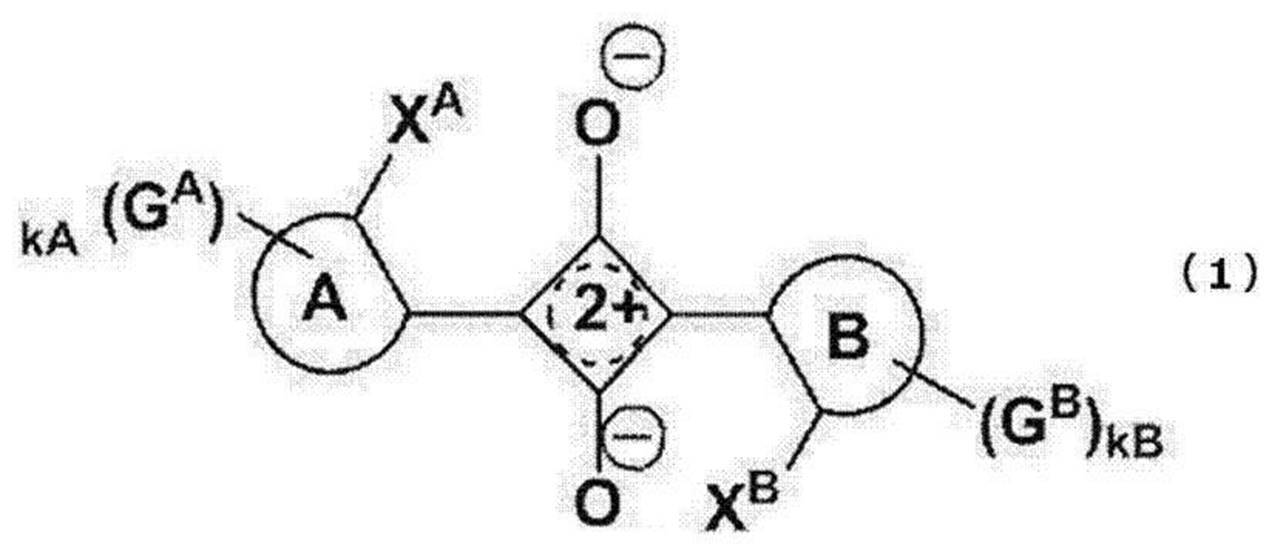
式(1)中、環A及び環Bは、それぞれ独立に、芳香環又は複素芳香環を表し、XA及びXBは、それぞれ独立に、1価の置換基を表し、GA及びGBは、それぞれ独立に、1価の置換基を表し、kAは0~nAの整数を表し、kBは0~nBの整数を表す。nAは、GAが環Aに置換可能な最大の整数を表し、nBは、GBが環Bに置換可能な最大の整数を表す。XAとGA、又はXBとGBは、それぞれ互いに結合して環を形成してもよく、GA及びGBがそれぞれ複数存在する場合は、環Aに結合する複数のGA、及び環Bに結合する複数のGBは、それぞれ互いに結合して環を形成していてもよい。
<9> インクジェットインクAが、更に、シアン顔料、マゼンタ顔料、及びイエロー顔料からなる群から選択させる少なくとも1種を含有する、<6>~<8>のいずれか1つに記載の印刷物。
<10> ブラック画像が、バーコード画像及びQRコード(登録商標)画像の少なくとも一方であり、赤外線吸収画像が、ドットコード画像である、<6>~<9>のいずれか1つに記載の印刷物。
<11> 複合画像が、更に、平面視でブラック画像に重なるシアン画像、平面視でブラック画像に重なるマゼンタ画像、及び平面視でブラック画像に重なるイエロー画像からなる群から選択される少なくとも1種であるカラー画像を含む、<6>~<10>のいずれか1つに記載の印刷物。
<12> 複合画像が、更に、平面視で重なり部分に重なる蛍光画像を含み、
蛍光画像が、重合性化合物、光重合開始剤、及び蛍光物質を含有し、含有される重合性化合物中に占める多官能重合性モノマーの割合が60質量%以上であるインクジェットインクCの硬化物である、<6>~<11>のいずれか1つに記載の印刷物。
<10> ブラック画像が、バーコード画像及びQRコード(登録商標)画像の少なくとも一方であり、赤外線吸収画像が、ドットコード画像である、<6>~<9>のいずれか1つに記載の印刷物。
<11> 複合画像が、更に、平面視でブラック画像に重なるシアン画像、平面視でブラック画像に重なるマゼンタ画像、及び平面視でブラック画像に重なるイエロー画像からなる群から選択される少なくとも1種であるカラー画像を含む、<6>~<10>のいずれか1つに記載の印刷物。
<12> 複合画像が、更に、平面視で重なり部分に重なる蛍光画像を含み、
蛍光画像が、重合性化合物、光重合開始剤、及び蛍光物質を含有し、含有される重合性化合物中に占める多官能重合性モノマーの割合が60質量%以上であるインクジェットインクCの硬化物である、<6>~<11>のいずれか1つに記載の印刷物。
本開示によれば、平面視で互いに重なる重なり部分を含むブラック画像及び赤外線吸収画像を含む複合画像を備え、この複合画像中のブラック画像の読み取り性と、上記複合画像中の赤外線吸収画像の赤外線による読み取り性と、が両立されている印刷物、並びに、この印刷物の製造に好適なインクセットが提供される。
本開示において、「~」を用いて表される数値範囲は、「~」の前後に記載される数値を下限値および上限値として含む範囲を意味する。
本開示において、組成物中の各成分の量は、組成物中に各成分に該当する物質が複数存在する場合、特に断らない限り、組成物中に存在する上記複数の物質の合計量を意味する。
本開示中に段階的に記載されている数値範囲において、ある数値範囲で記載された上限値又は下限値は、他の段階的な記載の数値範囲の上限値又は下限値に置き換えてもよく、また、実施例に示されている値に置き換えてもよい。
本開示において、「工程」との語は、独立した工程だけでなく、他の工程と明確に区別できない場合であっても工程の所期の目的が達成されれば、本用語に含まれる。
本開示において、好ましい態様の組み合わせは、より好ましい態様である。
本開示において、組成物中の各成分の量は、組成物中に各成分に該当する物質が複数存在する場合、特に断らない限り、組成物中に存在する上記複数の物質の合計量を意味する。
本開示中に段階的に記載されている数値範囲において、ある数値範囲で記載された上限値又は下限値は、他の段階的な記載の数値範囲の上限値又は下限値に置き換えてもよく、また、実施例に示されている値に置き換えてもよい。
本開示において、「工程」との語は、独立した工程だけでなく、他の工程と明確に区別できない場合であっても工程の所期の目的が達成されれば、本用語に含まれる。
本開示において、好ましい態様の組み合わせは、より好ましい態様である。
本開示において、「光」は、γ線、β線、電子線、紫外線、可視光線等の活性エネルギー線を包含する概念である。
本開示において、「(メタ)アクリレート」は、アクリレート及びメタクリレートの両方を包含する概念であり、「(メタ)アクリロイル基」はアクリロイル基及びメタクリロイル基の両方を包含する概念であり、「(メタ)アクリル酸」はアクリル酸及びメタクリル酸の両方を包含する概念である。
本開示において、「画像」とは、基材上にインクを付与して形成される膜全般を意味し、「画像の記録」及び「画像記録」とは、いずれも、基材上にインクを付与して膜を形成することを意味する。「画像」の概念には、ベタ画像(solid image)も包含される。
本開示において、「印刷」は、「画像記録」と同義である。
本開示において、「(メタ)アクリレート」は、アクリレート及びメタクリレートの両方を包含する概念であり、「(メタ)アクリロイル基」はアクリロイル基及びメタクリロイル基の両方を包含する概念であり、「(メタ)アクリル酸」はアクリル酸及びメタクリル酸の両方を包含する概念である。
本開示において、「画像」とは、基材上にインクを付与して形成される膜全般を意味し、「画像の記録」及び「画像記録」とは、いずれも、基材上にインクを付与して膜を形成することを意味する。「画像」の概念には、ベタ画像(solid image)も包含される。
本開示において、「印刷」は、「画像記録」と同義である。
〔インクセット〕
本開示のインクセットは、
重合性化合物、光重合開始剤、及びペリレンブラックを含有し、重合性化合物中に占める多官能重合性モノマーの割合が60質量%以上であるインクジェットインクA(以下、「インクA」ともいう)と、
重合性化合物、光重合開始剤、及び赤外線吸収色素を含有し、重合性化合物中に占める多官能重合性モノマーの割合が60質量%以上であるインクジェットインクB(以下、「インクB」ともいう)と、
を備える。
本開示のインクセットは、
重合性化合物、光重合開始剤、及びペリレンブラックを含有し、重合性化合物中に占める多官能重合性モノマーの割合が60質量%以上であるインクジェットインクA(以下、「インクA」ともいう)と、
重合性化合物、光重合開始剤、及び赤外線吸収色素を含有し、重合性化合物中に占める多官能重合性モノマーの割合が60質量%以上であるインクジェットインクB(以下、「インクB」ともいう)と、
を備える。
本開示のインクセットは、平面視で互いに重なる重なり部分を含むブラック画像及び赤外線吸収画像を含む複合画像を備える印刷物(例えば、後述の本開示の印刷物)の製造に好適である。
本開示のインクセットによって上記印刷物を製造することにより、複合画像中のブラック画像の読み取り性と、上記複合画像中の赤外線吸収画像の赤外線による読み取り性(以下、「IR読み取り性」ともいう)と、が両立される。
かかる効果が奏される理由は、以下のように推測される。
本開示のインクセットによって上記印刷物を製造することにより、複合画像中のブラック画像の読み取り性と、上記複合画像中の赤外線吸収画像の赤外線による読み取り性(以下、「IR読み取り性」ともいう)と、が両立される。
かかる効果が奏される理由は、以下のように推測される。
本開示のインクセットによれば、ペリレンブラックを含有するインクAにより上記複合画像におけるブラック画像を記録でき、赤外線吸収色素を含有するインクBにより上記複合画像における赤外線吸収画像を記録できる。
インクAは、赤外域の吸収が少ないペリレンブラックを含有する。これにより、複合画像における赤外線吸収画像を赤外線によって読み取る際に、誤ってブラック画像まで読み取られてしまう現象が抑制されるためである。
しかし、本発明者等の検討により、上記複合画像におけるブラック画像を、ペリレンブラックを含有するインクを用いて記録した場合であっても、上記複合画像における赤外線吸収画像の赤外線読み取り性が低下する場合があることが判明した。
具体的には、
(1)上記複合画像におけるブラック画像を、ペリレンブラックを含有するが、重合性化合物中に占める多官能重合性モノマーの割合(以下、「多官能比率」ともいう)が60質量%未満であるインクを用いて記録した場合、及び、
(2)上記複合画像における赤外線吸収画像を、赤外線吸収色素を含有するが、多官能比率が60質量%未満であるインクを用いて記録した場合
のいずれにおいても、上記複合画像における赤外線吸収画像の赤外線読み取り性が低下する場合がある。
(1)の場合には、ペリレンブラックを含有するインクの硬化性が不足するために、複合画像が得られるまでの硬化過程において、複合画像中の赤外線吸収画像に滲みが生じ、その結果、赤外線吸収画像のIR読み取り性が低下するためと考えられる。
(2)の場合には、赤外線吸収色素を含有するインク自体の硬化性が不足するために、複合画像が得られるまでの硬化過程において、複合画像中の赤外線吸収画像に滲みが生じ、その結果、赤外線吸収画像のIR読み取り性が低下するためと考えられる。
この問題に関し、本開示のインクセットでは、ペリレンブラックを含有するインクAにおける多官能比率が60質量%以上であり、かつ、赤外線吸収色素を含有するインクBにおける多官能比率が60質量%である。これにより、複合画像中における赤外線吸収画像の滲みが抑制され、その結果、上記複合画像中の赤外線吸収画像の赤外線による読み取り性が確保されると考えられる。更に、同様の理由により、ペリレンブラックを含有するインクAに由来するブラック画像の滲みも抑制され、その結果、上記複合画像中のブラック画像の読み取り性も確保されると考えられる。
以上の理由により、本開示のインクセットによって上記印刷物を製造することにより、複合画像中のブラック画像の読み取り性と、上記複合画像中の赤外線吸収画像のIR読み取り性と、が両立されると考えられる。
インクAは、赤外域の吸収が少ないペリレンブラックを含有する。これにより、複合画像における赤外線吸収画像を赤外線によって読み取る際に、誤ってブラック画像まで読み取られてしまう現象が抑制されるためである。
しかし、本発明者等の検討により、上記複合画像におけるブラック画像を、ペリレンブラックを含有するインクを用いて記録した場合であっても、上記複合画像における赤外線吸収画像の赤外線読み取り性が低下する場合があることが判明した。
具体的には、
(1)上記複合画像におけるブラック画像を、ペリレンブラックを含有するが、重合性化合物中に占める多官能重合性モノマーの割合(以下、「多官能比率」ともいう)が60質量%未満であるインクを用いて記録した場合、及び、
(2)上記複合画像における赤外線吸収画像を、赤外線吸収色素を含有するが、多官能比率が60質量%未満であるインクを用いて記録した場合
のいずれにおいても、上記複合画像における赤外線吸収画像の赤外線読み取り性が低下する場合がある。
(1)の場合には、ペリレンブラックを含有するインクの硬化性が不足するために、複合画像が得られるまでの硬化過程において、複合画像中の赤外線吸収画像に滲みが生じ、その結果、赤外線吸収画像のIR読み取り性が低下するためと考えられる。
(2)の場合には、赤外線吸収色素を含有するインク自体の硬化性が不足するために、複合画像が得られるまでの硬化過程において、複合画像中の赤外線吸収画像に滲みが生じ、その結果、赤外線吸収画像のIR読み取り性が低下するためと考えられる。
この問題に関し、本開示のインクセットでは、ペリレンブラックを含有するインクAにおける多官能比率が60質量%以上であり、かつ、赤外線吸収色素を含有するインクBにおける多官能比率が60質量%である。これにより、複合画像中における赤外線吸収画像の滲みが抑制され、その結果、上記複合画像中の赤外線吸収画像の赤外線による読み取り性が確保されると考えられる。更に、同様の理由により、ペリレンブラックを含有するインクAに由来するブラック画像の滲みも抑制され、その結果、上記複合画像中のブラック画像の読み取り性も確保されると考えられる。
以上の理由により、本開示のインクセットによって上記印刷物を製造することにより、複合画像中のブラック画像の読み取り性と、上記複合画像中の赤外線吸収画像のIR読み取り性と、が両立されると考えられる。
本開示のインクセットによって製造される印刷物の好ましい態様については、後述の「印刷物」の項において説明する。
以下、本開示のインクセットにおけるインクA及びインクB等について説明する。
以下、本開示のインクセットにおけるインクA及びインクB等について説明する。
<インクA>
インクAは、重合性化合物、光重合開始剤、及びペリレンブラックを含有し、多官能比率(即ち、含有される重合性化合物中に占める多官能重合性モノマーの割合)が60質量%以上であるインクジェットインクである。
インクAは、重合性化合物、光重合開始剤、及びペリレンブラックを含有し、多官能比率(即ち、含有される重合性化合物中に占める多官能重合性モノマーの割合)が60質量%以上であるインクジェットインクである。
(重合性化合物)
インクAは、重合性化合物を少なくとも1種含有する。
重合性化合物は、重合性基を有する化合物である。
重合性基としては、ラジカル重合性基又はカチオン重合性基が好ましく、ラジカル重合性基がより好ましい。
重合性化合物は、重合性基を1種のみ有していてもよいし、2種以上有していてもよい。
重合性化合物としては、ラジカル重合性化合物(即ち、ラジカル重合性基を有する化合物)が好ましい。
インクAは、重合性化合物を少なくとも1種含有する。
重合性化合物は、重合性基を有する化合物である。
重合性基としては、ラジカル重合性基又はカチオン重合性基が好ましく、ラジカル重合性基がより好ましい。
重合性化合物は、重合性基を1種のみ有していてもよいし、2種以上有していてもよい。
重合性化合物としては、ラジカル重合性化合物(即ち、ラジカル重合性基を有する化合物)が好ましい。
ラジカル重合性基としては、エチレン性不飽和基が好ましく、(メタ)アクリロイル基、アリル基、スチリル基、及びビニル基からなる群から選択される少なくとも1種がより好ましく、(メタ)アクリロイル基が更に好ましい。
カチオン重合性基としては、エポキシ基、オキセタニル基等が挙げられる。
カチオン重合性基としては、エポキシ基、オキセタニル基等が挙げられる。
-多官能比率-
インクAにおいて、多官能比率(即ち、重合性化合物中に占める多官能重合性モノマーの割合)は、60質量%以上である。
これにより、赤外線吸収画像の赤外線による読み取り性が向上する。
インクAにおける多官能比率は、100質量%であってもよい。
インクAにおいて、多官能比率(即ち、重合性化合物中に占める多官能重合性モノマーの割合)は、60質量%以上である。
これにより、赤外線吸収画像の赤外線による読み取り性が向上する。
インクAにおける多官能比率は、100質量%であってもよい。
本開示において、多官能重合性モノマーとは、一分子中における重合性基の数が2つ以上であり、かつ、分子量が1000以下である重合性化合物を意味する。
赤外線吸収画像のIR読み取り性をより向上させる観点から、インクAでは、含有される重合性化合物中に占める多官能ラジカル重合性モノマーの割合が60質量%~100質量%であることが好ましい。
赤外線吸収画像の赤外線による読み取り性と、インクジェットヘッドからのインクAの吐出安定性と、をより向上させる観点から、重合性化合物中に占める、2官能ラジカル重合性モノマーの割合が60質量%~100質量%であることがより好ましい。
赤外線吸収画像の赤外線による読み取り性と、インクジェットヘッドからのインクAの吐出安定性と、をより向上させる観点から、重合性化合物中に占める、2官能ラジカル重合性モノマーの割合が60質量%~100質量%であることがより好ましい。
インクAの全量に対する多官能重合性モノマー(好ましくは多官能ラジカル重合性モノマー、より好ましくは2官能ラジカル重合性モノマー)の含有量は、好ましくは40質量%以上であり、より好ましくは50質量%以上であり、更に好ましくは60質量%以上である。
インクAの全量に対する多官能重合性モノマー(好ましくは多官能ラジカル重合性モノマー、より好ましくは2官能ラジカル重合性モノマー)の含有量の上限は、他の成分の含有量にもよるが、例えば95質量%である。
インクAの全量に対する多官能重合性モノマー(好ましくは多官能ラジカル重合性モノマー、より好ましくは2官能ラジカル重合性モノマー)の含有量の上限は、他の成分の含有量にもよるが、例えば95質量%である。
-多官能重合性モノマー-
インクAは、多官能重合性モノマーを少なくとも1種含有する。
多官能重合性モノマーとしては、2官能ラジカル重合性モノマー及び3官能以上のラジカル重合性モノマーからなる群から選択される少なくとも1種が好ましい。
インクAは、多官能重合性モノマーを少なくとも1種含有する。
多官能重合性モノマーとしては、2官能ラジカル重合性モノマー及び3官能以上のラジカル重合性モノマーからなる群から選択される少なくとも1種が好ましい。
2官能ラジカル重合性モノマーとしては、例えば、2官能(メタ)アクリレート、2官能ビニルエーテル、ビニルエーテル基と(メタ)アクリロイル基とを含む2官能重合性化合物、等が挙げられる。
2官能(メタ)アクリレートとしては、例えば、エチレングリコールジ(メタ)アクリレート、ジエチレングリコールジ(メタ)アクリレート、トリエチレングリコールジ(メタ)アクリレート、プロピレングリコールジ(メタ)アクリレート、ジプロピレングリコールジ(メタ)アクリレート、トリプロピレングリコールジ(メタ)アクリレート、ポリエチレングリコールジ(メタ)アクリレート、ポリプロピレングリコールジ(メタ)アクリレート、ブチレングリコールジ(メタ)アクリレート、テトラエチレングリコールジ(メタ)アクリレート、ネオペンチルグリコールジ(メタ)アクリレート、3-メチル-1,5-ペンタンジオールジ(メタ)アクリレート、ヘキサンジオールジ(メタ)アクリレート、ヘプタンジオールジ(メタ)アクリレート、エトキシ化(以下、EO変性ともいう
ともいう)ネオペンチルグリコールジ(メタ)アクリレート、プロポキシ化(以下、「PO変性」ともいう)ネオペンチルグリコールジ(メタ)アクリレート、EO変性ヘキサンジオールジ(メタ)アクリレート、PO変性ヘキサンジオールジ(メタ)アクリレート、オクタンジオールジ(メタ)アクリレート、ノナンジオールジ(メタ)アクリレート、デカンジオールジ(メタ)アクリレート、ドデカンジオールジ(メタ)アクリレート、1,6-ヘキサンジオールジ(メタ)アクリレート、グリセリンジ(メタ)アクリレート、ペンタエリスリトールジ(メタ)アクリレート、エチレングリコールジグリシジルエーテルジ(メタ)アクリレート、ジエチレングリコールジグリシジルエーテルジ(メタ)アクリレート、トリシクロデカンジメタノールジ(メタ)アクリレート、3-メチル-1,5-ペンタンジオールジ(メタ)アクリレート、等が挙げられる。
ともいう)ネオペンチルグリコールジ(メタ)アクリレート、プロポキシ化(以下、「PO変性」ともいう)ネオペンチルグリコールジ(メタ)アクリレート、EO変性ヘキサンジオールジ(メタ)アクリレート、PO変性ヘキサンジオールジ(メタ)アクリレート、オクタンジオールジ(メタ)アクリレート、ノナンジオールジ(メタ)アクリレート、デカンジオールジ(メタ)アクリレート、ドデカンジオールジ(メタ)アクリレート、1,6-ヘキサンジオールジ(メタ)アクリレート、グリセリンジ(メタ)アクリレート、ペンタエリスリトールジ(メタ)アクリレート、エチレングリコールジグリシジルエーテルジ(メタ)アクリレート、ジエチレングリコールジグリシジルエーテルジ(メタ)アクリレート、トリシクロデカンジメタノールジ(メタ)アクリレート、3-メチル-1,5-ペンタンジオールジ(メタ)アクリレート、等が挙げられる。
2官能ビニルエーテルとしては、例えば、1,4-ブタンジオールジビニルエーテル、エチレングリコールジビニルエーテル、ジエチレングリコールジビニルエーテル、トリエチレングリコールジビニルエーテル、ポリエチレングリコールジビニルエーテル、プロピレングリコールジビニルエーテル、ブチレングリコールジビニルエーテル、ヘキサンジオールジビニルエーテル、1,4-シクロヘキサンジメタノールジビニルエーテル、ビスフェノールAアルキレンオキシドジビニルエーテル、ビスフェノールFアルキレンオキシドジビニルエーテル、等が挙げられる。
ビニルエーテル基と(メタ)アクリロイル基とを含む2官能重合性モノマーとしては、(メタ)アクリル酸2-(2-ビニロキシエトキシ)エチルが挙げられる。
3官能以上のラジカル重合性モノマーとしては、例えば、3官能以上の(メタ)アクリレート、3官能以上のビニルエーテル、等が挙げられる。
3官能以上の(メタ)アクリレートとしては、例えば、トリメチロールエタントリ(メタ)アクリレート、トリメチロールプロパントリ(メタ)アクリレート、EO変性トリメチロールプロパントリ(メタ)アクリレート、PO変性トリメチロールプロパントリ(メタ)アクリレート、ペンタエリスリトールトリ(メタ)アクリレート、ペンタエリスリトールテトラ(メタ)アクリレート、ジペンタエリスリトールテトラ(メタ)アクリレート、ジペンタエリスリトールペンタ(メタ)アクリレート、ジペンタエリスリトールヘキサ(メタ)アクリレート、トリ(メタ)アクリロイルオキシエトキシトリメチロールプロパン、グリセリンポリグリシジルエーテルポリ(メタ)アクリレート、トリス(2-アクリロイルオキシエチル)イソシアヌレート、等が挙げられる。
3官能以上のビニルエーテルとしては、例えば、トリメチロールエタントリビニルエーテル、トリメチロールプロパントリビニルエーテル、ジトリメチロールプロパンテトラビニルエーテル、グリセリントリビニルエーテル、ペンタエリスリトールテトラビニルエーテル、ジペンタエリスリトールペンタビニルエーテル、ジペンタエリスリトールヘキサビニルエーテル、EO変性トリメチロールプロパントリビニルエーテル、PO変性トリメチロールプロパントリビニルエーテル、EO変性ジトリメチロールプロパンテトラビニルエーテル、PO変性ジトリメチロールプロパンテトラビニルエーテル、EO変性ペンタエリスリトールテトラビニルエーテル、PO変性ペンタエリスリトールテトラビニルエーテル、EO変性ジペンタエリスリトールヘキサビニルエーテル、PO変性ジペンタエリスリトールヘキサビニルエーテル、等が挙げられる。
多官能重合性モノマーは、硬化性向上の観点から、酸素原子を有する化合物であることが好ましい。
酸素原子を有する化合物である多官能重合性モノマーにおいて、1分子中に含まれる炭素原子数に対する酸素原子数の比率は、0.2以上であることが好ましく、0.3以上であることがより好ましい。比率の上限値は特に限定されないが、例えば、0.5である。 1分子中に含まれる炭素原子数に対する酸素原子数の比率が0.2以上である化合物としては、3-メチル-1,5-ペンタンジオールジ(メタ)アクリレート又はPO変性ネオペンチルグリコールジ(メタ)アクリレートが特に好ましい。
酸素原子を有する化合物である多官能重合性モノマーにおいて、1分子中に含まれる炭素原子数に対する酸素原子数の比率は、0.2以上であることが好ましく、0.3以上であることがより好ましい。比率の上限値は特に限定されないが、例えば、0.5である。 1分子中に含まれる炭素原子数に対する酸素原子数の比率が0.2以上である化合物としては、3-メチル-1,5-ペンタンジオールジ(メタ)アクリレート又はPO変性ネオペンチルグリコールジ(メタ)アクリレートが特に好ましい。
多官能重合性モノマーの分子量は、好ましくは800以下であり、より好ましくは700以下であり、更に好ましくは500以下である。
多官能重合性モノマーの分子量の下限としては、例えば、100等が挙げられる。
多官能重合性モノマーの分子量の下限としては、例えば、100等が挙げられる。
-単官能重合性モノマー-
インクAは、単官能重合性モノマーを少なくとも1種含有してもよい。
単官能重合性モノマーとしては、例えば、単官能(メタ)アクリレート、単官能(メタ)アクリルアミド、単官能芳香族ビニル化合物、単官能ビニルエーテル、及び単官能N-ビニル化合物が挙げられる。
インクAは、単官能重合性モノマーを少なくとも1種含有してもよい。
単官能重合性モノマーとしては、例えば、単官能(メタ)アクリレート、単官能(メタ)アクリルアミド、単官能芳香族ビニル化合物、単官能ビニルエーテル、及び単官能N-ビニル化合物が挙げられる。
単官能(メタ)アクリレートとしては、例えば、メチル(メタ)アクリレート、エチル(メタ)アクリレート、プロピル(メタ)アクリレート、n-ブチル(メタ)アクリレート、ヘキシル(メタ)アクリレート、2-エチルヘキシル(メタ)アクリレート、tert-オクチル(メタ)アクリレート、イソアミル(メタ)アクリレート、デシル(メタ)アクリレート、イソデシル(メタ)アクリレート、ラウリル(メタ)アクリレート、ステアリル(メタ)アクリレート、イソステアリル(メタ)アクリレート、シクロヘキシル(メタ)アクリレート、4-n-ブチルシクロヘキシル(メタ)アクリレート、(メタ)アクリル酸4-tert-ブチルシクロヘキシル、ボルニル(メタ)アクリレート、イソボルニル(メタ)アクリレート、2-エチルヘキシルジグリコール(メタ)アクリレート、ブトキシエチル(メタ)アクリレート、2-クロロエチル(メタ)アクリレート、4-ブロモブチル(メタ)アクリレート、シアノエチル(メタ)アクリレート、ベンジル(メタ)アクリレート、ブトキシメチル(メタ)アクリレート、3-メトキシブチル(メタ)アクリレート、2-(2-メトキシエトキシ)エチル(メタ)アクリレート、2-(2-ブトキシエトキシ)エチル(メタ)アクリレート、エチルカルビトール(メタ)アクリレート、2,2,2-テトラフルオロエチル(メタ)アクリレート、1H,1H,2H,2H-パーフルオロデシル(メタ)アクリレート、4-ブチルフェニル(メタ)アクリレート、フェニル(メタ)アクリレート、2,4,5-テトラメチルフェニル(メタ)アクリレート、4-クロロフェニル(メタ)アクリレート、2-フェノキシメチル(メタ)アクリレート、2-フェノキシエチル(メタ)アクリレート、グリシジル(メタ)アクリレート、グリシジルオキシブチル(メタ)アクリレート、グリシジルオキシエチル(メタ)アクリレート、グリシジルオキシプロピル(メタ)アクリレート、テトラヒドロフルフリル(メタ)アクリレート、2-ヒドロキシエチル(メタ)アクリレート、3-ヒドロキシプロピル(メタ)アクリレート、2-ヒドロキシプロピル(メタ)アクリレート、2-ヒドロキシブチル(メタ)アクリレート、3-ヒドロキシブチル(メタ)アクリレート、4-ヒドロキシブチル(メタ)アクリレート、環状トリメチロールプロパンホルマール(メタ)アクリレート、フェニルグリシジルエーテル(メタ)アクリレート、ジメチルアミノエチル(メタ)アクリレート、ジエチルアミノエチル(メタ)アクリレート、ジメチルアミノプロピル(メタ)アクリレート、ジエチルアミノプロピル(メタ)アクリレート、トリメトキシシリルプロピル(メタ)アクリレート、トリメチルシリルプロピル(メタ)アクリレート、ポリエチレンオキシドモノメチルエーテル(メタ)アクリレート、ポリエチレンオキシド(メタ)アクリレート、ポリエチレンオキシドモノアルキルエーテル(メタ)アクリレート、ジプロピレングリコール(メタ)アクリレート、ポリプロピレンオキシドモノアルキルエーテル(メタ)アクリレート、2-メタクリロイルオキシエチルコハク酸、2-メタクリロイルオキシヘキサヒドロフタル酸、2-メタクリロイルオキシエチル-2-ヒドロキシプロピルフタレート、ブトキシジエチレングリコール(メタ)アクリレート、トリフルオロエチル(メタ)アクリレート、パーフルオロオクチルエチル(メタ)アクリレート、2-ヒドロキシ-3-フェノキシプロピル(メタ)アクリレート、エチレンオキシド(EO)変性フェノール(メタ)アクリレート、EO変性クレゾール(メタ)アクリレート、EO変性ノニルフェノール(メタ)アクリレート、プロピレンオキシド(PO)変性ノニルフェノール(メタ)アクリレート、EO変性-2-エチルヘキシル(メタ)アクリレート、ジシクロペンテニル(メタ)アクリレート、ジシクロペンテニルオキシエチル(メタ)アクリレート、ジシクロペンタニル(メタ)アクリレート、(3-エチル-3-オキセタニルメチル)(メタ)アクリレート、フェノキシエチレングリコール(メタ)アクリレート等が挙げられる。
中でも、環状構造を有する単官能(メタ)アクリレートが好ましく、環状トリメチロールプロパンホルマール(メタ)アクリレート又はフェニルグリシジルエーテル(メタ)アクリレートが特に好ましい。
中でも、環状構造を有する単官能(メタ)アクリレートが好ましく、環状トリメチロールプロパンホルマール(メタ)アクリレート又はフェニルグリシジルエーテル(メタ)アクリレートが特に好ましい。
単官能(メタ)アクリルアミドとしては、例えば、(メタ)アクリルアミド、N-メチル(メタ)アクリルアミド、N-エチル(メタ)アクリルアミド、N-プロピル(メタ)アクリルアミド、N-n-ブチル(メタ)アクリルアミド、N-t-ブチル(メタ)アクリルアミド、N-ブトキシメチル(メタ)アクリルアミド、N-イソプロピル(メタ)アクリルアミド、N-メチロール(メタ)アクリルアミド、N,N-ジメチル(メタ)アクリルアミド、N,N-ジエチル(メタ)アクリルアミド、(メタ)アクリロイルモルフォリン等が挙げられる。
単官能芳香族ビニル化合物としては、例えば、スチレン、ジメチルスチレン、トリメチルスチレン、イソプロピルスチレン、クロロメチルスチレン、メトキシスチレン、アセトキシスチレン、クロロスチレン、ジクロロスチレン、ブロモスチレン、ビニル安息香酸メチルエステル、3-メチルスチレン、4-メチルスチレン、3-エチルスチレン、4-エチルスチレン、3-プロピルスチレン、4-プロピルスチレン、3-ブチルスチレン、4-ブチルスチレン、3-ヘキシルスチレン、4-ヘキシルスチレン、3-オクチルスチレン、4-オクチルスチレン、3-(2-エチルヘキシル)スチレン、4-(2-エチルヘキシル)スチレン、アリルスチレン、イソプロペニルスチレン、ブテニルスチレン、オクテニルスチレン、4-t-ブトキシカルボニルスチレン及び4-t-ブトキシスチレンが挙げられる。
単官能ビニルエーテルとしては、例えば、メチルビニルエーテル、エチルビニルエーテル、プロピルビニルエーテル、n-ブチルビニルエーテル、t-ブチルビニルエーテル、2-エチルヘキシルビニルエーテル、n-ノニルビニルエーテル、ラウリルビニルエーテル、シクロヘキシルビニルエーテル、シクロヘキシルメチルビニルエーテル、4-メチルシクロヘキシルメチルビニルエーテル、ベンジルビニルエーテル、ジシクロペンテニルビニルエーテル、2-ジシクロペンテノキシエチルビニルエーテル、メトキシエチルビニルエーテル、エトキシエチルビニルエーテル、ブトキシエチルビニルエーテル、メトキシエトキシエチルビニルエーテル、エトキシエトキシエチルビニルエーテル、メトキシポリエチレングリコールビニルエーテル、テトラヒドロフルフリルビニルエーテル、2-ヒドロキシエチルビニルエーテル、2-ヒドロキシプロピルビニルエーテル、4-ヒドロキシブチルビニルエーテル、4-ヒドロキシメチルシクロヘキシルメチルビニルエーテル、ジエチレングリコールモノビニルエーテル、ポリエチレングリコールビニルエーテル、クロルエチルビニルエーテル、クロルブチルビニルエーテル、クロルエトキシエチルビニルエーテル、フェニルエチルビニルエーテル及びフェノキシポリエチレングリコールビニルエーテルが挙げられる。
単官能N-ビニル化合物としては、N-ビニルカプロラクタム及びN-ビニルピロリドンが挙げられる。
単官能重合性モノマーの分子量は、好ましくは500以下であり、より好ましくは300以下であり、更に好ましくは210以下である。
単官能重合性化合物の分子量の下限としては、例えば、50、60、70等が挙げられる。
単官能重合性化合物の分子量の下限としては、例えば、50、60、70等が挙げられる。
単官能重合性モノマーは、単官能(メタ)アクリレート及び単官能N-ビニル化合物の少なくとも一方を含むことが好ましい。
(光重合開始剤)
インクAは、光重合開始剤を少なくとも1種含有する。
光重合開始剤としては、ラジカル重合開始剤が好ましい。
ラジカル重合開始剤は、光の照射によってラジカルを発生し、既述の重合性化合物の重合反応を開始する機能を有する。
インクAは、光重合開始剤を少なくとも1種含有する。
光重合開始剤としては、ラジカル重合開始剤が好ましい。
ラジカル重合開始剤は、光の照射によってラジカルを発生し、既述の重合性化合物の重合反応を開始する機能を有する。
ラジカル重合開始剤としては、(a)芳香族ケトン類等のカルボニル化合物、(b)アシルホスフィンオキシド化合物、(c)芳香族オニウム塩化合物、(d)有機過酸物、(e)チオ化合物、(f)ヘキサアリールビイミダゾール化合物、(g)ケトオキシムエステル化合物、(h)ボレート化合物、(i)アジニウム化合物、(j)メタロセン化合物、(k)活性エステル化合物、(l)炭素ハロゲン結合を有する化合物、及び(m)アルキルアミン化合物が挙げられる。
ラジカル重合開始剤として、上記(a)~(m)の化合物を1種単独もしくは2種以上を組み合わせて使用してもよい。
ラジカル重合開始剤としては、上記(a)、(b)又は(e)がより好ましい。
(a)カルボニル化合物、(b)アシルホスフィンオキシド化合物、及び、(e)チオ化合物の好ましい例としては、”RADIATION CURING IN POLYMER SCIENCE AND TECHNOLOGY”,J.P.FOUASSIER,J.F.RABEK(1993)、pp.77~117に記載のベンゾフェノン骨格又はチオキサントン骨格を有する化合物が挙げられる。
より好ましい例としては、特公昭47-6416号公報記載のα-チオベンゾフェノン化合物、特公昭47-3981号公報記載のベンゾインエーテル化合物、特公昭47-22326号公報記載のα-置換ベンゾイン化合物、特公昭47-23664号公報記載のベンゾイン誘導体、特開昭57-30704号公報記載のアロイルホスホン酸エステル、特公昭60-26483号公報記載のジアルコキシベンゾフェノン、特公昭60-26403号公報、特開昭62-81345号公報記載のベンゾインエーテル類、特公平1-34242号公報、米国特許第4,318,791号パンフレット、ヨーロッパ特許0284561A1号公報に記載のα-アミノベンゾフェノン類、特開平2-211452号公報記載のp-ジ(ジメチルアミノベンゾイル)ベンゼン、特開昭61-194062号公報記載のチオ置換芳香族ケトン、特公平2-9597号公報記載のアシルホスフィンスルフィド、特公平2-9596号公報記載のアシルホスフィン、特公昭63-61950号公報記載のチオキサントン類、及び特公昭59-42864号公報記載のクマリン類を挙げることができる。
また、特開2008-105379号公報、及び特開2009-114290号公報に記載の重合開始剤も好ましい。
より好ましい例としては、特公昭47-6416号公報記載のα-チオベンゾフェノン化合物、特公昭47-3981号公報記載のベンゾインエーテル化合物、特公昭47-22326号公報記載のα-置換ベンゾイン化合物、特公昭47-23664号公報記載のベンゾイン誘導体、特開昭57-30704号公報記載のアロイルホスホン酸エステル、特公昭60-26483号公報記載のジアルコキシベンゾフェノン、特公昭60-26403号公報、特開昭62-81345号公報記載のベンゾインエーテル類、特公平1-34242号公報、米国特許第4,318,791号パンフレット、ヨーロッパ特許0284561A1号公報に記載のα-アミノベンゾフェノン類、特開平2-211452号公報記載のp-ジ(ジメチルアミノベンゾイル)ベンゼン、特開昭61-194062号公報記載のチオ置換芳香族ケトン、特公平2-9597号公報記載のアシルホスフィンスルフィド、特公平2-9596号公報記載のアシルホスフィン、特公昭63-61950号公報記載のチオキサントン類、及び特公昭59-42864号公報記載のクマリン類を挙げることができる。
また、特開2008-105379号公報、及び特開2009-114290号公報に記載の重合開始剤も好ましい。
ラジカル重合開始剤の中でも、(a)カルボニル化合物又は(b)アシルホスフィンオキシド化合物がより好ましく、具体的には、
ビス(2,4,6-トリメチルベンゾイル)-フェニルホスフィンオキシド(例えば、IGM Resins B.V.社製のOMNIRAD(登録商標) 819)、
2-(ジメチルアミン)-1-(4-モルホリノフェニル)-2-ベンジル-1-ブタノン(例えば、IGM Resins B.V.社製のOMNIRAD(登録商標) 369)、
2-メチル-1-(4-メチルチオフェニル)-2-モルフォリノプロパン-1-オン(例えば、IGM Resins B.V.社製のOMNIRAD(登録商標) 907)、
1-ヒドロキシ-シクロヘキシル-フェニル-ケトン(例えば、IGM Resins B.V.社製のOMNIRAD(登録商標) 184)、及び
2,4,6-トリメチルベンゾイル-ジフェニル-フォスフィンオキシド(IGM Resins B.V.社製のOMNIRAD(登録商標) TPO H)、
等が挙げられる。
中でも、感度向上の観点及びLED光への適合性の観点から、光重合開始剤としては、(b)アシルホスフィンオキシド化合物が好ましく、モノアシルホスフィンオキシド化合物(特に好ましくは、2,4,6-トリメチルベンゾイル-ジフェニル-フォスフィンオキシド)、又は、ビスアシルホスフィンオキシド化合物(特に好ましくは、ビス(2,4,6-トリメチルベンゾイル)-フェニルホスフィンオキシド)がより好ましい。
ビス(2,4,6-トリメチルベンゾイル)-フェニルホスフィンオキシド(例えば、IGM Resins B.V.社製のOMNIRAD(登録商標) 819)、
2-(ジメチルアミン)-1-(4-モルホリノフェニル)-2-ベンジル-1-ブタノン(例えば、IGM Resins B.V.社製のOMNIRAD(登録商標) 369)、
2-メチル-1-(4-メチルチオフェニル)-2-モルフォリノプロパン-1-オン(例えば、IGM Resins B.V.社製のOMNIRAD(登録商標) 907)、
1-ヒドロキシ-シクロヘキシル-フェニル-ケトン(例えば、IGM Resins B.V.社製のOMNIRAD(登録商標) 184)、及び
2,4,6-トリメチルベンゾイル-ジフェニル-フォスフィンオキシド(IGM Resins B.V.社製のOMNIRAD(登録商標) TPO H)、
等が挙げられる。
中でも、感度向上の観点及びLED光への適合性の観点から、光重合開始剤としては、(b)アシルホスフィンオキシド化合物が好ましく、モノアシルホスフィンオキシド化合物(特に好ましくは、2,4,6-トリメチルベンゾイル-ジフェニル-フォスフィンオキシド)、又は、ビスアシルホスフィンオキシド化合物(特に好ましくは、ビス(2,4,6-トリメチルベンゾイル)-フェニルホスフィンオキシド)がより好ましい。
インクA中における光重合開始剤の含有量は、インクAの全量に対し、1.0質量%~25.0質量%が好ましく、2.0質量%~20.0質量%がより好ましく、3.0質量%~15.0質量%が更に好ましい。
(色素増感剤)
インクAは、色素増感剤を少なくとも1種含有することが好ましい。
インクAが色素増感剤を含有することで、光硬化性を高めることができ、特にLED光源を用いた場合の光硬化性を良好なものとすることができる。また、色素増感剤は、耐光性の向上にも寄与する。
インクAは、色素増感剤を少なくとも1種含有することが好ましい。
インクAが色素増感剤を含有することで、光硬化性を高めることができ、特にLED光源を用いた場合の光硬化性を良好なものとすることができる。また、色素増感剤は、耐光性の向上にも寄与する。
色素増感剤は、特定の活性エネルギー線を吸収して電子励起状態となる物質である。電子励起状態となった色素増感剤は、ラジカル重合開始剤と接触して、電子移動、エネルギー移動、発熱等の作用を生じる。これにより、ラジカル重合開始剤の化学変化、即ち分解、ラジカル、酸又は塩基の生成が促進される。
色素増感剤としては、例えば、4-(ジメチルアミノ)安息香酸エチル(EDB)、アントラキノン、3-アシルクマリン誘導体、ターフェニル、スチリルケトン、3-(アロイルメチレン)チアゾリン、ショウノウキノン、エオシン、ローダミン、エリスロシン、特開2010-24276号公報に記載の一般式(i)で表される化合物、及び特開平6-107718号公報に記載の一般式(I)で表される化合物が挙げられる。
食品包装分野でインクを使用する場合、食品安全性の観点と十分な硬化性を担保する必要がある。そのため、色素増感剤の中でも、食品安全性の観点、並びに、LED光への適合性及び光重合開始剤との反応性を考慮してより良好な硬化性を担保する観点から、チオキサントン系化合物及びチオクロマノン系化合物の少なくとも1種を含むことが好ましい。
チオキサントン化合物及びチオクロマノン化合物については、特開2012-46724号の段落0066~段落0077を参照してもよい。
チオキサントン化合物及びチオクロマノン化合物については、特開2012-46724号の段落0066~段落0077を参照してもよい。
-チオキサントン化合物-
チオキサントン化合物としては、下記式(3)で表される化合物が好ましい。
チオキサントン化合物としては、下記式(3)で表される化合物が好ましい。

式(3)中、R11~R18は、それぞれ独立に、水素原子、アルキル基、ハロゲン原子、ヒドロキシ基、シアノ基、ニトロ基、アミノ基、アルキルチオ基、アルキルアミノ基(一置換及び二置換の場合を含む。)、アルコキシ基、アルコキシカルボニル基、アシルオキシ基、アシル基、カルボキシ基又はスルホ基を表す。
上記アルキル基、上記アルキルチオ基、上記アルキルアミノ基、上記アルコキシ基、上記アルコキシカルボニル基、上記アシルオキシ基、及び上記アシル基の各々において、アルキル部分の炭素数は、1~20であることが好ましく、1~8であることがより好ましく、1~4であることが更に好ましい。
上記アシルオキシ基は、アリールオキシカルボニル基であってもよく、上記アシル基はアリールカルボニル基であってもよい。この場合、アリールオキシカルボニル基及びアリールカルボニル基の各々において、アリール部分の炭素数は、6~14であることが好ましく、6~10であることがより好ましい。
上記アシルオキシ基は、アリールオキシカルボニル基であってもよく、上記アシル基はアリールカルボニル基であってもよい。この場合、アリールオキシカルボニル基及びアリールカルボニル基の各々において、アリール部分の炭素数は、6~14であることが好ましく、6~10であることがより好ましい。
R11~R18における隣接する2つは、互いに連結して環を形成していてもよい。
環構造としては、5員又は6員の単環構造;及び、5員又は6員の単環構造が2つ組み合わされた2核環(例えば縮合環)が挙げられる。
5員又は6員の単環構造としては、脂肪族環、芳香族環、及びヘテロ環が挙げられる。へテロ環におけるヘテロ原子としては、N、O、及びSが挙げられる。2核環における単環の組み合わせとしては、脂肪族環と脂肪族環との組み合わせ、脂肪族環と芳香族環との組み合わせ、脂肪族環とヘテロ環との組み合わせ、芳香族環と芳香族環との組み合わせ、芳香族環とヘテロ環との組み合わせ、及び、ヘテロ環とヘテロ環との組み合わせが挙げられる。
環構造は、置換基を有していてもよい。置換基としては、アルキル基、ハロゲン化アルキル基、ハロゲン原子、ヒドロキシ基、シアノ基、ニトロ基、アミノ基、アルキルチオ基、アルキルアミノ基、アルコキシ基、アルコキシカルボニル基、アシルオキシ基、アシル基、カルボキシ基及びスルホ基が挙げられる。
ハロゲン原子としては、フッ素原子、塩素原子、臭素原子又はヨウ素原子が好ましく、塩素原子、臭素原子又はヨウ素原子がより好ましく、塩素原子又は臭素原子が更に好ましい。
ハロゲン化アルキル基としては、フッ化アルキル基が好ましい。
環構造としては、5員又は6員の単環構造;及び、5員又は6員の単環構造が2つ組み合わされた2核環(例えば縮合環)が挙げられる。
5員又は6員の単環構造としては、脂肪族環、芳香族環、及びヘテロ環が挙げられる。へテロ環におけるヘテロ原子としては、N、O、及びSが挙げられる。2核環における単環の組み合わせとしては、脂肪族環と脂肪族環との組み合わせ、脂肪族環と芳香族環との組み合わせ、脂肪族環とヘテロ環との組み合わせ、芳香族環と芳香族環との組み合わせ、芳香族環とヘテロ環との組み合わせ、及び、ヘテロ環とヘテロ環との組み合わせが挙げられる。
環構造は、置換基を有していてもよい。置換基としては、アルキル基、ハロゲン化アルキル基、ハロゲン原子、ヒドロキシ基、シアノ基、ニトロ基、アミノ基、アルキルチオ基、アルキルアミノ基、アルコキシ基、アルコキシカルボニル基、アシルオキシ基、アシル基、カルボキシ基及びスルホ基が挙げられる。
ハロゲン原子としては、フッ素原子、塩素原子、臭素原子又はヨウ素原子が好ましく、塩素原子、臭素原子又はヨウ素原子がより好ましく、塩素原子又は臭素原子が更に好ましい。
ハロゲン化アルキル基としては、フッ化アルキル基が好ましい。
チオキサントン化合物としては、チオキサントン、2-イソプロピルチオキサントン、4-イソプロピルチオキサントン、2-クロロチオキサントン、2,4-ジクロロチオキサントン、2-ドデシルチオキサントン、2,4-ジエチルチオキサントン、2,4-ジメチルチオキサントン、1-メトキシカルボニルチオキサントン、2-エトキシカルボニルチオキサントン、3-(2-メトキシエトキシカルボニル)チオキサントン、4-ブトキシカルボニルチオキサントン、3-ブトキシカルボニル-7-メチルチオキサントン、1-シアノ-3-クロロチオキサントン、1-エトキシカルボニル-3-クロロチオキサントン、1-エトキシカルボニル-3-エトキシチオキサントン、1-エトキシカルボニル-3-アミノチオキサントン、1-エトキシカルボニル-3-フェニルスルフリルチオキサントン、3,4-ジ[2-(2-メトキシエトキシ)エトキシカルボニル]チオキサントン、1-エトキシカルボニル-3-(1-メチル-1-モルホリノエチル)チオキサントン、2-メチル-6-ジメトキシメチルチオキサントン、2-メチル-6-(1,1-ジメトキシベンジル)チオキサントン、2-モルホリノメチルチオキサントン、2-メチル-6-モルホリノメチルチオキサントン、n-アリルチオキサントン-3,4-ジカルボキシイミド、n-オクチルチオキサントン-3,4-ジカルボキシイミド、N-(1,1,3,3-テトラメチルブチル)チオキサントン-3,4-ジカルボキシイミド、1-フェノキシチオキサントン、6-エトキシカルボニル-2-メトキシチオキサントン、6-エトキシカルボニル-2-メチルチオキサントン、チオキサントン-2-ポリエチレングリコールエステル、及び2-ヒドロキシ-3-(3,4-ジメチル-9-オキソ-9H-チオキサントン-2-イルオキシ)-N,N,N-トリメチル-1-プロパンアミニウムクロリドが挙げられる。
これらの中でも、入手容易性や硬化性の観点から、2,4-ジエチルチオキサントン、2-イソプロピルチオキサントン、又は4-イソプロピルチオキサントンが好ましい。
これらの中でも、入手容易性や硬化性の観点から、2,4-ジエチルチオキサントン、2-イソプロピルチオキサントン、又は4-イソプロピルチオキサントンが好ましい。
チオキサントン化合物としては、上市されている市販品を用いてもよい。
市販品の例としては、Lambson社製のSPEEDCUREシリーズ(例:SPEEDCURE 7010、SPEEDCURE CPTX、SPEEDCURE ITX等)が挙げられる。
市販品の例としては、Lambson社製のSPEEDCUREシリーズ(例:SPEEDCURE 7010、SPEEDCURE CPTX、SPEEDCURE ITX等)が挙げられる。
-チオクロマノン化合物-
チオクロマノン化合物としては、下記式(4)で表される化合物が好ましい。
チオクロマノン化合物としては、下記式(4)で表される化合物が好ましい。
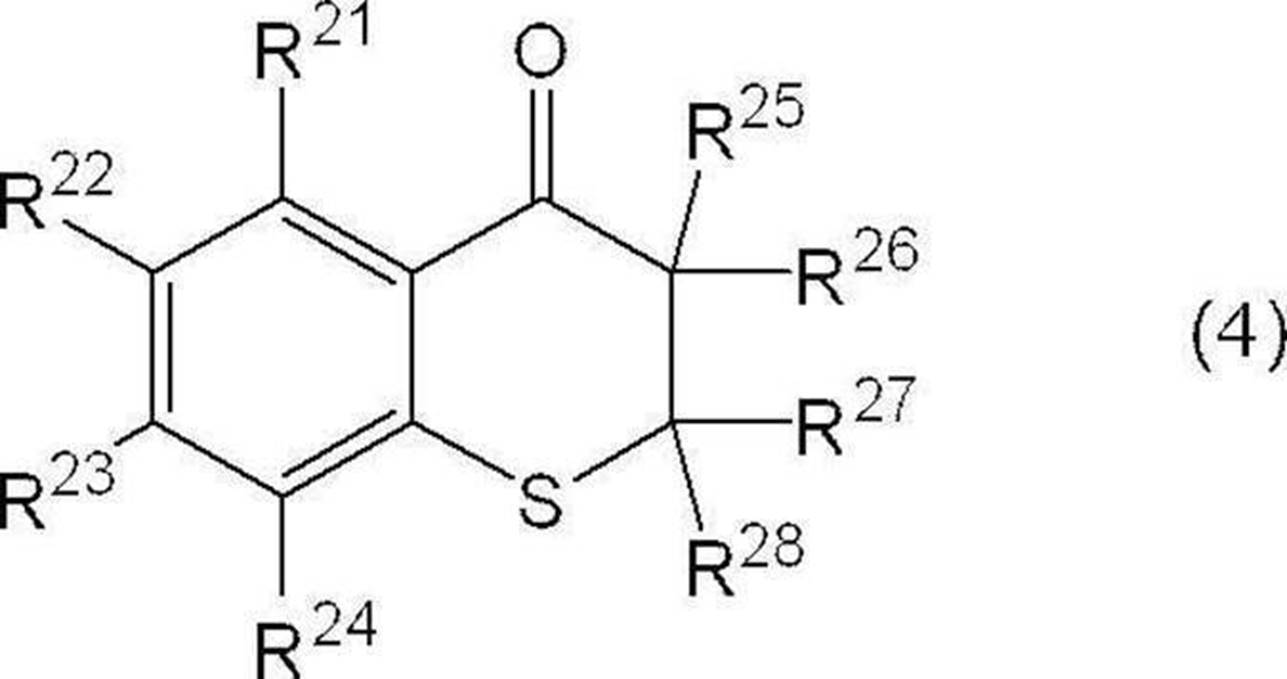
式(4)中、R21~R28は、それぞれ、式(3)中のR11~R18と同義であり、好ましい態様もそれぞれ同様である。
式(4)中のR21~R24において、隣接する2つは、互いに連結して環を形成していてもよい。
式(4)中のR21~R24における隣接する2つが形成し得る環構造の例は、式(3)中のR11~R18における隣接する2つが形成し得る環構造の例と同様である。
式(4)中のR21~R24における隣接する2つが形成し得る環構造の例は、式(3)中のR11~R18における隣接する2つが形成し得る環構造の例と同様である。
チオクロマノン化合物は、チオクロマノンの環構造上に少なくとも1つの置換基(例えば、アルキル基、ハロゲン化アルキル基、ハロゲン原子、ヒドロキシ基、シアノ基、ニトロ基、アミノ基、アルキルチオ基、アルキルアミノ基、アルコキシ基、アルコキシカルボニル基、アシルオキシ基、アシル基、カルボキシ基又はスルホ基)を有していてもよい。
上記置換基としては、アルキル基、ハロゲン原子、ヒドロキシ基、アルキルチオ基、アルキルアミノ基、アルコキシ基又はアシルオキシ基が好ましく、炭素数1~20のアルキル基又はハロゲン原子がより好ましく、炭素数1~4のアルキル基又はハロゲン原子が更に好ましい。
ハロゲン原子としては、フッ素原子、塩素原子、臭素原子又はヨウ素原子が好ましく、塩素原子、臭素原子又はヨウ素原子がより好ましく、塩素原子又は臭素原子が更に好ましい。
ハロゲン化アルキル基としては、フッ化アルキル基が好ましい。
また、チオクロマノン化合物は、芳香環上、及び、シクロヘキサノン環上のそれぞれに、少なくとも1つの置換基を有する化合物であることがより好ましい。
上記置換基としては、アルキル基、ハロゲン原子、ヒドロキシ基、アルキルチオ基、アルキルアミノ基、アルコキシ基又はアシルオキシ基が好ましく、炭素数1~20のアルキル基又はハロゲン原子がより好ましく、炭素数1~4のアルキル基又はハロゲン原子が更に好ましい。
ハロゲン原子としては、フッ素原子、塩素原子、臭素原子又はヨウ素原子が好ましく、塩素原子、臭素原子又はヨウ素原子がより好ましく、塩素原子又は臭素原子が更に好ましい。
ハロゲン化アルキル基としては、フッ化アルキル基が好ましい。
また、チオクロマノン化合物は、芳香環上、及び、シクロヘキサノン環上のそれぞれに、少なくとも1つの置換基を有する化合物であることがより好ましい。
チオクロマノン化合物の具体例としては、下記(4-1)~(4-30)が挙げられる。これらの中でも、(4-14)、(4-17)又は(4-19)がより好ましく、(4-14)が更に好ましい。
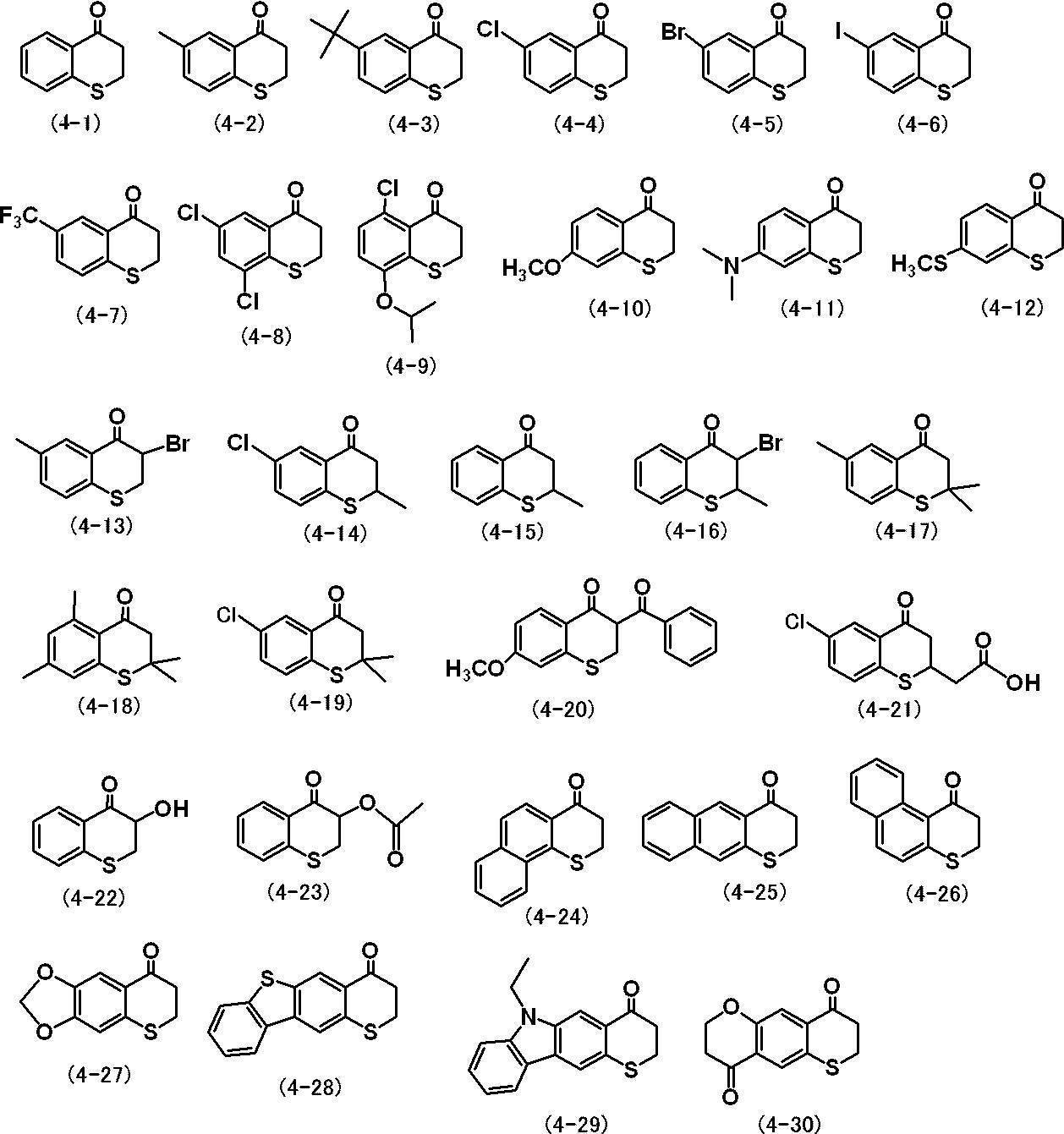
色素増感剤の少なくとも1種は、分子量が1000以上であることが好ましい。
色素増感剤の少なくとも1種は、分子量が1000以上であることで、記録後の画像からモノマー成分が外部へ転着する現象(いわゆるマイグレーション)を抑えることができる。特に、食品用の包装フィルム又は化粧品用の包装材料等のように、基材における安全性が厳格に要求される食品包装分野及び化粧品包装分野等への適用の観点から好ましい。
中でも、分子量が1000以上であるチオキサントン系化合物又は分子量が1000以上であるチオクロマノン系化合物を含有することが好ましい。
色素増感剤の分子量は、1000~100000の範囲がより好ましく、1000~50000の範囲がより好ましい。
色素増感剤の少なくとも1種は、分子量が1000以上であることで、記録後の画像からモノマー成分が外部へ転着する現象(いわゆるマイグレーション)を抑えることができる。特に、食品用の包装フィルム又は化粧品用の包装材料等のように、基材における安全性が厳格に要求される食品包装分野及び化粧品包装分野等への適用の観点から好ましい。
中でも、分子量が1000以上であるチオキサントン系化合物又は分子量が1000以上であるチオクロマノン系化合物を含有することが好ましい。
色素増感剤の分子量は、1000~100000の範囲がより好ましく、1000~50000の範囲がより好ましい。
インクA中における色素増感剤の含有量は、インクAの全量に対し、1.0質量%~15.0質量%が好ましく、1.5質量%~10.0質量%がより好ましく、2.0質量%~6.0質量%が更に好ましい。
<ペリレンブラック>
インクAは、ペリレンブラックを少なくとも1種含有する。
ペリレンブラックは、前述の通り、一般的なブラック顔料であるカーボンブラックと比較して、赤外域の吸収が少ないブラック顔料である。
ペリレンブラックとしては、C.I.Pigment Black 31及びC.I.Pigment Black 32が挙げられる。
ここで、「C.I.」は、カラーインデックスの略である。
ペリレンブラックについては、特表2018-517001号公報及び特表2007-522297号公報を参照してもよい。
インクAは、ペリレンブラックを少なくとも1種含有する。
ペリレンブラックは、前述の通り、一般的なブラック顔料であるカーボンブラックと比較して、赤外域の吸収が少ないブラック顔料である。
ペリレンブラックとしては、C.I.Pigment Black 31及びC.I.Pigment Black 32が挙げられる。
ここで、「C.I.」は、カラーインデックスの略である。
ペリレンブラックについては、特表2018-517001号公報及び特表2007-522297号公報を参照してもよい。
インクAの全量に対するペリレンブラックの含有量は、好ましくは1質量%~25質量%であり、より好ましくは1質量%~20質量%であり、更に好ましくは2質量%~15質量%である。
(シアン顔料、マゼンタ顔料、及びイエロー顔料)
インクAは、更に、シアン顔料、マゼンタ顔料、及びイエロー顔料からなる群から選択させる少なくとも1種を含有してもよい。
これにより、インクAによって記録されるブラック画像の色味を調整できる。
シアン顔料、マゼンタ顔料、及びイエロー顔料については、公知のものを特に制限なく使用できる。
インクAは、更に、シアン顔料、マゼンタ顔料、及びイエロー顔料からなる群から選択させる少なくとも1種を含有してもよい。
これにより、インクAによって記録されるブラック画像の色味を調整できる。
シアン顔料、マゼンタ顔料、及びイエロー顔料については、公知のものを特に制限なく使用できる。
インクAが、シアン顔料、マゼンタ顔料、及びイエロー顔料からなる群から選択させる少なくとも1種を含有する場合、シアン顔料、マゼンタ顔料、及びイエロー顔料の総含有量は、ペリレンブラックの全量に対し、好ましくは1質量%~50質量%であり、より好ましくは2質量%~30質量%であり、更に好ましくは3質量%~20質量%である。
(分散剤)
インクAは、分散剤を少なくとも1種含有してもよい。
分散剤としては、高分子分散剤が好ましい。
ここで、「高分子分散剤」とは、重量平均分子量(Mw)が1000以上である分散剤を意味する。
インクAは、分散剤を少なくとも1種含有してもよい。
分散剤としては、高分子分散剤が好ましい。
ここで、「高分子分散剤」とは、重量平均分子量(Mw)が1000以上である分散剤を意味する。
高分子分散剤としては、例えば;
DISPERBYK-101、DISPERBYK-102、DISPERBYK-103、DISPERBYK-106、DISPERBYK-111、DISPERBYK-161、DISPERBYK-162、DISPERBYK-163、DISPERBYK-164、DISPERBYK-166、DISPERBYK-167、DISPERBYK-168、DISPERBYK-170、DISPERBYK-171、DISPERBYK-174、DISPERBYK-182(以上、BYKケミー社製);
EFKA4010、EFKA4046、EFKA4080、EFKA5010、EFKA5207、EFKA5244、EFKA6745、EFKA6750、EFKA7414、EFKA745、EFKA7462、EFKA7500、EFKA7570、EFKA7575、EFKA7580、EFKA7701(以上、エフカアディティブ社製);
ディスパースエイド6、ディスパースエイド8、ディスパースエイド15、ディスパースエイド9100(以上、サンノプコ(株)製);
ソルスパース(SOLSPERSE)3000、5000、5000S、9000、12000、13240、13940、17000、22000、24000、26000、28000、32000、35000、36000、39000、41000、71000(以上、ルーブリゾール社製);
アデカプルロニックL31、F38、L42、L44、L61、L64、F68、L72、P95、F77、P84、F87、P94、L101、P103、F108、L121、P-123(以上、(株)ADEKA製);
イオネットS-20(三洋化成工業(株)製);
ディスパロン KS-860、873SN、874(高分子分散剤)、#2150(脂肪族多価カルボン酸)、#7004(ポリエーテルエステル型)(楠本化成(株)製);
等が挙げられる。
DISPERBYK-101、DISPERBYK-102、DISPERBYK-103、DISPERBYK-106、DISPERBYK-111、DISPERBYK-161、DISPERBYK-162、DISPERBYK-163、DISPERBYK-164、DISPERBYK-166、DISPERBYK-167、DISPERBYK-168、DISPERBYK-170、DISPERBYK-171、DISPERBYK-174、DISPERBYK-182(以上、BYKケミー社製);
EFKA4010、EFKA4046、EFKA4080、EFKA5010、EFKA5207、EFKA5244、EFKA6745、EFKA6750、EFKA7414、EFKA745、EFKA7462、EFKA7500、EFKA7570、EFKA7575、EFKA7580、EFKA7701(以上、エフカアディティブ社製);
ディスパースエイド6、ディスパースエイド8、ディスパースエイド15、ディスパースエイド9100(以上、サンノプコ(株)製);
ソルスパース(SOLSPERSE)3000、5000、5000S、9000、12000、13240、13940、17000、22000、24000、26000、28000、32000、35000、36000、39000、41000、71000(以上、ルーブリゾール社製);
アデカプルロニックL31、F38、L42、L44、L61、L64、F68、L72、P95、F77、P84、F87、P94、L101、P103、F108、L121、P-123(以上、(株)ADEKA製);
イオネットS-20(三洋化成工業(株)製);
ディスパロン KS-860、873SN、874(高分子分散剤)、#2150(脂肪族多価カルボン酸)、#7004(ポリエーテルエステル型)(楠本化成(株)製);
等が挙げられる。
インクAが分散剤を含有する場合、分散剤の含有量は、インクの全量に対し、0.05質量%~10質量%であることが好ましく、0.1質量%~5質量%であることがより好ましい。
(界面活性剤)
インクAは、界面活性剤を少なくとも1種含有してもよい。
界面活性剤としては、特開昭62-173463号公報、及び特開昭62-183457号公報に記載されたものが挙げられる。また、界面活性剤としては、例えば、ジアルキルスルホコハク酸塩、アルキルナフタレンスルホン酸塩、脂肪酸塩等のアニオン性界面活性剤;ポリオキシエチレンアルキルエーテル、ポリオキシエチレンアルキルアリルエーテル、アセチレングリコール、ポリオキシエチレン・ポリオキシプロピレンブロックコポリマー等のノニオン性界面活性剤;及び、アルキルアミン塩、第四級アンモニウム塩等のカチオン性界面活性剤が挙げられる。また、界面活性剤は、フッ素系界面活性剤又はシリコーン系界面活性剤であってもよい。
インクAは、界面活性剤を少なくとも1種含有してもよい。
界面活性剤としては、特開昭62-173463号公報、及び特開昭62-183457号公報に記載されたものが挙げられる。また、界面活性剤としては、例えば、ジアルキルスルホコハク酸塩、アルキルナフタレンスルホン酸塩、脂肪酸塩等のアニオン性界面活性剤;ポリオキシエチレンアルキルエーテル、ポリオキシエチレンアルキルアリルエーテル、アセチレングリコール、ポリオキシエチレン・ポリオキシプロピレンブロックコポリマー等のノニオン性界面活性剤;及び、アルキルアミン塩、第四級アンモニウム塩等のカチオン性界面活性剤が挙げられる。また、界面活性剤は、フッ素系界面活性剤又はシリコーン系界面活性剤であってもよい。
界面活性剤としては、シリコーン系界面活性剤(ただし、前述したエチレン性不飽和基を有するシリコーン化合物を除く)が好ましい。
シリコーン系界面活性剤としては、例えば、ポリシロキサン化合物が挙げられ、ジメチルポリシロキサンのメチル基の一部に有機基を導入した変性ポリシロキサン化合物であることが好ましい。変性としては、ポリエーテル変性、メチルスチレン変性、アルコール変性、アルキル変性、アラルキル変性、脂肪酸エステル変性、エポキシ変性、アミン変性、アミノ変性、及びメルカプト変性が挙げられる。ジメチルポリシロキサンのメチル基の一部に複数種類の有機基を導入してもよい。
中でも、吐出安定性の観点から、シリコーン系界面活性剤は、ポリエーテル変性ポリシロキサン化合物であることが好ましい。
シリコーン系界面活性剤としては、例えば、ポリシロキサン化合物が挙げられ、ジメチルポリシロキサンのメチル基の一部に有機基を導入した変性ポリシロキサン化合物であることが好ましい。変性としては、ポリエーテル変性、メチルスチレン変性、アルコール変性、アルキル変性、アラルキル変性、脂肪酸エステル変性、エポキシ変性、アミン変性、アミノ変性、及びメルカプト変性が挙げられる。ジメチルポリシロキサンのメチル基の一部に複数種類の有機基を導入してもよい。
中でも、吐出安定性の観点から、シリコーン系界面活性剤は、ポリエーテル変性ポリシロキサン化合物であることが好ましい。
ポリエーテル変性ポリシロキサン化合物としては、例えば、SILWET L-7604、SILWET L-7607N、SILWET FZ-2104及びSILWET FZ-2161(モメンティブ・パフォーマンス・マテリアルズ・ジャパン合同会社製);BYK306、BYK307、BYK331、BYK333、BYK347及びBYK348(BYK Chemie社製);並びに、KF-351A、KF-352A、KF-353、KF-354L、KF-355A、KF-615A、KF-945、KF-640、KF-642、KF-643、KF-6020、X-22-6191、X-22-4515、KF-6011、KF-6012、KF-6015及びKF-6017(信越化学工業社製)が挙げられる。
インクAが界面活性剤を含有する場合、界面活性剤の含有量は、インクAの全量に対して、0.001質量%~4.0質量%が好ましく、0.01質量%~3.0質量%がより好ましく、0.05質量%~2.0質量%がさらに好ましい。
(重合禁止剤)
インクAは、重合禁止剤を少なくとも1種含有していてもよい。
重合禁止剤としては、p-メトキシフェノール、キノン類(例えば、ハイドロキノン、ベンゾキノン、メトキシベンゾキノン等)、フェノチアジン、カテコール類、アルキルフェノール類(例えば、ジブチルヒドロキシトルエン(BHT)等)、アルキルビスフェノール類、ジメチルジチオカルバミン酸亜鉛、ジメチルジチオカルバミン酸銅、ジブチルジチオカルバミン酸銅、サリチル酸銅、チオジプロピオン酸エステル類、メルカプトベンズイミダゾール、ホスファイト類、2,2,6,6-テトラメチルピペリジン-1-オキシル(TEMPO)、2,2,6,6-テトラメチル-4-ヒドロキシピペリジン-1-オキシル(TEMPOL)、トリス(N-ニトロソ-N-フェニルヒドロキシルアミン)アルミニウム塩(別名:クペロンAl)などが挙げられる。
これらの中でも、p-メトキシフェノール、カテコール類、キノン類、アルキルフェノール類、TEMPO、TEMPOL、及びトリス(N-ニトロソ-N-フェニルヒドロキシルアミン)アルミニウム塩から選ばれる少なくとも1種が好ましく、p-メトキシフェノール、ハイドロキノン、ベンゾキノン、BHT、TEMPO、TEMPOL、及びトリス(N-ニトロソ-N-フェニルヒドロキシルアミン)アルミニウム塩から選ばれる少なくとも1種がより好ましい。
インクAは、重合禁止剤を少なくとも1種含有していてもよい。
重合禁止剤としては、p-メトキシフェノール、キノン類(例えば、ハイドロキノン、ベンゾキノン、メトキシベンゾキノン等)、フェノチアジン、カテコール類、アルキルフェノール類(例えば、ジブチルヒドロキシトルエン(BHT)等)、アルキルビスフェノール類、ジメチルジチオカルバミン酸亜鉛、ジメチルジチオカルバミン酸銅、ジブチルジチオカルバミン酸銅、サリチル酸銅、チオジプロピオン酸エステル類、メルカプトベンズイミダゾール、ホスファイト類、2,2,6,6-テトラメチルピペリジン-1-オキシル(TEMPO)、2,2,6,6-テトラメチル-4-ヒドロキシピペリジン-1-オキシル(TEMPOL)、トリス(N-ニトロソ-N-フェニルヒドロキシルアミン)アルミニウム塩(別名:クペロンAl)などが挙げられる。
これらの中でも、p-メトキシフェノール、カテコール類、キノン類、アルキルフェノール類、TEMPO、TEMPOL、及びトリス(N-ニトロソ-N-フェニルヒドロキシルアミン)アルミニウム塩から選ばれる少なくとも1種が好ましく、p-メトキシフェノール、ハイドロキノン、ベンゾキノン、BHT、TEMPO、TEMPOL、及びトリス(N-ニトロソ-N-フェニルヒドロキシルアミン)アルミニウム塩から選ばれる少なくとも1種がより好ましい。
インクAが重合禁止剤を含有する場合、重合禁止剤の含有量は、インクAの全量に対し、0.01質量%~2.0質量%が好ましく、0.02質量%~1.0質量%がより好ましく、0.03質量%~0.5質量%が特に好ましい。
(有機溶剤)
インクAは、有機溶剤を少なくとも1種含有してもよい。
有機溶剤としては、アセトン、メチルエチルケトン、ジエチルケトン等のケトン;メタノール、エタノール、2-プロパノール、1-プロパノール、1-ブタノール、tert-ブタノール等のアルコール;
クロロホルム、塩化メチレン等の塩素系溶剤;ベンゼン、トルエン等の芳香族系溶剤;酢酸エチル、酢酸ブチル、酢酸イソプロピル、乳酸エチル、乳酸ブチル、乳酸イソプロピル等のエステル系溶剤;
ジエチルエーテル、テトラヒドロフラン、ジオキサン等のエーテル系溶剤;エチレングリコールモノメチルエーテル、エチレングリコールジメチルエーテル、プロピレングリコールモノメチルエーテル等のグリコールエーテル系溶剤;及び、プロピレングリコールモノメチルエーテルアセテート等のグリコールエーテルアセテート系溶剤が挙げられる。
インクAは、有機溶剤を少なくとも1種含有してもよい。
有機溶剤としては、アセトン、メチルエチルケトン、ジエチルケトン等のケトン;メタノール、エタノール、2-プロパノール、1-プロパノール、1-ブタノール、tert-ブタノール等のアルコール;
クロロホルム、塩化メチレン等の塩素系溶剤;ベンゼン、トルエン等の芳香族系溶剤;酢酸エチル、酢酸ブチル、酢酸イソプロピル、乳酸エチル、乳酸ブチル、乳酸イソプロピル等のエステル系溶剤;
ジエチルエーテル、テトラヒドロフラン、ジオキサン等のエーテル系溶剤;エチレングリコールモノメチルエーテル、エチレングリコールジメチルエーテル、プロピレングリコールモノメチルエーテル等のグリコールエーテル系溶剤;及び、プロピレングリコールモノメチルエーテルアセテート等のグリコールエーテルアセテート系溶剤が挙げられる。
インクAが有機溶剤を含有する場合、有機溶剤の含有量としてはインクAの全量に対して、1質量%以下であることが好ましく、より好ましくは0.5質量%以下であり、更に好ましくは0.1質量%以下である。インクAは、有機溶剤を含まない組成(即ち、有機溶剤の含有量がインクAの全量に対して0質量%)であってもよい。
(樹脂)
インクAは、樹脂を少なくとも1種含有していてもよい。
樹脂としては、例えば、エポキシ樹脂、塩化ビニル系樹脂、酢酸ビニル系樹脂、ポリエステル、(メタ)アクリル樹脂(例えば、メタクリル酸メチルとメタクリル酸n-ブチルとの共重合体)、塩素化ポリオレフィン、及びポリケトンが挙げられる。
樹脂の重量平均分子量(Mw)は、3,000~200,000が好ましく、5,000~200,000がより好ましく、10,000~150,000であることが更に好ましい。
インクAは、樹脂を少なくとも1種含有していてもよい。
樹脂としては、例えば、エポキシ樹脂、塩化ビニル系樹脂、酢酸ビニル系樹脂、ポリエステル、(メタ)アクリル樹脂(例えば、メタクリル酸メチルとメタクリル酸n-ブチルとの共重合体)、塩素化ポリオレフィン、及びポリケトンが挙げられる。
樹脂の重量平均分子量(Mw)は、3,000~200,000が好ましく、5,000~200,000がより好ましく、10,000~150,000であることが更に好ましい。
インクAが樹脂を含む場合、樹脂の含有量は、インクAの全量に対して1質量%~10質量%であることが好ましい。
(水)
インクAは、少量の水を含有していてもよい。
具体的には、インクAの全量に対する水の含有量は、好ましくは3質量%以下であり、より好ましくは2質量%以下であり、特に好ましくは1質量%以下である。インクAは、実質的に水を含有しない、非水性のインクであることが好ましい。
インクAは、少量の水を含有していてもよい。
具体的には、インクAの全量に対する水の含有量は、好ましくは3質量%以下であり、より好ましくは2質量%以下であり、特に好ましくは1質量%以下である。インクAは、実質的に水を含有しない、非水性のインクであることが好ましい。
(その他の成分)
インクAは、上記以外のその他の成分を含有していてもよい。
その他の成分としては、紫外線吸収剤、共増感剤、酸化防止剤、褪色防止剤、導電性塩等が挙げられる。その他の成分については、特開2011-225848号公報、特開2009-209352号公報等の公知文献を適宜参照することができる。
インクAは、上記以外のその他の成分を含有していてもよい。
その他の成分としては、紫外線吸収剤、共増感剤、酸化防止剤、褪色防止剤、導電性塩等が挙げられる。その他の成分については、特開2011-225848号公報、特開2009-209352号公報等の公知文献を適宜参照することができる。
(インクAの物性)
インクAの粘度には特に制限はない。
インクAは、25℃における粘度が10mPa・s~50mPa・sであることが好ましく、10mPa・s~30mPa・sであることがより好ましく、10mPa・s~25mPa・sであることが更に好ましい。インクの粘度は、例えば、含有される各成分の組成比を調整することによって調整できる。
粘度は、粘度計:VISCOMETER RE-85L(東機産業(株)製)を用いて測定された値である。
インクAの粘度が上記範囲であると、インクジェットヘッドからの吐出安定性をより向上させることができる。
インクAの粘度には特に制限はない。
インクAは、25℃における粘度が10mPa・s~50mPa・sであることが好ましく、10mPa・s~30mPa・sであることがより好ましく、10mPa・s~25mPa・sであることが更に好ましい。インクの粘度は、例えば、含有される各成分の組成比を調整することによって調整できる。
粘度は、粘度計:VISCOMETER RE-85L(東機産業(株)製)を用いて測定された値である。
インクAの粘度が上記範囲であると、インクジェットヘッドからの吐出安定性をより向上させることができる。
インクAの表面張力には特に制限はない。
インクAは、30℃における表面張力が、20mN/m~30mN/mであることが好ましく、さらに好ましくは23mN/m~28mN/mである。表面張力は、濡れ性の点では30mN/m以下が好ましく、滲み抑制及び浸透性の点では20mN/m以上が好ましい。
表面張力は、表面張力計 DY-700(協和界面化学(株)製)を用いて測定された値である。
インクAは、30℃における表面張力が、20mN/m~30mN/mであることが好ましく、さらに好ましくは23mN/m~28mN/mである。表面張力は、濡れ性の点では30mN/m以下が好ましく、滲み抑制及び浸透性の点では20mN/m以上が好ましい。
表面張力は、表面張力計 DY-700(協和界面化学(株)製)を用いて測定された値である。
<インクB>
インクBは、重合性化合物、光重合開始剤、及び赤外線吸収色素を含有し、含有される重合性化合物中に占める多官能重合性モノマーの割合(即ち、多官能比率)が60質量%以上であるインクジェットインクである。
インクBは、重合性化合物、光重合開始剤、及び赤外線吸収色素を含有し、含有される重合性化合物中に占める多官能重合性モノマーの割合(即ち、多官能比率)が60質量%以上であるインクジェットインクである。
インクBの好ましい態様(組成、成分、多官能比率、等)は、ペリレンブラックに代えて赤外線吸収色素を含有すること以外は、前述したインクAの好ましい態様(組成、成分等)と同様である。
(赤外線吸収色素)
インクBは、赤外線吸収色素を少なくとも1種含有する。
赤外線吸収色素としては、例えば;
フタロシアニン化合物、シアニン化合物、スクアリリウム化合物、オキソノール化合物、等の有機色素;
LaB6(六ホウ化ランタン)、CWO(セシウム酸化タングステン)、ITO(スズ酸化インジウム)、ATO( アンチモン酸化スズ)等の無機色素;
等が挙げられる。
インクBは、赤外線吸収色素を少なくとも1種含有する。
赤外線吸収色素としては、例えば;
フタロシアニン化合物、シアニン化合物、スクアリリウム化合物、オキソノール化合物、等の有機色素;
LaB6(六ホウ化ランタン)、CWO(セシウム酸化タングステン)、ITO(スズ酸化インジウム)、ATO( アンチモン酸化スズ)等の無機色素;
等が挙げられる。
インクBに含有される赤外線吸収色素は、記録される赤外線吸収画像の不可視性(即ち、目視により視認されにくい性質。以下同じ。)及び赤外線読み取り性をより向上させる観点から、スクアリリウム化合物を含むことが好ましく、下記式(1)で表されるスクアリリウム化合物を含むことがより好ましい。
この場合、インクBに含有される赤外線吸収色素中に占めるスクアリリウム化合物(好ましくは下記式(1)で表されるスクアリリウム化合物)の割合は、好ましくは50質量%~100質量%であり、より好ましくは60質量%~100質量%であり、更に好ましくは80質量%~100質量%である。
この場合、インクBに含有される赤外線吸収色素中に占めるスクアリリウム化合物(好ましくは下記式(1)で表されるスクアリリウム化合物)の割合は、好ましくは50質量%~100質量%であり、より好ましくは60質量%~100質量%であり、更に好ましくは80質量%~100質量%である。

式(1)中、環A及び環Bは、それぞれ独立に、芳香環又は複素芳香環を表し、XA及びXBは、それぞれ独立に、1価の置換基を表し、GA及びGBは、それぞれ独立に、1価の置換基を表し、kAは0~nAの整数を表し、kBは0~nBの整数を表す。nAは、GAが環Aに置換可能な最大の整数を表し、nBは、GBが環Bに置換可能な最大の整数を表す。XAとGA、又はXBとGBは、それぞれ互いに結合して環を形成してもよく、GA及びGBがそれぞれ複数存在する場合は、環Aに結合する複数のGA、及び環Bに結合する複数のGBは、それぞれ互いに結合して環を形成していてもよい。
GA及びGBは、それぞれ独立に1価の置換基を表す。
1価の置換基としては、ハロゲン原子、シアノ基、ニトロ基、アルキル基、アルケニル基、アルキニル基、アリール基、ヘテロアリール基、アラルキル基、-OR10、-COR11、-COOR12、-OCOR13、-NR14R15、-NHCOR16、-CONR17R18、-NHCONR19R20、-NHCOOR21、-SR22、-SO2R23、-SO2OR24、-NHSO2R25及びSO2NR26R27が挙げられる。
R10~R27は、それぞれ独立に、水素原子、脂肪族基、芳香族基、又はヘテロ環基を表す。
なお、-COOR12のR12が水素原子の場合(すなわちカルボキシ基)は、水素原子が解離してもよく(すなわちカルボネート基)、塩の状態であってもよい。また、-SO2OR24のR24が水素原子の場合(すなわちスルホ基)は、水素原子が解離してもよく(すなわちスルホネート基)、塩の状態であってもよい。
1価の置換基としては、ハロゲン原子、シアノ基、ニトロ基、アルキル基、アルケニル基、アルキニル基、アリール基、ヘテロアリール基、アラルキル基、-OR10、-COR11、-COOR12、-OCOR13、-NR14R15、-NHCOR16、-CONR17R18、-NHCONR19R20、-NHCOOR21、-SR22、-SO2R23、-SO2OR24、-NHSO2R25及びSO2NR26R27が挙げられる。
R10~R27は、それぞれ独立に、水素原子、脂肪族基、芳香族基、又はヘテロ環基を表す。
なお、-COOR12のR12が水素原子の場合(すなわちカルボキシ基)は、水素原子が解離してもよく(すなわちカルボネート基)、塩の状態であってもよい。また、-SO2OR24のR24が水素原子の場合(すなわちスルホ基)は、水素原子が解離してもよく(すなわちスルホネート基)、塩の状態であってもよい。
ハロゲン原子としては、フッ素原子、塩素原子、臭素原子、及びヨウ素原子が挙げられる。
アルキル基の炭素数は、1~20が好ましく、1~15がより好ましく、1~8がさらに好ましい。アルキル基は、直鎖、分岐、及び環状のいずれでもよく、直鎖又は分岐が好ましい。
アルケニル基の炭素数は、2~20が好ましく、2~12がより好ましく、2~8が特に好ましい。アルケニル基は直鎖、分岐、及び環状のいずれでもよく、直鎖又は分岐が好ましい。
アルキニル基の炭素数は、2~40が好ましく、2~30がより好ましく、2~25が特に好ましい。アルキニル基は直鎖、分岐、及び環状のいずれでもよく、直鎖又は分岐が好ましい。
アリール基の炭素数は、6~30が好ましく、6~20がより好ましく、6~12がさらに好ましい。
アラルキル基のアルキル部分は、上記アルキル基と同様である。アラルキル基のアリール部分は、上記アリール基と同様である。アラルキル基の炭素数は、7~40が好ましく、7~30がより好ましく、7~25がさらに好ましい。
アルキル基の炭素数は、1~20が好ましく、1~15がより好ましく、1~8がさらに好ましい。アルキル基は、直鎖、分岐、及び環状のいずれでもよく、直鎖又は分岐が好ましい。
アルケニル基の炭素数は、2~20が好ましく、2~12がより好ましく、2~8が特に好ましい。アルケニル基は直鎖、分岐、及び環状のいずれでもよく、直鎖又は分岐が好ましい。
アルキニル基の炭素数は、2~40が好ましく、2~30がより好ましく、2~25が特に好ましい。アルキニル基は直鎖、分岐、及び環状のいずれでもよく、直鎖又は分岐が好ましい。
アリール基の炭素数は、6~30が好ましく、6~20がより好ましく、6~12がさらに好ましい。
アラルキル基のアルキル部分は、上記アルキル基と同様である。アラルキル基のアリール部分は、上記アリール基と同様である。アラルキル基の炭素数は、7~40が好ましく、7~30がより好ましく、7~25がさらに好ましい。
ヘテロアリール基は、単環又は縮合環が好ましく、単環又は縮合数が2~8の縮合環が好ましく、単環又は縮合数が2~4の縮合環がより好ましい。ヘテロアリール基の環を構成するヘテロ原子の数は1~3が好ましい。ヘテロアリール基の環を構成するヘテロ原子は、窒素原子、酸素原子又は硫黄原子が好ましい。ヘテロアリール基は、5員環又は6員環が好ましい。ヘテロアリール基の環を構成する炭素原子の数は3~30が好ましく、3~18がより好ましく、3~12がより好ましい。ヘテロアリール基の例には、ピリジン環、ピペリジン環、フラン環基、フルフラン環、チオフェン環、ピロール環、キノリン環、モルホリン環、インドール環、イミダゾール環、ピラゾール環、カルバゾール環、フェノチアジン環、フェノキサジン環、インドリン環、チアゾール環、ピラジン環、チアジアジン環、ベンゾキノリン環及びチアジアゾール環が挙げられる。
アルキル基、アルケニル基、アルキニル基、アラルキル基、アリール基及びヘテロアリール基は、置換基を有していてもよく、無置換であってもよい。
置換基は、特開2018-154672号公報の段落番号0030に記載の置換基が挙げられる。好ましい置換基としては、アルキル基、アリール基、アミノ基、アルコキシ基、アリールオキシ基、芳香族ヘテロ環オキシ基、アシル基、アルコキシカルボニル基、アリールオキシカルボニル基、アシルオキシ基、アシルアミノ基、アルコキシカルボニルアミノ基、アリールオキシカルボニルアミノ基、スルホニルアミノ基、アルキルチオ基、アリールチオ基、芳香族ヘテロ環チオ基、スルホニル基、ヒドロキシ基、メルカプト基、ハロゲン原子、シアノ基、スルホ基、及びカルボキシ基からなる群より選ばれる置換基であり、その中では、アルキル基、アリール基、アルコキシ基、アリールオキシ基、芳香族ヘテロ環オキシ基、アシル基、アルコキシカルボニル基、アリールオキシカルボニル基、アシルオキシ基、アルキルチオ基、アリールチオ基、芳香族ヘテロ環チオ基、スルホニル基、ヒドロキシ基、メルカプト基、ハロゲン原子、シアノ基、スルホ基、及びカルボキシ基からなる群より選ばれる置換基がより好ましい。
なお、置換基における「炭素数」とは、置換基の「総炭素数」を意味する。
また、各置換基の詳細は、特開2018-154672号公報の段落番号0031~0035に記載の置換基を参照することができる。
置換基は、特開2018-154672号公報の段落番号0030に記載の置換基が挙げられる。好ましい置換基としては、アルキル基、アリール基、アミノ基、アルコキシ基、アリールオキシ基、芳香族ヘテロ環オキシ基、アシル基、アルコキシカルボニル基、アリールオキシカルボニル基、アシルオキシ基、アシルアミノ基、アルコキシカルボニルアミノ基、アリールオキシカルボニルアミノ基、スルホニルアミノ基、アルキルチオ基、アリールチオ基、芳香族ヘテロ環チオ基、スルホニル基、ヒドロキシ基、メルカプト基、ハロゲン原子、シアノ基、スルホ基、及びカルボキシ基からなる群より選ばれる置換基であり、その中では、アルキル基、アリール基、アルコキシ基、アリールオキシ基、芳香族ヘテロ環オキシ基、アシル基、アルコキシカルボニル基、アリールオキシカルボニル基、アシルオキシ基、アルキルチオ基、アリールチオ基、芳香族ヘテロ環チオ基、スルホニル基、ヒドロキシ基、メルカプト基、ハロゲン原子、シアノ基、スルホ基、及びカルボキシ基からなる群より選ばれる置換基がより好ましい。
なお、置換基における「炭素数」とは、置換基の「総炭素数」を意味する。
また、各置換基の詳細は、特開2018-154672号公報の段落番号0031~0035に記載の置換基を参照することができる。
XA及びXBは、それぞれ独立に1価の置換基を表す。
XA及びXBにおける置換基は、活性水素を有する基が好ましく、-OH、-SH、-COOH、-SO3H、-NRX1RX2、-NHCORX1、-CONRX1RX2、-NHCONRX1RX2、-NHCOORX1、-NHSO2RX1、-B(OH)2又はPO(OH)2がより好ましく、-OH、-SH又はNRX1RX2がさらに好ましい。
RX1及びRX2は、それぞれ独立に水素原子又は1価の置換基を表す。置換基としてはアルキル基、アルケニル基、アルキニル基、アリール基、及びヘテロアリール基が挙げられ、アルキル基が好ましい。アルキル基は直鎖又は分岐が好ましい。アルキル基、アルケニル基、アルキニル基、アリール基、及び、ヘテロアリール基の詳細については、GA及びGBで説明した範囲と同義である。
XA及びXBにおける置換基は、活性水素を有する基が好ましく、-OH、-SH、-COOH、-SO3H、-NRX1RX2、-NHCORX1、-CONRX1RX2、-NHCONRX1RX2、-NHCOORX1、-NHSO2RX1、-B(OH)2又はPO(OH)2がより好ましく、-OH、-SH又はNRX1RX2がさらに好ましい。
RX1及びRX2は、それぞれ独立に水素原子又は1価の置換基を表す。置換基としてはアルキル基、アルケニル基、アルキニル基、アリール基、及びヘテロアリール基が挙げられ、アルキル基が好ましい。アルキル基は直鎖又は分岐が好ましい。アルキル基、アルケニル基、アルキニル基、アリール基、及び、ヘテロアリール基の詳細については、GA及びGBで説明した範囲と同義である。
環A及び環Bは、それぞれ独立に、芳香環又は複素芳香環を表す。
芳香環及び複素芳香環は、単環であってもよく、縮合環であってもよい。
芳香環及び複素芳香環の具体例としては、ベンゼン環、ナフタレン環、ペンタレン環、インデン環、アズレン環、ヘプタレン環、インデセン環、ペリレン環、ペンタセン環、アセタフタレン環、フェナントレン環、アントラセン環、ナフタセン環、クリセン環、トリフェニレン環、フルオレン環、ビフェニル環、ピロール環、フラン環、チオフェン環、イミダゾール環、オキサゾール環、チアゾール環、ピリジン環、ピラジン環、ピリミジン環、ピリダジン環、インドリジン環、インドール環、ベンゾフラン環、ベンゾチオフェン環、イソベンゾフラン環、キノリジン環、キノリン環、フタラジン環、ナフチリジン環、キノキサリン環、キノキサゾリン環、イソキノリン環、カルバゾール環、フェナントリジン環、アクリジン環、フェナントロリン環、チアントレン環、クロメン環、キサンテン環、フェノキサチイン環、フェノチアジン環、及び、フェナジン環が挙げられ、ベンゼン環又はナフタレン環が好ましい。
芳香族環は、無置換であってもよく、置換基を有していてもよい。置換基としては、GA及びGBで説明した置換基が挙げられる。
芳香環及び複素芳香環は、単環であってもよく、縮合環であってもよい。
芳香環及び複素芳香環の具体例としては、ベンゼン環、ナフタレン環、ペンタレン環、インデン環、アズレン環、ヘプタレン環、インデセン環、ペリレン環、ペンタセン環、アセタフタレン環、フェナントレン環、アントラセン環、ナフタセン環、クリセン環、トリフェニレン環、フルオレン環、ビフェニル環、ピロール環、フラン環、チオフェン環、イミダゾール環、オキサゾール環、チアゾール環、ピリジン環、ピラジン環、ピリミジン環、ピリダジン環、インドリジン環、インドール環、ベンゾフラン環、ベンゾチオフェン環、イソベンゾフラン環、キノリジン環、キノリン環、フタラジン環、ナフチリジン環、キノキサリン環、キノキサゾリン環、イソキノリン環、カルバゾール環、フェナントリジン環、アクリジン環、フェナントロリン環、チアントレン環、クロメン環、キサンテン環、フェノキサチイン環、フェノチアジン環、及び、フェナジン環が挙げられ、ベンゼン環又はナフタレン環が好ましい。
芳香族環は、無置換であってもよく、置換基を有していてもよい。置換基としては、GA及びGBで説明した置換基が挙げられる。
XAとGA、XBとGBは互いに結合して環を形成してもよく、GA及びGBがそれぞれ複数存在する場合は、互いに結合して環を形成していてもよい。
環としては、5員環又は6員環が好ましい。環は単環であってもよく、複環であってもよい。
XAとGA、XBとGB、GA同士又はGB同士が結合して環を形成する場合、これらが直接結合して環を形成してもよく、アルキレン基、-CO-、-O-、-NH-、-BR-及びそれらの組み合わせからなる群より選ばれる2価の連結基を介して結合して環を形成してもよい。XAとGA、XBとGB、GA同士又はGB同士が、-BR-を介して結合して環を形成することが好ましい。
Rは、水素原子又は1価の置換基を表す。置換基としては、GA及びGBで説明した置換基が挙げられ、アルキル基又はアリール基が好ましい。
kAは0~nAの整数を表し、kBは0~nBの整数を表し、nAは、A環に置換可能な最大の整数を表し、nBは、B環に置換可能な最大の整数を表す。
kA及びkBは、それぞれ独立に0~4が好ましく、0~2がより好ましく、0~1が特に好ましい。また、kA及びkBが同時に0(ゼロ)を表す場合を含まないことが好ましい。
環としては、5員環又は6員環が好ましい。環は単環であってもよく、複環であってもよい。
XAとGA、XBとGB、GA同士又はGB同士が結合して環を形成する場合、これらが直接結合して環を形成してもよく、アルキレン基、-CO-、-O-、-NH-、-BR-及びそれらの組み合わせからなる群より選ばれる2価の連結基を介して結合して環を形成してもよい。XAとGA、XBとGB、GA同士又はGB同士が、-BR-を介して結合して環を形成することが好ましい。
Rは、水素原子又は1価の置換基を表す。置換基としては、GA及びGBで説明した置換基が挙げられ、アルキル基又はアリール基が好ましい。
kAは0~nAの整数を表し、kBは0~nBの整数を表し、nAは、A環に置換可能な最大の整数を表し、nBは、B環に置換可能な最大の整数を表す。
kA及びkBは、それぞれ独立に0~4が好ましく、0~2がより好ましく、0~1が特に好ましい。また、kA及びkBが同時に0(ゼロ)を表す場合を含まないことが好ましい。
式(1)で表されるスクアリリウム色素の中でも、光に対する耐性の点で、下記式(2)で表される化合物が好ましい。

式(2)中、R1及びR2は、それぞれ独立に、1価の置換基を表し、R3及びR4は、それぞれ独立に、水素原子、又は、アルキル基を表す。
X1及びX2は、それぞれ独立に、酸素原子、又は、-N(R5)-を表し、X3及びX4は、それぞれ独立に、炭素原子、又は、ホウ素原子を表す。
tは、X3がホウ素原子である場合には1を表し、X3が炭素原子である場合には2を表す。X3が炭素原子であってtが2である場合、2つのR1は、互いに結合して環を形成していてもよい。
uは、X4がホウ素原子である場合には1を表し、X4が炭素原子である場合には2を表す。X4が炭素原子であってuが2である場合、2つのR2は、互いに結合して環を形成していてもよい。
R5は、水素原子、アルキル基、アリール基又はヘテロアリール基を表し、Y1、Y2、Y3及びY4は、それぞれ独立に、1価の置換基を表し、Y1とY2、及び、Y3とY4は、互いに結合して環を形成していてもよい。
Y1、Y2、Y3及びY4は、それぞれ複数存在する場合には、互いに結合して環を形成していてもよい。
p及びsは、それぞれ独立に0~3の整数を表し、q及びrは、それぞれ独立に0~2の整数を表す。
R1、R2、Y1、Y2、Y3及びY4が表す置換基としては、GA及びGBで説明した置換基が同様に挙げられる。
X1及びX2は、それぞれ独立に、酸素原子、又は、-N(R5)-を表し、X3及びX4は、それぞれ独立に、炭素原子、又は、ホウ素原子を表す。
tは、X3がホウ素原子である場合には1を表し、X3が炭素原子である場合には2を表す。X3が炭素原子であってtが2である場合、2つのR1は、互いに結合して環を形成していてもよい。
uは、X4がホウ素原子である場合には1を表し、X4が炭素原子である場合には2を表す。X4が炭素原子であってuが2である場合、2つのR2は、互いに結合して環を形成していてもよい。
R5は、水素原子、アルキル基、アリール基又はヘテロアリール基を表し、Y1、Y2、Y3及びY4は、それぞれ独立に、1価の置換基を表し、Y1とY2、及び、Y3とY4は、互いに結合して環を形成していてもよい。
Y1、Y2、Y3及びY4は、それぞれ複数存在する場合には、互いに結合して環を形成していてもよい。
p及びsは、それぞれ独立に0~3の整数を表し、q及びrは、それぞれ独立に0~2の整数を表す。
R1、R2、Y1、Y2、Y3及びY4が表す置換基としては、GA及びGBで説明した置換基が同様に挙げられる。
R3及びR4は、それぞれ独立に、水素原子又はアルキル基を表す。R3のアルキル基の炭素数は例えば1~4、好ましくは1又は2である。アルキル基は、直鎖であってもよく、分岐していてもよい。具体的には、メチル基、エチル基、プロピル基、イソプロピル基、ブチル基、及びイソブチル基が挙げられる。R3は、好ましくは水素原子、メチル基、又はエチル基であり、より好ましくは水素原子、又はメチル基であり、特に好ましくは水素原子である。
X1及びX2は、それぞれ独立に、酸素原子(-O-)、又は、-N(R5)-を表す。X1とX2は同一であってもよく、異なっていてもよいが、同一であることが好ましい。
R5は、水素原子、アルキル基、アリール基又はヘテロアリール基を表す。
R5は、水素原子、アルキル基又はアリール基が好ましく、水素原子又はアルキル基がより好ましい。R5が表すアルキル基、アリール基及びヘテロアリール基は、無置換であってもよく、1価の置換基を有していてもよい。1価の置換基としては、上述したGA及びGBで説明した1価の置換基が挙げられる。
アルキル基の炭素数は、1~20が好ましく、1~10がより好ましく、1~4がさらに好ましく、1~2が特に好ましい。アルキル基は、直鎖、及び分岐のいずれでもよい。
アリール基の炭素数は、6~20が好ましく、6~12がより好ましい。
ヘテロアリール基は、単環であっても多環であってもよい。ヘテロアリール基の環を構成するヘテロ原子の数は1~3が好ましい。ヘテロアリール基の環を構成するヘテロ原子は、窒素原子、酸素原子又は硫黄原子が好ましい。ヘテロアリール基の環を構成する炭素原子の数は3~30が好ましく、3~18がより好ましく、3~12がより好ましい。
X1及びX2は、それぞれ独立に、酸素原子(-O-)、又は、-N(R5)-を表す。X1とX2は同一であってもよく、異なっていてもよいが、同一であることが好ましい。
R5は、水素原子、アルキル基、アリール基又はヘテロアリール基を表す。
R5は、水素原子、アルキル基又はアリール基が好ましく、水素原子又はアルキル基がより好ましい。R5が表すアルキル基、アリール基及びヘテロアリール基は、無置換であってもよく、1価の置換基を有していてもよい。1価の置換基としては、上述したGA及びGBで説明した1価の置換基が挙げられる。
アルキル基の炭素数は、1~20が好ましく、1~10がより好ましく、1~4がさらに好ましく、1~2が特に好ましい。アルキル基は、直鎖、及び分岐のいずれでもよい。
アリール基の炭素数は、6~20が好ましく、6~12がより好ましい。
ヘテロアリール基は、単環であっても多環であってもよい。ヘテロアリール基の環を構成するヘテロ原子の数は1~3が好ましい。ヘテロアリール基の環を構成するヘテロ原子は、窒素原子、酸素原子又は硫黄原子が好ましい。ヘテロアリール基の環を構成する炭素原子の数は3~30が好ましく、3~18がより好ましく、3~12がより好ましい。
上記の式(1)又は式(2)で表されるスクアリリウム色素の分子量としては、100~2,000の範囲が好ましく、150~1,000の範囲がより好ましい。
式(2)で表されるスクアリリウム色素については、特開2011-208101号公報に詳細に記載されており、ここに記載の化合物は本開示におけるスクアリリウム色素として好適に用いることができる。
上記の式(1)又は式(2)で表されるスクアリリウム色素の具体例(具体例S-1~S-41)を以下に示す。但し、本開示においては、以下の化合物に制限されるものではない。式中、「Me」はメチル基を表し、「Ph」はフェニル基を表す。

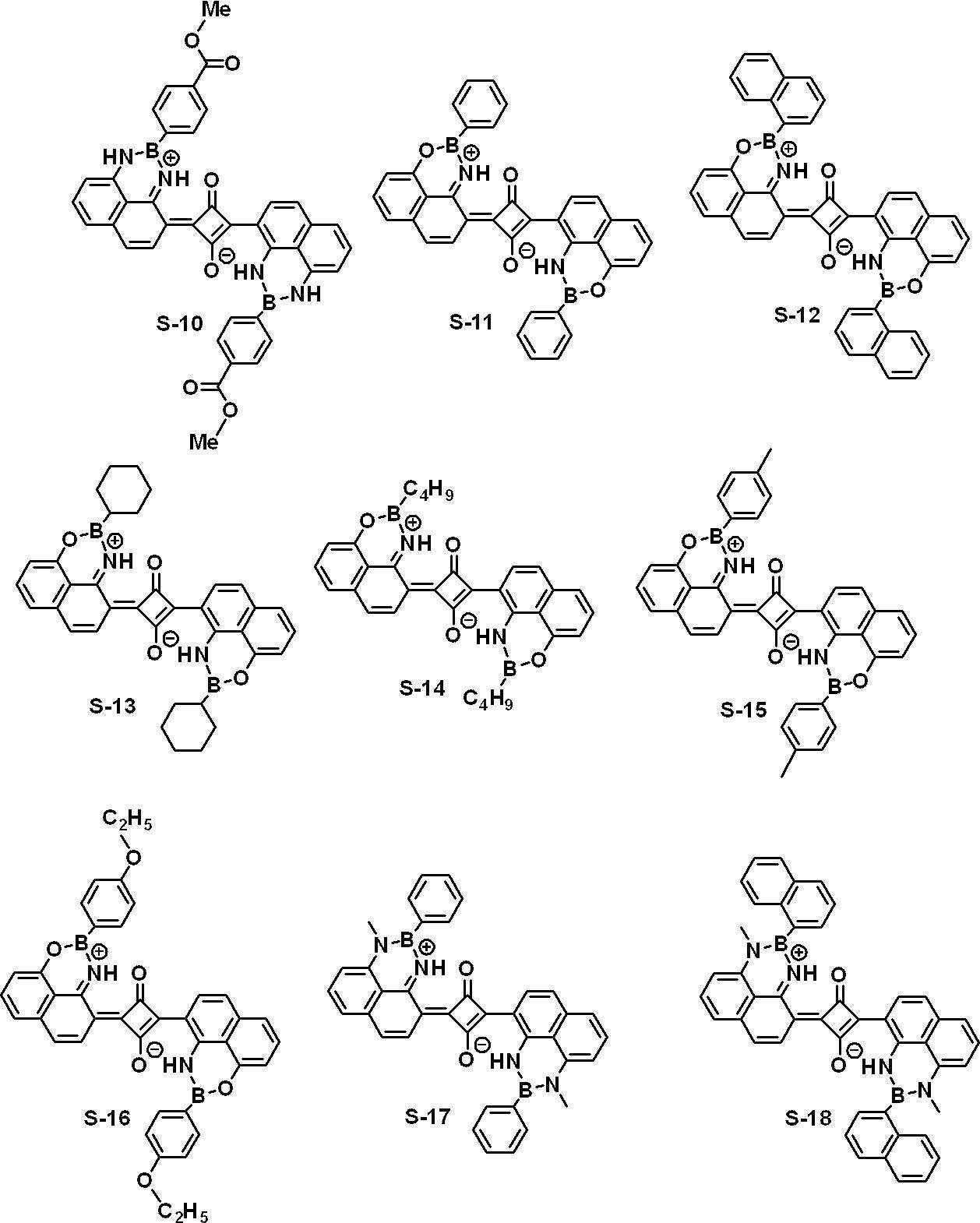

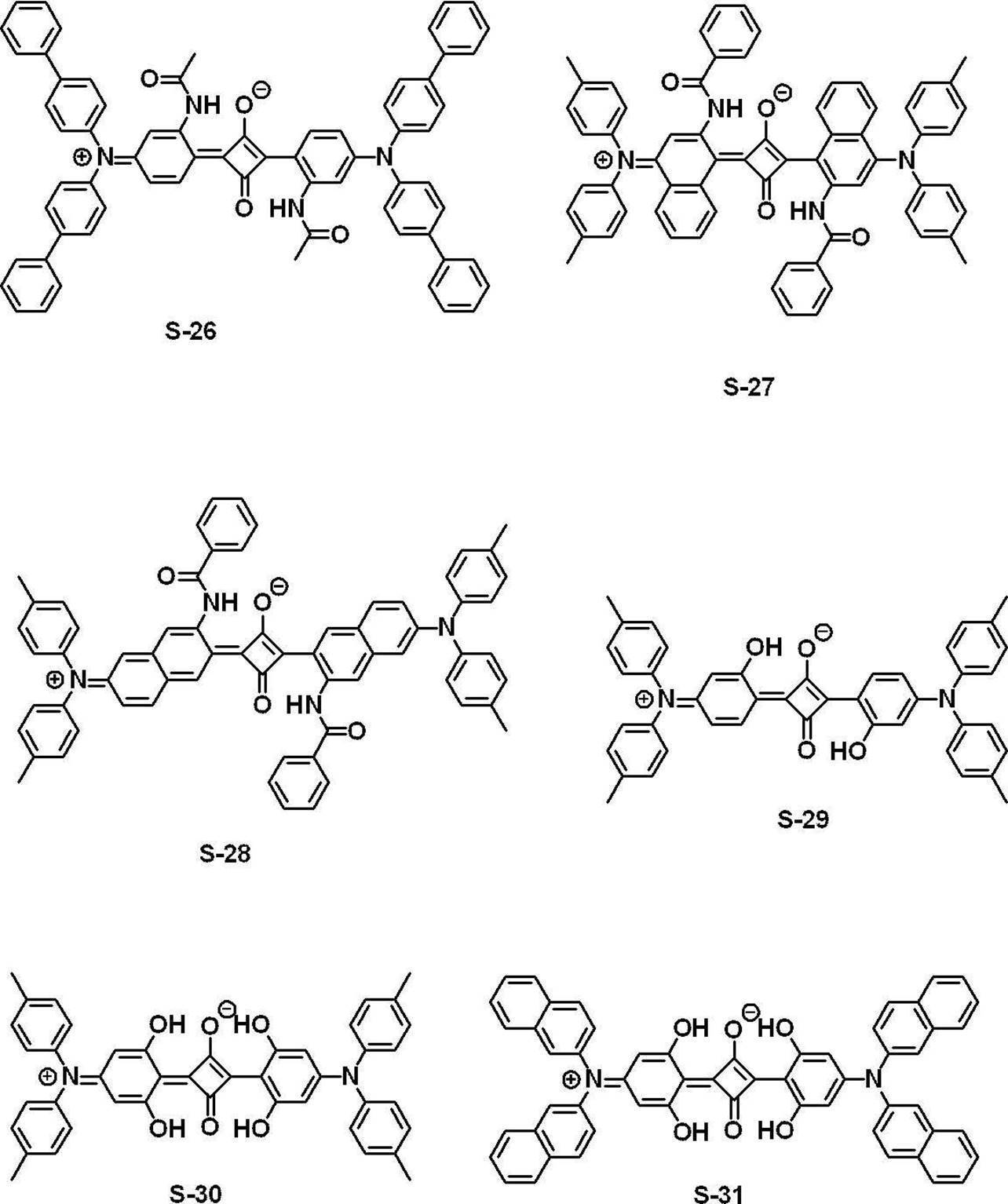
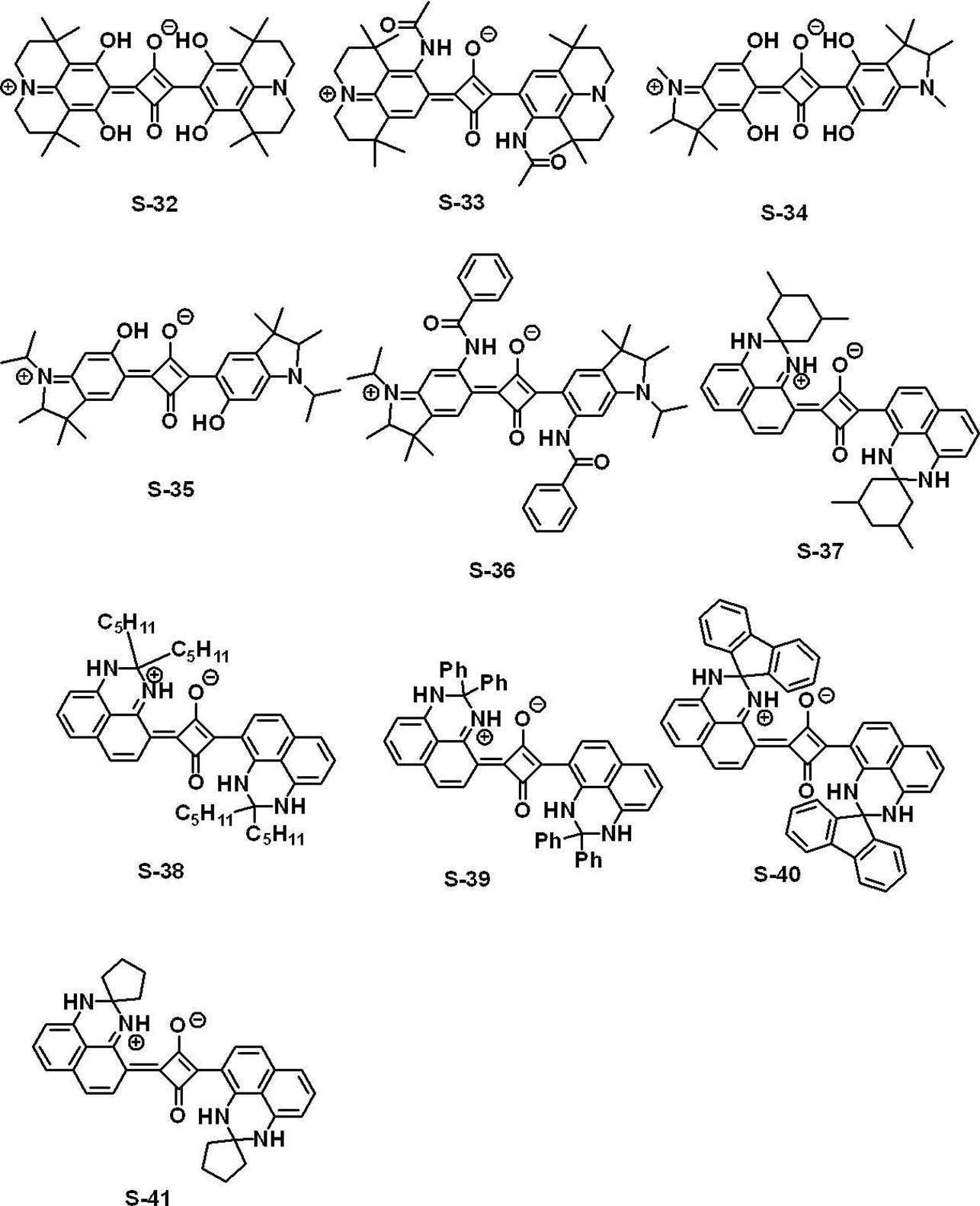
上記の中では、より好ましい化合物として、具体例S-1、S-3、S-4、S-6、S-9、S-11、S-21、S-24、S-30、S-31、S-37、S-38、S-40、及びS-41を挙げることができる。
赤外線吸収色素(好ましくはスクアリリウム化合物、より好ましくは式(1)で表されるスクアリリウム化合物)の含有量としては、インクBの全量に対し、0.1質量%~20質量%の範囲が好ましく、0.1質量%~10質量%の範囲がより好ましく、0.3質量%~7質量%の範囲がより好ましい。
上記含有量が0.1質量%以上であると、IR吸収性により優れ、耐光性により優れたものとなる。
また、上記含有量が20質量%以下であると、インクBの吐出安定性の点で有利である。
上記含有量が0.1質量%以上であると、IR吸収性により優れ、耐光性により優れたものとなる。
また、上記含有量が20質量%以下であると、インクBの吐出安定性の点で有利である。
<インクC>
本開示のインクセットは、重合性化合物、光重合開始剤及び蛍光物質を含有し、含有される重合性化合物中に占める多官能重合性モノマーの割合(即ち、多官能比率)が60質量%以上であるインクジェットインクC(本開示において、「インクC」ともいう)を更に備えていてもよい。
インクCを備える態様のインクセットによれば、平面視で重なる重なり部分を含む、ブラック画像、赤外線吸収画像及び蛍光画像を含む複合画像を備える印刷物を製造できる。
かかる態様の複合画像では、複合画像中のブラック画像の読み取り性と、上記複合画像中の赤外線吸収画像の赤外線による読み取り性と、上記複合画像中の蛍光画像にブラックライトを照射した際の読み取り性(以下、ブラックライト読み取り性ともいう)と、が確保される。
この理由は、記録される複合画像において、ブラック画像、赤外線吸収画像及び蛍光画像の各々の滲みを抑制できるためと考えられる。
本開示のインクセットは、重合性化合物、光重合開始剤及び蛍光物質を含有し、含有される重合性化合物中に占める多官能重合性モノマーの割合(即ち、多官能比率)が60質量%以上であるインクジェットインクC(本開示において、「インクC」ともいう)を更に備えていてもよい。
インクCを備える態様のインクセットによれば、平面視で重なる重なり部分を含む、ブラック画像、赤外線吸収画像及び蛍光画像を含む複合画像を備える印刷物を製造できる。
かかる態様の複合画像では、複合画像中のブラック画像の読み取り性と、上記複合画像中の赤外線吸収画像の赤外線による読み取り性と、上記複合画像中の蛍光画像にブラックライトを照射した際の読み取り性(以下、ブラックライト読み取り性ともいう)と、が確保される。
この理由は、記録される複合画像において、ブラック画像、赤外線吸収画像及び蛍光画像の各々の滲みを抑制できるためと考えられる。
インクCの好ましい態様(組成、成分、多官能比率、等)は、ペリレンブラックに代えて蛍光物質を含有すること以外は、前述したインクAの好ましい態様(組成、成分、多官能比率、等)と同様である。
(蛍光物質)
蛍光物質としては、蛍光を生じる物質を特に制限無く使用できる。
蛍光物質としては、無機化合物であってもよいし、有機化合物であってもよいし、有機無機複合体であってもよい。
無機化合物である蛍光物質としては、赤色蛍光体として、例えば、YVO4:Eu、Y2O3:Eu、Y2SiO5:Eu、Y3AlO12:Eu、Y2O2S:Eu,Bi、Zn3(PO4)2:Mn、YBO3:Eu、CaLa2S4:Ce、(Y、Gd)BO3:Eu、SrS:Eu、(Ca,Sr)S:Eu、GdBO3:Eu、ScBO3:Eu、LuBO3:Eu、YVO4:Bi,Eu、YVO4:Pb,Eu、等が挙げられる。
また、無機化合物である蛍光物質としては、青色蛍光体として、例えば、Y2SiO5:Ce、CaWO4:Pb、BaMgAl14O23:Eu、BaMgAl10O17:Eu,Mn、Zn2GeO4:Mn、MgAl2O4:Ce、等が挙げられる。
また、無機化合物である蛍光物質としては、緑色蛍光体として、例えば、Zn2SiO4:Mn、BaAl12O19:Mn、BaMgAl14O23:Mn、SrAl13O19:Mn、CaAl12O19:Mn、YBO3:Tb、YBO3:Ce,Tb、LaPO4:Ce,Tb、LuBO3:Tb、GdBO3:Tb、ScBO3:Tb、Sr6Si3O3C14:Eu、YVO4:Tb、等が挙げられる。
蛍光物質としては、蛍光を生じる物質を特に制限無く使用できる。
蛍光物質としては、無機化合物であってもよいし、有機化合物であってもよいし、有機無機複合体であってもよい。
無機化合物である蛍光物質としては、赤色蛍光体として、例えば、YVO4:Eu、Y2O3:Eu、Y2SiO5:Eu、Y3AlO12:Eu、Y2O2S:Eu,Bi、Zn3(PO4)2:Mn、YBO3:Eu、CaLa2S4:Ce、(Y、Gd)BO3:Eu、SrS:Eu、(Ca,Sr)S:Eu、GdBO3:Eu、ScBO3:Eu、LuBO3:Eu、YVO4:Bi,Eu、YVO4:Pb,Eu、等が挙げられる。
また、無機化合物である蛍光物質としては、青色蛍光体として、例えば、Y2SiO5:Ce、CaWO4:Pb、BaMgAl14O23:Eu、BaMgAl10O17:Eu,Mn、Zn2GeO4:Mn、MgAl2O4:Ce、等が挙げられる。
また、無機化合物である蛍光物質としては、緑色蛍光体として、例えば、Zn2SiO4:Mn、BaAl12O19:Mn、BaMgAl14O23:Mn、SrAl13O19:Mn、CaAl12O19:Mn、YBO3:Tb、YBO3:Ce,Tb、LaPO4:Ce,Tb、LuBO3:Tb、GdBO3:Tb、ScBO3:Tb、Sr6Si3O3C14:Eu、YVO4:Tb、等が挙げられる。
有機化合物である蛍光物質としては、例えば、フルオレセン、エオシン、ローダミンB、ローダミン6G、チオフラビン、ジアミノスチルベンジスルホン酸、イミダゾール、クマリン、トリアゾール、カルバゾール、ピリジン、ナフタル酸、イミダゾロン、アントラセン、及び、これらの化合物の誘導体が挙げられる。
有機無機複合体化合物である蛍光物質としては、例えば、特許第5630752号公報に記載されている有機無機複合体が挙げられる。
記録される蛍光画像の不可視性及びブラックライト読み取り性をより向上させる観点から、蛍光物質としては、有機化合物である蛍光物質を使用することが好ましい。
インクCの全量に対する蛍光物質の含有量は、好ましくは1質量%~20質量%であり、より好ましくは1質量%~10質量%であり、更に好ましくは2質量%~8質量%である。
<インクD>
本開示のインクセットは、重合性化合物、光重合開始剤、及び着色剤を含有するインクDを少なくとも1種備えていてもよい。
インクDとしては、
着色剤としてシアン着色剤(好ましくはシアン顔料)を含有するシアンインク、
着色剤としてマゼンタ着色剤(好ましくはマゼンタ顔料)を含有するマゼンタインク、及び、
着色剤としてイエロー着色剤(好ましくはイエロー顔料)を含有するイエローインク
からなる群から選択される少なくとも1種が好ましい。
本開示のインクセットは、重合性化合物、光重合開始剤、及び着色剤を含有するインクDを少なくとも1種備えていてもよい。
インクDとしては、
着色剤としてシアン着色剤(好ましくはシアン顔料)を含有するシアンインク、
着色剤としてマゼンタ着色剤(好ましくはマゼンタ顔料)を含有するマゼンタインク、及び、
着色剤としてイエロー着色剤(好ましくはイエロー顔料)を含有するイエローインク
からなる群から選択される少なくとも1種が好ましい。
インクDを含有する態様のインクセットによれば、インクAに由来するブラック画像の色味を調製するための、カラー画像(シアン画像、マゼンタ画像、及びイエロー画像のうちの少なくとも1つ)を記録することができる。
この場合、カラー画像は、ブラック画像の少なくとも一部の上に(詳細には、ブラック画像の少なくとも一部に対し、平面視で重なる位置に)記録される。
この場合、カラー画像は、ブラック画像の少なくとも一部の上に(詳細には、ブラック画像の少なくとも一部に対し、平面視で重なる位置に)記録される。
インクDは、含有される重合性化合物中に占める多官能重合性モノマーの割合(即ち、多官能比率)が60質量%以上であることが好ましい。
インクDの好ましい態様(組成、成分、多官能比率、等)は、ペリレンブラックに代えて着色剤を含有すること以外は、前述したインクAの好ましい態様(組成、成分、多官能比率、等)と同様である。
〔印刷物〕
本開示の印刷物は、
基材と、
基材上に配置され、平面視で互いに重なる重なり部分を含むブラック画像及び赤外線吸収画像を含む複合画像と、
を備え、
ブラック画像が、重合性化合物、光重合開始剤、及びペリレンブラックを含有し、含有される重合性化合物中に占める多官能重合性モノマーの割合が60質量%以上であるインクAの硬化物であり、
赤外線吸収画像が、重合性化合物、光重合開始剤、及び赤外線吸収色素を含有し、含有される重合性化合物中に占める多官能重合性モノマーの割合が60質量%以上であるインクBの硬化物である。
本開示の印刷物は、
基材と、
基材上に配置され、平面視で互いに重なる重なり部分を含むブラック画像及び赤外線吸収画像を含む複合画像と、
を備え、
ブラック画像が、重合性化合物、光重合開始剤、及びペリレンブラックを含有し、含有される重合性化合物中に占める多官能重合性モノマーの割合が60質量%以上であるインクAの硬化物であり、
赤外線吸収画像が、重合性化合物、光重合開始剤、及び赤外線吸収色素を含有し、含有される重合性化合物中に占める多官能重合性モノマーの割合が60質量%以上であるインクBの硬化物である。
本開示の印刷物におけるインクA及びインクBは、それぞれ、本開示のインクセットにおけるインクA及びインクBと同義である。
従って、本開示の印刷物によれば、本開示のインクセットによる効果と同様の効果が奏される。
即ち、本開示の印刷物では、複合画像中のブラック画像の読み取り性と、上記複合画像中の赤外線吸収画像(以下、「IR画像」ともいう)のIR読み取り性と、が両立される。
従って、本開示の印刷物によれば、本開示のインクセットによる効果と同様の効果が奏される。
即ち、本開示の印刷物では、複合画像中のブラック画像の読み取り性と、上記複合画像中の赤外線吸収画像(以下、「IR画像」ともいう)のIR読み取り性と、が両立される。
<基材>
本開示の印刷物は、基材を備える。
基材としては、紙等の浸透性基材であってもよいし、非浸透性基材であってもよい。
本開示の印刷物における画像(ブラック画像及び赤外線吸収画像)は、重合性化合物及び光重合開始剤を含有する活性エネルギー線硬化型インクであるインクA及びインクBの硬化物である。このため、基材が非浸透性基材である場合においても、基材と画像との密着性を確保しやすい。従って、本開示の画像記録物は、基材として非浸透性基材を備える画像記録物として特に好適である。
本開示の印刷物は、基材を備える。
基材としては、紙等の浸透性基材であってもよいし、非浸透性基材であってもよい。
本開示の印刷物における画像(ブラック画像及び赤外線吸収画像)は、重合性化合物及び光重合開始剤を含有する活性エネルギー線硬化型インクであるインクA及びインクBの硬化物である。このため、基材が非浸透性基材である場合においても、基材と画像との密着性を確保しやすい。従って、本開示の画像記録物は、基材として非浸透性基材を備える画像記録物として特に好適である。
本開示において、非浸透性基材とは、ASTM試験法のASTM D570で吸水率(質量%、24hr.)が0.2未満である基材を指す。
本開示において、浸透性基材とは、ASTM試験法のASTM D570で吸水率(質量%、24hr.)が0.2以上である基材を指す。
本開示において、浸透性基材とは、ASTM試験法のASTM D570で吸水率(質量%、24hr.)が0.2以上である基材を指す。
非浸透性基材としては、例えば、ガラス基板、石英基板、シリコン基板、及びプラスチック基板が挙げられる。
基材としては、配線、トランジスタ、ダイオード、受光素子、センサー、アクチュエータ等の要素が予め設けられた基材を用いてもよい。
プラスチック基板を構成する樹脂としては、例えば、二酢酸セルロース、三酢酸セルロース、プロピオン酸セルロース、酪酸セルロース、酢酸酪酸セルロース、硝酸セルロース、アクリル樹脂、塩素化ポリオレフィン樹脂、ポリエーテルスルホン樹脂、ポリエチレンテレフタラート(PET)、ポリエチレンナフタレート、ナイロン、ポリエチレン(PS)、ポリスチレン、ポリプロピレン(PP)、ポリシクロオレフィン樹脂、ポリイミド樹脂、ポリカーボネート(PC)樹脂、及びポリビニルアセタールが挙げられる。
プラスチック基板は、これらの樹脂を1種のみ含む基板であってもよく、2種以上を含む基板であってもよい。
プラスチック基板の表面には、ガスバリヤー層及び/又は耐溶剤性層が設けられていてもよい。
基材としては、配線、トランジスタ、ダイオード、受光素子、センサー、アクチュエータ等の要素が予め設けられた基材を用いてもよい。
プラスチック基板を構成する樹脂としては、例えば、二酢酸セルロース、三酢酸セルロース、プロピオン酸セルロース、酪酸セルロース、酢酸酪酸セルロース、硝酸セルロース、アクリル樹脂、塩素化ポリオレフィン樹脂、ポリエーテルスルホン樹脂、ポリエチレンテレフタラート(PET)、ポリエチレンナフタレート、ナイロン、ポリエチレン(PS)、ポリスチレン、ポリプロピレン(PP)、ポリシクロオレフィン樹脂、ポリイミド樹脂、ポリカーボネート(PC)樹脂、及びポリビニルアセタールが挙げられる。
プラスチック基板は、これらの樹脂を1種のみ含む基板であってもよく、2種以上を含む基板であってもよい。
プラスチック基板の表面には、ガスバリヤー層及び/又は耐溶剤性層が設けられていてもよい。
非浸透性基材の厚さは特に限定されないが、10μm~2000μmであることが好ましく、20μm~1000μmであることがより好ましく、30μm~500μmであることがさらに好ましく、30μm~400μmであることが特に好ましい。
<複合画像>
本開示の印刷物は、基材上に配置された複合画像を備える。
本開示の印刷物における複合画像は、平面視で互いに重なる重なり部分を含むブラック画像及びIR画像を含む。
重なり部分は、ブラック画像の一部分であっても全体であってもよく、また、IR画像の一部分であっても全体であってもよい。
また、複合画像における上記重なり部分において、ブラック画像及びIR画像は、どちらが上(即ち、基材からみて遠い側)でどちらが下(即ち、基材に近い側)あってもよい。ブラック画像及びIR画像のどちらが上であっても、可視光の照射によって複合画像中のブラック画像を読み取ることができ、IR(赤外線)の照射によって複合画像中のIR画像を読み取ることができる。
本開示の印刷物は、基材上に配置された複合画像を備える。
本開示の印刷物における複合画像は、平面視で互いに重なる重なり部分を含むブラック画像及びIR画像を含む。
重なり部分は、ブラック画像の一部分であっても全体であってもよく、また、IR画像の一部分であっても全体であってもよい。
また、複合画像における上記重なり部分において、ブラック画像及びIR画像は、どちらが上(即ち、基材からみて遠い側)でどちらが下(即ち、基材に近い側)あってもよい。ブラック画像及びIR画像のどちらが上であっても、可視光の照射によって複合画像中のブラック画像を読み取ることができ、IR(赤外線)の照射によって複合画像中のIR画像を読み取ることができる。
複合画像におけるブラック画像としては、バーコード画像及びQRコード(登録商標)画像の少なくとも一方が好ましい。
複合画像におけるIR画像としては、ドットコード画像が好ましい。
ドットコード画像としては、例えば、アポロジャパン社から提供されているスクリーンコードが挙げられる。
複合画像におけるIR画像としては、ドットコード画像が好ましい。
ドットコード画像としては、例えば、アポロジャパン社から提供されているスクリーンコードが挙げられる。
<カラー画像>
本開示の印刷物における複合画像は、更に、平面視でブラック画像に重なるシアン画像、平面視でブラック画像上に重なるマゼンタ画像、及び平面視でブラック画像上に重なるイエロー画像からなる群から選択される少なくとも1種であるカラー画像を含んでいてもよい。
複合画像がカラー画像を含む場合には、ブラック画像の色味を調整できる。
ブラック画像及びカラー画像は、どちらが上(即ち、基材からみて遠い側)であってもよいが、カラー画像が上であることが好ましい。更には、カラー画像が、ブラック画像の一部又は全体の上に重なる画像であることが好ましい。
ブラック画像の色味を調整し易さの観点から、好ましい態様の一つとしては、ベタ画像(網点率100%)であるブラック画像上に、100%未満(より好ましくは50%以下、更に好ましくは40%以下、更に好ましくは30%以下)の網点率のカラー画像が配置されている態様である。
本開示の印刷物における複合画像は、更に、平面視でブラック画像に重なるシアン画像、平面視でブラック画像上に重なるマゼンタ画像、及び平面視でブラック画像上に重なるイエロー画像からなる群から選択される少なくとも1種であるカラー画像を含んでいてもよい。
複合画像がカラー画像を含む場合には、ブラック画像の色味を調整できる。
ブラック画像及びカラー画像は、どちらが上(即ち、基材からみて遠い側)であってもよいが、カラー画像が上であることが好ましい。更には、カラー画像が、ブラック画像の一部又は全体の上に重なる画像であることが好ましい。
ブラック画像の色味を調整し易さの観点から、好ましい態様の一つとしては、ベタ画像(網点率100%)であるブラック画像上に、100%未満(より好ましくは50%以下、更に好ましくは40%以下、更に好ましくは30%以下)の網点率のカラー画像が配置されている態様である。
カラー画像は、対応する色のインクを用いて記録できる。
カラー画像は、前述のインクセットの項で説明したインクD(シアンインク、マゼンタインク及びイエローインクからなる群から選択される少なくとも1種)の硬化物であることが好ましい。
カラー画像は、前述のインクセットの項で説明したインクD(シアンインク、マゼンタインク及びイエローインクからなる群から選択される少なくとも1種)の硬化物であることが好ましい。
<蛍光画像>
本開示の印刷物における複合画像は、更に、蛍光画像を含んでいてもよい。
これにより、複合画像に対してブラックライトを照射して蛍光画像を読み取ることができる。
蛍光画像は、重合性化合物、光重合開始剤、及び蛍光物質を含有し、含有される重合性化合物中に占める多官能重合性モノマーの割合が60質量%以上であるインクC(即ち、前述のインクセットの項で説明したインクD)の硬化物であることが好ましい。これにより、複合画像中の蛍光画像の滲みが抑制されるので、蛍光画像のブラックライトの照射による読み取り性(以下、「ブラックライト読み取り性」ともいう)が向上する。
蛍光画像は、平面視で上記重なり部分(即ち、ブラック画像とIR画像との重なり部分)に重なる画像であることが好ましい。
本開示の印刷物における複合画像は、更に、蛍光画像を含んでいてもよい。
これにより、複合画像に対してブラックライトを照射して蛍光画像を読み取ることができる。
蛍光画像は、重合性化合物、光重合開始剤、及び蛍光物質を含有し、含有される重合性化合物中に占める多官能重合性モノマーの割合が60質量%以上であるインクC(即ち、前述のインクセットの項で説明したインクD)の硬化物であることが好ましい。これにより、複合画像中の蛍光画像の滲みが抑制されるので、蛍光画像のブラックライトの照射による読み取り性(以下、「ブラックライト読み取り性」ともいう)が向上する。
蛍光画像は、平面視で上記重なり部分(即ち、ブラック画像とIR画像との重なり部分)に重なる画像であることが好ましい。
<その他の画像>
本開示の印刷物における複合画像は、上述した各画像以外の画像(例えば、ブラック画像に対して重ならないカラー画像)を含んでいてもよい。
また、本開示の印刷物は、上述した複合画像以外の画像(例えば、複合画像以外の領域に設けられた、カラー画像及び/又はブラック画像)を備えていてもよい。
本開示の印刷物における複合画像は、上述した各画像以外の画像(例えば、ブラック画像に対して重ならないカラー画像)を含んでいてもよい。
また、本開示の印刷物は、上述した複合画像以外の画像(例えば、複合画像以外の領域に設けられた、カラー画像及び/又はブラック画像)を備えていてもよい。
<印刷物の製造方法の一例(製法X)>
本開示の印刷物は、既述の本開示のインクセット(即ち、インクAとインクBとを含む組み合わせ)を用いて製造できる。
印刷物の製造方法の一例(以下、製法Xとする)は、
基材上に、インクA及びインクBを、上記重なり部分が生じる配置にて付与するインク付与工程と、
基材上に付与されたインクA及びインクBに対し、活性エネルギー線を照射して複合画像を得る照射工程と、
を含む。
製法Xは、必要に応じ、その他の工程を含んでいてもよい。
本開示の印刷物は、既述の本開示のインクセット(即ち、インクAとインクBとを含む組み合わせ)を用いて製造できる。
印刷物の製造方法の一例(以下、製法Xとする)は、
基材上に、インクA及びインクBを、上記重なり部分が生じる配置にて付与するインク付与工程と、
基材上に付与されたインクA及びインクBに対し、活性エネルギー線を照射して複合画像を得る照射工程と、
を含む。
製法Xは、必要に応じ、その他の工程を含んでいてもよい。
(インク付与工程)
インク付与工程は、基材上に、インクA及びインクBを、上記重なり部分が生じる配置にて付与する工程である。
インク付与工程では、必要に応じ、インクA及びインクB以外のインク(例えば、前述のインクC及び/又はインクD)を付与してもよい。
インク付与工程は、基材上に、インクA及びインクBを、上記重なり部分が生じる配置にて付与する工程である。
インク付与工程では、必要に応じ、インクA及びインクB以外のインク(例えば、前述のインクC及び/又はインクD)を付与してもよい。
インク付与工程では、各インクが基材上に付与される毎に、基材上のインクに対し、活性エネルギー線を照射してもよい。即ち、インクの付与及び活性エネルギー線の照射を繰り返しながら、各インクの付与を実施してもよい。
また、インク付与工程では、複数のインクが付与された時点で、基材上の複数のインクに対し、活性エネルギー線を照射し、続いて次のインクを付与してもよい。
また、インク付与工程では、活性エネルギー線を照射することなく、各インクを順次付与してもよい。この場合は、インク付与工程後の照射工程において、全インクがまとめて硬化される。
インク付与工程がいずれの態様である場合であっても、照射工程において、少なくともインクA及びインクBに対し活性エネルギー線が照射されてこれらが硬化され、少なくともブラック画像及びIR画像を含む複合画像が記録される。
また、インク付与工程では、複数のインクが付与された時点で、基材上の複数のインクに対し、活性エネルギー線を照射し、続いて次のインクを付与してもよい。
また、インク付与工程では、活性エネルギー線を照射することなく、各インクを順次付与してもよい。この場合は、インク付与工程後の照射工程において、全インクがまとめて硬化される。
インク付与工程がいずれの態様である場合であっても、照射工程において、少なくともインクA及びインクBに対し活性エネルギー線が照射されてこれらが硬化され、少なくともブラック画像及びIR画像を含む複合画像が記録される。
本工程では、基材上に各インクをインクジェット法によって付与する。
即ち、本工程では、インクジェットヘッドの吐出孔(ノズル)から各インクを吐出し、基材上に付与する。
即ち、本工程では、インクジェットヘッドの吐出孔(ノズル)から各インクを吐出し、基材上に付与する。
ここで、インクジェットヘッドは、好ましくは1pL~100pL、より好ましくは8pL~30pLのマルチサイズドットを、好ましくは320dpi(dot per inch)×320dpi~4000dpi×4000dpi、より好ましくは400dpi×400dpi~1,600dpi×1,600dpi、さらに好ましくは720dpi×720dpi~1,600dpi×1,600dpiの解像度で吐出できるよう駆動することができる。なお、dpiとは、2.54cm(1inch)当たりのドット数を表す。
インクジェット法によるインクの付与方式としては、シングルパス方式及びマルチパス方式のいずれでもよいが、画像記録速度の観点から、シングルパス方式が好ましい。
ここで、シングルパス方式とは、インクジェットヘッドとして、基材の1辺の全域に対応して吐出孔(ノズル)が配列されているラインヘッドを用い、ラインヘッドを固定配置し、基材を、ラインヘッドの吐出孔の配列方向に対して交差する方向に搬送しながら、搬送中の基材上にインクを付与する方式である。
これに対し、マルチパス方式(スキャン方式ともいう)とは、インクジェットヘッドとして、短尺のシリアルヘッドを用い、基材に対し、短尺のシリアルヘッドを走査させてインクを付与する方式である。
シングルパス方式では、吐出孔の配列方向と交差する方向に基材を走査させることで基材の全面にパターン形成を行なうことができ、短尺ヘッドを走査するキャリッジ等の搬送系が不要となる。また、キャリッジの移動と基材との複雑な走査制御が不要になり、基材だけが移動するので、マルチパス方式に比べて記録速度の高速化が実現できる。
ここで、シングルパス方式とは、インクジェットヘッドとして、基材の1辺の全域に対応して吐出孔(ノズル)が配列されているラインヘッドを用い、ラインヘッドを固定配置し、基材を、ラインヘッドの吐出孔の配列方向に対して交差する方向に搬送しながら、搬送中の基材上にインクを付与する方式である。
これに対し、マルチパス方式(スキャン方式ともいう)とは、インクジェットヘッドとして、短尺のシリアルヘッドを用い、基材に対し、短尺のシリアルヘッドを走査させてインクを付与する方式である。
シングルパス方式では、吐出孔の配列方向と交差する方向に基材を走査させることで基材の全面にパターン形成を行なうことができ、短尺ヘッドを走査するキャリッジ等の搬送系が不要となる。また、キャリッジの移動と基材との複雑な走査制御が不要になり、基材だけが移動するので、マルチパス方式に比べて記録速度の高速化が実現できる。
(照射工程)
照射工程は、基材上に付与されたインクA及びインクBに対し、活性エネルギー線を照射して複合画像を得る工程である。
本工程により、インクAの硬化物であるブラック画像と、インクBの硬化物であるIR画像と、を含む複合画像が得られる。
インク付与工程において、インクA及びインクB以外のインク(例えば、前述のインクC及び/又はインクD)を付与する場合には、硬化工程において、インクA及びインクB以外のインクも硬化させる。
照射工程は、基材上に付与されたインクA及びインクBに対し、活性エネルギー線を照射して複合画像を得る工程である。
本工程により、インクAの硬化物であるブラック画像と、インクBの硬化物であるIR画像と、を含む複合画像が得られる。
インク付与工程において、インクA及びインクB以外のインク(例えば、前述のインクC及び/又はインクD)を付与する場合には、硬化工程において、インクA及びインクB以外のインクも硬化させる。
活性エネルギー線として、好ましくは、紫外(UV)線及び/又は可視光である。
活性エネルギー線のピーク波長は、例えば、200nm~405nmであることが好ましく、250nm~400nmであることがより好ましく、300nm~400nmであることがさらに好ましい。
活性エネルギー線のピーク波長は、例えば、200nm~405nmであることが好ましく、250nm~400nmであることがより好ましく、300nm~400nmであることがさらに好ましい。
紫外線照射用の光源としては、水銀ランプ、ガスレーザー及び固体レーザーが主に利用されており、水銀ランプ、メタルハライドランプ及び紫外線蛍光灯が広く知られている。また、UV-LED(発光ダイオード)及びUV-LD(レーザダイオード)は小型、高寿命、高効率、かつ、低コストであり、紫外線照射用の光源として期待されている。中でも、紫外線照射用の光源は、メタルハライドランプ、高圧水銀ランプ、中圧水銀ランプ、低圧水銀ランプ又はUV-LEDであることが好ましい。
活性エネルギー線の照度は、基材と画像との密着性をより向上させる観点から、好ましくは1.0W/cm以上であり、より好ましくは2.0W/cm以上であり、更に好ましくは4.0W/cm以上である。
活性エネルギー線の照度の上限には特に制限はないが、上限は、例えば10W/cmである。
活性エネルギー線の照度の上限には特に制限はないが、上限は、例えば10W/cmである。
活性エネルギー線の照射エネルギー(即ち、露光量)は、基材と画像との密着性をより向上させる観点から、好ましくは20mJ/cm2以上であり、より好ましくは80mJ/cm2以上である。
活性エネルギー線の照射エネルギーの上限には特に制限はないが、上限は、例えば240mJ/cm2である。
活性エネルギー線の照射エネルギーの上限には特に制限はないが、上限は、例えば240mJ/cm2である。
活性エネルギー線の照射は、酸素濃度0.1体積%以下の雰囲気下で行うことが好ましい。これにより、酸素による重合阻害が抑制され、基材との密着性により優れた画像が得られる。
酸素濃度0.1体積%以下の雰囲気下としては、不活性ガス(例えば、窒素ガス、アルゴンガス、ヘリウムガス)の存在下が好適である。
酸素濃度0.1体積%以下の雰囲気下としては、不活性ガス(例えば、窒素ガス、アルゴンガス、ヘリウムガス)の存在下が好適である。
以下、本開示の実施例を示すが、本開示は以下の実施例には限定されない。
以下、特に断りがない限り、「部」および「%」は質量基準である。
また、以下において、「溶剤」は、有機溶剤を意味する。
以下、特に断りがない限り、「部」および「%」は質量基準である。
また、以下において、「溶剤」は、有機溶剤を意味する。
〔インクAの調製〕
ペリレンブラックを含有するインクAとしてのインクA1~A7を調製した。
以下、詳細を示す。
ペリレンブラックを含有するインクAとしてのインクA1~A7を調製した。
以下、詳細を示す。
<インクA1の調製>(多官能比率100質量%)
(分散物A1の調製)
下記組成中の成分を混合し、ビーズミルで3時間分散して、ペリレンブラック分散物である分散物A1を得た。
(分散物A1の調製)
下記組成中の成分を混合し、ビーズミルで3時間分散して、ペリレンブラック分散物である分散物A1を得た。
-分散物A1の組成-
・Pigment Black 31(ペリレンブラック)
… 20部
・SOLSPERSE 35000(ルーブリゾール社製;高分子分散剤)
… 5部
・SR341(Sartomer社製:多官能ラジカル重合性モノマー;3-メチル-1,5-ペンタンジオールジアクリレート)
… 75部
・Pigment Black 31(ペリレンブラック)
… 20部
・SOLSPERSE 35000(ルーブリゾール社製;高分子分散剤)
… 5部
・SR341(Sartomer社製:多官能ラジカル重合性モノマー;3-メチル-1,5-ペンタンジオールジアクリレート)
… 75部
(インクA1の調製)
下記組成中の成分を混合して撹拌し、インクA1を得た。
インクA1において、重合性化合物中に占める多官能重合性モノマーの割合は、100質量%である。
下記組成中の成分を混合して撹拌し、インクA1を得た。
インクA1において、重合性化合物中に占める多官能重合性モノマーの割合は、100質量%である。
-インクA1の組成-
・上記分散物A1(ペリレンブラック分散物)
… 25部
・SR341(Sartomer社製:多官能ラジカル重合性モノマー;3-メチル-1,5-ペンタンジオールジアクリレート)
… 66.8部
・OMNIRAD(登録商標) 819(IGM Resins B.V.社製;ラジカル重合開始剤;アシルホスフィンオキシド化合物)
… 4部
・SPEEDCURE(登録商標) 7010L(Lambson社製;色素増感剤;分子量1000~2000のチオキサントン系化合物)
… 4部
・FLORSTAB UV12(Kromachem社製;ニトロソ系重合禁止剤;トリス(N-ニトロソ-N-フェニルヒドロキシルアミン)アルミニウム塩)
… 0.1部
・BYK307(ビックケミー・ジャパン社製;シリコーン系界面活性剤;ポリエーテル変性ポリシロキサン化合物)
… 0.1部
・上記分散物A1(ペリレンブラック分散物)
… 25部
・SR341(Sartomer社製:多官能ラジカル重合性モノマー;3-メチル-1,5-ペンタンジオールジアクリレート)
… 66.8部
・OMNIRAD(登録商標) 819(IGM Resins B.V.社製;ラジカル重合開始剤;アシルホスフィンオキシド化合物)
… 4部
・SPEEDCURE(登録商標) 7010L(Lambson社製;色素増感剤;分子量1000~2000のチオキサントン系化合物)
… 4部
・FLORSTAB UV12(Kromachem社製;ニトロソ系重合禁止剤;トリス(N-ニトロソ-N-フェニルヒドロキシルアミン)アルミニウム塩)
… 0.1部
・BYK307(ビックケミー・ジャパン社製;シリコーン系界面活性剤;ポリエーテル変性ポリシロキサン化合物)
… 0.1部
<インクA2の調製>(多官能比率65質量%)
以下の点以外はインクA1の調製と同様にして、インクA2を調製した。
インクA2において、重合性化合物中に占める多官能重合性モノマーの割合は、65質量%である。
-インクA1の調製との相違点-
インクA1の調製におけるSR341(66.8部)のうちの一部を、CTFA(環状トリメチロールプロパンホルマールアクリレート;単官能ラジカル重合性モノマー)で置き換えた。CTFAの使用量は、インクに含有される重合性化合物中に占める多官能重合性モノマーの割合が65質量%となるように調製した。
以下の点以外はインクA1の調製と同様にして、インクA2を調製した。
インクA2において、重合性化合物中に占める多官能重合性モノマーの割合は、65質量%である。
-インクA1の調製との相違点-
インクA1の調製におけるSR341(66.8部)のうちの一部を、CTFA(環状トリメチロールプロパンホルマールアクリレート;単官能ラジカル重合性モノマー)で置き換えた。CTFAの使用量は、インクに含有される重合性化合物中に占める多官能重合性モノマーの割合が65質量%となるように調製した。
<インクA3(比較用インク)の調製>(多官能比率50質量%)
以下の点以外はインクA1の調製と同様にして、インクA3(比較用インク)を調製した。
インクA3において、重合性化合物中に占める多官能重合性モノマーの割合は、50質量%である。
-インクA1の調製との相違点-
インクA1の調製におけるSR341(66.8部)のうちの一部分を、CTFA(環状トリメチロールプロパンホルマールアクリレート;単官能ラジカル重合性モノマー)で置き換えた。CTFAの使用量は、インクA3に含有される重合性化合物中に占める多官能重合性モノマーの割合が50質量%となるように調製した。
以下の点以外はインクA1の調製と同様にして、インクA3(比較用インク)を調製した。
インクA3において、重合性化合物中に占める多官能重合性モノマーの割合は、50質量%である。
-インクA1の調製との相違点-
インクA1の調製におけるSR341(66.8部)のうちの一部分を、CTFA(環状トリメチロールプロパンホルマールアクリレート;単官能ラジカル重合性モノマー)で置き換えた。CTFAの使用量は、インクA3に含有される重合性化合物中に占める多官能重合性モノマーの割合が50質量%となるように調製した。
<インクA4の調製>(多官能比率65質量%:Pigment Black 32)
分散物A1の調製において、ペリレンブラックとしてのPigment Black 31を、ペリレンブラックとしてのPigment Black32に置き換えたこと以外は分散物A1の調製と同様にして、分散物A2を調製した。
インクA2の調製において、分散物A1の代わりに、同質量の分散物A2を用いたこと以外はインクA2の調製と同様にして、インクA4を調製した。
インクA4において、重合性化合物中に占める多官能重合性モノマーの割合は、65質量%である。
分散物A1の調製において、ペリレンブラックとしてのPigment Black 31を、ペリレンブラックとしてのPigment Black32に置き換えたこと以外は分散物A1の調製と同様にして、分散物A2を調製した。
インクA2の調製において、分散物A1の代わりに、同質量の分散物A2を用いたこと以外はインクA2の調製と同様にして、インクA4を調製した。
インクA4において、重合性化合物中に占める多官能重合性モノマーの割合は、65質量%である。
<インクA5の調製>(多官能比率65質量%、シアン顔料含有)
(分散物D1Cの調製)
下記組成中の成分を分散機モーターミルM50(アイガー社製)に入れ、直径0.65mmのジルコニアビーズを用い、周速9m/sで4時間分散混合することにより、分散物D1C(シアン顔料分散物)を得た。
(分散物D1Cの調製)
下記組成中の成分を分散機モーターミルM50(アイガー社製)に入れ、直径0.65mmのジルコニアビーズを用い、周速9m/sで4時間分散混合することにより、分散物D1C(シアン顔料分散物)を得た。
-分散物D1Cの組成-
・IRGALITE BLUE GLVO(BASFジャパン社製;シアン顔料)
… 30部
・SR9003(Sartomer社製;多官能ラジカル重合性モノマー;プロポキシ化(2)ネオペンチルグリコールジアクリレート)
… 62部
・SOLSPERSE 32000(ルーブリゾール社製;分散剤)
… 8部
・IRGALITE BLUE GLVO(BASFジャパン社製;シアン顔料)
… 30部
・SR9003(Sartomer社製;多官能ラジカル重合性モノマー;プロポキシ化(2)ネオペンチルグリコールジアクリレート)
… 62部
・SOLSPERSE 32000(ルーブリゾール社製;分散剤)
… 8部
(インクA5の調製)
下記組成中の成分を混合して撹拌し、インクA5を得た。
インクA5において、重合性化合物中に占める多官能重合性モノマーの割合は、65質量%である。
下記組成中の成分を混合して撹拌し、インクA5を得た。
インクA5において、重合性化合物中に占める多官能重合性モノマーの割合は、65質量%である。
-インクA5の組成-
・上記分散物A1(ペリレンブラック分散物)
… 25部
・上記分散物D1C(シアン顔料分散物)
… 1.7部
・SR341(Sartomer社製:多官能ラジカル重合性モノマー;3-メチル-1,5-ペンタンジオールジアクリレート)
… 35.16部
・CTFA(単官能ラジカル重合性モノマー;環状トリメチロールプロパンホルマールアクリレート)
… 29.94部
・OMNIRAD(登録商標) 819
(IGM Resins B.V.社製;ラジカル重合開始剤;アシルホスフィンオキシド化合物)
… 4部
・SPEEDCURE(登録商標) 7010L(Lambson社製;色素増感剤;分子量1000~2000のチオキサントン系化合物)
… 4部
・FLORSTAB UV12(Kromachem社製;ニトロソ系重合禁止剤;トリス(N-ニトロソ-N-フェニルヒドロキシルアミン)アルミニウム塩)
… 0.1部
・BYK307(ビックケミー・ジャパン社製;シリコーン系界面活性剤;ポリエーテル変性ポリシロキサン化合物)
… 0.1部
・上記分散物A1(ペリレンブラック分散物)
… 25部
・上記分散物D1C(シアン顔料分散物)
… 1.7部
・SR341(Sartomer社製:多官能ラジカル重合性モノマー;3-メチル-1,5-ペンタンジオールジアクリレート)
… 35.16部
・CTFA(単官能ラジカル重合性モノマー;環状トリメチロールプロパンホルマールアクリレート)
… 29.94部
・OMNIRAD(登録商標) 819
(IGM Resins B.V.社製;ラジカル重合開始剤;アシルホスフィンオキシド化合物)
… 4部
・SPEEDCURE(登録商標) 7010L(Lambson社製;色素増感剤;分子量1000~2000のチオキサントン系化合物)
… 4部
・FLORSTAB UV12(Kromachem社製;ニトロソ系重合禁止剤;トリス(N-ニトロソ-N-フェニルヒドロキシルアミン)アルミニウム塩)
… 0.1部
・BYK307(ビックケミー・ジャパン社製;シリコーン系界面活性剤;ポリエーテル変性ポリシロキサン化合物)
… 0.1部
<インクA6の調製>(多官能比率65質量%、マゼンタ顔料含有)
(分散物D1Mの調製)
下記組成中の成分を分散機モーターミルM50(アイガー社製)に入れ、直径0.65mmのジルコニアビーズを用い、周速9m/sで4時間分散混合することにより、分散物D1M(マゼンタ顔料分散物)を得た。
(分散物D1Mの調製)
下記組成中の成分を分散機モーターミルM50(アイガー社製)に入れ、直径0.65mmのジルコニアビーズを用い、周速9m/sで4時間分散混合することにより、分散物D1M(マゼンタ顔料分散物)を得た。
-分散物D1Mの組成-
・CINQUASIA MAGENTA RT-355-D(BASFジャパン社製;マゼンタ顔料)
… 30部
・SR9003(Sartomer社製;多官能ラジカル重合性モノマー;プロポキシ化(2)ネオペンチルグリコールジアクリレート)
… 60部
・SOLSPERSE 32000(ルーブリゾール社製;分散剤)
… 10部
・CINQUASIA MAGENTA RT-355-D(BASFジャパン社製;マゼンタ顔料)
… 30部
・SR9003(Sartomer社製;多官能ラジカル重合性モノマー;プロポキシ化(2)ネオペンチルグリコールジアクリレート)
… 60部
・SOLSPERSE 32000(ルーブリゾール社製;分散剤)
… 10部
(インクA6の調製)
インクA5の調製において、分散物D1Cを同質量の上記分散物D1Mに変更したこと以外はインクA5の調製と同様にして、インクA6の調製を行った。
インクA6において、重合性化合物中に占める多官能重合性モノマーの割合は、65質量%である。
インクA5の調製において、分散物D1Cを同質量の上記分散物D1Mに変更したこと以外はインクA5の調製と同様にして、インクA6の調製を行った。
インクA6において、重合性化合物中に占める多官能重合性モノマーの割合は、65質量%である。
<インクA7の調製>(多官能比率65質量%、イエロー顔料含有)
(分散物D1Yの調製)
下記組成中の成分を分散機モーターミルM50(アイガー社製)に入れ、直径0.65mmのジルコニアビーズを用い、周速9m/sで4時間分散混合することにより、分散物D1Y(イエロー顔料分散物)を得た。
(分散物D1Yの調製)
下記組成中の成分を分散機モーターミルM50(アイガー社製)に入れ、直径0.65mmのジルコニアビーズを用い、周速9m/sで4時間分散混合することにより、分散物D1Y(イエロー顔料分散物)を得た。
-分散物D1Yの組成-
・NOVOPERM YELLOW H2G(クラリアント社製;イエロー顔料)
… 30部
・SR9003(Sartomer社製;多官能ラジカル重合性モノマー;プロポキシ化(2)ネオペンチルグリコールジアクリレート)
… 60部
・SOLSPERSE 32000(ルーブリゾール社製;分散剤)
… 10部
・NOVOPERM YELLOW H2G(クラリアント社製;イエロー顔料)
… 30部
・SR9003(Sartomer社製;多官能ラジカル重合性モノマー;プロポキシ化(2)ネオペンチルグリコールジアクリレート)
… 60部
・SOLSPERSE 32000(ルーブリゾール社製;分散剤)
… 10部
(インクA7の調製)
インクA5の調製において、分散物D1Cを同質量の上記分散物D1Yに変更したこと以外はインクA5の調製と同様にして、インクA7の調製を行った。
インクA7において、重合性化合物中に占める多官能重合性モノマーの割合は、65質量%である。
インクA5の調製において、分散物D1Cを同質量の上記分散物D1Yに変更したこと以外はインクA5の調製と同様にして、インクA7の調製を行った。
インクA7において、重合性化合物中に占める多官能重合性モノマーの割合は、65質量%である。
〔インクBの調製〕
赤外線吸収色素を含有するインクBとしてのインクB1~B4を調製した。
以下、詳細を示す。
赤外線吸収色素を含有するインクBとしてのインクB1~B4を調製した。
以下、詳細を示す。
<インクB1の調製>(多官能比率100質量%)
(分散物B1の調製)
下記組成中の成分を混合し、ビーズミルで3時間分散して分散物B1(赤外線吸収色素分散物)を得た。
(分散物B1の調製)
下記組成中の成分を混合し、ビーズミルで3時間分散して分散物B1(赤外線吸収色素分散物)を得た。
-分散物B1の組成-
・赤外線吸収色素S-1(前述した式(1)で表されるスクアリリウム色素の具体例S-1)
… 4部
・SOLSPERSE 35000(ルーブリゾール社製;高分子分散剤)
… 4部
・SOLSPERSE 5000S(ルーブリゾール社製;高分子分散剤)
… 0.01部
・SR341(Sartomer社製:多官能ラジカル重合性モノマー;3-メチル-1,5-ペンタンジオールジアクリレート)
… 91.99部
・赤外線吸収色素S-1(前述した式(1)で表されるスクアリリウム色素の具体例S-1)
… 4部
・SOLSPERSE 35000(ルーブリゾール社製;高分子分散剤)
… 4部
・SOLSPERSE 5000S(ルーブリゾール社製;高分子分散剤)
… 0.01部
・SR341(Sartomer社製:多官能ラジカル重合性モノマー;3-メチル-1,5-ペンタンジオールジアクリレート)
… 91.99部
(インクB1の調製)
下記組成中の成分を混合して撹拌し、インクB1を得た。
インクB1において、重合性化合物中に占める多官能重合性モノマーの割合は、100質量%である。
下記組成中の成分を混合して撹拌し、インクB1を得た。
インクB1において、重合性化合物中に占める多官能重合性モノマーの割合は、100質量%である。
-インクB1の組成-
・上記分散物B1(赤外線吸収色素分散物)
… 25部
・SR341(Sartomer社製:多官能ラジカル重合性モノマー;3-メチル-1,5-ペンタンジオールジアクリレート)
… 66.8部
・OMNIRAD(登録商標) 819(IGM Resins B.V.社製;ラジカル重合開始剤;アシルホスフィンオキシド化合物)
… 4部
・SPEEDCURE(登録商標) 7010L(Lambson社製;色素増感剤;分子量1000~2000のチオキサントン系化合物)
… 4部
・FLORSTAB UV12(Kromachem社製;ニトロソ系重合禁止剤;トリス(N-ニトロソ-N-フェニルヒドロキシルアミン)アルミニウム塩)
… 0.1部
・BYK307(ビックケミー・ジャパン社製;シリコーン系界面活性剤;ポリエーテル変性ポリシロキサン化合物)
… 0.1部
・上記分散物B1(赤外線吸収色素分散物)
… 25部
・SR341(Sartomer社製:多官能ラジカル重合性モノマー;3-メチル-1,5-ペンタンジオールジアクリレート)
… 66.8部
・OMNIRAD(登録商標) 819(IGM Resins B.V.社製;ラジカル重合開始剤;アシルホスフィンオキシド化合物)
… 4部
・SPEEDCURE(登録商標) 7010L(Lambson社製;色素増感剤;分子量1000~2000のチオキサントン系化合物)
… 4部
・FLORSTAB UV12(Kromachem社製;ニトロソ系重合禁止剤;トリス(N-ニトロソ-N-フェニルヒドロキシルアミン)アルミニウム塩)
… 0.1部
・BYK307(ビックケミー・ジャパン社製;シリコーン系界面活性剤;ポリエーテル変性ポリシロキサン化合物)
… 0.1部
<インクB2の調製>(多官能比率65質量%)
以下の点以外はインクB1の調製と同様にして、インクB2を調製した。
インクB2において、重合性化合物中に占める多官能重合性モノマーの割合は、65質量%である。
-インクB1の調製との相違点-
インクB1の調製におけるSR341(66.8部)のうちの一部を、CTFA(環状トリメチロールプロパンホルマールアクリレート;単官能ラジカル重合性モノマー)で置き換えた。CTFAの使用量は、インクに含有される重合性化合物中に占める多官能重合性モノマーの割合が65質量%となるように調製した。
以下の点以外はインクB1の調製と同様にして、インクB2を調製した。
インクB2において、重合性化合物中に占める多官能重合性モノマーの割合は、65質量%である。
-インクB1の調製との相違点-
インクB1の調製におけるSR341(66.8部)のうちの一部を、CTFA(環状トリメチロールプロパンホルマールアクリレート;単官能ラジカル重合性モノマー)で置き換えた。CTFAの使用量は、インクに含有される重合性化合物中に占める多官能重合性モノマーの割合が65質量%となるように調製した。
<インクB3(比較用インク)の調製>(多官能比率50質量%)
以下の点以外はインクB1の調製と同様にして、インクB3(比較用インク)を調製した。
インクB3において、重合性化合物中に占める多官能重合性モノマーの割合は、50質量%である。
-インクB1の調製との相違点-
インクB1の調製におけるSR341(66.8部)のうちの一部を、CTFA(環状トリメチロールプロパンホルマールアクリレート;単官能ラジカル重合性モノマー)で置き換えた。CTFAの使用量は、インクに含有される重合性化合物中に占める多官能重合性モノマーの割合が50質量%となるように調製した。
以下の点以外はインクB1の調製と同様にして、インクB3(比較用インク)を調製した。
インクB3において、重合性化合物中に占める多官能重合性モノマーの割合は、50質量%である。
-インクB1の調製との相違点-
インクB1の調製におけるSR341(66.8部)のうちの一部を、CTFA(環状トリメチロールプロパンホルマールアクリレート;単官能ラジカル重合性モノマー)で置き換えた。CTFAの使用量は、インクに含有される重合性化合物中に占める多官能重合性モノマーの割合が50質量%となるように調製した。
<インクB4の調製>(多官能比率100質量%、赤外吸収色素B-40使用)
赤外線吸収色素S-1を同質量の赤外吸収色素S-40(前述した式(1)で表されるスクアリリウム色素の具体例S-40)に変更したこと以外はインクB1の調製と同様にして、インクB4を調製した。
赤外線吸収色素S-1を同質量の赤外吸収色素S-40(前述した式(1)で表されるスクアリリウム色素の具体例S-40)に変更したこと以外はインクB1の調製と同様にして、インクB4を調製した。
〔インクCの調製〕
蛍光物質を含有するインクCとしてのインクC1~C2を調製した。
以下、詳細を示す。
蛍光物質を含有するインクCとしてのインクC1~C2を調製した。
以下、詳細を示す。
<インクC1の調製>(多官能比率100質量%)
(分散物C1の調製)
下記組成中の成分を混合し、ビーズミルで3時間分散して分散物C1(蛍光物質分散物)を得た。
(分散物C1の調製)
下記組成中の成分を混合し、ビーズミルで3時間分散して分散物C1(蛍光物質分散物)を得た。
-分散物C1の組成-
・クマリン誘導体(具体的には、4-メチルウンベリフェロン)(蛍光物質)
… 10部
・SOLSPERSE 35000(ルーブリゾール社製;高分子分散剤)
… 5部
・SR341(Sartomer社製:多官能ラジカル重合性モノマー;3-メチル-1,5-ペンタンジオールジアクリレート)
… 85部
・クマリン誘導体(具体的には、4-メチルウンベリフェロン)(蛍光物質)
… 10部
・SOLSPERSE 35000(ルーブリゾール社製;高分子分散剤)
… 5部
・SR341(Sartomer社製:多官能ラジカル重合性モノマー;3-メチル-1,5-ペンタンジオールジアクリレート)
… 85部
(インクC1の調製)
下記組成中の成分を混合して撹拌し、インクC1を得た。
インクC1において、重合性化合物中に占める多官能重合性モノマーの割合は、100質量%である。
下記組成中の成分を混合して撹拌し、インクC1を得た。
インクC1において、重合性化合物中に占める多官能重合性モノマーの割合は、100質量%である。
-インクC1の組成-
・上記分散物C1(蛍光物質分散物)
… 50部
・SR341(Sartomer社製:多官能ラジカル重合性モノマー;3-メチル-1,5-ペンタンジオールジアクリレート)
… 41.8部
・OMNIRAD(登録商標) 819(IGM Resins B.V.社製;ラジカル重合開始剤;アシルホスフィンオキシド化合物)
… 4部
・SPEEDCURE(登録商標) 7010L(Lambson社製;色素増感剤;分子量1000~2000のチオキサントン系化合物)
… 4部
・FLORSTAB UV12(Kromachem社製;ニトロソ系重合禁止剤;トリス(N-ニトロソ-N-フェニルヒドロキシルアミン)アルミニウム塩)
… 0.1部
・BYK307(ビックケミー・ジャパン社製;シリコーン系界面活性剤;ポリエーテル変性ポリシロキサン化合物)
… 0.1部
・上記分散物C1(蛍光物質分散物)
… 50部
・SR341(Sartomer社製:多官能ラジカル重合性モノマー;3-メチル-1,5-ペンタンジオールジアクリレート)
… 41.8部
・OMNIRAD(登録商標) 819(IGM Resins B.V.社製;ラジカル重合開始剤;アシルホスフィンオキシド化合物)
… 4部
・SPEEDCURE(登録商標) 7010L(Lambson社製;色素増感剤;分子量1000~2000のチオキサントン系化合物)
… 4部
・FLORSTAB UV12(Kromachem社製;ニトロソ系重合禁止剤;トリス(N-ニトロソ-N-フェニルヒドロキシルアミン)アルミニウム塩)
… 0.1部
・BYK307(ビックケミー・ジャパン社製;シリコーン系界面活性剤;ポリエーテル変性ポリシロキサン化合物)
… 0.1部
<インクC2の調製>(多官能比率65質量%)
以下の点以外はインクC1の調製と同様にして、インクC2を調製した。
インクC2において、重合性化合物中に占める多官能重合性モノマーの割合は、65質量%である。
-インクC1の調製との相違点-
インクC1の調製におけるSR341(41.8部)のうちの一部を、CTFA(環状トリメチロールプロパンホルマールアクリレート;単官能ラジカル重合性モノマー)で置き換えた。CTFAの使用量は、インクに含有される重合性化合物中に占める多官能重合性モノマーの割合が65質量%となるように調製した。
以下の点以外はインクC1の調製と同様にして、インクC2を調製した。
インクC2において、重合性化合物中に占める多官能重合性モノマーの割合は、65質量%である。
-インクC1の調製との相違点-
インクC1の調製におけるSR341(41.8部)のうちの一部を、CTFA(環状トリメチロールプロパンホルマールアクリレート;単官能ラジカル重合性モノマー)で置き換えた。CTFAの使用量は、インクに含有される重合性化合物中に占める多官能重合性モノマーの割合が65質量%となるように調製した。
〔インクD1C(シアンインク)の調製〕
下記組成中の成分を混合して撹拌し、シアンインクであるインクD1Cを調製した。
下記組成中の成分を混合して撹拌し、シアンインクであるインクD1Cを調製した。
-インクD1Cの組成-
・上記分散物D1C(シアン顔料分散物)
… 9.5部
・SR341(Sartomer社製:多官能ラジカル重合性モノマー;3-メチル-1,5-ペンタンジオールジアクリレート)
… 72部
・SR344(Sartomer社製:多官能ラジカル重合性モノマー;ポリエチレングリコール(400)ジアクリレート)
… 10部
・OMNIRAD(登録商標) 819(IGM Resins B.V.社製;ラジカル重合開始剤;アシルホスフィンオキシド化合物)
… 4部
・SPEEDCURE(登録商標) 7010L(Lambson社製;色素増感剤;分子量1000~2000のチオキサントン系化合物)
… 4部
・IRGASTAB(登録商標) UV-22(BASF社;キノン系重合禁止剤;Poly[oxy(methyl-1,2-ethanediyl)],.alpha.,.alpha.',.alpha.''-1,2,3-propanetriyltris[.omega.-[(1-oxo-2-propen-1-yl)oxy]-、2,6-bis(1,1-dimethylethyl)-4-(phenylenemethylene)cyclohexa-2,5-dien-1-one)
… 0.26部
・BYK307(ビックケミー・ジャパン社製;シリコーン系界面活性剤;ポリエーテル変性ポリシロキサン化合物)
… 0.1部
・上記分散物D1C(シアン顔料分散物)
… 9.5部
・SR341(Sartomer社製:多官能ラジカル重合性モノマー;3-メチル-1,5-ペンタンジオールジアクリレート)
… 72部
・SR344(Sartomer社製:多官能ラジカル重合性モノマー;ポリエチレングリコール(400)ジアクリレート)
… 10部
・OMNIRAD(登録商標) 819(IGM Resins B.V.社製;ラジカル重合開始剤;アシルホスフィンオキシド化合物)
… 4部
・SPEEDCURE(登録商標) 7010L(Lambson社製;色素増感剤;分子量1000~2000のチオキサントン系化合物)
… 4部
・IRGASTAB(登録商標) UV-22(BASF社;キノン系重合禁止剤;Poly[oxy(methyl-1,2-ethanediyl)],.alpha.,.alpha.',.alpha.''-1,2,3-propanetriyltris[.omega.-[(1-oxo-2-propen-1-yl)oxy]-、2,6-bis(1,1-dimethylethyl)-4-(phenylenemethylene)cyclohexa-2,5-dien-1-one)
… 0.26部
・BYK307(ビックケミー・ジャパン社製;シリコーン系界面活性剤;ポリエーテル変性ポリシロキサン化合物)
… 0.1部
〔インクD1M(マゼンタインク)の調製〕
下記組成中の成分を混合して撹拌し、マゼンタインクであるインクD1Mを調製した。
下記組成中の成分を混合して撹拌し、マゼンタインクであるインクD1Mを調製した。
-インクD1Mの組成-
・上記分散物D1M(マゼンタ顔料分散物)
… 16部
・SR341(Sartomer社製:多官能ラジカル重合性モノマー;3-メチル-1,5-ペンタンジオールジアクリレート)
… 73.6部
・SR344(Sartomer社製:多官能ラジカル重合性モノマー;ポリエチレングリコール(400)ジアクリレート)
… 2部
・OMNIRAD(登録商標) 819(IGM Resins B.V.社製;ラジカル重合開始剤;アシルホスフィンオキシド化合物)
… 4部
・SPEEDCURE(登録商標) 7010L(Lambson社製;色素増感剤;分子量1000~2000のチオキサントン系化合物)
… 4部
・IRGASTAB(登録商標) UV-22(BASF社;キノン系重合禁止剤)
… 0.26部
・BYK307(ビックケミー・ジャパン社製;シリコーン系界面活性剤;ポリエーテル変性ポリシロキサン化合物)
… 0.1部
・上記分散物D1M(マゼンタ顔料分散物)
… 16部
・SR341(Sartomer社製:多官能ラジカル重合性モノマー;3-メチル-1,5-ペンタンジオールジアクリレート)
… 73.6部
・SR344(Sartomer社製:多官能ラジカル重合性モノマー;ポリエチレングリコール(400)ジアクリレート)
… 2部
・OMNIRAD(登録商標) 819(IGM Resins B.V.社製;ラジカル重合開始剤;アシルホスフィンオキシド化合物)
… 4部
・SPEEDCURE(登録商標) 7010L(Lambson社製;色素増感剤;分子量1000~2000のチオキサントン系化合物)
… 4部
・IRGASTAB(登録商標) UV-22(BASF社;キノン系重合禁止剤)
… 0.26部
・BYK307(ビックケミー・ジャパン社製;シリコーン系界面活性剤;ポリエーテル変性ポリシロキサン化合物)
… 0.1部
〔インクD1Y(イエローインク)の調製〕
下記組成中の成分を混合して撹拌し、イエローインクであるインクD1Yを調製した。
下記組成中の成分を混合して撹拌し、イエローインクであるインクD1Yを調製した。
-インクD1Yの組成-
・上記分散物D1Y(イエロー顔料分散物)
… 10.5部
・SR341(Sartomer社製:多官能ラジカル重合性モノマー;3-メチル-1,5-ペンタンジオールジアクリレート)
… 66.1部
・SR344(Sartomer社製:多官能ラジカル重合性モノマー;ポリエチレングリコール(400)ジアクリレート)
… 15部
・OMNIRAD(登録商標) 819(IGM Resins B.V.社製;ラジカル重合開始剤;アシルホスフィンオキシド化合物)
… 4部
・SPEEDCURE(登録商標) 7010L(Lambson社製;色素増感剤;分子量1000~2000のチオキサントン系化合物)
… 4部
・IRGASTAB(登録商標) UV-22(BASF社;キノン系重合禁止剤)
… 0.26部
・BYK307(ビックケミー・ジャパン社製;シリコーン系界面活性剤;ポリエーテル変性ポリシロキサン化合物)
… 0.1部
・上記分散物D1Y(イエロー顔料分散物)
… 10.5部
・SR341(Sartomer社製:多官能ラジカル重合性モノマー;3-メチル-1,5-ペンタンジオールジアクリレート)
… 66.1部
・SR344(Sartomer社製:多官能ラジカル重合性モノマー;ポリエチレングリコール(400)ジアクリレート)
… 15部
・OMNIRAD(登録商標) 819(IGM Resins B.V.社製;ラジカル重合開始剤;アシルホスフィンオキシド化合物)
… 4部
・SPEEDCURE(登録商標) 7010L(Lambson社製;色素増感剤;分子量1000~2000のチオキサントン系化合物)
… 4部
・IRGASTAB(登録商標) UV-22(BASF社;キノン系重合禁止剤)
… 0.26部
・BYK307(ビックケミー・ジャパン社製;シリコーン系界面活性剤;ポリエーテル変性ポリシロキサン化合物)
… 0.1部
〔印刷物1の作製〕
富士フイルム社製のインクジェットプリンター「JetPress540WV」における送り出し部から最も近いスロットルにインクA1を、2番目のスロットルにインクD1Cを、3番目のスロットルにインクD1Mを、4番目のスロットルにインクD1Yを、5番目のスロットルにインクB1を、6番目のスロットルにインクC1を、それぞれ導入した。
上記インクジェットプリンターに、基材として、太閤PET50μm(フタムラ化学社製のポリエチレンテレフタレートフィルム、厚さ50μm)を装填した。
上記インクジェットプリンターを起動し、基材上に、インクA1及びインクB1をこの順に、それぞれ網点率100%にて付与し、次いで、基材上に付与されたインクA1及びインクB1に対し、紫外線を照射することにより、インクA1由来のブラック画像とインクB1由来の赤外線吸収画像とからなる複合画像を記録した。これにより、基材と、ブラック画像及び赤外線吸収画像からなる複合画像と、を備える印刷物1を得た。
印刷物1における上記複合画像において、ブラック画像は、バーコード画像及びQRコード(登録商標)画像とし、赤外線吸収画像はドットコード画像(詳細には、アポロジャパン社製のスクリーンコード)とした。また、上記複合画像において、ブラック画像及び赤外線吸収画像の配置は、複合画像を平面視した場合に、ブラック画像と赤外線吸収画像との重なり部分が存在する配置とした。
印刷物1の製造において、画像解像度は600dpi×600dpiとし、印刷速度(基材搬送速度)は50m/minとした。アンダーコートは使用しなかった。
紫外線は、ピーク波長385nmの紫外線である。紫外線の照射エネルギーは6600mJ/cm2とした。
富士フイルム社製のインクジェットプリンター「JetPress540WV」における送り出し部から最も近いスロットルにインクA1を、2番目のスロットルにインクD1Cを、3番目のスロットルにインクD1Mを、4番目のスロットルにインクD1Yを、5番目のスロットルにインクB1を、6番目のスロットルにインクC1を、それぞれ導入した。
上記インクジェットプリンターに、基材として、太閤PET50μm(フタムラ化学社製のポリエチレンテレフタレートフィルム、厚さ50μm)を装填した。
上記インクジェットプリンターを起動し、基材上に、インクA1及びインクB1をこの順に、それぞれ網点率100%にて付与し、次いで、基材上に付与されたインクA1及びインクB1に対し、紫外線を照射することにより、インクA1由来のブラック画像とインクB1由来の赤外線吸収画像とからなる複合画像を記録した。これにより、基材と、ブラック画像及び赤外線吸収画像からなる複合画像と、を備える印刷物1を得た。
印刷物1における上記複合画像において、ブラック画像は、バーコード画像及びQRコード(登録商標)画像とし、赤外線吸収画像はドットコード画像(詳細には、アポロジャパン社製のスクリーンコード)とした。また、上記複合画像において、ブラック画像及び赤外線吸収画像の配置は、複合画像を平面視した場合に、ブラック画像と赤外線吸収画像との重なり部分が存在する配置とした。
印刷物1の製造において、画像解像度は600dpi×600dpiとし、印刷速度(基材搬送速度)は50m/minとした。アンダーコートは使用しなかった。
紫外線は、ピーク波長385nmの紫外線である。紫外線の照射エネルギーは6600mJ/cm2とした。
〔印刷物1の評価〕
印刷物1における複合画像(ブラック画像+赤外線吸収画像)について、以下の評価を実施した。
結果を表1に示す。
以下では、赤外線吸収画像、バーコード画像、QRコード画像、及びドットコード画像を、それぞれ、IR画像、バーコード、QRコード、及びドットコードと称する。
印刷物1における複合画像(ブラック画像+赤外線吸収画像)について、以下の評価を実施した。
結果を表1に示す。
以下では、赤外線吸収画像、バーコード画像、QRコード画像、及びドットコード画像を、それぞれ、IR画像、バーコード、QRコード、及びドットコードと称する。
<バーコード(ブラック画像)の初期読み取り性>
印刷物1における複合画像中、ブラック画像としてのバーコードと、IR画像(赤外線吸収画像)としてのドットコード(詳細には、アポロジャパン社製のスクリーンコード。以下同じ。)と、が重なっている場所を10か所選択し、各場所において、スマートフォン(アップル社製「i-Phone SE」)のバーコードリーダーにより、バーコードの初期読み取り試験を実施した。
得られた結果に基づき、下記評価基準により、バーコードの初期読み取り性を評価した。
下記評価基準のうち、バーコードの初期読み取り性にもっとも優れるランクは、Aである。
印刷物1における複合画像中、ブラック画像としてのバーコードと、IR画像(赤外線吸収画像)としてのドットコード(詳細には、アポロジャパン社製のスクリーンコード。以下同じ。)と、が重なっている場所を10か所選択し、各場所において、スマートフォン(アップル社製「i-Phone SE」)のバーコードリーダーにより、バーコードの初期読み取り試験を実施した。
得られた結果に基づき、下記評価基準により、バーコードの初期読み取り性を評価した。
下記評価基準のうち、バーコードの初期読み取り性にもっとも優れるランクは、Aである。
-評価基準-
A:10か所すべてにおいて、バーコードを読み取れた。
B:10か所のうち8か所又は9か所において、バーコードを読み取れた。
C:10か所のうち3か所~7か所において、バーコードを読み取れた。
D:10か所のうち1か所又は2か所において、バーコードを読み取れた。
E:10か所のうち、バーコードを読み取れた場所がなかった。
A:10か所すべてにおいて、バーコードを読み取れた。
B:10か所のうち8か所又は9か所において、バーコードを読み取れた。
C:10か所のうち3か所~7か所において、バーコードを読み取れた。
D:10か所のうち1か所又は2か所において、バーコードを読み取れた。
E:10か所のうち、バーコードを読み取れた場所がなかった。
<QRコード(ブラック画像)の初期読み取り性>
印刷物1における複合画像中、ブラック画像としてのQRコードと、IR画像としてのドットコードと、が重なっている場所を10か所選択し、各場所において、スマートフォン(アップル社製「i-Phone SE」)のQRコードリーダーにより、QRコードの初期読み取り試験を実施した。
得られた結果に基づき、下記評価基準により、QRコードの初期読み取り性を評価した。
下記評価基準のうち、QRコードの初期読み取り性にもっとも優れるランクは、Aである。
印刷物1における複合画像中、ブラック画像としてのQRコードと、IR画像としてのドットコードと、が重なっている場所を10か所選択し、各場所において、スマートフォン(アップル社製「i-Phone SE」)のQRコードリーダーにより、QRコードの初期読み取り試験を実施した。
得られた結果に基づき、下記評価基準により、QRコードの初期読み取り性を評価した。
下記評価基準のうち、QRコードの初期読み取り性にもっとも優れるランクは、Aである。
-評価基準-
A:10か所すべてにおいて、QRコードを読み取れた。
B:10か所のうち8か所又は9か所において、QRコードを読み取れた。
C:10か所のうち3か所~7か所において、QRコードを読み取れた。
D:10か所のうち1か所又は2か所において、QRコードを読み取れた。
E:10か所のうち、QRコードを読み取れた場所がなかった。
A:10か所すべてにおいて、QRコードを読み取れた。
B:10か所のうち8か所又は9か所において、QRコードを読み取れた。
C:10か所のうち3か所~7か所において、QRコードを読み取れた。
D:10か所のうち1か所又は2か所において、QRコードを読み取れた。
E:10か所のうち、QRコードを読み取れた場所がなかった。
<ドットコード(IR画像)の初期読み取り性>
印刷物1における複合画像中、ブラック画像としてのバーコード又はQRコードと、IR画像としてのドットコード(即ち、アポロジャパン社製のスクリーンコード)と、が重なっている場所を10か所選択し、各場所において、アポロジャパン社製の音声ペンを用いてドットコードの初期読み取り試験を行った。この音声ペンを用いた初期読み取り試験は、IR読み取り性(即ち、赤外線による読み取り性)に関する試験である。
得られた結果に基づき、下記評価基準により、ドットコードの初期読み取り性を評価した。
下記評価基準のうち、ドットコードの初期読み取り性にもっとも優れるランクは、Aである。
印刷物1における複合画像中、ブラック画像としてのバーコード又はQRコードと、IR画像としてのドットコード(即ち、アポロジャパン社製のスクリーンコード)と、が重なっている場所を10か所選択し、各場所において、アポロジャパン社製の音声ペンを用いてドットコードの初期読み取り試験を行った。この音声ペンを用いた初期読み取り試験は、IR読み取り性(即ち、赤外線による読み取り性)に関する試験である。
得られた結果に基づき、下記評価基準により、ドットコードの初期読み取り性を評価した。
下記評価基準のうち、ドットコードの初期読み取り性にもっとも優れるランクは、Aである。
-評価基準-
A:10か所すべてにおいて、ドットコードを読み取れた。
B:10か所のうち8か所又は9か所において、ドットコードを読み取れた。
C:10か所のうち3か所~7か所において、ドットコードを読み取れた。
D:10か所のうち1か所又は2か所において、ドットコードを読み取れた。
E:10か所のうち、ドットコードを読み取れた場所がなかった。
A:10か所すべてにおいて、ドットコードを読み取れた。
B:10か所のうち8か所又は9か所において、ドットコードを読み取れた。
C:10か所のうち3か所~7か所において、ドットコードを読み取れた。
D:10か所のうち1か所又は2か所において、ドットコードを読み取れた。
E:10か所のうち、ドットコードを読み取れた場所がなかった。
<バーコード(ブラック画像)の擦過後読み取り性>
印刷物1における複合画像に対し、500gの加重にて100往復の学振型摩擦試験を実施した。
この学振型摩擦試験の途中及びこの学振型摩擦試験後において、ブラック画像としてのバーコードと、IR画像としてのドットコードと、が重なっている場所を10か所選択し、各場所において、スマートフォン(アップル社製「i-Phone SE」)のバーコードリーダーにより、バーコードの初期読み取り試験を実施した。
得られた結果に基づき、下記評価基準により、バーコードの擦過後読み取り性を評価した。
下記評価基準のうち、バーコードの擦過後読み取り性にもっとも優れるランクは、Aである。
印刷物1における複合画像に対し、500gの加重にて100往復の学振型摩擦試験を実施した。
この学振型摩擦試験の途中及びこの学振型摩擦試験後において、ブラック画像としてのバーコードと、IR画像としてのドットコードと、が重なっている場所を10か所選択し、各場所において、スマートフォン(アップル社製「i-Phone SE」)のバーコードリーダーにより、バーコードの初期読み取り試験を実施した。
得られた結果に基づき、下記評価基準により、バーコードの擦過後読み取り性を評価した。
下記評価基準のうち、バーコードの擦過後読み取り性にもっとも優れるランクは、Aである。
-評価基準-
A:100往復の摩擦試験後に読み取れた場所の数が、初期に読み取れた場所の数と同じである。
B:50往復の摩擦試験後に読み取れた場所の数が、初期に読み取れた場所の数と同じであったが、100往復の擦過試験後に読み取れた場所の数が、初期の読み取れた場所の数よりも少なかった。
C:30往復の摩擦試験後に読み取れた場所の数が、初期に読み取れた場所の数と同じであったが、50往復の擦過試験後に読み取れた場所の数が、初期に読み取れた場所の数よりも少なかった。
D:10往復の摩擦試験後に読み取れた場所の数が、初期に読み取れた場所の数と同じであったが、30往復の擦過試験後に読み取れた場所の数が、初期に読み取れた場所の数よりも少なかった。
E:10往復の擦過試験後に読み取れた場所の数が、初期に読み取れた場所の数よりも少なかった。
A:100往復の摩擦試験後に読み取れた場所の数が、初期に読み取れた場所の数と同じである。
B:50往復の摩擦試験後に読み取れた場所の数が、初期に読み取れた場所の数と同じであったが、100往復の擦過試験後に読み取れた場所の数が、初期の読み取れた場所の数よりも少なかった。
C:30往復の摩擦試験後に読み取れた場所の数が、初期に読み取れた場所の数と同じであったが、50往復の擦過試験後に読み取れた場所の数が、初期に読み取れた場所の数よりも少なかった。
D:10往復の摩擦試験後に読み取れた場所の数が、初期に読み取れた場所の数と同じであったが、30往復の擦過試験後に読み取れた場所の数が、初期に読み取れた場所の数よりも少なかった。
E:10往復の擦過試験後に読み取れた場所の数が、初期に読み取れた場所の数よりも少なかった。
<QRコード(ブラック画像)の擦過後読み取り性>
印刷物1における複合画像に対し、500gの加重にて100往復の学振型摩擦試験を実施した。
この学振型摩擦試験の途中及びこの学振型摩擦試験後において、ブラック画像としてのQRコードと、IR画像としてのドットコードと、が重なっている場所を10か所選択し、各場所において、スマートフォン(アップル社製「i-Phone SE」)のQRコードリーダーにより、QRコードの初期読み取り試験を実施した。
得られた結果に基づき、上述したバーコードの擦過後読み取り性の評価基準と同様の評価基準により、QRコードの擦過後読み取り性を評価した。
印刷物1における複合画像に対し、500gの加重にて100往復の学振型摩擦試験を実施した。
この学振型摩擦試験の途中及びこの学振型摩擦試験後において、ブラック画像としてのQRコードと、IR画像としてのドットコードと、が重なっている場所を10か所選択し、各場所において、スマートフォン(アップル社製「i-Phone SE」)のQRコードリーダーにより、QRコードの初期読み取り試験を実施した。
得られた結果に基づき、上述したバーコードの擦過後読み取り性の評価基準と同様の評価基準により、QRコードの擦過後読み取り性を評価した。
<ドットコード(IR画像)の擦過後読み取り性>
印刷物1における複合画像に対し、500gの加重にて100往復の学振型摩擦試験を実施した。
この学振型摩擦試験の途中及びこの学振型摩擦試験後において、ブラック画像としてのバーコード又はQRコードと、IR画像としてのドットコード(即ち、アポロジャパン社製のスクリーンコード)と、が重なっている場所を10か所選択し、各場所において、アポロジャパン社製の音声ペンを用いてドットコードの擦過後読み取り試験(IR読み取り試験)を行った。
得られた結果に基づき、上述したバーコードの擦過後読み取り性の評価基準と同様の評価基準により、ドットコードの擦過後読み取り性を評価した。
印刷物1における複合画像に対し、500gの加重にて100往復の学振型摩擦試験を実施した。
この学振型摩擦試験の途中及びこの学振型摩擦試験後において、ブラック画像としてのバーコード又はQRコードと、IR画像としてのドットコード(即ち、アポロジャパン社製のスクリーンコード)と、が重なっている場所を10か所選択し、各場所において、アポロジャパン社製の音声ペンを用いてドットコードの擦過後読み取り試験(IR読み取り試験)を行った。
得られた結果に基づき、上述したバーコードの擦過後読み取り性の評価基準と同様の評価基準により、ドットコードの擦過後読み取り性を評価した。
<ドットコード(IR画像)の不可視性>
印刷物1にIR画像としてのドットコード(スクリーンコード)が記録されていることを知らない10人の被験者に対し、印刷物1を提示し、ドットコードの存在に気づいた被験者の人数を確認した。
得られた結果に基づき、下記評価基準により、ドットコード(IR画像)の不可視性を評価した。
下記評価基準において、ドットコード(IR画像)の不可視性に最も優れるランクは、Aである。
印刷物1にIR画像としてのドットコード(スクリーンコード)が記録されていることを知らない10人の被験者に対し、印刷物1を提示し、ドットコードの存在に気づいた被験者の人数を確認した。
得られた結果に基づき、下記評価基準により、ドットコード(IR画像)の不可視性を評価した。
下記評価基準において、ドットコード(IR画像)の不可視性に最も優れるランクは、Aである。
-評価基準-
A:10人の被験者のうち、ドットコードの存在に気づいた人が1人もいなかった。
B:10人の被験者のうち1人が、ドットコードの存在に気づいた。
C:10人の被験者のうち2人~5人が、ドットコードの存在に気づいた。
D:10人の被験者のうち6人以上が、ドットコードの存在に気づいた。
A:10人の被験者のうち、ドットコードの存在に気づいた人が1人もいなかった。
B:10人の被験者のうち1人が、ドットコードの存在に気づいた。
C:10人の被験者のうち2人~5人が、ドットコードの存在に気づいた。
D:10人の被験者のうち6人以上が、ドットコードの存在に気づいた。
〔印刷物2~10の作製及び評価〕
インクAとインクBとの組み合わせを、表1に示すように変更したこと以外は印刷物1の作製及び評価と同様にして、印刷物2~10の作製及び評価を実施した。
結果を表1に示す。
インクAとインクBとの組み合わせを、表1に示すように変更したこと以外は印刷物1の作製及び評価と同様にして、印刷物2~10の作製及び評価を実施した。
結果を表1に示す。
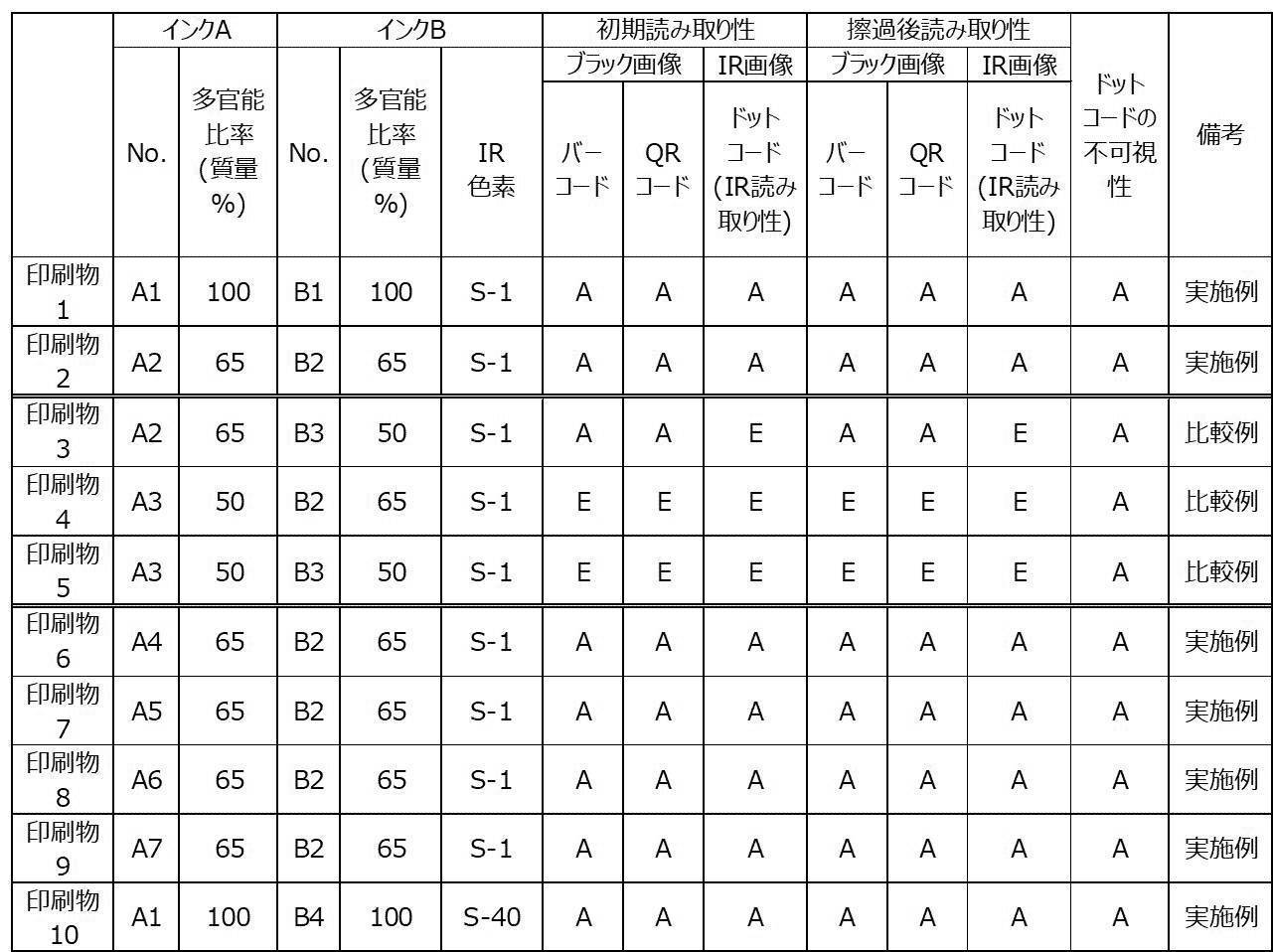
表1に示すように、
重合性化合物、光重合開始剤、及びペリレンブラックを含有し、多官能比率(即ち、含有される重合性化合物中に占める多官能重合性モノマーの割合)が60質量%以上であるインクAと、
重合性化合物、光重合開始剤、及び赤外線吸収色素を含有し、多官能比率が60質量%以上であるインクBと、
の組み合わせ(即ち、インクセット)を用いて作製された各実施例の印刷物は、インクBに由来するIR画像(ドットコード)の読み取り性に優れていた。
これに対し、インクAの多官能比率が60質量%未満である比較例の印刷物、及び、インクBの多官能比率が60質量%未満である比較例の印刷物のいずれにおいても、IR画像の読み取り性が低下した。
重合性化合物、光重合開始剤、及びペリレンブラックを含有し、多官能比率(即ち、含有される重合性化合物中に占める多官能重合性モノマーの割合)が60質量%以上であるインクAと、
重合性化合物、光重合開始剤、及び赤外線吸収色素を含有し、多官能比率が60質量%以上であるインクBと、
の組み合わせ(即ち、インクセット)を用いて作製された各実施例の印刷物は、インクBに由来するIR画像(ドットコード)の読み取り性に優れていた。
これに対し、インクAの多官能比率が60質量%未満である比較例の印刷物、及び、インクBの多官能比率が60質量%未満である比較例の印刷物のいずれにおいても、IR画像の読み取り性が低下した。
〔印刷物101〕
以下の点以外は印刷物1の作製と同様にして、印刷物101を作製した。
上記インクジェットプリンターを起動し、基材上に、インクA1、インクB1、及びインクC1をこの順に、それぞれ網点率100%にて付与し、次いで、基材上に付与された、インクA1、インクB1、及びインクC1に対し、紫外線を照射することにより、インクA1由来のブラック画像とインクB1由来のIR画像とインクC1に由来する画像とからなる複合画像を記録した。これにより、基材と、ブラック画像、IR画像及び蛍光画像からなる複合画像と、を備える印刷物101を得た。
印刷物101における上記複合画像において、ブラック画像は、バーコード画像及びQRコード(登録商標)画像とし、IR画像はドットコード画像(詳細には、アポロジャパン社製のスクリーンコード)とし、蛍光画像は、富士フイルム社のロゴ画像(以下、単に「ロゴ」ともいう)とした。
また、上記複合画像において、ブラック画像、IR画像及び蛍光画像の配置は、複合画像を平面視した場合に、ブラック画像とIR画像と蛍光画像との重なり部分が存在する配置とした。
以下の点以外は印刷物1の作製と同様にして、印刷物101を作製した。
上記インクジェットプリンターを起動し、基材上に、インクA1、インクB1、及びインクC1をこの順に、それぞれ網点率100%にて付与し、次いで、基材上に付与された、インクA1、インクB1、及びインクC1に対し、紫外線を照射することにより、インクA1由来のブラック画像とインクB1由来のIR画像とインクC1に由来する画像とからなる複合画像を記録した。これにより、基材と、ブラック画像、IR画像及び蛍光画像からなる複合画像と、を備える印刷物101を得た。
印刷物101における上記複合画像において、ブラック画像は、バーコード画像及びQRコード(登録商標)画像とし、IR画像はドットコード画像(詳細には、アポロジャパン社製のスクリーンコード)とし、蛍光画像は、富士フイルム社のロゴ画像(以下、単に「ロゴ」ともいう)とした。
また、上記複合画像において、ブラック画像、IR画像及び蛍光画像の配置は、複合画像を平面視した場合に、ブラック画像とIR画像と蛍光画像との重なり部分が存在する配置とした。
〔印刷物101の評価〕
印刷物101における複合画像(ブラック画像+IR画像+蛍光画像)について、印刷物1における複合画像(ブラック画像+IR画像)の評価と同様に、バーコードの初期読み取り性、QRコードの初期読み取り性、ドットコードの初期読み取り性(IR読み取り性)、バーコードの擦過後読み取り性、QRコードの擦過後読み取り性、ドットコードの擦過後読み取り性、及びドットコードの不可視性の各評価を実施した。
更に、蛍光画像としてのロゴについて、以下のようにして、初期読み取り性、擦過後読み取り性、及び不可視性の評価を実施した。
以上の結果を表2に示す。
印刷物101における複合画像(ブラック画像+IR画像+蛍光画像)について、印刷物1における複合画像(ブラック画像+IR画像)の評価と同様に、バーコードの初期読み取り性、QRコードの初期読み取り性、ドットコードの初期読み取り性(IR読み取り性)、バーコードの擦過後読み取り性、QRコードの擦過後読み取り性、ドットコードの擦過後読み取り性、及びドットコードの不可視性の各評価を実施した。
更に、蛍光画像としてのロゴについて、以下のようにして、初期読み取り性、擦過後読み取り性、及び不可視性の評価を実施した。
以上の結果を表2に示す。
<ロゴ(蛍光画像)の初期読み取り性>
印刷物101における複合画像中、ブラック画像としてのバーコード又はQRコードと、IR画像としてのドットコードと、蛍光画像としてのロゴ(即ち、富士フイルム社のロゴ)と、が重なっている場所を10か所選択し、各場所について、ブラックライトを照射し、ブラックライト照射時に目視でロゴを読み取れるかどうかを確認した。
得られた結果に基づき、下記評価基準により、ロゴの初期読み取り性(即ち、ブラックライト照射時の読み取り性;以下、「ブラックライト読み取り性」ともいう)を評価した。
下記評価基準のうち、ロゴの初期読み取り性にもっとも優れるランクは、Aである。
印刷物101における複合画像中、ブラック画像としてのバーコード又はQRコードと、IR画像としてのドットコードと、蛍光画像としてのロゴ(即ち、富士フイルム社のロゴ)と、が重なっている場所を10か所選択し、各場所について、ブラックライトを照射し、ブラックライト照射時に目視でロゴを読み取れるかどうかを確認した。
得られた結果に基づき、下記評価基準により、ロゴの初期読み取り性(即ち、ブラックライト照射時の読み取り性;以下、「ブラックライト読み取り性」ともいう)を評価した。
下記評価基準のうち、ロゴの初期読み取り性にもっとも優れるランクは、Aである。
-評価基準-
A:10か所すべてにおいて、ブラックライト照射時に目視でロゴを確認できた。
B:10か所のうちの少なくとも1か所において、ブラックライト照射時に目視でロゴを確認できなかった。
A:10か所すべてにおいて、ブラックライト照射時に目視でロゴを確認できた。
B:10か所のうちの少なくとも1か所において、ブラックライト照射時に目視でロゴを確認できなかった。
<ロゴ(蛍光画像)の擦過後読み取り性>
印刷物101における複合画像に対し、500gの加重にて100往復の学振型摩擦試験を実施した。
この学振型摩擦試験の途中及びこの学振型摩擦試験後において、ブラック画像としてのバーコードと、IR画像としてのドットコードと、蛍光画像としてのロゴと、が重なっている場所を10か所選択し、各場所において、ブラックライトを照射し、ブラックライト照射時に目視でロゴを読み取れるかどうかを確認した。
得られた結果に基づき、下記評価基準により、ロゴの擦過後読み取り性を評価した。
下記評価基準のうち、ロゴの擦過後読み取り性にもっとも優れるランクは、Aである。
印刷物101における複合画像に対し、500gの加重にて100往復の学振型摩擦試験を実施した。
この学振型摩擦試験の途中及びこの学振型摩擦試験後において、ブラック画像としてのバーコードと、IR画像としてのドットコードと、蛍光画像としてのロゴと、が重なっている場所を10か所選択し、各場所において、ブラックライトを照射し、ブラックライト照射時に目視でロゴを読み取れるかどうかを確認した。
得られた結果に基づき、下記評価基準により、ロゴの擦過後読み取り性を評価した。
下記評価基準のうち、ロゴの擦過後読み取り性にもっとも優れるランクは、Aである。
-評価基準-
A:100往復の摩擦試験後に読み取れた場所の数が、初期に読み取れた場所の数と同じである。
B:50往復の摩擦試験後に読み取れた場所の数が、初期に読み取れた場所の数と同じであったが、100往復の擦過試験後に読み取れた場所の数が、初期の読み取れた場所の数よりも少なかった。
C:30往復の摩擦試験後に読み取れた場所の数が、初期に読み取れた場所の数と同じであったが、50往復の擦過試験後に読み取れた場所の数が、初期に読み取れた場所の数よりも少なかった。
D:10往復の摩擦試験後に読み取れた場所の数が、初期に読み取れた場所の数と同じであったが、30往復の擦過試験後に読み取れた場所の数が、初期に読み取れた場所の数よりも少なかった。
E:10往復の擦過試験後に読み取れた場所の数が、初期に読み取れた場所の数よりも少なかった。
A:100往復の摩擦試験後に読み取れた場所の数が、初期に読み取れた場所の数と同じである。
B:50往復の摩擦試験後に読み取れた場所の数が、初期に読み取れた場所の数と同じであったが、100往復の擦過試験後に読み取れた場所の数が、初期の読み取れた場所の数よりも少なかった。
C:30往復の摩擦試験後に読み取れた場所の数が、初期に読み取れた場所の数と同じであったが、50往復の擦過試験後に読み取れた場所の数が、初期に読み取れた場所の数よりも少なかった。
D:10往復の摩擦試験後に読み取れた場所の数が、初期に読み取れた場所の数と同じであったが、30往復の擦過試験後に読み取れた場所の数が、初期に読み取れた場所の数よりも少なかった。
E:10往復の擦過試験後に読み取れた場所の数が、初期に読み取れた場所の数よりも少なかった。
<ロゴ(蛍光画像)の不可視性>
印刷物101に蛍光画像としてのロゴが記録されていることを知らない10人の被験者に対し、印刷物101を提示し、ロゴの存在に気づいた被験者の人数を確認した。
得られた結果に基づき、下記評価基準により、ロゴ(蛍光画像)の不可視性を評価した。
下記評価基準において、ロゴ(蛍光画像)の不可視性に最も優れるランクは、Aである。
印刷物101に蛍光画像としてのロゴが記録されていることを知らない10人の被験者に対し、印刷物101を提示し、ロゴの存在に気づいた被験者の人数を確認した。
得られた結果に基づき、下記評価基準により、ロゴ(蛍光画像)の不可視性を評価した。
下記評価基準において、ロゴ(蛍光画像)の不可視性に最も優れるランクは、Aである。
-評価基準-
A:10人の被験者のうち、ロゴ(蛍光画像)の存在に気づいた人が1人もいなかった。
B:10人の被験者のうち1人が、ロゴ(蛍光画像)の存在に気づいた。
C:10人の被験者のうち2人~5人が、ロゴ(蛍光画像)の存在に気づいた。
D:10人の被験者のうち6人以上が、ロゴ(蛍光画像)の存在に気づいた。
A:10人の被験者のうち、ロゴ(蛍光画像)の存在に気づいた人が1人もいなかった。
B:10人の被験者のうち1人が、ロゴ(蛍光画像)の存在に気づいた。
C:10人の被験者のうち2人~5人が、ロゴ(蛍光画像)の存在に気づいた。
D:10人の被験者のうち6人以上が、ロゴ(蛍光画像)の存在に気づいた。
〔印刷物102の作製及び評価〕
インクAとインクBとインクCとの組み合わせ(即ち、インクセット)を、表2に示すように変更したこと以外は印刷物101の作製及び評価と同様にして、印刷物102の作製及び評価を実施した。
結果を表2に示す。
インクAとインクBとインクCとの組み合わせ(即ち、インクセット)を、表2に示すように変更したこと以外は印刷物101の作製及び評価と同様にして、印刷物102の作製及び評価を実施した。
結果を表2に示す。
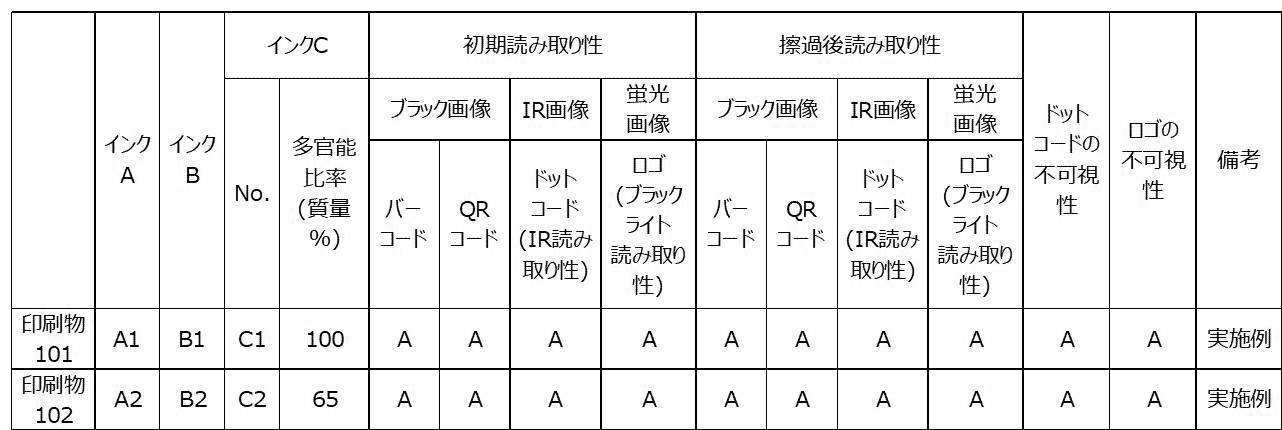
表2に示すように、印刷物101及び102においても、それぞれ、印刷物1及び2と同様の結果が得られた。
更に、印刷物101及び102では、ロゴの初期読み取り性、ロゴの擦過後読み取り性、及びロゴの不可視性にも優れていた。
更に、印刷物101及び102では、ロゴの初期読み取り性、ロゴの擦過後読み取り性、及びロゴの不可視性にも優れていた。
〔印刷物201~203の作製〕
以下の点以外は印刷物101の作製と同様にして、印刷物201~203を作製した。
上記インクジェットプリンターを起動し、基材上に、インクA1、表3に示すインクD〔詳細には、インクD1C(印刷物201)、インクD1M(印刷物202)、又はインクD1Y(印刷物203)〕、インクB1、及びインクC1をこの順に付与し、
次いで、基材上に付与された、インクA1、インクD、インクB1、及びインクC1に対し、紫外線を照射することにより、
インクA1由来のブラック画像と、
インクD由来のカラー画像〔詳細には、インクD1C由来のシアン画像(印刷物201)、インクD1M由来のマゼンタ画像(印刷物202)、又はインクD1Y由来のイエロー画像(印刷物203)〕と、
インクB1由来のIR画像と、
インクC1由来の蛍光画像と、
からなる複合画像を記録した。
上記複合画像において、
ブラック画像は、バーコード画像及びQRコード(登録商標)画像とし、
カラー画像は、ブラック画像上に重なる、バーコード画像及びQRコード(登録商標)画像とし、
IR画像はドットコード画像(詳細には、アポロジャパン社製のスクリーンコード)とし、
蛍光画像は、富士フイルム社のロゴ画像(以下、単に「ロゴ」ともいう)とした。
ここで、インクD1C(印刷物201)は網点率18%にて、インクD1M(印刷物202)は網点率10%にて、インクD1Y(印刷物203)は網点率16%にて、それぞれ付与し、これら以外のインクは、網点率100%にてそれぞれ付与した。
以上により、基材と、ブラック画像、カラー画像、IR画像及び蛍光画像からなる複合画像と、を備える印刷物201~203を得た。
ここで、カラー画像は、ブラック画像上に重なる画像であり、ブラック画像の色味を調整するための画像である。
以下の点以外は印刷物101の作製と同様にして、印刷物201~203を作製した。
上記インクジェットプリンターを起動し、基材上に、インクA1、表3に示すインクD〔詳細には、インクD1C(印刷物201)、インクD1M(印刷物202)、又はインクD1Y(印刷物203)〕、インクB1、及びインクC1をこの順に付与し、
次いで、基材上に付与された、インクA1、インクD、インクB1、及びインクC1に対し、紫外線を照射することにより、
インクA1由来のブラック画像と、
インクD由来のカラー画像〔詳細には、インクD1C由来のシアン画像(印刷物201)、インクD1M由来のマゼンタ画像(印刷物202)、又はインクD1Y由来のイエロー画像(印刷物203)〕と、
インクB1由来のIR画像と、
インクC1由来の蛍光画像と、
からなる複合画像を記録した。
上記複合画像において、
ブラック画像は、バーコード画像及びQRコード(登録商標)画像とし、
カラー画像は、ブラック画像上に重なる、バーコード画像及びQRコード(登録商標)画像とし、
IR画像はドットコード画像(詳細には、アポロジャパン社製のスクリーンコード)とし、
蛍光画像は、富士フイルム社のロゴ画像(以下、単に「ロゴ」ともいう)とした。
ここで、インクD1C(印刷物201)は網点率18%にて、インクD1M(印刷物202)は網点率10%にて、インクD1Y(印刷物203)は網点率16%にて、それぞれ付与し、これら以外のインクは、網点率100%にてそれぞれ付与した。
以上により、基材と、ブラック画像、カラー画像、IR画像及び蛍光画像からなる複合画像と、を備える印刷物201~203を得た。
ここで、カラー画像は、ブラック画像上に重なる画像であり、ブラック画像の色味を調整するための画像である。
〔印刷物201~203の評価〕
印刷物201~203の各々について、印刷物101の評価と同様の評価を実施した。
印刷物201~203において、バーコード画像及びQRコード画像の各々は、インクA由来のブラック画像と、インクD(即ち、カラーインク)由来のカラー画像と、が重なる複合画像である。
結果を表3に示す。
印刷物201~203の各々について、印刷物101の評価と同様の評価を実施した。
印刷物201~203において、バーコード画像及びQRコード画像の各々は、インクA由来のブラック画像と、インクD(即ち、カラーインク)由来のカラー画像と、が重なる複合画像である。
結果を表3に示す。
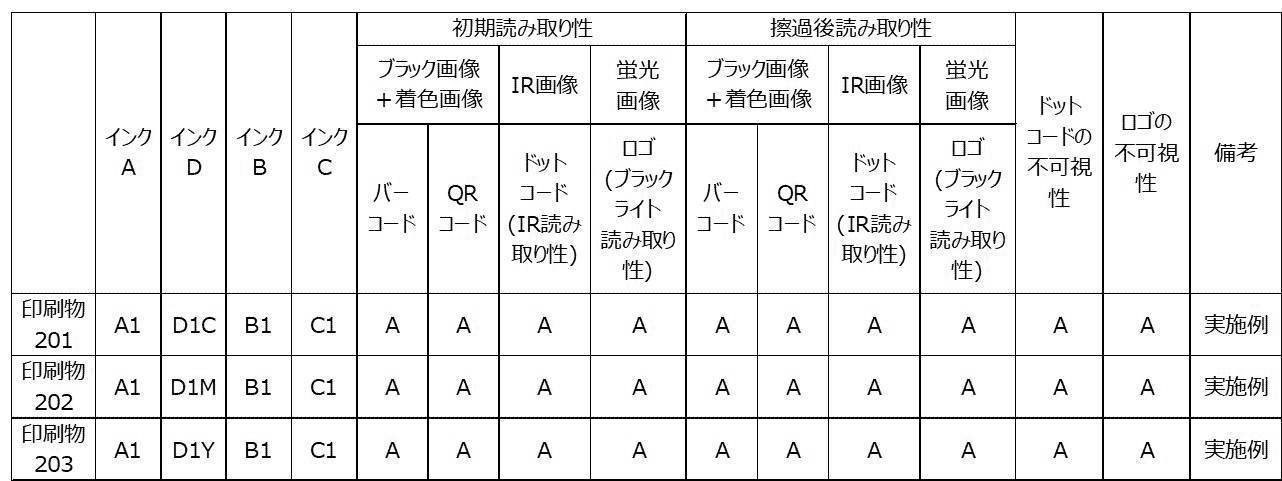
表3に示すように、印刷物201~203のそれぞれにおいて、印刷物101と同様の結果が得られた。
〔印刷物204(比較例)〕
以下の点以外は印刷物101の作製と同様にして、印刷物204(比較例)を作製した。
上記インクジェットプリンターを起動し、基材上に、インクD1C、インクD1M、インクD1Y、インクB1、及びインクC1をこの順に、それぞれ網点率100%にて付与し、次いで、基材上に付与された、インクD1C、インクD1M、インクD1Y、インクB1、及びインクC1に対し、紫外線を照射することにより、インクD1C、インクD1M、及びインクD1Y由来のカラー画像(コンポジットブラック画像)と、インクB1由来のIR画像と、インクC1に由来する蛍光画像と、からなる複合画像を記録した。これにより、基材と、カラー画像、IR画像及び蛍光画像からなる複合画像と、を備える印刷物204(比較例)を得た。
印刷物204(比較例)における上記複合画像において、カラー画像は、バーコード画像及びQRコード(登録商標)画像とし、IR画像はドットコード画像(詳細には、アポロジャパン社製のスクリーンコード)とし、蛍光画像は、富士フイルム社のロゴとした。
カラー画像について、より詳細には、インクD1C、インクD1M、及びインクD1Yをこの順に、同一の付与領域に重ねて付与することにより、コンポジットブラック画像として、バーコード画像及びQRコード(登録商標)画像であるカラー画像を記録した。
得られた印刷物204(印刷物)について、印刷物101の評価と同様の評価を実施した。
結果を表4に示す。
以下の点以外は印刷物101の作製と同様にして、印刷物204(比較例)を作製した。
上記インクジェットプリンターを起動し、基材上に、インクD1C、インクD1M、インクD1Y、インクB1、及びインクC1をこの順に、それぞれ網点率100%にて付与し、次いで、基材上に付与された、インクD1C、インクD1M、インクD1Y、インクB1、及びインクC1に対し、紫外線を照射することにより、インクD1C、インクD1M、及びインクD1Y由来のカラー画像(コンポジットブラック画像)と、インクB1由来のIR画像と、インクC1に由来する蛍光画像と、からなる複合画像を記録した。これにより、基材と、カラー画像、IR画像及び蛍光画像からなる複合画像と、を備える印刷物204(比較例)を得た。
印刷物204(比較例)における上記複合画像において、カラー画像は、バーコード画像及びQRコード(登録商標)画像とし、IR画像はドットコード画像(詳細には、アポロジャパン社製のスクリーンコード)とし、蛍光画像は、富士フイルム社のロゴとした。
カラー画像について、より詳細には、インクD1C、インクD1M、及びインクD1Yをこの順に、同一の付与領域に重ねて付与することにより、コンポジットブラック画像として、バーコード画像及びQRコード(登録商標)画像であるカラー画像を記録した。
得られた印刷物204(印刷物)について、印刷物101の評価と同様の評価を実施した。
結果を表4に示す。
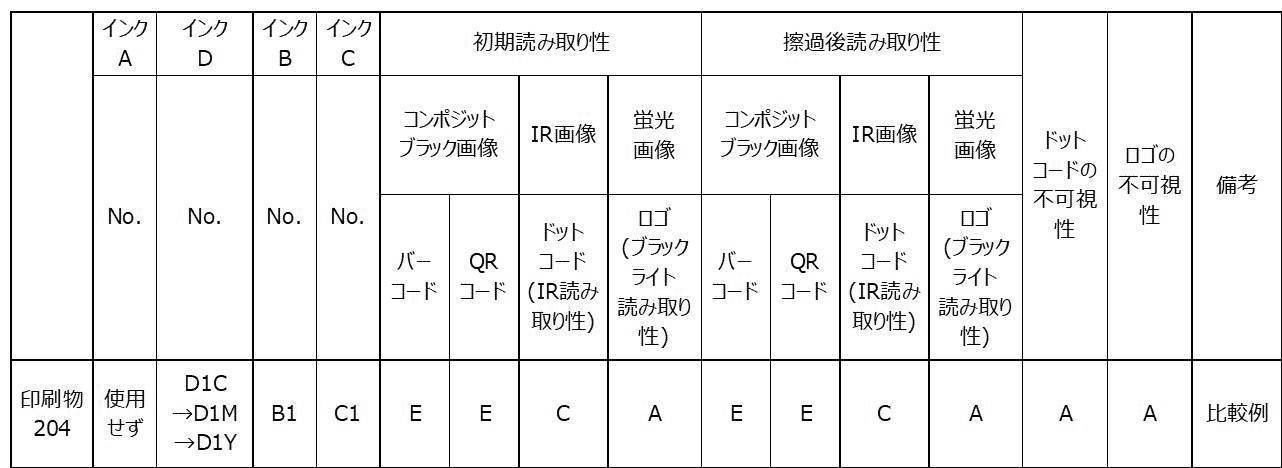
表4に示すように、印刷物204(印刷物)では、バーコード及びQRコードの読み取り性が不足した。この理由は、バーコード及びQRコードを、コンポジットブラック画像として記録したために、ブラック画像としての読み取り性が低下したためと考えられる。
2020年7月15日に出願された日本国特許出願2020-121261号の開示は、その全体が参照により本明細書に取り込まれる。本明細書に記載された全ての文献、特許出願、及び技術規格は、個々の文献、特許出願、及び技術規格が参照により取り込まれることが具体的かつ個々に記載された場合と同程度に、本明細書に参照により取り込まれる。
Claims (12)
- 重合性化合物、光重合開始剤、及びペリレンブラックを含有し、含有される前記重合性化合物中に占める多官能重合性モノマーの割合が60質量%以上であるインクジェットインクAと、
重合性化合物、光重合開始剤、及び赤外線吸収色素を含有し、含有される前記重合性化合物中に占める多官能重合性モノマーの割合が60質量%以上であるインクジェットインクBと、
を備える、
インクセット。 - 前記赤外線吸収色素が、スクアリリウム化合物を含む、
請求項1に記載のインクセット。 - 前記赤外線吸収色素が、下記式(1)で表されるスクアリリウム化合物を含む、
請求項1又は請求項2に記載のインクセット。

式(1)中、環A及び環Bは、それぞれ独立に、芳香環又は複素芳香環を表し、XA及びXBは、それぞれ独立に、1価の置換基を表し、GA及びGBは、それぞれ独立に、1価の置換基を表し、kAは0~nAの整数を表し、kBは0~nBの整数を表す。nAは、GAが環Aに置換可能な最大の整数を表し、nBは、GBが環Bに置換可能な最大の整数を表す。XAとGA、又はXBとGBは、それぞれ互いに結合して環を形成してもよく、GA及びGBがそれぞれ複数存在する場合は、環Aに結合する複数のGA、及び環Bに結合する複数のGBは、それぞれ互いに結合して環を形成していてもよい。 - 前記インクジェットインクAが、更に、シアン顔料、マゼンタ顔料、及びイエロー顔料からなる群から選択させる少なくとも1種を含有する、
請求項1~請求項3のいずれか1項に記載のインクセット。 - 重合性化合物、光重合開始剤、及び蛍光物質を含有し、含有される前記重合性化合物中に占める多官能重合性モノマーの割合が60質量%以上であるインクジェットインクCを更に備える、
請求項1~請求項4のいずれか1項に記載のインクセット。 - 基材と、
前記基材上に配置され、平面視で互いに重なる重なり部分を含むブラック画像及び赤外線吸収画像を含む複合画像と、
を備え、
前記ブラック画像が、重合性化合物、光重合開始剤、及びペリレンブラックを含有し、含有される前記重合性化合物中に占める多官能重合性モノマーの割合が60質量%以上であるインクジェットインクAの硬化物であり、
前記赤外線吸収画像が、重合性化合物、光重合開始剤、及び赤外線吸収色素を含有し、含有される前記重合性化合物中に占める多官能重合性モノマーの割合が60質量%以上であるインクジェットインクBの硬化物である、
印刷物。 - 前記赤外線吸収色素が、スクアリリウム化合物を含む、
請求項6に記載の印刷物。 - 前記赤外線吸収色素が、下記式(1)で表されるスクアリリウム化合物を含む、
請求項6又は請求項7に記載の印刷物。
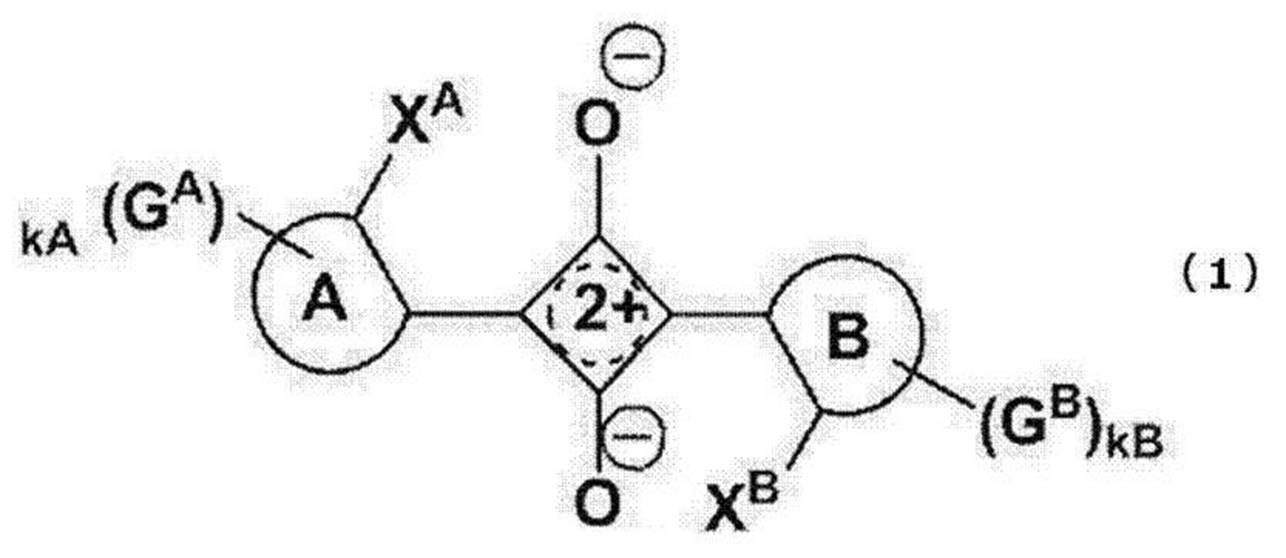
式(1)中、環A及び環Bは、それぞれ独立に、芳香環又は複素芳香環を表し、XA及びXBは、それぞれ独立に、1価の置換基を表し、GA及びGBは、それぞれ独立に、1価の置換基を表し、kAは0~nAの整数を表し、kBは0~nBの整数を表す。nAは、GAが環Aに置換可能な最大の整数を表し、nBは、GBが環Bに置換可能な最大の整数を表す。XAとGA、又はXBとGBは、それぞれ互いに結合して環を形成してもよく、GA及びGBがそれぞれ複数存在する場合は、環Aに結合する複数のGA、及び環Bに結合する複数のGBは、それぞれ互いに結合して環を形成していてもよい。 - 前記インクジェットインクAが、更に、シアン顔料、マゼンタ顔料、及びイエロー顔料からなる群から選択させる少なくとも1種を含有する、
請求項6~請求項8のいずれか1項に記載の印刷物。 - 前記ブラック画像が、バーコード画像及びQRコード(登録商標)画像の少なくとも一方であり、前記赤外線吸収画像が、ドットコード画像である、請求項6~請求項9のいずれか1項に記載の印刷物。
- 前記複合画像が、更に、平面視で前記ブラック画像に重なるシアン画像、平面視で前記ブラック画像に重なるマゼンタ画像、及び平面視で前記ブラック画像に重なるイエロー画像からなる群から選択される少なくとも1種であるカラー画像を含む、
請求項6~請求項10のいずれか1項に記載の印刷物。 - 前記複合画像が、更に、平面視で前記重なり部分に重なる蛍光画像を含み、
前記蛍光画像が、重合性化合物、光重合開始剤、及び蛍光物質を含有し、含有される前記重合性化合物中に占める多官能重合性モノマーの割合が60質量%以上であるインクジェットインクCの硬化物である、
請求項6~請求項11のいずれか1項に記載の印刷物。
Priority Applications (3)
| Application Number | Priority Date | Filing Date | Title |
|---|---|---|---|
| JP2022536183A JP7416950B2 (ja) | 2020-07-15 | 2021-06-15 | インクセット及び印刷物 |
| CN202180049343.5A CN115803399B (zh) | 2020-07-15 | 2021-06-15 | 油墨组及印刷物 |
| US18/064,937 US20230142929A1 (en) | 2020-07-15 | 2022-12-13 | Ink set and printed article |
Applications Claiming Priority (2)
| Application Number | Priority Date | Filing Date | Title |
|---|---|---|---|
| JP2020121261 | 2020-07-15 | ||
| JP2020-121261 | 2020-07-15 |
Related Child Applications (1)
| Application Number | Title | Priority Date | Filing Date |
|---|---|---|---|
| US18/064,937 Continuation US20230142929A1 (en) | 2020-07-15 | 2022-12-13 | Ink set and printed article |
Publications (1)
| Publication Number | Publication Date |
|---|---|
| WO2022014236A1 true WO2022014236A1 (ja) | 2022-01-20 |
Family
ID=79555478
Family Applications (1)
| Application Number | Title | Priority Date | Filing Date |
|---|---|---|---|
| PCT/JP2021/022702 Ceased WO2022014236A1 (ja) | 2020-07-15 | 2021-06-15 | インクセット及び印刷物 |
Country Status (4)
| Country | Link |
|---|---|
| US (1) | US20230142929A1 (ja) |
| JP (1) | JP7416950B2 (ja) |
| CN (1) | CN115803399B (ja) |
| WO (1) | WO2022014236A1 (ja) |
Cited By (1)
| Publication number | Priority date | Publication date | Assignee | Title |
|---|---|---|---|---|
| EP4212341A4 (en) * | 2020-09-11 | 2024-03-13 | FUJIFILM Corporation | INKJET PRINTING INK AND INKJET PRINTING METHOD |
Families Citing this family (1)
| Publication number | Priority date | Publication date | Assignee | Title |
|---|---|---|---|---|
| JPWO2025192502A1 (ja) * | 2024-03-13 | 2025-09-18 |
Citations (7)
| Publication number | Priority date | Publication date | Assignee | Title |
|---|---|---|---|---|
| JP2005507451A (ja) * | 2001-10-31 | 2005-03-17 | シクパ・ホールディング・ソシエテ・アノニム | インクセット、印刷された物品、印刷方法及び着色剤の使用 |
| WO2016186050A1 (ja) * | 2015-05-20 | 2016-11-24 | 富士フイルム株式会社 | 赤外線吸収組成物、赤外線カットフィルタ、積層体、パターン形成方法、および固体撮像素子 |
| CN108192420A (zh) * | 2017-11-28 | 2018-06-22 | 湖南互力达涂料科技有限公司 | 一种水性发光二极管光固化数码喷墨及其制备方法 |
| JP2018517001A (ja) * | 2015-09-21 | 2018-06-28 | エルジー・ケム・リミテッド | 高温耐熱性が強化されたインクジェット用紫外線硬化赤外線透過インク組成物 |
| JP2019011455A (ja) * | 2016-12-27 | 2019-01-24 | 東洋インキScホールディングス株式会社 | スクアリリウム化合物及びその用途 |
| WO2019163916A1 (ja) * | 2018-02-21 | 2019-08-29 | 富士フイルム株式会社 | インクジェット印刷用インク組成物、画像形成方法、記録物 |
| WO2020059484A1 (ja) * | 2018-09-18 | 2020-03-26 | 富士フイルム株式会社 | 組成物、膜、光学フィルタ、固体撮像素子、赤外線センサ、光学フィルタの製造方法、カメラモジュール、化合物、及び、分散組成物 |
Family Cites Families (3)
| Publication number | Priority date | Publication date | Assignee | Title |
|---|---|---|---|---|
| JP4914862B2 (ja) * | 2008-03-26 | 2012-04-11 | 富士フイルム株式会社 | インクジェット記録方法、及び、インクジェット記録装置 |
| JP6920837B2 (ja) * | 2017-03-15 | 2021-08-18 | 富士フイルム株式会社 | 色素組成物及び印画物 |
| JP2023051761A (ja) * | 2021-09-30 | 2023-04-11 | 富士フイルム株式会社 | インクジェット記録用インク及びインクジェット記録方法 |
-
2021
- 2021-06-15 JP JP2022536183A patent/JP7416950B2/ja active Active
- 2021-06-15 CN CN202180049343.5A patent/CN115803399B/zh active Active
- 2021-06-15 WO PCT/JP2021/022702 patent/WO2022014236A1/ja not_active Ceased
-
2022
- 2022-12-13 US US18/064,937 patent/US20230142929A1/en active Pending
Patent Citations (7)
| Publication number | Priority date | Publication date | Assignee | Title |
|---|---|---|---|---|
| JP2005507451A (ja) * | 2001-10-31 | 2005-03-17 | シクパ・ホールディング・ソシエテ・アノニム | インクセット、印刷された物品、印刷方法及び着色剤の使用 |
| WO2016186050A1 (ja) * | 2015-05-20 | 2016-11-24 | 富士フイルム株式会社 | 赤外線吸収組成物、赤外線カットフィルタ、積層体、パターン形成方法、および固体撮像素子 |
| JP2018517001A (ja) * | 2015-09-21 | 2018-06-28 | エルジー・ケム・リミテッド | 高温耐熱性が強化されたインクジェット用紫外線硬化赤外線透過インク組成物 |
| JP2019011455A (ja) * | 2016-12-27 | 2019-01-24 | 東洋インキScホールディングス株式会社 | スクアリリウム化合物及びその用途 |
| CN108192420A (zh) * | 2017-11-28 | 2018-06-22 | 湖南互力达涂料科技有限公司 | 一种水性发光二极管光固化数码喷墨及其制备方法 |
| WO2019163916A1 (ja) * | 2018-02-21 | 2019-08-29 | 富士フイルム株式会社 | インクジェット印刷用インク組成物、画像形成方法、記録物 |
| WO2020059484A1 (ja) * | 2018-09-18 | 2020-03-26 | 富士フイルム株式会社 | 組成物、膜、光学フィルタ、固体撮像素子、赤外線センサ、光学フィルタの製造方法、カメラモジュール、化合物、及び、分散組成物 |
Cited By (2)
| Publication number | Priority date | Publication date | Assignee | Title |
|---|---|---|---|---|
| EP4212341A4 (en) * | 2020-09-11 | 2024-03-13 | FUJIFILM Corporation | INKJET PRINTING INK AND INKJET PRINTING METHOD |
| US12331207B2 (en) | 2020-09-11 | 2025-06-17 | Fujifilm Corporation | Ink jet recording ink and ink jet recording method |
Also Published As
| Publication number | Publication date |
|---|---|
| CN115803399B (zh) | 2024-03-08 |
| JP7416950B2 (ja) | 2024-01-17 |
| JPWO2022014236A1 (ja) | 2022-01-20 |
| CN115803399A (zh) | 2023-03-14 |
| US20230142929A1 (en) | 2023-05-11 |
Similar Documents
| Publication | Publication Date | Title |
|---|---|---|
| CN108603059B (zh) | 光固化型喷墨印刷用油墨组合物及喷墨印刷方法 | |
| US10435577B2 (en) | Ink set and image forming method | |
| EP2010615A1 (en) | A printing ink | |
| US12331207B2 (en) | Ink jet recording ink and ink jet recording method | |
| EP4269513A1 (en) | Ultraviolet radiation curing type inkjet ink | |
| JP7416950B2 (ja) | インクセット及び印刷物 | |
| US10844234B2 (en) | Method of printing | |
| EP3209736B1 (en) | Printing ink | |
| WO2018042193A1 (en) | A method of printing | |
| JP7403229B2 (ja) | 光硬化型インクジェット記録用インク組成物およびインクセット | |
| US20260117083A1 (en) | Active energy ray-curable inkjet black ink and printed matter | |
| JP2023014221A (ja) | 光硬化型インクジェット記録用インク組成物およびインクセット | |
| US20260028494A1 (en) | Photocurable inkjet ink composition | |
| US12486417B2 (en) | Inkjet ink | |
| US20220389249A1 (en) | Printing ink | |
| JP7339059B2 (ja) | 光硬化型インクジェット記録用インク組成物およびインクセット | |
| WO2022014292A1 (ja) | セキュリティ画像記録用インクセット、セキュリティ画像記録方法、及びセキュリティ画像記録物 | |
| EP2997096A1 (en) | A printing ink | |
| US12359082B2 (en) | Method of inkjet printing | |
| JP2025019983A (ja) | 活性エネルギー線硬化型インクジェットインク、画像記録方法、及びラミネート体の製造方法 | |
| WO2011148201A1 (en) | Printing ink |
Legal Events
| Date | Code | Title | Description |
|---|---|---|---|
| 121 | Ep: the epo has been informed by wipo that ep was designated in this application |
Ref document number: 21842275 Country of ref document: EP Kind code of ref document: A1 |
|
| ENP | Entry into the national phase |
Ref document number: 2022536183 Country of ref document: JP Kind code of ref document: A |
|
| NENP | Non-entry into the national phase |
Ref country code: DE |
|
| 122 | Ep: pct application non-entry in european phase |
Ref document number: 21842275 Country of ref document: EP Kind code of ref document: A1 |