WO2022009817A1 - サーバ、ユーザ支援システム、ユーザ支援方法及びプログラム - Google Patents
サーバ、ユーザ支援システム、ユーザ支援方法及びプログラム Download PDFInfo
- Publication number
- WO2022009817A1 WO2022009817A1 PCT/JP2021/025236 JP2021025236W WO2022009817A1 WO 2022009817 A1 WO2022009817 A1 WO 2022009817A1 JP 2021025236 W JP2021025236 W JP 2021025236W WO 2022009817 A1 WO2022009817 A1 WO 2022009817A1
- Authority
- WO
- WIPO (PCT)
- Prior art keywords
- user
- data
- information
- biometric data
- user support
- Prior art date
- Legal status (The legal status is an assumption and is not a legal conclusion. Google has not performed a legal analysis and makes no representation as to the accuracy of the status listed.)
- Ceased
Links
Images

Classifications
-
- G—PHYSICS
- G16—INFORMATION AND COMMUNICATION TECHNOLOGY [ICT] SPECIALLY ADAPTED FOR SPECIFIC APPLICATION FIELDS
- G16H—HEALTHCARE INFORMATICS, i.e. INFORMATION AND COMMUNICATION TECHNOLOGY [ICT] SPECIALLY ADAPTED FOR THE HANDLING OR PROCESSING OF MEDICAL OR HEALTHCARE DATA
- G16H10/00—ICT specially adapted for the handling or processing of patient-related medical or healthcare data
- G16H10/60—ICT specially adapted for the handling or processing of patient-related medical or healthcare data for patient-specific data, e.g. for electronic patient records
- G16H10/65—ICT specially adapted for the handling or processing of patient-related medical or healthcare data for patient-specific data, e.g. for electronic patient records stored on portable record carriers, e.g. on smartcards, RFID tags or CD
-
- G—PHYSICS
- G16—INFORMATION AND COMMUNICATION TECHNOLOGY [ICT] SPECIALLY ADAPTED FOR SPECIFIC APPLICATION FIELDS
- G16H—HEALTHCARE INFORMATICS, i.e. INFORMATION AND COMMUNICATION TECHNOLOGY [ICT] SPECIALLY ADAPTED FOR THE HANDLING OR PROCESSING OF MEDICAL OR HEALTHCARE DATA
- G16H20/00—ICT specially adapted for therapies or health-improving plans, e.g. for handling prescriptions, for steering therapy or for monitoring patient compliance
- G16H20/30—ICT specially adapted for therapies or health-improving plans, e.g. for handling prescriptions, for steering therapy or for monitoring patient compliance relating to physical therapies or activities, e.g. physiotherapy, acupressure or exercising
Definitions
- This disclosure relates to a server, a user support system, a user support method, and a program that provide user support data based on measurement data acquired from a measuring device.
- a blood pressure information measuring system that acquires a user's electrocardiographic waveform data and pulse waveform data from a measuring device and generates blood pressure information is known (see, for example, Patent Document 1).
- a development support server that generates a mathematical model that is a causal relationship for performing an operation from a user's measurement data to biometric information data and provides the mathematical model so that it can be used is also known (for example, Patent Document 2). reference.).
- the system for confirming the condition of frail etc. was not sufficient.
- the system for appropriately determining whether or not the exercise is performed according to the physical condition is not sufficient.
- a server a user support system, a user support method, and a program that generate user support data based on measurement data acquired from a measurement device worn by the user will be described.
- the server in one aspect of the present disclosure is a server that receives measurement data from a measuring device worn by a user via a network and generates biometric data and user support data from the measured data, and is user information about the user.
- a data management unit that stores the measurement data, the biometric data, and the user support data in association with the measurement data, a biometric data generation unit that executes a predetermined operation on the measurement data and generates the biometric data, and the biological body.
- a user support data generation unit that generates user support data for indicating the frail level or symptom level of the user based on the data is provided.
- the server in one aspect of the present disclosure is a server that receives measurement data from a measuring device worn by a user via a network and generates biometric data and user support data from the measured data, and is user information about the user.
- a data management unit that stores the measurement data, the biometric data, and the user support data in association with the measurement data, a biometric data generation unit that executes a predetermined operation on the measurement data and generates the biometric data, and the biological body.
- a user support data generation unit for generating user support data for showing that there is a difference of a predetermined value or more in the comparison result with the past biometric data based on the data is provided.
- the user support method is a user support method that receives measurement data from a measuring device worn by a user via a network and generates biometric data and user support data from the measurement data.
- a step of storing the measurement data, the biometric data, and the user support data in association with the user information about the user performed by the management unit, and a predetermined calculation performed on the measurement data performed by the biometric data generation unit are executed.
- the user support method is a user support method that receives measurement data from a measuring device worn by a user via a network and generates biometric data and user support data from the measurement data.
- a step of storing the measurement data, the biometric data, and the user support data in association with the user information about the user performed by the management unit, and a predetermined calculation performed on the measurement data performed by the biometric data generation unit are executed.
- the program according to one aspect of the present disclosure is a program for a server that receives measurement data from a measuring device worn by a user via a network and generates biometric data and user support data from the measured data.
- a functional unit including a biometric data generation unit for generating data and a user support data generation unit for generating user support data for indicating a frail level or a symptom level of the user based on the biometric data is realized.
- the program according to one aspect of the present disclosure is a program for a server that receives measurement data from a measuring device worn by a user via a network and generates biometric data and user support data from the measured data.
- a data management unit that stores the measurement data, the biometric data, and the user support data in association with the user information about the user on the server, and executes a predetermined calculation on the measurement data to perform the biometric data.
- the user support system is based on the measurement data via the user support data generation unit, and in particular, the state of the user's frail level, the state of the symptom level such as dementia, and the past biological data. Generate user support data to show that there is a difference of more than a predetermined value in the comparison result of. As a result, for example, the user can easily obtain a notification for frailty prevention and the like, and various risks can be reduced. Further, by notifying the user based on the blood pressure information and the amount of exercise information, the user can perform appropriate exercise / training, and can prevent frailty more safely.
- FIG. 1 It is a block block diagram which shows the user support system which concerns on one Embodiment of this disclosure. It is a figure which shows the hardware configuration of the management server 100 of FIG. It is a block diagram illustrating the function of the storage unit 120 and the control unit 130 of FIG. It is a schematic diagram which shows the example of the tag information associated with the measurement data of FIG. It is a figure for demonstrating the example of the electrocardiographic waveform and the pulse waveform measured by the measuring apparatus 300 of FIG. It is a flowchart which shows the example of the process of the user support system 1 of FIG.
- a server that receives measurement data from a measurement device worn by a user via a network and generates biometric data and user support data from the measurement data.
- a data management unit that stores the measurement data, the biometric data, and the user support data in association with the user information about the user.
- a biometric data generation unit that executes a predetermined operation on the measurement data and generates the biometric data.
- a user support data generation unit that generates user support data for indicating the flail level or symptom level of the user based on the biometric data is provided.
- a server that features that.
- a server that receives measurement data from a measurement device worn by a user via a network and generates biometric data and user support data from the measurement data.
- a data management unit that stores the measurement data, the biometric data, and the user support data in association with the user information about the user.
- a biometric data generation unit that executes a predetermined operation on the measurement data and generates the biometric data.
- a user support data generation unit for generating user support data for showing that there is a difference of a predetermined value or more in the comparison result with the past biometric data based on the biometric data is provided.
- a server that features that. [Item 3] The user support data generation unit is Further, based on the biometric data different from the biometric data, the user support notification for urging the user to interrupt the exercise or take a break is transmitted.
- the server according to any one of item 1 or item 2, characterized in that.
- the data management unit generates account information for the user and controls accessability to the measurement data for each account information.
- the server according to any one of items 1 to 3, characterized in that.
- the data management unit associates the measurement data with tag information and stores the measurement data for each account information.
- the measurement data is data including at least one of the electrocardiogram, pulse wave, temperature, acceleration, and angular velocity of the user.
- the server according to any one of items 1 to 5, characterized in that.
- the biometric data includes blood pressure information, heartbeat information, blood oxygen amount information, maximum oxygen intake information, electrocardiographic information, respiratory rate, body temperature information, step count information, stride information, center of gravity position information, and posture information of the user. Data including at least one of action type information, stress information, exercise amount information, exercise load information, movement distance information, walking speed information, activity amount information, and left / right shaking amount information.
- the server according to any one of items 1 to 6, wherein the server is characterized by the above.
- the user support data generation unit detects an abnormality in blood pressure information, it sends a notification indicating the abnormality to a contact associated with the user information.
- the server according to any one of items 1 to 7, wherein the server is characterized by the above.
- a user support system that receives measurement data from a measurement device worn by a user via a network and generates biometric data and user support data from the measurement data.
- a data management unit that stores the measurement data, the biometric data, and the user support data in association with the user information about the user.
- a biometric data generation unit that executes a predetermined operation on the measurement data and generates the biometric data.
- a user support data generation unit that generates user support data for indicating the flail level or symptom level of the user based on the biometric data is provided.
- a user support system characterized by this.
- a user support system that receives measurement data from a measurement device worn by a user via a network and generates biometric data and user support data from the measurement data.
- a data management unit that stores the measurement data, the biometric data, and the user support data in association with the user information about the user.
- a biometric data generation unit that executes a predetermined operation on the measurement data and generates the biometric data.
- a user support data generation unit for generating user support data for showing that there is a difference of a predetermined value or more in the comparison result with the past biometric data based on the biometric data is provided.
- the user support data generation unit comprises a step of generating user support data for indicating the flail level or symptom level of the user based on the biometric data.
- the user support data generation unit includes a step of generating user support data for showing that the comparison result with the past biometric data has a difference of a predetermined value or more.
- a data management unit that stores the measurement data, the biometric data, and the user support data in association with the user information about the user.
- a biometric data generation unit that executes a predetermined operation on the measurement data and generates the biometric data.
- a user support data generation unit that generates user support data for indicating the frail level or symptom level of the user based on the biometric data.
- a program for a server that receives measurement data from a measurement device worn by a user via a network and generates biometric data and user support data from the measurement data.
- the user support program is installed in the management server.
- a data management unit that stores the measurement data, the biometric data, and the user support data in association with the user information about the user.
- a biometric data generation unit that executes a predetermined operation on the measurement data and generates the biometric data.
- a user support data generation unit that generates user support data to show that there is a difference of a predetermined value or more in the comparison result with the past bio data based on the biometric data.
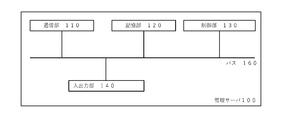
- FIG. 1 is a block configuration diagram showing a user support system 1 according to the first embodiment of the present disclosure.
- the user support system 1 receives, for example, user's measurement data from the measurement device 300 via the network NW at the management server 100, and generates biometric data by performing a predetermined calculation on the measurement data. It is a system that generates user support data based on the biometric data.
- the user support system 1 has a management server 100, a user terminal device 200, a measuring device 300, and a network NW.
- the management server 100 and the user terminal device 200 are connected via the network NW.
- the network NW is composed of the Internet, an intranet, a blockchain network, a wireless LAN (Local Area Network), a WAN (Wide Area Network), and the like.
- the management server 100 is, for example, a device that receives user's measurement data from the measurement device 300 via a network via the user terminal device 200 and calculates the measurement data into biometric data, for example, various Web services. It consists of the server equipment provided.
- the user terminal device 200 is an information processing device possessed by the user, such as a personal computer, a tablet terminal, a smartphone, a smart watch, a mobile phone, a PHS, or a PDA. It is used to display a waveform graph or the like, or to display user support data (details will be described later) generated based on biometric data.
- User information such as a user's identification number, date of birth, gender, height, and weight is registered in the user terminal device 200 in advance, and user information including the age calculated from the date of birth is associated with the measurement data. Is transmitted to the management server 100 via the network NW.
- the measuring device 300 is a device that measures the biometric data of the user, and is, for example, a wearable device that is used by being worn on the body such as the wrist or arm of the user.
- the measuring device 300 is, for example, a plurality of types of devices for measuring data of a user's electrocardiogram, pulse wave, temperature (body temperature), acceleration, and angular velocity.
- a device may be configured in which two electrodes are brought into contact with the skin and the electrocardiogram is acquired as electrocardiographic waveform data from the time change of the difference in the detected potential.
- the radio wave type may be data acquired by a galvanic skin reaction.
- each light is radiated to the skin from LEDs that emit green, red, and infrared light, and the time change in the intensity of the light received by the photodiode causes a pulse wave due to the change in the volume of the blood vessel caused by the heartbeat of the user's heart.
- It may be configured by a device that acquires pulse waveform data, and the pulse waveform that can be detected by this method is a photoelectric volume pulse waveform.
- the device may be configured to acquire the user's skin temperature as data by a temperature sensor in contact with the user's skin. Further, it may be configured by a 3-axis acceleration sensor that detects the variation state of each of the orthogonal XYZ axes, and the user's motion is acquired as acceleration data, and for example, the measuring device 300 is attached to the user's wrist, arm, or the like. In this case, the measuring device 300 acquires acceleration data as an acceleration in which the swing of the wrist, arm, or the like and the movement of the whole body are combined.
- a gyro sensor angular velocity sensor
- the measuring device 300 may be configured by a gyro sensor (angular velocity sensor) that detects the rotational angular velocity in each of the orthogonal XYZ axes, and the user's motion is acquired as angular velocity data
- the measuring device 300 is attached to the user's wrist, arm, or the like. If so, the measuring device 300 acquires the angular velocity data as the angular velocity in which the rotation of the wrist, the arm, or the like and the movement of the whole body are combined.
- Bluetooth registered trademark
- Afero registered trademark
- Zigbee registered trademark
- Z-Wave registered trademark
- the user terminal device 200 and the measuring device 300 may be an integrated device.
- the measuring device 300 may be provided with a communication function so as to be able to directly communicate with the management server 100. May be good.
- FIG. 2 is a diagram showing a hardware configuration of the management server 100.
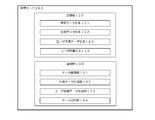
- FIG. 3 is a block diagram illustrating the functions of the storage unit 120 and the control unit 130. The configuration shown in the figure is an example, and may have other configurations.
- the management server 100 includes a communication unit 110, a storage unit 120, a control unit 130, and an input / output unit 140. These functional units are realized by executing a predetermined program for the management server 100.
- the communication unit 110 is a communication interface for communicating with the user terminal device 200, and communication is performed according to a communication protocol such as TCP / IP (Transmission Control Protocol / Internet Protocol).
- a communication protocol such as TCP / IP (Transmission Control Protocol / Internet Protocol).
- the storage unit 120 stores programs for executing various control processes and functions in the control unit 130, input data, and the like, and is composed of a RAM (RandomAccessMemory), a ROM (ReadOnlyMemory), and the like. To. Further, as shown in FIG. 3, the storage unit 120 associates the measurement data DB 121, which stores the measurement data by the measuring device 300 with the user information, and the biometric data calculated from the measurement data with the user information.
- the user information includes the account information generated by the data management unit 131, and the user information DB 124 may store the account information in association with other user information. Further, the storage unit 120 temporarily stores the data that has communicated with the user terminal device 200.
- the data structure of the DB is not limited to this, and a part of the above-mentioned DB may be stored in the user terminal device 200 or the measuring device 300.
- the control unit 130 controls the overall operation of the management server 100, and is composed of a CPU (Central Processing Unit) and the like. Further, as shown in FIG. 3, the control unit 130 includes functional units such as a data management unit 131, a biometric data generation unit 132, a user support data generation unit 133, and a data output unit 134.
- a data management unit 131 a data management unit 131, a biometric data generation unit 132, a user support data generation unit 133, and a data output unit 134.
- the data management unit 131 generates account information for each user who uses the measuring device 300. This account information generation is performed when the user who uses the measuring device 300 registers the account information on the user terminal device 200. Therefore, the data management unit 131 controls whether or not the user terminal device 200 of the user can access various DBs in the storage unit 120 for each account.
- the data management unit 131 stores various data such as measurement data, biometric data, and user support data in a corresponding DB in association with user information. Further, at this time, the data management unit 131 can associate the measurement data with predetermined tag information and store it.
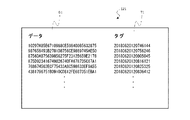
- FIG. 4 is a schematic diagram showing an example of tag information associated with the measurement data of FIG.
- the data D1 shown in FIG. 4 is the measurement data of the measuring device 300.
- the tag T1 is tag information associated with the data D1, and for example, the time information in which the measuring device 300 measures the data D1 or the time information in which the data D1 is transmitted from the measuring device 300 to the user terminal device 200 is time-series. It is stored as data. Alternatively, both the measured time information and the transmitted time information may be associated. For example, in the first line of the tag T1 shown in FIG. 4, "20180620120746144" is stored, but it indicates 12:07:46:144 ms on June 20, 2018. Such time information can be obtained from the communication log. This makes it possible to grasp which time zone the measurement data belongs to.
- the association of measurement data with such tag information is not limited to time information, and physical information or activity information indicating the user's physical condition or activity state may be freely entered and stored as tag information. Have them choose from a given option (for example, in response to the question "How are you feeling now?", Choose one of "1: good, 2: normal, 3: bad", etc.) and make that choice. You may try to remember the answer you gave.
- the control unit 150 when the control unit 150 generates biometric data, by associating the tag information with the biometric data, it is possible to generate more accurate biometric data, and the user support generated based on the tag information can be generated. The data can also be more personalized.
- the data management unit 131 can sort the data D1 in the time order of the tag T1 as shown in FIG.
- the reason for this configuration is that the measurement data is acquired in chronological order based on the biometric data of the user, and it is easier to process if the measurement data is arranged in chronological order.
- the received data may be reversed (the transmitted data transmitted later is received before the transmitted data transmitted earlier) due to a change in the communication status or the like. This is to prevent inconsistency in the measurement data at that time. This makes it possible to prevent inconsistencies in the measured data.
- the biometric data generation unit 132 performs a predetermined operation on the measurement data stored in the measurement data DB 121 to generate biometric data.
- This biometric data may be any information as long as it can be calculated from the measurement data, for example, the user's blood pressure information, heartbeat information, blood oxygen level information, maximum oxygen intake information, electrocardiographic information, etc. Breath rate, body temperature information, step count information, stride information, center of gravity position information, posture information, action type information, stress information, exercise amount information, exercise load information, travel distance information, walking speed information, activity amount information, hands or legs, etc. It is data such as operation information of, and is calculated from measurement data by a known method.
- the biometric data generated by the calculation is stored in the biometric data DB 122.
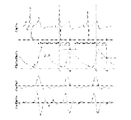
- FIG. 5 is a diagram for explaining an example of an electrocardiographic waveform and a pulse wave measured by the measuring device 300 of FIG. 1, and is a diagram for explaining an example of the electrocardiographic waveform and the pulse wave of the user measured by the measuring device 300 and stored in the storage unit 120.
- the photoelectric volume pulse waveform, the velocity pulse waveform in which the photoelectric volume pulse waveform is first-order differentiated by time, and the acceleration pulse waveform in which the photoelectric volume pulse waveform is second-order differentiated by time are shown.
- FIG. 5 shows an electrocardiographic waveform, a photoelectric volume pulse waveform, a velocity pulse waveform, and an acceleration pulse waveform in order from the top.
- the vertical axis shows the intensity of each waveform, and the electrocardiographic waveform and the photoelectric volume pulse waveform are represented by MV indicating the potential.
- the horizontal axis shows the passage of time, and shows the passage of time from left to right.
- the electrocardiographic waveform is a waveform showing a periodic change in an electrical signal that causes a human heart to beat.
- the names of P wave, Q wave, R wave, S wave, and T wave are assigned to the inflection points of the shape, respectively, and indicate one cycle of heartbeat.
- the P wave represents the atrial contraction
- the Q wave, the R wave, and the S wave represent the state of ventricular contraction
- the T wave represents the start of ventricular dilation.
- the photoelectric volume pulse waveform is a waveform showing changes in blood pressure and volume in the peripheral vascular system accompanying the beating of the human heart.
- the names of A wave, P wave, V wave, and D wave are assigned to the inflection points of the shape, respectively, and indicate one cycle of the heartbeat.
- the P wave is the Percussion wave (shock wave) generated by the ejection of the left ventricle
- the V wave is the Valley wave (wave due to the overlapping uplift) generated when the aortic valve is closed
- the D wave Indicates a Dicrotic wave (overlapping wave) which is a reflected vibration wave.
- the velocity pulse waveform is the first derivative of the photoelectric volume pulse waveform with respect to time.
- the acceleration pulse waveform is a first-order derivative of the velocity pulse waveform, that is, a second-order derivative of the photoelectric volume pulse waveform.
- the acceleration pulse waveform has a wave (initial contraction positive wave), b wave (initial contraction negative wave), c wave (mid-contraction re-rise wave), and d wave (contraction) at each peak of the waveform.
- the names of the late re-descending wave), the e wave (extended early positive wave), and the f wave (extended early negative wave) are assigned.
- the ratio of the intensity of the b wave to the intensity of the a wave and the ratio of the intensity of the f wave to the intensity of the e wave are parameters indicating the elasticity, that is, the elasticity of the blood vessel, respectively.
- the main vascular components are vascular endothelium (Endothelium), elastic fibers (Elastin), proteins (Collagen), and smooth muscle (Smooth Muscle). These components have different properties, and Collagen and Elastin have a strong influence on the elasticity of blood vessels at the maximum blood pressure and the minimum blood pressure, respectively.
- the elasticity that differs depending on the blood pressure value is indicated by the parameters of the ratio of the intensity of the b wave to the intensity of the a wave (b / a) and the ratio of the intensity of the f wave to the intensity of the e wave (f / e). These values also fluctuate depending on the influence of age, gender, and environment variables. Therefore, the values of (b / a) and (f / e) can be calculated as the characteristic information of the acceleration pulse waveform.
- the time difference between the time Tr at which the R wave is generated and the time Tp at which the P wave is generated is the ventricular systolic pulse wave propagation time PTT_SYS.
- the time of the difference between the time Tt in which the T wave is generated and the time Td in which the D wave is generated is the ventricular diastolic pulse wave propagation time PTT_DIA. That is, from the R wave time Tr and T wave time Tt of the electrocardiographic waveform, and the T wave time Tp and D wave time Td of the photoelectric volume pulse waveform, the ventricular systolic pulse wave propagation time PTT_SYS and the ventricular diastole period.
- the pulse wave propagation time PTT_DIA can be calculated.
- the relationship between the pulse wave velocity and the Young's modulus of the arterial wall has a correlation expressed by a predetermined formula, and the relationship between the Young's modulus and the blood pressure value is also shown by a predetermined formula. It is known to be correlated. Therefore, the maximum blood pressure can be obtained by a predetermined formula of the ventricular systolic pulse wave velocity PTT_SYS, and the minimum blood pressure can be obtained by a predetermined formula of the ventricular diastolic pulse wave propagation time PTT_DIA. This makes it possible to calculate the maximum blood pressure and the minimum blood pressure.
- an example is a method of calculating walking speed information, which is biological data, from measurement data.
- a known calculation method or the like from the waveform data of acceleration data measured by the measuring device 300 worn by the user on the wrist may be used alone or in combination (for example, averaging or weighting).
- the walking speed information can be obtained by, for example, the walking speed information is calculated by integrating the acceleration data at predetermined time intervals.
- the user terminal device 200 or the measuring device 300 is provided with a GPS function, and more accurate walking speed information is referred to by referring to the position information by GPS and the walking speed information calculated from the time information related to the position information. May be obtained.
- the user operates the user terminal device 200 by GPS. It may be possible to select whether to use the information in combination (or to use it instead of the calculation by the acceleration sensor), or to use the GPS reception sensitivity information in the user terminal device 200 or the distance calculated by the GPS or the acceleration sensor. You may choose whether to use the GPS information based on the information or the like.
- walking speed information By calculating the walking speed information in this way, it is easy (especially on a daily basis) to measure "walking speed", which is one of the known indexes for measuring human muscle mass that needs to be grasped in frailty prevention and the like. It is possible.
- smartphones and mobile phones also have an accelerometer, it is a device that makes it difficult to identify where the body is moving, so a measuring device worn by the user on the wrist, etc., such as a wearable device. By using the 300, it is possible to easily track the behavior information.
- an example is a method of calculating stride information, which is biometric data, from measurement data.
- a known calculation method or the like from the waveform data of acceleration data measured by the measuring device 300 worn by the user on the wrist may be used alone or in combination (for example, averaging or weighting).
- the hand is waved like a pendulum, so that the information of the above-mentioned acceleration sensor (for example, the timing at which the acceleration component in the traveling direction is the smallest or the timing at which the acceleration component is switched in the opposite direction, or the progress) can be obtained.
- the stride information can be obtained by further using the time information.
- the acceleration component in the kicking direction is synthesized, so that it is also possible to determine the interval of one step at the timing of occurrence of the acceleration component in the direction.
- the stride information By calculating the stride information in this way, it is possible to accurately grasp the timing at which the stride begins to shorten and the degree of variation in the stride, which is considered to be useful for estimating the degree of progression of dementia.
- the deterioration of the sense of balance may be calculated by calculating the amount of left and right shaking during walking (for example, the shaking width and the shaking speed) from the above-mentioned acceleration data.
- the exercise amount information calculated based on the distance information calculated by the above-mentioned GPS or the acceleration sensor, the above-mentioned stride information and the step count information (for example, can be obtained by a known method based on the information from the acceleration sensor) is also living body. It may be calculated as data.
- the user support data generation unit 133 generates user support data for notification such as advice and alerts based on the above-mentioned blood pressure information, walking speed information, and stride information.
- Reference value information such as reference blood pressure information, reference walking speed, reference stride information, and reference exercise amount information is stored in the biological data DB 122 in advance. Then, the user support data generation unit 133 also includes walking speed information and reference value information (for example, a known reference value such as 1.0 m / sec or 0.8 m / sec, or a reference value closer to a normal value than the known reference value.
- the user information is associated with the frail level (for example, flag information, identification information, etc.) associated with the comparison result and stored in the user support data DB 123, and is associated with the frail level.
- the user support notification (for example, a notification containing content that encourages training) is transmitted to the user terminal device 200 or the like.
- the notification content associated with the fray level may be stored in advance in, for example, a notification data DB (not shown).
- the comparison result for example, the average value or the predetermined period in the past predetermined period
- the frail level may be determined based on a difference of a predetermined value or more, that is, a delay, etc., as compared with a distant past value, and the same configuration may be made.
- the user support data generation unit 133 is based on the comparison result between the stride information and the reference value information (for example, a known reference value such as 65 cm or a reference value closer to the normal value than the known reference value).
- the symptom level (for example, flag information, identification information, etc.) associated with the comparison result is associated with the user information and stored in the user support data DB 123 as user support data, and the user support notification associated with the symptom level (for example). , Notifications containing content that encourages training, etc.) are transmitted to the user terminal device 200 and the like.
- the notification content associated with the symptom level may be stored in advance in, for example, a notification data DB (not shown).
- the past stride information stored in the biometric data DB 122 and the current stride information are compared, and the comparison result (for example, the average value of the past predetermined period or the predetermined period is separated).
- the symptom level may be determined based on a difference of a predetermined value or more from the past value, that is, the stride is shortened, and the same configuration may be made.
- the variation of the past stride information stored in the biological data DB 122 is calculated by a known statistical method, and the symptom level associated with the degree of variation is determined based on the calculation result, and the same configuration is made. May be good.
- the deterioration of the sense of balance may be detected by comparing the past left-right shaking amount stored in the biological data DB 122 with the current shaking amount, and the same configuration may be made.
- identification information may be stored in the user support data DB 123, and a user support notification (for example, a notification indicating that fact or a notification prompting training) may be transmitted to the user terminal device 200 or the like.
- the user support data generation unit 133 generates the user's blood pressure transition data based on the blood pressure information generated from the measurement data by the measuring device 300 which is always worn on the wrist, for example. Then, for example, when the difference between the blood pressure information and the reference value is more than the specified value, or when the abnormal value such as a sudden rise or fall of the blood pressure is monitored and the abnormal value occurs, an abnormality occurs.
- Information for example, flag information, identification information, etc.
- a user support notification prompting interruption or break is transmitted to the user terminal device 200 or the like.
- the user support data generation unit 133 may also generate blood pressure transition data before and after the abnormal value as the user support data in addition to the user support notification. Further, when the abnormality is detected, the control unit 130 links the user information such as a medical institution or a close relative directly from the management server 100 or indirectly via the user terminal device 200 or the measuring device 300. It may be controlled to send a notification indicating an abnormality (for example, a notification via a predetermined application stored in a device such as a PC or a smartphone, a notification using an e-mail address, etc.) to the attached contact. .. This makes it possible to limit the exercise load so that it is not applied more than necessary during training to increase muscle strength. The same applies not only to blood pressure information but also to the above-mentioned biological data (for example, heart rate information, blood oxygen amount information, maximum oxygen uptake information, electrocardiographic information, respiratory rate, body temperature information, stress information, etc.). It is possible.
- a notification indicating an abnormality for example, a notification via a predetermined
- the user support data is based on the comparison result between the above-mentioned exercise amount information and the reference value, and is used as user support data by associating the exercise level (for example, flag information, identification information, etc.) associated with the comparison result with the user information.
- the exercise level for example, flag information, identification information, etc.
- a user support notification associated with the exercise level (for example, a notification describing contents for urging training or taking a break) is transmitted to the user terminal device 200 or the like. ..
- the notification content associated with the exercise level may be stored in advance in, for example, a notification data DB (not shown).
- the exercise level may be a common user support notification, or the level for encouraging training and the level for encouraging a break may be changed according to the above-mentioned flail level and symptom level. As a result, it is possible not only to encourage exercise but also to avoid injuries and illness due to excessive exercise, and it is possible to make the user perform more appropriate exercise.
- the data output unit 134 outputs biometric data, user support data, user support notification, etc. to the user terminal device 200.
- the output data may be displayed on the screen via, for example, a dedicated application so that the user can easily confirm the data.
- the input / output unit 140 is an information input device such as a keyboard and a mouse, and an output device such as a display.
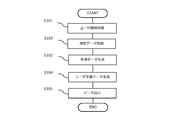
- FIG. 6 is a flowchart showing an example of processing of the user support system 1 of FIG.
- the data management unit 131 As the process of step S101, the data management unit 131 generates account information for each user who uses the measuring device 300, and acquires predetermined user information from the user terminal device 200 or the like. The registered user information is stored in the user information DB 124 by the data management unit 131.
- the process of step S101 may be performed as a pre-process for the user to use the measuring device 300, or may be performed when the user uses the measuring device 300 for the first time.
- the measurement data is transmitted from the measuring device 300 to the management server 100 via the user terminal device 200, and is received via the communication unit 110.
- the data management unit 131 stores the measurement data associated with the user information in the measurement data DB 121 of the storage unit 120.
- the measurement data is read by the biological data generation unit 132, and the biological data is generated by a predetermined calculation or the like.
- the generated biometric data is stored in the biometric data DB 122 by the data management unit 131.
- the biometric data is read by the user support data generation unit 133, and the user support data is generated and the user support notification is selected by a predetermined calculation, numerical comparison, or the like.
- the generated user support data is stored in the user support data DB 123 by the data management unit 131.
- step S105 At least one of the biological data, the user support data, and the user support notification is read by the data output unit 134 and output to the user terminal device 200.
- the user support system provides user support for indicating the state of the user's frail level, dementia, and other symptom levels based on the measurement data via the user support data generation unit 133. Generate data. As a result, for example, the user can easily obtain a notification for frailty prevention and the like, and various risks can be reduced. Further, by notifying the user based on the blood pressure information and the amount of exercise information, the user can perform appropriate exercise / training, and can prevent frailty more safely.
Landscapes
- Health & Medical Sciences (AREA)
- Engineering & Computer Science (AREA)
- Epidemiology (AREA)
- General Health & Medical Sciences (AREA)
- Medical Informatics (AREA)
- Primary Health Care (AREA)
- Public Health (AREA)
- Life Sciences & Earth Sciences (AREA)
- Biophysics (AREA)
- Physical Education & Sports Medicine (AREA)
- Medical Treatment And Welfare Office Work (AREA)
- Measuring And Recording Apparatus For Diagnosis (AREA)
Applications Claiming Priority (2)
| Application Number | Priority Date | Filing Date | Title |
|---|---|---|---|
| JP2020-116043 | 2020-07-05 | ||
| JP2020116043A JP6815055B1 (ja) | 2020-07-05 | 2020-07-05 | サーバ、ユーザ支援システム、ユーザ支援方法及びプログラム |
Publications (1)
| Publication Number | Publication Date |
|---|---|
| WO2022009817A1 true WO2022009817A1 (ja) | 2022-01-13 |
Family
ID=74164535
Family Applications (1)
| Application Number | Title | Priority Date | Filing Date |
|---|---|---|---|
| PCT/JP2021/025236 Ceased WO2022009817A1 (ja) | 2020-07-05 | 2021-07-05 | サーバ、ユーザ支援システム、ユーザ支援方法及びプログラム |
Country Status (2)
| Country | Link |
|---|---|
| JP (2) | JP6815055B1 (enExample) |
| WO (1) | WO2022009817A1 (enExample) |
Families Citing this family (3)
| Publication number | Priority date | Publication date | Assignee | Title |
|---|---|---|---|---|
| JP7580758B2 (ja) * | 2021-03-08 | 2024-11-12 | 国立大学法人山口大学 | フレイル判定支援装置とフレイル判定支援プログラムとフレイル判定支援方法 |
| JP7065550B1 (ja) | 2022-02-28 | 2022-05-12 | 株式会社Arblet | 情報処理システム、サーバ、情報処理方法及びプログラム |
| JP7778263B1 (ja) * | 2025-03-26 | 2025-12-01 | 社会福祉法人兵庫県社会福祉事業団 | ウォーキング経路案内システム、ウォーキング経路案内方法及びウォーキング経路案内プログラム |
Citations (9)
| Publication number | Priority date | Publication date | Assignee | Title |
|---|---|---|---|---|
| JP2012239544A (ja) * | 2011-05-17 | 2012-12-10 | Advanced Telecommunication Research Institute International | 歩行信号生成装置および歩行信号生成システム |
| JP2017127548A (ja) * | 2016-01-21 | 2017-07-27 | 株式会社インテック | 歩幅計測装置 |
| JP2017219933A (ja) * | 2016-06-03 | 2017-12-14 | 株式会社エヌ・トライブ | 健康増進システム |
| WO2018066465A1 (ja) * | 2016-10-03 | 2018-04-12 | 株式会社エッグ | フレイル評価システム |
| JP2019021146A (ja) * | 2017-07-19 | 2019-02-07 | 一般財団法人糧食研究会 | 高齢者の低栄養又はフレイルの予測方法 |
| JP2019063482A (ja) * | 2017-10-04 | 2019-04-25 | まさみ 仁頃 | 二肢間または体幹間の間隔計測器を用いた動態行動提示システム |
| JP2019117612A (ja) * | 2017-12-27 | 2019-07-18 | オムロンヘルスケア株式会社 | 情報処理装置、情報処理方法及びプログラム |
| WO2019181483A1 (ja) * | 2018-03-23 | 2019-09-26 | パナソニックIpマネジメント株式会社 | 認知機能評価装置、認知機能評価システム、認知機能評価方法、及び、プログラム |
| JP2020017153A (ja) * | 2018-07-26 | 2020-01-30 | 株式会社アシックス | 健康状態診断システム |
-
2020
- 2020-07-05 JP JP2020116043A patent/JP6815055B1/ja active Active
- 2020-12-14 JP JP2020206772A patent/JP2022013587A/ja active Pending
-
2021
- 2021-07-05 WO PCT/JP2021/025236 patent/WO2022009817A1/ja not_active Ceased
Patent Citations (9)
| Publication number | Priority date | Publication date | Assignee | Title |
|---|---|---|---|---|
| JP2012239544A (ja) * | 2011-05-17 | 2012-12-10 | Advanced Telecommunication Research Institute International | 歩行信号生成装置および歩行信号生成システム |
| JP2017127548A (ja) * | 2016-01-21 | 2017-07-27 | 株式会社インテック | 歩幅計測装置 |
| JP2017219933A (ja) * | 2016-06-03 | 2017-12-14 | 株式会社エヌ・トライブ | 健康増進システム |
| WO2018066465A1 (ja) * | 2016-10-03 | 2018-04-12 | 株式会社エッグ | フレイル評価システム |
| JP2019021146A (ja) * | 2017-07-19 | 2019-02-07 | 一般財団法人糧食研究会 | 高齢者の低栄養又はフレイルの予測方法 |
| JP2019063482A (ja) * | 2017-10-04 | 2019-04-25 | まさみ 仁頃 | 二肢間または体幹間の間隔計測器を用いた動態行動提示システム |
| JP2019117612A (ja) * | 2017-12-27 | 2019-07-18 | オムロンヘルスケア株式会社 | 情報処理装置、情報処理方法及びプログラム |
| WO2019181483A1 (ja) * | 2018-03-23 | 2019-09-26 | パナソニックIpマネジメント株式会社 | 認知機能評価装置、認知機能評価システム、認知機能評価方法、及び、プログラム |
| JP2020017153A (ja) * | 2018-07-26 | 2020-01-30 | 株式会社アシックス | 健康状態診断システム |
Non-Patent Citations (5)
| Title |
|---|
| ARISAKA, NAOYA ET AL.: "Improvement of a gait assessment system for measuring the athletic performance of older people in the community using a personal digital assistant", PROCEEDINGS OF THE 35TH JOINT CONFERENCE ON MEDICAL INFORMATICS (THE 16TH ANNUAL MEETING OF JAPAN ASSOCIATION FOR MEDICAL INFORMATICS, vol. 35, 1 November 2015 (2015-11-01), pages 708 - 711, ISSN: 1347-8508 * |
| LONG-TERM CARE PREVENTION EDITION: "Start loosely with power management and add rush service if you have a chronic disease", WHILE PARENTS ARE FINE! ''WATCHING, vol. 420, 4 August 2017 (2017-08-04), pages 91 - 94 * |
| OKAZAKI, JUNKI ET AL.: "Rehabilitation Robot based on the Measurement of Stride", IPSJ SIG TECHNICAL REPORT, vol. 2016, 5 August 2016 (2016-08-05), pages 1 - 8, ISSN: 2189-4450 * |
| TAIYO LIFE INSURANCE: "Judgment in predicting dementia by walking speed Encourage walking with a smartphone", NIKKEI COMPUTER, vol. 943, 20 July 2017 (2017-07-20), pages 024 - 027, ISSN: 0285-4619 * |
| THE SPECIAL EVENT: "The latest devices introduced by rehabilitation hospitals", TREE WALKING REHABILITATION SUPPORT DEVICE', 'NEC WALKING POSTURE MEASUREMENT SYSTEM, vol. 44, no. 5, 1 May 2017 (2017-05-01), ISSN: 0910-7991 * |
Also Published As
| Publication number | Publication date |
|---|---|
| JP6815055B1 (ja) | 2021-01-20 |
| JP2022013587A (ja) | 2022-01-18 |
| JP2022013460A (ja) | 2022-01-18 |
Similar Documents
| Publication | Publication Date | Title |
|---|---|---|
| JP6815055B1 (ja) | サーバ、ユーザ支援システム、ユーザ支援方法及びプログラム | |
| JP6864894B1 (ja) | 情報処理システム、サーバ、情報処理方法及びプログラム | |
| JP6887194B1 (ja) | 情報処理システム、サーバ、情報処理方法及びプログラム | |
| JP6919959B1 (ja) | 情報処理システム、サーバ、情報処理方法及びプログラム | |
| JP6934219B1 (ja) | 情報処理システム、サーバ、情報処理方法及びプログラム | |
| JP7033362B1 (ja) | 情報処理システム、サーバ、情報処理方法及びプログラム | |
| JP6869584B1 (ja) | 情報処理システム、サーバ、情報処理方法及びプログラム | |
| JP2024018876A (ja) | 情報処理システム、サーバ、情報処理方法、プログラム及び学習モデル | |
| JP7097111B2 (ja) | 情報処理システム、サーバ、情報処理方法及びプログラム | |
| JP6945908B1 (ja) | 情報処理システム、サーバ、情報処理方法及びプログラム | |
| JP7240052B1 (ja) | 情報処理システム、サーバ、情報処理方法、プログラム及び学習モデル | |
| JP7033363B1 (ja) | 情報処理システム、サーバ、情報処理方法及びプログラム | |
| JP7065550B1 (ja) | 情報処理システム、サーバ、情報処理方法及びプログラム | |
| WO2021246346A1 (ja) | 情報処理システム、サーバ、情報処理方法及びプログラム | |
| JP2023125114A (ja) | 情報処理システム、サーバ、情報処理方法及びプログラム | |
| JP2021186653A (ja) | サーバ、調整情報提供方法及びプログラム | |
| JP2023036454A (ja) | 情報処理システム、サーバ、情報処理方法及びプログラム | |
| WO2022009819A1 (ja) | 情報処理システム、情報処理方法及びプログラム |
Legal Events
| Date | Code | Title | Description |
|---|---|---|---|
| 121 | Ep: the epo has been informed by wipo that ep was designated in this application |
Ref document number: 21837135 Country of ref document: EP Kind code of ref document: A1 |
|
| NENP | Non-entry into the national phase |
Ref country code: DE |
|
| 122 | Ep: pct application non-entry in european phase |
Ref document number: 21837135 Country of ref document: EP Kind code of ref document: A1 |