WO2021256239A1 - ナビゲーション装置、ナビゲーションシステム、ナビゲーション方法、プログラム、及び、記録媒体 - Google Patents
ナビゲーション装置、ナビゲーションシステム、ナビゲーション方法、プログラム、及び、記録媒体 Download PDFInfo
- Publication number
- WO2021256239A1 WO2021256239A1 PCT/JP2021/020829 JP2021020829W WO2021256239A1 WO 2021256239 A1 WO2021256239 A1 WO 2021256239A1 JP 2021020829 W JP2021020829 W JP 2021020829W WO 2021256239 A1 WO2021256239 A1 WO 2021256239A1
- Authority
- WO
- WIPO (PCT)
- Prior art keywords
- image
- visitor
- information
- specific area
- terminal
- Prior art date
- Legal status (The legal status is an assumption and is not a legal conclusion. Google has not performed a legal analysis and makes no representation as to the accuracy of the status listed.)
- Ceased
Links
Images





Classifications
-
- G—PHYSICS
- G06—COMPUTING OR CALCULATING; COUNTING
- G06T—IMAGE DATA PROCESSING OR GENERATION, IN GENERAL
- G06T11/00—Two-dimensional [2D] image generation
- G06T11/60—Creating or editing images; Combining images with text
- G06T11/65—Creating or editing images; Combining images with text on geographic maps
-
- G—PHYSICS
- G01—MEASURING; TESTING
- G01C—MEASURING DISTANCES, LEVELS OR BEARINGS; SURVEYING; NAVIGATION; GYROSCOPIC INSTRUMENTS; PHOTOGRAMMETRY OR VIDEOGRAMMETRY
- G01C21/00—Navigation; Navigational instruments not provided for in groups G01C1/00 - G01C19/00
- G01C21/26—Navigation; Navigational instruments not provided for in groups G01C1/00 - G01C19/00 specially adapted for navigation in a road network
-
- G—PHYSICS
- G06—COMPUTING OR CALCULATING; COUNTING
- G06Q—INFORMATION AND COMMUNICATION TECHNOLOGY [ICT] SPECIALLY ADAPTED FOR ADMINISTRATIVE, COMMERCIAL, FINANCIAL, MANAGERIAL OR SUPERVISORY PURPOSES; SYSTEMS OR METHODS SPECIALLY ADAPTED FOR ADMINISTRATIVE, COMMERCIAL, FINANCIAL, MANAGERIAL OR SUPERVISORY PURPOSES, NOT OTHERWISE PROVIDED FOR
- G06Q50/00—Information and communication technology [ICT] specially adapted for implementation of business processes of specific business sectors, e.g. utilities or tourism
- G06Q50/10—Services
-
- G—PHYSICS
- G09—EDUCATION; CRYPTOGRAPHY; DISPLAY; ADVERTISING; SEALS
- G09B—EDUCATIONAL OR DEMONSTRATION APPLIANCES; APPLIANCES FOR TEACHING, OR COMMUNICATING WITH, THE BLIND, DEAF OR MUTE; MODELS; PLANETARIA; GLOBES; MAPS; DIAGRAMS
- G09B29/00—Maps; Plans; Charts; Diagrams, e.g. route diagram
-
- G—PHYSICS
- G09—EDUCATION; CRYPTOGRAPHY; DISPLAY; ADVERTISING; SEALS
- G09B—EDUCATIONAL OR DEMONSTRATION APPLIANCES; APPLIANCES FOR TEACHING, OR COMMUNICATING WITH, THE BLIND, DEAF OR MUTE; MODELS; PLANETARIA; GLOBES; MAPS; DIAGRAMS
- G09B29/00—Maps; Plans; Charts; Diagrams, e.g. route diagram
- G09B29/10—Map spot or coordinate position indicators; Map reading aids
Definitions
- the present invention relates to a navigation device, a navigation system, a navigation method, a program, and a recording medium.
- Patent Document 1 a technique for promoting a product or the like using AR (Augmented Reality) technology has been proposed (for example, Patent Document 1).
- an object of the present invention is to provide a navigation device and a navigation method capable of transmitting information using AR in a large facility or the like of an exhibition hall and easily confirming the current position. And.
- the navigation device of the present invention includes image capture information acquisition unit, virtual information generation unit, image information output unit, and map information management unit.
- the image pickup information acquisition unit acquires an image captured by a terminal of a visitor in a specific area, and obtains an image captured.
- the virtual information generation unit generates a virtual image relating to the specific area, and generates a virtual image.
- the image information output unit outputs a composite image in which the virtual image is superimposed on the captured image.
- the map information management unit manages the position code arranged in the specific area and the map information of the specific area in association with each other. When the position code is imaged by the terminal of the visitor, the captured image of the position code is acquired by the image pickup information acquisition unit.
- the map information management unit is a device that identifies the position of the terminal of the visitor from the image of the position code based on the map information.
- the navigation method of the present invention Includes imaging information acquisition process, virtual information generation process, image information output process, and map information management process.
- image pickup information acquisition step an image captured by a terminal of a visitor in a specific area is acquired.
- the virtual information generation step generates a virtual image relating to the specific area, and generates a virtual image.
- image information output step a composite image in which the virtual image is superimposed on the captured image is output.
- the map information management process manages the position code arranged in the specific area and the map information of the specific area in association with each other.
- the image pickup information acquisition step acquires the image of the imaged position code.
- the map information management step is a method of specifying the position of the terminal of the visitor from the image of the position code based on the map information.
- information can be transmitted by AR, and the current position of a visitor in a large facility or the like can be easily confirmed.
- the current position can be confirmed by, for example, GPS (Global Positioning System), but since GPS uses radio waves, there is a problem in confirming the position indoors.
- GPS Global Positioning System
- the present invention uses the position code, the position can be confirmed without any problem even indoors.
- the present invention may be applied to outdoor position confirmation.
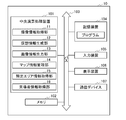
- FIG. 1A is a block diagram showing a configuration of an example of the apparatus of the first embodiment
- FIG. 1B is a schematic diagram showing a configuration of an example of the system of the fourth embodiment
- FIG. 2 is a block diagram showing an example of the hardware configuration of the apparatus of the first embodiment.
- FIG. 3 is a flowchart showing an example of processing in the apparatus of the first embodiment.
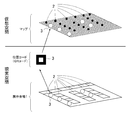
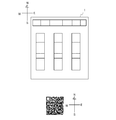
- FIG. 4 is a schematic diagram showing an example of the relationship between the map of the exhibition hall and the position code.
- FIG. 5 is a schematic diagram showing an example in which a terminal captures a position code.
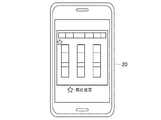
- FIG. 6 is a schematic diagram showing an example of displaying the position of the terminal on the display of the terminal of the visitor.
- FIG. 1A is a block diagram showing a configuration of an example of the apparatus of the first embodiment
- FIG. 1B is a schematic diagram showing a configuration of an example of the system of the fourth embodiment.
- FIG. 2 is a block diagram showing an example of the hardware configuration of the apparatus of the
- FIG. 7 is a schematic diagram showing an example of a composite image in which a virtual image relating to a specific area is superimposed on a captured image.
- FIG. 8 is a schematic diagram showing an example of a composite image in which a virtual image relating to a specific area is superimposed on a captured image.
- FIG. 9 is a schematic diagram showing an example of the relationship between the map of the exhibition hall and the direction of the position code.
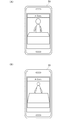
- FIG. 10 is a schematic diagram showing an example of the relationship between the orientation of the map of the exhibition hall and the orientation of the terminal.
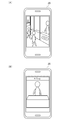
- FIG. 11 is a schematic diagram showing an example of the relationship between the tilt of the terminal and the image displayed on the display of the terminal.
- the "visitor” means a person who comes within a specific area, and is also referred to as a user. Visitors can also be rephrased as visitors, visitors, and the like.
- FIG. 1A is a block diagram showing a configuration of an example of the navigation device 10 of the present embodiment
- FIG. 1B is a schematic showing a configuration of an example of a navigation system including the navigation device 10 of the present embodiment. It is a figure.
- the apparatus 10 includes an image pickup information acquisition unit 11, a virtual information generation unit 12, an image information output unit 13, a map information management unit 14, a specific area information acquisition unit 15, and a visitor information acquisition. Including part 16.
- the specific area information acquisition unit 15 and the visitor information acquisition unit 16 have an arbitrary configuration and may not be included in the present device 10.
- the navigation system device will be described in the fourth embodiment.
- the device 10 may be, for example, one device including the above-mentioned parts, or may be a device in which the above-mentioned parts can be connected via the communication network 30. Further, the present device 10 can be connected to an external device described later via the communication line network 30.
- the communication network 30 is not particularly limited, and a known network can be used, and may be wired or wireless, for example. Examples of the communication line network 30 include an Internet line, WWW (World Wide Web), a telephone line, LAN (Local Area Network), SAN (Storage Area Network), DTN (Delay Traveler Network), and the like. Examples of wireless communication include WiFi (Wireless Fidelity), Bluetooth (registered trademark) and the like.
- the wireless communication may be either a form in which each device directly communicates (Ad Hoc communication) or an indirect communication via an access point.
- the apparatus 10 may be incorporated in the server as a system, for example. Further, the apparatus 10 is, for example, a personal computer (PC, for example, a desktop type, a notebook type), a terminal (for example, a smartphone, a mobile phone, a glasses type, a watch type, or the like) wearable terminal on which the program of the present invention is installed. ) Etc. may be used.
- FIG. 2 illustrates a block diagram of the hardware configuration of the present device 10.
- the apparatus 10 includes, for example, a central processing unit (CPU, GPU, etc.) 101, a memory 102, a bus 103, a storage device 104, an input device 105, a display device 106, a communication device 107, and the like. Each part of the apparatus 10 is connected to each other via a bus 103 by each interface (I / F).
- I / F interface
- the central processing unit (also referred to as a central processing unit or a central processing unit) 101 is responsible for controlling the entire device 10.
- the program of the present invention and other programs are executed by the central processing unit 101, and various information is read and written.
- the central processing unit 101 includes an imaging information acquisition unit 11, a virtual information generation unit 12, an image information output unit 13, a map information management unit 14, a specific area information acquisition unit 15, and a visitor information acquisition unit. Functions as 16.
- the bus 103 can also be connected to, for example, an external device.
- the external device include an external storage device (external database, etc.), a printer, and the like.
- the device 10 can be connected to an external network (communication network) by, for example, a communication device 107 connected to the bus 103, and can also be connected to another device via the external network.
- the memory 102 may be, for example, a main memory (main storage device).
- main memory main storage device
- the memory 102 reads various operation programs such as the program of the present invention stored in the storage device 104 described later, and the central processing unit 101 reads the memory. Receives data from 102 and executes the program.
- the main memory is, for example, a RAM (random access memory).
- the memory 102 may be, for example, a ROM (read-only memory).
- the storage device 104 is also referred to as a so-called auxiliary storage device with respect to the main memory (main storage device), for example.
- the storage device 104 stores an operation program including the program of the present invention.
- the storage device 104 may be, for example, a combination of a recording medium and a drive for reading and writing to the recording medium.
- the recording medium is not particularly limited, and may be an internal type or an external type, and examples thereof include HD (hard disk), CD-ROM, CD-R, CD-RW, MO, DVD, flash memory, and memory card. Be done.
- the storage device 104 may be, for example, a hard disk drive (HDD) in which a recording medium and a drive are integrated, and a solid state drive (SSD).
- HDD hard disk drive
- SSD solid state drive
- the memory 102 and the storage device 104 can also store user log information and information acquired from an external database (not shown).
- the device 10 further includes, for example, an input device 105 and a display device 106.
- the input device 105 is, for example, a touch panel, a keyboard, a mouse, or the like.
- Examples of the display device 106 include an LED display, a liquid crystal display, and the like.
- the navigation method of the present embodiment is carried out as follows, for example, by using the navigation device 10 of FIG.
- the navigation method of the present embodiment is not limited to the use of the navigation device 10 of FIG.
- the image pickup information acquisition unit 11 acquires an image captured by a terminal of a visitor in a specific area (S1).
- the specific area is not particularly limited and may be indoors or outdoors.
- the indoors include, for example, exhibition halls, event halls, department stores, schools such as universities, and the like.
- the terminal of the visitor is not particularly limited, and is, for example, a wearable terminal such as a smartphone, a mobile phone, a spectacle type, and a wristwatch type.
- the captured image may be, for example, a still image or a moving image.
- the acquisition is performed, for example, via the communication network 30.
- the virtual information generation unit 12 generates a virtual image related to the specific area (S2).
- the virtual image relating to the specific area is, for example, a pin image showing a booth position or the like.
- the image information output unit 13 outputs a composite image in which the virtual image is superimposed on the captured image (S3).
- the output may be executed, for example, via the communication network 30.
- the map information management unit 14 manages the position code arranged in the specific area and the map information of the specific area in association with each other (S4).
- the position code includes, for example, a QR code (registered trademark), an AR marker, a barcode, a chameleon code (registered trademark), and the like.
- FIG. 4 shows an example of the relationship between the map of the exhibition hall and the location code.
- the exhibition hall 1 will be used as the specific area, but it is an example and is not limited to this as described above.
- a plurality of exhibition booths 2 are arranged in the exhibition hall 1. Further, in the exhibition hall 1, for example, position codes (QR code (registered trademark)) 3 are arranged at regular intervals (for example, 15 m intervals).
- the arrangement of the exhibition booth 2 and the position code 3 is not particularly limited.
- the position code 3 is, for example, a marker for specifying a position in the exhibition hall 1.
- the number of position codes 3 is not particularly limited, and may be one or two or more.
- the installation location of the position code 3 is not particularly limited, and may be, for example, a floor, a wall, a ceiling, or a panel having the position code 3 may be installed by hanging it from the ceiling to the air. good.
- the position of the position code 3 installed in the exhibition hall 1 is associated with the map information (map of the virtual space). Further, the location of the exhibition booth 2 is also linked to the map information by, for example, the map information management unit 14.
- the map information is, for example, coordinate information.
- FIG. 5 shows an example in which the terminal of the visitor captures the position code.
- the visitor's terminal 20 captures, for example, a position code 3 arranged on the floor of the exhibition hall 1.
- FIG. 6 shows an example of displaying the position (current position) of the specified terminal on the display of the visitor's terminal.
- the apparatus 10 may transmit the position (that is, the current position) of the specified terminal 20 to the terminal 20 via, for example, the communication network 30.
- the terminal 20 displays the current position of the terminal 20 in the specific area superimposed on the map on the display of the terminal 20.
- the map displayed on the terminal 20 is, for example, a map of the exhibition hall 1, and is preferably schematically based on the coordinate information.
- the "current position" means the position of the terminal of the visitor at the time when the position code is imaged.
- the virtual information generation unit 12 may generate a virtual image related to the specific area based on the position of the terminal of the visitor specified by the map information management unit 14, for example.
- FIG. 7 shows an example of a composite image in which a virtual image relating to the specific area is superimposed on the captured image. As shown in FIG. 7, on the terminal 20 to which the composite image is output, a composite image in which the pins 4a and 4b of the exhibition booth, which are virtual images, are superimposed on the captured image of the specific area captured by the terminal 20 is displayed. Is displayed. In FIG. 7, the pin 4a of the exhibition booth is displayed larger than the pin 4b of the exhibition booth.
- the pin 4 of the exhibition booth is, for example, based on the position information of the specified terminal 20, the farther the position of the exhibition booth 2 is from the position information of the terminal 20, the more the pin 4 of the exhibition booth is located.
- the size may be smaller than the pin 4 of the other exhibition booth, and the closer the position of the exhibition booth 2 is from the position information of the terminal 20, the larger the size of the pin 4 of the exhibition booth will be. It may be larger than 4.
- the pin 4 of the exhibition booth may color the outer edge of the pin 4 of the exhibition booth according to the distance from the position information of the terminal 20 to the position of the exhibition booth 2, for example. Identification information may be assigned to each of the pins 4 of the exhibition booth by the virtual information generation unit 12.
- the identification information is, for example, a number, a character, a symbol, or a combination of two or more thereof.
- the present device 10 can generate a virtual image such as a pin 4 of the exhibition booth according to the position of the specified terminal 20, for example.
- the specific area information acquisition unit 15 may acquire information regarding the specific area (S7).
- the step (S7) may be processed in parallel with the step (S1), for example, as shown in FIG.
- the acquisition may be executed, for example, via the communication network 30, or may be acquired by input by the input device 105.
- the information regarding the specific area is, for example, information about an exhibition booth or the like, and more specifically, information about a company name, company introduction information, products, services, or the like.
- the virtual information generation unit 12 may generate a virtual image regarding the specific area based on the information regarding the specific area, for example. As a result, as shown in FIG.
- the visitor information acquisition unit 16 may acquire information about the visitor (S8).
- the step (S8) may be processed in parallel with the step (S1), for example, as shown in FIG.
- the acquisition may be executed, for example, via the communication network 30, or may be acquired by input by the input device 105.
- the information about the visitors is, for example, the attributes of the visitors (gender, age, occupation), the purpose of the visit (inspection, business negotiations, etc.), the exhibition booth (area) of interest, and the like.
- the image information output unit 13 outputs a composite image in which the virtual image is superimposed on the captured image according to the information about the visitor.
- the virtual image includes recommendation information, schedule information, exhibition booth information, and the like.
- the recommendation information is, for example, information recommended to the visitor based on the information about the visitor (for example, a recommended event, a recommended exhibition booth, etc.).
- the schedule information is, for example, information indicating the schedule of an event to be held in the specific area. Examples of the event include demonstrations and seminars.
- the event may be an event promoted by the organizer or an event promoted by the exhibitor.
- the exhibition booth information is, for example, the same as the above-mentioned information regarding the exhibition booth.
- the apparatus 10 may further include, for example, a route calculation unit.
- the map information further includes, for example, the position information of an obstacle existing in the specific area.
- the obstacle is not particularly limited, and is, for example, an object that obstructs passage such as a wall.
- the route calculation unit calculates a route from the position of the terminal of the visitor to the input position based on the map information.
- the input of the position may be input by, for example, acquiring from the terminal, or may be input by the input device 105.
- the position is not particularly limited, and is, for example, the position of an exhibition booth or the like.
- FIG. 8 shows an example of a composite image in which a virtual image relating to the specific area is superimposed on the captured image.
- the visitor 6 selects a pin 4 (pin 4b in FIG. 8) of an arbitrary exhibition booth by tapping the display of the terminal 20.
- the apparatus 10 acquires, for example, information indicating that the pin 4b of the exhibition booth is selected.
- the route calculation unit calculates a route from the position (Start) of the visitor 6 to the position (Goal) of the exhibition booth on the map information associated with the pin 4b of the selected exhibition booth. Then, using the composite image output from the present device 10, the visitor 6 is guided to the position (Goal) of the exhibition booth corresponding to the pin 4b of the selected exhibition booth.
- the composite image for guiding the visitor 6 is, for example, an image in which a guidance virtual object 5 such as an arrow and a character is superimposed on the captured image. As a result, for example, even a person who is not good at reading a map can go to a destination without stress.
- the composite image may be, for example, an image in which a map (2D object) (not shown) of the specific area is superimposed on the captured image in place of or in addition to the guidance virtual object 5.
- the current position may be superimposed on the map.
- GPS Global Positioning System
- the position of the terminal since the position of the terminal can be specified by using the position code 3, it depends on the environmental conditions such as the specific area (when it is indoors or when the communication state is not good). It is not possible to calculate the route.
- FIG. 9 is a schematic diagram showing the relationship between the map of the exhibition hall 3 and the direction of the position code 3.
- a direction mark for specifying the orientation of the terminal 20 may be arranged.
- the direction mark may be, for example, an image whose direction (direction) can be confirmed on the map information, and may be a mark (code) different from the position code 3.
- the position code 3 may also serve as the direction mark.
- the shape of the marker in the position code 3 can be used to function as the direction mark.
- the direction is, for example, north, south, east, and west.
- the map information management unit 14 further manages the direction mark and the map information of the specific area (exhibition hall 1) in association with each other. Specifically, for example, each direction of the direction mark and each direction of the map information of the specific area (exhibition hall 1) are matched and managed.
- the direction mark is imaged by the terminal 20, for example, the captured image of the direction mark (also referred to as a direction mark image) is acquired by the image pickup information acquisition unit 11.
- the map information management unit 14 further specifies the direction of the visitor's terminal, which direction the visitor's terminal is facing, from the image of the direction mark based on the map information.
- FIG. 10 is a schematic diagram showing the relationship between the direction of the map of the exhibition hall 3 and the direction of the terminal 20.
- the virtual information generation unit 12 may generate a virtual image relating to the specific area, for example, based on the orientation of the visitor's terminal specified by the map information management unit 14. Then, the image information output unit 13 outputs, for example, a composite image in which the virtual image is superimposed on the captured image.
- FIG. 10A the display of the terminal 20 displays a composite image in which the company name (A Corp.), which is a virtual image, is superimposed on the captured image obtained by capturing the exhibition booth of the company A from an oblique direction.
- FIG. 10B the display of the terminal 20 displays a composite image in which the company name (virtual image) is superimposed on the captured image obtained by capturing the exhibition booth of the company A from the front direction.
- the image pickup information acquisition unit 11 acquires the image of the image of the floor (also referred to as a floor image). Then, the map information management unit 14 identifies the inclination of the visitor's terminal from the floor image.
- the floor in the specific area is preferably flat. Specifically, for example, a flat panel expands with respect to the real space shown in the floor image, and the tilt of the terminal is specified from the tilt of the panel (also referred to as a flat scan). That is, the inclination of the terminal 20 can be specified from the inclination state of the floor image.
- the floor image may include, for example, at least one of the position code and the direction mark.
- the map information management unit 14 may specify the inclination of the terminal 20 from, for example, the inclination of at least one of the position code and the direction mark.
- FIG. 11 is a schematic diagram showing an example of the relationship between the tilt of the terminal 20 and the image displayed on the display of the terminal 20.
- a composite image as shown in FIG. 11A is displayed on the display of the terminal 20.
- the composite image of FIG. 11A is based on the tilt of the terminal 20.
- the tilted (distorted) composite image is displayed on the display of the terminal 20.
- the image shown in FIG. 11A is a composite image in which the company name (A Corp.), which is a virtual image, is superimposed on the captured image obtained by capturing the exhibition booth of company A from the front direction.
- the image shown in b) is a composite image in which the company name (A Corp.), which is a virtual image, is superimposed on the captured image obtained by capturing the exhibition booth of company A from above.
- the apparatus 10 may correct the captured image from the inclination of the specified terminal 20, for example. Then, the image information output unit 13 outputs, for example, a composite image in which the virtual image is superimposed on the corrected captured image. That is, for example, even when the terminal 20 is specified to be tilted, the present device 10 is not a composite image shown in FIG. 11 (b) but a composite image shown in FIG. 11 (a). to correct.
- FIG. 1B is a schematic diagram showing a configuration of an example of the navigation system of the present embodiment.
- the navigation system of the present embodiment includes the navigation device 10 according to any one of the first to third embodiments, and the terminal 20.
- the terminal 20 is a terminal of a visitor in the specific area.
- the navigation device 10 and the terminal 20 can communicate with each other via the communication network 30.
- the navigation system is also referred to as a navigation system device.
- the terminal 20 activates the image pickup device and prompts the user (for example, a visitor) to take a picture of the position code.
- the user searches for the position code arranged in the specific area, and captures the position code on the image pickup device.
- the position code is read by the navigation device 10, and the position of the user's terminal 20 is specified.
- the orientation of the terminal 20 is also specified, for example. Specifically, for example, after the orientation of the terminal 20 is specified, the position of the terminal 20 is specified.
- the program of the present embodiment is a program for causing a computer to execute each step of the method of the present invention as a procedure.
- "procedure” may be read as "processing”.
- the program of the present embodiment may be recorded on a computer-readable recording medium, for example.
- the recording medium is, for example, a non-transitory computer-readable storage medium.
- the recording medium is not particularly limited, and examples thereof include a read-only memory (ROM), a hard disk (HD), and an optical disk.
- Appendix 1 Includes image capture information acquisition unit, virtual information generation unit, image information output unit, and map information management unit.
- the image pickup information acquisition unit acquires an image captured by a terminal of a visitor in a specific area, and obtains an image captured.
- the virtual information generation unit generates a virtual image relating to the specific area, and generates a virtual image.
- the image information output unit outputs a composite image in which the virtual image is superimposed on the captured image.
- the map information management unit manages the position code arranged in the specific area and the map information of the specific area in association with each other.
- the map information management unit identifies the position of the visitor's terminal from the image of the position code based on the map information.
- Navigation device (Appendix 2)
- the virtual information generation unit generates a virtual image regarding the specific area based on the position of the terminal of the visitor specified by the map information management unit.
- the navigation device according to Appendix 1.
- Appendix 3 In the specific area, a direction mark for specifying the orientation of the visitor's terminal is arranged.
- the map information management unit manages the direction mark and the map information of the specific area in association with each other.
- the map information management unit identifies the direction of the visitor's terminal from the image of the direction mark based on the map information.
- the navigation device according to Appendix 1 or 2. (Appendix 4)
- the virtual information generation unit generates a virtual image relating to the specific area based on the orientation of the visitor's terminal specified by the map information management unit.
- the navigation device according to Appendix 3. (Appendix 5)
- the position code also serves as the direction mark.
- the navigation device according to Appendix 3 or 4. (Appendix 6) When the floor of the specific area is imaged by the terminal of the visitor, the image of the imaged floor is acquired by the image pickup information acquisition unit.
- the map information management unit identifies the inclination of the visitor's terminal from the image of the floor.
- the navigation device according to any one of Supplementary Notes 1 to 5.
- the image of the floor is an image including at least one of the position code and the direction mark.
- the navigation device according to Appendix 6. (Appendix 8) In addition, it includes a specific area information acquisition section.
- the specific area information acquisition unit acquires information about the specific area and obtains information about the specific area.
- the virtual information generation unit generates a virtual image related to the specific area based on the information about the specific area.
- the navigation device according to any one of Supplementary Provisions 1 to 7.
- the visitor information acquisition unit acquires information about the visitor and obtains information about the visitor.
- the image information output unit outputs a composite image in which the virtual image is superimposed on the captured image according to the information about the visitor.
- the navigation device according to any one of Supplementary Provisions 1 to 8.
- the navigation device is the navigation device according to any one of Supplementary Provisions 1 to 9.
- the terminal is a terminal of a visitor in the specific area.
- the navigation device and the terminal can communicate with each other via a communication network.
- Navigation system. (Appendix 11) Includes imaging information acquisition process, virtual information generation process, image information output process, and map information management process.
- the image pickup information acquisition step an image captured by a terminal of a visitor in a specific area is acquired.
- the virtual information generation step generates a virtual image relating to the specific area, and generates a virtual image.
- the image information output step a composite image in which the virtual image is superimposed on the captured image is output.
- the map information management process manages the position code arranged in the specific area and the map information of the specific area in association with each other.
- the image pickup information acquisition step acquires the image of the imaged position code.
- the map information management step identifies the position of the visitor's terminal from the image of the position code based on the map information. Navigation method.
- the virtual information generation step generates a virtual image relating to the specific area based on the position of the terminal of the visitor specified by the map information management step.
- the navigation method according to Appendix 11. (Appendix 13) In the specific area, a direction mark for specifying the orientation of the visitor's terminal is arranged.
- the map information management process manages the direction mark and the map information of the specific area in association with each other.
- the image pickup information acquisition step acquires the image of the imaged direction mark.
- the map information management step identifies the direction of the visitor's terminal, which direction the visitor's terminal is facing, from the image of the direction mark based on the map information.
- the virtual information generation step generates a virtual image relating to the specific area based on the orientation of the visitor's terminal specified by the map information management step.
- the navigation method according to Appendix 13. (Appendix 15) The position code also serves as the direction mark.
- the image pickup information acquisition step acquires the image of the imaged floor.
- the map information management step identifies the inclination of the visitor's terminal from the image of the floor.
- the navigation method according to any one of Supplementary note 11 to 15. (Appendix 17)
- the image of the floor is an image including at least one of the position code and the direction mark.
- (Appendix 18) In addition, it includes a specific area information acquisition process.
- the specific area information acquisition process acquires information about the specific area and obtains information.
- the virtual information generation step generates a virtual image related to the specific area based on the information about the specific area.
- the navigation method according to any one of Supplementary note 11 to 17.
- (Appendix 19) In addition, it includes a visitor information acquisition process.
- the visitor information acquisition process acquires information about the visitor and obtains information about the visitor.
- the image information output step outputs a composite image in which the virtual image is superimposed on the captured image according to the information about the visitor.
- the navigation method according to any one of Supplementary note 11 to 18.
- Appendix 20 A program for causing a computer to perform a procedure including an imaging information acquisition procedure, a virtual information generation procedure, an image information output procedure, and a map information management procedure;
- the image pickup information acquisition procedure an image captured by a terminal of a visitor in a specific area is acquired.
- the virtual information generation procedure generates a virtual image relating to the specific area and generates a virtual image.
- the image information output procedure a composite image in which the virtual image is superimposed on the captured image is output.
- the map information management procedure manages the position code arranged in the specific area and the map information of the specific area in association with each other. When the position code is imaged by the terminal of the visitor, the image pickup information acquisition procedure acquires the image of the imaged position code.
- the map information management procedure identifies the position of the visitor's terminal from the image of the position code based on the map information.
- the virtual information generation procedure generates a virtual image relating to the specific area based on the position of the visitor's terminal specified by the map information management procedure.
- the program described in Appendix 20 In the specific area, a direction mark for specifying the orientation of the visitor's terminal is arranged.
- the map information management procedure manages the direction mark and the map information of the specific area in association with each other. When the direction mark is imaged by the terminal of the visitor, the imaged direction mark image is acquired by the image pickup information acquisition procedure.
- the map information management procedure specifies the direction of the visitor's terminal, which direction the visitor's terminal is facing, from the image of the direction mark based on the map information.
- the program described in Appendix 20 or 21. (Appendix 23)
- the virtual information generation procedure generates a virtual image relating to the specific area based on the orientation of the visitor's terminal specified by the map information management procedure.
- the program described in Appendix 22. (Appendix 24)
- the position code also serves as the direction mark.
- the program described in Appendix 22 or 23. (Appendix 25) When the floor of the specific area is imaged by the terminal of the visitor, the image of the imaged floor is acquired by the image pickup information acquisition procedure.
- the map information management procedure identifies the inclination of the visitor's terminal from the image of the floor.
- the program described in any of the appendices 20 to 24. The image of the floor is an image including at least one of the position code and the direction mark.
- the program described in Appendix 25. (Appendix 27)
- the specific area information acquisition procedure acquires information about the specific area and obtains information.
- the virtual information generation procedure generates a virtual image related to the specific area based on the information about the specific area.
- the visitor information acquisition procedure acquires information about the visitor and obtains information about the visitor.
- the image information output procedure outputs a composite image in which the virtual image is superimposed on the captured image according to the information about the visitor.
- the program described in any of the appendices 20 to 27. (Appendix 29) A computer-readable recording medium recording the program according to any one of the appendices 20 to 28.
- the present invention it is possible to transmit information using AR in a large facility or the like of an exhibition hall, and it is possible to easily confirm the current position. Therefore, according to the present invention, it is useful in various fields to which AR technology can be applied.
Landscapes
- Engineering & Computer Science (AREA)
- Physics & Mathematics (AREA)
- Theoretical Computer Science (AREA)
- General Physics & Mathematics (AREA)
- Business, Economics & Management (AREA)
- Remote Sensing (AREA)
- Radar, Positioning & Navigation (AREA)
- Educational Technology (AREA)
- Tourism & Hospitality (AREA)
- Mathematical Physics (AREA)
- Educational Administration (AREA)
- General Business, Economics & Management (AREA)
- Human Resources & Organizations (AREA)
- Marketing (AREA)
- Primary Health Care (AREA)
- Strategic Management (AREA)
- General Health & Medical Sciences (AREA)
- Economics (AREA)
- Health & Medical Sciences (AREA)
- Automation & Control Theory (AREA)
- Navigation (AREA)
- Instructional Devices (AREA)
- Processing Or Creating Images (AREA)
- Management, Administration, Business Operations System, And Electronic Commerce (AREA)
Priority Applications (1)
| Application Number | Priority Date | Filing Date | Title |
|---|---|---|---|
| JP2022532472A JP7294735B2 (ja) | 2020-06-15 | 2021-06-01 | ナビゲーション装置、ナビゲーションシステム、ナビゲーション方法、プログラム、及び、記録媒体 |
Applications Claiming Priority (2)
| Application Number | Priority Date | Filing Date | Title |
|---|---|---|---|
| JP2020-102758 | 2020-06-15 | ||
| JP2020102758 | 2020-06-15 |
Publications (1)
| Publication Number | Publication Date |
|---|---|
| WO2021256239A1 true WO2021256239A1 (ja) | 2021-12-23 |
Family
ID=79267901
Family Applications (1)
| Application Number | Title | Priority Date | Filing Date |
|---|---|---|---|
| PCT/JP2021/020829 Ceased WO2021256239A1 (ja) | 2020-06-15 | 2021-06-01 | ナビゲーション装置、ナビゲーションシステム、ナビゲーション方法、プログラム、及び、記録媒体 |
Country Status (2)
| Country | Link |
|---|---|
| JP (1) | JP7294735B2 (https=) |
| WO (1) | WO2021256239A1 (https=) |
Cited By (1)
| Publication number | Priority date | Publication date | Assignee | Title |
|---|---|---|---|---|
| CN116242339A (zh) * | 2023-05-11 | 2023-06-09 | 天津市安定医院 | 一种基于5g的医院门诊导航系统 |
Families Citing this family (1)
| Publication number | Priority date | Publication date | Assignee | Title |
|---|---|---|---|---|
| JP2025009010A (ja) * | 2023-07-06 | 2025-01-20 | mov株式会社 | 情報処理システム及びその方法、並びに、プログラム、そのプログラムを記憶した媒体 |
Citations (3)
| Publication number | Priority date | Publication date | Assignee | Title |
|---|---|---|---|---|
| JP2009033366A (ja) * | 2007-07-25 | 2009-02-12 | Advanced Telecommunication Research Institute International | 光学マーカシステム |
| JP2019114078A (ja) * | 2017-12-25 | 2019-07-11 | ソニー株式会社 | 情報処理装置、情報処理方法及びプログラム |
| WO2019234936A1 (ja) * | 2018-06-08 | 2019-12-12 | マクセル株式会社 | 携帯端末、カメラ位置推定システム、カメラ位置推定方法および標識板 |
-
2021
- 2021-06-01 JP JP2022532472A patent/JP7294735B2/ja active Active
- 2021-06-01 WO PCT/JP2021/020829 patent/WO2021256239A1/ja not_active Ceased
Patent Citations (3)
| Publication number | Priority date | Publication date | Assignee | Title |
|---|---|---|---|---|
| JP2009033366A (ja) * | 2007-07-25 | 2009-02-12 | Advanced Telecommunication Research Institute International | 光学マーカシステム |
| JP2019114078A (ja) * | 2017-12-25 | 2019-07-11 | ソニー株式会社 | 情報処理装置、情報処理方法及びプログラム |
| WO2019234936A1 (ja) * | 2018-06-08 | 2019-12-12 | マクセル株式会社 | 携帯端末、カメラ位置推定システム、カメラ位置推定方法および標識板 |
Cited By (2)
| Publication number | Priority date | Publication date | Assignee | Title |
|---|---|---|---|---|
| CN116242339A (zh) * | 2023-05-11 | 2023-06-09 | 天津市安定医院 | 一种基于5g的医院门诊导航系统 |
| CN116242339B (zh) * | 2023-05-11 | 2023-10-03 | 天津市安定医院 | 一种基于5g的医院门诊导航系统 |
Also Published As
| Publication number | Publication date |
|---|---|
| JP7294735B2 (ja) | 2023-06-20 |
| JPWO2021256239A1 (https=) | 2021-12-23 |
Similar Documents
| Publication | Publication Date | Title |
|---|---|---|
| US11830249B2 (en) | Augmented reality, computer vision, and digital ticketing systems | |
| US10677596B2 (en) | Image processing device, image processing method, and program | |
| US7840343B2 (en) | Mobile terminal having map display function, map display system, information distribution server and program | |
| US9607094B2 (en) | Information communication method and information communication apparatus | |
| KR20160090198A (ko) | 전시 안내 장치, 전시 디스플레이 장치 및 단말 장치와 전시 안내 방법 | |
| JP7294735B2 (ja) | ナビゲーション装置、ナビゲーションシステム、ナビゲーション方法、プログラム、及び、記録媒体 | |
| Stähli et al. | Evaluation of pedestrian navigation in smart cities | |
| KR20120087269A (ko) | 경로 지도 정보 서비스를 제공하는 방법 및 시스템 | |
| KR102451012B1 (ko) | 증강현실을 이용한 정류장 정보 안내 서비스 시스템 및 방법 | |
| JP7332197B2 (ja) | 情報共有装置、イベント支援システム、情報共有方法、及びイベント支援システムの生産方法 | |
| JP2014164572A (ja) | 情報処理装置およびプログラム | |
| JP2014109539A (ja) | 案内情報提供装置および案内情報提供方法 | |
| JP7376191B2 (ja) | ガイド装置、ガイドシステム、ガイド方法、プログラム、及び、記録媒体 | |
| JP7368048B2 (ja) | 表示装置、イベント支援システム、表示方法、及びイベント支援システムの生産方法 | |
| JP7287710B2 (ja) | 需要度算出装置、イベント支援システム、需要度算出方法、及びイベント支援システムの生産方法 | |
| TWM657522U (zh) | 擴增實境系統 | |
| US20240127294A1 (en) | Advertisement information generation apparatus, event support system, advertisement information generation method, and event support system production method | |
| JP7355467B2 (ja) | ガイド装置、ガイドシステム、ガイド方法、プログラム、及び、記録媒体 | |
| JP2024025997A (ja) | 情報処理装置、情報処理方法及び情報処理プログラム | |
| JP7393054B2 (ja) | ガイド装置、ガイドシステム、ガイド方法、プログラム、及び、記録媒体 | |
| JP2011191892A (ja) | 画像表示システム、携帯情報端末及び画像表示プログラム | |
| JP2022118554A (ja) | 情報処理装置、情報処理方法及び情報処理プログラム | |
| KR102792539B1 (ko) | 뷰잉 맵을 이용한 인공지능 기반 위치 표시 방법 | |
| JP2023150584A (ja) | 位置情報マップ作成装置、現在位置特定装置、位置情報マップ生産方法、現在位置特定方法、及びプログラム | |
| JP7354165B2 (ja) | 情報処理装置、情報処理方法及び情報処理プログラム |
Legal Events
| Date | Code | Title | Description |
|---|---|---|---|
| 121 | Ep: the epo has been informed by wipo that ep was designated in this application |
Ref document number: 21825826 Country of ref document: EP Kind code of ref document: A1 |
|
| ENP | Entry into the national phase |
Ref document number: 2022532472 Country of ref document: JP Kind code of ref document: A |
|
| NENP | Non-entry into the national phase |
Ref country code: DE |
|
| 122 | Ep: pct application non-entry in european phase |
Ref document number: 21825826 Country of ref document: EP Kind code of ref document: A1 |