WO2021251464A1 - アプリケータ、マイクロニードルパッチキット、及び穿刺方法 - Google Patents
アプリケータ、マイクロニードルパッチキット、及び穿刺方法 Download PDFInfo
- Publication number
- WO2021251464A1 WO2021251464A1 PCT/JP2021/022133 JP2021022133W WO2021251464A1 WO 2021251464 A1 WO2021251464 A1 WO 2021251464A1 JP 2021022133 W JP2021022133 W JP 2021022133W WO 2021251464 A1 WO2021251464 A1 WO 2021251464A1
- Authority
- WO
- WIPO (PCT)
- Prior art keywords
- puncture
- skin
- array
- region
- microneedle
- Prior art date
- Legal status (The legal status is an assumption and is not a legal conclusion. Google has not performed a legal analysis and makes no representation as to the accuracy of the status listed.)
- Ceased
Links
Images









Classifications
-
- A—HUMAN NECESSITIES
- A61—MEDICAL OR VETERINARY SCIENCE; HYGIENE
- A61M—DEVICES FOR INTRODUCING MEDIA INTO, OR ONTO, THE BODY; DEVICES FOR TRANSDUCING BODY MEDIA OR FOR TAKING MEDIA FROM THE BODY; DEVICES FOR PRODUCING OR ENDING SLEEP OR STUPOR
- A61M37/00—Other apparatus for introducing media into the body; Percutany, i.e. introducing medicines into the body by diffusion through the skin
- A61M37/0015—Other apparatus for introducing media into the body; Percutany, i.e. introducing medicines into the body by diffusion through the skin by using microneedles
-
- A—HUMAN NECESSITIES
- A61—MEDICAL OR VETERINARY SCIENCE; HYGIENE
- A61M—DEVICES FOR INTRODUCING MEDIA INTO, OR ONTO, THE BODY; DEVICES FOR TRANSDUCING BODY MEDIA OR FOR TAKING MEDIA FROM THE BODY; DEVICES FOR PRODUCING OR ENDING SLEEP OR STUPOR
- A61M37/00—Other apparatus for introducing media into the body; Percutany, i.e. introducing medicines into the body by diffusion through the skin
- A61M37/0015—Other apparatus for introducing media into the body; Percutany, i.e. introducing medicines into the body by diffusion through the skin by using microneedles
- A61M2037/0023—Drug applicators using microneedles
-
- A—HUMAN NECESSITIES
- A61—MEDICAL OR VETERINARY SCIENCE; HYGIENE
- A61M—DEVICES FOR INTRODUCING MEDIA INTO, OR ONTO, THE BODY; DEVICES FOR TRANSDUCING BODY MEDIA OR FOR TAKING MEDIA FROM THE BODY; DEVICES FOR PRODUCING OR ENDING SLEEP OR STUPOR
- A61M37/00—Other apparatus for introducing media into the body; Percutany, i.e. introducing medicines into the body by diffusion through the skin
- A61M37/0015—Other apparatus for introducing media into the body; Percutany, i.e. introducing medicines into the body by diffusion through the skin by using microneedles
- A61M2037/0046—Solid microneedles
-
- A—HUMAN NECESSITIES
- A61—MEDICAL OR VETERINARY SCIENCE; HYGIENE
- A61M—DEVICES FOR INTRODUCING MEDIA INTO, OR ONTO, THE BODY; DEVICES FOR TRANSDUCING BODY MEDIA OR FOR TAKING MEDIA FROM THE BODY; DEVICES FOR PRODUCING OR ENDING SLEEP OR STUPOR
- A61M37/00—Other apparatus for introducing media into the body; Percutany, i.e. introducing medicines into the body by diffusion through the skin
- A61M37/0015—Other apparatus for introducing media into the body; Percutany, i.e. introducing medicines into the body by diffusion through the skin by using microneedles
- A61M2037/0061—Methods for using microneedles
Definitions
- the present disclosure relates to an applicator for puncturing the skin with a microneedle array, a microneedle patch kit containing the applicator, and a puncture method for puncturing the skin with the microneedle array.
- a drug administration system using a microneedle array has been attracting attention as one of the transdermal drug administration systems.
- fine needles with a length of several hundred microns are densely formed on the base material, and needles carrying target drugs (molecules such as vaccines, proteins, peptides, etc.) on the surface or inside are placed on the skin. It stabs and transfers the drug directly to the dermis or epidermis.
- Drug administration using a microneedle array does not burden the liver like oral drugs, does not cause pain associated with needle invasion like injections, and can reduce side effects due to temporary excessive drug absorption. It has many advantages such as.
- the microneedle array described in Patent Document 1 below aims to uniformly increase wrinkles on the skin, and is intended to effectively pierce the skin having irregularities due to wrinkles.
- Patent Document 1 aims to effectively pierce wrinkled skin with microneedles, but it is necessary to reliably pierce the skin with a large number of microneedles provided in the microneedle array regardless of the presence or absence of wrinkles. There is no disclosure about.
- the present disclosure discloses an applicator capable of reliably puncturing the skin with a large number of microneedles provided in the microneedle array, a microneedle patch kit containing the applicator, and a puncture that reliably punctures the skin with the microneedle array.
- the purpose is to provide a method.
- the present inventors focused on how to apply force to the microneedle array in order to solve the above problems.
- the present inventors have found that when a force is applied to the entire microneedle array toward the skin, the microneedles provided in the central region of the microneedle array may not sufficiently pierce the skin. This disclosure is based on this new finding.
- the present disclosure is an applicator for puncturing a microneedle array into the skin, in which a holding portion for holding the microneedle array and a central array region of the microneedle array are located on the peripheral side of the microneedle array with respect to the central array region. It is provided with a puncture promoting portion for forming a puncture completed state so as to project toward the skin side from the peripheral array region provided in the above.
- the skin When trying to push the microneedle array into the skin, the skin dents according to the force that pushes the skin due to its elasticity.
- the central array region is projected toward the skin side from the peripheral array region and pushed along the concave skin so that the microneedles are evenly applied with force and inserted into the skin.
- the holding portion holds the microneedle array
- the puncture promoting portion forms a puncture complete state in which the central array region protrudes toward the skin side from the peripheral array region, and is therefore provided in the peripheral array region.
- the microneedles provided in the central array region can be reliably punctured into the skin.
- the puncture promoting portion can form a pre-puncture state in which the central array region does not protrude toward the skin side from the peripheral array region before the puncture completion state.
- the microneedle array In the pre-puncture stage state, the microneedle array is not uneven, and both the microneedles provided in the peripheral array region and the microneedles provided in the central array region can be brought into contact with the skin. Since the central array region does not protrude toward the skin side from the peripheral array region when no force is applied to the skin, the microneedle array can be held without being loaded. The microneedle array can be pressed against the skin even in the pre-puncture state, in which case both the microneedle provided in the peripheral array region and the microneedle provided in the central array region can be punctured into the skin. .. Therefore, it is possible to achieve both the retention of the microneedle array with respect to the applicator and the puncture property when a force toward the skin is applied.
- the puncture promoting portion can transition from the pre-puncture stage state to form the puncture completion state when a force toward the skin is applied.
- the puncture complete state is formed after the pre-puncture state, the microneedle that is in contact with the skin but is not completely punctured can be surely punctured by pushing the central array area toward the skin. Can be done.
- the pre-puncture state is formed and then the puncture complete state is entered. It is possible to perform a series of operations up to the state where the microneedle is completely punctured.
- the holding portion can be provided on the peripheral array region side of the central array region.
- a first portion provided with a puncture promoting portion and a second portion integrally provided with a holding portion at least in the pre-puncture stage state are provided, and the first portion and the second portion are relatively relative to each other. It can be configured so that the positional relationship can be changed.
- the puncture promotion part Since the first part where the puncture promotion part is provided can change the positional relationship with respect to the second part where the holding part is integrally provided in the pre-puncture stage state, the puncture promotion part is placed on the skin side from the second part. It can be projected to form a puncture complete state.
- a through hole is provided in the second portion, and the puncture promoting portion can be held through the through hole.
- the through hole serves as a guide for the puncture promotion part when the first part changes its positional relationship relative to the second part, and the puncture promotion part is stabilized. It can be projected toward the skin.
- the through hole has a large diameter portion provided on the microneedle array side and a position farther from the microneedle array than the large diameter portion and has a smaller diameter than the large diameter portion, and slides the puncture promoting portion. It can be provided with a small diameter part that holds it movably, and a protrusion is provided on the puncture promotion part, and when the force toward the skin exceeds a predetermined magnitude, the protrusion passes through the small diameter part and generates a notification sound. Can be made to.
- the generation of the notification sound it is possible to detect that the force directed at the skin exceeds a predetermined magnitude and the microneedle is surely stuck in the skin.
- the generation of this notification sound triggers the applicator to be separated from the skin.
- the through hole also penetrates the holding portion, and the puncture promoting portion can protrude toward the skin side from the holding portion in the puncture completed state.
- the holding portion Since the through hole penetrates the holding portion, the holding portion is less likely to obstruct the movement of the puncture promoting portion. Even if the puncture promoting part protrudes to the skin side, the holding part maintains the integralness with the second part and does not move to the skin side. The array can be pulled apart. Therefore, it is possible to achieve both the retention of the microneedle array with respect to the applicator and the puncture property when a force toward the skin is applied.
- the holding portion is formed so that the central holding region protrudes toward the skin side from the peripheral holding region provided on the peripheral side of the central holding region, and the puncture promoting portion is a central array in the central holding region. It can be formed by retaining the region.
- the central array region Since the central array region is held in the central holding region, regardless of the shape of the holding portion, the central array region should form a pre-puncture state in which the central array region does not protrude toward the skin side of the peripheral array region before the puncture completion state. Can be done.
- the holding portion When the holding portion is pressed against the skin and further force is applied, the microneedle array is deformed along the shape of the holding portion, and a puncture completed state is formed in which the central array region protrudes toward the skin side from the peripheral array region. Therefore, since the puncture promoting portion can be formed by devising a simple form without providing the holding portion and the puncturing promoting portion at different positions, the configuration of the applicator can be simplified.
- the puncture promoting portion can be formed so that the central promoting region protrudes toward the skin side from the peripheral peripheral promoting region provided on the peripheral side of the central promoting region.
- the puncture promotion part Since the puncture promotion part has a convex shape in which the peripheral promotion area recedes from the skin side with respect to the central promotion area, when the puncture promotion part applies a force toward the skin side to the microneedle array, the central promotion area is formed.
- the portion of the microneedle array pushed by the skin is closer to the skin side, and the portion of the microneedle array pushed by the peripheral edge promoting region is relatively closer to the holding portion. Therefore, it is possible to secure the holding property while improving the puncture property by forming the microneedle array into a curved shape.
- the holding portion is formed so that the central holding region protrudes toward the skin side from the peripheral holding region provided on the peripheral side of the central holding region, and the puncture promoting portion is formed so that the central holding region and the peripheral holding region are formed. It can be formed by holding a microneedle array in the region.
- the puncture promoting portion can form a puncture completed state when a force along the skin is applied.
- the puncture promoting portion can form a puncture completed state by applying a force that brings the pair of opposite ends of the microneedle array close to each other.
- the present disclosure is a microneedle patch kit including the above applicator and a microneedle patch, and the microneedle patch has a microneedle array attached to one surface of an attachment tape.
- the sticking tape has a dent or surface processing that increases friction in the area where the puncture promoting portion abuts on the surface to which the microneedle array is not stuck.
- the present disclosure is a puncture method in which a microneedle array held in an applicator is punctured into the skin, wherein the central array region of the microneedle array is provided on the peripheral side of the microneedle array with respect to the central array region. It includes a step of puncturing the skin with a microneedle in a state of protruding toward the skin side from the region, and a step of removing the microneedle array from the applicator.
- an applicator capable of reliably puncturing the skin with a large number of microneedles provided in the microneedle array, a microneedle patch kit containing the applicator, and a microneedle array can be reliably punctured into the skin.
- a method of puncturing can be provided.
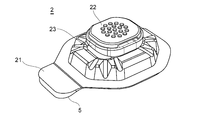
- FIG. 1 is an external perspective view showing the appearance of the applicator according to the present embodiment.
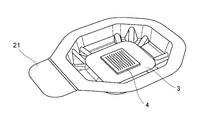
- FIG. 2 is a back perspective view showing a state in which the applicator shown in FIG. 1 is viewed from the back side.
- FIG. 3 is a cross-sectional view showing a cross section of the first portion and the second portion of the applicator shown in FIGS. 1 and 2.
- FIG. 4 is a cross-sectional view showing a cross section of the first portion and the second portion of the applicator shown in FIGS. 1 and 2.
- FIG. 5 is a diagram for explaining how the microneedle array is punctured into the skin by using the modified examples of the applicator shown in FIGS. 3 and 4.
- FIG. 3 is a back perspective view showing a state in which the applicator shown in FIG. 1 is viewed from the back side.
- FIG. 3 is a cross-sectional view showing a cross section of the first portion and the second portion of the applicator shown in FIGS. 1 and 2.
- FIG. 6 is a diagram for explaining how the microneedle array is punctured into the skin by using the modified examples of the applicator shown in FIGS. 3 and 4.
- FIG. 7 is a diagram for explaining how the microneedle array is punctured into the skin by using the modified examples of the applicator shown in FIGS. 3 and 4.
- FIG. 8 is a diagram for explaining how the microneedle array is punctured into the skin by using the modified examples of the applicator shown in FIGS. 3 and 4.
- FIG. 9 is a diagram for explaining how the microneedle array is punctured into the skin by using the modified examples of the applicator shown in FIGS. 3 and 4.
- FIG. 10 is a diagram for explaining a modified example of the puncture promoting portion.
- FIG. 10 is a diagram for explaining a modified example of the puncture promoting portion.
- FIG. 11 is a diagram for explaining a modified example of the puncture promoting portion.
- FIG. 12 is a diagram for explaining a modified example of the puncture promoting portion.
- FIG. 13 is a diagram for explaining a modified example of the puncture promoting portion.
- FIG. 14 is a diagram for explaining a modified example of the puncture promoting portion.
- FIG. 15 is a diagram for explaining a modified example of the puncture promoting portion.
- FIG. 16 is a diagram for explaining a central array region and a peripheral array region in a microneedle array.
- FIG. 17 is a diagram for explaining another example of the central array region and the peripheral array region in the microneedle array.
- FIG. 18 is a diagram for explaining another example of the central array region and the peripheral array region in the microneedle array.
- FIG. 19 is a diagram for explaining a modified example of the puncture promoting portion.
- FIG. 20 is a diagram for explaining a modified example of the puncture promoting portion.
- the applicator 2 in the present embodiment includes a housing 21, a first portion 22, and a second portion 23.
- the housing 21 is a dome-shaped member provided with an open space inside.
- the housing 21 is molded by a known method such as molding a thin resin sheet or film, or injecting the molten resin into a cavity in the mold.
- a material suitable for molding the housing 21 is preferably a material that is flexible and easily bends, deforms, and restores, for example, polyethylene, polypropylene, polyethylene terephthalate, polystyrene, nylon, acrylic, silicone, ABS, and the like. Resin is mentioned.
- the shape of the housing 21 and the thickness of each part are appropriately determined so that the desired deformation occurs when a person pushes the housing 21 from above with a finger.
- the shape of the housing 21 may be provided with a valley fold so that the housing 21 can be easily bent at the valley fold.
- the thickness of the housing 21 is, for example, about 50 ⁇ m to 1 mm, or 100 ⁇ m to 500 ⁇ m.
- a sticking tape 3 and a microneedle array 4 are arranged inside the housing 21.
- the housing 21 can also be used as a container by arranging the sticking tape 3 and the microneedle array 4 and then sealing the opening with the protective sheet 5.
- a target drug molecules such as vaccines, proteins, peptides, low molecular weight compounds, etc.
- the microneedle array 4 is attached to the skin to pierce the skin with the needle of the microneedle array 4 and directly transfer the drug to the dermis or the epidermis.
- the sticking tape 3 is an adhesive tape for puncturing and fixing the microneedle array 4 to the skin.
- the microneedle array 4 is attached to the attachment tape 3.
- the sticking tape 3 is attached to the inner surface of the housing 21 at positions corresponding to the first portion 22 and the second portion 23.
- the sticking tape 3 may be made of a material having moderately high rigidity and may have a thickness and a shape that can secure the rigidity. By using the sticking tape 3 having moderately high rigidity, the sticking tape 3 keeps a flat shape even after sticking, and the microneedles are held in the skin in a pressurized state, and the puncture property is improved.
- the applicator 2 is placed on the skin so that the microneedle array 4 faces the skin side. Then, by pushing the first portion 22 toward the skin, the microneedle array 4 and the sticking tape 3 are transferred to the skin.
- FIG. 3 shows a cross section of the first portion 22 and the second portion 23 in the pre-puncture stage state.
- the applicator 2 is arranged so that the microneedle array 4 comes into contact with the skin.
- the microneedle array 4 is provided with a microneedle 41, which is a needle carrying a target drug.
- a part of the microneedle 41 may be pierced into the skin.
- the surface on which the microneedle 41 is formed in the microneedle array 4 will be described as the main surface, and the surface opposite to the main surface will be described as the back surface.
- the second portion 23 is provided with a through hole 231.
- the through hole 231 is provided corresponding to the position where the microneedle array 4 of the housing 21 is attached.
- the through hole 231 includes a large diameter portion 231a and a small diameter portion 231b.
- the large diameter portion 231a has a larger diameter than the small diameter portion 231b and is provided on the microneedle array 4 side.
- the small diameter portion 231b is provided at a position farther from the microneedle array 4 than the large diameter portion 231a, and has a smaller diameter than the large diameter portion 231a.
- the small diameter portion 231b slidably holds the push rod 221 of the first portion 22.
- the first portion 22 is provided on the side opposite to the housing 21 with the second portion 23 interposed therebetween.
- the first portion 22 includes a push rod 221.
- the push rod 221 passes through the small diameter portion 231b of the second portion 23.
- the push rod 221 is provided with a protrusion 222.
- the protrusion 222 is located on the side opposite to the microneedle array 4 with the small diameter portion 231b interposed therebetween.
- the protrusion 222 provided in the first portion 22 passes through the small diameter portion 231b to generate a notification sound.
- a puncture promoting portion 223 is provided at a portion of the push rod 221 that is in contact with the housing 21.
- the puncture promoting portion 223 is arranged so as to abut on the back surface of the microneedle array 4.
- the puncture promoting portion 223 is a portion that forms a puncture complete state by projecting the central array region, which is a part of the microneedle array 4, toward the skin. The central array region will be described with reference to FIGS. 16-18.
- the microneedle array 4 is provided with a central array region 42 and a peripheral array region 43.
- the central array region 42 is a region provided inside the peripheral array region 43 in an arbitrary direction through the center of gravity of the microneedle array 4 and along the main surface on which the microneedle 41 is provided.
- the peripheral array region 43 is a region including the outer periphery of any one of the microneedle arrays 4.
- the puncture promotion unit 223 forms a puncture complete state in which the central array region 42 is projected toward the skin side from the peripheral array region 43.
- the puncture promoting portion 223 abuts on at least a part of the central array region 42 with the housing 21 interposed therebetween.
- the puncture promoting portion 223 does not have to have the same shape as the central array region 42, and may have a shape having a contact surface smaller than that of the central array region 42, such as a cylindrical shape.
- the central array region 42 is provided inside the peripheral array region 43 in all directions through the center of gravity of the microneedle array 4.
- the central array region does not necessarily have to be provided inside the peripheral array region 43 in all directions through the center of gravity of the microneedle array 4. An example thereof will be described with reference to FIG.
- the central array region 42A passes through the center of gravity of the microneedle array and inside the peripheral array region 43A in some directions through the main surface of the microneedle array 4. It is provided. A portion of the central array region 42A includes the outer circumference of the microneedle array 4.
- the central array regions 42 and 42A are formed as a single region.
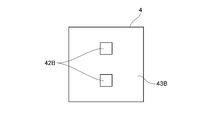
- the central array region does not necessarily have to be a single region and may be configured as a plurality of regions. An example thereof will be described with reference to FIG.
- central array region 42B is provided inside the peripheral array region 43B in all directions through the main surface of the microneedle array 4.
- the central array regions 42, 42A, 42B and the peripheral array regions 43, 43A, 43B described with reference to FIGS. 16, 17, and 18 are merely examples, and the puncture promoting portion abuts on the central array region and the skin. It can take any form as long as it can be projected to the side.
- the push rod 221 penetrates the through hole 231 and protrudes toward the microneedle array 4.
- the protrusion 222 provided on the push rod 221 passes through the small diameter portion 231b and is located on the large diameter portion 231a side.
- the puncture promoting portion 223 provided at the tip of the push rod 221 intervenes the housing 21 and the sticking tape 3 to interpose the microneedle array. Generates a force that pushes 4 toward the skin.
- FIG. 4 shows a cross section of the first portion 22 and the second portion 23 in the puncture completed state.
- the central array regions 42, 42A, 42B (see FIGS. 16, 17, 18) of the microneedle array 4 are closer to the skin than the peripheral array regions 43, 43A, 43B (see FIGS. 16, 17, 18).
- a protruding state is formed.
- the microneedle array 4 and the sticking tape 3 migrate to the skin, and most (preferably all) of the microneedle 41 is configured to pierce the skin.
- the microneedle array 4 is held in the housing 21 by the holding portion 211 with the sticking tape 3 interposed therebetween.
- the holding portion 211 is composed of double-sided adhesive tape.
- the holding portion 211 is provided at a position corresponding to the puncture assisting portion 232 in the second portion 23.
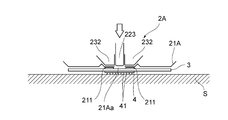
- FIG. 5 shows a state in which the applicator 2A is placed on the skin S. In the state shown in FIG. 5, there is a gap of about several mm between the microneedle array 4 and the skin S.
- the applicator 2A replaces the housing 21 of the applicator 2 with the housing 21A.
- the housing 21A is provided with a hole 21Aa at a position corresponding to the puncture promoting portion 223.
- a holding portion 211 for holding the microneedle array 4 and the sticking tape 3 is provided in the portion of the housing 21 corresponding to the microneedle array 4.
- the holding portion 211 is composed of double-sided adhesive tape.
- the holding portion 211 is provided at a position corresponding to the puncture assisting portion 232 of the second portion 23.
- FIG. 6 shows a state in which the applicator 2 is placed on the skin S and then a force is applied in the direction of the arrow in the figure, which is the direction toward the skin S.
- the microneedle array 4 is provided with a large number of microneedles 41, which are in contact with the skin S.
- the state shown in FIG. 7 is obtained.
- the state shown in FIG. 7 at least a part of the microneedle 41 is stuck in the skin S.
- the state of the applicator 2 shown in FIGS. 5, 6 and 7 is the pre-puncture stage state.
- the puncture assisting portion 232 presses the microneedle 41 toward the skin S in advance, the microneedle 41 provided mainly at the position corresponding to the puncture assisting portion 232 pierces the skin S. ..
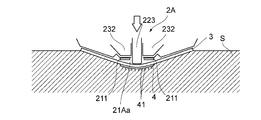
- FIG. 8 shows the puncture completion state.
- the puncture promoting portion 223 projects with respect to the puncturing assisting portion 232. From the state in which the puncture assisting portion 232 applies the force in advance, the puncture promoting portion 223 changes to the state in which the force is applied to the microneedle array 4.
- the puncture promoting portion 223 penetrates the hole 21Aa provided in the housing 21 and passes through the central array regions 42, 42A, 42B (see FIGS. 16, 17, 18) of the microneedle array 4 to the peripheral array regions 43, 43A, 43B (see FIGS. 16, 17, 18). (See FIGS. 16, 17, and 18) so that it protrudes toward the skin S side.
- the holding portion 211 maintains the state of being in contact with the puncture assisting portion 232, and the sticking tape 3 is separated from the holding portion 211.
- the portion of the microneedle array 4 corresponding to the puncture promoting portion 223 is pushed deeper into the skin S, resulting in a curved shape as a whole. In this state, a large number of microneedles 41 provided in the microneedle array 4 are evenly pierced into the skin S.
- the state shown in FIG. 9 is obtained.
- the puncture promoting portion 223 and the puncturing assisting portion 232 are separated from the microneedle array 4, and the skin S and the microneedle array 4 are restored to the unloaded state.
- the microneedle array 4 maintains a state in which a large number of microneedles 41 are stuck in the skin S, and is fixed to the skin S by the adhesive tape 3.
- the puncture assisting portion 232 applies a force to press the microneedle 41 against the skin S prior to the puncture promoting portion 223, but the puncturing promoting portion 223 may apply the force in advance. good. Further, a force for pressing the microneedle 41 against the skin S may be applied only by the puncture promoting portion 223.
- the puncture promoting portion 223 precedes or applies a force for pressing the microneedle 41 against the skin S only by the puncturing promoting portion 223, the puncturing promoting portion 223 may be projected after the microneedle 41 approaches the skin S to some extent. ..
- the applicators 2 and 2A in the present embodiment are applicators for puncturing the skin S with the microneedle array 4.
- the applicators 2 and 2A have a holding portion 211 for holding the microneedle array and a peripheral array region 42, 42A, 42B of the microneedle array provided on the peripheral side of the microneedle array with respect to the central array region. It is provided with a puncture promoting portion 223 that forms a puncture completed state so as to project toward the skin side of 43, 43A, 43B.
- the microneedle array 4 When the microneedle array 4 is pushed into the skin S, the skin S is dented according to the force for pushing the skin S due to its elasticity.
- the microneedle 41 By projecting the central array regions 42, 42A and 42B toward the skin S side from the peripheral array regions 43, 43A and 43B and pushing them along the concave skin S, the microneedle 41 is evenly applied with force to the skin. It is inserted in S.
- the holding portion 211 holds the microneedle array 4, and the puncture promoting portion 223 causes the central array regions 42, 42A, 42B to protrude toward the skin S side from the peripheral array regions 43, 43A, 43B.
- the puncture complete state is formed, not only the microneedle 41 provided in the peripheral array regions 43, 43A, 43B but also the microneedle 41 provided in the central array regions 42, 42A, 42B can be surely punctured into the skin. be able to.
- the puncture promotion unit 223 forms a pre-puncture state in which the central array regions 42, 42A, 42B do not protrude toward the skin side from the peripheral array regions 43, 43A, 43B before the puncture completion state.
- the microneedle array 4 is not uneven, and the microneedle 41 provided in the peripheral array regions 43, 43A, 43B is also provided in the central array region 42, 42A, 42B. Can also be brought into contact with the skin S. Since the central array regions 42, 42A, 42B do not protrude toward the skin S side from the peripheral array regions 43, 43A, 43B when no force is applied to the skin S, the microneedle array 4 is held without being loaded. be able to.
- microneedle array 4 It is possible to press the microneedle array 4 against the skin S side even in the pre-puncture stage state, in which case the microneedle 41 provided in the peripheral array regions 43, 43A, 43B is also in the central array regions 42, 42A, 42B.
- the provided microneedle 41 can also puncture the skin S. Therefore, it is possible to achieve both the retention of the microneedle array 4 with respect to the applicators 2 and 2A and the puncture property when a force toward the skin S is applied.
- the puncture promoting unit 223 transitions from the pre-puncture stage state to form the puncture completion state when a force toward the skin S is applied.
- the puncture complete state is formed after the pre-puncture stage state, the microneedle 41 that is in contact with the skin S but is not completely punctured is pushed in by projecting the central array regions 42, 42A, and 42B toward the skin S side. Therefore, it can be reliably stabbed in the skin S.
- the pre-puncture state is formed and then the puncture complete state is entered. It is possible to perform a series of operations up to the state where the microneedle 41 is completely punctured in S.
- the holding portion 211 is provided on the peripheral array regions 43, 43A, 43B side of the central array regions 42, 42A, 42B.
- the applicators 2 and 2A have a first portion 22 provided with a puncture promoting portion 223 and a second portion 23 integrally provided with a holding portion 211 at least in the pre-puncture stage state.
- the first portion 22 and the second portion 23 are configured so that the positional relationship can be relatively changed.
- the puncture promoting portion 223 can be projected from the second portion 23 toward the skin S side to form a puncture completed state.
- the through hole 231 is provided in the second portion 23, and the puncture promoting portion 223 is held through the through hole 231.
- the through hole 231 serves as a guide for the puncture promoting portion 223 and punctures when the first portion 22 changes its positional relationship relative to the second portion 23.
- the promoting portion 223 can be stably projected toward the skin S side.
- the through hole 231 is provided at a position farther from the microneedle array 4 than the large diameter portion 231a provided on the microneedle array 4 side and the large diameter portion 231a, and has a diameter larger than that of the large diameter portion 231a. It is provided with a small diameter portion 231b that is small and slidably holds the puncture promoting portion 223, and the puncturing promoting portion 223 is provided with a protrusion 222. The protrusion 222 passes through the small diameter portion 231b to generate a notification sound.
- the generation of the notification sound it is possible to detect that the force directed at the skin S exceeds a predetermined magnitude and the microneedle 41 is surely stuck in the skin.
- the generation of this notification sound triggers the applicators 2 and 2A to be separated from the skin S.
- the through hole 231 also penetrates the holding portion 211, and the puncture promoting portion 223 is closer to the skin S side than the holding portion 211 in the puncture completed state. It may be projected.
- the hole 21Aa is provided at a position corresponding to the puncture promoting portion 223.
- the hole 21Aa and the through hole 231 are connected to each other, and the through hole 231 is configured to penetrate the holding portion 211.
- the through hole 231 penetrates the holding portion 211, it is reduced that the holding portion 211 obstructs the movement of the puncture promoting portion 223. Even if the puncture promoting portion 223 protrudes to the skin S side, the holding portion 211 maintains the integralness with the second portion 23 and does not move to the skin S side, so that the puncturing promoting portion 223 pushes the microneedle array 4 toward the skin S side. As a result, the microneedle array 4 can be separated from the holding portion 211. Therefore, it is possible to achieve both the retention of the microneedle array 4 with respect to the applicators 2 and 2A and the puncture property when a force toward the skin S is applied.
- the puncture test performed in order to confirm the effect of the embodiment in which the microneedle array 4 is curved and pushed into the skin S and the microneedle 41 is surely pierced into the skin S will be described.
- the puncture test was performed as follows.
- the measurement results are shown in Table 1.
- the protrusion length [mm] is the amount of protrusion from the second portion 23 of the push rod 221 described with reference to FIG.
- the lining thickness [mm] is the thickness of the portion of the microneedle array 4 that holds the microneedle 41.
- the angle [°] is the angle of the top in the curved state of the microneedle array 4 described with reference to FIG. 5 (B). Therefore, when the protrusion length is 0 [mm], it is 90 [°], and as the protrusion length becomes longer, the angle decreases.
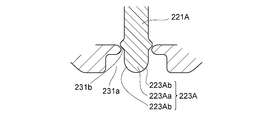
- the puncture promoting portion 223A exemplified in FIG. 10 is formed by processing the tip of the push rod 221A.
- the puncture promoting portion 223A is formed so that the central promoting region 223Aa protrudes toward the skin S side from the peripherally promoting region 223Ab provided on the peripheral side of the central promoting region 223Aa.
- the puncture promoting portion 223A Since the puncture promoting portion 223A has a convex shape in which the peripheral promoting region 223Ab recedes from the skin S side with respect to the central promoting region 223Aa, the puncturing promoting portion 223A faces the skin S side with respect to the microneedle array 4.
- the portion of the microneedle array 4 pushed by the central promotion region 223Aa becomes closer to the skin S side, and the portion of the microneedle array 4 pushed by the peripheral promotion region 223Ab becomes relatively closer to the holding portion 211. Therefore, the microneedle array 4 can be curved to improve the puncture property and secure the holdability.
- the puncture promotion portion 223B illustrated in FIG. 11 is separately attached to the tip of the push rod 221B.
- the push rod 221B passes through the small diameter portion 231b.
- the puncture promoting portion 223B is formed to have a larger diameter than the small diameter portion 231b so as to correspond to the large diameter portion 231a.
- the puncture promotion portion 223Ba illustrated in FIG. 12 is separately attached to the tip of the push rod 221B.
- the puncture promoting portion 223Ba is formed to have a larger diameter than the small diameter portion 231b so as to correspond to the large diameter portion 231a.
- the puncture promoting portion 223Ba is formed so that the central portion protrudes toward the skin S side.
- the puncture promoting portion 223A and 223Ba illustrated in FIGS. 10 and 12 are formed so as to have a convex shape toward the skin S, the puncturing promoting portion and the holding portion can be formed at the same position.
- An example of forming the puncture promoting portion and the holding portion at the same position will be described with reference to FIG.
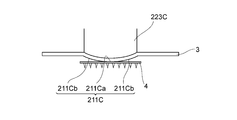
- the puncture promoting portion 223C illustrated in FIG. 13 has a convex shape in which the peripheral promoting region is recessed from the skin S side with respect to the central promoting region.
- the holding portion 211C is provided in the puncture promoting portion 223C.
- the holding portion 211C is formed so that the central holding region 211Ca projects toward the skin S side from the peripheral holding region 211Cb provided on the peripheral side of the central holding region 211Ca.
- the central array regions 42, 42A, 42B (see FIGS. 16, 17, 18) of the microneedle array 4 are held only in the central holding region 211Ca, the puncture is completed before the puncture completed state regardless of the shape of the holding portion 211C.
- the central array regions 42, 42A, 42B can form a pre-puncture stage state in which the peripheral array regions 43, 43A, 43B (see FIGS. 16, 17, 18) do not protrude toward the skin S side.
- the holding portion 211C is pressed against the skin S and further force is applied, the microneedle array 4 is deformed along the shape of the holding portion 211C, and the central array regions 42, 42A and 42B are formed from the peripheral array regions 43, 43A and 43B.
- a puncture completed state protruding toward the skin S side is formed.
- the puncture promoting portion 223C is formed by holding the central array regions 42, 42A, and 42B in the central holding region 211Ca without providing the holding portion 211C and the puncture promoting portion 223C at different positions. ..
- the puncture promoting portion 223C can be formed by devising a simple form, the configuration of the applicator can be simplified.
- the microneedle array 4 in the central holding region 211Ca and the peripheral holding region 211Cb.
- the central array regions 42, 42A, 42B are on the skin S side of the peripheral array regions 43, 43A, 43B along the shape of the holding portion 211C. It is possible to form a state in which the skin protrudes to the skin, and a state in which the puncture is completed can be reliably formed.
- FIG. 15A shows the microneedle array 4 in the pre-puncture stage state.
- FIG. 15 (A) when the puncture promoting portion 223D applies a force along the skin S to the microneedle array 4, the state shown in FIG. 15 (B) is obtained.
- FIG. 15B shows the microneedle array 4 in the puncture completed state.
- the puncture promoting portion 223D forms the puncture completed state by applying a force to bring the pair of opposite ends of the microneedle array 4 close to each other.
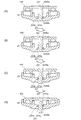
- the push rod 221 is provided with a single protrusion 222, but a plurality of protrusions may be provided in the longitudinal direction of the push rod 221. Such an example will be described with reference to FIG.
- FIGS. 19 (A), 19 (B), 19 (C), and 19 (D) the push rod 221 is provided with the first protrusion 222Ea and the second protrusion 222Eb.
- FIG. 19A shows a state in which no force is applied to the skin.
- the second protrusion 222Eb is provided on the skin side of the first protrusion 222Ea, and the first protrusion 222Ea is provided at a position farther from the skin than the second protrusion 222Eb.
- the puncture assist portion becomes a microneedle as in the state shown in FIG. Apply force toward the skin on the array.
- the state shown in FIG. 19C is obtained.
- the second protrusion 222Eb passes through the small diameter portion 231b, and the puncture promoting portion (see FIG. 4) of the push rod 221 protrudes toward the skin.
- the puncture promoting portion projects the central array region, which is a part of the microneedle array, toward the skin to puncture the microneedle.
- the state shown in FIG. 19 (D) is obtained.
- the first protrusion 222Ea also passes through the small diameter portion 231b, generates a notification sound, and completes the puncture.
- the microneedle array is separated from the holding portion (see FIG. 4), so that stress from the push rod 221 is applied only to the microneedle array. It becomes easier and can be punctured with less stress.
- an intervening portion 6 made of a hard body such as resin or metal or an elastic body such as gel or sponge is arranged between the second portion 23 and the housing 21, and the microneedle array 4 is arranged. May be easier to bring closer to the skin.
- a through hole can be provided in the center so that the central array region of the microneedle array 4 can be projected toward the skin by the stress of the push rod 221.
- a microneedle patch kit including applicators 2 and 2A and a microneedle patch may be used.
- the microneedle array 4 is attached to one surface of the attachment tape 3.
- the sticking tape 3 has a dent or friction in the area where the puncture promoting portions 223, 223A, 223B, 223Ba, 223C, 223D abut on the surface to which the microneedle array 4 is not stuck. The surface is processed to increase.
- the microneedle array 4 held by the applicators 2 and 2A is punctured into the skin, and the central array regions 42, 42A and 42B of the microneedle array 4 are the central array regions 42,
Landscapes
- Health & Medical Sciences (AREA)
- Engineering & Computer Science (AREA)
- Dermatology (AREA)
- Medical Informatics (AREA)
- Anesthesiology (AREA)
- Biomedical Technology (AREA)
- Heart & Thoracic Surgery (AREA)
- Hematology (AREA)
- Life Sciences & Earth Sciences (AREA)
- Animal Behavior & Ethology (AREA)
- General Health & Medical Sciences (AREA)
- Public Health (AREA)
- Veterinary Medicine (AREA)
- Media Introduction/Drainage Providing Device (AREA)
Priority Applications (2)
| Application Number | Priority Date | Filing Date | Title |
|---|---|---|---|
| JP2022530621A JPWO2021251464A1 (https=) | 2020-06-12 | 2021-06-10 | |
| US18/009,634 US20230226333A1 (en) | 2020-06-12 | 2021-06-10 | Applicator, micro needle patch kit, and insertion method |
Applications Claiming Priority (2)
| Application Number | Priority Date | Filing Date | Title |
|---|---|---|---|
| JP2020102540 | 2020-06-12 | ||
| JP2020-102540 | 2020-06-12 |
Publications (1)
| Publication Number | Publication Date |
|---|---|
| WO2021251464A1 true WO2021251464A1 (ja) | 2021-12-16 |
Family
ID=78846059
Family Applications (1)
| Application Number | Title | Priority Date | Filing Date |
|---|---|---|---|
| PCT/JP2021/022133 Ceased WO2021251464A1 (ja) | 2020-06-12 | 2021-06-10 | アプリケータ、マイクロニードルパッチキット、及び穿刺方法 |
Country Status (3)
| Country | Link |
|---|---|
| US (1) | US20230226333A1 (https=) |
| JP (1) | JPWO2021251464A1 (https=) |
| WO (1) | WO2021251464A1 (https=) |
Families Citing this family (1)
| Publication number | Priority date | Publication date | Assignee | Title |
|---|---|---|---|---|
| EP4710988A1 (en) * | 2024-09-16 | 2026-03-18 | LTS LOHMANN Therapie-Systeme AG | Application device for microneedles, microneedle application system and method for manufacturing a microneedle application system |
Citations (5)
| Publication number | Priority date | Publication date | Assignee | Title |
|---|---|---|---|---|
| JP2008520369A (ja) * | 2004-11-18 | 2008-06-19 | スリーエム イノベイティブ プロパティズ カンパニー | 目立たないマイクロニードルアレイアプリケーター |
| JP2013158601A (ja) * | 2012-02-08 | 2013-08-19 | Toppan Printing Co Ltd | マイクロニードルチップおよびその製造方法 |
| WO2016129184A1 (ja) * | 2015-02-13 | 2016-08-18 | 株式会社 メドレックス | マイクロニードルの穿刺装置及びマイクロニードルパッチの貼付装置 |
| WO2019176900A1 (ja) * | 2018-03-13 | 2019-09-19 | 株式会社メドレックス | 粘着部材、及びマイクロニードル貼付剤 |
| WO2019216097A1 (ja) * | 2018-05-08 | 2019-11-14 | 富士フイルム株式会社 | マイクロニードルアレイユニットの製造方法 |
Family Cites Families (1)
| Publication number | Priority date | Publication date | Assignee | Title |
|---|---|---|---|---|
| EP1904158B1 (en) * | 2005-06-24 | 2013-07-24 | 3M Innovative Properties Company | Collapsible patch with microneedle array |
-
2021
- 2021-06-10 JP JP2022530621A patent/JPWO2021251464A1/ja active Pending
- 2021-06-10 WO PCT/JP2021/022133 patent/WO2021251464A1/ja not_active Ceased
- 2021-06-10 US US18/009,634 patent/US20230226333A1/en active Pending
Patent Citations (5)
| Publication number | Priority date | Publication date | Assignee | Title |
|---|---|---|---|---|
| JP2008520369A (ja) * | 2004-11-18 | 2008-06-19 | スリーエム イノベイティブ プロパティズ カンパニー | 目立たないマイクロニードルアレイアプリケーター |
| JP2013158601A (ja) * | 2012-02-08 | 2013-08-19 | Toppan Printing Co Ltd | マイクロニードルチップおよびその製造方法 |
| WO2016129184A1 (ja) * | 2015-02-13 | 2016-08-18 | 株式会社 メドレックス | マイクロニードルの穿刺装置及びマイクロニードルパッチの貼付装置 |
| WO2019176900A1 (ja) * | 2018-03-13 | 2019-09-19 | 株式会社メドレックス | 粘着部材、及びマイクロニードル貼付剤 |
| WO2019216097A1 (ja) * | 2018-05-08 | 2019-11-14 | 富士フイルム株式会社 | マイクロニードルアレイユニットの製造方法 |
Also Published As
| Publication number | Publication date |
|---|---|
| US20230226333A1 (en) | 2023-07-20 |
| JPWO2021251464A1 (https=) | 2021-12-16 |
Similar Documents
| Publication | Publication Date | Title |
|---|---|---|
| CN105916543B (zh) | 微针单元以及微针组件 | |
| CN102905746B (zh) | 真皮进入装置 | |
| JP5396491B2 (ja) | 穿刺器具 | |
| JP5709137B2 (ja) | 剣山型マイクロニードルのアプリケーター | |
| US11185673B2 (en) | Micro-needle array unit and container | |
| US8690838B2 (en) | Transdermal administration device | |
| JP5966156B2 (ja) | 剣山型マイクロニードルのアプリケータデバイス | |
| KR20150017738A (ko) | 마이크로 니들·시트 | |
| US10646703B2 (en) | Device for containment and release of a transdermal drug formulation | |
| EP4108287B1 (en) | Microneedle array unit | |
| WO2015111672A1 (ja) | マイクロニードルユニット | |
| WO2021251464A1 (ja) | アプリケータ、マイクロニードルパッチキット、及び穿刺方法 | |
| US20190388668A1 (en) | Applicator | |
| JP2016131619A (ja) | 経皮投与デバイス | |
| KR20170038463A (ko) | 마이크로 니들 제조방법 | |
| JP6717207B2 (ja) | 経皮投与デバイス | |
| CN111836662A (zh) | 粘合构件和微针贴剂 | |
| EP3875140B1 (en) | Microneedle array unit | |
| KR20180006789A (ko) | 마이크로니들 장치 | |
| JP2007117619A (ja) | 穿刺器具 | |
| JP2009039146A (ja) | 穿刺器及びバイオセンサ装置 | |
| Waalen et al. | 3D-Printed Transdermal Microneedles for Allergen Immunotherapy | |
| JP2017209427A (ja) | 経皮投与デバイス、および、薬剤投与器具 | |
| KR20250043462A (ko) | 화장품 용기 및 유지 메커니즘 | |
| WO2022108602A1 (en) | An adhesive thumb ring and syringe assembly, and an adhesive thumb ring for a syringe |
Legal Events
| Date | Code | Title | Description |
|---|---|---|---|
| 121 | Ep: the epo has been informed by wipo that ep was designated in this application |
Ref document number: 21820879 Country of ref document: EP Kind code of ref document: A1 |
|
| ENP | Entry into the national phase |
Ref document number: 2022530621 Country of ref document: JP Kind code of ref document: A |
|
| NENP | Non-entry into the national phase |
Ref country code: DE |
|
| 122 | Ep: pct application non-entry in european phase |
Ref document number: 21820879 Country of ref document: EP Kind code of ref document: A1 |