WO2021241674A1 - 摩擦攪拌点接合装置及び継手構造 - Google Patents
摩擦攪拌点接合装置及び継手構造 Download PDFInfo
- Publication number
- WO2021241674A1 WO2021241674A1 PCT/JP2021/020157 JP2021020157W WO2021241674A1 WO 2021241674 A1 WO2021241674 A1 WO 2021241674A1 JP 2021020157 W JP2021020157 W JP 2021020157W WO 2021241674 A1 WO2021241674 A1 WO 2021241674A1
- Authority
- WO
- WIPO (PCT)
- Prior art keywords
- friction stir
- tip
- shoulder
- shoulder member
- stir welding
- Prior art date
- Legal status (The legal status is an assumption and is not a legal conclusion. Google has not performed a legal analysis and makes no representation as to the accuracy of the status listed.)
- Ceased
Links
Images





Classifications
-
- B—PERFORMING OPERATIONS; TRANSPORTING
- B23—MACHINE TOOLS; METAL-WORKING NOT OTHERWISE PROVIDED FOR
- B23K—SOLDERING OR UNSOLDERING; WELDING; CLADDING OR PLATING BY SOLDERING OR WELDING; CUTTING BY APPLYING HEAT LOCALLY, e.g. FLAME CUTTING; WORKING BY LASER BEAM
- B23K20/00—Non-electric welding by applying impact or other pressure, with or without the application of heat, e.g. cladding or plating
- B23K20/12—Non-electric welding by applying impact or other pressure, with or without the application of heat, e.g. cladding or plating the heat being generated by friction; Friction welding
- B23K20/122—Non-electric welding by applying impact or other pressure, with or without the application of heat, e.g. cladding or plating the heat being generated by friction; Friction welding using a non-consumable tool, e.g. friction stir welding
- B23K20/1245—Non-electric welding by applying impact or other pressure, with or without the application of heat, e.g. cladding or plating the heat being generated by friction; Friction welding using a non-consumable tool, e.g. friction stir welding characterised by the apparatus
- B23K20/1255—Tools therefor, e.g. characterised by the shape of the probe
-
- B—PERFORMING OPERATIONS; TRANSPORTING
- B23—MACHINE TOOLS; METAL-WORKING NOT OTHERWISE PROVIDED FOR
- B23K—SOLDERING OR UNSOLDERING; WELDING; CLADDING OR PLATING BY SOLDERING OR WELDING; CUTTING BY APPLYING HEAT LOCALLY, e.g. FLAME CUTTING; WORKING BY LASER BEAM
- B23K20/00—Non-electric welding by applying impact or other pressure, with or without the application of heat, e.g. cladding or plating
- B23K20/12—Non-electric welding by applying impact or other pressure, with or without the application of heat, e.g. cladding or plating the heat being generated by friction; Friction welding
- B23K20/122—Non-electric welding by applying impact or other pressure, with or without the application of heat, e.g. cladding or plating the heat being generated by friction; Friction welding using a non-consumable tool, e.g. friction stir welding
- B23K20/123—Controlling or monitoring the welding process
-
- B—PERFORMING OPERATIONS; TRANSPORTING
- B23—MACHINE TOOLS; METAL-WORKING NOT OTHERWISE PROVIDED FOR
- B23K—SOLDERING OR UNSOLDERING; WELDING; CLADDING OR PLATING BY SOLDERING OR WELDING; CUTTING BY APPLYING HEAT LOCALLY, e.g. FLAME CUTTING; WORKING BY LASER BEAM
- B23K20/00—Non-electric welding by applying impact or other pressure, with or without the application of heat, e.g. cladding or plating
- B23K20/12—Non-electric welding by applying impact or other pressure, with or without the application of heat, e.g. cladding or plating the heat being generated by friction; Friction welding
- B23K20/122—Non-electric welding by applying impact or other pressure, with or without the application of heat, e.g. cladding or plating the heat being generated by friction; Friction welding using a non-consumable tool, e.g. friction stir welding
- B23K20/123—Controlling or monitoring the welding process
- B23K20/124—Controlling or monitoring the welding process at the beginning or at the end of a weld
-
- B—PERFORMING OPERATIONS; TRANSPORTING
- B23—MACHINE TOOLS; METAL-WORKING NOT OTHERWISE PROVIDED FOR
- B23K—SOLDERING OR UNSOLDERING; WELDING; CLADDING OR PLATING BY SOLDERING OR WELDING; CUTTING BY APPLYING HEAT LOCALLY, e.g. FLAME CUTTING; WORKING BY LASER BEAM
- B23K20/00—Non-electric welding by applying impact or other pressure, with or without the application of heat, e.g. cladding or plating
- B23K20/12—Non-electric welding by applying impact or other pressure, with or without the application of heat, e.g. cladding or plating the heat being generated by friction; Friction welding
- B23K20/122—Non-electric welding by applying impact or other pressure, with or without the application of heat, e.g. cladding or plating the heat being generated by friction; Friction welding using a non-consumable tool, e.g. friction stir welding
- B23K20/1245—Non-electric welding by applying impact or other pressure, with or without the application of heat, e.g. cladding or plating the heat being generated by friction; Friction welding using a non-consumable tool, e.g. friction stir welding characterised by the apparatus
- B23K20/125—Rotary tool drive mechanism
-
- B—PERFORMING OPERATIONS; TRANSPORTING
- B23—MACHINE TOOLS; METAL-WORKING NOT OTHERWISE PROVIDED FOR
- B23K—SOLDERING OR UNSOLDERING; WELDING; CLADDING OR PLATING BY SOLDERING OR WELDING; CUTTING BY APPLYING HEAT LOCALLY, e.g. FLAME CUTTING; WORKING BY LASER BEAM
- B23K20/00—Non-electric welding by applying impact or other pressure, with or without the application of heat, e.g. cladding or plating
- B23K20/12—Non-electric welding by applying impact or other pressure, with or without the application of heat, e.g. cladding or plating the heat being generated by friction; Friction welding
- B23K20/122—Non-electric welding by applying impact or other pressure, with or without the application of heat, e.g. cladding or plating the heat being generated by friction; Friction welding using a non-consumable tool, e.g. friction stir welding
- B23K20/1245—Non-electric welding by applying impact or other pressure, with or without the application of heat, e.g. cladding or plating the heat being generated by friction; Friction welding using a non-consumable tool, e.g. friction stir welding characterised by the apparatus
- B23K20/126—Workpiece support, i.e. backing or clamping
-
- B—PERFORMING OPERATIONS; TRANSPORTING
- B23—MACHINE TOOLS; METAL-WORKING NOT OTHERWISE PROVIDED FOR
- B23K—SOLDERING OR UNSOLDERING; WELDING; CLADDING OR PLATING BY SOLDERING OR WELDING; CUTTING BY APPLYING HEAT LOCALLY, e.g. FLAME CUTTING; WORKING BY LASER BEAM
- B23K20/00—Non-electric welding by applying impact or other pressure, with or without the application of heat, e.g. cladding or plating
- B23K20/12—Non-electric welding by applying impact or other pressure, with or without the application of heat, e.g. cladding or plating the heat being generated by friction; Friction welding
- B23K20/122—Non-electric welding by applying impact or other pressure, with or without the application of heat, e.g. cladding or plating the heat being generated by friction; Friction welding using a non-consumable tool, e.g. friction stir welding
- B23K20/1265—Non-butt welded joints, e.g. overlap-joints, T-joints or spot welds
-
- B—PERFORMING OPERATIONS; TRANSPORTING
- B23—MACHINE TOOLS; METAL-WORKING NOT OTHERWISE PROVIDED FOR
- B23K—SOLDERING OR UNSOLDERING; WELDING; CLADDING OR PLATING BY SOLDERING OR WELDING; CUTTING BY APPLYING HEAT LOCALLY, e.g. FLAME CUTTING; WORKING BY LASER BEAM
- B23K20/00—Non-electric welding by applying impact or other pressure, with or without the application of heat, e.g. cladding or plating
- B23K20/22—Non-electric welding by applying impact or other pressure, with or without the application of heat, e.g. cladding or plating taking account of the properties of the materials to be welded
- B23K20/227—Non-electric welding by applying impact or other pressure, with or without the application of heat, e.g. cladding or plating taking account of the properties of the materials to be welded with ferrous layer
-
- B—PERFORMING OPERATIONS; TRANSPORTING
- B23—MACHINE TOOLS; METAL-WORKING NOT OTHERWISE PROVIDED FOR
- B23K—SOLDERING OR UNSOLDERING; WELDING; CLADDING OR PLATING BY SOLDERING OR WELDING; CUTTING BY APPLYING HEAT LOCALLY, e.g. FLAME CUTTING; WORKING BY LASER BEAM
- B23K20/00—Non-electric welding by applying impact or other pressure, with or without the application of heat, e.g. cladding or plating
- B23K20/22—Non-electric welding by applying impact or other pressure, with or without the application of heat, e.g. cladding or plating taking account of the properties of the materials to be welded
- B23K20/227—Non-electric welding by applying impact or other pressure, with or without the application of heat, e.g. cladding or plating taking account of the properties of the materials to be welded with ferrous layer
- B23K20/2275—Non-electric welding by applying impact or other pressure, with or without the application of heat, e.g. cladding or plating taking account of the properties of the materials to be welded with ferrous layer the other layer being aluminium
-
- B—PERFORMING OPERATIONS; TRANSPORTING
- B23—MACHINE TOOLS; METAL-WORKING NOT OTHERWISE PROVIDED FOR
- B23K—SOLDERING OR UNSOLDERING; WELDING; CLADDING OR PLATING BY SOLDERING OR WELDING; CUTTING BY APPLYING HEAT LOCALLY, e.g. FLAME CUTTING; WORKING BY LASER BEAM
- B23K2103/00—Materials to be soldered, welded or cut
- B23K2103/02—Iron or ferrous alloys
- B23K2103/04—Steel or steel alloys
-
- B—PERFORMING OPERATIONS; TRANSPORTING
- B23—MACHINE TOOLS; METAL-WORKING NOT OTHERWISE PROVIDED FOR
- B23K—SOLDERING OR UNSOLDERING; WELDING; CLADDING OR PLATING BY SOLDERING OR WELDING; CUTTING BY APPLYING HEAT LOCALLY, e.g. FLAME CUTTING; WORKING BY LASER BEAM
- B23K2103/00—Materials to be soldered, welded or cut
- B23K2103/08—Non-ferrous metals or alloys
- B23K2103/10—Aluminium or alloys thereof
-
- B—PERFORMING OPERATIONS; TRANSPORTING
- B23—MACHINE TOOLS; METAL-WORKING NOT OTHERWISE PROVIDED FOR
- B23K—SOLDERING OR UNSOLDERING; WELDING; CLADDING OR PLATING BY SOLDERING OR WELDING; CUTTING BY APPLYING HEAT LOCALLY, e.g. FLAME CUTTING; WORKING BY LASER BEAM
- B23K2103/00—Materials to be soldered, welded or cut
- B23K2103/08—Non-ferrous metals or alloys
- B23K2103/14—Titanium or alloys thereof
-
- B—PERFORMING OPERATIONS; TRANSPORTING
- B23—MACHINE TOOLS; METAL-WORKING NOT OTHERWISE PROVIDED FOR
- B23K—SOLDERING OR UNSOLDERING; WELDING; CLADDING OR PLATING BY SOLDERING OR WELDING; CUTTING BY APPLYING HEAT LOCALLY, e.g. FLAME CUTTING; WORKING BY LASER BEAM
- B23K2103/00—Materials to be soldered, welded or cut
- B23K2103/08—Non-ferrous metals or alloys
- B23K2103/15—Magnesium or alloys thereof
-
- B—PERFORMING OPERATIONS; TRANSPORTING
- B23—MACHINE TOOLS; METAL-WORKING NOT OTHERWISE PROVIDED FOR
- B23K—SOLDERING OR UNSOLDERING; WELDING; CLADDING OR PLATING BY SOLDERING OR WELDING; CUTTING BY APPLYING HEAT LOCALLY, e.g. FLAME CUTTING; WORKING BY LASER BEAM
- B23K2103/00—Materials to be soldered, welded or cut
- B23K2103/18—Dissimilar materials
-
- B—PERFORMING OPERATIONS; TRANSPORTING
- B23—MACHINE TOOLS; METAL-WORKING NOT OTHERWISE PROVIDED FOR
- B23K—SOLDERING OR UNSOLDERING; WELDING; CLADDING OR PLATING BY SOLDERING OR WELDING; CUTTING BY APPLYING HEAT LOCALLY, e.g. FLAME CUTTING; WORKING BY LASER BEAM
- B23K2103/00—Materials to be soldered, welded or cut
- B23K2103/18—Dissimilar materials
- B23K2103/20—Ferrous alloys and aluminium or alloys thereof
Definitions
- the present invention relates to a friction stir welding device and a joint structure.
- the cross-sectional area of the tip surface of the pin member is Ap
- the cross-sectional area of the tip surface of the shoulder member is As
- the press-fitting depth when the pin member is press-fitted from the surface of the object to be joined is Pp
- the shoulder member is the object to be joined.
- the present inventors have smoothed the surface of the object to be joined by the friction stir point joining method disclosed in Patent Document 1, so that the tool is worn from the surface of the object to be joined after the joining is completed. I can't judge the situation. Therefore, it was necessary to periodically remove the tool from the device and inspect the wear condition of the tool.
- An object of the present invention is to provide a friction stir welding point joining device and a joint structure capable of determining the wear state of a tool from the joining point (surface of the joined portion) of the object to be joined.
- the friction stir point joining device is a friction stir point joining device that joins by softening the object to be joined by frictional heat
- the friction stir point joining device is a circle.
- the shoulder member formed in a cylindrical shape and the pin member inserted therein, the pin member and the shoulder member, which coincide with the axis of the pin member.
- the shape of the tip is marked (transferred) on the surface of the bonded portion when the object to be welded is friction stir-welded.
- the shape of the tip is not marked on the surface of the bonded portion, and the surface becomes flat.
- the joint structure according to the present invention is a joint structure formed by joining a joint object including a first member and a second member at a friction stir point joint at the jointed portion, and is the first member. Is composed of a material having a melting point lower than that of the second member, the first member and the second member are arranged in this order, and a circle is formed on the surface of the joined portion. An annular recess is formed, and the bottom surface of the recess is formed to be inclined, curved, curved, or bent.
- the wear state of the tool can be determined from the joining hitting point (the surface of the joined portion) of the object to be joined.
- FIG. 1 is a schematic diagram showing a schematic configuration of a friction stir welding point joining device according to the first embodiment.
- FIG. 2 is an enlarged schematic view of a main part of the friction stir welding device shown in FIG.
- FIG. 3 is a block diagram schematically showing a control configuration of the friction stir welding device shown in FIG.
- FIG. 4 is a flowchart showing an example of the operation of the friction stir welding point joining device according to the first embodiment.
- FIG. 5A is a process diagram schematically showing an example of each process of friction stir point joining by the friction stir point joining device shown in FIG. 1.
- FIG. 5B is a process diagram schematically showing an example of each process of friction stir point joining by the friction stir point joining device shown in FIG. 1.
- FIG. 5A is a process diagram schematically showing an example of each process of friction stir point joining by the friction stir point joining device shown in FIG. 1.
- FIG. 5B is a process diagram schematically showing an example of each process of friction stir point joining by the friction stir point joining device shown in FIG
- FIG. 6 is an enlarged schematic view of a main part of the friction stir welding point joining device of the modification 1 of the first embodiment.
- FIG. 7 is a schematic diagram showing a schematic configuration of a main part of the friction stir welding point joining device according to the second embodiment.
- FIG. 8A is a schematic diagram showing a schematic configuration of a pin member, a shoulder member, and a tip portion of a clamp member of a friction stir welding device.
- FIG. 8B is an exploded view of the shearing force acting on the transfer portion of the object to be joined.
- FIG. 9 is a schematic diagram showing a schematic configuration of a main part of the friction stir welding point joining device according to the third embodiment.
- FIG. 8A is a schematic diagram showing a schematic configuration of a pin member, a shoulder member, and a tip portion of a clamp member of a friction stir welding device.
- FIG. 8B is an exploded view of the shearing force acting on the transfer portion of the object to be joined.
- FIG. 9 is
- FIG. 10 is a graph showing the results of a tensile shear test and a cross tensile test of a material to be joined by friction stir welding under the above joining conditions using the friction stir point joining devices of Test Examples 1 and 2 and Comparative Example.
- FIG. 11 is a cross-sectional photograph of an object to be joined by friction stir point joining using the friction stir point joining device of Test Example 1.
- FIG. 1 is a schematic diagram showing a schematic configuration of a friction stir welding point joining device according to the first embodiment.
- the vertical direction in the figure is represented as the vertical direction in the friction stir welding device.
- the friction stir welding point joining device 50 includes a pin member 11, a shoulder member 12, a tool fixing device 52, an advancing / retreating drive 53, a clamp member 13, and a backing support portion 55. It includes a backing member 56 and a rotary driver 57.
- the pin member 11, shoulder member 12, tool fixing device 52, advancing / retreating drive 53, clamp member 13, and rotary drive 57 are provided at the upper end of a backing support portion 55 composed of a C-type gun (C-type frame). Has been done. Further, a backing member 56 is provided at the lower end of the backing support portion 55. The pin member 11, the shoulder member 12, the clamp member 13, and the backing member 56 are attached to the backing support portion 55 at positions facing each other. The object to be joined 60 is arranged between the pin member 11, the shoulder member 12, the clamp member 13, and the backing member 56.
- the pin member 11, the shoulder member 12, and the clamp member 13 are fixed to the tool fixture 52 composed of the rotary tool fixture 521 and the clamp fixture 522. Specifically, the pin member 11 and the shoulder member 12 are fixed to the rotary tool fixture 521, and the clamp member 13 is fixed to the clamp fixture 522 via the clamp drive 41.
- the rotary tool fixture 521 is supported by the clamp fixture 522 via the rotary driver 57.
- the clamp drive 41 is composed of a spring.
- the pin member 11, the shoulder member 12, and the clamp member 13 are driven forward and backward in the vertical direction by the advance / retreat drive 53 composed of the pin drive 531 and the shoulder drive 532.
- the pin member 11 is formed in a columnar shape and is supported by a rotary tool fixture 521, although not shown in detail in FIG. Further, the pin member 11 is rotated by the rotation driver 57 around the axis Xr (rotational axis) corresponding to the axis of the pin member 11, and by the pin drive 531 in the arrow P1 direction, that is, the axis Xr direction (FIG. 1). In the vertical direction), it is configured to be able to move forward and backward.
- the pin drive 531 may be composed of, for example, a linear actuator.
- the linear actuator may be composed of, for example, a servomotor and a rack and pinion, a servomotor and a ball screw, an air cylinder, or the like.
- the shoulder member 12 is formed in a cylindrical shape having a hollow shape, and is supported by the rotary tool fixture 521.
- a pin member 11 is inserted in the hollow of the shoulder member 12.
- the shoulder member 12 is arranged so as to surround the outer peripheral surface of the pin member 11.
- the shoulder member 12 is configured to be rotated around the same axis Xr as the pin member 11 by the rotation drive 57, and can be moved forward and backward along the arrow P2 direction, that is, the axis Xr direction by the shoulder drive 532. There is.
- the shoulder drive 532 may be composed of, for example, a linear actuator.
- the linear actuator may be composed of, for example, a servomotor and a rack and pinion, a servomotor and a ball screw, an air cylinder, or the like.
- the pin member 11 and the shoulder member 12 (rotating tool) are both supported by the same rotary tool fixture 521 in the present embodiment, and both are integrally rotated around the axis Xr by the rotary driver 57. do. Further, the pin member 11 and the shoulder member 12 are configured to be movable back and forth along the axis Xr direction by the pin drive 531 and the shoulder drive 532, respectively.
- the pin member 11 can move forward and backward independently, and the pin member 11 and the shoulder member 12 can move forward and backward as the shoulder member 12 moves forward and backward.
- Each may be configured to be able to move forward and backward independently.
- the clamp member 13 is formed in a cylindrical shape having a hollow shape, and is provided so that its axis coincides with the axis Xr.
- a shoulder member 12 is inserted in the hollow of the clamp member 13.
- the cylindrical shoulder member 12 is arranged so as to surround the outer peripheral surface of the pin member 11, and the cylindrical clamp member 13 is arranged so as to surround the outer peripheral surface of the shoulder member 12.
- the clamp member 13, the shoulder member 12, and the pin member 11 each have a coaxial core-shaped nested structure.
- the clamp member 13 is configured to press the object to be joined 60 from one surface (surface). As described above, the clamp member 13 is supported by the clamp fixture 522 via the clamp drive 41 in the first embodiment.
- the clamp drive 41 is configured to urge the clamp member 13 toward the backing member 56 side.
- the clamp member 13 (including the clamp drive 41 and the clamp fixture 522) is configured to be able to advance and retreat in the arrow P3 direction (the same direction as the arrow P1 and the arrow P2) by the shoulder drive 532.
- the clamp drive 41 is composed of a spring in the first embodiment, the clamp drive 41 is not limited to this.
- the clamp drive 41 may be configured to give a bias or a pressing force to the clamp member 13, and for example, a mechanism using a gas pressure, a hydraulic pressure, a servomotor, or the like can be preferably used.
- the pin member 11, the shoulder member 12, and the clamp member 13 have a tip surface 11a, a tip surface 12a, and a tip surface 13a, respectively. Further, the tip surface 11a of the pin member 11 and the tip surface 12a of the shoulder member 12 are configured to coincide with each other when viewed from the horizontal direction.
- the pin member 11, the shoulder member 12, and the clamp member 13 are moved back and forth by the advancing / retreating drive 53, so that the tip surface 11a, the tip surface 12a, and the tip surface 13a are each the surface of the object to be joined 60 (the tip surface 13a). It comes into contact with the joined portion of the joined object 60) and presses the joined object 60.
- the tip portion 120 of the shoulder member 12 is formed in a tapered shape.
- the shape of the tip portion 120 of the shoulder member 12 will be described in detail with reference to FIG. 2.
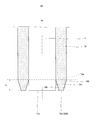
- FIG. 2 is an enlarged schematic view of a main part of the friction stir welding point joining device shown in FIG.
- the tip portion 120 is formed so that the outer peripheral surface 12b and the inner peripheral surface 12c of the shoulder member 12 are inclined with respect to the axis Xr.
- the tip portion 120 has a substantially V-shaped (substantially U-shaped) cross-sectional shape in the axis Xr direction when viewed from the horizontal direction.
- the tip portion 120 refers to a portion (region) from the tip surface 12a of the shoulder member 12 to a predetermined height h.
- the height h may be, for example, 0.05 mm or more, and 5% or more of the thickness dimension of the first member 61, from the viewpoint of marking (transferring) the shape of the tip portion 120 on the surface of the object to be joined 60. May be.
- the height h may be, for example, 0.5 mm or less, or 50% or less of the thickness dimension of the first member 61, from the viewpoint of suppressing damage to the tip portion 120 of the shoulder member 12. ..
- the tip portion 120 may be formed so that the cross-sectional area in the radial direction becomes smaller toward the tip. Further, if the area of the tip 12d (tip surface 12a) of the tip 120 is smaller than the radial cross-sectional area of the base end 12e of the tip 120, the tip 120 is inside the outer peripheral surface 12b of the tip 120.
- the shape of the peripheral surface 12c may be in any form.
- the backing member 56 is configured to be supported by a flat surface (support surface 56a) so as to abut the back surface of the flat plate-shaped object to be joined 60.
- the structure of the backing member 56 is not particularly limited as long as it can appropriately support the object to be joined 60 so that friction stir welding can be performed.
- the backing member 56 may be configured such that, for example, a backing member 56 having a plurality of types of shapes is separately prepared and can be removed from the backing support portion 55 and replaced depending on the type of the object to be joined 60. good.
- the object to be joined 60 has two plate-shaped first members 61 and second members 62.
- the first member 61 is arranged so as to face the pin member 11 and the shoulder member 12, and is made of a material having a melting point lower than that of the second member 62.
- a third member may be arranged between the first member 61 and the second member 62.
- the third member may be, for example, a metal material (for example, aluminum, an aluminum alloy, a magnesium alloy, etc.) or a sealant material.
- the sealant material may be a sealing material or an adhesive.
- the sealant material for example, polysulfide-based synthetic rubber, natural rubber, silicone rubber, synthetic rubber such as fluororubber, synthetic resin such as tetrafluoroethylene rubber resin, and the like can be used.
- the first member 61 includes at least one of a metal material (for example, aluminum, aluminum alloy, magnesium alloy, etc.), a thermoplastic (for example, polyamide, etc.), and a fiber reinforced plastic (for example, carbon fiber reinforced plastic, etc.).
- a metal material for example, aluminum, aluminum alloy, magnesium alloy, etc.
- a thermoplastic for example, polyamide, etc.
- a fiber reinforced plastic for example, carbon fiber reinforced plastic, etc.
- aluminum alloy various aluminum alloys can be used. For example, an Al—Mg—Si based alloy (A6061) or an Al—Si—Mg based alloy (AC4C) may be used.
- a metal material for example, steel, titanium, etc.
- steel various types of steel can be used, and mild steel or high-strength steel may be used.
- an oxide film may be formed on the surface of the steel, or a plating layer (for example, zinc plating) may be formed.
- the galvanized steel sheet may be a hot-dip galvanized steel sheet (GI steel sheet), an alloyed hot-dip galvanized steel sheet (GA steel sheet), or a galvanized steel sheet (registered trademark). It may be an aluminum silicon-plated hot stamped steel sheet. Further, the thickness of the plating layer may be 2 ⁇ m to 50 ⁇ m.
- the object to be joined 60 is composed of the plate-shaped first member 61 and the plate-shaped second member 62, but the method is not limited to this, and the object to be joined is not limited to this.
- the shape of the 60 (first member 61 and second member 62) is arbitrary, and may be, for example, a rectangular parallelepiped shape or an arc shape.
- the shape of the third member is also arbitrary, and may be, for example, a plate shape, a rectangular parallelepiped shape, or an arc shape.
- the specific configurations of the pin member 11, the shoulder member 12, the tool fixing device 52, the advancing / retreating drive 53, the clamp member 13, the backing support portion 55, and the rotary drive 57 in the first embodiment are described above.
- the configuration is not limited to this, and a configuration widely known in the field of friction stir welding can be preferably used.
- the pin drive 531 and the shoulder drive 532 may be composed of a motor, a gear mechanism, or the like known in the field of friction stir welding.
- the backing support portion 55 is composed of a C-type gun, but the present invention is not limited to this.
- the backing support portion 55 supports the pin member 11, the shoulder member 12, and the clamp member 13 so as to be able to move forward and backward, and the backing member 56 is provided at a position facing the pin member 11, the shoulder member 12, and the clamp member 13. It may be configured in any way as long as it can be supported.
- the configuration including the clamp member 13 is adopted, but the present invention is not limited to this, and a configuration without the clamp member 13 may be adopted.
- the clamp member 13 may be configured to be detachable from the backing support portion 55 as needed.
- the friction stir point joining device 50 adopts a form arranged in a friction stir point joining robot device (not shown). Specifically, the backing support portion 55 is attached to the tip of the arm of the robot device.
- the backing support portion 55 is also included in the friction stir welding robot device.
- the specific configuration of the friction stir point joining robot device including the backing support portion 55 and the arm is not particularly limited, and a configuration known in the field of friction stir welding such as an articulated robot can be preferably used. ..
- the friction stir point joining device 50 (including the backing support portion 55) is not limited to the case where it is applied to a friction stir point joining robot device, for example, an NC machine tool, a large C frame, or the like. It can also be suitably applied to known processing equipment such as an auto riveter.
- the friction stir point joining device 50 may adopt a form in which the object to be joined 60 is hand-held as long as it is possible to stably perform the friction stir point joining to the object to be joined 60.
- a form may be adopted in which the robot is used as the positioner of the object to be joined 60.
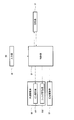
- FIG. 3 is a block diagram schematically showing a control configuration of the friction stir welding point joining device shown in FIG.
- the friction stir welding point joining device 50 includes a controller 51, a storage device 31, an input device 32, and a position detector 33.
- the controller 51 is composed of a microprocessor, a CPU, and the like, and is configured to control each member (each device) constituting the friction stir welding point joining device 50. Specifically, the controller 51 reads out and executes software such as a basic program stored in the storage device, thereby forming a pin drive 531 and a shoulder drive 532, and a rotary drive. 57 and, are controlled.
- the controller 51 may be configured by a single controller 51 that centrally controls, or may be configured by a plurality of controllers 51 that cooperate with each other to perform distributed control. Further, the controller 51 may be configured by a microcomputer, or may be configured by an MPU, a PLC (Programmable Logic Controller), a logic circuit, or the like.
- a microcomputer or may be configured by an MPU, a PLC (Programmable Logic Controller), a logic circuit, or the like.
- the storage device 31 stores a basic program and various data in a readable manner, and the storage device 31 is composed of a known memory, a storage device such as a hard disk, or the like.
- the storage device 31 does not have to be a single device, and may be configured as a plurality of storage devices (for example, a random access memory and a hard disk drive).
- the controller 51 and the like are configured by a microcomputer, at least a part of the storage device 31 may be configured as an internal memory of the microcomputer or may be configured as an independent memory.
- the data may be stored in the storage device 31 so that the data may be read from other than the controller 51, or the data may be written from the controller 51 or the like. Not to mention.
- the input device 32 can input various parameters related to the control of friction stir welding, other data, and the like to the controller 51, and is a known input device such as a keyboard, a touch panel, and a button switch group. It is configured.
- a known input device such as a keyboard, a touch panel, and a button switch group. It is configured.
- at least the joining conditions of the object to be joined 60 for example, data such as the thickness and material of the object to be joined 60 can be input by the input device 32.
- the position detector 33 is configured to detect the position information of the tip (tip surface 12a) of the shoulder member 12 and output the detected position information to the controller 51.
- a displacement sensor for example, a displacement sensor, an LVDT, an encoder, or the like may be used.
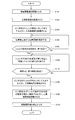
- FIG. 4 is a flowchart showing an example of the operation of the friction stir welding point joining device according to the first embodiment.
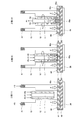
- 5A and 5B are process diagrams schematically showing an example of each process of friction stir point joining by the friction stir point joining device shown in FIG. 1.
- FIGS. 5A and 5B a part of the friction stir welding device is omitted, the arrow r indicates the rotation direction of the pin member 11 and the shoulder member 12, and the block arrow F indicates the first member 61 and the first member 61. 2
- the direction of the force applied to the member 62 is shown. Further, although a force is also applied to the first member 61 and the second member 62 from the backing member 56, they are not shown in FIGS. 5A and 5B for convenience of explanation.
- the shoulder member 12 is provided with shaded hatching in order to clearly distinguish it from the pin member 11 and the clamp member 13.
- an operator places the object to be joined 60 on the support surface 56a of the backing member 56. Then, the operator operates the input device 32 to input the joining execution of the object to be joined 60 to the controller 51. The robot may place the object to be joined 60 on the support surface 56a of the backing member 56.
- the controller 51 drives the rotation drive 57 to drive the pin member 11 and the shoulder member 12 at a predetermined first rotation speed (for example, 200 to 3000 rpm). Rotate (step S101; see step (1) in FIG. 5A).
- the controller 51 drives the advance / retreat drive 53 (shoulder drive 532) to rotate the pin member 11 and the shoulder member 12, and then holds the pin member 11, the shoulder member 12, and the clamp member 13.
- the tip surface 11a of the pin member 11, the tip surface 12a of the shoulder member 12, and the tip surface 13a of the clamp member 13 are brought close to the object to be joined 60. It is brought into contact with the surface 60c (the joined portion Wa of the joined object 60) (step S102; see step (2) in FIG. 5A).
- the controller 51 presses the object to be joined 60 with a predetermined pressing pressure (for example, a predetermined value included in the range of 3 kN to 15 kN) set in advance by the pin member 11, the shoulder member 12, and the clamp member 13.
- a predetermined pressing pressure for example, a predetermined value included in the range of 3 kN to 15 kN
- the advance / retreat drive 53 shoulder drive 532 is controlled so as to perform the operation.
- the first member 61 and the second member 62 are sandwiched between the clamp member 13 and the backing member 56, and the clamp member 13 is urged toward the surface 60c side of the object to be joined 60 by the contraction of the clamp drive 41. , Clamping force is generated.
- the controller 51 drives the advancing / retreating drive 53 so that the tip surface 11a of the pin member 11 is immersed in the tip surface 12a of the shoulder member 12 (step S103).
- the controller 51 may drive the advance / retreat drive 53 (pin drive 531) so that the pin member 11 is separated from the object to be joined 60.
- the controller 51 may drive the advance / retreat drive 53 (shoulder drive 532) so that the shoulder member 12 is press-fitted into the object to be joined 60.
- the tip end portion of the shoulder member 12 is press-fitted into the joined portion of the object to be joined 60 in a rotated state.
- the controller 51 acquires the position information of the tip surface 12a (tip) of the shoulder member 12 from the position detector 33 (step S104). Next, the controller 51 determines whether or not the position information of the tip of the shoulder member 12 acquired in step S104 has reached a predetermined first position set in advance (step S105).
- the first position can be set in advance by an experiment or the like, and is an arbitrary position in the second member 62. More specifically, the first position is 0.3 mm or less from the contact surface 62a of the second member 62 with the first member 61 (the surface of the second member 62 facing the tip surface 12a of the shoulder member 12). Any position in.
- the first position is 0.008 mm or more from the contact surface 62a from the viewpoint of removing the plating layer (plating film) or oxide film formed on the second member 62 to form a new surface. It may be at a position of 0.01 mm or more from the contact surface 62a. Further, the first position may be a position of 0.25 mm or less from the contact surface 62a, or 0.20 mm or less from the contact surface 62a, from the viewpoint of suppressing wear (damage) of the shoulder member 12. It may be present, and may be at a position of 0.10 mm or less from the contact surface 62a.
- the first position is a plating layer (plating) formed on the second member 62 from the viewpoint of removing the plating layer (plating film) or the oxide film formed on the second member 62 to form a new surface.
- the position may be 0.20 mm or less from the film) or the oxide film, or 0.10 mm or less from the plating layer (plating film) or the oxide film formed on the second member 62.
- the tip surface 12a of the shoulder member 12 reaches an arbitrary position (that is, the first position) within 0.3 mm from the contact surface 62a of the second member 62. Then, a new surface is formed on the portion of the second member 62 that is in contact with the shoulder member 12 and / or the portion of the second member 62 that is in contact with the plastic flow portion 60a.
- the softened material of the plastic flow portion 60a is pushed away by the shoulder member 12 and flows from directly under the shoulder member 12 directly under the pin member 11, so that the pin member 11 retracts and floats with respect to the shoulder member 12 (FIG. FIG. 5A step (3)).
- step S104 determines that the position information of the tip surface 12a of the shoulder member 12 acquired in step S104 has not reached the first position (No in step S105)
- the controller 51 returns to step S104 and returns to step S104.
- the processes of steps S104 and S105 are repeated until it is determined that the position information of the tip surface 12a of the shoulder member 12 acquired in 1 has reached the first position.
- step S104 determines that the position information of the tip surface 12a of the shoulder member 12 acquired in step S104 has reached the first position (Yes in step S105)
- the controller 51 executes the process of step S106. ..
- the controller 51 drives the advance / retreat drive 53 (shoulder drive 532) so that the tip surface 12a is located at the first position. Specifically, the controller 51 drives the advance / retreat drive 53 so as to stop the advance of the shoulder member 12.
- step S106 the controller 51 measures the time t after determining that the tip surface 12a of the shoulder member 12 has reached the first position. Next, the controller 51 determines whether or not the time t measured in step S106 has elapsed a predetermined first time set in advance (step S107).
- the first time can be set in advance by an experiment or the like.
- the first time may be, for example, longer than 0 seconds or 0.5 seconds or more from the viewpoint of sufficiently increasing the bonding strength of the bonded portion of the object to be bonded 60. Further, the first time may be less than 2 seconds from the viewpoint of shortening the joining time of the object to be joined 60.
- step S106 determines that the time t measured in step S106 has not elapsed the first time (No in step S107)
- the time t measured in step S106 has elapsed the first time.
- the processing of step S106 and step S107 is executed until it is determined.
- step S108 determines that the time t measured in step S106 has elapsed the first time (Yes in step S107).
- step S108 the controller 51 drives the advance / retreat drive 53 (pin drive 531) so that the pin member 11 advances toward the object 60, and / or the controller 51 is the shoulder member 12. Drives the advance / retreat drive 53 (pin drive 531) so as to move away from the object to be joined 60.
- the controller 51 controls the advancing / retreating drive 53 to align the tip surface 11a of the pin member 11 and the tip surface 12a of the shoulder member 12 to such an extent that almost no step is formed between them (they are flush with each other). ).
- the controller 51 has the tip surface 11a of the pin member 11 and the tip surface 12a of the shoulder member 12 to be joined.
- the advance / retreat drive 53 may be controlled so as to be located at a predetermined second position in the first member 61 of the object 60.
- the tip surface 11a of the pin member 11 is positioned on the surface 60c of the object to be joined 60, and the tip surface 12a of the shoulder member 12 is positioned at the second position in the first member 61 of the object to be joined 60.
- the advance / retreat drive 53 may be controlled so as to be located at.
- the second position can be set in advance by an experiment or the like. From the viewpoint of transferring the shape of the tip portion 120 to the surface (upper surface) 60c of the object to be joined 60, the second position is, for example, downward by the height h dimension of the tip portion 120 from the surface 60c of the object to be joined 60. It may be in the inner position). Further, the second position is, for example, downward by 1/2 dimension of the height h of the tip portion 120 from the surface 60c of the object to be joined 60 from the viewpoint of reducing the height of the unevenness of the surface 60c of the object to be joined 60. It may be in the (inner) position.
- the controller 51 may be retained for a predetermined second time in a state where the tip of the shoulder member 12 in the rotated state reaches the second position.
- the second time can be set in advance by an experiment.
- the second time may be, for example, longer than 0 seconds or 0.5 seconds or more from the viewpoint of transferring the shape of the tip portion 120 to the surface (upper surface) 60c of the object to be joined 60. good. Further, the second time may be less than 2 seconds from the viewpoint of shortening the joining time of the object to be joined 60.
- the pin member 11 gradually advances toward the first member 61, and the shoulder member 12 retracts from the first member 61.
- the softened portion of the plastic flow portion 60a flows from directly under the pin member 11 to directly under the shoulder member 12 (recess formed by press-fitting the shoulder member 12).
- the tip surface 11a of the pin member 11 and the tip surface 12a of the shoulder member 12 move to the vicinity of the surface 60c of the object to be joined 60.
- the shape of the tip portion 120 is marked (transferred) on the surface 60c of the object to be joined 60 (see step (4) in FIG. 5B).
- step S103 and / or step S108 the controller 51 sets the area of the tip surface of the pin member 11 to Ap, the area of the tip surface of the shoulder member 12 to As, and the press-fitting depth of the pin member 11 to Pp.
- the press-fitting depth of the shoulder member 12 is Ps
- the following equation (I) Ap ⁇ Pp + As ⁇ Ps Tx ⁇ ⁇ ⁇ (I)
- It is preferable to control the advance / retreat drive 53 so as to reduce the absolute value of the tool average position Tx defined in, and it is more preferable to control the advance / retreat drive 53 so that the tool average position Tx 0. .. Since the specific control for reducing the absolute value of the tool average position Tx is disclosed in detail in Japanese Patent Application Laid-Open No. 2012-196682, the description thereof will be omitted here.
- the controller 51 may control the advance / retreat drive 53 so that the tip surface 11a of the pin member 11 is located at the first position in the process of step S108.
- the controller 51 advances and retreats so that the tip surface 11a of the pin member 11 and the tip surface 12a of the shoulder member 12 are flush with each other after the tip surface 11a of the pin member 11 is located at the first position.
- the drive 53 may be controlled.
- the controller 51 drives the advancing / retreating drive 53 so as to separate the pin member 11, the shoulder member 12, and the clamp member 13 from the object to be joined 60 (step S109). Then, the controller 51 controls the rotation drive 57 to stop the rotation of the pin member 11 and the shoulder member 12 (step S110; see step (5) in FIG. 5B), and this program (the object to be joined 60). The joining process) is completed.
- the joint portion Wa of the object to be joined 60 formed by the friction stir welding device 50 according to the first embodiment is an example of the joint structure according to the first embodiment. Specifically, an annular recess 60b is formed in the bonded portion Wa of the bonded object 60.
- the inner wall of the recess 60b is formed so as to bend (FIG. 5B). Step (5)). That is, the shape of the tip portion 120 of the shoulder member 12 is marked (transferred) in the recess 60b.
- the inner wall of the recess 60b can be formed to be inclined, curved, curved, or bent.
- the tip portion 120 of the shoulder member 12 is formed in a tapered shape.
- the shape of the tip portion 120 is formed on the surface 60c of the object to be joined 60 (joint portion). Marked (transferred).
- the shape of the tip portion 120 is not marked on the surface of the object to be joined 60, and the surface 60c becomes flat.
- the shoulder member 12 is compared with the conventional shoulder member 12 which does not have a tapered shape.
- the area of the tip surface 12a of the above is reduced, and the surface pressure can be increased.
- the time required for the tip surface 12a of the shoulder member 12 to reach the first position is shortened as compared with the conventional friction stir point joining device. be able to.
- the second member 62 of the object to be joined 60 has a plating layer such as an alloyed hot-dip galvanized steel sheet, an oxide film is formed on the surface, or a sealant material is arranged on the surface.
- impurities for example, zinc or the like
- the tip portion 120 is formed in a tapered shape, the tip portion 120 of the shoulder member 12 is formed along the outer peripheral surface 12b and / or the inner peripheral surface 12c of the tip portion 120.
- the flow of impurities can be promoted.
- the shoulder member 12 in order to join the object to be joined 60 to a sufficient joining strength as compared with the conventional friction stir point joining device, the shoulder member 12 is used.
- the time for the tip surface 12a to stay in the first position can be set to 2 seconds or less.
- the joining time of the object to be joined 60 can be shortened as compared with the conventional friction stir point joining device.
- the friction stir point joining device is a friction stir point joining device that joins by softening the object to be joined by frictional heat, and the friction stir point joining device is formed in a columnar shape.
- the shoulder member is provided with an advance / retreat drive for moving the shoulder member forward and backward along the axis, respectively, and the tip portion of the shoulder member is formed in a tapered shape.
- the tip surface of the shoulder member and the tip surface of the pin member may be configured to coincide with each other when viewed from the horizontal direction.
- the outer peripheral surface of the tip end portion of the shoulder member may be configured to be inclined, curved, curved, or bent.
- the outer peripheral surface of the tip portion of the shoulder member is configured to be inclined, and the tip portion of the shoulder member is a shoulder member when viewed from the horizontal direction.
- the angle formed by the tip surface of the shoulder member and the inclined surface of the horizontal member may be 6 ° or more and less than 45 °.
- the inner peripheral surface of the tip end portion of the shoulder member may be configured to be inclined, curved, curved, or bent.
- the inner peripheral surface of the tip portion of the shoulder member is configured to be inclined, and the tip portion of the shoulder member is a shoulder when viewed from the horizontal direction.
- the angle between the tip surface of the member and the inclined surface of the horizontal member may be configured to be 6 ° or more and less than 45 °.
- the object to be joined includes a first member and a second member, and the first member is arranged so as to face the pin member and the shoulder member.
- the friction stir welding point joining device is further provided with a controller, and the controller is a cover of the object to be joined in a state where the pin member and the shoulder member are rotated.
- the shoulder member in the rotated state is operated after (B).
- the shoulder member in a rotated state is held from the bonded portion of the object to be welded after the state where the tip of the rod reaches the first position and is retained for a predetermined first time set in advance. It is configured to operate the rotary drive and the advance / retreat drive (D) so as to pull out and advance the rotated pin member toward the joined portion of the object to be joined. May be.
- the controller executes (D)
- the tip of the shoulder member is placed at a predetermined second position in the first member.
- the rotary drive and the advance / retreat drive may be operated so as to reach.
- the controller in (D), is set in advance in a predetermined state in which the tip of the shoulder member in the rotated state reaches the second position. It may be retained for a second hour.
- the controller pulls out the rotated pin member and the rotated shoulder member from the joined portion of the object to be joined.
- (E) for operating the rotary drive and the advance / retreat drive may be executed.
- the bonded portion may further include a third member arranged between the first member and the second member.
- the first time may be 0 seconds or more and less than 2 seconds in the first time.
- the joint structure according to the first embodiment is formed by joining the jointed object including the first member and the second member at the frictional stirring point joining portion by the friction stirring point joining device.
- the first member is made of a material having a lower melting point than the second member, and the first member and the second member are arranged in this order.
- An annular recess is formed on the surface, and the bottom surface of the recess is formed so as to be inclined, curved, curved, or bent.
- the friction stir welding point joining device includes a pin member formed in a cylindrical shape, a shoulder member formed in a cylindrical shape, and a shoulder member in which the pin member is inserted therein.
- the joint structure is provided with a state in which the tip of the shoulder member in a rotated state reaches a predetermined predetermined first position in the second member, and is retained for a predetermined first time. It may be formed by.
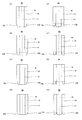
- FIG. 6 is an enlarged schematic view of a main part of the friction stir welding point joining device of the modification 1 in the first embodiment.
- 6 (A) to 6 (D) show an embodiment in which the outer peripheral surface of the tip end portion of the shoulder member is formed so as to be inclined, curved, curved, or bent.
- FIGS. 6E to 6H show an embodiment in which the inner peripheral surface of the tip end portion of the shoulder member is formed so as to be inclined, curved, curved, or bent.
- the friction stir welding device 50 of the first modification may be formed so that the outer peripheral surface 12b of the tip end portion 120 of the shoulder member 12 is inclined. More specifically, the cross section (cross section along the axis Xr) of the outer peripheral surface 12b of the tip portion 120 may be formed so as to be inclined with respect to the axis Xr when viewed from the horizontal direction.
- the friction stir welding device 50 of the modified example 1 may be formed so that the outer peripheral surface 12b of the tip end portion 120 of the shoulder member 12 is bent. More specifically, the cross-sectional shape of the outer peripheral surface 12b of the tip portion 120 may be formed so as to bend when viewed from the horizontal direction.
- the bending point shows one aspect, but it may be the aspect which has a plurality of bending points.
- the outer peripheral surface 12b of the tip end portion 120 of the shoulder member 12 is formed so as to be curved (on an arc). You may. More specifically, the cross-sectional shape of the outer peripheral surface 12b of the tip portion 120 may be formed so as to be curved when viewed from the horizontal direction.
- the outer peripheral surface 12b of the tip portion 120 of the shoulder member 12 may be formed in a curved shape. More specifically, the cross-sectional shape of the outer peripheral surface 12b of the tip portion 120 may be formed in a curved shape when viewed from the horizontal direction.
- the curved curve is a curve of a function represented by a higher-order function such as a quadratic function or a cubic function, an exponential function, or a logarithmic function.
- the friction stir welding device 50 of the modified example 1 may be formed so that the inner peripheral surface 12c of the tip portion 120 of the shoulder member 12 is inclined. More specifically, the cross section (cross section along the axis Xr) of the inner peripheral surface 12c of the tip portion 120 may be formed so as to be inclined with respect to the axis Xr when viewed from the horizontal direction.
- the friction stir welding device 50 of the modified example 1 may be formed so that the inner peripheral surface 12c of the tip portion 120 of the shoulder member 12 is bent. More specifically, the cross-sectional shape of the inner peripheral surface 12c of the tip portion 120 may be formed so as to bend when viewed from the horizontal direction.
- the bending point shows one aspect in (F) of FIG. 6, it may be the aspect which has a plurality of bending points.
- the inner peripheral surface 12c of the tip end portion 120 of the shoulder member 12 is formed so as to be curved (on an arc). May be. More specifically, the cross-sectional shape of the inner peripheral surface 12c of the tip portion 120 may be formed so as to be curved when viewed from the horizontal direction.
- the inner peripheral surface 12c of the tip portion 120 of the shoulder member 12 may be formed in a curved shape. More specifically, the cross-sectional shape of the inner peripheral surface 12c of the tip portion 120 may be formed in a curved shape when viewed from the horizontal direction.
- the curved curve is a curve of a function represented by a higher-order function such as a quadratic function or a cubic function, an exponential function, or a logarithmic function.
- the tip surface of the shoulder member is the tip of the pin member when viewed from the horizontal direction. It is configured to protrude above the surface.
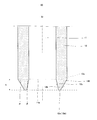
- FIG. 7 is a schematic diagram showing a schematic configuration of a main part of the friction stir welding point joining device according to the second embodiment.
- the friction stir point joining device 50 according to the second embodiment has the same basic configuration as the friction stir point joining device 50 according to the first embodiment, but has the same basic configuration as the tip surface of the horizontal member 12. The difference is that the 12a is configured to protrude from the tip surface 11a of the pin member 11 when viewed from the horizontal direction.
- the outer peripheral surface 12b and the inner peripheral surface 12c of the tip portion 120 of the shoulder member 12 are formed so as to be inclined when viewed from the horizontal direction.
- the outer peripheral surface 12b and the inner peripheral surface 12c of the tip portion 120 of the shoulder member 12 may be formed at the same inclination angle when viewed from the horizontal direction. Further, the inclination angle ⁇ of the outer peripheral surface 12b of the tip portion 120 may be larger than the inclination angle ⁇ of the inner peripheral surface 12c of the tip portion 120. Further, the inclination angle ⁇ of the outer peripheral surface 12b of the tip portion 120 may be smaller than the inclination angle ⁇ of the inner peripheral surface 12c of the tip portion 120.
- FIG. 8A is a schematic diagram showing a schematic configuration of a pin member, a shoulder member, and a tip portion of a clamp member of a friction stir welding device.
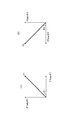
- FIG. 8B is an exploded view of the shearing force acting on the transfer portion of the object to be joined.
- the portion where the shape of the outer peripheral surface 12b of the tip portion 120 of the shoulder member 12 is transferred to the bonded portion Wa of the bonded object 60 is referred to as a transfer portion 601.
- the projecting portion formed in the bonded portion Wa of the bonded object 60 by the inner peripheral surface 12c of the tip portion 120 of the shoulder member 12 and the tip portion of the pin member 11 is referred to as a transfer portion 602.
- the inclination angle ⁇ of the outer peripheral surface 12b of the tip portion 120 is a virtual line C which is a line perpendicular to the axis Xr, and the base end side (upper end side) end portion A1 and the tip end side where the outer peripheral surface 12b is inclined. (Lower end side) The angle with the line connecting the end A2.
- the inclination angle ⁇ of the inner peripheral surface 12c of the tip portion 120 is the virtual line C, the base end side (upper end side) end portion B1 on which the inner peripheral surface 12c is inclined, and the tip end side (lower end portion side) end portion B2. The angle between the line connecting and.
- the distal end type end portion and the tip end side of the curved shape or the like are curved.
- the line connecting the ends and the virtual line C have an inclination angle ⁇ and an inclination angle ⁇ , respectively.
- the angle ⁇ 1 of the slope of the transfer portion 601 also increases.
- the angle ⁇ 1 of the slope of the transfer unit 601 becomes large, the bottom surface (area of the bottom surface) of the transfer unit 601 becomes small, and the transfer unit 601 may be damaged (plucking occurs).
- the angle ⁇ 2 of the slope of the transfer unit 602 also increases.
- the angle ⁇ 2 of the slope of the transfer unit 602 becomes large, the bottom surface (area of the bottom surface) of the transfer unit 602 becomes small, and the transfer unit 602 may be damaged (plucking occurs).
- F1sin ⁇ 1 acts as a force for peeling off the transfer unit 601.
- F2sin ⁇ 2 acts as a force to peel off the transfer unit 602 (see FIG. (B (2)).
- ⁇ 1 45 °
- F1sin ⁇ 1 F1cos ⁇ 1.
- ⁇ 2 45 °
- F2sin ⁇ 2 F2cos ⁇ 2.
- the inclination angle ⁇ of the outer peripheral surface 12b of the tip portion 120 is preferably less than 45 °, and the inclination angle ⁇ of the inner peripheral surface 12c of the tip portion 120 is preferably less than 45 °.
- the inclination angle ⁇ may be 32 ° or less, 17 ° or less, 12 ° or less, or 6 ° or less. May be. Similarly, the inclination angle ⁇ may be 32 ° or less, 17 ° or less, 12 ° or less, or 6 ° or less.
- the friction stir point joining device 50 according to the second embodiment which is configured in this way, has the same function and effect as the friction stir point joining device 50 according to the first embodiment.
- the friction stir point joining device according to the third embodiment is a friction stir point joining device that joins by softening the object to be joined by frictional heat, and the friction stir point joining device is formed in a columnar shape.
- the shoulder member is provided with an advance / retreat drive for moving the shoulder member forward and backward along the axis, respectively, and a recess extending along the circumferential direction is formed on the tip surface of the shoulder member.
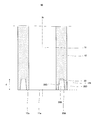
- FIG. 9 is a schematic diagram showing a schematic configuration of a main part of the friction stir welding point joining device according to the third embodiment.
- the friction stir point joining device 50 according to the third embodiment has the same basic configuration as the friction stir point joining device 50 according to the first embodiment, but has the same basic configuration as the tip surface of the shoulder member 12. The difference is that the (annular) recess 20 extending along the circumferential direction is formed in 12a.
- the recess 20 may be formed so that the area of the opening 20A is larger than the area of the bottom surface 20B. Further, at least one of the inner peripheral surface 20C and the outer peripheral surface 20D of the recess 20 may be formed so as to be parallel to the axis Xr. Further, at least one of the inner peripheral surface 20C and the outer peripheral surface 20D of the recess 20 may be formed to be inclined, curved, curved, or bent.
- the depth d of the recess 20 may be, for example, 0.05 mm or more from the viewpoint of marking (transferring) the shape of the tip portion 120 on the surface of the object to be joined 60, and the thickness of the first member 61. It may be 5% or more of the dimension. Further, the depth d may be, for example, 0.5 mm or less, or 50% or less of the thickness dimension of the first member 61, from the viewpoint of suppressing damage to the tip portion 120 of the shoulder member 12. ..
- the present invention is not limited to this.
- An embodiment in which an annular recess 20 is formed on the tip surface 11a of the pin member 11 may be adopted.
- Test Example 1 A joining test of the object to be joined 60 was performed using the friction stir point joining device 50 according to the second embodiment.
- the height of the tip portion 120 was set to 0.2 mm.
- the inclination angle ⁇ of the outer peripheral surface 12b of the tip portion 120 was set to 12 °
- the inclination angle ⁇ of the inner peripheral surface 12c of the tip portion 120 was set to 32 °.
- Test Example 2 A joining test of the object to be joined 60 was performed using the friction stir point joining device 50 according to the second embodiment.
- the height of the tip portion 120 was set to 0.1 mm.
- the inclination angle ⁇ of the outer peripheral surface 12b of the tip portion 120 was set to 6 °
- the inclination angle ⁇ of the inner peripheral surface 12c of the tip portion 120 was set to 17 °.
- Comparative example As a comparative example, a joining test of the object to be joined 60 was carried out by the friction stir point joining method disclosed in Patent Document 1. Specifically, as the friction stir welding point joining device of the comparative example, a shoulder member 12 formed so that the inner peripheral surface and the outer peripheral surface of the tip portion 120 are parallel to the axis Xr is used for joining. A joining test of the object 60 was performed.
- a 1 mm aluminum plate (A6061) was used as the first member 61, and a 1.2 mm 980 MPa class alloyed hot-dip galvanized steel sheet (GA) was used as the second member 62.
- the first position which is the target arrival position of the shoulder member 12 is set to a position 0.3 mm below the contact surface (upper surface) with the first member 61 of the second member 62. Further, in Test Example 2, the position was set 0.2 mm below the contact surface (upper surface) of the second member 62 with the first member 61. Further, in the comparative example, the first position, which is the target reaching position of the shoulder member 12, is set to a position 0.1 mm below the contact surface (upper surface) with the first member 61 of the second member 62.
- the time (first time) for the tip surface 12a to stay in the first position is changed to 0, 1, 2, or 3 seconds.
- the object to be joined 60 was joined.
- the first rotation speed which is the rotation speed of the pin member 11 and the shoulder member 12, was set to 2000 rpm.
- the bonded objects 60 were subjected to a tensile shear test (JIS Z 3136) and a cross tensile test (JIS Z 3137), respectively, by the friction stir welding point joining devices of Test Examples 1 and 2, respectively. ..
- FIG. 10 is a graph showing the results of a tensile shear test and a cross tensile test of a material to be joined by friction stir welding under the above joining conditions using the friction stir point joining devices of Test Examples 1 and 2 and Comparative Example. Further, FIG. 11 is a cross-sectional photograph of an object to be joined by friction stir point joining using the friction stir point joining device of Test Example 1.
- the friction stir welding point joining device of the present invention is useful because the wear state of the tool can be determined from the joining hit point (the surface of the joined portion) of the object to be joined.
Landscapes
- Engineering & Computer Science (AREA)
- Mechanical Engineering (AREA)
- Pressure Welding/Diffusion-Bonding (AREA)
Priority Applications (7)
| Application Number | Priority Date | Filing Date | Title |
|---|---|---|---|
| CN202180038588.8A CN115943008B (zh) | 2020-05-29 | 2021-05-27 | 摩擦搅拌点接合装置以及接缝构造 |
| JP2022526630A JP7489457B2 (ja) | 2020-05-29 | 2021-05-27 | 摩擦攪拌点接合装置及び継手構造 |
| EP21812652.2A EP4159356B1 (en) | 2020-05-29 | 2021-05-27 | Friction stir spot welding apparatus for joining a to-be-joined object by softening the object with frictional heat, and method of joining a to-be-joined object by softening the object with frictional heat |
| US17/928,461 US12202066B2 (en) | 2020-05-29 | 2021-05-27 | Friction stir spot welding apparatus and joint structure |
| KR1020227045206A KR102849081B1 (ko) | 2020-05-29 | 2021-05-27 | 마찰 교반 점 접합 장치 및 이음새 구조 |
| JP2024077884A JP7739521B2 (ja) | 2020-05-29 | 2024-05-13 | 摩擦攪拌点接合装置及び継手構造 |
| US18/975,211 US20250100071A1 (en) | 2020-05-29 | 2024-12-10 | Friction stir spot welding apparatus and joint structure |
Applications Claiming Priority (2)
| Application Number | Priority Date | Filing Date | Title |
|---|---|---|---|
| JP2020094145 | 2020-05-29 | ||
| JP2020-094145 | 2020-05-29 |
Related Child Applications (2)
| Application Number | Title | Priority Date | Filing Date |
|---|---|---|---|
| US17/928,461 A-371-Of-International US12202066B2 (en) | 2020-05-29 | 2021-05-27 | Friction stir spot welding apparatus and joint structure |
| US18/975,211 Continuation US20250100071A1 (en) | 2020-05-29 | 2024-12-10 | Friction stir spot welding apparatus and joint structure |
Publications (1)
| Publication Number | Publication Date |
|---|---|
| WO2021241674A1 true WO2021241674A1 (ja) | 2021-12-02 |
Family
ID=78744894
Family Applications (1)
| Application Number | Title | Priority Date | Filing Date |
|---|---|---|---|
| PCT/JP2021/020157 Ceased WO2021241674A1 (ja) | 2020-05-29 | 2021-05-27 | 摩擦攪拌点接合装置及び継手構造 |
Country Status (6)
| Country | Link |
|---|---|
| US (2) | US12202066B2 (https=) |
| EP (1) | EP4159356B1 (https=) |
| JP (2) | JP7489457B2 (https=) |
| KR (1) | KR102849081B1 (https=) |
| CN (1) | CN115943008B (https=) |
| WO (1) | WO2021241674A1 (https=) |
Cited By (2)
| Publication number | Priority date | Publication date | Assignee | Title |
|---|---|---|---|---|
| US20240001479A1 (en) * | 2020-12-04 | 2024-01-04 | Nippon Light Metal Company, Ltd. | Rotary tool, joining device, and joining method |
| WO2025253900A1 (ja) * | 2024-06-03 | 2025-12-11 | 川崎重工業株式会社 | 摩擦攪拌点接合装置および摩擦攪拌点接合方法 |
Families Citing this family (5)
| Publication number | Priority date | Publication date | Assignee | Title |
|---|---|---|---|---|
| CN112770863B (zh) * | 2018-10-11 | 2022-07-29 | 川崎重工业株式会社 | 摩擦搅拌接合装置、其运转方法以及接头构造 |
| US12202066B2 (en) * | 2020-05-29 | 2025-01-21 | Kawasaki Jukogyo Kabushiki Kaisha | Friction stir spot welding apparatus and joint structure |
| AT525198B1 (de) * | 2021-06-29 | 2025-05-15 | Stirtec Gmbh | Verfahren zum Verbinden übereinander angeordneter Bauteile, Verbundbauteil sowie Vorrichtung zur Durchführung eines entsprechenden Verfahrens |
| KR102877383B1 (ko) * | 2021-08-31 | 2025-10-27 | 제이에프이 스틸 가부시키가이샤 | 마찰 교반점 접합 조인트 및 그의 제조 방법, 그리고, 마찰 교반점 접합 방법 |
| JP2023152110A (ja) * | 2022-04-01 | 2023-10-16 | 川崎重工業株式会社 | 摩擦撹拌接合装置及びそのメンテナンス方法 |
Citations (4)
| Publication number | Priority date | Publication date | Assignee | Title |
|---|---|---|---|---|
| JP2003320465A (ja) * | 2002-05-07 | 2003-11-11 | Concurrent Technologies Corp | テーパー摩擦撹拌溶接工具 |
| JP2006061921A (ja) * | 2004-08-25 | 2006-03-09 | Mazda Motor Corp | 摩擦点接合方法およびその装置 |
| JP2012196682A (ja) | 2011-03-18 | 2012-10-18 | Kawasaki Heavy Ind Ltd | 摩擦攪拌点接合装置および摩擦攪拌点接合方法 |
| WO2019050002A1 (ja) * | 2017-09-08 | 2019-03-14 | 川崎重工業株式会社 | 複動式摩擦攪拌点接合用保持治具および保持治具セット、並びに、複動式摩擦攪拌点接合装置および複動式摩擦攪拌点接合方法 |
Family Cites Families (18)
| Publication number | Priority date | Publication date | Assignee | Title |
|---|---|---|---|---|
| CN1191144C (zh) * | 2000-05-08 | 2005-03-02 | 布莱阿姆青年大学 | 摩擦搅拌焊接的超级研磨工具和方法 |
| JP3505508B2 (ja) * | 2000-12-27 | 2004-03-08 | 川崎重工業株式会社 | 摩擦攪拌接合装置 |
| JP2005211971A (ja) | 2004-01-30 | 2005-08-11 | Mitsubishi Motors Corp | 摩擦撹拌接合装置 |
| JP2007054885A (ja) * | 2005-08-26 | 2007-03-08 | Kawasaki Heavy Ind Ltd | 接合ツールおよび摩擦撹拌接合方法 |
| US7581665B2 (en) * | 2006-01-04 | 2009-09-01 | The Boeing Company | Methods and apparatus for retractable pin friction stir welding and spot welding |
| US7848837B2 (en) * | 2007-04-02 | 2010-12-07 | Hitachi, Ltd | Method and apparatus for monitoring the quality of a machining operation |
| JP5183140B2 (ja) * | 2007-09-28 | 2013-04-17 | 株式会社総合車両製作所 | 摩擦攪拌接合システム及び摩擦攪拌接合方法 |
| JP5345223B2 (ja) * | 2010-01-15 | 2013-11-20 | 三菱重工業株式会社 | 接合部材の製造方法及び摩擦攪拌接合装置 |
| JP5788861B2 (ja) * | 2012-12-28 | 2015-10-07 | 株式会社エフテック | 摩擦撹拌接合装置 |
| EP3235585B1 (en) * | 2014-12-15 | 2021-01-20 | Kawasaki Jukogyo Kabushiki Kaisha | Friction stir spot welding device and friction stir spot welding method |
| JP6650801B2 (ja) * | 2016-03-17 | 2020-02-19 | 川崎重工業株式会社 | 摩擦攪拌点接合方法及び摩擦攪拌点接合装置 |
| JP6936608B2 (ja) * | 2017-04-10 | 2021-09-15 | 日本車輌製造株式会社 | 摩擦攪拌接合方法、及び摩擦攪拌接合用回転工具 |
| EP3680051B1 (en) * | 2017-09-04 | 2023-08-16 | Kawasaki Jukogyo Kabushiki Kaisha | Method for operating double-action friction stir welding device, and double-action friction stir welding device |
| JP6796565B2 (ja) * | 2017-09-08 | 2020-12-09 | 川崎重工業株式会社 | 複動式摩擦攪拌点接合方法 |
| JP6782674B2 (ja) * | 2017-09-08 | 2020-11-11 | 川崎重工業株式会社 | 複動式摩擦攪拌点接合装置用クランプ部材、複動式摩擦攪拌点接合装置、及び、複動式摩擦攪拌点接合方法 |
| CN112601629B (zh) * | 2018-08-23 | 2022-09-06 | 川崎重工业株式会社 | 复动式摩擦搅拌接合系统及其运行方法 |
| JP7216551B2 (ja) * | 2019-01-07 | 2023-02-01 | 川崎重工業株式会社 | 摩擦攪拌点接合装置及び摩擦攪拌点接合方法 |
| US12202066B2 (en) * | 2020-05-29 | 2025-01-21 | Kawasaki Jukogyo Kabushiki Kaisha | Friction stir spot welding apparatus and joint structure |
-
2021
- 2021-05-27 US US17/928,461 patent/US12202066B2/en active Active
- 2021-05-27 WO PCT/JP2021/020157 patent/WO2021241674A1/ja not_active Ceased
- 2021-05-27 CN CN202180038588.8A patent/CN115943008B/zh active Active
- 2021-05-27 KR KR1020227045206A patent/KR102849081B1/ko active Active
- 2021-05-27 JP JP2022526630A patent/JP7489457B2/ja active Active
- 2021-05-27 EP EP21812652.2A patent/EP4159356B1/en active Active
-
2024
- 2024-05-13 JP JP2024077884A patent/JP7739521B2/ja active Active
- 2024-12-10 US US18/975,211 patent/US20250100071A1/en active Pending
Patent Citations (4)
| Publication number | Priority date | Publication date | Assignee | Title |
|---|---|---|---|---|
| JP2003320465A (ja) * | 2002-05-07 | 2003-11-11 | Concurrent Technologies Corp | テーパー摩擦撹拌溶接工具 |
| JP2006061921A (ja) * | 2004-08-25 | 2006-03-09 | Mazda Motor Corp | 摩擦点接合方法およびその装置 |
| JP2012196682A (ja) | 2011-03-18 | 2012-10-18 | Kawasaki Heavy Ind Ltd | 摩擦攪拌点接合装置および摩擦攪拌点接合方法 |
| WO2019050002A1 (ja) * | 2017-09-08 | 2019-03-14 | 川崎重工業株式会社 | 複動式摩擦攪拌点接合用保持治具および保持治具セット、並びに、複動式摩擦攪拌点接合装置および複動式摩擦攪拌点接合方法 |
Non-Patent Citations (1)
| Title |
|---|
| See also references of EP4159356A4 |
Cited By (3)
| Publication number | Priority date | Publication date | Assignee | Title |
|---|---|---|---|---|
| US20240001479A1 (en) * | 2020-12-04 | 2024-01-04 | Nippon Light Metal Company, Ltd. | Rotary tool, joining device, and joining method |
| US12145211B2 (en) * | 2020-12-04 | 2024-11-19 | Nippon Light Metal Company, Ltd. | Rotary tool, joining device, and joining method |
| WO2025253900A1 (ja) * | 2024-06-03 | 2025-12-11 | 川崎重工業株式会社 | 摩擦攪拌点接合装置および摩擦攪拌点接合方法 |
Also Published As
| Publication number | Publication date |
|---|---|
| CN115943008A (zh) | 2023-04-07 |
| EP4159356A1 (en) | 2023-04-05 |
| US12202066B2 (en) | 2025-01-21 |
| JP7489457B2 (ja) | 2024-05-23 |
| KR20230015978A (ko) | 2023-01-31 |
| US20230211434A1 (en) | 2023-07-06 |
| JP7739521B2 (ja) | 2025-09-16 |
| KR102849081B1 (ko) | 2025-08-21 |
| EP4159356A4 (en) | 2024-07-17 |
| JP2024100815A (ja) | 2024-07-26 |
| US20250100071A1 (en) | 2025-03-27 |
| CN115943008B (zh) | 2025-12-02 |
| EP4159356B1 (en) | 2025-09-24 |
| JPWO2021241674A1 (https=) | 2021-12-02 |
Similar Documents
| Publication | Publication Date | Title |
|---|---|---|
| WO2021241674A1 (ja) | 摩擦攪拌点接合装置及び継手構造 | |
| JP7216551B2 (ja) | 摩擦攪拌点接合装置及び摩擦攪拌点接合方法 | |
| JP7787134B2 (ja) | 摩擦攪拌点接合装置及びその運転方法 | |
| JP7684900B2 (ja) | 摩擦攪拌点接合装置、摩擦攪拌点接合された被接合物、及びショルダ部材 | |
| JP3400409B2 (ja) | 接合方法及び接合装置 | |
| EP1902810B1 (en) | Friction stir spot welding method | |
| EP3903986B1 (en) | Friction stir spot welding device and method for operating same | |
| JP2024149583A (ja) | 摩擦攪拌点接合装置及び摩擦攪拌点接合方法 | |
| US20220362889A1 (en) | Joining system, and method for operating same | |
| JP7232275B2 (ja) | 摩擦攪拌点接合装置及びその運転方法 | |
| WO2020075813A1 (ja) | 摩擦攪拌接合装置、その運転方法、及び継手構造 | |
| Lin et al. | Microstructures and failure mechanisms of spot friction welds in lap-shear specimens of aluminum 6111-T4 sheets | |
| WO2020218444A1 (ja) | 摩擦攪拌点接合装置及びその運転方法 |
Legal Events
| Date | Code | Title | Description |
|---|---|---|---|
| 121 | Ep: the epo has been informed by wipo that ep was designated in this application |
Ref document number: 21812652 Country of ref document: EP Kind code of ref document: A1 |
|
| ENP | Entry into the national phase |
Ref document number: 2022526630 Country of ref document: JP Kind code of ref document: A |
|
| ENP | Entry into the national phase |
Ref document number: 20227045206 Country of ref document: KR Kind code of ref document: A |
|
| NENP | Non-entry into the national phase |
Ref country code: DE |
|
| ENP | Entry into the national phase |
Ref document number: 2021812652 Country of ref document: EP Effective date: 20230102 |
|
| WWG | Wipo information: grant in national office |
Ref document number: 1020227045206 Country of ref document: KR |
|
| WWG | Wipo information: grant in national office |
Ref document number: 2021812652 Country of ref document: EP |