WO2021215499A1 - 潤滑油組成物及び摺動機構 - Google Patents
潤滑油組成物及び摺動機構 Download PDFInfo
- Publication number
- WO2021215499A1 WO2021215499A1 PCT/JP2021/016296 JP2021016296W WO2021215499A1 WO 2021215499 A1 WO2021215499 A1 WO 2021215499A1 JP 2021016296 W JP2021016296 W JP 2021016296W WO 2021215499 A1 WO2021215499 A1 WO 2021215499A1
- Authority
- WO
- WIPO (PCT)
- Prior art keywords
- lubricating oil
- oil composition
- friction
- friction coefficient
- pentaerythritol
- Prior art date
- Legal status (The legal status is an assumption and is not a legal conclusion. Google has not performed a legal analysis and makes no representation as to the accuracy of the status listed.)
- Ceased
Links
Images
Classifications
-
- C—CHEMISTRY; METALLURGY
- C10—PETROLEUM, GAS OR COKE INDUSTRIES; TECHNICAL GASES CONTAINING CARBON MONOXIDE; FUELS; LUBRICANTS; PEAT
- C10M—LUBRICATING COMPOSITIONS; USE OF CHEMICAL SUBSTANCES EITHER ALONE OR AS LUBRICATING INGREDIENTS IN A LUBRICATING COMPOSITION
- C10M129/00—Lubricating compositions characterised by the additive being an organic non-macromolecular compound containing oxygen
- C10M129/02—Lubricating compositions characterised by the additive being an organic non-macromolecular compound containing oxygen having a carbon chain of less than 30 atoms
- C10M129/68—Esters
- C10M129/74—Esters of polyhydroxy compounds
-
- C—CHEMISTRY; METALLURGY
- C10—PETROLEUM, GAS OR COKE INDUSTRIES; TECHNICAL GASES CONTAINING CARBON MONOXIDE; FUELS; LUBRICANTS; PEAT
- C10M—LUBRICATING COMPOSITIONS; USE OF CHEMICAL SUBSTANCES EITHER ALONE OR AS LUBRICATING INGREDIENTS IN A LUBRICATING COMPOSITION
- C10M129/00—Lubricating compositions characterised by the additive being an organic non-macromolecular compound containing oxygen
- C10M129/02—Lubricating compositions characterised by the additive being an organic non-macromolecular compound containing oxygen having a carbon chain of less than 30 atoms
- C10M129/68—Esters
- C10M129/76—Esters containing free hydroxy or carboxyl groups
-
- C—CHEMISTRY; METALLURGY
- C10—PETROLEUM, GAS OR COKE INDUSTRIES; TECHNICAL GASES CONTAINING CARBON MONOXIDE; FUELS; LUBRICANTS; PEAT
- C10M—LUBRICATING COMPOSITIONS; USE OF CHEMICAL SUBSTANCES EITHER ALONE OR AS LUBRICATING INGREDIENTS IN A LUBRICATING COMPOSITION
- C10M169/00—Lubricating compositions characterised by containing as components a mixture of at least two types of ingredient selected from base-materials, thickeners or additives, covered by the preceding groups, each of these compounds being essential
- C10M169/04—Mixtures of base-materials and additives
-
- F—MECHANICAL ENGINEERING; LIGHTING; HEATING; WEAPONS; BLASTING
- F16—ENGINEERING ELEMENTS AND UNITS; GENERAL MEASURES FOR PRODUCING AND MAINTAINING EFFECTIVE FUNCTIONING OF MACHINES OR INSTALLATIONS; THERMAL INSULATION IN GENERAL
- F16C—SHAFTS; FLEXIBLE SHAFTS; ELEMENTS OR CRANKSHAFT MECHANISMS; ROTARY BODIES OTHER THAN GEARING ELEMENTS; BEARINGS
- F16C33/00—Parts of bearings; Special methods for making bearings or parts thereof
- F16C33/02—Parts of sliding-contact bearings
- F16C33/04—Brasses; Bushes; Linings
- F16C33/043—Sliding surface consisting mainly of ceramics, cermets or hard carbon, e.g. diamond like carbon [DLC]
-
- F—MECHANICAL ENGINEERING; LIGHTING; HEATING; WEAPONS; BLASTING
- F16—ENGINEERING ELEMENTS AND UNITS; GENERAL MEASURES FOR PRODUCING AND MAINTAINING EFFECTIVE FUNCTIONING OF MACHINES OR INSTALLATIONS; THERMAL INSULATION IN GENERAL
- F16C—SHAFTS; FLEXIBLE SHAFTS; ELEMENTS OR CRANKSHAFT MECHANISMS; ROTARY BODIES OTHER THAN GEARING ELEMENTS; BEARINGS
- F16C33/00—Parts of bearings; Special methods for making bearings or parts thereof
- F16C33/02—Parts of sliding-contact bearings
- F16C33/04—Brasses; Bushes; Linings
- F16C33/06—Sliding surface mainly made of metal
- F16C33/10—Construction relative to lubrication
- F16C33/1025—Construction relative to lubrication with liquid, e.g. oil, as lubricant
- F16C33/109—Lubricant compositions or properties, e.g. viscosity
-
- F—MECHANICAL ENGINEERING; LIGHTING; HEATING; WEAPONS; BLASTING
- F16—ENGINEERING ELEMENTS AND UNITS; GENERAL MEASURES FOR PRODUCING AND MAINTAINING EFFECTIVE FUNCTIONING OF MACHINES OR INSTALLATIONS; THERMAL INSULATION IN GENERAL
- F16F—SPRINGS; SHOCK-ABSORBERS; MEANS FOR DAMPING VIBRATION
- F16F7/00—Vibration-dampers; Shock-absorbers
- F16F7/08—Vibration-dampers; Shock-absorbers with friction surfaces rectilinearly movable along each other
- F16F7/09—Vibration-dampers; Shock-absorbers with friction surfaces rectilinearly movable along each other in dampers of the cylinder-and-piston type
-
- C—CHEMISTRY; METALLURGY
- C10—PETROLEUM, GAS OR COKE INDUSTRIES; TECHNICAL GASES CONTAINING CARBON MONOXIDE; FUELS; LUBRICANTS; PEAT
- C10M—LUBRICATING COMPOSITIONS; USE OF CHEMICAL SUBSTANCES EITHER ALONE OR AS LUBRICATING INGREDIENTS IN A LUBRICATING COMPOSITION
- C10M2207/00—Organic non-macromolecular hydrocarbon compounds containing hydrogen, carbon and oxygen as ingredients in lubricant compositions
- C10M2207/28—Esters
- C10M2207/283—Esters of polyhydroxy compounds
-
- C—CHEMISTRY; METALLURGY
- C10—PETROLEUM, GAS OR COKE INDUSTRIES; TECHNICAL GASES CONTAINING CARBON MONOXIDE; FUELS; LUBRICANTS; PEAT
- C10M—LUBRICATING COMPOSITIONS; USE OF CHEMICAL SUBSTANCES EITHER ALONE OR AS LUBRICATING INGREDIENTS IN A LUBRICATING COMPOSITION
- C10M2223/00—Organic non-macromolecular compounds containing phosphorus as ingredients in lubricant compositions
- C10M2223/02—Organic non-macromolecular compounds containing phosphorus as ingredients in lubricant compositions having no phosphorus-to-carbon bonds
- C10M2223/04—Phosphate esters
- C10M2223/045—Metal containing thio derivatives
-
- C—CHEMISTRY; METALLURGY
- C10—PETROLEUM, GAS OR COKE INDUSTRIES; TECHNICAL GASES CONTAINING CARBON MONOXIDE; FUELS; LUBRICANTS; PEAT
- C10N—INDEXING SCHEME ASSOCIATED WITH SUBCLASS C10M RELATING TO LUBRICATING COMPOSITIONS
- C10N2030/00—Specified physical or chemical properties which is improved by the additive characterising the lubricating composition, e.g. multifunctional additives
- C10N2030/06—Oiliness; Film-strength; Anti-wear; Resistance to extreme pressure
-
- C—CHEMISTRY; METALLURGY
- C10—PETROLEUM, GAS OR COKE INDUSTRIES; TECHNICAL GASES CONTAINING CARBON MONOXIDE; FUELS; LUBRICANTS; PEAT
- C10N—INDEXING SCHEME ASSOCIATED WITH SUBCLASS C10M RELATING TO LUBRICATING COMPOSITIONS
- C10N2040/00—Specified use or application for which the lubricating composition is intended
- C10N2040/08—Hydraulic fluids, e.g. brake-fluids
-
- F—MECHANICAL ENGINEERING; LIGHTING; HEATING; WEAPONS; BLASTING
- F16—ENGINEERING ELEMENTS AND UNITS; GENERAL MEASURES FOR PRODUCING AND MAINTAINING EFFECTIVE FUNCTIONING OF MACHINES OR INSTALLATIONS; THERMAL INSULATION IN GENERAL
- F16C—SHAFTS; FLEXIBLE SHAFTS; ELEMENTS OR CRANKSHAFT MECHANISMS; ROTARY BODIES OTHER THAN GEARING ELEMENTS; BEARINGS
- F16C2361/00—Apparatus or articles in engineering in general
Definitions
- the present invention relates to a lubricating oil composition and a sliding mechanism.
- a shock absorber which is an example of a sliding mechanism, exerts vibration damping force by reciprocating motion. It is known that the vibration damping force is a combination of the hydraulic damping force generated by the valve and the frictional force generated by the sliding portion of the piston rod and the oil seal or the piston and the cylinder. Further, when the damping force of the shock absorber is large, the operation stability is increased but the riding comfort is deteriorated. On the contrary, when the damping force of the shock absorber is small, the operating stability is deteriorated but the riding comfort is deteriorated. Is known to be good.
- shock absorbers research has been conducted to adjust the frictional force of sliding parts by selecting a friction modifier to be added to the lubricating oil applied to the sliding parts, thereby improving ride comfort and operational stability.
- a friction modifier for example, as a conventional friction modifier, there is a friction modifier referred to in "Technical Trends and Tribology of Shock Absorbers (Hiroshi Nakanishi, Tribologist 2009 (Vol.54) No. 9, p. 598)".
- DLC Diamond-like carbon
- the conventional lubricating oil composition containing a friction modifier does not sufficiently exert the friction adjusting effect on the DLC coating material.
- it is more difficult to set an effective friction modifier and lubricating oil composition it is difficult to improve the friction characteristics.
- the present invention has been made in view of the above problems, and an object of the present invention is to improve the frictional characteristics of a sliding mechanism having a sliding member coated with hydrogen-containing diamond-like carbon.
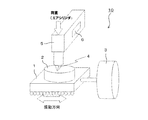
- FIG. 1 is a schematic diagram illustrating an apparatus for measuring a normal dynamic friction coefficient and a very low speed friction coefficient.
- the lubricating oil composition according to the present embodiment is a lubricating oil composition used for a sliding member coated with hydrogen-containing diamond-like carbon (hereinafter referred to as "hydrogen-containing DLC"), and is (A) a base oil. And (B) a friction modifier, and (B) a fatty acid ester of pentaerythritol as a friction modifier.
- hydrogen-containing DLC hydrogen-containing diamond-like carbon
- the base oil is a mineral oil and / or a synthetic oil.
- the type of the mineral oil or synthetic oil is not particularly limited, and examples of the mineral oil include paraffin-based mineral oil, intermediate-based mineral oil, and naphthen-based mineral oil obtained by ordinary refining methods such as solvent refining and hydrogenation refining. Can be mentioned.
- the synthetic oil include polybutene, polyolefin [ ⁇ -olefin (co) polymer], various esters (for example, polyol ester, dibasic acid ester, phosphoric acid ester, etc.), and various ethers (for example, poly). (Phenyl ether, etc.), alkylbenzene, alkylnaphthalene, etc. can be mentioned.
- one of the above mineral oils may be used as the base oil, or two or more of the above mineral oils may be used in combination.
- one of the above synthetic oils may be used, or two or more of the above synthetic oils may be used in combination.
- one or more mineral oils and one or more synthetic oils may be used in combination.
- the lubricating oil composition according to the present embodiment contains a fatty acid ester of pentaerythritol as a friction modifier.
- a fatty acid ester of pentaerythritol one having a fatty acid residue having 10 or more and 20 or less carbon atoms can be used.
- the fatty acid residue is a decarboxyl group residue of the fatty acid and may be a branched or linear fatty acid. Further, the fatty acid residue may be an unsaturated or saturated aliphatic hydrocarbon group.
- Pentaerythritol is a tetravalent sugar alcohol. Pentaerythritol includes pentaerythritol tetraester in which all four terminal substituents are ester-bonded to fatty acid residues, and pentaerythritol monoester, pentaerythritol diester and penta in which any terminal substituent is ester-bonded to fatty acid residues. There is an erythritol triester.
- a plurality of esters selected from the above-mentioned pentaerythritol monoester, pentaerythritol diester, pentaerythritol triester, and pentaerythritol tetraester can be mixed and used. ..
- the terminal hydroxyl group is more dominant than the fatty acid residue constituting the fatty acid ester of pentaerythritol as a factor that enables friction adjustment of the sliding member coated with the hydrogen-containing DLC. Will be done. Therefore, it is preferable to use a partial ester of pentaerythritol, which is said to have a higher hydroxyl value.
- pentaerythritol monooleate can be used, but the number of carbon atoms of the fatty acid residue is not limited to C18.
- the content of the fatty acid ester of pentaerythritol as the (B) friction modifier can be 0.2% by mass or more and 10.0% by mass or less with respect to the total amount of the lubricating oil composition. .. (B) If the content of the friction modifier is less than 0.2% by mass, the friction adjusting effect on the hydrogen-containing DLC coating material cannot be obtained, and if it exceeds 10.0% by mass, the friction adjusting effect reaches a plateau. , Leading to loss of material cost.
- the friction adjusting effect on the sliding member coated with the hydrogen-containing DLC is obtained. be able to.
- the friction modifier according to the present embodiment may contain a tetraester of pentaerythritol having an ester value of 4, and in this case, it may be used in combination with a monoester of pentaerythritol having a high hydroxyl value.
- the total hydroxyl value of pentaerythritol fatty acid ester is set to the above specific value.
- the friction modifier applicable in this embodiment may contain various anti-friction agents such as phosphorus-based, amine-based, and ester-based, in addition to those described above. By adjusting the amount of these anti-friction agents added, the coefficient of friction of the sliding member in the sliding mechanism to which the lubricating oil composition is applied can be adjusted.
- a phosphorus compound represented by the following general formula (1) represents an individual hydrocarbon group, and examples thereof include a linear primary alkyl group, a branched secondary alkyl group, and an aryl group.
- R is not particularly limited, but preferably has at least one short chain (3 to 5 carbon atoms) secondary alkyl group.
- ZnDTP having a different number of alkyl groups can be mixed and used as ZnDTP.
- the average number of alkyl groups in ZnDTP is preferably 1 to 3, and more preferably 1 to 2.
- the method for measuring the average number of alkyl groups in ZnDTP is not particularly limited, but can be obtained by measuring the hydroxyl value by, for example, FT-IR.
- the ZnDTP according to the present embodiment preferably has at least a secondary alkyl group, and preferably has more secondary alkyl groups than the primary alkyl group.
- different types of ZnDTP can be mixed, but in this case, it is preferable to contain ZnDTP having at least a secondary alkyl group, and ZnDTP as a whole is higher than the primary alkyl group. It is preferable to have many secondary alkyl groups.
- the alkyl group preferably has a short chain rather than a long chain. Therefore, the ZnDTP according to the present embodiment has at least a short chain (3 to 5 carbon atoms) secondary alkyl group.
- the lubricating oil composition according to the present embodiment is a lubricating oil composition used for a sliding member coated with hydrogen-containing diamond-like carbon, and contains a base oil and a friction modifier, and is a friction modifier. As, it contains a fatty acid ester of pentaerythritol.
- a lubricating oil composition enables friction adjustment with respect to a sliding mechanism having a sliding member coated with a hydrogen-containing DLC coating material, which has conventionally been difficult to adjust friction.
- the shock absorber In the shock absorber, it takes a certain amount of time for the damping force due to the flood control to give the damping force to rise and to start the damping action.
- the frictional force is highly responsive. For this reason, the frictional force is important for the damping force of the shock absorber during the period until the hydraulic damping force rises, that is, during the period when the sliding member shifts from the stationary state to the sliding state, or when the hydraulic damping force has a small amplitude that hardly acts. Factor.
- the present inventor has a period until the hydraulic damping force rises, a friction coefficient during micro-vibration vibration in which the hydraulic damping force hardly acts (referred to as "micro-low speed friction coefficient"), and the hydraulic damping force act. Focusing on the fact that the friction coefficient during normal vibration (referred to as the "normal dynamic friction coefficient") is different, it was found that this difference in friction characteristics affects the performance of the shock absorber. Then, it was found that by setting the ratio of the normal dynamic friction coefficient to the very low speed friction coefficient in a specific numerical range, it is possible to achieve both operational stability and ride comfort.
- the normal dynamic friction coefficient is a friction coefficient when a shock absorber is vibrated as a sliding member with a predetermined amplitude and a sliding speed of more than 4.0 mm / s.
- the very low speed friction coefficient is a friction coefficient when the shock absorber is vibrated at a predetermined amplitude and a sliding speed of 0.20 mm / s or less.
- the ratio of the normal dynamic friction coefficient to the very low speed friction coefficient can be set in a specific numerical range. can.
- a value of (normal dynamic friction coefficient) / (micro-low speed friction coefficient) of 1 means that the friction coefficient is constant regardless of the sliding speed of the sliding member, and is less than 1.20. Means that the fluctuation of the friction coefficient can be reduced with respect to the change in the sliding speed of the sliding member.
- the value of (normal dynamic friction coefficient) / (microlow speed friction coefficient) is less than 1, it means that the frictional force at very low speed is large and the frictional force at normal time is small.
- the lubricating oil composition according to the present embodiment when the lubricating oil composition according to the present embodiment is applied to, for example, a shock absorber as a shock absorber, the movement of the piston is started as a pre-stage in which an oil pressure for suppressing vibration is generated. At a certain initial stage, vibration can be suppressed by frictional force. Therefore, according to the lubricating oil composition according to the present embodiment, it is possible to easily set the hydraulic damping force of the shock absorber using the shock absorber coated with the hydrogen-containing DLC.
- a fatty acid ester of pentaerythritol having a fatty acid residue having 10 or more and 20 or less carbon atoms can be used.
- pentaerythritol monooleate can be used as an example of a partial ester of pentaerythritol.
- the lubricating oil composition according to the present embodiment can obtain a friction adjusting effect on the hydrogen-containing DLC coating material by containing 0.2% by mass or more of the fatty acid ester of pentaerythritol.
- the friction adjusting effect on the sliding member coated with the hydrogen-containing DLC can be obtained. can.
- the lubricating oil composition according to the present embodiment may further contain a phosphorus-containing compound.
- the lubricating oil composition according to the present embodiment can reduce the difference between the very low speed friction coefficient and the normal dynamic friction coefficient. As a result, the coefficient of friction suitable for ride comfort and steering stability can be easily adjusted.
- ZnDTP in particular is suppressed from deterioration (decomposition) by pentaerythritol, so that the adjusted frictional force can be maintained for a long period of time.
- the lubricating oil composition according to the present embodiment enables friction adjustment in a sliding mechanism having a sliding portion coated with a hydrogen-containing DLC coating material.
- the lubricating oil composition according to the present embodiment includes an internal combustion engine, a drive system transmission engine, an industrial facility, to which a low-friction sliding member coated with a hydrogen-containing DLC coating material as a hard thin film material is applied. It is suitable as a lubricating oil used for metal processing and the like.
- the sliding mechanism according to the present embodiment is a sliding mechanism using the lubricating oil composition according to the above-described embodiment, and is a sliding mechanism in which at least the sliding portion is covered with hydrogen-containing DLC.
- a piston rod, a cylinder, a gear, a bearing, a transmission, a shock absorber, etc. to which a low friction sliding member coated with a hydrogen-containing DLC coating material as a hard thin film material is applied. Can be mentioned.
- the sliding mechanism according to the present embodiment By applying the above-mentioned lubricating oil composition to the sliding mechanism according to the present embodiment, friction adjustment, which was difficult with the sliding mechanism coated with the hydrogen-containing DLC coating material, becomes possible. Further, when the sliding mechanism according to the present embodiment is a shock absorber, the sliding portion can be coated with a hydrogen-containing DLC coating material to improve durability against friction and wear, and also to provide a comfortable ride. It is possible to achieve both good performance and steering stability at a high level.
- FIG. 1 is a schematic diagram illustrating an apparatus for measuring a normal dynamic friction coefficient and a very low speed friction coefficient.
- the normal dynamic friction coefficient and the very low speed friction coefficient of the specimen were measured using the friction test apparatus 10 shown in FIG.
- the friction test device 10 shown in FIG. 1 is a pin-on-disk type friction test device.
- the friction test device 10 reciprocates the disc test piece 2 fixed on the slide bearing 1 by the electromagnetic exciter 3, presses the pin test piece 4 against the disc test piece 2, and slides the disc test piece 4 to perform a pin test.
- the measurement is performed using the strain gauge 6 attached to the fixed shaft 5 of the piece 4.
- NBR acrylonitrile butadiene rubber
- the tip of the pin test piece 4 was cut so as to have an angle of 140 °, imitating the shape of an oil lip. Further, the disc test piece 2 was coated with hydrogen-containing diamond-like carbon used for the surface of the piston rod and polished to have a surface roughness of Ra 0.01 ⁇ m or less.
- the normal dynamic friction coefficient and the very low speed friction coefficient were measured.
- the measurement in the friction test using the friction test device 10 shown in FIG. 1, the measurement was performed under the conditions of an amplitude of 5.0 mm, a frequency of 5.0 Hz, and a sliding speed of 4.0 mm / s.
- the micro-low speed friction coefficient was measured under the conditions of an amplitude of 5.0 mm, a frequency of 5.0 Hz, and a sliding speed of 0.20 mm / s.
- the amplitude-dependent index is an index adopted for evaluating the lubricating oil composition according to the present embodiment, and can be treated as one of the evaluation indexes for the ride quality of the shock absorber. ..
- the amplitude-dependent index is represented by (normal dynamic friction coefficient) / (micro-low speed friction coefficient). As the amplitude-dependent index, the closer the value is to 1, the smaller the difference between the friction coefficient at the time of fine amplitude and the friction coefficient at the time of normal amplitude, and it can be evaluated that the ride quality is good.
- composition of the friction modifier in the lubricating oil composition lubrication in which the total hydroxyl value was changed by changing the mixing ratio of fatty acid esters of pentaerythritol having different ester valences or by using them alone. It is an oil composition.
- fatty acid ester of pentaerythritol oleate having a fatty acid residue having C18 carbon atoms was used.
- mineral oil was used as the base oil.
- zinc dithiophosphate (ZnDTP) was used as a friction modifier.
- acrylonitrile butadiene rubber NBR
- hydrogen-containing diamond-like carbon DLC
- Comparative Example 1 uses pentaerythritol tetraester and uses a material coated with hydrogen-free DLC as the test piece 2 in the friction test apparatus 10. Further, in Comparative Example 2, a material coated with hydrogen-containing DLC was used as the test piece 2 in the friction test apparatus 10 using pentaerythritol tetraester.
- Comparative Example 3 a lubricating oil composition consisting only of mineral oil containing no fatty acid ester of pentaerythritol was applied to a friction test apparatus 10 using a material coated with hydrogen-free DLC as a test piece 2.
- Comparative Example 4 a lubricating oil composition consisting only of mineral oil containing no fatty acid ester of pentaerythritol was applied to a friction test apparatus 10 using a material coated with hydrogen-containing DLC as a test piece 2.
- the reference example group is a friction test apparatus 10 shown in FIG. 1 in which the lubricating oil compositions of Examples 1 and 7 are applied to a material coated with hydrogen-free diamond-like carbon (DLC). ..
- Example 1-7 when the total hydroxyl value of the lubricating oil composition is 2.20 mgKOH / g or more, the value of (normal dynamic friction coefficient) / (micro-low speed friction coefficient) is 0.4 to 0.4 to. It was found that when it was applied to a shock absorber, it was possible to obtain a vibration reducing effect in the stage before the oil pressure for suppressing vibration was generated without causing stick slip.
- the lubricating oil composition according to the present embodiment is a lubricating oil composition used for a sliding member coated with hydrogen-containing diamond-like carbon (DLC), and contains a base oil and a friction modifier. It contains a fatty acid ester of pentaerythritol as a friction modifier.
- DLC hydrogen-containing diamond-like carbon
- This lubricating oil composition enables friction adjustment even for a sliding mechanism having a sliding member coated with a hydrogen-containing DLC coating material, which has been difficult to adjust friction in the past. Therefore, this lubricating oil composition can improve the frictional properties of the sliding member coated with the hydrogen-containing DLC coating material.
- the ratio of the normal dynamic friction coefficient to the very low speed friction coefficient can be set in a specific numerical range. More specifically, when the lubricating oil composition according to the present embodiment is applied to a shock absorber provided with a sliding member coated with a hydrogen-containing DLC coating material, (normal dynamic friction coefficient) / (micro-low speed friction coefficient) ) Can be approached to 1.
- the terminal hydroxyl group of pentaerythritol contributes to the sliding member coated with the hydrogen-containing DLC in the lubricating oil composition according to the present embodiment. Therefore, in the present embodiment, if the total hydroxyl value of the pentaerythritol fatty acid ester as the friction modifier is 2.20 mgKOH / g or more, the friction adjusting effect on the sliding member coated with the hydrogen-containing DLC can be obtained. Can be done.
- the lubricating oil composition according to the present embodiment further contains a phosphorus-containing compound.
- the difference between the very low speed friction coefficient and the normal dynamic friction coefficient can be reduced.
- the coefficient of friction suitable for ride comfort and steering stability can be easily adjusted.
- the phosphorus-containing compound is zinc dithiophosphate (Zn-DTP) and contains at least a secondary alkyl group having 3 to 5 carbon atoms.
- Zn-DTP in particular can maintain the adjusted frictional force for a long period of time because deterioration (decomposition) is suppressed by pentaerythritol.
- the sliding mechanism according to the present embodiment is a sliding mechanism using the above-mentioned lubricating oil composition, and at least the sliding portion is coated with hydrogen-containing DLC.
- the friction can be adjusted by the lubricating oil composition containing the fatty acid ester of pentaerythritol, and the (normal dynamic friction coefficient) / (micro-low speed friction coefficient) can be brought close to 1.
- such a sliding mechanism makes it possible to design a shock absorber so as to obtain a vibration reduction effect in a stage before an oil pressure for suppressing vibration is generated.
- the range of design of the hydraulic damping force of the shock absorber can be expanded, and it becomes possible to design a shock absorber that can achieve both operational stability and ride comfort.
- the lubricating oil composition according to the present embodiment has, as optional components, an ashless cleaning dispersant, a metal-based cleaning agent, a lubricity improver, an antioxidant, a rust preventive, and a metal inactivating material.
- At least one component selected from a viscosity index improver, a pour point curing agent and a defoaming agent can be appropriately blended as long as the object of the present invention is not impaired.
- components applicable as additives for the lubricating oil composition for shock absorbers can be appropriately blended.
Landscapes
- Chemical & Material Sciences (AREA)
- Engineering & Computer Science (AREA)
- Oil, Petroleum & Natural Gas (AREA)
- General Engineering & Computer Science (AREA)
- Chemical Kinetics & Catalysis (AREA)
- General Chemical & Material Sciences (AREA)
- Organic Chemistry (AREA)
- Mechanical Engineering (AREA)
- Ceramic Engineering (AREA)
- Lubricants (AREA)
- Sliding-Contact Bearings (AREA)
- Vibration Prevention Devices (AREA)
- Vibration Dampers (AREA)
Priority Applications (5)
| Application Number | Priority Date | Filing Date | Title |
|---|---|---|---|
| JP2022517090A JP7492578B2 (ja) | 2020-04-24 | 2021-04-22 | 潤滑油組成物、緩衝器及び摺動機構 |
| CN202180030533.2A CN115461432B (zh) | 2020-04-24 | 2021-04-22 | 一种缓冲器 |
| DE112021002590.2T DE112021002590T5 (de) | 2020-04-24 | 2021-04-22 | Schmierölzusammensetzung und Gleitmechanismus |
| US17/996,660 US20230174882A1 (en) | 2020-04-24 | 2021-04-22 | Lubricating oil composition and sliding mechanism |
| US19/011,965 US20250154427A1 (en) | 2020-04-24 | 2025-01-07 | Lubricating oil composition and sliding mechanism |
Applications Claiming Priority (2)
| Application Number | Priority Date | Filing Date | Title |
|---|---|---|---|
| JP2020077577 | 2020-04-24 | ||
| JP2020-077577 | 2020-04-24 |
Related Child Applications (2)
| Application Number | Title | Priority Date | Filing Date |
|---|---|---|---|
| US17/996,660 A-371-Of-International US20230174882A1 (en) | 2020-04-24 | 2021-04-22 | Lubricating oil composition and sliding mechanism |
| US19/011,965 Continuation US20250154427A1 (en) | 2020-04-24 | 2025-01-07 | Lubricating oil composition and sliding mechanism |
Publications (1)
| Publication Number | Publication Date |
|---|---|
| WO2021215499A1 true WO2021215499A1 (ja) | 2021-10-28 |
Family
ID=78269233
Family Applications (1)
| Application Number | Title | Priority Date | Filing Date |
|---|---|---|---|
| PCT/JP2021/016296 Ceased WO2021215499A1 (ja) | 2020-04-24 | 2021-04-22 | 潤滑油組成物及び摺動機構 |
Country Status (5)
| Country | Link |
|---|---|
| US (2) | US20230174882A1 (cg-RX-API-DMAC7.html) |
| JP (1) | JP7492578B2 (cg-RX-API-DMAC7.html) |
| CN (1) | CN115461432B (cg-RX-API-DMAC7.html) |
| DE (1) | DE112021002590T5 (cg-RX-API-DMAC7.html) |
| WO (1) | WO2021215499A1 (cg-RX-API-DMAC7.html) |
Cited By (1)
| Publication number | Priority date | Publication date | Assignee | Title |
|---|---|---|---|---|
| JP2022076932A (ja) * | 2020-11-10 | 2022-05-20 | 日本アイ・ティ・エフ株式会社 | 摺動部材、潤滑油および摺動機構 |
Families Citing this family (1)
| Publication number | Priority date | Publication date | Assignee | Title |
|---|---|---|---|---|
| JP7454438B2 (ja) * | 2020-04-23 | 2024-03-22 | カヤバ株式会社 | 緩衝器および緩衝器用潤滑油の摩擦特性の調整方法 |
Citations (4)
| Publication number | Priority date | Publication date | Assignee | Title |
|---|---|---|---|---|
| JP2005090738A (ja) * | 2003-08-13 | 2005-04-07 | Nissan Motor Co Ltd | 転がり軸受 |
| WO2008130039A1 (ja) * | 2007-04-18 | 2008-10-30 | Idemitsu Kosan Co., Ltd. | 冷凍機用潤滑油組成物及びこれを用いた圧縮機 |
| JP2008266423A (ja) * | 2007-04-18 | 2008-11-06 | Idemitsu Kosan Co Ltd | 冷凍機用潤滑油組成物 |
| WO2015025972A1 (ja) * | 2013-08-23 | 2015-02-26 | 出光興産株式会社 | 緩衝器用潤滑油組成物、及び緩衝器の摩擦低減方法 |
Family Cites Families (6)
| Publication number | Priority date | Publication date | Assignee | Title |
|---|---|---|---|---|
| US4312767A (en) * | 1979-02-02 | 1982-01-26 | Chevron Research Company | Lubricant composition containing friction-modifying agent and antiwear agent |
| JP2599383B2 (ja) * | 1987-04-11 | 1997-04-09 | 出光興産 株式会社 | 潤滑油組成物 |
| DE19950345C2 (de) * | 1999-10-19 | 2003-06-05 | Hilti Ag | Verfahren und Vorrichtung zum Antrieb eines Kolbens eines brennkraftbetriebenen Arbeitsgeräts, insbesondere eines Setzgeräts für Befestigungselemente |
| JP4973971B2 (ja) * | 2003-08-08 | 2012-07-11 | 日産自動車株式会社 | 摺動部材 |
| US7867957B2 (en) * | 2007-03-30 | 2011-01-11 | Nippon Oil Corporation | Lubricating oil composition |
| WO2017047681A1 (ja) * | 2015-09-15 | 2017-03-23 | 本田技研工業株式会社 | 磁気粘性流体組成物及びこれを用いた振動減衰装置 |
-
2021
- 2021-04-22 US US17/996,660 patent/US20230174882A1/en not_active Abandoned
- 2021-04-22 DE DE112021002590.2T patent/DE112021002590T5/de active Pending
- 2021-04-22 JP JP2022517090A patent/JP7492578B2/ja active Active
- 2021-04-22 CN CN202180030533.2A patent/CN115461432B/zh active Active
- 2021-04-22 WO PCT/JP2021/016296 patent/WO2021215499A1/ja not_active Ceased
-
2025
- 2025-01-07 US US19/011,965 patent/US20250154427A1/en active Pending
Patent Citations (4)
| Publication number | Priority date | Publication date | Assignee | Title |
|---|---|---|---|---|
| JP2005090738A (ja) * | 2003-08-13 | 2005-04-07 | Nissan Motor Co Ltd | 転がり軸受 |
| WO2008130039A1 (ja) * | 2007-04-18 | 2008-10-30 | Idemitsu Kosan Co., Ltd. | 冷凍機用潤滑油組成物及びこれを用いた圧縮機 |
| JP2008266423A (ja) * | 2007-04-18 | 2008-11-06 | Idemitsu Kosan Co Ltd | 冷凍機用潤滑油組成物 |
| WO2015025972A1 (ja) * | 2013-08-23 | 2015-02-26 | 出光興産株式会社 | 緩衝器用潤滑油組成物、及び緩衝器の摩擦低減方法 |
Cited By (1)
| Publication number | Priority date | Publication date | Assignee | Title |
|---|---|---|---|---|
| JP2022076932A (ja) * | 2020-11-10 | 2022-05-20 | 日本アイ・ティ・エフ株式会社 | 摺動部材、潤滑油および摺動機構 |
Also Published As
| Publication number | Publication date |
|---|---|
| JP7492578B2 (ja) | 2024-05-29 |
| US20250154427A1 (en) | 2025-05-15 |
| US20230174882A1 (en) | 2023-06-08 |
| DE112021002590T5 (de) | 2023-02-16 |
| JPWO2021215499A1 (cg-RX-API-DMAC7.html) | 2021-10-28 |
| CN115461432A (zh) | 2022-12-09 |
| CN115461432B (zh) | 2024-12-31 |
Similar Documents
| Publication | Publication Date | Title |
|---|---|---|
| US20250154427A1 (en) | Lubricating oil composition and sliding mechanism | |
| JP7569326B2 (ja) | 緩衝器用潤滑油組成物、緩衝器、および緩衝器用潤滑油の摩擦調整方法 | |
| JP5284372B2 (ja) | 等速ジョイントに使用されるグリース組成物 | |
| JP6895022B2 (ja) | 緩衝器用潤滑油組成物、摩擦調整用添加剤、潤滑油添加剤、緩衝器および緩衝器用潤滑油の摩擦調整方法 | |
| JP4421781B2 (ja) | 等速ジョイント用グリース組成物 | |
| JP7316207B2 (ja) | 緩衝器用潤滑油組成物、摩擦調整用添加剤、潤滑油添加剤、緩衝器および緩衝器用潤滑油の摩擦調整方法 | |
| EP3872150B1 (en) | Shock absorber lubricating oil composition, additive for friction adjustment, lubricating oil additive, shock absorber, and method for adjusting friction of shock absorber lubricating oil | |
| JP5964943B2 (ja) | 潤滑剤組成物及び潤滑剤組成物を使用する方法 | |
| US20230250357A1 (en) | Lubricating oil composition, shock absorber, and method for using lubricating oil composition | |
| WO2019230412A1 (ja) | 駆動系機器用潤滑油組成物及びその製造方法、駆動系機器の潤滑方法並びに駆動系機器 | |
| WO2020213504A1 (ja) | 油圧装置用作動油及びその油圧装置用作動油を用いた油圧装置 | |
| JP7469151B2 (ja) | 緩衝器用潤滑油組成物、緩衝器、および緩衝器用潤滑油の摩擦特性の調整方法 | |
| JP7099876B2 (ja) | 潤滑油組成物及びその製造方法、駆動系機器の潤滑方法並びに駆動系機器 | |
| WO2023068163A1 (ja) | 緩衝器用潤滑油組成物、緩衝器、および緩衝器用潤滑油の摩擦特性の調整方法 | |
| CN121335967A (zh) | 液压缸装置用工作油以及液压缸装置 | |
| JP2022123601A (ja) | 潤滑グリース組成物 | |
| WO2025109151A1 (en) | Amine compounds as antiwear agents |
Legal Events
| Date | Code | Title | Description |
|---|---|---|---|
| 121 | Ep: the epo has been informed by wipo that ep was designated in this application |
Ref document number: 21791967 Country of ref document: EP Kind code of ref document: A1 |
|
| DPE1 | Request for preliminary examination filed after expiration of 19th month from priority date (pct application filed from 20040101) | ||
| ENP | Entry into the national phase |
Ref document number: 2022517090 Country of ref document: JP Kind code of ref document: A |
|
| 122 | Ep: pct application non-entry in european phase |
Ref document number: 21791967 Country of ref document: EP Kind code of ref document: A1 |
|
| WWG | Wipo information: grant in national office |
Ref document number: 202180030533.2 Country of ref document: CN |