WO2021205877A1 - Cpap装置 - Google Patents
Cpap装置 Download PDFInfo
- Publication number
- WO2021205877A1 WO2021205877A1 PCT/JP2021/012221 JP2021012221W WO2021205877A1 WO 2021205877 A1 WO2021205877 A1 WO 2021205877A1 JP 2021012221 W JP2021012221 W JP 2021012221W WO 2021205877 A1 WO2021205877 A1 WO 2021205877A1
- Authority
- WO
- WIPO (PCT)
- Prior art keywords
- support member
- fan
- rotation axis
- blower
- main body
- Prior art date
- Legal status (The legal status is an assumption and is not a legal conclusion. Google has not performed a legal analysis and makes no representation as to the accuracy of the status listed.)
- Ceased
Links
Images



Classifications
-
- A—HUMAN NECESSITIES
- A61—MEDICAL OR VETERINARY SCIENCE; HYGIENE
- A61M—DEVICES FOR INTRODUCING MEDIA INTO, OR ONTO, THE BODY; DEVICES FOR TRANSDUCING BODY MEDIA OR FOR TAKING MEDIA FROM THE BODY; DEVICES FOR PRODUCING OR ENDING SLEEP OR STUPOR
- A61M16/00—Devices for influencing the respiratory system of patients by gas treatment, e.g. ventilators; Tracheal tubes
- A61M16/0057—Pumps therefor
- A61M16/0066—Blowers or centrifugal pumps
-
- F—MECHANICAL ENGINEERING; LIGHTING; HEATING; WEAPONS; BLASTING
- F04—POSITIVE - DISPLACEMENT MACHINES FOR LIQUIDS; PUMPS FOR LIQUIDS OR ELASTIC FLUIDS
- F04D—NON-POSITIVE-DISPLACEMENT PUMPS
- F04D29/00—Details, component parts, or accessories
- F04D29/66—Combating cavitation, whirls, noise, vibration or the like; Balancing
-
- A—HUMAN NECESSITIES
- A61—MEDICAL OR VETERINARY SCIENCE; HYGIENE
- A61M—DEVICES FOR INTRODUCING MEDIA INTO, OR ONTO, THE BODY; DEVICES FOR TRANSDUCING BODY MEDIA OR FOR TAKING MEDIA FROM THE BODY; DEVICES FOR PRODUCING OR ENDING SLEEP OR STUPOR
- A61M16/00—Devices for influencing the respiratory system of patients by gas treatment, e.g. ventilators; Tracheal tubes
- A61M16/06—Respiratory or anaesthetic masks
-
- A—HUMAN NECESSITIES
- A61—MEDICAL OR VETERINARY SCIENCE; HYGIENE
- A61M—DEVICES FOR INTRODUCING MEDIA INTO, OR ONTO, THE BODY; DEVICES FOR TRANSDUCING BODY MEDIA OR FOR TAKING MEDIA FROM THE BODY; DEVICES FOR PRODUCING OR ENDING SLEEP OR STUPOR
- A61M16/00—Devices for influencing the respiratory system of patients by gas treatment, e.g. ventilators; Tracheal tubes
- A61M16/08—Bellows; Connecting tubes ; Water traps; Patient circuits
- A61M16/0816—Joints or connectors
-
- A—HUMAN NECESSITIES
- A61—MEDICAL OR VETERINARY SCIENCE; HYGIENE
- A61M—DEVICES FOR INTRODUCING MEDIA INTO, OR ONTO, THE BODY; DEVICES FOR TRANSDUCING BODY MEDIA OR FOR TAKING MEDIA FROM THE BODY; DEVICES FOR PRODUCING OR ENDING SLEEP OR STUPOR
- A61M16/00—Devices for influencing the respiratory system of patients by gas treatment, e.g. ventilators; Tracheal tubes
- A61M16/10—Preparation of respiratory gases or vapours
- A61M16/105—Filters
- A61M16/1055—Filters bacterial
-
- A—HUMAN NECESSITIES
- A61—MEDICAL OR VETERINARY SCIENCE; HYGIENE
- A61M—DEVICES FOR INTRODUCING MEDIA INTO, OR ONTO, THE BODY; DEVICES FOR TRANSDUCING BODY MEDIA OR FOR TAKING MEDIA FROM THE BODY; DEVICES FOR PRODUCING OR ENDING SLEEP OR STUPOR
- A61M16/00—Devices for influencing the respiratory system of patients by gas treatment, e.g. ventilators; Tracheal tubes
- A61M16/10—Preparation of respiratory gases or vapours
- A61M16/14—Preparation of respiratory gases or vapours by mixing different fluids, one of them being in a liquid phase
- A61M16/16—Devices to humidify the respiration air
-
- A—HUMAN NECESSITIES
- A61—MEDICAL OR VETERINARY SCIENCE; HYGIENE
- A61M—DEVICES FOR INTRODUCING MEDIA INTO, OR ONTO, THE BODY; DEVICES FOR TRANSDUCING BODY MEDIA OR FOR TAKING MEDIA FROM THE BODY; DEVICES FOR PRODUCING OR ENDING SLEEP OR STUPOR
- A61M2205/00—General characteristics of the apparatus
- A61M2205/42—Reducing noise
-
- A—HUMAN NECESSITIES
- A61—MEDICAL OR VETERINARY SCIENCE; HYGIENE
- A61M—DEVICES FOR INTRODUCING MEDIA INTO, OR ONTO, THE BODY; DEVICES FOR TRANSDUCING BODY MEDIA OR FOR TAKING MEDIA FROM THE BODY; DEVICES FOR PRODUCING OR ENDING SLEEP OR STUPOR
- A61M2205/00—General characteristics of the apparatus
- A61M2205/50—General characteristics of the apparatus with microprocessors or computers
- A61M2205/502—User interfaces, e.g. screens or keyboards
Definitions
- the present disclosure relates to a CPAP (Continuous Positive Airway Pressure) device that sends air taken into the device into the user's respiratory tract.
- CPAP Continuous Positive Airway Pressure
- a blower for sending out air is housed inside the main body case.
- a sound absorbing silencer is housed inside the main body case. Inside the sound absorbing silencer, a passage for supplying air to the blower is partitioned.
- the sound absorbing silencer has a shape that wraps almost the entire blower. Further, the suction silencer is in contact with the outer surface of the blower and the inner surface of the main body case, and supports the blower inside the main body case.
- the present disclosure is interposed between the main body case, the blower housed inside the main body case, the main body case and the blower, and supports the blower inside the main body case.
- the blower includes a fan portion containing a fan that blows air by rotating, and a lead-out pipe through which air blown from the fan flows.
- the first support member and the second support member of the support members are closer to the connection point side between the fan portion and the outlet pipe than the rotation axis.
- the third support member which is different from the first support member and the second support member, is arranged so as to sandwich the blower in the above rotation shaft, and is opposite to the connection point with respect to the rotation shaft. It is a CPAP device arranged on the side.
- the vibration of the entire blower can be suppressed. Further, since the vicinity of the lead-out pipe in the blower is sandwiched by the first support member and the second support member, the vibration of the lead-out pipe can be suppressed more effectively even in the blower. If the vibration of the lead-out pipe can be suppressed, the vibration can be suppressed from being transmitted from the lead-out pipe to the user via the hose or mask, so that the user is less likely to perceive the vibration.
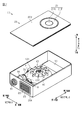
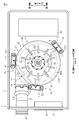
- the perspective view which shows the CPAP apparatus An exploded perspective view of the CPAP device disassembled. Top view showing a CPAP device.
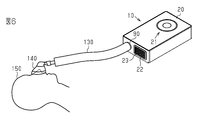
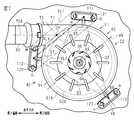
- Explanatory drawing explaining the use state of a CPAP apparatus Top view showing a part of the CPAP apparatus of the modified example.
- the CPAP device 10 includes a flat rectangular parallelepiped main body case 20.
- the thickness direction of the main body case 20 is the height direction Td.
- the longitudinal direction of the main body case 20 is the length direction Ld
- the lateral direction of the main body case 20 is the width direction Wd.
- An operation unit 21 for operating the CPAP device 10 is provided on the upper side surface 20U, which is the upper surface of the main body case 20 in the height direction Td.
- the operation unit 21 is composed of a circular switch 21A and an annular switch 21B.
- the switch 21B is arranged so as to surround the switch 21A. Both the switch 21A and the switch 21B are push button switches, and by operating them, it is possible to turn on / off the power of the CPAP device 10 and change the settings.
- a suction port 22 for introducing air from the outside to the inside of the main body case 20 is open.
- a filter 23 for filtering dust and the like contained in the air introduced into the main body case 20 is attached to the suction port 22.
- control unit 30 is housed inside the main body case 20.
- the control unit 30 is arranged on the second end side of the center in the length direction Ld.
- the control unit 30 has a control board and the like, and controls the CPAP device 10 by converting the operation of the operation unit 21 into an electric signal.
- the control unit 30 is shown roughly in a rectangular parallelepiped shape in FIGS. 2 and 3.
- the blower 40 is housed inside the main body case 20.
- the blower 40 is arranged on the first end side of the control unit 30 in the length direction Ld.
- the blower 40 is roughly classified into a fan portion 60 that houses the fan 50 inside and a lead-out pipe 70 through which the air blown from the fan 50 flows.
- the fan case 61 of the fan portion 60 has a circular shape when viewed from Td in the height direction.
- the fan case 61 includes an upper fan case 62 and a lower fan case 63.
- the upper fan case 62 has a circular bowl shape. At the center of the upper fan case 62, an introduction port 64 for sucking air from the outside to the inside of the fan portion 60 is opened.
- the introduction port 64 has a circular shape in a plan view.
- a plate-shaped projecting wall 65 projects upward from the upper outer surface of the upper fan case 62.
- a plurality of projecting walls 65 are provided, and in the present embodiment, ten projecting walls 65 are provided.
- the protruding wall 65 extends in the radial direction of the upper fan case 62. Further, the protruding walls 65 are arranged at equal intervals in the circumferential direction on the radial outer side of the introduction port 64. Therefore, the plurality of protruding walls 65 are arranged radially when viewed from the height direction Td.
- the lower fan case 63 has an annular shape when viewed from Td in the height direction.
- the outer diameter of the lower fan case 63 is the same as the outer diameter of the lower edge of the upper fan case 62.
- the motor 80 is fitted in the central hole of the lower fan case 63.
- the lower end of the motor 80 is located above the lower end of the lower fan case 63 in the height direction Td. That is, the motor 80 is not in contact with the main body case 20 and is supported by the lower fan case 63.
- the rotary shaft 81 of the motor 80 extends upward from the center of the motor 80.
- the lower fan case 63 has a substantially U-shape in a cross section orthogonal to the radial direction.
- the lower fan case 63 is fitted to the lower side of the upper fan case 62 so as to face each other.
- the accommodation space is divided by the upper fan case 62 and the lower fan case 63.
- a fan 50 that blows air by rotating is arranged.
- the fan 50 is composed of a holding plate 51 and a plurality of blades 52.
- the holding plate 51 has a substantially disk shape.
- the insertion hole 53 penetrates.
- the tip of the rotary shaft 81 of the motor 80 is fixed to the insertion hole 53.
- a plurality of blades 52 project upward on the upper surface of the holding plate 51.
- the blade 52 has a plate shape.
- the blades 52 extend from the radial inside to the outside of the holding plate 51. In this embodiment, blades 52 having different extending lengths are provided. Further, the blades 52 are arranged at equal intervals in the circumferential direction of the holding plate 51. Therefore, the plurality of blades 52 are arranged radially when viewed from the height direction Td.
- the radial outer ends of the blades 52 are located on the same virtual circle centered on the center of the holding plate 51.
- a circular tubular lead-out pipe 70 is connected to the fan portion 60.
- the lead-out pipe 70 is composed of an upper pipe portion 71 and a lower pipe portion 72.
- the upper pipe portion 71 extends in the tangential direction of the circular upper fan case 62.
- the upper pipe portion 71 has an arc shape that is convex upward when viewed from the extending direction of the upper pipe portion 71. That is, the upper pipe portion 71 constitutes the upper half of the lead-out pipe 70 which is a circular tube.
- the upper pipe portion 71 is integrally molded with the upper fan case 62.
- the lower pipe portion 72 extends in the tangential direction of the annular lower fan case 63.
- the extended length of the lower pipe portion 72 is the same as that of the upper pipe portion 71.
- the lower pipe portion 72 has an arc shape that is convex downward when viewed from the extending direction. That is, the lower pipe portion 72 constitutes the lower half of the lead-out pipe 70 which is a circular tube.
- the lower pipe portion 72 is integrally molded with the lower fan case 63.
- the lower pipe portion 72 is fitted to the lower side of the upper pipe portion 71 so as to face each other.
- the in-pipe space defined by the upper pipe portion 71 and the lower pipe portion 72 communicates with the accommodation space of the fan case 61. Air sent from the fan unit 60 flows through this pipe space.
- the opening on the side of the outlet pipe 70 opposite to the side connected to the fan portion 60 is an outlet 73 for guiding air from the blower 40 to the outside.
- the connection point CP between the fan portion 60 and the lead-out pipe 70 passes through the center of the lead-out pipe 70 in the width direction Wd when viewed from the height direction Td. This is the intersection of the central axis 70A extending in the extending direction of the lead-out pipe 70 and the outer diameter circle 61A of the accommodation space of the fan case 61.
- the outlet pipe 70 is connected to a discharge pipe 90 for discharging air from the inside of the main body case 20 to the outside.
- the discharge pipe 90 has a circular tubular shape.
- the discharge pipe 90 covers the portion of the lead-out pipe 70 on the first end side in the length direction Ld from the outside in the radial direction.
- the discharge pipe 90 penetrates the first end surface 20A of the main body case 20 and extends in the length direction Ld. Therefore, the end on the first end side of the discharge pipe 90 in the length direction Ld is located on the outside of the main body case 20.
- the opening on the first end side in the length direction Ld of the discharge pipe 90 is a discharge port 91 for discharging air from the outside to the inside of the main body case 20.
- the first protrusion 66 protrudes outward in the radial direction from the outer surface of the lower fan case 63.
- the first protrusion 66 when viewed from the height direction Td, the first protrusion 66 is located on the CP side of the connection point between the fan portion 60 and the lead-out pipe 70 in the fan portion 60 rather than the rotation axis RA of the fan 50. Is located in.
- the first protrusion 66 is arranged at a position close to the side surface on the second end side in the width direction Wd of the main body case 20.
- the extension direction of the rotation shaft RA coincides with the height direction Td.
- the inner portion 111A of the first rubber damper 111 is attached to the first protrusion 66.
- the inner portion 111A has a substantially elliptical shape slightly longer in the height direction Td when viewed from the protruding direction of the first protrusion 66.
- the inner portion 111A is provided with a recess (not shown), and the first protrusion 66 and the first damper 111 are fixed by inserting the first protrusion 66 into the recess.
- the outer portion 111B of the first damper 111 is arranged on the radial outer side of the inner portion 111A.
- the outer portion 111B has an elliptical ring shape that surrounds the inner portion 111A from the outside.
- the inner portion 111A and the outer portion 111B are connected at a plurality of points in the circumferential direction.
- the inner portion 111A and the outer portion 111B are separated from each other at a portion where they are not connected, and are relatively movable.
- the second protrusion 67 protrudes outward in the radial direction from the outer surface of the lower fan case 63.
- the second protrusion 67 is located on the fan portion 60 on the CP side of the connection point between the fan portion 60 and the lead-out pipe 70 with respect to the rotation axis RA of the fan 50 when viewed from the height direction Td. Further, the second protrusion 67 is arranged on the side opposite to the first protrusion 66 with the central axis 70A of the lead-out pipe 70 interposed therebetween.
- a rubber second damper 112 is attached to the second protrusion 67.
- the configuration of the second damper 112 is the same as that of the first damper 111.
- the second damper 112 is composed of an inner portion 112A and an outer portion 112B.
- the third protrusion 68 protrudes outward in the radial direction when viewed from the height direction Td. As shown in FIG. 3, when viewed from the height direction Td, the third protrusion 68 has a connection point CP between the fan portion 60 and the lead-out pipe 70 in the fan portion 60 rather than the rotation axis RA of the fan 50. Is located on the other side.
- a rubber third damper 113 is attached to the third protrusion 68.
- the configuration of the third damper 113 is the same as that of the first damper 111.
- the third damper 113 is composed of an inner portion 113A and an outer portion 113B.
- a first support member 121 is attached to the bottom surface of the main body case 20.
- the first support member 121 has a substantially plate shape.
- the first support member 121 is arranged in the vicinity of the side wall on the second end side in the width direction Wd of the main body case 20.
- Screw holes H are provided at both ends of the first support member 121 in the extending direction.
- the first support member 121 is fixed to the main body case 20 by screwing a screw (not shown) into the screw hole H.
- a hole penetrates in the thickness direction of the first support member 121.
- the first damper 111 of the fan portion 60 described above is fitted into the hole of the first support member 121. That is, the first support member 121 is interposed between the main body case 20 and the fan portion 60, and supports the fan portion 60 in the main body case 20.
- a second support member 122 is attached to the bottom surface of the main body case 20.
- the configuration of the second support member 122 is the same as that of the first support member 121.
- the second support member 122 is arranged in the vicinity of the side wall on the first end side in the length direction Ld in the main body case 20.
- the second damper 112 of the fan portion 60 described above is fitted in the hole penetrating the second support member 122 in the thickness direction. That is, the second support member 122 is interposed between the main body case 20 and the fan portion 60, and supports the fan portion 60 in the main body case 20.
- a third support member 123 is attached to the bottom surface of the main body case 20.
- the configuration of the third support member 123 is the same as that of the first support member 121.
- the third support member 123 is arranged in the vicinity of the side wall on the first end side in the width direction Wd of the main body case 20.
- the third damper 113 of the fan portion 60 described above is fitted in the hole penetrating the third support member 123 in the thickness direction. That is, the third support member 123 is interposed between the main body case 20 and the fan portion 60, and supports the fan portion 60 in the main body case 20.
- the first support member 121 is arranged so as to correspond to the first damper 111 of the fan portion 60.
- the first damper 111 is attached to the first protrusion 66 as described above. Therefore, the first support member 121 is arranged outside the fan portion 60 when viewed from the height direction Td. Further, the first support member 121 is located on the fan portion 60 on the CP side of the connection point between the fan portion 60 and the outlet pipe 70 with respect to the rotation axis RA of the fan 50 when viewed from the height direction Td. There is.
- the second support member 122 is arranged corresponding to the second damper 112 of the fan portion 60.
- the second damper 112 is attached to the second protrusion 67 as described above. Therefore, the second support member 122 is located outside the fan portion 60 when viewed from the height direction Td. Further, the second support member 122 is located on the CP side of the connection point between the fan portion 60 and the lead-out pipe 70 with respect to the rotation axis RA of the fan 50 when viewed from the height direction Td. Further, the second support member 122 is arranged on the side opposite to the first support member 121 with the connection portion CP interposed therebetween when viewed from the height direction Td.
- the first support member 121 and the second support member 122 are arranged so as to sandwich the blower 40.
- the boundary VB of the blower 40 is orthogonal to the straight line VA passing through the rotation axis RA of the fan 50 and the connection point CP, and the straight line passing through the rotation axis RA of the fan 50.
- the boundary VB as the boundary
- the area on the connection point CP side is referred to as the first area E1
- the area on the side opposite to the connection point CP is referred to as the second area E2.
- the first support member 121 and the second support member 122 support the first region E1 of the fan portion 60 of the blower 40.
- the virtual line segment farthest from the rotation axis RA is defined as the virtual line segment VLf.
- the virtual line segment VLf is in contact with the first support member 121 and the second support member 122 from the side opposite to the rotation axis RA in the extending direction of the straight line VA when viewed from the height direction Td.
- the virtual line segment VLf is located radially outside the outer edge 50A of the fan 50 when viewed from the height direction Td. That is, the virtual line segment VLf does not intersect the fan 50.
- the first support member 121 and the second support member 122 are arranged so as to sandwich the fan portion 60 of the blower 40 on the rotation axis RA side of the connection portion CP. Further, when viewed from the height direction Td, a part of the virtual line segments drawn between the first support member 121 and the second support member 122 does not intersect with either the fan 50 or the lead-out pipe 70. ..
- the third support member 123 is arranged corresponding to the third damper 113 of the fan portion 60.
- the third damper 113 is attached to the third protrusion 68 as described above. Therefore, the third support member 123 is arranged outside the fan portion 60 when viewed from the height direction Td. Further, the third support member 123 is located on the side opposite to the connection point CP of the fan portion 60 with the lead-out pipe 70 with respect to the rotation axis RA of the fan 50 when viewed from the height direction Td. That is, the third support member 123 supports the fan portion 60 of the blower 40 in the second region E2.
- the third support member 123 when viewed from the height direction Td, includes the distance between the third support member 123 and the first support member 121, and the third support member 123 and the second support. It is located at a position where the distance from the member 122 is equal to that of the member 122. In other words, the third support member 123 is arranged on a straight line VA passing through the rotation shaft RA of the fan 50 and the connection point CP.
- the distance between the support members is defined as the distance between the fixed centers of the support members, that is, the distance between the midpoints of the centers of the two screw holes H of each support member. It has established.
- the first distance D1 which is the distance between the first support member 121 and the second support member 122, is shorter than the second distance D2, which is the distance between the first support member 121 and the third support member 123.
- the first distance D1 is shorter than the third distance D3, which is the distance between the second support member 122 and the third support member 123.
- the second distance D2 is equal to the third distance D3. Therefore, an isosceles triangle is formed by three line segments for determining the distance between the support members. In this isosceles triangle, the equilateral sides are longer than the base.
- the fan portion 60 is supported by the main body case 20 only by the three support members, and the fan portion 60 is not in direct contact with the main body case 20.
- the first end of the hose 130 is connected to the tip of the discharge pipe 90 protruding to the outside of the main body case 20. Then, the second end portion of the hose 130 is connected to the mask 140.
- the mask 140 is worn, for example, to cover the nose or mouth of the user 150.
- the rotating shaft 81 of the motor 80 rotates.
- the fan 50 rotates about the rotating shaft RA as the center of rotation.
- air is sucked into the main body case 20 from the outside of the main body case 20 through the suction port 22.
- the air sucked into the main body case 20 from the suction port 22 is sucked into the accommodation space of the fan portion 60 of the blower 40 from the introduction port 64.
- the air in the accommodation space of the fan portion 60 is sent out to the outlet pipe 70 by the fan 50.
- the air led out from the outlet 73 of the outlet pipe 70 is discharged to the outside of the main body case 20 through the discharge pipe 90. Then, air is delivered from the mask 140 to the user 150 through the hose 130.
- the first support member 121 and the second support member 122 have a fan portion 60 and a lead-out pipe 70 rather than the rotation axis RA of the fan 50 when viewed from the height direction Td. It is located on the CP side of the connection point. Further, the first support member 121 and the second support member 122 are arranged so as to sandwich the blower 40. Therefore, it is possible to suppress the vibration of the portion of the fan portion 60 that is close to the lead-out pipe 70. Therefore, since the vibration of the lead-out pipe 70 can be suppressed, it is also possible to suppress the vibration from the lead-out pipe 70 via the hose 130 and the mask 140 to the user 150. As a result, the user 150 is less likely to perceive vibration.
- the outlet pipe 70 is not supported by the main body case 20 by each support member.
- the outlet pipe 70 is only connected to the discharge pipe 90. Therefore, even if the fan portion 60 vibrates, it is possible to suppress the vibration from being transmitted to the lead-out pipe 70 via each support member or the main body case 20.
- the virtual line segment farthest from the rotation axis RA does not intersect the fan 50. Therefore, in the fan portion 60 of the blower 40, the portion that comes into contact with the first support member 121 and the second support member 122 is appropriately close to the outlet pipe 70. Therefore, by supporting the lead-out pipe 70 at a position close to the connection point CP between the fan portion, the transmission of vibration to the lead-out pipe 70 can be reliably suppressed.
- a part of the virtual line segments drawn between the first support member 121 and the second support member 122 when viewed from the height direction Td is the fan 50 and the lead-out pipe. Does not intersect with any of 70. Therefore, it is possible to prevent the vibration of the fan portion 60 and the vibration of the lead-out pipe 70 from interfering with each other with the virtual line segment as a boundary.
- the first support member when viewed from the height direction Td, the first support member is in the first region E1 on the CP side of the connection point between the fan portion 60 and the lead-out pipe 70 rather than the rotation shaft RA. 121 and the second support member 122 are arranged.
- the third support member 123 when viewed from the height direction Td, the third support member 123 is arranged in the second region E2 on the side opposite to the connection point CP between the fan portion 60 and the outlet pipe 70 from the rotation shaft RA. ing. That is, when the blower 40 vibrates around the virtual line segment connecting the first support member 121 and the second support member 122, the side where the vibration increases is supported by the third support member 123. That is, the third support member 123 is arranged at a position where the vibration of the blower 40 can be suppressed more effectively.
- a third support member is used as a support member on the side opposite to the connection point CP between the fan portion 60 and the outlet pipe 70 from the rotation shaft RA. Only 123 is arranged. That is, the bearing capacity is weaker on the side opposite to the lead-out pipe 70 side with reference to the connection point CP. Therefore, even if the blower 40 vibrates, the blower 40 tends to vibrate on the side opposite to the lead-out pipe 70, and the vibration on the lead-out pipe 70 side is minimized.
- the second distance D2 between the first support member 121 and the third support member 123 is equal to the third distance D3 between the second support member 122 and the third support member 123. Therefore, when a virtual straight line passing through the rotation axis RA is drawn from the fixed center of the third support member 123, the blower 40 vibrates unevenly on both sides of the virtual straight line, causing distortion in the fan portion 60. Can be suppressed.
- the third support member 123 is arranged on a straight line VA passing through the rotation shaft RA of the fan 50 and the connection point CP. Therefore, by fixing the blower 40 at the portion farthest from the lead-out pipe 70 in the third support member 123, the vibration absorbed by the third support member 123 is less likely to be transmitted to the lead-out pipe 70.
- all three support members are arranged outside the fan portion 60 when viewed from the height direction Td.
- the three support members support the blower 40 from the outside. Therefore, when the fan 50 rotates, even if the blower 40 vibrates in a direction orthogonal to the rotation axis RA, it is easy to suppress the vibration in such a direction.
- the first damper 111 is supported by the first support member 121.
- the first damper 111 is composed of an inner portion 111A and an outer portion 111B.
- the vibration transmitted to the outer portion 111B becomes smaller. Therefore, the vibration of the fan portion 60 is damped by being transmitted to the first support member 121 via the first damper 111.
- the second damper 112 and the third damper 113 are the same applies to the second damper 112 and the third damper 113.
- the CPAP device 10 may include a humidifier.
- a humidifier may be attached to the discharge pipe 90 of the main body case 20, and a hose 130 may be attached to the discharge side of the humidifier.
- a humidifier may be housed inside the main body case 20, and the humidifier may be arranged between the outlet pipe 70 and the discharge pipe 90. In this case, the air led out from the outlet pipe 70 is humidified by the humidifier and reaches the user 150 from the discharge pipe 90 via the hose 130.
- the shape of the main body case 20 is not limited to the example of the above embodiment. It may be polygonal or spherical. Further, the shape and position of the suction port 22 and the discharge pipe 90 of the main body case 20 are not limited to the example of the above embodiment. For example, the shape of the suction port 22 may be circular, or the discharge pipe 90 may penetrate an end surface facing the opposite side of the first end surface 20A where the suction port 22 is located.
- the shape of the blower 40 is not limited to the example of the above embodiment.
- the fan case 61 may have a rectangular parallelepiped outer shape. It may be a polygonal shape.
- the lead-out pipe 70 may be extended so that the inner diameter is widened, or may be curved.
- the arrangement location of the first support member 121 and the second support member 122 is not limited to the example of the above embodiment.
- it when viewed from the height direction Td, in the circumferential direction of the fan case 61, it may be on the CP side of the connection point between the fan portion 60 and the outlet pipe 70 rather than the rotation axis RA.
- the first support member 121 and the second support member 122 are arranged farther from the lead-out pipe 70, it is possible to suppress the vibration from being transmitted to the lead-out pipe 70 through these support members.
- first support member 121 and the second support member 122 may be arranged so as to sandwich the lead-out pipe 70 when viewed from the height direction Td.
- all the virtual line segments drawn between the first support member 121 and the second support member 122 do not intersect with the fan 50.
- first support member 121 and the second support member 122 are arranged as in this modified example, distortion of the fan 50 and the like can be suitably suppressed.
- the positions of the first support member 121 and the second support member 122 in the radial direction of the fan 50 are far from the rotation axis RA when viewed from the height direction Td. ing.
- the amount of extension of the first protrusion 66 and the second protrusion 67 is larger toward the outer side in the radial direction of the fan 50.
- the one farthest from the rotation axis RA among the virtual line segments orthogonal to the straight line VA is defined as the first virtual line segment VL1.
- the second virtual line segment VL2 is the one closest to the rotation axis RA.
- the virtual line segment passing through the center of the first virtual line segment VL1 and the second virtual line segment VL2 in the extending direction of the straight line VA is defined as the intermediate virtual line segment VLm. That is, the intermediate virtual line segment VLm is an intermediate virtual line segment equidistant from the first virtual line segment VL1 and the second virtual line segment VL2.
- the intermediate virtual line segment VLm does not intersect with either the fan 50 or the lead-out pipe 70 when viewed from the height direction Td. Therefore, it is possible to prevent the vibration of the fan portion 60 and the vibration of the lead-out pipe 70 from interfering with each other with the intermediate virtual line segment VLm as a boundary.
- all the virtual line segments drawn between the first support member 121 and the second support member 122 may intersect the fan 50. Further, all the virtual line segments do not have to intersect with either the fan 50 or the lead-out pipe 70.
- the location of the third support member 123 is not limited to the example of the above embodiment.
- it may be on the side opposite to the connection point CP between the fan portion 60 and the outlet pipe 70 with respect to the rotation shaft RA.
- the second distance D2 between the first support member 121 and the third support member is longer than the first distance D1 between the first support member 121 and the second support member 122, and the second support member 122 and the third support member 122 and the third support member 122.
- the third distance D3 with the member 123 is longer than the third distance D3 between the first support member 121 and the second support member 122 in order to suppress the vibration of the entire fan portion 60.
- the location where the third support member 123 is arranged may be a position where the second distance D2 is shorter than the first distance D1 or a position where the third distance D3 is shorter than the first distance D1. Furthermore, the location of the third support member 123 may be arranged so that the second distance D2 and the third distance D3 are different from each other.
- the location where the third support member 123 is arranged does not have to be arranged on the straight line VA passing through the rotation shaft RA and the connection portion CP. Also in this case, at least when viewed from the height direction Td, it may be on the side opposite to the connection point CP from the rotation axis RA, that is, within the second region E2.
- each support member is fixed to the bottom surface of the main body case 20, but the fixing location to the main body case 20 is not limited to the example of the above embodiment.
- each support member may be fixed to the side surface or the lid surface of the main body case 20.
- each support member is not limited to the example of the above embodiment.
- the fan portion 60 may be supported on the main body case 20 by directly fixing the fan case 61 with bolts without providing each protrusion or each damper.
- the bolt functions as a support member.
- the number of locations supporting the blower 40 may be four or more.
- the fan portion 60 may be supported by the fourth support member.
- the fourth support member when the fourth support member is arranged on the CP side of the connection point between the fan 60 portion and the outlet pipe 70 when viewed from the rotation axis RA direction of the fan 50, the outlet pipe 70 of the fan portion 60 It is preferable in that it suppresses side vibration.
- the extending direction of each protrusion is not limited to the direction extending outward when viewed from the height direction Td, and may extend, for example, in the height direction Td.
- the first damper 111 is arranged above the fan portion 60
- the second damper 112 is arranged below the fan portion 60
- the first support member 121 and the second support member 122 each damper. You may support it.
- the first support member 121 and the second support member 122 are arranged so as to sandwich the fan portion 60 in the height direction Td.
Landscapes
- Health & Medical Sciences (AREA)
- Engineering & Computer Science (AREA)
- Life Sciences & Earth Sciences (AREA)
- Animal Behavior & Ethology (AREA)
- Anesthesiology (AREA)
- Biomedical Technology (AREA)
- Heart & Thoracic Surgery (AREA)
- Hematology (AREA)
- Emergency Medicine (AREA)
- Pulmonology (AREA)
- General Health & Medical Sciences (AREA)
- Public Health (AREA)
- Veterinary Medicine (AREA)
- Mechanical Engineering (AREA)
- General Engineering & Computer Science (AREA)
- Structures Of Non-Positive Displacement Pumps (AREA)
Priority Applications (2)
| Application Number | Priority Date | Filing Date | Title |
|---|---|---|---|
| JP2022514388A JP7487770B2 (ja) | 2020-04-08 | 2021-03-24 | Cpap装置 |
| US17/937,803 US20230028015A1 (en) | 2020-04-08 | 2022-10-04 | Cpap device |
Applications Claiming Priority (2)
| Application Number | Priority Date | Filing Date | Title |
|---|---|---|---|
| JP2020-069630 | 2020-04-08 | ||
| JP2020069630 | 2020-04-08 |
Related Child Applications (1)
| Application Number | Title | Priority Date | Filing Date |
|---|---|---|---|
| US17/937,803 Continuation US20230028015A1 (en) | 2020-04-08 | 2022-10-04 | Cpap device |
Publications (1)
| Publication Number | Publication Date |
|---|---|
| WO2021205877A1 true WO2021205877A1 (ja) | 2021-10-14 |
Family
ID=78022454
Family Applications (1)
| Application Number | Title | Priority Date | Filing Date |
|---|---|---|---|
| PCT/JP2021/012221 Ceased WO2021205877A1 (ja) | 2020-04-08 | 2021-03-24 | Cpap装置 |
Country Status (3)
| Country | Link |
|---|---|
| US (1) | US20230028015A1 (https=) |
| JP (1) | JP7487770B2 (https=) |
| WO (1) | WO2021205877A1 (https=) |
Cited By (1)
| Publication number | Priority date | Publication date | Assignee | Title |
|---|---|---|---|---|
| US20250010002A1 (en) * | 2023-07-06 | 2025-01-09 | Murata Manufacturing Co., Ltd. | Cpap device |
Families Citing this family (1)
| Publication number | Priority date | Publication date | Assignee | Title |
|---|---|---|---|---|
| USD1084293S1 (en) * | 2021-03-12 | 2025-07-15 | Seoul National University R&Db Foundation | Anti sleep apnea apparatus |
Citations (2)
| Publication number | Priority date | Publication date | Assignee | Title |
|---|---|---|---|---|
| US20070247009A1 (en) * | 2006-04-20 | 2007-10-25 | Leslie Hoffman | Motor blower unit |
| WO2019189126A1 (ja) * | 2018-03-30 | 2019-10-03 | 株式会社村田製作所 | Cpap装置 |
Family Cites Families (2)
| Publication number | Priority date | Publication date | Assignee | Title |
|---|---|---|---|---|
| JPH06294550A (ja) * | 1993-04-08 | 1994-10-21 | Matsushita Electric Ind Co Ltd | 温風発生装置 |
| MY205105A (en) | 2018-03-30 | 2024-10-02 | Murata Manufacturing Co | Cpap devive |
-
2021
- 2021-03-24 JP JP2022514388A patent/JP7487770B2/ja active Active
- 2021-03-24 WO PCT/JP2021/012221 patent/WO2021205877A1/ja not_active Ceased
-
2022
- 2022-10-04 US US17/937,803 patent/US20230028015A1/en active Pending
Patent Citations (2)
| Publication number | Priority date | Publication date | Assignee | Title |
|---|---|---|---|---|
| US20070247009A1 (en) * | 2006-04-20 | 2007-10-25 | Leslie Hoffman | Motor blower unit |
| WO2019189126A1 (ja) * | 2018-03-30 | 2019-10-03 | 株式会社村田製作所 | Cpap装置 |
Cited By (1)
| Publication number | Priority date | Publication date | Assignee | Title |
|---|---|---|---|---|
| US20250010002A1 (en) * | 2023-07-06 | 2025-01-09 | Murata Manufacturing Co., Ltd. | Cpap device |
Also Published As
| Publication number | Publication date |
|---|---|
| JP7487770B2 (ja) | 2024-05-21 |
| US20230028015A1 (en) | 2023-01-26 |
| JPWO2021205877A1 (https=) | 2021-10-14 |
Similar Documents
| Publication | Publication Date | Title |
|---|---|---|
| KR102053227B1 (ko) | 공기 청정기 | |
| TWI907466B (zh) | 可攜式空氣淨化器 | |
| KR101816568B1 (ko) | 공기조화기 | |
| JP6775595B2 (ja) | 空気清浄機 | |
| WO2021205877A1 (ja) | Cpap装置 | |
| US20220023789A1 (en) | Portable air purifier | |
| KR101068347B1 (ko) | 전기 청소기 | |
| JP2001241393A5 (https=) | ||
| KR20200072041A (ko) | 공기 청정기 | |
| KR20220120348A (ko) | 공기청정기 | |
| JP7151861B2 (ja) | Cpap装置 | |
| KR20210131296A (ko) | 청소기 | |
| JP4937984B2 (ja) | 電気掃除機 | |
| JP2019031922A (ja) | 送風装置 | |
| US20250010002A1 (en) | Cpap device | |
| JP2009183610A (ja) | 電気掃除機 | |
| JP5292759B2 (ja) | 遠心送風機 | |
| JPWO2021205877A5 (https=) | ||
| JP6995409B2 (ja) | 掃除機用モータ装置及び掃除機 | |
| JP2019011875A (ja) | 加湿空気清浄装置 | |
| JP7359305B2 (ja) | Cpap装置 | |
| WO2019003829A1 (ja) | 電動送風機及びそれを備える電気掃除機 | |
| CN115726993A (zh) | 送风机 | |
| KR102268850B1 (ko) | 360도 회전식 공기청정기 | |
| JP2008286077A (ja) | ブロワー |
Legal Events
| Date | Code | Title | Description |
|---|---|---|---|
| 121 | Ep: the epo has been informed by wipo that ep was designated in this application |
Ref document number: 21784244 Country of ref document: EP Kind code of ref document: A1 |
|
| ENP | Entry into the national phase |
Ref document number: 2022514388 Country of ref document: JP Kind code of ref document: A |
|
| NENP | Non-entry into the national phase |
Ref country code: DE |
|
| 122 | Ep: pct application non-entry in european phase |
Ref document number: 21784244 Country of ref document: EP Kind code of ref document: A1 |