WO2021199501A1 - 光学用スチレン系樹脂組成物、導光板及びエッジライト型面光源ユニット - Google Patents
光学用スチレン系樹脂組成物、導光板及びエッジライト型面光源ユニット Download PDFInfo
- Publication number
- WO2021199501A1 WO2021199501A1 PCT/JP2020/045195 JP2020045195W WO2021199501A1 WO 2021199501 A1 WO2021199501 A1 WO 2021199501A1 JP 2020045195 W JP2020045195 W JP 2020045195W WO 2021199501 A1 WO2021199501 A1 WO 2021199501A1
- Authority
- WO
- WIPO (PCT)
- Prior art keywords
- styrene
- resin composition
- tert
- antioxidant
- phosphorus
- Prior art date
- Legal status (The legal status is an assumption and is not a legal conclusion. Google has not performed a legal analysis and makes no representation as to the accuracy of the status listed.)
- Ceased
Links
Classifications
-
- C—CHEMISTRY; METALLURGY
- C08—ORGANIC MACROMOLECULAR COMPOUNDS; THEIR PREPARATION OR CHEMICAL WORKING-UP; COMPOSITIONS BASED THEREON
- C08F—MACROMOLECULAR COMPOUNDS OBTAINED BY REACTIONS ONLY INVOLVING CARBON-TO-CARBON UNSATURATED BONDS
- C08F212/00—Copolymers of compounds having one or more unsaturated aliphatic radicals, each having only one carbon-to-carbon double bond, and at least one being terminated by an aromatic carbocyclic ring
- C08F212/02—Monomers containing only one unsaturated aliphatic radical
- C08F212/04—Monomers containing only one unsaturated aliphatic radical containing one ring
- C08F212/06—Hydrocarbons
-
- C—CHEMISTRY; METALLURGY
- C08—ORGANIC MACROMOLECULAR COMPOUNDS; THEIR PREPARATION OR CHEMICAL WORKING-UP; COMPOSITIONS BASED THEREON
- C08F—MACROMOLECULAR COMPOUNDS OBTAINED BY REACTIONS ONLY INVOLVING CARBON-TO-CARBON UNSATURATED BONDS
- C08F212/00—Copolymers of compounds having one or more unsaturated aliphatic radicals, each having only one carbon-to-carbon double bond, and at least one being terminated by an aromatic carbocyclic ring
- C08F212/02—Monomers containing only one unsaturated aliphatic radical
- C08F212/04—Monomers containing only one unsaturated aliphatic radical containing one ring
- C08F212/06—Hydrocarbons
- C08F212/08—Styrene
-
- C—CHEMISTRY; METALLURGY
- C08—ORGANIC MACROMOLECULAR COMPOUNDS; THEIR PREPARATION OR CHEMICAL WORKING-UP; COMPOSITIONS BASED THEREON
- C08F—MACROMOLECULAR COMPOUNDS OBTAINED BY REACTIONS ONLY INVOLVING CARBON-TO-CARBON UNSATURATED BONDS
- C08F220/00—Copolymers of compounds having one or more unsaturated aliphatic radicals, each having only one carbon-to-carbon double bond, and only one being terminated by only one carboxyl radical or a salt, anhydride ester, amide, imide or nitrile thereof
- C08F220/02—Monocarboxylic acids having less than ten carbon atoms; Derivatives thereof
- C08F220/10—Esters
- C08F220/12—Esters of monohydric alcohols or phenols
- C08F220/16—Esters of monohydric alcohols or phenols of phenols or of alcohols containing two or more carbon atoms
- C08F220/18—Esters of monohydric alcohols or phenols of phenols or of alcohols containing two or more carbon atoms with acrylic or methacrylic acids
-
- C—CHEMISTRY; METALLURGY
- C08—ORGANIC MACROMOLECULAR COMPOUNDS; THEIR PREPARATION OR CHEMICAL WORKING-UP; COMPOSITIONS BASED THEREON
- C08K—Use of inorganic or non-macromolecular organic substances as compounding ingredients
- C08K3/00—Use of inorganic substances as compounding ingredients
- C08K3/02—Elements
- C08K3/06—Sulfur
-
- C—CHEMISTRY; METALLURGY
- C08—ORGANIC MACROMOLECULAR COMPOUNDS; THEIR PREPARATION OR CHEMICAL WORKING-UP; COMPOSITIONS BASED THEREON
- C08K—Use of inorganic or non-macromolecular organic substances as compounding ingredients
- C08K5/00—Use of organic ingredients
- C08K5/0008—Organic ingredients according to more than one of the "one dot" groups of C08K5/01 - C08K5/59
- C08K5/005—Stabilisers against oxidation, heat, light, ozone
-
- C—CHEMISTRY; METALLURGY
- C08—ORGANIC MACROMOLECULAR COMPOUNDS; THEIR PREPARATION OR CHEMICAL WORKING-UP; COMPOSITIONS BASED THEREON
- C08K—Use of inorganic or non-macromolecular organic substances as compounding ingredients
- C08K5/00—Use of organic ingredients
- C08K5/04—Oxygen-containing compounds
- C08K5/13—Phenols; Phenolates
-
- C—CHEMISTRY; METALLURGY
- C08—ORGANIC MACROMOLECULAR COMPOUNDS; THEIR PREPARATION OR CHEMICAL WORKING-UP; COMPOSITIONS BASED THEREON
- C08K—Use of inorganic or non-macromolecular organic substances as compounding ingredients
- C08K5/00—Use of organic ingredients
- C08K5/49—Phosphorus-containing compounds
-
- C—CHEMISTRY; METALLURGY
- C08—ORGANIC MACROMOLECULAR COMPOUNDS; THEIR PREPARATION OR CHEMICAL WORKING-UP; COMPOSITIONS BASED THEREON
- C08K—Use of inorganic or non-macromolecular organic substances as compounding ingredients
- C08K5/00—Use of organic ingredients
- C08K5/49—Phosphorus-containing compounds
- C08K5/51—Phosphorus bound to oxygen
- C08K5/52—Phosphorus bound to oxygen only
- C08K5/527—Cyclic esters
-
- C—CHEMISTRY; METALLURGY
- C08—ORGANIC MACROMOLECULAR COMPOUNDS; THEIR PREPARATION OR CHEMICAL WORKING-UP; COMPOSITIONS BASED THEREON
- C08L—COMPOSITIONS OF MACROMOLECULAR COMPOUNDS
- C08L25/00—Compositions of, homopolymers or copolymers of compounds having one or more unsaturated aliphatic radicals, each having only one carbon-to-carbon double bond, and at least one being terminated by an aromatic carbocyclic ring; Compositions of derivatives of such polymers
- C08L25/02—Homopolymers or copolymers of hydrocarbons
- C08L25/04—Homopolymers or copolymers of styrene
- C08L25/08—Copolymers of styrene
- C08L25/14—Copolymers of styrene with unsaturated esters
-
- G—PHYSICS
- G02—OPTICS
- G02B—OPTICAL ELEMENTS, SYSTEMS OR APPARATUS
- G02B6/00—Light guides; Structural details of arrangements comprising light guides and other optical elements, e.g. couplings
- G02B6/0001—Light guides; Structural details of arrangements comprising light guides and other optical elements, e.g. couplings specially adapted for lighting devices or systems
- G02B6/0011—Light guides; Structural details of arrangements comprising light guides and other optical elements, e.g. couplings specially adapted for lighting devices or systems the light guides being planar or of plate-like form
- G02B6/0065—Manufacturing aspects; Material aspects
-
- G—PHYSICS
- G02—OPTICS
- G02F—OPTICAL DEVICES OR ARRANGEMENTS FOR THE CONTROL OF LIGHT BY MODIFICATION OF THE OPTICAL PROPERTIES OF THE MEDIA OF THE ELEMENTS INVOLVED THEREIN; NON-LINEAR OPTICS; FREQUENCY-CHANGING OF LIGHT; OPTICAL LOGIC ELEMENTS; OPTICAL ANALOGUE/DIGITAL CONVERTERS
- G02F1/00—Devices or arrangements for the control of the intensity, colour, phase, polarisation or direction of light arriving from an independent light source, e.g. switching, gating or modulating; Non-linear optics
- G02F1/01—Devices or arrangements for the control of the intensity, colour, phase, polarisation or direction of light arriving from an independent light source, e.g. switching, gating or modulating; Non-linear optics for the control of the intensity, phase, polarisation or colour
- G02F1/13—Devices or arrangements for the control of the intensity, colour, phase, polarisation or direction of light arriving from an independent light source, e.g. switching, gating or modulating; Non-linear optics for the control of the intensity, phase, polarisation or colour based on liquid crystals, e.g. single liquid crystal display cells
- G02F1/133—Constructional arrangements; Operation of liquid crystal cells; Circuit arrangements
- G02F1/1333—Constructional arrangements; Manufacturing methods
- G02F1/1335—Structural association of cells with optical devices, e.g. polarisers or reflectors
- G02F1/1336—Illuminating devices
- G02F1/133615—Edge-illuminating devices, i.e. illuminating from the side
Definitions
- the present invention relates to an optical styrene resin composition, a light guide plate, and an edge light type surface light source unit.
- the backlight of the liquid crystal display device includes a direct type in which the light source is arranged on the back surface of the display device and an edge light type in which the light source is arranged on the side surface.
- the edge light type backlight uses a part called a light guide plate that guides the light of the light source placed on the side to the entire surface of the display device, and uses a TV, a monitor of a desktop personal computer, a notebook personal computer, a mobile phone, and a car. It is used in a wide range of applications such as navigation monitors.
- a backlight using a light guide plate is also used as a lighting device, a signboard, or the like.
- the light guide plate Since the light guide plate has a relatively long light transmission distance and a large light loss at the optical path length, it is required to have a particularly high light transmittance. Therefore, as the material of the light guide plate, an acrylic resin typified by polymethyl methacrylate (PMMA) is used. However, since PMMA has high water absorption, the light guide plate may warp or change in size due to water absorption. In addition, since it is easily thermally decomposed during molding, there is a problem that the molded product tends to have a poor appearance when molded at a high temperature. In order to improve these problems, it has been proposed to use a styrene-methyl acrylate copolymer as a material for a light guide plate (see, for example, Patent Document 1).
- a styrene resin made from a styrene monomer is excellent in low water absorption, but has a problem that the molded product becomes cloudy due to environmental changes such as temperature and humidity. Specifically, when a molded product is exposed to a high temperature and high humidity environment to a room temperature environment or a room temperature environment to a low temperature environment, the moisture uniformly present in the molded product becomes unstable and undergoes phase separation. , Small defects occur in the molded product, and as a result, cloudiness occurs.
- optical styrene resin composition constituting the light guide plate it was difficult for the optical styrene resin composition constituting the light guide plate to simultaneously satisfy transparency, hue, hue stability, extrusion stability, dimensional stability, moisture-heat whitening resistance, and strength.
- the present invention has been made in view of such problems, and provides a styrene-based resin composition for a light guide plate that simultaneously satisfies hue, hue stability, extrusion stability, dimensional stability, moisture-heat whitening resistance, and strength. It is a thing.
- a styrene resin (A) which is a copolymer containing 51 to 99% by mass of a styrene-based monomer unit and 1 to 49% by mass of a (meth) acrylic acid ester-based monomer unit is oxidized.
- An optical styrene resin composition containing an inhibitor (B), wherein the antioxidant (B) is a phosphorus-based antioxidant (B-1), a phenol-based antioxidant (B-2), and the like.
- phosphorus-phenolic antioxidants B-3
- the present inventors have found that the contents of the styrene-based monomer unit and the (meth) acrylic acid ester-based monomer unit in the styrene-based resin and the content of the antioxidant are within a predetermined range.
- the present invention was completed by finding that the styrene-based resin composition for optics simultaneously satisfies hue, hue stability, extrusion stability, dimensional stability, moisture-heat whitening resistance, and strength. ..
- the phosphorus-based antioxidant (B-1) is 2,2'-methylenebis (4,6-di-tert-butyl-1-phenyloxy) (2-ethylhexyloxy) phosphorus, tris (2,).
- the phenolic antioxidant (B-2) is octadecyl-3- (3,5-di-tert-butyl-4-hydroxyphenyl) propionate, ethylenebis (oxyethylene) bis [3- (5). -Tert-Butyl-4-hydroxy-m-trill) propionate], pentaerythritol tetrakis [3- (3,5-di-tert-butyl-4-hydroxyphenyl) propionate], 3,9-bis [2-[ Selected from 3- (3-tert-butyl-4-hydroxy-5-methylphenyl) propionyloxy] -1,1-dimethylethyl] -2,4,8,10-tetraoxaspiro [5,5] undecane It is at least one kind of styrene-based resin composition for optics.
- the phosphorus-phenolic antioxidant (B-3) is 6- [3- (3-tert-butyl-4-hydroxy-5-methylphenyl) propoxy] -2,4,8,10-.
- a styrene-based resin composition for optics which is tetra-tert-butyldibenzo [d, f] [1,3,2] dioxaphosphepine.
- the optical styrene resin composition is an optical styrene resin composition containing 0.1 to 20 ppm of 6-tert-butyl-2,4-xylenol.
- the optical styrene resin composition is an optical styrene resin composition containing 0.1 to 500 ppm of sulfur.
- the weight average molecular weight (Mw) of the styrene resin (A) is 50,000 to 400,000, and the ratio of the weight average molecular weight (Mw) of the styrene resin (A) to the number average molecular weight (Mn).
- Mw / Mn is an optical styrene resin composition having a molecular weight of 1.0 to 3.0.
- it is an optical styrene resin composition having an average transmittance of 85% or more at a wavelength of 380 to 780 nm at an initial optical path length of 115 mm.
- a light guide plate obtained by molding the above-mentioned optical styrene resin composition.
- a light guide plate having a thickness of 1.0 to 3.0 mm is preferable.
- an edge light type surface light source unit having the light guide plate and a light source for supplying light to an end surface of the light guide plate.
- the styrene-based resin composition according to the embodiment of the present invention is an optical styrene-based resin composition containing a styrene-based resin (A) and an antioxidant (B).
- the styrene-based resin (A) is a resin obtained by copolymerizing a styrene-based monomer and a monomer containing a (meth) acrylic acid ester-based monomer.
- the styrene-based resin (A) is a copolymer containing 51 to 99% by mass of the styrene-based monomer unit and 1 to 49% by mass of the (meth) acrylic acid ester-based monomer unit, and is preferably a styrene-based single amount.
- the content of the (meth) acrylic acid ester-based monomer unit of the styrene resin (A) is, for example, 1,5,10,15,16,17,18,19,20,25,30. , 35, 40, 45, 50% by mass, and may be within the range between any two of the numerical values exemplified here.
- styrene-based monomer examples include styrene, ⁇ -methylstyrene, o-methylstyrene, p-methylstyrene, m-methylstyrene, ethylstyrene, pt-butylstyrene and the like. These can be used individually by 1 type or in combination of 2 or more types.
- the styrene-based monomer is preferably styrene.
- Examples of the (meth) acrylic acid ester-based monomer include methyl (meth) acrylic acid, ethyl (meth) acrylic acid, n-propyl (meth) acrylic acid, isopropyl (meth) acrylic acid, and n (meth) acrylic acid.
- -Alkylate (meth) acrylic acid such as butyl, isobutyl (meth) acrylate, t-butyl (meth) acrylate, isoamyl (meth) acrylate, 2-ethylhexyl (meth) acrylate, lauryl (meth) acrylate, etc.
- (Meta) Acrylic acid aryl ester such as (meth) phenyl acrylate, (meth) benzyl acrylate; (meth) acrylate cyclohexyl, (meth) acrylate 4-t-butylcyclohexyl, (meth) acrylate tricyclo Cycloalkyl esters of (meth) acrylic acid such as decanyl and adamantyl (meth) acrylate; glycidyl (meth) acrylate; dicyclopentadienyl (meth) acrylate and the like can be mentioned. These can be used individually by 1 type or in combination of 2 or more types.
- the (meth) acrylic acid ester-based monomer is preferably a (meth) acrylic acid alkyl ester, and more preferably methyl methacrylate.
- the styrene resin (A) may be a copolymer obtained by copolymerizing with a styrene monomer and a monomer copolymerizable with the (meth) acrylic acid ester monomer.
- the copolymerizable monomer include (meth) acrylic acid such as acrylic acid and methacrylic acid; vinyl cyanide such as acrylonitrile and methacrylic acid; ⁇ , ⁇ -ethylene unsaturated such as maleic anhydride and fumaric acid.
- Saturated carboxylic acids; imides such as phenylmaleimide and cyclohexylmaleimide can be mentioned. These can be used individually by 1 type or in combination of 2 or more types.
- the weight average molecular weight (Mw) of the styrene resin (A) is preferably 50,000 to 400,000, more preferably 100,000 to 140,000.
- the ratio (Mw / Mn) of the weight average molecular weight (Mw) to the number average molecular weight (Mn) of the styrene resin (A) is preferably 1.0 to 3.0, more preferably 1.5 to. It is 2.5. By setting it in such a range, both moldability and strength of the light guide plate can be achieved. If the weight average molecular weight (Mw) is less than 50,000, the strength of the molded product may be insufficient, and if it exceeds 400,000, the moldability may decrease. Further, if the ratio (Mw / Mn) of the number average molecular weight (Mn) is less than 1.0, the moldability may decrease, and if it exceeds 3.0, the strength of the molded product may decrease.
- the antioxidant (B) contains at least one of a phosphorus-based antioxidant (B-1), a phenol-based antioxidant (B-2), and a phosphorus-phenolic antioxidant (B-3). ..
- a phosphorus-based antioxidant (B-1) and a phosphorus-phenolic antioxidant (B-3) are added to 100 parts by mass of the styrene-based resin (A) in total. Contains 1 to 0.5 parts by mass. Within such a range, transparency, hue, hue stability, extrusion stability, dimensional stability, moisture heat whitening resistance and strength can be satisfied at the same time.
- the total content of the phosphorus-based antioxidant (B-1) and the phosphorus-phenol-based antioxidant (B-3) is, specifically, for example, 0. It is 1, 0.2, 0.3, 0.4, 0.5 parts by mass, and may be within the range between any two of the numerical values exemplified here.
- a phenol-based antioxidant (B-2) and a phosphorus-phenolic antioxidant (B-3) are added to 100 parts by mass of the styrene-based resin (A) in total. It contains 0.01 to 0.5 parts by mass, preferably 0.05 to 0.3 parts by mass. Within such a range, transparency, hue, hue stability, extrusion stability, dimensional stability, moisture heat whitening resistance and strength can be satisfied at the same time.
- the total content of the phenol-based antioxidant (B-2) and the phosphorus / phenol-based antioxidant (B-3) is, specifically, for example, 0.
- the phosphorus-based antioxidant (B-1) is a (sub) phosphate ester that does not have a phenolic hydroxyl group in the basic skeleton, and is preferably a phosphite ester that is a trivalent phosphorus compound.
- Phenyl antioxidants (B-1) include, for example, 2,2'-methylenebis (4,6-di-tert-butyl-1-phenyloxy) (2-ethylhexyloxy) phosphorus, tris (2,4-).
- Di-tert-butylphenyl) phosphite 3,9-bis (2,6-di-tert-butyl-4-methylphenoxy) -2,4,8,10-tetraoxa-3,9-diphosphaspiro [5, 5]
- Undecane tetrakis (2,4-di-tert-butylphenyl) [1,1 biphenyl] -4,4 diylbisphosphonite, bis (2,4-di-tert-butyl-6-methylphenyl) ethyl
- Phenolic antioxidant (B-2) is an antioxidant that has a phenolic hydroxyl group in its basic skeleton and is not a (sub) phosphate ester.
- Phenolic antioxidants (B-2) include, for example, octadecyl-3- (3,5-di-tert-butyl-4-hydroxyphenyl) propionate and ethylenebis (oxyethylene) bis [3- (5-tert).
- the phosphorus-phenolic antioxidant (B-3) is a (sub) phosphoric acid ester having a phenolic hydroxyl group in the basic skeleton, and preferably a trivalent phosphorus compound having a phenolic hydroxyl group in the basic skeleton.
- Phosphorus-phenolic antioxidants (B-3) include, for example, 6- [3- (3-tert-butyl-4-hydroxy-5-methylphenyl) propoxy] -2,4,8,10-tetra-.
- the optical styrene resin composition preferably contains 6-tert-butyl-2,4-xylenol (TBX) at 0.1 to 20 ppm, more preferably 1 to 5 ppm. Within such a range, a light guide plate having excellent hue and transmittance can be obtained.
- the TBX content is, for example, 0.1, 0.2, 0.3, 0.4, 0.5, 0.6, 0.7, 0.8, 0.9, 1, It is 2,3,4,5,6,7,8,9,10,11,12,13,14,15,16,17,18,19,20ppm, and any two of the numerical values exemplified here. It may be within the range between.
- the optical styrene resin composition preferably contains t-butylcatechol (TBC) at 0.1 to 100 ppm, more preferably 1 to 20 ppm. Within such a range, a light guide plate having excellent hue and transmittance can be obtained.
- TBC content is, for example, 0.1, 0.2, 0.3, 0.4, 0.5, 0.6, 0.7, 0.8, 0.9, 1, 2,3,4,5,6,7,8,9,10,11,12,13,14,15,16,17,18,19,20,30,40,50,60,70,80, It is 90,100 ppm, and may be in the range between any two of the numerical values exemplified here.
- the optical styrene resin composition preferably contains 0.1 to 500 ppm of sulfur, more preferably 1 to 400 ppm, and further preferably 5 to 350 ppm. Within such a range, a light guide plate having a particularly excellent hue can be obtained.
- the sulfur content is, for example, 0.1,0.5,1,2,3,4,5,6,7,8,9,10,100,200,300,400,500 ppm. It may be within the range between any two of the numerical values exemplified here.
- the optical styrene resin composition includes a sulfur-based antioxidant, a lactone-based antioxidant, an ultraviolet absorber, a hindered amine-based stabilizer, an antioxidant, a hydrophilic additive, as long as the characteristics of the present invention are not impaired.
- Higher fatty acids such as liquid paraffin (mineral oil), polyethylene wax, microcrystallin wax, brewing agent, lauric acid, myristic acid, palmitic acid, stearic acid, higher grades such as stearic acid amide, erucic acid amide, ethylene bisstearic acid amide, etc. It may contain a release agent such as a higher alcohol such as fatty acid amide, myristyl alcohol, cetyl alcohol and stearyl alcohol.
- the styrene-based resin composition has an average transmittance of 380 to 780 nm at an initial optical path length of 115 mm, preferably 85% or more, and more preferably 86% or more.
- the styrene resin composition has an average transmittance of preferably 80% or more, more preferably 83% or more, still more preferably 85% or more at a wavelength of 380 to 780 nm at an optical path length of 115 mm after a long-term durability test. ..
- the styrene-based resin composition has a YI value of preferably 6.0 or less, and more preferably 4.0 or less at the initial optical path length of 115 mm.
- the styrene resin composition has a YI value of preferably 7.0 or less, more preferably 5.0 or less, at an optical path length of 115 mm after a long-term durability test.
- the difference ( ⁇ YI) between the YI value at the initial optical path length of 115 mm and the YI value at the optical path length of 115 mm after the long-term durability test is preferably 3.0 or less. It is more preferably 1.5 or less, still more preferably 1.0 or less.
- the Vicat softening temperature of the styrene resin composition is preferably 95 to 104 ° C, more preferably 100 to 104 ° C. If the Vicat softening temperature is less than 95 ° C., the heat resistance is insufficient, and the light guide plate may be deformed depending on the usage environment.
- Examples of the polymerization method of the styrene resin (A) include known styrene polymerization methods such as a massive polymerization method, a solution polymerization method, a suspension polymerization method, and an emulsion polymerization method. From the viewpoint of quality and productivity, the bulk polymerization method and the solution polymerization method are preferable, and continuous polymerization is preferable.
- alkylbenzenes such as benzene, toluene, ethylbenzene and xylene, ketones such as acetone and methyl ethyl ketone, and aliphatic hydrocarbons such as hexane and cyclohexane can be used.
- a polymerization initiator When the styrene resin (A) is polymerized, a polymerization initiator, a chain transfer agent, a cross-linking agent and other polymerization aids, and other polymerization aids can be used, if necessary.
- a radical polymerization initiator is preferable, and for example, 1,1-di (t-butylperoxy) cyclohexane, 2,2-di (t-butylperoxy) butane, 2,2-di (t-butylperoxy) butane, which are known and commonly used, are preferable.
- Peroxyketals such as di (4,5-di-t-butylperoxycyclohexyl) propane, 1,1-di (t-amylperoxy) cyclohexane, cumenehydroperoxide, t-butylhydroperoxide and the like.
- alkyl peroxides such as t-butylperoxyacetate, t-amylperoxyisononanoate, t-butylcumyl peroxide, di-t-butyl peroxide, dicumyl peroxide, di-t -Dialkyl peroxides such as hexyl peroxide, peroxyesters such as t-butylperoxyacetate, t-butylperoxybenzoate, t-butylperoxyisopropyl monocarbonate, t-butylperoxyisopropylcarbonate, polyether Peroxycarbonates such as tetrakis (t-butylperoxycarbonate), N, N'-azobis (cyclohexane-1-carbonitrile), N, N'-azobis (2-methylbutyronitrile), N, N' -Azobis (2,4-dimethylvaleronitrile), N, N'-azobis [2- (hydroxymethyl)
- chain transfer agent examples include aliphatic mercaptans such as n-dodecyl mercaptan and tert-dodecyl mercaptan, thiocarboxylic acids such as aromatic mercaptan, thioglycolic acid and mercaptopropionic acid, ethylene glycol, tetraethylene glycol, neopentyl glycol and trimethylol.
- Polyfunctional mercaptan, pentaphenylethane, ⁇ -methylstyrene dimer, terpinolene and the like obtained by esterifying polyhydric alcohol hydroxyl groups such as propane, pentaerythritol, dipentaerythritol, tripentaerythritol and sorbitol with thioglycolic acid or mercaptopropionic acid.
- polyhydric alcohol hydroxyl groups such as propane, pentaerythritol, dipentaerythritol, tripentaerythritol and sorbitol with thioglycolic acid or mercaptopropionic acid.
- aliphatic mercaptans, aromatic mercaptans, thiocarboxylic acids, and polyfunctional mercaptans are preferable from the viewpoint of being able to adjust the sulfur content.
- the styrene resin (A) can be produced by a method including a polymerization step, a volatilization step, and a granulation step.
- a known complete mixing tank type stirring tank, a tower reactor, or the like is used, and the polymerization reaction is controlled by adjusting the polymerization temperature or the like so as to obtain the target molecular weight, molecular weight distribution, and reaction conversion rate.
- the polymerization solution containing the polymer that has left the polymerization step is transferred to the devolatile step, and the unreacted monomer and the polymerization solvent are removed.
- the devolatilization process consists of a vacuum devolatilization tank with a heater and a devolatilization extruder with a vent.
- the molten polymer that has left the devolatile step is transferred to the granulation step.
- the molten resin is extruded into a strand shape from a porous die and processed into a pellet shape by a cold cut method, an aerial hot cut method, or an underwater hot cut method.
- the styrene-based resin composition can be produced by adding an antioxidant (B) to the styrene-based resin (A).
- the antioxidant (B) may be added at the time of polymerization of the styrene resin (A), or after the styrene resin (A) is polymerized, the antioxidant (B) is dry-blended and melt-kneaded to produce the product. You may. Further, a pellet-shaped masterbatch obtained by previously melt-kneading the antioxidant (B) with a small amount of styrene-based resin is prepared, and the styrene-based resin (A) and the masterbatch are dry-blended and then melt-kneaded. You may adjust.
- the content and sulfur content of t-butylcatechol or 6-tert-butyl-2,4-xylenol in the styrene resin composition are adjusted at the start of polymerization of the styrene resin (A) and subsequently removed.
- the content can be adjusted in the volatilization process and the like. Further, it may be added and adjusted at an arbitrary timing.
- the light guide plate according to the embodiment of the present invention is a molded product obtained by molding the above-mentioned optical styrene resin composition.
- the light guide plate is a light guide plate that can be used in an edge light type surface light source unit.
- the light guide plate may have an uneven shape on the surface of the light guide plate. More specifically, the surface of the light guide plate may have a plurality of lenticular-shaped and / or prism-shaped protrusions.
- the convex portion is preferably provided on at least one surface of the light guide plate, and particularly on one surface which is the front surface (light emitting surface) of the light guide plate. Other surfaces may be provided if necessary, but it is more preferable that the other surfaces are provided only on the front surface (light emitting surface) of the light guide plate.
- the lenticular-shaped convex portion is an arc-shaped convex portion
- the edge shape of the cross section is an arc-shaped ridge.
- the prism shape is an arcuate convex portion
- the edge shape of the cross section is a triangular chevron shape.
- the convex portions may be formed so as to have a plurality of rows and a parallel relationship with each other. Further, the convex portion can be integrally formed on the light guide plate.
- the thickness of the light guide plate is 1.0 to 3.0 mm, preferably 1.5 to 2.5 mm, and more preferably 1.6 to 2.4 mm. Within such a range, it is easy to manufacture a light guide plate having excellent moldability such as excellent extrusion stability and strength in molding of a styrene resin composition to which an antioxidant is added.
- the light guide plate according to an embodiment of the present invention is obtained by molding the above-mentioned styrene resin composition, and as a molding method, known methods such as sheet extrusion molding, injection molding, and compression molding can be used. However, continuous sheet extrusion molding provided with a surface shape transfer mold is preferable in terms of productivity and easy enlargement of the molded product.
- the sheet extrusion molding include an extrusion step of supplying a resin in a heat-melted state to a feed block to continuously produce an extrusion sheet from a die, and a pressing step of sandwiching the resin sheet between a pressure-bonding roll and a cooling roll.
- the light guide plate may have an uneven shape on the front surface (light emitting surface), and the back surface may be subjected to a reflection process for diffusely reflecting light.
- the reflection processing include silk printing, inkjet printing, and a method of imparting dot-shaped irregularities by laser irradiation.
- dot pattern printing ink having fine particles that diffuse light can be used. can.
- the edge light type surface light source unit according to the embodiment of the present invention is an edge light type surface light source unit having the light guide plate and a light source for supplying light to the end surface of the light guide plate.
- the edge light type surface light source unit is suitably used as a surface light source device for a liquid crystal display device.
- a polymerization process is configured by connecting the first reactor, which is a complete mixing type stirring tank, and the second reactor, which is a plug-flow type reactor with a static mixer, in series. Then, the styrene-based resin was produced under the conditions shown in Table 1. The capacity of each reactor was 30 liters for the first reactor and 12 liters for the second reactor. A raw material solution was prepared with the raw material composition shown in Table 1, and the raw material solution was continuously supplied to the first reactor at the flow rate shown in Table 1.
- the polymerization initiator was added to the raw material solution at the inlet of the first reactor so as to have the addition concentration (concentration based on the mass with respect to the raw material styrene) shown in Table 1, and uniformly mixed.
- the raw materials listed in Table 1 are as follows.
- Polymerization Initiator t-Butyl Peroxyisopropyl Monocarbonate (manufactured by NOF CORPORATION: Perbutyl I)
- Chain transfer agent n-dodecyl mercaptan (manufactured by Arkema Co., Ltd.)
- a temperature gradient was applied along the flow direction of the reaction solution, and the temperature was adjusted so as to be the temperature shown in Table 1 at the intermediate portion and the outlet portion.
- a solution containing the polymer continuously taken out from the second reactor was introduced into a vacuum devolatilization tank with a preheater composed of two stages in series, and the preheater was adjusted to the resin temperature shown in Table 1.
- the strands are extruded into strands from a porous die, and the strands are cooled and cut by a cold cut method to pellet. It became.
- melt mass flow rate was measured according to JIS K 7210 under the conditions of a temperature of 200 ° C. and a load of 49 N.
- GC device Agilent 7890A
- Column Agilent DB-5ms (0.25mm id x 30m) liquid phase film thickness 0.25 ⁇ m
- Injection port 300 ° C, 1.5 mL / min, (split ratio 1: 5)
- MS device Agilent 5975C Interface temperature: 320 ° C
- MS detection conditions SIM measurement TBC (quantitative m / z 295, confirmation m / z 310)
- the weight average molecular weight (Mw), Z average molecular weight (Mz), and number average molecular weight (Mn) were measured by gel permeation chromatography (GPC) under the following conditions.
- GPC model Showa Denko Corporation Shodex GPC-101 Column: Polymer Laboratories PLgel 10 ⁇ m MIXED-B Mobile phase: tetrahydrofuran Sample concentration: 0.2% by mass Temperature: Oven 40 ° C, inlet 35 ° C, detector 35 ° C Detector: Differential refractometer
- the molecular weight is calculated as the polystyrene-equivalent molecular weight by calculating the molecular weight at each elution time from the elution curve of monodisperse polystyrene.
- Example 1 0.2 parts by mass of phosphorus-based antioxidant (HP-10) and 0.1 parts by mass of phosphorus-phenolic antioxidant (GP) with respect to 100 parts by mass of pelletized styrene resin (A-1).
- the mixture was mixed with a blender and mixed at a cylinder temperature of 230 ° C. and a screw rotation speed of 100 rpm using a uniaxial extruder having a screw diameter of 40 mm to obtain a styrene resin composition.
- Examples 2 to 18 and Comparative Examples 1 to 8 A styrene-based resin composition and a light guide plate were produced in the same manner as in Example 1 except that the formulations were changed as shown in Tables 2 to 4. The results of various measurements and evaluations are shown in Tables 2 to 4.
- the phosphorus-based antioxidants (B-1), phenol-based antioxidants (B-2), and phosphorus-phenolic antioxidants (B-3) in Tables 2 to 4 are as follows. Is.
- Phosphorus Antioxidant (B-1)) HP-10 2,2'-Methylenebis (4,6-di-tert-butyl-1-phenyloxy) (2-ethylhexyloxy) Phosphorus (ADEKA CORPORATION ADEKA STAB HP-10) 168: Tris (2,4-di-tert-butylphenyl) phosfite (Irgafos 168 manufactured by BASF Japan Ltd.)
- PEP-36 3,9-bis (2,6-di-tert-butyl-4-methylphenoxy) -2,4,8,10-tetraoxa-3,9-diphosphaspiro [5.5] Undecane (Co., Ltd.) ADEKA ADEKA STAB PEP-36)
- P-EPQ Tetrakis (2,4-di-tert-butylphenyl) [1,1 biphenyl] -4,4 diylbiphosphonite (Hostanox P-EPQ manufactured by Clariant
- (Phenolic antioxidant (B-2)) 1076 Octadecyl-3- (3,5-di-t-butyl-4-hydroxyphenyl) propionate (Irganox 1076 manufactured by BASF Japan Ltd.) 245: Ethylene bis (oxyethylene) bis [3- (5-tert-butyl-4-hydroxy-m-tolyl) propionate] (Irganox 245, manufactured by BASF Japan Ltd.) 1010: Pentaerythritol tetrakis [3- (3,5-di-tert-butyl-4-hydroxyphenyl) propionate] (Irganox 1010, manufactured by BASF Japan Ltd.) AO80: 3,9-bis [2- [3- (3-tert-butyl-4-hydroxy-5-methylphenyl) propionyloxy] -1,1-dimethylethyl] -2,4,8,10-tetra Oxaspiro [5.5] Undecane (ADEKA STAB AO
- TBC, TBX and sulfur in the evaluation tables 2 to 4 are values calculated based on the contents in the styrene resin used.
- ⁇ Average transmittance and YI value of styrene resin composition The average transmittance and the YI value were measured by the following procedure. Using pellets of the styrene resin composition, injection molding was performed at a cylinder temperature of 230 ° C. and a mold temperature of 50 ° C. to form a plate-shaped molded product (initial sample) having a thickness of 127 ⁇ 127 ⁇ 3 mm.
- the sample for which the long-term durability is evaluated was stored in an oven at 80 ° C. for 1000 hours.
- a test piece having a thickness of 115 ⁇ 85 ⁇ 3 mm was cut out from the plate-shaped molded product of the initial sample and the sample after the long-term durability test, and the end face was polished by buffing to prepare a plate-shaped molded product having a mirror surface on the end face. ..
- the polished plate-shaped molded product has a wavelength at an optical path length of 115 mm in an incident light having a size of 20 ⁇ 1.6 mm and a spreading angle of 0 ° using an ultraviolet visible spectrophotometer V-670 manufactured by JASCO Corporation.
- the spectral transmittance of 350 nm to 800 nm was measured, and the YI value at a field of view of 2 ° in the C light source was calculated according to JIS K7105.
- the average transmittance (total light transmittance) was calculated as the average of the spectral transmittances at wavelengths of 380 to 780 nm.
- the die was discharged at a T-die temperature of 245 to 250 ° C., cooled and solidified with three vertical cooling rolls, and then the end face was trimmed to obtain a light guide plate having a width of 800 mm and a thickness of 2.0 mm.
- Deformation rate ((length of long side after storage)-(length of long side before storage)) ⁇ (length of long side before storage) x 100 (%)
- the dimensional stability (moisture absorption change) of the light guide plate was evaluated with a deformation rate of 0.10% or less as ⁇ , a deformation rate of 0.10 to 0.15% as ⁇ , and a deformation rate of 0.15% or more as ⁇ . ..
Landscapes
- Chemical & Material Sciences (AREA)
- Health & Medical Sciences (AREA)
- Organic Chemistry (AREA)
- Polymers & Plastics (AREA)
- Medicinal Chemistry (AREA)
- Chemical Kinetics & Catalysis (AREA)
- Physics & Mathematics (AREA)
- Nonlinear Science (AREA)
- Optics & Photonics (AREA)
- General Physics & Mathematics (AREA)
- Manufacturing & Machinery (AREA)
- Engineering & Computer Science (AREA)
- Crystallography & Structural Chemistry (AREA)
- Mathematical Physics (AREA)
- Compositions Of Macromolecular Compounds (AREA)
- Planar Illumination Modules (AREA)
Abstract
Description
一方、スチレン系単量体を原料とするスチレン系樹脂は、低吸水性には優れるが、温度や湿度などの環境変化により成形品が白濁する問題がある。具体的には、高温高湿環境下から室温環境下や室温環境下から低温環境に成形品が曝された場合、成形品内に均一に存在する水分が不安定となって相分離することで、成形品内に微小な欠陥が生じ、その結果、白濁が生じる。この問題を解決するため、スチレン系単量体と少量の(メタ)アクリル酸エステル系単量体を共重合したスチレン系樹脂からなる板状成形品が提案されている(特許文献2参照)。
前記スチレン系樹脂(A)100質量部に対して、前記リン系酸化防止剤(B-1)と前記リン・フェノール系酸化防止剤(B-3)を合計で0.1~0.5質量部、前記フェノール系酸化防止剤(B-2)と前記リン・フェノール系酸化防止剤(B-3)を合計で0.01~0.5質量部、含有する、光学用スチレン系樹脂組成物が提供される。
好ましくは、前記リン系酸化防止剤(B-1)は、2,2'-メチレンビス(4,6-ジ-tert-ブチル-1-フェニルオキシ)(2-エチルヘキシルオキシ)ホスホラス、トリス(2,4-ジ-tert-ブチルフェニル)フォスファイト、3,9-ビス(2,6-ジ―tert-ブチル―4-メチルフェノキシ)-2,4,8,10-テトラオキサ―3,9-ジホスファスピロ〔5,5〕ウンデカン、テトラキス(2,4-ジ―tert-ブチルフェニル)〔1,1ビフェニル〕―4,4ジイルビスホスホナイト、ビス(2,4-ジ―tert-ブチル―6-メチルフェニル)エチル亜リン酸エステルから選ばれる少なくとも1種である、光学用スチレン系樹脂組成物である。
好ましくは、前記フェノール系酸化防止剤(B-2)は、オクタデシル-3-(3,5-ジ-tert-ブチル-4-ヒドロキシフェニル)プロピオネート、エチレンビス(オキシエチレン)ビス〔3-(5-tert-ブチル-4-ヒドロキシ-m-トリル)プロピオネート〕、ペンタエリスリトールテトラキス[3-(3,5-ジ-tert-ブチル-4-ヒドロキシフェニル)プロピオネート]、3,9-ビス[2-〔3-(3-tert-ブチル―4-ヒドロキシ―5-メチルフェニル)プロピオニルオキシ〕-1,1-ジメチルエチル]-2,4,8,10-テトラオキサスピロ[5,5]ウンデカンから選ばれる少なくとも1種である、光学用スチレン系樹脂組成物である。
好ましくは、前記リン・フェノール系酸化防止剤(B-3)は、6-[3-(3-tert-ブチル-4-ヒドロキシ-5-メチルフェニル)プロポキシ]-2,4,8,10-テトラ-tert-ブチルジベンゾ[d,f][1,3,2]ジオキサホスフェピンである、光学用スチレン系樹脂組成物である。
好ましくは、前記光学用スチレン系樹脂組成物は、6-tert-ブチル―2,4-キシレノールを0.1~20ppm含む、光学用スチレン系樹脂組成物である。
好ましくは、前記光学用スチレン系樹脂組成物は、硫黄分を0.1~500ppm含む、光学用スチレン系樹脂組成物である。
好ましくは、前記スチレン系樹脂(A)の重量平均分子量(Mw)は、5万~40万であり、前記スチレン系樹脂(A)の重量平均分子量(Mw)と数平均分子量(Mn)の比(Mw/Mn)は、1.0~3.0である、光学用スチレン系樹脂組成物である。
好ましくは、初期の光路長115mmでの波長380~780nmの平均透過率が85%以上である、光学用スチレン系樹脂組成物である。
本発明の別の側面によれば、上記光学用スチレン系樹脂組成物を成形してなる導光板が提供される。
好ましくは、厚みが1.0~3.0mmである、導光板である。
本発明の別の側面によれば、上記導光板と、該導光板の端面に光を供給する光源を有する、エッジライト型面光源ユニットが提供される。
本発明の一実施形態に係るスチレン系樹脂組成物は、スチレン系樹脂(A)と、酸化防止剤(B)を含有する光学用スチレン系樹脂組成物である。
スチレン系樹脂(A)は、スチレン系単量体と(メタ)アクリル酸エステル系単量体を含む単量体を共重合して得られる樹脂である。スチレン系樹脂(A)は、スチレン系単量体単位51~99質量%と(メタ)アクリル酸エステル系単量体単位1~49質量%を含む共重合体であり、好ましくはスチレン系単量体単位51~85質量%と(メタ)アクリル酸エステル系単量体単位15~49質量%を含む共重合体であり、より好ましくはスチレン系単量体単位80~85質量%と(メタ)アクリル酸エステル系単量体単位15~20質量%を含む共重合体である。このような範囲とすることで、透明性、色相、色相安定性、押出安定性、寸法安定性、耐湿熱白化性及び強度を同時に満たすことができる。特に、スチレン系単量体を99質量%以下とすることで、湿熱白化の少ない導光板が得られ、スチレン系単量体を51%以上とすることで、寸法安定性に優れる導光板を得ることができる。スチレン系樹脂(A)の(メタ)アクリル酸エステル系単量体単位の含有量は、具体的には例えば、1,5,10,15,16,17,18,19,20,25,30,35,40,45,50質量%であり、ここで例示した数値の何れか2つの間の範囲内であってもよい。
酸化防止剤(B)は、リン系酸化防止剤(B-1)、フェノール系酸化防止剤(B-2)、及びリン・フェノール系酸化防止剤(B-3)のうち少なくとも1種を含む。
光学用スチレン系樹脂組成物は、6-tert-ブチル―2,4-キシレノール(TBX)を好ましくは0.1~20ppm含み、より好ましくは1~5ppm含む。このような範囲とすることで、色相と透過率に優れる導光板が得られる。TBXの含有量は、具体的には例えば、0.1,0.2,0.3,0.4,0.5,0.6,0.7,0.8,0.9,1,2,3,4,5,6,7,8,9,10,11,12,13,14,15,16,17,18,19,20ppmであり、ここで例示した数値の何れか2つの間の範囲内であってもよい。
スチレン系樹脂組成物のビカット軟化温度は、好ましくは95~104℃であり、より好ましくは100~104℃である。ビカット軟化温度が95℃未満では耐熱性が不足し、使用環境によっては導光板が変形する可能性がある。
スチレン系樹脂(A)の重合方法としては、塊状重合法、溶液重合法、懸濁重合法、乳化重合法等公知のスチレン重合方法が挙げられる。品質面や生産性の面では、塊状重合法、溶液重合法が好ましく、連続重合であることが好ましい。溶媒として例えばベンゼン、トルエン、エチルベンゼン及びキシレン等のアルキルベンゼン類やアセトンやメチルエチルケトン等のケトン類、ヘキサンやシクロヘキサン等の脂肪族炭化水素等が使用できる。
本発明の一実施形態に係る導光板は、上記光学用スチレン系樹脂組成物を成形してなる成形品である。導光板は、エッジライト型面光源ユニットに用いることが可能な導光板である。
導光板は、導光板の表面に凹凸形状を有していてよい。より詳細には、導光板の表面に複数のレンチキュラー形状及び/又はプリズム形状の凸部を有していてよい。凸部は、導光板の少なくとも一つの面に設けられていることが好ましく、特に導光板の前面(発光面)である一つの面に設けられる。他の面についても必要であれば設けてもよいが、導光板の前面(発光面)にのみ設けられていることがより好ましい。
本発明の一実施形態に係る導光板は、上記のスチレン系樹脂組成物を成形して得られ、成形方法としては、シート押出成形や、射出成形、圧縮成形等の公知の方法を用いることができるが、生産性、成形品の大型化が容易という点で、表面形状転写型を備えた連続シート押出成形であることが好ましい。該シート押出成形の例としては、樹脂を加熱溶融状態でフィードブロックに供給し、ダイから連続的に押し出しシートを作成する押出工程と、前記樹脂シートを、圧着ロールと冷却ロールで挟み込む押圧工程、押圧工程後、樹脂シートを冷却ロールに密着させながら搬送する搬送工程を有し、冷却ロールの表面に転写型を備える連続シート押出成形法が挙げられ、該転写型の形状を変更することで、シート表面に任意の凹凸形状を転写することができる。
本発明の一実施形態に係るエッジライト型面光源ユニットは、上記導光板と、該導光板の端面に光を供給する光源を有する、エッジライト型面光源ユニットである。エッジライト型面光源ユニットは、液晶表示装置用の面光源装置として好適に用いられる。
完全混合型撹拌槽である第1反応器と静的混合器付プラグフロー型反応器である第2反応器を直列に接続して重合工程を構成し、表1に示す条件によりスチレン系樹脂の製造を実施した。各反応器の容量は、第1反応器を30リットル、第2反応器を12リットルとした。表1に記載の原料組成にて、原料溶液を作成し、第1反応器に原料溶液を表1に記載の流量にて連続的に供給した。重合開始剤は、第1反応器の入口で表1に記載の添加濃度(原料スチレンに対する質量基準の濃度)となるように原料溶液に添加し、均一混合した。表1に記載の原料は次の通りである。
重合開始剤:t-ブチルパーオキシイソプロピルモノカーボネート(日油株式会社製:パーブチルI)
連鎖移動剤:n-ドデシルメルカプタン(アルケマ株式会社製)
なお、第2反応器では、反応液の流れ方向に沿って温度勾配をつけ、中間部分、出口部分で表1の温度となるよう調整した。
続いて、第2反応器より連続的に取り出した重合体を含む溶液を直列に2段より構成される予熱器付き真空脱揮槽に導入し、表1に記載の樹脂温度となるよう予熱器の温度を調整し、表1に記載の圧力に調整することで、未反応スチレン及びエチルベンゼンを分離した後、多孔ダイよりストランド状に押出して、コールドカット方式にて、ストランドを冷却及び切断しペレット化した。
メルトマスフローレートは、JIS K 7210に従って、温度200℃、49N荷重の条件で測定した。
ビカット軟化温度は、JIS K 7206に従って、昇温速度50℃/hr、試験荷重50Nで測定した。
イオンクロマトグラフ(DIONEX社製DX-120)を用い、燃焼クロマトグラフ法により、下記記載の測定条件にて測定した。
燃焼用前処理装置:AQF-100、WS100、GA-100(三菱ケミカル株式会社製)
試料量:100mg
燃焼管温度:入口900℃、出口1000℃
吸収液:600mg/L H2O2+10mg/L PO4 3-(内部標準)
吸収液量:5mL
検出器:電気伝導度検出器
カラム:AS12A
流量:1.5mL/min
移動相:2.7mM Na2CO3+0.3mM NaHCO3
試料導入量:20μL
スチレン系樹脂0.2gを少量のTHFに溶解した後、BSTFA(M,O-ビス(トリメチルシリル)トリフルオロアセトアミド)200μLを添加し、トリメチルシリル誘導体化処理を実施し、THFにて10mL定容した後、遠心分離によって分離した上澄み液について、ガスクロマトグラフ質量分析(GC/MS)にて、以下の条件で測定した。なお、濃度の決定には、予め作成した検量線を用いた。
GC装置 :Agilent社製 7890A
カラム :Agilent社製 DB-5ms(0.25mm i.d.×30m)液相膜厚0.25μm
カラム温度:50℃(1min)→(20℃/min昇温)→320℃(6.5min)計20min
注入口 :300℃、1.5mL/min、(スプリット比1:5)
注入量 :1μL
MS装置 :Agilent社製 5975C
インターフェイス温度:320℃
MS検出条件:SIM測定 TBC(定量用m/z 295、確認用m/z 310)
重量平均分子量(Mw)及びZ平均分子量(Mz)、数平均分子量(Mn)は、ゲルパーミエイションクロマトグラフィー(GPC)を用いて、次の条件で測定した。
GPC機種:昭和電工株式会社製Shodex GPC-101
カラム:ポリマーラボラトリーズ社製 PLgel 10μm MIXED-B
移動相:テトラヒドロフラン
試料濃度:0.2質量%
温度:オーブン40℃、注入口35℃、検出器35℃
検出器:示差屈折計
分子量は単分散ポリスチレンの溶出曲線より各溶出時間における分子量を算出し、ポリスチレン換算の分子量として算出したものである。

[実施例1]
ペレット化したスチレン系樹脂(A-1)100質量部に対し、リン系酸化防止剤(HP-10)0.2質量部と、リン・フェノール系酸化防止剤(GP)0.1質量部をブレンダーで混合し、スクリュー径40mmの単軸押出機を用いて、シリンダー温度230℃、スクリュー回転数100rpmで混合し、スチレン系樹脂組成物を得た。
配合を表2~表4のように変更した以外は実施例1と同様にスチレン系樹脂組成物及び導光板を製造した。各種測定及び評価結果を表2~表4に示す。
HP-10:2,2'-メチレンビス(4,6-ジ-tert-ブチル-1-フェニルオキシ)(2-エチルヘキシルオキシ)ホスホラス(株式会社ADEKA製 アデカスタブHP-10)
168:トリス(2,4-ジ-tert-ブチルフェニル)フォスファイト(BASFジャパン株式会社製 Irgafos 168)
PEP-36:3,9-ビス(2,6-ジ-tert-ブチル-4-メチルフェノキシ)-2,4,8,10-テトラオキサ-3,9-ジホスファスピロ〔5.5〕ウンデカン(株式会社ADEKA製 アデカスタブ PEP-36)
P-EPQ:テトラキス(2,4-ジ-tert-ブチルフェニル)[1,1ビフェニル]-4,4ジイルビホスホナイト(クラリアントCo.Ltd.製 Hostanox P-EPQ)
38:ビス(2,4-ジ-tert-ブチル-6-メチルフェニル)エチル亜りん酸エステル、(BASFジャパン株式会社製 Irgafos 38)
1076:オクタデシル-3-(3,5-ジ-t-ブチル-4-ヒドロキシフェニル)プロピオネート(BASFジャパン株式会社製 Irganox 1076)
245:エチレンビス(オキシエチレン)ビス〔3-(5-tert-ブチル-4-ヒドロキシ-m-トリル)プロピオネート〕(BASFジャパン株式会社製 Irganox 245)
1010:ペンタエリスリトールテトラキス[3-(3,5-ジ-tert-ブチル-4-ヒドロキシフェニル)プロピオネート](BASFジャパン株式会社製 Irganox 1010)
AO80:3,9-ビス[2-〔3-(3-tert-ブチル-4-ヒドロキシ-5-メチルフェニル)プロピオニルオキシ〕-1,1-ジメチルエチル]-2,4,8,10-テトラオキサスピロ[5.5]ウンデカン(株式会社ADEKA製 アデカスタブAO-80)
GP:6-〔3-(3-tert-ブチル-4-ヒドロキシ-5-メチルフェニル)プロポキシ〕-2,4,8,10-テトラ-tert-ブチルジベンゾ〔d,f〕〔1,3,2〕ジオキサホスフェピン(住友化学株式会社製 スミライザーGP)
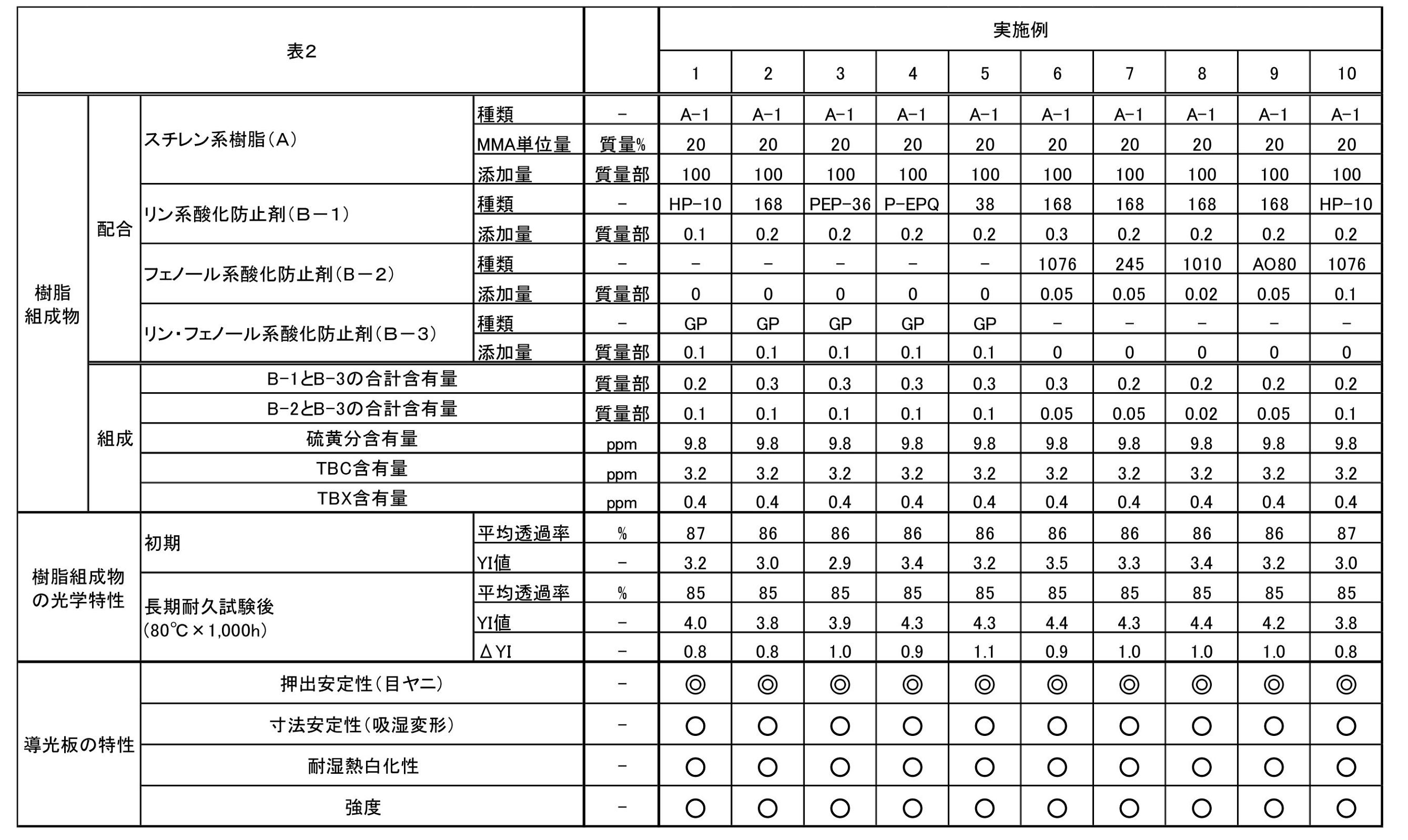
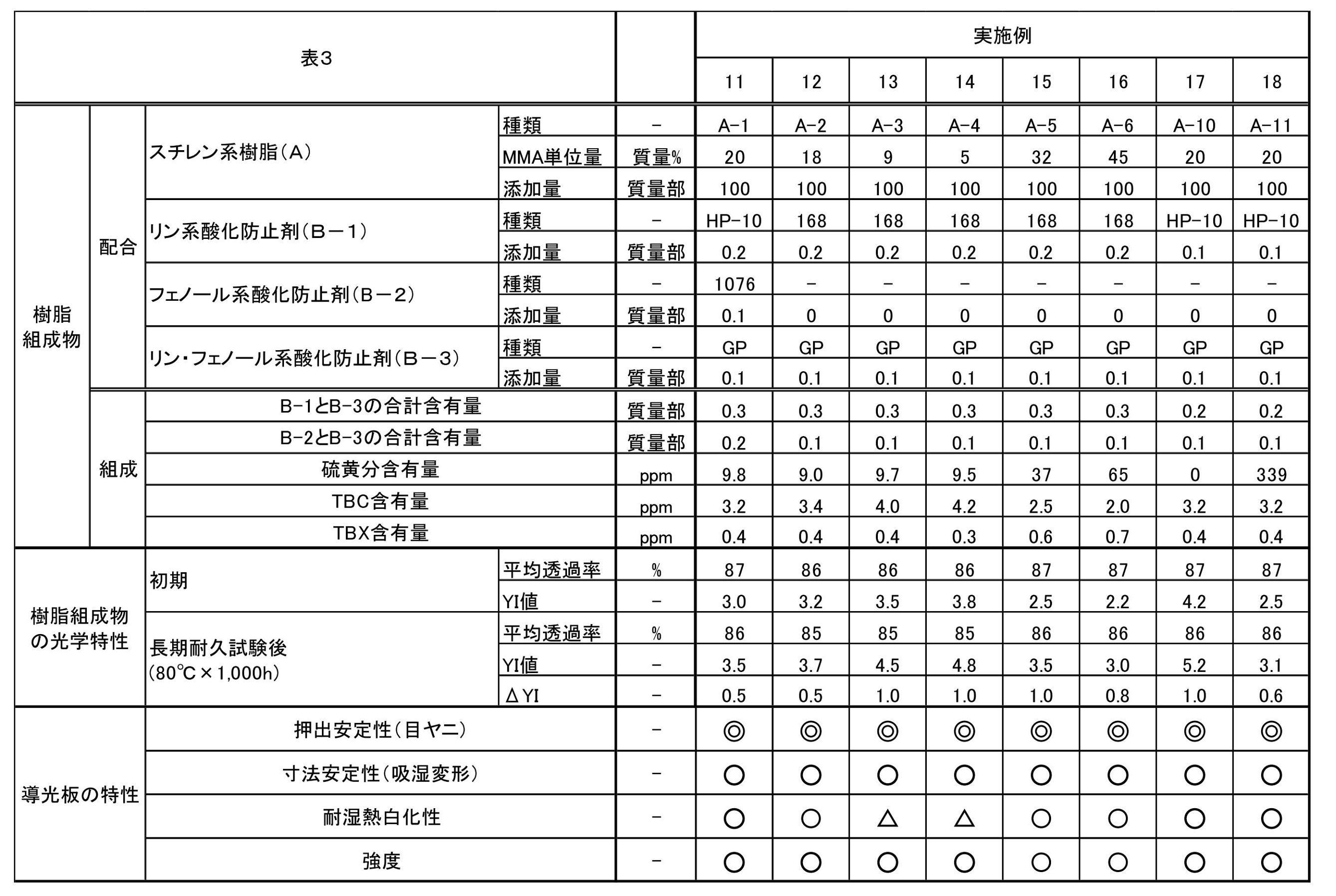

表2~表4中のTBC、TBX及び硫黄分の含有量は、使用したスチレン系樹脂中の含有量に基づき算出した値である。
平均透過率及びYI値は、次の手順にて測定を行った。スチレン系樹脂組成物のペレットを用い、シリンダー温度230℃、金型温度50℃にて射出成形を行い、127×127×3mm厚みの板状成形品(初期サンプル)を成形した。
ここで長期の耐久性を評価するサンプル(長期耐久試験後のサンプル)は、80℃のオーブン内に1000時間保管した。
次に、初期サンプル及び長期耐久試験後のサンプルの板状成形品から115×85×3mm厚みの試験片を切り出し、端面をバフ研磨によって研磨し、端面に鏡面を有する板状成形品を作成した。研磨後の板状成形品について、日本分光株式会社製の紫外線可視分光光度計V-670を用いて、大きさ20×1.6mm、広がり角度0°の入射光において、光路長115mmでの波長350nm~800nmの分光透過率を測定し、C光源における、視野2°でのYI値をJIS K7105に倣い算出した。平均透過率(全光線透過率)は、波長380~780nmにおける分光透過率の平均として算出した。
当該スチレン系樹脂組成物を、スクリュー径90mm、L/D=32の単軸ベント付き押出機に供給し、200~235℃で溶融混練した後、リップ幅1000mm、リップ開度3.0mmのTダイにて、Tダイ温度245~250℃で吐出し、縦型3本冷却ロールで冷却固化後、端面をトリミングし、幅800mm、厚み2.0mmの導光板を得た。
表2~表4における導光板の押出安定性(目ヤニ)、寸法安定性(吸湿変形)、耐湿熱白化性、及び強度について下記のように評価した。
ダイの樹脂温度を300℃に調整し、ダイ付近の目ヤニ発生状況を、以下の基準に基づき評価した。
○:シート押出開始後、30分を経過しても、目ヤニが確認されない。
△:シート押出開始後、10~30分で目ヤニが確認される。
×:シート押出開始後、10分以内に目ヤニが確認される。
なお、「目ヤニ」とは、ダイの出口ノズル周辺に発生する、茶色、若しくは黒色の樹脂劣化物であり、通常、押出量とともに増加し、所定の量を超えるとノズルより脱離し、シート表面に付着する。
前記で得られた導光板から、200mm×300mmの試験片を切り出し、試験片を温度60℃、相対湿度90%の条件で500時間保管し、保管前後での長辺の寸法変化を測定し、以下の式により変形率を計算した。
変形率=((保管後の長辺長さ)―(保管前の長辺長さ))÷(保管前の長辺の長さ)×100(%)
変形率が0.10%以下のものを〇、0.10~0.15%のものを△、0.15%以上のものを×として、導光板の寸法安定性(吸湿変化)を評価した。
前記で得られた導光板から、200mm×200mmの試験片を切り出し、試験片を60℃、相対湿度90%の環境下で150時間暴露後、温度23℃、相対湿度50%の環境下に試験片を取り出し、急冷し、更に1時間放置後に、試験片内部に発生する白化現象を観察し、以下の基準に基づき、耐湿熱白化性を評価した。
〇:全く白化が発生しない
△:わすかに白化が発生するが、24時間後にはほとんど消失する
×:著しく白化し、24時間後経っても消失しない
前記で得られた導光板から、200mm×200mmの試験片を切り出し、重量16.6gの球を使用し、JIS K-7211に従って、50%破壊高さを測定した。50%破壊高さが50cm以上のものを○、30~50cmのものを△、30cm以下のものを×として、導光板の強度を測定した。
また、硫黄分が0.1~500ppmである実施例1~16及び実施例18においては、色相が特に優れていた。
Claims (11)
- スチレン系単量体単位51~99質量%と(メタ)アクリル酸エステル系単量体単位1~49質量%を含む共重合体であるスチレン系樹脂(A)と、酸化防止剤(B)を含有する光学用スチレン系樹脂組成物であって、
前記酸化防止剤(B)は、リン系酸化防止剤(B-1)、フェノール系酸化防止剤(B-2)、及びリン・フェノール系酸化防止剤(B-3)のうち少なくとも1種を含み、
前記スチレン系樹脂(A)100質量部に対して、
前記リン系酸化防止剤(B-1)と前記リン・フェノール系酸化防止剤(B-3)を合計で0.1~0.5質量部、
前記フェノール系酸化防止剤(B-2)と前記リン・フェノール系酸化防止剤(B-3)を合計で0.01~0.5質量部、
含有する、
光学用スチレン系樹脂組成物。 - 前記リン系酸化防止剤(B-1)は、2,2'-メチレンビス(4,6-ジ-tert-ブチル-1-フェニルオキシ)(2-エチルヘキシルオキシ)ホスホラス、トリス(2,4-ジ-tert-ブチルフェニル)フォスファイト、3,9-ビス(2,6-ジ―tert-ブチル―4-メチルフェノキシ)-2,4,8,10-テトラオキサ―3,9-ジホスファスピロ〔5,5〕ウンデカン、テトラキス(2,4-ジ―tert-ブチルフェニル)〔1,1ビフェニル〕―4,4ジイルビスホスホナイト、ビス(2,4-ジ―tert-ブチル―6-メチルフェニル)エチル亜リン酸エステルから選ばれる少なくとも1種である、請求項1に記載の光学用スチレン系樹脂組成物。
- 前記フェノール系酸化防止剤(B-2)は、オクタデシル-3-(3,5-ジ-tert-ブチル-4-ヒドロキシフェニル)プロピオネート、エチレンビス(オキシエチレン)ビス〔3-(5-tert-ブチル-4-ヒドロキシ-m-トリル)プロピオネート〕、ペンタエリスリトールテトラキス[3-(3,5-ジ-tert-ブチル-4-ヒドロキシフェニル)プロピオネート]、3,9-ビス[2-〔3-(3-tert-ブチル―4-ヒドロキシ―5-メチルフェニル)プロピオニルオキシ〕-1,1-ジメチルエチル]-2,4,8,10-テトラオキサスピロ[5,5]ウンデカンから選ばれる少なくとも1種である、請求項1又は請求項2の何れかに記載の光学用スチレン系樹脂組成物。
- 前記リン・フェノール系酸化防止剤(B-3)は、6-[3-(3-tert-ブチル-4-ヒドロキシ-5-メチルフェニル)プロポキシ]-2,4,8,10-テトラ-tert-ブチルジベンゾ[d,f][1,3,2]ジオキサホスフェピンである、請求項1~請求項3の何れか1項に記載の光学用スチレン系樹脂組成物。
- 前記光学用スチレン系樹脂組成物は、6-tert-ブチル―2,4-キシレノールを0.1~20ppm含む、請求項1~請求項4の何れか1項に記載の光学用スチレン系樹脂組成物。
- 前記光学用スチレン系樹脂組成物は、硫黄分を0.1~500ppm含む、請求項1~請求項5の何れか1項に記載の光学用スチレン系樹脂組成物。
- 前記スチレン系樹脂(A)の重量平均分子量(Mw)は、5万~40万であり、
前記スチレン系樹脂(A)の重量平均分子量(Mw)と数平均分子量(Mn)の比(Mw/Mn)は、1.0~3.0である、
請求項1~請求項6の何れか1項に記載の光学用スチレン系樹脂組成物。 - 初期の光路長115mmでの波長380~780nmの平均透過率が85%以上である、請求項1~請求項7の何れか1項に記載の光学用スチレン系樹脂組成物。
- 請求項1~請求項8の何れか1項に記載の光学用スチレン系樹脂組成物を成形してなる導光板。
- 厚みが1.0~3.0mmである、請求項9に記載の導光板。
- 請求項9又は請求項10に記載の導光板と、該導光板の端面に光を供給する光源を有する、エッジライト型面光源ユニット。
Priority Applications (4)
| Application Number | Priority Date | Filing Date | Title |
|---|---|---|---|
| JP2022511521A JP7590412B2 (ja) | 2020-04-01 | 2020-12-04 | 光学用スチレン系樹脂組成物、導光板及びエッジライト型面光源ユニット |
| KR1020227037676A KR102940857B1 (ko) | 2020-04-01 | 2020-12-04 | 광학용 스티렌계 수지 조성물, 도광판 및 에지라이트형 면 광원 유닛 |
| MX2022011738A MX2022011738A (es) | 2020-04-01 | 2020-12-04 | Composicion optica de resina a base de estireno, placa de guia de luz y unidad de fuente de luz plana tipo luz de borde. |
| CN202080099327.2A CN115397913A (zh) | 2020-04-01 | 2020-12-04 | 光学用苯乙烯系树脂组合物、导光板以及侧光型面光源单元 |
Applications Claiming Priority (2)
| Application Number | Priority Date | Filing Date | Title |
|---|---|---|---|
| JP2020065885 | 2020-04-01 | ||
| JP2020-065885 | 2020-04-01 |
Publications (1)
| Publication Number | Publication Date |
|---|---|
| WO2021199501A1 true WO2021199501A1 (ja) | 2021-10-07 |
Family
ID=77928430
Family Applications (1)
| Application Number | Title | Priority Date | Filing Date |
|---|---|---|---|
| PCT/JP2020/045195 Ceased WO2021199501A1 (ja) | 2020-04-01 | 2020-12-04 | 光学用スチレン系樹脂組成物、導光板及びエッジライト型面光源ユニット |
Country Status (6)
| Country | Link |
|---|---|
| JP (1) | JP7590412B2 (ja) |
| KR (1) | KR102940857B1 (ja) |
| CN (1) | CN115397913A (ja) |
| MX (1) | MX2022011738A (ja) |
| TW (1) | TWI912274B (ja) |
| WO (1) | WO2021199501A1 (ja) |
Cited By (3)
| Publication number | Priority date | Publication date | Assignee | Title |
|---|---|---|---|---|
| JPWO2023218994A1 (ja) * | 2022-05-13 | 2023-11-16 | ||
| JPWO2025164509A1 (ja) * | 2024-01-30 | 2025-08-07 | ||
| WO2025216199A1 (ja) * | 2024-04-12 | 2025-10-16 | 株式会社Adeka | 樹脂組成物、成形品、樹脂組成物の製造方法、樹脂添加剤組成物および合成樹脂の熱安定化方法 |
Families Citing this family (1)
| Publication number | Priority date | Publication date | Assignee | Title |
|---|---|---|---|---|
| EP4628892A1 (en) | 2022-11-29 | 2025-10-08 | Korea Research Institute of Bioscience and Biotechnology | Inhibitor of activity or expression of ngr1 protein for improving cytolytic activity by promoting formation of immunological synapses of immune cells |
Citations (4)
| Publication number | Priority date | Publication date | Assignee | Title |
|---|---|---|---|---|
| WO2010071152A1 (ja) * | 2008-12-17 | 2010-06-24 | 電気化学工業株式会社 | 光学用成形体及びそれを用いた導光板及び光拡散体 |
| JP2013154546A (ja) * | 2012-01-30 | 2013-08-15 | Mitsubishi Gas Chemical Co Inc | 積層体およびそれを備えた保護部材 |
| WO2014010137A1 (ja) * | 2012-07-13 | 2014-01-16 | 東洋スチレン株式会社 | 光学用スチレン系樹脂組成物、成形品および導光板 |
| WO2016129675A1 (ja) * | 2015-02-12 | 2016-08-18 | デンカ株式会社 | 光学用スチレン系樹脂組成物 |
Family Cites Families (5)
| Publication number | Priority date | Publication date | Assignee | Title |
|---|---|---|---|---|
| JP2003075648A (ja) | 2001-09-07 | 2003-03-12 | Denki Kagaku Kogyo Kk | 導光板 |
| JP4506342B2 (ja) * | 2004-08-05 | 2010-07-21 | 東ソー株式会社 | 透明性樹脂組成物及び光学フィルム |
| CN103987780B (zh) * | 2011-12-20 | 2017-03-22 | 东洋苯乙烯股份有限公司 | 光学用苯乙烯系树脂组合物,成型品及导光板 |
| JP6039907B2 (ja) | 2012-02-17 | 2016-12-07 | 東洋スチレン株式会社 | スチレン系樹脂板状成形品および導光板 |
| WO2017094748A1 (ja) * | 2015-11-30 | 2017-06-08 | デンカ株式会社 | 透明な高耐熱性スチレン系共重合体 |
-
2020
- 2020-12-04 KR KR1020227037676A patent/KR102940857B1/ko active Active
- 2020-12-04 MX MX2022011738A patent/MX2022011738A/es unknown
- 2020-12-04 CN CN202080099327.2A patent/CN115397913A/zh active Pending
- 2020-12-04 WO PCT/JP2020/045195 patent/WO2021199501A1/ja not_active Ceased
- 2020-12-04 JP JP2022511521A patent/JP7590412B2/ja active Active
-
2021
- 2021-01-07 TW TW110100670A patent/TWI912274B/zh active
Patent Citations (4)
| Publication number | Priority date | Publication date | Assignee | Title |
|---|---|---|---|---|
| WO2010071152A1 (ja) * | 2008-12-17 | 2010-06-24 | 電気化学工業株式会社 | 光学用成形体及びそれを用いた導光板及び光拡散体 |
| JP2013154546A (ja) * | 2012-01-30 | 2013-08-15 | Mitsubishi Gas Chemical Co Inc | 積層体およびそれを備えた保護部材 |
| WO2014010137A1 (ja) * | 2012-07-13 | 2014-01-16 | 東洋スチレン株式会社 | 光学用スチレン系樹脂組成物、成形品および導光板 |
| WO2016129675A1 (ja) * | 2015-02-12 | 2016-08-18 | デンカ株式会社 | 光学用スチレン系樹脂組成物 |
Cited By (6)
| Publication number | Priority date | Publication date | Assignee | Title |
|---|---|---|---|---|
| JPWO2023218994A1 (ja) * | 2022-05-13 | 2023-11-16 | ||
| WO2023218994A1 (ja) * | 2022-05-13 | 2023-11-16 | デンカ株式会社 | 光学用スチレン系樹脂組成物、導光板、エッジライト型面光源ユニット、光拡散版、及び直下型面光源ユニット |
| JP7606648B2 (ja) | 2022-05-13 | 2024-12-25 | デンカ株式会社 | 光学用スチレン系樹脂組成物、導光板、エッジライト型面光源ユニット、光拡散版、及び直下型面光源ユニット |
| JPWO2025164509A1 (ja) * | 2024-01-30 | 2025-08-07 | ||
| WO2025164509A1 (ja) * | 2024-01-30 | 2025-08-07 | デンカ株式会社 | スチレン系樹脂組成物、導光板及びエッジライト型面光源ユニット |
| WO2025216199A1 (ja) * | 2024-04-12 | 2025-10-16 | 株式会社Adeka | 樹脂組成物、成形品、樹脂組成物の製造方法、樹脂添加剤組成物および合成樹脂の熱安定化方法 |
Also Published As
| Publication number | Publication date |
|---|---|
| KR20220162743A (ko) | 2022-12-08 |
| MX2022011738A (es) | 2022-10-13 |
| TWI912274B (zh) | 2026-01-21 |
| KR102940857B1 (ko) | 2026-03-19 |
| TW202144444A (zh) | 2021-12-01 |
| JPWO2021199501A1 (ja) | 2021-10-07 |
| JP7590412B2 (ja) | 2024-11-26 |
| CN115397913A (zh) | 2022-11-25 |
Similar Documents
| Publication | Publication Date | Title |
|---|---|---|
| CN103987780B (zh) | 光学用苯乙烯系树脂组合物,成型品及导光板 | |
| JP7590412B2 (ja) | 光学用スチレン系樹脂組成物、導光板及びエッジライト型面光源ユニット | |
| CN103998514B (zh) | 光学用苯乙烯系树脂组合物 | |
| CN104245823A (zh) | 光学用苯乙烯系树脂组合物,成型品及导光板 | |
| JP7606648B2 (ja) | 光学用スチレン系樹脂組成物、導光板、エッジライト型面光源ユニット、光拡散版、及び直下型面光源ユニット | |
| KR102669507B1 (ko) | 스티렌계 수지 조성물, 성형품 및 도광판 | |
| JP5715830B2 (ja) | 導光板用スチレン系樹脂組成物および導光板 | |
| JP5715829B2 (ja) | 導光板用スチレン系樹脂組成物および導光板 | |
| KR102952430B1 (ko) | 스티렌계 수지 조성물, 성형품 그리고 도광판 | |
| JP6039907B2 (ja) | スチレン系樹脂板状成形品および導光板 | |
| TWI800610B (zh) | 光學用苯乙烯系樹脂組成物以及光學部件 | |
| JP7344961B2 (ja) | エッジライト型導光板及びエッジライト型面光源ユニット | |
| WO2021132001A1 (ja) | 光拡散板及び直下型面光源ユニット | |
| WO2025164509A1 (ja) | スチレン系樹脂組成物、導光板及びエッジライト型面光源ユニット | |
| JP2016190425A (ja) | 光学用スチレン系多層成形品および導光板 |
Legal Events
| Date | Code | Title | Description |
|---|---|---|---|
| 121 | Ep: the epo has been informed by wipo that ep was designated in this application |
Ref document number: 20929657 Country of ref document: EP Kind code of ref document: A1 |
|
| ENP | Entry into the national phase |
Ref document number: 2022511521 Country of ref document: JP Kind code of ref document: A |
|
| ENP | Entry into the national phase |
Ref document number: 20227037676 Country of ref document: KR Kind code of ref document: A |
|
| NENP | Non-entry into the national phase |
Ref country code: DE |
|
| 122 | Ep: pct application non-entry in european phase |
Ref document number: 20929657 Country of ref document: EP Kind code of ref document: A1 |