WO2021199493A1 - 電源装置及びこれを備える車両並びに蓄電装置 - Google Patents
電源装置及びこれを備える車両並びに蓄電装置 Download PDFInfo
- Publication number
- WO2021199493A1 WO2021199493A1 PCT/JP2020/043710 JP2020043710W WO2021199493A1 WO 2021199493 A1 WO2021199493 A1 WO 2021199493A1 JP 2020043710 W JP2020043710 W JP 2020043710W WO 2021199493 A1 WO2021199493 A1 WO 2021199493A1
- Authority
- WO
- WIPO (PCT)
- Prior art keywords
- power supply
- supply device
- end plate
- battery
- power
- Prior art date
- Legal status (The legal status is an assumption and is not a legal conclusion. Google has not performed a legal analysis and makes no representation as to the accuracy of the status listed.)
- Ceased
Links
Images







Classifications
-
- H—ELECTRICITY
- H01—ELECTRIC ELEMENTS
- H01M—PROCESSES OR MEANS, e.g. BATTERIES, FOR THE DIRECT CONVERSION OF CHEMICAL ENERGY INTO ELECTRICAL ENERGY
- H01M50/00—Constructional details or processes of manufacture of the non-active parts of electrochemical cells other than fuel cells, e.g. hybrid cells
- H01M50/20—Mountings; Secondary casings or frames; Racks, modules or packs; Suspension devices; Shock absorbers; Transport or carrying devices; Holders
- H01M50/262—Mountings; Secondary casings or frames; Racks, modules or packs; Suspension devices; Shock absorbers; Transport or carrying devices; Holders with fastening means, e.g. locks
- H01M50/264—Mountings; Secondary casings or frames; Racks, modules or packs; Suspension devices; Shock absorbers; Transport or carrying devices; Holders with fastening means, e.g. locks for cells or batteries, e.g. straps, tie rods or peripheral frames
-
- B—PERFORMING OPERATIONS; TRANSPORTING
- B60—VEHICLES IN GENERAL
- B60K—ARRANGEMENT OR MOUNTING OF PROPULSION UNITS OR OF TRANSMISSIONS IN VEHICLES; ARRANGEMENT OR MOUNTING OF PLURAL DIVERSE PRIME-MOVERS IN VEHICLES; AUXILIARY DRIVES FOR VEHICLES; INSTRUMENTATION OR DASHBOARDS FOR VEHICLES; ARRANGEMENTS IN CONNECTION WITH COOLING, AIR INTAKE, GAS EXHAUST OR FUEL SUPPLY OF PROPULSION UNITS IN VEHICLES
- B60K1/00—Arrangement or mounting of electrical propulsion units
- B60K1/04—Arrangement or mounting of electrical propulsion units of the electric storage means for propulsion
-
- B—PERFORMING OPERATIONS; TRANSPORTING
- B60—VEHICLES IN GENERAL
- B60L—PROPULSION OF ELECTRICALLY-PROPELLED VEHICLES; SUPPLYING ELECTRIC POWER FOR AUXILIARY EQUIPMENT OF ELECTRICALLY-PROPELLED VEHICLES; ELECTRODYNAMIC BRAKE SYSTEMS FOR VEHICLES IN GENERAL; MAGNETIC SUSPENSION OR LEVITATION FOR VEHICLES; MONITORING OPERATING VARIABLES OF ELECTRICALLY-PROPELLED VEHICLES; ELECTRIC SAFETY DEVICES FOR ELECTRICALLY-PROPELLED VEHICLES
- B60L58/00—Methods or circuit arrangements for monitoring or controlling batteries or fuel cells, specially adapted for electric vehicles
- B60L58/10—Methods or circuit arrangements for monitoring or controlling batteries or fuel cells, specially adapted for electric vehicles for monitoring or controlling batteries
-
- H—ELECTRICITY
- H01—ELECTRIC ELEMENTS
- H01M—PROCESSES OR MEANS, e.g. BATTERIES, FOR THE DIRECT CONVERSION OF CHEMICAL ENERGY INTO ELECTRICAL ENERGY
- H01M10/00—Secondary cells; Manufacture thereof
- H01M10/42—Methods or arrangements for servicing or maintenance of secondary cells or secondary half-cells
- H01M10/44—Methods for charging or discharging
- H01M10/441—Methods for charging or discharging for several batteries or cells simultaneously or sequentially
-
- H—ELECTRICITY
- H01—ELECTRIC ELEMENTS
- H01M—PROCESSES OR MEANS, e.g. BATTERIES, FOR THE DIRECT CONVERSION OF CHEMICAL ENERGY INTO ELECTRICAL ENERGY
- H01M50/00—Constructional details or processes of manufacture of the non-active parts of electrochemical cells other than fuel cells, e.g. hybrid cells
- H01M50/20—Mountings; Secondary casings or frames; Racks, modules or packs; Suspension devices; Shock absorbers; Transport or carrying devices; Holders
- H01M50/204—Racks, modules or packs for multiple batteries or multiple cells
- H01M50/207—Racks, modules or packs for multiple batteries or multiple cells characterised by their shape
- H01M50/209—Racks, modules or packs for multiple batteries or multiple cells characterised by their shape adapted for prismatic or rectangular cells
-
- H—ELECTRICITY
- H01—ELECTRIC ELEMENTS
- H01M—PROCESSES OR MEANS, e.g. BATTERIES, FOR THE DIRECT CONVERSION OF CHEMICAL ENERGY INTO ELECTRICAL ENERGY
- H01M50/00—Constructional details or processes of manufacture of the non-active parts of electrochemical cells other than fuel cells, e.g. hybrid cells
- H01M50/20—Mountings; Secondary casings or frames; Racks, modules or packs; Suspension devices; Shock absorbers; Transport or carrying devices; Holders
- H01M50/218—Mountings; Secondary casings or frames; Racks, modules or packs; Suspension devices; Shock absorbers; Transport or carrying devices; Holders characterised by the material
- H01M50/22—Mountings; Secondary casings or frames; Racks, modules or packs; Suspension devices; Shock absorbers; Transport or carrying devices; Holders characterised by the material of the casings or racks
- H01M50/222—Inorganic material
- H01M50/224—Metals
-
- H—ELECTRICITY
- H01—ELECTRIC ELEMENTS
- H01M—PROCESSES OR MEANS, e.g. BATTERIES, FOR THE DIRECT CONVERSION OF CHEMICAL ENERGY INTO ELECTRICAL ENERGY
- H01M50/00—Constructional details or processes of manufacture of the non-active parts of electrochemical cells other than fuel cells, e.g. hybrid cells
- H01M50/20—Mountings; Secondary casings or frames; Racks, modules or packs; Suspension devices; Shock absorbers; Transport or carrying devices; Holders
- H01M50/233—Mountings; Secondary casings or frames; Racks, modules or packs; Suspension devices; Shock absorbers; Transport or carrying devices; Holders characterised by physical properties of casings or racks, e.g. dimensions
-
- H—ELECTRICITY
- H01—ELECTRIC ELEMENTS
- H01M—PROCESSES OR MEANS, e.g. BATTERIES, FOR THE DIRECT CONVERSION OF CHEMICAL ENERGY INTO ELECTRICAL ENERGY
- H01M50/00—Constructional details or processes of manufacture of the non-active parts of electrochemical cells other than fuel cells, e.g. hybrid cells
- H01M50/20—Mountings; Secondary casings or frames; Racks, modules or packs; Suspension devices; Shock absorbers; Transport or carrying devices; Holders
- H01M50/249—Mountings; Secondary casings or frames; Racks, modules or packs; Suspension devices; Shock absorbers; Transport or carrying devices; Holders specially adapted for aircraft or vehicles, e.g. cars or trains
-
- H—ELECTRICITY
- H01—ELECTRIC ELEMENTS
- H01M—PROCESSES OR MEANS, e.g. BATTERIES, FOR THE DIRECT CONVERSION OF CHEMICAL ENERGY INTO ELECTRICAL ENERGY
- H01M2220/00—Batteries for particular applications
- H01M2220/20—Batteries in motive systems, e.g. vehicle, ship, plane
-
- H—ELECTRICITY
- H01—ELECTRIC ELEMENTS
- H01M—PROCESSES OR MEANS, e.g. BATTERIES, FOR THE DIRECT CONVERSION OF CHEMICAL ENERGY INTO ELECTRICAL ENERGY
- H01M2250/00—Fuel cells for particular applications; Specific features of fuel cell system
- H01M2250/20—Fuel cells in motive systems, e.g. vehicle, ship, plane
-
- H—ELECTRICITY
- H01—ELECTRIC ELEMENTS
- H01M—PROCESSES OR MEANS, e.g. BATTERIES, FOR THE DIRECT CONVERSION OF CHEMICAL ENERGY INTO ELECTRICAL ENERGY
- H01M50/00—Constructional details or processes of manufacture of the non-active parts of electrochemical cells other than fuel cells, e.g. hybrid cells
- H01M50/20—Mountings; Secondary casings or frames; Racks, modules or packs; Suspension devices; Shock absorbers; Transport or carrying devices; Holders
- H01M50/233—Mountings; Secondary casings or frames; Racks, modules or packs; Suspension devices; Shock absorbers; Transport or carrying devices; Holders characterised by physical properties of casings or racks, e.g. dimensions
- H01M50/242—Mountings; Secondary casings or frames; Racks, modules or packs; Suspension devices; Shock absorbers; Transport or carrying devices; Holders characterised by physical properties of casings or racks, e.g. dimensions adapted for protecting batteries against vibrations, collision impact or swelling
-
- H—ELECTRICITY
- H01—ELECTRIC ELEMENTS
- H01M—PROCESSES OR MEANS, e.g. BATTERIES, FOR THE DIRECT CONVERSION OF CHEMICAL ENERGY INTO ELECTRICAL ENERGY
- H01M50/00—Constructional details or processes of manufacture of the non-active parts of electrochemical cells other than fuel cells, e.g. hybrid cells
- H01M50/20—Mountings; Secondary casings or frames; Racks, modules or packs; Suspension devices; Shock absorbers; Transport or carrying devices; Holders
- H01M50/289—Mountings; Secondary casings or frames; Racks, modules or packs; Suspension devices; Shock absorbers; Transport or carrying devices; Holders characterised by spacing elements or positioning means within frames, racks or packs
- H01M50/291—Mountings; Secondary casings or frames; Racks, modules or packs; Suspension devices; Shock absorbers; Transport or carrying devices; Holders characterised by spacing elements or positioning means within frames, racks or packs characterised by their shape
-
- Y—GENERAL TAGGING OF NEW TECHNOLOGICAL DEVELOPMENTS; GENERAL TAGGING OF CROSS-SECTIONAL TECHNOLOGIES SPANNING OVER SEVERAL SECTIONS OF THE IPC; TECHNICAL SUBJECTS COVERED BY FORMER USPC CROSS-REFERENCE ART COLLECTIONS [XRACs] AND DIGESTS
- Y02—TECHNOLOGIES OR APPLICATIONS FOR MITIGATION OR ADAPTATION AGAINST CLIMATE CHANGE
- Y02E—REDUCTION OF GREENHOUSE GAS [GHG] EMISSIONS, RELATED TO ENERGY GENERATION, TRANSMISSION OR DISTRIBUTION
- Y02E60/00—Enabling technologies; Technologies with a potential or indirect contribution to GHG emissions mitigation
- Y02E60/10—Energy storage using batteries
Definitions
- the present disclosure relates to a power supply device, a vehicle equipped with the power supply device, and a power storage device.
- Power supplies such as battery modules and battery packs equipped with multiple battery cells are used as power sources for vehicles such as hybrid vehicles and electric vehicles, and power storage systems for factories and households.
- a plurality of rechargeable and dischargeable battery cells are stacked.
- end plates 903 are arranged on both end faces of the battery laminate 910 in which the battery cells 901 of the square outer can are laminated, and the end plates 903 are placed on each other. Is fastened with a bind bar 904.
- the square battery cell 901 is provided with positive and negative electrode terminals 902 separated from each other on the upper surface thereof. The electrode terminals 902 of the adjacent battery cells 901 are connected by a bus bar 940.
- One of the objects according to one aspect of the present invention is to provide a power supply device, a vehicle equipped with the power supply device, and a power storage device in which the strength of the end plate is maintained and the cost is reduced.
- a power supply device comprises a battery laminate in which a plurality of square battery cells are laminated, a plan-view rectangular end plate having a pressing surface covering an end surface of the battery laminate, and the battery laminate.
- the end plate includes a fastening member for fastening, and the end plate has a flat pressing region formed on the end edge side in the vertical direction and an intermediate side in the vertical direction of the pressing surface. It forms a bead region that is bent into a shape that protrudes toward the back side.
- the strength can be improved by changing the shape of forming a bead region in the middle while leaving a pressing region for pressing the battery laminate on the end plate, so that the strength is high.
- the end plate can be provided at low cost.
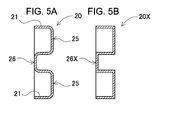
- FIG. 5A is a schematic vertical cross-sectional view of an end plate having a bead region formed in a curved surface
- FIG. 5B is a schematic cross-sectional view of an end plate having a bead region formed in a U shape
- 6A is a schematic vertical sectional view taken along the line VIA-VIA of FIG. 3, and FIG.
- FIG. 6B is a schematic vertical sectional view taken along the line VIB-VIB of FIG.
- FIG. 5 is a vertical cross-sectional view of an end plate portion of the power supply device according to the second embodiment.
- FIG. 5 is a vertical cross-sectional view of an end plate portion of the power supply device according to the third embodiment.
- It is a block diagram which shows an example which mounts a power supply device in a hybrid vehicle which runs by an engine and a motor.
- It is a block diagram which shows the example which mounts the power-source device on the electric vehicle which runs only by a motor.
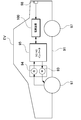
- It is a block diagram which shows the example which applies to the power supply device for electricity storage.
- It is an exploded perspective view which shows the conventional power supply device.
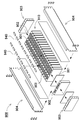
- FIG. 5 is an exploded perspective view of an end plate portion of the power supply device according to the fourth embodiment.
- the embodiment of the present invention may be specified by the following configuration.
- the end plate forms side walls on both sides of the side surface of the pressing surface, and the side walls are on the edge side in the vertical direction.
- Each of the positions corresponding to the pressing region has a fixing region for fixing to the fastening member, and is connected to the protruding shape of the bead region at the central portion in the vertical direction.
- the end plate forms a curved surface with a protruding shape of the bead region.
- the side wall of the end plate is formed so as to be continuously connected to the bead region by a curved surface at a central portion. ..
- the central portion can be continuous with the protruding portion of the bead region to ensure strength.
- the end plate in addition to any of the above configurations, steeply protrudes the protruding shape of the bead region at the left and right central portions in a vertical cross-sectional view. It is gently tilted toward both sides.
- the central portion is brought closer to the ridge to improve the strength, and at the end portion, the side wall of the end plate secures the fixing portion with the fastening member.
- the end plate is formed by bending one metal plate by press working. With the above configuration, it is possible to reduce the cost and weight of the end plate.
- the end plate in addition to any of the above configurations, has a sum of the heights of the pressing regions formed at the top and bottom in a cross-sectional view. It is made equal to the height of the bead region formed in the middle.
- the end plate is fixed to the fastening member by welding or caulking.
- the electric vehicle includes any of the above power supply devices, a traveling motor to which power is supplied from the power supply device, the power supply device, and the motor. It includes a main body and wheels driven by the motor to drive the vehicle main body.
- the power storage device includes any of the above power supply devices and a power supply controller that controls charging / discharging to the power supply device, and the power supply controller is used to generate electric power from the outside. Allows the battery cell to be charged and controls the battery cell to be charged.
- each element constituting the present invention may be configured such that a plurality of elements are composed of the same member and the plurality of elements are combined with one member, or conversely, the function of one member is performed by the plurality of members. It can also be shared and realized.
- the contents described in some examples and embodiments can be used in other embodiments and embodiments.
- the power supply device is a power source mounted on an electric vehicle such as a hybrid vehicle or an electric vehicle to supply electric power to a traveling motor, a power source for storing electric power generated by natural energy such as solar power generation or wind power generation, or a power source for storing electric power generated by natural energy such as solar power generation and wind power generation. It is used for various purposes such as a power source for storing midnight power, and is particularly suitable as a power source suitable for high power and large current applications.
- a power source for storing midnight power and is particularly suitable as a power source suitable for high power and large current applications.
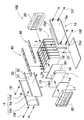
- FIGS. 1 to 2 show an exploded perspective view of the power supply device 100 shown in FIG.
- the power supply device 100 shown in these figures includes a battery laminate 10 in which a plurality of battery cells 1 are laminated via an insulating spacer 16, a pair of end plates 20 covering both end faces of the battery laminate 10, and an end plate 20. It includes a plurality of fastening members 15 for fastening each other, and a bus bar 40 provided on the upper surface of the battery laminate 10.
- the fastening member 15 is formed in a plate shape extending along the stacking direction of the plurality of battery cells 1.
- the fastening members 15 are arranged on opposite side surfaces of the battery laminate 10 to fasten the end plates 20 to each other. (Battery laminate 10)
- the battery laminate 10 is connected to a plurality of battery cells 1 having positive and negative electrode terminals 2 and electrode terminals 2 of the plurality of battery cells 1, and the plurality of battery cells 1 are arranged in parallel.
- a bus bar 40 connected in series is provided.
- a plurality of battery cells 1 are connected in parallel or in series via these bus bars 40.
- the battery cell 1 is a rechargeable secondary battery.
- a plurality of battery cells 1 are connected in parallel to form a parallel battery group, and a plurality of parallel battery groups are connected in series to connect a large number of battery cells 1 in parallel and in series.
- a plurality of battery cells 1 are laminated to form a battery laminate 10.
- a pair of end plates 20 are arranged on both end faces of the battery laminate 10. The ends of the fastening members 15 are fixed to the end plates 20, and the stacked battery cells 1 are fixed in a pressed state.
- the battery cell 1 is a square battery having a width wider than the thickness, in other words, a square battery thinner than the width, and is laminated in the thickness direction to form a battery laminate 10.
- the battery cell 1 can be, for example, a lithium ion secondary battery. Further, the battery cell can be any rechargeable secondary battery such as a nickel hydrogen battery or a nickel cadmium battery.
- positive and negative electrode plates are housed together with an electrolytic solution in an outer can 1a having a closed structure.
- a metal plate such as aluminum or an aluminum alloy is press-molded into a square shape, and the opening portion is airtightly sealed with a sealing plate 1b.
- the sealing plate 1b is made of the same aluminum or aluminum alloy as the square outer can 1a, and positive and negative electrode terminals 2 are fixed to both ends. Further, the sealing plate 1b is provided with a gas discharge valve 1c, which is a safety valve that opens according to a pressure change inside each of the battery cells 1, between the positive and negative electrode terminals 2.
- the plurality of battery cells 1 are laminated so that the thickness direction of each battery cell 1 is the stacking direction to form the battery laminate 10. At this time, the output of the battery laminate 10 can be increased by increasing the number of layers to be larger than usual. In such a case, the battery laminate 10 becomes a long one extended in the stacking direction.
- terminal surfaces 1X provided with positive and negative electrode terminals 2 are arranged on the same plane, and a plurality of battery cells 1 are laminated to form a battery laminate 10.
- the upper surface of the battery laminate 10 is a surface provided with gas discharge valves 1c of a plurality of battery cells 1. (Electrode terminal 2)
- the battery cell 1 has a sealing plate 1b, which is the top surface, as a terminal surface 1X, and positive and negative electrode terminals 2 are fixed to both ends of the terminal surface 1X.
- the electrode terminal 2 has a columnar protrusion.
- the protruding portion does not necessarily have to be cylindrical, and may be polygonal or elliptical.
- the positions of the positive and negative electrode terminals 2 fixed to the sealing plate 1b of the battery cell 1 are such that the positive electrode and the negative electrode are symmetrical.
- the battery cells 1 are flipped horizontally and stacked, and the electrode terminals 2 of the positive electrode and the negative electrode that are adjacent to each other are connected by the bus bar 40, whereby the adjacent battery cells 1 are connected in series. It is possible to connect to.
- the present invention does not specify the number of battery cells constituting the battery laminate and the connection state thereof.
- the number of battery cells constituting the battery laminate and the connection state thereof can be variously changed, including other embodiments described later.
- the plurality of battery cells 1 are laminated so that the thickness direction of each battery cell 1 is the stacking direction to form the battery laminate 10.
- a plurality of battery cells 1 are laminated so that the terminal surface 1X provided with the positive and negative electrode terminals 2 and the sealing plate 1b in FIG. 2 are flush with each other.
- adjacent electrode terminals 2 are connected by a metal plate bus bar 40, and battery cells 1 are connected in series. (Busbar 40)
- Both ends of the bus bar 40 are connected to positive and negative electrode terminals 2, and battery cells 1 are connected in series or in parallel.
- the battery cells 1 can be connected in series to increase the output voltage, and the battery cells 1 can be connected in parallel to increase the output voltage and output current.
- the battery laminate 10 has an insulating spacer 16 interposed between the battery cells 1 stacked adjacent to each other.
- the insulating spacer 16 is made of an insulating material such as resin in the form of a thin plate or sheet.
- the insulating spacer 16 has a plate shape having a size substantially equal to that of the facing surface of the battery cell 1.
- the insulating spacers 16 can be laminated between the battery cells 1 adjacent to each other to insulate the adjacent battery cells 1 from each other.
- a spacer having a shape in which a flow path of a cooling gas is formed between the battery cells and the spacer can also be used.
- the surface of the battery cell can be covered with an insulating material.
- the surface of the outer excluding the electrode terminal portion of the battery cell may be covered with a shrink film such as PET resin.
- end plates 20 are arranged on both end surfaces of the battery laminate 10.
- An end face spacer 17 may be interposed between the end plate 20 and the battery laminate 10 to insulate them.
- the end face spacer 17 can also be manufactured in the form of a thin plate or sheet with an insulating material such as resin.
- electrode terminals 2 of a plurality of battery cells 1 adjacent to each other are connected to each other by a bus bar 40 to form a plurality of batteries.
- the cells 1 are connected in parallel and in series.
- the end plates 20 are arranged at both ends of the battery laminate 10 and are fastened via a pair of left and right fastening members 15 arranged along both side surfaces of the battery laminate 10.
- the end plates 20 are both ends of the battery laminate 10 in the stacking direction of the battery cells 1, and are arranged outside the end face spacer 17 to sandwich the battery laminate 10 from both ends. (Fastening member 15)
- each fastening member 15 is made of metal having a predetermined width and a predetermined thickness along the side surface of the battery laminate 10, and is arranged so as to face both side surfaces of the battery laminate 10. There is.
- a metal plate such as iron, preferably a steel plate, can be used for the fastening member 15.
- the fastening member 15 made of a metal plate is bent by press molding or the like to form a predetermined shape.
- the fastening member 15 is formed by bending the upper and lower sides of the plate-shaped fastening main surface 15a in a U-shape to form a bent piece 15d.
- the upper and lower bent pieces 15d cover the upper and lower surfaces of the battery laminate 10 from the corners on the left and right side surfaces of the battery laminate 10.
- a plurality of battery cells 1 are connected by connecting end plates 20 arranged at both ends of a battery laminate 10 composed of the plurality of battery cells 1 with fastening members 15. Is configured to constrain. By restraining the plurality of battery cells 1 via the end plate 20 and the fastening member 15 having high rigidity, it is possible to suppress expansion, deformation, relative movement, malfunction due to vibration, etc. of the battery cells 1 due to charge / discharge and deterioration. .. (Insulation sheet 30)
- an insulating sheet 30 is interposed between the fastening member 15 and the battery laminate 10.
- the insulating sheet 30 is made of an insulating material such as resin, and insulates between the metal fastening member 15 and the battery cell 1.
- the insulating sheet 30 shown in FIG. 2 and the like is composed of a flat plate 31 that covers the side surface of the battery laminate 10 and bent covering portions 32 provided above and below the flat plate 31.
- the bent covering portion 32 is bent in a U shape from the flat plate 31 so as to cover the bent piece 15d of the fastening member 15, and then further folded back.
- the bent piece 15d can be covered with an insulating bent covering portion from the upper surface to the side surface and the lower surface, thereby avoiding unintended conduction between the battery cell 1 and the fastening member 15.
- each battery cell 1 presses the upper surface and the lower surface of the battery cell 1 of the battery laminate 10 via the bent covering portion 32.
- each battery cell 1 is pressed from the vertical direction by the bent piece 15d and held in the height direction, and even if vibration, impact, or the like is applied to the battery laminate 10, each battery cell 1 is positioned in the vertical direction. It can be maintained so that it does not shift.
- the battery cell When the surface of the battery laminate or the battery laminate is insulated, for example, the battery cell is housed in an insulating case, covered with a heat-shrinkable resin film, or the fastening member. If the surface is coated with an insulating paint or coating, or if the fastening member is made of an insulating material, the insulating sheet can be unnecessary. Further, the insulating sheet 30 may also have the bent covering portion 32 formed only on the upper end side when it is not necessary to consider the insulation of the fastening member 15 with the bent piece 15d on the lower surface side of the battery laminate 10. For example, the case where the battery cell is covered with a heat-shrinkable film is applicable. (End plate 20)
- FIG. 3 shows an enlarged perspective view of the end plate 20 portion of the power supply device 100 of FIG. 1
- FIG. 4 shows a vertical cross-sectional view of the end plate 20 portion of the power supply device 100 of FIG.
- the end plate 20 shown in these figures is formed in a frame shape 21 having a rectangular outer shape in a plan view and a protruding periphery. Further, the rectangular region surrounded by the frame shape 21 is used as a pressing surface covering the end surface of the battery laminate 10. By forming the box shape in which the frame shape 21 is formed around the pressing surface in this way, the strength of the pressing surface can be increased.
- screw holes or notches for connecting to other parts may be formed on the upper surface side of the frame-shaped 21.
- the end plate 20 forms a pressing region 25 on each of the vertical end edges of the pressing surface, and a bead region 26 is formed between the pressing regions 25. (Pressing area 25)
- the upper and lower pressing regions 25 each have a flat surface, and press the battery laminate 10.
- the widths of the upper and lower pressing regions 25 are substantially equal.
- the pressing region 25, including the bead region 26, is preferably formed line-symmetrically in the horizontal direction. (Bead area 26)
- the bead region 26 is formed in the middle of the pressing surface in the vertical direction, and is bent into a shape protruding toward the back surface side of the pressing surface.
- the strength can be improved by changing the shape of forming the bead region 26 in the middle while leaving the pressing region 25 for pressing the battery laminate 10 on the end plate 20, so that the high-strength end plate 20 can be improved.
- the end plate 20 When the end plate 20 is formed of sheet metal, the end plate 20 having a bead region 26 has a shape having a space on the battery cell 1 side. Therefore, it is preferable to arrange the end face spacer 17D arranged between the battery cell 1 and the end plate 20D as in the power supply device 400 according to the fourth embodiment shown in FIG. Specifically, as shown in FIG. 13, the end face spacer 17D has a convex portion 17d protruding toward a concave portion (back surface of the bead region 26D) of the end plate 20D, and the battery cell 1 and the end plate 20D. Allows the transfer of power on the entire surface. (Wall 22)
- the end plate 20 has a frame shape 21 around the pressing surface. Of the frame shape 21, both sides of the side surface of the pressing surface are side walls 22 respectively.
- the side wall 22 has a fixing region 23 for fixing to the fastening member 15 at a position corresponding to the pressing region 25 on the edge side in the vertical direction.
- the fixed region 23 is formed in the same plane at the top and bottom.
- the fixed region 23 is a flat surface.
- the end plate 20 is fixed to the fastening member 15 by the fixing region 23. Welding or caulking is preferable for fixing the end plate 20 and the fastening member 15. For example, spot welding, clinch, etc. can be used. Further, it may be screwed using a bolt or the like.
- the side wall 22 is connected to the protruding shape of the bead region 26 between these fixed regions 23, that is, at the central portion in the vertical direction.
- a fixed region 23 for connecting to the fastening member 15 is not provided in the middle of the side wall 22 in the height direction.
- the protruding shape of the bead region 26 is maintained and the reinforcing structure of the end plate 20 is exhibited.
- a fixing structure for fixing the end plate 20 to the fastening member 15 is also established by securing a fixing region 23 for fixing the fastening member 15 above and below the side wall 22.
- the protruding shape of the bead region 26 is preferably formed into a curved surface as shown in the schematic cross-sectional view of FIG. 5A.
- stress concentration can be avoided as compared with the end plate 20X having the bead region 26X bent in a U shape as shown in FIG. 5B, and the stress can be dispersed to increase the strength of the end plate 20. Can be improved.
- the side wall 22 of the end plate 20 is formed so as to be continuously connected to the bead region 26 by a curved surface at the center in the vertical direction.
- the central portion can be made continuous with the protruding portion of the bead region 26 to secure the strength.
- the protruding shape of the bead region 26 is projected relatively steeply in the central portions on the left and right as shown in FIG. 6A, but is gently inclined toward both sides as shown in FIG. 6B. It is preferable to form in. By doing so, in the middle of the pressing surface in the left-right direction where the strength is relatively weak, the protruding shape is made tight to increase the strength, and at the end of the pressing surface, the fastening member 15 is attached to the side wall 22 of the end plate 20. It can be deformed to secure a fixed area 23 for fixing the.
- the end plate 20 continuously forms the pressing region 25 and the bead region 26 on the pressing surface, but at the boundary with the side wall 22, the side wall 22 is slightly projected in the protruding direction, that is, pressed, as shown in FIG. It is preferable to incline in the direction toward the back surface side of the surface.
- Such an end plate 20 can be formed by bending one metal plate by press working. As a result, unlike the conventional end plate, it is possible to maintain the required strength while using only one sheet metal without using two sheets, and further realize cost reduction and weight reduction.
- the end plate 20 is preferably formed by processing a sheet metal such as SUS or a high-tensile steel plate.
- the size of the power supply device is increased in order to avoid interference between the equipment for fixing processing such as mechanical clinch and the power supply device as in the conventional case. There is no need.
- the end plate 20 is designed so that the sum of the heights of the pressing regions 25 formed at the top and bottom is substantially equal to the height of the bead region 26 formed in the middle in the cross-sectional view.
- the height of the upper pressing region 25 is b1
- the height of the bead region 26 is a
- the height of the lower pressing region 25 is b2.
- one bead region 26 is provided in the center of the end plate 20 in the vertical direction, but the present invention does not limit the number of bead regions to one, and a plurality of beads.
- a region may be provided.
- the power supply device 200 according to the second embodiment shown in the schematic cross-sectional view of FIG. 7 a configuration in which two bead regions 26B are provided on the end plate 20B is shown. By providing a plurality of bead regions 26B in this way, the strength of the end plate 20B can be further increased. Further, the pressing regions 25B are also dispersed and arranged in three, and the end faces of the battery laminate 10 can be pressed more uniformly.
- the fixing region 23B can be provided not only at the upper and lower edge edges but also in the middle, and the reliability of fixing the end plate 20B and the fastening member 15 can be improved.
- the same members as those in the first embodiment are designated by the same reference numerals, and detailed description thereof will be omitted as appropriate.
- the present invention is not limited to the example in which the bead region of the end plate is hollow, and can also be solid.
- Such an example is shown in the schematic cross-sectional view of FIG. 8 as the power supply device 300 according to the third embodiment.
- the same members as those in the first embodiment are designated by the same reference numerals, and detailed description thereof will be omitted as appropriate.
- the end plate 20C shown in FIG. 8 has a solid pressing surface without being hollow.
- the bead region 26 of the end plate 20C is filled with an insulating member 28 such as resin or rubber.
- the insulating member 28 may be configured to cover not only the bead region 26C but also the pressing region 25C.
- the pressing surface for pressing the battery laminate 10 can be made of a uniform material, the end surface of the battery laminate 10 can be pressed evenly, and heat can be dissipated evenly.
- the heat dissipation of the end face of the battery laminate 10 can be improved by eliminating the air layer as compared with the configuration shown in FIG. 4 in which the air layer is partially formed.
- the heat-bonded state with the end face of the battery laminate 10 can be made uniform to exhibit uniform heat dissipation performance.
- the power supply device 100 can be used as a power supply for a vehicle that supplies electric power to a motor that runs an electric vehicle.
- a vehicle equipped with the power supply device 100 an electric vehicle such as a hybrid vehicle or a plug-in hybrid vehicle that runs on both an engine and a motor, or an electric vehicle that runs only on a motor can be used, and is used as a power source for these vehicles. Will be done.
- a large number of the above-mentioned power supply devices 100 are connected in series or in parallel, and a large-capacity, high-output power supply device to which a necessary control circuit is added is constructed. do. (Power supply for hybrid vehicles)
- FIG. 9 shows an example in which the power supply device 100 is mounted on a hybrid vehicle traveling by both an engine and a motor.
- the vehicle HV equipped with the power supply device 100 shown in this figure is driven by a vehicle main body 91, an engine 96 for running the vehicle main body 91, a running motor 93, and these engines 96 and a running motor 93. It includes wheels 97, a power supply device 100 that supplies electric power to the motor 93, and a generator 94 that charges the batteries of the power supply device 100.
- the power supply device 100 is connected to the motor 93 and the generator 94 via the DC / AC inverter 95.
- the vehicle HV runs on both the motor 93 and the engine 96 while charging and discharging the battery of the power supply device 100.
- the motor 93 is driven to drive the vehicle in a region where the engine efficiency is low, for example, when accelerating or traveling at a low speed.
- the motor 93 is driven by being supplied with electric power from the power supply device 100.
- the generator 94 is driven by the engine 96 or by regenerative braking when braking the vehicle to charge the battery of the power supply device 100.
- the vehicle HV may be provided with a charging plug 98 for charging the power supply device 100. By connecting the charging plug 98 to an external power source, the power supply device 100 can be charged. (Power supply for electric vehicles)
- FIG. 10 shows an example in which the power supply device 100 is mounted on an electric vehicle traveling only by a motor.
- the vehicle EV equipped with the power supply device 100 shown in this figure supplies electric power to the vehicle main body 91, the traveling motor 93 for running the vehicle main body 91, the wheels 97 driven by the motor 93, and the motor 93.
- It includes a power supply device 100 for supplying power and a generator 94 for charging the battery of the power supply device 100.
- the power supply device 100 is connected to the motor 93 and the generator 94 via the DC / AC inverter 95.
- the motor 93 is driven by being supplied with electric power from the power supply device 100.
- the generator 94 is driven by the energy used for regenerative braking of the vehicle EV to charge the battery of the power supply device 100. Further, the vehicle EV is provided with a charging plug 98, and the charging plug 98 can be connected to an external power source to charge the power supply device 100. (Power supply device for power storage device)
- the present invention does not specify the use of the power supply device as the power supply of the motor that runs the vehicle.
- the power supply device according to the embodiment can also be used as a power source for a power storage device that charges and stores a battery with electric power generated by solar power generation, wind power generation, or the like.
- FIG. 11 shows a power storage device in which the battery of the power supply device 100 is charged by the solar cell 82 to store electricity.
- the power storage device shown in FIG. 11 charges the battery of the power supply device 100 with the electric power generated by the solar cell 82 arranged on the roof or roof of a building 81 such as a house or factory.
- This power storage device uses the solar cell 82 as a power source for charging, charges the battery of the power supply device 100 with the charging circuit 83, and then supplies power to the load 86 via the DC / AC inverter 85. Therefore, this power storage device has a charge mode and a discharge mode.
- the DC / AC inverter 85 and the charging circuit 83 are connected to the power supply device 100 via the discharge switch 87 and the charging switch 84, respectively.
- the ON / OFF of the discharge switch 87 and the charge switch 84 is switched by the power controller 88 of the power storage device.
- the power controller 88 switches the charging switch 84 to ON and the discharge switch 87 to OFF to allow the charging circuit 83 to charge the power supply device 100.
- the power controller 88 turns off the charging switch 84 and turns on the discharge switch 87 to switch to the discharge mode, and the power supply device 100 Allows discharge from to load 86.
- the charge switch 84 can be turned on and the discharge switch 87 can be turned on to supply power to the load 86 and charge the power supply device 100 at the same time.
- the power supply device can also be used as a power source for a power storage device that charges and stores batteries using midnight power at night.
- a power supply device charged with midnight power can be charged with midnight power, which is surplus power of a power plant, and output power in the daytime when the power load is large, so that the peak power in the daytime can be limited to a small value.
- the power supply can also be used as a power source for charging with both solar cell output and midnight power. This power supply device can effectively utilize both the power generated by the solar cell and the midnight power, and can efficiently store electricity while considering the weather and power consumption.
- the above-mentioned power storage system includes a backup power supply device that can be mounted in a computer server rack, a backup power supply device for a wireless base station such as a mobile phone, a power storage power supply for home or factory use, a power supply for street lights, and the like. It can be suitably used for power storage devices combined with solar cells, backup power sources for traffic lights and road traffic indicators, and the like.
- the power supply device is used as a power source for a large current used as a power source for a motor for driving an electric vehicle such as a hybrid vehicle, a fuel cell vehicle, an electric vehicle, or an electric motorcycle. It can be preferably used.
- a power supply device for a plug-in type hybrid electric vehicle, a hybrid type electric vehicle, an electric vehicle, or the like that can switch between an EV driving mode and a HEV driving mode can be mentioned.
- a backup power supply that can be mounted in a computer server rack, a backup power supply for wireless base stations such as mobile phones, a power storage device for home use and factories, a power supply for street lights, etc. , Can also be used as appropriate for backup power supplies such as traffic lights.
- Electrode terminal 10 ... Battery laminate 15 ... Fastening member; 15a ... Fastening Main surface; 15d ... Bent piece 15f ... Bolt 16 ... Insulating spacer 17, 17D ... End face spacer 17d ... Convex portion 20, 20B, 20C, 20D, 20X ... End plate 21 ... Frame shape 22 ... Side wall 23, 23B ... Fixed area 25, 25B, 25C ... Pressing area 26, 26B, 26C, 26D, 26X ... Bead area 28 ... Insulating member 30 ... Insulating sheet; 31 ...
Landscapes
- Chemical & Material Sciences (AREA)
- Chemical Kinetics & Catalysis (AREA)
- Electrochemistry (AREA)
- General Chemical & Material Sciences (AREA)
- Engineering & Computer Science (AREA)
- Mechanical Engineering (AREA)
- Transportation (AREA)
- Aviation & Aerospace Engineering (AREA)
- Inorganic Chemistry (AREA)
- Manufacturing & Machinery (AREA)
- Life Sciences & Earth Sciences (AREA)
- Sustainable Development (AREA)
- Sustainable Energy (AREA)
- Power Engineering (AREA)
- Combustion & Propulsion (AREA)
- Battery Mounting, Suspending (AREA)
- Electric Propulsion And Braking For Vehicles (AREA)
Priority Applications (4)
| Application Number | Priority Date | Filing Date | Title |
|---|---|---|---|
| US17/906,291 US20230098629A1 (en) | 2020-03-31 | 2020-11-25 | Power supply device, vehicle provided with same, and power storage device |
| EP20928244.1A EP4131561A4 (en) | 2020-03-31 | 2020-11-25 | POWER SUPPLY DEVICE, VEHICLE INCLUDING SAME, AND ENERGY STORAGE DEVICE |
| CN202080099005.8A CN115380423A (zh) | 2020-03-31 | 2020-11-25 | 电源装置和具备该电源装置的车辆以及蓄电装置 |
| JP2022511518A JP7649294B2 (ja) | 2020-03-31 | 2020-11-25 | 電源装置及びこれを備える車両並びに蓄電装置 |
Applications Claiming Priority (2)
| Application Number | Priority Date | Filing Date | Title |
|---|---|---|---|
| JP2020-064059 | 2020-03-31 | ||
| JP2020064059 | 2020-03-31 |
Publications (1)
| Publication Number | Publication Date |
|---|---|
| WO2021199493A1 true WO2021199493A1 (ja) | 2021-10-07 |
Family
ID=77928889
Family Applications (1)
| Application Number | Title | Priority Date | Filing Date |
|---|---|---|---|
| PCT/JP2020/043710 Ceased WO2021199493A1 (ja) | 2020-03-31 | 2020-11-25 | 電源装置及びこれを備える車両並びに蓄電装置 |
Country Status (5)
| Country | Link |
|---|---|
| US (1) | US20230098629A1 (https=) |
| EP (1) | EP4131561A4 (https=) |
| JP (1) | JP7649294B2 (https=) |
| CN (1) | CN115380423A (https=) |
| WO (1) | WO2021199493A1 (https=) |
Cited By (4)
| Publication number | Priority date | Publication date | Assignee | Title |
|---|---|---|---|---|
| JP2023507303A (ja) * | 2020-03-12 | 2023-02-22 | エルジー エナジー ソリューション リミテッド | エネルギー密度の向上した電池モジュールおよびこれを含む電池パック |
| EP4224599A3 (en) * | 2022-01-17 | 2023-11-01 | Aurora Flight Sciences Corporation, a subsidiary of The Boeing Company | Batteries, battery components, and related methods and apparatus for mitigating a thermal runaway event of a battery |
| EP4358251A1 (en) * | 2022-10-20 | 2024-04-24 | Prime Planet Energy & Solutions, Inc. | Battery module |
| EP4358250A1 (en) * | 2022-10-20 | 2024-04-24 | Prime Planet Energy & Solutions, Inc. | Battery module |
Families Citing this family (2)
| Publication number | Priority date | Publication date | Assignee | Title |
|---|---|---|---|---|
| US11133534B2 (en) | 2019-02-22 | 2021-09-28 | Aurora Flight Sciences Corporation | Programmable battery pack |
| DE102024110229A1 (de) * | 2024-04-12 | 2025-10-16 | Audi Aktiengesellschaft | Traktionsbatterie für ein Kraftfahrzeug |
Citations (6)
| Publication number | Priority date | Publication date | Assignee | Title |
|---|---|---|---|---|
| JPH09120808A (ja) * | 1995-10-24 | 1997-05-06 | Matsushita Electric Ind Co Ltd | 積層密閉形アルカリ蓄電池 |
| JP2009026703A (ja) * | 2007-07-23 | 2009-02-05 | Toyota Motor Corp | 組電池の製造方法 |
| JP2010176997A (ja) * | 2009-01-28 | 2010-08-12 | Sanyo Electric Co Ltd | 組電池及び組電池用セパレータ |
| JP2013069657A (ja) | 2011-08-02 | 2013-04-18 | Toyota Motor Corp | 蓄電装置 |
| US20170062783A1 (en) * | 2015-08-28 | 2017-03-02 | Samsung Sdi Co., Ltd. | Rechargeable battery pack |
| JP2018029017A (ja) * | 2016-08-18 | 2018-02-22 | 旭化成株式会社 | 耐衝撃蓄電モジュール |
Family Cites Families (11)
| Publication number | Priority date | Publication date | Assignee | Title |
|---|---|---|---|---|
| JP6174388B2 (ja) * | 2013-06-19 | 2017-08-02 | 日立オートモティブシステムズ株式会社 | 電池モジュール |
| KR101794265B1 (ko) * | 2013-07-18 | 2017-11-07 | 삼성에스디아이 주식회사 | 보강 비드부를 포함하는 배터리 팩 |
| JP6161199B2 (ja) * | 2013-09-02 | 2017-07-12 | 株式会社Gsユアサ | 蓄電装置 |
| WO2016157267A1 (ja) * | 2015-03-31 | 2016-10-06 | 三洋電機株式会社 | 電源装置及び電源装置を備える車両 |
| WO2017017913A1 (ja) * | 2015-07-30 | 2017-02-02 | 三洋電機株式会社 | 電源装置及びこれを用いた車両 |
| CN107851757B (zh) * | 2015-07-30 | 2020-11-13 | 三洋电机株式会社 | 电源装置与包括该电源装置的电源系统及电池单元用分隔件 |
| CN105206786A (zh) * | 2015-09-25 | 2015-12-30 | 江苏峰谷源储能技术研究院有限公司 | 一种三元电池组 |
| CN109690818A (zh) * | 2016-07-12 | 2019-04-26 | 松下知识产权经营株式会社 | 电池模块 |
| CN205790141U (zh) * | 2016-07-13 | 2016-12-07 | 宁德时代新能源科技股份有限公司 | 电池模组 |
| JP6990072B2 (ja) * | 2017-09-12 | 2022-01-12 | 株式会社ブルーエナジー | 蓄電装置 |
| JP7172111B2 (ja) * | 2018-04-20 | 2022-11-16 | 株式会社Gsユアサ | 蓄電装置 |
-
2020
- 2020-11-25 CN CN202080099005.8A patent/CN115380423A/zh active Pending
- 2020-11-25 EP EP20928244.1A patent/EP4131561A4/en active Pending
- 2020-11-25 JP JP2022511518A patent/JP7649294B2/ja active Active
- 2020-11-25 WO PCT/JP2020/043710 patent/WO2021199493A1/ja not_active Ceased
- 2020-11-25 US US17/906,291 patent/US20230098629A1/en active Pending
Patent Citations (6)
| Publication number | Priority date | Publication date | Assignee | Title |
|---|---|---|---|---|
| JPH09120808A (ja) * | 1995-10-24 | 1997-05-06 | Matsushita Electric Ind Co Ltd | 積層密閉形アルカリ蓄電池 |
| JP2009026703A (ja) * | 2007-07-23 | 2009-02-05 | Toyota Motor Corp | 組電池の製造方法 |
| JP2010176997A (ja) * | 2009-01-28 | 2010-08-12 | Sanyo Electric Co Ltd | 組電池及び組電池用セパレータ |
| JP2013069657A (ja) | 2011-08-02 | 2013-04-18 | Toyota Motor Corp | 蓄電装置 |
| US20170062783A1 (en) * | 2015-08-28 | 2017-03-02 | Samsung Sdi Co., Ltd. | Rechargeable battery pack |
| JP2018029017A (ja) * | 2016-08-18 | 2018-02-22 | 旭化成株式会社 | 耐衝撃蓄電モジュール |
Non-Patent Citations (1)
| Title |
|---|
| See also references of EP4131561A4 |
Cited By (8)
| Publication number | Priority date | Publication date | Assignee | Title |
|---|---|---|---|---|
| JP2023507303A (ja) * | 2020-03-12 | 2023-02-22 | エルジー エナジー ソリューション リミテッド | エネルギー密度の向上した電池モジュールおよびこれを含む電池パック |
| JP7436117B2 (ja) | 2020-03-12 | 2024-02-21 | エルジー エナジー ソリューション リミテッド | エネルギー密度の向上した電池モジュールおよびこれを含む電池パック |
| US12418066B2 (en) | 2020-03-12 | 2025-09-16 | Lg Energy Solution, Ltd. | Battery module having improved energy density and battery pack including the same |
| EP4224599A3 (en) * | 2022-01-17 | 2023-11-01 | Aurora Flight Sciences Corporation, a subsidiary of The Boeing Company | Batteries, battery components, and related methods and apparatus for mitigating a thermal runaway event of a battery |
| EP4358251A1 (en) * | 2022-10-20 | 2024-04-24 | Prime Planet Energy & Solutions, Inc. | Battery module |
| EP4358250A1 (en) * | 2022-10-20 | 2024-04-24 | Prime Planet Energy & Solutions, Inc. | Battery module |
| KR20240055658A (ko) * | 2022-10-20 | 2024-04-29 | 프라임 플래닛 에너지 앤드 솔루션즈 가부시키가이샤 | 전지 모듈 |
| KR102861319B1 (ko) | 2022-10-20 | 2025-09-19 | 프라임 플래닛 에너지 앤드 솔루션즈 가부시키가이샤 | 전지 모듈 |
Also Published As
| Publication number | Publication date |
|---|---|
| JPWO2021199493A1 (https=) | 2021-10-07 |
| US20230098629A1 (en) | 2023-03-30 |
| EP4131561A4 (en) | 2024-01-24 |
| JP7649294B2 (ja) | 2025-03-19 |
| CN115380423A (zh) | 2022-11-22 |
| EP4131561A1 (en) | 2023-02-08 |
Similar Documents
| Publication | Publication Date | Title |
|---|---|---|
| JP7649294B2 (ja) | 電源装置及びこれを備える車両並びに蓄電装置 | |
| JP7680428B2 (ja) | 電源装置及びこれを備える車両並びに蓄電装置 | |
| JP7225257B2 (ja) | 電源装置及び電源装置を備える車両並びに蓄電装置 | |
| US12531306B2 (en) | Power supply device, electric vehicle using same, and power storage device | |
| WO2020194937A1 (ja) | 電源装置及びこれを用いた電動車両並びに蓄電装置 | |
| WO2021199594A1 (ja) | 電源装置及びこれを備える車両並びに蓄電装置 | |
| CN113632300B (zh) | 电源装置和使用该电源装置的电动车辆以及蓄电装置 | |
| CN115053386B (zh) | 电源装置和具备该电源装置的车辆以及蓄电装置 | |
| US11605859B2 (en) | Battery module and vehicle equipped with same | |
| WO2019187314A1 (ja) | 電源装置及びこれを備える車両 | |
| WO2021033476A1 (ja) | 電源装置及びこれを用いた電動車両並びに蓄電装置 | |
| WO2021024772A1 (ja) | 電源装置及びこれを用いた電動車両並びに蓄電装置 | |
| JPWO2020026964A1 (ja) | 電源装置及びこれを備える車両並びに緩衝体 | |
| WO2020202671A1 (ja) | 電源装置及びこれを用いた電動車両並びに蓄電装置、電源装置用締結部材、電源装置の製造方法、電源装置用締結部材の製造方法 | |
| JP7532066B2 (ja) | 電源装置及びこれを備える車両並びに蓄電装置 | |
| WO2021199535A1 (ja) | 電源装置及びこれを備える車両並びに蓄電装置 | |
| WO2020194930A1 (ja) | 電源装置及びこれを用いた電動車両並びに蓄電装置 | |
| US12489177B2 (en) | Power supply device, electric vehicle using same, and power storage device | |
| US20230246274A1 (en) | Power source device, and vehicle and power storage device each equipped with same |
Legal Events
| Date | Code | Title | Description |
|---|---|---|---|
| 121 | Ep: the epo has been informed by wipo that ep was designated in this application |
Ref document number: 20928244 Country of ref document: EP Kind code of ref document: A1 |
|
| ENP | Entry into the national phase |
Ref document number: 2022511518 Country of ref document: JP Kind code of ref document: A |
|
| NENP | Non-entry into the national phase |
Ref country code: DE |
|
| ENP | Entry into the national phase |
Ref document number: 2020928244 Country of ref document: EP Effective date: 20221031 |