WO2021187552A1 - 水性塗料組成物 - Google Patents
水性塗料組成物 Download PDFInfo
- Publication number
- WO2021187552A1 WO2021187552A1 PCT/JP2021/011014 JP2021011014W WO2021187552A1 WO 2021187552 A1 WO2021187552 A1 WO 2021187552A1 JP 2021011014 W JP2021011014 W JP 2021011014W WO 2021187552 A1 WO2021187552 A1 WO 2021187552A1
- Authority
- WO
- WIPO (PCT)
- Prior art keywords
- water
- cellulose fine
- fine fibers
- coating composition
- cellulose
- Prior art date
- Legal status (The legal status is an assumption and is not a legal conclusion. Google has not performed a legal analysis and makes no representation as to the accuracy of the status listed.)
- Ceased
Links
Images


Classifications
-
- A—HUMAN NECESSITIES
- A47—FURNITURE; DOMESTIC ARTICLES OR APPLIANCES; COFFEE MILLS; SPICE MILLS; SUCTION CLEANERS IN GENERAL
- A47G—HOUSEHOLD OR TABLE EQUIPMENT
- A47G19/00—Table service
-
- C—CHEMISTRY; METALLURGY
- C09—DYES; PAINTS; POLISHES; NATURAL RESINS; ADHESIVES; COMPOSITIONS NOT OTHERWISE PROVIDED FOR; APPLICATIONS OF MATERIALS NOT OTHERWISE PROVIDED FOR
- C09D—COATING COMPOSITIONS, e.g. PAINTS, VARNISHES OR LACQUERS; FILLING PASTES; CHEMICAL PAINT OR INK REMOVERS; INKS; CORRECTING FLUIDS; WOODSTAINS; PASTES OR SOLIDS FOR COLOURING OR PRINTING; USE OF MATERIALS THEREFOR
- C09D101/00—Coating compositions based on cellulose, modified cellulose, or cellulose derivatives
- C09D101/08—Cellulose derivatives
- C09D101/16—Esters of inorganic acids
-
- C—CHEMISTRY; METALLURGY
- C09—DYES; PAINTS; POLISHES; NATURAL RESINS; ADHESIVES; COMPOSITIONS NOT OTHERWISE PROVIDED FOR; APPLICATIONS OF MATERIALS NOT OTHERWISE PROVIDED FOR
- C09D—COATING COMPOSITIONS, e.g. PAINTS, VARNISHES OR LACQUERS; FILLING PASTES; CHEMICAL PAINT OR INK REMOVERS; INKS; CORRECTING FLUIDS; WOODSTAINS; PASTES OR SOLIDS FOR COLOURING OR PRINTING; USE OF MATERIALS THEREFOR
- C09D11/00—Inks
Definitions
- the present invention relates to a water-based coating composition.
- the conventional water-based paint used for drawing on a pottery substrate has a composition of a pigment used for coloring, a fixing agent such as gelatin powder for improving fixation on an object to be coated, and a dispersibility of pigment such as Arabic glue. It contains a dispersant for enhancing and a solvent (Patent Document 1).
- the painter draws with a water-based paint composition of various colors in order to produce an aesthetically pleasing work.
- the dried water-based paint composition may exhibit a color immediately after drawing on the pottery substrate, in other words, a color different from the original color.
- the dispersant One of the factors that causes this is the dispersant.
- the Arabic glue used as a dispersant has a transparent color or a white color depending on the water content. Therefore, in order to reduce the influence of the color change due to the dispersant, it seems that the dispersant should be blended at a concentration that does not affect the color tone of the aqueous coating composition.
- other defects for example, the dispersibility may be lowered, and color unevenness or coating unevenness may occur.
- an object to be solved by the present invention is to provide a water-based coating composition in which the color after drying is close to the original color of the water-based coating composition.
- the original color of the water-based paint composition means the color of the water-based paint composition immediately after drawing on the pottery substrate.
- Colored base material and It has cellulose fine fibers modified with an ester group of phosphoxoic acid, and has.
- the fluctuation range of the L * value between application to the object to be coated and drying is within 25%.
- a water-based coating composition characterized by this.
- the cellulose fine fibers have a whitish color, but the cellulose fine fibers modified with the ester group of phosphoroxo acid have a color closer to the transparent color.
- the aqueous coating composition becomes whitish after drying.
- the fluctuation range of the L * value is within the above range, the change in color tone is small even when dried, and the color tone is close to the original color tone of the water-based coating composition.
- the surface roughness of the coating film surface formed on the object to be coated is 20% or less.
- the water-based coating composition of the first aspect is 20% or less.
- the color that a person perceives is the color of light that is reflected by a certain object. If the surface of the object is uneven, that is, the surface roughness is large, light is reflected randomly. When this phenomenon is considered for the object to be coated, if the surface roughness of the coating film surface of the object to be coated is large, a person perceives a color different from the original color of the pigment.
- the surface roughness is 20% or less, the unevenness of the coating film surface is not large, and the coating film surface is relatively smooth. Since light is less likely to be reflected randomly on a smooth coating film surface, it is presumed that the color tone is close to the original color tone of the colored base material.
- the cellulose fine fibers are Of the 1st to 6th carbon sites of glucose that make up cellulose fine fibers First cellulose fine fibers in which at least one carbon moiety is modified with an ester group of phosphoric acid, It has a second cellulose fine fiber in which a carbon moiety other than the carbon moiety is modified with an ester group of a phosphoric acid.
- the water-based coating composition of the first aspect is of the 1st to 6th carbon sites of glucose that make up cellulose fine fibers.
- the cellulose fine fibers are likely to be unevenly distributed due to the uneven charge, and the dispersibility is not relatively large. ..
- the cellulose fine fibers of the above-described embodiment are present in the aqueous coating composition, it is presumed that the cellulose fine fibers disperse while canceling each other's charge bias. Since the colored base material is dispersed together with the cellulose fine fibers, the shade of the water-based coating composition is alleviated.
- B-type viscosity is 600 cp or more and 1500 cp or less.
- the maximum value of high shear viscosity is 3.5 cp or less in the range of shear rate 1 ⁇ 10 5 (1 / sec) or more.
- a water-based coating composition according to any one of the first to third aspects.
- the water-based coating composition is highly fluid and easily smoothes the coating film surface under the influence of external force such as gravity.
- the water-based paint composition has a color after drying that is close to the original color of the water-based paint composition.
- the embodiment of the present invention is an example of the present invention.
- the scope of the present invention is not limited to the scope of the present embodiment.
- aqueous coating composition of the present embodiment has a colored base material and cellulose fine fibers, and the cellulose fine fibers have cellulose fine fibers into which an ester of a phosphoric acid is introduced.
- Each composition will be described in detail below.
- the colored base material is a substance that colors an object to be coated (for example, a pottery base), and exhibits various colors depending on the type of the base material.
- As a method of painting the object to be coated with the water-based coating composition having this colored base material there are overpainting and underpainting.
- the underpainting is performed before glazing, and can be performed by the following method as an example.
- a pattern is drawn on the unglazed object to be coated with a water-based paint composition containing a colored base material, and then glaze is applied and fired.
- the sketching may be performed a plurality of times, but if the secondary firing is not performed, the manufacturing cost is low and the labor is not required.
- Colored substrates such as some pigments react with the glaze, such as by dissolving in the glaze. This reaction can cause the drawing to blur or blur.
- a colored base material of a metal chloride or nitric acid compound which is a pigment that is refractory to the glaze, the above reaction can be suppressed and bleeding and blurring can be avoided.
- the drawing may be intentionally blurred or blurred.
- Overpainting can be done by the following method as an example.
- a glaze is applied to the unglazed pottery base and fired at a high temperature to form a glaze layer.
- the pottery base on which this glaze layer is formed is called a glaze layer molded body.
- a pattern is drawn on the surface of this glaze molded product using a water-based paint composition with a brush or the like.
- the drawn pottery base is fired at a low temperature.
- a coloring pigment As the color of this pigment, various colors such as red, blue, yellow, other colors, and gold can be used.
- the coloring substrate includes silica, alumina, a silica-alumina composite in which a metal oxide is dissolved in a solid solution, or a composite compound of these in a solid solution.
- the metal oxide is not particularly limited, and examples thereof include cobalt oxide, iron oxide, copper oxide, manganese oxide, chromium oxide, nickel oxide, and tin oxide.
- the colored substrate includes zirconium, silicon, praseodymium, vanadium, titanium, antimony, zinc, manganese, cobalt, nickel, aluminum, copper, lead, cadmium or a compound thereof, chromium or a compound thereof (for example, oxide of. Chromium, viridian, cobalt turquoise) can be exemplified.
- the colored base material can include a ceramic pigment.
- Ceramic pigments have excellent heat resistance, weather resistance, and chemical resistance, and some are mainly composed of oxides, composite oxides, silicates, and the like. However, it is not limited to these. Ceramic pigments include spinel-based solid solutions, antimonth tin gray, zircon gray, placeozim yellow, vanadium tin yellow (Sn-V series and Sn-Ti-V series, etc.), vanadium zirconium yellow, peacock, Victoria green, and chromium.
- Green (Al-Cr series), navy blue, azure, Co-Zn-Si series, Co-Si series, vanadium zircon blue, chrome tin lilac, lilac, chrome tin pink, pottery red, salmon pink, chrome alumina pink, fire Red can be exemplified.
- the average particle size of the colored substrate according to this embodiment is, for example, 5 ⁇ m to 60 ⁇ m, preferably 5 ⁇ m to 40 ⁇ m. If it exceeds 60 ⁇ m, unevenness due to the colored base material may occur in the drawing portion when the water-based coating composition is thinly applied, and the apparent color tone may not be uniform. If it is less than 5 ⁇ m, the dispersibility of the colored base material in the water-based coating composition may be insufficient, which causes uneven coating. Further, in order for the colored base material to be appropriately dispersed in the aqueous coating composition via the cellulose fine fibers, the particle size distribution of the colored base material and the pseudo particle size distribution of the cellulose fine fibers are close to each other. Better.
- the difference between the peak value in the particle size distribution of the colored substrate and the peak value in the pseudo particle size distribution of the cellulose fine fibers is preferably less than 20 ⁇ m, preferably less than 10. m.
- the difference is in such a range, the colored base material can be more effectively dispersed in the aqueous coating composition.
- the main component of the surface of the pottery base is silicic acid or a silicic acid compound (for example, glass or other solid solution)
- the above-mentioned production of the glaze layer molded body is omitted, and a brush or the like is applied to the pottery base.
- the pattern may be drawn using the water-based paint composition in. In this case, the pottery base after being drawn is fired at a low temperature.
- Cellulose fine fibers have a role of increasing the hydrogen bond points of the cellulose fibers and thereby improving the strength of the molded product.
- Cellulose fine fibers can be obtained by defibrating (miniaturizing) the raw material pulp, and can be produced by a known treatment method such as chemical treatment or mechanical treatment.
- raw material pulp for cellulose fine fibers for example, wood pulp made from broadleaf tree, coniferous tree, etc., non-wood pulp made from straw, bagasse, cotton, hemp, carrot fiber, etc., recovered waste paper, waste paper, etc. are used as raw materials.
- One type or two or more types can be selected and used from the waste paper pulp (DIP) and the like.
- the above-mentioned various raw materials may be in the state of a pulverized product called, for example, a cellulosic powder.
- wood pulp in order to avoid contamination with impurities as much as possible.
- wood pulp for example, one or two of chemical pulp such as broadleaf kraft pulp (LKP), coniferous kraft pulp (NKP), sulfite pulp (SP), and dissolving pulp (DP), and mechanical pulp (TMP). More than a species can be selected and used.
- thermomechanical pulp examples include stone ground pulp (SGP), pressurized stone ground pulp (PGW), refiner ground pulp (RGP), chemi-grand pulp (CGP), thermo-grand pulp (TGP), ground pulp (GP), and the like.
- SGP stone ground pulp
- PGW pressurized stone ground pulp
- RGP refiner ground pulp
- CGP chemi-grand pulp
- TGP thermo-grand pulp
- GP ground pulp
- thermomechanical pulp TMP
- CMP chemithermomechanical pulp
- RMP refiner mechanical pulp
- BTMP bleached thermomechanical pulp
- Pretreatments by chemical methods include, for example, hydrolysis of polysaccharides with acid (acid treatment), hydrolysis of polysaccharides with enzymes (enzyme treatment), swelling of polysaccharides with alkali (alkali treatment), and oxidation of polysaccharides with oxidizing agents (alkaline treatment).
- acid treatment hydrolysis of polysaccharides with acid
- enzyme treatment hydrolysis of polysaccharides with enzymes
- swelling of polysaccharides with alkali alkali treatment
- oxidation of polysaccharides with oxidizing agents alkaline treatment.
- Oxidization treatment reduction of polysaccharides with a reducing agent
- oxidation with a TEMPO catalyst oxidation treatment
- phosphoric acid esterification chemical treatment
- Enzyme treatment, acid treatment, and oxidation treatment prior to defibration can reduce the water retention rate and increase the homogeneity.
- the water retention level of the cellulose fine fibers is too high, the water-based coating composition does not stretch well. It is presumed that this is probably because the water-based paint composition contains a large amount of water, so that the water molecules are easily aggregated and formed into droplets due to hydrogen bonds between the water molecules.
- the raw material pulp is subjected to enzyme treatment, acid treatment, or oxidation treatment, the hemicellulose and cellulose amorphous regions of the pulp are decomposed, and as a result, the energy of the micronization treatment can be reduced, and the uniformity and dispersibility of the cellulose fibers can be improved. Can be improved.
- the dispersibility of the cellulose fibers contributes to, for example, improving the homogeneity of the molded product.
- the pretreatment reduces the aspect ratio of the cellulose fine fibers, it is preferable to avoid excessive pretreatment.
- an aqueous coating composition having cellulose fine fibers obtained by defibrating mechanical pulp when drawing on an object to be coated (for example, a glaze layer molding base in which a pottery base is covered with a glaze layer or a pottery base) with an aqueous coating composition having cellulose fine fibers obtained by defibrating mechanical pulp, this is obtained.
- the water-based coating composition has good spreadability, good adhesion to the object to be coated, and is less likely to cause uneven coating.
- Some conventional water-based coating compositions have a thickener such as carboxymethyl cellulose added to the composition in order to increase the viscosity and improve the adhesion. While carboxymethyl cellulose increases the viscosity of the water-based paint composition, it is a water-soluble thickener, so it dissolves in water when a glaze is applied, causing cracks after firing.
- Cellulose fine fibers can be mixed with a liquid such as water or an organic solvent and dispersed to form a dispersion liquid.
- the water-based coating composition at the time of drawing it is preferable to use mechanical pulp, and it is more preferable to use bleached mechanical pulp in order to bring out the original color of the colored base material, and BTMP. Is particularly preferred. If the adhesiveness of the water-based coating composition at the time of drawing is good, the water-based coating composition will not be peeled off from the object to be coated after drying, and the drawing work will be facilitated efficiently.
- cellulose fine fibers contained in the water-based coating composition those obtained by defibrating mechanical pulp or those obtained by defibrating chemical pulp can be preferably used.
- a chemical pulp an additive containing at least one of a phosphorus oxo acid and a phosphorus oxo acid metal salt is added to the cellulose fiber to defibrate the pulp in which a part of the hydroxy group of the cellulose fiber is esterified with the phosphorus oxo acid.
- All of these cellulose fine fibers are preferably contained in the aqueous coating composition in an amount of 2% by mass or more and 4% by mass or less, preferably 3% by mass or more and 4% by mass or less on a solid content basis.
- concentration of the cellulose fine fibers is high, the interaction between the cellulose fine fibers works strongly, and the high share viscosity is less likely to be relatively low, so that the elongation of the water-based coating composition becomes insufficient and uniform. It becomes difficult to draw with various colors.
- it is less than 2% by mass the cellulose fine fibers are difficult to disperse over the entire water-based coating composition, and the concentration of the cellulose fine fibers tends to be non-uniform in the water-based coating composition.
- the water-based coating composition contains cellulose fine fibers obtained by defibrating mechanical pulp and cellulose fine fibers obtained by defibrating chemical pulp
- cellulose fine fibers obtained by defibrating mechanical pulp and chemical pulp are used.
- the water-based coating composition is less likely to drip outward from the drawing portion, but the concentration of the cellulose fine fibers obtained by defibrating the mechanical pulp is low, so that the flow of the cellulose fine fibers is provided. The effect of improving the property and adhesion is weakened.
- esterification (chemical treatment) with phosphoroxo acid is performed prior to defibration, the fiber raw material can be made finer, and the produced cellulose fine fibers have a large aspect ratio, excellent strength, and high light transmittance and viscosity. It becomes.
- Esterification with a phosphorus oxo acid can be carried out by the method described in Patent Document 3 (Japanese Unexamined Patent Publication No. 2019-199671).
- Patent Document 3 Japanese Unexamined Patent Publication No. 2019-199671
- An example of the cellulose fine fiber (A) esterified with phosphoric acid is shown below.
- a part of the hydroxy groups of the cellulose fiber is substituted with the functional group shown in the following structural formula (1) and esterified with phosphoroxoic acid, and the amount of the functional group introduced in the structural formula (1) is 1 g of the cellulose fiber.
- Examples of cellulose fine fibers exceeding 2 mm Wennl per unit can be exemplified.
- the upper limit of the amount of the functional group introduced is 3.4 mm réellel per 1 g of cellulose fiber. If this upper limit is exceeded, the cellulose fine fibers may become more soluble in water.
- At least one of A1, A2, ..., An and A' is O, and the rest is one of R, OR, NHR, and none.
- R is a hydrogen atom, a saturated-linear hydrocarbon group, a saturated-branched chain hydrocarbon group, a saturated-cyclic hydrocarbon group, an unsaturated-linear hydrocarbon group, an unsaturated-branched chain hydrocarbon group.
- ⁇ is a cation composed of an organic substance or an inorganic substance.
- a part of the hydroxy group (-OH group) of the cellulose fiber was replaced with the functional group represented by the following structural formula (2), and the ester of phosphite was introduced (modified, modified) (esterified).
- It may be a cellulose fine fiber.
- it may be a cellulose fine fiber in which a part of the hydroxy group of the cellulose fiber is replaced with a carbamate group and a carbamate (ester of carbamic acid) is also introduced.
- ⁇ is one of none, R, and NHR.
- R is a hydrogen atom, a saturated-linear hydrocarbon group, a saturated-branched chain hydrocarbon group, a saturated-cyclic hydrocarbon group, an unsaturated-linear hydrocarbon group, an unsaturated-branched chain hydrocarbon group.
- ⁇ is a cation composed of an organic substance or an inorganic substance.
- the cellulose fine fiber (A) may be one in which an ester of a phosphorus oxo acid is introduced by substituting two or more of the hydroxy groups of the cellulose fiber with the functional group represented by the structural formula (1). .. Dispersibility is improved by the interaction of cellulose fine fibers due to hydrogen bonds and the like.
- Cellulose fiber has a structure in which a plurality of glucoses are polymerized with glucose as one constituent unit.
- the ester group of the phosphorus oxo acid is substituted with one particular glucose and may not be substituted with another glucose. Further, the ester group of the phosphorus oxo acid may be substituted and introduced at a plurality of places in a specific glucose.
- Cellulose fine fibers esterified with this phosphorus oxo acid have extremely high light transmittance and viscosity.
- a solution having a pH of less than 3.0 consisting of an additive (A) containing at least one of phosphorus oxo acids and phosphorus oxo acid metal salts is added to the cellulose fibers, and the fibers are heated and defibrated. Proceed with that.
- Examples of the additive (A) include phosphoric acid, ammonium dihydrogen phosphate, diammonium hydrogen phosphate, triammonium phosphate, ammonium pyrophosphate, ammonium polyphosphate, lithium dihydrogen phosphate, trilithium phosphate, and phosphorus.
- Each of these additives can be used alone or in combination of two or more.
- Cellulose fine fibers into which an ester of phosphoroxo acid has been introduced are preferably contained in the aqueous coating composition in an amount of 2 to 4% by mass, preferably 3 to 4% by mass based on the solid content. If it exceeds 4% by mass, the concentration of the cellulose fine fibers is high, the interaction between the cellulose fine fibers works strongly, the viscosity becomes high, the elongation of the water-based coating composition becomes insufficient, and it is difficult to draw with a uniform color. It will be something like that. If it is less than 2% by mass, the concentration of the cellulose fine fibers modified with the ester group of phosphorus oxo acid is small, and a sufficient dispersion effect cannot be obtained.
- Cellulose fibers esterified with phosphoric acid can also include those in which some of the hydroxy groups of the cellulose fibers are replaced with carbamate groups and carbamate is introduced.
- the additive (B) used for substitution with a carbamate group contains at least one of urea and a urea derivative.
- this additive for example, urea, thiourea, biuret, phenylurea, benzylurea, dimethylurea, diethylurea, tetramethylurea and the like can be used.
- ureas or urea derivatives can be used alone or in combination of two or more. However, it is preferable to use urea.
- the amount of the additive (B) added is preferably 0.01 to 100 mol, more preferably 0.2 to 20 mol, based on 1 mol of the additive (A). If the amount added is less than 0.01 mol, the introduction of carbamate may not proceed. On the other hand, even if the amount added exceeds 100 mol, the effect of adding urea may reach a plateau.
- Known pulp can be appropriately used for the introduction of the ester by phosphoroxoic acid and the introduction of carbamate, but it is preferable to use softwood bleached kraft pulp or broadleaf bleached kraft pulp, and softwood bleached kraft pulp is preferable. .. Softwood bleached kraft pulp and hardwood bleached kraft pulp are easily decomposed by hemicellulase-based enzymes, and subsequent defibration treatment is also easy.
- hemicellulase-based enzyme for example, xylanase, which is an enzyme that decomposes xylan, mannase, which is an enzyme that decomposes mannan, and arabanase, which is an enzyme that decomposes alabang, can be used.
- xylanase which is an enzyme that decomposes xylan
- mannase which is an enzyme that decomposes mannan
- arabanase which is an enzyme that decomposes alabang
- pectinase which is an enzyme that decomposes pectin
- Cellulose fiber defibration is performed by one or two of, for example, a high-pressure homogenizer, a homogenizer such as a high-pressure homogenizer, a millstone friction machine such as a grinder and a grinder, a refiner such as a conical refiner and a disc refiner, and various bacteria. It can be done by selectively using more than a kind of means. However, it is preferable to defibrate the cellulose fibers by using a device / method for refining the cellulose fibers with a water stream, particularly a high-pressure water stream. According to this device / method, the dimensional uniformity and dispersion uniformity of the obtained cellulose fine fibers are very high. On the other hand, for example, when a grinder that grinds between rotating grindstones is used, it is difficult to uniformly refine the cellulose fibers, and in some cases, there is a possibility that undissolved fiber lumps may remain.
- a high-pressure homogenizer such as a high-pressure homogen
- a grinder used for defibrating cellulose fibers for example, there is a mass colloider of Masuko Sangyo Co., Ltd.
- a device for miniaturizing with a high-pressure water flow for example, Starburst (registered trademark) of Sugino Machine Limited, Nanovater (registered trademark) of Yoshida Kikai Kogyo Co., Ltd., and the like exist.
- a high-speed rotary homogenizer used for defibrating cellulose fibers there is Clairemix-11S manufactured by M-Technique Co., Ltd. and the like.
- the present inventors have defibrated cellulose fibers by a method of grinding between rotating grindstones and a method of miniaturizing with a high-pressure water stream, and when each of the obtained fibers is observed under a microscope, the high-pressure water stream is used. It has been found that the fibers obtained by the miniaturization method have a more uniform fiber width.
- the dispersion liquid of cellulose fibers is pressurized to, for example, 30 MPa or more, preferably 100 MPa or more, more preferably 150 MPa or more, particularly preferably 220 MPa or more (high pressure conditions), and the pore diameter is 50 ⁇ m or more. It is preferable to use a method of ejecting the fiber from the nozzle of No. 1 and reducing the pressure so that the pressure difference is, for example, 30 MPa or more, preferably 80 MPa or more, more preferably 90 MPa or more (decompression condition). Pulp fibers are defibrated by the cleavage phenomenon caused by this pressure difference.
- the high-pressure homogenizer refers to a homogenizer having an ability to eject a slurry of cellulose fibers at a pressure of, for example, 10 MPa or more, preferably 100 MPa or more.
- a high-pressure homogenizer When the cellulose fibers are treated with a high-pressure homogenizer, collisions between the cellulose fibers, pressure difference, microcavitation, etc. act to effectively defibrate the cellulose fibers. Therefore, the number of defibration treatments can be reduced, and the production efficiency of cellulose fine fibers can be increased.
- the high-pressure homogenizer it is preferable to use one in which a slurry of cellulose fibers collides with each other in a straight line.
- a counter-collision type high-pressure homogenizer microwavefluidizer / MICROFLUIDIZER®, wet jet mill.
- microfluidizer / MICROFLUIDIZER® wet jet mill.
- two upstream flow paths are formed so that the pressurized cellulose fiber slurries collide with each other at the confluence. Further, the cellulose fiber slurries collide at the confluence, and the collided cellulose fiber slurries flow out from the downstream flow path.
- the downstream flow path is provided perpendicular to the upstream side flow path, and a T-shaped flow path is formed by the upstream side flow path and the downstream side flow path.
- a counter-collision type high-pressure homogenizer When such a counter-collision type high-pressure homogenizer is used, the energy given by the high-pressure homogenizer is converted to the collision energy to the maximum, so that the cellulose fibers can be defibrated more efficiently.
- the defibration of the raw material pulp has the average fiber diameter, average fiber length, water retention, peak value of pseudo particle size distribution, light transmittance of dispersion, B-type viscosity of water-based coating composition, and high shear viscosity of the obtained cellulose fine fibers. , It is preferable to obtain a desired value or evaluation as shown below.
- the average fiber diameter (average fiber width; average diameter of single fibers) of the cellulose fine fibers is preferably 1 to 200 nm, more preferably 2 to 100 nm, and particularly preferably 3 to 60 nm.
- Cellulose fine fibers having an average fiber diameter of less than 1 nm require high cost for production.
- the average fiber diameter of the cellulose fine fibers exceeds 200 nm, the effect of increasing the hydrogen bond points may not be obtained.
- Cellulose fine fibers in the dispersion liquid gel and have viscosity.
- the average fiber diameter is 100 nm or less, the dispersibility of the cellulose fine fibers is high and the three-dimensional network is easily maintained, so that the colored base material is sufficient. The difference in shade of the water-based coating composition due to the precipitation of the colored base material is unlikely to appear.
- the average fiber diameter of the cellulose fine fibers can be adjusted by, for example, selection of raw material pulp, pretreatment, defibration, and the like.
- the method for measuring the average fiber diameter of the cellulose fine fibers is as follows. First, 100 ml of an aqueous dispersion of cellulose fine fibers having a solid content concentration of 0.01 to 0.1% by mass is filtered through a membrane filter made of Teflon (registered trademark), and the solvent is once with 100 ml of ethanol and three times with 20 ml of t-butanol. Replace. Next, it is freeze-dried and coated with osmium to prepare a sample. This sample is observed by an electron microscope SEM image at a magnification of 3,000 to 30,000 times depending on the width of the constituent fibers.
- the average fiber length (length of single fiber) of the cellulose fine fibers is preferably 200 to 1300 ⁇ m, more preferably 200 to 1000 ⁇ m, and particularly preferably 200 to 800 ⁇ m. If the average fiber length of the cellulose fine fibers is less than 200 ⁇ m, it may be difficult for the cellulose fine fibers to be uniformly dispersed in the aqueous coating composition. The decrease in dispersibility causes agglomeration of the colored base material, and causes problems in terms of resistance to dripping and good elongation of the water-based coating composition.
- the average fiber length of the cellulose fine fibers exceeds 1300 ⁇ m, the fibers are easily entangled with each other, the area of contact between the fibers and the colored base material becomes small, the degree of adhesion becomes relatively small, and the colored base material becomes good. It will be difficult to disperse.
- the average fiber length of cellulose fine fibers can be adjusted by, for example, selection of raw material pulp, pretreatment, defibration, and the like.
- the average fiber length of cellulose fine fibers is measured visually in the same manner as in the case of the average fiber diameter.
- the average fiber length is the medium length of the measured value.
- the cellulose fine fibers have an aspect ratio of 100 to 300, preferably 100 to 250, and more preferably 100 to 200. When the aspect ratio exceeds 300, the cellulose fine fibers are often entangled with each other, resulting in a water-based coating composition having poor elongation. If the aspect ratio is less than 100, the so-called three-dimensional network structure is difficult to maintain for a long period of time, and the colored substrate may settle.
- the water retention of the cellulose fine fibers is, for example, preferably 150% or more, preferably 200%, more preferably 220%, and further preferably 250%. If the water retention level of the cellulose fine fibers is less than 150%, the dispersibility of the cellulose fine fibers may be deteriorated, and eventually the dispersibility of the colored base material adhering to the cellulose fine fibers may be deteriorated.
- the water retention level of the cellulose fine fibers should be, for example, 500% or less. If it exceeds 500%, since the water retention capacity of the cellulose fine fibers themselves is high, droplet formation occurs due to mutual water molecules, and it becomes difficult to form a thin film with the water-based coating composition in the substrate or the glaze layer.
- the water retention of cellulose fine fibers can be adjusted by, for example, selection of raw material pulp, pretreatment, defibration, and the like.
- the water retention of cellulose fine fibers is determined by JAPAN TAPPI No. It is a value measured according to 26 (2000).
- the light transmittance is 87% (mass / volume) or more, preferably 90%. It is preferably (mass / volume) or more, more preferably 92% (mass / volume) or more. If it is less than 87% (mass / volume), the color tone of the coating film surface of the water-based coating composition may give an impression different from the color tone of the colored base material.
- the light transmittance of the cellulose fine fibers can be adjusted by, for example, selection of pulp fibers, pretreatment, defibration and the like.
- the colored base material is also dispersed.
- the cellulose fine fibers those modified with an ester group of phosphoric acid Cellulose fine fibers have many hydrogen bond sites, easily construct a three-dimensional network structure, and are appropriately dispersed in the water-based coating composition. Guessed.
- the cellulose fine fibers have excellent light transmittance (see Patent Document 2), the color of the colored base material is not easily blocked by the cellulose fine fibers, and the colored base material exhibits a color close to the original color.
- the crystallinity of the cellulose fine fibers is preferably 80% or less, preferably 80 to 50%, and more preferably 80 to 60%. If the crystallinity exceeds 60%, the B-type viscosity of the water-based coating composition becomes too high, and the smoothness is impaired.
- the crystallinity can be adjusted by, for example, selection of pulp fibers, pretreatment, defibration and the like.
- the cellulose fine fibers having a relatively low crystallinity do not have a relatively high viscosity.
- the aqueous coating composition containing the cellulose fine fibers having the above-mentioned crystallinity has a viscosity approaching that of the cellulose fine fibers. Since the viscosity is not relatively high, the coating film surface becomes smooth.
- the crystallinity is a value measured by the X-ray diffraction method in accordance with the "general rule of X-ray diffraction analysis" of JIS-K0131 (1996).
- the cellulose fine fiber has an amorphous portion and a crystalline portion, and the crystallinity means the ratio of the crystalline portion in the entire cellulose fine fiber.
- the cumulative 50% diameter (hereinafter, also referred to as D50, medium diameter) on a volume basis in the pseudo particle size distribution of cellulose fine fibers is preferably 5 to 60 ⁇ m, more preferably 5 to 40 ⁇ m.
- D50 medium diameter
- the cellulose fine fibers are appropriately dispersed in the water-based coating composition, and uniform drawing can be performed by the water-based coating composition. If the median diameter exceeds 60 ⁇ m, it becomes difficult for the cellulose fine fibers to be uniformly dispersed in the aqueous coating composition. The production of cellulose fine fibers having a median diameter of less than 5 ⁇ m is technically difficult.
- the peak value in the pseudo particle size distribution curve of the water-based coating composition of the present embodiment is preferably one peak.
- the cellulose fine fibers defibrated from one or more kinds of pulp have high uniformity of fiber length and fiber diameter, and the dispersibility of the cellulose fine fibers in the water-based coating composition is excellent. It becomes a thing.
- the peak value is a value measured according to ISO-13320 (2009).
- Cellulose fine fibers preferably have a single peak in the pseudo-particle size distribution curve measured by laser diffraction in an aqueous dispersion. As described above, the cellulose fine fibers having one peak have been sufficiently refined, can exhibit good physical properties as the cellulose fine fibers, and the drawing by the obtained water-based coating composition is uniform.
- the "pseudo particle size distribution curve” means a curve showing a volume-based particle size distribution measured using a particle size distribution measuring device (for example, a particle size distribution measuring device "LA-960S” manufactured by HORIBA, Ltd.).
- the carbon moiety modified by the ester group of the phosphorus oxo acid may be any carbon moiety from the 1st to 6th carbon moieties of glucose constituting the cellulose fine fibers.
- An aqueous coating composition containing cellulose fine fibers having second cellulose fine fibers modified with an ester group is preferable because the cellulose fine fibers as a whole have little bias in polarity and have high dispersibility.
- an aqueous coating composition containing cellulose fine fibers in which at least one of the carbon moieties 1 to 6 of glucose and a carbon moiety other than this carbon moiety are modified with an ester group of phosphoric acid, respectively. is also preferable.
- the carboxylated cellulose fine fiber is one in which the hydroxyl group at the C6 position of glucose, which is one constituent unit of the cellulose fiber, is selectively modified into an aldehyde group and a carboxy group, and the charge of glucose is biased. Therefore, the interaction between the cellulose fine fibers is also biased, and it is difficult to maintain uniform dispersion.
- the mode of the particle size of the cellulose fine fibers and the median diameter of the pseudo-particle size distribution can be adjusted by, for example, selection of raw material pulp, pretreatment, defibration, and the like.
- the cellulose fine fibers obtained by defibration can be dispersed in an aqueous medium and stored as a dispersion liquid prior to being mixed with the colored base material. It is particularly preferable that the total amount of the aqueous medium is water (aqueous solution). However, the aqueous medium may be another liquid that is partially compatible with water. As the other liquid, for example, lower alcohols having 3 or less carbon atoms can be used.
- the dispersion liquid of cellulose fine fibers has a property of dispersing in the entire liquid. However, when the dispersion liquid of cellulose fine fibers is left for a while, it separates into a phase of cellulose fine fibers and an aqueous phase, and an interface between the two phases appears, and this interface may be lowered. It is presumed that the phenomenon of this phase separation is related to the dispersibility, which is a characteristic of cellulose fine fibers. The degree of dispersion varies depending on the raw material, processing means, physical characteristics, etc. of the cellulose fine fibers.
- cellulose fine fibers obtained by defibrating mechanical pulp and cellulose fine fibers obtained by defibrating chemical pulp have predetermined dispersibility, but are modified with an ester group of phosphoroxoic acid. Not as dispersive as it is.
- Cellulose fine fibers into which a phosphoric acid ester or carbamate has been introduced have a local charge bias and easily form hydrogen bonds with water or an organic solvent in the dispersion liquid, so that they have excellent dispersibility. The inventor knows. It is thought that it will be high.
- the viscosity differs depending on the concentration of the cellulose fine fibers, and the higher the concentration, the higher the viscosity.
- the viscosity can be evaluated by the B-type viscosity.
- the amount of cellulose fine fibers in which the ester of phosphoroxo acid is introduced exceeds this mixing ratio, the amount of cellulose fine fibers is too large with respect to the colored base material, and the dispersibility of the colored base material in the entire paint is biased. Occurs. Further, when the cellulose fine fibers into which the ester of phosphoroxo acid is introduced are contained below this mixing ratio, the amount of the cellulose fine fibers is small, and the dispersibility of the colored base material in the entire water-based coating composition is not good, and drawing is performed. It may cause color unevenness.
- the coating film surface formed by applying the water-based coating composition tends to maintain the morphology of the coating film surface immediately after application. If the morphology of the coating film surface immediately after coating is uneven, the morphology of the coating film surface is maintained, and the coating film surface is dried in that form. If the viscosity is not relatively high, it is presumed that the morphology of the coating film surface is smoothed by the action of an external force such as gravity and dried in the smoothed form to determine the morphology of the coating film surface.
- the B-type viscosity of the water-based coating composition is, for example, 2000 cP or less, more preferably 800 cP or less. If the B-type viscosity of the water-based coating composition exceeds 2000 cP, smoothing of the coating film surface due to gravity is unlikely to occur immediately after the water-based coating composition is applied until it is dried, which is not preferable. In addition, the interaction such as hydrogen bonds between the cellulose fine fibers becomes large, and a large amount of energy is used to disperse the cellulose fine fibers in the aqueous coating composition, which increases the cost of producing the aqueous coating composition. It may lead to an increase.
- the aqueous coating composition of the present embodiment the following minimum value of the high shear viscosity of 3.5 cps, preferably in the range of more than a shear rate 1 ⁇ 10 5, in the maximum value of the high shear viscosity of 3.3cP less, more preferably shear speed 1 ⁇ maximum value of high shear viscosity at 10 5 or more ranges may or less 3.2CP.
- the maximum value of the high shear viscosity exceeds 3.5 cP, the smoothing of the coating film surface due to the action of gravity is suppressed immediately after drawing. Further, when the water-based coating composition is included in the brush and drawn, the water-based coating composition does not spread well and is difficult to draw.
- the water-based coating composition exhibits a color close to the original color.
- the lower limit of the B-type viscosity is preferably 600 cp or more so that the water-based coating composition drawn on the pottery substrate does not drip on a portion other than the drawing portion.
- the aqueous coating composition In the production of a baked product, there is a step of allowing the object to be coated on which the aqueous coating composition is drawn to be left at 105 ° C. for 1 hour to dry.
- One of the factors that causes the color tone of the water-based paint composition immediately after drawing to differ from the color tone after drying is the water content of the material constituting the water-based paint composition.
- the water content of each of the colored base material, cellulose fine fibers, resin, etc. may affect the color tone.
- the hue can be evaluated using the L * value, the a * value, and the b * value.
- the L * value which is an index of lightness, affects the vividness of the water-based coating composition.
- the constituent material refers to a substance constituting the aqueous coating composition, for example, a colored base material, cellulose fine fibers, a resin, or the like.
- the fluctuation range of the L * value between application to the object to be coated and drying is within 25%, preferably within 15%, and more preferably within 10%. It is good. If the fluctuation range of the L * value exceeds 25%, the change in color tone before and after drying is too large, and the color tone after drying may be far from the color tone expected by the painter.
- the fluctuation range of the a * value from application to the baking material to drying is preferably within 20%, preferably within 15%, and the b * value.
- the fluctuation range is preferably 20% or less, preferably 10% or less. If the fluctuation range of the a * value exceeds 20% and / or the fluctuation range of the b * value exceeds 10%, the change in color tone is too large before and after drying, and the color tone after drying is far from the color tone expected by the painter. There is a risk of
- the surface of the coating film has irregularities. This unevenness is considered to be due to the viscosity of the water-based coating composition and the bias of the constituent materials of the water-based coating composition.
- the viscosity for example, the coating film surface formed by coating with a high-viscosity aqueous coating composition is not easily deformed, and is dried and solidified in the form immediately after coating.
- the coating film surface made of the low-viscosity water-based coating composition is smoothed by the action of gravity due to the weight of the water-based coating composition, and dried and solidified.
- the coating film surface becomes smooth.
- the coating film surface portion where the constituent materials are dense becomes convex relative to the base ground in the normal direction, and the constituent materials are sparse.
- the degree of the coating film surface portion being relatively convex in the normal direction with respect to the base surface of the pottery is small. Therefore, the bias of the constituent materials can be a factor of forming unevenness on the coating film surface.
- the degree of unevenness on the coating film surface can be evaluated by the index of surface roughness.
- the surface roughness of the coating film surface formed by applying the water-based coating composition to the pottery base is preferably 20% or less, preferably 18% or less, and more preferably 15%. If the surface roughness exceeds 20%, the coating film surface of the water-based coating composition may exhibit a color tone far from the original color tone.
- a colored base material, cellulose fine fibers, silica stone powder (SiO 2 powder), and a thickener can be added to the coating composition.
- the thickener should not be added excessively because it increases the B-type viscosity and the high shear viscosity, but it is possible to increase the viscosity auxiliaryly by adding an appropriate amount.
- Known thickeners can be appropriately used, and for example, carboxymethyl cellulose (CMC), xanthan gum, guar gum, pectin, and carrageenan can be used.
- CMC carboxymethyl cellulose
- xanthan gum xanthan gum
- guar gum guar gum
- pectin pectin
- carrageenan carrageenan
- the object to be coated is not particularly limited as long as it is a known substrate, and examples thereof include pottery, porcelain, glassware, enamel, earthenware, and unglazed material.
- clay, silica stone, feldspar, and a mixture thereof can be used as a raw material for the object to be coated, particularly the base material for pottery.
- the pottery base is a glassware, for example, silicic acid, silicic acid compound, boric acid, boric acid compound, phosphoric acid, phosphoric acid compound, titanic acid, titanic acid compound, tellurium, tellurium compound, alumina, alumina compound,
- these compounds and mixtures can be used to make glassware.
- the glaze is glassy and contains a known composition.
- ash medium-melting raw material
- clay asdhesive material
- feldspar asdhesive material / medium-melting raw material / glass raw material
- talc glass raw material
- Ash is mainly composed of limestone such as calcium oxide, and has a function of melting at a high temperature to vitrify it or making it easier to dissolve other components as a raw material for medium melting to enhance the fluidity of the glaze.
- a coloring component copper, iron, etc.
- the chemical components of the glaze are silicic acid and silicic acid compounds, alumina and alumina compounds, potassium oxide and potassium oxide compounds, potassium oxide and potassium oxide compounds, sodium oxide and sodium oxide compounds, iron oxide and iron oxide compounds, etc. Cadmium and cadmium compounds, lead and lead compounds and the like may be contained.
- silicic acid and silicic acid compounds are the main components of the calcined glaze and occupy about 45 to 80% of the glaze, depending on the type of glaze.
- the glaze can have, for example, the following composition, but is not limited to this.
- the same amount of water was added to 35.4 wt% of Fukushima feldspar, 18.6 wt% of limestone, 17 wt% of Korean kaolin, and 29 wt% of silica stone, stirred with a ball mill, deironed through a sieve, and water was added to adjust the specific gravity. Let the thing be glaze A. Further, 297 g of this glaze A is dissolved by adding 3 g of CMC to obtain glaze B.
- the water-based paint composition can be drawn on the base material 11 which is the basis of works such as Japanese and Western tableware, ornaments, and interior accessories.
- the base material 11 is glazed (that is, glazed), dried at room temperature to 105 ° C. (manufacturing step S11), and fired at 1200 to 1300 ° C. to cover the surface of the base material with a glaze layer (glaze layer).
- Also referred to as a molding base is obtained (manufacturing step 12).
- the firing conditions include, for example, raising the temperature to 950 ° C. over 9 hours and 30 minutes, and then raising the temperature to 1250 ° C. over 5 hours. Maintain 1250 ° C. for 30 minutes, then allow to cool naturally.
- the products can be used as ceramic products and enamel products as an example.
- Glazing may be applied to the entire surface of the substrate or a part of the surface of the substrate. Penetration may occur, but a form that covers the entire surface of the substrate is preferable. Moisture does not easily penetrate into the glaze layer.
- the case where the glaze is dispersed in water or the like is applied to the substrate is also included in the glaze.
- a base material for glassware it can be manufactured from the drawing process by omitting the above-mentioned glazed layer forming process.
- a pattern 30a is drawn on the obtained glaze layer molding base with the water-based coating composition, and dried at 60 to 105 ° C. for 1 hour to obtain a drawn molded product (manufacturing step S13).
- the firing conditions include, for example, raising the temperature to 950 ° C. over 9 hours and 30 minutes, and then raising the temperature to 1220 ° C. over 5 hours. Maintain 1220 ° C. for 30 minutes, then allow for natural cooling.
- this glaze layer molded product can be used as a product, it is possible to produce a product composed of a plurality of layers in which one or more glaze layers are further overlapped on the glaze layer molded product.
- a pattern 30a is drawn on the base material with a water-based paint composition, and dried at 60 to 105 ° C. for 1 hour to obtain a drawn molded product (manufacturing step S33).
- the drawing molded product is glazed (immersed), the pattern is glazed, and for example, it is dried again at 60 to 105 ° C. for 1 hour (manufacturing step S41) and fired at 580 to 780 ° C. to obtain a fired water-based paint.
- the composition is coated with a glaze to form a glaze layer 20a. That is, the glaze layer 20a is formed by coating the fired water-based paint composition with a glaze, and the drawing molded body is coated with the glaze layer 20a to form the glaze layer molded body (manufacturing step S42).
- the firing conditions are, for example, raising the temperature to 550 ° C. over 5 hours and 30 minutes, and then raising the temperature to 780 ° C. over 5 hours. Maintain 780 ° C. for 30 minutes, then allow to cool naturally.
- this glaze layer molded product can be used as a product, it is possible to produce a product composed of a plurality of layers in which one or more glaze layers are further overlapped on the glaze layer molded product.
- Cellulose fine fibers are mainly composed of organic substances, and also contain a small amount of inorganic substances. The organic content of the cellulose fine fibers disappears in the firing process.
- the surface of the glaze layer molded body that is, the surface of the glaze layer is very smooth, and even if the surface is drawn with the water-based coating composition, the surface repels the water-based coating composition and the water-based coating composition is the same surface. It was difficult to settle in.
- the paint containing the cellulose fine fibers is easily fixed on the same surface, it is difficult to be repelled from the same surface and becomes hydrophilic after drying, so that the glaze can be easily applied. Therefore, it is possible to draw the water-based coating composition and subsequently coat it with a glaze layer.
- Overpainting is known as a method of drawing on the surface of the glaze layer, but it is inferior in durability because the glaze layer cannot be formed on the surface of the pattern. It is known that the color easily fades due to repeated washing.
- the BTMP cellulose fine fibers are beaten to a ratio of fine fibers of 80% or more with a Niyagara beater or a single disc refiner to obtain a processed product, and the processed product is circulated 10 to 20 times with a high-pressure homogenizer to be finely divided. Then, it was prepared by measuring up with water so that the obtained product would be 3 to 4% by mass.
- a processed product is obtained by beating to a ratio of fine fibers of 80% or more with a Niagara beater or a single disc refiner, and the processed product is circulated 3 to 4 times with a high-pressure homogenizer to be refined. Adjusted.
- the phosphite esterified cellulose fine fibers water containing phosphorous acid and urea was impregnated with chemical pulp and reacted at 170 ° C. for 2 hours to obtain a product. The product was washed with water and circulated 2-3 times with a high-pressure homogenizer to be finely divided for preparation.
- the phosphite esterified cellulose fine fiber is a cellulose fine fiber dispersion produced by the phosphite esterification method.
- the high-share viscosity was measured with a high-share viscometer in each test example.
- the shear rate was gradually increased from 0 (1 / sec) to 183580 (1 / sec). Then, the shear rate was gradually reduced to 0 (1 / sec).
- the painter brings the brush into contact with the object to be coated, moves the brush at a high speed while following the object to be coated until a predetermined speed is reached, and then slows down the brush. It imitates the process of separating from the object to be coated.
- the speed at which the painter moves the brush corresponds to a range of about 183580 (1 / sec) or less in terms of shear speed.
- the measurement results of high shear viscosity are shown in Table 1.
- Table 1 the shear rate and the rotation speed are correlated.
- the maximum and minimum values in Table 1 indicate the maximum and minimum values of the high shear viscosities measured at different shear rates.
- the final values in Table 1 show the high shear viscosities at 11470 (1 / sec) when the shear rate is gradually reduced.
- the restoration rate in Table 1 shows the value obtained by dividing the final value by the high shear viscosity at 11470 (1 / sec) when the shear rate is gradually increased and multiplying by 100.
- ⁇ Stretching condition> The elongation of the water-based coating composition was evaluated by drawing with a brush impregnating the water-based coating composition on the surface of a ceramic base material entirely covered with a glaze.
- the evaluation criteria are as follows. ⁇ : The pattern drawn on the ceramic was not blurred and could be applied evenly. X: The pattern drawn on the pottery was blurred and uneven coating occurred.
- ⁇ Dripping condition> The degree of sagging of the water-based paint composition was evaluated by drawing with a brush soaked in the water-based paint composition on the surface of a ceramic base material entirely covered with a glaze.
- the evaluation criteria are as follows. ⁇ : When the ceramic base was turned upside down so that the drawn portion of the drawn ceramic base was on the bottom, the water-based paint composition did not drip on the outside of the drawn portion. X: When the ceramic base was turned upside down so that the drawn portion of the drawn ceramic base was on the bottom, the water-based paint composition hung down on the outside of the drawn portion.
- the water-based coating composition was drawn on the base material for ceramics, dried at 105 ° C., and then the roughness of the coating film surface of the drawn water-based coating composition was evaluated.
- the evaluation method is as follows.
- the paint was applied to the ceramics, and after drying, the coated surface was photographed with a microscope (Keyence, product "VHX-6000") at a magnification of 500 times.
- the coated surface was analyzed with 3D software, and the height difference (degree of unevenness) of the coated surface was calculated. This calculated numerical value is expressed as a percentage and can be used as an index of surface roughness.
- the lower the height difference the smaller the surface roughness (%), the better the smoothness, the better the color development property, and the water-based coating composition exhibits a color tone close to the original color tone.
- Table 2 shows the evaluation results of the B-type viscosity, the degree of elongation, the degree of sagging, and the surface roughness of the coating film.
- BTMP cellulose fine fibers Those with a relatively high concentration of BTMP cellulose fine fibers did not stretch well.
- the addition of LBKP cellulose fine fibers, phosphite esterified cellulose fine fibers, or carboxylated cellulose fine fibers had a good dripping condition and made it difficult for the liquid to drip.
- the form of the cellulose fine fibers can be applied to any form such as powder, paste, slurry, etc., and the medium for dispersing the cellulose fine fibers is not limited to water, but an organic solvent or other fluid can be appropriately applied. ..
- the viscosity corresponding to the shear rate in the non-Newtonian fluid can be obtained.
- the centrifuge used was the HITAHI cooling centrifuge CR22N.
- the average particle size of pigments and others is a value measured in accordance with JIS Z 8825: 2013.
- -Room temperature refers to a general temperature inside a house, for example, 1 to 30 ° C, more preferably 15 to 25 ° C.
- the B-type viscosity of the dispersion liquid (or water dispersion liquid) of cellulose fine fibers is a value measured at a temperature of 25 ° C. in accordance with JIS-Z8803 (2011 "Method for measuring liquid viscosity".
- the B-type viscosity is a value. It is the resistance torque when the dispersion liquid is stirred, and the higher it is, the more energy is required for stirring.
- -Drying means that the object to be dried is left at 105 ° C. for 1 hour, unless otherwise specified in the present specification.
- the concept of glucose includes ⁇ -glucose, ⁇ -glucose, and other glucoses.
- the present invention can be used as a water-based paint composition for drawing on traditional crafts, Japanese and Western tableware, ornaments, interior accessories, and the like.
Landscapes
- Chemical & Material Sciences (AREA)
- Life Sciences & Earth Sciences (AREA)
- Engineering & Computer Science (AREA)
- Materials Engineering (AREA)
- Wood Science & Technology (AREA)
- Organic Chemistry (AREA)
- Paints Or Removers (AREA)
- Table Devices Or Equipment (AREA)
Abstract
【課題】本発明は、乾燥後の色合いが水性塗料組成物本来の色合いに近い色合いとなる水性塗料組成物を提供する。 【解決手段】この課題は、焼物素地に塗る水性塗料組成物であって、着色基材と、当該着色基材を分散させる、リンオキソ酸のエステル基で変性されたセルロース微細繊維とを有し、前記焼物素地に塗ってから乾燥するまでの間における、L*値の変動幅が25%以内である、ことを特徴とする水性塗料組成物。よって解決される。
Description
本発明は、水性塗料組成物に関するものである。
従来より、美しい描画や心を楽しませる描画を備えた伝統工芸品、和洋食器、装飾品、インテリア小物等の焼物がある。これらの焼物素地への描画は、例えば、水性塗料組成物により行われる。水性塗料で描画された焼物素地は、釉薬をかけた後、焼成して製作品(完成品)となる。
従来の焼物素地への描画に用いられる水性塗料は、組成として着色に用いる顔料と、ゼラチンパウダー等、被塗布物への定着を良くするための定着剤と、アラビアのり等、顔料の分散性を高めるための分散剤と、溶媒が含まれてなる(特許文献1)。画師は、審美性豊かな製作品を製作するため、種々の色からなる水性塗料組成物を用いて描画する。
水性塗料組成物によっては、乾燥後の水性塗料組成物が、焼物素地に描画した直後の色合い、換言すると、本来の色あいと異なる色あいを呈することがある。これが生じる要因の一つは、分散剤にある。例えば、分散剤に用いられるアラビアのりは、含水量により見た目の色あいが透明色を呈したり白色を呈したりする。よって、分散剤による色彩変化の影響を少なくするためには、水性塗料組成物の色あいに影響を及ぼさない程度の濃度で、分散剤を配合すればよいようにも思われる。しかしながら、そのように配合された水性塗料組成物では、他の不具合、例えば、分散性が低下して、色ムラや塗りムラが発生するおそれがある。
そこで本発明が解決する課題は、乾燥後の色合いが水性塗料組成物本来の色合いに近い色合いとなる水性塗料組成物を提供することにある。
鋭意研究を重ねた結果、定着剤、分散剤における色の選定や濃度の調製のみならず、水性塗料組成物を塗って形成される塗膜面の凹凸が、水性塗料組成物の色合いを左右する要因であること、また、水性塗料組成物中における着色基材の分散の程度も色合いを左右する要因となり得ることを発明者は知見した。この知見を踏まえ前述の課題を解決するに至った態様が次記に示すものである。なお、水性塗料組成物の本来の色合いとは、焼物素地に描画した直後の水性塗料組成物の色合いをいう。
(第1の態様)
被塗布物に塗布する水性塗料組成物であって、
着色基材と、
リンオキソ酸のエステル基で変性されたセルロース微細繊維とを有し、
前記被塗布物に塗布してから乾燥するまでの間における、L*値の変動幅が25%以内である、
ことを特徴とする水性塗料組成物。
(第1の態様)
被塗布物に塗布する水性塗料組成物であって、
着色基材と、
リンオキソ酸のエステル基で変性されたセルロース微細繊維とを有し、
前記被塗布物に塗布してから乾燥するまでの間における、L*値の変動幅が25%以内である、
ことを特徴とする水性塗料組成物。
セルロース微細繊維は白色っぽい色を呈するが、リンオキソ酸のエステル基で変性されたセルロース微細繊維は、透明色により近い色を呈することを発明者は知見している。セルロース微細繊維を有する水性塗料組成物で被塗布物に描画すると、乾燥後、水性塗料組成物が白色っぽくなる。しかしながら、リンオキソ酸のエステル基で変性されたセルロース微細繊維を有する水性塗料組成物だと、描画して、乾燥させても白色っぽさが目立ちにくい。また、L*値の変動幅が上述の範囲なので乾燥させても色あいの変化が小さく、水性塗料組成物本来の色あいに近い色合いとなる。
(第2の態様)
前記被塗布物に形成された塗膜面における表面粗さが20%以下である、
第1の態様の水性塗料組成物。
前記被塗布物に形成された塗膜面における表面粗さが20%以下である、
第1の態様の水性塗料組成物。
人が知覚する色は、ある物体に反射して呈する光の色である。当該物体の表面の凹凸、すなわち表面粗さが大きいと、光が乱雑に反射する。この現象を被塗布物で考えた場合、被塗布物の塗膜面の表面粗さが大きいと、顔料の本来の色あいと異なる色あいを、人が知覚することになる。
表面粗さが20%以下であるので、塗膜面の凹凸が大きくなく、塗膜面が相対的に平滑である。平滑な塗膜面では光が乱雑に反射しにくいので、着色基材の本来の色合いに近い色合いとなると推測される。
(第3の態様)
前記セルロース微細繊維は、
セルロース微細繊維を構成するグルコースの炭素部位1位~6位のうちの、
少なくともいずれか1つの炭素部位がリンオキソ酸のエステル基で変性された第1セルロース微細繊維と、
前記炭素部位以外の炭素部位がリンオキソ酸のエステル基で変性された第2セルロース微細繊維とを有するものである、
第1の態様の水性塗料組成物。
前記セルロース微細繊維は、
セルロース微細繊維を構成するグルコースの炭素部位1位~6位のうちの、
少なくともいずれか1つの炭素部位がリンオキソ酸のエステル基で変性された第1セルロース微細繊維と、
前記炭素部位以外の炭素部位がリンオキソ酸のエステル基で変性された第2セルロース微細繊維とを有するものである、
第1の態様の水性塗料組成物。
グルコースの特定の炭素部位のみがリンオキソ酸のエステル基で変性されたセルロース微細繊維が水性塗料組成物中にあると、電荷の偏りによりセルロース微細繊維が偏在化し易く、分散性が相対的に大きくない。一方、前述の態様のセルロース微細繊維が水性塗料組成物中にあると、セルロース微細繊維間で電荷の偏りを相互に打ち消し合いつつ、分散すると推測される。セルロース微細繊維と共に着色基材も分散するので、水性塗料組成物の色合いの濃淡が緩和される。
(第4の態様)
B型粘度が600cp以上、かつ1500cp以下であり、
せん断速度1×10⁵(1/sec)以上の範囲で、ハイシェア粘度の最大値が3.5cp以下である、
第1~第3のいずれかの態様の水性塗料組成物。
B型粘度が600cp以上、かつ1500cp以下であり、
せん断速度1×10⁵(1/sec)以上の範囲で、ハイシェア粘度の最大値が3.5cp以下である、
第1~第3のいずれかの態様の水性塗料組成物。
B型粘度及びハイシェア粘度が前述の範囲なので、流動性に富み重力等による外力の影響を受けて、塗膜面が容易に平滑化する水性塗料組成物となる。
(第5の態様)
第1~第4のいずれか1つの態様の水性塗料組成物で描画された焼物。
第1~第4のいずれか1つの態様の水性塗料組成物で描画された焼物。
上記効果を備えた水性塗料組成物で描画された焼物となる。
本発明によると、乾燥後の色合いが水性塗料組成物本来の色合いに近い色合いとなる水性塗料組成物となる。
本発明を実施するための形態を次記に説明する。なお、本実施の形態は本発明の一例である。本発明の範囲は、本実施の形態の範囲に限定されない。
本実施形態の水性塗料組成物の一例は、着色基材とセルロース微細繊維とを有し、前記セルロース微細繊維はリンオキソ酸のエステルが導入されたセルロース微細繊維を有するものである。以下各組成物について詳述する。
(着色基材)
着色基材は、被塗布物(例えば焼物素地等)を着色する物質であり、基材の種類により様々な色を呈するものである。この着色基材を有する水性塗料組成物で被塗布物に絵付けをする方法として、上絵付けと下絵付けがある。下絵付けとは、絵付を施釉前に行うものであり、一例に次記の手法で行うことができる。素焼された被塗布物に着色基材を含む水性塗料組成物等で絵柄を描画し、その後釉薬をかけ焼成する。下絵付けは、複数回焼成をしてもよいが、二次焼成を行わない場合は、手間がかからず製造コストが安価なものとなる。一部の顔料等の着色基材は釉薬に溶け込むなど釉薬と反応する。この反応により、描画がにじんだり、ぼやけたりすることがある。釉薬に対して難反応性の顔料である、金属塩化物や硝酸化合物の着色基材を用いることで、上記反応が抑制され、にじみやぼやけを避けることができる。なお、意図的に描画をにじませたりぼやかしたりする場合もある。
着色基材は、被塗布物(例えば焼物素地等)を着色する物質であり、基材の種類により様々な色を呈するものである。この着色基材を有する水性塗料組成物で被塗布物に絵付けをする方法として、上絵付けと下絵付けがある。下絵付けとは、絵付を施釉前に行うものであり、一例に次記の手法で行うことができる。素焼された被塗布物に着色基材を含む水性塗料組成物等で絵柄を描画し、その後釉薬をかけ焼成する。下絵付けは、複数回焼成をしてもよいが、二次焼成を行わない場合は、手間がかからず製造コストが安価なものとなる。一部の顔料等の着色基材は釉薬に溶け込むなど釉薬と反応する。この反応により、描画がにじんだり、ぼやけたりすることがある。釉薬に対して難反応性の顔料である、金属塩化物や硝酸化合物の着色基材を用いることで、上記反応が抑制され、にじみやぼやけを避けることができる。なお、意図的に描画をにじませたりぼやかしたりする場合もある。
上絵付けは、一例に次記の手法で行うことができる。まず、素焼された焼物素地に釉薬をかけ、高温焼成し釉薬層を形成させる。この釉薬層が形成された焼物素地を釉薬層成形体という。この釉薬成形体の表面に、筆等で水性塗料組成物を使用して絵柄を描画する。次に描画された焼物素地を低温焼成する。低温で焼成する場合には、着色基材として、着色顔料を用いることが好ましい。この顔料の色としては、様々な色、例えば赤色、青色、黄色、その他の色や、金彩を用いることができる。
着色基材には、上記で示した着色顔料のほかに、シリカ、アルミナ、シリカ・アルミナ複合体に金属酸化物を固溶させたもの、又はこれらの複合化合物を固溶させたものを含めることができる。この金属酸化物としては、特に限定されないが、酸化コバルト、酸化鉄、酸化銅、酸化マンガン、酸化クロム、酸化ニッケル、酸化スズ等を例示できる。また、着色基材には、ジルコニウム、ケイ素、プラセオジム、バナジウム、チタン、アンチモン、亜鉛、マンガン、コバルト、ニッケル、アルミニウム、銅、鉛、カドミウム又はその化合物、クロム又はその化合物(例えば、オキサイド・オブ・クロミウム、ビリジアン、コバルトターコイズ)を例示できる。また、着色基材には、セラミック顔料を含めることができる。
セラミック顔料は、耐熱性、対候性、耐薬品性に優れ、主に酸化物や複合酸化物、ケイ酸塩等からなるものがある。しかしながら、これらに限られるものではない。セラミック顔料としては、スピネル系の固溶体やアンチモンスズグレーやジルコングレー、プラセオジム黄、バナジウムスズ黄(Sn-V系及びSn-Ti-V系等がある)、バナジウムジルコニウム黄、ピーコック、ビクトリアグリーン、クロムグリーン(Al-Cr系)、紺青、海碧、Co-Zn-Si系、Co-Si系、バナジウムジルコニウム青、クロムスズライラック、ライラック、クロムスズピンク、陶試紅、サーモンピンク、クロムアルミナピンク、ファイアーレッドを例示することができる。
本形態による着色基材の平均粒子径は、例えば、5μm~60μm、好ましくは、5μm~40μmとするとよい。60μmを超えると、水性塗料組成物を薄く塗った場合に描画部分に着色基材による凹凸が発生し、見た目の色合いが均一にならないことがある。また、5μm未満だと、水性塗料組成物中における着色基材の分散性が不十分となる場合があり、塗りムラの原因となる。また、着色基材がセルロース微細繊維を介して適度に水性塗料組成物中に分散されたものとするためには、着色基材の粒子径分布とセルロース微細繊維の擬似粒度分布が近似している方がよい。例えば、着色基材の粒子径分布におけるピーク値と、セルロース微細繊維の擬似粒度分布におけるピーク値との差が、20μm未満、好ましくは10・m未満であることが好ましい。当該差がこのような範囲にあることにより、着色基材を水性塗料組成物中により効果的に分散させることができる。
なお、焼物素地の、特に表面の主成分がケイ酸やケイ酸化合物(例えば、ガラスその他の固溶体)である場合は、上記、釉薬層成形体の製造を省略して、この焼物素地に筆等で水性塗料組成物を使用して絵柄を描画してもよい。この場合、描画された後の焼物素地を低温焼成する。
(セルロース微細繊維)
セルロース微細繊維は、セルロース繊維の水素結合点を増やし、もって成形体の強度を向上する役割を有する。セルロース微細繊維は、原料パルプを解繊(微細化)することで得ることができ、化学処理、機械処理等公知の処理手法で製造することができる。
セルロース微細繊維は、セルロース繊維の水素結合点を増やし、もって成形体の強度を向上する役割を有する。セルロース微細繊維は、原料パルプを解繊(微細化)することで得ることができ、化学処理、機械処理等公知の処理手法で製造することができる。
セルロース微細繊維の原料パルプとしては、例えば、広葉樹、針葉樹等を原料とする木材パルプ、ワラ・バガス・綿・麻・じん皮繊維等を原料とする非木材パルプ、回収古紙、損紙等を原料とする古紙パルプ(DIP)等の中から1種又は2種以上を選択して使用することができる。なお、以上の各種原料は、例えば、セルロース系パウダーなどと言われる粉砕物の状態等であってもよい。
ただし、不純物の混入を可及的に避けるために、木材パルプを使用するのが好ましい。木材パルプとしては、例えば、広葉樹クラフトパルプ(LKP)、針葉樹クラフトパルプ(NKP)、サルファイトパルプ(SP)、溶解パルプ(DP)等の化学パルプ、機械パルプ(TMP)の中から1種又は2種以上を選択して使用することができる。
機械パルプとしては、例えば、ストーングランドパルプ(SGP)、加圧ストーングランドパルプ(PGW)、リファイナーグランドパルプ(RGP)、ケミグランドパルプ(CGP)、サーモグランドパルプ(TGP)、グランドパルプ(GP)、サーモメカニカルパルプ(TMP)、ケミサーモメカニカルパルプ(CTMP)、リファイナーメカニカルパルプ(RMP)、晒サーモメカニカルパルプ(BTMP)等の中から1種又は2種以上を選択して使用することができる。
セルロース微細繊維の解繊に先立っては、化学的手法によって前処理することもできる。化学的手法による前処理としては、例えば、酸による多糖の加水分解(酸処理)、酵素による多糖の加水分解(酵素処理)、アルカリによる多糖の膨潤(アルカリ処理)、酸化剤による多糖の酸化(酸化処理)、還元剤による多糖の還元(還元処理)、TEMPO触媒による酸化(酸化処理)、リン酸エステル化(化学的処理)等を例示することができる。
解繊に先立って酵素処理や酸処理、酸化処理を施すと、保水度を比較的低くでき、かつ均質性を高くすることができる。この点、セルロース微細繊維の保水度が高過ぎると、水性塗料組成物がよく伸びにくくなる。これはおそらく、水性塗料組成物が水分を多く含むため、水分子相互の水素結合により水分子が凝集して液滴化しやすくなることによるものと推測される。
原料パルプを酵素処理や酸処理、酸化処理すると、パルプが持つヘミセルロースやセルロースの非晶領域が分解され、結果、微細化処理のエネルギーを低減することができ、セルロース繊維の均一性や分散性を向上することができる。セルロース繊維の分散性は、例えば、成形体の均質性向上に資する。ただし、前処理は、セルロース微細繊維のアスペクト比を低下させるため、過度の前処理は避けるのが好ましい。
特に、機械パルプを解繊して得たセルロース微細繊維を有する水性塗料組成物で被塗布物(例えば、焼物素地が釉薬層で覆われた釉薬層成形素地や、焼物素地)に描画すると、この水性塗料組成物は伸びがよく、被塗布物への密着性が良く、塗りムラが発生しづらいものとなる。従来の水性塗料組成物には、粘度を高め、密着性を良くするため、カルボキシメチルセルロース等の増粘剤を組成に加えたものがある。カルボキシメチルセルロースは水性塗料組成物の粘度を高める一方で、水溶性増粘剤のため、釉薬を塗布することで水に溶解してしまい、焼成後のひび割れの原因となる。
セルロース微細繊維は、水や有機溶剤等の液体に混入させ、分散させて分散液とすることができる。
描画時における水性塗料組成物の密着性や伸びの観点からは、機械パルプを使用するのが好ましく、着色基材の本来の色あいを発揮させるには晒機械パルプを使用するのがより好ましく、BTMPを使用するのが特に好ましい。描画するときの水性塗料組成物の密着性がよいと、乾燥後に水性塗料組成物が被塗布物から剥がれることがなくなり、描画作業を効率的に行い易くなる。
水性塗料組成物中に含まれるセルロース微細繊維は、機械パルプを解繊して得たものや化学パルプを解繊して得たものを好適に用いることができる。特に化学パルプとしては、セルロース繊維にリンオキソ酸類及びリンオキソ酸金属塩類の少なくともいずれか一方を含む添加物を添加して、セルロース繊維のヒドロキシ基の一部がリンオキソ酸でエステル化されたパルプを解繊して得たものや、セルロース繊維のヒドロキシ基の一部がカルバメート基で置換されてカルバメートが導入されたパルプを解繊して得たもの、セルロース繊維のヒドロキシ基の一部がリンオキソ酸でエステル化され、かつ他のヒドロキシ基の一部がカルバメート基で置換されてカルバメートが導入されたパルプを解繊して得たものを用いてもよい。
これら全てのセルロース微細繊維は、水性塗料組成物に固形分基準で2質量%以上、4質量%以下、好ましくは3質量%以上、4質量%以下含まれるとよい。4質量%を超えると、セルロース微細繊維の濃度が高く、セルロース微細繊維間の相互作用が強く働き、ハイシェア粘度が相対的に低くなりにくくなるので、水性塗料組成物の伸びが不十分となり、均一な色合いで描画することが困難なものとなる。2質量%を下回ると、セルロース微細繊維が水性塗料組成物全体に亘って分散し難く、水性塗料組成物中においてセルロース微細繊維の濃度が不均一になり易い。
化学パルプを解繊して得たセルロース微細繊維からなる分散液と、機械パルプを解繊して得たセルロース微細繊維からなる分散液を比較すると化学パルプを解繊して得たセルロース微細繊維からなる分散液の方が粘性が高いことを発明者は知見している。化学パルプを解繊して得たセルロース微細繊維と機械パルプを解繊して得たセルロース微細繊維との比率(質量比)を調整することで、粘度が相対的に高い水性塗料組成物とすることができる。
水性塗料組成物が機械パルプを解繊して得たセルロース微細繊維と化学パルプを解繊して得たセルロース微細繊維を含む場合、機械パルプを解繊して得たセルロース微細繊維と化学パルプを解繊して得たセルロース微細繊維との質量比が1~9:1、特に1~3:1である態様は好ましい。質量比が9:1を上回ると、機械パルプを解繊して得たセルロース微細繊維を相対的に多く用いることになるため、描画部分からの液タレが発生しやすくなり、塗りムラが生じやすくなる。質量比が1:1を下回ると、描画部分から水性塗料組成物が外側に垂れにくくなるが、機械パルプを解繊して得たセルロース微細繊維の濃度が低いので、このセルロース微細繊維が備える流動性や密着性向上の効果が弱まる。
解繊に先立ってリンオキソ酸によるエステル化(化学的処理)を施すと、繊維原料を微細化でき、製造されるセルロース微細繊維は、アスペクト比が大きく強度に優れ、光透過度及び粘度が高いものとなる。リンオキソ酸によるエステル化は、特許文献3(特開2019-199671号公報)に掲げる手法で行うことができる。リンオキソ酸によりエステル化されたセルロース微細繊維(A)の一例を次記に示す。セルロース繊維のヒドロキシ基の一部が、下記構造式(1)に示す官能基で置換されてリンオキソ酸でエステル化されており、構造式(1)に示す官能基の導入量が、セルロース繊維1gあたり2mmоlを超えるセルロース微細繊維を例示できる。当該官能基の導入量の上限はセルロース繊維1gあたり3.4mmоlである。この上限を超えると、セルロース微細繊維が水に溶けやすくなるおそれがある。
〔構造式(1)〕

構造式(1)において、a,b,m,nは自然数である。
A1,A2,・・・,AnおよびA’のうちの少なくとも1つはOであり、残りはR、OR、NHR、及び、なしのいずれかである。Rは、水素原子、飽和-直鎖状炭化水素基、飽和-分岐鎖状炭化水素基、飽和-環状炭化水素基、不飽和-直鎖状炭化水素基、不飽和-分岐鎖状炭化水素基、芳香族基、及びこれらの誘導基のいずれかである。αは有機物又は無機物からなる陽イオンである。
〔構造式(1)〕
A1,A2,・・・,AnおよびA’のうちの少なくとも1つはOであり、残りはR、OR、NHR、及び、なしのいずれかである。Rは、水素原子、飽和-直鎖状炭化水素基、飽和-分岐鎖状炭化水素基、飽和-環状炭化水素基、不飽和-直鎖状炭化水素基、不飽和-分岐鎖状炭化水素基、芳香族基、及びこれらの誘導基のいずれかである。αは有機物又は無機物からなる陽イオンである。
また、セルロース繊維のヒドロキシ基(-OH基)の一部が、下記構造式(2)に示す官能基で置換されて、亜リン酸のエステルが導入(修飾、変性)された(エステル化された)セルロース微細繊維であってもよい。好ましくは、セルロース繊維のヒドロキシ基の一部が、カルバメート基で置換されて、カルバメート(カルバミン酸のエステル)も導入されたセルロース微細繊維であってもよい。
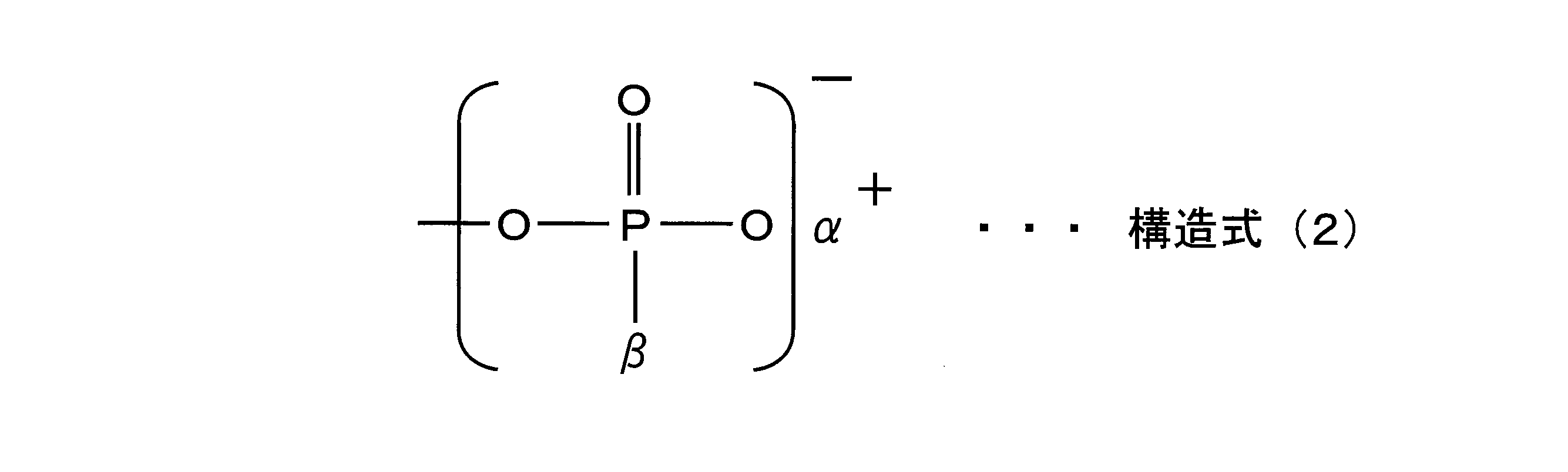
構造式(2)において、βは、なし、R、及びNHRのいずれかである。Rは、水素原子、飽和-直鎖状炭化水素基、飽和-分岐鎖状炭化水素基、飽和-環状炭化水素基、不飽和-直鎖状炭化水素基、不飽和-分岐鎖状炭化水素基、芳香族基、及びこれらの誘導基のいずれかである。αは有機物又は無機物からなる陽イオンである。
また、前記セルロース微細繊維(A)は、セルロース繊維のヒドロキシ基のうち2箇所以上、前記構造式(1)に示す官能基で置換されてリンオキソ酸のエステルが導入されたものであってもよい。水素結合等によるセルロース微細繊維の相互作用により、分散性が向上する。
セルロース繊維は、グルコースを一構成単位として、グルコースが複数重合した構造を形成している。重合された一つのセルロース繊維において、リンオキソ酸のエステル基は、ある特定のグルコースで置換され、別のグルコースでは置換されていなくてもよい。また、ある特定のグルコースにおいて複数個所に、リンオキソ酸のエステル基が置換されて導入されていてもよい。
このリンオキソ酸によりエステル化されたセルロース微細繊維は光透過度及び粘度が極めて高いものである。
リンオキソ酸によるエステル化の反応は、セルロース繊維に、リンオキソ酸類及びリンオキソ酸金属塩類の少なくともいずれか一方を含む添加物(A)からなるpH3.0未満の溶液を添加し、加熱し、解繊することで進行する。
添加物(A)としては、例えば、リン酸、リン酸二水素アンモニウム、リン酸水素二アンモニウム、リン酸三アンモニウム、ピロリン酸アンモニウム、ポリリン酸アンモニウム、リン酸二水素リチウム、リン酸三リチウム、リン酸水素二リチウム、ピロリン酸リチウム、ポリリン酸リチウム、リン酸二水素ナトリウム、リン酸水素二ナトリウム、リン酸三ナトリウム、ピロリン酸ナトリウム、ポリリン酸ナトリウム、リン酸二水素カリウム、リン酸水素二カリウム、リン酸三カリウム、ピロリン酸カリウム、ポリリン酸カリウム、亜リン酸、亜リン酸水素ナトリウム、亜リン酸水素アンモニウム、亜リン酸水素カリウム、亜リン酸二水素ナトリウム、亜リン酸ナトリウム、亜リン酸リチウム、亜リン酸カリウム、亜リン酸マグネシウム、亜リン酸カルシウム、亜リン酸トリエチル、亜リン酸トリフェニル、ピロ亜リン酸等の亜リン酸化合物等を使用することができる。これらの添加物は、それぞれを単独で又は複数を組み合わせて使用することができる。ただし、リンオキソ酸類の一部又は全部としては、ホスホン酸類を使用するのが好ましい。ホスホン酸類を使用すると、セルロース繊維の黄変化が防止されるので、着色基材の本来の色あいを備えた水性塗料組成物となる。
リンオキソ酸のエステルが導入されたセルロース微細繊維は、水性塗料組成物に固形分基準で2~4質量%、好ましくは3~4質量%含まれるとよい。4質量%を超えると、セルロース微細繊維の濃度が高く、セルロース微細繊維間の相互作用が強く働き、高粘度となり、水性塗料組成物の伸びが不十分となり、均一な色合いで描画することが困難なものとなる。2質量%を下回ると、リンオキソ酸のエステル基で変性されたセルロース微細繊維の濃度が小さく、十分な分散効果が得られない
(カルバメート化)
リンオキソ酸でエステル化されたセルロース繊維には、セルロース繊維のヒドロキシ基の一部がカルバメート基で置換されて、カルバメートが導入されたものを含めることもできる。
リンオキソ酸でエステル化されたセルロース繊維には、セルロース繊維のヒドロキシ基の一部がカルバメート基で置換されて、カルバメートが導入されたものを含めることもできる。
カルバメート基で置換するために用いる添加物(B)は、尿素及び尿素誘導体の少なくともいずれか一方を含む。この添加物としては、例えば、尿素、チオ尿素、ビウレット、フェニル尿素、ベンジル尿素、ジメチル尿素、ジエチル尿素、テトラメチル尿素等を使用することができる。これらの尿素又は尿素誘導体は、それぞれを単独で又は複数を組み合わせて使用することができる。ただし、尿素を使用するのが好ましい。
上記、 添加物(B)は、加熱されると、下記の反応式(1)に示すようにイソシアン酸及びアンモニアに分解される。そして、イソシアン酸は反応性が高く、下記の反応式(2)に示すようにセルロースの水酸基及びカルバメートを形成する。したがって、セルロース繊維に添加物(B)を添加するとカルバメートの導入が進む。
添加物(B)の添加量は、添加物(A)1molに対して、好ましくは0.01~100mol、より好ましくは0.2~20molである。添加量が0.01mol未満であると、カルバメートの導入が進まないおそれがある。他方、添加量が100molを超えても、尿素の添加による効果が頭打ちとなるおそれがある。
NH2-CO-NH2 → HN=C=O+NH3 …(1)
Cell-OH+H-N=C=O → Cell-O-CO-NH2 …(2)
なお、Cellは、セルロース分子を指す。
Cell-OH+H-N=C=O → Cell-O-CO-NH2 …(2)
なお、Cellは、セルロース分子を指す。
リンオキソ酸によるエステルの導入やカルバメートの導入には、特に限定されなく公知のパルプを適宜用いることができるが、針葉樹晒クラフトパルプや広葉樹晒クラフトパルプを用いるとよく、針葉樹晒クラフトパルプが好適である。針葉樹晒クラフトパルプや広葉樹晒クラフトパルプはヘミセルラーゼ系酵素により分解が容易になされ、その後の解繊処理も容易である。
ヘミセルラーゼ系酵素としては、例えば、キシランを分解する酵素であるキシラナーゼ(xylanase)、マンナンを分解する酵素であるマンナーゼ(mannase)、アラバンを分解する酵素であるアラバナーゼ(arabanase)等を使用することができる。また、ペクチンを分解する酵素であるペクチナーゼも使用することができる。
セルロース繊維の解繊は、例えば、高圧ホモジナイザー、高圧均質化装置等のホモジナイザー、グラインダー、摩砕機等の石臼式摩擦機、コニカルリファイナー、ディスクリファイナー等のリファイナー、各種バクテリア等の中から1種又は2種以上の手段を選択使用して行うことができる。ただし、セルロース繊維の解繊は、水流、特に高圧水流で微細化する装置・方法を使用して行うのが好ましい。この装置・方法によると、得られるセルロース微細繊維の寸法均一性、分散均一性が非常に高いものとなる。これに対し、例えば、回転する砥石間で磨砕するグラインダーを使用すると、セルロース繊維を均一に微細化するのが難しく、場合によっては、一部に解れない繊維塊が残ってしまうおそれがある。
セルロース繊維の解繊に使用するグラインダーとしては、例えば、増幸産業株式会社のマスコロイダー等が存在する。また、高圧水流で微細化する装置としては、例えば、株式会社スギノマシンのスターバースト(登録商標)や、吉田機械興業株式会社のナノヴェイタ\Nanovater(登録商標)等が存在する。また、セルロース繊維の解繊に使用する高速回転式ホモジナイザーとしては、エムテクニック社製のクレアミックス-11S等が存在する。
本発明者等は、回転する砥石間で磨砕する方法と、高圧水流で微細化する方法とで、それぞれセルロース繊維を解繊し、得られた各繊維を顕微鏡観察した場合に、高圧水流で微細化する方法で得られた繊維の方が、繊維幅が均一であることを知見している。
高圧水流による解繊は、セルロース繊維の分散液を増圧機で、例えば30MPa以上、好ましくは100MPa以上、より好ましくは150MPa以上、特に好ましくは220MPa以上に加圧し(高圧条件)、細孔直径50μm以上のノズルから噴出させ、圧力差が、例えば30MPa以上、好ましくは80MPa以上、より好ましくは90MPa以上となるように減圧する(減圧条件)方式で行うと好適である。この圧力差で生じるへき開現象によって、パルプ繊維が解繊される。高圧条件の圧力が低い場合や、高圧条件から減圧条件への圧力差が小さい場合には、解繊効率が下がり、所望の繊維幅とするために繰り返し解繊(ノズルから噴出)する必要が生じる。
高圧水流によって解繊する装置としては、高圧ホモジナイザーを使用するのが好ましい。高圧ホモジナイザーとは、例えば10MPa以上、好ましくは100MPa以上の圧力でセルロース繊維のスラリーを噴出する能力を有するホモジナイザーをいう。セルロース繊維を高圧ホモジナイザーで処理すると、セルロース繊維同士の衝突、圧力差、マイクロキャビテーションなどが作用し、セルロース繊維の解繊が効果的に生じる。したがって、解繊の処理回数を減らすことができ、セルロース微細繊維の製造効率を高めることができる。
高圧ホモジナイザーとしては、セルロース繊維のスラリーを一直線上で対向衝突させるものを使用するのが好ましい。具体的には、例えば、対向衝突型高圧ホモジナイザー(マイクロフルイダイザー/MICROFLUIDIZER(登録商標)、湿式ジェットミル)である。この装置においては、加圧されたセルロース繊維のスラリーが合流部で対向衝突するように2本の上流側流路が形成されている。また、セルロース繊維のスラリーは合流部で衝突し、衝突したセルロース繊維のスラリーは下流側流路から流出する。上流側流路に対して下流側流路は垂直に設けられており、上流側流路と下流側流路とでT字型の流路が形成されている。このような対向衝突型の高圧ホモジナイザーを用いると高圧ホモジナイザーから与えられるエネルギーが衝突エネルギーに最大限に変換されるため、より効率的にセルロース繊維を解繊することができる。
原料パルプの解繊は、得られるセルロース微細繊維の平均繊維径、平均繊維長、保水度、擬似粒度分布のピーク値、分散液の光透過率、水性塗料組成物のB型粘度、ハイシェア粘度が、以下に示すような所望の値又は評価となるように行うのが好ましい。
セルロース微細繊維の平均繊維径(平均繊維幅。単繊維の直径平均。)は、好ましくは1~200nm、さらに好ましくは2~100nm、特に好ましくは3~60nmである。平均繊維径が1nmを下回るセルロース微細繊維は製造に高コストを要する。他方、セルロース微細繊維の平均繊維径が200nmを上回ると、水素結合点の増加効果が得られないおそれがある。分散液中のセルロース微細繊維はゲル化して粘度を有するが、特に、平均繊維径が100nm以下だと、セルロース微細繊維の分散性が高く、三次元ネットワークが維持され易いので、着色基材は十分に分散し、着色基材の沈降による水性塗料組成物の濃淡の差が表れにくい。
セルロース微細繊維の平均繊維径は、例えば、原料パルプの選定、前処理、解繊等によって調整することができる。
セルロース微細繊維の平均繊維径の測定方法は、次のとおりである。
まず、固形分濃度0.01~0.1質量%のセルロース微細繊維の水分散液100mlをテフロン(登録商標)製メンブレンフィルターでろ過し、エタノール100mlで1回、t-ブタノール20mlで3回溶媒置換する。次に、凍結乾燥し、オスミウムコーティングして試料とする。この試料について、構成する繊維の幅に応じて3,000倍~30,000倍のいずれかの倍率で電子顕微鏡SEM画像による観察を行う。具体的には、観察画像に二本の対角線を引き、対角線の交点を通過する直線を任意に三本引く。さらに、この三本の直線と交錯する合計100本の繊維の幅を目視で計測する。そして、計測値の中位径を平均繊維径とする。
まず、固形分濃度0.01~0.1質量%のセルロース微細繊維の水分散液100mlをテフロン(登録商標)製メンブレンフィルターでろ過し、エタノール100mlで1回、t-ブタノール20mlで3回溶媒置換する。次に、凍結乾燥し、オスミウムコーティングして試料とする。この試料について、構成する繊維の幅に応じて3,000倍~30,000倍のいずれかの倍率で電子顕微鏡SEM画像による観察を行う。具体的には、観察画像に二本の対角線を引き、対角線の交点を通過する直線を任意に三本引く。さらに、この三本の直線と交錯する合計100本の繊維の幅を目視で計測する。そして、計測値の中位径を平均繊維径とする。
セルロース微細繊維の平均繊維長(単繊維の長さ)は、好ましくは200~1300μm、より好ましくは200~1000μm、特に好ましくは200~800μmである。セルロース微細繊維の平均繊維長が200μmを下回ると、水性塗料組成物中においてセルロース微細繊維が均一に分散しづらくなるおそれがある。分散性の低下は、着色基材の凝集化の原因となるし、水性塗料組成物の垂れにくさと伸びの良さの点で不具合をもたらす原因となる。
他方、セルロース微細繊維の平均繊維長が1300μmを上回ると、繊維相互が絡み易くなり、繊維と着色基材とが接触する面積が小さくなり、付着度合が比較的小さくなり、着色基材が良好に分散し難いものとなる。
セルロース微細繊維の平均繊維長は、例えば、原料パルプの選定、前処理、解繊等によって調整することができる。
セルロース微細繊維の平均繊維長の測定方法は、平均繊維径の場合と同様にして、各繊維の長さを目視で計測する。計測値の中位長を平均繊維長とする。
セルロース微細繊維は、アスペクト比が100~300、好ましくは100~250、より好ましくは100~200であるとよい。アスペクト比が300を上回ると、セルロース微細繊維相互の絡みつきが多く、伸びの良くない水性塗料組成物とある。アスペクト比が100を下回ると、いわゆる、三次元ネットワーク構造が長期間維持しにくく、着色基材が沈降するおそれがある。
セルロース微細繊維の保水度は、例えば150%以上とするとよく、好ましくは200%、より好ましくは220%、さらに好ましくは250%である。セルロース微細繊維の保水度が150%を下回ると、セルロース微細繊維の分散性が悪化し、ひいてはセルロース微細繊維に付着する着色基材の分散性も悪化するおそれがある。
他方、セルロース微細繊維の保水度は、例えば500%以下とするとよい。500%を上回ると、セルロース微細繊維自体の保水力が高いため、水分子相互による液滴化が生じ、素地又は釉薬層において水性塗料組成物による薄膜形成がしづらくなる。
セルロース微細繊維の保水度は、例えば、原料パルプの選定、前処理、解繊等によって調整することができる。
セルロース微細繊維の保水度は、JAPAN TAPPI No.26(2000)に準拠して測定した値である。
リンオキソ酸のエステル基で変性されたセルロース微細繊維を固形分0.2%(質量/体積)の水分散液とした場合の光透過率は、87%(質量/体積)以上、好ましくは90%(質量/体積)以上、より好ましくは92%(質量/体積)以上とするとよい。87%(質量/体積)を下回ると、水性塗料組成物の塗膜面の色合いが着色基材の色合いと異なった印象を受けるおそれがある。セルロース微細繊維の光透過度は例えば、パルプ繊維の選定、前処理、解繊等によって調整することができる。
着色基材には、セルロース微細繊維に付着するものもあれば、セルロース微細繊維相互で形成される隙間に留まるものもある。セルロース微細繊維は水性塗料組成物中に分散しているので、着色基材も分散した状態となる。セルロース微細繊維の中でも、リンオキソ酸のエステル基で変性されたものセルロース微細繊維は、水素結合部位が多く、三次元ネットワーク構造を容易に構築して、水性塗料組成物中において適度に分散するものと推測される。また、当該セルロース微細繊維は優れた光透過度を有する(特許文献2参照)ので、着色基材は当該セルロース微細繊維によって色が遮られにくく、本来の色合いに近い色合いを呈する。
セルロース微細繊維の結晶化度は、80%以下、好ましくは80~50%、より好ましくは80~60%とするとよい。結晶化度が60%を上回ると、水性塗料組成物のB型粘度が高まり過ぎ、平滑性が損なわれる。結晶化度は、例えば、パルプ繊維の選定、前処理、解繊等によって調整することができる。
ここで、結晶化度が相対的に大きくないセルロース微細繊維は、粘度も相対的に高いものではない。前述の結晶化度を有するセルロース微細繊維を含む水性塗料組成物は、粘度がセルロース微細繊維に備わる粘度に近づく。粘度が相対的に高いものではないため、塗膜面が平滑なものとなる。
結晶化度は、JIS-K0131(1996)の「X線回折分析通則」に準拠して、X線回折法により測定した値である。なお、セルロース微細繊維は、非晶質部分と結晶質部分とを有しており、結晶化度はセルロース微細繊維全体における結晶質部分の割合を意味する。
セルロース微細繊維の擬似粒度分布における体積基準での累積50%径(以下、D50、中位径ともいう。)は、5~60μm、より好ましくは5~40μmとするとよい。中位径が上記サイズであることで、セルロース微細繊維が水性塗料組成物に適度に分散され、水性塗料組成物による均質な描画を行うことができる。中位径が60μmを上回ると、セルロース微細繊維が水性塗料組成物に均一に分散し難くなる。中位径が5μmを下回るセルロース微細繊維の製造は、技術的に困難な面がある。
本実施形態の水性塗料組成物の擬似粒度分布曲線におけるピーク値は、1つのピークであるのが好ましい。1つのピークである場合、1種又は複数種のパルプから解繊されたセルロース微細繊維は、繊維長及び繊維径の均一性が高く、水性塗料組成物中におけるセルロース微細繊維の分散性が優れたものとなる。ピーク値は、ISO-13320(2009)に準拠して測定した値である。セルロース微細繊維は、水分散状態でレーザー回折法により測定される擬似粒度分布曲線において単一のピークを有することが好ましい。このように、一つのピークを有するセルロース微細繊維は、十分な微細化が進行しており、セルロース微細繊維としての良好な物性を発揮することができ、得られる水性塗料組成物による描画が均一化され好ましい。「擬似粒度分布曲線」とは、粒度分布測定装置( 例えば堀場製作所の粒度分布測定装置「LA-960S」)を用いて測定される体積基準粒度分布を示す曲線を意味する。
リンオキソ酸のエステル基で変性される炭素部位は、セルロース微細繊維を構成するグルコースの炭素部位1位~6位のうちの、どの炭素部位であってもよい。特に、グルコースの炭素部位1位~6位のうちの、少なくともいずれか1つの炭素部位がリンオキソ酸のエステル基で変性された第1セルロース微細繊維と、前記炭素部位以外の炭素部位がリンオキソ酸のエステル基で変性された第2セルロース微細繊維とを有するセルロース微細繊維を含む水性塗料組成物は、セルロース微細繊維全体として極性の偏りが少なく、高い分散性を有するので好ましい。また、グルコースの炭素部位1位~6位のうちの、少なくともいずれか1つの炭素部位とこの炭素部位以外の炭素部位がそれぞれリンオキソ酸のエステル基で変性されたセルロース微細繊維を含む水性塗料組成物も好ましい。
カルボキシル化セルロース微細繊維は、セルロース繊維の一構成単位であるグルコースのC6位の水酸基が選択的にアルデヒド基及びカルボキシ基に変性されたものであり、グルコースの電荷に偏りが生じている。そのため、セルロース微細繊維間の相互作用においても偏りが生じ、均一な分散が維持され難い。
セルロース微細繊維の粒径における最頻値、及び擬似粒度分布の中位径は、例えば、原料パルプの選定、前処理、解繊等によって調整することができる。
解繊して得られたセルロース微細繊維は、必要により、着色基材と混合するのに先立って水系媒体中に分散して分散液としておくことができる。水系媒体は、全量が水であるのが特に好ましい(水溶液)。ただし、水系媒体は、一部が水と相溶性を有する他の液体であってもよい。他の液体としては、例えば、炭素数3以下の低級アルコール類等を使用することができる。
(粘度)
セルロース微細繊維の分散液は、液体全体に分散する性質を有する。しかしながら、セルロース微細繊維の分散液については、しばらく放置するとセルロース微細繊維の相と水相に分離して、両相間の界面が現れ、この界面が下がる場合がある。この相が分離する現象は、セルロース微細繊維の特性である分散性が関与するものと推測される。セルロース微細繊維の原材料や加工手段、物性等により、分散の程度は異なる。
セルロース微細繊維の分散液は、液体全体に分散する性質を有する。しかしながら、セルロース微細繊維の分散液については、しばらく放置するとセルロース微細繊維の相と水相に分離して、両相間の界面が現れ、この界面が下がる場合がある。この相が分離する現象は、セルロース微細繊維の特性である分散性が関与するものと推測される。セルロース微細繊維の原材料や加工手段、物性等により、分散の程度は異なる。
例えば、機械パルプを解繊して得たセルロース微細繊維や化学パルプを解繊して得たセルロース微細繊維は所定の分散性を有しているが、リンオキソ酸のエステル基で変性されたセルロース繊維ほどの分散性を有さない。リンオキソ酸のエステルやカルバメートが導入されたセルロース微細繊維は、電荷の偏りが局所的にあり、分散液中の水や有機溶剤と水素結合を容易に形成するので、優れた分散性を備えることを発明者は知見している。の高いものとなると考えられる。
B型粘度については、特定の原料から同一の製造工程で得られたセルロース微細繊維の分散液であっても、セルロース微細繊維の濃度により粘度が異なり、高濃度ほど高粘度となる。なお、粘度はB型粘度により評価できる。
(水性塗料組成物)
本実施形態の水性塗料組成物では、セルロース微細繊維に着色基材が付着されているものと推測される。そのため、セルロース微細繊維が適度に水性塗料組成物中に分散していることで、着色基材も十分に分散したものとなる。そして、着色基材の分散が持続されるためには、リンオキソ酸のエステルが導入されたセルロース微細繊維と着色基材を混合させることが効果的である。例えば、着色基材とリンオキソ酸のエステルが導入されたセルロース微細繊維との混合比が1:0.005~0.045、好ましくは1:0.010~0.045である形態を例示できる。この混合比を上回ってリンオキソ酸のエステルが導入されたセルロース微細繊維が含まれていると、着色基材に対してセルロース微細繊維量が多すぎて、塗料全体における着色基材の分散性に偏りが生じる。また、この混合比を下回ってリンオキソ酸のエステルが導入されたセルロース微細繊維が含まれていると、セルロース微細繊維が少なく、水性塗料組成物全体における着色基材の分散性が良くなく、描画する際に色ムラの原因となる。
本実施形態の水性塗料組成物では、セルロース微細繊維に着色基材が付着されているものと推測される。そのため、セルロース微細繊維が適度に水性塗料組成物中に分散していることで、着色基材も十分に分散したものとなる。そして、着色基材の分散が持続されるためには、リンオキソ酸のエステルが導入されたセルロース微細繊維と着色基材を混合させることが効果的である。例えば、着色基材とリンオキソ酸のエステルが導入されたセルロース微細繊維との混合比が1:0.005~0.045、好ましくは1:0.010~0.045である形態を例示できる。この混合比を上回ってリンオキソ酸のエステルが導入されたセルロース微細繊維が含まれていると、着色基材に対してセルロース微細繊維量が多すぎて、塗料全体における着色基材の分散性に偏りが生じる。また、この混合比を下回ってリンオキソ酸のエステルが導入されたセルロース微細繊維が含まれていると、セルロース微細繊維が少なく、水性塗料組成物全体における着色基材の分散性が良くなく、描画する際に色ムラの原因となる。
水性塗料組成物を塗って形成された塗膜面は、水性塗料組成物の粘度が相対的に高いと、塗った直後の塗膜面の形態が維持され易いものとなる。塗った直後の塗膜面の形態が凹凸を有するものであれば、塗膜面は凹凸を有する形態が維持され、やがてその形態のまま乾燥する。当該粘度が相対的に高くないと、塗膜面の形態が重力等の外力の作用により平滑化して、平滑化した形態で乾燥して、塗膜面の形態が定まると推測される。
水性塗料組成物のB型粘度は、例えば、2000cP以下、より好ましくは800cP以下であると好ましい。水性塗料組成物のB型粘度が2000cPを上回ると、水性塗料組成物を塗った直後から乾燥するまでの間に、重力による塗膜面の平滑化が起こりにくいので、好ましくない。また、セルロース微細繊維間の水素結合等の相互作用が大きくなり、水性塗料組成物にセルロース微細繊維を分散させるために大きなエネルギーを用いることになり、水性塗料組成物を製造するのにかかるコストの増加につながるおそれがある。
本実施形態の水性塗料組成物は、ハイシェア粘度の最小値が3.5cP以下、好ましくはせん断速度1×10⁵以上の範囲で、でハイシェア粘度の最大値が3.3cP以下、より好ましくはせん断速度1×10⁵以上の範囲でハイシェア粘度の最大値が3.2cP以下であるとよい。ハイシェア粘度の最大値が3.5cPを超えると、描画直後に重力作用による塗膜面の平滑化が抑制される。また、水性塗料組成物を筆に含ませて描画するときに、水性塗料組成物の伸びが良くなく、描画しづらいものとなる。
B型粘度が1500cp以下、より好ましくは1200cp以下であり、せん断速度1×10⁵(1/sec)以上の範囲で、ハイシェア粘度の最大値が3.5cp以下である水性塗料組成物の形態は好ましい。ハイシェア粘度の最小値が3.5cp以下であるので筆等に含んだ水性塗料組成物を所定の速さで描画した直後から、塗膜面の平滑化が促進され、かつ、B型粘度が1500cp以下であるので、塗膜面の凹凸の程度が相対的に激しくない。よって、乾燥後であっても水性塗料組成物が本来の色合いに近い色合いを呈することになる。一方、焼物素地に描画した水性塗料組成物が描画部以外の箇所に垂れないようにするためB型粘度の下限は600cp以上とするとよい。
(色合い)
焼物の製造において、水性塗料組成物が描画された被塗布物を、105℃で1時間放置して乾燥させる工程がある。描画した直後の水性塗料組成物の色合いが乾燥後の色合いと異なる要因の一つとして、水性塗料組成物を構成する材料の含水量を挙げることができる。具体的には、着色基材、セルロース微細繊維、樹脂等それぞれの含水量が色合いを左右する場合があるということである。色合いは、L*値、a*値、b*値を用いて評価することができる。特に明度の指標であるL*値は、水性塗料組成物の鮮やかさに影響する。なお、構成材料とは、水性塗料組成物を構成する物質をいい、例えば、着色基材、セルロース微細繊維、樹脂等をいう。
焼物の製造において、水性塗料組成物が描画された被塗布物を、105℃で1時間放置して乾燥させる工程がある。描画した直後の水性塗料組成物の色合いが乾燥後の色合いと異なる要因の一つとして、水性塗料組成物を構成する材料の含水量を挙げることができる。具体的には、着色基材、セルロース微細繊維、樹脂等それぞれの含水量が色合いを左右する場合があるということである。色合いは、L*値、a*値、b*値を用いて評価することができる。特に明度の指標であるL*値は、水性塗料組成物の鮮やかさに影響する。なお、構成材料とは、水性塗料組成物を構成する物質をいい、例えば、着色基材、セルロース微細繊維、樹脂等をいう。
本実施形態の水性塗料組成物は、被塗布物に塗布してから乾燥するまでの間における、L*値の変動幅が25%以内、好ましくは15%以内、より好ましくは10%以内であるとよい。L*値の変動幅が25%を上回ると、乾燥前後で色合いの変化が大き過ぎ、乾燥後の色合いが,画師が予想した色合いとかけ離れるおそれがある。
また、本実施形態の水性塗料組成物は、焼物素地に塗ってから乾燥するまでの間における、a*値の変動幅が20%以内、好ましくは15%以内であるとよく、b*値の変動幅が20%以内、好ましくは10%以内であるとよい。a*値の変動幅が20%を上回る、及び/又はb*値の変動幅が10%を上回ると、乾燥前後で色合いの変化が大き過ぎ、乾燥後の色合いが画師が予想した色合いとかけ離れるおそれがある。
(表面粗さ)
水性塗料組成物を塗布して、被塗布物に形成された塗膜面を微視的に観察すると、塗膜の表面が凹凸を有していることが分かる。この凹凸は、水性塗料組成物の粘度や水性塗料組成物の構成材料の偏りに起因するものと思われる。粘度については、例えば、高粘度の水性塗料組成物で塗って形成された塗膜面は、変形しにくく、塗った直後の形態のまま乾燥して固化する。一方、低粘度の水性塗料組成物からなる塗膜面は、当該水性塗料組成物の自重により、重力の作用で平滑化して、乾燥して固化する。よって、水性塗料組成物が所定の粘度以下であると、塗膜面が平滑なものとなる。偏りについては、構成材料に偏りがある水性塗料組成物において、構成材料が密である塗膜面部分は焼物素地面に対して法線方向に相対的に凸状となり、構成材料が疎である塗膜面部分は焼物素地面に対して法線方向に相対的に凸状となる程度が小さい。よって、構成材料の偏りが、塗膜面の凹凸を形成する要因となり得る。
水性塗料組成物を塗布して、被塗布物に形成された塗膜面を微視的に観察すると、塗膜の表面が凹凸を有していることが分かる。この凹凸は、水性塗料組成物の粘度や水性塗料組成物の構成材料の偏りに起因するものと思われる。粘度については、例えば、高粘度の水性塗料組成物で塗って形成された塗膜面は、変形しにくく、塗った直後の形態のまま乾燥して固化する。一方、低粘度の水性塗料組成物からなる塗膜面は、当該水性塗料組成物の自重により、重力の作用で平滑化して、乾燥して固化する。よって、水性塗料組成物が所定の粘度以下であると、塗膜面が平滑なものとなる。偏りについては、構成材料に偏りがある水性塗料組成物において、構成材料が密である塗膜面部分は焼物素地面に対して法線方向に相対的に凸状となり、構成材料が疎である塗膜面部分は焼物素地面に対して法線方向に相対的に凸状となる程度が小さい。よって、構成材料の偏りが、塗膜面の凹凸を形成する要因となり得る。
塗膜面の凹凸の度合いは、表面粗さの指標で評価することができる。焼物素地に水性塗料組成物を塗って形成された塗膜面における表面粗さは、20%以下であるとよく、好ましくは18%以下、より好ましくは15%であるとよい。この表面粗さが20%を上回ると、水性塗料組成物の塗膜面が、本来の色合いとかけ離れた色合いを呈するおそれがある。
塗料組成物には、例えば、着色基材、セルロース微細繊維のほか、珪石粉(SiO2粉末)や増粘剤を加えることができる。特に増粘剤は、B型粘度とハイシェア粘度を高めるため、過度に添加すべきではないが、適度な添加により、粘度を補助的に高めることが可能である。増粘剤としては公知のものを適宜用いることができるが、例えば、カルボキシメチルセルロース(CMC)やキサンタンガム、グアーガム、ペクチン、カラギナンを用いることができる。着色基材やセルロース微細繊維の種類にもよるが、増粘剤が水性塗料組成物に20~30質量%含まれている形態が好ましい。しかしながら、増粘剤は必ずしも水性塗料組成物に含めなくてもよい。
(被塗布物)
被塗布物は、公知の素地であれば特に限定されないが、陶器や磁器、ガラス器、琺瑯、土器、素焼物等を例示できる。被塗布物、特に焼物素地の原料に、例えば、粘土、珪石、長石、及びこれらの混合物を用いることができる。焼物素地をガラス器とする場合は、例えば、ケイ酸、ケイ酸化合物、ホウ酸、ホウ酸化合物、リン酸、リン酸化合物、チタン酸、チタン酸化合物、テルル、テルル化合物、アルミナ、アルミナ化合物、並びにこれらの化合物及び混合物を用いてガラス器とすることができる。
被塗布物は、公知の素地であれば特に限定されないが、陶器や磁器、ガラス器、琺瑯、土器、素焼物等を例示できる。被塗布物、特に焼物素地の原料に、例えば、粘土、珪石、長石、及びこれらの混合物を用いることができる。焼物素地をガラス器とする場合は、例えば、ケイ酸、ケイ酸化合物、ホウ酸、ホウ酸化合物、リン酸、リン酸化合物、チタン酸、チタン酸化合物、テルル、テルル化合物、アルミナ、アルミナ化合物、並びにこれらの化合物及び混合物を用いてガラス器とすることができる。
(釉薬)
釉薬は、ガラス質であり、公知の組成を含むが、例えば、灰(媒熔原料)、粘土(接着材)、長石(接着材・媒熔原料・ガラス原料)、けい石(ガラス原料)を含んでよい。灰は、酸化カルシウム等の石灰質を主成分とするものであり、高温で溶けてガラス化したり、媒熔原料として他の成分も溶けやすくして、釉薬の流動性を高める機能がある。さらに、発色成分(銅や鉄分等)が含まれていると発色効果が奏される。
釉薬は、ガラス質であり、公知の組成を含むが、例えば、灰(媒熔原料)、粘土(接着材)、長石(接着材・媒熔原料・ガラス原料)、けい石(ガラス原料)を含んでよい。灰は、酸化カルシウム等の石灰質を主成分とするものであり、高温で溶けてガラス化したり、媒熔原料として他の成分も溶けやすくして、釉薬の流動性を高める機能がある。さらに、発色成分(銅や鉄分等)が含まれていると発色効果が奏される。
釉薬の化学成分は、ケイ酸及びケイ酸化合物、アルミナ及びアルミナ化合物、酸化カリウム及び酸化カリウム化合物、酸化カリウム及び酸化カリウム化合物、酸化ナトリウム及び酸化ナトリウム化合物、酸化鉄及び酸化鉄化合物等であり、その他カドミウム及びカドミウム化合物や鉛及び鉛化合物等が含有されていてもよい。また、換言するとケイ酸及びケイ酸化合物は、焼成された釉薬の主成分であり、釉薬の種類にもよるが、この釉薬のうちのおよそ45~80%を占める。
釉薬は、例えば、次記の組成とすることができるが、これに限られるものではない。福島長石35.4wt%、石灰石18.6wt%、朝鮮カオリン17wt%、けい石29wt%に同量の水を加えてボールミルで攪拌した後、ふるいを通して脱鉄し、水を加えて比重を調製したものを釉薬Aとする。さらに、この釉薬A297gに対して3gのCMCを加えて溶解させたものを釉薬Bとする。
(製造)
水性塗料組成物で描画された焼物の製造手順の一例を以下に示す。
<施釉層形成工程>
水性塗料組成物は、和洋食器、装飾品、インテリア小物等の製作品の基となる素地11に描画することができる。素地11に釉薬をかけて(すなわち、施釉して)、室温~105℃で乾燥させ(製造工程S11)、1200~1300℃で焼成することで、表面が釉薬層で覆われた素地(釉薬層成形素地ともいう。)を得る(製造工程12)。焼成条件は、例えば、950℃まで9時間30分かけて昇温させ、続いて、1250℃まで5時間かけて昇温させる。1250℃を30分間維持し、その後、自然冷却する。製作品は、一例として陶磁器製品や琺瑯製品として利用できる。
水性塗料組成物で描画された焼物の製造手順の一例を以下に示す。
<施釉層形成工程>
水性塗料組成物は、和洋食器、装飾品、インテリア小物等の製作品の基となる素地11に描画することができる。素地11に釉薬をかけて(すなわち、施釉して)、室温~105℃で乾燥させ(製造工程S11)、1200~1300℃で焼成することで、表面が釉薬層で覆われた素地(釉薬層成形素地ともいう。)を得る(製造工程12)。焼成条件は、例えば、950℃まで9時間30分かけて昇温させ、続いて、1250℃まで5時間かけて昇温させる。1250℃を30分間維持し、その後、自然冷却する。製作品は、一例として陶磁器製品や琺瑯製品として利用できる。
施釉は、素地表面の全体に行ってもよいし、一部に行ってもよい。貫入を生じることもあるが、素地表面の全体を覆う形態が好ましい。水分は釉薬層に滲入し難い。なお、水などに釉薬を分散させたものを素地にかける場合も施釉に含まれる。
ガラス器用の素地である場合は、前述の施釉層形成工程を省略して、描画工程から製造することができる。
<描画工程>
得られた釉薬層成形素地に、水性塗料組成物で図柄30aを描画し、例えば、60~105℃で1時間乾燥して描画成形体を得る(製造工程S13)。
得られた釉薬層成形素地に、水性塗料組成物で図柄30aを描画し、例えば、60~105℃で1時間乾燥して描画成形体を得る(製造工程S13)。
描画成形体を施釉(浸漬)し、図柄に釉薬をかけて、例えば、再度60~105℃で1時間乾燥させ(製造工程S21)、1220℃で焼成することで、焼成された水性塗料組成物が釉薬で被覆されて、釉薬層20aが形成される。すなわち、釉薬層20aは焼成された水性塗料組成物が釉薬で被覆されてなるものであり、釉薬層20aで描画成形体が被覆されて、釉薬層成形体が形成される(製造工程S22)。焼成条件は、例えば、950℃まで9時間30分かけて昇温させ、続いて、1220℃まで5時間かけて昇温させる。1220℃を30分間維持し、その後、自然冷却する。なお、この釉薬層成形体を製作品とすることもできるが、釉薬層成形体に、さらに釉薬層が1層以上重なった、複数層からなる製作品を製造することができる。
素地がガラス器用の素地である場合は、素地に、水性塗料組成物で図柄30aを描画し、例えば、60~105℃で1時間乾燥して描画成形体を得る(製造工程S33)。
描画成形体を施釉(浸漬)し、図柄に釉薬をかけて、例えば、再度60~105℃で1時間乾燥させ(製造工程S41)、580~780℃で焼成することで、焼成された水性塗料組成物が釉薬で被覆されて、釉薬層20aが形成される。すなわち、釉薬層20aは焼成された水性塗料組成物が釉薬で被覆されてなるものであり、釉薬層20aで描画成形体が被覆されて、釉薬層成形体が形成される(製造工程S42)。焼成条件は、例えば、550℃まで5時間30分かけて昇温させ、続いて、780℃まで5時間かけて昇温させる。780℃を30分間維持し、その後、自然冷却する。なお、この釉薬層成形体を製作品とすることもできるが、釉薬層成形体に、さらに釉薬層が1層以上重なった、複数層からなる製作品を製造することができる。
セルロース微細繊維はその主な化学組成が有機物であり、僅かに無機物も含まれる。焼成する工程でセルロース微細繊維の有機分は消失する。
従来、釉薬層成形体の表面、すなわち釉薬層の表面は非常に滑らかであり、この表面に水性塗料組成物で描画したとしても、表面が水性塗料組成物をはじき、水性塗料組成物が同表面に定着しづらいものであった。しかしながら、セルロース微細繊維が含有された塗料は、同表面に定着し易いので、同表面からはじかれにくく、かつ、乾燥後には、親水性となるため、釉薬を容易にかけることができる。よって、この水性塗料組成物の描画とそれに続く釉薬層による被覆を行うことが可能となる。
釉薬層の表面に描く方法としては、上絵付けが知られているが、図柄表面に釉薬層が形成できないため、耐久性に劣り、例えば、製作品が和洋食器である場合、食洗器の繰り返し洗浄などで容易に退色してしまうことが知られている。
(水性塗料組成物の調製)
顔料(日陶顔料工業(株)グリーンM-142)1.0g、セルロース微細繊維分散液、水を混合して水性塗料組成物、試験例1~比較例7を製造した。セルロース微細繊維分散液は、BTMPセルロース微細繊維水分散液(機械パルプ漂白品)、LBKPセルロース微細繊維水分散液(広葉樹パルプ由来の化学パルプ漂白品)、亜リン酸エステル化セルロース微細繊維、カルボキシル化セルロース微細繊維から1種又は2種以上選択して混合量を変化させて、混合したものを使用した。各組成物の混合量は表1に示すとおりである。BTMPセルロース微細繊維については、ナイヤガラビーター又はシングルディスクリファイナーで微細繊維の割合が80%以上まで叩解処理して処理物を得て、その処理物を高圧ホモジナイザーで10~20回循環させて微細化処理して、得たものが3~4質量%になるように水でメスアップして調製した。LBKPセルロース微細繊維については、ナイヤガラビーター又はシングルディスクリファイナーで微細繊維の割合が80%以上まで叩解処理して処理物を得て、その処理物を高圧ホモジナイザーで3~4回循環させて微細化処理して調整した。亜リン酸エステル化セルロース微細繊維については、亜リン酸及び尿素を含む水に化学パルプを含浸させ、170℃で2時間反応させて生成物を得た。この生成物を水洗浄して高圧ホモジナイザーで2~3回循環させて微細化処理して調整した。なお、亜リン酸エステル化セルロース微細繊維は亜リン酸エステル化法により製造されたセルロース微細繊維分散液である。
顔料(日陶顔料工業(株)グリーンM-142)1.0g、セルロース微細繊維分散液、水を混合して水性塗料組成物、試験例1~比較例7を製造した。セルロース微細繊維分散液は、BTMPセルロース微細繊維水分散液(機械パルプ漂白品)、LBKPセルロース微細繊維水分散液(広葉樹パルプ由来の化学パルプ漂白品)、亜リン酸エステル化セルロース微細繊維、カルボキシル化セルロース微細繊維から1種又は2種以上選択して混合量を変化させて、混合したものを使用した。各組成物の混合量は表1に示すとおりである。BTMPセルロース微細繊維については、ナイヤガラビーター又はシングルディスクリファイナーで微細繊維の割合が80%以上まで叩解処理して処理物を得て、その処理物を高圧ホモジナイザーで10~20回循環させて微細化処理して、得たものが3~4質量%になるように水でメスアップして調製した。LBKPセルロース微細繊維については、ナイヤガラビーター又はシングルディスクリファイナーで微細繊維の割合が80%以上まで叩解処理して処理物を得て、その処理物を高圧ホモジナイザーで3~4回循環させて微細化処理して調整した。亜リン酸エステル化セルロース微細繊維については、亜リン酸及び尿素を含む水に化学パルプを含浸させ、170℃で2時間反応させて生成物を得た。この生成物を水洗浄して高圧ホモジナイザーで2~3回循環させて微細化処理して調整した。なお、亜リン酸エステル化セルロース微細繊維は亜リン酸エステル化法により製造されたセルロース微細繊維分散液である。
<試験例1>
試験例1の水性塗料組成物の各物質の配合は以下のとおりである。
・顔料 1.0g
・2.0%BTMPセルロース微細繊維 0.07g
・水 3.43g
これらの各物質を配合して、水性塗料組成物(試験例1)を得た。
<試験例2>
試験例2の水性塗料組成物の各物質の配合は以下のとおりである。
・顔料 1.0g
・3.0%BTMPセルロース微細繊維 0.06g
・2.0%LBKPセルロース微細繊維 0.01g
・水 3.43g
これらの各物質を配合して、水性塗料組成物(試験例2)を得た。
<試験例3>
試験例3の水性塗料組成物の各物質の配合は以下のとおりである。
・顔料 1.0g
・2.5%BTMPセルロース微細繊維 0.07g
・2.0%LBKPセルロース微細繊維 0.02g
・水 3.24g
これらの各物質を配合して、水性塗料組成物(試験例3)を得た。
<試験例4>
試験例4の水性塗料組成物の各物質の配合は以下のとおりである。
・顔料 1.0g
・2.0%BTMPセルロース微細繊維 0.06g
・2.0%LBKPセルロース微細繊維 0.01g
・水 3.43g
これらの各物質を配合して、水性塗料組成物(試験例4)を得た。
<試験例5>
試験例5の水性塗料組成物の各物質の配合は以下のとおりである。
・顔料 1.0g
・2.0%BTMPセルロース微細繊維 0.05g
・1.0%亜リン酸エステル化セルロース微細繊維 0.01g
・水 3.45g
これらの各物質を配合して、水性塗料組成物(試験例5)を得た。
<試験例6>
試験例6の水性塗料組成物の各物質の配合は以下のとおりである。
・顔料 1.0g
・2.2%BTMPセルロース微細繊維 0.06g
・2.0%LBKPセルロース微細繊維 0.02g
・水 3.56g
これらの各物質を配合して、水性塗料組成物(試験例6)を得た。
<試験例7>
試験例7の水性塗料組成物の各物質の配合は以下のとおりである。
・顔料 1.0g
・2.0%BTMPセルロース微細繊維 0.05g
・1.0%カルボキシル化セルロース微細繊維 0.01g
・水 3.45g
これらの各物質を配合して、水性塗料組成物(試験例7)を得た。
試験例1の水性塗料組成物の各物質の配合は以下のとおりである。
・顔料 1.0g
・2.0%BTMPセルロース微細繊維 0.07g
・水 3.43g
これらの各物質を配合して、水性塗料組成物(試験例1)を得た。
<試験例2>
試験例2の水性塗料組成物の各物質の配合は以下のとおりである。
・顔料 1.0g
・3.0%BTMPセルロース微細繊維 0.06g
・2.0%LBKPセルロース微細繊維 0.01g
・水 3.43g
これらの各物質を配合して、水性塗料組成物(試験例2)を得た。
<試験例3>
試験例3の水性塗料組成物の各物質の配合は以下のとおりである。
・顔料 1.0g
・2.5%BTMPセルロース微細繊維 0.07g
・2.0%LBKPセルロース微細繊維 0.02g
・水 3.24g
これらの各物質を配合して、水性塗料組成物(試験例3)を得た。
<試験例4>
試験例4の水性塗料組成物の各物質の配合は以下のとおりである。
・顔料 1.0g
・2.0%BTMPセルロース微細繊維 0.06g
・2.0%LBKPセルロース微細繊維 0.01g
・水 3.43g
これらの各物質を配合して、水性塗料組成物(試験例4)を得た。
<試験例5>
試験例5の水性塗料組成物の各物質の配合は以下のとおりである。
・顔料 1.0g
・2.0%BTMPセルロース微細繊維 0.05g
・1.0%亜リン酸エステル化セルロース微細繊維 0.01g
・水 3.45g
これらの各物質を配合して、水性塗料組成物(試験例5)を得た。
<試験例6>
試験例6の水性塗料組成物の各物質の配合は以下のとおりである。
・顔料 1.0g
・2.2%BTMPセルロース微細繊維 0.06g
・2.0%LBKPセルロース微細繊維 0.02g
・水 3.56g
これらの各物質を配合して、水性塗料組成物(試験例6)を得た。
<試験例7>
試験例7の水性塗料組成物の各物質の配合は以下のとおりである。
・顔料 1.0g
・2.0%BTMPセルロース微細繊維 0.05g
・1.0%カルボキシル化セルロース微細繊維 0.01g
・水 3.45g
これらの各物質を配合して、水性塗料組成物(試験例7)を得た。
(評価試験)
試験例1~試験例7について、ハイシェア粘度、B型粘度、描画時の伸び具合、描画部分の外側への水性塗料組成物の垂れ具合、塗膜の表面粗さ、色あいを測定及び評価した。
試験例1~試験例7について、ハイシェア粘度、B型粘度、描画時の伸び具合、描画部分の外側への水性塗料組成物の垂れ具合、塗膜の表面粗さ、色あいを測定及び評価した。
<ハイシェア粘度>
ハイシェア粘度は、各試験例をハイシェア粘度計で測定した。せん断速度を0(1/sec)から徐々に183580(1/sec)まで上げた。その後、せん断速度を徐々に0(1/sec)になるまで下げた。これは、描画する際に、画師が筆を被塗布物に接触させて、所定の速度に至るまで被塗布物に沿わせつつ速度を上げて筆を移動させ、次いで速度を下げた後、筆を被塗布物から離すまでの工程を模したものである。ここで、一概には言えないが、画師が筆を移動させる速度は、せん断速度で表すとおよそ183580(1/sec)以下の範囲内に相当することを発明者は知見している。
ハイシェア粘度は、各試験例をハイシェア粘度計で測定した。せん断速度を0(1/sec)から徐々に183580(1/sec)まで上げた。その後、せん断速度を徐々に0(1/sec)になるまで下げた。これは、描画する際に、画師が筆を被塗布物に接触させて、所定の速度に至るまで被塗布物に沿わせつつ速度を上げて筆を移動させ、次いで速度を下げた後、筆を被塗布物から離すまでの工程を模したものである。ここで、一概には言えないが、画師が筆を移動させる速度は、せん断速度で表すとおよそ183580(1/sec)以下の範囲内に相当することを発明者は知見している。
ハイシェア粘度の測定結果を表1に示した。表1において、せん断速度と回転数は相関関係にある。各試験例について、表1の最大値及び最小値はせん断速度を変えて測定したハイシェア粘度のうちの最大値及び最小値を示す。表1の最終値は、せん断速度を徐々に下げていく場合における11470(1/sec)のときのハイシェア粘度を示す。表1の復元率は最終値を、せん断速度を徐々に上げていく場合における11470(1/sec)のときのハイシェア粘度で除して100を乗じた値を示す。
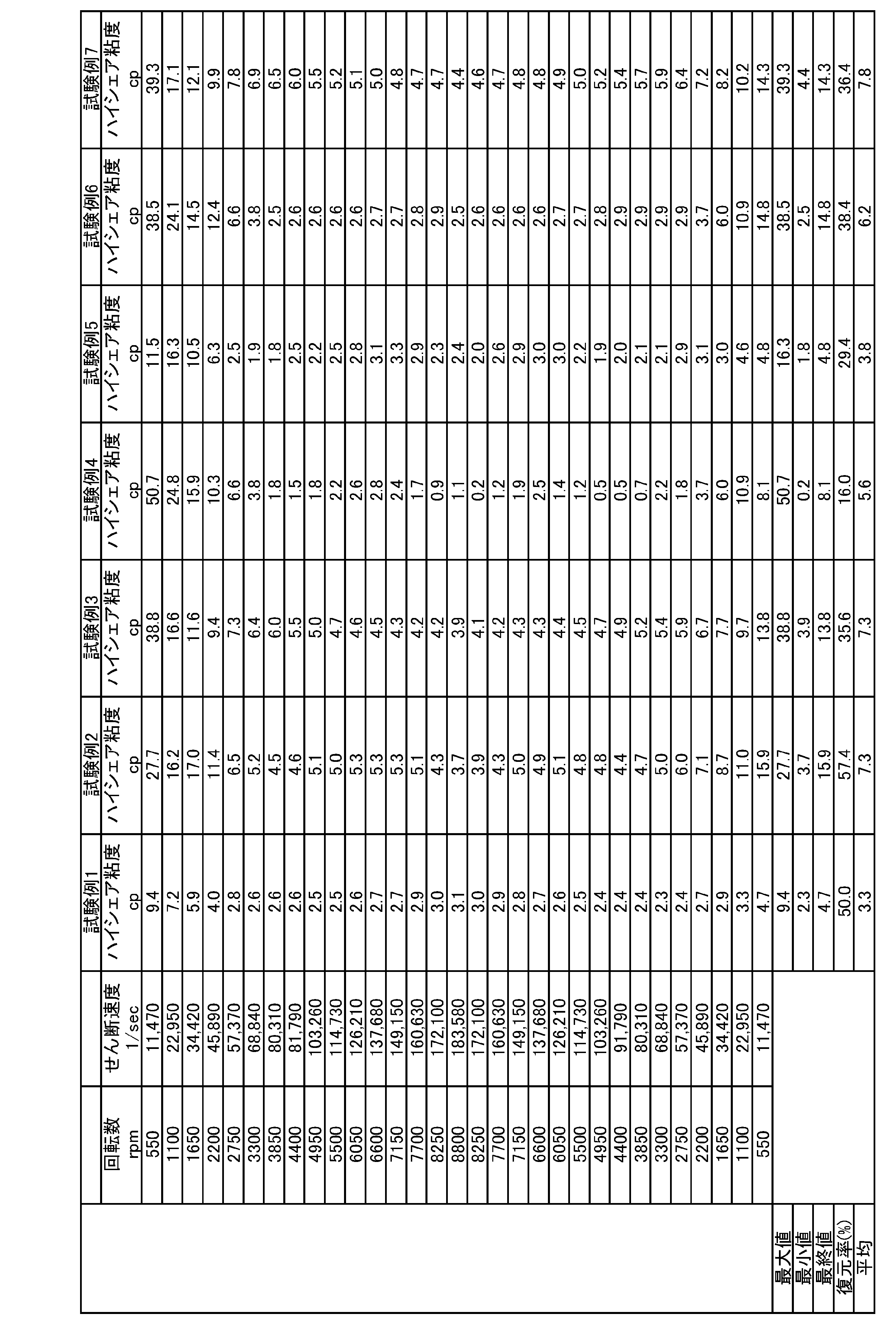
<B型粘度>
B型粘度は、JIS-Z8803(2011)の「液体の粘度測定方法」に準拠して測定した。
B型粘度は、JIS-Z8803(2011)の「液体の粘度測定方法」に準拠して測定した。
<伸び具合>
水性塗料組成物の伸びは、釉薬で全体を被覆した陶磁器用素地の表面に、水性塗料組成物を含ませた筆で描画して評価した。評価基準は次のとおりである。
〇:陶磁器に描画した図柄が掠れず、塗りムラ無く塗布できた。
×:陶磁器に描画した図柄が掠れ、塗りムラが発生した。
水性塗料組成物の伸びは、釉薬で全体を被覆した陶磁器用素地の表面に、水性塗料組成物を含ませた筆で描画して評価した。評価基準は次のとおりである。
〇:陶磁器に描画した図柄が掠れず、塗りムラ無く塗布できた。
×:陶磁器に描画した図柄が掠れ、塗りムラが発生した。
<垂れ具合>
水性塗料組成物のたれ具合は、釉薬で全体を被覆した陶磁器用素地の表面に、水性塗料組成物を含ませた筆で描画して評価した。評価基準は次のとおりである。
〇:描画した陶磁器用素地における描画部分が下になるように、陶磁器用素地を逆さにしたときに、描画部分の外側に水性塗料組成物が垂れなかった。
×:描画した陶磁器用素地における描画部分が下になるように、陶磁器用素地を逆さにしたときに、描画部分の外側に水性塗料組成物が垂れた。
水性塗料組成物のたれ具合は、釉薬で全体を被覆した陶磁器用素地の表面に、水性塗料組成物を含ませた筆で描画して評価した。評価基準は次のとおりである。
〇:描画した陶磁器用素地における描画部分が下になるように、陶磁器用素地を逆さにしたときに、描画部分の外側に水性塗料組成物が垂れなかった。
×:描画した陶磁器用素地における描画部分が下になるように、陶磁器用素地を逆さにしたときに、描画部分の外側に水性塗料組成物が垂れた。
<塗膜の表面粗さ>
陶磁器用素地に水性塗料組成物を描画して、105℃で乾燥させた後、描画した水性塗料組成物の塗膜表面の粗さを評価した。評価手法は次のとおりである。陶磁器に塗料を塗布し、乾燥後マイクロスコープ(キーエンス社、製品「VHX-6000」)で500倍の倍率で塗布面を撮影した。3Dソフトにて同塗布面の解析を行い、塗布面の高低差(凹凸度合)を算出した。この算出された数値は百分率で表され、表面粗さの指標に用いることができる。この高低差が低い程、表面粗さ(%)が小さく、平滑性が良く、発色性が向上して、水性塗料組成物は、本来の色合いに近い色合いを呈する。
陶磁器用素地に水性塗料組成物を描画して、105℃で乾燥させた後、描画した水性塗料組成物の塗膜表面の粗さを評価した。評価手法は次のとおりである。陶磁器に塗料を塗布し、乾燥後マイクロスコープ(キーエンス社、製品「VHX-6000」)で500倍の倍率で塗布面を撮影した。3Dソフトにて同塗布面の解析を行い、塗布面の高低差(凹凸度合)を算出した。この算出された数値は百分率で表され、表面粗さの指標に用いることができる。この高低差が低い程、表面粗さ(%)が小さく、平滑性が良く、発色性が向上して、水性塗料組成物は、本来の色合いに近い色合いを呈する。
B型粘度、伸び具合、垂れ具合、塗膜の表面粗さ、の評価結果を表2に示す。
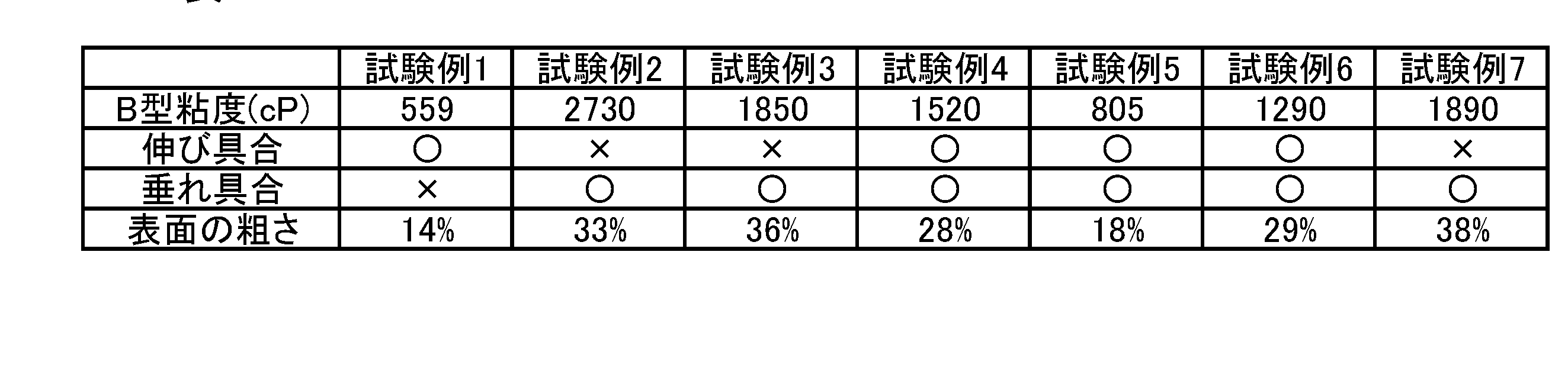
BTMPセルロース微細繊維の濃度が相対的に高いものは伸び具合が良くなかった。また、BTMPセルロース微細繊維の他にLBKPセルロース微細繊維、亜リン酸エステル化セルロース微細繊維、又はカルボキシル化セルロース微細繊維を加えたものは、たれ具合が良く、液が垂れにくいものとなった。
<色あい評価>
試験例4及び試験例5について、色あいを測定した。色あいは、Lab表色系での色空間におけるL*値、a*値、b*値で表され、L*値は、明度を表す指標であり、a*値は赤~緑の間の位置を表す指標、b*値は黄~青の間の位置を表す指標である。L*値、a*値、b*値は、釉薬で全体を被覆した陶磁器用素地の表面に、試験例4又は試験例5を含ませた筆で描画した部分を測定機Color i5 GretagMacbeth社製で測定した。なお、Tappi Brightnessについても測定した。結果を表3に示す。
試験例4及び試験例5について、色あいを測定した。色あいは、Lab表色系での色空間におけるL*値、a*値、b*値で表され、L*値は、明度を表す指標であり、a*値は赤~緑の間の位置を表す指標、b*値は黄~青の間の位置を表す指標である。L*値、a*値、b*値は、釉薬で全体を被覆した陶磁器用素地の表面に、試験例4又は試験例5を含ませた筆で描画した部分を測定機Color i5 GretagMacbeth社製で測定した。なお、Tappi Brightnessについても測定した。結果を表3に示す。

表3において、塗布直後とは、試験例を描画した直後に測定したもの(x1)であり、乾燥後とは、描画した対象物を105℃で1時間放置した後に測定したもの(x2)である。差は、(x1)から(x2)を差し引いたものである。変動幅は、次の算式1で計算した値である。
〔算式1〕
変動幅(%)=((x2)-(x1))/(x2)×100
〔算式1〕
変動幅(%)=((x2)-(x1))/(x2)×100
本発明は、上記の形態に限定されるものではなく、本発明の趣旨を逸脱しない範囲で種々の変形が可能である。
セルロース微細繊維の形態は、粉末、ペースト、スラリー等のどのような形態でも適用可能であり、セルロース微細繊維を分散させる媒体は、水に限らず、有機溶媒その他の流動体を適宜適用可能である。
(その他)
・ハイシェア粘度は、調整した水性塗料組成物について、温度25℃の粘度を、ハイシェア粘度計(SMT社、製品「PM-9000HV」)を使用し、Eボブを用いて、せん断速度を変化させて測定した。ハイシェア粘度は、試料を特定のせん断速度の状態にして、安定した時点の数値を測定値とした。ハイシェア粘度とは、特定のせん断速度(1/sec)で流れる流体の粘度(cP)をいう。一般的に非ニュートン流体は、ずり速度(せん断速度)により粘度が異なる性質を有する。ハイシェア粘度を測定することで、同非ニュートン流体におけるずり速度に応じた粘度が得られる。
・遠心分離機は、HITATHI冷却遠心分離機CR22Nを使用した。
・顔料その他の平均粒子径はJIS Z 8825:2013に準拠して測定した値である。
・室温とは、一般的な家屋内の温度をいうが、例えば、1~30℃、より好ましくは15~25℃をいう。
・セルロース微細繊維の分散液(又は水分散液)のB型粘度は、温度25℃でJIS-Z8803(2011の「液体の粘度測定方法」に準拠して測定した値である。B型粘度は分散液を攪拌したときの抵抗トルクであり、高いほど攪拌に必要なエネルギーが多くなることを意味する。
・乾燥とは、本明細書中で特に限定していない場合は、乾燥させる対象物を105℃で1時間放置することをいう。
・グルコースの概念には、α-グルコース、β-グルコース、その他のグルコースが含まれる。
・ハイシェア粘度は、調整した水性塗料組成物について、温度25℃の粘度を、ハイシェア粘度計(SMT社、製品「PM-9000HV」)を使用し、Eボブを用いて、せん断速度を変化させて測定した。ハイシェア粘度は、試料を特定のせん断速度の状態にして、安定した時点の数値を測定値とした。ハイシェア粘度とは、特定のせん断速度(1/sec)で流れる流体の粘度(cP)をいう。一般的に非ニュートン流体は、ずり速度(せん断速度)により粘度が異なる性質を有する。ハイシェア粘度を測定することで、同非ニュートン流体におけるずり速度に応じた粘度が得られる。
・遠心分離機は、HITATHI冷却遠心分離機CR22Nを使用した。
・顔料その他の平均粒子径はJIS Z 8825:2013に準拠して測定した値である。
・室温とは、一般的な家屋内の温度をいうが、例えば、1~30℃、より好ましくは15~25℃をいう。
・セルロース微細繊維の分散液(又は水分散液)のB型粘度は、温度25℃でJIS-Z8803(2011の「液体の粘度測定方法」に準拠して測定した値である。B型粘度は分散液を攪拌したときの抵抗トルクであり、高いほど攪拌に必要なエネルギーが多くなることを意味する。
・乾燥とは、本明細書中で特に限定していない場合は、乾燥させる対象物を105℃で1時間放置することをいう。
・グルコースの概念には、α-グルコース、β-グルコース、その他のグルコースが含まれる。
本発明は、伝統工芸品、和洋食器、装飾品、インテリア小物等に描画する水性塗料組成物として利用可能である。
10 製作品
11 素地
20a 釉薬層
21 釉薬層
30a 第1図柄
11 素地
20a 釉薬層
21 釉薬層
30a 第1図柄
Claims (5)
- 被塗布物に塗布する水性塗料組成物であって、
着色基材と、
リンオキソ酸のエステル基で変性されたセルロース微細繊維とを有し、
前記被塗布物に塗布してから乾燥するまでの間における、L*値の変動幅が25%以内である、
ことを特徴とする水性塗料組成物。 - 前記被塗布物に形成された塗膜面における表面粗さが20%である、
請求項1に記載の水性塗料組成物。 - 前記セルロース微細繊維は、
セルロース微細繊維を構成するグルコースの炭素部位1位~6位のうちの、
少なくともいずれか1つの炭素部位がリンオキソ酸のエステル基で変性された第1セルロース微細繊維と、
前記炭素部位以外の炭素部位がリンオキソ酸のエステル基で変性された第2セルロース微細繊維とを有するものである、
請求項1に記載の水性塗料組成物。 - B型粘度が600cp以上、かつ1500cp以下であり、
せん断速度1×10⁵(1/sec)以上の範囲で、ハイシェア粘度の最大値が3.5以下である、
請求項1~請求項3のいずれか1項に記載の水性塗料組成物。 - 請求項1~請求項4のいずれか1項に記載の水性塗料組成物で描画された焼物。
Applications Claiming Priority (2)
| Application Number | Priority Date | Filing Date | Title |
|---|---|---|---|
| JP2020049773A JP7584751B2 (ja) | 2020-03-19 | 2020-03-19 | 水性塗料組成物 |
| JP2020-049773 | 2020-03-19 |
Publications (1)
| Publication Number | Publication Date |
|---|---|
| WO2021187552A1 true WO2021187552A1 (ja) | 2021-09-23 |
Family
ID=77770997
Family Applications (1)
| Application Number | Title | Priority Date | Filing Date |
|---|---|---|---|
| PCT/JP2021/011014 Ceased WO2021187552A1 (ja) | 2020-03-19 | 2021-03-18 | 水性塗料組成物 |
Country Status (2)
| Country | Link |
|---|---|
| JP (1) | JP7584751B2 (ja) |
| WO (1) | WO2021187552A1 (ja) |
Cited By (1)
| Publication number | Priority date | Publication date | Assignee | Title |
|---|---|---|---|---|
| WO2025079289A1 (ja) * | 2023-10-13 | 2025-04-17 | 愛媛県 | シート、シートの製造方法、塗工液及び単層フィルム |
Families Citing this family (2)
| Publication number | Priority date | Publication date | Assignee | Title |
|---|---|---|---|---|
| WO2023234129A1 (ja) * | 2022-05-31 | 2023-12-07 | 日本製紙株式会社 | 微細繊維状セルロースの製造方法およびセルロースの解繊方法 |
| JP7377397B1 (ja) * | 2022-05-31 | 2023-11-09 | 日本製紙株式会社 | 微細繊維状セルロースの製造方法およびセルロースの解繊方法 |
Citations (5)
| Publication number | Priority date | Publication date | Assignee | Title |
|---|---|---|---|---|
| JP2017066272A (ja) * | 2015-09-30 | 2017-04-06 | 王子ホールディングス株式会社 | 微細繊維状セルロース含有物 |
| JP2017106012A (ja) * | 2015-12-08 | 2017-06-15 | 王子ホールディングス株式会社 | 塗料用組成物および筆記具 |
| JP2019172482A (ja) * | 2018-03-27 | 2019-10-10 | 愛媛県 | 多層絵付け方法 |
| JP2019199671A (ja) * | 2018-05-18 | 2019-11-21 | 大王製紙株式会社 | セルロース微細繊維及びその製造方法 |
| JP2021054917A (ja) * | 2019-09-27 | 2021-04-08 | 愛媛県 | 水性塗料と陶磁器類と絵付け方法 |
-
2020
- 2020-03-19 JP JP2020049773A patent/JP7584751B2/ja active Active
-
2021
- 2021-03-18 WO PCT/JP2021/011014 patent/WO2021187552A1/ja not_active Ceased
Patent Citations (5)
| Publication number | Priority date | Publication date | Assignee | Title |
|---|---|---|---|---|
| JP2017066272A (ja) * | 2015-09-30 | 2017-04-06 | 王子ホールディングス株式会社 | 微細繊維状セルロース含有物 |
| JP2017106012A (ja) * | 2015-12-08 | 2017-06-15 | 王子ホールディングス株式会社 | 塗料用組成物および筆記具 |
| JP2019172482A (ja) * | 2018-03-27 | 2019-10-10 | 愛媛県 | 多層絵付け方法 |
| JP2019199671A (ja) * | 2018-05-18 | 2019-11-21 | 大王製紙株式会社 | セルロース微細繊維及びその製造方法 |
| JP2021054917A (ja) * | 2019-09-27 | 2021-04-08 | 愛媛県 | 水性塗料と陶磁器類と絵付け方法 |
Cited By (1)
| Publication number | Priority date | Publication date | Assignee | Title |
|---|---|---|---|---|
| WO2025079289A1 (ja) * | 2023-10-13 | 2025-04-17 | 愛媛県 | シート、シートの製造方法、塗工液及び単層フィルム |
Also Published As
| Publication number | Publication date |
|---|---|
| JP2021147533A (ja) | 2021-09-27 |
| JP7584751B2 (ja) | 2024-11-18 |
Similar Documents
| Publication | Publication Date | Title |
|---|---|---|
| WO2021187552A1 (ja) | 水性塗料組成物 | |
| CN104245858B (zh) | 涂料用组合物 | |
| CN114514294B (zh) | 水性涂料、陶瓷器类和彩烧方法 | |
| JP6139404B2 (ja) | フィブリル化セルロースを含む組成物の製造方法及び組成物 | |
| US2949397A (en) | Mineral filled paper | |
| CN101679784A (zh) | 包括纤维素醚/网状结构聚合物流体凝胶增稠剂的改进的涂料配方 | |
| WO2019043782A1 (ja) | 繊維状セルロース含有組成物及び塗料 | |
| JP7732562B2 (ja) | 繊維状セルロース含有分散液及びその製造方法 | |
| JP7344496B2 (ja) | 水性塗料と陶磁器類と絵付け方法 | |
| JP7802292B2 (ja) | 水性塗料組成物 | |
| JP7334773B2 (ja) | 繊維状セルロース含有組成物及び塗料 | |
| JP7539637B2 (ja) | 水性塗料組成物 | |
| US3239475A (en) | Coatings for fibrous boards | |
| US20140109796A1 (en) | Cationic polyoxometalate-coated alumina trihydrate dispersants | |
| CN102666985A (zh) | 用于纸张涂料中的包含细碳酸钙颗粒的水性浆料 | |
| JPS6144807B2 (ja) | ||
| JP2020063351A (ja) | 繊維状セルロース、繊維状セルロース分散液及び繊維状セルロースの製造方法 | |
| JP7497658B2 (ja) | 繊維状セルロース、繊維状セルロース分散液及び繊維状セルロースの製造方法 | |
| JPH05163445A (ja) | 水性樹脂塗料組成物 | |
| CA1075726A (en) | Method for reducing the viscosity and for refining kaolin clays | |
| SU1261995A1 (ru) | Способ получени бумажного декоративно-облицовочного материала | |
| CN107815236A (zh) | 液态壁纸涂料及生产方法 |
Legal Events
| Date | Code | Title | Description |
|---|---|---|---|
| 121 | Ep: the epo has been informed by wipo that ep was designated in this application |
Ref document number: 21771643 Country of ref document: EP Kind code of ref document: A1 |
|
| NENP | Non-entry into the national phase |
Ref country code: DE |
|
| 122 | Ep: pct application non-entry in european phase |
Ref document number: 21771643 Country of ref document: EP Kind code of ref document: A1 |