WO2021186531A1 - 二酸化炭素吸着焼結体の製造方法、及び、二酸化炭素吸着焼結体 - Google Patents
二酸化炭素吸着焼結体の製造方法、及び、二酸化炭素吸着焼結体 Download PDFInfo
- Publication number
- WO2021186531A1 WO2021186531A1 PCT/JP2020/011646 JP2020011646W WO2021186531A1 WO 2021186531 A1 WO2021186531 A1 WO 2021186531A1 JP 2020011646 W JP2020011646 W JP 2020011646W WO 2021186531 A1 WO2021186531 A1 WO 2021186531A1
- Authority
- WO
- WIPO (PCT)
- Prior art keywords
- sintered body
- carbon dioxide
- amount
- temperature
- source
- Prior art date
- Legal status (The legal status is an assumption and is not a legal conclusion. Google has not performed a legal analysis and makes no representation as to the accuracy of the status listed.)
- Ceased
Links
Images


Classifications
-
- C—CHEMISTRY; METALLURGY
- C04—CEMENTS; CONCRETE; ARTIFICIAL STONE; CERAMICS; REFRACTORIES
- C04B—LIME, MAGNESIA; SLAG; CEMENTS; COMPOSITIONS THEREOF, e.g. MORTARS, CONCRETE OR LIKE BUILDING MATERIALS; ARTIFICIAL STONE; CERAMICS; REFRACTORIES; TREATMENT OF NATURAL STONE
- C04B35/00—Shaped ceramic products characterised by their composition; Ceramics compositions; Processing powders of inorganic compounds preparatory to the manufacturing of ceramic products
- C04B35/622—Forming processes; Processing powders of inorganic compounds preparatory to the manufacturing of ceramic products
- C04B35/64—Burning or sintering processes
Definitions
- the present invention relates to a method for producing a carbon dioxide adsorption sintered body using coal ash powder as a raw material and adsorbing carbon dioxide, and a carbon dioxide adsorption sintered body produced by this method.
- crushed coal powder is burned in a boiler and the heat energy is converted into electricity.
- Most of the coal ash in the boiler is sent to the flue along with the combustion gas and collected by an electrostatic precipitator.
- Most of the coal ash generated at such thermal power plants is effectively used for the production of concrete, concrete admixtures, fillers, shield materials, soil / ground improvement materials, etc., but the rest is in sea or land. It has been landfilled.
- Non-Patent Document 1 A method for producing a coal ash sintered body such as a product (Non-Patent Document 1) and a method for forming a high-density sintered body in a vacuum in a short time (Non-Patent Document 2) are considered.
- the present invention has been made in view of the above circumstances, and is a carbon dioxide adsorption sintered body capable of reducing carbon dioxide in combustion exhaust gas without generating carbon dioxide during production.
- the main subject is to provide a production method and a carbon dioxide adsorption sintered body produced by the production method.
- a mixture of coal ash mixed with a Ca source and, if necessary, a Na source is irradiated with microwaves and burned. Sintering is performed by raising the temperature above the condensing temperature, and in the process of lowering the temperature of the sintered body of this mixture, combustion exhaust gas is blown into the sintered body to adsorb carbon dioxide in the combustion exhaust gas to the sintered body. It is characterized by that.
- the igros amount is adjusted by the igros amount adjusting step of adjusting the igros amount of the coal ash, the Ca source adjusting step of adjusting the mixing amount of the Ca source mixed with the coal ash, and the igros amount adjusting step.
- the Ca source include concrete waste (concrete sludge, waste concrete), steel slag, and the like.
- the mixture since the mixture is sintered by microwaves, carbon dioxide is not emitted during the production of the sintered body, and since the mixture contains a Ca source, it is sintered.
- the combustion exhaust gas is blown into the sintered body in the temperature lowering step after the temperature is reduced, carbon dioxide in the combustion exhaust gas is adsorbed and fixed on the surface of the sintered body as calcium carbonate. Therefore, it is possible to reduce the amount of carbon dioxide in the combustion exhaust gas during the production of the carbon dioxide adsorption sintered body.
- a Na source adjusting step for adjusting the mixing amount of the Na source to be mixed with the coal ash is further provided, and the Na source adjusting is performed in the mixing step.
- the Na source whose mixing amount has been adjusted by the step may be further mixed.
- a sodium hydroxide solution a sodium chloride solution may be used, or seawater may be used instead of the sodium chloride solution.
- the combustion exhaust gas may be blown into the mixture to preheat the mixture also in the temperature raising step.
- the combustion exhaust gas Since the combustion exhaust gas is also used in this preheat, it is expected that carbon dioxide in the exhaust gas will be adsorbed on the mixture as calcium carbonate, but the mixture adsorbed on calcium carbonate is sintered by irradiating it with microwaves. There is a concern that the adsorbed calcium carbonate will decompose and return to carbon dioxide. Therefore, when the combustion exhaust gas is blown during the temperature rise (when the carbon dioxide in the exhaust gas is adsorbed and fixed as calcium carbonate), the microwave heating is performed by appropriately adjusting the microwave magnetic field component, electric field component, and frequency. , It is advisable to perform selective heating while avoiding calcium carbonate.
- the adjustment of the amount of coal ash in the amount of igros by the step of adjusting the amount of igros is possible, for example, by mixing coal ash having a different amount of igros (ignition loss) generated in each predetermined power plant.
- the mixing ratio of coal ash and Ca source is preferably set to 9: 1 to 7: 3 by weight, and the Na source is 3% by weight based on the weight of coal ash plus Ca source. It is preferable to add it as a limit.
- fly ash may be used as the coal ash.
- the frequency of the microwave irradiated in the heating step is preferably 2.45 GHz ⁇ 0.5 GHz, and the component irradiated to the mixture is preferably an electric field component. Further, in this heating step, it is desirable to heat to a temperature of 800 ° C. or higher, particularly 1200 ° C. or higher by irradiating with microwaves. The time to reach a predetermined temperature can be adjusted by the above-mentioned amount of Na.
- the cooling method of the temperature lowering step differs depending on the use of the final product, and it is desirable to slowly cool the final product when it is desired to maintain the boiled shape, and when it is desired to obtain the clinkerized final product. It is desirable to quench.
- combustion exhaust gas is generated in the process of lowering the temperature of the sintered body. Since the carbon dioxide adsorption sintered body was manufactured by blowing in and adsorbing carbon dioxide in the combustion exhaust gas, not only the generation of carbon dioxide was suppressed during the production of the carbon dioxide adsorption sintered body, but also the carbon dioxide in the combustion exhaust gas was produced. Can be reduced. Therefore, the obtained carbon dioxide adsorption sintered body can be effectively used as a coal ash sintered body and can contribute to the reduction of carbon dioxide emissions.
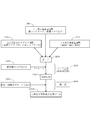
- the igros amount adjusting step (step 100) for adjusting the igros amount of coal ash to a predetermined value and the mixing amount of the Ca source to be mixed with the coal ash are adjusted to a predetermined value.
- the amount of igros was adjusted by the Ca source adjusting step (step 200), the Na source adjusting step (step 300) for adjusting the mixing amount of the Na source to be mixed with the coal ash to a predetermined value, and the igros amount adjusting step. It includes a coal ash, a Ca source whose mixing amount has been adjusted by the Ca source adjusting step, and a mixing step (step 400) of mixing the Na source whose mixing amount has been adjusted by the Na source adjusting step.
- the combustion exhaust gas generated by burning the coal powder in the power plant is blown (combustion gas blowing step: step 500), and at the same time, microwaves are blown to the mixture.
- the mixture is irradiated to raise the temperature to the sintering temperature (heating step: step 600), and the mixture is sintered (step 700). Since the mixture is preheated by the combustion exhaust gas blown at the time of temperature rise, the temperature rise of the mixture is promoted, and the time until the sintering process can be shortened. Then, after the sintering treatment, the irradiation by the microwave is stopped, and the process proceeds to the temperature lowering step of lowering the temperature of the sintered body (step 800).
- the combustion exhaust gas generated from the power plant is blown into the sintered body (step 900), whereby carbon dioxide (CO 2 ) in the combustion exhaust gas is adsorbed on the sintered body as calcium carbonate, and carbon dioxide is produced.
- a carbon adsorption sintered body is produced (step 1000).
- the adjustment of the amount of igros in the igros amount adjusting step 100 is, for example, coal ash (A ash) generated from a power plant having a low amount of igros (ignition loss) of about 3% and a power plant having a high amount of igross of about 17%. It is possible by adjusting the mixing ratio with the coal ash (B ash) generated from. Table 1 below shows an example of adjusting the amount of igrosse.
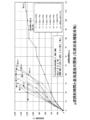
- each of the samples 1 to 7 shown in Table 1 is placed in a container (ceramic), surrounded by a heat insulating container, and placed in a microwave oven.
- the mixture was irradiated with microwaves ( ⁇ waves) and heated (500 W).
- the sample was appropriately taken out from the microwave oven, and the surface temperature of the sample was measured with an irradiation thermometer from a hole provided in the upper part of the heat insulating container.
- the target temperature was 1200 ° C.
- sample 1 (dotted line +), sample 2 (dotted line ⁇ ), sample 3 (dotted line ⁇ ), sample 4 (dotted line ⁇ ), sample 5 (dotted line ⁇ ), sample 6 (dotted line ⁇ ), sample 7 (dotted line ⁇ ).
- sample ejection, sintering, melting is shown as a legend of the label described in each. Many, medium, small, and none were selected from the experimental results as the blow-up, and ⁇ : whole, ⁇ : most, ⁇ : medium to small part, ⁇ : none were selected from the experimental results as the boiled / melted.
- the Ca source to be mixed with the coal ash adjusted in the igross amount adjusting step (step 100) (Ca source whose mixing amount was adjusted in the Ca source adjusting step 200), concrete waste (concrete sludge, waste electric column, etc.) is abolished. Powders rich in Ca such as concrete) and steel slag are selected.
- a case where waste concrete powder is used as the Ca source will be described.
- the microwave heating step when the temperature rises to 800 ° C. or higher, the Ca content contained in the coal ash and the waste concrete powder becomes CaO.
- a sodium chloride solution can be used even if a sodium hydroxide solution is used. Or seawater may be used instead of the sodium chloride solution.
- the Na source is not always essential for producing a carbon dioxide adsorption sintered body, but it can be added in order to improve the temperature rising characteristics (to produce the sintered body in a short time). desirable.
- the Na source When a sodium hydroxide solution is used as the Na source, as shown in FIG. 4, the result of raising the temperature with microwaves by changing the addition amount of NaOH from 10% to 1% with coal ash having an igros amount of 5.8%. Therefore, it was found that the temperature rises easily when the amount of addition is 10% to 3%, but when it is added to 3% or more, the phenomenon of rising may occur due to the relationship between the melting of Na content and the ejection of ash gas. rice field. Therefore, the Na source may be added up to 3%.
- the amount of igros and the amount of Na source added for sintering and melting coal ash it is effective to increase the amount of igros and add a large amount of Na source in order to improve the temperature rise characteristics.
- the coal ash mixture in which a predetermined amount of Ca source and a predetermined amount of Na source are mixed in the mixing step 300 is heated in the temperature raising step 400.
- the combustion exhaust gas of about 350 ° C. discharged from the boiler is blown into the mixture to preheat the mixture and promote the temperature rise.
- the frequency of the microwave irradiated in this temperature raising step 600 is preferably 2.45 GHz ⁇ 0.5 GHz, and the component irradiated to the mixture is preferably an electric field component. This is because the energy received by the coal ash mixture from the microwave is proportional to the sum of (complex permittivity) x (microwave electric field strength squared) and (complex magnetic permeability) x (microwave magnetic field strength squared). ..
- the microwave heating of the coal ash mixture is greatly contributed by the electric field of the microwave. Therefore, it is presumed that efficient heating can be achieved by irradiating with a microwave electric field. Therefore, in the temperature raising step 600, the mixture is irradiated with microwaves having the above-mentioned conditions in order to raise the temperature to, for example, 1200 ° C.
- the coal ash mixture heated to the sintering temperature or higher in the temperature raising step 600 is sintered, and then cooled in the temperature lowering step 800.
- the cooling method in the temperature lowering step 800 differs depending on the use of the final product, and when it is desired to obtain the final product in a state where the firing shape is maintained, it is slowly cooled. If you want to make a clinkerized final product, quench it. This makes it possible to obtain the desired final product.
- CO 2 is blown and adsorbed.
- CO 2 is blown in by blowing in the fuel exhaust gas of a thermal power plant, and more specifically, it is preferable to use the combustion exhaust gas after flowing into the pollution control equipment immediately after leaving the boiler. Since the waste concrete powder contains neutralized Ca (CaO) and non-neutralized Ca (Ca (OH) 2 ) that has undergone a hydration reaction, CO2 in the exhaust gas is blown into it. Then, calcium carbonate (CaCO 3 ) is produced as shown in the chemical formula below. That is, CO2 in the exhaust gas is fixed to the sintered body as calcium carbonate.
- Calcium carbonate has a melting point of 825 to 898 ° C., and is decomposed into calcium oxide (CaO) and carbon dioxide (CO 2) above this temperature. Therefore, the sintered coal ash is divided into three different areas (upper, middle, and lower) and heated, and the gas generated during heating is passed through the coal water for each area, depending on whether the coal water becomes cloudy or not. The presence or absence of carbon dioxide (CO 2) was confirmed. As a result, white turbidity was confirmed in the middle and lower samples with high heating temperature, and it was confirmed that calcium carbonate (CaCO3) remained in the sintered body. Therefore, the carbon dioxide adsorption sintered body described above not only suppresses the generation of carbon dioxide during production, but also makes it possible to reduce the carbon dioxide in the combustion exhaust gas.
- CaO calcium oxide
- CO 2 carbon dioxide
- CO 2 is fixed to the sintered body as calcium carbonate by blowing combustion exhaust gas into the sintered body when the temperature is lowered after the mixture is heated by microwaves and subjected to the sintering treatment.
- CO 2 in the combustion exhaust gas blown into the mixture may be adsorbed and retained as calcium carbonate.
- the fuel exhaust gas blown at the time of temperature rise can shorten the time until the sintering process by promoting the temperature rise of the mixture.
- CO 2 in the combustion exhaust gas is supplied to the mixture, CO is supplied to the mixture. 2 is adsorbed as calcium carbonate.
- the adsorbed calcium carbonate is decomposed into calcium oxide and carbon dioxide, and the adsorbed state of CO 2 is eliminated. Therefore, the electric field, magnetic field, and frequency of the microwave are adjusted so that the captured calcium carbonate is not directly heated by the microwave, and the mixture is sintered by selectively heating other than calcium carbonate.
- the mixture is selectively heated by microwaves. By raising the temperature, it is expected that the calcium carbonate incorporated inside will be retained as it is incorporated.
- the NaCl to be added is similar to the process of converting to Na2CO3 (soda ash) by adding CO 2 (combustion exhaust gas), so it is expected to improve the exhaust efficiency of Cl 2 (chlorine gas). .. Further, in the above configuration, an example in which waste concrete powder is used as a Ca source has been described, but steel slag or the like containing abundant Ca components can be used instead of waste concrete powder or in combination with waste concrete powder. You may use it.
Landscapes
- Chemical & Material Sciences (AREA)
- Engineering & Computer Science (AREA)
- Manufacturing & Machinery (AREA)
- Ceramic Engineering (AREA)
- Inorganic Chemistry (AREA)
- Materials Engineering (AREA)
- Structural Engineering (AREA)
- Organic Chemistry (AREA)
- Processing Of Solid Wastes (AREA)
- Treating Waste Gases (AREA)
Abstract
【課題】製造時に、二酸化炭素を発生させることがなく、また、燃焼排ガス中の二酸化炭素を低減することが可能な二酸化炭素吸着焼結体の製造方法と、その方法により製造された二酸化炭素吸着焼結体を提供する。 【解決手段】石炭灰のイグロス量を調整するイグロス量調整工程と、石炭灰に混合するCa源(コンクリート紛、鉄鋼スラグ)の混合量を調整するCa源調整工程と、イグロス量調整工程によってイグロス量が調整された石炭灰及び前記カルシウム源調整工程によって混合量が調整されたカルシウム源を混合させる混合工程と、混合工程によって混合された混合物にマイクロ波を照射して前記混合物を焼結温度以上に昇温させて焼結させる昇温工程と、昇温工程によって得られた前記混合物の焼結体を降温させる過程において、焼結体に燃焼排ガスを吹き込む降温工程と、を有する。
Description
本発明は、石炭灰粉末を原料にすると共に二酸化炭素を吸着させた二酸化炭素吸着焼結体を製造する方法、及び、この方法により製造された二酸化炭素吸着焼結体に関する。
石炭を燃料として用いる火力発電所では、粉砕された石炭粉がボイラーで燃焼され、その熱エネルギーが電気に変換される。ボイラー中の石炭灰の大部分は燃焼ガスと共に煙道に送られ,電気集塵器で回収される。このような火力発電所で生じた石炭灰の多くは、コンクリート、コンクリート混和材、充填材、シールド材、土壌・地盤改良材等の製造に有効利用されるが、残りは、海域あるいは陸域で埋立処理されている。
このような石炭灰の利用は、石炭灰を単純に粉体として利用するものであるが,さらに付加価値をつけて多方面で有効利用することが求められている。そこで、石炭灰の新たな利用方法を確立するために、石炭灰を原料とした石炭灰焼結体を利用することが考えられており、従来においては、石炭灰を大気中で焼成させてセラミックス製品などの石炭灰焼結体を製造する方法(非特許文献1)や、真空中において短時間で高密度の焼結体を形成する方法(非特許文献2)等が考えられている。
小泉公志郎、石炭灰を利用した多孔質セラミックスの剛性とその特定、日本セラミックス協会学術論文誌、1998,第106巻第9号、p899-903
金子玄洋、SPS法を用いた高密度石炭灰焼結体の試作および 機械的特性、日本金属学会誌、2008, 第72巻第10号、p797-799
しかしながら、前者の石炭灰焼結体の製造方法によれば、石炭灰を大気中で焼結するので、石炭灰中に残留する未燃カーボンの燃焼反応により二酸化炭素が放出され、これにより焼結体内部に多数の細孔が形成され、焼結体の強度が劣ることが報告されている。また、後者の製造方法によれば、真空加熱炉などの非酸化雰囲気で焼結させる方法となるので、焼結体を製造するまでに時間を要し生産効率が悪くなる不都合がある。
さらに、前者の製造方法においては、焼結体の形成時に二酸化炭素が放出されるので、二酸化炭素の排出量を少なくする取り組みに逆行するものとなる。火力発電所の燃焼排ガスから発生する二酸化炭素は、地球温暖化の原因の一端となっており、中でも石炭火力発電所から排出される二酸化炭素は最も多くなっている。このため、火力発電所から排出される二酸化炭素の排出量を少なくする取り組みは非常に重要な課題となっており、石炭灰を利用した焼結体を製造するに当たっても、二酸化炭素を排出させないだけでなく、さらには燃焼排ガス中の二酸化炭素を吸収することができれば、二酸化炭素の排出量の削減に大きく寄与することが可能となる。
本発明は、係る事情に鑑みてなされたものであり、製造時において、二酸化炭素を発生させることがなく、また、燃焼排ガス中の二酸化炭素を低減することが可能な二酸化炭素吸着焼結体の製造方法と、その方法により製造された二酸化炭素吸着焼結体を提供することを主たる課題としている。
上記課題を達成するために、本発明に係る二酸化炭素吸着焼結体の製造方法は、石炭灰に対してCa源と必要に応じてNa源を混合させた混合物にマイクロ波を照射させて焼結温度以上に昇温させることで焼結させ、この混合物の焼結体を降温させる過程で前記焼結体に燃焼排ガスを吹き込むことで前記燃焼排ガス中の二酸化炭素を前記焼結体に吸着させたことを特徴としている。
より具体的には、石炭灰のイグロス量を調整するイグロス量調整工程と、石炭灰に混合するCa源の混合量を調整するCa源調整工程と、前記イグロス量調整工程によってイグロス量が調整された石炭灰及び前記カルシウム源調整工程によって混合量が調整されたカルシウム源を混合させる混合工程と、前記混合工程によって混合された混合物にマイクロ波を照射して前記混合物を焼結温度以上に昇温させて焼結させる昇温工程と、前記昇温工程によって得られた前記混合物の焼結体を降温させる過程において、前記焼結体に燃焼排ガスを吹き込む降温工程と、を有することを特徴としている。
ここで、Ca源としては、コンクリート廃棄物(コンクリートスラッジ、廃コンクリート)や鉄鋼スラグ等が挙げられる。
ここで、Ca源としては、コンクリート廃棄物(コンクリートスラッジ、廃コンクリート)や鉄鋼スラグ等が挙げられる。
したがって、上述の製造方法によれば、マイクロ波により混合物を焼結させるので、焼結体の製造時に二酸化炭素を排出させることがなく、また、混合物にCa源が含まれているので、焼結させた後の降温工程において、燃焼排ガスを焼結体に吹き込むと、燃焼排ガス中の二酸化炭素が炭酸カルシウムとして焼結体の表面に吸着固定される。よって、二酸化炭素吸着焼結体の製造時に、燃焼排ガス中の二酸化炭素の量を低減することが可能となる。
また、混合物が焼結温度以上に昇温する時間を短くするために、前記石炭灰に混合させるNa源の混合量を調整するNa源調整工程をさらに設け、前記混合工程において、前記Na源調整工程によって混合量が調整されたNa源をさらに混合させるようにしてもよい。
ここで、Na源としては、水酸化ナトリウム溶液を用いても、塩化ナトリウム溶液を用いてもよく、塩化ナトリウム溶液の代わりに海水を用いてもよい。
ここで、Na源としては、水酸化ナトリウム溶液を用いても、塩化ナトリウム溶液を用いてもよく、塩化ナトリウム溶液の代わりに海水を用いてもよい。
また、昇温工程での混合物の昇温を促進するために、前記昇温工程においても、前記混合物に燃焼排ガスを吹き込んで混合物をプレヒートしてもよい。
このプレヒートにおいても、燃焼排ガスを利用しているので、排ガス中の二酸化炭素が炭酸カルシウムとして混合物に吸着することが期待されるが、炭酸カルシウムを吸着した混合物をマイクロ波を照射させて焼結させると、吸着していた炭酸カルシムが分解して二酸化炭素に戻ることが懸念される。そこで、昇温中に燃焼排ガスを吹き込む場合(排ガス中の二酸化炭素を炭酸カルシウムとして吸着固定させる場合)には、マイクロ波による加熱は、マイクロ波の磁界成分、電界成分、周波数を適宜調整して、炭酸カルシウムを避けて加熱する選択加熱を行うとよい。
なお、イグロス量調整工程による石炭灰のイグロス量の調整は、例えば、所定の発電所毎に生じるイグロス量(強熱減量)の異なる石炭灰を混合させることによって可能である。
また、石炭灰とCa源との混合割合は、重量比で9:1~7:3に設定することが好ましく、Na源は、石炭灰にCa源を加えた重量を基準として3重量%を限度として加えることが好ましい。
また、前記石炭灰としては、フライアッシュを用いるとよい。
また、石炭灰とCa源との混合割合は、重量比で9:1~7:3に設定することが好ましく、Na源は、石炭灰にCa源を加えた重量を基準として3重量%を限度として加えることが好ましい。
また、前記石炭灰としては、フライアッシュを用いるとよい。
前記加熱工程で照射されるマイクロ波の周波数は、2.45GHz±0.5GHzであることが望ましく、混合物に照射される成分が電界成分であることが望ましい。また、この加熱工程では、マイクロ波を照射することにより、800℃以上、特に1200℃以上の温度まで加熱することが望ましい。なお、所定の温度までの到達時間は、前述したNa量によって調整可能である。
前記降温工程の冷却方法は、最終生成物の用途によって異なるもので、燒結形状を保持した状態の最終生成物としたい場合には徐冷することが望ましく、クリンカ化した最終生成物としたい場合には急冷することが望ましい。
以上述べたように、本発明によれば、石炭灰にCa源と必要に応じてNa源を混合させた混合物をマイクロ波で焼結させた後に、焼結体の降温過程で、燃焼排ガスを吹き込んで燃焼排ガス中の二酸化炭素を吸着させて二酸化炭素吸着焼結体を製造したので、二酸化炭素吸着焼結体の製造時に二酸化炭素の発生が抑制されるだけでなく、燃焼排ガス中の二酸化炭素を低減することが可能となる。したがって、得られた二酸化炭素吸着焼結体は、石炭灰の焼結体として有効利用することができると共に二酸化炭素の排出量の削減に寄与することが可能となる。
以下、本発明の実施形態について図面に基づき説明する。
石炭灰(フライアッシュ:FA)を用いて二酸化炭素吸着焼結体(二酸化炭素を炭酸カルシウムとして吸着固定させた焼結体)を生成するために、本発明においては、石炭灰(FA)にCa源の粉末とNa源を混合し、その上でこの混合物を焼結温度以上に昇温して焼結させ、焼結された混合物の焼結体を降温させる過程で二酸化炭素(CO2)を吸着させるようにしている。
石炭灰(フライアッシュ:FA)を用いて二酸化炭素吸着焼結体(二酸化炭素を炭酸カルシウムとして吸着固定させた焼結体)を生成するために、本発明においては、石炭灰(FA)にCa源の粉末とNa源を混合し、その上でこの混合物を焼結温度以上に昇温して焼結させ、焼結された混合物の焼結体を降温させる過程で二酸化炭素(CO2)を吸着させるようにしている。
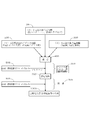
具体的には、図1に示されるように、石炭灰のイグロス量を所定値に調整するイグロス量調整工程(ステップ100)と、前記石炭灰に混合するCa源の混合量を所定値に調整するCa源調整工程(ステップ200)と、前記石炭灰に混合するNa源の混合量を所定値に調整するNa源調整工程(ステップ300)と、前記イグロス量調整工程によってイグロス量が調整された石炭灰、前記Ca源調整工程によって混合量が調整されたCa源、及び前記Na源調整工程によって混合量が調整されたNa源を混合する混合工程(ステップ400)と、を備える。
その後、混合工程で混合された混合物をプレヒートするために発電所において石炭紛を燃焼して生じた燃焼排ガスを吹き込み(燃焼ガス吹込み工程:ステップ500)、これと同時に混合物に対してマイクロ波を照射して混合物を焼結温度まで昇温させ(昇温工程:ステップ600)、混合物を焼結させる処理を行う(ステップ700)。昇温時において吹き込む燃焼排ガスにより混合物をプレヒートするので、混合物の昇温が促進され、焼結処理までの時間を短くすることが可能となる。
そして、焼結処理後にマイクロ波による照射を停止し、焼結体を降温させる降温工程に移行する(ステップ800)。この降温工程においては、発電所から生じた前記燃焼排ガスを焼結体に吹込み(ステップ900)、これにより燃焼排ガス中の二酸化炭素(CO2)を炭酸カルシウムとして焼結体に吸着させ、二酸化炭素吸着焼結体を生成する(ステップ1000)。
その後、混合工程で混合された混合物をプレヒートするために発電所において石炭紛を燃焼して生じた燃焼排ガスを吹き込み(燃焼ガス吹込み工程:ステップ500)、これと同時に混合物に対してマイクロ波を照射して混合物を焼結温度まで昇温させ(昇温工程:ステップ600)、混合物を焼結させる処理を行う(ステップ700)。昇温時において吹き込む燃焼排ガスにより混合物をプレヒートするので、混合物の昇温が促進され、焼結処理までの時間を短くすることが可能となる。
そして、焼結処理後にマイクロ波による照射を停止し、焼結体を降温させる降温工程に移行する(ステップ800)。この降温工程においては、発電所から生じた前記燃焼排ガスを焼結体に吹込み(ステップ900)、これにより燃焼排ガス中の二酸化炭素(CO2)を炭酸カルシウムとして焼結体に吸着させ、二酸化炭素吸着焼結体を生成する(ステップ1000)。
前記イグロス量調整工程100におけるイグロス量の調整は、例えば、イグロス量(強熱減量)が3%前後と低い発電所から生じる石炭灰(A灰)と、イグロス量が17%前後と高い発電所から生じる石炭灰(B灰)との混合比率を調整することによって可能である。下記の表1は、イグロス量の調整例を示すものである。

石炭灰に配合されるべき最適なイグロス量を決定するために、表1に記載された各試料1乃至7のそれぞれを容器(陶製)に投入し、断熱容器で囲った状態で、電子レンジにてマイクロ波(μ波)を照射し加熱(500W)を行った。μ波照射開始後、電子レンジから適宜取り出し、断熱容器の上部に設けられた穴から照射温度計にて試料の表面温度を計測した。目標温度は1200℃とした。加熱終了後、試料を断熱材で囲った状態で室内にて冷却し、燒結・溶融状況(試料の噴上げ、燒結、溶融)を確認した。この結果を、図2に示す。
この図2において、試料1(点線+)、試料2(点線△)、試料3(点線◇)、試料4(点線□)、試料5(点線〇)、試料6(点線×)、試料7(点線■)、A灰(実線×)の実験結果が特性線として示される。また、それぞれに記載されるラベルの凡例として(試料の噴上げ、燒結、溶融)が示される。噴き上げとしては、多、中、少、無が実験結果から選択され、燒結・溶融としては、〇:全体、□:大部分、△:中~小部分、×:無しが実験結果から選択した。
図2に示される実験結果から、イグロス量が低下するにつれて、昇温温度が小さくなる傾向が概ね認められた。また、μ波の照射時間と温度昇温時間、及び噴上げ、燒結・溶融の結果から、イグロス量を6%より大きくすると、試料3(イグロス量6.5%)に見られるように、焼結しにくくなる場合があり、上述した資料の中では、試料4(イグロス量5.8%)が最も適していることが判明した。
以上のことから、昇温特性を高めるためには、イグロス量を大きくした方がいいが、イグロス量が6%を超えると、混合物が焼結しにくくなる(イグロスの高温域での燃焼により燃焼ガス量が増加するため細孔が増えて焼結が不十分になることがある)。また、イグロス量が5.8%程度以上では、図3に示されるように、昇温速度に大差がなくなる。そこで、イグロス量は、6重量%を上限とすることが望ましい。本件においては、Ca源(廃コンクリートや鉄鋼スラグ)をさらに混合するので、A灰とB灰とCa源の合計に対して、6重量%以下にするとよい。
イグロス量調整工程(ステップ100)で調整された石炭灰に混合させるCa源(Ca源調整工程200で混合量が調整されたCa源)としては、コンクリート廃棄物(コンクリートスラッジ、廃電柱などの廃コンクリート)や鉄鋼スラグなどのCa分を豊富に含んだ粉末が選定される。ここでは、Ca源として廃コンクリート紛を用いた場合について説明する。
マイクロ波による昇温工程において、800℃以上になると,石炭灰と廃コンクリート粉に含まれるCa分がCaOとなる。また、CaOの存在により,石炭灰の融点が低下することが確認されており、融点降下(=電気使用量=コスト)を見据えてCa分の石炭灰への混合割合を検討する必要がある。さらに、石炭灰と廃コンクリートとの混合割合について,廃コンクリート粉の混合量が多い方がCO2を多く吸着すると考えられるが、多量添加の場合には、石炭灰の処理に寄与しなくなる廃コンクリートが多くなるため、Ca分による融点降下の効果が無くなるまでの廃コンクリート粉の添加量が限界となる。したがって、以上の点を考慮して、石炭灰と廃コンクリート粉との混合割合は重量比で9:1~7:3にすることが望ましい。
マイクロ波による昇温工程において、800℃以上になると,石炭灰と廃コンクリート粉に含まれるCa分がCaOとなる。また、CaOの存在により,石炭灰の融点が低下することが確認されており、融点降下(=電気使用量=コスト)を見据えてCa分の石炭灰への混合割合を検討する必要がある。さらに、石炭灰と廃コンクリートとの混合割合について,廃コンクリート粉の混合量が多い方がCO2を多く吸着すると考えられるが、多量添加の場合には、石炭灰の処理に寄与しなくなる廃コンクリートが多くなるため、Ca分による融点降下の効果が無くなるまでの廃コンクリート粉の添加量が限界となる。したがって、以上の点を考慮して、石炭灰と廃コンクリート粉との混合割合は重量比で9:1~7:3にすることが望ましい。
イグロス量調整工程(ステップ100)で調整された石炭灰に混合させるNa源(Na源調整工程300で混合量が調整されたNa源)としては、水酸化ナトリウム溶液を用いても、塩化ナトリウム溶液を用いてもよく、塩化ナトリウム溶液の代わりに海水を用いてもよい。
Na源は、二酸化炭素吸着焼結体を製造する上で、必ずしも必須となるものではないが、昇温特性を高めるために(短時間で焼結体を製造するために)、添加することが望ましい。
Na源は、二酸化炭素吸着焼結体を製造する上で、必ずしも必須となるものではないが、昇温特性を高めるために(短時間で焼結体を製造するために)、添加することが望ましい。
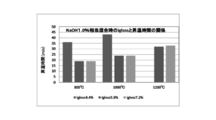
Na源として水酸化ナトリウム溶液を用いる場合、図4に示すように、イグロス量5.8%の石炭灰でNaOHの添加量を10%~1%まで変化させてマイクロ波で昇温させた結果から、添加量が10%~3%までは昇温し易くなることが判明したが、3%以上に添加するとNa分の溶融とイグロスのガスの噴出の関係から噴き上がり現象が生じる場合があった。このため、Na源は3%を上限として添加するとよい。
したがって、石炭灰を焼結・溶融するためのイグロス量とNa源の添加量については、昇温特性を高めるためにはイグロス量を多くし、また、Na源を多く添加することが有効であるが、上述した理由から、図5に示すように、Na源は3%を上限とし、イグロス量は5.8%=約6%を上限とする条件が最適であると推定される。
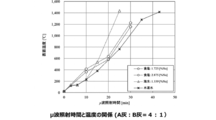
また、図6に示されるように、Na源(Na量添加物)として、塩化ナトリウム(NaCl)溶液を使用した場合には、イグロス量5.8%の混合灰に対して、食塩のナトリウム量を1.725%Naとした場合及び2.875%Naとした場合について、噴上げはなく1200℃到達まで30分であった。また、塩化ナトリウム溶液の代わりに海水を使用した場合には、Na量を1.339%Naとして実験した結果、噴上げは多く検出されたものの、昇温時間は約20分と早かった(食塩よりも海水の方が昇温特性が高いことが判明した)。
前記混合工程300において所定量のCa源と所定量のNa源が混合された石炭灰混合物は、昇温工程400において昇温される。この昇温工程においては、ボイラーから排出された350℃程度の燃焼排ガスを混合物に吹き込むことで、混合物をプレヒートし、昇温を促進させる。
この昇温工程600で照射されるマイクロ波の周波数は、2.45GHz±0.5GHzであることが望ましく、混合物に照射される成分が電界成分であることが望ましい。これは、マイクロ波より石炭灰混合物が受け取るエネルギーは、(複素誘電率)×(マイクロ波電界強度の2乗)と(複素透磁率)×(マイクロ波磁界強度の2乗)の和に比例する。共振摂動法の結果より、石炭灰混合物のマイクロ波加熱は、マイクロ波の持つ電界による寄与が大きいことが明らかになった。そのため、マイクロ波電界を照射することで、効率的な加熱が達成できると推察される。よって、昇温工程600では、混合物に上述した条件を有するマイクロ波を例えば1200℃まで昇温させるために照射する。
この昇温工程600で照射されるマイクロ波の周波数は、2.45GHz±0.5GHzであることが望ましく、混合物に照射される成分が電界成分であることが望ましい。これは、マイクロ波より石炭灰混合物が受け取るエネルギーは、(複素誘電率)×(マイクロ波電界強度の2乗)と(複素透磁率)×(マイクロ波磁界強度の2乗)の和に比例する。共振摂動法の結果より、石炭灰混合物のマイクロ波加熱は、マイクロ波の持つ電界による寄与が大きいことが明らかになった。そのため、マイクロ波電界を照射することで、効率的な加熱が達成できると推察される。よって、昇温工程600では、混合物に上述した条件を有するマイクロ波を例えば1200℃まで昇温させるために照射する。
昇温工程600において焼結温度以上に加熱された石炭灰混合物は燒結され、その後、降温工程800で冷却される。この降温工程800での冷却方法は、最終生成物の用途によって異なるもので、燒結形状を保持した状態の最終生成物としたい場合には徐冷する。また、クリンカ化した最終生成物としたい場合には急冷する。これによって、要望された最終生成物を取得することが可能となる。
この降温工程の温度降下時(800~300℃)において、CO2を吹き込み、吸着させる。CO2の吹き込みは、火力発電所の燃料排ガスを吹き込むことで行われ、より具体的には、ボイラーから出てすぐの公害対策設備に流入後の燃焼排ガスを用いるとよい。廃コンクリート紛には中性化したCa分(CaO)と水和反応している中性化していないCa分(Ca(OH)2)が含まれているので、排ガス中のCO2が吹き込まれることで、下記の化学式のように炭酸カルシウム(CaCO3)が生成される。すなわち、排ガス中のCO2が炭酸カルシウムとして焼結体に固定される。

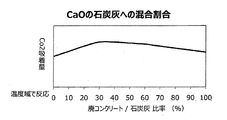
廃コンクリートと石炭灰との比率(廃コンクリート/石炭灰)に対するCO2吸着量を測定すると、図7に示されるようになり、比率が30~40%でCO2の吸着量はピークとなるが、この比率は焼結体として利用する場合に適した比率を必ずしも示すものではない。実際の廃コンクリートと石炭灰との比率は、使用用途に適した性能が得られる焼結体を形成する観点から決定される。
なお、上述した方法によって得られた二酸化炭素吸着焼結体に炭酸カルシウムが残留しているか(CaOに変化していないか)否かを確認するために、以下の実験を行った。
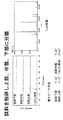
(1)焼結した石炭灰を異なる3つのエリア(上部、中部、下部)に分け、それぞれの試料を、乳鉢で粉砕して粉末にし、XRD分析を行った。
図8から分かるように、CaO単体のXRDと比較すると、資料のピークは、CaOのピークからは外れ、CaCO3のピークに近いことから、CaOになっている可能性は低く、CaCO3が残留していることが分かった。ただ、各試料は、CaCO3単体と比べて、最大ピーク角が変化しているので、なんらかの物質に変化している可能性がある。
(1)焼結した石炭灰を異なる3つのエリア(上部、中部、下部)に分け、それぞれの試料を、乳鉢で粉砕して粉末にし、XRD分析を行った。
図8から分かるように、CaO単体のXRDと比較すると、資料のピークは、CaOのピークからは外れ、CaCO3のピークに近いことから、CaOになっている可能性は低く、CaCO3が残留していることが分かった。ただ、各試料は、CaCO3単体と比べて、最大ピーク角が変化しているので、なんらかの物質に変化している可能性がある。
(2)炭酸カルシウムは、融点が825~898℃であり、この温度以上で酸化カルシウム(CaO)と二酸化炭素(CO2)に分解される。そこで、焼結した石炭灰を異なる3つのエリア(上部、中部、下部)に分けて加熱し、それぞれに対して加熱中に発生したガスを石炭水に通し、石炭水が白濁するか否かで二酸化炭素(CO2)の有無を確認した。その結果、加熱温度が高い中部および下部の試料で白濁が確認されたことから、焼結体に炭酸カルシウム(CaCO3)が残留していることが確認された。
したがって、上述した二酸化炭素吸着焼結体は、製造時に二酸化炭素の発生が抑制されるだけでなく、燃焼排ガス中の二酸化炭素を低減することが可能となる。
したがって、上述した二酸化炭素吸着焼結体は、製造時に二酸化炭素の発生が抑制されるだけでなく、燃焼排ガス中の二酸化炭素を低減することが可能となる。
以上の例では、マイクロ波により混合物を昇温させて焼結処理を施した後の降温時に燃焼排ガスを焼結体に吹き込んでCO2を焼結体に炭酸カルシウムとして固定したものであるが、図9に示されるように、マイクロ波による昇温工程(600)において、混合物に吹き込む燃焼排ガス中のCO2を炭酸カルシウムとして吸着残留させるようにしてもよい。
昇温時に吹き込む燃料排ガスは、混合物の昇温を促進することで焼結処理までの時間を短くすることが可能となるが、燃焼排ガス中のCO2が混合物に供給されるので、混合物にCO2が炭酸カルシムとして吸着される。しかしながら、マイクロ波を調整することなく混合物に照射すると、吸着されている炭酸カルシウムが、酸化カルシウムと二酸化炭素に分解されてCO2の吸着状態が解消される。そこで、この捕捉された炭酸カルシムをマイクロ波で直接加熱しないように、マイクロ波の電界、磁界、周波数を調節して、炭酸カルシウム以外を選択加熱して混合物を焼結させる。このような昇温手法を採用することで、昇温工程の300~800℃において廃コンクリートのCaOやCa(OH)2が二酸化炭素を炭酸カルシウムとして吸着した後は、マイクロ波の選択加熱により混合物を昇温させることで、内部に取り込まれた炭酸カルシウムを取り込まれたまま保持することが期待される。
昇温時に吹き込む燃料排ガスは、混合物の昇温を促進することで焼結処理までの時間を短くすることが可能となるが、燃焼排ガス中のCO2が混合物に供給されるので、混合物にCO2が炭酸カルシムとして吸着される。しかしながら、マイクロ波を調整することなく混合物に照射すると、吸着されている炭酸カルシウムが、酸化カルシウムと二酸化炭素に分解されてCO2の吸着状態が解消される。そこで、この捕捉された炭酸カルシムをマイクロ波で直接加熱しないように、マイクロ波の電界、磁界、周波数を調節して、炭酸カルシウム以外を選択加熱して混合物を焼結させる。このような昇温手法を採用することで、昇温工程の300~800℃において廃コンクリートのCaOやCa(OH)2が二酸化炭素を炭酸カルシウムとして吸着した後は、マイクロ波の選択加熱により混合物を昇温させることで、内部に取り込まれた炭酸カルシウムを取り込まれたまま保持することが期待される。
なお、添加するNaClについても、CO2(燃焼排ガス)を加えることで、Na2CO3(ソーダ灰)になるプロセスに類似しているので、Cl2(塩素ガス)の排気効率を高めることが期待される。
また、以上の構成においては、Ca源として廃コンクリート紛を用いた例について述べたが、Ca成分を豊富に含んでいる鉄鋼スラグ等を廃コンクリート紛の代わりに、又は、廃コンクリート紛と併せて用いるようにしてもよい。
また、以上の構成においては、Ca源として廃コンクリート紛を用いた例について述べたが、Ca成分を豊富に含んでいる鉄鋼スラグ等を廃コンクリート紛の代わりに、又は、廃コンクリート紛と併せて用いるようにしてもよい。
100 イグロス量調整工程
200 Ca源調整工程
300 Na源調整工程
400 混合工程
600 昇温工程
800 降温工程
200 Ca源調整工程
300 Na源調整工程
400 混合工程
600 昇温工程
800 降温工程
Claims (12)
- 石炭灰に対してCa源と必要に応じてNa源を混合させた混合物にマイクロ波を照射させて焼結温度以上に昇温させることで焼結させ、この混合物の焼結体を降温させる過程で前記焼結体に燃焼排ガスを吹き込むことで前記燃焼排ガス中の二酸化炭素を前記焼結体に吸着させたことを特徴とする二酸化炭素吸着焼結体の製造方法。
- 前記混合物を昇温させる過程で前記混合物に燃焼排ガスを吹き込むことを特徴とする請求項1記載の二酸化炭素吸着焼結体の製造方法。
- 石炭灰のイグロス量を調整するイグロス量調整工程と、
石炭灰に混合するCa源の混合量を調整するCa源調整工程と、
前記イグロス量調整工程によってイグロス量が調整された石炭灰及び前記カルシウム源調整工程によって混合量が調整されたカルシウム源を混合させる混合工程と、
前記混合工程によって混合された混合物にマイクロ波を照射して前記混合物を焼結温度以上に昇温させて焼結させる昇温工程と、
前記昇温工程によって得られた前記混合物の焼結体を降温させる過程において、前記焼結体に燃焼排ガスを吹き込む降温工程と、
を有することを特徴とする二酸化炭素吸着焼結体の製造方法。 - 前記石炭灰に混合させるNa源の混合量を調整するNa源調整工程をさらに含み、
前記混合工程は、前記イグロス量調整工程によってイグロス量が調整された石炭灰及び前記Ca源調整工程によって混合量が調整されたCa源に加え、前記Na源調整工程によって混合量が調整されたNa源を混合させるものであることを特徴とする請求項3に記載の二酸化炭素吸着焼結体の製造方法。 - 前記昇温工程においても、前記混合物に前記燃焼排ガスを吹き込むことを特徴とする請求項3又は4に記載の二酸化炭素吸着焼結体の製造方法。
- 前記マイクロ波による加熱は、生成される炭酸カルシウムを避けて加熱する選択加熱が行われることを特徴とする請求項2又は5記載の二酸化炭素吸着焼結体の製造方法。
- イグロス量調整工程は、発電所毎に生じるイグロス量の異なる石炭灰を混合させることによって石炭灰のイグロス量を調整することを特徴とする請求項3乃至5のいずれかに記載の二酸化炭素吸着焼結体の製造方法。
- 前記石炭灰と前記Ca源との混合割合は、重量比で9:1~7:3に設定されることを特徴とする請求項1乃至7のいずれかに記載の二酸化炭素吸着焼結体の製造方法。
- 前記Ca源としては、コンクリート廃棄物若しくは鉄鋼スラグであることを特徴とする請求項1乃至8のいずれかに記載の二酸化炭素吸着焼結体の製造方法。
- 前記Na源としては、水酸化ナトリウム溶液若しくは塩化ナトリウム溶液であること、又は、前記塩化ナトリウム溶液の代わりとして海水を用いることを特徴とする請求項1乃至9のいずれかに記載の二酸化炭素吸着焼結体の製造方法。
- 前記石炭灰は、フライアッシュであることを特徴とする請求項1乃至10のいずれかに記載の二酸化炭素吸着焼結体の製造方法。
- 請求項1乃至11のいずれかに記載の二酸化炭素吸着焼結体の製造方法によって製造されたことを特徴とする二酸化炭素吸着焼結体。
Priority Applications (2)
| Application Number | Priority Date | Filing Date | Title |
|---|---|---|---|
| PCT/JP2020/011646 WO2021186531A1 (ja) | 2020-03-17 | 2020-03-17 | 二酸化炭素吸着焼結体の製造方法、及び、二酸化炭素吸着焼結体 |
| JP2020540513A JP6833123B1 (ja) | 2020-03-17 | 2020-03-17 | 二酸化炭素吸着焼結体の製造方法 |
Applications Claiming Priority (1)
| Application Number | Priority Date | Filing Date | Title |
|---|---|---|---|
| PCT/JP2020/011646 WO2021186531A1 (ja) | 2020-03-17 | 2020-03-17 | 二酸化炭素吸着焼結体の製造方法、及び、二酸化炭素吸着焼結体 |
Publications (1)
| Publication Number | Publication Date |
|---|---|
| WO2021186531A1 true WO2021186531A1 (ja) | 2021-09-23 |
Family
ID=74665106
Family Applications (1)
| Application Number | Title | Priority Date | Filing Date |
|---|---|---|---|
| PCT/JP2020/011646 Ceased WO2021186531A1 (ja) | 2020-03-17 | 2020-03-17 | 二酸化炭素吸着焼結体の製造方法、及び、二酸化炭素吸着焼結体 |
Country Status (2)
| Country | Link |
|---|---|
| JP (1) | JP6833123B1 (ja) |
| WO (1) | WO2021186531A1 (ja) |
Cited By (1)
| Publication number | Priority date | Publication date | Assignee | Title |
|---|---|---|---|---|
| CN114213146A (zh) * | 2022-01-18 | 2022-03-22 | 中国建筑材料工业地质勘查中心宁夏总队 | 一种采用煤泥作为原料制备吸附co2用路面铺设绿色建筑材料关键技术 |
Families Citing this family (3)
| Publication number | Priority date | Publication date | Assignee | Title |
|---|---|---|---|---|
| JP7726685B2 (ja) * | 2021-07-21 | 2025-08-20 | 中国電力株式会社 | 廃棄副産物焼結体の製造方法 |
| JP2024044450A (ja) * | 2022-09-21 | 2024-04-02 | 中国電力株式会社 | 二酸化炭素吸収焼結体の製造方法 |
| CN117865575A (zh) * | 2024-01-04 | 2024-04-12 | 河南理工大学 | 一种加气混凝土砌块及其制备方法和应用 |
Citations (3)
| Publication number | Priority date | Publication date | Assignee | Title |
|---|---|---|---|---|
| JP2005060741A (ja) * | 2003-08-19 | 2005-03-10 | Nippon Steel Corp | 製鋼スラグの改質方法 |
| JP2006219348A (ja) * | 2005-02-10 | 2006-08-24 | Ube Ind Ltd | 水硬性焼結物、セメント組成物、及び水硬性焼結物の製造方法 |
| JP2006255705A (ja) * | 2006-06-19 | 2006-09-28 | Jfe Steel Kk | 炭酸固化体の製造方法 |
-
2020
- 2020-03-17 JP JP2020540513A patent/JP6833123B1/ja active Active
- 2020-03-17 WO PCT/JP2020/011646 patent/WO2021186531A1/ja not_active Ceased
Patent Citations (3)
| Publication number | Priority date | Publication date | Assignee | Title |
|---|---|---|---|---|
| JP2005060741A (ja) * | 2003-08-19 | 2005-03-10 | Nippon Steel Corp | 製鋼スラグの改質方法 |
| JP2006219348A (ja) * | 2005-02-10 | 2006-08-24 | Ube Ind Ltd | 水硬性焼結物、セメント組成物、及び水硬性焼結物の製造方法 |
| JP2006255705A (ja) * | 2006-06-19 | 2006-09-28 | Jfe Steel Kk | 炭酸固化体の製造方法 |
Cited By (2)
| Publication number | Priority date | Publication date | Assignee | Title |
|---|---|---|---|---|
| CN114213146A (zh) * | 2022-01-18 | 2022-03-22 | 中国建筑材料工业地质勘查中心宁夏总队 | 一种采用煤泥作为原料制备吸附co2用路面铺设绿色建筑材料关键技术 |
| CN114213146B (zh) * | 2022-01-18 | 2023-08-11 | 中国建筑材料工业地质勘查中心宁夏总队 | 一种采用煤泥作为原料制备吸附co2用路面铺设绿色建筑材料的制备方法 |
Also Published As
| Publication number | Publication date |
|---|---|
| JPWO2021186531A1 (ja) | 2021-09-23 |
| JP6833123B1 (ja) | 2021-02-24 |
Similar Documents
| Publication | Publication Date | Title |
|---|---|---|
| JP6833123B1 (ja) | 二酸化炭素吸着焼結体の製造方法 | |
| JP7365360B2 (ja) | 固体複合体の製造方法 | |
| Fernandes et al. | Physical, chemical and electric characterization of thermally treated rice husk ash and its potential application as ceramic raw material | |
| Ganesh et al. | Microwave assisted solid state reaction synthesis of MgAl2O4 spinel powders | |
| Pa et al. | Palm ash as an alternative source for silica production | |
| Wei et al. | Effect of waste glass addition on lightweight aggregates prepared from F-class coal fly ash | |
| KR102107600B1 (ko) | 초임계 유동층 보일러 플라이애시를 이용한 파일충전재 조성물 및 그 파일충전재의 제조방법 | |
| CN107057705B (zh) | 一种重金属污染土壤修复材料、制备方法和用途 | |
| Behnami et al. | Synthesis of WC powder through microwave heating of WO3–C mixture | |
| Huang et al. | Thermal plasma vitrification of MSWI fly ash mixed with different biomass ashes | |
| Hwang et al. | Calcination of mega-crystalline calcite using microwave and electric furnaces | |
| KR102510079B1 (ko) | 연소재를 이용한 복합탄산염의 제조방법 | |
| KR102113779B1 (ko) | 알루미늄 드로스의 처리방법 | |
| JP2012131702A (ja) | セラミック多孔質体の製造方法 | |
| JP2018162185A (ja) | 酸化マグネシウム粉末およびその製造方法 | |
| JPH08333119A (ja) | タングステン−銅複合酸化物の製造方法 | |
| Chiang et al. | Novel lightweight building bricks manufactured from water treatment plant sludge and agricultural waste | |
| JP7698592B2 (ja) | 生石灰の製造方法 | |
| JP2013184843A (ja) | セメントクリンカの製造方法 | |
| Huang et al. | Preparation, Microstructure, and Mechanical Properties of Spinel‐Corundum‐Sialon Composite Materials from Waste Fly Ash and Aluminum Dross | |
| JP2024044460A (ja) | 二酸化炭素吸収焼結体の製造方法 | |
| Zhenzhurist | The microwave electromagnetic field is the basis for environmentally friendly technologies for energy generation and production of firing material | |
| US11465902B2 (en) | Method for producing hydrogen gas | |
| KR101517099B1 (ko) | 제강 슬래그를 이용한 시멘트 원료 제조 방법 | |
| Huang et al. | Kinetic characteristics of lightweight aggregates obtained from dredged sediment |
Legal Events
| Date | Code | Title | Description |
|---|---|---|---|
| ENP | Entry into the national phase |
Ref document number: 2020540513 Country of ref document: JP Kind code of ref document: A |
|
| 121 | Ep: the epo has been informed by wipo that ep was designated in this application |
Ref document number: 20926176 Country of ref document: EP Kind code of ref document: A1 |
|
| NENP | Non-entry into the national phase |
Ref country code: DE |
|
| 122 | Ep: pct application non-entry in european phase |
Ref document number: 20926176 Country of ref document: EP Kind code of ref document: A1 |