WO2021182330A1 - 抗がん剤効果を増強するがん治療補助剤 - Google Patents
抗がん剤効果を増強するがん治療補助剤 Download PDFInfo
- Publication number
- WO2021182330A1 WO2021182330A1 PCT/JP2021/008704 JP2021008704W WO2021182330A1 WO 2021182330 A1 WO2021182330 A1 WO 2021182330A1 JP 2021008704 W JP2021008704 W JP 2021008704W WO 2021182330 A1 WO2021182330 A1 WO 2021182330A1
- Authority
- WO
- WIPO (PCT)
- Prior art keywords
- cancer
- polysulfide
- drug
- anticancer drug
- ambroxol
- Prior art date
- Legal status (The legal status is an assumption and is not a legal conclusion. Google has not performed a legal analysis and makes no representation as to the accuracy of the status listed.)
- Ceased
Links
Images

Classifications
-
- A—HUMAN NECESSITIES
- A61—MEDICAL OR VETERINARY SCIENCE; HYGIENE
- A61K—PREPARATIONS FOR MEDICAL, DENTAL OR TOILETRY PURPOSES
- A61K31/00—Medicinal preparations containing organic active ingredients
- A61K31/13—Amines
- A61K31/135—Amines having aromatic rings, e.g. ketamine, nortriptyline
- A61K31/137—Arylalkylamines, e.g. amphetamine, epinephrine, salbutamol, ephedrine or methadone
-
- A—HUMAN NECESSITIES
- A61—MEDICAL OR VETERINARY SCIENCE; HYGIENE
- A61K—PREPARATIONS FOR MEDICAL, DENTAL OR TOILETRY PURPOSES
- A61K31/00—Medicinal preparations containing organic active ingredients
- A61K31/33—Heterocyclic compounds
- A61K31/395—Heterocyclic compounds having nitrogen as a ring hetero atom, e.g. guanethidine or rifamycins
- A61K31/435—Heterocyclic compounds having nitrogen as a ring hetero atom, e.g. guanethidine or rifamycins having six-membered rings with one nitrogen as the only ring hetero atom
- A61K31/47—Quinolines; Isoquinolines
- A61K31/4738—Quinolines; Isoquinolines ortho- or peri-condensed with heterocyclic ring systems
- A61K31/4745—Quinolines; Isoquinolines ortho- or peri-condensed with heterocyclic ring systems condensed with ring systems having nitrogen as a ring hetero atom, e.g. phenantrolines
-
- A—HUMAN NECESSITIES
- A61—MEDICAL OR VETERINARY SCIENCE; HYGIENE
- A61K—PREPARATIONS FOR MEDICAL, DENTAL OR TOILETRY PURPOSES
- A61K31/00—Medicinal preparations containing organic active ingredients
- A61K31/66—Phosphorus compounds
- A61K31/675—Phosphorus compounds having nitrogen as a ring hetero atom, e.g. pyridoxal phosphate
-
- A—HUMAN NECESSITIES
- A61—MEDICAL OR VETERINARY SCIENCE; HYGIENE
- A61K—PREPARATIONS FOR MEDICAL, DENTAL OR TOILETRY PURPOSES
- A61K33/00—Medicinal preparations containing inorganic active ingredients
- A61K33/24—Heavy metals; Compounds thereof
- A61K33/243—Platinum; Compounds thereof
-
- A—HUMAN NECESSITIES
- A61—MEDICAL OR VETERINARY SCIENCE; HYGIENE
- A61K—PREPARATIONS FOR MEDICAL, DENTAL OR TOILETRY PURPOSES
- A61K45/00—Medicinal preparations containing active ingredients not provided for in groups A61K31/00 - A61K41/00
-
- A—HUMAN NECESSITIES
- A61—MEDICAL OR VETERINARY SCIENCE; HYGIENE
- A61P—SPECIFIC THERAPEUTIC ACTIVITY OF CHEMICAL COMPOUNDS OR MEDICINAL PREPARATIONS
- A61P35/00—Antineoplastic agents
-
- A—HUMAN NECESSITIES
- A61—MEDICAL OR VETERINARY SCIENCE; HYGIENE
- A61P—SPECIFIC THERAPEUTIC ACTIVITY OF CHEMICAL COMPOUNDS OR MEDICINAL PREPARATIONS
- A61P43/00—Drugs for specific purposes, not provided for in groups A61P1/00-A61P41/00
Definitions
- the present invention relates to a cancer treatment aid that enhances the effect of an anticancer drug on chemotherapeutic drug-resistant cancers and the like.
- Non-Patent Document 1 In the treatment of lung cancer, it has been shown that administration of a high concentration of ambroxol as a single agent improved the results regarding the occurrence of postoperative pulmonary complications and the administration period of antibiotics (Non-Patent Document 1). ), And it has been shown that the effect of the anticancer drug was enhanced by the combined use of paclitaxel, which is a taxane-based anticancer drug, and ambroxol (Non-Patent Document 2). However, in Cited Documents 1 and 2, ambroxol is not used for the purpose of acting on the anticancer drug itself to enhance the effect of the anticancer drug, and ambroxol is actually used as an anticancer drug. It was not clear if it would act on the cancer drug itself. On the other hand, these documents show that the expectorant action of ambroxol suppressed the physical symptoms caused by lung cancer, thereby suppressing the exacerbation of lung cancer.
- ambroxol When ambroxol was administered in vitro to a drug-resistant ovarian cancer cell line together with cisplatin, the rate of cell death of cancer cells increased compared to cisplatin alone, and ambroxol was an anticancer drug for cisplatin. The result was that the effect was enhanced. Furthermore, when ambroxol and cisplatin were co-administered to tumorigenesis model mice in vivo, tumor growth was suppressed as compared with cisplatin alone, and ambroxol had an anticancer drug effect by cisplatin, that is, a tumor retraction effect. The result was that it was enhanced. Based on the above findings, the present inventors have completed the invention.
- a cancer treatment aid other than lung cancer which contains a polysulfide remover as an active ingredient and is used in combination with a DNA intercalator type anticancer agent.
- the cancer treatment aid according to [8], wherein the anticancer drug resistance is resistance to a platinum preparation.
- a drug for treating cancer other than lung cancer which comprises a polysulfide remover and a DNA intercalator type anticancer agent.
- Drugs for cancer treatment [18] The cancer therapeutic agent according to any one of [11] to [17], wherein the cancer is an anticancer drug resistant cancer.
- cancers that show drug resistance to platinum preparations have been confirmed in many cancer types such as uterine cancer, lung cancer, and stomach cancer, in addition to ovarian cancer.
- a polysulfide remover such as ambroxol
- a DNA intercalator-type anticancer drug such as a platinum preparation
- anticancer drugs can be treated against these drug-resistant cancers for which the anticancer drug effect has not been confirmed so far.
- the effect of the drug can be expected, and drug-resistant cancer, for which treatment options have been limited to surgical radical surgery, can now be selected as a combination treatment with chemotherapy, reducing the physical and mental burden on the patient. Can lead to.
- ambroxol is a drug that has already been approved as an expectorant, it is considered that there are few obstacles to expanding its indication as a combination drug for anticancer drugs.
- a is an HE-stained photograph of a CCC tissue section
- b is a photograph of SERS imaging of a Raman shift 480 cm -1 of a CCC tissue section.
- the black annotation indicates the cancer cell cluster part (hereinafter, also simply referred to as the cancer part)
- the white annotation indicates the cancer stromal cell cluster part (hereinafter, also simply referred to as the cancer stromal part). ..
- This pathological annotation was made by a pathologist. After performing SERS imaging, the sections were used for HE staining. In the figure, the length of the bar is 1 mm.
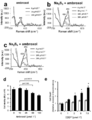
- a represents a spectral diagram of ambroxol itself, but there is no clear peak at positions other than Ramanshift 396 cm -1.
- bc is a spectrum diagram when ambroxol is added to polysulfides (Na 2 S 3 and Na 2 S 4 respectively).
- d indicates the effect on the survival rate of OVISE cells (cell line derived from clear cell adenocarcinoma of human ovary) as the concentration of ambroxol added increases.
- e is a diagram showing the effect of addition of 25 ⁇ mol / L ambroxol (black bar graph) on cisplatin-induced cell death of OVISE cells. Cell death was assessed by the Annexin V transfer assay. Luminescence intensity was standardized in cells to which cisplatin (indicated by CDDP in the figure) was not added. In one-way ANOVA with Fisher's LSD test, a P-value of less than 0.05 was considered to be statistically significant.
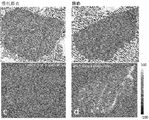
- b is an HE-stained photographic diagram of a pancreatic cancer tissue section
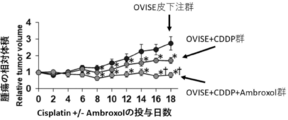
- d is a photographic diagram of SERS imaging of a Raman shift 480 cm -1 of a pancreatic cancer tissue section. After each SERS imaging was performed, the sections were used for HE staining. It is a figure which shows the enhancement of the anticancer agent effect of cisplatin by ambroxol in vivo in the tumor formation model mouse which subcutaneously transplanted OVISE cells.
- daily intraperitoneal administration of cisplatin from Day 0 to 10 mg / kg / day
- daily administration of ambroxol from Day 0 to 100 mg / kg / day (in the figure, shown by OVISE + CDDP).
- N 8
- N indicates a significant difference P ⁇ 0.05 with respect to the OVISE group
- ⁇ indicates a significant difference P ⁇ 0.05 with respect to the OVISE + CDDP group.
- the present invention is a cancer treatment auxiliary agent other than lung cancer (hereinafter, also simply referred to as an auxiliary agent), which contains a polysulfide remover as an active ingredient and is used in combination with a DNA intercalator type anticancer agent.
- an auxiliary agent which contains a polysulfide remover as an active ingredient and is used in combination with a DNA intercalator type anticancer agent.
- the polysulfide is a polymer containing one or more disulfide bonds or a salt thereof, and is a compound represented by the chemical formula of RS x R.
- R is, for example, an alkyl group that may be substituted with H, Na or any substituent, and is preferably Na.
- x is an arbitrary integer of 2 or more, but x is preferably an integer of 2 to 4.
- the polysulfide is not particularly limited, but when R is Na, it is preferably Na 2 S 2 , Na 2 S 3 or Na 2 S 4 .
- the polysulfide remover is an agent that binds to polysulfide and decomposes and eliminates polysulfide when administered to a subject, and reduces the amount of polysulfide expressed in the subject to which the agent is administered. Refers to what you want to do.
- the polysulfide remover is not particularly limited as long as it has a polysulfide remover action, but the polysulfide remover is preferably a sputum remover, and the sputum remover is preferably ambroxol.
- the polysulfide remover may be any pharmacologically acceptable salt, for example, a hydrochloride or the like.
- the DNA intercalator type anticancer agent is an agent that is inserted between the bases of the double-stranded structure of DNA and causes a structural change of DNA to inhibit DNA supercoyling.
- the DNA intercalator type anticancer agent is not particularly limited, and examples thereof include a platinum preparation, cyclophosphamide, and irinotecan.
- the platinum preparation is not particularly limited, and examples thereof include cisplatin, carboplatin, and oxaliplatin, and cisplatin is preferable.
- the DNA intercalator type anticancer agent may be any pharmacologically acceptable salt or may be a hydrate.
- the cancer to be treated is preferably a cancer having a high level of polysulfide as compared with the level of polysulfide in a non-cancer control tissue, and may be an anticancer drug-resistant cancer. ..
- the anticancer drug-resistant cancer is preferably a cancer having resistance to a platinum preparation.
- Anti-cancer drug resistance is defined not only when the effect of the anti-cancer drug is not obtained at all, but also when the therapeutic effect of the anti-cancer drug is weak and the therapeutic effect cannot be sufficiently obtained, or when the anti-cancer drug is used. It refers to the case where the effect is temporary but recurs soon afterwards.
- the cancer to be treated may be a cancer other than lung cancer, and specific examples thereof include ovarian cancer, pancreatic cancer, breast cancer, and glioma, and the ovary is preferable. Cancer or pancreatic cancer.
- the ovarian cancer is preferably clear cell cancer of the ovary.
- the method for measuring the level of polysulfide is not particularly limited, but can be measured by, for example, Raman spectroscopy or an electrochemical measurement method as described in Non-Patent Document 2. It is preferable to measure by Raman spectroscopy, and it is known to those skilled in the art that there are a plurality of methods as Raman spectroscopy, but the present invention is not particularly limited, and for example, conventional resonance Raman spectroscopy or surface-enhanced Raman spectroscopy.
- the method (SERS) can be used. In Raman spectroscopy, due to the characteristics of the measurement method, a specific peak on the Raman shift shifts by several cm-1 for each measurement.
- Shift of the peak in each the measurement since it is within often ⁇ 10 cm -1, in the case of Raman shift within ⁇ 10 cm -1 from the peak position, denote the same signals.
- the specific peak representing polysulfide is shifted depending on the measurement target and is not particularly limited. For example, when the cancer tissue is measured as the measurement target, the peak is at the position of Raman shift 480 ⁇ 10 cm -1. Appears, and when the solution is measured as the measurement target, a peak appears at the position of Raman shift 460 ⁇ 10 cm -1.
- the level of polysulfide represents the height of a specific peak representing polysulfide when the Raman analysis method is used, but when other measurement methods are used, the measured value of the amount of polysulfide in the cancer tissue, It may represent a correction value obtained by correcting an actually measured value with a control measurement value or the like, or an index value.
- High levels of polysulfide mean that the levels of polysulfide in the cancerous tissue are higher than the levels of polysulfide in the control tissue. Statistically significant differences are preferred, but not necessarily significant.
- the control tissue is, for example, the normal tissue of the corresponding part in a healthy person or the cancer tissue of the corresponding part in another cancer patient having cancer in the corresponding tissue.
- the content of the polysulfide remover in an adjunct or a cancer therapeutic drug described below is not particularly limited as long as the anticancer drug effect of the anticancer drug can be enhanced by the combined use.
- it may be 5 to 50 nmol / g, 10 to 40 nmol / g, 15 to 35 nmol / g, or 20 to 30 nmol / g.
- the auxiliary agent or the drug is a liquid agent, for example, it may be 5 to 50 ⁇ mol / L, 10 to 40 ⁇ mol / L, 15 to 35 ⁇ mol / L, or 20 to 30 ⁇ mol / L.
- the content in the auxiliary agent or pharmaceutical is preferably 5 to 50 nmol / g, more preferably 10 to 40 nmol / g, further preferably 15 to 35 nmol / g, and 20 to 35 nmol / g. 30 nmol / g is more preferable.
- the auxiliary agent or the drug is a liquid agent, it is preferably 5 to 50 ⁇ mol / L, more preferably 10 to 40 ⁇ mol / L, further preferably 15 to 35 ⁇ mol / L, and even more preferably 20 to 30 ⁇ mol / L.
- the content of the DNA intercalator type anticancer agent in the auxiliary agent or the drug is not particularly limited, but may be, for example, 1 to 10 nmol / g or 2 to 5 nmol / g.
- the auxiliary agent or the drug is a liquid agent, for example, it may be 1 to 10 ⁇ mol / L or 2 to 5 ⁇ mol / L.
- cisplatin is used as a DNA intercalator-type anticancer agent
- its content in an adjunct or drug is preferably 1 to 10 nmol / g, and more preferably 2 to 5 nmol / g.
- the auxiliary agent or the drug is a liquid agent, it is preferably 1 to 10 ⁇ mol / L, and more preferably 2 to 5 ⁇ mol / L.
- the dose of the polysulfide remover is not particularly limited as long as the anticancer drug effect of the anticancer drug can be enhanced by the combined use, and is appropriately selected depending on the age, sex, weight, symptoms, type of cancer, etc. of the patient. , It is preferable that the amount of the polysulfide remover does not cause toxicity or is less toxic when administered to the subject alone. Specifically, for example, in the case of a normal adult, the body weight can be 1 to 100 mg / 60 kg per day. This dose of the polysulfide remover may be administered in a single dose or in multiple doses. For example, when ambroxol hydrochloride is used, 15 mg / 60 kg body weight may be administered 3 times a day.
- the dose of the DNA intercalator type anticancer drug is not particularly limited as long as it is within the range normally used for the cancer to be treated as an anticancer drug, and the patient's age, sex, weight, symptoms, and so on. It is appropriately selected depending on the type of cancer and the like, but it may be less than the range of the normally used dose depending on the dose of the polysulfide remover. Specifically, for example, it can be 1 to 500 mg / m 2 (body surface area) per day.
- This dose of the DNA intercalator type anticancer agent may be administered once or may be administered in a plurality of doses.
- cisplatin 50 to 70 mg / m 2 (body surface area) may be administered once a day, and 15 to 20 mg / m 2 (body surface area) once a day for 5 consecutive days. It may be administered.
- carboplatin 300 to 400 mg / m 2 (body surface area) may be administered once a day.
- the molar ratio of these two agents is not particularly limited as long as the above-mentioned dose is followed and the anticancer agent effect is enhanced by the combined use of the polysulfide remover and the DNA intercalator type anticancer agent.
- the auxiliary agent or medicine of the present invention includes excipients, binders, disintegrants, lubricants, and stabilizers usually used for formulation. It can contain components such as an agent, a flavoring agent, a flavoring agent, a pH adjuster, and a coloring agent.
- the auxiliary agent or medicine of the present invention can be appropriately formulated into a desired dosage form according to the administration method.
- a desired dosage form for example, in the case of oral administration, it can be formulated into a solid preparation such as a powder, a granule, a tablet or a capsule; a liquid preparation such as a solution, a syrup, a suspension or an emulsion.
- parenteral administration it can be formulated into an injection, a liquid, a suspension or the like.
- the combined use may be administered to the subject at the same time, or the other agent may be administered to the subject after a certain period of time after the administration of one agent.
- the fixed time is 5 minutes, 10 minutes, 15 minutes, 20 minutes, 30 minutes, 1 hour, 2 hours, 3 hours, 4 hours, 5 hours, 6 hours, 7 hours, 8 hours, 9 hours, 10 hours.
- the administration method is not particularly limited as long as the anticancer agent enhancing effect of the present invention can be obtained, and a method usually used by those skilled in the art when administering these agents to a therapeutic subject may be used.
- the administration method may be a method suitable for each agent, and each agent can be administered by a different method.
- oral administration or parenteral administration may be used, and in the case of parenteral administration, intravenous drip infusion may be mentioned.
- auxiliary agent or medicine of the present invention may be further used in combination with other agents, medicines, etc., or may be used in combination with other therapeutic methods.
- Another embodiment of the present invention is a drug for treating cancer other than lung cancer, which comprises a polysulfide remover and a DNA intercalator type anticancer agent.
- the drug of the present embodiment may be a single drug formulated by containing a polysulfide remover and a DNA intercalator type anticancer agent in a single drug, or a polysulfide remover and a DNA intercalator type. It may be a concomitant drug in which the anticancer drug is formulated as a separate drug.
- the types of the polysulfide remover, the types of the DNA intercalator type anticancer agent, their contents, the dose of the drug, the administration method, the type of the target cancer, etc. are described above. As described in the section on cancer treatment aids.
- SERS Surface-enhanced Raman spectroscopy
- the Al film was boiled in hot water (100 ° C.) for 15 minutes to form boehmite (AlO (OH)) and dried with nitrogen gas.
- gold (Au) was vapor-deposited by an electron beam vapor deposition system (EBX-8C, ULVAC) at a vapor deposition angle of 80 °.
- EBX-8C, ULVAC electron beam vapor deposition system
- a random sequence of broad bean-type Au nanoparticles named Gold-nanofeve (GNF) was constructed on the substrate.
- the use of this substrate creates electromagnetic hotspots as excitation sources in surface-enhanced Raman spectroscopy (SERS) analysis and provides a wide range of molecular vibrations of metabolites in tissue sections with sufficient sensitivity and uniformity. It can be visualized.
- SERS surface-enhanced Raman spectroscopy
- the sensitivity and frequency of this microscope system was calibrated with a Raman shift 520 cm -1 in silicon phonon mode before making SERS measurements.
- the background noise of the SERS signal was subtracted from the measured spectrum by performing a weighted average fitting with the second function of Lanczos.
- OVISE cells were obtained from ATCC. OVISE cells were seeded on a 96-well plate (Thermo Fisher) at a cell concentration of 3 ⁇ 10 3 cells / well. Adherent cells (50-60% confluent) were treated with 25 ⁇ mol / L ambroxol hydrochloride (A9797, Sigma) and CDDP (cis-diammineplatinum (II) dichloride; SIGMA, P4394) for 48 hours. Apoptosis was assessed using the Realtime-Glo Annexin V Apoptosis Assay Kit (Promega, JA1000) as directed by the manufacturer. A reagent for detection was added 4 hours before the measurement. Luminescence was measured using a SpectraMAX L microplate reader (Molecular Devices, Sunnyvale, CA).
- Example 1 SERS imaging of ovarian cancer tissue
- CCC cancer ovarian cell cancer
- HE staining was performed using the same section by a method known to those skilled in the art.
- the range of Raman shift 480 ⁇ 10 cm -1 was set as the same signal.
- Example 2 Ambroxol promotes cell death of OVISE cells by cisplatin by degrading polysulfide
- a compound that decomposes endogenous polysulfide is an adjuvant reagent that promotes cisplatin-induced cell death of ovarian cancer cells. I hypothesized that it could be useful as a cell death.
- ambroxol an expectorant that cleaves mucin disulfide bonds, acts on polysulfides.
- Example 3 SERS imaging of pancreatic cancer tissue
- the present inventors performed SERS imaging and HE staining using the pancreatic cancer tissue in the same manner as in the method of Example 1.
- SERS imaging the range of Raman shift 480 ⁇ 10 cm -1 was set as the same signal.
- pancreatic cancer also shows a strong SERS signal at 480 ⁇ 10 cm -1 over the entire cancer tissue (FIGS. 3b and d).
- the results of SERS imaging of chronic pancreatitis as a control are also shown (FIGS. 3a and 3c).
- the anticancer drug can be used in combination with the anticancer drug as in the case of ovarian cancer. It was suggested that the effect of the anticancer drug possessed could be enhanced.
- Example 4 In vivo, ambroxol enhances the anticancer drug effect of cisplatin in in vivo, nude mice were used.
- a tumorigenesis model mouse for clear cell adenocarcinoma of the ovary was prepared by subcutaneously transplanting OVISE cells into this nude mouse purchased from Japan Marie Co., Ltd. (8 to 10 weeks old, female). Specifically, it was prepared by injecting 2 ⁇ 10 6 OVISE cells subcutaneously into mice. The patient was followed up for 10 days after the subcutaneous transplantation and set to Day 0.
- Tumor formation model mice were administered to the following three groups: (1) cisplatin and ambroxol unadministered group; (2) day 0 to 10 mg / kg / day cisplatin alone peritoneally administered daily; and (3) from Day 0.
- the group was divided into groups in which 10 mg / kg / day of cisplatin was administered daily peritoneally and ambroxol of Day 0 to 100 mg / kg / day was administered daily.
- Tumor volume in each group was measured every 2 days. The tumor volume was calculated by the formula of LS 2 with the major axis of the tumor as L and the width as S. The average tumor volume of each group on Day 0 was set to 1 and shown as a relative value (Mean ⁇ standard error).
- the relative volume of the tumor increased significantly with the passage of days in the cisplatin and ambroxol non-administered group, and the relative tumor volume increased in the cisplatin alone-administered group as compared with the cisplatin and ambroxol unadministered group.
- the relative volume of the tumor increased with the passage of days.
- the cisplatin and ambroxol combination group no increase in the relative volume of the tumor was observed even after the lapse of days (Fig. 4). From the above, it was clarified that ambroxol enhances the anticancer drug effect of cisplatin, that is, the tumor regression effect, even in tumorigenesis model mice in which OVISE cells are subcutaneously transplanted into nude mice.
Landscapes
- Health & Medical Sciences (AREA)
- Pharmacology & Pharmacy (AREA)
- Veterinary Medicine (AREA)
- Chemical & Material Sciences (AREA)
- Public Health (AREA)
- General Health & Medical Sciences (AREA)
- Medicinal Chemistry (AREA)
- Animal Behavior & Ethology (AREA)
- Life Sciences & Earth Sciences (AREA)
- Epidemiology (AREA)
- Organic Chemistry (AREA)
- Nuclear Medicine, Radiotherapy & Molecular Imaging (AREA)
- General Chemical & Material Sciences (AREA)
- Chemical Kinetics & Catalysis (AREA)
- Bioinformatics & Cheminformatics (AREA)
- Engineering & Computer Science (AREA)
- Inorganic Chemistry (AREA)
- Emergency Medicine (AREA)
- Pharmaceuticals Containing Other Organic And Inorganic Compounds (AREA)
- Medicines That Contain Protein Lipid Enzymes And Other Medicines (AREA)
- Acyclic And Carbocyclic Compounds In Medicinal Compositions (AREA)
Abstract
アンブロキソールを、シスプラチンとともに薬剤耐性卵巣がん細胞株にin vitroで投与したところ、シスプラチン単独投与に比べてがん細胞の細胞死の割合が増加し、アンブロキソールがシスプラチンの抗がん剤効果を増強することを明らかにした結果、抗がん剤の抗がん剤効果を増強し、抗がん剤耐性となった癌へも抗がん剤の効果を増強するがん治療補助剤を見出した。
Description
本発明は、化学療法薬剤耐性がんなどに対し抗がん剤効果を増強するがん治療補助剤に関する。
従来技術では、強力な抗がん剤耐性能を有するがんに対する治療としては、外科的手術による可能な限りがんを完全切除することや放射線療法を行うことが必須であり、患者への身体的かつ精神的な負担が大きかった。また、そのような患者負担の大きな治療を行った場合でも、がんが再発することが多く、抗がん剤耐性能を有するがんを治療することは困難であった。一方で、抗がん剤による抗がん効果が得られるがんについては、拡大手術を施行せずに、抗がん剤の使用による治療が期待出来る。
ここで、肺がんの治療において、高濃度のアンブロキソールを単剤投与することで手術後の肺合併症の発生や抗生物質投与期間に関する成績が向上したことが示されており(非特許文献1)、またタキサン系抗がん剤であるパクリタキセルとアンブロキソールを併用することにより抗がん剤の効果が増強されたことが示されている(非特許文献2)。しかしながら、引用文献1及び2においては、アンブロキソールは、抗がん剤自体に作用して抗がん剤の効果を増強することを目的として使用されておらず、実際にアンブロキソールが抗がん剤自体に作用するかは明らかになっていなかった。一方で、これらの文献においては、アンブロキソールの去痰作用によって、肺がんに起因する身体症状が抑制されたことによって、肺がんの悪化が抑制されたことが示されている。
Cell Biochem Biophys., 2015, 73(2), 281-284
Am J Cancer Res., 2017, 7(12), 2406-2421
Nature Communications, 2018, 9, Article number:1561
すなわち、本発明は抗がん剤の抗がん剤効果を増強し、抗がん剤耐性となった癌へも抗がん剤の効果を増強するがん治療補助剤を提供することを課題とする。
これまでに本発明者等は、シスプラチン等の白金製剤に対して薬剤耐性を示す卵巣がん組織においてはポリスルフィドの発現量が増加していることを見出し、シスプラチンがポリスルフィドと直接反応することにより構造変化を起こし、シスプラチンが活性を失うことを見出した(特願2019-162162)。
ここで、アンブロキソールは、ムチンのジスルフィド結合を切断することによって、痰の粘性を抑制する効果を有する去痰剤の1つである。
アンブロキソールを、シスプラチンとともに薬剤耐性卵巣がん細胞株にin vitroで投与したところ、シスプラチン単独投与に比べてがん細胞の細胞死の割合が増加し、アンブロキソールがシスプラチンの抗がん剤効果を増強するという結果が得られた。さらに、in vivoにおいて、腫瘍形成モデルマウスにアンブロキソール及びシスプラチンを併用投与したところ、シスプラチン単独投与に比べて腫瘍増殖が抑えられ、アンブロキソールはシスプラチンによる抗がん剤効果、すなわち腫瘍退縮効果を増強するという結果が得られた。
以上のような知見に基づき、本発明者らは発明を完成させた。
ここで、アンブロキソールは、ムチンのジスルフィド結合を切断することによって、痰の粘性を抑制する効果を有する去痰剤の1つである。
アンブロキソールを、シスプラチンとともに薬剤耐性卵巣がん細胞株にin vitroで投与したところ、シスプラチン単独投与に比べてがん細胞の細胞死の割合が増加し、アンブロキソールがシスプラチンの抗がん剤効果を増強するという結果が得られた。さらに、in vivoにおいて、腫瘍形成モデルマウスにアンブロキソール及びシスプラチンを併用投与したところ、シスプラチン単独投与に比べて腫瘍増殖が抑えられ、アンブロキソールはシスプラチンによる抗がん剤効果、すなわち腫瘍退縮効果を増強するという結果が得られた。
以上のような知見に基づき、本発明者らは発明を完成させた。
すなわち、この出願は、以下の発明を提供するものである。
[1]ポリスルフィド除去剤を有効成分とする、DNAインターカレーター型抗がん剤と併用される、肺がん以外のがん治療補助剤。
[2]前記ポリスルフィド除去剤が、去痰剤である、[1]に記載のがん治療補助剤。
[3]前記去痰剤が、アンブロキソールである、[1]又は[2]に記載のがん治療補助剤。
[4]前記DNAインターカレーター型抗がん剤が、白金製剤である、[1]~[3]のいずれかに記載のがん治療補助剤。
[5]前記白金製剤がシスプラチンである、[4]に記載のがん治療補助剤。
[6]前記DNAインターカレーター型抗がん剤が、シクロフォスファミド又はイリノテカンである、[1]~[3]のいずれかに記載のがん治療補助剤。
[7]前記がんが、非がん対照組織中のポリスルフィドのレベルと比較して、がん組織中のポリスルフィドのレベルが高いがんである、[1]~[6]のいずれかに記載のがん治療補助剤。
[8]前記がんが、抗がん剤耐性がんである、[1]~[7]のいずれかに記載のがん治療補助剤。
[9]前記抗がん剤耐性が、白金製剤に対する耐性である、[8]に記載のがん治療補助剤。
[10]前記がんが、卵巣がん又は膵臓がんである、[1]~[9]のいずれかに記載のがん治療補助剤。
[11]ポリスルフィド除去剤及びDNAインターカレーター型抗がん剤を含む、肺がん以外のがん治療用医薬。
[12]前記ポリスルフィド除去剤が、去痰剤である、[11]に記載のがん治療用医薬。
[13]前記去痰剤が、アンブロキソールである、[11]又は[12]に記載のがん治療用医薬。
[14]前記DNAインターカレーター型抗がん剤が、白金製剤である、[11]~[13]のいずれかに記載のがん治療用医薬。
[15]前記白金製剤がシスプラチンである、[14]に記載のがん治療用医薬。
[16]前記DNAインターカレーター型抗がん剤が、シクロフォスファミド又はイリノテカンである、[11]~[13]のいずれかに記載のがん治療用医薬。
[17]前記がんが、非がん対照組織中のポリスルフィドのレベルと比較して、がん組織中のポリスルフィドのレベルが高いがんである、[11]~[16]のいずれかに記載のがん治療用医薬。
[18]前記がんが、抗がん剤耐性がんである、[11]~[17]のいずれかに記載のがん治療用医薬。
[19]前記抗がん剤耐性が、白金製剤に対する耐性である、[18]に記載のがん治療補助剤。
[20]前記がんが、卵巣がん又は膵臓がんである、[11]~[19]のいずれかに記載のがん治療用医薬。
[1]ポリスルフィド除去剤を有効成分とする、DNAインターカレーター型抗がん剤と併用される、肺がん以外のがん治療補助剤。
[2]前記ポリスルフィド除去剤が、去痰剤である、[1]に記載のがん治療補助剤。
[3]前記去痰剤が、アンブロキソールである、[1]又は[2]に記載のがん治療補助剤。
[4]前記DNAインターカレーター型抗がん剤が、白金製剤である、[1]~[3]のいずれかに記載のがん治療補助剤。
[5]前記白金製剤がシスプラチンである、[4]に記載のがん治療補助剤。
[6]前記DNAインターカレーター型抗がん剤が、シクロフォスファミド又はイリノテカンである、[1]~[3]のいずれかに記載のがん治療補助剤。
[7]前記がんが、非がん対照組織中のポリスルフィドのレベルと比較して、がん組織中のポリスルフィドのレベルが高いがんである、[1]~[6]のいずれかに記載のがん治療補助剤。
[8]前記がんが、抗がん剤耐性がんである、[1]~[7]のいずれかに記載のがん治療補助剤。
[9]前記抗がん剤耐性が、白金製剤に対する耐性である、[8]に記載のがん治療補助剤。
[10]前記がんが、卵巣がん又は膵臓がんである、[1]~[9]のいずれかに記載のがん治療補助剤。
[11]ポリスルフィド除去剤及びDNAインターカレーター型抗がん剤を含む、肺がん以外のがん治療用医薬。
[12]前記ポリスルフィド除去剤が、去痰剤である、[11]に記載のがん治療用医薬。
[13]前記去痰剤が、アンブロキソールである、[11]又は[12]に記載のがん治療用医薬。
[14]前記DNAインターカレーター型抗がん剤が、白金製剤である、[11]~[13]のいずれかに記載のがん治療用医薬。
[15]前記白金製剤がシスプラチンである、[14]に記載のがん治療用医薬。
[16]前記DNAインターカレーター型抗がん剤が、シクロフォスファミド又はイリノテカンである、[11]~[13]のいずれかに記載のがん治療用医薬。
[17]前記がんが、非がん対照組織中のポリスルフィドのレベルと比較して、がん組織中のポリスルフィドのレベルが高いがんである、[11]~[16]のいずれかに記載のがん治療用医薬。
[18]前記がんが、抗がん剤耐性がんである、[11]~[17]のいずれかに記載のがん治療用医薬。
[19]前記抗がん剤耐性が、白金製剤に対する耐性である、[18]に記載のがん治療補助剤。
[20]前記がんが、卵巣がん又は膵臓がんである、[11]~[19]のいずれかに記載のがん治療用医薬。
白金製剤に対して薬剤耐性を示すがんは、卵巣がん以外にも子宮がん、肺がん、胃がん等、多くの癌種で確認されている。アンブロキソールなどのポリスルフィド除去剤と白金製剤などのDNAインターカレーター型抗がん剤との併用投与により、これまで抗がん剤効果が確認出来なかったこれらの薬剤耐性がんについても抗がん剤の効果が期待でき、これまで外科的根治手術のみしか治療の選択肢が無かった薬剤耐性がんについても化学療法との併用治療という選択が可能となり、患者への身体的及び精神的負担の減少へと導くことが出来る。またアンブロキソールは去痰剤としてすでに承認を得ている医薬品であることから、抗がん剤に対する併用薬としての適応拡大に向けての障害が少ないと考えられる。
本発明は、ポリスルフィド除去剤を有効成分とする、DNAインターカレーター型抗がん剤と併用される、肺がん以外のがん治療補助剤(以下、単に補助剤とも言う)である。
本発明においてポリスルフィドとは、1又は複数のジスルフィド結合を含むポリマー又はその塩のことであり、R-Sx-Rの化学式で表される化合物である。前記化学式中、特に限定されることはないが、Rは、例えば、H、Na又は任意の置換基で置換されていてもよいアルキル基であり、好ましくはNaである。また、xは2以上の任意の整数であるが、xは2~4の整数であることが好ましい。
本発明において、ポリスルフィドは特に限定されることはないが、RがNaである場合、Na2S2、Na2S3又はNa2S4であることが好ましい。
本発明において、ポリスルフィドは特に限定されることはないが、RがNaである場合、Na2S2、Na2S3又はNa2S4であることが好ましい。
本発明において、ポリスルフィド除去剤は、対象に投与することにより、ポリスルフィドと結合してポリスルフィドを分解して消去する剤のことであり、当該剤を投与した対象に発現しているポリスルフィドの量を減少させるものを指す。
ポリスルフィド除去剤は、ポリスルフィド除去作用を有する限り特に限定されないが、ポリスルフィド除去剤は去痰剤であることが好ましく、去痰剤はアンブロキソールであることが好ましい。
本発明において、ポリスルフィド除去剤は、薬理学的に許容される任意の塩であってもよく、例えば塩酸塩等であってもよい。
ポリスルフィド除去剤は、ポリスルフィド除去作用を有する限り特に限定されないが、ポリスルフィド除去剤は去痰剤であることが好ましく、去痰剤はアンブロキソールであることが好ましい。
本発明において、ポリスルフィド除去剤は、薬理学的に許容される任意の塩であってもよく、例えば塩酸塩等であってもよい。
本発明において、DNAインターカレーター型抗がん剤とは、DNAの二本鎖構造の塩基間に挿入され、DNAの構造変化が起こることによって、DNAのスーパーコイリングを阻害する剤のことである。特に限定されないが、DNAインターカレーター型抗がん剤は、例えば白金製剤やシクロフォスファミド、イリノテカンが挙げられる。白金製剤としては、特に限定されないが、例えばシスプラチン、カルボプラチン又はオキサリプラチンを挙げることができ、好ましくはシスプラチンである。
本発明において、DNAインターカレーター型抗がん剤は、薬理学的に許容される任意の塩であってもよく、又は水和物であってもよい。
本発明において、DNAインターカレーター型抗がん剤は、薬理学的に許容される任意の塩であってもよく、又は水和物であってもよい。
本発明において、治療対象となるがんは、非がん対照組織中のポリスルフィドのレベルと比較して、ポリスルフィドのレベルが高いがんであることが好ましく、抗がん剤耐性がんであってもよい。抗がん剤耐性がんは、白金製剤に対する耐性を有するがんであることが好ましい。抗がん剤耐性とは、抗がん剤の効果が全く得られない場合のみならず、例えば、抗がん剤の治療効果が弱く治療効果が十分に得られない場合や抗がん剤の効果が一時的にはあってもその後すぐに再発するような場合のことをいう。
本発明において、治療対象となるがんは肺がん以外のがんであればよいが、具体的には例えば、卵巣がん、膵臓がん、乳がん、神経膠芽腫などが挙げられ、好ましくは、卵巣がん又は膵臓がんである。卵巣がんとしては、好ましくは卵巣明細胞がんである。
本発明において、治療対象となるがんは肺がん以外のがんであればよいが、具体的には例えば、卵巣がん、膵臓がん、乳がん、神経膠芽腫などが挙げられ、好ましくは、卵巣がん又は膵臓がんである。卵巣がんとしては、好ましくは卵巣明細胞がんである。
ポリスルフィドのレベルの測定方法は、特に限定されないが、例えば、ラマン分光法や非特許文献2に記載されるような電気化学的測定法によって測定できる。ラマン分光法によって測定することが好ましく、ラマン分光法としては複数の方法があることが当業者に公知であるが、特に限定されることはなく、例えば通常型共鳴ラマン分光法や表面増強ラマン分光法(SERS)を用いる事ができる。
ラマン分光法は、その測定方法の特性上、測定ごとにラマンシフト上の特定のピークが数cm-1シフトするものである。この測定ごとのピークのシフトは、多くの場合±10cm-1以内であるので、ピーク位置から±10cm-1以内のラマンシフトの場合に、同一のシグナルを表すものとする。
ポリスルフィドを表す特定のピークは測定対象によってシフトするものであり、特に限定されることはないが、例えば、がん組織を測定対象として測定した場合は、ラマンシフト480±10cm-1の位置にピークが現れ、溶液を測定対象として測定した場合は、ラマンシフト460±10cm-1の位置にピークが現れる。
ラマン分光法は、その測定方法の特性上、測定ごとにラマンシフト上の特定のピークが数cm-1シフトするものである。この測定ごとのピークのシフトは、多くの場合±10cm-1以内であるので、ピーク位置から±10cm-1以内のラマンシフトの場合に、同一のシグナルを表すものとする。
ポリスルフィドを表す特定のピークは測定対象によってシフトするものであり、特に限定されることはないが、例えば、がん組織を測定対象として測定した場合は、ラマンシフト480±10cm-1の位置にピークが現れ、溶液を測定対象として測定した場合は、ラマンシフト460±10cm-1の位置にピークが現れる。
ポリスルフィドのレベルとは、ラマン分析法を用いた場合は、ポリスルフィドを表す特定のピークの高さを表すが、他の測定方法を用いた場合は、がん組織中のポリスルフィドの量の実測値、対照の測定値等で実測値を補正した補正値、又はインデックス値を表すものであってもよい。
ポリスルフィドのレベルが高いとは、がん組織中のポリスルフィドのレベルが対照組織中のポリスルフィドのレベルよりも高いことを言う。統計学的に有意差があることが好ましいが、必ずしも有意差があることは必要とはしない。
ポリスルフィドのレベルが高いとは、がん組織中のポリスルフィドのレベルが対照組織中のポリスルフィドのレベルよりも高いことを言う。統計学的に有意差があることが好ましいが、必ずしも有意差があることは必要とはしない。
対照組織とは、例えば、健常人における対応する部分の正常組織や、対応する組織にがんを有する他のがん患者における対応する部分のがん組織のことである。
ポリスルフィド除去剤の、補助剤又は後述のがん治療用医薬(以下、単に医薬とも言う)中の含有量は、併用による抗がん剤の抗がん剤効果を増強できる限り特に限定されないが、例えば、5~50nmol/gでもよく、10~40nmol/gでもよく、15~35nmol/gでもよく、20~30nmol/gでもよい。また、補助剤又は医薬が液剤の場合は、例えば、5~50μmol/Lでもよく、10~40μmol/Lでもよく、15~35μmol/Lでもよく、20~30μmol/Lでもよい。
ポリスルフィド除去剤としてアンブロキソールを用いる場合は、その補助剤又は医薬中の含有量は5~50nmol/gが好ましく、10~40nmol/gがさらに好ましく、15~35nmol/gがさらに好ましく、20~30nmol/gがより好ましい。また、補助剤又は医薬が液剤の場合は、5~50μmol/Lが好ましく、10~40μmol/Lがさらに好ましく、15~35μmol/Lがさらに好ましく、20~30μmol/Lがより好ましい。
ポリスルフィド除去剤としてアンブロキソールを用いる場合は、その補助剤又は医薬中の含有量は5~50nmol/gが好ましく、10~40nmol/gがさらに好ましく、15~35nmol/gがさらに好ましく、20~30nmol/gがより好ましい。また、補助剤又は医薬が液剤の場合は、5~50μmol/Lが好ましく、10~40μmol/Lがさらに好ましく、15~35μmol/Lがさらに好ましく、20~30μmol/Lがより好ましい。
DNAインターカレーター型抗がん剤の、補助剤又は医薬中の含有量は特に限定されないが、例えば、1~10nmol/gでもよく、2~5nmol/gでもよい。また、補助剤又は医薬が液剤の場合は、例えば、1~10μmol/Lでもよく、2~5μmol/Lでもよい。
DNAインターカレーター型抗がん剤としてシスプラチンを用いる場合は、その補助剤又は医薬中の含有量は1~10nmol/gであることが好ましく、2~5nmol/gであることがさらに好ましい。また、補助剤又は医薬が液剤の場合は、1~10μmol/Lであることが好ましく、2~5μmol/Lであることがさらに好ましい。
DNAインターカレーター型抗がん剤としてシスプラチンを用いる場合は、その補助剤又は医薬中の含有量は1~10nmol/gであることが好ましく、2~5nmol/gであることがさらに好ましい。また、補助剤又は医薬が液剤の場合は、1~10μmol/Lであることが好ましく、2~5μmol/Lであることがさらに好ましい。
ポリスルフィド除去剤の投与量は、併用による抗がん剤の抗がん剤効果を増強できる限り特に限定されず、患者の年齢、性別、体重、症状、がんの種類などにより適宜選択されるが、ポリスルフィド除去剤を単独で対象に投与した時に毒性が生じない又は毒性が少ない量であることが好ましい。
具体的には、例えば、通常の成人であれば、1日あたり、1~100mg/60kg体重とすることが出来る。この投与量のポリスルフィド除去剤を、1回で投与してもよく、複数回に分けて投与してもよい。例えば、アンブロキソール塩酸塩を用いた場合は、1日あたり、1回15mg/60kg体重を1日3回投与してもよい。
具体的には、例えば、通常の成人であれば、1日あたり、1~100mg/60kg体重とすることが出来る。この投与量のポリスルフィド除去剤を、1回で投与してもよく、複数回に分けて投与してもよい。例えば、アンブロキソール塩酸塩を用いた場合は、1日あたり、1回15mg/60kg体重を1日3回投与してもよい。
DNAインターカレーター型抗がん剤の投与量は、抗がん剤として治療対象のがんに対して通常使用される範囲内であれば特に限定されず、患者の年齢、性別、体重、症状、がんの種類などにより適宜選択されるが、ポリスルフィド除去剤の投与量によっては通常使用される投与量の範囲よりも少なくてもよい。
具体的には、例えば、1日あたり、1~500mg/m2(体表面積)とすることが出来る。ここで、ヒトの体表面積は、例えば、当業者に既知のDuBoisの式:体表面積(m2)=71.84×身長(cm)0.725×体重(kg)0.425×10-4によって求めることが出来る。この投与量のDNAインターカレーター型抗がん剤を、1回で投与してもよく、複数回に分けて投与してもよい。
例えば、シスプラチンを用いた場合は、1日1回50~70mg/m2(体表面積)を投与してもよく、また1日1回15~20mg/m2(体表面積)を5日連続で投与してもよい。また、例えば、カルボプラチンを用いた場合は、1日1回300~400mg/m2(体表面積)を投与してもよい。
具体的には、例えば、1日あたり、1~500mg/m2(体表面積)とすることが出来る。ここで、ヒトの体表面積は、例えば、当業者に既知のDuBoisの式:体表面積(m2)=71.84×身長(cm)0.725×体重(kg)0.425×10-4によって求めることが出来る。この投与量のDNAインターカレーター型抗がん剤を、1回で投与してもよく、複数回に分けて投与してもよい。
例えば、シスプラチンを用いた場合は、1日1回50~70mg/m2(体表面積)を投与してもよく、また1日1回15~20mg/m2(体表面積)を5日連続で投与してもよい。また、例えば、カルボプラチンを用いた場合は、1日1回300~400mg/m2(体表面積)を投与してもよい。
上述の投与量に従い、かつ、ポリスルフィド除去剤とDNAインターカレーター型抗がん剤の併用による抗がん剤効果を増強する限り、これら二剤のモル比は特に限定されない。
本発明の補助剤又は医薬は、ポリスルフィド除去剤及び/又はDNAインターカレーター型抗がん剤以外にも、通常製剤化に用いられている賦形剤、結合剤、崩壊剤、滑沢剤、安定剤、矯味剤、矯臭剤、pH調整剤、着色剤等の成分を含むことができる。
本発明の補助剤又は医薬は、投与方法に応じて、適宜所望の剤形に製剤化することができる。例えば、経口投与の場合は、散剤、顆粒剤、錠剤、カプセル剤等の固形製剤;溶液剤、シロップ剤、懸濁剤、乳剤等の液剤等に製剤化することができる。また、非経口投与の場合は、注射剤、液剤、懸濁剤等に製剤化することができる。
併用とは、同時に対象に投与することでもよく、一方の剤を投与してから一定の時間を空けて他方の剤を対象に投与することでもよい。例えば、一定の時間とは5分間、10分間、15分間、20分間、30分間、1時間、2時間、3時間、4時間、5時間、6時間、7時間、8時間、9時間、10時間、12時間、15時間、18時間、21時間、1日間、2日間、3日間、4日間、5日間、1週間等が挙げられる。
投与方法は、本発明の抗がん剤増強効果が得られる限り特に限定されず、これらの剤を治療対象に投与するときに当業者が通常用いる方法で用いてよい。例えば、投与方法は剤ごとに適した方法で投与すればよく、剤ごとに異なる方法で投与することができる。例えば経口投与又は非経口投与のいずれであってもよく、非経口投与であれば点滴静注が挙げられる。
本発明の補助剤又は医薬は、さらに他の剤や医薬等と併用してもよく、また他の治療法と併用してもよい。
本発明の他の実施態様は、ポリスルフィド除去剤及びDNAインターカレーター型抗がん剤を含む、肺がん以外のがん治療用医薬である。
本実施形態の医薬は、ポリスルフィド除去剤及びDNAインターカレーター型抗がん剤を単一の医薬中に含有させて製剤化した単一医薬であってもよく、またポリスルフィド除去剤とDNAインターカレーター型抗がん剤をそれぞれ別個の医薬として製剤化した併用医薬であってもよい。
本実施形態において、ポリスルフィド除去剤の種類、DNAインターカレーター型抗がん剤の種類、それらの含有量や、医薬の投与量、投与方法、対象となるがんの種類などについては、前述のがん治療補助剤の項にて記載した通りである。
実施例は、開示する目的のために記載されており、本発明の範囲を制限する意図はない。
<材料及び方法>
使用した検体
実施例に記載するがん組織を用いた実験データの取得は、防衛医科大学(NDMC、所沢)及び国立がん研究センター(NCC、東京)の倫理問題に関する内部審査委員会から承認を得て行った。使用した患者由来の卵巣がん組織及び膵臓がん組織は、NCCバイオバンクから入手した。
使用した検体
実施例に記載するがん組織を用いた実験データの取得は、防衛医科大学(NDMC、所沢)及び国立がん研究センター(NCC、東京)の倫理問題に関する内部審査委員会から承認を得て行った。使用した患者由来の卵巣がん組織及び膵臓がん組織は、NCCバイオバンクから入手した。
表面増強ラマン分光法(SERS)解析
<基板の作成>
24×24×0.5mm3のガラスプレートを、有機物の混入を防ぐために表面活性剤(W304/LB93、ADEKA Corp.)で洗浄し、超音波槽において超精製水でリンスした。スピンドライヤーでプレートを乾燥させた後、アルミニウム(Al)が反応性DCマグネトロンスパッタリングシステム(SPF-530H、ANELVA)を5Å s-1の蒸着速度で使用して、50nmの厚さになるようにプレートに蒸着した。その後、Alフィルムを熱水(100℃)で15分間煮沸して、ベーマイト(AlO(OH))を形成させ、窒素ガスで乾燥させた。さらに金(Au)を電子ビーム蒸着システム(EBX-8C、ULVAC)によって、80°という蒸着角度で蒸着させた。この方法により、基板上でGold-nanofeve(GNF)と名付けたソラマメ型Auナノ粒子のランダム配列を構築した。この基板を使用することで、表面増強ラマン分光法(SERS)解析において、励起源としての電磁的なホットスポットを生み出し、組織切片中の代謝物の分子振動を十分な感度と均一性を以て広範囲の可視化をすることができる。
<ラマンスペクトルの測定>
ラマンスペクトルの測定は、50倍(NA=0.65)の対物レンズを備えた倒立ラマン顕微鏡システム(RAMANforce、Nanophoton Corporation、大阪府吹田)により行った。この顕微鏡システムの感度と周波数は、SERS測定を行う前にシリコンフォノンモードのラマンシフト520cm-1を較正した。SERSシグナルのバックグラウンドノイズは、Lanczosの第二関数で加重平均フィッティングを行うことにより、測定したスペクトルから差し引いた。
<基板の作成>
24×24×0.5mm3のガラスプレートを、有機物の混入を防ぐために表面活性剤(W304/LB93、ADEKA Corp.)で洗浄し、超音波槽において超精製水でリンスした。スピンドライヤーでプレートを乾燥させた後、アルミニウム(Al)が反応性DCマグネトロンスパッタリングシステム(SPF-530H、ANELVA)を5Å s-1の蒸着速度で使用して、50nmの厚さになるようにプレートに蒸着した。その後、Alフィルムを熱水(100℃)で15分間煮沸して、ベーマイト(AlO(OH))を形成させ、窒素ガスで乾燥させた。さらに金(Au)を電子ビーム蒸着システム(EBX-8C、ULVAC)によって、80°という蒸着角度で蒸着させた。この方法により、基板上でGold-nanofeve(GNF)と名付けたソラマメ型Auナノ粒子のランダム配列を構築した。この基板を使用することで、表面増強ラマン分光法(SERS)解析において、励起源としての電磁的なホットスポットを生み出し、組織切片中の代謝物の分子振動を十分な感度と均一性を以て広範囲の可視化をすることができる。
<ラマンスペクトルの測定>
ラマンスペクトルの測定は、50倍(NA=0.65)の対物レンズを備えた倒立ラマン顕微鏡システム(RAMANforce、Nanophoton Corporation、大阪府吹田)により行った。この顕微鏡システムの感度と周波数は、SERS測定を行う前にシリコンフォノンモードのラマンシフト520cm-1を較正した。SERSシグナルのバックグラウンドノイズは、Lanczosの第二関数で加重平均フィッティングを行うことにより、測定したスペクトルから差し引いた。
<in vivo及びin vitroでの代謝産物のGNF-SERSイメージング>
NCC Biobankに保存された卵巣がんの凍結ブロックから調製された空気乾燥組織切片の代謝物は、5μm厚の組織切片をGNF基板に乗せ、真空乾燥チャンバーに入れることで可視化した。
SERSイメージング実験の前に、マイクロニードルを使用して、SERS基板の表面の組織スライスの外側領域に3つのマイクロスクラッチを付けた。このマイクロスクラッチは光学顕微鏡法とSERSイメージングによって特定できるため、SERS画像とH-E染色の向きを一致させることができた。より高いS/N比でSERSイメージングを達成するために、±10cm-1の中心ピーク波数でSERSシグナルを蓄積した。
NCC Biobankに保存された卵巣がんの凍結ブロックから調製された空気乾燥組織切片の代謝物は、5μm厚の組織切片をGNF基板に乗せ、真空乾燥チャンバーに入れることで可視化した。
SERSイメージング実験の前に、マイクロニードルを使用して、SERS基板の表面の組織スライスの外側領域に3つのマイクロスクラッチを付けた。このマイクロスクラッチは光学顕微鏡法とSERSイメージングによって特定できるため、SERS画像とH-E染色の向きを一致させることができた。より高いS/N比でSERSイメージングを達成するために、±10cm-1の中心ピーク波数でSERSシグナルを蓄積した。
<がん部及びがん間質部の病理学的アノテーション>
組織切片のSERSイメージングを行った直後に、同じ組織切片を用いてH-E染色を行った。NanoZoomer v.2.0-HT(浜松ホトニクス)を使用して、光学的に透明なGNF基板上にマウントしたH-E染色組織切片の顕微鏡画像をデジタル写真ファイルとしてインポートした。がん細胞は、NDP view2ソフトウェア(浜松ホトニクス)を使用して、病理の専門家ががん部及びがん間質部にそれぞれアノテーションを付けた。がん組織内において、間質部の候補領域にがん細胞が含まれる場合には、その領域にはアノテーションを付けなかった。
組織切片のSERSイメージングを行った直後に、同じ組織切片を用いてH-E染色を行った。NanoZoomer v.2.0-HT(浜松ホトニクス)を使用して、光学的に透明なGNF基板上にマウントしたH-E染色組織切片の顕微鏡画像をデジタル写真ファイルとしてインポートした。がん細胞は、NDP view2ソフトウェア(浜松ホトニクス)を使用して、病理の専門家ががん部及びがん間質部にそれぞれアノテーションを付けた。がん組織内において、間質部の候補領域にがん細胞が含まれる場合には、その領域にはアノテーションを付けなかった。
<細胞培養及び生存率試験に使用される化学物質>
OVISE細胞はATCCから入手した。OVISE細胞は、96ウェルプレート(Thermo Fisher)に3×10³細胞/ウェルの細胞濃度で播種した。接着細胞(50~60%コンフルエント)を25μmol/Lのアンブロキソール塩酸塩(A9797、Sigma)及びCDDP(cis-diammineplatinum(II)dichloride;SIGMA、P4394)で48時間処理した。製造業者の指示通りに、Realtime-Glo Annexin Vアポトーシスアッセイキット(Promega、JA1000)を使用して、アポトーシスを評価した。測定の4時間前に検出用の試薬を追加した。SpectraMAX Lマイクロプレートリーダー(Molecular Devices、Sunnyvale、CA)を用い、発光を測定した。
OVISE細胞はATCCから入手した。OVISE細胞は、96ウェルプレート(Thermo Fisher)に3×10³細胞/ウェルの細胞濃度で播種した。接着細胞(50~60%コンフルエント)を25μmol/Lのアンブロキソール塩酸塩(A9797、Sigma)及びCDDP(cis-diammineplatinum(II)dichloride;SIGMA、P4394)で48時間処理した。製造業者の指示通りに、Realtime-Glo Annexin Vアポトーシスアッセイキット(Promega、JA1000)を使用して、アポトーシスを評価した。測定の4時間前に検出用の試薬を追加した。SpectraMAX Lマイクロプレートリーダー(Molecular Devices、Sunnyvale、CA)を用い、発光を測定した。
<実施例1>卵巣がん組織のSERSイメージング
本発明者らは、CCC(卵巣明細胞がん)が、抗がん剤が効きにくいがんであることを見出した。
また、これまでの本発明者等の研究において、ラマンシフト480cm-1のSERSピークは、ポリスルフィドの存在によるものであることが示されている(非特許文献3)。ここで、CCCのがん組織を用いて、上述の方法によるSERSイメージングを行った後、同一の切片を用いて当業者に既知の方法でH-E染色を行った。SERSイメージングにおいて、ラマンシフト480±10cm-1の範囲を同一のシグナルとした。
SERSイメージングの結果、CCCのがん組織中のがん部(図1a中、黒のアノテーションで示す)及びがん間質部(図1a中、白のアノテーションで示す)の何れの部分においても、480±10cm-1に強いSERSシグナルを示すことが明らかになった(図1b)。すなわち、抗がん剤が効きにくいがんであるCCCにはポリスルフィドがその組織全体にわたって強く発現していることが示された。
本発明者らは、CCC(卵巣明細胞がん)が、抗がん剤が効きにくいがんであることを見出した。
また、これまでの本発明者等の研究において、ラマンシフト480cm-1のSERSピークは、ポリスルフィドの存在によるものであることが示されている(非特許文献3)。ここで、CCCのがん組織を用いて、上述の方法によるSERSイメージングを行った後、同一の切片を用いて当業者に既知の方法でH-E染色を行った。SERSイメージングにおいて、ラマンシフト480±10cm-1の範囲を同一のシグナルとした。
SERSイメージングの結果、CCCのがん組織中のがん部(図1a中、黒のアノテーションで示す)及びがん間質部(図1a中、白のアノテーションで示す)の何れの部分においても、480±10cm-1に強いSERSシグナルを示すことが明らかになった(図1b)。すなわち、抗がん剤が効きにくいがんであるCCCにはポリスルフィドがその組織全体にわたって強く発現していることが示された。
<実施例2>アンブロキソールがポリスルフィドを分解することによって、シスプラチンによるOVISE細胞の細胞死を促進する
内因性ポリスルフィドを分解する化合物は、卵巣がん細胞のシスプラチン誘発の細胞死を促進するアジュバント試薬として役立つ可能性があるという仮説を立てた。
本発明者らは、ムチンのジスルフィド結合を切断する去痰剤であるアンブロキソールが、ポリスルフィドに作用するかを検討した。アンブロキソール未添加だとNa2S3はラマンシフト426及び456cm-1に、Na2S4はラマンシフト430及び456cm-1に、それぞれ明確なダブルピークが現れるが、アンブロキソールを添加することによって、そのダブルピークのシグナル強度がアンブロキソールの添加濃度依存的に減少した。すなわち、アンブロキソールは、濃度依存的にポリスルフィドを分解消去することを示した(図2a-c)。
次に、アンブロキソール自体の細胞毒性の検討を行った。アネキシンV転移アッセイを行った結果、アネキシンVの転移を指標として判断できる通り、アンブロキソールの濃度が25μmol/L以下であれば、72時間OVISE細胞の培養を行っても、有意な細胞傷害を生じないことが示された(図2d)。
次に、アンブロキソールとシスプラチンを併用することにより、抗がん剤作用が増強されるかを検討した。図2eにおいて白い棒グラフで示す通り、シスプラチン(図中、CDDPと表す)濃度を増強させると、その濃度依存的にがん細胞の細胞死を増加させることが示されたが、そのシスプラチン濃度依存的な細胞死の増加はわずかなものであった。一方で、黒い棒グラフで示す通り、シスプラチンと25μmol/Lのアンブロキソールを併用することにより、シスプラチン濃度に依存して、がん細胞の細胞死が有意に増大することが示された。
以上より、CCCのように、シスプラチンに対する抗がん剤耐性能を有するがん細胞において、シスプラチンとアンブロキソールを併用することによって、シスプラチンの有する抗がん剤効果が増強されることが示された。
内因性ポリスルフィドを分解する化合物は、卵巣がん細胞のシスプラチン誘発の細胞死を促進するアジュバント試薬として役立つ可能性があるという仮説を立てた。
本発明者らは、ムチンのジスルフィド結合を切断する去痰剤であるアンブロキソールが、ポリスルフィドに作用するかを検討した。アンブロキソール未添加だとNa2S3はラマンシフト426及び456cm-1に、Na2S4はラマンシフト430及び456cm-1に、それぞれ明確なダブルピークが現れるが、アンブロキソールを添加することによって、そのダブルピークのシグナル強度がアンブロキソールの添加濃度依存的に減少した。すなわち、アンブロキソールは、濃度依存的にポリスルフィドを分解消去することを示した(図2a-c)。
次に、アンブロキソール自体の細胞毒性の検討を行った。アネキシンV転移アッセイを行った結果、アネキシンVの転移を指標として判断できる通り、アンブロキソールの濃度が25μmol/L以下であれば、72時間OVISE細胞の培養を行っても、有意な細胞傷害を生じないことが示された(図2d)。
次に、アンブロキソールとシスプラチンを併用することにより、抗がん剤作用が増強されるかを検討した。図2eにおいて白い棒グラフで示す通り、シスプラチン(図中、CDDPと表す)濃度を増強させると、その濃度依存的にがん細胞の細胞死を増加させることが示されたが、そのシスプラチン濃度依存的な細胞死の増加はわずかなものであった。一方で、黒い棒グラフで示す通り、シスプラチンと25μmol/Lのアンブロキソールを併用することにより、シスプラチン濃度に依存して、がん細胞の細胞死が有意に増大することが示された。
以上より、CCCのように、シスプラチンに対する抗がん剤耐性能を有するがん細胞において、シスプラチンとアンブロキソールを併用することによって、シスプラチンの有する抗がん剤効果が増強されることが示された。
<実施例3>膵臓がん組織のSERSイメージング
本発明者等は、膵臓がんの組織を用いて、実施例1の方法と同様にSERSイメージング及びH-E染色を行った。SERSイメージングにおいて、ラマンシフト480±10cm-1の範囲を同一のシグナルとした。
SERSイメージングの結果、膵臓がんにおいてもそのがん組織全体にわたって、480±10cm-1に強いSERSシグナルを示すことが明らかになった(図3b及びd)。コントロールとして慢性膵炎のSERSイメージングの結果も示す(図3a及びc)。
以上の結果を踏まえると、膵臓がんにおいてもその組織中のポリスルフィドのレベルが高いため、卵巣がんの場合と同様に抗がん剤とアンブロキソールを併用することによって、抗がん剤の有する抗がん剤効果を増強できることが示唆された。
本発明者等は、膵臓がんの組織を用いて、実施例1の方法と同様にSERSイメージング及びH-E染色を行った。SERSイメージングにおいて、ラマンシフト480±10cm-1の範囲を同一のシグナルとした。
SERSイメージングの結果、膵臓がんにおいてもそのがん組織全体にわたって、480±10cm-1に強いSERSシグナルを示すことが明らかになった(図3b及びd)。コントロールとして慢性膵炎のSERSイメージングの結果も示す(図3a及びc)。
以上の結果を踏まえると、膵臓がんにおいてもその組織中のポリスルフィドのレベルが高いため、卵巣がんの場合と同様に抗がん剤とアンブロキソールを併用することによって、抗がん剤の有する抗がん剤効果を増強できることが示唆された。
<実施例4>in vivoにおいて、アンブロキソールはシスプラチンの抗がん剤効果を増強する
in vivoにおいてアンブロキソールがシスプラチンの抗がん剤効果を増強することを確認するために、ヌードマウスを日本クレア(株)から購入し(8~10週齢、雌)、このヌードマウスにOVISE細胞を皮下移植することによって卵巣明細胞腺癌の腫瘍形成モデルマウスを作成した。具体的には、2×10⁶個のOVISE細胞をマウスの皮下に注射することにより作成した。皮下移植後10日間経過観察を行い、Day0とした。
腫瘍形成モデルマウスを以下の三つの群:(1)シスプラチン及びアンブロキソール未投与群;(2)Day0から10mg/kg/dayのシスプラチンを単独で連日腹腔投与した群;及び(3)Day0から10mg/kg/dayのシスプラチンの連日腹腔投与を行いかつDay0から100mg/kg/dayのアンブロキソールを連日投与した群に分けた。各群における腫瘍体積を2日毎に計測した。腫瘍体積は、腫瘍の長径をL、幅をSとして、LS2の計算式により算出した。Day0における各群の腫瘍体積平均値を1として相対値で示した(Mean±標準誤差)。
その結果、シスプラチン及びアンブロキソール未投与群は、日数経過に伴い腫瘍の相対体積が著しく増加し、シスプラチン単独投与群は、シスプラチン及びアンブロキソール未投与群と比較して腫瘍の相対体積の増加が抑えられたものの、日数経過に伴い腫瘍の相対体積が増加した。一方で、シスプラチン及びアンブロキソール併用群は、日数経過しても腫瘍の相対体積の増加がみられなかった(図4)。
以上より、ヌードマウスにOVISE細胞を皮下移植した腫瘍形成モデルマウスにおいても、アンブロキソールはシスプラチンによる抗がん剤効果、すなわち腫瘍退縮効果を増強することが明らかになった。
in vivoにおいてアンブロキソールがシスプラチンの抗がん剤効果を増強することを確認するために、ヌードマウスを日本クレア(株)から購入し(8~10週齢、雌)、このヌードマウスにOVISE細胞を皮下移植することによって卵巣明細胞腺癌の腫瘍形成モデルマウスを作成した。具体的には、2×10⁶個のOVISE細胞をマウスの皮下に注射することにより作成した。皮下移植後10日間経過観察を行い、Day0とした。
腫瘍形成モデルマウスを以下の三つの群:(1)シスプラチン及びアンブロキソール未投与群;(2)Day0から10mg/kg/dayのシスプラチンを単独で連日腹腔投与した群;及び(3)Day0から10mg/kg/dayのシスプラチンの連日腹腔投与を行いかつDay0から100mg/kg/dayのアンブロキソールを連日投与した群に分けた。各群における腫瘍体積を2日毎に計測した。腫瘍体積は、腫瘍の長径をL、幅をSとして、LS2の計算式により算出した。Day0における各群の腫瘍体積平均値を1として相対値で示した(Mean±標準誤差)。
その結果、シスプラチン及びアンブロキソール未投与群は、日数経過に伴い腫瘍の相対体積が著しく増加し、シスプラチン単独投与群は、シスプラチン及びアンブロキソール未投与群と比較して腫瘍の相対体積の増加が抑えられたものの、日数経過に伴い腫瘍の相対体積が増加した。一方で、シスプラチン及びアンブロキソール併用群は、日数経過しても腫瘍の相対体積の増加がみられなかった(図4)。
以上より、ヌードマウスにOVISE細胞を皮下移植した腫瘍形成モデルマウスにおいても、アンブロキソールはシスプラチンによる抗がん剤効果、すなわち腫瘍退縮効果を増強することが明らかになった。
Claims (20)
- ポリスルフィド除去剤を有効成分とする、DNAインターカレーター型抗がん剤と併用される、肺がん以外のがん治療補助剤。
- 前記ポリスルフィド除去剤が、去痰剤である、請求項1に記載のがん治療補助剤。
- 前記去痰剤が、アンブロキソールである、請求項1又は2に記載のがん治療補助剤。
- 前記DNAインターカレーター型抗がん剤が、白金製剤である、請求項1~3のいずれか一項に記載のがん治療補助剤。
- 前記白金製剤がシスプラチンである、請求項4に記載のがん治療補助剤。
- 前記DNAインターカレーター型抗がん剤が、シクロフォスファミド又はイリノテカンである、請求項1~3のいずれか一項に記載のがん治療補助剤。
- 前記がんが、非がん対照組織中のポリスルフィドのレベルと比較して、がん組織中のポリスルフィドのレベルが高いがんである、請求項1~6のいずれか一項に記載のがん治療補助剤。
- 前記がんが、抗がん剤耐性がんである、請求項1~7のいずれか一項に記載のがん治療補助剤。
- 前記抗がん剤耐性が、白金製剤に対する耐性である、請求項8に記載のがん治療補助剤。
- 前記がんが、卵巣がん又は膵臓がんである、請求項1~9のいずれか一項に記載のがん治療補助剤。
- ポリスルフィド除去剤及びDNAインターカレーター型抗がん剤を含む、肺がん以外のがん治療用医薬。
- 前記ポリスルフィド除去剤が、去痰剤である、請求項11に記載のがん治療用医薬。
- 前記去痰剤が、アンブロキソールである、請求項11又は12に記載のがん治療用医薬。
- 前記DNAインターカレーター型抗がん剤が、白金製剤である、請求項11~13のいずれか一項に記載のがん治療用医薬。
- 前記白金製剤がシスプラチンである、請求項14に記載のがん治療用医薬。
- 前記DNAインターカレーター型抗がん剤が、シクロフォスファミド又はイリノテカンである、請求項11~13のいずれか一項に記載のがん治療用医薬。
- 前記がんが、非がん対照組織中のポリスルフィドのレベルと比較して、がん組織中のポリスルフィドのレベルが高いがんである、請求項11~16のいずれか一項に記載のがん治療用医薬。
- 前記がんが、抗がん剤耐性がんである、請求項11~17のいずれか一項に記載のがん治療用医薬。
- 前記抗がん剤耐性が、白金製剤に対する耐性である、請求項18に記載のがん治療補助剤。
- 前記がんが、卵巣がん又は膵臓がんである、請求項11~19のいずれか一項に記載のがん治療用医薬。
Applications Claiming Priority (2)
| Application Number | Priority Date | Filing Date | Title |
|---|---|---|---|
| JP2020042090A JP2023058757A (ja) | 2020-03-11 | 2020-03-11 | 抗がん剤効果を増強するがん治療補助剤 |
| JP2020-042090 | 2020-03-11 |
Publications (1)
| Publication Number | Publication Date |
|---|---|
| WO2021182330A1 true WO2021182330A1 (ja) | 2021-09-16 |
Family
ID=77671671
Family Applications (1)
| Application Number | Title | Priority Date | Filing Date |
|---|---|---|---|
| PCT/JP2021/008704 Ceased WO2021182330A1 (ja) | 2020-03-11 | 2021-03-05 | 抗がん剤効果を増強するがん治療補助剤 |
Country Status (2)
| Country | Link |
|---|---|
| JP (1) | JP2023058757A (ja) |
| WO (1) | WO2021182330A1 (ja) |
Citations (1)
| Publication number | Priority date | Publication date | Assignee | Title |
|---|---|---|---|---|
| CN109568299A (zh) * | 2017-09-28 | 2019-04-05 | 复旦大学 | 氨溴索在制备肿瘤化疗药物增效制剂中用途 |
-
2020
- 2020-03-11 JP JP2020042090A patent/JP2023058757A/ja active Pending
-
2021
- 2021-03-05 WO PCT/JP2021/008704 patent/WO2021182330A1/ja not_active Ceased
Patent Citations (1)
| Publication number | Priority date | Publication date | Assignee | Title |
|---|---|---|---|---|
| CN109568299A (zh) * | 2017-09-28 | 2019-04-05 | 复旦大学 | 氨溴索在制备肿瘤化疗药物增效制剂中用途 |
Non-Patent Citations (7)
| Title |
|---|
| CHEN, BAISHEN ET AL.: "Glutathione peroxidase 1 promotes NSCLC resistance to cisplatin via ROS- induced activation of PI3K/AKT pathway", BIOMED RESEARCH INTERNATIONAL, vol. 2019, no. 7640547, 27 March 2019 (2019-03-27), pages 8,10, XP055798828, DOI: 10.1155/2019/7640547 * |
| CHINTALA SREENIVASULU, TÓTH KÁROLY, YIN MING-BIAO, BHATTACHARYA ARUP, SMITH SYLVIA B., OLA M. SHAMSUL, CAO SHOUSONG, DURRANI FARUK: "Downregulation of cystine transporter xc-by irinotecan in human head and neck cancer FaDu xenografts", CHEMOTHERAPY, vol. 56, no. 3, 2010, pages 223 - 233, XP055856803 * |
| CHOI SEUNG HO, HONG HYE KYUNG, CHO YONG BEOM, LEE WOO YONG, YOO HAE YONG: "Identification of Sestrin3 involved in the in vitro resistance of colorectal cancer cells to irinotecan", PLOS ONE, vol. 10, no. e0126830, 2015, pages 12, XP055856806 * |
| HONDA KAZUFUMI, HISHIKI TAKAKO, YAMAMOTO SOHEI, YAMAMOTO TAKEHIRO, MIURA NAMI, KUBO AKIKO, ITOH MAI, CHEN WEI-YU, TAKANO MASASHI, : "On-tissue polysulfide visualization by surface-enhanced Raman spectroscopy benefits patients with ovarian cancer to predict post-operative chemosensitivity", REDOX BIOLOGY, vol. 41, no. 101926, 2 March 2021 (2021-03-02), pages 1 - 17, XP055856935 * |
| KUNIKATA, HIROSHI ET AL.: "Metabolomic profiling of reactive persulfides and polysulfides in the aqueous and vitreous humors", SCIENTIFIC REPORTS, vol. 7, no. 1, 7 February 2017 (2017-02-07), pages 1 - 10, XP055586796 * |
| NAGANO, OSAMU ET AL.: "Oxidation stress evasion mechanism in cancer stem cells", JOURNAL OF CLINICAL AND EXPERIMENTAL MEDICINE, vol. 247, 30 November 2013 (2013-11-30), pages 983 - 988 * |
| SHIOTA MEGUMI, NAYA MASAYUKI, YAMAMOTO TAKEHIRO, HISHIKI TAKAKO, TANI TAKEHARU, TAKAHASHI HIROYUKI, KUBO AKIKO, KOIKE DAISUKE, ITO: "Gold-nanofeve surface-enhanced Raman spectroscopy visualizes hypotaurine as a robust anti-oxidant consumed in cancer survival", NATURE COMMUNICATIONS, vol. 9, no. 1561, 19 April 2018 (2018-04-19), pages 11, XP055798825 * |
Also Published As
| Publication number | Publication date |
|---|---|
| JP2023058757A (ja) | 2023-04-26 |
Similar Documents
| Publication | Publication Date | Title |
|---|---|---|
| KR101403100B1 (ko) | 상승 효과가 있는 암 치료용 약제 조합물 | |
| KR102272993B1 (ko) | 퀴니딘 유도체를 유효성분으로 함유하는 항암보조제 | |
| FR2775187A1 (fr) | Utilisation de l'epothilone b pour la fabrication d'une preparation pharmaceutique antiproliferative et d'une composition comprenant l'epothilone b comme agent antiproliferatif in vivo | |
| AU2017204436B2 (en) | Treatment of diseases involving mucin | |
| CN106822905A (zh) | 含Survivin抑制剂和IRE1抑制剂的药物及用途 | |
| US20090042923A1 (en) | Method of Treating Tumors with Azaxanthones | |
| Zhao et al. | Effect of lentinan combined with docetaxel and cisplatin on the proliferation and apoptosis of BGC823 cells | |
| EP2958569B1 (fr) | Hétérocycles phosphorés analogues de sucres à activité antimétastatique | |
| SK286378B6 (sk) | Použitie kompozície, ktorej účinnou zložkou je docetaxel alebo jeho hydrát, na prípravu liečiva na použitie na liečenie hepatocelulárneho karcinómu | |
| JP5605511B2 (ja) | 薬剤の併用による癌治療方法 | |
| RU2492865C2 (ru) | Комбинированное применение производных холестанола | |
| JP2023058757A (ja) | 抗がん剤効果を増強するがん治療補助剤 | |
| CN116271036A (zh) | Prmt5抑制剂在制备治疗耐药实体瘤的药物中的用途 | |
| JP6820567B2 (ja) | 癌治療剤 | |
| US20210154191A1 (en) | Methods of treatment of cancer | |
| US20070299084A1 (en) | Indole Derivatives Useful for Treating Resistance to Antitumor Agents | |
| RU2784809C2 (ru) | Комбинированный продукт, содержащий дициклоплатин, и способ его получения и применения | |
| CN120420332A (zh) | 一种含mTOR抑制剂的组合物及其用途 | |
| CN118401240A (zh) | 用于预防或治疗三阴性乳腺癌的药物组合物 | |
| KR20230070096A (ko) | 메타 아르세나이트 염을 포함하는 암 치료용 약학 조성물 | |
| CN100571709C (zh) | 一种有抗肿瘤协同增效作用的药物组合物 | |
| JP2020075894A (ja) | 抗血液悪性腫瘍薬 | |
| EP4329752A1 (fr) | Cardioprotection par induction d'autophagie et reprogrammation metabolique | |
| KR20210126507A (ko) | 벤즈아미드 화합물을 포함하는 암 예방 또는 치료용 조성물 | |
| HK1116186B (en) | Azaxanthones and use thereof for treating tumors |
Legal Events
| Date | Code | Title | Description |
|---|---|---|---|
| 121 | Ep: the epo has been informed by wipo that ep was designated in this application |
Ref document number: 21768782 Country of ref document: EP Kind code of ref document: A1 |
|
| NENP | Non-entry into the national phase |
Ref country code: DE |
|
| 122 | Ep: pct application non-entry in european phase |
Ref document number: 21768782 Country of ref document: EP Kind code of ref document: A1 |
|
| NENP | Non-entry into the national phase |
Ref country code: JP |