WO2021172234A1 - 蓄電デバイス - Google Patents
蓄電デバイス Download PDFInfo
- Publication number
- WO2021172234A1 WO2021172234A1 PCT/JP2021/006494 JP2021006494W WO2021172234A1 WO 2021172234 A1 WO2021172234 A1 WO 2021172234A1 JP 2021006494 W JP2021006494 W JP 2021006494W WO 2021172234 A1 WO2021172234 A1 WO 2021172234A1
- Authority
- WO
- WIPO (PCT)
- Prior art keywords
- sealing
- recess
- terminal plate
- plate
- power storage
- Prior art date
- Legal status (The legal status is an assumption and is not a legal conclusion. Google has not performed a legal analysis and makes no representation as to the accuracy of the status listed.)
- Ceased
Links
Images



Classifications
-
- H—ELECTRICITY
- H01—ELECTRIC ELEMENTS
- H01G—CAPACITORS; CAPACITORS, RECTIFIERS, DETECTORS, SWITCHING DEVICES, LIGHT-SENSITIVE OR TEMPERATURE-SENSITIVE DEVICES OF THE ELECTROLYTIC TYPE
- H01G11/00—Hybrid capacitors, i.e. capacitors having different positive and negative electrodes; Electric double-layer [EDL] capacitors; Processes for the manufacture thereof or of parts thereof
- H01G11/78—Cases; Housings; Encapsulations; Mountings
- H01G11/80—Gaskets; Sealings
-
- H—ELECTRICITY
- H01—ELECTRIC ELEMENTS
- H01M—PROCESSES OR MEANS, e.g. BATTERIES, FOR THE DIRECT CONVERSION OF CHEMICAL ENERGY INTO ELECTRICAL ENERGY
- H01M50/00—Constructional details or processes of manufacture of the non-active parts of electrochemical cells other than fuel cells, e.g. hybrid cells
- H01M50/10—Primary casings; Jackets or wrappings
- H01M50/183—Sealing members
-
- H—ELECTRICITY
- H01—ELECTRIC ELEMENTS
- H01G—CAPACITORS; CAPACITORS, RECTIFIERS, DETECTORS, SWITCHING DEVICES, LIGHT-SENSITIVE OR TEMPERATURE-SENSITIVE DEVICES OF THE ELECTROLYTIC TYPE
- H01G11/00—Hybrid capacitors, i.e. capacitors having different positive and negative electrodes; Electric double-layer [EDL] capacitors; Processes for the manufacture thereof or of parts thereof
- H01G11/74—Terminals, e.g. extensions of current collectors
-
- H—ELECTRICITY
- H01—ELECTRIC ELEMENTS
- H01G—CAPACITORS; CAPACITORS, RECTIFIERS, DETECTORS, SWITCHING DEVICES, LIGHT-SENSITIVE OR TEMPERATURE-SENSITIVE DEVICES OF THE ELECTROLYTIC TYPE
- H01G11/00—Hybrid capacitors, i.e. capacitors having different positive and negative electrodes; Electric double-layer [EDL] capacitors; Processes for the manufacture thereof or of parts thereof
- H01G11/78—Cases; Housings; Encapsulations; Mountings
- H01G11/82—Fixing or assembling a capacitive element in a housing, e.g. mounting electrodes, current collectors or terminals in containers or encapsulations
-
- H—ELECTRICITY
- H01—ELECTRIC ELEMENTS
- H01M—PROCESSES OR MEANS, e.g. BATTERIES, FOR THE DIRECT CONVERSION OF CHEMICAL ENERGY INTO ELECTRICAL ENERGY
- H01M10/00—Secondary cells; Manufacture thereof
- H01M10/04—Construction or manufacture in general
- H01M10/0481—Compression means other than compression means for stacks of electrodes and separators
-
- H—ELECTRICITY
- H01—ELECTRIC ELEMENTS
- H01M—PROCESSES OR MEANS, e.g. BATTERIES, FOR THE DIRECT CONVERSION OF CHEMICAL ENERGY INTO ELECTRICAL ENERGY
- H01M50/00—Constructional details or processes of manufacture of the non-active parts of electrochemical cells other than fuel cells, e.g. hybrid cells
- H01M50/10—Primary casings; Jackets or wrappings
- H01M50/102—Primary casings; Jackets or wrappings characterised by their shape or physical structure
- H01M50/107—Primary casings; Jackets or wrappings characterised by their shape or physical structure having curved cross-section, e.g. round or elliptic
-
- H—ELECTRICITY
- H01—ELECTRIC ELEMENTS
- H01M—PROCESSES OR MEANS, e.g. BATTERIES, FOR THE DIRECT CONVERSION OF CHEMICAL ENERGY INTO ELECTRICAL ENERGY
- H01M50/00—Constructional details or processes of manufacture of the non-active parts of electrochemical cells other than fuel cells, e.g. hybrid cells
- H01M50/10—Primary casings; Jackets or wrappings
- H01M50/147—Lids or covers
- H01M50/148—Lids or covers characterised by their shape
- H01M50/152—Lids or covers characterised by their shape for cells having curved cross-section, e.g. round or elliptic
-
- H—ELECTRICITY
- H01—ELECTRIC ELEMENTS
- H01M—PROCESSES OR MEANS, e.g. BATTERIES, FOR THE DIRECT CONVERSION OF CHEMICAL ENERGY INTO ELECTRICAL ENERGY
- H01M50/00—Constructional details or processes of manufacture of the non-active parts of electrochemical cells other than fuel cells, e.g. hybrid cells
- H01M50/10—Primary casings; Jackets or wrappings
- H01M50/172—Arrangements of electric connectors penetrating the casing
- H01M50/174—Arrangements of electric connectors penetrating the casing adapted for the shape of the cells
- H01M50/179—Arrangements of electric connectors penetrating the casing adapted for the shape of the cells for cells having curved cross-section, e.g. round or elliptic
-
- H—ELECTRICITY
- H01—ELECTRIC ELEMENTS
- H01M—PROCESSES OR MEANS, e.g. BATTERIES, FOR THE DIRECT CONVERSION OF CHEMICAL ENERGY INTO ELECTRICAL ENERGY
- H01M50/00—Constructional details or processes of manufacture of the non-active parts of electrochemical cells other than fuel cells, e.g. hybrid cells
- H01M50/10—Primary casings; Jackets or wrappings
- H01M50/183—Sealing members
- H01M50/186—Sealing members characterised by the disposition of the sealing members
- H01M50/188—Sealing members characterised by the disposition of the sealing members the sealing members being arranged between the lid and terminal
-
- H—ELECTRICITY
- H01—ELECTRIC ELEMENTS
- H01M—PROCESSES OR MEANS, e.g. BATTERIES, FOR THE DIRECT CONVERSION OF CHEMICAL ENERGY INTO ELECTRICAL ENERGY
- H01M50/00—Constructional details or processes of manufacture of the non-active parts of electrochemical cells other than fuel cells, e.g. hybrid cells
- H01M50/50—Current conducting connections for cells or batteries
- H01M50/531—Electrode connections inside a battery casing
- H01M50/533—Electrode connections inside a battery casing characterised by the shape of the leads or tabs
-
- H—ELECTRICITY
- H01—ELECTRIC ELEMENTS
- H01M—PROCESSES OR MEANS, e.g. BATTERIES, FOR THE DIRECT CONVERSION OF CHEMICAL ENERGY INTO ELECTRICAL ENERGY
- H01M50/00—Constructional details or processes of manufacture of the non-active parts of electrochemical cells other than fuel cells, e.g. hybrid cells
- H01M50/50—Current conducting connections for cells or batteries
- H01M50/543—Terminals
-
- H—ELECTRICITY
- H01—ELECTRIC ELEMENTS
- H01G—CAPACITORS; CAPACITORS, RECTIFIERS, DETECTORS, SWITCHING DEVICES, LIGHT-SENSITIVE OR TEMPERATURE-SENSITIVE DEVICES OF THE ELECTROLYTIC TYPE
- H01G11/00—Hybrid capacitors, i.e. capacitors having different positive and negative electrodes; Electric double-layer [EDL] capacitors; Processes for the manufacture thereof or of parts thereof
- H01G11/78—Cases; Housings; Encapsulations; Mountings
-
- Y—GENERAL TAGGING OF NEW TECHNOLOGICAL DEVELOPMENTS; GENERAL TAGGING OF CROSS-SECTIONAL TECHNOLOGIES SPANNING OVER SEVERAL SECTIONS OF THE IPC; TECHNICAL SUBJECTS COVERED BY FORMER USPC CROSS-REFERENCE ART COLLECTIONS [XRACs] AND DIGESTS
- Y02—TECHNOLOGIES OR APPLICATIONS FOR MITIGATION OR ADAPTATION AGAINST CLIMATE CHANGE
- Y02E—REDUCTION OF GREENHOUSE GAS [GHG] EMISSIONS, RELATED TO ENERGY GENERATION, TRANSMISSION OR DISTRIBUTION
- Y02E60/00—Enabling technologies; Technologies with a potential or indirect contribution to GHG emissions mitigation
- Y02E60/10—Energy storage using batteries
Definitions
- This disclosure relates to a power storage device.
- the power storage device includes a case that houses an electrode group including the first electrode and the second electrode and has an opening, and a sealing body that closes the opening of the case.
- the first electrode is electrically connected to the case
- the second electrode is connected to a terminal portion provided on the sealing body.
- the terminals need to be electrically insulated from the case.
- Patent Document 1 is a non-aqueous electrolyte secondary battery including a bottomed tubular battery case, a power generation element housed in the case, and a sealing plate for closing the opening of the battery case.
- a flange portion formed so as to substantially match the shape of the opening of the battery case, a boss portion that holds a gas discharging means that breaks when the pressure inside the battery case reaches a predetermined value, and an inner side of the boss portion.
- a cap, an upper metal thin plate, a lower metal thin plate, and a gasket that also serve as one electrode terminal between the protruding portion and the bent portion in which one end of the boss portion is bent inward. Teaches a non-aqueous electrolyte secondary battery in which is arranged.
- an object of the present disclosure is to provide a power storage device provided with a sealing body that can be easily processed.
- One aspect of the present disclosure includes an electrode group including a first electrode and a second electrode, a case that accommodates the electrode group and has an opening, and a sealing body that closes the opening of the case.
- the body has an annular sealing plate having a first surface and a second surface opposite to the first surface and having a first through hole, and faces the first surface of the sealing plate in a first direction.
- a terminal plate having a third surface and a fourth surface opposite to the third surface, and a second through hole that is interposed between the sealing plate and the terminal plate and overlaps with the first through hole.
- the sealing plate includes a first recess having the first through hole and a recessed first surface, and an outer peripheral portion continuous with the peripheral edge of the first recess.
- the terminal plate is projected from the third surface toward the sealing plate, and has an end surface that closes the first through hole and the second through hole, and the first direction from the protruding portion. It has a flange portion extending in a second direction at which it intersects, and the protruding portion of the terminal plate is housed in the first recess of the sealing plate via the gasket, and the peripheral edge of the outer peripheral portion of the sealing plate and the said.
- the opening end portion surrounding the opening of the case is joined, the first electrode is electrically connected to the protruding portion of the terminal plate, and the second electrode is electrically connected to the case.
- power storage devices Regarding power storage devices.
- the space between the sealing plate and the terminal plate can be sealed without a protruding portion, it is possible to provide a power storage device provided with a sealing body that can be easily formed.
- the power storage device includes an electrode group including a first electrode and a second electrode, a case that accommodates the electrode group and has an opening, and a sealing body that closes the opening of the case.
- the shape of the case is, for example, a cylinder.
- the case has, for example, a tubular portion, an open end that is continuous with one end of the tubular portion and corresponds to an opening, and a bottom that closes the other end of the tubular portion.
- the case is conductive.
- the case is made of, for example, metal.
- the metal constituting the case may be made of aluminum, copper, iron, stainless steel, nickel, an alloy obtained by combining these metals, or the like.
- the electrode group is configured by, for example, winding the first electrode and the second electrode via a separator. When the power storage device is a battery, one of the first electrode and the second electrode is a positive electrode, and the other is a negative electrode.
- the sealing body has a first surface and a second surface on the opposite side thereof, an annular sealing plate having a first through hole, and a third surface facing the first surface of the sealing plate in the first direction and the opposite side thereof. It is provided with an annular gasket having a second through hole that is interposed between the sealing plate and the terminal plate and overlaps with the first through hole. The gasket is interposed between the sealing plate and the terminal plate to insulate them.
- Gaskets include polypropylene (PP), polyphenylene sulfide (PPS), polybutylene terephthalate (PBT), perfluoroalkoxy alkane (PFA), polyetheretherketone (PEEK) and the like.
- the sealing body By joining the peripheral edge of the outer peripheral portion of the sealing plate and the opening end portion of the case, the sealing body seals the opening of the case.
- the peripheral edge of the outer peripheral portion of the sealing plate has a sufficient distance between the sealing plate and the gasket interposed between the terminal plate. Therefore, when the peripheral edge of the outer peripheral portion of the sealing plate and the open end portion of the case are joined by welding, the gasket is unlikely to be deteriorated by the heat during welding.
- the sealing plate has conductivity.
- the sealing plate may be made of, for example, metal.
- the metal constituting the sealing plate may be made of aluminum, copper, iron, stainless steel, nickel, an alloy obtained by combining these metals, or the like.
- the sealing plate has a first recess having a first through hole and a recessed first surface, and an outer peripheral portion continuous with the peripheral edge of the first recess. That is, the first surface of the sealing plate has an inner bottom surface of the first recess and an inner peripheral surface of the first recess extending in the first direction from the inner bottom surface.
- the bottom portion of the first recess may be formed of a thin portion thinner than the outer peripheral portion.
- the terminal plate has conductivity.
- the terminal plate may be made of, for example, metal.
- the metal constituting the terminal plate may be made of aluminum, copper, iron, stainless steel, nickel, an alloy obtained by combining these metals, or the like.
- the terminal plate has a protruding portion protruding from the third surface toward the sealing plate and a flange portion extending from the protruding portion in the second direction (or a direction perpendicular to the first direction) which is the radial direction of the sealing plate.
- the protruding portion has an end surface that closes the first through hole and the second through hole on the third surface side.
- Such a terminal plate can be easily formed at low cost and with high accuracy by combining punching and pressing.
- the protruding portion may be composed of a thick portion thicker than the flange portion.
- the protruding portion of the terminal plate is housed in the first recess of the sealing plate via a gasket. That is, the third surface of the terminal plate has an end surface of the projecting portion facing the inner bottom surface of the first recess and an outer peripheral surface of the projecting portion extending in the first direction from the end surface. The peripheral edge of the end surface of the protruding portion faces the inner bottom surface of the first recess of the sealing plate.
- the first electrode is electrically connected to the protruding part of the terminal plate.
- the second electrode is electrically connected to the case, and the sealing plate to be joined to the case has the same polarity as the second electrode.
- the gasket has a first sealing portion formed around the second through hole, a tubular second sealing portion continuous with the first sealing portion, and an annular third sealing portion continuous with the second sealing portion. It may have a sealing portion. This enhances the sealing performance between the sealing plate and the terminal plate.
- the first sealing portion is interposed between the end surface of the protruding portion of the terminal plate and the inner bottom surface of the first recess of the sealing plate.
- the second sealing portion extends from the first sealing portion in the first direction and is interposed between the inner peripheral surface of the first concave portion and the outer peripheral surface of the protruding portion.
- the third sealing portion extends from the second sealing portion in the second direction and is interposed between the flange portion of the terminal plate and the outer peripheral portion of the sealing plate.
- the opening edge of the first through hole of the first recess of the sealing plate may have a first hook portion protruding so as to press the first sealing portion of the gasket.
- this first hook portion is bent toward the first sealing portion.
- the end face of the terminal plate may have ribs (hereinafter, referred to as first ribs) protruding toward the first sealing portion.
- first ribs When viewed from the first direction, the first rib may be formed in an annular shape. At this time, by engaging the first hook portion with the inner peripheral surface of the first rib, the coupling force between the sealing plate and the terminal plate is further enhanced.
- the tip of the first hook portion may be inside the case in the second direction from the first rib.
- the first hook portion can sandwich the rib together with the inner peripheral surface of the first recess via the gasket. Therefore, the gasket is compressed between the inner peripheral surface of the first recess and the rib, and between the first hook portion and the rib, so that the reliability of sealing between the sealing plate and the terminal plate is improved.
- the protruding portion may have a second concave portion having a concave third surface.
- the fourth surface may have a first groove portion surrounding the second recess.
- the first groove portion may be formed so as to correspond to the first rib.
- the third surface may be projected by the first groove portion to form the first rib.
- the dimension D1 in the second direction of the arbitrary position P1 may be smaller than the dimension D2 in the second direction of the position P2 on the third surface side in the first direction from the position P1.
- the dimension of the first groove portion in the second direction is the position closest to the third surface (for example, the position of the first groove portion) at the position farthest from the third surface in the first direction (that is, near the opening of the first groove portion). It may be smaller than the deepest portion or the vicinity of the center in the depth direction of the first groove portion). In this case, since the most protruding portion of the first rib has a larger dimension in the second direction than the root portion of the first rib, the first hook portion is more firmly engaged with the inner peripheral surface of the first rib. be able to.
- the inner peripheral edge of the first sealing portion may be bent toward the second recess together with the first hook portion.
- the flange portion of the terminal plate may have a second hook portion that presses the third sealing portion.
- the second hook portion is bent toward the third sealing portion.
- the adhesion between the second hook portion and the third sealing portion is enhanced, and the compressibility of the third sealing portion is increased. Therefore, the airtightness between the outer peripheral portion of the sealing body and the terminal plate is further enhanced. It is not necessary to provide the first hook portion or the second hook portion for sealing between the terminal plate and the sealing plate in the power storage device of the present disclosure.
- the distance between the inner peripheral surface of the first recess and the outer peripheral surface of the protruding portion is made smaller than the thickness of the second sealing portion of the gasket, and the second sealing portion is formed by the inner peripheral surface and the outer peripheral surface. May be sealed between the terminal plate and the sealing plate by compressing.
- the second surface of the outer peripheral portion of the sealing plate may have a second groove portion surrounding the first recess.
- the first surface may be projected by the second groove portion to form the second rib.
- the dimension D3 in the second direction of the arbitrary position P3 may be smaller than the dimension D4 in the second direction of the position P4 on the first surface side in the first direction from the position P3.
- the dimension of the second groove portion in the second direction is closer to the first surface (for example, in the position of the second groove portion) at the position farthest from the first surface in the first direction (that is, near the opening of the second groove portion). It may be smaller than the deepest portion or the vicinity of the center in the depth direction of the second groove portion).
- the second hook portion is firmly engaged with the outer peripheral surface of the second rib via the gasket. Can be made to.
- the type of power storage device is not particularly limited, and examples thereof include primary batteries, secondary batteries, lithium ion capacitors, electric double layer capacitors, and solid electrolytic capacitors.
- a non-aqueous electrolyte secondary battery such as a lithium ion secondary battery having a high energy density can be preferably used.
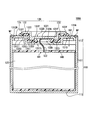
- FIG. 1 is a cross-sectional view showing the structure of an example of the power storage device 100 according to the embodiment.
- FIG. 2 is a cross-sectional view of the power storage device 100A according to a modified example of the power storage device 100.
- the power storage device 100 includes a cylindrical case 110 having an opening 101, an electrode group 120 including a first electrode and a second electrode housed in the case 110, and a sealing body 130 for sealing the opening 101.
- the sealing body 130 includes a sealing plate 131, a terminal plate 132, and an insulating gasket 133 interposed between them.
- the case 110 includes a cylindrical tubular portion 111, an opening end 112 that is continuous with one end of the tubular portion 111 and corresponds to the opening 101, and a bottom 113 that closes the other end of the tubular portion 111.
- the sealing plate 131 has a first surface 131A and a second surface 131B on the opposite side of the first surface.
- the sealing plate 131 is annular and has an inner flange-shaped first recess 1311 in which the first surface 131A is recessed, and has an outer peripheral portion 1312 around the first recess 1311.
- the first recess 1311 has a first through hole 1311h in the central portion.
- the region corresponding to the first recess 1311 of the first surface 131A has an inner bottom surface of the first recess and an inner peripheral surface extending in the first direction from the inner bottom surface.
- the first direction means the axial direction Da of the annular sealing plate 131.
- the peripheral edge of the outer peripheral portion 1312 is joined to the open end portion 112 of the case 110 at the welded portion WP. That is, the sealing plate 131 is electrically connected to the case 110. Since the case 110 is connected to the second electrode, the sealing plate 131 is electrically continuous with the second electrode.
- the peripheral edge of the outer peripheral portion 1312 extends inward of the case in order to increase the axial Da dimension (that is, the depth of the welding mark) of the welding mark between the sealing body 130 and the opening end portion 112 of the case.
- a shallow tubular wall 1312W is provided. With this configuration, the strength of the weld mark is increased. Therefore, the reliability of the sealing between the sealing body and the case can be improved.
- the terminal plate 132 has a third surface 132A facing the first surface 131A of the sealing plate 131 in the first direction, and a fourth surface 132B on the opposite side of the third surface 132A.
- the third surface 132A has an end surface of the projecting portion 1321 facing the inner bottom surface of the first recess 1311 of the sealing plate 131, and an outer peripheral surface of the projecting portion 1321 extending in the first direction from the end surface.
- the terminal plate 132 has a protruding portion 1321 protruding from the third surface 132A toward the sealing plate 131, and a flange portion 1322 extending from the protruding portion 1321 in the second direction Dr in the radial direction of the sealing plate.
- the second direction Dr is a direction perpendicular to the first direction Da.
- the first electrode is electrically connected to the protruding portion 1321 of the terminal plate 132.
- the gasket 133 has an annular shape, is interposed between the sealing plate 131 and the terminal plate 132, and has a second through hole 133h in the central portion.
- the protruding portion 1321 of the terminal plate 132 is housed in the first recess 1311 of the sealing plate 131 via the gasket 133.
- the second through hole 133h of the gasket 133 may overlap concentrically with the first through hole 1311h of the sealing plate.
- the gasket 133 has a first sealing portion 1331 formed around the second through hole 133h, a tubular second sealing portion 1332, and an annular third sealing portion 1333.
- the first sealing portion 1331 is interposed between the end surface of the protruding portion 1321 of the terminal plate 132 and the inner bottom surface of the first concave portion 1311 of the sealing plate 131.
- the tubular second sealing portion 1332 extends from the first sealing portion 1331 in the first direction Da, and is the outer peripheral surface of the protruding portion 1321 of the terminal plate 132 and the inner circumference of the first concave portion 1311 of the sealing plate 131. Intervenes between the faces.
- the annular third sealing portion extends from the second sealing portion 1332 in the second direction Dr, and is interposed between the flange portion 1322 of the terminal plate 132 and the outer peripheral portion 1312 of the sealing plate 131.
- a first hook portion 131f that bends toward the gasket 133 and presses the first sealing portion 1331 of the gasket 133 is formed at the opening edge of the first through hole 1311h of the first recess 1311. Further, a first rib 1323 projecting toward the first sealing portion 1331 is formed on the end surface of the protruding portion 1321 of the terminal plate 132.
- the sealing plate 131 and the terminal plate 132 are integrated, and the second through hole 133h is sealed. It has been stopped. That is, the sealing plate 131 is crimped to the third surface 132A of the terminal plate 132 by the first hook portion 131f via the third sealing portion 1333.
- the tip of the first hook portion 131f is located inside the case when viewed from the first direction Da from the first rib 1323.
- the first hook portion 131f can sandwich the first rib 1323 together with the inner peripheral surface of the first recess 1311 via the gasket 133. Therefore, the gasket 133 is compressed between the inner peripheral surface of the first recess 1311 and the first rib 1323, and between the first hook portion 131f and the first rib 1323, respectively, so that the sealing plate 131 and the terminal plate 132 are compressed. The reliability of sealing between and is increased.
- the flange portion 1322 of the terminal plate 132 is formed with a second hook portion 132f that presses the third sealing portion 1333 of the gasket 133. That is, the terminal plate 132 is crimped to the first surface 131A of the sealing plate 131 by the second hook portion 132f via the third sealing portion 1333.
- An internal insulating plate 140 is arranged between the electrode group 120 and the sealing body 130, and the internal insulating plate 140 prevents the electrode group 120 from coming into contact with the sealing body 130 or the case 110.
- the internal insulating plate 140 is provided with a predetermined lead hole 141.
- the lead 122 derived from the first electrode constituting the electrode group 120 passes through the lead hole 141 and is electrically connected to the inner surface of the terminal plate 132. Therefore, the terminal plate 132 has the same polarity as the first electrode.
- the second electrode constituting the electrode group 120 is electrically connected to the case 110. Therefore, the case 110 has the same polarity as the second electrode.
- the second surface 131B of the outer peripheral portion 1312 of the sealing plate 131 and the end surface (third surface 132A) of the protruding portion 1321 of the terminal plate 132 are approximately the same in the first direction Da. They may be located at the same height. Therefore, when connecting the external current collecting leads to the sealing plate 131 and the terminal plate 132, they can be connected at substantially the same height.
- the power storage device 100A according to the modified example of FIG. 2 basically has a sealing body having the same structure as the power storage device 100 of FIG. 1, but the fixing direction of the case 110 to the opening 101 is reversed.
- the first recess 1311 of the sealing plate 131 projects toward the outside of the case 110 in the first direction Da, and the height of the power storage device is increased by that amount.
- the first recess 1311 of the sealing plate 131 projects toward the inside of the case 110 in the first direction Da, and the increase in the height of the power storage device is suppressed.
- the first surface 131A of the outer peripheral portion 1312 of the sealing plate 131 and the fourth surface 132B) of the protruding portion 1321 of the terminal plate 132 are substantially the same height in the first direction Da. It may be located on the side.
- FIG. 3A is a cross-sectional view of the sealing body 130A according to a modified example of the sealing body 130.
- the protruding portion 1321 of the terminal plate 132 is formed with a second recess 1324 in which the third surface 132A is recessed.
- a first groove portion 132G is formed on the fourth surface 132B of the terminal plate 132 so as to surround the second recess 1324.
- the dimension of the first groove portion 132G in the second direction Dr is the smallest in the vicinity of the opening of the first groove portion 132G farthest from the first recess 1311 in the first direction Da, and is closest to the first recess 1311.
- the deepest portion of the first groove portion 132G is drawn to be the largest, but the present invention is not limited to this.
- the dimension of the first groove portion 132G in the second direction Dr may be maximized.
- FIG. 3B is a cross-sectional view of a main part of the sealing body 130B according to another modification of the sealing body 130.
- the second surface 131B of the outer peripheral portion 1312 of the sealing plate 131 has a second groove portion 131G surrounding the first recess 1311.
- the first surface 131A protrudes corresponding to the second groove 131G, and has the second rib 1313.
- the protruding portion 1321 of the terminal plate 132 is formed with a second recess 1324 in which the third surface 132A is recessed, and the fourth surface 132B has a first groove 132G surrounding the second recess 1324. It is formed.
- first groove portion 132G first rib 1323
- second groove portion 131G second rib 1313
- the sealing plate 131 and the terminal plate 132 are more firmly fixed.
- the structure of the sealing body is not limited to that shown in FIGS. 1 to 3, and may be changed in various ways.
- a modified example of the sealing body will be described with reference to the drawings, but the modified example is not limited to the following.
- FIG. 4 is a process diagram showing the first half of the manufacturing process of the sealing body 130A
- FIG. 5 is a process drawing showing the second half of the manufacturing process of the sealing body 130A.
- the sealing plate 131 is an annular shape having a first surface 131A and a second surface 131B on the opposite side thereof, has a first recess 1311 in which the first surface 131A is recessed, and an outer peripheral portion around the first recess 1311. It has 1312. A first through hole 1311h is provided in the central portion of the first recess 1311.
- the gasket 133 is inserted into the first recess 1311 of the sealing plate 131 to assemble the two (FIG. 4 (b)).
- the gasket 133 is annular and has a tubular wall portion 133W that later constitutes the second sealing portion and the third sealing portion, and an inner flange-shaped annular base 133R that later constitutes the first sealing portion. ..
- a second through hole 133h is provided in the central portion of the annular base portion 133R.
- the terminal plate 132 is inserted inside the tubular wall portion 133W of the gasket 133, and the two are put together (FIG. 4 (c)).
- the terminal plate 132 has a disk shape, and has a tubular wall portion 132W that later constitutes a flange portion 1322, and a bottom portion 132b that closes one end of the wall portion 132W.
- the bottom portion 132b constitutes a protruding portion protruding in the first direction Da when viewed from the flange portion 1322.
- a first rib 1323 projecting toward the annular base 133R of the gasket 133 is provided in an annular shape on the peripheral edge of the bottom 132b, and the circular region surrounded by the first rib 1323 has a third surface 132A recessed. It has 2 recesses 1324.
- the back surface side of the first rib 1323 constitutes the first groove portion 132G.
- the first mold 200 having a ring-shaped concave surface is brought into contact with the second surface 131B of the sealing plate 131, and the second concave portion 1324 is pressed against the fourth surface 132B of the terminal plate 132. 2
- the mold 300 is brought into contact with the mold 300, and pressure is applied in the direction in which the sealing plate 131 and the terminal plate 132 approach each other (first direction Da) (FIGS. 4 (d) and 4 (e)).
- first sealing portion 1331 and the second sealing portion 1332 of the gasket 133 are formed. Further, the first hook portion 131f presses the inner peripheral surface of the first rib 1323 toward the outside of the second direction Dr via the first sealing portion 1331, and the inner peripheral surface of the rib 1323 is inclined.
- the third mold 400 has a flat surface 400S at the center of the contact surface with the terminal plate 132, and has a smooth concave surface 400C around the flat surface 400S that abuts with the tubular wall portion 132W.
- the concave surface 400C of the third mold 400 is pressed against the wall portion 132W of the terminal plate 132, the tubular wall portion 132W is bent into a flange shape to form the flange portion 1322.
- the third sealing portion 1333 of the gasket is formed, and the second hook portion 132f is formed on the peripheral edge of the flange portion 1322 (FIGS. 5 (g) and 5 (h)).
- the sealing body 130 is completed (FIG. 5 (i)).
- a cylindrical power storage device has been described as an example, but the present disclosure can also be used for a power storage device having various shapes (for example, a square shape).
- the power storage device is particularly suitable for use as a power source for vehicles such as hybrid vehicles and electric vehicles.
- Power storage device 101 Opening 110: Case 111: Cylinder 112: Opening end 113: Bottom 120: Electrode group 122: Lead 130: Sealing body 131: Sealing plate 131A: First surface 131B: Second surface 131f: First 1 hook part 131G: 2nd groove part 1311: 1st concave part 1311h: 1st through hole 1312: outer peripheral part 1312W: tubular wall 1313: 2nd rib 132: terminal plate 132A: 3rd surface 132B: 4th surface 132b: bottom 132f: 2nd hook part 132G: 1st groove part 132W: Cylindrical wall part 1321: Protruding part 1322: Flange part 1323: 1st rib 1324: 2nd recess 133: Gasket 133h: 2nd through hole 133R: Circular base 133W : Cylindrical wall part 1331: 1st sealing part 1332: 2nd sealing part 1333: 3rd sealing part 140: Internal insulating
Landscapes
- Chemical & Material Sciences (AREA)
- Chemical Kinetics & Catalysis (AREA)
- Electrochemistry (AREA)
- General Chemical & Material Sciences (AREA)
- Engineering & Computer Science (AREA)
- Power Engineering (AREA)
- Microelectronics & Electronic Packaging (AREA)
- Manufacturing & Machinery (AREA)
- Sealing Battery Cases Or Jackets (AREA)
- Connection Of Batteries Or Terminals (AREA)
- Electric Double-Layer Capacitors Or The Like (AREA)
Priority Applications (4)
| Application Number | Priority Date | Filing Date | Title |
|---|---|---|---|
| CN202180011297.XA CN115004461B (zh) | 2020-02-28 | 2021-02-19 | 蓄电设备 |
| JP2022503355A JP7675380B2 (ja) | 2020-02-28 | 2021-02-19 | 蓄電デバイス |
| US17/760,110 US12368199B2 (en) | 2020-02-28 | 2021-02-19 | Power storage device |
| EP21761335.5A EP4113558B1 (en) | 2020-02-28 | 2021-02-19 | Power storage device |
Applications Claiming Priority (2)
| Application Number | Priority Date | Filing Date | Title |
|---|---|---|---|
| JP2020-034466 | 2020-02-28 | ||
| JP2020034466 | 2020-02-28 |
Publications (1)
| Publication Number | Publication Date |
|---|---|
| WO2021172234A1 true WO2021172234A1 (ja) | 2021-09-02 |
Family
ID=77489895
Family Applications (1)
| Application Number | Title | Priority Date | Filing Date |
|---|---|---|---|
| PCT/JP2021/006494 Ceased WO2021172234A1 (ja) | 2020-02-28 | 2021-02-19 | 蓄電デバイス |
Country Status (5)
| Country | Link |
|---|---|
| US (1) | US12368199B2 (https=) |
| EP (1) | EP4113558B1 (https=) |
| JP (1) | JP7675380B2 (https=) |
| CN (1) | CN115004461B (https=) |
| WO (1) | WO2021172234A1 (https=) |
Cited By (2)
| Publication number | Priority date | Publication date | Assignee | Title |
|---|---|---|---|---|
| EP4350850A3 (en) * | 2022-10-05 | 2024-05-22 | Samsung SDI Co., Ltd. | Cylindrical secondary battery |
| EP4435941A4 (en) * | 2021-11-16 | 2025-02-26 | Panasonic Intellectual Property Management Co., Ltd. | BATTERY |
Families Citing this family (2)
| Publication number | Priority date | Publication date | Assignee | Title |
|---|---|---|---|---|
| CN115004462B (zh) * | 2020-02-28 | 2024-08-16 | 松下知识产权经营株式会社 | 蓄电设备 |
| CN119725912A (zh) * | 2023-09-26 | 2025-03-28 | 宁德时代新能源科技股份有限公司 | 电池单体、电池及用电装置 |
Citations (4)
| Publication number | Priority date | Publication date | Assignee | Title |
|---|---|---|---|---|
| JPH09190806A (ja) * | 1996-01-05 | 1997-07-22 | Matsushita Electric Ind Co Ltd | 電池およびその製造方法 |
| JP2004186117A (ja) * | 2002-12-06 | 2004-07-02 | Matsushita Electric Ind Co Ltd | 密閉型二次電池 |
| JP2004241171A (ja) | 2003-02-04 | 2004-08-26 | Matsushita Electric Ind Co Ltd | 密閉型電池 |
| JP2010086782A (ja) * | 2008-09-30 | 2010-04-15 | Sanyo Electric Co Ltd | 密閉型電池及びその製造方法 |
Family Cites Families (25)
| Publication number | Priority date | Publication date | Assignee | Title |
|---|---|---|---|---|
| JPH0615401Y2 (ja) * | 1988-10-19 | 1994-04-20 | 松下電器産業株式会社 | 有機電解質電池 |
| US6083639A (en) * | 1997-08-22 | 2000-07-04 | Duracell Inc. | Current interrupter for electrochemical cells |
| JP3091722B2 (ja) * | 1998-03-30 | 2000-09-25 | 三洋電機株式会社 | 電池収容ケース |
| US6204635B1 (en) * | 1998-05-22 | 2001-03-20 | Texas Instruments Incorporated | Current interrupt apparatus particularly adapted for use with prismatic electrochemical cells |
| EP2613377B1 (en) * | 2010-08-30 | 2019-01-09 | Eliiy Power Co., Ltd. | Battery cover with attached electrode terminal, method for producing battery cover with attached electrode terminal, and airtight battery |
| JP2012059365A (ja) * | 2010-09-03 | 2012-03-22 | Sanyo Electric Co Ltd | 密閉電池用端子及びその製造方法 |
| JP6115084B2 (ja) * | 2011-11-29 | 2017-04-19 | 株式会社Gsユアサ | 蓄電素子 |
| JP6048080B2 (ja) * | 2011-11-29 | 2016-12-21 | 株式会社Gsユアサ | 蓄電素子 |
| CN103999262B (zh) * | 2011-12-19 | 2016-12-21 | 丰田自动车株式会社 | 电池 |
| DE112012006312B4 (de) * | 2012-05-02 | 2023-08-31 | Toyota Jidosha Kabushiki Kaisha | Abgedichtete Sekundärbatterie |
| JP5668729B2 (ja) * | 2012-06-25 | 2015-02-12 | トヨタ自動車株式会社 | 電池 |
| EP2978042B1 (de) * | 2014-07-21 | 2016-06-29 | HOPPECKE Batterien GmbH & Co. KG. | Batteriezelle für eine Batterie, insbesondere Traktionsbatterie |
| CN204348769U (zh) * | 2014-12-23 | 2015-05-20 | 深圳市天盛伟业科技有限公司 | 一种新型圆柱形锂离子电池 |
| KR102668193B1 (ko) * | 2016-01-04 | 2024-05-23 | 삼성에스디아이 주식회사 | 캡 조립체 및 이를 포함하는 이차 전지 |
| WO2017138323A1 (ja) * | 2016-02-09 | 2017-08-17 | 株式会社Gsユアサ | 蓄電素子の製造方法及び蓄電素子 |
| JP6601684B2 (ja) * | 2016-11-09 | 2019-11-06 | トヨタ自動車株式会社 | 密閉型電池および密閉型電池の製造方法 |
| JP6868400B2 (ja) * | 2017-01-17 | 2021-05-12 | Fdk株式会社 | 筒型電池の封口体、筒型電池 |
| WO2018139453A1 (ja) * | 2017-01-25 | 2018-08-02 | 三洋電機株式会社 | 二次電池 |
| CN110326124B (zh) * | 2017-02-27 | 2022-04-22 | 三洋电机株式会社 | 方形二次电池 |
| WO2018159180A1 (ja) * | 2017-02-28 | 2018-09-07 | 日立オートモティブシステムズ株式会社 | 二次電池 |
| CN113451713B (zh) * | 2017-08-30 | 2024-03-19 | 宁德时代新能源科技股份有限公司 | 二次电池以及电池模组 |
| CN207124215U (zh) * | 2017-09-07 | 2018-03-20 | 宁德时代新能源科技股份有限公司 | 二次电池的顶盖组件以及二次电池 |
| JP7171183B2 (ja) * | 2017-12-19 | 2022-11-15 | 三洋電機株式会社 | 二次電池及びそれを用いた組電池 |
| US10763466B2 (en) * | 2018-03-09 | 2020-09-01 | Contemporary Amperex Technology Co., Limited | Top cap assembly of a secondary battery, and secondary battery |
| KR102493916B1 (ko) * | 2018-11-28 | 2023-02-01 | 주식회사 엘지에너지솔루션 | 캡조립체, 이차전지 및 그의 제조방법, 전지팩 |
-
2021
- 2021-02-19 CN CN202180011297.XA patent/CN115004461B/zh active Active
- 2021-02-19 EP EP21761335.5A patent/EP4113558B1/en active Active
- 2021-02-19 US US17/760,110 patent/US12368199B2/en active Active
- 2021-02-19 JP JP2022503355A patent/JP7675380B2/ja active Active
- 2021-02-19 WO PCT/JP2021/006494 patent/WO2021172234A1/ja not_active Ceased
Patent Citations (4)
| Publication number | Priority date | Publication date | Assignee | Title |
|---|---|---|---|---|
| JPH09190806A (ja) * | 1996-01-05 | 1997-07-22 | Matsushita Electric Ind Co Ltd | 電池およびその製造方法 |
| JP2004186117A (ja) * | 2002-12-06 | 2004-07-02 | Matsushita Electric Ind Co Ltd | 密閉型二次電池 |
| JP2004241171A (ja) | 2003-02-04 | 2004-08-26 | Matsushita Electric Ind Co Ltd | 密閉型電池 |
| JP2010086782A (ja) * | 2008-09-30 | 2010-04-15 | Sanyo Electric Co Ltd | 密閉型電池及びその製造方法 |
Non-Patent Citations (1)
| Title |
|---|
| See also references of EP4113558A4 |
Cited By (2)
| Publication number | Priority date | Publication date | Assignee | Title |
|---|---|---|---|---|
| EP4435941A4 (en) * | 2021-11-16 | 2025-02-26 | Panasonic Intellectual Property Management Co., Ltd. | BATTERY |
| EP4350850A3 (en) * | 2022-10-05 | 2024-05-22 | Samsung SDI Co., Ltd. | Cylindrical secondary battery |
Also Published As
| Publication number | Publication date |
|---|---|
| JPWO2021172234A1 (https=) | 2021-09-02 |
| CN115004461B (zh) | 2024-08-20 |
| EP4113558A4 (en) | 2023-11-08 |
| EP4113558B1 (en) | 2026-05-06 |
| US20230060460A1 (en) | 2023-03-02 |
| US12368199B2 (en) | 2025-07-22 |
| JP7675380B2 (ja) | 2025-05-13 |
| CN115004461A (zh) | 2022-09-02 |
| EP4113558A1 (en) | 2023-01-04 |
Similar Documents
| Publication | Publication Date | Title |
|---|---|---|
| US12272829B2 (en) | Battery | |
| JP7675380B2 (ja) | 蓄電デバイス | |
| JP7320491B2 (ja) | 電池 | |
| WO2021153439A1 (ja) | 蓄電装置 | |
| JP2016207510A (ja) | 角形二次電池 | |
| JPWO2015059826A1 (ja) | 角形二次電池 | |
| JP7706077B2 (ja) | 蓄電デバイス | |
| JP2016207433A (ja) | 角形二次電池 | |
| JPWO2019194253A1 (ja) | 電池 | |
| CN113243058A (zh) | 电池 | |
| EP4250440B1 (en) | Cylindrical battery | |
| US20240014473A1 (en) | Cylindrical battery | |
| JP7780762B2 (ja) | 蓄電装置および蓄電装置の製造方法 | |
| JP7724451B2 (ja) | 蓄電デバイス | |
| JP7833662B2 (ja) | 蓄電装置および蓄電装置の製造方法 |
Legal Events
| Date | Code | Title | Description |
|---|---|---|---|
| 121 | Ep: the epo has been informed by wipo that ep was designated in this application |
Ref document number: 21761335 Country of ref document: EP Kind code of ref document: A1 |
|
| ENP | Entry into the national phase |
Ref document number: 2022503355 Country of ref document: JP Kind code of ref document: A |
|
| NENP | Non-entry into the national phase |
Ref country code: DE |
|
| ENP | Entry into the national phase |
Ref document number: 2021761335 Country of ref document: EP Effective date: 20220928 |