WO2021167109A1 - 美容機器および電流制御方法 - Google Patents
美容機器および電流制御方法 Download PDFInfo
- Publication number
- WO2021167109A1 WO2021167109A1 PCT/JP2021/015877 JP2021015877W WO2021167109A1 WO 2021167109 A1 WO2021167109 A1 WO 2021167109A1 JP 2021015877 W JP2021015877 W JP 2021015877W WO 2021167109 A1 WO2021167109 A1 WO 2021167109A1
- Authority
- WO
- WIPO (PCT)
- Prior art keywords
- electrode
- current
- frequency
- period
- electrodes
- Prior art date
- Legal status (The legal status is an assumption and is not a legal conclusion. Google has not performed a legal analysis and makes no representation as to the accuracy of the status listed.)
- Ceased
Links
Images







Classifications
-
- A—HUMAN NECESSITIES
- A61—MEDICAL OR VETERINARY SCIENCE; HYGIENE
- A61N—ELECTROTHERAPY; MAGNETOTHERAPY; RADIATION THERAPY; ULTRASOUND THERAPY
- A61N1/00—Electrotherapy; Circuits therefor
- A61N1/18—Applying electric currents by contact electrodes
- A61N1/32—Applying electric currents by contact electrodes alternating or intermittent currents
- A61N1/36—Applying electric currents by contact electrodes alternating or intermittent currents for stimulation
- A61N1/36014—External stimulators, e.g. with patch electrodes
-
- A—HUMAN NECESSITIES
- A61—MEDICAL OR VETERINARY SCIENCE; HYGIENE
- A61F—FILTERS IMPLANTABLE INTO BLOOD VESSELS; PROSTHESES; DEVICES PROVIDING PATENCY TO, OR PREVENTING COLLAPSING OF, TUBULAR STRUCTURES OF THE BODY, e.g. STENTS; ORTHOPAEDIC, NURSING OR CONTRACEPTIVE DEVICES; FOMENTATION; TREATMENT OR PROTECTION OF EYES OR EARS; BANDAGES, DRESSINGS OR ABSORBENT PADS; FIRST-AID KITS
- A61F7/00—Heating or cooling appliances for medical or therapeutic treatment of the human body
- A61F7/007—Heating or cooling appliances for medical or therapeutic treatment of the human body characterised by electric heating
-
- A—HUMAN NECESSITIES
- A61—MEDICAL OR VETERINARY SCIENCE; HYGIENE
- A61N—ELECTROTHERAPY; MAGNETOTHERAPY; RADIATION THERAPY; ULTRASOUND THERAPY
- A61N1/00—Electrotherapy; Circuits therefor
- A61N1/02—Details
- A61N1/04—Electrodes
- A61N1/06—Electrodes for high-frequency therapy
-
- A—HUMAN NECESSITIES
- A61—MEDICAL OR VETERINARY SCIENCE; HYGIENE
- A61N—ELECTROTHERAPY; MAGNETOTHERAPY; RADIATION THERAPY; ULTRASOUND THERAPY
- A61N1/00—Electrotherapy; Circuits therefor
- A61N1/18—Applying electric currents by contact electrodes
- A61N1/32—Applying electric currents by contact electrodes alternating or intermittent currents
- A61N1/36—Applying electric currents by contact electrodes alternating or intermittent currents for stimulation
-
- A—HUMAN NECESSITIES
- A61—MEDICAL OR VETERINARY SCIENCE; HYGIENE
- A61N—ELECTROTHERAPY; MAGNETOTHERAPY; RADIATION THERAPY; ULTRASOUND THERAPY
- A61N1/00—Electrotherapy; Circuits therefor
- A61N1/18—Applying electric currents by contact electrodes
- A61N1/32—Applying electric currents by contact electrodes alternating or intermittent currents
- A61N1/36—Applying electric currents by contact electrodes alternating or intermittent currents for stimulation
- A61N1/36003—Applying electric currents by contact electrodes alternating or intermittent currents for stimulation of motor muscles, e.g. for walking assistance
-
- A—HUMAN NECESSITIES
- A61—MEDICAL OR VETERINARY SCIENCE; HYGIENE
- A61N—ELECTROTHERAPY; MAGNETOTHERAPY; RADIATION THERAPY; ULTRASOUND THERAPY
- A61N1/00—Electrotherapy; Circuits therefor
- A61N1/18—Applying electric currents by contact electrodes
- A61N1/32—Applying electric currents by contact electrodes alternating or intermittent currents
- A61N1/36—Applying electric currents by contact electrodes alternating or intermittent currents for stimulation
- A61N1/36014—External stimulators, e.g. with patch electrodes
- A61N1/3603—Control systems
-
- A—HUMAN NECESSITIES
- A61—MEDICAL OR VETERINARY SCIENCE; HYGIENE
- A61N—ELECTROTHERAPY; MAGNETOTHERAPY; RADIATION THERAPY; ULTRASOUND THERAPY
- A61N5/00—Radiation therapy
- A61N5/06—Radiation therapy using light
- A61N5/0613—Apparatus adapted for a specific treatment
- A61N5/0616—Skin treatment other than tanning
-
- A—HUMAN NECESSITIES
- A61—MEDICAL OR VETERINARY SCIENCE; HYGIENE
- A61N—ELECTROTHERAPY; MAGNETOTHERAPY; RADIATION THERAPY; ULTRASOUND THERAPY
- A61N5/00—Radiation therapy
- A61N5/06—Radiation therapy using light
- A61N2005/065—Light sources therefor
- A61N2005/0651—Diodes
Definitions
- the present invention relates to a beauty device that applies an electric current to the skin.
- EMS Electro Muscle Stimulation
- RF radio wave
- the frequency band differs between the current used for EMS (hereinafter referred to as EMS current) and the current for realizing an effect such as warmth (hereinafter referred to as RF current). Therefore, there are appropriate conditions for applying the EMS current and applying the RF current.
- EMS the larger the range of the stimulation target, the higher the effect, and the range of the stimulation target is determined by the distance between the electrodes in contact with the skin. Therefore, basically, it is preferable that the electrodes are separated from each other.
- the smaller the distance between the electrodes the higher the effect of applying the RF current.
- An object of the present invention is to provide a mechanism capable of effectively applying currents of different frequencies at the same time.
- the present invention comprises a first electrode, an annular electrode concentrically arranged around the first electrode, and a second electrode arranged outside the first electrode.
- a current of the first frequency is applied between the third electrode arranged outside the second electrode, the fourth electrode arranged outside the third electrode, and the first electrode and the fourth electrode.
- a beauty device having an application means capable of applying a second frequency current between the second electrode and the third electrode to the skin while applying the current to the skin.
- the first frequency is 1 Hz to 100 kHz and the second frequency is 200 kHz to 4 MHz.
- the application means is used to apply a current of the first frequency from the first to fourth electrodes, depending on at least one of the value of the first frequency and the value of the second frequency. It has a selection means for selecting an electrode pair to be used or an electrode pair to be used for applying the current of the second frequency. In a preferred embodiment, the application means from the first to fourth electrodes of the first frequency, depending on at least one of the amplitude of the current of the first frequency and the amplitude of the current of the second frequency. It has a selection means for selecting an electrode pair used for applying a current or an electrode pair used for applying a current of the second frequency.
- the application means from the first to fourth electrodes, depending on at least one of the application period of the first frequency current and the application period of the second frequency current, the first. It has a selection means for selecting an electrode pair used for applying a frequency current or an electrode pair used for applying the second frequency current.
- the application means applies a current of the first RF frequency between the second electrode and the third electrode in the first period, and between the first electrode and the fourth electrode in the second period. A current having a second RF frequency smaller than the first RF frequency is applied, and the first period and the second period are repeated with each other.
- the application means further continuously applies a current of the second frequency between the first electrode and the fourth electrode in the first period, and in the second period, the application means continuously applies a current of the second frequency. Further, a current of the second frequency is intermittently applied between the second electrode and the third electrode.
- a sensor for detecting a current applied to the skin between the first electrode and the fourth electrode is further provided, and the application means is provided between the first electrode and the fourth electrode. When a current having a current value equal to or higher than a predetermined threshold value is not applied to the skin for a predetermined period, the application of at least the second frequency is stopped.
- the ratio of the length of the first period to the total application time is 70% or more.
- the distance between the second electrode and the third electrode is 1 mm to 3 mm, and at least one of the distances between adjacent electrodes is not the same as the other.
- each electrode projects from the head surface, and the side wall surface of each electrode is inclined with respect to the direction perpendicular to the head surface.
- the present invention includes a first electrode, a second electrode, a third electrode, and a fourth electrode, and the distance from the first electrode to the fourth electrode is the distance from the second electrode to the third electrode.
- the first electrode and the fourth electrode are applied while applying a current of the first RF frequency between the second electrode and the third electrode.
- a current having a second RF frequency smaller than the first RF frequency is generated between the first electrode and the fourth electrode.
- a second step of intermittently applying a current of the second frequency between the second electrode and the third electrode is provided, and the first RF frequency and the second RF frequency are 200 kHz or more.
- a current control method in which the second frequency is 4 MHz, the second frequency is 1 Hz to 100 kHz, and the first step and the second step are alternately repeated.
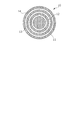
- the external view of the beauty device 1. Detailed view of the electrode 10. An example of a variation in the size of the electrode 10 is shown. The results of the sensory test for each variation of the electrode 10 are shown.
- FIG. 6 is a schematic view of another example of the internal structure of the beauty device 1.
- the figure which shows the temperature change corresponding to each control content The figure for demonstrating the difference in temperature change when the electrode 10 of a different distance between electrodes is used.
- FIG. 1 is an external view of the beauty device 1.
- the beauty device 1 has a housing 80 that is gripped by the user, and an electrode 10 that is provided at the tip of the housing 80 and is in contact with the skin.
- the housing 80 is provided with a switch 90 operated by the user.
- the switch 90 is used to specify the frequency and time of the applied current and other conditions related to the application, in addition to turning on / off the power supply.
- the housing 80 is provided with information display means such as a power connector and a liquid crystal screen, but since it is not directly related to the present invention, it is discarded.
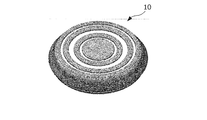
- FIG. 2A is a detailed view of the structure of the electrode 10.
- the electrodes 10 are a disk-shaped first electrode 11 arranged on the innermost side (center side) and an annular electrode arranged concentrically around the first electrode 11, respectively, of the first electrode 11. It is composed of a second electrode 12 arranged on the outside, a third electrode 13 arranged on the outside of the second electrode 12, and a fourth electrode 14 arranged on the outside (outermost) of the third electrode 13. ..
- d1 from the first electrode 11 to the fourth electrode 14 and the distance d2 from the second electrode 12 to the third electrode 13 are set, then d1> d2.
- the heights of the first electrode 11, the second electrode 12, the third electrode 13, and the fourth electrode 14 are substantially the same from the housing surface of each electrode so that they can come into contact with the skin at the same time. ..
- the width (diameter length), area, and distance between adjacent electrodes are examples of each electrode.
- the distance between adjacent electrodes the distance between the first electrode and the second electrode, the distance between the second electrode and the third electrode, and the distance between the third electrode and the fourth electrode
- the area of each electrode the area of the ring plane that does not include the side surface and can come into contact with the skin
- the ratio of the area of the first electrode 11 to the area of the fourth electrode 14 is 1: 1 or more and 1: 1, 7 or less. It is preferable to have. The reason for this will be explained with reference to FIGS. 2B and 2C.
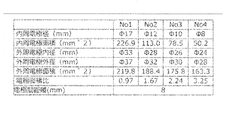
- FIG. 2B In order to verify the effect of the size and area of each electrode on the user's experience, first, as shown in FIG. 2B, a total of four sample electrodes (No.) in which the size and area of the first electrode 11 and the fourth electrode 14 are different. .1 to No. 4) were prepared.
- the center electrode diameter and the center electrode area are the diameter and area of the first electrode 11
- the outer peripheral electrode inner diameter, outer peripheral electrode outer diameter, and outer peripheral electrode area are the inner diameter, outer diameter, and area of the fourth electrode 14, respectively.
- the second electrode 12 and the third electrode 13 are not used for applying the current, the description thereof will be omitted.
- the distance between the adjacent electrodes is 2 mm
- the ratio of the area of the fourth electrode 14 to the area of the first electrode 11 is preferably 1 to 1.7 from the viewpoint of the muscle stimulating effect. Further, at this time, the outer diameter of the fourth electrode 14 is 12 mm to 17 mm, which is comparable to the conventional beauty equipment in terms of compactness.
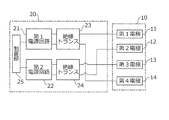
- FIG. 3 is a schematic view of the internal structure of the beauty device 1.
- the beauty device 1 applies a current having a first frequency f1 between the first electrode 11 and the fourth electrode 14 to the skin, and a third electrode between the second electrode, the third electrode, and the third electrode 13.
- the application means 20 capable of applying a current of two frequencies f2 to the skin is provided.
- the application means 20 includes a first power supply circuit 21, a second power supply circuit 22, an isolation transformer 23, an isolation transformer 24, and a control unit 25.
- the first power supply circuit 21 and the second power supply circuit 22 are realized by a coil, a resistor, a rectifier, a capacitor, a clock circuit and other elements, respectively, and generate alternating currents of the first frequency f1 and the second frequency f2, respectively.
- the current of the first frequency f1 is applied between the first electrode 11 and the second electrode 12, and the current of the second frequency f2 is applied between the third electrode 13 and the fourth electrode 14.
- the first frequency f1 is, for example, 1 Hz (hertz) to 100 kHz (kilohertz). This frequency band mainly contributes to the muscle stimulation effect (EMS).
- the second frequency f2 is, for example, 200 kHz to 4 MHz (megahertz), preferably 200 kHz to 2 MHz.
- This frequency band is a frequency band called radio frequency (RF) and mainly contributes to the thermal effect.
- the voltage is, for example, 10V (volt) to 300V.
- the frequency bands that can be generated by the first power supply circuit 21 and / or the second power supply circuit 22 may be separated from each other or may partially overlap each other.
- parameters such as the frequency to be generated can be appropriately set according to the purpose of applying the electric current (muscle stimulation, heat, promotion of penetration of the lotion into the inside, etc.).
- the waveform of the current is, for example, an AC sine wave, but may be a unipolar rectangular wave, a triangular wave, or another pulse train (in this case, the frequency described above can be regarded as a repeating frequency).
- the first frequency f1 and / or the second frequency f2 may be variable or fixed.
- the isolation transformer 23 and the isolation transformer 24 prevent the current generated in the second power supply circuit 22 and the first power supply circuit 21, and other unexpected currents from flowing in, respectively. That is, in the present invention, it is composed of a closed circuit composed of the first power supply circuit 21, the first electrode 11, and the fourth electrode 14, and the second power supply circuit 22, the second electrode 12, and the third electrode 13. A closed circuit is formed, and two types of currents are applied to the skin at the same time. However, by providing the insulated transformer 23 and the insulated transformer 24, the current is transferred from the other closed circuit to the closed circuit. It does not flow.
- the control unit 25 is a switch mechanism, a processor, or the like, and receives an ON / OFF signal and a current profile to be generated to the first power supply circuit 21 and the second power supply circuit 22 in response to an instruction received via the switch 90.
- a control signal indicating (application time, frequency, voltage, waveform, etc.) is supplied.
- the first frequency f1 is mainly the frequency for muscle stimulation and the second frequency f2 is mainly set as the frequency for heating
- the first frequency f1 Two currents can be applied at the same time in a state where the electrode arrangement suitable for the application of the second frequency f2 and the electrode arrangement suitable for the application of the second frequency f2 are simultaneously realized. As a result, the muscle stimulating effect and the thermal effect can be effectively given at the same time at substantially the same skin position.
- a current having a frequency intended for muscle stimulation and a current having a frequency intended for thermal stimulation using the same electrode.
- a current having a frequency for stimulating muscles is applied at a distance between electrodes suitable for exerting a thermal effect, the range of the stimulated muscles is narrowed.
- the electrode for applying the frequency current for muscle stimulation and the electrode for applying the frequency current for obtaining the thermal effect are physically separated from each other, the usable frequency band is defined. The constraint becomes large.
- the skin is wide. Appropriate muscle stimulation effect and thermal effect can be given to the range at the same time. As a result, the user's usage time is shortened as compared with, for example, a method of switching frequencies. Further, since it is not necessary to perform control such as switching the application timing in a time division manner, the circuit configuration can be simplified. Further, since the annular electrode is adopted, the electrode pair can be surely brought into contact with the skin, and as a result, the current flowing through the skin is stabilized and the discomfort given to the user is reduced.
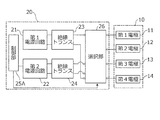
- FIG. 4 is a schematic view of another example of the internal structure of the beauty device 1.
- the control unit 25A is used instead of the control unit 25, and the application means 20A is used instead of the application means 20.
- the application means 20A is provided with a selection unit 26 between the first power supply circuit 21, the second power supply circuit 22, and each electrode.
- the control unit 25A determines from which of the first electrode 11 to the fourth electrode 14 the current generated by the first power supply circuit 21 and the second power supply circuit 22 is applied, and sends a control signal to the selection unit 26.
- the selection unit 26 is composed of a switch circuit or the like, and switches the wiring based on the control signal supplied from the control unit 25A.
- the selection unit 26 is used to apply a current of the first frequency from the first to fourth electrodes depending on at least one of the value of the first frequency and the value of the second frequency.
- the electrode pair to be used or the electrode pair to be used for applying the current of the second frequency is selected. As a result, the electrode pair suitable for the frequency is selected.
- the selection unit 26 has the first frequency from the first to fourth electrodes depending on at least one of the amplitude of the current of the first frequency and the amplitude of the current of the second frequency.
- the electrode pair used for applying the current of the second frequency or the electrode pair used for applying the current of the second frequency is selected. As a result, an electrode suitable for the applied current intensity is determined.
- the selection unit 26 may, from the first to fourth electrodes, depending on at least one of the first frequency current application period and the second frequency current application period.
- the electrode pair used for applying the first frequency current or the electrode pair used for applying the second frequency current is selected.
- an electrode suitable for the application period is selected.
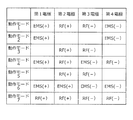
- the electrodes to be used may be selected according to the operation modes.
- a memory storing a table that defines a combination of the operation mode and the electrodes to be used is provided in the control unit 25A.
- the operation mode may be directly specified by the user via the switch 90, or is determined from the purpose, frequency, amplitude (intensity), application time, and other parameters related to application specified by the user via the switch 90.
- the control unit 25A may determine using the algorithm of.
- which electrode to apply either (or both) of the first frequency f1 and the second frequency f2 is specified according to the operation mode.
- (+) and (-) indicate the anode / negative electrode of the electrode pair, respectively.
- the current of f1 is applied between the first electrode 11 and the fourth electrode 14, and the current of f2 is applied between the second electrode 12 and the third electrode 13.
- the current of f1 is applied between the first electrode 11 and the fourth electrode 14.
- the current of f2 is applied between the second electrode 12 and the third electrode 13.
- the current of f1 is applied between the first electrode 11 and the third electrode 13, while the current of f2 is applied between the second electrode 12 and the fourth electrode 14.
- the electrodes used are different from those in the operation mode 1. This is effective when f1 and f2 have relatively close values.
- the first electrode 11 and the second electrode 12 have the same potential, and the third electrode 13 and the fourth electrode 14 have the same potential, so that the first electrode 11 and the second electrode 12 have one. It functions as an electrode (for example, an anode), and the third electrode 13 and the fourth electrode 14 function as one electrode (for example, an anode), and a current of one frequency is applied to the electrode pair.
- This is supposed to be selected when the purpose is to improve the experience of the effect by increasing the apparent area of the electrodes that come into contact with the skin, where the area of the electrodes in contact with the skin can affect the experience.
- the second electrode 12, the third electrode 13, and the fourth electrode 14 function as one of the electrode pairs. In this way, the electrodes can be flexibly selected according to the purpose, frequency, and other application modes.
- the first electrode 11 located on the innermost side may be annular rather than disc-shaped.
- a mechanism for irradiating the skin with light such as an LED may be provided in the space formed in the central portion of the first electrode 11.
- the number of electrodes of the electrode 10 may be 5 or more as long as it is an annular electrode arranged on concentric circles and having different diameters. By increasing the number of annular electrodes arranged on the concentric circles, the types of currents that can be applied at the same time increase.
- each electrode may have an elliptical ring, a rectangular ring, a polygonal (for example, rounded triangle) ring, a heart-shaped ring, or other hollow shape instead of a perfect circular ring shape.
- the "annular" in the present invention may be a hollow structure, for example, a shape in which protrusions are formed on an annular member as shown in FIG. 6, and the outer shape and inner diameter are distorted from the circle. You may. However, it is preferable that at least the distance between the electrodes constituting the electrode pair (for example, the first electrode 11 and the fourth electrode) is constant regardless of the position (in other words, the shapes of both electrodes are similar). When the distance between the electrodes is constant, the amount of applied current depending on the location of the skin and the sensation given to the user become uniform.
- the application means 20 applies a current having a first RF frequency between the second electrode 12 and the third electrode 13 in the first period, and between the first electrode 11 and the fourth electrode 14 in the second period.
- a current having a second RF frequency smaller than the first RF frequency may be applied.
- the first period and the second period may be repeated with each other.
- the application means 20 continuously applies the current of the second frequency between the first electrode and the fourth electrode in the first period, and further applies the current of the second frequency in the second period.
- the current of the second frequency may be intermittently applied between the second electrode and the third electrode.
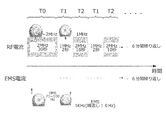
- FIG. 7 shows a specific example of such current application control.
- the applied alternating current is roughly classified into an RF current and an EMS current.
- the distance between the second electrode 12 and the third electrode 13 is 2 mm
- the distance between the first electrode 11 and the fourth electrode 14 is 8 mm.
- the application periods T0, T1 and T2 are set in order from when the power is turned on.
- an EMS current of 71 to 100 Hz is passed through the first electrode 11 and the fourth electrode 14 for 30 seconds.
- an RF current of 2 MHz is applied using the second electrode 12 and the third electrode 13.
- the longer the distance between the electrodes the better the feeling (the user is less likely to feel discomfort like chattering), and the stimulation is given to a wide range of muscles (by moving the muscles). )be able to. That is, in the period T0 immediately after the power is turned on, it is suitable to use the second electrode 12 and the third electrode 13, which are a pair of electrodes suitable for imparting a thermal effect, to warm the skin sufficiently and move the muscles firmly.
- the first electrode 11 and the fourth electrode 14 which are a pair of electrodes are used to stimulate the muscles so as to sandwich the area of warm skin.
- the EMS current (1 kHz) is applied to the second electrode 12 at that time.
- the third electrode 13 is used, and the current is passed at a repetition frequency of 10 Hz.
- a wide range can be heated by using the first electrode 11 and the fourth electrode 14, which are the combination in which the distance between the electrodes is the longest, for applying the RF current.
- the EMS current flows intermittently (that is, the EMS current flows) because the stimulation to the sensation becomes stronger (the discomfort increases) as the distance between the electrodes used for application becomes shorter. There is no period). It is said that the frequency of 1 kHz is relatively less unpleasant, but on the other hand, muscle contraction is unlikely to occur. There is also an effect.
- an RF current (2 MHz) is passed between the second electrode 12 and the third electrode 13 for 10 seconds, and an EMS current (71 to 100 Hz) is 10 between the first electrode and the fourth electrode. Run for seconds. That is, a current of 2 MHz, which is a frequency suitable for the thermal effect, is applied by using an electrode pair suitable for applying an RF current. As a result, the temperature of the skin is sufficiently raised to improve blood circulation, and electrical stimulation acts on the loosened muscles. In other words, a synergistic effect of muscle stimulation by EMS current and thermal effect by RF current is expected.
- the period T1 and the period T2 are repeated, and application is performed for, for example, 6 minutes to end the operation.
- the first RF frequency which can be expected to heat quickly
- the second RF frequency which has a modest capacity
- both rapid heating and temperature stability prevention of overheating
- the lengths of the periods T0, T1 and T2 described above are examples.
- the period T0 is preferably 20 to 40 seconds
- the period T1 is preferably 2 to 10 seconds
- the period T3 is preferably 5 to 15 seconds.
- the ratio of the length of the first period T1 to the total application time is preferably 70% to 80% or more.
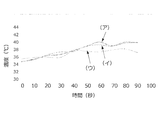
- FIG. 8 is the result of an experiment showing how the temperature changed when three different RF currents were applied for a total of 90 seconds.
- (A) shows the temperature change when a 2 MHz RF current is continuously applied between the second electrode 12 and the third electrode 13 for 90 seconds.
- (a) shows the temperature change when an RF current is passed between the second electrode 12 and the third electrode 13 for 2 seconds, and then 2 MHz is passed between the first electrode 11 and the fourth electrode 14.
- the temperature change when an RF current is passed for 10 seconds and then a step of applying a 1 MHz RF current for 2 seconds and a step of applying a 2 MHz RF current for 10 seconds are repeated.
- (C) shows the temperature change when the RF current of 1 MHz is continuously irradiated for 90 seconds between the first electrode 11 and the fourth electrode 14.
- the skin temperature which is preferable for skin care, is maintained at around 40 degrees, whereas in the case of (c), it reaches 40 degrees. Not done. This is because the distance between the electrodes used is larger than in the case of (a), and the thermal action is not sufficiently exerted.
- the electrodes that use the EMS current applied at the same time must be the second electrode 12 and the third electrode 13, so in this case, as described above.
- FIG. 9 is a diagram experimentally showing how the skin temperature changes depending on the difference between the distance between the annulus electrodes on the two concentric circles and the applied RF current.
- FIG. 3A shows a case where the RF current is 1 MHz and the distance between the electrodes is 3 mm
- FIG. 3B shows a case where the RF current is 2 MHz and the distance between the electrodes is 2 mm.
- the case (a) is superior in quick heating (has the effect of heating faster).
- Experiments have shown that when the distance between the electrodes is 1 mm, it becomes uncomfortable (too hot). Based on the above, in the example of FIG.
- the distance between the second electrode 12 and the third electrode 13 is preferably 1 mm to 3 mm.
- the electrodes 11 to 14 at least one of the intervals between adjacent electrodes is not the same as the other. This increases the variation in the distance between the electrodes when any two electrodes are used.
- Example 4 An example of the area (size) of each electrode is shown in FIG.
- the areas of the first electrode 11 to the fourth electrode 14 are 118.0 mm ⁇ 2, 113.7 mm ⁇ 2, 170.6 mm ⁇ 2, and 164.6 mm ⁇ 2, respectively.
- the size between the electrodes is preferably about 1.0 times to about 1.5 times. This is because, in the electrode pair used for applying the RF current or the EMS current, if the area ratio of the other electrode to one electrode is large, the thermal effect and the stimulating effect are reduced, or the sensation is deteriorated.
- each of the electrodes 11 to 14 does not have to be rectangular.
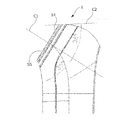
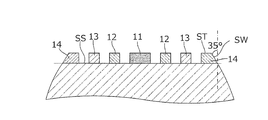
- the side surface (side wall surface) of the fourth electrode 14 has a predetermined angle (35 degrees in this case) with respect to the direction C1 perpendicular to the ground plane SS (head surface) of the electrode 10. It may be inclined. This predetermined angle is set so that the side surface of the fourth electrode 14 is continuous with the edge surface (C2) of the head portion of the housing 80 (see FIG. 12).
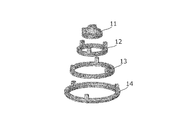
- FIG. 13 is an exploded view showing an example of the structure of the members constituting the electrodes 11 to 14.
- Each of the electrodes 11 to 14 has a shape in which three protrusions are formed on a metal ring.
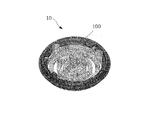
- 14 and 15 show the structure of the casing 100 in which these metal rings are fitted (buried and fixed).
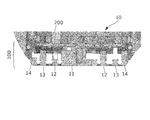
- FIG. 16 is a diagram showing a circuit board 200 for applying a voltage to a casing 100 in which a metal ring group is fitted.
- the circuit board 200 is provided with a plurality of conical (tapered) coil springs 201 as shown in FIG.
- each electrode member is fixed via the coil spring 201 by abutting on the protrusion of each electrode member and pressing each electrode member against the casing side 100.
- the coil spring 201 preferably has a cone shape (triangular pyramid, cone, etc.) such that the area of the apex portion is 50% or less of the area of the bottom surface portion.
- the width of each electrode When performing treatment on a narrow area such as the face, there are restrictions on the size of the head part, and if multiple electrodes are placed on concentric circles, the width of each electrode will inevitably become smaller. As an example, the width of the electrode may be 2 mm or less. In view of such a situation, in order to stabilize the energized state even with a thin electrode, the electrode side is projected from the insulating portion and energized via a tapered coil spring.
- the beauty device 1 is further provided with a sensor for detecting the current applied to the skin between the first electrode 11 and the fourth electrode so that the RF current does not flow when the skin does not touch the entire surface of the electrodes. It may be.
- the application means 20 stops the application of at least the second frequency when a current having a current value equal to or greater than a predetermined threshold value is not applied to the skin for a predetermined period between the first electrode and the fourth electrode.
- a minute RF voltage is applied between the first electrode 11 and the fourth electrode 14, and the difference in the applied current value (amplitude) when not touching the skin and when touching the skin is obtained. It is detected, and it is determined whether or not the electrode (the entire surface) is in contact with the skin based on whether or not the difference exceeds the threshold value. For example, it is as follows. ⁇ Judge that you are not touching your skin when the power is turned on. -After determining that the skin is not touched, it is determined that the skin is touched when the current value of the first threshold value flows for 50 ms or more.
- the current value of the first threshold value or more continues to flow for 25 ms or more after it is determined that the skin is in contact with the skin, it is determined that the skin is still in contact with the skin.
- the current value below the second threshold value continues for 3 seconds or more after determining that the skin is in contact with the skin, it is determined that the patient has left the skin (it is no longer in contact with the skin).
- the beauty device 1 includes a first electrode, a second electrode, a third electrode, and a fourth electrode, and the distance from the first electrode to the fourth electrode is the distance from the second electrode to the third electrode. It suffices if it is arranged so as to be larger than. In such an electrode arrangement, in the first period, a current of the first RF frequency is applied between the second electrode and the third electrode, and a current of the second frequency is applied between the first electrode and the fourth electrode.
- the second electrode and the second electrode In the first step of continuously applying and in the second period, while applying a current having a second RF frequency smaller than the first RF frequency between the first electrode and the fourth electrode, the second electrode and the second electrode A current of the second frequency is intermittently applied to and from the third electrode, the first RF frequency is 200 kHz to 4 MHz, the second frequency is 1 Hz to 100 kHz, and the first step and the first step.
- the two steps are repeated alternately. By doing so, it is possible to achieve both the thermal effect brought about by the first RF frequency and the muscle stimulating effect brought about by the second RF frequency.
Landscapes
- Health & Medical Sciences (AREA)
- Life Sciences & Earth Sciences (AREA)
- Engineering & Computer Science (AREA)
- Biomedical Technology (AREA)
- General Health & Medical Sciences (AREA)
- Veterinary Medicine (AREA)
- Public Health (AREA)
- Animal Behavior & Ethology (AREA)
- Nuclear Medicine, Radiotherapy & Molecular Imaging (AREA)
- Radiology & Medical Imaging (AREA)
- Biophysics (AREA)
- Heart & Thoracic Surgery (AREA)
- Physical Education & Sports Medicine (AREA)
- Pathology (AREA)
- Vascular Medicine (AREA)
- Electrotherapy Devices (AREA)
Priority Applications (3)
| Application Number | Priority Date | Filing Date | Title |
|---|---|---|---|
| CN202180002227.8A CN113874069B (zh) | 2020-04-27 | 2021-04-19 | 美容设备 |
| JP2021526809A JP7235862B2 (ja) | 2020-04-27 | 2021-04-19 | 美容機器および電流制御方法 |
| JP2023026900A JP7742372B2 (ja) | 2020-04-27 | 2023-02-24 | 美容機器および電流制御方法 |
Applications Claiming Priority (2)
| Application Number | Priority Date | Filing Date | Title |
|---|---|---|---|
| JP2020-077955 | 2020-04-27 | ||
| JP2020077955 | 2020-04-27 |
Publications (1)
| Publication Number | Publication Date |
|---|---|
| WO2021167109A1 true WO2021167109A1 (ja) | 2021-08-26 |
Family
ID=77390876
Family Applications (1)
| Application Number | Title | Priority Date | Filing Date |
|---|---|---|---|
| PCT/JP2021/015877 Ceased WO2021167109A1 (ja) | 2020-04-27 | 2021-04-19 | 美容機器および電流制御方法 |
Country Status (3)
| Country | Link |
|---|---|
| JP (2) | JP7235862B2 (https=) |
| CN (1) | CN113874069B (https=) |
| WO (1) | WO2021167109A1 (https=) |
Cited By (9)
| Publication number | Priority date | Publication date | Assignee | Title |
|---|---|---|---|---|
| WO2023053734A1 (ja) * | 2021-09-30 | 2023-04-06 | ヤーマン株式会社 | 美容装置、プログラム及び情報処理方法 |
| WO2023095922A1 (ja) * | 2021-11-29 | 2023-06-01 | ヤーマン株式会社 | 肌処理装置及びプログラム |
| JP2023079985A (ja) * | 2021-11-29 | 2023-06-08 | ヤーマン株式会社 | 肌処理装置及びプログラム |
| JP2023164237A (ja) * | 2022-04-28 | 2023-11-10 | ヤーマン株式会社 | 肌処理装置及びプログラム |
| WO2024010068A1 (ja) * | 2022-07-08 | 2024-01-11 | ヤーマン株式会社 | 肌処理装置 |
| WO2024058418A1 (ko) * | 2022-09-13 | 2024-03-21 | 주식회사 엘지생활건강 | 피부 관리 기기 |
| WO2024154694A1 (ja) * | 2023-01-18 | 2024-07-25 | ヤーマン株式会社 | 肌処理装置 |
| JP2025104210A (ja) * | 2023-12-27 | 2025-07-09 | ヤーマン株式会社 | 肌処理装置、肌処理方法及び出力制御プログラム |
| EP4525974A4 (en) * | 2022-05-19 | 2026-04-01 | Skin Design Llc | MULTIMODAL SKIN TREATMENT DEVICE |
Families Citing this family (8)
| Publication number | Priority date | Publication date | Assignee | Title |
|---|---|---|---|---|
| JP7839988B2 (ja) * | 2022-01-31 | 2026-04-03 | パナソニックIpマネジメント株式会社 | 美容器具 |
| CN115887927A (zh) * | 2022-08-30 | 2023-04-04 | 广东雅思电子有限公司 | 一种rf美颜仪及其电流控制方法 |
| CN219614748U (zh) * | 2023-02-27 | 2023-09-01 | 厦门松霖科技股份有限公司 | 一种分时复用的美容仪 |
| CN220070490U (zh) * | 2023-03-07 | 2023-11-24 | 深圳金茉科技有限公司 | 美容仪 |
| CN118718241A (zh) * | 2023-03-30 | 2024-10-01 | 厦门松霖科技股份有限公司 | 一种电极极性随模式变化的美容仪 |
| WO2025028859A1 (ko) * | 2023-07-28 | 2025-02-06 | 주식회사 에이피알 | 전기 자극을 이용한 스킨 케어 장치 |
| JP7839205B2 (ja) * | 2024-01-26 | 2026-04-01 | Aiロボティクス株式会社 | 美容器 |
| WO2026071774A1 (ko) * | 2024-09-26 | 2026-04-02 | 주식회사 제이시스메디칼 | 고주파 출력 장치 |
Citations (5)
| Publication number | Priority date | Publication date | Assignee | Title |
|---|---|---|---|---|
| JP2004538041A (ja) * | 2001-03-08 | 2004-12-24 | ノーススター ニューロサイエンス インコーポレイテッド | 患者の神経機能に永続的な変化をもたらすための方法及び装置 |
| US20100106205A1 (en) * | 2008-10-28 | 2010-04-29 | Silverstone Leon M | Devices for treatment of viral infections |
| WO2011041191A1 (en) * | 2009-09-29 | 2011-04-07 | Medtronic, Inc. | Steering stimulation current by employing steering current |
| JP2016511115A (ja) * | 2013-03-12 | 2016-04-14 | ヴァレンシア テクノロジーズ コーポレーションValencia Technologies Corporation | 埋め込み型電気鍼デバイスのための電極構成 |
| JP2019055052A (ja) * | 2017-09-21 | 2019-04-11 | ヤーマン株式会社 | 美容処理装置 |
Family Cites Families (13)
| Publication number | Priority date | Publication date | Assignee | Title |
|---|---|---|---|---|
| JP3465125B2 (ja) * | 1995-05-09 | 2003-11-10 | 株式会社マルタカ | 温熱治療器 |
| US8700176B2 (en) * | 2006-07-27 | 2014-04-15 | Pollogen Ltd. | Apparatus and method for non-invasive treatment of skin tissue |
| WO2010078313A1 (en) * | 2008-12-30 | 2010-07-08 | Nupathe, Inc. | Electronic control of drug delivery system |
| JP5511606B2 (ja) * | 2010-09-21 | 2014-06-04 | クルールラボ株式会社 | 美容マッサージ器 |
| JP6282049B2 (ja) * | 2012-08-10 | 2018-02-21 | 株式会社 Mtg | 美容器具 |
| WO2014196195A1 (ja) * | 2013-06-04 | 2014-12-11 | ヤーマン株式会社 | 高周波美容処理装置 |
| JP5872741B2 (ja) * | 2013-11-11 | 2016-03-01 | 株式会社 Artistic&Co. | 美容器 |
| CN204092178U (zh) * | 2014-09-16 | 2015-01-14 | 高彩云 | 美容仪 |
| KR101793373B1 (ko) * | 2016-04-01 | 2017-11-02 | (주)휴먼드림 | 주파수를 이용한 환부 자극장치 |
| KR102628092B1 (ko) * | 2016-11-07 | 2024-01-23 | 엘지전자 주식회사 | 피부 케어 기기 |
| JP6870799B2 (ja) * | 2017-02-27 | 2021-05-12 | 伊藤超短波株式会社 | 電気刺激装置 |
| JP2019037687A (ja) * | 2017-08-29 | 2019-03-14 | パナソニックIpマネジメント株式会社 | 美容器具 |
| JP2019088373A (ja) * | 2017-11-13 | 2019-06-13 | 株式会社 Artistic&Co. | 美容器 |
-
2021
- 2021-04-19 WO PCT/JP2021/015877 patent/WO2021167109A1/ja not_active Ceased
- 2021-04-19 CN CN202180002227.8A patent/CN113874069B/zh active Active
- 2021-04-19 JP JP2021526809A patent/JP7235862B2/ja active Active
-
2023
- 2023-02-24 JP JP2023026900A patent/JP7742372B2/ja active Active
Patent Citations (5)
| Publication number | Priority date | Publication date | Assignee | Title |
|---|---|---|---|---|
| JP2004538041A (ja) * | 2001-03-08 | 2004-12-24 | ノーススター ニューロサイエンス インコーポレイテッド | 患者の神経機能に永続的な変化をもたらすための方法及び装置 |
| US20100106205A1 (en) * | 2008-10-28 | 2010-04-29 | Silverstone Leon M | Devices for treatment of viral infections |
| WO2011041191A1 (en) * | 2009-09-29 | 2011-04-07 | Medtronic, Inc. | Steering stimulation current by employing steering current |
| JP2016511115A (ja) * | 2013-03-12 | 2016-04-14 | ヴァレンシア テクノロジーズ コーポレーションValencia Technologies Corporation | 埋め込み型電気鍼デバイスのための電極構成 |
| JP2019055052A (ja) * | 2017-09-21 | 2019-04-11 | ヤーマン株式会社 | 美容処理装置 |
Cited By (12)
| Publication number | Priority date | Publication date | Assignee | Title |
|---|---|---|---|---|
| WO2023053734A1 (ja) * | 2021-09-30 | 2023-04-06 | ヤーマン株式会社 | 美容装置、プログラム及び情報処理方法 |
| JP2023051298A (ja) * | 2021-09-30 | 2023-04-11 | ヤーマン株式会社 | 美容装置、プログラム及び情報処理方法 |
| JP7762532B2 (ja) | 2021-09-30 | 2025-10-30 | ヤーマン株式会社 | 美容装置、プログラム及び情報処理方法 |
| WO2023095922A1 (ja) * | 2021-11-29 | 2023-06-01 | ヤーマン株式会社 | 肌処理装置及びプログラム |
| JP2023079985A (ja) * | 2021-11-29 | 2023-06-08 | ヤーマン株式会社 | 肌処理装置及びプログラム |
| JP2023164237A (ja) * | 2022-04-28 | 2023-11-10 | ヤーマン株式会社 | 肌処理装置及びプログラム |
| JP7561166B2 (ja) | 2022-04-28 | 2024-10-03 | ヤーマン株式会社 | 肌処理装置及びプログラム |
| EP4525974A4 (en) * | 2022-05-19 | 2026-04-01 | Skin Design Llc | MULTIMODAL SKIN TREATMENT DEVICE |
| WO2024010068A1 (ja) * | 2022-07-08 | 2024-01-11 | ヤーマン株式会社 | 肌処理装置 |
| WO2024058418A1 (ko) * | 2022-09-13 | 2024-03-21 | 주식회사 엘지생활건강 | 피부 관리 기기 |
| WO2024154694A1 (ja) * | 2023-01-18 | 2024-07-25 | ヤーマン株式会社 | 肌処理装置 |
| JP2025104210A (ja) * | 2023-12-27 | 2025-07-09 | ヤーマン株式会社 | 肌処理装置、肌処理方法及び出力制御プログラム |
Also Published As
| Publication number | Publication date |
|---|---|
| JP2023054291A (ja) | 2023-04-13 |
| JP7742372B2 (ja) | 2025-09-19 |
| CN113874069A (zh) | 2021-12-31 |
| CN113874069B (zh) | 2025-09-02 |
| JP7235862B2 (ja) | 2023-03-08 |
| JPWO2021167109A1 (https=) | 2021-08-26 |
Similar Documents
| Publication | Publication Date | Title |
|---|---|---|
| WO2021167109A1 (ja) | 美容機器および電流制御方法 | |
| JPWO2021167109A5 (https=) | ||
| JP7387397B2 (ja) | 美容機器 | |
| JP7761984B2 (ja) | 美容器 | |
| US5546954A (en) | Method and apparatus of applying high-frequency wave current to reactive electro-permeable point of patient | |
| EP3171802B1 (en) | Treatment device using r.f. electrical current for heating a first inner region and a second inner region of skin | |
| CN114144225A (zh) | 美容设备 | |
| JP7542202B2 (ja) | 美容装置 | |
| US20170319262A1 (en) | Radio frequency skin treatment | |
| KR102759874B1 (ko) | 접촉 감지 센서를 구비한 미용 시술 기기의 제어 방법 | |
| KR102195322B1 (ko) | 미용 기구 | |
| JP2024091845A (ja) | 美容器、及びその制御方法 | |
| JP2006271689A (ja) | 刺激装置およびその制御方法 | |
| JP7012228B2 (ja) | 美容器具 | |
| JP2021133160A (ja) | 高周波美容器 | |
| KR100933463B1 (ko) | 발열체를 내장한 전기 뜸장치 | |
| KR102330207B1 (ko) | 환부 적응형 패드 및 이를 이용한 자극 치료 장치 | |
| KR200397295Y1 (ko) | 전극구분기능과 온도제어기능을 갖춘 고주파 전기치료기 | |
| KR20190115877A (ko) | 휴대용 저주파 전기자극 장치 및 그 제어 방법 | |
| TW202408620A (zh) | 用於減少電感覺的交變電場波形 | |
| CN118139674A (zh) | 肌肤处理装置 | |
| KR102425773B1 (ko) | 환부 자극 장치 및 그의 제어 방법 | |
| US20220241603A1 (en) | Varying Parameters of Tumor Treating Fields (TTFields) Treatment to Overcome Treatment Resistance | |
| HK40127166A (zh) | 具有接触检测传感器的美容施术设备及其控制方法 | |
| JP2003093522A (ja) | 低周波治療器 |
Legal Events
| Date | Code | Title | Description |
|---|---|---|---|
| ENP | Entry into the national phase |
Ref document number: 2021526809 Country of ref document: JP Kind code of ref document: A |
|
| 121 | Ep: the epo has been informed by wipo that ep was designated in this application |
Ref document number: 21756443 Country of ref document: EP Kind code of ref document: A1 |
|
| NENP | Non-entry into the national phase |
Ref country code: DE |
|
| 122 | Ep: pct application non-entry in european phase |
Ref document number: 21756443 Country of ref document: EP Kind code of ref document: A1 |
|
| WWG | Wipo information: grant in national office |
Ref document number: 202180002227.8 Country of ref document: CN |