WO2021157135A1 - Yagセラミックス接合体及びその製造方法 - Google Patents
Yagセラミックス接合体及びその製造方法 Download PDFInfo
- Publication number
- WO2021157135A1 WO2021157135A1 PCT/JP2020/038554 JP2020038554W WO2021157135A1 WO 2021157135 A1 WO2021157135 A1 WO 2021157135A1 JP 2020038554 W JP2020038554 W JP 2020038554W WO 2021157135 A1 WO2021157135 A1 WO 2021157135A1
- Authority
- WO
- WIPO (PCT)
- Prior art keywords
- yag
- ceramics
- glass
- bonded body
- yag ceramics
- Prior art date
- Legal status (The legal status is an assumption and is not a legal conclusion. Google has not performed a legal analysis and makes no representation as to the accuracy of the status listed.)
- Ceased
Links
Images
Classifications
-
- H—ELECTRICITY
- H01—ELECTRIC ELEMENTS
- H01S—DEVICES USING THE PROCESS OF LIGHT AMPLIFICATION BY STIMULATED EMISSION OF RADIATION [LASER] TO AMPLIFY OR GENERATE LIGHT; DEVICES USING STIMULATED EMISSION OF ELECTROMAGNETIC RADIATION IN WAVE RANGES OTHER THAN OPTICAL
- H01S3/00—Lasers, i.e. devices using stimulated emission of electromagnetic radiation in the infrared, visible or ultraviolet wave range
- H01S3/05—Construction or shape of optical resonators; Accommodation of active medium therein; Shape of active medium
- H01S3/06—Construction or shape of active medium
- H01S3/0602—Crystal lasers or glass lasers
- H01S3/0612—Non-homogeneous structure
-
- C—CHEMISTRY; METALLURGY
- C04—CEMENTS; CONCRETE; ARTIFICIAL STONE; CERAMICS; REFRACTORIES
- C04B—LIME, MAGNESIA; SLAG; CEMENTS; COMPOSITIONS THEREOF, e.g. MORTARS, CONCRETE OR LIKE BUILDING MATERIALS; ARTIFICIAL STONE; CERAMICS; REFRACTORIES; TREATMENT OF NATURAL STONE
- C04B37/00—Joining burned ceramic articles with other burned ceramic articles or other articles by heating
- C04B37/003—Joining burned ceramic articles with other burned ceramic articles or other articles by heating by means of an interlayer consisting of a combination of materials selected from glass, or ceramic material with metals, metal oxides or metal salts
-
- H—ELECTRICITY
- H01—ELECTRIC ELEMENTS
- H01S—DEVICES USING THE PROCESS OF LIGHT AMPLIFICATION BY STIMULATED EMISSION OF RADIATION [LASER] TO AMPLIFY OR GENERATE LIGHT; DEVICES USING STIMULATED EMISSION OF ELECTROMAGNETIC RADIATION IN WAVE RANGES OTHER THAN OPTICAL
- H01S3/00—Lasers, i.e. devices using stimulated emission of electromagnetic radiation in the infrared, visible or ultraviolet wave range
- H01S3/14—Lasers, i.e. devices using stimulated emission of electromagnetic radiation in the infrared, visible or ultraviolet wave range characterised by the material used as the active medium
- H01S3/16—Solid materials
- H01S3/163—Solid materials characterised by a crystal matrix
- H01S3/164—Solid materials characterised by a crystal matrix garnet
- H01S3/1643—YAG
-
- C—CHEMISTRY; METALLURGY
- C04—CEMENTS; CONCRETE; ARTIFICIAL STONE; CERAMICS; REFRACTORIES
- C04B—LIME, MAGNESIA; SLAG; CEMENTS; COMPOSITIONS THEREOF, e.g. MORTARS, CONCRETE OR LIKE BUILDING MATERIALS; ARTIFICIAL STONE; CERAMICS; REFRACTORIES; TREATMENT OF NATURAL STONE
- C04B37/00—Joining burned ceramic articles with other burned ceramic articles or other articles by heating
- C04B37/001—Joining burned ceramic articles with other burned ceramic articles or other articles by heating directly with other burned ceramic articles
-
- C—CHEMISTRY; METALLURGY
- C04—CEMENTS; CONCRETE; ARTIFICIAL STONE; CERAMICS; REFRACTORIES
- C04B—LIME, MAGNESIA; SLAG; CEMENTS; COMPOSITIONS THEREOF, e.g. MORTARS, CONCRETE OR LIKE BUILDING MATERIALS; ARTIFICIAL STONE; CERAMICS; REFRACTORIES; TREATMENT OF NATURAL STONE
- C04B37/00—Joining burned ceramic articles with other burned ceramic articles or other articles by heating
- C04B37/003—Joining burned ceramic articles with other burned ceramic articles or other articles by heating by means of an interlayer consisting of a combination of materials selected from glass, or ceramic material with metals, metal oxides or metal salts
- C04B37/005—Joining burned ceramic articles with other burned ceramic articles or other articles by heating by means of an interlayer consisting of a combination of materials selected from glass, or ceramic material with metals, metal oxides or metal salts consisting of glass or ceramic material
-
- C—CHEMISTRY; METALLURGY
- C04—CEMENTS; CONCRETE; ARTIFICIAL STONE; CERAMICS; REFRACTORIES
- C04B—LIME, MAGNESIA; SLAG; CEMENTS; COMPOSITIONS THEREOF, e.g. MORTARS, CONCRETE OR LIKE BUILDING MATERIALS; ARTIFICIAL STONE; CERAMICS; REFRACTORIES; TREATMENT OF NATURAL STONE
- C04B37/00—Joining burned ceramic articles with other burned ceramic articles or other articles by heating
- C04B37/04—Joining burned ceramic articles with other burned ceramic articles or other articles by heating with articles made from glass
- C04B37/045—Joining burned ceramic articles with other burned ceramic articles or other articles by heating with articles made from glass characterised by the interlayer used
-
- H—ELECTRICITY
- H01—ELECTRIC ELEMENTS
- H01S—DEVICES USING THE PROCESS OF LIGHT AMPLIFICATION BY STIMULATED EMISSION OF RADIATION [LASER] TO AMPLIFY OR GENERATE LIGHT; DEVICES USING STIMULATED EMISSION OF ELECTROMAGNETIC RADIATION IN WAVE RANGES OTHER THAN OPTICAL
- H01S3/00—Lasers, i.e. devices using stimulated emission of electromagnetic radiation in the infrared, visible or ultraviolet wave range
- H01S3/05—Construction or shape of optical resonators; Accommodation of active medium therein; Shape of active medium
- H01S3/06—Construction or shape of active medium
-
- H—ELECTRICITY
- H01—ELECTRIC ELEMENTS
- H01S—DEVICES USING THE PROCESS OF LIGHT AMPLIFICATION BY STIMULATED EMISSION OF RADIATION [LASER] TO AMPLIFY OR GENERATE LIGHT; DEVICES USING STIMULATED EMISSION OF ELECTROMAGNETIC RADIATION IN WAVE RANGES OTHER THAN OPTICAL
- H01S3/00—Lasers, i.e. devices using stimulated emission of electromagnetic radiation in the infrared, visible or ultraviolet wave range
- H01S3/05—Construction or shape of optical resonators; Accommodation of active medium therein; Shape of active medium
- H01S3/06—Construction or shape of active medium
- H01S3/0602—Crystal lasers or glass lasers
- H01S3/0606—Crystal lasers or glass lasers with polygonal cross-section, e.g. slab, prism
-
- H—ELECTRICITY
- H01—ELECTRIC ELEMENTS
- H01S—DEVICES USING THE PROCESS OF LIGHT AMPLIFICATION BY STIMULATED EMISSION OF RADIATION [LASER] TO AMPLIFY OR GENERATE LIGHT; DEVICES USING STIMULATED EMISSION OF ELECTROMAGNETIC RADIATION IN WAVE RANGES OTHER THAN OPTICAL
- H01S3/00—Lasers, i.e. devices using stimulated emission of electromagnetic radiation in the infrared, visible or ultraviolet wave range
- H01S3/05—Construction or shape of optical resonators; Accommodation of active medium therein; Shape of active medium
- H01S3/06—Construction or shape of active medium
- H01S3/0602—Crystal lasers or glass lasers
- H01S3/0617—Crystal lasers or glass lasers having a varying composition or cross-section in a specific direction
-
- H—ELECTRICITY
- H01—ELECTRIC ELEMENTS
- H01S—DEVICES USING THE PROCESS OF LIGHT AMPLIFICATION BY STIMULATED EMISSION OF RADIATION [LASER] TO AMPLIFY OR GENERATE LIGHT; DEVICES USING STIMULATED EMISSION OF ELECTROMAGNETIC RADIATION IN WAVE RANGES OTHER THAN OPTICAL
- H01S3/00—Lasers, i.e. devices using stimulated emission of electromagnetic radiation in the infrared, visible or ultraviolet wave range
- H01S3/05—Construction or shape of optical resonators; Accommodation of active medium therein; Shape of active medium
- H01S3/06—Construction or shape of active medium
- H01S3/0619—Coatings, e.g. AR, HR, passivation layer
-
- H—ELECTRICITY
- H01—ELECTRIC ELEMENTS
- H01S—DEVICES USING THE PROCESS OF LIGHT AMPLIFICATION BY STIMULATED EMISSION OF RADIATION [LASER] TO AMPLIFY OR GENERATE LIGHT; DEVICES USING STIMULATED EMISSION OF ELECTROMAGNETIC RADIATION IN WAVE RANGES OTHER THAN OPTICAL
- H01S3/00—Lasers, i.e. devices using stimulated emission of electromagnetic radiation in the infrared, visible or ultraviolet wave range
- H01S3/05—Construction or shape of optical resonators; Accommodation of active medium therein; Shape of active medium
- H01S3/06—Construction or shape of active medium
- H01S3/0619—Coatings, e.g. AR, HR, passivation layer
- H01S3/0625—Coatings on surfaces other than the end-faces
-
- H—ELECTRICITY
- H01—ELECTRIC ELEMENTS
- H01S—DEVICES USING THE PROCESS OF LIGHT AMPLIFICATION BY STIMULATED EMISSION OF RADIATION [LASER] TO AMPLIFY OR GENERATE LIGHT; DEVICES USING STIMULATED EMISSION OF ELECTROMAGNETIC RADIATION IN WAVE RANGES OTHER THAN OPTICAL
- H01S3/00—Lasers, i.e. devices using stimulated emission of electromagnetic radiation in the infrared, visible or ultraviolet wave range
- H01S3/14—Lasers, i.e. devices using stimulated emission of electromagnetic radiation in the infrared, visible or ultraviolet wave range characterised by the material used as the active medium
- H01S3/16—Solid materials
- H01S3/1685—Ceramics
-
- C—CHEMISTRY; METALLURGY
- C04—CEMENTS; CONCRETE; ARTIFICIAL STONE; CERAMICS; REFRACTORIES
- C04B—LIME, MAGNESIA; SLAG; CEMENTS; COMPOSITIONS THEREOF, e.g. MORTARS, CONCRETE OR LIKE BUILDING MATERIALS; ARTIFICIAL STONE; CERAMICS; REFRACTORIES; TREATMENT OF NATURAL STONE
- C04B2235/00—Aspects relating to ceramic starting mixtures or sintered ceramic products
- C04B2235/02—Composition of constituents of the starting material or of secondary phases of the final product
- C04B2235/30—Constituents and secondary phases not being of a fibrous nature
- C04B2235/32—Metal oxides, mixed metal oxides, or oxide-forming salts thereof, e.g. carbonates, nitrates, (oxy)hydroxides, chlorides
- C04B2235/3217—Aluminum oxide or oxide forming salts thereof, e.g. bauxite, alpha-alumina
- C04B2235/3222—Aluminates other than alumino-silicates, e.g. spinel (MgAl2O4)
-
- C—CHEMISTRY; METALLURGY
- C04—CEMENTS; CONCRETE; ARTIFICIAL STONE; CERAMICS; REFRACTORIES
- C04B—LIME, MAGNESIA; SLAG; CEMENTS; COMPOSITIONS THEREOF, e.g. MORTARS, CONCRETE OR LIKE BUILDING MATERIALS; ARTIFICIAL STONE; CERAMICS; REFRACTORIES; TREATMENT OF NATURAL STONE
- C04B2235/00—Aspects relating to ceramic starting mixtures or sintered ceramic products
- C04B2235/02—Composition of constituents of the starting material or of secondary phases of the final product
- C04B2235/30—Constituents and secondary phases not being of a fibrous nature
- C04B2235/32—Metal oxides, mixed metal oxides, or oxide-forming salts thereof, e.g. carbonates, nitrates, (oxy)hydroxides, chlorides
- C04B2235/3224—Rare earth oxide or oxide forming salts thereof, e.g. scandium oxide
-
- C—CHEMISTRY; METALLURGY
- C04—CEMENTS; CONCRETE; ARTIFICIAL STONE; CERAMICS; REFRACTORIES
- C04B—LIME, MAGNESIA; SLAG; CEMENTS; COMPOSITIONS THEREOF, e.g. MORTARS, CONCRETE OR LIKE BUILDING MATERIALS; ARTIFICIAL STONE; CERAMICS; REFRACTORIES; TREATMENT OF NATURAL STONE
- C04B2235/00—Aspects relating to ceramic starting mixtures or sintered ceramic products
- C04B2235/02—Composition of constituents of the starting material or of secondary phases of the final product
- C04B2235/30—Constituents and secondary phases not being of a fibrous nature
- C04B2235/32—Metal oxides, mixed metal oxides, or oxide-forming salts thereof, e.g. carbonates, nitrates, (oxy)hydroxides, chlorides
- C04B2235/3224—Rare earth oxide or oxide forming salts thereof, e.g. scandium oxide
- C04B2235/3225—Yttrium oxide or oxide-forming salts thereof
-
- C—CHEMISTRY; METALLURGY
- C04—CEMENTS; CONCRETE; ARTIFICIAL STONE; CERAMICS; REFRACTORIES
- C04B—LIME, MAGNESIA; SLAG; CEMENTS; COMPOSITIONS THEREOF, e.g. MORTARS, CONCRETE OR LIKE BUILDING MATERIALS; ARTIFICIAL STONE; CERAMICS; REFRACTORIES; TREATMENT OF NATURAL STONE
- C04B2235/00—Aspects relating to ceramic starting mixtures or sintered ceramic products
- C04B2235/02—Composition of constituents of the starting material or of secondary phases of the final product
- C04B2235/30—Constituents and secondary phases not being of a fibrous nature
- C04B2235/32—Metal oxides, mixed metal oxides, or oxide-forming salts thereof, e.g. carbonates, nitrates, (oxy)hydroxides, chlorides
- C04B2235/3231—Refractory metal oxides, their mixed metal oxides, or oxide-forming salts thereof
- C04B2235/3241—Chromium oxides, chromates, or oxide-forming salts thereof
-
- C—CHEMISTRY; METALLURGY
- C04—CEMENTS; CONCRETE; ARTIFICIAL STONE; CERAMICS; REFRACTORIES
- C04B—LIME, MAGNESIA; SLAG; CEMENTS; COMPOSITIONS THEREOF, e.g. MORTARS, CONCRETE OR LIKE BUILDING MATERIALS; ARTIFICIAL STONE; CERAMICS; REFRACTORIES; TREATMENT OF NATURAL STONE
- C04B2235/00—Aspects relating to ceramic starting mixtures or sintered ceramic products
- C04B2235/70—Aspects relating to sintered or melt-casted ceramic products
- C04B2235/74—Physical characteristics
- C04B2235/76—Crystal structural characteristics, e.g. symmetry
- C04B2235/762—Cubic symmetry, e.g. beta-SiC
- C04B2235/764—Garnet structure A3B2(CO4)3
-
- C—CHEMISTRY; METALLURGY
- C04—CEMENTS; CONCRETE; ARTIFICIAL STONE; CERAMICS; REFRACTORIES
- C04B—LIME, MAGNESIA; SLAG; CEMENTS; COMPOSITIONS THEREOF, e.g. MORTARS, CONCRETE OR LIKE BUILDING MATERIALS; ARTIFICIAL STONE; CERAMICS; REFRACTORIES; TREATMENT OF NATURAL STONE
- C04B2235/00—Aspects relating to ceramic starting mixtures or sintered ceramic products
- C04B2235/70—Aspects relating to sintered or melt-casted ceramic products
- C04B2235/96—Properties of ceramic products, e.g. mechanical properties such as strength, toughness, wear resistance
- C04B2235/9607—Thermal properties, e.g. thermal expansion coefficient
-
- C—CHEMISTRY; METALLURGY
- C04—CEMENTS; CONCRETE; ARTIFICIAL STONE; CERAMICS; REFRACTORIES
- C04B—LIME, MAGNESIA; SLAG; CEMENTS; COMPOSITIONS THEREOF, e.g. MORTARS, CONCRETE OR LIKE BUILDING MATERIALS; ARTIFICIAL STONE; CERAMICS; REFRACTORIES; TREATMENT OF NATURAL STONE
- C04B2235/00—Aspects relating to ceramic starting mixtures or sintered ceramic products
- C04B2235/70—Aspects relating to sintered or melt-casted ceramic products
- C04B2235/96—Properties of ceramic products, e.g. mechanical properties such as strength, toughness, wear resistance
- C04B2235/9646—Optical properties
- C04B2235/9653—Translucent or transparent ceramics other than alumina
-
- C—CHEMISTRY; METALLURGY
- C04—CEMENTS; CONCRETE; ARTIFICIAL STONE; CERAMICS; REFRACTORIES
- C04B—LIME, MAGNESIA; SLAG; CEMENTS; COMPOSITIONS THEREOF, e.g. MORTARS, CONCRETE OR LIKE BUILDING MATERIALS; ARTIFICIAL STONE; CERAMICS; REFRACTORIES; TREATMENT OF NATURAL STONE
- C04B2237/00—Aspects relating to ceramic laminates or to joining of ceramic articles with other articles by heating
- C04B2237/02—Aspects relating to interlayers, e.g. used to join ceramic articles with other articles by heating
- C04B2237/10—Glass interlayers, e.g. frit or flux
-
- C—CHEMISTRY; METALLURGY
- C04—CEMENTS; CONCRETE; ARTIFICIAL STONE; CERAMICS; REFRACTORIES
- C04B—LIME, MAGNESIA; SLAG; CEMENTS; COMPOSITIONS THEREOF, e.g. MORTARS, CONCRETE OR LIKE BUILDING MATERIALS; ARTIFICIAL STONE; CERAMICS; REFRACTORIES; TREATMENT OF NATURAL STONE
- C04B2237/00—Aspects relating to ceramic laminates or to joining of ceramic articles with other articles by heating
- C04B2237/30—Composition of layers of ceramic laminates or of ceramic or metallic articles to be joined by heating, e.g. Si substrates
- C04B2237/32—Ceramic
- C04B2237/34—Oxidic
- C04B2237/343—Alumina or aluminates
Definitions
- the present invention relates to a YAG (yttrium aluminum garnet) ceramics joint, and more particularly to a YAG ceramics joint in which glass is interposed as a joint layer and a method for producing the same.
- YAG yttrium aluminum garnet
- a standard laser is an application that excites a laser medium, which is a phosphor, and amplifies it in an optical cavity sandwiched between optically opposed high reflectance mirrors.
- YAG ceramics are used as a representative laser medium for high-power lasers.
- the laser medium is also applied as an amplifier that amplifies the laser light output generated from another medium, except when the laser medium itself serves as an oscillation source.
- Non-Patent Documents 1 and 2 The development of a light absorbing layer YAG polycrystalline in which Sm is doped around an Nd: YAG polycrystalline material for an amplifier has been reported (Non-Patent Documents 1 and 2). Further, high-power operation has been confirmed by joining a Cr-doped YAG polycrystal to a Yb: YAG laser polycrystal having excellent energy storage (Non-Patent Document 3).
- YAG semi-lux is exclusively used for high-power lasers, and is a technology for joining YAG ceramics of different dopants and optical glass for light absorption as a light absorption layer to prevent parasitic oscillation to YAG semi-lux in the laser oscillation part. Is required. There is also a demand for large-diameter transparent YAG ceramics, and in order to meet these demands, joining techniques for joining YAG ceramics and joining YAG ceramics and optical glass for light absorption are required.
- the present invention has been made in view of the above circumstances, and an object of the present invention is a bonded body in which YAG semilux and YAG ceramics are bonded, or a bonded body in which YAG ceramics and optical glass are bonded. Therefore, it is an object of the present invention to provide a bonded body in which the reflection of light at the bonded interface is suppressed and a method for producing the same.
- An embodiment of the present invention that can solve the above problems is a YAG ceramics bonded body obtained by bonding YAG ceramics with YAG ceramics or optical glass, and includes glass as a bonding layer, and the rate of change in transmittance is 7. It has a gist where it is within%.
- a bonded body of YAG ceramics and YAG ceramics in which light reflection at the bonding interface is suppressed, or a bonded body of YAG ceramics and optical glass, which has an excellent effect. ..
- a room temperature joining method has been reported as another method for joining ceramics to each other.
- the object to be bonded is introduced into a vacuum chamber, and the surface of the contacted surface is irradiated with an atomic beam such as an Ar beam or an ion beam.
- the irradiated surface is in a state where the surface bonding hands of the elements are exposed, and by bringing the surfaces to be bonded into contact with each other, it is possible to create a strong bond even at room temperature without element diffusion.
- the adhesive generally has a large coefficient of thermal expansion, and has a problem that the strain becomes large when the temperature is changed.
- the main component of the adhesive is an organic material, there is a problem that the heat resistance (cold resistance) is inferior.
- the heat resistance (cold resistance) and light resistance of the skeleton component of the organic substance are deteriorated.
- nanoparticles are also put into the adhesive, but there is a concern that the bonding strength may be lowered depending on the amount of nanoparticles put.
- Glass has a solid property that is elastic at room temperature and a liquid property that has a fluid property when the temperature is raised, and is a material with abundant excipients, so that a wide range of material formation is possible.
- the present invention is characterized in that such glass is used as a bonding layer to produce a bonded body of YAG ceramics or a bonded body of YAG ceramics and another optical material (optical glass).
- the YAG ceramics bonded body using glass as the bonding layer is extremely useful for laser applications because the reflection of light is suppressed and the transmittance is high at the bonding interface.
- the ceramics joint according to the present embodiment is a YAG ceramics joint in which YAG ceramics are bonded to YAG ceramics or optical glass, and glass is provided as a bonding layer, and the rate of change in transmittance is within 7%. It is characterized by. More preferably, the rate of change is within 5%, and even more preferably, the rate of change is within 3%.
- the change rate of the transmittance is defined as the transmittance of light (laser diode) having a wavelength of 650 nm incident on each of the YAG ceramic base material (before bonding) and the YAG ceramic bonding body (after bonding). Is measured and calculated from the following formula.
- Rate of change in transmittance (transmittance of bonded body) / (transmittance of base material) x 100
- rate of change of the transmittance is within 7%, it can be said that the reflection of light is sufficiently suppressed at the bonding interface, and it can be used as a laser application.
- a glass material having a refractive index of 1.71 to 1.91 with respect to light having a wavelength of 650 nm as the glass as the bonding layer.
- the refractive index of YAG ceramics which is the object to be bonded, depends on the type of dopant, but is about 1.83, and the optical glass used to suppress parasitic oscillation is the same as YAG ceramics, which is a laser medium. Since it has a degree of refractive index, by using a glass material having a refractive index equivalent to these (1.71 to 1.91: wavelength 650 nm) as the bonding layer, light at the bonding interface in the YAG ceramics bonded body is used. The reflection of the glass is suppressed, and an excellent effect of having a high transmittance can be obtained.
- Glass as a bonding layer is a transparent material containing silicate as the main component, and is an alkali silicate-based glass material, aluminosilicate-based glass, borosilicate-based glass, germanosilicate-based glass, lead-containing glass, and bismuth volate. System glass or the like can be used. Further, considering the bonding process, it is preferable to use glass having a low melting point (melting point: 1500 ° C. or less), but there is no particular problem as long as the refractive index is close to that of YAG ceramics or optical glass even if the melting point is high. .. Further, a crystallized part or all of the glass material can be used.
- YAG Ceramics is a bulk material obtained by adding dopants (Nd, Yb, Cr, Sm, Er, etc.) to a polycrystal based on Y 3 Al 5 O 12 for laser oscillation or light absorption. Further, there is no absorption by the doping element, and the transmittance from the visible light region (wavelength 380 nm to 760 nm) to the vicinity of the infrared region (upper limit is 3000 nm wavelength) is 80% or more.
- the refractive index of YAG ceramics varies slightly depending on the type of dopant, but is about 1.83 with respect to light having a wavelength of 650 nm. It is preferable to use a high-density material with a small amount of residual pores in the bulk, and depending on the purpose, additive-free YAG ceramics may be used.
- the optical glass can absorb the light oscillated from the YAG ceramics and can be used as a light absorption layer (clad) for reducing parasitic oscillation. It has a refractive index (refractive index of 1.71 to 1.91 for light with a wavelength of 650 nm) and a thermal expansion rate (7 to 9 ppm / K) equivalent to those of YAG ceramics forming a laser medium (core), and oscillates YAG. It is preferable to use a material having light absorption at a wavelength (wavelength 1030 nm, 1064 nm).
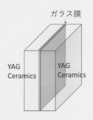
- a method for producing a YAG ceramics bonded body In order to join YAG ceramics and YAG ceramics or optical glass, the surface of one YAG ceramic is coated with molten glass (adhesive glass), and then the other YAG ceramic or optical glass is laminated on the coated surface, and then By slowly cooling, a YAG ceramics bonded body via glass can be produced as a bonding layer as shown in FIG. Further, by using a material of the same quality as the optical glass (such as titanosilicate glass) as the adhesive glass, a bonded body substantially made of YAG ceramics / optical glass can be produced.
- a material of the same quality as the optical glass such as titanosilicate glass
- the YAG ceramics bonded body bonded via glass as the bonding layer can be used, for example, in the following laser applications.
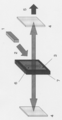
- a schematic diagram of a standard laser application is shown in FIG.
- the laser medium 3 (Yb: YAG ceramics, etc.), which is a phosphor, is excited by the excitation light 2 of the laser diode 1, and the light is amplified in a resonator sandwiched between the opposing high-reflection mirrors 4 and 4', and then the laser 5 is used. Release as. At this time, the end surface of the laser medium 3 becomes a reflecting surface, and parasitic oscillation 6 that oscillates the laser in a direction different from the surface formed by the mirrors 4 and 4'is generated. When this parasitic oscillation 6 occurs, the output is lower than the laser light predicted from the resonator composed of the original opposed mirrors 4 and 4', and it is required to reduce this.
- a light absorption layer 7 having an equivalent refractive index and absorbing light in the oscillation wavelength band of the laser medium is formed around the laser medium.
- Parasitic oscillation 6 can be prevented by bonding Cr: YAG ceramics doped with a transition metal such as Cr as the light absorption layer 7.
- the applicant previously had an absorption coefficient of 0.1 to 10.0 cm -1 as the light absorption layer, the difference in refractive index from the laser medium was within ⁇ 0.1, and linear thermal expansion with the laser medium. It has been proposed to use glass (optical glass) having a coefficient difference of ⁇ 1 ppm / K or less (Japanese Patent Application No. 2019-002307).
- a bonded body of YAG ceramics using the glass according to the present invention as a bonding layer, or a YAG ceramic Bonds with other optical materials can be applied.
- the bonding between YAG ceramics as a laser medium and YAG ceramics or optical glass as a light absorption layer has been described, but for purposes other than bonding with the light absorption layer, for example, YAG ceramics as a laser medium.
- the present invention can also be applied when a plurality of YAG ceramics of the same quality are bonded via a glass bonding layer for the purpose of increasing the diameter.
- Example 1 Two 0.5 at% Yb: YAG (2 cm ⁇ 1 cm, 5 mm thick) were prepared as YAG ceramics, and a glass material (LX-57B: manufactured by Nippon Electric Glass Co., Ltd.) was prepared as a bonding layer. The glass material was melted at 1000 ° C., the molten glass was coated on the surface of one YAG ceramic, and then the other YAG ceramic was laminated to prepare a YAG ceramic joint.
- the refractive index of Yb: YAG ceramics is 1.83 with respect to light having a wavelength of 650 nm, and the refractive index of the glass material of the bonding layer is 1.71 with respect to the same wavelength.
- the coefficient of thermal expansion of Yb: YAG ceramics is 8 ppm / K, and the coefficient of thermal expansion of the glass material is 8 ppm / K.
- Laser light (wavelength: 650 nm) was incident on the YAG ceramic base material (before joining) and the obtained YAG ceramic bonded body (after joining), and the transmittance before and after joining was measured and compared. The rate was 7%, and it was confirmed that the light reflection at the junction interface was suppressed. Further, it was confirmed that peeling, cracking, etc. did not occur in this bonded body even in a high temperature environment of 600 ° C. or higher above the glass transition point and in a low temperature environment of liquid nitrogen temperature.
- Example 2 Prepare 0.5 at% Yb: YAG (2 cm x 1 cm, 5 mm thick) and titanosilicate glass (optical glass: 2 cm x 1 cm, 5 mm thick) as YAG ceramics, and use the same glass material as the optical glass as the bonding layer.
- the glass material was melted at 1250 ° C., the molten glass was coated on the surface of YAG ceramics, and then optical glass was laminated to prepare a YAG ceramics joint.
- the refractive index of the optical glass is 1.81 with respect to light having a wavelength of 650 nm, and the coefficient of thermal expansion is 7 ppm / K.
- Laser light (wavelength: 650 nm) was incident on the YAG ceramic base material (before joining) and the obtained YAG ceramic bonded body (after joining), and the transmittances before and after joining were compared. It was 1.5%, and it was confirmed that the light reflection at the junction interface was suppressed. Further, it was confirmed that peeling, cracking, etc. did not occur in this bonded body even in a high temperature environment of 700 ° C. or higher above the glass transition point and in a low temperature environment of liquid nitrogen temperature.
- the present invention provides a bonded body of YAG ceramics and YAG ceramics, or a bonded body of YAG ceramics and optical glass, in which light reflection at the bonding interface is suppressed and destruction is unlikely to occur even with a temperature change. It has the excellent effect of being able to.
- the ceramic joint according to the present invention is useful as a laser application such as a high power laser (amplifier).
- Laser diode 2 Excitation light 3 Laser medium (core) 4 Mirror 5 Laser 6 Parasitic oscillation 7 Light absorption layer (clad)
Landscapes
- Electromagnetism (AREA)
- Physics & Mathematics (AREA)
- Engineering & Computer Science (AREA)
- Chemical & Material Sciences (AREA)
- Optics & Photonics (AREA)
- Plasma & Fusion (AREA)
- Ceramic Engineering (AREA)
- Crystallography & Structural Chemistry (AREA)
- Materials Engineering (AREA)
- Structural Engineering (AREA)
- Organic Chemistry (AREA)
- Lasers (AREA)
- Ceramic Products (AREA)
- Laser Beam Processing (AREA)
- Joining Of Glass To Other Materials (AREA)
Priority Applications (5)
| Application Number | Priority Date | Filing Date | Title |
|---|---|---|---|
| EP20917282.4A EP4023621A4 (en) | 2020-02-07 | 2020-10-13 | JAG YAG CERAMIC BODY AND METHOD FOR PRODUCING SAME |
| US17/763,451 US12160081B2 (en) | 2020-02-07 | 2020-10-13 | YAG ceramic joined body and production method therefor |
| JP2021575609A JP7503579B2 (ja) | 2020-02-07 | 2020-10-13 | Yagセラミックス接合体及びその製造方法 |
| CN202080069254.2A CN114502520B (zh) | 2020-02-07 | 2020-10-13 | Yag陶瓷接合体及其制造方法 |
| JP2022206720A JP2023029447A (ja) | 2020-02-07 | 2022-12-23 | Yagセラミックス接合体及びその製造方法 |
Applications Claiming Priority (2)
| Application Number | Priority Date | Filing Date | Title |
|---|---|---|---|
| JP2020019898 | 2020-02-07 | ||
| JP2020-019898 | 2020-02-07 |
Publications (1)
| Publication Number | Publication Date |
|---|---|
| WO2021157135A1 true WO2021157135A1 (ja) | 2021-08-12 |
Family
ID=77199873
Family Applications (1)
| Application Number | Title | Priority Date | Filing Date |
|---|---|---|---|
| PCT/JP2020/038554 Ceased WO2021157135A1 (ja) | 2020-02-07 | 2020-10-13 | Yagセラミックス接合体及びその製造方法 |
Country Status (5)
| Country | Link |
|---|---|
| US (1) | US12160081B2 (https=) |
| EP (1) | EP4023621A4 (https=) |
| JP (2) | JP7503579B2 (https=) |
| CN (1) | CN114502520B (https=) |
| WO (1) | WO2021157135A1 (https=) |
Citations (4)
| Publication number | Priority date | Publication date | Assignee | Title |
|---|---|---|---|---|
| US4507787A (en) * | 1982-09-28 | 1985-03-26 | Quantronix Corporation | Segmented YAG laser rods and methods of manufacture |
| US4509175A (en) * | 1982-09-14 | 1985-04-02 | Quantronix Corporation | Segmented YAG laser rods and method of manufacture |
| US20060227829A1 (en) * | 2005-04-12 | 2006-10-12 | Raytheon Company | Glaze soldered laser components and method of manufacturing |
| JP2019002307A (ja) | 2017-06-14 | 2019-01-10 | 日立オートモティブシステムズ株式会社 | 車両用制御装置 |
Family Cites Families (23)
| Publication number | Priority date | Publication date | Assignee | Title |
|---|---|---|---|---|
| JPS62226838A (ja) * | 1986-03-28 | 1987-10-05 | Hoya Corp | ガドリニウム・スカンジウム・ガリウム・ガ−ネツト単結晶用クラツデイングガラス及びそのクラツデイング方法 |
| US5846638A (en) * | 1988-08-30 | 1998-12-08 | Onyx Optics, Inc. | Composite optical and electro-optical devices |
| US5441803A (en) * | 1988-08-30 | 1995-08-15 | Onyx Optics | Composites made from single crystal substances |
| JPH0597530A (ja) * | 1991-10-04 | 1993-04-20 | Kobe Steel Ltd | セラミツクス焼結体の接合方法 |
| US6650670B1 (en) * | 2000-07-13 | 2003-11-18 | Yutaka Shimoji | Polycrystalline ceramic laser |
| US6587488B1 (en) * | 2000-11-08 | 2003-07-01 | Maxios Laser Corporation | Control of parasitic laser oscillations in solid-state lasers by frustrating total internal reflections |
| US7200161B2 (en) * | 2001-01-22 | 2007-04-03 | The Boeing Company | Side-pumped solid-state disk laser for high-average power |
| US6810060B2 (en) * | 2001-02-13 | 2004-10-26 | The Boeing Company | High-average power active mirror solid-state laser with multiple subapertures |
| KR20040030803A (ko) * | 2001-07-19 | 2004-04-09 | 이비덴 가부시키가이샤 | 세라믹 접합체 및 그 접합방법, 세라믹 구조체 |
| TW200301980A (en) * | 2002-01-10 | 2003-07-16 | Hrl Lab Llc | Diffusion bonded pump cavity |
| JP2003313083A (ja) * | 2002-04-22 | 2003-11-06 | Toshiba Ceramics Co Ltd | イットリウム系化合物の接合体及びその接合方法 |
| US7085304B2 (en) * | 2003-05-19 | 2006-08-01 | The Boeing Company | Diode-pumped solid state disk laser and method for producing uniform laser gain |
| JPWO2005091447A1 (ja) * | 2004-03-24 | 2008-02-07 | 独立行政法人科学技術振興機構 | レーザー装置 |
| US7463660B2 (en) | 2004-05-11 | 2008-12-09 | Lawrence Livermore National Laboratory, Llc | Gain media edge treatment to suppress amplified spontaneous emission in a high power laser |
| US7361938B2 (en) * | 2004-06-03 | 2008-04-22 | Philips Lumileds Lighting Company Llc | Luminescent ceramic for a light emitting device |
| JP2011146556A (ja) * | 2010-01-15 | 2011-07-28 | National Institutes Of Natural Sciences | 半導体レーザー励起固体レーザー装置 |
| RU2013148791A (ru) * | 2011-06-13 | 2015-07-20 | ЛОРЕНС ЛИВЕРМОР НЭШНЛ СЕКЬЮРИТИ, ЭлЭлСи | Способ и система для криогенно-охлаждаемого лазерного усилителя |
| US8774235B2 (en) * | 2011-06-23 | 2014-07-08 | Raytheon Company | System and method for suppressing parasitics in an optical device |
| US9337609B2 (en) * | 2012-05-09 | 2016-05-10 | Mitsubishi Electric Corporation | Passively Q-switched element and passively Q-switched laser device |
| DE102016118364B3 (de) * | 2016-09-28 | 2018-03-08 | Schott Ag | Mantelglas für Festkörperlaser |
| US11434143B2 (en) | 2018-03-30 | 2022-09-06 | Jx Nippon Mining & Metals Corporation | Polycrystalline YAG sintered body and production method thereof |
| EP3822233A4 (en) * | 2019-01-10 | 2022-06-29 | JX Nippon Mining & Metals Corporation | Light-absorbing layer and joined body provided with light-absorbing layer |
| CN111868007B (zh) | 2019-02-12 | 2022-06-21 | 捷客斯金属株式会社 | Cr:YAG烧结体 |
-
2020
- 2020-10-13 WO PCT/JP2020/038554 patent/WO2021157135A1/ja not_active Ceased
- 2020-10-13 CN CN202080069254.2A patent/CN114502520B/zh active Active
- 2020-10-13 JP JP2021575609A patent/JP7503579B2/ja active Active
- 2020-10-13 EP EP20917282.4A patent/EP4023621A4/en active Pending
- 2020-10-13 US US17/763,451 patent/US12160081B2/en active Active
-
2022
- 2022-12-23 JP JP2022206720A patent/JP2023029447A/ja not_active Withdrawn
Patent Citations (4)
| Publication number | Priority date | Publication date | Assignee | Title |
|---|---|---|---|---|
| US4509175A (en) * | 1982-09-14 | 1985-04-02 | Quantronix Corporation | Segmented YAG laser rods and method of manufacture |
| US4507787A (en) * | 1982-09-28 | 1985-03-26 | Quantronix Corporation | Segmented YAG laser rods and methods of manufacture |
| US20060227829A1 (en) * | 2005-04-12 | 2006-10-12 | Raytheon Company | Glaze soldered laser components and method of manufacturing |
| JP2019002307A (ja) | 2017-06-14 | 2019-01-10 | 日立オートモティブシステムズ株式会社 | 車両用制御装置 |
Non-Patent Citations (2)
| Title |
|---|
| See also references of EP4023621A4 |
| YAMAMOTO, R.M. ET AL., ROC, ADV. SOLID STATE PHOTON, NARA, JAPAN, vol. WC5, 2008 |
Also Published As
| Publication number | Publication date |
|---|---|
| US12160081B2 (en) | 2024-12-03 |
| EP4023621A1 (en) | 2022-07-06 |
| CN114502520B (zh) | 2023-12-05 |
| EP4023621A4 (en) | 2023-11-08 |
| US20220393424A1 (en) | 2022-12-08 |
| JPWO2021157135A1 (https=) | 2021-08-12 |
| JP2023029447A (ja) | 2023-03-03 |
| JP7503579B2 (ja) | 2024-06-20 |
| CN114502520A (zh) | 2022-05-13 |
Similar Documents
| Publication | Publication Date | Title |
|---|---|---|
| Ikesue et al. | Synthesis and performance of advanced ceramic lasers | |
| US5852622A (en) | Solid state lasers with composite crystal or glass components | |
| US5936984A (en) | Laser rods with undoped, flanged end-caps for end-pumped laser applications | |
| TWI737690B (zh) | 包含透明雷射焊接區之密封裝置 | |
| EP2369384B1 (en) | A planar waveguide and a method of fabricating a planar waveguide | |
| WO2004034523B1 (en) | Monolithic, side-pumped, passively q-switched solid-state laser | |
| EP2996211B1 (en) | Laser active medium and process of manufacturing the same | |
| Wentsch et al. | Yb: CaF2 thin-disk laser | |
| EP1834387B1 (en) | Glaze cladding for laser components | |
| US8406267B2 (en) | Grazing-incidence-disk laser element | |
| Furuse et al. | Sapphire/Nd: YAG composite by pulsed electric current bonding for high-average-power lasers | |
| CN106486885A (zh) | 固体激光器 | |
| US7463667B2 (en) | Solid-state laser and multi-pass resonator | |
| WO2021157135A1 (ja) | Yagセラミックス接合体及びその製造方法 | |
| JP7052088B2 (ja) | 光吸収層及び光吸収層を備えた接合体 | |
| WO2004081646A1 (ja) | 波長変換素子 | |
| WO2022118366A1 (ja) | 量子回路、量子コンピュータ及び量子回路の製造方法 | |
| RU2749153C1 (ru) | Способ создания композитного лазерного элемента на основе оксидных кристаллов | |
| CN116598870A (zh) | 一种碟片增益介质结构的激光器组件 | |
| CN120473802B (zh) | 基于超细单晶光纤的全光纤结构脉冲激光器及其制备方法 | |
| Tsunekane et al. | High-power, diode edge-pumped, single-crystal Yb: YAG/ceramic YAG composite microchip Yb: YAG laser for material processing | |
| CN118448966B (zh) | 一种复合板条激光装置和激光产生的方法 | |
| JP7683947B2 (ja) | 光学部品の製造方法 | |
| CN201044327Y (zh) | 半导体激光器泵浦的中红外固体激光器 | |
| Taira et al. | High-power edge pumped Yb: YAG single crystal/YAG ceramics hybrid microchip laser |
Legal Events
| Date | Code | Title | Description |
|---|---|---|---|
| 121 | Ep: the epo has been informed by wipo that ep was designated in this application |
Ref document number: 20917282 Country of ref document: EP Kind code of ref document: A1 |
|
| ENP | Entry into the national phase |
Ref document number: 2021575609 Country of ref document: JP Kind code of ref document: A |
|
| ENP | Entry into the national phase |
Ref document number: 2020917282 Country of ref document: EP Effective date: 20220331 |
|
| NENP | Non-entry into the national phase |
Ref country code: DE |