WO2021153148A1 - 判定装置 - Google Patents
判定装置 Download PDFInfo
- Publication number
- WO2021153148A1 WO2021153148A1 PCT/JP2020/049165 JP2020049165W WO2021153148A1 WO 2021153148 A1 WO2021153148 A1 WO 2021153148A1 JP 2020049165 W JP2020049165 W JP 2020049165W WO 2021153148 A1 WO2021153148 A1 WO 2021153148A1
- Authority
- WO
- WIPO (PCT)
- Prior art keywords
- flash
- image data
- acquired
- eye
- unit
- Prior art date
- Legal status (The legal status is an assumption and is not a legal conclusion. Google has not performed a legal analysis and makes no representation as to the accuracy of the status listed.)
- Ceased
Links
Images








Classifications
-
- G—PHYSICS
- G06—COMPUTING OR CALCULATING; COUNTING
- G06V—IMAGE OR VIDEO RECOGNITION OR UNDERSTANDING
- G06V10/00—Arrangements for image or video recognition or understanding
- G06V10/10—Image acquisition
- G06V10/12—Details of acquisition arrangements; Constructional details thereof
- G06V10/14—Optical characteristics of the device performing the acquisition or on the illumination arrangements
- G06V10/145—Illumination specially adapted for pattern recognition, e.g. using gratings
-
- A—HUMAN NECESSITIES
- A61—MEDICAL OR VETERINARY SCIENCE; HYGIENE
- A61B—DIAGNOSIS; SURGERY; IDENTIFICATION
- A61B5/00—Measuring for diagnostic purposes; Identification of persons
- A61B5/117—Identification of persons
- A61B5/1171—Identification of persons based on the shapes or appearances of their bodies or parts thereof
-
- G—PHYSICS
- G06—COMPUTING OR CALCULATING; COUNTING
- G06T—IMAGE DATA PROCESSING OR GENERATION, IN GENERAL
- G06T7/00—Image analysis
-
- G—PHYSICS
- G06—COMPUTING OR CALCULATING; COUNTING
- G06V—IMAGE OR VIDEO RECOGNITION OR UNDERSTANDING
- G06V10/00—Arrangements for image or video recognition or understanding
- G06V10/20—Image preprocessing
- G06V10/26—Segmentation of patterns in the image field; Cutting or merging of image elements to establish the pattern region, e.g. clustering-based techniques; Detection of occlusion
-
- G—PHYSICS
- G06—COMPUTING OR CALCULATING; COUNTING
- G06V—IMAGE OR VIDEO RECOGNITION OR UNDERSTANDING
- G06V10/00—Arrangements for image or video recognition or understanding
- G06V10/40—Extraction of image or video features
- G06V10/60—Extraction of image or video features relating to illumination properties, e.g. using a reflectance or lighting model
-
- G—PHYSICS
- G06—COMPUTING OR CALCULATING; COUNTING
- G06V—IMAGE OR VIDEO RECOGNITION OR UNDERSTANDING
- G06V10/00—Arrangements for image or video recognition or understanding
- G06V10/70—Arrangements for image or video recognition or understanding using pattern recognition or machine learning
- G06V10/74—Image or video pattern matching; Proximity measures in feature spaces
- G06V10/75—Organisation of the matching processes, e.g. simultaneous or sequential comparisons of image or video features; Coarse-fine approaches, e.g. multi-scale approaches; using context analysis; Selection of dictionaries
-
- G—PHYSICS
- G06—COMPUTING OR CALCULATING; COUNTING
- G06V—IMAGE OR VIDEO RECOGNITION OR UNDERSTANDING
- G06V40/00—Recognition of biometric, human-related or animal-related patterns in image or video data
- G06V40/10—Human or animal bodies, e.g. vehicle occupants or pedestrians; Body parts, e.g. hands
- G06V40/18—Eye characteristics, e.g. of the iris
-
- G—PHYSICS
- G06—COMPUTING OR CALCULATING; COUNTING
- G06V—IMAGE OR VIDEO RECOGNITION OR UNDERSTANDING
- G06V40/00—Recognition of biometric, human-related or animal-related patterns in image or video data
- G06V40/40—Spoof detection, e.g. liveness detection
Definitions
- the present invention relates to a determination device, a determination method, and a recording medium.
- Patent Document 1 is a technique for suppressing erroneous authentication when using image data.
- Patent Document 1 describes a step of acquiring an image taken by illuminating a subject coaxially with the optical axis of a camera, and a brightness value in the pupil region of the eye indicating whether or not the eye captured in the image is a living body eye.
- a method including a second step of determining based on the above is described.
- the brightness value in the pupil region of the eye is determined by utilizing the fact that the second image and the eyes captured in the second image are the eyes of the living body, and if the eyes of the living body are the eyes of the living body, the retinal reflex occurs. Judgment is based on.
- Patent Document 1 When the technique described in Patent Document 1 is used to take a picture only once, there is a risk of erroneously recognizing an image or the like in which the illumination is reflected in the eyes in advance. Further, when shooting twice in the technique described in Patent Document 1, the subject is illuminated by illuminating the subject coaxially with the optical axis of the camera, and the subject is illuminated by illuminating the subject with an optical axis different from the optical axis of the camera. Is required. Therefore, it is necessary to prepare a plurality of lighting devices, and as a result, there is a problem that it is difficult to suppress erroneous authentication using photographs or the like with a simple configuration.
- an object of the present invention is to provide a determination device, a determination method, and a recording medium that solve the problem that it is difficult to suppress false authentication using photographs or the like with a simple configuration.
- the determination device which is one embodiment of the present invention, is used to achieve such an object.
- An acquisition unit that acquires image data with a flash acquired with the flash fired and image data without a flash acquired without firing the flash for the same image as the image to be photographed reflected in the image data with the flash.
- Judgment unit and It has a structure of having.
- the determination method which is another embodiment of the present invention is Information processing device
- the image data with the flash acquired with the flash fired and the image data without the flash acquired without firing the flash for the same shooting target as the image with the flash reflected in the image data with the flash are acquired.
- the object to be imaged is a living body.
- the configuration is to determine whether or not.
- the recording medium which is another form of this invention is For information processing equipment
- the image data with the flash acquired with the flash fired and the image data without the flash acquired without firing the flash for the same shooting target as the image with the flash reflected in the image data with the flash are acquired.
- the object to be imaged is a living body.
- It is a computer-readable recording medium that records a program for realizing the process of determining whether or not it is.
- the present invention can provide a determination device, a determination method, and a recording medium capable of suppressing erroneous authentication using photographs or the like with a simple configuration by being configured as described above.
- FIG. 1 is a block diagram showing an example of the configuration of the information processing apparatus 100.
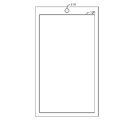
- FIG. 2 is a diagram showing an arrangement example of the image pickup unit 110 and the screen display unit 120.
- FIG. 3 is a diagram showing an example of an eye portion in image data with a flash.
- FIG. 4 is a diagram showing an example of an eye portion in image data without flash.
- FIG. 5 is a diagram showing an example of image data with a flash and image data without a flash in the case of the eyes of a living body and the case of a photograph.
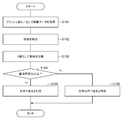
- FIG. 6 is a flowchart showing an example of the operation of the information processing device 100.
- the information processing device 100 determines whether the object to be photographed is a living body or a non-living body such as a photograph based on image data obtained by photographing a person's face. ) Will be explained. As will be described later, when the information processing apparatus 100 acquires image data, it acquires image data with a flash taken with a flash and image data without a flash taken without a flash. Then, the information processing apparatus 100 determines whether or not the imaging target is a living body by comparing the acquired image data with a flash and the image data without a flash.
- Image data such as image data with flash and image data without flash can be used for authentication purposes such as face recognition and iris recognition, for example.
- Image data such as image data with a flash and image data without a flash may be used for purposes other than authentication.
- the information processing device 100 is a device that acquires image data.
- the information processing device 100 in this embodiment is, for example, a portable terminal such as a smartphone.
- the information processing device 100 may be a device other than the illustrated portable terminal.
- FIG. 1 shows an example of the configuration of the information processing device 100.
- the information processing apparatus 100 has, for example, an imaging unit 110, a screen display unit 120, a storage unit 130, and an arithmetic processing unit 140 as constituent elements.
- the image pickup unit 110 acquires image data in response to an instruction from the image acquisition unit 141. Further, when acquiring image data, the imaging unit 110 can use a flash function using the screen display unit 120, which will be described later, a clock function of the information processing device 100, and the like.
- the imaging unit 110 may be a camera or the like preliminarily incorporated in the information processing device 100.
- the imaging unit 110 continuously acquires image data in a flash-fired state and image data in a non-flash-fired state in response to an instruction from the image acquisition unit 141. Can be done. That is, the image pickup unit 110 can continuously acquire the image data with a flash and the image data without a flash, for example, at predetermined predetermined intervals.
- the screen display unit 120 is a display device that displays an image in response to an instruction from the arithmetic processing unit 140.
- the screen display unit 120 may be a touch panel or the like that detects an operator's operation on the screen display unit 120 and outputs the operation to the arithmetic processing unit 140.
- the screen display unit 120 can function as a flash by increasing the brightness value of the image to be displayed on the screen display unit 120 when the imaging unit 110 acquires the image data.
- the screen display unit 120 serves as a flash by displaying a white image in which the brightness value is higher than a predetermined value (for example, the maximum value that can be set) in response to an instruction from the image acquisition unit 141.
- a predetermined value for example, the maximum value that can be set
- FIG. 2 shows an example of the arrangement of the imaging unit 110 and the screen display unit 120.
- the imaging unit 110 and the screen display unit 120 are arranged on the same surface of the information processing device 100.
- the imaging unit 110 is arranged above the rectangular screen display unit 120. If the image pickup unit 110 and the screen display unit 120 have a positional relationship in which the flash moves into the eye to be photographed when the flash is fired to acquire image data, the positional relationship other than that illustrated in FIG. 2 is used. It doesn't matter if there is.
- the storage unit 130 is a storage device such as a hard disk or a memory.
- the storage unit 130 stores processing information, a program 133, and the like necessary for various processes in the arithmetic processing unit 140.
- the program 133 realizes various processing units by being read and executed by the arithmetic processing unit 140.
- the program 133 is read in advance from an external device, a recording medium, or the like via the data input / output function of the information processing device 100, and is stored in the storage unit 130.
- the main information stored in the storage unit 130 includes, for example, image information 131 with a flash and image information 132 without a flash.
- the image information 131 with a flash includes the image data with a flash, which is the image data acquired by the imaging unit 110 by firing the flash.
- the flashed image information 131 includes flashed image data acquired by the imaging unit 110 with the brightness value of the image displayed on the screen display unit 120 increased.
- the image information 131 with a flash the image data with a flash and the information indicating the time when the image data with the flash is acquired by the imaging unit 110 are associated with each other.
- a flash is generated at the eye portion in the image data with the flash. It will be reflected.
- the shape of the screen display unit 120 is a rectangular shape, as shown in FIG. 3, a rectangular flash is reflected in the acquired image data (image data with a flash).
- the non-flash image information 132 includes the non-flash image data which is the image data acquired by the imaging unit 110 without firing the flash.
- the non-flash image data and the information indicating the time when the imaging unit 110 acquired the non-flash image data are associated with each other.
- the arithmetic processing unit 140 has a microprocessor such as an MPU and its peripheral circuits, and by reading and executing the program 133 from the storage unit 130, the hardware and the program 133 are made to cooperate to realize various processing units. do.
- the main processing units realized by the arithmetic processing unit 140 include, for example, an image acquisition unit 141, an extraction unit 142, and a comparison determination unit 143.
- the image acquisition unit 141 instructs the image pickup unit 110 to acquire image data, and also acquires the image data from the image pickup unit 110. Further, the image acquisition unit 141 controls the flash using the screen display unit 120.
- the image acquisition unit 141 instructs the image pickup unit 110 to continuously acquire two types of image data, an image data with a flash and an image data without a flash. Further, the image acquisition unit 141 acquires image data with a flash from the image pickup unit 110 and also acquires image data without a flash. Then, the image acquisition unit 141 stores the acquired image data with a flash in the storage unit 130 as the image information 131 with a flash in association with the time when the image data with the flash is acquired by the imaging unit 110 or the like. Further, the image acquisition unit 141 stores the acquired image data without flash in the storage unit 130 as image information 131 with flash in association with the time when the image data without flash is acquired by the imaging unit 110 or the like.
- the image acquisition unit 141 acquires a pair of image data including image data with a flash and image data without a flash.
- the extraction unit 142 extracts at least the pupil region of the eye portion from the image data such as the image data with flash and the image data without flash. For example, the extraction unit 142 extracts a region other than the white of the eye, such as an iris region and a pupil region, from image data such as image data with a flash and image data without a flash.
- the extraction unit 142 can use the processing result of the face authentication process when extracting the predetermined area.
- the center point of the pupil can be taken. Therefore, the extraction unit 142 is configured to extract the above-mentioned region by, for example, extracting a circular region having a predetermined size predetermined from the center point of the pupil specified by the face recognition process. Can be done.
- the extraction unit 142 may be configured to extract a predetermined region based on, for example, color information such as RGB.
- the comparison determination unit 143 compares predetermined areas extracted by the extraction unit 142 from the pair of image data, the image data with a flash and the image data without a flash. For example, the comparison determination unit 143 performs black and white binarization processing on each region extracted by the extraction unit 142. Then, the comparison determination unit 143 is based on the result of comparing the result of binarizing the image data with flash and the result of binarizing the image data without flash, and the image data with flash, which is a pair of image data. It is determined whether or not the subject to be photographed with the flashless image data is a living body.
- the comparison determination unit 143 calculates the ratio of black and white in the region extracted from the image data with flash and the ratio of black and white in the region extracted from the image data without flash. For example, the comparison determination unit 143 calculates at least one of the ratio of white in each region and the ratio of black in each region. Then, the comparison determination unit 143 determines whether or not the imaging target is a living body based on the result of comparing the calculated ratios. Specifically, for example, when the difference between the black-and-white ratio in the region extracted from the image data with flash and the black-and-white ratio in the region extracted from the image data without flash is equal to or more than a predetermined comparison threshold value, comparison is performed. The determination unit 143 determines that the imaging target is a living body.
- the comparison determination unit 143 determines. It is determined that the object to be imaged is not a living body.
- the flash when the eyes of a living body are photographed, the flash is reflected in the image data with a flash, but the flash is not reflected in the image data without a flash. Therefore, the ratio of black and white when the area is binarized varies between the image data with flash and the image data without flash.
- the flash in the case of a photograph taken with a flash in advance, the flash is reflected in both the image data with the flash and the image data without the flash. Further, in the case of a photograph taken in advance without a flash, the flash is not reflected in both the image data with the flash and the image data without the flash.
- the comparison determination unit 143 can easily determine whether or not the imaging target is a living body by comparing the image data with the flash with the image data without the flash. You can.
- the specific values of the threshold value and the comparison threshold value when binarizing the region are not particularly limited.
- the threshold value for binarization and the comparison threshold value may be set arbitrarily.
- the threshold value and the comparison threshold value at the time of binarization may be, for example, a preset fixed value or a fluidly fluctuating value.
- the comparison threshold value may be set according to the size of the flash such as the size of the screen display unit 120.
- the image acquisition unit 141 of the information processing apparatus 100 acquires a pair of continuously captured image data with a flash and image data without a flash (step S101).
- the extraction unit 142 extracts at least the pupil region of the eye portion from the image data such as the image data with flash and the image data without flash (step S102). For example, the extraction unit 142 extracts a region other than the white of the eye, such as an iris region and a pupil region, from image data such as image data with a flash and image data without a flash. The extraction unit 142 may use the processing result of the face authentication process when extracting the predetermined area.
- the comparison determination unit 143 compares the areas extracted by the extraction unit 142 from the pair of image data, the image data with flash and the image data without flash. For example, the comparison determination unit 143 performs black and white binarization processing on each region extracted by the extraction unit 142. Then, the comparison determination unit 143 compares the result of binarizing the image data with the flash and the result of binarizing the image data without the flash (step S103).
- step S104 When the difference between the black-and-white ratio in the region extracted from the image data with flash and the black-and-white ratio in the region extracted from the image data without flash is equal to or greater than a predetermined comparison threshold value (step S104, Yes), the comparison determination is made. Part 143 determines that the imaging target is a living body (step S105). On the other hand, when the difference between the black-and-white ratio in the region extracted from the image data with flash and the black-and-white ratio in the region extracted from the image data without flash is less than a predetermined comparison threshold value (step S104, No). The comparison determination unit 143 determines that the imaging target is not a living body (step S106).
- the above is an example of the operation of the information processing device 100.
- the information processing device 100 has a comparison determination unit 143. Further, the information processing apparatus 100 is configured to acquire image data with a flash and image data without a flash. With such a configuration, the comparison determination unit 143 can determine whether or not the imaging target is a living body based on the result of comparing the image data with the flash and the image data without the flash. As a result, with a simple configuration, it is possible to easily determine that the image data is not a living body when an image data such as a photograph is taken, and it is possible to suppress erroneous authentication.
- the information processing device 100 has the image pickup unit 110 .
- the information processing device 100 may be configured to acquire image data from an external camera or the like having a flash function. That is, the information processing device 100 does not necessarily have to have a function as an imaging unit 110.
- a case where the screen display unit 120 is used as a flash has been described.
- the function as a flash may be realized by a function other than the screen display unit 120.
- the present invention may be realized by having a plurality of information processing devices have each function shown in FIG. 1 in a distributed manner.
- the information processing device 100 is a portable terminal such as a smartphone
- the image data with flash and the image data without flash acquired by the information processing device 100 are configured to be transmitted to an external information processing device such as an external determination device.
- the external information processing device can have functions as an extraction unit 142 and a comparison determination unit 143.
- the present invention can be used for purposes other than using a portable terminal such as a smartphone, such as when performing entrance / exit management / opening / closing management of gates, delivery boxes, etc. by face authentication or iris authentication.
- a portable terminal such as a smartphone
- the present invention may be utilized in determining whether or not the object to be imaged is a living body in situations other than those illustrated above (for example, for purposes other than authentication).
- FIG. 7 is a block diagram showing an example of the configuration of the information processing device 200.
- FIG. 8 is a diagram showing an example of a flash pattern.
- FIG. 9 is a diagram showing an example of an eye portion in the image data.
- FIG. 10 is a diagram for explaining an example of processing of the extraction unit 243 and the comparison determination unit 244.
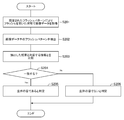
- FIG. 11 is a flowchart showing an example of the operation of the information processing device 200.
- FIG. 12 is a diagram showing another example of the flash pattern.
- the information processing device 200 for determining whether the object to be photographed is a living body or a non-living body such as a photograph by controlling the shape of the flash will be described.
- the information processing apparatus 200 controls the flash pattern, which is the shape control of the flash, when acquiring the image data.
- the information processing apparatus 200 controls the flash pattern by controlling the shape of the flash that is displayed in black instead of white.
- the information processing apparatus 200 determines whether or not the imaging target is a living body based on the shape of the flash reflected in the image data acquired by burning the shape-controlled flash.
- the image data acquired by the information processing device 200 can be used for various purposes such as authentication purposes, like the image data acquired by the information processing device 100.
- the information processing device 200 is a device that acquires image data, like the information processing device 100.
- the information processing device 200 in this embodiment is, for example, a portable terminal such as a smartphone.
- the information processing device 200 may be a device other than the illustrated portable terminal.
- FIG. 7 shows an example of the configuration of the information processing device 200.
- the information processing apparatus 100 includes, for example, an imaging unit 110, a screen display unit 120, a storage unit 230, and an arithmetic processing unit 240 as constituent elements.
- the same components as those of the information processing apparatus 100 described in the first embodiment are designated by the same reference numerals.
- a configuration characteristic of the present embodiment will be described.
- the storage unit 230 is a storage device such as a hard disk or a memory.
- the storage unit 230 stores the processing information and the program 233 required for various processes in the arithmetic processing unit 240.
- the program 233 realizes various processing units by being read and executed by the arithmetic processing unit 240.
- the program 233 is read in advance from an external device, a recording medium, or the like via the data input / output function of the information processing device 200, and is stored in the storage unit 230.
- the main information stored in the storage unit 230 includes, for example, flash pattern information 231 and image information 232.
- the flash pattern information 231 includes information indicating a flash pattern.
- the information indicating the flash pattern and the information indicating the time are associated with each other.
- the screen display unit 120 functions as a flash by displaying a white image in which the brightness value is higher than a predetermined value
- a black pattern can be displayed on the screen instead of simply making the entire surface white.
- FIG. 8 when the screen display unit 120 functions as a flash, a black donut shape can be displayed.
- the flash pattern can be displayed when the screen display unit 120 functions as a flash.
- the information indicating the flash pattern indicates information for specifying the flash pattern used when firing the flash, such as a donut shape.
- the flash pattern may be a shape other than a donut shape, such as a round shape, a square shape, a triangular shape, or another shape.
- the image information 232 includes image data acquired by the imaging unit 110 by firing a flash according to a predetermined flash pattern.
- the image data and the information indicating the time when the image data is acquired by the imaging unit 110 are associated with each other.
- the arithmetic processing unit 240 has a microprocessor such as an MPU and its peripheral circuits, and by reading and executing the program 233 from the storage unit 230, the hardware and the program 233 are made to cooperate to realize various processing units. do.
- the main processing units realized by the arithmetic processing unit 240 include, for example, a flash pattern control unit 241, an image acquisition unit 242, an extraction unit 243, and a comparison determination unit 244.
- the flash pattern control unit 241 determines the flash pattern when the flash is fired. In other words, the flash pattern control unit 241 determines a shape to be displayed in black on the screen display unit 120 when the flash is fired, for example, a round shape, a square shape, a triangular shape, or a donut shape. Then, the flash pattern control unit 241 instructs the screen display unit 120 to fire the flash with the determined flash pattern. Further, the flash pattern control unit 241 stores the determined flash pattern and the information indicating the time in the storage unit 230 as the flash pattern information 231 in association with each other.
- the flash pattern control unit 241 instructs the screen display unit 120 to make a difference in the brightness values in the image displayed on the screen display unit 120, thereby realizing that the flash is fired using the determined flash pattern. do.
- the timing of determining and controlling the flash pattern by the flash pattern control unit 241 is not particularly limited.
- the flash pattern control unit 241 can be configured to determine and control the flash pattern each time the image acquisition unit 242 acquires image data. Further, the flash pattern control unit 241 may be configured to determine and control the flash pattern at predetermined intervals, for example.
- the method of determining the flash pattern by the flash pattern control unit 241 is not particularly limited.
- the flash pattern control unit 241 can be configured to determine a flash pattern to be used from a plurality of predetermined flash patterns.
- the flash pattern control unit 241 may be configured to generate a flash pattern each time by a known algorithm.
- the flash pattern control unit 241 may be configured to determine, for example, a flash pattern including an intermediate luminance value in addition to the flash pattern represented by black.
- the image acquisition unit 242 instructs the image pickup unit 110 to acquire image data, and acquires image data from the image pickup unit 110. Further, the image acquisition unit 242 controls the flash using the screen display unit 120. In the case of the present embodiment, for example, when acquiring image data, the flash is always fired.
- the image acquisition unit 242 instructs the image pickup unit 110 to acquire image data. Further, the image acquisition unit 242 acquires image data acquired in a state where the flash is fired by the flash pattern determined by the flash pattern control unit 241. Then, the image acquisition unit 242 stores the acquired image data in the storage unit 230 as image information 232 in association with the time when the image data is acquired by the image pickup unit 110 or the like.
- the extraction unit 243 extracts a flash pattern from the image data. For example, when image data is acquired in a state where the flash is fired using the flash pattern as shown in FIG. 8, as shown in FIG. 9, a flash pattern surrounded by an area corresponding to the flash is projected in the pupil region. Will be. Therefore, the extraction unit 243 extracts the flash pattern in the image data as shown in FIG.
- the extraction unit 243 extracts the pupil region in the same manner as the extraction unit 142 described in the first embodiment.
- the extraction unit 243 specifies a flash region in the pupil region corresponding to the flash.
- the extraction unit 243 extracts the flash pattern in the specified flash area. For example, in the case shown in FIG. 9, as shown in FIG. 10, the extraction unit 243 extracts a donut-shaped flash pattern existing in the rectangular flash area.
- the comparison determination unit 244 compares the flash pattern extracted by the extraction unit 243 with the flash pattern information 231. Then, the comparison determination unit 244 determines whether or not the imaging target is a living body based on the comparison result.
- the comparison determination unit 244 acquires the flash pattern extracted by the extraction unit 243 from the extraction unit 243. Further, the comparison determination unit 244 acquires the information corresponding to the time when the image data is acquired from the flash pattern information 231. Then, the comparison determination unit 244 compares the flash pattern acquired from the extraction unit 243 with the corresponding information included in the flash pattern information 231.
- the comparison determination unit 244 determines that the imaging target is a living body. ..
- the comparison determination unit 143 determines that the imaging target is not a living body.
- the flash pattern acquired from the extraction unit 243 shows a donut shape.
- the flash pattern indicated by the corresponding information included in the flash pattern information 231 also shows a donut shape. Therefore, the comparison determination unit 244 determines that the imaging target is a living body based on the agreement between the flash pattern acquired from the extraction unit 243 and the flash pattern indicated by the corresponding information included in the flash pattern information 231.
- the image acquisition unit 242 of the information processing apparatus 200 acquires the image data acquired in a state where the flash is fired by the flash pattern determined by the flash pattern control unit 241 (step S201).
- the extraction unit 243 extracts a flash pattern from the image data (step S202). For example, the extraction unit 243 specifies a flash area corresponding to the flash in the image data, and extracts a flash pattern in the specified flash area.
- the comparison determination unit 244 compares the flash pattern extracted by the extraction unit 243 with the flash pattern indicated by the corresponding information included in the flash pattern information 231 (step S203). When the flash pattern extracted by the extraction unit 243 and the flash pattern indicated by the corresponding information included in the flash pattern information 231 match (step S204, Yes), the comparison determination unit 244 determines that the imaging target is a living body. Determine (step S205). On the other hand, when the flash pattern extracted by the extraction unit 243 and the flash pattern indicated by the corresponding information included in the flash pattern information 231 do not match (step S204, No), the comparison determination unit 255 does not have a living body. (Step S206).
- the above is an example of the operation of the information processing device 200.
- the information processing device 200 has a flash pattern control unit 241 and a comparison determination unit 244. Further, the information processing apparatus 200 is configured to acquire image data acquired in a state where the flash is fired by the flash pattern determined by the flash pattern control unit 241.
- the comparison determination unit 244 compares the flash pattern extracted by the extraction unit 243 with the flash pattern indicated by the corresponding information included in the flash pattern information 231, and the imaging target is a living body based on the result of comparison. It is possible to determine whether or not it is. As a result, with a simple configuration, it is possible to easily determine that the image data is not a living body when an image data such as a photograph is taken, and it is possible to suppress erroneous authentication.
- the information processing device 200 described in the present embodiment can employ various modified examples in the same manner as the information processing device 100 described in the first embodiment.
- the information processing device 200 may be configured to acquire image data from an external camera or the like having a flash function, or the function as a flash may be realized by a device other than the screen display unit 120.
- the function as the information processing device 200 may be realized by a plurality of information processing devices.
- the flash pattern may be determined by, for example, the shape of the flash itself.
- a flash pattern may be determined by using a flash device such as a donut type.
- the comparison determination unit 244 compares a predetermined flash pattern according to the shape of the flash device with the flash pattern extracted by the extraction unit 243. It may be configured to determine whether or not the imaging target is a living body.
- the function as the information processing device 200 described in the present embodiment and the function as the information processing device 100 described in the first embodiment may be combined.
- the information processing apparatus may be configured to acquire image data with a flash and image data without a flash acquired in a predetermined flash pattern.
- the information processing apparatus sets the image to be photographed, for example, when the difference in the black-and-white ratio between the image data with flash and the image data without flash is equal to or more than the comparison threshold value and the flash patterns match. It can be configured to determine that it is a living body.
- FIGS. 13 to 15. 13 and 14 show an example of the configuration of the determination device 300.
- FIG. 15 shows an example of another configuration of the determination device 300.
- FIG. 13 shows an example of the hardware configuration of the determination device 300.
- the determination device 300 has the following hardware configuration as an example.
- -CPU Central Processing Unit
- 301 Arimetic unit
- ROM Read Only Memory
- RAM Random Access Memory
- 303 storage device
- -Program group 304 loaded in RAM 303 -Storage device 305 that stores the program group 304
- a drive device 306 that reads and writes a recording medium 310 external to the information processing device.
- -Communication interface 307 that connects to the communication network 311 outside the information processing device.
- -I / O interface 308 that inputs and outputs data -Bus 309 connecting each component
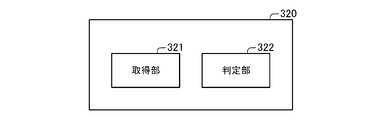
- the determination device 300 can realize the functions as the acquisition unit 321 and the determination unit 322 shown in FIG. 14 by the CPU 301 acquiring the program group 304 and executing the program group 304.
- the program group 304 is stored in the storage device 305 or the ROM 302 in advance, for example, and the CPU 301 loads the program group 304 into the RAM 303 or the like and executes the program group 304 as needed.
- the program group 304 may be supplied to the CPU 301 via the communication network 311 or may be stored in the recording medium 310 in advance, and the drive device 306 may read the program and supply the program to the CPU 301.
- FIG. 13 shows an example of the hardware configuration of the determination device 300.
- the hardware configuration of the determination device 300 is not limited to the above case.
- the determination device 300 may be configured from a part of the above-described configuration, such as not having the drive device 306.
- the acquisition unit 321 acquires the image data with the flash acquired in the state where the flash is fired. Further, the acquisition unit 321 acquires the non-flash image data acquired without firing the flash for the same shooting target as the shooting target reflected in the image data with the flash.
- the acquisition unit 321 acquires the image data with the flash and the image data without the flash.
- the same image target is shown in the image data with a flash and the image data without a flash.
- the acquisition of the image data with rush and the image data without flash by the acquisition unit 321 is continuously performed, for example, at predetermined intervals.
- the determination unit 322 determines the area of the eye to be photographed included in the image data with flash acquired by the acquisition unit 321 and the area of the eye to be photographed included in the image data without flash acquired by the acquisition unit 321. compare. Then, the determination unit 322 determines whether or not the imaging target is a living body based on the comparison result.
- the determination device 300 has an acquisition unit 321 and a determination unit 322. With such a configuration, the determination device 300 can determine whether or not the imaging target is a living body based on the result of comparing the image data with the flash and the image data without the flash acquired by the acquisition unit 321. .. As a result, with a simple configuration, it is possible to easily determine that the image data is not a living body when an image data such as a photograph is taken, and it is possible to suppress erroneous authentication.
- the above-mentioned determination device 300 can be realized by incorporating a predetermined program into the determination device 300.
- the determination device 300 is provided with a flash for the image data with the flash acquired in the state where the flash is fired and the same shooting target as the shooting target reflected in the image data with the flash.
- the acquisition unit 321 that acquires the image data without flash acquired without burning, the area of the eye to be photographed included in the image data with flash acquired by the acquisition unit 321 and the image without flash acquired by the acquisition unit 321.
- This is a program for realizing the determination unit 322 for determining whether or not the imaged object is a living body by comparing the area of the eye of the imaged object included in the data.
- the determination device 300 fires the flash for the image data with the flash acquired in the state where the flash is fired and the same image as the image to be captured in the image data with the flash.
- the image data without flash acquired without burning is acquired, and the area of the eye to be photographed included in the image data with flash is compared with the area of the eye to be photographed included in the image data without flash. This is a method of determining whether or not the imaging target is a living body.
- the object of the present invention can also be realized by a configuration such as the determination device 400.
- the determination device 400 has, for example, an acquisition unit 421 and a determination unit 422.
- the hardware configuration of the determination device 400 may be the same as the hardware configuration of the determination device 300 described with reference to FIG.
- the acquisition unit 421 acquires the image data acquired by firing the flash in a state where the shape of the flash is controlled to be a predetermined flash pattern.
- the determination unit 422 determines whether or not the imaging target is a living body based on the acquired image data.
- the determination device 400 has an acquisition unit 421 and a determination unit 422. Even with such a configuration, as with the determination device 300, it is possible to easily determine that the image data is not a living body when an image data such as a photograph is taken with a simple configuration, and it is possible to suppress erroneous authentication. Is possible. Further, even in the invention of the program for realizing the acquisition unit 421 and the determination unit 422 in the determination device 400 and the determination method performed by the determination device 400, the determination device 400 has the same action and effect as the determination device 400. The above-mentioned object of the present invention can be achieved.
- Appendix 1 An acquisition unit that acquires image data with a flash acquired with the flash fired and image data without a flash acquired without firing the flash for the same image as the image to be photographed reflected in the image data with the flash. By comparing the area of the eye to be photographed included in the image data with a flash and the area of the eye to be photographed included in the image data without a flash, it is determined whether or not the object to be photographed is a living body. Judgment unit and Judgment device having. (Appendix 2) The determination device according to Appendix 1, which is the determination device. The determination unit includes a result of binarizing the eye area of the imaging target included in the image data with flash and a result of binarizing the eye region of the imaging target included in the image data without flash.
- a determination device that determines whether or not the imaging target is a living body by comparing. (Appendix 3) The determination device according to Appendix 1 or Appendix 2. The determination unit determines the ratio of black and white in the region calculated based on the result of binarizing the region of the eye to be photographed included in the image data with flash, and the imaging included in the image data without flash. A determination device for determining whether or not the imaging target is a living body based on the difference between the black-and-white ratio in the region calculated based on the result of binarizing the eye region of the target.
- the determination device determines the ratio of black and white in the region calculated based on the result of binarizing the region of the eye to be imaged included in the image data with flash, and the imaging included in the image data without flash.
- the determination unit determines the ratio of black and white in the region calculated based on the result of binarizing the region of the eye to be imaged included in the image data with flash, and the imaging included in the image data without flash.
- the image data with a flash is image data acquired by firing a flash in a state where the shape of the flash has a predetermined flash pattern.
- Appendix 7) The determination device according to Appendix 6, which is the determination device.
- the determination unit is a determination device that determines whether or not the imaging target is a living body based on the flash pattern extracted by the extraction unit.
- the determination unit is a determination device that determines that the imaging target is a living body when the flash pattern extracted from the image data with a flash is predetermined.
- Information processing device The image data with the flash acquired with the flash fired and the image data without the flash acquired without firing the flash for the same shooting target as the image with the flash reflected in the image data with the flash are acquired.
- the object to be imaged is a living body. Judgment method to judge whether or not. (Appendix 10) For information processing equipment The image data with the flash acquired with the flash fired and the image data without the flash acquired without firing the flash for the same shooting target as the image with the flash reflected in the image data with the flash are acquired. By comparing the area of the eye to be photographed included in the acquired image data with flash and the area of the eye to be photographed included in the acquired image data without flash, the object to be imaged is a living body. A computer-readable recording medium on which a program for realizing the process of determining whether or not the data is recorded is recorded.
- the programs described in each of the above embodiments and appendices may be stored in a storage device or recorded in a computer-readable recording medium.
- the recording medium is a portable medium such as a flexible disk, an optical disk, a magneto-optical disk, and a semiconductor memory.
- Information processing device 110 Imaging unit 120 Screen display unit 130 Storage unit 131 With flash Image information 132 Without flash Image information 133 Program 140 Calculation processing unit 141 Image acquisition unit 142 Extraction unit 143 Comparison judgment unit 200 Information processing device 230 Storage unit 231 Flash Pattern information 232 Image information 240 Calculation processing unit 241 Flash pattern control unit 242 Image acquisition unit 243 Extraction unit 244 Comparison judgment unit 300 Judgment device 301 CPU 302 ROM 303 RAM 304 Program group 305 Storage device 306 Drive device 307 Communication interface 308 Input / output interface 309 Bus 310 Recording medium 311 Communication network 321 Acquisition unit 322 Judgment unit 400 Judgment device 421 Acquisition unit 422 Judgment unit
Landscapes
- Engineering & Computer Science (AREA)
- Theoretical Computer Science (AREA)
- Physics & Mathematics (AREA)
- General Physics & Mathematics (AREA)
- Multimedia (AREA)
- Computer Vision & Pattern Recognition (AREA)
- Health & Medical Sciences (AREA)
- General Health & Medical Sciences (AREA)
- Software Systems (AREA)
- Artificial Intelligence (AREA)
- Human Computer Interaction (AREA)
- Medical Informatics (AREA)
- Life Sciences & Earth Sciences (AREA)
- Ophthalmology & Optometry (AREA)
- Evolutionary Computation (AREA)
- Databases & Information Systems (AREA)
- Computing Systems (AREA)
- Public Health (AREA)
- Heart & Thoracic Surgery (AREA)
- Biomedical Technology (AREA)
- Veterinary Medicine (AREA)
- Pathology (AREA)
- Surgery (AREA)
- Molecular Biology (AREA)
- Animal Behavior & Ethology (AREA)
- Biophysics (AREA)
- Collating Specific Patterns (AREA)
Priority Applications (2)
| Application Number | Priority Date | Filing Date | Title |
|---|---|---|---|
| JP2021574563A JPWO2021153148A1 (https=) | 2020-01-30 | 2020-12-28 | |
| US17/791,645 US20230041725A1 (en) | 2020-01-30 | 2020-12-28 | Determination device |
Applications Claiming Priority (2)
| Application Number | Priority Date | Filing Date | Title |
|---|---|---|---|
| JP2020013982 | 2020-01-30 | ||
| JP2020-013982 | 2020-01-30 |
Publications (1)
| Publication Number | Publication Date |
|---|---|
| WO2021153148A1 true WO2021153148A1 (ja) | 2021-08-05 |
Family
ID=77078524
Family Applications (1)
| Application Number | Title | Priority Date | Filing Date |
|---|---|---|---|
| PCT/JP2020/049165 Ceased WO2021153148A1 (ja) | 2020-01-30 | 2020-12-28 | 判定装置 |
Country Status (3)
| Country | Link |
|---|---|
| US (1) | US20230041725A1 (https=) |
| JP (1) | JPWO2021153148A1 (https=) |
| WO (1) | WO2021153148A1 (https=) |
Citations (6)
| Publication number | Priority date | Publication date | Assignee | Title |
|---|---|---|---|---|
| JPH1069536A (ja) * | 1996-08-28 | 1998-03-10 | Sharp Corp | 画像合成装置 |
| JP2000298727A (ja) * | 1999-03-23 | 2000-10-24 | Lg Electronics Inc | 虹彩認識システムの偽造判別方法 |
| JP2001236501A (ja) * | 1999-12-13 | 2001-08-31 | Toyota Motor Corp | 画像認識装置および画像認識方法 |
| JP2007072861A (ja) * | 2005-09-08 | 2007-03-22 | Omron Corp | なりすまし検出装置及び顔認証装置 |
| US20170344793A1 (en) * | 2014-10-22 | 2017-11-30 | Veridium Ip Limited | Systems and methods for performing iris identification and verification using mobile devices |
| WO2019163065A1 (ja) * | 2018-02-22 | 2019-08-29 | 日本電気株式会社 | なりすまし検知装置、なりすまし検知方法、及びコンピュータ読み取り可能な記録媒体 |
Family Cites Families (7)
| Publication number | Priority date | Publication date | Assignee | Title |
|---|---|---|---|---|
| US20020159621A1 (en) * | 2001-04-26 | 2002-10-31 | Memphis Eye & Cataract Associates Ambulatory Surgery Center (Dba Meca Laser And Surgery Center) | System for automatically detecting eye corneal striae using projected and reflected shapes |
| US8300929B2 (en) * | 2009-10-07 | 2012-10-30 | Seiko Epson Corporation | Automatic red-eye object classification in digital photographic images |
| US10546183B2 (en) * | 2015-08-10 | 2020-01-28 | Yoti Holding Limited | Liveness detection |
| US10733439B1 (en) * | 2016-10-20 | 2020-08-04 | Facebook Technologies, Llc | Imaging retina in head-mounted displays |
| KR101866867B1 (ko) * | 2016-12-07 | 2018-06-14 | 주식회사 쓰리이 | 동공 중심 검출 방법 |
| DK3668371T3 (da) * | 2017-08-14 | 2022-05-23 | Optos Plc | Oftalmisk indretning |
| WO2019118716A1 (en) * | 2017-12-13 | 2019-06-20 | Princeton Identity, Inc. | Systems and methods of multi-modal biometric analisis |
-
2020
- 2020-12-28 WO PCT/JP2020/049165 patent/WO2021153148A1/ja not_active Ceased
- 2020-12-28 US US17/791,645 patent/US20230041725A1/en not_active Abandoned
- 2020-12-28 JP JP2021574563A patent/JPWO2021153148A1/ja active Pending
Patent Citations (6)
| Publication number | Priority date | Publication date | Assignee | Title |
|---|---|---|---|---|
| JPH1069536A (ja) * | 1996-08-28 | 1998-03-10 | Sharp Corp | 画像合成装置 |
| JP2000298727A (ja) * | 1999-03-23 | 2000-10-24 | Lg Electronics Inc | 虹彩認識システムの偽造判別方法 |
| JP2001236501A (ja) * | 1999-12-13 | 2001-08-31 | Toyota Motor Corp | 画像認識装置および画像認識方法 |
| JP2007072861A (ja) * | 2005-09-08 | 2007-03-22 | Omron Corp | なりすまし検出装置及び顔認証装置 |
| US20170344793A1 (en) * | 2014-10-22 | 2017-11-30 | Veridium Ip Limited | Systems and methods for performing iris identification and verification using mobile devices |
| WO2019163065A1 (ja) * | 2018-02-22 | 2019-08-29 | 日本電気株式会社 | なりすまし検知装置、なりすまし検知方法、及びコンピュータ読み取り可能な記録媒体 |
Also Published As
| Publication number | Publication date |
|---|---|
| JPWO2021153148A1 (https=) | 2021-08-05 |
| US20230041725A1 (en) | 2023-02-09 |
Similar Documents
| Publication | Publication Date | Title |
|---|---|---|
| CN111385482B (zh) | 图像处理设备及其控制方法和机器可读介质 | |
| US11948282B2 (en) | Image processing apparatus, image processing method, and storage medium for lighting processing on image using model data | |
| KR101493064B1 (ko) | 고도의 정확성으로 결함이 있는 눈을 검출하는 카메라에 기반한 방법 | |
| US10382734B2 (en) | Electronic device and color temperature adjusting method | |
| US10057503B2 (en) | Image processing apparatus and method for applying a virtual light source to an image | |
| WO2013114803A1 (ja) | 画像処理装置及びその画像処理方法、並びにコンピュータ・プログラム、および画像処理システム | |
| JP2017157043A (ja) | 画像処理装置、撮像装置、及び、画像処理方法 | |
| JP6718253B2 (ja) | 画像処理装置及び画像処理方法 | |
| CN108416333B (zh) | 图像处理的方法和装置 | |
| CN112672066B (zh) | 图像处理设备、图像拍摄设备、控制方法及存储介质 | |
| JP2018107741A (ja) | 画像処理装置、画像処理方法、およびプログラム | |
| JP6663246B2 (ja) | 画像処理装置、撮像装置およびこれらの制御方法ならびにプログラム | |
| JP2020102059A (ja) | 画像処理装置 | |
| WO2021153148A1 (ja) | 判定装置 | |
| WO2021153149A1 (ja) | 判定装置 | |
| CN109040654A (zh) | 外部拍摄设备的识别方法、装置及存储介质 | |
| JP2018092350A (ja) | 画像処理装置、画像処理方法、およびプログラム | |
| US10021314B2 (en) | Image processing apparatus, image capturing apparatus, method of controlling the same, and storage medium for changing shading using a virtual light source | |
| CN109345602A (zh) | 图像处理方法和装置、存储介质、电子设备 | |
| JP2016091376A (ja) | 画像処理装置およびその制御方法、プログラムならびに記録媒体 | |
| CN112906440A (zh) | 一种活体识别的防破解方法 | |
| JP2006185054A (ja) | 顔画像撮影装置および顔画像撮影方法 | |
| JP2018152700A (ja) | 画像処理装置 |
Legal Events
| Date | Code | Title | Description |
|---|---|---|---|
| 121 | Ep: the epo has been informed by wipo that ep was designated in this application |
Ref document number: 20916821 Country of ref document: EP Kind code of ref document: A1 |
|
| ENP | Entry into the national phase |
Ref document number: 2021574563 Country of ref document: JP Kind code of ref document: A |
|
| NENP | Non-entry into the national phase |
Ref country code: DE |
|
| 122 | Ep: pct application non-entry in european phase |
Ref document number: 20916821 Country of ref document: EP Kind code of ref document: A1 |