WO2021095332A1 - 身体状態モニタリングシステム、及びベッドシステム - Google Patents
身体状態モニタリングシステム、及びベッドシステム Download PDFInfo
- Publication number
- WO2021095332A1 WO2021095332A1 PCT/JP2020/033610 JP2020033610W WO2021095332A1 WO 2021095332 A1 WO2021095332 A1 WO 2021095332A1 JP 2020033610 W JP2020033610 W JP 2020033610W WO 2021095332 A1 WO2021095332 A1 WO 2021095332A1
- Authority
- WO
- WIPO (PCT)
- Prior art keywords
- center
- subject
- body movement
- excretion
- gravity
- Prior art date
- Legal status (The legal status is an assumption and is not a legal conclusion. Google has not performed a legal analysis and makes no representation as to the accuracy of the status listed.)
- Ceased
Links
Images


Classifications
-
- A—HUMAN NECESSITIES
- A61—MEDICAL OR VETERINARY SCIENCE; HYGIENE
- A61F—FILTERS IMPLANTABLE INTO BLOOD VESSELS; PROSTHESES; DEVICES PROVIDING PATENCY TO, OR PREVENTING COLLAPSING OF, TUBULAR STRUCTURES OF THE BODY, e.g. STENTS; ORTHOPAEDIC, NURSING OR CONTRACEPTIVE DEVICES; FOMENTATION; TREATMENT OR PROTECTION OF EYES OR EARS; BANDAGES, DRESSINGS OR ABSORBENT PADS; FIRST-AID KITS
- A61F5/00—Orthopaedic methods or devices for non-surgical treatment of bones or joints; Nursing devices ; Anti-rape devices
- A61F5/44—Devices worn by the patient for reception of urine, faeces, catamenial or other discharge; Colostomy devices
-
- A—HUMAN NECESSITIES
- A61—MEDICAL OR VETERINARY SCIENCE; HYGIENE
- A61G—TRANSPORT, PERSONAL CONVEYANCES, OR ACCOMMODATION SPECIALLY ADAPTED FOR PATIENTS OR DISABLED PERSONS; OPERATING TABLES OR CHAIRS; CHAIRS FOR DENTISTRY; FUNERAL DEVICES
- A61G7/00—Beds specially adapted for nursing; Devices for lifting patients or disabled persons
- A61G7/047—Beds for special sanitary purposes, e.g. for giving enemas, irrigations, flushings
-
- A—HUMAN NECESSITIES
- A61—MEDICAL OR VETERINARY SCIENCE; HYGIENE
- A61G—TRANSPORT, PERSONAL CONVEYANCES, OR ACCOMMODATION SPECIALLY ADAPTED FOR PATIENTS OR DISABLED PERSONS; OPERATING TABLES OR CHAIRS; CHAIRS FOR DENTISTRY; FUNERAL DEVICES
- A61G7/00—Beds specially adapted for nursing; Devices for lifting patients or disabled persons
- A61G7/05—Parts, details or accessories of beds
Definitions
- the present invention relates to a physical condition monitoring system and a bed system.
- Patent Document 1 describes the position of the total center of gravity obtained by determining the presence or absence of excretion of a subject based on the load applied to the bed, and the respiratory component separated from the load applied to the bed (a component that vibrates according to the subject's breathing). Describes a physical condition monitoring system that determines based on comparison with the position of the respiratory center of gravity obtained based on.
- Patent Document 2 describes an excretion detection system that detects excretion of a care recipient or the like based on a change in humidity of gas sucked from a mounting table on which the care recipient or the like is placed via a gas path. There is.
- the patient or the care recipient may be left with the diaper dirty, for example.
- the patient or the care recipient is falsely detected as having excretion when there is no excretion, unnecessary access to the patient or the care recipient will increase, which will be annoying to the patient or the care recipient. Instead, it puts an unnecessary burden on medical staff, long-term care workers, etc.
- an object of the present invention is to provide a physical condition monitoring system and a bed system capable of detecting that a subject has excretion with higher accuracy.
- a physical condition monitoring system that monitors the physical condition of a subject on the bed.
- a plurality of load detectors provided on the bed or under the legs of the bed to detect the load of the subject, and A center of gravity position calculation unit that obtains a temporal variation in the center of gravity position of the subject based on the detected load, and a center of gravity position calculation unit.
- a large body movement component that fluctuates according to a large body movement different from the breath of the subject is determined from the temporal fluctuation of the center of gravity position, and the center of gravity position is determined.
- a small body movement component removing part that removes small body movement components Provided is a physical condition monitoring system including an excretion determination unit that determines the presence or absence of excretion by the subject based on the temporal variation of the position of the center of gravity from which the large body movement component and the small body movement component are removed.
- the subject based on the movement distance of the center of gravity position, the subject is excreted from the temporal fluctuation of the center of gravity position from which the large body movement component and the small body movement component are removed.
- An excretory component specifying unit that specifies an excretory component that fluctuates according to the situation may be further provided.
- the physical condition monitoring system of the first aspect is based on the time fluctuation of the center of gravity position from which the large body movement component and the small body movement component are removed, based on the frequency of the time fluctuation of the detected load.
- An excretion component specifying unit that specifies an excretion component that fluctuates according to the excretion of the subject may be further provided.
- the physical condition monitoring system of the first aspect may further include a humidity sensor provided on the bed to detect the humidity on the bed, and the excretion determination unit includes the large body movement component and the small body movement.
- the presence or absence of excretion by the subject may be determined based on the temporal fluctuation of the position of the center of gravity from which the component has been removed and the value detected by the humidity sensor.
- the excretion determination unit is performed by the subject when the detection value of the humidity sensor rises within a predetermined period after the position of the center of gravity changes due to the excretion of the subject. It may be determined that there was excretion.
- a physical condition monitoring system that monitors the physical condition of a subject on the bed.
- a plurality of load detectors provided on the bed or under the legs of the bed to detect the load of the subject, and
- a center of gravity position calculation unit that obtains a temporal variation in the center of gravity position of the subject based on the detected load, and a center of gravity position calculation unit.
- a body movement determination unit that determines the presence or absence of a large body movement that accompanies the movement of the trunk of the subject based on the temporal fluctuation of the position of the center of gravity of the subject.
- a humidity detector provided on the bed to detect the humidity on the bed, and Provided is a physical condition monitoring system including an excretion determination unit that determines the presence or absence of excretion in the subject based on the determination result of the body movement determination unit and the detection value of the humidity detector.
- the excretion determination unit has a large body for the subject within a predetermined period from the time when the detection value of the humidity sensor rises and the rise of the detection value occurs. When there is no movement, it may be determined that the subject has excreted.
- the plurality of load detectors are four load detectors, each of which is installed under four legs provided at four corners of the bed. May be good.
- Bed and A bed system comprising the physical condition monitoring system of the first aspect or the second aspect is provided.
- the physical condition monitoring system and the bed system of the present invention it is possible to detect that the subject has excreted with higher accuracy.
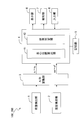
- FIG. 1 is a block diagram showing a configuration of a physical condition monitoring system according to the first and second embodiments of the present invention.
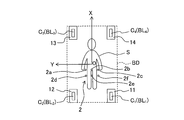
- FIG. 2 is an explanatory diagram showing the arrangement of the load detector and the humidity detector with respect to the bed.
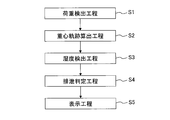
- FIG. 3 is a flowchart showing a procedure of a physical condition monitoring method using a physical condition monitoring system.
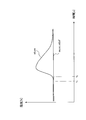
- FIG. 4 is a graph showing an example of the detection result by the humidity sensor.
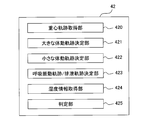
- FIG. 5 is a block diagram showing a configuration of an excretion determination unit included in the physical condition monitoring system according to the first embodiment of the present invention.
- FIG. 6 is a flowchart showing the procedure of the excretion determination step performed by the physical condition monitoring system according to the first embodiment of the present invention.
- FIG. 1 is a block diagram showing a configuration of a physical condition monitoring system according to the first and second embodiments of the present invention.
- FIG. 2 is an explanatory diagram showing the arrangement of the load detector and the humidity detector with respect to the bed.
- FIG. 3
- FIG. 7 (a) shows an example of the center of gravity locus of the subject
- FIG. 7 (b) shows the center of gravity locus obtained by converting the center of gravity locus shown in FIG. 7 (a) to a low sampling frequency
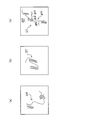
- 8 (a), 8 (b), and 8 (c) show a locus obtained by removing a large body movement locus from the locus of the center of gravity of the subject on the bed shown in FIG. 7 (a).
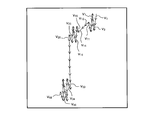
- FIG. 9 is an explanatory diagram illustrating a method of identifying a small body movement locus by analyzing a motion vector.
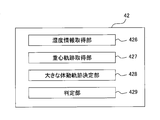
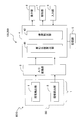
- FIG. 10 is a block diagram showing a configuration of an excretion determination unit included in the physical condition monitoring system according to the second embodiment of the present invention.
- FIG. 10 is a block diagram showing a configuration of an excretion determination unit included in the physical condition monitoring system according to the second embodiment of the present invention.
- FIG. 11 is a flowchart showing the procedure of the excretion determination step performed by the physical condition monitoring system according to the second embodiment of the present invention.
- FIG. 12 is an explanatory diagram illustrating a method of determining the moving direction of the motion vector.
- FIG. 13 is a block diagram showing the overall configuration of the bed system according to the modified example.
- the physical condition monitoring system 100 of the first embodiment mainly includes a load detection unit 1, a humidity detection unit 2, a control unit 4, and a storage unit 5.
- the load detection unit 1, the humidity detection unit 2, and the control unit 4 are connected via an A / D conversion unit 3.
- a display unit 6, a notification unit 7, and an input unit 8 are further connected to the control unit 4.
- the load detection unit 1 includes four load detectors 11, 12, 13, and 14 (FIG. 2). Each of the load detectors 11, 12, 13, and 14 is a load detector that detects a load using, for example, a beam-shaped load cell. Such load detectors are described, for example, in Japanese Patent No. 4829020 and Japanese Patent No. 4002905.
- the load detectors 11, 12, 13 and 14, respectively, are connected to the A / D conversion unit 3 by wiring or wirelessly.
- the four load detectors 11 to 14 of the load detector 1 were attached to the lower ends of the legs BL 1, BL 2 , BL 3 , and BL 4 at the four corners of the bed BD used by the subject S. It is placed under casters C 1 , C 2 , C 3 , and C 4, respectively.
- the humidity detection unit 2 includes six humidity sensors 2a, 2b, 2c, 2d, 2e, and 2f (FIG. 2).
- Each of the six humidity sensors 2a to 2f can be a sensor chip of an electric resistance type, a capacitance type, or the like.
- the six humidity sensors 2a to 2f are subjects lying on one side of the central portion of the bed BD in the length direction (X direction) and the central portion in the width direction (Y direction), that is, along the length direction on the bed BD. It is arranged in a matrix in the area near the buttocks.
- the distance between two humidity sensors adjacent in the length direction and the distance between two humidity sensors adjacent in the width direction can be, for example, about 30 to 100 mm.
- the six humidity sensors 2a to 2f are arranged in a 2 ⁇ 3 matrix with two rows in the length direction and three columns in the width direction.
- the arrangement is arbitrary and can be any number and arrangement suitable for humidity detection (details below).
- Each of the six humidity sensors 2a to 2f is arranged so that the humidity change due to the moisture released from the diaper worn by the subject S can be detected, and specifically, for example, it is arranged under the sheets.
- Each of the six humidity sensors 2a to 2f is connected to the A / D conversion unit 3 by wiring or wirelessly.
- a humidity detection sheet in which the six humidity sensors 2a to 2f are integrally arranged on a sheet-shaped base may be used as the humidity detection unit 2 and pulled under the sheets.
- the A / D conversion unit 3 includes an A / D converter that converts an analog signal from the load detection unit 1 and the humidity detection unit 2 into a digital signal, and the load detection unit 1, the humidity detection unit 2, and the control unit 4 are provided with an A / D converter. They are connected by wiring or wirelessly, respectively.
- the control unit 4 is a dedicated or general-purpose computer, and has a center of gravity position calculation unit 41 and an excretion determination unit 42 built therein.
- the storage unit 5 is a storage device that stores data used in the physical condition monitoring system 100, and for example, a hard disk (magnetic disk) can be used.
- the display unit 6 is an image display device such as a liquid crystal monitor that displays the information output from the control unit 4 to the user of the physical condition monitoring system 100.
- the notification unit 7 includes a device that aurally performs a predetermined notification based on information from the control unit 4, for example, a speaker.
- the input unit 8 is an interface for performing a predetermined input to the control unit 4, and may be a keyboard and a mouse.
- the physical condition monitor of the subject using the physical condition monitoring system 100 is a load detection step S1 for detecting the load of the subject and the position of the center of gravity of the subject based on the detected load (load value).
- the center of gravity trajectory calculation step S2 for calculating the locus of temporal fluctuation (center of gravity locus) of the center of gravity position
- the humidity detection step S3 for detecting the humidity on the bed
- the load detection step S1 the load of the subject S on the bed BD is detected by using the load detectors 11, 12, 13, and 14.
- the load of the subject S on the bed BD is distributed and applied to the load detectors 11 to 14 arranged under the legs BL 1 to BL 4 at the four corners of the bed BD, and is dispersed and detected by these.
- the weight of the bed BD is tare, but tare is not essential.
- Each of the load detectors 11 to 14 detects the load (load change) and outputs it as an analog signal to the A / D conversion unit 3.
- the A / D conversion unit 3 converts an analog signal into a digital signal with a sampling period of, for example, 5 milliseconds, and outputs the digital signal (hereinafter, “load signal”) to the control unit 4.
- the load signals obtained by digitally converting the analog signals output from the load detectors 11, 12, 13, and 14 by the A / D converter 3 are the load signals s 1 , s 2 , s 3 , and s, respectively. Call it 4.
- the center of gravity position calculation unit 41 determines the position G (X, Y) of the center of gravity G of the subject S on the bed BD based on the load signals s 1 to s 4 from the load detectors 11 to 14. It is calculated with a predetermined period T (for example, equal to the above sampling period of 5 milliseconds), and the temporal variation of the position of the center of gravity G of the subject S (center of gravity trajectory GT) is obtained.
- T for example, equal to the above sampling period of 5 milliseconds
- (X, Y) indicates the coordinates on the XY coordinate plane with the central portion of the bed BD as the origin O, X in the length direction, and Y in the width direction (FIG. 2).
- the calculation of the position G (X, Y) of the center of gravity G by the center of gravity position calculation unit 41 is performed by the following calculation. That is, G (X, Y) sets the coordinates of the load detectors 11, 12, 13, and 14 to (X 11 , Y 11 ), (X 12 , Y 12 ), (X 13 , Y 13 ), and (X 14), respectively. , Y 14 ), the load detection values of the load detectors 11 , 12 , 13 , and 14 are W 11, W 12, W 13, and W 14, respectively, and are calculated by the following equations.
- the center of gravity position calculation unit 41 calculates the position G (X, Y) of the center of gravity G in a predetermined sampling period T based on the above formulas 1 and 2, and the time of the position G (X, Y) of the center of gravity G.
- the target fluctuation, that is, the center of gravity trajectory GT is obtained and stored in, for example, the storage unit 5.
- the humidity on the bed BD is detected by using the six humidity sensors 2a to 2f of the humidity detection unit 2.
- Each of the six humidity sensors 2a to 2f detects humidity (humidity change) and outputs it as an analog signal to the A / D converter 3.
- the A / D conversion unit 3 converts an analog signal into a digital signal with a sampling period of, for example, 5 milliseconds, and outputs the digital signal (hereinafter, “humidity signal”) to the control unit 4.
- the humidity signals obtained by digitally converting the analog signals output from the humidity sensors 2a, 2b, 2c, 2d, 2e, and 2f by the A / D conversion unit 3 are converted into humidity signals sa, sb, sc, and sd, respectively. , Se, sf.
- the control unit 4 stores the received humidity signals sa to sf in the storage unit 5.
- the subject determines the presence or absence of excretion in the excretion determination unit 42 based on the following principle.
- the biological activity of subject S can be classified into “large body movement”, “small body movement”, and “breathing”.
- Trajectories of temporal fluctuations in the position of the center of gravity G in response to large body movements (hereinafter referred to as “large body movement trajectories")
- loci of temporal fluctuations in the position of the center of gravity G in response to small body movements (hereinafter referred to as "small body movements)
- the locus (referred to as “trajectory”) and the locus of temporal fluctuation of the position of the center of gravity G according to breathing (hereinafter referred to as “respiratory vibration locus”) show different characteristics.
- the "large body movement” means a relatively large body movement of a subject accompanied by movement of the body (trunk), and specifically, for example, turning over or getting up. Is.
- the orientation of the subject's body axis (the orientation in which the subject's spine extends) generally changes.
- a large body movement is a movement of the center of gravity G over a relatively long distance that occurs within a predetermined period, for example, the center of gravity G. It is a body movement that causes movement at a relatively high speed. Therefore, for example, a body movement that causes a movement of the center of gravity exceeding a predetermined distance PD1 in a predetermined period PP and / or a body movement that causes a movement of the center of gravity at a speed exceeding a predetermined value V1 can be defined as a large body movement.
- the center of gravity G is larger than a predetermined time, compared with the movement distance of the center of gravity G due to a small body movement within a unit time.
- the body movement that moves the body can also be defined as a large body movement.
- the large body movement locus is such a locus of movement of the center of gravity G.
- the "small body movement” means a relatively small body movement of a subject without movement of the torso (trunk), and specifically, for example, a limb or a head. Exercise only for the club.
- small body movements are movements of the center of gravity G over a relatively short distance within a unit time, for example, a relatively low velocity of the center of gravity G. It is a body movement that causes movement in. Therefore, for example, a body movement that causes a movement of the center of gravity of a predetermined distance PD2 ( ⁇ PD1) in a predetermined period PP and / or a body movement that causes a movement of the center of gravity of a predetermined value V2 ( ⁇ V1) is defined as a small body movement. can do.
- a small body movement causes a movement of the center of gravity of about a predetermined distance PD2 in a predetermined period PP, or the movement speed is about a predetermined value V2, has no periodicity, and is in a direction different from the body axis direction of the subject S.
- the body movement that causes the movement of the center of gravity toward the body may be defined as a small body movement.
- the small body movement locus is such a locus of movement of the center of gravity G.
- the state of temporal fluctuation of the position of the center of gravity G according to breathing is as follows. Human breathing is performed by moving the thorax and diaphragm to inflate and contract the lungs. Here, during inspiration, that is, when the lungs expand, the diaphragm moves downward and the internal organs also move downward. On the other hand, during exhalation, that is, when the lungs contract, the diaphragm rises upwards and the internal organs also move upwards. As described in Japanese Patent No. 6,105,703 issued to the applicant, since breathing accompanies the vertical movement of the internal organs, the center of gravity G of the subject is moved in the vertical direction (direction of the spine), that is, the body axis direction due to the breathing.
- respiration which appears as a vibration of the center of gravity in the body axis direction
- small body movement which appears as a movement of the center of gravity in a direction different from the body axis direction.
- the inventor of the present invention examined the movement of the center of gravity of the subject on the bed in more detail, and in addition to the above-mentioned movement of the center of gravity according to the body movement and respiration of the subject, it is also characteristic when the subject urinates. We found that the movement of the center of gravity can be observed.
- the physical condition monitoring system 100 of the first embodiment calculates the position of the center of gravity of the subject S as the position of the center of gravity of the weight including the clothes and diapers of the subject. Therefore, the urine and stool excreted in the diaper (that is, the urine and stool excreted outside the body of the subject S) are also used to calculate the position of the center of gravity of the subject S in the same manner as when they are present in the body of the subject S. affect.
- the excretion determination unit 42 of the first embodiment has a large body movement locus, a small body movement locus, and a small body in the center of gravity locus of the subject based on the fact that the large body movement locus, the small body movement locus, and the respiratory vibration locus have different characteristics as described above.
- the movement locus and the respiratory vibration locus are specified, and the excretion locus is specified. After that, the presence or absence of an increase in humidity on the bed is confirmed, and if the presence of an increase in humidity is confirmed, it is determined that the subject has excreted.
- the excretion determination unit 42 identifies and removes the center-of-gravity locus acquisition unit 420 that extracts the center-of-gravity locus of the subject S from the storage unit 5 and the large body movement locus of the subject S included in the extracted center-of-gravity locus.
- a large body movement locus determination unit (large body movement component removal unit, body movement determination unit) 421 and a small body movement trajectory determination unit (a small body movement trajectory determination unit) that identifies and removes the small body movement trajectory of the subject S included in the extracted center of gravity trajectory GT.
- Small body movement component removing part) 422 and the center of gravity locus GT from which the large body movement locus and the small body movement locus are removed are distinguished into a respiratory vibration locus and an excretion locus.
- a humidity information acquisition unit 424 that extracts humidity information on the bed from the storage unit 5, and a determination unit that determines the presence or absence of excretion by the subject based on the humidity information and the excretion trajectory of the subject S included in the center of gravity trajectory GT. It is equipped with 425.
- the excretion determination step S4 executed by the excretion determination unit 42 includes a large body movement determination step S41, a small body movement determination step S42, a respiratory vibration locus / excretion trajectory determination step S43, and a determination step S44. including.
- the center-of-gravity locus acquisition unit 420 is used to take out the center-of-gravity locus GT of the subject S from the storage unit 5 during a predetermined period.
- An example of the center-of-gravity locus GT taken out is as shown in FIG. 7 (a).
- the center-of-gravity locus GT shown in FIG. 7A shows that the subject S makes one round trip in the left-right direction on the bed due to a large body movement (turning over, etc.). Further, it shows how the center of gravity G of the subject S moves within the regions A, B, and C, respectively, during the period when no major body movement occurs (hereinafter, referred to as “stable posture period”). The movement of the center of gravity G within regions A, B, and C is caused by subject S's small body movements, respiration, and excretion.
- the excretion determination unit 42 uses the large body movement locus determination unit 421 to identify the large body movement locus of the subject S from the center of gravity locus GT.
- the large body movement locus determination unit 421 analyzes the position of the center of gravity G at each sampling time, and based on the definition of "large body movement", appropriately determines the locus of movement of the center of gravity G (large body movement locus) according to the large body movement. Can be identified. Specifically, for example, when the center of gravity G moves beyond a predetermined distance within a predetermined time, it is specified that the locus of this movement is a large body movement locus.
- the large body movement locus determination unit 421 determines whether or not the center of gravity G has moved beyond a predetermined distance within a predetermined time by using the following method.
- the center-of-gravity locus GT shown in FIG. 7 (a) is converted into the center-of-gravity locus GT1 converted to a lower sampling frequency (FIG. 7 (b)).
- the conversion to a lower sampling frequency can be performed by thinning out the data of the center of gravity position G acquired in the sampling period of 5 milliseconds or by performing a moving average process. Alternatively, it can also be performed by decomposing the center-of-gravity locus GT into frequencies and extracting a predetermined low-frequency component with a low-pass filter.
- the low sampling frequency has a short period (large frequency) sufficient to extract a large body movement, and is not affected by fluctuations in the center of gravity due to other factors such as small body movement and respiration. It is desirable to have a long period (small frequency).
- the large body movement locus determination unit 421 identifies the locus in this section as a large body movement locus.
- the locus between the points B2 and C1 also moves, for example, to the left over a predetermined distance within a predetermined time. Therefore, the large body movement locus determination unit 421 identifies the locus in this section as a large body movement locus.
- the large body movement locus determination unit 421 removes the large body movement locus from the center of gravity locus GT, and transfers the center of gravity locus GT from which the large body movement locus is removed to the small body movement locus determination unit 422. send. 8 (a) to 8 (c) show the center-of-gravity locus GT shown in FIG. 7 (a) with the large body movement locus removed.
- 8 (a) is the center of gravity locus GT in the region A of FIG. 7 (a)
- FIG. 8 (b) is the center of gravity locus GT in the region B of FIG. 7 (a)
- FIG. 8 (c) is of FIG. 7 (a). It is the center of gravity locus GT in the region C. Each of these corresponds to the center-of-gravity locus GT during the stable posture period.
- the excretion determination unit 42 uses the small body movement locus determination unit 422 to identify the small body movement locus included in the center of gravity locus GT from which the large body movement locus has been removed.
- a specific step will be described by taking as an example a step of separating the center-of-gravity locus GT (FIG. 8 (c)) of the region C into a small body movement locus and a respiratory vibration locus.
- the center-of-gravity locus GT represents the parts gt1, gt3, and gt5 representing the vibration of the center of gravity G due to breathing, the parts gt2 representing the movement of the center of gravity G due to small body movements, and the movement of the center of gravity G due to urination.
- the parts gt1, gt3, and gt5 representing the movement of the center of gravity G by respiration indicate periodic vibration.
- the vibration loci of the parts gt1, gt3, and gt5 actually appear overlapping on one axis along the vibration direction, but in FIG. 8C, they are orthogonal to the body axis direction for explanation. It is drawn with a shift in the direction. The same applies to FIGS. 8 (a), 8 (b), and 9.
- the part gt2 representing the movement of the center of gravity G due to a small body movement is a locus extending in a direction different from the body axis direction
- the part gt4 representing the movement of the center of gravity G due to urination is a locus extending in the body axis direction.
- the small body movement locus determination unit 422 can identify the small body movement locus of the subject S by the method of removing outliers as an example.
- the small body movement locus determination unit 422 obtains the direction of the mode vector v f from these 48 motion vectors.
- the motion vectors v 1 to v 48 each have an orientation, but as shown in FIG. 9, most of the motion vectors v 1 to v 48 have the same orientation as each other.
- the direction of the most frequent value vector v f is equal to the direction in which the motion vectors v 1 to v 48 appear most frequently, and as is clear from FIG. 9, the motion vectors v 1 to v 11 and v 15 to v 48 Equal to either orientation (as described above, these motion vectors are tilted relative to each other for convenience of illustration, but in reality they are all approximately along the body axis).
- the small body movement locus determination unit 422 sets an angle of 180 ° with respect to its own direction and the direction of the most frequent value vector v f (or the most frequent value vector v f) among the motion vectors v 1 to v 48.
- a motion vector whose difference from (orientation) is less than a certain threshold is regarded as a majority vector, and an angle of 180 ° with respect to its own direction and the direction of the most frequent vector v f (and the most frequent vector v f).
- a motion vector whose difference from (orientation with) is greater than a certain threshold is regarded as a minority vector.
- the locus represented by the minority vector extracted in this way corresponds to a small body movement locus.
- the small body movement locus determination unit 422 removes the small body movement locus from the center of gravity locus GT after determining the small body movement locus, and uses the center of gravity locus GT from which the small body movement locus has been removed as the respiratory vibration locus / excretion locus determination unit. Send to 423.
- the respiratory vibration locus / excretion locus determination unit 423 distinguishes the center of gravity locus GT from which the large body movement locus and the small body movement locus are removed into the respiratory vibration locus and the excretion locus. To do.
- the distinction between the respiratory vibration locus and the excretion locus is specifically performed by, for example, specifying the linear movement of the center of gravity G along the same direction or substantially the same direction by a predetermined distance or more.
- the respiratory vibration locus / excretion locus determination unit 423 receives the center-of-gravity locus GT from which the small body movement locus is removed from the small body movement locus determination unit 422.
- the received center-of-gravity locus GT is, for example, a locus in which the motion vectors v 12 to v 14 are removed in the center-of-gravity locus GT of FIG.
- the respiratory vibration locus / excretion locus determination unit 423 analyzes the received center of gravity locus GT to specify a region in which the center of gravity G linearly moves a predetermined distance or more along the same direction or substantially the same direction. This specification is performed, for example, by specifying a region in which motion vectors having the same or substantially the same orientation occur continuously in excess of a predetermined number.
- the position of the center of gravity G at each sampling time is referred to, and a region in which the center of gravity G linearly moves by a predetermined distance or more along the same direction or substantially the same direction is specified. You may.
- the respiratory vibration locus / excretion locus determination unit 423 identifies a region in which the center of gravity G linearly moves along the same direction or substantially the same direction by a predetermined distance or more, and then determines the locus of movement of the center of gravity G in the region as an excretion locus. It is determined that there is, and the other areas are determined to be respiratory vibration trajectories.
- the determination unit 425 determines the presence or absence of excretion by the subject S according to the following procedure.
- the determination unit 425 first sets the excretion locus flag when the respiratory vibration locus / excretion locus determination unit 423 specifies the excretion locus.
- the humidity signals sa to sf acquired from the storage unit 5 via the humidity information acquisition unit 424 are referred to, and the humidity signals sa to the humidity signals sa to be within a predetermined period (about 60 seconds as an example) after the excretion trajectory flag is set.
- a predetermined period about 60 seconds as an example
- the determination unit 425 determines that the subject S has excreted if no increase exceeding the predetermined value occurs in any of the humidity signals sa to sf within the predetermined period after setting the excretion trajectory flag. Not performed. Then, after the lapse of a predetermined period, the excretion trajectory flag is lowered.
- the determination unit 425 estimates that the subject S has excreted based on the identification of the excretion trajectory, and only when the humidity increase due to the excretion is confirmed within a predetermined period after the estimation. It is determined that the subject S has excreted. On the other hand, even if it is estimated that the subject S has excreted based on the identification of the excretion trajectory, if the humidity increase due to the excretion is not confirmed within the predetermined period after the estimation, it is determined that the subject S has excreted. Do not do.
- ⁇ Display process> In the display step S5, the presence or absence of excretion by the subject S determined by the excretion determination unit 42 is displayed on the monitor. By visually observing the monitor, the user can easily confirm whether or not the subject S has excreted, in other words, whether or not the subject S needs to change the diaper.
- the user of the physical condition monitoring system 100 can also be set so that the notification unit 7 notifies when the subject S excretes.
- the subject S is based on both that the characteristic movement of the center of gravity position that occurs in response to excretion is identified and that the humidity rises in response to excretion. Since the presence or absence of excretion by the subject is determined, the presence or absence of excretion by the subject can be determined with extremely high accuracy.
- the present invention when the excretion trajectory is specified and the humidity rise is detected within a predetermined period thereafter, it is determined that the subject S has excreted.
- the present invention is not limited to this, and it may be determined that the subject S has excreted only based on the fact that the excretion trajectory of the subject S is specified without considering the presence or absence of an increase in humidity.
- the configuration related to humidity detection such as the humidity detection unit 2 may be omitted.
- the excretion determination unit 42 includes a respiratory vibration locus / excretion locus determination unit 423, and after explicitly identifying the excretion locus, determines the presence or absence of excretion of the subject S.
- the determination unit 425 Based on the locus of the center of gravity from which the large body movement locus and the small body movement locus are removed, specifically, for example, the determination unit 425 has a spread exceeding a predetermined value in the axial direction (that is, the said locus). Based on (indicating that the locus includes an excretion locus), the excretion flag may be set without explicitly specifying the excretion locus.
- the small body movement locus determination unit 422 and the respiratory vibration locus / excretion locus determination unit 423 are used in the vibration direction of the respiratory vibration locus of the subject S (for example, the direction of the most frequent value vector v f). ), It may function as a body axis direction determining unit that determines that the direction is the direction in which the body axis of the subject S extends.
- the physical condition monitoring system 200 of the second embodiment is the first except that the internal configuration of the excretion determination unit 42 and the content of the excretion determination step S4 executed by the excretion determination unit 42 are different from those of the first embodiment. It is the same as the physical condition monitoring system 100 of one embodiment.
- the excretion determination unit 42 of the physical condition monitoring system 200 of the second embodiment includes a humidity information acquisition unit 426, a center of gravity trajectory acquisition unit 427, a large body movement trajectory determination unit 428, and a determination unit 429.
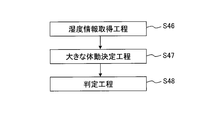
- the excretion determination step S4 executed by the excretion determination unit 42 of the physical condition monitoring system 200 of the second embodiment includes a humidity information acquisition step S46, a large body movement determination step S47, and a determination step S48.
- the determination unit 429 constantly acquires the humidity signals sa to sf from the storage unit 5 via the humidity information acquisition unit 426.
- the determination unit 429 sets a humidity flag when at least one of the humidity signals sa to sf has a rise exceeding a predetermined value.
- the large body movement trajectory determination unit 428 identifies the large body movement trajectory included in the center of gravity trajectory of the subject S acquired from the storage unit 5 via the center of gravity trajectory acquisition unit 427.
- the identification of the large body movement locus is specified, for example, by the same procedure as in the first embodiment.
- the identification of a large body movement locus may be performed at all times, or may be performed only when the humidity flag described later is set.
- the determination step S48 is performed when the humidity flag is set in the humidity information acquisition step S46.
- the determination unit 429 confirms whether or not a large body movement locus has been specified within a predetermined period retroactive from the time when the humidity flag is set.
- the determination unit 429 determines that the subject S has excreted if a large body movement trajectory has not been identified within a predetermined period (for example, a period of about 60 seconds) that goes back from the time when the humidity flag is set. To do. On the other hand, the determination unit 429 does not determine that the subject S has excreted and lowers the humidity flag if a large body movement trajectory is specified within a predetermined period retroactive from the time when the humidity flag is set. ..
- the determination unit 429 presumes that the subject S had excreted based on the increase in humidity, and when it was confirmed that the subject S did not have a large body movement prior to the increase in humidity. , It is determined that the subject S has excreted. On the other hand, even if it is estimated that the subject S has excreted based on the increase in humidity, if the subject S has a large body movement prior to the increase in humidity, it is determined that the subject S has excreted. Absent. In such a case, the increase in humidity causes the water trapped between the subject S and the bedding (mattress, etc.), which is irrelevant to excretion caused by sweating, etc., to be released with the large body movement of the subject S. This is because it is considered that the humidity rises due to the fact.
- the physical condition monitoring system 100 of the second embodiment is based on both the fact that the humidity rise has occurred and that the large body movement, which is a factor other than excretion that can cause the humidity rise, has not occurred. Since the presence or absence of excretion by the subject S is determined, a very accurate determination can be made.
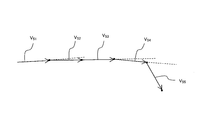
- the large body movement locus determination units 421 and 428 move in substantially one direction in substantially one direction beyond a predetermined distance within a predetermined time. It may be determined that a large body movement has occurred, and the center-of-gravity locus GT during this period may be specified as a large body movement locus. Whether or not the center of gravity G is moving in substantially one direction is determined by, for example, whether the angle between the motion vector of the center of gravity G in a predetermined sampling period and the motion vector of the center of gravity G in the next sampling period is equal to or less than a predetermined angle. It can be judged based on whether or not it is.
- the motion vectors v 52 to v 54 of the center of gravity G have an angle of about 5 ° or less with respect to the motion vector in the sampling period immediately before the motion vector.
- the motion vector v 55 has an angle of 5 ° or more with respect to the motion vector v 54 in the sampling period immediately before the motion vector v 55.
- the center of gravity G moves in a substantially constant direction during the sampling period corresponding to the motion vectors v 51 to v 54 , and the moving direction is changed during the sampling period corresponding to the motion vector v 55. it can.
- the large body movement locus determination units 421 and 428 When the large body movement locus determination units 421 and 428 consider that the movement direction has been changed, they are based on the motion vector (here, motion vectors v 51 to v 54 ) before the time when the movement direction is changed. It is determined whether or not a movement exceeding a predetermined distance has occurred within a predetermined time. Then, when the movement exceeding the predetermined distance occurs within the predetermined time, the locus represented by these motion vectors is specified as a large body movement locus.
- the motion vector here, motion vectors v 51 to v 54
- the center of gravity locus GT may be filtered by a low-pass filter before specifying a large body movement locus using a motion vector. As a result, high frequency components (noise) are removed, and specific accuracy can be improved.
- the respiratory vibration locus / excretion locus determination unit 423 separates the respiratory vibration locus and the excretion locus based on the amount of linear movement of the position of the center of gravity G.
- the respiratory vibration locus / excretion locus determination unit 423 applies filtering to the load signal corresponding to the center of gravity locus GT received from the small body movement locus determination unit 422 to remove the high frequency component, and obtains the center of gravity locus based on the remaining load component. It may be specified as an excretion trajectory.
- frequency filtering can be applied to identify the respiratory vibration trajectory and the excretion trajectory.
- the case where the subject S is wearing a diaper has been described as an example, but even when the subject is not wearing a diaper, the physical condition of the first and second embodiments is described.
- the excretion of the subject can be detected by the same principle as in the first and second embodiments.
- the physical condition monitoring systems 100 and 200 of the first and second embodiments do not necessarily have to include all of the load detectors 11 to 14, and may only include any one of them. Further, the load detectors do not necessarily have to be arranged at the four corners of the bed, and may be arranged at arbitrary positions so that the load of the subject on the bed and its fluctuation can be detected. Further, the load detectors 11 to 14 are not limited to the load sensor using the beam type load cell, and for example, a force sensor can also be used.
- each of the load detector 11 to 14 are located under the casters C 1 ⁇ C 4 attached to the lower end of the leg of the bed BD
- Each of the load detectors 11 to 14 may be provided between the four legs of the bed BD and the floor plate of the bed BD, or the upper part if the four legs of the bed BD can be divided into upper and lower parts. It may be provided between the leg and the lower leg.
- the load is detected by a large number of pressure sensors (pressure sensors) arranged in a matrix below the subject lying on the bed, for example, under the sheets.
- Part 1 can also be configured.
- the position of the center of gravity of the subject can be determined based on the outputs of a large number of pressure sensors.
- a large number of pressure-sensitive sensors constituting the load detection unit 1 and a plurality of humidity sensors constituting the humidity detection unit 2 are provided on the same sheet, and the load detection unit 1 and the humidity detection unit 2 are united. It may have a sheet-like structure.
- the bed system BDS including the bed BD and the physical condition monitoring system 100 of the first embodiment or the physical condition monitoring system 200 of the second embodiment is configured by integrally or detachably combining the load detection unit 1 and the bed BD. It may be (Fig. 13).
- the load detection unit 1 and / or the humidity detection unit 1 and / or the humidity detection unit 1 and / or the humidity detection unit 1 and / or the humidity detection unit 2 and the A / D conversion unit 3 are located between the load detection unit 1 and / or the humidity detection unit 2.
- a signal amplification unit that amplifies the signal from 2 and a filtering unit that removes noise from the signal may be provided.
- the display unit 6 prints and outputs information indicating the physical condition in place of or in addition to the monitor, or a physical condition.
- a simple visual display means such as a display lamp may be provided.
- the notification unit 7 may include a vibration generating unit that notifies by vibration in place of or in addition to the speaker.
- the present invention is not limited to the above-described embodiment, and other modes considered within the scope of the technical idea of the present invention are also included within the scope of the present invention. ..
- the physical condition monitoring system of the present invention it is possible to detect the excretion by the subject with high accuracy and contribute to the improvement of the quality of medical treatment, long-term care, etc.
Landscapes
- Health & Medical Sciences (AREA)
- Nursing (AREA)
- Life Sciences & Earth Sciences (AREA)
- Animal Behavior & Ethology (AREA)
- General Health & Medical Sciences (AREA)
- Public Health (AREA)
- Veterinary Medicine (AREA)
- Epidemiology (AREA)
- Orthopedic Medicine & Surgery (AREA)
- Engineering & Computer Science (AREA)
- Biomedical Technology (AREA)
- Heart & Thoracic Surgery (AREA)
- Vascular Medicine (AREA)
- Invalid Beds And Related Equipment (AREA)
- Orthopedics, Nursing, And Contraception (AREA)
- Measuring And Recording Apparatus For Diagnosis (AREA)
- Measurement Of The Respiration, Hearing Ability, Form, And Blood Characteristics Of Living Organisms (AREA)
Applications Claiming Priority (2)
| Application Number | Priority Date | Filing Date | Title |
|---|---|---|---|
| JP2019-204646 | 2019-11-12 | ||
| JP2019204646A JP7202999B2 (ja) | 2019-11-12 | 2019-11-12 | 身体状態モニタリングシステム、及びベッドシステム |
Publications (1)
| Publication Number | Publication Date |
|---|---|
| WO2021095332A1 true WO2021095332A1 (ja) | 2021-05-20 |
Family
ID=75899444
Family Applications (1)
| Application Number | Title | Priority Date | Filing Date |
|---|---|---|---|
| PCT/JP2020/033610 Ceased WO2021095332A1 (ja) | 2019-11-12 | 2020-09-04 | 身体状態モニタリングシステム、及びベッドシステム |
Country Status (2)
| Country | Link |
|---|---|
| JP (1) | JP7202999B2 (enExample) |
| WO (1) | WO2021095332A1 (enExample) |
Citations (3)
| Publication number | Priority date | Publication date | Assignee | Title |
|---|---|---|---|---|
| JP2013078566A (ja) * | 2011-09-19 | 2013-05-02 | Yoshimi Ui | 排泄検知システム |
| JP2018019763A (ja) * | 2016-08-01 | 2018-02-08 | ミネベアミツミ株式会社 | 身体状態モニタリングシステム |
| JP2018126436A (ja) * | 2017-02-10 | 2018-08-16 | ミネベアミツミ株式会社 | ベッドモニタリングシステム |
-
2019
- 2019-11-12 JP JP2019204646A patent/JP7202999B2/ja active Active
-
2020
- 2020-09-04 WO PCT/JP2020/033610 patent/WO2021095332A1/ja not_active Ceased
Patent Citations (3)
| Publication number | Priority date | Publication date | Assignee | Title |
|---|---|---|---|---|
| JP2013078566A (ja) * | 2011-09-19 | 2013-05-02 | Yoshimi Ui | 排泄検知システム |
| JP2018019763A (ja) * | 2016-08-01 | 2018-02-08 | ミネベアミツミ株式会社 | 身体状態モニタリングシステム |
| JP2018126436A (ja) * | 2017-02-10 | 2018-08-16 | ミネベアミツミ株式会社 | ベッドモニタリングシステム |
Also Published As
| Publication number | Publication date |
|---|---|
| JP2021074379A (ja) | 2021-05-20 |
| JP7202999B2 (ja) | 2023-01-12 |
Similar Documents
| Publication | Publication Date | Title |
|---|---|---|
| JP6594399B2 (ja) | 生体情報モニタリングシステム | |
| JP5451402B2 (ja) | センサ構成を有する心弾動センサシステム及び身体運動の心弾動検出をする方法 | |
| JP6767193B2 (ja) | 身体状態モニタリングシステム | |
| EP3659565B1 (en) | On-bed state monitoring system | |
| WO2017200009A1 (ja) | 生体情報モニタリングシステム | |
| WO2017200010A1 (ja) | 生体情報モニタリングシステム | |
| EP3581106B1 (en) | Bed monitoring system | |
| JP2018126436A (ja) | ベッドモニタリングシステム | |
| CN111867470B (zh) | 睡眠/觉醒判定系统 | |
| JP6934982B1 (ja) | 身体状態モニタリングシステム、及びベッドシステム | |
| WO2021095332A1 (ja) | 身体状態モニタリングシステム、及びベッドシステム | |
| JP6570585B2 (ja) | 体動判定システム、生体状態モニタリングシステム、及びベッドシステム | |
| JP2014147596A (ja) | 離床予測装置 | |
| WO2024135152A1 (ja) | 馬房システム | |
| JP6535770B2 (ja) | 生体情報モニタリングシステム | |
| JP6487081B2 (ja) | 生体情報モニタリングシステム | |
| JP2007327993A (ja) | 音声モニタシステム、音声モニタ方法、プログラム、咳検出システム | |
| KR102714183B1 (ko) | 3축 심탄도센서와 영상 개체 인식 알고리즘을 이용한 낙상 예측방법 및 이를 실행하는 컴퓨터 프로그램 | |
| JP2018015210A (ja) | 在床状態モニタリングシステム | |
| JP2018015209A (ja) | 在床状態モニタリングシステム | |
| JP7496257B2 (ja) | 生体情報取得システム、及びセンサ配置判定プログラム | |
| US20230127922A1 (en) | Bed scale noise compensation using a reference transducer | |
| JP2013183812A (ja) | 離床判定装置及び離床判定方法 | |
| CN111788614B (zh) | 在床状态监视系统以及具备其的床 | |
| JP2768196B2 (ja) | 就寝装置 |
Legal Events
| Date | Code | Title | Description |
|---|---|---|---|
| 121 | Ep: the epo has been informed by wipo that ep was designated in this application |
Ref document number: 20886235 Country of ref document: EP Kind code of ref document: A1 |
|
| NENP | Non-entry into the national phase |
Ref country code: DE |
|
| 122 | Ep: pct application non-entry in european phase |
Ref document number: 20886235 Country of ref document: EP Kind code of ref document: A1 |