WO2021070512A1 - 故障ツリー生成装置及びその方法 - Google Patents
故障ツリー生成装置及びその方法 Download PDFInfo
- Publication number
- WO2021070512A1 WO2021070512A1 PCT/JP2020/032830 JP2020032830W WO2021070512A1 WO 2021070512 A1 WO2021070512 A1 WO 2021070512A1 JP 2020032830 W JP2020032830 W JP 2020032830W WO 2021070512 A1 WO2021070512 A1 WO 2021070512A1
- Authority
- WO
- WIPO (PCT)
- Prior art keywords
- information
- component
- tree
- failure
- failure tree
- Prior art date
- Legal status (The legal status is an assumption and is not a legal conclusion. Google has not performed a legal analysis and makes no representation as to the accuracy of the status listed.)
- Ceased
Links
Images





Classifications
-
- G—PHYSICS
- G05—CONTROLLING; REGULATING
- G05B—CONTROL OR REGULATING SYSTEMS IN GENERAL; FUNCTIONAL ELEMENTS OF SUCH SYSTEMS; MONITORING OR TESTING ARRANGEMENTS FOR SUCH SYSTEMS OR ELEMENTS
- G05B23/00—Testing or monitoring of control systems or parts thereof
- G05B23/02—Electric testing or monitoring
- G05B23/0205—Electric testing or monitoring by means of a monitoring system capable of detecting and responding to faults
- G05B23/0218—Electric testing or monitoring by means of a monitoring system capable of detecting and responding to faults characterised by the fault detection method dealing with either existing or incipient faults
- G05B23/0243—Electric testing or monitoring by means of a monitoring system capable of detecting and responding to faults characterised by the fault detection method dealing with either existing or incipient faults model based detection method, e.g. first-principles knowledge model
- G05B23/0245—Electric testing or monitoring by means of a monitoring system capable of detecting and responding to faults characterised by the fault detection method dealing with either existing or incipient faults model based detection method, e.g. first-principles knowledge model based on a qualitative model, e.g. rule based; if-then decisions
- G05B23/0248—Causal models, e.g. fault tree; digraphs; qualitative physics
-
- G—PHYSICS
- G06—COMPUTING OR CALCULATING; COUNTING
- G06F—ELECTRIC DIGITAL DATA PROCESSING
- G06F11/00—Error detection; Error correction; Monitoring
- G06F11/07—Responding to the occurrence of a fault, e.g. fault tolerance
- G06F11/0703—Error or fault processing not based on redundancy, i.e. by taking additional measures to deal with the error or fault not making use of redundancy in operation, in hardware, or in data representation
- G06F11/079—Root cause analysis, i.e. error or fault diagnosis
-
- G—PHYSICS
- G06—COMPUTING OR CALCULATING; COUNTING
- G06F—ELECTRIC DIGITAL DATA PROCESSING
- G06F11/00—Error detection; Error correction; Monitoring
- G06F11/07—Responding to the occurrence of a fault, e.g. fault tolerance
- G06F11/0703—Error or fault processing not based on redundancy, i.e. by taking additional measures to deal with the error or fault not making use of redundancy in operation, in hardware, or in data representation
- G06F11/0706—Error or fault processing not based on redundancy, i.e. by taking additional measures to deal with the error or fault not making use of redundancy in operation, in hardware, or in data representation the processing taking place on a specific hardware platform or in a specific software environment
- G06F11/0721—Error or fault processing not based on redundancy, i.e. by taking additional measures to deal with the error or fault not making use of redundancy in operation, in hardware, or in data representation the processing taking place on a specific hardware platform or in a specific software environment within a central processing unit [CPU]
-
- G—PHYSICS
- G06—COMPUTING OR CALCULATING; COUNTING
- G06Q—INFORMATION AND COMMUNICATION TECHNOLOGY [ICT] SPECIALLY ADAPTED FOR ADMINISTRATIVE, COMMERCIAL, FINANCIAL, MANAGERIAL OR SUPERVISORY PURPOSES; SYSTEMS OR METHODS SPECIALLY ADAPTED FOR ADMINISTRATIVE, COMMERCIAL, FINANCIAL, MANAGERIAL OR SUPERVISORY PURPOSES, NOT OTHERWISE PROVIDED FOR
- G06Q50/00—Information and communication technology [ICT] specially adapted for implementation of business processes of specific business sectors, e.g. utilities or tourism
- G06Q50/10—Services
Definitions
- the present invention generally relates to a fault tree generator and a method for generating a fault tree from the system level to the level of both or one of the equipment and parts (hereinafter referred to as "equipment / parts").
- FTA fault Tree Analysis
- FTA is an analysis technique that systematically searches for the source of a defect by taking up the defect event of the product, identifying the cause of the failure in a hierarchical manner, and developing it.
- This analysis result has a tree structure in which the failure event of the product is at the top and the cause of the failure is in the lower hierarchy.
- the analysis result having this tree structure is called a failure tree.
- a defect event of a product to be analyzed is called a top event because it is located at the top of the failure tree.
- the failure tree consists of multiple hierarchies.
- the failure factor at the end of the failure tree is called a terminal event because it is located at the end of the failure tree. Terminal events represent the root cause of top events.
- FTAs can be used when building reliability of a product at the design stage and when investigating the cause when a defect occurs in the product.
- reliability is achieved by setting a defect event that you do not want the product to occur in the top event and taking measures to prevent the terminal event that is the root cause obtained as an analysis result from occurring. To improve.
- the defect event that has occurred is set as the top event, FTA is performed, and it is confirmed whether the terminal event is actually the failure factor of the top event.
- FTA can be implemented in a short time. However, if the cause of the failure cannot be immediately noticed, it will take time to search the literature or ask other people.
- Whether or not the cause of the failure can be noticed depends on the range of knowledge and experience of the designer who performs the FTA, but the range that each designer knows is limited due to the division of labor of the design work. As the number of skilled designers decreases, it may be necessary for young designers with little experience to perform FTAs, so it may take time to implement FTAs without immediately noticing the cause of the failure. Furthermore, when introducing and designing new parts that have not been dealt with before, new knowledge about the parts to be introduced is required accordingly. Such a point may also cause the FTA to take time without immediately noticing the cause of the failure.
- MFM Multilevel Flow Modeling
- Information MFM incidental information including component behavior information that expresses the relationship between the failure and the behavior of the component when a failure occurs in the component, and the influence ripple rule that defines the effect that it spreads when the function changes. Automatically generate a failure tree based on.
- the device described in Tokuken Document 2 stores the causal relationships of defects that have occurred in the past in a database, and by combining these causal relationships, a failure tree is automatically generated.
- the MFM information becomes the original data at the time of FTA generation.
- the figure represented by MFM is generally created by a knowledge engineer. However, it is determined whether or not the MFM created by the knowledge engineer is an accurate model of the system. This is difficult. Therefore, a method for proving the correctness of the model of MFM has been desired, and FMF is generally unfamiliar to system designers and therefore difficult to understand.
- (Paragraph 0013) That is, in the apparatus of Patent Document 1, the failure tree can be automatically generated, but instead, it is necessary to create MFM information about the product to be analyzed, and for that purpose, in addition to a wide range of knowledge about the product, MFM information is created. Knowledge engineering knowledge is required to do so.
- the device of Patent Document 2 automatically generates a failure tree by combining the causal relationships of defects that have occurred in the past. For this reason, if the component configuration of the product that has a defect in the past and the product that you want to analyze are different, there is a possibility that the generated failure tree may contain failure factors that are not related to the product you want to analyze, and the failure factors include Missing may occur.
- Part B Phenomenon B
- Part B Phenomenon B
- the parts composition may differ even with the same product name in order to respond to new needs and customize according to the customer.
- the component parts were “part B”, “part C”, “part D”, and “part E”, but in the product A to be analyzed, the component part is “part B”.
- Part C "Part F”, and “Part G”
- Part D Phenomenon D
- Part E Phenomenon E
- Part B: Phenomenon B "Part C: Phenomenon C”
- Part D Phenomenon D
- Part B: Phenomenon B "Part C: Phenomenon C”
- Part D: Phenomenon D "Part E: Phenomenon E” failure factors are extracted. By repeating this, the cause of the failure is deepened and a failure tree is generated. Even when digging deeper into this failure factor, there is a possibility that a failure factor that is not related to the product to be analyzed may enter.
- Products can be considered separately at the system level and the equipment / parts level.
- the system level refers to, for example, the entire power plant, and is constructed by combining multiple devices and parts according to the required performance and specifications.
- the equipment / component level refers to, for example, pumps, generators, etc., which are components of a power plant.
- the equipment / parts and connection relationships that are its components often differ from plant to plant, depending on the required performance and specifications.
- the components and connection relationships that are the components are not so different from those of the system.
- a pump consists of a casing, an impeller, a spindle, a bearing, and the like, and its basic configuration and connection relationship do not change significantly.
- the generated failure tree may contain failure factors that are not related to the product to be analyzed, and failure factors. There is a high possibility that the system will be missing.
- the present invention provides information indicating a defect to be analyzed, and at least information indicating a chain of causal relationships between defects belonging to a plurality of components constituting the analysis target. Based on the causal relationship storage unit that stores the connection relationship of each component, the component configuration information of the plurality of components constituting the analysis target, and the component connection information indicating the connection relationship of each of the plurality of components. Information indicating that a disturbance in information transmission has occurred between each component, and information on the first element indicating the relationship between each component and a phenomenon that has occurred in each component is generated and generated for each component.
- the system level failure tree generation unit that generates the information of the system level failure tree indicating the causal relationship of the failure between the parts, and the component configuration information and the component connection information.
- the causal relationship storage unit is searched to show information about a plurality of events connected to any one first element of the system level failure tree, and shows the relationship between each of the parts and the phenomenon occurring in each of the parts.
- a device that generates information on a part-level failure tree It is characterized by having a component level failure tree generator.
- FIG. It is a block diagram of the failure tree generation system which concerns on Example 1.
- FIG. It is a figure which shows the configuration example of a system. It is a figure explaining an example of system level failure tree generation. It is a figure which shows the configuration example of the component connection information table. It is a figure which showed the structural example of the component of a system. It is a figure which shows the structural example of the causal relation of the failure of the component part of a system. It is a figure which shows the structural example of the causal relation about the thermal deformation of a plug. It is a figure which showed the generation example of the system level failure tree. It is a figure explaining a part of the process of the equipment / component level failure tree generation processing.
- FIG. 1 is a configuration diagram of a failure tree generation system according to the first embodiment.
- the fault tree generation system is a system that generates fault tree information from the system level to the parts / equipment level, and has a fault tree generator 101 and an information terminal 102. These can be connected via network 103.
- the failure tree generator 101 is a general computer and includes a central control device 104, an input device 105, an output device 106, a main storage device 107, and an auxiliary storage device 108. These are connected to each other by a bus.
- the central control device 104 is composed of, for example, a CPU (Central Processing Unit) that controls the entire device.
- the input device 105 is composed of a keyboard or a mouse, and the output device 106 is composed of a display (display device) or a printer. At this time, the user can operate the input device 105 to input information about the system (product) to be solved.
- a CPU Central Processing Unit
- the main storage device 107 has a component connection information input unit 109, a system level failure tree generation unit 110, a device / component level failure tree generation unit 111, a filtering unit 112, and a failure tree output unit 113.
- the auxiliary storage device 108 stores the causal relational database 114 (details will be described later). Hereinafter, these will be abbreviated as causal relational database (DataBase) 114.
- DataBase causal relational database
- auxiliary storage device 108 is an external storage device independent of the failure tree generator 101, and both can be connected via the network 103.
- the component connection information input unit 109 receives the connection information of the device / component in the system to be analyzed, which is input by the user via the input device 105.
- the system-level failure tree generator 110 generates a system-level failure tree based on the input connection information of the device / component (details will be described later).
- the device / component level fault tree generator 111 determines the causal relationship accumulated in the causal relationship DB 114 with respect to the failure factors of the device / component included in the system level fault tree generated by the system level fault tree generator 110. Based on this, a failure tree at the equipment / component level is generated (details will be described later).
- the filtering unit 112 for the device / component level failure tree generated by the device / component level failure tree generation unit 111, the component name included in the device / component connection information input by the component connection information input unit 109 is input. Filter for failure factors that are not included.
- the failure tree output unit 113 outputs information on the system level failure tree and the device / component level failure tree generated by the system level failure tree generation unit 110, the device / component level failure tree generation unit 111, and the filtering unit 112. Output to.
- the information terminal 102 is also a general computer, and has a central control device, an input device, an output device, a main storage device, and an auxiliary storage device (not shown). These are connected to each other by a bus.
- the information terminal 102 can send and receive information to and from the fault tree generator 101 via the network 103. At this time, the user can operate the input device of the information terminal 102 to input information about the system (product) to be solved.
- System level failure tree generation process In the system-level fault tree generation process, the flow of energy such as current and flow rate in the system is considered, and the flow is disturbed, for example, the transmission of information including current is disturbed, that is, the transmission state of information deviates from the normal state. Generate a fault tree assuming that a problem will occur.
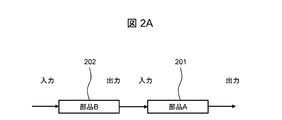
- system-level failure tree generation will be described using the system consisting of parts A201 and parts B202 shown in FIG. 2A.
- information including an electric current is input to the component B202, the input is received by the component B202, and the output is received by the component A201 as an input and output.
- the output of the component A201 is, for example, an output defect of the component A201
- the output of the component A201 is the most downstream (information receiving side) of the system, and the output defect of the component A becomes a top event of the system.
- the cause of the output failure of the component A201 can be considered to be "part A: single component failure" and "part A: input failure".
- Part A: Input failure "Part B: Output failure” can be considered from the connection relationship between the part A201 and the part B202.
- the causes of "component B: output defect” are considered to be “component B: single component defect” and “component B: input defect”. In this way, in the process of transmitting information between the parts A201 and B202 that make up the system, the transmission of information is disturbed, that is, if it deviates from the normal state, it is considered that a problem will occur and the failure tree will be created. Generated.
- the component A201 and the component B202 are connected to each other, and the input side of the component A201 is connected to the output side of the component B202.
- the system level failure tree generator 110 indicates the output failure of the part A as a failure factor related to the part A201 based on the configuration information of the part A201 (information on the component configuration).
- the failure factor 251 and the failure factor 252 indicating the unit failure of the component A and the failure factor 253 indicating the input failure of the component A are generated, and the information of the failure tree connecting the generated elements 251 to 253 to each other is generated, and the component B202 Based on the configuration information of, as the failure factors related to the component B202, the element 254 indicating the output defect of the component B, the element 255 indicating the single defect of the component B, and the element 256 indicating the input defect of the component B are generated and generated. Generates fault tree information that connects elements 254 to 256 to each other.
- system level failure tree generation unit 110 is based on the connection information of the component A201 and the component B202 (connection information input to the component connection information input unit 109), and the information of the failure tree in which the elements 253 and 254 are connected to each other. To generate.
- the failure tree generated based on this process is as shown in FIG. 2B as a system level failure tree.
- the system level failure tree is presented without noise and without omission.
- the fault tree is generated in consideration of the information transmission direction in the system. That is, a failure tree is generated while tracing the connection relationship between the components from the receiving side to the transmitting side of the information including the current. Therefore, in order to generate a system-level fault tree, a connection relationship between components in the system is required.
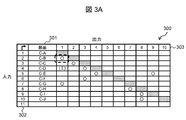
- the component connection information input unit 109 registers the connection relationship between components in the component connection information table 300 based on the user's input information.
- the component connection information table 300 is composed of component 301, number 302 on the vertical axis, and number 303 on the horizontal axis.
- information on component names relating to a plurality of components for example, information on "part A” to "part J", which is component configuration information constituting the system (product) to be solved, is input.
- the number 302 on the vertical axis represents the identification number on the input side of each component
- the number 303 on the horizontal axis represents the identification number on the output side of each component. Numbers are assigned to each row and column on both the vertical and horizontal axes.
- the user inputs the part name in the part 301 only for each number 302 on the vertical axis. If the number is the same for the horizontal axis, it means that the part name is the same as that for the vertical axis. That is, when the first component 301 on the vertical axis is "part A”, it means that the first component 301 on the horizontal axis is also "part A”, and when the second component 301 on the vertical axis is “part B", The second horizontal axis also means that it is "part B”.
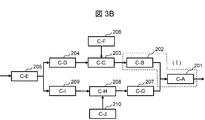
- 3A means the connection relationship between the component A201 and the component J210 (connection relationship between the components) as shown in FIG. 3B, and the component A201 is the connection relationship thereof.
- the input side is connected to the output side of the component E205 via the component B202, the component C203, and the component D204, and is connected to the output side of the component E205 via the component G207, the component H208, and the component I209. Further, the input side of the component C203 is connected to the output side of the component F206, and the input side of the component H208 is connected to the output side of the component J210.
- the component connection information table 300 contains component component information that constitutes the system (product) to be solved, that is, component name information related to a plurality of components and component connection information indicating the connection relationship between the components of each component. be registered.
- component component information that constitutes the system (product) to be solved, that is, component name information related to a plurality of components and component connection information indicating the connection relationship between the components of each component. be registered.
- the portion corresponding to (I) in FIG. 3A is the portion (I) in FIG. 3B.
- Causal relationship DB114 stores the causal relationship of defects that have occurred in the past.
- the causal relationship represents the chain of causality leading up to the occurrence of a defect. This causal relationship is created using information extracted from individual defect cases that have occurred in the past.
- the causal relationship DB114 is information indicating a defect of the system (product) to be analyzed, and at least information indicating a chain of causal relationships between defects of each component belonging to a plurality of components constituting the analysis target. It is configured as a causal relationship storage unit that stores the connection relationships of each component.
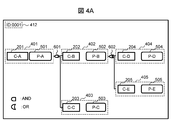
- Figure 4A shows an example of a causal relationship.
- the individual elements 401 to 405 that make up the cause and effect are composed of parts A201 to E205 and phenomena A501 to E505. Each of these elements is expressed as a string of beads in the order of causality.
- the right element causes the left element.
- the AND condition 601 indicates that the left element 401 is triggered when all the connected elements 402 and 403 occur.
- the OR condition 602 indicates that the left element 402 is triggered when any one of the connected elements 404 and 405 occurs.
- the phenomenon D504 occurs in the component D204, or the phenomenon E505 occurs in the component E205, so that the phenomenon B502 occurs in the component B202. Further, it indicates that the phenomenon B502 occurs in the component B202 and the phenomenon C503 occurs in the component C203, so that the phenomenon A501 occurs in the component A201.
- ID412 (ID: 0001) is assigned in advance to identify each individual.
- the causal relationship shown in FIG. 4A is similar to the result of the FTA in that the elements 401 to 405 constituting the causal relationship are connected by the AND condition 601 or the OR condition 602, but as a feature of the causal relationship in the present embodiment. Is a place where each element constituting causality is described as a set of a part and a phenomenon occurring in the part.
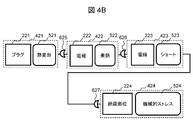
- FIG. 4B shows an example of a causal relationship regarding thermal deformation of the plug.
- a plurality of elements 421 to 424 constituting the causality are connected via OR conditions 625 to 627, respectively.
- a mechanical stress 524 was generated at the insulation site 224 in the element 424, which caused a short 523 at the electrode 223 in the element 423.
- the short 523 of the electrode 223 indicates that the electrode 222 in the element 422 generated heat generation 522, and finally the plug 221 in the element 421 generated thermal deformation 521.
- FIG. 5 shows a part of the system bell failure tree generated by executing the system level failure tree generation process described above with respect to the input contents of FIG. 3A.
- the component A201, the component B202, and the component G207 constituting the system (product) are connected to each other, and the input side of the component A201 is connected to the output side of the component B202 and the component G207.
- the system level failure tree generator 110 is conditioned on the condition that the information transmission between the components is disturbed.
- an element 251 indicating an output defect of the component A, an element 252 indicating a single defect of the component A, and an element 253 indicating an input defect of the component A are generated as failure factors related to the component A201.
- the information of the system level failure tree that connects the generated elements 251 to 253 to each other is generated, and based on the component configuration information of the component B202, the element 254 indicating the output failure of the component B as a failure factor related to the component B202, The element 255 indicating the single defect of the component B and the element 256 indicating the input defect of the component B are generated, and the information of the system level failure tree for connecting the generated elements 254 to 256 to each other is generated.
- the system level failure tree generator 110 uses the component configuration information of the component G207 as a failure factor for the component G207, which is an element 257 indicating an output defect of the component G, an element 258 indicating a single defect of the component G, and a component G. Generates the element 259 indicating the input failure of, and generates the information of the system level failure tree that connects the generated elements 257 to 259 to each other.
- the system level failure tree generator 110 has element 253, element 254, and element 257 based on the connection information of component A201, component B202, and component G207 (component connection information input to component connection information input unit 109). Generate information for system-level fault trees that connect to each other.
- the system-level failure tree generator 110 determines each component based on the component configuration information of a plurality of components constituting the system (product) to be analyzed and the component connection information indicating the connection relationship of each of the plurality of components.
- Information indicating that a disturbance in information transmission has occurred between the parts, and information of elements (first elements) 251 to 259 indicating the relationship between each part and the phenomenon generated in each part is generated and generated for each part.
- the information of the system level failure tree showing the causal relationship of the failure between each component is generated.
- the generated system-level failure tree includes single component defects such as "Part A: Single unit failure” and "Part B: Single unit failure” as failure factors.
- the device / component level failure tree generator 111 generates a device / component level failure tree based on the causal relationship accumulated in the causal relationship DB 114 described above for a single defect of a component component of this system.
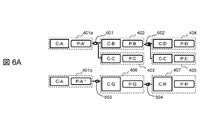
- the device / component level failure tree generator 111 searches for a causal relationship including "part A” from the causal relationship DB 114 in order to extract a failure factor related to "part A: single unit failure” (FIG. 6A). ).
- the device / component level failure tree generator 111 First generates device / component level failure tree information for each element.
- the AND condition 601 of the element 401a of "Part A: Phenomenon A'" is the element 402 of "Part B: Phenomenon B” and the element 403 of "Part C: Phenomenon C”.
- the occurrence in is registered in the causal relationship DB114, and the element 402 of "Part B: Phenomenon B” is the OR condition 602 of the element 404 of "Part D: Phenomenon D" or the element 405 of "Part E: Phenomenon E”.
- the device / component level failure tree generator 111 of "part B: phenomenon B” is based on the part connection information of part A201 and "phenomenon A'".
- Information on element 402, element 403 of "part C: phenomenon C”, element 404 of "part D: phenomenon D”, and element 405 of "part E: phenomenon E” is extracted from the causal relationship DB114, and AND condition 601 , OR condition 602 information is extracted from the causal relationship DB114, elements 402 and 403 are connected to element 401a via AND condition 601 and elements 404 and 405 are connected to element 402 via OR condition 602.
- OR condition 602 information is extracted from the causal relationship DB114, elements 402 and 403 are connected to element 401a via AND condition 601 and elements 404 and 405 are connected to element 402 via OR condition 602.
- the element 401b of "Part A: Phenomenon A” "occurs under the AND condition 603 of the element 406 of" Part G: Phenomenon G ", and" Part G: Phenomenon " If it is registered in the causal relationship DB114 that the element 406 of "G” occurs under the OR condition 604 of the element 407 of "Part R: Phenomenon R", the device / component level failure tree generator 111 of the component A201 Based on the component connection information and "Phenomenon A", the information of element 406 of "Part G: Phenomenon G” and element 407 of "Part R: Phenomenon R” is extracted from the causal relationship DB114, and AND condition 603, The information of the OR condition 604 is extracted from the causal relationship DB114, the element 406 is connected to the element 401b via the AND condition 603, and the information of connecting the element 407 to the element 406 via the OR condition 604 is generated.
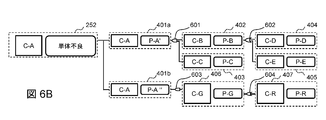
- the device / component level failure tree generation unit 111 combines the causal relationships of the two hit elements into one failure tree (Fig. 6B). That is, the device / component level failure tree generator 111 connects the elements 401a and 401b to the element 252 of "part A: single unit failure" which is the cause of the failure of the top event, respectively, and connects the elements 401a and 401b to the failure tree related to the single failure of the component A201. Generate information as fault tree information at the equipment / component level.
- a failure factor other than the hit failure factor (element 401a of "part A: phenomenon A'") and (element 401b of "part A: phenomenon A”), for example, an element
- the failure factors of 402 to 407 are called intermediate events.
- the terminal element connected to the intermediate event is called a terminal event.
- the device / component level failure tree generation unit 111 searches for the causal relationship including this intermediate event from the causal relationship DB 114, and combines the intermediate event obtained by the search and the hit causal relationship with the original failure tree.
- the element 404 of "part D: phenomenon D” is ANDed with the element 408 of "part K: phenomenon K” and the element 409 of "part L: phenomenon L”. If the occurrence under condition 605 is registered in the causal relationship DB114, elements 408 and 409 are extracted as intermediate events. Also, if the causal relationship DB114 is registered that the element 405 of "Part E: Phenomenon E” was caused by the occurrence of the element 410 of "Part M: Phenomenon M" by the AND condition 606, the element 410 is in the middle. Extracted as an event.
- the OR condition of the element 402 of "Part B: Phenomenon B” is the element 404 of "Part D: Phenomenon D", the element 405 of "Part E: Phenomenon E”, or the element 411 of "Part I: Phenomenon I”. If it is registered in the causal relationship DB114 that it occurred in 602 and the element 411 of "Part I: Phenomenon I” was caused by the occurrence of the AND condition 607 of the element 412 of "Part N: Phenomenon N", the element 411 and 412 are extracted as intermediate events.
- the element 403 of "Part C: Phenomenon C” occurs under the AND condition 608 of the element 413 of "Part J: Phenomenon J", and the element 413 of "Part J: Phenomenon J” is "Part O: If the occurrence of the AND condition 609 of the element 414 of "phenomenon O” and the element 415 of "part P: phenomenon P” is registered in the causal relationship DB114, the elements 413, 414, and 415 are extracted as intermediate events. Also, if the causal relationship DB114 is registered that the element 407 of "Part R: Phenomenon R” occurred under the AND condition 610 of the element 416 of "Part Q: Phenomenon Q", the element 416 is extracted as an intermediate event. Will be done. In the process of processing, the element of the intermediate event may be extracted as the element of the terminal event.
- the device / component level failure tree generator 111 searches for the causal relationship DB 114 based on the component configuration information and the component connection information, and sets the first element of any one of the system level failure trees, for example, element 252. Generates two or more pieces of information on a plurality of consecutive events (intermediate events, terminal events) and the second element (elements 401a, 401b, 402 to 416) indicating the relationship between each component and the phenomenon that occurred in each component. Then, based on the generated information of each second element, information on the equipment / component level failure tree (information on the failure tree shown in FIG. 6C) showing the causal relationship of the failure between the parts in a hierarchical structure is generated.
- the failure factors in the equipment / component level failure tree include failure factors that are not the components of the system to be analyzed.
- the reason for this is that the product that has a defect in the past and the product that you want to analyze may have different component configurations even if they have the same product name, and that there is an intermediate event in the processing of the device / component level failure tree generator 111.
- causal relationships that are not related to the system to be analyzed may also be searched and combined.
- the filtering unit 112 acquires the component name (the component name registered in the component connection information table 300) input by the component connection information input unit 109 from the component connection information input unit 109.
- Acquired part name and device / part level Failure tree generation unit 111 is generated by the device / part level failure tree. Matches with the part name among the elements belonging to each failure factor, and from among the elements of the failure factor. , A part name that does not match the part name input by the part connection information input unit 109 is present.
- a filtering process for removing the element of the cause of failure is executed.
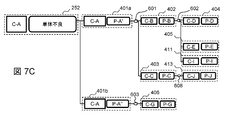
- the filtering unit 112 is information on the device / component level failure tree generated by the device / component level failure tree generation unit 111, and is information on elements 402 to 416 and AND conditions.
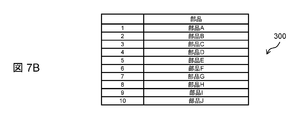
- Information including logical conditions such as 601 is acquired from the device / component level failure tree generation unit 111, and as shown in FIG. 7B, it is information about the component name input in the component connection information input unit 109 and is a system to be solved.
- Part configuration information related to the component names (part names registered in the component connection information table 300) of a plurality of components constituting (product) is acquired from the component connection information input unit 109, and the acquired information is compared, and FIG. 7C is shown.
- Q, R removes the existing elements 407, 408, 409, 410, 412, 414, 415, 416. This will accurately generate fault tree information related to the system components you want to analyze.
- the processing result of the filtering unit 112 (information after the filtering processing) is transferred to the failure tree output unit 113, and the failure tree output unit 113 transfers the processing result of the filtering unit 112 to the output device 106.
- the failure tree information shown in FIG. 7C is displayed on the screen of the output device 106.
- the filtering unit 112 transmits the information generated by the device / component level failure tree generation unit 111 (information before filtering processing by the filtering unit 112) and the information after filtering processing via the failure tree output unit 113.
- the failure tree information shown in FIG. 7A can be displayed on the screen of the output device 106.
- the output device 106 uses the information of the elements 407, 408, 409, 410, 412, 414, 415, and 416 as the elements 252, 401a, 401b, 402, 403, 404, 405, 406, 411, and 413. It can be displayed in different display formats. For example, when the information of elements 252, 401a, 401b, 402, 403 and the like is displayed in black and white (monochrome), the information of elements 407, 408, 409, 410, 412, 414, 415, 416 is displayed in gray and gray. The displayed element may indicate that it is not relevant to the system you want to analyze. The information of elements 407, 408, 409, 410, 412, 414, 415, and 416 can be displayed by blinking instead of being displayed in gray.
- the component connection information table 300 is displayed in the output device (not shown) of the output device 106 or the information terminal 102.
- a component connection information input screen as shown in FIG. 3A is displayed. While looking at the displayed component connection information input screen, the user can input the component name of the system to be analyzed and the connection relationship between the components as described above.
- the component connection information input unit 109 registers the input information in the component connection information table 300.
- the system level failure tree generation unit 110 executes the system level failure tree generation process, and the information of the system level failure tree as shown in FIG. 5 is displayed on the output device 106 or the output device 102 of the information terminal 102.
- the device / component level failure tree generator 111 performs a device / component level failure.
- the tree generation process is executed, and then the filtering unit 112 executes the filtering process by the components, and the device / component level failure tree information (information shown in FIG. 7C) is output from the output device 106 or the information terminal 102. Displayed on the device.
- a failure tree composed of a plurality of elements indicating failure factors from the system level to the device / component level can be accurately generated and displayed without using MFM information. That is, it is possible to present a failure tree without noise and without omission, and as a result, it is possible to improve the reliability of the product at the design stage of generating the failure tree, and when a defect occurs in the product, the cause is The efficiency of the survey can be improved.
- the component connection information can be input in the format shown in FIG. 3A, but in the present embodiment, the connection relationship between the components as shown in FIG. 3B is defined between the components such as the two-dimensional drawing and the 3D model.
- the components and their connection relationships are extracted from the data in which the connection relationships are defined.
- the component configuration information (information indicating the circuit configuration of each component) of each component A201 to J210 and the connection relationship between the components are shown.
- the component connection information stores the 2D drawing and 3D model information recorded in association with the product in the causal relationship DB 114 or another DB (not shown) as the component information storage unit in advance.
- the component connection information input unit 109 responds to the user's operation and causes and effect based on the input information (information that identifies the product).
- the part configuration information (information indicating the part name of each part) of each part A201 to J210 and the part connection showing the connection relationship between each part. Information is taken in, and the taken-in information is transferred to the system level failure tree generation unit 110, the device / component level failure tree generation unit 111, and the filtering unit 112.
- the system-level fault tree generator 110 searches the causal relationship DB114 based on the transferred information and generates information on the system-level fault tree.
- the device / component level failure tree generation unit 111 searches the causal relationship DB114 based on the transferred information base, and generates information on the device / failure level failure tree from the system level.
- the filtering unit 112 searches the causal relationship DB 114 based on the transferred information, acquires the component names of the component components constituting the product, and acquires the acquired component names and the device / component level failure tree generator 111. Matches with the part names belonging to each element of the equipment / part level failure tree generated in, and removes the elements that have part names that do not match the part names registered in the causal relationship DB114 from each element.
- the filtering process is executed, and the execution result of the filtering process is transferred to the failure tree output unit 113.
- the same effect as that of the first embodiment can be obtained, and the time and effort for the user to input the component connection information can be saved.
- the failure tree generator 101 is used as a failure factor analysis device for analyzing the failure factors of the product (system).
- the defect factor analysis device generates the analysis result of the defect factor of the product (system) as the information of the failure tree.
- the causal relationship DB114 is information indicating the analysis result of the defect factor of the system (product) to be analyzed, and at least the causal relationship between the defects of each component belonging to a plurality of components constituting the analysis target. It functions as a causal relationship storage unit that stores information indicating the chain of the above in association with the connection relationship of each component.
- the component connection information input unit 109 functions as a component connection information input unit for inputting component connection information indicating the connection relationship between the components of the component group belonging to the component component constituting the analysis target.
- the system-level failure tree generator 110 shows the analysis result of the failure factor peculiar to each component based on the component configuration information of the plurality of components constituting the analysis target and the component connection information indicating the connection relationship of each of the plurality of components.
- Information which is information of the first element indicating the relationship between each part and the phenomenon generated in each part, is generated for each part, and based on the generated information of each first element, the cause of failure between each part is generated. It has a function to generate information on a system-level fault tree that shows a causal relationship.
- the device / component level failure tree generation unit 111 searches the causal relationship storage unit based on the component configuration information and the component connection information, and uses information on a plurality of events linked to the first element of any one of the system level failure trees. Therefore, two or more pieces of information on the second element indicating the relationship between each part and the phenomenon generated in each part are generated, and based on the generated information on each second element, the causal relationship between the failure factors between the parts is determined. It has a function to generate information on the equipment / component level failure tree shown in a hierarchical structure.
- the filtering unit 112 compares the information of the device / component level failure tree generated by the device / component level failure tree generation unit 111 with the component information related to the components constituting the analysis target, and compares the information of the device / component level failure tree of the device / component level failure tree. It has a function to execute a filtering process for removing elements including parts other than the components constituting the analysis target from the information.
- the failure tree output unit 113 has a function of outputting the information after the filtering process by the filtering unit to the output device 106. Other configurations are the same as in Example 1 or Example 2.
- the component connection information input unit 109 can be operated by the user.
- the component information storage unit is searched, component configuration information and component connection information are input, and the input component configuration information and component connection information are input to the system level failure tree generator 110 and the device / component level failure tree generator 111. It functions as a component connection information input unit to be transferred to at least one of them.
- the failure tree output unit 113 takes in the information before the filtering process by the filtering unit 112 from the filtering unit 112 and outputs it to the output device 106
- the output device 106 is before the filtering process by the filtering unit 112.
- Information which is the information of the device / component level failure tree generated by the device / component level failure tree generation unit 111, is displayed in a display format different from the information after filtering processing by the output of the failure tree output unit 113. be able to.
- a failure tree composed of a plurality of elements showing the analysis result of the cause of failure can be accurately generated and displayed without using MFM information.
- the present invention is not limited to the above-described embodiment, and includes various modifications.
- the above-described embodiment has been described in detail in order to explain the present invention in an easy-to-understand manner, and is not necessarily limited to the one including all the described configurations.
- it is possible to replace a part of the configuration of one embodiment with the configuration of another embodiment and it is also possible to add the configuration of another embodiment to the configuration of one embodiment.
- 101 failure tree generator 102 information terminal, 103 network, 104 central control device, 105 input device, 106 output device, 107 main memory, 108 auxiliary storage device, 109 component connection information input unit, 110 system level failure tree generator , 111 Equipment / parts level failure tree generator, 112 Filtering section, 113 Failure tree output section
Landscapes
- Engineering & Computer Science (AREA)
- Theoretical Computer Science (AREA)
- Physics & Mathematics (AREA)
- General Physics & Mathematics (AREA)
- Business, Economics & Management (AREA)
- Quality & Reliability (AREA)
- General Engineering & Computer Science (AREA)
- Health & Medical Sciences (AREA)
- Tourism & Hospitality (AREA)
- Biomedical Technology (AREA)
- Automation & Control Theory (AREA)
- Economics (AREA)
- General Health & Medical Sciences (AREA)
- Human Resources & Organizations (AREA)
- Marketing (AREA)
- Primary Health Care (AREA)
- Strategic Management (AREA)
- General Business, Economics & Management (AREA)
- Test And Diagnosis Of Digital Computers (AREA)
- Testing And Monitoring For Control Systems (AREA)
- Management, Administration, Business Operations System, And Electronic Commerce (AREA)
Priority Applications (1)
| Application Number | Priority Date | Filing Date | Title |
|---|---|---|---|
| US17/764,737 US11977441B2 (en) | 2019-10-07 | 2020-08-31 | Fault tree generation device and fault tree generation method |
Applications Claiming Priority (2)
| Application Number | Priority Date | Filing Date | Title |
|---|---|---|---|
| JP2019-184702 | 2019-10-07 | ||
| JP2019184702A JP7372808B2 (ja) | 2019-10-07 | 2019-10-07 | 故障ツリー生成装置及びその方法 |
Publications (1)
| Publication Number | Publication Date |
|---|---|
| WO2021070512A1 true WO2021070512A1 (ja) | 2021-04-15 |
Family
ID=75380206
Family Applications (1)
| Application Number | Title | Priority Date | Filing Date |
|---|---|---|---|
| PCT/JP2020/032830 Ceased WO2021070512A1 (ja) | 2019-10-07 | 2020-08-31 | 故障ツリー生成装置及びその方法 |
Country Status (3)
| Country | Link |
|---|---|
| US (1) | US11977441B2 (https=) |
| JP (1) | JP7372808B2 (https=) |
| WO (1) | WO2021070512A1 (https=) |
Families Citing this family (1)
| Publication number | Priority date | Publication date | Assignee | Title |
|---|---|---|---|---|
| JP7827656B2 (ja) * | 2023-03-23 | 2026-03-10 | 株式会社日立製作所 | 故障ツリーを生成するシステムおよび方法 |
Citations (2)
| Publication number | Priority date | Publication date | Assignee | Title |
|---|---|---|---|---|
| JPH06123642A (ja) * | 1992-10-13 | 1994-05-06 | Toshiba Corp | プラント異常診断方法及びプラント異常診断装置 |
| JP2017111657A (ja) * | 2015-12-17 | 2017-06-22 | 株式会社日立製作所 | 設計支援装置及び設計支援方法及び設計支援プログラム |
Family Cites Families (2)
| Publication number | Priority date | Publication date | Assignee | Title |
|---|---|---|---|---|
| JP3808893B1 (ja) | 2005-07-14 | 2006-08-16 | 国立大学法人 岡山大学 | 故障診断装置、プログラム及び記録媒体 |
| JP6842299B2 (ja) * | 2016-12-28 | 2021-03-17 | 三菱パワー株式会社 | 診断装置、診断方法及びプログラム |
-
2019
- 2019-10-07 JP JP2019184702A patent/JP7372808B2/ja active Active
-
2020
- 2020-08-31 US US17/764,737 patent/US11977441B2/en active Active
- 2020-08-31 WO PCT/JP2020/032830 patent/WO2021070512A1/ja not_active Ceased
Patent Citations (2)
| Publication number | Priority date | Publication date | Assignee | Title |
|---|---|---|---|---|
| JPH06123642A (ja) * | 1992-10-13 | 1994-05-06 | Toshiba Corp | プラント異常診断方法及びプラント異常診断装置 |
| JP2017111657A (ja) * | 2015-12-17 | 2017-06-22 | 株式会社日立製作所 | 設計支援装置及び設計支援方法及び設計支援プログラム |
Also Published As
| Publication number | Publication date |
|---|---|
| JP7372808B2 (ja) | 2023-11-01 |
| JP2021060812A (ja) | 2021-04-15 |
| US11977441B2 (en) | 2024-05-07 |
| US20220374299A1 (en) | 2022-11-24 |
Similar Documents
| Publication | Publication Date | Title |
|---|---|---|
| CN104461842B (zh) | 基于日志相似性来处理故障的方法和装置 | |
| JP2017111657A (ja) | 設計支援装置及び設計支援方法及び設計支援プログラム | |
| JP5614843B2 (ja) | ソフトウェア設計・運用統合管理システム | |
| JP5489958B2 (ja) | 試験テーブル生成装置及びその方法 | |
| US12572138B2 (en) | Failure factor priority order calculation device and method based on use environment | |
| CN104204980A (zh) | 信息收集系统、信息收集方法、以及存储介质 | |
| JP2020057192A (ja) | 故障要因優先度提示装置 | |
| JP2735698B2 (ja) | インタフェース検証処理方式 | |
| JP2015032152A (ja) | 情報処理システム | |
| US20220035359A1 (en) | System and method for determining manufacturing plant topology and fault propagation information | |
| CN114245895B (zh) | 为至少两个日志文件生成一致表示的方法 | |
| WO2021070512A1 (ja) | 故障ツリー生成装置及びその方法 | |
| JP2009230618A (ja) | 設計書作成プログラム、該装置、及び該方法 | |
| EP3940483A1 (en) | Graph display device, graph display method, and graph display program | |
| JP2006059108A (ja) | 情報システム開発試験支援システム | |
| JP2002024337A (ja) | リスク解析支援方法および記憶媒体 | |
| US20210325840A1 (en) | Graph display device, graph display method, and recording medium | |
| CN118314307A (zh) | 工业场景下的数实融合系统的构建方法、装置及设备 | |
| JP2021060812A5 (https=) | ||
| WO2022224597A1 (ja) | 設備id推論方法および設備id推論装置 | |
| US20210255597A1 (en) | Graph display device, graph display method, and recording medium | |
| JP5180809B2 (ja) | 情報制御システムおよび制御ソフトウェアの作成方法 | |
| JP7294488B1 (ja) | 情報処理装置、情報処理方法および情報処理プログラム | |
| JP7795252B1 (ja) | プログラム、情報処理システム及び情報処理方法 | |
| JP5060467B2 (ja) | 情報制御システムおよび制御ソフトウェアの作成方法 |
Legal Events
| Date | Code | Title | Description |
|---|---|---|---|
| 121 | Ep: the epo has been informed by wipo that ep was designated in this application |
Ref document number: 20873517 Country of ref document: EP Kind code of ref document: A1 |
|
| NENP | Non-entry into the national phase |
Ref country code: DE |
|
| 122 | Ep: pct application non-entry in european phase |
Ref document number: 20873517 Country of ref document: EP Kind code of ref document: A1 |