WO2021060097A1 - Cnt分散cmc層を有する電極 - Google Patents
Cnt分散cmc層を有する電極 Download PDFInfo
- Publication number
- WO2021060097A1 WO2021060097A1 PCT/JP2020/035016 JP2020035016W WO2021060097A1 WO 2021060097 A1 WO2021060097 A1 WO 2021060097A1 JP 2020035016 W JP2020035016 W JP 2020035016W WO 2021060097 A1 WO2021060097 A1 WO 2021060097A1
- Authority
- WO
- WIPO (PCT)
- Prior art keywords
- electrode
- dispersed
- item
- cnt
- cnts
- Prior art date
- Legal status (The legal status is an assumption and is not a legal conclusion. Google has not performed a legal analysis and makes no representation as to the accuracy of the status listed.)
- Ceased
Links
Images



Classifications
-
- B—PERFORMING OPERATIONS; TRANSPORTING
- B82—NANOTECHNOLOGY
- B82Y—SPECIFIC USES OR APPLICATIONS OF NANOSTRUCTURES; MEASUREMENT OR ANALYSIS OF NANOSTRUCTURES; MANUFACTURE OR TREATMENT OF NANOSTRUCTURES
- B82Y30/00—Nanotechnology for materials or surface science, e.g. nanocomposites
-
- C—CHEMISTRY; METALLURGY
- C12—BIOCHEMISTRY; BEER; SPIRITS; WINE; VINEGAR; MICROBIOLOGY; ENZYMOLOGY; MUTATION OR GENETIC ENGINEERING
- C12Q—MEASURING OR TESTING PROCESSES INVOLVING ENZYMES, NUCLEIC ACIDS OR MICROORGANISMS; COMPOSITIONS OR TEST PAPERS THEREFOR; PROCESSES OF PREPARING SUCH COMPOSITIONS; CONDITION-RESPONSIVE CONTROL IN MICROBIOLOGICAL OR ENZYMOLOGICAL PROCESSES
- C12Q1/00—Measuring or testing processes involving enzymes, nucleic acids or microorganisms; Compositions therefor; Processes of preparing such compositions
-
- G—PHYSICS
- G01—MEASURING; TESTING
- G01N—INVESTIGATING OR ANALYSING MATERIALS BY DETERMINING THEIR CHEMICAL OR PHYSICAL PROPERTIES
- G01N27/00—Investigating or analysing materials by the use of electric, electrochemical, or magnetic means
- G01N27/26—Investigating or analysing materials by the use of electric, electrochemical, or magnetic means by investigating electrochemical variables; by using electrolysis or electrophoresis
- G01N27/28—Electrolytic cell components
- G01N27/30—Electrodes, e.g. test electrodes; Half-cells
-
- G—PHYSICS
- G01—MEASURING; TESTING
- G01N—INVESTIGATING OR ANALYSING MATERIALS BY DETERMINING THEIR CHEMICAL OR PHYSICAL PROPERTIES
- G01N27/00—Investigating or analysing materials by the use of electric, electrochemical, or magnetic means
- G01N27/26—Investigating or analysing materials by the use of electric, electrochemical, or magnetic means by investigating electrochemical variables; by using electrolysis or electrophoresis
- G01N27/28—Electrolytic cell components
- G01N27/30—Electrodes, e.g. test electrodes; Half-cells
- G01N27/327—Biochemical electrodes, e.g. electrical or mechanical details for in vitro measurements
-
- G—PHYSICS
- G01—MEASURING; TESTING
- G01N—INVESTIGATING OR ANALYSING MATERIALS BY DETERMINING THEIR CHEMICAL OR PHYSICAL PROPERTIES
- G01N27/00—Investigating or analysing materials by the use of electric, electrochemical, or magnetic means
- G01N27/26—Investigating or analysing materials by the use of electric, electrochemical, or magnetic means by investigating electrochemical variables; by using electrolysis or electrophoresis
- G01N27/416—Systems
-
- G—PHYSICS
- G01—MEASURING; TESTING
- G01N—INVESTIGATING OR ANALYSING MATERIALS BY DETERMINING THEIR CHEMICAL OR PHYSICAL PROPERTIES
- G01N27/00—Investigating or analysing materials by the use of electric, electrochemical, or magnetic means
- G01N27/26—Investigating or analysing materials by the use of electric, electrochemical, or magnetic means by investigating electrochemical variables; by using electrolysis or electrophoresis
- G01N27/416—Systems
- G01N27/48—Systems using polarography, i.e. measuring changes in current under a slowly-varying voltage
-
- H—ELECTRICITY
- H01—ELECTRIC ELEMENTS
- H01M—PROCESSES OR MEANS, e.g. BATTERIES, FOR THE DIRECT CONVERSION OF CHEMICAL ENERGY INTO ELECTRICAL ENERGY
- H01M4/00—Electrodes
- H01M4/02—Electrodes composed of, or comprising, active material
-
- H—ELECTRICITY
- H01—ELECTRIC ELEMENTS
- H01M—PROCESSES OR MEANS, e.g. BATTERIES, FOR THE DIRECT CONVERSION OF CHEMICAL ENERGY INTO ELECTRICAL ENERGY
- H01M4/00—Electrodes
- H01M4/86—Inert electrodes with catalytic activity, e.g. for fuel cells
- H01M4/90—Selection of catalytic material
-
- H—ELECTRICITY
- H01—ELECTRIC ELEMENTS
- H01M—PROCESSES OR MEANS, e.g. BATTERIES, FOR THE DIRECT CONVERSION OF CHEMICAL ENERGY INTO ELECTRICAL ENERGY
- H01M8/00—Fuel cells; Manufacture thereof
- H01M8/16—Biochemical fuel cells, i.e. cells in which microorganisms function as catalysts
-
- Y—GENERAL TAGGING OF NEW TECHNOLOGICAL DEVELOPMENTS; GENERAL TAGGING OF CROSS-SECTIONAL TECHNOLOGIES SPANNING OVER SEVERAL SECTIONS OF THE IPC; TECHNICAL SUBJECTS COVERED BY FORMER USPC CROSS-REFERENCE ART COLLECTIONS [XRACs] AND DIGESTS
- Y02—TECHNOLOGIES OR APPLICATIONS FOR MITIGATION OR ADAPTATION AGAINST CLIMATE CHANGE
- Y02E—REDUCTION OF GREENHOUSE GAS [GHG] EMISSIONS, RELATED TO ENERGY GENERATION, TRANSMISSION OR DISTRIBUTION
- Y02E60/00—Enabling technologies; Technologies with a potential or indirect contribution to GHG emissions mitigation
- Y02E60/30—Hydrogen technology
- Y02E60/50—Fuel cells
Definitions
- a technique relating to an electrode having a CNT-dispersed CMC layer is disclosed.
- nanocarbon Since nanocarbon has high electrical conductivity, its application as a conductive material for electron transfer with other substances is progressing. For example, it has been proposed to mix nanocarbon with an ink composed of carbon, a resin, and an organic solvent, print it on a substrate, and use it as an electrode for a biosensor (Patent Document 1).
- carbon nanotubes which are a type of nanocarbon, are used in sensors for measuring peroxides (Patent Document 2), or are molded into a film together with enzymes and used as electrodes for sensors and fuel cells (Patent Document 2). Patent Document 3).
- One issue is to provide improved electrodes.
- CNT carbon nanotubes
- Item 1 An electrode having a structure in which a layer in which carbon nanotubes are dispersed in carboxymethyl cellulose is formed on a metal substrate.
- Item 2 Item 2. The electrode according to Item 1, wherein the layer further contains an enzyme.
- Item 3 Item 2. The electrode according to Item 2, wherein the enzyme is an oxidase.
- Item 4 Item 3. The electrode according to Item 3, wherein the oxidase is uricase.
- Item 5 A sensor provided with the electrode according to any one of Items 1 to 4.
- Item 6 Item 5. The sensor according to Item 5, which is used for detecting hydrogen peroxide.
- Item 7 Item 6. The sensor according to Item 6, wherein the hydrogen peroxide is derived from uric acid.
- Item 8 A method for detecting hydrogen peroxide using the electrode according to any one of Items 1 to 4 or the sensor according to Item 5.
- Item 9 Item 8. The method according to Item 8, wherein the hydrogen peroxide is derived from
- Hydrogen peroxide can be detected more sensitively.
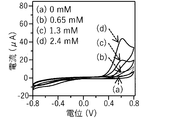
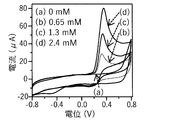
- the cyclic voltammogram when uric acid is detected using an electrode having a layer in which a single-walled CNT is dispersed in CMC is shown.
- the cyclic voltammogram when uric acid is detected using an electrode having a layer in which a single-walled CNT is dispersed in sodium cholicate is shown.
- the cyclic voltammogram when uric acid is detected using an electrode having a layer in which multi-walled CNTs are dispersed in CMC is shown.
- the cyclic voltammogram when uric acid is detected using an electrode having a layer in which multi-walled CNTs are dispersed in sodium cholic acid is shown.
- the electrode preferably has a structure in which a layer in which carbon nanotubes are dispersed in carboxymethyl cellulose is formed on a metal substrate.
- Carboxymethyl cellulose is commercially available and can be purchased and used.
- CMC can also be synthesized and used. Methods for synthesizing CMC are known.
- the CNT may be any of single-walled CNT, double-walled CNT, and multi-walled CNT. Further, the diameter and length of the CNT are also arbitrary and are not particularly limited. In one embodiment, the diameter of the CNT is preferably 0.5 to 50 nm. In one embodiment, the length of the CNTs is preferably 0.1 to 1000 ⁇ m. Commercially available CNTs may be purchased and used, or they may be synthesized and used. Methods for synthesizing CNTs are known.
- the metal substrate is not particularly limited as long as it can be used as an electrode.
- the metal electrode is preferably one in which a metal film is fixed to an insulating substrate.
- the metal film is preferably a metal film selected from the group consisting of gold, platinum, titanium, and carbon. Such metal electrodes are known.
- the formation of a layer in which CNTs are dispersed in CMC on a metal substrate can be obtained, for example, by dispersing CNTs in a liquid in which CMC is dissolved, dropping the CNTs on the metal substrate, and drying the layers.
- the solution in which CMC is dissolved can be obtained, for example, by dissolving CMC in a suitable solvent such as water.
- the concentration of CMC in the solvent is not particularly limited, but can be, for example, 0.01 to 2% (w / v).
- the amount of CNTs dispersed in the solution in which CMC is dissolved is arbitrary and is not particularly limited, but is, for example, about 0.001 to 1% (w / v).
- the dispersed state of CNTs is preferably a state in which the CNTs are not bundled and the CNTs form a network having many contacts.
- the concentration ratio (CNT / CMC) of CNTs and CMCs is 0.1 to 1.0 in the case of single-walled CNTs and 0.5 to 5 in the case of multi-walled CNTs. It is preferably 0.0.
- the layer in which CNTs are dispersed in the CMC formed on the metal substrate further contains an enzyme.
- the type of enzyme can be selected according to the purpose and is not particularly limited.
- preferred enzymes are oxidases such as uricase, glucose oxidase, lactate oxidase, cholesterol oxidase, alcohol oxidase, sarcosine oxidase, fructosylamine oxidase, pyruvate oxidase, glycerol oxidase, glycerol-3-phosphate oxidase.
- the preferred enzyme is uricase.
- the uricase is preferably from the genus Bacillus or from the genus Candida.
- the method of incorporating the enzyme into the layer in which the CNTs are dispersed in the CMC is arbitrary.
- the enzyme can be contained in the layer by dropping the solution in which the enzyme is dissolved onto the layer and drying it. It is also possible to disperse CNTs in a solution in which CMC is dissolved, prepare a solution in which an enzyme is further dissolved, drop the solution on a metal substrate, and dry the solution.
- the amount of the enzyme contained in the layer is arbitrary and can be set according to the purpose, but can be, for example, 0.1 to 100 U / mm 2 .
- pH buffers eg phosphate buffers, citrate buffers, and Good buffers
- sugars sucrose, lactose, etc.
- salts phosphates, ammonium sulfate, etc.
- amino acids glycine, alanine, etc.
- Serin, etc. other enzyme stabilizers
- the sensor preferably includes the above electrodes.
- the electrode is usually a working electrode.
- the sensor preferably further includes a counter electrode and a reference electrode.
- the configuration of such a sensor is known in the art. Further, the sensor may be provided with a configuration usually provided by a biosensor such as a potentiatory stat and a current detection circuit.
- Hydrogen peroxide can be detected accurately using the above-mentioned electrode or a sensor equipped with it.
- Hydrogen peroxide can be any substance, and in one embodiment hydrogen peroxide is preferably derived from uric acid. That is, uric acid in the sample can be detected using the electrode or the sensor. In one embodiment, the uric acid in the sample is oxidized by uricase, and the uric acid in the sample can be detected by detecting the hydrogen peroxide produced at that time.
- FIG. 1 An electrode chip having a working electrode portion of 9 mm 2 was produced using a sheet in which gold was vapor-deposited on a PET substrate (FIG. 1).
- FIG. 1 is a PET film
- “2” is an adhesive sheet
- "3” is a gold-deposited PET film
- "4" is a working electrode site. 5 ⁇ L of the aqueous dispersion of any of the following (1) to (4) was added dropwise to the working electrode site and dried.
- Multi-walled carbon nanotubes (NC7000: Nanocyl) in a 0.05% (w / v) carboxymethyl cellulose aqueous solution (diameter: 10 nm (median), 5 to 15 nm (measurement method: TEM), length: 1.5 ⁇ m ( A solution in which (average) (measurement method: TEM)) is dispersed at 0.1% (w / v).
- NC7000 Nanocyl
- FIG. 2 is the single-walled carbon nanotube dispersion liquid of the above (1)
- FIG. 3 is the single-walled carbon nanotube dispersion liquid of the above (2)
- FIG. 4 is the multilayer carbon nanotube dispersion liquid of the above (3)
- FIG. This is the case where the multi-walled carbon nanotube dispersion liquid of 4) is used.
- Table 1 shows the current value of + 0.4V when sweeping from -0.8V to + 0.8V in this cyclic voltammogram.
- CNT indicates carbon nanotube
- CMC indicates carboxymethyl cellulose
- SC indicates sodium cholic acid
- uric acid can be detected more sensitively at a lower voltage than when dispersed in sodium cholic acid.
- the voltage required for detecting uric acid can be lowered, so that uric acid can be detected while avoiding the detection of reducing substances that may be present in the biological sample.
Landscapes
- Chemical & Material Sciences (AREA)
- Life Sciences & Earth Sciences (AREA)
- Health & Medical Sciences (AREA)
- Engineering & Computer Science (AREA)
- Electrochemistry (AREA)
- Chemical Kinetics & Catalysis (AREA)
- Biochemistry (AREA)
- Physics & Mathematics (AREA)
- Molecular Biology (AREA)
- Analytical Chemistry (AREA)
- General Physics & Mathematics (AREA)
- Immunology (AREA)
- General Health & Medical Sciences (AREA)
- Pathology (AREA)
- Organic Chemistry (AREA)
- General Chemical & Material Sciences (AREA)
- Materials Engineering (AREA)
- Proteomics, Peptides & Aminoacids (AREA)
- Microbiology (AREA)
- Wood Science & Technology (AREA)
- Zoology (AREA)
- Nanotechnology (AREA)
- Biotechnology (AREA)
- Genetics & Genomics (AREA)
- Composite Materials (AREA)
- Condensed Matter Physics & Semiconductors (AREA)
- General Engineering & Computer Science (AREA)
- Crystallography & Structural Chemistry (AREA)
- Bioinformatics & Cheminformatics (AREA)
- Manufacturing & Machinery (AREA)
- Sustainable Development (AREA)
- Sustainable Energy (AREA)
- Biophysics (AREA)
- Measuring Or Testing Involving Enzymes Or Micro-Organisms (AREA)
- Apparatus Associated With Microorganisms And Enzymes (AREA)
Priority Applications (1)
| Application Number | Priority Date | Filing Date | Title |
|---|---|---|---|
| JP2021548843A JPWO2021060097A1 (https=) | 2019-09-26 | 2020-09-16 |
Applications Claiming Priority (2)
| Application Number | Priority Date | Filing Date | Title |
|---|---|---|---|
| JP2019175257 | 2019-09-26 | ||
| JP2019-175257 | 2019-09-26 |
Publications (1)
| Publication Number | Publication Date |
|---|---|
| WO2021060097A1 true WO2021060097A1 (ja) | 2021-04-01 |
Family
ID=75166958
Family Applications (1)
| Application Number | Title | Priority Date | Filing Date |
|---|---|---|---|
| PCT/JP2020/035016 Ceased WO2021060097A1 (ja) | 2019-09-26 | 2020-09-16 | Cnt分散cmc層を有する電極 |
Country Status (2)
| Country | Link |
|---|---|
| JP (1) | JPWO2021060097A1 (https=) |
| WO (1) | WO2021060097A1 (https=) |
Cited By (1)
| Publication number | Priority date | Publication date | Assignee | Title |
|---|---|---|---|---|
| WO2025023893A1 (en) * | 2023-07-27 | 2025-01-30 | Nanyang Technological University | Electrode device, method of forming the same, and signal collection platform |
Citations (5)
| Publication number | Priority date | Publication date | Assignee | Title |
|---|---|---|---|---|
| JP2006292495A (ja) * | 2005-04-08 | 2006-10-26 | Toray Ind Inc | カーボンナノチューブ組成物、バイオセンサーおよびそれらの製造方法 |
| WO2018043050A1 (ja) * | 2016-08-29 | 2018-03-08 | 国立研究開発法人産業技術総合研究所 | グルコースセンサ用試薬、グルコースセンサ、グルコースセンサの製造方法、および、グルコース測定装置 |
| JP2018036061A (ja) * | 2016-08-29 | 2018-03-08 | 東レ株式会社 | 積層体 |
| JP2018169220A (ja) * | 2017-03-29 | 2018-11-01 | 東レ株式会社 | 積層体 |
| JP2020085759A (ja) * | 2018-11-29 | 2020-06-04 | 東洋紡株式会社 | グルコースセンサ用試薬 |
-
2020
- 2020-09-16 JP JP2021548843A patent/JPWO2021060097A1/ja active Pending
- 2020-09-16 WO PCT/JP2020/035016 patent/WO2021060097A1/ja not_active Ceased
Patent Citations (5)
| Publication number | Priority date | Publication date | Assignee | Title |
|---|---|---|---|---|
| JP2006292495A (ja) * | 2005-04-08 | 2006-10-26 | Toray Ind Inc | カーボンナノチューブ組成物、バイオセンサーおよびそれらの製造方法 |
| WO2018043050A1 (ja) * | 2016-08-29 | 2018-03-08 | 国立研究開発法人産業技術総合研究所 | グルコースセンサ用試薬、グルコースセンサ、グルコースセンサの製造方法、および、グルコース測定装置 |
| JP2018036061A (ja) * | 2016-08-29 | 2018-03-08 | 東レ株式会社 | 積層体 |
| JP2018169220A (ja) * | 2017-03-29 | 2018-11-01 | 東レ株式会社 | 積層体 |
| JP2020085759A (ja) * | 2018-11-29 | 2020-06-04 | 東洋紡株式会社 | グルコースセンサ用試薬 |
Cited By (1)
| Publication number | Priority date | Publication date | Assignee | Title |
|---|---|---|---|---|
| WO2025023893A1 (en) * | 2023-07-27 | 2025-01-30 | Nanyang Technological University | Electrode device, method of forming the same, and signal collection platform |
Also Published As
| Publication number | Publication date |
|---|---|
| JPWO2021060097A1 (https=) | 2021-04-01 |
Similar Documents
| Publication | Publication Date | Title |
|---|---|---|
| Bartlett et al. | There is no evidence to support literature claims of direct electron transfer (DET) for native glucose oxidase (GOx) at carbon nanotubes or graphene | |
| Antiochia et al. | Development of a carbon nanotube paste electrode osmium polymer-mediated biosensor for determination of glucose in alcoholic beverages | |
| Karuwan et al. | A disposable screen printed graphene–carbon paste electrode and its application in electrochemical sensing | |
| Pumera et al. | Carbon nanotube-epoxy composites for electrochemical sensing | |
| Huang et al. | rGO/SWCNT composites as novel electrode materials for electrochemical biosensing | |
| Salimi et al. | Glucose biosensor prepared by glucose oxidase encapsulated sol-gel and carbon-nanotube-modified basal plane pyrolytic graphite electrode | |
| Rahman et al. | Development of amperometric glucose biosensor based on glucose oxidase co-immobilized with multi-walled carbon nanotubes at low potential | |
| Rivas et al. | Carbon nanotubes paste electrodes. A new alternative for the development of electrochemical sensors | |
| Ye et al. | Rapid detection of ssDNA and RNA using multi-walled carbon nanotubes modified screen-printed carbon electrode | |
| Li et al. | Improved electrochemical properties of prussian blue by multi-walled carbon nanotubes | |
| Kim et al. | Fabrication of enzyme-based coatings on intact multi-walled carbon nanotubes as highly effective electrodes in biofuel cells | |
| Thirumalraj et al. | A reliable electrochemical sensor for determination of H2O2 in biological samples using platinum nanoparticles supported graphite/gelatin hydrogel | |
| Li et al. | A pyrrole quinoline quinone glucose dehydrogenase biosensor based on screen-printed carbon paste electrodes modified by carbon nanotubes | |
| Canbay et al. | Design of a multiwalled carbon nanotube–Nafion–cysteamine modified tyrosinase biosensor and its adaptation of dopamine determination | |
| Pumera | Electrochemical properties of double wall carbon nanotube electrodes | |
| Pérez et al. | Glucose biosensor based on carbon nanotube epoxy composites | |
| Xu et al. | Electrocatalytic oxidation of catechol at multi‐walled carbon nanotubes modified electrode | |
| JP4863398B2 (ja) | カーボンナノチューブを用いたバイオセンサ | |
| Pasakon et al. | A high-performance, disposable screen-printed carbon electrode modified with multi-walled carbon nanotubes/graphene for ultratrace level electrochemical sensors | |
| Luong et al. | Multiwall carbon nanotube (MWCNT) based electrochemical biosensors for mediatorless detection of putrescine | |
| Anojčić et al. | Hydrodynamic chronoamperometric determination of hydrogen peroxide using carbon paste electrodes coated by multiwalled carbon nanotubes decorated with MnO2 or Pt particles | |
| Wu et al. | The fabrication of a carbon nanotube film on a glassy carbon electrode and its application to determining thyroxine | |
| Laschi et al. | Disposable electrodes modified with multi-wall carbon nanotubes for biosensor applications | |
| Guzsvány et al. | Screen-printed enzymatic glucose biosensor based on a composite made from multiwalled carbon nanotubes and palladium containing particles | |
| Luque et al. | Glucose biosensor based on the use of a carbon nanotube paste electrode modified with metallic particles |
Legal Events
| Date | Code | Title | Description |
|---|---|---|---|
| 121 | Ep: the epo has been informed by wipo that ep was designated in this application |
Ref document number: 20867937 Country of ref document: EP Kind code of ref document: A1 |
|
| ENP | Entry into the national phase |
Ref document number: 2021548843 Country of ref document: JP Kind code of ref document: A |
|
| NENP | Non-entry into the national phase |
Ref country code: DE |
|
| 122 | Ep: pct application non-entry in european phase |
Ref document number: 20867937 Country of ref document: EP Kind code of ref document: A1 |