WO2021054121A1 - 吸収性物品 - Google Patents
吸収性物品 Download PDFInfo
- Publication number
- WO2021054121A1 WO2021054121A1 PCT/JP2020/033220 JP2020033220W WO2021054121A1 WO 2021054121 A1 WO2021054121 A1 WO 2021054121A1 JP 2020033220 W JP2020033220 W JP 2020033220W WO 2021054121 A1 WO2021054121 A1 WO 2021054121A1
- Authority
- WO
- WIPO (PCT)
- Prior art keywords
- fibers
- surface layer
- sheet
- layer
- intermediate layer
- Prior art date
- Legal status (The legal status is an assumption and is not a legal conclusion. Google has not performed a legal analysis and makes no representation as to the accuracy of the status listed.)
- Ceased
Links
Images




Classifications
-
- A—HUMAN NECESSITIES
- A61—MEDICAL OR VETERINARY SCIENCE; HYGIENE
- A61F—FILTERS IMPLANTABLE INTO BLOOD VESSELS; PROSTHESES; DEVICES PROVIDING PATENCY TO, OR PREVENTING COLLAPSING OF, TUBULAR STRUCTURES OF THE BODY, e.g. STENTS; ORTHOPAEDIC, NURSING OR CONTRACEPTIVE DEVICES; FOMENTATION; TREATMENT OR PROTECTION OF EYES OR EARS; BANDAGES, DRESSINGS OR ABSORBENT PADS; FIRST-AID KITS
- A61F13/00—Bandages or dressings; Absorbent pads
- A61F13/15—Absorbent pads, e.g. sanitary towels, swabs or tampons for external or internal application to the body; Supporting or fastening means therefor; Tampon applicators
- A61F13/51—Absorbent pads, e.g. sanitary towels, swabs or tampons for external or internal application to the body; Supporting or fastening means therefor; Tampon applicators characterised by the outer layers of the pads
- A61F13/511—Topsheet, i.e. the permeable cover or layer facing the skin
- A61F13/512—Topsheet, i.e. the permeable cover or layer facing the skin characterised by its apertures, e.g. perforations
-
- A—HUMAN NECESSITIES
- A61—MEDICAL OR VETERINARY SCIENCE; HYGIENE
- A61F—FILTERS IMPLANTABLE INTO BLOOD VESSELS; PROSTHESES; DEVICES PROVIDING PATENCY TO, OR PREVENTING COLLAPSING OF, TUBULAR STRUCTURES OF THE BODY, e.g. STENTS; ORTHOPAEDIC, NURSING OR CONTRACEPTIVE DEVICES; FOMENTATION; TREATMENT OR PROTECTION OF EYES OR EARS; BANDAGES, DRESSINGS OR ABSORBENT PADS; FIRST-AID KITS
- A61F13/00—Bandages or dressings; Absorbent pads
- A61F13/15—Absorbent pads, e.g. sanitary towels, swabs or tampons for external or internal application to the body; Supporting or fastening means therefor; Tampon applicators
- A61F13/51—Absorbent pads, e.g. sanitary towels, swabs or tampons for external or internal application to the body; Supporting or fastening means therefor; Tampon applicators characterised by the outer layers of the pads
- A61F13/511—Topsheet, i.e. the permeable cover or layer facing the skin
- A61F13/513—Topsheet, i.e. the permeable cover or layer facing the skin characterised by its function or properties, e.g. stretchability, breathability, rewet, visual effect; having areas of different permeability
-
- A—HUMAN NECESSITIES
- A61—MEDICAL OR VETERINARY SCIENCE; HYGIENE
- A61F—FILTERS IMPLANTABLE INTO BLOOD VESSELS; PROSTHESES; DEVICES PROVIDING PATENCY TO, OR PREVENTING COLLAPSING OF, TUBULAR STRUCTURES OF THE BODY, e.g. STENTS; ORTHOPAEDIC, NURSING OR CONTRACEPTIVE DEVICES; FOMENTATION; TREATMENT OR PROTECTION OF EYES OR EARS; BANDAGES, DRESSINGS OR ABSORBENT PADS; FIRST-AID KITS
- A61F13/00—Bandages or dressings; Absorbent pads
- A61F13/15—Absorbent pads, e.g. sanitary towels, swabs or tampons for external or internal application to the body; Supporting or fastening means therefor; Tampon applicators
- A61F13/53—Absorbent pads, e.g. sanitary towels, swabs or tampons for external or internal application to the body; Supporting or fastening means therefor; Tampon applicators characterised by the absorbing medium
- A61F13/534—Absorbent pads, e.g. sanitary towels, swabs or tampons for external or internal application to the body; Supporting or fastening means therefor; Tampon applicators characterised by the absorbing medium having an inhomogeneous composition through the thickness of the pad
- A61F13/537—Absorbent pads, e.g. sanitary towels, swabs or tampons for external or internal application to the body; Supporting or fastening means therefor; Tampon applicators characterised by the absorbing medium having an inhomogeneous composition through the thickness of the pad characterised by a layer facilitating or inhibiting flow in one direction or plane, e.g. a wicking layer
Definitions
- the present invention relates to an absorbent article.
- loose stool and the like refer to excrement having solid content or not containing solid content but having viscosity, such as menstrual blood, vaginal discharge, loose stool, watery stool, diarrhea stool and the like.
- a first layer (fiber layer) containing synthetic fibers containing a water-repellent fiber treatment agent and a second layer (fiber layer) containing fibers having a low degree of water repellency are provided.
- Sheets for absorbent articles including these have been proposed (see, for example, Patent Documents 1 and 2).
- Patent Document 1 describes that the sheet can move excreted liquid such as menstrual blood or urine to an absorber.
- loose stools and the like which are particularly viscous, are absorbed by the sheet, but may stay inside the sheet, specifically, inside the first non-woven fabric and the second non-woven fabric, causing clogging.
- the main problem of the present invention is to improve the permeability of loose stools and the like from the surface to the inside.
- the absorbent articles that have solved the above problems are as follows. ⁇ First aspect> It is provided with a top sheet that allows loose stools to pass through, a second sheet that is adjacent to the outside of the top sheet and allows loose stools to pass through, and an absorbing element that is arranged on the outside of the second sheet.
- the second sheet is a laminated non-woven fabric composed of an inner surface layer, an outer surface layer, and an intermediate layer interposed between them.
- the degree of water repellency of the inner surface layer is r1
- the degree of water repellency of the intermediate layer is r2
- the degree of water repellency of the outer surface layer is r3, the relationship of r2> r1 ⁇ r3 is satisfied.
- the permeation of loose stools and the like from the inner surface layer to the intermediate layer is promoted by the water repellency gradient, and the permeation of loose stools and the like from the intermediate layer to the outer surface layer is promoted by the coarse and dense gradient of the fibers.
- Loose stools and the like are hard to stay on the second sheet, and easily permeate from the surface to the inside. Further, for the same reason, loose stool or the like that has passed through the second sheet is unlikely to return to the top sheet side.
- the fineness of the fibers of the outer surface layer is 5 to 6 dtex, and the fineness is 5 to 6 dtex.
- the fineness of the fibers of the inner surface layer is in the range of 4 to 6 dtex, and is larger than the fineness of the fibers of the outer surface layer and the intermediate layer.
- the fineness of the fibers in the intermediate layer is in the range of 4 to 6 dtex, and is smaller than the fineness of the fibers in the inner layer.
- the contact angle of the inner surface layer is 30 ° to 70 °, and the contact angle is 30 ° to 70 °.
- the contact angle of the intermediate layer is 1.3 to 2.5 times the contact angle of the inner surface layer.
- the contact angle of the outer surface layer is 0.3 to 1 times the contact angle of the inner surface layer.
- the intermediate layer Since the intermediate layer has the largest contact angle in the laminated non-woven fabric, the intermediate layer has the strongest water repellency. As a result, loose stools and the like can be smoothly moved from the outer surface layer to the intermediate layer.
- ⁇ Fourth aspect> In the laminated non-woven fabric, short fibers coated with a water repellent are laminated in the order of an outer surface layer, an intermediate layer, and an inner surface layer, and then hot air is passed from the inner surface side to the outer surface side to fuse the fibers.
- the top sheet is provided with a plurality of rows of through holes arranged at predetermined intervals in the front-rear direction in the width direction.
- the effective opening area of each of the through holes is 10,000 to 50,000 mm 2 .
- the permeation hole group is formed in an excretion region including at least a portion of the top sheet facing the excretion portion such as loose stool and its surroundings.
- the opening area ratio of the through-hole group to the top sheet is 20 to 50%.
- the thickness of the second sheet is 3 to 20 mm.
- the intermediate layer is thicker than the inner layer and the outer layer.
- the thickness of the intermediate layer occupying the thickness of the second sheet is sufficiently secured, and at least one of the inner surface layer and the outer surface layer is relatively thin, so that loose stools and the like can be formed on the inner surface layer. Alternatively, it does not easily stay in the outer surface layer and easily permeates the second sheet.
- the sheet for absorbent articles is easily permeable to loose stools and the like.
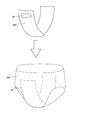
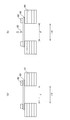
- FIG. 1 is a cross-sectional view taken along the line AA of FIG. It is explanatory drawing of the part where the absorbent article is fixed. It is explanatory drawing of the contact angle. It is a top view (skin contact surface) in the unfolded state of the absorbent article of another form. It is the figure which showed the fiber and the droplet which form the inner surface layer. It is the figure which showed the fiber and the droplet which form an intermediate layer. It is the figure which showed the fiber and the droplet which form the outer surface layer. It is explanatory drawing which shows the measurement operation of the holding amount of simulated stool.
- the absorbent articles of the present invention may be used for adults or infants. Needless to say, it can be applied to various absorbent articles such as pants-type diapers themselves and tape-type diapers.
- the absorbent article 200 illustrated in FIGS. 1 to 3 has a top sheet 22 that allows loose stool or the like to pass through and faces the skin, an absorbing element 23 that holds the loose stool or the like, and a space between the top sheet 22 and the absorbing element 23.
- a second sheet 26 that penetrates loose stools and covers the inner surface of the absorbent element 23, and a non-skin-contacting side of the absorbent element 23 that covers the outer surface of the absorbent element 23.
- a back sheet 25 that covers the outside of the impermeable sheet 21 such as loose stool and serves as a non-skin contact surface (outer surface) of the absorbent article 200 is provided. Further, it has gather sheets 24, 24 standing upright on the wearer side on both left and right sides of the product.
- the top sheet 22 may or may not be provided.
- the dimensions of the absorbent article 200 can be 100 to 850 mm for the longitudinal LD and 50 to 600 mm for the width WD.
- top sheet 22 When the top sheet 22 is provided, a known sheet can be used without particular limitation as long as it is a sheet that allows loose stool or the like to pass through.
- a sheet having a transmission hole group composed of a plurality of transmission holes H may be used. ..
- the top sheet 22 is formed with a large number of permeation holes H, H ...
- the excretion region including at least a portion facing the excretion portion such as loose stool and its surroundings, or in the form of FIG. 6 as a whole.
- the excretion region varies depending on the properties of loose stools and the like, and cannot be unequivocally defined.
- the excretion region has a length of 2/3 of the length L of the longitudinal LD of the absorbent article 200 and a width of the absorbing element 23.
- it can be a region including a site that opposes the excretory part such as loose stool.
- the form of the arrangement of the through holes in the top sheet 22 is not particularly limited, but can be as follows. As an example, it is preferable that a plurality of rows of through holes arranged at predetermined intervals in the front-rear direction are provided in the width direction (may be an oblique direction or a width direction).
- the transmission holes have a lattice point shape, an orthorhombic lattice point shape, a honeycomb structure (a structure in which hexagons are arranged without gaps), and a structure in which triangles are arranged without gaps. It can be arranged at each intersection.
- the effective opening area of each of the through holes is 10,000 to 50,000 mm 2 , more preferably 15,000 to 45,000 mm 2 , and the opening area ratio is 20 to 50. %, More preferably 25 to 45%, is preferably used. If the opening area and the opening area ratio are smaller than this range, the viscous ones of loose stools and the like are inferior in permeability, and if the opening area is larger than this range, the skin and the second sheet 26 come into direct contact with each other, and the top sheet 22 It becomes difficult to feel the texture and good tactile sensation of. If the opening area ratio is excessively large, the strength of the top sheet 22 is weak, which is not preferable.
- the top sheet 22 may or may not be fixed to the gather sheet 24, the impermeable sheet 21 such as loose stool, and the back sheet 25.
- the top sheet 22 may be fixed to a member of the product in some form.
- the top sheet 22 is fixed to the second sheet 26.
- the top sheet 22 may be fixed to the second sheet 26 by spiral application of a hot melt adhesive.
- the top sheet 22 in this embodiment is a perforated sheet and has a large opening.
- the hot-melt adhesive may squeeze out from the permeation holes toward the skin contact surface side, or the presence of the hot-melt adhesive may hinder the permeation of loose stool or the like through the permeation holes H, so that the top sheet 22 is loosened. It does not occur (if the fixed portions are widely dispersed, the top sheet 22 may be loosened, and the two sheets may be separated from each other, so that the transition to the second sheet 26 such as loose stool may not be smooth. ) Partially by heat sealing or ultrasonic sealing to reduce the fixed total area as much as possible and to prevent the hot melt adhesive from squeezing out from the through hole to the skin contact surface side. It is desirable to fix the top sheet 22 to the second sheet 26.
- the material of the top sheet 22 is preferably a non-woven fabric in order to improve the feel on the skin, but may be a plastic sheet.
- the top sheet 22 has permeability such as loose stool, and may be perforated or non-perforated.
- the opening shape of the transmission hole H may be an appropriate shape such as an ellipse, a round shape, a triangle, a quadrangle, a rhombus, a hexagon, etc., in addition to the circular shape shown in the figure. These can be arranged in large numbers regularly or irregularly over part or all of the topsheet 22.
- the raw material fiber of the non-woven fabric top sheet 22 is not particularly limited.
- the non-woven fabric top sheet 22 may be manufactured by any processing.
- the processing method include known methods such as a spunlace method, a spunbond method, a thermal bond method, a melt blown method, a needle punch method, an air through method, and a point bond method.
- the span lace method is preferable, and if bulkiness and softness are required, the thermal bond method is preferable.
- the fineness of the fibers constituting the non-woven fabric is preferably 4.0 to 6.0 dtex from the viewpoint of maintaining a space for absorbing loose stool and enhancing permeability.
- the basis weight is preferably 30 to 60 g / m 2.
- the top sheet 22 preferably uses water-repellent or hydrophobic fibers in order to suppress diffusion on the top sheet 22.
- the second sheet 26 functions to diffuse the excreted loose stool or the like and guide it to the absorbing element 23, and to prevent the loose stool or the like that has reached the absorbing element 23 from returning to the skin side.
- the second sheet 26 is composed of an inner surface layer, an outer surface layer, and an intermediate layer interposed between these non-woven fabrics, and is composed of three layers of non-woven fabric.
- the second sheet 26 is arranged on the absorbent article 200 so that the inner surface layer is on the skin contact side and the outer surface layer is on the non-skin contact side in the laminated non-woven fabric composed of three layers constituting the second sheet 26. .. That is, the outer surface layer forming the outer surface of the second sheet 26 covers the absorbing element 23.
- the excreted loose stool or the like is first absorbed by the inner surface layer of the second sheet 26, passes through the intermediate layer and the outer surface layer in order, and is absorbed by the absorbing element 23.
- the gaps between the fibers of the laminated non-woven fabric have a relationship of s3 ⁇ s2 ⁇ s1 when the gaps between the fibers in the inner surface layer are s1, the gaps between the fibers in the intermediate layer are s2, and the gaps between the fibers in the outer surface layer are s3.
- the form satisfying is preferable.
- s2 ⁇ s1 the moving force of loose stool or the like due to the capillary phenomenon increases from the outer surface side to the inner surface side.
- the voids between the fibers are preferably, for example, that the outer surface layer is shorter than the inner surface layer and the intermediate layer, and particularly preferably the intermediate layer is shorter than the inner surface layer.
- the inner surface layer may be 800 ⁇ m or more and 1000 ⁇ m or less
- the intermediate layer may be more than 600 ⁇ m to 800 ⁇ m or less
- the outer surface layer may be 200 ⁇ m or more and 600 ⁇ m or less
- the outer surface layer may be particularly optimally set to 300 to 500 ⁇ m. If the inner surface layer and the intermediate layer are smaller than this range, the shape of the non-woven fabric is likely to collapse due to the movement of the wearer or the like. If the inner layer and the intermediate layer are larger than this range, the density difference from the outer layer becomes small. Then, not only the loose stool or the like does not smoothly move from the inner surface layer to the outer surface layer, but also the loose stool or the like may revert.
- the density difference between the inner surface layer and the intermediate layer becomes small, which causes the above problem. If it is smaller than this range, a large amount of loose stool or the like is maintained in the outer surface layer, and it is difficult to transfer to the absorbing element 23.
- a known method can be appropriately adopted without particular limitation.
- a method of adhering a water repellent agent for imparting water repellency to the fiber surface of the non-woven fabric or dispersing the fibers with each other is preferable.
- the adhesion method include application to fibers, spraying on fibers, spinning of a resin containing a water repellent, and the like.
- Examples of the water repellent include known chemical compounds.
- a drug containing a metal salt of an alkyl phosphate having an alkyl group having 14 or more carbon atoms, an ammonium salt thereof, etc. a drug containing a perfluoroalkyl carboxylic acid salt, a perfluoroalkyltrimethylammonium salt, etc., a perfluoroalkyl-containing oligomer, a fluorine-containing vinyl Agents containing monomeric polymers, polydimethylcycloxane, amino-modified silicones, agents containing silicone-based surfactants, and agents containing alkylketen dimers are preferred.
- the inner surface layer and the outer surface layer have lower water repellency than the intermediate layer, and the concept of low water repellency may include hydrophilicity.
- a known method can be appropriately adopted without particular limitation.
- a method of adhering a hydrophilicity-imparting agent for imparting hydrophilicity to the fiber surface of the non-woven fabric or dispersing the fibers with each other is preferable.
- the adhesion method include application to fibers, spraying on fibers, spinning of a resin containing a hydrophilicity-imparting agent, and the like.
- hydrophilicity-imparting agent examples include known chemical compounds, particularly surfactants.
- a surfactant having an alkyl group having 6 or more carbon atoms is preferable, and an alkyl ester phosphate salt, a dialkyl sulfosuccinate salt, and an alkyl sulfonate salt can be examples of anionic surfactants.
- the salt is not particularly limited, and an alkali metal salt and an alkaline earth metal salt are preferable.
- a hydrophilicity-imparting agent containing dialkyldimethylammonium halide, alkenyldimethylammonium halide, alkylpyridinium halide, and alkenylpyridinium halide may be used.
- the number of carbon atoms is preferably 6 or more.
- the halide may be chlorine, bromine or the like.
- hydrophilicity-imparting agents containing betaine-type amphoteric ionic surfactants, amino acid-type amphoteric surfactants, polyhydric alcohol fatty acid esters typified by glycerin fatty acid esters, and amino-modified silicones can be mentioned.
- the degree of water repellency should be judged by the droplets of water adhering to the fibers forming the laminated non-woven fabric.
- the contact angle can be used as an index of water repellency.
- the contact angle can be measured by the method described in paragraphs [0017] to [0020] of Patent Document 1. That is, the contact angle is a place where the free surface of water comes into contact with the fiber, and means the angle formed by the water surface and the fiber surface (the angle inside the water is taken). If the contact angle of the fibers is too small, the liquid return prevention property of the non-woven fabric is lowered.
- the contact angle can be measured by the following method. For example, a measuring unit in which a lens is attached to a known microscope is fixed in a horizontally tilted state.
- the non-woven fabric is cut to a size of 50 mm in the LD direction and 10 mm in the WD direction, and this is used as a measurement sample.
- the measurement sample As the measurement sample, the inner surface layer portion, the intermediate layer portion, and the outer surface layer portion of the second sheet 26 were cut out. However, for example, the measurement sample may be cut out from each of the inner surface layer, the intermediate layer, and the outer surface layer in the stage before manufacturing the second sheet 26.
- the measurement surface of the measurement sample is turned upward and fixed to the laboratory table, and the measuring machine is installed so that the WD direction of the measurement sample is orthogonal to the lens surface.
- the measuring unit of the measuring machine is fixed in the horizontal direction.
- the observation direction and the WD direction coincide with each other.
- most of the fibers are oriented in a direction orthogonal to the observation direction.
- the angle formed by the observation direction and the WD direction may be adjusted to an acute angle or an obtuse angle depending on the type of fiber forming the non-woven fabric.
- Moisture is sprayed on the measurement sample. At this time, it is advisable to spray the water in as uniform droplets as possible.
- a spray or a mist blower can be used to obtain uniform droplets.
- known water such as pure water or ion-exchanged water can be appropriately used.
- the droplets adhering to the fibers are imaged with a measuring machine. Imaging is repeated in this procedure, and 20 or more images in which the fibers are horizontally oriented are selected from the captured images. Select 10 selected images in which fibers and droplets are clearly shown.
- the measurement of the contact angle ⁇ will be described as follows with reference to FIG.
- One point at the intersection of the gas-liquid interface of the droplet 60 and the fiber 70 is set as the reference point ⁇ 0, and the most fiber 70 among the straight lines that are tangent to the gas-liquid interface and pass through the reference point ⁇ 0.
- the angle formed by the one having a large upward angle with respect to P and the orientation direction Q of the fiber 70 is defined as the contact angle ⁇ .
- a place where the droplet touches the fiber was selected, a tangent line was drawn on the droplet, and the angle formed by the tangent line and the fiber was set. This contact angle ⁇ is measured with a protractor or other known angle meter (image analysis software, etc.).
- the contact angle may be measured by taking out the fibers constituting the inner surface layer, the fibers constituting the intermediate layer, and the fibers constituting the outer surface layer from the second sheet, or measuring the inner surface side, the outer surface side, and the intermediate portion of the second sheet. You may measure. To measure the contact angle of the intermediate part, that is, the intermediate layer, it is advisable to perform as follows.
- the outer surface side of the second sheet 26 is composed of an outer surface layer, and the intermediate layer is exposed by scraping the outer surface layer. Since the outer layer and the intermediate layer have different fineness, it is easy to tell whether the intermediate layer is exposed or not.
- a method of peeling off the inner surface layer or the outer surface layer of the second sheet 26 may be used. Also in this case, since the fineness is different between the inner surface layer or the outer surface layer and the intermediate layer, the degree of entanglement between the fibers differs between the inner surface layer or the outer surface layer and the intermediate layer, and as a result, the inner surface layer or the inner surface layer of the second sheet 26 or When the outer layer is peeled off, the intermediate layer is easily exposed.
- the contact angle of the droplet placed on the fiber is measured.
- the contact angle of a droplet hanging along a fiber and a droplet straddling two or more fibers is not measured.
- the measurement is performed at a place where the crimps are small or by stretching the fibers.
- the measurement result of the contact angle is obtained by averaging the measured values by selecting 20 or more images in which the fibers are horizontal by changing the measurement location or the measurement sample. If the fiber has a high degree of hydrophilicity, droplets may move on the fiber when measuring the contact angle. In this case, the measurement is performed after confirming that the droplets have stopped.
- FIGS. 7 to 9 are images of fibers and droplets, and a large number of fibers and droplets are shown in each figure, and typical fibers 70 and droplets 60 are depicted by solid lines.
- the image selected to measure the contact angle shall be one with droplets attached on top of the horizontally oriented fibers (ie, preferably above the vertical direction). If the droplet is not on the fiber, for example, if the droplet is attached to the side or the bottom of the fiber, such as when the fiber is not horizontally oriented, the shape of the droplet will be different. Then, the contact angle may not be measured properly.
- the degree of water repellency of the inner surface layer is r1
- the degree of water repellency of the intermediate layer is r2
- the degree of water repellency of the outer surface layer is r3
- a form satisfying the relationship of r2> r1 ⁇ r3 is preferable.
- the form in which r1> r3 is preferable and there is an effect that the droplets in the intermediate layer easily move to the inner surface layer and do not easily revert.
- the intermediate layer contains fibers to which water repellency is imparted, and each of the inner surface layer and the outer surface layer has lower water repellency than the intermediate layer.
- Water repellency can be evaluated, for example, by the contact angle.
- the contact angle of the inner surface layer is 30 ° to 70 °
- the contact angle of the intermediate layer is 1.3 to 2.5 times the contact angle of the inner surface layer
- the contact angle of the outer surface layer is that of the inner surface layer. It can be in the form of a layer having a contact angle of 0.3 to 1 times. Moreover, it may have the following form.
- the above-mentioned contact angle ⁇ is 70 ° to 170 °, more preferably 100 ° to 150 ° for the fibers forming the intermediate layer.
- the larger the contact angle ⁇ the higher the water repellency, which is preferable, but it is difficult to produce a fiber having a contact angle exceeding this range. Further, if it is less than this range, the difference in water repellency between the intermediate layer and the inner surface layer and the outer surface layer is small, and not only loose stools and the like cannot be smoothly permeated through the second sheet 26, but also loose stools and the like may revert. is there.
- the contact angle ⁇ is 30 ° to 70 ° for the fiber forming the inner surface layer and 10 ° to 40 ° for the fiber forming the outer surface layer. If it is larger than this range, as described above, the difference in water repellency between the inner layer and the outer layer and the intermediate layer is too small. If it is less than this range, it can be said that the non-woven fabric is hydrophilic, and particularly viscous loose stools and the like remain retained in the inner layer and the outer layer, and may not reach the absorbing element.
- Examples of the second sheet 26 include the same materials as the top sheet 22, spunlace non-woven fabric, spunbonded non-woven fabric, SMS non-woven fabric, pulp non-woven fabric, mixed sheet of pulp and rayon, point-bonded non-woven fabric or crepe paper.
- the air-through non-woven fabric is preferable because it is bulky.
- Synthetic fibers can be used as the fibers of the non-woven fabric forming the second sheet 26.
- the synthetic fiber used is not particularly limited, but is used for both polyethylene terephthalate, polybutylene terephthalate, polytrimethylene terephthalate, polyethylene naphthalate, polylactic acid, polybutylene succinate, polypropylene, polyethylene, polybutene, propylene copolymer, and ethylene-vinyl acetate.
- Examples include polymers, nylon 6, nylon 12, nylon 66, acrylic resins, polycarbonates, polyacetals, polystyrenes, and engineering plastics.
- the synthetic fiber a single fiber made of one or more resins selected from the above can be used.
- a single fiber is used, fibrillation and fine powder due to interfacial peeling between components are less likely to occur.
- the synthetic fiber may be a composite fiber composed of a plurality of components.
- each component may be composed of one resin or may be a mixture of a plurality of resins.
- the composite fiber for example, a core-sheath type, a sea-island type, a split type, and a side-by-side type composite fiber can be used.
- the fibers forming the inner surface layer, the fibers forming the intermediate layer, and the fibers forming the outer surface layer have the same composition.
- a form in which the non-woven fabric is formed from one or more fibers selected from the above can be mentioned.
- a core-sheath type composite resin in which the resin used for the core is polypropylene is used, or a polypropylene resin and a polyethylene terephthalate resin are mixed. Resin, etc. can be used. However, it is not limited to this specific example.
- the total basis weight of the second sheet 26 is 15 to 60 g / m 2 , preferably 30 to 50 g / m 2 . If it falls below this range, reversion of loose stools or the like may occur, and if it exceeds this range, it becomes difficult for loose stools or the like to move smoothly on the second seat 26.
- the outer surface layer is larger than the inner surface layer and the intermediate layer, and in particular, the form in which the intermediate layer is larger than the inner surface layer is preferable. Further, the outer surface layer is 10 ⁇ 15g / m 2 for basis weight, the intermediate layer is 5 ⁇ 10g / m 2, the inner surface layer is 15 ⁇ 25g / m 2 preferred.
- the basis weight is less than this range, when the wearer's body pressure is applied to the absorbent article 200, a reversion phenomenon may occur in which loose stool or the like held by the absorbent element 23 moves to the skin side. On the other hand, if the basis weight exceeds this range, loose stool or the like may not be smoothly absorbed by the absorbing element 23.
- the fineness of the fibers of the second sheet 26 is preferably such that the outer surface layer is larger than the inner surface layer and the intermediate layer. Further, it is preferable that the intermediate layer has a smaller fiber fineness than the inner layer.
- the outer surface layer is preferably 5.0 to 6.0 dtex, more preferably 5.5 to 6.0 dtex. Further, it is desirable that the inner layer is 4.0 to 6.0 dtex, more preferably 4.5 to 5.0 dtex, and the intermediate layer is 4 to 6 dtex, more preferably 5.0 to 5.5 dtex.
- the fineness of the outer surface layer is relatively small so that loose stool or the like that has migrated from the inner surface layer is quickly absorbed by the absorbing element 23. If the fineness is smaller than this range, the strength of the second sheet 26 becomes too weak, and if it is larger than this range, loose stool or the like once absorbed by the absorbing element 23 may revert.
- the absorbing element 23 protrudes in the LD direction and the MD direction and is covered by the second sheet 26.
- the present invention is not limited to this form, and the second sheet 26 may cover an area smaller than the absorbing element 23.
- the second sheet 26 covers 80% of the absorbing element 23 in the LD direction and 90% of the absorbing element 23 in the MD direction, and the central portion of the second sheet 26 is arranged so as to face the excretion position of loose stool or the like. Can be in the form.
- the excretion position of loose stools and the like is not particularly limited, but for example, the absorption element 23 can be the middle region of the regions divided into three equal parts in the LD direction.
- the central portion of the second sheet 26 is not particularly limited, but may be, for example, the middle region of the regions in which the second seat 26 is divided into three equal parts in the LD direction.
- the second sheet 26 having a characteristic structure as in the present invention that is, the second sheet 26 made of a three-layer non-woven fabric, can be produced, for example, by the following method.
- raw cotton which is the raw material of the layer (intermediate layer) located in the middle of the three-layered non-woven fabric, undergoes the steps of adding the raw material, heating, melting, extruding, and cooling, and then imparting the above-mentioned water repellency.
- raw cotton which is the raw material of the layer (intermediate layer) located in the middle of the three-layered non-woven fabric.
- the raw cotton inner surface layer
- the raw material for the layer located on the skin contact side
- the raw material for the layer located on the non-skin contact side.
- a step of imparting water repellency or hydrophilicity is inserted after the raw material is extruded and cooled. Then, it is advisable to manufacture raw cotton.
- Low water repellency can be imparted to the fibers by applying a low concentration water repellent agent, spraying the fibers for a short time, or the like.
- a plurality of lines of the non-woven fabric manufacturing apparatus for example, in the case of manufacturing the second sheet 26 having a three-layer structure, a line for manufacturing the inner surface layer, a line for manufacturing the intermediate layer, and a line for manufacturing the outer surface layer.
- the raw cotton which is the raw material of the layer located on the inner surface, the raw cotton which is the raw material of the layer located in the middle, and the raw cotton which is the raw material of the layer located on the outer surface are separately supplied. After that, separately for each line, primary defibration of each raw cotton, weighing / mixed cotton, secondary defibration, tuft formation (secondary defibrated raw cotton is uniformly stored in the box), web molding (by a card machine).
- each sheet produced by web molding is laminated and laminated in a plurality of layers. For example, hot air is passed from the inner side surface to the outer side surface to perform heat fusion treatment to bond the fibers, and then foreign matter is mixed. Manufactured through the processes of inspection and winding.
- the absorption element 23 is a portion that absorbs and retains loose stool and the like.
- the absorbent element 23 that directly faces the second sheet 26 and holds loose stool or the like may be an absorbent body, or may be in a form in which the entire absorbent body is wrapped by a packaging sheet.
- the absorber can be formed by an aggregate of fibers.
- the fiber aggregate is obtained by stacking short fibers such as cotton-like pulp and synthetic fibers, and by opening the tow (fiber bundle) of synthetic fibers such as cellulose acetate as necessary. Can also be used.
- the fiber basis weight of the absorber can be, for example, about 50 to 400 g / m 2 when stacking cotton-like pulp or short fibers, and about 10 to 100 g / m 2 for filament aggregates, for example. Can be.
- the fineness is, for example, 1.0 to 6.0 dtex, preferably 1.2 to 6.0 dtex, and more preferably 2.2 to 5.6 dtex.
- the filament may be a non-crimped fiber, but is preferably a crimped fiber.
- the degree of crimping of the crimped fibers can be, for example, 3 to 30 fibers per 2.54 cm, preferably 5 to 25 fibers, and more preferably about 10 to 20 fibers.
- uniformly crimped crimped fibers can be used.
- the absorber may contain highly absorbent polymer particles in part or all of it.
- the highly absorbent polymer particles include "powder” in addition to "particles".
- the particle size of the highly absorbent polymer particles is not particularly limited, but for example, sieving (shaking for 5 minutes) using a standard sieve (JIS Z8801-1: 2006) of 500 ⁇ m, and particles falling under the sieve by this sieving.
- the proportion of particles remaining on the 500 ⁇ m standard sieve is 30% by weight or less, and the 180 ⁇ m standard sieve. It is desirable that the proportion of particles remaining on the top is 60% by weight or more.
- the material of the highly absorbent polymer particles can be used without particular limitation, but a material having a water absorption of 42 g / g or more is preferable.
- Highly absorbent polymer particles include starch-based, cellulosic-based and synthetic polymer-based ones, which are starch-acrylic acid (salt) graft copolymers, saponified starch-acrylonitrile copolymers, and crosslinked sodium carboxymethyl cellulose.
- a substance or an acrylic acid (salt) polymer or the like can be used.
- As the shape of the highly absorbent polymer particles a commonly used powder or granular material is preferable, but other shapes can also be used.
- the highly absorbent polymer particles those having a water absorption rate of 70 seconds or less, particularly 50 seconds or less, are preferably used. If the water absorption rate is too slow, so-called reversion, in which the liquid supplied into the absorbent body returns to the outside of the absorbent body, is likely to occur.
- the highly absorbent polymer particles those having a gel strength of 5 Pa or more are preferably used. As a result, even when a bulky absorber is used, the sticky feeling after liquid absorption can be effectively suppressed.
- the basis weight of the highly absorbent polymer particles can be appropriately determined according to the amount of absorption required for the application of the absorber. Therefore, although it cannot be said unconditionally, it can be set to 50 to 500 g / m 2 . If the basis weight of the polymer is less than 30 g / m 2 , it becomes difficult to secure the absorption amount. If it exceeds 600 g / m 2 , not only the effect is saturated, but also an excess of highly absorbent polymer particles gives a jerky discomfort.
- the absorber can be incorporated as an absorbent element 23 wrapped in a packaging sheet.
- tissue paper particularly crepe paper, non-woven fabric, non-woven fabric of polylami, a sheet having small holes, or the like can be used.
- a non-woven fabric is used instead of the crepe paper, a hydrophilic SMMS (spunbond / meltblown / meltblown / spunbond) non-woven fabric is particularly preferable, and polypropylene, polyethylene / polypropylene or the like can be used as the material.
- the packaging sheet is made of a material that allows loose stools to permeate.
- This packaging sheet has a structure in which one sheet wraps the entire absorber, or a plurality of sheets such as two upper and lower sheets may wrap the entire absorber.
- the packaging sheet can be omitted.
- the basis weight of the packaging sheet is preferably 11.0 g / m 2 or more, and more preferably 13.5 g / m 2 or more. By setting this range, it is possible to prevent loose stools and the like held by the absorber from returning and adhering to the wearer's skin, which puts a burden on the skin.
- the impermeable sheet 21 such as loose stool arranged on the outer surface of the absorbing element 23 is made of, for example, a plastic sheet.
- the back sheet may be breathable.
- the back surface sheet extends laterally from the side edge of the absorbing element 23.
- the impermeable sheet 21 such as loose stools arranged on the outer surface of the absorbing element 23 is not particularly limited, but is preferably one having breathability and moisture permeability.
- the opaque sheet 21 such as loose stool is a microporous obtained by kneading an inorganic filler in an olefin resin such as polyethylene or polypropylene, forming the sheet, and then stretching in the uniaxial or biaxial direction.
- a sex sheet can be preferably used.
- the impermeable sheet 21 such as loose stool, a non-woven fabric as a base material with improved waterproofness can also be used.
- the opaque sheet 21 for loose stools or the like extends in the same or wider range as the absorbing element 23 in the anteroposterior direction LD and the width direction WD, but is necessary when there is another means that does not allow the loose stools or the like to permeate.
- the structure may be such that the end portion of the absorbing element 23 is not covered in the front-rear direction LD and the width direction WD.
- the back sheet 25 covers the entire back side of the impermeable sheet 21 such as loose stool, and makes the outer surface of the product look like a cloth.
- the back sheet 25 is not particularly limited, and the material fibers include, for example, olefin-based fibers such as polyethylene and polypropylene, polyester-based and polyamide-based synthetic fibers, recycled fibers such as rayon and cupra, and natural fibers such as cotton.
- a spunlace method, a spunbond method, a thermal bond method, an air-through method, a needle punch method, or the like can be used.
- long-fiber non-woven fabrics such as spunbonded non-woven fabrics, SMS non-woven fabrics, and SMMS non-woven fabrics are suitable in terms of both feel and strength.
- the non-woven fabric can be used alone or in layers. In the latter case, it is preferable to bond the non-woven fabrics to each other with a hot melt adhesive or the like.
- the fiber basis weight is preferably 9 to 18 g / m 2 , especially 11 to 15 g / m 2 .
- the back sheet 25 does not have to be provided, and in this case, the outer surface of the product is covered with an impermeable sheet 21 such as loose stool.
- a slip prevention portion 30 is provided on the outer surface of the back sheet 25, that is, the outer surface of the product, so that the absorbent article 200 does not shift or come off from the portion 90 when worn.
- the slip prevention portion 30 can be formed of, for example, an adhesive layer or a hook tape.
- the hook tape has a large number of hook-shaped protrusions, and may be attached to the slip prevention portion 30 with a hot melt adhesive or the like.
- the shape of the hook-shaped protrusions includes mushroom-shaped, hook-shaped, check-shaped, J-shaped, T-shaped, and double J-shaped (J-shaped ones joined back to back or anchor-shaped). Etc. can be used.
- the front end portion FR and the rear end portion BA of the front-rear direction LD on the outer surface of the back sheet are each provided with the displacement prevention portions 30 in a rectangular shape, but the front end portion FR to the rear end of the front-rear direction LD on the outer surface of the back sheet is provided. It may be provided continuously over the part BA. However, it is not limited to these as long as the absorbent article 200 does not shift or come off.
- the slip prevention portion 30 may be provided on the outer surface of the impermeable sheet 21 such as loose stool. Similar to the case of the outer surface of the back sheet, the position of the impermeable sheet such as loose stool is such that the front end FR and the rear end BA of the front-rear LD of the outer surface of the sheet are provided with the displacement prevention portions 30 in a rectangular shape. It may be provided continuously from the front end portion FR to the rear end portion BA of the front-rear direction LD on the outer surface of the transparent sheet.
- an impermeable sheet 21 such as loose stool and a second sheet 26 are stretched and bonded to both front and rear sides of the absorbent element 23, respectively, and an end flap in which the absorbent element 23 does not exist. Part EF is formed.
- the impermeable sheet 21 such as loose stool extends outward from the side edge of the absorbing element 23, and the inner surface of the portion from this extending portion to the side portion of the second sheet 26.
- a portion 24x outside the width direction of the gather sheet 24 is attached to the gather sheet 24 over the entire front-rear direction to form a side flap portion SF in which the absorbing element 23 does not exist.
- the bonded portion of the material including these can be formed by a hot melt adhesive, a heat seal, and an ultrasonic seal, and is shown by a diagonal line pattern in the plan view and a dot pattern in the cross-sectional view.
- Absorption element intervening portions other than the end flap portion EF and the side flap portion SF constitute a main body portion BD that holds excrement.
- a plastic sheet or a melt blown non-woven fabric can be used, but from the viewpoint of touch to the skin, a non-woven fabric treated with water repellent treatment such as silicon is preferably used.
- the portion 24c on the center side in the width direction of the gather sheet 24 extends to the second sheet 26, and an elongated elastic member 24G is hot in a stretched state along the front-rear direction at the end portion on the center side in the width direction. It is fixed with a melt adhesive or the like.
- the elongated elastic member 24G includes styrene rubber, olefin rubber, urethane rubber, ester rubber, polyurethane, polyethylene, polystyrene, styrene butadiene, silicon, polyester and the like formed in a thread shape, a string shape, a strip shape and the like. , Usually used materials can be used.
- the outer portion 24x in the width direction is bonded and fixed to the inner surface of the article (the surface of the second sheet 26 and the inner surface of the impermeable sheet 21 such as loose stool in the illustrated form) over the entire front-rear direction, and the gather sheets 24 and 24 are fixed in the width direction.
- the central portion 24c is attached and fixed to the inner surface of the article (the surface of the second sheet 26 in the illustrated form) at both ends in the front-rear direction, and the inner surface of the article (that is, the central portion) between both ends in the front-rear direction (that is, the central portion). In the form, it is not fixed to the surface of the second sheet 26).
- This non-fixed portion is a portion that becomes a three-dimensional gather that can stand up against the inner surface of the article (the surface of the top sheet 22 in the figure), and the standing base end 24b is the fixed portion 24x on the outer side in the width direction and the inner side of the gather sheet 24. It is located on the border with the part 24c.
- the artificial urine was prepared as follows. 1418 g of ion-exchanged water was placed in a 3000 ml beaker, and 400 g of urea, 160 g of sodium chloride, 6 g of calcium chloride, and 16 g of magnesium sulfate were added while being dissolved, and the urine was prepared to have a uniform concentration.
- the contact angles were 55 ° for the inner surface layer, 110 ° for the intermediate layer, and 42 ° for the outer surface layer.
- the gaps between the fibers were 900 ⁇ m for the inner surface layer, 700 ⁇ m for the intermediate layer, and 400 ⁇ m for the outer surface layer.
- Basis weight the inner surface layer is 5 g / m 2
- the intermediate layer is 30 g / m 2
- the outer surface layer was 10 g / m 2.
- the thickness was 1.5 mm for the inner surface layer, 4.0 mm for the intermediate layer, and 1.5 mm for the outer surface layer.
- the synthetic fibers used for the inner surface layer, the intermediate layer, and the outer surface layer were PET / PE bico resins.
- the mass of the test piece was 2.2 g.
- test piece 80 was spread out in an unfolded state so that the test piece 80 straddles each of the first laminated hard flat plate 81 and the second laminated hard flat plate 81 in the lateral direction.
- a 100 g weight 82 (length 20 mm ⁇ width 100 mm) is placed on both side ends of the test piece 80 in the lateral direction, and the test piece 80 is spread by sandwiching both side ends of the test piece 80 between the weight 82 and the laminated hard flat plate 81. It was fixed so that no wrinkles were formed.
- simulated stool 83 was dropped onto the central portion of the test piece 80 so as to be 0.4 mL / sec.
- test piece 80 was read as "blank test piece”.
- the physical characteristics of the blank test piece were used for fibers having a fineness of 5.6 dtex, a gap between fibers of 1000 ⁇ m, and a thickness of 5 mm, and the mass was 1.9 g.
- the above test operation was performed 5 times on the test piece 80 to obtain Test Example 16 to Test Example 20. Further, the blank test piece was subjected to 5 times to obtain Test Example 21 to Test Example 25.
- the test results are shown in Tables 4 and 5.
- the test piece 80 has a smaller amount of simulated stool retention than the blank test piece. From this, it can be seen that the second sheet of the present embodiment is easily permeable to loose stools and the like.
- front-back (vertical) direction means the direction connecting the ventral side (front side) and the dorsal side (rear side)
- width direction means the direction orthogonal to the front-back direction (horizontal direction).
- ⁇ "Inside” means the side closer to the wearer's skin, and is also called the skin contact side.
- the "LD direction” and "WD direction” mean the flow direction (LD direction) in the manufacturing equipment and the lateral direction (WD direction) orthogonal to the flow direction, and one of them is the front-rear direction of the product. The other is in the width direction of the product.
- the LD direction of the non-woven fabric is the direction of fiber orientation of the non-woven fabric.
- the fiber orientation is the direction along which the fibers of the non-woven fabric follow. For example, the measurement method based on the fiber orientation test method based on the zero-distance tensile strength of the TAPPI standard method T481 or the fiber orientation based on the tensile strength ratio in the anteroposterior direction and the width direction. It can be discriminated by a simple measuring method for determining the orientation direction.
- Unfolded state means a state in which it is unfolded flat without shrinkage or slack.
- Methodsuke is measured as follows. After pre-drying the sample or test piece, leave it in a test room or device under standard conditions (test location: temperature 23 ⁇ 1 ° C., relative humidity 50 ⁇ 2%) to bring it to a constant weight. Pre-drying refers to making a sample or test piece constant in an environment at a temperature of 100 ° C. It is not necessary to pre-dry the fibers having an official moisture content of 0.0%. A sample having a size of 100 mm ⁇ 100 mm is cut out from the test piece in a constant weight state using a sampling template (100 mm ⁇ 100 mm). The weight of the sample is measured and multiplied by 100 to calculate the weight per square meter, which is used as the basis weight.
- the "thickness" is automatically measured using an automatic thickness measuring device (KES-G5 handy compression tester) under the conditions of a load of 0.098 N / cm 2 and a pressurized area of 2 cm 2.
- KS-G5 handy compression tester automatic thickness measuring device
- Water absorption rate is the "time to the end point" when JIS K7224-1996 "Water absorption rate test method for highly water-absorbent resin” was performed using 2 g of highly absorbent polymer and 50 g of physiological saline. And.
- Voids between fibers can be obtained by measuring the shortest distance between fibers. For example, the distance from a specific point (first point) on the first fiber to the closest point (second point) from the first point on another fiber closest to the fiber is measured and obtained. be able to. This distance is measured in the same way between other fibers. This measurement is repeated 10 times, and the range up to the minimum and maximum values of the obtained measured values is defined as the range of the voids between the fibers. In addition to this, the average value may be obtained from the numerical value of the result of repeated measurement.
- the average interfiber distance may be measured instead of the interfiber voids.
- the "average interfiber distance" is obtained by the following equation (3) based on the assumption of Wrotnowski. Wrotnowski's assumption is that the fibers are columnar, do not intersect with each other, and are regularly oriented.
- D fiber diameter ( ⁇ m)
- p fiber density (g / cm 3 )
- t thickness (mm)
- w basis weight (g / m 2 ).
- the fiber density p is measured using a density gradient tube according to the measurement method of the density gradient tube method described in JIS L1015 Chemical Fiber Staple Test Method. For the fiber diameter D ( ⁇ m), 10 fiber cross sections of the cut fibers are measured using a scanning electron microscope, and the average value thereof is taken as the fiber diameter.
- test or measurement shall be performed in a test room or equipment under standard conditions (test location: temperature 23 ⁇ 1 ° C, relative humidity 50 ⁇ 2%). To do.
- the dimensions of each part mean the dimensions in the unfolded state, not in the natural length state.
- Top sheet 21 ... Impermeable sheet such as loose stool, 23 ... Absorbent element, 24 ... Gather sheet, 25 ... Back sheet, 26 ... Second sheet, H ... Top sheet transmission hole, LD ... Vertical direction (flow direction and Since the front-back direction is also the same direction in the illustrated example, the same reference numerals are used.
Landscapes
- Health & Medical Sciences (AREA)
- Epidemiology (AREA)
- Engineering & Computer Science (AREA)
- Biomedical Technology (AREA)
- Heart & Thoracic Surgery (AREA)
- Vascular Medicine (AREA)
- Life Sciences & Earth Sciences (AREA)
- Animal Behavior & Ethology (AREA)
- General Health & Medical Sciences (AREA)
- Public Health (AREA)
- Veterinary Medicine (AREA)
- Absorbent Articles And Supports Therefor (AREA)
Applications Claiming Priority (2)
| Application Number | Priority Date | Filing Date | Title |
|---|---|---|---|
| JP2019170569A JP7293064B2 (ja) | 2019-09-19 | 2019-09-19 | 吸収性物品 |
| JP2019-170569 | 2019-09-19 |
Publications (1)
| Publication Number | Publication Date |
|---|---|
| WO2021054121A1 true WO2021054121A1 (ja) | 2021-03-25 |
Family
ID=74876943
Family Applications (1)
| Application Number | Title | Priority Date | Filing Date |
|---|---|---|---|
| PCT/JP2020/033220 Ceased WO2021054121A1 (ja) | 2019-09-19 | 2020-09-02 | 吸収性物品 |
Country Status (2)
| Country | Link |
|---|---|
| JP (1) | JP7293064B2 (https=) |
| WO (1) | WO2021054121A1 (https=) |
Families Citing this family (1)
| Publication number | Priority date | Publication date | Assignee | Title |
|---|---|---|---|---|
| JP2024048964A (ja) * | 2022-09-28 | 2024-04-09 | 大王製紙株式会社 | 吸収性物品 |
Citations (7)
| Publication number | Priority date | Publication date | Assignee | Title |
|---|---|---|---|---|
| JPS6366892B2 (https=) * | 1985-06-20 | 1988-12-22 | Furukawa Electric Co Ltd | |
| JPH08503745A (ja) * | 1992-11-20 | 1996-04-23 | ポデュス | 多層不織材料及びかかる材料から成る吸収性衛生物品 |
| WO2007035038A1 (en) * | 2005-09-20 | 2007-03-29 | Yuhan-Kimberly Limited | Absorbent article with apertured surge layer |
| JP2008113857A (ja) * | 2006-11-06 | 2008-05-22 | Kao Corp | 吸収性物品 |
| JP2010094320A (ja) * | 2008-10-17 | 2010-04-30 | Kao Corp | 吸収性物品の表面シート |
| JP2011055959A (ja) * | 2009-09-08 | 2011-03-24 | Livedo Corporation | 吸収性物品 |
| JP2017110328A (ja) * | 2015-12-16 | 2017-06-22 | 花王株式会社 | 不織布 |
Family Cites Families (1)
| Publication number | Priority date | Publication date | Assignee | Title |
|---|---|---|---|---|
| JP6366892B1 (ja) | 2017-03-30 | 2018-08-01 | ダイワボウホールディングス株式会社 | 吸収性物品用シートおよび吸収性物品 |
-
2019
- 2019-09-19 JP JP2019170569A patent/JP7293064B2/ja active Active
-
2020
- 2020-09-02 WO PCT/JP2020/033220 patent/WO2021054121A1/ja not_active Ceased
Patent Citations (7)
| Publication number | Priority date | Publication date | Assignee | Title |
|---|---|---|---|---|
| JPS6366892B2 (https=) * | 1985-06-20 | 1988-12-22 | Furukawa Electric Co Ltd | |
| JPH08503745A (ja) * | 1992-11-20 | 1996-04-23 | ポデュス | 多層不織材料及びかかる材料から成る吸収性衛生物品 |
| WO2007035038A1 (en) * | 2005-09-20 | 2007-03-29 | Yuhan-Kimberly Limited | Absorbent article with apertured surge layer |
| JP2008113857A (ja) * | 2006-11-06 | 2008-05-22 | Kao Corp | 吸収性物品 |
| JP2010094320A (ja) * | 2008-10-17 | 2010-04-30 | Kao Corp | 吸収性物品の表面シート |
| JP2011055959A (ja) * | 2009-09-08 | 2011-03-24 | Livedo Corporation | 吸収性物品 |
| JP2017110328A (ja) * | 2015-12-16 | 2017-06-22 | 花王株式会社 | 不織布 |
Also Published As
| Publication number | Publication date |
|---|---|
| JP7293064B2 (ja) | 2023-06-19 |
| JP2021045393A (ja) | 2021-03-25 |
Similar Documents
| Publication | Publication Date | Title |
|---|---|---|
| US10646384B2 (en) | Absorbent article and wearable article including absorbent article | |
| JP2020536706A (ja) | 天然繊維を含むトップシート | |
| JP6219436B2 (ja) | 吸収性物品 | |
| JP6108522B2 (ja) | 吸収体及び吸収性物品 | |
| JP2011062227A (ja) | 吸収性物品 | |
| WO2021060133A1 (ja) | 吸収性物品 | |
| KR102722131B1 (ko) | 흡수성 물품 | |
| WO2021054121A1 (ja) | 吸収性物品 | |
| JP2001276125A (ja) | 排泄物処理用の使い捨て着用物品 | |
| JP2021045393A5 (https=) | ||
| WO2021060132A1 (ja) | 吸収性物品 | |
| JP2017221275A (ja) | 吸収体 | |
| KR102880055B1 (ko) | 흡수성 물품 | |
| KR102827525B1 (ko) | 흡수성 물품 | |
| WO2019073643A1 (ja) | 吸収性物品の液透過性シート用の不織布及び不織布ロール | |
| JP7323997B2 (ja) | 吸収性物品 | |
| JP7014577B2 (ja) | 吸収体及び吸収性物品 | |
| JP6990517B2 (ja) | 吸収体 | |
| JP7339068B2 (ja) | 軟便取りパッド | |
| CN114206290B (zh) | 吸收性物品 | |
| JP7453180B2 (ja) | 使い捨ておむつとその製造方法 | |
| JP2021052897A5 (https=) | ||
| KR102827520B1 (ko) | 흡수성 물품 | |
| RU2771693C1 (ru) | Впитывающее изделие | |
| JP2020151352A5 (https=) |
Legal Events
| Date | Code | Title | Description |
|---|---|---|---|
| 121 | Ep: the epo has been informed by wipo that ep was designated in this application |
Ref document number: 20865526 Country of ref document: EP Kind code of ref document: A1 |
|
| NENP | Non-entry into the national phase |
Ref country code: DE |
|
| 122 | Ep: pct application non-entry in european phase |
Ref document number: 20865526 Country of ref document: EP Kind code of ref document: A1 |