WO2021039899A1 - 潜熱蓄熱体マイクロカプセルおよびその製造方法 - Google Patents
潜熱蓄熱体マイクロカプセルおよびその製造方法 Download PDFInfo
- Publication number
- WO2021039899A1 WO2021039899A1 PCT/JP2020/032341 JP2020032341W WO2021039899A1 WO 2021039899 A1 WO2021039899 A1 WO 2021039899A1 JP 2020032341 W JP2020032341 W JP 2020032341W WO 2021039899 A1 WO2021039899 A1 WO 2021039899A1
- Authority
- WO
- WIPO (PCT)
- Prior art keywords
- gallium
- latent heat
- heat storage
- shell
- microcapsules
- Prior art date
- Legal status (The legal status is an assumption and is not a legal conclusion. Google has not performed a legal analysis and makes no representation as to the accuracy of the status listed.)
- Ceased
Links
Images












Classifications
-
- C—CHEMISTRY; METALLURGY
- C09—DYES; PAINTS; POLISHES; NATURAL RESINS; ADHESIVES; COMPOSITIONS NOT OTHERWISE PROVIDED FOR; APPLICATIONS OF MATERIALS NOT OTHERWISE PROVIDED FOR
- C09K—MATERIALS FOR MISCELLANEOUS APPLICATIONS, NOT PROVIDED FOR ELSEWHERE
- C09K5/00—Heat-transfer, heat-exchange or heat-storage materials, e.g. refrigerants; Materials for the production of heat or cold by chemical reactions other than by combustion
- C09K5/02—Materials undergoing a change of physical state when used
- C09K5/06—Materials undergoing a change of physical state when used the change of state being from liquid to solid or vice versa
- C09K5/063—Materials absorbing or liberating heat during crystallisation; Heat storage materials
-
- B—PERFORMING OPERATIONS; TRANSPORTING
- B22—CASTING; POWDER METALLURGY
- B22F—WORKING METALLIC POWDER; MANUFACTURE OF ARTICLES FROM METALLIC POWDER; MAKING METALLIC POWDER; APPARATUS OR DEVICES SPECIALLY ADAPTED FOR METALLIC POWDER
- B22F1/00—Metallic powder; Treatment of metallic powder, e.g. to facilitate working or to improve properties
- B22F1/14—Treatment of metallic powder
- B22F1/145—Chemical treatment, e.g. passivation or decarburisation
-
- B—PERFORMING OPERATIONS; TRANSPORTING
- B22—CASTING; POWDER METALLURGY
- B22F—WORKING METALLIC POWDER; MANUFACTURE OF ARTICLES FROM METALLIC POWDER; MAKING METALLIC POWDER; APPARATUS OR DEVICES SPECIALLY ADAPTED FOR METALLIC POWDER
- B22F1/00—Metallic powder; Treatment of metallic powder, e.g. to facilitate working or to improve properties
- B22F1/16—Metallic particles coated with a non-metal
-
- B—PERFORMING OPERATIONS; TRANSPORTING
- B22—CASTING; POWDER METALLURGY
- B22F—WORKING METALLIC POWDER; MANUFACTURE OF ARTICLES FROM METALLIC POWDER; MAKING METALLIC POWDER; APPARATUS OR DEVICES SPECIALLY ADAPTED FOR METALLIC POWDER
- B22F2301/00—Metallic composition of the powder or its coating
- B22F2301/30—Low melting point metals, i.e. Zn, Pb, Sn, Cd, In, Ga
-
- B—PERFORMING OPERATIONS; TRANSPORTING
- B22—CASTING; POWDER METALLURGY
- B22F—WORKING METALLIC POWDER; MANUFACTURE OF ARTICLES FROM METALLIC POWDER; MAKING METALLIC POWDER; APPARATUS OR DEVICES SPECIALLY ADAPTED FOR METALLIC POWDER
- B22F2302/00—Metal Compound, non-Metallic compound or non-metal composition of the powder or its coating
- B22F2302/25—Oxide
-
- B—PERFORMING OPERATIONS; TRANSPORTING
- B22—CASTING; POWDER METALLURGY
- B22F—WORKING METALLIC POWDER; MANUFACTURE OF ARTICLES FROM METALLIC POWDER; MAKING METALLIC POWDER; APPARATUS OR DEVICES SPECIALLY ADAPTED FOR METALLIC POWDER
- B22F2304/00—Physical aspects of the powder
- B22F2304/10—Micron size particles, i.e. above 1 micrometer up to 500 micrometer
-
- Y—GENERAL TAGGING OF NEW TECHNOLOGICAL DEVELOPMENTS; GENERAL TAGGING OF CROSS-SECTIONAL TECHNOLOGIES SPANNING OVER SEVERAL SECTIONS OF THE IPC; TECHNICAL SUBJECTS COVERED BY FORMER USPC CROSS-REFERENCE ART COLLECTIONS [XRACs] AND DIGESTS
- Y02—TECHNOLOGIES OR APPLICATIONS FOR MITIGATION OR ADAPTATION AGAINST CLIMATE CHANGE
- Y02E—REDUCTION OF GREENHOUSE GAS [GHG] EMISSIONS, RELATED TO ENERGY GENERATION, TRANSMISSION OR DISTRIBUTION
- Y02E60/00—Enabling technologies; Technologies with a potential or indirect contribution to GHG emissions mitigation
- Y02E60/14—Thermal energy storage
Definitions
- the present invention relates to a latent heat storage microcapsule and a method for producing the same, and more particularly to a latent heat storage microcapsule in which a core made of gallium or a gallium alloy is covered with a shell made of gallium oxide or a gallium hydroxide, and a method for manufacturing the same.
- the development of lithium-ion batteries has progressed, and the output and capacity of batteries have increased rapidly.
- advanced battery heat Management is required. For example, when the battery is charged and discharged, the cell temperature rises due to the heat generated by the battery cell, which may lead to deterioration of battery performance and thermal runaway. Therefore, the cell temperature is set to the optimum temperature (about 50 ° C.) when the battery is charged and discharged. It is necessary to maintain the temperature.
- the cruising range of electric vehicles has improved, the decrease in cruising range due to power consumption for cooling in the summer and heating in the winter has become a problem. If the heat generated in the car can be absorbed through the heat pump and used efficiently for cooling and heating, the cruising range can be prevented from decreasing, but unlike the internal combustion engine car, which has a large heat source called the engine, the electric car Since the heat generation process and the amount of heat generated are small, advanced heat management technology that collects heat more effectively is required.
- PCM Phase Change Material
- PCM Phase Change Material
- the thermal conductivity of PCM is generally low.
- the above-mentioned latent heat storage body has a very low thermal conductivity of about 0.21 W / m ⁇ K, and there is a problem that heat cannot be absorbed quickly.
- the space in which the heat storage material can be placed inside the electric vehicle is extremely limited, it is necessary to develop a latent heat storage body that can flexibly change its shape.
- an object of the present invention is to provide a latent heat accumulator microcapsule having a higher thermal conductivity than conventional PCM and capable of flexibly changing its shape, and a method for producing the same.
- One embodiment of the present invention With a core made of gallium or gallium alloy, It is a latent heat storage microcapsule that covers the core and has a shell made of gallium oxide.
- Latent heat storage microcapsules With a core made of gallium or gallium alloy, Latent heat storage microcapsules with a shell covering the core and made of gallium hydrate.
- a method for manufacturing latent heat storage microcapsules A particleization process that turns liquid gallium or an alloy of gallium into particles, A water treatment step in which the particles are heated in distilled water to form gallium hydrate on the surface of the particles.
- a method for producing latent heat storage microcapsules which comprises an oxidation treatment step of oxidizing gallium hydrate to form a shell made of gallium oxide.
- a method for manufacturing latent heat storage microcapsules A particleization process that turns liquid gallium or an alloy of gallium into particles, A cooling process that cools the particles to a solid state, A method for producing latent heat storage microcapsules, which comprises a pH treatment step of immersing particles in an aqueous solution having a predetermined pH to form a shell made of gallium hydrate.
- the latent heat storage microcapsule according to the embodiment of the present invention makes it possible to provide a heat storage material having high thermal conductivity and heat storage density and a flexible shape.
- FIG. 3 is an SEM photograph of latent heat storage microcapsules after water treatment when the water treatment time is 15 minutes, 3 hours, and 5 hours. It is an SEM photograph of the latent heat storage microcapsule when the water treatment time is 5 hours and the treatment temperature is 100 ° C. It is the XRD analysis result of the shell when the water treatment temperature was set to 100 degreeC and the water treatment time was changed. This is the result of measuring the latent heat of the same sample as in FIG. It is the result of the thermal durability test of the GaOOH shell.
- the cross section after the water treatment step and the oxidation treatment step is the SEM-EDS result. It is a figure explaining the manufacturing method of the latent heat storage body microcapsule which covers a solid state gallium with a shell.
- FIG. 3 is an SEM photograph of the surface of the latent heat storage microcapsules after stirring in a solution having a pH of 7-11 for 5 hours. This is the result of X-ray diffraction of the six samples shown in FIG. 26. It is a measurement result of the differential scanning calorimetry of latent heat for six samples of FIG. It is a measurement result of the differential scanning calorimetry of the latent heat storage microcapsule and Ga treated in the solution of pH 9 and 11. It is a surface SEM photograph before and after the repeated test of the latent heat storage microcapsules treated in the solution of pH 9 and 11.
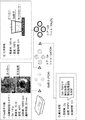
- FIG. 1 is a schematic diagram illustrating a latent heat storage microcapsule (hereinafter, also simply referred to as “microcapsule”) according to the embodiment of the present invention.
- gallium which is a PCM (Phase Change Material)
- Gallium has a melting point of about 29.8 ° C., and stores heat when it melts from a solid to a liquid near the melting point, and dissipates heat when it solidifies from a liquid to a solid.
- the latent heat storage body can always be used as a solid. Further, by using microcapsules having a diameter of several tens of ⁇ m, the heat transfer area is increased and the heat responsiveness is improved.
- the heat storage material By forming the heat storage material from an aggregate of latent heat storage microcapsules having a diameter of several tens of ⁇ m, the size and shape can be changed arbitrarily. Therefore, the heat storage material can be placed inside an electric vehicle or the like where the space where the heat storage material can be placed is extremely limited.
- the latent heat storage microcapsule consists of a core made of gallium (Ga) and a shell (capsule) made of gallium oxide or gallium hydrate (Ga 2 O 3 or Ga OOH). ..
- gallium / gallium oxide microcapsules When the core of the latent heat storage microcapsule is made of gallium (Ga) and the shell is made of gallium oxide, the gallium oxide (Ga 2 O 3 ) is ⁇ -Ga. It consists of 2 O 3, or a mixture of ⁇ -Ga 2 O 3 and ⁇ -Ga 2 O 3.
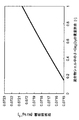
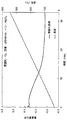
- FIG. 2 shows the weight ratio of ⁇ -Ga 2 O 3 to the entire mixture shell (( ⁇ -Ga 2 O 3 ) / ( ⁇ ) when the volume ratio of the mixture shell to the latent heat storage microcapsules is 0.1.
- the relationship between -Ga 2 O 3 + ⁇ -Ga 2 O 3 )) and the weight-based heat storage amount is shown.
- the weight-based heat storage amount of the microcapsules increases as the ratio of ⁇ -Ga 2 O 3 increases.
- the ratio of ⁇ -Ga 2 O 3 in the shell is high, and for example, the weight ratio is preferably 0.7 or more and 1 or less.
- the heat storage density is about 426 MJ / m 3 when the volume ratio of the shell is 0.1. This is about 2.4 times larger than the heat storage density (about 180 MJ / m 3 ) of the microcapsules in which the core is a paraffin-based organic compound described in Patent Document 1.
- the microcapsules are substantially spherical, and the diameter is 20 ⁇ m or more and 60 ⁇ m or less, preferably 30 ⁇ m or more and 40 ⁇ m or less. Further, the film thickness of the shell made of gallium oxide is preferably 0.5 ⁇ m or more and 1.0 ⁇ m or less, for example. The ratio (r2 / r1) of the radius r1 of the microcapsules to the film thickness r2 of the shell is preferably 0.025 or more and 0.07 or less.
- the heat transfer area (surface area of the microcapsules) can be increased by forming the microcapsules into spheres having a diameter of about 20 ⁇ m to 60 ⁇ m.
- the thermal conductivity of the core is about 40 W / mK. This is about 200 times larger than the thermal conductivity (about 0.21 W / mK) of the core of the microcapsule in which the core described in Patent Document 1 is a paraffin-based organic compound.
- the density of the microcapsules is 5910 kg / m 3 . This is 6 times or more the density of microcapsules (about 900 kg / m 3 ) in which the core is a paraffin-based organic compound described in Patent Document 1.
- the volume of the space inside the shell is formed to be the same as or larger than the volume of gallium in a state where gallium is solid below the melting point.
- the core metal may be a gallium alloy such as Ga-In, Ga-Sn, or Ga-Zn, in addition to pure gallium.
- the melting point of the core can be changed by adding In, Sn, Zn or the like.
- the boundary between the core made of gallium or gallium alloy and the shell made of gallium oxide may include a region containing both Ga or Ga alloy and Ga 2 O 3.
- gallium / gallium hydrate microcapsule When the core of the latent heat storage microcapsule is made of gallium (Ga) and the shell is made of gallium hydrate, the gallium hydrate is made of, for example, GaOOH.
- the microcapsules are substantially spherical, and the diameter is 20 ⁇ m or more and 60 ⁇ m or less, preferably 30 ⁇ m or more and 40 ⁇ m or less. Further, the film thickness of the shell made of gallium hydrate is preferably 0.5 ⁇ m or more and 1.0 ⁇ m or less, for example.
- the ratio (r2 / r1) of the radius r1 of the microcapsules to the film thickness r2 of the shell is preferably 0.025 or more and 0.07 or less.
- the volume of the space inside the shell is formed to be the same as or larger than the volume of gallium in a state where gallium is solid below the melting point.
- the core metal may be a gallium alloy such as Ga-In, Ga-Sn, or Ga-Zn, in addition to pure gallium.
- the melting point of the core can be changed by adding In, Sn, Zn or the like.
- the boundary between the core made of gallium or gallium alloy and the shell made of gallium oxide may include a region containing both Ga or Ga alloy and Ga 2 O 3.
- the volume of the space inside the shell is made to be the same as or larger than the volume of gallium in a state where the gallium of the core is solid below the melting point. ..
- To prepare such microcapsules (1) When the liquid gallium is covered with a shell, the gallium is heated from the melting point and expanded in volume by 3.2% or more in advance (volume is about 1.03). A manufacturing method in which gallium is covered with a shell is used, or (2) a manufacturing method in which gallium is cooled below the melting point to a solid state and covered with a shell is used.
- the method for producing the latent heat storage microcapsules is as follows: (1) a production method for covering gallium in a liquid state with a shell, and (2) a production method for covering gallium in a solid state with a shell. It will be explained in order.
- the method (1) corresponds to the method for producing gallium / gallium oxide microcapsules
- the method (2) corresponds to the method for producing gallium / gallium hydrate microcapsules.
- Manufacturing method of covering liquid gallium with a shell Manufacturing method of gallium / gallium oxide microcapsules (1-1)
- Manufacturing method Fig. 3 shows the manufacturing of latent heat storage microcapsules covering liquid gallium with a shell. It is a figure explaining the method. The manufacturing method includes three steps [1] to [3] shown in FIG.
- Gallium particle preparation step A thin film swirl mixer is prepared, and 1.0 g of gallium and 10 ml of distilled water are placed in a reaction vessel.
- the temperature of the distilled water is a temperature equal to or higher than the melting point of gallium (about 29.8 ° C.), and is maintained at 40 ° C. here. Since the melting point of gallium is about 29.8 ° C., gallium is a liquid in this state.
- the rotor is rotated at a rotation speed of 16000 rpm for 30 minutes to stir the distilled water containing gallium.
- liquid gallium particles having a diameter of about 30 ⁇ m are dispersed in the distilled water.
- Oxidation treatment step The gallium particles are taken out of distilled water and subjected to an oxidation treatment. It is held in an oxygen atmosphere at a temperature in the range of 300 ° C. to 700 ° C., for example, 600 ° C. for 3 hours.
- the GaOOH film is transformed into a solid gallium oxide film by the dehydration reaction.
- the volume of Ga, which is the core expands, a crack is generated in the gallium oxide film, and at the same time, the liquid Ga existing in the vicinity of the crack instantly reacts with oxygen in the atmosphere to form gallium oxide.
- the gallium oxide generated by the oxidation of the liquid Ga covers and integrates the cracked portion generated in the gallium oxide film derived from the GaOOH film, so that the surface of the gallium particles is covered with the solid gallium oxide.
- gallium has a melting point of about 29.8 ° C. and expands by 3.2% in volume when it solidifies from a liquid to a solid. For this reason, in the microcapsules in which liquid gallium is covered with solid gallium oxide, there is a problem that gallium expands in volume during solidification of gallium and the microcapsules are damaged. Therefore, in this oxidation treatment step, the surface is oxidized with the volume of the liquid gallium expanded by 3.2% in advance, and the gallium is covered with the solid gallium oxide.
- the liquid gallium expands by about 3.2% in volume.
- it is heated to 600 ° C. to form a gallium oxide shell on the surface of gallium.
- FIG. 4 is an SEM-EDS photograph of the surface when the oxidation temperature of the above-mentioned [3] oxidation treatment step is set to 300 ° C., 400 ° C., 500 ° C., 600 ° C., and 700 ° C. Other oxidation treatment conditions are the same.
- the spherical image is a microcapsule whose surface is covered with gallium oxide.
- the oxidation temperature is 300 ° C., 400 ° C., or 500 ° C.
- the gallium oxide on the surface is cracked (for example, the microcapsule in the center of the photograph at 300 ° C.), and the gallium inside the microcapsule is exposed.
- such cracks are not seen at 600 ° C and 700 ° C. It is probable that even if cracks occurred, the exposed gallium was reoxidized and self-repaired.
- the core when the oxidation treatment temperatures of 600 ° C and 700 ° C are used, the core can be covered with a gallium oxide shell in a state where the gallium of the core is expanded by 3.2% or more, and the gallium capsule can be used. Has succeeded in conversion.
- FIG. 5 shows the results of examining the gallium oxide forming the shell by XRD (X-ray diffraction method).
- XRD X-ray diffraction method
- microcapsules in which the surface of the Ga core is covered with a GaOOH shell are formed, while after the oxidation treatment, the surface of the Ga core is a ⁇ -Ga 2 O 3 shell. It can be seen that covered microcapsules are formed.
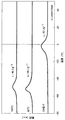
- FIG. 6 shows the results of differential scanning calorimetry (DSC) of latent heat and melting point.
- the left figure shows the time of heat storage (heating) and the right figure shows the time of heat dissipation (cooling).
- the horizontal axis represents the temperature and the vertical axis represents the heat flow.
- L is the latent heat and Tm is the melting point.
- the chemical conversion treatment conditions and the oxidation treatment conditions are the same as those in FIG.
- the latent heat is 92 J / g for pure Ga, 47.3 (25 + 22.3) J / g after chemical conversion treatment, and 51 J / g after oxidation treatment.
- the latent heat is 97 J / g for pure Ga, 46 J / g after chemical conversion treatment, and 46 J / g after oxidation treatment. As described above, it can be seen that the latent heat amount of about 50% of the pure Ga can be retained after the chemical conversion treatment and the oxidation treatment.
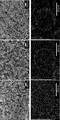
- FIG. 7 is an SEM-EDS photograph of a sample after chemical conversion treatment and oxidation treatment before and after repeated storage and heat dissipation test.
- the upper part of FIG. 7 is after the chemical conversion treatment, and the lower part of FIG. 7 is after the oxidation treatment, and SEM photographs before and after the storage and heat dissipation test are shown.
- the conditions for chemical conversion treatment and oxidation treatment are the same as those for the sample shown in FIG.
- storage and heat generation that is, phase transformation between the solid phase and the liquid phase was performed 10 times in a temperature range of ⁇ 80 ° C. to 50 ° C.
- FIG. 8 shows a sample after the oxidation treatment (oxidation temperature: 600 ° C.), in which the phase transformation between the solid phase and the liquid phase was repeated 10 times (combination of melting and solidification 10 times) as a repeated heat storage test. It is a surface SEM photograph of the sample after the relationship between the number of phase transformations (cycle) and the normalized latent heat, the phase transformation temperature, and the repeated storage and heat dissipation test. The horizontal axis is the number of phase transformations (cycles), and the vertical axis is the normalized latent heat and phase transformation temperature. Normalization is expressed by the value when the initial value is 1 (the value divided by the value of the first phase transformation).
- ⁇ -Ga is expanded by 3.2% by volume.
- Microcapsules covered with 2 O 3 shells were obtained. With microcapsules, a latent heat amount of about 50% of that of pure Ga was obtained. As a result of repeated storage and heat dissipation tests, it was found that the shell was hardly damaged and stable storage and heat dissipation characteristics could be obtained.
- FIG. 9 shows a method for producing microcapsules in which [1] gallium particle production conditions and [3] oxidation treatment conditions are fixed, and [2] chemical conversion treatment (water treatment) conditions are changed. The following evaluation was carried out on the sample before [1] gallium particle preparation step, [2] chemical conversion treatment (water treatment) step, and [3] oxidation treatment step. So to speak, the shell was evaluated in the state of a precursor of ⁇ -Ga 2 O 3 shell.
- the gallium particle preparation conditions are the same as those in FIG. 1 except that the temperature of the distilled water is 35 ° C. Further, in [2] chemical conversion treatment (water treatment), the temperature was selected within the range of 60 ° C. to 100 ° C., and the treatment time was also selected within the range of 5 minutes to 5 hours.
- FIG. 10 is an SEM photograph of microcapsules after chemical conversion treatment (water treatment) at 80 ° C. and 100 ° C. when the water treatment temperature is 60 ° C., 70 ° C., 80 ° C., 100 ° C. and the water treatment time is 3 hours. Is. The upper row is a surface photograph, and the lower row is a cross-sectional photograph. When the water treatment temperature is 80 ° C. and 100 ° C., it can be seen that a shell (GaOOH crystal) is formed on the surface of the Ga core. The film thickness of the shell is thicker at 100 ° C than at 80 ° C. On the other hand, in the samples in which the chemical conversion treatment temperatures were 60 ° C. and 70 ° C., no precipitate was formed on the surface.
- FIG. 11 is an XRD analysis result of the shell when the water treatment temperature is 80 ° C. and 100 ° C. where the shell is precipitated on the surface of the Ga core and the water treatment time is 3 hours.
- a larger peak was observed in the sample treated with water at 100 ° C. It is considered that this GaOOH becomes ⁇ -Ga 2 O 3 in the subsequent oxidation treatment.
- FIG. 12 shows the results of measuring the latent heat of the same sample as in FIG. 11, and in FIG. 12, the horizontal axis represents the temperature and the vertical axis represents the heat flow.
- the latent heat of the Ga particles is 82 J / g, but the latent heat of the samples at 80 ° C. and 100 ° C. is 56 J / g and 46 J / g, respectively. It is probable that the latent heat was reduced by covering the Ga core with the GaOOH shell.
- the 100 ° C. sample is considered to have a larger shell film thickness than the 80 ° C. sample. Further, in the samples at 80 ° C. and 100 ° C., a decrease in melting point (supercooling) is observed.
- FIG. 13 is an SEM photograph of microcapsules after water treatment when the water treatment time is 15 minutes, 3 hours, and 5 hours.
- the upper row is a surface photograph, and the lower row is a cross-sectional photograph.
- the water treatment temperature is 100 ° C. It can be seen that a shell (GaOOH crystal) is formed on the surface of the Ga core when the water treatment time is 15 minutes or more. The film thickness of the shell becomes thicker as the water treatment time becomes longer. In the sample having a water treatment time of 5 minutes, no precipitate was formed on the surface.
- FIG. 14 is an SEM photograph of microcapsules when the water treatment time is 5 hours and the treatment temperature is 100 ° C. (right end of FIG. 13). The shape is slightly distorted from the spherical shape, but it can be seen that a shell with a large film thickness is formed.
- FIG. 15 is an XRD analysis result of the shell when the water treatment temperature is 100 ° C. and the water treatment time is 15 minutes, 1 hour, 3 hours, and 5 hours. A peak due to GaOOH, which was not observed in Ga particles before water treatment, was observed in the sample treated with water for 15 minutes or more, and it can be seen that GaOOH was precipitated as a shell.
- FIG. 16 shows the results of measuring the latent heat of the same sample as in FIG. 15, and in FIG. 16, the horizontal axis represents temperature and the vertical axis represents heat flow.
- the water treatment temperature is 100 ° C.
- the latent heat of the Ga particles is 82 J / g, but the latent heat of the samples having a water treatment time of 15 minutes, 1 hour, 3 hours, and 5 hours is 57 J / g, 36 J / g, and 54 J / g, respectively. .. It is probable that the latent heat was reduced by covering the Ga core with the GaOOH shell. In addition, a decrease in melting point (supercooling) is observed in each sample.
- This GaOOH shell is considered to be a so-called precursor of the ⁇ -Ga 2 O 3 shell formed through the [3] oxidation step.
- FIG. 17 shows the result of the thermal durability test of the GaOOH shell formed on the surface of Ga particles.
- the horizontal axis is the heating time and the vertical axis is the weight change. Indicates the rate and heating temperature.
- FIG. 17 shows a temperature curve (dashed line) and a TG curve (solid line).
- FIG. 18 shows the method shown in FIG. 9, in which the cross section of the sample is observed by SEM (scanning electron microscope) and EDS (X-ray analysis) after the [2] water treatment step and [3] oxidation treatment step, respectively. It is the result of
- the water treatment conditions are a condition in which a good GaOOH shell is formed at a treatment temperature of 100 ° C. and a treatment time of 3 hours.
- Oxidation treatment conditions were a treatment temperature of 600 ° C. and a treatment time of 3 hours in an oxygen atmosphere.
- the upper row is after the [2] chemical conversion treatment (water treatment) step
- the lower row is after the [3] oxidation treatment step.
- the leftmost two are SEM photographs of the cross section, and the other four are the EDS results of Ga and O.
- the SEM photograph a shell is formed on the surface in both the [2] water treatment step and the [3] oxidation treatment step.
- the compound of Ga and O is formed on the surface.
- the shell after the [2] water treatment step is GaOOH
- the shell after the [3] oxidation treatment step is ⁇ . -It is considered to be Ga 2 O 3.
- the film thickness of the shell is about the same in both the [2] water treatment step and the [3] oxidation treatment step, and is 1 to 2 ⁇ m. Therefore, [2] the process conditions of the water treatment step (temperature, time) was adjusted by controlling the thickness of GaOOH shell, [3] the film thickness of the Ga 2 O 3 shell after the oxidation treatment step It turns out that it can be controlled.
- FIG. 19 shows a latent heat storage microcapsule of a solid state gallium covered with a shell. It is a figure explaining the manufacturing method. The manufacturing method includes three steps [1] to [3] shown in FIG.
- Gallium particle preparation step A thin film swirl mixer is prepared, and 1.0 g of gallium and 10 ml of distilled water are placed in a reaction vessel. The temperature of the distilled water is maintained at 35 ° C. Since the melting point of gallium is about 29.8 ° C., gallium is a liquid in this state.
- the rotor is rotated at a rotation speed of 16000 rpm for 10 minutes to stir the distilled water containing gallium.
- liquid gallium particles having a diameter of about 30 ⁇ m are dispersed in the distilled water.
- Cooling step of gallium particles Liquid gallium particles are taken out, placed in a container such as a beaker, and cooled in liquid nitrogen (boiling point: -196 ° C.) for 20 minutes. As a result, the gallium particles are solidified to obtain solid gallium particles.
- gallium has a melting point of about 29.8 ° C. and expands by 3.2% in volume when it solidifies from a liquid to a solid. Therefore, by covering the Ga particles in the solid state with a solid shell, it is possible to prevent damage to the shell due to volume expansion during solidification of Ga.
- GaOOH solid gallium hydrate
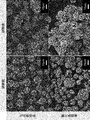
- FIG. 20 is an SEM photograph of the surface of the latent heat storage microcapsules after stirring in a solution of pH 11 for 15 minutes, 1 hour, 3 hours, 5 hours, 8 hours, 12 hours. When the treatment time was 3 hours or more, a honeycomb structure was observed on the surface of the microcapsules. It is considered that GaOOH, a hydrate of Ga, is formed around the Ga particles.
- FIG. 21 is an SEM photograph of a cross section of a microcapsule at pH 11 and a treatment time of 5 hours. A shell with a film thickness of about 0.5 ⁇ m is observed around the Ga particles. As mentioned above, it is considered to be a shell made of GaOOH.
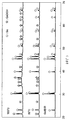
- FIG. 22 shows the results of X-ray diffraction (XRD) on the six samples of FIG. 20 to identify substances on the surface of the microcapsules. No peaks other than Ga were confirmed in all samples. From the honeycomb structure of FIG. 20, it is considered that the hydrate of Ga is not in the crystalline state but in the amorphous state, and therefore GaOOH was not detected in the XRD.
- the sample subjected to the [3] pH treatment step (pH 11 ⁇ 5 hours) was subjected to an oxidation treatment.
- the weight change was investigated.
- the oxidation treatment was carried out in an oxygen atmosphere (O 2 flow rate: 200 ml / min) for 30 minutes or more.
- FIG. 23 shows the relationship between the oxidation treatment time and the weight change during the oxidation treatment.
- the horizontal axis is the oxidation treatment time, and the vertical axis is the weight change rate and the treatment temperature.
- the weight reduction starts immediately after heating, and the weight becomes almost constant after 20 minutes.
- This weight loss 2GaOOH ⁇ Ga 2 O 3 + H 2 O It is considered that this is due to dehydration from GaOOH, and the honeycomb structure in FIG. 20 is considered to be GaOOH.
- FIG. 24 is a differential scanning calorimetry (DSC) result of latent heat for the six samples of FIG. The measurement was carried out by cooling from 50 ° C. to ⁇ 80 ° C. at a cooling rate of 2 ° / min.
- the atmosphere was an Ar atmosphere, and the Ar flow rate was 50 ml / min.
- the latent heat of the Ga particles before the treatment was 82 J / g, whereas the latent heat was 85 J / g even when the treatment time was 12 hours, and there was no significant difference in the latent heat amount between the samples. It is considered that this is because the amount of GaOOH precipitated around the Ga particles, that is, the film thickness of the GaOOH shell does not change significantly even if the treatment time is lengthened.
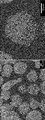
- FIG. 25 shows SEM photographs before and after the repeated storage and heat dissipation test of a sample having a pH of 11 and a treatment time of 5 hours. The left is the SEM photograph before the durability test, and the right is the SEM photograph after the durability test.
- storage and heat generation that is, phase transformation between the solid phase and the liquid phase was performed 10 times in a temperature range of ⁇ 80 ° C. to 50 ° C.
- the atmosphere was an Ar atmosphere, and the Ar flow rate was 50 ml / min.
- FIG. 26 is an SEM photograph of the surface of the latent heat storage microcapsules after stirring in a solution having a pH of 7, 8, 9, 10 and 11 at room temperature (25 ° C.) for 5 hours. When the treatment time was 3 hours or more, a honeycomb structure was observed on the surface of the microcapsules. It is considered that GaOOH, a hydrate of Ga, is formed around the Ga particles.
- FIG. 27 shows the results of X-ray diffraction (XRD) on the six samples of FIG. GaOOH peaks were observed in the samples at pH 8, 9 and 10. is this, Ga 2+ + 2OH - ⁇ GaOOH + 1 / 2H 2 As a result, GaOOH, a hydrate of Ga, was formed around Ga. On the other hand, no peak of GaOOH was observed in the sample at pH 11. It is considered that this is because GaOOH becomes an amorphous state at pH 11 as described in "(2-2) Adjustment of treatment time". In FIG. 27, the peak of GaOOH is the largest at pH 9.
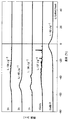
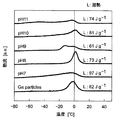
- FIG. 28 shows the differential scanning calorimetry (DSC) results of latent heat for the six samples of FIG. The measurement was carried out by cooling from 50 ° C. to ⁇ 80 ° C. at a cooling rate of 2 ° / min.
- the atmosphere was an Ar atmosphere, and the Ar flow rate was 50 ml / min.
- the latent heat of Ga particles before treatment is 82 J / g, whereas the latent heat is 97 J / g, 73 J / g, 61 J / g, 81 J / g, 74 J at pH 7, 8, 9, 10 and 11, respectively. It became / g.
- the latent heat amount is small at pH 9 because the film thickness of GaOOH, which is the shell, is the largest.
- FIG. 29 shows the measurement results of the differential scanning calorimetry of the latent heat storage microcapsules and Ga treated in the solutions of pH 9 and 11.
- the horizontal axis represents temperature and the vertical axis represents heat flow, and shows the measurement results of MEPCM-9 (pH 9), MEPCM-11 (pH 11), and Ga particles.
- the latent heat during solidification was 85 J / g for pure Ga, 61 J / g for MEPCM-9, and 86 J / g for MEPCM-11.
- the latent heat at the time of melting was 83 J / g for pure Ga, 59 J / g for MEPCM-9, and 88 J / g for MEPCM-11.
- the latent heat closer to pure Ga can be obtained by the treatment in the solution of pH 11 than in the case of the treatment in the solution of pH 9.
- FIG. 30 is a surface SEM photograph of a sample before and after repeated storage and heat dissipation tests (repetition number: 10 times) on MEPCM-9 (pH 9) and MEPCM-11 (pH 11).
- MEPCM-9 (pH 9)
- MEPCM-11 (pH 11)
- the spherical sample shape was maintained and no protrusions were observed before and after the repeated storage and heat dissipation test.
- GaOOH may be in a honeycomb-like amorphous state.
- the latent heat storage microcapsule according to the present invention can be used in electric vehicles and the like as a heat storage material having a flexible shape.
Landscapes
- Chemical & Material Sciences (AREA)
- Engineering & Computer Science (AREA)
- Chemical Kinetics & Catalysis (AREA)
- Physics & Mathematics (AREA)
- Combustion & Propulsion (AREA)
- Thermal Sciences (AREA)
- Materials Engineering (AREA)
- Organic Chemistry (AREA)
- General Chemical & Material Sciences (AREA)
- Manufacturing Of Micro-Capsules (AREA)
- Developing Agents For Electrophotography (AREA)
Priority Applications (5)
| Application Number | Priority Date | Filing Date | Title |
|---|---|---|---|
| US17/753,297 US12522759B2 (en) | 2019-08-27 | 2020-08-27 | Latent heat storage body microcapsule and method for producing same |
| JP2021542998A JP7352306B2 (ja) | 2019-08-27 | 2020-08-27 | 潜熱蓄熱体マイクロカプセルおよびその製造方法 |
| EP20857100.0A EP4023731A4 (en) | 2019-08-27 | 2020-08-27 | LATENT HEAT STORAGE MICRO CAPSULE AND METHOD FOR PRODUCING THE SAME |
| CN202080060730.4A CN114341309B (zh) | 2019-08-27 | 2020-08-27 | 潜热蓄热体微囊及其制造方法 |
| US19/411,548 US20260092209A1 (en) | 2019-08-27 | 2025-12-08 | Latent heat storage body microcapsule and method for producing same |
Applications Claiming Priority (2)
| Application Number | Priority Date | Filing Date | Title |
|---|---|---|---|
| JP2019155019 | 2019-08-27 | ||
| JP2019-155019 | 2019-08-27 |
Related Child Applications (2)
| Application Number | Title | Priority Date | Filing Date |
|---|---|---|---|
| US17/753,297 A-371-Of-International US12522759B2 (en) | 2019-08-27 | 2020-08-27 | Latent heat storage body microcapsule and method for producing same |
| US19/411,548 Division US20260092209A1 (en) | 2019-08-27 | 2025-12-08 | Latent heat storage body microcapsule and method for producing same |
Publications (1)
| Publication Number | Publication Date |
|---|---|
| WO2021039899A1 true WO2021039899A1 (ja) | 2021-03-04 |
Family
ID=74685952
Family Applications (1)
| Application Number | Title | Priority Date | Filing Date |
|---|---|---|---|
| PCT/JP2020/032341 Ceased WO2021039899A1 (ja) | 2019-08-27 | 2020-08-27 | 潜熱蓄熱体マイクロカプセルおよびその製造方法 |
Country Status (5)
| Country | Link |
|---|---|
| US (2) | US12522759B2 (https=) |
| EP (1) | EP4023731A4 (https=) |
| JP (1) | JP7352306B2 (https=) |
| CN (1) | CN114341309B (https=) |
| WO (1) | WO2021039899A1 (https=) |
Cited By (1)
| Publication number | Priority date | Publication date | Assignee | Title |
|---|---|---|---|---|
| CN115382475A (zh) * | 2022-09-08 | 2022-11-25 | 宁波大学 | 一种纳米粒子壁材掺杂型金属相变微胶囊及其制备方法 |
Families Citing this family (1)
| Publication number | Priority date | Publication date | Assignee | Title |
|---|---|---|---|---|
| CN115740435A (zh) * | 2022-11-18 | 2023-03-07 | 湖南中材盛特新材料科技有限公司 | 一种液态金属微粒胶囊的制备方法 |
Citations (8)
| Publication number | Priority date | Publication date | Assignee | Title |
|---|---|---|---|---|
| CN101775270A (zh) * | 2010-03-12 | 2010-07-14 | 重庆大学 | 含相变微胶囊的液态金属流体 |
| JP2014017445A (ja) * | 2012-07-11 | 2014-01-30 | Canon Inc | 保持装置、処理装置、リソグラフィー装置、および物品の製造方法 |
| WO2015162929A1 (ja) * | 2014-04-24 | 2015-10-29 | 国立大学法人北海道大学 | 潜熱蓄熱体、潜熱蓄熱体の製造方法、および、熱交換材料 |
| JP2016215745A (ja) | 2015-05-18 | 2016-12-22 | トヨタ自動車株式会社 | 車両の制御装置 |
| WO2017200021A1 (ja) * | 2016-05-17 | 2017-11-23 | 国立大学法人北海道大学 | 潜熱蓄熱体マイクロカプセルおよび潜熱蓄熱体マイクロカプセルの製造方法 |
| US20180257322A1 (en) * | 2017-03-08 | 2018-09-13 | Iowa State University Research Foundation, Inc. | Self-strengthening polymer composites |
| KR20190036278A (ko) * | 2017-09-27 | 2019-04-04 | 한국에너지기술연구원 | 코어-쉘 고온 열저장재 및 이의 제조 방법 |
| KR20190036275A (ko) * | 2017-09-27 | 2019-04-04 | 한국에너지기술연구원 | 코어-쉘 고온 열저장재 및 이의 제조 방법 |
Family Cites Families (4)
| Publication number | Priority date | Publication date | Assignee | Title |
|---|---|---|---|---|
| JP5272225B2 (ja) * | 2009-03-31 | 2013-08-28 | 石原薬品株式会社 | 低融点金属粉末およびその製造方法 |
| US10293325B2 (en) * | 2013-12-11 | 2019-05-21 | University Of Massachusetts | Core-shell multi-layer particles |
| WO2017011029A1 (en) * | 2015-07-14 | 2017-01-19 | Iowa State University Research Foundation, Inc. | Stable undercooled metallic particles for engineering at ambient conditions |
| US10720261B2 (en) * | 2016-02-02 | 2020-07-21 | Carnegie Mellon University, A Pennsylvania Non-Profit Corporation | Polymer composite with liquid phase metal inclusions |
-
2020
- 2020-08-27 US US17/753,297 patent/US12522759B2/en active Active
- 2020-08-27 JP JP2021542998A patent/JP7352306B2/ja active Active
- 2020-08-27 CN CN202080060730.4A patent/CN114341309B/zh active Active
- 2020-08-27 EP EP20857100.0A patent/EP4023731A4/en active Pending
- 2020-08-27 WO PCT/JP2020/032341 patent/WO2021039899A1/ja not_active Ceased
-
2025
- 2025-12-08 US US19/411,548 patent/US20260092209A1/en active Pending
Patent Citations (8)
| Publication number | Priority date | Publication date | Assignee | Title |
|---|---|---|---|---|
| CN101775270A (zh) * | 2010-03-12 | 2010-07-14 | 重庆大学 | 含相变微胶囊的液态金属流体 |
| JP2014017445A (ja) * | 2012-07-11 | 2014-01-30 | Canon Inc | 保持装置、処理装置、リソグラフィー装置、および物品の製造方法 |
| WO2015162929A1 (ja) * | 2014-04-24 | 2015-10-29 | 国立大学法人北海道大学 | 潜熱蓄熱体、潜熱蓄熱体の製造方法、および、熱交換材料 |
| JP2016215745A (ja) | 2015-05-18 | 2016-12-22 | トヨタ自動車株式会社 | 車両の制御装置 |
| WO2017200021A1 (ja) * | 2016-05-17 | 2017-11-23 | 国立大学法人北海道大学 | 潜熱蓄熱体マイクロカプセルおよび潜熱蓄熱体マイクロカプセルの製造方法 |
| US20180257322A1 (en) * | 2017-03-08 | 2018-09-13 | Iowa State University Research Foundation, Inc. | Self-strengthening polymer composites |
| KR20190036278A (ko) * | 2017-09-27 | 2019-04-04 | 한국에너지기술연구원 | 코어-쉘 고온 열저장재 및 이의 제조 방법 |
| KR20190036275A (ko) * | 2017-09-27 | 2019-04-04 | 한국에너지기술연구원 | 코어-쉘 고온 열저장재 및 이의 제조 방법 |
Non-Patent Citations (2)
| Title |
|---|
| See also references of EP4023731A4 |
| TEYIS, IAN D. ET AL.: "Synthesis of Liquid Core- Shell Particles and Solid Patchy Multicomponent Particles by Shearing Liquids Into Complex Particles (SLICE", LANGMUIR, vol. 30, 2014, pages 14308 - 14313, XP055536780, DOI: 10.1021/la5035118 * |
Cited By (2)
| Publication number | Priority date | Publication date | Assignee | Title |
|---|---|---|---|---|
| CN115382475A (zh) * | 2022-09-08 | 2022-11-25 | 宁波大学 | 一种纳米粒子壁材掺杂型金属相变微胶囊及其制备方法 |
| CN115382475B (zh) * | 2022-09-08 | 2023-11-17 | 宁波大学 | 一种纳米粒子壁材掺杂型金属相变微胶囊及其制备方法 |
Also Published As
| Publication number | Publication date |
|---|---|
| US20220380650A1 (en) | 2022-12-01 |
| CN114341309B (zh) | 2025-03-14 |
| JP7352306B2 (ja) | 2023-09-28 |
| EP4023731A1 (en) | 2022-07-06 |
| US20260092209A1 (en) | 2026-04-02 |
| CN114341309A (zh) | 2022-04-12 |
| JPWO2021039899A1 (https=) | 2021-03-04 |
| US12522759B2 (en) | 2026-01-13 |
| EP4023731A4 (en) | 2023-09-13 |
Similar Documents
| Publication | Publication Date | Title |
|---|---|---|
| US20260092209A1 (en) | Latent heat storage body microcapsule and method for producing same | |
| JP6967790B2 (ja) | 潜熱蓄熱体マイクロカプセル、潜熱蓄熱体の製造方法、熱交換材料、および触媒機能性潜熱蓄熱体 | |
| Li et al. | A yolk/shell strategy for designing hybrid phase change materials for heat management in catalytic reactions | |
| Sheng et al. | Development of a microencapsulated Al–Si phase change material with high-temperature thermal stability and durability over 3000 cycles | |
| US10894907B2 (en) | Latent-heat storage body microcapsules and process for producing latent-heat storage body microcapsules | |
| Kashiyama et al. | Ga‐based microencapsulated phase change material for low‐temperature thermal management applications | |
| Zhou et al. | Flexible core–shell structured Al-Cu alloy phase change materials for heat management | |
| Kawaguchi et al. | Modified preparation of Al2O3@ Al microencapsulated phase change material with high durability for high-temperature thermal energy storage over 650° C | |
| Zhao et al. | Development of over 3000 cycles durable macro-encapsulated aluminum with cavity by a sacrificial layer method for high temperature latent heat storage | |
| Shimizu et al. | Novel microencapsulated ternary eutectic alloy-based phase change material | |
| JP2026020409A (ja) | 潜熱蓄熱粒子、熱交換材料、および潜熱蓄熱粒子の製造方法 | |
| Gokon et al. | Thermal charge/discharge performance of iron–germanium alloys as phase change materials for solar latent heat storage at high temperatures | |
| KR20220055765A (ko) | 우수한 열 전도성 및 형태 안정성을 가진 유무기 하이브리드 캡슐형 상 변이 소재의 제조방법 | |
| CN118888724A (zh) | 一种正极材料及其制备方法、锂离子电池 | |
| Liu et al. | Synthesis of Al@ Al2O3 microcapsules by a triple-coating method for high-temperature thermal energy storage | |
| Zhang et al. | Processing and properties of Al-Si microcapsules with a biomimetic-corrugated structure and corundum-mullite composite shell | |
| CN117832449A (zh) | 高镍正极材料及其制备方法和电池 | |
| Park et al. | Microencapsulated sodium nitrate with titanium-dioxide shell for high-temperature and high-density latent heat storage | |
| Sheng et al. | Fabrication and characterization of Sn@ Viod@ Ceramic phase change macrocapsules for medium-temperature thermal storage | |
| Zhu et al. | Preparation of Microencapsulated Low‐Melting‐Point Sn–Bi Alloy for Latent Heat Storage | |
| CN111217592B (zh) | 一种基于熔盐法的高锂含量氚增殖陶瓷小球制备方法 | |
| CN115000516A (zh) | 一种多聚磷酸铵@聚脲醛微胶囊结构的阻燃剂材料及合成方法 | |
| Ge et al. | Fabrication of Cu–Ge macrocapsules using ceramic shells by powder formation method for high-temperature thermal energy storage | |
| US20250179340A1 (en) | Latent heat storage particle, heat exchange material and method for manufacturing latent heat storage particle | |
| CN115851235A (zh) | 一种热化学-潜热-显热的复合储热大胶囊及其制备方法 |
Legal Events
| Date | Code | Title | Description |
|---|---|---|---|
| 121 | Ep: the epo has been informed by wipo that ep was designated in this application |
Ref document number: 20857100 Country of ref document: EP Kind code of ref document: A1 |
|
| DPE1 | Request for preliminary examination filed after expiration of 19th month from priority date (pct application filed from 20040101) | ||
| ENP | Entry into the national phase |
Ref document number: 2021542998 Country of ref document: JP Kind code of ref document: A |
|
| NENP | Non-entry into the national phase |
Ref country code: DE |
|
| ENP | Entry into the national phase |
Ref document number: 2020857100 Country of ref document: EP Effective date: 20220328 |
|
| WWG | Wipo information: grant in national office |
Ref document number: 202080060730.4 Country of ref document: CN |
|
| WWG | Wipo information: grant in national office |
Ref document number: 17753297 Country of ref document: US |