WO2021033281A1 - 情報処理方法 - Google Patents
情報処理方法 Download PDFInfo
- Publication number
- WO2021033281A1 WO2021033281A1 PCT/JP2019/032582 JP2019032582W WO2021033281A1 WO 2021033281 A1 WO2021033281 A1 WO 2021033281A1 JP 2019032582 W JP2019032582 W JP 2019032582W WO 2021033281 A1 WO2021033281 A1 WO 2021033281A1
- Authority
- WO
- WIPO (PCT)
- Prior art keywords
- fim
- evaluation value
- information processing
- items
- evaluation
- Prior art date
- Legal status (The legal status is an assumption and is not a legal conclusion. Google has not performed a legal analysis and makes no representation as to the accuracy of the status listed.)
- Ceased
Links
Images






Classifications
-
- G—PHYSICS
- G16—INFORMATION AND COMMUNICATION TECHNOLOGY [ICT] SPECIALLY ADAPTED FOR SPECIFIC APPLICATION FIELDS
- G16H—HEALTHCARE INFORMATICS, i.e. INFORMATION AND COMMUNICATION TECHNOLOGY [ICT] SPECIALLY ADAPTED FOR THE HANDLING OR PROCESSING OF MEDICAL OR HEALTHCARE DATA
- G16H50/00—ICT specially adapted for medical diagnosis, medical simulation or medical data mining; ICT specially adapted for detecting, monitoring or modelling epidemics or pandemics
- G16H50/30—ICT specially adapted for medical diagnosis, medical simulation or medical data mining; ICT specially adapted for detecting, monitoring or modelling epidemics or pandemics for calculating health indices; for individual health risk assessment
-
- G—PHYSICS
- G16—INFORMATION AND COMMUNICATION TECHNOLOGY [ICT] SPECIALLY ADAPTED FOR SPECIFIC APPLICATION FIELDS
- G16H—HEALTHCARE INFORMATICS, i.e. INFORMATION AND COMMUNICATION TECHNOLOGY [ICT] SPECIALLY ADAPTED FOR THE HANDLING OR PROCESSING OF MEDICAL OR HEALTHCARE DATA
- G16H20/00—ICT specially adapted for therapies or health-improving plans, e.g. for handling prescriptions, for steering therapy or for monitoring patient compliance
- G16H20/30—ICT specially adapted for therapies or health-improving plans, e.g. for handling prescriptions, for steering therapy or for monitoring patient compliance relating to physical therapies or activities, e.g. physiotherapy, acupressure or exercising
Definitions
- the present invention relates to an information processing method, an information processing device, and a program.
- Injuries, illnesses, old age, etc. may reduce movement and cognitive functions in daily life.
- rehabilitation is performed at a rehabilitation facility to restore activities of daily living and cognitive function.
- FIM Frctional Independence Measure: daily life
- An index for measuring motor / cognitive function related to movement is used.
- the FIM is composed of a total of 18 items such as 13 types of exercise items and 5 types of cognitive items, and each item is evaluated to the extent that assistance in 4 or 7 stages is required. I'm supposed to do it.
- the FIM is an example as an index for measuring the condition of the human body as a patient, and it is possible to predict the evaluation of items set in other indexes for evaluating the condition of the human body different from the FIM.
- an object of the present invention is to provide an information processing method, an information processing device, and a program capable of solving the above-mentioned problem that it is difficult to accurately predict the evaluation of all items of FIM. It is to propose.
- the information processing method which is one embodiment of the present invention, is In each of the plurality of items set in FIM (Functional Independence Measure), the first evaluation value indicating the evaluation of the subject at a predetermined time point and the second evaluation value representing the evaluation of the subject after a lapse of a predetermined time from the predetermined time point. Accepting the input of evaluation value, A model for calculating the second evaluation value with respect to the first evaluation value in each of a plurality of FIM items is generated based on the information representing the relationship between the items of the FIM. It takes the configuration.
- FIM Federal Information Processing Method
- the information processing method is Based on the information indicating the relationship between the items set in the FIM (Functional Independence Measure), the predetermined time from the predetermined time point with respect to the first evaluation value representing the evaluation of the target person at the predetermined time point in each of the plurality of items of the FIM.
- the model generated to calculate the second evaluation value representing the evaluation of the subject after the lapse the new first evaluation value in each of the plurality of items of the FIM is input, and the new first evaluation value is input.
- the information processing device which is one embodiment of the present invention is In each of the plurality of items set in FIM (Functional Independence Measure), the first evaluation value representing the evaluation of the subject at a predetermined time point and the second evaluation value representing the evaluation of the subject after a lapse of a predetermined time from the predetermined time point.
- the input section that accepts the input of the evaluation value
- a generation unit that generates a model for calculating the second evaluation value with respect to the first evaluation value in each of a plurality of FIM items based on information representing the relationship between the items of the FIM. With, It takes the configuration.
- the information processing device which is one embodiment of the present invention is Based on the information indicating the relationship between the items set in the FIM (Functional Independence Measure), the predetermined time from the predetermined time point with respect to the first evaluation value representing the evaluation of the target person at the predetermined time point in each of the plurality of items of the FIM.
- An input unit for inputting a new first evaluation value in each of a plurality of items of the FIM for a model generated to calculate a second evaluation value representing the evaluation of the subject after the lapse of time.
- a prediction unit that outputs the value calculated by the model in response to the input of the new first evaluation value, and With, It takes the configuration.
- the program which is one form of the present invention For information processing equipment In each of the plurality of items set in FIM (Functional Independence Measure), the first evaluation value representing the evaluation of the subject at a predetermined time point and the second evaluation value representing the evaluation of the subject after a lapse of a predetermined time from the predetermined time point.
- the input section that accepts the input of the evaluation value
- a generation unit that generates a model for calculating the second evaluation value with respect to the first evaluation value in each of a plurality of FIM items based on information representing the relationship between the items of the FIM. To realize, It takes the configuration.
- the program which is one form of the present invention For information processing equipment Based on the information indicating the relationship between the items set in the FIM (Functional Independence Measure), the predetermined time from the predetermined time point with respect to the first evaluation value representing the evaluation of the target person at the predetermined time point in each of the plurality of items of the FIM.
- An input unit for inputting a new first evaluation value in each of a plurality of items of the FIM for a model generated to calculate a second evaluation value representing the evaluation of the subject after the lapse of time.
- a prediction unit that outputs the value calculated by the model in response to the input of the new first evaluation value, and To realize, It takes the configuration.
- the information processing method which is one form of the present invention, is The first evaluation value representing the evaluation of the subject at a predetermined time in each of the plurality of items set as the predetermined index for evaluating the condition of the human body, and the evaluation of the subject after a lapse of a predetermined time from the predetermined time.
- a model for calculating the second evaluation value with respect to the first evaluation value in each of the plurality of items of the predetermined index is generated based on the information representing the relationship between the items of the predetermined index. It takes the configuration.
- the information processing method which is one form of the present invention, is Based on the information indicating the relationship between the items set in the predetermined index for evaluating the state of the human body, with respect to the first evaluation value representing the evaluation of the subject at a predetermined time in each of the plurality of items of the predetermined index.
- the model generated to calculate the second evaluation value representing the evaluation of the subject after the lapse of the predetermined time from the predetermined time point the new first evaluation value in each of the plurality of items of the predetermined index is applied.
- the present invention is configured as described above, and can accurately predict the evaluation of all items of FIM.
- FIG. 5 is a diagram showing an example of data included in a mathematical formula used when a model is generated by the information processing apparatus disclosed in FIG.
- FIGS. 1 to 7. are diagrams for explaining the configuration of the information processing device, and FIG. 7 is a diagram for explaining the processing operation of the information processing device.
- a patient whose movement and cognitive function in daily life has deteriorated due to injury, illness, old age, etc. can rehabilitate for recovery of movement / cognitive function in daily life. It is used to predict the patient's condition later when performing rehabilitation in an institution.
- the target patient for rehabilitation includes patients with cerebrovascular diseases such as cerebral infarction and cerebral hemorrhage, but patients in any state may be targeted.
- the information processing device 10 uses the FIM (Functional Independence Measure), which is an index for measuring the motor / cognitive function related to the patient's activities of daily living, to check each item of the FIM at the time of admission (predetermined time point).
- the facility side can create an efficient rehabilitation plan for the patient.
- the prediction results can provide appropriate information regarding future assistance to the patient and the patient's family.
- the above-mentioned time of admission is not necessarily limited to the day of admission, but may be a time that can be regarded as a time of admission, such as when each item of FIM is evaluated several days after the day of admission.
- the above-mentioned discharge time is not necessarily limited to the day of discharge, but may be the day when discharge is scheduled from the time of admission or the time when a preset period such as two weeks or one month has passed from the time of admission. ..
- the above-mentioned hospitalization and discharge are examples, and the information processing device 10 predicts the evaluation value of each item of FIM at an arbitrary time point after the patient from the state at an arbitrary time point during hospitalization. You may.
- the FIM which is an index for measuring the motor / cognitive function related to the activities of daily living of the patient, will be described with reference to FIG.
- the FIM is composed of a total of 18 items, including 13 types of motor items for evaluating the patient's "motor function” and 5 types of cognitive items for evaluating the patient's "cognitive function”. ..
- FIM is an item for evaluating the movement function of the patient's "self-care” category as the above-mentioned exercise items, such as "meal”, “conditioning”, “bed bath”, “changing clothes (upper body)", and “changing clothes (upper body)".
- “transfer” category which is an item to evaluate the movement function of the patient.
- Items such as “bed / chair / wheelchair”, “toilet”, “bath / shower”, and “walking / wheelchair” and “stairs” that evaluate the movement function of the patient's "movement” category.
- FIM is an item for evaluating the function of the patient's “communication” category as the above cognitive items, “understanding (auditory / visual)", “expression (voice / non-voice)", and patient's “social recognition”. It includes items such as “social interaction”, “problem solving”, and “memory” that evaluate the function of the category.
- the degree of assistance required by the patient is evaluated on a 4-point or 7-point scale for each of the above-mentioned items.
- levels such as “L1: complete assistance”, “L2: with assistance”, “L3: partial assistance”, and “L4: independence”. May be evaluated.
- evaluation on a 7-point scale in this way, the patient may be evaluated by aggregating each item, each category, and each function by using the points given according to each evaluation degree.
- each item of FIM described above is usually performed by an expert who assists the patient. For example, as will be described later with reference to FIG. 6, depending on the “occupational therapist (OP)” and “physiotherapist (PT)”, “meal”, “dressing”, “cleaning”, and “changing clothes (upper body)” , “Changing clothes (lower body)”, “toilet operation”, “bed / chair / wheelchair”, “bathtub / shower”, “stairs”, etc. are evaluated. In addition, items such as “urination control”, “defecation control”, “toilet”, and “walking / wheelchair” are evaluated by the “nurse”. In addition, items such as “understanding (auditory / visual)”, “expression (voice / non-voice)”, “social interaction”, “problem solving”, and “memory” by "speech-language pathologist (ST)” Is evaluated.
- the evaluation value of each item of the FIM is input to the data management device 20 by the expert who is the evaluator described above, and is stored as patient data.
- the data management device 20 stores patient data for each patient as an electronic medical record.
- patient data for example, "gender”, “age group”, “consciousness level (JCS: Japan Coma Scale)", “disease name”, “paralyzed state”, “FIM at the time of admission” Information such as “evaluation value (first evaluation value)” and “evaluation value of each item of FIM at discharge (second evaluation value)" is stored.
- the patient data is not necessarily limited to including the information of the above-mentioned contents, and may be only a part of the above-mentioned information, or may include other information. It should be noted that the patient data of the patients who are still in the hospital do not include the "evaluation value of each item of FIM at the time of discharge".
- the information processing device 10 evaluates each item of the FIM at the time of discharge of the patient at the time of admission or at the time of discharge of the patient. Predict. Therefore, the information processing apparatus 10 has a process of generating a model for predicting the evaluation value of each item of the FIM at the time of discharge of the patient (model generation process) and a process of generating the FIM at the time of discharge of the patient using such a model. It has the following configuration to realize the process of predicting the evaluation value of each item (prediction process) and the function of performing the process.
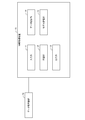
- the information processing device 10 is composed of one or a plurality of information processing devices including an arithmetic unit and a storage device. Then, as shown in FIG. 2, the information processing device 10 includes an input unit 11, a learning unit 12, and an output unit 13 constructed by the arithmetic unit executing a program. Further, the information processing device 10 includes a data storage unit 14 and a model storage unit 15 formed in the storage device.
- the information processing device 10 includes a data storage unit 14 and a model storage unit 15 formed in the storage device.
- the input unit 11 requests patient data from the data management device 20, receives the input of the patient data, and stores it in the data storage unit 14.
- the input unit 11 requests and acquires patient data of a patient who has already been discharged as learning data at the time of model generation processing. For example, the input unit 11 requests patient data in which a flag indicating that the patient has been discharged is set, and patient data in which the evaluation value of each item of the FIM at the time of discharge is input, and is the learning data. Get as.
- the input unit 11 requests and acquires the patient data of the patient to be the target of the prediction processing that has not been discharged yet as the prediction data. For example, the input unit 11 requests patient data in which a flag indicating that the patient has been discharged is not set, or patient data in which the evaluation value of each item of FIM at the time of discharge is not input, and is predictive data. Get as.
- the patient data as the prediction data of the patient to be the target of the prediction processing is acquired after the model is generated as described later, but it may be acquired at any timing.
- the learning unit 12 (generation unit) performs machine learning using the patient data acquired as the learning data described above, generates a model for predicting the evaluation value of each item of the FIM at the time of discharge of the patient, and obtains such a model. Is stored in the model storage unit 15. At this time, the learning unit 12 includes "basic information” such as "gender”, “age group”, “consciousness level”, “disease name”, and "paralyzed state” in the patient data, and "FIM at the time of admission”.
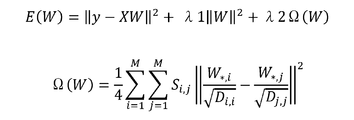
- the learning unit 12 generates a model function f_i using ridge regression. Specifically, the learning unit 12 calculates the parameters (W) (coefficients) of each term constituting the model function (f_i) so as to minimize the evaluation function (loss function) shown in the upper part of FIG. , Generate the model function (f_i).
- an evaluation function including two regularization terms including the parameter (W) is used.
- the first regularization term is " ⁇ 1
- ⁇ 1 and ⁇ 2 are parameters that adjust the degree of influence of each regularization term on the loss function. This parameter shall be given in advance. The larger the magnitude of ⁇ 1 and ⁇ 2, the stronger the influence on the loss function.
- ⁇ (W)" constituting the regularization term of the final term includes an adjacency matrix represented by "Si, j" as shown in the lower part of FIG.
- the adjacency matrices Si and j are information indicating the relationship between the items of the FIM. For example, “1” is set between the items related to each other and “0” is set between the items not related to each other. It will be.
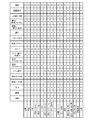
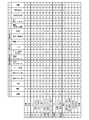
- the adjacency matrix Si, j will be described with reference to FIGS. 4 to 6.
- the adjacency matrices Si and j are set based on the similarity of the evaluation contents of each item of FIM. Specifically, in the example of FIG. 4, when the "function" ("motor” or “cognition") to which the item in the FIM shown in FIG. 1 belongs is the same, the items are related to each other. "1" is set between the items belonging to the "motor” function and between the items belonging to the "cognitive” function. Further, in the example of FIG.
- the function (f_i) corresponding to the FIM items associated with each other is included.
- the function (f_i) can be generated so that the parameters are similar to each other. That is, in the formula shown in the lower part of FIG. 3, the difference between the parameters of the functions corresponding to the FIM items associated with each other is squared, but the parameters are used to reduce the value of the evaluation function. Will be optimized to be similar.
- the output unit 13 (prediction unit) inputs the patient data of the patient who has not yet been discharged, which was acquired as the prediction data by the input unit 11, into the model function (f_i) generated as described above. That is, the output unit 13 uses the model function as "basic information” such as “gender”, “age group”, “consciousness level”, “disease name”, and “paralyzed state” in the patient data just hospitalized, and "hospitalization”. "Information at the time of admission” such as “evaluation value (first evaluation value) of each item of FIM at the time” is input to the model function as an input value (X_n'), and output by such model function (f_i (X_n')). Calculate the value (y_i'). Thereby, it is possible to predict the evaluation value (for example, a value of 7 steps) of each item of FIM at the time of discharge of the patient who has just been hospitalized.
- the information processing device 10 performs a model generation process for generating a model for predicting the evaluation value of each item of the FIM at the time of discharge of the patient. Therefore, the information processing device 10 requests the past patient data from the data management device 20, and acquires the patient data as learning data (step S1).
- the information processing device 10 contains "basic information” such as "gender”, “age group”, “consciousness level”, “disease name”, and “paralyzed state” in the patient data, and "FIM at the time of admission”.
- a model function represented by a function that uses “evaluation value” and other "admission information” as input values and "evaluation value of each item of FIM at discharge” as an output value is generated by machine learning ( Step S2).
- the information processing apparatus 10 generates a model function using ridge regression, and in particular, as described above, a regularization term including an adjacent matrix which is information representing the relationship between the items of the FIM is added.
- the evaluation function is used to optimize the parameters of each term that composes the model function. As a result, it is possible to generate a model function in which the parameters included in the model function corresponding to the mutually related FIM items are similar to each other.
- the information processing apparatus 10 uses the generated model to perform prediction processing for predicting the evaluation value of each item of FIM at the time of discharge of the patient. Therefore, the information processing device 10 requests the data management device 20 for newly admitted patients or patient data that has been hospitalized but has not been discharged, and acquires such patient data as prediction data. (Step S3). Therefore, the patient data acquired as the prediction data does not include the evaluation value of each item of FIM at the time of discharge because the patient has not been discharged yet.
- the information processing device 10 contains "basic information” such as "gender”, “age group”, “consciousness level”, “disease name”, and “paralyzed state” in the patient data, and "FIM at the time of admission”. "Evaluation value” and other "hospitalization information” are input to the model function as input values (step S4). Then, the information processing apparatus 10 outputs the "evaluation value of each item of FIM at the time of discharge” calculated by the model function as a predicted value (step S5). This makes it possible to predict the evaluation value (for example, a value of 7 levels) of each item of FIM at the time of discharge of the hospitalized patient. Then, the output prediction result can be used, for example, to create an efficient rehabilitation plan for the patient at the facility, or to give advice on future assistance to the patient and the patient's family.
- a model for calculating the evaluation value of each item of the FIM is generated from the information of the patient who has undergone rehabilitation in consideration of the relationship between the items of the FIM. ..
- the evaluation value of the item set in the FIM is used, but the value of the item set in another index for evaluating the state of the human body may be used.
- an index for evaluating activities of daily living such as the "Barthel Index” that evaluates all 10 items set from the two viewpoints of personal movement and movement movement according to the degree of independence, and the value of the item of such index May be used to generate a model as described above and calculate a predicted value.
- FIG. 8 is a diagram for explaining the configuration of the information processing apparatus according to the second embodiment.
- the information processing apparatus 10 in the present invention is based on the patient's information including the evaluation values of each item of the FIM at the time of admission (predetermined time point) at the time of later discharge (predetermined time has elapsed from the time of admission). It is used to predict the evaluation value of each item of FIM (later).
- this embodiment is different from the first embodiment in that it predicts whether or not the evaluation value of each item of FIM at the time of discharge will increase by one step or more.
- a configuration different from that of the first embodiment will be mainly described.
- the information processing device 10 includes an input unit 11, a learning unit 12, and an output unit 13 constructed by the arithmetic unit executing a program, as shown in FIG. Further, the information processing device 10 includes a data storage unit 14 and a model storage unit 15 formed in the storage device.
- the input unit 11 in the present embodiment requests the patient data from the data management device 20, receives the input of the patient data, and stores it in the data storage unit 14.
- the input unit 11 requests and acquires patient data of a patient who has already been discharged as learning data at the time of model generation processing.
- the evaluation values of each item of FIM at the time of admission and discharge are "L1: complete assistance", “L2: with assistance”, “L3: partial assistance”, and "L4: independence". It is assumed that the evaluation is made on a four-point scale.
- the input unit 11 requests and acquires the patient data of the patient to be the target of the prediction processing that has not been discharged yet as the prediction data.
- the learning unit 12 (generation unit) in the present embodiment performs machine learning using the patient data acquired as the above-mentioned learning data, and the evaluation value of each item of FIM at the time of discharge of the patient is even one stage.
- a model for predicting whether or not to rise is generated, and such a model is stored in the model storage unit 15.
- the learning unit 12 first receives "basic information” such as "gender”, "age group”, “consciousness level”, “disease name”, and "paralyzed state” in the patient data, and "FIM at the time of admission".
- the above-mentioned “initial value which is an evaluation value of each item of FIM at the time of admission” is "L1: complete assistance”, “L2: with assistance”, “L3: partial assistance”, “L4: independence”. It is an evaluation value of four stages such as ", and patient data is classified and learned for each FIM item and each initial value.
- the learning unit 12 from the "evaluation value of each item of FIM at the time of admission and discharge" in the patient data, in each item of FIM, "the evaluation value at the time of admission increases by one step or more at the time of discharge".
- the value (y) representing "" is calculated in advance and set as an output value.
- the output value may be set as a value indicating "whether or not the evaluation value at the time of admission has decreased by one step or more at the time of discharge" in each item of the FIM. That is, the output value may be set as a value indicating whether or not the evaluation value at the time of admission changes in one direction such as an increase or a decrease at the time of discharge.
- the learning unit 12 uses a machine to generate a model function represented by a function (f_ik (X_n)) that calculates an output value that becomes a binary value as described above with respect to the input value set as described above. Generated by learning. At this time, the learning unit 12 generates a model function for calculating an output value for each item of FIM and for each initial value which is an evaluation value of each item of FIM at the time of admission. For example, the learning unit 12 has a model function for the FIM item "meal” whose initial value, which is the evaluation value of the item "meal" at the time of admission, corresponds to each of "L1", “L2", and "L3". Will be generated.
- a model function corresponding to each of the three types of initial values is generated for each of the 18 items, and a total of 54 types of model functions are collectively generated. If the initial value at the time of admission is "L4: Independence", it is not necessary to predict the later evaluation value, so the model function is not generated.
- the learning unit 12 generates a model function (f_ik) using logistic regression. Specifically, the learning unit 12 generates a model function so as to calculate a binary output value with respect to the input value by using the classification probability of the sigmoid function. At this time, the learning unit 12 calculates the parameters (W) (coefficients) of each term constituting the model function so as to minimize the evaluation function (loss function), as in the first embodiment. Generate a function. The parameters of each term that composes the model function are given to the output values by the input values (for example, age, gender, consciousness level, value of each item of FIM, etc.) input to the variables included in the model function. It represents the degree of strength of the influence.
- an evaluation function is used in which another regularization term is added to the two regularization terms including the parameter (W) described in the first embodiment.
- 2 " and " ⁇ 2 ⁇ (W)” described in the first embodiment are combined with the third regularization term “ ⁇ 3 ⁇ '(W). ) ”Is added.
- ⁇ 1, ⁇ 2, and ⁇ 3 are parameters that adjust the degree of influence of each regularization term on the loss function, as described above. This parameter shall be given in advance. The larger the magnitude of ⁇ 1, ⁇ 2, and ⁇ 3, the stronger the effect on the loss function.
- ⁇ '(W) constituting the third regularization term added in the present embodiment is the second regularization term shown in FIG. 3 described in the first embodiment.
- the contents are almost the same as the constituent ⁇ (W), but the adjacency matrix "Si, j" is different.
- the adjacency matrix S'i, j of the regularization term to be added is information indicating the relationship between the initial values in each item of FIM. For example, “1" is provided between the initial values that are related to each other, and they are related to each other. It is an adjacency matrix in which "0" is set between the initial values.
- the adjacency matrix S'i, j included in the " ⁇ '(W)" constituting the third regularization term in the present embodiment will be described with reference to FIG.
- the adjacency matrix S'i, j is set according to whether or not the initial values in each item of FIM are associated.
- the evaluation values shown in FIG. 1 are associated with “L1: complete assistance” and “L2: with assistance”, and between the initial values, “L1: with assistance”. 1 ”is set.
- “1” is set for the initial values "L1” and “L2”
- "0" is set for the initial value "L3”
- other items are also set.
- the adjacency matrix shown in FIG. 8, that is, the association between the initial values is an example, and other information indicating the association between the initial values may be used.
- the matrix has a size of 54 columns ⁇ 54 columns.
- the adjacency matrices Si and j included in " ⁇ (W)" constituting the second regularization term of the present embodiment are different from the case of the first embodiment shown in FIG. Similar to the adjacency matrix S'i, j included in the regularization term of the eye, it is a matrix with a size of 54 columns ⁇ 54 columns.
- the value of each element is set for each FIM item and for each initial value as in FIG. 8, but regardless of the initial value, the FIM item " Considering only the related examples of "function” and “category”, “1” is set when the "function” and “category” of the FIM item are related to each other, and "0” is set in other cases. Will be done. For example, for the row of the "exercise” function of FIM, “1” is set for all columns of the “exercise” function regardless of the value of each initial value, and “0” is set for the other columns. Is set. Also, for the row of the "cognitive” function of FIM, “1” is set for all columns of the “cognitive” function regardless of the value of each initial value, and "0” for the other columns. Is set.
- the initial value of each item of FIM associated with each other is added.
- the model function can be generated so that the parameters included in the corresponding model function (f_ik) are similar to each other.
- the model corresponding to the FIM items associated with each other is provided.
- the model function can be generated so that the parameters included in the function are similar to each other.
- the output unit 13 (prediction unit) in the present embodiment inputs the patient data of the patient who has not been discharged yet acquired as the prediction data by the input unit 11 into the model function (f_ik) generated as described above. To do. That is, the output unit 13 uses the model function as "basic information” such as "gender”, “age group”, “consciousness level”, “disease name”, and "paralyzed state” in the patient data just hospitalized, and "hospitalization".
- each of the FIMs is considered to be related to each item of the FIM and the relationship between the initial values of each item of the FIM from the information of the past patient to be rehabilitated.
- a model is generated to calculate whether or not the evaluation value of the item increases. In this way, changes in the evaluation value of each item of FIM at the time of discharge can be predicted based on the relationship between the items of FIM and the relationship between the initial values of each item of FIM. Even if the evaluation index has items, it is possible to accurately and quickly predict the change in the evaluation value of each item of the FIM at the time of discharge.
- the evaluation value of the item set in the FIM is used, but the value of the item set in another index for evaluating the state of the human body may be used.
- an index for evaluating activities of daily living such as the "Barthel Index” that evaluates all 10 items set from the two viewpoints of personal movement and movement movement according to the degree of independence, and the value of the item of such index May be used to generate a model as described above and calculate a predicted value.
- FIGS. 9 to 13 are block diagrams showing the configuration of the information processing device according to the third embodiment, and FIGS. 12 to 13 are flowcharts showing the operation of the information processing device.
- the outline of the configuration of the information processing apparatus and the information processing method described in the first and second embodiments is shown.
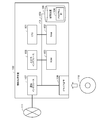
- the information processing device 100 is composed of a general information processing device, and is equipped with the following hardware configuration as an example.
- -CPU Central Processing Unit
- -ROM Read Only Memory
- RAM Random Access Memory
- 103 storage device
- -Program group 104 loaded into RAM 303
- a storage device 105 that stores the program group 304.
- a drive device 106 that reads and writes a storage medium 110 external to the information processing device.
- -Communication interface 107 that connects to the communication network 111 outside the information processing device -I / O interface 108 for inputting / outputting data -Bus 109 connecting each component
- the information processing apparatus 100 can construct and equip the input unit 121 and the generation unit 122 shown in FIG. 10 by acquiring the program group 104 by the CPU 101 and executing the program group 104.
- the program group 104 is stored in, for example, a storage device 105 or a ROM 102 in advance, and the CPU 101 loads the program group 104 into the RAM 103 and executes the program group 104 as needed. Further, the program group 104 may be supplied to the CPU 101 via the communication network 111, or may be stored in the storage medium 110 in advance, and the drive device 106 may read the program and supply the program to the CPU 101.
- the input unit 121 and the generation unit 122 described above may be constructed by an electronic circuit.
- FIG. 9 shows an example of the hardware configuration of the information processing device 100, and the hardware configuration of the information processing device is not limited to the above case.
- the information processing device may be composed of a part of the above-described configuration, such as not having the drive device 106.
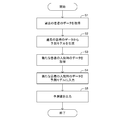
- the information processing apparatus 100 executes the information processing method shown in the flowchart of FIG. 12 by the functions of the input unit 121 and the generation unit 122 constructed by the program as described above.
- the information processing device 100 is In each of the plurality of items set in FIM (Functional Independence Measure), the first evaluation value indicating the evaluation of the subject at a predetermined time point and the second evaluation value representing the evaluation of the subject after a lapse of a predetermined time from the predetermined time point.
- FIM Field Independent Measure
- Accepting the input of the evaluation value step S11
- a model for calculating the second evaluation value with respect to the first evaluation value in each of the plurality of items of the FIM is generated (step S12).
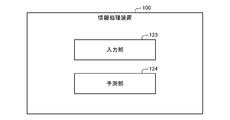
- the information processing apparatus 100 can be equipped with the input unit 123 and the prediction unit 124 shown in FIG. 11 by constructing and equipping the program group 104 by the CPU 101 acquiring the program group 104 and executing the program group 104.
- the above-mentioned input unit 123 and prediction unit 124 may be constructed by an electronic circuit.
- the information processing device 100 executes the information processing method shown in the flowchart of FIG. 13 by the functions of the input unit 123 and the prediction unit 124 constructed by the program as described above.
- the information processing device 100 is Based on the information indicating the relationship between the items set in the FIM (Functional Independence Measure), the predetermined time from the predetermined time point with respect to the first evaluation value representing the evaluation of the target person at the predetermined time point in each of the plurality of items of the FIM.
- the model generated to calculate the second evaluation value representing the evaluation of the subject after the lapse a new first evaluation value in each of the plurality of items of the FIM is input (step S21), and the new evaluation value is input.
- the value calculated by the model is output in response to the input of the first evaluation value (step S22).
- the information processing device 100 described above is composed of, for example, a server computer installed in a facility such as a hospital where the target patient performs rehabilitation, or a so-called cloud-based server computer operated and managed by the facility. .. Further, as described above, the value calculated and output by the information processing apparatus 100 is an information processing terminal (personal computer, tablet terminal, smartphone) used by medical professionals such as therapists and nurses who assist the rehabilitation of patients in the facility. , Etc.) and will be referred to by the healthcare professional.
- a server computer installed in a facility such as a hospital where the target patient performs rehabilitation
- a so-called cloud-based server computer operated and managed by the facility. ..
- the value calculated and output by the information processing apparatus 100 is an information processing terminal (personal computer, tablet terminal, smartphone) used by medical professionals such as therapists and nurses who assist the rehabilitation of patients in the facility. , Etc.) and will be referred to by the healthcare professional.
- the present embodiment is configured as described above to generate a model for calculating the evaluation value of each item of the FIM in consideration of the relationship between the items of the FIM. By utilizing the relationship between the items of the FIM in this way, it is possible to predict the evaluation value of each item of the FIM accurately and quickly even if the evaluation index has many items. It should be noted that each embodiment is not limited to being applied to the items set in the FIM, and evaluates the items set in the index different from the FIM for measuring the patient's condition and other human body conditions. It is also applicable to items set for all indicators such as.
- Appendix 2 The information processing method described in Appendix 1 Generate the model based on information indicating whether the items of the FIM are related to each other. Information processing method.
- Appendix 3 The information processing method described in Appendix 2 The model is generated based on the information associated between the items according to the evaluation content of each item of the FIM. Information processing method.
- Appendix 3.1 The information processing method described in Appendix 2 The model is generated based on the information indicating whether or not the items are associated with each other, which is set based on the evaluation content of each item of the FIM. Information processing method.
- Appendix 4 The information processing method according to Appendix 3 or 3.1.
- the model is generated based on the information associated between the items according to the action or cognitive content to be evaluated in each item of the FIM. Information processing method.
- Appendix 4.1 The information processing method according to Appendix 3 or 3.1.
- the model is generated based on the information indicating whether or not the items are associated with each other, which is set based on the content of the action or cognition evaluated in each item of the FIM. Information processing method.
- Appendix 9 The information processing method described in Appendix 8 While generating the model for each item of FIM and for each first evaluation value, Based on the information indicating the relationship between the items of the FIM and the information indicating the relationship between the first evaluation values, the second evaluation value with respect to the first evaluation value in each of the plurality of items of the FIM is set. Generate a model to calculate, Information processing method.
- Appendix 10 The information processing method described in Appendix 9 The model is generated based on the information indicating whether or not the first evaluation values are associated with each other. Information processing method.
- Appendix 11 The information processing method described in Appendix 10 Generate the model so that the parameters contained in the model corresponding to the interconnected first evaluation value are similar. Information processing method.
- Appendix 16 The information processing device according to Appendix 15.
- a prediction unit that outputs a value calculated by the model in response to a new input of the first evaluation value in each of a plurality of items of the FIM with respect to the model.
- Information processing device further equipped with.
- Appendix 19 The program described in Appendix 18 In the information processing device A prediction unit that outputs a value calculated by the model in response to a new input of the first evaluation value in each of a plurality of items of the FIM with respect to the model. A program to further realize.
- Appendix 20 For information processing equipment Based on the information indicating the relationship between the items set in the FIM (Functional Independence Measure), the predetermined time from the predetermined time point with respect to the first evaluation value representing the evaluation of the target person at the predetermined time point in each of the plurality of items of the FIM.
- An input unit for inputting a new first evaluation value in each of a plurality of items of the FIM for a model generated to calculate a second evaluation value representing the evaluation of the subject after the lapse of time.
- a prediction unit that outputs the value calculated by the model in response to the input of the new first evaluation value, and A program to realize.
- Appendix 22 The information processing method described in Appendix 21.
- a new first evaluation value for each of a plurality of items of the predetermined index is input to the model, and a value calculated by the model is output in response to the input of the new first evaluation value.
- Information processing method
- Non-temporary computer-readable media include various types of tangible storage media.
- Examples of non-temporary computer-readable media include magnetic recording media (eg, flexible disks, magnetic tapes, hard disk drives), magneto-optical recording media (eg, magneto-optical disks), CD-ROMs (Read Only Memory), CD-Rs, Includes CD-R / W and semiconductor memory (for example, mask ROM, PROM (Programmable ROM), EPROM (Erasable PROM), flash ROM, RAM (RandomAccessMemory)).
- the program may also be supplied to the computer by various types of temporary computer readable media. Examples of temporary computer-readable media include electrical, optical, and electromagnetic waves.
- the temporary computer-readable medium can supply the program to the computer via a wired communication path such as an electric wire and an optical fiber, or a wireless communication path.
- Information processing device 11 Input unit 12 Learning unit 13 Output unit 14 Data storage unit 15 Model storage unit 20 Data management device 100 Information processing device 101 CPU 102 ROM 103 RAM 104 Program group 105 Storage device 106 Drive device 107 Communication interface 108 Input / output interface 109 Bus 110 Storage medium 111 Communication network 121 Input unit 122 Generation unit 123 Input unit 124 Prediction unit
Landscapes
- Medical Informatics (AREA)
- Engineering & Computer Science (AREA)
- Public Health (AREA)
- Health & Medical Sciences (AREA)
- Pathology (AREA)
- Databases & Information Systems (AREA)
- Data Mining & Analysis (AREA)
- Biomedical Technology (AREA)
- Epidemiology (AREA)
- General Health & Medical Sciences (AREA)
- Primary Health Care (AREA)
- Medical Treatment And Welfare Office Work (AREA)
- Management, Administration, Business Operations System, And Electronic Commerce (AREA)
Priority Applications (3)
| Application Number | Priority Date | Filing Date | Title |
|---|---|---|---|
| PCT/JP2019/032582 WO2021033281A1 (ja) | 2019-08-21 | 2019-08-21 | 情報処理方法 |
| JP2021541400A JP7409384B2 (ja) | 2019-08-21 | 2019-08-21 | 情報処理方法 |
| US17/632,871 US20220285030A1 (en) | 2019-08-21 | 2019-08-21 | Information processing method |
Applications Claiming Priority (1)
| Application Number | Priority Date | Filing Date | Title |
|---|---|---|---|
| PCT/JP2019/032582 WO2021033281A1 (ja) | 2019-08-21 | 2019-08-21 | 情報処理方法 |
Publications (1)
| Publication Number | Publication Date |
|---|---|
| WO2021033281A1 true WO2021033281A1 (ja) | 2021-02-25 |
Family
ID=74660668
Family Applications (1)
| Application Number | Title | Priority Date | Filing Date |
|---|---|---|---|
| PCT/JP2019/032582 Ceased WO2021033281A1 (ja) | 2019-08-21 | 2019-08-21 | 情報処理方法 |
Country Status (3)
| Country | Link |
|---|---|
| US (1) | US20220285030A1 (https=) |
| JP (1) | JP7409384B2 (https=) |
| WO (1) | WO2021033281A1 (https=) |
Cited By (4)
| Publication number | Priority date | Publication date | Assignee | Title |
|---|---|---|---|---|
| JP7418072B1 (ja) * | 2022-11-28 | 2024-01-19 | 芙蓉開発株式会社 | ソフトウェア、データ処理装置及びデータ処理方法 |
| JP2024009366A (ja) * | 2022-03-03 | 2024-01-19 | Sompoケア株式会社 | 自立支援方法、情報処理装置、システム、及びプログラム |
| WO2024154781A1 (ja) * | 2023-01-19 | 2024-07-25 | 国立大学法人 東京大学 | 回帰分析方法、回帰分析システム及び回帰分析プログラム |
| JP7800880B1 (ja) * | 2025-10-06 | 2026-01-16 | Rehabilitation3.0株式会社 | Fim値推定装置、fim値推定方法、fim値推定プログラム、人工知能学習装置、人工知能学習方法、及び人工知能学習プログラム |
Citations (4)
| Publication number | Priority date | Publication date | Assignee | Title |
|---|---|---|---|---|
| JP2014178800A (ja) * | 2013-03-14 | 2014-09-25 | Gifu Univ | 医療情報処理装置、及び、プログラム |
| JP2018055424A (ja) * | 2016-09-29 | 2018-04-05 | 株式会社日立製作所 | 推計モデル構築システム、推計モデル構築方法及びプログラム |
| JP2018163493A (ja) * | 2017-03-24 | 2018-10-18 | 聡子 水流 | 評価システム、及び評価プログラム |
| JP2019057282A (ja) * | 2017-09-20 | 2019-04-11 | メディア株式会社 | 患者プロファイル情報システム、患者プロファイル情報システムの制御方法、プログラム、及び記録媒体 |
Family Cites Families (5)
| Publication number | Priority date | Publication date | Assignee | Title |
|---|---|---|---|---|
| CN106021377A (zh) * | 2016-05-11 | 2016-10-12 | 上海点荣金融信息服务有限责任公司 | 计算机实现的信息处理方法及装置 |
| US10361926B2 (en) * | 2017-03-03 | 2019-07-23 | Nec Corporation | Link prediction with spatial and temporal consistency in dynamic networks |
| WO2019147257A1 (en) | 2018-01-26 | 2019-08-01 | Hitachi High-Tech Solutions Corporation | Controlling devices to achieve medical outcomes |
| WO2020004102A1 (ja) * | 2018-06-25 | 2020-01-02 | 日本電信電話株式会社 | 機能回復訓練支援システムおよび方法 |
| JP7255392B2 (ja) * | 2019-06-27 | 2023-04-11 | トヨタ自動車株式会社 | リハビリ支援システム、推定装置、学習装置、方法、プログラム、及び学習済みモデル |
-
2019
- 2019-08-21 US US17/632,871 patent/US20220285030A1/en not_active Abandoned
- 2019-08-21 WO PCT/JP2019/032582 patent/WO2021033281A1/ja not_active Ceased
- 2019-08-21 JP JP2021541400A patent/JP7409384B2/ja active Active
Patent Citations (4)
| Publication number | Priority date | Publication date | Assignee | Title |
|---|---|---|---|---|
| JP2014178800A (ja) * | 2013-03-14 | 2014-09-25 | Gifu Univ | 医療情報処理装置、及び、プログラム |
| JP2018055424A (ja) * | 2016-09-29 | 2018-04-05 | 株式会社日立製作所 | 推計モデル構築システム、推計モデル構築方法及びプログラム |
| JP2018163493A (ja) * | 2017-03-24 | 2018-10-18 | 聡子 水流 | 評価システム、及び評価プログラム |
| JP2019057282A (ja) * | 2017-09-20 | 2019-04-11 | メディア株式会社 | 患者プロファイル情報システム、患者プロファイル情報システムの制御方法、プログラム、及び記録媒体 |
Cited By (6)
| Publication number | Priority date | Publication date | Assignee | Title |
|---|---|---|---|---|
| JP2024009366A (ja) * | 2022-03-03 | 2024-01-19 | Sompoケア株式会社 | 自立支援方法、情報処理装置、システム、及びプログラム |
| JP7543530B2 (ja) | 2022-03-03 | 2024-09-02 | Sompoケア株式会社 | 自立支援方法、情報処理装置、システム、及びプログラム |
| JP7418072B1 (ja) * | 2022-11-28 | 2024-01-19 | 芙蓉開発株式会社 | ソフトウェア、データ処理装置及びデータ処理方法 |
| WO2024116242A1 (ja) * | 2022-11-28 | 2024-06-06 | 芙蓉開発株式会社 | ソフトウェア、データ処理装置及びデータ処理方法 |
| WO2024154781A1 (ja) * | 2023-01-19 | 2024-07-25 | 国立大学法人 東京大学 | 回帰分析方法、回帰分析システム及び回帰分析プログラム |
| JP7800880B1 (ja) * | 2025-10-06 | 2026-01-16 | Rehabilitation3.0株式会社 | Fim値推定装置、fim値推定方法、fim値推定プログラム、人工知能学習装置、人工知能学習方法、及び人工知能学習プログラム |
Also Published As
| Publication number | Publication date |
|---|---|
| JPWO2021033281A1 (https=) | 2021-02-25 |
| JP7409384B2 (ja) | 2024-01-09 |
| US20220285030A1 (en) | 2022-09-08 |
Similar Documents
| Publication | Publication Date | Title |
|---|---|---|
| US20260106015A1 (en) | Apparatus, method, and computer readable medium for rehabilitation planning using machine learning | |
| Zarchi et al. | SCADI: A standard dataset for self-care problems classification of children with physical and motor disability | |
| Dangare et al. | A data mining approach for prediction of heart disease using neural networks | |
| WO2021033281A1 (ja) | 情報処理方法 | |
| JP2024059912A (ja) | デジタル個別化医療のためのプラットフォームおよびシステム | |
| Li et al. | Blood pressure prediction via recurrent models with contextual layer | |
| Lutze | Digital twins in ehealth–: Prospects and challenges focussing on information management | |
| JP7349078B2 (ja) | リハビリ計画装置、リハビリ計画方法、及びプログラム | |
| CN106777874A (zh) | 基于循环神经网络构建预测模型的方法 | |
| CN112639833A (zh) | 可自适应神经网络 | |
| KR102466731B1 (ko) | 멀티모달 인공신경망을 활용한 정신건강 상태 분류 장치 및 방법 | |
| WO2019137538A1 (en) | Emotion representative image to derive health rating | |
| Higaki et al. | Predicting outcome of Morris water maze test in vascular dementia mouse model with deep learning | |
| Al-Dailami et al. | Predicting length of stay in ICU and mortality with temporal dilated separable convolution and context-aware feature fusion | |
| Dutta et al. | An automated hierarchical gait pattern identification tool employing cross‐correlation‐based feature extraction and recurrent neural network based classification | |
| Saleh et al. | Stress Classification using Deep Learning with 1D Convolutional Neural Networks. | |
| JP7327498B2 (ja) | 情報処理方法 | |
| KR102564996B1 (ko) | 인공지능 기반 사용자 맞춤형 건강기능식품 큐레이션 서비스 제공 방법, 장치 및 시스템 | |
| KR102447046B1 (ko) | 인공지능 기반 임상시험 프로토콜 설계 방법, 장치 및 시스템 | |
| Ogburn et al. | Statistical reasoning and methods in epidemiology to promote individualized health: in celebration of the 100th Anniversary of the Johns Hopkins Bloomberg School of Public Health | |
| Mohanty et al. | A classification model based on an adaptive neuro-fuzzy inference system for disease prediction | |
| WO2022044284A1 (ja) | 情報処理方法 | |
| Divyashree et al. | Prediction of human health using decision tree technique | |
| KR20230060393A (ko) | 강화학습을 활용한 정신질환 예측 장치 및 방법 | |
| JP7367767B2 (ja) | 情報処理方法 |
Legal Events
| Date | Code | Title | Description |
|---|---|---|---|
| 121 | Ep: the epo has been informed by wipo that ep was designated in this application |
Ref document number: 19942091 Country of ref document: EP Kind code of ref document: A1 |
|
| ENP | Entry into the national phase |
Ref document number: 2021541400 Country of ref document: JP Kind code of ref document: A |
|
| NENP | Non-entry into the national phase |
Ref country code: DE |
|
| 122 | Ep: pct application non-entry in european phase |
Ref document number: 19942091 Country of ref document: EP Kind code of ref document: A1 |