WO2021002332A1 - チタン濃縮物の製造方法 - Google Patents
チタン濃縮物の製造方法 Download PDFInfo
- Publication number
- WO2021002332A1 WO2021002332A1 PCT/JP2020/025551 JP2020025551W WO2021002332A1 WO 2021002332 A1 WO2021002332 A1 WO 2021002332A1 JP 2020025551 W JP2020025551 W JP 2020025551W WO 2021002332 A1 WO2021002332 A1 WO 2021002332A1
- Authority
- WO
- WIPO (PCT)
- Prior art keywords
- titanium
- producing
- leaching
- titanium concentrate
- concentrate according
- Prior art date
- Legal status (The legal status is an assumption and is not a legal conclusion. Google has not performed a legal analysis and makes no representation as to the accuracy of the status listed.)
- Ceased
Links
Images

Classifications
-
- C—CHEMISTRY; METALLURGY
- C01—INORGANIC CHEMISTRY
- C01G—COMPOUNDS CONTAINING METALS NOT COVERED BY SUBCLASSES C01D OR C01F
- C01G23/00—Compounds of titanium
- C01G23/04—Oxides; Hydroxides
-
- C—CHEMISTRY; METALLURGY
- C22—METALLURGY; FERROUS OR NON-FERROUS ALLOYS; TREATMENT OF ALLOYS OR NON-FERROUS METALS
- C22B—PRODUCTION AND REFINING OF METALS; PRETREATMENT OF RAW MATERIALS
- C22B1/00—Preliminary treatment of ores or scrap
- C22B1/02—Roasting processes
-
- C—CHEMISTRY; METALLURGY
- C22—METALLURGY; FERROUS OR NON-FERROUS ALLOYS; TREATMENT OF ALLOYS OR NON-FERROUS METALS
- C22B—PRODUCTION AND REFINING OF METALS; PRETREATMENT OF RAW MATERIALS
- C22B3/00—Extraction of metal compounds from ores or concentrates by wet processes
- C22B3/04—Extraction of metal compounds from ores or concentrates by wet processes by leaching
- C22B3/06—Extraction of metal compounds from ores or concentrates by wet processes by leaching in inorganic acid solutions, e.g. with acids generated in situ; in inorganic salt solutions other than ammonium salt solutions
- C22B3/10—Hydrochloric acid, other halogenated acids or salts thereof
-
- C—CHEMISTRY; METALLURGY
- C22—METALLURGY; FERROUS OR NON-FERROUS ALLOYS; TREATMENT OF ALLOYS OR NON-FERROUS METALS
- C22B—PRODUCTION AND REFINING OF METALS; PRETREATMENT OF RAW MATERIALS
- C22B34/00—Obtaining refractory metals
- C22B34/10—Obtaining titanium, zirconium or hafnium
- C22B34/12—Obtaining titanium or titanium compounds from ores or scrap by metallurgical processing; preparation of titanium compounds from other titanium compounds see C01G23/00 - C01G23/08
-
- Y—GENERAL TAGGING OF NEW TECHNOLOGICAL DEVELOPMENTS; GENERAL TAGGING OF CROSS-SECTIONAL TECHNOLOGIES SPANNING OVER SEVERAL SECTIONS OF THE IPC; TECHNICAL SUBJECTS COVERED BY FORMER USPC CROSS-REFERENCE ART COLLECTIONS [XRACs] AND DIGESTS
- Y02—TECHNOLOGIES OR APPLICATIONS FOR MITIGATION OR ADAPTATION AGAINST CLIMATE CHANGE
- Y02P—CLIMATE CHANGE MITIGATION TECHNOLOGIES IN THE PRODUCTION OR PROCESSING OF GOODS
- Y02P10/00—Technologies related to metal processing
- Y02P10/20—Recycling
Definitions
- the present invention relates to a method for producing a high-quality titanium concentrate by removing impurities such as iron and silica from ilmenite-containing iron ore or its analogs.
- Titanium tetrachloride is usually produced by chlorinating a titanium concentrate with chlorine gas by the fluidization method (that is, fluid chlorination), so that it is high-grade, does not contain fine powder, and is easily chlorinated by the fluidization method. A concentrate was needed. This is because if the titanium concentrate contains a large amount of fine powder, the fine powder is scattered outside the fluidized chlorination furnace, so that the yield of titanium tetrachloride is low.
- the fluid chlorination is a method of causing the reaction while maintaining the titanium raw material and the carbonaceous reducing agent in a uniform fluidized state, that is, a suspended dispersion state by using a chlorinated gas.
- a titanium concentrate a high-grade titanium concentrate obtained by removing iron from natural rutile or titanium-containing iron ore such as ilmenite or ilmenite hematite ore has been used.
- These titanium concentrates for example, reduce titanium-containing iron ore or the like to convert iron into ferrous iron, and in the presence of a seed for promoting titanium salt hydrolysis or a titanium (III) salt, the first is ferrous acid. It is known that iron can be leached and then fired to produce it (Patent Documents 1 and 2).
- Patent Documents 3, 4, 5 and 6 have been proposed as a method for producing a high-grade titanium concentrate using titanium-containing iron ore having a low degree of metamorphism produced from a massive deposit.
- ilmenite produced from a massive deposit is pulverized so that 80% by mass or more thereof passes through a sieve of 200 mesh (opening 75 ⁇ m), and then leachate with mineral acid to remove iron, and TiO 2
- Described is a method of obtaining a powdered titanium concentrate having a quality (that is, TiO 2 content) of 90% by mass or more and granulating it into a size of substantially 10 to 150 mesh (opening 1.70 mm to 100 ⁇ m). Has been done.
- titania slag containing at least one selected from the group consisting of iron oxide, manganese oxide, chromium oxide, vanadium oxide, aluminum oxide, silicon oxide and alkaline earth metal oxide is sized to 75 to 850 ⁇ m.
- Patent Document 5 describes a method for producing pigment-grade titanium oxide by a hydrometallurgical method including a production step of leaching high magnesium ilmenite ore with concentrated hydrochloric acid in two steps.
- Patent Document 6 describes a solid substance obtained by leaching low-grade titanium ore with 35 to 40% hydrochloric acid at a reaction temperature of 60 to 70 ° C. again with 35 to 40% hydrochloric acid at 75 to 80 ° C. A method for producing high-quality synthetic rutile by leaching at the reaction temperature of is described.
- Patent Documents 5 and 6 are both manufacturing methods including a two-step leaching step using concentrated hydrochloric acid, there are problems in terms of safety, durability of the reaction vessel, etc., and the manufacturing method is industrially advantageous. I can't say.
- the present inventor crushes ilmenite-containing iron ore or the like more finely than before, and then at a reaction temperature of 80 ° C. or lower at an initial concentration of hydrochloric acid of 1 to 20% by mass. After pre-leaching, if the main leaching is performed at a reaction temperature of 90 ° C. or higher at an initial concentration of 15 to 20% by mass of hydrochloric acid in the presence of a soluble reducing substance, impurities such as iron and silica can be removed by a simple method. The present invention was completed with the finding that a high-quality titanium concentrate could be obtained.
- the titanium concentrate can be given a particle size and hardness suitable for fluid chlorination, and fine powder of the titanium concentrate can be obtained. Based on the finding that fluid chlorination can be efficiently performed without adversely affecting the production equipment because the content can be prevented and the fine powder can be prevented from being scattered outside the furnace, the present invention was developed. completed.
- a pulverized product obtained by pulverizing a titanium-containing iron ore or a similar product to a particle size passing through a 330 mesh sieve is preliminarily leached at a reaction temperature of 80 ° C. or lower at an initial concentration of 1 to 20% by mass of hydrochloric acid.
- a method for producing a titanium concentrate which comprises performing the main leaching at a reaction temperature of 90 ° C. or higher at an initial concentration of hydrochloric acid of 15 to 20% by mass in the presence of a soluble reducing substance.
- [2] The method for producing a titanium concentrate according to [1], wherein preliminary leaching is performed at an initial concentration of hydrochloric acid of 1 to 15% by mass.
- [3] The method for producing a titanium concentrate according to [1] or [2], which comprises washing and drying the leached product obtained by solid-liquid separation after performing the main leaching.
- [4] The method for producing a titanium concentrate according to [3], wherein the drying is granulation drying.
- [5] The method for producing a titanium concentrate according to [3] or [4], which comprises calcining the dried product obtained by drying at a temperature of 600 to 1000 ° C.
- [6] The method for producing a titanium concentrate according to any one of [1] to [5], wherein the main leaching is performed at a temperature equal to or lower than the boiling point of the leachate.
- [9] The method for producing a titanium concentrate according to any one of [1] to [8], wherein a step of adding a fluorine-based additive is performed after the main leaching is performed.
- the method for producing a titanium concentrate of the present invention even when a titanium-containing iron ore containing a large amount of impurities such as iron and silica and having a low degree of alteration is used as a starting material, it is simple and safe, and a reaction vessel is used. Since it is an industrially advantageous method with less load on the iron, it is possible to efficiently produce a high-quality titanium concentrate. Further, by simultaneously granulating and drying the titanium concentrate, the titanium concentrate can have an appropriate particle size and hardness, and the inclusion of fine powder in the titanium concentrate can be avoided, and the fine powder can be fluidized in a chlorination furnace. It is possible to prevent it from scattering to the outside, and it is possible to obtain titanium tetrachloride in a high yield.
- the titanium-containing iron ore or its analogs applicable to the production method of the present invention are ilmenite, ilmenite variants, for example, titanium-containing iron ore such as ilmenite and hematite, pretreated ores, or these. It is a similar product having the same composition and properties as. It can be applied to both ilmenite-containing iron ore with a high degree of metamorphism and ilmenite containing a low degree of denaturation, and is also suitably applied to ilmenite-containing iron ore with a low degree of denaturation containing a large amount of impurities such as silica or similar substances. it can.
- titanium slag which is a by-product in iron smelting.
- the particle size of these ilmenite-containing iron ores or their analogs is usually 50 to 500 ⁇ m, and those larger than this can be used after being appropriately pulverized.
- Al, Ca, Co, Cr, Cu, Ga, Ge, Mg, Mn, Mo, Nb, Ni, Pd, Ru , Sn, Ta, V, W and Zr may contain impurities consisting of oxides of at least one element selected from the group.
- the content of silica in ilmenite iron ore or its analogs is usually 0.5 to 35% by mass in terms of SiO 2 .
- ilmenite-containing iron ore or an analog thereof is pulverized to a particle size capable of passing through a sieve of 330 mesh (opening 45 ⁇ m) and used.
- the pulverization may be dry pulverization or wet pulverization in which pulverization is performed in a solvent, and commonly used pulverizing means such as ball mill, tube mill, vibrating ball mill, sand mill, disc mill, media mill, medialess mill, roller. This can be done using a mill or the like.
- the pulverization is preferably performed by dry pulverization and then wet pulverization. When wet pulverization is performed, the solvent and the pulverized product are separated into solid and liquid after pulverization.
- Solid-liquid separation can be performed by decantation, sedimentation separation, centrifugation, filtration, membrane separation, etc., but it is preferable to perform decantation. If the obtained pulverized product is not pulverized, or if the pulverized product is insufficiently pulverized to a predetermined particle size, impurities such as silica in the titanium concentrate cannot be sufficiently removed, resulting in high TiO 2 High-quality titanium concentrate cannot be obtained. In addition, there is a drawback that the pre-leaching and main leaching steps are not efficiently performed.
- the particle size is such that it can pass through a sieve with an opening of 20 ⁇ m). It is preferable to perform sizing after pulverization, and the ultrafine powder can be removed by utilizing the difference in the sedimentation rate of the particles.
- the obtained pulverized product was preliminarily leached at a reaction temperature of 80 ° C. or lower at an initial concentration of 1 to 20% by mass of hydrochloric acid, and then at an initial concentration of 15 to 20% by mass of hydrochloric acid in the presence of a soluble reducing substance.
- Main leaching is performed at a reaction temperature of 90 ° C. or higher to remove impurities such as iron and silica.
- the hydrochloric acid used is represented by the initial concentration, which is the hydrochloric acid concentration at the start of leaching. In the preliminary leaching, it is desirable that the initial concentration of hydrochloric acid is 1 to 15% by mass in order to remove the silica content more efficiently.
- the leaching container for pre-leaching and the leaching container for main leaching use a leaching container made of a material that is not corroded by hydrochloric acid. May be good.
- the preliminary leaching may be performed a plurality of times, or the main leaching may be performed a plurality of times.
- the amount (V) of hydrochloric acid used in the preliminary leaching is preferably 1.5 to 20 V / W with respect to the mass (W) of the pulverized product, more preferably 5 to 15, and 7 to 12 Is more preferable. Further, the preliminary leaching is preferably performed at a temperature of 80 ° C. or lower, more preferably 60 ° C. or lower. The time can be set as appropriate, and it is preferably performed for 1 to 15 hours. Further, when the preliminary leaching is performed in the presence of a fluorine-based additive, the silica component can be dissolved, which is efficient. As the fluorine-based additive, sodium fluoride, potassium fluoride, calcium fluoride, hydrofluoric acid and the like can be used.
- the amount of the fluorine-based additive added can be appropriately set.
- a soluble reducing substance described later may be present in order to increase the elution rate and the elution amount of iron.
- the leached product after the preliminary leaching may be directly subjected to the next main leaching step, and the main leaching can be continuously performed by adding hydrochloric acid and a soluble reducing substance to the container after the preliminary leaching.
- the pre-leaching exudate is solid-liquid separated by decantation, sedimentation, centrifugation, filtration, membrane separation, etc., concentrated in the form of a wet cake or slurry, and then subjected to the next main leaching step. May be served. Further, the leachate may be solid-liquid separated and then washed with water to desalt the coexisting ions remaining in the leachate. In this case, the leaching material is separated in the form of a wet cake and subjected to the next main leaching step.
- the amount (V) of hydrochloric acid used in the main leaching is preferably 1 to 10 in V / W with respect to the mass (W) of the leachate after the preliminary leaching, and more preferably 2 to 8.
- the main leaching is carried out at a reaction temperature of 90 ° C. or higher, but it is preferably carried out at a temperature equal to or lower than the boiling point of the leachate, and the time can be appropriately set, and is preferably carried out for 2 to 20 hours.
- an open leaching container it is preferable to perform leaching at 90 to 110 ° C. (below the boiling point) for 5 to 20 hours, and when using a closed leaching container, the temperature and time are adjusted depending on the pressurizing conditions. It can be set as appropriate, and leaching is preferably performed at 110 to 160 ° C. for 2 to 18 hours.
- a soluble reducing substance also referred to as “soluble reducing substance” in the present application
- soluble reducing substance in the present application
- Soluble reducing substances include metallic iron and / or soluble titanium salts.
- Metallic iron dissolves into iron ions when placed in a leachate.
- the soluble titanium salt include titanium (III) salt and titanium (IV) salt, and titanium (III) salt is preferable.
- titanium (III) salt As a method for allowing the titanium (III) salt to exist in the system, in addition to the method of adding a titanium (III) salt solution, metal iron powder or the like is added to the leachate to add titanium (IV) salt in the system to titanium (IV).
- metal iron powder or the like is added to the leachate to add titanium (IV) salt in the system to titanium (IV).
- the amount of the soluble titanium salt added can be appropriately set, and is preferably 0.8 to 1.5 times the amount of reducing trivalent iron to divalent (reduction equivalent), and 0.9 to 1 . Double the amount is more preferred.
- a seed for promoting titanium salt hydrolysis may be used in combination.
- This is a seed crystal used when a titanium salt solution is hydrolyzed to precipitate a titanium content in a method for producing a titanium dioxide pigment by a general sulfuric acid method, and this is an acidity of a titanium salt such as titanyl sulfuric acid.
- the solution is neutralized and the precipitated colloidal titanium compound is aged.
- the amount of titanium added in the titanium salt hydrolysis promoting seed to the leached product after the preliminary leaching should be about 0.05 to 2% by mass as TiO 2. Is preferable, and usually 0.1 to 1% by mass is more preferable.
- a fluorine-based additive When a fluorine-based additive is added to the leaching solution after the main leaching, or to a slurry of the leaching solution that has been solid-liquid separated by decantation, sedimentation separation, centrifugation, filtration, membrane separation, etc. It is preferable because it can remove the silica content.
- This step is called de-silica treatment, and as the fluorine-based additive, the above-mentioned sodium fluoride, potassium fluoride, calcium fluoride, hydrofluoric acid and the like can be used.
- the amount of the fluorine-based additive added can be appropriately set.
- the temperature of the desilicaization treatment is preferably a temperature equal to or lower than the boiling point of the leachate, more preferably a temperature of 20 to 90 ° C.
- the time for the desilicaization treatment can be appropriately set, and is preferably 0.5 to 10 hours.
- the leachate (that is, titanium concentrate) from which impurities such as iron and silica have been removed by pre-leaching, main leaching, and desilicaization is solidified by decantation, sedimentation, centrifugation, filtration, membrane separation, etc. Liquid separation. After that, it is preferable to wash and desalinate the coexisting ions remaining in the leachate.
- the desalting treatment is preferably washed until the electric conductivity becomes 0.1 S / m or less.
- the leachate can then be usually dried to form a powder. The drying temperature can be set as appropriate. Further, after drying, it may be crushed and granulated as needed.
- the titanium concentrate produced as described above has an extremely high TiO 2 grade, preferably 95% by mass or more.
- a normal granulation dryer can be used, and a fluidized bed granulation dryer and spray drying are more preferable.
- a spray dryer it is preferable to make the wet cake into a slurry, wet-pulverize it if necessary, and then spray-dry it.
- the titanium concentrate can be sized to a particle size of 30 to 300 ⁇ m by granulation drying, and can have an appropriate hardness.
- a titanium concentrate of the present invention after pre-leaching and main leaching, and further cleaning of the leachate obtained by solid-liquid separation after the main leaching (preferably, the leachate after desilicing treatment). Drying, especially granulation drying, can produce a titanium concentrate containing titanium oxide with a rutile structure.
- a titanium concentrate containing only titanium oxide having a rutile-type structure can be produced by drying without firing at a high temperature. Titanium oxide having a rutile-type structure has good reactivity with chlorine gas, so that chlorination is efficiently performed.
- the resulting titanium concentrate containing titanium oxide having a rutile structure can be calcined at a temperature of 600 to 1000 ° C. to increase hardness and purity, if necessary.
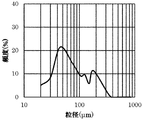
- the main composition of the raw material ilmenite ore used is shown in Table 1, and the particle size distribution is shown in FIG.
- the total TiO 2 in each table is a value obtained by expressing the Ti content in the composition in terms of TiO 2 .
- the composition was analyzed by volumetric analysis (Ti and Fe) and ICP emission spectroscopy.
- the particle size distribution was measured with a laser diffraction / scattering type particle size distribution measuring device LA-950 (manufactured by HORIBA, Ltd.).
- Example 1 It was confirmed that the ilmenite ore was crushed by a ball mill and passed through a 330 mesh (44 ⁇ m) sieve. The particle size distribution of this pulverized product is shown in FIG.
- titanium concentrate Two types of titanium concentrates were obtained by exchanging the nozzles of the spray dryer, a granular dried product having an average particle size of 40 ⁇ m and a granular dried product having an average particle size of 200 ⁇ m.
- the main component compositions of the obtained titanium concentrate are shown in Table 2.
- the total amount of total TiO 2 was titanium oxide having a rutile structure, and did not contain anatas-type structure titanium oxide or amorphous titanium oxide.
- the total Fe in the table represents the total amount of the analyzed FeO and Fe 2 O 3 in terms of Fe.
- Fe (0) metallic iron
- TiO 2 was titanium oxide having a rutile structure, and did not contain titanium oxide having an anatas-type structure or amorphous titanium oxide.
- the total Fe in the table represents the total amount of the analyzed FeO and Fe 2 O 3 in terms of Fe.
- the method for producing a titanium concentrate of the present invention is a simple method and efficiently even when a titanium-containing iron ore having a low degree of alteration containing a large amount of impurities such as iron and silica is used as a starting material. It is an industrially useful technique such as being able to produce a high-quality titanium concentrate and obtaining titanium tetrachloride in a high yield.
Landscapes
- Chemical & Material Sciences (AREA)
- Engineering & Computer Science (AREA)
- Organic Chemistry (AREA)
- Geology (AREA)
- Life Sciences & Earth Sciences (AREA)
- General Life Sciences & Earth Sciences (AREA)
- Environmental & Geological Engineering (AREA)
- Manufacturing & Machinery (AREA)
- Materials Engineering (AREA)
- Mechanical Engineering (AREA)
- Metallurgy (AREA)
- Inorganic Chemistry (AREA)
- Geochemistry & Mineralogy (AREA)
- Manufacture And Refinement Of Metals (AREA)
- Inorganic Compounds Of Heavy Metals (AREA)
Priority Applications (1)
| Application Number | Priority Date | Filing Date | Title |
|---|---|---|---|
| JP2021530022A JPWO2021002332A1 (https=) | 2019-07-02 | 2020-06-29 |
Applications Claiming Priority (4)
| Application Number | Priority Date | Filing Date | Title |
|---|---|---|---|
| JP2019-123585 | 2019-07-02 | ||
| JP2019123585 | 2019-07-02 | ||
| JP2019-194326 | 2019-10-25 | ||
| JP2019194326 | 2019-10-25 |
Publications (1)
| Publication Number | Publication Date |
|---|---|
| WO2021002332A1 true WO2021002332A1 (ja) | 2021-01-07 |
Family
ID=74100126
Family Applications (1)
| Application Number | Title | Priority Date | Filing Date |
|---|---|---|---|
| PCT/JP2020/025551 Ceased WO2021002332A1 (ja) | 2019-07-02 | 2020-06-29 | チタン濃縮物の製造方法 |
Country Status (3)
| Country | Link |
|---|---|
| JP (1) | JPWO2021002332A1 (https=) |
| TW (1) | TW202111132A (https=) |
| WO (1) | WO2021002332A1 (https=) |
Cited By (3)
| Publication number | Priority date | Publication date | Assignee | Title |
|---|---|---|---|---|
| CN112723311A (zh) * | 2020-12-28 | 2021-04-30 | 宜宾天原海丰和泰有限公司 | 利用铁矿石处理人造金红石母液综合利用的方法 |
| CN113604671A (zh) * | 2021-07-30 | 2021-11-05 | 四川顺应动力电池材料有限公司 | 一种高钙镁钛精矿制备高纯钛渣的方法 |
| WO2022059534A1 (ja) * | 2020-09-18 | 2022-03-24 | 石原産業株式会社 | フッ化アルカリ金属塩の回収方法及びその利用 |
Citations (6)
| Publication number | Priority date | Publication date | Assignee | Title |
|---|---|---|---|---|
| JPH06501741A (ja) * | 1990-03-02 | 1994-02-24 | ウィメラ インダストリアル ミネラルズ プロプライアタリー リミティド | 合成ルチルの製造 |
| JPH07500145A (ja) * | 1991-05-20 | 1995-01-05 | イー・アイ・デュポン・ドウ・ヌムール・アンド・カンパニー | TiO↓2鉱石の精製方法 |
| JPH07509279A (ja) * | 1992-07-31 | 1995-10-12 | アールジーシー ミネラル サンドズ リミテッド | チタン含有物質の処理 |
| CN102978378A (zh) * | 2012-11-30 | 2013-03-20 | 重庆地质矿产研究院 | 一种煤系地层共伴生钛矿床金属钛的浸出方法 |
| WO2014125275A1 (en) * | 2013-02-15 | 2014-08-21 | Tioxide Europe Limited | Method for producing titanium oxide and iron oxide |
| US20150252448A1 (en) * | 2014-03-05 | 2015-09-10 | Fouad F. KAMALEDDINE | Production of high-grade synthetic rutile from low-grade titanium-bearing ores |
-
2020
- 2020-06-29 JP JP2021530022A patent/JPWO2021002332A1/ja active Pending
- 2020-06-29 WO PCT/JP2020/025551 patent/WO2021002332A1/ja not_active Ceased
- 2020-06-29 TW TW109121761A patent/TW202111132A/zh unknown
Patent Citations (6)
| Publication number | Priority date | Publication date | Assignee | Title |
|---|---|---|---|---|
| JPH06501741A (ja) * | 1990-03-02 | 1994-02-24 | ウィメラ インダストリアル ミネラルズ プロプライアタリー リミティド | 合成ルチルの製造 |
| JPH07500145A (ja) * | 1991-05-20 | 1995-01-05 | イー・アイ・デュポン・ドウ・ヌムール・アンド・カンパニー | TiO↓2鉱石の精製方法 |
| JPH07509279A (ja) * | 1992-07-31 | 1995-10-12 | アールジーシー ミネラル サンドズ リミテッド | チタン含有物質の処理 |
| CN102978378A (zh) * | 2012-11-30 | 2013-03-20 | 重庆地质矿产研究院 | 一种煤系地层共伴生钛矿床金属钛的浸出方法 |
| WO2014125275A1 (en) * | 2013-02-15 | 2014-08-21 | Tioxide Europe Limited | Method for producing titanium oxide and iron oxide |
| US20150252448A1 (en) * | 2014-03-05 | 2015-09-10 | Fouad F. KAMALEDDINE | Production of high-grade synthetic rutile from low-grade titanium-bearing ores |
Cited By (3)
| Publication number | Priority date | Publication date | Assignee | Title |
|---|---|---|---|---|
| WO2022059534A1 (ja) * | 2020-09-18 | 2022-03-24 | 石原産業株式会社 | フッ化アルカリ金属塩の回収方法及びその利用 |
| CN112723311A (zh) * | 2020-12-28 | 2021-04-30 | 宜宾天原海丰和泰有限公司 | 利用铁矿石处理人造金红石母液综合利用的方法 |
| CN113604671A (zh) * | 2021-07-30 | 2021-11-05 | 四川顺应动力电池材料有限公司 | 一种高钙镁钛精矿制备高纯钛渣的方法 |
Also Published As
| Publication number | Publication date |
|---|---|
| TW202111132A (zh) | 2021-03-16 |
| JPWO2021002332A1 (https=) | 2021-01-07 |
Similar Documents
| Publication | Publication Date | Title |
|---|---|---|
| EP2474633B1 (en) | Titaniumrich hydrochloric acid leaching residue use thereof and preparation method of titanium dioxide | |
| WO2021002332A1 (ja) | チタン濃縮物の製造方法 | |
| CN102786082B (zh) | 一种人造金红石的制备方法 | |
| US3784670A (en) | Titanium dixide concentrate and its manufacturing process | |
| US20150252448A1 (en) | Production of high-grade synthetic rutile from low-grade titanium-bearing ores | |
| JPS61183123A (ja) | 顔料品位の二酸化チタン製造方法 | |
| CN112111661A (zh) | 钒渣钙锰复合焙烧提钒的方法 | |
| CA2480865C (en) | Acid beneficiation of ore | |
| JP2022510772A (ja) | チタン担持材料からの生成物の抽出方法 | |
| US10407316B2 (en) | Extraction of products from titanium-bearing minerals | |
| JPH08500393A (ja) | チタン鉄材料の品質改善 | |
| CN109476500A (zh) | 用于生产二氧化钛的工艺以及由此获得的二氧化钛 | |
| TW201335074A (zh) | 製造四氯化鈦所使用之二氧化鈦粒狀物及其製造方法 | |
| Lasheen | Sulfate digestion process for high purity TiO2 from titania slag | |
| CN107531507A (zh) | 含钛材料的选矿 | |
| CN114729419A (zh) | 钒回收方法 | |
| WO2022059534A1 (ja) | フッ化アルカリ金属塩の回収方法及びその利用 | |
| US2654653A (en) | Method of producing concentrates of uranium and vanadium from lowbearing ores | |
| US3660078A (en) | Process for the preparation of titanium dioxide concentrates | |
| US2812237A (en) | Preparation of alkali metal fluotitanates | |
| US3416885A (en) | Process for producing a titanium sulfate solution and a tio2 concentrate from a titaniferous ore | |
| CN111606342A (zh) | 一种钛矿回收利用工艺 | |
| JP2023102909A (ja) | チタン濃縮物の製造方法 | |
| CN113264553B (zh) | 一种四氯化钛收尘渣添加晶种再结晶回收氧化钛的方法 | |
| RU2623974C1 (ru) | Способ переработки титансодержащего минерального сырья |
Legal Events
| Date | Code | Title | Description |
|---|---|---|---|
| 121 | Ep: the epo has been informed by wipo that ep was designated in this application |
Ref document number: 20834388 Country of ref document: EP Kind code of ref document: A1 |
|
| ENP | Entry into the national phase |
Ref document number: 2021530022 Country of ref document: JP Kind code of ref document: A |
|
| NENP | Non-entry into the national phase |
Ref country code: DE |
|
| 122 | Ep: pct application non-entry in european phase |
Ref document number: 20834388 Country of ref document: EP Kind code of ref document: A1 |