WO2020262157A1 - 皮膚洗浄用スプレー剤 - Google Patents
皮膚洗浄用スプレー剤 Download PDFInfo
- Publication number
- WO2020262157A1 WO2020262157A1 PCT/JP2020/023784 JP2020023784W WO2020262157A1 WO 2020262157 A1 WO2020262157 A1 WO 2020262157A1 JP 2020023784 W JP2020023784 W JP 2020023784W WO 2020262157 A1 WO2020262157 A1 WO 2020262157A1
- Authority
- WO
- WIPO (PCT)
- Prior art keywords
- skin
- spray
- acid
- cleansing
- skin cleansing
- Prior art date
- Legal status (The legal status is an assumption and is not a legal conclusion. Google has not performed a legal analysis and makes no representation as to the accuracy of the status listed.)
- Ceased
Links
Classifications
-
- A—HUMAN NECESSITIES
- A61—MEDICAL OR VETERINARY SCIENCE; HYGIENE
- A61K—PREPARATIONS FOR MEDICAL, DENTAL OR TOILETRY PURPOSES
- A61K8/00—Cosmetics or similar toiletry preparations
- A61K8/18—Cosmetics or similar toiletry preparations characterised by the composition
- A61K8/30—Cosmetics or similar toiletry preparations characterised by the composition containing organic compounds
- A61K8/33—Cosmetics or similar toiletry preparations characterised by the composition containing organic compounds containing oxygen
- A61K8/34—Alcohols
- A61K8/345—Alcohols containing more than one hydroxy group
-
- A—HUMAN NECESSITIES
- A61—MEDICAL OR VETERINARY SCIENCE; HYGIENE
- A61K—PREPARATIONS FOR MEDICAL, DENTAL OR TOILETRY PURPOSES
- A61K8/00—Cosmetics or similar toiletry preparations
- A61K8/02—Cosmetics or similar toiletry preparations characterised by special physical form
-
- A—HUMAN NECESSITIES
- A61—MEDICAL OR VETERINARY SCIENCE; HYGIENE
- A61K—PREPARATIONS FOR MEDICAL, DENTAL OR TOILETRY PURPOSES
- A61K8/00—Cosmetics or similar toiletry preparations
- A61K8/02—Cosmetics or similar toiletry preparations characterised by special physical form
- A61K8/04—Dispersions; Emulsions
- A61K8/046—Aerosols; Foams
-
- A—HUMAN NECESSITIES
- A61—MEDICAL OR VETERINARY SCIENCE; HYGIENE
- A61K—PREPARATIONS FOR MEDICAL, DENTAL OR TOILETRY PURPOSES
- A61K8/00—Cosmetics or similar toiletry preparations
- A61K8/18—Cosmetics or similar toiletry preparations characterised by the composition
- A61K8/30—Cosmetics or similar toiletry preparations characterised by the composition containing organic compounds
- A61K8/33—Cosmetics or similar toiletry preparations characterised by the composition containing organic compounds containing oxygen
- A61K8/37—Esters of carboxylic acids
-
- A—HUMAN NECESSITIES
- A61—MEDICAL OR VETERINARY SCIENCE; HYGIENE
- A61K—PREPARATIONS FOR MEDICAL, DENTAL OR TOILETRY PURPOSES
- A61K8/00—Cosmetics or similar toiletry preparations
- A61K8/18—Cosmetics or similar toiletry preparations characterised by the composition
- A61K8/30—Cosmetics or similar toiletry preparations characterised by the composition containing organic compounds
- A61K8/33—Cosmetics or similar toiletry preparations characterised by the composition containing organic compounds containing oxygen
- A61K8/39—Derivatives containing from 2 to 10 oxyalkylene groups
-
- A—HUMAN NECESSITIES
- A61—MEDICAL OR VETERINARY SCIENCE; HYGIENE
- A61K—PREPARATIONS FOR MEDICAL, DENTAL OR TOILETRY PURPOSES
- A61K8/00—Cosmetics or similar toiletry preparations
- A61K8/18—Cosmetics or similar toiletry preparations characterised by the composition
- A61K8/30—Cosmetics or similar toiletry preparations characterised by the composition containing organic compounds
- A61K8/55—Phosphorus compounds
-
- A—HUMAN NECESSITIES
- A61—MEDICAL OR VETERINARY SCIENCE; HYGIENE
- A61K—PREPARATIONS FOR MEDICAL, DENTAL OR TOILETRY PURPOSES
- A61K8/00—Cosmetics or similar toiletry preparations
- A61K8/18—Cosmetics or similar toiletry preparations characterised by the composition
- A61K8/30—Cosmetics or similar toiletry preparations characterised by the composition containing organic compounds
- A61K8/55—Phosphorus compounds
- A61K8/553—Phospholipids, e.g. lecithin
-
- A—HUMAN NECESSITIES
- A61—MEDICAL OR VETERINARY SCIENCE; HYGIENE
- A61K—PREPARATIONS FOR MEDICAL, DENTAL OR TOILETRY PURPOSES
- A61K8/00—Cosmetics or similar toiletry preparations
- A61K8/18—Cosmetics or similar toiletry preparations characterised by the composition
- A61K8/30—Cosmetics or similar toiletry preparations characterised by the composition containing organic compounds
- A61K8/60—Sugars; Derivatives thereof
-
- A—HUMAN NECESSITIES
- A61—MEDICAL OR VETERINARY SCIENCE; HYGIENE
- A61K—PREPARATIONS FOR MEDICAL, DENTAL OR TOILETRY PURPOSES
- A61K8/00—Cosmetics or similar toiletry preparations
- A61K8/18—Cosmetics or similar toiletry preparations characterised by the composition
- A61K8/30—Cosmetics or similar toiletry preparations characterised by the composition containing organic compounds
- A61K8/63—Steroids; Derivatives thereof
-
- A—HUMAN NECESSITIES
- A61—MEDICAL OR VETERINARY SCIENCE; HYGIENE
- A61K—PREPARATIONS FOR MEDICAL, DENTAL OR TOILETRY PURPOSES
- A61K8/00—Cosmetics or similar toiletry preparations
- A61K8/18—Cosmetics or similar toiletry preparations characterised by the composition
- A61K8/30—Cosmetics or similar toiletry preparations characterised by the composition containing organic compounds
- A61K8/64—Proteins; Peptides; Derivatives or degradation products thereof
-
- A—HUMAN NECESSITIES
- A61—MEDICAL OR VETERINARY SCIENCE; HYGIENE
- A61K—PREPARATIONS FOR MEDICAL, DENTAL OR TOILETRY PURPOSES
- A61K8/00—Cosmetics or similar toiletry preparations
- A61K8/18—Cosmetics or similar toiletry preparations characterised by the composition
- A61K8/72—Cosmetics or similar toiletry preparations characterised by the composition containing organic macromolecular compounds
- A61K8/84—Cosmetics or similar toiletry preparations characterised by the composition containing organic macromolecular compounds obtained by reactions otherwise than those involving only carbon-carbon unsaturated bonds
- A61K8/86—Polyethers
-
- A—HUMAN NECESSITIES
- A61—MEDICAL OR VETERINARY SCIENCE; HYGIENE
- A61Q—SPECIFIC USE OF COSMETICS OR SIMILAR TOILETRY PREPARATIONS
- A61Q19/00—Preparations for care of the skin
- A61Q19/10—Washing or bathing preparations
Definitions
- the present invention relates to a skin cleansing spray agent used by directly spraying it on the skin.
- Various skin cleansing compositions such as facial cleansers, body soaps, and shampoos are provided as products aimed at cleaning the skin and keeping the skin clean.
- the surfactant adsorbs to the dirt to reduce the surface tension between the dirt and water, and the mechanical force due to friction causes the dirt to float in the water.
- it is necessary to add a surfactant at a critical micelle concentration or higher.
- Patent Document 1 describes a liquid skin cleaning agent product comprising a former container and a liquid skin cleaning agent composition filled in the former container, wherein the liquid skin cleaning agent composition is (1).
- Liquid skin containing the copolymer of (C) and (C) sugar alcohol, and the mass ratio (A) / (B) of the content of the component (A) to the content of the component (B) is 20 to 250.
- Cleaning agent products are disclosed.
- Patent Document 2 states that (a) fatty acid salt is 2 to 9% by mass, (b) betaine lauryldimethylaminoacetate is 0.5 to 4% by mass, and (c) one or more dihydric alcohols.
- a skin cleaning agent composition which comprises filling a former container with a cleaning agent having a / (a) of 0.1 to 0.5.
- Patent Document 3 describes a former container containing (a) betaine lauryldimethylaminoacetate and (b) 4 to 15% by mass of a higher fatty acid soap having a specific composition and formed from a fatty acid having 5 to 25 carbon atoms. The cleaning agent composition discharged in the above is disclosed.
- Patent Document 4 describes 11 to 45 parts by weight of a natural surfactant, 25 to 35 parts by weight of mirabyl stone, 10 to 40 parts by weight of a hard water softener, 0.1 to 5 parts by weight of a chelating agent, and an additional residue.
- a cleaning agent composition is disclosed in which the total amount of the various cleaning agent raw materials is 100 parts by weight.
- the pumpformer-type skin cleansing composition contains a relatively small amount of surfactant, and in that respect, irritation to the skin is reduced as compared with the solid or semi-solid skin cleansing composition. It is thought that there is a tendency to be. On the other hand, since it is a major premise that the pump former type skin cleansing composition is discharged in the form of foam, the minimum amount of surfactant necessary for exerting the foaming force is blended. That is inevitable due to its composition.
- various skin cleaning agents have been created for the purpose of removing body fluids such as sebum and sweat and dirt, excluding skin cleaning agents for the purpose of removing makeup (cleansing), but pump former type skin cleaning agents.
- charges and natural surfactants which skin cleanser including skin cleanser containing also without exception, based on the premise that the whipping before applying to the skin, also bubbling well before cleaning, relieve friction on the skin
- Foam can relieve physical friction by intervening between the skin and the hand, but since the foam itself is rubbed against the skin, it itself causes physical friction and is irritating to the skin. There is no change in being. As described above, there is a limit to the reduction of the burden on the skin of the skin cleansing agent by the same usage method as before.
- an object of the present invention is to provide a skin cleansing composition used by a method different from the conventional method.
- the present inventor has come up with the idea of a novel application in which the skin cleansing composition is directly sprayed onto the skin without foaming in advance when applied to the skin in order to further reduce irritation to the skin. ..
- a naturally-derived surfactant was blended, and the blending amount thereof was significantly reduced as compared with the blending amount contained in the conventional skin cleansing composition.
- a skin cleansing composition containing such a significantly small amount of surfactant does not provide cleansing power in exchange for reduced irritation to the skin, but by coexisting with an amphipathic ester, it does not foam in advance.
- the present invention has been completed by further studies based on this finding.
- Item 1 For skin cleansing, which contains (A) a naturally occurring surfactant and (B) an amphipathic ester, and has a content of (A) of 0.025 to 2% by weight and is contained in a spray container.
- Spray agent Item 2.
- Item 2. The spray agent for skin cleaning according to Item 1, wherein the spray container is a pump type spray container.
- Item 2. The spray agent for skin cleaning according to Item 1, wherein the spray container is an aerosol spray container.
- Item 4. Item 2. The skin cleansing spray agent according to any one of Items 1 to 3, wherein the component (A) is selected from the group consisting of glycerophospholipids, saponins, and lipopeptides.
- Item 5 The skin cleansing spray agent according to Item 4, wherein the glycerophospholipid is selected from the group consisting of lecithin, lysolecithin, and hydrogenated lecithin.
- Item 6. The skin cleansing spray agent according to Item 4, wherein the lipopeptide is selected from the group consisting of surfactins and salts thereof.
- Item 7. Items 1 to 6 in which the component (B) is selected from the group consisting of a dicarboxylic acid bis (polyoxyalkylene alkyl ether) ester, a dicarboxylic acid dialkoxyalkyl ester, and a (icosane diic acid / tetradecane diic acid) polyglyceryl-10.
- Item 7 The skin cleaning spray agent according to any one of.
- Item 7 wherein the dicarboxylic acid bis (polyoxyalkylene alkyl ether) ester is cyclohexane-1,4-dicarboxylic acid bisethoxydiglycol.
- the skin cleansing composition can exhibit excellent cleansing power while reducing the skin irritation, it is different from the conventional use of foaming in advance when applied to the skin, and directly on the skin. It is possible to provide a new application of spraying and applying a cleansing composition onto the skin. Since it can be washed without foaming in advance, the blending amount of the surfactant in the skin cleansing liquid composition can be significantly reduced as compared with the blending amount contained in the conventional skin cleansing liquid composition. It is also possible to further reduce skin irritation.
- the skin cleansing spray agent of the present invention contains (A) a naturally occurring surfactant (hereinafter, may be referred to as (A) component) in a predetermined amount and (B) an amphipathic ester (hereinafter, (B) component). It is characterized in that it contains (sometimes referred to as) and is housed in a spray-type container.
- A naturally occurring surfactant
- B amphipathic ester
- the skin cleansing spray agent of the present invention contains a naturally derived surfactant as the component (A).
- Naturally-derived surfactants are substances that originate from living organisms and have a surfactant action.
- the naturally occurring surfactant used in the present invention is not particularly limited, and is a natural product extracted and purified from animals, plants or microorganisms; these natural products are microbiologically cultured and synthesized, and genetically engineered. Products and chemically synthesized products; those subjected to treatments such as hydrogenation treatment, hydroxylation treatment, and hydrolysis treatment can be mentioned.
- Examples of the naturally occurring surfactant used in the present invention include phospholipids, saponins, lipopeptides, cholesterol, bile acids and the like.
- One of these naturally-derived surfactants may be used alone, or two or more thereof may be used in combination.
- phospholipids, saponins and lipopeptides are preferable.
- Examples of phospholipids include glycerophospholipids and sphingolipids.
- Glycerophospholipid is a substance having a glycerophosphate skeleton, and has a fatty acid ester, a long-chain alkyl ether, a vinyl ether and the like as a parent oil group.
- Specific examples of glycerophospholipids include phosphatidylcholine (lecithin), phosphatidylethanolamine, phosphatidylserine, phosphatidylinositol, phosphatidylinositol polyphosphate, diphosphatidylglycerol (cardiolipin), phosphatidylic acid, and hydrolyzed products and hydroxylation treatments thereof.
- Sphingolipids are phosphoric acid or phosphonic acid derivatives of long-chain bases or long-chain fatty acids such as sphingosine and phytosphingosine.
- Specific examples of sphingolipids include ceramide 1 phosphoric acid derivatives (sphingomyelin and the like) and ceramide 1-phosphonic acid derivatives (ceramide aminoethyl phosphonic acid and the like).
- One of these phospholipids may be used alone, or two or more thereof may be used in combination.
- glycerophospholipids are preferable, lecithin (soy lecithin, egg yolk lecithin), hydrogenated lecithin, hydroxylated lecithin, and lysolecithin are more preferable, and lecithin (soy lecithin, soybean lecithin,) is more preferable.
- lecithin soybean lecithin
- Egg yolk lecithin etc. hydrogenated lecithin, lysolecithin and the like.
- lecithin seybean lecithin, egg yolk lecithin, etc.
- lysolecithin are preferably mentioned from the viewpoint of obtaining more excellent detergency
- hydrogenated lecithin is preferable from the viewpoint of further suppressing skin irritation and tension due to insufficient moisturization. Can be mentioned.
- Saponin is a glycoside composed of sapogenin and sugar, and specific examples thereof include triterpene glycosides and steroid glycosides. Specific examples of the saponin include Kiraya saponin, soybean saponin, yukka saponin, enju saponin, beet saponin, azukisaponin, carrot saponin, tea species saponin, hechimasaponin, and tsubokusaponin. One of these saponins may be used alone, or two or more of them may be used in combination.
- the lipopeptide is a lipidized peptide, and specific examples thereof include surfactin, arslovactin, itulin, and salts thereof.
- One of these lipopeptides may be used alone, or two or more thereof may be used in combination.
- surfactin and a salt thereof are preferably mentioned, and more preferably a salt of surfactin is mentioned.
- the salt of surfactin is a compound represented by the following formula (I).
- X represents an amino acid residue selected from leucine, isoleucine and valine
- R represents a C 9-18 alkyl group
- M + represents an alkali metal ion or a quaternary ammonium ion.
- the alkali metal ion is not particularly limited, and examples thereof include lithium ion, sodium ion, potassium ion and the like, and sodium ion is preferable.
- Examples of the substituent of the quaternary ammonium ion include an alkyl group such as a methyl group, an ethyl group, an n-propyl group, an isopropyl group, an n-butyl group and a tert-butyl group; a benzyl group, a methylbenzyl group and a phenylethyl group.
- Aralkyl groups such as groups; organic groups such as aryl groups such as phenyl group, toluyl group and xsilyl group can be mentioned.
- One of these surfactins or a salt thereof may be used alone, or two or more thereof may be used in combination.
- the content of component (A) in the skin cleansing spray agent of the present invention is 0.025 to 2% by weight. Since the amount of the surfactant is small as described above, the skin irritation can be significantly reduced. In the present invention, since excellent detergency can be exhibited by coexisting with the component (B), even a small amount of surfactant that cannot originally exhibit effective detergency can be exhibited. Detergency can be effectively exerted.
- the preferable content of the component (A) is, for example, 0.5 to 2% by weight, more preferably 1 to 2% by weight from the viewpoint of obtaining even more excellent detergency, and gives a feeling of tension due to insufficient moisturizing. From the viewpoint of further suppression, 0.025 to 1.5% by weight, more preferably 0.025 to 1% by weight can be mentioned. Further, when the component (A) is lecithin or lysolecithin, 0.5 to 2% by weight is mentioned from the viewpoint of obtaining even more excellent detergency, and from the viewpoint of further suppressing the feeling of tension due to insufficient moisturizing, 0. 025 to 1% by weight, and 0.025 to 1.5% by weight from the viewpoint of further suppressing skin irritation. When the component (A) is saponin, 1 to 2% by weight can be mentioned from the viewpoint of obtaining even more excellent detergency.
- the skin cleansing spray agent of the present invention contains an amphipathic ester as a component (B).
- the component (B) does not show a cleansing effect by itself, but by coexisting with the component (A) of 0.025 to 2% by weight, the cleansing power of the skin cleansing spray agent is improved while maintaining low irritation. be able to.
- the amphipathic ester is dissolved in ion-exchanged water adjusted to a conductivity of 70 to 110 ⁇ s / m in an amount of 2% by mass or more at room temperature by the method specified in the General Test Method of the Japanese Pharmacopoeia. , Isotridecyl isononanoate (manufactured by Nisshin Oillio Group, Saracos 913), which is an oil agent, also dissolves in 10% by mass or more at room temperature (25 ° C.), and ester-based surfactants are excluded.
- the amphoteric ester is not particularly limited, but from the viewpoint of obtaining better skin irritation reduction property and detergency, a dicarboxylic acid bis (polyoxyalkylene alkyl ether) ester, a dicarboxylic acid dialkoxyalkyl ester, and (eicosandic acid) are used. / Tetradecanedioic acid) It is preferable that it is selected from the group consisting of polyglyceryl-10.
- amphoteric ester any one of dicarboxylic acid bis (polyoxyalkylene alkyl ether) ester, dicarboxylic acid dialkoxyalkyl ester, and (eicosandioic acid / tetradecanedioic acid) polyglyceryl-10 is used alone. Also, two or more kinds may be used in combination. Among these amphipathic esters, the dicarboxylic acid bis (polyoxyalkylene alkyl ether) ester is more preferable from the viewpoint of further suppressing the feeling of tension due to insufficient moisturization.
- the dicarboxylic acid bis (polyoxyalkylene alkyl ether) ester used in the present invention is a diester compound of a dicarboxylic acid and a polyoxyalkylene alkyl ether.
- Specific examples of the dicarboxylic acid constituting the diester compound of the dicarboxylic acid bis (polyoxyalkylene alkyl ether) ester include oxalic acid, malonic acid, succinic acid, tartaric acid, malic acid, glutaric acid, adipic acid, pemeric acid, and the like.
- Examples thereof include suberic acid, azelaic acid, sebacic acid, aspartic acid, glutamic acid, acetonedicarboxylic acid, phthalic acid, cyclohexane-1,4-dicarboxylic acid and the like.
- Examples of the polyoxyalkylene alkyl ether constituting the diester compound include polyoxyethylene monoalkyl ether, and more specifically, diethylene glycol monoethyl ether and triethylene glycol monoethyl ether. Be done.
- dicarboxylic acid bis (polyoxyalkylene alkyl ether) esters a diester of cyclohexane-1,4-dicarboxylic acid and diethylene glycol monoethyl ether is preferable from the viewpoint of obtaining better skin irritation reduction property and detergency.
- cyclohexane-1,4-dicarboxylic acid bisethoxydiglycol examples include, for example, "Neosolue-Aqulio (trade name)” manufactured by Nippon Fine Chemical Co., Ltd.
- specific examples of the bisethoxydiglycol succinate include "High Aquos Star DCS (trade name)” manufactured by Higher Alcohol Industry Co., Ltd.
- dicarboxylic acid bis (polyoxyalkylene alkyl ether) esters may be used alone or in combination of two or more.
- dicarboxylic acid bis (polyoxyalkylene alkyl ether) esters cyclohexane-from the viewpoint of further suppressing the feeling of tension due to insufficient moisturization, especially when hydrogenated lecithin or lipopeptide is used as the component (A). It is preferable to use bisethoxydiglycol 1,4-dicarboxylic acid.
- the dicarboxylic acid dialkoxyalkyl ester used in the present invention is a diester compound of a dicarboxylic acid and an alkoxy alcohol.
- Specific examples of the dicarboxylic acid constituting the diester compound of the dicarboxylic acid dialkoxyalkyl include oxalic acid, malonic acid, succinic acid, tartaric acid, malic acid, glutaric acid, adipic acid, pemeric acid, suberic acid, and azelaic acid. Examples thereof include sebacic acid, aspartic acid, glutamic acid, acetone dicarboxylic acid, phthalic acid, cyclohexane-1,4-dicarboxylic acid and the like.
- Examples of the alkoxy alcohol constituting the diester compound include 2-methoxyethanol and 2-ethoxyethanol.
- a diester compound of succinic acid and 2-ethoxyethanol is preferable, specifically, diethoxyethyl succinate, from the viewpoint of obtaining better skin irritation reduction property and detergency. Can be mentioned.
- dicarboxylic acid dialkoxyalkyl esters may be used alone or in combination of two or more.
- the polyglyceryl-10 (eicosanedioic acid / tetradecanedioic acid) used in the present invention is not particularly limited, but for example, "Neosolue-Aqua (trade name)" and “Neosolue-AquaS” manufactured by Nippon Seika Co., Ltd. Product name) ”and the like.
- the content of the component (B) in the skin cleansing spray agent of the present invention is not particularly limited, and examples thereof include 0.1% by weight or more. From the viewpoint of obtaining better detergency and / or further reducing the feeling of tension due to insufficient moisturizing, the content of the component (B) is preferably 0.5% by weight or more, more preferably 1. 5% by weight or more, more preferably 2% by weight or more.
- the upper limit of the content of the component (B) is not particularly limited, but from the viewpoint of the stability of the skin cleansing spray, for example, 5% by weight or less, preferably 4% by weight or less, more preferably 3% by weight or less. Can be mentioned.
- the ratio of the component (A) to the component (B) is not particularly limited and is determined by each of the above-mentioned contents, but from the viewpoint of obtaining better skin irritation reduction property and cleansing power. Therefore, for example, the component (B) is 0.1 to 100 parts by weight, preferably 1 to 80 parts by weight with respect to 1 part by weight of the component (A). Further, from the viewpoint of obtaining even more excellent detergency, 1 to 4 parts by weight, more preferably 1 to 2 parts by weight of the component (B) is mentioned with respect to 1 part by weight of the component (A), and the tension due to insufficient moisturizing is mentioned.
- the component (A) is lecithin or lysolecithin, from the viewpoint of obtaining even more excellent detergency, 1 to 4 parts by weight of the component (B) is mentioned with respect to 1 part by weight of the component (A) to moisturize. From the viewpoint of further suppressing the feeling of tension due to lack, 2 to 80 parts by weight of the component (B) is mentioned with respect to 1 part by weight of the component (A), and from the viewpoint of further suppressing the skin irritation, the component (A) 1 The component (B) is 1.2 to 80 parts by weight based on the weight part. When the component (A) is saponin, the component (B) is 1 to 2 parts by weight with respect to 1 part by weight of the component (A) from the viewpoint of obtaining even more excellent detergency.
- the skin cleansing spray agent of the present invention contains other bases and additives required for formulation and the like as long as the effects of the present invention are not impaired. May be good.
- Such additives are not particularly limited as long as they are pharmaceutically acceptable, but for example, water, lower alcohols having 1 to 5 carbon atoms (ethanol, isopropanol, etc.), and polyhydric alcohols (ethylene glycol, Aqueous bases such as 1,3-butylene glycol (BG), propylene glycol, isoprene glycol, diethylene glycol, dipropylene glycol, polypropylene glycol, glycerin, etc.; preservatives (phenoxyethanol, methylparaben, propylparaben, benzoic acid, sodium citrate) , Sorbonic acid, etc.), flavoring agents (citral, 1,8-cyonel, citroneral, farnesol, etc.), colorants (tar pigments (brown 201, blue 201, yellow 4, yellow 40
- Viscous agent hydroxypropyl cellulose, hydroxyethyl cellulose, crosslinked acrylic acid polymer, carboxyvinyl polymer, hypromellose, polyvinylpyrrolidone, sodium alginate, ethyl cellulose, sodium carboxymethyl cellulose, xanthan gum, carrageenan, etc.
- pH adjusters phosphate, hydrochloric acid, citrate, sodium citrate (trisodium citrate), succinic acid, tartrate, sodium hydroxide, potassium hydroxide, triethanolamine, triisopropanolamine, etc.
- wetting agents dl- Sodium pyrrolidone carboxylate solution, D-sorbitol solution, macrogol, etc.
- stabilizers dibutylhydroxytoluene, butylhydroxyanisole, sodium edetate, sodium metaphosphate, L-arginine, L-asparanic acid, DL-alanine, glycine ,
- the skin cleansing spray agent of the present invention may contain, if necessary, other pharmacological components in addition to the above-mentioned components as long as the effects of the present invention are not impaired.
- pharmacological components include vitamins (vitamin A, vitamin B1, vitamin B2, vitamin B5, vitamin B6, vitamin B12, vitamin C, vitamin D, vitamin K, niacin).
- the form of the skin cleansing spray agent of the present invention is liquid or gel at room temperature.
- the viscosity of the skin cleansing spray agent of the present invention is 10,000 mPa ⁇ s or less, preferably 5000 mPa ⁇ s or less at 20 ° C.
- the viscosity is a value measured by a BL viscometer (rotor No. 3, 6 rpm, 20 ° C.).
- the container for accommodating the skin cleansing spray agent of the present invention is not particularly limited as long as it is a spray type container.
- the spray container in the present invention discharges the contents in a mist state, and is different from the pump former container that discharges the skin cleansing composition in a foam state.
- the skin cleansing spray agent is directly applied to the skin by spraying without foaming before application to the skin. .. Therefore, it is easy to apply to the skin, and physical friction by hands or the like at the time of application can be avoided.
- the spray type container include a pump type spray container which is a non-aerosol type spray container and an aerosol type spray container.
- the diameter (nozzle inner diameter) of the spray container include 0.01 to 3 mm ⁇ , preferably 0.1 to 1 mm ⁇ .
- the injection amount per push is, for example, 0.05 to 1.2 g, preferably 0.1 to 0.3 g.
- the skin cleansing spray of the present invention is used to remove body fluids such as oils and sweats on the skin, stains, etc., and is not used as a makeup remover (cleansing).
- the skin cleansing spray agent of the present invention is used by applying it to the skin as it is without foaming without diluting with water.
- the amount used at one time depends on the concentration of the surfactant, the degree of stain, etc., but for example, when used for face washing, 0.5 to 3 g, preferably 1 to 2 g can be mentioned.
- the spray agent for skin cleansing of the present invention is a formulation having excellent cleansing power, it is possible to cleanse the skin by using the mechanical force of the liquid flow without giving physical friction in this way. The burden is significantly reduced and an extremely gentle cleaning method becomes possible.
- the skin cleansing spray agent of the present invention is particularly suitable for the above-mentioned cleaning method that does not give physical friction to the skin, but after applying the skin cleansing spray agent to the site to be cleaned, a hand or the like is used. It does not exclude the usage of scrubbing.
- the site to be cleaned of the skin cleansing spray agent of the present invention is not particularly limited because it can clean any body part, and examples thereof include hands, hair, scalp, body, and face. Since the spray agent for skin cleaning of the present invention is applied to the site to be cleaned by spraying, it is suitable for use on hair, scalp, and body from the viewpoint of ease of application. In addition, the skin cleansing spray agent of the present invention can exert excellent cleansing power without foaming in advance, and is therefore suitable for use on the face sensitive to irritation.
- the skin cleansing spray can be washed away with water.
- it may be performed in the same manner as a normal face wash, but from the viewpoint of reducing the burden on the skin, it is preferable to wash off using the mechanical force of the water stream so as not to give friction by hand.
- the skin cleansing spray agent of the present invention is also suitable for cleaning in hospitals, skin cleansing treatments such as face washing in beauty salons and beauty salons, and disaster supplies. If it is not washed away, a water-absorbent base material such as a towel or tissue may be used to absorb and remove the skin-cleaning spray agent remaining on the washed area.
- the skin cleansing spray agent of the present invention is prepared into a predetermined form by mixing the above-mentioned components (A) and (B), and other components to be blended as necessary, and then prepared into a predetermined form.
- Manufactured by being housed in a spray container.
- a spray container When it is housed in an aerosol spray container as a spray container, it is manufactured by being housed together with a spray agent such as gas.
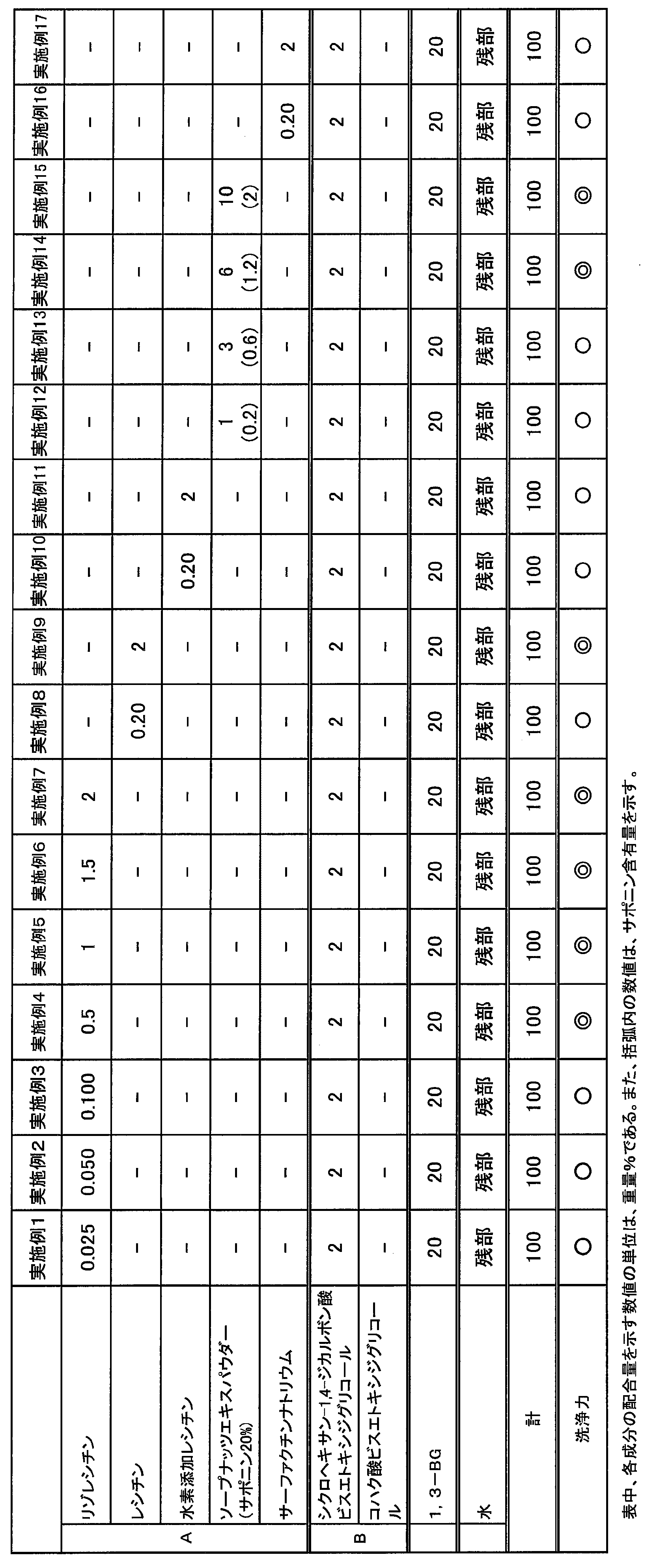
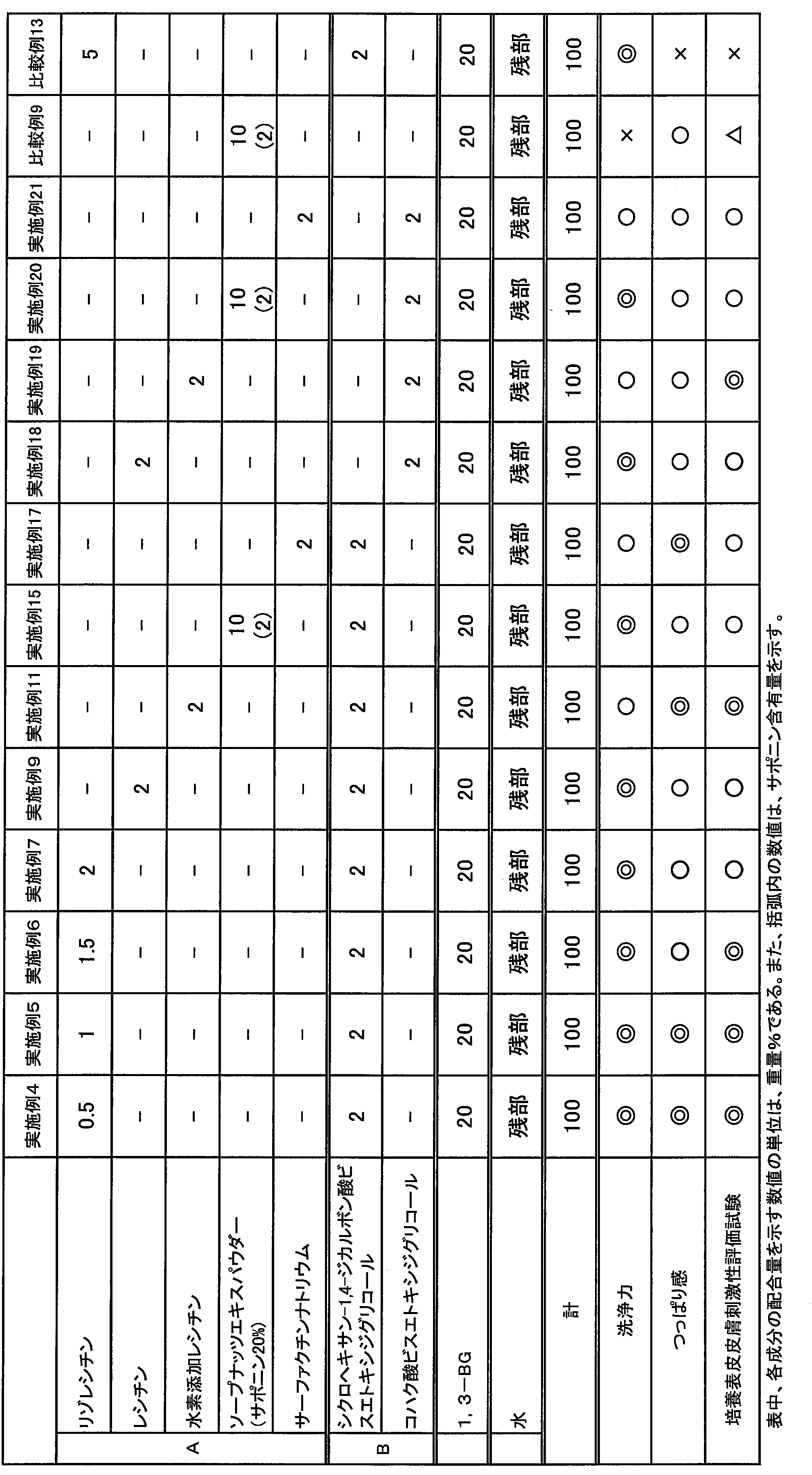
- Tables 1 to 4 prepared skin cleansing sprays having the compositions shown in Tables 1 to 4. Details of each component shown in Tables 1 to 4 are as follows.
- the skin cleansing sprays shown in Tables 1 to 4 are liquid, and their viscosities at 20 ° C. (measured by BL viscometer (Brookfield B-type viscometer) rotor No. 3 and 6 rpm) are all 5000 mPa. ⁇ It was in the range of s or less.
- Lysolecithin Lysolecithin Kyowa (manufactured by Kyowa Hakko Bio)
- Saponin Soap nut extract powder (made by Ichimaru Falcos) (saponin content 20% by weight)
- Sodium surfactin Kaneka surfactin (made by Kaneka) -Cyclohexane-1,4-dicarboxylic acid bisethoxydiglycol ("Neosolue-Aqulio (trade name)” manufactured by Nippon Fine Chemical Co., Ltd.)
- Bisethoxydiglycol succinate (“High Aquos Star DCS (trade name)” manufactured by Higher Alcohol Industry Co., Ltd.)
- each skin cleansing spray agent is contained in a pump-type spray container (injection amount per push of "Z-155-C110 (trade name)" manufactured by Takemoto Yohki Co., Ltd. is 0.15 g). It was applied by spraying 5 g directly onto the face. It was left for about 5 seconds, and then rinsed with water so that the hands did not touch the face. After holding the face with a towel and absorbing water, the feeling of dirt removal on the skin was scored by sensory evaluation based on the following indexes.
- each skin cleansing spray agent is contained in a pump-type spray container (Takemoto Yohki Co., Ltd. "Z-155-C110 (trade name)" (injection amount per push is 0.15 g), and 1 .5 g was applied by spraying directly on the face. Leave it for about 5 seconds, then rinse with water so that the hands do not touch the face. Hold the face with a towel and absorb the water, then feel taut. Was scored by sensory evaluation based on the following indexes. The stronger the degree of tension, the less moisturizing.
- ⁇ Cultured epidermal skin irritation test (in vitro evaluation of skin irritation)> The prepared skin cleansing spray was subjected to a cultured epidermal skin irritation test as follows. 1. 1. Preparation of Cultured Epidermis Model LabCite EPI-MODEL24 The assay medium was warmed and 0.5 mL each was added to a 24-well assay plate. Cultured epidermis model LabCite EPI-MODEL24 (lot number: LCE24-180226-A) was transferred to a 24-well assay plate supplemented with assay medium. After confirming that there were no bubbles on the bottom surface of the culture cup, the cells were placed in a CO 2 incubator and allowed to stand for 1 hour or more until exposure to the test substance.
- test substance Twelve of the 24 epidermis models were used (the rest were pre-cultured until this test). A 24-well assay plate was removed from the CO 2 incubator. The assay medium was warmed and 1.0 mL each was added to the third row of the 24-well assay plate. 25 ⁇ L of the test substance (spray agent for cleaning each skin) was added dropwise to the culture epidermis of the culture cup without using a pump-type spray container, and the whole was exposed. After 1 minute, 5 minutes and 10 minutes after exposure, the test substance was aspirated and removed, and the cultured epidermis model in the cup was washed with phosphate buffer (PBS) and transferred to the third row of the 24-well assay plate.
- PBS phosphate buffer
- MTT test occurs when MTT [3- (4,5-dimethylthiazol-2-yl) -2,5-diphenyltrazolium bromide] taken up into cells is reduced by intracellular mitochondrial dehydrogenase. This is a method of measuring the viable cell ratio by extracting a formazan dye with an organic solvent and measuring the absorbance at 570 nm.
- MTT medium 10 mL was prepared at a final concentration of 0.5 mg / mL.
- the MTT medium was warmed and 0.5 mL each was added to row 4 of the 24-well assay plate.
- the cultured epidermis model was transferred to row 4 of the 24-well assay plate and placed in a CO2 incubator for 3 hours MTT reaction. After completion of the MTT reaction, the cultured skin was picked up with tweezers and taken out, and transferred to a 1.5 mL microtube. 300 ⁇ L of isopropanol was placed in a microtube and the cultured epidermis model was completely immersed. After that, it was allowed to stand for 2 hours, and the microtube was vortexed to extract the pigment.
- Extract 200 mL was placed in each well of a 96-well plate. Further, as a blank (negative control), 200 ⁇ L of isopropanol was added to A1. Absorbance at 570 nm and 650 nm was measured with a microplate reader. The value obtained by subtracting the absorbance at 650 nm from the absorbance at 570 nm was used as the measured value, and the viable cell ratio of the test substance was calculated from the following formula.
- the viable cell rate was classified based on the following criteria, and skin irritation was evaluated. The results are shown in Tables 3-4. ⁇ : 90% or more ⁇ : 75% or more and less than 90% ⁇ : 65% or more and less than 75% ⁇ : 50% or more and less than 65% ⁇ ⁇ : less than 50%
- the skin cleaning sprays (Comparative Examples 13 to 16) containing a surfactant in a concentration of more than 2% by weight were found to be skin irritating, and the naturally occurring surfactant was 0.025 to 0.025. No detergency was observed with the skin cleaning sprays (Comparative Examples 1 to 10) contained at a concentration of 2% by weight.
- a skin cleansing spray containing 0.025 to 2% by weight of a naturally occurring surfactant containing an amphipathic ester (Comparative Examples 11 to 12) which does not show detergency by itself (Examples 1 to 21).
- the skin cleansing spray agent of the present invention improves the cleansing power while suppressing the skin irritation and the feeling of tension due to insufficient moisturization. It was shown to be doing. In other words, by setting the concentration of the naturally occurring surfactant of the skin cleaning spray agent that is applied directly to the skin by spraying to 0.025 to 2% by weight, it is possible to perform cleaning that is physically and chemically gentle on the skin. Was shown.
Landscapes
- Health & Medical Sciences (AREA)
- Life Sciences & Earth Sciences (AREA)
- General Health & Medical Sciences (AREA)
- Veterinary Medicine (AREA)
- Public Health (AREA)
- Animal Behavior & Ethology (AREA)
- Epidemiology (AREA)
- Birds (AREA)
- Emergency Medicine (AREA)
- Dermatology (AREA)
- Biophysics (AREA)
- Molecular Biology (AREA)
- Chemical & Material Sciences (AREA)
- Dispersion Chemistry (AREA)
- Cosmetics (AREA)
- Detergent Compositions (AREA)
Abstract
【課題】本発明は、従来と異なる方法で使用される皮膚洗浄料組成物を提供することを目的とする。 【解決手段】(A)天然由来界面活性剤と(B)両親媒性エステルとを含有し、前記(A)の含有量が0.025~2重量%であり、噴霧式容器に収容された、皮膚洗浄用スプレー剤は、皮膚洗浄料組成物の皮膚刺激性が低減されつつも優れた洗浄力を発揮することができるため、肌への適用に際して予め泡立てる従来の用途とは異なり、直接的に皮膚洗浄料組成物を肌へ噴霧して適用するという新たな用途を提供することができる。
Description
本発明は、直接的に肌へ噴霧して使用する皮膚洗浄用スプレー剤に関する。
皮膚を洗浄し、肌を清潔に保つことを目的とした製品として、洗顔料、ボディソープ、シャンプー等の様々な皮膚洗浄料組成物が提供されている。皮膚洗浄料組成物が皮膚を洗浄する機構においては、界面活性剤が汚れに吸着して汚れと水との間の表面張力を小さくし、摩擦による機械力も相まって、汚れを水中に浮き上がらせる。このような洗浄機構を有効に作用させるには、界面活性剤を臨界ミセル濃度以上で配合することが必要である。
一方で、界面活性剤による洗浄力が強すぎることで皮膚刺激の原因となり、その結果、乾燥肌をはじめとする肌トラブルが引き起こされているといった現状もある。このため、肌への作用をマイルドにすることを目的として、洗浄成分の組み合わせや配合量等を工夫する処方が種々提案されている。中でも、洗浄時に形成される泡が、肌と指とが直接触れて発生する摩擦を軽減すると認識されていることから、気泡力、泡持ち力等の泡質を向上させる処方は、肌への作用をマイルドにする処方として優れているというのが一般常識となっている。
このため、近年では、ポンプフォーマータイプの皮膚洗浄料が種々提案されており、簡単に良質な泡が得られる手軽さだけでなく、肌への優しさも注目されている。具体的には、特許文献1に、フォーマー容器と、このフォーマー容器に充填されてなる液体皮膚洗浄剤組成物とからなる液体皮膚洗浄剤製品であって、上記液体皮膚洗浄剤組成物が、(A)炭素数7~21の直鎖又は分岐鎖の一価炭化水素基を有する特定の脂肪酸塩を3~10質量%と、(B)特定の塩化ジメチルジアリルアンモニウムとアクリル酸及び/又はアクリルアミドとの共重合体と、(C)糖アルコールとを含有し、(A)成分の含有量と(B)成分の含有量との質量比(A)/(B)が20~250である液体皮膚洗浄剤製品が開示されている。また、特許文献2には、(a)脂肪酸塩を2~9質量%、(b)ラウリルジメチルアミノ酢酸ベタインを0.5~4質量%、(c)2価アルコールの1種類または2種類以上を1~10質量%を含有し、かつ、(a)成分と(b)成分の配合量(質量%)の和(a)+(b)が3~10質量%、配合量比(b)/(a)が0.1~0.5である洗浄剤をフォーマー容器に充填したことを特徴とする皮膚洗浄剤組成物が開示されている。さらに、特許文献3には、(a)ラウリルジメチルアミノ酢酸ベタインと、(b)炭素数5~25の脂肪酸から形成され且つ特定組成の高級脂肪酸石鹸4~15質量%と、を含有するフォーマー容器で吐出される洗浄料組成物が開示されている。
一方、環境負荷を考慮して、生分解性のある天然界面活性剤を用いた洗浄剤組成物も知られている。例えば、特許文献4には、天然界面活性剤11~45重量部、ミラビル石25~35重量部、硬水軟化剤10~40重量部、キレート剤0.1~5重量部、及び残余の付加的な洗浄剤原料を合計して100重量部となる洗浄剤組成物が開示されている。
ポンプフォーマータイプの皮膚洗浄料組成物は、界面活性剤の配合量が比較的少なく、その点で、固形状や半固形状の皮膚洗浄料組成物に比べて皮膚への刺激は低減されている傾向にあると考えられる。一方で、ポンプフォーマータイプの皮膚洗浄料組成物は、泡の状態で吐出されることが大前提となっているため、気泡力を発揮させるために必要な最低限の界面活性剤を配合することがその構成上不可避となっている。
また、メイク落とし(クレンジング)を目的とした皮膚洗浄料を除く、皮脂や汗等の体液や汚れ等の除去を目的とした皮膚洗浄料は様々創出されているが、ポンプフォーマータイプの皮膚洗浄料及び天然界面活性剤を含む皮膚洗浄料を含めどの皮膚洗浄料も例外なく、肌へ適用する前に泡立てることを前提としており、また、洗浄前によく泡立てることは、肌への摩擦を和らげる点で好ましいということも常識化している。泡は、肌と手との間に介在することで物理的摩擦を和らげることができるものの、泡自体が肌にこすりつけられるため、それ自体が物理的摩擦を生じさせ、肌への刺激になっていることには変わりない。このように、従前と同様の使用方法では、皮膚洗浄料の肌への負担の低減には限度がある。
そこで本発明は、従来と異なる方法で使用される皮膚洗浄料組成物を提供することを目的とする。
本発明者は、肌への刺激をより軽減させるため、肌への適用に際して予め泡立てることなく、直接的に皮膚洗浄料組成物を肌へ噴霧して適用するという斬新な用途の着想に至った。また、肌への刺激をより軽減させるため、天然由来界面活性剤を配合し、その配合量を、従前の皮膚洗浄料組成物に含まれる配合量よりも大幅に低減させた。そのように大幅に少量の界面活性剤しか含まれない皮膚洗浄料組成物では、肌への刺激低減と引き換えに洗浄力が得られないが、両親媒性エステルを共存させることによって、予め泡立てなくても効果的に洗浄力が得られることを見出した。本発明は、この知見に基づいてさらに検討を重ねることにより完成したものである。
即ち、本発明は、下記に掲げる態様の発明を提供する。
項1. (A)天然由来界面活性剤と(B)両親媒性エステルとを含有し、前記(A)の含有量が0.025~2重量%であり、噴霧式容器に収容された、皮膚洗浄用スプレー剤。
項2. 前記噴霧式容器がポンプ式スプレー容器である、項1に記載の皮膚洗浄用スプレー剤。
項3. 前記噴霧式容器がエアゾール式スプレー容器である、項1に記載の皮膚洗浄用スプレー剤。
項4. 前記(A)成分が、グリセロリン脂質、サポニン、及びリポペプチドからなる群より選択される、項1~3のいずれかに記載の皮膚洗浄用スプレー剤。
項5. 前記グリセロリン脂質が、レシチン、リゾレシチン、及び水素添加レシチンからなる群より選択される、項4に記載の皮膚洗浄用スプレー剤。
項6. 前記リポペプチドがサーファクチン及びその塩からなる群より選択される、項4に記載の皮膚洗浄用スプレー剤。
項7. 前記(B)成分が、ジカルボン酸ビス(ポリオキシアルキレンアルキルエーテル)エステル、ジカルボン酸ジアルコキシアルキルエステル、及び(エイコサン二酸/テトラデカン二酸)ポリグリセリル-10よりなる群から選ばれる、項1~6のいずれかに記載の皮膚洗浄用スプレー剤。
項8. 前記ジカルボン酸ビス(ポリオキシアルキレンアルキルエーテル)エステルが、シクロヘキサン-1,4-ジカルボン酸ビスエトキシジグリコールである、項7に記載の皮膚洗浄用スプレー剤。
項1. (A)天然由来界面活性剤と(B)両親媒性エステルとを含有し、前記(A)の含有量が0.025~2重量%であり、噴霧式容器に収容された、皮膚洗浄用スプレー剤。
項2. 前記噴霧式容器がポンプ式スプレー容器である、項1に記載の皮膚洗浄用スプレー剤。
項3. 前記噴霧式容器がエアゾール式スプレー容器である、項1に記載の皮膚洗浄用スプレー剤。
項4. 前記(A)成分が、グリセロリン脂質、サポニン、及びリポペプチドからなる群より選択される、項1~3のいずれかに記載の皮膚洗浄用スプレー剤。
項5. 前記グリセロリン脂質が、レシチン、リゾレシチン、及び水素添加レシチンからなる群より選択される、項4に記載の皮膚洗浄用スプレー剤。
項6. 前記リポペプチドがサーファクチン及びその塩からなる群より選択される、項4に記載の皮膚洗浄用スプレー剤。
項7. 前記(B)成分が、ジカルボン酸ビス(ポリオキシアルキレンアルキルエーテル)エステル、ジカルボン酸ジアルコキシアルキルエステル、及び(エイコサン二酸/テトラデカン二酸)ポリグリセリル-10よりなる群から選ばれる、項1~6のいずれかに記載の皮膚洗浄用スプレー剤。
項8. 前記ジカルボン酸ビス(ポリオキシアルキレンアルキルエーテル)エステルが、シクロヘキサン-1,4-ジカルボン酸ビスエトキシジグリコールである、項7に記載の皮膚洗浄用スプレー剤。
本発明によれば、皮膚洗浄料組成物の皮膚刺激性が低減されつつも優れた洗浄力を発揮することができるため、肌への適用に際して予め泡立てる従来の用途とは異なり、直接的に皮膚洗浄料組成物を肌へ噴霧して適用するという新たな用途を提供することができる。予め泡立てずに洗浄可能であるため、皮膚洗浄用液体組成物における界面活性剤の配合量を、従前の皮膚洗浄用液体組成物に含まれる配合量よりも大幅に低減させることができ、これによってより一層皮膚刺激性を低減させることも可能である。
本発明の皮膚洗浄用スプレー剤は、(A)天然由来界面活性剤(以下、(A)成分と表記することがある)を所定量と(B)両親媒性エステル(以下、(B)成分と表記することがある)とを含有し、噴霧式容器に収容されていることを特徴とする。以下、本発明の皮膚洗浄用スプレー剤について詳述する。
(A)天然由来界面活性剤
本発明の皮膚洗浄用スプレー剤は、(A)成分として天然由来界面活性剤を含有する。天然由来界面活性剤は、生物を起源とし界面活性作用を有する物質である。
本発明の皮膚洗浄用スプレー剤は、(A)成分として天然由来界面活性剤を含有する。天然由来界面活性剤は、生物を起源とし界面活性作用を有する物質である。
本発明で用いられる天然由来界面活性剤としては特に限定されず、動物、植物又は微生物から抽出及び精製した天然物;これらの天然物を、微生物学的に培養合成したもの、遺伝子工学的に合成したもの、及び化学合成したもの;水素添加処理、水酸化処理、加水分解処理などの処理を行ったもの等が挙げられる。
本発明で用いられる天然由来界面活性剤の例としては、リン脂質、サポニン、リポペプチド、コレステロール、胆汁酸等が挙げられる。これらの天然由来界面活性剤は1種を単独で用いてもよいし、2種以上を組み合わせて用いてもよい。これらの天然由来界面活性剤の中でも、好ましくは、リン脂質、サポニン、リポペプチドが挙げられる。
リン脂質としては、グリセロリン脂質、スフィンゴリン脂質等が挙げられる。グリセロリン脂質は、グリセロリン酸骨格を有する物質で、親油基として脂肪酸エステル、長鎖アルキルエーテル、ビニルエーテルなどを有している物質である。グリセロリン脂質の具体例としては、ホスファチジルコリン(レシチン)、ホスファチジルエタノールアミン、ホスファチジルセリン、ホスファジルイノシトール、ホスファチジルイノシトールポリリン酸、ジホスファチジルグリセロール(カルジオリピン)、ホスファチジン酸、並びにこれらの水素添加処理物、水酸化処理物、及び加水分解処理物が挙げられる。スフィンゴ-リン脂質は、スフィンゴシン、フィトスフィンゴシン等の長鎖塩基又は長鎖脂肪酸の、リン酸又はホスホン酸誘導体である。スフィンゴリン脂質の具体例としては、セラミド1リン酸誘導体(スフィンゴミエリン等)、セラミド1-ホスホン酸誘導体(セラミドアミノエチルホスホン酸等)が挙げられる。これらのリン脂質は、1種を単独で用いてもよいし、2種以上を組み合わせて用いてもよい。
これらのリン脂質の中でも、好ましくはグリセロリン脂質が挙げられ、より好ましくは、レシチン(大豆レシチン、卵黄レシチン)、水素添加レシチン、水酸化レシチン、リゾレシチンが挙げられ、更に好ましくは、レシチン(大豆レシチン、卵黄レシチン等)、水素添加レシチン、リゾレシチンが挙げられる。また、一層優れた洗浄力を得る観点から、好ましくはレシチン(大豆レシチン、卵黄レシチン等)及びリゾレシチンが挙げられ、皮膚刺激性及び保湿不足によるつっぱり感を一層抑制する観点から、好ましくは水素添加レシチンが挙げられる。
サポニンは、サポゲニンと糖から構成される配糖体であり、具体的にはトリテルペンの配糖体及びステロイドの配糖体が挙げられる。サポニンの具体例としては、キラヤサポニン、ダイズサポニン、ユッカサポニン、エンジュサポニン、ビートサポニン、アズキサポニン、ニンジンサポニン、茶種サポニン、ヘチマサポニン、ツボクササポニン等が挙げられる。これらのサポニンは、1種を単独で用いてもよいし、2種以上を組み合わせて用いてもよい。
リポペプチドは、脂質化されたペプチドであり、具体的には、サーファクチン、アルスロファクチン、イチュリン及びこれらの塩等が挙げられる。これらのリポペプチドは、1種を単独で用いてもよいし、2種以上を組み合わせて用いてもよい。
これらのリポペプチドの中でも、好ましくはサーファクチン及びその塩が挙げられ、より好ましくはサーファクチンの塩が挙げられる。サーファクチンの塩は、下記式(I)で示される化合物である。

式(I)中、Xは、ロイシン、イソロイシン及びバリンから選択されるアミノ酸残基を示し、RはC9-18アルキル基を示し、M+はアルカリ金属イオン又は第四級アンモニウムイオンを示す。アルカリ金属イオンとしては特に限定されないが、リチウムイオン、ナトリウムイオン、カリウムイオン等が挙げられ、好ましくはナトリウムイオンが挙げられる。第四級アンモニウムイオンの置換基としては、例えば、メチル基、エチル基、n-プロピル基、イソプロピル基、n-ブチル基、tert-ブチル基等のアルキル基;ベンジル基、メチルベンジル基、フェニルエチル基等のアラルキル基;フェニル基、トルイル基、キシリル基等のアリール基等の有機基が挙げられる。これらのサーファクチン又はその塩は、1種を単独で用いてもよいし、2種以上を組み合わせて用いてもよい。
本発明の皮膚洗浄用スプレー剤における(A)成分の含有量は、0.025~2重量%である。このように界面活性剤量が少量であることより、皮膚刺激性を各段に低減することができる。本発明においては、(B)成分と共存させることで、優れた洗浄力を発揮することができるため、本来的には有効な洗浄力を発揮できないような少量の界面活性剤量であっても効果的に洗浄力を発揮することができる。
(A)成分の好ましい含有量としては、例えば、より一層優れた洗浄力を得る観点から、0.5~2重量%、より好ましくは1~2重量%が挙げられ、保湿不足によるつっぱり感を一層抑制する観点から、0.025~1.5重量%、より好ましくは0.025~1重量%が挙げられる。更に、(A)成分がレシチン又はリゾレシチンの場合は、より一層優れた洗浄力を得る観点から、0.5~2重量%が挙げられ、保湿不足によるつっぱり感を一層抑制する観点から、0.025~1重量%が挙げられ、皮膚刺激性を一層抑制する観点から、0.025~1.5重量%が挙げられる。(A)成分がサポニンの場合は、より一層優れた洗浄力を得る観点から、1~2重量%が挙げられる。
(B)両親媒性エステル
本発明の皮膚洗浄用スプレー剤は、(B)成分として両親媒性エステルを含有する。(B)成分は単独で洗浄作用を示さないが、0.025~2重量%の(A)成分と共存させることによって、低刺激性を維持しながら皮膚洗浄用スプレー剤の洗浄力を向上させることができる。
本発明の皮膚洗浄用スプレー剤は、(B)成分として両親媒性エステルを含有する。(B)成分は単独で洗浄作用を示さないが、0.025~2重量%の(A)成分と共存させることによって、低刺激性を維持しながら皮膚洗浄用スプレー剤の洗浄力を向上させることができる。
本発明において、両親媒性エステルは、日本薬局方一般試験法に定められた方法による測定で、導電率70~110μs/mに調整されたイオン交換水に常温で2質量%以上溶解し、かつ、油剤であるイソノナン酸イソトリデシル(日清オイリオグループ社製、サラコス913)にも常温(25℃)で10質量%以上溶解するものであり、エステル系界面活性剤は除かれる。
両親媒性エステルとしては特に限定されないが、皮膚刺激低減性及び洗浄力をより良好に得る観点から、ジカルボン酸ビス(ポリオキシアルキレンアルキルエーテル)エステル、ジカルボン酸ジアルコキシアルキルエステル、及び(エイコサン二酸/テトラデカン二酸)ポリグリセリル-10よりなる群から選ばれるものであることが好ましい。両親媒性エステルとしては、ジカルボン酸ビス(ポリオキシアルキレンアルキルエーテル)エステル、ジカルボン酸ジアルコキシアルキルエステル、及び(エイコサン二酸/テトラデカン二酸)ポリグリセリル-10の中からいずれかを単独で使用してもよく、また2種以上を組み合わせて使用してもよい。これらの両親媒性エステルの中でも、保湿不足によるつっぱり感を一層抑制する観点から、ジカルボン酸ビス(ポリオキシアルキレンアルキルエーテル)エステルがより好ましい。
本発明に使用されるジカルボン酸ビス(ポリオキシアルキレンアルキルエーテル)エステルは、ジカルボン酸とポリオキシアルキレンアルキルエーテルとのジエステル化合物である。ジカルボン酸ビス(ポリオキシアルキレンアルキルエーテル)エステルのジエステル化合物を構成するジカルボン酸の具体例としては、例えば、シュウ酸、マロン酸、コハク酸、酒石酸、リンゴ酸、グルタル酸、アジピン酸、ペメリン酸、スベリン酸、アゼライン酸、セバシン酸、アスパラギン酸、グルタミン酸、アセトンジカルボン酸、フタル酸、シクロヘキサン-1,4-ジカルボン酸などが挙げられる。また、ジエステル化合物を構成するポリオキシアルキレンアルキルエーテルとしては、例えば、ポリオキシエチレンモノアルキルエーテルなどが挙げられ、より具体的には、例えば、ジエチレングリコールモノエチルエーテル、トリエチレングリコールモノエチルエーテルなどが挙げられる。
これらのジカルボン酸ビス(ポリオキシアルキレンアルキルエーテル)エステルの中でも、皮膚刺激低減性及び洗浄力をより良好に得る観点から、好ましくは、シクロヘキサン-1,4-ジカルボン酸とジエチレングリコールモノエチルエーテルとのジエステル化合物、具体的には、INCI名(International Cosmetic Ingredient Dictionary and Handbook,第13版,第1巻,CTFA,2010年,p.331):BIS-ETHOXYDIGLYCOL CYCLOHEXANE 1,4-DICARBOXYLATEで表記される、シクロへキサン-1,4-ジカルボン酸ビスエトキシジグリコールと称される化合物、及びコハク酸とジエチレングリコールモノエチルエーテルとのジエステル化合物、具体的には、INCI名(International Cosmetic Ingredient Dictionary and Handbook,第13版,第1巻,CTFA,2010年,p.331-332):BIS-ETHOXYDIGLYCOL SUCCINATEで表記される、コハク酸ビスエトキシジグリコールと称される化合物が挙げられる
また、本発明において、前記シクロへキサン-1,4-ジカルボン酸ビスエトキシジグリコールの具体例としては、例えば、日本精化株式会社製の「Neosolue-Aqulio(商品名)」等が挙げられる。また、前記コハク酸ビスエトキシジグリコールの具体例としては、例えば、高級アルコール工業株式会社製の「ハイアクオスター DCS(商品名)」等が挙げられる。
これらのジカルボン酸ビス(ポリオキシアルキレンアルキルエーテル)エステルは、1種単独で使用してもよく、また2種以上を組み合わせて使用してもよい。
これらのジカルボン酸ビス(ポリオキシアルキレンアルキルエーテル)エステルの中でも、特に、(A)成分として水素添加レシチン又はリポペプチドを用いる場合に、保湿不足によるつっぱり感を一層抑制する観点から、シクロへキサン-1,4-ジカルボン酸ビスエトキシジグリコールを用いることが好ましい。
本発明に使用されるジカルボン酸ジアルコキシアルキルエステルは、ジカルボン酸とアルコキシアルコールとのジエステル化合物である。ジカルボン酸ジアルコキシアルキルのジエステル化合物を構成するジカルボン酸の具体例としては、例えば、シュウ酸、マロン酸、コハク酸、酒石酸、リンゴ酸、グルタル酸、アジピン酸、ペメリン酸、スベリン酸、アゼライン酸、セバシン酸、アスパラギン酸、グルタミン酸、アセトンジカルボン酸、フタル酸、シクロヘキサン-1,4-ジカルボン酸などが挙げられる。また、ジエステル化合物を構成するアルコキシアルコールとしては、例えば、2-メトキシエタノール、2-エトキシエタノールなどが挙げられる。
これらのジカルボン酸ジアルコキシアルキルエステル中でも、皮膚刺激低減性及び洗浄力をより良好に得る観点から、好ましくは、コハク酸と2-エトキシエタノールとのジエステル化合物、具体的には、コハク酸ジエトキシエチルが挙げられる。
これらのジカルボン酸ジアルコキシアルキルエステル、1種単独で使用してもよく、また2種以上を組み合わせて使用してもよい。
本発明に使用される(エイコサン二酸/テトラデカン二酸)ポリグリセリル-10としては、特に限定されないが、例えば、日本精化株式会社製の「Neosolue-Aqua(商品名)」、「Neosolue-AquaS(商品名)」等が挙げられる。
本発明の皮膚洗浄用スプレー剤における(B)成分の含有量としては特に限定されないが、例えば0.1重量%以上が挙げられる。洗浄力をより一層良好に得る観点、及び/又は、保湿不足によるつっぱり感をより一層低減させる観点から、(B)成分の含有量としては好ましくは0.5重量%以上、より好ましくは1.5重量%以上、より好ましくは2重量%以上が挙げられる。(B)成分の含有量の範囲の上限は特に限定されないが、皮膚洗浄用スプレー剤の安定性等の観点から、例えば5重量%以下、好ましくは4重量%以下、より好ましくは3重量%以下が挙げられる。
本発明の皮膚洗浄用スプレー剤において、(A)成分と(B)成分との比率は特に限定されず、上記の各含有量により定まるが、皮膚刺激低減性及び洗浄力をより良好に得る観点から、(A)成分1重量部に対して(B)成分が例えば0.1~100重量部、好ましくは1~80重量部が挙げられる。また、より一層優れた洗浄力を得る観点から、(A)成分1重量部に対して(B)成分が1~4重量部、より好ましくは1~2重量部が挙げられ、保湿不足によるつっぱり感を一層抑制する観点から、1.2~80重量部、より好ましくは2~80重量部が挙げられる。更に、(A)成分がレシチン又はリゾレシチンの場合は、より一層優れた洗浄力を得る観点から、(A)成分1重量部に対して(B)成分が1~4重量部が挙げられ、保湿不足によるつっぱり感を一層抑制する観点から、(A)成分1重量部に対して(B)成分が2~80重量部が挙げられ、皮膚刺激性を一層抑制する観点から、(A)成分1重量部に対して(B)成分が1.2~80重量部が挙げられる。(A)成分がサポニンの場合は、より一層優れた洗浄力を得る観点から、(A)成分1重量部に対して(B)成分が1~2重量部が挙げられる。
他の成分
本発明の皮膚洗浄用スプレー剤には、前記成分の他に、本発明の効果を損なわない範囲で、製剤化等に必要とされる他の基剤や添加剤が含まれていてもよい。このような添加剤については、薬学的に許容されることを限度として特に制限されないが、例えば、水、炭素数1~5の低級アルコール(エタノール、イソプロパノール等)、及び多価アルコール(エチレングリコール、1,3-ブチレングリコール(BG)、プロピレングリコール、イソプレングリコール、ジエチレングリコール、ジプロピレングリコール、ポリプロピレングリコール、グリセリン等)等の水性基剤;防腐剤(フェノキシエタノール、メチルパラベン、プロピルパラベン、安息香酸、安息香酸ナトリウム、ソルビン酸等)、着香剤(シトラール、1,8-シオネール、シトロネラール、ファルネソール等)、着色剤(タール色素(褐色201号、青色201号、黄色4号、黄色403号等)、カカオ色素、クロロフィル、酸化アルミニウム等)、粘稠剤(ヒドロキシプロピルセルロース、ヒドロキシエチルセルロース、架橋型アクリル酸重合体、カルボキシビニルポリマー、ヒプロメロース、ポリビニルピロリドン、アルギン酸ナトリウム、エチルセルロース、カルボキシメチルセルロースナトリウム、キサンタンガム、カラギーナン等)、pH調整剤(リン酸、塩酸、クエン酸、クエン酸ナトリウム(クエン酸三ナトリウム)、コハク酸、酒石酸、水酸化ナトリウム、水酸化カリウム、トリエタノールアミン、トリイソプロパノールアミン等)、湿潤剤(dl-ピロリドンカルボン酸ナトリウム液、D-ソルビトール液、マクロゴール等)、安定化剤(ジブチルヒドロキシトルエン、ブチルヒドロキシアニソール、エデト酸ナトリウム、メタリン酸ナトリウム、L-アルギニン、L-アスパラギン酸、DL-アラニン、グリシン、エリソルビン酸ナトリウム、没食子酸プロピル、亜硫酸ナトリウム、二酸化硫黄、クロロゲン酸、カテキン、ローズマリー抽出物等)、酸化防止剤、紫外線吸収剤、キレート剤、粘着剤、緩衝剤、溶解補助剤、可溶化剤、保存剤等の添加剤が挙げられる。これらの基材や添加剤は、1種単独で使用してもよく、また2種以上を組み合わせて使用してもよい。これらの基材や添加剤の含有量は、製剤形態等に応じて適宜設定することができる。
本発明の皮膚洗浄用スプレー剤には、前記成分の他に、本発明の効果を損なわない範囲で、製剤化等に必要とされる他の基剤や添加剤が含まれていてもよい。このような添加剤については、薬学的に許容されることを限度として特に制限されないが、例えば、水、炭素数1~5の低級アルコール(エタノール、イソプロパノール等)、及び多価アルコール(エチレングリコール、1,3-ブチレングリコール(BG)、プロピレングリコール、イソプレングリコール、ジエチレングリコール、ジプロピレングリコール、ポリプロピレングリコール、グリセリン等)等の水性基剤;防腐剤(フェノキシエタノール、メチルパラベン、プロピルパラベン、安息香酸、安息香酸ナトリウム、ソルビン酸等)、着香剤(シトラール、1,8-シオネール、シトロネラール、ファルネソール等)、着色剤(タール色素(褐色201号、青色201号、黄色4号、黄色403号等)、カカオ色素、クロロフィル、酸化アルミニウム等)、粘稠剤(ヒドロキシプロピルセルロース、ヒドロキシエチルセルロース、架橋型アクリル酸重合体、カルボキシビニルポリマー、ヒプロメロース、ポリビニルピロリドン、アルギン酸ナトリウム、エチルセルロース、カルボキシメチルセルロースナトリウム、キサンタンガム、カラギーナン等)、pH調整剤(リン酸、塩酸、クエン酸、クエン酸ナトリウム(クエン酸三ナトリウム)、コハク酸、酒石酸、水酸化ナトリウム、水酸化カリウム、トリエタノールアミン、トリイソプロパノールアミン等)、湿潤剤(dl-ピロリドンカルボン酸ナトリウム液、D-ソルビトール液、マクロゴール等)、安定化剤(ジブチルヒドロキシトルエン、ブチルヒドロキシアニソール、エデト酸ナトリウム、メタリン酸ナトリウム、L-アルギニン、L-アスパラギン酸、DL-アラニン、グリシン、エリソルビン酸ナトリウム、没食子酸プロピル、亜硫酸ナトリウム、二酸化硫黄、クロロゲン酸、カテキン、ローズマリー抽出物等)、酸化防止剤、紫外線吸収剤、キレート剤、粘着剤、緩衝剤、溶解補助剤、可溶化剤、保存剤等の添加剤が挙げられる。これらの基材や添加剤は、1種単独で使用してもよく、また2種以上を組み合わせて使用してもよい。これらの基材や添加剤の含有量は、製剤形態等に応じて適宜設定することができる。
本発明の皮膚洗浄用スプレー剤には、前記成分の他に、本発明の効果を損なわない範囲で、必要に応じて他の薬理成分を含有していてもよい。このような薬理成分としては、例えば、ビタミン類(ビタミンA類、ビタミンB1類、ビタミンB2類、ビタミンB5類、ビタミンB6類、ビタミンB12類、ビタミンC類、ビタミンD類、ビタミンK類、ナイアシン類、葉酸、ビオチン、リコペン等)、抗ヒスタミン剤(ジフェンヒドラミン、塩酸ジフェンヒドラミン等)、局所麻酔剤(プロカイン、テトラカイン、ブピバカイン、メピバカイン、クロロプロカイン、プロパラカイン、メプリルカイン又はこれらの塩、オルソカイン、オキセサゼイン、オキシポリエントキシデカン、ロートエキス、ペルカミンパーゼ、テシットデシチン等)、抗炎症剤(インドメタシン、フェルビナク、ジクロフェナクナトリウム、ロキソプロフェンナトリウム等)、皮膚保護剤(コロジオン、ヒマシ油等)、血行促進成分(ノニル酸ワニリルアミド、ニコチン酸ベンジルエステル、カプサイシン、トウガラシエキス等)、清涼化剤(メントール、カンフル、ボルネオール、ハッカ水、ハッカ油等)、ムコ多糖類(コンドロイチン硫酸ナトリウム、グルコサミン、ヒアルロン酸、カチオン化ヒアルロン酸(ヒアルロン酸ジヒドロキシプロピルトリモニウム等)等)等が挙げられる。これらの薬理成分は、1種単独で使用してもよく、また2種以上を組み合わせて使用してもよい。これらの薬理成分を含有させる場合、その含有量については、使用する薬理成分の種類、期待する効果等に応じて適宜設定すればよい。
形態
本発明の皮膚洗浄用スプレー剤の形態は、常温で液状又はジェル状である。また、本発明の皮膚洗浄用スプレー剤の粘度としては、20℃において10000mPa・s以下、好ましくは5000mPa・s以下が挙げられる。なお、粘度は、BL粘度計(ロ-ターNo3、6rpm、20℃)によって測定される値である。
本発明の皮膚洗浄用スプレー剤の形態は、常温で液状又はジェル状である。また、本発明の皮膚洗浄用スプレー剤の粘度としては、20℃において10000mPa・s以下、好ましくは5000mPa・s以下が挙げられる。なお、粘度は、BL粘度計(ロ-ターNo3、6rpm、20℃)によって測定される値である。
容器
本発明の皮膚洗浄用スプレー剤を収容する容器については、噴霧式容器であることを限度として特に限定されない。なお、本発明における噴霧式容器は、内容物をミスト状態で吐出するものであり、皮膚洗浄剤組成物を泡状態で吐出するポンプフォーマー容器とは異なる。
本発明の皮膚洗浄用スプレー剤を収容する容器については、噴霧式容器であることを限度として特に限定されない。なお、本発明における噴霧式容器は、内容物をミスト状態で吐出するものであり、皮膚洗浄剤組成物を泡状態で吐出するポンプフォーマー容器とは異なる。
本発明においては、このように皮膚洗浄用スプレー剤を噴霧式容器に収容することにより、肌への適用の前に泡立てることなく、皮膚洗浄用スプレー剤が噴霧により直接的に肌に塗布される。従って、肌への塗布が手軽であり且つ塗布時における手等による物理摩擦を回避することができる。噴霧式容器としては、非エアゾール式スプレー容器であるポンプ式スプレー容器、及び、エアゾール式スプレー容器が挙げられる。噴霧式容器の口径(ノズル内径)としては、例えば0.01~3mmφ、好ましくは0.1~1mmφが挙げられる。噴霧式容器がポンプ式スプレー容器である場合の1プッシュあたりの噴射量としては、例えば0.05~1.2g、好ましくは0.1~0.3gが挙げられる。
用途
本発明の皮膚洗浄用スプレー剤は、皮膚の油脂、汗などの体液や汚れ等を除去するために用いられるものであり、化粧落とし(クレンジング)として用いられるものではない。本発明の皮膚洗浄用スプレー剤は、水で薄めることなく、泡立てずにそのまま皮膚に塗布することで使用する。1回当たりの使用量としては、界面活性剤の濃度及び汚れの程度等にもよるが、例えば洗顔に用いる場合0.5~3g、好ましくは1~2gが挙げられる。
本発明の皮膚洗浄用スプレー剤は、皮膚の油脂、汗などの体液や汚れ等を除去するために用いられるものであり、化粧落とし(クレンジング)として用いられるものではない。本発明の皮膚洗浄用スプレー剤は、水で薄めることなく、泡立てずにそのまま皮膚に塗布することで使用する。1回当たりの使用量としては、界面活性剤の濃度及び汚れの程度等にもよるが、例えば洗顔に用いる場合0.5~3g、好ましくは1~2gが挙げられる。
より具体的には、皮膚洗浄用スプレー剤を手に取ることなく、直接的に噴霧式容器から噴霧により洗浄対象部位に塗布することができる。このように、皮膚洗浄用スプレー剤を直接的に洗浄対象部位に塗布することで、洗浄対象部位の皮膚と手との間に生じる摩擦や、洗浄部位の皮膚と気泡と間に生じる摩擦といった物理的摩擦を一切与えることなく、液流の機械力を利用するだけで洗浄することが可能になる。本発明の皮膚洗浄用スプレー剤は、洗浄力に優れた処方であるため、このように物理的摩擦を与えずに液流の機械力を利用して洗浄することで、洗浄時における肌への負担が顕著に軽減され極めて優しい洗浄方法が可能となる。このように泡立てない洗浄方法は、素早い洗浄を可能とし、界面活性剤が少なく肌に優しいことも実感しやすく、肌に優しい洗浄を追及する意識が高い消費者の満足感も得られやすくなる。なお、本発明の皮膚洗浄用スプレー剤は、前述のような肌に物理的摩擦を与えない洗浄方法に特に適しているが、皮膚洗浄用スプレー剤を洗浄対象部位に塗布した後に手等を用いてこすり洗いする使用方法を除外するものではない。
本発明の皮膚洗浄用スプレー剤の洗浄対象部位としては、あらゆる身体部位の洗浄が可能であるため特に制限されず、例えば、手、髪、頭皮、体、顔等が挙げられる。本発明の皮膚洗浄用スプレー剤は噴霧により洗浄対象部位に塗布されるため、塗布容易性の観点からは、髪、頭皮、体への使用において好適である。また、本発明の皮膚洗浄用スプレー剤が予め泡立てることなく優れた洗浄力を発揮することができるため、刺激に対して敏感な顔への使用において好適である。
洗浄後、皮膚洗浄用スプレー剤は、水で洗い流すことができる。水で洗い流す場合は、通常の洗顔と同様に行えばよいが、肌への負担を軽減させる観点からは、手による摩擦を与えないように水流の機械力を利用して洗い流すことが好ましい。
また、本発明の皮膚洗浄用スプレー剤は、界面活性剤濃度を極端に低くすることができるため、この場合、洗浄後に洗い流さなくてもよい。このため、本発明の皮膚洗浄用スプレー剤は、病院における清拭用途、エステサロンや美容院における洗顔等皮膚洗浄施術用途、及び災害用品用途等でも好適である。洗い流さない場合、タオルやティッシュ等の吸水性基材を用いて洗浄部位に残存した皮膚洗浄用スプレー剤を吸い取って除去してもよい。
製造方法
本発明の皮膚洗浄用スプレー剤は、前述する(A)成分及び(B)成分、並びに必要に応じて配合される他の成分等を混合して、所定の形態に調製された後、噴霧式容器に収容されることによって製造される。噴霧式容器としてエアゾール式スプレー容器に収容される場合は、ガス等の噴霧剤と共に収容されて製造される。
本発明の皮膚洗浄用スプレー剤は、前述する(A)成分及び(B)成分、並びに必要に応じて配合される他の成分等を混合して、所定の形態に調製された後、噴霧式容器に収容されることによって製造される。噴霧式容器としてエアゾール式スプレー容器に収容される場合は、ガス等の噴霧剤と共に収容されて製造される。
以下に実施例を示して本発明をより具体的に説明するが、本発明はこれらに限定されるものではない。
試験例
表1~4に示す組成の皮膚洗浄用スプレー剤を調製した。表1~4に示す各成分の詳細は以下の通りである。なお、表1~4に示す皮膚洗浄用スプレー剤は液状であり、20℃における粘度(BL粘度計(ブルックフィールド社製B型粘度計)ロ-ターNo3、6rpmによって測定)は、いずれも5000mPa・s以下の範囲にあった。
・リゾレシチン:リゾレシチン協和(協和発酵バイオ製)
・レシチン:ベイシス LP-20(日清オイリオ製)
・水素添加レシチン:ベイシス LP-20H(日清オイリオ製)
・サポニン:ソープナッツエキスパウダー(一丸ファルコス製)(サポニン含量20重量%)
・サーファクチンナトリウム:カネカ・サーファクチン(カネカ製)
・シクロヘキサン-1,4-ジカルボン酸ビスエトキシジグリコール(日本精化株式会社製「Neosolue-Aqulio(商品名)」)
・コハク酸ビスエトキシジグリコール(高級アルコール工業株式会社製「ハイアクオスター DCS(商品名)」)
表1~4に示す組成の皮膚洗浄用スプレー剤を調製した。表1~4に示す各成分の詳細は以下の通りである。なお、表1~4に示す皮膚洗浄用スプレー剤は液状であり、20℃における粘度(BL粘度計(ブルックフィールド社製B型粘度計)ロ-ターNo3、6rpmによって測定)は、いずれも5000mPa・s以下の範囲にあった。
・リゾレシチン:リゾレシチン協和(協和発酵バイオ製)
・レシチン:ベイシス LP-20(日清オイリオ製)
・水素添加レシチン:ベイシス LP-20H(日清オイリオ製)
・サポニン:ソープナッツエキスパウダー(一丸ファルコス製)(サポニン含量20重量%)
・サーファクチンナトリウム:カネカ・サーファクチン(カネカ製)
・シクロヘキサン-1,4-ジカルボン酸ビスエトキシジグリコール(日本精化株式会社製「Neosolue-Aqulio(商品名)」)
・コハク酸ビスエトキシジグリコール(高級アルコール工業株式会社製「ハイアクオスター DCS(商品名)」)
<洗浄力評価>
調製した皮膚洗浄用スプレー剤について、化粧品評価専門パネラー10名が洗浄力評価を行った。具体的には、各皮膚洗浄用スプレー剤をポンプ式スプレー容器(竹本容器株式会社製「Z-155-C110(商品名)」1プッシュあたりの噴射量は0.15g)に収容し、1.5gを顔に直接的に噴霧することで塗布した。5秒程度放置し、その後、手が顔に触れないように水で洗い流した。タオルで顔を抑えて水を吸い取った後、肌の汚れ落ち感を以下の指標に基づいて官能評価することで採点した。
調製した皮膚洗浄用スプレー剤について、化粧品評価専門パネラー10名が洗浄力評価を行った。具体的には、各皮膚洗浄用スプレー剤をポンプ式スプレー容器(竹本容器株式会社製「Z-155-C110(商品名)」1プッシュあたりの噴射量は0.15g)に収容し、1.5gを顔に直接的に噴霧することで塗布した。5秒程度放置し、その後、手が顔に触れないように水で洗い流した。タオルで顔を抑えて水を吸い取った後、肌の汚れ落ち感を以下の指標に基づいて官能評価することで採点した。
5点:汚れ落ちがしっかり感じられた
4点:汚れ落ちが感じられた
3点:どちらでもない
2点:汚れ落ちがあまり感じられない
1点:汚れ落ちが全く感じられない
4点:汚れ落ちが感じられた
3点:どちらでもない
2点:汚れ落ちがあまり感じられない
1点:汚れ落ちが全く感じられない
パネラー10名の獲得スコアを合計し、以下の分類により洗浄力の程度を評価した。結果を表1~4に示す。
◎:45点以上
○:40点以上45点未満
△:35点以上40点未満
×:35点未満
◎:45点以上
○:40点以上45点未満
△:35点以上40点未満
×:35点未満
<つっぱり感評価>
調製した皮膚洗浄用スプレー剤について、化粧品評価専門パネラー10名がつっぱり感評価を行った。具体的には、各皮膚洗浄用スプレー剤をポンプ式スプレー容器(竹本容器株式会社製「Z-155-C110(商品名)」(1プッシュあたりの噴射量は0.15g)に収容し、1.5gを顔に直接的に噴霧することで塗布した。5秒程度放置し、その後、手が顔に触れないように水で洗い流した。タオルで顔を抑えて水を吸い取った後、つっぱり感を以下の指標に基づいて官能評価することで採点した。つっぱり感の程度が強いほど、保湿が不足していることを表している。
調製した皮膚洗浄用スプレー剤について、化粧品評価専門パネラー10名がつっぱり感評価を行った。具体的には、各皮膚洗浄用スプレー剤をポンプ式スプレー容器(竹本容器株式会社製「Z-155-C110(商品名)」(1プッシュあたりの噴射量は0.15g)に収容し、1.5gを顔に直接的に噴霧することで塗布した。5秒程度放置し、その後、手が顔に触れないように水で洗い流した。タオルで顔を抑えて水を吸い取った後、つっぱり感を以下の指標に基づいて官能評価することで採点した。つっぱり感の程度が強いほど、保湿が不足していることを表している。
5点:つっぱり感を全く感じない
4点:つっぱり感をほとんど感じない
3点:つっぱり感をわずかしか感じない
2点:つっぱり感を感じる
1点:つっぱり感を強く感じる
4点:つっぱり感をほとんど感じない
3点:つっぱり感をわずかしか感じない
2点:つっぱり感を感じる
1点:つっぱり感を強く感じる
パネラー10名の獲得スコアを合計し、以下の分類によりつっぱり感の程度を評価した。結果を表3~4に示す。
◎:45点以上
○:40点以上45点未満
△:35点以上40点未満
×:35点未満
◎:45点以上
○:40点以上45点未満
△:35点以上40点未満
×:35点未満
<培養表皮皮膚刺激試験(肌刺激性のin vitro評価)>
調製した皮膚洗浄用スプレー剤について、以下の通りに培養表皮皮膚刺激試験を行った。
1.培養表皮モデルLabCyte EPI-MODEL24の準備
アッセイ培地を温め、24ウェルアッセイプレートに0.5mLずつ添加した。培養表皮モデルLabCyte EPI-MODEL24(ロット番号:LCE24-180226-A)を、アッセイ培地を添加した24ウェルアッセイプレートに移した。培養カップ底面に気泡が無いことを確認し、CO2インキュベーターに入れ被験物質暴露まで1時間以上静置した。
調製した皮膚洗浄用スプレー剤について、以下の通りに培養表皮皮膚刺激試験を行った。
1.培養表皮モデルLabCyte EPI-MODEL24の準備
アッセイ培地を温め、24ウェルアッセイプレートに0.5mLずつ添加した。培養表皮モデルLabCyte EPI-MODEL24(ロット番号:LCE24-180226-A)を、アッセイ培地を添加した24ウェルアッセイプレートに移した。培養カップ底面に気泡が無いことを確認し、CO2インキュベーターに入れ被験物質暴露まで1時間以上静置した。
2.被験物質の適用及び洗浄
表皮モデル24個のうち、12個を使用した(残りは本試験まで前培養を続けた)。24ウェルアッセイプレートをCO2インキュベーターから取り出した。アッセイ培地を温め、24ウェルアッセイプレート第3行に1.0mLずつ添加した。被験物質(各皮膚洗浄用スプレー剤)をポンプ式スプレー容器を用いずに培養カップの培養表皮に25μL滴下し、全体にいきわたらせて暴露した。暴露後1分、5分、10分経過時に被験物質を吸引除去し、カップ内の培養表皮モデルをリン酸緩衝液(PBS)で洗浄し、24ウェルアッセイプレート第3行に移した。
表皮モデル24個のうち、12個を使用した(残りは本試験まで前培養を続けた)。24ウェルアッセイプレートをCO2インキュベーターから取り出した。アッセイ培地を温め、24ウェルアッセイプレート第3行に1.0mLずつ添加した。被験物質(各皮膚洗浄用スプレー剤)をポンプ式スプレー容器を用いずに培養カップの培養表皮に25μL滴下し、全体にいきわたらせて暴露した。暴露後1分、5分、10分経過時に被験物質を吸引除去し、カップ内の培養表皮モデルをリン酸緩衝液(PBS)で洗浄し、24ウェルアッセイプレート第3行に移した。
3.MTT試験
MTT試験は、細胞内に取り込まれたMTT[3-(4,5-dimethylthiazol-2-yl)-2,5-diphenyltetrazolium bromide]が細胞内にあるミトコンドリアの脱水素酵素によって還元されて生じるフォルマザン色素を、有機溶媒により抽出して570nmの吸光度を測定することで生細胞率を計測する方法である。
MTT試験は、細胞内に取り込まれたMTT[3-(4,5-dimethylthiazol-2-yl)-2,5-diphenyltetrazolium bromide]が細胞内にあるミトコンドリアの脱水素酵素によって還元されて生じるフォルマザン色素を、有機溶媒により抽出して570nmの吸光度を測定することで生細胞率を計測する方法である。
MTT培地を終濃度0.5mg/mLで10mL調製した。MTT培地を温め、24ウェルアッセイプレート第4行に0.5mLずつ添加した。培養表皮モデルを24ウェルアッセイプレート第4行に移し、CO2インキュベーターに入れて、3時間MTT反応を行った。MTT反応終了後、培養皮膚をピンセットでつまんで取り出し、1.5mLマイクロチューブに移した。マイクロチューブにイソプロパノール300μLを入れて培養表皮モデルを完全に浸漬した。その後2時間静置し、マイクロチューブをボルテックスにかけ、色素を抽出した。抽出液(200mL)を96ウェルプレートの各ウェルに入れた。また、ブランク(陰性対照)として、A1にイソプロパノール200μLを入れた。マイクロプレートリーダーで570nm、650nmの吸光度を測定した。570nmの吸光度から650nmの吸光度を差し引いた値を測定値とし、下記式より被験物質の生細胞率を計算した。

生細胞率を以下の基準に基づいて分類し、肌刺激性を評価した。結果を表3~4に示す。
◎:90%以上
○:75%以上90%未満
△:65%以上75%未満
×:50%以上65%未満
××:50%未満
◎:90%以上
○:75%以上90%未満
△:65%以上75%未満
×:50%以上65%未満
××:50%未満
表1~4に示すとおり、界面活性剤を2重量%超の濃度で含む皮膚洗浄用スプレー剤(比較例13~16)は皮膚刺激性が認められ、天然由来界面活性剤を0.025~2重量%の濃度で含む皮膚洗浄用スプレー剤(比較例1~10)では洗浄力が認められなかった。これに対し、単独では洗浄力を示さない両親媒性エステル(比較例11~12)を0.025~2重量%の天然由来界面活性剤とともに含む皮膚洗浄用スプレー剤(実施例1~21)では、噴霧式容器から噴霧により直接肌に塗布するだけで、物理的摩擦を一切与えることなく、液流の機械力を利用するだけで優れた洗浄力が得られた。つまり、肌に優しい洗浄が可能であることが示された。しかも、実施例4~7、9、11、15、17~21に示されるように、本発明の皮膚洗浄用スプレー剤では、皮膚刺激性及び保湿不足によるつっぱり感を抑制しながら洗浄力が向上していることが示された。つまり、噴霧により直接肌に塗布する皮膚洗浄用スプレー剤の天然由来界面活性剤濃度を0.025~2重量%とすることで、物理的にも化学的にも肌に優しい洗浄が可能となることが示された。


Claims (8)
- (A)天然由来界面活性剤と(B)両親媒性エステルとを含有し、前記(A)の含有量が0.025~2重量%であり、噴霧式容器に収容された、皮膚洗浄用スプレー剤。
- 前記噴霧式容器がポンプ式スプレー容器である、請求項1に記載の皮膚洗浄用スプレー剤。
- 前記噴霧式容器がエアゾール式スプレー容器である、請求項1に記載の皮膚洗浄用スプレー剤。
- 前記(A)成分が、グリセロリン脂質、サポニン、及びリポペプチドからなる群より選択される、請求項1~3のいずれかに記載の皮膚洗浄用スプレー剤。
- 前記グリセロリン脂質が、レシチン、リゾレシチン、及び水素添加レシチンからなる群より選択される、請求項4に記載の皮膚洗浄用スプレー剤。
- 前記リポペプチドがサーファクチン及びその塩からなる群より選択される、請求項4に記載の皮膚洗浄用スプレー剤。
- 前記(B)成分が、ジカルボン酸ビス(ポリオキシアルキレンアルキルエーテル)エステル、ジカルボン酸ジアルコキシアルキルエステル、及び(エイコサン二酸/テトラデカン二酸)ポリグリセリル-10よりなる群から選ばれる、請求項1~6のいずれかに記載の皮膚洗浄用スプレー剤。
- 前記ジカルボン酸ビス(ポリオキシアルキレンアルキルエーテル)エステルが、シクロヘキサン-1,4-ジカルボン酸ビスエトキシジグリコールである、請求項7に記載の皮膚洗浄用スプレー剤。
Priority Applications (1)
| Application Number | Priority Date | Filing Date | Title |
|---|---|---|---|
| CN202080003388.4A CN112367965A (zh) | 2019-06-26 | 2020-06-17 | 皮肤清洗用喷雾剂 |
Applications Claiming Priority (2)
| Application Number | Priority Date | Filing Date | Title |
|---|---|---|---|
| JP2019-118265 | 2019-06-26 | ||
| JP2019118265A JP7684016B2 (ja) | 2019-06-26 | 2019-06-26 | 皮膚洗浄用スプレー剤 |
Publications (1)
| Publication Number | Publication Date |
|---|---|
| WO2020262157A1 true WO2020262157A1 (ja) | 2020-12-30 |
Family
ID=74061628
Family Applications (1)
| Application Number | Title | Priority Date | Filing Date |
|---|---|---|---|
| PCT/JP2020/023784 Ceased WO2020262157A1 (ja) | 2019-06-26 | 2020-06-17 | 皮膚洗浄用スプレー剤 |
Country Status (4)
| Country | Link |
|---|---|
| JP (1) | JP7684016B2 (ja) |
| CN (1) | CN112367965A (ja) |
| TW (1) | TW202114619A (ja) |
| WO (1) | WO2020262157A1 (ja) |
Families Citing this family (3)
| Publication number | Priority date | Publication date | Assignee | Title |
|---|---|---|---|---|
| CN113143797A (zh) * | 2021-04-20 | 2021-07-23 | 东晟源研究院(广州)有限公司 | 一种含改善雾化效果组合物的保湿化妆水及其制备方法 |
| CN113712827B (zh) * | 2021-08-20 | 2023-08-04 | 华熙生物科技股份有限公司 | 含硅酸盐和枯草菌脂肽钠的喷雾乳液产品及其制备方法 |
| CN115517983A (zh) * | 2022-10-25 | 2022-12-27 | 美尚(广州)化妆品股份有限公司 | 一种定妆喷雾及其制备方法 |
Citations (7)
| Publication number | Priority date | Publication date | Assignee | Title |
|---|---|---|---|---|
| JP2012232970A (ja) * | 2011-04-22 | 2012-11-29 | Rohto Pharmaceutical Co Ltd | 抗菌用組成物 |
| JP2014181206A (ja) * | 2013-03-19 | 2014-09-29 | Mandom Corp | 水性クレンジング化粧料 |
| JP2016044180A (ja) * | 2014-08-20 | 2016-04-04 | ホシケミカルズ株式会社 | 化粧料 |
| JP2018024639A (ja) * | 2016-07-27 | 2018-02-15 | 日本精化株式会社 | マンノシルエリスリトールリピッドを含有する化粧料用組成物 |
| JP2019059679A (ja) * | 2017-09-25 | 2019-04-18 | 株式会社コーセー | 水性クレンジング化粧料 |
| JP2020007304A (ja) * | 2018-06-27 | 2020-01-16 | 小林製薬株式会社 | 皮膚洗浄用スプレー剤 |
| JP2020007305A (ja) * | 2018-06-27 | 2020-01-16 | 小林製薬株式会社 | 皮膚洗浄用液体組成物 |
Family Cites Families (1)
| Publication number | Priority date | Publication date | Assignee | Title |
|---|---|---|---|---|
| EP2545903B1 (en) * | 2010-03-12 | 2017-12-20 | The Nisshin OilliO Group, Ltd. | Composition for external use on skin, cosmetic, and cleaning agent |
-
2019
- 2019-06-26 JP JP2019118265A patent/JP7684016B2/ja active Active
-
2020
- 2020-06-10 TW TW109119381A patent/TW202114619A/zh unknown
- 2020-06-17 CN CN202080003388.4A patent/CN112367965A/zh active Pending
- 2020-06-17 WO PCT/JP2020/023784 patent/WO2020262157A1/ja not_active Ceased
Patent Citations (7)
| Publication number | Priority date | Publication date | Assignee | Title |
|---|---|---|---|---|
| JP2012232970A (ja) * | 2011-04-22 | 2012-11-29 | Rohto Pharmaceutical Co Ltd | 抗菌用組成物 |
| JP2014181206A (ja) * | 2013-03-19 | 2014-09-29 | Mandom Corp | 水性クレンジング化粧料 |
| JP2016044180A (ja) * | 2014-08-20 | 2016-04-04 | ホシケミカルズ株式会社 | 化粧料 |
| JP2018024639A (ja) * | 2016-07-27 | 2018-02-15 | 日本精化株式会社 | マンノシルエリスリトールリピッドを含有する化粧料用組成物 |
| JP2019059679A (ja) * | 2017-09-25 | 2019-04-18 | 株式会社コーセー | 水性クレンジング化粧料 |
| JP2020007304A (ja) * | 2018-06-27 | 2020-01-16 | 小林製薬株式会社 | 皮膚洗浄用スプレー剤 |
| JP2020007305A (ja) * | 2018-06-27 | 2020-01-16 | 小林製薬株式会社 | 皮膚洗浄用液体組成物 |
Non-Patent Citations (1)
| Title |
|---|
| DATABASE MINTEL GNPD June 2017 (2017-06-01), "Extra Cool Shampoo ID:4882745", Database accession no. ID:4882745 * |
Also Published As
| Publication number | Publication date |
|---|---|
| TW202114619A (zh) | 2021-04-16 |
| JP7684016B2 (ja) | 2025-05-27 |
| CN112367965A (zh) | 2021-02-12 |
| JP2021004203A (ja) | 2021-01-14 |
Similar Documents
| Publication | Publication Date | Title |
|---|---|---|
| JP7690555B2 (ja) | 皮膚洗浄料組成物 | |
| JP2016516023A (ja) | 皮膚更新のためのペプチド及び前記ペプチドを使用する方法 | |
| JP7684016B2 (ja) | 皮膚洗浄用スプレー剤 | |
| JP7471780B2 (ja) | 皮膚洗浄用スプレー剤 | |
| JP7360826B2 (ja) | 皮膚洗浄用液体組成物 | |
| WO2020262154A1 (ja) | 皮膚洗浄料組成物 | |
| JP7344020B2 (ja) | 皮膚洗浄用液体組成物 | |
| JP2023184664A (ja) | 皮膚洗浄料組成物 | |
| WO2020262152A1 (ja) | 皮膚洗浄用スプレー剤 | |
| WO2020262151A1 (ja) | 皮膚洗浄料組成物 | |
| JP7602864B2 (ja) | 皮膚洗浄用スプレー剤 | |
| WO2020262156A1 (ja) | 皮膚洗浄用液体組成物 | |
| WO2020262153A1 (ja) | 皮膚洗浄用液体組成物 | |
| HK40046702A (en) | Skin-cleansing spray | |
| JP2020002050A (ja) | 皮膚洗浄料組成物 | |
| WO2020262159A1 (ja) | 皮膚清拭用組成物 | |
| WO2021124497A1 (ja) | 皮膚洗浄用液体組成物 | |
| WO2021124496A1 (ja) | 皮膚洗浄用スプレー剤 | |
| WO2021124495A1 (ja) | 皮膚洗浄料組成物 |
Legal Events
| Date | Code | Title | Description |
|---|---|---|---|
| 121 | Ep: the epo has been informed by wipo that ep was designated in this application |
Ref document number: 20831968 Country of ref document: EP Kind code of ref document: A1 |
|
| NENP | Non-entry into the national phase |
Ref country code: DE |
|
| 122 | Ep: pct application non-entry in european phase |
Ref document number: 20831968 Country of ref document: EP Kind code of ref document: A1 |