WO2020262109A1 - ガラス組成物及び封着材料 - Google Patents
ガラス組成物及び封着材料 Download PDFInfo
- Publication number
- WO2020262109A1 WO2020262109A1 PCT/JP2020/023577 JP2020023577W WO2020262109A1 WO 2020262109 A1 WO2020262109 A1 WO 2020262109A1 JP 2020023577 W JP2020023577 W JP 2020023577W WO 2020262109 A1 WO2020262109 A1 WO 2020262109A1
- Authority
- WO
- WIPO (PCT)
- Prior art keywords
- glass
- sealing material
- glass composition
- content
- powder
- Prior art date
- Legal status (The legal status is an assumption and is not a legal conclusion. Google has not performed a legal analysis and makes no representation as to the accuracy of the status listed.)
- Ceased
Links
Images
Classifications
-
- C—CHEMISTRY; METALLURGY
- C03—GLASS; MINERAL OR SLAG WOOL
- C03C—CHEMICAL COMPOSITION OF GLASSES, GLAZES OR VITREOUS ENAMELS; SURFACE TREATMENT OF GLASS; SURFACE TREATMENT OF FIBRES OR FILAMENTS MADE FROM GLASS, MINERALS OR SLAGS; JOINING GLASS TO GLASS OR OTHER MATERIALS
- C03C3/00—Glass compositions
- C03C3/12—Silica-free oxide glass compositions
-
- C—CHEMISTRY; METALLURGY
- C03—GLASS; MINERAL OR SLAG WOOL
- C03C—CHEMICAL COMPOSITION OF GLASSES, GLAZES OR VITREOUS ENAMELS; SURFACE TREATMENT OF GLASS; SURFACE TREATMENT OF FIBRES OR FILAMENTS MADE FROM GLASS, MINERALS OR SLAGS; JOINING GLASS TO GLASS OR OTHER MATERIALS
- C03C3/00—Glass compositions
- C03C3/12—Silica-free oxide glass compositions
- C03C3/16—Silica-free oxide glass compositions containing phosphorus
-
- C—CHEMISTRY; METALLURGY
- C03—GLASS; MINERAL OR SLAG WOOL
- C03C—CHEMICAL COMPOSITION OF GLASSES, GLAZES OR VITREOUS ENAMELS; SURFACE TREATMENT OF GLASS; SURFACE TREATMENT OF FIBRES OR FILAMENTS MADE FROM GLASS, MINERALS OR SLAGS; JOINING GLASS TO GLASS OR OTHER MATERIALS
- C03C3/00—Glass compositions
- C03C3/12—Silica-free oxide glass compositions
- C03C3/16—Silica-free oxide glass compositions containing phosphorus
- C03C3/17—Silica-free oxide glass compositions containing phosphorus containing aluminium or beryllium
-
- C—CHEMISTRY; METALLURGY
- C03—GLASS; MINERAL OR SLAG WOOL
- C03C—CHEMICAL COMPOSITION OF GLASSES, GLAZES OR VITREOUS ENAMELS; SURFACE TREATMENT OF GLASS; SURFACE TREATMENT OF FIBRES OR FILAMENTS MADE FROM GLASS, MINERALS OR SLAGS; JOINING GLASS TO GLASS OR OTHER MATERIALS
- C03C3/00—Glass compositions
- C03C3/12—Silica-free oxide glass compositions
- C03C3/16—Silica-free oxide glass compositions containing phosphorus
- C03C3/21—Silica-free oxide glass compositions containing phosphorus containing titanium, zirconium, vanadium, tungsten or molybdenum
-
- C—CHEMISTRY; METALLURGY
- C03—GLASS; MINERAL OR SLAG WOOL
- C03C—CHEMICAL COMPOSITION OF GLASSES, GLAZES OR VITREOUS ENAMELS; SURFACE TREATMENT OF GLASS; SURFACE TREATMENT OF FIBRES OR FILAMENTS MADE FROM GLASS, MINERALS OR SLAGS; JOINING GLASS TO GLASS OR OTHER MATERIALS
- C03C8/00—Enamels; Glazes; Fusion seal compositions being frit compositions having non-frit additions
- C03C8/14—Glass frit mixtures having non-frit additions, e.g. opacifiers, colorants, mill-additions
- C03C8/16—Glass frit mixtures having non-frit additions, e.g. opacifiers, colorants, mill-additions with vehicle or suspending agents, e.g. slip
-
- C—CHEMISTRY; METALLURGY
- C03—GLASS; MINERAL OR SLAG WOOL
- C03C—CHEMICAL COMPOSITION OF GLASSES, GLAZES OR VITREOUS ENAMELS; SURFACE TREATMENT OF GLASS; SURFACE TREATMENT OF FIBRES OR FILAMENTS MADE FROM GLASS, MINERALS OR SLAGS; JOINING GLASS TO GLASS OR OTHER MATERIALS
- C03C8/00—Enamels; Glazes; Fusion seal compositions being frit compositions having non-frit additions
- C03C8/24—Fusion seal compositions being frit compositions having non-frit additions, i.e. for use as seals between dissimilar materials, e.g. glass and metal; Glass solders
Definitions
- the present invention relates to a glass composition that can be air-sealed at a low temperature without containing harmful lead, and a sealing material using the same.
- Sealing materials are used for semiconductor integrated circuits, crystal oscillators, flat display devices, glass terminals for LD, etc.
- the above sealing material is required to have chemical durability and heat resistance, a glass-based sealing material is used instead of a resin-based adhesive.
- the sealing material is further required to have characteristics such as mechanical strength, fluidity, and weather resistance.
- the sealing temperature should be as low as possible. Required. Specifically, sealing at a temperature lower than 450 ° C. is required. Therefore, as a glass satisfying the above characteristics, a lead boric acid-based glass containing a large amount of PbO, which has an extremely large effect of lowering the melting point, has been widely used (see, for example, Patent Document 1).
- an object of the present invention is to provide a glass composition that can be sealed at a low temperature without containing lead that is harmful to the environment, and a sealing material using the same.
- the glass composition of the present invention in mol%, Li 2 O + K 2 O 1 ⁇ 30%, TeO 2 30 ⁇ 80%, characterized in that it contains a MoO 3 5 ⁇ 30%.
- Li 2 O + K 2 O means the total amount of Li 2 O and K 2 O.
- the glass composition of the present invention achieves a low softening point by setting the total amount of Li 2 O and K 2 O to 1% or more.
- the melting point of glass is lowered, it tends not to be vitrified or phase separation occurs, making it difficult to obtain a homogeneous glass.
- the content of TeO 2 is 30% or more, and that of MoO 3 Since the content is specified to be 5% or more, the glass is stabilized and a homogeneous glass can be obtained.
- the glass composition of the present invention in mol%, characterized by containing Li 2 O + Na 2 O + K 2 O 1 ⁇ 30%, TeO 2 30 ⁇ 80%, the MoO 3 5 ⁇ 30%.
- Li 2 O + Na 2 O + K 2 O means the total amount of Li 2 O, Na 2 O and K 2 O.
- the glass composition of the present invention preferably contains 1 to 30% of Li 2 O in mol%.
- the glass composition of the present invention preferably has a Li 2 O / K 2 O of 0.3 to 5 in terms of molar ratio.
- Li 2 O / K 2 O is a value obtained by dividing the content of Li 2 O by the content of K 2 O.
- the glass composition of the present invention further preferably contains TiO 2 + Al 2 O 30 to 10% in mol%.
- TiO 2 + Al 2 O 3 means the total amount of TiO 2 and Al 2 O 3 .
- the glass composition of the present invention furthermore, in mol%, CuO 0 ⁇ 30%, WO 3 0 ⁇ 20%, preferably contains P 2 O 5 0 ⁇ 10% .
- the sealing material of the present invention is characterized by containing 40 to 100% by volume of a glass powder composed of the above glass composition and 0 to 60% by volume of a refractory filler powder.
- the sealing material of the present invention preferably has a substantially spherical fire-resistant filler powder.
- the refractory filler powder preferably contains Zr 2 WO 4 (PO 4 ) 2 .
- the sealing material of the present invention is preferably used for crystal oscillator applications.
- the sealing material paste of the present invention is characterized by containing the above-mentioned sealing material and a vehicle.
- the glass composition of the present invention in mol%, Li 2 O + K 2 O 1 ⁇ 30%, TeO 2 30 ⁇ 80%, preferably contains MoO 3 5 ⁇ 30%.
- the glass composition of the present invention in mol%, Li 2 O + Na 2 O + K 2 O 1 ⁇ 30%, TeO 2 30 ⁇ 80%, preferably contains MoO 3 5 ⁇ 30%.
- Li 2 O and K 2 O are components that reduce the viscosity (softening point, etc.) of glass.
- Li 2 O + K 2 O is preferably 1 to 30%, 2 to 30%, 5 to 28%, and particularly preferably 7 to 26%. If the amount of Li 2 O + K 2 O is too small, the viscosity (softening point, etc.) of the glass becomes high, which makes low-temperature sealing difficult, and the glass becomes thermally unstable, causing the glass to devitrify during melting or firing. It becomes easier to do. On the other hand, if the amount of Li 2 O + K 2 O is too large, the glass becomes thermally unstable, and the glass tends to be devitrified during melting or firing.
- Li 2 O / K 2 O is preferably 0.3 to 5, 0.5 to 4, 0.7 to 3, and particularly preferably 0.8 to 2. If Li 2 O / K 2 O is too small, the viscosity (softening point, etc.) of the glass becomes high, making low-temperature sealing difficult, and the glass becomes thermally unstable, causing the glass to become unstable during melting or firing. It becomes easy to devitrify. On the other hand, if Li 2 O / K 2 O is too large, the glass becomes thermally unstable, and the glass tends to be devitrified during melting or firing.
- Na 2 O is also a component that lowers the viscosity (softening point, etc.) of glass.
- Li 2 O + Na 2 O + K 2 O is preferably 1 to 30%, 2 to 30%, 5 to 28%, and particularly preferably 7 to 26%. If the amount of Li 2 O + Na 2 O + K 2 O is too small, the viscosity (softening point, etc.) of the glass becomes high, which makes low-temperature sealing difficult and the glass becomes thermally unstable, causing the glass to become unstable during melting or firing. It becomes easy to devitrify. On the other hand, if the amount of Li 2 O + Na 2 O + K 2 O is too large, the glass becomes thermally unstable, and the glass tends to be devitrified during melting or firing.
- the preferable range of the contents of Li 2 O, Na 2 O and K 2 O is as follows.
- Li 2 O is more likely to reduce the viscosity (softening point, etc.) of the glass than Na 2 O and K 2 O without strengthening the devitrification of the glass. Therefore, Li 2 O is more than Na 2 O and K 2 O. It is preferable to contain a large amount. Specifically, the content of Li 2 O is preferably 1 to 30%, 2 to 25%, 3 to 20%, particularly 5 to 18%, and the content of Na 2 O is 0 to 20%. 1-15% 2 to 14% especially 3 is preferably to 13%, and the content of K 2 O is 0-20%, 1-15% 2 to 14% in particular 3 - 13% Is preferable.
- TeO 2 is a component that forms a glass network and improves weather resistance.
- the content of TeO 2 is 30 to 80%, preferably 40 to 70%, particularly preferably 50 to 65%. If the content of TeO 2 is too small, the glass becomes thermally unstable, the glass tends to be devitrified during melting or firing, and the weather resistance tends to decrease. On the other hand, if the content of TeO 2 is too large, the viscosity (softening point, etc.) of the glass becomes high, which makes low-temperature sealing difficult and the glass becomes thermally unstable, so that the glass becomes unstable during melting or firing. It becomes easy to devitrify. In addition, the coefficient of thermal expansion of glass tends to be too high.
- MoO 3 is a component that forms a glass network and improves weather resistance.
- the content of MoO 3 is 5 to 30%, preferably 7 to 27%, particularly preferably 10 to 25%. If the content of MoO 3 is too small, the glass becomes thermally unstable, the glass tends to be devitrified during melting or firing, and the viscosity (softening point, etc.) of the glass becomes high, resulting in low temperature sealing. It will be difficult. On the other hand, if the content of MoO 3 is too large, the glass becomes thermally unstable, the glass tends to be devitrified at the time of melting or firing, and the coefficient of thermal expansion of the glass tends to be too high.
- the glass composition of the present invention may contain the following components in the glass composition.
- TiO 2 and Al 2 O 3 are components that improve weather resistance.
- TiO 2 + Al 2 O 3 is preferably 0 to 10%, 0.1 to 8%, and particularly preferably 1 to 6%. If the amount of TiO 2 + Al 2 O 3 is too large, the viscosity (softening point, etc.) of the glass becomes high, which makes low-temperature sealing difficult, and the glass becomes thermally unstable, and the glass is lost during melting or firing. It becomes easy to see through.
- the preferable range of the contents of TiO 2 and Al 2 O 3 is as follows.
- the content of TiO 2 is preferably 0 to 8%, 0.1 to 6%, 1 to 5%, and the content of Al 2 O 3 is 0 to 5%, 0 to 3%, 0.1 to 1. It is preferably 2%.
- CuO is a component that lowers the viscosity (softening point, etc.) of glass and lowers the coefficient of thermal expansion of glass.
- the content of CuO is preferably 0 to 30%, 0 to 10%, 0 to 6%, and particularly preferably 0.1 to 2%. If the CuO content is too high, the glass becomes thermally unstable, and the glass tends to be devitrified during melting or firing.
- WO 3 is a component that lowers the coefficient of thermal expansion of glass.
- the content of WO 3 is preferably 0 to 20%, 0 to 10%, and particularly preferably 0.1 to 5%. If the content of WO 3 is too high, the glass becomes thermally unstable, the glass tends to be devitrified during melting or firing, and the viscosity (softening point, etc.) of the glass becomes high, resulting in low temperature sealing. It will be difficult.
- P 2 O 5 is a component that forms a glass network and thermally stabilizes the glass.
- the content of P 2 O 5 is preferably 0 to 10%, 0 to 5%, 0 to 2%, and particularly preferably 0.1 to 1%. If the content of P 2 O 5 is too large, the viscosity (softening point, etc.) of the glass becomes high, which makes low-temperature sealing difficult and the weather resistance tends to decrease.
- Ag 2 O is a component that lowers the viscosity (softening point, etc.) of glass.
- the content of Ag 2 O is preferably 0 to 10%, 0 to 5%, and particularly preferably 0 to 2%. If the content of Ag 2 O is too high, the glass becomes thermally unstable, and the glass tends to be devitrified during melting or firing.
- AgI is a component that lowers the viscosity (softening point, etc.) of glass.
- the content of AgI is preferably 0 to 10%, 0 to 5%, and particularly preferably 0 to 2%. If the content of AgI is too high, the coefficient of thermal expansion of the glass tends to be too high.
- MgO, CaO, SrO, and BaO have the effect of thermally stabilizing the glass and improving the weather resistance, and their content is 0 to 20%, particularly 0 to 10% in total. Is preferable. If the total amount of MgO, CaO, SrO, and BaO is too large, the glass becomes thermally unstable and the glass tends to be devitrified during melting or firing.
- the contents of MgO, CaO, SrO, and BaO are each preferably 0 to 10%, particularly preferably 0 to 5%.
- ZnO is a component that lowers the viscosity (softening point, etc.) of glass and improves weather resistance.
- the ZnO content is preferably 0 to 10%, particularly preferably 0 to 5%. If the ZnO content is too high, the glass becomes thermally unstable and the glass tends to be devitrified during melting or firing.
- Nb 2 O 5 is a component that thermally stabilizes the glass and improves the weather resistance.
- the content of Nb 2 O 5 is preferably 0 to 10%, particularly preferably 0 to 5%. If the content of Nb 2 O 5 is too large, the viscosity (softening point, etc.) of the glass becomes high, and low-temperature sealing tends to be difficult.
- V 2 O 5 is a component that forms a glass network and lowers the viscosity (softening point, etc.) of the glass.
- the content of V 2 O 5 is preferably 0 to 10%, particularly preferably 0 to 5%. If the content of V 2 O 5 is too large, the glass becomes thermally unstable, the glass tends to be devitrified during melting or firing, and the weather resistance tends to decrease.
- Ga 2 O 3 is a component that thermally stabilizes the glass and improves the weather resistance, but since it is very expensive, its content is less than 0.01%, and it is particularly preferable that it is not contained. ..
- SiO 2 , GeO 2 , Fe 2 O 3 , NiO, CeO 2 , B 2 O 3 , Sb 2 O 3 , and ZrO 2 are components that thermally stabilize the glass and suppress devitrification. It can be added up to less than%. If these contents are too high, the glass becomes thermally unstable, and the glass tends to be devitrified during melting or firing.
- the glass composition of the present invention preferably contains substantially no PbO.
- substantially free of PbO refers to a case where the content of PbO in the glass composition is 1000 ppm or less.
- the sealing material of the present invention contains a glass powder composed of the above glass composition.
- the sealing material of the present invention may contain a refractory filler powder in order to improve mechanical strength or adjust the coefficient of thermal expansion.
- the mixing ratio is 40 to 100% by volume of glass powder, 0 to 60% by volume of fire-resistant filler powder, 50 to 99% by volume of glass powder, 1 to 50% by volume of fire-resistant filler powder, and particularly 60 to 95% by volume of glass powder. %, 5 to 40% by volume of the fire resistant filler powder is preferable. If the content of the refractory filler powder is too large, the proportion of the glass powder is relatively small, and it becomes difficult to secure the desired fluidity.
- the refractory filler powder is preferably substantially spherical.
- the refractory filler powder is preferably substantially spherical.
- the fluidity of the glass powder is less likely to be hindered by the refractory filler powder, and as a result, the fluidity of the sealing material is improved.
- the stress of this part is dispersed because the fire-resistant filler powder is substantially spherical, and the object to be sealed is further sealed. Even if it comes into contact with the glaze layer, it is difficult for an unreasonable stress to be applied to the object to be sealed, and as a result, it becomes easy to secure airtightness.
- substantially spherical in the present invention is not limited to a true sphere, and the value obtained by dividing the shortest diameter passing through the center of gravity of the fire-resistant filler powder by the longest diameter in the fire-resistant filler powder is not limited to the true sphere. Refers to those of 0.5 or more, preferably 0.7 or more.
- the refractory filler powder preferably contains Zr 2 WO 4 (PO 4 ) 2 .
- Zr 2 WO 4 (PO 4 ) 2 does not easily react with the above glass powder, and can efficiently reduce the coefficient of thermal expansion of the sealing material.
- a refractory filler powder other than Zr 2 WO 4 (PO 4 ) 2 can be used as the refractory filler powder.
- Other refractory filler powders include NbZr (PO 4 ) 3 , Zr 2 MoO 4 (PO 4 ) 2 , Hf 2 WO 4 (PO 4 ) 2 , Hf 2 MoO 4 (PO 4 ) 2 , zirconium phosphate, Zircon, zirconia, tin oxide, aluminum titanate, quartz, ⁇ -spojumen, mulite, titania, quartz glass, ⁇ -eucryptite, ⁇ -quartz, willemite, cordierite, Sr 0.5 Zr 2 (PO 4 )
- the powder consisting of 3 mag can be used alone or in combination of 2 or more. It is preferable to use a refractory filler powder having an average particle diameter D 50 of about 0.2 to 20 ⁇ m.
- the softening point of the sealing material of the present invention is preferably 380 ° C. or lower, 370 ° C. or lower, 360 ° C. or lower, and particularly preferably 350 ° C. or lower. If the softening point is too high, the viscosity of the glass becomes high, so that the sealing temperature rises, which may deteriorate the element at the time of sealing.
- the lower limit of the softening point is not particularly limited, but is actually 180 ° C. or higher.
- the "softening point" refers to a value measured by a macro-type differential thermal analyzer using a sealing material having an average particle diameter D 50 of 0.5 to 20 ⁇ m as a measurement sample.
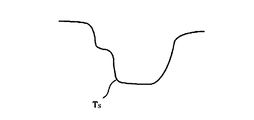
- the softening point measured by the macro-type differential thermal analyzer refers to the temperature (Ts) of the fourth bending point in the measurement curve shown in FIG.
- the coefficient of thermal expansion (30 to 150 ° C.) of the sealing material of the present invention is 20 ⁇ 10-7 / ° C. to 200 ⁇ 10-7 / ° C., 30 ⁇ 10-7 / ° C. to 160 ⁇ 10-7 / ° C., in particular. It is preferably 40 ⁇ 10 -7 / ° C. to 140 ⁇ 10 -7 / ° C. If the coefficient of thermal expansion is too low or too high, the sealing portion is likely to be damaged at the time of sealing or after sealing due to the difference in expansion from the material to be sealed.
- the sealing material of the present invention having the above characteristics is particularly suitable for crystal oscillator applications where sealing at a low temperature is required.
- the raw material powder prepared to have the above composition is melted at 800 to 1000 ° C. for 1 to 2 hours until a homogeneous glass is obtained.
- the molten glass is formed into a film or the like, crushed, and classified to produce a glass powder made of the glass composition of the present invention.
- the average particle size D 50 of the glass powder is preferably about 2 to 20 ⁇ m.
- the sealing material is made by adding various refractory filler powders to the glass powder.
- the glass paste (or sealing material paste) is prepared by adding the vehicle to the glass powder (or sealing material) and kneading it.
- the vehicle is mainly composed of an organic solvent and a resin, and the resin is added for the purpose of adjusting the viscosity of the paste. Further, if necessary, a surfactant, a thickener and the like can be added.
- the organic solvent preferably has a low boiling point (for example, a boiling point of 300 ° C. or lower), a small amount of residue after firing, and does not deteriorate the glass, and its content is 10 to 40% by mass. preferable.
- the organic solvent include propylene carbonate, toluene, N, N'-dimethylformamide (DMF), 1,3-dimethyl-2-imidazolidinone (DMI), dimethyl carbonate, butylcarbitol acetate (BCA), isoamyl acetate, and the like. It is preferable to use dimethyl sulfoxide, acetone, methyl ethyl ketone and the like. Further, it is more preferable to use a higher alcohol as the organic solvent.
- the higher alcohol Since the higher alcohol has its own viscosity, it can be made into a paste without adding a resin to the vehicle. Further, pentanediol and its derivatives, particularly diethyl pentanediol (C 9 H 20 O 2) also is excellent in viscosity, it can be used in a solvent.
- the resin preferably has a low decomposition temperature, a small amount of residue after firing, and is difficult to deteriorate the glass, and the content thereof is preferably 0.1 to 20% by mass.
- the resin it is preferable to use nitrocellulose, polyethylene glycol derivative, polyethylene carbonate, acrylic acid ester (acrylic resin) and the like.
- the paste is applied to the sealing portion between the first member made of metal, ceramic or glass and the second member made of metal, ceramic or glass by using a coating machine such as a dispenser or a screen printing machine. It is applied, dried and heat treated at 300-440 ° C. By this heat treatment, the glass powder softens and flows to seal the first and second members.
- the glass composition of the present invention can be used for purposes such as coating and filling in addition to sealing applications. Further, it can be used in a form other than paste, specifically, in a state of powder, green sheet, tablet or the like.
- Tables 1 and 2 show Examples (Samples Nos. 1 to 12) and Comparative Examples (Samples Nos. 13 and 14) of the present invention.
- various glass raw materials such as oxides and carbonates are mixed so as to have the glass composition shown in the table, a glass batch is prepared, and then this glass batch is placed in a platinum crucible and heated at 800 to 1000 ° C. Melted for 2 hours.
- a part of the molten glass was poured into a stainless steel mold as a sample for TMA (coefficient of thermal expansion), and the other molten glass was formed into a film by a water-cooled roller. No. which does not contain the refractory filler powder.
- a sample for TMA was obtained by performing a predetermined slow cooling treatment (annealing) after molding.
- the film-shaped glass was pulverized with a ball mill and then passed through a sieve having an opening of 75 ⁇ m to obtain a glass powder having an average particle diameter D 50 of about 10 ⁇ m.
- substantially spherical Zr 2 WO 4 (PO 4 ) 2 (denoted as ZWP in the table) and NbZr (PO 4 ) 3 (denoted as NZP in the table) were used.
- the average particle size D 50 of the refractory filler powder was about 10 ⁇ m.
- the obtained mixed powder was fired at 380 ° C. for 10 minutes to obtain a fired body.
- the obtained fired body was used as a sample for TMA.
- the glass transition point and the coefficient of thermal expansion (30 to 150 ° C.) were measured with a TMA sample using a TMA device.
- the softening point was measured by a macro-type differential thermal analyzer.
- the measurement atmosphere was in the atmosphere, the temperature rising rate was 10 ° C./min, and the measurement was started from room temperature.
- Liquidity was evaluated as follows. 5 g of the powder sample was placed in a mold having a diameter of 20 mm, press-molded, and then fired on a glass substrate at 380 ° C. for 10 minutes. The fired body having a flow diameter of 19 mm or more was designated as “ ⁇ ”, and the fired body having a flow diameter of less than 19 mm was designated as “x”.
- the glass composition and sealing material of the present invention are suitable for sealing semiconductor integrated circuits, crystal oscillators, flat display devices, LD glass terminals, and aluminum nitride substrates.
Landscapes
- Chemical & Material Sciences (AREA)
- Life Sciences & Earth Sciences (AREA)
- Engineering & Computer Science (AREA)
- Chemical Kinetics & Catalysis (AREA)
- General Chemical & Material Sciences (AREA)
- Geochemistry & Mineralogy (AREA)
- Materials Engineering (AREA)
- Organic Chemistry (AREA)
- Glass Compositions (AREA)
Abstract
環境に有害な鉛を含有させることなく、低温で封着可能なガラス組成物と、それを用いた封着材料を提供する。 モル%で、Li2O+K2O 1~30%、TeO2 30~80%、MoO3 5~30%を含有することを特徴とするガラス組成物。
Description
本発明は、有害な鉛を含有することなく、低温で気密封着することが可能なガラス組成物と、それを用いた封着材料に関するものである。
半導体集積回路、水晶振動子、平面表示装置やLD用ガラス端子等には、封着材料が使用される。
上記の封着材料には、化学的耐久性および耐熱性が要求されるため、樹脂系の接着剤ではなくガラス系封着材料が用いられている。封着材料には、さらに機械的強度、流動性、耐候性等の特性が要求されるが、熱に弱い素子を搭載する電子部品の封着には、封着温度をできる限り低くすることが要求される。具体的には、450℃未満での封着が要求される。それゆえ、上記特性を満足するガラスとして、融点を下げる効果が極めて大きいPbOを多量に含有する鉛硼酸系ガラスが広く用いられてきた(例えば、特許文献1参照)。
近年、鉛硼酸系ガラスに含まれるPbOに対して環境上の問題が指摘されており、鉛硼酸系ガラスからPbOを含まないガラスに置き換えることが望まれている。そのため、鉛硼酸系ガラスの代替品として、様々な低融点ガラスが開発されている。中でも特許文献2に記載されているBi2O3-B2O3系ガラスは、鉛硼酸系ガラスの代替候補として期待されているが、封止温度が450℃以上と高く、より低温での封止が必要な用途には用いることが出来ない。
以上に鑑み、本発明は、環境に有害な鉛を含有させることなく、低温で封着可能なガラス組成物と、それを用いた封着材料を提供することを目的とする。
本発明のガラス組成物は、モル%で、Li2O+K2O 1~30%、TeO2 30~80%、MoO3 5~30%を含有することを特徴とする。ここで、「Li2O+K2O」とは、Li2O及びK2Oの合量を意味する。
本発明のガラス組成物は、Li2O及びK2Oの合量を1%以上とすることにより、低軟化点を達成している。なお、一般に、ガラスの融点を低くすると、ガラス化しなかったり、分相が生じて均質なガラスが得られにくい傾向にあるが、本発明では、TeO2の含有量を30%以上、MoO3の含有量を5%以上と規定しているため、ガラスが安定化し、均質なガラスを得ることが出来る。
本発明のガラス組成物は、モル%で、Li2O+Na2O+K2O 1~30%、TeO2 30~80%、MoO3 5~30%を含有することを特徴とする。ここで、「Li2O+Na2O+K2O」とは、Li2O、Na2O及びK2Oの合量を意味する。
本発明のガラス組成物は、モル%で、Li2O 1~30%を含有することが好ましい。
本発明のガラス組成物は、モル比で、Li2O/K2Oが0.3~5であることが好ましい。ここで、「Li2O/K2O」とは、Li2Oの含有量をK2Oの含有量で除した値である。
本発明のガラス組成物は、さらに、モル%で、TiO2+Al2O3 0~10%を含有することが好ましい。ここで、「TiO2+Al2O3」とは、TiO2及びAl2O3の合量を意味する。
本発明のガラス組成物は、さらに、モル%で、CuO 0~30%、WO3 0~20%、P2O5 0~10%を含有することが好ましい。
本発明の封着材料は、上記のガラス組成物からなるガラス粉末 40~100体積%と、耐火性フィラー粉末 0~60体積%とを含有することを特徴とする。
本発明の封着材料は、耐火性フィラー粉末が略球状であることが好ましい。
本発明の封着材料は、耐火性フィラー粉末がZr2WO4(PO4)2を含有することが好ましい。
本発明の封着材料は、水晶振動子用途に使用されることが好ましい。
本発明の封着材料ペーストは、上記の封着材料とビークルとを含有することを特徴とする。
環境に有害な鉛を含有させることなく、低温で封着可能なガラス組成物と、それを用いた封着材料を提供することができる。
本発明のガラス組成物は、モル%で、Li2O+K2O 1~30%、TeO2 30~80%、MoO3 5~30%を含有することが好ましい。また、本発明のガラス組成物は、モル%で、Li2O+Na2O+K2O 1~30%、TeO2 30~80%、MoO3 5~30%を含有することが好ましい。ガラス組成を上記のように限定した理由を以下に示す。なお、以下の各成分の含有量に関する説明において、特に断りのない限り、「%」は「モル%」を意味する。
Li2O及びK2Oは、ガラスの粘性(軟化点等)を低下させる成分である。Li2O+K2Oは1~30%、2~30%、5~28%、特に7~26%であることが好ましい。Li2O+K2Oが少な過ぎると、ガラスの粘性(軟化点等)が高くなり、低温封着が困難になると共に、ガラスが熱的に不安定になり、溶融時又は焼成時にガラスが失透し易くなる。一方、Li2O+K2Oが多過ぎると、ガラスが熱的に不安定になり、溶融時又は焼成時にガラスが失透し易くなる。
モル比で、Li2O/K2Oは0.3~5、0.5~4、0.7~3、特に0.8~2であることが好ましい。Li2O/K2Oが小さ過ぎると、ガラスの粘性(軟化点等)が高くなり、低温封着が困難になると共に、ガラスが熱的に不安定になり、溶融時又は焼成時にガラスが失透し易くなる。一方、Li2O/K2Oが大き過ぎると、ガラスが熱的に不安定になり、溶融時又は焼成時にガラスが失透し易くなる。
Na2Oも、Li2O及びK2Oと同様にガラスの粘性(軟化点等)を低下させる成分である。Li2O+Na2O+K2Oは1~30%、2~30%、5~28%、特に7~26%であることが好ましい。Li2O+Na2O+K2Oが少な過ぎると、ガラスの粘性(軟化点等)が高くなり、低温封着が困難になると共に、ガラスが熱的に不安定になり、溶融時又は焼成時にガラスが失透し易くなる。一方、Li2O+Na2O+K2Oが多過ぎると、ガラスが熱的に不安定になり、溶融時又は焼成時にガラスが失透し易くなる。
なお、Li2O、Na2O及びK2Oの含有量の好ましい範囲は以下の通りである。
Li2Oは、Na2O及びK2Oに比べガラスの失透性を強めずにガラスの粘性(軟化点等)を低下させ易いため、Li2OはNa2O及びK2Oよりも多く含有することが好ましい。具体的には、Li2Oの含有量は1~30%、2~25%、3~20%、特に5~18%であることが好ましく、Na2Oの含有量は0~20%、1~15%、2~14%、特に3~13%であることが好ましく、K2Oの含有量は0~20%、1~15%、2~14%、特に3~13%であることが好ましい。
TeO2は、ガラスネットワークを形成すると共に、耐候性を向上させる成分である。TeO2の含有量は30~80%であり、40~70%、特に50~65%であることが好ましい。TeO2の含有量が少な過ぎると、ガラスが熱的に不安定になり、溶融時又は焼成時にガラスが失透し易くなると共に、耐候性が低下し易くなる。一方、TeO2の含有量が多過ぎると、ガラスの粘性(軟化点等)が高くなり、低温封着が困難になると共に、ガラスが熱的に不安定になり、溶融時又は焼成時にガラスが失透し易くなる。また、ガラスの熱膨張係数が高くなり過ぎる傾向にある。
MoO3は、ガラスネットワークを形成すると共に、耐候性を向上させる成分である。MoO3の含有量は5~30%であり、7~27%、特に10~25%であることが好ましい。MoO3の含有量が少な過ぎると、ガラスが熱的に不安定になり、溶融時又は焼成時にガラスが失透し易くなると共に、ガラスの粘性(軟化点等)が高くなり、低温封着が困難になる。一方、MoO3の含有量が多過ぎると、ガラスが熱的に不安定になり、溶融時又は焼成時にガラスが失透し易くなると共に、ガラスの熱膨張係数が高くなり過ぎる傾向にある。
本発明のガラス組成物は、上記成分以外にも、ガラス組成中に下記の成分を含有してもよい。
TiO2及びAl2O3は、耐候性を向上させる成分である。TiO2+Al2O3は0~10%、0.1~8%、特に1~6%であることが好ましい。TiO2+Al2O3が多過ぎると、ガラスの粘性(軟化点等)が高くなり、低温封着が困難になると共に、ガラスが熱的に不安定になり、溶融時又は焼成時にガラスが失透し易くなる。
なお、TiO2及びAl2O3の含有量の好ましい範囲は以下の通りである。
TiO2の含有量は0~8%、0.1~6%、1~5%であることが好ましく、Al2O3の含有量は0~5%、0~3%、0.1~2%であることが好ましい。
CuOは、ガラスの粘性(軟化点等)を低下させると共に、ガラスの熱膨張係数を低下させる成分である。CuOの含有量は0~30%、0~10%、0~6%、特に0.1~2%であることが好ましい。CuOの含有量が多過ぎると、ガラスが熱的に不安定になり、溶融時又は焼成時にガラスが失透し易くなる。
WO3は、ガラスの熱膨張係数を低下させる成分である。WO3の含有量は0~20%、0~10%、特に0.1~5%であることが好ましい。WO3の含有量が多過ぎると、ガラスが熱的に不安定になり、溶融時又は焼成時にガラスが失透し易くなると共に、ガラスの粘性(軟化点等)が高くなり、低温封着が困難になる。
P2O5は、ガラスネットワークを形成すると共に、ガラスを熱的に安定化させる成分である。P2O5の含有量は0~10%、0~5%、0~2%、特に0.1~1%であることが好ましい。P2O5の含有量が多過ぎると、ガラスの粘性(軟化点等)が高くなり、低温封着が困難になると共に耐候性が低下し易くなる。
Ag2Oは、ガラスの粘性(軟化点等)を低下させる成分である。Ag2Oの含有量は0~10%、0~5%、特に0~2%であることが好ましい。Ag2Oの含有量が多過ぎると、ガラスが熱的に不安定になり、溶融時又は焼成時にガラスが失透し易くなる。
AgIは、ガラスの粘性(軟化点等)を低下させる成分である。AgIの含有量は0~10%、0~5%、特に0~2%であることが好ましい。AgIの含有量が多過ぎると、ガラスの熱膨張係数が高くなり過ぎる傾向にある。
MgO、CaO、SrO、BaOは、ガラスを熱的に安定化させると共に、耐候性を向上させる効果があり、それらの含有量は合量で、0~20%、特に0~10%であることが好ましい。MgO、CaO、SrO、BaOの合量が多過ぎると、ガラスが熱的に不安定になり溶融時または焼成時にガラスが失透し易くなる。なお、MgO、CaO、SrO、BaOの含有量はそれぞれ、0~10%、特に0~5%であることが好ましい。
ZnOは、ガラスの粘性(軟化点等)を低下させると共に、耐候性を向上させる成分である。ZnOの含有量は0~10%、特に0~5%であることが好ましい。ZnOの含有量が多過ぎると、ガラスが熱的に不安定になり溶融時または焼成時にガラスが失透し易くなる。
Nb2O5は、ガラスを熱的に安定化させると共に、耐候性を向上させる成分である。Nb2O5の含有量は0~10%、特に0~5%であることが好ましい。Nb2O5の含有量が多過ぎると、ガラスの粘性(軟化点等)が高くなり、低温封着が困難になり易い。
V2O5は、ガラスネットワークを形成すると共に、ガラスの粘性(軟化点等)を低下させる成分である。V2O5の含有量は0~10%、特に0~5%であることが好ましい。V2O5の含有量が多過ぎると、ガラスが熱的に不安定になり、溶融時又は焼成時にガラスが失透し易くなると共に、耐候性が低下し易くなる。
Ga2O3は、ガラスを熱的に安定化させると共に、耐候性を向上させる成分であるが、非常に高価であることから、その含有量は0.01%未満、特に含有しないことが好ましい。
SiO2、GeO2、Fe2O3、NiO、CeO2、B2O3、Sb2O3、ZrO2はガラスを熱的に安定化させて、失透を抑制する成分であり、各々2%未満まで添加可能である。これらの含有量が多すぎると、ガラスが熱的に不安定になり、溶融時又は焼成時にガラスが失透し易くなる。
本発明のガラス組成物は、環境上の理由から、実質的にPbOを含有しないことが好ましい。ここで、「実質的にPbOを含有しない」とは、ガラス組成中のPbOの含有量が1000ppm以下の場合を指す。
本発明の封着材料は、上記のガラス組成物からなるガラス粉末を含有する。本発明の封着材料は、機械的強度を向上、或いは熱膨張係数を調整するために、耐火性フィラー粉末を含有してもよい。その混合割合は、ガラス粉末40~100体積%、耐火性フィラー粉末0~60体積%であり、ガラス粉末50~99体積%、耐火性フィラー粉末1~50体積%、特にガラス粉末60~95体積%、耐火性フィラー粉末5~40体積%であることが好ましい。耐火性フィラー粉末の含有量が多過ぎると、相対的にガラス粉末の割合が少なくなるため、所望の流動性を確保し難くなる。
耐火性フィラー粉末は、略球状であることが好ましい。このようにすれば、ガラス粉末が軟化する際に、ガラス粉末の流動性が耐火性フィラー粉末によって阻害され難くなり、結果として、封着材料の流動性が向上する。また、平滑なグレーズ層を得やすくなる。さらに、仮にグレーズ層の表面に耐火性フィラー粉末の一部が露出しても、耐火性フィラー粉末が略球状であるため、この部分の応力が分散され、更には封着に際し、被封着物をグレーズ層に当接しても、被封着物に不当な応力がかかり難く、結果として気密性を確保し易くなる。なお、本発明でいう「略球状」とは、真球のみに限定されるものではなく、耐火性フィラー粉末において、耐火性フィラー粉末の重心を通る最も短い径を最も長い径で割った値が0.5以上、好ましくは0.7以上のものを指す。
耐火性フィラー粉末は、Zr2WO4(PO4)2を含有することが好ましい。Zr2WO4(PO4)2は上記のガラス粉末と反応し難く、効率的に封着材料の熱膨張係数を低下することが可能である。
また本発明の封着材料は、耐火性フィラー粉末として、Zr2WO4(PO4)2以外の耐火性フィラー粉末を使用することもできる。その他の耐火性フィラー粉末としては、NbZr(PO4)3、Zr2MoO4(PO4)2、Hf2WO4(PO4)2、Hf2MoO4(PO4)2、リン酸ジルコニウム、ジルコン、ジルコニア、酸化錫、チタン酸アルミニウム、石英、β-スポジュメン、ムライト、チタニア、石英ガラス、β-ユークリプタイト、β-石英、ウィレマイト、コーディエライト、Sr0.5Zr2(PO4)3等からなる粉末を、単独で又は2種以上を混合して使用することができる。なお、耐火性フィラー粉末の粒径は平均粒子径D50が0.2~20μm程度のものを使用することが好ましい。
本発明の封着材料の軟化点は380℃以下、370℃以下、360℃以下、特に350℃以下であることが好ましい。軟化点が高過ぎると、ガラスの粘性が高くなるため、封着温度が上昇して、封着時に素子を劣化させるおそれがある。なお、軟化点の下限は特に限定されないが、現実的には180℃以上である。ここで、「軟化点」とは、平均粒子径D50が0.5~20μmの封着材料を測定試料として、マクロ型示差熱分析装置で測定した値を指す。測定条件としては、室温から測定を開始し、昇温速度は10℃/分とする。なお、マクロ型示差熱分析装置で測定した軟化点は、図1に示す測定曲線における第四屈曲点の温度(Ts)を指す。
本発明の封着材料の熱膨張係数(30~150℃)は20×10-7/℃~200×10-7/℃、30×10-7/℃~160×10-7/℃、特に40×10-7/℃~140×10-7/℃であることが好ましい。熱膨張係数が低すぎても高すぎても、被封着材料との膨張差により封着時や封着後に封着部が破損し易くなる。
上記の特性を有する本発明の封着材料は、特に低温での封着が要求される水晶振動子用途に好適である。
次に本発明のガラス組成物を用いたガラス粉末の製造方法、及び本発明のガラス組成物を封着材料として使用する方法の一例について説明する。
まず、上記組成となるように調合した原料粉末を800~1000℃で1~2時間、均質なガラスが得られるまで溶融する。次いで、溶融ガラスをフィルム状等に成形した後、粉砕し、分級することにより、本発明のガラス組成物からなるガラス粉末を作製する。なお、ガラス粉末の平均粒子径D50は2~20μm程度であることが好ましい。必要に応じて、ガラス粉末に各種耐火性フィラー粉末を添加した封着材料とする。
次いでガラス粉末(あるいは封着材料)にビークルを添加して混練することによりガラスペースト(あるいは封着材料ペースト)を調製する。ビークルは、主に有機溶剤と樹脂とからなり、樹脂はペーストの粘性を調整する目的で添加される。また、必要に応じて、界面活性剤、増粘剤等を添加することもできる。
有機溶剤は、沸点が低く(例えば、沸点が300℃以下)、且つ焼成後の残渣が少ないことに加えて、ガラスを変質させないものが好ましく、その含有量は10~40質量%であることが好ましい。有機溶剤としては、プロピレンカーボネート、トルエン、N,N’-ジメチルホルムアミド(DMF)、1,3-ジメチル-2-イミダゾリジノン(DMI)、炭酸ジメチル、ブチルカルビトールアセテート(BCA)、酢酸イソアミル、ジメチルスルホキシド、アセトン、メチルエチルケトン等を使用することが好ましい。また、有機溶剤として、高級アルコールを使用することがさらに好ましい。高級アルコールは、それ自身が粘性を有しているために、ビークルに樹脂を添加しなくても、ペースト化することができる。また、ペンタンジオールとその誘導体、具体的にはジエチルペンタンジオール(C9H20O2)も粘性に優れるため、溶剤に使用することができる。
樹脂は、分解温度が低く、焼成後の残渣が少ないことに加えて、ガラスを変質させ難いものが好ましく、その含有量は0.1~20質量%であることが好ましい。樹脂として、ニトロセルロース、ポリエチレングリコール誘導体、ポリエチレンカーボネート、アクリル酸エステル(アクリル樹脂)等を使用することが好ましい。
次いで、ペーストを金属、セラミック、または、ガラスからなる第一の部材と、金属、セラミック、または、ガラスからなる第二の部材との封着箇所にディスペンサーやスクリーン印刷機等の塗布機を用いて塗布し、乾燥させ、300~440℃で熱処理する。この熱処理により、ガラス粉末が軟化流動して第一と第二の部材を封着する。
本発明のガラス組成物は、封着用途以外にも被覆、充填等の目的で使用できる。また、ペースト以外の形態、具体的には粉末、グリーンシート、タブレット等の状態で使用することもできる。
実施例に基づいて、本発明を詳細に説明する。表1及び2は、本発明の実施例(試料No.1~12)及び比較例(試料No.13、14)を示している。
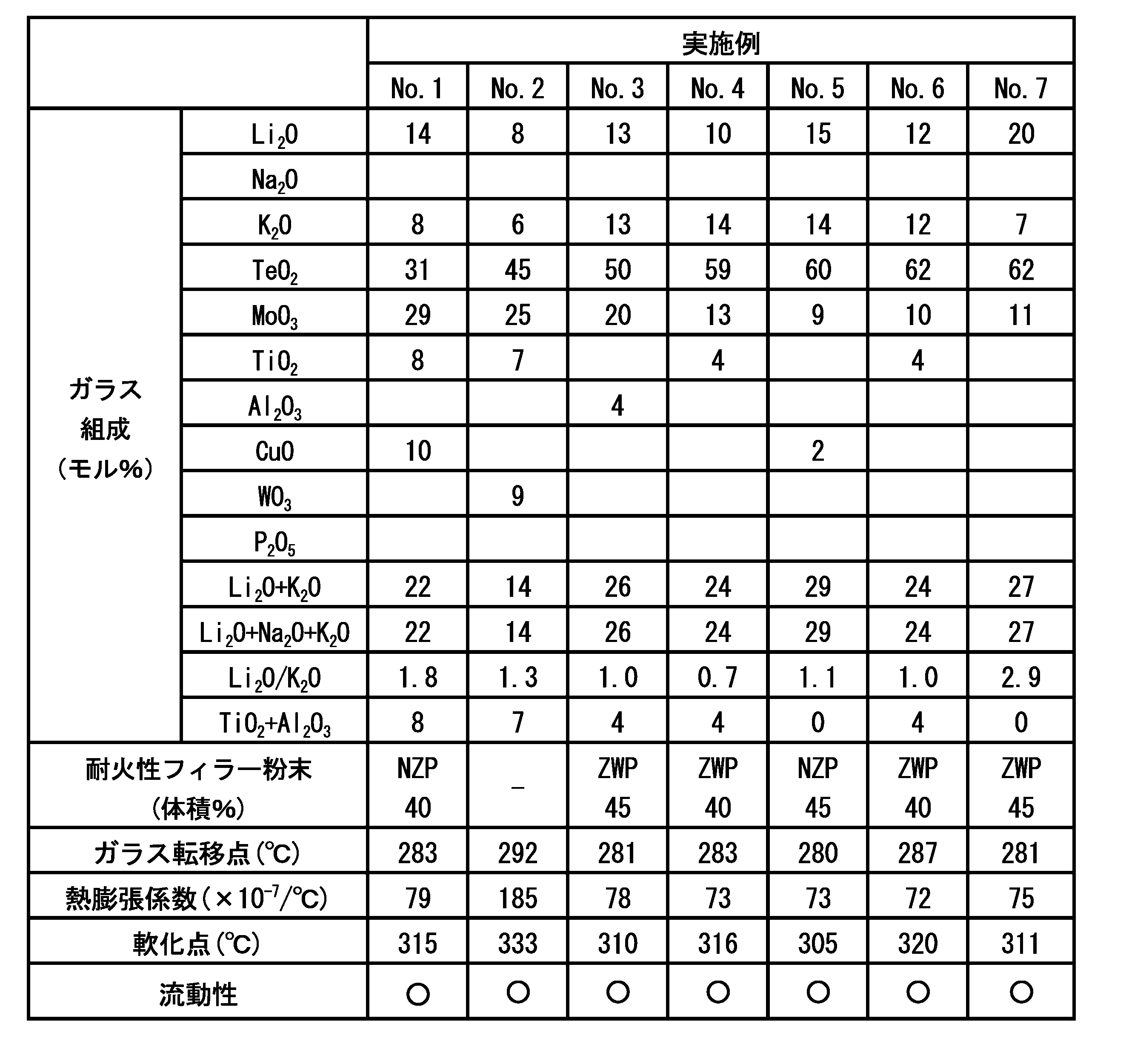
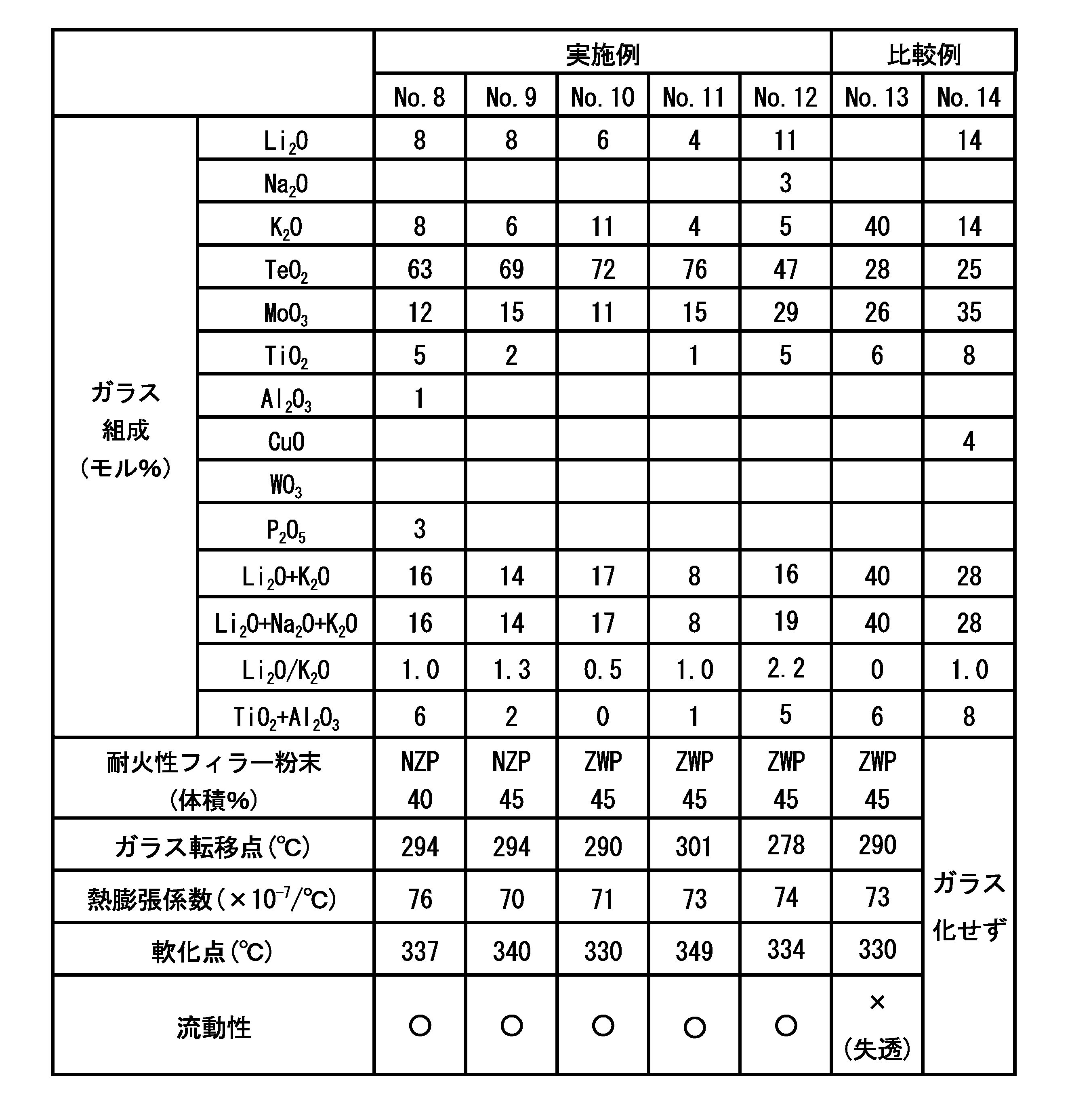
まず、表中に示したガラス組成となるように各種酸化物、炭酸塩等のガラス原料を調合し、ガラスバッチを準備した後、このガラスバッチを白金坩堝に入れ、800~1000℃で1~2時間溶融した。次に、溶融ガラスの一部をTMA(押棒式熱膨張係数測定)用サンプルとしてステンレス製の金型に流し出し、その他の溶融ガラスを水冷ローラーでフィルム状に成形した。なお、耐火性フィラー粉末を含有しないNo.2については、成形後に所定の徐冷処理(アニール)を行うことによりTMA用サンプルを得た。最後に、フィルム状のガラスをボールミルで粉砕した後、目開き75μmの篩を通過させて、平均粒子径D50が約10μmのガラス粉末を得た。
その後、耐火性フィラー粉末を混合するNo.1、3~13の試料については、表中に示した通りに、得られたガラス粉末と耐火性フィラー粉末を混合し、混合粉末を得た。
耐火性フィラー粉末には、略球状のZr2WO4(PO4)2(表中ではZWPと表記)、NbZr(PO4)3(表中ではNZPと表記)を用いた。また、耐火性フィラー粉末の平均粒子径D50は約10μmであった。
得られた混合粉末を380℃にて10分間焼成し、焼成体を得た。得られた焼成体をTMA用サンプルとした。
No.1~12の試料について、ガラス転移点、熱膨張係数、軟化点、流動性を評価した。
ガラス転移点及び熱膨張係数(30~150℃)は、TMA用サンプルをTMA装置により測定した。
軟化点はマクロ型示差熱分析装置により測定した。測定雰囲気は大気中、昇温速度は10℃/分とし、室温から測定を開始した。
流動性は次のようにして評価した。粉末試料5gを、直径20mmの金型に入れプレス成型した後に、ガラス基板上で380℃にて10分間焼成した。焼成体の流動径が19mm以上であるものを「○」、19mm未満のものを「×」とした。
表から明らかなように、本発明の実施例であるNo.1~12の試料は、流動性に優れていた。一方、比較例であるNo.13の試料はK2Oを過剰に含有、且つTeO2の含有量が少ないため、焼成時に失透した。No.14の試料は、MoO3を過剰に含有し、且つTeO2の含有量が少ないためガラス化しなかった。
本発明のガラス組成物及び封着材料は、半導体集積回路、水晶振動子、平面表示装置、LD用ガラス端子や窒化アルミニウム基板の封着に好適である。
Claims (11)
- モル%で、Li2O+K2O 1~30%、TeO2 30~80%、MoO3 5~30%を含有することを特徴とするガラス組成物。
- モル%で、Li2O+Na2O+K2O 1~30%、TeO2 30~80%、MoO3 5~30%を含有することを特徴とするガラス組成物。
- モル%で、Li2O 1~30%を含有することを特徴とする請求項1又は2に記載のガラス組成物。
- モル比で、Li2O/K2Oが0.3~5であることを特徴とする請求項1~3のいずれかに記載のガラス組成物。
- さらに、モル%で、TiO2+Al2O3 0~10%を含有することを特徴とする請求項1~4のいずれかに記載のガラス組成物。
- さらに、モル%で、CuO 0~30%、WO3 0~20%、P2O5 0~10%を含有することを特徴とする請求項1~5のいずれかに記載のガラス組成物。
- 請求項1~6のいずれかに記載のガラス組成物からなるガラス粉末 40~100体積%と、耐火性フィラー粉末 0~60体積%とを含有することを特徴とする封着材料。
- 耐火性フィラー粉末が略球状であることを特徴とする請求項7に記載の封着材料。
- 耐火性フィラー粉末がZr2WO4(PO4)2を含有することを特徴とする請求項7又は8に記載の封着材料。
- 水晶振動子用途に使用されることを特徴とする請求項7~9のいずれかに記載の封着材料。
- 請求項7~10のいずれかに記載の封着材料とビークルとを含有することを特徴とする封着材料ペースト。
Priority Applications (1)
| Application Number | Priority Date | Filing Date | Title |
|---|---|---|---|
| CN202080021106.3A CN113574025A (zh) | 2019-06-26 | 2020-06-16 | 玻璃组合物以及密封材料 |
Applications Claiming Priority (4)
| Application Number | Priority Date | Filing Date | Title |
|---|---|---|---|
| JP2019-118107 | 2019-06-26 | ||
| JP2019118107 | 2019-06-26 | ||
| JP2019-148860 | 2019-08-14 | ||
| JP2019148860A JP7385169B2 (ja) | 2019-06-26 | 2019-08-14 | ガラス組成物及び封着材料 |
Publications (1)
| Publication Number | Publication Date |
|---|---|
| WO2020262109A1 true WO2020262109A1 (ja) | 2020-12-30 |
Family
ID=74060133
Family Applications (1)
| Application Number | Title | Priority Date | Filing Date |
|---|---|---|---|
| PCT/JP2020/023577 Ceased WO2020262109A1 (ja) | 2019-06-26 | 2020-06-16 | ガラス組成物及び封着材料 |
Country Status (1)
| Country | Link |
|---|---|
| WO (1) | WO2020262109A1 (ja) |
Citations (4)
| Publication number | Priority date | Publication date | Assignee | Title |
|---|---|---|---|---|
| JP2016103354A (ja) * | 2014-11-27 | 2016-06-02 | 株式会社ノリタケカンパニーリミテド | 導電性組成物 |
| JP2018123015A (ja) * | 2017-01-31 | 2018-08-09 | 日本電気硝子株式会社 | 銀リン酸系ガラス組成物及び封着材料 |
| JP2020059615A (ja) * | 2018-10-05 | 2020-04-16 | 日本電気硝子株式会社 | ガラス組成物及び封着材料 |
| JP2020117421A (ja) * | 2019-01-25 | 2020-08-06 | 日本電気硝子株式会社 | ガラス粉末及びそれを用いた封着材料 |
-
2020
- 2020-06-16 WO PCT/JP2020/023577 patent/WO2020262109A1/ja not_active Ceased
Patent Citations (4)
| Publication number | Priority date | Publication date | Assignee | Title |
|---|---|---|---|---|
| JP2016103354A (ja) * | 2014-11-27 | 2016-06-02 | 株式会社ノリタケカンパニーリミテド | 導電性組成物 |
| JP2018123015A (ja) * | 2017-01-31 | 2018-08-09 | 日本電気硝子株式会社 | 銀リン酸系ガラス組成物及び封着材料 |
| JP2020059615A (ja) * | 2018-10-05 | 2020-04-16 | 日本電気硝子株式会社 | ガラス組成物及び封着材料 |
| JP2020117421A (ja) * | 2019-01-25 | 2020-08-06 | 日本電気硝子株式会社 | ガラス粉末及びそれを用いた封着材料 |
Non-Patent Citations (5)
| Title |
|---|
| CHUNG, W. J. ET AL.: "Local Environment Modification of Er3+ Ion in Tellurite Glasses Induced by Mo03", J. AM. CERAM. SOC., vol. 93, 26 April 2010 (2010-04-26), pages 1432 - 1436, XP055780407, DOI: 10.1111/j.1551- 2916.2009.03586.x * |
| DI PRATULA, P. E. ET AL.: "Ionic conductivity enhancement achieved by the incorporation of ZnO in a lithium tellurite glass", J. NON-CRYST. SOLIDS, vol. 461, 30 January 2017 (2017-01-30), pages 18 - 23, XP029939070, DOI: 10.1016/j.jnoncrysol. 2017.01.03 9 * |
| FRECHERO, M. A. ET AL.: "IR absorption spectra of lithum and silver vanadium-tellurite based glasses", J. NON-CRYST. SOLIDS, vol. 353, 1 October 2007 (2007-10-01), pages 2919 - 2925, XP022208331, DOI: 10.1016/j.jnoncrysol. 2007.06.03 2 * |
| SAVIKIN, A. P. ET AL.: "Luminescence of erbium ions in tellurite glasses", J. SOLID STATE CHEM., vol. 207, 20 September 2013 (2013-09-20), pages 80 - 86, XP055780401, DOI: 10.1016/j.jssc. 2013.09.01 4, in particular * |
| YUE, J. ET AL.: "Thermally stable mid-infrared fluorotellurite glass with low OH content", J. NON-CRYST. SOLIDS, vol. 408, 14 October 2014 (2014-10-14), pages 1 - 6, XP055780402, DOI: 10.1016/j.jnoncrysol. 2014.10.00 6 * |
Similar Documents
| Publication | Publication Date | Title |
|---|---|---|
| JP7222182B2 (ja) | ガラス組成物及び封着材料 | |
| JP7185182B2 (ja) | ガラス組成物及び封着材料 | |
| JP7090838B2 (ja) | ガラス組成物及び封着材料 | |
| US20240368024A1 (en) | Glass composition and sealing material | |
| JP7385169B2 (ja) | ガラス組成物及び封着材料 | |
| JP2019089689A (ja) | ガラス組成物及び封着材料 | |
| CN113614042B (zh) | 玻璃组合物以及密封材料 | |
| JP7616507B2 (ja) | ガラス組成物及び封着材料 | |
| WO2020153061A1 (ja) | ガラス粉末及びそれを用いた封着材料 | |
| JP2023033083A (ja) | ガラス組成物及び封着材料 | |
| JP6816538B2 (ja) | 銀リン酸系ガラス組成物及び封着材料 | |
| WO2024262306A1 (ja) | ガラス組成物、封着材料及び封着材料ペースト | |
| JP2020040848A (ja) | ガラス組成物及び封着材料 | |
| CN115038672B (zh) | 玻璃组合物以及密封材料 | |
| JP7522386B2 (ja) | ガラス組成物及び封着材料 | |
| JP2018123016A (ja) | 銀リン酸系ガラス組成物及び封着材料 | |
| WO2026063225A1 (ja) | ガラス組成物、封着材料及び封着材料ペースト | |
| JP2019089685A (ja) | バナジウムリン酸系ガラス組成物及び封着材料 | |
| JP2019073403A (ja) | バナジウムリン酸系ガラス組成物及び封着材料 | |
| JP2025003302A (ja) | ガラス組成物、封着材料及び封着材料ペースト | |
| WO2025075031A1 (ja) | ガラス粉末、封着材料及び封着材料ペースト | |
| JP2018184314A (ja) | 銀リン酸系ガラス組成物及び封着材料 |
Legal Events
| Date | Code | Title | Description |
|---|---|---|---|
| 121 | Ep: the epo has been informed by wipo that ep was designated in this application |
Ref document number: 20832269 Country of ref document: EP Kind code of ref document: A1 |
|
| NENP | Non-entry into the national phase |
Ref country code: DE |
|
| 122 | Ep: pct application non-entry in european phase |
Ref document number: 20832269 Country of ref document: EP Kind code of ref document: A1 |