WO2020255569A1 - 光ファイバ - Google Patents
光ファイバ Download PDFInfo
- Publication number
- WO2020255569A1 WO2020255569A1 PCT/JP2020/018341 JP2020018341W WO2020255569A1 WO 2020255569 A1 WO2020255569 A1 WO 2020255569A1 JP 2020018341 W JP2020018341 W JP 2020018341W WO 2020255569 A1 WO2020255569 A1 WO 2020255569A1
- Authority
- WO
- WIPO (PCT)
- Prior art keywords
- resin layer
- meth
- acrylate
- optical fiber
- silica particles
- Prior art date
- Legal status (The legal status is an assumption and is not a legal conclusion. Google has not performed a legal analysis and makes no representation as to the accuracy of the status listed.)
- Ceased
Links
Images
Classifications
-
- C—CHEMISTRY; METALLURGY
- C03—GLASS; MINERAL OR SLAG WOOL
- C03C—CHEMICAL COMPOSITION OF GLASSES, GLAZES OR VITREOUS ENAMELS; SURFACE TREATMENT OF GLASS; SURFACE TREATMENT OF FIBRES OR FILAMENTS MADE FROM GLASS, MINERALS OR SLAGS; JOINING GLASS TO GLASS OR OTHER MATERIALS
- C03C25/00—Surface treatment of fibres or filaments made from glass, minerals or slags
- C03C25/10—Coating
- C03C25/465—Coatings containing composite materials
- C03C25/47—Coatings containing composite materials containing particles, fibres or flakes, e.g. in a continuous phase
-
- C—CHEMISTRY; METALLURGY
- C03—GLASS; MINERAL OR SLAG WOOL
- C03C—CHEMICAL COMPOSITION OF GLASSES, GLAZES OR VITREOUS ENAMELS; SURFACE TREATMENT OF GLASS; SURFACE TREATMENT OF FIBRES OR FILAMENTS MADE FROM GLASS, MINERALS OR SLAGS; JOINING GLASS TO GLASS OR OTHER MATERIALS
- C03C25/00—Surface treatment of fibres or filaments made from glass, minerals or slags
- C03C25/10—Coating
- C03C25/104—Coating to obtain optical fibres
- C03C25/1065—Multiple coatings
-
- C—CHEMISTRY; METALLURGY
- C03—GLASS; MINERAL OR SLAG WOOL
- C03C—CHEMICAL COMPOSITION OF GLASSES, GLAZES OR VITREOUS ENAMELS; SURFACE TREATMENT OF GLASS; SURFACE TREATMENT OF FIBRES OR FILAMENTS MADE FROM GLASS, MINERALS OR SLAGS; JOINING GLASS TO GLASS OR OTHER MATERIALS
- C03C25/00—Surface treatment of fibres or filaments made from glass, minerals or slags
- C03C25/10—Coating
- C03C25/104—Coating to obtain optical fibres
- C03C25/105—Organic claddings
-
- G—PHYSICS
- G02—OPTICS
- G02B—OPTICAL ELEMENTS, SYSTEMS OR APPARATUS
- G02B6/00—Light guides; Structural details of arrangements comprising light guides and other optical elements, e.g. couplings
- G02B6/02—Optical fibres with cladding with or without a coating
- G02B6/02395—Glass optical fibre with a protective coating, e.g. two layer polymer coating deposited directly on a silica cladding surface during fibre manufacture
-
- H—ELECTRICITY
- H05—ELECTRIC TECHNIQUES NOT OTHERWISE PROVIDED FOR
- H05F—STATIC ELECTRICITY; NATURALLY-OCCURRING ELECTRICITY
- H05F1/00—Preventing the formation of electrostatic charges
- H05F1/02—Preventing the formation of electrostatic charges by surface treatment
Definitions
- the present disclosure relates to optical fibers.
- This application claims priority based on Japanese Application No. 2019-112809 filed on June 18, 2019, and incorporates all the contents described in the Japanese application.
- an optical fiber has a coating resin layer for protecting a glass fiber which is an optical transmitter.
- the coating resin layer is composed of, for example, a primary resin layer and a secondary resin layer.
- the optical fiber according to one aspect of the present disclosure includes a glass fiber including a core and a clad, and a coating resin layer that covers the outer periphery of the glass fiber, and the coating resin layer is in contact with the glass fiber to coat the glass fiber.
- the secondary resin layer has a primary resin layer and a secondary resin layer that covers the outer periphery of the primary resin layer.
- the secondary resin layer contains hydrophobic spherical silica particles, and the content of the silica particles is based on the total amount of the secondary resin layer. It is 7% by mass or more and 60% by mass or less, and the absolute value of the surface potential of the optical fiber is 10 mV or more and 60 mV or less.
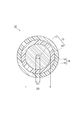
- FIG. 1 is a schematic cross-sectional view showing an example of an optical fiber according to the present embodiment.
- An object of the present disclosure is to provide an optical fiber capable of suppressing charging and reducing disconnection due to adhesion of foreign matter or the like.
- the optical fiber according to one aspect of the present disclosure includes a glass fiber including a core and a clad, and a coating resin layer that covers the outer periphery of the glass fiber, and the coating resin layer is in contact with the glass fiber to coat the glass fiber.
- the secondary resin layer has a primary resin layer and a secondary resin layer that covers the outer periphery of the primary resin layer.
- the secondary resin layer contains hydrophobic spherical silica particles, and the content of the silica particles is based on the total amount of the secondary resin layer. It is 7% by mass or more and 60% by mass or less, and the absolute value of the surface potential of the optical fiber is 10 mV or more and 60 mV or less.
- the absolute value of the surface potential of the optical fiber can be increased, charging of the optical fiber can be suppressed, and disconnection of the optical fiber due to adhesion of foreign matter or the like can be reduced. it is conceivable that.
- the average particle size of the silica particles may be 5 nm or more and 400 nm or less because the dispersibility in the resin layer is excellent and the surface potential of the optical fiber can be easily adjusted.
- the Young's modulus of the secondary resin layer may be 1200 MPa or more and 3000 MPa or less at 23 ° C. in order to improve the strength of the optical fiber.
- the outer diameter of the optical fiber may be 200 ⁇ 15 ⁇ m. Since it has the secondary resin layer according to the present embodiment, it is difficult to break even a small-diameter optical fiber. From the viewpoint of suppressing the charging of the optical fiber and reducing the disconnection due to the adhesion of foreign matter, the secondary resin layer is composed of a base resin containing an oligomer containing urethane (meth) acrylate, a monomer and a photopolymerization initiator, and a hydrophobic spherical shape. A cured product of the resin composition containing silica particles may be included.
- FIG. 1 is a schematic cross-sectional view showing an example of an optical fiber according to the present embodiment.
- the optical fiber 10 includes a glass fiber 13 including a core 11 and a clad 12, and a coating resin layer 16 including a primary resin layer 14 and a secondary resin layer 15 provided on the outer periphery of the glass fiber 13.
- the clad 12 surrounds the core 11.
- the core 11 and the clad 12 mainly contain glass such as quartz glass.
- glass such as quartz glass.
- quartz glass or pure quartz glass to which germanium is added can be used for the core 11, and pure quartz glass or pure quartz glass or pure quartz glass can be used for the clad 12.
- Fused quartz glass to which fluorine has been added can be used.
- the outer diameter (D2) of the glass fiber 13 is about 100 ⁇ m to 125 ⁇ m, and the diameter (D1) of the core 11 constituting the glass fiber 13 is about 7 ⁇ m to 15 ⁇ m.
- the thickness of the coating resin layer 16 is usually about 22 ⁇ m to 70 ⁇ m.
- the thickness of each of the primary resin layer 14 and the secondary resin layer 15 may be about 5 ⁇ m to 50 ⁇ m.
- the thickness of each layer of the primary resin layer 14 and the secondary resin layer 15 is about 10 ⁇ m to 50 ⁇ m.
- the thickness of the primary resin layer 14 may be 35 ⁇ m, and the thickness of the secondary resin layer 15 may be 25 ⁇ m.
- the outer diameter of the optical fiber 10 may be about 245 ⁇ m to 265 ⁇ m.
- the thickness of each layer of the primary resin layer 14 and the secondary resin layer 15 is about 10 ⁇ m to 38 ⁇ m.
- the thickness of the primary resin layer 14 may be 25 ⁇ m, and the thickness of the secondary resin layer 15 may be 10 ⁇ m.
- the outer diameter of the optical fiber 10 may be about 179 ⁇ m to 221 ⁇ m.
- the thickness of each layer of the primary resin layer 14 and the secondary resin layer 15 is about 5 ⁇ m to 32 ⁇ m.
- the thickness of the primary resin layer 14 may be 25 ⁇ m, and the thickness of the secondary resin layer 15 may be 10 ⁇ m.
- the outer diameter of the optical fiber 10 may be about 144 ⁇ m to 174 ⁇ m.
- the absolute value of the surface potential of the optical fiber is 10 mV or more and 60 mV or less, preferably 10 mV or more and 50 mV or less, and more preferably 15 mV or more and 40 mV or less.
- the secondary resin layer 15 is hydrophobic with a base resin containing an oligomer containing a urethane (meth) acrylate, a monomer and a photopolymerization initiator. It can be formed by curing a resin composition containing spherical silica particles. That is, the secondary resin layer 15 may contain a cured product of a resin composition containing an oligomer containing a urethane (meth) acrylate, a monomer, a base resin containing a photopolymerization initiator, and hydrophobic spherical silica particles.
- the (meth) acrylate means an acrylate or a methacrylate corresponding thereto.
- the silica particles according to this embodiment are spherical particles whose surface is hydrophobically treated.
- the hydrophobic treatment according to the present embodiment means that a hydrophobic group is introduced on the surface of the silica particles.
- the silica particles into which a hydrophobic group has been introduced are excellent in dispersibility in the resin composition.
- the hydrophobic group is a reactive group (ultraviolet curable functional group) such as a (meth) acryloyl group, an aliphatic hydrocarbon group (for example, an alkyl group), or an aromatic hydrocarbon group (for example, a phenyl group). It may be a non-reactive group such as.
- When the silica particles have a reactive group it becomes easy to form a resin layer having a high Young's modulus.
- the silica particles according to the present embodiment may have an ultraviolet curable functional group because it is easy to suppress the charging of the optical fiber and reduce the disconnection due to the adhesion of foreign matter or the like.
- the ultraviolet curable functional group can be introduced on the surface of the spherical silica particles.
- silane compound having an ultraviolet curable functional group examples include 3-methacryloxypropyltrimethoxysilane, 3-acryloxypropyltrimethoxysilane, 3-methacryloxypropyltriethoxysilane, and 3-acryloxypropyltriethoxysilane. , 8-Methyloxyoctyltrimethoxysilane, 8-acryloxyoctyltrimethoxysilane, 7-octenyltrimethoxysilane, vinyltrimethoxysilane and vinyltriethoxysilane.
- the silica particles according to this embodiment are dispersed in a dispersion medium.
- the silica particles dispersed in the dispersion medium By using the silica particles dispersed in the dispersion medium, the silica particles can be uniformly dispersed in the resin composition, and the silica particles are present in a dispersed state even in the resin layer formed from the resin composition.
- the dispersion medium is not particularly limited as long as it does not inhibit the curing of the resin composition.
- the dispersion medium may be reactive or non-reactive.
- a monomer such as a (meth) acryloyl compound or an epoxy compound
- examples of the (meth) acrylic compound include 1,6-hexanediol di (meth) acrylate, EO-modified bisphenol A di (meth) acrylate, polyethylene glycol di (meth) acrylate, and PO-modified bisphenol A di (meth) acrylate.
- the (meth) acryloyl compound a compound exemplified by the monomer described later may be used.
- a ketone solvent such as methyl ethyl ketone (MEK), an alcohol solvent such as methanol (methanol), or an ester solvent such as propylene glycol monomethyl ether acetate (PGMEA) may be used.
- MEK methyl ethyl ketone
- methanol methanol
- PMEA propylene glycol monomethyl ether acetate
- the base resin and the spherical silica particles dispersed in the dispersion medium may be mixed, and then a part of the dispersion medium may be removed to prepare a resin composition.
- the silica particles dispersed in the dispersion medium exist in a dispersed state in the resin layer even after the resin composition is cured.
- a reactive dispersion medium When a reactive dispersion medium is used, the silica particles are mixed with the resin composition together with the dispersion medium and incorporated into the resin layer while maintaining the dispersed state.
- a non-reactive dispersion medium When a non-reactive dispersion medium is used, at least a part of the dispersion medium volatilizes from the resin composition and disappears, but the silica particles remain in the dispersed state in the resin composition and also in the cured resin layer. It exists in a dispersed state.
- the silica particles present in the resin layer are observed in a state in which the primary particles are dispersed when observed with an electron microscope.
- silica particles having an ultraviolet curable functional group As the silica particles according to the present embodiment, it is preferable to use silica particles having an ultraviolet curable functional group as the silica particles according to the present embodiment.
- the average primary particle size of the silica particles is preferably 400 nm or less, more preferably 300 nm or less. From the viewpoint of increasing the Young's modulus of the secondary resin layer, the average primary particle size of the silica particles is preferably 5 nm or more, more preferably 10 nm or more.
- the average primary particle size can be measured by, for example, image analysis of electron micrographs, a light scattering method, a BET method, or the like.
- the dispersion medium in which the primary particles of the inorganic oxide are dispersed looks transparent visually when the particle size of the primary particles is small. When the particle size of the primary particles is relatively large (40 nm or more), the dispersion medium in which the primary particles are dispersed appears cloudy, but no sediment is observed.
- the content of the hydrophobic spherical silica particles is preferably 7% by mass or more and 60% by mass or less, more preferably 8% by mass or more and 55% by mass or less, based on the total amount of the resin composition (total amount of the base resin and silica particles). More preferably, it is 10% by mass or more and 50% by mass or less.
- the content of the hydrophobic spherical silica particles is 7% by mass or more, it becomes easy to increase the absolute value of the surface potential of the optical fiber.
- the content of the hydrophobic spherical silica particles is 60% by mass or less, the Young's modulus of the resin composition can be adjusted to form a tough resin layer. Since the total amount of the resin composition hardly changes with curing, the total amount of the resin composition may be considered as the total amount of the cured product of the resin composition.
- the base resin according to the present embodiment contains an oligomer containing a urethane (meth) acrylate, a monomer, and a photopolymerization initiator.
- urethane (meth) acrylate an oligomer obtained by reacting a polyol compound, a polyisocyanate compound and a hydroxyl group-containing (meth) acrylate compound can be used.
- polystyrene resin examples include polytetramethylene glycol, polypropylene glycol and bisphenol A / ethylene oxide-added diol.
- the number average molecular weight of the polyol compound may be 400 or more and 1000 or less.
- polyisocyanate compound examples include 2,4-tolylene diisocyanate, 2,6-tolylene diisocyanate, isophorone diisocyanate and dicyclohexylmethane 4,4'-diisocyanate.
- Examples of the hydroxyl group-containing (meth) acrylate compound include 2-hydroxyethyl (meth) acrylate, 2-hydroxybutyl (meth) acrylate, 1,6-hexanediol mono (meth) acrylate, pentaerythritol tri (meth) acrylate, and the like. Examples thereof include 2-hydroxypropyl (meth) acrylate and tripropylene glycol mono (meth) acrylate.
- An organic tin compound is generally used as a catalyst for synthesizing urethane (meth) acrylate.
- organotin compound examples include dibutyltin dilaurate, dibutyltin diacetate, dibutyltinmalate, dibutyltinbis (2-ethylhexyl mercaptoacetate), dibutyltinbis (isooctyl mercaptoacetate) and dibutyltin oxide. From the viewpoint of easy availability or catalytic performance, it is preferable to use dibutyltin dilaurate or dibutyltin diacetate as the catalyst.
- a lower alcohol having 5 or less carbon atoms may be used when synthesizing urethane (meth) acrylate.
- the lower alcohol include methanol, ethanol, 1-propanol, 2-propanol, 1-butanol, 2-butanol, 2-methyl-2-propanol, 1-pentanol, 2-pentanol, 3-pentanol, and the like. Examples thereof include 2-methyl-1-butanol, 3-methyl-1-butanol, 2-methyl-2-butanol, 3-methyl-2-butanol and 2,2-dimethyl-1-propanol.
- the oligomer may further contain an epoxy (meth) acrylate because the surface potential of the optical fiber can be easily increased.
- an epoxy (meth) acrylate an oligomer obtained by reacting an epoxy resin having two or more glycidyl groups with a compound having a (meth) acryloyl group can be used.
- the content of epoxy (meth) acrylate is preferably 10% by mass or more and 55% by mass or less, and more preferably 15% by mass or more and 50% by mass or less, based on the total amount of oligomers and monomers, in order to increase the toughness of the optical fiber. , 20% by mass or more and 45% by mass or less is more preferable.
- the monomer at least one selected from the group consisting of a monofunctional monomer having one polymerizable group and a polyfunctional monomer having two or more polymerizable groups can be used. Two or more kinds of monomers may be mixed and used.
- Examples of the monofunctional monomer include methyl (meth) acrylate, ethyl (meth) acrylate, propyl (meth) acrylate, n-butyl (meth) acrylate, s-butyl (meth) acrylate, and tert-butyl (meth) acrylate.
- polyfunctional monomer examples include ethylene glycol di (meth) acrylate, polyethylene glycol di (meth) acrylate, polypropylene glycol di (meth) acrylate, neopentyl glycol di (meth) acrylate, and tripropylene glycol di (meth) acrylate.
- Di (meth) acrylate of alkylene oxide adduct of bisphenol A tetraethylene glycol di (meth) acrylate, neopentyl glycol di (meth) acrylate of hydroxypivalate, 1,4-butanediol di (meth) acrylate, 1,6 -Hexanediol di (meth) acrylate, 1,9-nonanediol di (meth) acrylate, 1,12-dodecanediol di (meth) acrylate, 1,14-tetradecanediol di (meth) acrylate, 1,16-hexadecane EO addition of diol di (meth) acrylate, 1,20-eicosane diol di (meth) acrylate, isopentyl diol di (meth) acrylate, 3-ethyl-1,8-octane diol di (meth) acrylate, bisphenol A
- the monomer preferably contains a polyfunctional monomer, and more preferably contains a monomer having two polymerizable groups.
- the photopolymerization initiator it can be appropriately selected from known radical photopolymerization initiators and used.
- the photopolymerization initiator include 1-hydroxycyclohexylphenyl ketone (Omnirad 184, manufactured by IGM Resins), 2,2-dimethoxy-2-phenylacetophenone, 1- (4-isopropylphenyl) -2-hydroxy-2-.
- Methylpropan-1-one bis (2,6-dimethoxybenzoyl) -2,4,4-trimethylpentylphosphine oxide, 2-methyl-1- [4- (methylthio) phenyl] -2-morpholino-propane-1 -On (Omnirad 907, manufactured by IGM Resins), 2,4,6-trimethylbenzoyldiphenylphosphine oxide (Omnirad TPO, manufactured by IGM Resins) and bis (2,4,6-trimethylbenzoyl) phenylphosphin oxide (Omnirad 819) , IGM Resins).
- the resin composition may further contain a silane coupling agent, a leveling agent, an antifoaming agent, an antioxidant, a sensitizer and the like.
- the silane coupling agent is not particularly limited as long as it does not interfere with the curing of the resin composition.
- examples of the silane coupling agent include tetramethyl silicate, tetraethyl silicate, mercaptopropyltrimethoxysilane, vinyltrichlorosilane, vinyltriethoxysilane, vinyltris ( ⁇ -methoxy-ethoxy) silane, and ⁇ - (3,4-epylcyclohexyl).
- -Ethyltrimethoxysilane dimethoxydimethylsilane, diethoxydimethylsilane, 3-acryloxypropyltrimethoxysilane, ⁇ -glycidoxypropyltrimethoxysilane, ⁇ -glycidoxypropylmethyldiethoxysilane, ⁇ -methacryloxypropyl Trimethoxysilane, N- ( ⁇ -aminoethyl) - ⁇ -aminopropyltrimethoxysilane, N- ( ⁇ -aminoethyl) - ⁇ -aminopropyltrimethyldimethoxysilane, N-phenyl- ⁇ -aminopropyltrimethoxysilane, ⁇ -Chloropropyltrimethoxysilane, ⁇ -mercaptopropyltrimethoxysilane, ⁇ -aminopropyltrimethoxysilane, bis- [3- (triethoxysilyl) prop
- the Young's modulus of the secondary resin layer is preferably 1200 MPa or more and 3000 MPa or less at 23 ° C., more preferably 1250 MPa or more and 2800 MPa or less, and further preferably 1300 MPa or more and 2700 MPa or less.
- the Young's modulus of the secondary resin layer is 1200 MPa or more, the lateral pressure characteristics can be easily improved, and when it is 3000 MPa or less, appropriate toughness can be imparted to the secondary resin layer, so that the low temperature characteristics can be easily improved.
- the primary resin layer 14 can be formed by curing, for example, a resin composition containing an oligomer containing a urethane (meth) acrylate, a monomer, a photopolymerization initiator, and a silane coupling agent.
- a resin composition for the primary resin layer a conventionally known technique can be used.
- the urethane (meth) acrylate, monomer, photopolymerization initiator and silane coupling agent may be appropriately selected from the compounds exemplified in the above base resin.
- the resin composition forming the primary resin layer has a composition different from that of the base resin forming the secondary resin layer.
- the Young's modulus of the primary resin layer is preferably 0.04 MPa or more and 1.0 MPa or less, and 0.05 MPa or more and 0.9 MPa or less at 23 ° C. Is more preferable, and 0.05 MPa or more and 0.8 MPa or less is further preferable.
- Resin composition for secondary resin layer (Oligomer)
- urethane acrylate (UA) obtained by reacting polypropylene glycol, 2,4-tolylene diisocyanate and hydroxyethyl acrylate having a molecular weight of 600 and bisphenol A type epoxy acrylate (EA) were prepared.
- TPGDA tripropylene glycol diacrylate
- PO-A 2-phenoxyethyl acrylate
- Photopolymerization initiator As a photopolymerization initiator, 1-hydroxycyclohexylphenyl ketone (Omnirad 184) and 2,4,6-trimethylbenzoyldiphenylphosphine oxide (Omnirad TPO) were prepared.
- silica particles As the silica particles, a silica sol containing the silica particles (Si-1 to Si-4) shown in Table 1 was prepared. The hydrophobic silica particles had a methacryloyl group.
- the numerical values of oligomers and monomers are the contents based on the total amount of oligomers and monomers
- the numerical values of silica particles are the contents based on the total amount of the resin composition.
- ⁇ Dispersed state of resin composition The resin composition was diluted 100-fold with MEK, and the zeta potential at a voltage of 200 V was measured using the zeta potential / particle size / molecular weight measurement system “ELSZ-2000” manufactured by Otsuka Electronics Co., Ltd. When the absolute value of the zeta potential exceeds 30 mV, it is judged that the silica particles are uniformly dispersed in the resin composition.
- Resin composition for primary resin layer Urethane acrylate obtained by reacting polypropylene glycol, isophorone diisocyanate, hydroxyethyl acrylate and methanol having a molecular weight of 4000 was prepared. 75 parts by mass of this urethane acrylate, 12 parts by mass of nonylphenol EO modified acrylate, 6 parts by mass of N-vinylcaprolactam, 2 parts by mass of 1,6-hexanediol diacrylate, 1 part by mass of 2,4,6-trimethylbenzoyldiphenylphosphine oxide, And 1 part by mass of 3-mercaptopropyltrimethoxysilane were mixed to obtain a resin composition for the primary resin layer.
- a resin composition for a primary resin layer is used to form a primary resin layer having a thickness of 20 ⁇ m on the outer periphery of a glass fiber having a diameter of 125 ⁇ m composed of a core and a clad, and a resin composition for a secondary resin layer is further formed on the outer periphery thereof.
- a secondary resin layer having a thickness of 15 ⁇ m was formed using the above to prepare an optical fiber. The line speed was 1500 m / min.
Landscapes
- Chemical & Material Sciences (AREA)
- Life Sciences & Earth Sciences (AREA)
- Materials Engineering (AREA)
- Engineering & Computer Science (AREA)
- Physics & Mathematics (AREA)
- General Chemical & Material Sciences (AREA)
- General Life Sciences & Earth Sciences (AREA)
- Chemical Kinetics & Catalysis (AREA)
- Geochemistry & Mineralogy (AREA)
- Organic Chemistry (AREA)
- Optics & Photonics (AREA)
- General Physics & Mathematics (AREA)
- Composite Materials (AREA)
- Optical Fibers, Optical Fiber Cores, And Optical Fiber Bundles (AREA)
- Macromonomer-Based Addition Polymer (AREA)
- Surface Treatment Of Glass Fibres Or Filaments (AREA)
Priority Applications (5)
| Application Number | Priority Date | Filing Date | Title |
|---|---|---|---|
| KR1020227000515A KR102765409B1 (ko) | 2019-06-18 | 2020-04-30 | 광파이버 |
| CN202080042577.2A CN113940144A (zh) | 2019-06-18 | 2020-04-30 | 光纤 |
| JP2021527432A JP7459874B2 (ja) | 2019-06-18 | 2020-04-30 | 光ファイバ |
| US17/257,980 US11472735B2 (en) | 2019-06-18 | 2020-04-30 | Optical fiber |
| EP20825590.1A EP3989681A4 (en) | 2019-06-18 | 2020-04-30 | GLASS FIBER |
Applications Claiming Priority (2)
| Application Number | Priority Date | Filing Date | Title |
|---|---|---|---|
| JP2019-112809 | 2019-06-18 | ||
| JP2019112809 | 2019-06-18 |
Publications (1)
| Publication Number | Publication Date |
|---|---|
| WO2020255569A1 true WO2020255569A1 (ja) | 2020-12-24 |
Family
ID=74037225
Family Applications (1)
| Application Number | Title | Priority Date | Filing Date |
|---|---|---|---|
| PCT/JP2020/018341 Ceased WO2020255569A1 (ja) | 2019-06-18 | 2020-04-30 | 光ファイバ |
Country Status (7)
| Country | Link |
|---|---|
| US (1) | US11472735B2 (https=) |
| EP (1) | EP3989681A4 (https=) |
| JP (1) | JP7459874B2 (https=) |
| KR (1) | KR102765409B1 (https=) |
| CN (1) | CN113940144A (https=) |
| TW (1) | TWI833963B (https=) |
| WO (1) | WO2020255569A1 (https=) |
Cited By (1)
| Publication number | Priority date | Publication date | Assignee | Title |
|---|---|---|---|---|
| JPWO2022190693A1 (https=) * | 2021-03-11 | 2022-09-15 |
Families Citing this family (1)
| Publication number | Priority date | Publication date | Assignee | Title |
|---|---|---|---|---|
| GB2615737B (en) * | 2021-12-23 | 2026-04-29 | Wika Optical Sensing Ltd | Optical sensor |
Citations (8)
| Publication number | Priority date | Publication date | Assignee | Title |
|---|---|---|---|---|
| JPH0269706A (ja) * | 1988-09-06 | 1990-03-08 | Sumitomo Electric Ind Ltd | 被覆光ファイバ |
| JP2000007717A (ja) * | 1998-06-19 | 2000-01-11 | Takeda Chem Ind Ltd | 紫外線硬化型樹脂組成物 |
| JP2004204206A (ja) * | 2002-03-29 | 2004-07-22 | Mitsubishi Chemicals Corp | 光硬化性組成物及びその製造方法、並びに硬化物 |
| JP2010511770A (ja) * | 2006-12-05 | 2010-04-15 | ディーエスエム アイピー アセッツ ビー.ブイ. | 放射線硬化性被覆組成物 |
| US20120321265A1 (en) * | 2009-11-26 | 2012-12-20 | Lidia Terruzzi | Optical fiber with double coating |
| JP2013018562A (ja) | 2011-07-07 | 2013-01-31 | Sumitomo Electric Ind Ltd | 光ファイバの巻取り方法及び巻取り装置 |
| WO2019116967A1 (ja) * | 2017-12-11 | 2019-06-20 | 住友電気工業株式会社 | 樹脂組成物及び光ファイバ |
| JP2019112809A (ja) | 2017-12-22 | 2019-07-11 | Ykk Ap株式会社 | 建具の排水構造 |
Family Cites Families (8)
| Publication number | Priority date | Publication date | Assignee | Title |
|---|---|---|---|---|
| JPH06183790A (ja) * | 1992-12-16 | 1994-07-05 | Showa Electric Wire & Cable Co Ltd | 光ファイバ心線の製造方法 |
| US20040042750A1 (en) * | 2002-08-09 | 2004-03-04 | Gillberg Gunilla E. | Clay nanocomposite optical fiber coating |
| RU2436823C2 (ru) * | 2006-12-14 | 2011-12-20 | ДСМ Ай Пи ЭССЕТС Б.В. | Вторичные покрытия d 1364 вт на оптическом волокне |
| CN105246985B (zh) * | 2013-05-30 | 2017-11-03 | 3M创新有限公司 | 交联聚(乙烯醇)和二氧化硅纳米颗粒多层涂层以及方法 |
| JP6750463B2 (ja) * | 2016-11-07 | 2020-09-02 | 住友電気工業株式会社 | 光ファイバ心線 |
| JP7494849B2 (ja) * | 2019-06-11 | 2024-06-04 | 住友電気工業株式会社 | 樹脂組成物、光ファイバのセカンダリ被覆材料、光ファイバ及び光ファイバの製造方法 |
| KR102881276B1 (ko) * | 2019-06-11 | 2025-11-04 | 스미토모 덴키 고교 가부시키가이샤 | 수지 조성물, 광파이버 및 광파이버의 제조 방법 |
| US11960115B2 (en) | 2019-06-18 | 2024-04-16 | Sumitomo Electric Industries, Ltd. | Optical fiber |
-
2020
- 2020-04-30 CN CN202080042577.2A patent/CN113940144A/zh active Pending
- 2020-04-30 WO PCT/JP2020/018341 patent/WO2020255569A1/ja not_active Ceased
- 2020-04-30 EP EP20825590.1A patent/EP3989681A4/en not_active Withdrawn
- 2020-04-30 US US17/257,980 patent/US11472735B2/en active Active
- 2020-04-30 KR KR1020227000515A patent/KR102765409B1/ko active Active
- 2020-04-30 JP JP2021527432A patent/JP7459874B2/ja active Active
- 2020-06-01 TW TW109118278A patent/TWI833963B/zh active
Patent Citations (8)
| Publication number | Priority date | Publication date | Assignee | Title |
|---|---|---|---|---|
| JPH0269706A (ja) * | 1988-09-06 | 1990-03-08 | Sumitomo Electric Ind Ltd | 被覆光ファイバ |
| JP2000007717A (ja) * | 1998-06-19 | 2000-01-11 | Takeda Chem Ind Ltd | 紫外線硬化型樹脂組成物 |
| JP2004204206A (ja) * | 2002-03-29 | 2004-07-22 | Mitsubishi Chemicals Corp | 光硬化性組成物及びその製造方法、並びに硬化物 |
| JP2010511770A (ja) * | 2006-12-05 | 2010-04-15 | ディーエスエム アイピー アセッツ ビー.ブイ. | 放射線硬化性被覆組成物 |
| US20120321265A1 (en) * | 2009-11-26 | 2012-12-20 | Lidia Terruzzi | Optical fiber with double coating |
| JP2013018562A (ja) | 2011-07-07 | 2013-01-31 | Sumitomo Electric Ind Ltd | 光ファイバの巻取り方法及び巻取り装置 |
| WO2019116967A1 (ja) * | 2017-12-11 | 2019-06-20 | 住友電気工業株式会社 | 樹脂組成物及び光ファイバ |
| JP2019112809A (ja) | 2017-12-22 | 2019-07-11 | Ykk Ap株式会社 | 建具の排水構造 |
Non-Patent Citations (2)
| Title |
|---|
| See also references of EP3989681A4 |
| SHIUE, J. ET AL.: "Effects of silica nanoparticle addition to the secondary coating of dual-coated optical fibers", ACTA MATERIALIA, vol. 54, no. 10, June 2006 (2006-06-01), pages 2631 - 2636, XP027889775 * |
Cited By (3)
| Publication number | Priority date | Publication date | Assignee | Title |
|---|---|---|---|---|
| JPWO2022190693A1 (https=) * | 2021-03-11 | 2022-09-15 | ||
| WO2022190693A1 (ja) * | 2021-03-11 | 2022-09-15 | 住友電気工業株式会社 | 光ファイバ及び光ファイバリボン |
| JP7852623B2 (ja) | 2021-03-11 | 2026-04-28 | 住友電気工業株式会社 | 光ファイバ及び光ファイバリボン |
Also Published As
| Publication number | Publication date |
|---|---|
| EP3989681A4 (en) | 2022-07-20 |
| TWI833963B (zh) | 2024-03-01 |
| CN113940144A (zh) | 2022-01-14 |
| KR102765409B1 (ko) | 2025-02-07 |
| TW202108713A (zh) | 2021-03-01 |
| EP3989681A1 (en) | 2022-04-27 |
| KR20220024437A (ko) | 2022-03-03 |
| US11472735B2 (en) | 2022-10-18 |
| JP7459874B2 (ja) | 2024-04-02 |
| JPWO2020255569A1 (https=) | 2020-12-24 |
| US20210221736A1 (en) | 2021-07-22 |
Similar Documents
| Publication | Publication Date | Title |
|---|---|---|
| JP7327405B2 (ja) | 光ファイバ | |
| JP7355149B2 (ja) | 光ファイバのセカンダリ樹脂層用の樹脂組成物 | |
| JP7322874B2 (ja) | 光ファイバ | |
| EP3778682B1 (en) | Resin composition, secondary coating material for optical fiber, and optical fiber | |
| WO2020255570A1 (ja) | 光ファイバ | |
| JPWO2020101030A1 (ja) | 樹脂組成物及び光ファイバ | |
| JP7367696B2 (ja) | 樹脂組成物、光ファイバ及び光ファイバの製造方法 | |
| WO2021019908A1 (ja) | 光ファイバリボン及び光ファイバケーブル | |
| JPWO2020071544A1 (ja) | 樹脂組成物及び光ファイバ | |
| TWI848127B (zh) | 樹脂組合物、光纖之二次被覆材料、光纖及光纖之製造方法 | |
| WO2020250838A1 (ja) | 樹脂組成物、光ファイバ及び光ファイバの製造方法 | |
| JPWO2020101029A1 (ja) | 樹脂組成物、光ファイバ及び光ファイバの製造方法 | |
| WO2020255569A1 (ja) | 光ファイバ | |
| WO2020255774A1 (ja) | 樹脂組成物、光ファイバ及び光ファイバの製造方法 | |
| WO2020255835A1 (ja) | 光ファイバ | |
| WO2020255830A1 (ja) | 樹脂組成物、光ファイバのセカンダリ被覆材料、光ファイバ及び光ファイバの製造方法 | |
| JPWO2020171082A1 (ja) | 光ファイバ | |
| WO2020250594A1 (ja) | 樹脂組成物、光ファイバ及び光ファイバの製造方法 | |
| RU2772949C1 (ru) | Оптическое волокно |
Legal Events
| Date | Code | Title | Description |
|---|---|---|---|
| 121 | Ep: the epo has been informed by wipo that ep was designated in this application |
Ref document number: 20825590 Country of ref document: EP Kind code of ref document: A1 |
|
| ENP | Entry into the national phase |
Ref document number: 2021527432 Country of ref document: JP Kind code of ref document: A |
|
| NENP | Non-entry into the national phase |
Ref country code: DE |
|
| ENP | Entry into the national phase |
Ref document number: 20227000515 Country of ref document: KR Kind code of ref document: A |
|
| ENP | Entry into the national phase |
Ref document number: 2020825590 Country of ref document: EP Effective date: 20220118 |
|
| WWW | Wipo information: withdrawn in national office |
Ref document number: 2021137305 Country of ref document: RU |