WO2020235581A1 - 基板処理システム - Google Patents
基板処理システム Download PDFInfo
- Publication number
- WO2020235581A1 WO2020235581A1 PCT/JP2020/019869 JP2020019869W WO2020235581A1 WO 2020235581 A1 WO2020235581 A1 WO 2020235581A1 JP 2020019869 W JP2020019869 W JP 2020019869W WO 2020235581 A1 WO2020235581 A1 WO 2020235581A1
- Authority
- WO
- WIPO (PCT)
- Prior art keywords
- time
- series data
- polishing
- physical quantity
- substrate processing
- Prior art date
- Legal status (The legal status is an assumption and is not a legal conclusion. Google has not performed a legal analysis and makes no representation as to the accuracy of the status listed.)
- Ceased
Links
Images







Classifications
-
- B—PERFORMING OPERATIONS; TRANSPORTING
- B24—GRINDING; POLISHING
- B24B—MACHINES, DEVICES, OR PROCESSES FOR GRINDING OR POLISHING; DRESSING OR CONDITIONING OF ABRADING SURFACES; FEEDING OF GRINDING, POLISHING, OR LAPPING AGENTS
- B24B37/00—Lapping machines or devices; Accessories
- B24B37/005—Control means for lapping machines or devices
-
- B—PERFORMING OPERATIONS; TRANSPORTING
- B24—GRINDING; POLISHING
- B24B—MACHINES, DEVICES, OR PROCESSES FOR GRINDING OR POLISHING; DRESSING OR CONDITIONING OF ABRADING SURFACES; FEEDING OF GRINDING, POLISHING, OR LAPPING AGENTS
- B24B37/00—Lapping machines or devices; Accessories
- B24B37/005—Control means for lapping machines or devices
- B24B37/013—Devices or means for detecting lapping completion
-
- B—PERFORMING OPERATIONS; TRANSPORTING
- B24—GRINDING; POLISHING
- B24B—MACHINES, DEVICES, OR PROCESSES FOR GRINDING OR POLISHING; DRESSING OR CONDITIONING OF ABRADING SURFACES; FEEDING OF GRINDING, POLISHING, OR LAPPING AGENTS
- B24B37/00—Lapping machines or devices; Accessories
- B24B37/11—Lapping tools
- B24B37/20—Lapping pads for working plane surfaces
-
- B—PERFORMING OPERATIONS; TRANSPORTING
- B24—GRINDING; POLISHING
- B24B—MACHINES, DEVICES, OR PROCESSES FOR GRINDING OR POLISHING; DRESSING OR CONDITIONING OF ABRADING SURFACES; FEEDING OF GRINDING, POLISHING, OR LAPPING AGENTS
- B24B37/00—Lapping machines or devices; Accessories
- B24B37/34—Accessories
-
- B—PERFORMING OPERATIONS; TRANSPORTING
- B24—GRINDING; POLISHING
- B24B—MACHINES, DEVICES, OR PROCESSES FOR GRINDING OR POLISHING; DRESSING OR CONDITIONING OF ABRADING SURFACES; FEEDING OF GRINDING, POLISHING, OR LAPPING AGENTS
- B24B49/00—Measuring or gauging equipment for controlling the feed movement of the grinding tool or work; Arrangements of indicating or measuring equipment, e.g. for indicating the start of the grinding operation
-
- B—PERFORMING OPERATIONS; TRANSPORTING
- B24—GRINDING; POLISHING
- B24B—MACHINES, DEVICES, OR PROCESSES FOR GRINDING OR POLISHING; DRESSING OR CONDITIONING OF ABRADING SURFACES; FEEDING OF GRINDING, POLISHING, OR LAPPING AGENTS
- B24B51/00—Arrangements for automatic control of a series of individual steps in grinding a workpiece
-
- B—PERFORMING OPERATIONS; TRANSPORTING
- B24—GRINDING; POLISHING
- B24B—MACHINES, DEVICES, OR PROCESSES FOR GRINDING OR POLISHING; DRESSING OR CONDITIONING OF ABRADING SURFACES; FEEDING OF GRINDING, POLISHING, OR LAPPING AGENTS
- B24B57/00—Devices for feeding, applying, grading or recovering grinding, polishing or lapping agents
- B24B57/02—Devices for feeding, applying, grading or recovering grinding, polishing or lapping agents for feeding of fluid, sprayed, pulverised, or liquefied grinding, polishing or lapping agents
-
- H—ELECTRICITY
- H10—SEMICONDUCTOR DEVICES; ELECTRIC SOLID-STATE DEVICES NOT OTHERWISE PROVIDED FOR
- H10P—GENERIC PROCESSES OR APPARATUS FOR THE MANUFACTURE OR TREATMENT OF DEVICES COVERED BY CLASS H10
- H10P52/00—Grinding, lapping or polishing of wafers, substrates or parts of devices
-
- H—ELECTRICITY
- H10—SEMICONDUCTOR DEVICES; ELECTRIC SOLID-STATE DEVICES NOT OTHERWISE PROVIDED FOR
- H10P—GENERIC PROCESSES OR APPARATUS FOR THE MANUFACTURE OR TREATMENT OF DEVICES COVERED BY CLASS H10
- H10P72/00—Handling or holding of wafers, substrates or devices during manufacture or treatment thereof
- H10P72/04—Apparatus for manufacture or treatment
- H10P72/0428—Apparatus for mechanical treatment or grinding or cutting
Definitions
- the present invention relates to a substrate processing system.
- a polishing device represented by a CMP device is used as one of the substrate processing devices.
- the wiring structure of a semiconductor device is formed by forming a metal film (copper film or the like) on an insulating film in which a groove is formed along a wiring pattern, and then removing an unnecessary metal film by a polishing device.
- the polishing device polishes the surface of the substrate by relatively moving the substrate and the polishing pad while supplying the polishing liquid (slurry) to the polishing pad on the polishing table.
- the conventional polishing device is equipped with a polishing end point detecting device that detects the polishing end point of the substrate.
- This polishing end point detecting device monitors the polishing of the substrate based on the polishing index value indicating the film thickness (for example, table torque current, output signal of eddy current type film thickness sensor, output signal of optical film thickness sensor). The time when the metal film is removed is determined as the polishing end point.
- Patent Document 1 describes a plurality of polishing end point detecting devices and a host computer connected to a plurality of polishing end point detecting devices via a network. It is disclosed that the device is provided with. Further, in Patent Document 1, the host computer has a memory for storing the polishing end point detection data sent from a plurality of polishing end point detection devices and a display screen for displaying the polishing end point detection data. It is described that a new polishing end point detection recipe is sent to at least one polishing end point detection device selected from a plurality of polishing end point detection devices, and the polishing end point detection recipe of the selected at least one polishing end point detection device is rewritten. ing.
- the present invention has been made in view of the above problems, and an object of the present invention is to provide a substrate processing system that enables labor saving, energy saving, and / or cost saving related to a substrate processing apparatus.
- the substrate processing system is installed in a substrate processing apparatus, and has a sensor that detects a target physical quantity during processing of the target substrate, time-series data of the physical quantity detected by the sensor, or the said.
- the machine learning is provided with a prediction unit that outputs a polishing end point timing, which is a timing to end polishing, by inputting time series data obtained by differentiating time series data of physical quantities with time into a trained machine learning model.
- the model was machine-learned using the time-series data of the past physical quantity or the time-series data obtained by differentiating the time-series data of the past physical quantity with time as input and the past polishing end point timing as output as learning data. It is a model.
- the polishing end point timing can be automatically predicted, the time and cost required for predicting the polishing end point timing can be reduced, and labor saving, energy saving, and / or cost saving can be achieved.
- the time series data obtained by differentiating the time series data of the current value of the table rotation motor with respect to time is used, a plurality of minimum points or maximum points are generated, and the time of which minimum point or maximum point is the polishing end point timing. There was a problem that it was not known in real time.
- the machine learning model after learning inputs the time-series data of the past physical quantity or the time-series data obtained by differentiating the time-series data of the past physical quantity with time, and outputs the past polishing end point timing as the output. Since it is learned with the data for, it is possible to output the correct polishing end point timing even when the time series data of an unknown physical quantity or the time series data obtained by differentiating the time series data of the physical quantity with time is input. The sex can be improved.
- the substrate processing system is the substrate processing system according to the first aspect, and compares the time series data of the physical quantity detected by the sensor with the past time series data.
- a determination unit that determines whether or not there is an abnormality in the time-series change of the physical quantity, a determination unit that determines the processing conditions again when the determination unit determines that there is an abnormality, and a process determined by the determination unit. It is further provided with an update control unit that controls updating according to conditions.
- the polishing end point timing can be predicted automatically, so that the time and cost required for predicting the polishing end point timing can be reduced, and if there is an abnormality in the time-series change of the physical quantity, the processing conditions (recipe) can be updated. Automatically corrects the polishing end timing. For this reason, it is not necessary to go to the site to update the recipe, so that labor saving, energy saving, and / or cost saving can be achieved. Even if on-site work occurs, the work content is lighter than before. Specifically, it is possible to judge the polishing end point timing with high accuracy from the waveform change, and it is possible to judge whether the polishing is operating normally from the time-series change of the physical quantity, and the polishing does not operate normally. However, the recipe can be updated automatically.
- the substrate processing system is the substrate processing system according to the first or second aspect, and the physical quantity of the target is the current value of the table rotation motor of the substrate processing apparatus and the substrate processing.
- the current value of the top ring rotary motor of the device or the torque of the table of the substrate processing device, and the current value is based on the time series data obtained by differentiating the time series data of the current value detected by the sensor with time.
- the learning has been completed by machine learning using a sorting unit that selects time-series data and a learning data set that inputs time-series data of the current value selected by the sorting unit and outputs the polishing end point timing as an output. It further includes a learning unit that generates a machine learning model of the above.
- the substrate processing system according to the fourth aspect of the present invention is the substrate processing system according to the third aspect, and the sorting unit has a minimum point or a maximum that satisfies a setting criterion in the time series data differentiated with respect to the time.
- the time series data of the current value is selected by excluding the time series data of the current value before the differentiation from the data set for learning.
- the prediction accuracy of the polishing end point timing is improved by excluding the time series data of the current value before differentiation from the training data set. Can be made to.
- the substrate processing system is installed in a substrate processing apparatus, and has a sensor for detecting a physical quantity of a target during processing of the target substrate and a past during the substrate processing for a lot of the substrate.
- a storage in which at least one physical quantity time-series data of the physical quantity is associated and stored, and an extraction that extracts the past physical quantity time-series data corresponding to the lot of the target board to be processed by referring to the storage.
- a determination unit that compares the time-series data of the physical quantity detected by the sensor with the past time-series data extracted by the extraction unit, and determines whether or not there is an abnormality in the time-series change of the physical quantity. And.
- the substrate processing system according to the sixth aspect of the present invention is the substrate processing system according to the fifth aspect, and when the determination unit determines that there is an abnormality, a determination unit that redetermines the processing conditions and a determination unit. It includes an update control unit that controls updating under the processing conditions determined by the determination unit.
- the processing condition (recipe) can be updated, so that the time and cost for creating a countermeasure against the abnormality can be reduced. It can save labor, save energy, and / or save costs.
- the substrate processing system is installed in a substrate processing apparatus and processes the substrate for at least one sensor that detects a physical quantity of the target during processing of the target substrate and a lot of the substrate.
- the first storage in which at least one time-series data of the past physical quantity in the data is associated and stored, and the past corresponding to the lot of the target board to be processed by referring to the first storage. Maintenance is required by comparing the extraction unit that extracts the time-series data of the physical quantity, the time-series data of the physical quantity at the time of abnormality detected by the sensor, and the time-series data of the past physical quantity extracted by the extraction unit.
- a second storage in which a combination of a maintenance necessity determination unit for determining whether or not a physical quantity is present, a combination of presence or absence of an abnormality in at least one physical quantity, and a cause of the abnormality and / or a solution for the abnormality are stored.
- the maintenance necessity determination unit determines that maintenance is necessary, the cause of the abnormality and / or the factor for outputting the solution of the abnormality according to the combination of the presence or absence of the abnormality of the physical quantity is referred to with reference to the second storage. It has an analysis unit.
- the maintenance personnel of the substrate processing device can immediately grasp the cause of the abnormality and / or the solution of the abnormality, so that the abnormality of the polishing equipment can be quickly detected by going to the local polishing equipment. Can be solved.
- the time and cost for detecting the cause of the abnormality and / or creating a solution for the abnormality can be reduced, and labor saving, energy saving, and / or cost saving can be achieved.
- the board processing system includes an information processing device connected to a plurality of board processing devices by a communication line, a fog computer or a terminal connected to the information processing device by a communication line, and the like.
- the information processing device collects data from the plurality of board processing devices, processes the collected data, transmits the processing result to the fog computer or the terminal, and uses the fog computer or the terminal.
- the terminal controls to output the processing result.
- the fog computer or the terminal can output the result of processing the data collected from the plurality of board processing devices by the information processing device.
- the substrate processing system according to the ninth aspect of the present invention is the substrate processing system according to the eighth aspect, and the information processing apparatus uses the collected data to determine the substrate processing conditions, the substrate processing table state, and /.
- the means for extracting parameters that are more than or equal to the dressing uniformity and the reference, and the extracted parameters are compared between the substrate processing devices, and at least one parameter of the data is updated according to the comparison result. Means and.
- the substrate processing conditions for example, polishing conditions
- the substrate processing table state for example, polishing table state
- the dressing uniformity can be brought close to each other, so that between the substrate processing devices (for example, polishing devices). It is possible to reduce the variation in the substrate treatment (for example, polishing).
- the polishing end point timing can be automatically predicted, the time and cost required for predicting the polishing end point timing can be reduced, and the recipe can be automatically updated when there is an abnormality in polishing. It can save people, energy, and / or cost.
- the time series data obtained by differentiating the time series data of the current value of the table rotation motor with respect to time is used, a plurality of minimum points or maximum points are generated, and the time of which minimum point or maximum point is the polishing end point timing. There was a problem that it was not known in real time.
- This problem has an aspect that it is difficult to detect from the shape of the waveform of the time series data, and an aspect that it is difficult to detect because the waveform of the time series data contains noise.
- AI such as machine learning can solve this problem by applying it to waveform analysis, noise removal, and trend analysis.
- the machine learning model after learning inputs the time-series data of the past physical quantity or the time-series data obtained by differentiating the time-series data of the past physical quantity with time, and outputs the past polishing end point timing as the output. Since the training is performed with the data set for, the correct polishing end point timing can be output even when the time series data of an unknown physical quantity or the time series data obtained by differentiating the time series data of the physical quantity with time is input.
- the possibilities can be improved.
- the maintenance personnel of the substrate processing apparatus can immediately grasp the cause of the abnormality and / or the solution of the abnormality, so that the maintenance personnel can quickly go to the local polishing apparatus or the like. It is possible to solve the abnormality of the polishing device.
- the time and cost for detecting the cause of the abnormality and / or creating a solution for the abnormality can be reduced, and labor saving, energy saving, and / or cost saving can be achieved.
- a polishing device will be used as an example of the substrate processing device.
- the polishing device according to the present embodiment includes a polishing end point detecting device for detecting the polishing end point of the substrate.
- This polishing end point detecting device is a polishing index value indicating the film thickness (for example, an output signal indicating a torque such as a table rotating motor current value, a table torque or a top ring rotating motor current value, and an eddy current type film thickness sensor.
- the polishing of the substrate is monitored based on the output signal (output signal of the optical film thickness sensor), and the time when the metal film is removed is determined as the polishing end point.
- the current value of the table rotary motor will be used as the polishing index value indicating the film thickness.
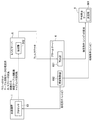
- FIG. 1 is a diagram showing a schematic configuration of a substrate processing system according to the first embodiment.
- the substrate processing system S1 for each factory FAB-1, ..., Factory FAB-M (M is a positive integer), polishing devices 1-1 to 1-N (N is a positive integer). Is provided.
- the number of polishing devices is assumed to be the same for each factory, but may be different.
- a recipe server 5 and an alarm server 6 are provided for each factory FAB-1, ..., Factory FAB-M (M is a positive integer).
- the polishing devices 1-1 to 1-N, the recipe server 5, and the alarm server 6 are communicably connected by the local area network LN-i (i is an integer from 1 to M).
- the factory FAB-1 is provided with a process device 4. Further, as an example, the factory FAB-1 is provided with a factory management center FC, and the factory management center FC can communicate with the Fog server 2 and the Fog server 2 which are communicably connected to the process device 4.
- a PC (Personal Computer) 3 connected to is provided.
- the Fog server 2 is connected to the global network GN, and can communicate with the recipe server 5, the alarm server 6, the analysis server 7, and the predictive maintenance server 8 via the global network GN.
- Each recipe server 5 is connected to the global network GN and can communicate with the analysis server 7 and the predictive maintenance server 8 provided in the analysis center AC.
- each alarm server 6 is connected to the global network GN and can communicate with the analysis server 7 and the predictive maintenance server 8 provided in the analysis center AC.
- the board processing system S1 includes an analysis server 7 and a predictive maintenance server 8, and the analysis server 7 and the predictive maintenance server 8 are connected to the global network GN. Further, the board processing system S1 includes a terminal device 9, which is connected to the global network GN, and the terminal device 9 can communicate with the predictive maintenance server 8.
- the polishing devices 1-1 to 1-N are generically referred to as a polishing device 1.
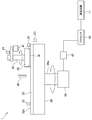
- FIG. 2 is a schematic view showing a polishing apparatus according to the first embodiment.
- This polishing device is a CMP device that chemically polishes a substrate.
- the polishing apparatus includes a polishing table 30, a top ring 35 connected to the lower end of the top ring shaft 34, and a processor 10 for detecting a polishing end point.
- the top ring shaft 34 is connected to the top ring rotation motor 41 via a connecting means such as a timing belt and is rotationally driven. Due to the rotation of the top ring shaft 34, the top ring 35 rotates about the top ring shaft 34 in the direction indicated by the arrow.
- the substrate (for example, wafer) W to be polished is held on the lower surface of the top ring 35 by vacuum adsorption or adsorption by a membrane.
- the polishing table 30 is connected to a table rotation motor 40 arranged below the table shaft 30a via a table shaft 30a, and the table rotation motor 40 rotates the polishing table 30 around the table shaft 30a in the direction indicated by the arrow. It has become like.
- a polishing pad 32 is attached to the upper surface of the polishing table 30, and the polishing surface 32a, which is the upper surface of the polishing pad 32, polishes the substrate W.
- a polishing liquid supply mechanism 38 for supplying the polishing liquid (slurry) to the polishing surface 32a is arranged above the polishing table 30, a polishing liquid supply mechanism 38 for supplying the polishing liquid (slurry) to the polishing surface 32a is arranged.
- Polishing of the substrate W is performed as follows.
- the top ring 35 and the polishing table 30 are rotated by the top ring rotation motor 41 and the table rotation motor 40, respectively, and the polishing liquid is supplied from the polishing liquid supply mechanism 38 to the polishing surface 32a of the polishing pad 32, respectively.
- the top ring 35 presses the substrate W against the polished surface 32a.
- the substrate W is polished by the mechanical action of the sliding contact with the polishing pad 32 and the chemical action of the polishing liquid.
- a table motor current detection unit 45 that detects the motor current is connected to the table rotation motor 40. Further, the table motor current detection unit 45 is connected to the processor 10. During polishing of the substrate W, the surface of the substrate W and the polishing surface 32a of the polishing pad 32 are in sliding contact with each other, so that a frictional force is generated between the substrate W and the polishing pad 32. This frictional force acts on the table rotation motor 40 as resistance torque.
- the polishing device 1 further includes a processor 10 and a communication circuit 11 connected to the processor 10.
- the processor 10 outputs the time-series data of the motor current (torque current) measured by the table motor current detection unit 45 from the communication circuit 11 to the recipe server 5.
- the processor 10 acquires the polishing end point timing transmitted from the recipe server 5 according to the time-series data of the motor current (torque current) via the communication circuit 11.
- a substrate having a laminated structure In a substrate having a laminated structure, a plurality of different types of films are formed. When the top film is removed by polishing, the underlying film appears on the surface. Since these films usually have different hardnesses, the frictional force between the substrate W and the polishing pad 32 changes when the upper film is removed and the lower film appears. This change in frictional force can be detected as a change in torque applied to the table rotation motor 40.
- the learning unit 762 which will be described later, of the analysis server 7 is a trained machine learning model by machine learning using time-series data of past physical quantities as input and the past polishing end point timing as output as a learning data set.
- the polishing end point timing included in the learning data set given to the learning unit 762 is that the film was removed by the worker or a device having a determination function based on the change in the current to the table rotation motor 40. That is, the timing of the polishing end point is determined.
- the processor 10 may monitor the current output from the motor driver (not shown) connected to the table rotation motor 40 without providing the table motor current detection unit 45.
- the polishing device 1 is provided with, for example, sensors 21 to 24.
- the sensor 21 detects the flow rate of water or slurry.
- the sensor 22 detects the polishing pressure.
- the sensor 23 detects the rotation speed of the polishing table 30.
- the sensor 24 detects the rotation speed of the top ring 35.
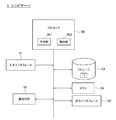
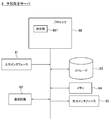
- FIG. 3 is a diagram showing a schematic configuration of the recipe server according to the first embodiment.
- the recipe server 5 includes an input interface 51, a communication circuit 52, a storage 53, a memory 54, an output interface 55, and a processor 56.
- the input interface 51 is, for example, a keyboard, and accepts input from the administrator of the recipe server 5.
- the communication circuit 52 communicates with the polishing devices 1-1 to 1-1N and the alarm server 6 via the connected local area network LN-i (i is an integer from 1 to M). Further, the communication circuit 52 communicates with the analysis server 7 and the predictive maintenance server 8 via the global network GN. These communications may be wired or wireless, but will be described as being wired as an example.
- the storage 53 stores a program and various data for the processor 56 to read and execute, and is, for example, a non-volatile memory (for example, a hard disk drive).
- the memory 54 temporarily holds data and programs, and is, for example, a volatile memory (for example, RAM (Random Access Memory)).
- the output interface 55 is an interface for connecting to an external device.
- the processor 56 functions as a prediction unit 561 and an extraction unit 562 by loading a program from the storage 53 into the memory 54 and executing a series of instructions included in the program.
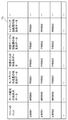
- FIG. 4 is an example of a table stored in the storage of the recipe server.
- the table T1 shows a lot of wafers, time series data of motor current, time series data of flow rate of water or slurry, time series data of polishing pressure, time series data of polishing table rotation speed, top.
- a set of records such as time series data of ring rotation speed is stored.
- the storage 53 contains time-series data of past physical quantities (for example, motor current, flow rate of water or slurry, polishing pressure, polishing table rotation speed) during processing of the substrate for a lot of the substrate. Are associated and remembered at least one.
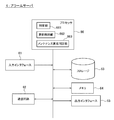
- FIG. 5 is a diagram showing a schematic configuration of an alarm server according to the first embodiment.
- the alarm server 6 includes an input interface 61, a communication circuit 62, a storage 63, a memory 64, an output interface 65, and a processor 66.
- the input interface 61 is, for example, a keyboard, and receives input from the administrator of the alarm server 6.
- the communication circuit 62 communicates with the polishing devices 1-1 to 1-1N and the recipe server 5 via the connected local area network LN-i (i is an integer from 1 to M). Further, the communication circuit 52 communicates with the analysis server 7 and the predictive maintenance server 8 via the global network GN. These communications may be wired or wireless, but will be described as being wired as an example.
- the storage 63 stores a program and various data for the processor 66 to read and execute, and is, for example, a non-volatile memory (for example, a hard disk drive).
- the memory 64 temporarily holds data and programs, and is, for example, a volatile memory (for example, RAM (Random Access Memory)).
- the output interface 65 is an interface for connecting to an external device.
- the processor 66 functions as a determination unit 661, an update control unit 662, and a maintenance necessity determination unit 663 by loading a program from the storage 63 into the memory 64 and executing a series of instructions included in the program.
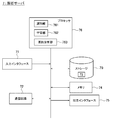
- FIG. 6 is a diagram showing a schematic configuration of an analysis server according to the first embodiment.
- the analysis server 7 includes an input interface 71, a communication circuit 72, a storage 73, a memory 74, an output interface 75, and a processor 76.
- the input interface 71 is, for example, a keyboard, and receives input from the administrator of the analysis server 7.
- the communication circuit 72 communicates with the recipe server 5, the alarm server 6, and the predictive maintenance server 8 via the global network GN. These communications may be wired or wireless, but will be described as being wired as an example.
- the storage 73 stores a program and various data for the processor 76 to read and execute, and is, for example, a non-volatile memory (for example, a hard disk drive).
- the memory 74 temporarily holds data and programs, and is, for example, a volatile memory (for example, RAM (Random Access Memory)).
- the output interface 75 is an interface for connecting to an external device.
- the processor 76 functions as a selection unit 761, a learning unit 762, and a factor analysis unit 763 by loading a program from the storage 73 into the memory 74 and executing a series of instructions included in the program.
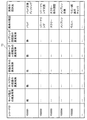
- FIG. 7 is an example of a table stored in the storage of the analysis server.
- the table T2 shows the record ID which is the identification information for identifying the record, the presence / absence of abnormality in the motor current, the presence / absence of abnormality in the flow rate of water or slurry, the presence / absence of abnormality in the polishing pressure, and the presence / absence of abnormality in the polishing table rotation speed.
- the presence or absence of an abnormality in the top ring rotation speed, the cause of the abnormality, and the set of solutions for the abnormality are stored.
- the storage 83 stores at least one combination of the presence or absence of abnormality in physical quantities, the cause of the abnormality, and / or the solution of the abnormality in association with each other.
- FIG. 8 is a diagram showing a schematic configuration of a predictive maintenance server according to the first embodiment.
- the predictive maintenance server 8 includes an input interface 81, a communication circuit 82, a storage 83, a memory 84, an output interface 85, and a processor 86.
- the input interface 81 is, for example, a keyboard, and receives input from the administrator of the predictive maintenance server 8.
- the communication circuit 82 communicates with the recipe server 5, the alarm server 6, and the analysis server 7 via the global network GN. These communications may be wired or wireless, but will be described as being wired as an example.
- the storage 83 stores a program and various data for the processor 86 to read and execute, and is, for example, a non-volatile memory (for example, a hard disk drive).
- the memory 84 temporarily holds data and programs, and is, for example, a volatile memory (for example, RAM (Random Access Memory)).
- the output interface 85 is an interface for connecting to an external device.
- the processor 86 functions as a determination unit 861 by loading a program from the storage 83 into the memory 84 and executing a series of instructions included in the program.
- FIG. 9 is a schematic diagram showing an example of waveforms of the motor current and the differential value of the motor current.
- the waveform G1 shows the relationship between the motor current and the polishing time
- the waveform G2 shows the relationship between the differential value of the motor current and the polishing time. As shown in the waveform G2, when the minimum point P1 appears, it can be determined that the end point detection timing is the time t1 at which the minimum point P1 is reached.
- the learning unit 762 of the analysis server 7 learns by machine learning using the time-series data of the past motor current value as an input and the polishing end point timing as an output as a learning data set. Solve the problem by generating a completed machine learning model.
- FIG. 10 is a schematic diagram showing another example of the waveform of the motor current and the differential value of the motor current.
- the waveform G3 shows the relationship between the motor current and the polishing time
- the waveform G4 shows the relationship between the differential value of the motor current and the polishing time. Since the minimum point (or maximum point) does not appear in the waveform G4, the operator cannot determine the end point detection timing. Therefore, it is necessary to exclude this data from the training data set.
- the sorting unit 761 of the analysis server 7 sorts the time-series data of the current value based on the time-series data obtained by differentiating the time-series data of the current value detected by the sensor with respect to time. Specifically, for example, the sorting unit 761 excludes the time-series data of the current value before the differentiation when the minimum point or the maximum point satisfying the setting criterion is not detected in the time-series data differentiated at the time. , Select the time series data of the current value. According to this, when the minimum point or the maximum point satisfying the setting standard is not detected, the prediction accuracy of the polishing end point timing is improved by excluding the time series data of the current value before differentiation from the training data set. be able to.
- the setting standard is, for example, a condition that the differential value of the current value is below (or below the threshold value) a preset threshold value. Further, for example, it is known that the minimum point of the time-series data differentiated with respect to time is 0 for the second-order differential value and positive for the third-order differential value of the time-series data of the original current value.
- the condition is that the second derivative of the time-series data of the original current value is in a preset range with respect to 0, and the third derivative of the time-series data of the original current value is positive. May be good.
- the learning unit 762 of the analysis server 7 has been learned by machine learning using, for example, time-series data of the current value selected by the sorting unit 761 as an input and using the polishing end point timing as an output as a learning data set.
- the machine learning model is, for example, a machine-learned model in which time-series data of the current value is input and the polishing end point timing is output as a data set for learning.
- the trained machine learning model for example, when time-series data of the current value is input, the candidate value of the polishing end point timing and the correct answer probability of the candidate value are output.
- this current value has been described as an example of the current value of the table rotation motor of the polishing device in the present embodiment, the current value is not limited to this, and the current value of the top ring rotation motor of the polishing device or the polishing device. It may be the torque of the table.
- FIG. 11 is a schematic diagram for explaining the process of generating the polishing end point timing according to the present embodiment.
- the learning unit 762 of the analysis server 7 transmits the learned machine learning model to the prediction unit 561 of the recipe server 5.
- the learning unit 762 of the analysis server can update the trained machine learning model used by the prediction unit 561 at any time.
- the prediction unit 561 of the recipe server 5 When the prediction unit 561 of the recipe server 5 receives the learned machine learning model from the learning unit 762, it stores it in the storage 53.
- the processor 10 of the polishing device 1 outputs the data to the prediction unit 561 every time the current value (motor current) of the table rotation motor is acquired.
- the prediction unit 561 of the recipe server 5 receives the current value (motor current) of the table rotation motor from the polishing device 1, the time series of the current value (motor current) of the table rotation motor received from the start of polishing to that time.
- the machine learning model in which the data has been trained is input, and the correct answer probability for each candidate value of the polishing end point timing is output.
- the prediction unit 561 outputs the correct answer probability for each candidate value of the moment-to-moment and polishing end point timing from the time-series data of the motor current up to that point for the motor current that changes every moment, and the correct answer of the candidate value.
- the probability exceeds the threshold probability (for example, 90%)
- the predicted value of the polishing end point timing is used as the output polishing end point timing.
- the prediction unit 561 has already learned the time series data of the physical quantity (here, the current value of the table rotation motor as an example) detected by the sensor (here, the table motor current detection unit 45 as an example).
- the polishing end point timing which is the timing to end the polishing
- learning is performed using the time-series data of the current value of the table rotation motor when multiple minimum points (or maximum points) have appeared in the past and the correct polishing end point timing at that time. Even if multiple minimum points (or maximum points) appear in the time-series waveform of the differential value of the current value, it is predicted which of the minimum points (or maximum points) is the correct polishing end point timing. be able to.
- the prediction unit 561 of the recipe server 5 controls to transmit the output polishing end point timing to the polishing device 1.
- the processor 10 of the polishing device 1 can acquire the polishing end point timing.
- the present invention is not limited to this, and the time-series data of the differential value of the past motor current value may be used. ..
- the sorting unit 761 is based on the time-series data obtained by differentiating the time-series data of the physical quantity (here, the current value of the table rotating motor as an example) detected by the sensor with respect to time, and the time-series data differentiated with respect to the time. May be sorted.
- the learning unit 762 inputs the "time-series data obtained by differentiating the time-series data of the physical quantity (here, the current value of the table rotation motor as an example)" selected by the sorting unit 761 with time, and sets the polishing end point timing.
- a trained machine learning model may be generated by machine learning using it as an output training data set.
- the machine learning model is used as a data set for learning in which the time-series data obtained by differentiating the time-series data of the physical quantity (here, as an example, the current value of the table rotation motor) with time is input and the polishing end point timing is output. It is a machine-learned model.
- the prediction unit 561 differentiates the time series data of the physical quantity (here, the current value of the table rotation motor as an example) detected by the sensor (here, the table motor current detection unit 45 as an example) with time.
- the polishing end point timing which is the timing to end the polishing, is output.
- FIG. 12 is a schematic diagram for explaining the update processing of the processing conditions (recipe) according to the present embodiment.
- the processor 10 of the polishing apparatus 1 outputs a lot of wafers and a second physical quantity such as a flow rate of water / or slurry, a polishing pressure, a polishing table rotation speed, or a top ring rotation speed to the recipe server 5.
- the second physical quantity is a physical quantity during processing of the target substrate, and is a second sensor (here, as an example, the sensor 21) installed in the substrate processing apparatus (here, the polishing apparatus 1 as an example). It is a physical quantity detected by ⁇ 24).
- the extraction unit 562 of the recipe server 5 refers to the storage 53 and refers to a past physical quantity (for example, table rotation) corresponding to a lot of the substrate to be processed (here, a lot of wafers received from the processor 10 as an example). At least one of motor current values, water / or slurry flow rates, polishing pressures, polishing table speeds, and / or top ring speeds) is extracted.
- the storage 53 contains a lot of substrates and past physical quantities during the substrate processing (for example, current value of table rotation motor, flow rate of water / or slurry, polishing pressure, polishing table rotation speed, and / or top. At least one) time series data such as ring rotation speed) is associated and stored.
- the extraction unit 562 may extract one or more of the past time series data corresponding to the lot of the target substrate to be processed in the storage 53, or the extraction unit 562 may extract the time series data. Statistical values such as the mean value and the median value of the time series data may be extracted.
- the extraction unit 562 controls the communication circuit 52 that transmits the extracted time series data to the alarm server 6 as one of the data included in the filter data.
- the determination unit 661 of the alarm server 6 determines a physical quantity (for example, the current value of the table rotation motor, the flow rate of water / or slurry, etc.) detected by the sensor (here, as an example, the table motor current detection unit 45 or the sensors 21 to 24).
- the time series data of at least one of the polishing pressure, the number of rotations of the polishing table, and / or the number of rotations of the top ring) is compared with the past time series data extracted by the extraction unit 562, and the time series of the physical quantity is compared. Determine if there is an abnormality in the change.
- the determination unit 661 determines that there is an abnormality, it requests the processing conditions (recipe) from the predictive maintenance server 8 in order to update the processing conditions (recipe) of the polishing apparatus.
- the determination unit 861 of the predictive maintenance server 8 determines the processing conditions (recipe) again when the determination unit 661 determines that there is an abnormality.
- the determination unit 861 controls the communication circuit 82 so as to transmit the redetermined processing condition (recipe) to the alarm server 6.
- the update control unit 662 that has acquired the re-determined processing condition (recipe) controls to update with the processing condition determined by the determination unit 861.
- the update control unit 662 controls the communication circuit 62 so as to transmit this processing condition to the polishing device 1.
- the abnormality is automatically judged, (1) the recipe is automatically updated, (2) the result of the recipe update is reported after the recipe is updated, and (3) an alert is notified if the recipe is updated but still abnormal. To do.
- the processing condition (recipe) can be updated, so that the time and cost for creating a countermeasure against the abnormality can be reduced. It can save labor, save energy, and / or save costs.
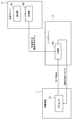
- FIG. 13 is a schematic diagram for explaining the maintenance necessity determination process according to the present embodiment.
- the processor 10 has a time series of an abnormality history and a physical quantity of a target at the time of an abnormality detected by a sensor (here, as an example, a table motor current detection unit 45 and / or sensors 21 to 24).
- the communication circuit 11 is controlled so as to transmit the related data set including the data to the maintenance necessity determination unit 663. Further, the processor 10 controls the communication circuit 11 so as to transmit a lot of wafers to the extraction unit 562.
- the extraction unit 562 refers to the storage 53 (first storage) and refers to the time series data of the past physical quantity corresponding to the lot of the substrate to be processed (for example, the current value of the table rotation motor, water / or). At least one of slurry flow rate, polishing pressure, polishing table rotation speed, and / or top ring rotation speed) is extracted.
- the extracted time-series data of past physical quantities (time-series data of past sensor values) is transmitted to the maintenance necessity determination unit 663.
- the maintenance necessity determination unit 663 is extracted by the extraction unit 562 and the time series data of the physical quantity at the time of the abnormality detected by the sensor here, as an example, the table motor current detection unit 45 and / or the sensors 21 to 24). The time series data of past physical quantities are compared to determine the necessity of maintenance.
- FIG. 14 is a diagram for explaining the comparison process in the maintenance necessity determination unit 663.
- a time-series change W1 of the motor current a time-series change W2 of the flow rate of the slurry, and a time-series change W3 of the polishing pressure are shown.
- the average AW, average AW-2 ⁇ ( ⁇ is standard deviation), and average AW + 2 ⁇ of the time series data of the past slurry flow rate are shown, and the time series change W2 of the slurry flow rate is the past slurry flow rate.
- the time series data deviates from a preset range (for example, AW-2 ⁇ to AW + 2 ⁇ ) based on the average AW.
- a preset range for example, AW-2 ⁇ to AW + 2 ⁇
- the maintenance necessity judgment is made.
- Unit 663 determines that maintenance is required. Further, in this case, the maintenance necessity determination unit 663 determines that there is an abnormality in the flow rate of the slurry and that there is no abnormality in the motor current and the polishing pressure.
- the maintenance necessity determination unit 663 controls the communication circuit 62 so as to transmit the determined maintenance necessity and the time series data of the physical quantity at the time of abnormality occurrence (time series data of the sensor value at the time of abnormality occurrence) to the analysis server 7. ..
- the maintenance necessity determination unit 663 detects one parameter abnormality or a plurality of parameter abnormalities among the plurality of compared parameters (time series data of physical quantities).
- the storage 73 (second storage) of the analysis server 7 is associated with the combination of the presence or absence of abnormality of at least one or more physical quantities, the cause of the abnormality, and / or the solution of the abnormality. It is remembered.
- the factor analysis unit 763 of the analysis server 7 determines that maintenance is necessary by the maintenance necessity determination unit 663, the factor analysis unit 763 refers to the storage 73 (second storage) and has an abnormality according to the combination of the presence or absence of the physical quantity abnormality. The cause and / or the solution of the abnormality is output.
- the factor analysis unit 763 of the analysis server 7 transmits the time-series data of the physical quantity at the time of the abnormality (time-series data of the sensor value at the time of the abnormality) and the cause of the abnormality and / or the solution of the abnormality to the terminal device 9. Controls the communication circuit 72. Then, the terminal device 9 that has received these information displays the information. As a result, the maintenance personnel of the substrate processing device can immediately grasp the cause of the abnormality and / or the solution of the abnormality by confirming this information on the terminal device 9, and therefore go to the local polishing device. By doing so, it is possible to quickly resolve the abnormality of the polishing device.
- the substrate processing system is installed in the substrate processing apparatus and has a sensor (here, as an example, a table motor current detection unit 45) that detects a physical quantity of a target during processing of the target substrate, and the sensor (the sensor (here, as an example).
- a sensor here, as an example, a table motor current detection unit 45
- the sensor the sensor (here, as an example).
- the time series data of the physical quantity here, the current value of the table rotating motor as an example
- the time series of the physical quantity here, the current value of the table rotating motor as an example
- the time series of the physical quantity here, the current value of the table rotating motor as an example
- a prediction unit that outputs a polishing end point timing, which is a timing at which polishing is finished, by inputting time-series data obtained by differentiating the data with time into a trained machine learning model.
- the machine learning model is a time-series data of the past physical quantity (here, the current value of the table rotation motor as an example) or a time-series data of the past physical quantity (here, the current value of the table rotation motor as an example).
- This is a machine-learned model that uses time-series data differentiated with time as input and the past polishing end point timing as output as a learning data set.
- the polishing end point timing can be automatically predicted, the time and cost required for predicting the polishing end point timing can be reduced, and labor saving, energy saving, and / or cost saving can be achieved.
- the time series data obtained by differentiating the time series data of the current value of the table rotation motor with respect to time is used, a plurality of minimum points (or maximum points) are generated, and the time of which minimum point (or maximum point) is used. There was a problem that it was not possible to know in real time whether was the timing of the end point of polishing.
- the machine learning model after learning inputs the time-series data of the past physical quantity or the time-series data obtained by differentiating the time-series data of the past physical quantity with time, and outputs the past polishing end point timing as the output. Since the training is performed with the data set for, the correct polishing end point timing can be output even when the time series data of an unknown physical quantity or the time series data obtained by differentiating the time series data of the physical quantity with time is input. The possibilities can be improved.
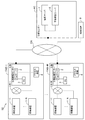
- FIG. 15 is a diagram showing a schematic configuration of a substrate processing system according to a second embodiment.
- the substrate processing system S2 according to the second embodiment is provided with the Fog server 2 in the factory management center as compared with the substrate processing system S1 according to the first embodiment.
- the Fog server 2 acquires information from each server of analysis data in order to realize the function of the Fog server shown in FIG. 17, which will be described later.
- FIG. 16 is a diagram showing a schematic configuration of a substrate processing system according to a third embodiment.
- the substrate processing system S3 according to the third embodiment is provided with a server 90 for each factory as compared with the substrate processing system S2 according to the second embodiment.
- the server 90 functions as a gateway server.
- the server 90 is connected to the global network GN and also to the corresponding local area network LN-i (i is an integer from 1 to M).
- the server 90 is used for maintenance purposes in each factory.
- FIG. 17 is a table summarizing the functions, mechanisms, IoT configurations, merits and reasons for each operating part in the substrate processing system according to the first to third embodiments.
- the polishing device 1 (internal processor) is an edge in so-called edge computing, that is, a processor installed in a controller in the device, a gateway in the vicinity of the device, or the like, and may have the following functions.
- the processor 10 of the polishing device 1 has a table rotary motor current value (torque TT), a top ring rotary motor current value (torque) (TR), and a top ring rocking rotary motor, which represent the measured table torque.
- the polishing end point timing is detected by using the current value (torque TROT), the output signal (SOPM) of the optical film thickness sensor, or the output signal of the eddy current film thickness sensor.
- the processor 10 of the polishing apparatus 1 uses the measured pad temperature, membrane pressing distribution, rotation speed, or film thickness distribution to make polishing uniform, pad temperature control, membrane pressing control, and rotation of the table or top ring. Run the control.
- the processor 10 of the polishing apparatus 1 executes recipe update (high-speed processing / no data storage) by executing high-speed determination / update conditions.
- the processor of the fog server 2 of the factory management center is (1) process / transport, (2) polishing time, (3) usage time, event type / number of times, (4) polishing condition change history, (5) recipe update, event. It has a mechanism of species / number of times, (6) event type / number of times, conditions before and after, (7) recommendation, and warning notification.
- the processor of the Fog server 2 of the factory management center can perform (1) warning / abnormality management, (2) operation history management, (3) consumables management, (4) operation status management, (5) recipe management, ( It has the functions of 6) emergency avoidance operation, (7) replacement / maintenance notification, main data storage and visualization, and simple relevance / trend analysis and update.
- the Fog server 2 manages data of a plurality of devices in the factory. As a result, it is possible to centrally manage the state of a large number of devices in the factory, and it is possible to carry out the next stage of response and update from short-term trend analysis between devices.
- the processor 76 of the analysis server 7 of the analysis center AC analyzes (or analyzes) the factors when an abnormality occurs, using a large amount of data classification, correlation analysis, impact analysis and improvement conditions, set functions, and the like.
- the processor 86 of the predictive maintenance server 8 of the analysis center AC determines the processing conditions (improved recipe) for which the polishing conditions are optimized, and controls to update the processing conditions (recipe) with the determined processing conditions (improved recipe). ..
- the processor 86 of the predictive maintenance server 8 of the analysis center AC predicts the replacement time of the consumables of the polishing device 1 by using the consumables judgment model of the polishing device 1, and updates the consumables judgment model.
- the replacement period of consumables is updated each time.
- the processor 76 of the analysis server 7 of the analysis center AC or the processor 86 of the predictive maintenance server 8 carries out long-term trend analysis and updates such as data analysis of multiple devices and recipe improvement (parameter correlation analysis / automatic process judgment, etc.). You may.
- the analysis server 7 and the predictive maintenance server 8 of the analysis center AC store and utilize data from multiple factories.
- trend analysis or impact analysis of processing conditions will be carried out by utilizing data from many factories / equipment.
- create an improved model or judgment criteria by utilizing the data from many factories / devices, create an improved model or judgment criteria, and send these updated ones (updated version) to the Fog server 2 of the factory center to execute them on the Fog server 2.
- the processor of the analysis server 7 of the analysis center AC analyzes a gradual tendency over time (for example, month or day level) when performing end point processing or the like performed at the edge, and applies the improved recipe to the processor (or edge processor) at the edge. It may be sent to the controller) to update the recipe of the target polishing device. For example, waveform data (for example, torque TT waveform data) that detects the end point of a polishing device is accumulated in a data center (or analysis center), and analysis of removal of waveform noise of the corresponding polishing device is analyzed.
- waveform data for example, torque TT waveform data
- a trained model (tuned neural network) for preprocessing which is performed by the processor of the analysis server 7 of the center AC and the processor of the analysis server 7 of the AC performs noise separation, may be generated and used. It is also possible that the analysis center AC sends an update recipe to the edge processor or controller, and the edge processor updates the recipe and uses a preprocessing learning model for noise reduction. These recipes can be updated automatically by network communication. In addition, when communication is not possible, it is possible to update manually at the site.
- processing in these analysis center ACs may be executed in the cloud.
- the processing is performed by edge computing.
- the controller (or processor) in the polishing device 1 or the server 90 on the gateway side needs to respond to changes over time, for example, when processing of 100 ms or less is required, for example, when the end point prediction (waveform prediction) is performed online.
- Execute the process Since the processing of the function executed by the Fog server and the processing of each server of the analysis center in FIG. 16 are management processing, the processing does not have to be so fast, and therefore, the processing may be executed by the Fog server or each server of the analysis center. ..
- the input is the time series data of the motor current from the start of polishing to the prediction time
- the output is the correct answer probability for each candidate value of the polishing end point timing. It is not limited to the configuration.
- the input of the machine learning model is the time series data of the motor current from the start of polishing to the predicted time, the current value of the table rotating motor from the start of polishing to the predicted time, the current value of the top ring rotating motor, and the torque of the table.
- Sensor output such as light intensity scattered when light is applied to the substrate, intensity of magnetic field line due to eddy current generated by applying magnetic force line to the substrate, other parameters (pad temperature, membrane pressing, polishing table or polishing table rotation speed) , The amount of slurry) and the like may be at least one of the physical quantities representing the state of the polishing apparatus.
- the uniformity of the polished surface is improved, and the time timing accuracy of the polishing end point timing is further improved.
- the input of the machine learning model is the current value of the table rotating motor from the start of polishing to the predicted time, the current value of the top ring rotating motor, and the table instead of the time series data of the motor current from the start of polishing to the predicted time.
- Sensor output such as torque, light intensity scattered when light is applied to the substrate, strength of magnetic field lines due to eddy current generated by applying magnetic force lines to the substrate, and other parameters (pad temperature, membrane pressure value, table / top ring) It may be at least one of physical quantities representing the state of the polishing apparatus such as the number of rotations and the flow rate of the slurry.
- the machine learning model may be realized as a computer program product.
- a computer program product that controls the processing of a substrate, a computer program product embodied in a non-temporary computer recording medium, and an instruction for causing a processor to perform at least one of the above-mentioned processing.
- the output of the machine learning model may be a program for outputting control parameters, or may be a modified parameter.
- a normal normal data set is used as the end point detection result, but the learning data set is not limited to this.
- the end point detection result may be an abnormal abnormal data set or a mixed data set in which normal data and abnormal data are mixed (for example, 80% or more is a mixed data set of normal data).
- automatic learning may be performed using a neural network (for example, deep learning), reinforcement learning, a support vector machine, or the like. Furthermore, this machine learning may be realized by quantum computing.
- FIG. 18 is an example of a neural network according to each embodiment.
- the prediction unit 561 includes a normalizer 91, a neural network 92, and a determination processor 93.
- Prediction unit 561 at normalizer 91, time-series data of a physical quantity representing a state of the above-mentioned polishing apparatus (e.g., time-series data of the motor current) to normalize the D 1 ⁇ D N.
- the normalized data d 1 to d N are input to the neural network 92, and the neural network 92 generates correct answer probabilities P 1 to P N for each candidate value of a plurality of polishing end point timings (N is a positive integer). ..
- the determination processor 93 exceeds the threshold value among the plurality of generated correct answer probabilities, the determination processor 93 outputs the candidate value T i of the polishing end point timing corresponding to the correct answer probability P i exceeding the threshold value as the polishing end point timing (i). Is the index).
- neural network 102 time-series data of the physical quantity representing the state of the above-mentioned polishing apparatus (e.g., time-series data of the motor current) a plurality of inputs for receiving the D 1 ⁇ D N a normalized data d 1 ⁇ d N A node, a plurality of output nodes assigned for each polishing end point timing and outputting correct answer probabilities, and an output whose input is connected to the output of at least one input node and whose output is at least one. It has multiple hidden nodes connected to the input of the node.
- the neural network 102 may be realized by software, or part or all of it may be realized by hardware.
- the neural network 102 includes a first filter 921 that constitutes an input node, a second filter 922 that constitutes a hidden node, and an output.
- a third filter 923 that constitutes the node may be provided.
- FIG. 19 is a diagram showing a schematic configuration of a substrate processing system according to a fourth embodiment.
- the fog server 2 is connected to the local area network LN-i, whereas the fog computer 2b is connected to the server 100. There is.
- the server 100 which is an example of the information processing device, is transmitted to the fog computer 2b.
- the predictive maintenance system 8 is changed to the predictive maintenance system 8b, and the terminal device 9 is deleted.
- a server 100 is installed in the factory.
- the server 100 can collect and analyze operational data of a plurality of substrate processing devices (also referred to as semiconductor manufacturing devices, here, as an example, a polishing device). For example, it is possible to analyze differences between devices with respect to polishing conditions. It is possible to generate update parameters and send update data according to the difference.
- the server 100 can be connected to a fog computer (for example, a fog server) 2b for factory management and a PC 3 for an administrator.
- the factory manager can access the server 100 from the PC 3 to analyze data and generate parameters for updating.
- data can be downloaded from the server 100 to the fog computer b or the administrator's PC3, and the factory administrator can analyze the data or generate update parameters on the fog computer 2b or the PC3.
- the service provider can connect to the server 100 from the outside of the factory or an outdoor place (vendor room, etc.) where the equipment is installed in the factory.
- the service provider can analyze data of a plurality of substrate processing devices (also referred to as semiconductor manufacturing devices, for example, polishing devices). Further, for example, it is possible to change the polishing parameter of the polishing device, analyze the correlation of the polishing result, change the polishing uniformity, generate the update parameter for maintaining the uniformity, transmit the update parameter to the corresponding device, and update the parameter. ..
- Substrate processing equipment also referred to as semiconductor manufacturing equipment
- includes polishing equipment also referred to as CMP equipment
- plating equipment also referred to as CMP equipment
- bevel polishing equipment inspection equipment
- package substrate polishing equipment exposure equipment
- etching equipment polishing equipment
- cleaning equipment Etching device, etc.
- the server 100 collects data such as polishing parameters and / or sensor detection values from each polishing device: The server 100 adjusts the polishing parameters of each polishing device so as to minimize the difference in polishing state between the polishing devices. The server 100 analyzes the trouble factor using the sensor detection value. As a result, the analysis can be accelerated and troubles can be prevented.
- the collected data is, for example, at least one of the following. Consumables usage time (retainer ring, pad, membrane, dresser tool, brush, top), number of processed sheets / unit, torque fluctuation during polishing (motor current), thickness measuring instrument (In-Line Thickness Metrology) built into the polishing device : ITM) film thickness measurement results, end point detection (EPD) data, environmental data (pad temperature, polishing unit temperature / humidity, slurry temperature), wafer transfer data (position, torque, speed, acceleration), etc. ..
- the processor of the server 100 is among torque data (eg, motor current for polishing table rotation) and other parameters.
- torque data eg, motor current for polishing table rotation
- other parameters e.g, torque data (eg, motor current for polishing table rotation) and other parameters.
- a parameter group that correlates with the polishing conditions for example, the amount of polishing
- Parameter group that correlates with "polishing table condition (state)” that is, parameter group that works for polishing table condition (state)
- Parameter group that correlates with "dressing uniformity” that is, dressing uniformity
- Parameter group that works for "sex Is extracted.
- the extraction method may extract correlated parameters by obtaining eigenvalues in the principal component analysis.
- the processor of the server 100 may adjust the parameter of the parameter group which is suitable for the polishing condition so that the difference in the polishing condition (for example, the amount of polishing) between the polishing devices becomes small.
- the processor of the server 100 is such that the "polishing table condition" makes a small difference between the polishing machines. You may adjust the parameters of the parameter group which is good for the polishing table condition.
- the parameters of the parameter group favoring the polishing table condition may be adjusted so that the "dressing uniformity" is less different between the polishing devices.
- the processor of the server 100 calculates cumulative contribution data, which is a cumulative value of correlation values (for example, correlation coefficients) representing the correlation of correlated parameters, for each polishing device, and polishes the cumulative contribution data. Variations between devices may be monitored. Then, when the variation is out of the predetermined range, the processor of the server 100 may consider that there is a sign of abnormality and update the parameter (for example, the parameter having a high correlation value).
- the correlation value representing the correlation a parameter having a strong correlation whose correlation value is at least a threshold value (for example, 0.5) may be selected.
- the processor of the server 100 monitors the correlation value of the correlated parameter over time, and updates the parameter (for example, the parameter having the high correlation value) when the correlation coefficient is out of the prediction range. Further, for example, the processor of the server 100 may update the new parameter when the original correlation value is lower than the threshold value but a new parameter having the correlation value higher than the threshold value appears.
- the parameter for example, the parameter having the high correlation value
- the processor of the server 100 may prioritize parameters having a high correlation value and compare them among polishing devices. Then, the processor of the server 100 detects that the variation (degree of deviation, for example, difference) of the parameter having a high correlation value is a trouble factor when it is out of the range normally predicted, and the parameter (for example, the relevant parameter) is detected. A parameter with a high correlation value) may be updated.
- the processor of the server 100 outputs information prompting maintenance when the variation of parameters having a high correlation value (for example, the degree of deviation, for example, the difference) exceeds the threshold value. You may. For example, the processor of the server 100 may output that maintenance should be performed after X (X is a predetermined number) time.
- the server 100 stores the data of a plurality of polishing devices in the internal or external storage and performs data analysis. This minimizes downtime due to failures and parts replacement. Therefore, the server 100 uses, for example, the usage time of consumables such as pads, retainers, membranes, and rotary motors, the number of processed sheets, the evaluation value of the degree of consumption, the change over time in the polishing time for detecting the end point, and the change over time in polishing uniformity. Data analysis and based on this, the estimated value of consumable replacement time, the estimation of the remaining usable time, the estimation of the conditioning implementation time, etc. are performed.
- the server 100 generates an update parameter for maintaining / stabilizing (correcting) the polishing characteristics, and estimates the consumable replacement time and the remaining usable time when the update parameter is used. , Estimate the conditioning implementation time, estimate the maintenance time when the update parameter is used, and notify the factory manager or service provider. This notification may be notified by e-mail or a message service, or may be notified by an application installed on the factory manager's PC3 or the service provider's terminal device 9. The trouble factor analysis and prevention may be performed by the analysis system 7 and / or the predictive maintenance system 8b instead of the server 100.
- the basic processing system includes a server 100 connected to a plurality of substrate processing devices (for example, polishing device 1) by a communication line, and a fog computer 2b connected to the server by a communication line.
- a terminal for example, PC3
- the server 100 collects data from a plurality of substrate processing devices (for example, polishing device 1), processes the collected data, and processes the processed result into the fog computer.
- the data is transmitted to 2b or the terminal (for example, PC3) and the fog computer 2b or the terminal (for example, PC3) receives the processing result, it is controlled to output the processing result.
- the fog computer or terminal can output the result of processing the data collected by the server from the plurality of polishing devices 1.
- the server 100 serves as a means for extracting parameters that correlate with the substrate processing conditions (for example, polishing conditions), the substrate processing table state (for example, polishing table state), and / or the dressing uniformity and above the standard from the collected data.
- the substrate processing conditions for example, polishing conditions
- the substrate processing table state for example, the polishing table state
- the dressing uniformity can be brought close to each other, so that the substrate processing between the substrate processing devices (for example, the polishing device) Variations in (for example, polishing) can be reduced.
- the substrate processing systems S1 to S4 described in the above-described embodiment may be configured by hardware or software.
- a program that realizes at least a part of the functions of the board processing systems S1 to S3 may be stored in a recording medium such as a flexible disk or a CD-ROM, read by a computer, and executed. ..
- the recording medium is not limited to a removable one such as a magnetic disk or an optical disk, and may be a fixed recording medium such as a hard disk device or a memory.
- a program that realizes at least a part of the functions of the board processing systems S1 to S4 may be distributed via a communication line (including wireless communication) such as the Internet. Further, the program may be encrypted, modulated, compressed, and distributed via a wired line or wireless line such as the Internet, or stored in a recording medium.
- a communication line including wireless communication
- the program may be encrypted, modulated, compressed, and distributed via a wired line or wireless line such as the Internet, or stored in a recording medium.
- all the steps (steps) may be realized by automatic control by a computer. Further, the progress control between the processes may be manually performed while the computer is used to perform each process. Further, at least a part of the whole process may be performed manually.
- the present invention is not limited to the above embodiment as it is, and at the implementation stage, the components can be modified and embodied within a range that does not deviate from the gist thereof.
- various inventions can be formed by an appropriate combination of the plurality of components disclosed in the above-described embodiment. For example, some components may be removed from all the components shown in the embodiments. Further, components over different embodiments may be combined as appropriate.
- Polishing device 10 Processor 11 Communication circuit 2 Fog server 21 to 24 Sensor 30 Polishing table 30a Table shaft 32 Polishing pad 34 Top ring shaft 35 Top ring 38 Polishing liquid supply mechanism 4 Process device 40 Table rotation motor 41 Top ring rotation motor 45 Table Motor current detector 5 Recipe server 51 Input interface 52 Communication circuit 53 Storage 54 Memory 55 Output interface 56 Processor 561 Prediction unit 562 Extraction unit 6 Alarm server 61 Input interface 62 Communication circuit 63 Storage 64 Memory 65 Output interface 66 Processor 661 Judgment unit 662 Update control unit 663 Maintenance necessity judgment unit 7 Analysis server 71 Input interface 72 Communication circuit 73 Storage 74 Memory 75 Output interface 76 Processor 761 Sorting unit 762 Learning unit 763 Factor analysis unit 8 Prediction maintenance server 81 Input interface 82 Communication circuit 83 Storage 84 Memory 85 Output interface 86 Processor 861 Decision unit 9 Terminal device 90 Server 91 Normalizer 92 Neural network 93 Judgment processor 100 Server
Landscapes
- Engineering & Computer Science (AREA)
- Mechanical Engineering (AREA)
- Finish Polishing, Edge Sharpening, And Grinding By Specific Grinding Devices (AREA)
- Mechanical Treatment Of Semiconductor (AREA)
- Constituent Portions Of Griding Lathes, Driving, Sensing And Control (AREA)
Priority Applications (5)
| Application Number | Priority Date | Filing Date | Title |
|---|---|---|---|
| JP2021520809A JP7527279B2 (ja) | 2019-05-22 | 2020-05-20 | 基板処理システム |
| KR1020217041321A KR102734004B1 (ko) | 2019-05-22 | 2020-05-20 | 기판 처리 시스템 |
| SG11202112854XA SG11202112854XA (en) | 2019-05-22 | 2020-05-20 | Substrate processing system |
| CN202080037700.1A CN113853275B (zh) | 2019-05-22 | 2020-05-20 | 基板处理系统 |
| US17/612,721 US20220234164A1 (en) | 2019-05-22 | 2020-05-20 | Substrate processing system |
Applications Claiming Priority (2)
| Application Number | Priority Date | Filing Date | Title |
|---|---|---|---|
| JP2019095619 | 2019-05-22 | ||
| JP2019-095619 | 2019-05-22 |
Publications (1)
| Publication Number | Publication Date |
|---|---|
| WO2020235581A1 true WO2020235581A1 (ja) | 2020-11-26 |
Family
ID=73459387
Family Applications (1)
| Application Number | Title | Priority Date | Filing Date |
|---|---|---|---|
| PCT/JP2020/019869 Ceased WO2020235581A1 (ja) | 2019-05-22 | 2020-05-20 | 基板処理システム |
Country Status (7)
| Country | Link |
|---|---|
| US (1) | US20220234164A1 (https=) |
| JP (1) | JP7527279B2 (https=) |
| KR (1) | KR102734004B1 (https=) |
| CN (1) | CN113853275B (https=) |
| SG (1) | SG11202112854XA (https=) |
| TW (1) | TW202044394A (https=) |
| WO (1) | WO2020235581A1 (https=) |
Cited By (8)
| Publication number | Priority date | Publication date | Assignee | Title |
|---|---|---|---|---|
| JP2022157024A (ja) * | 2021-03-31 | 2022-10-14 | 株式会社ディスコ | 研削装置 |
| CN115376962A (zh) * | 2021-05-18 | 2022-11-22 | 细美事有限公司 | 基板处理设备和数据变化确定方法 |
| JP2023019657A (ja) * | 2021-07-29 | 2023-02-09 | 株式会社Screenホールディングス | 基板処理方法及び基板処理装置 |
| KR20230028552A (ko) * | 2020-12-18 | 2023-02-28 | 어플라이드 머티어리얼스, 인코포레이티드 | 적응형 슬러리 분배 시스템 |
| WO2023162579A1 (ja) * | 2022-02-24 | 2023-08-31 | 株式会社荏原製作所 | 研磨終点検出方法、研磨終点検出システム、研磨装置、およびコンピュータ読み取り可能な記録媒体 |
| WO2024029236A1 (ja) * | 2022-08-01 | 2024-02-08 | 株式会社荏原製作所 | 情報処理装置、推論装置、機械学習装置、情報処理方法、推論方法、及び、機械学習方法 |
| WO2024142757A1 (ja) * | 2022-12-27 | 2024-07-04 | 株式会社荏原製作所 | 研磨方法、研磨装置、および記録媒体 |
| WO2024202179A1 (ja) * | 2023-03-24 | 2024-10-03 | 株式会社Screenホールディングス | 分析装置、分析方法および分析プログラム |
Families Citing this family (7)
| Publication number | Priority date | Publication date | Assignee | Title |
|---|---|---|---|---|
| WO2022003983A1 (ja) * | 2020-07-03 | 2022-01-06 | 日本電気株式会社 | 時系列データ処理方法、時系列データ処理装置、時系列データ処理システム、記録媒体 |
| US11710228B2 (en) | 2021-03-05 | 2023-07-25 | Applied Materials, Inc. | Detecting an excursion of a CMP component using time-based sequence of images and machine learning |
| JP2024016960A (ja) * | 2022-07-27 | 2024-02-08 | アズビル株式会社 | 刃具検査装置および方法 |
| KR102605515B1 (ko) * | 2022-09-15 | 2023-12-29 | (주)성화에스티 | 인공지능 기반, 피가공물 두께에 기초한 가공 시스템 |
| US20240210916A1 (en) * | 2022-12-22 | 2024-06-27 | Applied Materials, Inc. | Machine and deep learning techniques for predicting ecological efficiency in substrate processing |
| JP2024155301A (ja) * | 2023-04-21 | 2024-10-31 | 株式会社荏原製作所 | 研磨方法、研磨装置、および温度調節プログラム |
| CN119115781B (zh) * | 2024-11-08 | 2025-01-28 | 江苏元夫半导体科技有限公司 | 抛光终点检测方法、装置、电子设备及存储介质 |
Citations (6)
| Publication number | Priority date | Publication date | Assignee | Title |
|---|---|---|---|---|
| JP2000202768A (ja) * | 1999-01-12 | 2000-07-25 | Tdk Corp | 研磨方法及び装置、及び薄膜磁気ヘッドの製造方法 |
| JP2004025057A (ja) * | 2002-06-26 | 2004-01-29 | Dainippon Screen Mfg Co Ltd | 基板処理システム、基板処理装置、基板処理方法、プログラム及び記録媒体 |
| JP2009004442A (ja) * | 2007-06-19 | 2009-01-08 | Renesas Technology Corp | 半導体ウェハの研磨方法 |
| JP2018058197A (ja) * | 2016-09-30 | 2018-04-12 | 株式会社荏原製作所 | 研磨装置、及び研磨方法 |
| US20190143474A1 (en) * | 2017-11-13 | 2019-05-16 | Taiwan Semiconductor Manufacturing Co., Ltd. | System and method for monitoring chemical mechanical polishing |
| JP2020053550A (ja) * | 2018-09-27 | 2020-04-02 | 株式会社荏原製作所 | 研磨装置、研磨方法、及び機械学習装置 |
Family Cites Families (8)
| Publication number | Priority date | Publication date | Assignee | Title |
|---|---|---|---|---|
| JP2001138218A (ja) * | 1999-11-12 | 2001-05-22 | Nec Corp | Cmp加工機 |
| US7156717B2 (en) * | 2001-09-20 | 2007-01-02 | Molnar Charles J | situ finishing aid control |
| JP4355193B2 (ja) * | 2003-11-10 | 2009-10-28 | 株式会社ルネサステクノロジ | 半導体デバイスの製造方法及び半導体デバイス製造システム |
| JP2006310504A (ja) * | 2005-04-28 | 2006-11-09 | Matsushita Electric Ind Co Ltd | 半導体装置の製造方法 |
| TWI422798B (zh) * | 2006-10-06 | 2014-01-11 | 荏原製作所股份有限公司 | 加工終點檢測方法、研磨方法及研磨裝置 |
| JP2013176828A (ja) | 2012-02-29 | 2013-09-09 | Ebara Corp | 研磨終点検出装置の遠隔監視システム |
| JP6370084B2 (ja) * | 2014-04-10 | 2018-08-08 | 株式会社荏原製作所 | 基板処理装置 |
| CN106457507B (zh) * | 2014-04-22 | 2019-04-09 | 株式会社荏原制作所 | 研磨方法 |
-
2020
- 2020-05-19 TW TW109116511A patent/TW202044394A/zh unknown
- 2020-05-20 KR KR1020217041321A patent/KR102734004B1/ko active Active
- 2020-05-20 CN CN202080037700.1A patent/CN113853275B/zh active Active
- 2020-05-20 WO PCT/JP2020/019869 patent/WO2020235581A1/ja not_active Ceased
- 2020-05-20 US US17/612,721 patent/US20220234164A1/en not_active Abandoned
- 2020-05-20 SG SG11202112854XA patent/SG11202112854XA/en unknown
- 2020-05-20 JP JP2021520809A patent/JP7527279B2/ja active Active
Patent Citations (6)
| Publication number | Priority date | Publication date | Assignee | Title |
|---|---|---|---|---|
| JP2000202768A (ja) * | 1999-01-12 | 2000-07-25 | Tdk Corp | 研磨方法及び装置、及び薄膜磁気ヘッドの製造方法 |
| JP2004025057A (ja) * | 2002-06-26 | 2004-01-29 | Dainippon Screen Mfg Co Ltd | 基板処理システム、基板処理装置、基板処理方法、プログラム及び記録媒体 |
| JP2009004442A (ja) * | 2007-06-19 | 2009-01-08 | Renesas Technology Corp | 半導体ウェハの研磨方法 |
| JP2018058197A (ja) * | 2016-09-30 | 2018-04-12 | 株式会社荏原製作所 | 研磨装置、及び研磨方法 |
| US20190143474A1 (en) * | 2017-11-13 | 2019-05-16 | Taiwan Semiconductor Manufacturing Co., Ltd. | System and method for monitoring chemical mechanical polishing |
| JP2020053550A (ja) * | 2018-09-27 | 2020-04-02 | 株式会社荏原製作所 | 研磨装置、研磨方法、及び機械学習装置 |
Cited By (12)
| Publication number | Priority date | Publication date | Assignee | Title |
|---|---|---|---|---|
| KR20230028552A (ko) * | 2020-12-18 | 2023-02-28 | 어플라이드 머티어리얼스, 인코포레이티드 | 적응형 슬러리 분배 시스템 |
| KR102805914B1 (ko) | 2020-12-18 | 2025-05-14 | 어플라이드 머티어리얼스, 인코포레이티드 | 적응형 슬러리 분배 시스템 |
| JP2022157024A (ja) * | 2021-03-31 | 2022-10-14 | 株式会社ディスコ | 研削装置 |
| JP7601685B2 (ja) | 2021-03-31 | 2024-12-17 | 株式会社ディスコ | 研削装置 |
| CN115376962A (zh) * | 2021-05-18 | 2022-11-22 | 细美事有限公司 | 基板处理设备和数据变化确定方法 |
| CN115376962B (zh) * | 2021-05-18 | 2026-04-14 | 细美事有限公司 | 基板处理设备和数据变化确定方法 |
| JP2023019657A (ja) * | 2021-07-29 | 2023-02-09 | 株式会社Screenホールディングス | 基板処理方法及び基板処理装置 |
| JP7698502B2 (ja) | 2021-07-29 | 2025-06-25 | 株式会社Screenホールディングス | 基板処理方法及び基板処理装置 |
| WO2023162579A1 (ja) * | 2022-02-24 | 2023-08-31 | 株式会社荏原製作所 | 研磨終点検出方法、研磨終点検出システム、研磨装置、およびコンピュータ読み取り可能な記録媒体 |
| WO2024029236A1 (ja) * | 2022-08-01 | 2024-02-08 | 株式会社荏原製作所 | 情報処理装置、推論装置、機械学習装置、情報処理方法、推論方法、及び、機械学習方法 |
| WO2024142757A1 (ja) * | 2022-12-27 | 2024-07-04 | 株式会社荏原製作所 | 研磨方法、研磨装置、および記録媒体 |
| WO2024202179A1 (ja) * | 2023-03-24 | 2024-10-03 | 株式会社Screenホールディングス | 分析装置、分析方法および分析プログラム |
Also Published As
| Publication number | Publication date |
|---|---|
| JP7527279B2 (ja) | 2024-08-02 |
| KR102734004B1 (ko) | 2024-11-26 |
| KR20220011144A (ko) | 2022-01-27 |
| US20220234164A1 (en) | 2022-07-28 |
| CN113853275B (zh) | 2023-08-29 |
| JPWO2020235581A1 (https=) | 2020-11-26 |
| TW202044394A (zh) | 2020-12-01 |
| SG11202112854XA (en) | 2021-12-30 |
| CN113853275A (zh) | 2021-12-28 |
Similar Documents
| Publication | Publication Date | Title |
|---|---|---|
| WO2020235581A1 (ja) | 基板処理システム | |
| US6650955B1 (en) | Method and apparatus for determining a sampling plan based on process and equipment fingerprinting | |
| CN110088699B (zh) | 信息处理方法、信息处理系统以及信息处理装置 | |
| US6556949B1 (en) | Semiconductor processing techniques | |
| JP5020101B2 (ja) | ラントゥラン制御器を用いた欠陥検出および分類(fdc) | |
| US7257457B2 (en) | System and method for monitoring semiconductor production apparatus | |
| KR102868664B1 (ko) | 연마 장치, 정보 처리 시스템, 연마 방법 및 프로그램 | |
| US12367417B2 (en) | Assessing conditions of industrial equipment and processes | |
| CN111190393B (zh) | 半导体制程自动化控制方法及装置 | |
| US6687561B1 (en) | Method and apparatus for determining a sampling plan based on defectivity | |
| KR102248777B1 (ko) | 총 측정 불확도의 정량화 및 감소 | |
| US6821792B1 (en) | Method and apparatus for determining a sampling plan based on process and equipment state information | |
| TW202301212A (zh) | 共享資料誘導之用於材料之品質控制系統 | |
| US6732007B1 (en) | Method and apparatus for implementing dynamic qualification recipes | |
| KR20190001414A (ko) | 실시간 로봇 모니터링 서비스 제공 방법, 서버 및 프로그램 | |
| CN116113897A (zh) | 用于监测铣床的方法和设备 | |
| JP2009283580A (ja) | 半導体装置の生産管理システム | |
| US20250027846A1 (en) | System and method for vibration analysis | |
| JP2019102574A (ja) | 情報処理装置、情報処理装置の制御方法、およびプログラム | |
| WO2021042233A1 (en) | Remote diagnosis system, apparatus and method for power tool | |
| US6988225B1 (en) | Verifying a fault detection result based on a process control state | |
| US7103444B1 (en) | Method and apparatus for supervising manufacturing tools | |
| US7849366B1 (en) | Method and apparatus for predicting yield parameters based on fault classification | |
| EP4513152A1 (en) | System and method for vibration analysis | |
| US7098048B1 (en) | Method and apparatus for capturing fault state data |
Legal Events
| Date | Code | Title | Description |
|---|---|---|---|
| 121 | Ep: the epo has been informed by wipo that ep was designated in this application |
Ref document number: 20810674 Country of ref document: EP Kind code of ref document: A1 |
|
| ENP | Entry into the national phase |
Ref document number: 2021520809 Country of ref document: JP Kind code of ref document: A |
|
| NENP | Non-entry into the national phase |
Ref country code: DE |
|
| ENP | Entry into the national phase |
Ref document number: 20217041321 Country of ref document: KR Kind code of ref document: A |
|
| 122 | Ep: pct application non-entry in european phase |
Ref document number: 20810674 Country of ref document: EP Kind code of ref document: A1 |