WO2020217480A1 - ユーザ装置及び無線基地局 - Google Patents
ユーザ装置及び無線基地局 Download PDFInfo
- Publication number
- WO2020217480A1 WO2020217480A1 PCT/JP2019/018028 JP2019018028W WO2020217480A1 WO 2020217480 A1 WO2020217480 A1 WO 2020217480A1 JP 2019018028 W JP2019018028 W JP 2019018028W WO 2020217480 A1 WO2020217480 A1 WO 2020217480A1
- Authority
- WO
- WIPO (PCT)
- Prior art keywords
- gnb
- base station
- reference time
- request signal
- time
- Prior art date
- Legal status (The legal status is an assumption and is not a legal conclusion. Google has not performed a legal analysis and makes no representation as to the accuracy of the status listed.)
- Ceased
Links
Images

Classifications
-
- H—ELECTRICITY
- H04—ELECTRIC COMMUNICATION TECHNIQUE
- H04W—WIRELESS COMMUNICATION NETWORKS
- H04W56/00—Synchronisation arrangements
- H04W56/001—Synchronization between nodes
- H04W56/0015—Synchronization between nodes one node acting as a reference for the others
-
- H—ELECTRICITY
- H04—ELECTRIC COMMUNICATION TECHNIQUE
- H04W—WIRELESS COMMUNICATION NETWORKS
- H04W56/00—Synchronisation arrangements
- H04W56/001—Synchronization between nodes
-
- H—ELECTRICITY
- H04—ELECTRIC COMMUNICATION TECHNIQUE
- H04W—WIRELESS COMMUNICATION NETWORKS
- H04W72/00—Local resource management
- H04W72/04—Wireless resource allocation
- H04W72/044—Wireless resource allocation based on the type of the allocated resource
- H04W72/0446—Resources in time domain, e.g. slots or frames
-
- H—ELECTRICITY
- H04—ELECTRIC COMMUNICATION TECHNIQUE
- H04W—WIRELESS COMMUNICATION NETWORKS
- H04W72/00—Local resource management
- H04W72/20—Control channels or signalling for resource management
- H04W72/23—Control channels or signalling for resource management in the downlink direction of a wireless link, i.e. towards a terminal
- H04W72/231—Control channels or signalling for resource management in the downlink direction of a wireless link, i.e. towards a terminal the control data signalling from the layers above the physical layer, e.g. RRC or MAC-CE signalling
-
- H—ELECTRICITY
- H04—ELECTRIC COMMUNICATION TECHNIQUE
- H04W—WIRELESS COMMUNICATION NETWORKS
- H04W88/00—Devices specially adapted for wireless communication networks, e.g. terminals, base stations or access point devices
- H04W88/02—Terminal devices
-
- H—ELECTRICITY
- H04—ELECTRIC COMMUNICATION TECHNIQUE
- H04W—WIRELESS COMMUNICATION NETWORKS
- H04W88/00—Devices specially adapted for wireless communication networks, e.g. terminals, base stations or access point devices
- H04W88/08—Access point devices
Definitions
- the present invention relates to a user device and a wireless base station that transmit and receive a reference time.
- LTE Long Term Evolution
- LTE-Advanced LTE-Advanced
- 5G New Radio NR
- a radio base station In the Industrial Internet of Things (IIoT), in order to support Time-Sensitive Networking (TSN), a radio base station (gNB) is applied in at least one of the NR system and TSN in the NR system. It is being considered to deliver the reference time to the user device (UE) (see Non-Patent Document 1). As a result, the UE can perform time synchronization based on the reference time.
- IIoT Time-Sensitive Networking
- Non-Patent Document 1 discusses that gNB delivers a reference time to the UE using unicast radio resource control (RRC) signaling.
- RRC radio resource control
- 3GPP does not specify anything about the trigger that gNB sends the above-mentioned RRC signaling to the UE.
- gNB may not be able to deliver the reference time using RRC signaling at the timing when the UE requires the reference time.
- an object of the present invention is to provide a user device and a wireless base station capable of transmitting and receiving a reference time in a predetermined network at a timing requiring a reference time. And.
- the user device (100) includes a transmission unit (101) that transmits a request signal requesting transmission of a reference time in a predetermined network to a radio base station (200) at a predetermined timing, and the above.
- the radio base In response to the transmission of the request signal, the radio base sends a radio resource control (RRC) message including a reference system frame number assigned to the reference radio frame and the reference time associated with the reference system frame number.
- RRC radio resource control
- the radio base station (200) is a radio resource including a reference system frame number assigned to a reference radio frame and a reference time in a predetermined network associated with the reference system frame number. It includes a control unit (205) that sets a control (RRC) message at a predetermined timing, and a transmission unit (201) that transmits the set RRC message to the user device (100).
- RRC control
- the radio base station (200) is connected to a first communication device (230) that communicates with the user device (100) and the first communication device (230), and the first communication device.
- the second communication device (210) includes a second communication device (210) that communicates with the user device (100) via (230), and the second communication device (210) is a request signal requesting transmission of a reference time in a predetermined network.
- the first communication device (230) includes a transmission unit (211) that transmits the request signal to the first communication device (230) at a predetermined timing, and the reception unit (233) that receives the request signal.
- a radio resource control (RRC) message including a reference system frame number assigned to a reference radio frame and a reference time in a predetermined network associated with the reference system frame number is set according to the reception of a request signal.
- the control unit (235) is provided, and the transmission unit (231) that transmits the set RRC message to the user device (100) is provided.
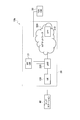
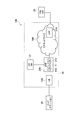
- FIG. 1 is an overall schematic configuration diagram of the remote control system 10.
- FIG. 2 is an overall schematic configuration diagram of the remote control system 10a.
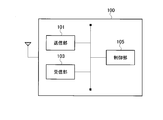
- FIG. 3 is a functional block configuration diagram of the UE 100.
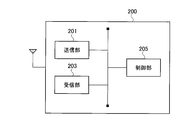
- FIG. 4 is a functional block configuration diagram of the gNB 200.
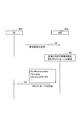
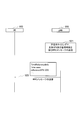
- FIG. 5 is a diagram showing a sequence of distribution processing at a reference time by a UE trigger.
- FIG. 6 is a diagram showing a sequence of distribution processing 1 at a reference time by a network trigger.
- FIG. 7 is an overall schematic configuration diagram of the remote control system 10b.
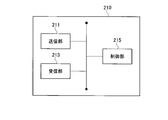
- FIG. 8 is a functional block configuration diagram of gNB-CU210.
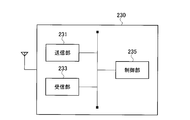
- FIG. 9 is a functional block configuration diagram of gNB-DU230.
- FIG. 10 is a diagram showing a sequence of distribution processing 2 at a reference time by a network trigger.
- FIG. 11 is a diagram showing an example of the hardware configuration of UE100, gNB200, gNB-CU210, and gNB-DU230
- FIG. 1 is an overall schematic configuration diagram of the remote control system 10 according to the embodiment.
- the remote control system 10 includes a TSN grand master (TSNGM) 20, an NR system 30, and an end station 40.
- TSN control source (not shown) remotely controls the TSN end station 40 in real time via the NR system 30.
- the specific configuration of the remote control system 10 including the number of gNBs and UEs is not limited to the example shown in FIG.
- the TSN GM20 oscillates the clock for generating the TSN time with high accuracy.
- the time generated based on the clock oscillated by the TSN GM20 is referred to as the TSN time.
- the TSN time is the reference time applied within the TSN.
- the NR system 30 includes the NR grandmaster (NR GM) 31, UE100, gNB200, and core network 300.
- the NR GM31 oscillates the clock that is the operation timing of the NR system 30.
- the time generated based on the clock oscillated by the NR GM31 is referred to as the NR time.
- the NR time is the reference time applied within the NR system 30.
- the UE100 executes wireless communication according to NR between UE100 and gNB200 and core network 300.
- the UE100 sends a request signal requesting a reference time to the gNB200.
- the UE100 receives unicast RRC signaling from the gNB200 that includes the NR time as the reference time.
- the UE100 synchronizes the time based on the received NR time in order to support TSN.
- the gNB200 executes wireless communication according to NR between the gNB200 and the core network 300.
- the gNB200 transmits unicast RRC signaling including the NR time as the reference time to the UE100.
- the gNB200 can perform time synchronization based on the NR time.
- UE100 and gNB200 include Massive MIMO, which generates a more directional beam by controlling radio signals transmitted from multiple antenna elements, carrier aggregation (CA) using multiple component carriers (CC), and multiple carriers. It is possible to support dual connectivity (DC) in which component carriers are transmitted simultaneously between gNB and UE.
- Massive MIMO which generates a more directional beam by controlling radio signals transmitted from multiple antenna elements, carrier aggregation (CA) using multiple component carriers (CC), and multiple carriers.
- CA carrier aggregation
- CC component carriers
- DC dual connectivity
- the core network 300 communicates with the UE 100 via the gNB 200.
- the core network 300 has a User Plane Function (UPF) 310.
- UPF310 provides functions specialized for U-plane processing.
- the UPF310 is connected to TSN GM20.
- the TSN GM20 may be connected to the gNB 200 instead of the UPF310.
- the gNB 200 can transmit unicast RRC signaling including the TSN time as the reference time to the UE 100.
- UE100 performs time synchronization based on the received TSN time in order to support TSN.
- the gNB200 can perform time synchronization based on at least one of the NR time and the TSN time.
- the gNB 200 may transmit unicast RRC signaling including the NR time and the TSN time as the reference time to the UE 100.
- the UE100 performs time synchronization based on at least one reference time of the received NR time and TSN time in order to support TSN.
- the end station 40 is a machine (for example, a robot arm) installed in the production factory.
- the end station 40 receives a command from the TSN control source via the NR system 30.
- the control source of the TSN performs real-time remote control in the remote control system 10 by performing time scheduling for operating the end station 40 based on the TSN time.
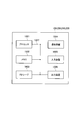
- FIG. 3 is a functional block configuration diagram of UE100. The hardware configuration of UE100 will be described later. As shown in FIG. 3, the UE 100 includes a transmission unit 101, a reception unit 103, and a control unit 105.
- the transmission unit 101 transmits a request signal requesting transmission of the reference time to the gNB 200.
- the receiving unit 103 receives the RRC message from the gNB 200.
- the control unit 105 detects the timing of transmitting the request signal.
- FIG. 4 is a functional block configuration diagram of gNB200.
- the hardware configuration of gNB200 will be described later.
- the gNB 200 includes a transmission unit 201, a reception unit 203, and a control unit 205.
- Transmission unit 201 sends an RRC message to UE100.
- the receiving unit 203 receives the request signal from the UE 100.
- the receiving unit 203 receives a notification of the timing for setting the RRC message from the core network 300.
- the control unit 205 detects the timing for setting the RRC message. Control unit 205 sets the RRC message.
- the gNB 200 delivers the reference time to the UE 100 at a predetermined timing using unicast RRC signaling.
- the gNB 200 transmits an RRC message as unicast RRC signaling.
- the information element TimeReferenceInfoList is set in the RRC message (for example, DLInformationTransfer message).
- the system frame number (reference SFN) assigned to the reference wireless frame is set for the referenceSFN in the information element TimeReferenceInfoList. Further, for Time in the information element TimeReferenceInfoList, the NR time in gNB-DU230 associated with the reference SFN set in referenceSFN is set as the reference time.
- the reference time set in Time corresponds to the NR time in gNB-DU230 at the end boundary of SFN set in the reference SFN.
- the TSN GM20 when the TSN GM20 is connected to the gNB 200, set the reference time of at least one of the NR time and the TSN time in the gNB-DU230 to Time in the information element TimeReferenceInfoList. Can be done.
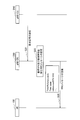
- FIG. 5 is a diagram showing a sequence of distribution processing at a reference time by a UE trigger.
- the UE100 transmits a request signal requesting transmission of the reference time to the gNB200 at a predetermined timing (S1).
- Predetermined timings include the following events: timer, traffic cycle, uplink data occurrence, downlink data occurrence, paging message reception, trigger reception from core network, NR in UE100 When a synchronization shift is detected at the time or TSN time, when it is attached, when the RRC state transitions, etc.
- UE100 when the timer to be counted in UE100 expires, UE100 sends a request signal to gNB200.
- the UE100 when the UE100 detects that the downlink data has occurred in the gNB200, the UE100 transmits a request signal to the gNB200.
- the UE100 when the UE100 receives a transmission instruction from the core network 300 via the NAS layer, the UE100 transmits a request signal to the gNB200.
- the UE100 when the UE100 transitions to the RRC connected state, the UE100 transmits a request signal to the gNB200.
- the UE100 transmits a request signal to the gNB200 at the timing when any of the above-mentioned events occurs.
- the UE 100 may transmit a request signal to the gNB 200 at a timing other than the above-mentioned event.
- the UE 100 may transmit the content of the event that triggered the transmission of the request signal to the gNB 200 together with the request signal.
- the gNB200 sets an RRC message addressed to the UE100 in response to the reception of the request signal. Specifically, the gNB 200 sets the reference SFN in the referenceSFN of the information element TimeReferenceInfoList in the RRC message, and sets the reference time associated with the reference SFN in the Time of the information element TimeReferenceInfoList (S3).
- the reference SFN XXX is set in the referenceSFN of the information element TimeReferenceInfoList in the DLInformationTransfer message, and the reference time aaaa is set in the time of the information element TimeReferenceInfoList.
- the gNB200 encodes the RRC message and sends it to the UE100 (S5).
- the UE100 When the UE100 receives the RRC message, it may notify the gNB200 of an acknowledgment signal (ACK).
- ACK acknowledgment signal
- FIG. 6 is a diagram showing a sequence of distribution processing 1 at a reference time by a network trigger.
- the gNB200 sets an RRC message addressed to the UE100 at a predetermined timing. Specifically, the gNB 200 sets the reference SFN in the referenceSFN of the information element TimeReferenceInfoList in the RRC message, and sets the reference time associated with the reference SFN in the Time of the information element TimeReferenceInfoList (S21).
- the reference SFN XXX is set in the referenceSFN of the information element TimeReferenceInfoList in the DLInformationTransfer message, and the reference time aaaa is set in the time of the information element TimeReferenceInfoList.
- Predetermined timings include the following events: timers, traffic cycles, uplink data occurrences, downlink data occurrences, paging message transmissions, trigger receptions from the core network, within the UE100.
- timers When a synchronization shift at NR time or TSN time is detected, when attached, or when the RRC state transitions (when transitioning to the eg RRC connected state).
- gNB200 sets an RRC message.
- uplink data occurs, when synchronization deviation at NR time or TSN time is detected in UE100, and when RRC state transition occurs, for example, when gNB200 detects that these events have occurred in UE100. , GNB200 sets the RRC message.
- gNB200 When sending a paging message, receiving a trigger from the core network, or attaching, for example, when gNB200 is notified by the core network that these events have occurred, gNB200 sets an RRC message. ..
- gNB200 generates an RRC message at the timing when any of the above-mentioned events occurs.
- the gNB200 may set an RRC message at a timing other than the above-mentioned event.
- the gNB200 encodes the RRC message and sends it to the UE100 (S23). In addition, the gNB 200 may transmit the content of the event that triggered the transmission of the request signal to the UE 100 together with the RRC message.
- the UE100 When the UE100 receives the RRC message, it may notify the gNB200 of an acknowledgment signal (ACK).
- ACK acknowledgment signal
- FIG. 7 is an overall schematic configuration diagram of the remote control system 10b.
- the gNB 200 is separated into a Central Unit (gNB-CU) 210 and a Distributed Unit (gNB-DU) 230 that protrudes from the installation location of the gNB-CU and is placed remotely.
- gNB-CU210 is provided with a higher layer than the packet data convergence protocol layer (PDCP)
- gNB-DU230 is provided with a lower layer such as a wireless link control layer (RLC).
- PDCP packet data convergence protocol layer
- RLC wireless link control layer
- the gNB-CU210 is located on the core network 300 side and controls the gNB-DU230.
- the gNB-CU210 may control a plurality of gNB-DU230s.
- gNB-DU230 is located on the UE100 side.
- the gNB-CU210 is connected to the gNB-DU230 via an F1 interface (for example, an optical fiber).
- the gNB-CU210 communicates with the UE 100 via the gNB-DU230.
- a hub, router, etc. can be installed between the gNB-CU210 and gNB-DU230.
- the gNB-DU230 constitutes a first communication device that executes wireless communication with the UE100.
- the gNB-CU 210 constitutes a second communication device that is connected to the gNB-DU230 and communicates with the UE 100 via the gNB-DU230.
- FIG. 8 is a functional block configuration diagram of gNB-CU210.
- the hardware configuration of gNB-CU210 will be described later.
- the gNB-CU210 includes a transmission unit 211, a reception unit 213, and a control unit 215.
- Transmission unit 211 transmits a request signal requesting transmission of the reference time to gNB-DU230.
- the receiving unit 213 receives a notification of the timing for setting the RRC message from the core network 300.
- the control unit 215 detects the timing of transmitting the request signal.
- FIG. 9 is a functional block configuration diagram of gNB-DU230.
- the hardware configuration of gNB-DU230 will be described later.
- the gNB-DU230 includes a transmission unit 231, a reception unit 233, and a control unit 235.
- Transmission unit 231 sends an RRC message to UE100.
- the receiving unit 233 receives the request signal from the gNB-CU210.
- Control unit 235 sets the RRC message.
- FIG. 10 is a diagram showing a sequence of distribution processing 2 at a reference time by a network trigger.
- the gNB-CU210 transmits a request signal requesting transmission of the reference time to the gNB-DU230 at a predetermined timing (S31).
- a predetermined timing As the predetermined timing, the event mentioned in the distribution process 1 of the reference time by the network trigger is applied.
- the gNB-CU210 may transmit a request signal to the gNB-DU230 at a timing other than the events listed in the distribution process 1 of the reference time by the network trigger. Further, the gNB-CU 210 may transmit the content of the event that triggered the transmission of the request signal to the gNB-DU230 together with the request signal.
- the gNB-DU230 generates an RRC message addressed to UE100 in response to the reception of the request signal.
- the gNB-DU230 sets the reference SFN in the referenceSFN of the information element TimeReferenceInfoList in the RRC message, and sets the reference time in the gNB-DU230 associated with the reference SFN in the Time of the information element TimeReferenceInfoList (S33). ).
- the reference SFN XXX is set in the referenceSFN of the information element TimeReferenceInfoList in the DLInformationTransfer message, and the reference time aaaa is set in the time of the information element TimeReferenceInfoList.
- the gNB-DU230 encodes the RRC message and sends it to the UE100 (S35).
- the UE100 When the UE100 receives the RRC message, it may notify the gNB-CU210 or gNB-DU230 of an acknowledgment signal (ACK).
- ACK acknowledgment signal
- the UE 100 transmits a request signal to the gNB 200 at a predetermined timing and a transmission unit 101 requesting transmission of a reference time in a predetermined network.
- the receiving unit 103 that receives the RRC message including the reference SFN allocated to the reference radio frame and the reference time associated with the reference SFN from the gNB 200 is provided.
- the UE100 can transmit a request signal requesting transmission of the reference time to the gNB200. Therefore, the UE 100 can receive the reference time in the predetermined network from the gNB 200 at the timing when the UE 100 needs the reference time.
- the gNB 200 sets an RRC message including a reference SFN assigned to the reference radio frame and a reference time in a predetermined network associated with the reference SFN at a predetermined timing. It includes a control unit 205 and a transmission unit 101 that transmits a set RRC message to the UE 100.
- the gNB200 can set the RRC message at the timing when the UE100 needs the reference time. Therefore, the gNB 200 can transmit the reference time in the predetermined network at the timing when the UE 100 needs the reference time.
- control unit 205 of the gNB 200 sets the RRC message based on the notification from the core network 300.
- the gNB200 can set the RRC message at the timing when the UE100 needs the reference time.
- the gNB 200 includes a gNB-DU230 that communicates with the UE100 and a gNB-CU210 that is connected to the gNB-DU230 and communicates with the UE100 via the gNB-DU230.
- the gNB-CU210 includes a transmission unit 211 that transmits a request signal requesting transmission of a reference time in a predetermined network to the gNB-DU230 at a predetermined timing.
- the gNB-DU230 includes a receiving unit 233 that receives a request signal, a reference SFN assigned to a reference radio frame according to the reception of the request signal, and a reference time in a predetermined network associated with the reference SFN. It includes a control unit 235 for setting an RRC message including the above, and a transmission unit 231 for transmitting the set RRC message to the UE 100.
- the gNB200 can set the RRC message at the timing when the UE100 needs the reference time. Therefore, the gNB 200 can transmit the reference time in the predetermined network at the timing when the UE 100 needs the reference time.
- the transmission unit 211 of the gNB-CU210 transmits a request signal to the gNB-DU230 based on the notification from the core network 300.
- the gNB200 can set the RRC message at the timing when the UE100 needs the reference time.
- the block configuration diagram (FIGS. 3, FIG. 4, FIG. 8 and FIG. 9) used in the description of the above-described embodiment shows a block of functional units.
- These functional blocks are realized by any combination of at least one of hardware and software.
- the method of realizing each functional block is not particularly limited. That is, each functional block may be realized by using one device that is physically or logically connected, or directly or indirectly (for example, by using two or more physically or logically separated devices). , Wired, wireless, etc.) and may be realized using these plurality of devices.
- the functional block may be realized by combining the software with the one device or the plurality of devices.
- Functions include judgment, decision, judgment, calculation, calculation, processing, derivation, investigation, search, confirmation, reception, transmission, output, access, solution, selection, selection, establishment, comparison, assumption, expectation, deemed, and notification (There are, but are not limited to, broadcasting, notifying, communicating, forwarding, configuring, reconfiguring, allocating, mapping, assigning, etc. ..
- a functional block that makes transmission function is called a transmitting unit or a transmitter.
- the method of realizing each is not particularly limited.
- FIG. 11 is a diagram showing an example of the hardware configuration of the device.
- the device may be configured as a computer device including a processor 1001, a memory 1002, a storage 1003, a communication device 1004, an input device 1005, an output device 1006, a bus 1007, and the like.
- the word “device” can be read as a circuit, device, unit, etc.
- the hardware configuration of the device may be configured to include one or more of each of the devices shown in the figure, or may be configured not to include some of the devices.
- Each functional block of the device is realized by any hardware element of the computer device or a combination of the hardware elements.
- the processor 1001 performs the calculation, controls the communication by the communication device 1004, and the memory. It is realized by controlling at least one of reading and writing of data in 1002 and storage 1003.
- Processor 1001 operates, for example, an operating system to control the entire computer.
- the processor 1001 may be composed of a central processing unit (CPU) including an interface with peripheral devices, a control device, an arithmetic unit, registers, and the like.
- CPU central processing unit
- the processor 1001 reads a program (program code), a software module, data, etc. from at least one of the storage 1003 and the communication device 1004 into the memory 1002, and executes various processes according to these.
- a program program code
- a program that causes a computer to execute at least a part of the operations described in the above-described embodiment is used.
- the various processes described above may be executed by one processor 1001 or may be executed simultaneously or sequentially by two or more processors 1001.
- Processor 1001 may be implemented by one or more chips.
- the program may be transmitted from the network via a telecommunication line.
- the memory 1002 is a computer-readable recording medium, and is composed of at least one of, for example, ReadOnlyMemory (ROM), ErasableProgrammableROM (EPROM), Electrically ErasableProgrammableROM (EEPROM), RandomAccessMemory (RAM), and the like. May be done.
- the memory 1002 may be called a register, a cache, a main memory (main storage device), or the like.
- the memory 1002 can store a program (program code), a software module, or the like that can execute the method according to the embodiment of the present disclosure.
- the storage 1003 is a computer-readable recording medium, for example, an optical disk such as a Compact Disc ROM (CD-ROM), a hard disk drive, a flexible disk, a photomagnetic disk (for example, a compact disk, a digital versatile disk, a Blu-ray). It may consist of at least one (registered trademark) disk), smart card, flash memory (eg, card, stick, key drive), floppy (registered trademark) disk, magnetic strip, and the like.
- Storage 1003 may be referred to as auxiliary storage.
- the recording medium described above may be, for example, a database, server or other suitable medium containing at least one of memory 1002 and storage 1003.
- the communication device 1004 is hardware (transmission / reception device) for communicating between computers via at least one of a wired network and a wireless network, and is also referred to as, for example, a network device, a network controller, a network card, a communication module, or the like.
- Communication device 1004 includes, for example, a high frequency switch, a duplexer, a filter, a frequency synthesizer, etc. in order to realize at least one of frequency division duplex (FDD) and time division duplex (TDD). It may be composed of.
- FDD frequency division duplex
- TDD time division duplex
- the input device 1005 is an input device (for example, keyboard, mouse, microphone, switch, button, sensor, etc.) that accepts input from the outside.
- the output device 1006 is an output device (for example, a display, a speaker, an LED lamp, etc.) that outputs to the outside.
- the input device 1005 and the output device 1006 may have an integrated configuration (for example, a touch panel).
- each device such as the processor 1001 and the memory 1002 is connected by the bus 1007 for communicating information.
- the bus 1007 may be configured by using a single bus, or may be configured by using a different bus for each device.
- the device includes hardware such as a microprocessor, a digital signal processor (Digital Signal Processor: DSP), an Application Specific Integrated Circuit (ASIC), a Programmable Logic Device (PLD), and a Field Programmable Gate Array (FPGA).
- the hardware may implement some or all of each functional block.
- processor 1001 may be implemented using at least one of these hardware.
- information notification includes physical layer signaling (for example, Downlink Control Information (DCI), Uplink Control Information (UCI), upper layer signaling (eg, RRC signaling, Medium Access Control (MAC) signaling, broadcast information (Master Information Block)). (MIB), System Information Block (SIB)), other signals or combinations thereof.
- DCI Downlink Control Information
- UCI Uplink Control Information
- RRC signaling may also be referred to as an RRC message, for example, RRC Connection Setup. ) Message, RRC Connection Reconfiguration message, etc. may be used.
- LTE LongTermEvolution
- LTE-A LTE-Advanced
- SUPER3G IMT-Advanced
- 4G 4th generation mobile communication system
- 5G 5th generation mobile communication system
- FutureRadioAccess FAA
- NewRadio NR
- W-CDMA registered trademark
- GSM registered trademark
- CDMA2000 Code Division Multiple Access 2000
- UMB UltraMobile Broadband
- IEEE802.11 Wi-Fi (registered trademark)
- IEEE802.16 WiMAX®
- IEEE802.20 Ultra-WideBand (UWB), Bluetooth®, and other systems that utilize appropriate systems and at least one of the next generation systems extended based on them.
- a plurality of systems may be applied in combination (for example, a combination of at least one of LTE and LTE-A and 5G).
- the specific operation performed by the base station in the present disclosure may be performed by its upper node (upper node).
- various operations performed for communication with a terminal are performed by the base station and other network nodes other than the base station (for example, MME or). It is clear that it can be done by at least one of (but not limited to, S-GW, etc.).
- S-GW network node
- the case where there is one network node other than the base station is illustrated above, it may be a combination of a plurality of other network nodes (for example, MME and S-GW).
- Information and signals can be output from the upper layer (or lower layer) to the lower layer (or upper layer).
- Input / output may be performed via a plurality of network nodes.
- the input / output information may be stored in a specific location (for example, memory) or may be managed using a management table.
- the input / output information can be overwritten, updated, or added.
- the output information may be deleted.
- the input information may be transmitted to another device.
- the determination may be made by a value represented by 1 bit (0 or 1), by a boolean value (Boolean: true or false), or by comparing numerical values (for example, a predetermined value). It may be done by comparison with the value).
- the notification of predetermined information (for example, the notification of "being X") is not limited to the explicit one, but is performed implicitly (for example, the notification of the predetermined information is not performed). May be good.
- Software is an instruction, instruction set, code, code segment, program code, program, subprogram, software module, whether called software, firmware, middleware, microcode, hardware description language, or another name.
- Applications, software applications, software packages, routines, subroutines, objects, executable files, execution threads, procedures, functions, etc. should be broadly interpreted to mean.
- software, instructions, information, etc. may be transmitted and received via a transmission medium.
- a transmission medium For example, a website, where the software uses at least one of wired technology (coaxial cable, fiber optic cable, twist pair, Digital Subscriber Line (DSL), etc.) and wireless technology (infrared, microwave, etc.).
- wired technology coaxial cable, fiber optic cable, twist pair, Digital Subscriber Line (DSL), etc.
- wireless technology infrared, microwave, etc.
- the information, signals, etc. described in this disclosure may be represented using any of a variety of different techniques.
- data, instructions, commands, information, signals, bits, symbols, chips, etc. that may be referred to throughout the above description are voltages, currents, electromagnetic waves, magnetic fields or magnetic particles, light fields or photons, or any of these. It may be represented by a combination of.
- a channel and a symbol may be a signal (signaling).
- the signal may be a message.
- the component carrier (CC) may be referred to as a carrier frequency, a cell, a frequency carrier, or the like.
- system and “network” used in this disclosure are used interchangeably.
- the information, parameters, etc. described in the present disclosure may be expressed using absolute values, relative values from predetermined values, or using other corresponding information. It may be represented.
- the radio resource may be one indicated by an index.
- Base Station BS
- Wireless Base Station Wireless Base Station
- NodeB NodeB
- eNodeB eNodeB
- gNodeB gNodeB
- Base stations are sometimes referred to by terms such as macrocells, small cells, femtocells, and picocells.
- the base station can accommodate one or more (for example, three) cells (also called sectors). When a base station accommodates multiple cells, the entire coverage area of the base station can be divided into multiple smaller areas, each smaller area being a base station subsystem (eg, a small indoor base station (Remote Radio)). Communication services can also be provided by Head: RRH).
- a base station subsystem eg, a small indoor base station (Remote Radio)
- Communication services can also be provided by Head: RRH).
- cell refers to a base station that provides communication services in this coverage, and part or all of the coverage area of at least one of the base station subsystems.
- MS mobile station
- UE user equipment
- terminal terminal
- Mobile stations can be subscriber stations, mobile units, subscriber units, wireless units, remote units, mobile devices, wireless devices, wireless communication devices, remote devices, mobile subscriber stations, access terminals, mobile terminals, wireless, depending on the trader. It may also be referred to as a terminal, remote terminal, handset, user agent, mobile client, client, or some other suitable term.
- At least one of the base station and the mobile station may be called a transmitting device, a receiving device, a communication device, or the like.
- At least one of the base station and the mobile station may be a device mounted on the mobile body, the mobile body itself, or the like.
- the moving body may be a vehicle (eg, car, airplane, etc.), an unmanned moving body (eg, drone, self-driving car, etc.), or a robot (manned or unmanned). ) May be.
- at least one of the base station and the mobile station includes a device that does not necessarily move during communication operation.
- at least one of a base station and a mobile station may be an Internet of Things (IoT) device such as a sensor.
- IoT Internet of Things
- the base station in the present disclosure may be read as a mobile station (user terminal, the same applies hereinafter).
- communication between a base station and a mobile station has been replaced with communication between a plurality of mobile stations (for example, it may be called Device-to-Device (D2D), Vehicle-to-Everything (V2X), etc.).
- D2D Device-to-Device
- V2X Vehicle-to-Everything
- Each aspect / embodiment of the present disclosure may be applied to the configuration.
- the mobile station may have the function of the base station.
- words such as "up” and “down” may be read as words corresponding to inter-terminal communication (for example, "side").
- the uplink, downlink, and the like may be read as side channels.
- the mobile station in the present disclosure may be read as a base station.
- the base station may have the functions of the mobile station.
- connection means any direct or indirect connection or connection between two or more elements, and each other. It can include the presence of one or more intermediate elements between two “connected” or “combined” elements.
- the connection or connection between the elements may be physical, logical, or a combination thereof.
- connection may be read as "access”.
- the two elements use at least one of one or more wires, cables and printed electrical connections, and, as some non-limiting and non-comprehensive examples, the radio frequency domain.
- Electromagnetic energies with wavelengths in the microwave and light (both visible and invisible) regions, etc. can be considered to be “connected” or “coupled” to each other.
- the reference signal can also be abbreviated as Reference Signal (RS), and may be called a pilot (Pilot) depending on the applicable standard.
- RS Reference Signal
- Pilot pilot
- references to elements using designations such as “first”, “second” as used in this disclosure does not generally limit the quantity or order of those elements. These designations can be used in the present disclosure as a convenient way to distinguish between two or more elements. Thus, references to the first and second elements do not mean that only two elements can be adopted there, or that the first element must somehow precede the second element.
- the term "A and B are different” may mean “A and B are different from each other”.
- the term may mean that "A and B are different from C”.
- Terms such as “separate” and “combined” may be interpreted in the same way as “different”.
- the reference time in the predetermined network can be transmitted and received at the timing when the reference time is required.
Landscapes
- Engineering & Computer Science (AREA)
- Computer Networks & Wireless Communication (AREA)
- Signal Processing (AREA)
- Mobile Radio Communication Systems (AREA)
Priority Applications (6)
| Application Number | Priority Date | Filing Date | Title |
|---|---|---|---|
| CN201980095309.4A CN113678518B (zh) | 2019-04-26 | 2019-04-26 | 用户装置及无线基站 |
| JP2021515711A JP7332687B2 (ja) | 2019-04-26 | 2019-04-26 | ユーザ装置及び無線基地局 |
| PCT/JP2019/018028 WO2020217480A1 (ja) | 2019-04-26 | 2019-04-26 | ユーザ装置及び無線基地局 |
| KR1020217031147A KR20210153607A (ko) | 2019-04-26 | 2019-04-26 | 유저장치 및 무선기지국 |
| EP19925705.6A EP3962186A1 (en) | 2019-04-26 | 2019-04-26 | User equipment and wireless base station |
| US17/605,451 US12041567B2 (en) | 2019-04-26 | 2019-04-26 | User equipment and radio base station |
Applications Claiming Priority (1)
| Application Number | Priority Date | Filing Date | Title |
|---|---|---|---|
| PCT/JP2019/018028 WO2020217480A1 (ja) | 2019-04-26 | 2019-04-26 | ユーザ装置及び無線基地局 |
Publications (1)
| Publication Number | Publication Date |
|---|---|
| WO2020217480A1 true WO2020217480A1 (ja) | 2020-10-29 |
Family
ID=72940883
Family Applications (1)
| Application Number | Title | Priority Date | Filing Date |
|---|---|---|---|
| PCT/JP2019/018028 Ceased WO2020217480A1 (ja) | 2019-04-26 | 2019-04-26 | ユーザ装置及び無線基地局 |
Country Status (6)
| Country | Link |
|---|---|
| US (1) | US12041567B2 (enExample) |
| EP (1) | EP3962186A1 (enExample) |
| JP (1) | JP7332687B2 (enExample) |
| KR (1) | KR20210153607A (enExample) |
| CN (1) | CN113678518B (enExample) |
| WO (1) | WO2020217480A1 (enExample) |
Cited By (2)
| Publication number | Priority date | Publication date | Assignee | Title |
|---|---|---|---|---|
| CN116458221A (zh) * | 2020-11-19 | 2023-07-18 | 佳能株式会社 | 用于同步无线网络的设备的方法和设备 |
| JP2024514738A (ja) * | 2021-05-04 | 2024-04-03 | キヤノン株式会社 | 無線ネットワークにおける時刻同期の制御 |
Families Citing this family (2)
| Publication number | Priority date | Publication date | Assignee | Title |
|---|---|---|---|---|
| CN115426094B (zh) * | 2019-08-02 | 2023-11-14 | 中兴通讯股份有限公司 | 无线资源配置方法、装置及存储介质 |
| CN113543299A (zh) * | 2020-04-15 | 2021-10-22 | 华为技术有限公司 | 一种时间同步方法及装置 |
Family Cites Families (7)
| Publication number | Priority date | Publication date | Assignee | Title |
|---|---|---|---|---|
| KR100421876B1 (ko) * | 2001-09-17 | 2004-03-11 | 엘지전자 주식회사 | 단말기의 시간 표시 방법 및 이를 위한 장치 |
| CN102056284A (zh) * | 2009-10-27 | 2011-05-11 | 大唐移动通信设备有限公司 | 时间同步方法、系统和设备 |
| CN102083194B (zh) * | 2009-11-30 | 2014-12-03 | 电信科学技术研究院 | 时间信息发送与时间同步方法、系统和设备 |
| US8878721B2 (en) * | 2011-06-02 | 2014-11-04 | Qualcomm Incorporated | Hybrid positioning using timing reference information |
| US8934452B2 (en) * | 2012-07-17 | 2015-01-13 | Alcatel Lucent | Method, apparatus and computer readable medium for timing alignment in overlaid heterogeneous wireless networks |
| JP2019176196A (ja) * | 2016-08-10 | 2019-10-10 | 株式会社Nttドコモ | 基地局、ユーザ装置及び信号送信方法 |
| JP2019068145A (ja) * | 2017-09-28 | 2019-04-25 | 株式会社Nttドコモ | ユーザ装置 |
-
2019
- 2019-04-26 JP JP2021515711A patent/JP7332687B2/ja active Active
- 2019-04-26 EP EP19925705.6A patent/EP3962186A1/en not_active Withdrawn
- 2019-04-26 KR KR1020217031147A patent/KR20210153607A/ko not_active Ceased
- 2019-04-26 CN CN201980095309.4A patent/CN113678518B/zh active Active
- 2019-04-26 WO PCT/JP2019/018028 patent/WO2020217480A1/ja not_active Ceased
- 2019-04-26 US US17/605,451 patent/US12041567B2/en active Active
Non-Patent Citations (3)
| Title |
|---|
| "Generation Partnership Project; Technical Specification Group Services and System Aspects; Study on enhancement of 5GS for Vertical and LAN Services (Release 16), 3GPP", 3GPP TR 23.734, December 2018 (2018-12-01) |
| SAMSUNG: "Generating and delivering the time reference information in split NG-RAN architecture", 3GPP DRAFT; R3-191534_DISC_PCR FOR TIME REFERENCE INFORMATION, 29 March 2019 (2019-03-29), Xi’an, China, pages 1 - 4, XP051694988 * |
| SAMSUNG: "Reference Timing Delivery for Industrial IOT", 3GPP DRAFT; R2-1902178 REFERENCE TIMING DELIVERY, 15 February 2019 (2019-02-15), Athens, Greece, pages 1 - 2, XP051603521 * |
Cited By (3)
| Publication number | Priority date | Publication date | Assignee | Title |
|---|---|---|---|---|
| CN116458221A (zh) * | 2020-11-19 | 2023-07-18 | 佳能株式会社 | 用于同步无线网络的设备的方法和设备 |
| JP2024514738A (ja) * | 2021-05-04 | 2024-04-03 | キヤノン株式会社 | 無線ネットワークにおける時刻同期の制御 |
| JP7689581B2 (ja) | 2021-05-04 | 2025-06-06 | キヤノン株式会社 | 無線ネットワークにおける時刻同期の制御 |
Also Published As
| Publication number | Publication date |
|---|---|
| JP7332687B2 (ja) | 2023-08-23 |
| KR20210153607A (ko) | 2021-12-17 |
| US12041567B2 (en) | 2024-07-16 |
| JPWO2020217480A1 (enExample) | 2020-10-29 |
| CN113678518A (zh) | 2021-11-19 |
| CN113678518B (zh) | 2024-03-22 |
| US20220217663A1 (en) | 2022-07-07 |
| EP3962186A1 (en) | 2022-03-02 |
Similar Documents
| Publication | Publication Date | Title |
|---|---|---|
| JP7506662B2 (ja) | 無線基地局 | |
| JP7165816B2 (ja) | 無線基地局 | |
| WO2020166017A1 (ja) | ユーザ装置、基地局及び通信方法 | |
| JP7332687B2 (ja) | ユーザ装置及び無線基地局 | |
| WO2020255424A1 (ja) | 端末 | |
| US12439350B2 (en) | Terminal and communication node | |
| WO2020166027A1 (ja) | ユーザ装置及び通信方法 | |
| WO2021070388A1 (ja) | 端末 | |
| CN113728678A (zh) | 用户装置以及通信方法 | |
| WO2020165979A1 (ja) | 無線基地局及びユーザ装置 | |
| JP7219340B2 (ja) | 端末 | |
| WO2020255421A1 (ja) | 端末 | |
| US20220124708A1 (en) | Radio base station and user equipment | |
| US20220201570A1 (en) | User apparatus and communication method | |
| WO2021029075A1 (ja) | 端末及び通信方法 | |
| JPWO2020170404A1 (ja) | ユーザ装置 | |
| WO2020144834A1 (ja) | ユーザ装置及び通信方法 | |
| JPWO2020165957A1 (ja) | 通信装置 | |
| WO2020230224A1 (ja) | ユーザ装置 | |
| WO2020255420A1 (ja) | 端末 | |
| WO2020084745A1 (ja) | ユーザ装置 |
Legal Events
| Date | Code | Title | Description |
|---|---|---|---|
| 121 | Ep: the epo has been informed by wipo that ep was designated in this application |
Ref document number: 19925705 Country of ref document: EP Kind code of ref document: A1 |
|
| ENP | Entry into the national phase |
Ref document number: 2021515711 Country of ref document: JP Kind code of ref document: A |
|
| NENP | Non-entry into the national phase |
Ref country code: DE |
|
| ENP | Entry into the national phase |
Ref document number: 2019925705 Country of ref document: EP Effective date: 20211126 |
|
| WWR | Wipo information: refused in national office |
Ref document number: 1020217031147 Country of ref document: KR |