WO2020209128A1 - 位置制御装置 - Google Patents
位置制御装置 Download PDFInfo
- Publication number
- WO2020209128A1 WO2020209128A1 PCT/JP2020/014579 JP2020014579W WO2020209128A1 WO 2020209128 A1 WO2020209128 A1 WO 2020209128A1 JP 2020014579 W JP2020014579 W JP 2020014579W WO 2020209128 A1 WO2020209128 A1 WO 2020209128A1
- Authority
- WO
- WIPO (PCT)
- Prior art keywords
- cord
- controlled object
- control device
- unit
- position control
- Prior art date
- Legal status (The legal status is an assumption and is not a legal conclusion. Google has not performed a legal analysis and makes no representation as to the accuracy of the status listed.)
- Ceased
Links
Images




Classifications
-
- B—PERFORMING OPERATIONS; TRANSPORTING
- B33—ADDITIVE MANUFACTURING TECHNOLOGY
- B33Y—ADDITIVE MANUFACTURING, i.e. MANUFACTURING OF THREE-DIMENSIONAL [3D] OBJECTS BY ADDITIVE DEPOSITION, ADDITIVE AGGLOMERATION OR ADDITIVE LAYERING, e.g. BY 3D PRINTING, STEREOLITHOGRAPHY OR SELECTIVE LASER SINTERING
- B33Y50/00—Data acquisition or data processing for additive manufacturing
- B33Y50/02—Data acquisition or data processing for additive manufacturing for controlling or regulating additive manufacturing processes
-
- G—PHYSICS
- G03—PHOTOGRAPHY; CINEMATOGRAPHY; ANALOGOUS TECHNIQUES USING WAVES OTHER THAN OPTICAL WAVES; ELECTROGRAPHY; HOLOGRAPHY
- G03B—APPARATUS OR ARRANGEMENTS FOR TAKING PHOTOGRAPHS OR FOR PROJECTING OR VIEWING THEM; APPARATUS OR ARRANGEMENTS EMPLOYING ANALOGOUS TECHNIQUES USING WAVES OTHER THAN OPTICAL WAVES; ACCESSORIES THEREFOR
- G03B15/00—Special procedures for taking photographs; Apparatus therefor
-
- G—PHYSICS
- G03—PHOTOGRAPHY; CINEMATOGRAPHY; ANALOGOUS TECHNIQUES USING WAVES OTHER THAN OPTICAL WAVES; ELECTROGRAPHY; HOLOGRAPHY
- G03B—APPARATUS OR ARRANGEMENTS FOR TAKING PHOTOGRAPHS OR FOR PROJECTING OR VIEWING THEM; APPARATUS OR ARRANGEMENTS EMPLOYING ANALOGOUS TECHNIQUES USING WAVES OTHER THAN OPTICAL WAVES; ACCESSORIES THEREFOR
- G03B17/00—Details of cameras or camera bodies; Accessories therefor
- G03B17/56—Accessories
-
- G—PHYSICS
- G05—CONTROLLING; REGULATING
- G05D—SYSTEMS FOR CONTROLLING OR REGULATING NON-ELECTRIC VARIABLES
- G05D3/00—Control of position or direction
Definitions
- the present invention relates to a position control device that moves a controlled object to an arbitrary position in a moving space.
- a moving mechanism using a plurality of linear motion systems such as a linear guide or a parallel link type moving mechanism has been used as a mechanism for moving the print head in the XYZ axis direction. ..
- the print head or the moving mechanism interferes with each other, which limits the shape that can be formed in three dimensions.
- the rigidity of the stage on which the printer head is mounted is required to precisely control the position of the print head.
- the weight of the moving mechanism portion increases and the position of the stage becomes unstable, and it is difficult to make the 3D printer compatible with the large modeled object.
- a moving mechanism for moving the shooting equipment or the like in the three-dimensional direction a moving mechanism for suspending the shooting equipment with a plurality of wires is known (see, for example, Patent Document 1). According to this moving mechanism, by adjusting the length of each wire, it is possible to move the photographing equipment or the like in the three-dimensional direction.
- the photographing equipment is unstable in a state of being suspended by a wire, and it cannot be said that the photographing equipment is supported with high rigidity. Therefore, for example, if the moving mechanism described in Patent Document 1 is applied to the moving mechanism of the print head of the 3D printer, the size of the 3D printer can be increased, but it is difficult to precisely control the position of the printer head. Is.
- An object of the present invention is to provide a position control device capable of widening the moving space of a controlled object and precisely controlling the position of the controlled object.
- the position control device of the present invention A position control device that moves a controlled object to an arbitrary position in the moving space.
- a plurality of cords connected to the controlled object A plurality of cord body operating portions that are connected to each other and change the take-up amount and the withdrawal amount of each cord while applying tension to the cords.
- the plurality of cords are positive in the first direction with respect to the controlled object by the first-direction component, the second-direction component, and the third-direction component of the tension acting on each cord. It is arranged so that the holding force in the opposite direction, the holding force in the forward / reverse direction of the second direction, and the holding force in the forward / reverse direction of the third direction act.
- the moving space of the controlled object can be widened, and the position of the controlled object can be precisely controlled.
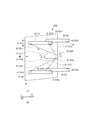
- FIG. 1 is a perspective view showing the overall configuration of the position control device according to the first embodiment of the present invention.
- FIG. 2 is a schematic view showing the configuration of a 3D printing control system.
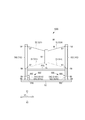
- FIG. 3 is a side view of the position control device as viewed in the Y1 direction.
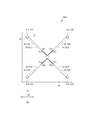
- FIG. 4 is a side view of the position control device as viewed in the Z2 direction.
- FIG. 5 is a side view showing an example of the operation of the position control device.
- FIG. 6 is a side view showing an example of the operation of the position control device.
- FIG. 7 is a perspective view showing the overall configuration of the position control device according to the second embodiment of the present invention.
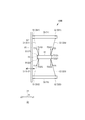
- FIG. 8 is a side view of the position control device as viewed in the Y1 direction.
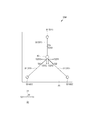
- FIG. 9 is a side view of the position control device as viewed in the Z2 direction.
- FIG. 10 is a perspective view showing the overall configuration of the position control device according to the third embodiment of the present invention.
- FIG. 11 is a side view of the position control device as viewed in the Y1 direction.
- FIG. 12 is a side view of the position control device as viewed in the Z2 direction.
- FIG. 13 is a side view of the position control device according to the fourth embodiment of the present invention as viewed in the Y1 direction.
- the position control device is A position control device that moves a controlled object to an arbitrary position in the moving space.
- a plurality of cords connected to the controlled object A plurality of cord body operating portions that are connected to each other and change the take-up amount and the withdrawal amount of each cord while applying tension to the cords.
- a control unit that controls the position of the controlled object in the moving space by controlling each cord operating unit so as to change the take-up amount and the withdrawal amount of each cord.
- the plurality of cords are positive in the first direction with respect to the controlled object by the first-direction component, the second-direction component, and the third-direction component of the tension acting on each cord. It is a position control device arranged so that a holding force in the reverse direction, a holding force in the forward / reverse direction of the second direction, and a holding force in the forward / reverse direction of the third direction act. 1 configuration).
- the controlled object is moved to an arbitrary position in the moving space by a plurality of cords. Therefore, the moving space of the controlled object can be widened.
- the plurality of cords hold the controlled object in the forward and reverse directions of the first direction, the holding force in the forward and reverse directions of the second direction, and the holding force in the forward and reverse directions of the third direction. Force is working. Therefore, the position of the controlled object can be stabilized, and the position of the controlled object can be precisely controlled.
- the plurality of cords are connected to a plurality of positions on the controlled object.
- the posture of the controlled object may be controlled by controlling each of the cord operating units so that the control unit changes the take-up amount and the withdrawal amount of each cord (second configuration).
- the control target is in a state where the holding force in the forward and reverse directions of the first direction, the holding force in the forward and reverse directions of the second direction, and the holding force in the forward and reverse directions of the third direction are applied. Since the attitude of the object is controlled, the attitude of the object to be controlled can be stabilized, and the attitude of the object to be controlled can be precisely controlled.
- One direction in which the controlled object is moved is set as the advancing / retreating direction.
- One end of the controlled object in the advancing / retreating direction is set as the first end.
- the other end of the controlled object in the advancing / retreating direction is defined as the second end.
- the cord connected to the first end side of the controlled object is defined as the first cord.
- the cord connected to the second end side of the controlled object is defined as the second cord.
- the cord body operating portion arranged at a position closer to the first end portion than the second end portion is designated as the first cord body operating portion.
- the cord body operation portion arranged at a position closer to the second end portion than the first end portion is used as the second cord body operation portion.
- the first cord body is connected to the first cord body operation unit and is connected to the first cord body.
- the second cord may be connected to the second cord operating portion (third configuration).
- the position and posture of the control object can be stabilized.
- the position control and attitude control of the controlled object can be precisely performed.
- One direction in which the controlled object is moved is set as the advancing / retreating direction.
- One end of the controlled object in the advancing / retreating direction is set as the first end.
- the other end of the controlled object in the advancing / retreating direction is defined as the second end.
- the cord connected to the first end side of the controlled object is defined as the first cord.
- the cord connected to the second end side of the controlled object is defined as the second cord.
- the cord body operating portion arranged at a position closer to the first end portion than the second end portion is designated as the first cord body operating portion.
- the cord body operation portion arranged at a position closer to the second end portion than the first end portion is used as the second cord body operation portion.
- the first cord body is connected to the second cord body operation unit, and is connected to the second cord body operation unit.
- the second cord may be connected to the first cord operating portion (fourth configuration).
- the first cord is connected to the second cord operating unit, and the second cord is connected to the first cord operating unit, so that the position and posture of the controlled object are controlled. Can be stabilized, and the position control and attitude control of the controlled object can be precisely performed.
- the angle between the cord and the controlled object can be reduced, the moving space of the controlled object can be widened, and the rope and the controlled object are less likely to interfere with obstacles in the moving space. Can be done.
- the distance from the first cord operating unit to the second cord operating unit is larger than the distance from the first end to the second end of the controlled object. Therefore, the moving space of the controlled object can be increased.
- It may have a row in which the first cord operation unit and the second cord operation unit are arranged (sixth configuration).
- the above configuration it has a row in which the first cord operation unit and the second cord operation unit are arranged. Therefore, the arrangement of the first cord operating unit and the second cord operating unit can be facilitated, and the moving space of the controlled object can be widened.
- the rows in which the first cord operating unit and the second cord operating unit are arranged one by one may be arranged in three rows so as to be separated from each other outside the moving space (7th). Constitution).
- the position and attitude of the controlled object are controlled by the 6-axis cord, the position and attitude of the controlled object can be stabilized, and the position control and attitude control of the controlled object can be precisely controlled. Can be done.
- the rows in which the first cord operating unit and the second cord operating unit are arranged one by one may be arranged in four rows so as to be separated from each other outside the moving space (eighth). Constitution).
- the position and attitude of the controlled object are controlled by the 8-axis cord, the position and attitude of the controlled object can be stabilized, and the position control and attitude control of the controlled object can be precisely controlled. Can be done.
- the moving space is The space may have the positions of the plurality of cord operating units as vertices (9th configuration).
- the moving space is a space whose apex is the position of a plurality of rope body operation units
- the holding force in the forward and reverse directions of the first direction with respect to the controlled object by the plurality of rope bodies act.
- the holding force in the forward and reverse directions of the second direction and the holding force in the forward and reverse directions of the third direction act.
- the position of the controlled object can be stabilized, and the position of the controlled object can be precisely controlled.
- the cord operation unit is A winding section for winding and accommodating the cord, and It has a guide portion for guiding the winding and feeding of the cord by the winding portion.
- the position of the cord body operating portion may be a position where the guide portion is arranged (tenth configuration).
- the position of the cord operating unit is the position where the guide unit is arranged, the degree of freedom in the configuration of the cord operating unit is increased and the degree of freedom in the arrangement of the winding unit and the guide unit is increased. Can be enhanced.
- the take-up portion and the guide portion are arranged apart from each other. It has at least a support portion that supports the guide portion,
- the cord supplied from the winding unit may be connected to the controlled object via the guide unit (11th configuration).
- the degree of freedom in the configuration of the cord operating portion is increased and the winding portion and the guide portion can be freely arranged.
- the degree can be increased.
- the moving space of the controlled object can be widened.
- the support portions may be arranged so as to intersect with each other in the axial direction (12th configuration).
- the cord operation unit is Further having a cord guide portion that is arranged between the winding portion and the guide portion to guide the cord.
- the plurality of winding portions may be arranged near one end of the supporting portion (13th configuration).
- the position control device since the winding portion, which is a heavy object in the cord operating portion, is arranged near one end of the support portion, the position control device can be easily installed.
- FIG. 1 is a perspective view showing the overall configuration of the position control device 100 according to the first embodiment of the present invention.
- the position control device 100 constitutes a moving space AR having the cord operating unit 50 (511 to 514, 521 to 524) as the apex.
- the position control device 100 can move the controlled object 10 to an arbitrary position in the moving space AR.
- the position control device 100 is applied to a 3D printing system (3D printer).
- the 3D printing system of this embodiment is an FDM (Fused Deposition Modeling) method.
- thermoplastic resin is discharged from the nozzle 15 to the modeling table PT based on the 3D data, and the three-dimensional modeled objects are laminated one by one.
- the modeling table PT is, for example, a wall surface erected in the vertical direction.
- one direction in the moving space AR is the X1 direction
- the direction opposite to the X1 direction is the X2 direction.
- the X1 direction corresponds to the first direction of the present invention.
- the X1 direction and the X2 direction correspond to the forward and reverse directions of the first direction of the present invention.
- One direction orthogonal to the X1 direction is the Y1 direction
- the direction opposite to the Y1 direction is the Y2 direction.
- the Y1 direction and the Y2 direction are horizontal directions.
- the Y1 direction corresponds to the second direction of the present invention.
- the Y1 direction and the Y2 direction correspond to the forward and reverse directions of the second direction of the present invention.
- the Z1 direction corresponds to the third direction of the present invention. Further, the Z1 direction and the Z2 direction correspond to the forward and reverse directions of the third direction of the present invention.
- the position control device 100 can move the controlled object 10 in any direction and position in the moving space AR.
- the Z1 direction and the Z2 direction which are one directions for advancing and retreating the controlled object 10, correspond to the advancing and retreating directions of the present invention.
- the position control device 100 includes a control object 10, a cord body 30 (311 to 314, 321 to 324), a cord body operation unit 50 (511 to 514, 521 to 524), a support unit 70 (71 to 74), and control.
- a unit 90 (see FIG. 2) is provided.
- the controlled object 10 is a portion that is moved in an arbitrary direction and position in the moving space AR.
- the controlled object 10 has a shape extending in the Z1 direction (Z2 direction). One end in the Z1 direction (Z2 direction) is referred to as the first end 11, and the other end is referred to as the second end 12.
- the controlled object 10 of the present embodiment is a printer head of a 3D printing system, and a nozzle 15 for discharging a thermoplastic resin is provided at the first end portion 11.
- the cord 30 (311 to 314, 321 to 324) is a member connected to the controlled object 10. By changing the length of each cord 30 (311 to 314, 321 to 324) while synchronizing with each other, the controlled object 10 is moved to an arbitrary direction and position in the moving space AR.
- the cord 30 may be any member as long as it can bear a predetermined tension and has flexibility, and for example, a wire-shaped, string-shaped, or belt-shaped member can be used.
- the material of the cord 30 is not limited, and for example, the material may be metal, synthetic resin, or the like. In this embodiment, a metal wire is used as the cord 30.
- the cords 311 to 314 are shown by a long-dotted chain line, and the cords 321 to 324 are shown by a solid line.
- the cords 30 (311 to 314, 321 to 324) in the present embodiment are distributed to the first end 11 side and the second end 12 side of the control object 10 and are connected to the control object 10.
- the four cords 30 (311 to 314) connected to the first end 11 side are designated as the first cord 31, and the four cords 30 (321 to 324) connected to the second end 12 side. Is the second cord 32.
- the cords 311 to 314 and the cords 321 to 324 are not individually distinguished, they may be referred to as the cord 30, the first cord 31, or the second cord 32.
- the lengths of the cords 30 are changed in synchronization with each other. By doing so, not only the position of the controlled object 10 but also the posture can be changed.
- the cords 311 and 312 and the cords 313 and 314 are connected to different positions on the first end 11 side
- the second cord 32 (321) Of ⁇ 324)
- the cord bodies 321 and 322 and the cord bodies 323 and 324 are connected to different positions on the second end 12 side. Therefore, by changing the length of each cord 30 in synchronization with each other, the posture of the controlled object 10 can be changed also around the axis of the controlled object 10.
- the state in which the controlled object 10 moves to an arbitrary position in the moving space AR includes a state in which a part of the controlled object 10 protrudes from the moving space AR.
- the cord body operation unit 50 (511 to 514, 521 to 524) is connected to the cord body 30 (311 to 314, 321 to 324), and while applying tension to each cord body 30, each cord body 30 It is a part that changes the take-back amount and the withdrawal amount.
- the position control device 100 constitutes a moving space AR having the cord operating unit 50 (511 to 514, 521 to 524) as the apex.
- the cord operating unit 50 (511 to 514, 521 to 524) constitutes a substantially rectangular parallelepiped moving space AR.
- the cord body operating unit 50 has, for example, a winding unit 55, a driving unit (not shown), and a guide unit 57.
- the winding unit 55 has a spool for winding and accommodating the cord 30.
- the drive unit drives the winding unit 55 so as to rotate the spool in the forward and reverse directions to wind and unwind the cord 30.
- the guide portion 57 is provided so that the cord body 30 can be smoothly wound and unwound.
- the guide portion 57 is, for example, the outlet of the cord 30 provided in the support portion 70 (71 to 74), and the guide portion 57 has, for example, a pulley.
- the cord 30 supplied from the winding unit 55 is connected to the controlled object 10 via the guide unit 57.
- the position of the cord operating unit 50 (11 to 514, 521 to 524) described below is the position where the guide portion 57, which is the exit of the cord 30, is arranged.
- the take-up section 55, the drive section, and the guide section 57 do not have to be integrated.
- the take-up section 55 and the drive section are arranged close to each other, and the guide section 57 is separated from the take-up section 55. It is also possible to arrange it.
- the position of the cord body operation unit 50 (511 to 514, 521 to 524) is assumed to be the position where the guide unit 57 is arranged.
- each cord body operation unit 50 When a plurality of guide units 57 are provided in each cord body operation unit 50 (511 to 514, 521 to 524), the guide unit 57 closest to the controlled object 10 among the plurality of guide units 57 The position is the position where each cord operating unit 50 (511 to 514, 521 to 524) is arranged.
- the cord body operation unit 50 (511 to 514, 521 to 524) is arranged inside the support unit 70 (71 to 74), but the present invention is not limited to this.
- the take-up portion 55, the drive portion, and the guide portion 57 may be arranged outside the support portion 70 (71 to 74).
- the winding unit 55 and the driving unit are arranged apart from the guide unit 57, only the guide unit 57 is arranged on the support unit 70 (71 to 74), and the cord 30 is taken out from the guide unit 57 to be controlled. It may be connected to the object 10.
- the take-up portion 55 and the drive portion may be arranged on the support portion 70 (71 to 74), or may be arranged at a position away from the support portion 70 (71 to 74).
- the cord body operation unit 50 (511 to 514, 521 to 524) has a first cord body operation unit 51 and a second cord body operation unit 52.
- the first cord body operation unit 51 includes the cord body operation units 511 to 514, and is arranged at a position closer to the first end portion 11 than the second end portion 12 of the controlled object 10.
- the second cord operation unit 52 includes the cord operation units 521 to 524, and is arranged at a position closer to the second end portion 12 than the first end portion 11 of the controlled object 10.
- the first cord 31 (311 to 314) is connected to the first cord operation unit 51 (511 to 514).
- the second cord 32 (321 to 324) is connected to the second cord operation unit 52 (521 to 524).
- the distance L1 from the first cord operating unit 51 (511 to 514) to the second cord operating unit 52 (521 to 524) is controlled in the Z1 direction and the Z2 direction, which are one directions for advancing and retreating the controlled object 10.
- the distance from the first end 11 to the second end 12 of the object 10 is made larger than the distance L2. Therefore, the moving space AR of the controlled object 10 can be increased.
- the support portion 70 (71 to 74) is a portion that supports the cord body operation portion 50 (511 to 514, 521 to 524).
- the winding portion 55 and the guide portion 57 are integrated, the winding portion 55 and the guide portion 57 are provided on the support portions 70 (71 to 74), but the winding portion 55 and the guide portion 57 are provided.
- the guide portion 57 is not integrated, only the guide portion 57 may be provided on the support portion 70 (71 to 74).
- the support portions 70 are arranged on the modeling table PT so as to be separated from each other outside the moving space AR, and extend in the Z1 direction.
- a first cord operating unit 51 (511 to 514) and a second cord operating unit 52 (521 to 524) are arranged in each of the support portions 70 (71 to 74). Therefore, the rows in which the first cord operating unit and the second cord operating unit are arranged in the Z1 direction are arranged in four rows so as to be separated from each other outside the moving space AR.
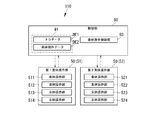
- FIG. 2 is a schematic view showing the configuration of the 3D printing control system 110.
- the 3D printing control system 110 is a system that controls the operation of the 3D printing system.
- FIG. 2 shows a configuration for mainly controlling the operation of the cord operating unit 50 (511 to 514, 521 to 524) of the 3D printing control system 110.
- the 3D printing control system 110 includes a control unit 90 and a cord operation unit 50 (511 to 514, 521 to 524).
- the control unit 90 includes a memory 91 and a cord operation control unit 93.
- the memory 91 stores data related to the operation of each cord operating unit 50.
- the 3D data DE1 and the cord operation data DE2 are stored in the memory 91.
- the 3D data DE1 stores the coordinate information of the three-dimensional model formed by the 3D printing system.
- the cord operation data DE2 stores data for controlling the operation of each cord operation unit 50 based on the 3D data DE1.
- the cord operation control unit 93 controls the operation of the cord operation unit 50 (511 to 514, 521 to 524) with reference to the 3D data DE1 and the cord operation data DE2 stored in the memory 91. In controlling the operation of the cord body operation unit 50 (511 to 514, 521 to 524), the cord body operation control unit 93 applies tension to each cord body 30 (311 to 314, 321 to 324) while applying tension to each cord. Each cord operating unit 50 (511 to 514, 521 to 524) is controlled so as to change the take-up amount and the withdrawal amount of the body 30 (311 to 314, 321 to 324) in synchronization with each other.
- the cord body operation control unit 93 may control the operation based on the cam curve corresponding to each cord body operation unit 50 (511 to 514, 521 to 524) so that the controlled object 10 can move smoothly. preferable.
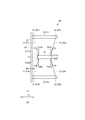
- FIG. 3 is a side view of the position control device 100 as viewed in the Y1 direction.
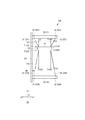
- FIG. 4 is a side view of the position control device 100 as viewed in the Z2 direction.
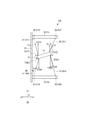
- 5 and 6 are side views showing an example of the operation of the position control device.
- the cords 30 (311 to 314, 321 to 324) Tension is acting.
- the tension acting on each cord body 30 (311 to 314, 321 to 324) is applied by the cord body operation unit 50 (511 to 514, 521 to 524). Since the cord operating unit 50 (511 to 514, 521 to 524) is located at each apex of the moving space AR, the controlled object 10 has a holding force in the X1 direction and the X2 direction, Y1 direction and Y2.
- the holding force in the direction and the holding force in the Z1 direction and the Z2 direction act.
- the tension acting on each cord 30 (311 to 314, 321 to 324) will be specifically described.
- the cord bodies 311, 314, 321 and 324 are visible.
- Tensions T11, T14, T21, and T24 act on the cords 311, 314, 321 and 324, respectively.
- the tension T11 acting on the cord 311 is decomposed into the components in the X1 direction, the X2 direction, the Z1 direction and the Z2 direction, the tension T11 can be decomposed into the X1 direction component T11X1 and the Z2 direction component T11Z2.
- the tensions T14, T21, and T24 can be decomposed into the X2 direction component T14X2 and the Z2 direction component T14Z2, the X1 direction component T21X1 and the Z1 direction component T21Z1, and the X2 direction component T24X2 and the Z1 direction component T24Z1.
- the cord bodies 321, 322, 323 and 324 are visible.
- Tensions T21, T22, T23, and T24 act on the cords 321, 322, 323, and 324, respectively.
- the tension T21 acting on the cord 321 is decomposed into the components in the X1 direction, the X2 direction, the Y1 direction and the Y2 direction
- the tension T21 can be decomposed into the X1 direction component T21X1 and the Y2 direction component T21Y2.
- the tensions T22, T23, and T24 can be decomposed into the X1 direction component T22X1 and the Y1 direction component T22Y1, the X2 direction component T23X2 and the Y1 direction component T23Y1, and the X2 direction component T24X2 and the Y2 direction component T24Y2, respectively.
- tensions T12 and T13 also act on the cords 312 and 313, and the tensions T12 and T13 are also in the X1 direction, the X2 direction, the Y1 direction, and the Z1 direction. It can be decomposed into components.
- FIGS. 5 and 6 the position and orientation of the controlled object 10 in the moving space AR are changed from the states of FIGS. 3 and 4.
- FIG. 5 shows a state in which the controlled object 10 is moved in the X1 direction from the state of FIG.
- FIG. 6 shows a state in which the posture of the controlled object 10 is changed from the state of FIG.
- the nozzle 15 of the printer head can be made perpendicular to the inclined surface.
- the controlled object 10 has a holding force in the X1 direction and the X2 direction, and a holding force in the Y1 direction and the Y2 direction. , And the holding force in the Z1 and Z2 directions acts.
- the control object 10 has a holding force in the X1 direction and the X2 direction, and a holding force in the Y1 direction and the Y2 direction due to the tension acting on each of the cords 30 (311 to 314, 321 to 324). And the holding force in the Z1 direction and the Z2 direction acts. Therefore, the position of the controlled object 10 can be stabilized, and a three-dimensional object can be modeled on the modeling table PT erected in the vertical direction. Further, while maintaining the tension acting on each cord 30 (311 to 314, 321 to 324), the take-up amount and the withdrawal amount of each cord 30 (311 to 314, 321 to 324) are changed in synchronization with each other. The position of the controlled object 10 (printer head nozzle 15) is less likely to shift (the rigidity is increased), and the position of the controlled object 10 can be precisely controlled.
- the second cord body 32 (321 to 324) is connected to the first cord body operation unit 51 (511 to 514), and the second cord body operation unit 52 (521). ⁇ 524) is different from the position control device 100 of the first embodiment in that the first cord 31 (311 to 314) is connected.
- the same components as those in the first embodiment are designated by the same reference numerals and the description thereof will be omitted, and only the configurations different from the first embodiment will be described.
- FIG. 7 is a perspective view showing the overall configuration of the position control device 100A according to the second embodiment of the present invention.
- the first cord operating unit 51 (511 to 514) is arranged at a position closer to the first end portion 11 than the second end portion 12 of the controlled object 10.
- the second cord operating unit 52 (521 to 524) is arranged at a position closer to the second end portion 12 than the first end portion 11 of the controlled object 10.
- the second cord 32 (321 to 324) is connected to the first cord operation unit 51 (511 to 514), and the first cord is connected to the second cord operation unit 52 (521 to 524). 31 (311 to 314) are connected.
- FIG. 8 is a side view of the position control device 100A as viewed in the Y1 direction.
- FIG. 9 is a side view of the position control device 100A as viewed in the Z2 direction. As shown in FIG. 8, when the position control device 100A is viewed in the Y1 direction, the first cord 31 (311 to 314) and the second cord 32 (321 to 324) appear to intersect.
- each cord 30 (311 to 314, 321 to 324) Is under tension. Similar to the first embodiment, the tension acting on the controlled object 10 can be decomposed into components in the X1 direction, the X2 direction, the Y1 direction and the Y2 direction, the Z1 direction and the Z2 direction.
- the control object 10 has a holding force in the X1 direction and the X2 direction, a holding force in the Y1 direction and the Y2 direction, and a holding force in the Z1 direction and the Z1 direction due to the tension acting on each of the cords 30 (311 to 314, 321 to 324).
- a holding force in the Z2 direction acts. Therefore, the position of the controlled object 10 can be stabilized, and a three-dimensional object can be modeled on the modeling table PT erected in the vertical direction. Further, while maintaining the tension acting on each cord 30 (311 to 314, 321 to 324), the take-up amount and the withdrawal amount of each cord 30 (311 to 314, 321 to 324) are changed in synchronization with each other.
- the position of the controlled object 10 (printer head nozzle 15) is less likely to shift (the rigidity is increased), and the position of the controlled object 10 can be precisely controlled.
- each cord 30 311 to 314, 321 to 324 and the control object 10 can be made smaller than that of the first embodiment, the control object 10 can be made smaller.
- the moving space AR can be widened, and the cords 30 (311 to 314, 321 to 324) and the controlled object 10 can be made difficult to interfere with obstacles and the like in the moving space AR.
- the cord operating portion 50 (511 to 514, 521 to 524) provided on the same support portion 70 (71 to 74) is a shaft of the support portion 70 (71 to 74). They are arranged so that they intersect with each other. Specifically, for example, the guide portions 57 of the cord operating portion 511 and the cord operating portion 511 provided on the support portion 71 intersect in the axial direction of the support portion 71 (circle of the support portion 71). They are arranged so as to be offset in the circumferential direction). Therefore, the cords 30 (311 to 314, 321 to 324) connected to the cord operating portions 50 (511 to 514, 521 to 524) provided on the same support portion 70 (71 to 74) are connected to each other. Interference can be suppressed.
- the position control device 100B of the third embodiment has three support portions 70 (71 to 73), a cord body 30 (311 to 313, 321 to 323), and a cord body operation unit 50 (511 to 513, 521 to 523). ) Is provided, which is different from the position control device 100 of the first embodiment.
- the same components as those in the first embodiment are designated by the same reference numerals and the description thereof will be omitted, and only the configurations different from the first embodiment will be described.
- FIG. 10 is a perspective view showing the overall configuration of the position control device 100B according to the third embodiment of the present invention.
- the first cord operating unit 51 (511 to 513) is arranged at a position closer to the first end portion 11 than the second end portion 12 of the controlled object 10.
- the second cord operating unit 52 (521 to 523) is arranged at a position closer to the second end portion 12 than the first end portion 11 of the controlled object 10.
- the first cord 31 (311 to 313) is connected to the first cord operation unit 51 (511 to 513), and the second cord is connected to the second cord operation unit 52 (521 to 524).
- 32 (321 to 323) are connected.
- the support portions 70 are arranged on the modeling table PT so as to be separated from each other outside the moving space AR, and extend in the Z1 direction.
- a first cord operating unit 51 (511 to 513) and a second cord operating unit 52 (521 to 523) are arranged in each of the support portions 70 (71 to 73). Therefore, the rows in which the first cord operating unit and the second cord operating unit are arranged in the Z1 direction are arranged in three rows so as to be separated from each other outside the moving space AR.
- FIG. 11 is a side view of the position control device 100B as viewed in the Y1 direction.
- FIG. 12 is a side view of the position control device 100B as viewed in the Z2 direction.
- the cords 30 (11 to 313, 321 to 323) Is under tension. Similar to the first embodiment, the tension acting on the controlled object 10 can be decomposed into components in the X1 direction, the X2 direction, the Y1 direction and the Y2 direction, the Z1 direction and the Z2 direction.
- the control object 10 has a holding force in the X1 direction and the X2 direction, a holding force in the Y1 direction and the Y2 direction, and a holding force in the Z1 direction and the Z1 direction due to the tension acting on each of the cords 30 (311 to 313, 321 to 323).
- a holding force in the Z2 direction acts. Therefore, the position of the controlled object 10 can be stabilized, and a three-dimensional object can be modeled on the modeling table PT erected in the vertical direction. Further, while maintaining the tension acting on each cord body 30 (311 to 313, 321 to 323), the take-back amount and the withdrawal amount of each cord body 30 (311 to 313, 321 to 323) are changed in synchronization with each other.
- the position of the controlled object 10 (printer head nozzle 15) is less likely to shift (the rigidity is increased), and the position of the controlled object 10 can be precisely controlled.
- the position control device 100C of the fourth embodiment is different from the position control device 100 of the first embodiment in that the cord guide unit 59 is arranged between the winding unit 55C and the guide unit 57.
- the same components as those in the first embodiment are designated by the same reference numerals and the description thereof will be omitted, and only the configurations different from the first embodiment will be described.
- FIG. 13 is a side view of the position control device 100C according to the fourth embodiment of the present invention as viewed in the Y1 direction.
- the position control device 100C includes a control object 10, a cord body 30 (311 to 314, 321 to 324), a cord body operation unit 50C (511C to 514C, 521C to 524C), a support unit 70C (71C to 74C), and the like. I have.
- the base BC on which the position control device 100C is installed is arranged in the horizontal direction.
- the modeling table PTC is arranged horizontally above the base BC.
- the cord body operation unit 50C (511C to 514C, 521C to 524C) has a winding unit 55C, a drive unit (not shown), a guide unit 57, and a cord body guide unit 59.
- the winding portion 55C and the guide portion 57 are arranged apart from each other.
- the cord guide portion 59 is arranged between the take-up portion 55C and the guide portion 57.
- the cord guide unit 59 guides the cord 30 supplied from the winding portion 55C to the guide portion 57.
- Each guide unit 57 of the cord body operation unit 50C (511C to 514C, 521C to 524C) constitutes a substantially rectangular parallelepiped moving space AR.
- the support portion 70C (71C to 74C) is a portion that supports the cord body operation portion 50C (511C to 514C, 521C to 524C).
- the support portions 70C (71C to 74C) are arranged on the base BC so as to be separated from each other outside the moving space AR, and extend in the Z1 direction.
- the support portions 70C (71C to 74C) are provided with a guide portion 57 and a cord guide portion 59.
- the plurality of winding portions 55C are arranged near the ends of the support portions 70C (71C to 74C) on the base BC side.
- a drive unit (not shown) that drives the take-up portion 55C is also arranged close to the take-up portion 55C.
- the winding portion 55C which is a heavy object among the cord body operating portions 50C (511C to 514C, 521C to 524C), is arranged near the end of the support portion 70C (71C to 74C) on the base BC side. This facilitates the installation of the position control device 100C.
- the power supply (not shown) of the drive unit, which is a heavy object, may also be arranged close to the take-up unit 55C.
- the cord guide portion 59 and the cord 30 are arranged inside the support portion 70C (71C to 74C), but the present invention is not limited to this.
- the cord guide portion 59 and the cord 30 (311 to 314, 321 to 324) may be arranged outside the support portion 70C (71C to 74C).
- the support portion 70C (71C to 74C) was arranged on the base BC, the support portion 70C (71C to 74C) was erected on the ground, and the winding portion 55C and the drive portion were arranged on the ground. May be good.
- the position control device is not limited to the present embodiment described above.
- the shape and size that can be modeled are restricted by the size of the 3D printer, and it is not possible to model a large projected area and height. It was also difficult to increase the size of the 3D printer itself.
- the configuration for supporting the print head portion is only the cord, the weight can be reduced even if the device is increased in size.
- the print head is moved by controlling the cord, even if there are obstacles around the modeling surface or there are existing modeling objects around, new modeling can be done without interfering with them. It can be carried out.
- the 3D printing system to which the position control device is applied is not limited to forming a three-dimensional model on a modeling table, and can be applied to, for example, a building.
- a building For example, it is possible to create a building itself by modeling an interior decoration such as a wall surface or furniture of an existing building with obstacles, and by replacing the discharged material with a building material such as concrete.
- the position control device is applied to the FDM type 3D printing system, but the modeling method is not limited.
- the modeling method can be applied to a 3D printing system of another modeling method such as a stereolithography method.
- the number of cords is not limited as long as the controlled object can be moved to an arbitrary position in the moving space.
- the position control device can be widely applied to the technology by not only creating a three-dimensional model but also providing a device and mechanism such as a spray nozzle for painting and a camera on the controlled object.
- Control unit 100 Position control device 10 Control object 30 Cable body 50 Cable body operation unit 70 Support unit 90 Control unit
Landscapes
- Physics & Mathematics (AREA)
- General Physics & Mathematics (AREA)
- Engineering & Computer Science (AREA)
- Automation & Control Theory (AREA)
- Chemical & Material Sciences (AREA)
- Manufacturing & Machinery (AREA)
- Materials Engineering (AREA)
- Accessories Of Cameras (AREA)
- Control Of Position Or Direction (AREA)
- Toys (AREA)
Priority Applications (1)
| Application Number | Priority Date | Filing Date | Title |
|---|---|---|---|
| JP2021513582A JP7440201B2 (ja) | 2019-04-09 | 2020-03-30 | 位置制御装置 |
Applications Claiming Priority (2)
| Application Number | Priority Date | Filing Date | Title |
|---|---|---|---|
| JP2019074074 | 2019-04-09 | ||
| JP2019-074074 | 2019-04-09 |
Publications (1)
| Publication Number | Publication Date |
|---|---|
| WO2020209128A1 true WO2020209128A1 (ja) | 2020-10-15 |
Family
ID=72751079
Family Applications (1)
| Application Number | Title | Priority Date | Filing Date |
|---|---|---|---|
| PCT/JP2020/014579 Ceased WO2020209128A1 (ja) | 2019-04-09 | 2020-03-30 | 位置制御装置 |
Country Status (2)
| Country | Link |
|---|---|
| JP (1) | JP7440201B2 (https=) |
| WO (1) | WO2020209128A1 (https=) |
Citations (4)
| Publication number | Priority date | Publication date | Assignee | Title |
|---|---|---|---|---|
| JPH08299600A (ja) * | 1995-05-02 | 1996-11-19 | Kyowa Kikai Seisakusho:Kk | 懸吊移動機 |
| JPH09500337A (ja) * | 1994-02-28 | 1997-01-14 | マックドーネル ダグラス コーポレイション | 腱吊プラットホームロボット |
| JP2009150056A (ja) * | 2007-12-18 | 2009-07-09 | Chugoku Electric Power Co Inc:The | ゴンドラ移動装置 |
| JP2014504397A (ja) * | 2010-11-24 | 2014-02-20 | サムスン ヘビー インダストリーズ カンパニー リミテッド | ワイヤを用いた自律移動装置の制御システム及びその方法 |
-
2020
- 2020-03-30 JP JP2021513582A patent/JP7440201B2/ja active Active
- 2020-03-30 WO PCT/JP2020/014579 patent/WO2020209128A1/ja not_active Ceased
Patent Citations (4)
| Publication number | Priority date | Publication date | Assignee | Title |
|---|---|---|---|---|
| JPH09500337A (ja) * | 1994-02-28 | 1997-01-14 | マックドーネル ダグラス コーポレイション | 腱吊プラットホームロボット |
| JPH08299600A (ja) * | 1995-05-02 | 1996-11-19 | Kyowa Kikai Seisakusho:Kk | 懸吊移動機 |
| JP2009150056A (ja) * | 2007-12-18 | 2009-07-09 | Chugoku Electric Power Co Inc:The | ゴンドラ移動装置 |
| JP2014504397A (ja) * | 2010-11-24 | 2014-02-20 | サムスン ヘビー インダストリーズ カンパニー リミテッド | ワイヤを用いた自律移動装置の制御システム及びその方法 |
Also Published As
| Publication number | Publication date |
|---|---|
| JP7440201B2 (ja) | 2024-02-28 |
| JPWO2020209128A1 (https=) | 2020-10-15 |
Similar Documents
| Publication | Publication Date | Title |
|---|---|---|
| US10683997B2 (en) | Illumination raising/lowering device | |
| US11220011B2 (en) | Multi-jointed welding robot | |
| CN103659839B (zh) | 机器人的线条体安装装置 | |
| US8070473B2 (en) | System for building three-dimensional objects containing embedded inserts, and method of use thereof | |
| US5585707A (en) | Tendon suspended platform robot | |
| US10513104B2 (en) | 3D printer with coupling for attaching print head to head carriage | |
| JP4653427B2 (ja) | アーク溶接ロボットのトーチケーブル処理構造 | |
| EP3159145A1 (en) | Powder supplying device, method for controlling powder supplying device, program for controlling powder supplying device, and three-dimensional shaping device | |
| JP5890653B2 (ja) | 多軸ロボット | |
| US12122098B2 (en) | Configurable printing bed for 3D printing | |
| US20160184719A1 (en) | Flexibly supported movable platform | |
| US11491723B2 (en) | Consumable assembly | |
| US20170095973A1 (en) | Cable Driven Manipulator for Additive Manufacturing | |
| US10688401B1 (en) | System and method to control entertainment figures | |
| WO2020209128A1 (ja) | 位置制御装置 | |
| WO2020235378A1 (ja) | 巻線装置並びに巻線方法及びそれを用いたコイル製造方法 | |
| CN106550598B (zh) | 定位系统 | |
| US20240140029A1 (en) | Apparatus and method for three-dimensional printing | |
| US20260102969A1 (en) | 3d printer with supported umbilical to print head | |
| KR20220027463A (ko) | 안정적인 필라멘트 공급을 위한 3d프린터용 필라멘트 공급장치 | |
| JP2008198254A (ja) | ライブラリー装置およびライブラリー装置用搬送機構 | |
| US20250214304A1 (en) | Method of concurrently 3d printing extruded parts having dissimilar slice heights | |
| US9597795B2 (en) | System for moving a mobile tendon controlled platform robot | |
| CN223236970U (zh) | 3d打印机底座及3d打印机 | |
| US20250042088A1 (en) | Micro gravity 3d printer and method |
Legal Events
| Date | Code | Title | Description |
|---|---|---|---|
| 121 | Ep: the epo has been informed by wipo that ep was designated in this application |
Ref document number: 20787490 Country of ref document: EP Kind code of ref document: A1 |
|
| ENP | Entry into the national phase |
Ref document number: 2021513582 Country of ref document: JP Kind code of ref document: A |
|
| NENP | Non-entry into the national phase |
Ref country code: DE |
|
| 122 | Ep: pct application non-entry in european phase |
Ref document number: 20787490 Country of ref document: EP Kind code of ref document: A1 |