WO2020203741A1 - 粘着シート、積層シート、画像表示装置 - Google Patents
粘着シート、積層シート、画像表示装置 Download PDFInfo
- Publication number
- WO2020203741A1 WO2020203741A1 PCT/JP2020/013955 JP2020013955W WO2020203741A1 WO 2020203741 A1 WO2020203741 A1 WO 2020203741A1 JP 2020013955 W JP2020013955 W JP 2020013955W WO 2020203741 A1 WO2020203741 A1 WO 2020203741A1
- Authority
- WO
- WIPO (PCT)
- Prior art keywords
- acrylate
- adhesive sheet
- meth
- sheet
- kpa
- Prior art date
- Legal status (The legal status is an assumption and is not a legal conclusion. Google has not performed a legal analysis and makes no representation as to the accuracy of the status listed.)
- Ceased
Links
Classifications
-
- C—CHEMISTRY; METALLURGY
- C09—DYES; PAINTS; POLISHES; NATURAL RESINS; ADHESIVES; COMPOSITIONS NOT OTHERWISE PROVIDED FOR; APPLICATIONS OF MATERIALS NOT OTHERWISE PROVIDED FOR
- C09J—ADHESIVES; NON-MECHANICAL ASPECTS OF ADHESIVE PROCESSES IN GENERAL; ADHESIVE PROCESSES NOT PROVIDED FOR ELSEWHERE; USE OF MATERIALS AS ADHESIVES
- C09J133/00—Adhesives based on homopolymers or copolymers of compounds having one or more unsaturated aliphatic radicals, each having only one carbon-to-carbon double bond, and at least one being terminated by only one carboxyl radical, or of salts, anhydrides, esters, amides, imides, or nitriles thereof; Adhesives based on derivatives of such polymers
- C09J133/04—Homopolymers or copolymers of esters
- C09J133/06—Homopolymers or copolymers of esters of esters containing only carbon, hydrogen and oxygen, the oxygen atom being present only as part of the carboxyl radical
- C09J133/10—Homopolymers or copolymers of methacrylic acid esters
- C09J133/12—Homopolymers or copolymers of methyl methacrylate
-
- C—CHEMISTRY; METALLURGY
- C09—DYES; PAINTS; POLISHES; NATURAL RESINS; ADHESIVES; COMPOSITIONS NOT OTHERWISE PROVIDED FOR; APPLICATIONS OF MATERIALS NOT OTHERWISE PROVIDED FOR
- C09J—ADHESIVES; NON-MECHANICAL ASPECTS OF ADHESIVE PROCESSES IN GENERAL; ADHESIVE PROCESSES NOT PROVIDED FOR ELSEWHERE; USE OF MATERIALS AS ADHESIVES
- C09J133/00—Adhesives based on homopolymers or copolymers of compounds having one or more unsaturated aliphatic radicals, each having only one carbon-to-carbon double bond, and at least one being terminated by only one carboxyl radical, or of salts, anhydrides, esters, amides, imides, or nitriles thereof; Adhesives based on derivatives of such polymers
-
- C—CHEMISTRY; METALLURGY
- C09—DYES; PAINTS; POLISHES; NATURAL RESINS; ADHESIVES; COMPOSITIONS NOT OTHERWISE PROVIDED FOR; APPLICATIONS OF MATERIALS NOT OTHERWISE PROVIDED FOR
- C09J—ADHESIVES; NON-MECHANICAL ASPECTS OF ADHESIVE PROCESSES IN GENERAL; ADHESIVE PROCESSES NOT PROVIDED FOR ELSEWHERE; USE OF MATERIALS AS ADHESIVES
- C09J175/00—Adhesives based on polyureas or polyurethanes; Adhesives based on derivatives of such polymers
- C09J175/04—Polyurethanes
- C09J175/14—Polyurethanes having carbon-to-carbon unsaturated bonds
- C09J175/16—Polyurethanes having carbon-to-carbon unsaturated bonds having terminal carbon-to-carbon unsaturated bonds
-
- B—PERFORMING OPERATIONS; TRANSPORTING
- B32—LAYERED PRODUCTS
- B32B—LAYERED PRODUCTS, i.e. PRODUCTS BUILT-UP OF STRATA OF FLAT OR NON-FLAT, e.g. CELLULAR OR HONEYCOMB, FORM
- B32B23/00—Layered products comprising a layer of cellulosic plastic substances, i.e. substances obtained by chemical modification of cellulose, e.g. cellulose ethers, cellulose esters, viscose
- B32B23/04—Layered products comprising a layer of cellulosic plastic substances, i.e. substances obtained by chemical modification of cellulose, e.g. cellulose ethers, cellulose esters, viscose comprising such cellulosic plastic substance as the main or only constituent of a layer, which is next to another layer of the same or of a different material
- B32B23/08—Layered products comprising a layer of cellulosic plastic substances, i.e. substances obtained by chemical modification of cellulose, e.g. cellulose ethers, cellulose esters, viscose comprising such cellulosic plastic substance as the main or only constituent of a layer, which is next to another layer of the same or of a different material of synthetic resin
-
- B—PERFORMING OPERATIONS; TRANSPORTING
- B32—LAYERED PRODUCTS
- B32B—LAYERED PRODUCTS, i.e. PRODUCTS BUILT-UP OF STRATA OF FLAT OR NON-FLAT, e.g. CELLULAR OR HONEYCOMB, FORM
- B32B23/00—Layered products comprising a layer of cellulosic plastic substances, i.e. substances obtained by chemical modification of cellulose, e.g. cellulose ethers, cellulose esters, viscose
- B32B23/20—Layered products comprising a layer of cellulosic plastic substances, i.e. substances obtained by chemical modification of cellulose, e.g. cellulose ethers, cellulose esters, viscose comprising esters
-
- B—PERFORMING OPERATIONS; TRANSPORTING
- B32—LAYERED PRODUCTS
- B32B—LAYERED PRODUCTS, i.e. PRODUCTS BUILT-UP OF STRATA OF FLAT OR NON-FLAT, e.g. CELLULAR OR HONEYCOMB, FORM
- B32B27/00—Layered products comprising a layer of synthetic resin
-
- B—PERFORMING OPERATIONS; TRANSPORTING
- B32—LAYERED PRODUCTS
- B32B—LAYERED PRODUCTS, i.e. PRODUCTS BUILT-UP OF STRATA OF FLAT OR NON-FLAT, e.g. CELLULAR OR HONEYCOMB, FORM
- B32B27/00—Layered products comprising a layer of synthetic resin
- B32B27/06—Layered products comprising a layer of synthetic resin as the main or only constituent of a layer, which is next to another layer of the same or of a different material
- B32B27/08—Layered products comprising a layer of synthetic resin as the main or only constituent of a layer, which is next to another layer of the same or of a different material of synthetic resin
-
- B—PERFORMING OPERATIONS; TRANSPORTING
- B32—LAYERED PRODUCTS
- B32B—LAYERED PRODUCTS, i.e. PRODUCTS BUILT-UP OF STRATA OF FLAT OR NON-FLAT, e.g. CELLULAR OR HONEYCOMB, FORM
- B32B27/00—Layered products comprising a layer of synthetic resin
- B32B27/28—Layered products comprising a layer of synthetic resin comprising synthetic resins not wholly covered by any one of the sub-groups B32B27/30 - B32B27/42
- B32B27/281—Layered products comprising a layer of synthetic resin comprising synthetic resins not wholly covered by any one of the sub-groups B32B27/30 - B32B27/42 comprising polyimides
-
- B—PERFORMING OPERATIONS; TRANSPORTING
- B32—LAYERED PRODUCTS
- B32B—LAYERED PRODUCTS, i.e. PRODUCTS BUILT-UP OF STRATA OF FLAT OR NON-FLAT, e.g. CELLULAR OR HONEYCOMB, FORM
- B32B27/00—Layered products comprising a layer of synthetic resin
- B32B27/30—Layered products comprising a layer of synthetic resin comprising vinyl (co)polymers; comprising acrylic (co)polymers
- B32B27/308—Layered products comprising a layer of synthetic resin comprising vinyl (co)polymers; comprising acrylic (co)polymers comprising acrylic (co)polymers
-
- B—PERFORMING OPERATIONS; TRANSPORTING
- B32—LAYERED PRODUCTS
- B32B—LAYERED PRODUCTS, i.e. PRODUCTS BUILT-UP OF STRATA OF FLAT OR NON-FLAT, e.g. CELLULAR OR HONEYCOMB, FORM
- B32B27/00—Layered products comprising a layer of synthetic resin
- B32B27/32—Layered products comprising a layer of synthetic resin comprising polyolefins
- B32B27/325—Layered products comprising a layer of synthetic resin comprising polyolefins comprising polycycloolefins
-
- B—PERFORMING OPERATIONS; TRANSPORTING
- B32—LAYERED PRODUCTS
- B32B—LAYERED PRODUCTS, i.e. PRODUCTS BUILT-UP OF STRATA OF FLAT OR NON-FLAT, e.g. CELLULAR OR HONEYCOMB, FORM
- B32B27/00—Layered products comprising a layer of synthetic resin
- B32B27/36—Layered products comprising a layer of synthetic resin comprising polyesters
- B32B27/365—Layered products comprising a layer of synthetic resin comprising polyesters comprising polycarbonates
-
- B—PERFORMING OPERATIONS; TRANSPORTING
- B32—LAYERED PRODUCTS
- B32B—LAYERED PRODUCTS, i.e. PRODUCTS BUILT-UP OF STRATA OF FLAT OR NON-FLAT, e.g. CELLULAR OR HONEYCOMB, FORM
- B32B7/00—Layered products characterised by the relation between layers; Layered products characterised by the relative orientation of features between layers, or by the relative values of a measurable parameter between layers, i.e. products comprising layers having different physical, chemical or physicochemical properties; Layered products characterised by the interconnection of layers
- B32B7/02—Physical, chemical or physicochemical properties
- B32B7/022—Mechanical properties
-
- B—PERFORMING OPERATIONS; TRANSPORTING
- B32—LAYERED PRODUCTS
- B32B—LAYERED PRODUCTS, i.e. PRODUCTS BUILT-UP OF STRATA OF FLAT OR NON-FLAT, e.g. CELLULAR OR HONEYCOMB, FORM
- B32B7/00—Layered products characterised by the relation between layers; Layered products characterised by the relative orientation of features between layers, or by the relative values of a measurable parameter between layers, i.e. products comprising layers having different physical, chemical or physicochemical properties; Layered products characterised by the interconnection of layers
- B32B7/04—Interconnection of layers
- B32B7/12—Interconnection of layers using interposed adhesives or interposed materials with bonding properties
-
- C—CHEMISTRY; METALLURGY
- C08—ORGANIC MACROMOLECULAR COMPOUNDS; THEIR PREPARATION OR CHEMICAL WORKING-UP; COMPOSITIONS BASED THEREON
- C08F—MACROMOLECULAR COMPOUNDS OBTAINED BY REACTIONS ONLY INVOLVING CARBON-TO-CARBON UNSATURATED BONDS
- C08F290/00—Macromolecular compounds obtained by polymerising monomers on to polymers modified by introduction of aliphatic unsaturated end or side groups
- C08F290/02—Macromolecular compounds obtained by polymerising monomers on to polymers modified by introduction of aliphatic unsaturated end or side groups on to polymers modified by introduction of unsaturated end groups
- C08F290/06—Polymers provided for in subclass C08G
- C08F290/067—Polyurethanes; Polyureas
-
- C—CHEMISTRY; METALLURGY
- C08—ORGANIC MACROMOLECULAR COMPOUNDS; THEIR PREPARATION OR CHEMICAL WORKING-UP; COMPOSITIONS BASED THEREON
- C08G—MACROMOLECULAR COMPOUNDS OBTAINED OTHERWISE THAN BY REACTIONS ONLY INVOLVING UNSATURATED CARBON-TO-CARBON BONDS
- C08G18/00—Polymeric products of isocyanates or isothiocyanates
- C08G18/06—Polymeric products of isocyanates or isothiocyanates with compounds having active hydrogen
- C08G18/28—Polymeric products of isocyanates or isothiocyanates with compounds having active hydrogen characterised by the compounds used containing active hydrogen
- C08G18/40—High-molecular-weight compounds
- C08G18/62—Polymers of compounds having carbon-to-carbon double bonds
- C08G18/6204—Polymers of olefins
- C08G18/6208—Hydrogenated polymers of conjugated dienes
-
- C—CHEMISTRY; METALLURGY
- C09—DYES; PAINTS; POLISHES; NATURAL RESINS; ADHESIVES; COMPOSITIONS NOT OTHERWISE PROVIDED FOR; APPLICATIONS OF MATERIALS NOT OTHERWISE PROVIDED FOR
- C09J—ADHESIVES; NON-MECHANICAL ASPECTS OF ADHESIVE PROCESSES IN GENERAL; ADHESIVE PROCESSES NOT PROVIDED FOR ELSEWHERE; USE OF MATERIALS AS ADHESIVES
- C09J133/00—Adhesives based on homopolymers or copolymers of compounds having one or more unsaturated aliphatic radicals, each having only one carbon-to-carbon double bond, and at least one being terminated by only one carboxyl radical, or of salts, anhydrides, esters, amides, imides, or nitriles thereof; Adhesives based on derivatives of such polymers
- C09J133/04—Homopolymers or copolymers of esters
-
- C—CHEMISTRY; METALLURGY
- C09—DYES; PAINTS; POLISHES; NATURAL RESINS; ADHESIVES; COMPOSITIONS NOT OTHERWISE PROVIDED FOR; APPLICATIONS OF MATERIALS NOT OTHERWISE PROVIDED FOR
- C09J—ADHESIVES; NON-MECHANICAL ASPECTS OF ADHESIVE PROCESSES IN GENERAL; ADHESIVE PROCESSES NOT PROVIDED FOR ELSEWHERE; USE OF MATERIALS AS ADHESIVES
- C09J151/00—Adhesives based on graft polymers in which the grafted component is obtained by reactions only involving carbon-to-carbon unsaturated bonds; Adhesives based on derivatives of such polymers
- C09J151/08—Adhesives based on graft polymers in which the grafted component is obtained by reactions only involving carbon-to-carbon unsaturated bonds; Adhesives based on derivatives of such polymers grafted on to macromolecular compounds obtained otherwise than by reactions only involving carbon-to-carbon unsaturated bonds
-
- C—CHEMISTRY; METALLURGY
- C09—DYES; PAINTS; POLISHES; NATURAL RESINS; ADHESIVES; COMPOSITIONS NOT OTHERWISE PROVIDED FOR; APPLICATIONS OF MATERIALS NOT OTHERWISE PROVIDED FOR
- C09J—ADHESIVES; NON-MECHANICAL ASPECTS OF ADHESIVE PROCESSES IN GENERAL; ADHESIVE PROCESSES NOT PROVIDED FOR ELSEWHERE; USE OF MATERIALS AS ADHESIVES
- C09J175/00—Adhesives based on polyureas or polyurethanes; Adhesives based on derivatives of such polymers
- C09J175/04—Polyurethanes
- C09J175/14—Polyurethanes having carbon-to-carbon unsaturated bonds
-
- C—CHEMISTRY; METALLURGY
- C09—DYES; PAINTS; POLISHES; NATURAL RESINS; ADHESIVES; COMPOSITIONS NOT OTHERWISE PROVIDED FOR; APPLICATIONS OF MATERIALS NOT OTHERWISE PROVIDED FOR
- C09J—ADHESIVES; NON-MECHANICAL ASPECTS OF ADHESIVE PROCESSES IN GENERAL; ADHESIVE PROCESSES NOT PROVIDED FOR ELSEWHERE; USE OF MATERIALS AS ADHESIVES
- C09J4/00—Adhesives based on organic non-macromolecular compounds having at least one polymerisable carbon-to-carbon unsaturated bond ; adhesives, based on monomers of macromolecular compounds of groups C09J183/00 - C09J183/16
- C09J4/06—Organic non-macromolecular compounds having at least one polymerisable carbon-to-carbon unsaturated bond in combination with a macromolecular compound other than an unsaturated polymer of groups C09J159/00 - C09J187/00
-
- C—CHEMISTRY; METALLURGY
- C09—DYES; PAINTS; POLISHES; NATURAL RESINS; ADHESIVES; COMPOSITIONS NOT OTHERWISE PROVIDED FOR; APPLICATIONS OF MATERIALS NOT OTHERWISE PROVIDED FOR
- C09J—ADHESIVES; NON-MECHANICAL ASPECTS OF ADHESIVE PROCESSES IN GENERAL; ADHESIVE PROCESSES NOT PROVIDED FOR ELSEWHERE; USE OF MATERIALS AS ADHESIVES
- C09J7/00—Adhesives in the form of films or foils
- C09J7/10—Adhesives in the form of films or foils without carriers
-
- C—CHEMISTRY; METALLURGY
- C09—DYES; PAINTS; POLISHES; NATURAL RESINS; ADHESIVES; COMPOSITIONS NOT OTHERWISE PROVIDED FOR; APPLICATIONS OF MATERIALS NOT OTHERWISE PROVIDED FOR
- C09J—ADHESIVES; NON-MECHANICAL ASPECTS OF ADHESIVE PROCESSES IN GENERAL; ADHESIVE PROCESSES NOT PROVIDED FOR ELSEWHERE; USE OF MATERIALS AS ADHESIVES
- C09J7/00—Adhesives in the form of films or foils
- C09J7/30—Adhesives in the form of films or foils characterised by the adhesive composition
- C09J7/38—Pressure-sensitive adhesives [PSA]
-
- G—PHYSICS
- G06—COMPUTING OR CALCULATING; COUNTING
- G06F—ELECTRIC DIGITAL DATA PROCESSING
- G06F3/00—Input arrangements for transferring data to be processed into a form capable of being handled by the computer; Output arrangements for transferring data from processing unit to output unit, e.g. interface arrangements
- G06F3/01—Input arrangements or combined input and output arrangements for interaction between user and computer
- G06F3/03—Arrangements for converting the position or the displacement of a member into a coded form
- G06F3/041—Digitisers, e.g. for touch screens or touch pads, characterised by the transducing means
-
- B—PERFORMING OPERATIONS; TRANSPORTING
- B32—LAYERED PRODUCTS
- B32B—LAYERED PRODUCTS, i.e. PRODUCTS BUILT-UP OF STRATA OF FLAT OR NON-FLAT, e.g. CELLULAR OR HONEYCOMB, FORM
- B32B2307/00—Properties of the layers or laminate
- B32B2307/50—Properties of the layers or laminate having particular mechanical properties
- B32B2307/51—Elastic
-
- B—PERFORMING OPERATIONS; TRANSPORTING
- B32—LAYERED PRODUCTS
- B32B—LAYERED PRODUCTS, i.e. PRODUCTS BUILT-UP OF STRATA OF FLAT OR NON-FLAT, e.g. CELLULAR OR HONEYCOMB, FORM
- B32B2307/00—Properties of the layers or laminate
- B32B2307/50—Properties of the layers or laminate having particular mechanical properties
- B32B2307/54—Yield strength; Tensile strength
-
- B—PERFORMING OPERATIONS; TRANSPORTING
- B32—LAYERED PRODUCTS
- B32B—LAYERED PRODUCTS, i.e. PRODUCTS BUILT-UP OF STRATA OF FLAT OR NON-FLAT, e.g. CELLULAR OR HONEYCOMB, FORM
- B32B2307/00—Properties of the layers or laminate
- B32B2307/50—Properties of the layers or laminate having particular mechanical properties
- B32B2307/542—Shear strength
-
- B—PERFORMING OPERATIONS; TRANSPORTING
- B32—LAYERED PRODUCTS
- B32B—LAYERED PRODUCTS, i.e. PRODUCTS BUILT-UP OF STRATA OF FLAT OR NON-FLAT, e.g. CELLULAR OR HONEYCOMB, FORM
- B32B2307/00—Properties of the layers or laminate
- B32B2307/50—Properties of the layers or laminate having particular mechanical properties
- B32B2307/546—Flexural strength; Flexion stiffness
-
- B—PERFORMING OPERATIONS; TRANSPORTING
- B32—LAYERED PRODUCTS
- B32B—LAYERED PRODUCTS, i.e. PRODUCTS BUILT-UP OF STRATA OF FLAT OR NON-FLAT, e.g. CELLULAR OR HONEYCOMB, FORM
- B32B2457/00—Electrical equipment
- B32B2457/20—Displays, e.g. liquid crystal displays, plasma displays
- B32B2457/208—Touch screens
-
- C—CHEMISTRY; METALLURGY
- C09—DYES; PAINTS; POLISHES; NATURAL RESINS; ADHESIVES; COMPOSITIONS NOT OTHERWISE PROVIDED FOR; APPLICATIONS OF MATERIALS NOT OTHERWISE PROVIDED FOR
- C09J—ADHESIVES; NON-MECHANICAL ASPECTS OF ADHESIVE PROCESSES IN GENERAL; ADHESIVE PROCESSES NOT PROVIDED FOR ELSEWHERE; USE OF MATERIALS AS ADHESIVES
- C09J2203/00—Applications of adhesives in processes or use of adhesives in the form of films or foils
- C09J2203/318—Applications of adhesives in processes or use of adhesives in the form of films or foils for the production of liquid crystal displays
-
- C—CHEMISTRY; METALLURGY
- C09—DYES; PAINTS; POLISHES; NATURAL RESINS; ADHESIVES; COMPOSITIONS NOT OTHERWISE PROVIDED FOR; APPLICATIONS OF MATERIALS NOT OTHERWISE PROVIDED FOR
- C09J—ADHESIVES; NON-MECHANICAL ASPECTS OF ADHESIVE PROCESSES IN GENERAL; ADHESIVE PROCESSES NOT PROVIDED FOR ELSEWHERE; USE OF MATERIALS AS ADHESIVES
- C09J2301/00—Additional features of adhesives in the form of films or foils
- C09J2301/30—Additional features of adhesives in the form of films or foils characterized by the chemical, physicochemical or physical properties of the adhesive or the carrier
- C09J2301/312—Additional features of adhesives in the form of films or foils characterized by the chemical, physicochemical or physical properties of the adhesive or the carrier parameters being the characterizing feature
-
- C—CHEMISTRY; METALLURGY
- C09—DYES; PAINTS; POLISHES; NATURAL RESINS; ADHESIVES; COMPOSITIONS NOT OTHERWISE PROVIDED FOR; APPLICATIONS OF MATERIALS NOT OTHERWISE PROVIDED FOR
- C09J—ADHESIVES; NON-MECHANICAL ASPECTS OF ADHESIVE PROCESSES IN GENERAL; ADHESIVE PROCESSES NOT PROVIDED FOR ELSEWHERE; USE OF MATERIALS AS ADHESIVES
- C09J2433/00—Presence of (meth)acrylic polymer
Definitions
- the present invention relates to an adhesive sheet, a laminated sheet, and an image display device.
- Such a display device has a laminated structure in which a cover lens, a circularly polarizing plate, a touch film sensor, a light emitting element, and the like (these members are also referred to as "member sheets”) are laminated with a transparent adhesive sheet. , It can be composed of a plurality of laminated sheets formed by laminating a member sheet and an adhesive sheet.
- the optical device member includes a first adhesive film, a touch function member, and a second adhesive film, and the first adhesive film or the first adhesive film or
- the members are disclosed and a suitable viscoelastic range is shown.
- the pressure-sensitive adhesive sheet disclosed in Patent Document 1 for example, the pressure-sensitive adhesive sheet shown in the examples thereof, has a large amount of distortion depending on the radius of curvature at the time of folding, and the layers are peeled off after bonding. Problems such as a phenomenon (delamination, referred to as "radius") may occur. Further, in recent years, the thickness of the image display device and its constituent members has become thinner and thinner, and there has been a problem that the adherend to which the adhesive sheet is attached is cracked due to the interlayer stress due to folding.
- the adhesive sheet and the laminated sheet do not cause cracking or delamination even when the laminated sheet is folded in an environment of low temperature and high temperature. It is intended to provide a sheet. Furthermore, it is intended to provide an adhesive sheet and a laminated sheet which are not temperature dependent and have excellent resilience when the laminated sheet is bent and held under high temperature conditions.
- the present invention proposes an adhesive sheet that satisfies the following requirements (1) to (3).
- the stored shear modulus (G'(80 ° C.)) at 80 ° C. obtained by dynamic viscoelasticity measurement in the shear mode with a frequency of 1 Hz is 1.0 kPa or more and 100 kPa or less.
- the storage shear modulus (G'(-20 ° C)) at -20 ° C obtained by the target viscoelasticity measurement is 1.0 kPa or more and 140 kPa or less
- the storage shear modulus by dynamic viscoelasticity measurement in the shear mode with a frequency of 1 Hz is 1.0 kPa or more and 140 kPa or less.
- the present invention also proposes a laminated sheet having a structure in which the pressure-sensitive adhesive sheet and a member sheet are laminated.
- the member sheet is preferably a member sheet (also referred to as "first member sheet") having a tensile strength of 10 MPa to 900 MPa at 25 ° C. measured in accordance with ASTM D882.
- the adhesive sheet proposed by the present invention can reduce the stress applied to the member sheet when it is attached to the member sheet to form a laminated sheet, and even if it is folded in an environment of low temperature and high temperature. It is possible to prevent delamination and cracking of the laminated sheet. Further, this laminated sheet has excellent resilience when bent and held under high temperature conditions. Therefore, the adhesive sheet proposed by the present invention and the laminated sheet using the adhesive sheet can be suitably used as a constituent member of a foldable image display device or the like.
- the pressure-sensitive adhesive sheet according to an example of the embodiment of the present invention (hereinafter, may be referred to as “the present pressure-sensitive adhesive sheet”) is a pressure-sensitive adhesive sheet that satisfies the following requirements (1) to (3).
- the storage shear modulus (G'(80 ° C.)) at 80 ° C. obtained by dynamic viscoelasticity measurement in a shear mode with a frequency of 1 Hz is 1 kPa or more and 100 kPa or less.
- Dynamic viscoelasticity in a shear mode with a frequency of 1 Hz The storage shear elastic modulus (G'(-20 ° C)) at -20 ° C obtained by elastic measurement was 1 kPa or more and 140 kPa or less.
- the laminated sheet according to an example of the embodiment of the present invention (hereinafter, may be referred to as “the present laminated sheet”) is a member sheet (referred to as “the first member sheet") satisfying the following (4).
- the first member sheet a member sheet satisfying the following (4).
- This is a laminated sheet having a structure in which the present adhesive sheets are laminated.
- the tensile strength at 25 ° C. measured in accordance with ASTM D882 is 10 MPa to 900 MPa.
- the adhesive sheet preferably has a storage shear elastic modulus (G'(80 ° C.)) of 1 kPa or more and 100 kPa or less obtained by dynamic viscoelasticity measurement in a shear mode having a frequency of 1 Hz.
- G'(80 ° C.) storage shear elastic modulus
- the storage shear elastic modulus (G'(80 ° C.)) of the present adhesive sheet at 80 ° C. is preferably 1 kPa or more and 100 kPa or less, more preferably 2 kPa or more or 90 kPa or less, and 3 kPa or more or 80 kPa or less. Is even more preferable.
- the storage shear modulus (G'(80 ° C.)) in the above range, for example, when the present adhesive sheet is attached to a member sheet to form a laminated sheet, when the laminated sheet is bent at room temperature to high temperature, the laminated sheet is formed. Interlayer stress can be reduced, and delamination and cracking of member sheets can be suppressed.
- the loss tangent (tan ⁇ (80 ° C.)) at 80 ° C. in the shear measurement at a frequency of 1 Hz of this adhesive sheet is preferably 0.60 or less. It is more preferably 0.50 or less, and further preferably 0.40 or less.
- the loss tangent (tan ⁇ (80 ° C.)) in the above range the flow of the adhesive sheet can be suppressed. For example, when the adhesive sheet is attached to a member sheet to form a laminated sheet, the laminated sheet is formed. Restorability when opened from the bent state can be improved.
- the molecular weight between the cross-linking points may be increased and the gel component may be increased.
- the number of polyfunctional monomers may be reduced or a high-molecular-weight cross-linking agent may be used.
- the method is not limited to these methods.
- the loss tangent in order to reduce the loss tangent (tan ⁇ (80 ° C.)
- the uncrosslinked and unreacted components in the present adhesive sheet may be reduced.
- the method is not limited to these methods.
- the storage shear elastic modulus (G'(-20 ° C.)) of ⁇ 20 ° C. obtained by dynamic viscoelasticity measurement in a shear mode with a frequency of 1 Hz of the present adhesive sheet is preferably 1 kPa or more and 140 kPa or less. Above all, 1 kPa or more or 139 kPa or less is more preferable.
- the adhesive sheet generally has a glass transition temperature (Tg) between low temperature and normal temperature
- the storage shear modulus (G'(-20 ° C)) is larger than the storage shear modulus (G'(80 ° C)).
- Tg glass transition temperature
- the storage shear modulus G'(-20 ° C.)) is 140 kPa or less, cracking of the member sheet can be prevented even if the bending operation is performed at a low temperature.
- the member sheet to which the adhesive sheet is attached and used as the member sheet used in the image display device includes, for example, polyimide, polyester, and TAC as the member sheet used in the image display device.
- a sheet made of cyclic olefin or the like As all, the tensile strength of the cyclic olefin polymer at 25 ° C. is as low as 40 MPa to 60 MPa at 100 ⁇ m, and in the case of a laminated sheet using a member sheet having such a low tensile strength, cracks are likely to occur during bending, and within the scope of the prior art. It was difficult to eliminate the cracks.
- the adhesive sheet has a small average gradient of storage elastic modulus at ⁇ 20 ° C. to 80 ° C. and the loss tangent (tan ⁇ (80 ° C.)) satisfies 0.60 or less, when the laminated sheet is exposed to high temperature and humidity. In addition, foaming can be suppressed.
- Maximum point of loss tangent (tan ⁇ ) and glass transition temperature (Tg) The maximum point of loss tangent obtained by dynamic viscoelasticity measurement in a shear mode with a frequency of 1 Hz of the present adhesive sheet is preferably ⁇ 25 ° C. or lower.
- the maximum point of the loss tangent (tan ⁇ ) can be interpreted as the glass transition temperature (Tg), and when the glass transition temperature (Tg) is in the above range, the storage shear elastic modulus (G'(G'( -20 ° C)) can be easily adjusted to 140 kPa or less.
- the “glass transition temperature” refers to the temperature at which the peak of the main dispersion of the loss tangent (tan ⁇ ) appears. Therefore, when only one maximum point of loss tangent (tan ⁇ ) obtained by dynamic viscoelasticity measurement is observed in the shear mode with a frequency of 1 Hz, in other words, when the tan ⁇ curve has a single peak shape, the glass transition temperature ( Tg) can be considered to be single.
- the "maximum point" of the loss tangent (tan ⁇ ) is the maximum value in the tan ⁇ curve, that is, the inflection point that changes from positive (+) to negative (-) when differentiated, in a predetermined range or the entire range. It means a point with a value of.
- the relative permittivity of the pressure-sensitive adhesive sheet is preferably 5.0 or less.
- the adhesive sheet preferably has a relative permittivity of 5.0 or less, particularly 2.0 or more or 4.5 or less, and particularly preferably 2.5 or more or 4.0 or less. ..
- the relative permittivity can be adjusted within the above range by mixing a polyolefin-based pressure-sensitive adhesive, a silicone-based pressure-sensitive adhesive, or the like.
- the relative permittivity can be reduced by selecting (meth) acrylate having an alkyl group having 9 to 22 carbon atoms as the monomer component as the acrylic polymer constituting the pressure-sensitive adhesive sheet.
- the method is not limited to this method.
- the total light transmittance of the pressure-sensitive adhesive sheet is preferably 85% or more, more preferably 88% or more, and even more preferably 90% or more. Further, the haze of the present adhesive sheet is preferably 1.0% or less, more preferably 0.8% or less, and particularly preferably 0.5% or less. When the haze of this adhesive sheet is 1.0% or less, it can be used for an image display device. In order to keep the haze of the pressure-sensitive adhesive sheet within the above range, it is preferable that the pressure-sensitive adhesive sheet does not contain particles such as organic particles.
- the thickness of the adhesive sheet is not particularly limited, and if the thickness is 5 ⁇ m or more, the handleability is good, and if the thickness is 1000 ⁇ m or less, it contributes to the thinning of the laminated body. Can be done. Therefore, the thickness of the pressure-sensitive adhesive sheet is preferably 5 ⁇ m or more, and more preferably 8 ⁇ m or more, particularly 10 ⁇ m or more. On the other hand, the upper limit is preferably 1000 ⁇ m or less, and more preferably 500 ⁇ m or less, particularly 250 ⁇ m or less.
- This pressure-sensitive adhesive sheet contains a monofunctional (meth) acrylate (a1) and an acrylic polymer having a polyfunctional (meth) acrylate (a2) as a monomer component.
- a1 monofunctional (meth) acrylate
- a2 acrylic polymer having a polyfunctional (meth) acrylate
- the other components are not particularly limited, and other monomer components and polymer components may be contained.
- the acrylic polymer will be described in detail.
- the monofunctional acrylate which is a constituent monomer of the acrylic polymer include carboxyl group-containing acrylate, hydroxyl group-containing acrylate, epoxy group-containing acrylate, amino group-containing acrylate, and amide group-containing acrylate, in addition to alkyl (meth) acrylate. Can be done.
- the monofunctional acrylate is preferably an alkyl (meth) acrylate from the viewpoint of adjusting the glass transition temperature of the acrylic polymer.
- alkyl (meth) acrylate either a linear or branched alkyl (meth) acrylate can be adopted.
- alkyl (meth) acrylate either a linear or branched alkyl (meth) acrylate can be adopted. Examples include n-butyl (meth) acrylate, isobutyl (meth) acrylate, sec-butyl (meth) acrylate, t-butyl (meth) acrylate, pentyl (meth) acrylate, isopentyl (meth) acrylate, neopentyl (meth).
- the monofunctional (meth) acrylate (a1) is an alkyl (meth) acrylate having an alkyl group having 9 to 22 carbon atoms from the viewpoint of adjusting the glass transition temperature of the acrylic polymer. It is preferably present, and more preferably an alkyl (meth) acrylate having an alkyl group having 9 to 18 carbon atoms.
- Alkyl (meth) acrylates have different glass transition temperatures of homopolymers depending on the number of carbon atoms of the alkyl group, the presence or absence of branching, and the structure of branching, and the above average gradient is -0.4 to 0.0 kPa /.
- Alkyl (meth) acrylates having an alkyl group having a branched structure are particularly preferable because they have no crystallinity and have a low glass transition temperature even when the number of carbon atoms is large.
- the acrylic polymer preferably contains the monofunctional (meth) acrylate (a1) as a constituent monomer in an amount of 70 to 95% by mass, more preferably 75 to 90% by mass. Within the above range, it becomes easy to suppress delamination and cracking of the member sheet at low to high temperatures in this laminated body.
- Multifunctional (meth) acrylate (a2) As a constituent monomer of the acrylic polymer, it is preferable to contain a polyfunctional (meth) acrylate in addition to the above monofunctional (meth) acrylate (a1). By containing the polyfunctional (meth) acrylate as a monomer component, the present adhesive sheet forms a crosslinked network, the storage shear elastic modulus can be maintained even at a high temperature, and the adhesive property can be exhibited.
- the polyfunctional (meth) acrylate (a2) is not limited as long as it is an acrylate having a plurality of (meth) acrylate groups, but the storage shear elastic modulus (G'(80 ° C.)) of the present adhesive sheet is adjusted to 100 kPa or less. From the viewpoint of facilitation, polyfunctional urethane (meth) acrylate is preferable. In order to adjust the average gradient to ⁇ 0.4 to 0.0 kPa / ° C., it is necessary to form a crosslinked network so that the storage shear modulus (G') on the high temperature side does not decrease.
- the polyfunctional (meth) acrylate (a2) has 2 to 3 (meth) acrylate groups from the viewpoint of reducing the storage shear modulus (G'(80 ° C.)) to 100 kPa or less without increasing the crosslink density too much.
- G'(80 ° C.) storage shear modulus
- a 2-3 functional urethane (meth) acrylate is more preferred, and a bifunctional urethane (meth) acrylate is particularly preferred.
- the type of polyfunctional urethane (meth) acrylate is not particularly limited, but preferably a polyol compound having two or more hydroxyl groups in the molecule, a compound having two or more isocyanate groups in the molecule, and at least in the molecule. It is preferably a polyfunctional urethane (meth) acrylate composed of a reaction product with a (meth) acrylate containing one or more hydroxyl groups.
- the weight average molecular weight of the polyfunctional urethane (meth) acrylate is preferably 20,000 to 100,000, more preferably 25,000 to 90,000, and particularly preferably 30,000 to 80. It is 000.
- the weight average molecular weight refers to the polystyrene-equivalent weight average molecular weight measured by gel permeation chromatography.
- polyol compounds having two or more hydroxyl groups in the molecule include polyether polyols, polyester polyols, caprolactone diols, bisphenol polyols, polyisoprene polyols, hydrogenated polyisoprene polyols, polybutadiene polyols, hydrogenated polybutadiene polyols, and castor oil polyols. , Polycarbonate diol and the like.
- polycarbonate diols, polybutadiene polyols, and hydrogenated polybutadiene polyols are preferable because they have excellent transparency and durability, and particularly preferably, polycarbonate diols and hydrogenated polybutadiene polyols do not cause cloudiness even under high temperature and high humidity conditions.
- examples include polyols. These may be used alone or in combination of two or more.
- Examples of the compound having two or more isocyanate groups in the molecule include aromatic polyisocyanate, alicyclic polyisocyanate, and aliphatic polyisocyanate, and among them, fat is obtained from the viewpoint of obtaining a flexible cured product.
- Group polyisocyanates and alicyclic polyisocyanates are preferable. These may be used alone or in combination of two or more.
- aromatic polyisocyanates include 2,4-tolylene diisocyanate, 2,6-tolylene diisocyanate, 1,3-xylylene diisocyanate, 1,4-xylylene diisocyanate, tetramethylxylylene diisocyanate, and diphenylmethane diisocyanate.
- Naphthalene-1,5-disocyanate, triphenylmethane triisocyanate and the like can be mentioned.
- alicyclic polyisocyanates include isophorone diisocyanate, bis (4-isocyanatocyclohexyl) methane, and 1,3-bis (isocyanatomethyl).
- Examples of aliphatic polyisocyanates include hexamethylene diisocyanate and 1,3,6-hexamethylene triisocyanate.
- diisocyanates such as isophorone diisocyanate and hexamethylene diisocyanate are preferable because a cured product that does not cause white turbidity in the adhesive layer can be obtained when placed under high temperature and high humidity.
- the (meth) acrylate containing at least one hydroxyl group in the molecule includes, for example, ethylene glycol, propylene glycol, 1,3-propanediol, 1,3-butanediol, 1,4-butanediol, polyethylene glycol and the like.
- Examples thereof include mono (meth) acrylates of dihydric alcohols, mono (meth) acrylates of trihydric alcohols such as trimethylolethane, trimethylolpropane and glycerin, and di (meth) acrylates. These may be used alone or in combination of two or more.
- the method for synthesizing the polyfunctional urethane (meth) acrylate is not particularly limited, and a known method can be used.
- a polyol compound having two or more hydroxyl groups in the molecule and an isocyanate compound having two or more isocyanate groups in the molecule are preferably arranged in a molar ratio (polyol compound: isocyanate compound) of 3: 1 to 1: 1.
- a urethane prepolymer is obtained by reacting with a diluent (for example, methyl ethyl ketone, methoxyphenol, etc.) at a ratio of 3, more preferably 2: 1 to 1: 2.
- Polyfunctional urethane by reacting the isocyanate group remaining in the obtained urethane prepolymer with a (meth) acrylate containing at least one hydroxyl group in the molecule in an amount sufficient to react with the isocyanate group.
- a (meth) acrylate is obtained.
- the catalyst used at this time include lead oleate, tetrabutyltin, antimony trichloride, triphenylaluminum, trioctylaluminum, dibutyltin dilaurate, copper naphthenate, zinc naphthenate, zinc octylate, zinc octate, and naphthenic acid.
- Examples thereof include zirconium, cobalt naphthenate, tetra-n-butyl-1,3-diacetyloxydistanoxane, triethylamine, 1,4-diaza [2,2,2] bicyclooctane, and N-ethylmorpholin.
- the content of the polyfunctional urethane (meth) acrylate (a2) contained as the constituent monomer of the acrylic polymer is preferably 1 to 30% by mass, and the content is more preferably 3 to 20% by mass. Within the above range, it becomes easy to suppress delamination and cracking of the member sheet at low to high temperatures in this laminated body.
- the acrylic polymer preferably contains the monofunctional (meth) acrylate (a1) in an amount of 70 to 95% by mass and the polyfunctional (meth) acrylate (a2) in an amount of 1 to 30% by mass as a monomer component.
- the acrylic polymer can contain a monomer component other than the above.
- a monomer having a polar group examples include a hydroxyl group, a thiol group, a carboxyl group, a carbonyl group, an ester group, an amino group, an amide group, a glycidyl group, and a silanol group.
- the peripheral member improves the adhesion to the member.
- a hydroxyl group, an amino group, an amide group, a carbonyl group, an ester group, a glycidyl group, and a silanol group are preferable as polar groups that do not easily corrode Groups are preferred.
- Examples of the monomer containing such a polar group include 4-hydroxybutyl acrylate glycidyl ether, 4-hydroxybutyl acrylate, diethyl acrylamide, hydroxyethyl acrylamide, acryloyl morpholine, 4-t-butyl cyclohexyl acrylate and the like.
- 4-hydroxybutyl acrylate, diethyl acrylamide, hydroxyethyl acrylamide, and acryloyl morpholine are particularly preferable from the viewpoint of cost and adhesion.
- a bifunctional or higher acrylate may be contained in addition to the monofunctional monomer.
- the present adhesive sheet may contain a rust preventive agent in addition to the polymer.
- Triazoles and benzotriazoles are particularly preferable as the type of rust preventive, and it is possible to prevent the transparent electrode on the touch panel from corroding.
- the preferable addition amount is 0.01 to 5% by mass, more preferably 0.1 to 3% by mass, based on the present pressure-sensitive adhesive sheet.
- the present pressure-sensitive adhesive sheet may contain a silane coupling agent in addition to the polymer.
- a silane coupling agent those containing a glycidyl group, those having a (meth) acrylic group and a vinyl group are particularly preferable. By containing these, when the adhesive sheet is made into a laminated body, the adhesiveness with the member sheet is improved, and the foaming phenomenon in a moist heat environment can be suppressed.
- the preferable addition amount is 0.01 to 3% by mass, more preferably 0.1 to 1% by mass, based on the present pressure-sensitive adhesive sheet.
- the silane coupling agent can exhibit its effect even when added in an amount of 0.01% by mass. On the other hand, foaming due to dealcohol can be suppressed by adjusting the content to 3% by mass or less.
- this pressure-sensitive adhesive sheet is added with a polymerization initiator, a curing accelerator, a filler, a coupling agent, an ultraviolet absorber, an ultraviolet stabilizer, an antioxidant, a stabilizer, a pigment, or some combination thereof. May be good.
- the amount of these additives is typically preferably selected so as not to adversely affect the curing of the pressure-sensitive adhesive sheet or the physical properties of the pressure-sensitive adhesive sheet.
- the present laminated sheet is a laminated sheet having a structure in which a first member sheet and the above-mentioned adhesive sheet are laminated.
- the first member sheet has a tensile strength of 10 MPa to 900 MPa at 25 ° C. measured according to ASTM D882.
- the first member sheet, the present adhesive sheet, and an arbitrary member sheet are laminated sheets having a structure in which they are laminated in this order. ..
- the first member sheet and the second member sheet mean sheets located on both sides of the adhesive sheet, and the first and second members have no individual definitions. Therefore, the first member sheet and the second member sheet may be the same or different.
- the thickness of the laminated sheet is not particularly limited.
- the present laminate is in the form of a sheet, and if the thickness is 0.01 mm or more, the handleability is good, and if the thickness is 1 mm or less.
- the thickness of the laminated sheet is preferably 0.01 mm or more, and more preferably 0.03 mm or more, particularly 0.05 mm or more.
- the upper limit is preferably 1 mm or less, and more preferably 0.7 mm or less, particularly 0.5 mm or less.
- the first member sheet and the second member sheet include a cover lens, a polarizing plate, a retardation film, a barrier film, a touch sensor film, and a light emitting element. And so on.
- the material of the first member sheet and the second member sheet examples include polyimide, polycarbonate, acrylic polymer, TAC, polyester, cyclic olefin polymer and the like.
- the first member sheet has a touch input function.
- the second member sheet may also have a touch input function.
- the tensile strength at 25 ° C. measured according to ASTM D882 of the first member sheet is preferably 10 MPa to 900 MPa, more preferably 15 MPa or more or 800 MPa or less, and particularly preferably 20 MPa or more or 700 MPa or less. ..
- the tensile strength at 25 ° C. measured according to ASTM D882 of the second member sheet is preferably 10 MPa to 900 MPa, particularly 15 MPa or more or 800 MPa or less. Above all, it is more preferably 20 MPa or more or 700 MPa or less.
- Examples of the member sheet having high tensile strength include a polyimide film and a polyester film, and these tensile strengths are generally 900 MPa or less.
- examples of the member sheet having a slightly low tensile strength include a TAC film and a cyclic olefin polymer (COP) film, and the tensile strength thereof is 10 MPa or more. In this laminated sheet, even if a member sheet made of a material having a slightly low tensile strength is used, defects such as cracks can be suppressed.
- the present adhesive sheet containing, for example, an acrylic monomer, and if necessary, an acrylic polymer, an olefin monomer, an olefin polymer, a tackifier, a polymerization initiator, and other components.
- the present adhesive sheet may be prepared by preparing a resin composition, molding the resin composition into a sheet, cross-linking the acrylic monomer, that is, polymerizing it to cure it, and appropriately processing it as necessary. ..
- the method is not limited to this method.
- the present laminated sheet can be produced by sticking the present adhesive sheet to the first member sheet to the second member sheet.
- the method is not limited to such a manufacturing method.
- the above raw materials are mixed with a temperature-adjustable kneader (for example, a single-screw extruder, a twin-screw extruder, a planetary mixer, a twin-screw mixer, a pressure kneader, etc.). You just have to knead.
- a temperature-adjustable kneader for example, a single-screw extruder, a twin-screw extruder, a planetary mixer, a twin-screw mixer, a pressure kneader, etc.
- a temperature-adjustable kneader for example, a single-screw extruder, a twin-screw extruder, a planetary mixer, a twin-screw mixer, a pressure kneader, etc.
- the resin composition for the present adhesive sheet may be applied to the first member sheet to the second member sheet and polymerized, or the resin composition for the adhesive sheet may be polymerized and attached. ..
- the resin composition for the pressure-sensitive adhesive sheet contains a polymerization initiator.
- the polymerization initiator is not particularly limited as long as it is a polymerization initiator that can be used in the polymerization reaction. For example, those activated by heat and those activated by active energy rays can be used. Further, any one that generates a radical and causes a radical reaction, or one that generates a cation or anion and causes an addition reaction can be used.
- Preferred polymerization initiators are photopolymerization initiators, and the choice of photopolymerization initiator generally depends at least in part on the specific ingredients used in the curable composition and the desired curing rate.
- photopolymerization initiators examples include acetophenone, benzoin, benzophenone, benzoyl compounds, anthraquinone, thioxanthone, phosphine oxides such as phenyl and diphenylphosphine oxides, ketones, and acridines.
- phosphine oxides such as phenyl and diphenylphosphine oxides, ketones, and acridines.
- LUCIRIN BASF
- DAROCUR Ciba Specialty Chemicals
- IRGACURE Ciba Specialty Chemicals
- LUCIRIN TPO available as ethyl-2,4,6-trimethylbenzoyldiphenylphosphinate. Photopolymerization initiators can be mentioned.
- photopolymerization initiator one having an excitation wavelength range of 400 nm or more can be selected and used.
- Specific photopolymerization initiators include ⁇ -diketones such as camphorquinone and 1-phenyl-1,2-propanedione; 2,4,6-trimethylbenzoyldiphenylphosphine oxide, bis (2,4,6-).
- Acylphosphine oxides such as trimethylbenzoyl) -phenylphosphine oxide; 2-benzyl-2-dimethylamino-1- (4-morpholinophenyl) -butanone-1,2-methyl-1- (4-methylthiophenyl)- 2-morpholinopropan-1-one, such as the ⁇ - aminoalkyl phenones; or bis (eta 5-2,4-cyclopentadiene-1-yl) - bis (2,6-difluoro-3-(1H-pyrrol Examples thereof include titanocenes such as titanosen compounds such as -1-yl) phenyl) titanium.
- ⁇ -diketones and acylphosphine oxides are preferable, and camphorquinone and 2,4,6-trimethylbenzoyldiphenylphosphine oxide are more preferable from the viewpoints of good polymerization activity and less harmfulness to living organisms. preferable.
- thermal polymerization initiator for polymerization, a thermal polymerization initiator can be used in addition to the photopolymerization initiator.
- thermal polymerization initiators include azo compounds, quinine, nitro compounds, acyl halides, hydrazone, mercapto compounds, pyrylium compounds, imidazole, chlorotriazine, benzoin, benzoin alkyl ethers, diketones, phenones, and dilauroyl peroxides and NOFs.
- Co. Can be mentioned from organic peroxides such as 1,1-di (t-hexylperoxy) -3,3,5-trimethylcyclohexane available as PERHEXA TMH.
- the polymerization initiator is often used at a concentration of about 0.01 to about 10% by mass, or about 0.01 to about 5% by mass, based on the total mass of the curable composition.
- a mixture of polymerization initiators may be used.
- Known methods for molding the resin composition for an adhesive sheet into a sheet include, for example, wet lamination, dry lamination, extrusion casting method using a T-die, extrusion lamination method, calendar method, inflation method, injection molding, and liquid injection. A curing method or the like can be adopted. Above all, when producing a sheet, the wet lamination method, the extrusion casting method, and the extrusion lamination method are preferable.
- the resin composition for an adhesive sheet contains a polymerization initiator
- a cured product can be produced by irradiating heat and / or active energy rays to cure the resin composition.
- the pressure-sensitive adhesive sheet can be produced by irradiating a molded resin composition for the pressure-sensitive adhesive sheet with heat and / or active energy rays.
- the active energy rays to be irradiated include ionizing radiation such as ⁇ -rays, ⁇ -rays, ⁇ -rays, neutron rays, and electron beams, ultraviolet rays, visible rays, etc., among which damage suppression to optical device components can be suppressed. Ultraviolet rays are preferable from the viewpoint of reaction control.
- the irradiation energy of the active energy ray, the irradiation time, the irradiation method, and the like are not particularly limited, and it is sufficient that the polymerization initiator can be activated to polymerize the monomer component.
- the resin composition for the present pressure-sensitive adhesive sheet which will be described later, may be dissolved in an appropriate solvent and carried out by using various coating methods.
- the present adhesive sheet can also be obtained by thermosetting in addition to the above-mentioned active energy ray irradiation curing.
- the thickness of the adhesive sheet can be adjusted by the coating thickness and the solid content concentration of the coating liquid.
- a protective film having a release layer laminated on at least one surface of the adhesive sheet can be provided. Further, if necessary, embossing or various unevenness (cone, pyramid shape, hemispherical shape, etc.) may be performed. Further, for the purpose of improving the adhesiveness to various member sheets, various surface treatments such as corona treatment, plasma treatment and primer treatment may be performed on the surface.
- image display device By incorporating the present laminated sheet, for example, by laminating the present laminated sheet on another image display device constituent member, an image display device including the present sheet can be formed.
- this laminated sheet can prevent delamination and cracking of the laminated sheet even when it is folded in an environment of low temperature and high temperature, and has good resilience, so that a flexible image display device can be formed.
- Examples of the above-mentioned other image display device components include optical films such as polarizing films and retardation films, liquid crystal materials, and backlight panels.
- a "sheet” is a thin product according to the definition in JIS, and its thickness is small and flat for its length and width.
- a "film” is thicker than its length and width.
- the term "film” is used to include the “sheet” and is referred to as the "sheet” in the present invention. Even if it is, it shall include “film”.
- panel when the term "panel” is used as in the case of an image display panel, a protective panel, etc., it includes a plate body, a sheet, and a film.
- X to Y (X, Y are arbitrary numbers) is described, it means “X or more and Y or less” and “preferably larger than X” or “preferably larger than X” unless otherwise specified. It also includes the meaning of "smaller than Y”. Further, when “X or more” (X is an arbitrary number) is described, it includes the meaning of “preferably larger than X” and is described as “Y or less” (Y is an arbitrary number) unless otherwise specified. In this case, unless otherwise specified, it also includes the meaning of "preferably smaller than Y”.
- adhesive sheet laminates were obtained as follows.
- a resin composition was prepared by blending the raw materials in the mass ratio shown in Table 1, and the thickness of the resin composition was measured on a 100 ⁇ m-thick release film (PET film manufactured by Mitsubishi Chemical Co., Ltd.) that had been subjected to silicone mold release treatment. It was developed into a sheet so as to have a thickness of 25 ⁇ m.
- a 75 ⁇ m-thick release film (PET film manufactured by Mitsubishi Chemical Co., Ltd.) subjected to silicone mold release treatment was laminated on the sheet-shaped resin composition to form a laminate, and a metal halide lamp irradiation device (Ushio) was formed.
- UVC-0516S1, lamp UVL-8001M3-N Using an electric company, UVC-0516S1, lamp UVL-8001M3-N), light irradiation was performed so that the total irradiation amount at a wavelength of 365 nm was 2000 mJ / cm 2, and both sides of a 25 ⁇ m adhesive sheet (sample) were subjected to light irradiation. An adhesive sheet laminate on which a release film was laminated was obtained.
- ⁇ Monomer component of acrylic polymer > 1.
- Monofunctional (meth) acrylate (a1) (1) NK ester S1800ALC; Isostearyl acrylate manufactured by Shin-Nakamura Chemical Co., Ltd., alkyl group carbon number 18 (branched) (2) INAA; Isononyl acrylate branched isomer mixture manufactured by Osaka Organic Chemical Industry Co., Ltd., alkyl group carbon number 9 (branched) (3) IDAA; Isodecyl acrylate manufactured by Osaka Organic Chemical Industry Co., Ltd., alkyl group with 10 carbon atoms (branched)
- Polyfunctional (meth) acrylate (a2) (1) CN9014NS; Bifunctional urethane acrylate of hydrogenated polybutadiene manufactured by Sartmer (2) UV-3630ID80; Hydrogenated polybutadiene urethane acrylate manufactured by Nippon Synthetic Chemical Industry Co., Ltd.
- Photopolymerization Initiator (1) Omnirad TPO-G; BASF Acylphosphine Oxide Photopolymerization Initiator 2.
- Isoparaffin (1) IP Solvent 2835; Isoparaffin manufactured by Idemitsu Kosan Co., Ltd.
- ⁇ Storage shear modulus (G'), average gradient, loss tangent (tan ⁇ )> A release film was removed from each of the laminates produced in Examples and Comparative Examples, and the films were laminated to obtain an adhesive sheet (sample) having a thickness of about 2 mm.
- the obtained adhesive sheet (sample) is used as a sample (circular shape having a thickness of about 2 mm and a diameter of 20 mm), and a rheometer (“MARS” manufactured by Eiko Seiki Co., Ltd.) is used to store and shear modulus under the following measurement conditions.
- (G') and loss tangent (tan ⁇ ) were measured.
- Table 2 shows the evaluation results of the adhesive sheet (sample) and the laminated sheet (sample).
- the average gradient is between -0.4 and 0 kPa / ° C, but both the low temperature (-30 ° C) dynamic test and the high temperature (85 ° C, 85% RH) static test are both. It is compatible. In Comparative Examples 1 and 2 having a large average gradient, both the low temperature dynamic test and the high temperature static test could not be compatible, and the foldable performance was insufficient.
Landscapes
- Chemical & Material Sciences (AREA)
- Organic Chemistry (AREA)
- Engineering & Computer Science (AREA)
- Theoretical Computer Science (AREA)
- General Engineering & Computer Science (AREA)
- Chemical Kinetics & Catalysis (AREA)
- Mechanical Engineering (AREA)
- Human Computer Interaction (AREA)
- Physics & Mathematics (AREA)
- General Physics & Mathematics (AREA)
- Medicinal Chemistry (AREA)
- Polymers & Plastics (AREA)
- Health & Medical Sciences (AREA)
- Adhesives Or Adhesive Processes (AREA)
- Laminated Bodies (AREA)
- Adhesive Tapes (AREA)
Abstract
部材シートに貼着して積層シートを形成した際、低温及び高温環境下で積層シートを折り畳み操作しても、割れやデラミを生じず、当該積層シートを高温条件下で折曲保持した際の復元性に優れる、下記(1)~(3)の要件を満たす粘着シートを提供する。 (1)周波数1Hzの剪断モードで動的粘弾性測定により得られる80℃の貯蔵剪断弾性率(G'(80℃))が、1.0kPa以上100kPa以下 (2)周波数1Hzの剪断モードで動的粘弾性測定により得られる-20℃の貯蔵剪断弾性率(G'(-20℃))が、1.0kPa以上140kPa以下 (3)周波数1Hzの剪断モードで動的粘弾性測定により貯蔵剪断弾性率を測定した際、y軸を貯蔵剪断弾性率(kPa)、x軸を温度(℃)としたグラフ上で、式(1)で示される-20℃~80℃の平均勾配が-0.40~0(kPa/℃) 式(1) 平均勾配=(G'(80℃)-G'(-20℃))/100
Description
本発明は、粘着シート、積層シート、及び、画像表示装置に関する。
近年、有機発光ダイオード(OLED)や量子ドット(QD)を用いた、曲面からなる画像表示装置や、折り曲げ可能な画像表示装置が開発され、広く商用化されつつある。
このような表示装置は、カバーレンズ、円偏光板、タッチフィルムセンサー、発光素子等(これらの部材を「部材シート」とも称する)が、透明な粘着シートで貼り合された積層構造をしており、部材シートと粘着シートが積層してなる複数の積層シートによって構成することができる。
このような表示装置は、カバーレンズ、円偏光板、タッチフィルムセンサー、発光素子等(これらの部材を「部材シート」とも称する)が、透明な粘着シートで貼り合された積層構造をしており、部材シートと粘着シートが積層してなる複数の積層シートによって構成することができる。
折り曲げ可能な画像表示装置に用いる積層シートとしては、例えば特許文献1において、光学装置部材に、第1の粘着フィルムと、タッチ機能部材と、第2の粘着フィルムを備え、第1の粘着フィルム又は第2の粘着フィルムの80℃の貯蔵剪断弾性率が10kPa~140kPaで、-20℃~80℃の貯蔵剪断弾性率の平均勾配が-9.9~0kPa/℃であるフレキシブルディスプレイ向けの光学装置部材が開示されており、好適な粘弾性の範囲が示されている。
折り畳み可能な画像表示装置を構成する複層シートに関しては、折り曲げた時の層間応力に起因する様々な課題が生じている。例えば、折り畳んだ際に層間で剥がれが発生する場合があり、折り畳んでも剥がれない積層シートが求められていた。また、画面を折り畳んだ状態から開いたときに、速やかに平らな状態に復元する積層シートが求められていた。さらに、折り畳み操作を繰り返すうちに、被着体である部材シートに亀裂が生じ、遂には破断する場合があり、特に低温での繰り返しの折り畳み操作で耐久性のある積層シートが求められていた。
しかしながら、上記特許文献1に開示されている粘着シート、例えばその実施例に示されている粘着シートは、折り畳み時の曲率半径によっては、粘着シートの歪量が大きくなり、粘着後に層間が剥離する現象(デラミネーション、「デラミ」と称する)等の不具合が生じることがあった。
また、近年、画像表示装置及びその構成部材の厚みがますます薄くなっており、折り畳みによる層間応力によっては、粘着シートを貼着する被着体に亀裂を生じるなどの問題があった。
また、近年、画像表示装置及びその構成部材の厚みがますます薄くなっており、折り畳みによる層間応力によっては、粘着シートを貼着する被着体に亀裂を生じるなどの問題があった。
そこで、本発明は、粘着シートを部材シートに貼着して積層シートを形成した際、低温及び高温における環境下で当該積層シートを折り畳み操作しても、割れやデラミを生じさせない粘着シート及び積層シートを提供せんとするものである。さらには、温度依存性がなく、当該積層シートを高温条件下で折曲保持した際の復元性に優れる粘着シート及び積層シートを提供せんとするものである。
本発明は、下記(1)~(3)の要件を満たす粘着シートを提案する。
(1)周波数1Hzの剪断モードで動的粘弾性測定により得られる80℃の貯蔵剪断弾性率(G’(80℃))が、1.0kPa以上100kPa以下
(2)周波数1Hzの剪断モードで動的粘弾性測定により得られる-20℃の貯蔵剪断弾性率(G’(-20℃))が、1.0kPa以上140kPa以下
(3)周波数1Hzの剪断モードで動的粘弾性測定により貯蔵剪断弾性率を測定した際、y軸を貯蔵剪断弾性率(kPa)、x軸を温度(℃)としたグラフ上で、式(1)で示される-20℃~80℃の平均勾配が-0.40~0kPa/℃
式(1) 平均勾配=(G’(80℃)-G’(-20℃))/100
(1)周波数1Hzの剪断モードで動的粘弾性測定により得られる80℃の貯蔵剪断弾性率(G’(80℃))が、1.0kPa以上100kPa以下
(2)周波数1Hzの剪断モードで動的粘弾性測定により得られる-20℃の貯蔵剪断弾性率(G’(-20℃))が、1.0kPa以上140kPa以下
(3)周波数1Hzの剪断モードで動的粘弾性測定により貯蔵剪断弾性率を測定した際、y軸を貯蔵剪断弾性率(kPa)、x軸を温度(℃)としたグラフ上で、式(1)で示される-20℃~80℃の平均勾配が-0.40~0kPa/℃
式(1) 平均勾配=(G’(80℃)-G’(-20℃))/100
本発明はまた、前記粘着シートと部材シートとが積層されてなる構成を備えた積層シートを提案する。
この際、当該部材シートは、ASTM D882に準拠して測定した25℃の引張強度が、10MPa~900MPaである部材シート(「第1の部材シート」とも称する)であるのが好ましい。
この際、当該部材シートは、ASTM D882に準拠して測定した25℃の引張強度が、10MPa~900MPaである部材シート(「第1の部材シート」とも称する)であるのが好ましい。
本発明が提案する粘着シートは、部材シートに貼着して積層シートを形成した際、当該部材シートにかかるストレスを低減することができ、低温及び高温における環境下で折り畳み操作をしても、当該積層シートのデラミや割れを防止できる。さらに、この積層シートは、高温条件下で折曲保持した際の復元性に優れている。
よって、本発明が提案する粘着シート及びこれを用いた積層シートは、折り畳み可能な画像表示装置等の構成部材として好適に用いることができる。
よって、本発明が提案する粘着シート及びこれを用いた積層シートは、折り畳み可能な画像表示装置等の構成部材として好適に用いることができる。
次に、実施の形態例に基づいて本発明を説明する。但し、本発明が次に説明する実施形態に限定されるものではない。
[本粘着シート]
本発明の実施形態の一例に係る粘着シート(以下、「本粘着シート」と称することがある。)は、下記(1)~(3)の要件を満たす粘着シートである。
(1)周波数1Hzの剪断モードで動的粘弾性測定により得られる80℃の貯蔵剪断弾性率(G’(80℃))が、1kPa以上100kPa以下
(2)周波数1Hzの剪断モードで動的粘弾性測定により得られる-20℃の貯蔵剪断弾性率(G’(-20℃))が、1kPa以上140kPa以下
(3)周波数1Hzの剪断モードで動的粘弾性測定により貯蔵剪断弾性率を測定した際、y軸を貯蔵剪断弾性率(kPa)、x軸を温度(℃)としたグラフ上で、式(1)で示される-20℃~80℃の平均勾配が-0.40~0kPa/℃
式(1) 平均勾配=(G’(80℃)-G’(-20℃))/100
また、本発明の実施形態の一例に係る積層シート(以下、「本積層シート」と称することがある。)は、下記(4)を満たす部材シート(「第1の部材シート」と称する)と、本粘着シートが積層されてなる構成を備えた積層シートである。
(4)ASTM D882に準拠して測定した25℃の引張強度が、10MPa~900MPa
(4)ASTM D882に準拠して測定した25℃の引張強度が、10MPa~900MPa
先ずは、本積層シートを構成する本粘着シートについて説明する。
<貯蔵剪断弾性率と損失正接>
本粘着シートは、周波数1Hzの剪断モードで動的粘弾性測定により得られる80℃の貯蔵剪断弾性率(G’(80℃))が、1kPa以上100kPa以下であるのが好ましい。
本粘着シートは、周波数1Hzの剪断モードで動的粘弾性測定により得られる80℃の貯蔵剪断弾性率(G’(80℃))が、1kPa以上100kPa以下であるのが好ましい。
本粘着シートの80℃の貯蔵剪断弾性率(G’(80℃))は1kPa以上100kPa以下であるのが好ましく、中でも2kPa以上或いは90kPa以下であるのがより好ましく、3kPa以上或いは80kPa以下であるのがさらに好ましい。
貯蔵剪断弾性率(G’(80℃))を上記範囲とすることで、例えば本粘着シートを部材シートに貼着して積層シートを形成した際、常温から高温において、積層シートの折り曲げ時の層間応力を小さくすることができ、部材シートのデラミや割れを抑制することができる。
貯蔵剪断弾性率(G’(80℃))を上記範囲とすることで、例えば本粘着シートを部材シートに貼着して積層シートを形成した際、常温から高温において、積層シートの折り曲げ時の層間応力を小さくすることができ、部材シートのデラミや割れを抑制することができる。
本粘着シートの周波数1Hzの剪断測定における80℃の損失正接(tanδ(80℃))は、0.60以下であるのが好ましい。0.50以下であるのがより好ましく、0.40以下であるのがさらに好ましい。損失正接(tanδ(80℃))を上記範囲とすることで、粘着シートの流動を抑えることができ、例えば本粘着シートを部材シートに貼着して積層シートを形成した際、当該積層シートを折り曲げ状態から開いた際の復元性を良好にすることができる。
このように貯蔵剪断弾性率(G’(80℃))と損失正接(tanδ(80℃))の両方を小さくするためには、架橋点間分子量を大きくし、ゲル成分を多くすればよい。粘着シートにおいて架橋点間分子量を大きくするには、多官能のモノマーを減らしたり、高分子量の架橋剤を用いたりすればよい。但し、これらの方法に限定するものではない。
さらに、損失正接(tanδ(80℃))を小さくするには、本粘着シート中の未架橋や未反応の成分を減らしたりすればよい。但し、これらの方法に限定するものではない。
さらに、損失正接(tanδ(80℃))を小さくするには、本粘着シート中の未架橋や未反応の成分を減らしたりすればよい。但し、これらの方法に限定するものではない。
本粘着シートの貯蔵剪断弾性率(G’(80℃))が100kPa以下であっても、損失正接(tanδ(80℃))が大きい場合は本粘着シートが高温屈曲時にクリープ変形することになる。しかしながら、損失正接(tanδ(80℃))を0.60以下とすることで、クリープ変形を抑えることができ、折り曲げ状態から開いた際の復元性も良好にできる。
本粘着シートの周波数1Hzの剪断モードで動的粘弾性測定により得られる-20℃の貯蔵剪断弾性率(G’(-20℃))は、1kPa以上140kPa以下であるのが好ましい。中でも1kPa以上或いは139kPa以下がさらに好ましい。粘着シートの貯蔵剪断弾性率(G’(-20℃))を140kPa以下とすることで、低温での折り曲げ時の層間応力を小さくすることができ、部材シートのデラミや割れを抑制することができる。
一般的に粘着シートは低温から常温間にガラス転移温度(Tg)があるため、貯蔵剪断弾性率(G’(-20℃))は貯蔵剪断弾性率(G’(80℃))よりも大きくなる。しかし、貯蔵剪断弾性率G’(-20℃))が140kPa以下であれば、低温で折り曲げ操作をしても、部材シートの割れを防止することができる。
一般的に粘着シートは低温から常温間にガラス転移温度(Tg)があるため、貯蔵剪断弾性率(G’(-20℃))は貯蔵剪断弾性率(G’(80℃))よりも大きくなる。しかし、貯蔵剪断弾性率G’(-20℃))が140kPa以下であれば、低温で折り曲げ操作をしても、部材シートの割れを防止することができる。
近年、部材シートの厚みはますます薄くなっているため、部材シートへのストレスを低減することが重要となる。
なお、本粘着シートを貼着する部材シートであって、当該画像表示装置に使用される部材シートとして使用されるものとしては、画像表示装置に使用される部材シートとして、例えばポリイミド、ポリエステル、TAC、環状オレフィン等からなるシートを挙げることができる。
中でも環状オレフィンポリマーの25℃の引張強度は100μmで40MPa~60MPaと低く、このような引張強度が低めの部材シートを用いた積層シートの場合は、折り曲げ時に割れが生じやすく、従来技術の範囲では割れを解消することが困難であった。
なお、本粘着シートを貼着する部材シートであって、当該画像表示装置に使用される部材シートとして使用されるものとしては、画像表示装置に使用される部材シートとして、例えばポリイミド、ポリエステル、TAC、環状オレフィン等からなるシートを挙げることができる。
中でも環状オレフィンポリマーの25℃の引張強度は100μmで40MPa~60MPaと低く、このような引張強度が低めの部材シートを用いた積層シートの場合は、折り曲げ時に割れが生じやすく、従来技術の範囲では割れを解消することが困難であった。
そこで、粘着シートの-20℃~80℃の貯蔵弾性率の平均勾配を小さくすることで、粘着シートを部材シートに貼着し、低温で折り曲げた際に生じる層間応力を低減でき、結果として部材シートの割れを抑制できる。
ここで、平均勾配(kPa/℃)は下記式(1)で表される。
式(1) 平均勾配=(G’(80℃)-G’(-20℃))/100
ここで、平均勾配(kPa/℃)は下記式(1)で表される。
式(1) 平均勾配=(G’(80℃)-G’(-20℃))/100
さらに、-20℃~80℃の貯蔵弾性率の平均勾配を小さく、損失正接(tanδ(80℃))が0.60以下を満たす粘着シートであれば、積層シートを高温多湿下に暴露した際に、発泡抑制することができる。
[損失正接(tanδ)の極大点、及び、ガラス転移温度(Tg)]
本粘着シートの周波数1Hzの剪断モードで動的粘弾性測定により得られる損失正接の極大点は、-25℃以下にあるのが好ましい。
当該損失正接(tanδ)の極大点は、ガラス転移温度(Tg)と解釈することができ、ガラス転移温度(Tg)が上記範囲にあることで、本粘着シートの貯蔵剪断弾性率(G’(-20℃))を140kPa以下に調整しやすい。
本粘着シートの周波数1Hzの剪断モードで動的粘弾性測定により得られる損失正接の極大点は、-25℃以下にあるのが好ましい。
当該損失正接(tanδ)の極大点は、ガラス転移温度(Tg)と解釈することができ、ガラス転移温度(Tg)が上記範囲にあることで、本粘着シートの貯蔵剪断弾性率(G’(-20℃))を140kPa以下に調整しやすい。
なお、「ガラス転移温度」とは、損失正接(tanδ)の主分散のピークが現れる温度をいう。よって、周波数1Hzの剪断モードで動的粘弾性測定により得られる損失正接(tanδ)の極大点が1点のみ観察される場合、言い換えれば、tanδ曲線が単峰山形状を呈する場合、ガラス転移温度(Tg)が単一であるとみなすことができる。
損失正接(tanδ)の「極大点」とは、tanδ曲線におけるピーク値、すなわち微分した際に正(+)から負(-)に変化する変曲点の中で、所定範囲或いは全体範囲において最大の値を持つ点の意味である。
損失正接(tanδ)の「極大点」とは、tanδ曲線におけるピーク値、すなわち微分した際に正(+)から負(-)に変化する変曲点の中で、所定範囲或いは全体範囲において最大の値を持つ点の意味である。
種々の温度における弾性率(貯蔵弾性率)G’、粘性率(損失弾性率)G”及びtanδ=G”/G’は、ひずみレオメーターを用いて測定することができる。
<比誘電率>
本粘着シートの比誘電率は5.0以下であるのが好ましい。
本粘着シートの比誘電率が5.0以下であれば、本粘着シートを例えばタッチパネルの下側の部材に使用した際、誤作動などを少なくすることができる。
かかる観点から、本粘着シートは、比誘電率が5.0以下であるのが好ましく、中でも2.0以上或いは4.5以下、その中でも2.5以上或いは4.0以下であるのが好ましい。
本粘着シートの比誘電率を調整する方法としては、例えばポリオレフィン系粘着剤、シリコーン系粘着剤などを混合することで、比誘電率を上記範囲に調整することができる。本粘着シートを構成するアクリル系重合体として、炭素数9~22のアルキル基を有する(メタ)アクリレートをモノマー成分として選択することで、比誘電率を低下させることができる。但し、このような方法に限定するものではない。
<全光線透過率、ヘイズ>
本粘着シートの全光線透過率は85%以上であることが好ましく、88%以上であることがさらに好ましく、90%以上であることがより好ましい。
また、本粘着シートは、ヘイズが1.0%以下であることが好ましく、0.8%以下であることがさらに好ましく、特に0.5%以下であることがより好ましい。
本粘着シートのヘイズが1.0%以下であることにより、画像表示装置用の用途に使用することができる。本粘着シートのヘイズを上記範囲にするためには、本粘着シートが有機粒子等の粒子を含まないことが好ましい。
本粘着シートの全光線透過率は85%以上であることが好ましく、88%以上であることがさらに好ましく、90%以上であることがより好ましい。
また、本粘着シートは、ヘイズが1.0%以下であることが好ましく、0.8%以下であることがさらに好ましく、特に0.5%以下であることがより好ましい。
本粘着シートのヘイズが1.0%以下であることにより、画像表示装置用の用途に使用することができる。本粘着シートのヘイズを上記範囲にするためには、本粘着シートが有機粒子等の粒子を含まないことが好ましい。
<本粘着シートの厚み>
本粘着シートの厚みは、特に制限されるものではなく、その厚みが5μm以上であれば、ハンドリング性が良好であり、また、厚みが1000μm以下であれば、積層体の薄型化に寄与することができる。
よって、本粘着シートの厚みは、5μm以上であるのが好ましく、中でも8μm以上、特に10μm以上であるのがより好ましい。一方、上限に関しては、1000μm以下であるのが好ましく、中でも500μm以下、特に250μm以下であるのがさらに好ましい。
本粘着シートの厚みは、特に制限されるものではなく、その厚みが5μm以上であれば、ハンドリング性が良好であり、また、厚みが1000μm以下であれば、積層体の薄型化に寄与することができる。
よって、本粘着シートの厚みは、5μm以上であるのが好ましく、中でも8μm以上、特に10μm以上であるのがより好ましい。一方、上限に関しては、1000μm以下であるのが好ましく、中でも500μm以下、特に250μm以下であるのがさらに好ましい。
[アクリル系重合体]
本粘着シートは、単官能(メタ)アクリレート(a1)、及び、多官能(メタ)アクリレート(a2)をモノマー成分として有するアクリル系重合体を含む。これらモノマー成分を含有していれば、それ以外の成分は特に限定されず、他のモノマー成分やポリマー成分を含有していてもよい。
以下、アクリル系重合体について詳述する。
本粘着シートは、単官能(メタ)アクリレート(a1)、及び、多官能(メタ)アクリレート(a2)をモノマー成分として有するアクリル系重合体を含む。これらモノマー成分を含有していれば、それ以外の成分は特に限定されず、他のモノマー成分やポリマー成分を含有していてもよい。
以下、アクリル系重合体について詳述する。
<単官能(メタ)アクリレート(a1)>
アクリル系重合体の構成モノマーである単官能アクリレートとしては、アルキル(メタ)アクリレート以外に、カルボキシル基含有アクリレート、水酸基含有アクリレート、エポキシ基含有アクリレート、アミノ基含有アクリレート、アミド基含有アクリレート等を挙げることができる。
本発明においては、単官能アクリレートはアクリル系重合体のガラス転移温度を調整する観点からアルキル(メタ)アクリレートであることが好ましい。
アクリル系重合体の構成モノマーである単官能アクリレートとしては、アルキル(メタ)アクリレート以外に、カルボキシル基含有アクリレート、水酸基含有アクリレート、エポキシ基含有アクリレート、アミノ基含有アクリレート、アミド基含有アクリレート等を挙げることができる。
本発明においては、単官能アクリレートはアクリル系重合体のガラス転移温度を調整する観点からアルキル(メタ)アクリレートであることが好ましい。
アルキル(メタ)アクリレートとしては、直鎖又は分岐アルキル(メタ)アクリレートのいずれも採用することができる。例としては、n-ブチル(メタ)アクリレート、イソブチル(メタ)アクリレート、sec-ブチル(メタ)アクリレート、t-ブチル(メタ)アクリレート、ペンチル(メタ)アクリレート、イソペンチル(メタ)アクリレート、ネオペンチル(メタ)アクリレート、ヘキシル(メタ)アクリレート、シクロヘキシル(メタ)アクリレート、ヘプチル(メタ)アクリレート、2-エチルヘキシル(メタ)アクリレート、n-オクチル(メタ)アクリート、イソオクチル(メタ)アクリレート、ノニル(メタ)アクリレート、イソノニル(メタ)アクリレート、t-ブチルシクロヘキシル(メタ)アクリレート、デシル(メタ)アクリレート、イソデシル(メタ)アクリレート、ウンデシル(メタ)アクリレート、ラウリル(メタ)アクリレート、トリデシル(メタ)アクリレート、テトラデシル(メタ)アクリレート、セチル(メタ)アクリレート、ステアリル(メタ)アクリレート、イソステアリル(メタ)アクリレート、イソボルニル(メタ)アクリレート、3,5,5-トリメチルシクロヘキサン(メタ)アクリレート、ジシクロペンタニル(メタ)アクリレート、ジシクロペンテニル(メタ)アクリレート、ジシクロペンテニルオキシエチル(メタ)アクリレート等を挙げることができる。これらは1種又は2種以上を組み合わせて使用してもよい。
これらのアルキル(メタ)アクリレートの中でも、アクリル系重合体のガラス転移温度を調整する観点から、単官能(メタ)アクリレート(a1)が炭素数9~22のアルキル基を有するアルキル(メタ)アクリレートであることが好ましく、炭素数9~18のアルキル基を有するアルキル(メタ)アクリレートであることがさらに好ましい。
アルキル(メタ)アクリレートは、そのアルキル基の炭素数、分岐の有無、及び、分岐の構造によって、ホモポリマーのガラス転移温度が異なっており、前記の平均勾配を-0.4~0.0kPa/℃に調整するためには、できる限りアクリル系重合体が低いガラス転移温度となる組み合わせとすることが好ましく、アルキル炭素数が9~22の範囲内であれば、低いガラス転移温度に調整しやすくなる。分岐構造であるアルキル基を有するアルキル(メタ)アクリレートは、炭素数が大きい場合でも結晶性がなく低いガラス転移温度であるので、特に好ましい。
アルキル(メタ)アクリレートは、そのアルキル基の炭素数、分岐の有無、及び、分岐の構造によって、ホモポリマーのガラス転移温度が異なっており、前記の平均勾配を-0.4~0.0kPa/℃に調整するためには、できる限りアクリル系重合体が低いガラス転移温度となる組み合わせとすることが好ましく、アルキル炭素数が9~22の範囲内であれば、低いガラス転移温度に調整しやすくなる。分岐構造であるアルキル基を有するアルキル(メタ)アクリレートは、炭素数が大きい場合でも結晶性がなく低いガラス転移温度であるので、特に好ましい。
前記アクリル系重合体は、前記単官能(メタ)アクリレート(a1)を構成モノマーとして70~95質量%含むことが好ましく、75~90質量%含むことがさらに好ましい。上記の範囲であれば、本積層体において低温~高温において部材シートのデラミや割れを抑制することが容易となる。
<多官能(メタ)アクリレート(a2)>
アクリル系重合体の構成モノマーとして、上記単官能(メタ)アクリレート(a1)の他、多官能(メタ)アクリレートを含有することが好ましい。
多官能(メタ)アクリレートをモノマー成分として含有することで、本粘着シートは架橋ネットワークを形成し、貯蔵剪断弾性率が高温においても維持でき粘着特性を発現することができる。
アクリル系重合体の構成モノマーとして、上記単官能(メタ)アクリレート(a1)の他、多官能(メタ)アクリレートを含有することが好ましい。
多官能(メタ)アクリレートをモノマー成分として含有することで、本粘着シートは架橋ネットワークを形成し、貯蔵剪断弾性率が高温においても維持でき粘着特性を発現することができる。
多官能(メタ)アクリレート(a2)は、複数の(メタ)アクリレート基を有するアクリレートであれば制限はないが、本粘着シートの貯蔵剪断弾性率(G’(80℃))を100kPa以下に調整しやすくする観点から、多官能ウレタン(メタ)アクリレートであることが好ましい。
前記の平均勾配を-0.4~0.0kPa/℃に調整するためには、高温側での貯蔵剪断弾性率(G’)が下がらないように架橋ネットワークを形成する必要がある。上記したアルキル(メタ)アクリレートに加えて、多官能ウレタン(メタ)アクリレートをモノマー成分として選択することで、適切なネットワーク形成をしやすくなる。特に架橋密度を上げすぎず貯蔵剪断弾性率(G’(80℃))を100kPa以下にする観点から、多官能(メタ)アクリレート(a2)は、2~3個の(メタ)アクリレート基を有する2~3官能のウレタン(メタ)アクリレートがより好ましく、2官能ウレタン(メタ)アクリレートが特に好ましい。
前記の平均勾配を-0.4~0.0kPa/℃に調整するためには、高温側での貯蔵剪断弾性率(G’)が下がらないように架橋ネットワークを形成する必要がある。上記したアルキル(メタ)アクリレートに加えて、多官能ウレタン(メタ)アクリレートをモノマー成分として選択することで、適切なネットワーク形成をしやすくなる。特に架橋密度を上げすぎず貯蔵剪断弾性率(G’(80℃))を100kPa以下にする観点から、多官能(メタ)アクリレート(a2)は、2~3個の(メタ)アクリレート基を有する2~3官能のウレタン(メタ)アクリレートがより好ましく、2官能ウレタン(メタ)アクリレートが特に好ましい。
多官能ウレタン(メタ)アクリレートの種類は特に制限はないが、好ましくは、分子内に2個以上の水酸基を有するポリオール化合物と、分子内に2個以上のイソシアネート基を有する化合物と、少なくとも分子中に1個以上の水酸基を含有する(メタ)アクリレートとの反応生成物からなる多官能ウレタン(メタ)アクリレートであることが好ましい。
また、多官能ウレタン(メタ)アクリレートの重量平均分子量は、好ましくは、20,000~100,000であり、更に好ましくは25,000~90,000であり、特に好ましくは、30,000~80,000である。重量平均分子量が20,000以上であれば架橋密度が高くなりすぎず、貯蔵剪断弾性率(G’(80℃))を100kPa以下に調整しやすくなる。一方、重量平均分子量が100,000以下であれば、一定以上の架橋密度を維持でき、平均勾配を-0.4~0.0kPa/℃に調整しやすくなる。
なお、本発明において、重量平均分子量は、ゲルパーミエーションクロマトグラフィーで測定したポリスチレン換算の重量平均分子量をいう。
分子内に2個以上の水酸基を有するポリオール化合物は、例として、ポリエーテルポリオール、ポリエステルポリオール、カプロラクトンジオール、ビスフェノールポリオール、ポリイソプレンポリオール、水添ポリイソプレンポリオール、ポリブタジエンポリオール、水添ポリブタジエンポリオール、ひまし油ポリオール、ポリカーボネートジオール等が挙げられる。中でも、透明性に優れ、耐久性に優れることから、ポリカーボネートジオール、ポリブタジエンポリオール、水添ポリブタジエンポリオールが好ましく、特に好ましくは、高温高湿度条件下でも白濁を生じないという観点からポリカーボネートジオール、水添ポリブタジエンポリオールが挙げられる。これらは単独で使用してもよく、複数を組み合わせて使用してもよい。
分子内に2個以上のイソシアネート基を有する化合物は、例えば芳香族ポリイソシアネート、脂環式ポリイソシアネート、脂肪族ポリイソシアネートなどが挙げられ、中でも柔軟性のある硬化物が得られるという観点で、脂肪族ポリイソシアネート、脂環式ポリイソシアネートが好ましい。これらは単独で使用してもよく、複数を組み合わせて使用してもよい。
芳香族ポリイソシアネートの例としては、2,4-トリレンジイソシアネート、2,6-トリレンジイソシアネート、1,3-キシリレンジイソシアネート、1,4-キシリレンジイソシアネート、テトラメチルキシリレンジイソシアネート、ジフェニルメタンジイソシアネート、ナフタレン-1,5-ジソシアナート、トリフェニルメタントリイソシアネートなどが挙げられ、脂環式ポリイソシアネートの例としては、イソホロンジイソシアネート、ビス(4-イソシアナトシクロヘキシル)メタン、1,3-ビス(イソシアナトメチル)シクロヘキサン、1,4-ビス(イソシアナトメチル)シクロヘキサン、ノルボルナンジイソシアネート、ビシクロヘプタントリイソシアネート等が挙げられ、脂肪族ポリイソシアネートの例としては、ヘキサメチレンジイソシアネート、1,3,6-ヘキサメチレントリイソシアネート、1,6,11-ウンデカトリイソシアネート等が挙げられる。中でも、高温高湿度下に置いた場合に接着層に白濁が生じない硬化物が得られることから、イソホロンジイソシアネート、ヘキサメチレンジイソシアネート等のジイソシアネートが好ましい。
芳香族ポリイソシアネートの例としては、2,4-トリレンジイソシアネート、2,6-トリレンジイソシアネート、1,3-キシリレンジイソシアネート、1,4-キシリレンジイソシアネート、テトラメチルキシリレンジイソシアネート、ジフェニルメタンジイソシアネート、ナフタレン-1,5-ジソシアナート、トリフェニルメタントリイソシアネートなどが挙げられ、脂環式ポリイソシアネートの例としては、イソホロンジイソシアネート、ビス(4-イソシアナトシクロヘキシル)メタン、1,3-ビス(イソシアナトメチル)シクロヘキサン、1,4-ビス(イソシアナトメチル)シクロヘキサン、ノルボルナンジイソシアネート、ビシクロヘプタントリイソシアネート等が挙げられ、脂肪族ポリイソシアネートの例としては、ヘキサメチレンジイソシアネート、1,3,6-ヘキサメチレントリイソシアネート、1,6,11-ウンデカトリイソシアネート等が挙げられる。中でも、高温高湿度下に置いた場合に接着層に白濁が生じない硬化物が得られることから、イソホロンジイソシアネート、ヘキサメチレンジイソシアネート等のジイソシアネートが好ましい。
少なくとも分子中に1個以上の水酸基を含有する(メタ)アクリレートは、例えば、エチレングリコール、プロピレングリコール、1,3-プロパンジオール、1,3-ブタンジオール、1,4-ブタンジオール、ポリエチレングリコール等の二価のアルコールのモノ(メタ)アクリレート、トリメチロールエタン、トリメチロールプロパン、グリセリン等の三価のアルコールのモノ(メタ)アクリレート又はジ(メタ)アクリレート等が挙げられる。これらは単独で使用してもよく、複数を組み合わせて使用してもよい。
多官能ウレタン(メタ)アクリレートの合成方法は特に限定されるものではなく、公知の方法を使用することができる。例えば、分子内に2個以上の水酸基を有するポリオール化合物と、分子内に2個以上のイソシアネート基を有するイソシアネート化合物とを、モル比(ポリオール化合物:イソシアネート化合物)で好ましくは3:1~1:3、より好ましくは2:1~1:2の割合で、希釈剤(例えば、メチルエチルケトン、メトキシフェノール等)中で反応させることによって、ウレタンプレポリマーを得る。得られたウレタンプレポリマー中に残存するイソシアネート基と、これと反応するのに十分な量の少なくとも分子中に1個以上の水酸基を含有する(メタ)アクリレートとを反応させることによって、多官能ウレタン(メタ)アクリレートが得られる。
この時に用いる触媒としては、例えば、オレイン酸鉛、テトラブチルスズ、三塩化アンチモン、トリフェニルアルミニウム、トリオクチルアルミニウム、ジブチル錫ジラウレート、ナフテン酸銅、ナフテン酸亜鉛、オクチル酸亜鉛、オクテン酸亜鉛、ナフテン酸ジルコニウム、ナフテン酸コバルト、テトラ-n-ブチル-1,3-ジアセチルオキシジスタノキサン、トリエチルアミン、1,4-ジアザ[2,2,2]ビシクロオクタン、N-エチルモルホリンなどを挙げることができる。
この時に用いる触媒としては、例えば、オレイン酸鉛、テトラブチルスズ、三塩化アンチモン、トリフェニルアルミニウム、トリオクチルアルミニウム、ジブチル錫ジラウレート、ナフテン酸銅、ナフテン酸亜鉛、オクチル酸亜鉛、オクテン酸亜鉛、ナフテン酸ジルコニウム、ナフテン酸コバルト、テトラ-n-ブチル-1,3-ジアセチルオキシジスタノキサン、トリエチルアミン、1,4-ジアザ[2,2,2]ビシクロオクタン、N-エチルモルホリンなどを挙げることができる。
アクリル系重合体の構成モノマーとして含まれる多官能ウレタン(メタ)アクリレート(a2)の含有量は1~30質量%が好ましく、含有量は3~20質量%がより好ましい。上記の範囲であれば、本積層体において低温~高温において部材シートのデラミや割れを抑制することが容易となる。
アクリル系重合体は、モノマー成分として前記単官能(メタ)アクリレート(a1)を70~95質量%、前記多官能(メタ)アクリレート(a2)を1~30質量%含むことが好ましい。
<その他モノマー成分>
アクリル系重合体は上記以外のモノマー成分を含有することができる。
例えば、部材シートとの密着性を向上させるために、極性基を有するモノマーを含有することが好ましい。モノマーが有する極性基としては、水酸基、チオール基、カルボキシル基、カルボニル基、エステル基、アミノ基、アミド基、グリシジル基、シラノール基などが挙げられ、中でも部材との密着性を向上させ、周辺部材を腐食させにくい極性基として水酸基、アミノ基、アミド基、カルボニル基、エステル基、グリシジル基、シラノール基が好ましく、中でも特に密着性の向上に効果が高いものとして水酸基、アミノ基、アミド基、グリシジル基が好ましい。
このような極性基を含有するモノマーとしては、例えば4-ヒドロキシブチルアクリレートグリシジルエーテル、4-ヒドロキシブチルアクリレート、ジエチルアクリルアミド、ヒドロキシエチルアクリルアミド、アクリロイルモルフォリン、4-t-ブチルシクロヘキシルアクリレートなどが挙げられる。中でも4-ヒドロキシブチルアクリレート、ジエチルアクリルアミド、ヒドロキシエチルアクリルアミド、アクリロイルモルフォリンがコストや密着性の観点から特に好ましい。
また、上記単官能モノマー以外にも2官能以上のアクリレートを含有してもよい。
本粘着シートは、重合体以外にも、防錆剤を含有してもよい。
防錆剤の種類としては、トリアゾール類、ベンゾトリアゾール類が特に好ましく、タッチパネル上の透明電極が腐食するのを防止することができる。
好ましい添加量は本粘着シートに対して0.01~5質量%であり、0.1~3質量%がさらに好ましい。
防錆剤の種類としては、トリアゾール類、ベンゾトリアゾール類が特に好ましく、タッチパネル上の透明電極が腐食するのを防止することができる。
好ましい添加量は本粘着シートに対して0.01~5質量%であり、0.1~3質量%がさらに好ましい。
本粘着シートは、重合体以外にも、シランカップリング剤を含有してもよい。
シランカップリング剤の種類としては、グリシジル基を含有する物や、(メタ)アクリル基、ビニル基を有するものが特に好ましい。これらを含有することで、粘着シートを積層体にした際に、部材シートとの密着性が向上し、湿熱環境下での発泡現象を抑制することができる。
好ましい添加量は本粘着シートに対して0.01~3質量%であり、0.1~1質量%がさらに好ましい。被着体によっては、シランカップリング剤は0.01質量%の添加でも効果を発現することができる。一方で、3質量%以下に調整することで脱アルコールによる発泡を抑えることができる。
シランカップリング剤の種類としては、グリシジル基を含有する物や、(メタ)アクリル基、ビニル基を有するものが特に好ましい。これらを含有することで、粘着シートを積層体にした際に、部材シートとの密着性が向上し、湿熱環境下での発泡現象を抑制することができる。
好ましい添加量は本粘着シートに対して0.01~3質量%であり、0.1~1質量%がさらに好ましい。被着体によっては、シランカップリング剤は0.01質量%の添加でも効果を発現することができる。一方で、3質量%以下に調整することで脱アルコールによる発泡を抑えることができる。
本粘着シートは、その他、重合開始剤、硬化促進剤、充填剤、カップリング剤、紫外線吸収剤、紫外線安定剤、酸化防止剤、安定剤、顔料、又はこれらの幾つかの組み合わせを添加してもよい。
これら添加剤の量は、典型的には、粘着シートの硬化に悪影響を与えないように、又は粘着シートの物理的特性に悪影響を与えないように選択するのが好ましい。
これら添加剤の量は、典型的には、粘着シートの硬化に悪影響を与えないように、又は粘着シートの物理的特性に悪影響を与えないように選択するのが好ましい。
[部材シート]
本積層シートは、第1の部材シートと、上記の粘着シートが積層されてなる構成を備えた積層シートである。ここで第1の部材シートは、ASTM D882に準拠して測定した25℃の引張強度が10MPa~900MPaであることが好ましい。
また、第1の部材シートと、本粘着シートと、任意の部材シート(「第2の部材シート」と称する)とが、この順で積層されてなる構成を備えた積層シートであるのが好ましい。
この場合、第1の部材シートと第2の部材シートは、本粘着シートの両面それぞれに位置するシートという意味であり、第1及び第2には個別の定義はない。
よって、第1の部材シートと第2の部材シートは同じでもよいし、異なるものでもよい。
本積層シートの厚みは、特に制限されるものではない。例えば、画像表示装置に使用される場合の一例としては、本積層体はシート状であり、その厚みが0.01mm以上であれば、ハンドリング性が良好であり、また、厚みが1mm以下であれば、積層体の薄型化に寄与することができる。
よって、本積層シートの厚みは、0.01mm以上であるのが好ましく、中でも0.03mm以上、特に0.05mm以上であるのがより好ましい。一方、上限に関しては、1mm以下であるのが好ましく、中でも0.7mm以下、特に0.5mm以下であるのがさらに好ましい。
よって、本積層シートの厚みは、0.01mm以上であるのが好ましく、中でも0.03mm以上、特に0.05mm以上であるのがより好ましい。一方、上限に関しては、1mm以下であるのが好ましく、中でも0.7mm以下、特に0.5mm以下であるのがさらに好ましい。
フレキシブル画像表示装置の構成や本粘着シートの位置にも依るが、第1の部材シート及び第2の部材シートとしては、カバーレンズ、偏光板、位相差フィルム、バリアフィルム、タッチセンサーフィルム、発光素子等が挙げられる。
第1の部材シート及び第2の部材シートの材質としては、例えばポリイミド、ポリカーボネート、アクリルポリマー、TAC、ポリエステル、環状オレフィンポリマー等が挙げられる。
特に、画像表示の構成を考慮すると、第1の部材シートは、タッチ入力機能を有することが好ましい。本粘着シートが前述した第2の部材シートを有する場合、第2の部材シートもタッチ入力機能を有していてもよい。
特に、画像表示の構成を考慮すると、第1の部材シートは、タッチ入力機能を有することが好ましい。本粘着シートが前述した第2の部材シートを有する場合、第2の部材シートもタッチ入力機能を有していてもよい。
さらに、第1の部材シートのASTM D882に準拠して測定した25℃の引張強度は10MPa~900MPaであることが好ましく、中でも15MPa以上或いは800MPa以下、中でも20MPa以上或いは700MPa以下であることがさらに好ましい。
本粘着シートが前述した第2の部材シートを有する場合、第2の部材シートのASTM D882に準拠して測定した25℃の引張強度は10MPa~900MPaであることが好ましく、中でも15MPa以上或いは800MPa以下、中でも20MPa以上或いは700MPa以下であることがさらに好ましい。
本粘着シートが前述した第2の部材シートを有する場合、第2の部材シートのASTM D882に準拠して測定した25℃の引張強度は10MPa~900MPaであることが好ましく、中でも15MPa以上或いは800MPa以下、中でも20MPa以上或いは700MPa以下であることがさらに好ましい。
引張強度の高い部材シートとしては、ポリイミドフィルムやポリエステルフィルム等を挙げることができ、これらの引張強度としては一般に900MPa以下である。
他方、引張強度がやや低い部材シートとしては、TACフィルム、環状オレフィンポリマー(COP)フィルム等を挙げることができ、これらの引張強度としては10MPa以上である。本積層シートは、このような引張強度がやや低い材料からなる部材シートを用いても、割れなどの不具合を抑制することができる。
他方、引張強度がやや低い部材シートとしては、TACフィルム、環状オレフィンポリマー(COP)フィルム等を挙げることができ、これらの引張強度としては10MPa以上である。本積層シートは、このような引張強度がやや低い材料からなる部材シートを用いても、割れなどの不具合を抑制することができる。
[本積層シートの製造方法]
次に、本積層シートの製造方法について説明する。但し、以下の説明は、本積層シートを製造する方法の一例であり、本積層シートはかかる製造方法により製造されるものに限定されるものではない。
次に、本積層シートの製造方法について説明する。但し、以下の説明は、本積層シートを製造する方法の一例であり、本積層シートはかかる製造方法により製造されるものに限定されるものではない。
本積層シートの作製においては、例えば、アクリル系モノマー、必要に応じて、アクリル系ポリマー、オレフィン系モノマー、オレフィン系ポリマー、粘着付与剤、重合開始剤、その他の成分などを含有する本粘着シート用樹脂組成物を調製し、当該樹脂組成物をシート状に成形し、アクリル系モノマーを架橋すなわち重合反応させて硬化させ、必要に応じて適宜加工を施すことにより、本粘着シートを作製すればよい。但し、この方法に限定するものではない。
そして、本粘着シートを、第1の部材シート乃至第2の部材シートに貼着することにより、本積層シートを作製することができる。但し、このような製造方法に限定するものではない。
そして、本粘着シートを、第1の部材シート乃至第2の部材シートに貼着することにより、本積層シートを作製することができる。但し、このような製造方法に限定するものではない。
本粘着シート用樹脂組成物を調製する際、上記原料を、温度調節可能な混練機(例えば、一軸押出機、二軸押出機、プラネタリーミキサー、二軸ミキサー、加圧ニーダー等)を用いて混練すればよい。
なお、種々の原料を混合する際、シランカップリング剤、酸化防止剤等の各種添加剤は、予め樹脂とともにブレンドしてから混練機に供給してもよいし、予め全ての材料を溶融混合してから供給してもよいし、添加剤のみを予め樹脂に濃縮したマスターバッチを作製し供給してもよい。
なお、種々の原料を混合する際、シランカップリング剤、酸化防止剤等の各種添加剤は、予め樹脂とともにブレンドしてから混練機に供給してもよいし、予め全ての材料を溶融混合してから供給してもよいし、添加剤のみを予め樹脂に濃縮したマスターバッチを作製し供給してもよい。
本粘着シートに硬化性を付与するためには、上述のように、本粘着シート用樹脂組成物を重合、言い換えれば架橋させるのが好ましい。
この際、第1の部材シート乃至第2の部材シートに本粘着シート用樹脂組成物を塗布して重合させてもよいし、本粘着シート用樹脂組成物を重合させて貼着してもよい。
この際、第1の部材シート乃至第2の部材シートに本粘着シート用樹脂組成物を塗布して重合させてもよいし、本粘着シート用樹脂組成物を重合させて貼着してもよい。
本粘着シート用樹脂組成物を重合させるには、本粘着シート用樹脂組成物は重合開始剤を含むのが好ましい。
該重合開始剤としては、重合反応に利用できる重合開始剤であれば特に限定されない。例えば、熱により活性化するもの、活性エネルギー線により活性化するもの、いずれも使用できる。また、ラジカルを発生し、ラジカル反応を引き起こすもの、カチオンやアニオンを発生し、付加反応を引き起こすものいずれも使用することが出来る。
好ましい重合開始剤としては、光重合開始剤であり、一般に光重合開始剤の選択は、硬化性組成物で用いられる具体的な成分、及び所望の硬化速度に少なくとも部分的に依存する。
該重合開始剤としては、重合反応に利用できる重合開始剤であれば特に限定されない。例えば、熱により活性化するもの、活性エネルギー線により活性化するもの、いずれも使用できる。また、ラジカルを発生し、ラジカル反応を引き起こすもの、カチオンやアニオンを発生し、付加反応を引き起こすものいずれも使用することが出来る。
好ましい重合開始剤としては、光重合開始剤であり、一般に光重合開始剤の選択は、硬化性組成物で用いられる具体的な成分、及び所望の硬化速度に少なくとも部分的に依存する。
光重合開始剤の例としては、フェニル及びジフェニルホスフィンオキシド、ケトン、及びアクリジン等の、アセトフェノン、ベンゾイン、ベンゾフェノン、ベンゾイル化合物、アントラキノン、チオキサントン、ホスフィンオキシドを挙げることができる。
具体的には、商品名DAROCUR(Ciba Specialty Chemicals)、IRGACURE(Ciba Specialty Chemicals)及びLUCIRIN TPOとして入手可能なエチル-2,4,6-トリメチルベンゾイルジフェニルホスフィネート等のLUCIRIN(BASF)として入手可能な光重合開始剤を挙げることができる。
具体的には、商品名DAROCUR(Ciba Specialty Chemicals)、IRGACURE(Ciba Specialty Chemicals)及びLUCIRIN TPOとして入手可能なエチル-2,4,6-トリメチルベンゾイルジフェニルホスフィネート等のLUCIRIN(BASF)として入手可能な光重合開始剤を挙げることができる。
光重合開始剤としては、400nm以上に励起波長域を有するものを選択して用いることもできる。具体的な光重合開始剤としては、カンファーキノン、1-フェニル-1,2-プロパンジオンなどのα-ジケトン類;2,4,6-トリメチルベンゾイルジフェニルホスフィンオキサイド、ビス(2,4,6-トリメチルベンゾイル)-フェニルホスフィンオキサイドなどのアシルホスフィンオキサイド類;2-ベンジル-2-ジメチルアミノ-1-(4-モルフォリノフェニル)-ブタノン-1,2-メチル-1-(4-メチルチオフェニル)-2-モルフォリノプロパン-1-オンなどのα-アミノアルキルフェノン類;またはビス(η5-2,4-シクロペンタジエン-1-イル)-ビス(2,6-ジフルオロ-3-(1H-ピロール-1-イル)フェニル)チタニウムなどのチタノセン化合物などのチタノセン類などを挙げることができる。これらの中でも、重合活性の良さ、生体への為害性の少なさなどの観点から、α-ジケトン類やアシルホスフィンオキサイド類が好ましく、カンファーキノン、2,4,6-トリメチルベンゾイルジフェニルホスフィンオキサイドがより好ましい。
一方、重合には、光重合開始剤以外にも熱重合開始剤を使用することが出来る。
熱重合開始剤の例としては、アゾ化合物、キニーネ、ニトロ化合物、アシルハロゲン化物、ヒドラゾン、メルカプト化合物、ピリリウム化合物、イミダゾール、クロロトリアジン、ベンゾイン、ベンゾインアルキルエーテル、ジケトン、フェノン、並びにジラウロイルペルオキシド及びNOF Co.からPERHEXA TMHとして入手可能な1,1-ジ(t-ヘキシルペルオキシ)-3,3,5-トリメチルシクロヘキサン等の有機ペルオキシドを挙げることができる。
熱重合開始剤の例としては、アゾ化合物、キニーネ、ニトロ化合物、アシルハロゲン化物、ヒドラゾン、メルカプト化合物、ピリリウム化合物、イミダゾール、クロロトリアジン、ベンゾイン、ベンゾインアルキルエーテル、ジケトン、フェノン、並びにジラウロイルペルオキシド及びNOF Co.からPERHEXA TMHとして入手可能な1,1-ジ(t-ヘキシルペルオキシ)-3,3,5-トリメチルシクロヘキサン等の有機ペルオキシドを挙げることができる。
重合開始剤は、硬化性組成物の総質量に基づいて約0.01~約10質量%、又は約0.01~約5質量%の濃度で用いられることが多い。重合開始剤の混合物を用いてもよい。
粘着シート用樹脂組成物をシート状に成形する方法としては、公知の方法、例えばウェットラミネーション、ドライラミネート、Tダイを用いる押出キャスト法、押出ラミネート法、カレンダー法やインフレーション法、射出成型、注液硬化法等を採用することができる。中でも、シートを製造する場合は、ウェットラミネーション法、押出キャスト法、押出ラミネート法が好適である。
また、粘着シート用樹脂組成物が重合開始剤を含む場合、熱及び/又は活性エネルギー線を照射し硬化させることにより、硬化物を製造することができる。特に、本粘着シート用樹脂組成物を成形体成形したものに、熱及び/又は活性エネルギー線を照射することにより、本粘着シートを製造することができる。
ここで、照射する活性エネルギー線としては、α線、β線、γ線、中性子線、電子線などの電離性放射線、紫外線、可視光線などが挙げられ、中でも光学装置構成部材へのダメージ抑制や反応制御の観点から紫外線が好適である。
また、活性エネルギー線の照射エネルギー、照射時間、照射方法などに関しては特に限定されず、重合開始剤を活性化させてモノマー成分を重合できればよい。
ここで、照射する活性エネルギー線としては、α線、β線、γ線、中性子線、電子線などの電離性放射線、紫外線、可視光線などが挙げられ、中でも光学装置構成部材へのダメージ抑制や反応制御の観点から紫外線が好適である。
また、活性エネルギー線の照射エネルギー、照射時間、照射方法などに関しては特に限定されず、重合開始剤を活性化させてモノマー成分を重合できればよい。
また、本粘着シートの製造方法の別の実施態様として、後述する本粘着シート用樹脂組成物を適切な溶剤に溶解させ、各種コーティング手法を用いて実施することもできる。
コーティング手法を用いた場合、上記の活性エネルギー線照射硬化の他、熱硬化させることにより本粘着シートを得ることもできる。
コーティング手法を用いた場合、上記の活性エネルギー線照射硬化の他、熱硬化させることにより本粘着シートを得ることもできる。
コーティングの場合、粘着シートの厚みは塗工厚みと塗工液の固形分濃度によって調整できる。
なお、ブロッキング防止や異物付着防止の観点から、本粘着シートの少なくとも片面に、離型層が積層されてなる保護フィルムを設けることもできる。
また、必要に応じて、エンボス加工や種々の凹凸(円錐や角錐形状や半球形状など)加工を行ってもよい。また、各種部材シートへの接着性を向上させる目的で、表面にコロナ処理、プラズマ処理およびプライマー処理などの各種表面処理を行ってもよい。
また、必要に応じて、エンボス加工や種々の凹凸(円錐や角錐形状や半球形状など)加工を行ってもよい。また、各種部材シートへの接着性を向上させる目的で、表面にコロナ処理、プラズマ処理およびプライマー処理などの各種表面処理を行ってもよい。
[画像表示装置]
本積層シートを組み込むことで、例えば本積層シートを他の画像表示装置構成部材に積層することで、本シートを備えた画像表示装置を形成することができる。
特に本積層シートは、低温及び高温における環境下で折り畳み操作をしても、積層シートのデラミや割れを防止でき、復元性も良好であるから、フレキシブル画像表示装置を形成することができる。
本積層シートを組み込むことで、例えば本積層シートを他の画像表示装置構成部材に積層することで、本シートを備えた画像表示装置を形成することができる。
特に本積層シートは、低温及び高温における環境下で折り畳み操作をしても、積層シートのデラミや割れを防止でき、復元性も良好であるから、フレキシブル画像表示装置を形成することができる。
上記他の画像表示装置構成部材としては、偏光フィルム、位相差フィルム等の光学フィルム、液晶材料およびバックライトパネルなどを挙げることができる。
[語句の説明など]
一般的に「シート」とは、JISにおける定義上、薄く、その厚さが長さと幅のわりには小さく平らな製品をいい、一般的に「フィルム」とは、長さ及び幅に比べて厚さが極めて小さく、最大厚さが任意に限定されている薄い平らな製品で、通常、ロールの形で供給されるものをいう(日本工業規格JISK6900)。しかし、シートとフィルムの境界は定かでなく、本発明において文言上両者を区別する必要がないので、本発明においては、「フィルム」と称する場合でも「シート」を含むものとし、「シート」と称する場合でも「フィルム」を含むものとする。
また、画像表示パネル、保護パネル等のように「パネル」と表現する場合、板体、シートおよびフィルムを包含するものである。
本明細書において、「X~Y」(X,Yは任意の数字)と記載した場合、特にことわらない限り「X以上Y以下」の意と共に、「好ましくはXより大きい」或いは「好ましくはYより小さい」の意も包含するものである。
また、「X以上」(Xは任意の数字)と記載した場合、特にことわらない限り「好ましくはXより大きい」の意を包含し、「Y以下」(Yは任意の数字)と記載した場合、特にことわらない限り「好ましくはYより小さい」の意も包含するものである。
また、「X以上」(Xは任意の数字)と記載した場合、特にことわらない限り「好ましくはXより大きい」の意を包含し、「Y以下」(Yは任意の数字)と記載した場合、特にことわらない限り「好ましくはYより小さい」の意も包含するものである。
本発明は、以下の実施例により更に説明する。但し、下記に示す実施例に本発明が限定解釈されるものではない。
[粘着シートの作製]
実施例1~4及び比較例1~2において、以下のようにして粘着シート積層体を得た。
表1に示した質量比で原料を配合して樹脂組成物を作製し、シリコーン離型処理された厚さ100μmの離形フィルム(三菱ケミカル社製PETフィルム)上に、樹脂組成物の厚みが25μmとなるようにシート状に展開した。
次に、当該シート状の樹脂組成物の上からシリコーン離型処理された厚さ75μmの離形フィルム(三菱ケミカル社製PETフィルム)を積層して積層体を形成し、メタルハライドランプ照射装置(ウシオ電機社、UVC-0516S1、ランプUVL-8001M3-N)を用いて、波長365nmの照射量が積算で2000mJ/cm2となるように光照射を行い、25μmの粘着シート(サンプル)の表裏両側に離形フィルムが積層された粘着シート積層体を得た。
粘着シートの作製に用いた原料の詳細は次のとおりである。
<アクリル重合体のモノマー成分>
1.単官能(メタ)アクリレート(a1)
(1)NKエステルS1800ALC;
新中村化学社製イソステアリルアクリレート、アルキル基炭素数18(分岐)
(2)INAA;
大阪有機化学工業社製イソノニルアクリレート分岐異性体混合物、アルキル基炭素数9(分岐)
(3)IDAA;
大阪有機化学工業社製イソデシルアクリレート、アルキル基炭素数10(分岐)
<アクリル重合体のモノマー成分>
1.単官能(メタ)アクリレート(a1)
(1)NKエステルS1800ALC;
新中村化学社製イソステアリルアクリレート、アルキル基炭素数18(分岐)
(2)INAA;
大阪有機化学工業社製イソノニルアクリレート分岐異性体混合物、アルキル基炭素数9(分岐)
(3)IDAA;
大阪有機化学工業社製イソデシルアクリレート、アルキル基炭素数10(分岐)
2.多官能(メタ)アクリレート(a2)
(1)CN9014NS;
サートマー社製水素添加ポリブタジエンの2官能ウレタンアクリレート
(2)UV-3630ID80;
日本合成化学工業社製水添ポリブタジエン系ウレタンアクリレート
(1)CN9014NS;
サートマー社製水素添加ポリブタジエンの2官能ウレタンアクリレート
(2)UV-3630ID80;
日本合成化学工業社製水添ポリブタジエン系ウレタンアクリレート
3.その他モノマー
(1)DEAA;
KJケミカル社製ジエチルアクリルアミド
(1)DEAA;
KJケミカル社製ジエチルアクリルアミド
<その他成分>
1.光重合開始剤
(1)Omnirad TPO-G;
BASF社製アシルフォスフィンオキサイド系光重合開始剤
2.アクリル系ポリマー
(1)パンロンS-2012固形分;
根上工業社製 2-エチルへキシルアクリレート(C8)とブチルアクリレート(C4)を主成分とする、重量平均分子量(Mw)=84万、Mw/Mn=3.3の重合体。(※トルエンで希釈された状態で市販されているが、トルエンを揮発させ、固形分のみを回収した。)
3.イソパラフィン
(1)IPソルベント2835;
出光興産社製イソパラフィン
1.光重合開始剤
(1)Omnirad TPO-G;
BASF社製アシルフォスフィンオキサイド系光重合開始剤
2.アクリル系ポリマー
(1)パンロンS-2012固形分;
根上工業社製 2-エチルへキシルアクリレート(C8)とブチルアクリレート(C4)を主成分とする、重量平均分子量(Mw)=84万、Mw/Mn=3.3の重合体。(※トルエンで希釈された状態で市販されているが、トルエンを揮発させ、固形分のみを回収した。)
3.イソパラフィン
(1)IPソルベント2835;
出光興産社製イソパラフィン

[粘着シートの評価]
実施例・比較例で得た粘着シート(サンプル)を次のように評価した。
実施例・比較例で得た粘着シート(サンプル)を次のように評価した。
<貯蔵剪断弾性率(G’)及び平均勾配、損失正接(tanδ)>
実施例及び比較例において作製した各積層体から離型フィルムを取り除き、積層することで、厚み約2mmの粘着シート(サンプル)を得た。
得られた粘着シート(サンプル)を、試料(厚み約2mm、直径20mmの円状)とし、レオメータ(英弘精機株式会社製「MARS」)を用いて、以下の測定条件下で、貯蔵剪断弾性率(G’)及び損失正接(tanδ)を測定した。
得られたデータから、損失正接(tanδ)の極大点があらわれる温度(ガラス転移温度(Tg))、-20℃における貯蔵剪断弾性率G’(-20℃)、80℃における貯蔵剪断弾性率G’(80℃)を求めた。さらに、下式から平均勾配(kPa/℃)を算出した。
式(1) 平均勾配=(G’(80℃)-G’(-20℃))/100
(貯蔵剪断弾性率G’の測定条件)
・粘着治具:Φ20mmパラレルプレート
・歪み:0.1%
・周波数:1Hz
・測定温度:-70~100℃
・昇温速度:3℃/分の条件
・粘着治具:Φ20mmパラレルプレート
・歪み:0.1%
・周波数:1Hz
・測定温度:-70~100℃
・昇温速度:3℃/分の条件
[積層シートの作製]
次に、得られた粘着シート積層体の離型フィルムを取り除き、粘着シート(サンプル)の両面に第1の部材シート及び第2の部材シートをハンドロールにより貼り合わせ、積層シート(サンプル)を得た。
次に、得られた粘着シート積層体の離型フィルムを取り除き、粘着シート(サンプル)の両面に第1の部材シート及び第2の部材シートをハンドロールにより貼り合わせ、積層シート(サンプル)を得た。
この際、実施例1~4及び比較例1~2では、第1の部材シート及び第2の部材シートとして、ユーピレックス50S(宇部興産(株)商品名、厚さ50μmのポリイミドフィルム、25℃引張強度:455MPa)を用いた。
[積層シートの評価]
実施例・比較例で得た積層シート(サンプル)を次のように評価した。
実施例・比較例で得た積層シート(サンプル)を次のように評価した。
(Dynamic folding)
得られた積層シート(サンプル)を、恒温恒湿器内耐久システムと面状体無負荷U字伸縮試験機(ユアサシステム機器(株)製)を用いて、曲率半径R=3mm、60rpm(1Hz)の設定にて、COPフィルム側を内側としてU字曲げのサイクル評価を行った。
温度とサイクル数は-30℃、10万回で評価した。なお、下記の評価基準で評価した。
○:屈曲部のデラミ、破断、座屈、流動のいずれも発生しなかった。
×:屈曲部のデラミ、破断、座屈、流動のいずれかが発生した。
得られた積層シート(サンプル)を、恒温恒湿器内耐久システムと面状体無負荷U字伸縮試験機(ユアサシステム機器(株)製)を用いて、曲率半径R=3mm、60rpm(1Hz)の設定にて、COPフィルム側を内側としてU字曲げのサイクル評価を行った。
温度とサイクル数は-30℃、10万回で評価した。なお、下記の評価基準で評価した。
○:屈曲部のデラミ、破断、座屈、流動のいずれも発生しなかった。
×:屈曲部のデラミ、破断、座屈、流動のいずれかが発生した。
(Static folding)
得られた積層シート(サンプル)を、COPフィルム側を内側として曲率半径R=3mmにて屈曲し、85℃,85%RHの条件で24時間保管後、治具を開いて1時間後の復元性を評価した。同様に部材シート(ユーピレックス50S)のみの復元性を確認したところ、フィルムの内角度は90°であった。
○:屈曲部の内角度が70°以上90°以下に復元した。
×:屈曲部の内角度が70°未満であったか、又は、デラミ、破断、座屈、流動のいずれかが見られた。
得られた積層シート(サンプル)を、COPフィルム側を内側として曲率半径R=3mmにて屈曲し、85℃,85%RHの条件で24時間保管後、治具を開いて1時間後の復元性を評価した。同様に部材シート(ユーピレックス50S)のみの復元性を確認したところ、フィルムの内角度は90°であった。
○:屈曲部の内角度が70°以上90°以下に復元した。
×:屈曲部の内角度が70°未満であったか、又は、デラミ、破断、座屈、流動のいずれかが見られた。
粘着シート(サンプル)及び積層シート(サンプル)の評価結果を表2に示す。
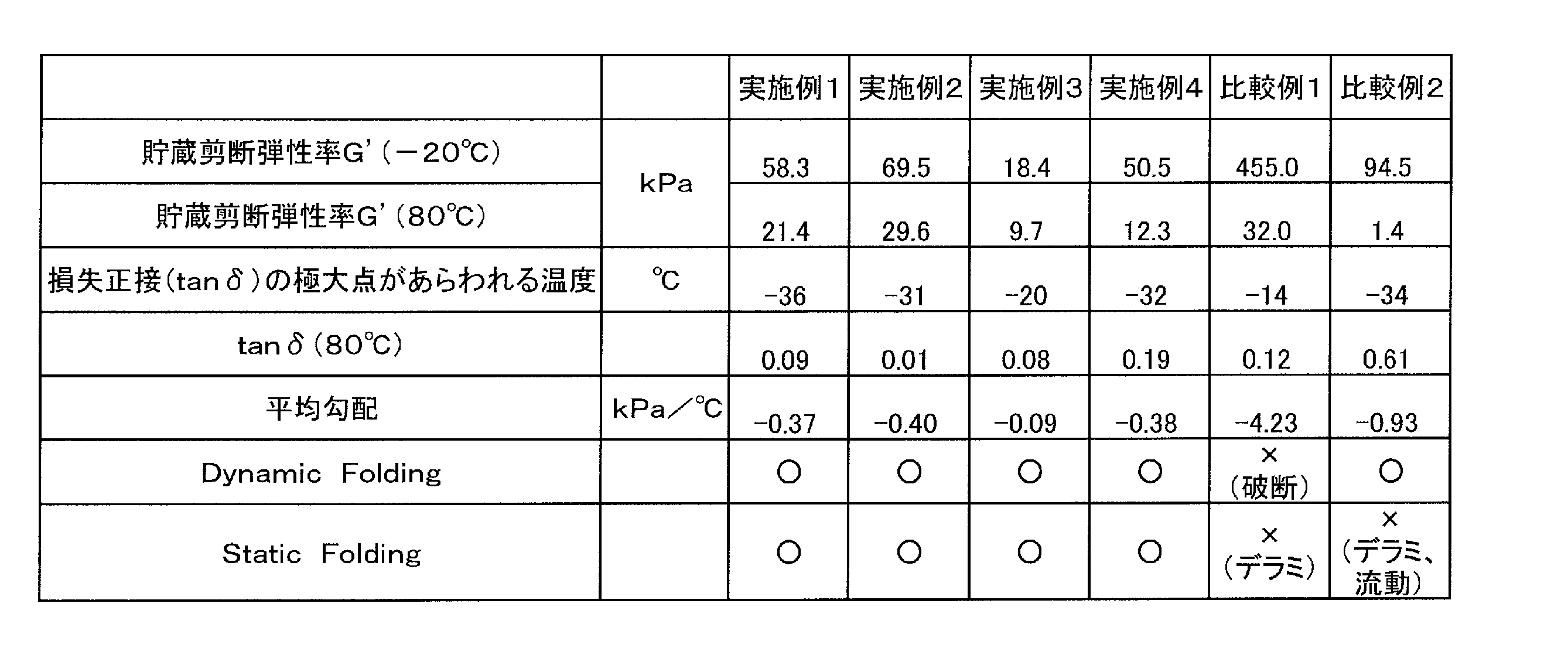
実施例1~4は、平均勾配が-0.4~0kPa/℃の間にあるが、低温(-30℃)動的試験と、高温(85℃,85%RH)静的試験のいずれも両立ができている。
平均勾配が大きい比較例1~2は、低温動的試験と、高温静的試験の両立ができておらず、フォルダブル性能が不十分であった。
平均勾配が大きい比較例1~2は、低温動的試験と、高温静的試験の両立ができておらず、フォルダブル性能が不十分であった。
Claims (13)
- 下記(1)~(3)の要件を満たす粘着シート。
(1)周波数1Hzの剪断モードで動的粘弾性測定により得られる80℃の貯蔵剪断弾性率(G’(80℃))が、1.0kPa以上100kPa以下
(2)周波数1Hzの剪断モードで動的粘弾性測定により得られる-20℃の貯蔵剪断弾性率(G’(-20℃))が、1.0kPa以上140kPa以下
(3)周波数1Hzの剪断モードで動的粘弾性測定により貯蔵剪断弾性率を測定した際、y軸を貯蔵剪断弾性率(kPa)、x軸を温度(℃)としたグラフ上で、式(1)で示される-20℃~80℃の平均勾配が-0.40~0kPa/℃
式(1) 平均勾配=(G’(80℃)-G’(-20℃))/100 - 前記粘着シートが、単官能(メタ)アクリレート(a1)、及び、多官能(メタ)アクリレート(a2)をモノマー成分として有するアクリル系重合体を含む請求項1に記載の粘着シート。
- 前記単官能(メタ)アクリレート(a1)が、炭素数9~22のアルキル基を有するアルキル(メタ)アクリレートである請求項2に記載の粘着シート。
- 前記単官能(メタ)アクリレート(a1)が、分岐構造であるアルキル基を有するアルキル(メタ)アクリレートである請求項2または3に記載の粘着シート。
- 前記多官能アクリレート(a2)が、多官能ウレタン(メタ)アクリレートである請求項2~4のいずれかに記載の粘着シート。
- 前記多官能アクリレート(a2)が、2官能ウレタン(メタ)アクリレートである請求項5に記載の粘着シート。
- 前記アクリル系重合体が、モノマー成分として前記単官能(メタ)アクリレート(a1)を70~95質量%、前記多官能(メタ)アクリレート(a2)を1~30質量%含むことを特徴とする請求項2~6のいずれかに記載の粘着シート。
- 粘着シートの周波数1Hzの剪断測定における80℃の損失正接(tanδ(80℃))が、0.60以下である請求項1~7のいずれかに記載の粘着シート。
- 周波数1Hzの剪断モードで動的粘弾性測定により得られる損失正接の極大点が、-25℃以下にある請求項1~8のいずれかに記載の粘着シート。
- 下記(4)を満たす第1の部材シートと、請求項1~9のいずれかに記載の粘着シートが積層されてなる構成を備えた積層シート。
(4)ASTM D882に準拠して測定した25℃の引張強度が、10MPa~900MPa - 前記第1の部材シートと、請求項1~9のいずれかに記載の粘着シートと、第2の部材シートがこの順で積層されてなる構成を備えた請求項10に記載の積層シート。
- 前記第1の部材シートがタッチ入力機能を有することを特徴とする請求項10または11に記載の積層シート。
- 請求項12に記載の積層シートを備えた画像表示装置。
Priority Applications (3)
| Application Number | Priority Date | Filing Date | Title |
|---|---|---|---|
| KR1020217025639A KR102761502B1 (ko) | 2019-03-29 | 2020-03-27 | 점착 시트, 적층 시트, 화상 표시 장치 |
| CN202080020263.2A CN113557280A (zh) | 2019-03-29 | 2020-03-27 | 粘合片、层叠片、图像显示装置 |
| US17/479,123 US20220025226A1 (en) | 2019-03-29 | 2021-09-20 | Adhesive Sheet, Laminate Sheet, and Image Display Device Technical Field |
Applications Claiming Priority (2)
| Application Number | Priority Date | Filing Date | Title |
|---|---|---|---|
| JP2019065470 | 2019-03-29 | ||
| JP2019-065470 | 2019-03-29 |
Related Child Applications (1)
| Application Number | Title | Priority Date | Filing Date |
|---|---|---|---|
| US17/479,123 Continuation US20220025226A1 (en) | 2019-03-29 | 2021-09-20 | Adhesive Sheet, Laminate Sheet, and Image Display Device Technical Field |
Publications (1)
| Publication Number | Publication Date |
|---|---|
| WO2020203741A1 true WO2020203741A1 (ja) | 2020-10-08 |
Family
ID=72667690
Family Applications (1)
| Application Number | Title | Priority Date | Filing Date |
|---|---|---|---|
| PCT/JP2020/013955 Ceased WO2020203741A1 (ja) | 2019-03-29 | 2020-03-27 | 粘着シート、積層シート、画像表示装置 |
Country Status (6)
| Country | Link |
|---|---|
| US (1) | US20220025226A1 (ja) |
| JP (1) | JP2020164859A (ja) |
| KR (1) | KR102761502B1 (ja) |
| CN (1) | CN113557280A (ja) |
| TW (1) | TW202102633A (ja) |
| WO (1) | WO2020203741A1 (ja) |
Cited By (2)
| Publication number | Priority date | Publication date | Assignee | Title |
|---|---|---|---|---|
| CN116179071A (zh) * | 2022-11-17 | 2023-05-30 | 武汉瑞普赛技术有限公司 | 一种柔性印刷版用pet基膜底涂剂及其制备方法和使用方法 |
| WO2025204581A1 (ja) * | 2024-03-26 | 2025-10-02 | 日東電工株式会社 | 粘着剤組成物 |
Families Citing this family (6)
| Publication number | Priority date | Publication date | Assignee | Title |
|---|---|---|---|---|
| JP7668136B2 (ja) * | 2021-03-09 | 2025-04-24 | リンテック株式会社 | 粘着シート、繰り返し屈曲積層部材および繰り返し屈曲デバイス |
| CN115071242B (zh) * | 2022-07-20 | 2024-05-14 | 京东方科技集团股份有限公司 | 显示盖板及包含该显示盖板的显示装置 |
| KR102831933B1 (ko) * | 2022-08-23 | 2025-07-09 | 삼성에스디아이 주식회사 | 점착 필름, 이를 포함하는 광학 부재 및 이를 포함하는 광학표시장치 |
| KR102863230B1 (ko) * | 2022-10-20 | 2025-09-22 | 주식회사 엘지화학 | Uv 경화성 접착제 조성물, 이를 포함하는 접착 필름, 편광 필름 및 디스플레이 장치 |
| JP2024169233A (ja) * | 2023-05-25 | 2024-12-05 | 日東電工株式会社 | 光学粘着シート |
| WO2025205163A1 (ja) * | 2024-03-27 | 2025-10-02 | 日東電工株式会社 | 粘着シート |
Citations (8)
| Publication number | Priority date | Publication date | Assignee | Title |
|---|---|---|---|---|
| JPH03243679A (ja) * | 1990-02-19 | 1991-10-30 | Sekisui Chem Co Ltd | アクリル系粘着剤組成物及び粘着テープ、ラベル、シート |
| WO2010044229A1 (ja) * | 2008-10-15 | 2010-04-22 | 三菱樹脂株式会社 | 透明粘着シートおよび画像表示装置 |
| US20160122599A1 (en) * | 2014-11-01 | 2016-05-05 | Samsung Sdi Co., Ltd. | Adhesive composition, adhesive film prepared from the same and display member including the same |
| JP2016108555A (ja) * | 2014-11-28 | 2016-06-20 | 三星エスディアイ株式会社Samsung SDI Co., Ltd. | 光学フィルム用粘着剤、光学フィルム用粘着剤層、光学部材および画像表示装置 |
| JP2017095659A (ja) * | 2015-11-27 | 2017-06-01 | 三星エスディアイ株式会社Samsung SDI Co., Ltd. | 粘着剤組成物、粘着シートおよび画像表示装置 |
| US20170309867A1 (en) * | 2016-04-22 | 2017-10-26 | Samsung Sdi Co., Ltd. | Flexible display apparatus |
| JP2018045213A (ja) * | 2016-09-16 | 2018-03-22 | リンテック株式会社 | フレキシブルディスプレイ用粘着剤、粘着シート、フレキシブル積層部材およびフレキシブルディスプレイ |
| JP2019173005A (ja) * | 2018-03-29 | 2019-10-10 | 三菱ケミカル株式会社 | 粘着シート、積層シート及びそれを用いた画像表示装置 |
Family Cites Families (7)
| Publication number | Priority date | Publication date | Assignee | Title |
|---|---|---|---|---|
| US6177173B1 (en) * | 1998-07-01 | 2001-01-23 | 3M Innovative Properties Company | Damped laminates having welded through holes and/or edges with decreased spring back and improved fastener force retention and, a method of making |
| KR20170032529A (ko) * | 2015-09-14 | 2017-03-23 | 주식회사 엘지화학 | 광학 접착제용 광경화성 조성물, 이를 적용한 화상 표시 장치 및 화상 표시 장치의 제조 방법 |
| KR102069286B1 (ko) * | 2015-11-20 | 2020-01-22 | 동우 화인켐 주식회사 | 플렉서블 표시 장치 |
| JP6564695B2 (ja) * | 2015-11-27 | 2019-08-21 | 三星エスディアイ株式会社SAMSUNG SDI Co., LTD. | 粘着剤組成物、その製造方法、粘着シートおよび画像表示装置 |
| CN110431174A (zh) * | 2017-03-22 | 2019-11-08 | 三菱化学株式会社 | 固化性组合物、片、使用其的层叠体、图像显示装置 |
| US11661536B2 (en) * | 2018-02-28 | 2023-05-30 | 3M Innovative Properties Company | Adhesives comprising polymerized units of secondary hexyl (meth)acrylates |
| WO2020058481A1 (en) * | 2018-09-21 | 2020-03-26 | Danmarks Tekniske Universitet | A protein-based water insoluble and bendable polymer with ionic conductivity |
-
2020
- 2020-03-27 CN CN202080020263.2A patent/CN113557280A/zh active Pending
- 2020-03-27 JP JP2020057141A patent/JP2020164859A/ja active Pending
- 2020-03-27 KR KR1020217025639A patent/KR102761502B1/ko active Active
- 2020-03-27 TW TW109110709A patent/TW202102633A/zh unknown
- 2020-03-27 WO PCT/JP2020/013955 patent/WO2020203741A1/ja not_active Ceased
-
2021
- 2021-09-20 US US17/479,123 patent/US20220025226A1/en not_active Abandoned
Patent Citations (8)
| Publication number | Priority date | Publication date | Assignee | Title |
|---|---|---|---|---|
| JPH03243679A (ja) * | 1990-02-19 | 1991-10-30 | Sekisui Chem Co Ltd | アクリル系粘着剤組成物及び粘着テープ、ラベル、シート |
| WO2010044229A1 (ja) * | 2008-10-15 | 2010-04-22 | 三菱樹脂株式会社 | 透明粘着シートおよび画像表示装置 |
| US20160122599A1 (en) * | 2014-11-01 | 2016-05-05 | Samsung Sdi Co., Ltd. | Adhesive composition, adhesive film prepared from the same and display member including the same |
| JP2016108555A (ja) * | 2014-11-28 | 2016-06-20 | 三星エスディアイ株式会社Samsung SDI Co., Ltd. | 光学フィルム用粘着剤、光学フィルム用粘着剤層、光学部材および画像表示装置 |
| JP2017095659A (ja) * | 2015-11-27 | 2017-06-01 | 三星エスディアイ株式会社Samsung SDI Co., Ltd. | 粘着剤組成物、粘着シートおよび画像表示装置 |
| US20170309867A1 (en) * | 2016-04-22 | 2017-10-26 | Samsung Sdi Co., Ltd. | Flexible display apparatus |
| JP2018045213A (ja) * | 2016-09-16 | 2018-03-22 | リンテック株式会社 | フレキシブルディスプレイ用粘着剤、粘着シート、フレキシブル積層部材およびフレキシブルディスプレイ |
| JP2019173005A (ja) * | 2018-03-29 | 2019-10-10 | 三菱ケミカル株式会社 | 粘着シート、積層シート及びそれを用いた画像表示装置 |
Cited By (3)
| Publication number | Priority date | Publication date | Assignee | Title |
|---|---|---|---|---|
| CN116179071A (zh) * | 2022-11-17 | 2023-05-30 | 武汉瑞普赛技术有限公司 | 一种柔性印刷版用pet基膜底涂剂及其制备方法和使用方法 |
| CN116179071B (zh) * | 2022-11-17 | 2024-03-08 | 武汉瑞普赛技术有限公司 | 一种柔性印刷版用pet基膜底涂剂及其制备方法和使用方法 |
| WO2025204581A1 (ja) * | 2024-03-26 | 2025-10-02 | 日東電工株式会社 | 粘着剤組成物 |
Also Published As
| Publication number | Publication date |
|---|---|
| JP2020164859A (ja) | 2020-10-08 |
| KR20210144670A (ko) | 2021-11-30 |
| US20220025226A1 (en) | 2022-01-27 |
| KR102761502B1 (ko) | 2025-02-04 |
| CN113557280A (zh) | 2021-10-26 |
| TW202102633A (zh) | 2021-01-16 |
Similar Documents
| Publication | Publication Date | Title |
|---|---|---|
| KR102761502B1 (ko) | 점착 시트, 적층 시트, 화상 표시 장치 | |
| JP7180714B2 (ja) | 粘着シート、積層シート、フレキシブル画像表示装置部材及びフレキシブル画像表示装置 | |
| JP6888730B1 (ja) | 粘着シート、粘着部品、フレキシブル画像表示装置部材、積層体、画像表示装置 | |
| CN101855280B (zh) | 复合膜 | |
| JP7318687B2 (ja) | 粘着シート、フレキシブル画像表示装置部材、光学部材及び画像表示装置 | |
| JP7180715B2 (ja) | 粘着シート、積層シート、フレキシブル画像表示装置部材及びフレキシブル画像表示装置 | |
| KR102890936B1 (ko) | 점착 시트, 적층 시트, 플렉시블 화상 표시 장치 부재 및 플렉시블 화상 표시 장치 | |
| JP6768024B2 (ja) | 活性エネルギー線硬化性粘着剤、粘着シートおよび積層体 | |
| JP7497748B2 (ja) | 粘着シート、それを用いた積層シート及び画像表示装置 | |
| WO2024204744A1 (ja) | 接着剤、接着シート、光学構成体および表示体 | |
| JP7265185B2 (ja) | 光硬化性組成物およびその硬化物 | |
| TW201541188A (zh) | 活性能量線硬化型樹脂組成物、硬化物、接著劑及積層薄膜 | |
| JP6768018B2 (ja) | 活性エネルギー線硬化性粘着シートおよび積層体 | |
| JP7719352B2 (ja) | 光硬化性組成物 | |
| WO2024202754A1 (ja) | 粘着シートおよび表示体 | |
| WO2025205785A1 (ja) | 粘着シート、その製造方法、及び光学積層体 |
Legal Events
| Date | Code | Title | Description |
|---|---|---|---|
| 121 | Ep: the epo has been informed by wipo that ep was designated in this application |
Ref document number: 20781974 Country of ref document: EP Kind code of ref document: A1 |
|
| ENP | Entry into the national phase |
Ref document number: 20217025639 Country of ref document: KR Kind code of ref document: A |
|
| NENP | Non-entry into the national phase |
Ref country code: DE |
|
| 122 | Ep: pct application non-entry in european phase |
Ref document number: 20781974 Country of ref document: EP Kind code of ref document: A1 |