WO2020203540A1 - 硬化性エポキシ樹脂組成物 - Google Patents
硬化性エポキシ樹脂組成物 Download PDFInfo
- Publication number
- WO2020203540A1 WO2020203540A1 PCT/JP2020/013293 JP2020013293W WO2020203540A1 WO 2020203540 A1 WO2020203540 A1 WO 2020203540A1 JP 2020013293 W JP2020013293 W JP 2020013293W WO 2020203540 A1 WO2020203540 A1 WO 2020203540A1
- Authority
- WO
- WIPO (PCT)
- Prior art keywords
- group
- formula
- represented
- resin composition
- acid anhydride
- Prior art date
- Legal status (The legal status is an assumption and is not a legal conclusion. Google has not performed a legal analysis and makes no representation as to the accuracy of the status listed.)
- Ceased
Links
- 0 CC(C)C(*)(C1*)C(*)(C2C(O3)=O)C(*)(*)C1(*)C2C3=O Chemical compound CC(C)C(*)(C1*)C(*)(C2C(O3)=O)C(*)(*)C1(*)C2C3=O 0.000 description 2
- AECAELSZJWCIRV-UHFFFAOYSA-N CCC(COC(CCS)=O)(COC(CCSC(CC(C1)C2C(O)O3)C1C2C3=O)=O)COC(CCSC(CC(C1)C2C(O3)=O)C1C2C3=O)=O Chemical compound CCC(COC(CCS)=O)(COC(CCSC(CC(C1)C2C(O)O3)C1C2C3=O)=O)COC(CCSC(CC(C1)C2C(O3)=O)C1C2C3=O)=O AECAELSZJWCIRV-UHFFFAOYSA-N 0.000 description 1
- BVRRXLUZSZMYAZ-UHFFFAOYSA-N O=C(CCS)OCC(COC(CCS)=O)(COC(CCSC(CC(C1)C2C(O3)=O)C1C2C3=O)=O)COC(CCSC(CC(C1)C2C(O3)=O)C1C2C3=O)=O Chemical compound O=C(CCS)OCC(COC(CCS)=O)(COC(CCSC(CC(C1)C2C(O3)=O)C1C2C3=O)=O)COC(CCSC(CC(C1)C2C(O3)=O)C1C2C3=O)=O BVRRXLUZSZMYAZ-UHFFFAOYSA-N 0.000 description 1
- ZHTLTWZTQYJUJE-UHFFFAOYSA-N OC(C(C(C1)C2)C3C1C2SCCC(OCC(COCC(COC(CCS)=O)(COC(CCS)=O)COC(CCSC(CC(C1)C24)C1C2C(O)OC4=O)=O)(COC(CCS)=O)COC(CCSC(CC(C1)C2C(O4)=O)C1C2C4=O)=O)=O)OC3=O Chemical compound OC(C(C(C1)C2)C3C1C2SCCC(OCC(COCC(COC(CCS)=O)(COC(CCS)=O)COC(CCSC(CC(C1)C24)C1C2C(O)OC4=O)=O)(COC(CCS)=O)COC(CCSC(CC(C1)C2C(O4)=O)C1C2C4=O)=O)=O)OC3=O ZHTLTWZTQYJUJE-UHFFFAOYSA-N 0.000 description 1
- LZDSSQYHIULUNL-UHFFFAOYSA-N OC(N(CCOC(CCSC(CC(C1)C2C(O3)=O)C1C2C3=O)=O)C(N1CCOC(CCS)=O)=O)N(CCOC(CCSC(CC(C2)C3C(O4)=O)C2C3C4=O)=O)C1=O Chemical compound OC(N(CCOC(CCSC(CC(C1)C2C(O3)=O)C1C2C3=O)=O)C(N1CCOC(CCS)=O)=O)N(CCOC(CCSC(CC(C2)C3C(O4)=O)C2C3C4=O)=O)C1=O LZDSSQYHIULUNL-UHFFFAOYSA-N 0.000 description 1
Images
Classifications
-
- C—CHEMISTRY; METALLURGY
- C08—ORGANIC MACROMOLECULAR COMPOUNDS; THEIR PREPARATION OR CHEMICAL WORKING-UP; COMPOSITIONS BASED THEREON
- C08G—MACROMOLECULAR COMPOUNDS OBTAINED OTHERWISE THAN BY REACTIONS ONLY INVOLVING UNSATURATED CARBON-TO-CARBON BONDS
- C08G59/00—Polycondensates containing more than one epoxy group per molecule; Macromolecules obtained by polymerising compounds containing more than one epoxy group per molecule using curing agents or catalysts which react with the epoxy groups
- C08G59/18—Macromolecules obtained by polymerising compounds containing more than one epoxy group per molecule using curing agents or catalysts which react with the epoxy groups ; e.g. general methods of curing
- C08G59/40—Macromolecules obtained by polymerising compounds containing more than one epoxy group per molecule using curing agents or catalysts which react with the epoxy groups ; e.g. general methods of curing characterised by the curing agents used
- C08G59/42—Polycarboxylic acids; Anhydrides, halides or low molecular weight esters thereof
-
- C—CHEMISTRY; METALLURGY
- C08—ORGANIC MACROMOLECULAR COMPOUNDS; THEIR PREPARATION OR CHEMICAL WORKING-UP; COMPOSITIONS BASED THEREON
- C08G—MACROMOLECULAR COMPOUNDS OBTAINED OTHERWISE THAN BY REACTIONS ONLY INVOLVING UNSATURATED CARBON-TO-CARBON BONDS
- C08G59/00—Polycondensates containing more than one epoxy group per molecule; Macromolecules obtained by polymerising compounds containing more than one epoxy group per molecule using curing agents or catalysts which react with the epoxy groups
- C08G59/18—Macromolecules obtained by polymerising compounds containing more than one epoxy group per molecule using curing agents or catalysts which react with the epoxy groups ; e.g. general methods of curing
- C08G59/40—Macromolecules obtained by polymerising compounds containing more than one epoxy group per molecule using curing agents or catalysts which react with the epoxy groups ; e.g. general methods of curing characterised by the curing agents used
- C08G59/66—Mercaptans
-
- C—CHEMISTRY; METALLURGY
- C09—DYES; PAINTS; POLISHES; NATURAL RESINS; ADHESIVES; COMPOSITIONS NOT OTHERWISE PROVIDED FOR; APPLICATIONS OF MATERIALS NOT OTHERWISE PROVIDED FOR
- C09D—COATING COMPOSITIONS, e.g. PAINTS, VARNISHES OR LACQUERS; FILLING PASTES; CHEMICAL PAINT OR INK REMOVERS; INKS; CORRECTING FLUIDS; WOODSTAINS; PASTES OR SOLIDS FOR COLOURING OR PRINTING; USE OF MATERIALS THEREFOR
- C09D163/00—Coating compositions based on epoxy resins; Coating compositions based on derivatives of epoxy resins
-
- C—CHEMISTRY; METALLURGY
- C09—DYES; PAINTS; POLISHES; NATURAL RESINS; ADHESIVES; COMPOSITIONS NOT OTHERWISE PROVIDED FOR; APPLICATIONS OF MATERIALS NOT OTHERWISE PROVIDED FOR
- C09J—ADHESIVES; NON-MECHANICAL ASPECTS OF ADHESIVE PROCESSES IN GENERAL; ADHESIVE PROCESSES NOT PROVIDED FOR ELSEWHERE; USE OF MATERIALS AS ADHESIVES
- C09J11/00—Features of adhesives not provided for in group C09J9/00, e.g. additives
- C09J11/02—Non-macromolecular additives
- C09J11/06—Non-macromolecular additives organic
-
- C—CHEMISTRY; METALLURGY
- C09—DYES; PAINTS; POLISHES; NATURAL RESINS; ADHESIVES; COMPOSITIONS NOT OTHERWISE PROVIDED FOR; APPLICATIONS OF MATERIALS NOT OTHERWISE PROVIDED FOR
- C09J—ADHESIVES; NON-MECHANICAL ASPECTS OF ADHESIVE PROCESSES IN GENERAL; ADHESIVE PROCESSES NOT PROVIDED FOR ELSEWHERE; USE OF MATERIALS AS ADHESIVES
- C09J163/00—Adhesives based on epoxy resins; Adhesives based on derivatives of epoxy resins
-
- C—CHEMISTRY; METALLURGY
- C09—DYES; PAINTS; POLISHES; NATURAL RESINS; ADHESIVES; COMPOSITIONS NOT OTHERWISE PROVIDED FOR; APPLICATIONS OF MATERIALS NOT OTHERWISE PROVIDED FOR
- C09K—MATERIALS FOR MISCELLANEOUS APPLICATIONS, NOT PROVIDED FOR ELSEWHERE
- C09K3/00—Materials not provided for elsewhere
- C09K3/10—Materials in mouldable or extrudable form for sealing or packing joints or covers
-
- H—ELECTRICITY
- H10—SEMICONDUCTOR DEVICES; ELECTRIC SOLID-STATE DEVICES NOT OTHERWISE PROVIDED FOR
- H10H—INORGANIC LIGHT-EMITTING SEMICONDUCTOR DEVICES HAVING POTENTIAL BARRIERS
- H10H20/00—Individual inorganic light-emitting semiconductor devices having potential barriers, e.g. light-emitting diodes [LED]
- H10H20/80—Constructional details
- H10H20/85—Packages
- H10H20/852—Encapsulations
- H10H20/854—Encapsulations characterised by their material, e.g. epoxy or silicone resins
-
- H—ELECTRICITY
- H10—SEMICONDUCTOR DEVICES; ELECTRIC SOLID-STATE DEVICES NOT OTHERWISE PROVIDED FOR
- H10W—GENERIC PACKAGES, INTERCONNECTIONS, CONNECTORS OR OTHER CONSTRUCTIONAL DETAILS OF DEVICES COVERED BY CLASS H10
- H10W74/00—Encapsulations, e.g. protective coatings
- H10W74/10—Encapsulations, e.g. protective coatings characterised by their shape or disposition
-
- H—ELECTRICITY
- H10—SEMICONDUCTOR DEVICES; ELECTRIC SOLID-STATE DEVICES NOT OTHERWISE PROVIDED FOR
- H10W—GENERIC PACKAGES, INTERCONNECTIONS, CONNECTORS OR OTHER CONSTRUCTIONAL DETAILS OF DEVICES COVERED BY CLASS H10
- H10W74/00—Encapsulations, e.g. protective coatings
- H10W74/40—Encapsulations, e.g. protective coatings characterised by their materials
Definitions
- the present invention relates to a curable epoxy resin composition.
- the present application claims the priority of Japanese Patent Application No. 2019-068077 filed in Japan on March 29, 2019, the contents of which are incorporated herein by reference.
- a cured product of the above resin may be used as a sealing material for coating the optical semiconductor element for the purpose of protection or the like.
- the coloring of the sealing material progresses due to the heat generated from the optical semiconductor element, so that the light that should be originally output is absorbed, and as a result, the light is output from the optical semiconductor device.
- the luminous intensity of light decreases with time. Therefore, there is a demand for a sealing material having higher heat resistance.
- Patent Document 2 a resin composition containing an epoxy resin, an acid anhydride as a curing agent, and a thiol has also been proposed (Patent Document 2).
- Patent Document 2 a resin composition containing an epoxy resin, an acid anhydride as a curing agent, and a thiol has also been proposed.
- Patent Document 2 a resin composition containing an epoxy resin, an acid anhydride as a curing agent, and a thiol has also been proposed.
- Patent Document 2 a resin composition containing an epoxy resin, an acid anhydride as a curing agent, and a thiol
- the curable epoxy resin composition is used for various purposes other than the sealing agent, but it is known that the cured product has flexibility and durability under high temperature and high humidity. Therefore, if these performances are improved, it is expected to be applied in many applications.
- an object of the present invention is to provide a curable epoxy resin composition capable of forming a cured product having high heat resistance, water resistance, and flexibility.
- the present inventor has made a curable epoxy resin composition containing an alicyclic epoxy compound, a specific curing agent, and a curing accelerator into high heat resistance, water resistance, and We have found that it is possible to form a cured product with flexibility, and completed the present invention.
- the curing agent (B) has the following formula (B1).
- Rx is the same or different, hydrogen atom
- the following formula (b1) R 1 to R 6 represent hydrogen atoms or linear or branched alkyl groups having 1 to 4 carbon atoms, which are the same or different. Wavy lines represent binding sites.
- a group having a structure represented by, or the following formula (b2) R 7 to R 10 represent hydrogen atoms or linear or branched alkyl groups having 1 to 4 carbon atoms, which are the same or different.
- Wavy lines represent binding sites.
- A may have a substituent and may have a functional group containing a heteroatom in the main chain and / or the side chain, and is a linear or a-valent linear chain having 2 to 50 carbon atoms. It is a branched hydrocarbon group. a represents an integer of 2 to 6.
- Acid anhydride represented by and the following formula (B2) [In the formula, Rx is the same or different, hydrogen atom, the following formula (b1) (R 1 to R 6 represent hydrogen atoms or linear or branched alkyl groups having 1 to 4 carbon atoms, which are the same or different. Wavy lines represent binding sites.) A group having a structure represented by, or the following formula (b2) (R 7 to R 10 represent hydrogen atoms or linear or branched alkyl groups having 1 to 4 carbon atoms, which are the same or different. Wavy lines represent binding sites.) Indicates a group having a structure represented by, and one or more of them is a group having a structure represented by the formula (b1) or (b2).
- R are the same or different, hydrogen atoms or methyl groups.
- R is a (b + c) valent group having a linear, branched, or cyclic structure having 2 to 28 carbon atoms, which may have a functional group containing a heteroatom.
- R' is the same or different, hydrogen atom, alkyl group having 1 to 8 carbon atoms, thiol group, or the following formula (b3).
- R 11 and R 12 are different, R 11 indicates a thiol group or a methyl group, R 12 indicates a hydrogen atom or a thiol group.
- the wavy line represents a bond site.
- a curable epoxy resin composition which is at least one selected from the group consisting of acid anhydrides represented by.
- R in the acid anhydride represented by the formula (B2) is the following formulas (b4) to (b8).
- n represents an integer from 1 to 10.
- the wavy line indicates the binding site. It is preferably any one of the groups represented by.
- the alicyclic epoxy group of the alicyclic epoxy compound (A) is preferably a cyclohexene oxide group.
- the alicyclic epoxy compound (A) has the following formula (I-1). It is preferably a compound represented by.
- the present invention provides a cured product of the curable epoxy resin composition.
- the present invention provides a sealing agent containing the curable epoxy resin composition.
- the present invention provides an adhesive containing the curable epoxy resin composition.
- the present invention provides a coating agent containing the curable epoxy resin composition.
- the present invention provides an optical member containing the cured product.
- the curable epoxy resin composition of the present invention has the above-mentioned structure, a cured product having high heat resistance, water resistance, and flexibility can be obtained by curing. Therefore, the resin composition can be used as a sealing agent, an adhesive, and a coating agent. Further, the cured product can be used as an optical member.
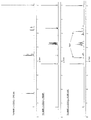
- FIG. 6 is a 1 1 H-NMR chart of the acid anhydride (Compound A) obtained in Reference Example 1.
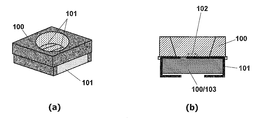
- This is an optical semiconductor device in which an optical semiconductor element is sealed with a cured product of a resin composition produced in the evaluation of Examples.
- FIG. (A) is a perspective view
- FIG. (B) is a cross-sectional view.
- the curable epoxy resin composition of the present invention contains an alicyclic epoxy compound (A), a curing agent (B), and a curing accelerator (C), and the curing agent (B) is represented by the above formula (B1). It is characterized in that it is at least one selected from the group consisting of the acid anhydride to be prepared and the acid anhydride represented by the above formula (B2).
- the alicyclic epoxy compound (alicyclic epoxy resin) (A) is a compound having at least an alicyclic (aliphatic hydrocarbon ring) structure and an epoxy group (oxylanyl group) in the molecule (in one molecule).
- alicyclic epoxy compounds can be used. More specifically, the alicyclic epoxy compound (A) is, for example, a compound having an epoxy group (alicyclic epoxy group) composed of two adjacent carbon atoms and oxygen atoms constituting the alicyclic. Examples thereof include “compound (A-1)”) and compounds having an epoxy group directly bonded to the alicyclic ring by a single bond (sometimes referred to as "compound (A-2)").
- the compound (A-1) a known or commonly used compound having one or more alicyclic epoxy groups in the molecule can be used, and is not particularly limited.
- a cyclohexene oxide group is preferable from the viewpoint of heat resistance of the cured product.
- a compound having two or more cyclohexene oxide groups in the molecule is preferable, and a compound represented by the following formula (I) is more preferable. is there.
- X represents a single bond or a linking group (a divalent group having one or more atoms).
- the linking group include a divalent hydrocarbon group, an alkenylene group in which part or all of the carbon-carbon double bond is epoxidized (sometimes referred to as "epoxidized alkenylene group"), a carbonyl group, and the like. Examples thereof include an ether bond, an ester bond, a carbonate group, an amide group, and a group in which a plurality of these are linked.
- a substituent such as an alkyl group may be bonded to one or more of the carbon atoms constituting the cyclohexane ring (cyclohexene oxide group) in the formula (I).
- Examples of the compound in which X is a single bond in the formula (I) include (3,4,3', 4'-diepoxy) bicyclohexyl and the like.
- Examples of the divalent hydrocarbon group include a linear or branched alkylene group having 1 to 18 carbon atoms, a divalent alicyclic hydrocarbon group and the like.
- Examples of the linear or branched alkylene group having 1 to 18 carbon atoms include a methylene group, a methylmethylene group, a dimethylmethylene group, an ethylene group, a propylene group and a trimethylene group.
- Examples of the divalent alicyclic hydrocarbon group include 1,2-cyclopentylene group, 1,3-cyclopentylene group, cyclopentylidene group, 1,2-cyclohexylene group and 1,3-.
- Examples thereof include a cycloalkylene group (including a cycloalkylidene group) such as a cyclohexylene group, a 1,4-cyclohexylene group and a cyclohexylidene group.
- a cycloalkylene group including a cycloalkylidene group
- examples thereof include a cycloalkylene group (including a cycloalkylidene group) such as a cyclohexylene group, a 1,4-cyclohexylene group and a cyclohexylidene group.
- alkenylene group in the alkenylene group (epoxydylated alkenylene group) in which a part or all of the carbon-carbon double bond is epoxidized examples include a vinylene group, a propenylene group, a 1-butenylene group, a 2-butenylene group, and a butadienylene. Examples thereof include a linear or branched alkenylene group having 2 to 8 carbon atoms such as a group, a pentenylene group, a hexenylene group, a heptenylene group, and an octenylene group.
- an alkenylene group in which all carbon-carbon double bonds are epoxidized is preferable, and more preferably, all carbon-carbon double bonds are epoxidized and have 2 to 4 carbon atoms. It is an alkenylene group.
- a linking group containing an oxygen atom is particularly preferable, and specifically, -CO-, -O-CO-O-, -COO-, -O-, -CONH-, and epoxy.
- Examples include a chemical alkenylene group; a group in which a plurality of these groups are linked; a group in which one or two or more of these groups and one or two or more of divalent hydrocarbon groups are linked. Examples of the divalent hydrocarbon group include those exemplified above.
- Typical examples of the compound represented by the formula (I) are the compounds represented by the following formulas (I-1) to (I-10) and 2,2-bis (3,4-epoxycyclohexane-1).
- -Il) Propane, 1,2-bis (3,4-epoxycyclohexane-1-yl) ethane, 1,2-epoxy-1,2-bis (3,4-epoxycyclohexane-1-yl) ethane, bis (3,4-Epoxycyclohexylmethyl) ether and the like can be mentioned.
- l'and m'in the following formulas (I-5) and (I-7) each represent an integer of 1 to 30.
- R in the following formula (I-5) is an alkylene group having 1 to 8 carbon atoms, and is a methylene group, an ethylene group, a propylene group, an isopropylene group, a butylene group, an isobutylene group, an s-butylene group, a pentylene group, or a hexylene.
- Examples thereof include a linear or branched alkylene group such as a group, a heptylene group and an octylene group.
- a linear or branched alkylene group having 1 to 3 carbon atoms such as a methylene group, an ethylene group, a propylene group and an isopropylene group is preferable.
- N1 to n6 in the following formulas (I-9) and (I-10) represent integers of 1 to 30, respectively.
- Examples of the compound (A-2) include a compound (epoxy resin) represented by the following formula (II).
- R 1 represents a p-valent organic group.
- p represents an integer from 1 to 20.
- Examples of the p-valent organic group include a p-valent organic group having a structure formed by removing p-hydroxy groups from the structural formula of an organic compound having p-hydroxy groups, which will be described later.
- q indicates an integer from 1 to 50.
- p is an integer of 2 or more, a plurality of qs may be the same or different.
- the sum (sum) of q in equation (II) is an integer of 3 to 100.
- R 2 is a substituent on the cyclohexane ring represented in the formula, and represents any of the groups represented by the following formulas (IIa) to (IIc).
- the bond position of R 2 on the cyclohexane ring is not particularly limited, but usually, when the positions of the two carbon atoms of the cyclohexane ring bonded to the oxygen atom are 1-position and 2-position, the carbon atom at the 4-position or 5-position is used. Is.
- the bond position of R 2 in each cyclohexane ring may be the same or different.
- At least one of R 2 in formula (II) is a group (epoxy group) represented by formula (IIa).
- the plurality of R 2 may be the same or different.
- R 3 represents a hydrogen atom, a substituted or unsubstituted alkyl group, a substituted or unsubstituted alkylcarbonyl group, or a substituted or unsubstituted arylcarbonyl group.
- alkyl group include methyl group, ethyl group, n-propyl group, isopropyl group, butyl group, isobutyl group, s-butyl group, t-butyl group, pentyl group, hexyl group, octyl group and 2-ethylhexyl.
- Examples thereof include a linear or branched alkyl group having 1 to 20 carbon atoms such as a group.
- alkylcarbonyl group examples include methylcarbonyl group (acetyl group), ethylcarbonyl group, n-propylcarbonyl group, isopropylcarbonyl group, n-butylcarbonyl group, isobutylcarbonyl group, s-butylcarbonyl group and t-butyl.
- alkylcarbonyl group examples include methylcarbonyl group (acetyl group), ethylcarbonyl group, n-propylcarbonyl group, isopropylcarbonyl group, n-butylcarbonyl group, isobutylcarbonyl group, s-butylcarbonyl group and t-butyl.
- alkylcarbonyl group examples include methylcarbonyl group (acetyl group), ethylcarbonyl group, n-propylcarbonyl group, isopropylcarbonyl group, n-butylcarbonyl group, iso
- arylcarbonyl group examples include aryl-carbonyl groups having 6 to 20 carbon atoms such as a phenylcarbonyl group (benzoyl group), a 1-naphthylcarbonyl group, and a 2-naphthylcarbonyl group.
- Examples of the substituent that the above-mentioned alkyl group, alkylcarbonyl group, and arylcarbonyl group may have include a substituent having 0 to 20 carbon atoms (more preferably 0 to 10 carbon atoms) and the like.
- Examples of the substituent include halogen atoms such as fluorine atom, chlorine atom, bromine atom and iodine atom; hydroxy group; alkoxy group such as methoxy group, ethoxy group, propoxy group, isopropyloxy group, butoxy group and isobutyloxy group.
- alkenyloxy group such as allyloxy group (preferably C 2-6 alkenyloxy group, more preferably C 2-4 alkenyloxy group)
- Acyloxy groups such as acetyloxy group, propionyloxy group, (meth) acryloyloxy group (preferably C 1-12 acyloxy group); mercapto group; alkylthio group such as methylthio group, ethylthio group (preferably C 1-6 alkylthio) Group, more preferably C 1-4 alkylthio group); alkenylthio group such as allylthio group (preferably C 2-6 alkenylthio group, more preferably C 2-4 alkenylthio group); carboxy group; methoxycarbonyl group, Alkoxycarbonyl groups such as ethoxycarbonyl group, propoxycarbonyl group, butoxycarbonyl group (preferably C 1-6 alkoxy-carbonyl)
- examples of the substituent that the above-mentioned arylcarbonyl group may have include the above-mentioned substituted or unsubstituted alkyl group and the above-mentioned substituted or unsubstituted alkylcarbonyl group.
- the ratio of the group (epoxy group) represented by the formula (IIa) to the total amount (100 mol%) of R 2 in the compound represented by the formula (II) is not particularly limited, but is 40 mol% or more (for example,). 40 to 100 mol%), more preferably 60 mol% or more, still more preferably 80 mol% or more.
- the above ratio can be calculated by, for example, 1 H-NMR spectrum measurement, oxylan oxygen concentration measurement, or the like.
- the compound represented by the formula (II) is not particularly limited, but for example, an organic compound [R 1 (OH) p ] having p hydroxy groups in the molecule is used as an initiator (that is, the hydroxy group of the compound). (Starting from (active hydrogen)), 1,2-epoxy-4-vinylcyclohexane (3-vinyl-7-oxabicyclo [4.1.0] heptane) is subjected to ring-open polymerization (cationic polymerization), and then Manufactured by epoxidation with an oxidant.
- an organic compound [R 1 (OH) p ] having p hydroxy groups in the molecule is used as an initiator (that is, the hydroxy group of the compound). (Starting from (active hydrogen)), 1,2-epoxy-4-vinylcyclohexane (3-vinyl-7-oxabicyclo [4.1.0] heptane) is subjected to ring-open polymerization (cationic polymerization),
- Examples of the organic compound [R 1 (OH) p ] having p hydroxy groups in the molecule include aliphatic alcohols such as methanol, ethanol, propanol, butanol, pentanol, hexanol and octanol; ethylene glycol and diethylene glycol.
- Triethylene glycol polyethylene glycol, propylene glycol, dipropylene glycol, 1,3-butanediol, 1,4-butanediol, pentanediol, 1,6-hexanediol, neopentyl glycol, neopentyl glycol ester, cyclohexanedi
- Polyhydric alcohols such as methanol, glycerin, diglycerin, polyglycerin, trimethylolpropane, pentaerythritol, dipentaerythritol, hydrogenated bisphenol A, hydrogenated bisphenol F, hydrogenated bisphenol S; polyvinyl alcohol, partial hydrolysis of polyvinyl acetate Products, starch, acrylic polyol resin, styrene-allyl alcohol copolymer resin, polyester polyol, polycaprolactone polyol, polypropylene polyol, polytetramethylene glycol, polycarbonate polyols
- 1,2-epoxy-4-vinylcyclohexane can be produced by a known or conventional method, and is not particularly limited.
- 4-vinylcyclohexene obtained by a dimerization reaction of butadiene is used as an oxidizing agent such as peracetic acid. Obtained by partial epoxidation using.
- 1,2-epoxy-4-vinylcyclohexane a commercially available product can also be used.
- oxidizing agent known or commonly used oxidizing agents such as hydrogen peroxide and organic peracid can be used and are not particularly limited.
- organic peracid include performic acid, peracetic acid and excess. Examples thereof include benzoic acid and trifluoroperacetic acid. Of these, peracetic acid is preferable because it is industrially available at low cost and has high stability.
- the ring-opening polymerization and epoxidation can be carried out according to a well-known and commonly used method described in, for example, Japanese Patent Application Laid-Open No. 60-161973.
- the weight average molecular weight of the compound represented by the formula (II) in terms of standard polystyrene is not particularly limited, but is preferably 300 to 100,000, more preferably 1,000 to 10,000.
- the weight average molecular weight is 300 or more, the heat resistance of the cured product tends to be improved.
- the weight average molecular weight is 100,000 or less, the viscosity does not become too high and the fluidity at the time of molding tends to be kept low.
- the weight average molecular weight is measured by a gel permeation chromatography (GPC) method.
- the equivalent of the epoxy group (epoxy equivalent) of the compound represented by the formula (II) is not particularly limited, but is preferably 50 to 1000, and more preferably 100 to 500.
- the epoxy equivalent is 50 or more, the cured product tends to be less likely to become brittle.
- the epoxy equivalent is 1000 or less, the mechanical strength of the cured product tends to improve.
- the epoxy equivalent is measured according to JIS K7236: 2001.
- the compound (A-1) and the compound (A-2) are preferable from the viewpoint of the heat resistance of the cured product.
- the compound (A-1) is a compound represented by the formula (I-1) from the viewpoint of heat resistance of the cured product [3,4-epoxycyclohexylmethyl (3,4-epoxy) cyclohexanecarboxylate;
- the trade name "Selokiside 2021P" (manufactured by Daicel Corporation)] is particularly preferable.
- alicyclic epoxy compound (A) one type can be used alone, or two or more types can be used in combination.
- the alicyclic epoxy compound (A) can also be produced by a known or conventional method, and for example, commercially available products such as the trade names "Selokiside 2021P" and "Selokiside 2081" (all manufactured by Daicel Corporation) are commercially available. Goods can also be used.
- the content (blending amount) of the alicyclic epoxy compound (A) is not particularly limited, but is preferably 1 to 90% by weight, more preferably 10 to 10% by weight, based on the curable epoxy resin composition (100% by weight). It is 80% by weight, more preferably 20 to 70% by weight, and particularly preferably 20 to 60% by weight.
- the content of each component for example, alicyclic epoxy compound (A), curing agent (B), curing accelerator (C), etc.
- the content of each component for example, alicyclic epoxy compound (A), curing agent (B), curing accelerator (C), etc.
- the curing agent (B) has the following formula (B1).
- Rx is the same or different, hydrogen atom
- the following formula (b1) R 1 to R 6 represent hydrogen atoms or linear or branched alkyl groups having 1 to 4 carbon atoms, which are the same or different. Wavy lines represent bonding sites.
- a group having a structure represented by, or the following formula (b2) R 7 to R 10 represent hydrogen atoms or linear or branched alkyl groups having 1 to 4 carbon atoms, which are the same or different. Wavy lines represent binding sites.
- Indicates a group having a structure represented by, and one or more of them is a group having a structure represented by the formula (b1) or (b2).
- A may have a substituent and may have a functional group containing a heteroatom in the main chain and / or the side chain, and is a linear or a-valent linear chain having 2 to 50 carbon atoms. It is a branched chain hydrocarbon group. a represents an integer of 2 to 6.
- Acid anhydride represented by and the following formula (B2) [In the formula, Rx is the same or different, hydrogen atom, the following formula (b1) (R 1 to R 6 represent hydrogen atoms or linear or branched alkyl groups having 1 to 4 carbon atoms, which are the same or different.
- Wavy lines represent bonding sites.
- a group having a structure represented by, or the following formula (b2) (R 7 to R 10 represent hydrogen atoms or linear or branched alkyl groups having 1 to 4 carbon atoms, which are the same or different. Wavy lines represent binding sites.)
- Rs are the same or different, hydrogen atoms or methyl groups.
- R is a (b + c) valent group having a linear, branched, or cyclic structure having 2 to 28 carbon atoms, which may have a functional group containing a heteroatom.
- R' is the same or different, hydrogen atom, alkyl group having 1 to 8 carbon atoms, thiol group, or the following formula (b3).
- R 11 and R 12 are different, R 11 indicates a thiol group or a methyl group, R 12 indicates a hydrogen atom or a thiol group.
- the wavy line represents a bond site.
- an acid anhydride and a thiol compound are used in combination as a curing agent for an epoxy resin.
- an enchol reaction is carried out in the reaction of an acid anhydride having an unsaturated group with a thiol compound.
- An operation for forming a sulfide bond (for example, an addition reaction by irradiation with ultraviolet rays or a radical reaction) is required, and it cannot be obtained simply by mixing.
- the acid anhydride represented by the formula (B1) or the acid anhydride represented by the formula (B2) when used in combination, Good performance as a curing agent.
- the present inventor has obtained a curing obtained by blending an alicyclic epoxy compound (A) with an acid anhydride represented by the formula (B1) or an acid anhydride represented by the formula (B2) as a curing agent.
- the present invention has been completed by finding that the sex epoxy resin composition can form a cured product having excellent flexibility and excellent durability under high temperature and high humidity.
- crosslink density can be increased by the structure derived from the acid anhydride represented by the formula (B1) and the acid anhydride represented by the formula (B2), and as a result. It is presumed that this is because the heat resistance is maintained and the flexibility is imparted by introducing the sulfide bond into the skeleton.
- the constituent units of the acid anhydride represented by the formula (B1) and the acid anhydride represented by the formula (B2) are the formula (b9), the formula (b10), the formula (b11), and the formula (b12).
- the compound represented by is described.
- R 1 to R 6 represent hydrogen atoms or linear or branched alkyl groups having 1 to 4 carbon atoms, which are the same or different.
- the compound represented by the formula (b9) is 5-norbornene-2,3-dicarboxylic acid anhydride or a derivative thereof.
- the compound represented by the formula (b9) is a compound in which 0 to 4 (particularly 0 to 2) of R 1 to R 6 are methyl groups from the viewpoint of moisture resistance and moisture absorption and reflow resistance of the cured product.
- it is methylnorbornene 2,3-dicarboxylic acid anhydride and norbornene 2,3-dicarboxylic acid anhydride.
- the norbornene skeleton of the compound represented by the formula (b9) contains stereoisomers of exo and endo isomers.
- the abundance ratio of the exo form is high. More specifically, the abundance ratio of the exo body in the compound represented by the formula (b9) [exo body / (exo body + end body)] is preferably 40% by weight or more, more preferably 50% by weight or more. ..
- the compound represented by the formula (3) tends to become a solid at room temperature, which tends to be difficult to handle.
- the method for setting the abundance ratio of the exo form to 40% by weight or more is not particularly limited, but as described in the specific examples below, the isomerization to the exo form is allowed to proceed in the compound represented by the formula (b9). The method and the like can be mentioned.
- methylnorbornene 2,3-dicarboxylic acid anhydride in the present specification is a general term for each isomer having a different bond position of a methyl group on the norbornene ring.
- Typical examples of methylnorbornene 2,3-dicarboxylic acid anhydride include 5-methylnorbornene 2,3-dicarboxylic acid anhydride.
- Norbornene 2,3-dicarboxylic acid anhydride can be obtained, for example, by the Diels-Alder reaction of cyclopentadiene and maleic anhydride.
- norbornene-2,3-dicarboxylic acid anhydride obtained by the Diels-Alder reaction of cyclopentadiene and maleic anhydride has an endo-form abundance ratio of 95% by weight or more, and therefore is heated to 150 ° C. or higher to form an exo-form.
- Norbornene 2,3-dicarboxylic acid anhydride having a large abundance ratio of exo for example, norbornene 2,3-dicarboxylic acid anhydride having an exo abundance ratio of 30% by weight or more by isomerization (heat isomerization) Things
- Examples of commercially available products of the compound represented by the formula (b9) include 5-norbornene-2,3-dicarboxylic acid anhydride, trade name "MHAC-P" (manufactured by Hitachi Chemical Co., Ltd.) and the like.
- R 7 to R 10 represent hydrogen atoms or linear or branched alkyl groups having 1 to 4 carbon atoms, which are the same or different.
- the compound represented by the formula (b10) is 1,2,3,6-tetrahydrophthalic anhydride or a derivative thereof.
- the derivative include various alkyl substitutions.
- methyltetrahydrophthalic anhydride (4-methyltetrahydrophthalic anhydride, 3-methyltetrahydrophthalic anhydride, etc.) and the like can be mentioned.
- commercially available products of such compounds include trade names "HN-2200” and "HN-2000" (all manufactured by Hitachi Chemical Co., Ltd.).
- the compound represented by the formula (b9) is represented by the formula (b10). It is preferable to the compound represented by.
- A may have a substituent and may have a functional group containing a heteroatom in the main chain and / or the side chain, having a d-valent value having 2 to 50 carbon atoms. It is a linear or branched chain hydrocarbon group. d represents an integer of 2 to 6.
- the compound represented by the formula (b11) is an organic compound having a plurality of thiol groups.
- a functional group containing a heteroatom in the main chain and / or a side chain may be provided, for example, having a heteroatom between two or more carbon atoms constituting a hydrocarbon group. Means.
- any A can be used as long as it is a hydrocarbon group that does not directly affect the enthiol reaction.
- the hydrocarbon represented by A is not particularly limited, and is an a-valent linear or branched chain hydrocarbon group having 2 to 50 carbon atoms, and has a heteroatom in the main chain and / or the side chain. It may have a functional group containing it.
- the number of carbon atoms is more preferably 5 or more, and most preferably 14 or more. Further, the number of carbon atoms is more preferably 36 or less, and most preferably 28 or less.
- Examples of the substituent that may be present in A include an ether group, an ester group, a group having a cyclic hydrocarbon structure, a uryl group, a group having a heterocyclic structure, a sulfide group, an amino group, an amide group, and urethane. Groups, ketone groups and the like can be mentioned. Of these, those having two or more structures may be used. These functional groups may be those existing as side chain functional groups, or may be functional groups forming a part of the main chain.
- the group having a cyclic hydrocarbon structure exemplified as a substituent that may be present in A includes an aliphatic ring such as a cyclohexane ring even if it has an aromatic ring such as a benzene ring or a naphthalene ring. It may be a group having.
- Examples of the group having a heterocyclic structure include any group such as a group having a 1,3,5-triazine ring and a group having a 1,3,4,6-glycoluryl ring. These substituents may be present in the main chain or in the side chain.
- R are the same or different and are hydrogen atoms or methyl groups.
- R is a (e + f) valent group having a linear, branched, or cyclic structure having 2 to 28 carbon atoms, which may have a functional group containing a heteroatom.
- R ′′ represents the same or different hydrogen atom, an alkyl group having 1 to 8 carbon atoms, a thiol group, or a group represented by the following formula (b3).
- R 11 and R 12 are different, R 11 represents a thiol group or a methyl group, and R 12 represents a hydrogen atom or a thiol group.
- the wavy line represents the binding site.
- the compound represented by the formula (b12) is an organic compound having a plurality of thiol groups, similarly to the compound represented by the formula (b11).
- the case where the functional group containing a hetero atom may be possessed includes, for example, the case where the hetero atom may be possessed between two or more carbon atoms constituting the hydrocarbon group.
- R may have a functional group containing any heteroatom as long as it does not adversely affect the reactivity.
- the functional group include an ether group, an ester group, a group having a cyclic hydrocarbon structure in which at least one carbon atom is substituted with a hetero atom, a uryl group, a group having a heterocyclic structure, a sulfide group and an amino group.
- examples thereof include an amide group, a urethane group and a ketone group.
- Examples of the (e + f) valent group of R having a linear, branched or cyclic structure having 2 to 28 carbon atoms include a hydrocarbon group having 2 to 28 carbon atoms, and more specifically. Examples thereof include an aliphatic hydrocarbon group, an aromatic hydrocarbon group, and an alicyclic hydrocarbon group.
- R is any of the groups represented by the following formulas (b4) to (b8).
- n represents an integer of 1 to 10.
- the wavy line indicates the binding site.
- the compound represented by the formula (b12) is, for example, an esterified product of a mercaptocarboxylic acid and a polyhydric alcohol.
- an acid anhydride represented by the formula (B2) can be obtained.
- Examples of the compound represented by the formula (b11) and the formula (b12) include trimethylpropanthritol (3-mercaptopropionate) (TMMP manufactured by SC Organic Chemistry Co., Ltd.) and tris-[(3-mercaptopropionyloxy).
- TPIC Trimethyl -Ethyl] -Isocyanurate
- PEMP Pentaerythritol tetrakis (3-mercaptopropionate)
- EGMP-4 Tetraethylene glycol bis (3-mercaptopropionate)
- DPMP dipentaerythritol hexakis (3-mercaptopropionate)
- Lyloxyethyl) -1,3,5-triazine-2,4,6 (1H, 3H, 5H) -trione, trimethylolpropane tris (3-mercaptobutyrate), trimethylolethanetris (3-mercaptobutyrate) ), Pentaerythritol poly (3-mercaptopropionate), 4- (mercaptomethyl) -3,6-dithiaoctane-1,8-dithiol, 4,8-bis (mercapto) sold by Mitsui Chemicals, Inc.
- Methyl) -3,6,9-trithiaundecane-1,11-dithiol, 1,3,4,6-tetrakis (2-mercaptoethyl) glycoluryl (TS-) sold by Shikoku Kasei Kogyo Co., Ltd. G) and the like can also be used.
- ethanedithiol propanedithiol, butanedithiol, hexamethylenedithiol, decamethylenedithiol, trilen-2,4-dithiol, xylenedithiol, diglycoldimercaptan, triglycoldimercaptan, polyoxypropylene glycol dimercaptan, tris-[ Known compounds such as (3-mercaptopropionyloxy) -ethyl] -isocyanurate, 1,3,5-trithiopropyl isocyanurate can also be used.
- Each substituent of the acid anhydride represented by the formulas (B1) and (B2) was derived from the compound represented by the above-mentioned formulas (b9), (b10), formula (b11) and formula (b12). It becomes a structure.
- the compounds represented by the formulas (b11) and (b12) have a plurality of thiol groups. Then, by adjusting the molar ratio of the unsaturated group-containing acid anhydride to be reacted and the thiol group, any ratio of the thiol groups in the raw material can be used as the sulfide group. Further, even if the thiol group remains, the remaining thiol group causes a curing reaction with the epoxy group, so that it does not adversely affect the effect of the present invention, but rather low-temperature curing by the thiol group. Can be expected.
- the reaction rate of the thiol group ((number of sulfide groups) / (number of sulfide groups + number of thiol groups) in the acid anhydride represented by the formulas (B1) and (B2)) is not particularly limited, but is, for example, 15 to 100%. Is preferable, and 50 to 70% is more preferable.
- compounds represented by the formulas (b9), (b10), (b11), and (b12) may remain as unreacted raw materials in some cases.
- Compositions in which raw materials remain are also included in the present invention.
- the acid anhydride represented by the formulas (B1) and (B2) is not particularly limited as long as it has the above-mentioned structure, but specific compounds are exemplified below.
- Examples of the acid anhydride represented by the formula (B1) include the following. Specifically, it is an acid anhydride represented by the following formula [B1-1], that is, an acid anhydride represented by the formula (B1), and Rx in the formula is the formulas (b2) (R 7 ). ⁇ R 10 represents a hydrogen atom. The wavy line represents a bond site), where A is a divalent linear hydrocarbon group having 4 carbon atoms and a is 2.
- Wavy lines represent bond sites), where A is -CH 2- Ph-CH 2 -group and a is 2.
- the wavy line represents a bond site), where A is a divalent linear hydrocarbon group having 4 carbon atoms and a is 2.
- ⁇ R 6 indicates a hydrogen atom.
- the wavy line represents a bond site.)
- An acid having a structure represented by (A) is a -CH 2- Ph-CH 2- group and a is an acid indicating 2.
- the acid anhydride represented by the formula [B1-1] may be used as a mixture with an acid anhydride in which one Rx in the formula is substituted with hydrogen. That is, it is represented by the same structural formula as the acid anhydride represented by the formula [B1-1] and the acid anhydride represented by the formula [B1-1] except that one Rx is replaced with hydrogen.
- the acid anhydride may be contained in the curable epoxy resin composition of the present invention as a mixture.
- the above mixture will be referred to as "a mixture of acid anhydrides represented by the formula [B1-1]".
- Examples of the acid anhydride represented by the formula (B2) include the following. Specifically, the acid anhydride represented by the following formula [B2-1], that is, the acid anhydride represented by the formula (B2), in which Rx in the formula is a hydrogen atom or the formula (b1). (R 1 to R 6 represent hydrogen atoms. Wavy lines represent bond sites), and two of them are groups having a structure represented by the formula (b1), and Rs.
- R is a group represented by (b6), b is 0, and c is 3 acid anhydride; an acid anhydride represented by the following formula [B2-2], that is, , an acid anhydride represented by the formula (B2), Rx in the formula, a hydrogen atom or the formula (b1) (R 1 ⁇ R 6 represents a hydrogen atom. wavy line represents a binding site.) Shows a group having a structure represented, two of which are groups having a structure represented by the formula (b1), Rs is a hydrogen atom, R is a group represented by (b7), and b is a group.
- the acid anhydride represented that is, the acid anhydride represented by the formula (B2), in which Rx in the formula represents a hydrogen atom in the formulas (b1) (R 1 to R 6 ), the wavy line indicates the bond site.
- Rx in the formula represents a hydrogen atom in the formulas (b1) (R 1 to R 6 )
- the wavy line indicates the bond site.
- (B1) (R 1 to R 6 represent hydrogen atoms. Wavy lines represent bond sites), and two of them are groups having a structure represented by the formula (b1). Examples thereof include acid an
- ⁇ R 10 represents a hydrogen atom.
- the wavy line represents a bond site), two of which are groups having a structure represented by the formula (b2), and Rs is a hydrogen atom.
- a group having a structure is shown, two of which are groups having a structure represented by the formula (b2), Rs is a hydrogen atom, R is a group represented by (b7), and b is 0.
- C is 4; an acid anhydride represented by the following formula [B2-8], that is, an acid anhydride represented by the formula (B2), in which Rx in the formula is a hydrogen atom.
- Rx in the formula is a hydrogen atom.
- it represents a group having a structure represented by the formula (b2) (R 7 to R 10 represent hydrogen atoms; wavy lines represent bonding sites), and three of them have a structure represented by the formula (b2).
- An acid anhydride that is, an acid anhydride represented by the formula (B2), in which Rx represents a hydrogen atom in the formula (b2) (R 7 to R 10 ; wavy lines represent a bonding site. ) Is a group having a structure represented by), Rs is a hydrogen atom, R is a group represented by (b4) (n indicates 3), b is 0, and c is 2.
- R 7 to R 10 represent hydrogen atoms. Wavy lines represent bond sites), and two of them are groups having a structure represented by the formula (b2), and Rs. Is a hydrogen atom, R is a group represented by (b5), b is 0, and c is 3 acid anhydride.
- the curable epoxy resin composition of the present invention is a mixture of the acid anhydride represented by the same structural formula as the acid anhydride represented by the formula [B2-1] except that the group having the hydrogen is substituted with hydrogen. May be included in.
- the above mixture will be referred to as "a mixture of acid anhydrides represented by the formula [B2-1]".
- the acid anhydride represented by the same structural formula and the hydrogen atom of Rx are replaced with a group having a structure represented by the formula (b1) or (b2)
- the acid anhydride is represented by the same structural formula. It may be contained in the curable epoxy resin composition of the present invention as a mixture with an acid anhydride. Each mixture is referred to as "a mixture of acid anhydrides represented by the formulas [B2-2] to [B2-10]".
- Such a compound can be easily produced by an esterification reaction between a mercaptocarboxylic acid such as 3-mercaptopropionic acid or 3-mercaptobutanoic acid and a polyhydric alcohol such as pentaerythritol or trimethylolpropane according to the formula (b12). It is particularly preferable in that the compound represented is used as a raw material.
- a mercaptocarboxylic acid such as 3-mercaptopropionic acid or 3-mercaptobutanoic acid
- a polyhydric alcohol such as pentaerythritol or trimethylolpropane according to the formula (b12). It is particularly preferable in that the compound represented is used as a raw material.
- the acid anhydride represented by the formula (B1) is obtained by mixing a compound represented by the formula (b9) and / or a compound represented by the formula (b10) and a compound represented by the formula (b11), and enthiol. It can be obtained by a method of forming a sulfide bond by the reaction.
- the acid anhydride represented by the formula (B2) is a mixture of the compound represented by the formula (b9) and / or the compound represented by the formula (b10) and the compound represented by the formula (b12). It can be obtained by a method of forming a sulfide bond by an enethiol reaction.
- the method of forming a sulfide bond by the ential reaction is not particularly limited, and examples thereof include a method of performing ultraviolet irradiation or a radical reaction.
- the general formula of such a reaction is shown below.
- the acid anhydride represented by the formula (B1) is not limited to the one synthesized by the following reaction formula.
- the above ultraviolet irradiation or radical reaction can be carried out in an organic solvent.
- the organic solvent include an acid anhydride represented by the formula (B1) and / or the formula (B2), a compound represented by the formula (b9) and / or a compound represented by the formula (b10), and the formula (b11).
- / or an organic solvent in which the formula (b12) is dissolved is not particularly limited, and examples thereof include tetrahydrofuran and the like.
- the above ultraviolet irradiation can also be performed in the presence of the alicyclic epoxy compound (A).
- the reaction of irradiation with ultraviolet rays even if an epoxy group is present in the system, the reaction of forming a sulfide group by an unsaturated bond and a thiol group occurs preferentially.
- the acid anhydrides represented by the formulas (B1) and (B2) can also be obtained by carrying out the reaction by irradiation with ultraviolet rays in the presence.
- the liquid epoxy compound can serve as a solvent, which is preferable.
- the content (blending amount) of the curing agent (B) is not particularly limited, but is preferably 1 to 90% by weight, more preferably 5 to 80% by weight, based on the curable epoxy resin composition (100% by weight). , More preferably 10 to 70% by weight, and particularly preferably 20 to 60% by weight.
- the curable epoxy resin composition of the present invention contains a curing accelerator (C).
- the curing accelerator (C) is a compound having a function of accelerating the reaction rate of a compound having an epoxy group when it reacts with a curing agent or the like.
- a known or conventional curing accelerator can be used, for example, 1,8-diazabicyclo [5.4.0] undecene-7 (DBU) or a salt thereof (for example, phenol).
- Salts octylates, p-toluenesulfonates, formates, tetraphenylborate salts, etc.
- 1,5-diazabicyclo [4.3.0] nonen-5 (DBN) or salts thereof eg, phenol salts, Octylate, p-toluenesulfonate, formate, tetraphenylborate salt, etc.
- imidazoles such as 2-ethyl-4-methylimidazole and 1-cyanoethyl-2-ethyl-4-methylimidazole
- phosphines such as phosphate esters and triphenylphosphines
- tetraphenylphosphonium tetra (p-tolyl) borates Phosphonium compounds such as; organic metal salts such as zinc octylate and tin octylate; metal chelate and the like.
- the curing accelerator (C) can be used alone, or two or more types can be used in combination.
- the curing accelerator (C) can also be produced by a known or conventional method, and for example, the trade names "U-CAT SA 506", “U-CAT SA 102", “U-CAT 5003", “U-CAT 18X”, “12XD” (developed product) (above, manufactured by Sun Appro Co., Ltd.); Product name “TPP-K”, “TPP-MK” (above, manufactured by Hokuko Kagaku Kogyo Co., Ltd.); Commercially available products such as the name "PX-4ET” (manufactured by Nippon Chemical Industrial Co., Ltd.) can also be used.
- the content (blending amount) of the curing accelerator (C) is not particularly limited, but is 0.05 to 10 parts by weight with respect to 100 parts by weight of the total amount of the compound having an epoxy group contained in the curable epoxy resin composition. Is preferable, and more preferably 0.1 to 5 parts by weight.
- the content of the curing accelerator is 0.05 parts by weight or more, the curing reaction tends to proceed more efficiently.
- the content of the curing accelerator is 10 parts by weight or less, coloring is suppressed and a cured product having an excellent hue tends to be easily obtained.
- various additives can be used in the curable epoxy resin composition of the present invention as long as the effects of the present invention are not impaired.
- an additive for example, a compound having a hydroxy group such as ethylene glycol, diethylene glycol, propylene glycol, and glycerin can be used to allow the reaction to proceed slowly.
- defoaming agents, leveling agents, silane coupling agents such as ⁇ -glycidoxypropyltrimethoxysilane and 3-mercaptopropyltrimethoxysilane, and surfactants as long as the viscosity and transparency are not impaired.
- Conventional additives such as flame retardants, colorants, ion adsorbents, ultraviolet absorbers, light stabilizers, and pigments other than white pigments can be used. The content of these additives is not particularly limited and can be appropriately selected.
- the curable epoxy resin composition of the present invention is not particularly limited, but can be prepared by stirring and mixing each of the above components in a heated state, if necessary.
- the curable epoxy resin composition of the present invention can be used as a one-component composition in which each component is mixed in advance and is used as it is. For example, two or more components are stored separately. Can also be used as a multi-component (for example, two-component) composition used by mixing the components of the above in a predetermined ratio before use.
- the above-mentioned stirring / mixing method is not particularly limited, and for example, various mixers such as dissolvers and homogenizers, known or conventional stirring / mixing means such as kneaders, rolls, bead mills, and self-revolving stirring devices can be used. Further, after stirring and mixing, defoaming may be performed under vacuum.
- the temperature for curing by heating is not particularly limited, but is preferably 45 to 200 ° C, more preferably 50 to 190 ° C, and even more preferably 55 to 180 ° C.
- the heating time (curing time) at the time of curing is not particularly limited, but is preferably 30 to 600 minutes, more preferably 45 to 540 minutes, and even more preferably 60 to 480 minutes. If the curing temperature and the curing time are lower than the lower limit of the above range, the curing becomes insufficient, and conversely, if it is higher than the upper limit of the above range, the resin component may be decomposed, which is not preferable.
- the curing conditions depend on various conditions, and can be appropriately adjusted, for example, by shortening the curing time when the curing temperature is high and lengthening the curing time when the curing temperature is low. Further, the curing can be performed in one step or in multiple steps of two or more steps.
- the composition contains a compound represented by the formula (b9) and / or a compound represented by the formula (b10), a compound represented by the formula (b11), an epoxy compound (A), and a curing accelerator (C).
- a compound represented by the formula (b9) and / or a compound represented by the formula (b10) is irradiated with ultraviolet rays to obtain a compound represented by the formula (b9) and / or a compound represented by the formula (b10) and a compound represented by the formula (b11).
- a cured product of the epoxy resin composition can also be obtained by forming a curing agent (B) by the reaction and then performing thermosetting.
- the curable resin composition of the present invention is preferably used as a sealing agent, for example. Above all, it is particularly preferably used as a sealing agent for optical elements such as LEDs. Since the sealant of the present invention has high transparency, heat resistance, and water resistance of the cured product, it is preferable because there is no decrease in the amount of light or change in color. Further, the shrinkage at the time of curing is small, the damage of the element in the production process can be significantly reduced, and the productivity is improved.
- the curable epoxy resin composition of the present invention has high transparency, low light loss, low curing shrinkage, high heat resistance, water resistance, and flexibility of the cured product, and deteriorates during long-term use.
- -It is also preferably used as an adhesive from the viewpoint of no coloring.
- the adhesive is preferably used, for example, for assembling and connecting optical communication devices such as liquid crystal panel parts and optical fibers, fixing various optical parts such as optical sensors and optical lenses, and bonding optical parts such as optical lenses and prisms. ..
- the cured resin product of the present invention is also preferably used as a coating agent for protecting optical parts such as liquid crystal panels. It is preferable because the cured product has high transparency and therefore does not deteriorate the image quality, and has high heat resistance, water resistance, and flexibility.
- cured product of the present invention By curing the curable epoxy resin composition of the present invention, a cured product having excellent physical properties such as heat resistance and water resistance (hereinafter, may be referred to as "cured product of the present invention") can be obtained. ..
- the heating temperature (curing temperature) at the time of curing is not particularly limited, but is preferably 45 to 200 ° C, more preferably 50 to 190 ° C, and even more preferably 55 to 180 ° C.
- the heating time (curing time) at the time of curing is not particularly limited, but is preferably 30 to 600 minutes, more preferably 45 to 540 minutes, and even more preferably 60 to 480 minutes.
- the curing temperature and the curing time are lower than the lower limit of the above range, the curing becomes insufficient, and conversely, if it is higher than the upper limit of the above range, the resin component may be decomposed, which is not preferable.
- the curing conditions depend on various conditions, and can be appropriately adjusted, for example, by shortening the curing time when the curing temperature is high and lengthening the curing time when the curing temperature is low.
- the cured product of the present invention has high transparency and light reflectivity, and is also excellent in heat resistance and water resistance. Therefore, the curable epoxy resin composition of the present invention is used for optical semiconductor encapsulation (for example, LED encapsulant application) and LED package application (LED package constituent material, for example, reflector material and housing in an optical semiconductor device). It can be used for optical members such as materials).
- optical semiconductor encapsulation for example, LED encapsulant application
- LED package application LED package constituent material, for example, reflector material and housing in an optical semiconductor device. It can be used for optical members such as materials).
- the curable epoxy resin composition and cured product of the present invention include electrical insulating materials, laminated plates, inks, paints, sealants, resists, composite materials, transparent substrates, transparent sheets, transparent films, optical elements, and the like.
- optical pickup sensors for example, DVD recorders, Blue Ray recorders, etc.
- Optical pickup sensor photoelectric sensor (for example, photoelectric sensor in non-contact switch, etc.), Color sensor (for example, color sensor in camera, printer, etc.), Illumination sensor (for example, illuminance sensor in mobile terminal, TV, etc.), Proximity sensor (For example, proximity sensor in mobile terminal etc.), composite sensor (for example, composite sensor in mobile terminal etc.), image sensor (for example, image sensor in camera etc.), AF sensor (for example, AF sensor in camera etc.), MEMS implementation It can also be used for various purposes such as.
- Example 1 According to the formulation (unit: parts by weight) shown in Table 1, celloxide 2021P (CEL2021P, manufactured by Daicel Co., Ltd.), the acid anhydride (Compound A) obtained in Reference Example 1, U-CAT 18X (18X, Sun Appro) Stirring (manufactured by Wako Pure Chemical Industries, Ltd.) and ethylene glycol (manufactured by Wako Pure Chemical Industries, Ltd.) using a self-revolving stirrer (trade name "Awatori Rentaro AR-250", manufactured by Shinky Co., Ltd.) Defoaming was performed. The obtained solution was poured into a frame mold, heated at 120 ° C. for 5 hours, and cured to obtain a cured product.
- a self-revolving stirrer trade name "Awatori Rentaro AR-250", manufactured by Shinky Co., Ltd.
- Example 2 Comparative Example 1
- a resin composition and a cured product thereof were obtained in the same manner as in Example 1 except that the compounding composition was changed as shown in Table 1.
- the wavy line represents a group having a structure represented by the bond site), and one or more of them are groups having a structure represented by the formula (b1) or (b2). .. A may have a substituent and may have a functional group containing a heteroatom in the main chain and / or the side chain, and is a linear or a-valent linear chain having 2 to 50 carbon atoms. It is a branched chain hydrocarbon group. a represents an integer of 2 to 6. ]
- Rx is the same or different, hydrogen atom
- formula (b1) (R 1 to R 6 are the same or different, hydrogen atom or straight chain.
- the wavy line represents a bond site), or a group having a structure represented by the formula (b2) (R 7 to R 10 are the same or different.
- the wavy line represents a bond site), and one or more of them represent a group having a structure represented by the formula (b1).
- it is a group having a structure represented by (b2).
- Rs are the same or different, hydrogen atoms or methyl groups.
- R is a (b + c) valent group having a linear, branched, or cyclic structure having 2 to 28 carbon atoms, which may have a functional group containing a heteroatom.
- R' is the same or different, hydrogen atom, alkyl group with 1 to 8 carbon atoms, thiol group, or formula (b3) (in the formula, R 11 and R 12 are different, R 11 is a thiol group or It indicates a methyl group, R 12 indicates a hydrogen atom or a thiol group, and a wavy line indicates a group represented by a bond site).
- the curable epoxy resin composition is at least one selected from the group consisting of acid anhydrides.
- R in the acid anhydride represented by the above formula (B2) is represented by the formulas (b4) to (b8) (where n represents an integer of 1 to 10; the wavy line indicates the binding site).
- the alicyclic epoxy compound (A) is of the formula (I) (wherein X represents a single bond or a linking group.
- the linking group is a divalent hydrocarbon group or a carbon-carbon double bond. It is preferable that a part or all of the epoxidized alkenylene group, carbonyl group, ether bond, ester bond, carbonate group, amide group, or a group in which a plurality of these are linked is preferable.
- the curable epoxy resin composition according to any one of [1] to [3], which is a compound represented by (1) or more of carbon atoms constituting the group may have an alkyl group bonded thereto. object. [5]
- the acid anhydride represented by the above formula (B1) is an acid anhydride represented by the above formula [B1-1], an acid anhydride represented by the above formula [B1-2], and the above formula [6].
- the curable epoxy resin composition according to any one of [1] to [5], which is a mixture of an acid anhydride represented by the above formula or a mixture of an acid anhydride represented by the above formula [B1-5]. .. [7]
- the acid anhydride represented by the above formula (B2) is an acid anhydride represented by the above formula [B2-1], an acid anhydride represented by the above formula [B2-2], and the above formula [7].
- the curable epoxy resin composition according to 1.
- the content (blending amount) of the alicyclic epoxy compound (A) is 1 to 90% by weight, 10 to 80% by weight, or 20 to 70% by weight with respect to the curable epoxy resin composition (100% by weight).
- the content (blending amount) of the curing agent (B) is 1 to 90% by weight, 5 to 80% by weight, 10 to 70% by weight, based on the curable epoxy resin composition (100% by weight).
- the content (blending amount) of the curing accelerator (C) is 0.05 to 10 parts by weight, or 0.05 to 10 parts by weight, based on 100 parts by weight of the total amount of the compound having an epoxy group contained in the curable epoxy resin composition.
- the curable epoxy resin composition of the present invention By curing the curable epoxy resin composition of the present invention, a cured product having high heat resistance, water resistance, and flexibility can be obtained. Therefore, the resin composition can be used as a sealing agent, an adhesive, and a coating agent. Further, the cured product can be used as an optical member.
Landscapes
- Chemical & Material Sciences (AREA)
- Organic Chemistry (AREA)
- Health & Medical Sciences (AREA)
- Chemical Kinetics & Catalysis (AREA)
- Medicinal Chemistry (AREA)
- Polymers & Plastics (AREA)
- Engineering & Computer Science (AREA)
- Materials Engineering (AREA)
- Life Sciences & Earth Sciences (AREA)
- Wood Science & Technology (AREA)
- Epoxy Resins (AREA)
- Structures Or Materials For Encapsulating Or Coating Semiconductor Devices Or Solid State Devices (AREA)
- Sealing Material Composition (AREA)
- Paints Or Removers (AREA)
- Adhesives Or Adhesive Processes (AREA)
- Led Device Packages (AREA)
Abstract
高い耐熱性、耐水性、及び柔軟性を備える硬化物を形成可能な硬化性エポキシ樹脂組成物を提供する。脂環式エポキシ化合物(A)と、硬化剤(B)と、硬化促進剤(C)を含む硬化性エポキシ樹脂組成物であって、硬化剤(B)が分子中に1又は2以上(2~6)の-S-Rx基を有する酸無水物であることを特徴とする硬化性エポキシ樹脂組成物。
Description
本発明は、硬化性エポキシ樹脂組成物に関する。本願は、2019年3月29日に日本に出願した特願2019-068077号の優先権を主張し、その内容をここに援用する。
近年、光半導体装置の高出力化が進んでおり、光半導体装置に用いられる樹脂としては、良好な光学特性(例えば、透明性、光反射性)や耐水性、耐熱性を与える硬化物を形成可能な樹脂が求められている。
光半導体装置においては、光半導体素子の保護等を目的として、これを被覆する封止材として上記の樹脂の硬化物が用いられることがある。この様な封止材では、光半導体素子から発せられる熱等によって封止材の着色が進行することで、本来出力されるべき光が吸収されてしまい、その結果、光半導体装置から出力される光の光度が経時で低下するといった問題が生じていた。このため、より耐熱性が高い封止材が求められている。
これまでに、耐熱性が高い封止材を形成するための封止剤として、脂環式エポキシ化合物と、硬化剤としてのノルボルナン-2,3-ジカルボン酸無水物とを含む硬化性エポキシ樹脂組成物が提案されている(特許文献1)。しかし、当該硬化性エポキシ樹脂組成物の硬化物は、柔軟性が劣り、耐衝撃性に不安があるという問題が生じていた。
また、エポキシ樹脂と、硬化剤としての酸無水物と、チオールとを含む樹脂組成物についても提案されている(特許文献2)。しかしながら、このような樹脂組成物では、充分な柔軟性を得ることができなかった。なお、上記特許文献2に係る技術は、組成物を調製した後、熱硬化により硬化物を得ており、あらかじめ硬化剤である酸無水物とチオールとを反応させているものではない。
また、硬化性エポキシ樹脂組成物は、封止剤の他にも種々の用途において使用されているが、その硬化物が柔軟性を有し、高温高湿下における耐久性を有するものは知られていないことから、これらの性能が改善されれば、多くの用途における適用が期待される。
したがって、本発明の目的は、高い耐熱性、耐水性、及び柔軟性を備える硬化物を形成可能な硬化性エポキシ樹脂組成物を提供することである。
本発明者は、上記課題を解決するため鋭意検討した結果、脂環式エポキシ化合物と、特定の硬化剤と、硬化促進剤を含む硬化性エポキシ樹脂組成物により、高い耐熱性、耐水性、及び柔軟性を備える硬化物を形成することが可能であることを見出し、本発明を完成させた。
すなわち、本発明では、脂環式エポキシ化合物(A)と、硬化剤(B)と、硬化促進剤(C)を含む硬化性エポキシ樹脂組成物であって、
硬化剤(B)が、下記式(B1)

[式中、Rxは、同一又は異なって、水素原子、下記式(b1)
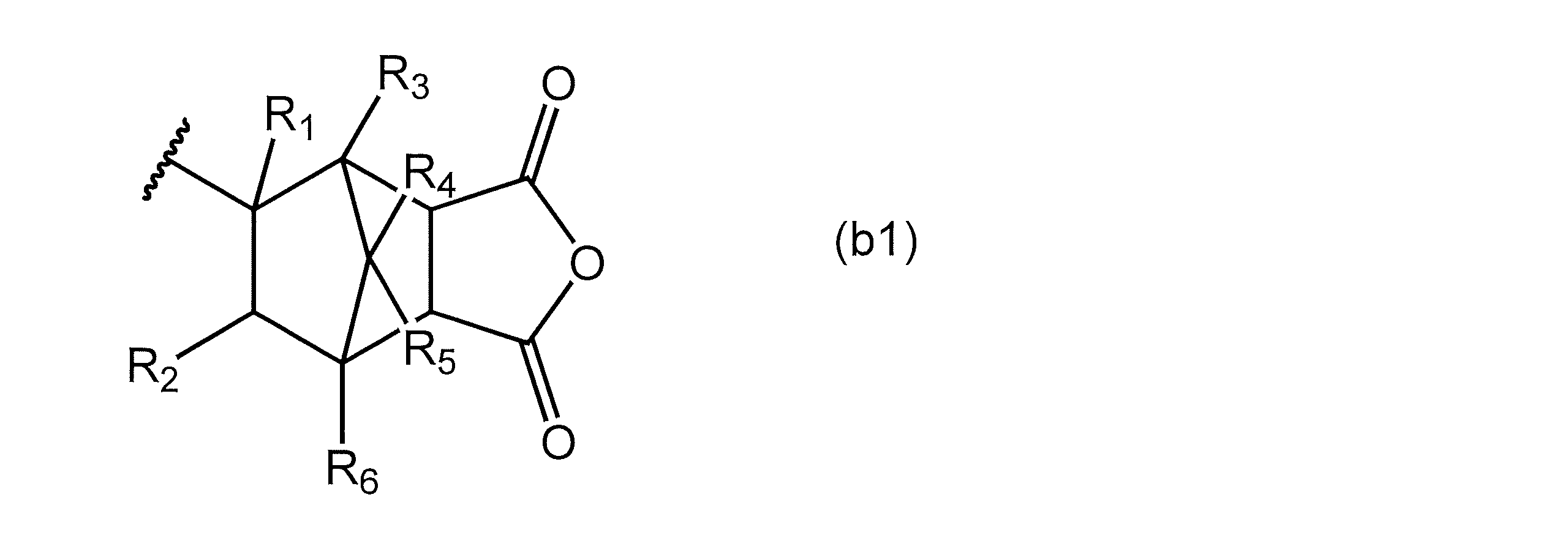
(R1~R6は、同一又は異なって、水素原子又は直鎖若しくは分岐状の炭素数1~4のアルキル基を示す。波線は結合部位を表す。)
で表される構造を有する基、又は下記式(b2)
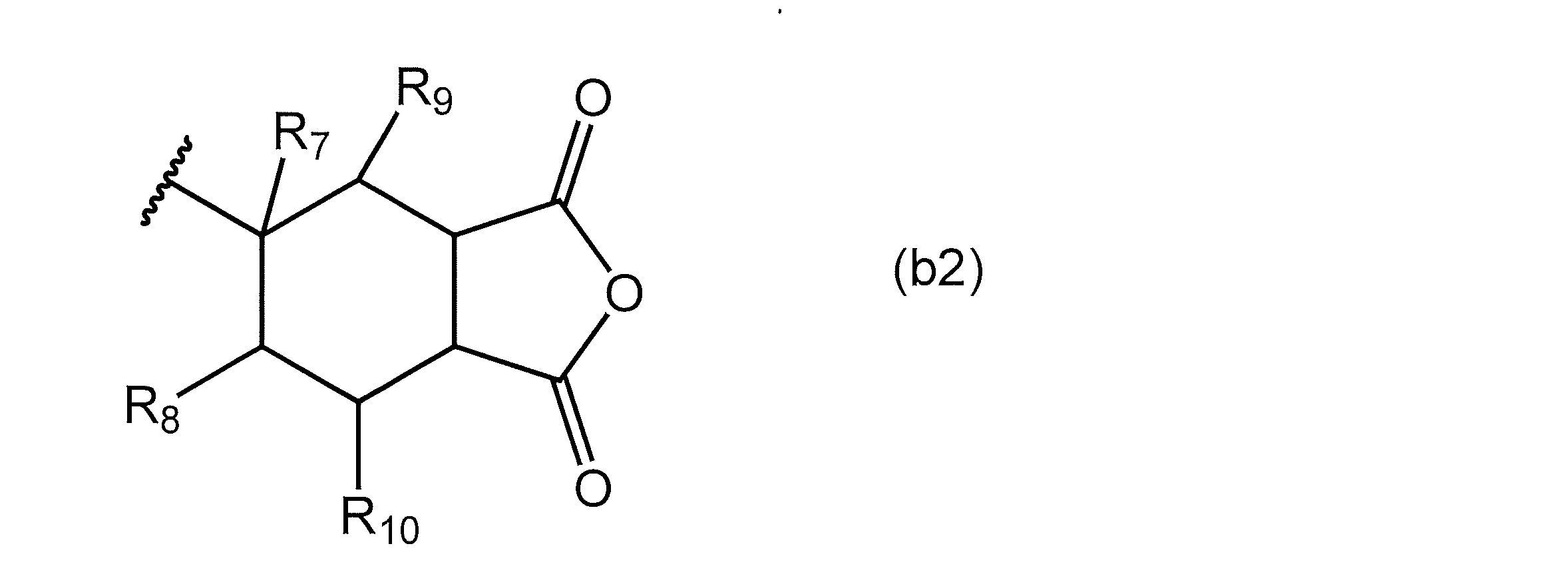
(R7~R10は、同一又は異なって、水素原子又は直鎖若しくは分岐状の炭素数1~4のアルキル基を示す。波線は結合部位を表す。)
で表される構造を有する基を示し、その1つ以上が式(b1)又は(b2)で表される構造を有する基である。Aは、置換基を有していてもよく、主鎖中及び/又は側鎖中にヘテロ原子を含む官能基を有していてもよい、炭素数2~50の、a価の直鎖又は分岐状炭化水素基である。aは2~6の整数を示す。]
で表される酸無水物及び下記式(B2)
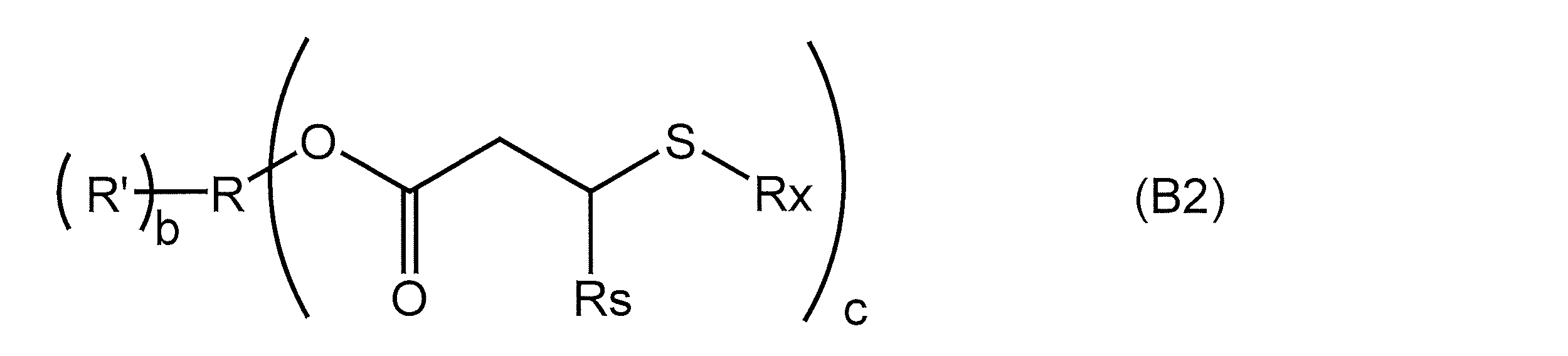
[式中、Rxは、同一又は異なって、水素原子、下記式(b1)
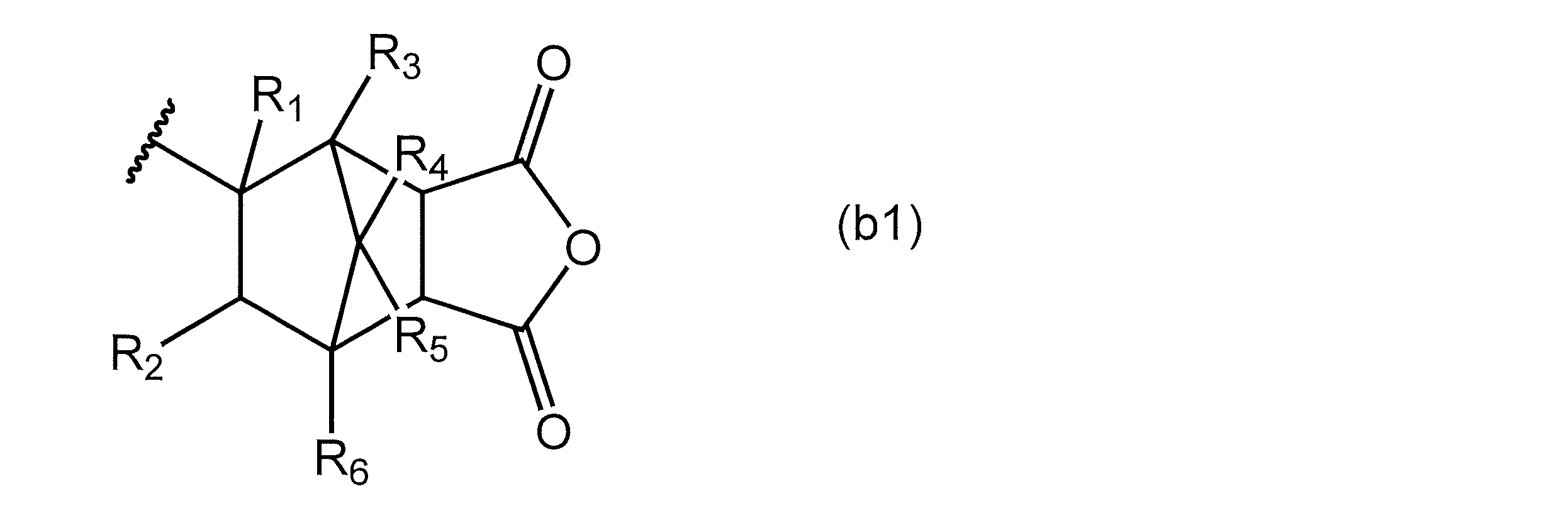
(R1~R6は、同一又は異なって、水素原子又は直鎖若しくは分岐状の炭素数1~4のアルキル基を示す。波線は結合部位を表す。)
で表される構造を有する基、又は下記式(b2)
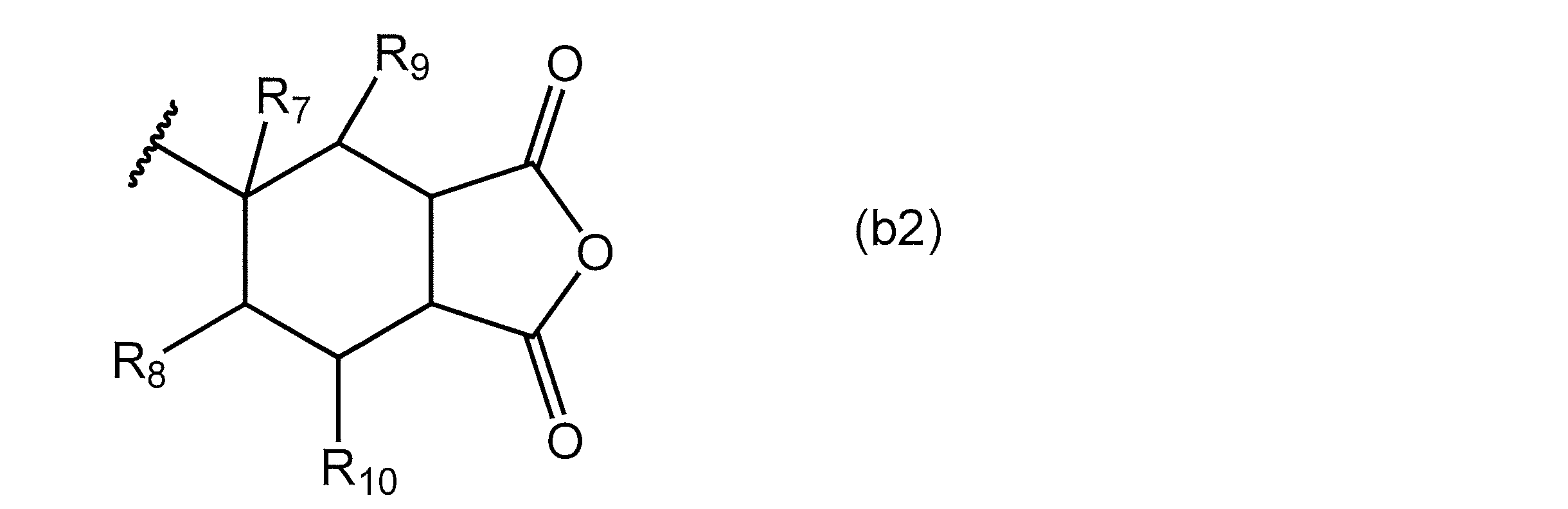
(R7~R10は、同一又は異なって、水素原子又は直鎖若しくは分岐状の炭素数1~4のアルキル基を示す。波線は結合部位を表す。)
で表される構造を有する基を示し、その1つ以上が式(b1)又は(b2)で表される構造を有する基である。Rsは、同一又は異なって、水素原子又はメチル基である。Rは、ヘテロ原子を含む官能基を有してもよい、炭素数2~28の、直鎖状、分岐状、又は環状の構造を有する(b+c)価の基である。R’は、同一又は異なって、水素原子、炭素数が1~8のアルキル基、チオール基、又は下記式(b3)

(式中、R11及びR12は、異なって、R11はチオール基又はメチル基を示し、R12は水素原子又はチオール基を示す。波線は結合部位を表す。)
で表される基を示す。bとcは、b+c=2~6であって、bは0を含む整数であり、cは1~6の整数を示す。]
で表される酸無水物からなる群より選択される少なくとも1つであることを特徴とする硬化性エポキシ樹脂組成物を提供する。
硬化剤(B)が、下記式(B1)
[式中、Rxは、同一又は異なって、水素原子、下記式(b1)
(R1~R6は、同一又は異なって、水素原子又は直鎖若しくは分岐状の炭素数1~4のアルキル基を示す。波線は結合部位を表す。)
で表される構造を有する基、又は下記式(b2)
(R7~R10は、同一又は異なって、水素原子又は直鎖若しくは分岐状の炭素数1~4のアルキル基を示す。波線は結合部位を表す。)
で表される構造を有する基を示し、その1つ以上が式(b1)又は(b2)で表される構造を有する基である。Aは、置換基を有していてもよく、主鎖中及び/又は側鎖中にヘテロ原子を含む官能基を有していてもよい、炭素数2~50の、a価の直鎖又は分岐状炭化水素基である。aは2~6の整数を示す。]
で表される酸無水物及び下記式(B2)
[式中、Rxは、同一又は異なって、水素原子、下記式(b1)
(R1~R6は、同一又は異なって、水素原子又は直鎖若しくは分岐状の炭素数1~4のアルキル基を示す。波線は結合部位を表す。)
で表される構造を有する基、又は下記式(b2)
(R7~R10は、同一又は異なって、水素原子又は直鎖若しくは分岐状の炭素数1~4のアルキル基を示す。波線は結合部位を表す。)
で表される構造を有する基を示し、その1つ以上が式(b1)又は(b2)で表される構造を有する基である。Rsは、同一又は異なって、水素原子又はメチル基である。Rは、ヘテロ原子を含む官能基を有してもよい、炭素数2~28の、直鎖状、分岐状、又は環状の構造を有する(b+c)価の基である。R’は、同一又は異なって、水素原子、炭素数が1~8のアルキル基、チオール基、又は下記式(b3)
(式中、R11及びR12は、異なって、R11はチオール基又はメチル基を示し、R12は水素原子又はチオール基を示す。波線は結合部位を表す。)
で表される基を示す。bとcは、b+c=2~6であって、bは0を含む整数であり、cは1~6の整数を示す。]
で表される酸無水物からなる群より選択される少なくとも1つであることを特徴とする硬化性エポキシ樹脂組成物を提供する。
前記式(B2)で表される酸無水物におけるRは、下記式(b4)~(b8)


(式中、nは1~10の整数を示す。波線は結合部位を示す。)
で表される基のいずれか1つであることが好ましい。
(式中、nは1~10の整数を示す。波線は結合部位を示す。)
で表される基のいずれか1つであることが好ましい。
前記脂環式エポキシ化合物(A)の脂環エポキシ基は、シクロヘキセンオキシド基であることが好ましい。
前記脂環式エポキシ化合物(A)は、下記式(I-1)
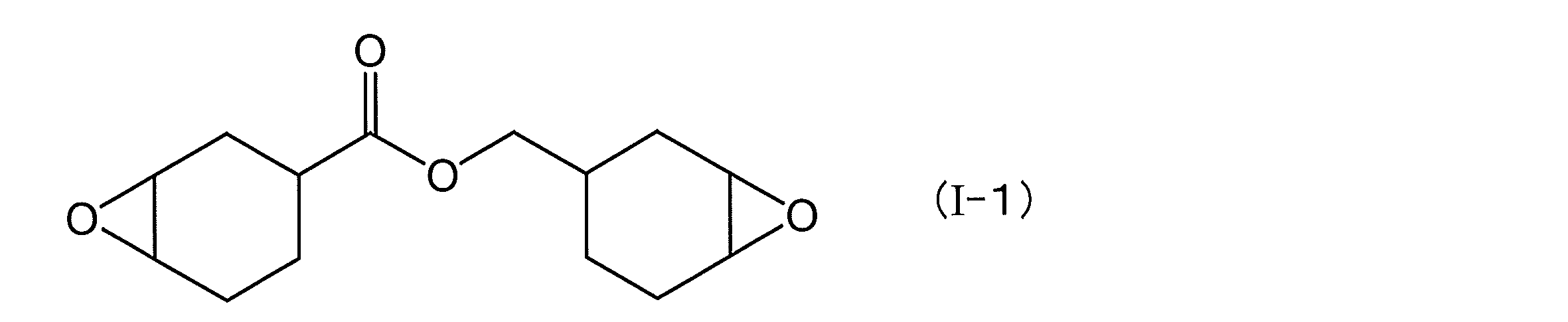
で表される化合物であることが好ましい。
で表される化合物であることが好ましい。
また、本発明では、前記硬化性エポキシ樹脂組成物の硬化物を提供する。
また、本発明では、前記硬化性エポキシ樹脂組成物を含む封止剤を提供する。
また、本発明では、前記硬化性エポキシ樹脂組成物を含む接着剤を提供する。
また、本発明では、前記硬化性エポキシ樹脂組成物を含むコーティング剤を提供する。
また、本発明では、前記硬化物を含む光学部材を提供する。
本発明の硬化性エポキシ樹脂組成物は上記構成を有するため、硬化させることにより、高い耐熱性、耐水性、及び柔軟性を備える硬化物を得ることができる。したがって、該樹脂組成物は、封止剤、接着剤、コーティング剤として使用することができる。また、その硬化物は光学部材として使用することができる。
<硬化性エポキシ樹脂組成物>
本発明の硬化性エポキシ樹脂組成物は、脂環式エポキシ化合物(A)と、硬化剤(B)と、硬化促進剤(C)を含み、硬化剤(B)が前記式(B1)で表される酸無水物及び前記式(B2)で表される酸無水物からなる群より選択される少なくとも1つであることを特徴とする。
本発明の硬化性エポキシ樹脂組成物は、脂環式エポキシ化合物(A)と、硬化剤(B)と、硬化促進剤(C)を含み、硬化剤(B)が前記式(B1)で表される酸無水物及び前記式(B2)で表される酸無水物からなる群より選択される少なくとも1つであることを特徴とする。
[脂環式エポキシ化合物(A)]
脂環式エポキシ化合物(脂環式エポキシ樹脂)(A)は、分子内(一分子中)に脂環(脂肪族炭化水素環)構造とエポキシ基(オキシラニル基)とを少なくとも有する化合物であり、公知乃至慣用の脂環式エポキシ化合物を使用することができる。脂環式エポキシ化合物(A)としては、より具体的には、例えば、脂環を構成する隣接する2つの炭素原子と酸素原子とで構成されるエポキシ基(脂環エポキシ基)を有する化合物(「化合物(A-1)」と称する場合がある)、脂環に直接単結合で結合しているエポキシ基を有する化合物(「化合物(A-2)」と称する場合がある)が挙げられる。
脂環式エポキシ化合物(脂環式エポキシ樹脂)(A)は、分子内(一分子中)に脂環(脂肪族炭化水素環)構造とエポキシ基(オキシラニル基)とを少なくとも有する化合物であり、公知乃至慣用の脂環式エポキシ化合物を使用することができる。脂環式エポキシ化合物(A)としては、より具体的には、例えば、脂環を構成する隣接する2つの炭素原子と酸素原子とで構成されるエポキシ基(脂環エポキシ基)を有する化合物(「化合物(A-1)」と称する場合がある)、脂環に直接単結合で結合しているエポキシ基を有する化合物(「化合物(A-2)」と称する場合がある)が挙げられる。
前記の化合物(A-1)としては、分子内に脂環エポキシ基を1つ以上有する公知乃至慣用の化合物を使用することができ、特に限定されない。上記脂環エポキシ基としては、硬化物の耐熱性の観点から、シクロヘキセンオキシド基が好ましい。特に、化合物(A-1)としては、硬化物の耐熱性の観点から、分子内に2つ以上のシクロヘキセンオキシド基を有する化合物が好ましく、より好ましくは下記式(I)で表される化合物である。

式(I)中、Xは単結合又は連結基(1以上の原子を有する二価の基)を示す。上記連結基としては、例えば、二価の炭化水素基、炭素-炭素二重結合の一部又は全部がエポキシ化されたアルケニレン基(「エポキシ化アルケニレン基」と称する場合がある)、カルボニル基、エーテル結合、エステル結合、カーボネート基、アミド基、及びこれらが複数個連結した基等が挙げられる。なお、式(I)におけるシクロヘキサン環(シクロヘキセンオキシド基)を構成する炭素原子の1以上には、アルキル基等の置換基が結合していてもよい。
式(I)中のXが単結合である化合物としては、(3,4,3',4'-ジエポキシ)ビシクロヘキシル等が挙げられる。
上記二価の炭化水素基としては、炭素数が1~18の直鎖又は分岐鎖状のアルキレン基、二価の脂環式炭化水素基等が挙げられる。炭素数が1~18の直鎖又は分岐鎖状のアルキレン基としては、例えば、メチレン基、メチルメチレン基、ジメチルメチレン基、エチレン基、プロピレン基、トリメチレン基等が挙げられる。上記二価の脂環式炭化水素基としては、例えば、1,2-シクロペンチレン基、1,3-シクロペンチレン基、シクロペンチリデン基、1,2-シクロヘキシレン基、1,3-シクロヘキシレン基、1,4-シクロヘキシレン基、シクロヘキシリデン基等のシクロアルキレン基(シクロアルキリデン基を含む)等が挙げられる。
上記炭素-炭素二重結合の一部又は全部がエポキシ化されたアルケニレン基(エポキシ化アルケニレン基)におけるアルケニレン基としては、例えば、ビニレン基、プロペニレン基、1-ブテニレン基、2-ブテニレン基、ブタジエニレン基、ペンテニレン基、ヘキセニレン基、ヘプテニレン基、オクテニレン基等の炭素数2~8の直鎖又は分岐鎖状のアルケニレン基等が挙げられる。特に、上記エポキシ化アルケニレン基としては、炭素-炭素二重結合の全部がエポキシ化されたアルケニレン基が好ましく、より好ましくは炭素-炭素二重結合の全部がエポキシ化された炭素数2~4のアルケニレン基である。
上記Xにおける連結基としては、特に、酸素原子を含有する連結基が好ましく、具体的には、-CO-、-O-CO-O-、-COO-、-O-、-CONH-、エポキシ化アルケニレン基;これらの基が複数個連結した基;これらの基の1又は2以上と二価の炭化水素基の1又は2以上とが連結した基等が挙げられる。二価の炭化水素基としては上記で例示したものが挙げられる。
式(I)で表される化合物の代表的な例としては、下記式(I-1)~(I-10)で表される化合物、2,2-ビス(3,4-エポキシシクロヘキサン-1-イル)プロパン、1,2-ビス(3,4-エポキシシクロヘキサン-1-イル)エタン、1,2-エポキシ-1,2-ビス(3,4-エポキシシクロヘキサン-1-イル)エタン、ビス(3,4-エポキシシクロヘキシルメチル)エーテル等が挙げられる。なお、下記式(I-5)、(I-7)中のl'、m'は、それぞれ1~30の整数を表す。下記式(I-5)中のRは炭素数1~8のアルキレン基であり、メチレン基、エチレン基、プロピレン基、イソプロピレン基、ブチレン基、イソブチレン基、s-ブチレン基、ペンチレン基、ヘキシレン基、ヘプチレン基、オクチレン基等の直鎖又は分岐鎖状のアルキレン基が挙げられる。これらの中でも、メチレン基、エチレン基、プロピレン基、イソプロピレン基等の炭素数1~3の直鎖又は分岐鎖状のアルキレン基が好ましい。下記式(I-9)、(I-10)中のn1~n6は、それぞれ1~30の整数を示す。
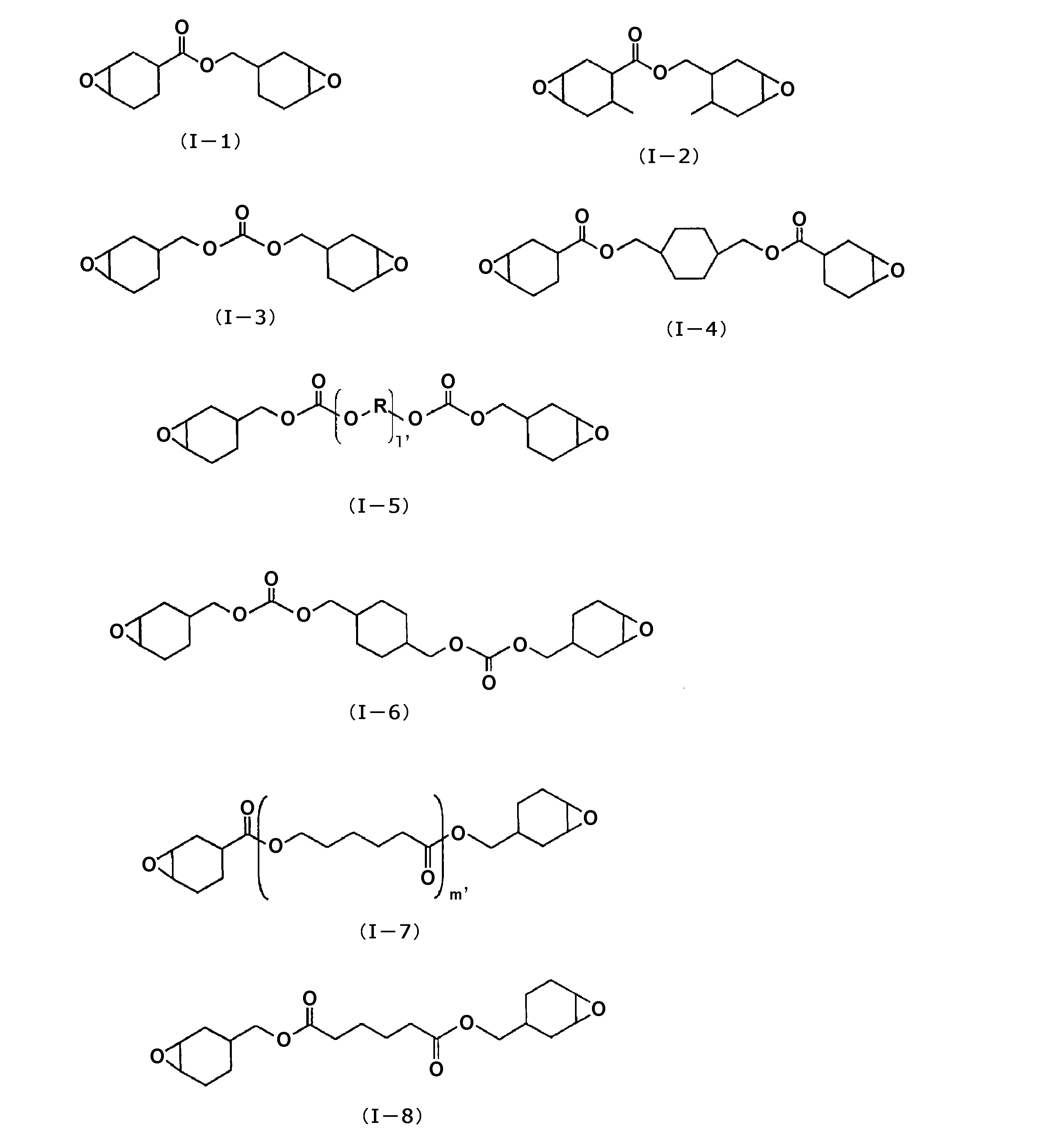
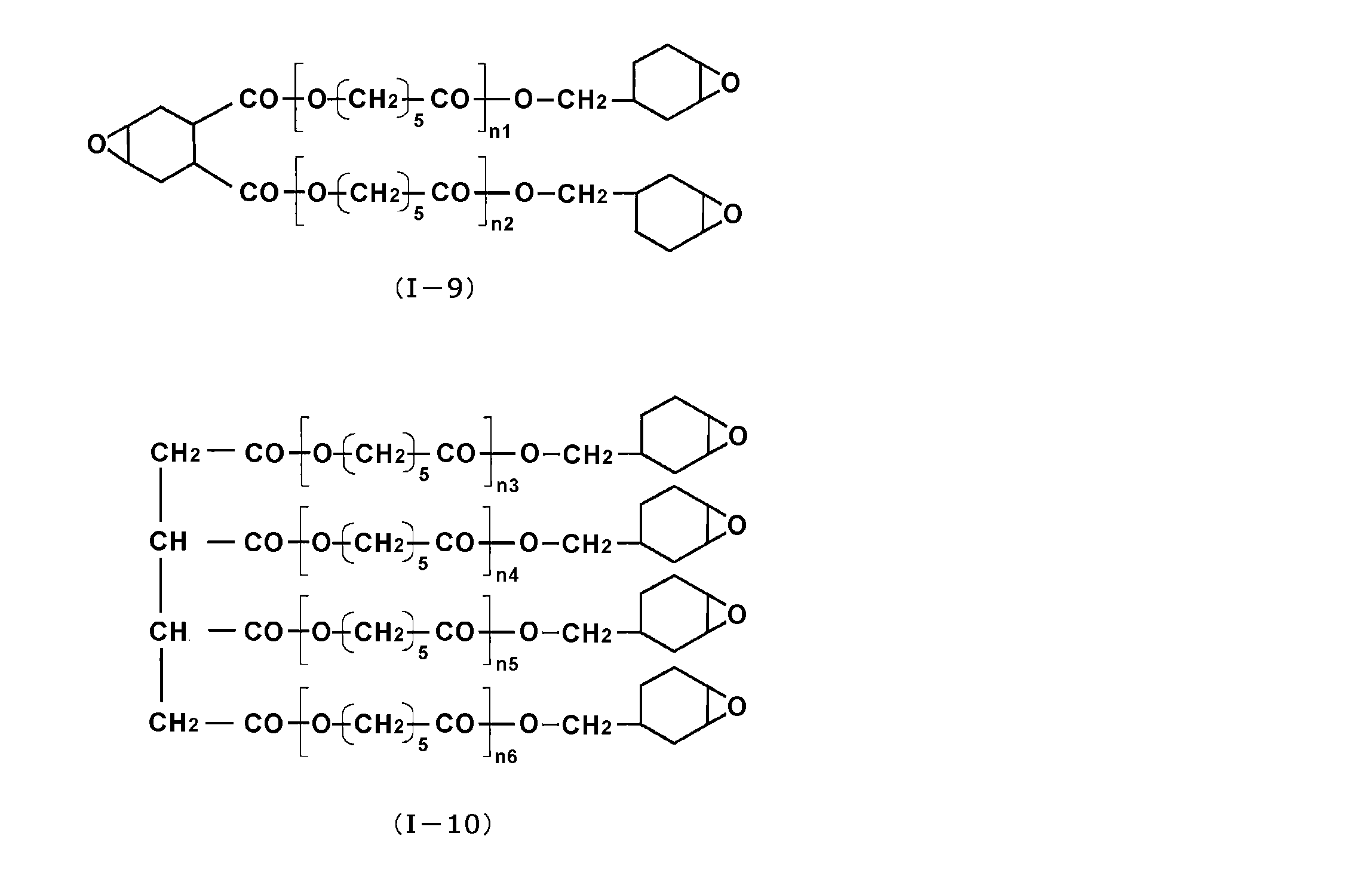
化合物(A-2)としては、例えば、下記式(II)で表される化合物(エポキシ樹脂)が挙げられる。
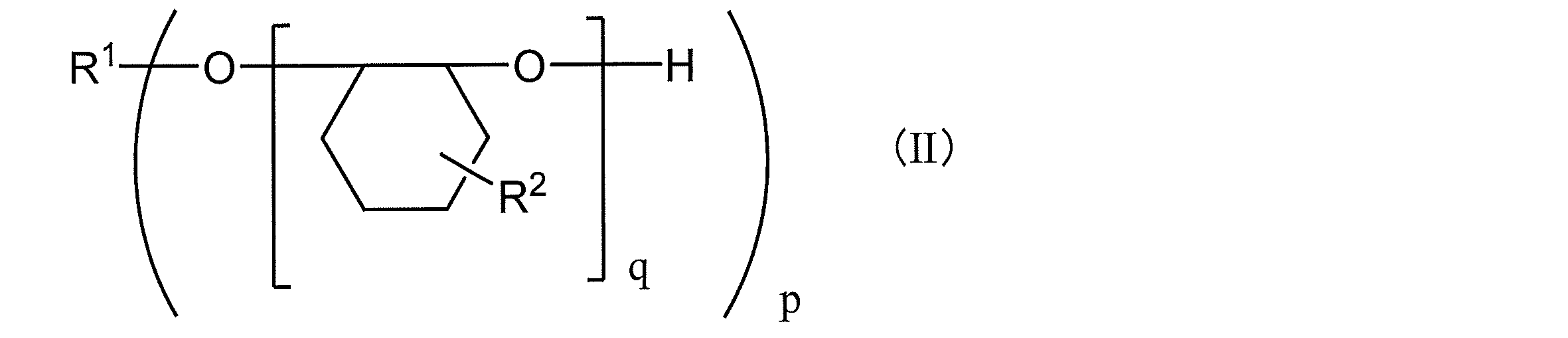
式(II)中、R1はp価の有機基を示す。pは、1~20の整数を示す。p価の有機基としては、例えば、後述のp個のヒドロキシ基を有する有機化合物の構造式からp個のヒドロキシ基を除いて形成された構造を有するp価の有機基等が挙げられる。
式(II)中、qは、1~50の整数を示す。なお、pが2以上の整数の場合、複数のqは同一であってもよいし、異なっていてもよい。式(II)におけるqの和(総和)は、3~100の整数である。
式(II)中、R2は、式中に示されるシクロヘキサン環上の置換基であり、下記式(IIa)~(IIc)で表される基のいずれかを示す。上記シクロヘキサン環上のR2の結合位置は特に限定されないが、通常、酸素原子と結合するシクロヘキサン環の2つの炭素原子の位置を1位、2位とした場合、4位又は5位の炭素原子である。また、式(II)で表される化合物が複数のシクロヘキサン環を有する場合、それぞれのシクロヘキサン環におけるR2の結合位置は同一であってもよいし、異なっていてもよい。式(II)におけるR2の少なくとも1つは、式(IIa)で表される基(エポキシ基)である。なお、式(II)で表される化合物が2以上のR2を有する場合、複数のR2は同一であってもよいし、異なっていてもよい。



式(IIc)中、R3は、水素原子、置換若しくは無置換のアルキル基、置換若しくは無置換のアルキルカルボニル基、又は置換若しくは無置換のアリールカルボニル基を示す。上記アルキル基としては、例えば、メチル基、エチル基、n-プロピル基、イソプロピル基、ブチル基、イソブチル基、s-ブチル基、t-ブチル基、ペンチル基、ヘキシル基、オクチル基、2-エチルヘキシル基等の炭素数1~20の直鎖又は分岐鎖状のアルキル基等が挙げられる。上記アルキルカルボニル基としては、例えば、メチルカルボニル基(アセチル基)、エチルカルボニル基、n-プロピルカルボニル基、イソプロピルカルボニル基、n-ブチルカルボニル基、イソブチルカルボニル基、s-ブチルカルボニル基、t-ブチルカルボニル基等の炭素数1~20の直鎖又は分岐鎖状のアルキル-カルボニル基等が挙げられる。上記アリールカルボニル基としては、例えば、フェニルカルボニル基(ベンゾイル基)、1-ナフチルカルボニル基、2-ナフチルカルボニル基等の炭素数6~20のアリール-カルボニル基等が挙げられる。
上述のアルキル基、アルキルカルボニル基、アリールカルボニル基が有していてもよい置換基としては、例えば、炭素数0~20(より好ましくは炭素数0~10)の置換基等が挙げられる。上記置換基としては、例えば、フッ素原子、塩素原子、臭素原子、ヨウ素原子等のハロゲン原子;ヒドロキシ基;メトキシ基、エトキシ基、プロポキシ基、イソプロピルオキシ基、ブトキシ基、イソブチルオキシ基等のアルコキシ基(好ましくはC1-6アルコキシ基、より好ましくはC1-4アルコキシ基);アリルオキシ基等のアルケニルオキシ基(好ましくはC2-6アルケニルオキシ基、より好ましくはC2-4アルケニルオキシ基);アセチルオキシ基、プロピオニルオキシ基、(メタ)アクリロイルオキシ基等のアシルオキシ基(好ましくはC1-12アシルオキシ基);メルカプト基;メチルチオ基、エチルチオ基等のアルキルチオ基(好ましくはC1-6アルキルチオ基、より好ましくはC1-4アルキルチオ基);アリルチオ基等のアルケニルチオ基(好ましくはC2-6アルケニルチオ基、より好ましくはC2-4アルケニルチオ基);カルボキシ基;メトキシカルボニル基、エトキシカルボニル基、プロポキシカルボニル基、ブトキシカルボニル基等のアルコキシカルボニル基(好ましくはC1-6アルコキシ-カルボニル基);アミノ基;メチルアミノ基、エチルアミノ基、ジメチルアミノ基、ジエチルアミノ基等のモノ又はジアルキルアミノ基(好ましくはモノ又はジ-C1-6アルキルアミノ基);アセチルアミノ基、プロピオニルアミノ基等のアシルアミノ基(好ましくはC1-11アシルアミノ基);エチルオキセタニルオキシ基等のオキセタニル基含有基;アセチル基、プロピオニル基等のアシル基;オキソ基;これらの2以上が必要に応じてC1-6アルキレン基を介して結合した基等が挙げられる。また、上述のアリールカルボニル基が有していてもよい置換基としては、さらに、上記置換若しくは無置換のアルキル基、上記置換若しくは無置換のアルキルカルボニル基も挙げられる。
式(II)で表される化合物におけるR2の全量(100モル%)に対する、式(IIa)で表される基(エポキシ基)の割合は、特に限定されないが、40モル%以上(例えば、40~100モル%)が好ましく、より好ましくは60モル%以上、さらに好ましくは80モル%以上である。上記割合が40モル%以上であると、硬化物の耐熱性がより向上する傾向がある。なお、上記割合は、例えば、1H-NMRスペクトル測定や、オキシラン酸素濃度測定等により算出することができる。
式(II)で表される化合物は、特に限定されないが、例えば、分子内にp個のヒドロキシ基を有する有機化合物[R1(OH)p]を開始剤として(すなわち、当該化合物のヒドロキシ基(活性水素)を出発点として)、1,2-エポキシ-4-ビニルシクロヘキサン(3-ビニル-7-オキサビシクロ[4.1.0]ヘプタン)を開環重合(カチオン重合)させ、その後、酸化剤によりエポキシ化することによって製造される。
上記分子内にp個のヒドロキシ基を有する有機化合物[R1(OH)p]としては、例えば、メタノール、エタノール、プロパノール、ブタノール、ペンタノール、ヘキサノール、オクタノール等の脂肪族アルコール;エチレングリコール、ジエチレングリコール、トリエチレングリコール、ポリエチレングリコール、プロピレングリコール、ジプロピレングリコール、1,3-ブタンジオール、1,4-ブタンジオール、ペンタンジオール、1,6-ヘキサンジオール、ネオペンチルグリコール、ネオペンチルグリコールエステル、シクロヘキサンジメタノール、グリセリン、ジグリセリン、ポリグリセリン、トリメチロールプロパン、ペンタエリスリトール、ジペンタエリスリトール、水添ビスフェノールA、水添ビスフェノールF、水添ビスフェノールS等の多価アルコール;ポリビニルアルコール、ポリ酢酸ビニル部分加水分解物、デンプン、アクリルポリオール樹脂、スチレン-アリルアルコール共重合樹脂、ポリエステルポリオール、ポリカプロラクトンポリオール、ポリプロピレンポリオール、ポリテトラメチレングリコール、ポリカーボネートポリオール類、ヒドロキシ基を有するポリブタジエン、セルロース、セルロースアセテート、セルロースアセテートブチレート、ヒドロキシエチルセルロース等のセルロース系ポリマー等のヒドロキシ基を有するオリゴマー又はポリマー等が挙げられる。
上記1,2-エポキシ-4-ビニルシクロヘキサンは、公知乃至慣用の方法により製造でき、特に限定されないが、例えば、ブタジエンの二量化反応によって得られる4-ビニルシクロヘキセンを、過酢酸等の酸化剤を使用して部分エポキシ化することによって得られる。また、1,2-エポキシ-4-ビニルシクロヘキサンとしては、市販品を使用することもできる。
また、上記酸化剤としては、過酸化水素や有機過酸等の公知乃至慣用の酸化剤を使用することができ、特に限定されないが、例えば、有機過酸としては、過ギ酸、過酢酸、過安息香酸、トリフルオロ過酢酸等が挙げられる。中でも、過酢酸は工業的に安価に入手可能であり、かつ安定度も高いため、好ましい。
なお、前記の開環重合及びエポキシ化は、より具体的には、例えば、特開昭60-161973号公報等に記載の周知慣用の方法に従って実施することができる。
式(II)で表される化合物の標準ポリスチレン換算の重量平均分子量は、特に限定されないが、300~100000が好ましく、より好ましくは1000~10000である。重量平均分子量が300以上であると、硬化物の耐熱性が向上する傾向がある。一方、重量平均分子量が100000以下であると、粘度が高くなり過ぎず成型時の流動性を低く維持しやすい傾向がある。なお、重量平均分子量は、ゲルパーミエーションクロマトグラフィー(GPC)法により測定される。
式(II)で表される化合物のエポキシ基の当量(エポキシ当量)は、特に限定されないが、50~1000が好ましく、より好ましくは100~500である。エポキシ当量が50以上であると、硬化物が脆くなりにくい傾向がある。一方、エポキシ当量が1000以下であると、硬化物の機械強度が向上する傾向がある。なお、エポキシ当量は、JIS K7236:2001に準じて測定される。
脂環式エポキシ化合物(A)としては、硬化物の耐熱性の観点から、化合物(A-1)、化合物(A-2)が好ましい。また、化合物(A-1)としては、硬化物の耐熱性の観点から、式(I-1)で表される化合物[3,4-エポキシシクロヘキシルメチル(3,4-エポキシ)シクロヘキサンカルボキシレート;例えば、商品名「セロキサイド2021P」((株)ダイセル製)]が特に好ましい。
脂環式エポキシ化合物(A)は、一種を単独で使用することもできるし、二種以上を組み合わせて使用することもできる。また、脂環式エポキシ化合物(A)は、公知乃至慣用の方法により製造することもできるし、例えば、商品名「セロキサイド2021P」、「セロキサイド2081」(以上、(株)ダイセル製)等の市販品を使用することもできる。
脂環式エポキシ化合物(A)の含有量(配合量)は、特に限定されないが、硬化性エポキシ樹脂組成物(100重量%)に対して、1~90重量%が好ましく、より好ましくは10~80重量%、さらに好ましくは20~70重量%、特に好ましくは20~60重量%である。脂環式エポキシ化合物(A)を上記範囲内で使用することにより、硬化物の耐熱性、耐水性、柔軟性が向上する傾向がある。なお、本明細書において、本発明の硬化性エポキシ樹脂組成物に含まれる各成分(例えば、脂環式エポキシ化合物(A)、硬化剤(B)、硬化促進剤(C)等)の含有量は、それぞれ、合計が100重量%以下となるように、記載の範囲内から適宜選択することができる。
[硬化剤(B)]
硬化剤(B)は、下記式(B1)

[式中、Rxは、同一又は異なって、水素原子、下記式(b1)

(R1~R6は、同一又は異なって、水素原子又は直鎖若しくは分岐鎖状の炭素数1~4のアルキル基を示す。波線は結合部位を表す。)
で表される構造を有する基、又は下記式(b2)
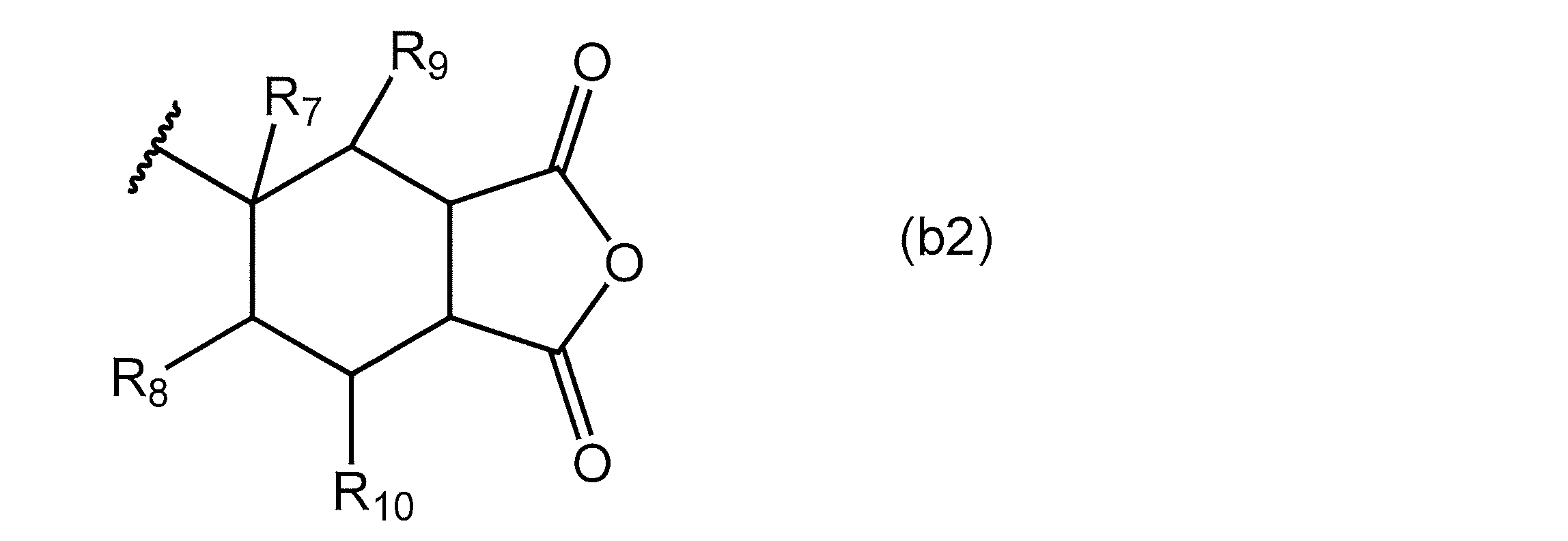
(R7~R10は、同一又は異なって、水素原子又は直鎖若しくは分岐鎖状の炭素数1~4のアルキル基を示す。波線は結合部位を表す。)
で表される構造を有する基を示し、その1つ以上が式(b1)又は(b2)で表される構造を有する基である。Aは、置換基を有していてもよく、主鎖中及び/又は側鎖中にヘテロ原子を含む官能基を有していてもよい、炭素数2~50の、a価の直鎖又は分岐鎖状炭化水素基である。aは2~6の整数を示す。]
で表される酸無水物及び下記式(B2)

[式中、Rxは、同一又は異なって、水素原子、下記式(b1)
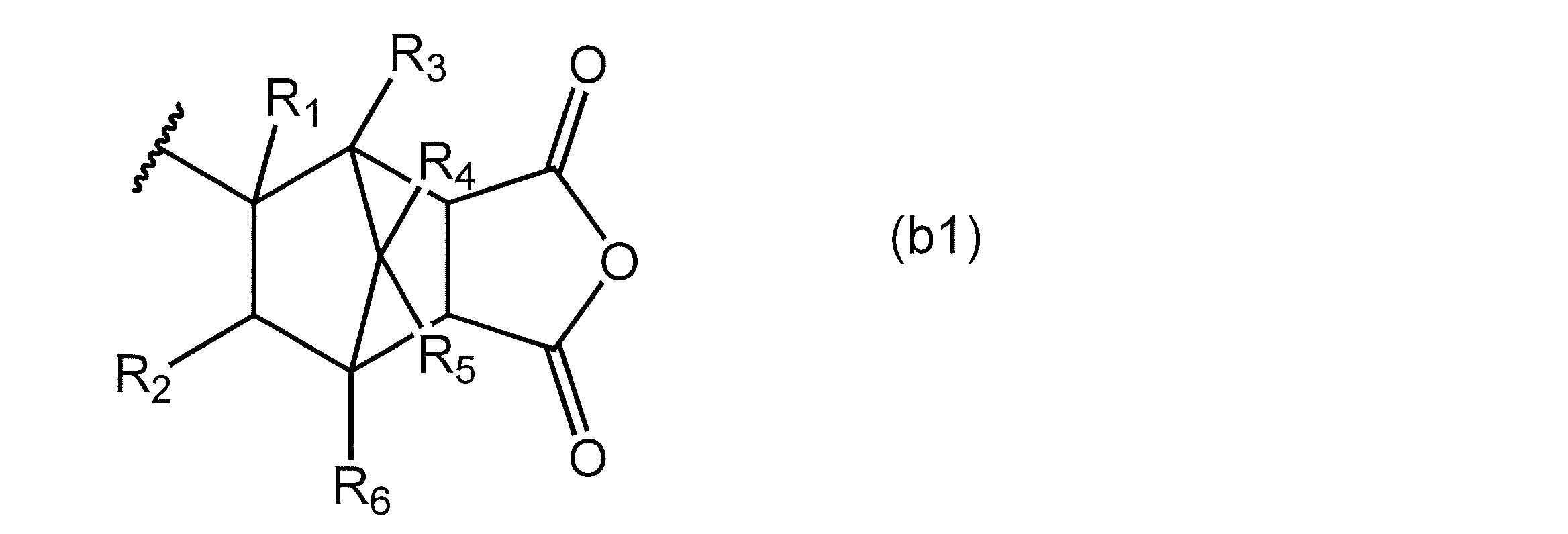
(R1~R6は、同一又は異なって、水素原子又は直鎖若しくは分岐鎖状の炭素数1~4のアルキル基を示す。波線は結合部位を表す。)
で表される構造を有する基、又は下記式(b2)

(R7~R10は、同一又は異なって、水素原子又は直鎖若しくは分岐鎖状の炭素数1~4のアルキル基を示す。波線は結合部位を表す。)
で表される構造を有する基を示し、その1つ以上が式(b1)又は(b2)で表される構造を有する基である。Rsは、同一又は異なって、水素原子又はメチル基である。Rは、ヘテロ原子を含む官能基を有してもよい、炭素数2~28の、直鎖状、分岐鎖状、又は環状の構造を有する(b+c)価の基である。R’は、同一又は異なって、水素原子、炭素数が1~8のアルキル基、チオール基、又は下記式(b3)

(式中、R11及びR12は、異なって、R11はチオール基又はメチル基を示し、R12は水素原子又はチオール基を示す。波線は結合部位を表す。)
で表される基を示す。bとcは、b+c=2~6であって、bは0を含む整数であり、cは1~6の整数を示す。]
で表される酸無水物からなる群より選択される少なくとも1つである。すなわち、硬化剤(B)は分子中に1又は2以上(2~6)の-S-Rx基を有する酸無水物である。
硬化剤(B)は、下記式(B1)
[式中、Rxは、同一又は異なって、水素原子、下記式(b1)
(R1~R6は、同一又は異なって、水素原子又は直鎖若しくは分岐鎖状の炭素数1~4のアルキル基を示す。波線は結合部位を表す。)
で表される構造を有する基、又は下記式(b2)
(R7~R10は、同一又は異なって、水素原子又は直鎖若しくは分岐鎖状の炭素数1~4のアルキル基を示す。波線は結合部位を表す。)
で表される構造を有する基を示し、その1つ以上が式(b1)又は(b2)で表される構造を有する基である。Aは、置換基を有していてもよく、主鎖中及び/又は側鎖中にヘテロ原子を含む官能基を有していてもよい、炭素数2~50の、a価の直鎖又は分岐鎖状炭化水素基である。aは2~6の整数を示す。]
で表される酸無水物及び下記式(B2)
[式中、Rxは、同一又は異なって、水素原子、下記式(b1)
(R1~R6は、同一又は異なって、水素原子又は直鎖若しくは分岐鎖状の炭素数1~4のアルキル基を示す。波線は結合部位を表す。)
で表される構造を有する基、又は下記式(b2)
(R7~R10は、同一又は異なって、水素原子又は直鎖若しくは分岐鎖状の炭素数1~4のアルキル基を示す。波線は結合部位を表す。)
で表される構造を有する基を示し、その1つ以上が式(b1)又は(b2)で表される構造を有する基である。Rsは、同一又は異なって、水素原子又はメチル基である。Rは、ヘテロ原子を含む官能基を有してもよい、炭素数2~28の、直鎖状、分岐鎖状、又は環状の構造を有する(b+c)価の基である。R’は、同一又は異なって、水素原子、炭素数が1~8のアルキル基、チオール基、又は下記式(b3)
(式中、R11及びR12は、異なって、R11はチオール基又はメチル基を示し、R12は水素原子又はチオール基を示す。波線は結合部位を表す。)
で表される基を示す。bとcは、b+c=2~6であって、bは0を含む整数であり、cは1~6の整数を示す。]
で表される酸無水物からなる群より選択される少なくとも1つである。すなわち、硬化剤(B)は分子中に1又は2以上(2~6)の-S-Rx基を有する酸無水物である。
上述の通り、エポキシ樹脂の硬化剤として、酸無水物とチオール化合物とを併用して使用することは公知である。しかし、不飽和基を有する酸無水物とチオール化合物との反応において、式(B1)で表される酸無水物又は式(B2)で表される酸無水物を得るためには、エンチオール反応によりスルフィド結合を生成するための操作(例えば、紫外線の照射やラジカル反応による付加反応)が必要であり、単に混合することのみでは得ることは不可能である。
さらに、酸無水物とチオール化合物とを併用して使用した場合と比較して、式(B1)で表される酸無水物又は式(B2)で表される酸無水物を使用した場合は、硬化剤としての性能が良好である。本発明者は、脂環式エポキシ化合物(A)に対し、硬化剤として式(B1)で表される酸無水物又は式(B2)で表される酸無水物を配合して得られた硬化性エポキシ樹脂組成物が、柔軟性に優れ、高温高湿下における優れた耐久性を有する硬化物を形成可能であることを見出して本発明を完成した。このような優れた効果が得られるのは、式(B1)で表される酸無水物及び式(B2)で表される酸無水物由来の構造により架橋密度を上げることができ、その結果として耐熱性が維持されることに加え、スルフィド結合を骨格内に導入することで柔軟性が付与されているためであると推測される。
以下、式(B1)で表される酸無水物及び式(B2)で表される酸無水物の構成単位である、式(b9)、式(b10)、式(b11)、式(b12)で表される化合物について説明する。
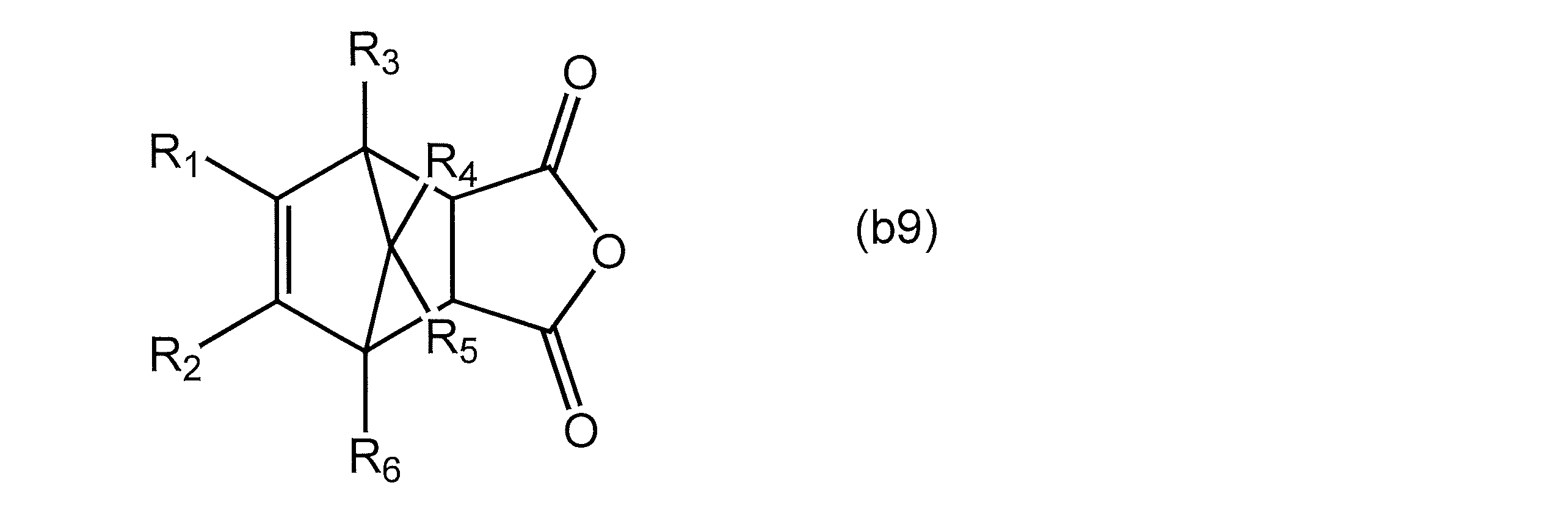
式中、R1~R6は、同一又は異なって、水素原子又は直鎖若しくは分岐鎖状の炭素数1~4のアルキル基を示す。
式(b9)で表される化合物は、5-ノルボルネン-2,3-ジカルボン酸無水物又はその誘導体である。式(b9)で表される化合物は、硬化物の耐湿性、耐吸湿リフロー性の観点で、R1~R6のうち0~4個(特に0~2個)がメチル基である化合物が好ましく、より好ましくはメチルノルボルネン2,3-ジカルボン酸無水物、ノルボルネン2,3-ジカルボン酸無水物である。
式(b9)で表される化合物のノルボルネン骨格には、エキソ体とエンド体の立体異性体が存在する。式(b9)で表される化合物において、エキソ体の存在比率が増加すると、室温で液状となりやすいため、取り扱いが容易となる傾向がある。したがって、式(b9)で表される化合物としては、そのエキソ体の存在比率が高いことが好ましい。より詳しくは、式(b9)で表される化合物中のエキソ体の存在比率[エキソ体/(エキソ体+エンド体)]は、40重量%以上が好ましく、より好ましくは50重量%以上である。エキソ体の存在比率が40重量%未満であると、式(3)で表される化合物が室温で固体となりやすく、取り扱いが困難となる傾向がある。エキソ体の存在比率を40重量%以上とする方法は、特に限定されないが、下記の具体例で述べるように、式(b9)で表される化合物においてエキソ体への異性化を進行させておく方法等が挙げられる。
なお、本明細書における上記「メチルノルボルネン2,3-ジカルボン酸無水物」は、ノルボルネン環上のメチル基の結合位置が異なる各異性体の総称である。メチルノルボルネン2,3-ジカルボン酸無水物の代表的な例としては、5-メチルノルボルネン2,3-ジカルボン酸無水物等が挙げられる。
ノルボルネン2,3-ジカルボン酸無水物は、例えば、シクロペンタジエンと無水マレイン酸のディールスアルダー反応により得られる。通常、シクロペンタジエンと無水マレイン酸のディールスアルダー反応により得られるノルボルネン-2,3-ジカルボン酸無水物は、エンド体の存在比率が95重量%以上であるため、150℃以上に加熱してエキソ体に異性化(熱異性化)させることで、エキソ体の存在比率が多いノルボルネン2,3-ジカルボン酸無水物(例えば、エキソ体の存在比率が30重量%以上のノルボルネン2,3-ジカルボン酸無水物)を生成させることができる。式(b9)で表される化合物の市販品としては、5-ノルボルネン-2,3-ジカルボン酸無水物、商品名「MHAC-P」((株)日立化成製)等を挙げることができる。
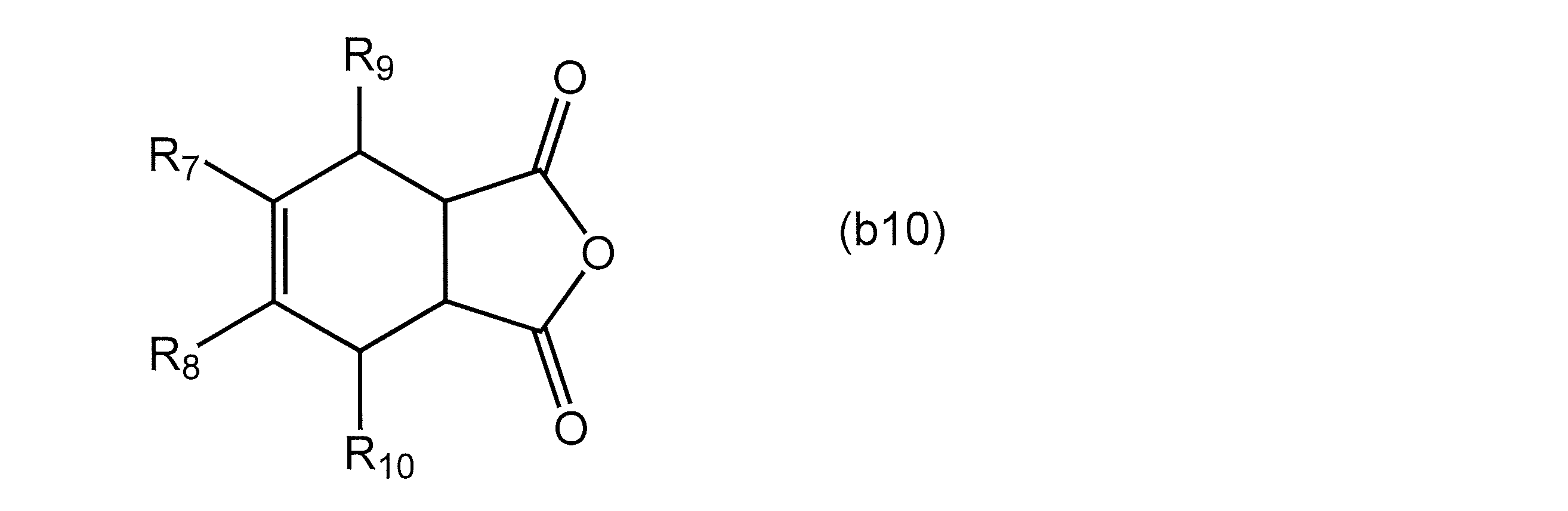
式中、R7~R10は、同一又は異なって、水素原子又は直鎖若しくは分岐鎖状の炭素数1~4のアルキル基を示す。
式(b10)で表される化合物は、1,2,3,6-テトラヒドロフタル酸無水物又はその誘導体である。誘導体としては、各種アルキル置換物を挙げることができる。例えば、メチルテトラヒドロ無水フタル酸(4-メチルテトラヒドロ無水フタル酸、3-メチルテトラヒドロ無水フタル酸等)等を挙げることができる。このような化合物の市販品としては、商品名「HN-2200」、「HN-2000」(以上、(株)日立化成製)等を挙げることができる。
なお、後述の式(b11)で表される化合物との反応性や、エポキシ樹脂硬化剤として使用した際の性能等の観点からみて、式(b9)で表される化合物は、式(b10)で表される化合物よりも好ましい。

式中、Aは、置換基を有していてもよく、主鎖中及び/又は側鎖中にヘテロ原子を含む官能基を有していてもよい、炭素数2~50の、d価の直鎖又は分岐鎖状炭化水素基である。dは、2~6の整数を表す。
式(b11)で表される化合物は、複数のチオール基を有する有機化合物である。Aにおいて、主鎖中及び/又は側鎖中にヘテロ原子を含む官能基を有していてもよいとは、例えば、炭化水素基を構成する2以上の炭素原子間にヘテロ原子を有すること等を意味する。
式(b11)で表される化合物において、Aは、エンチオール反応に直接の影響を与えない炭化水素基であれば、任意のものを使用することができる。
Aで表される炭化水素としては、特に限定されず、炭素数2~50の、a価の直鎖又は分岐鎖状炭化水素基であり、主鎖中及び/又は側鎖中にヘテロ原子を含む官能基を有しているものであってもよい。炭素数は、5以上であることがより好ましく、14以上であることが最も好ましい。また、炭素数は36以下であることがより好ましく、28以下であることが最も好ましい。A中に存在していてもよい置換基としては、例えば、エーテル基、エステル基、環状炭化水素構造を有する基、ウリル基、複素環構造を有する基、スルフィド基、アミノ基、アミド基、ウレタン基、ケトン基等を挙げることができる。これらのうち、2以上の構造を有するものであってもよい。これらの官能基は、側鎖官能基として存在するものであってもよいし、主鎖の一部を形成する官能基であってもよい。
A中に存在していてもよい置換基として例示した環状炭化水素構造を有する基には、ベンゼン環、ナフタレン環等の芳香族環を有する基であっても、シクロヘキサン環等の脂肪族環を有する基であってもよい。複素環構造を有する基としては、1,3,5-トリアジン環を有する基、1,3,4,6-グリコールウリル環を有する基等の任意の基が挙げられる。これらの置換基は、主鎖中に存在するものであっても、側鎖中に存在するものであってもよい。
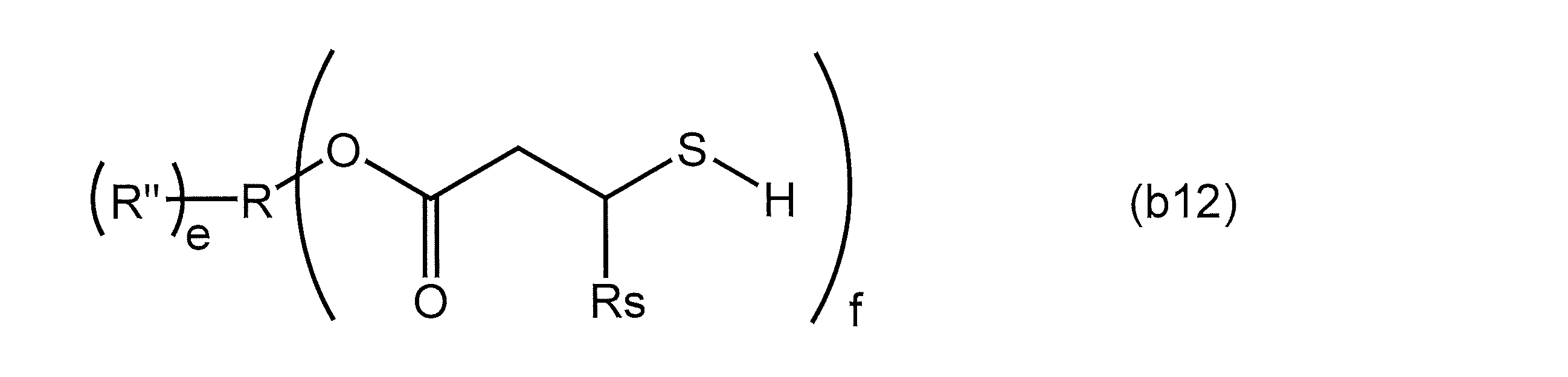
式中、Rsは、同一又は異なって、水素原子又はメチル基である。Rは、ヘテロ原子を含む官能基を有してもよい、炭素数2~28の、直鎖状、分岐鎖状、又は環状の構造を有する(e+f)価の基である。R’’は、同一又は異なって、水素原子、炭素数が1~8のアルキル基、チオール基、又は下記式(b3)で表される基を示す。eとfは、e+f=2~6であって、eは0を含む整数であり、fは1~6の整数を示す。
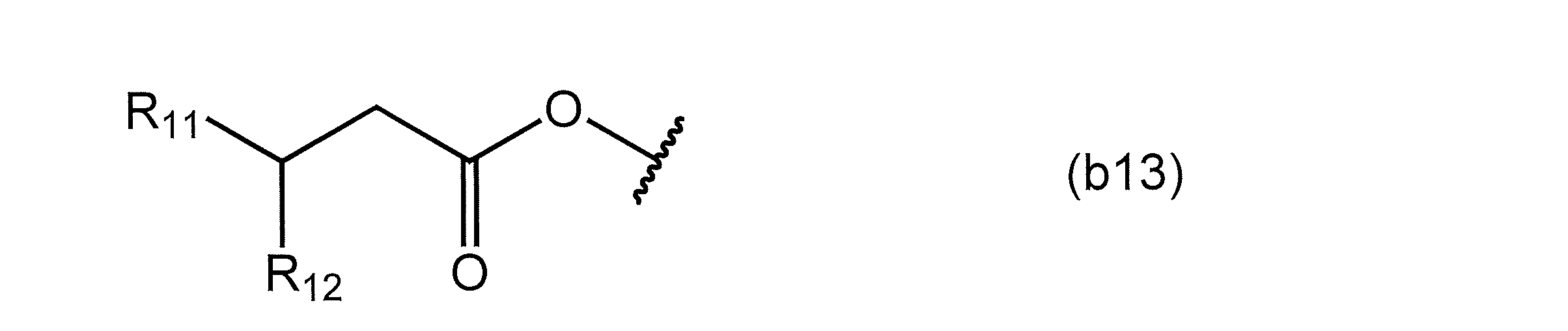
式中、R11及びR12は、異なって、R11はチオール基又はメチル基を示し、R12は水素原子又はチオール基を示す。波線は結合部位を表す。
式(b12)で表される化合物は、式(b11)で表される化合物と同様に、複数のチオール基を有する有機化合物である。Rにおいて、ヘテロ原子を含む官能基を有していてもよいとは、例えば、炭化水素基を構成する2以上の炭素原子間にヘテロ原子を有していてもよい場合などが挙げられる。
R中には、反応性に悪影響を与えない限りは、任意のヘテロ原子を含む官能基を有していてもよい。前記官能基としては、例えば、エーテル基、エステル基、少なくとも1つの炭素原子がヘテロ原子に置換された環状炭化水素構造を有する基、ウリル基、複素環構造を有する基、スルフィド基、アミノ基、アミド基、ウレタン基、ケトン基等が挙げられる。
Rの、炭素数2~28の、直鎖状、分岐鎖状、又は環状の構造を有する(e+f)価の基とは、例えば、炭素数2~28の炭化水素基が挙げられ、より具体的には、脂肪族炭化水素基、芳香族炭化水素基、脂環式炭化水素基が挙げられる。
Rは、下記式(b4)~(b8)で表される基のいずれかであることが特に好ましい。


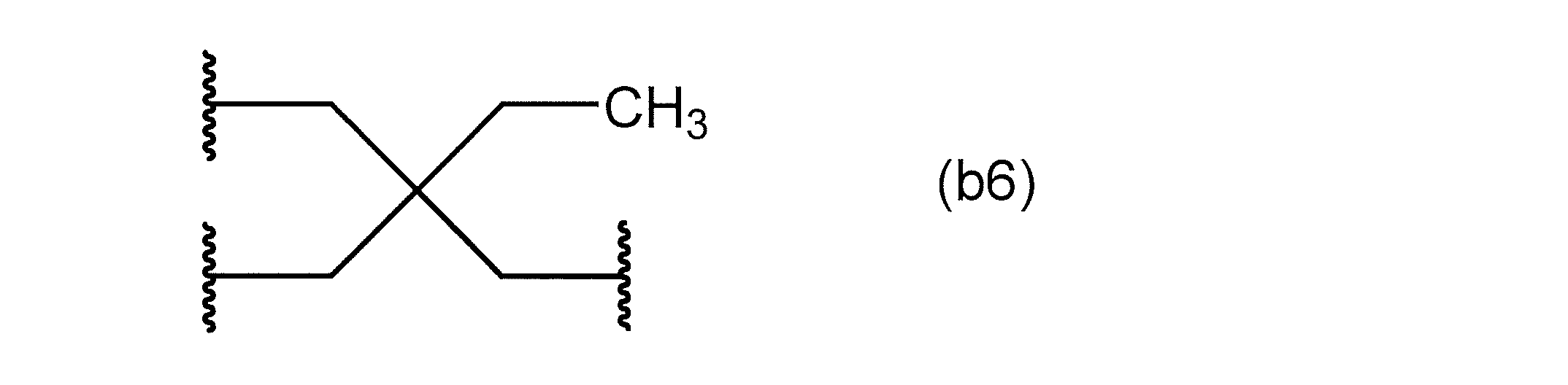
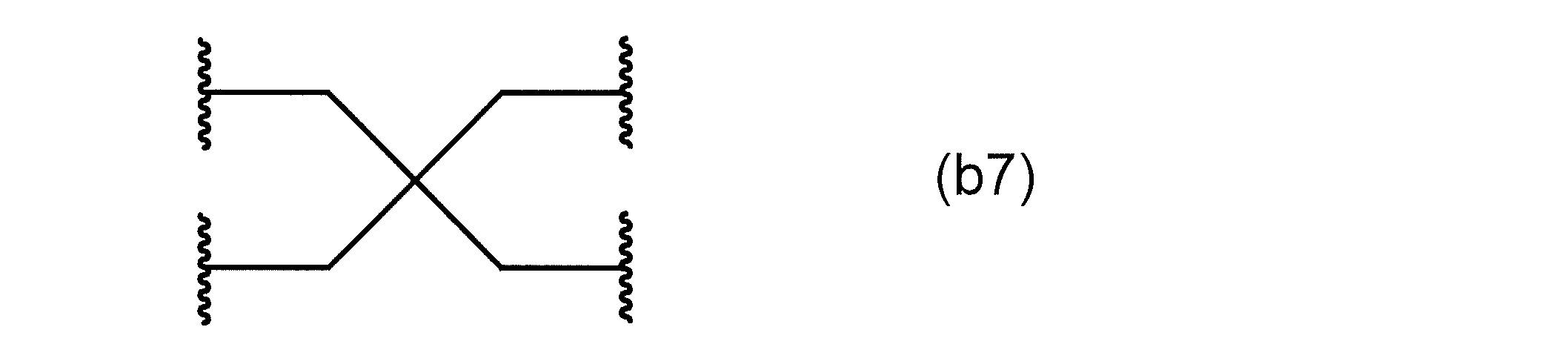
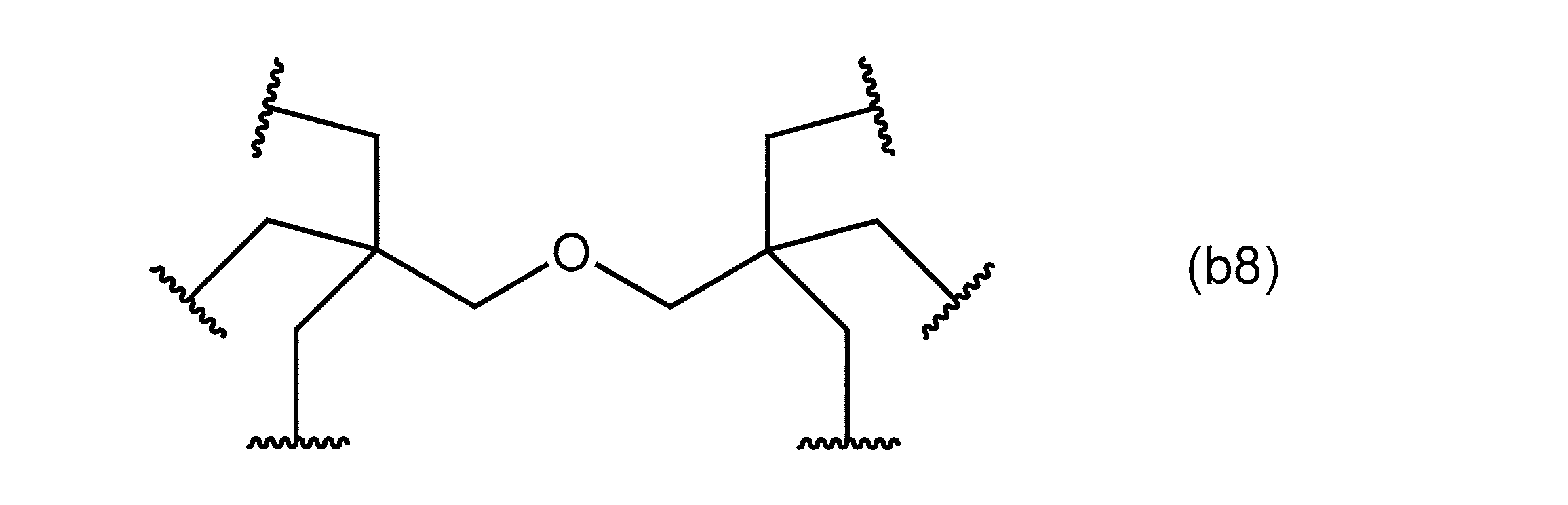
式(b4)~(b8)中、nは1~10の整数を示す。波線は結合部位を示す。
式(b12)で表される化合物は、例えば、メルカプトカルボン酸と多価アルコールとのエステル化物である。当該化合物の一部又は全部のチオール基を特定の酸無水物によりスルフィド化することで、式(B2)で表される酸無水物を得ることができる。
式(b11)及び式(b12)で表される化合物としては、例えば、トリメチロールプロパントリス(3-メルカプトプロピオネート)(SC有機化学株式会社製TMMP)、トリス-[(3-メルカプトプロピオニルオキシ)-エチル]-イソシアヌレート(SC有機化学株式会社製TMPIC)、ペンタエリスリトールテトラキス(3-メルカプトプロピオネート)(SC有機化学株式会社製PEMP)、テトラエチレングリコールビス(3-メルカプトプロピオネート)(SC有機化学株式会社製EGMP-4)、ジペンタエリスリトールヘキサキス(3-メルカプトプロピオネート)(SC有機化学株式会社製DPMP)を挙げることができる。さらに、昭和電工株式会社より販売されている、ペンタエリスリトール テトラキス(3-メルカプトブチレート)、1,4-ビス(3-メルカプトブチリルオキシ)ブタン、1,3,5-トリス(3-メルカプトブチリルオキシエチル)-1,3,5-トリアジン-2,4,6(1H,3H,5H)-トリオン、トリメチロールプロパン トリス(3-メルカプトブチレート)、トリメチロールエタン トリス(3-メルカプトブチレート)、三井化学株式会社より販売されている、ペンタエリスリトールポリ(3-メルカプトプロピオネート)、4-(メルカプトメチル)-3,6-ジチアオクタン-1,8-ジチオール、4,8-ビス(メルカプトメチル)-3,6,9-トリチアウンデカン-1,11-ジチオール、四国化成工業株式会社より販売されている、1,3,4,6-テトラキス(2-メルカプトエチル)グリコールウリル(TS-G)等も使用することができる。さらに、エタンジチオール、プロパンジチオール、ブタンジチオール、ヘキサメチレンジチオール、デカメチレンジチオール、トリレン-2,4-ジチオール、キシレンジチオール、ジグリコールジメルカプタン、トリグリコールジメルカプタン、ポリオキシプロピレングリコールジメルカプタン、トリス-[(3-メルカプトプロピオニルオキシ)-エチル]-イソシアヌレート、1,3,5-トリチオプロピルイソシアヌレート等の公知の化合物も使用することができる。
式(B1)及び(B2)で表される酸無水物の各置換基は、上述した式(b9)、式(b10)、式(b11)、式(b12)で表される化合物に由来した構造となる。
また、式(b9)で表される化合物、式(b10)で表される化合物として複数種の化合物を併用すれば、式(B1)のRxが複数種の構造を有する化合物とすることもできる。このような化合物も式(B1)で表される酸無水物に包含される。また、式(B2)で表される酸無水物にも同様のことが言える。すなわち、式(B1)及び(B2)で表される酸無水物は単一で用いてもよいが、複数種の酸無水物の混合物の状態で用いてもよい。
式(b11)及び式(b12)で表される化合物は、複数のチオール基を有するものである。そして、反応させる不飽和基含有酸無水物とチオール基とのモル比を調整することによって、原料中のチオール基のうち、任意の割合をスルフィド基とすることができる。また、チオール基が残存していたとしても、残存したチオール基は、エポキシ基との硬化反応を生じるものであることから、本発明の効果に悪影響を与えるものではなく、むしろチオール基による低温硬化が期待できる。
例えば、式(b11)で表される化合物としてチオール基を6個有する化合物を使用した場合、チオール化合物1モルに対して、不飽和基含有酸無水物を3モル使用して反応すると、原料中の50%のチオール基がスルフィド基に置換される。この場合、6個のチオール基のうち3個がスルフィド化合物のみが得られるのではなく、組成物全体の平均として50%のチオール基がスルフィド基に置換されたものとなる。その結果、上記式のaとbの割合のみが相違する複数種の化合物の混合物となる。このような混合物も本発明の一部である。
上記チオール基の反応率(式(B1)及び(B2)で表される酸無水物における(スルフィド基数)/(スルフィド基数+チオール基数))は特に限定されないが、例えば15~100%であることが好ましく、50~70%であることがより好ましい。
当該混合物においては、一部に未反応の原料として式(b9)、式(b10)、式(b11)、式(b12)で表される化合物が残存している場合もあるが、このような原料が残存した組成物も、本発明に包含される。
式(B1)及び(B2)で表される酸無水物としては、上述した構造を有するものであれば、特に限定されるものではないが、具体的な化合物を以下に例示する。
式(B1)で表される酸無水物としては、以下が挙げられる。具体的には、下記式[B1-1]で表される酸無水物、すなわち、式(B1)で表される酸無水物であって、式中のRxが、式(b2)(R7~R10が水素原子を示す。波線は結合部位を表す。)で表される構造を有する基であり、Aが、炭素数4の2価の直鎖状炭化水素基であり、aが2を示す酸無水物;下記式[B1-2]で表される酸無水物、すなわち、式(B1)で表される酸無水物であって、式中のRxが、式(b2)(R7~R10が水素原子を示す。波線は結合部位を表す。)で表される構造を有する基であり、Aが、-CH2-Ph-CH2-基であり、aが2を示す酸無水物;下記式[B1-3]で表される酸無水物、すなわち、式(B1)で表される酸無水物であって、式中のRxが、式(b1)(R1~R6が水素原子を示す。波線は結合部位を表す。)で表される構造を有する基であり、Aが、炭素数4の2価の直鎖状炭化水素基であり、aが2を示す酸無水物;下記式[B1-4]で表される酸無水物、すなわち、式(B1)で表される酸無水物であって、式中のRxが、式(b1)(R1~R6が水素原子を示す。波線は結合部位を表す。)で表される構造を有する基であり、Aが、-CH2-Ph-CH2-基であり、aが2を示す酸無水物、が挙げられる。
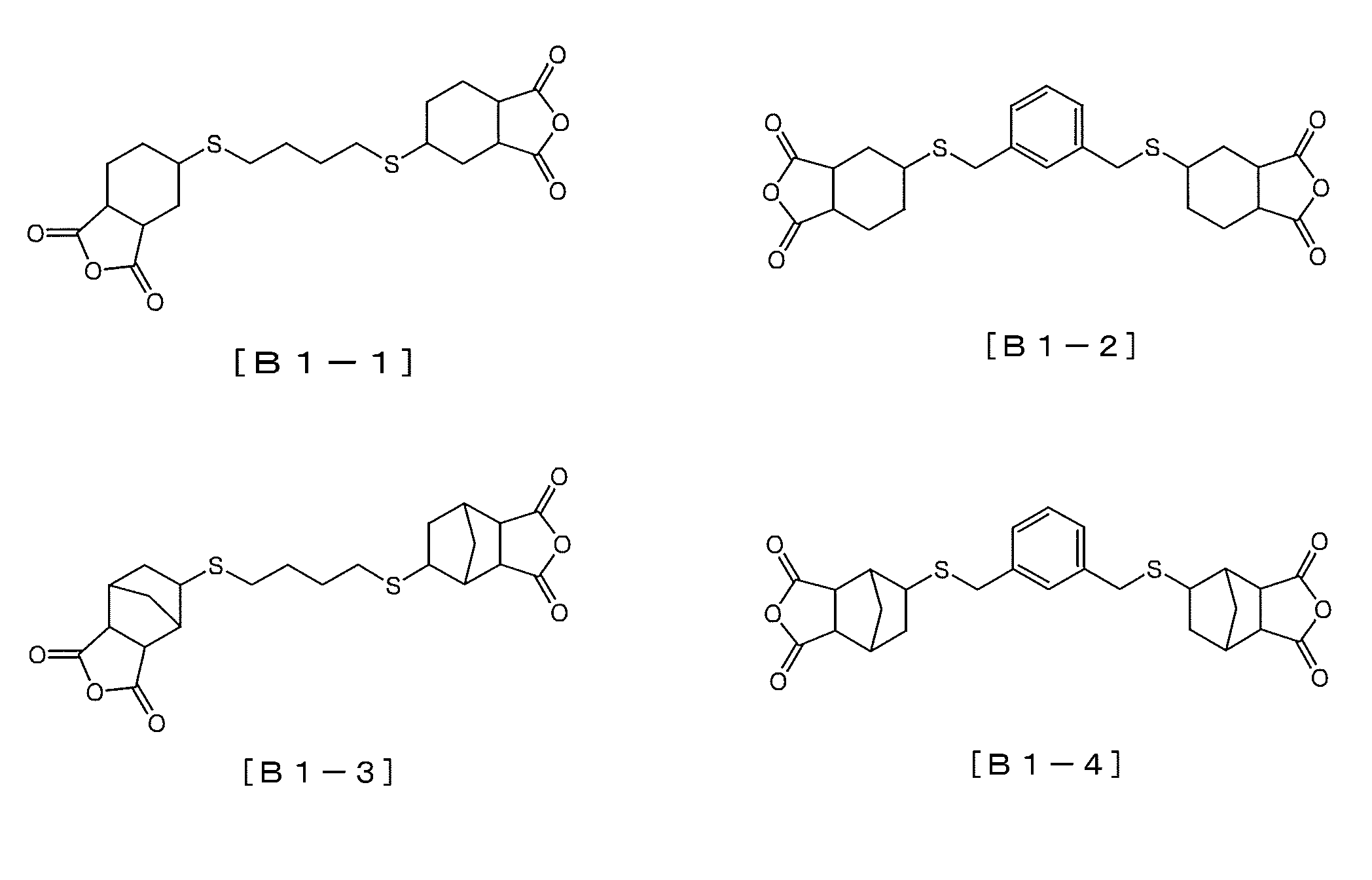
式[B1-1]で表される酸無水物は、式中の一方のRxが水素に置換された酸無水物との混合物として使用されてもよい。すなわち、式[B1-1]で表される酸無水物と、一方のRxが水素に置換されたこと以外は式[B1-1]で表される酸無水物と同じ構造式で表される酸無水物とは、混合物として、本発明の硬化性エポキシ樹脂組成物に含まれていてもよい。以下、上記の混合物を「式[B1-1]で表される酸無水物の混合物」と称する。式[B1-2]~式[B1-4]で表される酸無水物も同様であり、それぞれの混合物を「式[B1-2]~式[B1-4]で表される酸無水物の混合物」と称する。
式(B2)で表される酸無水物としては、以下が挙げられる。具体的には、下記式[B2-1]で表される酸無水物、すなわち、式(B2)で表される酸無水物であって、式中のRxが、水素原子又は式(b1)(R1~R6が水素原子を示す。波線は結合部位を表す。)で表される構造を有する基を示し、その2つが式(b1)で表される構造を有する基であり、Rsが水素原子であり、Rが(b6)で表される基であり、bが0であり、cが3である酸無水物;下記式[B2-2]で表される酸無水物、すなわち、式(B2)で表される酸無水物であって、式中のRxが、水素原子又は式(b1)(R1~R6が水素原子を示す。波線は結合部位を表す。)で表される構造を有する基を示し、その2つが式(b1)で表される構造を有する基であり、Rsが水素原子であり、Rが(b7)で表される基であり、bが0であり、cが4である酸無水物;下記式[B2-3]で表される酸無水物、すなわち、式(B2)で表される酸無水物であって、式中のRxが、水素原子又は式(b1)(R1~R6が水素原子を示す。波線は結合部位を表す。)で表される構造を有する基を示し、その3つが式(b1)で表される構造を有する基であり、Rsが水素原子であり、Rが(b8)で表される基であり、bが0であり、cが6である酸無水物;下記式[B2-4]で表される酸無水物、すなわち、式(B2)で表される酸無水物であって、式中のRxが、式(b1)(R1~R6が水素原子を示す。波線は結合部位を表す。)で表される構造を有する基を示し、Rsが水素原子であり、Rが(b4)(nは3を示す。)で表される基であり、bが0であり、cが2である酸無水物;下記式[B2-5]で表される酸無水物、すなわち、式(B2)で表される酸無水物であって、式中のRxが、水素原子又は式(b1)(R1~R6が水素原子を示す。波線は結合部位を表す。)で表される構造を有する基を示し、その2つが式(b1)で表される構造を有する基であり、Rsが水素原子であり、Rが(b5)で表される基であり、bが0であり、cが3である酸無水物、が挙げられる。
また、下記式[B2-6]で表される酸無水物、すなわち、式(B2)で表される酸無水物であって、式中のRxが、水素原子又は式(b2)(R7~R10が水素原子を示す。波線は結合部位を表す。)で表される構造を有する基を示し、その2つが式(b2)で表される構造を有する基であり、Rsが水素原子であり、Rが(b6)で表される基であり、bが0であり、cが3である酸無水物;下記式[B2-7]で表される酸無水物、すなわち、式(B2)で表される酸無水物であって、式中のRxが、水素原子又は式(b2)(R7~R10が水素原子を示す。波線は結合部位を表す。)で表される構造を有する基を示し、その2つが式(b2)で表される構造を有する基であり、Rsが水素原子であり、Rが(b7)で表される基であり、bが0であり、cが4である酸無水物;下記式[B2-8]で表される酸無水物、すなわち、式(B2)で表される酸無水物であって、式中のRxが、水素原子又は式(b2)(R7~R10が水素原子を示す。波線は結合部位を表す。)で表される構造を有する基を示し、その3つが式(b2)で表される構造を有する基であり、Rsが水素原子であり、Rが(b8)で表される基であり、bが0であり、cが6である酸無水物;下記式[B2-9]で表される酸無水物、すなわち、式(B2)で表される酸無水物であって、式中のRxが、式(b2)(R7~R10が水素原子を示す。波線は結合部位を表す。)で表される構造を有する基を示し、Rsが水素原子であり、Rが(b4)(nは3を示す。)で表される基であり、bが0であり、cが2である酸無水物;下記式[B2-10]で表される酸無水物、すなわち、式(B2)で表される酸無水物であって、式中のRxが、水素原子又は式(b2)(R7~R10が水素原子を示す。波線は結合部位を表す。)で表される構造を有する基を示し、その2つが式(b2)で表される構造を有する基であり、Rsが水素原子であり、Rが(b5)で表される基であり、bが0であり、cが3である酸無水物、が挙げられる。

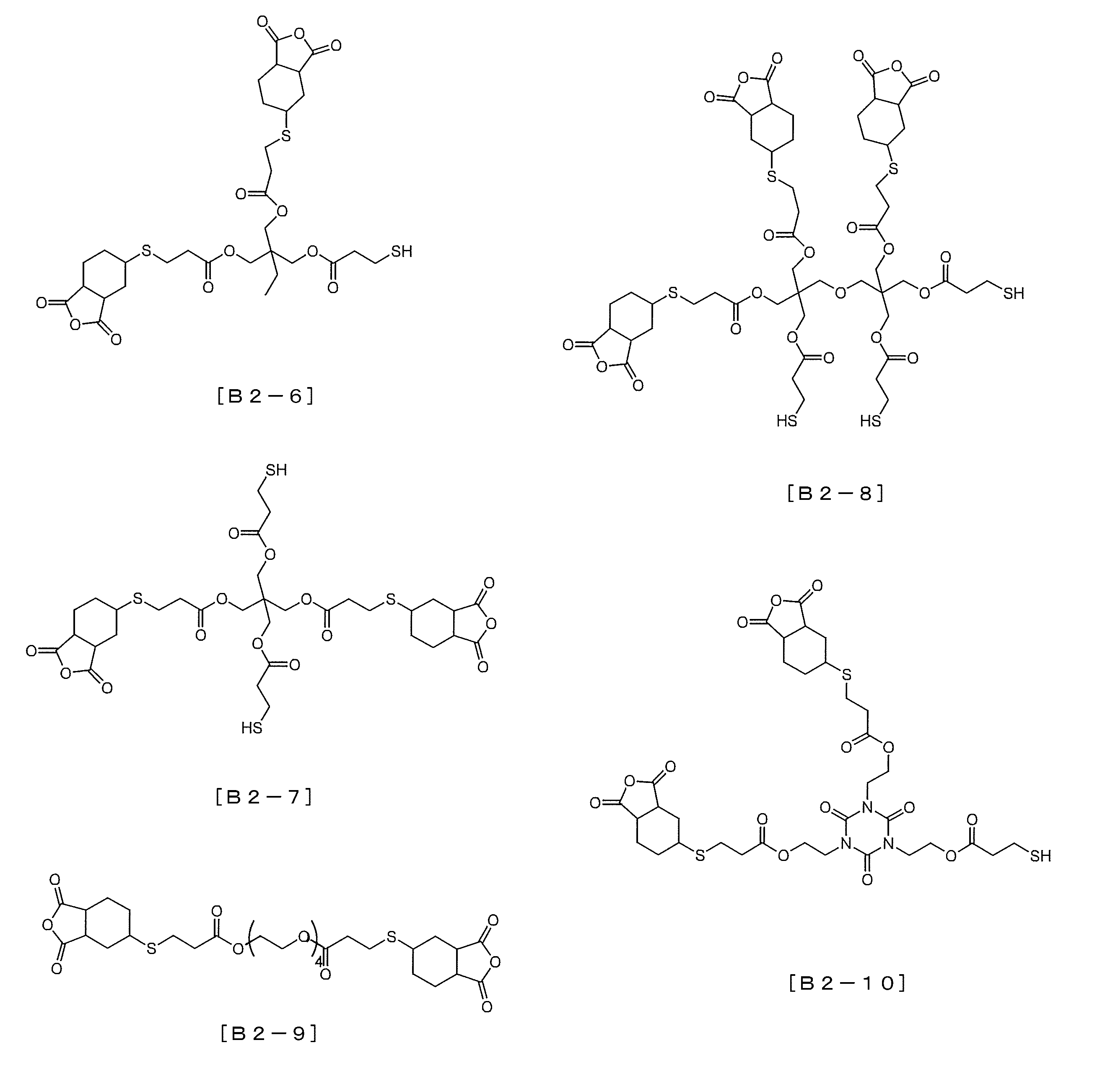
式[B2-1]で表される酸無水物は、式中の全てのRxが式(b1)(R1~R6が水素原子を示す。波線は結合部位を表す。)で表される構造を有する基に置換された酸無水物や、式中のRxのうち、1つの式(b1)で表される構造を有する基が水素原子に置換された酸無水物との混合物として使用されてもよい。すなわち、式[B2-1]で表される酸無水物と、Rxの水素が式(b1)(R1~R6が水素原子を示す。波線は結合部位を表す。)で表される構造を有する基に置換されたこと以外は式[B2-1]で表される酸無水物と同じ構造式で表される酸無水物と、Rxの1つの式(b1)で表される構造を有する基が水素に置換されたこと以外は式[B2-1]で表される酸無水物と同じ構造式で表される酸無水物とは、混合物として、本発明の硬化性エポキシ樹脂組成物に含まれていてもよい。以下、上記の混合物を「式[B2-1]で表される酸無水物の混合物」と称する。式[B2-2]~式[B2-10]で表される酸無水物も同様であり、そのRxの式(b1)又は(b2)で表される構造を有する基が水素原子に置換されたこと以外は同じ構造式で表される酸無水物と、Rxの水素原子が式(b1)又は(b2)で表される構造を有する基に置換されたこと以外は同じ構造式で表される酸無水物との混合物として、本発明の硬化性エポキシ樹脂組成物に含まれていてもよい。それぞれの混合物を「式[B2-2]~式[B2-10]で表される酸無水物の混合物」と称する。
このような化合物は、3-メルカプトプロピオン酸や3-メルカプトブタン酸等のメルカプトカルボン酸とペンタエリスリトールやトリメチロールプロパン等の多価アルコールとのエステル化反応により、容易に製造できる式(b12)で表される化合物を原料としているという点で特に好ましいものである。
式(B1)で表される酸無水物は、式(b9)で表される化合物及び/又は式(b10)で表される化合物並びに式(b11)で表される化合物とを混合し、エンチオール反応によりスルフィド結合を形成する方法によって得ることができる。同様に、式(B2)で表される酸無水物は、式(b9)で表される化合物及び/又は式(b10)で表される化合物並びに式(b12)で表される化合物とを混合し、エンチオール反応によりスルフィド結合を形成する方法によって得ることができる。
エンチオール反応によりスルフィド結合を形成する方法としては特に限定されず、例えば、紫外線照射又はラジカル反応を行う方法が挙げられる。このような反応の一般式を以下に示す。ただし、式(B1)で表される酸無水物は、以下の反応式によって合成されたものに限定されるものではない。

また、式(B2)で表される酸無水物についての反応式の一例を以下に示す。

上記紫外線照射又はラジカル反応は、有機溶媒中で行うことができる。有機溶媒としては、式(B1)及び/又は式(B2)で表される酸無水物、式(b9)で表される化合物及び/又は式(b10)で表される化合物並びに式(b11)及び/又は式(b12)が溶解する有機溶媒であれば特に限定されるものではないが、例えば、テトラヒドロフラン等を挙げることができる。
上記紫外線照射は、脂環式エポキシ化合物(A)の存在下で行うこともできる。上述した紫外線照射による反応の場合は、系中にエポキシ基が存在していても、不飽和結合とチオール基によるスルフィド基の形成反応が優先的に生じることから、脂環式エポキシ化合物(A)存在下で紫外線照射による反応を行っても、式(B1)及び(B2)で表される酸無水物を得ることができる。
脂環式エポキシ化合物(A)中で反応を行う場合、液状のエポキシ化合物は溶媒としての役割を果たすことができるため、好ましい。
硬化剤(B)の含有量(配合量)は、特に限定されないが、硬化性エポキシ樹脂組成物(100重量%)に対して、1~90重量%が好ましく、より好ましくは5~80重量%、さらに好ましくは10~70重量%、特に好ましくは20~60重量%である。硬化剤(B)を上記範囲内で使用することにより、硬化物の耐熱性、耐水性、柔軟性が向上する傾向がある。
[硬化促進剤(C)]
本発明の硬化性エポキシ樹脂組成物は硬化促進剤(C)を含む。硬化促進剤(C)は、エポキシ基を有する化合物が硬化剤等と反応する際、その反応速度を促進する機能を有する化合物である。硬化促進剤(C)としては、公知乃至慣用の硬化促進剤を使用することができ、例えば、1,8-ジアザビシクロ[5.4.0]ウンデセン-7(DBU)又はその塩(例えば、フェノール塩、オクチル酸塩、p-トルエンスルホン酸塩、ギ酸塩、テトラフェニルボレート塩等);1,5-ジアザビシクロ[4.3.0]ノネン-5(DBN)又はその塩(例えば、フェノール塩、オクチル酸塩、p-トルエンスルホン酸塩、ギ酸塩、テトラフェニルボレート塩等);ベンジルジメチルアミン、2,4,6-トリス(ジメチルアミノメチル)フェノール、N,N-ジメチルシクロヘキシルアミン等の第3級アミン;2-エチル-4-メチルイミダゾール、1-シアノエチル-2-エチル-4-メチルイミダゾール等のイミダゾール;リン酸エステル、トリフェニルホスフィン等のホスフィン類;テトラフェニルホスホニウムテトラ(p-トリル)ボレート等のホスホニウム化合物;オクチル酸亜鉛やオクチル酸スズ等の有機金属塩;金属キレート等が挙げられる。
本発明の硬化性エポキシ樹脂組成物は硬化促進剤(C)を含む。硬化促進剤(C)は、エポキシ基を有する化合物が硬化剤等と反応する際、その反応速度を促進する機能を有する化合物である。硬化促進剤(C)としては、公知乃至慣用の硬化促進剤を使用することができ、例えば、1,8-ジアザビシクロ[5.4.0]ウンデセン-7(DBU)又はその塩(例えば、フェノール塩、オクチル酸塩、p-トルエンスルホン酸塩、ギ酸塩、テトラフェニルボレート塩等);1,5-ジアザビシクロ[4.3.0]ノネン-5(DBN)又はその塩(例えば、フェノール塩、オクチル酸塩、p-トルエンスルホン酸塩、ギ酸塩、テトラフェニルボレート塩等);ベンジルジメチルアミン、2,4,6-トリス(ジメチルアミノメチル)フェノール、N,N-ジメチルシクロヘキシルアミン等の第3級アミン;2-エチル-4-メチルイミダゾール、1-シアノエチル-2-エチル-4-メチルイミダゾール等のイミダゾール;リン酸エステル、トリフェニルホスフィン等のホスフィン類;テトラフェニルホスホニウムテトラ(p-トリル)ボレート等のホスホニウム化合物;オクチル酸亜鉛やオクチル酸スズ等の有機金属塩;金属キレート等が挙げられる。
硬化促進剤(C)は、一種を単独で使用することもできるし、二種以上を組み合わせて使用することもできる。また、硬化促進剤(C)は、公知乃至慣用の方法により製造することもできるし、例えば、商品名「U-CAT SA 506」、「U-CAT SA 102」、「U-CAT 5003」、「U-CAT 18X」、「12XD」(開発品)(以上、サンアプロ(株)製);商品名「TPP-K」、「TPP-MK」(以上、北興化学工業(株)製);商品名「PX-4ET」(日本化学工業(株)製)等の市販品を使用することもできる。
硬化促進剤(C)の含有量(配合量)は、特に限定されないが、硬化性エポキシ樹脂組成物に含まれるエポキシ基を有する化合物の全量100重量部に対して、0.05~10重量部が好ましく、より好ましくは0.1~5重量部である。硬化促進剤の含有量を0.05重量部以上とすることにより、より効率的に硬化反応を進行させることができる傾向がある。一方、硬化促進剤の含有量を10重量部以下とすることにより、着色が抑制され色相に優れた硬化物が得られやすい傾向がある。
本発明の硬化性エポキシ樹脂組成物には、上記の成分以外にも、本発明の効果を損なわない範囲内で各種添加剤を使用することができる。このような添加剤としては、例えば、エチレングリコール、ジエチレングリコール、プロピレングリコール、グリセリン等のヒドロキシ基を有する化合物を使用すると、反応を緩やかに進行させることができる。その他にも、粘度や透明性を損なわない範囲内で、消泡剤、レベリング剤、γ-グリシドキシプロピルトリメトキシシランや3-メルカプトプロピルトリメトキシシラン等のシランカップリング剤、界面活性剤、難燃剤、着色剤、イオン吸着体、紫外線吸収剤、光安定剤、白色顔料以外の顔料等の慣用の添加剤を使用することができる。これら添加剤の含有量は特に限定されず、適宜選択可能である。
本発明の硬化性エポキシ樹脂組成物は、特に限定されないが、上記の各成分を、必要に応じて加熱した状態で撹拌・混合することにより調製することができる。なお、本発明の硬化性エポキシ樹脂組成物は、各成分があらかじめ混合されたものをそのまま使用する1液系の組成物として使用することもできるし、例えば、別々に保管しておいた2以上の成分を使用前に所定の割合で混合して使用する多液系(例えば、2液系)の組成物として使用することもできる。上記撹拌・混合の方法は、特に限定されず、例えば、ディゾルバー、ホモジナイザー等の各種ミキサー、ニーダー、ロール、ビーズミル、自公転式撹拌装置等の公知乃至慣用の撹拌・混合手段を使用できる。また、撹拌・混合後、真空下にて脱泡してもよい。
硬化の手段としては、加熱処理等の公知の手段を利用できる。加熱により硬化させる際の温度(硬化温度)は、特に限定されないが、45~200℃が好ましく、より好ましくは50~190℃、さらに好ましくは55~180℃である。また、硬化の際に加熱する時間(硬化時間)は、特に限定されないが、30~600分が好ましく、より好ましくは45~540分、さらに好ましくは60~480分である。硬化温度と硬化時間が上記範囲の下限値より低い場合は硬化が不十分となり、逆に上記範囲の上限値より高い場合は樹脂成分の分解が起きる場合があるので、いずれも好ましくない。硬化条件は種々の条件に依存するが、例えば、硬化温度を高くした場合は硬化時間を短く、硬化温度を低くした場合は硬化時間を長くする等により、適宜調整することができる。また、硬化は、一段階で行うこともできるし、二段階以上の多段階で行うこともできる。
更に、式(b9)で表される化合物及び/又は式(b10)で表される化合物、式(b11)で表される化合物、エポキシ化合物(A)、並びに硬化促進剤(C)を含有する組成物を所定の形状に成形した後、紫外線照射を行うことで、式(b9)で表される化合物及び/又は式(b10)で表される化合物と式(b11)で表される化合物の反応によって硬化剤(B)を形成させ、続いて熱硬化を行うことでエポキシ樹脂組成物の硬化物を得ることもできる。
本発明の硬化性樹脂組成物は、例えば、封止剤として好ましく用いられる。中でも、LED等の光学素子の封止剤として特に好ましく用いられる。本発明の封止剤は、その硬化物の透明性が高く、耐熱性、耐水性が高いため、光量の低下や色彩の変化がなく好ましい。さらに、硬化時の収縮が小さく、生産工程での素子の破損を大幅に低減でき、生産性が向上する。
本発明の硬化性エポキシ樹脂組成物は、透明性が高く光の損失が小さいことや、硬化収縮が小さいこと、また、硬化物の耐熱性、耐水性、柔軟性が高く、長期使用時の劣化・着色がない等の観点から、接着剤としても好ましく用いられる。接着剤は、例えば、液晶パネル部品や光ファイバー等の光通信デバイスの組立及び接続、光センサー、光学レンズ等の各種光学部品の固定、光学レンズ、プリズム等の光学部品の貼り合わせ等に好ましく用いられる。
本発明の樹脂硬化物は、液晶パネル等の光学部品の保護用等のコーティング剤としても好ましく用いられる。硬化物の透明性が高いため画質の低下がなく、また耐熱性、耐水性、柔軟性が高いため好ましい。
<硬化物>
本発明の硬化性エポキシ樹脂組成物を硬化させることにより、耐熱性、耐水性等の諸物性に優れた硬化物(以下、「本発明の硬化物」と称することがある)を得ることができる。硬化の際の加熱温度(硬化温度)は、特に限定されないが、45~200℃が好ましく、より好ましくは50~190℃、さらに好ましくは55~180℃である。また、硬化の際に加熱する時間(硬化時間)は、特に限定されないが、30~600分が好ましく、より好ましくは45~540分、さらに好ましくは60~480分である。硬化温度と硬化時間が上記範囲の下限値より低い場合は、硬化が不十分となり、逆に上記範囲の上限値より高い場合は、樹脂成分の分解が起きる場合があるので、いずれも好ましくない。硬化条件は種々の条件に依存するが、例えば、硬化温度を高くした場合は硬化時間を短く、硬化温度を低くした場合は硬化時間を長くする等により、適宜調整することができる。
本発明の硬化性エポキシ樹脂組成物を硬化させることにより、耐熱性、耐水性等の諸物性に優れた硬化物(以下、「本発明の硬化物」と称することがある)を得ることができる。硬化の際の加熱温度(硬化温度)は、特に限定されないが、45~200℃が好ましく、より好ましくは50~190℃、さらに好ましくは55~180℃である。また、硬化の際に加熱する時間(硬化時間)は、特に限定されないが、30~600分が好ましく、より好ましくは45~540分、さらに好ましくは60~480分である。硬化温度と硬化時間が上記範囲の下限値より低い場合は、硬化が不十分となり、逆に上記範囲の上限値より高い場合は、樹脂成分の分解が起きる場合があるので、いずれも好ましくない。硬化条件は種々の条件に依存するが、例えば、硬化温度を高くした場合は硬化時間を短く、硬化温度を低くした場合は硬化時間を長くする等により、適宜調整することができる。
本発明の硬化物は、高い透明性や光反射性を有し、耐熱性、耐水性にも優れる。したがって、本発明の硬化性エポキシ樹脂組成物は、光半導体封止用途(例えば、LEDの封止材用途)や、LEDパッケージ用途(LEDパッケージの構成材、例えば、光半導体装置におけるリフレクター材、ハウジング材等)といった光学部材に使用することができる。
本発明の硬化性エポキシ樹脂組成物及び硬化物は、上記以外にも、電気絶縁材、積層板、インク、塗料、シーラント、レジスト、複合材料、透明基材、透明シート、透明フィルム、光学素子、光学レンズ、光学部材、光造形、電子ペーパー、タッチパネル、太陽電池基板、光導波路、導光板、ホログラフィックメモリ、チップ部品、ベアチップ実装、光ファイバー、光ピックアップセンサー(例えば、DVDレコーダ、Blue Rayレコーダ等における光ピックアップセンサー)、光電センサー(例えば、非接触スイッチ等における光電センサー)、カラーセンサー(例えば、カメラ、プリンタ等におけるカラーセンサー)、照度センサー(例えば、携帯端末、テレビ等における照度センサー)、近接センサー(例えば、携帯端末等における近接センサー)、複合センサー(例えば、携帯端末等における複合センサー)、イメージセンサー(例えば、カメラ等におけるイメージセンサー)、AFセンサー(例えば、カメラ等におけるAFセンサー)、MEMS実装等の各種用途にも用いることができる。
以下に、実施例に基づいて本発明をより詳細に説明するが、本発明はこれらの実施例により限定されるものではない。
(参考例1)
反応容器に3.00gのペンタエリスリトールテトラキス(3-メルカプトプロピオネート)(PEMP;SC有機化学株式会社製)、7mLのテトラヒドロフラン(THF)を仕込み、室温にて撹拌した。続いて、2.03gの5-ノルボルネン-2,3-ジカルボン酸無水物(CPDMA)を加えた後、反応温度60℃にてUVを10分間照射した。NMRにて反応が定量的に進行していることを確認した後、THFを減圧留去して残渣として目的の酸無水物(化合物A)を得た。
反応容器に3.00gのペンタエリスリトールテトラキス(3-メルカプトプロピオネート)(PEMP;SC有機化学株式会社製)、7mLのテトラヒドロフラン(THF)を仕込み、室温にて撹拌した。続いて、2.03gの5-ノルボルネン-2,3-ジカルボン酸無水物(CPDMA)を加えた後、反応温度60℃にてUVを10分間照射した。NMRにて反応が定量的に進行していることを確認した後、THFを減圧留去して残渣として目的の酸無水物(化合物A)を得た。
なお、参考例1の実施に際して、原料であるPEMP及びCPDMAの反応によって得られた化合物の1H-NMRチャートを図1に示した。図1より、反応によってCPDMAのビニレンピークが消失していることが観察され、目的の酸無水物が得られていることが確認できた。

(実施例1)
表1に示す配合処方(単位:重量部)に従って、セロキサイド2021P(CEL2021P、株式会社ダイセル製)、参考例1にて得られた酸無水物(化合物A)、U-CAT 18X(18X、サンアプロ(株)製)、及びエチレングリコール(和光純薬工業(株)製)を、自公転式撹拌装置(商品名「あわとり練太郎 AR-250」、(株)シンキー製)を使用して撹拌・脱泡を行った。得られた溶液を枠型に流し込み、120℃で5時間加熱し、硬化させて硬化物を得た。
表1に示す配合処方(単位:重量部)に従って、セロキサイド2021P(CEL2021P、株式会社ダイセル製)、参考例1にて得られた酸無水物(化合物A)、U-CAT 18X(18X、サンアプロ(株)製)、及びエチレングリコール(和光純薬工業(株)製)を、自公転式撹拌装置(商品名「あわとり練太郎 AR-250」、(株)シンキー製)を使用して撹拌・脱泡を行った。得られた溶液を枠型に流し込み、120℃で5時間加熱し、硬化させて硬化物を得た。
(実施例2、比較例1)
配合組成を表1に示す様に変更したこと以外は実施例1と同様にして樹脂組成物及びその硬化物を得た。
配合組成を表1に示す様に変更したこと以外は実施例1と同様にして樹脂組成物及びその硬化物を得た。
<評価>
実施例1、2、比較例1で得られた硬化物について、下記の評価を実施した。
実施例1、2、比較例1で得られた硬化物について、下記の評価を実施した。
[硬化物-Tg]
実施例及び比較例で得られた硬化物より、縦5mm、横4mm、高さ10mmのサイズの試験片を切り出し、熱機械測定装置(TMA)(セイコーインスツルメント(株)製)を用いて上記試験片のガラス転移温度(Tg、単位:℃)を測定した。結果を表1の「Tg(℃)」の欄に示す。
実施例及び比較例で得られた硬化物より、縦5mm、横4mm、高さ10mmのサイズの試験片を切り出し、熱機械測定装置(TMA)(セイコーインスツルメント(株)製)を用いて上記試験片のガラス転移温度(Tg、単位:℃)を測定した。結果を表1の「Tg(℃)」の欄に示す。
[硬化物-透明性]
実施例及び比較例で得られた硬化物より、縦50mm、横30mm、高さ3mmのサイズの試験片を切り出し、分光光度計(商品名「UV-2400」、(株)島津製作所製)を用いて上記試験片の透過率(波長:450nm、単位:%T)を測定した。結果を表1の「透明性[%T]」の欄に示す。
実施例及び比較例で得られた硬化物より、縦50mm、横30mm、高さ3mmのサイズの試験片を切り出し、分光光度計(商品名「UV-2400」、(株)島津製作所製)を用いて上記試験片の透過率(波長:450nm、単位:%T)を測定した。結果を表1の「透明性[%T]」の欄に示す。
[硬化物-屈折率]
実施例及び比較例で得られた硬化物より、縦50mm、横30mm、高さ0.5mmのサイズの試験片を切り出し、プリズムカプラ(2010/M)(Metricon製)を用いて上記試験片の屈折率(波長:589nm)を測定した。結果を表1の「屈折率」の欄に示す。
実施例及び比較例で得られた硬化物より、縦50mm、横30mm、高さ0.5mmのサイズの試験片を切り出し、プリズムカプラ(2010/M)(Metricon製)を用いて上記試験片の屈折率(波長:589nm)を測定した。結果を表1の「屈折率」の欄に示す。
[硬化物-硬化収縮率]
実施例及び比較例における樹脂組成物の比重aを比重瓶にて測定し、硬化物の比重bを水中置換法で測定し、次式により硬化収縮率(%)を求めた。結果を表1の「硬化収縮率(%)」の欄に示す。
硬化収縮率(%)=[1-(b/a)]×100
実施例及び比較例における樹脂組成物の比重aを比重瓶にて測定し、硬化物の比重bを水中置換法で測定し、次式により硬化収縮率(%)を求めた。結果を表1の「硬化収縮率(%)」の欄に示す。
硬化収縮率(%)=[1-(b/a)]×100
[硬化物-総合判定]
硬化物のガラス転移温度が138℃以上、透明性が85%T以上、屈折率が1.52以上、硬化収縮率が3.0%以下である場合は「〇」、いずれか一つでもこれを満たさない場合は「×」と表1に記載した。
硬化物のガラス転移温度が138℃以上、透明性が85%T以上、屈折率が1.52以上、硬化収縮率が3.0%以下である場合は「〇」、いずれか一つでもこれを満たさない場合は「×」と表1に記載した。
[光学材料(光半導体装置)の作製]
光半導体のリードフレーム(InGaN素子、3.5mm×2.8mm)に、実施例及び比較例における樹脂組成物を注型した後、120℃のオーブンで5時間加熱することで、前記樹脂組成物の硬化物により光半導体素子が封止された光半導体装置を得た(図2参照)。得られた光半導体装置の透明性(明るさ)及び耐熱性を評価した。なお、図2において、100はリフレクター、101は金属配線、102は光半導体素子、103はパッケージ基板を示す。
光半導体のリードフレーム(InGaN素子、3.5mm×2.8mm)に、実施例及び比較例における樹脂組成物を注型した後、120℃のオーブンで5時間加熱することで、前記樹脂組成物の硬化物により光半導体素子が封止された光半導体装置を得た(図2参照)。得られた光半導体装置の透明性(明るさ)及び耐熱性を評価した。なお、図2において、100はリフレクター、101は金属配線、102は光半導体素子、103はパッケージ基板を示す。
[光学材料-透明性(明るさ)]
光半導体装置の透明性(明るさ)(ルーメン:lm)は、光半導体装置の全光束を全光束測定機(商品名「マルチ分光放射測定システム OL771」、オプトロニックラボラトリーズ社製)を使用して測定した。結果を表1の「透明性(lm)」の欄に示す。
光半導体装置の透明性(明るさ)(ルーメン:lm)は、光半導体装置の全光束を全光束測定機(商品名「マルチ分光放射測定システム OL771」、オプトロニックラボラトリーズ社製)を使用して測定した。結果を表1の「透明性(lm)」の欄に示す。
[光学材料-耐熱性]
光半導体装置を120℃で300時間の加熱処理(エージング)に付して、光線透過率の保持率を下記式から算出し、これを耐熱性の指標とした。結果を表1の「耐熱性(%)」の欄に示す。
光線透過率の保持率(%)=(加熱処理後の光半導体装置の光線透過率/加熱処理前の光半導体装置の光線透過率)×100
光半導体装置を120℃で300時間の加熱処理(エージング)に付して、光線透過率の保持率を下記式から算出し、これを耐熱性の指標とした。結果を表1の「耐熱性(%)」の欄に示す。
光線透過率の保持率(%)=(加熱処理後の光半導体装置の光線透過率/加熱処理前の光半導体装置の光線透過率)×100
[光学材料-総合判定]
光半導体装置の透明性が0.60lm以上、耐熱性が80%以上である場合は「〇」、いずれか一つでもこれを満たさない場合は「×」と表1に記載した。
光半導体装置の透明性が0.60lm以上、耐熱性が80%以上である場合は「〇」、いずれか一つでもこれを満たさない場合は「×」と表1に記載した。
[コーティング剤-反応性]
実施例及び比較例における樹脂組成物(コーティング剤)の反応性を、ゲルタイム測定装置(商品名「No.153 ゲルタイムテスター(マグネット式)」、(株)安田精機製作所製)を用いて測定した。なお、120℃で加熱した際の反応性(硬化性;ゲルタイム)を評価した。結果を表1の「反応性(sec)」の欄に示す。
実施例及び比較例における樹脂組成物(コーティング剤)の反応性を、ゲルタイム測定装置(商品名「No.153 ゲルタイムテスター(マグネット式)」、(株)安田精機製作所製)を用いて測定した。なお、120℃で加熱した際の反応性(硬化性;ゲルタイム)を評価した。結果を表1の「反応性(sec)」の欄に示す。
[コーティング剤-熱衝撃試験]
実施例及び比較例における硬化物に対し、-40℃の雰囲気下に30分曝露し、続いて、100℃の雰囲気下に30分曝露することを1サイクルとした熱衝撃を、熱衝撃試験機を用いて200サイクル分与えた。その後、デジタルマイクロスコープ(商品名「VHX-900」、(株)キーエンス製)を使用して硬化物を観察し、長さが90μm以上のクラックが発生したか否かを確認した。硬化物に長さが90μm以上のクラックが発生した個数を表1の「熱衝撃試験[クラック数]」の欄に示した。
実施例及び比較例における硬化物に対し、-40℃の雰囲気下に30分曝露し、続いて、100℃の雰囲気下に30分曝露することを1サイクルとした熱衝撃を、熱衝撃試験機を用いて200サイクル分与えた。その後、デジタルマイクロスコープ(商品名「VHX-900」、(株)キーエンス製)を使用して硬化物を観察し、長さが90μm以上のクラックが発生したか否かを確認した。硬化物に長さが90μm以上のクラックが発生した個数を表1の「熱衝撃試験[クラック数]」の欄に示した。
[コーティング剤-総合判定]
樹脂組成物(コーティング剤)の反応性が250sec以下、硬化物の熱衝撃性試験におけるクラック数が5以下である場合は「〇」、いずれか一つでもこれを満たさない場合は「×」と表1に記載した。
樹脂組成物(コーティング剤)の反応性が250sec以下、硬化物の熱衝撃性試験におけるクラック数が5以下である場合は「〇」、いずれか一つでもこれを満たさない場合は「×」と表1に記載した。
100:リフレクター
101:金属配線
102:光半導体素子
103:パッケージ基板
101:金属配線
102:光半導体素子
103:パッケージ基板
以上のまとめとして、本発明の構成及びそのバリエーションを以下に付記しておく。
[1]脂環式エポキシ化合物(A)と、硬化剤(B)と、硬化促進剤(C)を含む硬化性エポキシ樹脂組成物であって、硬化剤(B)が、式(B1)[式中、Rxは、同一又は異なって、水素原子、式(b1)(R1~R6は、同一又は異なって、水素原子又は直鎖若しくは分岐鎖状の炭素数1~4のアルキル基を示す。波線は結合部位を表す。)で表される構造を有する基、又は式(b2)(R7~R10は、同一又は異なって、水素原子又は直鎖若しくは分岐鎖状の炭素数1~4のアルキル基を示す。波線は結合部位を表す。)で表される構造を有する基を示し、その1つ以上が式(b1)又は(b2)で表される構造を有する基である。Aは、置換基を有していてもよく、主鎖中及び/又は側鎖中にヘテロ原子を含む官能基を有していてもよい、炭素数2~50の、a価の直鎖又は分岐鎖状炭化水素基である。aは2~6の整数を示す。]で表される酸無水物及び式(B2)[式中、Rxは、同一又は異なって、水素原子、式(b1)(R1~R6は、同一又は異なって、水素原子又は直鎖若しくは分岐鎖状の炭素数1~4のアルキル基を示す。波線は結合部位を表す。)で表される構造を有する基、又は式(b2)(R7~R10は、同一又は異なって、水素原子又は直鎖若しくは分岐鎖状の炭素数1~4のアルキル基を示す。波線は結合部位を表す。)で表される構造を有する基を示し、その1つ以上が式(b1)又は(b2)で表される構造を有する基である。Rsは、同一又は異なって、水素原子又はメチル基である。Rは、ヘテロ原子を含む官能基を有してもよい、炭素数2~28の、直鎖状、分岐鎖状、又は環状の構造を有する(b+c)価の基である。R’は、同一又は異なって、水素原子、炭素数が1~8のアルキル基、チオール基、又は式(b3)(式中、R11及びR12は、異なって、R11はチオール基又はメチル基を示し、R12は水素原子又はチオール基を示す。波線は結合部位を表す。)で表される基を示す。bとcは、b+c=2~6であって、bは0を含む整数であり、cは1~6の整数を示す。]で表される酸無水物からなる群より選択される少なくとも1つであることを特徴とする硬化性エポキシ樹脂組成物。
[2]前記式(B2)で表される酸無水物におけるRが、式(b4)~(b8)(式中、nは1~10の整数を示す。波線は結合部位を示す。)で表される基のいずれか1つである[1]に記載の硬化性エポキシ樹脂組成物。
[3]前記脂環式エポキシ化合物(A)の脂環エポキシ基がシクロヘキセンオキシド基である[1]又は[2]に記載の硬化性エポキシ樹脂組成物。
[4]前記脂環式エポキシ化合物(A)が式(I)(式中、Xは単結合又は連結基を示す。前記連結基は、二価の炭化水素基、炭素-炭素二重結合の一部又は全部がエポキシ化されたアルケニレン基、カルボニル基、エーテル結合、エステル結合、カーボネート基、アミド基、又はこれらが複数個連結した基であることが好ましい。なお、式(I)におけるシクロヘキセンオキシド基を構成する炭素原子の1以上には、アルキル基が結合していてもよい。)で表される化合物である[1]~[3]のいずれか1つに記載の硬化性エポキシ樹脂組成物。
[5]前記脂環式エポキシ化合物(A)が式(I-1)で表される化合物である[1]~[4]のいずれか1つに記載の硬化性エポキシ樹脂組成物。
[6]前記式(B1)で表される酸無水物が、上記式[B1-1]で表される酸無水物、上記式[B1-2]で表される酸無水物、上記式[B1-3]で表される酸無水物、上記式[B1-4]で表される酸無水物、上記式[B1-5]で表される酸無水物、上記式[B1-1]で表される酸無水物の混合物、上記式[B1-2]で表される酸無水物の混合物、上記式[B1-3]で表される酸無水物の混合物、上記式[B1-4]で表される酸無水物の混合物、又は上記式[B1-5]で表される酸無水物の混合物である[1]~[5]のいずれか1つに記載の硬化性エポキシ樹脂組成物。
[7]前記式(B2)で表される酸無水物が、上記式[B2-1]で表される酸無水物、上記式[B2-2]で表される酸無水物、上記式[B2-3]で表される酸無水物、上記式[B2-4]で表される酸無水物、上記式[B2-5]で表される酸無水物、上記式[B2-6]で表される酸無水物、上記式[B2-7]で表される酸無水物、上記式[B2-8]で表される酸無水物、上記式[B2-9]で表される酸無水物、上記式[B2-10]で表される酸無水物、上記式[B2-1]で表される酸無水物の混合物、上記式[B2-2]で表される酸無水物の混合物、上記式[B2-3]で表される酸無水物の混合物、上記式[B2-4]で表される酸無水物の混合物、上記式[B2-5]で表される酸無水物の混合物、上記式[B2-6]で表される酸無水物の混合物、上記式[B2-7]で表される酸無水物の混合物、上記式[B2-8]で表される酸無水物の混合物、上記式[B2-9]で表される酸無水物の混合物、又は上記式[B2-10]で表される酸無水物の混合物である[1]~[6]のいずれか1つに記載の硬化性エポキシ樹脂組成物。
[8]脂環式エポキシ化合物(A)の含有量(配合量)が、硬化性エポキシ樹脂組成物(100重量%)に対して、1~90重量%、10~80重量%、20~70重量%、又は20~60重量%である[1]~[7]のいずれか1つに記載の硬化性エポキシ樹脂組成物。
[9]硬化剤(B)の含有量(配合量)が、硬化性エポキシ樹脂組成物(100重量%)に対して、1~90重量%、5~80重量%、10~70重量%、又は20~60重量%である[1]~[8]のいずれか1つに記載の硬化性エポキシ樹脂組成物。
[10]硬化促進剤(C)の含有量(配合量)が、硬化性エポキシ樹脂組成物に含まれるエポキシ基を有する化合物の全量100重量部に対して、0.05~10重量部、又は0.1~5重量部である[1]~[9]のいずれか1つに記載の硬化性エポキシ樹脂組成物。
[11][1]~[10]のいずれか1つに記載の硬化性エポキシ樹脂組成物の硬化物。
[12][1]~[10]のいずれか1つに記載の硬化性エポキシ樹脂組成物を含む封止剤。
[13][1]~[10]のいずれか1つに記載の硬化性エポキシ樹脂組成物を含む接着剤。
[14][1]~[10]のいずれか1つに記載の硬化性エポキシ樹脂組成物を含むコーティング剤。
[15][11]に記載の硬化物を含む光学部材。
[1]脂環式エポキシ化合物(A)と、硬化剤(B)と、硬化促進剤(C)を含む硬化性エポキシ樹脂組成物であって、硬化剤(B)が、式(B1)[式中、Rxは、同一又は異なって、水素原子、式(b1)(R1~R6は、同一又は異なって、水素原子又は直鎖若しくは分岐鎖状の炭素数1~4のアルキル基を示す。波線は結合部位を表す。)で表される構造を有する基、又は式(b2)(R7~R10は、同一又は異なって、水素原子又は直鎖若しくは分岐鎖状の炭素数1~4のアルキル基を示す。波線は結合部位を表す。)で表される構造を有する基を示し、その1つ以上が式(b1)又は(b2)で表される構造を有する基である。Aは、置換基を有していてもよく、主鎖中及び/又は側鎖中にヘテロ原子を含む官能基を有していてもよい、炭素数2~50の、a価の直鎖又は分岐鎖状炭化水素基である。aは2~6の整数を示す。]で表される酸無水物及び式(B2)[式中、Rxは、同一又は異なって、水素原子、式(b1)(R1~R6は、同一又は異なって、水素原子又は直鎖若しくは分岐鎖状の炭素数1~4のアルキル基を示す。波線は結合部位を表す。)で表される構造を有する基、又は式(b2)(R7~R10は、同一又は異なって、水素原子又は直鎖若しくは分岐鎖状の炭素数1~4のアルキル基を示す。波線は結合部位を表す。)で表される構造を有する基を示し、その1つ以上が式(b1)又は(b2)で表される構造を有する基である。Rsは、同一又は異なって、水素原子又はメチル基である。Rは、ヘテロ原子を含む官能基を有してもよい、炭素数2~28の、直鎖状、分岐鎖状、又は環状の構造を有する(b+c)価の基である。R’は、同一又は異なって、水素原子、炭素数が1~8のアルキル基、チオール基、又は式(b3)(式中、R11及びR12は、異なって、R11はチオール基又はメチル基を示し、R12は水素原子又はチオール基を示す。波線は結合部位を表す。)で表される基を示す。bとcは、b+c=2~6であって、bは0を含む整数であり、cは1~6の整数を示す。]で表される酸無水物からなる群より選択される少なくとも1つであることを特徴とする硬化性エポキシ樹脂組成物。
[2]前記式(B2)で表される酸無水物におけるRが、式(b4)~(b8)(式中、nは1~10の整数を示す。波線は結合部位を示す。)で表される基のいずれか1つである[1]に記載の硬化性エポキシ樹脂組成物。
[3]前記脂環式エポキシ化合物(A)の脂環エポキシ基がシクロヘキセンオキシド基である[1]又は[2]に記載の硬化性エポキシ樹脂組成物。
[4]前記脂環式エポキシ化合物(A)が式(I)(式中、Xは単結合又は連結基を示す。前記連結基は、二価の炭化水素基、炭素-炭素二重結合の一部又は全部がエポキシ化されたアルケニレン基、カルボニル基、エーテル結合、エステル結合、カーボネート基、アミド基、又はこれらが複数個連結した基であることが好ましい。なお、式(I)におけるシクロヘキセンオキシド基を構成する炭素原子の1以上には、アルキル基が結合していてもよい。)で表される化合物である[1]~[3]のいずれか1つに記載の硬化性エポキシ樹脂組成物。
[5]前記脂環式エポキシ化合物(A)が式(I-1)で表される化合物である[1]~[4]のいずれか1つに記載の硬化性エポキシ樹脂組成物。
[6]前記式(B1)で表される酸無水物が、上記式[B1-1]で表される酸無水物、上記式[B1-2]で表される酸無水物、上記式[B1-3]で表される酸無水物、上記式[B1-4]で表される酸無水物、上記式[B1-5]で表される酸無水物、上記式[B1-1]で表される酸無水物の混合物、上記式[B1-2]で表される酸無水物の混合物、上記式[B1-3]で表される酸無水物の混合物、上記式[B1-4]で表される酸無水物の混合物、又は上記式[B1-5]で表される酸無水物の混合物である[1]~[5]のいずれか1つに記載の硬化性エポキシ樹脂組成物。
[7]前記式(B2)で表される酸無水物が、上記式[B2-1]で表される酸無水物、上記式[B2-2]で表される酸無水物、上記式[B2-3]で表される酸無水物、上記式[B2-4]で表される酸無水物、上記式[B2-5]で表される酸無水物、上記式[B2-6]で表される酸無水物、上記式[B2-7]で表される酸無水物、上記式[B2-8]で表される酸無水物、上記式[B2-9]で表される酸無水物、上記式[B2-10]で表される酸無水物、上記式[B2-1]で表される酸無水物の混合物、上記式[B2-2]で表される酸無水物の混合物、上記式[B2-3]で表される酸無水物の混合物、上記式[B2-4]で表される酸無水物の混合物、上記式[B2-5]で表される酸無水物の混合物、上記式[B2-6]で表される酸無水物の混合物、上記式[B2-7]で表される酸無水物の混合物、上記式[B2-8]で表される酸無水物の混合物、上記式[B2-9]で表される酸無水物の混合物、又は上記式[B2-10]で表される酸無水物の混合物である[1]~[6]のいずれか1つに記載の硬化性エポキシ樹脂組成物。
[8]脂環式エポキシ化合物(A)の含有量(配合量)が、硬化性エポキシ樹脂組成物(100重量%)に対して、1~90重量%、10~80重量%、20~70重量%、又は20~60重量%である[1]~[7]のいずれか1つに記載の硬化性エポキシ樹脂組成物。
[9]硬化剤(B)の含有量(配合量)が、硬化性エポキシ樹脂組成物(100重量%)に対して、1~90重量%、5~80重量%、10~70重量%、又は20~60重量%である[1]~[8]のいずれか1つに記載の硬化性エポキシ樹脂組成物。
[10]硬化促進剤(C)の含有量(配合量)が、硬化性エポキシ樹脂組成物に含まれるエポキシ基を有する化合物の全量100重量部に対して、0.05~10重量部、又は0.1~5重量部である[1]~[9]のいずれか1つに記載の硬化性エポキシ樹脂組成物。
[11][1]~[10]のいずれか1つに記載の硬化性エポキシ樹脂組成物の硬化物。
[12][1]~[10]のいずれか1つに記載の硬化性エポキシ樹脂組成物を含む封止剤。
[13][1]~[10]のいずれか1つに記載の硬化性エポキシ樹脂組成物を含む接着剤。
[14][1]~[10]のいずれか1つに記載の硬化性エポキシ樹脂組成物を含むコーティング剤。
[15][11]に記載の硬化物を含む光学部材。
本発明の硬化性エポキシ樹脂組成物は、硬化させることにより、高い耐熱性、耐水性、及び柔軟性を備える硬化物を得ることができる。したがって、該樹脂組成物は、封止剤、接着剤、コーティング剤として使用することができる。また、その硬化物は光学部材として使用することができる。
Claims (9)
- 脂環式エポキシ化合物(A)と、硬化剤(B)と、硬化促進剤(C)を含む硬化性エポキシ樹脂組成物であって、
硬化剤(B)が、下記式(B1)

[式中、Rxは、同一又は異なって、水素原子、下記式(b1)
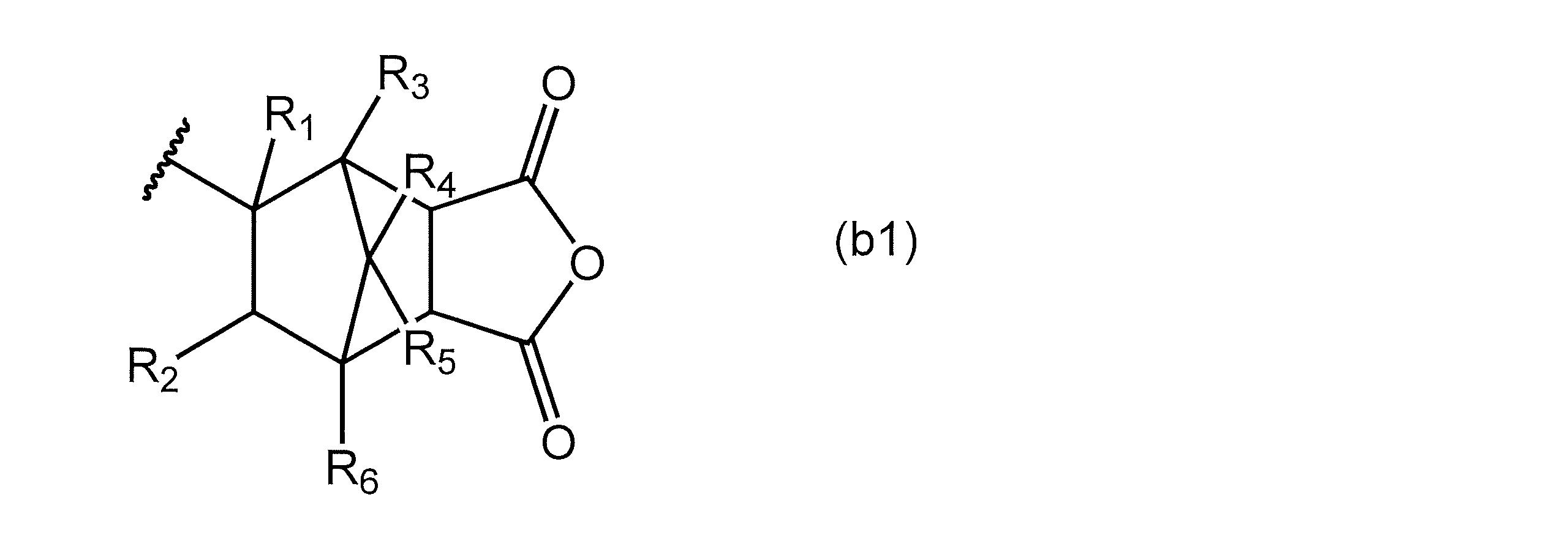
(R1~R6は、同一又は異なって、水素原子又は直鎖若しくは分岐鎖状の炭素数1~4のアルキル基を示す。波線は結合部位を表す。)
で表される構造を有する基、又は下記式(b2)
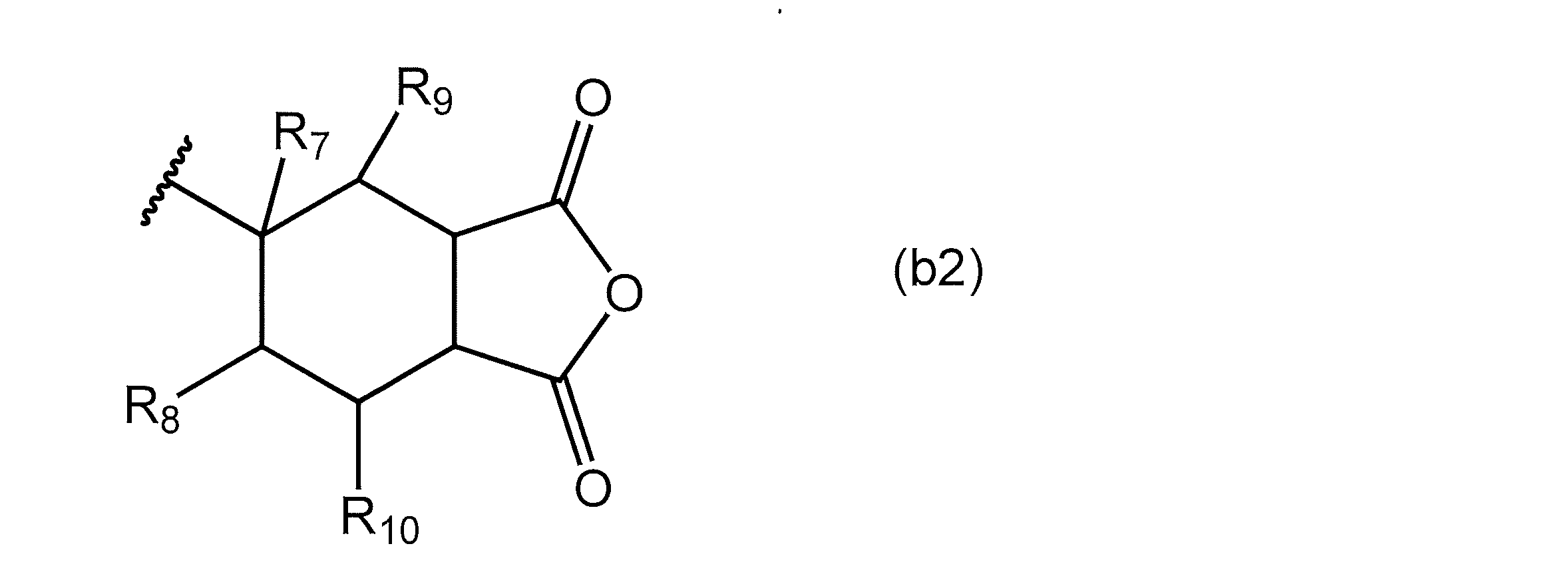
(R7~R10は、同一又は異なって、水素原子又は直鎖若しくは分岐鎖状の炭素数1~4のアルキル基を示す。波線は結合部位を表す。)
で表される構造を有する基を示し、その1つ以上が式(b1)又は(b2)で表される構造を有する基である。Aは、置換基を有していてもよく、主鎖中及び/又は側鎖中にヘテロ原子を含む官能基を有していてもよい、炭素数2~50の、a価の直鎖又は分岐鎖状炭化水素基である。aは2~6の整数を示す。]
で表される酸無水物及び下記式(B2)
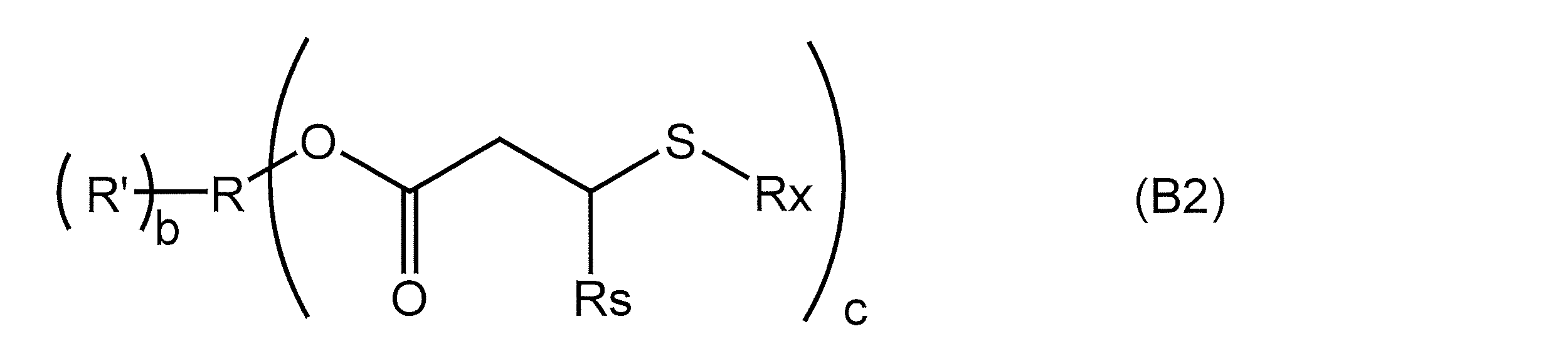
[式中、Rxは、同一又は異なって、水素原子、下記式(b1)

(R1~R6は、同一又は異なって、水素原子又は直鎖若しくは分岐鎖状の炭素数1~4のアルキル基を示す。波線は結合部位を表す。)
で表される構造を有する基、又は下記式(b2)
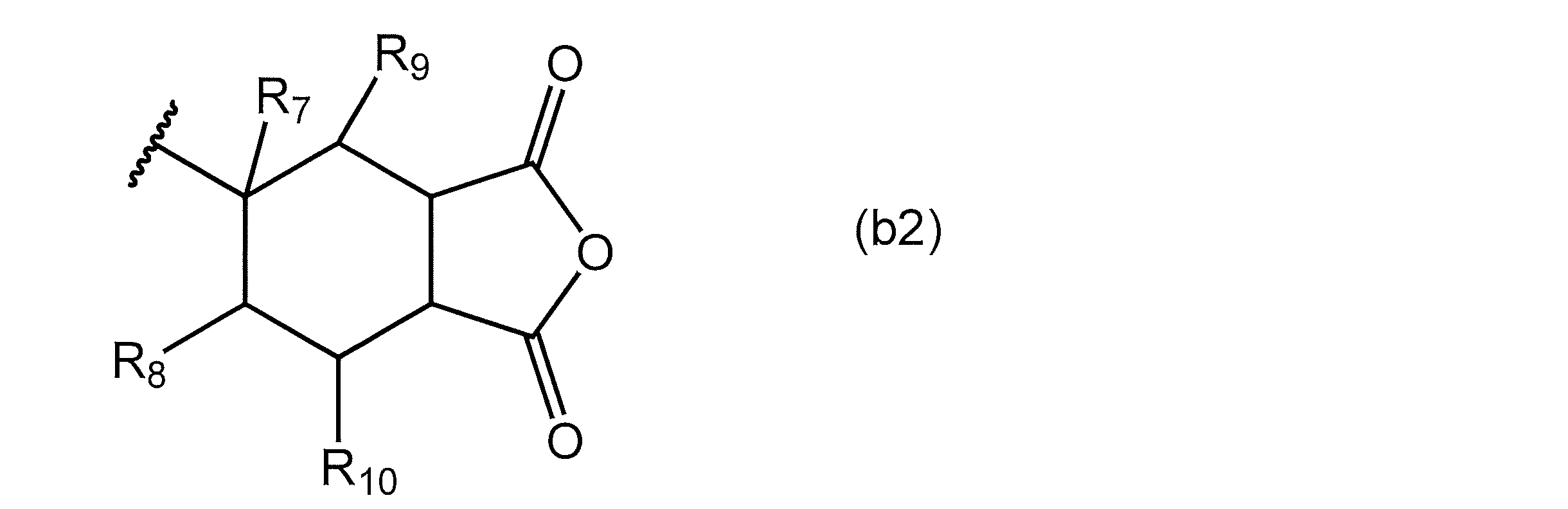
(R7~R10は、同一又は異なって、水素原子又は直鎖若しくは分岐鎖状の炭素数1~4のアルキル基を示す。波線は結合部位を表す。)
で表される構造を有する基を示し、その1つ以上が式(b1)又は(b2)で表される構造を有する基である。Rsは、同一又は異なって、水素原子又はメチル基である。Rは、ヘテロ原子を含む官能基を有してもよい、炭素数2~28の、直鎖、分岐鎖状、又は環状の構造を有する(b+c)価の基である。R’は、同一又は異なって、水素原子、炭素数が1~8のアルキル基、チオール基、又は下記式(b3)

(式中、R11及びR12は、異なって、R11はチオール基又はメチル基を示し、R12は水素原子又はチオール基を示す。波線は結合部位を表す。)
で表される基を示す。bとcは、b+c=2~6であって、bは0を含む整数であり、cは1~6の整数を示す。]
で表される酸無水物からなる群より選択される少なくとも1つであることを特徴とする硬化性エポキシ樹脂組成物。 - 前記式(B2)で表される酸無水物におけるRが、下記式(b4)~(b8)

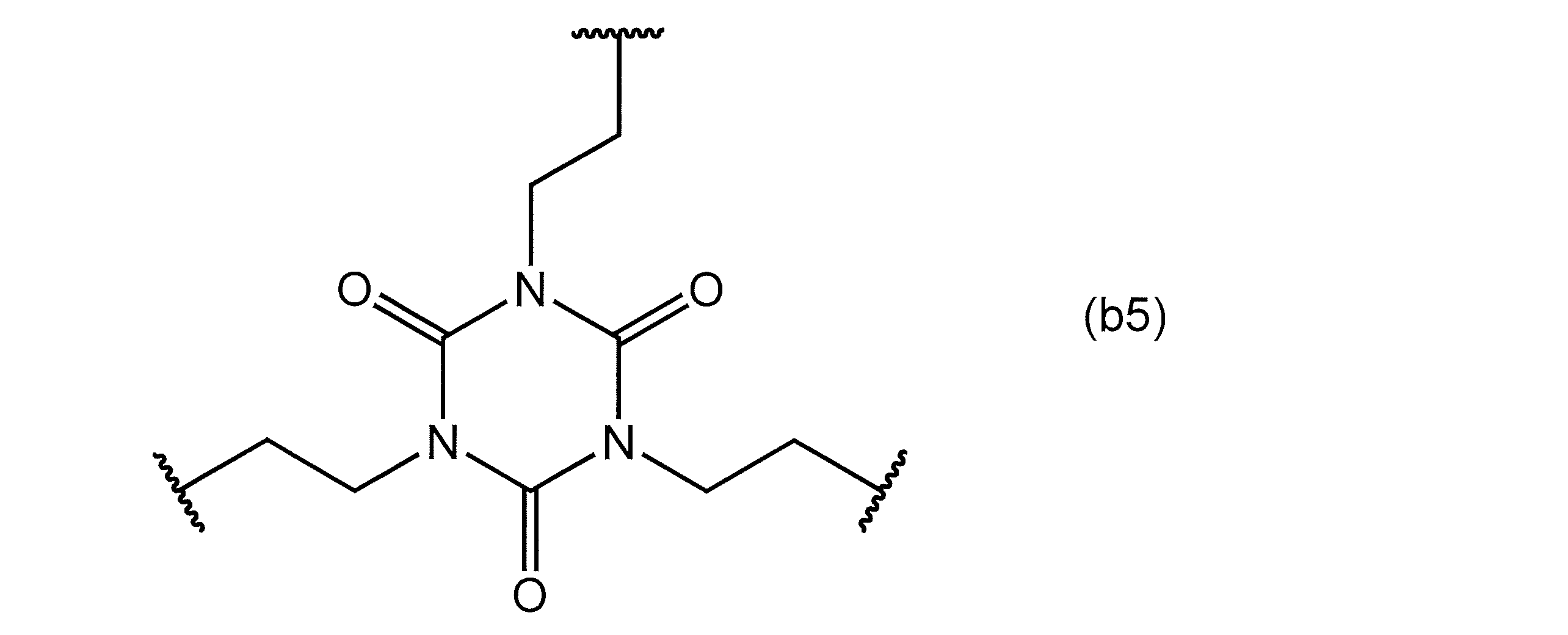
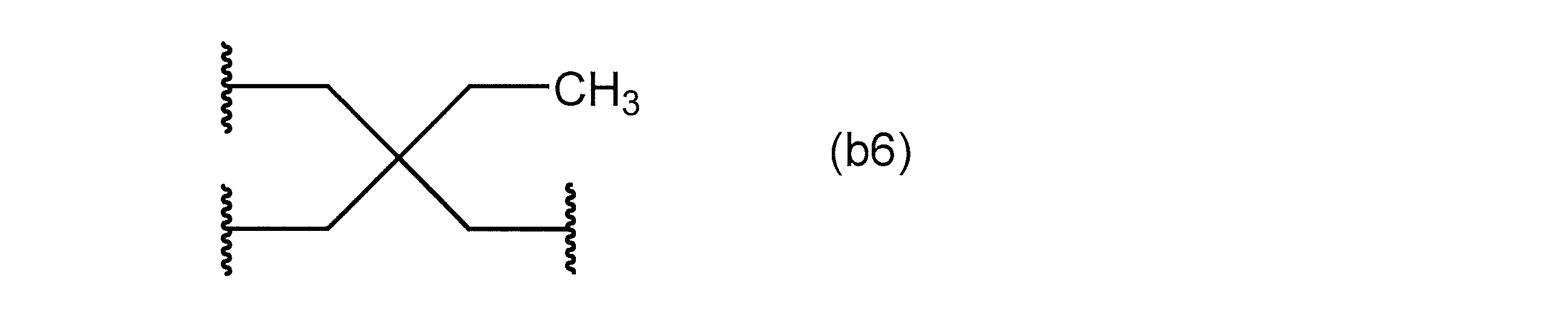


(式中、nは1~10の整数を示す。波線は結合部位を示す。)
で表される基のいずれか1つである請求項1に記載の硬化性エポキシ樹脂組成物。 - 前記脂環式エポキシ化合物(A)の脂環エポキシ基がシクロヘキセンオキシド基である請求項1又は2に記載の硬化性エポキシ樹脂組成物。
- 前記脂環式エポキシ化合物(A)が下記式(I-1)

で表される化合物である請求項1~3のいずれか1項に記載の硬化性エポキシ樹脂組成物。 - 請求項1~4のいずれか1項に記載の硬化性エポキシ樹脂組成物の硬化物。
- 請求項1~4のいずれか1項に記載の硬化性エポキシ樹脂組成物を含む封止剤。
- 請求項1~4のいずれか1項に記載の硬化性エポキシ樹脂組成物を含む接着剤。
- 請求項1~4のいずれか1項に記載の硬化性エポキシ樹脂組成物を含むコーティング剤。
- 請求項5に記載の硬化物を含む光学部材。
Applications Claiming Priority (2)
| Application Number | Priority Date | Filing Date | Title |
|---|---|---|---|
| JP2019068077A JP7329350B2 (ja) | 2019-03-29 | 2019-03-29 | 硬化性エポキシ樹脂組成物 |
| JP2019-068077 | 2019-03-29 |
Publications (1)
| Publication Number | Publication Date |
|---|---|
| WO2020203540A1 true WO2020203540A1 (ja) | 2020-10-08 |
Family
ID=72667725
Family Applications (1)
| Application Number | Title | Priority Date | Filing Date |
|---|---|---|---|
| PCT/JP2020/013293 Ceased WO2020203540A1 (ja) | 2019-03-29 | 2020-03-25 | 硬化性エポキシ樹脂組成物 |
Country Status (3)
| Country | Link |
|---|---|
| JP (1) | JP7329350B2 (ja) |
| TW (1) | TW202104336A (ja) |
| WO (1) | WO2020203540A1 (ja) |
Citations (6)
| Publication number | Priority date | Publication date | Assignee | Title |
|---|---|---|---|---|
| US3340236A (en) * | 1962-06-04 | 1967-09-05 | Ciba Ltd | Chemical composition |
| JPH04504873A (ja) * | 1989-04-26 | 1992-08-27 | アクゾ ナムローゼ フェンノートシャップ | チオール系化合物重合触媒 |
| JP2009001752A (ja) * | 2007-06-25 | 2009-01-08 | Nitto Denko Corp | 光半導体素子封止用エポキシ樹脂組成物およびそれを用いた光半導体装置 |
| JP2010053199A (ja) * | 2008-08-27 | 2010-03-11 | Daicel Chem Ind Ltd | 光半導体封止用樹脂組成物 |
| JP2015183145A (ja) * | 2014-03-26 | 2015-10-22 | 東洋インキScホールディングス株式会社 | 含硫黄エポキシ化合物、及びその製造方法 |
| JP2017082124A (ja) * | 2015-10-29 | 2017-05-18 | 昭和電工株式会社 | エポキシ樹脂組成物 |
-
2019
- 2019-03-29 JP JP2019068077A patent/JP7329350B2/ja active Active
-
2020
- 2020-03-25 WO PCT/JP2020/013293 patent/WO2020203540A1/ja not_active Ceased
- 2020-03-27 TW TW109110596A patent/TW202104336A/zh unknown
Patent Citations (6)
| Publication number | Priority date | Publication date | Assignee | Title |
|---|---|---|---|---|
| US3340236A (en) * | 1962-06-04 | 1967-09-05 | Ciba Ltd | Chemical composition |
| JPH04504873A (ja) * | 1989-04-26 | 1992-08-27 | アクゾ ナムローゼ フェンノートシャップ | チオール系化合物重合触媒 |
| JP2009001752A (ja) * | 2007-06-25 | 2009-01-08 | Nitto Denko Corp | 光半導体素子封止用エポキシ樹脂組成物およびそれを用いた光半導体装置 |
| JP2010053199A (ja) * | 2008-08-27 | 2010-03-11 | Daicel Chem Ind Ltd | 光半導体封止用樹脂組成物 |
| JP2015183145A (ja) * | 2014-03-26 | 2015-10-22 | 東洋インキScホールディングス株式会社 | 含硫黄エポキシ化合物、及びその製造方法 |
| JP2017082124A (ja) * | 2015-10-29 | 2017-05-18 | 昭和電工株式会社 | エポキシ樹脂組成物 |
Also Published As
| Publication number | Publication date |
|---|---|
| JP7329350B2 (ja) | 2023-08-18 |
| JP2020164698A (ja) | 2020-10-08 |
| TW202104336A (zh) | 2021-02-01 |
Similar Documents
| Publication | Publication Date | Title |
|---|---|---|
| JP6001668B2 (ja) | 硬化性組成物及びその硬化物、光学部材、並びに光学装置 | |
| KR101913603B1 (ko) | 에폭시 수지 조성물, 그 경화물, 및 경화성 수지 조성물 | |
| JP5179839B2 (ja) | エポキシ樹脂組成物、及びその硬化物 | |
| CN102459144B (zh) | 多元羧酸及其组合物、固化性树脂组合物、固化物以及多元羧酸的制造方法 | |
| JP5905014B2 (ja) | 放射線硬化性組成物 | |
| TWI652302B (zh) | 硬化性組成物及其硬化物、光學構件、以及光學裝置 | |
| TW202104199A (zh) | 脂環式環氧化合物製品 | |
| CN111587267A (zh) | 脂环式环氧化合物产品 | |
| JP6174836B2 (ja) | 白色リフレクター成型用硬化性エポキシ樹脂組成物及びその硬化物、光半導体素子搭載用基板、並びに光半導体装置 | |
| CN104903379B (zh) | 环氧树脂、环氧树脂组合物及固化物 | |
| JP7329350B2 (ja) | 硬化性エポキシ樹脂組成物 | |
| CN115605527B (zh) | 环氧树脂和环氧树脂组合物 | |
| TW202102568A (zh) | 環氧硬化用化合物及環氧樹脂組成物 | |
| JP2024025155A (ja) | 硬化性組成物及びその硬化物、並びにウェハレベルレンズ |
Legal Events
| Date | Code | Title | Description |
|---|---|---|---|
| 121 | Ep: the epo has been informed by wipo that ep was designated in this application |
Ref document number: 20782821 Country of ref document: EP Kind code of ref document: A1 |
|
| NENP | Non-entry into the national phase |
Ref country code: DE |
|
| 122 | Ep: pct application non-entry in european phase |
Ref document number: 20782821 Country of ref document: EP Kind code of ref document: A1 |