WO2020195143A1 - 自動車用冷却システム用チューブおよびその製造方法 - Google Patents
自動車用冷却システム用チューブおよびその製造方法 Download PDFInfo
- Publication number
- WO2020195143A1 WO2020195143A1 PCT/JP2020/003333 JP2020003333W WO2020195143A1 WO 2020195143 A1 WO2020195143 A1 WO 2020195143A1 JP 2020003333 W JP2020003333 W JP 2020003333W WO 2020195143 A1 WO2020195143 A1 WO 2020195143A1
- Authority
- WO
- WIPO (PCT)
- Prior art keywords
- tube
- alloy
- cooling system
- component
- weight
- Prior art date
- Legal status (The legal status is an assumption and is not a legal conclusion. Google has not performed a legal analysis and makes no representation as to the accuracy of the status listed.)
- Ceased
Links
Images
Classifications
-
- C—CHEMISTRY; METALLURGY
- C08—ORGANIC MACROMOLECULAR COMPOUNDS; THEIR PREPARATION OR CHEMICAL WORKING-UP; COMPOSITIONS BASED THEREON
- C08K—Use of inorganic or non-macromolecular organic substances as compounding ingredients
- C08K3/00—Use of inorganic substances as compounding ingredients
- C08K3/01—Use of inorganic substances as compounding ingredients characterized by their specific function
- C08K3/013—Fillers, pigments or reinforcing additives
-
- C—CHEMISTRY; METALLURGY
- C08—ORGANIC MACROMOLECULAR COMPOUNDS; THEIR PREPARATION OR CHEMICAL WORKING-UP; COMPOSITIONS BASED THEREON
- C08K—Use of inorganic or non-macromolecular organic substances as compounding ingredients
- C08K5/00—Use of organic ingredients
- C08K5/04—Oxygen-containing compounds
- C08K5/13—Phenols; Phenolates
-
- C—CHEMISTRY; METALLURGY
- C08—ORGANIC MACROMOLECULAR COMPOUNDS; THEIR PREPARATION OR CHEMICAL WORKING-UP; COMPOSITIONS BASED THEREON
- C08K—Use of inorganic or non-macromolecular organic substances as compounding ingredients
- C08K5/00—Use of organic ingredients
- C08K5/16—Nitrogen-containing compounds
- C08K5/34—Heterocyclic compounds having nitrogen in the ring
- C08K5/3467—Heterocyclic compounds having nitrogen in the ring having more than two nitrogen atoms in the ring
- C08K5/3477—Six-membered rings
-
- C—CHEMISTRY; METALLURGY
- C08—ORGANIC MACROMOLECULAR COMPOUNDS; THEIR PREPARATION OR CHEMICAL WORKING-UP; COMPOSITIONS BASED THEREON
- C08L—COMPOSITIONS OF MACROMOLECULAR COMPOUNDS
- C08L23/00—Compositions of homopolymers or copolymers of unsaturated aliphatic hydrocarbons having only one carbon-to-carbon double bond; Compositions of derivatives of such polymers
- C08L23/02—Compositions of homopolymers or copolymers of unsaturated aliphatic hydrocarbons having only one carbon-to-carbon double bond; Compositions of derivatives of such polymers not modified by chemical after-treatment
- C08L23/04—Homopolymers or copolymers of ethene
-
- C—CHEMISTRY; METALLURGY
- C08—ORGANIC MACROMOLECULAR COMPOUNDS; THEIR PREPARATION OR CHEMICAL WORKING-UP; COMPOSITIONS BASED THEREON
- C08L—COMPOSITIONS OF MACROMOLECULAR COMPOUNDS
- C08L23/00—Compositions of homopolymers or copolymers of unsaturated aliphatic hydrocarbons having only one carbon-to-carbon double bond; Compositions of derivatives of such polymers
- C08L23/02—Compositions of homopolymers or copolymers of unsaturated aliphatic hydrocarbons having only one carbon-to-carbon double bond; Compositions of derivatives of such polymers not modified by chemical after-treatment
- C08L23/10—Homopolymers or copolymers of propene
-
- F—MECHANICAL ENGINEERING; LIGHTING; HEATING; WEAPONS; BLASTING
- F16—ENGINEERING ELEMENTS AND UNITS; GENERAL MEASURES FOR PRODUCING AND MAINTAINING EFFECTIVE FUNCTIONING OF MACHINES OR INSTALLATIONS; THERMAL INSULATION IN GENERAL
- F16L—PIPES; JOINTS OR FITTINGS FOR PIPES; SUPPORTS FOR PIPES, CABLES OR PROTECTIVE TUBING; MEANS FOR THERMAL INSULATION IN GENERAL
- F16L11/00—Hoses, i.e. flexible pipes
- F16L11/04—Hoses, i.e. flexible pipes made of rubber or flexible plastics
Definitions
- the present invention relates to an automobile cooling system tube used for piping of an automobile cooling system and a method for manufacturing the same.
- a polyamide resin has been used as a piping material for a cooling system in a gasoline vehicle because of its excellent strength and heat resistance (see, for example, Patent Document 1). Further, as a piping material for a cooling system in an electric vehicle, a polyamide resin similar to that of a gasoline vehicle has been conventionally used.
- a tube made of polypropylene resin has been conventionally secured for high-temperature strength by containing a filler, there remains a problem that the tube is liable to break due to deterioration.
- the causes of tube breakage as described above are, for example, deterioration of polypropylene resin due to trace metal elements in the filler, thermal deterioration of polypropylene resin caused when the tube material is extruded, and heat load when the tube is actually driven. It is conceivable that heat aging caused by receiving the product.
- the present invention has been made in view of such circumstances, and provides a tube for an automobile cooling system and a method for manufacturing the same, which can realize improvement in heat aging resistance, impact resistance, high temperature strength, etc. at low cost. ..
- the present inventors have conducted extensive research to solve the above problems.
- the present inventors use polypropylene, which is a low-cost material, as the main raw material of the polymer in the forming material of the tube for the cooling system for automobiles, and in order to improve the impact resistance, the sea of polypropylene components.
- the alloy (A) in which the island phase of the polyethylene component, which is a soft component, was dispersed in the phase was used as a polymer for a tube material for an automobile cooling system.
- the compound (B) appropriately coats the surface of the inorganic filler (D), and the phenolic antioxidant (C) on the surface of the inorganic filler (D) is used. It is considered that because the adsorption was suppressed, it was possible to prevent the antioxidant function of the phenolic antioxidant (C) from being invalidated by the adsorption. In addition to this, it is considered that the heat deterioration prevention performance of polypropylene by the compound (B) itself also worked advantageously.
- the compound (B) and the inorganic filler (D) are unevenly distributed in the sea phase of the alloy (A), but tentatively in the island phase which is a soft component of the alloy (A). ,
- the presence of the inorganic filler (D) and the above compound (B) is considered to cause problems such as an increase in the hardness of the entire tube and impaired impact resistance, and the intended purpose could not be achieved. Conceivable.
- the gist of the present invention is the following [1] to [9].
- the following components (A) are the main components, the following components (B) to (D) are contained, and the components (B) and (D) are unevenly distributed in the sea phase of the component (A).
- Tubes for automotive cooling systems characterized by being made of alloys.
- B A compound having a guanamine skeleton.
- C Phenolic antioxidant.
- D Inorganic filler.
- [II] A step of kneading the compound (B) having a guanamine skeleton and the inorganic filler (D) with the kneaded product obtained in the above step [I].
- [III] A step of melt-extruding the kneaded product obtained in the above step [II] into a tube shape.
- the tube for an automobile cooling system of the present invention can be reduced in cost and can be improved in heat aging resistance, impact resistance, high temperature strength and the like.
- the tube for an automobile cooling system of the present invention contains the following components (A) as a main component and the following components (B) to (D), and (B) and
- the component (D) is composed of alloys unevenly distributed in the sea phase of the component (A).
- the above-mentioned "main component” is a component that has a great influence on the characteristics of the automobile cooling system tube of the present invention, and is usually the following material for forming the automobile cooling system tube. It shows that 50% by weight or more of the whole polypropylene resin composition containing the components (A) to (D) is the following component (A).
- A An alloy in which the island phase of the polyethylene component is dispersed in the sea phase of the polypropylene component.
- B A compound having a guanamine skeleton.
- C Phenolic antioxidant.
- D Inorganic filler.
- the components (B) and (D) are unevenly distributed in the sea phase of the component (A)
- the identification of the sea-island structure and the identification of the uneven distribution state as described above include, for example, the cross section of the tube for the automobile cooling system (or the polypropylene resin composition for forming the tube for the automobile cooling system).
- the cross section of the cured product is cut or polished, surfaced, stained, and then the reflected electron image is observed with a scanning electron microscope at an observation magnification of 5000 times.
- the average particle size of the island phase measured from the above observation results is preferably 0.01 to 100 ⁇ m, more preferably 0.1 to 10 ⁇ m, from the viewpoint of impact resistance, heat aging resistance, and the like.
- the ratio of the island phase (polyethylene component) to the entire resin portion (alloy) measured from the above observation results is preferably in the range of 1 to 49% by weight, more preferably in the range of 2.5 to 20% by weight. Is.
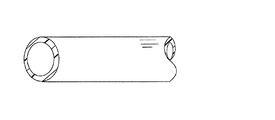
- the tube for an automobile cooling system of the present invention is made of an alloy containing the above components (A) to (D), and usually has a single-layer structure as shown in FIG. 1, but if necessary, other
- the resin layer and the reinforcing thread layer of the above may be further laminated to form a tube having a multilayer structure provided with the layer made of the alloy.
- alloy (A) As the alloy (A), as described above, an alloy in which the island phase of the polyethylene component is dispersed in the sea phase of the polypropylene component is used.
- polypropylene (oligocarbon) used as the material of the alloy in addition to the homopolymer of propylene, a block copolymer of ⁇ -olefin other than propylene such as butene-1 and propylene, and a random copolymer. , Copolymers such as graft copolymers, modified polypropylene modified with acid anhydrides such as maleic anhydride, and the like. These may be used alone or in combination of two or more.
- a homopolymer of propylene (homopolypropylene) is preferable because it can form a good sea-island structure with a polyethylene component and is also excellent in melt extrusion moldability and the like.
- an ethylene homopolymer, an ethylene-vinyl acetate copolymer, an ethylene-acrylic acid copolymer, and an ethylene-methacrylic acid in order to form the island phase of the polyethylene component as described above, an ethylene homopolymer, an ethylene-vinyl acetate copolymer, an ethylene-acrylic acid copolymer, and an ethylene-methacrylic acid
- One or more ethylene-based copolymers such as copolymers, ethylene- ⁇ -olefin copolymers (ethylene-propylene copolymer, ethylene-butene copolymer, ethylene-octene copolymer), etc. It is also used.
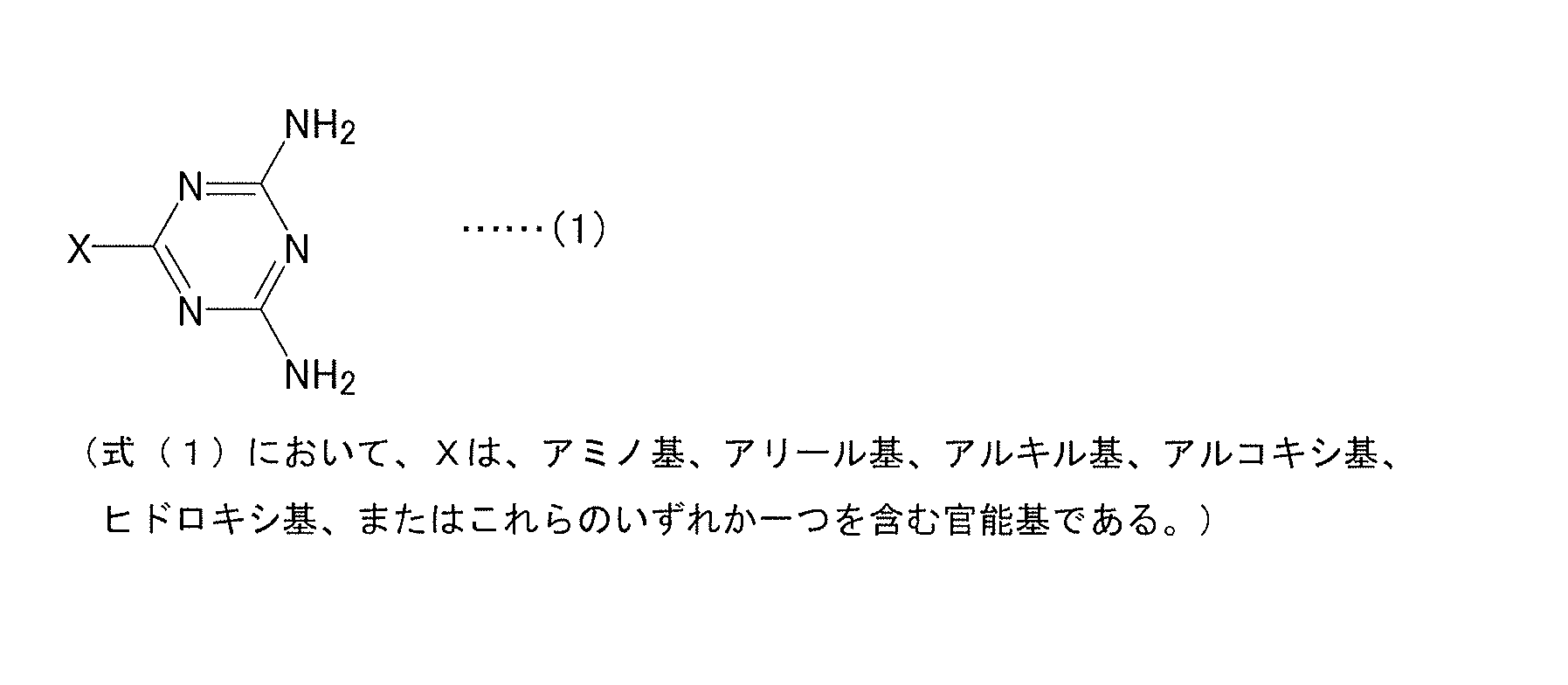
- X in the above general formula (1) is a functional group containing an amino group, an aryl group, an alkyl group, an alkoxy group, a hydroxy group, or any one of them. It is preferable to use the base compound (melamine compound) from the viewpoint of the action and effect of the present invention.
- Specific examples of the compound represented by the above general formula (1) include melamine, acetoguanamine, benzoguanamine and the like. These may be used alone or in combination of two or more. Of these, melamine is preferable because it is more excellent in adsorbability to fillers.
- the content ratio of the compound (B) having a guanamine skeleton is preferably 0.01 to 10 parts by weight, more preferably 0.1 to 5 parts by weight, based on 100 parts by weight of the alloy (A). .. By containing it in such an amount, the antioxidant function of the phenolic antioxidant (C) and the like can be satisfactorily exhibited.
- Phenolic antioxidant (C) >> Examples of the phenolic antioxidant (C) used in the present invention include tetrakis [3- (3', 5'-di-tert-butyl-4'-hydroxyphenyl) propionic acid] pentaerythritol, 2,2.
- the content ratio of the phenolic antioxidant (C) is preferably 0.01 to 10 parts by weight, more preferably 0.01 to 9 parts by weight, and particularly preferably 0.01 to 9 parts by weight, based on 100 parts by weight of the alloy (A). It is in the range of 0.1 to 5 parts by weight. By containing it in such an amount, the antioxidant function of the phenolic antioxidant (C) and the like can be satisfactorily exhibited.
- Inorganic filler (D) examples include talc, silica, mica, kaolin, calcium carbonate, potassium titanate, apatite, mica and the like. These may be used alone or in combination of two or more. Of these, talc is preferable from the viewpoint of extrusion processability, reinforcing property and the like.
- the content ratio of the inorganic filler (D) is preferably 1 to 100 parts by weight, more preferably 10 to 70 parts by weight, based on 100 parts by weight of the alloy (A). By containing in such an amount, good tube strength can be obtained.
- the material for forming the tube for the automobile cooling system of the present invention includes weather-resistant stabilizers, lubricants, pigments, dyes, antistatic agents, plasticizers and the like. Various additives may be appropriately blended as needed.
- the tube for an automobile cooling system of the present invention comprises the steps shown in the following [I] to [III] in this order. It can be manufactured satisfactorily.
- [I] A step of kneading the alloy (A) or a polypropylene-ethylene copolymer which is a constituent material of the alloy (A) and a phenolic antioxidant (C).
- [II] A step of kneading the compound (B) and the inorganic filler (D) with the kneaded product obtained in the above step [I].
- [III] A step of melt-extruding the kneaded product obtained in the above step [II] into a tube shape.
- the step [I] is carried out by, for example, kneading the alloy (A) and the phenolic antioxidant (C) at 160 to 230 ° C. for 0.01 to 10 minutes using a twin-screw kneading extruder or the like. It is said. Further, instead of the alloy (A), polypropylene (oligoform), which is a constituent material of the alloy (A), and the ethylene-based copolymer (oligoene) are blended in a predetermined ratio, and the phenol-based After blending the antioxidant (C), knead at 160 to 230 ° C.
- the agent (C) may be mixed at the same time.
- step [II] the compound (B) having a guanamine skeleton and the inorganic filler (D) are kneaded with respect to the kneaded product obtained in the above step [I], and the compound (B) having a guanamine skeleton is used.
- the compound (B) having a guanamine skeleton and the inorganic filler (D) in advance and knead it with the kneaded product obtained in the above step [I]. ..
- the kneading is carried out by kneading at 160 to 270 ° C. for 0.01 to 10 minutes with a twin-screw kneading extruder or the like.
- the mixing timing of the optional components other than the components (A) to (D) is not particularly limited as long as it is before the step [III], but it is preferable to mix the components after the step [II].
- the kneaded product obtained in the above step [II] is melt-extruded into a tube shape at 160 to 270 ° C. by a melt extrusion molding machine equipped with a cylindrical die.
- a melt extrusion molding machine equipped with a cylindrical die.
- pelletized products it is preferable to use pelletized products from the viewpoint of productivity.
- the tube for an automobile cooling system of the present invention thus obtained has an inner diameter in the range of 2.5 to 30 mm and a thickness in the range of 0.5 to 5.0 mm from the viewpoint of its application. Is preferable.
- the tube for an automobile cooling system of the present invention is used for piping a refrigerant such as cooling water in an automobile, and is used, for example, for a radiator hose, a heater hose, an air conditioner hose, etc., an electric vehicle, a fuel cell vehicle, etc. Used for cooling tubes of battery packs.
- Examples 1 to 14 Homo PP, EP, and phenolic antioxidants were kneaded with a twin-screw kneading extruder (TEM-18SS, manufactured by Toshiba Machine Co., Ltd.) at 200 ° C. for 5 minutes at the weight ratios and combinations shown in Tables 1 and 2 below. After that, the melamine compound and talc were added at the same time in the weight ratios and combinations shown in Tables 1 and 2 below, and further kneaded at 200 ° C. for 5 minutes by the above twin-screw kneading extruder. For materials not listed in the table below, the above kneading was performed without adding the material.
- TEM-18SS twin-screw kneading extruder
- the kneaded product is pelletized, and the pellets are melt-extruded into a tube at 250 ° C. by a melt extrusion molding machine (GT-40, manufactured by Plastic Engineering Laboratory) equipped with a cylindrical die.
- GT-40 melt extrusion molding machine
- a resin tube having an inner diameter of 18 mm and an outer diameter of 20 mm was obtained.
- the resin tube was cut in half and punched into strips with a width of 10 mm and a length of 15 cm.
- the strip-shaped sample thus obtained was subjected to a heat aging treatment (heat treatment at 120 ° C. for 1000 hours), and then the elongation at break [Eb] of the sample was adjusted to JIS K 6251. It was measured by a tensile tester (AGS-X, manufactured by Shimadzu Corporation). Then, the elongation of the sample was evaluated as “ ⁇ ” when it was 50% or more of the length of the sample, and “x” when it was less than 50% of the length of the sample.
- the cross section of the resin tube of the example was cut or polished, surfaced, stained, and then the reflected electron image was observed with a scanning electron microscope at an observation magnification of 5000 times. As a result, any resin tube was used. , It was confirmed that the island phase of the polyethylene component was dispersed in the sea phase of the polypropylene component, and further, it was confirmed that the melamine compound and talc were unevenly distributed in the sea phase of the alloy component. It was.
- the ratio of the island phase (polyethylene component) to the entire resin portion (alloy) observed in the cross section of the resin tube of the above-mentioned example was measured based on the above-mentioned reflected electron image, and all of them were 1 to 1. It was in the range of 49% by weight.
- Comparative Example 1 polypropylene was not used as the polymer, but only the ethylene-propylene copolymer was used, and the result was that the resin was dissolved during tube molding.
- Comparative Example 2 an ethylene-propylene copolymer was not used as the polymer, and only polypropylene was used, resulting in inferior impact resistance.
- Comparative Example 3 the result was inferior in heat aging resistance.
- a resin tube was produced by kneading melamine and an ethylene-propylene copolymer in advance with homo-PP, a phenolic antioxidant, and talc to produce a resin tube.
- the tube for an automobile cooling system of the present invention is used for piping a refrigerant such as cooling water in an automobile, and is used for, for example, a radiator hose, a heater hose, an air conditioner hose, etc., and an electric vehicle or a fuel cell vehicle. Used for cooling tubes of battery packs. Further, the tube for an automobile cooling system of the present invention is used for cooling not only automobiles but also other transportation machines (industrial transportation vehicles such as airplanes, forklifts, excavators, cranes, railroad vehicles, etc.) and vending machines. It can also be used as a tube for use.
Landscapes
- Chemical & Material Sciences (AREA)
- Medicinal Chemistry (AREA)
- Health & Medical Sciences (AREA)
- Chemical Kinetics & Catalysis (AREA)
- Polymers & Plastics (AREA)
- Organic Chemistry (AREA)
- General Engineering & Computer Science (AREA)
- Engineering & Computer Science (AREA)
- Mechanical Engineering (AREA)
- Compositions Of Macromolecular Compounds (AREA)
- Rigid Pipes And Flexible Pipes (AREA)
- Manufacture Of Macromolecular Shaped Articles (AREA)
- Extrusion Moulding Of Plastics Or The Like (AREA)
Abstract
下記の(A)成分を主成分とするとともに下記の(B)~(D)成分を含有し、かつ、(B)および(D)成分が(A)成分の海相内に偏在するアロイからなる自動車用冷却システム用チューブとする。これにより、低コストであり、耐熱老化性、耐衝撃性、高温強度等の改善を実現できる。 (A)ポリプロピレン成分の海相内にポリエチレン成分の島相が分散されたアロイ。 (B)グアナミン骨格を有する化合物。 (C)フェノール系酸化防止剤。 (D)無機フィラー。
Description
本発明は、自動車内の冷却システムの配管に用いられる、自動車用冷却システム用チューブおよびその製造方法に関するものである。
従来より、ガソリン車内の冷却システムの配管材料には、強度や耐熱性に優れることから、ポリアミド樹脂が採用されている(例えば、特許文献1参照)。
また、電気自動車内の冷却システムの配管材料にも、従来、ガソリン車と同様のポリアミド樹脂が採用されている。
また、電気自動車内の冷却システムの配管材料にも、従来、ガソリン車と同様のポリアミド樹脂が採用されている。
しかしながら、ポリアミド樹脂からなるチューブは、価格の面で課題が残る。そのため、上記課題を解決するために廉価なポリプロピレン樹脂を用いたチューブの使用も検討されている(例えば、特許文献2参照)。
ところが、ポリプロピレン樹脂からなるチューブは、耐熱性・耐衝撃性に大きな課題が残るため、その改善が望まれている。
また、ポリプロピレン樹脂からなるチューブは、フィラーの含有による高温強度の確保が従来から行われているが、劣化によるチューブ折れを生じやすいといった問題が残る。
上記のようなチューブ折れの要因は、例えば、フィラー中の微量金属元素に起因するポリプロピレン樹脂の劣化、チューブ材料を押出加工する際に生じたポリプロピレン樹脂の熱劣化、チューブが実車走行時の熱負荷を受けることにより生じる熱老化等が考えられる。
上記のようなチューブ折れの要因は、例えば、フィラー中の微量金属元素に起因するポリプロピレン樹脂の劣化、チューブ材料を押出加工する際に生じたポリプロピレン樹脂の熱劣化、チューブが実車走行時の熱負荷を受けることにより生じる熱老化等が考えられる。
本発明は、このような事情に鑑みなされたもので、低コストであり、耐熱老化性、耐衝撃性、高温強度等の改善を実現できる、自動車用冷却システム用チューブおよびその製造方法を提供する。
本発明者らは、前記課題を解決するため鋭意研究を重ねた。その研究の過程で、本発明者らは、自動車用冷却システム用チューブの形成材料において、低コスト材料であるポリプロピレンをポリマーの主原料としつつ、耐衝撃性を改善するために、ポリプロピレン成分の海相内に、柔軟成分であるポリエチレン成分の島相が分散されたアロイ(A)を、自動車用冷却システム用チューブ材料のポリマーとして用いることを想起した。そして、上記アロイ(A)に対し、高温強度を確保するために無機フィラー(D)を加えるとともに、フェノール系酸化防止剤(C)を加えることにより、上記無機フィラー(D)中の微量金属元素に起因するポリプロピレンの劣化を抑えることを検討した。
しかしながら、このようにしても、実際にはポリプロピレンの劣化を充分に抑えられなかったことから、本発明者らは、さらに実験を重ねた。その結果、自動車用冷却システム用チューブ材料中に、さらに、グアナミン骨格を有する化合物(B)を加え、かつ、上記化合物(B)および無機フィラー(D)を、上記アロイ(A)の海相内に偏在させるようにしたところ、所期の目的が達成できることを見いだした。
なお、上記のような結果が得られた理由は、上記化合物(B)が無機フィラー(D)の表面を適度にコートし、無機フィラー(D)表面へのフェノール系酸化防止剤(C)の吸着が抑えられたために、上記吸着によりフェノール系酸化防止剤(C)による酸化防止機能が失効されるのを防ぐことができたためと考えられる。また、このことに加え、上記化合物(B)自身によるポリプロピレンの熱劣化防止性能も有利に働いたと考えられる。なお、本発明では、上記化合物(B)および無機フィラー(D)を上記アロイ(A)の海相内に偏在させているが、仮に、上記アロイ(A)の柔軟成分である島相内に、無機フィラー(D)や上記化合物(B)が存在すると、チューブ全体の硬度が上がってしまい、耐衝撃性が損なわれる等の問題が生じると考えられ、所期の目的を達成し得なかったと考えられる。
しかしながら、このようにしても、実際にはポリプロピレンの劣化を充分に抑えられなかったことから、本発明者らは、さらに実験を重ねた。その結果、自動車用冷却システム用チューブ材料中に、さらに、グアナミン骨格を有する化合物(B)を加え、かつ、上記化合物(B)および無機フィラー(D)を、上記アロイ(A)の海相内に偏在させるようにしたところ、所期の目的が達成できることを見いだした。
なお、上記のような結果が得られた理由は、上記化合物(B)が無機フィラー(D)の表面を適度にコートし、無機フィラー(D)表面へのフェノール系酸化防止剤(C)の吸着が抑えられたために、上記吸着によりフェノール系酸化防止剤(C)による酸化防止機能が失効されるのを防ぐことができたためと考えられる。また、このことに加え、上記化合物(B)自身によるポリプロピレンの熱劣化防止性能も有利に働いたと考えられる。なお、本発明では、上記化合物(B)および無機フィラー(D)を上記アロイ(A)の海相内に偏在させているが、仮に、上記アロイ(A)の柔軟成分である島相内に、無機フィラー(D)や上記化合物(B)が存在すると、チューブ全体の硬度が上がってしまい、耐衝撃性が損なわれる等の問題が生じると考えられ、所期の目的を達成し得なかったと考えられる。
すなわち、本発明は、以下の[1]~[9]を、その要旨とする。
[1]下記の(A)成分を主成分とするとともに下記の(B)~(D)成分を含有し、かつ、(B)および(D)成分が(A)成分の海相内に偏在するアロイからなることを特徴とする自動車用冷却システム用チューブ。
(A)ポリプロピレン成分の海相内にポリエチレン成分の島相が分散されたアロイ。
(B)グアナミン骨格を有する化合物。
(C)フェノール系酸化防止剤。
(D)無機フィラー。
[2]上記の、グアナミン骨格を有する化合物(B)が、下記の一般式(1)に示すメラミン化合物である、[1]に記載の自動車用冷却システム用チューブ。
[3]上記アロイ(A)におけるポリエチレン成分の割合が1~49重量%である、[1]または[2]に記載の自動車用冷却システム用チューブ。
[4]上記の、グアナミン骨格を有する化合物(B)の含有割合が、上記アロイ(A)100重量部に対して0.01~10重量部の範囲である、[1]~[3]のいずれかに記載の自動車用冷却システム用チューブ。
[5]上記フェノール系酸化防止剤(C)の含有割合が、上記アロイ(A)100重量部に対して0.01~10重量部の範囲である、[1]~[4]のいずれかに記載の自動車用冷却システム用チューブ。
[6]上記無機フィラー(D)の含有割合が、上記アロイ(A)100重量部に対して1~100重量部の範囲である、[1]~[5]のいずれかに記載の自動車用冷却システム用チューブ。
[7]上記無機フィラー(D)が、タルクである、[1]~[6]のいずれかに記載の自動車用冷却システム用チューブ。
[8][1]~[7]のいずれかに記載の自動車用冷却システム用チューブの製造方法であって、下記の[I]~[III]に示す工程をこの順で備えていることを特徴とする自動車用冷却システム用チューブの製造方法。
[I]ポリプロピレン成分の海相内にポリエチレン成分の島相が分散されたアロイ(A)、または上記アロイ(A)の構成材料であるポリプロピレンおよびエチレン系共重合体と、フェノール系酸化防止剤(C)とを、混練する工程。
[II]上記工程[I]で得られた混練物に対し、グアナミン骨格を有する化合物(B)と無機フィラー(D)とを混練する工程。
[III]上記工程[II]で得られた混練物を、チューブ状に溶融押出成形する工程。
[9]上記工程[II]における、工程[I]で得られた混練物に対する、グアナミン骨格を有する化合物(B)と無機フィラー(D)の混合を、同時に行う、[8]に記載の自動車用冷却システム用チューブの製造方法。
[1]下記の(A)成分を主成分とするとともに下記の(B)~(D)成分を含有し、かつ、(B)および(D)成分が(A)成分の海相内に偏在するアロイからなることを特徴とする自動車用冷却システム用チューブ。
(A)ポリプロピレン成分の海相内にポリエチレン成分の島相が分散されたアロイ。
(B)グアナミン骨格を有する化合物。
(C)フェノール系酸化防止剤。
(D)無機フィラー。
[2]上記の、グアナミン骨格を有する化合物(B)が、下記の一般式(1)に示すメラミン化合物である、[1]に記載の自動車用冷却システム用チューブ。
[4]上記の、グアナミン骨格を有する化合物(B)の含有割合が、上記アロイ(A)100重量部に対して0.01~10重量部の範囲である、[1]~[3]のいずれかに記載の自動車用冷却システム用チューブ。
[5]上記フェノール系酸化防止剤(C)の含有割合が、上記アロイ(A)100重量部に対して0.01~10重量部の範囲である、[1]~[4]のいずれかに記載の自動車用冷却システム用チューブ。
[6]上記無機フィラー(D)の含有割合が、上記アロイ(A)100重量部に対して1~100重量部の範囲である、[1]~[5]のいずれかに記載の自動車用冷却システム用チューブ。
[7]上記無機フィラー(D)が、タルクである、[1]~[6]のいずれかに記載の自動車用冷却システム用チューブ。
[8][1]~[7]のいずれかに記載の自動車用冷却システム用チューブの製造方法であって、下記の[I]~[III]に示す工程をこの順で備えていることを特徴とする自動車用冷却システム用チューブの製造方法。
[I]ポリプロピレン成分の海相内にポリエチレン成分の島相が分散されたアロイ(A)、または上記アロイ(A)の構成材料であるポリプロピレンおよびエチレン系共重合体と、フェノール系酸化防止剤(C)とを、混練する工程。
[II]上記工程[I]で得られた混練物に対し、グアナミン骨格を有する化合物(B)と無機フィラー(D)とを混練する工程。
[III]上記工程[II]で得られた混練物を、チューブ状に溶融押出成形する工程。
[9]上記工程[II]における、工程[I]で得られた混練物に対する、グアナミン骨格を有する化合物(B)と無機フィラー(D)の混合を、同時に行う、[8]に記載の自動車用冷却システム用チューブの製造方法。
以上のことから、本発明の自動車用冷却システム用チューブは、低コスト化を図ることができ、かつ、耐熱老化性、耐衝撃性、高温強度等の改善を実現することができる。
つぎに、本発明の実施の形態について詳しく説明する。ただし、本発明は、この実施の形態に限られるものではない。
本発明の自動車用冷却システム用チューブは、先に述べたように、下記の(A)成分を主成分とするとともに下記の(B)~(D)成分を含有し、かつ、(B)および(D)成分が(A)成分の海相内に偏在するアロイからなるものである。ここで、上記の「主成分」とは、本発明の自動車用冷却システム用チューブの特性に大きな影響を与える成分のことであり、通常は、自動車用冷却システム用チューブの形成材料である下記の(A)~(D)成分を含むポリプロピレン系樹脂組成物全体の50重量%以上が、下記の(A)成分であるものを示す。
(A)ポリプロピレン成分の海相内にポリエチレン成分の島相が分散されたアロイ。
(B)グアナミン骨格を有する化合物。
(C)フェノール系酸化防止剤。
(D)無機フィラー。
(A)ポリプロピレン成分の海相内にポリエチレン成分の島相が分散されたアロイ。
(B)グアナミン骨格を有する化合物。
(C)フェノール系酸化防止剤。
(D)無機フィラー。
なお、本発明において、「(B)および(D)成分が(A)成分の海相内に偏在する」とは、本発明の自動車用冷却システム用チューブに含まれる(B)成分の70重量%以上および(D)成分の70重量%以上が、(A)成分の海相に含まれていることを意味し、好ましくは(B)成分の80重量%以上および(D)成分の80重量%以上が、より好ましくは(B)成分の95重量%以上および(D)成分の95重量%以上が、(A)成分の海相に含まれていることを意味する。そして、最も好ましいのは、本発明の自動車用冷却システム用チューブに含まれる(B)成分の全ておよび(D)成分の全てが、(A)成分の海相に含まれていることである。
また、上記のような海-島構造の識別、および、偏在状況の識別は、例えば、上記自動車用冷却システム用チューブの断面(あるいは上記自動車用冷却システム用チューブ形成用のポリプロピレン系樹脂組成物の硬化体断面)に対し、切削ないし研磨して面出しし、染色した後、観察倍率5000倍で走査型電子顕微鏡による反射電子像観察を行うことによりなされる。
そして、上記の観察結果より測定された島相の平均粒径は、耐衝撃性、耐熱老化性等の観点から、0.01~100μmであることが好ましく、より好ましくは0.1~10μmの範囲である。
上記の観察結果より測定された樹脂部分(アロイ)全体に対する島相(ポリエチレン成分)の割合は、1~49重量%の範囲であることが好ましく、より好ましくは2.5~20重量%の範囲である。
上記の観察結果より測定された樹脂部分(アロイ)全体に対する島相(ポリエチレン成分)の割合は、1~49重量%の範囲であることが好ましく、より好ましくは2.5~20重量%の範囲である。
本発明の自動車用冷却システム用チューブは、上記(A)~(D)成分を含有するアロイからなるものであり、通常、図1に示すような単層構造であるが、必要に応じ、他の樹脂層や補強糸層をさらに積層し、上記アロイからなる層を備えた多層構造のチューブとしてもよい。
つぎに、本発明の自動車用冷却システム用チューブの各材料について説明する。
《アロイ(A)》
上記アロイ(A)としては、先に述べたように、ポリプロピレン成分の海相内にポリエチレン成分の島相が分散されたアロイが用いられる。
上記アロイの材料に用いられるポリプロピレン(オリゴマー)としては、プロピレンの単独重合体(ホモポリプロピレン)の他、ブテン-1等のプロピレン以外のα-オレフィンとプロピレンとのブロック共重合体、ランダム共重合体、グラフト共重合体等の共重合体、無水マレイン酸等の酸無水物で変性した変性ポリプロピレン等があげられる。これらは単独であるいは二種以上併せて用いられる。なかでも、ポリエチレン成分と良好な海-島構造を形成することができ、さらに、溶融押出成形性等にも優れることから、プロピレンの単独重合体(ホモポリプロピレン)が好ましい。
また、上記アロイの材料には、上記のようにポリエチレン成分の島相を形成するために、エチレン単独共重合体、エチレン-酢酸ビニル共重合体、エチレン-アクリル酸共重合体、エチレン-メタクリル酸共重合体、エチレンとα-オレフィンの共重合体(エチレン-プロピレン共重合体、エチレン-ブテン共重合体、エチレン-オクテン共重合体)等の、エチレン系共重合体が単独でもしくは二種以上併せて用いられる。
上記アロイ(A)としては、先に述べたように、ポリプロピレン成分の海相内にポリエチレン成分の島相が分散されたアロイが用いられる。
上記アロイの材料に用いられるポリプロピレン(オリゴマー)としては、プロピレンの単独重合体(ホモポリプロピレン)の他、ブテン-1等のプロピレン以外のα-オレフィンとプロピレンとのブロック共重合体、ランダム共重合体、グラフト共重合体等の共重合体、無水マレイン酸等の酸無水物で変性した変性ポリプロピレン等があげられる。これらは単独であるいは二種以上併せて用いられる。なかでも、ポリエチレン成分と良好な海-島構造を形成することができ、さらに、溶融押出成形性等にも優れることから、プロピレンの単独重合体(ホモポリプロピレン)が好ましい。
また、上記アロイの材料には、上記のようにポリエチレン成分の島相を形成するために、エチレン単独共重合体、エチレン-酢酸ビニル共重合体、エチレン-アクリル酸共重合体、エチレン-メタクリル酸共重合体、エチレンとα-オレフィンの共重合体(エチレン-プロピレン共重合体、エチレン-ブテン共重合体、エチレン-オクテン共重合体)等の、エチレン系共重合体が単独でもしくは二種以上併せて用いられる。
《グアナミン骨格を有する化合物(B)》
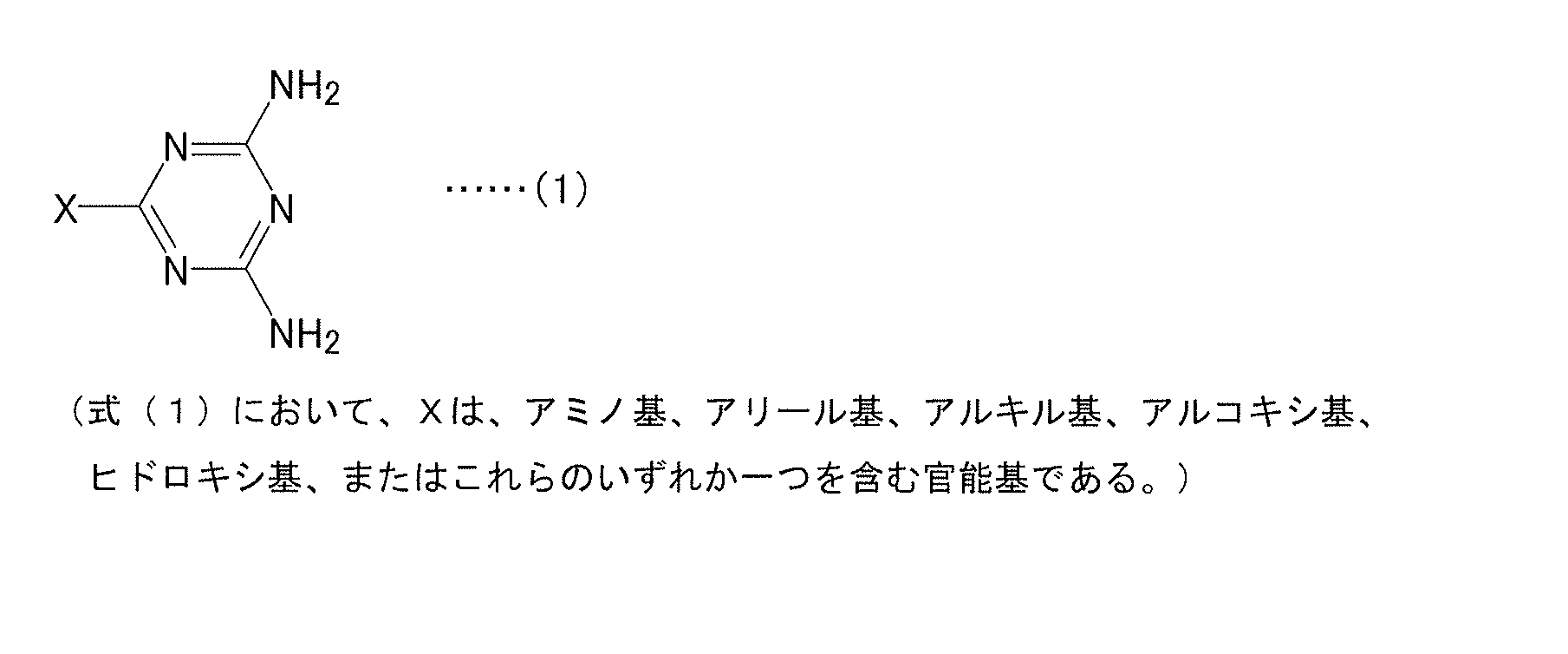
上記の、グアナミン骨格を有する化合物(B)とは、下記の一般式(1)に示すような化学構造の化合物のことをいう。
上記の、グアナミン骨格を有する化合物(B)とは、下記の一般式(1)に示すような化学構造の化合物のことをいう。
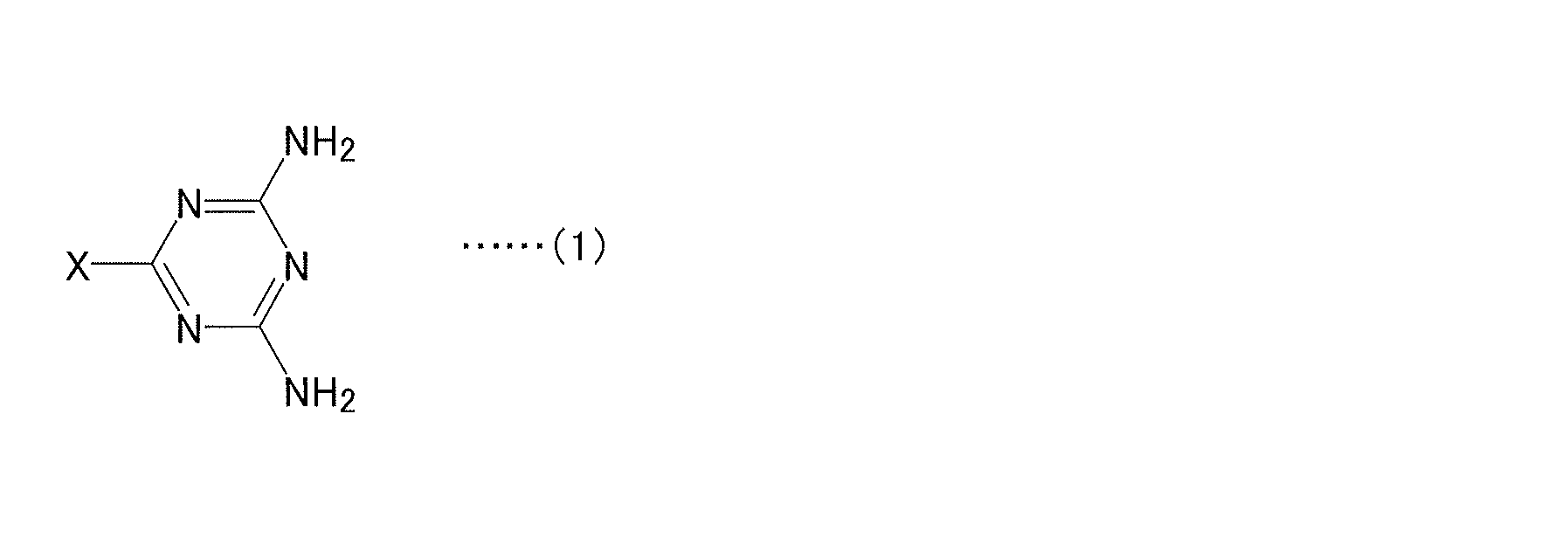
そして、上記の、グアナミン骨格を有する化合物(B)として、上記一般式(1)におけるXが、アミノ基、アリール基、アルキル基、アルコキシ基、ヒドロキシ基、またはこれらのいずれか一つを含む官能基である化合物(メラミン化合物)を用いることが、本発明の作用効果の観点から好ましい。
上記一般式(1)に示す化合物としては、具体的には、メラミン、アセトグアナミン、ベンゾグアナミン等があげられる。これらは単独でもしくは二種以上併せて用いられる。なかでも、よりフィラーへの吸着性に優れることから、メラミンが好ましい。
上記の、グアナミン骨格を有する化合物(B)の含有割合は、前記アロイ(A)100重量部に対して、0.01~10重量部が好ましく、より好ましくは0.1~5重量部である。このような量で含有することにより、フェノール系酸化防止剤(C)による酸化防止機能等が良好に発現されるようになる。
《フェノール系酸化防止剤(C)》
本発明で用いられるフェノール系酸化防止剤(C)としては、例えば、テトラキス[3-(3',5'-ジ-tert-ブチル-4'-ヒドロキシフェニル)プロピオン酸]ペンタエリトリトール、2,2'-チオジエチルビス[3-(3,5-ジ-tert-ブチル-4-ヒドロキシフェニル)プロピオナート]、3-(3,5-ジ-tert-ブチル-4-ヒドロキシフェニル)プロピオン酸オクタデシル、N,N'-ビス3-(3',5'-ジ-tert-ブチル-4'-ヒドロキシフェニル)プロピオニルヘキサメチレンジアミン、2,4-ビス[(ドデシルチオ)メチル]-6-メチルフェノール、ビス[3-(3-tert-ブチル-4-ヒドロキシ-5-メチルフェニル)プロピオン酸][エチレンビス(オキシエチレン)]、1,6-ヘキサンジオールビス[3-(3,5-ジ-tert-ブチル-4-ヒドロキシフェニル)プロピオナート]、1,3,5-トリス[[3,5-ビス(1,1-ジメチルエチル)-4-ヒドロキシフェニル]メチル]-1,3,5-トリアジン-2,4,6(1H,3H,5H)-トリオン、1,1,3-トリス(2-メチル-4-ヒドロキシ-5-tert-ブチルフェニル)ブタン、4,4'-ブチリデンビス(6-tert-ブチル-m-クレゾール)、2,2'-ジメチル-2,2'-(2,4,8,10-テトラオキサスピロ[5.5]ウンデカン-3,9-ジイル)ジプロパン-1,1'-ジイル=ビス[3-(3-tert-ブチル-4-ヒドロキシ-5-メチルフェニル)プロパノアート]、2,4,6-トリス(3',5'-ジ-tert-ブチル-4'-ヒドロキシベンジル)メシチレン等があげられる。これらは単独でもしくは二種以上併せて用いられる。
本発明で用いられるフェノール系酸化防止剤(C)としては、例えば、テトラキス[3-(3',5'-ジ-tert-ブチル-4'-ヒドロキシフェニル)プロピオン酸]ペンタエリトリトール、2,2'-チオジエチルビス[3-(3,5-ジ-tert-ブチル-4-ヒドロキシフェニル)プロピオナート]、3-(3,5-ジ-tert-ブチル-4-ヒドロキシフェニル)プロピオン酸オクタデシル、N,N'-ビス3-(3',5'-ジ-tert-ブチル-4'-ヒドロキシフェニル)プロピオニルヘキサメチレンジアミン、2,4-ビス[(ドデシルチオ)メチル]-6-メチルフェノール、ビス[3-(3-tert-ブチル-4-ヒドロキシ-5-メチルフェニル)プロピオン酸][エチレンビス(オキシエチレン)]、1,6-ヘキサンジオールビス[3-(3,5-ジ-tert-ブチル-4-ヒドロキシフェニル)プロピオナート]、1,3,5-トリス[[3,5-ビス(1,1-ジメチルエチル)-4-ヒドロキシフェニル]メチル]-1,3,5-トリアジン-2,4,6(1H,3H,5H)-トリオン、1,1,3-トリス(2-メチル-4-ヒドロキシ-5-tert-ブチルフェニル)ブタン、4,4'-ブチリデンビス(6-tert-ブチル-m-クレゾール)、2,2'-ジメチル-2,2'-(2,4,8,10-テトラオキサスピロ[5.5]ウンデカン-3,9-ジイル)ジプロパン-1,1'-ジイル=ビス[3-(3-tert-ブチル-4-ヒドロキシ-5-メチルフェニル)プロパノアート]、2,4,6-トリス(3',5'-ジ-tert-ブチル-4'-ヒドロキシベンジル)メシチレン等があげられる。これらは単独でもしくは二種以上併せて用いられる。
上記フェノール系酸化防止剤(C)の含有割合は、前記アロイ(A)100重量部に対して、0.01~10重量部が好ましく、より好ましくは0.01~9重量部、特に好ましくは0.1~5重量部の範囲である。このような量で含有することにより、上記フェノール系酸化防止剤(C)による酸化防止機能等が良好に発現されるようになる。
《無機フィラー(D)》
本発明で用いられる無機フィラー(D)としては、例えば、タルク、シリカ、マイカ、カオリン、炭酸カルシウム、チタン酸カリウム、アパタイト、雲母等があげられる。これらは単独でもしくは二種以上併せて用いられる。なかでも、押出加工性、補強性等の観点から、タルクが好ましい。
本発明で用いられる無機フィラー(D)としては、例えば、タルク、シリカ、マイカ、カオリン、炭酸カルシウム、チタン酸カリウム、アパタイト、雲母等があげられる。これらは単独でもしくは二種以上併せて用いられる。なかでも、押出加工性、補強性等の観点から、タルクが好ましい。
上記無機フィラー(D)の含有割合は、前記アロイ(A)100重量部に対して、1~100重量部が好ましく、より好ましくは10~70重量部である。このような量で含有することにより、良好なチューブ強度が得られるようになる。
なお、本発明の自動車用冷却システム用チューブの形成材料には、上記(A)~(D)の各成分に加えて、耐候安定剤、滑剤、顔料、染料、帯電防止剤、可塑剤などの各種添加剤を、必要に応じて適宜配合しても差し支えない。
そして、上記アロイ(A)を主成分とするとともに、上記の、グアナミン骨格を有する化合物(B)、フェノール系酸化防止剤(C)、無機フィラー(D)を含有し、かつ、上記化合物(B)および無機フィラー(D)が上記アロイ(A)の海相内に偏在するアロイからなる、本発明の自動車用冷却システム用チューブは、下記の[I]~[III]に示す工程をこの順で行うことにより、良好に製造することができる。
[I]上記アロイ(A)、または上記アロイ(A)の構成材料であるポリプロピレンおよびエチレン系共重合体と、フェノール系酸化防止剤(C)とを、混練する工程。
[II]上記工程[I]で得られた混練物に対し、上記化合物(B)と無機フィラー(D)とを混練する工程。
[III]上記工程[II]で得られた混練物を、チューブ状に溶融押出成形する工程。
[I]上記アロイ(A)、または上記アロイ(A)の構成材料であるポリプロピレンおよびエチレン系共重合体と、フェノール系酸化防止剤(C)とを、混練する工程。
[II]上記工程[I]で得られた混練物に対し、上記化合物(B)と無機フィラー(D)とを混練する工程。
[III]上記工程[II]で得られた混練物を、チューブ状に溶融押出成形する工程。
上記工程[I]は、例えば、上記アロイ(A)と、フェノール系酸化防止剤(C)とを、二軸混練押出機等により160~230℃で0.01~10分間混練することにより行われる。
また、上記アロイ(A)に代えて、上記アロイ(A)の構成材料であるポリプロピレン(オリゴマー)と、上記エチレン系共重合体(オリゴマー)とを、所定の割合で配合し、そこにフェノール系酸化防止剤(C)を配合したうえで、二軸混練押出機等により160~230℃で混練し、上記ポリプロピレン(オリゴマー)とエチレン系共重合体(オリゴマー)の共重合と、フェノール系酸化防止剤(C)の混合を同時に行うようにしてもよい。
また、上記アロイ(A)に代えて、上記アロイ(A)の構成材料であるポリプロピレン(オリゴマー)と、上記エチレン系共重合体(オリゴマー)とを、所定の割合で配合し、そこにフェノール系酸化防止剤(C)を配合したうえで、二軸混練押出機等により160~230℃で混練し、上記ポリプロピレン(オリゴマー)とエチレン系共重合体(オリゴマー)の共重合と、フェノール系酸化防止剤(C)の混合を同時に行うようにしてもよい。
上記工程[II]では、上記工程[I]で得られた混練物に対する、グアナミン骨格を有する化合物(B)と無機フィラー(D)の混練が行われるが、グアナミン骨格を有する化合物(B)と無機フィラー(D)を上記アロイ(A)の海相内に良好に偏在させるため、グアナミン骨格を有する化合物(B)と無機フィラー(D)の混合を、同時に行うことが好ましい。そして、同様の観点から、予めグアナミン骨格を有する化合物(B)と無機フィラー(D)を混合しておいて、それを上記工程[I]で得られた混練物に混練することが、より好ましい。
そして、上記混練は、二軸混練押出機等により160~270℃で0.01~10分間混練することにより行われる。
なお、上記(A)~(D)成分以外の任意成分の混合時期については、上記工程[III]以前であれば特に限定されないが、上記工程[II]以降に混合することが好ましい。
そして、上記混練は、二軸混練押出機等により160~270℃で0.01~10分間混練することにより行われる。
なお、上記(A)~(D)成分以外の任意成分の混合時期については、上記工程[III]以前であれば特に限定されないが、上記工程[II]以降に混合することが好ましい。
上記工程[III]では、上記工程[II]で得られた混練物が、円筒状ダイが装着された溶融押出成形機等により、160~270℃でチューブ状に溶融押出成形される。なお、上記混練物としては、ペレット化したものを用いることが、生産性の観点から好ましい。
このようにして得られる本発明の自動車用冷却システム用チューブは、その用途上の観点から、内径が2.5~30mmの範囲であり、厚みが0.5~5.0mmの範囲であるものが好ましい。
そして、本発明の自動車用冷却システム用チューブは、自動車内における冷却水等の冷媒の配管に用いられるものであり、例えば、ラジエーターホース、ヒーターホース、エアコンホース等や、電気自動車や燃料電池自動車用の電池パックの冷却用チューブに用いられる。
つぎに、本発明の実施例について比較例と併せて説明する。ただし、本発明はこれら実施例に限定されるものではない。
まず、実施例および比較例に先立ち、下記に示す材料を準備した。
〔ホモPP(ホモポリプロピレン)〕
HiZEX E-200GP、プライムポリマー社製
HiZEX E-200GP、プライムポリマー社製
〔エチレン-プロピレン共重合体(EP)〕
タフマーDF840、三井化学社製
タフマーDF840、三井化学社製
〔メラミン化合物(i)〕
メラミン、東京化成工業社製
メラミン、東京化成工業社製
〔メラミン化合物(ii)〕
アセトグアナミン、三菱ケミカル社製
アセトグアナミン、三菱ケミカル社製
〔メラミン化合物(iii)〕
ベンゾグアナミン、日本カーバイド工業社製
ベンゾグアナミン、日本カーバイド工業社製
〔メラミン化合物(iv)〕
前記一般式(1)においてXがヒドロキシ基を含む官能基であるメラミン化合物(VD-3、四国化成社製)
前記一般式(1)においてXがヒドロキシ基を含む官能基であるメラミン化合物(VD-3、四国化成社製)
〔メラミン化合物(v)〕
前記一般式(1)においてXがアルコキシ基であるメラミン化合物(VD-5、四国化成社製)
前記一般式(1)においてXがアルコキシ基であるメラミン化合物(VD-5、四国化成社製)
〔メラミン+EP〕
メラミン(東京化成工業社製)とエチレン-プロピレン共重合体(タフマーDF840、三井化学社製)を、重量比で、メラミン:エチレン-プロピレン共重合体=100:5の割合となるよう混練した、練込品
メラミン(東京化成工業社製)とエチレン-プロピレン共重合体(タフマーDF840、三井化学社製)を、重量比で、メラミン:エチレン-プロピレン共重合体=100:5の割合となるよう混練した、練込品
〔フェノール系酸化防止剤〕
テトラキス[3-(3',5'-ジ-tert-ブチル-4'-ヒドロキシフェニル)プロピオン酸]ペンタエリトリトール(IRGANOX 1010、BASF社製)
テトラキス[3-(3',5'-ジ-tert-ブチル-4'-ヒドロキシフェニル)プロピオン酸]ペンタエリトリトール(IRGANOX 1010、BASF社製)
〔タルク〕
FH108、富士タルク社製
FH108、富士タルク社製
[実施例1~14、比較例1,2,4~7]
後記の表1および表2に示す重量割合および組合せで、ホモPP、EP、フェノール系酸化防止剤を、二軸混練押出機(TEM-18SS、東芝機械社製)により200℃で5分間混練した後、後記の表1および表2に示す重量割合および組合せで、メラミン化合物とタルクを同時に加え、さらに上記二軸混練押出機により200℃で5分間混練した。なお、後記の表に記載のない材料に関しては、当該材料を加えずに、上記混練を行った。
つぎに、上記混練物をペレット化し、そのペレットを、円筒状ダイが装着された溶融押出成形機(GT-40、プラスチック工学研究所社製)により、250℃でチューブ状に溶融押出成形することにより、内径18mm,外径20mmの樹脂チューブを得た。
後記の表1および表2に示す重量割合および組合せで、ホモPP、EP、フェノール系酸化防止剤を、二軸混練押出機(TEM-18SS、東芝機械社製)により200℃で5分間混練した後、後記の表1および表2に示す重量割合および組合せで、メラミン化合物とタルクを同時に加え、さらに上記二軸混練押出機により200℃で5分間混練した。なお、後記の表に記載のない材料に関しては、当該材料を加えずに、上記混練を行った。
つぎに、上記混練物をペレット化し、そのペレットを、円筒状ダイが装着された溶融押出成形機(GT-40、プラスチック工学研究所社製)により、250℃でチューブ状に溶融押出成形することにより、内径18mm,外径20mmの樹脂チューブを得た。
[比較例3]
後記の表2に示す重量割合および組合せで、ホモPP、メラミン+EP、フェノール系酸化防止剤、およびタルクを、同時に加え、二軸混練押出機(TEM-18SS、東芝機械社製)により200℃で5分間混練した。
つぎに、上記混練物をペレット化し、そのペレットを、円筒状ダイが装着された溶融押出成形機(GT-40、プラスチック工学研究所社製)により、250℃でチューブ状に溶融押出成形することにより、内径18mm,外径20mmの樹脂チューブを得た。
後記の表2に示す重量割合および組合せで、ホモPP、メラミン+EP、フェノール系酸化防止剤、およびタルクを、同時に加え、二軸混練押出機(TEM-18SS、東芝機械社製)により200℃で5分間混練した。
つぎに、上記混練物をペレット化し、そのペレットを、円筒状ダイが装着された溶融押出成形機(GT-40、プラスチック工学研究所社製)により、250℃でチューブ状に溶融押出成形することにより、内径18mm,外径20mmの樹脂チューブを得た。
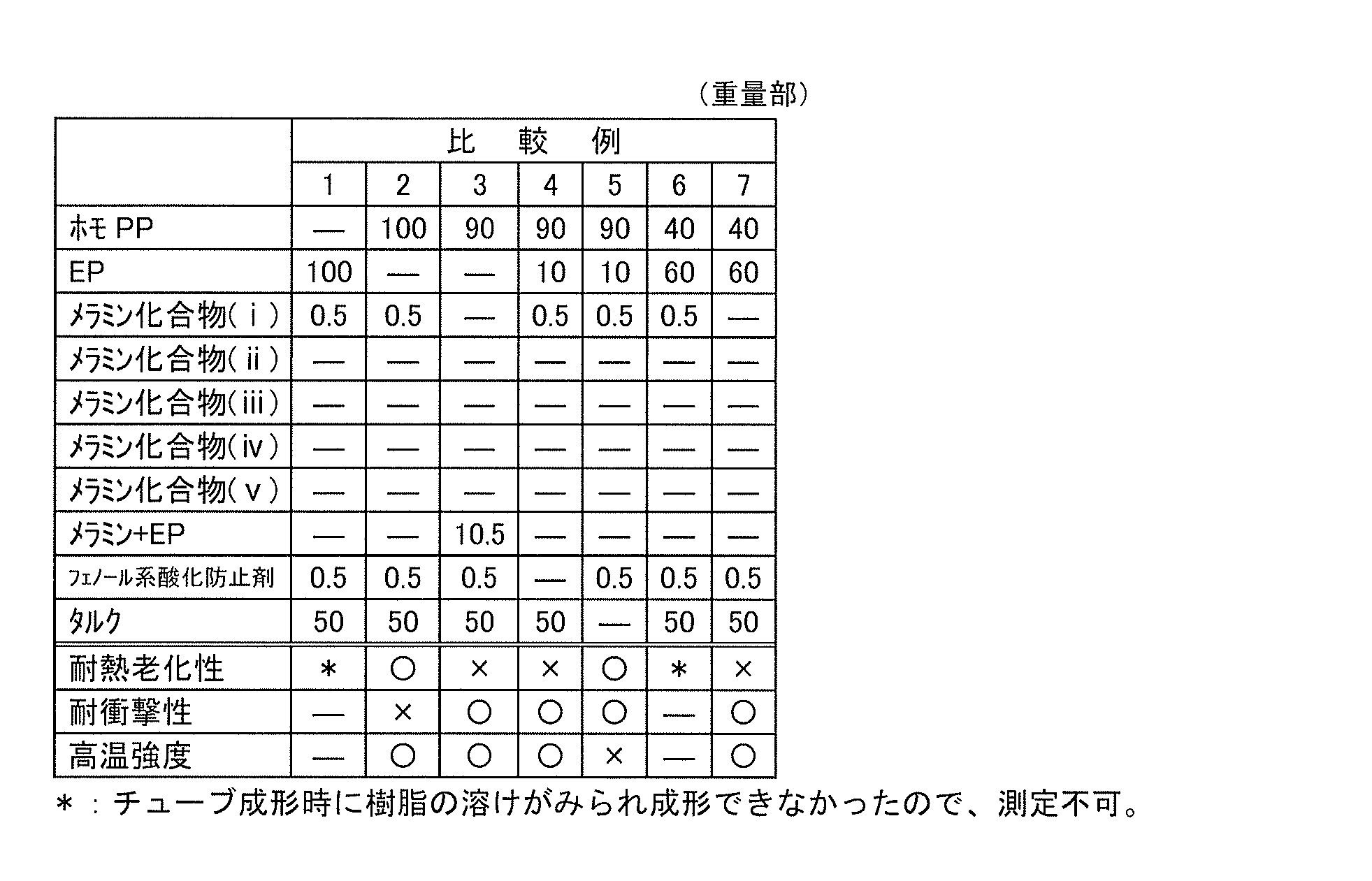
このようにして得られた実施例および比較例の樹脂チューブに関し、下記の基準に従って、各特性の評価を行った。その結果を、後記の表1および表2に併せて示した。
≪耐熱老化性≫
樹脂チューブを半割し、幅10mm、長さ15cmの短冊状に打ち抜いた。このようにして得られた短冊状のサンプルに対し、熱老化処理(120℃×1000時間の熱処理)を実施した後、上記サンプルの破断時の伸び[Eb]を、JIS K 6251に準拠し、引張試験機(AGS-X、島津製作所社製)により測定した。そして、上記サンプルの伸びが、サンプルの長さの50%以上であったものを「〇」、サンプルの長さの50%未満であったものを「×」と評価した。
樹脂チューブを半割し、幅10mm、長さ15cmの短冊状に打ち抜いた。このようにして得られた短冊状のサンプルに対し、熱老化処理(120℃×1000時間の熱処理)を実施した後、上記サンプルの破断時の伸び[Eb]を、JIS K 6251に準拠し、引張試験機(AGS-X、島津製作所社製)により測定した。そして、上記サンプルの伸びが、サンプルの長さの50%以上であったものを「〇」、サンプルの長さの50%未満であったものを「×」と評価した。
≪耐衝撃性≫
樹脂チューブを半割し、JIS K 7110に準拠した寸法形状のサンプルを打ち抜いた。そして、上記サンプルに対し、JIS K 7110に準拠し、23℃環境下で、アイゾット衝撃試験を行った。上記試験の結果、アイゾット衝撃値(J/m)が、45J/m未満であるものを「×」、45J/m以上のものを「〇」と評価した。
樹脂チューブを半割し、JIS K 7110に準拠した寸法形状のサンプルを打ち抜いた。そして、上記サンプルに対し、JIS K 7110に準拠し、23℃環境下で、アイゾット衝撃試験を行った。上記試験の結果、アイゾット衝撃値(J/m)が、45J/m未満であるものを「×」、45J/m以上のものを「〇」と評価した。
≪高温強度≫
樹脂チューブを半割し、幅10mm、長さ15cmの短冊状に打ち抜いた。このようにして得られた短冊状のサンプルに対し、120℃雰囲気での降伏強度を、引張試験機(AGS-X、島津製作所社製)により測定した。その結果、上記降伏強度が4MPa未満であるものを「×」、4MPa以上のものを「〇」と評価した。
樹脂チューブを半割し、幅10mm、長さ15cmの短冊状に打ち抜いた。このようにして得られた短冊状のサンプルに対し、120℃雰囲気での降伏強度を、引張試験機(AGS-X、島津製作所社製)により測定した。その結果、上記降伏強度が4MPa未満であるものを「×」、4MPa以上のものを「〇」と評価した。
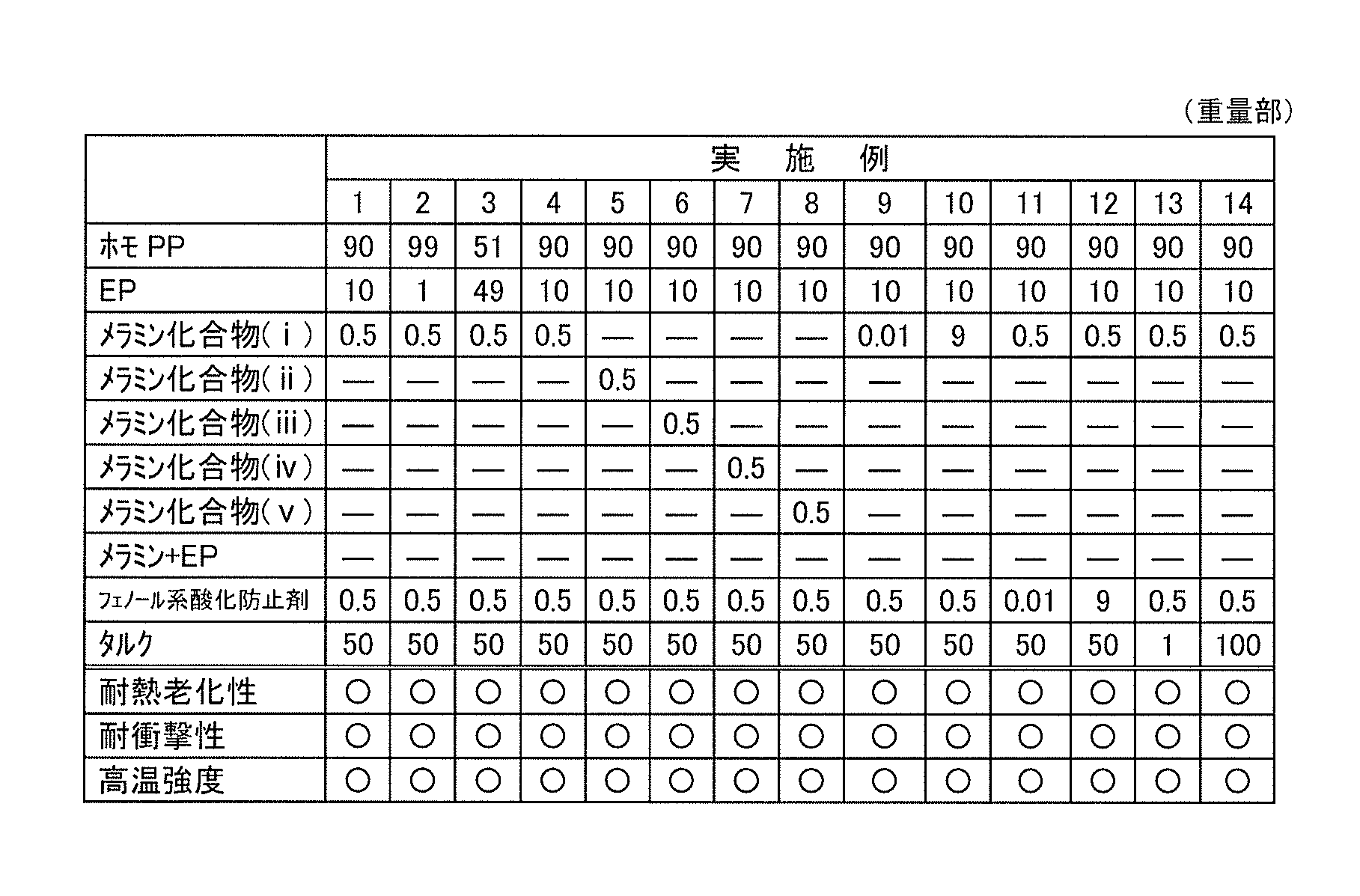
上記表1の結果より、実施例の樹脂チューブは、いずれも、耐熱老化性、耐衝撃性、高温強度の全てにおいて、優れるものであった。
なお、実施例の樹脂チューブの断面に対し、切削ないし研磨して面出しし、染色した後、観察倍率5000倍で走査型電子顕微鏡による反射電子像観察を行ったところ、いずれの樹脂チューブにおいても、ポリプロピレン成分の海相内にポリエチレン成分の島相が分散されたアロイとなっていることが確認され、さらに、メラミン化合物およびタルクが、上記アロイの海相内に偏在していることが確認された。
また、上記の、実施例の樹脂チューブの断面に認められる、樹脂部分(アロイ)全体に対する島相(ポリエチレン成分)の割合は、上記反射電子像をもとに測定した結果、いずれも、1~49重量%の範囲であった。
これに対し、上記表2より、比較例1では、ポリマーにポリプロピレンを用いておらず、エチレン-プロピレン共重合体のみを使用しており、チューブ成形時に樹脂の溶けがみられる結果となった。比較例2では、ポリマーにエチレン-プロピレン共重合体を用いておらず、ポリプロピレンのみを使用しており、耐衝撃性に劣る結果となった。比較例3では、耐熱老化性に劣る結果となった。なお、比較例3では、メラミンとエチレン-プロピレン共重合体を予め練り込んだものを、ホモPP、フェノール系酸化防止剤、およびタルクと混練して樹脂チューブを製造していることから、上記観察条件に従い走査型電子顕微鏡による反射電子像観察を行っても、ポリプロピレン成分の海相内へのメラミンの偏在は認められなかった。比較例4では、フェノール系酸化防止剤を使用しておらず、耐熱老化性に劣る結果となった。比較例5では、タルクを使用しておらず、高温強度に劣る結果となった。比較例6では、チューブ成形時に樹脂の溶けがみられる結果となった。なお、比較例6では、ポリプロピレンとエチレン-プロピレン共重合体の併用を行っているが、ポリプロピレンの割合が少なく、そのため、上記観察条件に従い走査型電子顕微鏡による反射電子像観察を行っても、ポリプロピレン成分の海相内にポリエチレン成分の島相が分散されたアロイは認められなかった。比較例7では、メラミン化合物を使用しておらず、耐熱老化性に劣る結果となった。
なお、上記実施例においては、本発明における具体的な形態について示したが、上記実施例は単なる例示にすぎず、限定的に解釈されるものではない。当業者に明らかな様々な変形は、本発明の範囲内であることが企図されている。
本発明の自動車用冷却システム用チューブは、自動車内における冷却水等の冷媒の配管に用いられるものであり、例えば、ラジエーターホース、ヒーターホース、エアコンホース、等や、電気自動車や燃料電池自動車用の電池パックの冷却用チューブに用いられる。また、本発明の自動車用冷却システム用チューブは、自動車用のみならず、その他の輸送機械(飛行機,フォークリフト,ショベルカー,クレーン等の産業用輸送車両、鉄道車両等)や自動販売機等の冷却用チューブとしても利用可能である。
Claims (9)
- 下記の(A)成分を主成分とするとともに下記の(B)~(D)成分を含有し、かつ、(B)および(D)成分が(A)成分の海相内に偏在するアロイからなることを特徴とする自動車用冷却システム用チューブ。
(A)ポリプロピレン成分の海相内にポリエチレン成分の島相が分散されたアロイ。
(B)グアナミン骨格を有する化合物。
(C)フェノール系酸化防止剤。
(D)無機フィラー。 - 上記の、グアナミン骨格を有する化合物(B)が、下記の一般式(1)に示すメラミン化合物である、請求項1記載の自動車用冷却システム用チューブ。
- 上記アロイ(A)におけるポリエチレン成分の割合が1~49重量%である、請求項1または2記載の自動車用冷却システム用チューブ。
- 上記の、グアナミン骨格を有する化合物(B)の含有割合が、上記アロイ(A)100重量部に対して0.01~10重量部の範囲である、請求項1~3のいずれか一項に記載の自動車用冷却システム用チューブ。
- 上記フェノール系酸化防止剤(C)の含有割合が、上記アロイ(A)100重量部に対して0.01~10重量部の範囲である、請求項1~4のいずれか一項に記載の自動車用冷却システム用チューブ。
- 上記無機フィラー(D)の含有割合が、上記アロイ(A)100重量部に対して1~100重量部の範囲である、請求項1~5のいずれか一項に記載の自動車用冷却システム用チューブ。
- 上記無機フィラー(D)が、タルクである、請求項1~6のいずれか一項に記載の自動車用冷却システム用チューブ。
- 請求項1~7のいずれか一項に記載の自動車用冷却システム用チューブの製造方法であって、下記の[I]~[III]に示す工程をこの順で備えていることを特徴とする自動車用冷却システム用チューブの製造方法。
[I]ポリプロピレン成分の海相内にポリエチレン成分の島相が分散されたアロイ(A)、または上記アロイ(A)の構成材料であるポリプロピレンおよびエチレン系共重合体と、フェノール系酸化防止剤(C)とを、混練する工程。
[II]上記工程[I]で得られた混練物に対し、グアナミン骨格を有する化合物(B)と無機フィラー(D)とを混練する工程。
[III]上記工程[II]で得られた混練物を、チューブ状に溶融押出成形する工程。 - 上記工程[II]における、工程[I]で得られた混練物に対する、グアナミン骨格を有する化合物(B)と無機フィラー(D)の混合を、同時に行う、請求項8記載の自動車用冷却システム用チューブの製造方法。
Priority Applications (1)
| Application Number | Priority Date | Filing Date | Title |
|---|---|---|---|
| JP2020545822A JP7471226B2 (ja) | 2019-03-28 | 2020-01-30 | 自動車用冷却システム用チューブおよびその製造方法 |
Applications Claiming Priority (2)
| Application Number | Priority Date | Filing Date | Title |
|---|---|---|---|
| JP2019062278 | 2019-03-28 | ||
| JP2019-062278 | 2019-03-28 |
Publications (1)
| Publication Number | Publication Date |
|---|---|
| WO2020195143A1 true WO2020195143A1 (ja) | 2020-10-01 |
Family
ID=72610003
Family Applications (1)
| Application Number | Title | Priority Date | Filing Date |
|---|---|---|---|
| PCT/JP2020/003333 Ceased WO2020195143A1 (ja) | 2019-03-28 | 2020-01-30 | 自動車用冷却システム用チューブおよびその製造方法 |
Country Status (2)
| Country | Link |
|---|---|
| JP (1) | JP7471226B2 (ja) |
| WO (1) | WO2020195143A1 (ja) |
Cited By (1)
| Publication number | Priority date | Publication date | Assignee | Title |
|---|---|---|---|---|
| JP2023148501A (ja) * | 2022-03-30 | 2023-10-13 | 株式会社ユポ・コーポレーション | 印刷用紙及びその製造方法 |
Citations (6)
| Publication number | Priority date | Publication date | Assignee | Title |
|---|---|---|---|---|
| JPH10298417A (ja) * | 1997-02-28 | 1998-11-10 | Asahi Chem Ind Co Ltd | 難燃性ポリカーボネート系樹脂組成物 |
| JP2002241546A (ja) * | 2001-02-22 | 2002-08-28 | Toray Ind Inc | 燃料取扱用部材 |
| JP2003128846A (ja) * | 2001-10-26 | 2003-05-08 | Toray Ind Inc | 樹脂構造体 |
| JP2010254994A (ja) * | 2009-04-01 | 2010-11-11 | Asahi Kasei Chemicals Corp | 樹脂組成物及びその成形体 |
| WO2017094738A1 (ja) * | 2015-12-01 | 2017-06-08 | トヨタ紡織株式会社 | 改質剤及びその使用方法、改質剤の製造方法並びに添加材用担体 |
| JP2019507227A (ja) * | 2016-02-29 | 2019-03-14 | クラリアント・プラスティクス・アンド・コーティングス・リミテッド | 難燃性ポリアミド組成物 |
-
2020
- 2020-01-30 WO PCT/JP2020/003333 patent/WO2020195143A1/ja not_active Ceased
- 2020-01-30 JP JP2020545822A patent/JP7471226B2/ja active Active
Patent Citations (6)
| Publication number | Priority date | Publication date | Assignee | Title |
|---|---|---|---|---|
| JPH10298417A (ja) * | 1997-02-28 | 1998-11-10 | Asahi Chem Ind Co Ltd | 難燃性ポリカーボネート系樹脂組成物 |
| JP2002241546A (ja) * | 2001-02-22 | 2002-08-28 | Toray Ind Inc | 燃料取扱用部材 |
| JP2003128846A (ja) * | 2001-10-26 | 2003-05-08 | Toray Ind Inc | 樹脂構造体 |
| JP2010254994A (ja) * | 2009-04-01 | 2010-11-11 | Asahi Kasei Chemicals Corp | 樹脂組成物及びその成形体 |
| WO2017094738A1 (ja) * | 2015-12-01 | 2017-06-08 | トヨタ紡織株式会社 | 改質剤及びその使用方法、改質剤の製造方法並びに添加材用担体 |
| JP2019507227A (ja) * | 2016-02-29 | 2019-03-14 | クラリアント・プラスティクス・アンド・コーティングス・リミテッド | 難燃性ポリアミド組成物 |
Cited By (2)
| Publication number | Priority date | Publication date | Assignee | Title |
|---|---|---|---|---|
| JP2023148501A (ja) * | 2022-03-30 | 2023-10-13 | 株式会社ユポ・コーポレーション | 印刷用紙及びその製造方法 |
| JP7783109B2 (ja) | 2022-03-30 | 2025-12-09 | 株式会社ユポ・コーポレーション | 印刷用紙及びその製造方法 |
Also Published As
| Publication number | Publication date |
|---|---|
| JP7471226B2 (ja) | 2024-04-19 |
| JPWO2020195143A1 (ja) | 2020-10-01 |
Similar Documents
| Publication | Publication Date | Title |
|---|---|---|
| US12071541B2 (en) | Thermoplastic resin composition for refrigerant transporting piping, and method for producing same | |
| CN101445639A (zh) | 用于车辆内部材料的聚丙烯树脂组合物 | |
| US20150175790A1 (en) | Polypropylene resin composition | |
| JPWO2003022920A1 (ja) | ポリエチレン樹脂組成物 | |
| EP3385331B1 (en) | Polyamide resin composition with high fluidity | |
| JP6115386B2 (ja) | 熱可塑性樹脂組成物並びにそれを用いたタイヤ及びホース | |
| CN108602996B (zh) | 分散直径的调整方法和热塑性树脂组合物 | |
| CN103443231A (zh) | 粘合性树脂组合物及使用其的多层结构体 | |
| JP2009040947A (ja) | 電線絶縁体用樹脂組成物及び被覆電線 | |
| WO2020195143A1 (ja) | 自動車用冷却システム用チューブおよびその製造方法 | |
| JP7390931B2 (ja) | 自動車用水系多層チューブ | |
| JP2010037496A (ja) | 熱可塑性エラストマー組成物並びにその製造方法及びそれを用いた空気入りタイヤ | |
| US20250333591A1 (en) | Resin composition for coolant transport tube for vehicles and coolant transport tube for vehicles | |
| WO2024190356A1 (ja) | 車両用冷却液輸送チューブ用樹脂組成物および車両用冷却液輸送チューブ | |
| CN108570193A (zh) | 聚丙烯树脂组合物及其成型产品 | |
| JPH09111061A (ja) | 熱可塑性樹脂組成物 | |
| CN120051531A (zh) | 车辆用冷却液输送管用树脂组合物及车辆用冷却液输送管 | |
| JP2024168404A (ja) | 車両用冷却液輸送チューブ用樹脂組成物および車両用冷却液輸送チューブ | |
| JP2001131364A (ja) | 耐不凍液系統自動車部品材料 | |
| CN113454156B (zh) | 树脂组合物及成型体 | |
| CN114787280B (zh) | 树脂组合物的制造方法及成型体的制造方法 | |
| CN121127705A (zh) | 层叠管 | |
| JP2024131492A (ja) | 車両用冷却液輸送チューブ用樹脂組成物および車両用冷却液輸送チューブ | |
| JPH04239559A (ja) | ポリアミド樹脂組成物 | |
| CN121195128A (zh) | 层叠管 |
Legal Events
| Date | Code | Title | Description |
|---|---|---|---|
| ENP | Entry into the national phase |
Ref document number: 2020545822 Country of ref document: JP Kind code of ref document: A |
|
| 121 | Ep: the epo has been informed by wipo that ep was designated in this application |
Ref document number: 20779114 Country of ref document: EP Kind code of ref document: A1 |
|
| NENP | Non-entry into the national phase |
Ref country code: DE |
|
| 122 | Ep: pct application non-entry in european phase |
Ref document number: 20779114 Country of ref document: EP Kind code of ref document: A1 |