WO2020189391A1 - イネいもち病防除剤 - Google Patents
イネいもち病防除剤 Download PDFInfo
- Publication number
- WO2020189391A1 WO2020189391A1 PCT/JP2020/010142 JP2020010142W WO2020189391A1 WO 2020189391 A1 WO2020189391 A1 WO 2020189391A1 JP 2020010142 W JP2020010142 W JP 2020010142W WO 2020189391 A1 WO2020189391 A1 WO 2020189391A1
- Authority
- WO
- WIPO (PCT)
- Prior art keywords
- group
- substituted
- unsubstituted
- formula
- rice blast
- Prior art date
- Legal status (The legal status is an assumption and is not a legal conclusion. Google has not performed a legal analysis and makes no representation as to the accuracy of the status listed.)
- Ceased
Links
- TYOLMMATWJSUAJ-UHFFFAOYSA-N CCCCC(Nc1c(C(c(c(C)cc(OCOCCOC)c2)c2O2)=CC2=O)[o]c2ccccc12)=O Chemical compound CCCCC(Nc1c(C(c(c(C)cc(OCOCCOC)c2)c2O2)=CC2=O)[o]c2ccccc12)=O TYOLMMATWJSUAJ-UHFFFAOYSA-N 0.000 description 1
- RVVDNJKBEAIHDY-UHFFFAOYSA-N Cc(cc1OCOCCOC)cc(O2)c1C(c([o]c1ccccc11)c1NC(C1CCCCC1)=O)=CC2=O Chemical compound Cc(cc1OCOCCOC)cc(O2)c1C(c([o]c1ccccc11)c1NC(C1CCCCC1)=O)=CC2=O RVVDNJKBEAIHDY-UHFFFAOYSA-N 0.000 description 1
- ZFDIZXAYHFMXOW-UHFFFAOYSA-N Cc(cc1OCOCCOC)cc(O2)c1C(c([o]c1ccccc11)c1NC(c1ccccc1)=O)=CC2=O Chemical compound Cc(cc1OCOCCOC)cc(O2)c1C(c([o]c1ccccc11)c1NC(c1ccccc1)=O)=CC2=O ZFDIZXAYHFMXOW-UHFFFAOYSA-N 0.000 description 1
Images

Classifications
-
- A—HUMAN NECESSITIES
- A01—AGRICULTURE; FORESTRY; ANIMAL HUSBANDRY; HUNTING; TRAPPING; FISHING
- A01N—PRESERVATION OF BODIES OF HUMANS OR ANIMALS OR PLANTS OR PARTS THEREOF; BIOCIDES, e.g. AS DISINFECTANTS, AS PESTICIDES OR AS HERBICIDES; PEST REPELLANTS OR ATTRACTANTS; PLANT GROWTH REGULATORS
- A01N43/00—Biocides, pest repellants or attractants, or plant growth regulators containing heterocyclic compounds
- A01N43/02—Biocides, pest repellants or attractants, or plant growth regulators containing heterocyclic compounds having rings with one or more oxygen or sulfur atoms as the only ring hetero atoms
- A01N43/04—Biocides, pest repellants or attractants, or plant growth regulators containing heterocyclic compounds having rings with one or more oxygen or sulfur atoms as the only ring hetero atoms with one hetero atom
- A01N43/14—Biocides, pest repellants or attractants, or plant growth regulators containing heterocyclic compounds having rings with one or more oxygen or sulfur atoms as the only ring hetero atoms with one hetero atom six-membered rings
- A01N43/16—Biocides, pest repellants or attractants, or plant growth regulators containing heterocyclic compounds having rings with one or more oxygen or sulfur atoms as the only ring hetero atoms with one hetero atom six-membered rings with oxygen as the ring hetero atom
-
- A—HUMAN NECESSITIES
- A01—AGRICULTURE; FORESTRY; ANIMAL HUSBANDRY; HUNTING; TRAPPING; FISHING
- A01N—PRESERVATION OF BODIES OF HUMANS OR ANIMALS OR PLANTS OR PARTS THEREOF; BIOCIDES, e.g. AS DISINFECTANTS, AS PESTICIDES OR AS HERBICIDES; PEST REPELLANTS OR ATTRACTANTS; PLANT GROWTH REGULATORS
- A01N43/00—Biocides, pest repellants or attractants, or plant growth regulators containing heterocyclic compounds
- A01N43/90—Biocides, pest repellants or attractants, or plant growth regulators containing heterocyclic compounds having two or more relevant hetero rings, condensed among themselves or with a common carbocyclic ring system
-
- A—HUMAN NECESSITIES
- A01—AGRICULTURE; FORESTRY; ANIMAL HUSBANDRY; HUNTING; TRAPPING; FISHING
- A01N—PRESERVATION OF BODIES OF HUMANS OR ANIMALS OR PLANTS OR PARTS THEREOF; BIOCIDES, e.g. AS DISINFECTANTS, AS PESTICIDES OR AS HERBICIDES; PEST REPELLANTS OR ATTRACTANTS; PLANT GROWTH REGULATORS
- A01N47/00—Biocides, pest repellants or attractants, or plant growth regulators containing organic compounds containing a carbon atom not being member of a ring and having no bond to a carbon or hydrogen atom, e.g. derivatives of carbonic acid
- A01N47/08—Biocides, pest repellants or attractants, or plant growth regulators containing organic compounds containing a carbon atom not being member of a ring and having no bond to a carbon or hydrogen atom, e.g. derivatives of carbonic acid the carbon atom having one or more single bonds to nitrogen atoms
- A01N47/10—Carbamic acid derivatives, i.e. containing the group —O—CO—N<; Thio analogues thereof
- A01N47/18—Carbamic acid derivatives, i.e. containing the group —O—CO—N<; Thio analogues thereof containing a —O—CO—N< group, or a thio analogue thereof, directly attached to a heterocyclic or cycloaliphatic ring
-
- C—CHEMISTRY; METALLURGY
- C07—ORGANIC CHEMISTRY
- C07D—HETEROCYCLIC COMPOUNDS
- C07D407/00—Heterocyclic compounds containing two or more hetero rings, at least one ring having oxygen atoms as the only ring hetero atoms, not provided for by group C07D405/00
- C07D407/02—Heterocyclic compounds containing two or more hetero rings, at least one ring having oxygen atoms as the only ring hetero atoms, not provided for by group C07D405/00 containing two hetero rings
- C07D407/04—Heterocyclic compounds containing two or more hetero rings, at least one ring having oxygen atoms as the only ring hetero atoms, not provided for by group C07D405/00 containing two hetero rings directly linked by a ring-member-to-ring-member bond
-
- C—CHEMISTRY; METALLURGY
- C07—ORGANIC CHEMISTRY
- C07D—HETEROCYCLIC COMPOUNDS
- C07D491/00—Heterocyclic compounds containing in the condensed ring system both one or more rings having oxygen atoms as the only ring hetero atoms and one or more rings having nitrogen atoms as the only ring hetero atoms, not provided for by groups C07D451/00 - C07D459/00, C07D463/00, C07D477/00 or C07D489/00
- C07D491/02—Heterocyclic compounds containing in the condensed ring system both one or more rings having oxygen atoms as the only ring hetero atoms and one or more rings having nitrogen atoms as the only ring hetero atoms, not provided for by groups C07D451/00 - C07D459/00, C07D463/00, C07D477/00 or C07D489/00 in which the condensed system contains two hetero rings
- C07D491/04—Ortho-condensed systems
- C07D491/044—Ortho-condensed systems with only one oxygen atom as ring hetero atom in the oxygen-containing ring
- C07D491/048—Ortho-condensed systems with only one oxygen atom as ring hetero atom in the oxygen-containing ring the oxygen-containing ring being five-membered
-
- C—CHEMISTRY; METALLURGY
- C07—ORGANIC CHEMISTRY
- C07F—ACYCLIC, CARBOCYCLIC OR HETEROCYCLIC COMPOUNDS CONTAINING ELEMENTS OTHER THAN CARBON, HYDROGEN, HALOGEN, OXYGEN, NITROGEN, SULFUR, SELENIUM OR TELLURIUM
- C07F7/00—Compounds containing elements of Groups 4 or 14 of the Periodic Table
- C07F7/02—Silicon compounds
- C07F7/08—Compounds having one or more C—Si linkages
- C07F7/10—Compounds having one or more C—Si linkages containing nitrogen having a Si-N linkage
-
- C—CHEMISTRY; METALLURGY
- C12—BIOCHEMISTRY; BEER; SPIRITS; WINE; VINEGAR; MICROBIOLOGY; ENZYMOLOGY; MUTATION OR GENETIC ENGINEERING
- C12N—MICROORGANISMS OR ENZYMES; COMPOSITIONS THEREOF; PROPAGATING, PRESERVING, OR MAINTAINING MICROORGANISMS; MUTATION OR GENETIC ENGINEERING; CULTURE MEDIA
- C12N9/00—Enzymes; Proenzymes; Compositions thereof; Processes for preparing, activating, inhibiting, separating or purifying enzymes
- C12N9/99—Enzyme inactivation by chemical treatment
Definitions
- the present invention relates to a rice blast control agent and a method for controlling rice blast.
- Rice blast is an important disease of water rice. It is said that blast fungus synthesizes melanin to increase the strength of its own cell wall and invades rice, but when melanin synthesis is inhibited, the strength of the cell wall decreases and it cannot invade. For this reason, the pesticides for rice blast fungus currently on the market focus on the melanin production pathway in the fungus (see Fig. 1) and target specific enzymes involved in each process leading to melanin production. It was developed. For example, as pesticides targeting Citalon dehydratase (SDH1) involved in one step of the pathway, Bayer gave Calpropamide in 1998, Sumitomo Chemical gave Diclosimet in 2000, and Nihon Nohyaku gave Phenoxanil in 2001. There was a time when they were put on the market and generalized, but resistant bacteria appeared in 2001, and the desired effect could not be obtained, so they are no longer used.
- SDH1 Citalon dehydratase
- Patent applications have been filed for rice blast control agents containing various compounds as active ingredients (for example, Patent Documents 1 to 4), but compounds having a coumarin skeleton are said to be effective as rice blast control agents. There are no reports.
- N-substituted-4- (3-amino-2-benzofuranyl) coumarin derivative for example, the N- (2-furanylcarbonyl) derivative is described in Non-Patent Document 1, but for rice blast. Is not mentioned at all.
- An object of the present invention is to provide a novel citalon dehydratase inhibitor, a rice blast control agent, and a novel compound useful as an active ingredient thereof.
- coumarin derivatives having a predetermined structure also inhibit citalon dehydratase (SDH1) and / or its amino acid mutants involved in the melanin production pathway. It was found to have activity. Based on this finding, further studies have shown that the application of the coumarin derivatives can significantly suppress and control melanin production against wild-type rice blast fungi and / or drug-resistant bacteria thereof. The present invention has been completed.
- SDH1 citalon dehydratase
- the gist of the present invention is as follows.
- R 5 is a substituted or unsubstituted hydrocarbon group having 1 to 10 carbon atoms, or a substituted or unsubstituted heterocyclic group.
- R 5 is a substituted or unsubstituted hydrocarbon group having 1 to 10 carbon atoms, or a substituted or unsubstituted heterocyclic group.
- the substituent represented by R is a substituted or unsubstituted C 1-10 -alkyl group, a substituted or unsubstituted C 1-10 -alkoxy group, a substituted or unsubstituted C.
- the citalon dehydratase inhibitor according to (1) above which is a 6-10- aryloxy group, a substituted or unsubstituted C 7-11 -aralkyloxy group, a halogen atom, or a hydroxyl group.
- the formula (I) is the following formula (II): (In the formula, either R 1 or R 2 is a substituted or unsubstituted C 1-5 -alkyl group or a substituted or unsubstituted C 1-5 -alkoxy group, and is of R 1 and R 2 .
- the other is a hydrogen atom, a substituted or unsubstituted C 1-5 -alkyl group, or a substituted or unsubstituted C 1-5 -alkoxy group
- R 3 and R 4 are a hydrogen atom, a hydroxyl group, and a benzyl, respectively.
- X 2 is in the above formula (I). It is synonymous with X 2 of .)
- the substituted or unsubstituted C 1-5 -alkoxy group in the formula (II) is a methoxymethoxy group, a (2-methoxyethoxy) methoxy group, a [2- (trimethylsilyl) ethoxy] methoxy group or a benzyloxymethoxy group.
- the citalon dehydratase inhibitor according to (3) above which is a group.
- the substituted or unsubstituted C 1-3 -alkoxy group in the formula (IIa) is a methoxymethoxy group, a (2-methoxyethoxy) methoxy group, a [2- (trimethylsilyl) ethoxy] methoxy group or a benzyloxymethoxy group.
- the rice blast control agent according to (6) or (7) above is used for the rice plant itself, its seeds, the field in which it is growing or is expected to grow, or its growth. A method for controlling rice blast, including the process of applying it to an instrument.
- the rice blast control agent according to (6) or (7) above is sprayed on rice foliage, or rice root treatment, rice surface treatment, water surface treatment, side strip treatment, soil with the rice blast control agent.
- the method according to (10) above which comprises a step of subjecting to treatment, rice seed treatment or seedling box treatment.
- FIG. 1 is a schematic diagram of the melanin production pathway of rice blast fungus.
- FIG. 2 shows the evaluation results of the rice blast control effect of each compound.
- the substituent represented by R in the formula (I) is not particularly limited, and is, for example, a substituted or unsubstituted hydrocarbon group having 1 to 10 carbon atoms (for example, an alkyl group, an alkenyl group, an alkynyl group, a cyclo).
- acyloxy group an amino group, a hydroxyl group, a carb
- Examples of the C 1-10 -alkyl group represented by X 1 or X 2 in the formula (I) and the C 1-10 -alkyl group represented by R as a substituent include a methyl group and an ethyl group. , Propyl group, isopropyl group, butyl group, isobutyl group, sec-butyl group, tert-butyl group, pentyl group, isopentyl group, hexyl group, heptyl group, octyl group, nonyl group, decyl group, etc.
- C 1-10 -alkyl groups in the form can be mentioned.
- hydrocarbon group of the formula a substituted or unsubstituted 1 to 10 carbon atoms represented by R 5 in (I), for example, C 1-10 - alkyl group, C 2-10 - alkenyl, C 2- Examples thereof include a 10 -alkynyl group, a C 3-10 -cycloalkyl group, a C 4-10 -cycloalkyl-alkyl group, and a C 7-10 -aralkyl group.
- R 5 in (I) for example, O, monocyclic saturated or unsaturated containing 1 to 4 hetero atoms selected from S and N
- a 3- to 8-membered, preferably 5- to 7-membered heterocyclic group may be mentioned, and the heterocycles may be fused with each other or with a cycloalkyl ring or a benzene ring to form a two- to tricyclic heterocycle.
- Ring atoms S or N may be oxidized to form oxides or dioxides.
- the heterocycle contains a saturated heterocycle, an aromatic heterocycle and a partially saturated heterocycle thereof, in which any carbon atom is substituted with an oxo group in the saturated heterocycle and the partially saturated heterocycle.
- Benzoimidazolyl benzothiasiazolyl, benzoxazolyl, imidazoly pyridyl, benzofuryl, benzothienyl, benzothiazolyl, tetrahydroquinolyl, tetrahydroisoquinolyl, piperidil, piperazinyl, azepanyl, diazepanyl, tetrahydrofuranyl, tetrahydropyranyl, morpholinyl, indrill , Indazolyl, isoindyl, indolinyl, tetrahydrobenzoimidazolyl, dihydrobenzoimidazolidinyl, chromenyl and chromanyl groups and the like.
- hydrocarbon group, alkoxy group, aryloxy group, aralkyloxy group, aliphatic acyl group, aromatic acyl group, alkanoyloxy group and aromatic acyloxy group are amino group, hydroxyl group, carboxyl group, cyano group and halogen atom. It may be substituted with one or more substituents selected from (for example, fluorine atom, chlorine atom, bromine atom, iodine atom), nitro group and the like.
- R 1 or R 2 is a substituted or unsubstituted C 1-5 -alkyl group or a substituted or unsubstituted C 1-5 -alkoxy group
- R 1 and The other of R 2 is a hydrogen atom, a substituted or unsubstituted C 1-5 -alkyl group, or a substituted or unsubstituted C 1-5 -alkoxy group
- R 3 and R 4 are hydrogen atoms, respectively.
- X 2 is the above formula ( It is synonymous with X 2 in I).
- the C 1-5 -alkyl group represented by R 1 , R 2 , R 3 or R 4 in the above formula (II) includes a methyl group, an ethyl group, a propyl group, an isopropyl group, a butyl group, an isobutyl group and sec. -Butyl group, tert-butyl group, pentyl group, isopentyl group, and these C 1-5 -alkyl groups are amino group, hydroxyl group, carboxyl group, cyano group, halogen atom (for example, fluorine atom, chlorine atom). , Bromine atom, iodine atom), may be substituted with one or more substituents selected from a nitro group and the like.
- Examples of the C 1-5 -alkoxy group represented by R 1 , R 2 , R 3 or R 4 in the above formula (II) include a methoxy group, an ethoxy group, a propoxy group, an isopropoxy group, a butoxy group and an isobutoxy group. Examples thereof include sec-butoxy group, tert-butoxy group, pentyloxy group and isopentyloxy group, and these C 1-5 -alkoxy groups are amino group, hydroxyl group, carboxyl group, cyano group and halogen atom (for example, fluorine).
- Atomic chlorine atom, bromine atom, iodine atom
- nitro group C 1-3 -alkoxy group (eg, methoxy group), 2-methoxyethoxy group, benzyloxy group, tri (C 1-3 -alkyl) silyl- It may be substituted with one or more substituents selected from C 1-3 -alkoxy group (for example, 2- (trimethylsilyl) ethoxy group) and the like.
- Examples of the C 2-6 -alkanoyloxy group represented by R 3 or R 4 in the above formula (II) include an acetoxy group.
- Examples include methyl group, ethyl group, propyl group, isopropyl group, butyl group, isobutyl group, sec-butyl group, tert-butyl group, pentyl group, isopentyl group, hexyl group, heptyl group, octyl group and nonyl group.
- C 1-10 -alkyl group such as decyl group; C 3-10 -cycloalkyl group such as cyclopropyl group, cyclobutyl group, cyclopentyl group, cyclohexyl group, cycloheptyl group; vinyl group, C 2-10 -alkenyl groups such as 1-propenyl group, allyl group, 1-butenyl group, 2-butenyl group, pentenyl group, hexenyl group; ethynyl group, 1-propynyl group, 2-propynyl (propargyl) group, 3 -C 2-10 -alkynyl group such as butynyl group, pentynyl group and hexynyl group; aralkyl group such as benzyl group and phenethyl group; aromatic hydrocarbon group such as phenyl group, tolyl group and naphthyl group.
- hydrocarbon group a hydrocarbon group having 2 to 10 carbon atoms is preferable, and a linear or branched C 3-10 -alkyl group and a C 3-10 -cycloalkyl group are more preferable.
- the hydrocarbon group includes, for example, a methoxy group, an ethoxy group, a propoxy group, an isopropoxy group, a butoxy group, an isobutoxy group, a sec-butoxy group, a tert-butoxy group, a pentyloxy group, an isopentyloxy group and a hexyloxy group.
- C 1-6 -alkoxy groups such as cyclopropyloxy group, cyclobutyloxy group, cyclopentyloxy group, cyclohexyloxy group; methoxycarbonyl group, ethoxycarbonyl group, propoxycarbonyl group, isopropoxycarbonyl group, butoxycarbonyl group, isobutoxy C 1-6 -alkoxy such as carbonyl group, sec-butoxycarbonyl group, tert-butoxycarbonyl group, pentyloxycarbonyl group, isopentyloxycarbonyl group, cyclopropyloxycarbonyl group, cyclobutyloxycarbonyl group, cyclopentyloxycarbonyl group, etc.
- C 1-6 -Carbonyl group hydroxyl group; aromatic hydrocarbon group such as phenyl group, tolyl group, naphthyl group; halogen atom such as fluorine atom, chlorine atom, bromine atom, iodine atom; nitro group; C 1-6 -acyl group, carboxyl It may be substituted with a group, an aralkyloxy group, a C 1-6 -alkylamino group, or a diC 1-6 -alkylamino group.
- R 1 and R 2 are methyl groups and R 3 and R 4 are hydrogen atoms; R 2 and R 4 are methyl groups, and R 1 and R 3 are.
- X 2 is at -CO-R 5
- the compound represented by the formula (I) can be produced, for example, as follows.
- R 1 and R 3 are hydrogen atoms
- R 2 is a methyl group
- R 4 is a [2- (trimethylsilyl) ethoxy] methoxy group
- X 2 is -COCH (CH 3). ) 2 will be described as an example, but other compounds can also be produced according to the following method.
- compound 26 can be obtained by adding a base (triethylamine) and isobutyryl chloride to a solution of compound f in an anhydrous organic solvent (for example, anhydrous dichloromethane) and reacting in an inert gas atmosphere.
- a base for example, potassium carbonate
- anhydrous organic solvent for example, anhydrous dichloromethane
- a commonly used method such as column chromatography using silica gel or the like as a carrier or a recrystallization method using methanol, ethanol, chloroform, dimethyl sulfoxide, water or the like is used.
- the elution solvent for column chromatography include methanol, ethanol, chloroform, acetone, hexane, dichloromethane, ethyl acetate, and a mixed solvent thereof.
- the Citalon dehydratase (SDH1) inhibitor of the present invention contains at least one of the compounds of the formula (I) as its active ingredient.
- the compound of the formula (I) has an inhibitory activity against SDH1 and / or its amino acid mutant (V75M mutant) involved in the melanin production pathway of rice blast fungus.
- Rice blast drug-resistant bacteria are said to exhibit drug resistance due to the V75M mutation of SDH1. Therefore, the SDH1 inhibitor of the present invention is also effective against drug-resistant bacteria of rice blast.
- the control agent of the present invention containing the compound of the above formula (I) when applied to a rice blast fungus or a drug-resistant bacterium thereof, the melanin-producing ability of the rice blast fungus is suppressed, and as a result, the rice blast fungus Can control the invasion of rice plants.
- the compounds of the formula (I) there are compounds that have inhibitory activity against both SDH1 and its V75 mutant, or compounds that show high inhibitory activity only by the V75 mutant.
- the results of the docking simulation show that the compound of the formula (I) binds to SDH1 in the same manner as the existing SDH1-inhibiting rice blast control agent carpropamide. However, it was suggested that the binding mode would be different from that of carpropamide. It is presumed that this property is based on the common structure represented by the above formula (I).
- control agent of the present invention is provided in an appropriate dosage form by using a carrier and further adding an appropriate auxiliary agent as needed.
- a carrier for example, it is preferable to formulate it in an oil, an emulsion, a powder, a wettable powder, a granule, a suspension, or the like, and dilute it appropriately before use.
- Preferred carriers include clay, talc, diatomaceous earth, clay, calcium carbonate, silicic anhydride, bentonite, sodium sulfate, silica gel, organic acid salts, saccharides, starches, resins, synthetic or natural polymers and the like, or solid powders or granules.
- Carriers aromatic hydrocarbons such as xylene, aliphatic hydrocarbons such as kerosine, ketones such as methyl ethyl ketone, cyclohexanone, isophorone, ethers such as lactams and anisole, alcohols such as ethanol, propanol and ethylene glycol, Examples thereof include esters such as ethyl acetate and butyl acetate, and liquid carriers such as dimethylsulfoxide, dimethylformamide and water.
- auxiliary agents such as emulsifiers, dispersants, wetting agents, binders and lubricants according to the purpose.
- auxiliary agent include nonionic or ionic surfactants, carboxymethyl cellulose, polyvinyl acetate, polyvinyl alcohol, gums, stearate, waxes, pastes and the like.
- the compound of the formula (I) is usually about 0.01 to 10% by mass, preferably about 0.1 to 5% by mass in the case of a powder, and in the case of a wettable powder. Is about 1 to 90% by mass, preferably about 5 to 75% by mass, in the case of granules, about 0.01 to 40% by mass, preferably about 0.1 to 20% by mass, and in the case of liquids, 1 to 1 to It is contained in an amount of about 60% by mass, preferably about 5 to 40% by mass, and in the case of a suspending agent, about 1 to 80% by mass, preferably about 5 to 50% by mass.
- the rice blast control agent of the present invention can be used alone, but blastsaidin S, kasgamicin, tricyclazole, pyroquilone, isoprothiolane, fusalide, provenazole, methoxyacrylate, benzthiazol, cyclopropane.
- control agent of the present invention includes at least one compound represented by the above formula (I) and at least one inhibitor against other enzymes involved in the melanin production pathway, specifically, a polyketide synthase and a reductase. It may further contain at least one compound having an inhibitory activity against at least one of the enzymes. It can be blended in an optimum ratio according to the distribution of viable bacteria such as soil to be applied and the plant species.
- the compound represented by the above formula (I) is used for the rice plant itself, its seeds, the field in which it is growing or planned to grow, or its growth. It includes a step of applying to the device to be applied. More specifically, when the outbreak of rice blast is expected, the compound of the above formula (I) is sprayed on the rice foliage in advance, and the roots, rice fields, water surface, side stripes, soil, and seeds of rice , The compound of the above formula (I) is applied to a seedling box or the like. Alternatively, after the disease has developed and spread as a result of being infected with the rice blast fungus, the disease can be eliminated or suppressed by using the compound of the formula (I) as described above.
- control agent of the present invention is appropriately determined in consideration of the form of the preparation, the method of application, the purpose, and the timing, but is usually converted into the amount of the compound of the formula (I) which is the active ingredient. It is preferably applied in the range of 10 to 2000 g per ha, and more preferably in the range of 50 to 1000 g.
- the solvents used in the synthesis are all reagent grade.
- Anhydrous dichloromethane (CH 2 Cl 2 ) was obtained from Wako Pure Chemical Industries.
- Kanto Chemical's silica gel 60N (spherical; neutral; 0.04-0.05 mm) was used for flash chromatography.
- Example 1 Example of Synthesis of Compound 26 Compound 26 was synthesized by the following steps 1 to 4.
- Step 1 Synthesis of 4- (chloromethyl) -5-hydroxy-7-methyl-2H-chromen-2-one (compound c)
- step 1 a) Xie, L .; Takeuchi, Y .; Cosentino, LM; McPhail, AT; Lee, K.-HJ Med. Chem, 2001, 44, 664-671.
- Step 2 Synthesis of 4- (chloromethyl) -7-methyl-5-((2- (trimethylsilyl) ethoxy) methoxy) -2H-chromen-2-one (compound d)
- Step 3 Synthesis of 4- (3-aminobenzofuran-2-yl) -7-methyl-5-((2- (trimethylsilyl) ethoxy) methoxy) -2H-chromen-2-one (compound f)
- Step 4 N- (2- (7-methyl-2-oxo-5-((2- (trimethylsilyl) ethoxy) methoxy) -2H-chromen-4-yl) benzofuran-3-yl) isobutyramide (Compound 26) )
- Example 2 Evaluation of SDH1 Inhibitory Activity The following tests were conducted on each compound of the formula (I) in order to evaluate the inhibitory activity against SDH1 in the melanin biosynthetic pathway shown in FIG.
- SDH1 derived from wild-type rice blast fungus and SDH1 (V75) derived from drug-resistant rice blast fungus were used.
- SDH1 derived from drug-resistant rice blast fungus is a V75M type in which valine at position 75 is replaced with methionine.
- Each compound shown in the table below was added at a predetermined concentration (0.3 nM to 30 ⁇ M), the concentration of the substrate citalon was fixed at 50 ⁇ M, and the progress of the reaction was monitored by an increase in absorption at 352 nm.
- the activity (%) for DMSO control was determined, and the concentration of each compound when 50% of the activity of the control was shown was set to IC 50 .
- a sample solution for comparative example to which calpropamide (CPD; obtained from Wako Pure Chemical Industries; an existing SDH1 inhibitor) was added instead of the compound of the formula (I) was also evaluated in the same manner.
- the 50% inhibition concentration (IC 50 ) for SDH1 was less than 3 nM, and the IC 50 for SDH1 (V75M type) was 100 nM. From the results shown in the table, it can be understood that the compound of the formula (I) has an inhibitory activity against SDH1. In addition, it can be understood that some compounds have strong inhibitory activity against the amino acid mutant SDH1 which can be inhibited only weakly by the existing inhibitor CPD.
- Example 3 In vivo evaluation of melaninization inhibitory activity against rice blast fungus Pyricularia oryzae Kita1 strain (NBRC30736 strain) was used as a wild-type rice blast fungus.
- P. oryzae R2-1 or P. oryzae KR5-1 was used as the drug-resistant rice blast fungus.
- the R2-1 strain is a carpropamide-resistant bacterium isolated in Saga Prefecture, and it has been confirmed that the SDH1 gene has a mutation from GTG to ATG (V75M mutation) (see Reference X above).
- the KR5-1 strain was prepared by substituting the SDH1 gene of the Kita1 strain with a drug-resistant type (V75M).
- Method 1 Each well of the 24-well plate was filled with 500 ⁇ L of potato dextrose broth (PDB) + 0.1% agar medium (PDB (manufactured by Difco) with 0.1% agar added). Rice blast fungus was added to each well at a concentration of 2%, and then each compound of the above formula (I) was added to each well at 100 ⁇ M, and cultured at 25 ° C. for 7 days, and each sample culture solution was added.
- Got As the control culture solution calpropamide was used instead of the control culture solution (DMSO) and the compound of the formula (I) prepared in the same manner except that DMSO was added instead of the compound of the formula (I). Control cultures (CPD) prepared in the same manner except that they were added at the same concentration were also prepared.
- Method 2 To each well of a 24 well plate, 500 [mu] L of CYA medium (in Czapek-Dox Broth (manufactured by Difco), 0.5% yeast extract, ZnSO 4 to 0.0001%, those obtained by adding CuSO 4 in an amount of 0.00005%) was filled. Rice blast fungus was added to each well at a concentration of 2%, and then each compound of the above formula (I) was added to each well at 100 ⁇ M, and cultured at 25 ° C. for 7 days, and each sample culture solution was added.
- DMSO was added instead of the control culture solution (-) prepared in the same manner except that the compound of the formula (I) was not added, and the compound of the formula (I).
- DMSO was added instead of the control culture solution (-) prepared in the same manner except that the compound of the formula (I) was not added, and the compound of the formula (I).
- DMSO was added instead of the control culture solution (-) prepared in the same manner except that the compound of the formula (
- control culture solution calpropamide was used instead of the control culture solution (DMSO) and the compound of the formula (I) prepared in the same manner except that DMSO was added instead of the compound of the formula (I).
- Control cultures (CPD) prepared in the same manner except that they were added at the same concentration were also prepared.
- melanin biosynthetic pathway of rice blast is functioning normally, melanin is produced by culturing and the culture solution turns black.
- SDH1 involved in the melanin biosynthetic pathway is inhibited, dehydration of citalon does not proceed, and as a result, melanin is not produced and the culture solution does not blacken.
- the culture accumulates citalon. After observing whether or not blackening of the culture solution occurred in each sample culture solution and each control culture solution, the accumulated amount of citalon was measured using UPLC (manufactured by Waters Corp.).
- Kita1 strain as the rice blast fungus to be cultivated, evaluation was performed by any of the above methods 1 to 3. In either method, it was visually confirmed that the culture solution was blackened due to the production of melanin in the DMSO control (and the control culture solution (-)) in which the melanin biocombination pathway was functioning normally. On the other hand, it was visually confirmed that the blackening of each sample culture solution was suppressed as in the control culture solution (CPD). Furthermore, as shown in Tables 2 to 4, accumulation of citalon was observed in the culture medium in which blackening was suppressed. From the above results, it was demonstrated in vivo that the compound of the formula (I) suppresses melanin production against wild-type rice blast fungus and exhibits SDH1 inhibitory activity.
- Drug-resistant rice blast fungus (R2-1 or KR5-1) was used as the rice blast fungus to be cultured, and evaluation was performed by any of methods 1 to 3. In either method, it was visually confirmed that the culture solution was blackened due to the production of melanin in the DMSO control (and the control culture solution (-)) in which the melanin biocombination pathway was functioning normally. On the other hand, it was visually confirmed that the blackening of each sample culture solution was suppressed as compared with the control culture solution (-). Furthermore, as shown in Tables 3 to 4, accumulation of citalon was observed in the culture medium in which blackening was suppressed. From the above results, it was demonstrated in vivo that the compound of the formula (I) suppresses melanin production against drug-resistant rice blast fungus and exhibits inhibitory activity against amino acid mutant SDH1.
- Example 4 Evaluation of control action on rice Wild-type rice blast fungus (Kita1 strain) or drug-resistant rice blast fungus (KR5-1) against rice (Nihonbare) sensitive to the three-leaf stage rice blast fungus Kita1 strain spore suspension 20mL strains) a (suspended in 0.02% Tween20 so that unit volume mL per 0.3 ⁇ 10 4), was sprayed ingested with an airbrush. 10 ⁇ M of the compound of the formula (I) (Compound 26) or CRP was added to the spore suspension. Moreover, the one to which only DMSO was added was used as a control.
Landscapes
- Chemical & Material Sciences (AREA)
- Life Sciences & Earth Sciences (AREA)
- Organic Chemistry (AREA)
- Health & Medical Sciences (AREA)
- Wood Science & Technology (AREA)
- Zoology (AREA)
- Engineering & Computer Science (AREA)
- General Health & Medical Sciences (AREA)
- Dentistry (AREA)
- Environmental Sciences (AREA)
- Pest Control & Pesticides (AREA)
- Agronomy & Crop Science (AREA)
- Plant Pathology (AREA)
- Bioinformatics & Cheminformatics (AREA)
- Genetics & Genomics (AREA)
- Biomedical Technology (AREA)
- Molecular Biology (AREA)
- Medicinal Chemistry (AREA)
- Biotechnology (AREA)
- General Chemical & Material Sciences (AREA)
- Microbiology (AREA)
- Biochemistry (AREA)
- General Engineering & Computer Science (AREA)
- Plural Heterocyclic Compounds (AREA)
- Agricultural Chemicals And Associated Chemicals (AREA)
Abstract
本発明は、次式(I): (式中、A1~A4はそれぞれ、CH又はNを表し;Rは水素原子以外の置換基であり、nは0~4の整数であり、nが2以上のとき複数のRは互いに同一であっても異なっていてもよく、隣り合う炭素原子に結合したRは互いに結合して環を形成していてもよく;X1及びX2はそれぞれ、水素原子、C1-10-アルキル基、-CO-R5、-CO-OR5又は-SO2-R5であり;R5は置換又は非置換の炭素数1~10の炭化水素基、又は置換又は非置換のヘテロ環基である。) で示される化合物から選ばれる少なくとも1種を含有するシタロン脱水酵素阻害剤;前記シタロン脱水酵素阻害剤を含有するイネいもち病防除剤;並びに前記イネいもち病防除剤を、イネの植物体自体、その種子、それが生育している又は生育が予定される圃場、又はその生育に利用される器具に施用する工程を含む、イネいもち病の防除方法に関する。
Description
本発明はイネいもち病防除剤及びイネいもち病の防除方法に関する。
イネいもち病は水イネの重要病害である。いもち病菌はメラニンを合成して自らの細胞壁の強度を高めてイネに侵入するが、メラニン合成が阻害されると、細胞壁の強度が低下して侵入できなくなるとされている。このことから、現在上市されているイネいもち病菌用農薬は、菌内のメラニン産生経路に着目し(図1参照のこと)、メラニン産生に至る各工程に関与している特定の酵素を標的として開発されたものである。例えば、前記経路の一工程に関与しているシタロン脱水酵素(SDH1)を標的とする農薬として、バイエルから1998年にカルプロパミドが、住友化学から2000年にジクロシメットが、及び日本農薬から2001年にフェノキサニルがそれぞれ上市され、汎用された時期もあったが、2001年に耐性菌が出現し、所期の効果が得られなくなり、現在では使用されていない。
これまで種々の化合物を有効成分とするイネいもち病防除剤について特許出願がされているが(例えば、特許文献1~4)、クマリン骨格を有する化合物がイネいもち病防除剤として有効であるとの報告はない。
また、N-置換-4-(3-アミノ-2-ベンゾフラニル)クマリン誘導体については、例えば、非特許文献1にN-(2-フラニルカルボニル)誘導体が記載されているが、イネいもち病については何ら言及されていない。
Frasinyuk, M. S., et al., Chemistry of Heterocyclic Compounds (New York, NY, United States) (2009), 45(10), 1261-1269.
本発明は、新規なシタロン脱水酵素阻害剤及びイネいもち病防除剤、並びにその有効成分等として有用な新規化合物を提供することを課題とする。
本発明者らは、前記課題を解決するため種々検討したところ、所定の構造のクマリン誘導体類が、メラニン産生経路に関与するシタロン脱水酵素(SDH1)及び/又はそのアミノ酸変異体に対しても阻害活性を有することを見出した。この知見に基づいて、更に種々検討したところ、前記クマリン誘導体類を施用することにより、野生型イネいもち病菌及び/又はその薬剤耐性菌に対して、メラニン産生を有意に抑制し、防除し得ることを見出し、本発明を完成するに至った。
すなわち、本発明の要旨は以下のとおりである。
(1)次式(I):
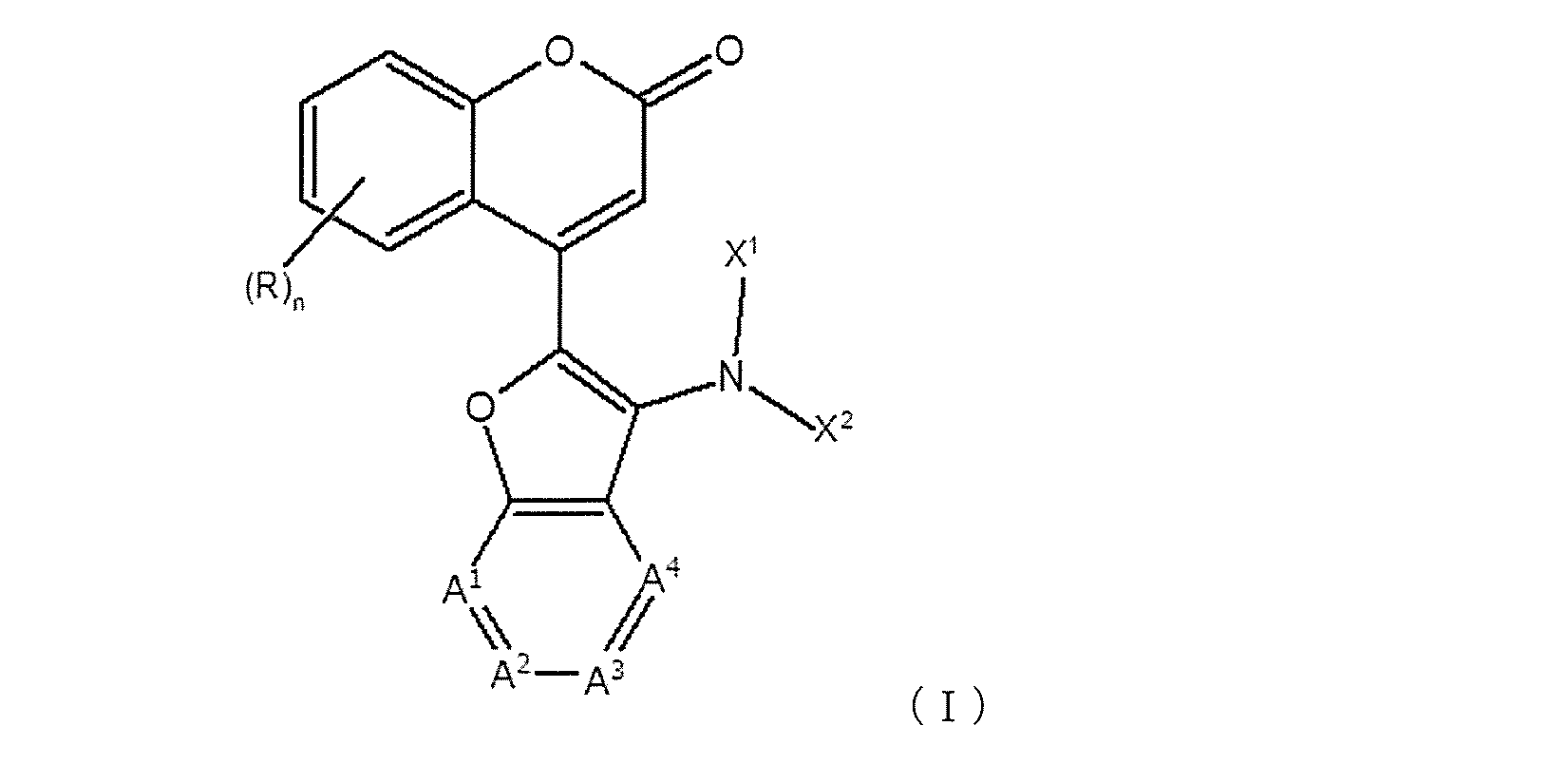
(式中、A1~A4はそれぞれ、CH又はNを表し;Rは水素原子以外の置換基であり、nは0~4の整数であり、nが2以上のとき複数のRは互いに同一であっても異なっていてもよく、隣り合う炭素原子に結合したRは互いに結合して環を形成していてもよく;X1及びX2はそれぞれ、水素原子、C1-10-アルキル基、-CO-R5、-CO-OR5又は-SO2-R5であり;R5は置換又は非置換の炭素数1~10の炭化水素基、又は置換又は非置換のヘテロ環基である。)
で示される化合物から選ばれる少なくとも1種を含有するシタロン脱水酵素阻害剤。
(2)前記式(I)中、Rが表す前記置換基が、置換又は非置換のC1-10-アルキル基、置換又は非置換のC1-10-アルコキシ基、置換又は非置換のC6-10-アリールオキシ基、置換又は非置換のC7-11-アラルキルオキシ基、ハロゲン原子、又は水酸基である前記(1)に記載のシタロン脱水酵素阻害剤。
(3)前記式(I)が次式(II):
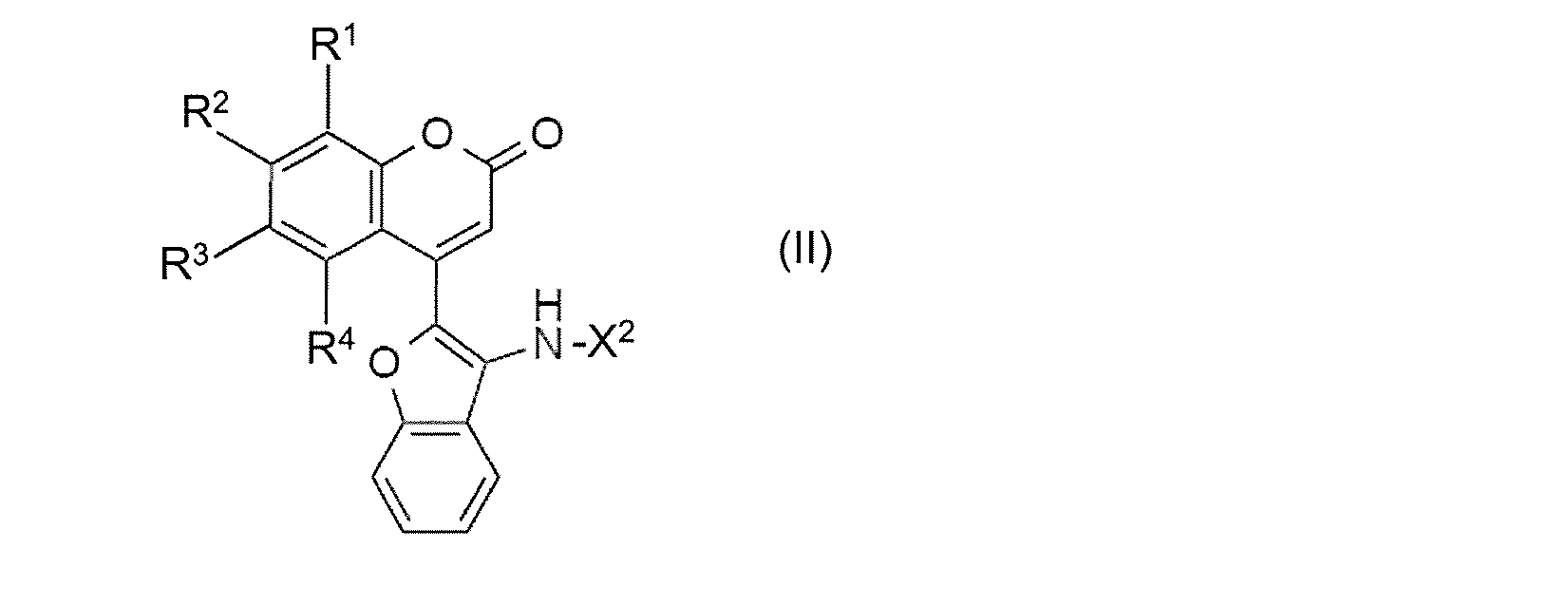
(式中、R1及びR2のいずれか一方は、置換又は非置換のC1-5-アルキル基、又は置換又は非置換のC1-5-アルコキシ基であり、R1及びR2の他方は、水素原子、置換又は非置換のC1-5-アルキル基、又は置換又は非置換のC1-5-アルコキシ基であり;R3及びR4は、それぞれ、水素原子、水酸基、ベンジルオキシ基、C2-6-アルカノイルオキシ基、置換又は非置換のC1-5-アルキル基、又は置換又は非置換のC1-5-アルコキシ基であり;X2は前記式(I)中のX2と同義である。)
である前記(1)又は(2)に記載のシタロン脱水酵素阻害剤。
(4)前記式(II)中の置換又は非置換のC1-5-アルコキシ基がメトキシメトキシ基、(2-メトキシエトキシ)メトキシ基、[2-(トリメチルシリル)エトキシ]メトキシ基又はベンジルオキシメトキシ基である前記(3)に記載のシタロン脱水酵素阻害剤。
(5)少なくとも1種のアミノ酸が変異した非野生型シタロン脱水酵素に対して阻害活性を有する前記(1)~(4)のいずれかに記載のシタロン脱水酵素阻害剤。
(6)前記(1)~(5)のいずれかに記載のシタロン脱水酵素阻害剤を含有するイネいもち病防除剤。
(7)イネいもち病菌のメラニン生合成経路に関与する、ポリケタイド合成酵素及び還元酵素の少なくとも1種に対して阻害活性を有する少なくとも1種の化合物を更に含有する前記(6)に記載のイネいもち病防除剤。
(8)次式(IIa):
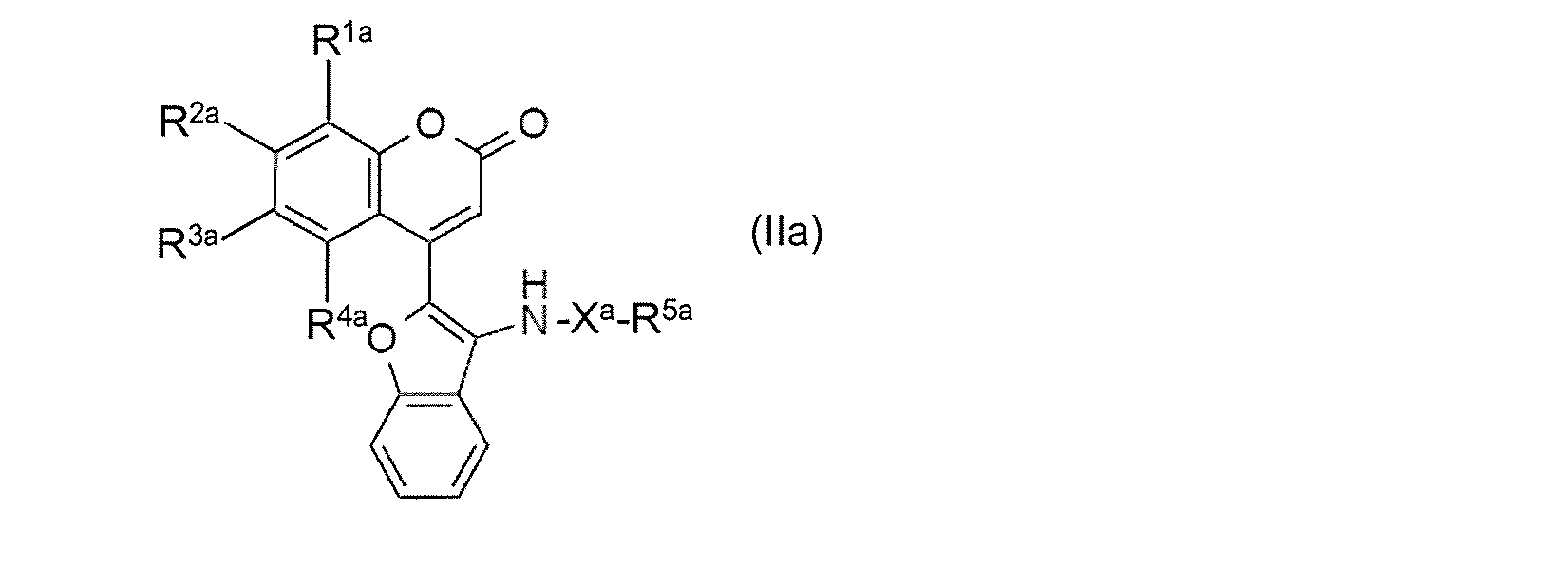
(式中、R1aは水素原子であり、R2aはメチル基、又は置換又は非置換のC1-3-アルコキシ基であり、R3aは水素原子であり、R4aはメチル基、水酸基、ベンジルオキシ基、C2-6-アルカノイルオキシ基、又は置換又は非置換のC1-3-アルコキシ基であり;Xaは-CO-又は-SO2-であり;R5aは置換又は非置換の炭素数1~10の炭化水素基、又は置換又は非置換のC1-3-アルコキシ基である。)
で示される化合物(但し、R1a及びR3aが水素原子であり、R2a及びR4aがメチル基であり、Xaが-CO-であり、R5aが非置換のイソプロピル基である化合物を除く)。
(9)前記式(IIa)中の置換又は非置換のC1-3-アルコキシ基がメトキシメトキシ基、(2-メトキシエトキシ)メトキシ基、[2-(トリメチルシリル)エトキシ]メトキシ基又はベンジルオキシメトキシ基である前記(8)に記載の化合物。
(10)前記(6)又は(7)に記載のイネいもち病防除剤を、イネの植物体自体、その種子、それが生育している又は生育が予定される圃場、又はその生育に利用される器具に施用する工程を含む、イネいもち病の防除方法。
(11)前記(6)又は(7)に記載のイネいもち病防除剤をイネ茎葉へ散布し、又は前記イネいもち病防除剤によるイネ経根処理、田面処理、水面処理、側条処理、土壌処理、イネ種子処理又は苗箱処理に付す工程を含む前記(10)に記載の方法。
(1)次式(I):
で示される化合物から選ばれる少なくとも1種を含有するシタロン脱水酵素阻害剤。
(2)前記式(I)中、Rが表す前記置換基が、置換又は非置換のC1-10-アルキル基、置換又は非置換のC1-10-アルコキシ基、置換又は非置換のC6-10-アリールオキシ基、置換又は非置換のC7-11-アラルキルオキシ基、ハロゲン原子、又は水酸基である前記(1)に記載のシタロン脱水酵素阻害剤。
(3)前記式(I)が次式(II):
である前記(1)又は(2)に記載のシタロン脱水酵素阻害剤。
(4)前記式(II)中の置換又は非置換のC1-5-アルコキシ基がメトキシメトキシ基、(2-メトキシエトキシ)メトキシ基、[2-(トリメチルシリル)エトキシ]メトキシ基又はベンジルオキシメトキシ基である前記(3)に記載のシタロン脱水酵素阻害剤。
(5)少なくとも1種のアミノ酸が変異した非野生型シタロン脱水酵素に対して阻害活性を有する前記(1)~(4)のいずれかに記載のシタロン脱水酵素阻害剤。
(6)前記(1)~(5)のいずれかに記載のシタロン脱水酵素阻害剤を含有するイネいもち病防除剤。
(7)イネいもち病菌のメラニン生合成経路に関与する、ポリケタイド合成酵素及び還元酵素の少なくとも1種に対して阻害活性を有する少なくとも1種の化合物を更に含有する前記(6)に記載のイネいもち病防除剤。
(8)次式(IIa):
で示される化合物(但し、R1a及びR3aが水素原子であり、R2a及びR4aがメチル基であり、Xaが-CO-であり、R5aが非置換のイソプロピル基である化合物を除く)。
(9)前記式(IIa)中の置換又は非置換のC1-3-アルコキシ基がメトキシメトキシ基、(2-メトキシエトキシ)メトキシ基、[2-(トリメチルシリル)エトキシ]メトキシ基又はベンジルオキシメトキシ基である前記(8)に記載の化合物。
(10)前記(6)又は(7)に記載のイネいもち病防除剤を、イネの植物体自体、その種子、それが生育している又は生育が予定される圃場、又はその生育に利用される器具に施用する工程を含む、イネいもち病の防除方法。
(11)前記(6)又は(7)に記載のイネいもち病防除剤をイネ茎葉へ散布し、又は前記イネいもち病防除剤によるイネ経根処理、田面処理、水面処理、側条処理、土壌処理、イネ種子処理又は苗箱処理に付す工程を含む前記(10)に記載の方法。
本発明によれば、新規なシタロン脱水酵素阻害剤及びイネいもち病防除剤、並びにその有効成分等として有用な新規化合物を提供することができる。
以下、本発明を詳細に説明する。
前記式(I)においてRで表される置換基としては、特に制限はなく、例えば、置換又は非置換の炭素数1~10の炭化水素基(例えば、アルキル基、アルケニル基、アルキニル基、シクロアルキル基、シクロアルキル-アルキル基、アラルキル基)、置換又は非置換のC1-10-アルコキシ基、置換又は非置換のC6-10-アリールオキシ基、置換又は非置換のC7-11-アラルキルオキシ基、置換又は非置換のC1-10-脂肪族アシル基、置換又は非置換の芳香族アシル基、置換又は非置換のC2-10-アルカノイルオキシ基、置換又は非置換の芳香族アシルオキシ基、アミノ基、水酸基、カルボキシル基、シアノ基、ハロゲン原子(例えば、フッ素原子、塩素原子、臭素原子、ヨウ素原子)、ニトロ基が挙げられる。
前記式(I)においてRで表される置換基としては、特に制限はなく、例えば、置換又は非置換の炭素数1~10の炭化水素基(例えば、アルキル基、アルケニル基、アルキニル基、シクロアルキル基、シクロアルキル-アルキル基、アラルキル基)、置換又は非置換のC1-10-アルコキシ基、置換又は非置換のC6-10-アリールオキシ基、置換又は非置換のC7-11-アラルキルオキシ基、置換又は非置換のC1-10-脂肪族アシル基、置換又は非置換の芳香族アシル基、置換又は非置換のC2-10-アルカノイルオキシ基、置換又は非置換の芳香族アシルオキシ基、アミノ基、水酸基、カルボキシル基、シアノ基、ハロゲン原子(例えば、フッ素原子、塩素原子、臭素原子、ヨウ素原子)、ニトロ基が挙げられる。
前記式(I)においてX1又はX2で表されるC1-10-アルキル基、及びRで表される置換基としてのC1-10-アルキル基としては、例えば、メチル基、エチル基、プロピル基、イソプロピル基、ブチル基、イソブチル基、sec-ブチル基、tert-ブチル基、ペンチル基、イソペンチル基、ヘキシル基、ヘプチル基、オクチル基、ノニル基、デシル基等の直鎖状又は分岐状のC1-10-アルキル基が挙げられる。
前記式(I)においてR5で表される置換又は非置換の炭素数1~10の炭化水素基としては、例えば、C1-10-アルキル基、C2-10-アルケニル基、C2-10-アルキニル基、C3-10-シクロアルキル基、C4-10-シクロアルキル-アルキル基、C7-10-アラルキル基が挙げられる。
前記式(I)においてR5で表される置換又は非置換のヘテロ環基としては、例えば、O、S及びNから選択されるヘテロ原子を1~4個含有する飽和又は不飽和の単環3~8員、好ましくは5~7員のヘテロ環基が挙げられ、当該ヘテロ環同士、又はシクロアルキル環やベンゼン環と縮環し二から三環式ヘテロ環を形成してもよい。環原子であるS又はNが酸化されオキシドやジオキシドを形成してもよい。当該ヘテロ環は飽和ヘテロ環、芳香族ヘテロ環及びその部分的に飽和されたヘテロ環を含み、飽和ヘテロ環及び部分的に飽和されたヘテロ環においては任意の炭素原子がオキソ基で置換されていてもよい。好ましくは、ピリジル、ピラジニル、ピリミジニル、ピリダジニル、イミダゾリル、ピロリル、ピロリジル、トリアゾリル、テトラゾリル、チエニル、フリル、チアゾリル、ピラゾリル、イソチアゾリル、オキサゾリル、イソオキサゾリル、チアジアゾリル、オキサジアゾリル、キナゾリル、キノキサリニル、キノリル、イソキノリル、シンノリニル、フタラジニル、ベンゾイミダゾリル、ベンゾチアジアゾリル、ベンゾオキサゾリル、イミダゾピリジル、ベンゾフリル、ベンゾチエニル、ベンゾチアゾリル、テトラヒドロキノリル、テトラヒドロイソキノリル、ピペリジル、ピペラジニル、アゼパニル、ジアゼパニル、テトラヒドロフラニル、テトラヒドロピラニル、モルホリニル、インドリル、インダゾリル、イソインドリル、インドリニル、テトラヒドロベンゾイミダゾリル、ジヒドロベンゾイミダゾリジニル、クロメニル及びクロマニル基等が挙げられる。
前記の炭化水素基、アルコキシ基、アリールオキシ基、アラルキルオキシ基、脂肪族アシル基、芳香族アシル基、アルカノイルオキシ基及び芳香族アシルオキシ基は、アミノ基、水酸基、カルボキシル基、シアノ基、ハロゲン原子(例えば、フッ素原子、塩素原子、臭素原子、ヨウ素原子)、ニトロ基等から選ばれる1以上の置換基で置換されていてもよい。
前記式(I)の一態様は、下記式(II)である。

前記式(II)中、R1及びR2のいずれか一方は、置換又は非置換のC1-5-アルキル基、又は置換又は非置換のC1-5-アルコキシ基であり、R1及びR2の他方は、水素原子、置換又は非置換のC1-5-アルキル基、又は置換又は非置換のC1-5-アルコキシ基であり;R3及びR4は、それぞれ、水素原子、水酸基、ベンジルオキシ基、C2-6-アルカノイルオキシ基、置換又は非置換のC1-5-アルキル基、又は置換又は非置換のC1-5-アルコキシ基であり;X2は前記式(I)中のX2と同義である。
前記式(II)においてR1、R2、R3又はR4で表されるC1-5-アルキル基としては、メチル基、エチル基、プロピル基、イソプロピル基、ブチル基、イソブチル基、sec-ブチル基、tert-ブチル基、ペンチル基、イソペンチル基が挙げられ、これらのC1-5-アルキル基は、アミノ基、水酸基、カルボキシル基、シアノ基、ハロゲン原子(例えば、フッ素原子、塩素原子、臭素原子、ヨウ素原子)、ニトロ基等から選ばれる1以上の置換基で置換されていてもよい。
前記式(II)においてR1、R2、R3又はR4で表されるC1-5-アルコキシ基としては、メトキシ基、エトキシ基、プロポキシ基、イソプロポキシ基、ブトキシ基、イソブトキシ基、sec-ブトキシ基、tert-ブトキシ基、ペンチルオキシ基、イソペンチルオキシ基が挙げられ、これらのC1-5-アルコキシ基は、アミノ基、水酸基、カルボキシル基、シアノ基、ハロゲン原子(例えば、フッ素原子、塩素原子、臭素原子、ヨウ素原子)、ニトロ基、C1-3-アルコキシ基(例えば、メトキシ基)、2-メトキシエトキシ基、ベンジルオキシ基、トリ(C1-3-アルキル)シリル-C1-3-アルコキシ基(例えば、2-(トリメチルシリル)エトキシ基)等から選ばれる1以上の置換基で置換されていてもよい。
前記式(II)においてR3又はR4で表されるC2-6-アルカノイルオキシ基としては、例えばアセトキシ基が挙げられる。
前記式(II)においてX2で表される-CO-R5、-CO-OR5又は-SO2-R5の置換基中、R5で表される炭素数1~10の炭化水素基としては、例えば、メチル基、エチル基、プロピル基、イソプロピル基、ブチル基、イソブチル基、sec-ブチル基、tert-ブチル基、ペンチル基、イソペンチル基、ヘキシル基、ヘプチル基、オクチル基、ノニル基、デシル基等の直鎖状又は分岐状のC1-10-アルキル基;シクロプロピル基、シクロブチル基、シクロペンチル基、シクロヘキシル基、シクロヘプチル基等のC3-10-シクロアルキル基;ビニル基、1-プロペニル基、アリル基、1-ブテニル基、2-ブテニル基、ペンテニル基、ヘキセニル基等のC2-10-アルケニル基;エチニル基、1-プロピニル基、2-プロピニル(プロパルギル)基、3-ブチニル基、ペンチニル基、ヘキシニル基等のC2-10-アルキニル基;ベンジル基、フェネチル基等のアラルキル基;フェニル基、トリル基、ナフチル基等の芳香族炭化水素基が挙げられる。
前記炭化水素基としては、炭素数2~10の炭化水素基が好ましく、直鎖状又は分岐状のC3-10-アルキル基、C3-10-シクロアルキル基が更に好ましい。
前記炭化水素基は、例えば、メトキシ基、エトキシ基、プロポキシ基、イソプロポキシ基、ブトキシ基、イソブトキシ基、sec-ブトキシ基、tert-ブトキシ基、ペンチルオキシ基、イソペンチルオキシ基、ヘキシルオキシ基、シクロプロピルオキシ基、シクロブチルオキシ基、シクロペンチルオキシ基、シクロヘキシルオキシ基等のC1-6-アルコキシ基;メトキシカルボニル基、エトキシカルボニル基、プロポキシカルボニル基、イソプロポキシカルボニル基、ブトキシカルボニル基、イソブトキシカルボニル基、sec-ブトキシカルボニル基、tert-ブトキシカルボニル基、ペンチルオキシカルボニル基、イソペンチルオキシカルボニル基、シクロプロピルオキシカルボニル基、シクロブチルオキシカルボニル基、シクロペンチルオキシカルボニル基等のC1-6-アルコキシ-カルボニル基;水酸基;フェニル基、トリル基、ナフチル基等の芳香族炭化水素基;フッ素原子、塩素原子、臭素原子、ヨウ素原子等のハロゲン原子;ニトロ基;C1-6-アシル基、カルボキシル基、アラルキルオキシ基、C1-6-アルキルアミノ基、ジC1-6-アルキルアミノ基で置換されていてもよい。
前記式(II)で示される化合物としては、R1及びR2がメチル基で、R3及びR4が水素原子である化合物;R2及びR4がメチル基で、R1及びR3が水素原子である化合物;R2及びR3がメチル基で、R1及びR4が水素原子である化合物;R1及びR3がメチル基で、R2及びR4が水素原子である化合物;R2及びR4が[2-(トリメチルシリル)エトキシ]メトキシ基で、R1及びR3が水素原子である化合物;及びR2がメチル基で、R4が水酸基、メトキシ基、メトキシメトキシ基、(2-メトキシエトキシ)メトキシ基又は[2-(トリメチルシリル)エトキシ]メトキシ基で、R1及びR3が水素原子である化合物が好ましい。これらの化合物のうち、X2が-CO-R5で、R5がイソプロピル基、ブチル基、tert-ブチル基又はシクロヘキシル基である化合物が更に好ましい。
前記式(II)で示される化合物のうち、次式(IIa):

(式中、R1aは水素原子であり、R2aはメチル基、又は置換又は非置換のC1-3-アルコキシ基であり、R3aは水素原子であり、R4aはメチル基、水酸基、ベンジルオキシ基、C2-6-アルカノイルオキシ基、又は置換又は非置換のC1-3-アルコキシ基であり;Xaは-CO-又は-SO2-であり;R5aは置換又は非置換の炭素数1~10の炭化水素基、又は置換又は非置換のC1-3-アルコキシ基である。)
で示される化合物(但し、R1a及びR3aが水素原子であり、R2a及びR4aがメチル基であり、Xaが-CO-であり、R5aが非置換のイソプロピル基である化合物を除く)は新規化合物である。
で示される化合物(但し、R1a及びR3aが水素原子であり、R2a及びR4aがメチル基であり、Xaが-CO-であり、R5aが非置換のイソプロピル基である化合物を除く)は新規化合物である。
前記式(I)で示される化合物は、例えば、以下のようにして製造することができる。
なお、以下においては、前記式(II)において、R1及びR3が水素原子、R2がメチル基、R4が[2-(トリメチルシリル)エトキシ]メトキシ基、X2が-COCH(CH3)2である化合物を例にとり説明するが、その他の化合物も以下の方法に準じて製造することができる。
なお、以下においては、前記式(II)において、R1及びR3が水素原子、R2がメチル基、R4が[2-(トリメチルシリル)エトキシ]メトキシ基、X2が-COCH(CH3)2である化合物を例にとり説明するが、その他の化合物も以下の方法に準じて製造することができる。

クマリン化合物dのケトン系有機溶媒(例えば、2-ブタノン)溶液に2-シアノフェノールと塩基(例えば、炭酸カリウム)を加え、加熱下反応させて、化合物fを得る。次いで、化合物fの無水有機溶媒(例えば、無水ジクロロメタン)溶液に塩基(トリエチルアミン)とイソブチリルクロライドを加えて、不活性ガス雰囲気下反応させることにより、化合物26を得ることができる。
前記のようにして得られる生成物を精製するには、通常用いられる手法、例えばシリカゲル等を担体として用いたカラムクロマトグラフィーやメタノール、エタノール、クロロホルム、ジメチルスルホキシド、水等を用いた再結晶法によればよい。カラムクロマトグラフィーの溶出溶媒としては、メタノール、エタノール、クロロホルム、アセトン、ヘキサン、ジクロロメタン、酢酸エチル、及びこれらの混合溶媒等が挙げられる。
また、前記式(I)で示される化合物のうち、市販されているものは、これらの市販品を本発明に用いることができる。
本発明のシタロン脱水酵素(SDH1)阻害剤は、その活性成分として前記式(I)の化合物の少なくとも1種を含有する。前記式(I)の化合物は、イネいもち病菌のメラニン産生経路に関与するSDH1及び/又はそのアミノ酸変異体(V75M変異体)に対して阻害活性を有する。イネいもち病薬剤耐性菌は、SDH1のV75M変異により薬剤耐性を示すとされている。よって、本発明のSDH1阻害剤は、イネいもち病の薬剤耐性菌に対しても効果を奏する。より具体的には、前記式(I)の化合物を含む本発明の防除剤をイネいもち病菌ないしその薬剤耐性菌に施用すると、イネいもち病菌のメラニン産生能が抑制され、その結果、イネいもち病菌の植物細胞への侵入を防除できる。前記式(I)の化合物の中には、SDH1及びそのV75変異体の双方に対して阻害活性を有する化合物、又はV75変異体のみに高い阻害活性を示す化合物もある。この作用機序については、詳細は明らかではないが、ドッキングシミュレーションの結果は、前記式(I)の化合物が、既存のSDH1阻害性イネいもち病菌防除剤であるカルプロパミドと同様、SDH1に結合することで活性を阻害していること、但し、その結合様式がカルプロパミドとは異なるであろう、ことを示唆した。この性質は、前記式(I)で示される共通の構造に基づくものと推察される。
本発明の防除剤は、担体を用い、更に必要に応じて適切な補助剤を配合して、適切な剤形とされて提供されることが好ましい。例えば油剤、乳剤、粉剤、水和剤、粒剤、懸濁剤等に製剤し、適宜希釈するなどして使用するのが好ましい。
好ましく用いられる担体としては、クレー、タルク、珪藻土、白土、炭酸カルシウム、無水珪酸、ベントナイト、硫酸ナトリウム、シリカゲル、有機酸塩類、糖類、澱粉、樹脂類、合成もしくは天然高分子等の固体粉末あるいは粒状担体、キシレン等の芳香族炭化水素類、ケロシン等の脂肪族炭化水素類、メチルエチルケトン、シクロヘキサノン、イソホロン等のケトン類、ラクタム類、アニソール等のエーテル類、エタノール、プロパノール、エチレングリコール等のアルコール類、酢酸エチル、酢酸ブチル等のエステル類、ジメチルスルホキシド、ジメチルホルムアミド、水等の液体担体が挙げられる。
更に、防除剤の効果をより確実にするために、乳化剤、分散剤、湿潤剤、結合剤、滑沢剤等の補助剤を目的に応じて適宜選択し、組み合わせるなどして用いることが望ましい。そのような補助剤の例としては例えば非イオン性又はイオン性の界面活性剤、カルボキシメチルセルロース、ポリ酢酸ビニル、ポリビニルアルコール、ガム類、ステアリン酸塩類、ワックス、糊料等が挙げられる。
本発明の防除剤においては、前記式(I)の化合物を、通常、粉剤の場合には0.01~10質量%程度、好ましくは0.1~5質量%程度、水和剤の場合には1~90質量%程度、好ましくは5~75質量%程度、粒剤の場合には0.01~40質量%程度、好ましくは0.1~20質量%程度、液剤の場合には1~60質量%程度、好ましくは5~40質量%程度、懸濁剤の場合には1~80質量%程度、好ましくは5~50質量%程度含有させる。
本発明のイネいもち病防除剤は、単独で使用できることはもちろんであるが、ブラストサイジンS、カスガマイシン、トリサイクラゾール、ピロキロン、イソプロチオラン、フサライド、プロベナゾール、メトキシアクリレート系、ベンズチアジアゾール系、シクロプロパン系、ピリミジン系、ジチオカーバメート系、カーバメート系、ベンズイミダゾール系、ベンズチアゾール系、トリアジン系、シアノ酢酸アミド系、イミダゾール系、ピロール系、ニコチノイド系、グアニジン系、ニトロメチレン系、シアノメチレン系、イソチアゾール系、アニライド系、キノリン系、有機塩素系、スルホン酸アミド系、ピレスロイド系、スルホニル尿素系、尿素系、有機リン系化合物等の殺菌剤、殺虫剤、除草剤、植物成長調節剤、あるいは肥料等と併用して、若しくは混合剤として使用することもできる。
また、本発明の防除剤は、前記式(I)で示される化合物の少なくとも1種とともにメラニン産生経路に関与する他の酵素に対する阻害剤の少なくとも1種、具体的には、ポリケタイド合成酵素及び還元酵素の少なくとも1種に対して阻害活性を有する少なくとも1種の化合物を更に含有していてもよい。施用する土壌等の生存菌の分布や、植物種に応じて、最適な割合で配合することができる。
本発明のイネいもち病の防除方法は、前記式(I)で示される化合物を、イネの植物体自体、その種子、それが生育している又は生育を予定される圃場、又はその生育に利用される器具に施用する工程を含んでなるものである。より具体的には、イネいもち病の発生が予想される場合に、予め前記式(I)の化合物をイネ茎葉への散布するほか、イネの経根、田面、水面、側条、土壌、種子、苗箱などに前記式(I)の化合物を施用する。あるいは、イネいもち病菌に感染した結果、病害が発生、蔓延した後に、前記のように前記式(I)の化合物を使用することにより、病害を除きあるいは抑制することができる。
本発明の防除剤の適用量は、製剤の形態及び施用する方法、目的、時期を考慮して適宜決定されるが、通常、有効成分である前記式(I)の化合物の量に換算して、1ha当たり10~2000gの範囲で適用するのが好ましく、より好ましくは50~1000gの範囲である。
本明細書は、本願の優先権の基礎である特願2019-048574の明細書及び/又は図面に記載される内容を包含する。
以下、実施例を挙げて本発明を更に具体的に説明するが、本発明の範囲は以下の実施例に限定されるものではない。
合成に用いた溶媒は、いずれも試薬グレードのものである。無水ジクロロメタン(CH2Cl2)は、和光純薬から入手した。
各反応は、0.25mmプレコートされたシリカゲルプレート(Merck KGaA製)を用いた薄層クロマトグラフィー(TLC)によってモニターした。
関東化学のシリカゲル60N(球状;中性;0.04-0.05mm)をフラッシュクロマトグラフィーに用いた。
1H NMR は、JEOL JNM-ECA-500 (500 MHz) スペクトロメータを用いて、内部標準としてのテトラメチルシラン(0ppm)を含むCDCl3中で、又は溶媒及び内部標準(3.30ppm)としてのCD3OD中で測定した。各略記、Sはシングレット、dはダブレット、tはトリプレット、qはクオーテット、mはマルチプレット、brはブロードを意味する。
13C NMRは、JEOL JNM-ECA-500 (125 MHz)スペクトロメータを用いて、溶媒及び内部標準(それぞれ、77.0又は49.0ppmである)としてCDCl3又はCD3OD中で測定した。
実施例1:化合物26の合成例
以下の工程1~4により、化合物26を合成した。
以下の工程1~4により、化合物26を合成した。
工程1:4-(クロロメチル)-5-ヒドロキシ-7-メチル-2H-クロメン-2-オン(化合物c)の合成
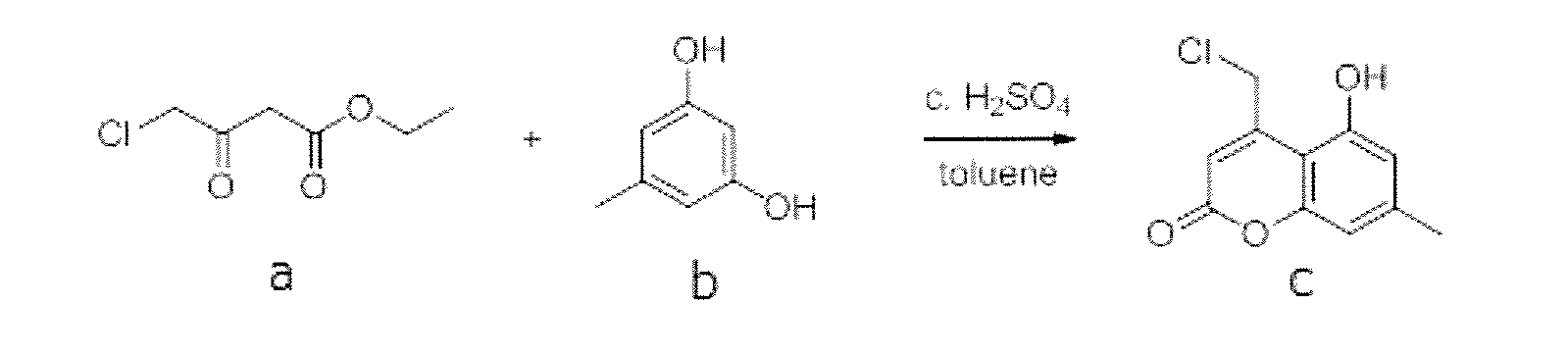
4-クロロ-3-オキソブタン酸エチル(a)(2.47g,15mmol)と5-メチルベンゼン-1,3-ジオール(b)(1.24g,10mmol)のトルエン(40mL)溶液に5滴の濃硫酸を加え、85℃で一晩加熱した。室温に冷却後、析出した固体をろ取した。固体を水、EtOAcで洗浄後乾燥し、淡黄色固体(1.23g)を得た。また、有機層を水、飽和食塩水で洗浄後、MgSO4で乾燥し、溶媒を減圧留去した。残渣を再びトルエン中濃硫酸と加熱し、淡黄色固体(0.81g)を得た。最後にその有機層を水、飽和食塩水で洗浄後MgSO4で乾燥し、溶媒を減圧留去した。残渣をシリカゲルカラムクロマトグラフィー(CHCl3:MeOH=10:1)に付し、無色の化合物c(0.05g)を得た。化合物cの全収率は93.1%であった。なお、前記工程1については、a) Xie, L.; Takeuchi, Y.; Cosentino, L. M.; McPhail, A.T.; Lee, K.-H. J. Med. Chem, 2001, 44, 664-671. b) Zak, J.; Ron, D.; Riva, E.; Harding, H. P.; Cross, B. C. S.; Baxendale, I. R. Chem. Eur. J. 2012, 18, 9901-9910に記載の方法を参照した。
化合物(c): 1H NMR (500 MHz, CD3OD) δ 2.33 (s, 3H), 5.09 (d, J = 1.0 Hz, 2H), 6.46 (brs, 1H), 6.58 (brs,, 1H), 6.68 (brs, 1H).
13C NMR (125 MHz, CD3OD) δ 21.6, 45.9, 106.1, 109.5, 112.4, 113.2, 145.4, 154.4, 156.4, 157.1, 163.1.
化合物(c): 1H NMR (500 MHz, CD3OD) δ 2.33 (s, 3H), 5.09 (d, J = 1.0 Hz, 2H), 6.46 (brs, 1H), 6.58 (brs,, 1H), 6.68 (brs, 1H).
13C NMR (125 MHz, CD3OD) δ 21.6, 45.9, 106.1, 109.5, 112.4, 113.2, 145.4, 154.4, 156.4, 157.1, 163.1.
工程2:4-(クロロメチル)-7-メチル-5-((2-(トリメチルシリル)エトキシ)メトキシ)-2H-クロメン-2-オン(化合物d)の合成
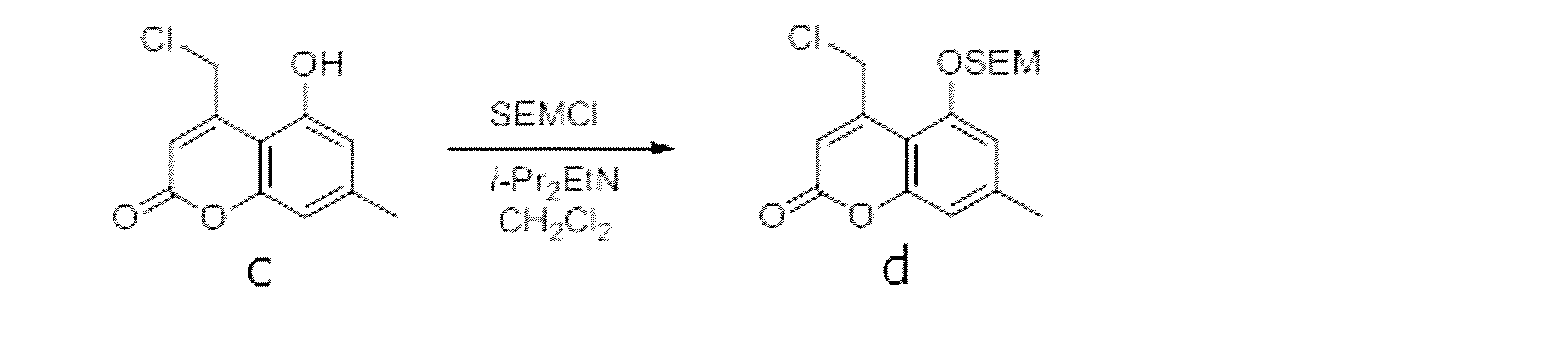
クマリン化合物c(44.8mg,0.2mmol)と2-(トリメチルシリル)エトキシメチルクロライド(SEMCl)(42.6μL,2.4mmol)の無水CH2Cl2(5mL)溶液にジイソプロピルエチルアミン(41.8μL,2.4mmol)を加え、窒素雰囲気下室温で3時間攪拌した。混合物に水-CH2Cl2を加え希釈した。有機層を水、飽和食塩水で洗浄後、MgSO4で乾燥し、溶媒を減圧留去した。残渣をシリカゲルカラムクロマトグラフィー(n-ヘキサン:EtOAc=2:1)に付し、無色オイル(化合物d)(42.0mg,59%)を得た。なお、前記工程2については、Lipshutz, B. H.; Pegram, J. J. Tetrahedron Lett. 1980, 21, 3343-3346に記載の方法を参照した。
化合物d: 1H NMR (500 MHz, CDCl3) δ 0.02 (s, 9H), 0.99 (t, J = 8.0 Hz, 2H), 2.41 (s, 3H), 3.81 (t, J = 8.0 Hz, 2H), 4.93 (d, J = 1.5 Hz, 2H), 5.19 (s, 2H), 6.54 (brs, 1H), 6.84 (brs, 1H), 6.88 (brs, 1H).
13C NMR (125 MHz, CDCl3) δ -1.4, 18.0, 22.0, 45.4, 67.2, 93.5, 106.3, 110.8, 111.3, 114.1, 143.8, 150.6, 154.9, 155.1, 160.5.
化合物d: 1H NMR (500 MHz, CDCl3) δ 0.02 (s, 9H), 0.99 (t, J = 8.0 Hz, 2H), 2.41 (s, 3H), 3.81 (t, J = 8.0 Hz, 2H), 4.93 (d, J = 1.5 Hz, 2H), 5.19 (s, 2H), 6.54 (brs, 1H), 6.84 (brs, 1H), 6.88 (brs, 1H).
13C NMR (125 MHz, CDCl3) δ -1.4, 18.0, 22.0, 45.4, 67.2, 93.5, 106.3, 110.8, 111.3, 114.1, 143.8, 150.6, 154.9, 155.1, 160.5.
工程3:4-(3-アミノベンゾフラン-2-イル)-7-メチル-5-((2-(トリメチルシリル)エトキシ)メトキシ)-2H-クロメン-2-オン(化合物f)の合成

クマリン化合物d(420mg,1.2mmol)の2-ブタノン(20mL)溶液に2-シアノフェノール(282mg,2.4mmol)とK2CO3(652mg,4.7mmol)を加え、一晩加熱還流した。溶媒を減圧留去後、残渣を水、EtOAcで希釈した。有機層を水、飽和食塩水で洗浄後、MgSO4で乾燥し、溶媒を減圧留去した。残渣をシリカゲルカラムクロマトグラフィー(ベンゼン:アセトニトリル=10:1)に付し、無色オイル(化合物f)(251mg,49%)を得た。
化合物f: 1H NMR (500 MHz, CDCl3) δ -0.06 (s, 9H), 0.77 (t, J = 8.0 Hz, 2H), 2.42 (s, 3H), 3.49 (t, J = 8.0 Hz, 2H), 4.96 (s, 2H), 6.45 (s, 1H), 6.86 (brs, 2H), 7.27 (ddd, J = 8.0, 8.0, 2.0 Hz, 1H), 7.35 (ddd, J = 8.0, 8.0, 1.0 Hz, 1H), 7.36 (dd, J = 8.0, 2.0 Hz, 1H), 7.53 (dd, J = 8.0, 1.0 Hz, 1H).
13C NMR (125 MHz, CDCl3) δ -1.5, 17.9, 22.0, 66.7, 94.2, 106.8, 111.0, 111.3, 111.5, 113.6, 118.6, 122.1, 123.8, 125.9, 126.9, 134.1, 142.3, 144.1, 153.3, 154.9, 155.6, 160.8.
化合物f: 1H NMR (500 MHz, CDCl3) δ -0.06 (s, 9H), 0.77 (t, J = 8.0 Hz, 2H), 2.42 (s, 3H), 3.49 (t, J = 8.0 Hz, 2H), 4.96 (s, 2H), 6.45 (s, 1H), 6.86 (brs, 2H), 7.27 (ddd, J = 8.0, 8.0, 2.0 Hz, 1H), 7.35 (ddd, J = 8.0, 8.0, 1.0 Hz, 1H), 7.36 (dd, J = 8.0, 2.0 Hz, 1H), 7.53 (dd, J = 8.0, 1.0 Hz, 1H).
13C NMR (125 MHz, CDCl3) δ -1.5, 17.9, 22.0, 66.7, 94.2, 106.8, 111.0, 111.3, 111.5, 113.6, 118.6, 122.1, 123.8, 125.9, 126.9, 134.1, 142.3, 144.1, 153.3, 154.9, 155.6, 160.8.
工程4:N-(2-(7-メチル-2-オキソ-5-((2-(トリメチルシリル)エトキシ)メトキシ)-2H-クロメン-4-イル)ベンゾフラン-3-イル)イソブチルアミド(化合物26)

クマリン化合物f(250mg,0.57mmol)の無水CH2Cl2(10mL)溶液にトリエチルアミン(159μL,1.14mmol)とイソブチリルクロライド(72μL,0.68mmol)を加えた。窒素雰囲気下室温で一晩攪拌後、混合物を水、EtOAcで希釈した。有機層を水、飽和食塩水で洗浄後、MgSO4で乾燥し、溶媒を減圧留去した。残渣をシリカゲルカラムクロマトグラフィー(n-ヘキサン:EtOAc=2:1)に付し、無色オイル(化合物26)(263mg,91%)を得た。なお、工程3及び4については、a) Karn, I. A. Kurkarni, M. V. Gopal, M.; Shahabuddin, M. S.; Sun, C.-M. Bioorg. Med. Chem. Lett. 2005, 15, 3584-3587. b) Frasinyuk, M. S.; Gorelov, S. V.; Bondarenkoo, S. P.; Khilya, V. P. Chem. Heterocyclic Compounds, 2009, 45, 1261-1269に記載の方法を参照した。
化合物26: 1H NMR (500 MHz, CDCl3) δ -0.06 (s, 9H), 0.72 (t, J = 8.0 Hz, 2H), 1.22 (d, J = 7.0 Hz, 6H), 2.40 (s, 3H), 2.58 (qq, J = 7.0, 7.0 Hz, 1H), 3.39 (t, J = 8.0 Hz, 2H), 4.87 (s, 2H), 6.37 (s, 1H), 6.80 (brs, 1H), 6.82 (brs, 1H), 7.29 (dd, J = 8.0, 8.0 Hz, 1H), 7.35 (ddd, J = 8.0, 8.0, 1.0 Hz, 1H), 7.43 (brd, J = 8.0 Hz, 1H), 7.59 (brd,J = 8.0 Hz, 1H).
13C NMR (125 MHz, CDCl3) δ -1.6, 17.7, 19.6, 22.1, 35.6, 66.7, 93.9, 106.7, 111.0, 111.3, 111.4, 116.2, 117.1, 120.8, 123.1, 125.1, 125.5, 141.7, 144.4, 144.7, 153.5, 154.4, 155.2, 160.3, 175.8.
化合物26: 1H NMR (500 MHz, CDCl3) δ -0.06 (s, 9H), 0.72 (t, J = 8.0 Hz, 2H), 1.22 (d, J = 7.0 Hz, 6H), 2.40 (s, 3H), 2.58 (qq, J = 7.0, 7.0 Hz, 1H), 3.39 (t, J = 8.0 Hz, 2H), 4.87 (s, 2H), 6.37 (s, 1H), 6.80 (brs, 1H), 6.82 (brs, 1H), 7.29 (dd, J = 8.0, 8.0 Hz, 1H), 7.35 (ddd, J = 8.0, 8.0, 1.0 Hz, 1H), 7.43 (brd, J = 8.0 Hz, 1H), 7.59 (brd,J = 8.0 Hz, 1H).
13C NMR (125 MHz, CDCl3) δ -1.6, 17.7, 19.6, 22.1, 35.6, 66.7, 93.9, 106.7, 111.0, 111.3, 111.4, 116.2, 117.1, 120.8, 123.1, 125.1, 125.5, 141.7, 144.4, 144.7, 153.5, 154.4, 155.2, 160.3, 175.8.
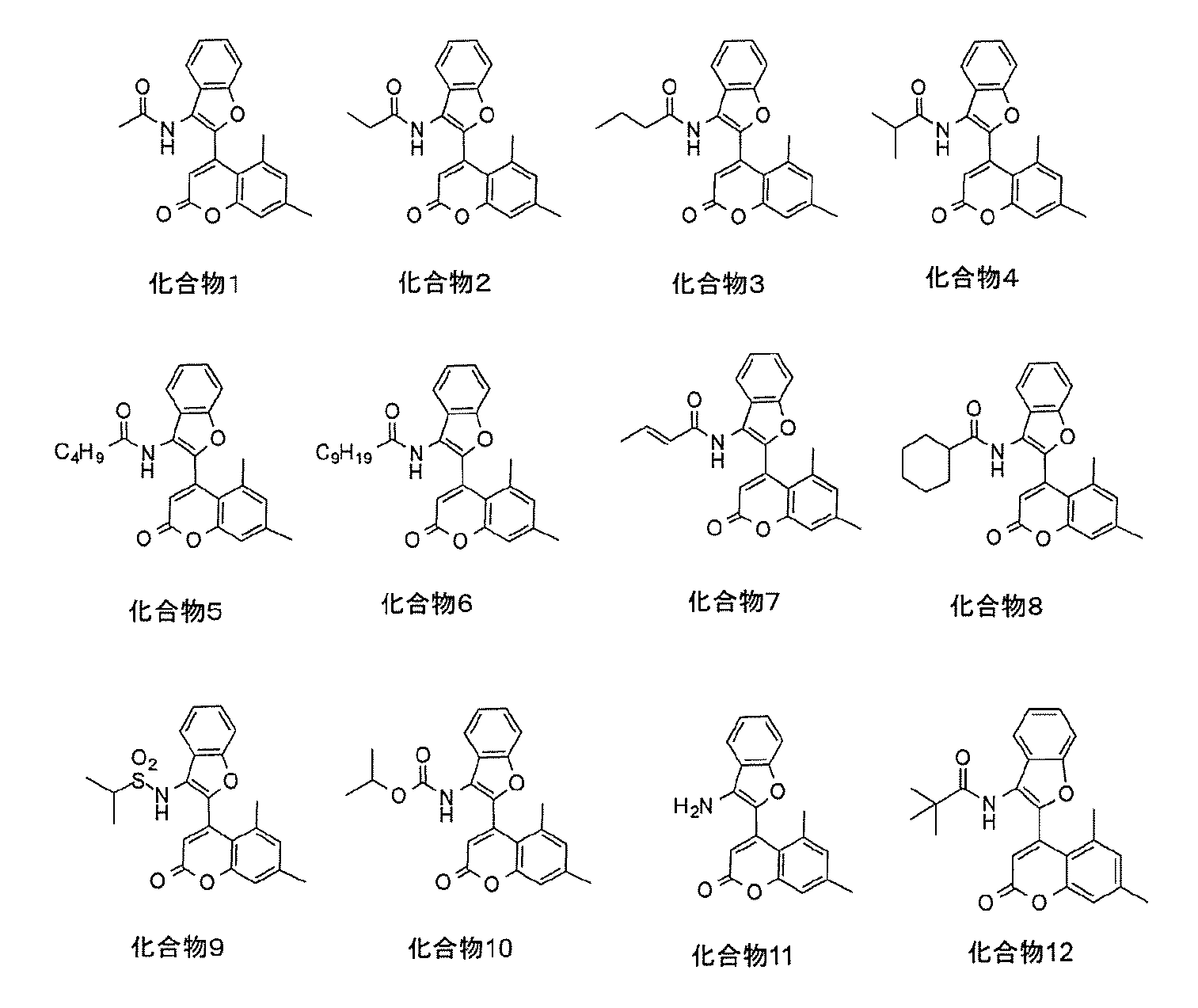
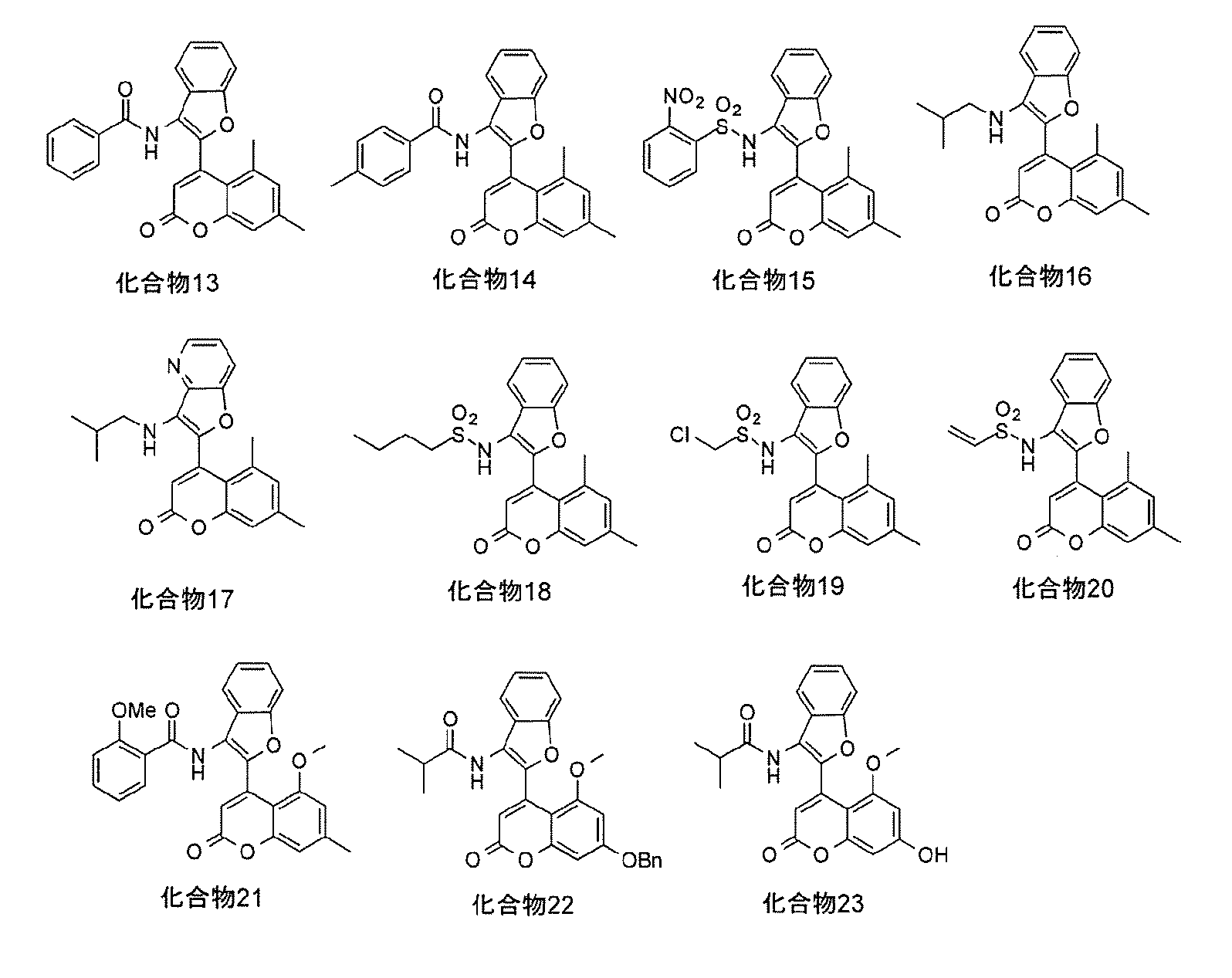
前記合成例において、工程1に用いた試薬(化合物b)、工程2に用いた試薬SEMCl、及び工程4に用いた試薬イソブチリルクロライドの少なくとも1つを、対応する試薬にそれぞれ置き換えて、同様に反応を進行させて、化合物1~25及び27~48をそれぞれ合成した。
化合物49~59は、ナミキ商事から入手した。
化合物60~64は、理研天然化合物バンクに収載されている化合物である。
化合物49~59は、ナミキ商事から入手した。
化合物60~64は、理研天然化合物バンクに収載されている化合物である。


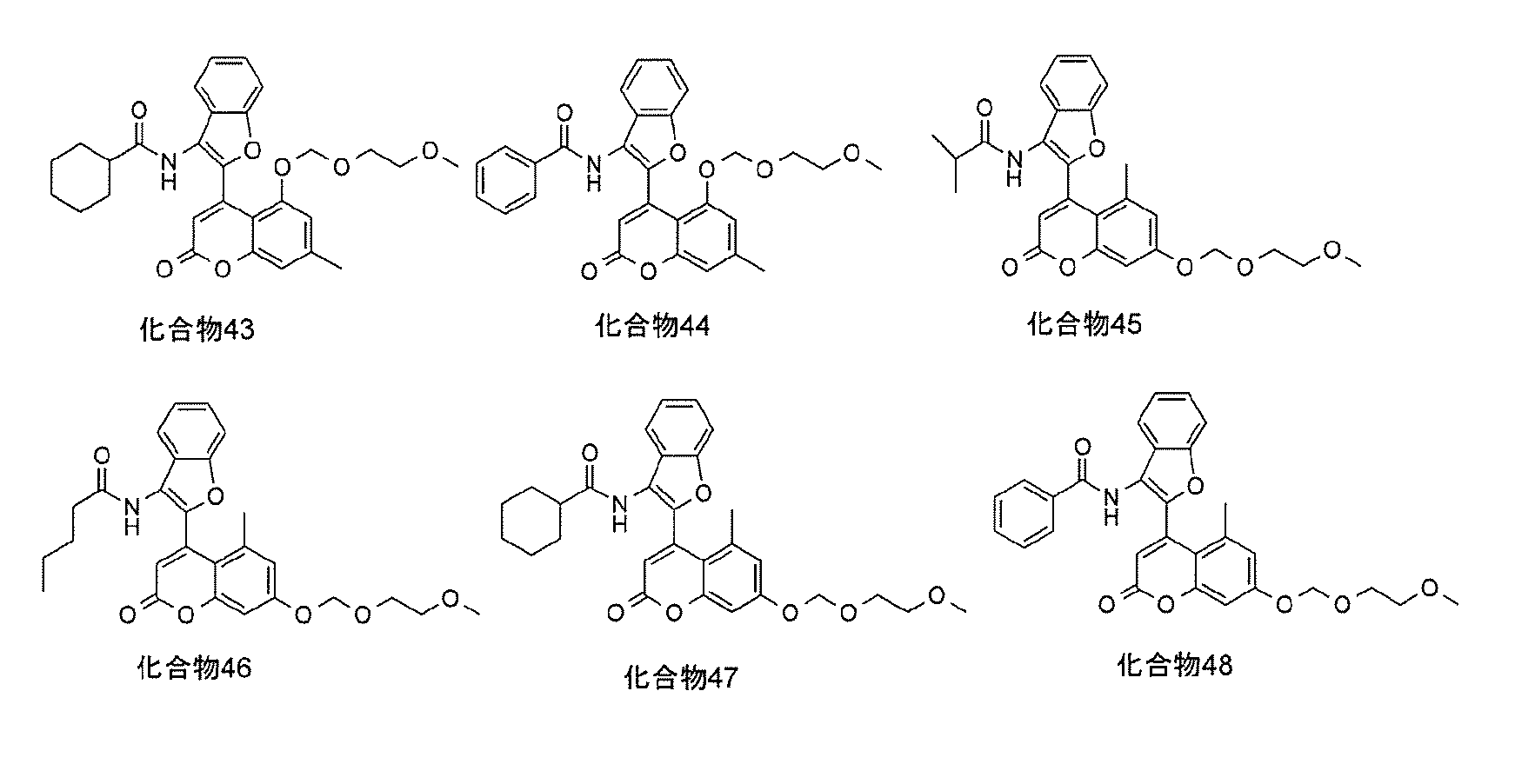
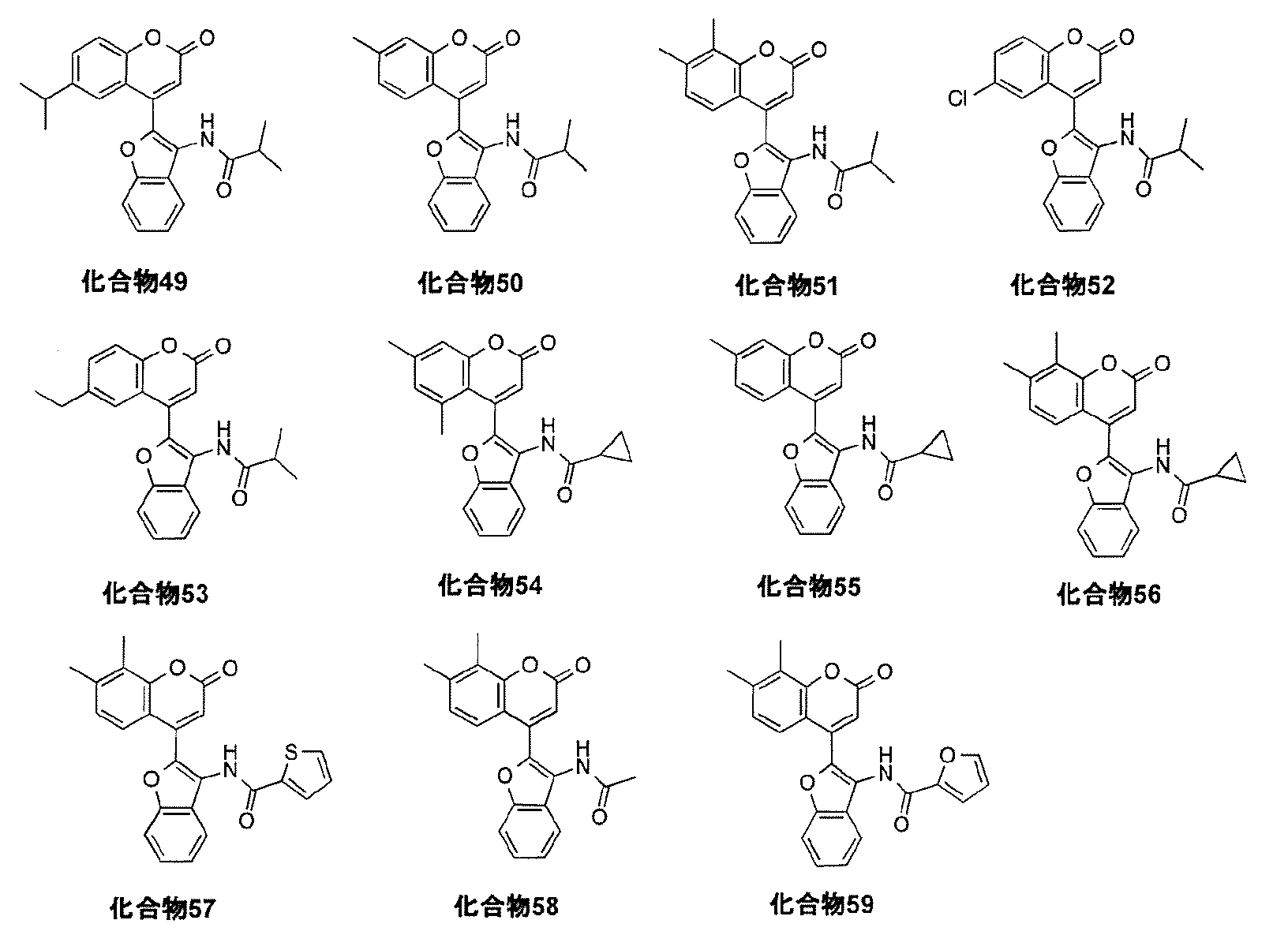

実施例2:SDH1阻害活性評価
前記式(I)の各化合物について、図1中に示すメラニン生合成経路におけるSDH1に対する阻害活性を評価するために、以下の試験を行った。なお、SDH1として、野生型イネいもち病菌由来のSDH1及び薬剤耐性イネいもち病菌由来のSDH1(V75)を用いた。なお、薬剤耐性イネいもち病菌由来のSDH1は、75位のバリンがメチオニンに置換されているV75M型である。これらの酵素の調製及び阻害活性測定は文献X(Yamada, N., Motoyama, T., Nakasako, M., Kagabu, S., Kudo, T., Yamaguchi, I.: “Enzymatic characterization of scytalone dehydratase Val75Met variant found in melanin biosynthesis dehydratase inhibitor (MBI-D) resistant strains of the rice blast fungus”, Biosci. Biotechnol. Biochem. 68: 615-621 (2004))に記載の方法で行った。下記表に示す各化合物を所定の濃度(0.3nM~30μM)でそれぞれ添加し、基質であるシタロンの濃度を50μMに固定し、反応の進行を352nmの吸収の増加でモニタリングした。DMSOコントロールに対する活性(%)を求め、コントロールの活性の50%を示した時の各化合物の濃度をIC50とした。なお、比較例として、前記式(I)の化合物にかえてカルプロパミド(CPD;和光純薬から入手;既存のSDH1阻害剤)を添加した比較例用試料液についても同様に評価した。その結果、SDH1(WT型)に対する50%阻害濃度(IC50)は、3nM未満であり、SDH1(V75M型)に対するIC50は100nMであった。表中に示す結果から、前記式(I)の化合物は、SDH1に対して阻害活性を有することが理解できる。また、化合物によっては、既存の阻害剤CPDでは弱くしか阻害できないアミノ酸変異SDH1に対しても、強力な阻害活性を有することが理解できる。
前記式(I)の各化合物について、図1中に示すメラニン生合成経路におけるSDH1に対する阻害活性を評価するために、以下の試験を行った。なお、SDH1として、野生型イネいもち病菌由来のSDH1及び薬剤耐性イネいもち病菌由来のSDH1(V75)を用いた。なお、薬剤耐性イネいもち病菌由来のSDH1は、75位のバリンがメチオニンに置換されているV75M型である。これらの酵素の調製及び阻害活性測定は文献X(Yamada, N., Motoyama, T., Nakasako, M., Kagabu, S., Kudo, T., Yamaguchi, I.: “Enzymatic characterization of scytalone dehydratase Val75Met variant found in melanin biosynthesis dehydratase inhibitor (MBI-D) resistant strains of the rice blast fungus”, Biosci. Biotechnol. Biochem. 68: 615-621 (2004))に記載の方法で行った。下記表に示す各化合物を所定の濃度(0.3nM~30μM)でそれぞれ添加し、基質であるシタロンの濃度を50μMに固定し、反応の進行を352nmの吸収の増加でモニタリングした。DMSOコントロールに対する活性(%)を求め、コントロールの活性の50%を示した時の各化合物の濃度をIC50とした。なお、比較例として、前記式(I)の化合物にかえてカルプロパミド(CPD;和光純薬から入手;既存のSDH1阻害剤)を添加した比較例用試料液についても同様に評価した。その結果、SDH1(WT型)に対する50%阻害濃度(IC50)は、3nM未満であり、SDH1(V75M型)に対するIC50は100nMであった。表中に示す結果から、前記式(I)の化合物は、SDH1に対して阻害活性を有することが理解できる。また、化合物によっては、既存の阻害剤CPDでは弱くしか阻害できないアミノ酸変異SDH1に対しても、強力な阻害活性を有することが理解できる。


実施例3:イネいもち病菌に対するメラニン化阻害活性のin vivo評価
野生型イネいもち病菌としてPyricularia oryzae Kita1株(NBRC30736株)を用いた。薬剤耐性型イネいもち病菌はP. oryzae R2-1あるいはP. oryzae KR5-1を用いた。R2-1株は佐賀県で単離されたカルプロパミド耐性菌であり、SDH1遺伝子にGTGからATGへの変異(V75M変異)を持っていることを確認している(前記文献X参照)。KR5-1株はKita1株のSDH1遺伝子を薬剤耐性型(V75M)のものに置換することにより作製した。
野生型イネいもち病菌としてPyricularia oryzae Kita1株(NBRC30736株)を用いた。薬剤耐性型イネいもち病菌はP. oryzae R2-1あるいはP. oryzae KR5-1を用いた。R2-1株は佐賀県で単離されたカルプロパミド耐性菌であり、SDH1遺伝子にGTGからATGへの変異(V75M変異)を持っていることを確認している(前記文献X参照)。KR5-1株はKita1株のSDH1遺伝子を薬剤耐性型(V75M)のものに置換することにより作製した。
(方法1)
24ウェルプレートの各ウェルに、500μLのポテトデキストロースブロス(PDB)+0.1%寒天培地(PDB(Difco製)に、寒天を0.1%添加したもの)を充填した。各ウェルに、イネいもち病菌を2%の濃度で添加して、その後、各ウェルに、前記式(I)の各化合物を100μMでそれぞれ添加し、25℃で7日間培養し、各試料培養液を得た。なお、対照用の培養液として、前記式(I)の化合物にかえてDMSOを添加した以外は同様に調製した対照用培養液(DMSO)、前記式(I)の化合物にかえて、カルプロパミドを同一の濃度で添加した以外は同様にして調製した対照用培養液(CPD)も、それぞれ準備した。
24ウェルプレートの各ウェルに、500μLのポテトデキストロースブロス(PDB)+0.1%寒天培地(PDB(Difco製)に、寒天を0.1%添加したもの)を充填した。各ウェルに、イネいもち病菌を2%の濃度で添加して、その後、各ウェルに、前記式(I)の各化合物を100μMでそれぞれ添加し、25℃で7日間培養し、各試料培養液を得た。なお、対照用の培養液として、前記式(I)の化合物にかえてDMSOを添加した以外は同様に調製した対照用培養液(DMSO)、前記式(I)の化合物にかえて、カルプロパミドを同一の濃度で添加した以外は同様にして調製した対照用培養液(CPD)も、それぞれ準備した。
(方法2)
24ウェルプレートの各ウェルに、500μLのCYA培地(Czapek-Dox Broth(Difco製)に、酵母エキスを0.5%、ZnSO4を0.0001%、CuSO4を0.00005%添加したもの)を充填した。各ウェルに、イネいもち病菌を2%の濃度で添加して、その後、各ウェルに、前記式(I)の各化合物を100μMでそれぞれ添加し、25℃で7日間培養し、各試料培養液を得た。なお、対照用の培養液として、前記式(I)の化合物を添加しなかった以外は同様に調製した対照用培養液(-)、前記式(I)の化合物にかえてDMSOを添加した以外は同様に調製した対照用培養液(DMSO)、前記式(I)の化合物にかえて、カルプロパミドを同一の濃度で添加した以外は同様にして調製した対照用培養液(CPD)も、それぞれ準備した。
24ウェルプレートの各ウェルに、500μLのCYA培地(Czapek-Dox Broth(Difco製)に、酵母エキスを0.5%、ZnSO4を0.0001%、CuSO4を0.00005%添加したもの)を充填した。各ウェルに、イネいもち病菌を2%の濃度で添加して、その後、各ウェルに、前記式(I)の各化合物を100μMでそれぞれ添加し、25℃で7日間培養し、各試料培養液を得た。なお、対照用の培養液として、前記式(I)の化合物を添加しなかった以外は同様に調製した対照用培養液(-)、前記式(I)の化合物にかえてDMSOを添加した以外は同様に調製した対照用培養液(DMSO)、前記式(I)の化合物にかえて、カルプロパミドを同一の濃度で添加した以外は同様にして調製した対照用培養液(CPD)も、それぞれ準備した。
(方法3)
24ウェルプレートの各ウェルに、500μLのPDB+Metal+0.1%寒天培地(PDB(Difco製)に、ZnSO4を0.0001%、CuSO4を0.00005%、寒天を0.1%添加したもの)を充填した。各ウェルに、イネいもち病菌を2%の濃度で添加して、その後、各ウェルに、前記式(I)の各化合物を30μMあるいは100μMでそれぞれ添加し、25℃で4日間培養し、各試料培養液を得た。なお、対照用の培養液として、前記式(I)の化合物にかえてDMSOを添加した以外は同様に調製した対照用培養液(DMSO)、前記式(I)の化合物にかえて、カルプロパミドを同一の濃度で添加した以外は同様にして調製した対照用培養液(CPD)も、それぞれ準備した。
24ウェルプレートの各ウェルに、500μLのPDB+Metal+0.1%寒天培地(PDB(Difco製)に、ZnSO4を0.0001%、CuSO4を0.00005%、寒天を0.1%添加したもの)を充填した。各ウェルに、イネいもち病菌を2%の濃度で添加して、その後、各ウェルに、前記式(I)の各化合物を30μMあるいは100μMでそれぞれ添加し、25℃で4日間培養し、各試料培養液を得た。なお、対照用の培養液として、前記式(I)の化合物にかえてDMSOを添加した以外は同様に調製した対照用培養液(DMSO)、前記式(I)の化合物にかえて、カルプロパミドを同一の濃度で添加した以外は同様にして調製した対照用培養液(CPD)も、それぞれ準備した。
イネいもち病のメラニン生合成経路が正常に機能していれば、培養によってメラニンが生成し、培養液が黒色化する。一方、メラニン生合成経路に関与するSDH1が阻害されると、シタロンの脱水が進行せず、結果として、メラニンが生成せず培養液の黒色化が起こらない。この場合、培養によってシタロンが蓄積する。各試料培養液及び各対照用培養液について、培養液の黒色化が起こるかどうかを観察したのちに、UPLC(Waters社製)を用いてシタロンの蓄積量を測定した。
培養するイネいもち病菌として、Kita1株を用いて、前記方法1~3のいずれかで評価した。いずれの方法でも、メラニン生合経路が正常に機能しているDMSOコントロール(及び対照用培養液(-))では、メラニンの生成により培養液が黒色化したことが目視にて確認された。一方、各試料培養液は、対照用培養液(CPD)と同様、黒色化が抑制されていることを目視にて確認した。更に、表2~4に示すように、黒色化が抑制されている培養液では、シタロンの蓄積が認められた。以上の結果から、前記式(I)の化合物が野生型のイネいもち病菌に対してメラニン産生を抑制すること、及びSDH1阻害活性を示すことがin vivoで実証された。
培養するイネいもち病菌として薬剤耐性型イネいもち病菌(R2-1あるいはKR5-1)を用いて、方法1~3のいずれかで評価した。いずれの方法でも、メラニン生合経路が正常に機能しているDMSOコントロール(及び対照用培養液(-))では、メラニンの生成により培養液が黒色化したことが目視にて確認された。一方、各試料培養液は、対照用培養液(-)と比較して、黒色化が抑制されていることを目視にて確認した。更に、表3~4に示すように、黒色化が抑制されている培養液では、シタロンの蓄積が認められた。以上の結果から、前記式(I)の化合物が薬剤耐性型イネいもち病菌に対してメラニン産生を抑制すること、及びアミノ酸変異型SDH1に対する阻害活性を示すことがin vivoで実証された。
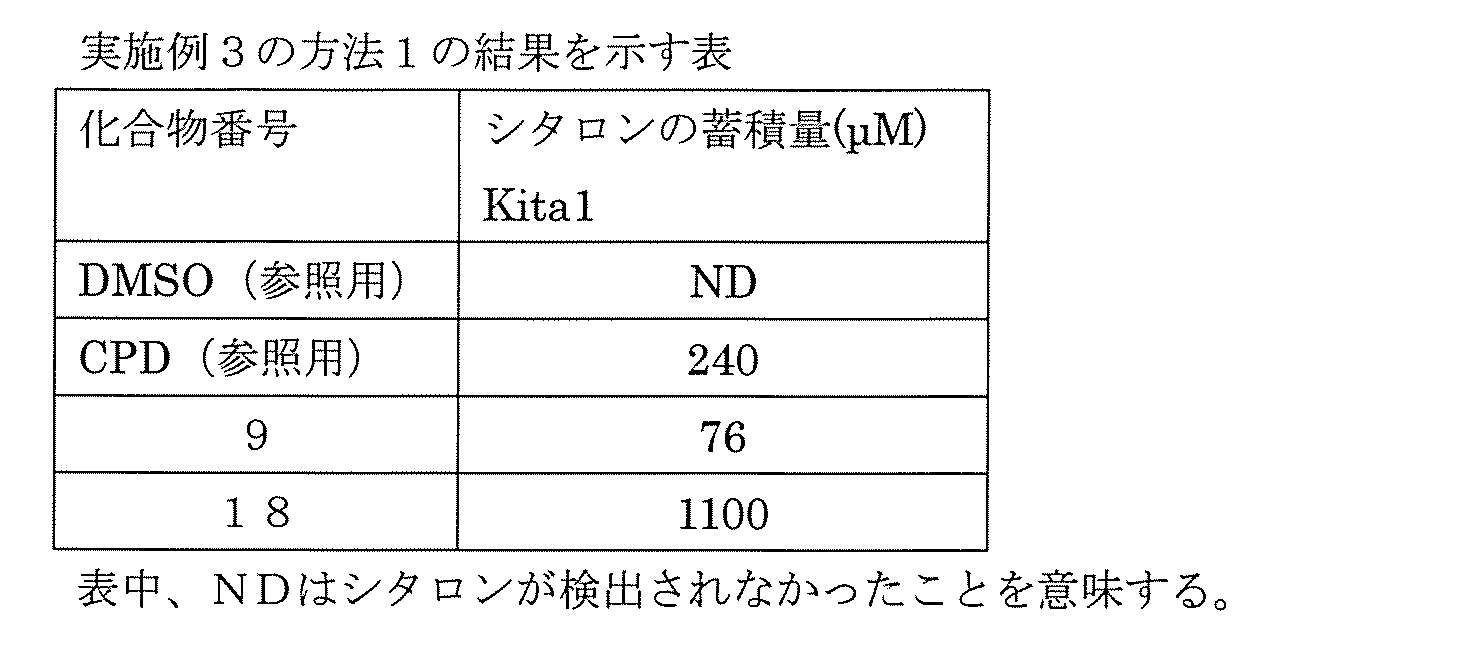
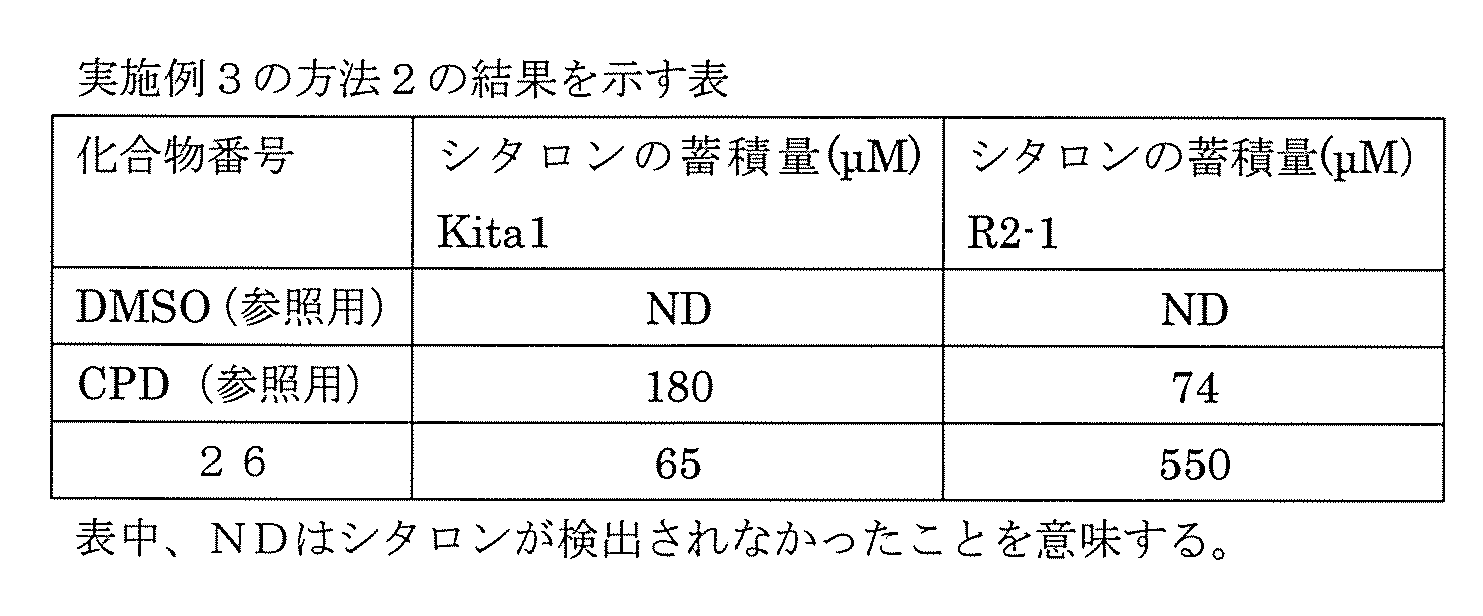

実施例4:イネに対する防除作用の評価
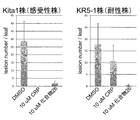
三葉期のイネいもち病菌Kita1株に感受性のイネ(日本晴れ)に対して、野生型イネいもち病菌(Kita1株)あるいは薬剤耐性型イネいもち病菌(KR5-1株)の胞子懸濁液20mL(単位体積mL当たり0.3×10⁴になるように0.02%Tween20に懸濁)を、エアブラシを用いて噴霧摂取した。胞子懸濁液中に、前記式(I)の化合物(化合物26)あるいはCRPを10μM添加した。またコントロールとしてDMSOのみを添加したものを用いた。相対湿度100%、暗所、温度25℃の環境下で24時間感染させた後、それぞれ、人工気象器中で6日間、明期14時間25℃暗期10時間20℃の条件下で、いもち病の完全な病斑が生じるまで生育させた。栽培したそれぞれのイネについて、第2葉から第4葉に生じた病斑の数をカウントして、イネいもち病の発生を評価した。病原性の評価はそれぞれ14株のイネ(2ポット)を用いて行った。イネ一株あたりの病斑数を平均±標準偏差で示した。
三葉期のイネいもち病菌Kita1株に感受性のイネ(日本晴れ)に対して、野生型イネいもち病菌(Kita1株)あるいは薬剤耐性型イネいもち病菌(KR5-1株)の胞子懸濁液20mL(単位体積mL当たり0.3×10⁴になるように0.02%Tween20に懸濁)を、エアブラシを用いて噴霧摂取した。胞子懸濁液中に、前記式(I)の化合物(化合物26)あるいはCRPを10μM添加した。またコントロールとしてDMSOのみを添加したものを用いた。相対湿度100%、暗所、温度25℃の環境下で24時間感染させた後、それぞれ、人工気象器中で6日間、明期14時間25℃暗期10時間20℃の条件下で、いもち病の完全な病斑が生じるまで生育させた。栽培したそれぞれのイネについて、第2葉から第4葉に生じた病斑の数をカウントして、イネいもち病の発生を評価した。病原性の評価はそれぞれ14株のイネ(2ポット)を用いて行った。イネ一株あたりの病斑数を平均±標準偏差で示した。
図2に示す通り、イネに施用すると、カルプロパミドは野生型に対しては高い防除効果を示すものの、薬剤耐性菌に対してはほとんど活性を示さなかった。一方、化合物26は、野生型のみならず、薬剤耐性型のイネいもち病菌に対しても高い防除効果を示すことが実証された。
本明細書中で引用した全ての刊行物、特許及び特許出願をそのまま参考として本明細書中にとり入れるものとする。
Claims (11)
- 次式(I):

で示される化合物から選ばれる少なくとも1種を含有するシタロン脱水酵素阻害剤。 - 前記式(I)中、Rが表す前記置換基が、置換又は非置換のC1-10-アルキル基、置換又は非置換のC1-10-アルコキシ基、置換又は非置換のC6-10-アリールオキシ基、置換又は非置換のC7-11-アラルキルオキシ基、ハロゲン原子、又は水酸基である請求項1に記載のシタロン脱水酵素阻害剤。
- 前記式(I)が次式(II):
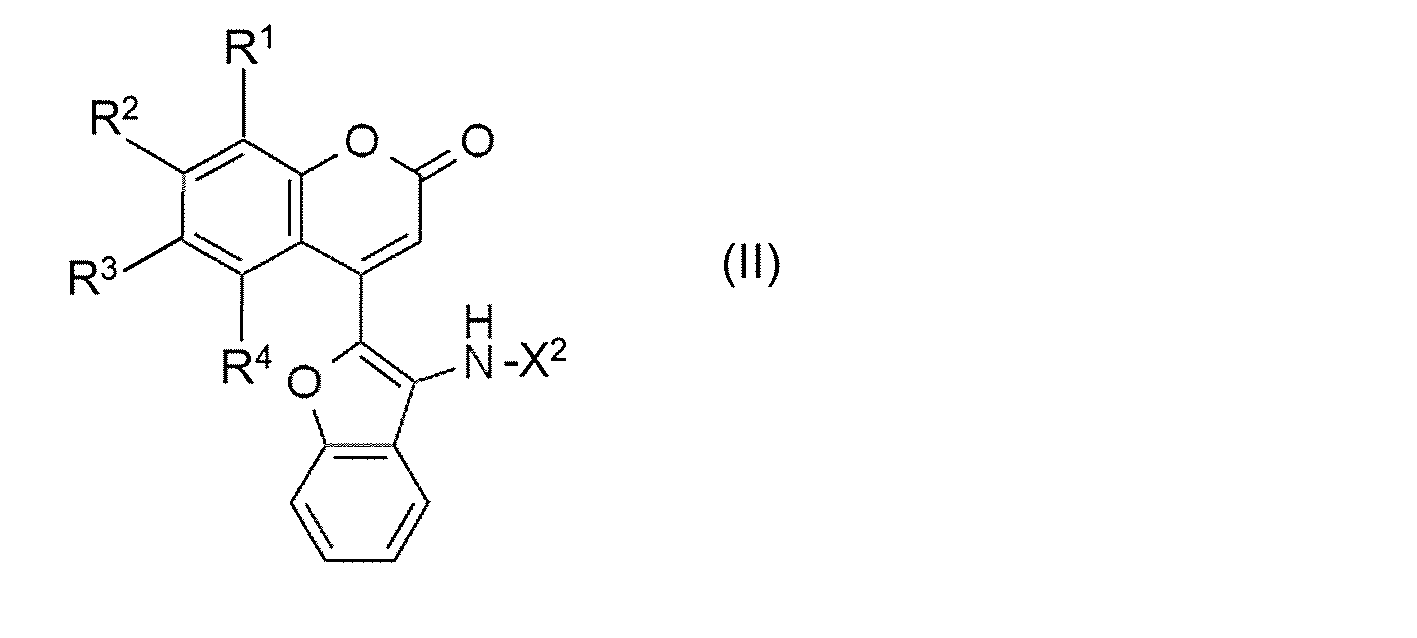
である請求項1又は2に記載のシタロン脱水酵素阻害剤。 - 前記式(II)中の置換又は非置換のC1-5-アルコキシ基がメトキシメトキシ基、(2-メトキシエトキシ)メトキシ基、[2-(トリメチルシリル)エトキシ]メトキシ基又はベンジルオキシメトキシ基である請求項3に記載のシタロン脱水酵素阻害剤。
- 少なくとも1種のアミノ酸が変異した非野生型シタロン脱水酵素に対して阻害活性を有する請求項1~4のいずれか1項に記載のシタロン脱水酵素阻害剤。
- 請求項1~5のいずれか1項に記載のシタロン脱水酵素阻害剤を含有するイネいもち病防除剤。
- イネいもち病菌のメラニン生合成経路に関与する、ポリケタイド合成酵素及び還元酵素の少なくとも1種に対して阻害活性を有する少なくとも1種の化合物を更に含有する請求項6に記載のイネいもち病防除剤。
- 次式(IIa):

で示される化合物(但し、R1a及びR3aが水素原子であり、R2a及びR4aがメチル基であり、Xaが-CO-であり、R5aが非置換のイソプロピル基である化合物を除く)。 - 前記式(IIa)中の置換又は非置換のC1-3-アルコキシ基がメトキシメトキシ基、(2-メトキシエトキシ)メトキシ基、[2-(トリメチルシリル)エトキシ]メトキシ基又はベンジルオキシメトキシ基である請求項8に記載の化合物。
- 請求項6又は7に記載のイネいもち病防除剤を、イネの植物体自体、その種子、それが生育している又は生育が予定される圃場、又はその生育に利用される器具に施用する工程を含む、イネいもち病の防除方法。
- 請求項6又は7に記載のイネいもち病防除剤をイネ茎葉へ散布し、又は前記イネいもち病防除剤によるイネ経根処理、田面処理、水面処理、側条処理、土壌処理、イネ種子処理又は苗箱処理に付す工程を含む請求項10に記載の方法。
Priority Applications (1)
| Application Number | Priority Date | Filing Date | Title |
|---|---|---|---|
| JP2021507225A JP7437783B2 (ja) | 2019-03-15 | 2020-03-10 | イネいもち病防除剤 |
Applications Claiming Priority (2)
| Application Number | Priority Date | Filing Date | Title |
|---|---|---|---|
| JP2019048574 | 2019-03-15 | ||
| JP2019-048574 | 2019-03-15 |
Publications (1)
| Publication Number | Publication Date |
|---|---|
| WO2020189391A1 true WO2020189391A1 (ja) | 2020-09-24 |
Family
ID=72519065
Family Applications (1)
| Application Number | Title | Priority Date | Filing Date |
|---|---|---|---|
| PCT/JP2020/010142 Ceased WO2020189391A1 (ja) | 2019-03-15 | 2020-03-10 | イネいもち病防除剤 |
Country Status (2)
| Country | Link |
|---|---|
| JP (1) | JP7437783B2 (ja) |
| WO (1) | WO2020189391A1 (ja) |
Citations (2)
| Publication number | Priority date | Publication date | Assignee | Title |
|---|---|---|---|---|
| JPS58157705A (ja) * | 1982-03-11 | 1983-09-19 | Rikagaku Kenkyusho | 農園芸用殺菌剤 |
| JP2000109404A (ja) * | 1998-10-01 | 2000-04-18 | Nippon Bayer Agrochem Co Ltd | 植物細菌病防除剤 |
-
2020
- 2020-03-10 JP JP2021507225A patent/JP7437783B2/ja active Active
- 2020-03-10 WO PCT/JP2020/010142 patent/WO2020189391A1/ja not_active Ceased
Patent Citations (2)
| Publication number | Priority date | Publication date | Assignee | Title |
|---|---|---|---|---|
| JPS58157705A (ja) * | 1982-03-11 | 1983-09-19 | Rikagaku Kenkyusho | 農園芸用殺菌剤 |
| JP2000109404A (ja) * | 1998-10-01 | 2000-04-18 | Nippon Bayer Agrochem Co Ltd | 植物細菌病防除剤 |
Non-Patent Citations (3)
| Title |
|---|
| DATABASE REGISTRY [online] 26 August 2006 (2006-08-26), retrieved from STN Database accession no. 904501-07-01 * |
| DATABASE REGISTRY [online] 9 April 2007 (2007-04-09), "Acetamide, N-[2-(5,7-dimethyl-2-oxo-2H-1-benzopyran-4-yl)-3-benzofuranyl]- (CA INDEX NAME)", XP055742761, retrieved from STN Database accession no. 929490-29-9 * |
| FRASINYUK, M. S. ET AL.: "Synthesis and properties of 4-(3-amino-2- benzofuranyl)coumarins", CHEMISTRY OF HETEROCYCLIC COMPOUNDS, vol. 45, no. 10, January 2009 (2009-01-01), pages 1261 - 1269, XP055741212 * |
Also Published As
| Publication number | Publication date |
|---|---|
| JPWO2020189391A1 (ja) | 2020-09-24 |
| JP7437783B2 (ja) | 2024-02-26 |
Similar Documents
| Publication | Publication Date | Title |
|---|---|---|
| EP2017268B1 (en) | 1,2-benzisothiazole derivative, and agricultural or horticultural plant disease-controlling agent | |
| EP0276177B1 (en) | Heterocyclic derivatives, method for their preparation and fungicides containing them as active ingredients | |
| AU607274B2 (en) | Substituted carboxylic acid derivatives, processes for preparing the same and agricultural or horticultural fungicides containing the same | |
| JPS6330463A (ja) | アクリル酸誘導体、その製造方法およびこれを含有する殺菌剤組成物 | |
| JPH02149502A (ja) | 殺有害生物組成物 | |
| HU204168B (en) | Fungicide, insecticide, acaricide and nematocide compositions containing acrylic acid derivatives as active components and process for producing the active components | |
| KR900001196B1 (ko) | 피라졸 유도체의 제조방법 | |
| OA10106A (fr) | (Hetero)-aryl-alkyl-cetoxim-o-ethers substitues acaricides insecticides et nematocides procede pour leur preparation agents les contenant et leur utilisation en tant qu'agents de lutte antiparaasitaire | |
| CA1085857A (en) | 1-aryl-5-carboxy-2 pyridones and derivatives thereof | |
| JP7437783B2 (ja) | イネいもち病防除剤 | |
| JPH07509253A (ja) | キノリニルオキサジアゾール除草剤 | |
| JP2000159610A (ja) | 農園芸用植物病害防除剤および新規イソオキサゾールカルボン酸誘導体 | |
| DK179669B1 (en) | SUCCINIMIDE COMPOUND | |
| JP2584807B2 (ja) | マレイミド誘導体、その製造法およびそれを有効成分として含有する農園芸用殺菌剤 | |
| JPH05194400A (ja) | イソニコチン酸アニリド誘導体及びこれを含有する農園芸用殺菌剤 | |
| JP4534452B2 (ja) | 3−メチルイソチアゾール−5−メタノール誘導体、その製造法および農園芸用病害防除剤 | |
| EP2221293A1 (en) | Amide compound and bacterial disease control agent for agricultural and horticultural use | |
| JPH07252242A (ja) | 4,5−置換−1,2,3−チアジアゾール誘導体及びその製造方法、並びに農園芸用植物病害防除剤 | |
| JPH03169872A (ja) | 植物を病気から保護するための組成物 | |
| KR850000208B1 (ko) | 3-이속사졸리디논의 제조방법 | |
| JP3090995B2 (ja) | 3,4−トランス−4−エチル−3−(置換フェニル)−1−(3−イソプロピルフェニル)−2−ピロリジノン誘導体、 | |
| JPH0656784A (ja) | 殺菌性化合物、その製造法、その中間体、殺菌剤組成物及びカビ菌類の防除方法 | |
| JP2618639B2 (ja) | シクロヘキセノン誘導体およびそれを有効成分とする除草剤 | |
| CN110724136A (zh) | 酰胺类化合物及其制备方法和应用 | |
| KR900003390B1 (ko) | 피라졸 유도체, 그의 제조방법 및 농원예용 살균제 |
Legal Events
| Date | Code | Title | Description |
|---|---|---|---|
| 121 | Ep: the epo has been informed by wipo that ep was designated in this application |
Ref document number: 20774141 Country of ref document: EP Kind code of ref document: A1 |
|
| ENP | Entry into the national phase |
Ref document number: 2021507225 Country of ref document: JP Kind code of ref document: A |
|
| NENP | Non-entry into the national phase |
Ref country code: DE |
|
| 122 | Ep: pct application non-entry in european phase |
Ref document number: 20774141 Country of ref document: EP Kind code of ref document: A1 |