WO2020189028A1 - 情報処理装置 - Google Patents
情報処理装置 Download PDFInfo
- Publication number
- WO2020189028A1 WO2020189028A1 PCT/JP2020/002990 JP2020002990W WO2020189028A1 WO 2020189028 A1 WO2020189028 A1 WO 2020189028A1 JP 2020002990 W JP2020002990 W JP 2020002990W WO 2020189028 A1 WO2020189028 A1 WO 2020189028A1
- Authority
- WO
- WIPO (PCT)
- Prior art keywords
- screen
- information
- log
- processing device
- information processing
- Prior art date
- Legal status (The legal status is an assumption and is not a legal conclusion. Google has not performed a legal analysis and makes no representation as to the accuracy of the status listed.)
- Ceased
Links
Images





Classifications
-
- G—PHYSICS
- G06—COMPUTING OR CALCULATING; COUNTING
- G06F—ELECTRIC DIGITAL DATA PROCESSING
- G06F11/00—Error detection; Error correction; Monitoring
- G06F11/30—Monitoring
- G06F11/34—Recording or statistical evaluation of computer activity, e.g. of down time, of input/output operation ; Recording or statistical evaluation of user activity, e.g. usability assessment
- G06F11/3438—Recording or statistical evaluation of computer activity, e.g. of down time, of input/output operation ; Recording or statistical evaluation of user activity, e.g. usability assessment monitoring of user actions
-
- G—PHYSICS
- G06—COMPUTING OR CALCULATING; COUNTING
- G06F—ELECTRIC DIGITAL DATA PROCESSING
- G06F11/00—Error detection; Error correction; Monitoring
- G06F11/30—Monitoring
- G06F11/32—Monitoring with visual or acoustical indication of the functioning of the machine
- G06F11/321—Display for diagnostics, e.g. diagnostic result display, self-test user interface
-
- G—PHYSICS
- G06—COMPUTING OR CALCULATING; COUNTING
- G06F—ELECTRIC DIGITAL DATA PROCESSING
- G06F11/00—Error detection; Error correction; Monitoring
- G06F11/30—Monitoring
- G06F11/34—Recording or statistical evaluation of computer activity, e.g. of down time, of input/output operation ; Recording or statistical evaluation of user activity, e.g. usability assessment
- G06F11/3452—Performance evaluation by statistical analysis
-
- G—PHYSICS
- G06—COMPUTING OR CALCULATING; COUNTING
- G06F—ELECTRIC DIGITAL DATA PROCESSING
- G06F11/00—Error detection; Error correction; Monitoring
- G06F11/30—Monitoring
- G06F11/34—Recording or statistical evaluation of computer activity, e.g. of down time, of input/output operation ; Recording or statistical evaluation of user activity, e.g. usability assessment
- G06F11/3466—Performance evaluation by tracing or monitoring
- G06F11/3476—Data logging
-
- G—PHYSICS
- G06—COMPUTING OR CALCULATING; COUNTING
- G06Q—INFORMATION AND COMMUNICATION TECHNOLOGY [ICT] SPECIALLY ADAPTED FOR ADMINISTRATIVE, COMMERCIAL, FINANCIAL, MANAGERIAL OR SUPERVISORY PURPOSES; SYSTEMS OR METHODS SPECIALLY ADAPTED FOR ADMINISTRATIVE, COMMERCIAL, FINANCIAL, MANAGERIAL OR SUPERVISORY PURPOSES, NOT OTHERWISE PROVIDED FOR
- G06Q50/00—Information and communication technology [ICT] specially adapted for implementation of business processes of specific business sectors, e.g. utilities or tourism
- G06Q50/10—Services
-
- G—PHYSICS
- G06—COMPUTING OR CALCULATING; COUNTING
- G06F—ELECTRIC DIGITAL DATA PROCESSING
- G06F2201/00—Indexing scheme relating to error detection, to error correction, and to monitoring
- G06F2201/835—Timestamp
Definitions
- the present invention relates to an information processing device.
- Patent Document 1 discloses an information processing device that provides content suitable for a user's taste by using a log indicating the content viewed by the user. This information processing device reduces a part of the log showing the content viewed by the user based on the number of times the user browses the content and the number of times the user views the content, and based on the log partially deleted. Determine the content to provide to the user.
- Each screen displayed on the information processing device is displayed under the control of the software. Then, a program module may be assigned to each screen.
- the log showing the usage history of the program module shows the transition of the screen displayed by the information processing device, so that the user is in a state of being confused about the operation or in a state of performing a familiar operation. It can be useful for estimating the condition.
- the frontmost screen among a plurality of screens displayed by a plurality of different program modules is the second screen. Transition to the first screen based on a log including a transition time from the transition to the first screen and identification information for identifying the first program module for displaying the first screen among the plurality of program modules.
- a feature information generation unit that generates feature information related to the above, an index value generation unit that generates an index value indicating the degree to which the first screen is noticed by the user based on the feature information, and the identification information of the user. It includes a determination unit that determines whether or not to use it in the process of estimating the state based on the index value.
- the processing load can be reduced while ensuring the accuracy of estimating the user's state.
- the first embodiment is a block diagram showing an information processing apparatus 1 according to an embodiment of the present invention.
- the information processing device 1 is assumed to be a smartphone. However, any information processing device can be adopted as the information processing device 1, and for example, it may be a terminal-type information device such as a personal computer, or a laptop computer, a wearable terminal, a tablet terminal, or the like. It may be a portable information terminal.
- the information processing device 1 is realized by a computer system including a processing device 12, a storage device 14, a GPS (Global Positioning System) device 15, a display device 16, an operating device 17, a communication device 18, and a battery 19.
- a processing device 12 a storage device 14
- GPS Global Positioning System
- Each element of the information processing apparatus 1 is connected to each other by a single unit or a plurality of buses 10 for communicating information.
- the term "device” in the present specification may be read as another term such as a circuit, a device or a unit.
- each element of the information processing device 1 may be composed of a single or a plurality of devices, and some elements of the information processing device 1 may be omitted.
- the information processing device 1 executes the application software by the operation of the user, and displays the screen managed by the application software on the display device 16.
- application software is simply referred to as "application”.
- the screen log LG indicating when and which screen the user used in the process of estimating the user's state, the user's state can be estimated with high accuracy.
- the process of estimating the user's state is hereinafter simply referred to as "estimation process”.
- the estimation process is, for example, a process of estimating whether or not the user is confused about the operation of the screen, or a process of estimating the state of psychological stress applied to the user.
- the screen log LG can be privacy information, it is desirable to analyze the screen log LG in the information processing device 1 without transmitting the screen log LG to an external device.
- the amount of data in the screen log LG is large, if the estimation process uses all the records in the screen log LG, the processing load of the information processing device 1 becomes high. Therefore, the information processing device 1 determines, among the records of the screen log LG, the records that will not contribute to improving the estimation accuracy, and determines the records that are not used in the estimation process.
- the processing device 12 is a processor that controls the entire information processing device 1, and is composed of, for example, a single or a plurality of chips.
- the processing device 12 is composed of, for example, an interface with a peripheral device, a central processing unit (CPU: Central Processing Unit) including an arithmetic unit and registers, and the like. Note that some or all of the functions of the processing device 12 are realized by hardware such as DSP (Digital Signal Processor), ASIC (Application Specific Integrated Circuit), PLD (Programmable Logic Device), and FPGA (Field Programmable Gate Array). You may.
- the processing device 12 executes various processes in parallel or sequentially.
- the storage device 14 is a recording medium that can be read by the processing device 12, and stores a plurality of programs including the control program PR executed by the processing device 12 and the screen log LG.
- the storage device 14 is composed of, for example, one or more types of storage circuits such as a ROM (ReadOnlyMemory), an EPROM (ErasableProgrammableROM), an EPROM (ElectricallyErasableProgrammableROM), and a RAM (RandomAccessMemory).
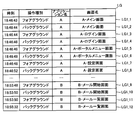
- FIG. 2 is a diagram showing an example of the stored contents of the screen log LG.
- the screen log LG includes a screen name and a screen transition time.
- the screen is displayed on the display device 16 by a program module that is part of a program stored in the storage device 14.
- the storage device 14 stores a plurality of program modules that are different from each other.
- a plurality of screens are displayed on the display device 16 by the plurality of program modules.
- the screen name is an example of "identification information for identifying the program module".
- the transition time to the first screen is the first screen specified by the screen name, and the foreground screen is different from the first screen. This is the time when the transition from the second screen to the first screen.
- the screen log LG is an example of a “log”.
- the program module that displays the first screen is an example of the "first program module”.
- the screen that transitions to the foreground after the first screen is an example of the "third screen”.
- the foreground screen is an example of the "foreground screen”.
- the screen log LG is an example of a “log”.
- the screen log LG shown in FIG. 2 is information that associates the time, the operation type, the application name, and the screen name.
- the screen log LG shown in FIG. 2 has records LG1_1 to records LG1_1.
- the time indicates the time when the operation occurred on the screen specified by the screen name.
- FIG. 2 shows an example in which the time in the screen log LG indicates the time in an arbitrary day for the sake of simplicity, but in reality, not only the time but also the date and time including the date are included in each record.
- the operation types include foreground and background.
- the application name and screen name are the name of the application and the name of the screen corresponding to the screen when an operation occurs on the screen.
- record LG1_1 indicates that the screen managed by the application whose application name is "A” and whose screen name is "main screen” has transitioned to the foreground at 18:46:43.
- the screen managed by the application may be referred to as "application name-screen name" in the explanation and drawings.
- the record LG1_3 indicates that the transition time to the A-login screen is 18:46:44.
- the GPS device 15 receives radio waves from a plurality of satellites and identifies the position of the information processing device 1 from the received radio waves.
- the display device 16 displays various images under the control of the processing device 12.
- various display panels such as a liquid crystal display panel or an organic EL (Electro Luminescence) display panel are preferably used as the display device 16.
- the display device 16 may be turned off in order to suppress the consumption of the battery 19 or by the operation of the user.
- the operation device 17 is a device for the user to input information used by the information processing device 1.
- the operation device 17 accepts an operation by the user.
- the operating device 17 accepts an operation for inputting a code such as a number and a character and an operation for selecting an icon displayed by the display device 16.
- a touch panel that detects contact with the display surface of the display device 16 is suitable as the operation device 17.
- the operation device 17 may include an operator that can be operated by the user. The operator is, for example, a stylus.
- the communication device 18 is hardware (transmission / reception device) for communicating with another device via a network.
- the communication device 18 is also called, for example, a network device, a network controller, a network card, a communication module, or the like.
- the communication device 18 is, for example, a high frequency switch, a duplexer, a filter, and a frequency synthesizer in order to realize one or both of frequency division duplex (FDD: Frequency Division Duplex) and time division duplex (TDD: Time Division Duplex). Etc. may be included in the configuration.
- FDD Frequency Division Duplex
- TDD Time Division Duplex
- the communication device 18 is a wireless LAN (Local Area Network) communication module, and is connected to a wireless LAN access point in the vicinity of the communication device 18 according to IEEE 802.11 (Wi-Fi). Is possible.
- the communication device 18 can be connected to a server device (not shown) via a network.
- the battery 19 supplies electric power to the information processing device 1.
- a lithium ion battery can be adopted.
- the function processing device 12 of the information processing device 1 reads and executes the control program PR from the storage device 14, thereby performing screen log acquisition unit 122, feature information generation unit 124, index value generation unit 126, determination unit 128, and estimation. It functions as part 129.
- the screen log acquisition unit 122 is an example of the “acquisition unit”. The functions realized by the processing apparatus 12 will be described with reference to FIGS. 3A and 3B.
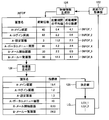
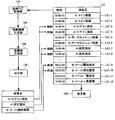
- FIG. 3A and 3B are diagrams showing an outline of the functions of the information processing device 1.
- the screen log acquisition unit 122 acquires the screen log LG from the storage device 14.
- the display of the operation type and the application name is omitted in order to avoid complication of the drawing.
- the feature information generation unit 124 generates the feature information INFOF related to the screen transition based on the screen log LG.
- the feature information INFOF generated by the feature information generation unit 124 can take any of the following eight modes. Eight aspects of the feature information INFOF will be described with reference to FIG.
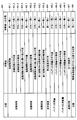
- FIG. 4 is a diagram showing a list of information that can be included in the feature information INFOF.
- Table 400 shown in FIG. 4 has records 401_1 to 401_4, records 402_1 to record 402_3, record 403_1, record 403_2, record 404, record 405_1, record 405_2, record 406_1, record 406_2, record 407, and record 408.
- the information that can be included in the feature information INFOF is grouped by the same type of elements, and each group will be described. In the following description, when distinguishing elements of the same type, reference codes such as record 401_1 and record 401_2 are used. On the other hand, when the same type of elements are not distinguished, only the common number among the reference codes is used as in record 401.
- the first aspect of the feature information INFOF includes information on the number of activations shown in record 401 and information on the activation period shown in record 402. More specifically, the first aspect of the feature information INFOF is the total number of times the first screen is started in the screen log LG, the average value of the number of times the first screen is started over a plurality of unit periods, and the first aspect over a plurality of unit periods.
- the total number of startups is an example of "the total number of times the frontmost screen has transitioned to the first screen in the log".
- the dispersion value of the number of activations over multiple unit periods and the difference between the maximum and minimum values of the number of activations over multiple unit periods are "the number of times the front screen has transitioned to the first screen over multiple unit periods. This is an example of "degree of variation”.
- the average value of the lengths of a plurality of activation periods is an example of "the average value of the lengths of a plurality of activation periods from the transition of the foreground screen to the first screen to the transition to the third screen". ..
- the dispersion value of the lengths of multiple startup periods and the difference between the maximum and minimum values of the lengths of multiple startup periods are as follows: "The foreground screen transitions to the first screen and then to the third screen. This is an example of "degree of variation in the lengths of multiple activation periods".
- the unit period may be any length, but it is preferable that the unit period is sufficiently longer than the time that one activation period can take in the situation where the information processing apparatus 1 is used in daily life.
- the unit period is, for example, one hour or one day.
- the unit period related to the average value of the number of activations and the unit period related to the distributed value of the number of activations may be the same time length or different time lengths from each other.
- the startup period is from the time when the screen is started (date and time) to the time when the screen becomes the background (date and time).
- the screen launched by the user's operation usually transitions to the foreground at the same time as the screen is launched.
- OS Operating System
- a screen managed by an update program that fixes a security vulnerability may be started at a predetermined time. Such screens may launch in the background.
- the screen activation period is the time from the time (date and time) when the first screen is activated in the foreground to the time (date and time) when the transition to the background occurs on the first screen. is there.
- the second aspect of the feature information INFOF includes information about the screens that are activated back and forth in time, as shown in record 403. More specifically, the second aspect of the feature information INFOF is the number of types of the second screen that is activated before the first screen in time, or the third screen that is activated after the first screen in time. Includes the number of types.
- the number of types of the second screen that is started before the first screen is an example of "the number of types of the second screen before the frontmost screen transitions to the first screen".
- the number of types of the third screen that is activated after the first screen is an example of "the number of types of the third screen in which the foreground screen has transitioned from the first screen".
- FIG. 5 is a diagram showing an example of a method for specifying the number of screen types to be started before and the number of screen types to be started after.
- the feature information generation unit 124 uses N-gram to specify the number of screen types to be started before and the number of screen types to be started after.
- N-gram is a text segmentation method for dividing an arbitrary character string or document into n consecutive characters.
- n is an integer of 1 or more.
- the feature information generation unit 124 sets a character string in which screen names included in the screen log LG are arranged in chronological order as a division target, and two screen names as a division unit. That is, the screen name is regarded as one character, and N-gram with n as 2 is applied.
- FIG. 5 it is premised that the operations that have occurred are shown in the screen log LG in the order of oldest as follows.
- the screen log LG shown in FIG. 5 indicates, for example, that the screen with the screen name Aa is set to the foreground, and then the screen with the screen name Ab is set to the foreground.
- the feature information generation unit 124 divides the screen name indicated by the screen log LG into a set consisting of two screen names that are back and forth in time, and outputs Table 510 as the division result.
- the arrangement of the two screen names in each set after division is referred to as a "pattern".
- One pattern has a screen name located in front of the screen in time and a screen name located in the back.
- records 511_1 to 511_9 in Table 510 the feature information generation unit 124 obtains nine patterns.
- the feature information generation unit 124 specifies a pattern in which the screen name of the first screen is located behind in time, and the specified pattern. Count the number of screen types located in front of. For example, when the screen name of the first screen is Bb, the feature information generation unit 124 specifies a pattern shown by record 511_4 and a pattern shown by record 511_6 as a pattern in which Bb is located behind. .. Then, since the screen name located in front of the pattern indicated by record 511_4 is B-a and the screen name located in front of the pattern indicated by record 511_6 is B-c, the feature information generation unit 124 has a screen name. The number of screen types to be started before the screen in which is Bb is specified as 2. The feature information generation unit 124 similarly specifies screens whose screen names are other than Bb, and outputs Table 520.
- the feature information generation unit 124 specifies a pattern in which the screen name of the first screen is located in front of the time, and in the specified pattern. Count the number of types of screen names located behind. For example, when the screen name of the first screen is Aa, the feature information generation unit 124 specifies the pattern indicated by record 511_1 and the pattern indicated by record 511_3 as the pattern in which Aa is located in front. .. Since the screen name located behind in the pattern indicated by record 511_1 is Ab and the screen name located earlier in the pattern indicated by record 511_1 is Baa, the feature information generation unit 124 has a screen name. The number of screen types to be activated after the screen in which is Aa is specified as 2. The feature information generation unit 124 similarly specifies screens whose screen names are other than Aa, and outputs Table 530.
- a third aspect of the feature information INFOF includes information about the display device 16 shown in record 404. More specifically, the third aspect of the feature information INFOF includes the display device lighting rate at the first screen activation time. The display device lighting rate is obtained by the following equation (1).
- Display device lighting rate at the first screen startup time Total number of times the display device 16 was lit at the time the first screen was started in the screen log LG / Total number of times the first screen was started in the screen log LG (1)
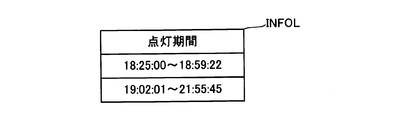
- the screen log LG includes the lighting period information INFOL indicating the period during which the display device 16 was lit.
- FIG. 6 is a diagram showing an example of the stored contents of the lighting period information INFOL.
- the period during which the display device 16 was lit was from 18:25:00 to 18:59:22 and from 19:02:01 to 21:55:45.
- the display device lighting rate at the screen startup time is "the total number of times the front screen has transitioned to the first screen in the log and the time when the front screen has transitioned to the first screen in the log. This is an example of "information representing the ratio to the total number of times the lights were lit”.
- a fourth aspect of the feature information INFOF includes information about the remaining battery level shown in record 405. More specifically, the fourth aspect of the feature information INFOF is the average value of the remaining amount of the battery 19 at a plurality of screen activation times when the first screen is activated a plurality of times, or the battery at a plurality of screen activation times. Includes the variance value of the remaining amount of 19.
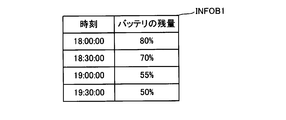
- the screen log LG includes the remaining amount information INFOB1 indicating the remaining amount of the battery 19 at each of the plurality of times.
- the plurality of times in the remaining amount information INFOB1 have, for example, the following two modes.
- the first aspect of the plurality of times is the time at predetermined time intervals.
- the second aspect of the plurality of times is the time when the first screen is activated, in other words, the time when the first screen is in the foreground.
- the plurality of times will be described as the first aspect.
- FIG. 7 is a diagram showing an example of the stored contents of the remaining amount information INFOB1.
- the remaining amount information INFOB1 is the battery 19 at 18:00:00, 18:30, 19:00, and 19:30, respectively, at a plurality of times. Indicates that the remaining amount of is 80%, 70%, 55%, and 50%, respectively.
- the feature information generation unit 124 specifies the remaining amount of the battery 19 at the screen start time, for example, by using linear interpolation.
- the dispersion value of the remaining amount of the battery 19 at a plurality of screen startup times is an example of "the degree of variation in the remaining amount at a plurality of times when the frontmost screen transitions to the first screen".
- a fifth aspect of the feature information INFOF includes information about the consumption of battery 19 shown in record 406. More specifically, the fifth aspect of the feature information INFOF is the average value of the consumption of the battery 19 over a plurality of screen activation periods when the first screen is activated a plurality of times, or over a plurality of screen activation periods. Includes a distributed value of battery 19 consumption.
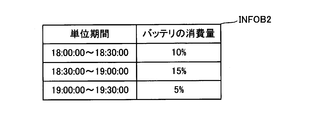
- the screen log LG includes consumption information INFOB2 indicating the consumption of the battery 19 for each unit period.
- FIG. 8 is a diagram showing an example of the stored contents of the consumption information INFOB2.
- the consumption information INFOB2 has a unit period from 18:00:00 to 18:30, a unit period from 18:30 to 19:00, 19 It is shown that the consumption of the battery 19 in the unit period from 0:00:00 to 19:30:00 is 10%, 15%, and 5%, respectively.
- the consumption amount of the battery 19 in one start-up period is the consumption amount of the battery consumed in the same start-up period among the consumption amounts in the unit period overlapping with the same start-up period among the consumption amounts indicated by the consumption amount information INFOB2.
- the feature information generation unit 124 sets the length of the activation period of the first screen (for example, in minutes) to the consumption amount of the consumption amount indicated by the consumption information INFOB2 in the unit period that overlaps with the activation time of the first screen. By dividing the multiplied value by the length of the unit period (eg, in minutes), the consumption of the battery 19 in the screen period can be obtained.
- the consumption amount of the battery 19 is a value obtained by subtracting the remaining amount of the battery 19 at the end time of the unit period from the remaining amount of the battery 19 at the start time of the unit period when the battery 19 is not charged.
- the first activation period of the first screen is from 18:00 to 18:06:00
- the second activation period is from 18:35:00 to 18:37:00.
- the dispersion value of the consumption amount of the battery 19 over a plurality of startup periods is an example of "the degree of variation in the consumption amount over a plurality of startup periods until the frontmost screen transitions from the first screen to the third screen". ..
- a sixth aspect of the feature information INFOF includes information about the communication device 18 shown in record 407. More specifically, the sixth aspect of the feature information INFOF includes the Wi-Fi connection rate at the first screen activation time. The Wi-Fi connection rate at the start time of the first screen is calculated by the following equation (2).
- Wi-Fi connection rate at the first screen startup time total number of times the Wi-Fi connection was established at the time the first screen was started in the screen log LG / total number of times the first screen was started in the screen log LG (2)
- the screen log LG provides the connection period information INFOW indicating the period during which the connection between the information processing device 1 and the access point of the wireless LAN is established. Including.
- FIG. 9 is a diagram showing an example of the stored contents of the connection period information INFOW.
- the connection period information INFOW shown in FIG. 9 the period during which the connection with the wireless LAN access point was established was from 18:26:10 to 18:58:22, and 19:02:10. It is shown that it is from 19:05:45.
- the information processing device 1 is an example of an "information processing device that displays a plurality of screens".
- the Wi-Fi connection rate at the screen startup time is "The connection is established at the total number of times the front screen has transitioned to the first screen in the log and the time when the front screen has transitioned to the first screen in the log. This is an example of "information representing the ratio to the total number of times that was being used".
- a seventh aspect of the feature information INFOF includes information about the position shown in record 408. More specifically, the seventh aspect of the feature information INFOF includes the total number of times that the information processing device 1 is positioned at a predetermined position at the first screen activation time in the screen log LG.
- An example of a "predetermined position" is a POI (Point Of Interest).
- the POI is the position of interest to the user.
- the information processing device 1 specifies in advance the position where the information processing device 1 has stayed for a predetermined time or longer as a POI.
- FIG. 10 is a diagram showing an example of POI.
- the map MP shown in FIG. 10 shows the positions of POI1 to POI4 specified as POI.
- the POI 1 indicates the home position of the user of the information processing device 1.
- POI2 indicates the location of the user's workplace.
- POI3 indicates the location of the nearest station from home.
- POI4 indicates the location of the nearest station from the workplace.
- the screen log LG is a position indicating the position of the information processing device 1 at each of a plurality of times. Includes information INFOP.
- the position information INFOP indicates the position of the information processing device 1 by latitude and longitude.
- the information processing device 1 generates position information INFOP based on the position of the information processing device 1 specified by the GPS device 15.
- FIG. 11 is a diagram showing an example of the stored contents of the position information INFOP.
- the position information INFOP is an information processing device at 18:00:00, 18:10, 18:00:00, 18:30, and 18:04:00. It is shown that the position of 1 is (x1, y1), (x2, y2), (x3, y3), (x4, y4), (x5, y5), respectively.
- x1, x2, x3, x4, and x5 indicate longitude
- y1, y2, y3, y4, and y5 indicate latitude.
- the feature information generation unit 124 interpolates from the positions at the two times before and after the screen start time in the position information INFOP.
- the position of the information processing device 1 at the start time of the first screen is specified, and the specified position is generated as the position information INFOP at the start time of the first screen.
- the feature information generation unit 124 counts the total number of times that the position information INFOP indicates POI at the first screen start time, and includes the obtained total number of times in the feature information INFOF.
- the eighth aspect of the feature information INFOF is a combination of at least two aspects of the feature information INFOF from the first aspect to the seventh aspect.
- the feature information generation unit 124 sets the average value of the remaining amount of the battery 19 at a plurality of screen startup times and the screen for the first screen.
- the feature information INFOF including the total number of times the information processing device 1 is located in the POI at the screen activation time is generated.
- the screen log LG includes the remaining amount information INFOB1 and the position information INFOP.
- the plurality of times of the remaining amount information INFOB1 and the plurality of times of the position information INFOP may be all the same, partially different, or all different.
- the feature information generation unit 124 includes a total number of activations, an average value of the activation period lengths, and a dispersion value of the activation period lengths for each of the plurality of screens.
- the index value generation unit 126 generates an index value indicating the degree to which each screen attracts the user's attention based on the feature information INFOF.
- the degree to which the screen is noticed by the user is hereinafter referred to as "attention level".
- the tendency of attention to the screen differs depending on the nature of the information contained in the feature information INFOF.
- Table 400 shows the tendency of the degree of attention for each information that can be included in the feature information INFOF.
- the longer the average value of the activation period over a plurality of unit periods the higher the degree of attention tends to be.
- the average value of the remaining amount of the battery 19 at the plurality of screen startup times tends to attract more attention as the value is smaller, and the remaining amount of the battery 19 at the plurality of screen startup times tends to be higher.
- the larger the variance value of the higher the degree of attention.
- the larger the average value of the consumption of the battery 19 during the screen activation and the dispersion value of the consumption of the battery 19 during the screen activation the higher the attention tends to be. is there.
- the lower the Wi-Fi connection rate at the screen activation time the higher the degree of attention tends to be.
- the position shown in the record 408 the total number of times the information processing device 1 is located at the POI at the screen activation time tends to be higher in attention.
- the index value generation unit 126 For information indicating that the larger the value, the higher the degree of attention to the screen tends to be, the index value generation unit 126 generates a larger index value as the value is larger. Further, the index value generation unit 126 generates an index value having a larger value as the value is smaller, as for the information indicating that the smaller the value is, the higher the degree of attention to the screen tends to be.
- the index value generation unit 126 generates an index value using, for example, the following equation (3) or (4).
- the predetermined value in the equation (4) is a value equal to or more than the maximum value of the information that tends to attract more attention as the value becomes smaller.
- the index value generation unit 126 can obtain the index value by using the following formula (3') instead of the formula (3).
- Index value (1 / maximum value of the number of times each screen is activated) x ⁇ (information that tends to attract more attention as the value increases) x ⁇ (reciprocal of information that tends to attract more attention as the value decreases) ) (3')
- the index value generation unit 126 generates the index value of each screen using the equation (3').
- the maximum number of total activations of each screen is 62 on the A-login screen.
- the total number of activations of the A-main screen is 40, the average activation period length is 6.4 hours, and the dispersion value of the activation period length is 4.7.
- the index value generation unit 126 generates, for example, the index value of the A-main screen as follows using the equation (3').
- A-Indicator value on the main screen 1/62 x (total number of startups x average value of startup period length x dispersion value of startup period length)
- A-Indicator value on the main screen 1/62 x (40 x 6.4 x 4.7) ⁇ 19.4
- the determination unit 128 determines whether or not to use the record including the screen name of the screen for the estimation process based on the index value.
- the determination unit 128 determines that the screen whose index value is equal to or less than a predetermined value is not used for the estimation process.
- the determination unit 128 determines that the upper predetermined screens are not used for the estimation process in ascending order of the index value.
- the third method it is determined that the screens with the smallest index values are not used for the estimation process until the ratio of the records related to the screens not used for the estimation process to the total number of records of the screen log LG becomes equal to or higher than the target reduction rate.
- the information processing device 1 receives, for example, a target reduction rate from the user.
- the determination unit 128 determines the screen not used for the estimation process by the third method.
- the estimation unit 129 executes the estimation process using the record including the screen name of the screen used for the estimation process. For example, the estimation unit 129 obtains an estimation result by inputting a record including the screen name of the screen determined to be used for the estimation process into the pre-trained learning model. There are the following two modes of processing for the screen determined not to be used for the estimation processing.
- the determination unit 128 deletes the record LG1 including the screen name of the screen determined not to be used for the estimation process. According to the first aspect, it is possible to increase the free space of the storage device 14.
- the determination unit 128 stores the screen name of the screen determined not to be used for the estimation process in the storage device 14.
- the estimation unit 129 executes the estimation process by using the record LG1 including the screen name other than the stored screen name.
- the record LG1 including the screen name determined not to be used for the estimation processing can also be processed.
- the mode of processing for the screen determined not to be used for the estimation processing will be described as the first mode.
- the determination unit 128 displays the B-mail start screen and A-mail in ascending order of the index value until the ratio of records related to screen names not used in the estimation process becomes a predetermined ratio or more. Decide that the login screen and the A-setting screen are not used for the estimation process. Then, the determination unit 128 deletes the record LG1_9 and record LG1_10 related to the B-mail start screen, the record LG1_7 and record LG1_8 related to the A-setting screen, and the record LG1_3 and record LG1_4 related to the A-login screen. The estimation unit 129 executes the estimation process by using the record LG1 that has not been deleted from the screen log LG.
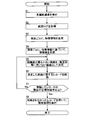
- FIG. 12 is a flowchart showing the log deletion process.
- the information processing device 1 receives the target reduction rate by the operation of the user (step S1). Next, the information processing device 1 acquires the screen log LG from the storage device 14 (step S2). Then, the information processing device 1 generates the feature information INFOF for each screen based on the screen log LG (step S3). Next, the information processing device 1 generates an index value for each screen based on the feature information INFOF (step S4). Then, the information processing device 1 determines the screen having the smallest index value as the screen not used for the estimation process (step S5). Then, the information processing apparatus 1 deletes the record LG1 including the determined screen name from the plurality of records LG1 included in the screen log LG (step S6).
- step S7 determines whether or not the ratio of the deleted record LG1 is equal to or higher than the target reduction rate.
- step S7 determines whether or not the ratio of the deleted record LG1 is equal to or higher than the target reduction rate.
- step S8 determines whether or not the ratio of the deleted record LG1 is equal to or higher than the target reduction rate.
- the information processing apparatus 1 has a feature information generation unit 124 that generates a feature information INFOF related to a transition of the first screen based on the screen log LG, and a first. It includes an index value generation unit 126 that generates an index value indicating the degree of attention of one screen, and a determination unit 128 that determines whether or not to use the first screen for estimation processing based on the index value.
- the screen log that is not attracting the attention of the user does not contribute to improving the estimation accuracy of the estimation process.
- the login screen that is automatically started is not a screen that is started by the user's operation, so it can be said that the screen is not attracting the attention of the user. Therefore, it can be said that the accuracy of the estimation process does not decrease even if the record related to the login screen is not used for the estimation process for estimating the user's state.
- the estimation is performed while ensuring the accuracy of the estimation process. It is possible to reduce the processing load.
- the first aspect of the feature information INFOF is the total number of activations in the screen log LG, the average value of the number of activations over a plurality of unit periods, the degree of variation in the number of activations over a plurality of unit periods, the average value of a plurality of activation periods, and the like. And at least one of a plurality of activation period variations.
- the total number of activations the larger the number, the more screens are activated by the user, so it can be said that the greater the number, the higher the degree of attention.
- the average value of the number of activations the larger the value, the more the user repeatedly activates the screen. Therefore, it can be said that the larger the average value, the higher the degree of attention.
- the distributed value of the number of activations means that the larger the value, the higher the possibility of being activated by human operation, and the smaller the value, the higher the possibility of being automatically activated.
- the variance value of the number of times the screen is started at a predetermined time becomes small. Therefore, it can be said that the larger the variance value of the number of activations, the higher the degree of attention.
- the feature information INFOF includes the total number of activations, the average value of the number of activations over a plurality of unit periods, or the degree of variation in the number of activations over a plurality of unit periods, it is automatically performed regardless of the user's operation. Since it can be determined that the record related to the screen that is likely to be started in is not used for the estimation process, it is possible to reduce the load on the estimation process while ensuring the accuracy of the estimation process.
- the feature information INFOF includes the average value of the activation period, it can be determined that the record related to the screen for which the user is viewing for a short time is not used for the estimation process, so that the load on the estimation process can be reduced. Further, since the screen that the user sees for a short time has a low degree of attention, it is possible to ensure the accuracy of the estimation process.
- the login screen is automatically logged in
- the login screen ends immediately after it is started, so that the length of the login screen startup period is almost constant.
- the input speed of the user usually does not fluctuate significantly, so that the length of the activation period of the login screen is almost constant.
- the splash screen may start.
- the splash screen is started when the program is running, and basically ends when the program starts and switches to the main screen.
- the length of the start-up period of the splash screen is almost constant.
- the user wants to pay attention to the main screen rather than the splash screen and starts the program, and it can be said that the attention level of the splash screen is lower than the attention level of the main screen. Therefore, it can be said that the larger the variance value of the length of the activation period, the higher the degree of attention.
- the feature information INFOF includes the variance value of the activation period, it can be determined that the record related to the screen having a constant activation period is not used for the estimation process, so that the load on the estimation process can be reduced. Further, since the screen having a constant activation period has a low degree of attention, it is possible to ensure the accuracy of the estimation process.
- the second aspect of the feature information INFOF includes the number of types of the second screen that is activated before the first screen in time, or the number of types of the third screen that is activated after the first screen.
- the fact that the number of types of the second screen that is started before is large means that there are many screens that transition to the first screen.
- the fact that it is possible to transition from many screens means that this screen is in an important position in the program, so it can be said that there is a high possibility that it will be noticed by the user. Therefore, it can be said that the larger the number of types of the second screen that is started before the first screen, the higher the degree of attention.
- the feature information INFOF includes the number of types of the second screen that are activated before the first screen in time
- the record related to the screen that is not importantly positioned in the program is used for the estimation process. Since it can be determined that it does not exist, the load on the estimation process can be reduced. Furthermore, since it is unlikely that the user will pay attention to the screen that is not positioned as important in the program, it is possible to ensure the accuracy of the estimation process.
- the fact that there are many types of the third screen that are started after the first screen in terms of time means that the user often terminates the program to which the first screen belongs and starts the third screen of another program. It can be said that.
- One of the reasons for terminating the program to which the first screen belongs is that the user's purpose has been achieved on the first screen, so that it is no longer necessary to execute the program to which the first screen belongs.
- the fact that the number of types of the third screen that is started after the first screen is large means that it is highly possible that the first screen is the screen intended by the user. Therefore, it can be said that the larger the number of screen types that are activated after the first screen, the higher the degree of attention.
- the feature information INFOF includes the number of types of the second screen that is activated after the first screen in terms of time
- the record related to the screen that is likely not the screen intended by the user is used for the estimation process. Since it can be determined that there is no estimation process, the load on the estimation process can be reduced. Further, since the screen that is likely not the screen intended by the user has a low degree of attention, it is possible to ensure the accuracy of the estimation process.
- the third aspect of the feature information INFOF includes the display device lighting rate at the start time of the first screen.
- the display device 16 When the display device 16 is lit, the user can visually recognize the contents of the screen. On the other hand, when the display device 16 is turned off, the user cannot visually recognize the contents of the screen. Therefore, when the display device lighting rate is low, it can be said that the rate at which the user could not visually recognize the contents of the screen is high.
- the feature information INFOF includes the display device lighting rate at the screen startup time, it is decided not to use the record related to the screen, which has a high rate of the user not being able to visually recognize the contents of the screen, for the estimation process. Therefore, the load on the estimation process can be reduced. Further, since the screen having a high rate of the user being unable to visually recognize the contents of the screen has a low degree of attention, it is possible to ensure the accuracy of the estimation process.
- the information processing device 1 is assumed to be a smartphone. In general smartphones that are driven by a battery, in order to reduce battery consumption, the time from when the display device is on to when it is off is shorter than that of a PC (Personal Computer) when there is no input operation. It is set. Further, when the smartphone is put in a bag or a pocket, the user may manually turn off the display device and disable the touch panel function in order to prevent the touch panel from malfunctioning. In this way, in the information processing device 1 which is a smartphone, the display device 16 is turned off more frequently than in the PC, so that the user can visually recognize the contents of the screen even if the first screen is in the foreground. It is highly possible that it could not be done. Therefore, by using the display device lighting rate at the screen activation time, the information processing device 1 can generate an index value that reflects the rate at which the user can truly confirm the contents of the screen.
- a PC Personal Computer
- the average value of the remaining amount of the battery 19 at the plurality of start-up times of the first screen or the dispersion value of the remaining amount of the battery 19 at the plurality of start-up times of the first screen is obtained. Including. The lower the average value of the remaining amount of the battery 19 at the screen start time, the shorter the time until the battery 19 approaches the completely discharged state and the information processing apparatus 1 stops operating. It can be said that the screen that is started even though the time until the information processing device 1 stops operating is short is an important screen for the user.
- the screen for updating may not start unless the remaining amount of the battery 19 is equal to or more than a predetermined value in order to prevent the battery 19 from being completely discharged and data being lost during the update. Therefore, the average value of the remaining amount of the battery 19 at the plurality of startup times of the screen for updating becomes a predetermined value or more. And it can be said that the screen for updating is not important to the user.
- the dispersion value of the remaining amount of the battery 19 at the plurality of startup times on the first screen it can be said that the larger the value, the higher the attention of the user because it is used in various situations.
- the dispersion value of the remaining amount of the battery 19 at the screen start time tends to be small. Therefore, when the feature information INFOF includes the average value or the dispersion value of the remaining amount of the battery 19 at a plurality of startup times of the first screen, it can be determined that the record related to the screen which is not important to the user is not used for the estimation process. Therefore, the load on the estimation process can be reduced. Further, since the screen that is not important to the user has a low degree of attention, it is possible to ensure the accuracy of the estimation process.
- the fifth aspect of the feature information INFOF includes an average value of a plurality of consumptions of the battery 19 over a plurality of startup periods of the first screen, or a dispersion value of a plurality of consumptions of the battery 19 over a plurality of startup periods. ..
- the feature information INFOF includes the average value of the consumption of the battery 19 over a plurality of startup periods, it can be determined that the record related to the screen which is not important to the user is not used for the estimation process, so that the load on the estimation process can be reduced. .. Further, since the screen that is not important to the user has a low degree of attention, it is possible to ensure the accuracy of the estimation process.
- SNS social networking
- the feature information INFOF includes the dispersion value of the consumption amount of the battery 19, it can be determined that the record related to the screen that is likely to be used in one usage mode is not used for the estimation process, so that the estimation process is performed.
- the load can be reduced. Furthermore, since the screen that is likely to be used in one usage mode will not attract much attention, it is possible to ensure the accuracy of the estimation process.
- the sixth aspect of the feature information INFOF includes the Wi-Fi connection rate at the start time of the first screen.
- the lower the Wi-Fi connection rate at the screen startup time the more important the screen is for the user, because it means that the screen was started even though the environment was not comfortable to use.
- the higher the Wi-Fi connection rate at the screen startup time the less important the screen is for the user.
- the update screen may not start unless a Wi-Fi connection is being established in order to download a large amount of data. And it can be said that the screen for updating has a low degree of attention.
- the feature information INFOF includes the Wi-Fi connection rate at the start time of the first screen, it can be determined that the record related to the screen that is not important to the user is not used for the estimation process, so that the load on the estimation process can be reduced. Further, since the screen that is not important to the user has a low degree of attention, it is possible to ensure the accuracy of the estimation process.
- the seventh aspect of the feature information INFOF includes the total number of times that the information processing device 1 is located at the POI at the start time of the first screen in the screen log LG.
- the more times it is located in the POI the more the screen is used in various positions of interest to the user.
- the screen can be said to be an important screen for the user.
- the screens activated by POI1, POI2, POI3, and POI4 shown in FIG. 10 mean that they were used at home, at work, or while commuting, and can be said to be important screens for the user.
- the smaller the number of times the screen is located in the POI the less important the screen is for the user.
- the feature information INFOF includes the total number of times the information processing device 1 is located at the POI in the screen log LG, it can be determined that the record related to the screen that is not important to the user is not used for the estimation process.
- the processing load can be reduced. Further, since the screen that is not important to the user has a low degree of attention, it is possible to ensure the accuracy of the estimation process.
- the eighth aspect of the feature information INFOF is a combination of two or more aspects of the first to seventh aspects.
- index values obtained from various viewpoints can be generated.
- the feature information INFOF may include an average value of a plurality of communication speeds at a plurality of screen activation times or a distributed value of a plurality of communication speeds at a plurality of screen activation times for the first screen.
- the communication speed may be the uplink communication speed, the downlink communication speed, or the average value of the uplink communication speed and the downlink communication speed. The lower the average value of the communication speed at the screen startup time, the higher the degree of attention.
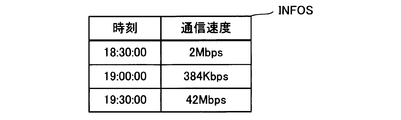
- the screen log LG includes a speed information INFOS indicating a communication speed at each of a plurality of times between the information processing device 1 and the external device.
- FIG. 13 is a diagram showing an example of the stored contents of the speed information INFOS.
- the speed information INFOS shown in FIG. 13 indicates that the communication speeds at 18:30, 19:00, and 19:30 are 2 Mbps, 384 Kbps, and 42 Mbps, respectively, at a plurality of times. Shown.
- the feature information generator 124 uses linear interpolation, for example, as in the case of the remaining battery 19 at the screen startup time described above. , Specify the communication speed at the screen startup time.
- the update screen may not start unless the Wi-Fi connection is being established in order to download a large amount of data. It can be said that the communication speed during the establishment of the Wi-Fi connection has a smaller dispersion value than the case where the Wi-Fi connection is not established.
- the feature information INFOF includes the average value or the variance value of the communication speed at the screen activation time, it can be determined that the records related to the screen that are not important to the user are not used for the estimation process, so that the load on the estimation process can be reduced. Further, since the screen that is not important to the user has a low degree of attention, it is possible to ensure the accuracy of the estimation process.
- Wi-Fi connection rate Comparing the Wi-Fi connection rate and the communication speed, whether or not it is connected to Wi-Fi is one of the important concerns of the user, so a general OS is currently connected to Wi-Fi. An icon indicating whether or not it is present is displayed on the display device 16. Therefore, when the Wi-Fi connection rate is included in the feature information INFOF, the information processing device 1 only needs to generate the connection period information INFOW according to the contents of the above-mentioned icon display, and can be easily implemented. Further, in the case of the Wi-Fi connection rate, there is an advantage that the information processing device 1 does not need to measure the communication speed.
- the communication speed at the screen startup time is an example of "communication speed at the time when the foreground screen transitions to the first screen”.
- the dispersion value of the communication speed is an example of the “degree of variation in the communication speed”.
- the information that can be included in the feature information INFOF may include the foreground rate at the start-up time of the first screen. It is assumed that there is a screen that starts in the foreground and a screen that starts in the background.
- the foreground rate at the start time of the first screen is calculated by the following equation (5).
- Foreground rate at the first screen startup time Total number of times the foreground screen transitioned to the first screen at the time the first screen was started in the screen log LG / Total number of times the first screen was started in the screen log LG (5) )
- the screen log LG includes the time information INFOT indicating the time when the screen is started.
- FIG. 14 shows an example of the stored contents of the time information INFOT.
- FIG. 14 shows the time information INFOT_1 to the time information INFOT_3.
- the time information INFOT_1 indicates that the time when the A-main screen is activated is 18:46:43.
- the time information INFOT_2 indicates that the time when the A-login screen is activated is 18:46:44.
- the time information INFOT_3 indicates that the time when the C-update screen is activated is 02:00:00.
- the feature information INFOF includes the foreground rate at the screen startup time, it can be determined that the record related to the screen, which has a high ratio of difficulty in visually recognizing the contents of the screen by the user, is not used for the estimation process.
- the load on the estimation process can be reduced. Further, since the screen having a high rate of difficulty in visually recognizing the contents of the screen by the user has a low degree of attention, it is possible to maintain the accuracy of the estimation process.
- the degree of variation has been described as, for example, the variance value or the difference between the maximum value and the minimum value, but the variation is not limited to this.
- the degree of variation may be the standard deviation or the difference between the first quartile and the third quartile.
- the first quartile is a value at a position 25% from the smallest value when a plurality of values are arranged.
- the third quartile is a value at a position 75% from the smallest value when a plurality of values are arranged.
- the display device was lit at the total number of times the frontmost screen transitioned to the first screen in the log and the time when the frontmost screen transitioned to the first screen in the log.
- the "information representing the ratio to the total number of times” has been described as, for example, the display device lighting rate at the screen startup time, but the present invention is not limited to this.
- the information representing the above-mentioned ratio may be the reciprocal of the display device lighting rate at the screen startup time. The same applies to the Wi-Fi connection rate at the screen startup time.
- the information processing device 1 generates the position information INFOP based on the position of the information processing device 1 specified by the GPS device 15, but the information processing device 1 is not limited to this and is generated by any method. You may.
- the information processing device 1 may generate the position information INFOP by using the cell ID assigned to the base station to be communicated with.
- the information processing device 1 when the information processing device 1 communicates with the access point of the wireless LAN, the information processing device 1 has the identification address (MAC (Media Access Control) address) on the network assigned to the access point and the actual address.
- the location information INFOP may be generated by referring to a database in which the above are associated with each other.
- each functional block is realized by one physically and / or logically coupled device, or directly and / or indirectly by two or more physically and / or logically separated devices. (For example, wired and / or wireless) may be connected and realized by these plurality of devices.
- information notification includes physical layer signaling (for example, DCI (Downlink Control Information), UCI (Uplink Control Information)), higher layer signaling (for example, RRC (Radio Resource Control) signaling, MAC (Medium Access Control) signaling, etc. It may be carried out by notification information (MIB (Master Information Block), SIB (System Information Block)), other signals, or a combination thereof.
- RRC signaling may be referred to as an RRC message, and may be, for example, an RRC connection setup (RRCConnectionSetup) message, an RRC connection reconfiguration (RRCConnectionReconfiguration) message, or the like.
- the specific operation for example, identification of the position information by the base station
- the base station may be performed by its upper node (upper node) in some cases.
- various operations performed for communication with a terminal are performed by the base station and / or other network nodes other than the base station (for example,). It is clear that it can be done by (but not limited to) MME or S-GW.
- MME Mobility Management Entity
- S-GW Serving Mobility Management Entity
- information and the like can be output from the upper layer (or lower layer) to the lower layer (or upper layer).
- Input / output may be performed via a plurality of network nodes.
- the input / output information and the like may be stored in a specific place (for example, a memory) or may be managed by a management table. Input / output information and the like can be overwritten, updated, or added. The output information and the like may be deleted. The input information or the like may be transmitted to another device.
- the determination may be made by a value represented by 1 bit (0 or 1) or by a boolean value (Boolean: true or false). , May be done by numerical comparison (eg, comparison with a given value).
- a portable information processing device such as a mobile phone or a smartphone is exemplified as the information processing device 1, but the specific form of the information processing device 1 is arbitrary, and each of the above-described forms It is not limited to the examples.
- a portable or stationary personal computer may be used as the information processing device 1.
- the storage device 14 is a recording medium that can be read by the processing device 12, and examples thereof include a ROM and a RAM.
- the program may also be transmitted from the network.
- the program may also be transmitted from the communication network via a telecommunication line.
- Each of the above-mentioned forms includes LTE (Long Term Evolution), LTE-A (LTE-Advanced), SUPER 3G, IMT-Advanced, 4G, 5G, FRA (Future Radio Access), W-CDMA (registered trademark). , GSM (registered trademark), CDMA2000, UMB (Ultra Mobile Broadband), IEEE 802.11 (Wi-Fi), IEEE 802.16 (WiMAX), IEEE 802.20, UWB (Ultra-WideBand), Bluetooth (registered trademark) ), Other systems that utilize suitable systems and / or next-generation systems that are extended based on them.
- the described information, signals, and the like may be represented using any of a variety of different techniques.
- data, instructions, commands, information, signals, bits, symbols, chips, etc. that may be referred to throughout the above description are voltages, currents, electromagnetic waves, magnetic fields or magnetic particles, light fields or photons, or any of these. It may be represented by a combination of.
- the terms described herein and / or the terms necessary for understanding the present specification may be replaced with terms having the same or similar meanings.
- Each function illustrated in FIG. 1 is realized by any combination of hardware and software.
- each function may be realized by a single device, or may be realized by two or more devices configured as separate bodies from each other.
- the processing device of the server device connected to the information processing device 1 may function as a screen log acquisition unit 122, a feature information generation unit 124, an index value generation unit 126, a determination unit 128, and an estimation unit 129.
- the processing device 12 functions as the screen log acquisition unit 122, the feature information generation unit 124, the index value generation unit 126, and the determination unit 128, and only the records determined to be used for the estimation processing in the screen log LG are used as the server device.
- the processing device of the server device may function as the estimation unit 129 for transmission.
- the software uses wired technology such as coaxial cable, fiber optic cable, twisted pair and digital subscriber line (DSL) and / or wireless technology such as infrared, wireless and microwave to websites, servers, or other When transmitted from a remote source, these wired and / or wireless technologies are included within the definition of transmission medium.
- wired technology such as coaxial cable, fiber optic cable, twisted pair and digital subscriber line (DSL) and / or wireless technology such as infrared, wireless and microwave to websites, servers, or other
- the information, parameters, etc. may be represented by an absolute value, a relative value from a predetermined value, or another corresponding information. May be good.
- the radio resource may be indexed.
- the base station can accommodate one or more (eg, three) cells (also referred to as sectors). When a base station accommodates multiple cells, the entire coverage area of the base station can be divided into multiple smaller areas, each smaller area being a base station subsystem (eg, small indoor base station RRH: Remote). Communication services can also be provided by Radio Head).
- the term “cell” or “sector” refers to a part or all of the coverage area of a base station and / or base station subsystem that provides communication services in this coverage.
- the terms “base station,” “eNB,” “cell,” and “sector” may be used interchangeably herein.
- a base station may be referred to by terms such as a fixed station, a NodeB, an eNodeB (eNB), an access point, a femtocell, and a small cell.
- the information processing device 1 includes a case where it is a mobile station.
- Mobile stations can be subscriber stations, mobile units, subscriber units, wireless units, remote units, mobile devices, wireless devices, wireless communication devices, remote devices, mobile subscriber stations, access terminals, mobile terminals, wireless, depending on the trader. It may also be referred to as a terminal, remote terminal, handset, user agent, mobile client, client, or some other suitable term.
- connection means any direct or indirect connection or connection between two or more elements. It can include the presence of one or more intermediate elements between two elements that are "connected” to each other.
- the connections between the elements may be physical, logical, or a combination of these.
- the two elements are by using one or more wires, cables and / or printed electrical connections, and, as some non-limiting and non-comprehensive examples, radio frequencies. It can be considered to be “connected” to each other by using electromagnetic energies such as electromagnetic energies having wavelengths in the region, microwave region and light (both visible and invisible) regions.
Landscapes
- Engineering & Computer Science (AREA)
- Theoretical Computer Science (AREA)
- General Engineering & Computer Science (AREA)
- Physics & Mathematics (AREA)
- General Physics & Mathematics (AREA)
- Quality & Reliability (AREA)
- Computer Hardware Design (AREA)
- Business, Economics & Management (AREA)
- Tourism & Hospitality (AREA)
- Human Computer Interaction (AREA)
- Human Resources & Organizations (AREA)
- Life Sciences & Earth Sciences (AREA)
- Economics (AREA)
- Marketing (AREA)
- Primary Health Care (AREA)
- Strategic Management (AREA)
- General Business, Economics & Management (AREA)
- General Health & Medical Sciences (AREA)
- Bioinformatics & Cheminformatics (AREA)
- Bioinformatics & Computational Biology (AREA)
- Evolutionary Biology (AREA)
- Probability & Statistics with Applications (AREA)
- Health & Medical Sciences (AREA)
- Management, Administration, Business Operations System, And Electronic Commerce (AREA)
- Debugging And Monitoring (AREA)
- User Interface Of Digital Computer (AREA)
Abstract
情報生成装置は、互いに異なる複数のプログラムモジュールにより表示される複数の画面のうち最前面の画面が第2画面から第1画面に遷移した遷移時刻と、複数のプログラムモジュールのうちの第1画面を表示させる第1プログラムモジュールを識別する識別情報とを含むログに基づいて、第1画面への遷移に関する特徴情報を生成する特徴情報生成部と、特徴情報に基づいて、第1画面がユーザに注目される程度を示す指標値を生成する指標値生成部と、第1プログラムモジュールを識別する識別情報をユーザの状態を推定する処理に用いるか否かを、指標値に基づいて決定する決定部と、を備える。
Description
本発明は、情報処理装置に関する。
従来、コンピュータの動作を示すログを保存しておき、ログを用いてサービスを提供することが普及している。例えば、特許文献1には、ユーザが閲覧したコンテンツを示すログを用いて、ユーザの嗜好に適したコンテンツを提供する情報処理装置が開示されている。この情報処理装置は、ユーザがコンテンツを閲覧した回数及びユーザがコンテンツを視聴した回数に基づいて、ユーザが閲覧したコンテンツを示すログの一部を削減し、一部が削除されたログに基づいてユーザに提供するコンテンツを決定する。
情報処理装置で表示される各画面は、ソフトウェアの管理の下に表示される。そして、画面ごとにプログラムモジュールが割り当てられる場合がある。この場合、プログラムモジュールの利用履歴を示すログは、情報処理装置で表示される画面の遷移を示すので、ユーザが操作に困惑している状態、又は慣れた操作を行っている状態等のユーザの状態を推定するために役立てることができる。
しかしながら、プログラムモジュールの利用履歴を示すログのレコード数は膨大であり、全てのレコードを用いてユーザの状態を推定すると、処理負荷が高いといった問題があった。処理負荷を低減するには、ユーザの状態を推定する処理に用いないレコードを判別する必要があるが、どのレコードが推定精度に影響しないレコードであるのか不明であった。
また、特許文献1に記載の技術は、ユーザの嗜好に適したコンテンツを推定することを目的としてコンテンツの閲覧履歴を削減するものである。よって、ユーザの状態を推定することを目的としてプログラムモジュールの利用履歴のログを削減する際に削減の対象となるログの内容と異なる。従って、特許文献1に記載の技術をプログラムモジュールの利用履歴のログの削減に適用することができなかった。
また、特許文献1に記載の技術は、ユーザの嗜好に適したコンテンツを推定することを目的としてコンテンツの閲覧履歴を削減するものである。よって、ユーザの状態を推定することを目的としてプログラムモジュールの利用履歴のログを削減する際に削減の対象となるログの内容と異なる。従って、特許文献1に記載の技術をプログラムモジュールの利用履歴のログの削減に適用することができなかった。
以上の課題を解決するために、本発明の好適な態様にかかる情報処理装置において、情報生成装置は、互いに異なる複数のプログラムモジュールにより表示される複数の画面のうち最前面の画面が第2画面から第1画面に遷移した遷移時刻と、前記複数のプログラムモジュールのうちの前記第1画面を表示させる第1プログラムモジュールを識別する識別情報とを含むログに基づいて、前記第1画面への遷移に関する特徴情報を生成する特徴情報生成部と、前記特徴情報に基づいて、前記第1画面がユーザに注目される程度を示す指標値を生成する指標値生成部と、前記識別情報を前記ユーザの状態を推定する処理に用いるか否かを、前記指標値に基づいて決定する決定部と、を備える。
本発明によれば、ユーザの状態を推定できる精度を確保しつつ、処理負荷を低減できる。
1.実施形態
図1は、本発明の一実施形態にかかる情報処理装置1を示すブロック図である。情報処理装置1は、スマートフォンを想定する。ただし、情報処理装置1としては、任意の情報処理装置を採用することができ、例えば、パーソナルコンピュータ等の端末型の情報機器であってもよいし、ノートパソコン、ウェアラブル端末及びタブレット端末等の可搬型の情報端末であってもよい。
図1は、本発明の一実施形態にかかる情報処理装置1を示すブロック図である。情報処理装置1は、スマートフォンを想定する。ただし、情報処理装置1としては、任意の情報処理装置を採用することができ、例えば、パーソナルコンピュータ等の端末型の情報機器であってもよいし、ノートパソコン、ウェアラブル端末及びタブレット端末等の可搬型の情報端末であってもよい。
情報処理装置1は、処理装置12、記憶装置14、GPS(Global Positioning System)装置15、表示装置16、操作装置17、通信装置18、及びバッテリ19を具備するコンピュータシステムにより実現される。情報処理装置1の各要素は、情報を通信するための単体又は複数のバス10で相互に接続される。なお、本明細書における「装置」という用語は、回路、デバイス又はユニット等の他の用語に読替えられてもよい。また、情報処理装置1の各要素は、単数又は複数の機器で構成され、情報処理装置1の一部の要素は省略されてもよい。
情報処理装置1は、ユーザの操作によって、アプリケーションソフトウェアを実行し、アプリケーションソフトウェアが管理する画面を表示装置16に表示する。以下の説明では、アプリケーションソフトウェアを、単に、「アプリケーション」と称する。ユーザが、いつ、どの画面を用いたかを表す画面ログLGを、ユーザの状態を推定する処理に用いることにより、ユーザの状態を精度良く推定することができる。ユーザの状態を推定する処理を、以下、単に、「推定処理」と称する。推定処理は、例えば、ユーザが画面の操作に困惑している状態か否かを推定する処理、又は、ユーザにかかる心理的なストレスの状態を推定する処理である。
画面ログLGはプライバシー情報となり得るため、画面ログLGを外部の装置に送信せず、情報処理装置1内で画面ログLGを解析することが望ましい。しかしながら、画面ログLGのデータ量は大きいため、推定処理が画面ログLGの全てのレコードを用いると、情報処理装置1の処理負荷が高くなってしまう。そこで、情報処理装置1は、画面ログLGのレコードのうち、推定精度を高めることに寄与しないであろうレコードを判別し、推定処理に用いないレコードとして決定する。
処理装置12は、情報処理装置1の全体を制御するプロセッサであり、例えば、単数又は複数のチップで構成される。処理装置12は、例えば、周辺装置とのインタフェースと、演算装置とレジスタ等を含む中央処理装置(CPU:Central Processing Unit)とで構成される。なお、処理装置12の機能の一部又は全部は、DSP(Digital Signal Processor)、ASIC(Application Specific Integrated Circuit)、PLD(Programmable Logic Device)、FPGA(Field Programmable Gate Array)等のハードウェアによって実現されてもよい。処理装置12は、各種の処理を並列的又は逐次的に実行する。
記憶装置14は、処理装置12が読取可能な記録媒体であり、処理装置12が実行する制御プログラムPRを含む複数のプログラム、及び画面ログLGを記憶する。記憶装置14は、例えば、ROM(Read Only Memory)、EPROM(Erasable Programmable ROM)、EEPROM(Electrically Erasable Programmable ROM)、及びRAM(Random Access Memory)等の記憶回路の1種類以上で構成される。
図2は、画面ログLGの記憶内容の一例を示す図である。画面ログLGは、画面名と、画面の遷移時刻とを含む。画面は、記憶装置14に記憶されるプログラムの一部であるプログラムモジュールによって表示装置16に表示される。記憶装置14は、互いに異なる複数のプログラムモジュールを記憶する。複数のプログラムモジュールによって、複数の画面が表示装置16に表示される。画面名は、「プログラムモジュールを識別する識別情報」の一例である。複数の画面のうち任意の画面を「第1画面」としたとき、第1画面への遷移時刻は、画面名で特定される第1画面について、フォアグラウンドの画面が、第1画面とは異なる第2画面から、第1画面へ遷移した時刻である。
なお、画面ログLGが、「ログ」の一例である。第1画面を表示させるプログラムモジュールが、「第1プログラムモジュール」の一例である。第1画面の次にフォアグラウンドに遷移した画面が、「第3画面」の一例である。フォアグラウンドの画面が、「最前面の画面」の一例である。画面ログLGは「ログ」の一例である。
なお、画面ログLGが、「ログ」の一例である。第1画面を表示させるプログラムモジュールが、「第1プログラムモジュール」の一例である。第1画面の次にフォアグラウンドに遷移した画面が、「第3画面」の一例である。フォアグラウンドの画面が、「最前面の画面」の一例である。画面ログLGは「ログ」の一例である。
図2に示す画面ログLGは、時刻と、操作種別と、アプリケーション名と、画面名とを対応付ける情報である。図2に示す画面ログLGは、レコードLG1_1~レコードLG1_12を有する。時刻は、画面名で特定される画面に対して操作が発生した時刻を示す。なお、図2は図示の簡易のため画面ログLGにおける時刻が任意の一日における時刻を示す例を示すが、実際には、時刻だけでなく日付を含む日時が各レコードには含まれる。操作種別には、フォアグラウンドとバックグラウンドとがある。アプリケーション名及び画面名は、ある画面に対して操作が発生した場合の、当該画面に対応するアプリケーションの名称及び画面の名称である。
例えば、レコードLG1_1は、アプリケーション名が「A」であるアプリケーションが管理する画面であって、画面名「メイン画面」である画面が、18時46分43秒にフォアグラウンドに遷移したことを示す。説明の簡略化のため、アプリケーションが管理する画面を、説明及び図面において「アプリケーション名-画面名」と表記する場合がある。
画面の遷移時刻の一例としては、レコードLG1_3は、A-ログイン画面への遷移時刻が、18時46分44秒であることを示す。
説明を図1に戻す。GPS装置15は、複数の衛星からの電波を受信し、受信した電波から、情報処理装置1の位置を特定する。
表示装置16は、処理装置12による制御のもとで各種の画像を表示する。例えば液晶表示パネル、又は有機EL(Electro Luminescence)表示パネル等の各種の表示パネルが表示装置16として好適に利用される。表示装置16は、バッテリ19の消費量を抑制するため、又は、ユーザの操作によって、消灯する場合がある。
操作装置17は、情報処理装置1が使用する情報をユーザが入力するための機器である。操作装置17は、ユーザによる操作を受け付ける。具体的には、操作装置17は、数字及び文字等の符号を入力するための操作と、表示装置16が表示するアイコンを選択するための操作とを受け付ける。例えば、表示装置16の表示面に対する接触を検出するタッチパネルが操作装置17として好適である。なお、ユーザが操作可能な操作子を操作装置17が含んでもよい。操作子は、例えば、タッチペンである。
通信装置18は、ネットワークを介して他の装置と通信を行うためのハードウェア(送受信デバイス)である。通信装置18は、例えば、ネットワークデバイス、ネットワークコントローラ、ネットワークカード、又は通信モジュール等とも呼ばれる。通信装置18は、例えば、周波数分割複信(FDD:Frequency Division Duplex)及び時分割複信(TDD:Time Division Duplex)の一方又は両方を実現するために、高周波スイッチ、デュプレクサ、フィルタ、及び周波数シンセサイザ等を含んで構成されてもよい。
本実施形態では、通信装置18は、無線LAN(Local Area Network)通信モジュールであり、IEEE 802.11(Wi-Fi)に従って、通信装置18の付近にある、無線LANのアクセスポイントと接続することが可能である。通信装置18は、ネットワークを介して、図示しないサーバ装置と接続することが可能である。
バッテリ19は、情報処理装置1に電力を供給する。バッテリ19としては、例えば、リチウムイオンバッテリを採用することができる。
1.1.情報処理装置1の機能
処理装置12は、記憶装置14から制御プログラムPRを読み取り実行することによって、画面ログ取得部122、特徴情報生成部124、指標値生成部126、決定部128、及び、推定部129として機能する。画面ログ取得部122は、「取得部」の一例である。
図3A及び図3Bを用いて、処理装置12によって実現される機能について説明する。
処理装置12は、記憶装置14から制御プログラムPRを読み取り実行することによって、画面ログ取得部122、特徴情報生成部124、指標値生成部126、決定部128、及び、推定部129として機能する。画面ログ取得部122は、「取得部」の一例である。
図3A及び図3Bを用いて、処理装置12によって実現される機能について説明する。
図3A及び図3Bは、情報処理装置1の機能の概要を示す図である。
画面ログ取得部122は、記憶装置14から、画面ログLGを取得する。図3Bに示す画面ログLGにおいては、図面の煩雑化を避けるために、操作種別とアプリケーション名との表示を省略する。
画面ログ取得部122は、記憶装置14から、画面ログLGを取得する。図3Bに示す画面ログLGにおいては、図面の煩雑化を避けるために、操作種別とアプリケーション名との表示を省略する。
特徴情報生成部124は、画面ログLGに基づいて、画面の遷移に関する特徴情報INFOFを生成する。特徴情報生成部124が生成する特徴情報INFOFは、以下の8個の態様の何れかをとり得る。特徴情報INFOFの8個の態様について、図4を用いながら説明する。
図4は、特徴情報INFOFに含まれ得る情報の一覧を示す図である。図4に示す表400は、レコード401_1~レコード401_4、レコード402_1~レコード402_3、レコード403_1、レコード403_2、レコード404、レコード405_1、レコード405_2、レコード406_1、レコード406_2、レコード407、レコード408を有する。表400に示すように、特徴情報INFOFに含まれ得る情報を同種の要素ごとにグループ分けし、それぞれのグループについて説明する。
以下の説明では、同種の要素を区別する場合には、レコード401_1、レコード401_2のように参照符号を使用する。一方、同種の要素を区別しない場合には、レコード401のように、参照符号のうちの共通番号だけを使用する。
以下の説明では、同種の要素を区別する場合には、レコード401_1、レコード401_2のように参照符号を使用する。一方、同種の要素を区別しない場合には、レコード401のように、参照符号のうちの共通番号だけを使用する。
<第1の態様>
特徴情報INFOFの第1の態様は、レコード401に示す起動回数に関する情報、及びレコード402に示す起動期間に関する情報を含む。より詳細には、特徴情報INFOFの第1の態様は、画面ログLGにおける、第1画面の総起動回数、複数の単位期間にわたる第1画面の起動回数の平均値、複数の単位期間にわたる第1画面の起動回数の分散値、複数の単位期間にわたる第1画面の起動回数の最大値と最小値との差、第1画面の複数の起動期間(第1画面が起動状態にある期間, activated period)の長さの平均値、第1画面の複数の起動期間の長さの分散値、及び、第1画面の複数の起動期間の長さの最大値と最小値との差のうち、少なくとも一つを含む。
特徴情報INFOFの第1の態様は、レコード401に示す起動回数に関する情報、及びレコード402に示す起動期間に関する情報を含む。より詳細には、特徴情報INFOFの第1の態様は、画面ログLGにおける、第1画面の総起動回数、複数の単位期間にわたる第1画面の起動回数の平均値、複数の単位期間にわたる第1画面の起動回数の分散値、複数の単位期間にわたる第1画面の起動回数の最大値と最小値との差、第1画面の複数の起動期間(第1画面が起動状態にある期間, activated period)の長さの平均値、第1画面の複数の起動期間の長さの分散値、及び、第1画面の複数の起動期間の長さの最大値と最小値との差のうち、少なくとも一つを含む。
なお、総起動回数が、「前記ログにおいて、最前面の画面が第1画面へ遷移した総回数」の一例である。複数の単位期間にわたる起動回数の分散値、及び、複数の単位期間にわたる起動回数の最大値と最小値との差が、「複数の単位期間にわたる、最前面の画面が第1画面へ遷移した回数のばらつき度合い」の一例である。複数の起動期間の長さの平均値が、「最前面の画面が第1画面に遷移してから第3画面に遷移するまでの、複数の起動期間の長さの平均値」の一例である。複数の起動期間の長さの分散値、及び、複数の起動期間の長さの最大値と最小値との差が、「最前面の画面が第1画面に遷移してから第3画面に遷移するまでの、複数の起動期間の長さのばらつき度合い」の一例である。単位期間は、どのような時間長でもよいが、情報処理装置1が日常で使用される状況において、1回の起動期間がとり得る時間より十分長いことが好ましい。単位期間は、例えば、1時間又は1日等である。また、起動回数の平均値に関する単位期間と、起動回数の分散値に関する単位期間とは、同一の時間長でもよいし互いに異なる時間長でもよい。
起動期間は、画面が起動した時刻(日時)からバックグラウンドになる時刻(日時)までの間である。ユーザの操作によって起動された画面は、通常、画面の起動と同時にフォアグラウンドに遷移する。一方、OS(Operating System)のサービスの一種として、セキュリティの脆弱性を修正する更新プログラムが管理する画面が、所定時刻に起動される場合がある。このような画面は、バックグラウンドで起動する場合がある。
本実施形態では、説明を簡略化するため、画面の起動と同時にフォアグラウンドに設定されるという前提とする。従って、本実施形態では、画面の起動期間は、第1画面がフォアグラウンドでの起動が発生した時刻(日時)から、第1画面がバックグラウンドへの移行が発生した時刻(日時)までの時間である。
本実施形態では、説明を簡略化するため、画面の起動と同時にフォアグラウンドに設定されるという前提とする。従って、本実施形態では、画面の起動期間は、第1画面がフォアグラウンドでの起動が発生した時刻(日時)から、第1画面がバックグラウンドへの移行が発生した時刻(日時)までの時間である。
<第2の態様>
特徴情報INFOFの第2の態様は、レコード403に示す、時間的に前後に起動される画面に関する情報を含む。より詳細には、特徴情報INFOFの第2の態様は、時間的に第1画面の前に起動される第2画面の種別数、又は、時間的に第1画面の後に起動される第3画面の種別数を含む。
特徴情報INFOFの第2の態様は、レコード403に示す、時間的に前後に起動される画面に関する情報を含む。より詳細には、特徴情報INFOFの第2の態様は、時間的に第1画面の前に起動される第2画面の種別数、又は、時間的に第1画面の後に起動される第3画面の種別数を含む。
なお、第1画面の前に起動される第2画面の種別数は、「最前面の画面が第1画面へ遷移する前の第2画面の種別の数」の一例である。第1画面の後に起動される第3画面の種別数は、「最前面の画面が第1画面から遷移した第3画面の種類の数」の一例である。前に起動される第2画面の種別数及び後に起動される第3画面の種別数の特定方法について、図5を用いて説明する。
図5は、前に起動される画面の種別数及び後に起動される画面の種別数の特定方法の一例を示す図である。特徴情報生成部124は、N-gramを用いて、前に起動される画面の種別数及び後に起動される画面の種別数を特定する。N-gramは、任意の文字列又は文書を、連続したn個の文字で分割するテキスト分割方法である。nは、1以上の整数である。特徴情報生成部124は、画面ログLGに含まれる画面名を時系列に従って並べた文字列を分割対象とし、2つの画面名を分割単位とする。すなわち、画面名を1つの文字とみなし、nを2としたN-gramを適用する。図5の例では、画面ログLGには、発生した操作が古い順に、以下のように示されているという前提である。
A-a A-b A-a B-a B-b B-c B-b C-b C-a C-b
従って、図5に示す画面ログLGは、例えば、まず画面名がA-aの画面がフォアグラウンドに設定され、次に、画面名がA-bの画面がフォアグラウンドに設定されたことを示す。
特徴情報生成部124は、画面ログLGが示す画面名を、時間的に前後する2つの画面名から成る組に分割し、分割結果として表510を出力する。以下の記載では、分割後の各組における2つの画面名の並びを、「パターン」と称する。1つのパターンは、時間的に前に位置する画面名と、後ろに位置する画面名とを有する。表510のレコード511_1~レコード511_9が示すように、特徴情報生成部124は、9個のパターンを得る。
第1画面の前に起動される画面の種別数を特定する場合には、特徴情報生成部124は、第1画面の画面名が、時間的に後ろに位置するパターンを特定し、特定したパターンにおいて前に位置する画面の種別数を計数する。例えば、第1画面の画面名がB-bである場合、特徴情報生成部124は、B-bが後ろに位置するパターンとして、レコード511_4が示すパターンと、レコード511_6が示すパターンとを特定する。そして、レコード511_4が示すパターンにおいて前に位置する画面名がB-aであり、レコード511_6が示すパターンにおいて前に位置する画面名がB-cであるから、特徴情報生成部124は、画面名がB-bである画面の前に起動される画面の種別数を、2と特定する。特徴情報生成部124は、画面名がB-b以外の画面についても同様に特定し、表520を出力する。
第1画面の後に起動される画面の種別数を特定する場合には、特徴情報生成部124は、第1画面の画面名が、時間的に前に位置するパターンを特定し、特定したパターンにおいて後ろに位置する画面名の種別数を計数する。例えば、第1画面の画面名がA-aである場合、特徴情報生成部124は、A-aが前に位置するパターンとして、レコード511_1が示すパターンと、レコード511_3が示すパターンとを特定する。そして、レコード511_1が示すパターンにおいて後ろに位置する画面名がA-bであり、レコード511_3が示すパターンにおいて前に位置する画面名がB-aであるから、特徴情報生成部124は、画面名がA-aである画面の後に起動される画面の種別数を、2と特定する。特徴情報生成部124は、画面名がA-a以外の画面についても同様に特定し、表530を出力する。
<第3の態様>
説明を図4に戻す。特徴情報INFOFの第3の態様は、レコード404に示す表示装置16に関する情報を含む。より詳細には、特徴情報INFOFの第3の態様は、第1画面起動時刻における表示装置点灯率を含む。表示装置点灯率は、下記(1)式により求められる。
説明を図4に戻す。特徴情報INFOFの第3の態様は、レコード404に示す表示装置16に関する情報を含む。より詳細には、特徴情報INFOFの第3の態様は、第1画面起動時刻における表示装置点灯率を含む。表示装置点灯率は、下記(1)式により求められる。
第1画面起動時刻における表示装置点灯率=画面ログLGにおいて、第1画面が起動した時刻で表示装置16が点灯していた総回数/画面ログLGにおいて、第1画面の総起動回数 (1)
(1)式を求めるため、特徴情報INFOFの第3の態様においては、画面ログLGは、表示装置16が点灯していた期間を示す点灯期間情報INFOLを含む。
図6は、点灯期間情報INFOLの記憶内容の一例を示す図である。図6に示す点灯期間情報INFOLは、表示装置16が点灯していた期間が、18時25分00秒から18時59分22秒までと、19時02分01秒から21時55分45秒までであることを示す。
点灯期間情報INFOLが示す期間に画面起動時刻が含まれる場合、画面起動時刻で表示装置16が点灯していたことを示す。点灯期間情報INFOLが示す期間に画面起動時刻が含まれない場合、画面起動時刻に表示装置16が消灯していたことを示す。
なお、画面起動時刻における表示装置点灯率は、「ログにおいて、最前面の画面が第1画面へ遷移した総回数と、ログにおいて、最前面の画面が第1画面へ遷移した時刻に表示装置が点灯していた総回数との比を表す情報」の一例である。
なお、画面起動時刻における表示装置点灯率は、「ログにおいて、最前面の画面が第1画面へ遷移した総回数と、ログにおいて、最前面の画面が第1画面へ遷移した時刻に表示装置が点灯していた総回数との比を表す情報」の一例である。
<第4の態様>
説明を図4に戻す。特徴情報INFOFの第4の態様は、レコード405に示すバッテリ19の残量に関する情報を含む。より詳細には、特徴情報INFOFの第4の態様は、第1画面が複数回起動された場合における、複数の画面起動時刻におけるバッテリ19の残量の平均値、又は複数の画面起動時刻におけるバッテリ19の残量の分散値を含む。特徴情報INFOFの第4の態様においては、画面ログLGは、複数の時刻の各々におけるバッテリ19の残量を示す残量情報INFOB1を含む。残量情報INFOB1における複数の時刻は、例えば、以下に示す2つの態様がある。複数の時刻の第1の態様は、所定時間ごとの時刻である。複数の時刻の第2の態様は、第1画面が起動した時刻、言い換えれば、第1画面がフォアグラウンドになった時刻である。以下の説明では、複数の時刻は、第1の態様であるとして説明する。
説明を図4に戻す。特徴情報INFOFの第4の態様は、レコード405に示すバッテリ19の残量に関する情報を含む。より詳細には、特徴情報INFOFの第4の態様は、第1画面が複数回起動された場合における、複数の画面起動時刻におけるバッテリ19の残量の平均値、又は複数の画面起動時刻におけるバッテリ19の残量の分散値を含む。特徴情報INFOFの第4の態様においては、画面ログLGは、複数の時刻の各々におけるバッテリ19の残量を示す残量情報INFOB1を含む。残量情報INFOB1における複数の時刻は、例えば、以下に示す2つの態様がある。複数の時刻の第1の態様は、所定時間ごとの時刻である。複数の時刻の第2の態様は、第1画面が起動した時刻、言い換えれば、第1画面がフォアグラウンドになった時刻である。以下の説明では、複数の時刻は、第1の態様であるとして説明する。
図7は、残量情報INFOB1の記憶内容の一例を示す図である。図7に示すように、残量情報INFOB1は、複数の時刻の各々として、18時00分00秒、18時30分00秒、19時00分00秒、19時30分00秒におけるバッテリ19の残量が、それぞれ、80%、70%、55%、50%であることを示す。
画面起動時刻に一致する時刻が残量情報INFOB1に存在しない場合には、特徴情報生成部124は、例えば、線形補間を用いて、画面起動時刻でのバッテリ19の残量を特定する。
なお、複数の画面起動時刻におけるバッテリ19の残量の分散値は、「最前面の画面が第1画面へ遷移した複数の時刻における残量のばらつき度合い」の一例である。
なお、複数の画面起動時刻におけるバッテリ19の残量の分散値は、「最前面の画面が第1画面へ遷移した複数の時刻における残量のばらつき度合い」の一例である。
<第5の態様>
説明を図4に戻す。特徴情報INFOFの第5の態様は、レコード406に示すバッテリ19の消費量に関する情報を含む。より詳細には、特徴情報INFOFの第5の態様は、第1画面が複数回起動された場合における、複数の画面起動期間にわたるバッテリ19の消費量の平均値、又は、複数の画面起動期間にわたるバッテリ19の消費量の分散値を含む。特徴情報INFOFの第5の態様において、画面ログLGは、単位期間ごとのバッテリ19の消費量を示す消費量情報INFOB2を含む。
説明を図4に戻す。特徴情報INFOFの第5の態様は、レコード406に示すバッテリ19の消費量に関する情報を含む。より詳細には、特徴情報INFOFの第5の態様は、第1画面が複数回起動された場合における、複数の画面起動期間にわたるバッテリ19の消費量の平均値、又は、複数の画面起動期間にわたるバッテリ19の消費量の分散値を含む。特徴情報INFOFの第5の態様において、画面ログLGは、単位期間ごとのバッテリ19の消費量を示す消費量情報INFOB2を含む。
図8は、消費量情報INFOB2の記憶内容の一例を示す図である。図8に示すように、消費量情報INFOB2は、18時00分00秒から18時30分00秒までの単位期間、18時30分00秒から19時00分00秒までの単位期間、19時00分00秒から19時30分00秒までの単位期間のバッテリ19の消費量が、それぞれ、10%、15%、5%であることを示す。
一起動期間におけるバッテリ19の消費量は、消費量情報INFOB2が示す消費量のうち同起動期間と重なる単位期間の消費量のうち、同起動期間において前記バッテリが消費された消費量である。例えば、特徴情報生成部124は、第1画面の起動期間の長さ(例えば、分単位)に、消費量情報INFOB2が示す消費量のうち第1画面の起動時間と重なる単位期間の消費量を乗じた値を、単位期間の長さ(例えば、分単位)で除することにより、画面期間におけるバッテリ19の消費量を得ることができる。バッテリ19の消費量は、バッテリ19が充電されていない場合には、単位期間の開始時刻のバッテリ19の残量から、単位期間の終了時刻のバッテリ19の残量を減じた値である。
例えば、第1画面の1回目の起動期間が、18時00分00秒から18時06分00秒まで、2回目の起動期間が18時35分00秒から18時37分00秒までであったと想定する。すなわち、1回目の起動期間の長さは6分間、2回目の起動期間の長さは2分間である。1回目の起動期間と重なる単位期間における、消費量情報INFOB2が示す消費量は10%である。従って、1回目の第1画面起動期間におけるバッテリ19の消費量は、6(分間)×10(%)÷30(分)=2(%)である。2回目の起動期間と重なる単位期間における、消費量情報INFOB2が示す消費量は15%である。従って、2回目の起動期間におけるバッテリ19の消費量は、2(分間)×15(%)÷30(分)=1(%)である。
なお、複数の起動期間にわたるバッテリ19の消費量の分散値は、「最前面の画面が第1画面から第3画面に遷移するまでの複数の起動期間にわたる消費量のばらつき度合い」の一例である。
<第6の態様>
説明を図4に戻す。特徴情報INFOFの第6の態様は、レコード407に示す通信装置18に関する情報を含む。より詳細には、特徴情報INFOFの第6の態様は、第1画面起動時刻におけるWi-Fi接続率を含む。第1画面起動時刻におけるWi-Fi接続率は、下記(2)式により求められる。
説明を図4に戻す。特徴情報INFOFの第6の態様は、レコード407に示す通信装置18に関する情報を含む。より詳細には、特徴情報INFOFの第6の態様は、第1画面起動時刻におけるWi-Fi接続率を含む。第1画面起動時刻におけるWi-Fi接続率は、下記(2)式により求められる。
第1画面起動時刻におけるWi-Fi接続率=画面ログLGにおいて、第1画面が起動した時刻にWi-Fiの接続が確立していた総回数/画面ログLGにおいて、第1画面の総起動回数 (2)
(2)式を求めるため、特徴情報INFOFの第6の態様において、画面ログLGは、情報処理装置1と無線LANのアクセスポイントとの間の接続が確立された期間を示す接続期間情報INFOWを含む。
図9は、接続期間情報INFOWの記憶内容の一例を示す図である。図9に示す接続期間情報INFOWは、無線LANのアクセスポイントとの間の接続が確立されていた期間が、18時26分10秒から18時58分22秒までと、19時02分10秒から19時05分45秒までとであることを示す。
なお、情報処理装置1は、「複数の画面を表示する情報処理装置」の一例である。画面起動時刻におけるWi-Fi接続率は、「ログにおいて、最前面の画面が第1画面へ遷移した総回数と、ログにおいて、最前面の画面が第1画面へ遷移した時刻に接続が確立されていた総回数との比を表す情報」の一例である。
なお、情報処理装置1は、「複数の画面を表示する情報処理装置」の一例である。画面起動時刻におけるWi-Fi接続率は、「ログにおいて、最前面の画面が第1画面へ遷移した総回数と、ログにおいて、最前面の画面が第1画面へ遷移した時刻に接続が確立されていた総回数との比を表す情報」の一例である。
<第7の態様>
説明を図4に戻す。特徴情報INFOFの第7の態様は、レコード408に示す位置に関する情報を含む。より詳細には、特徴情報INFOFの第7の態様は、画面ログLGにおいて、第1画面起動時刻において情報処理装置1が所定位置に位置する総回数を含む。「所定位置」の一例は、POI(Point Of Interest)である。POIは、ユーザが関心を持った位置である。情報処理装置1は、情報処理装置1が所定時間以上滞在した位置を、POIとして予め特定しておく。
説明を図4に戻す。特徴情報INFOFの第7の態様は、レコード408に示す位置に関する情報を含む。より詳細には、特徴情報INFOFの第7の態様は、画面ログLGにおいて、第1画面起動時刻において情報処理装置1が所定位置に位置する総回数を含む。「所定位置」の一例は、POI(Point Of Interest)である。POIは、ユーザが関心を持った位置である。情報処理装置1は、情報処理装置1が所定時間以上滞在した位置を、POIとして予め特定しておく。
図10は、POIの一例を示す図である。図10に示す地図MPは、POIとして特定したPOI1~POI4の位置を示す。POI1は、情報処理装置1のユーザの自宅の位置を示す。POI2は、ユーザの職場の位置を示す。POI3は、自宅からの最寄り駅の位置を示す。POI4が、職場からの最寄り駅の位置を示す。
画面起動時刻において情報処理装置1がPOIに位置するか否かを特定するため、特徴情報INFOFの第7態様において、画面ログLGは、複数の時刻の各々における情報処理装置1の位置を示す位置情報INFOPを含む。位置情報INFOPは、情報処理装置1の位置を、緯度と経度とにより示す。情報処理装置1は、GPS装置15が特定した情報処理装置1の位置に基づいて、位置情報INFOPを生成する。
図11は、位置情報INFOPの記憶内容の一例を示す図である。図11に示すように、位置情報INFOPは、18時00分00秒、18時10分00秒、18時20分00秒、18時30分00秒、18時40分00秒における情報処理装置1の位置が、それぞれ、(x1,y1)、(x2,y2)、(x3,y3)、(x4,y4)、(x5,y5)であることを示す。x1、x2、x3、x4、及びx5は経度を示し、y1、y2、y3、y4、及びy5は、緯度を示す。
第1画面起動時刻に一致する時刻が位置情報INFOPに存在しない場合には、特徴情報生成部124は、位置情報INFOPにおいて、画面起動時刻の前後の2つの時刻における位置から補間することにより、第1画面起動時刻における情報処理装置1の位置を特定し、特定した位置を、第1画面起動時刻における位置情報INFOPとして生成する。特徴情報生成部124は、画面ログLGにおいて、第1画面起動時刻における位置情報INFOPがPOIを示す総回数を計数し、得られた総回数を特徴情報INFOFに含める。
<第8の態様>
説明を図4に戻す。特徴情報INFOFの第8の態様は、特徴情報INFOFの第1の態様から第7の態様までの少なくとも2態様の組み合わせである。例えば、特徴情報INFOFの第4の態様と第7の態様とを組み合わせる態様において、特徴情報生成部124は、第1画面について、複数の画面起動時刻におけるバッテリ19の残量の平均値と、画面ログLGにおいて、画面起動時刻に情報処理装置1がPOIに位置する総回数と、を含む特徴情報INFOFを生成する。特徴情報INFOFの第4の態様と第7の態様とを組み合わせる態様においては、画面ログLGは、残量情報INFOB1と、位置情報INFOPとを含む。残量情報INFOB1の複数の時刻と、位置情報INFOPの複数の時刻とは、全て同一でもよいし、一部異なってもよいし、全て異なってもよい。
説明を図4に戻す。特徴情報INFOFの第8の態様は、特徴情報INFOFの第1の態様から第7の態様までの少なくとも2態様の組み合わせである。例えば、特徴情報INFOFの第4の態様と第7の態様とを組み合わせる態様において、特徴情報生成部124は、第1画面について、複数の画面起動時刻におけるバッテリ19の残量の平均値と、画面ログLGにおいて、画面起動時刻に情報処理装置1がPOIに位置する総回数と、を含む特徴情報INFOFを生成する。特徴情報INFOFの第4の態様と第7の態様とを組み合わせる態様においては、画面ログLGは、残量情報INFOB1と、位置情報INFOPとを含む。残量情報INFOB1の複数の時刻と、位置情報INFOPの複数の時刻とは、全て同一でもよいし、一部異なってもよいし、全て異なってもよい。
図3A及び図3Bの例では、特徴情報生成部124は、複数の画面の各々について、総起動回数と、起動期間の長さの平均値と、起動期間の長さの分散値とを含む特徴情報INFOFを生成する。より詳細には、特徴情報生成部124は、A-メイン画面の特徴情報INFOF_1、A-ログイン画面の特徴情報INFOF_2、A-設定画面の特徴情報INFOF_3、A-ポータルメニュー画面の特徴情報INFOF_4、B-メール開始画面の特徴情報INFOF_5、及び、B-メール一覧画面の特徴情報INFOF_6を生成する。
指標値生成部126は、特徴情報INFOFに基づいて、各画面がユーザに注目される程度を示す指標値を生成する。画面がユーザに注目される程度を、以下、「注目度」と称する。画面への注目度の傾向は特徴情報INFOFに含まれる情報の性質に応じて異なる。表400は、特徴情報INFOFに含まれ得る情報ごとの注目度の傾向を示す。
レコード401に示す総起動回数に関する情報において、総起動回数は、多いほど注目度が高い傾向にある。複数の単位期間にわたる起動回数の平均値、複数の単位期間にわたる起動回数の分散値、及び、複数の単位期間における起動回数の最大値と最小値との差は、大きいほど注目度が高い傾向にある。
レコード402に示す起動期間に関する情報において、複数の単位期間にわたる起動期間の平均値は、長いほど注目度が高い傾向にある。複数の単位期間にわたる起動期間の分散値、及び、複数の単位期間における起動期間の最大値と最小値との差は、大きいほど注目度が高い傾向にある。
レコード403に示す、時間的に第1画面の前後に起動される画面に関する情報において、時間的に前に起動される第2画面の種別数、及び、後に起動される第3画面の種別数は、多いほど注目度が高い傾向にある。
レコード404に示す表示装置16に関する情報において、画面起動時刻における表示装置点灯率は、高いほど注目度が高い傾向にある。
レコード404に示す表示装置16に関する情報において、画面起動時刻における表示装置点灯率は、高いほど注目度が高い傾向にある。
レコード405に示すバッテリ19の残量に関する情報において、複数の画面起動時刻におけるバッテリ19の残量の平均値は、少ないほど注目度が高い傾向にあり、複数の画面起動時刻におけるバッテリ19の残量の分散値は、大きいほど注目度が高い傾向にある。
レコード406に示すバッテリ19の消費量に関する情報において、画面起動中のバッテリ19の消費量の平均値、及び、画面起動中のバッテリ19の消費量の分散値は、大きいほど注目度が高い傾向にある。
レコード406に示すバッテリ19の消費量に関する情報において、画面起動中のバッテリ19の消費量の平均値、及び、画面起動中のバッテリ19の消費量の分散値は、大きいほど注目度が高い傾向にある。
レコード407に示す通信装置18に関する情報において、画面起動時刻におけるWi-Fi接続率は、低いほど注目度が高い傾向にある。
レコード408に示す位置に関する情報において、画面起動時刻において情報処理装置1がPOIに位置する総回数は、多いほど注目度が高い傾向にある。
レコード408に示す位置に関する情報において、画面起動時刻において情報処理装置1がPOIに位置する総回数は、多いほど注目度が高い傾向にある。
指標値生成部126は、値が大きいほど画面への注目度が高い傾向にあることを示す情報については、その値が大きいほど、大きな値の指標値を生成する。また、指標値生成部126は、値が小さいほど画面への注目度が高い傾向にあることを示す情報については、その値が小さいほど、大きな値の指標値を生成する。指標値生成部126は、例えば、下記(3)式又は(4)式を用いて指標値を生成する。
指標値=Π(値が大きいほど注目度が高い傾向にある情報)×Π(値が小さいほど注目度が高い傾向にある情報の逆数) (3)
指標値=Π(値が大きいほど注目度が高い傾向にある情報)×Π(所定値-値が小さいほど注目度が高い傾向にある情報) (4)
Πは、要素全ての積を示す演算子である。(4)式における所定値は、値が小さいほど注目度が高い傾向にある情報の最大値以上の値である。
指標値=Π(値が大きいほど注目度が高い傾向にある情報)×Π(所定値-値が小さいほど注目度が高い傾向にある情報) (4)
Πは、要素全ての積を示す演算子である。(4)式における所定値は、値が小さいほど注目度が高い傾向にある情報の最大値以上の値である。
特徴情報INFOFに起動回数が含まれる場合、指標値生成部126は、(3)式の替わりに、下記(3’)式を用いて指標値を求めることができる。
指標値=(1/各画面の起動回数のうちの最大値)×Π(値が大きいほど注目度が高い傾向にある情報)×Π(値が小さいほど注目度が高い傾向にある情報の逆数) (3’)
図3A及び図3Bの例では、指標値生成部126は、(3’)式を用いて各画面の指標値を生成する。各画面の総起動回数のうちの最大値は、A-ログイン画面の62回である。また、A-メイン画面の総起動回数は40回、起動期間の長さの平均値は6.4時間、起動期間の長さの分散値は4.7である。指標値生成部126は、例えば、A-メイン画面の指標値を、(3’)式を用いて下記のように生成する。
A-メイン画面の指標値=1/62×(総起動回数×起動期間の長さの平均値×起動期間の長さの分散値)
A-メイン画面の指標値=1/62×(40×6.4×4.7)≒19.4
A-メイン画面の指標値=1/62×(40×6.4×4.7)≒19.4
決定部128は、複数の画面の各々について、当該画面の画面名を含むレコードを推定処理に用いるか否かを、指標値に基づいて決定する。推定処理に用いない画面の具体的な決定方法について、例えば、以下に示す3つの方法がある。第1の方法において、決定部128は、指標値が所定値以下の画面を、推定処理に用いないと決定する。第2の方法において、決定部128は、指標値が小さい順から上位所定個の画面を、推定処理に用いないと決定する。第3の方法において、画面ログLGの全レコード数に対する、推定処理に用いない画面に関するレコードの割合が目標削減率以上となるまで、指標値が小さい画面の順に推定処理に用いないと決定する。情報処理装置1は、例えば、目標削減率を、ユーザから受け付ける。
以下では、決定部128が、第3の方法によって、推定処理に用いない画面を決定したものとして説明する。
以下では、決定部128が、第3の方法によって、推定処理に用いない画面を決定したものとして説明する。
推定部129は、推定処理に用いる画面の画面名を含むレコードを用いて、推定処理を実行する。例えば、推定部129は、予め訓練された学習モデルに、推定処理に用いると決定した画面の画面名を含むレコードを入力することにより、推定結果を得る。
推定処理に用いないと決定した画面に対する処理の態様として、以下に示す2つの態様がある。第1の態様において、決定部128は、推定処理に用いないと決定した画面の画面名を含むレコードLG1を削除する。第1の態様によれば、記憶装置14の空き容量を増やすことが可能になる。第2の態様において、決定部128は、推定処理に用いないと決定した画面の画面名を記憶装置14に記憶しておく。そして、推定部129は、記憶した画面名以外の画面名を含むレコードLG1を用いて、推定処理を実行する。第2の態様によれば、推定処理以外の処理が画面ログLGを用いる場合に、推定処理に用いないと決定した画面名を含むレコードLG1も処理対象とすることができる。
以下では、推定処理に用いないと決定した画面に対する処理の態様は、第1の態様であることとして説明する。
推定処理に用いないと決定した画面に対する処理の態様として、以下に示す2つの態様がある。第1の態様において、決定部128は、推定処理に用いないと決定した画面の画面名を含むレコードLG1を削除する。第1の態様によれば、記憶装置14の空き容量を増やすことが可能になる。第2の態様において、決定部128は、推定処理に用いないと決定した画面の画面名を記憶装置14に記憶しておく。そして、推定部129は、記憶した画面名以外の画面名を含むレコードLG1を用いて、推定処理を実行する。第2の態様によれば、推定処理以外の処理が画面ログLGを用いる場合に、推定処理に用いないと決定した画面名を含むレコードLG1も処理対象とすることができる。
以下では、推定処理に用いないと決定した画面に対する処理の態様は、第1の態様であることとして説明する。
図3A及び図3Bの例では、決定部128は、推定処理に用いない画面名に関するレコードの割合が所定の割合以上となるまで、指標値が小さい画面の順に、B-メール開始画面、A-ログイン画面、及びA-設定画面を推定処理に用いない画面に決定する。そして、決定部128は、B-メール開始画面に関するレコードLG1_9及びレコードLG1_10、A-設定画面に関するレコードLG1_7及びレコードLG1_8、ならびに、A-ログイン画面に関するレコードLG1_3及びレコードLG1_4を削除する。推定部129は、画面ログLGのうち削除されなかったレコードLG1を用いて、推定処理を実行する。
1.2.実施形態の動作
次に、情報処理装置1(具体的には、処理装置12)が実施するログ削除処理について、図12を用いて説明する。
次に、情報処理装置1(具体的には、処理装置12)が実施するログ削除処理について、図12を用いて説明する。
図12は、ログ削除処理を示すフローチャートである。情報処理装置1は、ユーザの操作によって、目標削減率を受け付ける(ステップS1)。次に、情報処理装置1は、記憶装置14から、画面ログLGを取得する(ステップS2)。そして、情報処理装置1は、画面ログLGに基づいて、画面ごとに、特徴情報INFOFを生成する(ステップS3)。次に、情報処理装置1は、画面ごとに、特徴情報INFOFに基づいて、指標値を生成する(ステップS4)。そして、情報処理装置1は、指標値が最も小さい画面を、推定処理に用いない画面として決定する(ステップS5)。そして、情報処理装置1は、画面ログLGに含まれる複数のレコードLG1のうち、決定した画面名を含むレコードLG1を削除する(ステップS6)。
次に、情報処理装置1は、削除したレコードLG1の割合が目標削減率以上か否かを判定する(ステップS7)。ステップS7の判定結果が否定の場合、すなわち削除したレコードLG1の割合が目標削減率未満である場合、情報処理装置1は、処理をステップS5に戻す。一方、ステップS7の判定結果が肯定の場合、情報処理装置1は、削除されなかったレコードLG1を用いて、推定処理を実行する(ステップS8)。ステップS8の処理終了後、情報処理装置1は、図12に示す一連の処理を終了する。
1.3.実施形態の効果
以上説明したように、本実施形態によれば、情報処理装置1は、画面ログLGに基づいて、第1画面の遷移に関する特徴情報INFOFを生成する特徴情報生成部124と、第1画面の注目度を示す指標値を生成する指標値生成部126と、第1画面を推定処理に用いるか否かを、指標値に基づいて決定する決定部128とを備える。
以上説明したように、本実施形態によれば、情報処理装置1は、画面ログLGに基づいて、第1画面の遷移に関する特徴情報INFOFを生成する特徴情報生成部124と、第1画面の注目度を示す指標値を生成する指標値生成部126と、第1画面を推定処理に用いるか否かを、指標値に基づいて決定する決定部128とを備える。
ユーザに注目されていない画面のログは、推定処理の推定精度を高めることに寄与しない可能性が高い。例えば、自動的に起動されるログイン画面は、ユーザの操作によって起動された画面ではないので、ユーザに注目されていない画面であると言える。従って、ログイン画面に関するレコードを、ユーザの状態を推定する推定処理に用いなくても、推定処理の精度が低下しないと言える。以上のように、注目度によってユーザが注目していないことを示す画面に関するレコードを、ユーザの状態を推定する推定処理に用いないことに決定することにより、推定処理の精度を確保しつつ、推定処理にかかる負荷を低減することが可能になる。
また、特徴情報INFOFの第1の態様は、画面ログLGにおける総起動回数、複数の単位期間にわたる起動回数の平均値、複数の単位期間にわたる起動回数のばらつき度合い、複数の起動期間の平均値、及び複数の起動期間のばらつき度合いのうち、少なくとも一つを含む。総起動回数は、多いほどユーザによって多く画面が起動されていることを意味するため、多いほど注目度が高いと言える。起動回数の平均値は、大きいほどユーザが繰り返し画面を起動させていることを意味するため、大きいほど注目度が高いと言える。起動回数の分散値は、大きいほど人の操作によって起動されている可能性が高くなり、小さいほど自動的に起動されている可能性が高くなることを意味する。例えば、所定時刻に起動される画面の起動回数の分散値は小さくなる。従って、起動回数の分散値は、大きいほど注目度が高いと言える。
以上により、特徴情報INFOFに、総起動回数、複数の単位期間にわたる起動回数の平均値、又は、複数の単位期間にわたる起動回数のばらつき度合いが含まれる場合には、ユーザの操作によらず自動的に起動された可能性が高い画面に関するレコードを推定処理に用いないと決定できるため、推定処理の精度を確保しつつ、推定処理にかかる負荷を低減することが可能になる。
起動期間の平均値は、長いほどユーザが長く画面を見ていることを意味するため、長いほど注目度が高いと言える。以上により、特徴情報INFOFに起動期間の平均値が含まれる場合には、ユーザが見ている時間が短い画面に関するレコードを推定処理に用いないと決定できるため、推定処理にかかる負荷を低減できる。さらに、ユーザが見ている時間が短い画面は注目度が低いから、推定処理の精度を確保することも可能になる。
起動期間の分散値は、大きいほど、画面が様々な使用状況で使用されていることを示すため、ユーザが画面に注目していると言える。また、起動期間の分散値が小さいほど、画面は自動的に終了する画面であるためユーザが画面に注目していないと言える。例えば、ログイン画面について、自動でログインする場合には、ログイン画面は起動した後即座に終了するため、ログイン画面の起動期間の長さはほぼ一定である。また、アカウント名とパスワードをユーザが入力する場合でも、ユーザの入力速度は通常大きく変動しないため、ログイン画面の起動期間の長さはほぼ一定である。そして、ユーザは、ログイン画面よりもログイン画面後のメイン画面に注目したいためログイン画面を起動させたのであり、ログイン画面の注目度はメイン画面の注目度よりも低いと言える。
また、例えば、プログラムを起動すると、スプラッシュ画面が起動する場合がある。スプラッシュ画面は、プログラム起動中の段階で起動され、基本的にはプログラムの起動が完了した時点で終了しメイン画面に切り替わる。このように、スプラッシュ画面の起動期間の長さは、ほぼ一定である。一般的には、ユーザは、スプラッシュ画面よりもメイン画面に注目したくてプログラムを起動させたのであり、スプラッシュ画面の注目度はメイン画面の注目度よりも低いと言える。従って、起動期間の長さの分散値は、大きいほど注目度が高いと言える。以上により、特徴情報INFOFに起動期間の分散値が含まれる場合には、起動期間の長さが一定の画面に関するレコードを推定処理に用いないと決定できるため、推定処理にかかる負荷を低減できる。さらに、起動期間の長さが一定の画面は注目度が低いから、推定処理の精度を確保することも可能になる。
また、特徴情報INFOFの第2の態様は、時間的に第1画面の前に起動される第2画面の種別数、又は、第1画面の後に起動される第3画面の種別数を含む。前に起動される第2画面の種別数が多いということは、第1画面に遷移する画面が多く存在することを意味する。多くの画面から遷移することが可能ということは、この画面はプログラムの中で重要な位置づけにあるから、ユーザに注目される可能性も高いと言える。従って、第1画面の前に起動される第2画面の種別数は、多いほど注目度が高いと言える。以上により、特徴情報INFOFに、時間的に第1画面の前に起動される第2画面の種別数が含まれる場合には、プログラムの中で重要な位置づけにない画面に関するレコードを推定処理に用いないと決定できるため、推定処理にかかる負荷を低減できる。さらに、プログラムの中で重要な位置づけにない画面がユーザに注目されることは少ないであろうから、推定処理の精度を確保することも可能になる。
時間的に第1画面の後に起動される第3画面の種別数が多いということは、ユーザが、第1画面が属するプログラムを終了させて、他のプログラムの第3画面を起動させることが多いと言える。第1画面が属するプログラムを終了させる理由の一つには、第1画面でユーザの目的が達成されたため、第1画面が属するプログラムの実行が不要になったことが考えられる。このように、第1画面の後に起動される第3画面の種別数が多いということは、第1画面がユーザの目的の画面である可能性が高いと言える。従って、第1画面の後に起動される画面の種別数は、多いほど注目度が高いと言える。
以上により、特徴情報INFOFに、時間的に第1画面の後に起動される第2画面の種別数が含まれる場合には、ユーザの目的の画面でない可能性が高い画面に関するレコードを推定処理に用いないと決定できるため、推定処理にかかる負荷を低減できる。さらに、ユーザの目的の画面でない可能性が高い画面は注目度が低いから、推定処理の精度を確保することも可能になる。
また、特徴情報INFOFの第3の態様は、第1画面の起動時刻における表示装置点灯率を含む。表示装置16が点灯している場合には、ユーザが画面の内容を視認可能である。一方で、表示装置16が消灯している場合には、ユーザが画面の内容を視認することができない。従って、表示装置点灯率が低い場合には、ユーザが画面の内容を視認することができなかった割合が高いと言える。以上により、特徴情報INFOFに、画面起動時刻における表示装置点灯率が含まれる場合には、ユーザが画面の内容を視認することができなかった割合が高い画面に関するレコードを推定処理に用いないと決定できるため、推定処理にかかる負荷を低減できる。さらに、ユーザが画面の内容を視認することができなかった割合が高い画面は注目度が低いから、推定処理の精度を確保することも可能になる。
さらに、情報処理装置1は、スマートフォンを想定している。バッテリの駆動で動作する一般的なスマートフォンは、バッテリの消費量を抑えるために、入力操作がない場合に表示装置が点灯している状態から消灯するまでの時間がPC(Personal Computer)よりも短く設定されている。さらに、ユーザは、スマートフォンをカバンやポケットに入れる場合、タッチパネルの誤動作を防ぐために、手動で表示装置を消灯させ、かつ、タッチパネルの機能を無効にさせることがある。このように、スマートフォンである情報処理装置1は、PCと比較してより頻繁に表示装置16が消灯されるため、第1画面がフォアグラウンドにあるとしても、ユーザが画面の内容を視認することができなかった可能性が高くなる。従って、画面起動時刻における表示装置点灯率を用いることにより、情報処理装置1は、ユーザが画面の内容を真に確認できた割合が反映された指標値を生成することができる。
また、特徴情報INFOFの第4の態様は、第1画面の複数の起動時刻におけるバッテリ19の残量の平均値、又は、第1画面の複数の起動時刻におけるバッテリ19の残量の分散値を含む。画面起動時刻におけるバッテリ19の残量の平均値が低いほど、バッテリ19が完全放電状態に近づいており、情報処理装置1が動作しなくなるまでの時間が短いことを意味する。情報処理装置1が動作しなくなるまでの時間が短いにも拘わらず起動された画面は、ユーザにとって重要な画面であると言える。一方で、例えば、アップデートを行う画面は、アップデートの途中でバッテリ19が完全放電状態となりデータが失われることを避けるため、バッテリ19の残量が所定値以上でなければ起動しない場合がある。従って、アップデートを行う画面の複数の起動時刻におけるバッテリ19の残量の平均値は、所定値以上になる。そして、アップデートを行う画面は、ユーザにとって重要でないと言える。
第1画面の複数の起動時刻におけるバッテリ19の残量の分散値は、値が大きいほど様々な状況で使用されているため、ユーザの注目度が高いと言える。一方、前述したアップデートを行う画面のように、バッテリ19の残量の所定値以上でなければ起動しない場合、画面起動時刻におけるバッテリ19の残量の分散値は小さくなる傾向にある。
従って、特徴情報INFOFに、第1画面の複数の起動時刻におけるバッテリ19の残量の平均値又は分散値が含まれる場合には、ユーザにとって重要でない画面に関するレコードを推定処理に用いないと決定できるため、推定処理にかかる負荷を低減できる。さらに、ユーザにとって重要でない画面は注目度が低いから、推定処理の精度も確保することが可能になる。
従って、特徴情報INFOFに、第1画面の複数の起動時刻におけるバッテリ19の残量の平均値又は分散値が含まれる場合には、ユーザにとって重要でない画面に関するレコードを推定処理に用いないと決定できるため、推定処理にかかる負荷を低減できる。さらに、ユーザにとって重要でない画面は注目度が低いから、推定処理の精度も確保することが可能になる。
また、特徴情報INFOFの第5の態様は、第1画面の複数の起動期間にわたるバッテリ19の複数の消費量の平均値又は、複数の起動期間にわたるバッテリ19の複数の消費量の分散値を含む。バッテリ19の消費量の平均値が大きいほど、情報処理装置1が動作しなくなるまでの時間が短くなることを意味する。情報処理装置1が動作しなくなるまでの時間が短くなるにも関わらず起動された画面は、ユーザにとって重要な画面であると言える。一方、画面起動中のバッテリ19の消費量の平均値が低いほど、ユーザにとって重要な画面でないと言える。
従って、特徴情報INFOFに複数の起動期間にわたるバッテリ19の消費量の平均値が含まれる場合、ユーザにとって重要でない画面に関するレコードを推定処理に用いないと決定できるため、推定処理にかかる負荷を低減できる。さらに、ユーザにとって重要でない画面は注目度が低いから、推定処理の精度を確保することも可能になる。
複数の起動期間にわたるバッテリ19の複数の消費量の分散値が大きいほど、画面を様々な使用態様で使用していることを意味する。例えば、SNS(social networking)アプリケーションの一覧画面では、ユーザが他のユーザの動画に興味を持った場合にこの動画を再生するとバッテリ19の消費量が大きくなる一方で、前述の動画に興味を持たず前述の動画を再生しない場合にはバッテリ19の消費量が低くなる。様々な使用態様で使用している画面は、注目度が高いと言える。一方、バッテリ19の消費量の分散値が小さいほど、第1画面を一つの使用態様で使用している可能性が高くなり、注目度が低いと言える。従って、特徴情報INFOFにバッテリ19の消費量の分散値が含まれる場合、一つの使用態様で使用している可能性が高い画面に関するレコードを推定処理に用いないと決定できるため、推定処理にかかる負荷を低減できる。さらに、一つの使用態様で使用している可能性が高い画面は注目度が低いだろうから、推定処理の精度を確保することも可能になる。
また、特徴情報INFOFの第6の態様は、第1画面の起動時刻におけるWi-Fi接続率を含む。画面起動時刻におけるWi-Fi接続率が低いほど、快適に使用できない環境にあるにも拘わらず起動されたことを意味するため、ユーザにとって重要な画面と言える。一方、画面起動時刻におけるWi-Fi接続率が高いほど、ユーザにとって重要でない画面と言える。例えば、アップデートを行う画面は、大量のデータをダウンロードするために、Wi-Fi接続確立中でなければ起動しない場合がある。そして、アップデートを行う画面は注目度が低いと言える。従って、特徴情報INFOFに第1画面の起動時刻におけるWi-Fi接続率が含まれる場合、ユーザにとって重要でない画面に関するレコードを推定処理に用いないと決定できるため、推定処理にかかる負荷を低減できる。さらに、ユーザにとって重要でない画面は注目度が低いから、推定処理の精度を確保することも可能になる。
また、特徴情報INFOFの第7の態様は、画面ログLGにおいて、第1画面の起動時刻において情報処理装置1がPOIに位置する総回数を含む。POIに位置する回数が多いほど、ユーザが関心を持った様々な位置で画面が使用されていることを示す。ユーザが関心を持った様々な位置で画面が使用されている場合、ユーザにとって重要である画面と言える。例えば、図10に示したPOI1、POI2、POI3及びPOI4で起動された画面は、家でも職場でも通勤中でも使用されたことを意味し、ユーザにとって重要である画面であると言える。一方、POIに位置する回数が少ないほど、ユーザにとって重要でない画面であると言える。従って、特徴情報INFOFに画面ログLGにおいて、画面起動時刻において情報処理装置1がPOIに位置する総回数が含まれる場合、ユーザにとって重要でない画面に関するレコードを推定処理に用いないと決定できるため、推定処理にかかる負荷を低減できる。さらに、ユーザにとって重要でない画面は注目度が低いから、推定処理の精度を確保することも可能になる。
また、特徴情報INFOFの第8の態様は、第1の態様から第7の態様の2以上の態様の組み合わせである。第1の態様から第7の態様の2以上の態様を組み合わせることによって、様々な観点によって得られた指標値を生成することができる。
2.変形例
本発明は、以上に例示した各実施形態に限定されない。具体的な変形の態様を以下に例示する。以下の例示から任意に選択された2以上の態様を併合してもよい。
本発明は、以上に例示した各実施形態に限定されない。具体的な変形の態様を以下に例示する。以下の例示から任意に選択された2以上の態様を併合してもよい。
(1)上述の態様において、図4に示す表400には、特徴情報INFOFに含まれ得る情報の一覧を示したが、特徴情報INFOFに含まれ得る情報は、表400に示す情報に限られない。
(1-1)例えば、特徴情報INFOFは、第1画面について、複数の画面起動時刻における複数の通信速度の平均値、又は、複数の画面起動時刻における複数の通信速度の分散値を含んでもよい。通信速度は、アップリンクの通信速度でもよいし、ダウンリンクの通信速度でもよいし、アップリンクの通信速度とダウンリンクの通信速度との平均値でもよい。
画面起動時刻における通信速度の平均値は、低いほど注目度が高いことを示す。画面起動時刻における通信速度の分散値は、大きいほど注目度が高いことを示す。変形例1において、画面ログLGは、情報処理装置1と外部装置との間の複数の時刻の各々における通信速度を示す速度情報INFOSを含む。
(1-1)例えば、特徴情報INFOFは、第1画面について、複数の画面起動時刻における複数の通信速度の平均値、又は、複数の画面起動時刻における複数の通信速度の分散値を含んでもよい。通信速度は、アップリンクの通信速度でもよいし、ダウンリンクの通信速度でもよいし、アップリンクの通信速度とダウンリンクの通信速度との平均値でもよい。
画面起動時刻における通信速度の平均値は、低いほど注目度が高いことを示す。画面起動時刻における通信速度の分散値は、大きいほど注目度が高いことを示す。変形例1において、画面ログLGは、情報処理装置1と外部装置との間の複数の時刻の各々における通信速度を示す速度情報INFOSを含む。
図13は、速度情報INFOSの記憶内容の一例を示す図である。図13に示す速度情報INFOSは、複数の時刻の各々として、18時30分00秒、19時00分00秒、19時30分00秒における通信速度が、2Mbps、384Kbps、42Mbpsであることを示す。
第1画面の起動時刻に一致する時刻が速度情報INFOSに存在しない場合には、特徴情報生成部124は、例えば、上述した画面起動時刻のバッテリ19の残量と同様に、線形補間を用いて、画面起動時刻における通信速度を特定する。
複数の画面起動時刻における通信速度の平均値が低いほど、画面起動時刻におけるWi-Fi接続率と同様に、快適に使用できない環境にあるにも拘わらず起動されたことを意味するため、ユーザにとって重要な画面と言える。
複数の画面起動時刻における通信速度の分散値が大きいほど、様々な使用状況で使用されており、ユーザにとって重要な画面と言える。一方、画面起動時刻における通信速度の分散値が小さいほど、ユーザにとって重要でない画面と言える。例えば、上述したように、アップデートを行う画面は、大量のデータをダウンロードするために、Wi-Fi接続確立中でなければ起動しない場合がある。そして、Wi-Fi接続確立中の通信速度は、Wi-Fi接続確立中でない場合と比較して、分散値が小さいと言える。
従って、特徴情報INFOFに画面起動時刻における通信速度の平均値又は分散値が含まれる場合、ユーザにとって重要でない画面に関するレコードは推定処理に用いないと決定できるため、推定処理にかかる負荷を低減できる。さらに、ユーザにとって重要でない画面は注目度が低いから、推定処理の精度を確保することが可能になる。
Wi-Fi接続率と通信速度とを比較すると、Wi-Fiに接続しているか否かはユーザの重要な関心の一つであるから、一般的なOSは、現在Wi-Fiに接続しているか否かを示すアイコンを表示装置16に表示する。従って、Wi-Fi接続率が特徴情報INFOFに含まれる場合、情報処理装置1は、前述のアイコンの表示の内容に従って、接続期間情報INFOWを生成すればよく、容易に実施することができる。また、Wi-Fi接続率の場合には、情報処理装置1が通信速度を測定する必要がないという利点がある。
一方、通信速度の平均値又は分散値を特徴情報INFOFに含める場合、契約したデータ通信量上限を超えない場合の高速通信、及び、契約したデータ通信量上限を超えた場合の低速通信を考慮することができる。
なお、画面起動時刻における通信速度は、「最前面の画面が第1画面へ遷移した時刻における通信速度」の一例である。通信速度の分散値は、「通信速度のばらつき度合い」の一例である。
(1-2)特徴情報INFOFに含まれ得る情報は、第1画面の起動時刻におけるフォアグラウンド率を含んでもよい。フォアグラウンドで起動する画面と、バックグラウンドで起動する画面とがあるという前提である。第1画面起動時刻におけるフォアグラウンド率は、下記(5)式により求められる。
第1画面起動時刻におけるフォアグラウンド率=画面ログLGにおいて、第1画面が起動した時刻にフォアグラウンドの画面が第1画面へ遷移した総回数/画面ログLGにおいて、第1画面が起動した総回数 (5)
本変形例において、画面ログLGは、画面が起動した時刻を示す時刻情報INFOTを含む。
図14は、時刻情報INFOTの記憶内容の一例を示す。図14では、時刻情報INFOT_1~時刻情報INFOT_3を示す。時刻情報INFOT_1は、A-メイン画面が起動した時刻が18時46分43秒であることを示す。時刻情報INFOT_2は、A-ログイン画面が起動した時刻が18時46分44秒であることを示す。時刻情報INFOT_3は、C-アップデート画面が起動した時刻が02時00分00秒であることを示す。
第1画面の起動時刻におけるフォアグラウンド率は、高いほど注目度が高い傾向にある。第1画面が起動した時点でフォアグラウンドの画面が、第1画面へ遷移した場合、ユーザは、第1画面の内容を容易に視認することができる。一方、第1画面が起動した時点でフォアグラウンドの画面が、第1画面へ遷移しない場合、換言すれば、第1画面がバックグラウンドで起動した場合、フォアグラウンドの画面に阻害されるので、ユーザが第1画面の内容を視認することが困難である。以上により、特徴情報INFOFに、画面起動時刻におけるフォアグラウンド率が含まれる場合には、ユーザが画面の内容を視認することが困難な割合が高い画面に関するレコードを推定処理に用いないと決定できるため、推定処理にかかる負荷を低減できる。さらに、ユーザが画面の内容を視認することが困難な割合が高い画面は注目度が低いから、推定処理の精度を維持することも可能になる。
(3)上述した各形態において、ばらつき度合いは、例えば、分散値、又は、最大値と最小値との差であると説明したが、これに限られない。例えば、ばらつき度合いは、標準偏差、又は、第1四分位数と第3四分位数との差でもよい。第1四分位数は、複数の値を並べた場合の値が小さい方から25%の位置にある値のことである。第3四分位数は、複数の値を並べた場合の値が小さい方から75%の位置にある値のことである。
(4)上述した各形態において、「ログにおいて、最前面の画面が第1画面へ遷移した総回数と、ログにおいて最前面の画面が第1画面へ遷移した時刻に表示装置が点灯していた総回数との比を表す情報」は、例えば、画面起動時刻における表示装置点灯率であると説明したが、これに限られない。例えば、前述の比を表す情報は、画面起動時刻における表示装置点灯率の逆数でもよい。画面起動時刻におけるWi-Fi接続率についても同様である。
(5)上述した各形態において、情報処理装置1は、位置情報INFOPを、GPS装置15が特定した情報処理装置1の位置に基づいて生成したが、これに限られず、どのような方法で生成してもよい。例えば、情報処理装置1は、位置情報INFOPを、通信先となる基地局に割り当てられたセルIDを用いて生成してもよい。又は、情報処理装置1が無線LANのアクセスポイントと通信する場合には、情報処理装置1は、アクセスポイントに割り当てられたネットワーク上の識別アドレス(MAC(Media Access Control)アドレス)と実際の住所とを互いに対応付けたデータベースを参照することにより、位置情報INFOPを生成してもよい。
(6)上述した各形態の説明に用いたブロック図は、機能単位のブロックを示している。これらの機能ブロック(構成部)は、ハードウェア及び/又はソフトウェアの任意の組み合わせによって実現される。また、各機能ブロックの実現手段は特に限定されない。すなわち、各機能ブロックは、物理的及び/又は論理的に結合した1つの装置により実現されてもよいし、物理的及び/又は論理的に分離した2つ以上の装置を直接的及び/又は間接的に(例えば、有線及び/又は無線)で接続し、これら複数の装置により実現されてもよい。
(7)上述した各形態において、情報の通知は、本明細書で説明した態様/実施形態に限られず、他の方法で行われてもよい。例えば、情報の通知は、物理レイヤシグナリング(例えば、DCI(Downlink Control Information)、UCI(Uplink Control Information))、上位レイヤシグナリング(例えば、RRC(Radio Resource Control)シグナリング、MAC(Medium Access Control)シグナリング、報知情報(MIB(Master Information Block)、SIB(System Information Block)))、その他の信号又はこれらの組み合わせによって実施されてもよい。また、RRCシグナリングは、RRCメッセージと呼ばれてもよく、例えば、RRC接続セットアップ(RRC Connection Setup)メッセージ、RRC接続再構成(RRC Connection Reconfiguration)メッセージなどであってもよい。
(8)上述した各形態における処理手順、シーケンス、フローチャートなどは、矛盾のない限り、順序を入れ替えてもよい。例えば、本明細書で説明した方法については、例示的な順序で様々なステップの要素を提示しており、提示した特定の順序に限定されない。
(9)上述した各形態において、基地局によって行われるとした特定動作(例えば、基地局による位置情報の特定)は、場合によってはその上位ノード(upper node)によって行われることもある。基地局を有する1つ又は複数のネットワークノード(network nodes)からなるネットワークにおいて、端末との通信のために行われる様々な動作は、基地局及び/又は基地局以外の他のネットワークノード(例えば、MME又はS-GWなどが考えられるが、これらに限られない)によって行われ得ることは明らかである。上記において基地局以外の他のネットワークノードが1つである場合を例示したが、複数の他のネットワークノードの組み合わせ(例えば、MME及びS-GW)であってもよい。
(10)上述した各形態において、情報等は、上位レイヤ(又は下位レイヤ)から下位レイヤ(又は上位レイヤ)へ出力され得る。複数のネットワークノードを介して入出力されてもよい。
(11)上述した各形態において、入出力された情報等は特定の場所(例えば、メモリ)に保存されてもよいし、管理テーブルで管理してもよい。入出力される情報等は、上書き、更新、又は追記され得る。出力された情報等は削除されてもよい。入力された情報等は他の装置へ送信されてもよい。
(12)上述した各形態において、判定は、1ビットで表される値(0か1か)によって行われてもよいし、真偽値(Boolean:true又はfalse)によって行われてもよいし、数値の比較(例えば、所定の値との比較)によって行われてもよい。
(13)上述した各形態では、携帯電話機又はスマートフォン等の可搬型の情報処理装置を情報処理装置1として例示したが、情報処理装置1の具体的な形態は任意であり、前述の各形態の例示には限定されない。例えば、可搬型又は据置型のパーソナルコンピュータを情報処理装置1として利用してもよい。
(14)上述した各形態では、記憶装置14は、処理装置12が読取可能な記録媒体であり、ROM及びRAMなどを例示したが、フレキシブルディスク、光磁気ディスク(例えば、コンパクトディスク、デジタル多用途ディスク、Blu-ray(登録商標)ディスク)、スマートカード、フラッシュメモリデバイス(例えば、カード、スティック、キードライブ)、CD-ROM(Compact Disc-ROM)、レジスタ、リムーバブルディスク、ハードディスク、フロッピー(登録商標)ディスク、磁気ストリップ、データベース、サーバその他の適切な記憶媒体である。また、プログラムは、ネットワークから送信されても良い。また、プログラムは、電気通信回線を介して通信網から送信されても良い。
(15)上述した各形態は、LTE(Long Term Evolution)、LTE-A(LTE-Advanced)、SUPER 3G、IMT-Advanced、4G、5G、FRA(Future Radio Access)、W-CDMA(登録商標)、GSM(登録商標)、CDMA2000、UMB(Ultra Mobile Broadband)、IEEE 802.11(Wi-Fi)、IEEE 802.16(WiMAX)、IEEE 802.20、UWB(Ultra-WideBand)、Bluetooth(登録商標)、その他の適切なシステムを利用するシステム及び/又はこれらに基づいて拡張された次世代システムに適用されてもよい。
(16)上述した各形態において、説明した情報及び信号などは、様々な異なる技術の何れかを使用して表されてもよい。例えば、上述の説明全体に渡って言及され得るデータ、命令、コマンド、情報、信号、ビット、シンボル、チップなどは、電圧、電流、電磁波、磁界若しくは磁性粒子、光場若しくは光子、又はこれらの任意の組み合わせによって表されてもよい。
なお、本明細書で説明した用語及び/又は本明細書の理解に必要な用語については、同一の又は類似する意味を有する用語と置き換えてもよい。
なお、本明細書で説明した用語及び/又は本明細書の理解に必要な用語については、同一の又は類似する意味を有する用語と置き換えてもよい。
(17)図1に例示された各機能は、ハードウェア及びソフトウェアの任意の組み合わせによって実現される。また、各機能は、単体の装置によって実現されてもよいし、相互に別体で構成された2個以上の装置によって実現されてもよい。例えば、情報処理装置1と接続するサーバ装置の処理装置が、画面ログ取得部122、特徴情報生成部124、指標値生成部126、決定部128、及び推定部129として機能してもよい。又は、処理装置12が、画面ログ取得部122、特徴情報生成部124、指標値生成部126、決定部128として機能し、画面ログLGのうち推定処理に用いると決定したレコードのみをサーバ装置に送信し、サーバ装置の処理装置が、推定部129として機能してもよい。
(18)上述した各実施形態で例示したプログラムは、ソフトウェア、ファームウェア、ミドルウェア、マイクロコード又はハードウェア記述言語と呼ばれるか、他の名称によって呼ばれるかを問わず、命令、命令セット、コード、コードセグメント、プログラムコード、サブプログラム、ソフトウェアモジュール、アプリケーション、ソフトウェアアプリケーション、ソフトウェアパッケージ、ルーチン、サブルーチン、オブジェクト、実行可能ファイル、実行スレッド、手順又は機能等を意味するよう広く解釈されるべきである。
また、ソフトウェア、命令などは、伝送媒体を介して送受信されてもよい。例えば、ソフトウェアが、同軸ケーブル、光ファイバケーブル、ツイストペア及びデジタル加入者回線(DSL)などの有線技術及び/又は赤外線、無線及びマイクロ波などの無線技術を使用してウェブサイト、サーバ、又は他のリモートソースから送信される場合、これらの有線技術及び/又は無線技術は、伝送媒体の定義内に含まれる。
また、ソフトウェア、命令などは、伝送媒体を介して送受信されてもよい。例えば、ソフトウェアが、同軸ケーブル、光ファイバケーブル、ツイストペア及びデジタル加入者回線(DSL)などの有線技術及び/又は赤外線、無線及びマイクロ波などの無線技術を使用してウェブサイト、サーバ、又は他のリモートソースから送信される場合、これらの有線技術及び/又は無線技術は、伝送媒体の定義内に含まれる。
(19)上述した各実施形態において、「システム」及び「ネットワーク」という用語は、互換的に使用される。
(20)上述した各実施形態において、情報、パラメータなどは、絶対値で表されてもよいし、所定の値からの相対値で表されてもよいし、対応する別の情報で表されてもよい。例えば、無線リソースはインデックスで指示されるものであってもよい。
(21)上述したパラメータに使用する名称はいかなる点においても限定的なものではない。さらに、これらのパラメータを使用する数式等は、本明細書で明示的に開示したものと異なる場合もある。様々なチャネル(例えば、PUCCH、PDCCHなど)及び情報要素(例えば、TPCなど)は、あらゆる好適な名称によって識別できるので、これらの様々なチャネル及び情報要素に割り当てている様々な名称は、いかなる点においても限定的なものではない。
(22)上述した各実施形態において、基地局は、1つ又は複数(例えば、3つ)の(セクタとも呼ばれる)セルを収容できる。基地局が複数のセルを収容する場合、基地局のカバレッジエリア全体は複数のより小さいエリアに区分でき、各々のより小さいエリアは、基地局サブシステム(例えば、屋内用の小型基地局RRH:Remote Radio Head)によって通信サービスを提供することもできる。「セル」又は「セクタ」という用語は、このカバレッジにおいて通信サービスを行う基地局、及び/又は基地局サブシステムのカバレッジエリアの一部又は全体を指す。さらに、「基地局」「eNB」、「セル」、及び「セクタ」という用語は、本明細書では互換的に使用され得る。基地局は、固定局(fixed station)、NodeB、eNodeB(eNB)、アクセスポイント(access point)、フェムトセル、スモールセルなどの用語で呼ばれる場合もある。
(23)上述した各実施形態において、情報処理装置1は、移動局である場合が含まれる。移動局は、当業者によって、加入者局、モバイルユニット、加入者ユニット、ワイヤレスユニット、リモートユニット、モバイルデバイス、ワイヤレスデバイス、ワイヤレス通信デバイス、リモートデバイス、モバイル加入者局、アクセス端末、モバイル端末、ワイヤレス端末、リモート端末、ハンドセット、ユーザエージェント、モバイルクライアント、クライアント、又はいくつかの他の適切な用語で呼ばれる場合もある。
(24)上述した各実施形態において、「接続された(connected)」という用語、又はこれらのあらゆる変形は、2又はそれ以上の要素間の直接的又は間接的なあらゆる接続又は結合を意味し、互いに「接続」された2つの要素間に1又はそれ以上の中間要素が存在することを含むことができる。要素間の接続は、物理的なものであっても、論理的なものであっても、あるいはこれらの組み合わせであってもよい。本明細書で使用する場合、2つの要素は、1又はそれ以上の電線、ケーブル及び/又はプリント電気接続を使用することにより、ならびにいくつかの非限定的かつ非包括的な例として、無線周波数領域、マイクロ波領域及び光(可視及び不可視の両方)領域の波長を有する電磁エネルギーなどの電磁エネルギーを使用することにより、互いに「接続」されると考えることができる。
(25)上述した各実施形態において、「に基づいて」という記載は、別段に明記されていない限り、「のみに基づいて」を意味しない。言い換えれば、「に基づいて」という記載は、「のみに基づいて」と「に少なくとも基づいて」の両方を意味する。
(26)本明細書で使用する「第1」、「第2」などの呼称を使用した要素へのいかなる参照も、それらの要素の量又は順序を全般的に限定するものではない。これらの呼称は、2つ以上の要素間を区別する便利な方法として本明細書で使用され得る。従って、第1及び第2の要素への参照は、2つの要素のみがそこで採用され得ること、又は何らかの形で第1の要素が第2の要素に先行しなければならないことを意味しない。
(27)上述した各実施形態において「含む(including)」、「含んでいる(comprising)」、及びそれらの変形が、本明細書あるいは特許請求の範囲で使用されている限り、これら用語は、用語「備える」と同様に、包括的であることが意図される。さらに、本明細書あるいは特許請求の範囲において使用されている用語「又は(or)」は、排他的論理和ではないことが意図される。
(28)本願の全体において、例えば、英語におけるa、an及びtheのように、翻訳によって冠詞が追加された場合、これらの冠詞は、文脈から明らかにそうではないことが示されていなければ、複数を含む。
(29)本発明が本明細書中に説明した実施形態に限定されないことは当業者にとって明白である。本発明は、特許請求の範囲の記載に基づいて定まる本発明の趣旨及び範囲を逸脱することなく修正及び変更態様として実施できる。従って、本明細書の記載は、例示的な説明を目的とし、本発明に対して何ら制限的な意味を有さない。また、本明細書に例示した態様から選択された複数の態様を組み合わせてもよい。
1…情報処理装置、12…処理装置、122…画面ログ取得部、124…特徴情報生成部、126…指標値生成部、128…決定部、129…推定部、INFOB1…残量情報、INFOB2…消費量情報、INFOF…特徴情報、INFOL…点灯期間情報、INFOP…位置情報、INFOS…速度情報、INFOT…時刻情報、INFOW…接続期間情報、LG…画面ログ。
Claims (10)
- 互いに異なる複数のプログラムモジュールにより表示される複数の画面のうち最前面の画面が第2画面から第1画面に遷移した遷移時刻と、前記複数のプログラムモジュールのうちの前記第1画面を表示させる第1プログラムモジュールを識別する識別情報とを含むログに基づいて、前記第1画面への遷移に関する特徴情報を生成する特徴情報生成部と、
前記特徴情報に基づいて、前記第1画面がユーザに注目される程度を示す指標値を生成する指標値生成部と、
前記識別情報を前記ユーザの状態を推定する処理に用いるか否かを、前記指標値に基づいて決定する決定部と、
を備える情報処理装置。 - 前記特徴情報は、前記ログにおいて、最前面の画面が前記第1画面へ遷移した総回数、複数の単位期間にわたる、前記最前面の画面が前記第1画面へ遷移した回数の平均値、複数の単位期間にわたる前記回数のばらつき度合い、前記最前面の画面が前記第1画面に遷移してから第3画面に遷移するまでの、複数の起動期間の長さの平均値、及び前記複数の起動期間の長さのばらつき度合いのうち、少なくとも一つを含む、
請求項1に記載の情報処理装置。 - 前記特徴情報は、
最前面の画面が前記第1画面へ遷移する前の前記第2画面の種別の数、又は、前記最前面の画面が前記第1画面から遷移した第3画面の種別の数を含む、
請求項1又は2に記載の情報処理装置。 - 前記ログは、前記複数の画面を表示する表示装置が点灯していた期間を示す点灯期間情報を含み、
前記特徴情報は、前記ログにおいて、最前面の画面が前記第1画面へ遷移した総回数と、前記ログにおいて、前記最前面の画面が前記第1画面へ遷移した時刻に前記表示装置が点灯していた総回数との比を表す情報を含む、
請求項1から3までの何れか1項に記載の情報処理装置。 - 前記ログは、前記第1画面が起動した時刻を示す時刻情報を含み、
前記特徴情報は、前記ログにおいて、前記第1画面が起動した総回数と、前記ログにおいて、前記第1画面が起動した時刻に最前面の画面が前記第1画面へ遷移した総回数との比を表す情報を含む、
請求項1から4までの何れか1項に記載の情報処理装置。 - 前記ログは、複数の時刻の各々におけるバッテリの残量を示す残量情報を含み、
前記特徴情報は、最前面の画面が前記第1画面へ遷移した複数の時刻おける前記残量の平均値、又は前記残量のばらつき度合いを含む、
請求項1から5までの何れか1項に記載の情報処理装置。 - 前記ログは、単位期間ごとのバッテリの消費量を示す消費量情報を含み、
前記特徴情報は、最前面の画面が前記第1画面に遷移してから第3画面に遷移するまでの複数の起動期間にわたる前記バッテリの複数の消費量の平均値、又は前記複数の起動期間にわたる前記複数の消費量のばらつき度合いを含む、
請求項1から6までの何れか1項に記載の情報処理装置。 - 前記ログは、前記複数の画面を表示する当該情報処理装置と無線LANのアクセスポイントとの間の接続が確立されていた期間を示す接続期間情報を含み、
前記特徴情報は、前記ログにおいて、最前面の画面が前記第1画面へ遷移した総回数と、前記ログにおいて、前記最前面の画面が前記第1画面へ遷移した時刻に前記接続が確立されていた総回数との比を表す情報を含む、
請求項1から7までの何れか1項に記載の情報処理装置。 - 前記ログは、前記複数の画面を表示する当該情報処理装置と当該情報処理装置の外部装置との間の複数の時刻の各々における通信速度を示す速度情報を含み、
前記特徴情報は、最前面の画面が前記第1画面へ遷移した複数の時刻における前記通信速度の平均値、又は複数の時刻における前記通信速度のばらつき度合いを含む、
請求項1から8までの何れか1項に記載の情報処理装置。 - 前記ログは、複数の時刻の各々における、前記複数の画面を表示する当該情報処理装置の位置を示す位置情報を含み、
前記特徴情報は、前記ログにおいて、最前面の画面が前記第1画面へ遷移した時刻において前記位置情報が所定の位置を示す総回数を含む、
請求項1から9までの何れか1項に記載の情報処理装置。
Priority Applications (2)
| Application Number | Priority Date | Filing Date | Title |
|---|---|---|---|
| JP2021506214A JP7374990B2 (ja) | 2019-03-20 | 2020-01-28 | 情報処理装置 |
| US17/438,114 US11782811B2 (en) | 2019-03-20 | 2020-01-28 | Information processing apparatus |
Applications Claiming Priority (2)
| Application Number | Priority Date | Filing Date | Title |
|---|---|---|---|
| JP2019-052624 | 2019-03-20 | ||
| JP2019052624 | 2019-03-20 |
Publications (1)
| Publication Number | Publication Date |
|---|---|
| WO2020189028A1 true WO2020189028A1 (ja) | 2020-09-24 |
Family
ID=72519846
Family Applications (1)
| Application Number | Title | Priority Date | Filing Date |
|---|---|---|---|
| PCT/JP2020/002990 Ceased WO2020189028A1 (ja) | 2019-03-20 | 2020-01-28 | 情報処理装置 |
Country Status (3)
| Country | Link |
|---|---|
| US (1) | US11782811B2 (ja) |
| JP (1) | JP7374990B2 (ja) |
| WO (1) | WO2020189028A1 (ja) |
Citations (3)
| Publication number | Priority date | Publication date | Assignee | Title |
|---|---|---|---|---|
| WO2009125817A1 (ja) * | 2008-04-09 | 2009-10-15 | 三菱電機株式会社 | グラフィックユーザインタフェース装置 |
| WO2010061520A1 (ja) * | 2008-11-25 | 2010-06-03 | パナソニック株式会社 | 操作支援装置及びその方法 |
| JP2017058995A (ja) * | 2015-09-17 | 2017-03-23 | 株式会社Nttドコモ | 情報処理装置 |
Family Cites Families (4)
| Publication number | Priority date | Publication date | Assignee | Title |
|---|---|---|---|---|
| JP2006338233A (ja) * | 2005-06-01 | 2006-12-14 | Matsushita Electric Ind Co Ltd | 状態検知装置及び状態検知方法 |
| JP5752630B2 (ja) | 2012-03-27 | 2015-07-22 | 株式会社Nttドコモ | レコメンド情報生成装置およびレコメンド情報生成方法 |
| JP6151315B2 (ja) * | 2015-07-23 | 2017-06-21 | Kddi株式会社 | 情報提供システム及び情報提供方法 |
| CN105183364A (zh) * | 2015-10-30 | 2015-12-23 | 小米科技有限责任公司 | 应用程序切换方法、装置及设备 |
-
2020
- 2020-01-28 US US17/438,114 patent/US11782811B2/en active Active
- 2020-01-28 JP JP2021506214A patent/JP7374990B2/ja active Active
- 2020-01-28 WO PCT/JP2020/002990 patent/WO2020189028A1/ja not_active Ceased
Patent Citations (3)
| Publication number | Priority date | Publication date | Assignee | Title |
|---|---|---|---|---|
| WO2009125817A1 (ja) * | 2008-04-09 | 2009-10-15 | 三菱電機株式会社 | グラフィックユーザインタフェース装置 |
| WO2010061520A1 (ja) * | 2008-11-25 | 2010-06-03 | パナソニック株式会社 | 操作支援装置及びその方法 |
| JP2017058995A (ja) * | 2015-09-17 | 2017-03-23 | 株式会社Nttドコモ | 情報処理装置 |
Also Published As
| Publication number | Publication date |
|---|---|
| JPWO2020189028A1 (ja) | 2020-09-24 |
| US11782811B2 (en) | 2023-10-10 |
| US20220253367A1 (en) | 2022-08-11 |
| JP7374990B2 (ja) | 2023-11-07 |
Similar Documents
| Publication | Publication Date | Title |
|---|---|---|
| US20200351764A1 (en) | Method for transmitting and receiving signals in proximity network and electronic device thereof | |
| CN108476533B (zh) | 无线通信方法及提供该无线通信方法的电子设备 | |
| CN104346256B (zh) | 应用程序耗电信息的获取方法、装置和移动终端 | |
| CN116094632A (zh) | 感知业务的实现方法和设备 | |
| US10932238B2 (en) | Identifying a type of cellular connection and a type of service area from cellular broadcast data | |
| CN107197507B (zh) | 控制网络链接的方法、装置及移动终端 | |
| JP2018520403A (ja) | メッセージ更新方法、装置、および端末 | |
| CN108293229A (zh) | 基于数据通信量速率选择外部电子设备的方法 | |
| US20160308768A1 (en) | Electronic device and method for operating communication of the same | |
| EP3544344A1 (en) | Operation mode switching method and user equipment | |
| CN110234152A (zh) | 信道扫描方法、装置、存储介质及电子设备 | |
| US11805393B2 (en) | Method for aggregation and calculation of a population distribution of devices over a predetermined geographic area | |
| EP4465602A1 (en) | Srs port mapping method and apparatus, and terminal | |
| US20160219520A1 (en) | Mobile terminal apparatus, communications control method, and computer product | |
| US20230232312A1 (en) | Configuration Method and Apparatus, and Terminal and Network Side Device | |
| CN109844688B (zh) | 片上系统、包括该片上系统的电子装置及其驱动方法 | |
| CN113923756B (zh) | 获取紧急服务的控制方法及装置、终端及可读存储介质 | |
| US9648554B2 (en) | Mobile terminal for cell reselection in cellular mobile communication system and methods therefor | |
| JP7374990B2 (ja) | 情報処理装置 | |
| JPWO2018128016A1 (ja) | 基地局及びユーザ装置 | |
| WO2023202603A1 (zh) | 条件切换的配置方法、终端及网络侧设备 | |
| JP7291779B2 (ja) | 情報生成装置、及び制御システム | |
| JP6723449B2 (ja) | 単独推定装置 | |
| JP7053371B2 (ja) | 行動推定装置 | |
| CN115913501A (zh) | 联合调度方法和设备 |
Legal Events
| Date | Code | Title | Description |
|---|---|---|---|
| 121 | Ep: the epo has been informed by wipo that ep was designated in this application |
Ref document number: 20773343 Country of ref document: EP Kind code of ref document: A1 |
|
| ENP | Entry into the national phase |
Ref document number: 2021506214 Country of ref document: JP Kind code of ref document: A |
|
| NENP | Non-entry into the national phase |
Ref country code: DE |
|
| 122 | Ep: pct application non-entry in european phase |
Ref document number: 20773343 Country of ref document: EP Kind code of ref document: A1 |